SmarterEd

Aussie Maths & Science Teachers: Save your time with SmarterEd

  • Login
  • Get Help
  • About

Functions, EXT1* F1 2012 HSC 8 MC

The diagram shows the region enclosed by  `y = x- 2`  and  `y^2 = 4-x`. 
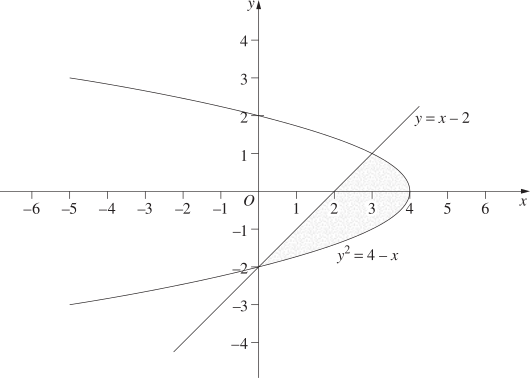
  

Which of the following pairs of inequalities describes the shaded region in the diagram? 

  1. `y^2 <= 4-x\ \ and\ \ y <= x-2`  
  2. `y^2 <= 4-x\ \ and\ \ y >= x-2`  
  3. `y^2 >= 4-x\ \ and\ \ y<= x-2`  
  4. `y^2 >= 4-x\ \ and\ \ y >= x-2`
Show Answers Only

`A`

Show Worked Solution
♦  Mean mark 44%.

`text(Using information from diagram)`

`(3,0)\ text(is in the shaded region)`

`text{Substituting (3,0) into}\ \ \ y^2<=4-x,\ \ \ 0 <= 4-3 => text(true)`

`:.\ text(Cannot be)\ C\ text(or)\ D`
 

`text(Similarly)`

`(3,0)\ text(must satisfy other inequality)`

`text(i.e.)\ \ y <= x-2\ \ text(becomes)\ \ 0<= 3-2 =>\ text(true)`

`=>  A`

Filed Under: 4. Real Functions, Functions and Other Graphs, Inequalities (Ext1) Tagged With: Band 5, num-title-ct-extension, num-title-qs-hsc, smc-1033-40-Regions, smc-4244-85-Non-linear inequalities

Functions, EXT1* F1 2013 HSC 11g

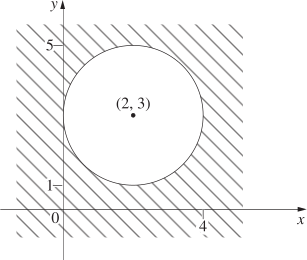
Sketch the region defined by  `(x-2)^2 + ( y-3)^2 >= 4`.    (3 marks)

--- 10 WORK AREA LINES (style=lined) ---

Show Answers Only

Show Worked Solution

`text(The region is the exterior of a circle,)`

COMMENT: This past “Advanced” HSC question now fits into the Ext1 (new) syllabus.

`text(centre)\ text{(2,3)}\ text(and radius 2.)`
 

Filed Under: 4. Real Functions, Functions and Other Graphs, Inequalities (Ext1) Tagged With: Band 4, num-title-ct-extension, num-title-qs-hsc, smc-1033-40-Regions

Functions, 2ADV F1 2013 HSC 3 MC

Which inequality defines the domain of the function  `f(x) = 1/sqrt(x+3)` ?

  1. `x > -3`  
  2. `x >= -3`  
  3. `x < -3`  
  4. `x <= -3` 
Show Answers Only

`A`

Show Worked Solution

`text(Given)\ f(x) = 1/sqrt(x+3)`

`(x + 3)` `> 0`
`x` `> -3`


`:.\ text(The domain of)\ f(x)\ text(is)\ \ \ f(x)> -3`

`=>  A`

Filed Under: 4. Real Functions, Functions and Other Graphs, Further Functions and Relations (Y11), Other Functions and Relations (Adv-2027) Tagged With: Band 4, num-title-ct-patha, num-title-qs-hsc, smc-4244-10-Domain, smc-4244-70-Square root, smc-6216-40-Square-Root Functions, smc-6218-40-Square-Root Functions, smc-987-40-Square-Root Functions

Functions, 2ADV F1 2013 HSC 1 MC

What are the solutions of   `2x^2-5x-1 = 0`? 

  1. `x = (-5 +-sqrt17)/4` 
  2. `x = (5 +-sqrt17)/4`
  3. `x = (-5 +-sqrt33)/4`
  4. `x = (5 +-sqrt33)/4`
Show Answers Only

`D`

Show Worked Solution

`2x^2-5x-1 = 0`

`text(Using)\ x = (-b +- sqrt( b^2-4ac) )/(2a)`

`x` `= (5 +- sqrt{\ \ (-5)^2-4 xx 2 xx(-1) })/ (2 xx 2)`
  `= (5 +- sqrt(25 + 8) )/4`
  `= (5 +- sqrt(33) )/4`

 
`=>  D`

Filed Under: Factors and Other Equations, Quadratics and Cubic Functions (Adv-2027), Quadratics and Cubic Functions (Y11), Quadratics and Cubics Tagged With: Band 3, num-title-ct-pathc, num-title-qs-hsc, smc-4386-40-Quadratic formula, smc-6215-10-Quadratics, smc-6215-15-Quadratic Formula, smc-984-10-Quadratics

Algebra, STD2 A4 2011 HSC 28a

The air pressure, `P`, in a bubble varies inversely with the volume, `V`, of the bubble. 

  1. Write an equation relating `P`, `V` and `a`, where `a` is a constant.    (1 mark)

    --- 1 WORK AREA LINES (style=lined) ---

  2. It is known that `P = 3` when `V = 2`.


    By finding the value of the constant, `a`, find the value of `P` when `V = 4`.    (2 marks)

    --- 4 WORK AREA LINES (style=lined) ---

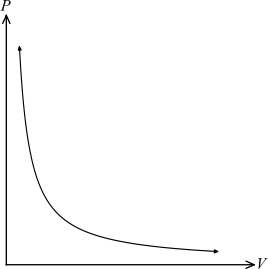
  3. Sketch a graph to show how `P` varies for different values of `V`.


    Use the horizontal axis to represent volume and the vertical axis to represent air pressure.   (2 marks)

    --- 8 WORK AREA LINES (style=lined) ---


Show Answers Only
  1. `P = a/V`
  2. `P = 1 1/2`
  3.  
     
Show Worked Solution
♦ Mean mark (i) 39%
COMMENT: Expressing the proportional relationship `P prop 1/V` as the equation `P=k/V` is a core skill here.
i. `P` `prop 1/V`
    `= a/V`


ii. `text(When)\ P=3,\ V = 2`
`3` `= a/2`
`a` `=6`


`text(Need to find)\ P\ text(when)\ V = 4`  

♦ Mean mark (ii) 47%
`P` `=6/4`
  `= 1 1/2`


♦♦ Mean mark (iii) 26%
COMMENT: An inverse relationship is reflected by a hyperbola on the graph.
iii.

Filed Under: Inverse, Non-Linear: Inverse and Other Problems (Std 2), Variation and Rates of Change Tagged With: Band 5, num-title-ct-patha, num-title-qs-hsc, smc-4239-30-a prop 1/b, smc-795-10-Inverse, smc-795-40-Proportional

Statistics, STD2 S1 2011 HSC 25b

The graph below displays data collected at a school on the number of students
in each Year group, who own a mobile phone.
 

2UG 2011 25b
 

  1. Which Year group has the highest percentage of students with mobile phones? (1 mark)

    --- 1 WORK AREA LINES (style=lined) ---

  2. Two students are chosen at random, one from Year 9 and one from Year 10.


    Which student is more likely to own a mobile phone?


    Justify your answer with suitable calculations. (2 marks)

    --- 4 WORK AREA LINES (style=lined) ---

  3. Identify a trend in the data shown in the graph. (1 mark)

    --- 2 WORK AREA LINES (style=lined) ---

Show Answers Only
  1. `text{Year 12 (100%)}`
  2. `text(Year 10)`
  3. `text(See Worked Solutions for detail)`
Show Worked Solution

i.   `text(Year 12 (100%))`

MARKER’S COMMENT: Many students ignore the instruction to use calculations and lose marks as a result.
 

ii.     `text(% Ownership in Year 9)` `=55/70`
    `=\ text{78.6%  (1d.p.)}`
      `text(% Ownership in Year 10)` `=50/60`
    `=\ text{83.3%  (1d.p.)}`

  
`:.\ text(The Year 10 student is more likely to own a mobile phone.)`


iii.   `text(% Ownership increases as students)`

 `text(progress from Year 7 to Year 12.)`

Filed Under: Bar Charts and Histograms, Bar Charts and Histograms (Std 2), Bar Charts and Histograms (Std2-2027), Bar Charts and Histograms (Y12), Bar Charts, Histograms and Other Graphs (Std 1), Displaying Data, Relative Frequency Tagged With: Band 3, Band 4, common-content, num-title-ct-core, num-title-qs-hsc, smc-1128-10-Bar Charts, smc-5076-10-Column graphs and histograms, smc-6310-10-Bar Charts, smc-821-10-Bar Charts, smc-997-10-Bar Charts

Statistics, STD2 S1 2010 HSC 27b

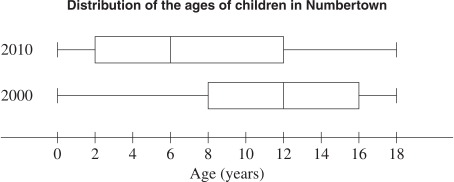
The graphs show the distribution of the ages of children in Numbertown in 2000 and 2010.
  

  1. In 2000 there were 1750 children aged 0–18 years.


    How many children were aged 12–18 years in 2000?   (1 mark)

    --- 1 WORK AREA LINES (style=lined) ---

  2. The number of children aged 12–18 years is the same in both 2000 and 2010.


    How many children aged 0–18 years are there in 2010?    (1 mark)

    --- 1 WORK AREA LINES (style=lined) ---

  3. Identify TWO changes in the distribution of ages between 2000 and 2010. In your answer, refer to measures of location or spread or the shape of the distributions.   (2 marks)

    --- 5 WORK AREA LINES (style=lined) ---

  4. What would be ONE possible implication for government planning, as a consequence of this change in the distribution of ages?   (1 mark)

    --- 2 WORK AREA LINES (style=lined) ---

Show Answers Only

i.    `875`

ii.    `3500`

iii.  `text{Changes in distribution (include 2 of the following):}`

  • `text(the lower quartile age is lower in 2010)`
  • `text(the median is lower in 2010)`
  • `text(the upper quartile age is lower in 2010)`
  • `text(the interquartile range is greater in 2010)`
  • `text(2010 is positively skewed while 2000 is negatively)`

iv.  `text(Implication for government planning:)`

`text(Since the children are getting younger in 2010,)`

  • `text(Approve and build more childcare facilities)`
  • `text(Build more school and public playgrounds)`
Show Worked Solution

i.    `text{Since the median = 12 years}`

♦ Mean mark (i) 45%

`=>\ text{50% of children are aged 12–18 years}`

`:.\ text{Children aged 12–18}\ = 50\text{%}\ xx 1750 = 875`


♦♦ Mean mark (ii) 25%

ii.   `text{Upper quartile (2010) = 12 years}`

`text{Children in upper quartile = 875 (from part (i))}`

`:.\ text{Children aged 0–18}\ =4 xx 875= 3500`
 

iii.  `text{Changes in distribution (include 2 of the following):}`

♦ Mean mark (iii) 35%
MARKER’S COMMENT: A number of students incorrectly identified “positive” skew as “negative” skew here.
  • `text(the lower quartile age is lower in 2010)`
  • `text(the median is lower in 2010)`
  • `text(the upper quartile age is lower in 2010)`
  • `text(the interquartile range is greater in 2010)`
  • `text(2010 is positively skewed while 2000 is negatively)`

iv.  `text(Implication for government planning:)`

♦ Mean mark (iv) 46%
MARKER’S COMMENT: Answers should reflect the 1 mark allocation.

`text(Since the children are getting younger in 2010,)`

  • `text(Approve and build more childcare facilities)`
  • `text(Build more school and public playgrounds)`

Filed Under: Box Plots and 5-Number Summary, Stem & Leaf, Box & Whisker, Summary Statistics - Box Plots (Std 2), Summary Statistics - Box Plots (Std2-2027), Summary Statistics - Box Plots (Y12) Tagged With: Band 5, common-content, num-title-ct-corea, num-title-qs-hsc, smc-1000-20-Parallel Box-Plots, smc-5021-60-Box plots (parallel), smc-5021-80-Inferences from dataset, smc-6313-20-Parallel Box Plots, smc-825-20-Parallel Box-Plots

Algebra, 2UG 2010 HSC 27a

Fully simplify  `(4x^2)/(3y) -: (xy)/5`.   (3 marks) 

--- 5 WORK AREA LINES (style=lined) ---

Show Answers Only

 `(20x)/(3y^2)`

Show Worked Solution
♦♦ Mean mark 33%.
MARKER’S COMMENT: Remember to “invert and multiply” when dividing a fraction by a fraction (see Worked Solution).
`(4x^2)/(3y) -: (xy)/5` `= (4x^2)/(3y) xx 5/(xy)`
  `= (20x^2)/(3xy^2)`
  `= (20x)/(3y^2)`

Filed Under: Index and Log Laws, Indices Tagged With: Band 5, num-title-ct-pathb, num-title-qs-hsc, smc-4228-10-Positive integers

Probability, STD2 S2 2013 HSC 30b

In a class there are 15 girls (G) and 7 boys (B). Two students are chosen at random to be class representatives.

  1. Complete the tree diagram below.    (2 marks)


    --- 0 WORK AREA LINES (style=lined) ---

  2. What is the probability that the two students chosen are of the same gender?    (2 marks)

    --- 4 WORK AREA LINES (style=lined) ---

Show Answers Only
  1.  
  2. `6/11`
Show Worked Solution

i.  

ii.    `Ptext{(same gender)}` `=P(G,G) + P(B,B)`
    `=(15/22 xx 14/21) + (7/22 xx 6/21)`
    `=210/462 + 42/462`
    `=252/462`
    `=6/11`
♦ Mean mark (ii) 40%.

Filed Under: Multi-stage Events, Multi-Stage Events (Std 2), Single and Multi-Stage Events (Std 1) Tagged With: Band 4, Band 5, num-title-ct-corea, num-title-qs-hsc, smc-1135-10-Probability Trees, smc-4238-10-Dependent events, smc-4238-50-Probability trees, smc-829-10-Probability Trees

Measurement, STD2 M6 2010 HSC 26d

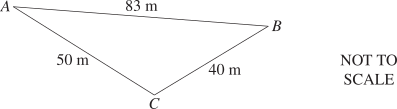
Find the area of triangle `ABC`, correct to the nearest square metre.   (3 marks)

--- 6 WORK AREA LINES (style=lined) ---

Show Answers Only

`717\ text(m²)`    `text{(nearest m²)}`

Show Worked Solution
♦♦ Mean mark 32%.
TIP: The allocation of 3 marks to this question should flag the need for more than 1 step.
`cos/_C` `=(AC^2 + CB^2-AB^2)/(2 xx AC xx CB)`
  `=(50^2 + 40^2-83^2)/(2 xx 50 xx 40)`
  `= -0.69725…`
`/_C` `=134.2067…^@`


`text(Using Area) = 1/2 ab\ sinC :`
`text(Area)\ Delta ABC` `=1/2 xx 50 xx 40 xx sin134.2067…^@`
  `=716.828…`
  `=717\ text(m²)\ \ \ \ text{(nearest m²)}`

Filed Under: Non Right-Angled Trig, Non-Right Angled Trig, Non-Right Angled Trig (Std2) Tagged With: Band 5, num-title-ct-extension, num-title-qs-hsc, smc-4553-10-Cosine Rule, smc-4553-30-Sine Rule (Area), smc-804-10-Cosine Rule, smc-804-20-Sine Rule

Probability, STD2 S2 2011 HSC 24b

A die was rolled 72 times. The results for this experiment are shown in the table.
  

\begin{array} {|c|c|}
\hline
\rule{0pt}{2.5ex} \textit{Number obtained} \rule[-1ex]{0pt}{0pt} & \textit{Frequency} \\
\hline
\rule{0pt}{2.5ex} \ 1 \rule[-1ex]{0pt}{0pt} & 16 \\
\hline
\rule{0pt}{2.5ex} \ 2 \rule[-1ex]{0pt}{0pt} & 11 \\
\hline
\rule{0pt}{2.5ex} \ 3 \rule[-1ex]{0pt}{0pt} & \textbf{A} \\
\hline
\rule{0pt}{2.5ex} \ 4 \rule[-1ex]{0pt}{0pt} & 8 \\
\hline
\rule{0pt}{2.5ex} \ 5 \rule[-1ex]{0pt}{0pt} & 12 \\
\hline
\rule{0pt}{2.5ex} \ 6 \rule[-1ex]{0pt}{0pt} & 15 \\
\hline
\end{array}

  1. Find the value of  `A`.   (1 mark)

    --- 1 WORK AREA LINES (style=lined) ---

  2. What was the relative frequency of obtaining a 4.   (1 mark)

    --- 1 WORK AREA LINES (style=lined) ---

  3. If the die was unbiased, which number was obtained the expected number of times?   (1 mark)

    --- 1 WORK AREA LINES (style=lined) ---

Show Answers Only
  1. \(10\)
  2. \(\dfrac{1}{9}\)
  3. \(5\)
Show Worked Solution
i.     \(\text{Since die rolled 72 times}\)
\(\therefore\ A\) \(=72-(16+11+8+12+15)\)
  \(=72-62\)
  \(=10\)
♦ Mean mark 38%
IMPORTANT: Many students confused ‘relative frequency’ with ‘frequency’ and incorrectly answered 8.
ii.     \(\text{Relative frequency of 4}\) \(=\dfrac{8}{72}\)
  \(=\dfrac{1}{9}\)


iii.  \(\text{Expected frequency of any number}\)
\(=\dfrac{1}{6}\times 72\)
\(=12\)
 
\(\therefore\ \text{5 was obtained the expected number of times.}\)

Filed Under: Probability, Relative Frequency, Relative Frequency (Std 1), Relative Frequency (Std 2), Relative Frequency (Y11) Tagged With: Band 2, Band 4, Band 5, common-content, num-title-ct-core, num-title-qs-hsc, smc-1133-20-Games of Chance, smc-1133-30-Expected Frequency (np), smc-4225-35-Relative frequency, smc-827-20-Games of Chance, smc-827-40-Expected Frequency (np), smc-990-20-Games of Chance, smc-990-40-Expected Frequency (np)

Statistics, STD2 S1 2011 HSC 17 MC

The heights of the players in a basketball team were recorded as 1.8 m, 1.83 m, 1.84 m, 1.86 m and 1.92 m. When a sixth player joined the team, the average height of the players increased by 1 centimetre.

What was the height of the sixth player?

  1.   1.85 m
  2.   1.86 m
  3.   1.91 m
  4.   1.93 m
Show Answers Only

`C`

Show Worked Solution
`text(Old Mean)` `=(1.8+1.83+1.84+1.86+1.92)-:5`
  `=9.25/5`
  `=1.85\ \ text(m)`


`text{S}text{ince the new mean = 1.86m  (given)}`

`text(New Mean)` `=text(Height of all 6 players) -: 6`
`:.1.86` `=(9.25+h)/6\ \ \ \ (h\ text{= height of new player})`
`h` `=(6xx1.86)-9.25`
  `=1.91\ \ text(m)`

`=> C`

Filed Under: Data Analysis, Measures of Centre and Spread (Std2-2027), Summary Statistics - No Graph (Std 2), Summary Statistics - No graph (Y12), Summary Statistics (no graph), Summary Statistics (Std 1) Tagged With: Band 4, common-content, num-title-ct-core, num-title-qs-hsc, smc-1131-10-Mean, smc-4224-25-Mean, smc-4224-50-Add/remove data, smc-6312-10-Mean, smc-824-10-Mean, smc-999-10-Mean

Probability, STD2 S2 2011 HSC 15 MC

An unbiased coin is tossed 10 times.

A tail is obtained on each of the first 9 tosses.

What is the probability that a tail is obtained on the 10th toss?

  1. `1/2^10`
  2. `1/2`
  3. `1/10`
  4. `9/10`
Show Answers Only

`B`

Show Worked Solution

`text(Each toss is an independent event and has an even chance)`

`text(of being a head or tail.)`

`=> B`

Filed Under: Fundamental understanding, Fundamental Understanding (Std 1), Fundamental Understanding (Std 2), Multi-Stage Events Tagged With: Band 3, num-title-ct-corea, num-title-qs-hsc, smc-4238-20-Independent events

Statistics, STD2 S1 2011 HSC 14 MC

A data set of nine scores has a median of 7.

The scores  6, 6, 12 and 17  are added to this data set.

What is the median of the data set now?

  1. 6
  2. 7
  3. 8
  4. 9
Show Answers Only

`B`

Show Worked Solution

`text(S)text(ince an even amount of scores are added below and)`

`text(above the existing median, it will not change.)`

`=>B`

Filed Under: Data Analysis, Measures of Centre and Spread (Std2-2027), Summary Statistics - No Graph (Std 2), Summary Statistics - No graph (Y12), Summary Statistics (no graph), Summary Statistics (Std 1) Tagged With: Band 4, common-content, num-title-ct-core, num-title-qs-hsc, smc-1131-20-Median and Mode, smc-4224-20-Median, smc-4224-50-Add/remove data, smc-6312-20-Median and Mode, smc-824-20-Median and Mode, smc-999-20-Median and Mode

Algebra, STD2 A4 2009 HSC 28c

The height above the ground, in metres, of a person’s eyes varies directly with the square of the distance, in kilometres, that the person can see to the horizon.

A person whose eyes are 1.6 m above the ground can see 4.5 km out to sea.

How high above the ground, in metres, would a person’s eyes need to be to see an island that is 15 km out to sea? Give your answer correct to one decimal place.   (3 marks)

--- 6 WORK AREA LINES (style=lined) ---

Show Answers Only

 `17.8\ text(m)\ \ text{(to 1 d.p.)}`

Show Worked Solution
♦♦ Mean mark 22%
CRITICAL STEP: Reading the first line of the question carefully and establishing the relationship `h=k d^2` is the key part of solving this question.

`h prop d^2`

`h=kd^2`

`text(When)\ h = 1.6,\ d = 4.5`

`1.6` `= k xx 4.5^2`
`:. k` `= 1.6/4.5^2`
  `= 0.07901` `…`


`text(Find)\ h\ text(when)\ d = 15`

`h` `= 0.07901… xx 15^2`
  `= 17.777…`
  `= 17.8\ text(m)\ \ \ text{(to 1 d.p.)}`

Filed Under: Exponential/Quadratic (Projectile), Non-Linear: Exponential/Quadratics (Std 2), Variation and Rates of Change Tagged With: Band 5, num-title-ct-patha, num-title-qs-hsc, smc-4239-40-a prop other, smc-830-20-Quadratics, smc-830-60-Proportional

Statistics, STD2 S4 2009 HSC 28b

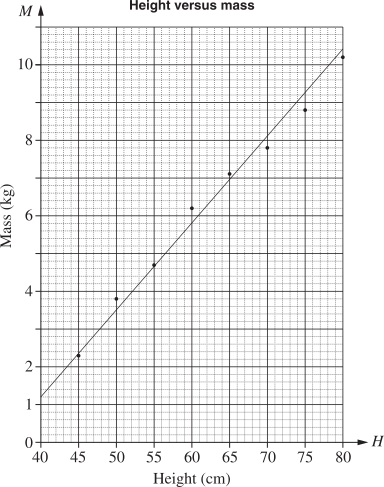
The height and mass of a child are measured and recorded over its first two years. 

\begin{array} {|l|c|c|}
\hline \rule{0pt}{2.5ex} \text{Height (cm), } H \rule[-1ex]{0pt}{0pt} & \text{45} & \text{50} & \text{55} & \text{60} & \text{65} & \text{70} & \text{75} & \text{80} \\
\hline \rule{0pt}{2.5ex} \text{Mass (kg), } M \rule[-1ex]{0pt}{0pt} & \text{2.3} & \text{3.8} & \text{4.7} & \text{6.2} & \text{7.1} & \text{7.8} & \text{8.8} & \text{10.2} \\
\hline
\end{array}

This information is displayed in a scatter graph. 
 

  1. Describe the correlation between the height and mass of this child, as shown in the graph.   (1 mark)

    --- 2 WORK AREA LINES (style=lined) ---

  2. A line of best fit has been drawn on the graph.


    Find the equation of this line.   (2 marks)

    --- 4 WORK AREA LINES (style=lined) ---

Show Answers Only
  1. `text(The correlation between height and)`


    `text(mass is positive and strong.)`

  2. `M = 0.23H-8`
Show Worked Solution

i.  `text(The correlation between height and)`

♦ Mean mark 48%. 

`text(mass is positive and strong.)`


ii.  `text(Using)\ \ P_1(40, 1.2)\ \ text(and)\ \ P_2(80, 10.4)`

♦♦♦ Mean mark 18%. 
MARKER’S COMMENT: Many students had difficulty due to the fact the horizontal axis started at `H= text(40cm)` and not the origin.
`text(Gradient)` `= (y_2-y_1)/(x_2-x_1)`
  `= (10.4-1.2)/(80-40)`
  `= 9.2/40`
  `= 0.23`


`text(Line passes through)\ \ P_1(40, 1.2)`

`text(Using)\ \ \ y-y_1` `= m(x-x_1)`
`y-1.2` `= 0.23(x-40)`
`y-1.2` `= 0.23x-9.2`
`y` `= 0.23x-8`

 
`:. text(Equation of the line is)\ \ M = 0.23H-8`

Filed Under: Bivariate Data, Bivariate Data Analysis (Y12), Life Expectancy, Other Linear Modelling, S3 Further Statistical Analysis (Y12), S4 Bivariate Data Analysis (Y12) Tagged With: Band 5, Band 6, common-content, num-title-ct-coreb, num-title-qs-hsc, smc-1001-10-Line of Best Fit, smc-1001-30-Correlation, smc-1113-10-Line of Best Fit, smc-1113-30-Correlation, smc-5022-28-LOBF equations, smc-5022-30-Correlation, smc-785-10-Line of Best Fit, smc-785-30-Correlation

Probability, STD2 S2 2009 HSC 27c

In each of three raffles, 100 tickets are sold and one prize is awarded.

Mary buys two tickets in one raffle. Jane buys one ticket in each of the other two raffles.

Determine who has the better chance of winning at least one prize. Justify your response using probability calculations.   (4 marks)  

Show Answers Only
`P(text(Mary wins) )` `= 2/100`
  `= 1/50`


`P(text(Jane wins at least 1) )` `= 1-P (text(loses both) )`
  `= 1-99/100 xx 99/100`
  `= 1-9801/(10\ 000)`
  `= 199/(10\ 000)`

 
`text{Since}\ \ 1/50 > 199/(10\ 000)`

`=>\ text(Mary has a better chance of winning.)`

Show Worked Solution
`P(text(Mary wins) )` `= 2/100`
  `= 1/50`


`P(text(Jane wins at least 1) )` `= 1-P (text(loses both) )`
  `= 1-99/100 xx 99/100`
  `= 1-9801/(10\ 000)`
  `= 199/(10\ 000)`

 
`text{Since}\ \ 1/50 > 199/(10\ 000)`

`=>\ text(Mary has a better chance of winning.)`

♦♦ Mean mark 31%.
MARKER’S COMMENT: Very few students calculated Jane’s chance of winning correctly. Note the use of “at least” in the question. Finding `1-P`(complement) is the best strategy here.

Filed Under: Multi-stage Events, Multi-Stage Events, Multi-Stage Events (Std 2), Single and Multi-Stage Events (Std 1) Tagged With: Band 5, num-title-ct-pathb, num-title-qs-hsc, smc-1135-20-Other Multi-Stage Events, smc-1135-30-P(E) = 1 - P(not E), smc-4238-70-Complementary events, smc-4238-80-"at least", smc-829-20-Other Multi-Stage Events, smc-829-30-P(E) = 1 - P(not E)

Algebra, STD2 A1 2009 HSC 25a

Simplify  `5-2(x + 7)`.    (2 marks)

--- 4 WORK AREA LINES (style=lined) ---

Show Answers Only

 `-2x-9`

Show Worked Solution
♦ Mean mark 47%
`5-2(x + 7)` `= 5-2x-14`
  `= -2x-9`

Filed Under: AM1 - Algebra (Prelim), Distributive Laws, Substitution and Other Equations (Std 1), Substitution and Other Equations (Std 2), Substitution and Other Equations (Std2-2027) Tagged With: Band 4, num-title-ct-corea, num-title-qs-hsc, smc-1116-50-Other Equations, smc-6234-50-Other Equations, smc-789-50-Other Equations

Algebra, STD2 A1 2013 HSC 29a

Sarah tried to solve this equation and made a mistake in Line 2. 

`(W+4)/3-(2W-1)/5` `=1` `text(... Line 1)`
`5W+ 20-6W-3` `=15` `text(... Line 2)`
`17-W` `=15` `text(... Line 3)`
`W` `=2` `text(... Line 4)`

 
Copy the equation in Line 1 and continue your solution to solve this equation for `W`.

Show all lines of working.   (2 marks)

--- 5 WORK AREA LINES (style=lined) ---

Show Answers Only
`(W+4)/3-(2W-1)/5` `=1` `text(… Line 1)`
`5W+ 20-6W+ 3` `=15` `text(… Line 2)`
`23-W` `=15` `text(… Line 3)`
`W` `=8` `text(… Line 4)`
Show Worked Solution
♦♦ Mean mark 27%
STRATEGY: The RHS of the equation increases from 1 to 15 (from Line 1 to Line 2), indicating both sides must have been multiplied by 15.
`(W+4)/3-(2W-1)/5` `=1` `text(… Line 1)`
`5W+ 20-6W+3` `=15` `text(… Line 2)`
`23-W` `=15` `text(… Line 2)`
`W` `=8` `text(… Line 4)`

Filed Under: Algebraic Fractions, Linear and Other Equations, Substitution and Other Equations (Std 1), Substitution and Other Equations (Std 2), Substitution and Other Equations (Std2-2027) Tagged With: Band 5, num-title-ct-pathc, num-title-qs-hsc, smc-1116-40-Find the Mistake, smc-4402-40-Multiple fractions, smc-6234-40-Find the Mistake, smc-789-40-Find the Mistake

Measurement, STD2 M1 2013 HSC 27d

A rectangular wooden chopping board is advertised as being 17 cm by 25 cm, with each side measured to the nearest centimetre.

  1. Calculate the percentage error in the measurement of the longer side.   (1 mark)

    --- 2 WORK AREA LINES (style=lined) ---

  2. Between what lower and upper limits does the actual area of the top of the chopping board lie?     (2 marks)

    --- 4 WORK AREA LINES (style=lined) ---

Show Answers Only
  1. `text(2%)`
  2. `404.25\ text{cm}^2 and 446.25\ text{cm}^2`
Show Worked Solution

i.    `text(Longer side) = 25\ text(cm)`

♦♦ Mean mark 23%
MARKER’S COMMENT: Be aware that measurements accurate to the nearest cm have an absolute error for calculation purposes of 0.5 cm.

`text{Absolute error}\ =1/2 xx text{precision}\ = 1/2 xx 1 = 0.5\ text{cm}`

`text{% error}` `=\ frac{text{absolute error}}{text{measurement}} xx 100%`  
  `=0.5/25 xx 100%`  
  `=2%`  


ii.   `text(Area) = l xx b`

♦ Mean mark 35%
`text{Area (upper)}` `=25.5 xx 17.5`
  `=446.25\ text{cm}^2`


`text{Area (lower)}` `=24.5 xx 16.5`
  `=404.25\ text{cm}^2`

 
`:.\ text{Area is between 404.25 cm}^2\ text{and 446.25 cm}^2.`

Filed Under: Areas and Volumes (Harder), Numbers of Any Magnitude, Simpson's Rule/Measurement Error, Units and Measurement Error (Std 1), Units and Measurement Error (Std 2) Tagged With: Band 5, num-title-ct-corea, num-title-qs-hsc, smc-1120-10-Measurement Error, smc-4232-10-Measurement error, smc-797-10-Measurement Error

Statistics, STD2 S1 2013 HSC 26f

Jason travels to work by car on all five days of his working week, leaving home at 7 am each day. He compares his travel times using roads without tolls and roads with tolls over a period of 12 working weeks.

He records his travel times (in minutes) in a back-to-back stem-and-leaf plot.
 

2013 26f
 

  1. What is the modal travel time when he uses roads without tolls?  (1 mark)

    --- 1 WORK AREA LINES (style=lined) ---

  2. What is the median travel time when he uses roads without tolls?   (1 mark)

    --- 1 WORK AREA LINES (style=lined) ---

  3. Describe how the two data sets differ in terms of the spread and skewness of their distributions.   (2 marks)

    --- 5 WORK AREA LINES (style=lined) ---

Show Answers Only
  1. `52\ text(minutes)`
  2. `50.5\ text(minutes)`
  3. `text(Spread)`
  4. `text{Times without tolls have a tighter spread (range = 22)}`
  5. `text{than times with tolls (range = 55).}`
  6.  

    `text(Skewness)`

  7. `text(Times without tolls shows virtually no skewness while`
  8. `text(times with tolls are positively skewed.)`
Show Worked Solution

i.  `text(Modal time) = 52\ text(minutes)`

♦ Mean mark 36%
MARKER’S COMMENT: Finding a median proved challenging for many students. Take note!


ii.  `text(30 times with no tolls)`

`text(Median)` `=\ text(Average of 15th and 16th)`
  `=(50 + 51)/2`
  `= 50.5\ text(minutes)`


♦ Mean mark 39%


 iii.  `text(Spread)`

`text{Times without tolls have a much tighter}`

`text{spread (range = 22) than times with tolls}`

`text{(range = 55).}`

`text(Skewness)`

`text(Times without tolls shows virtually no skewness)`

`text(while times with tolls are positively skewed.)`

Filed Under: Bar Charts, Histograms and Other Graphs (Std 1), Data Analysis, Other Chart Types (Y12), Other Charts (Std 2), Other Charts (Std2-2027), Stem & Leaf, Box & Whisker Tagged With: Band 4, Band 5, num-title-ct-core, num-title-qs-hsc, smc-1128-24-Stem and Leaf, smc-4224-15-Mode, smc-4224-20-Median, smc-4224-35-Describing datasets, smc-4224-40-Stem and Leaf, smc-6311-20-Back-to-Back Stem-and-Leaf, smc-822-30-Back-to-Back Stem and Leaf, smc-998-30-Back-to-Back Stem and Leaf

Probability, STD2 S2 2013 HSC 26c

The probability that Michael will score more than 100 points in a game of bowling is `31/40`. 

  1. A commentator states that the probability that Michael will score less than 100 points in a game of bowling is  `9/40`.


    Is the commentator correct? Give a reason for your answer.   (1 mark)

    --- 2 WORK AREA LINES (style=lined) ---

  2. Michael plays two games of bowling. What is the probability that he scores more than 100 points in the first game and then again in the second game?   (1 mark)

    --- 1 WORK AREA LINES (style=lined) ---

Show Answers Only
  1. `text{Incorrect. Less than “or equal to 100” is correct.}`
  2. `961/1600`
Show Worked Solution
♦♦♦ Mean mark 11%

i.   `text(The commentator is incorrect. The correct)`

`text(statement is)\ Ptext{(score} <=100 text{)} =9/40`

`text{(i.e. less than “or equal to 100” is the correct statement)}`


♦ Mean mark 34%
ii. `\ \ \ P(text{score >100 in both})` `= 31/40 xx 31/40` 
    `= 961/1600`

Filed Under: Fundamental understanding, Fundamental Understanding (Std 1), Fundamental Understanding (Std 2), Multi-stage Events, Multi-Stage Events, Multi-Stage Events (Std 2), Single and Multi-Stage Events (Std 1) Tagged With: Band 5, Band 6, num-title-ct-corea, num-title-qs-hsc, smc-1135-20-Other Multi-Stage Events, smc-4238-20-Independent events, smc-4238-70-Complementary events, smc-829-20-Other Multi-Stage Events

Statistics, STD2 S1 2013 HSC 26b

Write down a set of six data values that has a range of 12, a mode of 12 and a minimum value of 12.   (2 marks)

Show Answers Only

 `12, 12, 12, 16, 18, 24`

Show Worked Solution

`12, 12, 12, 16, 18, 24`

`text(NB. There are many correct solutions.)`


Filed Under: Data Analysis, Measures of Centre and Spread (Std2-2027), Summary Statistics - No Graph (Std 2), Summary Statistics - No graph (Y12), Summary Statistics (no graph), Summary Statistics (Std 1) Tagged With: Band 4, common-content, num-title-ct-core, num-title-qs-hsc, smc-1131-70-Other, smc-4224-10-Range, smc-4224-15-Mode, smc-6312-70-Other, smc-824-70-Other, smc-999-70-Other

Measurement, STD2 M6 2013 HSC 26a

Triangle `PQR` is shown. 

2013 26a

Find the size of angle `Q`, to the nearest degree.    (2 marks)

--- 4 WORK AREA LINES (style=lined) ---

Show Answers Only

`110^@\ \ \ text{(nearest degree)}`

Show Worked Solution
♦ Mean mark 47%

`text(Using Cosine rule)`

`cos /_Q` `= (a^2 + b^2-c^2)/(2ab)`
  `= (53^2 + 66^2-98^2)/(2xx53xx66)`
  `=-0.3486…`


`:. /_Q` `= 110.4034…`
  `= 110^@\ \ \ text{(nearest degree)}`

Filed Under: Non-Right Angled Trig, Non-Right Angled Trig (Std2) Tagged With: Band 4, num-title-ct-pathc, num-title-qs-hsc, smc-4553-10-Cosine Rule, smc-804-10-Cosine Rule

Measurement, STD2 M6 2010 HSC 24d

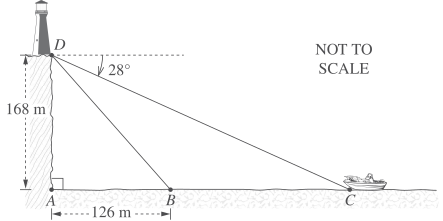
The base of a lighthouse, `D`, is at the top of a cliff 168 metres above sea level. The angle of depression from `D` to a boat at `C` is 28°. The boat heads towards the base of the cliff, `A`, and stops at `B`. The distance `AB` is 126 metres.
 

  1. What is the angle of depression from `D` to `B`, correct to the nearest degree?   (3 marks)

    --- 6 WORK AREA LINES (style=lined) ---

  2. How far did the boat travel from `C` to `B`, correct to the nearest metre?   (2 marks)

    --- 4 WORK AREA LINES (style=lined) ---

Show Answers Only
  1. `53^circ`
  2. `190\ text(m)`
Show Worked Solution
♦♦ Mean mark 31%
i.    `tan/_ADB` `=126/168`
  ` /_ADB` `=36.8698…`
    `=36.9^circ\ \ \ \ text{(to 1 d.p)}` 


`/_text(Depression)\ D\ text(to)\ B` `=90-36.9`
  `=53.1`
  `=53^circ\ text{(nearest degree)}`


ii.     `text(Find)\ CB:`

♦♦ Mean mark 31%
MARKER’S COMMENT: Solve efficiently by using right-angled trigonometry. Many students used non-right angled trig, adding to the calculations and the difficulty.
`/_ADC+28` `=90`
 `/_ADC` `=62^circ`
`tan 62^circ` `=(AC)/168`
`AC` `=168xxtan 62^circ`
  `=315.962…`


`CB` `=AC-AB`
  `=315.962…-126`
  `=189.962…`
  `=190\ text(m (nearest m))`

Filed Under: 2-Triangle and Harder Examples, M3 Right-Angled Triangles (Y12), Non-Right Angled Trig (Std2), Pythagoras and Right-Angled Trig (Std2), Right-Angled Trig Tagged With: Band 5, num-title-ct-coreb, num-title-qs-hsc, smc-1103-20-Right-angled Trig, smc-1103-30-Angle of Depression, smc-4552-40-Real world applications, smc-4552-45-2-triangles, smc-4552-50-Angle of depression, smc-802-20-Right-Angled Trig, smc-802-30-Angle of Depression, smc-804-40-2-Triangle

Algebra, STD2 A1 2010 HSC 24a

Fred tried to solve this equation and made a mistake in Line 2. 

\begin{array}{rl}
4(y+2)-3(y+1)= -3\ & \ \ \ \text{Line 1} \\
4y+8-3y+3= -3\ &\ \ \ \text{Line 2} \\
y+11 =-3\ &\ \ \ \text{Line 3} \\
y =-14& \ \ \ \text{Line 3}
\end{array}

Copy the equation in Line 1.

  1. Rewrite Line 2 correcting his mistake.   (1 mark)

    --- 1 WORK AREA LINES (style=lined) ---

  2. Continue your solution showing the correct working for Lines 3 and 4 to solve this equation for `y`.   (1 mark)

    --- 2 WORK AREA LINES (style=lined) ---

Show Answers Only
  1.  `4y+8+3y-3=-3`
  2. `y+5=-3`


    `y=-8`

Show Worked Solution
i.    `4(y+2)-3(y+1)` `=-3\ \ \ \ \ \ \ text(Line)\ 1`
  `4y+8-3y-3` `=-3\ \ \ \ \ \  text(Line)\ 2`


ii.    `y+5` `=-3\ \ \ \ \ \ \ text(Line)\ 3`
  `y` `=-8\ \ \ \ \ \ \ text(Line)\ 4`

Filed Under: AM1 - Algebra (Prelim), Linear, Substitution and Other Equations (Std 1), Substitution and Other Equations (Std 2), Substitution and Other Equations (Std2-2027) Tagged With: Band 4, num-title-ct-corea, num-title-qs-hsc, smc-1116-40-Find the Mistake, smc-6234-40-Find the Mistake, smc-789-40-Find the Mistake

Probability, STD2 S2 2010 HSC 23c

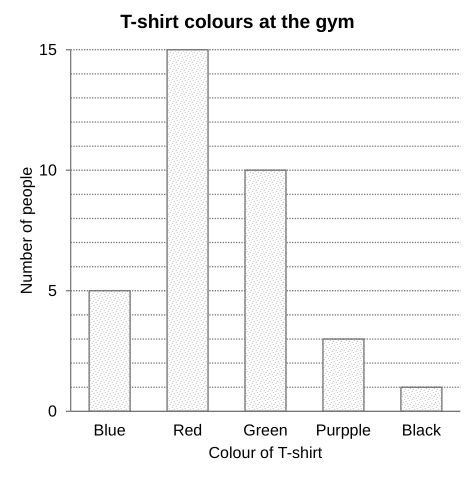
On Saturday, Jonty recorded the colour of T-shirts worn by the people at his gym. The results are shown in the graph.


  1. How many people were at the gym on Saturday? (Assume everyone was wearing a T-shirt).   (1 mark)

    --- 1 WORK AREA LINES (style=lined) ---

  2. What is the probability that a person selected at random at the gym on Saturday, would be wearing either a blue or green T-shirt?   (1 mark)

    --- 2 WORK AREA LINES (style=lined) ---

Show Answers Only
  1. `34`
  2. `15/34`
Show Worked Solution
i.   `text(# People)` `=5+15+10+3+1`
  `=34`


ii.   `P (B\ text{or}\ G)` `=P(B)+P(G)`
  `=5/34+10/34`
  `=15/34`

Filed Under: Bar Charts and Histograms, Bar Charts and Histograms (Std 2), Bar Charts and Histograms (Std2-2027), Bar Charts and Histograms (Y12), Combinations and Single Stage Events (Std 2), Probability, Single and Multi-Stage Events (Std 1), Single stage events Tagged With: Band 2, Band 3, common-content, num-title-ct-core, num-title-qs-hsc, smc-1135-05-Simple Probability, smc-4225-15-Single-stage events, smc-6310-10-Bar Charts, smc-821-10-Bar Charts, smc-828-10-Simple Probability, smc-997-10-Bar Charts

Probability, STD2 S2 2010 HSC 20 MC

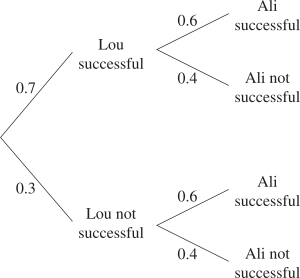
Lou and Ali are on a fitness program for one month. The probability that Lou will finish the program successfully is 0.7 while the probability that Ali will finish successfully is 0.6. The probability tree shows this information


What is the probability that only one of them will be successful ?

  1. `0.18`
  2. `0.28`
  3. `0.42`
  4. `0.46`
Show Answers Only

`D`

Show Worked Solution

`text(Let)\ \ Ptext{(Lou successful)}=P(L) = 0.7, \ P(\text{not}\ L) = 0.3`

`text(Let)\ \ Ptext{(Ali successful)}=P(A) = 0.6, \ P(\text{not}\ A) = 0.4`

`P text{(only 1 successful)}` `=P(L)xxP(text(not)\ A)+P(text(not)\ L)xxP(A)`
  `=(0.7xx0.4)+(0.3xx0.6)`
  `=0.28+0.18`
  `=0.46`

 
`=>  D`

♦ Mean mark 48%.

Filed Under: Multi-stage Events, Multi-Stage Events, Multi-Stage Events (Std 2), Single and Multi-Stage Events (Std 1) Tagged With: Band 5, num-title-ct-corea, num-title-qs-hsc, smc-1135-10-Probability Trees, smc-4238-20-Independent events, smc-4238-50-Probability trees, smc-829-10-Probability Trees

Algebra, STD2 A1 2010 HSC 18 MC

Which of the following correctly express  `x`  as the subject of  `a=(nx)/5` ?

  1. `x=(an)/5`
  2. `x=(5a)/n`
  3. `x=(a-5)/n`
  4. `x=5a-n`
Show Answers Only

`B`

Show Worked Solution
`a` `=(nx)/5`
`nx` `=5a`
`x` `=(5a)/n`

 
`=>  B`

Filed Under: Formula Rearrange, Formula Rearrange (Std 1), Formula Rearrange (Std 2), Formula Rearrange (Std2-2027), Linear Tagged With: Band 4, num-title-ct-pathc, num-title-qs-hsc, smc-1200-10-Linear, smc-1201-10-Linear, smc-4362-20-Formula rearrange, smc-6236-10-Linear

Statistics, STD2 S1 2010 HSC 16 MC

This back-to-back stem-and-leaf plot displays the test results for a class of 26 students.
 

2010 Q16 MC  
 

What is the median test result for the class?

  1.    `44`
  2.    `46`
  3.    `48`
  4.    `49`
Show Answers Only

`B`

Show Worked Solution
♦♦ Mean mark 35%

`text(26 results given in the data)`

  `=>text(Median is average of)\ 13^text(th)\ text(and)\ 14^text(th)`

`:.\ text(Median)` `=(45+47)/2`
  `=46`

`=>B`

Filed Under: Bar Charts, Histograms and Other Graphs (Std 1), Data Analysis, Other Chart Types (Y12), Other Charts (Std 2), Other Charts (Std2-2027), Stem & Leaf, Box & Whisker Tagged With: Band 5, num-title-ct-core, num-title-qs-hsc, smc-1128-26-Back-to-back Stem and Leaf, smc-4224-20-Median, smc-4224-40-Stem and Leaf, smc-6311-20-Back-to-Back Stem-and-Leaf, smc-822-30-Back-to-Back Stem and Leaf, smc-998-30-Back-to-Back Stem and Leaf

Algebra, STD2 A2 2009 HSC 24d

A factory makes boots and sandals. In any week

• the total number of pairs of boots and sandals that are made is 200
• the maximum number of pairs of boots made is 120
• the maximum number of pairs of sandals made is 150.

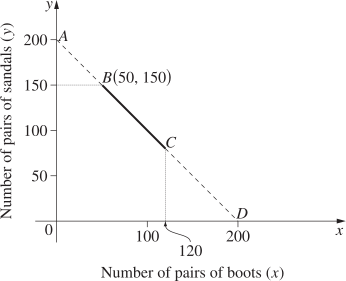
The factory manager has drawn a graph to show the numbers of pairs of boots (`x`) and sandals (`y`) that can be made.


  1. Find the equation of the line `AD`.   (1 mark)

    --- 2 WORK AREA LINES (style=lined) ---

  2. Explain why this line is only relevant between `B` and `C` for this factory.     (1 mark)

    --- 3 WORK AREA LINES (style=lined) ---

  3. The profit per week, `$P`, can be found by using the equation  `P = 24x + 15y`.


    Compare the profits at `B` and `C`.     (2 marks)

    --- 5 WORK AREA LINES (style=lined) ---

Show Answers Only
  1. `x + y = 200`
  2. `text(S)text(ince the max amount of boots = 120)`


    `=> x\ text(cannot)\ >120`


    `text(S)text(ince the max amount of sandals = 150`


    `=> y\ text(cannot)\ >150`


    `:.\ text(The line)\ AD\ text(is only possible between)\ B\ text(and)\ C.`

  3. `text(The profits at)\ C\ text(are $630 more than at)\ B.`
Show Worked Solution

i.   `text{We are told the number of boots}\ (x),` 

♦♦♦ Mean mark part (i) 14%. 
Using `y=mx+b` is a less efficient but equally valid method, using  `m=–1`  and  `b=200` (`y`-intercept).

`text{and shoes}\  (y),\ text(made in any week = 200)`

`=>text(Equation of)\ AD\ text(is)\ \ x + y = 200`


ii.  `text(S)text(ince the max amount of boots = 120)`

♦ Mean mark 49%

`=> x\ text(cannot)\ >120`

`text(S)text(ince the max amount of sandals = 150`

`=> y\ text(cannot)\ >150`

`:.\ text(The line)\ AD\ text(is only possible between)\ B\ text(and)\ C.`


iii.  `text(At)\ B,\ \ x = 50,\ y = 150`

♦ Mean mark 40%.
`=>$P  (text(at)\ B)` `= 24 xx 50 + 15 xx 150`
  `= 1200 + 2250`
  ` = $3450`

`text(At)\ C,\ \  x = 120 text(,)\ y = 80`

`=> $P  (text(at)\ C)` `= 24 xx 120 + 15 xx 80`
  `= 2880 + 1200`
  `= $4080`


`:.\ text(The profits at)\ C\ text(are $630 more than at)\ B.`

Filed Under: Applications: Currency, Fuel and Other Problems (Std 1), Applications: Currency, Fuel and Other Problems (Std 2), Applications: Currency, Fuel and Other Problems (Std2-2027), Breakeven and Financial modelling, Linear Applications, Linear Functions (Adv-2027), Linear Functions (Y11) Tagged With: Band 5, Band 6, common-content, num-title-ct-coreb, num-title-qs-hsc, smc-1119-30-Other Linear Applications, smc-4421-70-Other, smc-6214-20-Other Real World Applications, smc-6256-30-Other Linear Applications, smc-793-30-Other Linear Applications, smc-793-40-Limitations, smc-985-20-Other Linear Applications

Statistics, STD2 S1 2009 HSC 24a

The diagram below shows a stem-and-leaf plot for 22 scores. 
 

2UG-2009-24a
 

  1.  What is the mode for this data?   (1 mark)

    --- 1 WORK AREA LINES (style=lined) ---

  2.  What is the median for this data?     (1 mark)

    --- 1 WORK AREA LINES (style=lined) ---

Show Answers Only
  1. `78`
  2. `46`
Show Worked Solution

i.   `text(Mode) = 78`


ii.    `22\ text(scores)`

`=>\ text(Median is the average of 11th and 12th scores)`
 

`:.\ text(Median)` `= (45 + 47)/2`
  `= 46`

Filed Under: Bar Charts, Histograms and Other Graphs (Std 1), Data Analysis, Other Chart Types (Y12), Other Charts (Std 2), Other Charts (Std2-2027), Stem & Leaf, Box & Whisker Tagged With: Band 3, Band 4, common-content, num-title-ct-core, num-title-qs-hsc, smc-1128-24-Stem and Leaf, smc-4224-15-Mode, smc-4224-20-Median, smc-4224-40-Stem and Leaf, smc-6311-10-Stem-and-Leaf, smc-822-20-Stem and Leaf, smc-998-20-Stem and Leaf

Measurement, STD2 M1 2009 HSC 23c

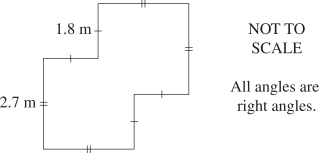
The diagram shows the shape and dimensions of a terrace which is to be tiled.
 

  1. Find the area of the terrace.   (2 marks)

    --- 5 WORK AREA LINES (style=lined) ---

  2. Tiles are sold in boxes. Each box holds one square metre of tiles and costs $55. When buying the tiles, 10% more tiles are needed, due to cutting and wastage.


    Find the total cost of the boxes of tiles required for the terrace.   (2 marks)

    --- 4 WORK AREA LINES (style=lined) ---

Show Answers Only

i.    `13.77\ text(m²)`

ii.   `$880`

Show Worked Solution
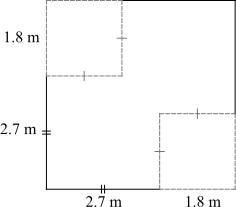
i.
`text(Area)` `=\ text(Area of big square – Area of 2 cut-out squares`
  `= (2.7 + 1.8) xx (2.7 + 1.8)\-2 xx (1.8 xx 1.8)`
  `= 20.25\-6.48`
  `= 13.77\ text(m²)`


ii. `text(Tiles required)` `= (13.77 +10 text{%}) xx 13.77`
    `= 15.147\ text(m²)`


 `=>\ text(16 boxes are needed)`

`:.\ text(Total cost of boxes)` `=16 xx $55`
  `= $880`

Filed Under: Area and Surface Area, M4 Rates (Y12), MM1 - Units of Measurement, MM2 - Perimeter, Area and Volume (Prelim), Perimeter and Area (Std 1), Perimeter, Area and Volume (Std 2), Perimeter, Area and Volume (Std2-2027), Rates (Std2) Tagged With: Band 4, num-title-ct-corea, num-title-qs-hsc, smc-1104-15-General rate problems, smc-1121-10-Perimeter and Area, smc-4234-10-Area (std), smc-6304-10-Perimeter and Area, smc-798-10-Perimeter and Area, smc-805-60-Other rate problems

Measurement, STD2 M6 2009 HSC 23a

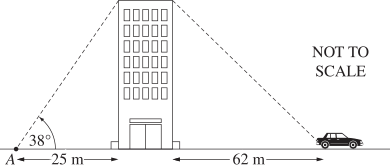
The point `A` is 25 m from the base of a building. The angle of elevation from `A` to the top of the building is 38°.
 

  1. Show that the height of the building is approximately 19.5 m.   (1 mark)

    --- 2 WORK AREA LINES (style=lined) ---

  2. A car is parked 62 m from the base of the building.


    What is the angle of depression from the top of the building to the car?


    Give your answer to the nearest minute.   (2 marks)

    --- 5 WORK AREA LINES (style=lined) ---

Show Answers Only

i.    `text{Proof  (See Worked Solutions)}`

ii.   `17°28^{′}`

Show Worked Solution

i.  `text(Need to prove height (h) ) ~~ 19.5\ text(m)`

`tan 38^@` `= h/25`
`h` `= 25 xx tan38^@`
  `= 19.5321…`
  `~~ 19.5\ text(m)\ \ text(… as required.)`


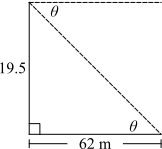
ii.  

`text(Let)\ \ /_ \ text(Elevation (from car) ) = theta`

♦♦ Mean mark 33%
MARKER’S COMMENT: If >30 “seconds”, round to the higher “minute”.
`tan theta` `= h/62`
  `= 19.5/62`
  `= 0.3145…`
`:. theta` `= 17.459…`
  `= 17°27^{′}33^{″}..`
  `=17°28^{′}\ \ text{(nearest minute)}`


`:./_ \ text(Depression to car) =17°28^{′}\ \ text{(alternate to}\ theta text{)}`

Filed Under: M3 Right-Angled Triangles (Y12), Pythagoras and basic trigonometry, Pythagoras and Right-Angled Trig (Std2), Right-Angled Trig Tagged With: Band 4, Band 5, num-title-ct-coreb, num-title-qs-hsc, smc-1103-20-Right-angled Trig, smc-1103-30-Angle of Depression, smc-1103-40-Angle of Elevation, smc-4552-40-Real world applications, smc-4552-50-Angle of depression, smc-4552-60-Angle of elevation, smc-802-20-Right-Angled Trig, smc-802-30-Angle of Depression, smc-802-40-Angle of Elevation

Algebra, STD2 A1 2009 HSC 16 MC

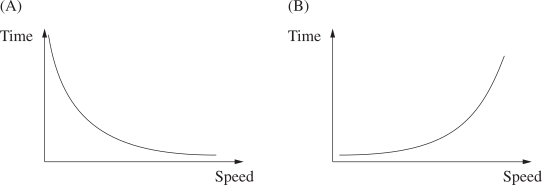
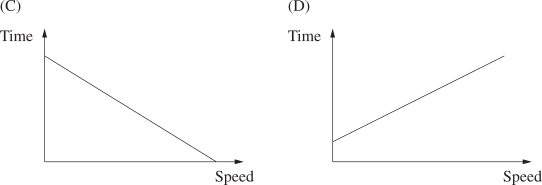
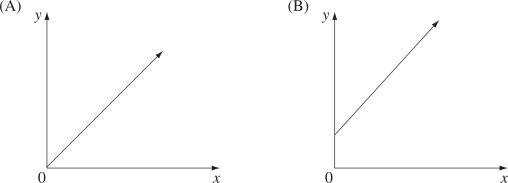
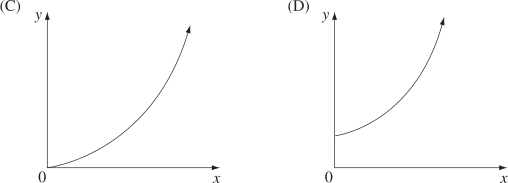
The time for a car to travel a certain distance varies inversely with its speed.

Which of the following graphs shows this relationship?
 

Show Answers Only

`A`

Show Worked Solution
`T` `prop 1/S`
`T` `= k/S`

 
`text{By elimination:}`

`text(As   S) uarr text(, T) darr => text(cannot be B or D)`

♦ Mean mark 38%

`text(C  is incorrect because it graphs a linear relationship)`

`=>  A`

Filed Under: Applications: BAC, Medication and D=SxT (Std 2), Inverse, Linear Equations and Basic Graphs (Std 2), Non-Linear: Inverse and Other Problems (Std 2), Safety: D=ST & BAC, Variation and Rates of Change Tagged With: Band 5, num-title-ct-patha, num-title-qs-hsc, smc-4239-30-a prop 1/b, smc-6235-20-Speed Distance Time, smc-6255-40-Other, smc-791-20-Speed Distance Time, smc-792-40-Other, smc-795-10-Inverse

Algebra, STD2 A2 2009 HSC 14 MC

If   `A = 6x + 10`, and  `x`  is increased by  2, what will be the corresponding increase in `A` ?

  1. `2x` 
  2. `6x` 
  3. `2` 
  4. `12` 
Show Answers Only

`D`

Show Worked Solution
♦ Mean mark 50%.
STRATEGY: Substituting real numbers into the equation can work well in these type of questions. eg. If `x=0,\ A=10` and when `x=2,\ A=22`.

`A = 6x + 10`

`text(If)\ x\ text(increases by 2)`

`A\ text(increases by)\ 6 xx 2 = 12`

`=>  D`

Filed Under: Linear and Other Equations, Linear Applications, Linear Equations and Basic Graphs (Std 1), Linear Equations and Basic Graphs (Std 2), Linear Relationships and Basic Graphs (Std2-2027) Tagged With: Band 5, num-title-ct-coreb, num-title-qs-hsc, smc-1118-40-Other problems, smc-6255-40-Other, smc-792-40-Other

Measurement, STD2 M1 2009 HSC 11 MC

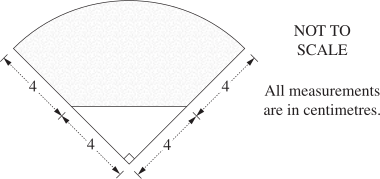
 What is the area of the shaded part of this quadrant, to the nearest square centimetre?  

  1. 34 cm²
  2. 42 cm²
  3. 50 cm²
  4. 193 cm²
Show Answers Only

`B`

Show Worked Solution
`text(Area)` `=\ text(Area of Sector – Area of triangle)`
  `= (theta/360 xx pi r^2)-(1/2 xx bh)`
  `= (90/360 xx pi xx 8^2)-(1/2 xx 4 xx 4)`
  `= 50.2654…-8`
  `= 42.265…\ text(cm²)`

`=>  B`

Filed Under: Areas and Volumes (Harder), Circular measure, Perimeter and Area (Std 1), Perimeter, Area and Volume (Std 2), Perimeter, Area and Volume (Std2-2027) Tagged With: Band 4, num-title-ct-core, num-title-qs-hsc, smc-1121-20-Perimeter and Area (Circular Measure), smc-4944-30-Sectors, smc-6304-20-Perimeter and Area (Circular Measure), smc-798-20-Perimeter and Area (Circular Measure)

Financial Maths, STD2 F1 2009 HSC 10 MC

Billy worked for 35 hours at the normal hourly rate of pay and for five hours at double time. He earned $561.60 in total for this work.

What was the normal hourly rate of pay?

  1. $7.02
  2. $12.48
  3. $14.04
  4. $16.05
Show Answers Only

`B`

Show Worked Solution

`text(Let hourly rate) = $X\ text(per hour)`

`35X + 5(2X)` `= 561.60`
`45X` `=561.60`
`X` `= 561.60/45` 
  `= $12.48`

 
`=>  B`

Filed Under: Earning and Spending Money, Earning Money and Budgeting (Std 1), Earning Money and Budgeting (Std 2), FM1 - Earning money, Ways of Earning (Std2-2027) Tagged With: Band 3, num-title-ct-corea, num-title-qs-hsc, smc-1126-10-Wages, smc-4331-10-Wages, smc-6276-10-Wages/Salaries, smc-810-10-Wages

Probability, STD2 S2 2009 HSC 9 MC

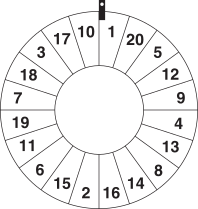
A wheel has the numbers 1 to 20 on it, as shown in the diagram. Each time the wheel is spun, it stops with the marker on one of the numbers.


 The wheel is spun 120 times.

 How many times would you expect a number less than 6 to be obtained?

  1.   `20` 
  2.   `24` 
  3.   `30` 
  4.   `36` 
Show Answers Only

`C`

Show Worked Solution

`P(text(number < 6) ) = 5/20 = 1/4`

`:.\ text(Expected times)` `= 1/4 xx text(times spun)`
  `= 1/4 xx 120`
  `= 30`

`=>  C`

Filed Under: Probability, Relative Frequency, Relative Frequency (Std 1), Relative Frequency (Std 2), Relative Frequency (Y11) Tagged With: Band 4, common-content, num-title-ct-core, num-title-qs-hsc, smc-1133-20-Games of Chance, smc-1133-30-Expected Frequency (np), smc-4225-35-Relative frequency, smc-827-20-Games of Chance, smc-827-40-Expected Frequency (np), smc-990-20-Games of Chance, smc-990-40-Expected Frequency (np)

Financial Maths, STD2 F4 2009 HSC 6 MC

A house was purchased in 1984 for $35 000. Assume that the value of the house has increased by 3% per annum since then. 

Which expression gives the value of the house in 2009?  

  1. `35\ 000(1 + 0.03)^25`
  2. `35\ 000(1 + 3)^25` 
  3. `35\ 000 xx 25 xx 0.03`
  4. `35\ 000 xx 25 xx 3`
Show Answers Only

`A`

Show Worked Solution

`r =\ text(3%)\ = 0.03`

`n = 25\ text(years)`

`text(Using)\ \ FV = PV(1 + r)^n`

` :.\ text(Value in 2009) = 35\ 000(1+0.03)^25` 

`=>  A`

Filed Under: Compound Interest, Compound Interest and Shares (Std2), F2 Investment (Y12), FM2 - Investing, Modelling Investments and Loans (Y12) Tagged With: Band 3, common-content, num-title-ct-coreb, num-title-qs-hsc, smc-1002-20-FV Formula, smc-1108-20-FV Formula, smc-4334-10-Find FV, smc-4334-70-Inflation, smc-817-20-FV Formula

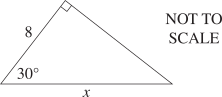
Measurement, STD2 M6 2009 HSC 4 MC

Which is the correct expression for the value of `x` in this triangle? 


  1. `8/cos30°` 
  2. `8/sin30°` 
  3. `8 xx cos30°`  
  4. `8 xx sin30°` 
Show Answers Only

`A`

Show Worked Solution
`cos30^@`  `= 8/x`
`:.x` `= 8/cos30^@` 

 
`=>  A`

Filed Under: M3 Right-Angled Triangles (Y12), Pythagoras and basic trigonometry, Pythagoras and Right-Angled Trig (Std2), Right-Angled Trig Tagged With: Band 4, num-title-ct-corea, num-title-qs-hsc, smc-1103-20-Right-angled Trig, smc-4552-20-cos, smc-802-20-Right-Angled Trig

Statistics, STD2 S1 2009 HSC 3 MC

The eye colours of a sample of children were recorded.

When analysing this data, which of the following could be found?

  1. Mean
  2. Median
  3. Mode
  4. Range
Show Answers Only

`C`

Show Worked Solution

`text(Eye colour is categorical data)`

`:.\ text(Only the mode can be found)`

`=>  C`

Filed Under: Classifying Data, Classifying Data (Std 1), Classifying Data (Std 2), Classifying Data (Y12), Data Analysis, Data Classification, Investigation and Sampling Methods (Std2-2027), DS1 - Stats and society, Measures of Centre and Spread (Std2-2027), Summary Statistics - No Graph (Std 2), Summary Statistics - No graph (Y12), Summary Statistics (no graph), Summary Statistics (Std 1) Tagged With: Band 3, common-content, num-title-ct-core, num-title-qs-hsc, smc-1127-20-Classifying Data, smc-1131-10-Mean, smc-1131-20-Median and Mode, smc-4224-45-Mean/median/mode/range, smc-5075-10-Categorical, smc-6309-20-Data Classification, smc-6312-10-Mean, smc-6312-20-Median and Mode, smc-820-20-Classifying Data, smc-824-10-Mean, smc-824-20-Median and Mode, smc-999-10-Mean, smc-999-20-Median and Mode

Probability, STD2 S2 2009 HSC 1 MC

A newspaper states: ‘It will most probably rain tomorrow.’

Which of the following best represents the probability of an event that will most probably occur?   

  1.   `33 1/3 text(%)` 
  2.   `text(50%)` 
  3.   `text(80%)` 
  4.   `text(100%)` 
Show Answers Only

`C`

Show Worked Solution

`text(Probably) =>\ text(likelihood > 50%)`

`text(However 100% = certainty)`

`:.\ text(80% is the answer)`

`=> C`

Filed Under: Fundamental understanding, Fundamental Understanding (Std 1), Fundamental Understanding (Std 2), Probability Tagged With: Band 3, num-title-ct-core, num-title-qs-hsc, smc-4225-05-Core concepts

Algebra, STD2 A1 2011 HSC 18 MC

Which of the following correctly expresses  `a`  as the subject of  `s= ut+1/2at^2 `?

  1. `a=(2(s-ut))/t^2`
  2. `a=(2s-ut)/t^2`
  3. `a=(1/2(s-ut))/t^2`
  4. `a=(1/2s-ut)/t^2`
Show Answers Only

`A`

Show Worked Solution
`s` `=ut+1/2at^2`
`1/2at^2` `=s-ut`
`at^2` `=2(s-ut)`
`a` `=(2(s-ut))/t^2`

 
`=>A`

Filed Under: Formula Rearrange, Formula Rearrange (Std 1), Formula Rearrange (Std 2), Formula Rearrange (Std2-2027), Quadratics and Cubics Tagged With: Band 5, num-title-ct-pathc, num-title-qs-hsc, smc-1200-20-Non-Linear, smc-1201-20-Non-Linear, smc-4386-10-Rearrange equation, smc-6236-20-Non-Linear

Algebra, STD2 A4 2010 HSC 13 MC

The number of hours that it takes for a block of ice to melt varies inversely with the temperature. At 30°C it takes 8 hours for a block of ice to melt.

How long will it take the same size block of ice to melt at 12°C?  

  1. 3.2 hours
  2. 20 hours
  3. 26  hours
  4. 45 hours
Show Answers Only

`B`

Show Worked Solution
 
♦ Mean mark 50% 

`text{Time to melt}\ (T) prop1/text(Temp) \ => \ T=k/text(Temp)`

`text(When) \ T=8, text(Temp = 30)`

`8` `=k/30`
`k` `=240`


`text{Find}\ T\ text{when  Temp = 12:}`

`T` `=240/12`
  `=20\ text(hours)`

 
`=>  B`

Filed Under: Inverse, Non-Linear: Inverse and Other Problems (Std 2), Variation and Rates of Change Tagged With: Band 5, num-title-ct-patha, num-title-qs-hsc, smc-4239-30-a prop 1/b, smc-795-10-Inverse, smc-795-40-Proportional

Measurement, STD2 M6 2010 HSC 9 MC

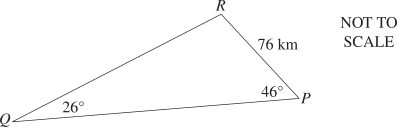
Three towns `P`, `Q`  and `R` are marked on the diagram.

The distance from `R` to `P` is 76 km.  `angle RQP=26^circ`  and  `angle RPQ=46^@.`


  What is the distance from  `P`  to  `Q`  to the nearest kilometre?

  1. `100\ text(km)`
  2. `125\ text(km)`
  3. `165\ text(km)`
  4. `182\ text(km)`
Show Answers Only

`C`

Show Worked Solution
`angle QRP` `=180-(26+46)     (180^circ\ text(in) \ Delta)`
  `=108^circ`


`text{Using sine rule}`

`(PQ)/sin108^circ` `=76/sin26^circ`
`PQ` `=(76xxsin108^circ)/sin26^circ`
  `=164.88\ text(km)`

`=>  C`

Filed Under: Non Right-Angled Trig, Non-Right Angled Trig, Non-Right Angled Trig (Std2) Tagged With: Band 4, num-title-ct-pathc, num-title-qs-hsc, smc-4553-20-Sine Rule, smc-804-20-Sine Rule

Algebra, STD2 A4 2012 HSC 30b

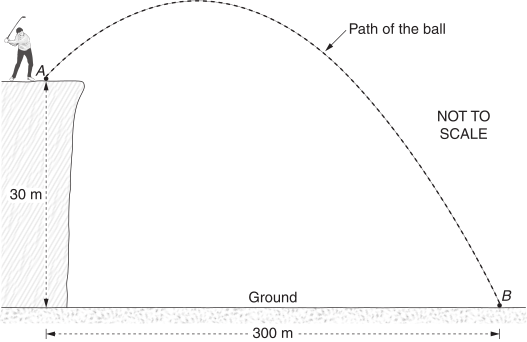
A golf ball is hit from point `A` to point `B`, which is on the ground as shown. Point `A` is 30 metres above the ground and the horizontal distance from point `A` to point `B` is  300 m.
 

The path of the golf ball is modelled using the equation 

`h = 30 + 0.2d-0.001d^2` 

where 

`h` is the height of the golf ball above the ground in metres, and 

`d` is the horizontal distance of the golf ball from point `A` in metres.

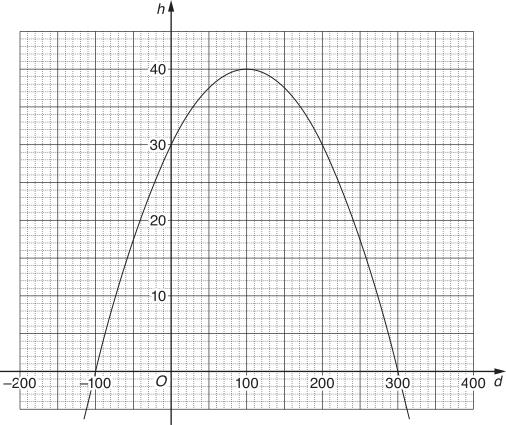
The graph of this equation is drawn below.


  1. What is the maximum height the ball reaches above the ground?    (1 mark)

    --- 1 WORK AREA LINES (style=lined) ---

  2. There are two occasions when the golf ball is at a height of 35 metres.


    What horizontal distance does the ball travel in the period between these two occasions?   (1 mark)

    --- 2 WORK AREA LINES (style=lined) ---

  3. What is the height of the ball above the ground when it still has to travel a horizontal distance of 50 metres to hit the ground at point `B`?   (1 mark)

    --- 2 WORK AREA LINES (style=lined) ---

  4. Only part of the graph applies to this model.


    Find all values of `d` that are not suitable to use with this model, and explain why these values are not suitable.   (2 marks)

    --- 4 WORK AREA LINES (style=lined) ---

Show Answers Only
  1. `40 text(m)`
  2. `140 text(m)`
  3. `text(17.5 m)`
  4. `d < 0\ text(and)\ d>300`
Show Worked Solution

i.   `text(Max height) = 40 text(m)`

COMMENT: With a mean mark of 92% in (i), a classic example of low hanging fruit in later questions.


ii.   `text(From graph)`

`h = 35\ text(when)\ x = 30\ text(and)\ x = 170`

`:.\ text(Horizontal distance)` `= 170-30`
  `= 140\ text(m)`


iii.   `text(Ball hits ground at)\ x = 300`

MARKER’S COMMENT: Responses for (iii) in the range  `17<=\ h\ <=18`  were deemed acceptable estimates read off the graph.

`=>text(Need to find)\ y\ text(when)\ x = 250`

`text(From graph,)\ y = 17.5 text(m)\ text(when)\ x = 250`

`:.\ text(Height of ball is 17.5 m at a horizontal)`

`text(distance of 50m before)\ B.`


iv.   `text(Values of)\ d\ text(not suitable).`

♦♦♦ Mean mark (iv) 12%
MARKER’S COMMENT: Many students did not refer to the domain `d>300` as unsuitable to the model.

`text(If)\ d < 0 text(, it assumes the ball is hit away)`

`text(from point)\ B text(. This is not the case in our)`

`text(example.)`

`text(If)\ d > 300 text(,)\ h\ text(becomes negative which is)`

`text(not possible given the ball cannot go)`

`text(below ground level.)`

Filed Under: Exponential/Quadratic (Projectile), Non-Linear: Exponential/Quadratics (Std 2), Quadratics Tagged With: Band 2, Band 4, Band 6, num-title-ct-coreb, num-title-qs-hsc, page-break-before-question, smc-4443-60-Projectiles, smc-830-20-Quadratics, smc-830-50-Limitations

Statistics, STD2 S1 2009 HSC 21 MC

The mean of a set of ten scores is 14. Another two scores are included and the new mean is 16.

What is the mean of the two additional scores?

  1.    4
  2.    16
  3.    18
  4.    26
Show Answers Only

`D`

Show Worked Solution
♦♦♦ Mean mark 28%.

`text(If ) bar x\ text(of 10 scores = 14)`

  `=>text(Sum of 10 scores)= 10 xx 14 = 140`

`text(With 2 additional scores,)\ \ bar x = 16 `

  `=>text(Sum of 12 scores)= 12 xx 16 = 192`

`:.\ text(Value of 2 extra scores)` `= 192\-140`
  `= 52`


`:.\ text(Mean of 2 extra scores)= 52/2 = 26`

`=>  D`

Filed Under: Data Analysis, Measures of Centre and Spread (Std2-2027), Summary Statistics - No Graph (Std 2), Summary Statistics - No graph (Y12), Summary Statistics (no graph), Summary Statistics (Std 1) Tagged With: Band 6, common-content, num-title-ct-core, num-title-qs-hsc, smc-1131-10-Mean, smc-4224-25-Mean, smc-4224-50-Add/remove data, smc-6312-10-Mean, smc-824-10-Mean, smc-999-10-Mean

Measurement, STD2 M7 2012 HSC 28c

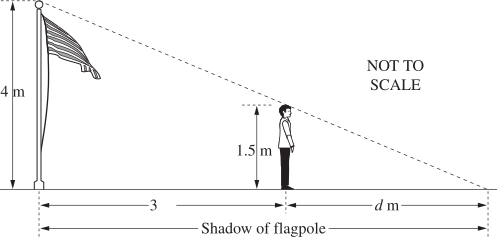
Jacques and a flagpole both cast shadows on the ground. The difference between the lengths of their shadows is 3 metres.
 

What is the value of `d`, the length of Jacques’ shadow?     (3 marks)

--- 6 WORK AREA LINES (style=lined) ---

Show Answers Only

 `d = 1.8\  text(m)`

Show Worked Solution
♦♦ Mean mark 24%

`text{Both triangles have right-angles with a common (ground) angle.}`

`:.\ text{Triangles are similar (equiangular)}`
 

` text{Since corresponding sides are in the same ratio}`

`d/1.5` `= (d+3)/4`
`4d` `= 1.5(d + 3)`
`8d` `= 3(d + 3)`
  `= 3d + 9`
`5d` `= 9`
`:.d` `= 9/5`
  `=1.8\ text(m)`

Filed Under: M5 Scale Drawings (Y12), Ratio and Scale (Std2), Similarity, Similarity and Scale Tagged With: Band 5, num-title-ct-pathc, num-title-qs-hsc, smc-1105-30-Similarity, smc-1187-60-Similarity, smc-4746-50-Real world applications

Algebra, 2UG 2012 HSC 28b

Simplify fully  `(18ab)/(3a^2) xx c/b`.   (2 marks)

Show Answers Only

 `(6c)/a`

Show Worked Solution
♦ Mean mark 35%!
`(18ab)/(3a^2) xx c/b` `= (18abc)/(3a^2b)`
  `=(6c)/a`

Filed Under: Index and Log Laws, Indices Tagged With: Band 5, num-title-ct-pathb, num-title-qs-hsc, smc-4228-10-Positive integers

Probability, STD2 S2 2012 HSC 27e

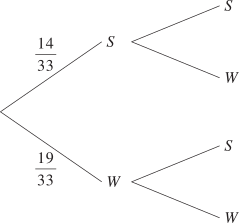
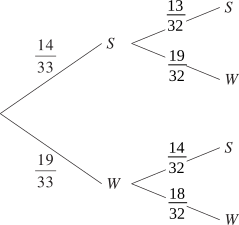
A box contains 33 scarves made from two different fabrics. There are 14 scarves made from silk (S) and 19 made from wool (W).
Two girls each select, at random, a scarf to wear from the box.

  1. Complete the probability tree diagram below.   (2 marks) 


    --- 0 WORK AREA LINES (style=lined) ---

  2. Calculate the probability that the two scarves selected are made from silk.    (1 mark)

    --- 2 WORK AREA LINES (style=lined) ---

  3. Calculate the probability that the two scarves selected are made from different fabrics.   (2 marks)

    --- 4 WORK AREA LINES (style=lined) ---

Show Answers Only
  1.  
       
     
  2. `P\ text{(2 silk)}= 91/528`
  3. `P\ text{(different fabrics)}= 133/264`
Show Worked Solution

i. 

♦ Mean mark (i) 43%.
ii.  `P\ text{(2 silk)}` `= P(S_1) xx P(S_2)`
  `= 14/33 xx 13/32`
  `= 91/528`


iii.  `P\ text{(different)}` `= P (S_1,W_2) + P(W_1,S_2)`
  `= (14/33 xx 19/32) + (19/33 xx 14/32)`
  `= 532/1056`
  `= 133/264`
♦ Mean mark (iii) 41%.
MARKER’S COMMENT: In better responses, students multiplied along the branches and then added these two results together

Filed Under: Multi-stage Events, Multi-Stage Events, Multi-Stage Events (Std 2), Single and Multi-Stage Events (Std 1) Tagged With: Band 4, Band 5, num-title-ct-corea, num-title-qs-hsc, smc-1135-10-Probability Trees, smc-4238-10-Dependent events, smc-4238-50-Probability trees, smc-829-10-Probability Trees

Measurement, STD2 M6 2012 HSC 27d

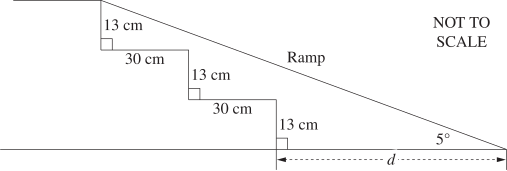
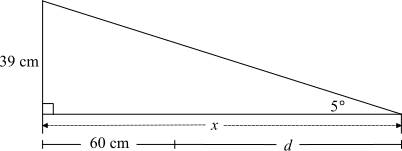
A disability ramp is to be constructed to replace steps, as shown in the diagram.

The angle of inclination for the ramp is to be 5°.   
  

Calculate the extra distance, `d`, that the ramp will extend beyond the bottom step.

Give your answer to the nearest centimetre.   (3 marks)

--- 6 WORK AREA LINES (style=lined) ---

Show Answers Only

 `386\  text(cm)`

Show Worked Solution

`text(Let the horizontal part of the ramp) = x\ text(cm)`

♦♦ Mean mark 35%
MARKER’S COMMENT:  The better responses used a diagram of a simplified version of the ramp as per the Worked Solution.
`tan5^@` `= 39/x`
`x` `= 39/tan5^@`
  `= 445.772…`
   
`text(S)text(ince)\  \ x` `= 60 + d`
`d` `=445.772-60`
  `=385.772\  text(cm)`
  `=386\ text(cm)\ \ text{(nearest cm)}`

Filed Under: 2-Triangle and Harder Examples, M3 Right-Angled Triangles (Y12), Pythagoras and Right-Angled Trig (Std2), Right-Angled Trig Tagged With: Band 5, num-title-ct-corea, num-title-qs-hsc, smc-1103-20-Right-angled Trig, smc-4552-40-Real world applications, smc-4552-45-2-triangles, smc-802-20-Right-Angled Trig

Measurement, STD2 M7 2012 HSC 27c

A map has a scale of  1 : 500 000.

  1. Two mountain peaks are 2 cm apart on the map.


    What is the actual distance between the two mountain peaks, in kilometres?  (1 mark)

    --- 3 WORK AREA LINES (style=lined) ---

  2. Two cities are 75 km apart. How far apart are the two cities on the map, in centimetres?   (1 mark)

    --- 2 WORK AREA LINES (style=lined) ---

Show Answers Only
  1. `text(10 km)`
  2. `text(15 cm)`
Show Worked Solution
♦ Mean mark 37%
MARKER’S COMMENT: Better responses realised that 1 unit on the map represented 1 unit x 500,000 in real life.
i.  `text{Actual distance (2 cm)}` `= 2 xx 500\ 000`
  `= 1\ 000\ 000\ text(cm)`
  `= 10\ 000\ text(m)`
  `=10\ text(km)`


`:.\ text(The 2 mountain peaks are 10 km apart.)`


♦ Mean mark 44%

ii.   `text(Cities are 75 km apart.)`

`text{From part (i), we know 2 cm = 10 km}`

`=>\ text(1 cm = 5 km)`

`=>\ text(On the map,  75 km)= 75/5=15\ text(cm)` 

`:.\ text(Distance on the map is 15 cm.)`

Filed Under: M5 Scale Drawings (Y12), Ratio and Scale (Std2), Similarity, Similarity and Scale Tagged With: Band 5, num-title-ct-corea, num-title-qs-hsc, smc-1105-20-Maps and Scale Drawings, smc-1187-40-Maps and Scale Drawings, smc-4746-60-Scale drawings

Algebra, 2UG 2011 HSC 12 MC

Which of the following expresses `(6x^2y)/3-:(2y)/5` in its simplest form?

  1. `5x^2`
  2. `30x^2y`
  3. `1/(5x^2)`
  4. `5/(4x^2y^2)`
Show Answers Only

`A`

Show Worked Solution
ALGEBRA TIP: When you divide by a fraction, invert the divisor and multiply as shown in the Worked Solution.
`(6x^2y)/3-:(2y)/5` `=(6x^2y)/3xx5/(2y)`
  `=(30x^2y)/(6y)`
  `=5x^2`

 
`=>A`

Filed Under: Index and Log Laws, Indices Tagged With: Band 4, num-title-ct-pathb, num-title-qs-hsc, smc-4228-10-Positive integers

Statistics, STD2 S1 2011 HSC 11 MC

The sets of data, `X` and `Y`, are displayed in the histograms.

2UG 2011 11

Which of these statements is true?

  1.   `X` has a larger mode and `Y ` has a larger range.
  2.   `X` has a larger mode and the ranges are the same.
  3.   The modes are the same and `Y` has a larger range.
  4.   The modes are the same and the ranges are the same.
Show Answers Only

`B`

Show Worked Solution
♦ Mean mark 47%

`text(Mode of)\ X=9`

`text(Range of)\ X=9-3=6`

`text(Mode of)\ Y=8`

`text(Range of)\ Y=11-5=6`

`:. X\ text(has a larger mode and ranges are the same)`

`=>B`

Filed Under: Bar Charts and Histograms, Bar Charts and Histograms (Std 2), Bar Charts and Histograms (Std2-2027), Bar Charts and Histograms (Y12), Bar Charts, Histograms and Other Graphs (Std 1), Data Analysis Tagged With: Band 4, common-content, num-title-ct-core, num-title-qs-hsc, smc-1128-15-Histograms, smc-4224-45-Mean/median/mode/range, smc-6310-20-Histograms, smc-821-15-Histograms, smc-997-15-Histograms

Measurement, STD2 M6 2011 HSC 9 MC

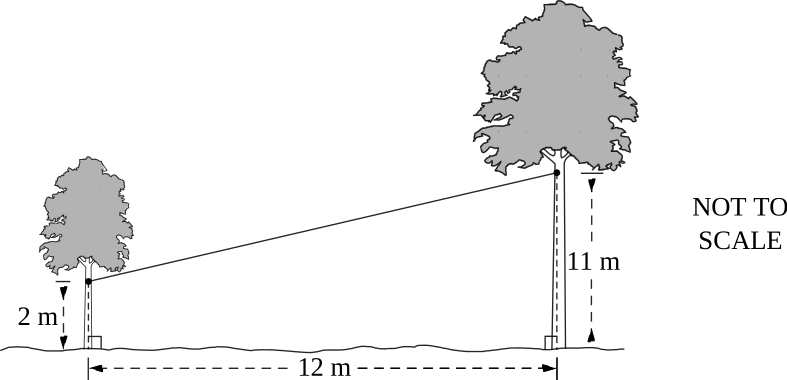
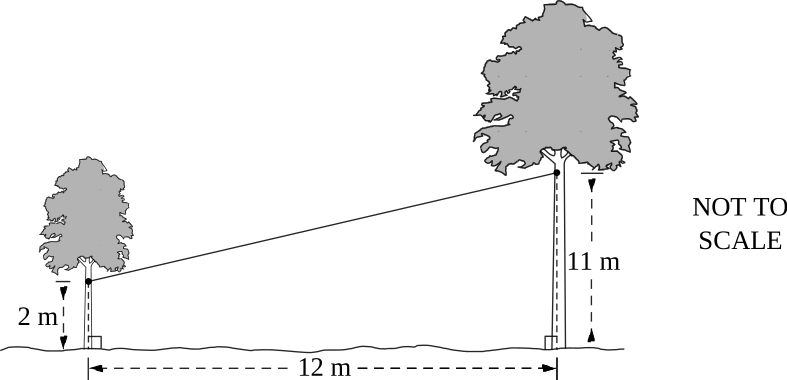
Two trees on level ground, 12 metres apart, are joined by a cable. It is attached 2 metres above the ground to one tree and 11 metres above the ground to the other.

What is the length of the cable between the two trees, correct to the nearest metre? 

  1.  `9\ text(m)`
  2. `12\ text(m)`
  3. `15\ text(m)`
  4. `16\ text(m)`
Show Answers Only

`C`

Show Worked Solution

`text(Using Pythagoras)`

`c^2` `=12^2+9^2`
  `=144+81`
  `=225`
`:.c` `=15,\ \ c>0`

 
`=>C`

Filed Under: M3 Right-Angled Triangles (Y12), Pythagoras and basic trigonometry, Pythagoras and Right-Angled Trig (Std2), Right-angled Triangles Tagged With: Band 3, num-title-ct-core, num-title-qs-hsc, smc-1103-20-Right-angled Trig, smc-4218-30-Hypotenuse, smc-802-10-Pythagoras

Statistics, STD2 S1 2011 HSC 7 MC

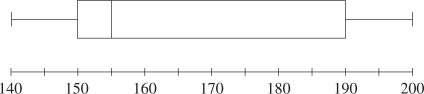
A set of data is displayed in this box-and-whisker plot.
 

Which of the following best describes this set of data?

  1. Symmetrical
  2. Positively skewed
  3. Negatively skewed
  4. Normally distributed
Show Answers Only

`B`

Show Worked Solution

`text{Since the median (155) is closer to the lower quartile (150) and range}`

`text{low (140) than the upper quartile (190) and range high (200), it is}`

`text{positively skewed.}`

`=>B`

♦ Mean mark 47%.

Filed Under: Box Plots and 5-Number Summary, Stem & Leaf, Box & Whisker, Summary Statistics - Box Plots (Std 2), Summary Statistics - Box Plots (Std2-2027), Summary Statistics - Box Plots (Y12), Summary Statistics (Std 1) Tagged With: Band 5, common-content, num-title-ct-corea, num-title-qs-hsc, smc-1000-10-Single Box-Plots, smc-1131-35-Box Plots, smc-5021-50-Box plot (single), smc-5021-70-Skew, smc-6313-10-Single Box Plots, smc-825-10-Single Box-Plots

Algebra, STD2 A4 2011 HSC 6 MC


Which of the following graphs best represents the equation `y = a^x`, where `a` is a positive number greater than 1?
  

Show Answers Only

`D`

Show Worked Solution
 
♦ Mean mark 48%

`text(At) \ x=0,\ y=1`

`text(As)\ x uarr, \ \ y ↑\ text(exponentially)`

`=>D`

Filed Under: Exponential/Quadratic (Projectile), Exponentials, Non-Linear: Exponential/Quadratics (Std 2) Tagged With: Band 5, num-title-ct-corea, num-title-qs-hsc, smc-4444-10-Identify graphs, smc-830-10-Identify Graphs

Probability, STD2 S2 2011 HSC 2 MC

Which of the following could be the probability of an event occurring?

  1.    `1` 
  2.    `6/5` 
  3.    `1.27` 
  4.    `text(145%)` 
Show Answers Only

`A`

Show Worked Solution

`text(Probabilities must lie between 0 and 1 inclusive.)`

`=>A`

Filed Under: Fundamental understanding, Fundamental Understanding (Std 1), Fundamental Understanding (Std 2), Probability Tagged With: Band 4, num-title-ct-core, num-title-qs-hsc, smc-4225-05-Core concepts

Probability, STD2 S2 2010 HSC 8 MC

A bag contains red, green, yellow and blue balls.

\begin{array} {|c|c|}
\hline
\rule{0pt}{2.5ex} \textit{Colour} \rule[-1ex]{0pt}{0pt} & \textit{Probability} \\
\hline
\rule{0pt}{2.5ex} \text{Red} & \dfrac{1}{3} \\
\hline
\rule{0pt}{2.5ex} \text{Green}  & \dfrac{1}{4} \\
\hline
\rule{0pt}{2.5ex} \text{Yellow}  & \text{?} \\
\hline
\rule{0pt}{2.5ex} \text{Blue}  & \dfrac{1}{6} \\
\hline
\end{array}

The table shows the probability of choosing a red, green, or blue ball from the bag.

If there are 12 yellow balls in the bag, how many balls are in the bag altogether

  1.    16
  2.    36
  3.    48
  4.    60
Show Answers Only

\(C\)

Show Worked Solution
\(P(R)+P(G)+P(Y)+P(B)\) \(=1\)
\(\dfrac{1}{3}+\dfrac{1}{4}+P(Y)+\dfrac{1}{6}\) \(=1\)
\(P(Y)\) \(= 1-(\dfrac{1}{3}+\dfrac{1}{4}+\dfrac{1}{6})\)
  \(=1-\dfrac{9}{12}\)
  \(=\dfrac{1}{4}\)
\(P(Y)\) \(=\dfrac{\text{Yellow balls}}{\text{Total balls}}\)
\(\dfrac{1}{4}\) \(=\dfrac{12}{\text{Total balls}}\)


\(\therefore\ \text{ Total balls}=48\)

\(\Rightarrow C\)

Filed Under: Combinations and Single Stage Events (Std 2), Probability, Single and Multi-Stage Events (Std 1), Single stage events Tagged With: Band 4, num-title-ct-core, num-title-qs-hsc, smc-1135-05-Simple Probability, smc-4225-15-Single-stage events, smc-828-10-Simple Probability

  • « Previous Page
  • 1
  • …
  • 5
  • 6
  • 7
  • 8
  • Next Page »

Copyright © 2014–2025 SmarterEd.com.au · Log in