SmarterEd

Aussie Maths & Science Teachers: Save your time with SmarterEd

  • Login
  • Get Help
  • About

Calculus, MET2 2022 VCAA 2

On a remote island, there are only two species of animals: foxes and rabbits. The foxes are the predators and the rabbits are their prey.

The populations of foxes and rabbits increase and decrease in a periodic pattern, with the period of both populations being the same, as shown in the graph below, for all `t \geq 0`, where time `t` is measured in weeks.

One point of minimum fox population, (20, 700), and one point of maximum fox population, (100, 2500), are also shown on the graph.

The graph has been drawn to scale.
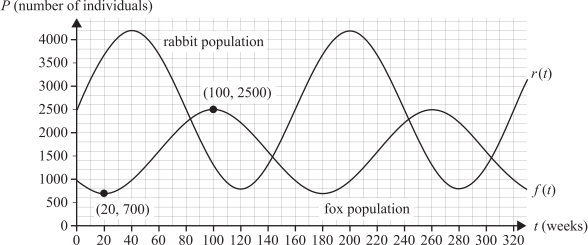
 

The population of rabbits can be modelled by the rule `r(t)=1700 \sin \left(\frac{\pi t}{80}\right)+2500`.

  1.   i. State the initial population of rabbits.   (1 mark)

    --- 2 WORK AREA LINES (style=lined) ---

  2.  ii. State the minimum and maximum population of rabbits.   (1 mark)

    --- 2 WORK AREA LINES (style=lined) ---

  3. iii. State the number of weeks between maximum populations of rabbits.   (1 mark)

    --- 2 WORK AREA LINES (style=lined) ---

The population of foxes can be modelled by the rule `f(t)=a \sin (b(t-60))+1600`.

  1. Show that `a=900` and `b=\frac{\pi}{80}`.   (2 marks)

    --- 4 WORK AREA LINES (style=lined) ---

  2. Find the maximum combined population of foxes and rabbits. Give your answer correct to the nearest whole number.   (1 mark)

    --- 1 WORK AREA LINES (style=lined) ---

  3. What is the number of weeks between the periods when the combined population of foxes and rabbits is a maximum?   (1 mark)

    --- 1 WORK AREA LINES (style=lined) ---

The population of foxes is better modelled by the transformation of `y=\sin (t)` under `Q` given by

 

  1. Find the average population during the first 300 weeks for the combined population of foxes and rabbits, where the population of foxes is modelled by the transformation of `y=\sin(t)` under the transformation `Q`. Give your answer correct to the nearest whole number.   (4 marks)

    --- 8 WORK AREA LINES (style=lined) ---

Over a longer period of time, it is found that the increase and decrease in the population of rabbits gets smaller and smaller.

The population of rabbits over a longer period of time can be modelled by the rule

`s(t)=1700cdote^(-0.003t)cdot sin((pit)/80)+2500,\qquad text(for all)\ t>=0`

  1. Find the average rate of change between the first two times when the population of rabbits is at a maximum. Give your answer correct to one decimal place.   (2 marks)

    --- 3 WORK AREA LINES (style=lined) ---

  2. Find the time, where `t>40`, in weeks, when the rate of change of the rabbit population is at its greatest positive value. Give your answer correct to the nearest whole number.   (2 marks)

    --- 3 WORK AREA LINES (style=lined) ---

  3. Over time, the rabbit population approaches a particular value.
  4. State this value.   (1 mark)

    --- 1 WORK AREA LINES (style=lined) ---
Show Answers Only

ai.   `r(0)=2500`

aii.  Minimum population of rabbits `= 800`

Maximum population of rabbits `= 4200`

aiii. `160`  weeks

b.    See worked solution.

c.    `~~ 5339` (nearest whole number)

d.    Weeks between the periods is 160

e.    `~~ 4142` (nearest whole number)

f.    Average rate of change `=-3.6` rabbits/week (1 d.p.)

g.    `t = 156` weeks (nearest whole number)  

h.    ` s → 2500`

Show Worked Solution

ai.  Initial population of rabbits

From graph when `t=0, \ r(0) = 2500`

Using formula when `t=0`

`r(t)` `= 1700\ sin \left(\frac{\pi t}{80}\right)+2500`  
`r(0)` `= 1700\ sin \left(\frac{\pi xx 0}{80}\right)+2500 = 2500`  rabbits  


aii.
From graph,

Minimum population of rabbits `= 800`

Maximum population of rabbits `= 4200`

OR

Using formula

Minimum is when `t = 120`

`r(120) = 1700\ sin \left(\frac{\pi xx 120}{80}\right)+2500 = 1700 xx (-1) + 2500 = 800`

Maximum is when `t = 40`

`r(40) = 1700\ sin \left(\frac{\pi xx 40}{80}\right)+2500 = 1700 xx (1) + 2500 = 4200`

 
aiii. Number of weeks between maximum populations of rabbits `= 200-40 = 160`  weeks

 
b.  Period of foxes = period of rabbits = 160:

`frac{\2pi}{b} = 160`

`:.\  b = frac{\2pi}{160} = frac{\pi}{80}` which is the same period as the rabbit population.

Using the point `(100 , 2500)`

Amplitude when `b = frac{\pi}{80}`: 

`f(t)` `=a \ sin (pi/80(t-60))+1600`  
`f(100)` `= 2500`  
`2500` `= a \ sin (pi/80(100-60))+1600`  
`2500` `= a \ sin (pi/2)+1600`  
`a` `= 2500-1600 = 900`  

 
`:.\  f(t)= 900 \ sin (pi/80)(t-60) + 1600`


c.    Using CAS find `h(t) = f(t) + r(t)`:

`h(t):=900 \cdot \sin \left(\frac{\pi}{80} \cdot(t-60)\right)+1600+1700\cdot \sin \left(\frac{\pit}{80}\right) +2500`

  
`text{fMax}(h(t),t)|0 <= t <= 160`      `t = 53.7306….`
  

`h(53.7306…)=5339.46`

  
Maximum combined population `~~ 5339` (nearest whole number)


♦♦ Mean mark (c) 40%.
MARKER’S COMMENT: Many rounding errors with a common error being 5340. Many students incorrectly added the max value of rabbits to the max value of foxes, however, these points occurred at different times.

d.    Using CAS, check by changing domain to 0 to 320.

`text{fMax}(h(t),t)|0 <= t <= 320`     `t = 213.7305…`
 
`h(213.7305…)=5339.4568….`
 
Therefore, the number of weeks between the periods is 160.
  

e.    Fox population:

`t^{\prime} = frac{90}{pi}t + 60`   →   `t = frac{pi}{90}(t^{\prime}-60)`

`y^{\prime} = 900y+1600`   →   `y = frac{1}{900}(y^{\prime}-1600)`

`frac{y^{\prime}-1600}{900} = sin(frac{pi(t^{\prime}-60)}{90})`

`:.\  f(t) = 900\ sin\frac{pi}{90}(t-60) + 1600`

  
Average combined population  [Using CAS]   
  
`=\frac{1}{300} \int_0^{300} left(\900 \sin \left(\frac{\pi(t-60)}{90}\right)+1600+1700\ sin\ left(\frac{\pi t}{80}\right)+2500\right) d t`
  

`= 4142.2646…..  ~~ 4142` (nearest whole number)


♦ Mean mark (e) 40%.
MARKER’S COMMENT: Common incorrect answer 1600. Some incorrectly subtracted `r(t)`. Others used average rate of change instead of average value.

f.   Using CAS

`s(t):= 1700e^(-0.003t) dot\sin\frac{pit}{80} + 2500`
 

`text{fMax}(s(t),t)|0<=t<=320`        `x = 38.0584….`
 

`s(38.0584….)=4012.1666….`
 

`text{fMax}(s(t),t)|160<=t<=320`     `x = 198.0584….`
 

`s(198.0584….)=3435.7035….`
 

Av rate of change between the points

`(38.058 , 4012.167)`  and  `(198.058 , 3435.704)`

`= frac{4012.1666….-3435.7035….}{38.0584….-198.0584….} =-3.60289….`
 

`:.` Average rate of change `=-3.6` rabbits/week (1 d.p.)


♦ Mean mark (f ) 45%.
MARKER’S COMMENT: Some students rounded too early.
`frac{s(200)-s(40)}{200-40}` was commonly seen.
Some found average rate of change between max and min populations.

g.   Using CAS

`s^(primeprime)(t) = 0` , `t = 80(n-0.049) \ \forall n \in Z`

After testing `n = 1, 2, 3, 4` greatest positive value occurs for `n = 2` 

`t` `= 80(n-0.049)`  
  `= 80(2-0.049)`  
  `= 156.08`  

 
`:. \ t = 156` weeks (nearest whole number)


♦♦♦ Mean mark (g) 25%.
MARKER’S COMMENT: Many students solved `frac{ds}{dt}=0`.
A common answer was 41.8, as `s(156.11…)=41.79`.
Another common incorrect answer was 76 weeks.

h.   As `t → ∞`, `e^(-0.003t) → 0`

`:.\ s → 2500`

Filed Under: Average Value and Other, Differentiation (Trig), Maxima and Minima, Trig Differentiation Tagged With: Band 2, Band 4, Band 5, Band 6, smc-2757-10-Sin, smc-2757-80-Applications, smc-641-60-Other themes, smc-736-10-sin, smc-744-10-sin, smc-753-60-Matrix, smc-756-20-Trig

Graphs, MET2 2023 VCAA 18 MC

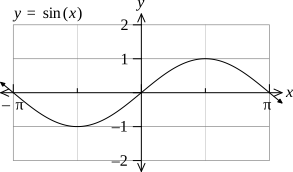
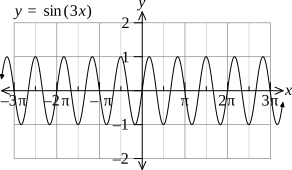
Consider the function \(f:[-a\pi, a\pi] \rightarrow\ R, f(x)=\sin(ax)\), where \(a\) is a positive integer.

The number of local minima in the graph of \(y=f(x)\) is always equal to

  1. \(2\)
  2. \(4\)
  3. \(a\)
  4. \(2a\)
  5. \(a^2\)
Show Answers Only

\(E\)

Show Worked Solution

\(\text{Check graphs for different values of }a\)

\(a=1\to \text{1 local minimum}\)


\(a=2\to \text{4 local minimums}\)


\(a=3\to \text{9 local minimums}\)


\(\therefore\ \text{Number of local minimums is always equal to }a^2\)
 

\(\Rightarrow E\)


♦♦ Mean mark 29%.
MARKER’S COMMENT: 22% incorrectly chose C and 26% incorrectly chose D.

Filed Under: Trig Graphing Tagged With: Band 5, smc-2757-10-Sin, smc-2757-30-Find period

Functions, MET2 2023 VCAA 9 MC

The function \(f\) is given by
 

\(f(x) = \begin {cases}
\tan\Bigg(\dfrac{x}{2}\Bigg)         &\ \ 4 \leq x \leq 2\pi \\
\sin(ax) &\ \ \ 2\pi\leq x\leq 8
\end{cases}\)

 
The value of \(a\) for which \(f\) is continuous and smooth at  \( x\) = \(2\pi\)  is

  1. \(-2\)
  2. \(-\dfrac{\pi}{2}\)
  3. \(-\dfrac{1}{2}\)
  4. \(\dfrac{1}{2}\)
  5. \(2\)
Show Answers Only

\(C\)

Show Worked Solution

\(\text{Solve for}\ a\ \text{given}\ \ x=2\pi:\)

\(\tan\Bigg(\dfrac{2\pi}{2}\Bigg)=\sin(a2\pi)=0\)

\(a=\pm \dfrac{1}{2}\)
 

\(\text{For smoothness, solve for}\ a\ \text{given}\ \ x=2\pi:\)

\(\dfrac{d}{dx}\tan\Bigg(\dfrac{x}{2}\Bigg)=\dfrac{d}{dx}\sin(ax)\)

\(\therefore a=-\dfrac{1}{2}\)

 
\(\Rightarrow C\)


♦ Mean mark 46%.

Filed Under: Curve Sketching, Trig Graphing Tagged With: Band 5, smc-2757-10-Sin, smc-2757-20-Tan, smc-2757-50-Identify graph, smc-724-45-Other graphs

Graphs, MET2 2023 VCAA 1 MC

The amplitude, \(A\), and the period, \(P\), of the function \(f(x)=-\dfrac{1}{2}\sin(3x+2\pi)\) are

  1. \(A=-\dfrac{1}{2},\ P=\dfrac{\pi}{3}\)
  2. \(A=-\dfrac{1}{2},\ P=\dfrac{2\pi}{3}\)
  3. \(A=-\dfrac{1}{2},\ P=\dfrac{3\pi}{2}\)
  4. \(A=\dfrac{1}{2},\ P=\dfrac{\pi}{3}\)
  5. \(A=\dfrac{1}{2},\ P=\dfrac{2\pi}{3}\)
Show Answers Only

\(E\)

Show Worked Solution

\(\text{Period:}\ \ P= \dfrac{2\pi}{n}= \dfrac{2\pi}{3}\)  

\(\text{Amplitude}:\ \ A=\bigg|-\dfrac{1}{2}\bigg|=\dfrac{1}{2}\)

\(\Rightarrow E\)

Filed Under: Trig Graphing Tagged With: Band 3, smc-2757-10-Sin, smc-2757-30-Find period, smc-2757-40-Find amplitude

Calculus, MET1 2022 VCAA 7

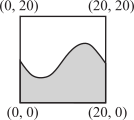
A tilemaker wants to make square tiles of size 20 cm × 20 cm.

The front surface of the tiles is to be painted with two different colours that meet the following conditions:

  • Condition 1 - Each colour covers half the front surface of a tile.
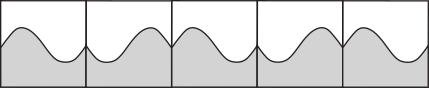
  • Condition 2 - The tiles can be lined up in a single horizontal row so that the colours form a continuous pattern.

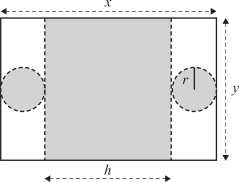
An example is shown below.
 

There are two types of tiles: Type A and Type B.

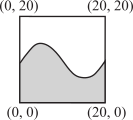
For Type A, the colours on the tiles are divided using the rule `f(x)=4 \sin \left(\frac{\pi x}{10}\right)+a`, where `a \in R`.

The corners of each tile have the coordinates (0,0), (20,0), (20,20) and (0,20), as shown below.
 

  1.  i. Find the area of the front surface of each tile.   (1 mark)

    --- 2 WORK AREA LINES (style=lined) ---

    ii. Find the value of `a` so that a Type A tile meets Condition 1.   (1 mark)

    --- 2 WORK AREA LINES (style=lined) ---


Type B tiles, an example of which is shown below, are divided using the rule `g(x)=-\frac{1}{100} x^3+\frac{3}{10} x^2-2 x+10`.
 

  1. Show that a Type B tile meets Condition 1.   (3 marks)

    --- 8 WORK AREA LINES (style=lined) ---

  2. Determine the endpoints of `f(x)` and `g(x)` on each tile. Hence, use these values to confirm that Type A and Type B tiles can be placed in any order to produce a continuous pattern in order to meet Condition 2.   (2 marks)

    --- 8 WORK AREA LINES (style=lined) ---

Show Answers Only

a.i.    `400` cm²

a.ii.   `a = 10`

b.     `200` cm²

c.     See worked solution

Show Worked Solution
a.i   Area `= 20 xx 20`  
  `= 400` cm²  

  
a.ii  `a = 10`
 

b.   Area `=\int_0^{20} \frac{-x^3}{100}+\frac{3 x^2}{10}-2 x+10\ d x`  
  `=\left[\frac{-x^4}{400}+\frac{x^3}{10}-x^2+10 x\right]_0^{20}`  
  `=\left[-\frac{20^4}{400}+\frac{20^3}{10}-20^2+10 xx 20\right]-\left[0\right]`  
  `= – 400 +800 -400 +200`  
  `= 200` cm²  

 
`:.` The area of the coloured section of the Type B tile is 200 cm² which is half the 400 cm² area of the tile.
 

c.   
`f(0)` `=4 \sin \left(\frac{\pi(0)}{10}\right)+10 = 10`  
  `f(20)` `=4 \sin (2 \pi)+10 = 10`  
  `g(0)` `=\frac{-0}{100}+\frac{3(0)}{10}-2(0)+10=10`  
  `g(20)` `=-\frac{8000}{100}+\frac{200}{10}-2(20)+10 = 10`  

 
→`\ f(0) = f(20) = g(0) = g(20) =10`
 

`:.`    The endpoints for `f(x)` are `(0,10)` and `(20,10)` and for `g(x)` are also `(0,10)` and `(20,10)`.

So the tiles can be placed in any order to make the continuous pattern.


♦♦ Mean mark (c) 30%.
MARKER’S COMMENT: Students often only found `f(20)` and `g(20)`, however, `f(0)` and `g(0)` also needed to be found to verify the pattern match.

Filed Under: Area Under Curves, Standard Integration Tagged With: Band 4, Band 6, smc-2757-10-Sin, smc-723-70-Other, smc-749-20-Definite Integrals

Graphs, MET1 2022 VCAA 6

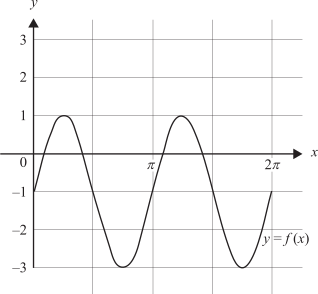
The graph of `y=f(x)`, where `f:[0,2 \pi] \rightarrow R, f(x)=2 \sin(2x)-1`, is shown below.
 

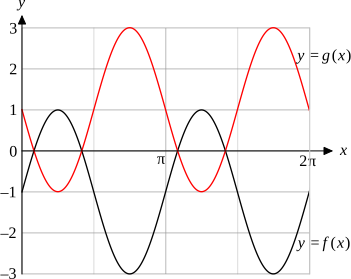
  1. On the axes above, draw the graph of `y=g(x)`, where `g(x)` is the reflection of `f(x)` in the horizontal axis.   (2 marks)

    --- 0 WORK AREA LINES (style=lined) ---

  2. Find all values of `k` such that `f(k)=0` and `k \in[0,2 \pi]`.   (3 marks)

    --- 5 WORK AREA LINES (style=lined) ---

  3. Let `h: D \rightarrow R, h(x)=2 \sin(2x)-1`, where `h(x)` has the same rule as `f(x)` with a different domain.
  4. The graph of `y=h(x)` is translated `a` units in the positive horizontal direction and `b` units in the positive vertical direction so that it is mapped onto the graph of `y=g(x)`, where `a, b \in(0, \infty)`.
    1. Find the value for `b`.   (1 mark)

      --- 2 WORK AREA LINES (style=lined) ---

    2. Find the smallest positive value for `a`.   (1 mark)

      --- 2 WORK AREA LINES (style=lined) ---

    3. Hence, or otherwise, state the domain, `D`, of `h(x)`.   (1 mark)

      --- 2 WORK AREA LINES (style=lined) ---

Show Answers Only

a.    Graph `y=g(x)`

b.    `\frac{\pi}{12}, \frac{5 \pi}{12}, \frac{13 \pi}{12}, \frac{17 \pi}{12}`

c.i.    `b=2`

cii.    `=\frac{\pi}{2}`

ciii.   `\left[-\frac{\pi}{2}, \frac{3 \pi}{2}\right]`

Show Worked Solution

a.

b.  `2 \sin (2 k)-1` `=0`       `0<=k<=2\pi`  
`sin (2 k)` `=1/2`  
`2k` `=\frac{\pi}{6}, \frac{5 \pi}{6}, \frac{13 \pi}{6}, \frac{17 \pi}{6}`  
`k` `=\frac{\pi}{12}, \frac{5 \pi}{12}, \frac{13 \pi}{12}, \frac{17 \pi}{12}`  


c.i   ` 2 \sin 2(x-a)-1+b` `=-(2 \sin 2 x-1)`  
`:.\ -1+b` `=1`  
`b` `=2`  


c.ii  `2 \sin 2(x-a)` `=-(2 \sin 2 x-1)`  
`\sin (2 x-2 a)` `=-\sin 2 x`  
`\therefore 2 a` `=\pi`  
`a` `=\frac{\pi}{2}`  

♦ Mean mark (c.ii) 50%.
MARKER’S COMMENT: Students confused vertical and horizontal translations. Common error `a=\frac{\pi}{4}.`

c.iii The domain for `f(x)` is `[0,2pi]`

`:. \ D` is `\left[-\frac{\pi}{2}, \frac{3 \pi}{2}\right]`

 
♦♦♦ Mean mark (c.iii) 10%.
MARKER’S COMMENT: Common error was translating in the wrong direction. A common incorrect answer was `\left[-\frac{\pi}{2}, \frac{5 \pi}{2}\right].`

Filed Under: Trig Graphing Tagged With: Band 4, Band 5, Band 6, smc-2757-10-Sin, smc-2757-70-Sketch graph, smc-2757-80-Applications

Functions, MET1 2021 VCAA 3

Consider the function  `g: R -> R, \ g(x) = 2sin(2x).`

  1. State the range of `g`.   (1 mark)

    --- 2 WORK AREA LINES (style=lined) ---

  2. State the period of `g`.   (1 mark)

    --- 1 WORK AREA LINES (style=lined) ---
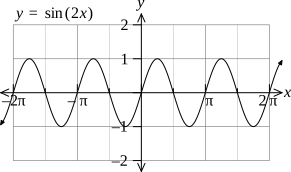
  3. Solve  `2 sin(2x) = sqrt3`  for  `x ∈ R`.   (3 marks)

    --- 6 WORK AREA LINES (style=lined) ---

Show Answers Only
  1. `[-2,2]`
  2. `pi`
  3. `x= pi/6 + npi, pi/3 + npi\ \ \ (n in ZZ)`
Show Worked Solution

a.   `text(S)text(ince)  -1<sin(2x)<1,`

`text(Range)\  g(x) = [-2,2]`
 

b.   `text(Period) = (2pi)/n = (2pi)/2 = pi`
 

c.    `2sin(2x)` `=sqrt3`
  `sin(2x)` `=sqrt3/2`
  `2x` `=pi/3, (2pi)/3, pi/3 + 2pi, (2pi)/3 + 2pi, …`
  `x` `=pi/6, pi/3, pi/6+pi, pi/3+pi, …`

 
`:.\ text(General solution)`

`= pi/6 + npi, pi/3 + npi\ \ \ (n in ZZ)`

Filed Under: Trig Equations, Trig Graphing Tagged With: Band 3, Band 4, smc-2757-10-Sin, smc-2757-30-Find period, smc-2757-35-Find range, smc-725-10-Sin, smc-725-50-General solution

Calculus, MET1-NHT 2018 VCAA 7

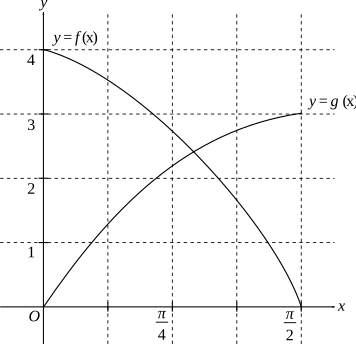
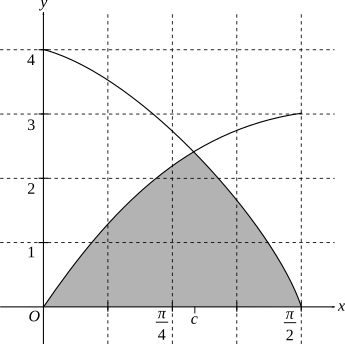
Let  `f : [ 0, (pi)/(2)] → R, \ f(x) = 4 cos(x)`  and  `g : [0, (pi)/(2)]  → R, \ g(x) = 3 sin(x)`.

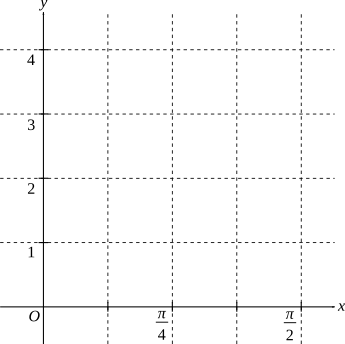
  1. Sketch the graph of `f` and the graph of `g` on the axes provided below.   (2 marks)

    --- 0 WORK AREA LINES (style=lined) ---


    `qquad qquad `
     

  2. Let `c` be such that  `f(c) = g(c)`,  where  `c∈[0, (pi)/(2)]`

     
    Find the value of  `sin(c)`  and the value of  `cos(c)`.   (3 marks)


    --- 4 WORK AREA LINES (style=lined) ---

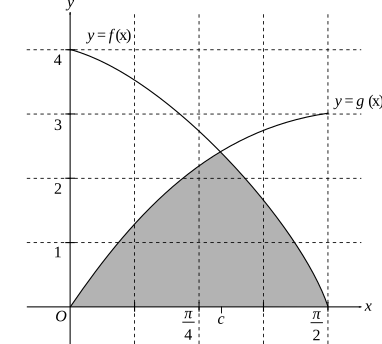
  3.  Let `A` be the region enclosed by the horizontal axis, the graph of `f` and the graph of `g`.
    1. Shade the region `A` on the axes provided in part a. and also label the position of `c` on the horizontal axis.   (1 mark)

      --- 0 WORK AREA LINES (style=lined) ---

    2. Calculate the area of the region `A`.   (3 marks)

      --- 7 WORK AREA LINES (style=lined) ---

Show Answers Only
  1.  


  2. `sin(c) = (4)/(5), \ cos(c) = (3)/(5)`


  3. i.

     
    ii. `2 \ u^2`
Show Worked Solution

a.   


b.   `text(At intersection:)`

`4cos(c)` `= 3sin(c)`
`tan(c)` `= (4)/(3)`

`sin(c) = (4)/(5)`

`cos(c) = (3)/(5)`


c. i.


   ii.       `A` `= int_0^c g(x)\ dx + int_c^((pi)/(2)) f(x)\ dx`
  `= int_0^c 3sin x \ dx + int_c^((pi)/(2)) 4cos \ x \ dx`
  `= 3[-cos x]_0^c + 4[sin x]_c^((pi)/(2))`
  `= 3(-cos(c) + cos \ 0) + 4(sin \ (pi)/(2)-sin(c))`
  `= 3(-(3)/(5) + 1) + 4(1-(4)/(5))`
  `= (6)/(5) + (4)/(5)`
  `= 2 \ \ text(u²)`

Filed Under: Area Under Curves, Trig Graphing Tagged With: Band 4, smc-2757-10-Sin, smc-2757-15-Cos, smc-2757-70-Sketch graph, smc-723-60-Trig, smc-723-80-Area between graphs

Trigonometry, MET2-NHT 2019 VCAA 2

The wind speed at a weather monitoring station varies according to the function

`v(t) = 20 + 16sin ((pi t)/(14))`

where `v` is the speed of the wind, in kilometres per hour (km/h), and  `t`  is the time, in minutes, after 9 am.

  1. What is the amplitude and the period of  `v(t)`?   (2 marks)

    --- 3 WORK AREA LINES (style=lined) ---

  2. What are the maximum and minimum wind speeds at the weather monitoring station?   (1 mark)

    --- 2 WORK AREA LINES (style=lined) ---

  3. Find  `v(60)`, correct to four decimal places.   (1 mark)

    --- 2 WORK AREA LINES (style=lined) ---

  4. Find the average value of  `v(t)`  for the first 60 minutes, correct to two decimal places.   (2 marks)

    --- 5 WORK AREA LINES (style=lined) ---

A sudden wind change occurs at 10 am. From that point in time, the wind speed varies according to the new function

                    `v_1(t) = 28 + 18 sin((pi(t-k))/(7))`

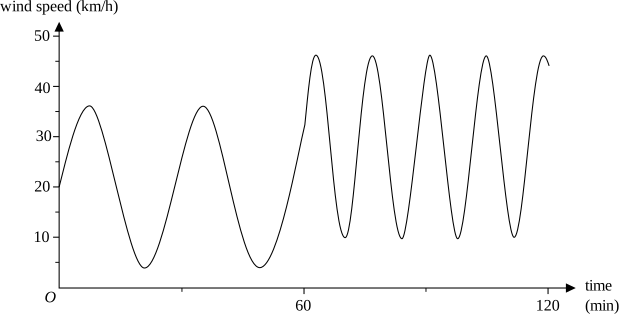
where  `v_1`  is the speed of the wind, in kilometres per hour, `t` is the time, in minutes, after 9 am and  `k ∈ R^+`. The wind speed after 9 am is shown in the diagram below.
 

  1. Find the smallest value of `k`, correct to four decimal places, such that  `v(t)`  and  `v_1(t)`  are equal and are both increasing at 10 am.   (2 marks)

    --- 2 WORK AREA LINES (style=lined) ---

  2. Another possible value of `k` was found to be 31.4358


    Using this value of `k`, the weather monitoring station sends a signal when the wind speed is greater than 38 km/h.


    i.  Find the value of `t` at which a signal is first sent, correct to two decimal places.   (1 mark)

    --- 2 WORK AREA LINES (style=lined) ---


    ii. Find the proportion of one cycle, to the nearest whole percent, for which  `v_1 > 38`.   (2 marks)

    --- 5 WORK AREA LINES (style=lined) ---

  3. Let  `f(x) = 20 + 16 sin ((pi x)/(14))`  and  `g(x) = 28 + 18 sin ((pi(x-k))/(7))`.
     
    The transformation  `T([(x),(y)]) = [(a \ \ \ \ 0),(0 \ \ \ \ b)][(x),(y)] + [(c),(d)]`  maps the graph of  `f`  onto the graph of  `g`.


    State the values of  `a`, `b`, `c` and `d`, in terms of `k` where appropriate.   (3 marks)

    --- 11 WORK AREA LINES (style=lined) ---

Show Answers Only
  1. `28`
  2. `v_text(max) \ = 36 \ text(km/h)`


    `v_text(min) \ = 4 \ text(km/h)`

  3. `32.5093 \ text(km/h)`
  4. `20.45 \ text(km/h)`
  5. `3.4358`
  6. i. `60.75 \ text(m)`


    ii. `31text(%)`

  7. `a = (1)/(2) \ , \ b = (9)/(8) \ , \ c = k \ , \ d = (11)/(2)`
Show Worked Solution

a.    `text(Amplitude) = 16`

`text{Find Period (n):}`

`(2 pi)/(n)` `= (pi)/(14)`
`n` `= 28`


b.    `v_text(max) = 20 + 16 = 36 \ text(km/h)`

`v_text(min) = 20-16 = 4 \ text(km/h)`


c.    `v(60)` `= 20 + 16 sin ((60 pi)/(14))`
  `= 32.5093 \ \ text(km/h)`


d.    `v(t)\ \ text(is always positive.)`

`s(t) = int_0^60 v(t) \ dt`

`v(t)_(avg)` `= (1)/(60) int_0^60 20 + 16 sin ((pi t)/(14))\ dt`
  `= 20.447`
  `= 20.45 \ text(km/h) \ \ text((to 2 d.p.))`


e.    `text(S) text{olve (for}\ k text{):} \ \ v(60) = v_1(60)`

`k = 3.4358 \ \ text((to 4 d.p.))`


f.i.  `text(S) text(olve for) \ t , \ text(given) \ \ v_1(t) = 38 \ \ text(and) \ \ k = 31.4358`

`=> t = 60.75 \ text(minutes)`
 

f.ii.  `text(S) text(olving for) \ \ v_1(t) = 38 \ , \ k = 31.4358`

`t_1 = 60.75 \ text{(part i)}, \ t_2 = 65.123`

`text(Period of) \ \ v_1 = (2 pi)/(n) = (pi)/(7)\ \ => \ n = 14`

`:. \ text(Proportion of cycle)` `= (65.123-60.75)/(14)`
  `= 0.312`
  `= 31 text{%  (nearest %)}`


g.    `f(x) → g(x)`

`y^{prime} = 28 + 18 sin ({pi(x^{prime}-k)}/{7})`

`x^{prime} = ax + c` `\ \ \ \ \ \ y^{prime} = by + d`


`text(Using) \ \ y^{prime} = by + d`

`28 + 18 sin ({pi(x^{prime}-k)}/{7}) = b (20 + 16 sin ({pi x}/{14})) + d`
 

`text(Equating coefficients of) \ \ sin theta :`

`16b = 18 \ \ \ => \ b = (9)/(8)`
 

`text(Equating constants:)`

`20 xx (9)/(8) + d = 28 \ \ \ => \ \ d = (11)/(2)`

`(x^{prime}-k)/(7)` `= (x)/(14)`
`x^{prime}` `= (x)/(2) + k \ \ => \ \ a = (1)/(2) \ , \ c = k`


`a = (1)/(2) \ , \ b = (9)/(8) \ , \ c = k \ , \ d = (11)/(2)`

Filed Under: Transformations, Trig Graphing Tagged With: Band 4, Band 5, Band 6, smc-2757-10-Sin, smc-2757-30-Find period, smc-2757-40-Find amplitude, smc-2757-80-Applications, smc-2757-85-Max/min (non-calc), smc-753-60-Matrix

Calculus, MET2 2019 VCAA 3

During a telephone call, a phone uses a dual-tone frequency electrical signal to communicate with the telephone exchange.

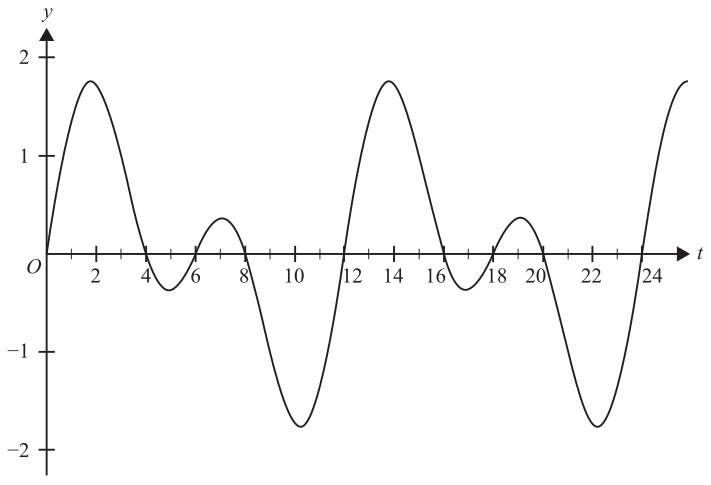
The strength, `f`, of a simple dual-tone frequency signal is given by the function  `f(t) = sin((pi t)/3) + sin ((pi t)/6)`, where  `t`  is a measure of time and  `t >= 0`.

Part of the graph of `y = f(t)`  is shown below

  1. State the period of the function.   (1 mark)

    --- 5 WORK AREA LINES (style=lined) ---

  2. Find the values of  `t`  where  `f(t) = 0`  for the interval  `t in [0, 6]`.   (1 mark)

    --- 5 WORK AREA LINES (style=lined) ---

  3. Find the maximum strength of the dual-tone frequency signal, correct to two decimal places.   (1 mark)

    --- 5 WORK AREA LINES (style=lined) ---

  4. Find the area between the graph of  `f`  and the horizontal axis for  `t in [0, 6]`.   (2 marks)

    --- 5 WORK AREA LINES (style=lined) ---

Let  `g`  be the function obtained by applying the transformation  `T`  to the function  `f`, where
 

`T([(x), (y)]) = [(a, 0), (0, b)] [(x), (y)] + [(c), (d)]`
 

and `a, b, c` and `d` are real numbers.

  1. Find the values of `a, b, c` and `d` given that  `int_2^0 g(t)\ dt + int_2^6 g(t)\ dt`  has the same area calculated in part d.   (2 marks)

    --- 5 WORK AREA LINES (style=lined) ---

  2. The rectangle bounded by the line  `y = k, \ k in R^+`, the horizontal axis, and the lines  `x = 0`  and  `x = 12`  has the same area as the area between the graph of  `f`  and the horizontal axis for one period of the dual-tone frequency signal.


    Find the value of  `k`.   (2 marks)

    --- 5 WORK AREA LINES (style=lined) ---

Show Answers Only
  1. `12`
  2. `0, 4, 6`
  3. `1.760`
  4. `15/pi\ text(u²)`
  5. `a = 1,\ b =-1,\ c =-6,\ d = 0`
  6. `5/(2pi)`
Show Worked Solution

a.   `text(Period) = 12`
  

b.   `t = 0, 4, 6`
  

c.   `f(t) = sin ((pi t)/3) + sin ((pi t)/6)`

`f(t)_max ~~ 1.76\ \ text{(by CAS)}`


d.    `text(Area)` `= int_0^4 sin((pi t)/3) + sin ((pi t)/6) dt-int_4^6 sin ((pi t)/3) + sin ((pi t)/6) dt`
    `= 15/pi\ text(u²)`


e.   `text(Same area) => f(t)\ text(is reflected in the)\ x text(-axis and)`

`text(translated 6 units to the left.)`

`x′=ax+c`

`y′=by+d`

`text(Reflection in)\ xtext(-axis) \ => \ b=-1, \ d=0`

`text(Translate 6 units to the left) \ => \ a=1, \ c=-6`

`:. a = 1,\ b = -1,\ c = -6,\ d = 0`
  

f.    `text(Area of rectangle)` `= 2 xx text(Area between)\ f(t) and x text(-axis)\ \ t in [0, 6]`
  `12k` `= 2 xx 15/pi`
  `:. k` `=5/(2pi)`

Filed Under: Area Under Curves, Trig Graphing Tagged With: Band 3, Band 4, Band 5, Band 6, smc-2757-10-Sin, smc-2757-30-Find period, smc-2757-85-Max/min (non-calc), smc-723-60-Trig

Graphs, MET2 2019 VCAA 10 MC

Which one of the following statements is true for  `f: R -> R, \ f(x) = x + sin(x)`?

  1. The graph of  `f` has a horizontal asymptote
  2. There are infinitely many solutions to  `f(x) = 4`
  3. `f` has a period of  `2 pi`
  4. `f^{\prime}(x) >= 0`  for  `x in R`
  5. `f^{\prime}(x) = cos(x)`
Show Answers Only

`D`

Show Worked Solution

`text(By CAS, sketch)\ \ f(x) = x + sin(x):`

`text(By inspection, eliminate A, B, C)`

`text(By CAS, sketch)\ \ d/(dx)\ f(x):`

` text(Graph range) >= 0\ \ text(for)\ \ x in R`
 

`=>   D`

Filed Under: Trig Graphing Tagged With: Band 4, smc-2757-10-Sin, smc-2757-50-Identify graph

Graphs, MET2 2019 VCAA 1 MC

Let  `f: R -> R,\ \ f(x) = 3 sin ((2x)/5) - 2`.

The period and range of  `f`  are respectively

  1. `5 pi`  and  `[-3, 3]`
  2. `5 pi`  and  `[-5, 1]`
  3. `5 pi`  and  `[-1, 5]`
  4. `(5 pi)/2`  and  `[-5, 1]`
  5. `(5 pi)/2`  and  `[-3, 3]`
Show Answers Only

`B`

Show Worked Solution
`text(Period)` `= (2pi)/n`
  `= (2 pi)/(2/5)`
  `= 5 pi`
   
`text(Range)` `= [-2 -3, -2 + 3]`
  `= [-5, 1]`

 
`=>   B`

Filed Under: Trig Graphing Tagged With: Band 3, smc-2757-10-Sin, smc-2757-30-Find period, smc-2757-35-Find range

Graphs, MET2 2017 VCAA 1 MC

Let  `f : R → R, \ f (x) = 5sin(2x) - 1`.

The period and range of this function are respectively

  1. `π\ text(and)\ [−1, 4]`
  2. `2π\ text(and)\ [−1, 5]`
  3. `π\ text(and)\ [−6, 4]`
  4. `2π\ text(and)\ [−6, 4]`
  5. `4π\ text(and)\ [−6, 4]`
Show Answers Only

`C`

Show Worked Solution

`text(Period) = (2pi)/2 = pi`

`text(Range)` `= [−1 – 5, −1 + 5]`
  `= [−6 ,4]`

`=> C`

Filed Under: Trig Graphing Tagged With: Band 2, smc-2757-10-Sin, smc-2757-30-Find period, smc-2757-35-Find range

Graphs, MET1 SM-Bank 27

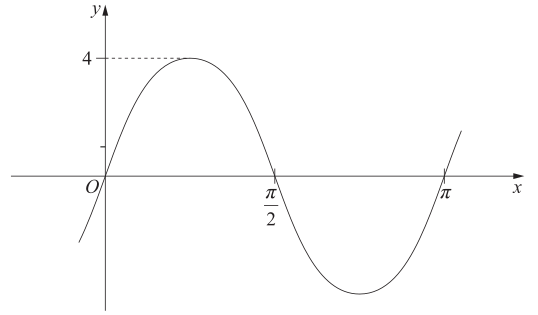
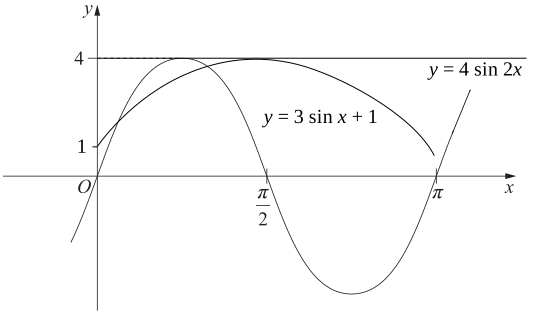
The graph shown is  `y = A sin bx`.

  1. Write down the value of  `A`.   (1 mark)

    --- 1 WORK AREA LINES (style=lined) ---
  2. Find the value of  `b`.   (1 mark)

    --- 6 WORK AREA LINES (style=lined) ---
  3. Copy or trace the graph into your writing booklet.


    On the same set of axes, draw the graph  `y = 3 sin x + 1`  for  `0 <= x <= pi`.   (2 marks)

    --- 10 WORK AREA LINES (style=blank) ---

Show Answers Only
  1. `A = 4`
  2. `b = 2`
  3. `text(See Worked Solutions for sketch)`
Show Worked Solution

a.   `A = 4`

b.  `text(S)text(ince the graph passes through)\ \ (pi/4, 4)`

`text(Substituting into)\ \ y = 4 sin bx`

`4 sin (b xx pi/4)` `=4`
`sin (b xx pi/4)` `= 1`
`b xx pi/4` `= pi/2`
`:. b` `= 2`


 MARKER’S COMMENT: Graphs are consistently drawn too small by many students. Aim to make your diagrams 1/3 to 1/2 of a page. 
c.

Filed Under: Trig Graphing Tagged With: Band 3, Band 4, smc-2757-10-Sin, smc-2757-30-Find period, smc-2757-40-Find amplitude, smc-2757-70-Sketch graph

Graphs, MET2 2016 VCAA 6 MC

Consider the graph of the function defined by  `f: [0, 2 pi] -> R,\ f(x) = sin (2x).`

The square of the length of the line segment joining the points on the graph for which  `x = pi/4 and x = (3 pi)/4` is

  1. `(pi^2 + 16)/4`
  2. `pi + 4`
  3. `4`
  4. `(3 pi^2 + 16 pi)/4`
  5. `(10 pi^2)/16`
Show Answers Only

`A`

Show Worked Solution

`text(When)\ \ x=pi/4,\ \ f(x) = sin(pi/2)=1`

`text(When)\ \ x=(3pi)/4,\ \ f(x) = sin((3pi)/2)=-1`

`text(Let)\ \ z` `= text(distance between)\ (pi/4, 1) and ((3pi)/4, −1)`
`z^2` `= ((3pi)/4 – pi/4)^2 + (−1 −1)^2`
   `=pi^2/4 + 4`
  `= (pi^2 + 16)/4`

`=>   A`

Filed Under: Coordinate Geometry, Trig Graphing Tagged With: Band 4, smc-2757-10-Sin, smc-2757-80-Applications, smc-727-20-Distance

Algebra, MET2 2012 VCAA 1 MC

The function with rule  `f(x) = −3sin((pix)/5)`  has period

  1. `3`
  2. `5`
  3. `10`
  4. `pi/5`
  5. `pi/10`
Show Answers Only

`=> C`

Show Worked Solution
`text(Period)` `= (2pi)/n`
  `= (2pi)/(pi/5)`
  `= 10`

 
`=> C`

Filed Under: Trig Graphing Tagged With: Band 2, smc-2757-10-Sin, smc-2757-30-Find period

Functions, MET1 2010 VCAA 4a

Write down the amplitude and period of the function

`qquad f: R -> R,\ \ f(x) = 4 sin ((x + pi)/3)`.   (2 marks)

--- 3 WORK AREA LINES (style=lined) ---
Show Answers Only

`text(Amplitude) = 4;\ \ text(Period) = 6 pi`

Show Worked Solution

`text(Amplitude) = 4`

`text(Period):\ \ (2 pi)/n = (2 pi)/(1/3) = 6 pi`

Filed Under: Trig Graphing Tagged With: Band 3, smc-2757-10-Sin, smc-2757-30-Find period, smc-2757-40-Find amplitude

Functions, MET1 2012 VCAA 6

The graphs of  `y = cos (x) and y = a sin (x)`,  where `a` is a real constant, have a point of intersection at  `x = pi/3.`

  1. Find the value of `a`.  (2 marks)

    --- 5 WORK AREA LINES (style=lined) ---
  2. If  `x in [0, 2 pi]`, find the `x`-coordinate of the other point of intersection of the two graphs.  (1 mark)

    --- 3 WORK AREA LINES (style=lined) ---
Show Answers Only
  1. `1/sqrt 3`
  2. `(4 pi)/3`
Show Worked Solution

a.   `text(Intersection occurs when)\ \ x=pi/3,`

`a sin(pi/3)` `= cos (pi/3)`
`tan(pi/3)` `= 1/a`
`sqrt 3` `=1/a`
`:. a` `=1/sqrt3`


b.   `tan (x)` `= sqrt 3`
  `x` `= pi/3, (4 pi)/3, 2pi+ pi/3, …\ text(but)\ x in [0, 2 pi]`
  `:. x` `= (4 pi)/3`

Filed Under: Trig Graphing Tagged With: Band 3, Band 5, smc-2757-10-Sin, smc-2757-15-Cos, smc-2757-40-Find amplitude, smc-2757-80-Applications

Graphs, MET2 2015 VCAA 1 MC

Let `f: R -> R,\ f(x) = 2sin(3x) - 3.`

The period and range of this function are respectively

  1. `text(period) = (2 pi)/3 and text(range) = text{[−5, −1]}`
  2. `text(period) = (2 pi)/3 and text(range) = text{[−2, 2]}`
  3. `text(period) = pi/3 and text(range) = text{[−1, 5]}`
  4. `text(period) = 3 pi and text(range) = text{[−1, 5]}`
  5. `text(period) = 3 pi and text(range) = text{[−2, 2]}`
Show Answers Only

`A`

Show Worked Solution

`text(Range:)\ [−3 – 2, −3 + 2]`

`= [−5,−1]`

`text(Period) = (2pi)/n = (2pi)/3`

`=>   A`

Filed Under: Trig Graphing Tagged With: Band 1, smc-2757-10-Sin, smc-2757-30-Find period, smc-2757-35-Find range

Graphs, MET2 2008 VCAA 10 MC

The range of the function  `f: [pi/8, pi/3) -> R,\ f(x) = 2 sin (2x)`  is

  1. `(sqrt 2, sqrt 3]`
  2. `[sqrt 2, 2)`
  3. `[sqrt 2, 2]`
  4. `(sqrt 2, sqrt 3)`
  5. `[sqrt 2, sqrt 3)`
Show Answers Only

`C`

Show Worked Solution

♦ Mean mark 45%.

`:.\ text(Range) = [sqrt 2, 2],`

`=>   C`

Filed Under: Trig Graphing Tagged With: Band 5, smc-2757-10-Sin, smc-2757-35-Find range

Copyright © 2014–2025 SmarterEd.com.au · Log in