SmarterEd

Aussie Maths & Science Teachers: Save your time with SmarterEd

  • Login
  • Get Help
  • About

Calculus, MET2 2022 VCAA 2

On a remote island, there are only two species of animals: foxes and rabbits. The foxes are the predators and the rabbits are their prey.

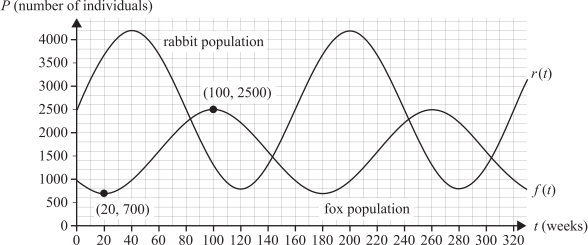
The populations of foxes and rabbits increase and decrease in a periodic pattern, with the period of both populations being the same, as shown in the graph below, for all `t \geq 0`, where time `t` is measured in weeks.

One point of minimum fox population, (20, 700), and one point of maximum fox population, (100, 2500), are also shown on the graph.

The graph has been drawn to scale.
 

The population of rabbits can be modelled by the rule `r(t)=1700 \sin \left(\frac{\pi t}{80}\right)+2500`.

  1.   i. State the initial population of rabbits.   (1 mark)

    --- 2 WORK AREA LINES (style=lined) ---

  2.  ii. State the minimum and maximum population of rabbits.   (1 mark)

    --- 2 WORK AREA LINES (style=lined) ---

  3. iii. State the number of weeks between maximum populations of rabbits.   (1 mark)

    --- 2 WORK AREA LINES (style=lined) ---

The population of foxes can be modelled by the rule `f(t)=a \sin (b(t-60))+1600`.

  1. Show that `a=900` and `b=\frac{\pi}{80}`.   (2 marks)

    --- 4 WORK AREA LINES (style=lined) ---

  2. Find the maximum combined population of foxes and rabbits. Give your answer correct to the nearest whole number.   (1 mark)

    --- 1 WORK AREA LINES (style=lined) ---

  3. What is the number of weeks between the periods when the combined population of foxes and rabbits is a maximum?   (1 mark)

    --- 1 WORK AREA LINES (style=lined) ---

The population of foxes is better modelled by the transformation of `y=\sin (t)` under `Q` given by

 

  1. Find the average population during the first 300 weeks for the combined population of foxes and rabbits, where the population of foxes is modelled by the transformation of `y=\sin(t)` under the transformation `Q`. Give your answer correct to the nearest whole number.   (4 marks)

    --- 8 WORK AREA LINES (style=lined) ---

Over a longer period of time, it is found that the increase and decrease in the population of rabbits gets smaller and smaller.

The population of rabbits over a longer period of time can be modelled by the rule

`s(t)=1700cdote^(-0.003t)cdot sin((pit)/80)+2500,\qquad text(for all)\ t>=0`

  1. Find the average rate of change between the first two times when the population of rabbits is at a maximum. Give your answer correct to one decimal place.   (2 marks)

    --- 3 WORK AREA LINES (style=lined) ---

  2. Find the time, where `t>40`, in weeks, when the rate of change of the rabbit population is at its greatest positive value. Give your answer correct to the nearest whole number.   (2 marks)

    --- 3 WORK AREA LINES (style=lined) ---

  3. Over time, the rabbit population approaches a particular value.
  4. State this value.   (1 mark)

    --- 1 WORK AREA LINES (style=lined) ---
Show Answers Only

ai.   `r(0)=2500`

aii.  Minimum population of rabbits `= 800`

Maximum population of rabbits `= 4200`

aiii. `160`  weeks

b.    See worked solution.

c.    `~~ 5339` (nearest whole number)

d.    Weeks between the periods is 160

e.    `~~ 4142` (nearest whole number)

f.    Average rate of change `=-3.6` rabbits/week (1 d.p.)

g.    `t = 156` weeks (nearest whole number)  

h.    ` s → 2500`

Show Worked Solution

ai.  Initial population of rabbits

From graph when `t=0, \ r(0) = 2500`

Using formula when `t=0`

`r(t)` `= 1700\ sin \left(\frac{\pi t}{80}\right)+2500`  
`r(0)` `= 1700\ sin \left(\frac{\pi xx 0}{80}\right)+2500 = 2500`  rabbits  


aii.
From graph,

Minimum population of rabbits `= 800`

Maximum population of rabbits `= 4200`

OR

Using formula

Minimum is when `t = 120`

`r(120) = 1700\ sin \left(\frac{\pi xx 120}{80}\right)+2500 = 1700 xx (-1) + 2500 = 800`

Maximum is when `t = 40`

`r(40) = 1700\ sin \left(\frac{\pi xx 40}{80}\right)+2500 = 1700 xx (1) + 2500 = 4200`

 
aiii. Number of weeks between maximum populations of rabbits `= 200-40 = 160`  weeks

 
b.  Period of foxes = period of rabbits = 160:

`frac{\2pi}{b} = 160`

`:.\  b = frac{\2pi}{160} = frac{\pi}{80}` which is the same period as the rabbit population.

Using the point `(100 , 2500)`

Amplitude when `b = frac{\pi}{80}`: 

`f(t)` `=a \ sin (pi/80(t-60))+1600`  
`f(100)` `= 2500`  
`2500` `= a \ sin (pi/80(100-60))+1600`  
`2500` `= a \ sin (pi/2)+1600`  
`a` `= 2500-1600 = 900`  

 
`:.\  f(t)= 900 \ sin (pi/80)(t-60) + 1600`


c.    Using CAS find `h(t) = f(t) + r(t)`:

`h(t):=900 \cdot \sin \left(\frac{\pi}{80} \cdot(t-60)\right)+1600+1700\cdot \sin \left(\frac{\pit}{80}\right) +2500`

  
`text{fMax}(h(t),t)|0 <= t <= 160`      `t = 53.7306….`
  

`h(53.7306…)=5339.46`

  
Maximum combined population `~~ 5339` (nearest whole number)


♦♦ Mean mark (c) 40%.
MARKER’S COMMENT: Many rounding errors with a common error being 5340. Many students incorrectly added the max value of rabbits to the max value of foxes, however, these points occurred at different times.

d.    Using CAS, check by changing domain to 0 to 320.

`text{fMax}(h(t),t)|0 <= t <= 320`     `t = 213.7305…`
 
`h(213.7305…)=5339.4568….`
 
Therefore, the number of weeks between the periods is 160.
  

e.    Fox population:

`t^{\prime} = frac{90}{pi}t + 60`   →   `t = frac{pi}{90}(t^{\prime}-60)`

`y^{\prime} = 900y+1600`   →   `y = frac{1}{900}(y^{\prime}-1600)`

`frac{y^{\prime}-1600}{900} = sin(frac{pi(t^{\prime}-60)}{90})`

`:.\  f(t) = 900\ sin\frac{pi}{90}(t-60) + 1600`

  
Average combined population  [Using CAS]   
  
`=\frac{1}{300} \int_0^{300} left(\900 \sin \left(\frac{\pi(t-60)}{90}\right)+1600+1700\ sin\ left(\frac{\pi t}{80}\right)+2500\right) d t`
  

`= 4142.2646…..  ~~ 4142` (nearest whole number)


♦ Mean mark (e) 40%.
MARKER’S COMMENT: Common incorrect answer 1600. Some incorrectly subtracted `r(t)`. Others used average rate of change instead of average value.

f.   Using CAS

`s(t):= 1700e^(-0.003t) dot\sin\frac{pit}{80} + 2500`
 

`text{fMax}(s(t),t)|0<=t<=320`        `x = 38.0584….`
 

`s(38.0584….)=4012.1666….`
 

`text{fMax}(s(t),t)|160<=t<=320`     `x = 198.0584….`
 

`s(198.0584….)=3435.7035….`
 

Av rate of change between the points

`(38.058 , 4012.167)`  and  `(198.058 , 3435.704)`

`= frac{4012.1666….-3435.7035….}{38.0584….-198.0584….} =-3.60289….`
 

`:.` Average rate of change `=-3.6` rabbits/week (1 d.p.)


♦ Mean mark (f ) 45%.
MARKER’S COMMENT: Some students rounded too early.
`frac{s(200)-s(40)}{200-40}` was commonly seen.
Some found average rate of change between max and min populations.

g.   Using CAS

`s^(primeprime)(t) = 0` , `t = 80(n-0.049) \ \forall n \in Z`

After testing `n = 1, 2, 3, 4` greatest positive value occurs for `n = 2` 

`t` `= 80(n-0.049)`  
  `= 80(2-0.049)`  
  `= 156.08`  

 
`:. \ t = 156` weeks (nearest whole number)


♦♦♦ Mean mark (g) 25%.
MARKER’S COMMENT: Many students solved `frac{ds}{dt}=0`.
A common answer was 41.8, as `s(156.11…)=41.79`.
Another common incorrect answer was 76 weeks.

h.   As `t → ∞`, `e^(-0.003t) → 0`

`:.\ s → 2500`

Filed Under: Average Value and Other, Differentiation (Trig), Maxima and Minima, Trig Differentiation Tagged With: Band 2, Band 4, Band 5, Band 6, smc-2757-10-Sin, smc-2757-80-Applications, smc-641-60-Other themes, smc-736-10-sin, smc-744-10-sin, smc-753-60-Matrix, smc-756-20-Trig

Graphs, MET1 2022 VCAA 6

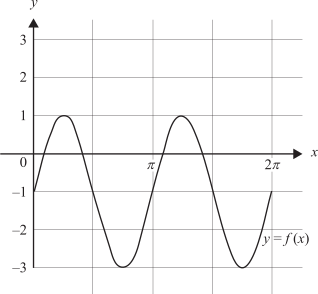
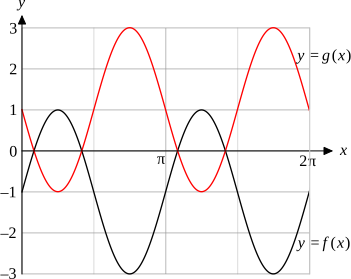
The graph of `y=f(x)`, where `f:[0,2 \pi] \rightarrow R, f(x)=2 \sin(2x)-1`, is shown below.
 

  1. On the axes above, draw the graph of `y=g(x)`, where `g(x)` is the reflection of `f(x)` in the horizontal axis.   (2 marks)

    --- 0 WORK AREA LINES (style=lined) ---

  2. Find all values of `k` such that `f(k)=0` and `k \in[0,2 \pi]`.   (3 marks)

    --- 5 WORK AREA LINES (style=lined) ---

  3. Let `h: D \rightarrow R, h(x)=2 \sin(2x)-1`, where `h(x)` has the same rule as `f(x)` with a different domain.
  4. The graph of `y=h(x)` is translated `a` units in the positive horizontal direction and `b` units in the positive vertical direction so that it is mapped onto the graph of `y=g(x)`, where `a, b \in(0, \infty)`.
    1. Find the value for `b`.   (1 mark)

      --- 2 WORK AREA LINES (style=lined) ---

    2. Find the smallest positive value for `a`.   (1 mark)

      --- 2 WORK AREA LINES (style=lined) ---

    3. Hence, or otherwise, state the domain, `D`, of `h(x)`.   (1 mark)

      --- 2 WORK AREA LINES (style=lined) ---

Show Answers Only

a.    Graph `y=g(x)`

b.    `\frac{\pi}{12}, \frac{5 \pi}{12}, \frac{13 \pi}{12}, \frac{17 \pi}{12}`

c.i.    `b=2`

cii.    `=\frac{\pi}{2}`

ciii.   `\left[-\frac{\pi}{2}, \frac{3 \pi}{2}\right]`

Show Worked Solution

a.

b.  `2 \sin (2 k)-1` `=0`       `0<=k<=2\pi`  
`sin (2 k)` `=1/2`  
`2k` `=\frac{\pi}{6}, \frac{5 \pi}{6}, \frac{13 \pi}{6}, \frac{17 \pi}{6}`  
`k` `=\frac{\pi}{12}, \frac{5 \pi}{12}, \frac{13 \pi}{12}, \frac{17 \pi}{12}`  


c.i   ` 2 \sin 2(x-a)-1+b` `=-(2 \sin 2 x-1)`  
`:.\ -1+b` `=1`  
`b` `=2`  


c.ii  `2 \sin 2(x-a)` `=-(2 \sin 2 x-1)`  
`\sin (2 x-2 a)` `=-\sin 2 x`  
`\therefore 2 a` `=\pi`  
`a` `=\frac{\pi}{2}`  

♦ Mean mark (c.ii) 50%.
MARKER’S COMMENT: Students confused vertical and horizontal translations. Common error `a=\frac{\pi}{4}.`

c.iii The domain for `f(x)` is `[0,2pi]`

`:. \ D` is `\left[-\frac{\pi}{2}, \frac{3 \pi}{2}\right]`

 
♦♦♦ Mean mark (c.iii) 10%.
MARKER’S COMMENT: Common error was translating in the wrong direction. A common incorrect answer was `\left[-\frac{\pi}{2}, \frac{5 \pi}{2}\right].`

Filed Under: Trig Graphing Tagged With: Band 4, Band 5, Band 6, smc-2757-10-Sin, smc-2757-70-Sketch graph, smc-2757-80-Applications

Trigonometry, MET2-NHT 2019 VCAA 2

The wind speed at a weather monitoring station varies according to the function

`v(t) = 20 + 16sin ((pi t)/(14))`

where `v` is the speed of the wind, in kilometres per hour (km/h), and  `t`  is the time, in minutes, after 9 am.

  1. What is the amplitude and the period of  `v(t)`?   (2 marks)

    --- 3 WORK AREA LINES (style=lined) ---

  2. What are the maximum and minimum wind speeds at the weather monitoring station?   (1 mark)

    --- 2 WORK AREA LINES (style=lined) ---

  3. Find  `v(60)`, correct to four decimal places.   (1 mark)

    --- 2 WORK AREA LINES (style=lined) ---

  4. Find the average value of  `v(t)`  for the first 60 minutes, correct to two decimal places.   (2 marks)

    --- 5 WORK AREA LINES (style=lined) ---

A sudden wind change occurs at 10 am. From that point in time, the wind speed varies according to the new function

                    `v_1(t) = 28 + 18 sin((pi(t-k))/(7))`

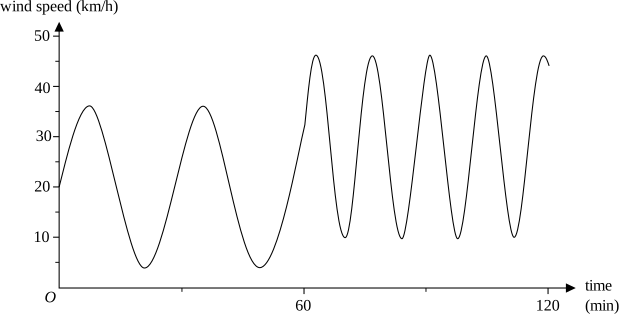
where  `v_1`  is the speed of the wind, in kilometres per hour, `t` is the time, in minutes, after 9 am and  `k ∈ R^+`. The wind speed after 9 am is shown in the diagram below.
 

  1. Find the smallest value of `k`, correct to four decimal places, such that  `v(t)`  and  `v_1(t)`  are equal and are both increasing at 10 am.   (2 marks)

    --- 2 WORK AREA LINES (style=lined) ---

  2. Another possible value of `k` was found to be 31.4358


    Using this value of `k`, the weather monitoring station sends a signal when the wind speed is greater than 38 km/h.


    i.  Find the value of `t` at which a signal is first sent, correct to two decimal places.   (1 mark)

    --- 2 WORK AREA LINES (style=lined) ---


    ii. Find the proportion of one cycle, to the nearest whole percent, for which  `v_1 > 38`.   (2 marks)

    --- 5 WORK AREA LINES (style=lined) ---

  3. Let  `f(x) = 20 + 16 sin ((pi x)/(14))`  and  `g(x) = 28 + 18 sin ((pi(x-k))/(7))`.
     
    The transformation  `T([(x),(y)]) = [(a \ \ \ \ 0),(0 \ \ \ \ b)][(x),(y)] + [(c),(d)]`  maps the graph of  `f`  onto the graph of  `g`.


    State the values of  `a`, `b`, `c` and `d`, in terms of `k` where appropriate.   (3 marks)

    --- 11 WORK AREA LINES (style=lined) ---

Show Answers Only
  1. `28`
  2. `v_text(max) \ = 36 \ text(km/h)`


    `v_text(min) \ = 4 \ text(km/h)`

  3. `32.5093 \ text(km/h)`
  4. `20.45 \ text(km/h)`
  5. `3.4358`
  6. i. `60.75 \ text(m)`


    ii. `31text(%)`

  7. `a = (1)/(2) \ , \ b = (9)/(8) \ , \ c = k \ , \ d = (11)/(2)`
Show Worked Solution

a.    `text(Amplitude) = 16`

`text{Find Period (n):}`

`(2 pi)/(n)` `= (pi)/(14)`
`n` `= 28`


b.    `v_text(max) = 20 + 16 = 36 \ text(km/h)`

`v_text(min) = 20-16 = 4 \ text(km/h)`


c.    `v(60)` `= 20 + 16 sin ((60 pi)/(14))`
  `= 32.5093 \ \ text(km/h)`


d.    `v(t)\ \ text(is always positive.)`

`s(t) = int_0^60 v(t) \ dt`

`v(t)_(avg)` `= (1)/(60) int_0^60 20 + 16 sin ((pi t)/(14))\ dt`
  `= 20.447`
  `= 20.45 \ text(km/h) \ \ text((to 2 d.p.))`


e.    `text(S) text{olve (for}\ k text{):} \ \ v(60) = v_1(60)`

`k = 3.4358 \ \ text((to 4 d.p.))`


f.i.  `text(S) text(olve for) \ t , \ text(given) \ \ v_1(t) = 38 \ \ text(and) \ \ k = 31.4358`

`=> t = 60.75 \ text(minutes)`
 

f.ii.  `text(S) text(olving for) \ \ v_1(t) = 38 \ , \ k = 31.4358`

`t_1 = 60.75 \ text{(part i)}, \ t_2 = 65.123`

`text(Period of) \ \ v_1 = (2 pi)/(n) = (pi)/(7)\ \ => \ n = 14`

`:. \ text(Proportion of cycle)` `= (65.123-60.75)/(14)`
  `= 0.312`
  `= 31 text{%  (nearest %)}`


g.    `f(x) → g(x)`

`y^{prime} = 28 + 18 sin ({pi(x^{prime}-k)}/{7})`

`x^{prime} = ax + c` `\ \ \ \ \ \ y^{prime} = by + d`


`text(Using) \ \ y^{prime} = by + d`

`28 + 18 sin ({pi(x^{prime}-k)}/{7}) = b (20 + 16 sin ({pi x}/{14})) + d`
 

`text(Equating coefficients of) \ \ sin theta :`

`16b = 18 \ \ \ => \ b = (9)/(8)`
 

`text(Equating constants:)`

`20 xx (9)/(8) + d = 28 \ \ \ => \ \ d = (11)/(2)`

`(x^{prime}-k)/(7)` `= (x)/(14)`
`x^{prime}` `= (x)/(2) + k \ \ => \ \ a = (1)/(2) \ , \ c = k`


`a = (1)/(2) \ , \ b = (9)/(8) \ , \ c = k \ , \ d = (11)/(2)`

Filed Under: Transformations, Trig Graphing Tagged With: Band 4, Band 5, Band 6, smc-2757-10-Sin, smc-2757-30-Find period, smc-2757-40-Find amplitude, smc-2757-80-Applications, smc-2757-85-Max/min (non-calc), smc-753-60-Matrix

Algebra, MET2 2017 VCAA 2

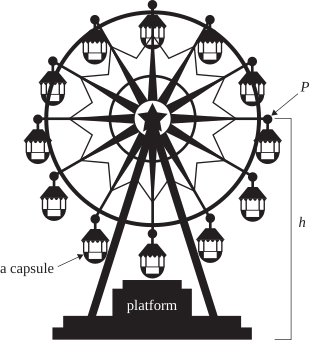
Sammy visits a giant Ferris wheel. Sammy enters a capsule on the Ferris wheel from a platform above the ground. The Ferris wheel is rotating anticlockwise. The capsule is attached to the Ferris wheel at point `P`. The height of `P` above the ground, `h`, is modelled by  `h(t) = 65-55cos((pit)/15)`, where `t` is the time in minutes after Sammy enters the capsule and `h` is measured in metres.

Sammy exits the capsule after one complete rotation of the Ferris wheel.


  1. State the minimum and maximum heights of `P` above the ground.   (1 mark)

    --- 2 WORK AREA LINES (style=lined) ---

  2. For how much time is Sammy in the capsule?   (1 mark)

    --- 2 WORK AREA LINES (style=lined) ---

  3. Find the rate of change of `h` with respect to `t` and, hence, state the value of `t` at which the rate of change of `h` is at its maximum.   (2 marks)

    --- 4 WORK AREA LINES (style=lined) ---

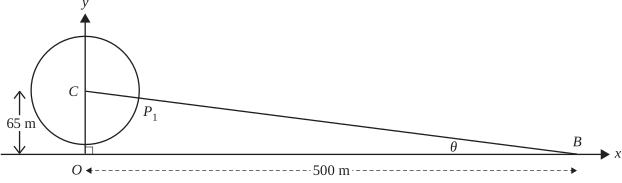
As the Ferris wheel rotates, a stationary boat at `B`, on a nearby river, first becomes visible at point `P_1`. `B` is 500 m horizontally from the vertical axis through the centre `C` of the Ferris wheel and angle `CBO = theta`, as shown below.


  1. Find `theta` in degrees, correct to two decimal places.   (1 mark)

    --- 3 WORK AREA LINES (style=lined) ---

Part of the path of `P` is given by  `y = sqrt(3025-x^2) + 65, x ∈ [-55,55]`, where `x` and `y` are in metres.

  1. Find `(dy)/(dx)`.   (1 mark)

    --- 2 WORK AREA LINES (style=lined) ---

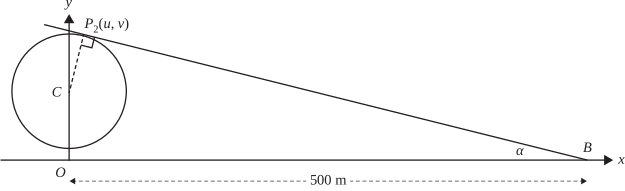
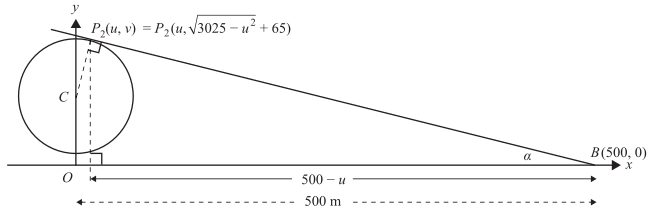
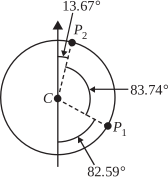
As the Ferris wheel continues to rotate, the boat at `B` is no longer visible from the point  `P_2(u, v)` onwards. The line through `B` and `P_2` is tangent to the path of `P`, where angle `OBP_2 = alpha`.


  1. Find the gradient of the line segment `P_2B` in terms of `u` and, hence, find the coordinates of `P_2`, correct to two decimal places.   (3 marks)

    --- 10 WORK AREA LINES (style=lined) ---

  2. Find `alpha` in degrees, correct to two decimal places.   (1 mark)

    --- 4 WORK AREA LINES (style=lined) ---

  3. Hence or otherwise, find the length of time, to the nearest minute, during which the boat at `B` is visible.   (2 marks)

    --- 5 WORK AREA LINES (style=lined) ---

Show Answers Only
  1. `h_text(min) = 10\ text(m), h_text(max) = 120\ text(m)`
  2. `30\ text(min)`
  3. `t = 7.5`
  4. `7.41^@`
  5. `(-x)/(sqrt(3025-x^2))`
  6. `P_2(13.00, 118.44)`
  7. `13.67^@`
  8. `7\ text(min)`
Show Worked Solution
a.    `h_text(min)` `= 65-55` `h_text(max)` `= 65 + 55`
    `= 10\ text(m)`   `= 120\ text(m)`


b.   `text(Period) = (2pi)/(pi/15) = 30\ text(min)`


c.   `h^{prime}(t) = (11pi)/3\ sin(pi/15 t)`

♦ Mean mark 50%.
MARKER’S COMMENT: A number of commons errors here – 2 answers given, calc not in radian mode, etc …


`text(Solve)\ h^{primeprime}(t) = 0, t ∈ (0,30)`

`t = 15/2\ \ text{(max)}`   `text(or)`   `t = 45/2\ \ text{(min – descending)}`

`:. t = 7.5`


d.   

♦ Mean mark 36%.
MARKER’S COMMENT: Choosing degrees vs radians in the correct context was critical here.

`tan(theta)` `= 65/500`
`:. theta` `=7.406…`
  `= 7.41^@`


e.    `(dy)/(dx)` `= (-x)/(sqrt(3025-x^2))`


f.   

`P_2(u,sqrt(3025-u^2) + 65),\ \ B(500,0)`

`:. m_(P_2B)` `= (sqrt(3025-u^2) + 65)/(u-500)`


`text{Using part (e), when}\ \ x=u,`

♦♦♦ Mean mark part (f) 18%.
MARKER’S COMMENT: Many students were unable to use the rise over run information to calculate the second gradient.

`dy/dx=(-u)/(sqrt(3025-u^2))`


`text{Solve (by CAS):}`

`(sqrt(3025-u^2) + 65)/(u-500)` `= (-u)/(sqrt(3025-u^2))\ \ text(for)\ u`


`u=12.9975…=13.00\ \ text{(2 d.p.)}`


`:. v` `= sqrt(3025-(12.9975…)^2) + 65`
  `= 118.4421…`
  `= 118.44\ \ text{(2 d.p.)}`


`:.P_2(13.00, 118.44)`


♦♦♦ Mean mark part (g) 7%.

g.    `tan alpha` `=v/(500-u)`
    `= (118.442…)/(500-12.9975…)`
  `:. alpha` `= 13.67^@\ \ text{(2 d.p.)}`


h.   

♦♦♦ Mean mark 5%.

`text(Find the rotation between)\ P_1 and P_2:`

`text(Rotation to)\ P_1 = 90-7.41=82.59^@`

`text(Rotation to)\ P_2 = 180-13.67=166.33^@`

`text(Rotation)\ \ P_1 → P_2 = 166.33-82.59 = 83.74^@`


`:.\ text(Time visible)` `= 83.74/360 xx 30\ text(min)`
  `=6.978…`
  `= 7\ text{min  (nearest degree)}`

Filed Under: Average Value and Other, Trig Graphing Tagged With: Band 2, Band 3, Band 4, Band 5, Band 6, page-break-before-question, smc-2757-15-Cos, smc-2757-80-Applications, smc-2757-85-Max/min (non-calc), smc-756-20-Trig

Graphs, MET2 2016 VCAA 6 MC

Consider the graph of the function defined by  `f: [0, 2 pi] -> R,\ f(x) = sin (2x).`

The square of the length of the line segment joining the points on the graph for which  `x = pi/4 and x = (3 pi)/4` is

  1. `(pi^2 + 16)/4`
  2. `pi + 4`
  3. `4`
  4. `(3 pi^2 + 16 pi)/4`
  5. `(10 pi^2)/16`
Show Answers Only

`A`

Show Worked Solution

`text(When)\ \ x=pi/4,\ \ f(x) = sin(pi/2)=1`

`text(When)\ \ x=(3pi)/4,\ \ f(x) = sin((3pi)/2)=-1`

`text(Let)\ \ z` `= text(distance between)\ (pi/4, 1) and ((3pi)/4, −1)`
`z^2` `= ((3pi)/4 – pi/4)^2 + (−1 −1)^2`
   `=pi^2/4 + 4`
  `= (pi^2 + 16)/4`

`=>   A`

Filed Under: Coordinate Geometry, Trig Graphing Tagged With: Band 4, smc-2757-10-Sin, smc-2757-80-Applications, smc-727-20-Distance

Functions, MET1 2012 VCAA 6

The graphs of  `y = cos (x) and y = a sin (x)`,  where `a` is a real constant, have a point of intersection at  `x = pi/3.`

  1. Find the value of `a`.  (2 marks)

    --- 5 WORK AREA LINES (style=lined) ---

  2. If  `x in [0, 2 pi]`, find the `x`-coordinate of the other point of intersection of the two graphs.  (1 mark)

    --- 3 WORK AREA LINES (style=lined) ---

Show Answers Only
  1. `1/sqrt 3`
  2. `(4 pi)/3`
Show Worked Solution

a.   `text(Intersection occurs when)\ \ x=pi/3,`

`a sin(pi/3)` `= cos (pi/3)`
`tan(pi/3)` `= 1/a`
`sqrt 3` `=1/a`
`:. a` `=1/sqrt3`


b.   `tan (x)` `= sqrt 3`
  `x` `= pi/3, (4 pi)/3, 2pi+ pi/3, …\ text(but)\ x in [0, 2 pi]`
  `:. x` `= (4 pi)/3`

Filed Under: Trig Graphing Tagged With: Band 3, Band 5, smc-2757-10-Sin, smc-2757-15-Cos, smc-2757-40-Find amplitude, smc-2757-80-Applications

Algebra, MET2 2014 VCAA 1

The population of wombats in a particular location varies according to the rule  `n(t) = 1200 + 400 cos ((pi t)/3)`, where `n` is the number of wombats and `t` is the number of months after 1 March 2013.

  1. Find the period and amplitude of the function `n`.   (2 marks)

    --- 3 WORK AREA LINES (style=lined) ---

  2. Find the maximum and minimum populations of wombats in this location.   (2 marks)

    --- 2 WORK AREA LINES (style=lined) ---

  3. Find  `n(10)`.   (1 mark)

    --- 1 WORK AREA LINES (style=lined) ---
  4. Over the 12 months from 1 March 2013, find the fraction of time when the population of wombats in this location was less than  `n(10)`.   (2 marks)

    --- 6 WORK AREA LINES (style=lined) ---
Show Answers Only
  1. `text(Period) = text(6 months);\ text(Amplitude) = 400`
  2. `text(Max) = 1600;\ text(Min) = 800`
  3. `1000`
  4. `1/3`
Show Worked Solution

a.   `text(Period) = (2pi)/n = (2pi)/(pi/3) = 6\ text(months)`

MARKER’S COMMENT: Expressing the amplitude as [800,1600] in part (a) is incorrect.

`text(A)text(mplitude) = 400`
  

b.   `text(Max:)\ 1200 + 400 = 1600\ text(wombats)`

`text(Min:)\ 1200-400 = 800\ text(wombats)`
  

c.   `n(10) = 1000\ text(wombats)`
   

d.    `text(Solve)\ n(t)` `= 1000\ text(for)\ t ∈ [0,12]`

`t= 2,4,8,10`

`text(S)text(ince the graph starts at)\ \ (0,1600),`

♦ Mean mark 48%.

`=> n(t) < 1000\ \ text(for)`

`t ∈ (2,4)\ text(or)\ t ∈ (8,10)`

`:.\ text(Fraction)` `= ((4-2) + (10-8))/12`
  `= 1/3\ \ text(year)`

Filed Under: Trig Graphing Tagged With: Band 2, Band 3, Band 4, smc-2757-15-Cos, smc-2757-30-Find period, smc-2757-40-Find amplitude, smc-2757-80-Applications, smc-2757-85-Max/min (non-calc)

Graphs, MET2 2013 VCAA 1

Trigg the gardener is working in a temperature-controlled greenhouse. During a particular 24-hour time interval, the temperature  `(Ttext{°C})` is given by  `T(t) = 25 + 2 cos ((pi t)/8), \ 0 <= t <= 24`, where `t` is the time in hours from the beginning of the 24-hour time interval.

  1. State the maximum temperature in the greenhouse and the values of `t` when this occurs.   (2 marks)

    --- 3 WORK AREA LINES (style=lined) ---
  2. State the period of the function `T.`   (1 mark)

    --- 2 WORK AREA LINES (style=lined) ---
  3. Find the smallest value of `t` for which  `T = 26.`   (2 marks)

    --- 3 WORK AREA LINES (style=lined) ---
  4. For how many hours during the 24-hour time interval is  `T >= 26?`   (2 marks)

    --- 3 WORK AREA LINES (style=lined) ---

Trigg is designing a garden that is to be built on flat ground. In his initial plans, he draws the graph of  `y = sin(x)`  for  `0 <= x <= 2 pi`  and decides that the garden beds will have the shape of the shaded regions shown in the diagram below. He includes a garden path, which is shown as line segment `PC.`

  1. The line through points  `P((2 pi)/3, sqrt 3/2)`  and  `C (c, 0)`  is a tangent to the graph of  `y = sin (x)`  at point `P.`

    1. Find  `(dy)/(dx)`  when  `x = (2 pi)/3.`   (1 mark)

      --- 3 WORK AREA LINES (style=lined) ---

    2. Show that the value of `c` is  `sqrt 3 + (2 pi)/3.`   (1 mark)

      --- 6 WORK AREA LINES (style=lined) ---

In further planning for the garden, Trigg uses a transformation of the plane defined as a dilation of factor `k` from the `x`-axis and a dilation of factor `m` from the `y`-axis, where `k` and `m` are positive real numbers.

  1. Let `X^{′}, P^{′}` and `C^{′}` be the image, under this transformation, of the points `X, P` and `C` respectively. 


    1. Find the values of `k` and `m`  if  `X^{′}P^{′} = 10`  and  `X^{′} C^{′} = 30.`   (2 marks)

      --- 8 WORK AREA LINES (style=lined) ---

    2. Find the coordinates of the point `P^{′}.`   (1 mark)

      --- 3 WORK AREA LINES (style=lined) ---

Show Answers Only
  1. `t = 0, or 16\ text(h)`
  2. `16\ text(hours)`
  3. `8/3`
  4. `8\ text(hours)`
  5.  i.  `-1/2`
    ii.  `text(See worked solution)`
  6.  i.  `k=(20sqrt3)/3, m=10sqrt3`
    ii.  `P^{′}((20pisqrt3)/3,10)`
Show Worked Solution

a.   `T_text(max)\ text(occurs when)\ \ cos((pit)/8) = 1,`

`T_text(max)= 25 + 2 = 27^@C`

`text(Max occurs when)\ \ t = 0, or 16\ text(h)`


b.    `text(Period)` `= (2pi)/(pi/8)`
    `= 16\ text(hours)`


c.   `text(Solve:)\ \ 25 + 2 cos ((pi t)/8)=26\ \ text(for)\ t,`

`t`  `= 8/3,40/3,56/3\ \ text(for)\ t ∈ [0,24]`
`t_text(min)` `= 8/3`


d.   `text(Consider the graph:)`

met2-2013-vcaa-sec1-answer1

`text(Time above)\ 26 text(°C)` `= 8/3 + (56/3-40/3)`
  `= 8\ text(hours)`


e.i.   `(dy)/(dx) = cos(x)`

`text(At)\ x = (2pi)/3,`

`(dy)/(dx)` `= cos((2pi)/3)=-1/2`


e.ii.  `text(Solution 1)`

`text(Equation of)\ \ PC,`

`y-sqrt3/2` `=-1/2(x-(2pi)/3)`
`y` `=-1/2 x +pi/3 +sqrt3/2`


`PC\ \ text(passes through)\ \ (c,0),`

`0` `=-1/2 c +pi/3 + sqrt3/2`
`c` `=sqrt3 + (2 pi)/3\ …\ text(as required)`


`text(Solution 2)`

`text(Equating gradients:)`

`- 1/2` `= (sqrt3/2-0)/((2pi)/3-c)`
`-1` `= sqrt3/((2pi-3c)/3)`
`3c-2pi` `= 3sqrt3`
`3c` `= 3 sqrt3 + 2pi`
`:. c` `= sqrt3 + (2pi)/3\ …\ text(as required)`


f.i.   `X^{′} ((2pi)/3 m,0)qquadP^{′}((2pi)/3 m, sqrt3/2 k)qquadC^{′} ((sqrt3 + (2pi)/3)m, 0)`

`X^{′}P^{′}` `= 10`
`sqrt3/2 k` `= 10`
`:. k` `= 20/sqrt3`
  `=(20sqrt3)/3`
♦♦♦ Mean mark part (f)(i) 14%.


`X^{′}C^{′}=30`

`((sqrt3 + (2pi)/3)m)-(2pi)/3 m` `= 30`
`:. m` `= 30/sqrt3`
  `=10sqrt3`
♦♦♦ Mean mark part (f)(ii) 12%.


f.ii.    `P^{′}((2pi)/3 m, sqrt3/2 k)` `= P^{′}((2pi)/3 xx 10sqrt3, sqrt3/2 xx 20/sqrt3)`
    `= P^{′}((20pisqrt3)/3,10)`

Filed Under: Tangents and Normals, Transformations, Trig Graphing Tagged With: Band 3, Band 4, Band 6, smc-2757-15-Cos, smc-2757-30-Find period, smc-2757-80-Applications, smc-2757-85-Max/min (non-calc), smc-634-30-Trig Function, smc-634-50-Find tangent given curve, smc-753-20-Dilation (Only), smc-753-75-Trig functions

Copyright © 2014–2025 SmarterEd.com.au · Log in