SmarterEd

Aussie Maths & Science Teachers: Save your time with SmarterEd

  • Login
  • Get Help
  • About

Probability, STD2 S2 2025 HSC 13 MC

A ten-sided die has faces numbered 1 to 10 .

The die is constructed so that the probability of obtaining the number 1 is greater than the probability of obtaining any of the other numbers. The numbers 2 to 10 are equally likely to occur.

When the die is rolled 153 times, a 1 is obtained 72 times.

By using the relative frequency of rolling a 1, which of the following is the best estimate for the probability of rolling a 10 ?

  1. \(\dfrac{1}{17}\)
  2. \(\dfrac{1}{11}\)
  3. \(\dfrac{1}{10}\)
  4. \(\dfrac{1}{9}\)
Show Answers Only

\(A\)

Show Worked Solution

\(P(1) = \dfrac{72}{153}=\dfrac{8}{17} \)

\(\text{Let}\ \ p=P(2)=P(3) = … =P(10) \)

\(\dfrac{8}{17}+9p\) \(=1\)  
\(9p\) \(=1-\dfrac{8}{17}\)  
\(p\) \(=\dfrac{1}{17}\)  

 
\(\Rightarrow A\)

♦ Mean mark 53%.

Filed Under: Relative Frequency, Venn Diagrams and Expected/Relative Frequency Tagged With: 2adv-std2-common, Band 5, smc-6936-30-Relative Frequency, smc-6936-50-Games of Chance, smc-827-20-Games of Chance, smc-827-40-Expected Frequency (np)

Probability, STD2 S2 2019 HSC 20

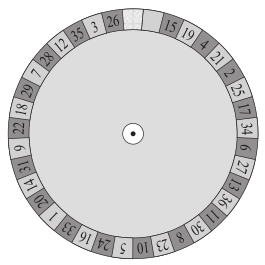
A roulette wheel has the numbers 0, 1, 2, …, 36 where each of the 37 numbers is equally likely to be spun.
 

If the wheel is spun 18 500 times, calculate the expected frequency of spinning the number 8.   (2 marks)

--- 4 WORK AREA LINES (style=lined) ---

Show Answers Only

`500`

Show Worked Solution

`P(8) = 1/37`

`:.\ text(Expected Frequency (8)) = 1/37 xx 18\ 500 = 500`

Filed Under: Data, Expected/Relative Frequency, Probability, Relative Frequency, Relative Frequency, Relative Frequency, Venn Diagrams and Expected/Relative Frequency Tagged With: Band 4, common-content, num-title-ct-core, num-title-qs-hsc, smc-1133-20-Games of Chance, smc-4225-35-Relative frequency, smc-6805-40-Games of Chance, smc-6805-50-Expected Frequency, smc-6888-10-Expected Frequency, smc-6888-20-Games of Chance, smc-6936-40-Expected Frequency, smc-6936-50-Games of Chance, smc-827-20-Games of Chance, smc-827-40-Expected Frequency (np), smc-990-20-Games of Chance, smc-990-40-Expected Frequency (np)

Probability, STD2 S2 2006 HSC 6 MC

Marcella is planning to roll a standard six-sided die 60 times.

How many times would she expect to roll the number 4?

  1. 6
  2. 10
  3. 15
  4. 20
Show Answers Only

`B`

Show Worked Solution

`P(4) = 1/6`

`:.\ text(Expected times to roll 4) = 1/6 xx 60 = 10`

`=>  B`

Filed Under: Data, Expected/Relative Frequency, Probability, Relative Frequency, Relative Frequency, Relative Frequency, Relative Frequency, Venn Diagrams and Expected/Relative Frequency Tagged With: Band 4, common-content, num-title-ct-core, num-title-qs-hsc, smc-1133-20-Games of Chance, smc-1133-30-Expected Frequency (np), smc-4225-35-Relative frequency, smc-6805-40-Games of Chance, smc-6805-50-Expected Frequency, smc-6888-10-Expected Frequency, smc-6888-20-Games of Chance, smc-6936-40-Expected Frequency, smc-6936-50-Games of Chance, smc-827-20-Games of Chance, smc-827-40-Expected Frequency (np), smc-990-20-Games of Chance, smc-990-40-Expected Frequency (np)

Probability, STD2 S2 2011 HSC 24b

A die was rolled 72 times. The results for this experiment are shown in the table.

\begin{array} {|c|c|}
\hline
\rule{0pt}{2.5ex} \textit{Number obtained} \rule[-1ex]{0pt}{0pt} & \textit{Frequency} \\
\hline
\rule{0pt}{2.5ex} \ 1 \rule[-1ex]{0pt}{0pt} & 16 \\
\hline
\rule{0pt}{2.5ex} \ 2 \rule[-1ex]{0pt}{0pt} & 11 \\
\hline
\rule{0pt}{2.5ex} \ 3 \rule[-1ex]{0pt}{0pt} & \textbf{A} \\
\hline
\rule{0pt}{2.5ex} \ 4 \rule[-1ex]{0pt}{0pt} & 8 \\
\hline
\rule{0pt}{2.5ex} \ 5 \rule[-1ex]{0pt}{0pt} & 12 \\
\hline
\rule{0pt}{2.5ex} \ 6 \rule[-1ex]{0pt}{0pt} & 15 \\
\hline
\end{array}

  1. Find the value of `A`.   (1 mark)

    --- 1 WORK AREA LINES (style=lined) ---

  2. What was the relative frequency of obtaining a 4.   (1 mark)

    --- 2 WORK AREA LINES (style=lined) ---

  3. If the die was unbiased, which number was obtained the expected number of times?   (1 mark)

    --- 2 WORK AREA LINES (style=lined) ---

Show Answers Only

a.    \(10\)

b.    \(\dfrac{1}{9}\)

c.    \(5\)

Show Worked Solution

a.    \(\text{Since die rolled 72 times:}\)

\(A=72-(16+11+8+12+15)=10\)

♦ Mean mark 38%
IMPORTANT: Many students confused ‘relative frequency’ with ‘frequency’ and incorrectly answered 8.

 
b.
     \(\text{Relative frequency of 4}=\dfrac{8}{72}=\dfrac{1}{9}\)
 

c.    \(\text{Expected frequency of any number}=\dfrac{1}{6}\times 72=12\)

\(\therefore\ \text{5 was obtained the expected number of times.}\)

Filed Under: Data, Expected/Relative Frequency, Probability, Relative Frequency, Relative Frequency, Relative Frequency, Relative Frequency, Venn Diagrams and Expected/Relative Frequency Tagged With: Band 2, Band 4, Band 5, common-content, num-title-ct-core, num-title-qs-hsc, smc-1133-20-Games of Chance, smc-1133-30-Expected Frequency (np), smc-4225-35-Relative frequency, smc-6805-40-Games of Chance, smc-6805-50-Expected Frequency, smc-6888-10-Expected Frequency, smc-6888-20-Games of Chance, smc-6888-35-Relative Frequency, smc-6936-30-Relative Frequency, smc-6936-40-Expected Frequency, smc-6936-50-Games of Chance, smc-827-20-Games of Chance, smc-827-40-Expected Frequency (np), smc-990-20-Games of Chance, smc-990-40-Expected Frequency (np)

Probability, STD2 S2 2009 HSC 28d

In an experiment, two unbiased dice, with faces numbered  1, 2, 3, 4, 5, 6  are rolled 18 times.

The difference between the numbers on their uppermost faces is recorded each time. Juan performs this experiment twice and his results are shown in the tables.

 2009 28d

Juan states that Experiment 2 has given results that are closer to what he expected than the results given by Experiment 1.

Is he correct? Explain your answer by finding the sample space for the dice differences and using theoretical probability.   (4 marks)

--- 8 WORK AREA LINES (style=lined) ---

Show Answers Only

 `text{Juan is correct (See Worked Solutions)}`

Show Worked Solution
♦♦♦ Mean mark 7%.
MARKER’S COMMENT: This question guides students by asking for an explanation using the sample space for the dice differences.

`text(Sample space for dice differences:)`

2UG-2009-28d1

2UG-2009-28d2_1

2UG-2009-28d3_1

`text(Juan is correct.  The table shows Experiment 1 has greater total differences to the)`

`text(expected frequencies than Experiment 2)`

Filed Under: Multi-stage Events, Multi-Stage Events, Relative Frequency, Relative Frequency, Relative Frequency, Single and Multi-Stage Events, Venn Diagrams and Expected/Relative Frequency Tagged With: Band 6, common-content, smc-6935-50-Arrays, smc-6936-40-Expected Frequency, smc-6936-50-Games of Chance, smc-827-20-Games of Chance, smc-827-40-Expected Frequency (np), smc-829-50-Arrays

Probability, STD2 S2 2009 HSC 9 MC

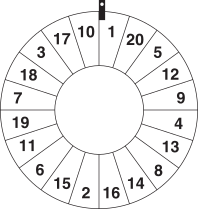
A wheel has the numbers 1 to 20 on it, as shown in the diagram. Each time the wheel is spun, it stops with the marker on one of the numbers.
 

The wheel is spun 120 times.

 How many times would you expect a number less than 6 to be obtained?

  1. `20` 
  2. `24` 
  3. `30` 
  4. `36` 
Show Answers Only

`C`

Show Worked Solution

`P(text(number < 6) ) = 5/20 = 1/4`

`:.\ text(Expected times)= 1/4 xx text(times spun)= 1/4 xx 120= 30`

`=>  C`

Filed Under: Data, Expected/Relative Frequency, Probability, Relative Frequency, Relative Frequency, Relative Frequency, Relative Frequency, Venn Diagrams and Expected/Relative Frequency Tagged With: Band 4, common-content, num-title-ct-core, num-title-qs-hsc, smc-1133-20-Games of Chance, smc-1133-30-Expected Frequency (np), smc-4225-35-Relative frequency, smc-6805-40-Games of Chance, smc-6805-50-Expected Frequency, smc-6888-10-Expected Frequency, smc-6888-20-Games of Chance, smc-6936-40-Expected Frequency, smc-6936-50-Games of Chance, smc-827-20-Games of Chance, smc-827-40-Expected Frequency (np), smc-990-20-Games of Chance, smc-990-40-Expected Frequency (np)

Probability, STD2 S2 2013 HSC 7 MC

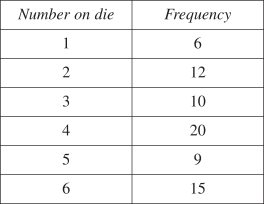
In an experiment, a standard six-sided die was rolled 72 times. The results are shown in the table.
 

Which number on the die was obtained the expected number of times?

  1. 1
  2. 2
  3. 3
  4. 6
Show Answers Only

`B`

Show Worked Solution

`text(Probability of rolling a specific number)=1/6`

`text{After 72 rolls, expected number of times (of any specific number)}`

 `=1/6 xx 72=12`

`=>\ B`

Filed Under: Data, Expected/Relative Frequency, Probability, Relative Frequency, Relative Frequency, Relative Frequency, Relative Frequency, Venn Diagrams and Expected/Relative Frequency Tagged With: Band 3, common-content, num-title-ct-core, num-title-qs-hsc, smc-1133-20-Games of Chance, smc-1133-30-Expected Frequency (np), smc-4225-35-Relative frequency, smc-6805-40-Games of Chance, smc-6805-50-Expected Frequency, smc-6888-10-Expected Frequency, smc-6888-20-Games of Chance, smc-6936-40-Expected Frequency, smc-6936-50-Games of Chance, smc-827-20-Games of Chance, smc-827-40-Expected Frequency (np), smc-990-20-Games of Chance, smc-990-40-Expected Frequency (np)

Copyright © 2014–2026 SmarterEd.com.au · Log in