SmarterEd

Aussie Maths & Science Teachers: Save your time with SmarterEd

  • Login
  • Get Help
  • About

Probability, STD2 S2 2025 HSC 29

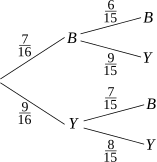
A bag contains 7 blue lollies and 9 yellow lollies. One lolly is selected at random and eaten. A second lolly is then selected from the remaining lollies in the bag.

Find the probability that the two lollies selected are the same colour.   (2 marks)

--- 7 WORK AREA LINES (style=blank) ---

Show Answers Only

\(P\text{(same colour)}=\dfrac{19}{40}\)

Show Worked Solution

♦ Mean mark 49%.
\(P\text{(same colour)}\) \(=P(BB)+P(YY)\)
  \(=\dfrac{7}{16} \times \dfrac{6}{15}+\dfrac{9}{16} \times \dfrac{8}{15}\)
  \(=\dfrac{19}{40}\)

Filed Under: Multi-Stage Events, Single and Multi-Stage Events Tagged With: Band 5, smc-6935-15-Draw Probability Tree, smc-829-15-Draw Probability Tree

Probability, STD2 S2 2025 HSC 8 MC

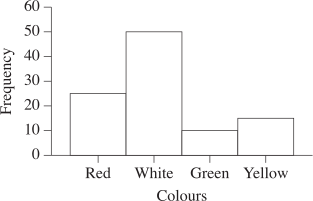
A spinner made up of 4 colours is spun 100 times. The frequency histogram shows the results.
 

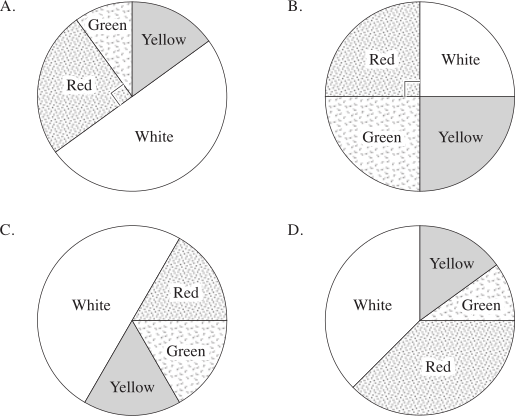
Which of these spinners is most likely to give the results shown?
 

Show Answers Only

\(A\)

Show Worked Solution
\(P(\text{White})\) \(=\dfrac{50}{100}=\dfrac{1}{2}\)
\(P(\text{Red})\) \(=\dfrac{25}{100}=\dfrac{1}{4}\)  
\(P(\text{Yellow})\) \(=\dfrac{15}{100}=\dfrac{3}{20}\)
\(P(\text{Green})\) \(=\dfrac{10}{100}=\dfrac{2}{20}=\dfrac{1}{10}\)

 
\(\text{Eliminate Options B and D as white}\ \neq \dfrac{1}{2}\ \text{of spinner.}\)

\(\text{Eliminate Option C as red}\ \neq \dfrac{1}{4}\ \text{of spinner.}\)

\(\Rightarrow A\)

Filed Under: Combinations and Single Stage Events, Relative Frequency, Single and Multi-Stage Events Tagged With: Band 2, smc-6935-05-Simple Probability, smc-827-20-Games of Chance, smc-828-10-Simple Probability

Probability, STD2 S2 2024 HSC 31

A coin is biased so that it is twice as likely to show a head than a tail.

  1. What is the probability of obtaining a head with one throw of this coin?   (1 mark)

    --- 2 WORK AREA LINES (style=lined) ---

  2. In two throws of this coin, what is the probability of obtaining at least one head?   (2 marks)

    --- 6 WORK AREA LINES (style=lined) ---

Show Answers Only

a.   \(P(H) = \dfrac{2}{3}\)

b.   \(P\text{(at least 1 head)}\ = \dfrac{8}{9}\)

Show Worked Solution

a.   \(P(H) = \dfrac{2}{3}\)

b.   \(P(T) = 1-P(H)=1-\dfrac{2}{3}=\dfrac{1}{3}\)

  \(P\text{(at least 1 head)}\) \(=1-P\text{(no heads)}\)
    \(=1-P(TT)\)
    \(=1-\dfrac{1}{3} \times \dfrac{1}{3}=\dfrac{8}{9}\)
♦ Mean mark (a) 51%.
♦♦ Mean mark (b) 30%.

Filed Under: Multi-Stage Events, Single and Multi-Stage Events Tagged With: Band 4, Band 5, smc-6935-20-P(A and B)=P(A) x P(B), smc-6935-30-\(P\text{(E)} = 1-P\text{(not E)}\), smc-829-30-P(E) = 1 - P(not E)

Probability, STD2 S2 2023 HSC 23

One hundred tickets are sold in a raffle which offers two prizes. Hazel buys five of the tickets.

A ticket is drawn at random for the first prize. A second ticket is drawn from the remaining tickets for the other prize.

What is the probability that Hazel wins both prizes?   (2 marks)

Show Answers Only

`1/495`

Show Worked Solution

`P(W_1, W_2) = 5/100 xx 4/99=1/495`

Filed Under: Multi-Stage Events, Single and Multi-Stage Events Tagged With: Band 4, smc-6935-25-Other Multi-Stage Events, smc-829-20-Other Multi-Stage Events

Probability, STD2 S2 2023 HSC 8 MC

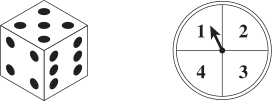
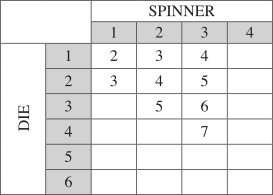
A game involves throwing a die and spinning a spinner.

The sum of the two numbers obtained is the score.

The table of scores below is partially completed.
 

What is the probability of getting a score of 7 or more?

  1. `1/6`
  2. `1/4`
  3. `5/18`
  4. `5/12`

Show Answers Only

`D`

Show Worked Solution

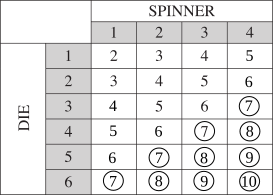
`Ptext{(score 7+)} = 10/24=5/12`

`=>D`

Filed Under: Multi-Stage Events, Single and Multi-Stage Events, Single and Multi-Stage Events Tagged With: 2adv-std2-common, Band 4, smc-6887-80-Arrays, smc-6935-50-Arrays, smc-829-50-Arrays

Probability, STD2 S2 2022 HSC 17

The numbers 1, 2, 3, 4, 5 and 6 are each written on separate cards.

Amy has cards 1, 3 and 5 and Bob has cards 2, 4 and 6.

They play a game in which each person randomly chooses one of their own cards and compares it with the other person's card. The person with the higher card wins.

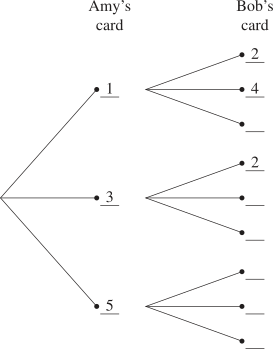
  1. A partially completed tree diagram is shown.


    Complete the tree diagram and find the probability that Bob wins.   (2 marks)
     
  2. Suppose Amy and Bob play this game 30 times.
  3. How many times would Bob be expected to win?   (1 mark)

    --- 2 WORK AREA LINES (style=lined) ---

Show Answers Only
  1. `6/9`
  2. `20`
Show Worked Solution

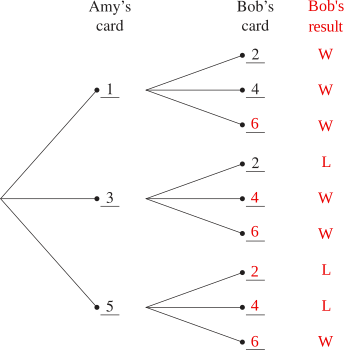
a.   
       

`P(text{Bob wins}) = 6/9=2/3`
  

b.    `text{Expected wins}=2/3 xx 30=20`

Filed Under: Multi-Stage Events, Single and Multi-Stage Events, Venn Diagrams and Expected/Relative Frequency Tagged With: Band 4, smc-6935-10-Probability Trees, smc-6935-15-Draw Probability Tree, smc-6936-40-Expected Frequency, smc-829-10-Probability Trees, smc-829-15-Draw Probability Tree

Probability, STD2 S2 2021 HSC 11 MC

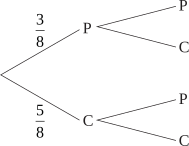
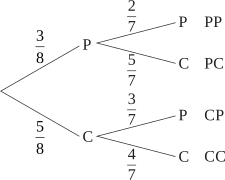
There are 8 chocolates in a box. Three have peppermint centres (P) and five have caramel centres (C).

Kim randomly chooses a chocolate from the box and eats it. Sam then randomly chooses and eats one of the remaining chocolates.

A partially completed probability tree is shown.
 

What is the probability that Kim and Sam choose chocolates with different centres?

  1. `\frac{15}{64}`
  2. `\frac{15}{56}`
  3. `\frac{15}{32}`
  4. `\frac{15}{28}`
Show Answers Only

`D`

Show Worked Solution

♦♦ Mean mark 35%.


`Ptext{(different centres)}` `= P text{(PC)} + P text{(CP)}`
  `=\frac{3}{8}xx \frac{5}{7} + \frac{5}{8}xx \frac{3}{7}`
  `= \frac{15}{56} + \frac{15}{56}`
  `= \frac{15}{28}`

 
`=> D`

Filed Under: Multi-Stage Events, Single and Multi-Stage Events Tagged With: 2adv-std2-common, Band 5, common-content, smc-6935-10-Probability Trees, smc-829-10-Probability Trees

Probability, STD2 S2 2020 HSC 15 MC

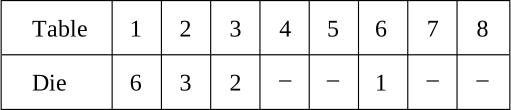
The top of a rectangular table is divided into 8 equal sections as shown.
  

\begin{array} {|c|c|c|c|}
\hline
\rule{0pt}{2.5ex} \quad 1  \quad \rule[-1ex]{0pt}{0pt} & \quad 2 \quad \rule[-1ex]{0pt}{0pt} & \quad 3 \quad \rule[-1ex]{0pt}{0pt} & \quad 4 \quad \\
\hline
\rule{0pt}{2.5ex} 5 \rule[-1ex]{0pt}{0pt} & 6 \rule[-1ex]{0pt}{0pt} & 7 \rule[-1ex]{0pt}{0pt} & 8 \\
\hline
\end{array}

A standard die with faces labelled 1 to 6 is rolled onto the table. The die is equally likely to land in any of the 8 sections of the table. If the die does not land entirely in one section of the table, it is rolled again.

A score is calculated by multiplying the value shown on the top face of the die by the number shown in the section of the table where the die lands.

What is the probability of getting a score of 6?

  1. `frac{1}{48}`
  2. `frac{1}{12}`
  3. `frac{1}{8}`
  4. `frac{1}{6}`
Show Answers Only

`B`

Show Worked Solution

`text{Strategy 1}`

♦ Mean mark 40%.

`text{Combinations that score 6:}`

`4 \ text{combinations score} \ 6`

`therefore \ P(6)= 4 xx frac{1}{8} xx frac{1}{6}= frac{1}{12}`
  

`text{Strategy 2}`

`Ptext{(6)}` `= Ptext{(T1)}Ptext{(D6)} + Ptext{(T2)}Ptext{(D3)} + Ptext{(T3)}Ptext{(D2)} + Ptext{(T6)}Ptext{(D1)}`
  `= frac{1}{8} xx frac{1}{6} + frac{1}{8} xx frac{1}{6} + frac{1}{8} xx frac{1}{6} + frac{1}{8} xx frac{1}{6}`
  `= 4 xx frac{1}{8} xx frac{1}{6}= frac{1}{12}`

 
`=> \ B`

Filed Under: Multi-Stage Events, Single and Multi-Stage Events Tagged With: Band 5, smc-6935-25-Other Multi-Stage Events, smc-6935-50-Arrays, smc-829-20-Other Multi-Stage Events, smc-829-50-Arrays

Probability, STD2 S2 2019 HSC 25

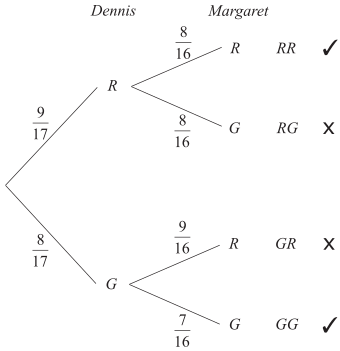
A bowl of fruit contains 17 apples of which 9 are red and 8 are green.

Dennis takes one apple at random and eats it. Margaret also takes an apple at random and eats it.

By drawing a probability tree diagram, or otherwise, find the probability that Dennis and Margaret eat apples of the same colour.   (3 marks)

--- 8 WORK AREA LINES (style=lined) ---

Show Answers Only

`8/17`

Show Worked Solution

`P(text(same colour))` `= P(R R) + P(GG)`
  `= 9/17 xx 8/16 + 8/17 xx 7/16`
  `= 72/272 + 56/272= 8/17`
♦♦ Mean mark 35%.

Filed Under: Multi-Stage Events, Multi-Stage Events, Single and Multi-Stage Events, Single and Multi-Stage Events Tagged With: Band 5, num-title-ct-corea, num-title-qs-hsc, smc-1135-10-Probability Trees, smc-1135-15-Draw Probability Tree, smc-4238-10-Dependent events, smc-4238-50-Probability trees, smc-6935-10-Probability Trees, smc-6935-15-Draw Probability Tree, smc-829-10-Probability Trees, smc-829-15-Draw Probability Tree

Probability, STD2 S2 2018 HSC 30d

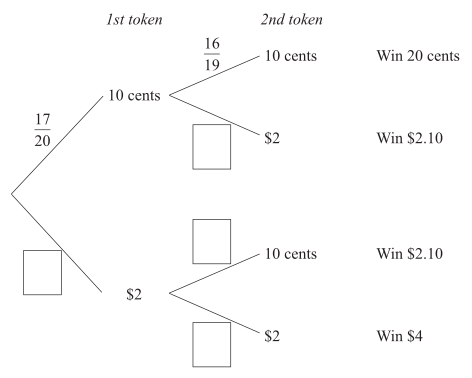
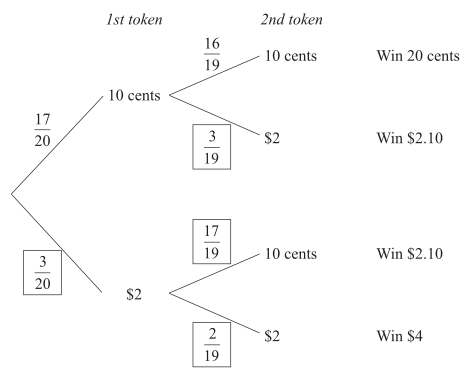
A game consists of two tokens being drawn at random from a barrel containing 20 tokens. There are 17 tokens labelled 10 cents and 3 tokens labelled $2. The player wins the total value of the two tokens drawn.

Complete the probability tree by writing the missing probabilities in the boxes.   (2 marks)


--- 0 WORK AREA LINES (style=lined) ---

Show Answers Only

Show Worked Solution

Filed Under: Single and Multi-Stage Events, Single and Multi-Stage Events Tagged With: Band 4, smc-1135-10-Probability Trees, smc-6935-10-Probability Trees, smc-6935-15-Draw Probability Tree

Probability, STD2 S2 2011 HSC 26a

The two spinners shown are used in a game.

2UG 2011 26a1

Each arrow is spun once. The score is the total of the two numbers shown by the arrows.
A table is drawn up to show all scores that can be obtained in this game.

2UG 2011 26a2

  1. What is the value of `X` in the table?   (1 mark)

    --- 1 WORK AREA LINES (style=lined) ---

  2. What is the probability of obtaining a score less than 4?   (1 mark)

    --- 2 WORK AREA LINES (style=lined) ---

  3. On Spinner `B`, a 2 is obtained. What is the probability of obtaining a score of 3?   (1 mark)

    --- 2 WORK AREA LINES (style=lined) ---

Show Answers Only

a.    `5`

b.    `1/2`

c.    `2/3`

Show Worked Solution

a.    `X=3+2=5`

b.    `P(text{score}<4)=6/12=1/2`

c.    `P(3)=2/3`

Filed Under: Multi-Stage Events, Single and Multi-Stage Events, Single and Multi-Stage Events, Single and Multi-Stage Events Tagged With: Band 3, Band 4, smc-1135-20-Other Multi-Stage Events, smc-1135-40-Arrays, smc-6887-50-Other Multi-stage Events, smc-6887-80-Arrays, smc-6935-25-Other Multi-Stage Events, smc-6935-50-Arrays, smc-829-20-Other Multi-Stage Events, smc-829-50-Arrays

Probability, STD2 S2 EQ-Bank 31

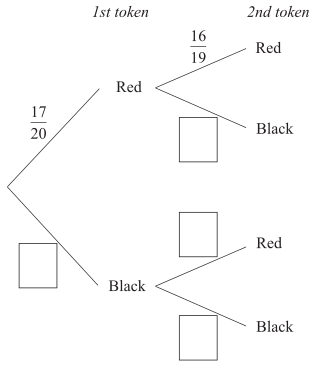
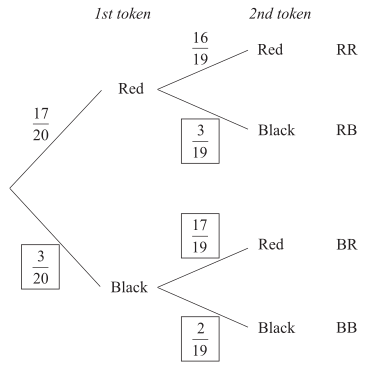
A game consists of two tokens being drawn at random from a barrel containing 20 tokens. There are 17 red tokens and 3 black tokens. The player keeps the two tokens drawn.

  1.  Complete the probability tree by writing the missing probabilities in the boxes.   (2 marks)


    --- 0 WORK AREA LINES (style=lined) ---

  2.  What is the probability that a player draws at least one red token. Give your answer in exact form.   (2 marks)

    --- 4 WORK AREA LINES (style=lined) ---

Show Answers Only

a.   
           

b.    `187/190`

Show Worked Solution
a.    


b.    `P(text(at least one red))`

`= 1-P(BB)`

`= 1-3/20 xx 2/19= 187/190`

Filed Under: Multi-Stage Events, Single and Multi-Stage Events, Single and Multi-Stage Events Tagged With: Band 4, Band 5, smc-1135-10-Probability Trees, smc-1135-30-\(P(\text{E})=1-P(\text{not E})\), smc-6935-10-Probability Trees, smc-6935-30-\(P\text{(E)} = 1-P\text{(not E)}\), smc-829-10-Probability Trees, smc-829-30-P(E) = 1 - P(not E)

Probability, STD2 S2 2018 HSC 9 MC

An experiment has three distinct outcomes, A, B and C.

Outcome A occurs 50% of the time. Outcome B occurs 23% of the time.

What is the expected number of times outcome C would occur if the experiment is conducted 500 times?

  1. 115
  2. 135
  3. 250
  4. 365
Show Answers Only

`B`

Show Worked Solution

`text(Expectation of outcome)\ C`

`= 1-0.5-0.23= 0.27`
 

`:.\ text(Expected times)\ C\ text(occurs)`

`= 0.27 xx 500= 135`

`=> B`

Filed Under: Fundamental Understanding, Fundamental Understanding, Probability, Single and Multi-Stage Events, Single and Multi-Stage Events Tagged With: Band 3, num-title-ct-core, num-title-qs-hsc, smc-4225-35-Relative frequency, smc-6887-10-Fundamental Understanding, smc-6935-04-Fundamental Understanding

Probability, STD2 S2 2017 HSC 24 MC

A deck of 52 playing cards contains 12 picture cards. Two cards from the deck are drawn at random and placed on a table.

What is the probability, correct to four decimal places, that exactly one picture card is on the table?

  1. `0.0498`
  2. `0.1810`
  3. `0.3550`
  4. `0.3620`
Show Answers Only

`D`

Show Worked Solution

`P(text(exactly 1 picture card))`

`= P(text(picture)) xx P(text(no picture)) + P(text(no picture)) xx P(text(picture))`

`= 12/52 xx 40/51quad+quad40/52 xx 12/51`

♦♦♦ Mean mark 21%.

`= 2((12 xx 40)/(52 xx 51))`

`= 0.36199…`

`=>\ D`

Filed Under: Multi-stage Events, Multi-Stage Events, Single and Multi-Stage Events Tagged With: Band 6, smc-6935-25-Other Multi-Stage Events, smc-829-20-Other Multi-Stage Events

Probability, STD2 S2 2017 HSC 15 MC

The faces on a twenty-sided die are labelled  $0.05, $0.10, $0.15, … , $1.00.

The die is rolled once.

What is the probability that the amount showing on the upper face is more than 50 cents but less than 80 cents?

  1. `1/4`
  2. `3/10`
  3. `7/20`
  4. `1/2`
Show Answers Only

`A`

Show Worked Solution

`text(Possible faces that satisfy are:)`

♦ Mean mark 50%.

`55text(c),60text(c),65text(c),70text(c),75text(c)`

`:.\ text(Probability)= 5/20= 1/4`
  

`=>A`

Filed Under: Combinations and Single Stage Events, Probability, Single and Multi-Stage Events, Single and Multi-Stage Events, Single and Multi-Stage Events, Single stage events Tagged With: Band 5, num-title-ct-core, num-title-qs-hsc, smc-1135-05-Simple Probability, smc-4225-15-Single-stage events, smc-6887-20-Simple Probability, smc-6935-05-Simple Probability, smc-828-10-Simple Probability

Probability, STD2 S2 2016 HSC 28c

A cricket team is about to play two matches. The probability of the team having a win, a loss or a draw is 0.7, 0.1 and 0.2 respectively in each match. The possible results in the two matches are displayed in the probability tree diagram.
  

2ug-2016-hsc-q28_2

  1. What is the probability of the team having a win and a draw, in any order?   (2 marks)

    --- 4 WORK AREA LINES (style=lined) ---

  2. Paul claims that 1.4 is the probability of the team winning both matches.


    Give one reason why this is NOT correct.   (1 mark)

    --- 2 WORK AREA LINES (style=lined) ---

Show Answers Only

i.    `0.28`

ii.   `text(Probabilities cannot exceed 1.)`

Show Worked Solution

i.    `P(W\ text(and)\ D)`

`= P(W,D) + P(D,W)`

`= 0.7 xx 0.2 + 0.2 xx 0.7= 0.28`

♦ Mean mark (i) 45%.
♦ Mean mark (ii) 49%.

 
ii.
   `text(Probabilities cannot exceed 1.)`

Filed Under: Multi-stage Events, Multi-Stage Events, Single and Multi-Stage Events, Single and Multi-Stage Events, Single and Multi-Stage Events Tagged With: Band 5, num-title-ct-corea, smc-1135-10-Probability Trees, smc-4238-10-Dependent events, smc-4238-50-Probability trees, smc-6887-30-Probability Trees, smc-6935-10-Probability Trees, smc-829-10-Probability Trees

Probability, STD2 S2 2015 HSC 30b

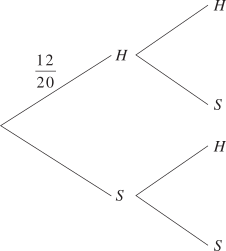
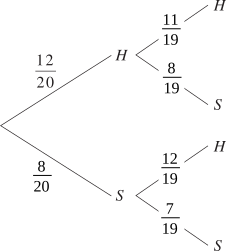
On a tray there are 12 hard‑centred chocolates `(H)` and 8 soft‑centred chocolates `(S)`. Two chocolates are selected at random. A partially completed probability tree is shown.
 

What is the probability of selecting one of each type of chocolate?   (3 marks)

--- 7 WORK AREA LINES (style=lined) ---

Show Answers Only

`48/95`

Show Worked Solution

`Ptext{(one of each type)}`

♦ Mean mark 45%.

`= P(HS) + P(SH)`

`= (12/20 xx 8/19) + (8/20 xx 12/19)`

`= 24/95 + 24/95= 48/95`

Filed Under: Multi-stage Events, Multi-Stage Events, Single and Multi-Stage Events, Single and Multi-Stage Events Tagged With: Band 5, smc-6935-10-Probability Trees, smc-829-10-Probability Trees

Probability, STD2 S2 2015 HSC 26e

The table shows the relative frequency of selecting each of the different coloured jelly beans from packets containing green, yellow, black, red and white jelly beans.

\begin{array} {|c|c|}
\hline
\rule{0pt}{2.5ex} \textit{Colour} \rule[-1ex]{0pt}{0pt} & \textit{Relative frequency} \\
\hline
\rule{0pt}{2.5ex} \text{Green} \rule[-1ex]{0pt}{0pt} & 0.32 \\
\hline
\rule{0pt}{2.5ex} \text{Yellow} \rule[-1ex]{0pt}{0pt} & 0.13 \\
\hline
\rule{0pt}{2.5ex} \text{Black} \rule[-1ex]{0pt}{0pt} & 0.14 \\
\hline
\rule{0pt}{2.5ex} \text{Red} \rule[-1ex]{0pt}{0pt} &  \\
\hline
\rule{0pt}{2.5ex} \text{White} \rule[-1ex]{0pt}{0pt} & 0.24 \\
\hline
\end{array}

  1. What is the relative frequency of selecting a red jelly bean?   (1 mark)

    --- 2 WORK AREA LINES (style=lined) ---

  2. Based on this table of relative frequencies, what is the probability of NOT selecting a black jelly bean?   (1 mark)

    --- 2 WORK AREA LINES (style=lined) ---

Show Answers Only

a.    \(0.17\)

b.    \(0.86\)

Show Worked Solution

a.    \(\text{Relative frequency of red}\)

\(= 1-(0.32 + 0.13 + 0.14 + 0.24)= 1-0.83= 0.17\)


b.    \(P\text{(not selecting black)}\)

\(= 1-P\text{(selecting black)}= 1-0.14= 0.86\)

Filed Under: Combinations and Single Stage Events, Data, Expected/Relative Frequency, Probability, Relative Frequency, Relative Frequency, Relative Frequency, Relative Frequency, Single and Multi-Stage Events, Single and Multi-Stage Events, Single and Multi-Stage Events, Single stage events Tagged With: Band 3, Band 4, common-content, num-title-ct-core, num-title-qs-hsc, smc-1133-20-Games of Chance, smc-1135-05-Simple Probability, smc-4225-20-Complementary events, smc-4225-35-Relative frequency, smc-6805-40-Games of Chance, smc-6887-20-Simple Probability, smc-6888-20-Games of Chance, smc-6888-35-Relative Frequency, smc-6935-05-Simple Probability, smc-827-20-Games of Chance, smc-828-10-Simple Probability, smc-990-20-Games of Chance

Probability, STD2 S2 2015 HSC 16 MC

The probability of winning a game is `7/10`.

Which expression represents the probability of winning two consecutive games?

  1. `7/10 xx 6/9`
  2. `7/10 xx 6/10`
  3. `7/10 xx 7/9`
  4. `7/10 xx 7/10`
Show Answers Only

`D`

Show Worked Solution

`text{Since the two events are independent:}`

`P text{(W)}= 7/10`

`P text{(WW)}= 7/10 xx 7/10`

  
`=>D`

Filed Under: Multi-stage Events, Multi-Stage Events, Multi-Stage Events, Single and Multi-Stage Events, Single and Multi-Stage Events Tagged With: Band 4, num-title-ct-corea, num-title-qs-hsc, smc-1135-20-Other Multi-Stage Events, smc-4238-20-Independent events, smc-6935-20-P(A and B)=P(A) x P(B), smc-6935-25-Other Multi-Stage Events, smc-829-20-Other Multi-Stage Events

Probability, STD2 S2 2006 HSC 25c

Sonia buys three raffle tickets.

HSC 2006 25c

  1. What is the probability that Sonia wins first prize?   (1 mark)

    --- 1 WORK AREA LINES (style=lined) ---

  2. What is the probability that she wins both prizes?   (2 marks)

    --- 4 WORK AREA LINES (style=lined) ---

Show Answers Only

a.    `1/60`

b.    `1/5370`

Show Worked Solution
a.    `text{P (wins 1st prize)}` `= text(# tickets bought) / text(total tickets)`
    `= 3/180= 1/60`


b.     `text{P (wins both)}` `= text{P (wins 1st)} xx text{P (wins 2nd)}`
    `= 1/60 xx 2/179= 1/5370`

Filed Under: Multi-stage Events, Multi-Stage Events, Single and Multi-Stage Events, Single and Multi-Stage Events Tagged With: Band 4, Band 5, smc-1135-20-Other Multi-Stage Events, smc-6935-25-Other Multi-Stage Events, smc-829-20-Other Multi-Stage Events

Probability, STD2 S2 2006 HSC 28a

On a bridge, the toll of $2.50 is paid in coins collected by a machine. The machine only accepts two-dollar coins, one-dollar coins and fifty-cent coins.

  1. List the different combinations of coins that could be used to pay the $2.50 toll.   (1 mark)

    --- 2 WORK AREA LINES (style=lined) ---

  2. Jill has three two-dollar coins, six one-dollar coins and two fifty-cent coins. She selects two coins at random.


    What is the probability that she selects exactly $2.50?   (3 marks)

    --- 6 WORK AREA LINES (style=lined) ---

  3. At the end of a day, the machine contains `x` two-dollar coins, `y` one-dollar coins and `w` fifty-cent coins.


    Write an expression for the total value of coins in dollars in the machine.   (1 mark)

    --- 2 WORK AREA LINES (style=lined) ---

Show Answers Only

a.    `text(Proof)\ \ text{(See Worked Solutions)}`

b.    `6/55`

c.    `$(2x + y + 0.5w)`

Show Worked Solution

a.    `text(Combinations for $2.50)`

`$2, 50c`

`$1, $1, 50c`

`$1, 50c, 50c, 50c`

`50c, 50c, 50c, 50c, 50c`
  

b.    `3 xx $2, 6 xx $1, 2 xx 50c`

`P($2.50)` `= (3/11 xx 2/10) + (2/11 xx 3/10)`
  `= 6/110 + 6/110= 6/55`


c.    `text(Total value) = $ (2x + y + 0.5w)`

Filed Under: Multi-stage Events, Multi-Stage Events, Single and Multi-Stage Events Tagged With: Band 4, Band 5, Band 6, smc-6935-10-Probability Trees, smc-6935-15-Draw Probability Tree, smc-829-10-Probability Trees, smc-829-15-Draw Probability Tree

Probability, STD2 S2 2005 HSC 23c

Moheb owns five red and seven blue ties. He chooses a tie at random for himself and puts it on. He then chooses another tie at random, from the remaining ties, and gives it to his brother.

  1. What is the probability that Moheb chooses a red tie for himself?   (1 mark)

    --- 1 WORK AREA LINES (style=lined) ---

Copy the tree diagram into your writing booklet.
 

2UG-2005-23c
 

  1. Complete your tree diagram by writing the correct probability on each branch.   (2 marks)
  2. Calculate the probability that both of the ties are the same colour.   (2 marks)

    --- 4 WORK AREA LINES (style=lined) ---

Show Answers Only

a.    `5/12`

b.

c.    `31/66`

Show Worked Solution

a.    `P(R)= (#\ text(red ties))/(#\ text(total ties))=5/12`


b.    


c.    `Ptext((same colour))`

`= P(text(RR)) + P(text(BB))`

`= 5/12 × 4/11\ \ +\ \ 7/12 × 6/11= 20/132 + 42/132= 31/66`

Filed Under: Multi-stage Events, Multi-Stage Events, Single and Multi-Stage Events, Single and Multi-Stage Events Tagged With: Band 3, Band 4, Band 5, smc-1135-10-Probability Trees, smc-6935-10-Probability Trees, smc-6935-15-Draw Probability Tree, smc-829-10-Probability Trees

Probability, STD2 S2 2005 HSC 11 MC

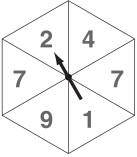
The diagram shows a spinner.


The arrow is spun and will stop in one of the six sections.

What is the probability that the arrow will stop in a section containing a number greater
than 4?

  1. `2/5`
  2. `2/3`
  3. `1/3`
  4. `1/2`
Show Answers Only

`D`

Show Worked Solution

`P\ text((number greater than 4))`

`= P(7) + P (9)`

`= 2/6 + 1/6= 1/2`

`=>  D`

Filed Under: Combinations and Single Stage Events, Probability, Single and Multi-Stage Events, Single and Multi-Stage Events, Single and Multi-Stage Events, Single stage events Tagged With: Band 3, num-title-ct-core, num-title-qs-hsc, smc-1135-05-Simple Probability, smc-4225-15-Single-stage events, smc-6887-20-Simple Probability, smc-6935-05-Simple Probability, smc-828-10-Simple Probability

Probability, STD2 S2 2006 HSC 10 MC

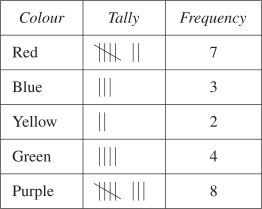
Kay randomly selected a marble from a bag of marbles, recorded its colour and returned it to the bag. She repeated this process a number of times.


Based on these results, what is the best estimate of the probability that Kay will choose a green marble on her next selection?

  1. `5/24`
  2. `1/24`
  3. `1/6`
  4. `1/5`
Show Answers Only

`C`

Show Worked Solution
`text{P(Green)}` `= text(# Green chosen) / text(Total Selections)`
  `= 4/24= 1/6`

`=>  C`

Filed Under: Multi-stage Events, Multi-Stage Events, Probability, Single and Multi-Stage Events, Single and Multi-Stage Events, Single and Multi-Stage Events Tagged With: Band 4, num-title-ct-core, num-title-qs-hsc, smc-1135-20-Other Multi-Stage Events, smc-4225-35-Relative frequency, smc-6887-50-Other Multi-stage Events, smc-6935-25-Other Multi-Stage Events, smc-829-20-Other Multi-Stage Events

Probability, STD2 S2 2006 HSC 1 MC

The probability of an event occurring is `9/10.`

Which statement best describes the probability of this event occurring?

  1. The event is likely to occur.
  2. The event is certain to occur.
  3. The event is unlikely to occur.
  4. The event has an even chance of occurring.
Show Answers Only

`A`

Show Worked Solution

`text(The event is highly likely to occur but not certain.)`

`=>  A`

Filed Under: Fundamental understanding, Fundamental Understanding, Fundamental Understanding, Probability, Single and Multi-Stage Events, Single and Multi-Stage Events Tagged With: Band 3, num-title-ct-core, num-title-qs-hsc, smc-4225-05-Core concepts, smc-6887-10-Fundamental Understanding, smc-6935-04-Fundamental Understanding

Probability, STD2 S2 2005 HSC 23a

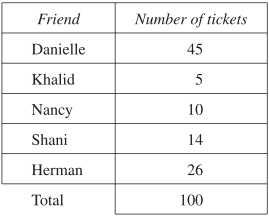
There are 100 tickets sold in a raffle. Justine sold all 100 tickets to five of her friends. The number of tickets she sold to each friend is shown in the table.
 

  1. Justine claims that each of her friends is equally likely to win first prize.


    Give a reason why Justine’s statement is NOT correct.   (1 mark)

    --- 2 WORK AREA LINES (style=lined) ---

  2. What is the probability that first prize is NOT won by Khalid or Herman?   (2 marks)

    --- 4 WORK AREA LINES (style=lined) ---

Show Answers Only

a.    `text(The claim is incorrect because each of her friends)`

`text(bought a different number of tickets and therefore)`

`text(their chances of winning are different.)`

b.    `69/100`

Show Worked Solution

a.    `text(The claim is incorrect because each of her friends bought)`

`text(a different number of tickets and therefore their chances of)`

`text(winning are different.)`


b.    `text(Number of tickets not sold to K or H)= 45 + 10 + 14= 69` 

`:.\ text(Probability 1st prize NOT won by K or H)= 69/100`

Filed Under: Combinations and Single Stage Events, Fundamental understanding, Fundamental Understanding, Fundamental Understanding, Multi-Stage Events, Single and Multi-Stage Events, Single and Multi-Stage Events, Single and Multi-Stage Events, Single stage events Tagged With: Band 3, Band 4, num-title-ct-corea, num-title-qs-hsc, smc-1135-05-Simple Probability, smc-4238-70-Complementary events, smc-6887-10-Fundamental Understanding, smc-6887-20-Simple Probability, smc-6935-04-Fundamental Understanding, smc-6935-05-Simple Probability, smc-828-10-Simple Probability

Probability, STD2 S2 2004 HSC 18 MC

Two dice are rolled. What is the probability that only one of the dice shows a six?

  1. `5/36`
  2. `1/6`
  3. `5/18`
  4. `11/36`
Show Answers Only

`C`

Show Worked Solution

`text(Method 1: Using an array)`

`P text{(only 1 six)}=10/36=5/18`

\begin{align}
\textbf{Die B }
\begin{array}{c}
\textbf{Die A}  \\
\begin{array}{c|c|c|c|c|c|c}
\ & 1 & 2 & 3 & 4 & 5 & 6  \\
\hline
\ 1 & 1,1  & 1,2 & 1,3 & 1,4 & 1,5 & \fcolorbox{red}{white}{1,6} \\
\hline
\ 2 & 2,1 & 2,2 & 2,3 & 2,4 & 2,5 & \fcolorbox{red}{white}{2,6}  \\
\hline
\ 3 & 3,1 & 3,2 & 3,3 & 3,4 & 3,5 & \fcolorbox{red}{white}{3,6}  \\
\hline
\ 4 & 4,1 & 4,2 & 4,3 & 4,4 & 4,5 & \fcolorbox{red}{white}{4,6}  \\
\hline
\ 5 & 5,1 & 5,2 & 5,3 & 5,4 & 5,5 & \fcolorbox{red}{white}{5,6}  \\
\hline
\ 6 & \fcolorbox{red}{white}{6,1} & \fcolorbox{red}{white}{6,2} & \fcolorbox{red}{white}{6,3} & \fcolorbox{red}{white}{6,4} & \fcolorbox{red}{white}{6,5} & 6,6  \\
\end{array}
\end{array}
\end{align}


`text(Method 2:)`

`text{P (Only 1 six)}`

`= P text{(6, not 6)} + P text{(not 6, 6)}`

`= 1/6 xx 5/6 + 5/6 xx 1/6`

`= 10/36= 5/18`

`=>  C`

Filed Under: Multi-stage Events, Multi-Stage Events, Single and Multi-Stage Events, Single and Multi-Stage Events, Single and Multi-Stage Events Tagged With: Band 5, smc-1135-20-Other Multi-Stage Events, smc-6887-50-Other Multi-stage Events, smc-6935-25-Other Multi-Stage Events, smc-829-20-Other Multi-Stage Events

Probability, STD2 S2 2005 HSC 3 MC

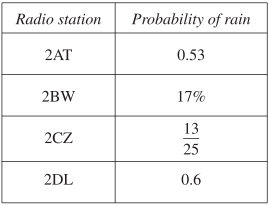
Four radio stations reported the probability of rain as shown in the table.
 

Which radio station reported the highest probability of rain?

  1. `text(2AT)`
  2. `text(2BW)`
  3. `text(2CZ)`
  4. `text(2DL)`
Show Answers Only

`D`

Show Worked Solution

`text(Converting all probabilities to decimals)`

`2AT` `= 0.53`
`2BW` `= 0.17`
`2CZ` `= 0.52`
`2DL` `= 0.60`

  
`=> D`

Filed Under: Fundamental understanding, Fundamental Understanding, Fundamental Understanding, Probability, Single and Multi-Stage Events, Single and Multi-Stage Events Tagged With: Band 4, num-title-ct-core, num-title-qs-hsc, smc-4225-05-Core concepts, smc-6887-10-Fundamental Understanding, smc-6935-04-Fundamental Understanding

Probability, STD2 S2 2004 HSC 1 MC

Which fraction is equal to a probability of `text(25%)`?

  1. `1/25`
  2. `1/4`
  3. `1/3`
  4. `1/2`
Show Answers Only

`B`

Show Worked Solution

`P=25/100=1/4`

`=> B`

Filed Under: Fundamental understanding, Fundamental Understanding, Fundamental Understanding, Probability, Single and Multi-Stage Events, Single and Multi-Stage Events Tagged With: Band 2, num-title-ct-core, num-title-qs-hsc, smc-4225-05-Core concepts, smc-6887-10-Fundamental Understanding, smc-6935-04-Fundamental Understanding

Probability, STD2 S2 2007 HSC 25c

In a stack of 10 DVDs, there are 5 rated PG, 3 rated G and 2 rated M.

  1. A DVD is selected at random. What is the probability that it is rated M?   (1 mark)

    --- 2 WORK AREA LINES (style=lined) ---

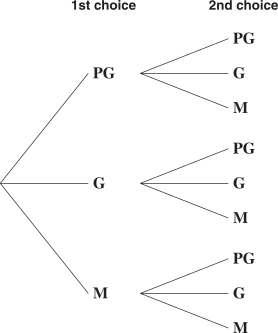
Grant chooses two DVDs at random from the stack. Copy or trace the tree diagram into your writing booklet.
 

  1. Complete the tree diagram by writing the correct probability on each branch.   (2 marks)

    --- 0 WORK AREA LINES (style=lined) ---

  2. Calculate the probability that Grant chooses two DVDs with the same rating.   (2 marks)

    --- 4 WORK AREA LINES (style=lined) ---

Show Answers Only

a.    `1/5`

b.  

c.    `14/45`

Show Worked Solution

a.    `text(5 PG, 3 G, 2 M)`

`P text{(M)} = 2/10 = 1/5` 


b.     


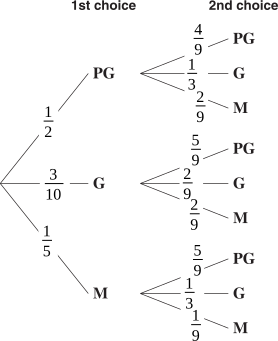
c.    `P text{(same rating)}`

`= P text{(PG, PG)} + P text{(G, G)} + P text{(M, M)}`

`= (1/2 xx 4/9) + (3/10 xx 2/9) + (1/5 xx 1/9)`

`= 2/9 + 1/15 + 1/45= 14/45`

Filed Under: Multi-stage Events, Multi-Stage Events, Multi-Stage Events, Single and Multi-Stage Events, Single and Multi-Stage Events Tagged With: Band 3, Band 5, num-title-ct-corea, num-title-qs-hsc, smc-1135-10-Probability Trees, smc-4238-10-Dependent events, smc-4238-50-Probability trees, smc-6935-10-Probability Trees, smc-829-10-Probability Trees

Probability, STD2 S2 2007 HSC 25a

Give an example of an event that has a probability of exactly  `3/4`.   (1 mark)

--- 2 WORK AREA LINES (style=lined) ---

Show Answers Only

`text(Choosing a red ball out of a bag that)`

`text(contains 3 red balls and 1 green ball.)`

`text{(An infinite amount of examples are}`

`text{possible)}`

Show Worked Solution

`text(Choosing a red ball out of a bag that contains)`

`text(3 red balls and 1 green ball.)`

`text{(An infinite amount of examples are}`

`text{possible)}`

Filed Under: Fundamental understanding, Fundamental Understanding, Fundamental Understanding, Probability, Single and Multi-Stage Events, Single and Multi-Stage Events Tagged With: Band 4, num-title-ct-core, num-title-qs-hsc, smc-4225-05-Core concepts, smc-6887-10-Fundamental Understanding, smc-6935-04-Fundamental Understanding

Probability, STD2 S2 2007 HSC 10 MC

Each time she throws a dart, the probability that Mary hits the dartboard is  `2/7`.

She throws two darts, one after the other.

What is the probability that she hits the dartboard with both darts?

  1. `1/21` 
  2. `4/49` 
  3. `2/7`
  4. `4/7`
Show Answers Only

`B`

Show Worked Solution

`P text{(hits)} = 2/7`

`P text{(hits twice)}= 2/7 xx 2/7= 4/49`  

`=>  B`

Filed Under: Multi-stage Events, Multi-Stage Events, Single and Multi-Stage Events, Single and Multi-Stage Events Tagged With: Band 4, smc-1135-20-Other Multi-Stage Events, smc-6935-20-P(A and B)=P(A) x P(B), smc-6935-25-Other Multi-Stage Events, smc-829-20-Other Multi-Stage Events

Probability, STD2 S2 2008 HSC 25b

In a drawer there are 30 ribbons. Twelve are blue and eighteen are red.

Two ribbons are selected at random.

  1. Copy and complete the probability tree diagram.   (1 mark)


  2. What is the probability of selecting a pair of ribbons which are the same colour?   (2 marks)

    --- 4 WORK AREA LINES (style=lined) ---

Show Answers Only

a.

b.    `73/145`

Show Worked Solution

a. 

b.    `Ptext{(same colour)}`

`=\ text{P(BB) + P(RR)}`

`= 12/30 xx 11/29 + 18/30 xx 17/29`

`= 132/870 + 306/870= 73/145` 

Filed Under: Multi-stage Events, Multi-Stage Events, Single and Multi-Stage Events, Single and Multi-Stage Events Tagged With: Band 4, Band 5, smc-1135-10-Probability Trees, smc-6935-10-Probability Trees, smc-829-10-Probability Trees

Probability, STD2 S2 2008 HSC 22 MC

A die has faces numbered 1 to 6. The die is biased so that the number 6 will appear more often than each of the other numbers. The numbers 1 to 5 are equally likely to occur.

The die was rolled 1200 times and it was noted that the 6 appeared 450 times.

Which statement is correct?

  1. The probability of rolling the number 5 is expected to be  `1/7`.
  2. The number 6 is expected to appear 2 times as often as any other number.
  3. The number 6 is expected to appear 3 times as often as any other number.
  4. The probability of rolling an even number is expected to be equal to the probability of rolling an odd number.
Show Answers Only

`C`

Show Worked Solution

`P(6) = 450/1200 = 3/8`
 

`text(Numbers 1-5 are rolled) = 1200-450=750\ text(times)` 

`:.\ text(Each number is expected to appear)=750/5 = 150\ text(times)`
 

`:.P text{(specific number ≠ 6)}= 150/1200= 1/8`
 

`=>  C`

Filed Under: Multi-stage Events, Multi-Stage Events, Relative Frequency, Single and Multi-Stage Events Tagged With: Band 5, smc-6935-25-Other Multi-Stage Events, smc-827-20-Games of Chance, smc-829-20-Other Multi-Stage Events

Probability, STD2 S2 2008 HSC 16 MC

A bag contains some marbles. The probability of selecting a blue marble at random from this bag is  `3/8`.

Which of the following could describe the marbles that are in the bag?

  1. `3`  blue,  `8`  red
  2. `6`  blue,  `11`  red
  3. `3`  blue,  `4`  red,  `4`  green
  4. `6`  blue,  `5`  red,  `5`  green 
Show Answers Only

`D`

Show Worked Solution

`P(B) = 3/8`

`text(In)\ A,\ \ ` `P(B) = 3/11`
`text(In)\ B,\ \ ` `P(B) = 6/17 `
`text(In)\ C,\ \ ` `P(B) = 3/11`
`text(In)\ D,\ \ ` `P(B) = 6/16 = 3/8`

`=>  D`

Filed Under: Combinations and Single Stage Events, Probability, Single and Multi-Stage Events, Single and Multi-Stage Events, Single and Multi-Stage Events, Single stage events Tagged With: Band 4, num-title-ct-core, num-title-qs-hsc, smc-1135-05-Simple Probability, smc-4225-15-Single-stage events, smc-6887-20-Simple Probability, smc-6935-05-Simple Probability, smc-828-10-Simple Probability

Probability, STD2 S2 2014 HSC 28c

A fair coin is tossed three times. Using a tree diagram, or otherwise, calculate the probability of obtaining two heads and a tail in any order.   (2 marks)

--- 4 WORK AREA LINES (style=lined) ---

Show Answers Only

`3/8`

Show Worked Solution

 
`P text{(2 heads, 1 tail)}`

`= P(HHT) + P(HTH) + P(THH)`

`= (1/2 xx 1/2 xx 1/2) + (1/2 xx 1/2 xx 1/2) + (1/2 xx 1/2 xx 1/2)`

`= 1/8 + 1/8 + 1/8= 3/8`

Filed Under: Multi-stage Events, Multi-Stage Events, Single and Multi-Stage Events, Single and Multi-Stage Events Tagged With: Band 4, smc-1135-10-Probability Trees, smc-1135-15-Draw Probability Tree, smc-6935-10-Probability Trees, smc-6935-15-Draw Probability Tree, smc-829-10-Probability Trees, smc-829-15-Draw Probability Tree

Probability, STD2 S2 2014 HSC 19 MC

Jaz has 2 bags of apples.
  

Bag A contains 4 red apples and 3 green apples. 

Bag B contains 3 red apples and 1 green apple.
  

Jaz chooses an apple from one of the bags. 

Which tree diagram could be used to determine the probability that Jaz chooses a red apple?
 

2014 19 mc1

2014 19 mc2

Show Answers Only

`A`

Show Worked Solution

`text(The tree diagram needs to identify 2 separate events.)`

`text(1st event – which bag is chosen)`

`text(2nd event – choosing a red apple from a particular bag)`

`=>  A`

Filed Under: Multi-stage Events, Multi-Stage Events, Single and Multi-Stage Events, Single and Multi-Stage Events Tagged With: Band 4, smc-1135-10-Probability Trees, smc-6935-10-Probability Trees, smc-829-10-Probability Trees

Probability, STD2 S2 2014 HSC 16 MC

In Mathsville, there are on average eight rainy days in October.

Which expression could be used to find a value for the probability that it will rain on two consecutive days in October in Mathsville?

  1. `8/31 xx 7/30`
  2. `8/31 xx 7/31`
  3. `8/31 xx 8/30`
  4. `8/31 xx 8/31`
Show Answers Only

`D`

Show Worked Solution

`P text{(rains)} = 8/31\ \ \text{(independent event for each day)}`

`text{Since each day has same probability:}`

`P(R_1 R_2) = 8/31 xx 8/31`

`=>  D`

♦♦♦ Mean mark 16%.
Lowest mark of any MC question in 2014!

Filed Under: Multi-stage Events, Multi-Stage Events, Multi-Stage Events, Single and Multi-Stage Events Tagged With: Band 6, num-title-ct-corea, num-title-qs-hsc, smc-4238-20-Independent events, smc-6935-20-P(A and B)=P(A) x P(B), smc-6935-25-Other Multi-Stage Events, smc-829-20-Other Multi-Stage Events

Probability, STD2 S2 2013 HSC 30b

In a class there are 15 girls (G) and 7 boys (B). Two students are chosen at random to be class representatives.

  1. Complete the tree diagram below.   (2 marks)


    --- 0 WORK AREA LINES (style=lined) ---

  2. What is the probability that the two students chosen are of the same gender?   (2 marks)

    --- 4 WORK AREA LINES (style=lined) ---

Show Answers Only

 a.   

b.    `6/11`

Show Worked Solution

a.  

b.      `Ptext{(same gender)}` `=P(G,G) + P(B,B)`
    `=(15/22 xx 14/21) + (7/22 xx 6/21)`
    `=210/462 + 42/462`
    `=252/462=6/11`
♦ Mean mark (b) 40%.

Filed Under: Multi-stage Events, Multi-Stage Events, Single and Multi-Stage Events, Single and Multi-Stage Events Tagged With: Band 4, Band 5, num-title-ct-corea, num-title-qs-hsc, smc-1135-10-Probability Trees, smc-4238-10-Dependent events, smc-4238-50-Probability trees, smc-6935-10-Probability Trees, smc-829-10-Probability Trees

Probability, STD2 S2 2011 HSC 15 MC

An unbiased coin is tossed 10 times.

A tail is obtained on each of the first 9 tosses.

What is the probability that a tail is obtained on the 10th toss?

  1. `1/2^10`
  2. `1/2`
  3. `1/10`
  4. `9/10`
Show Answers Only

`B`

Show Worked Solution

`text(Each toss is an independent event and has an even chance)`

`text(of being a head or tail.)`

`=> B`

Filed Under: Fundamental understanding, Fundamental Understanding, Fundamental Understanding, Multi-Stage Events, Single and Multi-Stage Events, Single and Multi-Stage Events Tagged With: Band 3, num-title-ct-corea, num-title-qs-hsc, smc-4238-20-Independent events, smc-6887-10-Fundamental Understanding, smc-6935-04-Fundamental Understanding

Probability, STD2 S2 2009 HSC 28d

In an experiment, two unbiased dice, with faces numbered  1, 2, 3, 4, 5, 6  are rolled 18 times.

The difference between the numbers on their uppermost faces is recorded each time. Juan performs this experiment twice and his results are shown in the tables.

 2009 28d

Juan states that Experiment 2 has given results that are closer to what he expected than the results given by Experiment 1.

Is he correct? Explain your answer by finding the sample space for the dice differences and using theoretical probability.   (4 marks)

--- 8 WORK AREA LINES (style=lined) ---

Show Answers Only

 `text{Juan is correct (See Worked Solutions)}`

Show Worked Solution
♦♦♦ Mean mark 7%.
MARKER’S COMMENT: This question guides students by asking for an explanation using the sample space for the dice differences.

`text(Sample space for dice differences:)`

2UG-2009-28d1

2UG-2009-28d2_1

2UG-2009-28d3_1

`text(Juan is correct.  The table shows Experiment 1 has greater total differences to the)`

`text(expected frequencies than Experiment 2)`

Filed Under: Multi-stage Events, Multi-Stage Events, Relative Frequency, Relative Frequency, Relative Frequency, Single and Multi-Stage Events, Venn Diagrams and Expected/Relative Frequency Tagged With: Band 6, common-content, smc-6935-50-Arrays, smc-6936-40-Expected Frequency, smc-6936-50-Games of Chance, smc-827-20-Games of Chance, smc-827-40-Expected Frequency (np), smc-829-50-Arrays

Probability, STD2 S2 2009 HSC 27c

In each of three raffles, 100 tickets are sold and one prize is awarded.

Mary buys two tickets in one raffle. Jane buys one ticket in each of the other two raffles.

Determine who has the better chance of winning at least one prize. Justify your response using probability calculations.   (4 marks)  

Show Answers Only

`P(text(Mary wins) )= 2/100= 1/50`
  

`P(text(Jane wins at least 1) )` `= 1-P (text(loses both) )`
  `= 1-99/100 xx 99/100`
  `= 1-9801/(10\ 000)= 199/(10\ 000)`

 
`text{Since}\ \ 1/50 > 199/(10\ 000)`

`=>\ text(Mary has a better chance of winning.)`

Show Worked Solution

`P(text(Mary wins) )= 2/100= 1/50`
  

`P(text(Jane wins at least 1) )` `= 1-P (text(loses both) )`
  `= 1-99/100 xx 99/100`
  `= 1-9801/(10\ 000)= 199/(10\ 000)`

 
`text{Since}\ \ 1/50 > 199/(10\ 000)`

`=>\ text(Mary has a better chance of winning.)`

♦♦ Mean mark 31%.
MARKER’S COMMENT: Very few students calculated Jane’s chance of winning correctly. Note the use of “at least” in the question. Finding `1-P`(complement) is the best strategy here.

Filed Under: Multi-stage Events, Multi-Stage Events, Multi-Stage Events, Single and Multi-Stage Events, Single and Multi-Stage Events Tagged With: Band 5, num-title-ct-pathb, num-title-qs-hsc, smc-1135-20-Other Multi-Stage Events, smc-1135-30-\(P(\text{E})=1-P(\text{not E})\), smc-4238-70-Complementary events, smc-4238-80-"at least", smc-6935-25-Other Multi-Stage Events, smc-6935-30-\(P\text{(E)} = 1-P\text{(not E)}\), smc-829-20-Other Multi-Stage Events, smc-829-30-P(E) = 1 - P(not E)

Probability, STD2 S2 2013 HSC 26c

The probability that Michael will score more than 100 points in a game of bowling is `31/40`. 

  1. A commentator states that the probability that Michael will score less than 100 points in a game of bowling is  `9/40`.


    Is the commentator correct? Give a reason for your answer.   (1 mark)

    --- 2 WORK AREA LINES (style=lined) ---

  2. Michael plays two games of bowling. What is the probability that he scores more than 100 points in the first game and then again in the second game?   (1 mark)

    --- 1 WORK AREA LINES (style=lined) ---

Show Answers Only

a.    `text{Incorrect. Less than “or equal to 100” is correct.}`

b.    `961/1600`

Show Worked Solution
♦♦♦ Mean mark (a) 11%

a.    `text(The commentator is incorrect. )`

`text(The correct statement is)\ Ptext{(score} <=100 text{)} =9/40`

`text{(i.e. less than “or equal to 100” is the correct statement)}`


♦ Mean mark (b) 34%

b.    `P(text{score >100 in both})= 31/40 xx 31/40= 961/1600`

Filed Under: Fundamental understanding, Fundamental Understanding, Fundamental Understanding, Multi-stage Events, Multi-Stage Events, Multi-Stage Events, Single and Multi-Stage Events, Single and Multi-Stage Events Tagged With: Band 5, Band 6, num-title-ct-corea, num-title-qs-hsc, smc-1135-20-Other Multi-Stage Events, smc-4238-20-Independent events, smc-4238-70-Complementary events, smc-6935-04-Fundamental Understanding, smc-6935-20-P(A and B)=P(A) x P(B), smc-6935-25-Other Multi-Stage Events, smc-829-20-Other Multi-Stage Events

Probability, STD2 S2 2010 HSC 23c

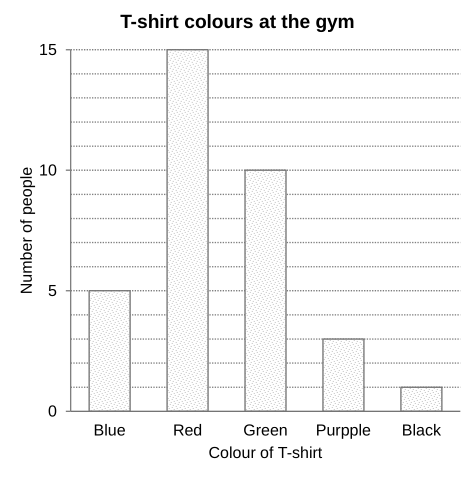
On Saturday, Jonty recorded the colour of T-shirts worn by the people at his gym. The results are shown in the graph.


  1. How many people were at the gym on Saturday? (Assume everyone was wearing a T-shirt).   (1 mark)

    --- 1 WORK AREA LINES (style=lined) ---

  2. What is the probability that a person selected at random at the gym on Saturday, would be wearing either a blue or green T-shirt?   (1 mark)

    --- 2 WORK AREA LINES (style=lined) ---

Show Answers Only

a.    `34`

b.    `15/34`

Show Worked Solution

a.    `text(# People)=5+15+10+3+1=34`
  

b.    `P (B\ text{or}\ G)=P(B)+P(G)=5/34+10/34=15/34`

Filed Under: Bar Charts and Histograms, Bar Charts and Histograms, Bar Charts and Histograms, Combinations and Single Stage Events, Probability, Single and Multi-Stage Events, Single and Multi-Stage Events, Single and Multi-Stage Events, Single stage events Tagged With: Band 2, Band 3, common-content, num-title-ct-core, num-title-qs-hsc, smc-1135-05-Simple Probability, smc-4225-15-Single-stage events, smc-6887-20-Simple Probability, smc-6935-05-Simple Probability, smc-821-10-Bar Charts, smc-828-10-Simple Probability, smc-997-10-Bar Charts

Probability, STD2 S2 2010 HSC 20 MC

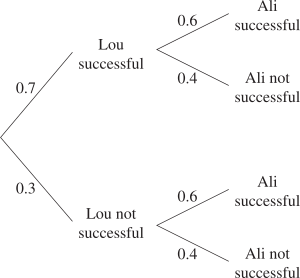
Lou and Ali are on a fitness program for one month. The probability that Lou will finish the program successfully is 0.7 while the probability that Ali will finish successfully is 0.6. The probability tree shows this information


What is the probability that only one of them will be successful ?

  1. `0.18`
  2. `0.28`
  3. `0.42`
  4. `0.46`
Show Answers Only

`D`

Show Worked Solution

`text(Let)\ \ Ptext{(Lou successful)}=P(L) = 0.7, \ P(\text{not}\ L) = 0.3`

`text(Let)\ \ Ptext{(Ali successful)}=P(A) = 0.6, \ P(\text{not}\ A) = 0.4`

`P text{(only 1 successful)}` `=P(L)xxP(text(not)\ A)+P(text(not)\ L)xxP(A)`
  `=(0.7xx0.4)+(0.3xx0.6)`
  `=0.28+0.18=0.46`

 
`=>  D`

♦ Mean mark 48%.

Filed Under: Multi-stage Events, Multi-Stage Events, Multi-Stage Events, Single and Multi-Stage Events, Single and Multi-Stage Events Tagged With: Band 5, num-title-ct-corea, num-title-qs-hsc, smc-1135-10-Probability Trees, smc-4238-20-Independent events, smc-4238-50-Probability trees, smc-6935-10-Probability Trees, smc-829-10-Probability Trees

Probability, STD2 S2 2009 HSC 1 MC

A newspaper states: ‘It will most probably rain tomorrow.’

Which of the following best represents the probability of an event that will most probably occur?   

  1. `33 1/3 text(%)` 
  2.  `text(50%)` 
  3. `text(80%)` 
  4. `text(100%)` 
Show Answers Only

`C`

Show Worked Solution

`text(Probably) =>\ text(likelihood > 50%)`

`text(However 100% = certainty)`

`:.\ text(80% is the answer)`

`=> C`

Filed Under: Fundamental understanding, Fundamental Understanding, Fundamental Understanding, Probability, Single and Multi-Stage Events, Single and Multi-Stage Events Tagged With: Band 3, num-title-ct-core, num-title-qs-hsc, smc-4225-05-Core concepts, smc-6887-10-Fundamental Understanding, smc-6935-04-Fundamental Understanding

Probability, STD2 S2 2012 HSC 27e

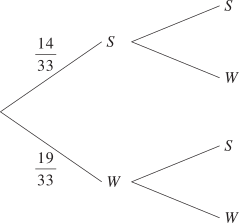
A box contains 33 scarves made from two different fabrics. There are 14 scarves made from silk (S) and 19 made from wool (W).
Two girls each select, at random, a scarf to wear from the box.

  1. Complete the probability tree diagram below.   (2 marks) 


    --- 0 WORK AREA LINES (style=lined) ---

  2. Calculate the probability that the two scarves selected are made from silk.   (1 mark)

    --- 2 WORK AREA LINES (style=lined) ---

  3. Calculate the probability that the two scarves selected are made from different fabrics.   (2 marks)

    --- 4 WORK AREA LINES (style=lined) ---

Show Answers Only

a. 


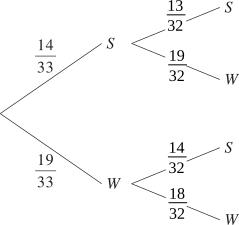
b.    `P\ text{(2 silk)}= 91/528`

c.    `P\ text{(different fabrics)}= 133/264`

Show Worked Solution

a. 

♦ Mean mark (a) 43%.
b.    `P\ text{(2 silk)}` `= P(S_1) xx P(S_2)`
  `= 14/33 xx 13/32= 91/528`


c.    `P\ text{(different)}` `= P (S_1,W_2) + P(W_1,S_2)`
  `= (14/33 xx 19/32) + (19/33 xx 14/32)`
  `= 532/1056= 133/264`
♦ Mean mark (c) 41%.
MARKER’S COMMENT: In better responses, students multiplied along the branches and then added these two results together

Filed Under: Multi-stage Events, Multi-Stage Events, Multi-Stage Events, Single and Multi-Stage Events, Single and Multi-Stage Events Tagged With: Band 4, Band 5, num-title-ct-corea, num-title-qs-hsc, smc-1135-10-Probability Trees, smc-4238-10-Dependent events, smc-4238-50-Probability trees, smc-6935-10-Probability Trees, smc-829-10-Probability Trees

Probability, STD2 S2 2011 HSC 2 MC

Which of the following could be the probability of an event occurring?

  1. `1` 
  2. `6/5` 
  3. `1.27` 
  4. `text(145%)` 
Show Answers Only

`A`

Show Worked Solution

`text(Probabilities must lie between 0 and 1 inclusive.)`

`=>A`

Filed Under: Fundamental understanding, Fundamental Understanding, Fundamental Understanding, Probability, Single and Multi-Stage Events, Single and Multi-Stage Events Tagged With: Band 4, num-title-ct-core, num-title-qs-hsc, smc-4225-05-Core concepts, smc-6887-10-Fundamental Understanding, smc-6935-04-Fundamental Understanding

Probability, STD2 S2 2010 HSC 8 MC

A bag contains red, green, yellow and blue balls.

\begin{array} {|c|c|}
\hline
\rule{0pt}{2.5ex} \textit{Colour} \rule[-1ex]{0pt}{0pt} & \textit{Probability} \\
\hline
\rule{0pt}{2.5ex} \text{Red} & \dfrac{1}{3} \\
\hline
\rule{0pt}{2.5ex} \text{Green}  & \dfrac{1}{4} \\
\hline
\rule{0pt}{2.5ex} \text{Yellow}  & \text{?} \\
\hline
\rule{0pt}{2.5ex} \text{Blue}  & \dfrac{1}{6} \\
\hline
\end{array}

The table shows the probability of choosing a red, green, or blue ball from the bag.

If there are 12 yellow balls in the bag, how many balls are in the bag altogether

  1. 16
  2. 36
  3. 48
  4. 60
Show Answers Only

\(C\)

Show Worked Solution
\(P(R)+P(G)+P(Y)+P(B)\) \(=1\)
\(\dfrac{1}{3}+\dfrac{1}{4}+P(Y)+\dfrac{1}{6}\) \(=1\)


\(P(Y)\) \(= 1-(\dfrac{1}{3}+\dfrac{1}{4}+\dfrac{1}{6})\)
  \(=1-\dfrac{9}{12}\)
  \(=\dfrac{1}{4}\)


\(P(Y)\) \(=\dfrac{\text{Yellow balls}}{\text{Total balls}}\)
\(\dfrac{1}{4}\) \(=\dfrac{12}{\text{Total balls}}\)

  
\(\therefore\ \text{ Total balls}=48\)

\(\Rightarrow C\)

Filed Under: Combinations and Single Stage Events, Probability, Single and Multi-Stage Events, Single and Multi-Stage Events, Single and Multi-Stage Events, Single stage events Tagged With: Band 4, num-title-ct-core, num-title-qs-hsc, smc-1135-05-Simple Probability, smc-4225-15-Single-stage events, smc-6887-20-Simple Probability, smc-6935-05-Simple Probability, smc-828-10-Simple Probability

Probability, STD2 S2 2012 HSC 12 MC

Two unbiased dice, each with faces numbered 1, 2, 3, 4, 5, 6, are rolled. 

What is the probability of a 6 appearing on at least one of the dice? 

  1. `1/6`  
  2. `11/36` 
  3. `25/36`  
  4. `5/6`  
Show Answers Only

`B`

Show Worked Solution

`text(Method 1: Using an array`

`P text{(at least 1 six)}=11/36`

\begin{align}
\textbf{Die B }
\begin{array}{c}
\textbf{Die A}  \\
\begin{array}{c|c|c|c|c|c|c}
\ & 1 & 2 & 3 & 4 & 5 & 6  \\
\hline
\ 1 & 1,1  & 1,2 & 1,3 & 1,4 & 1,5 & \fcolorbox{red}{white}{1,6} \\
\hline
\ 2 & 2,1 & 2,2 & 2,3 & 2,4 & 2,5 & \fcolorbox{red}{white}{2,6}  \\
\hline
\ 3 & 3,1 & 3,2 & 3,3 & 3,4 & 3,5 & \fcolorbox{red}{white}{3,6}  \\
\hline
\ 4 & 4,1 & 4,2 & 4,3 & 4,4 & 4,5 & \fcolorbox{red}{white}{4,6}  \\
\hline
\ 5 & 5,1 & 5,2 & 5,3 & 5,4 & 5,5 & \fcolorbox{red}{white}{5,6}  \\
\hline
\ 6 & \fcolorbox{red}{white}{6,1} & \fcolorbox{red}{white}{6,2} & \fcolorbox{red}{white}{6,3} & \fcolorbox{red}{white}{6,4} & \fcolorbox{red}{white}{6,5} & \fcolorbox{red}{white}{6,6}  \\
\end{array}
\end{array}
\end{align}


`text(Method 2: Using )P text{(E)} = 1-P\text{(not E)}`
  

`P text{(at least 1 six)}`

`=1-P text{(no six)} xx P text{(no six)} `

`=1-5/6 xx 5/6=11/36`

`=>  B`

♦♦♦ Mean mark 25%
COMMENT: The term “at least” should flag that calculating the probability of `1-P text{(event not happening)}` is likely to be the most efficient way to solve.

Filed Under: Multi-stage Events, Multi-Stage Events, Single and Multi-Stage Events, Single and Multi-Stage Events, Single and Multi-Stage Events Tagged With: Band 5, num-title-ct-pathb, num-title-qs-hsc, smc-1135-20-Other Multi-Stage Events, smc-1135-30-\(P(\text{E})=1-P(\text{not E})\), smc-4238-70-Complementary events, smc-4238-80-"at least", smc-6887-50-Other Multi-stage Events, smc-6887-80-Arrays, smc-6935-25-Other Multi-Stage Events, smc-6935-30-\(P\text{(E)} = 1-P\text{(not E)}\), smc-829-20-Other Multi-Stage Events, smc-829-30-P(E) = 1 - P(not E)

Probability, STD2 S2 2013 HSC 18 MC

Two unbiased dice, each with faces numbered  1, 2, 3, 4, 5, 6,  are rolled.

What is the probability of obtaining a sum of 6?

  1. `1/6`
  2. `1/12`
  3. `5/12`
  4. `5/36`
Show Answers Only

`D`

Show Worked Solution

`text(Total outcomes)=6xx6=36`

`text{Outcomes that sum to 6}=text{(1,5) (5,1) (2,4) (4,2) (3,3)} =5`

`:.\ P\text{(sum of 6)} =5/36`

`=> D`

♦♦ Mean mark 35%.

Filed Under: Multi-stage Events, Multi-Stage Events, Multi-Stage Events, Single and Multi-Stage Events, Single and Multi-Stage Events, Single and Multi-Stage Events Tagged With: Band 5, num-title-ct-corea, num-title-qs-hsc, smc-1135-20-Other Multi-Stage Events, smc-4238-20-Independent events, smc-6887-50-Other Multi-stage Events, smc-6935-25-Other Multi-Stage Events, smc-829-20-Other Multi-Stage Events

Probability, STD2 S2 2013 HSC 1 MC

Which of the following events would be LEAST likely to occur?

  1. Tossing a fair coin and obtaining a head
  2. Rolling a standard six-sided die and obtaining a 3
  3. Randomly selecting the letter 'G' from the 26 letters of the alphabet
  4. Winning first prize in a raffle of 100 tickets in which you have 4 tickets
Show Answers Only

`C`

Show Worked Solution

`P(A)=1/2,\ \ P(B)=1/6`

`P(C)=1/26,\ \ P(D)=4/100=1/25`
  

`=> C`

Filed Under: Combinations and Single Stage Events, Probability, Single and Multi-Stage Events, Single and Multi-Stage Events, Single and Multi-Stage Events, Single stage events Tagged With: Band 4, num-title-ct-core, num-title-qs-hsc, smc-1135-05-Simple Probability, smc-4225-15-Single-stage events, smc-6887-20-Simple Probability, smc-6935-05-Simple Probability, smc-828-10-Simple Probability

Copyright © 2014–2026 SmarterEd.com.au · Log in