SmarterEd

Aussie Maths & Science Teachers: Save your time with SmarterEd

  • Login
  • Get Help
  • About

Probability, STD1 S2 2019 HSC 24

The faces on a biased six-sided die are labelled 1, 2, 3, 4, 5 and 6. The die was rolled twenty times. The relative frequency of rolling a 6 was 30% and the relative frequency of rolling a 2 was 15%. The number 3 was the only other number rolled in the twenty rolls.

How many times was the number 3 rolled in the twenty rolls of the die?   (3 marks)

--- 4 WORK AREA LINES (style=lined) ---
 
Show Answers Only

`11`

Show Worked Solution

`text(Number of 6’s) = 30/100 xx 20 = 6`

`text(Number of 2’s) = 15/100 xx 20 = 3`

`:.\ text(Number of 3’s)= 20(6 + 3)=11`

Filed Under: Expected/Relative Frequency, Probability, Relative Frequency Tagged With: Band 4, num-title-ct-core, num-title-qs-hsc, smc-1133-30-Expected Frequency (np), smc-4225-35-Relative frequency, smc-6888-10-Expected Frequency, smc-6888-35-Relative Frequency

Probability, STD2 S2 2018 HSC 26a

Jeremy rolled a biased 6-sided die a number of times. He recorded the results in a table.
  

\begin{array} {|l|c|c|c|c|c|c|}
\hline
\rule{0pt}{2.5ex} \text{Number} \rule[-1ex]{0pt}{0pt} & \ \ 1 \ \ & \ \ 2 \ \  & \ \ 3 \ \  & \ \ 4 \ \  & \ \ 5 \ \  & \ \ 6 \ \ \\
\hline
\rule{0pt}{2.5ex} \text{Frequency} \rule[-1ex]{0pt}{0pt} & \ \ 23 \ \ & \ \ 19 \ \  & \ \ 48 \ \  & \ \ 20 \ \  & \ \ 21 \ \  & \ \ 19 \ \ \\
\hline
\end{array} 

What is the relative frequency of rolling a 3?   (1 mark)

--- 2 WORK AREA LINES (style=lined) ---

Show Answers Only

\(\dfrac{8}{25}\)

Show Worked Solution
♦ Mean mark 40%.

\(\text{Rel Freq}\) \(=\dfrac{\text{number of 3’s rolled}}{\text{total rolls}}\)
  \(=\dfrac{48}{150}=\dfrac{8}{25}\)

Filed Under: Data, Expected/Relative Frequency, Probability, Relative Frequency, Relative Frequency, Relative Frequency Tagged With: Band 5, common-content, num-title-ct-core, num-title-qs-hsc, smc-1133-20-Games of Chance, smc-4225-35-Relative frequency, smc-6805-40-Games of Chance, smc-6888-20-Games of Chance, smc-6888-35-Relative Frequency, smc-827-20-Games of Chance, smc-990-20-Games of Chance

Probability, STD2 S2 2015 HSC 26e

The table shows the relative frequency of selecting each of the different coloured jelly beans from packets containing green, yellow, black, red and white jelly beans.

\begin{array} {|c|c|}
\hline
\rule{0pt}{2.5ex} \textit{Colour} \rule[-1ex]{0pt}{0pt} & \textit{Relative frequency} \\
\hline
\rule{0pt}{2.5ex} \text{Green} \rule[-1ex]{0pt}{0pt} & 0.32 \\
\hline
\rule{0pt}{2.5ex} \text{Yellow} \rule[-1ex]{0pt}{0pt} & 0.13 \\
\hline
\rule{0pt}{2.5ex} \text{Black} \rule[-1ex]{0pt}{0pt} & 0.14 \\
\hline
\rule{0pt}{2.5ex} \text{Red} \rule[-1ex]{0pt}{0pt} &  \\
\hline
\rule{0pt}{2.5ex} \text{White} \rule[-1ex]{0pt}{0pt} & 0.24 \\
\hline
\end{array}

  1. What is the relative frequency of selecting a red jelly bean?   (1 mark)

    --- 2 WORK AREA LINES (style=lined) ---

  2. Based on this table of relative frequencies, what is the probability of NOT selecting a black jelly bean?   (1 mark)

    --- 2 WORK AREA LINES (style=lined) ---

Show Answers Only

a.    \(0.17\)

b.    \(0.86\)

Show Worked Solution

a.    \(\text{Relative frequency of red}\)

\(= 1-(0.32 + 0.13 + 0.14 + 0.24)= 1-0.83= 0.17\)


b.    \(P\text{(not selecting black)}\)

\(= 1-P\text{(selecting black)}= 1-0.14= 0.86\)

Filed Under: Combinations and Single Stage Events, Data, Expected/Relative Frequency, Probability, Relative Frequency, Relative Frequency, Relative Frequency, Relative Frequency, Single and Multi-Stage Events, Single and Multi-Stage Events, Single and Multi-Stage Events, Single stage events Tagged With: Band 3, Band 4, common-content, num-title-ct-core, num-title-qs-hsc, smc-1133-20-Games of Chance, smc-1135-05-Simple Probability, smc-4225-20-Complementary events, smc-4225-35-Relative frequency, smc-6805-40-Games of Chance, smc-6887-20-Simple Probability, smc-6888-20-Games of Chance, smc-6888-35-Relative Frequency, smc-6935-05-Simple Probability, smc-827-20-Games of Chance, smc-828-10-Simple Probability, smc-990-20-Games of Chance

Probability, STD2 S2 2007 HSC 2 MC

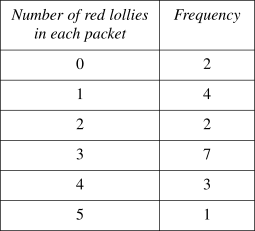
Each student in a class is given a packet of lollies. The teacher records the number of red lollies in each packet using a frequency table.
 

What is the relative frequency of a packet of lollies containing more than three red lollies?

  1. `4/19`
  2. `4/15`
  3. `11/19`
  4. `11/15`
Show Answers Only

`A`

Show Worked Solution

`text(# Packets with more than 3 red) = 3 + 1 = 4`

`text(Total packets) = 19`

`:.\ text(Relative Frequency) = 4/19`

`=>  A`

Filed Under: Expected/Relative Frequency, Probability, Relative Frequency, Relative Frequency, Relative Frequency, Relative Frequency, Venn Diagrams and Expected/Relative Frequency Tagged With: Band 3, common-content, num-title-ct-core, num-title-qs-hsc, smc-1133-10-Surveys/Two-Way Tables, smc-4225-35-Relative frequency, smc-6888-35-Relative Frequency, smc-6936-30-Relative Frequency, smc-827-10-Surveys/Two-Way Tables, smc-990-10-Surveys/Two-Way Tables

Probability, STD2 S2 2011 HSC 24b

A die was rolled 72 times. The results for this experiment are shown in the table.

\begin{array} {|c|c|}
\hline
\rule{0pt}{2.5ex} \textit{Number obtained} \rule[-1ex]{0pt}{0pt} & \textit{Frequency} \\
\hline
\rule{0pt}{2.5ex} \ 1 \rule[-1ex]{0pt}{0pt} & 16 \\
\hline
\rule{0pt}{2.5ex} \ 2 \rule[-1ex]{0pt}{0pt} & 11 \\
\hline
\rule{0pt}{2.5ex} \ 3 \rule[-1ex]{0pt}{0pt} & \textbf{A} \\
\hline
\rule{0pt}{2.5ex} \ 4 \rule[-1ex]{0pt}{0pt} & 8 \\
\hline
\rule{0pt}{2.5ex} \ 5 \rule[-1ex]{0pt}{0pt} & 12 \\
\hline
\rule{0pt}{2.5ex} \ 6 \rule[-1ex]{0pt}{0pt} & 15 \\
\hline
\end{array}

  1. Find the value of `A`.   (1 mark)

    --- 1 WORK AREA LINES (style=lined) ---

  2. What was the relative frequency of obtaining a 4.   (1 mark)

    --- 2 WORK AREA LINES (style=lined) ---

  3. If the die was unbiased, which number was obtained the expected number of times?   (1 mark)

    --- 2 WORK AREA LINES (style=lined) ---

Show Answers Only

a.    \(10\)

b.    \(\dfrac{1}{9}\)

c.    \(5\)

Show Worked Solution

a.    \(\text{Since die rolled 72 times:}\)

\(A=72-(16+11+8+12+15)=10\)

♦ Mean mark 38%
IMPORTANT: Many students confused ‘relative frequency’ with ‘frequency’ and incorrectly answered 8.

 
b.
    \(\text{Relative frequency of 4}=\dfrac{8}{72}=\dfrac{1}{9}\)
 

c.    \(\text{Expected frequency of any number}=\dfrac{1}{6}\times 72=12\)

\(\therefore\ \text{5 was obtained the expected number of times.}\)

Filed Under: Data, Expected/Relative Frequency, Probability, Relative Frequency, Relative Frequency, Relative Frequency, Relative Frequency, Venn Diagrams and Expected/Relative Frequency Tagged With: Band 2, Band 4, Band 5, common-content, num-title-ct-core, num-title-qs-hsc, smc-1133-20-Games of Chance, smc-1133-30-Expected Frequency (np), smc-4225-35-Relative frequency, smc-6805-40-Games of Chance, smc-6805-50-Expected Frequency, smc-6888-10-Expected Frequency, smc-6888-20-Games of Chance, smc-6888-35-Relative Frequency, smc-6936-30-Relative Frequency, smc-6936-40-Expected Frequency, smc-6936-50-Games of Chance, smc-827-20-Games of Chance, smc-827-40-Expected Frequency (np), smc-990-20-Games of Chance, smc-990-40-Expected Frequency (np)

Probability, STD2 S2 2012 HSC 17 MC

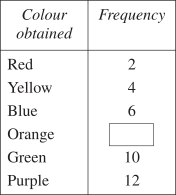
A spinner with different coloured sectors is spun 40 times. The results are recorded in the table.

 What is the relative frequency of obtaining the colour orange? 

  1. `3/20`  
  2. `1/5`  
  3. `6`  
  4. `8` 
Show Answers Only

`A`

Show Worked Solution
♦♦ Mean mark 34%
COMMENT: Note that relative frequency is the frequency of an event divided by the total frequencies (i.e. the probability).
`text(Total frequency)` `= 40\ text(spins)`
`text(Orange freq.)` `= 40-(2 + 4 + 6 + 10 +12)`
  `=6`
`:.\ text(Relative freq.)` `= 6/40 = 3/20`

 
`=>  A`

Filed Under: Data, Expected/Relative Frequency, Probability, Relative Frequency, Relative Frequency, Relative Frequency, Relative Frequency Tagged With: Band 5, common-content, num-title-ct-core, num-title-qs-hsc, smc-1133-20-Games of Chance, smc-4225-35-Relative frequency, smc-6805-40-Games of Chance, smc-6888-20-Games of Chance, smc-6888-35-Relative Frequency, smc-827-20-Games of Chance, smc-990-20-Games of Chance

Copyright © 2014–2026 SmarterEd.com.au · Log in