SmarterEd

Aussie Maths & Science Teachers: Save your time with SmarterEd

  • Login
  • Get Help
  • About

Polynomials, EXT1 EQ-Bank 18

Consider the function  \(P(x)=(x-1)^2(x+2)\left(x^2+3 x-4\right)\)

  1. By expressing \(P(x)\) as a product of its linear factors, identify its zeroes and the multiplicity of each zero.   (2 marks)

    --- 6 WORK AREA LINES (style=lined) ---

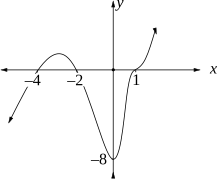
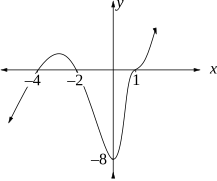
  2. Without using calculus, draw a sketch of  \(y=P(x)\)  showing any \(x\)-intercepts.   (2 marks)

    --- 8 WORK AREA LINES (style=lined) ---

Show Answers Only

a.    \(P(x)=(x-1)^3(x+2)(x+4)\)

\(\text{Roots:}\)

\(x=-2 \ \ \text{(multiplicity 1)}\)

\(x=-4 \ \ \text{(multiplicity 1)}\)

\(x=1 \ \ \text{(multiplicity 3)}\)
 

b.  
Show Worked Solution
a.     \(P(x)\) \(=(x-1)^2(x+2)\left(x^2+3 x-4\right)\)
    \(=(x-1)^2(x+2)(x-1)(x+4)\)
    \(=(x-1)^3(x+2)(x+4)\)

 
\(\text{Roots:}\)

\(x=-2 \ \ \text{(multiplicity 1)}\)

\(x=-4 \ \ \text{(multiplicity 1)}\)

\(x=1 \ \ \text{(multiplicity 3)}\)
 

b.    \(\text{Degree} \ P(x)=5, \ \ \text {Leading coefficient }=1\)

\(\text{As} \ \ x \rightarrow \infty, \ y \rightarrow \infty\)

\(\text{As} \ \ x \rightarrow -\infty, \ y \rightarrow -\infty\)

\(\text{At} \ \ x=0, y=-8\)
 

Filed Under: Graphs of Polynomials Tagged With: Band 3, Band 4, smc-6742-25-Multiplicity of Zeroes, smc-6742-40-Sketch Graphs, syllabus-2027

Polynomials, EXT1 EQ-Bank 6 MC

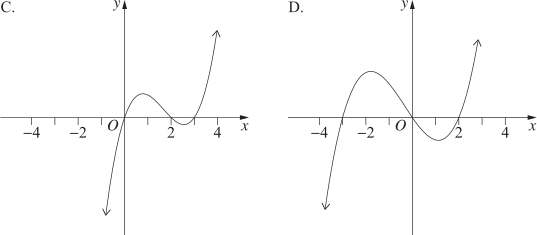
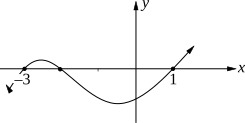
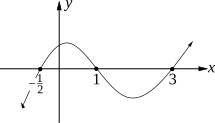
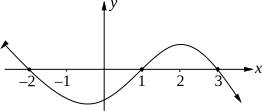
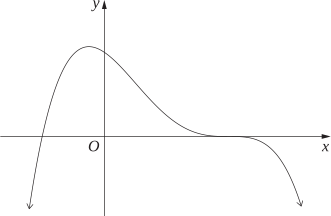
The graph of  `y = f(x)`  is shown.
 

Which of the following could be the equation of this graph?

  1. `y = (1-x)(2 + x)^3`
  2. `y = (x + 1)(x-2)^3`
  3. `y = (x + 1)(2-x)^3`
  4. `y = (x-1)(2 + x)^3`
Show Answers Only

`C`

Show Worked Solution

`text(By elimination:)`

`text(A single negative root occurs when)\ \ x =–1`

`->\ text(Eliminate A and D)`

`text(When)\ \ x = 0, \ y > 0`

`->\ text(Eliminate B)`

`=> C`

Filed Under: Graphs of Polynomials Tagged With: Band 4, smc-6742-10-Identify Graphs, syllabus-2027

Polynomials, EXT1 EQ-Bank 3 MC

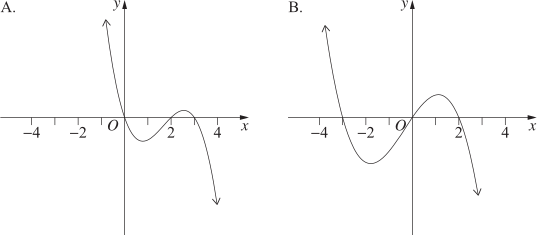
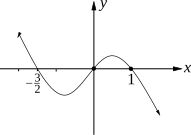
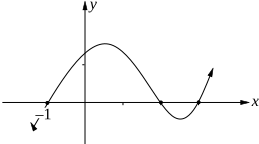
Which of the following best represents the graph of  \(y=-5 x(x-2)(3-x)\)?
 

Show Answers Only

\(C\)

Show Worked Solution

\(\text{By elimination:}\)

\(\text{Degree = 3,  Leading co-efficient}\ = 5\)

\(\text{As}\ \ x \rightarrow \infty,\ \ y \rightarrow \infty\ \text{(eliminate A and B)}\)

\(\text{When}\ x=1:\)

\(y=-5(-1)(2)=10>0\ \ \text{(eliminate D)}\)

\(\Rightarrow C\)

Filed Under: Graphs of Polynomials Tagged With: Band 3, smc-6742-10-Identify Graphs, syllabus-2027

Polynomials, EXT1 EQ-Bank 14

Consider the polynomial \(P(x)=x(3-x)^3\).

  1. State the degree of the polynomial and identify the leading coefficient.   (1 mark)

    --- 2 WORK AREA LINES (style=lined) ---

  2. Explain what happens to \(y\) as  \(x \rightarrow \pm \infty\).   (1 mark)

    --- 2 WORK AREA LINES (style=lined) ---

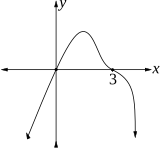
  3. Without using calculus, sketch \(P(x)\) showing its general form and any \(x\)-intercepts.   (2 marks)

    --- 6 WORK AREA LINES (style=lined) ---

Show Answers Only

a.    \(\text{Degree}\ P(x)=4\)

\(\text{Leading co-efficient}=-1\)
 

b.    \(\text{As} \ \ x \rightarrow-\infty,-x^4 \rightarrow-\infty, \ y \rightarrow-\infty\).

\(\text{As} \ \ x \rightarrow \infty,-x^4 \rightarrow-\infty, \ y \rightarrow-\infty\).
 

c.    \(P(x)\ \text{has zeroes at}\ \ x=0, 3:\)


Show Worked Solution

a.    \(\text{Degree}\ P(x)=4\)

\(\text{Leading co-efficient}=-1\)
 

b.    \(\text{As} \ \ x \rightarrow-\infty,-x^4 \rightarrow-\infty, \ y \rightarrow-\infty\).

\(\text{As} \ \ x \rightarrow \infty,-x^4 \rightarrow-\infty, \ y \rightarrow-\infty\).
 

c.    \(P(x)\ \text{has zeroes at}\ \ x=0, 3:\)


Filed Under: Graphs of Polynomials Tagged With: Band 3, smc-6742-20-Degree/Coefficients, smc-6742-30-\(x \rightarrow \pm \infty\), smc-6742-40-Sketch Graphs, syllabus-2027

Polynomials, EXT1 EQ-Bank 23

The polynomial  \(p(x) = x^3 + ax^2 + b\)  has a zero at \(r\) and a double zero at 4.

Find the values of \(a, b\) and \(r\).   (3 marks)

--- 5 WORK AREA LINES (style=lined) ---

Show Answers Only

\(a =-6, b = 32, r = -2\)

Show Worked Solution

\(p(x) = x^3 + ax^2 + b\)

\(\text{Zero at \(r\) and double zero at 4:}\)

\(p(x)\) \(=(x-4)^2(x-r) \)  
  \(=(x^2-8x+16)(x-r)\)  
  \(=x^3-8x^2+16x-rx^2+8rx-16r\)  
  \(=x^3+(-8-r)x^2+(16+8r)x-16r\)  


\(\text{Equating coefficients:}\)

\(16+8r=0\ \ \Rightarrow \ \ r=-2\)

\(a=-8-(-2)=-6\)

\(b=-16 \times -2=32\)

Filed Under: Graphs of Polynomials Tagged With: Band 4, smc-6742-20-Degree/Coefficients, syllabus-2027

Polynomials, EXT1 EQ-Bank 12

Consider a polynomial  \(y=-2 x^5-26 x^4-x+1\).

With reference to the leading term, explain what happens to \(y\) as  \(x \rightarrow-\infty\).   (2 marks)

--- 5 WORK AREA LINES (style=lined) ---

Show Answers Only

\(\text{As}\ \ x \rightarrow-\infty,\ \ x^{5}\ \rightarrow-\infty\)

\(\text{Since the leading coefficient \((-2)\) is negative:}\)

\(\text{As}\ \ x \rightarrow-\infty,\ \ y \rightarrow \infty.\)

Show Worked Solution

\(\text{As}\ \ x \rightarrow-\infty,\ \ x^{5}\ \rightarrow-\infty\)

\(\text{Since the leading coefficient \((-2)\) is negative:}\)

\(\text{As}\ \ x \rightarrow-\infty,\ \ y \rightarrow \infty.\)

Filed Under: Graphs of Polynomials Tagged With: Band 3, smc-6742-30-\(x \rightarrow \pm \infty\), syllabus-2027

Polynomials, EXT1 EQ-Bank 20

A polynomial has the equation

\(P(x)=(x-1)(x-3)(x+2)^2\left(x^2-x-6\right)\).

  1. By expressing \(P(x)\) as a product of its linear factors, determine the multiplicity of each of the roots of  \(P(x)=0\).   (2 marks)

    --- 5 WORK AREA LINES (style=lined) ---

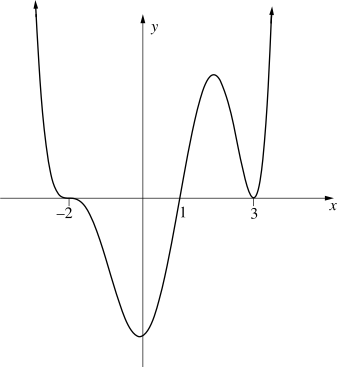
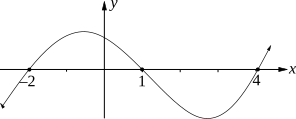
  2. Hence, without using calculus, draw a sketch of  \(y=P(x)\)  showing all \(x\)-intercepts.   (2 marks)

    --- 12 WORK AREA LINES (style=blank) ---

Show Answers Only
a.     \(P(x)\) \(=(x-1)(x-3)(x+2)^2\left(x^2-x-6\right)\)
    \(=(x-1)(x-3)(x+2)^2(x-3)(x+2)\)
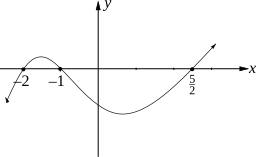
    \(=(x-1)(x-3)^2(x+2)^3\)


\(\text{Roots:}\)

\(x=1\ \text{(multiplicity 1)}\)

\(x=-2\ \text{(multiplicity 3)}\)

\(x=3\ \text{(multiplicity 2)}\)
 

b.
     

Show Worked Solution
a.     \(P(x)\) \(=(x-1)(x-3)(x+2)^2\left(x^2-x-6\right)\)
    \(=(x-1)(x-3)(x+2)^2(x-3)(x+2)\)
    \(=(x-1)(x-3)^2(x+2)^3\)


\(\text{Roots:}\)

\(x=1\ \text{(multiplicity 1)}\)

\(x=-2\ \text{(multiplicity 3)}\)

\(x=3\ \text{(multiplicity 2)}\)
 

b.
     

Filed Under: Graphs of Polynomials Tagged With: Band 3, Band 4, smc-6742-25-Multiplicity of Zeroes, smc-6742-40-Sketch Graphs, syllabus-2027

Functions, EXT1 EQ-Bank 23

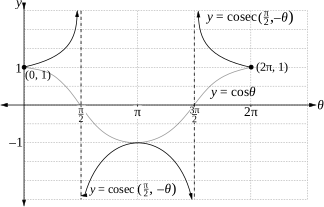
Consider the function  \(f(\theta)=\operatorname{cosec}\left(\frac{\pi}{2}-\theta\right)\)  for  \(0 \leqslant \theta \leqslant 2 \pi\).

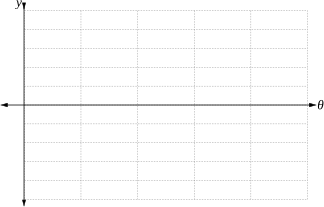
  1. Sketch the graph of  \(y=\operatorname{cosec}\left(\frac{\pi}{2}-\theta\right)\),  showing all key features.   (2 marks)


    --- 0 WORK AREA LINES (style=lined) ---

  2. In set notation, state the range of \(\theta\).   (1 mark)

    --- 2 WORK AREA LINES (style=lined) ---

Show Answers Only

a.     


b.   \(\text{Range} \ \ f(\theta):\ y \in(-\infty,-1] \cup[1, \infty)\)

Show Worked Solution

a.    \(y=\operatorname{cosec}\left(\frac{\pi}{2}-\theta\right)=\dfrac{1}{\sin \left(\frac{\pi}{2}-\theta\right)}=\dfrac{1}{\cos\, \theta}\)


b.   \(\text{Range} \ \ f(\theta):\ y \in(-\infty,-1] \cup[1, \infty)\)

Filed Under: Graphical Relationships Tagged With: Band 4, smc-6640-15-cosec/sec/cot, syllabus-2027

Functions, EXT1 EQ-Bank 24

Consider the functions  \(f(x)=\tan x\)  and  \(g(x)=\cot x\).

  1. Explain why  \(\cot x \neq \dfrac{1}{\tan x}\)  for all values of \(x\).   (2 marks)

    --- 5 WORK AREA LINES (style=lined) ---

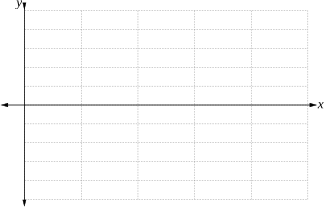
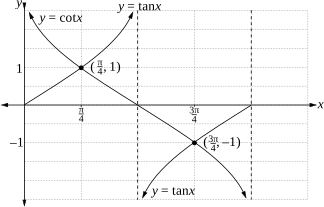
  2. On the same set of axes below, sketch  \(y=\tan x\)  and  \(y=\cot x\)  for  \(0<x<\pi\), identifying any points where the graphs intersect.   (2 marks)


--- 0 WORK AREA LINES (style=lined) ---

Show Answers Only

a.    \(\text{At}\ \  x=\dfrac{\pi}{2}:\)

\(\cot \dfrac{\pi}{2}=\dfrac{\cos \frac{\pi}{2}}{\sin \frac{\pi}{2}}=\dfrac{0}{1}=0 \ \Rightarrow \ \text{defined}\).

\(\tan \dfrac{\pi}{2}=\dfrac{\sin \frac{\pi}{2}}{\cos \frac{\pi}{2}}=\dfrac{1}{0} \Rightarrow \ \text{undefined}\).

\(\dfrac{1}{\tan \frac{\pi}{2}}\ \ \text{is therefore undefined}\).

\(\therefore \cot x \neq \dfrac{1}{\tan x} \ \ \text{for all values of }\ x\).
 

b.
       

Show Worked Solution

a.    \(\text{At}\ \  x=\dfrac{\pi}{2}:\)

\(\cot \dfrac{\pi}{2}=\dfrac{\cos \frac{\pi}{2}}{\sin \frac{\pi}{2}}=\dfrac{0}{1}=0 \ \Rightarrow \ \text{defined}\).

\(\tan \dfrac{\pi}{2}=\dfrac{\sin \frac{\pi}{2}}{\cos \frac{\pi}{2}}=\dfrac{1}{0} \Rightarrow \ \text{undefined}\).

\(\dfrac{1}{\tan \frac{\pi}{2}}\ \ \text{is therefore undefined}\).

\(\therefore \cot x \neq \dfrac{1}{\tan x} \ \ \text{for all values of }\ x\).
 

b.
       

Filed Under: Graphical Relationships Tagged With: Band 4, smc-6640-15-cosec/sec/cot, syllabus-2027

Functions, EXT1 EQ-Bank 18

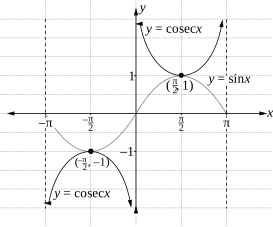
Consider the function  \(y=\operatorname{cosec}\,x\)  for  \(-\pi \leqslant x \leqslant \pi\).

  1. State the equations of all vertical asymptotes in the given domain.   (1 mark)

    --- 3 WORK AREA LINES (style=lined) ---

  2. Sketch the graph of  \(y=\operatorname{cosec} x\), showing all key features.   (2 marks)

    --- 0 WORK AREA LINES (style=lined) ---


Show Answers Only

a.    \(y=\operatorname{cosec}\,x=\dfrac{1}{\sin x}\)

\(\text{Asymptotes when \(\ \sin x=0 \ \) in given domain.}\)

\(\therefore \ \text{Asymptotes at} \ \ x=-\pi, 0, \pi\)
 

b.
       

Show Worked Solution

a.    \(y=\operatorname{cosec}\,x=\dfrac{1}{\sin x}\)

\(\text{Asymptotes when \(\ \sin x=0 \ \) in given domain.}\)

\(\therefore \ \text{Asymptotes at} \ \ x=-\pi, 0, \pi\)
 

b.
       

Filed Under: Graphical Relationships Tagged With: Band 3, Band 4, smc-6640-15-cosec/sec/cot, syllabus-2027

Functions, EXT1 EQ-Bank 17

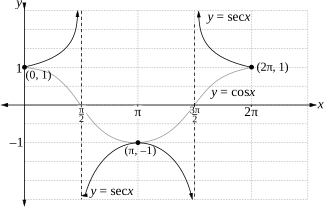
  1. Sketch the graph of  \(y=\sec x\)  for  \(0 \leqslant x \leqslant 2 \pi\).
  2. In your answer, identify all asymptotes and the coordinates of any maximum and minimum turning points.   (2 marks)

    --- 0 WORK AREA LINES (style=lined) ---


  3. Using set notation, state the domain and range of  \(y=\sec x\).   (1 mark)

    --- 2 WORK AREA LINES (style=lined) ---

Show Answers Only

a.
   

b.    \(\text{Domain:} \ x \in\left[0, \frac{\pi}{2}\right) \cup\left(\frac{\pi}{2}, \frac{3 \pi}{2}\right) \cup\left(\frac{3 \pi}{2}, 2 \pi\right]\)

\(\text{Range:} \ y \in(-\infty,-1] \cup[1, \infty)\)

Show Worked Solution

a.    \(\text{Draw}\ \ y=\cos\,x\ \ \text{to inform graph:}\)


\(\text{Minimum TPs:}\ (0,1), (2\pi, 1) \)

\(\text{Maximum TP:}\ (\pi, -1)\)
 

b.    \(\text{Domain:} \ x \in\left[0, \frac{\pi}{2}\right) \cup\left(\frac{\pi}{2}, \frac{3 \pi}{2}\right) \cup\left(\frac{3 \pi}{2}, 2 \pi\right]\)

\(\text{Range:} \ y \in(-\infty,-1] \cup[1, \infty)\)

Filed Under: Graphical Relationships Tagged With: Band 3, Band 4, smc-6640-15-cosec/sec/cot, syllabus-2027

Probability, 2ADV EQ-Bank 13

Consider the universal set  \(U=\{x\) is a positive integer and  \(x \leqslant 24\}\)

Three sets are defined as

\begin{aligned}
& A=\{x \text { is a factor of } 24\} \\
& B=\{x \text { is a perfect square}\} \\
& C=\{x \text { is divisible by } 3\}
\end{aligned}

  1. List the elements of set \(A\).   (1 mark)

    --- 1 WORK AREA LINES (style=lined) ---

  2. Find \(A \cap B\).   (1 mark)

    --- 2 WORK AREA LINES (style=lined) ---

  3. Find \((A \cup B) \cap C^c\)   (2 marks)

    --- 5 WORK AREA LINES (style=lined) ---

Show Answers Only

a.    \(A=\{1,2,3,4,6,8,12,24\}\)

b.    \(A \cap B=\{1,4\}\)

c.    \((A \cup B) \cap C^c=\{1,2,4,8,16\}\)

Show Worked Solution

a.    \(A=\{1,2,3,4,6,8,12,24\}\)
 

b.    \(B=\{1,4,9,16\}\)

\(A \cap B=\{1,4\}\)
 

c.    \(A \cup B=\{1,2,3,4,6,8,9,12,16,24\}\)

\(C=\{3,6,9,12,15,18,21,24\}\)

\(C^c=\{1,2,4,5,7,8,10,11,13,14,16,17,19,20,22,23\}\)

\((A \cup B) \cap C^c=\{1,2,4,8,16\}\)

Filed Under: Conditional Probability and Venn Diagrams Tagged With: Band 2, Band 3, smc-6470-05-Sets/Set Notation, syllabus-2027

Probability, 2ADV EQ-Bank 12

Consider the universal set  \(U=\{x\) is a positive integer and \(x \leqslant 15\}\)

Three sets are defined as:

\begin{aligned}
& A=\{x \text { is a multiple of } 3\} \\
& B=\{x \text{ is a prime number}\} \\
& C=\{x \text{ is even}\}
\end{aligned}

  1. List the elements of set \(A\).   (1 mark)

    --- 1 WORK AREA LINES (style=lined) ---

  2.  Find  \(B \cap C\)   (1 mark)

    --- 3 WORK AREA LINES (style=lined) ---

  3. Find  \(A \cup \overline{C}\)   (2 marks)

    --- 4 WORK AREA LINES (style=lined) ---

Show Answers Only

a.    \(A=\{3,6,9,12,15\}\)

b.   \(B \cap C = \{2\} \)

c.    \(A \cup \overline{C}=\{1,3,5,6,7,9,11,12,13,15\}\)

Show Worked Solution

a.    \(A=\{3,6,9,12,15\}\)
 

b.    \(B=\{2,3,5,7,11,13\}\)

\(C=\{2,4,6,8,10,12,14\}\)

\(B \cap C = \{2\} \)
 

c.    \(\text{Find} \ \ A \cup \overline{C}:\)

\(\overline{C}=\{1,3,5,7,9,11,13\}\)

\(A \cup \overline{C}=\{1,3,5,6,7,9,11,12,13,15\}\)

Filed Under: Conditional Probability and Venn Diagrams Tagged With: Band 2, Band 3, smc-6470-05-Sets/Set Notation, syllabus-2027

Probability, 2ADV EQ-Bank 11

Consider the universal set  \(U=\{1,2,3,4,5,6,7,8,9,10\}\).

Two sets, \(A\) and \(B\), are given as

\(A= \{1,3,4,7,9\}\)

\(B =\{2,4,7,10\}\)

  1. Find \(A \cup B\)   (1 mark)

    --- 2 WORK AREA LINES (style=lined) ---

  2. Find \(A \cap \overline{B}\)   (2 marks)

    --- 4 WORK AREA LINES (style=lined) ---

Show Answers Only

a.    \(A \cup B = \{1,2,3,4,7,9,10\}\)

b.    \(A \cap \overline{B} = \{3, 4, 9\}\)

Show Worked Solution

a.    \(A= \{1,3,4,7,9\},\ \ B=\{2,4,7,10\}\)

\(A \cup B = \{1,2,3,4,7,9,10\}\)
 

b.     \(\overline{B} = \{1,3,5,6,8,9\}\)

\(A \cap \overline{B} = \{3, 4, 9\}\)

Filed Under: Conditional Probability and Venn Diagrams Tagged With: Band 2, Band 3, smc-6470-05-Sets/Set Notation, syllabus-2027

Measurement, STD2 EQ-Bank 19

A bus departs Sydney at 8:00 am on Monday for Perth. The bus makes five stops on the journey whose durations are given below: 

  • Dubbo: 45 minutes
  • Broken Hill: 1 hour 15 minutes
  • Port Augusta: 50 minutes
  • Ceduna: 40 minutes
  • Norseman: 1 hour 10 minutes

The total driving time (excluding stops) is 52 hours and 30 minutes. The bus arrives in Perth at 3:25 pm on Thursday.

  1. Calculate the total time for the journey from Sydney to Perth, including all stops. Give your answer in hours and minutes.   (2 marks)

    --- 5 WORK AREA LINES (style=lined) ---

  2. Convert your answer from part (a) to days, hours and minutes, and hence state the day and time the bus arrives in Perth. Ignore time zones in your calculations.   (2 marks)

    --- 6 WORK AREA LINES (style=lined) ---

Show Answers Only

a.   \(\text{57 hours 10 minutes}\)

b.   \(\text{Bus arrives on Wednesday at 5:10 pm with the journey}\)

\(\text{taking 2 days 9 hours 10 minutes.}\)

Show Worked Solution

a.   \(\text{Total stopping time}\)

\(=45+75+50+40+70\)

\(= 280 \text{ minutes}= 4\ \text{hours}\ 40 \text{ minutes} \)

\(\text{Total journey}\)

\(=52\ \text{hours}\ 30 \text{ minutes}+4\ \text{hours}\ 40 \text{ minutes} \)

\(=57\ \text{hours}\ 10 \text{ minutes} \)
  

b.   \(\text{Convert 57 hours 10 minutes to days, hours and minutes:}\)

\(57\ \text{hours}=(2 \times 24) + 9=2\ \text{days}\ 9\ \text{hours}\)

\(57\ \text{ hours 10 minutes}=2\ \text{days}\ 9\ \text{hours}\ 10\ \text{minutes}\)
 

\(\text{Bus arrival in Perth:}\)

\(\rightarrow\ \text{Bus departs 8 am Monday}\)

\(\rightarrow\ \text{Monday 8:00 am + 2 days = Wednesday 8:00 am}\)

\(\rightarrow\ \text{Wednesday 8:00 am + 9 hours 10 minutes = Wednesday 5:10 pm}\)

\(\therefore\ \text{Bus arrives Wednesday at 5:10 pm.}\)

Filed Under: Time and Time Difference, Time and Time Difference Tagged With: Band 3, Band 4, smc-6306-15-Time Conversions, smc-6306-20-Elapsed Time Problems, smc-6525-15-Time Conversions, smc-6525-20-Elapsed Time Problems, syllabus-2027

Measurement, STD2 EQ-Bank 23

Day 1 of the Ashes Test match at the SCG begins at 10:30 am. Each session of play lasts 2 hours, with a 40-minute lunch break after the first session and a 20-minute tea break after the second session. Rain delays the start of the third session by 37 minutes.

At what time does play finish for Day 1?   (2 marks)

--- 5 WORK AREA LINES (style=lined) ---

Show Answers Only

\(6:07\ \text{pm}\)

Show Worked Solution

\(\text{Total time }\)

\(=2\ \text{hours}\times 3+40\ \text{minutes}+20\ \text{minutes}+37\ \text{minutes}\)

\(=7\ \text{hours}\ 37\ \text{ minutes}\)

\(\text{Since match starts at }10:30\ \text{am}:\)

\(\text{Finish time}=10:30\ \text{am}+7\ \text{hours}\ 37\ \text{ minutes}=6:07\ \text{pm}\)

Filed Under: Time and Time Difference, Time and Time Difference Tagged With: Band 4, smc-6306-20-Elapsed Time Problems, smc-6525-20-Elapsed Time Problems, syllabus-2027

Measurement, STD2 EQ-Bank 27

A basketball game starts at 6:35 pm. The game consists of four quarters that are 10 minutes each, with a 2-minute break after the first and third quarters and an 8-minute break at half time.

  1. The home team scores a three-pointer 6 minutes into the second quarter. At what time does this occur?   (2 marks)

    --- 4 WORK AREA LINES (style=lined) ---

  2. If 4 minutes injury time is added to the total time, at what time does the game finish?   (2 marks)

    --- 4 WORK AREA LINES (style=lined) ---

Show Answers Only

a.   \(6:53\ \text{pm}\)

b.   \(7:31\ \text{pm}\)

Show Worked Solution

a.   \(\text{Match starts at }6:35\ \text{pm}\)

\(\text{Calculate time elapsed until 6 minutes into the second quarter:}\)

\(\text{Total time before three-pointer}\)

\(=10+2+6=18\text{ minutes}\)

\(\therefore\ \text{Three pointer is scored at: }6:35+18\ \text{minutes}=6:53\ \text{pm}\)
 

b.   \(\text{Total duration of game}\)

\(=4 \times 10+2 \times 2+8+4=56\ \text{minutes}\)

\(\therefore\ \text{Finish time}=6:35+56\ \text{minutes}=7:31\ \text{pm}\)

Filed Under: Time and Time Difference, Time and Time Difference Tagged With: Band 4, smc-6306-20-Elapsed Time Problems, smc-6525-20-Elapsed Time Problems, syllabus-2027

Measurement, STD2 EQ-Bank 24

Sarah's netball match starts at 1:45 pm. The match consists of four quarters that are 12 minutes each, with a 3-minute break after the first and third quarters, and a 7-minute break at half time.

  1. Sarah intercepts the ball 8 minutes into the third quarter. At what time does this occur?   (2 marks)

    --- 3 WORK AREA LINES (style=lined) ---

  2. At what time does the match finish?   (2 marks)

    --- 3 WORK AREA LINES (style=lined) ---

Show Answers Only

a.   \(2:27\ \text{pm}\)

b.   \(2:46\ \text{pm}\)

Show Worked Solution

a.   \(\text{Match starts at }1:45\ \text{pm}\)

\(\text{Calculate time elapsed until 8 minutes into the third quarter:}\)

\(\text{Total time before intercept}\)

\(=12+3+12+7+8=42\text{ minutes}\)

\(\therefore\ \text{Sarah intercepts the ball at: }1:45+42\ \text{minutes}=2:27\ \text{pm}\)
 

b.   \(\text{Total duration of game}\)

\(=4 \times 12+2 \times 3+7=61\ \text{minutes}\)

\(\therefore\ \text{Finish time}=1:45+61\ \text{minutes}=2:46\ \text{pm}\)

Filed Under: Time and Time Difference, Time and Time Difference Tagged With: Band 4, smc-6306-20-Elapsed Time Problems, smc-6525-20-Elapsed Time Problems, syllabus-2027

Measurement, STD2 EQ-Bank 14 MC

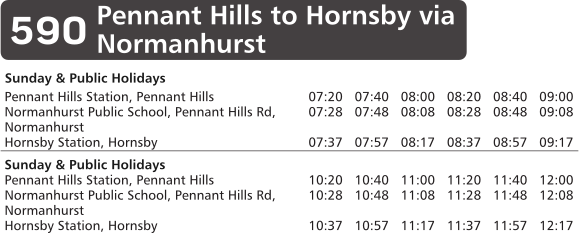
Use the bus timetable below to answer this question.

John works weekend shifts at a cafe near Hornsby station. He needs to be at work by 9:30 am.

It takes him 12 minutes to walk from his home to Pennant Hills Station and 8 minutes to walk from Hornsby Station to his workplace.

What is the latest bus he can catch from Pennant Hills Station and what time must he leave home? 

  1. 8:40 bus, leaving home at 8:28
  2. 9:00 bus, leaving home at 8:48
  3. 9:20 bus, leaving home at 9:08
  4. 9:40 bus, leaving home at 9:28
Show Answers Only

\(B\)

Show Worked Solution

\(\text{Work backwards from when John needs to be at work.}\)

\(\text{John must arrive at work by 9:30 am:}\)

\(\rightarrow\ 8\text{ minutes to walk from Hornsby Station to work.}\)

\(\rightarrow\ \text{Must arrive at Hornsby Station by: }\ 9:30-8 \text{ minutes} = 9:22 \text{ am}\)
 

\(\text{Find the latest bus arriving at Hornsby Station by 9:22 am:}\)

\(\rightarrow\ \text{Arrival times: } 08:37, 08:57, 09:17, 09:37…\)

\(\rightarrow\ \text{He must catch the }09:17.\)

\(\rightarrow\ 09:17\ \text{departs Pennant Hills Station at }09:00.\)
  

\(\text{John needs to leave home 12 minutes before train comes:}\)

\(\rightarrow\ 9:00-12 \text{ minutes} = 8:48 \text{ am} \)
   

\(\Rightarrow B\)

Filed Under: Uncategorized Tagged With: Band 4, smc-6306-20-Elapsed Time Problems, smc-6525-20-Elapsed Time Problems, syllabus-2027

Measurement, STD2 EQ-Bank 4 MC

On Tuesday Sarah started work at 6:45 am and finished at 3:12 pm.

For how many hours and minutes did Sarah work on Tuesday?

  1. 8 hours 27 minutes
  2. 8 hours 33 minutes
  3. 9 hours 27 minutes
  4. 9 hours 33 minutes
Show Answers Only

\(A\)

Show Worked Solution

\(\text{Break into steps}\)

\(\text{From 6:45 am to 7:00 am: }\ 60-45 = 15 \text{ minutes} \)

\(\text{From 7:00 am to 3:12 pm: }\  8\ \text{hours}\ 12 \text{ minutes} \)

\(\text{Total: }\  8\ \text{hours}+12 \text{ minutes} +15 \text{ minutes}=8\ \text{hours}\ 27\ \text{minutes}\)

\(\Rightarrow A\)

Filed Under: Time and Time Difference, Time and Time Difference Tagged With: Band 3, smc-6306-20-Elapsed Time Problems, smc-6525-20-Elapsed Time Problems, syllabus-2027

Measurement, STD2 EQ-Bank 3 MC

A bus departs at 8:23 am and arrives at its destination at 11:47 am.

How long was the bus journey?

  1. 3 hours 24 minutes
  2. 3 hours 34 minutes
  3. 4 hours 24 minutes
  4. 4 hours 34 minutes
Show Answers Only

\(A\)

Show Worked Solution

\(\text{Method 1: Break into steps}\)

\(\rightarrow\text{From 8:23 am to 9:00 am: }\ 60-23 = 37 \text{ minutes} \)

\(\rightarrow\text{From 9:00 am to 11:47 am: }\  2\ \text{hours}\ 47 \text{ minutes} \)

\(\rightarrow\text{Total: }\  37 \text{ minutes} + 2\ \text{hours}+\ 47 \text{ minutes}=2\ \text{hours}\ 84\ \text{minutes}\)

\(=3\ \text{hours}\ 24\ \text{minutes}\)
  

\(\text{Method 2: Calculate hours and minutes separately}\)

\(\rightarrow\text{Hours: } \ 11-8 = 3 \text{ hours} \)

\(\rightarrow\text{Minutes: }\ 47-23 = 24 \text{ minutes} \)

\(\rightarrow\text{Total: }\ 3 \text{ hours } 24 \text{ minutes} \)
  

\(\Rightarrow B\)

Filed Under: Time and Time Difference, Time and Time Difference Tagged With: Band 3, smc-6306-20-Elapsed Time Problems, smc-6525-20-Elapsed Time Problems, syllabus-2027

Measurement, STD2 EQ-Bank 1 MC

It is currently 2:17 pm. A train is due to arrive at 3:08 pm.

How long do you need to wait for the train?

  1. 49 minutes
  2. 51 minutes
  3. 1 hour 9 minutes
  4. 1 hour 51 minutes
Show Answers Only

\(B\)

Show Worked Solution

\(\text{Method 1: Break into steps}\)

\(\rightarrow\text{From 2:17 pm to 3:00 pm: }\ 60-17 = 43 \text{ minutes} \)

\(\rightarrow\text{From 3:00 pm to 3:08 pm: }\  8 \text{ minutes} \)

\(\rightarrow\text{Total: }\  43+8 = 51 \text{ minutes} \)
  
\(\text{Method 2: Calculate directly}\)

\(\rightarrow 3:08-2:17 = 51 \text{ minutes} \)
  

\(\Rightarrow B\)

Filed Under: Time and Time Difference, Time and Time Difference Tagged With: Band 2, smc-6306-20-Elapsed Time Problems, smc-6525-20-Elapsed Time Problems, syllabus-2027

Measurement, STD2 EQ-Bank 18

A concert runs for 5400 seconds.

  1. Convert this time to hours and minutes.   (2 marks)

    --- 3 WORK AREA LINES (style=lined) ---

  2. If the concert finishes at 10:45 pm, what time did it start?   (2 marks)

    --- 3 WORK AREA LINES (style=lined) ---

Show Answers Only

a.   \(\text{1 hours 30 minutes}\)

b.   \(\text{9:15 pm}\)

Show Worked Solution

a.   \(\text{Step 1: Convert seconds to minutes}\)

\(5400 \text{ seconds} = \dfrac{5400}{60} \text{ minutes} = 90 \text{ minutes} \)

\(\text{Step 2: Convert minutes to hours and minutes}\)

\(90 \text{ minutes} = \dfrac{90}{60} \text{ hours} = 1.5 \text{ hours} \)

\(\therefore\ 90 \text{ minutes} = 1 \text{ hour } 30 \text{ minutes} \)
  

b.   \(\text{Finish time: 10:45 pm}\)

\(\text{Concert duration: 1 hours 30 minutes}\)

\(10:45\ \text{pm}-1\ \text{hour}=9:45\ \text{pm}\)

\(9:45\ \text{pm}-30\ \text{minutes}=9:15\ \text{pm}\)

\(\text{Start time: 9:15 pm}\)

Filed Under: Time and Time Difference, Time and Time Difference Tagged With: Band 3, Band 4, smc-6306-15-Time Conversions, smc-6306-20-Elapsed Time Problems, smc-6525-15-Time Conversions, smc-6525-20-Elapsed Time Problems, syllabus-2027

Measurement, STD2 EQ-Bank 16

A movie runs for 8400 seconds.

  1. Convert this time to hours and minutes.   (2 marks)

    --- 3 WORK AREA LINES (style=lined) ---

  2. If the movie starts at 7:15 pm, what time will it finish?   (1 mark)

    --- 2 WORK AREA LINES (style=lined) ---

Show Answers Only

a.   \(\text{2 hours 20 minutes}\)

b.   \(\text{9:35 pm}\)

Show Worked Solution

a.   \(\text{Step 1: Convert seconds to minutes}\)

\(8400 \text{ seconds} = \dfrac{8400}{60} \text{ minutes} = 140 \text{ minutes} \)

\(\text{Step 2: Convert minutes to hours and minutes}\)

\(140 \text{ minutes} = \dfrac{140}{60} \text{ hours} = 2.333… \text{ hours} \)

\(\text{To find the minutes part:}\ 140 = 2 \times 60 + 20  \)

\(\therefore\ 140 \text{ minutes} = 2 \text{ hours } 20 \text{ minutes} \)
  

b.   \(\text{Starting time: 7:15 pm}\)

\(\text{Movie duration: 2 hours 20 minutes}\)

\(\text{Finish time: 9:35 pm}\)

Filed Under: Time and Time Difference, Time and Time Difference Tagged With: Band 3, smc-6306-15-Time Conversions, smc-6306-20-Elapsed Time Problems, smc-6525-15-Time Conversions, smc-6525-20-Elapsed Time Problems, syllabus-2027

Measurement, STD2 EQ-Bank 8 MC

Convert 10 500 seconds to hours and minutes.

  1. 2 hours 55 minutes
  2. 3 hours 15 minutes
  3. 2 hours 50 minutes
  4. 175 minutes
Show Answers Only

\(A\)

Show Worked Solution

\(\text{Convert seconds to minutes:}\)

\(10\,500 \text{ seconds} = \dfrac{10\,500}{60} \text{ minutes} = 175 \text{ minutes} \)
 

\(\text{Convert minutes to hours and minutes:}\)

\(175 \text{ minutes} = \dfrac{175}{60} \text{ hours} = 2.916… \text{ hours} \)
 

\(\text{Calculate minutes:}\ 175-2 \times 60=55  \)

\(\therefore\ 175 \text{ minutes} = 2 \text{ hours } 55 \text{ minutes} \)

\(\Rightarrow A\)

Filed Under: Time and Time Difference, Time and Time Difference Tagged With: Band 4, smc-6306-15-Time Conversions, smc-6525-15-Time Conversions, syllabus-2027

Measurement, STD2 EQ-Bank 7 MC

Convert 7200 seconds to hours.

  1. 1 hour
  2. 2 hours
  3. 12 hours
  4. 120 hours
Show Answers Only

\(B\)

Show Worked Solution

\( 7200 \text{ seconds} = \dfrac{7200}{60} \text{ minutes} = 120 \text{ minutes} \)

\( 120 \text{ minutes} = \dfrac{120}{60} \text{ hours} = 2 \text{ hours} \)

\(\Rightarrow B\)

Filed Under: Time and Time Difference, Time and Time Difference Tagged With: Band 4, smc-6306-15-Time Conversions, smc-6525-15-Time Conversions, syllabus-2027

Measurement, STD2 EQ-Bank 5 MC

Jeremy watched a movie at the cinema that began at 11:35 am. If it finished at 2:05 pm, what was the duration of the movie, in minutes?

  1. 25 minutes
  2. 125 minutes
  3. 150 minutes
  4. 250 minutes
Show Answers Only

\(C\)

Show Worked Solution

\(\text{11:35 to 2:05 = 2.5 hours}\)

\(\text{To convert hours to minutes multiply by 60.}\)

\( 2.5 \text{ hours} = 2.5 \times 60 \text{ minutes} = 150 \text{ minutes} \)

\(\Rightarrow C\)

Filed Under: Time and Time Difference, Time and Time Difference Tagged With: Band 3, smc-6306-15-Time Conversions, smc-6525-15-Time Conversions, syllabus-2027

Measurement, STD2 EQ-Bank 2 MC

Convert 180 seconds to minutes.

  1. 2 minutes
  2. 3 minutes
  3. 18 minutes
  4. 10,800 minutes
Show Answers Only

\(B\)

Show Worked Solution

\(\text{To convert seconds to minutes divide by 60.}\)

\( 180 \text{ seconds} = \dfrac{180}{60} \text{ minutes} = 3 \text{ minutes} \)

\(\Rightarrow B\)

Filed Under: Time and Time Difference, Time and Time Difference Tagged With: Band 2, smc-6306-15-Time Conversions, smc-6525-15-Time Conversions, syllabus-2027

Functions, EXT1 EQ-Bank 18

A cubic function is given by  \(f(x)=\left(2 x^2+3 x-5\right)(x+2)\)

  1. Find the zeros of \(f(x)\).   (1 mark)

    --- 3 WORK AREA LINES (style=lined) ---

  2. Hence, or otherwise, solve \(f(x) \geqslant 0\), giving your answer in set notation.   (2 marks)

    --- 6 WORK AREA LINES (style=lined) ---

Show Answers Only

a.    \(\text{Zeros at} \ \ x=-\dfrac{5}{2}, x=1 \ \ \text{and}\ \  x=-2\)

b.    \(x \in\left[-\frac{5}{2},-2\right] \cup\ x \in[1, \infty)\)

Show Worked Solution

a.    \(f(x)=\left(2 x^2+3 x-5\right)(x+2)=(2 x+5)(x-1)(x+2)\)

\(\text{Zeros at} \ \ x=-\dfrac{5}{2}, x=1 \ \ \text{and}\ \  x=-2\)
 

b.    \(\text{Find} \ x \ \text{such that} \ \ f(x) \geqslant 0.\)

\(\text{At} \ \ x=0: \ (5)(-1)(2)<0\)
 

\(\therefore \text{Graph}\ (f(x)) \geqslant 0 \ \ \text{for} \ \  x \in\left[-\frac{5}{2},-2\right] \cup\ x \in[1, \infty)\)

Filed Under: Inequalities Tagged With: Band 3, Band 4, smc-6643-05-Cubics, syllabus-2027

Functions, 2ADV EQ-Bank 14

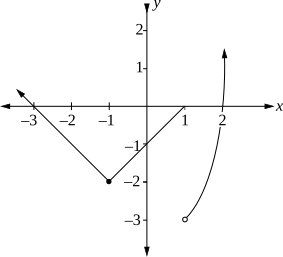
The function  \(y=f(x)\)  is defined by:

\begin{align*}
f(x)= \begin{cases}|x+1|-2, & \text { for }\ x \leqslant 1 \\ x^2-4, & \text { for }\ x>1\end{cases}
\end{align*}

  1. Sketch  \(y=f (x)\)   (3 marks)

    --- 12 WORK AREA LINES (style=lined) ---

  2. For what values of \(x\) is  \(f(x)=0\)?   (1 mark)

    --- 2 WORK AREA LINES (style=lined) ---

Show Answers Only

a.   
     
 
b.    \(f(x)=0\ \ \text{when}\ \ x=-3,2\).

Show Worked Solution

a.   
     
 
b.    \(f(x)=0\ \ \text{when}\ \ x=-3,2\).

Filed Under: Piecewise Functions Tagged With: Band 3, Band 4, smc-6217-10-Sketch graph, smc-6217-60-Other problems, syllabus-2027

Functions, 2ADV EQ-Bank 28

Consider the function

\begin{align*}
f(x)=\begin{cases}2^x, & \text {for }\ x<0 \\ m x+c, & \text {for }\ 0 \leq x \leq 2 \\ \dfrac{8}{x}, & \text {for }\ x>2\end{cases}
\end{align*}

Given that \(f(x)\) is continuous at both  \(x =0\)  and \(x =2\):

  1. Find the values of \(m\) and \(c\).   (2 marks)

    --- 6 WORK AREA LINES (style=blank) ---

  2. Identify any asymptotes of  \(y=f(x)\).   (1 mark)

    --- 4 WORK AREA LINES (style=blank) ---

Show Answers Only

a.    \(f(x)=\left\{\begin{array}{cl}2^x & \text {for } x<0 \\ m x+c & \text {for } 0 \leq x \leq 2 \\ \dfrac{8}{x} & \text {for } x>2\end{array}\right.\)

\(\text {Continuous at}\ \ x=0:\)

\(2^\circ=m(0)+c \ \Rightarrow \ c=1\)

\(\text {Continuous at}\ \ x=2:\)

\(2 m+1=\dfrac{8}{2} \ \Rightarrow \ m=\dfrac{3}{2}\)
 

b.    \(\text{Asymptotes:}\)

\(\text{As} \ x \rightarrow-\infty, 2^x \rightarrow 0^{+}\)

\(\text{As} \ x \rightarrow \infty, \dfrac{8}{x} \rightarrow 0^{+}\)
 

\(\text{Asymptote at} \ \ y=0.\)

\(\text{There are no vertical asymptotes.}\)

Show Worked Solution

a.    \(f(x)=\left\{\begin{array}{cl}2^x & \text {for } x<0 \\ m x+c & \text {for } 0 \leq x \leq 2 \\ \frac{8}{x} & \text {for } x>2\end{array}\right.\)

\(\text {Continuous at}\ \ x=0:\)

\(2^\circ=m(0)+c \ \Rightarrow \ c=1\)

\(\text {Continuous at}\ \ x=2:\)

\(2 m+1=d\dfrac{8}{2} \ \Rightarrow \ m=\dfrac{3}{2}\)
 

b.    \(\text{Asymptotes:}\)

\(\text{As} \ x \rightarrow-\infty, 2^x \rightarrow 0^{+}\)

\(\text{As} \ x \rightarrow \infty, \dfrac{8}{x} \rightarrow 0^{+}\)
 

\(\text{Asymptote at} \ \ y=0.\)

\(\text{There are no vertical asymptotes.}\)

Filed Under: Piecewise Functions Tagged With: Band 4, smc-6217-40-Continuity, smc-6217-60-Other problems, syllabus-2027

Functions, 2ADV EQ-Bank 24

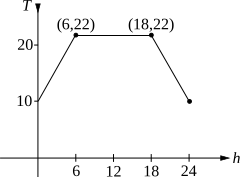
The temperature \(T\) (in °C) in a greenhouse follows the pattern:

\begin{align*}
T(h)= \begin{cases}10+2 h, & \text {for }\ 0 \leqslant h<6 \\ 22, & \text {for }\ 6 \leqslant h \leqslant 18 \\ 58-2 h, & \text {for }\ 18<h \leqslant 24\end{cases}
\end{align*}

where \(h\) is the number of hours after midnight.

  1. Sketch the graph of \(T(h)\) for  \(0 \leqslant h \leqslant 24\)   (2 marks)

    --- 12 WORK AREA LINES (style=blank) ---

  2. At what time(s) during the day is the temperature exactly 18 °C?   (2 marks)

    --- 5 WORK AREA LINES (style=lined) ---

Show Answers Only

a.


b.   \(\text{Temperature is 18° at 4 am and 8 pm.}\)

Show Worked Solution

a.


b.   \(\text{Temperature}=18^{\circ} \ \text{twice (see graph)}\)

\(10+2 h=18 \ \Rightarrow \ h=4\)

\(58-2 h=18 \ \Rightarrow \ h=20\)

\(\therefore \ \text{Temperature is 18° at 4 am and 8 pm.}\)

Filed Under: Piecewise Functions Tagged With: Band 4, smc-6217-10-Sketch graph, smc-6217-60-Other problems, syllabus-2027

Functions, 2ADV EQ-Bank 25

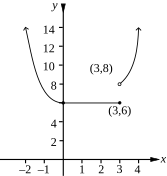
Consider the function  \(h(x)=\begin{cases}\dfrac{x^2-9}{x-3}, & \text {for } x \neq 3 \\ k, & \text {for } x=3\end{cases}\)

  1. For what value of \(k\) is \(h(x)\) continuous at  \(x =3\)?   (2 marks)

    --- 5 WORK AREA LINES (style=lined) ---

  2. Sketch  \(y=h (x)\)  for this value of \(k\).   (2 marks) 

    --- 12 WORK AREA LINES (style=blank) ---

Show Answers Only

a.    \(\text{Since} \ \ \dfrac{x^2-9}{x-3}=\dfrac{(x+3)(x-3)}{x-3}=x+3\)

\(\text{As} \ \ x \rightarrow 3, x+3 \rightarrow 6\)

\(h(x) \ \text {is continuous when}\ \  k=6\)
 

b.   
         

Show Worked Solution

a.    \(\text{Since} \ \ \dfrac{x^2-9}{x-3}=\dfrac{(x+3)(x-3)}{x-3}=x+3\)

\(\text{As} \ \ x \rightarrow 3, x+3 \rightarrow 6\)

\(h(x) \ \text {is continuous when}\ \  k=6\)
 

b.   
         

Filed Under: Piecewise Functions Tagged With: Band 4, smc-6217-10-Sketch graph, smc-6217-40-Continuity, syllabus-2027

Functions, EXT1 EQ-Bank 12

Find all values of \(x\) for which  \((2 x+1)(x-3)(x-1) \leqslant 0\).   (2 marks)

--- 5 WORK AREA LINES (style=lined) ---

Show Answers Only

\(x \leqslant-\dfrac{1}{2}\ \cup \  1 \leqslant x \leqslant 3\)

Show Worked Solution

\((2 x+1)(x-3)(x-1) \leqslant 0\)

\(\text{Zeros at} \ \  x=-\dfrac{1}{2}, x=3 \ \ \text{and} \ \ x=1\)

\(\text{At} \ \ x=0: \ (1)(-3)(-1)>0\)
 

\(\therefore \text{Graph} \ \leqslant 0 \ \ \text{for} \ \ x \leqslant-\dfrac{1}{2}\ \cup \  1 \leqslant x \leqslant 3\)

Filed Under: Inequalities Tagged With: Band 3, smc-6643-05-Cubics, syllabus-2027

Functions, EXT1 EQ-Bank 22

Solve the inequality  \(\left(2 x^2+3 x\right)(1-x) \geqslant 0\), expressing your answer in set notation.   (3 marks)

--- 9 WORK AREA LINES (style=lined) ---

Show Answers Only

\(x \in\left(-\infty,-\dfrac{3}{2}\right]\  \cup\  x \in [0,1] \)

Show Worked Solution

\(\left(2 x^2+3 x\right)(1-x)=x(2 x+3)(1-x)\)

\(x(2 x+3)(1-x) \geqslant 0\)

\(\text{Zeros at} \ \ x=0, x=-\dfrac{3}{2} \ \ \text{and} \ \ x=1\)

\(\text{At} \ \ x=-1: \ (-1)(1)(2)<0\)
 

\(\therefore \text{Graph} \geqslant 0 \ \ \text{for} \ \ x \in\left(-\infty,-\dfrac{3}{2}\right]\  \cup\  x \in [0,1] \)

Filed Under: Inequalities Tagged With: Band 4, smc-6643-05-Cubics, syllabus-2027

Functions, EXT1 EQ-Bank 11

Solve the inequality  \((x-4)(x+2)(x-1) \geqslant 0\).   (2 marks)

--- 8 WORK AREA LINES (style=lined) ---

Show Answers Only

\(-2 \leqslant x \leqslant 1\  \cup\  x \geqslant 4\)

Show Worked Solution

\((x-4)(x+2)(x-1) \geqslant 0\)

\(\text{Zeros at} \ \ x=4, x=-2 \ \ \text{and}\ \  x=1\)

\(\text{At} \ \ x=0: \ (-4)(2)(-1)>0\)
 

\(\therefore \text{Graph}\ \geqslant 0 \ \text {for} \ -2 \leqslant x \leqslant 1\ \cup\ x \geqslant 4\)

Filed Under: Inequalities Tagged With: Band 3, smc-6643-05-Cubics, syllabus-2027

Functions, EXT1 EQ-Bank 6 MC

For which values of \(x\) is  \((2x^2-3x-5)(x+2)<0\) ?

  1. \(x \in(-1,-2) \ \cup\  x \in\left(\dfrac{5}{2}, \infty\right]\)
  2. \(x \in[-\infty,-2)\  \cup\  x \in\left(-1, \dfrac{5}{2}\right)\)
  3. \(x \in(-1,-2)\  \cup\  x \in\left(\dfrac{5}{2}, \infty\right)\)
  4. \(x \in(-\infty,-2)\  \cup\  x \in\left(-1, \dfrac{5}{2}\right)\)
Show Answers Only

\(D\)

Show Worked Solution

\((2x^2-3x-5)(x+2)=(2x-5)(x+1)(x+2) \)

\(\text {Zeros at} \ \ x=\dfrac{5}{2}, \ x=-1,\ \ \text {and} \ \ x=-2\)

\(\text{At} \ \ x=0: \ (-5)(1)(2)<0\)
 

\(\therefore \ \text{Graph }<0\ \text{ for }\ x \in(-\infty,-2)\  \cup\  x \in\left(-1, \frac{5}{2}\right) \)

\(\Rightarrow D\)

Filed Under: Inequalities Tagged With: Band 4, smc-6643-05-Cubics, syllabus-2027

Functions, EXT1 EQ-Bank 2 MC

The inequality  \((2 x+4)(x-1)(3-x) \leqslant 0\)  has solution

  1. \(x \leqslant-2 \ \cup \  1 \lt x \leqslant 3\)
  2. \(-2 \leqslant x \leqslant 1 \ \cup \  x \geqslant 3\)
  3. \(x \leqslant-2 \ \cup \  x \geqslant 3\)
  4. \(-2 \leqslant x \leqslant 3\)
Show Answers Only

\(B\)

Show Worked Solution

\(\text{Zeros at} \ \ x=-2, x=1 \ \ \text{and}\ \ x=3\)

\(\text{At} \ \ x=0: \ (4)(-1)(3)<0 \)
 

\(\therefore \ \text{Graph} \ \leqslant 0 \ \ \text{for} \ -2 \leqslant x \leqslant 1 \ \cup \ x \geqslant 3 \)

\(\Rightarrow B\)

Filed Under: Inequalities Tagged With: Band 3, smc-6643-05-Cubics, syllabus-2027

Functions, EXT1 EQ-Bank 1 MC

What is the solution to the inequality

\((x-2)(x+1)(x-3)>0\)

  1. \(x<-1 \ \cup \ 2<x<3\)
  2. \(-1<x<2 \ \cup \ x>3\)
  3. \(x<-1 \ \cup \ x>3\)
  4. \(-1<x<3\)
Show Answers Only

\(B\)

Show Worked Solution

\(\text {Zeros at}\ \  x=2, x=-1 \ \ \text {and} \ \ x=3\)

\(\text{At} \ \ x=0: \ (-2)(1)(-3)>0\)
 

\(\therefore \text {Graph}\ >0 \ \ \text{for}\ \ -1<x<2 \ \cup \ x>3\)

\(\Rightarrow B\)

Filed Under: Inequalities Tagged With: Band 3, smc-6643-05-Cubics, syllabus-2027

Functions, 2ADV EQ-Bank 21

The function  \(g(x)=\left\{\begin{array}{ll}a x+b, & \text {for } x \leq 2 \\ x^2-1, & \text {for } x>2\end{array}\right.\) 

\(g(x)\) is continuous at  \(x =2\)  and passes through the point  \((0,-5)\).

  1. Find the values of \(a\) and \(b\)   (2 marks)

    --- 7 WORK AREA LINES (style=lined) ---

  2. Evaluate  \(g(3)-g(-1)\)   (1 mark)

    --- 2 WORK AREA LINES (style=lined) ---

Show Answers Only

a.    \(a=4, b=-5\)

b.    \(17\)

Show Worked Solution

a.    \(\text{Since} \ f(x) \ \text{is continuous at} \ \ x=2:\)

\(a(2)+b\) \(=2^2-1\)
\(2 a+b\) \(=3\ \ldots\ (1)\)

 
\(\text{Since} \ g(x) \ \text{passes through}\ (0,-5):\)

\(a(0)+b=-5 \ \ \Rightarrow\ \ b=-5\)
 

\(\text{Substitute}\ \ b=-5 \ \ \text{into (1):}\)

\(2 a-5=3 \ \ \Rightarrow\ \ a=4\)
 

b.     \(g(3)-g(-1)\) \(=\left(3^2-1\right)-[4(-1)-5]\)
    \(=8+9\)
    \(=17\)

Filed Under: Piecewise Functions Tagged With: Band 3, Band 4, smc-6217-40-Continuity, smc-6217-60-Other problems, syllabus-2027

Functions, 2ADV EQ-Bank 16

Consider the function 

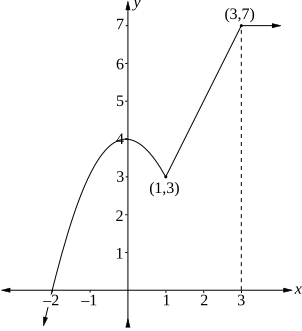
\begin{align*}
f(x)=\begin{cases}-x^2+4, & \text {for }\ x<1 \\ 2 x+1, & \text {for} \ 1 \leq x<3 \\ 7, & \text {for }\ x \geq 3\end{cases}
\end{align*}

  1. Sketch  \(y=f (x)\)   (3 marks)

    --- 10 WORK AREA LINES (style=blank) ---

  2. State the range of  \(f(x)\)   (1 mark)

    --- 2 WORK AREA LINES (style=lined) ---

Show Answers Only

a.


b.   \(\text {Range:} \ \ y \in(-\infty, 7]\)

Show Worked Solution

a.


b.   \(\text {Range:} \ \ y \in(-\infty, 7]\)

Filed Under: Piecewise Functions Tagged With: Band 3, Band 4, smc-6217-10-Sketch graph, smc-6217-50-Find Range, syllabus-2027

Functions, 2ADV EQ-Bank 4 MC

A parking garage charges according to the following piecewise function 

\(C(t)= \begin{cases}5, & \text{for }\ 0<t \leq 1 \\ 5+3(t-1), & \text{for }\ 1<t \leq 4 \\ 18, & \text{for }\ t>4\end{cases}\) 

where \(C\) is the cost in dollars and \(t\) is time in hours.

How much does it cost to park for 3.5 hours?

  1. $11.50
  2. $12.50
  3. $13.50
  4. $18.00
Show Answers Only

\(B\)

Show Worked Solution

\(C(3.5)=5+3(3.5-1)=\$ 12.50\)

\(\Rightarrow B\)

Filed Under: Piecewise Functions Tagged With: Band 3, smc-6217-60-Other problems, syllabus-2027

Functions, 2ADV EQ-Bank 3 MC

For the function  \(f(x)=\left\{\begin{array}{ll}|x+2|, & \text{for } x \leq 0 \\ \sqrt{x}, & \text{for } x>0\end{array}\right.\),  what is  \(f (-2)+ f (4)\) ?

  1. \(2\)
  2. \(4\)
  3. \(6\)
  4. \(8\)
Show Answers Only

\(A\)

Show Worked Solution

\(f(x)= \begin{cases}|x+2|, & \text { for } x \leq 0 \\ \sqrt{x}, & \text { for } x>0\end{cases}\)

\(f(-2)=|-2+2|=0\)

\(f(4)=\sqrt{4}=2\)

\(f(-2)+f(4)=2\)

\(\Rightarrow A\)

Filed Under: Piecewise Functions Tagged With: Band 3, smc-6217-60-Other problems, syllabus-2027

Functions, 2ADV EQ-Bank 2 MC

The function  \(f(x)=\left\{\begin{array}{ll}k x+2, & \text{for } x<-1 \\ x^2+3, & \text{for } x \geq-1\end{array}\right.\) 

If \(f(x)\) is continuous at  \(x =-1\), what is the value of \(k\) ?

  1. \(-2\)
  2. \(-1\)
  3. \(1\)
  4. \(2\)
Show Answers Only

\(A\)

Show Worked Solution

\(f(x) \ \text{ is continuous at} \ \ x=-1:\)

\(k(-1)+2=(-1)^2+3 \ \ \Rightarrow\ \ k=-2\)

\(\Rightarrow A\)

Filed Under: Piecewise Functions Tagged With: Band 3, smc-6217-40-Continuity, syllabus-2027

Functions, 2ADV EQ-Bank 1 MC

Which of the following piecewise functions is not continuous at  \(x =1\) ?

  1. \(f(x)= \begin{cases}x^2+1, & \text{for } \ x \leq 1 \\ 3 x-1, & \text{for } x>1\end{cases}\)
  2. \(f(x)= \begin{cases}2 x, & \text{for } \ x<1 \\ x+1, & \text{for } x \geq 1\end{cases}\)
  3. \(f(x)= \begin{cases}-x^2, & \text{for }\ x \leq 1 \\ 2 x-1, & \text{for } x>1\end{cases}\)
  4. \(f(x)= \begin{cases}3-x, & \text{for } \ x<1 \\ x^2+1, & \text{for } x \geq 1\end{cases}\)
Show Answers Only

\(C\)

Show Worked Solution

\(\text {Consider option }C:\)

\(\text{As} \ \ x \rightarrow 1^{-},-x^2 \rightarrow-1\)

\(\text{As} \ \ x \rightarrow 1^{+}, 2 x-1 \rightarrow 1\)

\(\therefore \ \text {Not continuous at} \ \ x=1\)

\(\Rightarrow C\)

Filed Under: Piecewise Functions Tagged With: Band 3, smc-6217-40-Continuity, syllabus-2027

Functions, 2ADV EQ-Bank 13

A set of ordered pairs \((x, y)\) on the coordinate plane are represented by set \(A\) below:

\(A=\{(1,3),(4,6),(5,6),(0,1),(1,7)\}\)

Explain if Set \(A\) a function or a relation?   (2 marks)

--- 5 WORK AREA LINES (style=lined) ---

Show Answers Only

\(\text {If set \(A\) is a function, there can only be one \(y\)-value}\)

\(\text{for any given } x \text{-value.}\)

\(\text{This is not the case} \ \Rightarrow\ (1,3),(1,7)\)

\(\therefore\ \text{Set} \ A \ \text {is a relation.}\)

Show Worked Solution

\(\text {If set \(A\) is a function, there can only be one \(y\)-value}\)

\(\text{for any given } x \text{-value.}\)

\(\text{This is not the case} \ \Rightarrow\ (1,3),(1,7)\)

\(\therefore\ \text{Set} \ A \ \text {is a relation.}\)

Filed Under: Other Functions and Relations Tagged With: Band 3, smc-6218-60-Functions vs Relations, syllabus-2027

Functions, 2ADV EQ-Bank 20

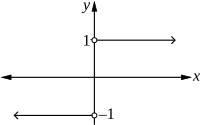
  1. Identify where the graph  \(f(x)=\dfrac{\abs{x}}{x}\)  is not continuous.   (1 mark)

    --- 2 WORK AREA LINES (style=lined) ---

  2. Sketch the graph of \(f(x)\).   (2 marks)

    --- 6 WORK AREA LINES (style=blank) ---

Show Answers Only

a.    \(\text {Denominator} \neq 0\)

\(f(x)\ \text{is not continuous when} \ \ x=0.\)
 

b.    \(\text{If} \ \ x>0 \ \Rightarrow \ f(x)=\dfrac{x}{x}=1\)

\(\text{If} \ \ x<0 \ \Rightarrow \ f(x)=-\dfrac{x}{x}=-1\)
 

Show Worked Solution

a.    \(\text {Denominator} \neq 0\)

\(f(x)\ \text{is not continuous when} \ \ x=0\)
 

b.    \(\text{If} \ \ x>0 \ \Rightarrow \ f(x)=\dfrac{x}{x}=1\)

\(\text{If} \ \ x<0 \ \Rightarrow \ f(x)=-\dfrac{x}{x}=-1\)
 

Filed Under: Piecewise Functions Tagged With: Band 3, Band 4, smc-6217-10-Sketch graph, smc-6217-40-Continuity, syllabus-2027

Functions, 2ADV EQ-Bank 17

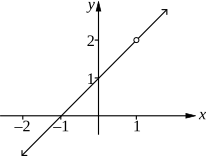
  1. Identify where the graph  \(f(x)=\dfrac{x^2-1}{x-1}\)  is not continuous.   (1 mark)

    --- 3 WORK AREA LINES (style=lined) ---

  2. Sketch the graph of \(f(x)\).   (2 marks)

    --- 6 WORK AREA LINES (style=blank) ---

Show Answers Only

a.    \(f(x)=\dfrac{x^2-1}{x-1}=\dfrac{(x+1)(x-1)}{(x-1)}=x+1\)

\(\text{Since denominator} \neq 0\)

\(f(x) \ \ \text{is not continuous when} \ \ x=1.\)
 

b.
       

Show Worked Solution

a.    \(f(x)=\dfrac{x^2-1}{x-1}=\dfrac{(x+1)(x-1)}{(x-1)}=x+1\)

\(\text{Since denominator} \neq 0\)

\(f(x) \ \ \text{is not continuous when} \ \ x=1.\)
 

b.
       

Filed Under: Piecewise Functions Tagged With: Band 3, Band 4, smc-6217-10-Sketch graph, smc-6217-40-Continuity, syllabus-2027

Functions, 2ADV EQ-Bank 15

Consider the function  \(y=f(x)\)  where

\(f(x)= \begin{cases}x^2+6, & \text { for } x \leqslant 0 \\ 6, & \text { for } 0<x \leqslant 3 \\ 2^x, & \text { for } x>3\end{cases}\)

  1. Sketch  \(y=f(x)\)   (3 marks)

    --- 12 WORK AREA LINES (style=lined) ---

  2. For what value of \(x\) is  \(y=f(x)\)  NOT continuous?   (1 mark)

    --- 1 WORK AREA LINES (style=lined) ---

Show Answers Only

a.
   

b.    \(f(x)\ \ \text {is NOT continuous at}\ \  x=3.\)

Show Worked Solution

a.
   

b.    \(f(x)\ \ \text {is NOT continuous at}\ \  x=3.\)

Filed Under: Piecewise Functions Tagged With: Band 3, Band 4, smc-6217-10-Sketch graph, smc-6217-40-Continuity, syllabus-2027

Functions, 2ADV EQ-Bank 11

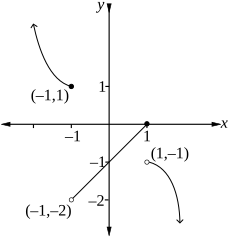
Graph the function  \(y=f(x)\)  where:

\(f(x)= \begin{cases}x^2, & \text { for } x \leq-1 \\ x-1, & \text { for }-1<x \leq 1 \\ -x^3, & \text { for } x>1 \end{cases}\).    (3 marks)

--- 12 WORK AREA LINES (style=blank) ---

Show Answers Only

Show Worked Solution
 

Filed Under: Piecewise Functions Tagged With: Band 3, smc-6217-10-Sketch graph, syllabus-2027

Functions, 2ADV F1 EQ Bank 26

Find \(a\) and \(b\) such that \(a\) and \(b\) are real and   \(\dfrac{2\sqrt{3}+2}{\sqrt{6}-\sqrt{2}} = a\,\sqrt{2} + b\,\sqrt{6}\).   (2 marks)

Show Answers Only

\(a=2\ \ \text{and}\ \ b=1 \)

Show Worked Solution

\(\dfrac{2\sqrt{3}+2}{\sqrt{6}-\sqrt{2}} \times \dfrac{\sqrt{6}+\sqrt{2}}{\sqrt{6}+\sqrt{2}} \)

\(=\dfrac{(2\sqrt{3}+2)(\sqrt{6}+\sqrt{2})}{6-2}\)

\(=\dfrac{2\sqrt{18}+2\sqrt{6}+2\sqrt{6}+2\sqrt{2}}{4}\)

\(=\dfrac{6\sqrt{2}+4\sqrt{6}+2\sqrt{2}}{4}\)

\(=\dfrac{8\sqrt{2}+4\sqrt{6}}{4}\)

\(=2\sqrt{2}+\sqrt{6}\)
 

\(\therefore a=2\ \ \text{and}\ \ b=1 \)

Filed Under: Algebraic Techniques Tagged With: Band 4, smc-6213-30-Surd Denominators, syllabus-2027

Functions, 2ADV EQ-Bank 12

Rationalise the denominator in \(\dfrac{\sqrt{3}-\sqrt{2}}{\sqrt{5}+\sqrt{2}}\), and express in the simplest form.   (2 marks)

Show Answers Only

\(\dfrac{\sqrt{15}-\sqrt{6}-\sqrt{10}+2}{3} \)

Show Worked Solution

\(\dfrac{\sqrt{3}-\sqrt{2}}{\sqrt{5}+\sqrt{2}} \times \dfrac{\sqrt{5}-\sqrt{2}}{\sqrt{5}-\sqrt{2}}\)

\(=\dfrac{(\sqrt{3}-\sqrt{2})(\sqrt{5}-\sqrt{2})}{5-2}\)

\(=\dfrac{\sqrt{15}-\sqrt{6}-\sqrt{10}+2}{3}\)

Filed Under: Algebraic Techniques Tagged With: Band 3, smc-6213-30-Surd Denominators, syllabus-2027

Functions, 2ADV EQ-Bank 33

Find \(x\) and \(y\) such that \(x\) and \(y\) are real and   \(\dfrac{\sqrt{2}+1}{\sqrt{6}-\sqrt{3}} = x\,\sqrt{3} + y\,\sqrt{6}\).   (2 marks)

Show Answers Only

\(x=1\ \ \text{and}\ \ y=\dfrac{2}{3} \)

Show Worked Solution

\(\dfrac{\sqrt{2}+1}{\sqrt{6}-\sqrt{3}} \times \dfrac{\sqrt{6}+\sqrt{3}}{\sqrt{6}+\sqrt{3}} \)

\(=\dfrac{(\sqrt{2}+1)(\sqrt{6}+\sqrt{3})}{6-3}\)

\(=\dfrac{\sqrt{12}+2\sqrt{6}+\sqrt{3}}{3}\)

\(=\dfrac{3\sqrt{3}+2\sqrt{6}}{3}\)

\(= \sqrt{3}+\dfrac{2}{3} \sqrt{6}\)
 

\(\therefore x=1\ \ \text{and}\ \ y=\dfrac{2}{3} \)

Filed Under: Algebraic Techniques Tagged With: Band 4, smc-6213-30-Surd Denominators, syllabus-2027

Vectors, EXT1* V1 2024 HSC 1 MC

Which of the following vectors is perpendicular to  \(3 \underset{\sim}{i}+2 \underset{\sim}{j}-5 \underset{\sim}{k}\) ?

  1. \(-\underset{\sim}{i}-\underset{\sim}{j}+\underset{\sim}{k}\)
  2. \(\underset{\sim}{i}+\underset{\sim}{j}-\underset{\sim}{k}\)
  3. \(-2 \underset{\sim}{i}+3 \underset{\sim}{j}+\underset{\sim}{k}\)
  4. \( 3 \underset{\sim}{i}-2 \underset{\sim}{j}+\underset{\sim}{k}\)
Show Answers Only

\(D\)

Show Worked Solution

\(\text{Consider option}\ D:\)

\[\underset{\sim}{a} \cdot \underset{\sim}{b}=\left(\begin{array}{c} 3 \\ 2 \\ -5 \end{array}\right) \left(\begin{array}{c} 3 \\ -2 \\ 1 \end{array}\right) = 9-4-5=0 \]

\(\Rightarrow D\)

Filed Under: Operations With Vectors Tagged With: Band 3, smc-7286-25-Perpendicular Vectors, smc-7286-70-3D Vectors, syllabus-2027

Functions, 2ADV F1 EQ-Bank 7 MC

Given that  \(f(x)=\left\{\begin{array}{ll}3-(x-2)^2, & \text { for } x \leqslant 2 \\ m x+5, & \text { for } x>2\end{array}\right.\)

What is the value of \(m\) for which \(f(x)\) is continuous at  \(x=2\) ?

  1. \(1\)
  2. \(2\)
  3. \(-1\)
  4. \(-2\)
Show Answers Only

\(C\)

Show Worked Solution

\(\text {If continuous at}\ x=2:\)

  \(3-(x-2)^2\) \(=mx+5\)
  \(3-(2-2)^2\) \(=2m+5\)
   \(2m\) \(=-2\)
  \(m\) \(=-1\)

 
\(\Rightarrow C\)

Filed Under: Further Functions and Relations, Piecewise Functions Tagged With: Band 4, smc-987-80-Continuous, syllabus-2027

Functions, 2ADV F1 2017 HSC 11a

Rationalise the denominator of  `2/(sqrt(5)-1)`.   (2 marks)

Show Answers Only

`(sqrt(5) + 1)/2`

Show Worked Solution
`2/(sqrt(5)-1) xx (sqrt(5) + 1)/(sqrt(5) + 1)` `= (2(sqrt(5) + 1))/((sqrt 5)^2-1)`
  `= (2(sqrt(5) + 1))/4`
  `= (sqrt(5) + 1)/2`

Filed Under: Algebraic Techniques Tagged With: Band 3, smc-6213-30-Surd Denominators, syllabus-2027

Functions, 2ADV F1 2015 HSC 11c

Express  `8/(2 + sqrt 7)`  with a rational denominator.  (2 marks)

Show Answers Only

`(-8 (2-sqrt 7))/3`

Show Worked Solution

`8/(2 + sqrt 7) xx (2-sqrt 7)/(2-sqrt 7)`

`= (8(2-sqrt 7))/(2^2 -(sqrt 7)^2)`

`= (8 (2-sqrt 7))/(4-7)`

`= (-8(2-sqrt 7))/3`

Filed Under: Algebraic Techniques Tagged With: Band 3, smc-6213-30-Surd Denominators, syllabus-2027

Functions, 2ADV F1 2008 HSC 1e

Expand and simplify  `(sqrt3-1)(2 sqrt3 + 5)`.   (2 marks)

Show Answers Only

`1 + 3 sqrt 3`

Show Worked Solution

`(sqrt 3-1)(2 sqrt 3 + 5)`

`= 2 xx 3 + 5 sqrt 3-2 sqrt 3-5`

`= 1 + 3 sqrt 3`

Filed Under: Algebraic Techniques, Algebraic Techniques, Indices, Surds and Rounding Tagged With: Band 3, num-title-ct-pathc, num-title-qs-hsc, smc-4228-70-Surds, smc-6213-20-Surds (general), smc-983-20-Surds (General), syllabus-2027

Functions, 2ADV F1 2014 HSC 11a

Rationalise the denominator of   `1/(sqrt5-2)`.   (2 marks)

Show Answers Only

`sqrt5 + 2`

Show Worked Solution

`1/(sqrt5-2) xx (sqrt5 + 2)/(sqrt5 + 2)`

`= (sqrt5 + 2)/((sqrt5)^2-2^2)`

`= sqrt5 + 2`

Filed Under: Algebraic Techniques Tagged With: Band 3, smc-6213-30-Surd Denominators, syllabus-2027

Functions, 2ADV F1 2011 HSC 1f

Rationalise the denominator of  `4/(sqrt5-sqrt3)`.

Give your answer in the simplest form.   (2 marks)

Show Answers Only

`2(sqrt5 + sqrt3)`

Show Worked Solution

`4/(sqrt5-sqrt3) xx (sqrt5 + sqrt3)/(sqrt5 + sqrt3)`

`= (4(sqrt5 + sqrt3))/(5-3)`

`= 2 (sqrt5 + sqrt3)`

Filed Under: Algebraic Techniques Tagged With: Band 3, smc-6213-30-Surd Denominators, syllabus-2027

  • « Previous Page
  • 1
  • 2
  • 3
  • 4
  • Next Page »

Copyright © 2014–2026 SmarterEd.com.au · Log in