Solve the following simultaneous equations
\(6 x-7 y=-6\)
\(4 x+2 y=16\) (2 marks)
--- 9 WORK AREA LINES (style=lined) ---
Aussie Maths & Science Teachers: Save your time with SmarterEd
Solve the following simultaneous equations
\(6 x-7 y=-6\)
\(4 x+2 y=16\) (2 marks)
--- 9 WORK AREA LINES (style=lined) ---
Solve the following simultaneous equations:
\(3 x-4 y=5\)
\(x+2 y=15\). (2 marks)
--- 8 WORK AREA LINES (style=lined) ---
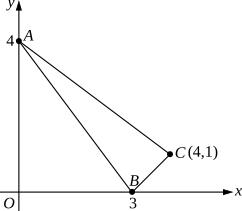
--- 8 WORK AREA LINES (style=lined) ---
--- 5 WORK AREA LINES (style=lined) ---
The diagram shows a line `l_1`, with equation `3x + 4y-12 = 0`, which intersects the `y`-axis at `B`.
A second line `l_2`, with equation `4x-3y = 0`, passes through the origin `O` and intersects `l_1` at `E`.

--- 3 WORK AREA LINES (style=lined) ---
--- 5 WORK AREA LINES (style=lined) ---
--- 5 WORK AREA LINES (style=lined) ---
--- 5 WORK AREA LINES (style=lined) ---
Consider the function shown.
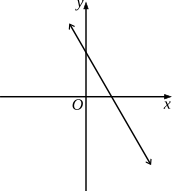
Which of the following could be the equation of this function?
Prove that the line between \((1,-1)\) and \((4,-3)\) is perpendicular to the line \(3x-2y-4=0\) (2 marks) --- 6 WORK AREA LINES (style=lined) ---
Which of the following could be the graph of `y= -2 x+2`?
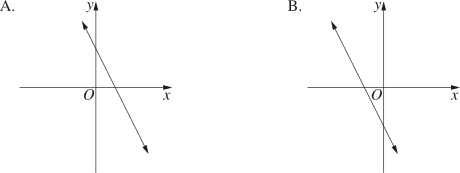
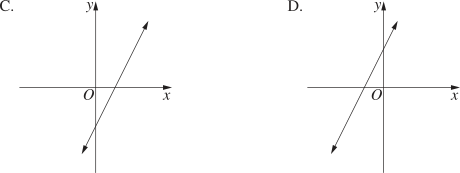
There are two tanks on a property, Tank `A` and Tank `B`. Initially, Tank `A` holds 1000 litres of water and Tank B is empty.

By drawing a line on the grid (above), or otherwise, find the value of `t` when the two tanks contain the same volume of water. (2 marks)
--- 2 WORK AREA LINES (style=lined) ---
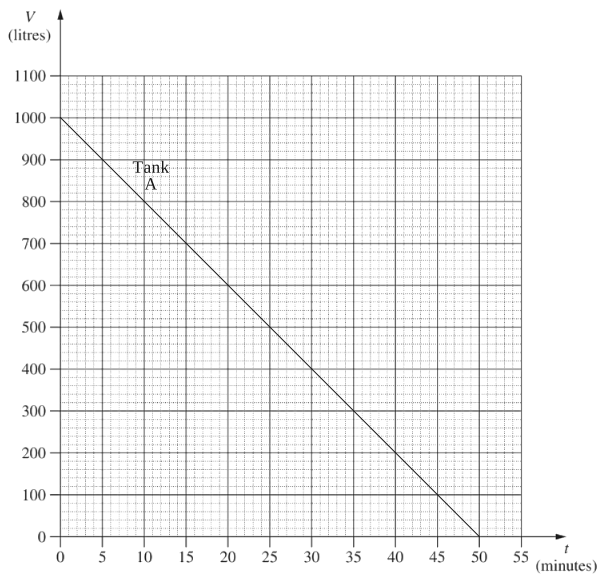
a. `text{T} text{ank} \ A \ text{will pass trough (0, 1000) and (50, 0)}`
b. `text{T} text{ank} \ B \ text{will pass through (15, 0) and (45, 900)}`

`text{By inspection, the two graphs intersect at} \ \ t = 29 \ text{minutes}`
c. `text{Strategy 1}`
`text{By inspection of the graph, consider} \ \ t = 45`
`text{T} text{ank A} = 100 \ text{L} , \ text{T} text{ank B} =900 \ text{L} `
`:.\ text(Total volume = 1000 L when t = 45)`
`text{Strategy 2}`
| `text{Total Volume}` | `=text{T} text{ank A} + text{T} text{ank B}` |
| `1000` | `= 1000 – 20t + (t – 15) xx 30` |
| `1000` | `= 1000 – 20t + 30t – 450 ` |
| `10t` | `= 450` |
| `t` | `= 45 \ text{minutes}` |
The relationship between British pounds `(p)` and Australian dollars `(d)` on a particular day is shown in the graph.
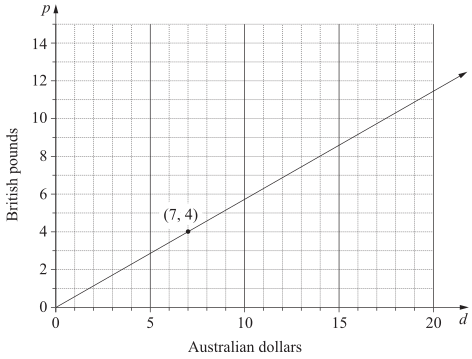
--- 2 WORK AREA LINES (style=lined) ---
Convert 93 100 Japanese yen to British pounds. (2 marks)
--- 4 WORK AREA LINES (style=lined) ---
Last Saturday, Luke had 165 followers on social media. Rhys had 537 followers. On average, Luke gains another 3 followers per day and Rhys loses 2 followers per day.
If `x` represents the number of days since last Saturday and `y` represents the number of followers, which pair of equations model this situation?
| A. | `text(Luke:)\ \ y = 165x + 3`
`text(Rhys:)\ \ y = 537x-2` |
| B. | `text(Luke:)\ \ y = 165 + 3x`
`text(Rhys:)\ \ y = 537-2x` |
| C. | `text(Luke:)\ \ y = 3x + 165`
`text(Rhys:)\ \ y = 2x-537` |
| D. | `text(Luke:)\ \ y = 3 + 165x`
`text(Rhys:)\ \ y = 2-537x` |
What values of `x` satisfy `4-3x <= 12`?
Damon owns a swim school and purchased a new pool pump for $3250.
He writes down the value of the pool pump by 8% of the original price each year.
--- 1 WORK AREA LINES (style=lined) ---
--- 8 WORK AREA LINES (style=lined) ---
a. `text(Depreciation each year)= 8text(%) xx 3250= $260`
`:.\ text(Value) = 3250-260t`
b.

`text(Find)\ \ t\ \ text(when value = 0)`
| `3250-260t` | `= 0` |
| `t` | `= 3250/260= 12.5\ text(years)` |
`text(Domain)\ \ {t: 0 <= t <= 12.5}`
`text(Range)\ \ {y: 0 <= y <= 3250}`
Ita publishes and sells calendars for $25 each. The cost of producing the calendars is $8 each plus a set up cost of $5950.
How many calendars does Ita need to sell to breakeven? (2 marks)
--- 5 WORK AREA LINES (style=lined) ---
Solve `1 - 3x > 10`. (2 marks)
What is the `x`-intercept of the line `x + 3y + 6 = 0`?
What is the gradient of the line `2x + 3y + 4 = 0`?
The diagram shows points `A(1, 0), B(2, 4)` and `C(6, 1).` The point `D` lies on `BC` such that `AD _|_ BC.`

--- 6 WORK AREA LINES (style=lined) ---
--- 3 WORK AREA LINES (style=lined) ---
--- 5 WORK AREA LINES (style=lined) ---
Find the equation of the line that passes through the point `(1, 3)` and is perpendicular to `2x + y + 4 = 0`. (2 marks)
--- 5 WORK AREA LINES (style=lined) ---
Solve `2x-5> -3` and graph the solution on a number line. (2 marks)
--- 5 WORK AREA LINES (style=lined) ---
`x > 1`

| `2x-5` | `> -3` |
| `2x` | `> 2` |
| `x` | `> 1` |
Ariana’s parents have given her an interest‑free loan of $4800 to buy a car. She will pay them back by paying `$x` immediately and `$y` every month until she has repaid the loan in full.
After 18 months Ariana has paid back $1510, and after 36 months she has paid back $2770.
This information can be represented by the following equations.
`x + 18y = 1510`
`x + 36y = 2770`
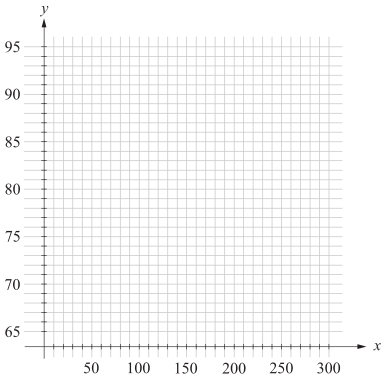
--- 1 WORK AREA LINES (style=lined) ---
--- 4 WORK AREA LINES (style=lined) ---
i.
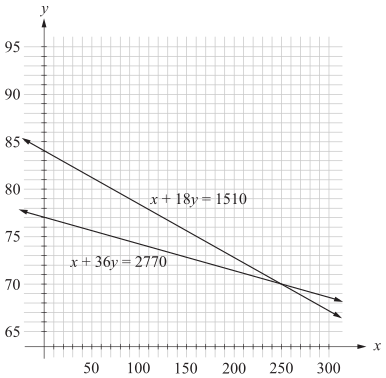
`:.\ text(Solution is)\ \ x = 250, \ y = 70`
ii. `text(Let)\ \ A = text(the amount paid back after)\ n\ text(months)`
`A = 250 + 70n`
`text(Find)\ n\ text(when)\ A = 4800`
| `250 + 70n` | `= 4800` |
| `70n` | `= 4550` |
| `n` | `= 65` |
`:.\ text(It will take Ariana 65 months to repay)`
`text(the loan in full.)`
What is the slope of the line with equation `2x-4y + 3 = 0`?
Solve `3-5x <= 2`. (2 marks)
Sue and Mikey are planning a fund-raising dance. They can hire a hall for $400 and a band for $300. Refreshments will cost them $12 per person.
--- 2 WORK AREA LINES (style=lined) ---
The graph shows planned income and costs when the ticket price is $20

--- 1 WORK AREA LINES (style=lined) ---
--- 2 WORK AREA LINES (style=lined) ---
Sue and Mikey plan to sell 200 tickets. They want to make a profit of $1500.
--- 6 WORK AREA LINES (style=lined) ---
Fiona and John are planning to hold a fund-raising event for cancer research. They can hire a function room for $650 and a band for $850. Drinks will cost them $25 per person.
--- 1 WORK AREA LINES (style=lined) ---

--- 1 WORK AREA LINES (style=lined) ---
--- 2 WORK AREA LINES (style=lined) ---
A clubhouse uses four long-life light globes for five hours every night of the year. The purchase price of each light globe is $6.00 and they each cost `$d` per hour to run.
--- 4 WORK AREA LINES (style=lined) ---
--- 2 WORK AREA LINES (style=lined) ---
--- 2 WORK AREA LINES (style=lined) ---
What is the mean life, in hours, of these light globes if 97.5% will last up to 5000 hours? (1 mark)
--- 2 WORK AREA LINES (style=lined) ---
a. `text(Purchase price) = 4 xx 6 = $24`
| `text(Running cost)` | `= text(# Hours) xx text(Cost per hour)` |
| `= 4 xx 5 xx 365 xx d= 7300d` |
`:.\ $c = 24 + 7300d`
b. `text(Given)\ \ $c = $250:`
| `250` | `= 24 + 7300d` |
| `7300d` | `= 226` |
| `d` | `= 226/7300= 0.03095…= 0.031\ $ text(/hr)\ text{(3 d.p.)}` |
c. `text(If)\ d\ text(doubles to 0.062)\ \ $text(/hr)`
`$c= 24 + 7300 xx 0.062= $476.60`
`text(S) text(ince $476.60 is less than)\ 2 xx $250\ ($500),`
`text(the total cost increases to less than double)`
`text(the original cost.)`
d. `sigma = 170`

`z\ text(-score of 5000 hours) = 2`
| `z` | `= (x-mu)/sigma` |
| `2` | `= (5000-mu)/170` |
| `340` | `= 5000-mu` |
| `mu` | `= 4660` |
`:.\ text(The mean life of these globes is 4660 hours.)`
Which equation represents the line perpendicular to `2x-3y = 8`, passing through the point `(2, 0)`?
In the diagram, the points `A` and `C` lie on the `y`-axis and the point `B` lies on the `x`-axis. The line `AB` has equation `y = sqrt3x-3`. The line `BC` is perpendicular to `AB`.

--- 4 WORK AREA LINES (style=lined) ---
--- 4 WORK AREA LINES (style=lined) ---
Sketch the graph of `y-2x = 3`, showing the intercepts on both axes. (2 marks)
--- 8 WORK AREA LINES (style=lined) ---
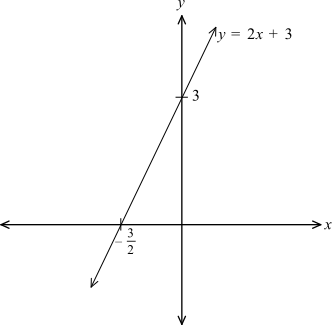
`y-2x=3\ \ =>\ \ y=2x+3`
`ytext{-intercept}\ = 3`
`text{Find}\ x\ text{when}\ y=0:`
`0-2x=3\ \ =>\ \ x=-3/2`
Solve `2 -3x <= 8`. (2 marks)
The graph shows tax payable against taxable income, in thousands of dollars.

--- 1 WORK AREA LINES (style=lined) ---
--- 3 WORK AREA LINES (style=lined) ---
--- 2 WORK AREA LINES (style=lined) ---
--- 4 WORK AREA LINES (style=lined) ---
| a. |  |
`text(Income on)\ $21\ 000=$3000\ \ \ text{(from graph)}`
b. `text(Using the points)\ (21,3)\ text(and)\ (39,9)`
| `text(Gradient at)\ A` | `= (y_2-y_1)/(x_2-x_1)` |
| `= (9000-3000)/(39\ 000-21\ 000)` | |
| `= 6000/(18\ 000)` | |
| `= 1/3\ \ \ \ \ text(… as required)` |
c. `text(The gradient represents the tax applicable to each dollar)`
| `text(Tax)` | ` = 1/3\ text(of each dollar earned)` |
| ` = 33 1/3\ text(cents per dollar earned)` |
d. `text( Tax payable up to $21 000 = $3000)`
`text(Tax payable on income between $21 000 and $39 000)`
` = 1/3 (I-21\ 000)`
| `:.\ text(Tax payable on)\ \ I` | `= 3000 + 1/3 (I-21\ 000)` |
| `= 3000 + 1/3 I-7000` | |
| `= 1/3 I-4000` |
A function centre hosts events for up to 500 people. The cost `C`, in dollars, for the centre
to host an event, where `x` people attend, is given by:
`C = 10\ 000 + 50x`
The centre charges $100 per person. Its income `I`, in dollars, is given by:
`I = 100x`

How much greater is the income of the function centre when 500 people attend an event, than its income at the breakeven point?
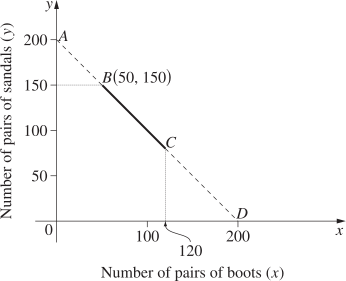
A factory makes boots and sandals. In any week
• the total number of pairs of boots and sandals that are made is 200
• the maximum number of pairs of boots made is 120
• the maximum number of pairs of sandals made is 150.
The factory manager has drawn a graph to show the numbers of pairs of boots (`x`) and sandals (`y`) that can be made.
--- 2 WORK AREA LINES (style=lined) ---
--- 3 WORK AREA LINES (style=lined) ---
Compare the profits at `B` and `C`. (2 marks)
--- 5 WORK AREA LINES (style=lined) ---
