The total cost, \($C\), of a school excursion is given by \(C=4n+9\), where \(n\) is the number of students.
If five extra students go on the excursion, by how much does the total cost increase?
- $4
- $20
- $18
- $29
Aussie Maths & Science Teachers: Save your time with SmarterEd
The total cost, \($C\), of a school excursion is given by \(C=4n+9\), where \(n\) is the number of students.
If five extra students go on the excursion, by how much does the total cost increase?
What is the slope of the line with equation `2x-4y + 3 = 0`?
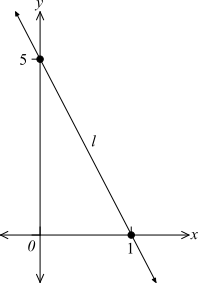
What is the equation of the line \(l\)?
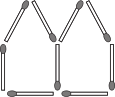
A pentagon is created using matches.

By adding more matches, a row of two pentagons is formed.
Continuing to add matches, a row of three pentagons can be formed.
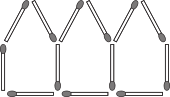
Continuing this pattern, what is the maximum number of complete pentagons that can be formed if 230 matches in total are available?
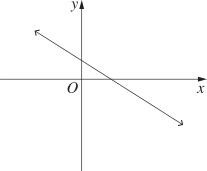
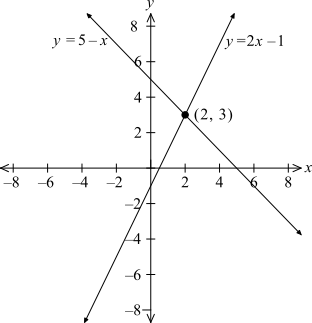
The graph of the line with equation \(y=5-x\) is shown.
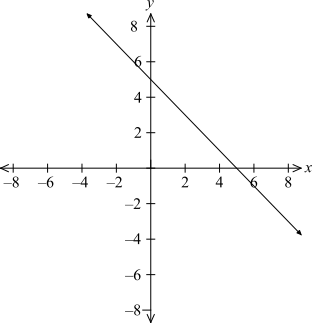
When the graph of the line with equation \(y=2x-1\) is also drawn on this number plane, what will be the point of intersection of the two lines?
\(\text{Method 1: Graphically}\)
\(\text{From graph, intersection is at} (2,3)\)
\(\text{Method 2: Algebraically}\)
| \(y\) | \(=5-x\) | \(…\ (1)\) |
| \(y\) | \(=2x-1\) | \(…\ (2)\) |
\(\text{Substitute (2) into (1)}\)
| \(2x-1\) | \(=5-x\) |
| \(3x\) | \(=6\) |
| \(x\) | \(=2\) |
\(\text{When}\ \ x=2,\ y=5-2=3\)
\(\Rightarrow C\)
What is the gradient of the line \(4x-5y-2 = 0\)?
What is the \(x\)-intercept of the line \(x-4y+8=0\)?
Suppose \(y=-2-3x\).
When the value of \(x\) increases by 4, the value of \(y\) decreases by
Marty is thinking of a number. Let the number be \(n\).
When Marty subtracts 4 from this number and multiplies the result by 7, the answer is 8 more than \(n\).
Which equation can be used to find \(n\)?
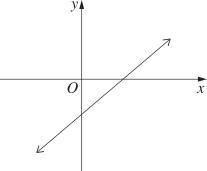
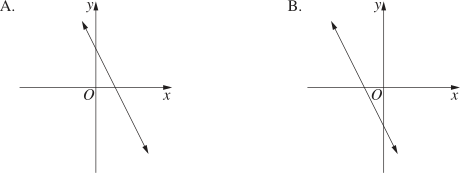
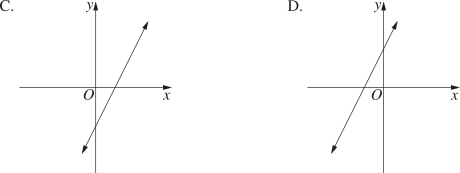
Which of the following could be the graph of \(y=-2-2x\)?
A car takes 5 hours to complete a journey when travelling at 75 km/h.
How long would the same journey take if the car were travelling at 100 km/h?
A train departs from Town A at 4.00 pm to travel to Town B. Its average speed for the journey is 80 km/h, and it arrives at 6.00 pm. A second train departs from Town A at 4.30 pm and arrives at Town B at 6.10 pm.
What is the average speed of the second train?
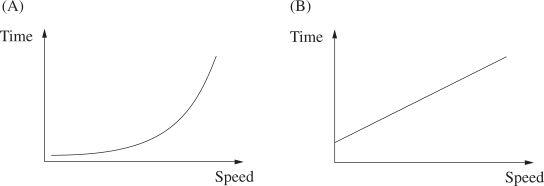
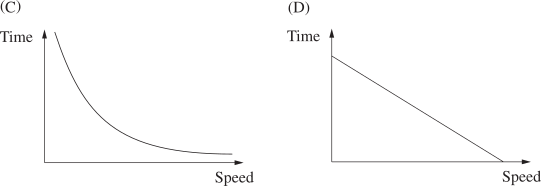
The time for a train to travel a certain distance varies inversely with its speed.
Which of the following graphs shows this relationship?
Young’s formula below is used to calculate the required dosages of medicine for children aged 1–12 years.
\(\text{Dosage}=\dfrac{\text{age of child (in years)}\ \times\ \text{adult dosage}}{\text{age of child (in years)}\ +\ 12}\)
How much of the medicine should be given to an 18-month-old child in a 24-hour period if each adult dosage is 27 mL? The medicine is to be taken every 8 hours by both adults and children.
Blood alcohol content of males can be calculated using the following formula
\(BAC_{\text{Male}} = \dfrac{10N-7.5H}{6.8M}\)
where \(N\) is the number of standard drinks consumed
\(H\) is the number of hours drinking
\(M\) is the person's mass in kilograms
What is the maximum number of standard drinks that Jacko, who has a mass of 75 kg, can consume over 5 hours in order to maintain a blood alcohol content (\(BAC\)) of less than 0.05? (3 marks)
--- 6 WORK AREA LINES (style=lined) ---
The number of ‘standard drinks’ in various glasses of wine is shown.
| Number of standard drinks | |||
| White Wine | Red Wine | ||
| small glass | large glass | small glass | large glass |
| 0.9 | 1.4 | 1.0 | 1.5 |
A woman weighing 58 kg drinks two small glasses of white wine and three small glasses of red wine between 7 pm and 11 pm.
Using the formula for calculating blood alcohol below, what would be her blood alcohol content (\(BAC\)) estimate at 11 pm, correct to three decimal places?
\(BAC_{\text{Female}}=\dfrac{10N-7.5H}{5.5M}\)
where \(N\) is the number of standard drinks consumed
\(H\) is the number of hours drinking
\(M\) is the person's mass in kilograms
The formula \(D=\dfrac{2A}{15}\) is used to calculate the dosage of liquid paracetamol to be given to a child.
--- 2 WORK AREA LINES (style=lined) ---
The correct dosage of liquid paracetamol for Teddy is 6 mL.
--- 6 WORK AREA LINES (style=lined) ---
Monica is driving on a motorway at a speed of 105 kilometres per hour and has to brake suddenly. She has a reaction time of 1.3 seconds and a braking distance of 54.3 metres.
Stopping distance can be calculated using the following formula
\(\text{stopping distance = {reaction time distance} + {braking distance}}\)
What is Monica's stopping distance? Give your answer to 1 decimal place. (2 marks)
--- 6 WORK AREA LINES (style=lined) ---
Anika drinks two small bottles of wine over a four-hour period. Each of these bottles contains 2.4 standard drinks. Anika weighs 55 kg.
Using the formula below, what is Anika's approximate blood alcohol content (\(BAC\)) at the end of this period?
\(BAC_{\text{Female}}=\dfrac{10N - 7.5H}{5.5M}\)
where \(N\) is the number of standard drinks consumed
\(H\) is the number of hours drinking
\(M\) is the person's mass in kilograms
A car is travelling at 85 km/h.
How far will it travel in 3 hours and 30 minutes?
Young’s formula, shown below, is used to calculate the dosage of medication for children aged 1−12 years based on the adult dosage.
\(D=\dfrac{yA}{y + 12}\)
| where \(D\) | = dosage for children aged 1−12 years |
| \(y\) | = age of child (in years) |
| \(A\) | = Adult dosage |
A child’s dosage is calculated to be 15 mg, based on an adult dosage of 30 mg.
How old is the child in years?
Bryce is drinking low alcohol beer at a party over a four-hour period. He reads on the label of the low alcohol beer bottle that it is equivalent to 0.8 standard drinks.
Bryce weighs 85 kg.
The formula below can be used to calculate a male's blood alcohol content.
\(BAC_{\text{Male}}=\dfrac{10N-7.5H}{6.8M}\)
where \(N\) is the number of standard drinks consumed
\(H\) is the number of hours drinking
\(M\) is the person's mass in kilograms
What is the maximum number of complete bottles of the low alcohol beer Bryce can drink to remain under a Blood Alcohol Content (\(BAC\)) of 0.05? (4 marks)
--- 8 WORK AREA LINES (style=lined) ---
Clark’s formula, given below, is used to determine the dosage of medicine for children.
\(\text{Dosage}=\dfrac{\text{weight in kg × adult dosage}}{70}\)
For a particular medicine, the adult dosage is 220 mg and the correct dosage for a specific child is 45 mg.
How much does the child weigh, to the nearest kg? (2 marks)
--- 5 WORK AREA LINES (style=lined) ---
Drake is driving at 80 km/h. He notices a branch on the road ahead and decides to apply the brakes. His reaction time is 1.2 seconds. His braking distance (\(D\) metres) is given by \(D=0.01v^2\), where \(v\) is speed in km/h.
Stopping distance can be calculated using the following formula
\(\text{stopping distance = {reaction time distance} + {braking distance}}\)
What is Drake’s stopping distance, to the nearest metre? (3 marks)
--- 6 WORK AREA LINES (style=lined) ---
The formula below is used to calculate an estimate for blood alcohol content \((BAC)\) for females.
\(BAC_{\text{female}}=\dfrac{10N - 7.5H}{5.5M}\)
The number of hours required for a person to reach zero \(BAC\) after they stop consuming alcohol is given by the following formula.
\(\text{Time}=\dfrac{BAC}{0.015}\)
The number of standard drinks in a glass of wine and a glass of spirits is shown.
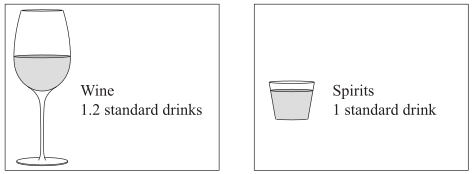
Georgie weighs 58 kg. She consumed 2 glasses of wine and 4 glasses of spirits between 7:45 pm and 12:15 am the following day. She then stopped drinking alcohol.
Using the given formulae, calculate the time in the morning when Georgie's \(BAC\) should reach zero. (4 marks)
--- 8 WORK AREA LINES (style=lined) ---
The following formula can be used to calculate an estimate for blood alcohol content (\(BAC\)) for males. \(BAC_{\text{male}}=\dfrac{10N-7.5H}{6.8M}\) \(N\) is the number of standard drinks consumed \(M\) is the person's weight in kilograms \(H\) is the number of hours of drinking Min weighs 70 kg. His \(BAC\) was zero when he began drinking alcohol. At 10:30 pm, after consuming 4 standard drinks, his \(BAC\) was 0.032. Using the formula, estimate at what time Min began drinking alcohol, to the nearest minute. (4 marks) --- 8 WORK AREA LINES (style=lined) ---
Clark’s formula is used to determine the dosage of medicine for children.
\(\text{Dosage}=\dfrac{\text{weight in kg × adult dosage}}{70}\)
The adult daily dosage of a medicine contains 1750 mg of a particular drug.
A child who weighs 30 kg is to be given tablets each containing 125 mg of this drug.
How many tablets should this child be given daily? (2 marks)
--- 4 WORK AREA LINES (style=lined) ---
The distance between the Yarra Valley and Ballarat is 150 km. A person travels from the Yarra Valley to Ballarat at an average speed of 90 km/h.
How long does it take the person to complete the journey?
When Stuart stops drinking alcohol at 11:30 pm, he has a blood alcohol content (BAC) of 0.08625.
The number of hours required for a person to reach zero BAC after they stop consuming alcohol is given by the formula:
\(\text{Time}=\dfrac{BAC}{0.015}\).
At what time on the next day should Stuart expect his BAC to be 0.05?
Margie tried to solve this equation and made a mistake in Line 2.
\begin{array}{rl}
3(m+3)-2(m+4)=-5\ &\ \ \ \text{Line 1} \\
3m+9-2m+8=-5\ &\ \ \ \text{Line 2} \\
m+17=-5\ &\ \ \ \text{Line 3} \\
m=-12& \ \ \ \text{Line 4}
\end{array}
--- 2 WORK AREA LINES (style=lined) ---
--- 2 WORK AREA LINES (style=lined) ---
Jeremy tried to solve this equation and made a mistake in Line 2.
| \(\dfrac{M+3}{2}-\dfrac{2M-1}{5}\) | \(=1\) | \(\text{... Line 1}\) |
| \(5M+15-4M-2\) | \(=10\) | \(\text{... Line 2}\) |
| \(M+13\) | \(=10\) | \(\text{... Line 3}\) |
| \(M\) | \(=-3\) | \(\text{... Line 4}\) |
Copy the equation in Line 1 and continue your solution to solve this equation for \(M\).
Show all lines of working. (2 marks)
--- 4 WORK AREA LINES (style=lined) ---
If \(M=-8\), what is the value of \(\dfrac{4M^2+3M}{8}\)
Simplify \(10-3(x+4)\). (2 marks)
--- 3 WORK AREA LINES (style=lined) ---
Solve the equation \(\dfrac{4x-3}{5}-6=7-6x\). (3 marks)
--- 5 WORK AREA LINES (style=lined) ---
What is the value of \(\sqrt{\dfrac{2x + y}{5x}}\) if \(x=5.1\) and \(y=3.7\), correct to 2 decimal places?
The distance in kilometres (\(D\)) of an observer from the centre of a thunderstorm can be estimated by counting the number of seconds (\(t\)) between seeing the lightning and first hearing the thunder.
Use the formula \(D=\dfrac{t}{3}\) to estimate the number of seconds between seeing the lightning and hearing the thunder if the storm is 2.1 km away. (1 mark)
--- 3 WORK AREA LINES (style=lined) ---
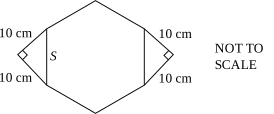
This shape is made up of two right-angled triangle and a regular hexagon.
The area of a regular hexagon can be estimated using the formula \(A=2.598S^2\) where \(S\) is the hexagon's side-length.
Calculate the total area of the shape using this formula. (3 marks)
--- 6 WORK AREA LINES (style=lined) ---
What is the value of \(\dfrac{x-y}{6}\), if \(x=184\) and \(y=46\)?
If \(V=\dfrac{4}{3}\pi r^3\), what is the value of \(V\) when \(r = 5\), correct to two decimal places?
If \(K=Ft^3\), \(F=9\) and \(t=0.829\), what is the value of \(K\) correct to three significant figures?
Using the formula \(d=6t^3-5\), Marcia tried to find the value of \(t\) when \(d=389\).
Here is her solution. She has made one mistake.
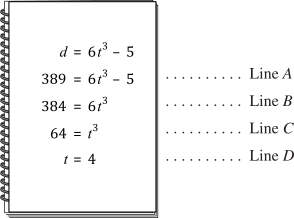
Which line does NOT follow correctly from the previous line?
Which of the following is \(5m+4y-m-6y\) in its simplest form?
Consider the equation \(\dfrac{5x}{2}-3=\dfrac{3x}{5}+1\).
Which of the following would be a correct step in solving this equation?
The formula \(C=\dfrac{5}{9}(F-32)\) is used to convert temperatures between degrees Fahrenheit \((F)\) and degrees Celsius \((C)\).
Convert 18°C to the equivalent temperature in Fahrenheit. (2 marks)
--- 5 WORK AREA LINES (style=lined) ---
It is given that \(I=\dfrac{3}{2}MR^2\).
What is the value of \(I\) when \(M =19.12\) and \(R = 1.02\), correct to two decimal places?
What is the value of \(x\) in the equation \(\dfrac{4-x}{7}=2\)?
Which expression is equivalent to \(2(7x-3)+5\)?
Solve the equation \(\dfrac{3x}{4}+1=\dfrac{5x+1}{3}\), leaving your answer as a fraction. (3 marks)
--- 6 WORK AREA LINES (style=lined) ---
Solve \(x+\dfrac{x-3}{4}=5\), leaving your answer as a fraction. (2 marks)
--- 5 WORK AREA LINES (style=lined) ---
The distance, \(d\) metres, travelled by a car slowing down from \(u\) km/h to \(v\) km/h can be obtained using the formula
\(v^2=u^2-100 d\)
What distance does a car travel while slowing down from 100 km/h to 70 km/h? (2 marks)
--- 5 WORK AREA LINES (style=lined) ---
Which equation correctly shows \(n\) as the subject of \(V=600(1-n)\)?
Which of the following correctly expresses \(r\) as the subject of \(V=\pi r^2+x\) ?
Which of the following correctly expresses \(b\) as the subject of \(y= ax+\dfrac{1}{4}bx^2\)?
If \(m = 8n^2\), what is a possible value of \(n\) when \(m=7200\)?
What is the formula for \(g\) as the subject of \(7d=8e+5g^2\)?
Which of the following correctly expresses \(X\) as the subject of \(Y=4\pi\Bigg(\dfrac{X}{4}+L\Bigg)\)?
Make \(r\) the subject of the equation \(V=4\pi r^2\). (2 marks)
--- 3 WORK AREA LINES (style=lined) ---
Which of the following correctly expresses \(M\) as the subject of \(y=\dfrac{M}{V}+cX\)?
Make \(b\) the subject of the equation \(a=\sqrt{bc-4}\). (2 marks)
--- 5 WORK AREA LINES (style=lined) ---