SmarterEd

Aussie Maths & Science Teachers: Save your time with SmarterEd

  • Login
  • Get Help
  • About

MATRICES, FUR2 2018 VCAA 1

A toll road is divided into three sections, `E, F` and `G`.

The cost, in dollars, to drive one journey on each section is shown in matrix `C` below.

`C = [(3.58),(2.22),(2.87)]{:(E),(F),(G):}`

  1. What is the cost of one journey on section `G`?   (1 mark)

    --- 1 WORK AREA LINES (style=lined) ---

  2. Write down the order of matrix `C`.   (1 mark)

    --- 1 WORK AREA LINES (style=lined) ---

  3. One day Kim travels once on section `E` and twice on section `G`.
  4. His total toll cost for this day can be found by the matrix product  `M xx C`.
  5. Write down the matrix  `M`.   (1 mark)

    --- 2 WORK AREA LINES (style=lined) ---
Show Answers Only
  1. `$2.87`
  2. `text(Order:)\ 3 xx 1`
  3. `M = [(1, 0, 2)]`
Show Worked Solution

a.   `$2.87`
 

b.   `text(Order:)\ 3 xx 1`
 

c.   `M = [(1, 0, 2)]`

Filed Under: Matrix Applications Tagged With: Band 2, Band 4, smc-619-30-Matrix product and interpretation, smc-619-40-Interpret Elements

CORE, FUR2 2018 VCAA 4


Julie deposits some money into a savings account that will pay compound interest every month.

The balance of Julie’s account, in dollars, after `n` months, `V_n` , can be modelled by the recurrence relation shown below.

`V_0 = 12\ 000, qquad V_(n + 1) = 1.0062 V_n` 

  1. How many dollars does Julie initially invest?   (1 mark)

    --- 1 WORK AREA LINES (style=lined) ---

  2. Recursion can be used to calculate the balance of the account after one month.
    1. Write down a calculation to show that the balance in the account after one month, `V_1`, is  $12 074.40.   (1 mark)

      --- 3 WORK AREA LINES (style=lined) ---

    2. After how many months will the balance of Julie’s account first exceed $12 300?   (1 mark)

      --- 3 WORK AREA LINES (style=lined) ---

  3. A rule of the form  `V_n = a xx b^n`  can be used to determine the balance of Julie's account after `n` months.
    1. Complete this rule for Julie’s investment after `n` months by writing the appropriate numbers in the boxes provided below.   (1 mark)

      --- 0 WORK AREA LINES (style=lined) ---

    2. Balance = 
       
       × 
       
       `n`
    3. What would be the value of  `n`  if Julie wanted to determine the value of her investment after three years?   (1 mark)

      --- 1 WORK AREA LINES (style=lined) ---

Show Answers Only

  1. `$12\ 000`
    1. `text(Proof)\ \ text{(See Worked Solutions)}`
    2. `4\ text(months)`
    1. `text(balance) = 12\ 000 xx 1.0062^n`
    2. `36`

Show Worked Solution

a.   `$12\ 000`
 

b.i.   `V_1` `= 1.0062 xx V_0`
    `= 1.0062 xx 12000`
    `= $12\ 074.40\ text(… as required.)`


b.ii.   `V_2` `= 1.0062 xx 12\ 074.40 = 12\ 149.26`
  `V_3` `= 1.0062 xx 12\ 149.26 = 12\ 224.59`
  `V_4` `= 1.0062 xx 12\ 224.59 = 12\ 300.38`

 
`:.\ text(After 4 months)`

 
c.i.
  `text(balance) = 12\ 000 xx 1.0062^n`

 
c.ii.
  `n = 12 xx 3 = 36`

Filed Under: Interest Rates and Investing, Recursion - Financial Tagged With: Band 2, Band 3, Band 4, smc-604-95-Recurrence relations, smc-717-10-Compound interest, smc-717-70-Find RR

CORE, FUR2 2018 VCAA 1


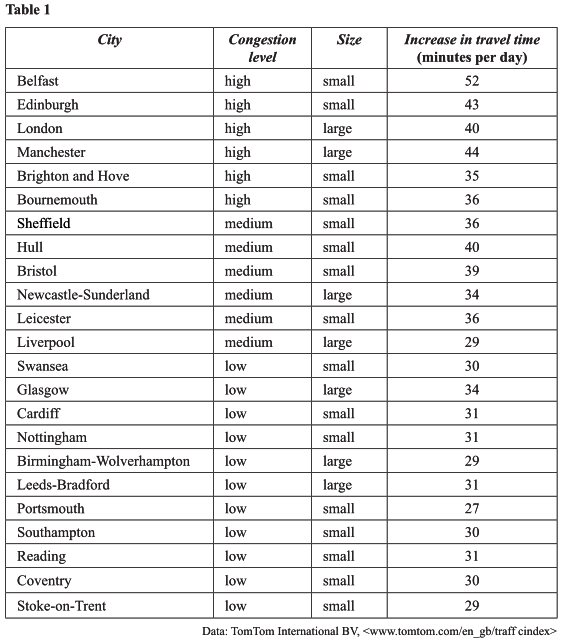
The data in Table 1 relates to the impact of traffic congestion in 2016 on travel times in 23 cities in the United Kingdom (UK).

The four variables in this data set are:

  • city — name of city
  • congestion level — traffic congestion level (high, medium, low)
  • size — size of city (large, small)
  • increase in travel time — increase in travel time due to traffic congestion (minutes per day).
  1. How many variables in this data set are categorical variables?  (1 mark)

    --- 1 WORK AREA LINES (style=lined) ---

  2. How many variables in this data set are ordinal variables  (1 mark)

    --- 1 WORK AREA LINES (style=lined) ---

  3. Name the large UK cities with a medium level of traffic congestion.  (1 mark)

    --- 1 WORK AREA LINES (style=lined) ---

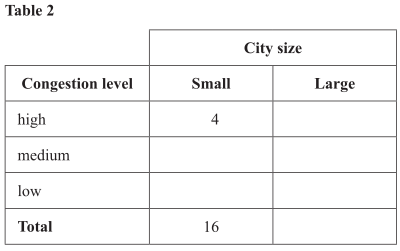
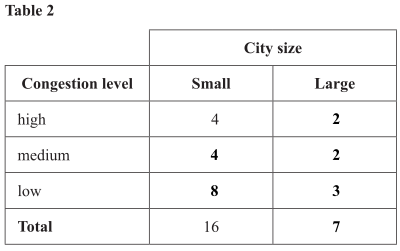
  4. Use the data in Table 1 to complete the following two-way frequency table, Table 2.  (2 marks)

    --- 0 WORK AREA LINES (style=lined) ---


  5. What percentage of the small cities have a high level of traffic congestion?  (1 mark)

    --- 3 WORK AREA LINES (style=lined) ---

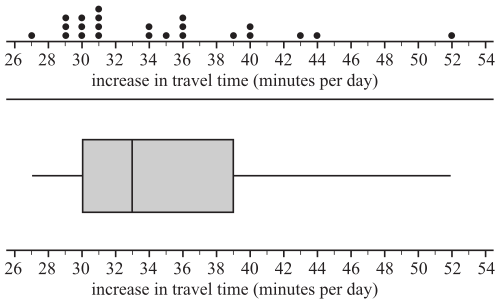
Traffic congestion can lead to an increase in travel times in cities. The dot plot and boxplot below both show the increase in travel time due to traffic congestion, in minutes per day, for the 23 UK cities.


  1. Describe the shape of the distribution of the increase in travel time for the 23 cities.  (1 mark)

    --- 1 WORK AREA LINES (style=lined) ---

  2. The data value 52 is below the upper fence and is not an outlier.
  3. Determine the value of the upper fence.  (1 mark)

    --- 3 WORK AREA LINES (style=lined) ---

Show Answers Only

  1. `3\ text(city, congestion level, size)`
  2. `2\ text(congestion level, size)`
  3. `text(Newcastle-Sunderland and Liverpool)`
  4. `text(See Worked Solutions)`
  5. `25 text(%)`
  6. `text(Positively skewed)`
  7. `52.5`

Show Worked Solution

a.   `3\-text(city, congestion level, size)`
 

b.   `2\-text(congestion level, size)`
 

c.   `text(Newcastle-Sunderland and Liverpool)`
 

d.   


e.    `text(Percentage)` `= text(Number of small cities high congestion)/text(Number of small cities) xx 100`
    `= 4/16 xx 100`
    `= 25 text(%)`

 
f.
   `text(Positively skewed)`


g.   `IQR = 39-30 = 9`
 

`text(Calculate the Upper Fence:)`

`Q_3 + 1.5 xx IQR` `= 39 + 1.5 xx 9`
  `= 52.5`

Filed Under: Graphs - Stem/Leaf and Boxplots, Summary Statistics Tagged With: Band 2, Band 3, Band 4, page-break-before-question, smc-468-10-Data Classification, smc-468-50-IQR / Outliers, smc-643-10-Single Box-Plots, smc-643-60-Outliers, smc-643-70-Distribution Description

Functions, 2ADV F2 SM-Bank 1

  1.  Draw the graph  `y = ln x`.  (1 mark)

    --- 6 WORK AREA LINES (style=lined) ---

  2.  Explain how the above graph can be transformed to produce the graph
     
             `y = 3ln(x + 2)`
     
    and sketch the graph, clearly identifying all intercepts.  (3 marks)

    --- 9 WORK AREA LINES (style=lined) ---

Show Answers Only
  1.  

  2.  
Show Worked Solution

i.


ii.   `text(Transforming)\ \ y = ln x => \ y = ln(x + 2)`

`y = ln x\ \ =>\ text(shift 2 units to left.)`
 

`text(Transforming)\ \ y = ln(x + 2)\ \ text(to)\ \ y = 3ln(x + 2)`

`=>\ text(increase each)\ y\ text(value by a factor of 3)`
 

Filed Under: Graph Transformations (Adv-2027), Graphs and Applications (Y11), Transformations (Y12) Tagged With: Band 2, Band 4, smc-1008-30-Log/Exp, smc-1008-70-Combinations, smc-6408-20-Log/Exp, smc-6408-60-Combinations, smc-966-40-Log graphs

Calculus, EXT1 C1 EQ-Bank 12

A tank is initially full. It is drained so that at time `t` seconds the volume of water, `V`, in litres, is given by

`V = 50(1 - t/80)^2`  for  `0 <= t <= 100`

  1.  How much water was initially in the tank?  (1 mark)

    --- 2 WORK AREA LINES (style=lined) ---
  2.  After how many seconds was the tank one-quarter full?  (1 mark)

    --- 4 WORK AREA LINES (style=lined) ---

  3.  At what rate was the water draining out the tank when it was one-quarter full?  (2 marks)

    --- 4 WORK AREA LINES (style=lined) ---

Show Answers Only
  1.  `50\ text(L)`
  2.  `40\ text(seconds)`
  3.  `5/8\ text(litres per second)`
Show Worked Solution

i.   `text(Initially,)\ \ t = 0.`

`V` `= 50(1 – 0)^2`
  `= 50\ text(L)`


ii.   `text(Find)\ t\ text(when tank is)\ \ 1/4\ \ text(full:)`

`50/4` `= 50(1 – t/80)^2`
`(1 – 1/80)^2` `= 1/4`
`1 – t/80` `= 1/2`
`t/80` `= 1/2`
`t` `= 40\ text(seconds)`


iii.   `(dv)/(dt)` `= 2 · 50(1 – t/80)(−1/80)`
  `= −5/4(1 – t/80)`

 
`text(When)\ \ t = 40,`

`(dv)/(dt)` `= −5/4(1 – 40/80)`
  `= −5/8`

 
`:. text(Water is draining out at)\ \ 5/8\ \ text(litres per second.)`

Filed Under: Rates of Change with respect to time (Ext1) Tagged With: Band 2, Band 3, smc-1077-20-Flow and Other Rates

Trigonometry, EXT1 T2 SM-Bank 3

Show that

`sin(8x + 3x) + sin(8x - 3x) = 2sin(8x)cos(3x)`.  (1 mark)

Show Answers Only

`text(See Worked Solutions)`

Show Worked Solution

`text(Expanding the LHS:)`

`text(LHS)` `= sin(8x)cos(3x) + cos(8x)sin(3x) + sin(8x)cos(3x) – cos(8x)sin(3x)`
  `= 2sin(8x)cos(3x)`

Filed Under: T2 Further Trigonometric Identities (Y11) Tagged With: Band 2, smc-1025-20-Compound Angles

Calculus, 2ADV C1 2008 HSC 6b

The graph shows the velocity of a particle,  `v`  metres per second, as a function of time,  `t`  seconds.

  1. What is the initial velocity of the particle?   (1 mark)

    --- 1 WORK AREA LINES (style=lined) ---

  2. When is the velocity of the particle equal to zero?    (1 mark)

    --- 1 WORK AREA LINES (style=lined) ---

  3. When is the acceleration of the particle equal to zero?    (1 mark)

    --- 1 WORK AREA LINES (style=lined) ---

Show Answers Only
  1. `20\ text(m/s)`
  2. `t=10\ text(seconds)`
  3. `t=6\ text(seconds)`
Show Worked Solution

i.    `text(Find)\   v  \ text(when)  t=0`

`v=20\ \ text(m/s)`
 

ii.    `text(Particle comes to rest at)\  t=10\ text{seconds  (from graph)}`


iii.  `text(Acceleration is zero when)\ t=6\ text{seconds  (from graph)}`

Filed Under: Rates of Change (Adv-2027), Rates of Change (Y11) Tagged With: Band 2, Band 3, smc-1083-10-Motion Graphs, smc-6438-10-Motion Graphs

Complex Numbers, EXT2 N2 2018 HSC 11d

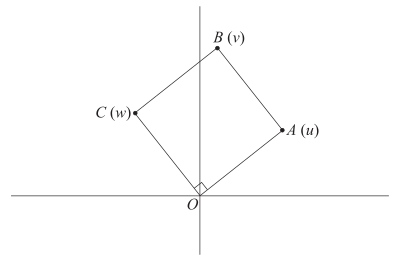
The points `A`, `B` and `C` on the Argand diagram represent the complex numbers `u`, `v` and `w` respectively.

The points `O`, `A`, `B` and `C` form a square as shown on the diagram.


It is given that  `u = 5 + 2i`.

  1.  Find  `w`.  (1 mark)

    --- 2 WORK AREA LINES (style=lined) ---
  2.  Find  `v`.  (1 mark)

    --- 2 WORK AREA LINES (style=lined) ---
  3.  Find  `text(arg)(w/v)`.  (1 mark)

    --- 2 WORK AREA LINES (style=lined) ---

Show Answers Only
  1. `−2 + 5i`
  2. `3 + 7i`
  3. `pi/4`
Show Worked Solution
i.    `w` `= iu`
    `= i(5 + 2i)`
    `= −2 + 5i`


ii.    `v` `= u + w`
    `= 5 + 2i + (−2 + 5i)`
    `= 3 + 7i`


iii.    `text(arg)(w/v)` `= text(arg)(w) – text(arg)(v)`
    `= pi/4\ \ (text(diagonal of square bisects corner))`

Filed Under: Geometrical Implications of Complex Numbers, Geometry and Complex Numbers (vectors) Tagged With: Band 2, Band 3, Band 4, smc-1052-30-Quadrilaterals

Complex Numbers, EXT2 N1 2018 HSC 11a

Let  `z = 2 + 3i`  and  `w = 1 - i.`

  1. Find  `zw`.  (1 mark)

    --- 3 WORK AREA LINES (style=lined) ---

  2. Express  `barz  - 2/w`  in the form  `x + iy`, where `x` and `y` are real numbers.  (2 marks)

    --- 3 WORK AREA LINES (style=lined) ---

Show Answers Only
  1. `5 + i`
  2. `1 – 4i`
Show Worked Solution

i.   `z = 2 + 3iqquadw = 1 – i`

♦ Mean mark part (i) 97!%.

`zw` `= (2 + 3i)(1 – i)`
  `= 2 – 2i + 3i – 3i^2`
  `= 2 + i + 3`
  `= 5 + i`


ii.    `barz – 2/w` `= 2 – 3i – 2/(1 – i)`
    `= 2 – 3i – (2(1 – i))/((1 – i)(1 + i))`
    `= 2 – 3i – (1 + i)`
    `= 1 – 4i`

Filed Under: Arithmetic and Complex Numbers, Arithmetic of Complex Numbers Tagged With: Band 1, Band 2, smc-1048-10-Basic Arithmetic

Measurement, STD2 M7 2018 HSC 27a

Jenny used her mobile phone while she was overseas for one month.

Her mobile phone plan has a base monthly cost of $50. While overseas, she is also charged 33 cents per SMS message sent and 26 cents per MB of data used.

During her month overseas, Jenny sent 120 SMS messages and used 1400 MB of data.

What was her mobile phone bill for the month overseas?  (2 marks)

Show Answers Only

`$453.60`

Show Worked Solution

`text(SMS charge = 120 × 33c = $39.60)`

`text(Data charge = 1400 × 26c = $364.00)`
 

`:.\ text(Total bill)` `= 50 + 39.60 + 364`
  `= $453.60`

Filed Under: M4 Rates (Y12), Rates (Std2) Tagged With: Band 2, smc-1104-15-General rate problems, smc-805-60-Other rate problems

Statistics, STD2 S1 2018 HSC 26d

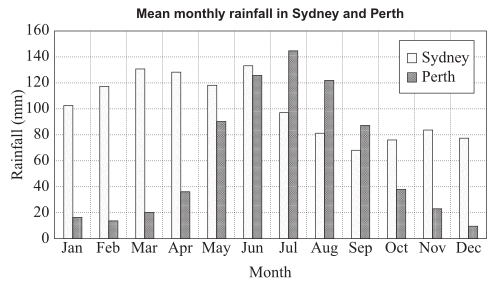
The graph displays the mean monthly rainfall in Sydney and Perth.


  1. For how many months is the mean monthly rainfall higher in Perth than in Sydney?  (1 mark)

    --- 1 WORK AREA LINES (style=lined) ---
  2. For which of the two cities is the standard deviation of the mean monthly rainfall smaller? Justify your answer WITHOUT calculations.  (1 mark)

    --- 2 WORK AREA LINES (style=lined) ---
Show Answers Only
  1. `3`
  2. `text(The mean monthly rainfall of Sydney is in a)`
    `text(much tighter range than Perth.)`
    `:.\ text(Sydney has a smaller standard deviation.)`
Show Worked Solution

a.   `text(3 months (Jul, Aug and Sep))`

♦ Mean mark part (ii) 38%.
COMMENT: Extremely volatile result between parts with part (i) producing a 91% mean mark.


b.    `text(The mean monthly rainfall of Sydney is in a)`

`text(much tighter range than Perth.)`

`:.\ text(Sydney has a smaller standard deviation.)`

Filed Under: Bar Charts and Histograms (Std 2), Bar Charts and Histograms (Std1-2027), Bar Charts and Histograms (Std2-2027), Bar Charts and Histograms (Y12), Bar Charts, Histograms and Other Graphs (Std 1) Tagged With: Band 2, Band 5, common-content, smc-1128-10-Bar Charts, smc-6310-10-Bar Charts, smc-6530-10-Bar Charts, smc-821-10-Bar Charts, smc-997-10-Bar Charts

Linear Functions, 2UA 2018 HSC 2 MC

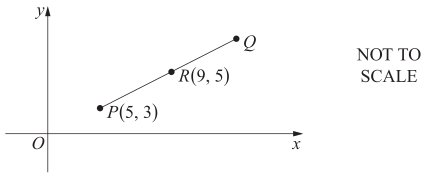
The point  `R(9, 5)`  is the midpoint of the interval  `PQ`, where `P` has coordinates  `(5, 3).`
 

What are the coordinates of  `Q`?

  1. `(4, 7)`
  2. `(7, 4)`
  3. `(13, 7)`
  4. `(14, 8)`
Show Answers Only

`C`

Show Worked Solution

`text(Using the midpoint formula):`

`(x_Q + x_P)/2` `= x_R` `(y_Q + y_P)/2` `= y_R`
`(x_Q + 5)/2` `= 9` `(y_Q + 3)/2` `= 5`
`x_Q` `= 13` `y_Q` `= 7`

 
`:. Q\ text(has coordinates)\ (13, 7).`

`=>  C`

Filed Under: 6. Linear Functions, Cartesian Plane Tagged With: Band 2, num-title-ct-pathc, num-title-qs-hsc, smc-4422-10-Mid-point

Functions, 2ADV F1 2018 HSC 1 MC

What is the value of  `7^(-1.3)`  correct to two decimal places?

  1. 0.07
  2. 0.08
  3. -12.54
  4. -12.55
Show Answers Only

`B`

Show Worked Solution

`7^(-1.3)`

`= 0.0796…`

`= 0.08\ \ text{(2 d.p.)}`

`=>  B`

Filed Under: Algebraic Techniques (Adv-2027), Algebraic Techniques (Y11), Surds and Rounding Tagged With: Band 2, smc-6213-60-Rounding, smc-983-10-Rounding

Networks, STD2 N3 2008 FUR1 1 MC

Steel water pipes connect five points underground.

The directed graph below shows the directions of the flow of water through these pipes between these points. 
 

networks-fur1-2008-vcaa-1-mc

 
The directed graph shows that water can flow from

A.   point 1 to point 2.

B.   point 1 to point 4.

C.   point 4 to point 1.

D.   point 4 to point 2.

Show Answers Only

`=> C`

Show Worked Solution

`=> C`

Filed Under: Flow Networks and Minimum Cuts Tagged With: Band 2, smc-915-40-Other Directed Flows

Networks, FUR2 2016 VCE 1

A map of the roads connecting five suburbs of a city, Alooma (`A`), Beachton (`B`), Campville (`C`), Dovenest (`D`) and Easyside (`E`), is shown below.


  1. Starting at Beachton, which two suburbs can be driven to using only one road?  (1 mark)

A graph that represents the map of the roads is shown below.


One of the edges that connects to vertex `E` is missing from the graph.

    1. Add the missing edge to the graph above.  (1 mark)


      (Answer on the graph above.)

    2. Explain what the loop at `D` represents in terms of a driver who is departing from Dovenest.  (1 mark)
Show Answers Only
  1. `text(Alooma and Easyside.)`

    1. `text(The loop represents that a driver can take a route out of)`
      `text(Dovenest and return home without going through another)`
      `text(suburb or turning back.)`
Show Worked Solution

a.   `text(Alooma and Easyside.)`


b.i.   

`text(Draw a third edge between Easyside and Dovenest.)`


b.ii. `text(The loop represents that a driver can take a)`

♦♦ Mean mark 30%.

`text(route out of Dovenest and return home without)`

`text(going through another suburb or turning back.)`

Filed Under: Uncategorized Tagged With: Band 2, Band 4, Band 5

Networks, STD2 N2 2011 FUR2 1

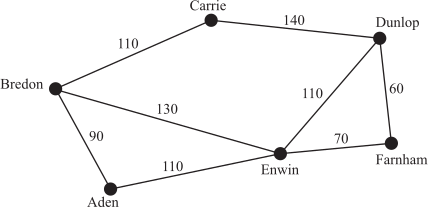
Aden, Bredon, Carrie, Dunlop, Enwin and Farnham are six towns.

The network shows the road connections and distances between these towns in kilometres.
 

  1. In kilometres, what is the shortest distance between Farnham and Carrie?  (1 mark)

    --- 1 WORK AREA LINES (style=lined) ---
  2. How many different ways are there to travel from Farnham to Carrie without passing through any town more than once?  (1 mark)

    --- 1 WORK AREA LINES (style=lined) ---

An engineer plans to inspect all of the roads in this network.

He will start at Dunlop and inspect each road only once.

  1. At which town will the inspection finish?  (1 mark)

    --- 2 WORK AREA LINES (style=lined) ---

Show Answers Only
  1. `200\ text(km)`
  2. `6`
  3. `text(Bredon)`
Show Worked Solution

a.   `text{Farnham to Carrie (shortest)}`

`= 60 + 140`

`= 200\ text(km)`


b.   `text(Different paths are)`

`FDC, FEDC, FEBC, FEABC, FDEBC, FDEABC`

`:. 6\ text(different ways)`


c.   `text(A possible path is)\ DFEABCDEB\ text(and will finish)`

`text{at Bredon – the only other odd-degree vertex.}`

`text{(Note that solving this can be done quickly by applying the}`

`text{concept underlying the Konigsberg Bridge problem.)}`

Filed Under: Shortest Path (Std1-2027), Shortest Paths, Shortest Paths, Shortest Paths (Std2-2027) Tagged With: Band 2, Band 3, smc-1137-10-Network Diagram, smc-6308-10-Network Diagrams, smc-6527-10-Network Diagrams, smc-913-10-Network Diagram

Networks, STD2 N2 2017 FUR2 1

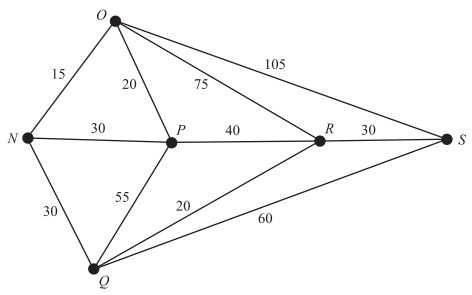
Bus routes connect six towns.

The towns are Northend (`N`), Opera (`O`), Palmer (`P`), Quigley (`Q`), Rosebush (`R`) and Seatown (`S`).

The graph below gives the cost, in dollars, of bus travel along these routes.

Bai lives in Northend (`N`) and he will travel by bus to take a holiday in Seatown (`S`).


  1. Bai considers travelling by bus along the route Northend (`N`) – Opera (`O`) – Seatown (`S`).
    How much would Bai have to pay?  (1 mark)

    --- 1 WORK AREA LINES (style=lined) ---

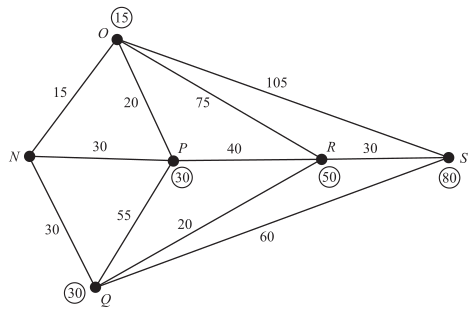
  2. If Bai takes the cheapest route from Northend (`N`) to Seatown (`S`), which other town(s) will he pass through?  (1 mark)

    --- 1 WORK AREA LINES (style=lined) ---

Show Answers Only
  1. `$120`
  2. `text(Quigley and Rosebush.)`
Show Worked Solution
a.    `text(C)text(ost)` `= 15 + 105`
    `= $120`


b.   `text(Using Djikstra’s algorithm:)`

`text(Fastest route is:)\ \ NQRS.` 

`:.\ text(Other towns are Quigley and Rosebush.)`

Filed Under: Shortest Path (Std1-2027), Shortest Paths, Shortest Paths, Shortest Paths (Std2-2027) Tagged With: Band 2, Band 3, smc-1137-10-Network Diagram, smc-6308-10-Network Diagrams, smc-6527-10-Network Diagrams, smc-913-10-Network Diagram

Networks, STD2 N2 2013 FUR2 1

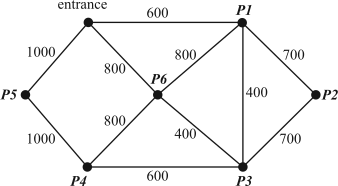
The vertices in the network diagram below show the entrance to a wildlife park and six picnic areas in the park: `P1`, `P2`, `P3`, `P4`, `P5` and `P6`.

The numbers on the edges represent the lengths, in metres, of the roads joining these locations.


  1. In this graph, what is the degree of the vertex at the entrance to the wildlife park?  (1 mark)

    --- 1 WORK AREA LINES (style=lined) ---
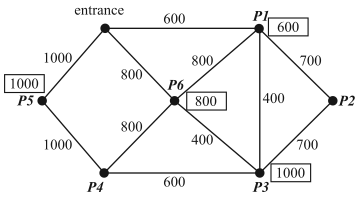
  2. What is the shortest distance, in metres, from the entrance to picnic area `P3`?  (1 mark)

    --- 1 WORK AREA LINES (style=lined) ---
Show Answers Only
  1. `3`
  2. `1000\ text(m)`
Show Worked Solution

a.   `3`

b.  `text(Using Djikstra’s algorithm:)`


`text( Shortest distance)`

`= E – P1 – P3`

`= 600 + 400`

`= 1000\ text(m)`

Filed Under: Shortest Path (Std1-2027), Shortest Paths, Shortest Paths, Shortest Paths (Std2-2027) Tagged With: Band 2, Band 3, smc-1137-10-Network Diagram, smc-6308-10-Network Diagrams, smc-6527-10-Network Diagrams, smc-913-10-Network Diagram

Networks, STD2 N2 2015 FUR1 5 MC

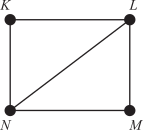
The graph below represents a friendship network. The vertices represent the four people in the friendship network: Kwan (K), Louise (L), Milly (M) and Narelle (N).

An edge represents the presence of a friendship between a pair of these people. For example, the edge connecting K and L shows that Kwan and Louise are friends.

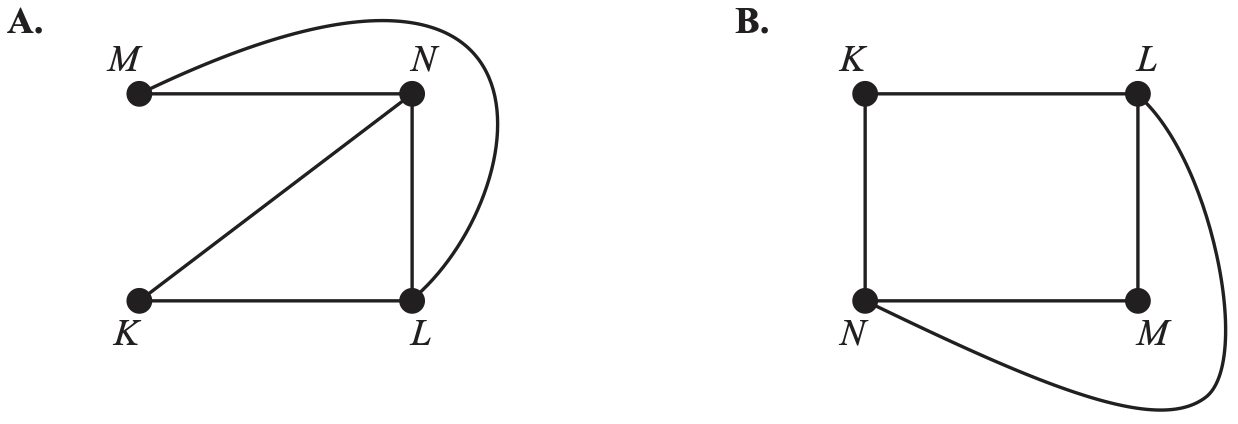
Which one of the following graphs does not contain the same information.


Show Answers Only

`D`

Show Worked Solution

`text(Option D has Kwan and Milly as friends which is not correct.)`

`=> D`

Filed Under: Basic Concepts, Basic Concepts, Basic Concepts, Network Concepts (Std1-2027), Network Concepts (Std2-2027) Tagged With: Band 2, num-title-ct-path, smc-1136-50-Other, smc-4788-40-Planar graphs, smc-6307-60-Other, smc-6526-60-Other, smc-912-50-Other

Networks, STD2 N2 2009 FUR1 2 MC

The network shows the distances, in kilometres, along roads that connect the cities of Austin and Boyle.
 

networks-fur1-2009-vcaa-2-mc

 
The shortest distance, in kilometres, from Austin to Boyle is

A.     `7`

B.     `8`

C.     `9`

D.   `10`

Show Answers Only

`B`

Show Worked Solution

`text(The shortest distance)`

`=2+4+1+1`

`=8`

`=>  B`

Filed Under: Shortest Path (Std1-2027), Shortest Paths, Shortest Paths, Shortest Paths (Std2-2027) Tagged With: Band 2, smc-1137-10-Network Diagram, smc-6308-10-Network Diagrams, smc-6527-10-Network Diagrams, smc-913-10-Network Diagram

Networks, STD2 N2 2015 FUR2 1

A factory requires seven computer servers to communicate with each other through a connected network of cables.

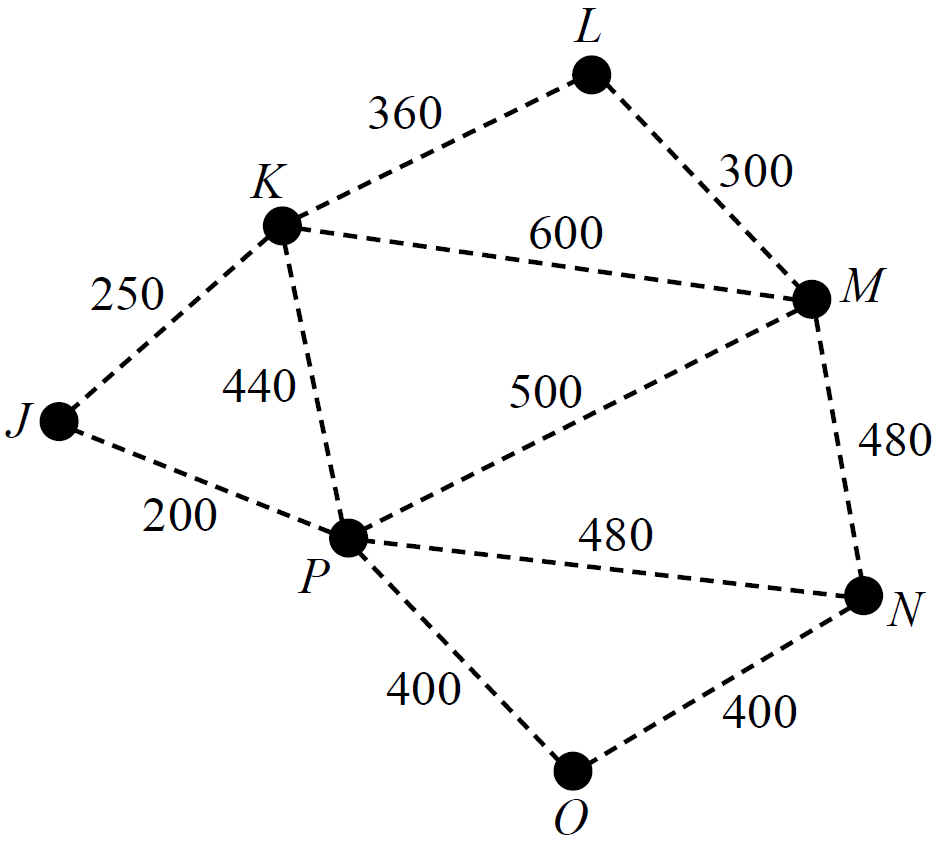
The servers, `J`, `K`, `L`, `M`, `N`, `O` and `P`, are shown as vertices on the graph below.
 

Networks, FUR2 2015 VCAA 11

 
The edges on the graph represent the cables that could connect adjacent computer servers.

The numbers on the edges show the cost, in dollars, of installing each cable.

  1. What is the cost, in dollars, of installing the cable between server `L` and server `M`?  (1 mark)

    --- 1 WORK AREA LINES (style=lined) ---
  2. What is the cheapest cost, in dollars, of installing cables between server `K` and server `N`?  (1 mark)

    --- 1 WORK AREA LINES (style=lined) ---
  3. The computer servers will be able to communicate with all the other servers as long as each server is connected by cable to at least one other server.

    1. The cheapest installation that will join the seven computer servers by cable in a connected network follows a minimum spanning tree.


      Draw the minimum spanning tree on the plan below.  (1 mark) 
       

      Networks, FUR2 2015 VCAA 12


    2. The factory’s manager has decided that only six connected computer servers will be needed, rather than seven.


      How much would be saved in installation costs if the factory removed computer server `P` from its minimum spanning tree network?


      A copy of the graph above is provided below to assist with your working.  (1 mark)

      Networks, FUR2 2015 VCAA 12

      --- 0 WORK AREA LINES (style=lined) ---
Show Answers Only
  1. `$300`
  2. `$920`
  3. `N\ text(and)\ P\ text{(or}\ P\ text(and)\ N)`
    1.  
      Networks, FUR2 2015 VCAA 12 Answer
    2. `$120`
Show Worked Solution

a.   `$300`


b.   `text(Minimum cost of)\ K\ text(to)\ N`

`= 440 + 480`

`= $920`
 

MARKER’S COMMENT: Many students had difficulty finding the minimum spanning tree, often incorrectly excluding `PO` or `KL`.

c.i.  `text(Using Prim’s Algorithm:)`

`text(Starting at Vertex)\ L`

`text{1st Edge: L → M (300)}`

`text{2nd Edge: L → K (360)}`

`text{3rd Edge: K → J (250)}`

`text{4th Edge: J → P (200)  etc…}`
 

Networks, FUR2 2015 VCAA 12 Answer


c.ii.
   `text(Disconnect)\ J – P\ text(and)\ O – P`

`text(Savings) = 200 + 400 = $600`

`text(Add in)\ M – N`

`text(C)text(ost) = $480`

`:.\ text(Net savings)` `= 600 – 480`
  `= $120`

Filed Under: Minimum Spanning Trees, Minimum Spanning Trees, Spanning Trees (Std1-2027), Spanning Trees (Std2-2027) Tagged With: Band 2, Band 3, Band 4, smc-1138-30-Cost, smc-1138-40-Draw Tree, smc-6320-30-Cost, smc-6320-40-Draw Tree, smc-6528-30-Cost, smc-6528-40-Draw Tree, smc-914-30-Cost, smc-914-40-Draw Tree

Networks, STD2 N2 2015 FUR1 1 MC

In the graph above, the number of vertices of odd degree is

  1. `1`
  2. `2`
  3. `3`
  4. `4`
Show Answers Only

`B`

Show Worked Solution

`=> B`

Filed Under: Basic Concepts, Basic Concepts, Network Concepts (Std1-2027), Network Concepts (Std2-2027) Tagged With: Band 2, smc-1136-40-Degrees of Vertices, smc-6307-50-Degree of Vertices, smc-6526-50-Degree of Vertices, smc-912-40-Degrees of Vertices

Networks, STD2 N2 2013 FUR1 1 MC

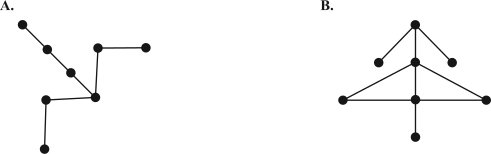
Which one of the following graphs is a tree?
  

Show Answers Only

`A`

Show Worked Solution

`text(A tree cannot contain a cycle.)`

`=>  A`

Filed Under: Basic Concepts, Basic Concepts, Basic Concepts, Network Concepts (Std1-2027), Network Concepts (Std2-2027) Tagged With: Band 2, num-title-ct-path, smc-1136-30-Definitions, smc-4788-10-Definitions, smc-6307-40-Definitions, smc-6526-40-Definitions, smc-912-30-Definitions

Networks, STD2 N2 2010 FUR1 2 MC

 vcaa-networks-fur1-2010-2 

The number of edges in the graph above is

  1. `5`
  2. `7`
  3. `8`
  4. `10`
Show Answers Only

`C`

Show Worked Solution

`text{Edges are represented by lines between vertices.}`

`=>  C`

Filed Under: Basic Concepts, Basic Concepts, Basic Concepts, Network Concepts (Std1-2027), Network Concepts (Std2-2027) Tagged With: Band 2, smc-1136-30-Definitions, smc-1136-45-Number of Edges, smc-4788-10-Definitions, smc-4788-20-Number of edges, smc-6307-40-Definitions, smc-6526-40-Definitions, smc-912-30-Definitions

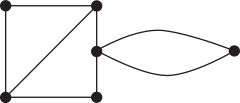
Networks, STD2 N2 2012 FUR1 1 MC

The sum of the degrees of all the vertices in the graph above is

A.    `6`

B.    `9`

C.   `11`

D.   `12`

Show Answers Only

`D`

Show Worked Solution

`text(Total Degrees)`

`=1 + 3 + 2 + 2 + 2 + 2`

`=12`

`rArr D`

Filed Under: Basic Concepts, Basic Concepts, Network Concepts (Std1-2027), Network Concepts (Std2-2027) Tagged With: Band 2, smc-1136-40-Degrees of Vertices, smc-6307-50-Degree of Vertices, smc-6526-50-Degree of Vertices, smc-912-40-Degrees of Vertices

GRAPHS, FUR2 2017 VCAA 1

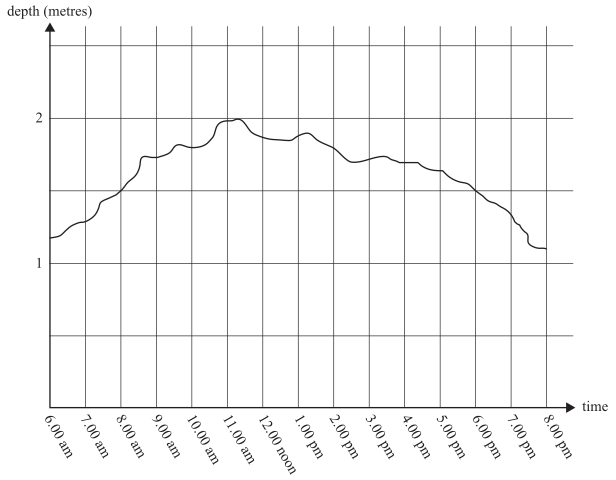
The graph below shows the depth of water in a sea bath from 6.00 am to 8.00 pm.


  1. What was the maximum depth, in metres, of water in the sea bath?   (1 mark)

    --- 1 WORK AREA LINES (style=lined) ---
  2. The sea bath was open to the public when the depth of water was above 1.5 m.
  3. Between which times was the sea bath open?   (1 mark)

    --- 1 WORK AREA LINES (style=lined) ---
Show Answers Only

a.   `text(2 metres)`

b.   `text(8 am – 6 pm)`

Show Worked Solution

a.   `text(2 metres)`

b.   `text(8 am – 6 pm)`

Filed Under: Graphs - Histograms and Other Tagged With: Band 2, Band 3, smc-644-45-Other Graphs

NETWORKS, FUR2 2017 VCAA 1

Bus routes connect six towns.

The towns are Northend (`N`), Opera (`O`), Palmer (`P`), Quigley (`Q`), Rosebush (`R`) and Seatown (`S`).

The graph below gives the cost, in dollars, of bus travel along these routes.

Bai lives in Northend (`N`) and he will travel by bus to take a holiday in Seatown (`S`).


  1. Bai considers travelling by bus along the route Northend (`N`) – Opera (`O`) – Seatown (`S`).


    How much would Bai have to pay?   (1 mark)

    --- 2 WORK AREA LINES (style=lined) ---

  2. If Bai takes the cheapest route from Northend (`N`) to Seatown (`S`), which other town(s) will he pass through?   (1 mark)

    --- 2 WORK AREA LINES (style=lined) ---

  3. Euler’s formula, `v + f = e + 2`, holds for this graph.

    Complete the formula by writing the appropriate numbers in the boxes provided below.   (1 mark)

    --- 0 WORK AREA LINES (style=lined) ---


Show Answers Only

a.   `$120`

b.   `text(Quigley and Rosebush.)`

c. 


Show Worked Solution
a.    `text(C)text(ost)` `= 15 + 105`
    `= $120`


b.   `text(Cheapest route is)\ N – Q – R – S`

`:.\ text(Other towns are Quigley and Rosebush.)`


c.   

Filed Under: Basic Concepts, Minimum Spanning Trees and Shortest Paths Tagged With: Band 2, Band 3, smc-624-20-Cost, smc-626-40-Euler's Formula

MATRICES, FUR2 2017 VCAA 2

Junior students at a school must choose one elective activity in each of the four terms in 2018.

Students can choose from the areas of performance (`P`), sport (`S`) and technology (`T`).

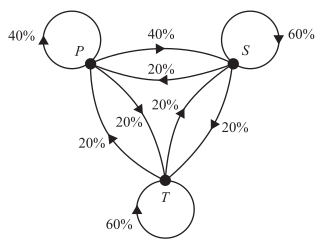
The transition diagram below shows the way in which junior students are expected to change their choice of elective activity from term to term.


  1. Of the junior students who choose performance (`P`) in one term, what percentage are expected to choose sport (`S`) the next term?   (1 mark)

    --- 1 WORK AREA LINES (style=lined) ---
Matrix `J_1` lists the number of junior students who will be in each elective activity in Term 1.
 

`J_1 = [(300),(240),(210)]{:(P),(S),(T):}`
 

  1. 306 junior students are expected to choose sport (`S`) in Term 2.
     
    Complete the calculation below to show this.   (1 mark)

    --- 0 WORK AREA LINES (style=lined) ---


  2. In Term 4, how many junior students in total are expected to participate in performance (`P`) or sport (`S`) or technology (`T`)?   (1 mark)

    --- 3 WORK AREA LINES (style=lined) ---
Show Answers Only
  1. `text(40%)`
  2.  `300 xx 0.4 + 240 xx 0.6 + 210 xx 0.2 = 306`
  3. `750`
Show Worked Solution

a.   `text(40%)`
 

b.  `300 xx 0.4 + 240 xx 0.6 + 210 xx 0.2 = 306`

♦♦ Mean mark part (c) 30%.

MARKER’S COMMENT: No matrix calculations were required here.


c. 
 `text(Each term, every student will do)\ P\ text(or)\ S\ text(or)\ T.`

`:. text(Total students (Term 4))` `=\ text(Total students (Term 1))`
  `= 300 + 240 + 210`
  `= 750`

Filed Under: Transition Matrices - Regular Tagged With: Band 2, Band 4, Band 5, smc-618-25-Interpret Diagram, smc-618-30-State Matrix in discrete period

CORE, FUR2 2017 VCAA 5

Alex is a mobile mechanic.

He uses a van to travel to his customers to repair their cars.

The value of Alex’s van is depreciated using the flat rate method of depreciation.

The value of the van, in dollars, after `n` years, `V_n`, can be modelled by the recurrence relation shown below.

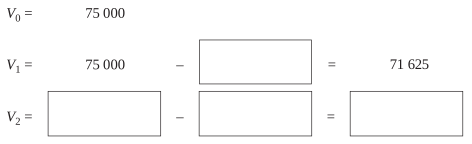
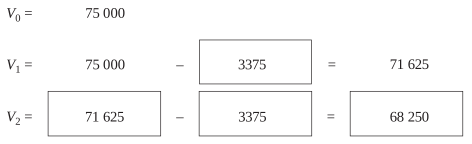
`V_0 = 75\ 000 qquad V_(n + 1) = V_n - 3375`

  1. Recursion can be used to calculate the value of the van after two years.


    Complete the calculations below by writing the appropriate numbers in the boxes provided.   (2 marks)

    --- 0 WORK AREA LINES (style=lined) ---

    1. By how many dollars is the value of the van depreciated each year?   (1 mark)

      --- 1 WORK AREA LINES (style=lined) ---
    2. Calculate the annual flat rate of depreciation in the value of the van.
    3. Write your answer as a percentage.   (1 mark)

      --- 2 WORK AREA LINES (style=lined) ---

  2. The value of Alex’s van could also be depreciated using the reducing balance method of depreciation.
  3. The value of the van, in dollars, after `n` years, `R_n`, can be modelled by the recurrence relation shown below.


            `R_0 = 75\ 000 qquad R_(n + 1) = 0.943R_n`

    At what annual percentage rate is the value of the van depreciated each year?   (1 mark)

    --- 2 WORK AREA LINES (style=lined) ---

Show Answers Only

a.

b.i.  `$3375`

b.ii. `4.5text(%)`

c.  `5.7text(%)`

Show Worked Solution

a.   

  
b.i.
   `$3375`


b.ii.    `text(Annual Rate)` `= 3375/(75\ 000) xx 100`
    `= 4.5text(%)`


c.    `text(Annual Rate)` `= (1-0.943) xx 100text(%)`
    `= 5.7text(%)`

Filed Under: Depreciation, Recursion - Financial Tagged With: Band 2, Band 3, Band 4, smc-602-40-Comparing methods, smc-602-50-Recurrence relation, smc-717-50-Depreciation (SL), smc-717-60-Depreciation (reducing balance)

Algebra, MET2 2017 VCAA 2

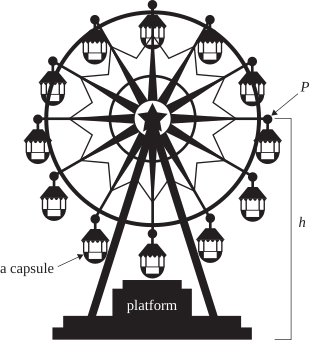
Sammy visits a giant Ferris wheel. Sammy enters a capsule on the Ferris wheel from a platform above the ground. The Ferris wheel is rotating anticlockwise. The capsule is attached to the Ferris wheel at point `P`. The height of `P` above the ground, `h`, is modelled by  `h(t) = 65-55cos((pit)/15)`, where `t` is the time in minutes after Sammy enters the capsule and `h` is measured in metres.

Sammy exits the capsule after one complete rotation of the Ferris wheel.


  1. State the minimum and maximum heights of `P` above the ground.   (1 mark)

    --- 2 WORK AREA LINES (style=lined) ---
  2. For how much time is Sammy in the capsule?   (1 mark)

    --- 2 WORK AREA LINES (style=lined) ---

  3. Find the rate of change of `h` with respect to `t` and, hence, state the value of `t` at which the rate of change of `h` is at its maximum.   (2 marks)

    --- 4 WORK AREA LINES (style=lined) ---

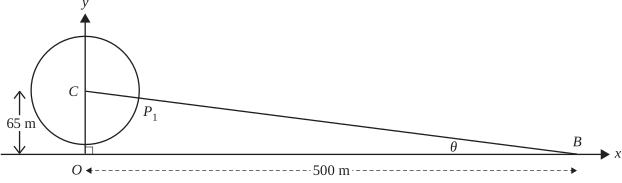
As the Ferris wheel rotates, a stationary boat at `B`, on a nearby river, first becomes visible at point `P_1`. `B` is 500 m horizontally from the vertical axis through the centre `C` of the Ferris wheel and angle `CBO = theta`, as shown below.


  1. Find `theta` in degrees, correct to two decimal places.   (1 mark)

    --- 3 WORK AREA LINES (style=lined) ---

Part of the path of `P` is given by  `y = sqrt(3025-x^2) + 65, x ∈ [-55,55]`, where `x` and `y` are in metres.

  1. Find `(dy)/(dx)`.   (1 mark)

    --- 2 WORK AREA LINES (style=lined) ---
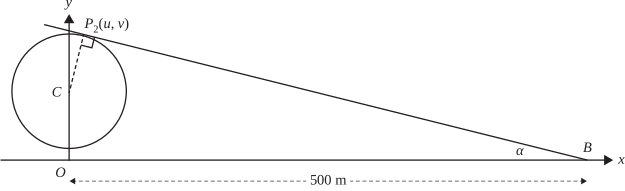
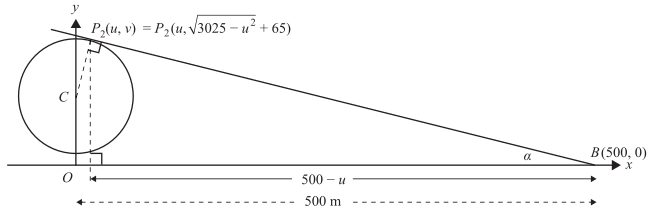
As the Ferris wheel continues to rotate, the boat at `B` is no longer visible from the point  `P_2(u, v)` onwards. The line through `B` and `P_2` is tangent to the path of `P`, where angle `OBP_2 = alpha`.


  1. Find the gradient of the line segment `P_2B` in terms of `u` and, hence, find the coordinates of `P_2`, correct to two decimal places.   (3 marks)

    --- 10 WORK AREA LINES (style=lined) ---
  2. Find `alpha` in degrees, correct to two decimal places.   (1 mark)

    --- 4 WORK AREA LINES (style=lined) ---

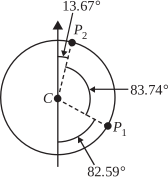
  3. Hence or otherwise, find the length of time, to the nearest minute, during which the boat at `B` is visible.   (2 marks)

    --- 5 WORK AREA LINES (style=lined) ---

Show Answers Only
  1. `h_text(min) = 10\ text(m), h_text(max) = 120\ text(m)`
  2. `30\ text(min)`
  3. `t = 7.5`
  4. `7.41^@`
  5. `(-x)/(sqrt(3025-x^2))`
  6. `P_2(13.00, 118.44)`
  7. `13.67^@`
  8. `7\ text(min)`
Show Worked Solution
a.    `h_text(min)` `= 65-55` `h_text(max)` `= 65 + 55`
    `= 10\ text(m)`   `= 120\ text(m)`


b.   `text(Period) = (2pi)/(pi/15) = 30\ text(min)`


c.   `h^{prime}(t) = (11pi)/3\ sin(pi/15 t)`

♦ Mean mark 50%.
MARKER’S COMMENT: A number of commons errors here – 2 answers given, calc not in radian mode, etc …


`text(Solve)\ h^{primeprime}(t) = 0, t ∈ (0,30)`

`t = 15/2\ \ text{(max)}`   `text(or)`   `t = 45/2\ \ text{(min – descending)}`

`:. t = 7.5`


d.   

♦ Mean mark 36%.
MARKER’S COMMENT: Choosing degrees vs radians in the correct context was critical here.

`tan(theta)` `= 65/500`
`:. theta` `=7.406…`
  `= 7.41^@`


e.    `(dy)/(dx)` `= (-x)/(sqrt(3025-x^2))`


f.   

`P_2(u,sqrt(3025-u^2) + 65),\ \ B(500,0)`

`:. m_(P_2B)` `= (sqrt(3025-u^2) + 65)/(u-500)`


`text{Using part (e), when}\ \ x=u,`

♦♦♦ Mean mark part (f) 18%.
MARKER’S COMMENT: Many students were unable to use the rise over run information to calculate the second gradient.

`dy/dx=(-u)/(sqrt(3025-u^2))`


`text{Solve (by CAS):}`

`(sqrt(3025-u^2) + 65)/(u-500)` `= (-u)/(sqrt(3025-u^2))\ \ text(for)\ u`


`u=12.9975…=13.00\ \ text{(2 d.p.)}`


`:. v` `= sqrt(3025-(12.9975…)^2) + 65`
  `= 118.4421…`
  `= 118.44\ \ text{(2 d.p.)}`


`:.P_2(13.00, 118.44)`


♦♦♦ Mean mark part (g) 7%.

g.    `tan alpha` `=v/(500-u)`
    `= (118.442…)/(500-12.9975…)`
  `:. alpha` `= 13.67^@\ \ text{(2 d.p.)}`


h.   

♦♦♦ Mean mark 5%.

`text(Find the rotation between)\ P_1 and P_2:`

`text(Rotation to)\ P_1 = 90-7.41=82.59^@`

`text(Rotation to)\ P_2 = 180-13.67=166.33^@`

`text(Rotation)\ \ P_1 → P_2 = 166.33-82.59 = 83.74^@`


`:.\ text(Time visible)` `= 83.74/360 xx 30\ text(min)`
  `=6.978…`
  `= 7\ text{min  (nearest degree)}`

Filed Under: Average Value and Other, Trig Graphing Tagged With: Band 2, Band 3, Band 4, Band 5, Band 6, page-break-before-question, smc-2757-15-Cos, smc-2757-80-Applications, smc-2757-85-Max/min (non-calc), smc-756-20-Trig

Graphs, MET2 2017 VCAA 1 MC

Let  `f : R → R, \ f (x) = 5sin(2x) - 1`.

The period and range of this function are respectively

  1. `π\ text(and)\ [−1, 4]`
  2. `2π\ text(and)\ [−1, 5]`
  3. `π\ text(and)\ [−6, 4]`
  4. `2π\ text(and)\ [−6, 4]`
  5. `4π\ text(and)\ [−6, 4]`
Show Answers Only

`C`

Show Worked Solution

`text(Period) = (2pi)/2 = pi`

`text(Range)` `= [−1 – 5, −1 + 5]`
  `= [−6 ,4]`

`=> C`

Filed Under: Trig Graphing Tagged With: Band 2, smc-2757-10-Sin, smc-2757-30-Find period, smc-2757-35-Find range

Harder Ext1 Topics, EXT2 2017 HSC 14b

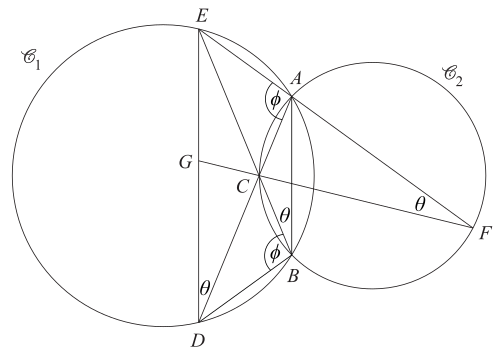
Two circles, `cc"C"_1` and `cc"C"_2`, intersect at the points `A` and `B`. Point `C` is chosen on the arc `AB` of `cc"C"_2` as shown in the diagram.

The line segment `AC` produced meets `cc"C"_1` at `D`.

The line segment `BC` produced meets `cc"C"_1` at `E`.

The line segment `EA` produced meets `cc"C"_2` at `F`.

The line segment `FC` produced meets the line segment `ED` at `G`.

Copy or trace the diagram into your writing booklet.

  1. State why `/_ EAD = /_ EBD`.  (1 mark)
  2. Show that `/_ EDA = /_ AFC`.  (1 mark)
  3. Hence, or otherwise, show that `B, C, G` and `D` are concyclic points.  (3 marks)
Show Answers Only
  1. `text(Proof)\ \ text{(See Worked Solutions)}`
  2. `text(Proof)\ \ text{(See Worked Solutions)}`
  3. `text(Proof)\ \ text{(See Worked Solutions)}`
Show Worked Solution

(i)  `text(Join)\ DB`

`/_ EAD = /_ EBD` `text{(angles at circumference}`
  `text(sitting on same arc)\ ED\ text(of)\ cc”C”_1 text{)}`


(ii)  `text(Join)\ AB`

`/_ EDA = /_ EBA` `text{(angles at circumference}`
  `text(sitting on same arc)\ EA\ text(of)\ cc”C”_1 text{)}`


`text(Consider arc)\ AC\ text(in)\ cc”C”_2`

`/_ EBA = /_ CBA = /_ AFC` `text{(angles at circumference}`
  `text(sitting on same arc)\ AC\ text(of)\ cc”C”_2 text{)}`


`:. /_ EDA = /_ AFC\ text(… as required.)`


(iii)   `text(Let)\ \ ` `/_ EDA = /_ AFC = theta\ \ text{(part (ii))}`
    `/_ EAD = /_ EBD = phi\ \ text{(part (i))}`


`text(Consider)\ Delta EAD:`

♦ Mean mark 47%.

`/_ AED = pi – theta – phi`

`text(Consider)\ Delta EGF:`

`/_ EGF` `= pi – (theta + pi – theta – phi)`
  `= phi`


`text(In)\ BCGD`

`text(External angle)\ EGF = phi`

`text(Interior opposite angle)\ EBD = phi`

`:. BCGD\ text(is a cyclic quadrilateral.)`

Filed Under: Circle/Plane Geometry Tagged With: Band 2, Band 4, Band 5

CORE, FUR2 2017 VCAA 2

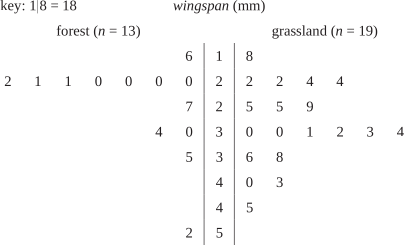
The back-to-back stem plot below displays the wingspan, in millimetres, of 32 moths and their place of capture (forest or grassland).


  1. Which variable, wingspan or place of capture, is a categorical variable?  (1 mark)

    --- 1 WORK AREA LINES (style=lined) ---

  2. Write down the modal wingspan, in millimetres, of the moths captured in the forest.  (1 mark)

    --- 1 WORK AREA LINES (style=lined) ---

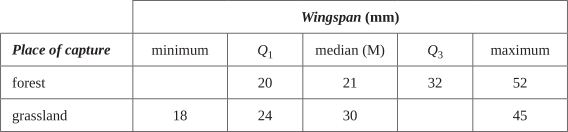
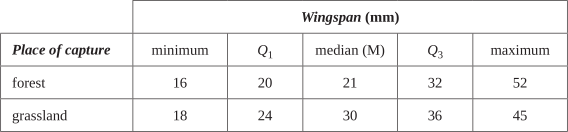
  3. Use the information in the back-to-back stem plot to complete the table below.  (2 marks)

    --- 0 WORK AREA LINES (style=lined) ---


  4. Show that the moth captured in the forest that had a wingspan of 52 mm is an outlier.  (2 marks)

    --- 5 WORK AREA LINES (style=lined) ---

  5. The back-to-back stem plot suggests that wingspan is associated with place of capture.
  6. Explain why, quoting the values of an appropriate statistic.  (2 marks)

    --- 4 WORK AREA LINES (style=lined) ---

Show Answers Only

  1. `text(Place of Capture)`
  2. `20\ text(mm)`
  3.    


  4. `text(See Worked Solution)`
  5. `text(See Worked Solution)`

Show Worked Solution

a.   `text(Place of Capture is categorical.)`


b.   `text(Modal wingspan in forest = 20 mm)`


c.   `Q_3\ text(in grassland: 19 data points)`

`:. Q_3\ text{is the 15th data point (lowest to highest) = 36}`


d.    `Q_1\ (text(forest))` `= (text(3rd + 4th))/2 = (20 + 20)/2 = 20`
  `Q_3\ (text(forest))` `= (text(10th + 11th))/2 = (30 + 34)/2 = 32`


`=> IQR = 32 – 20 = 12`

`Q_3 + 1.5 xx IQR` `= 32 + 1.5 xx 12`
  `= 50\ text(mm)`


`:.\ text(S)text(ince 52 mm > 50 mm, 52 min is an outlier.)`


e.   `text(Comparing the median wingspan of both places:)`

`M_text(forest) = 21,\ \ M_text(grassland) = 30`

`text(The higher median of grassland suggests that)`

`text(wingspan is associated with place of capture.)`

Filed Under: Graphs - Stem/Leaf and Boxplots Tagged With: Band 2, Band 3, Band 4, smc-643-50-Back-to-Back Stem and Leaf, smc-643-60-Outliers

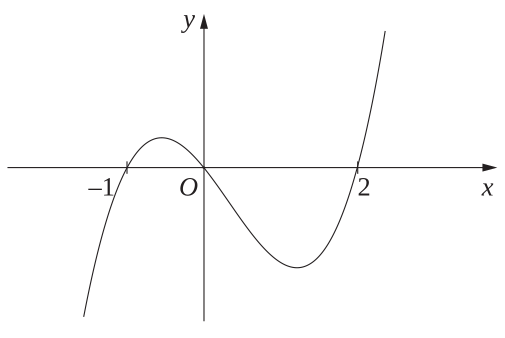
Graphs, EXT2 2017 HSC 4 MC

The graph of the function  `y = f(x)`  is shown.

A second graph is obtained from the function  `y = f(x)`.

Which equation best represents the second graph?

  1. `y = sqrt{f(x)}`
  2. `y^2 = f(x)`
  3. `y = [f(x)]^2`
  4. `y = f(x^2)`
Show Answers Only

`C`

Show Worked Solution

`text(Features of the second graph:)`

♦ Mean mark 95%!

`•\ text(S)text(ingle roots in the top graph at)\ x = -1, 0 and 2,`

`text(become double roots in the second graph.)`

`•\ y >= 0\ \ text(for all)\ x`

`:. y = [f(x)]^2`

`=>  C`

Filed Under: Drawing graphs to powers Tagged With: Band 2

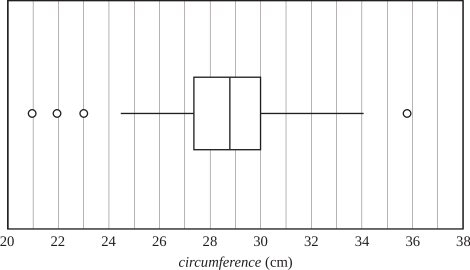
CORE, FUR1 2017 VCAA 1-3 MC

The boxplot below shows the distribution of the forearm circumference, in centimetres, of 252 people.
 

Part 1

The percentage of these 252 people with a forearm circumference of less than 30 cm is closest to

  1. `text(15%)`
  2. `text(25%)`
  3. `text(50%)`
  4. `text(75%)`
  5. `text(100%)`


Part 2

The five-number summary for the forearm circumference of these 252 people is closest to

  1. `\ \ \ 21,\ 27.4,\ 28.7,\ 30,\ 34`
  2. `\ \ \ 21,\ 27.4,\ 28.7,\ 30,\ 35.9`
  3. `24.5,\ 27.4,\ 28.7,\ 30,\ 34`
  4. `24.5,\ 27.4,\ 28.7,\ 30,\ 35.9`
  5. `24.5,\ 27.4,\ 28.7,\ 30,\ 36`


Part 3

The table below shows the forearm circumference, in centimetres, of a sample of 10 people selected from this group of 252 people.


The mean, `barx`, and the standard deviation, `s_x`, of the forearm circumference for this sample of people are closest to

  1. `barx = 1.58qquads_x = 27.8`
  2. `barx = 1.66qquads_x = 27.8`
  3. `barx = 27.8qquads_x = 1.58`
  4. `barx = 27.8qquads_x = 1.66`
  5. `barx = 27.8qquads_x = 2.30`
Show Answers Only

`text(Part 1:)\ D`

`text(Part 2:)\ B`

`text(Part 3:)\ D`

Show Worked Solution

`text(Part 1)`

`Q_3 = 30\ text(cm)`

`:. 75text(% have a circumference less than 30 cm.)`

`=> D`


`text(Part 2)`

`text(Outliers are relevant data points and form)`

`text(part of the five-number summary.)`

`=> B`


`text(Part 3)`

`text(By calculator,)`

`barx = 27.8,\ \ s_x = 1.66`

`=> D`

Filed Under: Graphs - Stem/Leaf and Boxplots Tagged With: Band 2, Band 3, smc-643-10-Single Box-Plots

Functions, EXT1 F2 2017 HSC 1 MC

Which polynomial is a factor of  `x^3-5x^2 + 11x-10`?

  1. `x-2`
  2. `x + 2`
  3. `11x-10`
  4. `x^2-5x + 11`
Show Answers Only

`A`

Show Worked Solution
`f(2)` `= 2^3-5*2^2 + 11*2-10`
  `= 8-20 + 22 – 10`
  `= 0`

 
`:. (x-2)\ text(is a factor)`

`⇒ A`

Filed Under: Polynomials, Remainder and Factor Theorems (Ext1), Roots, Remainders and Factors Tagged With: Band 2, num-title-ct-patha, num-title-qs-hsc, smc-1031-10-Factor Theorem

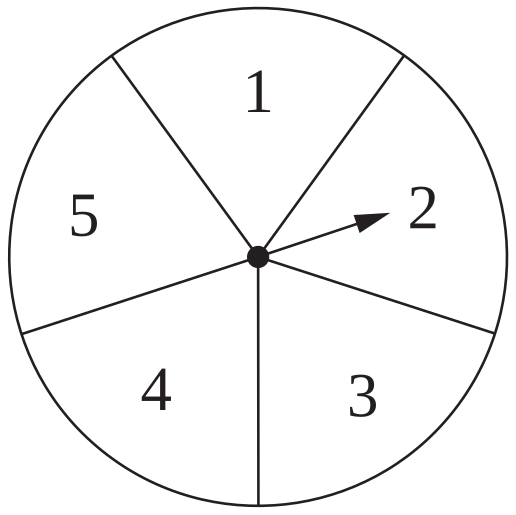
Statistics, 2ADV 2017 HSC 12e

A spinner is marked with the numbers 1, 2, 3, 4 and 5. When it is spun, each of the five numbers is equally likely to occur.


The spinner is spun three times.

  1. What is the probability that an even number occurs on the first spin?  (1 mark)
  2. What is the probability that an even number occurs on at least one of the three spins?  (1 mark)
  3. What is the probability that an even number occurs on the first spin and odd numbers occur on the second and third spins?  (1 mark)
  4. What is the probability that an even number occurs on exactly one of the three spins?  (1 mark)
Show Answers Only
  1. `2/5`
  2. `98/125`
  3. `18/125`
  4. `54/125`
Show Worked Solution

i.   `Ptext{(even)} = 2/5`
 

ii.  `Ptext{(at least 1 even)}`

`= 1 – Ptext{(no evens)}`

`= 1 – 3/5 ⋅ 3/5 ⋅ 3/5`

`= 1 – 27/125`

`= 98/125`
 

iii.  `Ptext{(even, odd, odd)}`

`= 2/5 ⋅ 3/5 ⋅ 3/5`

`= 18/125`
 

iv.  `Ptext{(even occurs exactly once)}`

`= Ptext{(e, o, o)} + P text{(o, e, o)} + P text{(o, o, e)}`

`= 2/5 ⋅ 3/5 ⋅ 3/5 + 3/5 ⋅ 2/5 ⋅ 3/5 + 3/5 ⋅ 3/5 ⋅ 2/5`

`= 54/125`

Filed Under: 3. Probability Tagged With: Band 2, Band 3, Band 4

Algebra, STD2 A1 2017 HSC 7 MC

It is given that  `I = 3/2 MR^2`.

What is the value of  `I`  when  `M = 26.55`  and  `R = 3.07`, correct to two decimal places?

A.     `375.35`

B.     `3246.08`

C.     `9965.45`

D.     `14\ 948.18`

Show Answers Only

`A`

Show Worked Solution
`I` `= 3/2 xx 26.55 xx (3.07)^2`
  `= 375.346…`


`=> A`

Filed Under: AM1 - Algebra (Prelim), Substitution and Other Equations (Std 1), Substitution and Other Equations (Std1-2027), Substitution and Other Equations (Std2-2027) Tagged With: Band 2, smc-1116-10-Substitution, smc-6234-10-Substitution, smc-6508-10-Substitution, smc-789-10-Substitution

Statistics, STD2 S1 2017 HSC 1 MC

The box-and-whisker plot for a set of data is shown.
 

What is the median of this set of data?

  1. 15
  2. 20
  3. 30
  4. 35
Show Answers Only

`C`

Show Worked Solution

`text(Median = 30)`

`=> C`

Filed Under: Box Plots and 5-Number Summary, Stem & Leaf, Box & Whisker, Summary Statistics - Box Plots (Std 2), Summary Statistics - Box Plots (Std1-2027), Summary Statistics - Box Plots (Std2-2027), Summary Statistics (Std 1) Tagged With: Band 2, common-content, num-title-ct-corea, num-title-qs-hsc, smc-1131-35-Box Plots, smc-5021-18-Find median, smc-5021-50-Box plot (single), smc-6313-10-Single Box Plots, smc-6533-10-Single Box Plots, smc-825-10-Single Box-Plots

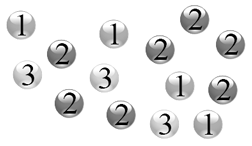
Probability, NAP-J2-02

The numbered balls below are placed in a bag.


Petunia reaches into the bag and takes out a ball without looking.

Which type of ball is she most likely to take out?


Show Answers Only

Show Worked Solution

`text(The most common ball is:)`

Filed Under: Chance Tagged With: Band 2, smc-712-30-Selection

Graphs, MET2 2007 VCAA 15 MC

The graph of the function  `f: [0, oo) -> R`  where  `f(x) = 3x^(5/2)`  is reflected in the `x`-axis and then translated 3 units to the right and 4 units down.

The equation of the new graph is

`y = 3(x - 3)^(5/2) + 4`

`y = -3 (x - 3)^(5/2) - 4`

`y = -3 (x + 3)^(5/2) - 1`

`y = -3 (x - 4)^(5/2) + 3`

`y = 3(x - 4)^(5/2) + 3`

Show Answers Only

`B`

Show Worked Solution

`text(Let)\ \ y= 3x^(5/2)`

`text(Reflect in the)\ x text(-axis:)`

`y= – 3x^(5/2)`


`text(Translate 3 units to the right:)`

`y=- 3(x-3)^(5/2)`


`text(Translate 4 units down:)`

`y=- 3(x-3)^(5/2) – 4`

`=>   B`

Filed Under: Transformations Tagged With: Band 2, smc-753-40-Combinations, smc-753-70-Polynomials

Calculus, MET2 2009 VCAA 2 MC

At the point `(1, 1)` on the graph of the function with rule  `y = (x - 1)^3 + 1`

  1. there is a local maximum.
  2. there is a local minimum.
  3. there is a stationary point of inflection.
  4. the gradient is not defined.
  5. there is a point of discontinuity.
Show Answers Only

`C`

Show Worked Solution

`y = (x – 1)^3 + 1`

`y′ = 3(x – 1)^2`

`y″ = 6(x – 1)`

`text(Point of inflection at)\ \ x=1.`

`=>   C`

Filed Under: The Derivative Function and its Graph Tagged With: Band 2, smc-2830-40-Increasing/Decreasing intervals

Calculus, MET2 2011 VCAA 3

  1. Consider the function  `f: R -> R, f(x) = 4x^3 + 5x-9`.


    1. Find  `f^{prime}(x).`   (1 mark)

      --- 1 WORK AREA LINES (style=lined) ---

    2. Explain why  `f^{prime}(x) >= 5` for all `x`.   (1 mark)

      --- 4 WORK AREA LINES (style=lined) ---

  2. The cubic function `p` is defined by  `p: R -> R, p(x) = ax^3 + bx^2 + cx + k`, where `a`, `b`, `c` and `k` are real numbers.


    1. If `p` has `m` stationary points, what possible values can `m` have?   (1 mark)

      --- 2 WORK AREA LINES (style=lined) ---

    2. If `p` has an inverse function, what possible values can `m` have?   (1 mark)

      --- 2 WORK AREA LINES (style=lined) ---

  3. The cubic function `q` is defined by  `q:R -> R, q(x) = 3-2x^3`.


    1. Write down a expression for  `q^(-1)(x)`.   (2 marks)

      --- 4 WORK AREA LINES (style=lined) ---

    2. Determine the coordinates of the point(s) of intersection of the graphs of  `y = q(x)`  and  `y = q^(-1)(x)`.   (2 marks)

      --- 3 WORK AREA LINES (style=lined) ---

  4. The cubic function `g` is defined by  `g: R -> R, g(x) = x^3 + 2x^2 + cx + k`, where `c` and `k` are real numbers.


    1. If `g` has exactly one stationary point, find the value of `c`.   (3 marks)

      --- 4 WORK AREA LINES (style=lined) ---

    2. If this stationary point occurs at a point of intersection of  `y = g(x)`  and  `g^(−1)(x)`, find the value of `k`.   (3 marks)

      --- 8 WORK AREA LINES (style=lined) ---

Show Answers Only
    1. `f^{prime}(x) = 12x^2 + 5`
    2. `text(See Worked Solutions)`
    1. `m = 0, 1, 2`
    2. `m = 0, 1`
    1. `q^(-1)(x) = root(3)((3-x)/2), x ∈ R`
    2. `(1, 1)`
    1. `4/3`
    2. `-10/27`
Show Worked Solution

a.i.   `f^{prime}(x) = 12x^2 + 5`
  

a.ii.  `text(S)text(ince)\ \ x^2>=0\ \ text(for all)\ x,`

♦ Mean mark 47%.
` 12x^2` `>= 0`
`12x^2 + 5` `>=  5`
`f^{prime}(x)` `>=  5\ \ text(for all)\ x`


b.i.   `p(x) = text(is a cubic)`

♦♦♦ Mean mark part (b)(i) 9%, and part (b)(ii) 20%.
MARKER’S COMMENT: Good exam strategy should point students to investigate earlier parts for direction. Here, part (a) clearly sheds light on a solution!

`:. m = 0, 1, 2`

`text{(Note: part a.ii shows that a cubic may have no SP’s.)}`


b.ii.   `text(For)\ p^(−1)(x)\ text(to exist)`

`:. m = 0, 1`


c.i.   `text(Let)\ y = q(x)`

`text(Inverse: swap)\ x ↔ y`

`x` `= 3-2y^3`
`y^3` `= (3-x)/2`

`:. q^(-1)(x) = root(3)((3-x)/2), \ x ∈ R`
  

c.ii.  `text(Any function and its inverse intersect on)`

   `text(the line)\ \ y=x.`

`text(Solve:)\ \ 3-2x^3` `= xqquadtext(for)\ x,`
`x` `= 1`


`:.\ text{Intersection at (1, 1)}`
  

♦ Mean mark part (d)(i) 44%.
d.i.    `g^{prime}(x)` `= 0`
  `3x^2 + 4x + c` `= 0`
  `Delta` `= 0`
  `16-4(3c)` `= 0`
  `:. c` `= 4/3`


d.ii.   `text(Define)\ \ g(x) = x^3 + 2x^2 + 4/3x + k`

♦♦♦ Mean mark part (d)(ii) 14%.

  `text(Stationary point when)\ \ g^{prime}(x)=0`

`g^{prime}(x) = 3x^2+4x+4/3`

`text(Solve:)\ \ g^{prime}(x)=0\ \ text(for)\ x,`

`x = -2/3`

`text(Intersection of)\ g(x)\ text(and)\ g^(-1)(x)\ text(occurs on)\ \ y = x`

`text(Point of intersection is)\  (-2/3, -2/3)`

`text(Find)\ k:`

`g(-2/3)` `= -2/3\ text(for)\ k`
`:. k` ` = -10/27`

Filed Under: Curve Sketching, Polynomial and Other Functions Tagged With: Band 2, Band 3, Band 4, Band 5, Band 6, smc-5205-10-Polynomials, smc-5205-50-Find intersection, smc-724-10-Cubic, smc-724-40-Inverse functions

Calculus, MET2 2016 VCAA 4 MC

The average rate of change of the function  `f` with rule  `f(x) = 3x^2 - 2 sqrt(x + 1)`, between  `x = 0 and x = 3`, is

A.   `8`

B.   `25`

C.   `53/9`

D.   `25/3`

E.   `13/9`

Show Answers Only

`D`

Show Worked Solution
`text(Average ROC)` `= {f(3) – f(0)}/(3 – 0)`
  `=[(27-2xxsqrt4) – (-2)]/(3-0)`
  `= 25/3`

`=>   D`

Filed Under: Standard Differentiation Tagged With: Band 2, smc-746-40-Average ROC

Graphs, MET2 2016 VCAA 2 MC

Let  `f: R -> R,\ f(x) = 1 - 2 cos ({pi x}/2).`

The period and range of this function are respectively

  1. `4 and [−2, 2]`
  2. `4 and [−1, 3]`
  3. `1 and [−1, 3]`
  4. `4 pi and [−1, 3]`
  5. `4 pi and [−2, 2]`
Show Answers Only

`B`

Show Worked Solution
`text(Period)` `= (2 pi)/n = (2pi)/(pi/2)=4`
   

`text(Amplitude = 2 and median is)\ \ y=1.`

`text(Range)` `= [1 – 2, quad 1 + 2]`
  `= [−1, 3]`

`=>   B`

Filed Under: Trig Graphing Tagged With: Band 2, smc-2757-15-Cos, smc-2757-30-Find period, smc-2757-35-Find range

Graphs, MET2 2016 VCAA 1 MC

The linear function  `f: D -> R,\ f(x) = 5 - x`  has range  `[−4, 5).`

The domain `D` is

  1. `(0, 9]`
  2. `(0, 1]`
  3. `[5, −4)`
  4. `[−9, 0)`
  5. `[1, 9)`
Show Answers Only

`A`

Show Worked Solution
`5` `= 5 – x` `-4` `= 5 – x`
`x` `= 0` `x` `= 9`
`text{(non-inclusive)}` `text{(inclusive)}`


`:. x ∈ (0, 9]`

`=>   A`

Filed Under: Coordinate Geometry Tagged With: Band 2, smc-727-40-Domain/Range

Algebra, MET2 2012 VCAA 1 MC

The function with rule  `f(x) = −3sin((pix)/5)`  has period

  1. `3`
  2. `5`
  3. `10`
  4. `pi/5`
  5. `pi/10`
Show Answers Only

`=> C`

Show Worked Solution
`text(Period)` `= (2pi)/n`
  `= (2pi)/(pi/5)`
  `= 10`

 
`=> C`

Filed Under: Trig Graphing Tagged With: Band 2, smc-2757-10-Sin, smc-2757-30-Find period

NETWORKS, FUR2 2016 VCAA 1

A map of the roads connecting five suburbs of a city, Alooma (`A`), Beachton (`B`), Campville (`C`), Dovenest (`D`) and Easyside (`E`), is shown below.


  1. Starting at Beachton, which two suburbs can be driven to using only one road?   (1 mark)

    --- 2 WORK AREA LINES (style=lined) ---

A graph that represents the map of the roads is shown below.


One of the edges that connects to vertex `E` is missing from the graph.

  1.  i. Add the missing edge to the graph above.   (1 mark)

    (Answer on the graph above)

    --- 0 WORK AREA LINES (style=lined) ---

  2. ii. Explain what the loop at `D` represents in terms of a driver who is departing from Dovenest.   (1 mark)

    --- 2 WORK AREA LINES (style=lined) ---

Show Answers Only

a.    `text(Alooma and Easyside.)`

b.i. 

b.ii. `text(The loop represents that a driver can take a route out)`

`text(of Dovenest and return home without going through another)`

`text(suburb or turning back.)`

Show Worked Solution

a.   `text(Alooma and Easyside.)`


b.i.   

`text(Draw a third edge between Easyside and Dovenest.)`


b.ii. `text(The loop represents that a driver can take a)`

♦♦ Mean mark 30%.

`text(route out of Dovenest and return home without)`

`text(going through another suburb or turning back.)`

Filed Under: Travelling Problems and Adjacency Matrices Tagged With: Band 2, Band 4, Band 5, smc-622-50-Draw Network from Map/Matrix

GRAPHS, FUR2 2016 VCAA 1

Maria is a hockey player. She is paid a bonus that depends on the number of goals that she scores in a season.

The graph below shows the value of Maria’s bonus against the number of goals that she scores in a season.

  1. What is the value of Maria’s bonus if she scores seven goals in a season?  (1 mark) 
  2. What is the least number of goals that Maria must score in a season to receive a bonus of $2500?  (1 mark)

Another player, Bianca, is paid a bonus of $125 for every goal that she scores in a season.

  1. What is the value of Bianca’s bonus if she scores eight goals in a season?  (1 mark)
  2. At the end of the season, both players have scored the same number of goals and receive the same bonus amount.


    How many goals did Maria and Bianca each score in the season?  (1 mark)

Show Answers Only
  1. `$1500`
  2. `15`
  3. `$1000`
  4. `text(28 goals)`
Show Worked Solution

a.   `$1500`


b.   `15`


c.    `text(Bonus)` `= 8 xx 125`
    `= $1000`


d.   `text(Draw the graph of Bianca’s payments on)`

`text(the same graph.)`

`text(The intersection is where both players)`

`text(receive the same bonus amount.)`

`:.\ text(Maria and Bianca each score 28 goals.)`

Filed Under: Graph Applications Tagged With: Band 2, Band 3, Band 4

MATRICES, FUR2 2016 VCAA 3

A travel company is studying the choice between air (`A`), land (`L`), sea (`S`) or no (`N`) travel by some of its customers each year.

Matrix `T`, shown below, contains the percentages of customers who are expected to change their choice of travel from year to year.

`{:(qquadqquadqquadqquadqquadquadtext(this year)),(qquadqquadqquadquadAqquadqquadLqquadqquadSqquadquadN),(T = [(0.65,0.25,0.25,0.50),(0.15,0.60,0.20,0.15),(0.05,0.10,0.25,0.20),(0.15,0.05,0.30,0.15)]{:(A),(L),(S),(N):}text(next year)):}`

Let `S_n` be the matrix that shows the number of customers who choose each type of travel `n` years after 2014.

Matrix `S_0` below shows the number of customers who chose each type of travel in 2014.

`S_0 = [(520),(320),(80),(80)]{:(A),(L),(S),(N):}`

Matrix `S_1` below shows the number of customers who chose each type of travel in 2015.

`S_1 = TS_0 = [(478),(d),(e),(f)]{:(A),(L),(S),(N):}`

  1. Find the values missing from matrix `S_1 (d, e, f )`.   (1 mark)

    --- 2 WORK AREA LINES (style=lined) ---
  2. Write a calculation that shows that 478 customers were expected to choose air travel in 2015.   (1 mark)

    --- 2 WORK AREA LINES (style=lined) ---
  3. Consider the customers who chose sea travel in 2014.
  4. How many of these customers were expected to choose sea travel in 2015?   (1 mark)

    --- 3 WORK AREA LINES (style=lined) ---

  5. Consider the customers who were expected to choose air travel in 2015.
  6. What percentage of these customers had also chosen air travel in 2014?
  7. Round your answer to the nearest whole number.   (1 mark)

    --- 4 WORK AREA LINES (style=lined) ---

In 2016, the number of customers studied was increased to 1360.
Matrix `R_2016`, shown below, contains the number of these customers who chose each type of travel in 2016.

`R_2016 = [(646),(465),(164),(85)]{:(A),(L),(S),(N):}`

  1. The company intends to increase the number of customers in the study in 2017 and in 2018.
  2. The matrix that contains the number of customers who are expected to choose each type of travel in 2017 (`R_2017`) and 2018 (`R_2018`) can be determined using the matrix equations shown below.

`R_2017 = TR_2016 + BqquadqquadqquadR_2018 = TR_2017 + B`
 

`{:(qquadqquadqquadqquadqquadquadtext(this year)),(qquadqquadqquadquadAqquadqquadLqquadqquadSqquadquadN),(T = [(0.65,0.25,0.25,0.50),(0.15,0.60,0.20,0.15),(0.05,0.10,0.25,0.20),(0.15,0.05,0.30,0.15)]{:(A),(L),(S),(N):}text(next year)):}qquadqquad{:(),(),(B = [(80),(80),(40),(−80)]{:(A),(L),(S),(N):}):}`

    1. The element in the fourth row of matrix `B` is – 80.
    2. Explain this number in the context of selecting customers for the studies in 2017 and 2018.   (1 mark)

      --- 2 WORK AREA LINES (style=lined) ---

    3. Determine the number of customers who are expected to choose sea travel in 2018.
    4. Round your answer to the nearest whole number.   (2 marks)

      --- 5 WORK AREA LINES (style=lined) ---

Show Answers Only
  1. `d=298, \ e=94, \ f=130`
  2. `(0.65 xx 520) + (0.25 xx 320) + (0.25 xx 80) + (0.50 xx 80) = 478`
  3. `20\ text(customers)`
  4. `71text(%)`
  5.  
    1. `text(80 customers who have no travel in a given)`
      `text(year are removed from the study. This occurs)`
      `text(in both 2017 and 2018.)`
    2. `text(190 customers)`
Show Worked Solution

a.   `d=298, \ e=94, \ f=130`
 

b.   `(0.65 xx 520) + (0.25 xx 320) + (0.25 xx 80) + (0.50 xx 80) = 478`

♦♦ Mean mark part (b) and (c) was 35% and 45% respectively.


c.   `text(Sea Travel in 2014-80 customers.)`

`text(Of those 80 customers,)`

`text(Sea Travel in 2015)` `= 25text(%) xx 80`
  `= 20\ text(customers)`


d.   `text(Expected total for air travel in 2015)`

♦♦♦ Mean mark 17%.

`= 478\ text(customers)`
 

`text(In 2014, 520 customers chose air travel.)`

`text(65% of those chose air travel in 2015)`

`= 65text(%) xx 520`

`= 338\ text(customers)`

`:.\ text(Percentage)` `= 338/478 xx 100`
  `= 70.71…`
  `= 71text(%)`


e.i.   `text(80 customers who have no travel in a given)`

♦ Mean mark 14%.
MARKER’S COMMENT: “80 people chose not to travel” was a common answer that received no marks.

`text(year are removed from the study. This occurs)`

`text(in both 2017 and 2018.)`


e.ii.   `R_2017` `= TR_2016 + B`
    `= [(0.65,0.25,0.25,0.50),(0.15,0.60,0.20,0.15),(0.05,0.10,0.25,0.20),(0.15,0.05,0.30,0.15)][(646),(465),(164),(85)] + [(80),(80),(40),(−80)]`
    `= [(699.65),(501.45),(176.80),(102.10)]`


`R_2018` `= TR_2017 + B`
  `= [(0.65,0.25,0.25,0.50),(0.15,0.60,0.20,0.15),(0.05,0.10,0.25,0.20),(0.15,0.05,0.30,0.15)][(699.65),(501.45),(176.80),(102.10)]`
  `= [(755.39),(536.49),(189.75),(118.38)]`


`:. 190\ text(customers are expected to choose)`

`text(sea travel in 2018.)`

Filed Under: Transition Matrices - Modified Tagged With: Band 2, Band 5, Band 6, page-break-before-question, smc-1893-20-State Matrix in discrete period, smc-1893-32-4x4 Matrix, smc-1893-60-Regular Transition Matrices

MATRICES, FUR2 2016 VCAA 2

A travel company has five employees, Amara (`A`), Ben (`B`), Cheng (`C`), Dana (`D`) and Elka (`E`).

The company allows each employee to send a direct message to another employee only as shown in the communication matrix `G` below.

The matrix `G^2` is also shown below.
 

`{:(),(),(G = text(sender )):}{:(qquadqquadqquad\ text(receiver)),(qquadqquadAquadBquadCquadDquadE),({:(A),(B),(C),(D),(E):}[(0,1,1,1,1),(1,0,1,0,0),(1,1,0,1,0),(0,1,0,0,1),(0,0,0,1,0)]):}qquad{:(),(),(G^2 = text(sender )):}{:(qquadqquadqquad\ text(receiver)),(qquadqquadAquadBquadCquadDquadE),({:(A),(B),(C),(D),(E):}[(2,2,1,2,1),(1,2,1,2,1),(1,2,2,1,2),(1,0,1,1,0),(0,1,0,0,1)]):}`
 

The 1 in row `E`, column `D` of matrix `G` indicates that Elka (sender) can send a direct message to Dana (receiver).

The 0 in row `E`, column `C` of matrix `G` indicates that Elka cannot send a direct message to Cheng.

  1. To whom can Dana send a direct message?   (1 mark)

    --- 1 WORK AREA LINES (style=lined) ---

  2. Cheng needs to send a message to Elka, but cannot do this directly.
  3. Write down the names of the employees who can send the message from Cheng directly to Elka.   (1 mark) 

    --- 2 WORK AREA LINES (style=lined) ---
Show Answers Only
  1. `text(Ben and Elka)`
  2. `text(Amara and Dana)`
Show Worked Solution

a.   `text(Ben and Elka)`
 

b.   `text(Amara and Dana)`

Filed Under: Matrix Applications Tagged With: Band 2, Band 3, smc-619-80-Communication

MATRICES, FUR2 2016 VCAA 1

A travel company arranges flight (`F`), hotel (`H`), performance (`P`) and tour (`T`) bookings.

Matrix `C` contains the number of each type of booking for a month.

`C = [(85),(38),(24),(43)]{:(F),(H),(P),(T):}`

  1. Write down the order of matrix `C`.   (1 mark)

    --- 1 WORK AREA LINES (style=lined) ---

A booking fee, per person, is collected by the travel company for each type of booking.

Matrix `G` contains the booking fees, in dollars, per booking.

`{:((qquadqquadquadF,\ H,\ P,\ T)),(G = [(40,25,15,30)]):}`

  1.  i. Calculate the matrix product  `J = G × C`.   (1 mark)

    --- 3 WORK AREA LINES (style=lined) ---

  2. ii. What does matrix `J` represent?   (1 mark) 

    --- 2 WORK AREA LINES (style=lined) ---

Show Answers Only
  1. `4 xx 1`
    1. `[6000]`
    2. `J\ text(represents the total booking fees for the travel)`
      `text(company in the given month.)`
Show Worked Solution

a.   `text(Order:)\ 4 xx 1`
 

b.i.    `J = [(40,25,15,30)][(85),(38),(24),(43)]= [6000]`

 
b.ii.
 `J\ text(represents the total booking fees for the)`

♦ Mean mark 42%.

 `text(travel company in the given month.)`

Filed Under: Matrix Applications Tagged With: Band 2, Band 3, Band 4, smc-619-30-Matrix product and interpretation

CORE, FUR2 2016 VCAA 5

Ken has opened a savings account to save money to buy a new caravan.

The amount of money in the savings account after `n` years, `V_n`, can be modelled by the recurrence relation shown below.

`V_0 = 15000, qquad qquad qquad V_(n + 1) = 1.04 xx V_n`

  1. How much money did Ken initially deposit into the savings account?  (1 mark)

    --- 2 WORK AREA LINES (style=lined) ---
  2. Use recursion to write down calculations that show that the amount of money in Ken’s savings account after two years, `V_2`, will be $16 224.  (1 mark)

    --- 5 WORK AREA LINES (style=lined) ---

  3. What is the annual percentage compound interest rate for this savings account?  (1 mark)

    --- 2 WORK AREA LINES (style=lined) ---

  4. The amount of money in the account after `n` years, `Vn` , can also be determined using a rule.
    i.
    Complete the rule below by writing the appropriate numbers in the boxes provided.   (1 mark)

    --- 0 WORK AREA LINES (style=lined) ---

    `V_n =` 
     
    `­^n xx`
     
  5. ii. How much money will be in Ken’s savings account after 10 years?   (1 mark)

    --- 3 WORK AREA LINES (style=lined) ---

Show Answers Only
  1. `$15000`
  2. `text(Proof)\ text{(See Worked Solutions)}`
  3. `4 text(%)`
  4. i. `text(See Worked Solutions)`
    ii. `$22\ 203.66` 
Show Worked Solution
a.    `text(Initial deposit)` `= V_0`
    `= $15\ 000`
b.    `V_0` `= $15\ 000`
  `V_1` `= 1.04 xx 15\ 000`
    `= $15\ 600`
  `V_2` `= 1.04 xx 15\ 600`
    `= $16\ 224\ text(… as required.)`

MARKER’S COMMENT: (b) Stating `V_2 =1.04^2 xx 15\ 600` `=16\ 224` is not using recursion as required here and did not gain a mark.
c.    `text(Annual compound interest)` `= 0.04 xx 100`
    `= 4 text(%)`


d.i.   `V_n` `= 1.04^n xx V_0`
d.ii.    `V_10` `= 1.04^10 xx 15\ 000`
    `= $22\ 203.664…`
    `= $22\ 203.66\ text{(nearest cent)}`

♦ Mean mark (d)(ii) 47%.
MARKER’S COMMENT: Rounding to $22 203.70 lost a mark!

Filed Under: Recursion - Financial Tagged With: Band 2, Band 3, Band 4, Band 5

CORE, FUR2 2016 VCAA 2

A weather station records daily maximum temperatures.

  1. The five-number summary for the distribution of maximum temperatures for the month of February is displayed in the table below.


  1. There are no outliers in this distribution.
  2.  i. Use the five-number summary above to construct a boxplot on the grid below.   (1 mark)

    --- 0 WORK AREA LINES (style=lined) ---


  1. ii. What percentage of days had a maximum temperature of 21°C, or greater, in this particular February?   (1 mark)

    --- 2 WORK AREA LINES (style=lined) ---
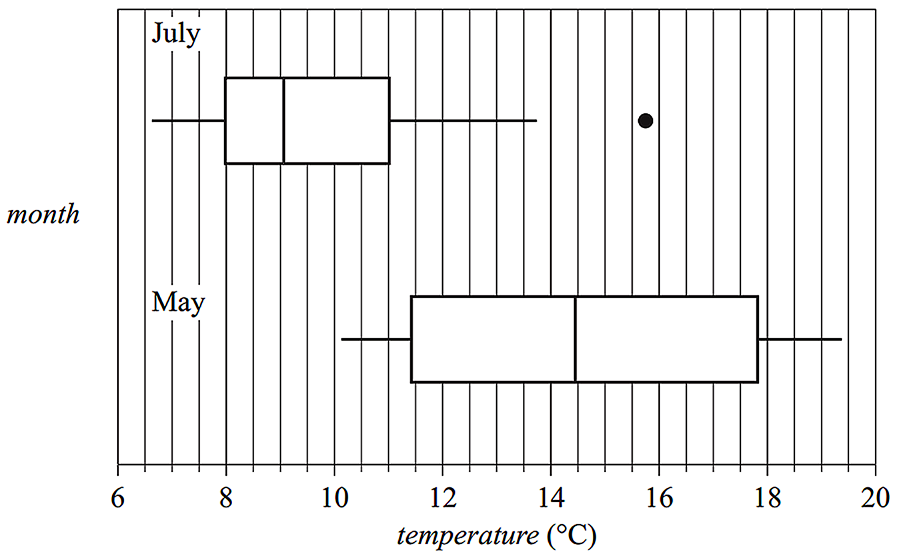
  2. The boxplots below display the distribution of maximum daily temperature for the months of May and July.
     

  3.   i. Describe the shapes of the distributions of daily temperature (including outliers) for July and for May.   (1 mark)

    --- 2 WORK AREA LINES (style=lined) ---

  4.  ii. Determine the value of the upper fence for the July boxplot.   (1 mark)

    --- 3 WORK AREA LINES (style=lined) ---

  5. iii. Using the information from the boxplots, explain why the maximum daily temperature is associated with the month of the year. Quote the values of appropriate statistics in your response.   (1 mark)

    --- 3 WORK AREA LINES (style=lined) ---

Show Answers Only
a.i.   

a.ii.   `text(75%)`

b.i.    `text(July – Positively skewed with an outlier.)`
  `text(May – Symmetrical with no outliers.)`

b.ii.  `15.5^@\text(C)`

b.iii. `text{The median temperature in May (14.5°C)}`

`text(differs from the median temperature in July)`

`text{(just over 9°C). This difference is why the}`

`text(maximum daily temperature is associated)`

`text(with the month.)`

Show Worked Solution
a.i.   

a.ii.   `text(75%)`

MARKER’S COMMENT: Incorrect May descriptors included “evenly or normally distributed”, “bell shaped” and “symmetrically skewed.”
b.i.    `text(July – Positively skewed with an outlier.)`
  `text(May – Symmetrical with no outliers.)`


b.ii.    `text(Upper fence)` `= Q_3 + 1.5 xx IQR`
    `= 11 + 1.5 xx (11 – 8)`
    `= 11 + 4.5`
    `= 15.5^@\text(C)`
♦♦ Mean mark (b)(iii) – 30%.
COMMENT: Refer to the difference in medians. Just quoting the numbers was not enough to gain a mark here.

b.iii. `text{The median temperature in May (14.5°C)}`

`text(differs from the median temperature in July)`

`text{(just over 9°C). This difference is why the}`

`text(maximum daily temperature is associated)`

`text(with the month.)`

Filed Under: Graphs - Stem/Leaf and Boxplots Tagged With: Band 2, Band 3, Band 4, Band 5, smc-643-10-Single Box-Plots, smc-643-20-Parallel Box-Plots, smc-643-30-Draw Box Plots, smc-643-60-Outliers, smc-643-70-Distribution Description

CORE, FUR2 2016 VCAA 1

The dot plot below shows the distribution of daily rainfall, in millimetres, at a weather station for 30 days in September.


  1. Write down the
  2.  i. range   (1 mark)

    --- 1 WORK AREA LINES (style=lined) ---

  3. ii. median   (1 mark)

    --- 1 WORK AREA LINES (style=lined) ---

  1. Circle the data point on the dot plot above that corresponds to the third quartile `(Q_3).`   (1 mark)

    --- 0 WORK AREA LINES (style=lined) ---

  2. Write down the
  3.  i. the number of days on which no rainfall was recorded.   (1 mark)

    --- 1 WORK AREA LINES (style=lined) ---

  4. ii. the percentage of days on which the daily rainfall exceeded 12 mm.   (1 mark)

    --- 2 WORK AREA LINES (style=lined) ---

  1. Use the grid below to construct a histogram that displays the distribution of daily rainfall for the month of September. Use interval widths of two with the first interval starting at 0.   (2 marks) 

    --- 0 WORK AREA LINES (style=lined) ---


Show Answers Only
    1. `17.8\ text(mm)`
    2. `0`
  1. `text(See Worked Solutions)`


    1. `16\ text(days)`
    2. `10\text(%)`
  2. `text(See Worked Solutions)`
Show Worked Solution
a.i.    `text(Range)` `=\ text(High) – text(Low)`
    `= 17.8 – 0`
    `= 17.8\ text(mm)`
     

a.ii.   `text(30 data points)`

`text(Median)` `= text{15th + 16th}/2`
  `= 0`


b.   


c.i.   `16\ text(days)`

c.ii.    `text(Percentage)` `= 3/30 xx 100`
    `= 10\ text(%)`


d.   

Filed Under: Graphs - Histograms and Other, Summary Statistics Tagged With: Band 2, Band 3, Band 4, smc-468-40-Median Mode and Range, smc-644-10-Dot Plots

NETWORKS, FUR1 2016 VCAA 1 MC

Lee, Mandy, Nola, Oscar and Pieter are each to be allocated one particular task at work.

The bipartite graph below shows which task(s), 1–5, each person is able to complete.


Each person completes a different task.

Task 4 must be completed by

  1. `text(Lee.)`
  2. `text(Mandy.)`
  3. `text(Nola.)`
  4. `text(Oscar.)`
  5. `text(Pieter.)`
Show Answers Only

`B`

Show Worked Solution

`=> B`

Filed Under: Matching Problems Tagged With: Band 2, smc-623-20-Other Matching

GRAPHS, FUR1 2016 VCAA 2 MC

A phone company charges a fixed, monthly line rental fee of $28 and $0.25 per call.

Let `n` be the number of calls that are made in a month.

Let `C` be the monthly phone bill, in dollars.

The equation for the relationship between the monthly phone bill, in dollars, and the number of calls is

  1. `C = 28 + 0.25n`
  2. `C = 28n + 0.25`
  3. `C = n + 28.25`
  4. `C = 28(n + 0.25)`
  5. `C = 0.25(n + 28)`
Show Answers Only

`A`

Show Worked Solution

`C = 28 + 0.25n`

`=> A`

Filed Under: Linear relationships Tagged With: Band 2

GRAPHS, FUR1 2016 VCAA 1 MC

The graph below shows the temperature, in degrees Celsius, between 6 am and 6 pm on a given day.

From 2 pm to 6 pm, the temperature decreased by

  1.   `4°text(C)`
  2. `11 °text(C)`
  3. `12 °text(C)`
  4. `15 °text(C)`
  5. `23 °text(C)`
Show Answers Only

`B`

Show Worked Solution
`text(Temperature)` `= 23 – 12`
  `= 11°text(C)`

`=> B`

Filed Under: Graph Applications Tagged With: Band 2

GEOMETRY, FUR1 2016 VCAA 2 MC

Triangle ABC is similar to triangle DEF.


The length of DF, in centimetres, is

  1. `0.9`
  2. `1.2`
  3. `1.8`
  4. `2.7`
  5. `3.6`
Show Answers Only

`D`

Show Worked Solution

`text(Using similar ratios,)`

`(DF)/(DE)` `= (AC)/(AB)`
`(DF)/1.8` `= 3.6/2.4`
`:. DF` `= ((3.6 xx 1.8))/2.4`
  `= 2.7\ text(cm)`

`=> D`

Filed Under: Similarity and Scale Tagged With: Band 2, smc-606-10-Similarity

Number and Algebra, NAP-B1-07

Moe has 22 first cousins and Homer has 28.

Barney has more first cousins than Moe but less than Homer.

How many first cousins could Barney have?

`19` `21` `24` `29`


Show Answers Only

`24`

Show Worked Solution

`text(The number of cousins Barney has must be more than)`

`text(22 and less than 28.)`

`=>\ text(Barney could have 24 first cousins.)`

Filed Under: Number and Place, Number and Place Value, TESTLET B Tagged With: Band 2, smc-708-60-Place Value

  • « Previous Page
  • 1
  • …
  • 4
  • 5
  • 6
  • 7
  • 8
  • …
  • 10
  • Next Page »

Copyright © 2014–2025 SmarterEd.com.au · Log in