SmarterEd

Aussie Maths & Science Teachers: Save your time with SmarterEd

  • Login
  • Get Help
  • About

Statistics, STD2 S1 2017 HSC 1 MC

The box-and-whisker plot for a set of data is shown.

 

What is the median of this set of data?

  1. 15
  2. 20
  3. 30
  4. 35
Show Answers Only

`C`

Show Worked Solution

`text(Median = 30)`

`=> C`

Filed Under: Box Plots and 5-Number Summary, Stem & Leaf, Box & Whisker, Summary Statistics, Summary Statistics - Box Plots, Summary Statistics - Box Plots, Summary Statistics - Box Plots Tagged With: Band 2, common-content, num-title-ct-corea, num-title-qs-hsc, smc-1131-35-Box Plots, smc-5021-18-Find median, smc-5021-50-Box plot (single), smc-6313-10-Single Box Plots, smc-6533-10-Single Box Plots, smc-825-10-Single Box-Plots

Probability, NAP-J2-02

The numbered balls below are placed in a bag.
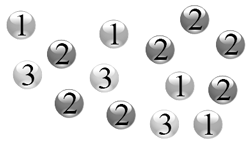


Petunia reaches into the bag and takes out a ball without looking.

Which type of ball is she most likely to take out?


Show Answers Only

Show Worked Solution

`text(The most common ball is:)`

Filed Under: Chance Tagged With: Band 2, smc-712-30-Selection

Graphs, MET2 2007 VCAA 15 MC

The graph of the function  `f: [0, oo) -> R`  where  `f(x) = 3x^(5/2)`  is reflected in the `x`-axis and then translated 3 units to the right and 4 units down.

The equation of the new graph is

`y = 3(x - 3)^(5/2) + 4`

`y = -3 (x - 3)^(5/2) - 4`

`y = -3 (x + 3)^(5/2) - 1`

`y = -3 (x - 4)^(5/2) + 3`

`y = 3(x - 4)^(5/2) + 3`

Show Answers Only

`B`

Show Worked Solution

`text(Let)\ \ y= 3x^(5/2)`

`text(Reflect in the)\ x text(-axis:)`

`y= – 3x^(5/2)`


`text(Translate 3 units to the right:)`

`y=- 3(x-3)^(5/2)`


`text(Translate 4 units down:)`

`y=- 3(x-3)^(5/2) – 4`

`=>   B`

Filed Under: Transformations Tagged With: Band 2, smc-753-40-Combinations, smc-753-70-Polynomials

Calculus, MET2 2009 VCAA 2 MC

At the point `(1, 1)` on the graph of the function with rule  `y = (x - 1)^3 + 1`

  1. there is a local maximum.
  2. there is a local minimum.
  3. there is a stationary point of inflection.
  4. the gradient is not defined.
  5. there is a point of discontinuity.
Show Answers Only

`C`

Show Worked Solution

`y = (x – 1)^3 + 1`

`y′ = 3(x – 1)^2`

`y″ = 6(x – 1)`

`text(Point of inflection at)\ \ x=1.`

`=>   C`

Filed Under: The Derivative Function and its Graph Tagged With: Band 2, smc-2830-40-Increasing/Decreasing intervals

Calculus, MET2 2011 VCAA 3

  1. Consider the function  `f: R -> R, f(x) = 4x^3 + 5x-9`.


    1. Find  `f^{prime}(x).`   (1 mark)

      --- 1 WORK AREA LINES (style=lined) ---

    2. Explain why  `f^{prime}(x) >= 5` for all `x`.   (1 mark)

      --- 4 WORK AREA LINES (style=lined) ---

  2. The cubic function `p` is defined by  `p: R -> R, p(x) = ax^3 + bx^2 + cx + k`, where `a`, `b`, `c` and `k` are real numbers.


    1. If `p` has `m` stationary points, what possible values can `m` have?   (1 mark)

      --- 2 WORK AREA LINES (style=lined) ---

    2. If `p` has an inverse function, what possible values can `m` have?   (1 mark)

      --- 2 WORK AREA LINES (style=lined) ---

  3. The cubic function `q` is defined by  `q:R -> R, q(x) = 3-2x^3`.


    1. Write down a expression for  `q^(-1)(x)`.   (2 marks)

      --- 4 WORK AREA LINES (style=lined) ---

    2. Determine the coordinates of the point(s) of intersection of the graphs of  `y = q(x)`  and  `y = q^(-1)(x)`.   (2 marks)

      --- 3 WORK AREA LINES (style=lined) ---

  4. The cubic function `g` is defined by  `g: R -> R, g(x) = x^3 + 2x^2 + cx + k`, where `c` and `k` are real numbers.


    1. If `g` has exactly one stationary point, find the value of `c`.   (3 marks)

      --- 4 WORK AREA LINES (style=lined) ---

    2. If this stationary point occurs at a point of intersection of  `y = g(x)`  and  `g^(−1)(x)`, find the value of `k`.   (3 marks)

      --- 8 WORK AREA LINES (style=lined) ---

Show Answers Only
    1. `f^{prime}(x) = 12x^2 + 5`
    2. `text(See Worked Solutions)`
    1. `m = 0, 1, 2`
    2. `m = 0, 1`
    1. `q^(-1)(x) = root(3)((3-x)/2), x ∈ R`
    2. `(1, 1)`
    1. `4/3`
    2. `-10/27`
Show Worked Solution

a.i.   `f^{prime}(x) = 12x^2 + 5`
  

a.ii.  `text(S)text(ince)\ \ x^2>=0\ \ text(for all)\ x,`

♦ Mean mark 47%.
` 12x^2` `>= 0`
`12x^2 + 5` `>=  5`
`f^{prime}(x)` `>=  5\ \ text(for all)\ x`


b.i.   `p(x) = text(is a cubic)`

♦♦♦ Mean mark part (b)(i) 9%, and part (b)(ii) 20%.
MARKER’S COMMENT: Good exam strategy should point students to investigate earlier parts for direction. Here, part (a) clearly sheds light on a solution!

`:. m = 0, 1, 2`

`text{(Note: part a.ii shows that a cubic may have no SP’s.)}`


b.ii.   `text(For)\ p^(−1)(x)\ text(to exist)`

`:. m = 0, 1`


c.i.   `text(Let)\ y = q(x)`

`text(Inverse: swap)\ x ↔ y`

`x` `= 3-2y^3`
`y^3` `= (3-x)/2`

`:. q^(-1)(x) = root(3)((3-x)/2), \ x ∈ R`
  

c.ii.  `text(Any function and its inverse intersect on)`

   `text(the line)\ \ y=x.`

`text(Solve:)\ \ 3-2x^3` `= xqquadtext(for)\ x,`
`x` `= 1`


`:.\ text{Intersection at (1, 1)}`
  

♦ Mean mark part (d)(i) 44%.
d.i.    `g^{prime}(x)` `= 0`
  `3x^2 + 4x + c` `= 0`
  `Delta` `= 0`
  `16-4(3c)` `= 0`
  `:. c` `= 4/3`


d.ii.   `text(Define)\ \ g(x) = x^3 + 2x^2 + 4/3x + k`

♦♦♦ Mean mark part (d)(ii) 14%.

  `text(Stationary point when)\ \ g^{prime}(x)=0`

`g^{prime}(x) = 3x^2+4x+4/3`

`text(Solve:)\ \ g^{prime}(x)=0\ \ text(for)\ x,`

`x = -2/3`

`text(Intersection of)\ g(x)\ text(and)\ g^(-1)(x)\ text(occurs on)\ \ y = x`

`text(Point of intersection is)\  (-2/3, -2/3)`

`text(Find)\ k:`

`g(-2/3)` `= -2/3\ text(for)\ k`
`:. k` ` = -10/27`

Filed Under: Curve Sketching, Polynomial and Other Functions Tagged With: Band 2, Band 3, Band 4, Band 5, Band 6, smc-5205-10-Polynomials, smc-5205-50-Find intersection, smc-724-10-Cubic, smc-724-40-Inverse functions

Calculus, MET2 2016 VCAA 4 MC

The average rate of change of the function  `f` with rule  `f(x) = 3x^2 - 2 sqrt(x + 1)`, between  `x = 0 and x = 3`, is

A.   `8`

B.   `25`

C.   `53/9`

D.   `25/3`

E.   `13/9`

Show Answers Only

`D`

Show Worked Solution
`text(Average ROC)` `= {f(3) – f(0)}/(3 – 0)`
  `=[(27-2xxsqrt4) – (-2)]/(3-0)`
  `= 25/3`

`=>   D`

Filed Under: Standard Differentiation Tagged With: Band 2, smc-746-40-Average ROC

Graphs, MET2 2016 VCAA 2 MC

Let  `f: R -> R,\ f(x) = 1 - 2 cos ({pi x}/2).`

The period and range of this function are respectively

  1. `4 and [−2, 2]`
  2. `4 and [−1, 3]`
  3. `1 and [−1, 3]`
  4. `4 pi and [−1, 3]`
  5. `4 pi and [−2, 2]`
Show Answers Only

`B`

Show Worked Solution
`text(Period)` `= (2 pi)/n = (2pi)/(pi/2)=4`
   

`text(Amplitude = 2 and median is)\ \ y=1.`

`text(Range)` `= [1 – 2, quad 1 + 2]`
  `= [−1, 3]`

`=>   B`

Filed Under: Trig Graphing Tagged With: Band 2, smc-2757-15-Cos, smc-2757-30-Find period, smc-2757-35-Find range

Graphs, MET2 2016 VCAA 1 MC

The linear function  `f: D -> R,\ f(x) = 5 - x`  has range  `[−4, 5).`

The domain `D` is

  1. `(0, 9]`
  2. `(0, 1]`
  3. `[5, −4)`
  4. `[−9, 0)`
  5. `[1, 9)`
Show Answers Only

`A`

Show Worked Solution
`5` `= 5 – x` `-4` `= 5 – x`
`x` `= 0` `x` `= 9`
`text{(non-inclusive)}` `text{(inclusive)}`


`:. x ∈ (0, 9]`

`=>   A`

Filed Under: Coordinate Geometry Tagged With: Band 2, smc-727-40-Domain/Range

Algebra, MET2 2012 VCAA 1 MC

The function with rule  `f(x) = −3sin((pix)/5)`  has period

  1. `3`
  2. `5`
  3. `10`
  4. `pi/5`
  5. `pi/10`
Show Answers Only

`=> C`

Show Worked Solution
`text(Period)` `= (2pi)/n`
  `= (2pi)/(pi/5)`
  `= 10`

 
`=> C`

Filed Under: Trig Graphing Tagged With: Band 2, smc-2757-10-Sin, smc-2757-30-Find period

NETWORKS, FUR2 2016 VCAA 1

A map of the roads connecting five suburbs of a city, Alooma (`A`), Beachton (`B`), Campville (`C`), Dovenest (`D`) and Easyside (`E`), is shown below.


  1. Starting at Beachton, which two suburbs can be driven to using only one road?   (1 mark)

    --- 2 WORK AREA LINES (style=lined) ---

A graph that represents the map of the roads is shown below.


One of the edges that connects to vertex `E` is missing from the graph.

  1.  i. Add the missing edge to the graph above.   (1 mark)

    (Answer on the graph above)

    --- 0 WORK AREA LINES (style=lined) ---

  2. ii. Explain what the loop at `D` represents in terms of a driver who is departing from Dovenest.   (1 mark)

    --- 2 WORK AREA LINES (style=lined) ---

Show Answers Only

a.    `text(Alooma and Easyside.)`

b.i. 

b.ii. `text(The loop represents that a driver can take a route out)`

`text(of Dovenest and return home without going through another)`

`text(suburb or turning back.)`

Show Worked Solution

a.   `text(Alooma and Easyside.)`


b.i.   

`text(Draw a third edge between Easyside and Dovenest.)`


b.ii. `text(The loop represents that a driver can take a)`

♦♦ Mean mark 30%.

`text(route out of Dovenest and return home without)`

`text(going through another suburb or turning back.)`

Filed Under: Travelling Problems and Adjacency Matrices Tagged With: Band 2, Band 4, Band 5, smc-622-50-Draw Network from Map/Matrix

GRAPHS, FUR2 2016 VCAA 1

Maria is a hockey player. She is paid a bonus that depends on the number of goals that she scores in a season.

The graph below shows the value of Maria’s bonus against the number of goals that she scores in a season.
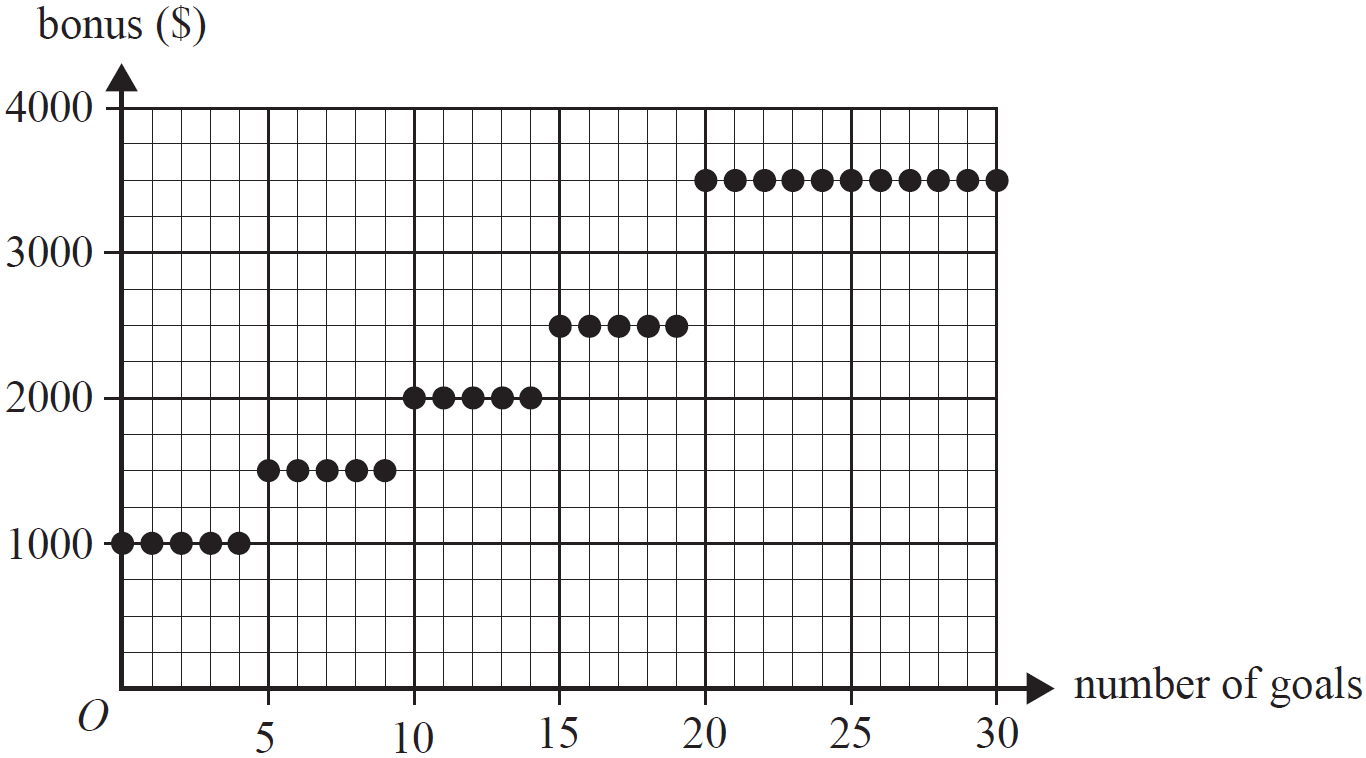
  1. What is the value of Maria’s bonus if she scores seven goals in a season?  (1 mark) 
  2. What is the least number of goals that Maria must score in a season to receive a bonus of $2500?  (1 mark)

Another player, Bianca, is paid a bonus of $125 for every goal that she scores in a season.

  1. What is the value of Bianca’s bonus if she scores eight goals in a season?  (1 mark)
  2. At the end of the season, both players have scored the same number of goals and receive the same bonus amount.


    How many goals did Maria and Bianca each score in the season?  (1 mark)

Show Answers Only
  1. `$1500`
  2. `15`
  3. `$1000`
  4. `text(28 goals)`
Show Worked Solution

a.   `$1500`


b.   `15`


c.    `text(Bonus)` `= 8 xx 125`
    `= $1000`


d.   `text(Draw the graph of Bianca’s payments on)`

`text(the same graph.)`
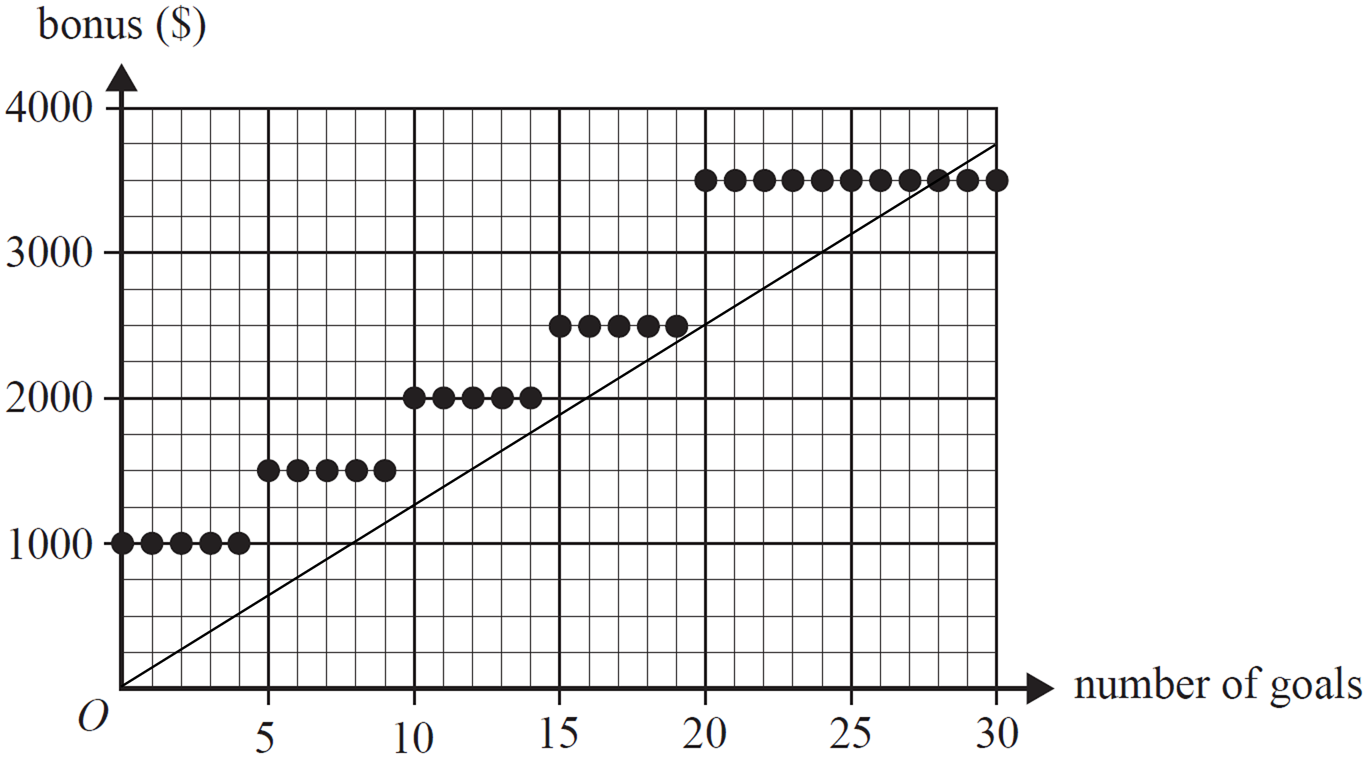
`text(The intersection is where both players)`

`text(receive the same bonus amount.)`

`:.\ text(Maria and Bianca each score 28 goals.)`

Filed Under: Graph Applications Tagged With: Band 2, Band 3, Band 4

MATRICES, FUR2 2016 VCAA 3

A travel company is studying the choice between air (`A`), land (`L`), sea (`S`) or no (`N`) travel by some of its customers each year.

Matrix `T`, shown below, contains the percentages of customers who are expected to change their choice of travel from year to year.

`{:(qquadqquadqquadqquadqquadquadtext(this year)),(qquadqquadqquadquadAqquadqquadLqquadqquadSqquadquadN),(T = [(0.65,0.25,0.25,0.50),(0.15,0.60,0.20,0.15),(0.05,0.10,0.25,0.20),(0.15,0.05,0.30,0.15)]{:(A),(L),(S),(N):}text(next year)):}`

Let `S_n` be the matrix that shows the number of customers who choose each type of travel `n` years after 2014.

Matrix `S_0` below shows the number of customers who chose each type of travel in 2014.

`S_0 = [(520),(320),(80),(80)]{:(A),(L),(S),(N):}`

Matrix `S_1` below shows the number of customers who chose each type of travel in 2015.

`S_1 = TS_0 = [(478),(d),(e),(f)]{:(A),(L),(S),(N):}`

  1. Find the values missing from matrix `S_1 (d, e, f )`.   (1 mark)

    --- 2 WORK AREA LINES (style=lined) ---

  2. Write a calculation that shows that 478 customers were expected to choose air travel in 2015.   (1 mark)

    --- 2 WORK AREA LINES (style=lined) ---

  3. Consider the customers who chose sea travel in 2014.
  4. How many of these customers were expected to choose sea travel in 2015?   (1 mark)

    --- 3 WORK AREA LINES (style=lined) ---

  5. Consider the customers who were expected to choose air travel in 2015.
  6. What percentage of these customers had also chosen air travel in 2014?
  7. Round your answer to the nearest whole number.   (1 mark)

    --- 4 WORK AREA LINES (style=lined) ---

In 2016, the number of customers studied was increased to 1360.
Matrix `R_2016`, shown below, contains the number of these customers who chose each type of travel in 2016.

`R_2016 = [(646),(465),(164),(85)]{:(A),(L),(S),(N):}`

  1. The company intends to increase the number of customers in the study in 2017 and in 2018.
  2. The matrix that contains the number of customers who are expected to choose each type of travel in 2017 (`R_2017`) and 2018 (`R_2018`) can be determined using the matrix equations shown below.

`R_2017 = TR_2016 + BqquadqquadqquadR_2018 = TR_2017 + B`
 

`{:(qquadqquadqquadqquadqquadquadtext(this year)),(qquadqquadqquadquadAqquadqquadLqquadqquadSqquadquadN),(T = [(0.65,0.25,0.25,0.50),(0.15,0.60,0.20,0.15),(0.05,0.10,0.25,0.20),(0.15,0.05,0.30,0.15)]{:(A),(L),(S),(N):}text(next year)):}qquadqquad{:(),(),(B = [(80),(80),(40),(−80)]{:(A),(L),(S),(N):}):}`

    1. The element in the fourth row of matrix `B` is – 80.
    2. Explain this number in the context of selecting customers for the studies in 2017 and 2018.   (1 mark)

      --- 2 WORK AREA LINES (style=lined) ---

    3. Determine the number of customers who are expected to choose sea travel in 2018.
    4. Round your answer to the nearest whole number.   (2 marks)

      --- 5 WORK AREA LINES (style=lined) ---

Show Answers Only
  1. `d=298, \ e=94, \ f=130`
  2. `(0.65 xx 520) + (0.25 xx 320) + (0.25 xx 80) + (0.50 xx 80) = 478`
  3. `20\ text(customers)`
  4. `71text(%)`
  5.  
    1. `text(80 customers who have no travel in a given)`
      `text(year are removed from the study. This occurs)`
      `text(in both 2017 and 2018.)`
    2. `text(190 customers)`
Show Worked Solution

a.   `d=298, \ e=94, \ f=130`
 

b.   `(0.65 xx 520) + (0.25 xx 320) + (0.25 xx 80) + (0.50 xx 80) = 478`

♦♦ Mean mark part (b) and (c) was 35% and 45% respectively.


c.   `text(Sea Travel in 2014-80 customers.)`

`text(Of those 80 customers,)`

`text(Sea Travel in 2015)` `= 25text(%) xx 80`
  `= 20\ text(customers)`


d.   `text(Expected total for air travel in 2015)`

♦♦♦ Mean mark 17%.

`= 478\ text(customers)`
 

`text(In 2014, 520 customers chose air travel.)`

`text(65% of those chose air travel in 2015)`

`= 65text(%) xx 520`

`= 338\ text(customers)`

`:.\ text(Percentage)` `= 338/478 xx 100`
  `= 70.71…`
  `= 71text(%)`


e.i.   `text(80 customers who have no travel in a given)`

♦ Mean mark 14%.
MARKER’S COMMENT: “80 people chose not to travel” was a common answer that received no marks.

`text(year are removed from the study. This occurs)`

`text(in both 2017 and 2018.)`


e.ii.   `R_2017` `= TR_2016 + B`
    `= [(0.65,0.25,0.25,0.50),(0.15,0.60,0.20,0.15),(0.05,0.10,0.25,0.20),(0.15,0.05,0.30,0.15)][(646),(465),(164),(85)] + [(80),(80),(40),(−80)]`
    `= [(699.65),(501.45),(176.80),(102.10)]`


`R_2018` `= TR_2017 + B`
  `= [(0.65,0.25,0.25,0.50),(0.15,0.60,0.20,0.15),(0.05,0.10,0.25,0.20),(0.15,0.05,0.30,0.15)][(699.65),(501.45),(176.80),(102.10)]`
  `= [(755.39),(536.49),(189.75),(118.38)]`


`:. 190\ text(customers are expected to choose)`

`text(sea travel in 2018.)`

Filed Under: Transition Matrices - Modified Tagged With: Band 2, Band 5, Band 6, page-break-before-question, smc-1893-20-State Matrix in discrete period, smc-1893-32-4x4 Matrix, smc-1893-60-Regular Transition Matrices

MATRICES, FUR2 2016 VCAA 2

A travel company has five employees, Amara (`A`), Ben (`B`), Cheng (`C`), Dana (`D`) and Elka (`E`).

The company allows each employee to send a direct message to another employee only as shown in the communication matrix `G` below.

The matrix `G^2` is also shown below.
 

`{:(),(),(G = text(sender )):}{:(qquadqquadqquad\ text(receiver)),(qquadqquadAquadBquadCquadDquadE),({:(A),(B),(C),(D),(E):}[(0,1,1,1,1),(1,0,1,0,0),(1,1,0,1,0),(0,1,0,0,1),(0,0,0,1,0)]):}qquad{:(),(),(G^2 = text(sender )):}{:(qquadqquadqquad\ text(receiver)),(qquadqquadAquadBquadCquadDquadE),({:(A),(B),(C),(D),(E):}[(2,2,1,2,1),(1,2,1,2,1),(1,2,2,1,2),(1,0,1,1,0),(0,1,0,0,1)]):}`
 

The 1 in row `E`, column `D` of matrix `G` indicates that Elka (sender) can send a direct message to Dana (receiver).

The 0 in row `E`, column `C` of matrix `G` indicates that Elka cannot send a direct message to Cheng.

  1. To whom can Dana send a direct message?   (1 mark)

    --- 1 WORK AREA LINES (style=lined) ---

  2. Cheng needs to send a message to Elka, but cannot do this directly.
  3. Write down the names of the employees who can send the message from Cheng directly to Elka.   (1 mark) 

    --- 2 WORK AREA LINES (style=lined) ---

Show Answers Only
  1. `text(Ben and Elka)`
  2. `text(Amara and Dana)`
Show Worked Solution

a.   `text(Ben and Elka)`
 

b.   `text(Amara and Dana)`

Filed Under: Matrix Applications Tagged With: Band 2, Band 3, smc-619-80-Communication

MATRICES, FUR2 2016 VCAA 1

A travel company arranges flight (`F`), hotel (`H`), performance (`P`) and tour (`T`) bookings.

Matrix `C` contains the number of each type of booking for a month.

`C = [(85),(38),(24),(43)]{:(F),(H),(P),(T):}`

  1. Write down the order of matrix `C`.   (1 mark)

    --- 1 WORK AREA LINES (style=lined) ---

A booking fee, per person, is collected by the travel company for each type of booking.

Matrix `G` contains the booking fees, in dollars, per booking.

`{:((qquadqquadquadF,\ H,\ P,\ T)),(G = [(40,25,15,30)]):}`

  1.  i. Calculate the matrix product  `J = G × C`.   (1 mark)

    --- 3 WORK AREA LINES (style=lined) ---

  2. ii. What does matrix `J` represent?   (1 mark) 

    --- 2 WORK AREA LINES (style=lined) ---

Show Answers Only
  1. `4 xx 1`
    1. `[6000]`
    2. `J\ text(represents the total booking fees for the travel)`
      `text(company in the given month.)`
Show Worked Solution

a.   `text(Order:)\ 4 xx 1`
 

b.i.    `J = [(40,25,15,30)][(85),(38),(24),(43)]= [6000]`

 
b.ii.
 `J\ text(represents the total booking fees for the)`

♦ Mean mark 42%.

 `text(travel company in the given month.)`

Filed Under: Matrix Applications Tagged With: Band 2, Band 3, Band 4, smc-619-30-Matrix product and interpretation

CORE, FUR2 2016 VCAA 2

A weather station records daily maximum temperatures.
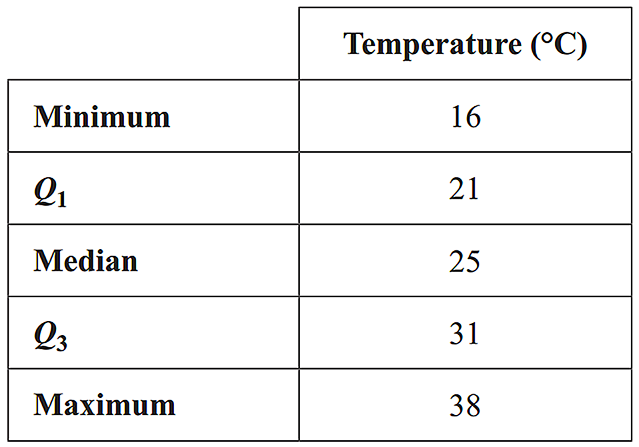
  1. The five-number summary for the distribution of maximum temperatures for the month of February is displayed in the table below.


  1. There are no outliers in this distribution.
  2.  i. Use the five-number summary above to construct a boxplot on the grid below.   (1 mark)

    --- 0 WORK AREA LINES (style=lined) ---


  1. ii. What percentage of days had a maximum temperature of 21°C, or greater, in this particular February?   (1 mark)

    --- 2 WORK AREA LINES (style=lined) ---
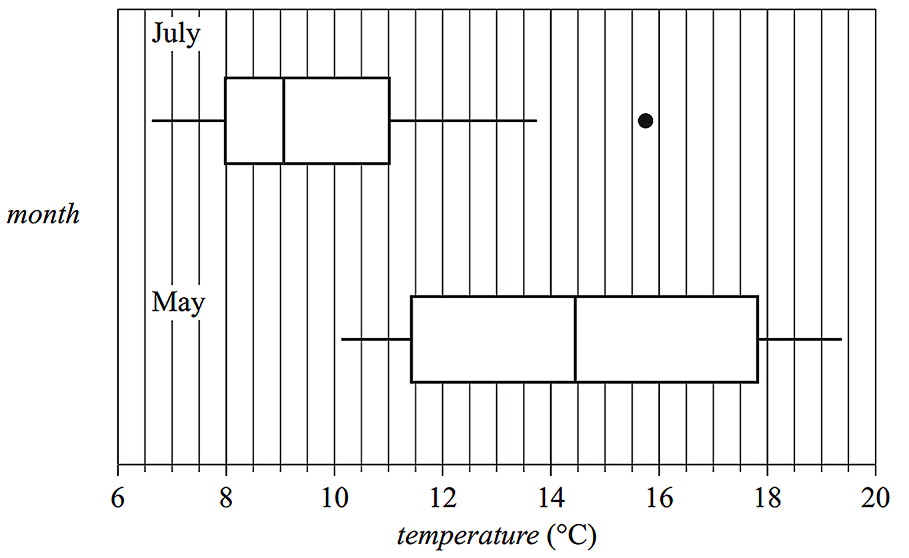
  2. The boxplots below display the distribution of maximum daily temperature for the months of May and July.
     

  3.   i. Describe the shapes of the distributions of daily temperature (including outliers) for July and for May.   (1 mark)

    --- 2 WORK AREA LINES (style=lined) ---

  4.  ii. Determine the value of the upper fence for the July boxplot.   (1 mark)

    --- 3 WORK AREA LINES (style=lined) ---

  5. iii. Using the information from the boxplots, explain why the maximum daily temperature is associated with the month of the year. Quote the values of appropriate statistics in your response.   (1 mark)

    --- 3 WORK AREA LINES (style=lined) ---

Show Answers Only
a.i.   

a.ii.   `text(75%)`

b.i.    `text(July – Positively skewed with an outlier.)`
  `text(May – Symmetrical with no outliers.)`

b.ii.  `15.5^@\text(C)`

b.iii. `text{The median temperature in May (14.5°C)}`

`text(differs from the median temperature in July)`

`text{(just over 9°C). This difference is why the}`

`text(maximum daily temperature is associated)`

`text(with the month.)`

Show Worked Solution
a.i.   

a.ii.   `text(75%)`

MARKER’S COMMENT: Incorrect May descriptors included “evenly or normally distributed”, “bell shaped” and “symmetrically skewed.”
b.i.    `text(July – Positively skewed with an outlier.)`
  `text(May – Symmetrical with no outliers.)`


b.ii.    `text(Upper fence)` `= Q_3 + 1.5 xx IQR`
    `= 11 + 1.5 xx (11 – 8)`
    `= 11 + 4.5`
    `= 15.5^@\text(C)`
♦♦ Mean mark (b)(iii) – 30%.
COMMENT: Refer to the difference in medians. Just quoting the numbers was not enough to gain a mark here.

b.iii. `text{The median temperature in May (14.5°C)}`

`text(differs from the median temperature in July)`

`text{(just over 9°C). This difference is why the}`

`text(maximum daily temperature is associated)`

`text(with the month.)`

Filed Under: Graphs - Stem/Leaf and Boxplots Tagged With: Band 2, Band 3, Band 4, Band 5, smc-643-10-Single Box-Plots, smc-643-20-Parallel Box-Plots, smc-643-30-Draw Box Plots, smc-643-60-Outliers, smc-643-70-Distribution Description

CORE, FUR2 2016 VCAA 1

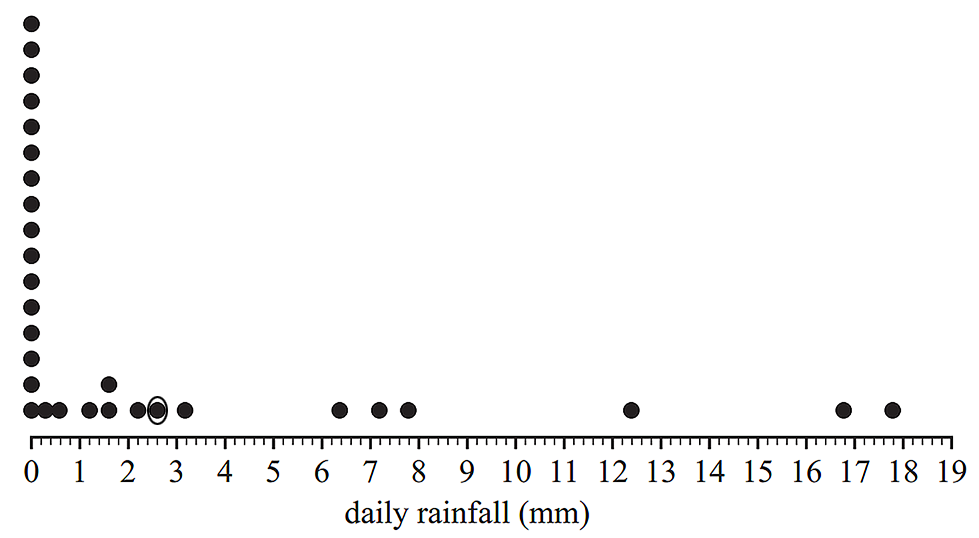
The dot plot below shows the distribution of daily rainfall, in millimetres, at a weather station for 30 days in September.
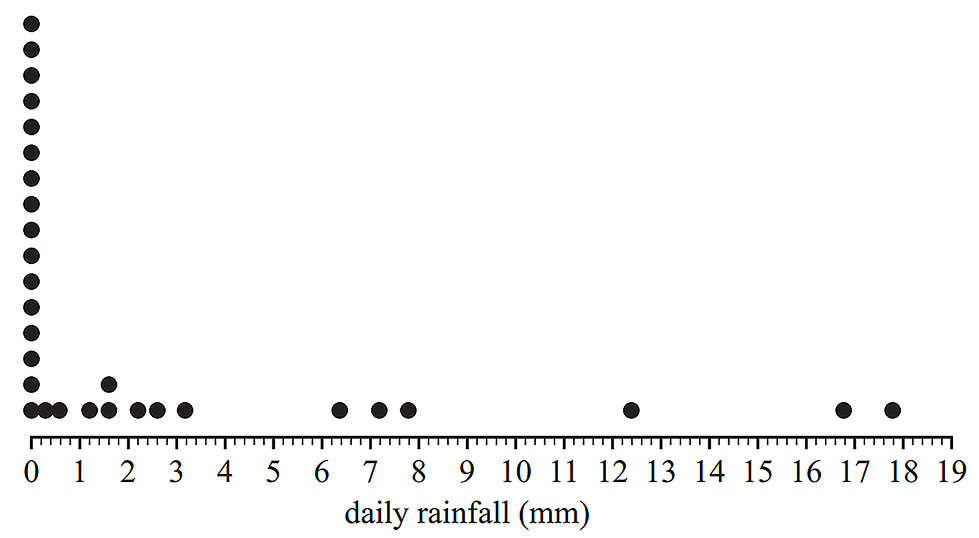


  1. Write down the
  2.  i. range   (1 mark)

    --- 1 WORK AREA LINES (style=lined) ---

  3. ii. median   (1 mark)

    --- 1 WORK AREA LINES (style=lined) ---

  1. Circle the data point on the dot plot above that corresponds to the third quartile `(Q_3).`   (1 mark)

    --- 0 WORK AREA LINES (style=lined) ---
  2. Write down the
  3.  i. the number of days on which no rainfall was recorded.   (1 mark)

    --- 1 WORK AREA LINES (style=lined) ---

  4. ii. the percentage of days on which the daily rainfall exceeded 12 mm.   (1 mark)

    --- 2 WORK AREA LINES (style=lined) ---

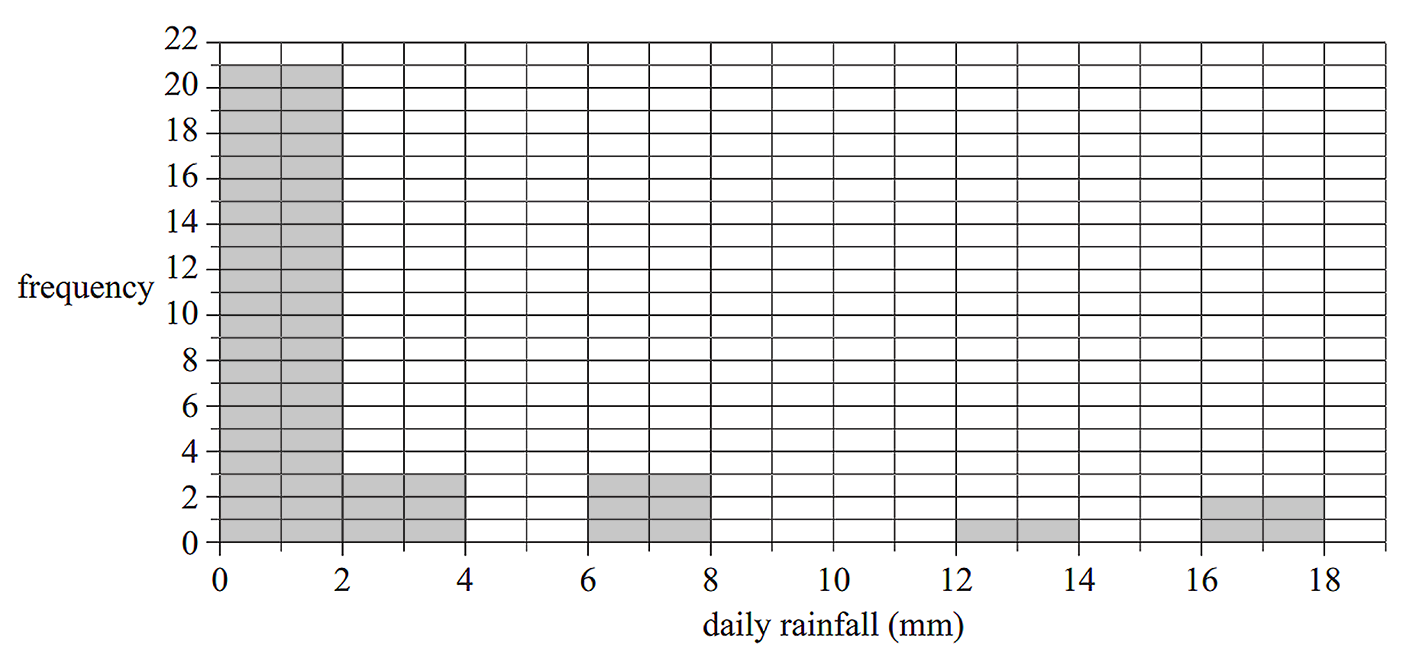
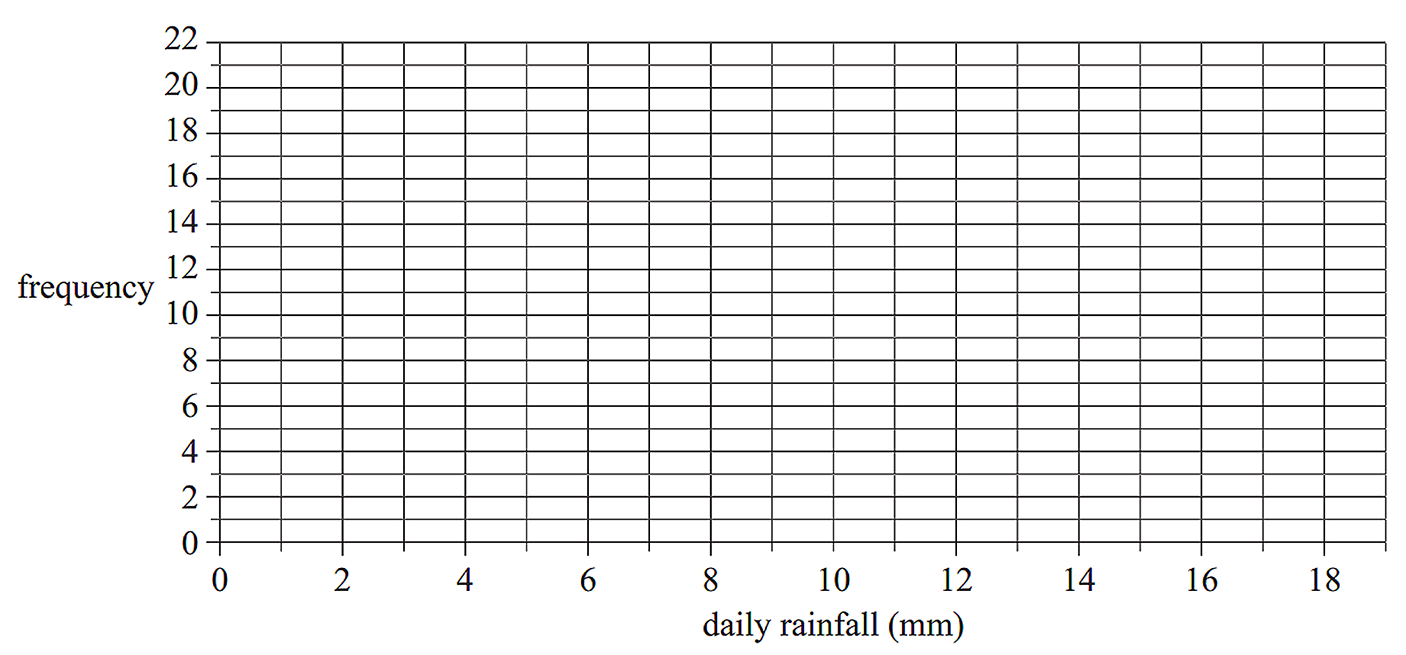
  1. Use the grid below to construct a histogram that displays the distribution of daily rainfall for the month of September. Use interval widths of two with the first interval starting at 0.   (2 marks) 

    --- 0 WORK AREA LINES (style=lined) ---


Show Answers Only
    1. `17.8\ text(mm)`
    2. `0`
  1. `text(See Worked Solutions)`


    1. `16\ text(days)`
    2. `10\text(%)`
  2. `text(See Worked Solutions)`
Show Worked Solution
a.i.    `text(Range)` `=\ text(High) – text(Low)`
    `= 17.8 – 0`
    `= 17.8\ text(mm)`
     

a.ii.   `text(30 data points)`

`text(Median)` `= text{15th + 16th}/2`
  `= 0`


b.   


c.i.   `16\ text(days)`

c.ii.    `text(Percentage)` `= 3/30 xx 100`
    `= 10\ text(%)`


d.   

Filed Under: Graphs - Histograms and Other, Summary Statistics Tagged With: Band 2, Band 3, Band 4, smc-468-40-Median Mode and Range, smc-644-10-Dot Plots

NETWORKS, FUR1 2016 VCAA 1 MC

Lee, Mandy, Nola, Oscar and Pieter are each to be allocated one particular task at work.

The bipartite graph below shows which task(s), 1–5, each person is able to complete.
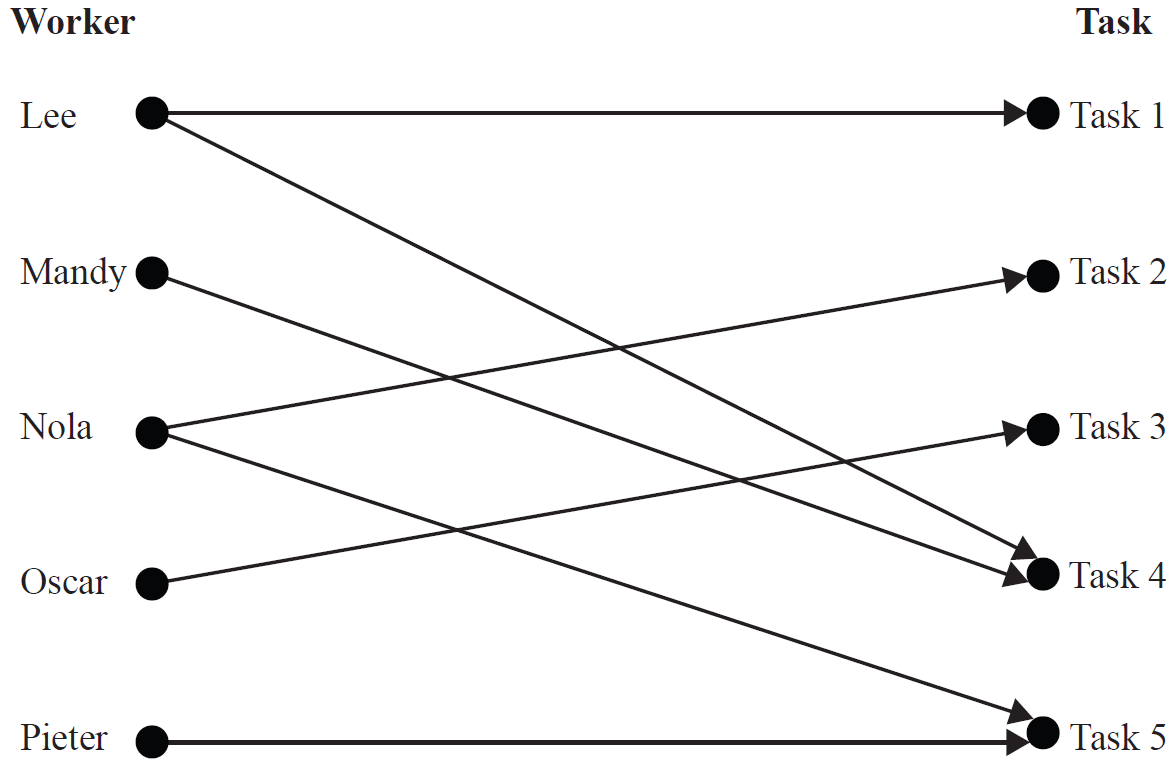


Each person completes a different task.

Task 4 must be completed by

  1. `text(Lee.)`
  2. `text(Mandy.)`
  3. `text(Nola.)`
  4. `text(Oscar.)`
  5. `text(Pieter.)`
Show Answers Only

`B`

Show Worked Solution

`=> B`

Filed Under: Matching Problems Tagged With: Band 2, smc-623-20-Other Matching

GRAPHS, FUR1 2016 VCAA 2 MC

A phone company charges a fixed, monthly line rental fee of $28 and $0.25 per call.

Let `n` be the number of calls that are made in a month.

Let `C` be the monthly phone bill, in dollars.

The equation for the relationship between the monthly phone bill, in dollars, and the number of calls is

  1. `C = 28 + 0.25n`
  2. `C = 28n + 0.25`
  3. `C = n + 28.25`
  4. `C = 28(n + 0.25)`
  5. `C = 0.25(n + 28)`
Show Answers Only

`A`

Show Worked Solution

`C = 28 + 0.25n`

`=> A`

Filed Under: Linear relationships Tagged With: Band 2

GRAPHS, FUR1 2016 VCAA 1 MC

The graph below shows the temperature, in degrees Celsius, between 6 am and 6 pm on a given day.
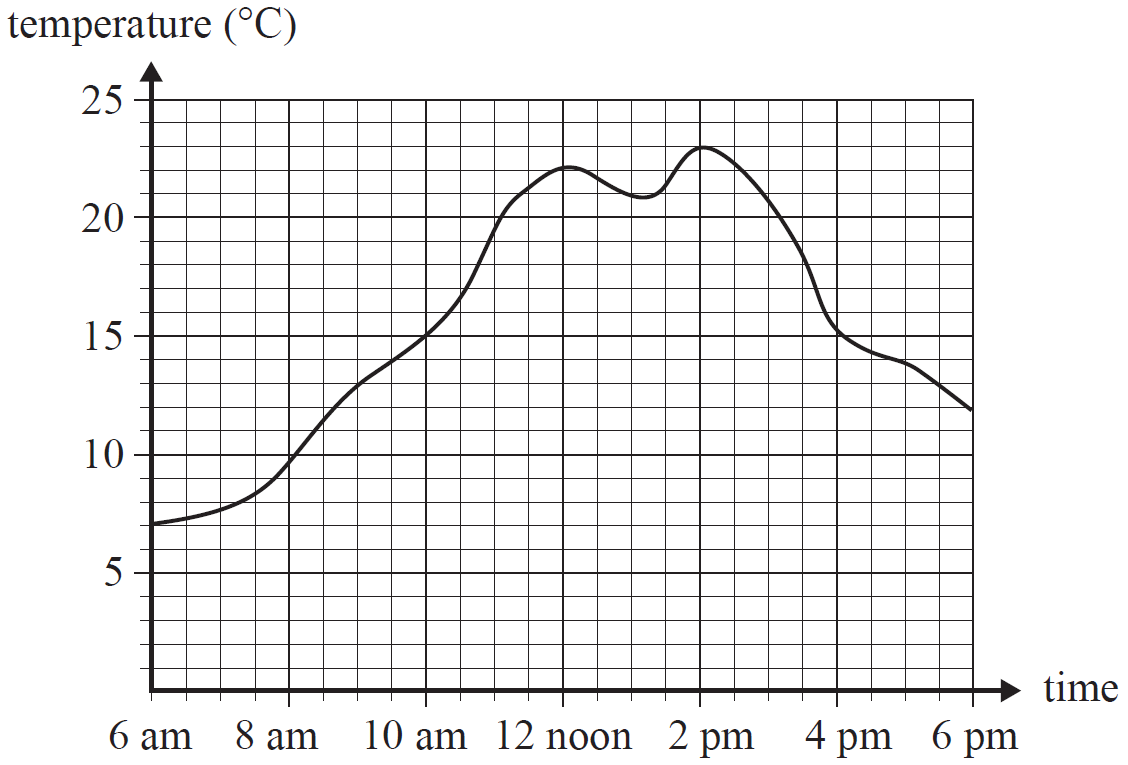
From 2 pm to 6 pm, the temperature decreased by

  1.   `4°text(C)`
  2. `11 °text(C)`
  3. `12 °text(C)`
  4. `15 °text(C)`
  5. `23 °text(C)`
Show Answers Only

`B`

Show Worked Solution
`text(Temperature)` `= 23 – 12`
  `= 11°text(C)`

`=> B`

Filed Under: Graph Applications Tagged With: Band 2

GEOMETRY, FUR1 2016 VCAA 2 MC

Triangle ABC is similar to triangle DEF.
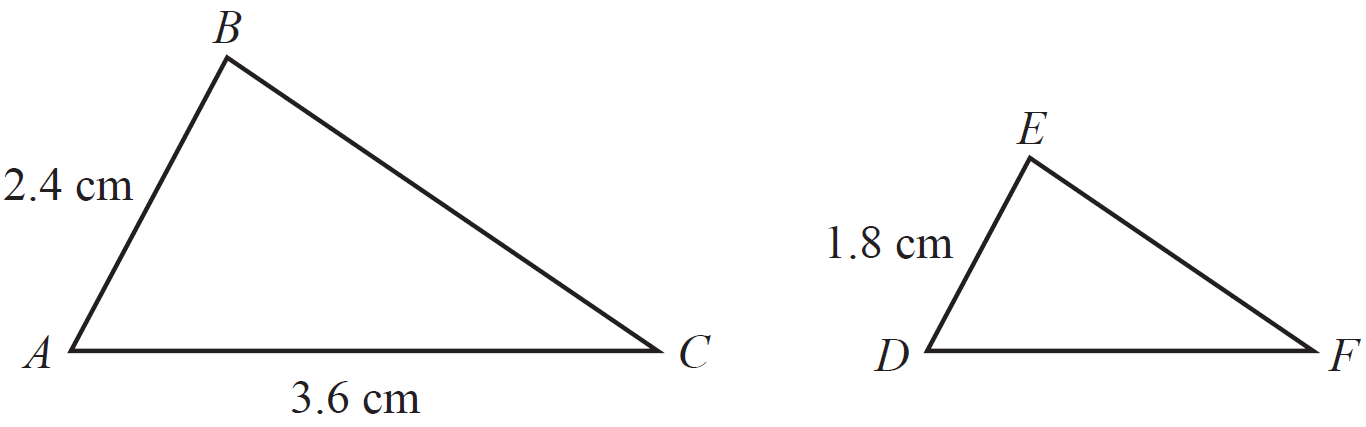


The length of DF, in centimetres, is

  1. `0.9`
  2. `1.2`
  3. `1.8`
  4. `2.7`
  5. `3.6`
Show Answers Only

`D`

Show Worked Solution

`text(Using similar ratios,)`

`(DF)/(DE)` `= (AC)/(AB)`
`(DF)/1.8` `= 3.6/2.4`
`:. DF` `= ((3.6 xx 1.8))/2.4`
  `= 2.7\ text(cm)`

`=> D`

Filed Under: Similarity and Scale Tagged With: Band 2, smc-606-10-Similarity

Number and Algebra, NAP-B1-07

Moe has 22 first cousins and Homer has 28.

Barney has more first cousins than Moe but less than Homer.

How many first cousins could Barney have?

`19` `21` `24` `29`


Show Answers Only

`24`

Show Worked Solution

`text(The number of cousins Barney has must be more than)`

`text(22 and less than 28.)`

`=>\ text(Barney could have 24 first cousins.)`

Filed Under: Number and Place, Number and Place Value, TESTLET B Tagged With: Band 2, smc-708-60-Place Value

Measurement, NAP-B1-06

Which of these is used to measure mass?


Show Answers Only

Show Worked Solution

Filed Under: TESTLET C, Units of Measurement, Units of Measurement Tagged With: Band 2, smc-3022-10-Scale measure

Number and Algebra, NAP-B1-05 SA

Write seven hundred and fifty-six as a number.

Show Answers Only

`756`

Show Worked Solution

`756`

Filed Under: Number and Place, Number and Place Value, TESTLET C Tagged With: Band 2, smc-708-60-Place Value

Geometry, NAP-B1-04

The     is at E4.
The     is at  
 
Show Answers Only

`text(C2)`

Show Worked Solution

`text(C2)`

Filed Under: Location, Maps and Directions Tagged With: Band 2, smc-705-10-Grids

Statistics, NAP-B1-03

Brian works at a pool.

The table shows how many towels Brian sells during one week.

How many towels were sold altogether on Wednesday, Thursday and Friday?

`9` `13` `21` `26`


Show Answers Only

`26`

Show Worked Solution
`text(Towels sold)` `=7 + 13+6`
  `=26`

Filed Under: Data and Interpretation, Data and Interpretation, TESTLET B Tagged With: Band 2, smc-713-30-Tally chart

Number and Algebra, NAP-C1-05

Which one of these equals 735?


Show Answers Only

Show Worked Solution

Filed Under: Uncategorized Tagged With: Band 2

Geometry, NAP-C1-04

Ryan joined two blocks together to make the object pictured below.

He used a rectangular prism and a

 
square pyramid
 
triangular pyramid
 
triangular prism
 
cube
Show Answers Only

`text(triangular prism)`

Show Worked Solution

`text(triangular prism)`

Filed Under: 2D-3D Shapes, 2D-3D Shapes, TESTLET B Tagged With: Band 2, smc-704-20-3D objects

Number and Algebra, NAP-C1-03

Jethro has these bananas.

He gives half of his bananas to Jed.

How many bananas does Jethro have left?

`4` `5` `10` `20`


Show Answers Only

`5`

Show Worked Solution

`text(There are 10 bananas.)`

`=>\ text(Bananas left for Jethro)`

`=1/2 xx 10`

`=5`

Filed Under: Fractions, Fractions, TESTLET C Tagged With: Band 2, smc-709-20-Halves

Statistics, NAP-D1-07

In which state or territory were Barry and Sharon the most popular names?

`text(NT)` `text(Qld)` `text(SA)` `text(WA)`


Show Answers Only

`text(Qld)`

Show Worked Solution

`text(Qld)`

Filed Under: Data and Interpretation, Data and Interpretation, TESTLET B Tagged With: Band 2, smc-713-40-Table data

Number and Algebra, NAP-D1-06

Sean ate half a box of chocolates.

There are 9 chocolates left in the box

How many chocolates are in a full box?

`18` `16` `9` `8`


Show Answers Only

`18\ text(chocolates)`

Show Worked Solution

`text(Half of a box) = 9\ text(chocolates)`

`=>\ text(A full box of chocolates)`

`=9 xx 2`

`= 18\ text(chocolates)`

Filed Under: Fractions Tagged With: Band 2, smc-709-20-Halves

Geometry, NAP-D1-03

Coby drew a robot using different shapes.

How many triangles did he draw?

`1` `2` `4` `6`


Show Answers Only

`6`

Show Worked Solution

`6\ text(triangles)`

Filed Under: 2D-3D Shapes Tagged With: Band 2, smc-704-10-2D shapes

Probability, NAP-E1-07

Fiona plays netball tomorrow.

Today is Tuesday.

Which of these is certain?

 
Fiona's team will lose.
 
Fiona's team trains on Monday.
 
It will be sunny during the game.
 
Tomorrow is Wednesday.
Show Answers Only

`text(Tomorrow is Wednesday.)`

Show Worked Solution

`text(Tomorrow is Wednesday.)`

Filed Under: Chance Tagged With: Band 2, smc-712-10-Core Concepts

Number and Algebra, NAP-D1-02

George has the coins shown below.

How much money does he have?

`$0.77` `$0.87` `$2.65` `$2.75`


Show Answers Only

`$2.75`

Show Worked Solution

`text(Amount of money)`

`=$2 + 50¢ + 20¢ + 5¢`

`= $2.75`

Filed Under: Money, Money, TESTLET C Tagged With: Band 2, smc-2909-10-Recognise notes/coins, smc-2909-20-$ and cents

Number and Algebra, NAP-F1-09

Kris buys one fruit juice and one slice of toast.

How much does she pay altogether?

`60¢` `$2.20` `$2.70` `$2.80`


Show Answers Only

`$2.80`

Show Worked Solution

`$2.20 + 60¢ = $2.80`

Filed Under: Money Tagged With: Band 2, smc-2909-20-$ and cents

Statistics, NAP-F1-06

Four children played a game that scored points.

A tally was used to show the points each child scored.


Who scored exactly seven points?

`text(Paul)` `text(John)` `text(George)` `text(Ringo)`


Show Answers Only

`text(Ringo)`

Show Worked Solution

`text(Ringo)`

Filed Under: Data and Interpretation, Data and Interpretation, TESTLET C Tagged With: Band 2, smc-713-30-Tally chart

Measurement, NAP-F1-05

Which one of the grey shapes has the largest area?


Show Answers Only

Show Worked Solution

`text(The fourth image has the highest number)`

`text{of shaded triangles (15)}.`

Filed Under: Length, Area and Capacity, Length, Area and Capacity, TESTLET B Tagged With: Band 2, smc-706-20-Area

Number and Algebra, NAP-G1-08

Which of these surfboards is cheapest?


Show Answers Only

Show Worked Solution

Filed Under: Number and Place, Number and Place Value, TESTLET C Tagged With: Band 2, smc-708-60-Place Value

Number and Algebra, NAP-G1-07

Milly walked 13 kilometres to get to town and then travelled 38 kilometres by bus.

How many kilometres did she travel altogether?

`25` `41` `45` `51`


Show Answers Only

`51`

Show Worked Solution
`text(Distance)` `=13+38`
  `=51\ text(km)`

Filed Under: Solving Problems - Add/Subtract, Solving Problems - Add/Subtract, TESTLET B Tagged With: Band 2, smc-710-10-Addition, smc-710-30-2-digit calculations

Geometry, NAP-F1-03

These telegraph poles are shaped most like a

`text(cone)` `text(sphere)` `text(cylinder)` `text(rectangle)`


Show Answers Only

`text(cylinder)`

Show Worked Solution

`text(cylinder)`

Filed Under: 2D-3D Shapes, 2D-3D Shapes, TESTLET C Tagged With: Band 2, smc-704-20-3D objects

Geometry, NAP-F1-02

On this grid H can be found at A1.

What can be found at C3?


Show Answers Only

Show Worked Solution

Filed Under: Location, Directions and Angles, Location, Maps and Directions, TESTLET C Tagged With: Band 2, smc-705-10-Grids

Measurement, NAP-H1-05

About how long is the clip?

`text(5 cm)` `text(6 cm)` `text(7 cm)` `text(8 cm)`


Show Answers Only

`text(6 cm)`

Show Worked Solution

`text(6 cm)`

Filed Under: Length, Area and Capacity Tagged With: Band 2, smc-706-10-Length

Number and Algebra, NAP-H1-03

Which sport goods item is the cheapest?

`text(racquet)` `text(soccer ball)` `text(roller blades)` `text(hockey stick)`


Show Answers Only

`text(roller blades)`

Show Worked Solution

`text($39 is the lowest price.)`

`:.\ text(Roller blades are the cheapest.)`

Filed Under: Number and Place, Number and Place Value, TESTLET B Tagged With: Band 2, smc-708-60-Place Value

Number and Algebra, NAP-I1-08 SA

Kate had saved the notes below after 1 year.


How much money had Kate saved in total after 1 year?

$  
Show Answers Only

`$85`

Show Worked Solution

`text(Total money saved)`

`=$20 + $20 + $20 +$10 + $5 + $5 + $5`

`=$85`

Filed Under: Money Tagged With: Band 2, smc-2909-10-Recognise notes/coins, smc-2909-15-Whole $

Geometry, NAP-I1-05

Preston has 2 shapes.


Which shape could he make by joining them together?


Show Answers Only

Show Worked Solution

Filed Under: 2D-3D Shapes, 2D-3D Shapes, TESTLET C Tagged With: Band 2, smc-704-10-2D shapes

Number and Algebra, NAP-I1-03

Michael plays violin in the park and collects 8 ten-cent coins in his hat.

How much money does Michael have in his hat altogether?

`text(44 cents)` `text(18 cents)` `text(80 cents)` `text(88 cents)`


Show Answers Only

`text(80 cents)`

Show Worked Solution

`8 xx 10¢ = 80¢`

`:.\ text(Michael has 80 cents in his hat.)`

Filed Under: Money Tagged With: Band 2, smc-2909-20-$ and cents

Number and Algebra, NAP-E2-01

Kylie had 11 balloons. She gave 4 away to her friends and 2 burst.

How many balloons does Kylie have left?

`5`    `6`   `7` `17`


Show Answers Only

`5`

Show Worked Solution

`11 – 4 – 2 = 5`

Filed Under: Solving Problems - Add/Subtract, Solving Problems - Add/Subtract, TESTLET C Tagged With: Band 2, smc-3017-20-Subtraction, smc-3017-30-2-digit calculations, smc-710-20-Subtraction, smc-710-30-2-digit calculations

Statistics, NAP-H2-02

Renshaw threw darts at the board below.

He hit the board with every throw.

He recorded each time he hit a colour in the table below.

How many darts did Renshaw throw in total?

`9` `17` `20` `23`


Show Answers Only

`23\ text(darts)`

Show Worked Solution

`6 + 8 + 9 = 23\ text(darts)`

Filed Under: Data and Interpretation, Data and Interpretation, Data and Interpretation, TESTLET C Tagged With: Band 2, smc-3052-30-Tally chart, smc-713-30-Tally chart

Number and Algebra, NAP-G2-01

Barnaby writes a number pattern where each number is four more than the previous number.

`5, 9, 13, 17,`  
 

What number should Barnaby write next?

`18` `20` `21` `22`


Show Answers Only

`21`

Show Worked Solution

`17+4 = 21`

Filed Under: Patterns, Patterns, TESTLET C Tagged With: Band 2, smc-711-10-Number sequences

Functions, EXT1 F1 2016 HSC 11a

Find the inverse of the function  `y = x^3-2`.  (2 marks)

Show Answers Only

`y = (x + 2)^(1/3)`

Show Worked Solution

`y = x^3-2`

`text(For inverse),\ \ x harr y`

`x` `= y^3-2`
`y^3` `= x + 2`
`:. y` `= (x + 2)^(1/3)`

Filed Under: Inverse Functions, Inverse Functions, Other Inverse Functions EXT1 Tagged With: Band 2, smc-1034-20-Other Functions, smc-6641-20-Other Functions

Functions, EXT1 F2 2016 HSC 2 MC

What is the remainder when  `2x^3-10x^2 + 6x + 2`  is divided by  `x-2`?

  1. `-66`
  2. `-10`
  3. `-x^3 + 5x^2-3x-1`
  4. `x^3-5x^2 + 3x + 1`
Show Answers Only

`B`

Show Worked Solution
`P(2)` `= 2 · 2^3-10 · 2^2 + 6 · 2 + 2`
  `= -10`

 
`=>   B`

Filed Under: Polynomials, Remainder and Factor Theorems, Remainder and Factor Theorems, Roots, Remainders and Factors Tagged With: Band 2, num-title-ct-patha, num-title-qs-hsc, smc-1031-20-Remainder Theorem, smc-4242-10-Factor Theorem, smc-6644-20-Remainder Theorem

Calculus, 2ADV C4 2016 HSC 16a

A particle moves in a straight line. Its velocity `v\ text(ms)^-1` at time `t` seconds is given by

`v = 2-4/(t + 1).`

  1. Find the initial velocity.   (1 mark)

    --- 1 WORK AREA LINES (style=lined) ---

  2. Find the acceleration of the particle when the particle is stationary.   (2 marks)

    --- 4 WORK AREA LINES (style=lined) ---

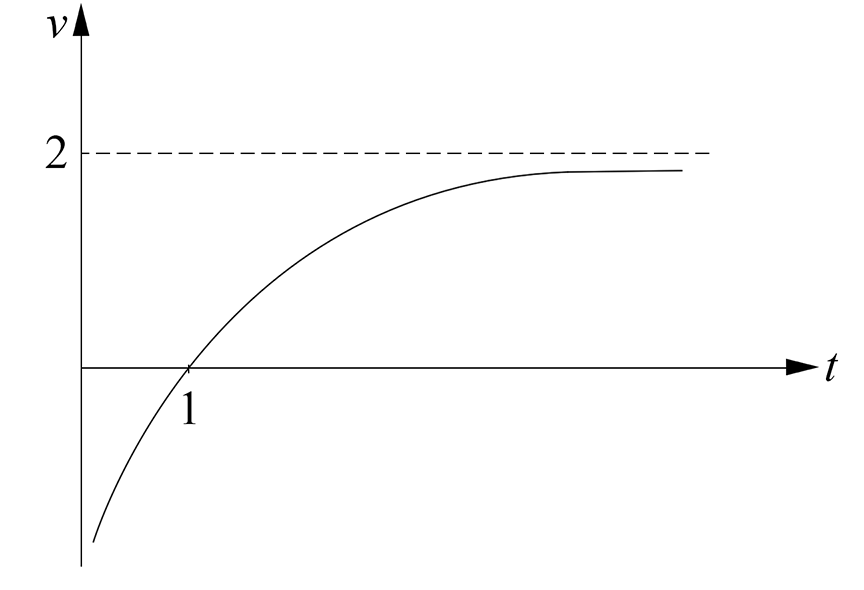
  3. By considering the behaviour of `v` for large `t`, sketch a graph of `v` against `t` for  `t >= 0`, showing any intercepts.   (2 marks)

    --- 4 WORK AREA LINES (style=lined) ---

  4. Find the exact distance travelled by the particle in the first 7 seconds.   (3 marks)

    --- 6 WORK AREA LINES (style=lined) ---

Show Answers Only

i.    `-2\ text(ms)^-1`

ii.   `1\ text(ms)^-2`

iii.
   hsc-2016-16ai

iv.   `10-4 ln 2\ \ text(metres)`

Show Worked Solution

i.    `text(Initial velocity when)\ \ t = 0`

Mean mark (i) 93%.
COMMENT: Great example of low hanging fruit late in the exam for students who progress efficiently.

`v = 2-4/1 =-2\ text(ms)^-1`
  

ii.    `v` `= 2-4/(t + 1)`
  `a` `=(dv)/(dt)= 4/(t + 1)^2`

  
`text(Particle is stationary when)\ \ v = 0,`

`2-4/(t + 1)` `= 0`
`2 (t + 1)` `= 4`
`t` `= 1`

  
`text(When)\ \ t=1,`

`:.a` `= 4/(1 + 1)^2`
  `= 1\ text(ms)^-2` 


iii.  `v = 2-4/(t + 1)`

♦ Mean mark (iii) 47%.

`text(As)\ \ t -> oo,\ \ \ 4/(t + 1) -> 0`

`:. v -> 2`

 hsc-2016-16ai


♦♦ Mean mark (iv) 26%.

iv.   `text(Distance travelled in 1st 7 seconds)`

`= |\ int_0^1 (2-4/(t + 1))\ dt\ | + int_1^7 (2-4/(t + 1))\ dt`

`= -[2t-4 ln (t + 1)]_0^1 + [2t-4 ln (t + 1)]_1^7`

`= -[(2-4 ln 2)-0] + [(14-4 ln 8)-(2-4 ln 2)]`

`= 4 ln 2-2 + 12-4 ln 2^3 + 4 ln 2`

`= 10 + 8 ln 2-12 ln 2`

`= 10-4 ln 2\ \ text(metres)`

Filed Under: Motion, Other Integration Applications, Rates of Change Tagged With: Band 2, Band 4, Band 5, smc-1213-10-Motion, smc-7135-10-Motion

Integration, EXT2 2016 HSC 14a

  1. Show that  `int sin^3 x\ dx = 1/3 cos^3 x - cos x + C.`  (1 mark)
  2. Using a graphical approach, or otherwise, explain why


    `int_0^pi cos^(2n - 1) x\ dx = 0`, for all positive integers `n.`  (1 mark)
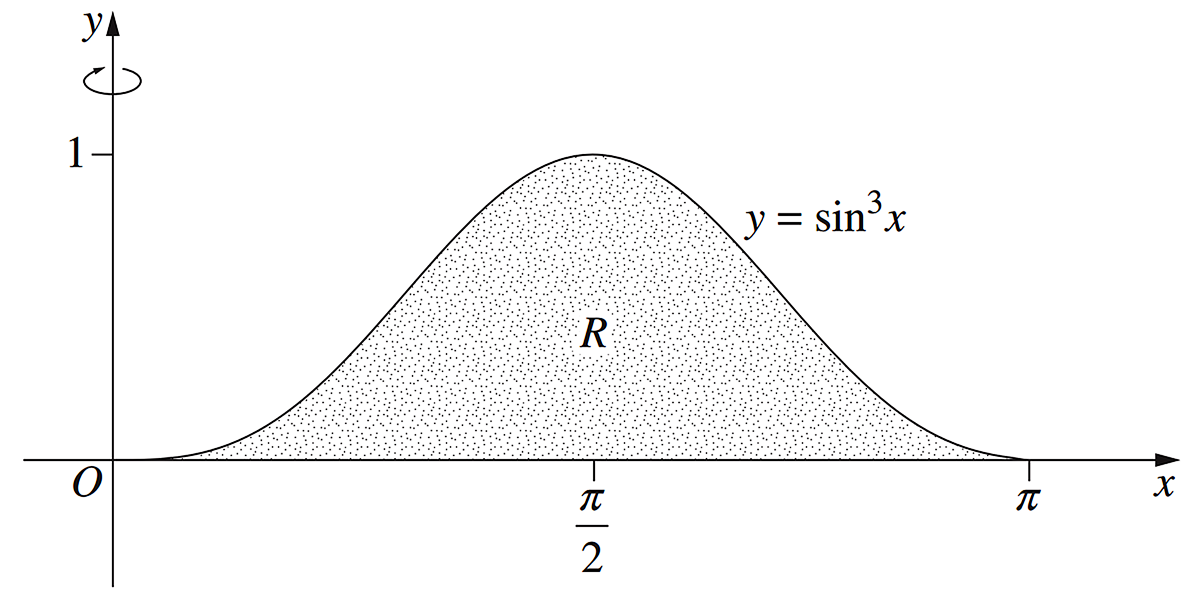
  3. The diagram shows the region `R` enclosed by `y = sin^3 x` and the `x`-axis for `0 <= x <= pi.`

    ext2-hsc-2016-14a


    Using the method of cylindrical shells and the results in parts (i) and (ii), find the exact volume of the solid formed when `R` is rotated about the `y`-axis.  (3 marks)

Show Answers Only
  1. `text(See Worked Solutions)`
  2. `text(See Worked Solutions)`
  3. `(4pi^2)/3 \ u^3`
Show Worked Solution
i.    `int sin^3x\ dx` `= int sinx(1 – cos^2x)dx`
    `= int sinx\ dx – int (sin x · cos^2 x)\ dx`
    `= −cos x + 1/3cos^3x – c\ \ …\ text(as required)`


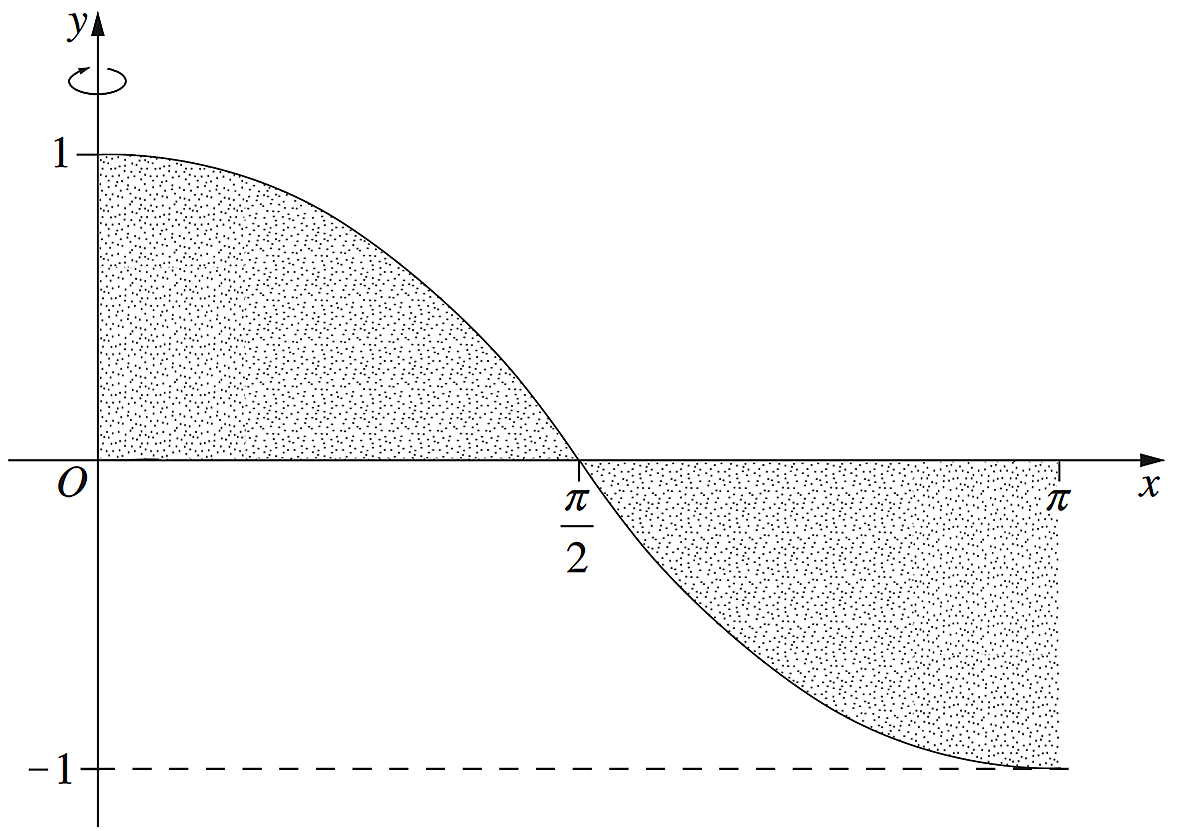
ii.   `int_0^pi cos^(2n – 1)x\ dx`

`text(Graphically, the integral can be represented)`

`text{below since (2n − 1) is always odd.}`
ext2-hsc-2016-14a-answer

`text(S)text(ince it is symmetrical about)\ \ x = pi/2,`

`int_0^pi cos^(2n – 1)x\ dx = 0`


iii.    `V` `= 2pi int_0^pi xy\ dx`
    `= 2pi int_0^pi (xsin^3x)\ dx`


`text(Using integration by parts:)`

`u` `= x` `du` `= dx`
`dv` `= sin^3x` `v` `= 1/3 cos^3x – cos x`


`I = [1/3 xcos^3x – xcosx]_0^pi – int_0^pi (1/3cos^3x – cosx)\ dx`

`text(S)text(ince)\ int_0^pi(1/3cos^3x – cosx)\ dx = 0\ \ text{(from part(ii)),}`

`I` `= [(1/3picos^3pi – picospi) – 0] – 0`
  `= (−pi/3 + pi)`
  `= (2pi)/3`


`:. V` `= 2pi · (2pi)/3`
  `= (4pi^2)/3 \ u^3`

Filed Under: Trig Integrals Tagged With: Band 2, Band 4

Functions, 2ADV F1 2016 HSC 12a*

The diagram shows points `A(1, 0), B(2, 4)` and `C(6, 1).` The point `D` lies on `BC` such that `AD _|_ BC.`
 

hsc-2016-12a
 

  1. Show that the equation of `BC` is  `3x + 4y-22 = 0`.   (2 marks)

    --- 6 WORK AREA LINES (style=lined) ---

  2. Determine the gradient of `AD`.   (1 mark)

    --- 3 WORK AREA LINES (style=lined) ---

--- 5 WORK AREA LINES (style=lined) ---

Show Answers Only

i.    `text(Proof)\ \ text{(See Worked Solutions)}`

ii.   `m_(AD)=4/3`

Show Worked Solution

i.    `B (2, 4),\ \ C (6, 1)`

`m_(BC) = (y_2-y_1)/(x_2-x_1) = (1-4)/(6-2) =-3/4`
 

`text(Equation of)\ \ BC,\ \ m=-3/4\ \ text(through)\ \ (2, 4):`

`y-y_1` `= m(x-x_1)`
`y-4` `=-3/4 (x-2)`
`4y-16` `= -3x + 6`
`3x + 4y-22` `= 0\ text(… as required.)`

 
ii.
   `\text{Perpendicular lines:}\ m_1 xx m_2 = -1`

`m_(BC) =-3/4\ \ =>\ \ m_(AD)=4/3\ (BC _|_ AD)`

Filed Under: 6. Linear Functions, Linear Functions, Linear Functions Tagged With: Band 2, smc-6214-02-Equation of Line, smc-6214-06-Perpendicular, smc-985-30-Coordinate Geometry

Conics, EXT2 2016 HSC 12d

  1. Show that the equation of the normal to the hyperbola `xy = c^2,\ \ c != 0`, at `P (cp, c/p)` is given by `px - y/p = c (p^2 - 1/p^2).`  (2 marks)
  2. The normal at `P` meets the hyperbola again at `Q (cq, c/q).`
    Show that
    `q = -1/p^3.`  (3 marks)
Show Answers Only
  1. `text(See Worked Solutions)`
  2. `text(See Worked Solutions)`
Show Worked Solution

i.   `xy = c^2, c != 0`

`y` `= (c^2)/x`
`yprime` `= −(c^2)/(x^2)`


`text(At)\ P(cp, c/p),`

`yprime = −(c^2)/((cp)^2) = −1/(p^2)`


`:. text(Normal has)\ \ m = p^2,\ text(through)\ P(cp,c/p)`

`y – c/p` `= p^2(x – cp)`
  `= p^2x – cp^3`
`p^2x – y` `= cp^3 – c/p`
`:. px – y/p` `= c(p^2 – 1/(p^2))\ …\ text(as required)`


ii.   `text(Intersection of normal and hyperbola:)`

`px – y/p` `= c(p^2 – 1/(p^2))\ …\ (1)`
`xy` `= c^2\ …\ (2)`


`text(Substitute)\ \ y = (c^2)/x\ text{from  (2)  into  (1)}`

`px – ((c^2)/x)/p` `= c(p^2 – 1/(p^2))`
`px – (c^2)/(px)` `= c(p^2 – 1/(p^2))`
`px^2 – (c^2)/p` `= c(p^2 – 1/(p^2))x`

`px^2 – c(p^2 – 1/(p^2))x – (c^2)/p = 0`

`text(Using)\ sum\ text(roots) = −b/a,`

`cp + cq` `= (c(p^2 – 1/(p^2)))/p`
`:. q` `= ((p^2 – 1/(p^2)))/p – p`
  `= (p^2)/p – 1/(p^3) – p`
  `= −1/(p^3)\ \ …\ text(as required.)`

Filed Under: Hyperbola Tagged With: Band 2, Band 4

Complex Numbers, EXT2 N2 2016 HSC 12c

Let  `z = cos theta + i sin theta.`

  1. By considering the real part of `z^4`, show that `cos 4 theta` is
  2. `qquad cos^4 theta-6 cos^2 theta sin^2 theta + sin^4 theta.`   (2 marks)
  3. Hence, or otherwise, find an expression for  `cos 4 theta`  involving only powers of `cos theta.`   (1 mark)

    --- 3 WORK AREA LINES (style=lined) ---

Show Answers Only

i.    `text(See Worked Solutions)`

ii.   `8cos^4theta-8cos^2theta + 1`

Show Worked Solution

i.   `z = costheta + isintheta`

`z^4` `= (costheta + isintheta)^4`
 

`= cos^4theta + 4cos^3theta*(isintheta) + 6cos^2theta*(isintheta)^2 +`

`4costheta*(isintheta)^3 + (isintheta)^4`


`= cos^4theta + 4icos^3thetasintheta-6cos^2thetasin^2theta -`

`4icosthetasin^3theta + sin^4theta`


`z^4 = cos4theta + isin4theta\ \ text{(by De Moivre)}`
 

`text(Equating real parts:)`

`cos4theta = cos^4theta-6cos^2thetasin^2theta + sin^4theta\ …\ text(as required)`


ii.    `cos4theta` `= cos^4theta-6cos^2theta(1-cos^2theta) + (1-cos^2theta)^2`
    `= cos^4theta-6cos^2theta + 6cos^4theta + 1-2cos^2theta + cos^4theta`
    `= 8cos^4theta-8cos^2theta + 1`

Filed Under: Powers and Roots, Powers and Roots, Solving Equations with Complex Numbers Tagged With: Band 2, Band 3, smc-1050-40-De Moivre and trig identities, smc-7430-30-De Moivre, smc-7430-55-Trig Identities

Conics, EXT2 2016 HSC 12a

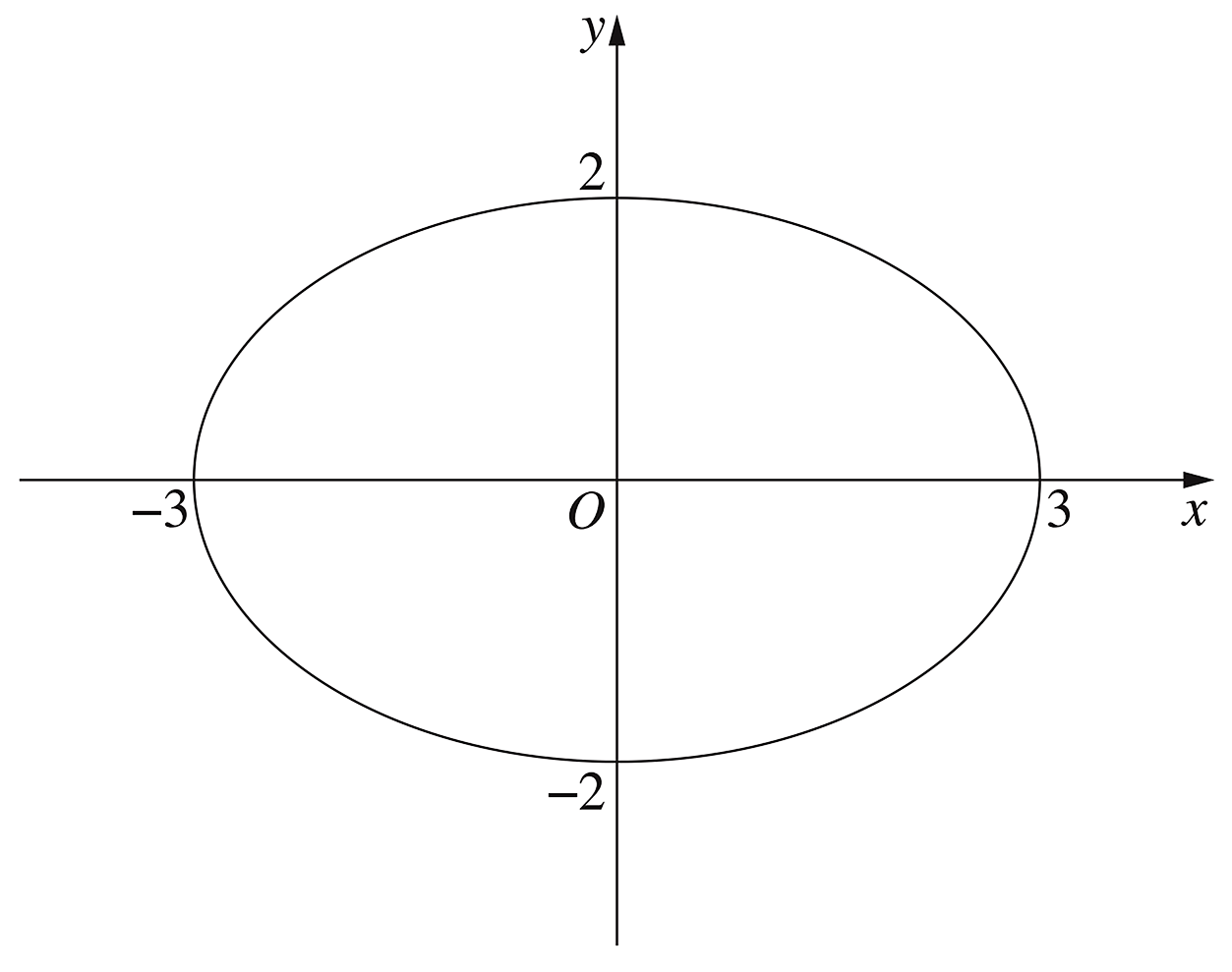
The diagram shows an ellipse.

ext2-hsc-2016-12a

  1. Write an equation for the ellipse.  (1 mark)
  2. Find the eccentricity of the ellipse.  (1 mark)
  3. Write the coordinates of the foci of the ellipse.  (1 mark)
  4. Write the equations of the directrices of the ellipse.  (1 mark)
Show Answers Only
  1. `(x^2)/9 + (y^2)/4 = 1`
  2. `sqrt5/3`
  3. `(−sqrt5,0)\ text(and)\ (sqrt5,0)`
  4. `x = −(9sqrt5)/5\ text(and)\ x = (9sqrt5)/5`
Show Worked Solution

i.   `(x^2)/9 + (y^2)/4 = 1`


ii.    `4` `= 9(1 – e^2)`
  `9e^2` `= 5`
  `e^2` `= 5/9`
  `:. e` `= sqrt5/3`


iii.   `text(Foci are)`

`(−sqrt5,0)\ text(and)\ (sqrt5,0)`


iv.   `text(Ellipse directrices:)`

`x = −(9sqrt5)/5\ \ text(and)\ \ x = (9sqrt5)/5`

Filed Under: Ellipse Tagged With: Band 1, Band 2, Band 3

Graphs, EXT2 2016 HSC 11c

Find  `(dy)/(dx)`  for the curve given by  `x^3 + y^3 = 2xy`, leaving your answer in terms of `x` and `y.`  (2 marks)

Show Answers Only

`(2y – 3x^2)/(3y^2 – 2x)`

Show Worked Solution

`x^3 + y^3 = 2xy`

`3x^2 + 3y^2 · dy/dx` `= 2y + 2x · dy/dx`
`3y^2 · dy/dx – 2x *dy/dx` `= 2y – 3x^2`
`dy/dx(3y^2 – 2x)` `= 2y – 3x^2`
`:. dy/dx` `= (2y – 3x^2)/(3y^2 – 2x)`

Filed Under: Implicit Differentiation Tagged With: Band 2

Complex Numbers, EXT2 N1 2016 HSC 11a

Let  `z = sqrt 3 - i.`

  1.  Express  `z`  in modulus-argument form.  (2 marks)

    --- 5 WORK AREA LINES (style=lined) ---

  2.  Show that  `z^6`  is real.  (1 mark)

    --- 2 WORK AREA LINES (style=lined) ---

  3.  Find a positive integer `n` such that  `z^n`  is purely imaginary.  (1 mark)

    --- 5 WORK AREA LINES (style=lined) ---

Show Answers Only
  1. `z = sqrt3 – i = 2 text(cis)((−pi)/6)`
  2. `text(Proof)\ \ text{(See Worked Solutions)}`
  3. `n = 3`
Show Worked Solution

i.   `z = sqrt3 – i`

`|\ z\ | = sqrt((sqrt3)^2 + 1^2) = 2`

`:. z = sqrt3 – i` `= 2(sqrt3/2 – 1/2 i)`
  `= 2(cos(− pi/6) + isin(− pi/6))`
  `= 2 text(cis)(− pi/6)`


ii.    `z^6` `= 2^6(cos(− pi/6) + isin(− pi/6))^6`
    `= 64\ text(cis)(−pi)quadquadtext{(by De Moivre)}`
    `= −64`

 
`:. z^6\ text(is real.)`


iii.   `z^n = 2^n (cos(−(npi)/6) + isin(−(npi)/6))`

`z^n\ text(is purely imaginary when:)`

`cos(−(npi)/6)=0`

`text(Or more generally,)`

`(npi)/6` `= pi/2 + kpi`
`n` `= 6k + 3,quad(k ∈ ZZ)`
`:.n` `=3,\ \ (n>0)`

Filed Under: Argand Diagrams and Mod/Arg form, Arithmetic and Complex Numbers, Powers and Roots Tagged With: Band 1, Band 2, Band 3

Measurement, STD2 M1 2016 HSC 26a

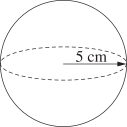
Calculate the surface area of a sphere with a radius of 5 cm, correct to the nearest whole number.   (1 mark)
 

--- 3 WORK AREA LINES (style=lined) ---

Show Answers Only

`314\ text{cm}^2`

Show Worked Solution

`SA= 4pir^2= 4 xx pi xx 5^2= 314.15…= 314\ text(cm)^2  text{(nearest cm}^2 text{)}`

Filed Under: Area and Surface Area, Areas and Volumes (Harder), Perimeter, Area and Volume, Surface Area, Surface Area Tagged With: Band 2, num-title-ct-pathb, num-title-qs-hsc, smc-4234-50-SA (sphere), smc-6484-20-Surface Area (Circular Measure), smc-6522-20-Surface Area (Circular Measure), smc-798-25-Surface Area

Algebra, STD2 A1 2016 HSC 2 MC

Which of the following equations has  `x = 5`  as the solution?
  1. `x - 5 = 10`
  2. `5 - x = 10`
  3. `x/2 = 10`
  4. `2x = 10`
Show Answers Only

`D`

Show Worked Solution
`2x` `= 10`
`:. x` `= 5`

 
`=> D`

Filed Under: AM1 - Algebra (Prelim), Substitution and Other Equations, Substitution and Other Equations, Substitution and Other Equations, Substitution and Other Equations Tagged With: Band 2, smc-1116-50-Other Equations, smc-6234-50-Other Equations, smc-6508-50-Other Equations, smc-789-50-Other Equations

  • « Previous Page
  • 1
  • …
  • 5
  • 6
  • 7
  • 8
  • 9
  • …
  • 11
  • Next Page »

Copyright © 2014–2026 SmarterEd.com.au · Log in