SmarterEd

Aussie Maths & Science Teachers: Save your time with SmarterEd

  • Login
  • Get Help
  • About

Probability, 2ADV S1 2007 HSC 9b

A pack of 52 cards consists of four suits with 13 cards in each suit.

  1. One card is drawn from the pack and kept on the table. A second card is drawn and placed beside it on the table. What is the probability that the second card is from a different suit to the first?  (1 mark)

    --- 3 WORK AREA LINES (style=lined) ---

  2. The two cards are replaced and the pack shuffled. Four cards are chosen from the pack and placed side by side on the table. What is the probability that these four cards are all from different suits?  (2 marks)

    --- 4 WORK AREA LINES (style=lined) ---

Show Answers Only
  1. `13/17`
  2. `0.105\ \ \ text{(to 3 d.p.)}`
Show Worked Solution

i.  `text(After 1st card is drawn)`

`text(# Cards left from another suit) = 39`

`text(# Cards left in pack) = 51`

`:. P\ text{(2nd card from a different suit)}`

`= 39/51`

`= 13/17`


ii.  `P\ text{(all 4 cards from different suits)}`

`= 52/52 xx 39/51 xx 26/50 xx 13/49`

`= 2197/(20\ 825)`

`= 0.1054…`

`= 0.105\ \ \ text{(to 3 d.p.)}`

Filed Under: 3. Probability, Multi-Stage Events (Adv-2027), Multi-Stage Events (Y11) Tagged With: Band 4, Band 5, smc-6469-20-Other Multi-Stage Events, smc-989-20-Other Multi-Stage Events

Calculus, EXT1* C3 2007 HSC 9a

2007 9a
  

The shaded region in the diagram is bounded by the curve  `y = x^2 + 1`, the `x`-axis, and the lines  `x = 0`  and  `x = 1.`

Find the volume of the solid of revolution formed when the shaded region is rotated about the `x`-axis.  (3 marks)

Show Answers Only

`(28 pi)/15\ \ text(u³)`

Show Worked Solution
`V` `= pi int_0^1 y^2\ dx`
  `= pi int_0^1 (x^2 + 1)^2\ dx`
  `= pi int_0^1 x^4 + 2x^2 + 1\ dx`
  `= pi [1/5 x^5 + 2/3 x^3 + x]_0^1`
  `= pi[(1/5 + 2/3 + 1) – 0]`
  `= pi [3/15 + 10/15 + 1]`
  `= (28 pi)/15\ \ text(u³)`

Filed Under: Further Area and Solids of Revolution (Ext1), Volumes of Solids of Rotation Tagged With: Band 3, Band 4, HSC, smc-1039-10-Polynomial, smc-1039-60-x-axis Rotation

Plane Geometry, 2UA 2007 HSC 8b

In the diagram, `AE` is parallel to `BD`, `AE = 27`, `CD = 8`, `BD = p`, `BE = q` and `/_ABE`, `/_BCD` and `/_BDE` are equal.

Copy or trace this diagram into your writing booklet.

  1. Prove  that `Delta ABE\ text(|||)\ Delta BCD`.  (2 marks)
  2. Prove  that `Delta EDB\ text(|||)\ Delta BCD`.  (2 marks)
  3. Show that `8`, `p`, `q`, `27` are the first four terms of a geometric series.  (1 mark)
  4. Hence find the values of `p` and `q`.  (2 marks)
Show Answers Only
  1. `text(Proof)\ \ text{(See Worked Solution)}`
  2. `text(Proof)\ \ text{(See Worked Solution)}`
  3. `text(Proof)\ \ text{(See Worked Solution)}`
  4. `p = 12, q = 18`
Show Worked Solution

(i)

`text(Prove)\ Delta ABE\ text(|||)\  Delta BCD`

`/_ ABE = /_ BCD\ \ \ text{(given)}`

`/_ EAB = /_ DBC\ \ \ text{(corresponding angles,}\ AE\ text(||)\ BD text{)}`

`:. Delta ABE\ text(|||)\ Delta BCD\ \ \ text{(equiangular)}`


(ii)  `text(Prove)\ Delta EDB\ text(|||)\ Delta BCD`

`/_ EDB = /_ BCD\ \ \ text{(given)}`

`/_ CDB = 180° – (/_ BCD + /_ DBC)\ \ \ text{(Angle sum of}\ Delta BCD text{)}`

`/_ EBD` `= 180° – (/_ ABE + /_ DBC)\ \ \ text{(}/_ ABC\ text{is a straight angle)}`
  `= 180° – (/_ BCD + /_ DBC)\ \ \ text{(}/_ ABE = /_ BCD,\ text{given)}`
  `= /_ CDB`

`:. Delta EDB\ text(|||)\ Delta BCD\ \ \ text{(equiangular)}`


(iii)  `text(In a GP,)\ \ r = T_n/T_(n-1)`

`text(If)\ \ \ 8, p, q, 27\ \ \ text(are 1st 4 terms of a GP)`

`=> p/8 = q/p = 27/q .`

`text(S)text(ince corresponding sides of similar)`

`text(triangles are in the same ratio)`

`(BD)/(DC) = (EB)/(BD) = (AE)/(EB)`

`p/8 = q/p = 27/q .`


`:. 8, p, q, 27\ \ text(are 1st 4 terms of a GP.)`


(iv)  `8, p, q, 27`

`a = 8`

`text(Using)\ \ T_n = ar^(n-1)`

`T_4=ar^3`

`27` `= 8 xx r^3`
`r^3` `= 27/8`
`r` `= 3/2`


`T_2` `=ar`
`:.p` `= 8 * 3/2`
  `= 12`


`T_3` `=ar^2`
`:.q` `= 8 * (3/2)^2`
  `= 18`

Filed Under: 2. Plane Geometry, Geometric Series Tagged With: Band 4, Band 5, HSC

Calculus, EXT1* C1 2007 HSC 8a

One model for the number of mobile phones in use worldwide is the exponential growth model,

`N = Ae^(kt)`,

where `N` is the estimate for the number of mobile phones in use (in millions), and `t` is the time in years after 1 January 2008.

  1. It is estimated that at the start of 2009, when  `t = 1`, there will be 1600 million mobile phones in use, while at the start of 2010, when  `t = 2`, there will be 2600 million. Find `A` and `k`.  (3 marks)

    --- 8 WORK AREA LINES (style=lined) ---

  2. According to the model, during which month and year will the number of mobile phones in use first exceed 4000 million?  (2 marks)

    --- 6 WORK AREA LINES (style=lined) ---

Show Answers Only
  1. `A = (12\ 800)/13, k = log_e\ 13/8`
  2. `text(November 2010)`
Show Worked Solution

i.  `N = Ae^(kt)`

`text(When)\ t = 1,\ N = 1600`

`:. 1600` `= Ae^k`
`A` `= 1600/e^k`

 
`text(When)\ t = 2, N = 2600`

`:. 2600` `= A e^(2k)`
  `= 1600/e^k xx e^(2k)`
  `= 1600 e^k`
`e^k` `= 2600/1600 = 13/8`
`log_e e^k` `= log_e\ 13/8`
`k` `= log_e\ 13/8`
  `=0.4855…`
  `=0.49\ \ \ text{(to 2 d.p.)}`


`:. A` `= 1600/(e^(log_e\ 13/8)`
  `= 1600/(13/8)`
  `= (12\ 800)/13`


ii.  `text(Find)\ \ t\ \ text(such that)\ N > 4000`

`(12\ 800)/13 xx e^(kt)` `> 4000`
`e^(kt)` `> (13 xx 4000)/(12\800)`
`log_e e^(kt)` `> log_e\ 65/16`
`kt` `> log_e\ 65/16\ \ \ \ (k = log_e\ 13/8)`
`t` `> (log_e\ 65/16)/(log_e\ 13/8`
`t` `> 2.887…\ \ text(years)`
  `>\ text{2 years and 10.6 months (approx)}`


`:.\ text(The number of mobile phones in use will exceed)`

`text(4000 million in November 2010.)`

Filed Under: Exponential growth and decay, Standard Growth and Decay Tagged With: Band 4, Band 5, smc-1081-10-Growth, smc-1081-50-Other Themes

Calculus, 2ADV C4 2007 HSC 7b

2ua 2007 7b
 

The diagram shows the graphs of  `y = sqrt 3 cos x`  and  `y = sin x`. The first two points of intersection to the right of the `y`-axis are labelled  `A`  and  `B`.

  1. Solve the equation  `sqrt 3 cos x = sin x`  to find the `x`-coordinates of  `A`  and  `B`.  (2 marks)

    --- 5 WORK AREA LINES (style=lined) ---

  2. Find the area of the shaded region in the diagram.  (3 marks)

    --- 7 WORK AREA LINES (style=lined) ---

Show Answers Only
  1. `pi/3, (4 pi)/3`
  2. `4\ text(u²)`
Show Worked Solution
i.  `sqrt 3 cos x` `= sin x`
`tan x` `= sqrt 3`


`text(S)text(ince)\ tan\ pi/3 = sqrt 3 and tan\ text(is)`

`text(positive in 1st/3rd quadrants:)`

`x` `= pi/3 , pi + pi/3`
  `= pi/3, (4 pi)/3`


`:. text(The)\ x text(-coordinates of)\ A and B`

`text(are)\ \ x = pi/3, (4 pi)/3.`


ii.  `text(Shaded Area)`

`= int_(pi/3)^((4 pi)/3) sin\ x\ dx – int_(pi/3)^((4 pi)/3) sqrt 3\ cos\ x\ dx`

`= int_(pi/3)^((4 pi)/3) sin\ x – sqrt 3\ cos\ x\ dx`

`= [-cos\ x – sqrt 3\ sin\ x]_(pi/3)^((4 pi)/3)`

`= [(-cos\ (4 pi)/3 – sqrt 3\ sin\ (4 pi)/3) – (-cos\ pi/3 – sqrt 3\ sin\ pi/3)]`

`= [(1/2 + sqrt 3 xx (sqrt 3)/2) – (- 1/2 – sqrt 3 xx (sqrt 3)/2)]`

`= [2 – (-2)]`

`= 4\ text(u²)`

Filed Under: Areas Under Curves, Areas Under Curves (Y12), Exact Trig Ratios and Other Identities Tagged With: Band 4, smc-975-50-Trig

Quadratic, 2UA 2007 HSC 7a

  1. Find the coordinates of the focus, `S`, of the parabola  `y = x^2 + 4`.  (2 marks)
  2. The graphs of  `y = x^2 + 4`  and the line  `y = x + k`  have only one point of intersection, `P`. Show that the `x`-coordinate of `P` satisfies.
    1. `x^2 - x + 4 - k = 0`.  (1 mark)
  3. Using the discriminant, or otherwise, find the value of `k`.  (1 mark)
  4. Find the coordinates of `P`.  (2 marks)
  5. Show that `SP` is parallel to the directrix of the parabola.  (1 mark)
Show Answers Only
  1. `(0, 4 1/4)`

  2. `text(Proof)\ \ text{(See Worked Solutions)}`

  3. `15/4`

  4. `(1/2, 4 1/4)`

  5. `text(Proof)\ \ text{(See Worked Solutions)}`
Show Worked Solution
(i)   `y` `= x^2 + 4`
`x^2` `= y – 4`

`text(Using)\ (x – x_0) = 4a (y – y_0)`

`x_0` `= 0`
`a` `= 1/4`
`y_0` `= 4`

`(x – 0) = 4 xx 1/4 xx (y – 4)`

`text(Vertex)` `= (0, 4)`
`:.\ text(Focus)` `= (0, 4 1/4)`


(ii)  `y` `= x^2 + 4` `\ \ …\ \ (1)`
`y` `= x + k` `\ \ …\ \ (2)`


`text(Solving simultaneously)`

`x^2 + 4` `= x + k`
`x^2 – x + 4 – k` `= 0`


(iii)  `text(If only 1 point of intersection,)`

`b^2 – 4ac` `= 0`
`(–1)^2 – 4 xx 1 xx (4 – k)` `= 0`
`1 – 16 + 4k` `= 0`
`4k` `= 15`
`k` `= 15/4`


(iv)  `text(Finding)\ \ P`

`x^2 – x + 4 – 15/4 = 0`

`x^2 – x + 1/4 = 0`

`(x – 1/2)^2 = 0`

`x = 1/2`

`text(When)\ x = 1/2`

`y` `= (1/2)^2 + 4`
  `= 4 1/4`

`:. P\ text(has coordinates)\ \  (1/2, 4 1/4)`


(v)  `text(Focus)\ (S)` `= (0, 4 1/4)`
`P` `= (1/2, 4 1/4)`


`:.\ text(S)text(ince)\ y text(-values are the same,)\ SP\ text(is parallel)`

`text(with the)\ x text(-axis.)`

`=>text(Directrix has the equation)\ \ y = 3 3/4`

`:. SP\ text(is parallel with the directrix.)`

Filed Under: The Parabola Tagged With: Band 3, Band 4, HSC

Calculus, 2ADV C3 2007 HSC 6b

Let  `f (x) =x^4 - 4x^3`.

  1. Find the coordinates of the points where the curve crosses the axes.  (2 marks)

    --- 4 WORK AREA LINES (style=lined) ---

  2. Find the coordinates of the stationary points and determine their nature.  (4 marks)

    --- 8 WORK AREA LINES (style=lined) ---

  3. Find the coordinates of the points of inflection.  (1 mark)

    --- 2 WORK AREA LINES (style=lined) ---

  4. Sketch the graph of  `y = f (x)`, indicating clearly the intercepts, stationary points and points of inflection.  (3 marks)

    --- 8 WORK AREA LINES (style=lined) ---

Show Answers Only
  1. `(0, 0)\ , \ (4, 0)`
  2. `text(Minimum S.P. at)\ (3,\ text(-27))`
  3. `(0, 0) and (2, 16)`
  4.  
Show Worked Solution

i.  `f (x) = x^4 – 4x^3`

`text(Cuts)\ x text(-axis when)\ f(x) = 0`

`x^4 – 4x` `= 0`
`x^3 (x – 4)` `= 0`

`x = 0 or 4`

`:. text(Cuts the)\ x text(-axis at)\ (0, 0)\ ,\ (4, 0)`


`text(Cuts the)\ y text(-axis when)\ x = 0`

`:. text(Cuts the)\ y text(-axis at)\ (0, 0)`


ii.   `f(x) = x^4 – 4x^3`

`f prime (x) = 4x^3 – 12x^2`

`f″ (x) = 12x^2 – 24x`


`text(S.P.’s when)\ f prime (x) = 0`

`4x^3 – 12x^2` `= 0`
`4x^2 (x – 3)` `= 0`

`x = 0 or 3`

`text(When)\ x = 0`

`f(0) = 0`

`f″(0) = 0`

`text(S)text(ince concavity changes, a P.I.)`

`text(occurs at)\ (0, 0)`


`text(When)\ x = 3`

`f (3)` `= 3^4 – 4 xx 3^3`
  `= -27`
`f″ (3)` `= 12 xx 3^2 – 24 xx 3`
  `= 36 > 0`


`:. text(Minimum S.P. at)\ (3,\ text(–27))`


iii.  `text(P.I. when)\ f″(x) = 0`

`12x^2 – 24x` `= 0`
`12x(x – 2)` `= 0`

`x = 0 or 2`

`text(P.I. at)\ (0, 0)\ \ \ text{(from(ii))}`


`text(When)\ x = 2`

`text(S)text(ince concavity changes, a P.I.)`

`text(occurs when)\ x = 2`

`f (2)` `= 2^4 – 4 xx 2^3`
  `= 16`


`:. text(P.I.’s at)\ (0, 0) and (2, 16)`


iv.

2UA HSC 2007 6b

Filed Under: Curve Sketching (Y12), Curve Sketching and The Primitive Function Tagged With: Band 3, Band 4, smc-969-20-Degree 4

L&E, 2ADV E1 2007 HSC 6a

Solve the following equation for `x`:

`2e^(2x)-e^x = 0`.   (2 marks)

--- 5 WORK AREA LINES (style=lined) ---

Show Answers Only

`x = ln\ 1/2`

Show Worked Solution

`text(Solution 1)`

`2e^(2x)-e^x = 0`

`text(Let)\ \ X = e^x:`

`2X^2-X` `= 0`
`X (2X-1)` `= 0`

 
`X = 0 or 1/2`

 
`text(When)\ e^x = 0\  =>\ text(no solution)`

`text(When)\ e^x = 1/2`

`ln e^x` `= ln\ 1/2`
`:. x` `= ln\ 1/2`


`text(Solution 2)`

`2e^(2x)-e^x` `=0`
`2e^(2x)` `=e^x`
`ln 2e^(2x)` `=ln e^x`
`ln 2 +ln e^(2x)` `=x`
`ln 2 + 2x` `=x`
`x` `=-ln2`
  `=ln\ 1/2`

Filed Under: Equations reducible to quadratics, Log/Index Laws and Equations (Adv-2027), Log/Index Laws and Equations (Y11), Log/Index laws and Other Equations Tagged With: Band 4, smc-6455-50-Exponential Equations, smc-6455-60-Quadratic Equations, smc-963-50-Exponential Equation, smc-963-60-Quadratic Equations

Calculus, EXT1* C1 2007 HSC 5b

A particle is moving on the `x`-axis and is initially at the origin. Its velocity, `v` metres per second, at time `t` seconds is given by

`v = (2t)/(16 + t^2).`

  1. What is the initial velocity of the particle?  (1 mark)

    --- 2 WORK AREA LINES (style=lined) ---

  2. Find an expression for the acceleration of the particle.  (2 marks)

    --- 4 WORK AREA LINES (style=lined) ---

  3. Find the time when the acceleration of the particle is zero.  (1 mark)

    --- 4 WORK AREA LINES (style=lined) ---

  4. Find the position of the particle when `t = 4`.  (3 marks)

    --- 8 WORK AREA LINES (style=lined) ---

Show Answers Only
  1. `0`
  2. `{2(16 – t^2)}/(16 + t^2)^2`
  3. `4\ text(seconds)`
  4. `log_e 2\ \ text(metres)`
Show Worked Solution

i.  `v = (2t)/(16 + t^2)`

`text(When)\ t` `= 0`
`v` `= 0`

`:.\ text(Initial velocity is 0.)`


ii.  `a = d/(dt) ((2t)/(16 + t^2))`
 

`text(Using quotient rule)`

`u` `= 2t` `v` `= 16 + t^2`
`u prime` `= 2` `v prime` `= 2t`
`(dv)/(dt)` `= (u prime v – uv prime)/v^2`
  `= {2(16 + t^2) – 2t * 2t}/(16 + t^2)^2`
  `= (32 + 2t^2 – 4t^2)/(16 + t^2)^2`
  `= {2(16 – t^2)}/(16 + t^2)^2`


iii.  `text(Find)\ t\ text(when)\ (dv)/(dt) = 0`

`{2 (16 – t^2)}/(16 + t^2)^2` `= 0`
`2 (16 – t^2)` `= 0`
`t^2` `= 16`
`t` `= 4\ ,\ t >= 0`


`:.\ text(The acceleration is zero when)`

`t = 4\ text(seconds.)`


iv.  `v = (2t)/(16 + t^2)`

`x` `= int v\ dt`
  `= int (2t)/(16 + t^2)`
  `= log_e (16 + t^2) + c`


`text(When)\ \ t = 0\ ,\ x = 0`

`0 = log_e (16 + 0) + c`

`c = -log_e 16`

`:. x = log_e(16 + t^2) – log_e 16`
 

`text(When)\ t = 4,`

`x` `= log_e (16 + 4^2) – log_e 16`
  `= log_e 32 – log_e 16`
  `= log_e (32/16)`
  `= log_e 2\ \ text(metres)`


`:.\ text(When)\ t = 4\ , \ text(the position of the)`

`text(particle is)\ log_e 2 \ text(metres.)`

Filed Under: Motion, Rates of Change with respect to time (Ext1) Tagged With: Band 3, Band 4, Band 5, smc-1077-10-Motion, smc-1077-50-Log Equation

Plane Geometry, 2UA 2007 HSC 5a

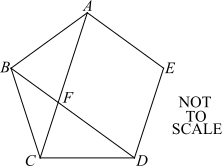
In the diagram, `ABCDE` is a regular pentagon. The diagonals `AC` and `BD` intersect at `F`.

Copy or trace this diagram into your writing booklet.

  1. Show that the size of `/_ABC` is `108°`.  (1 mark)
  2. Find the size of `/_BAC`. Give reasons for your answer.  (2 marks)
  3. By considering the sizes of angles, show that `Delta ABF` is isosceles.  (2 marks)
Show Answers Only
  1. `text(See Worked Solutions)`
  2. `36°`
  3. `text(See Worked Solutions)`
Show Worked Solution
(i)

`text(Sum of all internal angles`

`= (n – 2) xx 180°`

`= (5 – 2) xx 180°`

`= 540°`

`:. /_ABC` `= 540/5= 108°`


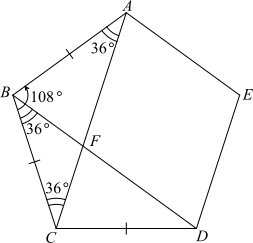
(ii)  `BA = BC`

`text{(equal sides of a regular pentagon)}`

`:. Delta BAC\ text(is isosceles)`

`/_BAC` `= 1/2 (180 – 108)\ \ \ text{(base angle of}\ Delta BAC text{)}`
  `= 36°`


(iii)  `text(Consider)\ Delta BCD and Delta ABC`

`BC = CD = BA`

`text{(equal sides of a regular pentagon)}`

`/_BCD = /_ABC = 108°`

`text{(internal angles of a regular pentagon)}`

`:. Delta BCD -= Delta ABC\ \ \ text{(SAS)}`

`:. CBF` `= 36°` `text{(corresponding angles in}`
     `text{congruent triangles)}`
`/_FBA` `= 108 – 36`
  `= 72°`
`/_BFA` `= 180 – (72 + 36)\ \ \ \ text{(angle sum of}\ Delta ABF text{)}`
  `= 72°`

`:. Delta ABF\ \ text(is isosceles.)`

Filed Under: 2. Plane Geometry Tagged With: Band 3, Band 4, HSC

Trigonometry, 2ADV T1 2007 HSC 4c

 
An advertising logo is formed from two circles, which intersect as shown in the diagram.

The circles intersect at `A` and `B` and have centres at `O` and `C`.

The radius of the circle centred at `O` is 1 metre and the radius of the circle centred at `C` is `sqrt 3` metres. The length of `OC` is 2 metres.

  1. Use Pythagoras’ theorem to show that  `/_OAC = pi/2`.  (1 mark)

    --- 2 WORK AREA LINES (style=lined) ---

  2. Find  `/_ ACO`  and  `/_ AOC`.  (2 marks)

    --- 4 WORK AREA LINES (style=lined) ---

  3. Find the area of the quadrilateral  `AOBC`.  (1 mark)

    --- 2 WORK AREA LINES (style=lined) ---

  4. Find the area of the major sector  `ACB`.  (1 mark)

    --- 2 WORK AREA LINES (style=lined) ---

  5. Find the total area of the logo (the sum of all the shaded areas).  (2 marks)

    --- 4 WORK AREA LINES (style=lined) ---
Show Answers Only
  1. `text(Proof)\ \ text{(See Worked Solutions)}`
  2. `/_ ACO = pi/6\ ,\ /_ AOC = pi/3`
  3. `sqrt 3\ \ text(m²)`
  4. `(5 pi)/2\ text(m²)`
  5. `((19 pi + 6 sqrt 3)/6)\ text(m²)`
Show Worked Solution

i.

`text(In)\ Delta AOC`

`AO^2 + AC^2` `= 1^2 + sqrt 3^2`
  `=1 + 3`
  `= 4`
  `= OC^2`

 
`:. Delta AOC\ \ text(is right-angled and)\ \ /_OAC = pi/2`


ii.  `sin\  /_ACO` `= 1/2`
`:. /_ACO` `= pi/6`
`sin\  /_AOC` `= sqrt 3/2`
`:. /_AOC` `= pi/3`


iii.  `text(Area)\ AOBC`

`= 2 xx text(Area)\ Delta AOC`

`= 2 xx 1/2 xx b xx h`

`= 2 xx 1/2 xx 1 xx sqrt 3`

`= sqrt 3\ \ text(m²)`


iv.  `/_ACB = pi/6 + pi/6 = pi/3`

`:. /_ACB\ text{(reflex)}` `= 2 pi – pi/3`
  `= (5 pi)/3`

 
`text(Area of major sector)\ ACB`

`= theta/(2 pi) xx pi r^2`

`= {(5 pi)/3}/(2 pi) xx pi(sqrt 3)^2`

`= (5 pi)/6 xx 3`

`= (5 pi)/2\ text(m²)`


v.  `/_AOB = pi/3 + pi/3 = (2 pi)/3`

`:. /_AOB\ text{(reflex)}` `= 2 pi – (2 pi)/3`
  `= (4 pi)/3`

`text(Area of major sector)\ AOB`

`= {(4 pi)/3}/(2 pi) xx pi xx 1^2`

`= (2 pi)/3\ text(m²)`


`:.\ text(Total area of the logo)`

`= (5 pi)/2 + (2 pi)/3 + text(Area)\ AOBC`

`= (15 pi + 4 pi)/6 + sqrt 3`

`= ((19 pi + 6 sqrt 3)/6)\ text(m²)`

Filed Under: Circular Measure, Circular Measure (Adv-2027), Circular Measure (Y11), Sine and Cosine Rules, Bearings, Trig Ratios, Sine and Cosine Rules (Adv-2027), Trig Ratios, Sine and Cosine Rules (Y11) Tagged With: Band 3, Band 4, Band 5, page-break-before-solution, smc-6392-10-Pythagoras, smc-6392-20-Trig Ratios, smc-6394-30-Area - Other, smc-978-30-Area - Other, smc-980-10-Pythagoras, smc-980-20-Trig Ratios

Probability, 2ADV S1 2007 HSC 4b

Two ordinary dice are rolled. The score is the sum of the numbers on the top faces.

  1. What is the probability that the score is 10?  (2 marks)

    --- 4 WORK AREA LINES (style=lined) ---
  2. What is the probability that the score is not 10?  (1 mark)

    --- 2 WORK AREA LINES (style=lined) ---

Show Answers Only
  1. `1/12`
  2. `11/12`
Show Worked Solution
i. 2UA HSC 2007 4b

`text{P (score = 10)}`

`= 3/36`

`= 1/12`


ii.  `text{P (score is not ten)}`

`= 1 – text{P (score is ten)}`

`= 1 – 1/12`

`= 11/12`

Filed Under: 3. Probability, Multi-Stage Events (Adv-2027), Multi-Stage Events (Y11) Tagged With: Band 3, Band 4, smc-6469-30-Complementary Probability, smc-6469-40-Arrays, smc-989-30-Complementary Probability, smc-989-40-Arrays

Geometry and Calculus, EXT1 2005 HSC 7b

Let  `f(x) = Ax^3 - Ax + 1`,  where  `A > 0`.

  1. Show that  `f(x)`  has stationary points at
    1. `x = +- (sqrt 3)/3.`  (1 mark)

  2. Show that  `f(x)`  has exactly one zero when
    1. `A < (3 sqrt 3)/2.`  (2 marks)

  3. By observing that  `f(-1) = 1`, deduce that  `f(x)`  does not have a zero in the interval  `-1 <= x <= 1`  when
    1. `0 < A < (3 sqrt 3)/2.`  (1 mark)

  4. Let  `g(theta) = 2 cos theta + tan theta`,  where  `-pi/2 < theta < pi/2.`
  5. By calculating  `g prime (theta)`  and applying the result in part (iii), or otherwise, show that  `g(theta)`  does not have any stationary points.  (3 marks)
  6. Hence, or otherwise, deduce that  `g(theta)`  has an inverse function.  (1 mark)
Show Answers Only
  1. `text(Proof)\ \ text{(See Worked Solutions)}`
  2. `text(Proof)\ \ text{(See Worked Solutions)}`
  3. `text(Proof)\ \ text{(See Worked Solutions)}`
  4. `text(Proof)\ \ text{(See Worked Solutions)}`
  5. `text(Proof)\ \ text{(See Worked Solutions)}`
Show Worked Solution

(i)   `f(x) = Ax^3 – Ax + 1\ \ ,\ \ \ A > 0`

`f prime (x) = 3Ax^2 – A`

`text(S.P.’s when)\ \ f prime (x) = 0`

`3Ax^2 – A` `= 0`
`A (3x^2 – 1)` `= 0`
`3x^2` `= 1`
`x^2` `= 1/3`
`x` `= +- 1/sqrt3 xx (sqrt 3)/(sqrt 3)`
  `= +- (sqrt 3)/3\ \ text(…  as required)`


(ii)   `text(Consider)\ \ f(x)\ \ text(with only 1 zero.)`

`f(0) = 1`

`:.\ f(x)\ \ text(passes through)\ \ (0, 1)\ \ text(and has)`

`text(turning points either side at)\ \ x = +- (sqrt 3)/3.`


`text(Given 1 zero)`

`=> f((sqrt 3)/3) > 0`

`A ((sqrt 3)/3)^3 – A ((sqrt 3)/3) + 1` `> 0`
`A((3 sqrt 3)/27) – A ((9 sqrt 3)/27)` `> -1`
`A ((-6 sqrt 3)/27)` `> -1`
`A` `< 27/(6 sqrt 3)`
`A` `< 9/(2 sqrt 3) xx (sqrt 3)/(sqrt 3)`
`A` `< (9 sqrt 3)/6`
 `A` `< (3 sqrt 3)/2\ \ text(…  as required.)`


(iii)  `text(S)text(ince 1 zero occurs when)\ \ A < (3 sqrt 3)/2\ \ text{(part (ii))}`

`=> text(Minimum TP when)\ \ x = (sqrt3)/3`

`=> text(Maximum TP when)\ \ x = -(sqrt 3)/3\ \ text{(see graph)}`


`text(S)text(ince)\ \ f(-1) = 1`

`:. f(x)\ \ text(cannot have a zero for)\ \ \ -1 <= x <= 1`


(iv)   `g(theta) = 2 cos theta + tan theta,\ \ \ \ \ \ -pi/2 < theta < pi/2`

`g prime (theta) = -2 sin theta + sec^2 theta`


`text(S.P.’s when)\ \ g prime (theta) = 0`

`-2 sin theta + sec^2 theta` `= 0`
`-2 sin theta + 1/(cos^2 theta)` `= 0`
`-2 sin theta + 1/((1 – sin^2 theta))` `= 0`
`(-2 sin theta (1 – sin^2 theta) + 1)/((1 – sin^2 theta))` `= 0`
`-2 sin theta (1 – sin^2 theta) + 1` `= 0`
 `-2 sin theta + 2 sin^3 theta + 1` `= 0`
 `2 sin^3 theta – 2 sin theta + 1` `= 0\ \ text(…  (1))`


`text(Let)\ \ x = sin theta and A = 2`

`text{Equation (1) becomes}`

`Ax^3 – 2x + 1 = 0`

`text(S)text(ince)\ \ A = 2`

`0 < A < (3 sqrt 3)/2`

`text(S)text(ince)\ -pi/2` `< \ \ \ theta` `< pi/2`
`-1` `< sin theta` `< 1`
`-1` `< \ \ \ x` `< 1`


`:.\ text{Using Part (iii)} => g prime (theta)\ \ text(has no zeros and)`

`text(therefore)\ \ g (theta)\ \ text(has no S.P.’s for)\ \ -pi/2 < theta < pi/2.`


(v)   `text(Given)\ \ g(theta)\ \ text(has no stationary points, it will be)`

`text(either an increasing or decreasing function in the)`

`text(range)\ \ (-pi)/2 < theta < pi/2\ \ text(and therefore it has an inverse)`

`text(function.)`

Filed Under: 10. Geometrical Applications of Calculus EXT1 Tagged With: Band 4, Band 5, Band 6

Quadratic, 2UA 2005 HSC 10a

2005 10a

The parabola  `y = x^2`  and the line  `y = mx + b`  intersect at the points  `A(α,α^2)`  and  `B(β, β^2)`  as shown in the diagram.

  1. Explain why  `α + β = m`  and  `αβ = –b`.  (1 mark)
  2. Given that
  3. `(α − β)^2 + (α^2 − β^2)^2 = (α − β)^2[1 + (α + β)^2]`, show that the distance  `AB = sqrt((m^2 + 4b)(1 + m^2)).`  (2 marks)
  4. The point  `P(x, x^2)`  lies on the parabola between  `A`  and  `B`. Show that the area of the triangle  `ABP`  is given by  `1/2(mx − x^2 + b)sqrt(m^2 + 4b).`  (2 marks)
  5.  
  6. The point  `P`  in part (iii) is chosen so that the area of the triangle  `ABP`  is a maximum.
  7. Find the coordinates of  `P`  in terms of  `m`.  (2 marks)
  8.  
Show Answers Only
  1. `text(See Worked Solutions)`
  2. `text(See Worked Solutions)`
  3. `text(See Worked Solutions)`
  4. `P(m/2, m^2/4)`
Show Worked Solution

(i)   `text(Instersection)`

`y = x^2` `\ \ …\ (1)`
`y = mx + b` `\ \ …\ (2)`

`text(Substitute)\ y = x^2\ text(into)\ \ (2)`

`x^2 = mx + b`

`x^2 − mx − b = 0`

`text(We know the intersection occurs when)`

`x = α\ \ text(and)\ \ x = β`

`:.α\ \ text(and)\ \ β\ \ text(are roots of)\ \ x^2 − mx − b = 0`

`:.α + β` `= (−b)/a` `= m`  
`αβ` `= c/a` `= −b` `\ \ …text(as required)`


(ii)   `A(α, α^2),\ \ B(β, β^2)`

`AB` `= sqrt((α − β)^2 + (α^2 − β^2)^2)`
  `= sqrt((α − β)^2[1 + (α + β)^2])`
  `= sqrt([(α + β)^2 − 4αβ][1 + (α + β)^2])`
  `= sqrt([m^2 − 4(−b)][1 + m^2])`
  `= sqrt((m^2 + 4b)(1 + m^2))\ \ …text(as required)`


(iii) `⊥\ text(distance of)\ \ (x, x^2)\ \ text(from)\ \ \ y=mx+b`

`text(i.e.)\ \ mx – y+b=0`

`= |(ax_1 + by_1 + c)/(sqrt(a^2 + b^2))|`

`= |(mx − 1(x^2) + b)/(sqrt(m^2 + (−1)^2))|`

`= |(mx − x^2 + b)/(sqrt(m^2 + 1))|`


`text(Area of)\ ΔABP`

`= 1/2 xx AB xx h`

`= 1/2 xx sqrt((m^2 + 4b)(1 + m^2)) xx (mx − x^2 + b)/(sqrt(m^2 + 1))`

`= 1/2 (mx − x^2 + b)sqrt(m^2 + 4b)`


(iv) `A` `= 1/2 sqrt(m^2 + 4b)(mx − x^2 + b)`
  `(dA)/(dx)` `= 1/2 sqrt(m^2 + 4b)(m − 2x)` 
  `(d^2A)/(dx^2)` `= 1/2 sqrt(m^2 + 4b)(−2)`
    `= −sqrt(m^2 + 4b)` 


`text(Max or min when)\ (dA)/(dx) = 0`

`1/2sqrt(m^2 + 4b)(m − 2x)` `= 0`
`m-2x` `=0`
`2x` `= m`
`x` ` = m/2`

`text(When)\ x = 2`

`(d^2A)/(dx^2) = −sqrt(m^2 + 4b) < 0\ \ \ text{(constant)}`

`:.\ text(Maximum when)\ x = m/2`

`:.P\ text(is)\ (m/2, m^2/4)` 

Filed Under: Maxima and Minima, The Parabola Tagged With: Band 4, Band 5, Band 6

Mechanics, EXT2* M1 2015 HSC 14b

A particle is moving horizontally. Initially the particle is at the origin `O` moving with velocity `1 text(ms)^(−1)`.

The acceleration of the particle is given by  `ddot x = x − 1`, where `x` is its displacement at time  `t`.

  1. Show that the velocity of the particle is given by  `dot x = 1 − x`.  (3 marks)

    --- 10 WORK AREA LINES (style=lined) ---

  2. Find an expression for `x` as a function of `t`.  (2 marks)

    --- 8 WORK AREA LINES (style=lined) ---

  3. Find the limiting position of the particle.  (1 mark)

    --- 3 WORK AREA LINES (style=lined) ---

Show Answers Only
  1. `text(See Worked Solutions.)`
  2. `x = 1 − e^(-t)`
  3. `x = 1`
Show Worked Solution

i.   `ddot x = d/(dx)(1/2 v^2) = x − 1`

`1/2 v^2` `= int ddot x\ dx`
  `= int x − 1\ dx`
  `= 1/2x^2 − x + c`

 
`text(When)\ \ x = 0, \ v = 1:`

`1/2·1^2` `= 0 − 0 + c`
`c` `= 1/2`


`:.1/2  v^2` `= 1/2x^2 − x + 1/2`
`v^2` `= x^2 − 2x + 1`
  `= (x − 1)^2`
`:.dot x` `= ±(x − 1)`

 
`text(S)text(ince)\ \ dotx = 1\ \ text(when)\ \ x = 0,`

`dot x = 1 − x\ \ …\ text(as required)`


ii.   `(dx)/(dt)` `= 1 − x\ \ \ text{(from (i))}`
  `(dt)/(dx)` `= 1/(1 − x)`
  `t` `= int 1/(1 − x)\ dx`
    `= -ln(1 − x) + c`


`text(When)\ \ t = 0, x = 0:`

♦ Mean mark 49%.
`0` `= -ln1 + c`
`:.c` `= 0`
`t` `= -ln(1 − x)`
`-t` `= ln(1 − x)`
`1 − x` `= e^(-t)`
`:.x` `= 1 − e^(-t)`


♦ Mean mark 42%.
iii.   `text(As)\ t` `→ ∞`
  `e^(-t)` `→ 0`
  `x` `→ 1`


`:.\ text(Limiting position is)\ \ x = 1`

Filed Under: Motion Without Resistance, Other Motion EXT1 Tagged With: Band 4, Band 5, smc-1060-02-Motion as f(x), smc-1060-10-Polynomial

Calculus, EXT1 C2 2015 HSC 13d

Let  `f(x) = cos^(-1)\ (x) + cos^(-1)\ (-x)`, where  `-1 ≤ x ≤ 1`.

  1. By considering the derivative of  `f(x)`, prove that  `f(x)`  is constant.  (2 marks)

    --- 4 WORK AREA LINES (style=lined) ---

  2. Hence deduce that  `cos^(-1)\ (-x) = pi - cos^(-1)\ (x)`.  (1 mark)

    --- 4 WORK AREA LINES (style=lined) ---

Show Answers Only
  1. `text(See Worked Solutions.)`
  2. `text(See Worked Solutions.)`
Show Worked Solution

i.  `text(Prove)\ f(x)\ text(is a constant)`

`f(x)` `= cos^(-1)(x) + cos^(-1)(-x), \ \ -1 ≤ x ≤ 1`
`f′(x)` `= (-1)/sqrt(1 – x^2) + (-1)/sqrt(1 -(-x)^2) xx d/(dx) (-x)`
  `= (-1)/sqrt(1 – x^2) + 1/sqrt(1 – x^2)`
  `= 0`

 
`:.\ text(S)text(ince)\ \ f′(x) = 0,  f(x)\ text(must be a constant.)`
 

♦ Mean mark 35%.
ii.   `f(0)` `= cos^(−1)(0) + cos^(−1)(0)`
    `= pi/2 + pi/2`
    `= pi`

 
`:.f(x) = pi`

`pi = cos^(−1)(x) + cos^(−1)(−x)`

`:.cos^(−1)(−x) = pi – cos^(−1)(x)\ \ …text(as required)`

Filed Under: Inverse Functions Calculus (Ext1), Inverse Trig Functions EXT1 Tagged With: Band 4, Band 5, smc-1037-10-Sin/Cos Differentiation

Financial Maths, 2ADV M1 2007 HSC 3b

Heather decides to swim every day to improve her fitness level.

On the first day she swims 750 metres, and on each day after that she swims `100` metres more than the previous day. That is, she swims 850 metres on the second day, 950 metres on the third day and so on.

  1. Write down a formula for the distance she swims on the `n`th day.  (1 mark)

    --- 2 WORK AREA LINES (style=lined) ---

  2. How far does she swim on the 10th day?  (1 mark)

    --- 1 WORK AREA LINES (style=lined) ---

  3. What is the total distance she swims in the first 10 days?  (1 mark)

    --- 2 WORK AREA LINES (style=lined) ---

  4. After how many days does the total distance she has swum equal the width of the English Channel, a distance of 34 kilometres?  (2 marks)

    --- 5 WORK AREA LINES (style=lined) ---

Show Answers Only
  1. `T_n = 650 + 100n`
  2. `1650\ text(metres)`
  3. `12\ text(km)`
  4. `34\ text(km)`
Show Worked Solution
i.  `T_1` `= 750`
`T_2` `= 850`

`=>  text(AP)\ text(where)\ a = 750\ ,\ d = 100`

`:. T_n` `= a + (n-1) d`
  `= 750 + (n – 1) 100`
  `= 750 + 100n – 100`
  `= 650 + 100n`


ii.  `T_10` `= 650 + 100 xx 10`
  `= 1650\ text(metres)`


`:.\ text(She swims 1650 metres on the 10th day.)`


iii.  `S_n = n/2 [2a + (n – 1) d]`

`:. S_10` `= 10/2 [2 xx 750 + (10 -1) 100]`
  `= 5 [1500 + 900]`
  `= 12\ 000`


`:.\ text(She swims 12 km in the first 10 days.)`


iv.  `text(Find)\ n\ text(such that)\ S_n = 34\ text(km)`

`n/2 [2 xx 750 + (n – 1) 100]` `= 34\ 000`
`n/2 [1500 + 100n – 100]` `= 34\ 000`
`n/2 [1400 + 100n]` `= 34\ 000`
`700n + 50n^2` `= 34\ 000`
`50 n^2 + 700n – 34\ 000` `= 0`
`50 (n^2 + 14 n – 680)` `= 0`


`text(Using the quadratic formula)`

`n` `= {-b +- sqrt(b^2 – 4ac)}/(2a)`
  `= {-14 +- sqrt(14^2 – 4 xx 1 xx (-680))}/(2 xx 1)`
  `= (-14 +- sqrt 2916)/2`
  `= (-14 +- 54)/2`
  `= 20 or -34`
  `= 20\ ,\ n > 0`


`:.\ text(Her total distance equals 34 km after 20 days.)`

Filed Under: Arithmetic Series, Arithmetic Series (Y12) Tagged With: Band 3, Band 4, smc-1005-10-Find Term, smc-1005-20-Find Sum, smc-1005-70-Applied Context

Calculus, 2ADV C3 2007 HSC 2c

The point  `P (pi, 0)`  lies on the curve  `y = x sinx`. Find the equation of the tangent to the curve at  `P`.  (3 marks)

--- 6 WORK AREA LINES (style=lined) ---

Show Answers Only

`y = – pi x + pi^2`

Show Worked Solution

`y = x sin x`

`(dy)/(dx)` `= x xx d/(dx) (sin x) + d/(dx) x xx sin x`
  `= x  cos x + sin x`

 
`text(When)\ \ x = pi`

`(dy)/(dx)` `= pi xx cos pi + sin pi`
  `= pi (-1) + 0`
  `= – pi`

 
`text(Equation of line,)\ \ m = – pi,\ text(through)\ P(pi, 0):`

`y – y_1` `= m(x – x_1)`
`y – 0` `= – pi(x – pi)`
`:. y` `= – pi x + pi^2`

Filed Under: Differentiation and Integration, Tangents (Y12), Tangents and Normals Tagged With: Band 3, Band 4, smc-1090-30-Trig Function, smc-1090-40-Find tangent given curve

Calculus, 2ADV C4 2007 HSC 2bii

Evaluate  `int_1^4 8/x^2\ dx`.  (3 marks)

Show Answers Only

`6`

Show Worked Solution

`int_1^4 8/x^2\ dx`

`= 8 int_1^4 x^-2\ dx` 

`= 8[-1/x]_1^4`

`= 8[(-1/4) – (-1/1)]`

`= 8(3/4)`

`= 6`

Filed Under: Integrals, Standard Integration Tagged With: Band 3, Band 4, smc-1202-20-Definite Integrals

Calculus, 2ADV C4 2007 HSC 2bi

Find  `int (1 + cos 3x)\ dx`.  (2 marks)

Show Answers Only

`x + 1/3 sin 3x + C`

Show Worked Solution

`int (1 + cos 3x)\ dx`

`= x + 1/3 sin 3x + C`

Filed Under: Differentiation and Integration, Integrals, Trig Integration Tagged With: Band 3, Band 4, smc-1204-20-Cos

Combinatorics, EXT1 A1 2015 HSC 13b

Consider the binomial expansion
 

`(2x + 1/(3x))^18 = a_0x^(18) + a_1x^(16) + a_2x^(14) + …`
 

where `a_0, a_1, a_2`, . . . are constants.

  1. Find an expression for `a_2`.  (2 marks)

    --- 6 WORK AREA LINES (style=lined) ---

  2. Find an expression for the term independent of `x`.  (2 marks)

    --- 4 WORK AREA LINES (style=lined) ---
Show Answers Only
  1. `(\ ^18C_2 · 2^(16))/(3^2)`
  2. `(\ ^(18)C_9 · 2^9)/(3^9)`
Show Worked Solution

i.   `text(Need co-efficient of)\ x^(14)`

`text(General term of)\ (2x + 1/(3x))^(18)`

`T_k` `= \ ^(18)C_k(2x)^(18 − k) · (1/(3x))^k`
  `= \ ^(18)C_k · 2^(18 − k) · x^(18 − k) · 3^(−k) · x^(−k)`
  `= \ ^(18)C_k · 2^(18 − k) · 3^(−k) · x^(18 − 2k)`


`a_2\ text(occurs when:)`

`18 − 2k` `= 14`
`2k` `= 4`
`k` `= 2`


`:.a_2` `= \ ^(18)C_2 · 2^(18 − 2) · 3^(−2)`
  `= (\ ^(18)C_2 · 2^(16))/(3^2)`


ii.  `text(Independent term occurs when:)`

`18 − 2k` `= 0`
`2k` `= 18`
`k` `= 9`

 
`:.\ text(Independent term)`

`= \ ^(18)C_9 · 2^(18− 9) · 3^(−9)`

`= (\ ^(18)C_9 · 2^9)/(3^9)`

Filed Under: 17. Binomial EXT1, Binomial Expansion (Ext1) Tagged With: Band 3, Band 4, smc-1088-10-Coefficients, smc-1088-20-Independent Term

Mechanics, EXT2* M1 2015 HSC 13a

A particle is moving along the `x`-axis in simple harmonic motion. The displacement of the particle is `x` metres and its velocity is `v` ms`\ ^(–1)`. The parabola below shows `v^2` as a function of `x`.

2015 13a

  1. For what value(s) of `x` is the particle at rest?  (1 mark)

    --- 2 WORK AREA LINES (style=lined) ---

  2. What is the maximum speed of the particle?  (1 mark)

    --- 2 WORK AREA LINES (style=lined) ---

  3. The velocity `v` of the particle is given by the equation

         `v^2 = n^2(a^2 − (x −c)^2)`  where `a`, `c` and `n` are positive constants.


    What are the values of `a`, `c` and `n`?  (3 marks)

    --- 6 WORK AREA LINES (style=lined) ---

Show Answers Only
  1. `3\ text(or)\ 7`
  2. `V = sqrt11\ text(m/s)`
  3. `a = 2, c = 5,`
  4. `n = (sqrt11)/2`
Show Worked Solution

i.   `text(Particle is at rest when)\ v^2 = 0`

`:. x = 3\ \ text(or)\ \ 7`


ii.   `text(Maximum speed occurs when)`

`v^2` `= 11`
`v` `= sqrt11\ text(m/s)`


iii.  `v^2 = n^2(a^2 − (x − c)^2)`

♦ Mean mark 41%.

`text(Amplitude) = 2`

`:.a = 2`

`text(Centre of motion when)\ x = 5`

`:.c = 5`

`text(S)text(ince)\ \ v^2 = 11\ \ text(when)\ \ x = 5`

`11` `= n^2(2^2 − (5 − 5)^2)`
  `= 4n^2`
`n^2` `= 11/4`
`:.n`  `= sqrt11/2`

Filed Under: Simple Harmonic Motion, Simple Harmonic Motion EXT1 Tagged With: Band 3, Band 4, Band 5, smc-1059-10-Amplitude / Period, smc-1059-20-Prove/Identify SHM, smc-1059-30-At Rest, smc-1059-31-Max Speed

Trig Ratios, EXT1 2015 HSC 12d

A kitchen bench is in the shape of a segment of a circle. The segment is bounded by an arc of length 200 cm and a chord of length 160 cm. The radius of the circle is `r` cm and the chord subtends an angle `theta` at the centre `O` of the circle.
 

2015 12d
 

  1. Show that  `160^2 = 2r^2 (1 - cos\ theta)`.  (1 mark)
  2. Hence, or otherwise, show that  `8 theta^2 + 25 cos\ theta - 25 = 0`.  (2 marks)
  3. Taking  `theta_1 = pi`  as a first approximation to the value of  `theta`, use one application of Newton’s method to find a second approximation to the value of  `theta`. Give your answer correct to two decimal places.  (2 marks)


Show Answers Only
  1. `text(See Worked Solutions)`
  2. `text(See Worked Solutions)`
  3. `2.57\ \ text{(to 2 d.p.)}`
Show Worked Solution

(i)   `text(Using the cosine rule)`

`a^2` `= b^2 + c^2 − 2bc\ cos\ A`
`160^2` `= r^2 + r^2 −2 xx r xx r xx cos\ theta`
  `= 2r^2 − 2r^2\ cos\ theta`
  `= 2r^2(1 − cos\ theta)\ \ …\ text(as required)`


(ii)   `text(Show)\ \ 8theta^2 + 25\ cos\ theta − 25 = 0`

`text(Arc length)` `= 200`
`theta/(2pi) xx 2pir` `= 200`
`rtheta` `= 200`
`r` `= 200/theta`


`text(Substitute)\ \ r = 200/theta\ text{into part (i) equation}`

`2 xx (200/theta)^2(1 – cos\ theta)` `= 160^2`
`80\ 000(1 – cos\ theta)` `= 25\ 600\ theta^2`
`25(1 – cos\ theta)` `= 8theta^2`
`8theta^2 + 25\ cos\ theta – 25` `= 0\ \ …\ text(as required.)`


(iii)   `f(theta)` `= 8theta^2 + 25\ cos\ theta – 25`
  `f′(theta)` `= 16theta – 25\ sin\ theta`
  `f(pi)` `= 8pi^2 + 25\ cos\ pi – 25`
    `= 28.9568…`
  `f′(pi)` `= 16pi – 25\ sin\ pi`
    `= 50.2654…`
`theta_2` `= pi – (f(pi))/(f′(pi))`
  `= pi – (28.9568…)/(50.2654…)`
  `= 2.5655…`
  `= 2.57\ \ text{(to 2 d.p.)}`

Filed Under: 13. Trig Calc, Graphs and Circular Measure EXT1, 5. Trig Ratios EXT1, Newton's Method etc... EXT1 Tagged With: Band 3, Band 4

Trig Ratios, EXT1 2015 HSC 12c

A person walks 2000 metres due north along a road from point `A` to point `B`. The point `A` is due east of a mountain `OM`, where `M` is the top of the mountain. The point `O` is directly below point `M` and is on the same horizontal plane as the road. The height of the mountain above point `O` is `h` metres.

From point `A`, the angle of elevation to the top of the mountain is 15°.

From point `B`, the angle of elevation to the top of the mountain is 13°.
 

Trig Ratios, EXT1 2015 HSC 12c
 

  1. Show that `OA = h\ cot\ 15°`.  (1 mark)
  2. Hence, find the value of  `h`.  (2 marks)
Show Answers Only
  1. `text(See Worked Solutions)`
  2. `910\ text{m  (nearest metre)}`
Show Worked Solution

(i)   `text(Show)\ \ OA = h\ cot\ 15^@` 

Trig Ratios, EXT1 2015 HSC 12c Answer1

`text(In)\ \ Delta MOA,`

`tan\ 15^@` `= h/(OA)`
`OA` `= h/(tan\ 15^@)`
  `= h\ cot\ 15^@\ \ …text(as required)`


(ii)   `text(In)\ \ ΔMOB`

`tan\ 13^@` `= h/(OB)`
`OB` `= h/(tan\ 13^@)`
  `= h\ cot\ 13^@`


Trig Ratios, EXT1 2015 HSC 12c Answer2 
 

`text(In)\ \ ΔAOB`

`OA^2 + AB^2` `= OB^2`
`OB^2 − OA^2` `= AB^2`
`(h\ cot\ 13^@)^2 − (h\ cot\ 15^@)^2` `= 2000^2`
`h^2[(cot^2\ 13^@ − cot^2\ 15^@)]` `= 2000^2`
`h^2` `= (2000^2)/(cot^2\ 13^@ − cot^2\ 15^@)`
`:. h` `= sqrt((2000^2)/(cot^2\ 13^@ − cot^2\ 15^@))`
  `= 909.704…`
  `= 910\ text{m  (nearest metre)}`

Filed Under: 5. Trig Ratios EXT1 Tagged With: Band 2, Band 4, page-break-before-solution

Quadratic, EXT1 2015 HSC 12b

The points  `P(2ap, ap^2)`  and  `Q(2aq, aq^2)`  lie on the parabola  `x^2 = 4ay`.

The equation of the chord  `PQ`  is given by  `(p + q)x- 2y- 2apq = 0`.  (Do NOT prove this.)

  1. Show that if  `PQ`  is a focal chord then  `pq = –1`.  (1 mark)
  2. If  `PQ`  is a focal chord and  `P`  has coordinates  `(8a, 16a)`, what are the coordinates of  `Q`  in terms of  `a`?  (2 marks)


Show Answers Only
  1. `text(See Worked Solutions)`
  2. `(−a/2, a/16)`
Show Worked Solution

(i)   `text(Show if)\ PQ\ text(is a focal chord)\ pq = −1`
 

Quadtratic, EXT1 2015 HSC 12b Answer1

 
`(p + q)x – 2y – 2apq = 0`

`text(If)\ PQ\ text(is a focal chord, it passes)\ (0, a)`

`(p + q)0 − 2a − 2apq` `= 0`
`2apq` `= -2a`
`pq` `= (−2a)/(2a)`
  `= −1\ \ …\ text(as required)`


(ii)  `text(If)\ P(2ap, ap^2) = (8a, 16a)`

`⇒ 2ap` `= 8a`
`p` `= 4`
`text(Using)\ \ q` `= −1/p\ \ \ text{(from part (i))}`
`q` `= −1/4`
`:.Q(2aq, aq^2)` `= (2a(−1/4), a(−1/4)^2)`
  `= (−a/2, a/16)`

Filed Under: 9. Quadratics and the Parabola EXT1 Tagged With: Band 4

Trig Calculus, EXT1 2015 HSC 10 MC

The graph of the function  `y = cos\ (2t − pi/3)`  is shown

2015 10 mc

What are the coordinates of the point `P`?

  1. `((5pi)/(12), 0)`
  2. `((2pi)/3, 0)`
  3. `((11pi)/(12), 0)`
  4. `((7pi)/6, 0)`
Show Answers Only

`C`

Show Worked Solution

`y = cos\ (2t − pi/3)`

`cos\ x = 0\ text(when)\ x = pi/2\ text(or)\ (3pi)/2`

`:.2t − pi/3` `= pi/2`    `text(or)` `2t − pi/3` `= (3pi)/2`
`2t` `= (5pi)/6`   `2t` `= (11pi)/6`
`t` `= (5pi)/12`   `t` `= (11pi)/12`

`text(From the graph,)\ P\ text(is where)\ y = cos\ (2t − pi/3)`

`text(hits the)\ xtext(-axis the second time.)`

`:.P\ text(has the coordinates)\ ((11pi)/12, 0)`

`⇒ C`

Filed Under: 13. Trig Calc, Graphs and Circular Measure EXT1 Tagged With: Band 4

Mechanics, EXT2* M1 2015 HSC 9 MC

Two particles oscillate horizontally. The displacement of the first is given by  `x = 3\ sin\ 4t`  and the displacement of the second is given by  `x = a\ sin\ nt`. In one oscillation, the second particle covers twice the distance of the first particle, but in half the time.

What are the values of `a` and `n`?

  1. `a = 1.5,\ \ n = 2`
  2. `a = 1.5, \ \ n = 8`
  3. `a = 6,\ \ n = 2`
  4. `a = 6, \ \ n = 8`
Show Answers Only

`D`

Show Worked Solution
`x_1` `= 3\ sin\ 4t`
`x_2` `= a\ sin\ nt`


`x_2\ text(has twice the amplitude of)\ x_1`

`:. a = 2 xx 3 = 6`

`x_2\ text(has a period)\ (T)\ text(that is half of)\ x_1`

`T(x_1)` `= (2 pi)/n = (2pi)/4`
`:.T(x_2)` `= 1/2 xx (2 pi)/4 = (2pi)/8`
`:.n` `= 8`

 
`=> D`

Filed Under: Simple Harmonic Motion, Simple Harmonic Motion EXT1 Tagged With: Band 4, smc-1059-10-Amplitude / Period

Trig Calculus, EXT1 2015 HSC 8 MC

What is the value of `lim_(x → 3)(sin\ (x − 3))/((x − 3)(x + 2))\ ?`

  1. `0`
  2. `1/5`
  3. `5`
  4. `text(Undefined)`
Show Answers Only

`B`

Show Worked Solution
`lim_(x → 3)(sin\ (x − 3))/((x − 3)(x + 2))` `= lim_(x → 3)(sin\(x − 3))/(x −3) · 1/(x + 2)`
  `= lim_(x → 3) 1/(x + 2)`
  `= 1/5`

`⇒ B`

Filed Under: 13. Trig Calc, Graphs and Circular Measure EXT1, 8. Differentiation and 1st Principles EXT1 Tagged With: Band 4

Geometry and Calculus, EXT1 2015 HSC 5 MC

What are the asymptotes of `y = (3x)/((x + 1)(x + 2))`

A.    `y = 0,` `x = −1,` `x = −2`
B.    `y = 0,` `x = 1,` `x = 2`
C.    `y = 3,` `x = −1,` `x = −2`
D.    `y = 3,` `x = 1,` `x = 2`
Show Answers Only

`A`

Show Worked Solution

`y = (3x)/((x + 1)(x + 2))`

`text(Asymptotes at)\ x = −1\ text(and)\ x = −2`

`text(As)\ x → ∞, y → 0^+`

`text(As)\ x → −∞, y → 0^−`

`:.\ text(Horizontal asymptote at)\ \ y = 0`

`⇒ A`

Filed Under: 10. Geometrical Applications of Calculus EXT1 Tagged With: Band 4

Statistics, STD2 S4 2015 HSC 28e

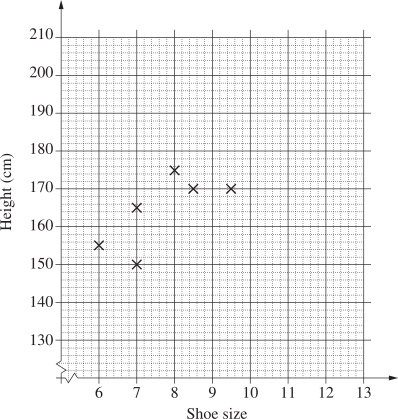
The shoe size and height of ten students were recorded.

\begin{array} {|l|c|c|}
\hline \rule{0pt}{2.5ex} \text{Shoe size} \rule[-1ex]{0pt}{0pt} & \text{6} & \text{7} & \text{7} & \text{8} & \text{8.5} & \text{9.5} & \text{10} & \text{11} & \text{12} & \text{12} \\
\hline \rule{0pt}{2.5ex} \text{Height} \rule[-1ex]{0pt}{0pt} & \text{155} & \text{150} & \text{165} & \text{175} & \text{170} & \text{170} & \text{190} & \text{185} & \text{200} & \text{195} \\
\hline
\end{array}

  1. Complete the scatter plot AND draw a line of fit by eye.  (2 marks)
     
     
  2. Use the line of fit to estimate the height difference between a student who wears a size 7.5 shoe and one who wears a size 9 shoe.  (1 mark)

    --- 1 WORK AREA LINES (style=lined) ---

  3. A student calculated the correlation coefficient to be 1 for this set of data. Explain why this cannot be correct.  (1 mark)

    --- 2 WORK AREA LINES (style=lined) ---
Show Answers Only
  1. `text(See Worked Solutions.)`
  2. `13\ text{cm  (or close given LOBF drawn)}
  3. `text(A correlation co-efficient of 1 would)`
    `text(mean that all data points occur on the)`
    `text(line of best fit which clearly isn’t the case.)`
Show Worked Solution

i.    
      2UG 2015 28e Answer

ii.   `text{Shoe size 7½ gives a height estimate of 162 cm (see graph)}`

`text{Shoe size 9 gives a height estimate of 175 cm (see graph)}`

`:.\ text(Height difference)` `= 175-162`
  `= 13\ text{cm  (or close given LOBF drawn)}`


iii.   `text(A correlation co-efficient of 1 would mean)`

♦ Mean mark (c) 39%.

`text(that all data points occur on the line of best)`

`text(fit which clearly isn’t the case.)`

Filed Under: Bivariate Data Analysis (Y12), Correlation / Body Measurements, S3 Further Statistical Analysis (Y12), S4 Bivariate Data Analysis (Y12) Tagged With: Band 4, Band 5, common-content, smc-1001-10-Line of Best Fit, smc-1001-30-Correlation, smc-1113-10-Line of Best Fit, smc-1113-20-Scatterplot from Table, smc-1113-30-Correlation, smc-785-10-Line of Best Fit, smc-785-30-Correlation

Algebra, STD2 A1 2015 HSC 28d

The formula  `C = 5/9 (F-32)`  is used to convert temperatures between degrees Fahrenheit `(F)` and degrees Celsius `(C)`.

Convert 3°C to the equivalent temperature in Fahrenheit.   (2 marks)

--- 5 WORK AREA LINES (style=lined) ---

Show Answers Only

`37.4\ text(degrees)\ F`

Show Worked Solution
`C` `= 5/9(F-32)`
`F-32` `= 9/5C`
`F`  `= 9/5C + 32`

 
`text(When)\ \ C = 3,`

`F` `= (9/5 xx 3) + 32`
  `= 37.4\ text(degrees)\ F`

Filed Under: AM1 - Algebra (Prelim), Formula Rearrange, Formula Rearrange (Std 1), Formula Rearrange (Std 2), Formula Rearrange (Std1-2027), Formula Rearrange (Std2-2027), Linear, Substitution and Other Equations (Std 1), Substitution and Other Equations (Std 2), Substitution and Other Equations (Std1-2027), Substitution and Other Equations (Std2-2027) Tagged With: Band 4, num-title-ct-pathc, num-title-qs-hsc, smc-1116-20-Rearrange and Substitute, smc-1200-10-Linear, smc-1201-10-Linear, smc-4362-30-Rearrange and substitute, smc-6234-20-Rearrange and Substitute, smc-6236-10-Linear, smc-6508-20-Rearrange and Substitute, smc-6511-10-Linear, smc-789-20-Rearrange and Substitute

Measurement, 2UG 2015 HSC 28c

Three equally spaced cross-sectional areas of a vase are shown.

2UG 2015 29c

Use Simpson’s rule to find the approximate capacity of the vase in litres.  (3 marks)

Show Answers Only

`4\ text(litres)`

Show Worked Solution

2UG 2015 29c Answer 

`V` `≈ h/3[y_0 + 4y_1 + y_2]`
  `≈ 15/3[45 + 4(180) + 35]`
  `≈ 5[800]`
  `≈ 4000\ text(cm³)`
  `~~4\ text(litres)\ \ \ text{(1 cm³ = 1 mL)}`

Filed Under: Simpson's Rule/Measurement Error Tagged With: Band 4, HSC

Measurement, STD2 M1 2015 HSC 28a

The diagram shows an annulus.
 

2015 28a

 
Calculate the area of the annulus.  (1 mark)

--- 3 WORK AREA LINES (style=lined) ---

Show Answers Only

`≈ 50.26…\ text(cm²)`

Show Worked Solution

`text(Area of annulus)`

`= pi(R^2 − r^2)`

`= pi(5^2 − 3^2)`

`= pi(25 − 9)`

`= 16pi\ text(cm²)`

`≈ 50.26…\ text(cm²)`

Filed Under: Areas and Volumes (Harder), Perimeter and Area (Std 1), Perimeter and Area (Std1-2027), Perimeter and Area (Std2-2027), Perimeter, Area and Volume (Std 2) Tagged With: Band 4, smc-1121-20-Perimeter and Area (Circular Measure), smc-6483-50-Area (Circular Measure), smc-6520-50-Area (Circular Measure), smc-798-20-Perimeter and Area (Circular Measure)

Statistics, STD2 S1 2015 HSC 27d

In a small business, the seven employees earn the following wages per week:

\(\$300, \ \$490, \ \$520, \ \$590, \ \$660, \ \$680, \ \$970\)

  1.  Is the wage of $970 an outlier for this set of data? Justify your answer with calculations.  (3 marks)

    --- 6 WORK AREA LINES (style=lined) ---
  2.  Each employee receives a $20 pay increase.


     What effect will this have on the standard deviation?  (1 mark)

    --- 2 WORK AREA LINES (style=lined) ---

Show Answers Only

a.    \(\text{See Worked Solutions.} \)

b.    \(\text{The standard deviation will remain the same.}\)

Show Worked Solution

a.    \(300, 490, 520, 590, 660, 680, 970\)

\(\text{Median}\) \(= 590\)
\(Q_1\) \(= 490\)
\(Q_3\) \(= 680\)
\(IQR\) \(= 680-490 = 190\)


\(\text{Outlier if \$970 is greater than:} \)

\(Q_3 + 1.5 x\times IQR = 680 + 1.5 \times 190 = \$965 \) 

\(\therefore\ \text{The wage \$970 per week is an outlier.}\)

♦ Mean mark (a) 39%.


b. 
  \(\text{All values increase by \$20, but so too does the mean.} \)

\(\text{Therefore the spread about the new mean will not change} \)

\(\text{and therefore the standard deviation will remain the same.} \)

Filed Under: Measures of Central and Spread (Std1-2027), Measures of Centre and Spread (Std2-2027), Summary Statistics - No Graph (Std 2), Summary Statistics - No graph (Y12), Summary Statistics (no graph), Summary Statistics (Std 1) Tagged With: Band 4, Band 5, common-content, smc-1131-30-IQR and Outliers, smc-1131-50-Std Dev (by calc), smc-6312-30-IQR and Outliers, smc-6312-50-Std Dev (by Calc), smc-6532-30-IQR and Outliers, smc-6532-50-Std Dev (by Calc), smc-824-30-IQR and Outliers, smc-824-50-Std Dev (by calc), smc-999-30-IQR and Outliers, smc-999-50-Std Dev (by calc)

Measurement, STD2 M7 2015 HSC 27a

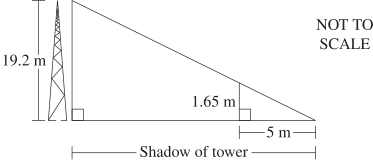
At a particular time during the day, a tower of height 19.2 metres casts a shadow. At the same time, a person who is 1.65 metres tall casts a shadow 5 metres long.


What is the length of the shadow cast by the tower at that time?  (2 marks)

--- 4 WORK AREA LINES (style=lined) ---

Show Answers Only

`58\ text{m}`

Show Worked Solution

`text(Both triangles have right angles and a common)`

`text(angle to the ground.)`

`:.\ text{Triangles are similar (equiangular)}`


`text(Let)\ x =\ text(length of tower shadow)`

`x/5` `= 19.2/1.65\ \ text{(corresponding sides of similar triangles)}`


`x` `= (5 xx 19.2)/1.65`  
  `= 58.1818…`  
  `= 58\ text{m  (nearest m)}`  

Filed Under: M5 Scale Drawings (Y12), Ratio and Scale (Std2), Similarity, Similarity and Scale Tagged With: Band 4, num-title-ct-pathc, num-title-qs-hsc, smc-1105-30-Similarity, smc-1187-60-Similarity, smc-4746-50-Real world applications

FS Comm, 2UG 2015 HSC 26g

Pat’s mobile phone plan is shown.

2015 26g

Last month Pat:

• made calls to the value of `$561`
• sent `152` SMS messages
• sent `37` MMS messages
• used `1.7` GB of data.

What was the total of Pat’s phone bill for last month?  (3 marks)

Show Answers Only

`$96.36`

Show Worked Solution

`text(C)text(ost of excess calls)`

`= 561 − 550`

`= $11`

`text(Excess data)`

`1.7\ text(GB)` `= 1.7 xx 2^(10)\ text(MB)`
`text(Excess)` `= 1.7 xx 2^(10) − 500`
  `= 1240.8\ text(MB)`


`:.\ text(C)text(ost of excess data)`

`= 1240.8 xx $0.0293`

`= $36.355…`

`= $36.36`


`text(SMS and MMS messages within plan)`

`:.\ text(Total phone bill)`

`= $49 + $11 + $36.36`

`= $96.36`

Filed Under: FS Communication Tagged With: Band 4, HSC

Measurement, STD2 M1 2015 HSC 26f

Approximately 71% of Earth’s surface is covered by water. Assume Earth is a sphere with a radius of 6400 km.

Calculate the number of square kilometres covered by water.  (2 marks)

--- 4 WORK AREA LINES (style=lined) ---

Show Answers Only

`3.7 xx 10^8\ text(km²)\ \ text{(nearest km²)}`

Show Worked Solution

`text(Surface area of Earth)`

`= 4pir^2`

`= 4pi xx 6400^2`


`:.\ text(Surface covered by water)`

`= text(71%) xx 4pi xx 6400^2`

`= 365\ 450\ 163.7…`

`= 3.7 xx 10^8\ text(km²)\ \ text{(nearest km²)}`

Filed Under: Areas and Volumes (Harder), Perimeter, Area and Volume (Std 2), Surface Area (Std1-2027), Surface Area (Std2-2027) Tagged With: Band 4, num-title-ct-pathb, num-title-qs-hsc, smc-4234-50-SA (sphere), smc-6484-20-Surface Area (Circular Measure), smc-6522-20-Surface Area (Circular Measure), smc-798-25-Surface Area

Probability, STD2 S2 2015 HSC 26e

The table shows the relative frequency of selecting each of the different coloured jelly beans from packets containing green, yellow, black, red and white jelly beans.

\begin{array} {|c|c|}
\hline
\rule{0pt}{2.5ex} \textit{Colour} \rule[-1ex]{0pt}{0pt} & \textit{Relative frequency} \\
\hline
\rule{0pt}{2.5ex} \text{Green} \rule[-1ex]{0pt}{0pt} & 0.32 \\
\hline
\rule{0pt}{2.5ex} \text{Yellow} \rule[-1ex]{0pt}{0pt} & 0.13 \\
\hline
\rule{0pt}{2.5ex} \text{Black} \rule[-1ex]{0pt}{0pt} & 0.14 \\
\hline
\rule{0pt}{2.5ex} \text{Red} \rule[-1ex]{0pt}{0pt} &  \\
\hline
\rule{0pt}{2.5ex} \text{White} \rule[-1ex]{0pt}{0pt} & 0.24 \\
\hline
\end{array}

  1. What is the relative frequency of selecting a red jelly bean?  (1 mark)

    --- 2 WORK AREA LINES (style=lined) ---
  2. Based on this table of relative frequencies, what is the probability of NOT selecting a black jelly bean?  (1 mark)

    --- 2 WORK AREA LINES (style=lined) ---

Show Answers Only
  1. \(0.17\)
  2. \(0.86\)
Show Worked Solution

i.  \(\text{Relative frequency of red}\)

\(= 1-(0.32 + 0.13 + 0.14 + 0.24)\)

\(= 1-0.83\)

\(= 0.17\)


ii.  \(P\text{(not selecting black)}\)

\(= 1-P\text{(selecting black)}\)

\(= 1-0.14\)

\(= 0.86\)

Filed Under: Combinations and Single Stage Events (Std 2), Probability, Relative Frequency, Relative Frequency (Std 1), Relative Frequency (Std 2), Relative Frequency (Y11), Single and Multi-Stage Events (Std 1), Single stage events Tagged With: Band 3, Band 4, common-content, num-title-ct-core, num-title-qs-hsc, smc-1133-20-Games of Chance, smc-1135-05-Simple Probability, smc-4225-20-Complementary events, smc-4225-35-Relative frequency, smc-827-20-Games of Chance, smc-828-10-Simple Probability, smc-990-20-Games of Chance

Financial Maths, STD2 F4 2015 HSC 26d

A family currently pays $320 for some groceries.

Assuming a constant annual inflation rate of 2.9%, calculate how much would be paid for the same groceries in 5 years’ time.  (2 marks)

Show Answers Only

`$369.17\ \ text{(nearest cent)}`

Show Worked Solution
`FV` `= PV(1 + r)^n`
  `= 320(1.029)^5`
  `= $369.1703…`
  `= $369.17\ \ text{(nearest cent)}`

Filed Under: Compound Interest, Compound Interest and Shares (Std2), F2 Investment (Y12), FM2 - Investing, Modelling Investments and Loans (Y12) Tagged With: Band 4, common-content, num-title-ct-coreb, num-title-qs-hsc, smc-1002-20-FV Formula, smc-1108-20-FV Formula, smc-4334-10-Find FV, smc-817-20-FV Formula

Data, 2UG 2015 HSC 26a

A farmer used the ‘capture‑recapture’ technique to estimate the number of chickens he had on his farm. He captured, tagged and released 18 of the chickens. Later, he caught 26 chickens at random and found that 4 had been tagged.

What is the estimate for the total number of chickens on this farm?  (2 marks)

Show Answers Only

`117`

Show Worked Solution

`text(Let)\ C = text(total chickens on farm)`

`text(Capture)` `= 18/C`
`text(Recapture)` `= 4/26`
`⇒ 18/C` `= 4/26`
`4C` `= 18 xx 26`
`C` `= (18 xx 26)/4`
  `= 117`


`:.\ text(There are an estimated 117 chickens)`

`text(on the farm.)`

Filed Under: DS5/6 - Normal Distribution and Sampling Tagged With: Band 4, HSC

Financial Maths, STD2 F1 2015 HSC 25 MC

An insurance company offers customers the following discounts on the basic annual premium for car insurance.

2015 25 mc

If a customer is eligible for more than one discount, subsequent discounts are applied to the already discounted premium. The combined compulsory third party (CTP) and comprehensive insurance discount is always applied last.

Jamie has three insurance policies, including combined CTP and comprehensive insurance, with this company. He has used this company for 8 years and he has never made a claim.

The basic annual premium for his car insurance is $870.

How much will Jamie need to pay after the discounts are applied?

  1.    $482.44
  2.    $515.50
  3.    $541.60
  4.    $557.60
Show Answers Only

`C`

Show Worked Solution

`text(Multi-policy discount)`

`text(New premium)` `= 870 − (text(15%) xx 870)`
  `= $739.50`

 
`text(No claim bonus)`

`text(New premium)` `= 739.50 − (text(20%) xx 739.50)`
  `= $591.60`

 
`text(Combined CTP bonus)`

`text(New premium)` `= 591.60 − 50`
  `= $541.60`

`⇒ C`

Filed Under: Costs to Purchase / Insurance, Earning Money and Budgeting (Std 1), Earning Money and Budgeting (Std 2), Purchasing Goods (Std1-2027), Purchasing Goods (Std2-2027), Tax and Percentage Increase/Decrease (Std 1), Tax and Percentage Increase/Decrease (Std 2) Tagged With: Band 4, smc-1125-30-% Increase/Decrease, smc-1126-40-Insurance, smc-6278-20-Stamp Duty/Insurance, smc-6517-20-Stamp Duty/Insurance, smc-810-40-Insurance, smc-831-30-% Increase/Decrease

Algebra, STD2 A1 2015 HSC 24 MC

Consider the equation  `(2x)/3-4 = (5x)/2 + 1`.

Which of the following would be a correct step in solving this equation?

  1. `(2x)/3-3 = (5x)/2`
  2. `(2x)/3 = (5x)/2 + 5`
  3. `2x-4 = (15x)/2 + 3`
  4. `(4x)/6-8 = 5x + 2`
Show Answers Only

`B`

Show Worked Solution
`(2x)/3-4` `= (5x)/2 + 1`
`(2x)/3` `= (5x)/2 + 5`

 
`=>B`

Filed Under: Algebraic Fractions, Linear and Other Equations, Substitution and Other Equations (Std 1), Substitution and Other Equations (Std 2), Substitution and Other Equations (Std1-2027), Substitution and Other Equations (Std2-2027) Tagged With: Band 4, common-content, num-title-ct-pathc, num-title-qs-hsc, smc-1116-30-Algebraic Fractions, smc-4402-40-Multiple fractions, smc-6234-30-Algebraic Fractions, smc-6508-30-Algebraic Fractions, smc-789-30-Algebraic Fractions

Algebra, STD2 A1 2015 HSC 23 MC

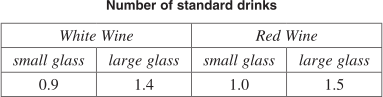
The number of ‘standard drinks’ in various glasses of wine is shown.
 

A woman weighing 62 kg drinks three small glasses of white wine and two large glasses of red wine between 8 pm and 1 am.

Using the formula for calculating blood alcohol below, what would be her blood alcohol content (BAC) estimate at 1 am, correct to three decimal places?
 

`BAC_text(Female) = (10N-7.5H)/(5.5M)`
 

where    `N` is the number of standard drinks consumed

`H` is the number of hours drinking

`M` is the person's mass in kilograms
 

  1. `0.030`
  2. `0.037`
  3. `0.046`
  4. `0.057`
Show Answers Only

`D`

Show Worked Solution
`N` `= 3 xx 0.9 + 2 xx 1.5`
  `= 5.7\ text(standard drinks)`
`H` `=\ text(5 hours)`
`M` `=\ text(62 kg)`
   
`:.BAC_f` `= (10 xx 5.7-7.5 xx 5)/ (5.5 xx 62)`
  `= 0.05718…`

`⇒ D`

Filed Under: Applications: BAC, Medication and D=SxT (Std 2), Applications: BAC, Medicine and D=SxT (Std1-2027), Applications: BAC, Medicine and D=SxT (Std2-2027), Safety: D=ST & BAC Tagged With: Band 4, smc-6235-10-BAC, smc-6509-10-BAC, smc-791-10-BAC

Calculus, EXT1* C1 2015 HSC 14a

In a theme park ride, a chair is released from a height of  `110`  metres and falls vertically. Magnetic brakes are applied when the velocity of the chair reaches  `text(−37)`  metres per second.
 

2015 2ua 14a
 

The height of the chair at time `t` seconds is `x` metres. The acceleration of the chair is given by   `ddot x = −10`. At the release point,  `t = 0, x = 110 and dot x = 0`.

  1. Using calculus, show that  `x = -5t^2 + 110`.  (2 marks)

    --- 5 WORK AREA LINES (style=lined) ---

  2. How far has the chair fallen when the magnetic brakes are applied?  (2 marks)

    --- 4 WORK AREA LINES (style=lined) ---

Show Answers Only
  1. `text(Proof)\ \ text{(See Worked Solutions)}`
  2. `68.45\ text(m)`
Show Worked Solution

i.  `text(Show)\ \ x = -5t^2 + 110`

`ddot x` `= -10`
`dot x` `= int ddot x\ dt`
  `= int -10\ dt`
  `= -10t + c`

 
`text(When)\ \ t = 0,\ dot x = 0`

`:.\ 0` `= -10 (0) + c`
`c` `= 0`
`dot x` `= -10t`
`x` `= int dot x\ dt`
  `= int -10t\ dt`
  `= -5t^2 + c`

 
`text(When)\ \ t = 0,\ x = 110`

`:.\ 110` `= -5 (0^2) + c`
`c` `= 110`

 
`:.\ x = -5t^2 + 110\ \ text(…  as required.)`
 

ii.  `text(Find)\ \t\ \text(when)\ \ dot x = -37`

`-37` `= -10t`
`t` `= 3.7\ \ text(seconds)`

 
`text(When)\ \ t = 3.7`

`x` `= -5 (3.7^2) + 110`
  `= -68.45 + 110`
  `= 41.55`

 
`:.\ text(Distance the chair has fallen)`

`= 110 – 41.55`

`= 68.45\ text(m)`

Filed Under: Motion, Rates of Change with respect to time (Ext1) Tagged With: Band 3, Band 4, smc-1077-10-Motion

Financial Maths, STD2 F4 2015 HSC 17 MC

What amount must be invested now at 4% per annum, compounded quarterly, so that in five years it will have grown to  $60 000?

  1. $8919
  2. $11 156
  3. $49 173
  4. $49 316
Show Answers Only

`C`

Show Worked Solution

`text(Using)\ \ FV = PV(1 + r)^n`

`r` `= text(4%)/4` `= text(1%) = 0.01\ text(per quarter)`
`n` `= 5 xx 4` `= 20\ text(quarters)`


`60\ 000` `= PV(1 + 0.01)^(20)`
`:.PV` `= (60\ 000)/1.01^(20)`
  `= $49\ 172.66…`

`⇒ C`

Filed Under: Compound Interest, Compound Interest and Shares (Std2), F2 Investment (Y12), FM4 - Credit and Borrowing, Modelling Investments and Loans (Y12) Tagged With: Band 4, common-content, num-title-ct-coreb, num-title-qs-hsc, smc-1002-20-FV Formula, smc-1108-20-FV Formula, smc-4334-30-Find PV, smc-817-20-FV Formula

Probability, STD2 S2 2015 HSC 16 MC

The probability of winning a game is `7/10`.

Which expression represents the probability of winning two consecutive games?

  1. `7/10 xx 6/9`
  2. `7/10 xx 6/10`
  3. `7/10 xx 7/9`
  4. `7/10 xx 7/10`
Show Answers Only

`D`

Show Worked Solution

`text{Since the two events are independent:}`

`P text{(W)}` `= 7/10`
`P text{(WW)}` `= 7/10 xx 7/10`

 
`=>D`

Filed Under: Multi-stage Events, Multi-Stage Events, Multi-Stage Events (Std 2), Single and Multi-Stage Events (Std 1) Tagged With: Band 4, num-title-ct-corea, num-title-qs-hsc, smc-1135-20-Other Multi-Stage Events, smc-4238-20-Independent events, smc-829-20-Other Multi-Stage Events

Measurement, 2UG 2015 HSC 14 MC

Stockholm is located at `text(59°N 18°E)` and Darwin is located at `text(13°S 131°E)`. 

What is the time difference between Stockholm and Darwin? (Ignore time zones and daylight saving.)

(A)   `184` minutes

(B)   `288` minutes

(C)   `452` minutes

(D)   `596` minutes

Show Answers Only

`C`

Show Worked Solution

`text(Stockholm is 59°N 18°E,  Darwin is 13°S 131°E)`

`text{Angular difference (longitude)}`

`= 131^@− 18^@`

`= 113^@`
 

`:.\ text(Time difference)` `= 113 xx 4`
  `= 452\ text(minutes)`

`⇒ C`

Filed Under: Uncategorized Tagged With: Band 4, HSC, M/C

Financial Maths, STD2 F4 2015 HSC 10 MC

A piece of machinery, initially worth $56 000, depreciates at 8% per annum.

Which graph best shows the salvage value of this piece of machinery over time?
 

2015 10 mc1

2015 10 mc2

Show Answers Only

`A`

Show Worked Solution

`text(By Elimination)`

`text(A depreciation of 8% per annum depreciates the largest)`

`text(amount in year 1 and then gradually depreciates less each)`

`text(subsequent year.)`

`:.text(Cannot be)\ C\ text(or)\ D`

`text(Consider when)\ t` `= 5`
`text(Salvage Value)` `= V_0(1 − r)^n`
  `= 56\ 000(1 − 0.08)^5`
  `= 36\ 908.5…`

`text(Graph B depreciates too quickly)`

`:.text(Cannot be)\ B`

`⇒ A`

Filed Under: Depreciation - Declining Balance (Std 1), Depreciation - Declining Balance (Std 2), Depreciation / Running costs Tagged With: Band 4, smc-1139-60-Depreciation Graphs, smc-813-60-Depreciation Graphs

Measurement, STD2 M1 2015 HSC 8 MC

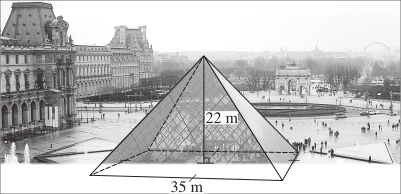
The Louvre Pyramid in Paris has a square base with side length 35 m and a perpendicular height of 22 m.
 

What is the volume of this pyramid, to the nearest m³?

  1. `257\ text(m)^3`
  2. `1027\ text(m)^3`
  3. `8983\ text(m)^3`
  4. `26\ 950\ text(m)^3`
Show Answers Only

`C`

Show Worked Solution
`V` `= 1/3Ah`
`A` `= 35 xx 35`
  `= 1225\ text(m)^2`


`:.V` `= 1/3 xx 1225 xx 22`
  `= 8983.33…\ text(m)^3`

 
`=>C`

Filed Under: Areas and Volumes (Harder), Perimeter, Area and Volume (Std 2), Volume, Volume, Mass and Capacity (Std1-2027), Volume, Mass and Capacity (Std2-2027) Tagged With: Band 4, num-title-ct-pathb, num-title-qs-hsc, smc-4235-50-Pyramids/Cones, smc-6304-40-Volume, smc-6521-40-Volume, smc-798-40-Volume

Measurement, STD2 M6 2015 HSC 7 MC

The diagram shows a radial survey of a field `ABCD`.
 

2UG 2015 7MC
 

In triangle `AOB`, what is the size of `∠AOB` ?

  1.    `51^@`
  2.    `111^@`
  3.    `125^@`
  4.    `249^@`
Show Answers Only

`B`

Show Worked Solution

2UG 2015 7MC Answer

`text(Let)\ P\ text(be due North of)\ O`

`∠POB` `= 51^@`
`∠POA` `= 360 − 300`
  `= 60^@`
`:.∠AOB` `= 51 + 60`
  `= 111^@`

`⇒ B`

Filed Under: Bearings & Field Surveys, Bearings and Radial Surveys (Std2) Tagged With: Band 4, smc-803-20-Radial Surveys

Statistics, STD2 S1 2015 HSC 6 MC

The times, in minutes, that a large group of students spend on exercise per day are presented in the box‑and‑whisker plot.
 

What percentage of these students spend between 40 minutes and 60 minutes per day on exercise?

  1. 17%
  2. 20%
  3. 25%
  4. 50%
Show Answers Only

`C`

Show Worked Solution

`text{Q}_1 = 40, \ text(Median) = 60`

`:.\ text(% Students between 40 and 60)`

`= 50text{%}-25text{%}`

`=25 text{%}`
 

`=>C`

Filed Under: Box Plots and 5-Number Summary, Stem & Leaf, Box & Whisker, Summary Statistics - Box Plots (Std 2), Summary Statistics - Box Plots (Std1-2027), Summary Statistics - Box Plots (Std2-2027), Summary Statistics - Box Plots (Y12), Summary Statistics (Std 1) Tagged With: Band 4, common-content, num-title-ct-corea, num-title-qs-hsc, smc-1000-10-Single Box-Plots, smc-5021-50-Box plot (single), smc-6313-10-Single Box Plots, smc-6533-10-Single Box Plots, smc-825-10-Single Box-Plots

Statistics, STD2 S1 2015 HSC 4 MC

On a school report, a student’s record of completing homework is graded using the following codes.

C = consistently
U = usually
S = sometimes
R = rarely
N = never

What type of data is this?

  1. Categorical, ordinal
  2. Categorical, nominal
  3. Numerical, continuous
  4. Numerical, discrete
Show Answers Only

`A`

Show Worked Solution

`text(The data has been grouped into categories and)`

`text(because each category can be ranked, it is ordinal.)`

`⇒ A`

Filed Under: Classifying Data, Classifying Data (Std 1), Classifying Data (Std 2), Classifying Data (Y12), Data Classification, Investigation and Sampling Methods (Std1-2027), Data Classification, Investigation and Sampling Methods (Std2-2027), DS1 - Stats and society Tagged With: Band 4, common-content, num-title-ct-core, num-title-qs-hsc, smc-1127-20-Classifying Data, smc-5075-10-Categorical, smc-6309-20-Data Classification, smc-6529-20-Data Classification, smc-820-20-Classifying Data

Calculus, 2ADV C4 2015 HSC 15c

Water is flowing in and out of a rock pool. The volume of water in the pool at time `t` hours is `V` litres. The rate of change of the volume is given by

`(dV)/(dt) = 80 sin(0.5t)`

At time  `t = 0`, the volume of water in the pool is 1200 litres and is increasing.

  1. After what time does the volume of water first start to decrease?  (2 marks)

    --- 6 WORK AREA LINES (style=lined) ---

  2. Find the volume of water in the pool when  `t = 3`.  (2 marks)

    --- 6 WORK AREA LINES (style=lined) ---

  3. What is the greatest volume of water in the pool?  (1 mark)

    --- 3 WORK AREA LINES (style=lined) ---

Show Answers Only
  1. `2 pi\ text(hours)`
  2. `1349\ text(litres)`
  3. `1520\ text(litres)`
Show Worked Solution

i.   `(dV)/(dt) = 80 sin (0.5t)`

♦ Mean mark (i) 37%.

`text(Volume decreases when)\ \ (dV)/(dt) < 0`

`(dV)/(dt) < 0\ \ text(when)\ \ t > 2 pi\ text(hours)`

`:.\ text(After 2)\pi\ \text(hours, volume starts to decrease.)`


ii.   `V` `= int (dV)/(dt)\ dt`
  `= int 80 sin (0.5t)\ dt`
  `= -160 cos (0.5t) + c`


`text(When)\ \ t = 0,\ V = 1200`

`1200` `= -160 cos 0 + c`
`c` `= 1360`
`:.\ V` `= -160 cos (0.5t) + 1360`


`text(When)\ \ t = 3`

`V` `= -160 cos (0.5 xx 3) + 1360`
  `= 1348.68…\ \ text(litres)`
  `= 1349\ text{litres  (nearest litre)}`


iii.  `V = -160 cos (0.5t) + 1360`

♦♦ Mean mark (iii) 27%.

`=>\ text(Greatest volume occurs when)`

`cos (0.5t) = -1`

`:.\ text(Maximum volume)`

`= -160 (-1) + 1360`

`= 1520\ text(litres)`

Filed Under: Other Integration Applications (Y12), Rates of Change Tagged With: Band 4, Band 5, smc-1091-20-Flow, smc-1091-40-Trig Function, smc-1213-15-Flow

Plane Geometry, 2UA 2015 HSC 15b

The diagram shows `Delta ABC` which has a right angle at `C`. The point `D` is the midpoint of the side `AC`. The point `E` is chosen on `AB` such that `AE = ED`. The line segment `ED` is produced to meet the line `BC` at `F`.

Copy or trace the diagram into your writing booklet.

  1. Prove that `Delta ACB` is similar to `Delta DCF.`  (2 marks)
  2. Explain why `Delta EFB` is isosceles.  (1 mark)
  3. Show that `EB = 3AE.`  (2 marks)
Show Answers Only
  1. `text(Proof)\ \ text{(See Worked Solutions)}`
  2. `text(Proof)\ \ text{(See Worked Solutions)}`
  3. `text(Proof)\ \ text{(See Worked Solutions)}`
Show Worked Solution

(i)  `text(Prove)\ \ Delta ACB\ \ text(|||)\ \ Delta DCF`

`/_ EAD = /_ ADE = theta\ \ text{(base angles of isosceles}\ \ Delta AED text{)}`

`/_ CDF = /_ ADE = theta\ \ text{(vertically opposite angles)}`

`/_ DCF = /_ ACB = 90°\ \ text{(}/_ FCB\ text{is a straight angle)}`

`:.\ Delta ACB\ \ text(|||)\ \ Delta DCF\ \ text{(equiangular)}`


♦ Mean mark 45%.

(ii)  `/_ DFC = 90 – theta\ \ text{(angle sum of}\ \ Delta DCF text{)}`

`/_ ABC = 90 – theta\ \ text{(angle sum of}\ \ Delta ACB text{)}`

`:.\ Delta EFB\ \ text{is isosceles  (base angles are equal)}`


(iii)  `text(Show)\ \ EB = 3AE`

♦♦ Mean mark 23%.
`(DC)/(AC)` `= (DF)/(AB)`

`\ \ \ \ \ text{(corresponding sides of}`

`\ \ \ \ \ text{similar triangles)}`

`1/2` `= (DF)/(AB)`  
`2DF` `= AB`  
`2(EF – ED)` `= AE + EB`  
`2(EB – AE)` `= AE + EB` `\ \ \ \ \ text{(given}\ EF = EB, ED = AE text{)}`
`2EB – 2AE` `= AE + EB`  


`:. EB = 3AE\ \ text(…  as required)`

Filed Under: 2. Plane Geometry Tagged With: Band 4, Band 5, Band 6, HSC

Calculus, EXT1* C1 2015 HSC 15a

The amount of caffeine, `C`, in the human body decreases according to the equation

`(dC)/(dt) = -0.14C,` 

where `C` is measured in mg and `t` is the time in hours.

  1. Show that  `C = Ae^(-0.14t)`  is a solution to  `(dC)/(dt) = -0.14C,` where ` A` is a constant.


    When `t = 0`, there are 130 mg of caffeine in Lee’s body.  (1 mark)

    --- 3 WORK AREA LINES (style=lined) ---

  2. Find the value of `A.`  (1 mark)

    --- 1 WORK AREA LINES (style=lined) ---

  3. What is the amount of caffeine in Lee’s body after 7 hours?   (1 mark)

    --- 4 WORK AREA LINES (style=lined) ---

  4. What is the time taken for the amount of caffeine in Lee’s body to halve?  (2 marks)

    --- 8 WORK AREA LINES (style=lined) ---

Show Answers Only
  1. `text(Proof)\ \ text{(See Worked Solutions)}`
  2. `130`
  3. `48.8\ text(mg)`
  4. `4.95\ text(hours)`
Show Worked Solution
i. `C` `= Ae^(-0.14t)`
  `(dC)/(dt)` `= d/(dt) (Ae^(-0.14t))`
    `= -0.14 xx Ae^(-0.14t)`
    `= -0.14\ C`

 
`:.\ C = Ae^(-0.14t)\ \ text(is a solution)`


ii.  `text(When)\ \ t = 0,\ C = 130`

`130` `= Ae^(-0.14 xx 0)`
`:.\ A` `= 130`


iii.  `text(Find)\ \ C\ \ text(when)\ \ t = 7`

`C` `= 130\ e^(-0.14 xx 7)`
  `= 130\ e^(-0.98)`
  `= 48.79…`
  `= 48.8\ text{mg  (to 1 d.p.)}`

 
`:.\ text(After 7 hours, Lee will have 48.8 mg)`

`text(of caffeine left in her body.)`


iv.  `text(Find)\ \ t\ \ text(when caffeine has halved.)`

`text(When)\ \ t = 0,\ \ C = 130`

`:.\ text(Find)\ \ t\ \ text(when)\ \ C = 65`

`65` `= 130 e^(-0.14 xx t)`
`e^(-0.14t)` `= 65/130`
`ln e^(-0.14t)` `= ln\ 65/130`
`-0.14t xx ln e` `= ln\ 65/130`
`t` `= (ln\ 65/130)/-0.14`
  `= 4.951…`
  `= 4.95\ text{hours  (to 2 d.p.)}`


`:.\ text(It will take 4.95 hours for Lee’s)`

`text(caffeine to halve.)`

Filed Under: Exponential growth and decay, Standard Growth and Decay Tagged With: Band 2, Band 3, Band 4, HSC, smc-1081-20-Decay, smc-1081-50-Other Themes

Financial Maths, 2ADV M1 2015 HSC 14c

Sam borrows $100 000 to be repaid at a reducible interest rate of 0.6% per month. Let  `$A_n`  be the amount owing at the end of  `n`  months and  `$M`  be the monthly repayment.

  1. Show that  `A_2 = 100\ 000 (1.006)^2 - M (1 + 1.006).`  (1 mark)

    --- 1 WORK AREA LINES (style=lined) ---

  2. Show that  `A_n = 100\ 000 (1.006)^n - M (((1.006)^n - 1)/0.006).`  (2 marks)

    --- 5 WORK AREA LINES (style=lined) ---

  3. Sam makes monthly repayments of $780. Show that after making 120 monthly repayments the amount owing is $68 500 to the nearest $100.  (1 mark)

    --- 2 WORK AREA LINES (style=lined) ---

Immediately after making the 120th repayment, Sam makes a one-off payment, reducing the amount owing to $48 500. The interest rate and monthly repayment remain unchanged.

  1. After how many more months will the amount owing be completely repaid?  (3 marks)

    --- 6 WORK AREA LINES (style=lined) ---

Show Answers Only
  1. `text(Proof)\ \ text{(Show Worked Solutions)}`
  2. `text(Proof)\ \ text{(Show Worked Solutions)}`
  3. `text(Proof)\ \ text{(Show Worked Solutions)}`
  4. `79\ text(months)`
Show Worked Solution
i.  `A_1` `= 100\ 000 (1.006) – M`
`A_2` `= A_1 (1.006) – M`
  `= [100\ 000 (1.006) – M] (1.006) – M`
  `= 100\ 000 (1.006)^2 – M (1.006) – M`
  `= 100\ 000 (1.006)^2 – M (1 + 1.006)\ \ text(…  as required)`


ii.  `A_3 = 100\ 000 (1.006)^3 – M (1 + 1.006 + 1.006^2)`

`vdots`

`A_n = 100\ 000 (1.006)^n – M (1 + 1.006 + … + 1.006^(n-1))`

`=> text(S)text(ince)\ \ (1 + 1.006 + … + 1.006^(n-1))\ text(is a)`

`text(GP with)\ \ a = 1,\ r = 1.006`

`:.\ A_n` `= 100\ 000 (1.006)^n – M ((a (r^n – 1))/(r – 1))`
  `= 100\ 000 (1.006)^n – M ((1 (1.006^n – 1))/(1.006 – 1))`
  `= 100\ 000 (1.006)^n – M (((1.006)^n – 1)/0.006)`

`text(…  as required.)`


iii.  `text(If)\ \ M = 780 and n = 120`

`A_120` `= 100\ 000 (1.006)^120 – 780 ((1.006^120 – 1)/0.006)`
  `= 205\ 001.80… – 780 (175.0030…)`
  `= 205\ 001.80… – 136\ 502.34…`
  `= 68\ 499.45…`
  `= $68\ 500\ \ text{(to nearest $100)  …  as required}`


iv.  `text(After the one-off payment, amount owing)=$48\ 500`

`:. A_n = 48\ 500 (1.006)^n – 780 ((1.006^n – 1)/0.006)`

`text(where)\ \ n\ \ text(is the number of months after)`

 `text(the one-off payment.)`
 

`text(Find)\ \ n\ \ text(when)\ \ A_n = 0`

`48\ 500 (1.006)^n – 780 ((1.006^n – 1)/0.006) = 0`

`48\ 500 (1.006)^n` `= 780 ((1.006^n – 1)/0.006)`
`48\ 500 (1.006)^n` `= 130\ 000 (1.006^n – 1)`
  `= 130\ 000 (1.006)^n – 130\ 000`
`81\ 500 (1.006)^n` `= 130\ 000`
`1.006^n` `= (130\ 000)/(81\ 500)`
`n xx ln 1.006` `= ln\ 1300/815`
`n` `= (ln\ 1300/815)/(ln\ 1.006)`
  `= 78.055…`

 
`:.\ text(The amount owing will be completely repaid after)`

`text(another 79 months.)`

Filed Under: Compound interest, loan repayments and annuities, Financial Applications of Series (Y12) Tagged With: Band 3, Band 4, Band 5, smc-1007-10-Loan

Probability, 2ADV S1 2015 HSC 14b

Weather records for a town suggest that:

  • if a particular day is wet `(W)`, the probability of the next day being dry is  `5/6`
  • if a particular day is dry `(D)`, the probability of the next day being dry is  `1/2`.

In a specific week Thursday is dry. The tree diagram shows the possible outcomes for the next three days: Friday, Saturday and Sunday.
 

2015 2ua 14b
 

  1. Show that the probability of Saturday being dry is `2/3`.  (1 mark)

    --- 2 WORK AREA LINES (style=lined) ---

  2. What is the probability of both Saturday and Sunday being wet?  (2 marks)

    --- 4 WORK AREA LINES (style=lined) ---

  3. What is the probability of at least one of Saturday and Sunday being dry?  (1 mark)

    --- 2 WORK AREA LINES (style=lined) ---

Show Answers Only
  1. `text(Proof)\ \ text{(See Worked Solutions)}`
  2. `1/(18)`
  3. `(17)/(18)`
Show Worked Solution

i.  `text{Show}\ \ P text{(Sat dry)} = 2/3`

`P text{(Sat dry)}`

`= P (W,D) + P (D, D)`

`=(1/2 xx 5/6) + (1/2 xx 1/2)`

`= 5/(12) + 1/4`

`= 2/3\ \ text(…  as required)`
 

ii.  `Ptext{(Sat and Sun wet)}`

`= P (WWW) + P (DWW)`

`= (1/2 xx 1/6 xx 1/6) + (1/2 xx 1/2 xx 1/6)`

`= 1/(72) + 1/(24)`

`= 1/(18)`
 

iii.  `Ptext{(At least Sat or Sun dry)}`

`= 1 – Ptext{(Sat and Sun both wet)}`

`= 1 – 1/(18)`

`= (17)/(18)`

Filed Under: 3. Probability, Multi-Stage Events (Adv-2027), Multi-Stage Events (Y11) Tagged With: Band 3, Band 4, smc-6469-10-Probability Trees, smc-6469-30-Complementary Probability, smc-989-10-Probability Trees, smc-989-30-Complementary Probability

Calculus, 2ADV C3 2015 HSC 13c

Consider the curve  `y = x^3 − x^2 − x + 3`.

  1. Find the stationary points and determine their nature.   (4 marks)

    --- 8 WORK AREA LINES (style=lined) ---

  2. Given that the point  `P (1/3, 70/27)`  lies on the curve, prove that there is a point of inflection at  `P`.  (2 marks)

    --- 5 WORK AREA LINES (style=lined) ---

  3. Sketch the curve, labelling the stationary points, point of inflection and `y`-intercept.  (2 marks)

    --- 8 WORK AREA LINES (style=lined) ---

Show Answers Only
  1. `text(MAX at)\ (-1/3, 86/27); \ text(MIN at)\ (1, 2)`
  2. `text(Proof)\ \ text{(See Worked Solutions)}`
  3.  
Show Worked Solution
i. `y` `= x^3 – x^2 – x + 3`
  `(dy)/(dx)` `= 3x^2 – 2x – 1`
  `(d^2y)/(dx^2)` `= 6x – 2`

`text(S.P.’s when)\ (dy)/(dx) = 0`

`3x^2 – 2x – 1` `= 0`
`(3x + 1) (x – 1)` `= 0`

`x = -1/3 or 1`


`text(When)\ \ x = -1/3`

`f(-1/3)` `= (-1/3)^3 – (-1/3)^2 – (-1/3) + 3`
  `= -1/27 – 1/9 + 1/3 + 3`
  `= 86/27`
`f″(-1/3)` `= (6 xx -1/3) – 2 = -4 < 0`

`:.\ text(MAX at)\ \ (-1/3, 86/27)`


`text(When)\ \ x = 1`

`f(1)` `= 1^3 – 1^2 – 1 + 3 =2`
`f″(1)` `= (6 xx 1) – 2 = 4 > 0`

`:.\ text(MIN at)\ \ (1, 2)`


ii.  `(d^2y)/(dx^2) = 0\ \ text(when)`

`6x-2` `=0`
`x` `=1/3`


`text(Checking change of concavity)`

`text(Concavity changes either side of)\ x = 1/3`

`:.\ (1/3, 70/27)\ \ text(is a P.I.)`


iii.  `text(When)\ \ x` `= 0`
`y` `= 3`

Filed Under: Curve Sketching (Y12), Curve Sketching and The Primitive Function Tagged With: Band 3, Band 4, smc-969-10-Cubic

Functions, EXT1* F1 2015 HSC 13b

  1. Find the domain and range for the function  `f(x) = sqrt (9 - x^2)`.  (2 marks)

    --- 4 WORK AREA LINES (style=lined) ---

  2. On a number plane, shade the region where the points `(x, y)` satisfy both of the inequalities
     
      `qquad y <= sqrt (9 - x^2)`  and  `y >= x` .  (2 marks)

    --- 10 WORK AREA LINES (style=lined) ---

Show Answers Only
  1. `text(Domain)\ -3 <= x <= 3\ \ \ \ \ \ \ \ text(Range)\ 0<= y <= 3`
  2. `text(See Worked Solutions)`
Show Worked Solution

i.  `f(x) = sqrt(9 – x^2)`

`text(Domain)`

`9 – x^2` `>= 0`
`x^2` `<= 9`

`-3 <= x <= 3`

`text(Range)`

`0 <= y <= 3`


♦ Mean mark 34%.
ii.   

Filed Under: 4. Real Functions, Inequalities (Ext1) Tagged With: Band 4, Band 5, smc-1033-40-Regions

Quadratic, 2UA 2015 HSC 12e

The diagram shows the parabola `y = x^2/2` with focus `S (0, 1/2).` A tangent to the parabola is drawn at `P (1, 1/2).`

  1. Find the equation of the tangent at the point `P`.   (2 marks)
  2. What is the equation of the directrix of the parabola?   (1 mark)
  3. The tangent and directrix intersect at `Q`.
    Show that `Q` lies on the `y`-axis.   (1 mark)

  4. Show that `Delta PQS` is isosceles.   (1 mark)
Show Answers Only
  1. `y = x – 1/2`
  2. `y = -1/2`
  3.  
  4. `text(Proof)\ \ text{(See Worked Solutions)}`
  5. `text(Proof)\ \ text{(See Worked Solutions)}`
Show Worked Solution
(i)   

`y = 1/2 x^2`

`(dy)/(dx) = x`
 

`text(When)\ \ x = 1,\ \ (dy)/(dx) = 1`

`text(Equation of tangent,)\ m = 1,\ text(through)\ (1, 1/2):`

`y – y_1` `= m (x – x_1)`
`y – 1/2` `= 1 (x – 1)`
`y – 1/2` `= x – 1`
`y` `= x – 1/2`


(ii)  `text(Directrix is)\ \ y = -1/2`
 

(iii)  `Q\ text(is at the intersection of)`

`y = x – 1/2\ \ …\ \ text{(1)}`

`y = -1/2\ \ \ \ …\ \ text{(2)}`

`text{(1) = (2)}`

`x – 1/2` `= -1/2`
`x` `= 0`

 
`:.\ Q\ text(lies on the)\ y text(-axis)\ \ …\ \ text(as required)`


(iv)  `text(Show)\ Delta PQS\ text(is isosceles.)`

`text(Distance)\ PS = 1 – 0 = 1`

`Q\ text(has coordinates)\ (0, -1/2)`

`text(Distance)\ SQ = 1/2 + 1/2 = 1`

`:. PS = SQ = 1`

`:.\ Delta PQS\ text(is isosceles)`

Filed Under: 6. Linear Functions, Tangents and Normals, The Parabola Tagged With: Band 3, Band 4, HSC, page-break-before-solution

  • « Previous Page
  • 1
  • …
  • 101
  • 102
  • 103
  • 104
  • 105
  • …
  • 114
  • Next Page »

Copyright © 2014–2025 SmarterEd.com.au · Log in