SmarterEd

Aussie Maths & Science Teachers: Save your time with SmarterEd

  • Login
  • Get Help
  • About

Geometry and Calculus, EXT1 2012 HSC 13d

The concentration of a drug in the blood of a patient  `t`  hours after it was administered is given by

`C(t) = 1.4te^(–0.2t),`

where  `C(t)`  is measured in `text(mg/L)`.  

  1. Initially the concentration of the drug in the blood of the patient increases until it reaches a maximum, and then it decreases. Find the time when this maximum occurs.   (3 marks)
  2. Taking  `t = 20`  as a first approximation, use one application of Newton’s method to find approximately when the concentration of the drug in the blood of the patient reaches  `0.3\ text(mg/L)`.   (2 marks)
Show Answers Only
  1. `t = 5\ \ text(hours.)`
  2. `text(The concentration of the blood will be)`
  3. `text(approx 0.3 mg/L after 22.8 hours.)`
Show Worked Solution
(i)    `\ \ C(t)` `= 1.4 te^(-0.2t)`
  `(dC)/(dt)` `= 1.4t (-0.2)e^(-0.2t) + 1.4 e^(-0.2t)`
    `= 1.4 e^(-0.2t) (1\ – 0.2t)`

`text(Max or min when)\ (dC)/(dt) = 0`

`1.4e^(-0.2t)` `= 0 => text(has no solution)`
`(1 – 0.2t)` `= 0`
`0.2t` `= 1`
`t` `= 5\ \ text(hours)`

`text(When)\ \ t < 5,\ (dC)/(dt)>0`

`text(When)\ \ t > 5,\ (dC)/(dt)<0`

`:.\ text(Maximum when)\ \ t = 5\ text(hours.)`


♦ Mean mark 45% 
MARKER’S COMMENT: Only a minority of students could successfully apply Newton’s method in this instance. A must know area asked every year!
(ii)    `text(Taking)\ C = 0.3`
`0.3` `= 1.4te^(-0.2t)`
`f(t)` `= 1.4te^(-0.2t)\ – 0.3`
`f′(t)` `= 1.4t(-0.2)e^(-0.2t) + 1.4e^(-0.2t)`
  `= 1.4 e^(-0.2t) (1\ – 0.2t)`
`f(20)` `=1.4 xx 20 xx e^(-0.2 xx 20)\ – 0.3`
  `=0.21283…`
`f′(20)` `= 1.4 e^(-0.2 xx 20) (1-0.2 xx20)`
  `=-0.0769…`
`t_2`  `= 20\ – f(20)/(f prime (20))`
  `= 20\ – (0.21283…)/(-0.0769…)`
  `= 22.766…`
  `= 22.8\ text(hours)\ \ \ text{(to 1 d.p.)}`


`:.\ text(The concentration of the blood will be)`

`text(approx 0.3 mg/L after 22.8 hours.)`

Filed Under: 10. Geometrical Applications of Calculus EXT1, Newton's Method etc... EXT1 Tagged With: Band 4, Band 5

Geometry and Calculus, EXT1 2012 HSC 13b

  1. Find the horizontal asymptote of the graph
     
    `qquad qquad y=(2x^2)/(x^2 + 9)`.   (1 mark)
  2. Without the use of calculus, sketch the graph 
     
    `qquad qquad y=(2x^2)/(x^2 + 9)`,
     
    showing the asymptote found in part (i).    (2 marks)
Show Answers Only
  1. `text(Horizontal asymptote at)\ y = 2`
    1. Geometry and Calculus, EXT1 2012 HSC 13b Answer
Show Worked Solution
(i)    `y` `= (2x^2)/(x^2 +9)`
    `= 2/(1 + 9/(x^2))`


`text(As)\ \ x -> oo,\ y ->2`

`text(As)\ \ x -> – oo,\ y -> 2`

`:.\ text(Horizontal asymptote at)\ y = 2`


(ii)    `text(At)\ \ x = 0,\ y = 0`

`f(x) = (2x^2)/(x^2 + 9) >= 0\ text(for all)\ x`

`f(–x) = (2(–x)^2)/((–x)^2 + 9) = (2x^2)/(x^2 + 9) = f(x)`

`text(S)text(ince)\ \ f(x) = f(–x) \ \ =>\ text(EVEN function)`

Geometry and Calculus, EXT1 2012 HSC 13b Answer

Filed Under: 10. Geometrical Applications of Calculus EXT1 Tagged With: Band 3, Band 4

Trigonometry, EXT1 T1 2012 HSC 13a

Write  `sin(2 cos ^(-1) (2/3))`  in the form  `a sqrtb`, where `a` and `b` are rational.   (2 mark)

--- 5 WORK AREA LINES (style=lined) ---

Show Answers Only

 `4/9 sqrt5` 

Show Worked Solution
TIP: This question is made  less complicated by reminding yourself that `cos^(-1) (2/3)` is simply an angle.

`sin (2 cos^(-1) (2/3))`

`text(Let)\ \ x = cos ^(-1) (2/3)`

`:.\ cos x = 2/3`
 

Inverse Functions, EXT1 2012 HSC 13a Answer 
 

`sin x = sqrt5/3`

`sin(2 cos^(-1) (2/3))` `= sin 2x`
  `= 2 sin x cos x`
  `= 2 xx sqrt5/3 xx 2/3`
  `= 4/9 sqrt5`

Filed Under: Inverse Trig Functions EXT1, T1 Inverse Trig Functions (Y11) Tagged With: Band 4, smc-1024-30-Equations and Exact Values

Quadratic, EXT1 2012 HSC 12d

Let  `A(0, –k)`  be a fixed point on the  `y`-axis with  `k > 0`. The point  `C(t, 0)`  is on the  `x`-axis. The point  `B(0, y)`  is on the  `y`-axis so that  `Delta ABC`  is right-angled with the right angle at  `C`. The point  `P`  is chosen so that  `OBPC`  is a rectangle as shown in the diagram.

2012 12d

  1. Show that  `P`  lies on the parabola given parametrically by          (2 marks)
    1. `x = t\ \ ` and`\ \ y = (t^2)/k`. 
  2. Write down the coordinates of the focus of the parabola in terms of  `k`.    (1 mark)
Show Answers Only
  1. `text(Proof)  text{(See Worked Solutions)}`
  2. `text(Focus is)\ (0, k/4)`
Show Worked Solution
♦♦ Mean mark 30%.
IMPORTANT: The highlighted right-angle in this question should flag the potential use of `m_1 xx m_2=–1`.

`A(0,–k)\ \ \ B(0,y)\ \ \ C(t,0)`

`m` `= (y_2\ – y_1)/(x_2\ – x_1)`
`m_(AC)` `= (0 + k)/(t\ – 0) = k/t`
`m_(BC)` `= (y\ – 0)/(0\ – t) = -y/t`


`text(S)text(ince)\ Delta ABC\ text(is right-angled)`

`m_(AC) xx m_(BC)` `= -1`
`k/t xx (-y)/t` `= -1`
`-yk` `= -t^2`
`y` `= (t^2)/k`

`text(S)text(ince)\ OBPC\ text(is a rectangle)`

`=>P\ text(has the same)\ x text(-coordinate as)\ C`
`text(and the same)\ y text(-coordinate as)\ B`

`:.P\ \ text(has coordinates)\ \ (t, (t^2)/k)`

`:.P\ text(lies on the parabola where)`
`x = t,\ \ y = (t^2)/k`


(ii)    `y` `= (x^2)/k`
  `x^2` `= ky`

`text(Using)\ \ x^2 = 4ay`

`4a` `=k`
`a` `=k/4`


`text(Parabola has vertex)\ \ (0,0)\ \ text(and)\ \ a = k/4`

`:.\ text(Focus is)\ \ (0, k/4)`

Filed Under: 9. Quadratics and the Parabola EXT1 Tagged With: Band 4, Band 5

Statistics, EXT1 S1 2012 HSC 12c

Kim and Mel play a simple game using a spinner marked with the numbers  1, 2, 3, 4 and 5.
 

2012 12c
 

The game consists of each player spinning the spinner once. Each of the five numbers is equally likely to occur.

The player who obtains the higher number wins the game.

If both players obtain the same number, the result is a draw.

  1. Kim and Mel play one game. What is the probability that Kim wins the game?   (1 mark)

    --- 5 WORK AREA LINES (style=lined) ---

  2. Kim and Mel play six games. What is the probability that Kim wins exactly three games?    (2 marks)

    --- 4 WORK AREA LINES (style=lined) ---

Show Answers Only
  1. `2/5`
  2. `864/3125`
Show Worked Solution

i.  `text(Method 1)`

`P text{(Kim wins game)}`

`= P text{(K spins 5)} xx P text{(M<5)} + P text{(K spins 4)} xx P text{(M<4)} +\ …`

`= (1/5 xx 4/5) + (1/5 xx 3/5) + (1/5 xx 2/5) + (1/5 xx 1/5)`

`= 10/25`

`= 2/5`


♦ Mean mark 37%

`text(Method 2)`

`P text{(Draw)} = 1/5`

`:.\ P text{(Not a draw)}= 1\ – 1/5=4/5`

 
`text(S)text(ince Kim and Mel have equal chance)`

`P text{(K wins)}` `= 1/2 xx 4/5`
  `= 2/5`


ii.  `P text{(Kim wins)} = 2/5`

`P text{(Kim doesn’t win)} = 3/5`
 

`text(After 6 games,)`

`P text{(Kim wins exactly 3)}`

`=\ ^6C_3 (2/5)^3 (3/5)^3`

`= (6!)/(3!3!) xx 8/125 xx 27/125`

`= 864/3125`

Filed Under: Binomial Probability (Ext1), Binomial Probability EXT1 Tagged With: Band 4, Band 5, smc-1084-20-Games of Chance, smc-1084-25-Compound Events

Functions, EXT1 F1 2012 HSC 12b

Let  `f(x) = sqrt(4x-3)` 

  1.  Find the domain of  `f(x)`.   (1 mark)

    --- 2 WORK AREA LINES (style=lined) ---

  2.  Find an expression for the inverse function  `f^(-1) (x)`.    (2 marks)

    --- 4 WORK AREA LINES (style=lined) ---

  3.  Find the points where the graphs  `y = f(x)`  and  `y=x`  intersect.   (1 mark)

    --- 4 WORK AREA LINES (style=lined) ---

  4.  On the same set of axes, sketch the graphs  `y = f(x)`  and  `y = f^(-1) (x)`  showing the information found in part (iii).   (2 marks)

    --- 8 WORK AREA LINES (style=lined) ---

Show Answers Only
  1. `x >= 3/4`
  2. `f^(-1) (x) = 1/4 x^2 + 3/4,\ x >= 0`
  3. `(1,1),\ (3,3)`
  4.   
    1. Inverse Functions, EXT1 2012 HSC 12b Answer
Show Worked Solution

i.  `f(x) = sqrt(4x-3)`

`text(Domain exists when)\ \ 4x-3` `>= 0`
`4x` `>= 3`
`x` `>= 3/4`


ii.  `text(Inverse function when)`

`x` `= sqrt(4y-3)`
`x^2` `= 4y-3`
`4y` `= x^2 + 3`
`y` `= 1/4 x^2 + 3/4`


`text(S)text(ince range of)\ \ f(x)\ \ text(is)\ \ y >= 0`

`=> text(Domain of)\ \ f^(-1) (x)\ \ text(is)\ \ x >= 0`

`:.\ f^(-1) (x) = 1/4 x^2 + 3/4,\ \ \ \ x >= 0`


iii.  `text(Find intersection)`

`y` ` = sqrt(4x-3)\ \ …\ text{(1)}`
`y ` `=x\ \ …\ text{(2)}`


`text{Intersection occurs when}`

`x` `= sqrt(4x-3)`
`x^2` `= 4x-3`
`x^2-4x + 3` `= 0`
`(x-3)(x-1)` `= 0`
`x` `=1\ \ text(or 3)`


`:.\ text(Intersection at)\ \ (1,1)\ \ text(and)\ \ (3,3)`


iv.

`qquad`Inverse Functions, EXT1 2012 HSC 12b Answer

Filed Under: Inverse Functions (Ext1-2027), Inverse Functions (Ext1), Other Inverse Functions EXT1 Tagged With: Band 2, Band 3, Band 4, smc-1034-20-Other Functions, smc-6641-20-Other Functions

Proof, EXT1 P1 2012 HSC 12a

Use mathematical induction to prove that  `2^(3n)\ – 3^n`  is divisible by  `5`  for  `n >= 1`.   (3 marks)

--- 14 WORK AREA LINES (style=lined) ---

Show Answers Only

 `text(Proof)\ \ text{(See Worked Solutions)}`

Show Worked Solution

`text(Prove by induction)`

`2^(3n)\ – 3^n\ text(is divisible by)\ 5\ text(for)\ n >= 1`

`text(If)\ n = 1`

`2^(3n)\ – 3^n` `= 2^3\ – 3^1`
  `= 5\ \ \ \ text{(divisible by 5)}`

`:.\ text(True for)\ n = 1`

IMPORTANT: Making `3^k` or `2^(3k)` the subject helps for the substitution required in the proof for `n+1`. Important to state that `P` is an integer.

 
`text(Assume true for)\ n = k`

`text(i.e.)\ \ 2^(3k)\ – 3^k` `= 5P\ \ \ \ text{(} P\ text{integer)}`
`3^k` `= 2^(3k)\ – 5P\ \ …\ text{(1)}`

 
`text(Prove true for)\ n = k+1`

`2^(3(k+1))\ – 3^(k+1)` `= 2^(3k + 3)\ – 3 * 3^k`
  `= 2^3 * 2^(3k)\ – 3(2^(3k)\ – 5P)\ \ \ text{(from (1) above)}`
  `= 8 * 2^(3k)\ – 3 * 2 ^(3k) + 15P`
  `= 5 * 2^(3k) + 15P`
  `= 5 (2^(3k) + 3P)`

 
`=>\ text(True for)\ n = k + 1`

`:.\ text(S)text(ince true for)\ n = 1,\ text(by PMI, true for integral)\ n >= 1`

Filed Under: 7. Induction and Other Series EXT1, P1 Induction (Y12) Tagged With: Band 4, smc-1019-10-Divisibility

Combinatorics, EXT1 A1 2012 HSC 11f


  1. Use the binomial theorem to find an expression for the constant term in the expansion of 
     
     
    `(2x^3 - 1/x)^12`.   (2 marks)

    --- 5 WORK AREA LINES (style=lined) ---

  2. For what values of  `n`  does  `(2x^3 - 1/x)^n`  have a non-zero constant term?    (1 mark)

    --- 6 WORK AREA LINES (style=lined) ---

Show Answers Only
  1. `-1760`
  2. `n\ text(must be a multiple of 4)`
Show Worked Solution

i.  `text(General term)`

`\ ^12C_k * (2x^3)^(12\ – k) (-1/x)^k` 

`=\ ^12C_k * (–1)^k *2^(12\ – k) * x^(36\ – 3k)  * x^(-k)`

`=\ ^12C_k * (–1)^k*2^(12\ – k) * x^(36\ – 4k)`
 

`text(Constant term occurs when)`

`36\ – 4k` `= 0`
`k` `= 9`


`:.\ text(Constant term)` `=\ ^12C_9 * (–1)^9*2^3`
  `= – (12!)/(3!9!) xx 8`
  `= – 1760`


ii.  `text(General term of)\ (2x^3\ – 1/x)^n`

♦♦♦ Mean mark 16%.

`\ ^nC_k * (2x^3)^(n\ – k) (–1/x)^k`

`=\ ^nC_k * 2^(n\ – k) * x^(3n\ – 3k) * (–1)^k * x^(-k)`

`=\ ^nC_k * (–1)^k*2^(n\ -k) * x^(3n\ – 4k)`


`text(Constant term when)\ \ 3n\ – 4k = 0.`

`text(i.e.)\ \ k=3/4n`
 

`text(S)text(ince)\ n\ text(and)\ k\ text(must be integers,)\ \ n\ \ text(must)`

`text(be a multiple of 4.)`

Filed Under: 17. Binomial EXT1, Binomial Expansion (Ext1) Tagged With: Band 4, Band 6, smc-1088-20-Independent Term

Combinatorics, EXT1 A1 2012 HSC 11e

In how many ways can a committee of 3 men and 4 women be selected from a group of 8 men and 10 women?     (1 mark)

--- 2 WORK AREA LINES (style=lined) ---

Show Answers Only

`11\ 760`

Show Worked Solution
`text(# Combinations)` `=\ ^8C_3 xx\ ^10C_4`
  `= (8!)/(5!3!) xx (10!)/(6!4!)`
  `= 56 xx 210`
  `= 11\ 760`

Filed Under: Permutations and Combinations (Ext1), Permutations and Combinations EXT1 Tagged With: Band 4, smc-1082-20-Unordered Combinations

Plane Geometry, EXT1 2012 HSC 10 MC

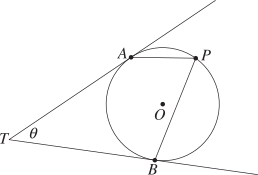
The points `A`, `B` and `P` lie on a circle centred at `O`. The tangents to the circle at `A` and `B` meet at the point `T`, and `/_ATB = theta`.

 What is `/_APB` in terms of  `theta`? 

  1. `theta/2`  
  2. `90^@-theta/2`
  3. `theta` 
  4. `180^@-theta` 
Show Answers Only

`B`

Show Worked Solution

`/_ BOA= 2 xx /_ APB`

`text{(angles at centre and circumference on arc}\ AB text{)}`

`/_TAO = /_ TBO = 90^@\ text{(angle between radius and tangent)}`

`:.\ theta + /_BOA` `= 180^@\ text{(angle sum of quadrilateral}\ TAOB text{)}`
`theta + 2 xx /_APB` `= 180^@`
`2 xx /_APB` `= 180^@-theta`
`/_APB` `= 90^@-theta/2`

 
`=>  B`

Filed Under: 2. Plane Geometry EXT1, Circle Geometry Tagged With: Band 4, num-title-ct-patha, num-title-qs-hsc, smc-4240-10-Angles on arcs, smc-4240-60-Tangents

Functions, EXT1 F2 2012 HSC 8 MC

When the polynomial  `P(x)`  is divided by  `(x + 1)(x-3)`, the remainder is  `2x + 7`.  

What is the remainder when  `P(x)`  is divided by  `x-3`? 

  1. `1` 
  2. `7` 
  3. `9` 
  4. `13` 
Show Answers Only

`D`

Show Worked Solution

`text(Let)\ \ P(x) =A(x) * Q(x) + R(x)`

`text(where)\ \ A(x) = (x + 1)(x-3),\ text(and)\ \ R(x)=2x+7`

`text(When)\ \ P(x) -: (x-3),\ text(remainder) = P(3)`

`P(3)` `= 0 + R(3)`
  `= (2 xx 3) + 7`
  `= 13`

 
`=>  D`

Filed Under: Polynomials, Remainder and Factor Theorems (Ext1), Roots, Remainders and Factors Tagged With: Band 4, num-title-ct-patha, num-title-qs-hsc, smc-1031-20-Remainder Theorem, smc-4242-20-Remainder Theorem

Mechanics, EXT2* M1 2012 HSC 6 MC

A particle is moving in simple harmonic motion with displacement `x`. Its velocity `v` is given by

 `v^2 = 16(9 − x^2)`.

 What is the amplitude, `A`, and the period, `T`, of the motion? 

  1. `A = 3\ \ \ text(and)\ \ \ T = pi/2` 
  2. `A = 3\ \ \ text(and)\ \ \ T = pi/4` 
  3. `A = 4\ \ \ text(and)\ \ \ T = pi/3` 
  4. `A = 4\ \ \ text(and)\ \ \ T = (2pi)/3` 
Show Answers Only

`A`

Show Worked Solution

`v^2 = 16(9 – x^2)`

`text(Find amplitude and period of motion)`

`v^2` `= n^2(A^2 – x^2)`
`A^2` `= 9`
`:.\ A` `=3,\ \ \ (A > 0)`
`n^2` `= 16`
`n` `=4,\ \ \ (n>0)`
`:. T` `= (2pi)/n`
  `= pi/2`

 
`=>  A`

Filed Under: Simple Harmonic Motion, Simple Harmonic Motion EXT1 Tagged With: Band 4, smc-1059-10-Amplitude / Period

Combinatorics, EXT1 A1 2012 HSC 5 MC

How many arrangements of the letters of the word  `OLYMPIC`  are possible if the  `C`  and  the  `L`  are to be together in any order?

  1. `5!`  
  2. `6!` 
  3. `2 xx 5!` 
  4. `2 xx 6!` 
Show Answers Only

`D`

Show Worked Solution

`text(S)text(ince)\ C\ text(and)\ L\ text(must be kept together, they)`

`text(act as 1 letter with 2 possible combinations.)`
 

`:.\ text(Total combinations)`

`= 2 xx 6 xx 5 xx 4 xx 3 xx 2 xx 1`

`= 2 xx 6!`
 

`=>  D`

Filed Under: Permutations and Combinations (Ext1), Permutations and Combinations EXT1 Tagged With: Band 4, smc-1082-10-Ordered Combinations

Trigonometry, EXT1 T1 2012 HSC 4 MC

Which function best describes the following graph? 

2012 4 mc

  1. `y = 3sin^(−1) 2x` 
  2. `y = 3/2 sin^(−1) 2x` 
  3. `y = 3sin^(−1)\ x/2` 
  4. `y = 3/2 sin^(−1)\ x/2` 
Show Answers Only

`C`

Show Worked Solution
`text{Domain:}` `\ \ -2 <= x <= 2`
  `\ \ -1 <= x/2 <= 1`

 
`:.\ text(Graph is)\ \ y = a sin^(-1)\ x/2`
 

`text(When)\ \ x = 2,\ \ y = (3pi)/2:`

`(3pi)/2` `=a sin^(-1) 1`
`(3pi)/2` `=a xx pi/2`
`a` `= 3`
`:.\ y` `= 3 sin ^(-1)\ x/2`

 
`=>  C`

Filed Under: Inverse Trig Functions EXT1, T1 Inverse Trig Functions (Y11) Tagged With: Band 4, smc-1024-10-arcsin Graphs, smc-1024-15-Identify Graphs

Calculus, 2ADV C3 2009 HSC 10

`text(Let)\ \ f(x) = x - (x^2)/2 + (x^3)/3`

  1. Show that the graph of  `y = f(x)`  has no turning points.   (2 marks)

    --- 4 WORK AREA LINES (style=lined) ---

  2. Find the point of inflection of  `y = f(x)`.     (1 mark)

    --- 3 WORK AREA LINES (style=lined) ---

  3. i. Show that `1 - x + x^2 - 1/(1 + x) = (x^3)/(1 + x)`  for  `x != -1`.   (1 mark)

    --- 2 WORK AREA LINES (style=lined) ---


    ii. Let  `g(x) = ln (1 + x)`.


        Use the result in part c.i. to show that  `f prime (x) >= g prime (x)`  for all  `x >= 0`.   (2 marks)

    --- 5 WORK AREA LINES (style=lined) ---

  1. Sketch the graphs of  `y = f(x)`  and  `y = g(x)`  for  `x >= 0`.    (2 marks)
    --- 8 WORK AREA LINES (style=lined) ---

  2. Show that  `d/(dx) [(1 + x) ln (1 + x) - (1 + x)] = ln (1 + x)`.   (2 marks)

    --- 5 WORK AREA LINES (style=lined) ---

  3. Find the area enclosed by the graphs of  `y = f(x)`  and  `y = g(x)`, and the straight line  `x = 1`.   (2 marks)

    --- 5 WORK AREA LINES (style=lined) ---

Show Answers Only
  1. `text{Proof  (See Worked Solutions)}`
  2. `(1/2, 5/12)`
  3. i. `text{Proof  (See Worked Solutions)}`


    ii. `text{Proof  (See Worked Solutions)}` 

  4.  
        Geometry and Calculus, 2UA 2009 HSC 10 Answer
  5. `text{Proof  (See Worked Solutions)}`
  6. `1 5/12\ – 2ln2\ \ text(u²)`
Show Worked Solution
a.    `f(x) = x\ – (x^2)/2 + (x^3)/3`
♦♦ Mean mark 28% for all of Q10 (note that data for each question part is not available).
 

`text(Turning points when)\ f prime (x) = 0`

`f prime (x) = 1\ – x + x^2`

`x^2\ – x + 1 = 0`

`text(S)text(ince)\ \ Delta` `= b^2\ – 4ac`
  `= (–1)^2\ – 4 xx 1 xx 1`
  `= -3 < 0 => text(No solution)`

 
`:.\ f(x)\ text(has no turning points)`


b.    `text(P.I. when)\ f″(x) = 0`
`f″(x)` `= -1 + 2x = 0`
`2x` `= 1`
`x` `= 1/2`

`text(Check for change in concavity)`

`f″(1/4)` `= -1/2 < 0`
`f″(3/4)` `= 1/2 > 0`

`=>\ text(Change in concavity)`

`:.\ text(P.I. at)\ \ x = 1/2`


`f(1/2)` `= 1/2\ – ((1/2)^2)/2 + ((1/2)^3)/3`
  `= 1/2\ – 1/8 + 1/24`
  `= 5/12`

`:.\ text(Point of Inflection at)\ (1/2, 5/12)`


c.i.    `text(Show)\ 1\ – x + x^2\ – 1/(1 + x) = (x^3)/(1 + x),\ \ \ x != -1` 
`text(LHS)` `= (1+x)/(1+x)\ – (x(1+x))/(1+x) + (x^2(1+x))/((1+x))\ – 1/(1+x)`
  `= (1 + x\ – x\ – x^2 + x^2 + x^3\ – 1)/(1+x)`
  `= (x^3)/(1+x)\ \ \ text(… as required)`


c.ii.   `text(Let)\ g(x) = ln(1+x)`
  `g prime (x) = 1/(1 + x)`
`f prime (x)\ – g prime (x)` `= 1\ – x + x^2\ – 1/(1+x)`
  `= (x^3)/(1 + x)\ \ text{(using part (i))}`

`text(S)text(ince)\ (x^3)/(1 + x) >= 0\ text(for)\ x >= 0`

`f prime (x)\ – g prime (x) >= 0`
`f prime (x) >= g prime (x)\ text(for)\ x >= 0`
MARKER’S COMMENT: When 2 graphs are drawn on the same set of axes, you must label them. 
 

d. 

Geometry and Calculus, 2UA 2009 HSC 10 Answer

e.    `text(Show)\ d/(dx) [(1 + x) ln (1 + x)\ – (1 + x)] = ln (1 + x)`
  `text(Using)\ d/(dx) uv=uv′+vu′`
`text(LHS)` `= (1+x) xx 1/(1 + x) + ln(1+x)xx1 +  – 1`
  `= 1+ ln(1+x)\ – 1`
  `= ln(1+x)`
  `=\ text(RHS    … as required)`


f.    `text(Area)` `= int_0^1 f(x)\ – g(x)\ dx`
    `= int_0^1 (x\ – (x^2)/2 + (x^3)/3\ – ln(x+1))\ dx`
    `= [x^2/2\ – x^3/6 + (x^4)/12\ – (1 + x) ln (1+x) + (1+x)]_0^1`
    `text{(using part (e) above)}`
    `= [(1/2 – 1/6 + 1/12 – (2)ln2 + 2) – (ln1 + 1)]`
    `= 5/12\ – 2ln2 + 2\ – 1`
    `= 1 5/12\ – 2 ln 2\ \ text(u²)`

Filed Under: Applied Calculus (L&E), Areas Under Curves, Areas Under Curves (Y12), Curve Sketching (Y12), Curve Sketching and The Primitive Function Tagged With: Band 4, Band 5, Band 6, smc-969-10-Cubic, smc-969-30-Other Graphs, smc-975-60-Other

Trigonometry, 2ADV T3 2009 HSC 7b

Between 5 am and 5 pm on 3 March 2009, the height, `h`, of the tide in a harbour was given by

`h = 1 + 0.7 sin(pi/6 t)\ \ \ text(for)\ \ 0 <= t <= 12`

where  `h`  is in metres and  `t`  is in hours, with  `t = 0`  at 5 am. 

  1. What is the period of the function  `h`?    (1 mark)

    --- 2 WORK AREA LINES (style=lined) ---

  2. What was the value of  `h`  at low tide, and at what time did low tide occur?     (2 marks)

    --- 4 WORK AREA LINES (style=lined) ---

  3. A ship is able to enter the harbour only if the height of the tide is at least 1.35 m.


    Find all times between 5 am and 5 pm on 3 March 2009 during which the ship was able to enter the harbour.    (3 marks)
    --- 6 WORK AREA LINES (style=lined) ---

Show Answers Only
  1. `12\ text(hours)`
  2. `text(2pm)\ \ text{(5am + 9 hours)}`
  3. `text(6am to 10am)`
Show Worked Solution

i.   `h = 1 + 0.7 sin (pi/6 t)\ \ text(for)\ 0 <= t <= 12`

`T` `= (2pi)/n\ \ text(where)\ n = pi/6`
  `= 2 pi xx 6/pi`
  `= 12\ text(hours)`


`:.\ text(The period of)\ h\ text(is 12 hours.)`


ii.  `text(Find)\ h\ text(at low tide)`

IMPORTANT: Using `sin x=–1` for a minimum here is very effective and time efficient. This property of trig functions is often very useful in harder questions.

`=> h\ text(will be a minimum when)`

`sin(pi/6 t) = -1`

`:.\ h_text(min)` `= 1 + 0.7(-1)`
  `= 0.3\ text(metres)`


`text(S)text(ince)\ \ sinx = -1\ \ text(when)\ \ x = (3pi)/2`

`pi/6 t` `= (3pi)/2`
`t` `= (3pi)/2 xx 6/pi`
  `= 9\ text(hours)`

 
`:.\ text{Low tide occurs at 2pm (5 am + 9 hours)}`


iii.
  `text(Find)\ \ t\ \ text(when)\ \ h >= 1.35`

`1 + 0.7 sin (pi/6 t)` `>= 1.35`
`0.7 sin (pi/6 t)` `>= 0.35`
`sin (pi/6 t)` `>= 1/2`
`sin (pi/6 t)` `= 1/2\ text(when)`
`pi/6 t` `= pi/6,\ (5pi)/6,\ (13pi)/6,\ text(etc …)`
   
`t` `= 1,\ 5\ \ \ \ \ \ (0 <= t <= 12)`


Trig Calculus, 2UA 2009 HSC 7b Answer

`text(From the graph,)`

`sin(pi/6 t) >= 1/2\ \ \ text(when)\ \ 1 <= t <= 5`

 
`:.\ text(Ship can enter the harbour between 6 am and 10 am.)`

Filed Under: Trig Applications (Y12), Trig graphs Tagged With: Band 4, Band 5, Band 6, smc-1188-20-Tides

Calculus, EXT1* C3 2009 HSC 6a

The diagram shows the region bounded by the curve  `y = sec x`, the lines  `x = pi/3`  and  `x = -pi/3`,  and the  `x`-axis. 
 

2009 6a
 

The region is rotated about the   `x`-axis. Find the volume of the solid of revolution formed.   (3 marks)
Show Answers Only

 `2 sqrt 3 pi\ text(u³)`

Show Worked Solution
`V` `= pi int_(-pi/3)^(pi/3) y^2\ dx`
  `= pi int_(-pi/3)^(pi/3) sec^2x\ dx`
  `= pi [tanx]_(-pi/3)^(pi/3)`
  `= pi[tan(pi/3) – tan(-pi/3)]`
  `= pi [sqrt3\ – (-sqrt3)]`
  `= 2 sqrt3 pi\ text(u³)`

Filed Under: Further Area and Solids of Revolution (Ext1), Volumes of Solids of Rotation Tagged With: Band 4, smc-1039-20-Trig Function, smc-1039-60-x-axis Rotation

Trigonometry, 2ADV T1 2009 HSC 5c

The diagram shows a circle with centre `O` and radius 2 centimetres. The points  `A`  and  `B`  lie on the circumference of the circle and  `/_AOB = theta`.
 

2009 5c  
 

  1. There are two possible values of  `theta`  for which the area of  `Delta AOB`  is  `sqrt 3`  square centimetres. One value is  `pi/3`.


    Find the other value.    (2 marks)

    --- 4 WORK AREA LINES (style=lined) ---

  2. Suppose that  `theta = pi/3`.


    (1)  Find the area of sector  `AOB`   (1 mark)

    --- 3 WORK AREA LINES (style=lined) ---


    (2)  Find the exact length of the perimeter of the minor segment bounded by the chord  `AB`  and the arc  `AB`.   (2 marks)

    --- 4 WORK AREA LINES (style=lined) ---

Show Answers Only
  1. `(2pi)/3`
  2. (1)  `(2pi)/3\ \ text(cm²)`
  3. (2)  `(2 + (2pi)/3)\ text(cm)`
Show Worked Solution
i.    `text(Area)\ Delta AOB` `= 1/2 ab sin theta`
    `= 1/2 xx 2 xx 2 xx sin theta`
    `= 2 sin theta`
`2 sin theta` `= sqrt 3\ \ \ text{(given)}`
`sin theta` `= sqrt3/2`
`:. theta` `= pi/3,\ pi\ – pi/3`
  `= pi/3,\ (2pi)/3`


`:.\ text(The other value of)\ theta\ text(is)\ \ (2pi)/3\ \ text(radians)` 


ii. (1)    `text(Area of sector)\ AOB` `= pi r^2 xx theta/(2pi)`
    `= 1/2 r^2 theta`
    `= 1/2 xx 2^2 xx pi/3`
    `= (2pi)/3\ text(cm²)` 


ii. (2)    `text(Using the cosine rule:)`
`AB^2` `= OA^2 + OB^2\ – 2 xx OA xx OB xx cos theta`
  `= 2^2 + 2^2\ – 2 xx 2 xx 2 xx cos (pi/3)`
  `= 4 + 4\ – 4`
  `= 4`
`:.\ AB` `= 2`


`text(Arc)\ AB` `= 2 pi r xx theta/(2pi)`
  `= r theta`
  `= (2pi)/3\ text(cm)`


`:.\ text(Perimeter) = (2 + (2pi)/3)\ text(cm)`

Filed Under: Circular Measure, Circular Measure (Adv-2027), Circular Measure (Y11), Sine and Cosine Rules, Bearings, Trig Ratios, Sine and Cosine Rules (Adv-2027), Trig Ratios, Sine and Cosine Rules (Y11) Tagged With: Band 4, Band 5, smc-6392-30-Sine Rule, smc-6392-60-Ambiguous Case, smc-6394-10-Arc Length/Perimeter, smc-6394-20-Area of Sector, smc-978-10-Arc Length/Perimeter, smc-978-20-Area of Sector, smc-980-30-Sine Rule, smc-980-50-Ambiguous Case

Functions, 2ADV F1 2009 HSC 5a

In the diagram, the points  `A`  and  `C`  lie on the  `y`-axis and the point  `B`  lies on the  `x`-axis. The line  `AB`  has equation  `y = sqrt3x − 3`. The line  `BC`  is perpendicular to  `AB`.
 

2009 5a 

  1. Find the equation of the line  `BC`.    (2 marks)

    --- 4 WORK AREA LINES (style=lined) ---

  2. Find the area of the triangle  `ABC`.    (2 marks)

    --- 4 WORK AREA LINES (style=lined) ---

Show Answers Only
  1. `y= – 1/sqrt3 x +1`
  2. `text(Area)\ Delta ABC = 2 sqrt 3\ text(u²)`
Show Worked Solution

i.   `text(Gradient of)\ \ AB = sqrt 3`

`:. m_(BC) = -1/(sqrt3)\ \ (BC _|_ AB)`

`text(Finding)\ B,`

`0` `= sqrt3 x – 3`
`sqrt 3 x` `= 3`
`x` `= 3/sqrt3 xx sqrt3/sqrt3`
  `= sqrt3`

 
`:. B (sqrt3, 0)`

 
`text(Equation of)\ \ BC\ \ text(has)\ \ m = – 1/sqrt3\ \ text(through)\ \ (sqrt3, 0)`

`y\ – y_1` `= m (x\ – x_1)`
`y\ – 0` `= – 1/sqrt3 (x\ – sqrt3)`
`y` `= – 1/sqrt3 x +1`


ii.  `AB\ \ text(cuts)\ y text(-axis when)\ \ x = 0, \ \ y=-3`

  `=> A (0,–3)`

`BC\ \ text(cuts)\ y text(-axis when)\ \ x = 0, \ \ y=1`

  `=> C (0,1)`

`:. AC` `= 4`
`OB` `= sqrt 3`


`text(Area)\ \ Delta ABC` `= 1/2 xx AC xx OB`
  `= 1/2 xx 4 xx sqrt 3`
  `= 2 sqrt 3\ text(u²)`

Filed Under: 6. Linear Functions, Linear Functions (Adv-2027), Linear Functions (Y11) Tagged With: Band 4, smc-6214-05-Coordinate Geometry, smc-985-30-Coordinate Geometry

Plane Geometry, 2UA 2009 HSC 4c

In the diagram,  `Delta ABC`  is a right-angled triangle, with the right angle at  `C`. The midpoint of  `AB`  is  `M`, and  `MP _|_ AC`.

Plane Geometry, 2UA 2009 HSC 4c_1

Copy or trace the diagram into your writing booklet. 

  1. Prove that  `Delta AMP`  is similar to  `Delta ABC`.   (2 marks)
  2. What is the ratio of  `AP`  to  `AC`?    (1 mark)
  3. Prove that  `Delta AMC`  is isosceles.   (2 marks)
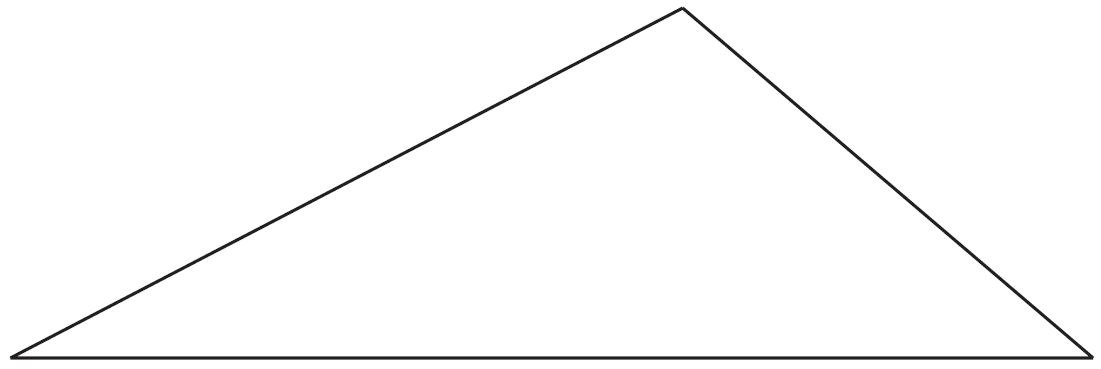
  4. Show that  `Delta ABC`  can be divided into two isosceles triangles.   (1 mark)
  5. Plane Geometry, 2UA 2009 HSC 4c_2
  6. Copy or trace this triangle into your writing booklet and show how to divide it into four isosceles triangles.   (1 mark)
  7.  
Show Answers Only
  1. `text(Proof)\ \ text{(See Worked Solutions)}`
  2. `text(Ratio)\ AP:AC = 1:2`
  3. `text(Proof)\ \ text{(See Worked Solutions)}`
  4. `text(Proof)\ \ text{(See Worked Solutions)}`
  5. Plane Geometry, 2UA 2009 HSC 4c_2 Answer1
Show Worked Solution
(i)    `text(Need to prove)\ Delta AMP\  text(|||)\  Delta ABC`
  `/_ PAM\ text(is common)`
  `/_ MPA = /_BCA = 90°\ \ \ text{(given)}`
  `:.\ Delta AMP \ text(|||) \ Delta ABC\ \ \ text{(equiangular)}`


(ii)   `(AP)/(AC) = (AM)/(AB)\ \ \ ` `text{(corresponding sides of}`
    `text{similar triangles)}`


`text(S)text(ince)\ \ AB = 2 xx AM`
`(AP)/(AC) = 1/2`
`:.\ text(Ratio)\ AP:AC = 1:2`


(iii)

Plane Geometry, 2UA 2009 HSC 4c_1 Answer

`AP = PC \ \ \ text{(from part (ii))}`
`PM\ text(is common)`
`/_APM = /_CPM = 90°\ \ text{(∠}\ APC\ text{is a straight angle)}`
`:.\ Delta AMP ~= Delta CMP\ text{(SAS)}`
`=> AM = CM\ \ ` `text{(corresponding sides of}`
  `text{congruent triangles)}`

`:.\ Delta AMC\ text(is isosceles.)`


(iv)   `text(S)text(ince)\ \ AM` `= MC\ \ \ text{(part (iii))}`
  `AM`  `= MB\ text{(given)}`
  `:. MC`  `= MB`
`:. Delta MCB\ text(is isosceles)`
`:. Delta ABC\ text(can be divided into 2 isosceles)`
`text(triangles)\ (Delta AMC\ text(and)\ Delta MCB text{)}`


(v)

Plane Geometry, 2UA 2009 HSC 4c_2 Answer1

♦♦ Mean mark 25%.
MARKER’S COMMENT: Use a ruler, draw large diagrams and always pay careful attention to previous parts of the question!
`/_AFB = /_CFB = 90°`
`DF\ text(bisects)\ AB`
`EF\ text(bisects)\ BC`
`text(From part)\ text{(iv)}\ text(we get 4 isosceles)`
`text(triangles as shown.)`

Filed Under: 2. Plane Geometry Tagged With: Band 3, Band 4, Band 5, Band 6

Quadratic, 2UA 2009 HSC 4b

Find the values of  `k`  for which the quadratic equation 

`x^2 - (k + 4)x + (k + 7) = 0`

has equal roots.    (3 marks)

Show Answers Only

 `k = –6 \ \ text(or)\ \  2`

Show Worked Solution

`x^2\ – (k + 4)x + (k + 7) = 0`

`text(Equal roots when)\ Delta = 0`

`text(i.e.)\ \ \ b^2\ – 4ac = 0`

`[–(k + 4)]^2\ – 4(1)(k + 7)` `= 0`
`k^2 + 8k + 16\ – 4k\ – 28` `= 0`
`k^2 + 4k\ – 12` `= 0`
`(k + 6)(k\ – 2)` `= 0`
`k` `= -6 \ \ text(or)\ \  2`


`:.\ text(Equal roots when)\ \ k = –6 or 2`

Filed Under: Roots and the discriminant Tagged With: Band 4

Integration, 2UA 2009 HSC 3d

The diagram shows a block of land and its dimensions, in metres. The block of land is bounded on one side by a river. Measurements are taken perpendicular to the line  `AB`, from  `AB`  to the river, at equal intervals of  `50\ text(m)`.
 

Integration, 2UA 2009 HSC 3d

 
Use Simpson’s rule with six subintervals to find an approximation to the area of the block of land.   (3 marks)

Show Answers Only

 `text(64,500 m²`

Show Worked Solution

Integration, 2UA 2009 HSC 3d Answer

`A` `~~ h/3 [y_0 + y_6 + 4(y_1 + y_3 + y_5) + 2(y_2 + y_4)]`
  `~~ 50/3 [210 + 240 + 4(220 + 190 + 240) + 2(200 + 210)]`
  `~~ 50/3 [210 + 240 + 2600 + 820]`
  `~~ 64,500\ text(m²)`


`:.\ text(The block of land is approx 64,500 m²)`

Filed Under: Trapezoidal and Simpson's Rule Tagged With: Band 4

Functions, EXT1* F1 2009 HSC 3c

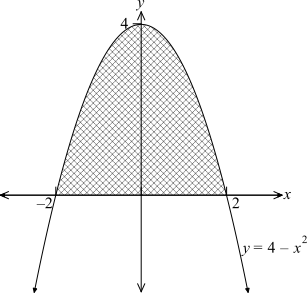
Shade the region in the plane defined by  `y >= 0`  and  `y <= 4-x^2`.   (2 marks)

--- 8 WORK AREA LINES (style=lined) ---

Show Answers Only


`text(Shaded area is region where)`

`y >= 0\ text(and)\ y >= 4-x^2`

Show Worked Solution

COMMENT: This past “Advanced” HSC question now fits into the Ext1 (new) syllabus.

`text(Shaded area is region where)`

`y >= 0\ \ text(and)\ \ y >= 4-x^2`

Filed Under: 4. Real Functions, Functions and Other Graphs, Inequalities (Ext1-2027), Inequalities (Ext1), The Parabola Tagged With: Band 4, num-title-ct-extension, num-title-qs-hsc, smc-1033-40-Regions, smc-4244-85-Non-linear inequalities, smc-6643-40-Regions

Functions, 2ADV F1 2009 HSC 3b

2009 3b
 

The circle in the diagram has centre  `N`. The line  `LM`  is tangent to the circle at  `P`. 

  1. Find the equation of  `LM`  in the form  `ax + by + c = 0`.   (2 marks)
  2. Find the distance  `NP`.    (2 marks)
  3. Find the equation of the circle.    (1 mark)
Show Answers Only
  1. `4x – 3y – 5 = 0`
  2. `2\ text(units)`
  3. `text(Equation is)\ \ (x – 1)^2 + (y – 3)^2 = 4`
Show Worked Solution

(i)  `text(Need to find the gradient of)\ LM`

`m_(LM)` `= (y_2\ – y_1)/(x_2\ – x_1)`
  `= (5\ – 1)/(5\ – 2)`
  `= 4/3`

 
`text(Equation of)\ LM\ text(has)\ m = 4/3\ text(through)\ (2,1)`

`y\ – y_1` `= m (x\ – x_1)`
`y\ – 1` `= 4/3 (x\ – 2)`
`3y\ – 3` `= 4x\ – 8`
`4x\ – 3y\ – 5` `= 0`


(ii)  `NP\ text(is)  _|_ text(distance of)\ \ N(1,3)\ \ text(from)\ \ LM`

`_|_\ text(dist)` `= |(ax_1 + by_1 + c)/sqrt(a^2 + b^2)|`
  `= |(4(1)\ – 3(3)\ – 5)/sqrt(4^2 + (-3)^2)|`
  `= |-10/5|`
  `= 2\ text(units)`


(iii)  `text{The circle has centre (1,3) and radius 2 units:`

`:.\ text(Equation is)\ \ (x\ – 1)^2 + (y\ – 3)^2 = 4`

Filed Under: 4. Real Functions, 6. Linear Functions Tagged With: Band 3, Band 4

Calculus, 2ADV C4 2009 HSC 2b

  1. Find  `int 5\ dx`.   (1 mark)

    --- 1 WORK AREA LINES (style=lined) ---

  2. Find  `int 3/((x - 6)^2)\ dx`.    (2 marks)

    --- 3 WORK AREA LINES (style=lined) ---

  3. Evaluate  `int_1^4 x^2 + sqrtx\ dx`.   (3 marks)

    --- 5 WORK AREA LINES (style=lined) ---

Show Answers Only
  1. `5x + C`
  2. `(-3)/((x – 6)) + C`
  3. `77/3`
Show Worked Solution

i.  `int 5\ dx= 5x + C`


ii.  `int 3/((x – 6)^2)\ dx`

`= 3 int (x – 6)^(-2)\ dx`

`= 3 xx 1/(-1) xx (x – 6)^(-1) + c`

`= (-3)/((x – 6)) + c`


iii.  `int_1^4 x^2 + sqrtx\ \ dx`

`= int_1^4 (x^2 + x^(1/2))\ dx`

`= [1/3 x^3 + 1/(3/2) x^(3/2)]_1^4`

`= [(x^3)/3 + 2/3x^(3/2)]_1^4`

`= [((4^3)/3 + 2/3 xx 4^(3/2))\ – (1/3 + 2/3)]`

`= [(64/3 + 16/3) – 3/3]`

`= [80/3 – 3/3]`

`= 77/3`

Filed Under: Integrals, Standard Integration Tagged With: Band 2, Band 3, Band 4, smc-1202-10-Indefinite Integrals, smc-1202-20-Definite Integrals

Calculus, EXT1 C2 2012 HSC 7 MC

Which expression is equal to `int sin^2 3x\ dx`?

  1. `1/2 (x-1/3 sin 3x) + C`
  2. `1/2 (x + 1/3 sin 3x) + C`
  3. `1/2 (x-1/6 sin 6x) + C`
  4. `1/2 (x + 1/6 sin 6x) + C`
Show Answers Only

`C`

Show Worked Solution

`text(Using:)\ \ sin^2a = 1/2 (1-cos 2a)`

`int sin^2 3x\ dx` `= 1/2 int (1-cos 6x)\ dx`
  `= 1/2 (x-1/6 sin 6x) + C`

`=>  C`

Filed Under: 11. Integration EXT1, 13. Trig Calc, Graphs and Circular Measure EXT1, Harder Trig Calculus (Ext1) Tagged With: Band 4, smc-1038-10-Integrate sin^2(x)

Trigonometry, 2ADV T3 2010 HSC 8c

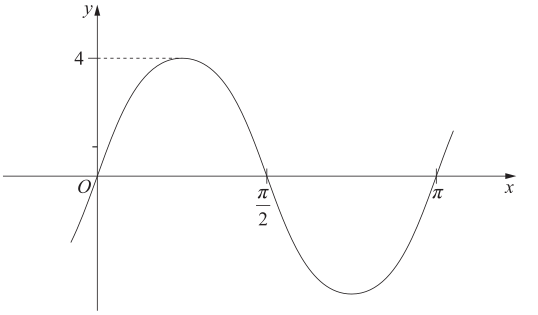
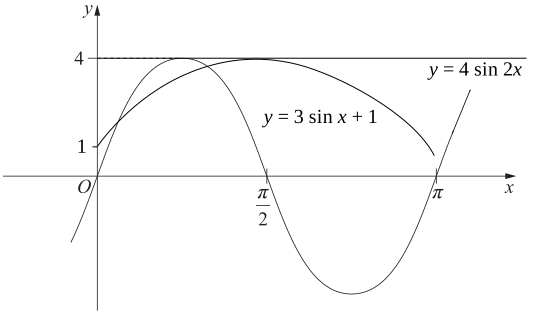
The graph shown is  `y = A sin bx`.


  1. Write down the value of  `A`.    (1 mark)

    --- 1 WORK AREA LINES (style=lined) ---

  2. Find the value of  `b`.    (1 mark)

    --- 3 WORK AREA LINES (style=lined) ---

  3. On the same set of axes, draw the graph  `y = 3 sin x + 1`  for  `0 <= x <= pi`.   (2 marks)

    --- 0 WORK AREA LINES (style=lined) ---

Show Answers Only
  1. `A = 4`
  2. `b = 2`
  3. `text(See Worked Solutions for sketch)`
Show Worked Solution

i.   `A = 4`

ii.  `text(S)text(ince the graph passes through)\ \ (pi/4, 4)`

`text(Substituting into)\ \ y = 4 sin bx`

`4 sin (b xx pi/4)` `=4`
`sin (b xx pi/4)` `= 1`
`b xx pi/4` `= pi/2`
`:. b` `= 2`


 MARKER’S COMMENT: Graphs are consistently drawn too small by many students. Aim to make your diagrams 1/3 to 1/2 of a page. 
iii.

Filed Under: Trig graphs, Trig Graphs (Y12) Tagged With: Band 2, Band 4, smc-977-10-sin

Trigonometry, 2ADV T1 2010 HSC 6b

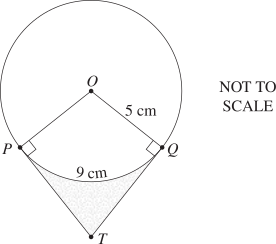
The diagram shows a circle with centre `O` and radius 5 cm.

The length of the arc `PQ` is 9 cm. Lines drawn perpendicular to `OP` and `OQ` at `P` and `Q` respectively meet at  `T`.
 

  1. Find  `/_POQ`  in radians.   (1 mark)

    --- 2 WORK AREA LINES (style=lined) ---

  2. Prove that  `Delta OPT`  is congruent to  `Delta OQT`.   (2 marks)

    --- 2 WORK AREA LINES (style=lined) ---

  3. Find the area of the shaded region.   (2 marks)

    --- 5 WORK AREA LINES (style=lined) ---

Show Answers Only
  1. `9/5\ text(radians)`
  2. `text(Proof)  text{(See Worked Solutions)}`
  3. `6.3\ text(cm)\ \ \ text{(to 1 d.p.)}`
  4. `9.0\ text(cm²)\ \ \ text{(to 1 d.p.)}`
Show Worked Solution
i.    `text(Length of Arc)` `= r theta`
  `9` `= 5 xx /_POQ`
  `:.\ /_ POQ` `= 9/5\ text(radians)`


ii.

`text(Prove)\ Delta OPT ~= Delta OQT`

`OT\ text(is common)`

 MARKER’S COMMENT: Know the difference between the congruency proof of `RHS` and `SAS`. Incorrect identification will lose a mark.

`/_OPT = /_OQT = 90°\ \ \ text{(given)}`

`OP = OQ\ \ \ text{(radii)}`

`:.\ Delta OPT ~= Delta OQT\ \ \ text{(RHS)}`
 

iii.   
`/_POT ` `= 1/2 xx /_POQ\ \ \ text{(from part (ii))}`
  `=1/2 xx 9/5`
  `= 9/10\ text(radians)`
♦♦ Mean mark below 30%.
MARKER’S COMMENT: Many students struggled to work in radians. Make sure you understand this concept.
`tan /_ POT` `= (PT)/(OP)`
`tan (9/10)` `= (PT)/5`
`PT` `= 5 xx tan(9/10)`
  `=6.3007…`
  `=6.3\ text(cm)\ \ text{(to 1 d.p.)}`


iv.    `text(Shaded Area = Area)\ OQTP\ – text(Area Sector)\ OQP`
♦ Mean mark 35%.
`text(Area)\ OQTP` `= 2 xx text(Area)\ Delta OPT`
  `=2 xx 1/2 xx OP xx PT`
  `= 5 xx 6.3007`
  `~~ 31.503…`
  `~~31.5\ text(cm²)`


`text(Area Sector)\ OQP` ` = 1/2 r^2 theta`
  `= 1/2 xx 25 xx 9/5`
  `= 22.5\ text(cm²)`


`:.\ text(Shaded Area)` `= 31.503\ – 22.5`
  `=9.003…`
  `=9.0\ text(cm²)\ \ \ text{(to 1 d.p.)}`

Filed Under: 2. Plane Geometry, Circular Measure, Circular Measure (Adv-2027), Circular Measure (Y11) Tagged With: Band 4, Band 5, smc-6394-30-Area - Other, smc-978-30-Area - Other

Calculus, 2ADV C3 2010 HSC 6a

Let  `f(x) = (x + 2)(x^2 + 4)`.

  1. Show that the graph  `y=f(x)`  has no stationary points.   (2 marks)

    --- 5 WORK AREA LINES (style=lined) ---

  2. Find the values of  `x`  for which the graph  `y=f(x)`  is concave down, and the values for which it is concave up.    (2 marks)

    --- 5 WORK AREA LINES (style=lined) ---

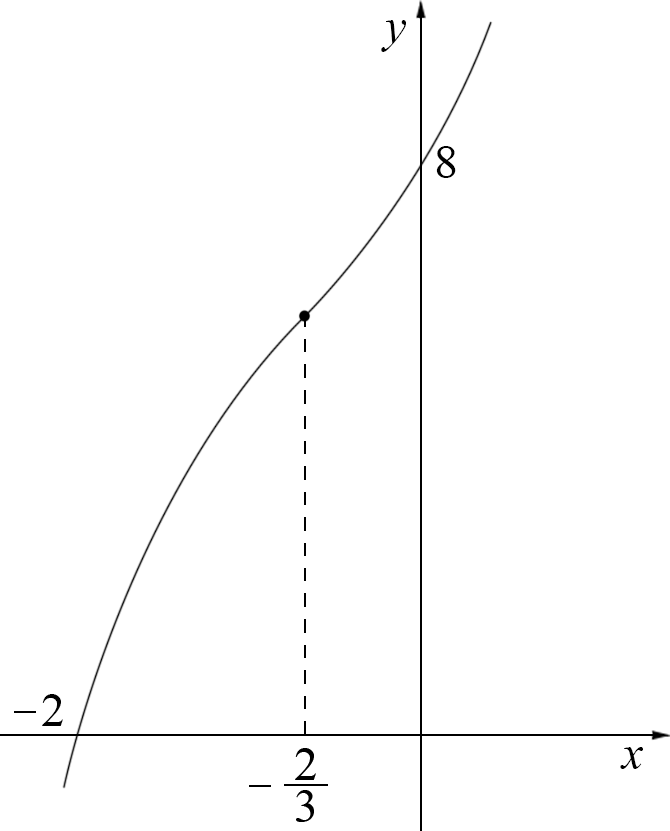
  3. Sketch the graph  `y=f(x)`,  indicating the values of the  `x`  and  `y` intercepts.   (2 marks)

    --- 8 WORK AREA LINES (style=lined) ---

Show Answers Only
  1. `text(Proof)  text{(See Worked Solutions)}`
  2.  `f(x)\ text(is concave down when)\ x < -2/3`


    `f(x)\ text(is concave up when)\ x > -2/3`

  3.  
Show Worked Solution

i.  `text(Need to show no  S.P.’s)`

`f(x)` `= (x+2)(x^2 + 4)`
  `=x^3 + 2x^2 + 4x + 8`
`f prime (x)` `= 3x^2 + 4x + 4`


`text(S.P.s  occur when)\ \ f prime (x) =0,`

`3x^2 + 4x + 4 =0`

`Delta` `= b^2\ – 4ac`
  `=4^2\ – (4 xx 3 xx 4)`
  `=16\ – 48`
  `= -32 < 0`


`text(S)text(ince)\ \ Delta < 0,\ \ text(No Solution)`

`:.\ text(No  S.P.’s  for)\ \ f(x)`


ii.  `f(x)\ text(is concave down when)\ f″(x) < 0`

MARKER’S COMMENT: The significance of the sign of the second derivative was not well understood by most students.

`f″(x) = 6x + 4`

`=> 6x + 4` `< 0`
`6x` `< -4`
`x` `< -2/3`

`:.\ f(x)\ text(is concave down when)\ x < -2/3`

`f(x)\ text(is concave up when)\ f″(x) > 0`

`f″(x) = 6x + 4`

`=> 6x + 4` `> 0`
`6x` `> -4`
`x` `> -2/3`

`:. f(x)\ text(is concave up when)\ x > -2/3`


♦♦ Mean mark 33%.
MARKER’S COMMENT: Students are reminded to bring a ruler to the exam and use it to draw the axes for graphing and to help with an appropriate scale.

iii.  `y text(-intercept) =2 xx4=8`

`x text(-intercept)=–2` 


Filed Under: Curve Sketching (Y12), Curve Sketching and The Primitive Function Tagged With: Band 4, Band 5, smc-969-10-Cubic, smc-969-40-Concavity Intervals

Calculus, 2ADV C4 2010 HSC 5b

  1. Prove that  `sec^2 x + secx tanx = (1 + sinx)/(cos^2x)`.   (1 mark)

    --- 4 WORK AREA LINES (style=lined) ---

  2. Hence prove that  `sec^2 x + secx tanx = 1/(1 - sinx)`.     (1 mark)

    --- 4 WORK AREA LINES (style=lined) ---

  3. Hence, use the identity  `int sec ax tan ax\ dx=1/a sec ax`  to find the exact value of


          `int_0^(pi/4) 1/(1 - sinx)\ dx`.   (2 marks)

    --- 4 WORK AREA LINES (style=lined) ---

Show Answers Only
  1. `text(Proof)  text{(See Worked Solutions)}`
  2. `text(Proof)  text{(See Worked Solutions)}`
  3. `sqrt2`
Show Worked Solution

i.    `text(Need to prove)`

`sec^2x + secxtanx = (1 + sinx)/(cos^2x)`
 

`text(LHS)` `=sec^2x + secx tanx`
  `=1/(cos^2x) + 1/(cosx) xx (sinx)/cosx`
  `=1/(cos^2x) + (sinx)/(cos^2x)`
  `=(1 + sinx)/(cos^2x)`
  `= text(RHS)\ \ \ \ text(… as required)`


ii.   `text(Need to prove)` 

♦♦ Mean mark 31%.
`sec^2x + secx tanx` `= 1/(1\ – sinx)`
`text(i.e.)\ \ (1 + sinx)/(cos^2x)` `= 1/(1\ – sin x)\ \ \ \ \ text{(part (i))}`
`text(LHS)` `= (1 + sinx)/(cos^2x)`
  `=(1 + sin x)/(1\ – sin^2x)`
  `=(1 + sinx)/((1\ – sinx)(1 + sinx)`
  `=1/(1\ – sinx)\ \ \ \ text(… as required)`


iii.  `int_0^(pi/4) 1/(1\ – sinx)\ dx`

♦ Mean mark 37%.

`= int_0^(pi/4) (sec^2x + secx tanx)\ dx`

`= [tanx + secx]_0^(pi/4)`

`= [(tan(pi/4) + sec(pi/4)) – (tan0 + sec0)]`

`= [(1 + 1/(cos(pi/4)))\ – (0 + 1/(cos0))]`

`= 1 + sqrt2\ – 1`

`= sqrt2`

Filed Under: Differentiation and Integration, Exact Trig Ratios and Other Identities, Integrals, Trig Identities and Harder Equations (Adv-2027), Trig Identities and Harder Equations (Y11), Trig Integration Tagged With: Band 4, Band 5, smc-1189-10-Solve Equation, smc-1189-20-Prove Identity, smc-1204-40-Other, smc-6412-10-Solve Equation, smc-6412-20-Prove Identity

Probability, 2ADV S1 2010 HSC 4c

There are twelve chocolates in a box. Four of the chocolates have mint centres, four have caramel centres and four have strawberry centres. Ali randomly selects two chocolates and eats them.

  1. What is the probability that the two chocolates have mint centres?   (1 mark)

    --- 2 WORK AREA LINES (style=lined) ---

  2. What is the probability that the two chocolates have the same centre?    (1 mark)

    --- 2 WORK AREA LINES (style=lined) ---

  3. What is the probability that the two chocolates have different centres?   (1 mark)

    --- 2 WORK AREA LINES (style=lined) ---

Show Answers Only
  1. `1/11`
  2. `3/11`
  3. `8/11`
Show Worked Solution
i.    `P text{(2 mint)}` `=P(M_1) xx P(M_2)`
    `=4/12 xx 3/11`
    `=1/11`


ii.    `P text{(2 same)}` `=P(M_1 M_2) + P(C_1 C_2) + P(S_1 S_2)`
    `=1/11 + (4/12 xx 3/11) + (4/12 xx 3/11)`
    `=3/11`
 EXAM TIP: Using `1-Ptext{(2 things the same)}` is a quicker and easier strategy here.


iii.  `text(Solution 1)`

`P text{(2 diff)}` `=1\ – P text{(2 same)}`
  `=1\ – 3/11`
  `=8/11`

 
`text(Solution 2)`

`P text{(2 diff)}` `=P(M_1,text(not)\ M_2 text{)} + P(C_1,text(not)\ C_2 text{)} + P(S_1,text(not)\ S_2 text{)}`
  `=(4/12 xx 8/11) + (4/12 xx 8/11) + (4/12 xx 8/11)`
  `=32/121 + 32/121 + 32/121`
  `=8/11`

Filed Under: 3. Probability, Multi-Stage Events (Adv-2027), Multi-Stage Events (Y11) Tagged With: Band 4, smc-6469-20-Other Multi-Stage Events, smc-6469-30-Complementary Probability, smc-989-20-Other Multi-Stage Events, smc-989-30-Complementary Probability

Linear Functions, 2UA 2010 HSC 3a

In the diagram  `A`,  `B`  and  `C`  are the points  `( –2, –4 ),\ (12,6)`  and  `(6,8)`  respectively.

The point  `N (2,2)`  is the midpoint of   `AC`. The point  `M`  is the midpoint of  `AB`.
 

2010 3a
 

  1. Find the coordinates of  `M`.   (1 mark)
  2. Find the gradient of  `BC`.   (1 mark)
  3. Prove that  `Delta ABC`  is similar to  `Delta AMN`.   (2 marks)
  4. Find the equation of  `MN`.   (2 marks)
  5. Find the exact length of  `BC`.   (1 mark)
  6. Given that the area of  `Delta ABC`  is  `44`  square units, find the perpendicular distance  from  `A`  to  `BC`.    (1 mark)


Show Answers Only
  1. `M (5,1)`
  2. `-1/3`
  3. `text{Proof (See Worked Solutions)}`
  4. `x + 3y  – 8 = 0`
  5. `2 sqrt 10 \ text(units)`
  6. `(22 sqrt 10)/5 \ text(units)`
  7.  
Show Worked Solution

(i)   `M \ text(is the midpoint of) \ AB`

`A text{(–2,–4),}\ \ \ \ B(12,6)`

`:.M` `=((x_1+x_2)/2 ‘ (y_1+y_2)/2)`
  `= ((-2 + 12)/2  ,  (-4 + 6)/2)`
  `= (5,1)`


(ii)   `B(12,6),     C(6,8)`

`m_(BC)` `= (y_2 – y_1)/(x_2 – x_1)`
  `= (8– 6)/(6– 12)`
  `= -1/3`


(iii)  `text(Prove)\ Delta ABC \ text(|||) \ Delta AMN`

`text(Find gradient of) \ NM`

`N(2,2)   M(5,1)`

`m_(NM)` `= (1- 2)/(5– 2)`
  `= -1/3`

`:. NM\ text(||)\ BC \ \ \ text{(gradients are equal)}`

`angle NAM \ text(is common)`

`angle ANM = angle ACB\ \ \ text{(corresponding angles},\ NM\ text(||)\ BC text{)}`

`:.  Delta ABC \ text(|||) \ Delta AMN \ \ \ text{(equiangular)}`


(iv)   `text(Equation of) \ MN \ text(has) \ m=-1/3 \ \ text(through) \ (2,2)`

`text(Using) \ \ \ y- y_1` `= m(x  – x_1)`
`y  – 2` `= -1/3 (x  – 2)`
`3y  – 6` `= -x + 2`
`x +3y  – 8` `= 0`


`:. \ text(Equation of) \ MN \ text(is) \ \ x + 3y  – 8 = 0`


(v)   `B(12,6)   C(6,8)` 

`BC` `=sqrt{(x_2 – x_1)^2 + (y_2– y_1)^2}`
  `=sqrt{(6– 12)^2 + (8– 6)^2}`
  `=sqrt(36 +4)`
  `=sqrt(40)`
  `= 2 sqrt(10) \ text(units)`


(vi)   `text(Given the Area) \  Delta ABC=44\ text(u²)`

`1/2 xx b xx h` `= 44`
`1/2 xx BC xx h`  `= 44`
`1/2 xx 2 sqrt 10 xx h` `= 44`
`:. h` `= 44/ sqrt 10 xx sqrt 10 / sqrt 10`
  `= (44 sqrt 10 )/ 10`
  `= (22 sqrt 10) / 5`


`:. _|_ text(distance from) \ A \ text(to) \ BC \ text(is) \ (22 sqrt 10) / 5  \ text(units)`.

Filed Under: 6. Linear Functions Tagged With: Band 2, Band 3, Band 4

Functions, 2ADV F1 2010 HSC 1g

Let  `f(x) = sqrt(x-8)`.  What is the domain of  `f(x)`?   (1 mark)

--- 2 WORK AREA LINES (style=lined) ---

Show Answers Only

 `x >= 8`

Show Worked Solution
♦ Mean mark 49%.
MARKER’S COMMENT: `x>8` was a common incorrect answer.

`f(x) = sqrt(x-8)`

`text(Domain exists for:)`

`(x-8)` `>= 0`
`x` `>= 8`

Filed Under: 4. Real Functions, Functions and Other Graphs, Further Functions and Relations (Y11), Other Functions and Relations (Adv-2027) Tagged With: Band 4, num-title-ct-patha, num-title-qs-hsc, smc-4244-70-Square root, smc-6216-40-Square-Root Functions, smc-6218-40-Square-Root Functions, smc-987-40-Square-Root Functions

Plane Geometry, 2UA 2011 HSC 9a

The diagram shows  `Delta ADE`, where  `B`  is the midpoint of  `AD`  and  `C`  is the midpoint of  `AE`. The intervals  `BE`  and  `CD`  meet at  `F`.

Plane Geometry, 2UA 2011 HSC 9a 


  1. Explain why  `Delta ABC`  is similar to  `Delta ADE`.    (1 marks)
  2. Hence, or otherwise, prove that the ratio  `BF : FE = 1: 2`.     (2 marks)
Show Answers Only
  1. `text(Proof)  text{(See Worked Solutions)}`
  2. `text(Proof)  text{(See Worked Solutions)}`
Show Worked Solution

(i)  `/_ BAC\ text(is common)`

`(AB)/(AD) = (AC)/(AE) = 1/2`

`:.\ Delta ABC\ text(is similar to)\ Delta ADE`

`text{(two sides are in the same ratio and the}`

`\ \ text{included angle is equal)}`


♦♦ Mean mark 22%.
TIP: Proving similarity via (AAA) test only requires proving 2 angles are equal because the remaining angle then must be equal – this will help save time in proofs.
(ii)

Plane Geometry, 2UA 2011 HSC 9a Answer

`/_ ABC = /_ ADE\ \ \ ` `text{(corresponding angles of}`
  `\ \ text{similar triangles)}`
`:. BC\ text(||)\ DE\ \ text{(corresponding angles are equal)}`


`/_ FED` `= /_ FBC\ text{(alternate,}\ BC\ text(||)\ DEtext{)}`
`/_ FDE` `= /_ FCB\ text{(alternate,}\ BC\ text(||)\ DEtext{)}`
`:.\ Delta FED\ text(|||)\ Delta FBC\ \ \ text{(equiangular)}`


`=>(BF)/(FE) = (BC)/(ED)= 1/2`

`text{(corresponding sides of similar triangles)}`

`:. BF : FE = 1 : 2\ \ \ text(… as required).`

Filed Under: 2. Plane Geometry Tagged With: Band 4, Band 6

Calculus, EXT1* C3 2012 HSC 14b

The diagram shows the region bounded by  `y = 3/((x+2)^2)`, the `x`-axis, the  `y`-axis,  and the line  `x = 1`.  
 

2012 14b
 

The region is rotated about the  `x`-axis to form a solid.

Find the volume of the solid.  (3 marks)

--- 8 WORK AREA LINES (style=lined) ---

Show Answers Only

 `(19pi)/72\ text(u³)`

Show Worked Solution
MARKER’S COMMENT: Most students omitted the `dx` when stating the definite integral in this question!
`V` `= pi int_0^1 y^2\ dx`
  `= pi int_0^1 (3/((x+2)^2))^2\ dx`
  `= pi int_0^1 9/((x+2)^4)\ dx`
  `= 9pi int_0^1 (x + 2)^-4\ dx`
  `= 9pi  [-1/3 (x + 2)^-3]_0^1`
  `= 9pi  [(-1/3 xx 1/(3^3))\ – (-1/3 xx 1/(2^3))]`
  `= 9 pi [-1/81 + 1/24]`
  `= 9 pi (19/648)`
  `= (19pi)/72\ text(u³)`


`:.\ text(Volume of the solid is)\ (19pi)/72\ text(u³)`.

Filed Under: Further Area and Solids of Revolution (Ext1), Volumes of Solids of Rotation Tagged With: Band 4, smc-1039-40-Other Graphs, smc-1039-60-x-axis Rotation

Calculus, 2ADV C3 2012 HSC 14a

A function is given by  `f(x) = 3x^4 + 4x^3-12x^2`. 

  1. Find the coordinates of the stationary points of  `f(x)`  and determine their nature.   (3 marks)

    --- 6 WORK AREA LINES (style=lined) ---

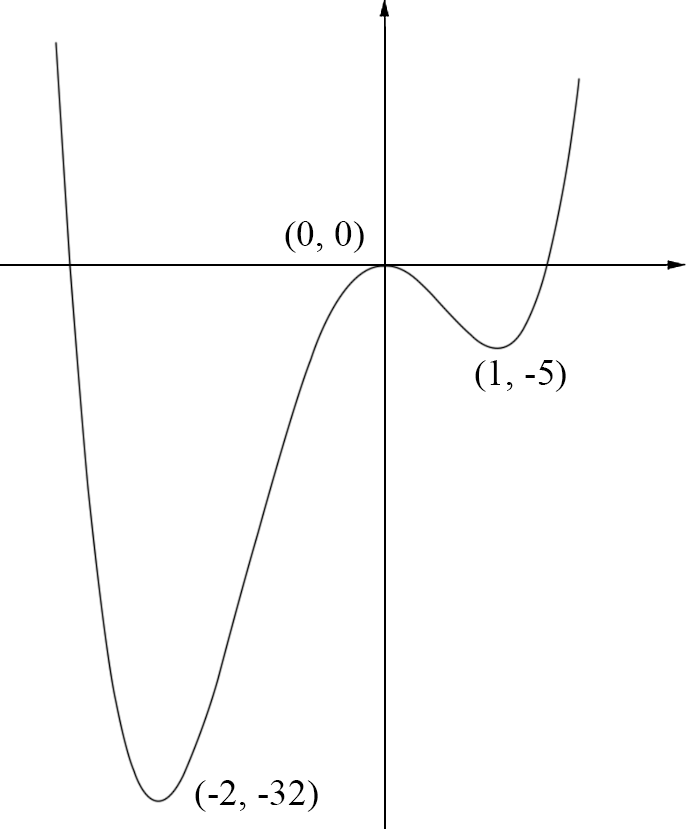
  2. Hence, sketch the graph  `y = f(x)`   showing the stationary points.   (2 marks)

    --- 8 WORK AREA LINES (style=lined) ---

  3. For what values of  `x`  is the function increasing?   (1 mark)

    --- 2 WORK AREA LINES (style=lined) ---

  4. For what values of  `k`  will  `f(x) = 3x^4 + 4x^3-12x^2 + k = 0`  have no solution?   (1 mark)

    --- 2 WORK AREA LINES (style=lined) ---

Show Answers Only
  1. `text{MAX at (0,0), MINs at (1, –5) and (–2, –32)}`
  2.  
        
        2UA HSC 2012 14ai
     
  3. `f(x)\ text(is increasing for)\ -2 < x < 0\ text(and)\ x > 1`
  4. `text(No solution when)\ k > 32`
Show Worked Solution
i. `f(x)` `= 3x^4 + 4x^3-12x^2`
  `f^{′}(x)` `= 12x^3 + 12x^2-24x`
  `f^{″}(x)` `= 36x^2 + 24x-24`


`text(Stationary points when)\ f^{′}(x) = 0`

`12x^3 + 12x^2-24x` `=0`
`12x(x^2 + x-2)` `=0`
`12x (x+2) (x-1)` `=0`


`:.\ text(Stationary points at)\ x=0,\ 1\ text(or)\ -2`
 

`text(When)\ x=0,\ \ \ \ f(0)=0`
`f^{″}(0)` `= -24 < 0`
`:.\ text{MAX at  (0,0)}`


`text(When)\ x=1`

`f(1)` `= 3+4-12 = -5`
`f^{″}(1)` `= 36 + 24-24 = 36 > 0`
`:.\ text{MIN at}\  (1,-5)`


`text(When)\ x=–2`

`f(-2)` `=3(-2)^4 + 4(-2)^3-12(-2)^2`
  `= 48-32-48`
  `= -32`
`f^{″}(-2)` `= 36(-2)^2 + 24(-2)-24`
  `=144-48-24 = 72 > 0`
`:.\ text{MIN at  (–2, –32)}`


ii.  2UA HSC 2012 14ai
♦ Mean mark 42%
MARKER’S COMMENT: Be careful to use the correct inequality signs, and not carelessly include ≥ or ≤ by mistake.


iii. `f(x)\ text(is increasing for)`
  `-2 < x < 0\ text(and)\ x > 1`


iv.   `text(Find)\ k\ text(such that)`

♦♦♦ Mean mark 12%.

`3x^4 + 4x^3-12x^2 + k = 0\ text(has no solution)`

`k\ text(is the vertical shift of)\ \ y = 3x^4 + 4x^3-12x^2`

`=>\ text(No solution if it does not cross the)\ x text(-axis.)`

`:.\ text(No solution when)\ k > 32`

Filed Under: Curve Sketching (Y12), Curve Sketching and The Primitive Function Tagged With: Band 4, Band 5, Band 6, page-break-before-solution, smc-969-20-Degree 4, smc-969-50-Increasing/Decreasing Intervals

Calculus, EXT1* C3 2011 HSC 8b

The diagram shows the region enclosed by the parabola  `y = x^2`, the  `y`-axis and the line  `y = h`, where  `h > 0`. This region is rotated about the  `y`-axis to form a solid called a paraboloid. The point  `C`  is the intersection of  `y = x^2` and  `y = h`.

The point  `H`  has coordinates  `(0, h)`.
 

2011 8b

  1. Find the exact volume of the paraboloid in terms of  `h`.    (2 marks)

    --- 5 WORK AREA LINES (style=lined) ---

  2. A cylinder has radius  `HC`  and height  `h`.    


    What is the ratio of the volume of the paraboloid to the volume of the cylinder?   (1 mark)

    --- 8 WORK AREA LINES (style=lined) ---

Show Answers Only
  1. `(pi h^2)/2\ text(u³)`
  2. `1:2`
Show Worked Solution
IMPORTANT: Most common errors: 1-use the correct axis, and 2-check the limits!
i.    `V` `= pi int_0^h x^2\ dy`
    `= pi int_0^h y\ dy`
    `= pi [1/2 y^2]_0^h`
    `= pi (1/2 h^2)`
    `= (pi h^2)/2 \ text(u³)`

 
`:.\ text(The volume of the paraboloid is)\  (pi h^2)/2\ text(u³)`
 

ii.   `text(Radius of cylinder)\ (r) = HC`

`text(Find)\ x text(-coordinate of)\ C:`

♦♦ Mean mark of 24%.
`text(When)\ y` `=h`
`=> x^2` `= h`
`x` `= sqrt h`
`:. r` `= sqrth`


`text(Volume of cylinder)` `= pi r^2 h`
  `= pi (sqrth)^2 h`
  `= pi h^2`

 
`:.\ text(Volume of paraboloid : volume of cylinder)`

`= (pi h^2)/2 : pi h^2`

`= 1:2`

Filed Under: Further Area and Solids of Revolution (Ext1), Volumes of Solids of Rotation Tagged With: Band 4, Band 6, smc-1039-10-Polynomial, smc-1039-61-y-axis Rotation

Trigonometry, 2ADV T1 2011 HSC 8a

In the diagram, the shop at  `S`  is 20 kilometres across the bay from the post office at  `P`. The distance from the shop to the lighthouse at  `L`  is 22 kilometres and  `/_ SPL`  is 60°.

Let the distance  `PL`  be  `x`  kilometres.
 

2011 8a
 

  1. Use the cosine rule to show that  `x^2-20x- 84 = 0`.    (1 mark)

    --- 2 WORK AREA LINES (style=lined) ---

  2. Hence, find the distance from the post office to the lighthouse. Give your answer correct to the nearest kilometre.    (2 mark)

    --- 4 WORK AREA LINES (style=lined) ---

Show Answers Only
  1. `text(Proof)\ \ text{(See Worked Solutions)}`
  2. `24\ text(km)`
Show Worked Solution

i.  `text(Using the cosine rule)`

`cos 60^@` `= (x^2 + SP^2 – SL^2)/( 2 xx x xx 20)`
`1/2` `= (x^2 + 20^2 – 22^2)/(40x)`
`20x` `= x^2 – 84`

  
`:. x^2 – 20x – 84= 0\ \ \ text(… as required)`


ii.  `text(Find)\ \ LP:`

`x^2 – 20x – 84 = 0`

`x` `= (-b +- sqrt(b^2 – 4ac))/(2a)`
  `= (20 +- sqrt(20^2 – 4 xx 1 xx (–84)))/2`
  `= (20 +- sqrt(736))/2`
  `= 23.546…\ \ \ \ (x>0)`
  `= 24\ text(km)\ \ text{(nearest km)}`

Filed Under: Sine and Cosine Rules, Bearings, Trig Ratios, Sine and Cosine Rules (Adv-2027), Trig Ratios, Sine and Cosine Rules (Y11) Tagged With: Band 4, smc-6392-40-Cosine Rule, smc-980-40-Cosine Rule

Functions, 2ADV F1 2010 HSC 1c

Write down the equation of the circle with centre `(-1, 2)` and radius 5.   (1 mark)

Show Answers Only

 `text{Circle with centre}\  (-1,2),\ r = 5`

`(x + 1)^2 + (y-2)^2 = 25`

Show Worked Solution
 MARKER’S COMMENT: Expanding this equation is not necessary!

`text{Circle with centre}\ (-1, 2),\ r = 5`

`(x + 1)^2 + (y-2)^2 = 25`

Filed Under: 4. Real Functions, Circles and Hyperbola, Further Functions and Relations (Y11), Graph Transformations (Adv-2027) Tagged With: Band 4, num-title-ct-pathc, num-title-qs-hsc, smc-4445-20-Find circle equation, smc-6408-80-Circles, smc-987-50-Circles

Calculus, 2ADV C4 2010 HSC 2di

Find  `int sqrt(5x +1) \ dx .`   (2 marks)

Show Answers Only

`2/15(5x  + 1)^(3/2) + C`


Show Worked Solution
` int sqrt( 5x + 1 ) \ dx` `= 1/(3/2) xx 1/5 xx (5x+1)^(3/2) +C`
  `=  2/15(5x  + 1)^(3/2) + C`

Filed Under: Integrals, Standard Integration Tagged With: Band 4, smc-1202-10-Indefinite Integrals

Calculus, 2ADV C4 2010 HSC 2e

Given that  `int_0^6 ( x + k )\ dx = 30`, and  `k`  is a constant, find the value of  `k`.   (2 marks)

--- 5 WORK AREA LINES (style=lined) ---

Show Answers Only

`k = 2`

Show Worked Solution
`int_0^6 ( x + k ) \ dx` `= 30`
`int_0^6 ( x + k ) \ dx` `= [ 1/2\ x^2 + kx ]_0^6`
  `= [(1/2xx 6^2 + 6 xx k ) – 0 ]`
  `= 18 + 6k`


`=> 18 + 6k` `=30`
`6k` `= 12`
`:.  k` `= 2`

Filed Under: Integrals, Standard Integration Tagged With: Band 4, smc-1202-20-Definite Integrals

Probability, 2ADV S1 2012 HSC 13c

Two buckets each contain red marbles and white marbles. Bucket `A` contains 3 red and 2 white marbles. Bucket `B`  contains 3 red and 4 white marbles.

Chris randomly chooses one marble from each bucket. 

  1. What is the probability that both marbles are red?   (1 mark)

    --- 2 WORK AREA LINES (style=lined) ---

  2. What is the probability that at least one of the marbles is white?   (1 mark)

    --- 3 WORK AREA LINES (style=lined) ---

  3. What is the probability that both marbles are the same colour?   (2 marks)

    --- 5 WORK AREA LINES (style=lined) ---

Show Answers Only
  1. `9/35`
  2. `26/35`
  3. ` 17/35`
Show Worked Solution
i.    `P{(both red)}` `= P(R_1) xx P(R_2)`
  `= 3/5 xx 3/7`
  `= 9/35`


STRATEGY: When the term “at least” appears in a probability question, it is likely that `1-P(text{complement})` will solve the question more efficiently and with less chance of error, as shown in part (ii).
ii.    `Ptext{(at least one white)}` `= 1 – Ptext{(none white)}`
  `= 1 – P(R_1) xx P(R_2)`
  `= 1 – 9/35`
  `= 26/35`


iii.    `Ptext{(same colour)}` `= P(R_1 R_2) + P(W_1 W_2)`
  `= 9/35 + (2/5 xx 4/7)`
  `= 9/35 + 8/35`
  `= 17/35`

Filed Under: 3. Probability, Multi-Stage Events (Adv-2027), Multi-Stage Events (Y11) Tagged With: Band 3, Band 4, smc-6469-20-Other Multi-Stage Events, smc-6469-30-Complementary Probability, smc-989-20-Other Multi-Stage Events, smc-989-30-Complementary Probability

FS Comm, 2UG SM-Bank 01

Patrick has purchased an `8 \ text(GB)` USB.  The average size of each file he saves is  `492 \ text(KB)`.

Find how many files Patrick can expect to save on his USB (to the nearest whole number).   (2 marks)


Show Answers Only

`17\ 050\ text(files)\ \ \ text{(to nearest whole)}`

Show Worked Solution
 
 MARKER’S COMMENT: Be aware that the conversion table between bytes and gigabytes etc… is on page 3 of the  “Formula and Data Sheet” provided in the HSC exam.

`text(File size) = 492 text(KB)`

`text(USB storage capacity) = 8 text(GB)`

`text(S)text(ince)\ 1 text(KB)` `=2^10\ text(bytes)`
`1 text(GB)` `=2^30\ text(bytes)`
`:.\ text(# Files that fit)` `= text(Total Capacity)/text(Size of File)`
  `= (8 xx 2^30)/(492 xx 2^10)`
  `=17\ 050.016…`
  `=17\ 050\ text(files)\ \ \ text{(to nearest whole)}`

Filed Under: FS Communication Tagged With: Band 4, Extra

Measurement, STD2 M7 SM-Bank 8

A patient is to receive 1.8 L of pain killer medication by intravenous drip that will take 1.5 hours to administer.

Given  1 mL = 4 drops, calculate the amount of drops per minute the machine must be set on.   (2 marks)

--- 4 WORK AREA LINES (style=lined) ---

Show Answers Only

 `text(The machine must be set to 80 drops per minute.)`

Show Worked Solution
`text(Total drops required)` `=1800 xx 4`
  `=7200\ text(drops)`
`text(Time)\ text{(in minutes)}` `=1.5 xx 60`
  `= 90\ text(minutes)`
`text(Drops per minute)` `=7200/90`
  `=80`


`:.\ text(The machine must be set to 80 drops per minute.)`

Filed Under: M4 Rates (Y12), Medication, Rates (Std2) Tagged With: Band 4, smc-1104-30-Medication, smc-805-30-Medication

Algebra, STD2 A1 SM-Bank 1 MC

The blood alcohol content (`BAC`) of a male's blood is given by the formula;

`BAC_text(male) = (10N - 7.5H)/(6.8M)`  , where

`N` is the number of standard drinks consumed,

`H` is the number of hours drinking and 

`M` is the person's mass in kgs. 

Calculate the  `BAC`  of a male who consumed 4 standard drinks in 3.5 hours and weighs 68 kgs, correct to 2 decimal places. 

  1.    1.03
  2.    0.03
  3.    0.04
  4.    0.01
Show Answers Only

`B`

Show Worked Solution
`BAC_text(male)` `= ( (10 xx 4)\ – (7.5 xx 3.5) )/( (6.8 xx 68) )`
  `= 13.75/462.4`
  `=0.0297…`

`=>  B`

Filed Under: Applications: BAC, Medication and D=SxT (Std 2), Applications: BAC, Medicine and D=SxT (Std1-2027), Applications: BAC, Medicine and D=SxT (Std2-2027), Safety: D=ST & BAC Tagged With: Band 4, smc-6235-10-BAC, smc-6509-10-BAC, smc-791-10-BAC

Calculus, 2ADV C4 2011 HSC 6c

The diagram shows the graph  `y = 2 cos x` . 
  

2011 6c 
  

  1. State the coordinates of  `P`.   (1 mark)

    --- 1 WORK AREA LINES (style=lined) ---

  2. Evaluate the integral  `int_0^(pi/2) 2 cos x\ dx`.    (2 marks)

    --- 4 WORK AREA LINES (style=lined) ---

  3. Indicate which area in the diagram,  `A`,  `B`,  `C` or  `D`, is represented by the integral
     
           `int_((3pi)/2)^(2pi) 2 cos x\ dx`.   (1 mark)

    --- 1 WORK AREA LINES (style=lined) ---

  4. Using parts (ii) and (iii), or otherwise, find the area of the region bounded by the curve  `y = 2 cos x`  and the  `x`-axis, between  `x = 0`  and  `x = 2pi` .   (1 mark)

    --- 2 WORK AREA LINES (style=lined) ---

  5. Using the parts above, write down the value of
     
         `int_(pi/2)^(2pi) 2 cos x\ dx`.   (1 mark)

    --- 2 WORK AREA LINES (style=lined) ---

Show Answers Only
  1. `P(0,2)`
  2. `2`
  3. `C`
  4. `8\ text(u²)`
  5. `-2`
Show Worked Solution

i.  `y = 2 cos x`

`text(At)\ x = 0`

`y = 2 cos 0 = 2`

`:.\ P(0,2)`


ii.  `int_0^(pi/2) 2 cos x\ dx`

`= [2 sin x]_0^(pi/2)`

`= [2 sin (pi/2)\ – 2 sin 0]`

`= 2\ – 0`

`= 2`
 

iii.  `C`
 

iv.    `text(S)text(ince Area)\ A` `=\ text(Area)\ C,\ \ text(and)`
  `text(Area)\ B` `= 2 xx text(Area)\ A`


`:.\ text(Total Area)` `= 2 + (2xx2) + 2`
  `= 8\ text(u²)`


MARKER’S COMMENT: “Using the parts above” in part (v) was ignored by many students. Important to know when finding an area and evaluating an integral may differ.

v.  `int_(pi/2)^(2pi) 2 cos x\ dx`

`= text(Area)\ C\ – text(Area)\ B`

`= 2\ – (2 xx 2)`

`= -2`

Filed Under: Areas Under Curves, Areas Under Curves (Y12), Differentiation and Integration Tagged With: Band 3, Band 4, Band 5, smc-975-50-Trig

Plane Geometry, 2UA 2011 HSC 6a

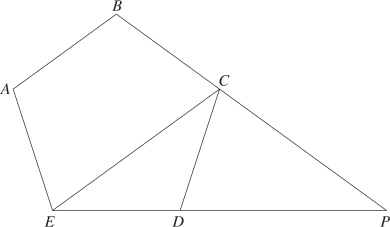
The diagram shows a regular pentagon `ABCDE`. Sides `ED` and `BC` are produced to meet at `P`.
  

  1. Find the size of `/_CDE`.    (1 mark)

    --- 2 WORK AREA LINES (style=lined) ---

  2. Hence, show that `Delta EPC` is isosceles.    (2 marks)

    --- 5 WORK AREA LINES (style=lined) ---

Show Answers Only
  1. `108°`
  2. `text(Proof)\ \ text{(see Worked Solutions)}`
Show Worked Solution
i.  

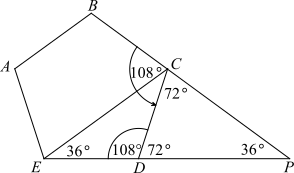
`text(Angle sum of pentagon)=(5-2) xx 180°=540°`

`:.\ /_CDE` `= 540/5\ \ \ text{(regular pentagon has equal angles)}`
  `= 108°`
MARKER’S COMMENT: Very few students solved part (i) efficiently. Remember the general formula for the sum of internal angles equals (# sides – 2) x 90°.

 
ii.
  `text(Show)\ Delta EPC\ text(is isosceles)`

`text(S)text(ince)\ ED=CD\ \ text{(sides of a regular pentagon)}`

`Delta ECD\ text(is isosceles)`

`/_DEC=1/2 xx (180-108)= 36^{\circ}\ \ \ text{(Angle sum of}\ Delta DEC text{)}`

`/_CDP=72^@\ \ \ (\angle PDE\ \text{is a straight angle})`

`/_DCP=72^@\ \ \ (\angle PCB\ \text{is a straight angle})`

`=> /_CPD= 180-(72 + 72)=36^{\circ}\ \ \ text{(angle sum of}\ Delta CPD text{)}`

`:.\ Delta EPC\ \text(is isosceles)\ \ \ text{(2 equal angles)}`

Filed Under: 2. Plane Geometry, Special Properties Tagged With: Band 3, Band 4, HSC, num-title-ct-pathc, num-title-qs-hsc, smc-4748-10-Triangle properties, smc-4748-30-5+ sided shapes, smc-4748-50-Sum of internal angles

Integration, 2UA 2011 HSC 5c

The table gives the speed  `v`  of a jogger at time  `t`  in minutes over a  20-minute period. The speed  `v`  is measured in metres per minute, in intervals of 5 minutes.
 

2011 5c
  

The distance covered by the jogger over the 20-minute period is given by

`int_0^20 v\ dt`.

Use Simpson’s rule and the speed at each of the five time values to find the approximate distance the jogger covers in the  20-minute period.   (3 marks)

Show Answers Only

 `2831 2/3\ text(metres)`

Show Worked Solution
`text(Area)` `~~ h/3 [v_0 + 4v_1 + 2v_2 + 4v_3 + v_4]`
  `~~ 5/3 [173 + (4 xx 81) + (2 xx 127) + (4 xx 195) + 168]`
  `~~ 5/3 [173 + 324 + 254 + 780 + 168]`
  `~~ 2831 2/3`


`:.\ text(The approx distance covered) = 2831 2/3\ text(metres)`

Filed Under: Trapezoidal and Simpson's Rule Tagged With: Band 4

Statistics, 2ADV 2011 HSC 5b

Kim has three red shirts and two yellow shirts. On each of the three days, Monday, Tuesday and Wednesday, she selects one shirt at random to wear. Kim wears each shirt that she selects only once.

  1. What is the probability that Kim wears a red shirt on Monday?    (1 mark)
  2. What is the probability that Kim wears a shirt of the same colour on all three days?     (1 mark)
  3. What is the probability that Kim does not wear a shirt of the same colour on consecutive days?   (2 marks)
Show Answers Only
  1. `3/5`
  2. `1/10`
  3. `3/10`
Show Worked Solution
i.    `P (R\ text(on Monday) text{)}` `= text(# Red)/text(# Shirts)`
    `= 3/5`


MARKER’S COMMENT: Students could also have drawn a probability tree setting out this problem over 3 different days (stages).
ii.    `text(S)text(ince not enough yellow shirts)`
  `P text{(same colour each day)}`

`= P (R,R,R)`

`= 3/5 xx 2/4 xx 1/3`

`= 1/10`


iii.   `P text{(not wearing same colour 2 days in a row)}`

`= P (Y,R,Y) + P (R,Y,R)`

♦ Mean mark 47%.
MARKER’S COMMENT: Students should clearly write what probability they are finding in words or symbols before showing calculations.

`=  (2/5 xx 3/4 xx 1/3)+(3/5 xx 2/4 xx 2/3)`

`= 6/60 + 12/60 `

`= 3/10`

Filed Under: 3. Probability Tagged With: Band 2, Band 4, Band 5, HSC

Calculus, 2ADV C4 2011 HSC 4d

  1. Differentiate  `y=sqrt(9 - x^2)`  with respect to  `x`.   (2 marks)

    --- 4 WORK AREA LINES (style=lined) ---

  2. Hence, or otherwise, find  `int (6x)/sqrt(9 - x^2)\ dx`.    (2 marks)

    --- 4 WORK AREA LINES (style=lined) ---

Show Answers Only
  1. `- x/sqrt(9\ – x^2)`
  2. `-6 sqrt(9\ – x^2) + C`
Show Worked Solution
IMPORTANT: Some students might find calculations easier by rewriting the equation as `y=(9-x^2)^(1/2)`.
i.    `y` `= sqrt(9 – x^2)`
    `= (9 – x^2)^(1/2)`


`dy/dx` `=1/2 xx (9 – x^2)^(-1/2) xx d/dx (9 – x^2)`
  `= 1/2 xx (9 – x^2)^(-1/2) xx -2x`
  `= – x/sqrt(9 – x^2)`


ii.    `int (6x)/sqrt(9 – x^2)\ dx` `= -6 int (-x)/sqrt(9 – x^2)\ dx`
    `= -6 (sqrt(9 – x^2)) + C`
    `= -6 sqrt(9 – x^2) + C`

Filed Under: Integrals, Standard / 1st Principles, Standard Integration Tagged With: Band 4, Band 5, smc-1202-10-Indefinite Integrals, smc-1202-30-Diff then Integrate

Calculus, 2ADV C4 2011 HSC 4c

The gradient of a curve is given by  `dy/dx = 6x-2`.  The curve passes through the point `(-1, 4)`. 

What is the equation of the curve?   (2 marks)

--- 5 WORK AREA LINES (style=lined) ---

Show Answers Only

 `y = 3x^2-2x-1`

Show Worked Solution

`dy/dx = 6x-2` 

`y` `= int 6x-2\ dx`
  `= 3x^2-2x + c`

 
`text{Since it passes through}\ (-1,4),`

`4` `= 3 (-1)^2-2(-1) + c`
`4` `= 3 + 2 + c`
`c` `= -1`

 
`:. y = 3x^2-2x-1`

Filed Under: Integrals, Other Integration Applications (Y12), Tangents and Normals Tagged With: Band 4, smc-1089-30-Find f(x) given f'(x), smc-1090-10-Quadratic Function, smc-1090-50-Find curve given tangent, smc-1213-25-Tangents/Primitive function

Quadratic, 2UA 2011 HSC 3b

A parabola has focus  `(3, 2)`  and directrix  `y = –4`. Find the coordinates of the vertex.   (2 marks)

Show Answers Only

`text(Vertex is)\ (3,–1)`

Show Worked Solution

`text{Focus (S)}=(3,2),\ text(Directrix)\ y = –4`

 Quadratic, 2UA 2011 HSC 3b Answer1

`x\ text(-coordinate of Vertex) = 3`

 MARKER’S COMMENT: Students who drew an accurate drawing obtained the correct answer easily.
`y\ text(-coordinate of Vertex)` `= (2 + (–4))/2`
  `= –1`

`:.\ text(Vertex)=(3,–1)`

Filed Under: The Parabola Tagged With: Band 4

Trigonometry, 2ADV T2 2011 HSC 2b

Find the exact values of  `x`  such that  `2sin x =-sqrt3`, where  `0 <= x <= 2pi`.   (2 marks)

--- 5 WORK AREA LINES (style=lined) ---

Show Answers Only

 `x = (4pi)/3,\ (5pi)/3`

Show Worked Solution
MARKER’S COMMENT: Better responses found the reference angle and then identified the correct quadrants, as shown clearly in the worked solution.
`2sinx` `=- sqrt3\ \ text(where)\ \ 0 <= x <= 2pi`
`sin x` `= -sqrt3/2`
`sin (pi/3)` `= sqrt3/2`


`text(S)text(ince)\ sin x\ text(is negative in)\ 3^text(rd) // 4^text(th)\ text(quadrants)`

`x` `= pi + pi/3,\ 2pi-pi/3`
  `= (4pi)/3,\ (5pi)/3\ \ text(radians)`

Filed Under: Exact Trig Ratios (Adv-2027), Exact Trig Ratios (Y11), Exact Trig Ratios and Other Identities Tagged With: Band 4, smc-6411-10-sin, smc-979-10-sin

Calculus, 2ADV C4 2012 HSC 13b

The diagram shows the parabolas `y = 5x - x^2` and `y = x^2 - 3x`. The parabolas intersect at

the origin `O` and the point `A`. The region between the two parabolas is shaded. 
 

2012 13b
 

  1. Find the `x`-coordinate of the point `A`   (1 mark)

    --- 2 WORK AREA LINES (style=lined) ---

  2. Find the area of the shaded region.   (3 marks)

    --- 6 WORK AREA LINES (style=lined) ---

Show Answers Only
  1. `4`
  2. `64/3 \ text(u²)`
Show Worked Solution

i.     `y = x^2 -3x\ \ …\ (1)`

`y = 5x – x^2\ \ …\ (2)`

`text(Solve:)\ \ (1)=(2)`

`x^2 – 3x` `= 5x  – x^2`
`2x^2 – 8x` `= 0`
`2x(x – 4)` `=0`
`x` `= 0  \ text(or) \ 4`
MARKER’S COMMENT: Less errors were made in part (ii) by students who simplified the definite integral before integrating, as shown in the worked solution. 

 
`:. x text(-coordinate of)  \ A  \ text(is) \  4`


ii.   `text(Area)` `= int_0^4 (5x – x^2) dx  –  int_0^4 (x^2 – 3x) dx`
  `= int_0^4 (5x – x^2 – x^2 + 3x) dx`
  `= int_0^4 (8x – 2x^2) dx`
  `= [4x^2 – 2/3x^3]_0^4`
  `= [(4 xx 4^2) – (2/3 xx 4^3)]`
  `= [ 64\ – 128/3 ]`
  `= 64/3 \ text(u²)`

Filed Under: Areas Under Curves, Areas Under Curves (Y12) Tagged With: Band 4, smc-975-10-Quadratic

Trigonometry, 2ADV T1 2012 HSC 13a

The diagram shows a triangle  `ABC`. The line  `2x + y = 8`  meets the `x` and `y` axes at the points `A` and `B` respectively. The point `C` has coordinates  `(7, 4)`. 
 

2012 13a
 

  1. Calculate the distance  ` AB `.   (2 marks)

    --- 5 WORK AREA LINES (style=lined) ---

  2. It is known that  `AC = 5`  and  `BC = sqrt 65 \ \ \ `(Do NOT prove this)  


    Calculate the size of  `angle ABC` to the nearest degree.    (2 marks)

    --- 4 WORK AREA LINES (style=lined) ---

  3. The point `N` lies on  `AB`  such that  `CN`  is perpendicular to  `AB`. 


    Find the coordinates of `N`.    (3 marks)

    --- 6 WORK AREA LINES (style=lined) ---

Show Answers Only
  1. `4 sqrt 5  \ text(units)`
  2. ` 34°  \ text{(nearest degree)}`
  3. `N (3,2)`
Show Worked Solution

i.   `text(Find distance) \  AB:`

`text(Find A),\ \ y=0`

`2x + 0` `= 8`
`x` `= 4 \ => A (4,0)`

 
`text(Find B),\ \ x=0`

` 0 + y = 8  \ => B(0,8)`
  

`text(Using Pythagoras:)`

`AB^2` `= OB^2 + OA^2`
  `= 8^2 + 4^2`
  `= 80`
`:. \ AB` `= sqrt 80`
  ` = 4 sqrt 5  \ text(units)`


ii.   `text(Find)\  angle ABC:`

`text(Using cosine rule)`

`cos angle ABC` `=  (AB^2 + BC^2 – AC^2)/(2 xx AB xx BC)`
  `= ((4 sqrt 5)^2 + (sqrt 65)^2 – 5^2)/(2 xx 4 sqrt 5 xx sqrt 65)` 
  `= (80 + 65 – 25) / (8 xx sqrt 325)`
  `= 120/(40 sqrt 13)`
  `= 3/ sqrt 13`
  `= 0.83205…`
`:. angle ABC` `= 33.690…`
  `= 34°\ \  text{(nearest degree)}`


iii.  `text(Find) \ N:`

`AB   text(is)  \ 2x +y = 8`

`=>  \ text(Gradient)  \ AB = -2`

`:.\ text(Gradient of) \  CN = ½ \ \ \ (m_1 m_2 = -1\ \ text(for ⊥ lines))`


`text(Equation of) \ CN, \ m = ½\ text(through)\ (7,4)`

MARKER’S COMMENT: Many students could not find the correct equation on `CN` because they took its gradient to be the reciprocal of `AB` and not the negative reciprocal. 
`y  – 4` `= ½ (x  – 7)`
`2y  – 8` `= x  – 7`
`x  – 2y + 1` `= 0`


` N \ text(is intersection of) \ AB \  text(and) \ CN`

`2x + y  – 8` `= 0\ \ …\ (1)`
`x  – 2y + 1` `= 0\ \ …\ (2)`

 
`text(Multiply)  \ (1) xx 2`

`4x +2y  – 16 = 0\ \ …\ (3)`

 
`text(Add) \  (2) + (3)`

`5x  – 15` `= 0`
`x` `=3`

 
`text(Substitute)\ \ x = 3\ \ text(into)\ \ (1)`

`2(3) + y  – 8 = 0   =>  y = 2`

`:. N (3,2)`

Filed Under: 6. Linear Functions, Sine and Cosine Rules, Bearings, Trig Ratios, Sine and Cosine Rules (Adv-2027), Trig Ratios, Sine and Cosine Rules (Y11) Tagged With: Band 3, Band 4, smc-6392-10-Pythagoras, smc-6392-40-Cosine Rule, smc-980-10-Pythagoras, smc-980-40-Cosine Rule

Integration, 2UA 2012 HSC 12d

At a certain location a river is `12` metres wide. At this location the depth of the river, in metres, has been measured at `3` metre intervals. The cross-section is shown below.
 

2012 12d
 

  1. Use Simpson's rule with the five depth measurements to calculate the approximate area of the cross-section   (3 marks)
  2. The river flows at 0.4 metres per second.
  3. Calculate the approximate volume of water flowing through the cross-section in 10 seconds.   (1 mark)
  4.  
Show Answers Only
  1. `32.8 \ text(m²)`
  2. `131.2 \ text(m³)`  
Show Worked Solution
(i)    `A` `~~ h/3 [y_0 + 4y_1 + 2y_2 +4y_3 +y_4 ]`
  `~~3/3 [ 0.5 + (4xx2.3) + (2xx2.9) + (4xx3.8) + 2.1 ]`
  `~~ [ 0.5 + 9.2 + 5.8 + 15.2 + 2.1 ]`
  `~~ 32.8\  text(m²)`


♦ Over half of the students examined answered part (ii) incorrectly. 
(ii)  `text(Distance water flows)`  `= 0.4 xx 10`
  `= 4 \ text(metres)`


`text(Volume flow in 10 seconds)` `~~ 4 xx 32.8`
  `~~ 131.2  text(m³)`

Filed Under: Trapezoidal and Simpson's Rule Tagged With: Band 3, Band 4

Calculus, 2ADV C4 2012 HSC 10 MC

The graph of  `y = f(x)`  has been drawn to scale for  `0 <= x <= 8`.
 

2012 10 mc
 

Which of the following integrals has the greatest value? 

  1. `int_0^1 f(x) \ dx` 
  2. `int_0^2 f(x) \ dx`  
  3. `int_0^7 f(x) \ dx`  
  4. `int_0^8 f(x) \ dx`  
Show Answers Only

`B`

Show Worked Solution

`text(S)text(ince the integrals measure the net area under)`

`text(the graph and above the)\ x text(-axis)\ text{(i.e. below the}`

`x text{-axis is a negative value.)}`

`=>  B`

Filed Under: Areas Under Curves, Areas Under Curves (Y12) Tagged With: Band 4, smc-975-70-Functions - no integration

Trigonometry, 2ADV T2 2012 HSC 6 MC

What are the solutions of  `sqrt3 tanx = -1`  for  `0<=x<=2 pi`? 

  1. `(2 pi)/3\ text(and)\ (4 pi)/3` 
  2. `(2 pi)/3\ text(and)\ (5 pi)/3`
  3. `(5 pi)/6\ text(and)\ (7 pi)/6` 
  4. `(5 pi)/6\ text(and)\ (11 pi)/6` 
Show Answers Only

`D`

Show Worked Solution
`sqrt3 tanx` `= -1`
`tanx` `= -1/sqrt3`

 `text(When)\ tanx = 1/sqrt3,\ \ x=pi/6`

`text(S)text(ince)\ tanx\ text(is negative in)\ 2^text(nd) // 4^text(th)\ text(quadrant)`

`:. x` ` = pi\-pi/6,\ 2 pi\-pi/6,\ …`
  `= (5 pi)/6,\ (11 pi)/6`

`=>  D`

Filed Under: Exact Trig Ratios (Adv-2027), Exact Trig Ratios (Y11), Exact Trig Ratios and Other Identities Tagged With: Band 4, smc-6411-30-tan, smc-979-30-tan

Calculus, 2ADV C4 2012 HSC 11g

Find  `int_0^(pi/2) sec^2 (x/2)\ dx`   (3 marks)


Show Answers Only

`2`

Show Worked Solution

 `int_0^(pi/2) sec^2 (x/2)\ dx`

`= [2 tan(x/2)]_0^(pi/2)`
`= 2 tan\ pi/4- 2 tan 0`
`= 2(1)-0`
`= 2`

Filed Under: Differentiation and Integration, Integrals, Trig Integration Tagged With: Band 4, smc-1204-30-Sec^2

Trigonometry, 2ADV T1 2012 HSC 11f

The area of the sector of a circle with a radius of 6 cm is 50 cm².

Find the length of the arc of the sector.  (2 marks)

--- 5 WORK AREA LINES (style=lined) ---

Show Answers Only

`50/3\ text(cm)`

Show Worked Solution
TIP: Many students find it easier to think of the area of a sector by calculating `theta/(2 pi)` multiplied by the area of a circle rather than remembering a formula.

`text(Area of sector, radius 6 cm = 50 cm²)`

`theta/(2 pi) xx pi r^2` `= 50`
`1/2 r^2 theta` `=50`
`1/2 xx 6^2 xx theta`  `=50`
`theta` `=50/18=25/9\ text(radians)`


`:.\ text(Length of Arc)` `= theta/(2pi) xx 2pi r` 
  `= theta xx r`
  `= 25/9xx6` 
  `= 50/3 \ text(cm)`


Filed Under: Circular Measure, Circular Measure (Adv-2027), Circular Measure (Y11) Tagged With: Band 4, smc-6394-10-Arc Length/Perimeter, smc-978-10-Arc Length/Perimeter

  • « Previous Page
  • 1
  • …
  • 109
  • 110
  • 111
  • 112
  • 113
  • 114
  • Next Page »

Copyright © 2014–2025 SmarterEd.com.au · Log in