SmarterEd

Aussie Maths & Science Teachers: Save your time with SmarterEd

  • Login
  • Get Help
  • About

HMS, HAG EQ-Bank 029 MC

Which best describes the role of the ACEMID system in early diagnosis?

  1. Measures oxygen saturation levels
  2. Tracks sleep cycle irregularities
  3. Creates a body avatar for melanoma detection
  4. Assists surgeons with robotic movements
Show Answers Only

\(C\)

Show Worked Solution
  • C is correct. The ACEMID system creates a 3D body avatar using high-resolution imaging to detect and track moles.

Other options:

  • A is incorrect. Oxygen saturation levels are measured using pulse oximeters, not the ACEMID system.
  • B is incorrect. Sleep cycle irregularities are tracked with apps and wearable devices.
  • D is incorrect. Robotic movements are linked to precision surgery.

Filed Under: Technology and Health relationship Tagged With: Band 4, smc-5490-30-Early diagnosis

HMS, HAG EQ-Bank 027 MC

Which technology is commonly used for early detection of cancer?

  1. PET scan
  2. Fitness tracker
  3. Ultrasound imaging
  4. Sleep app
Show Answers Only

\(A\)

Show Worked Solution
  • A is correct. A PET scan is commonly used for the early detection of cancer, as it identifies abnormal metabolic activity associated with tumour growth.

Other options:

  • B is incorrect. Fitness trackers measure steps, heart rate, and activity but cannot detect cancer.
  • C is incorrect. Ultrasound imaging can assist in identifying some abnormal growths but is not a primary tool for early cancer detection compared to PET scans, CT scans, or MRI.
  • D is incorrect. Sleep apps track sleep behaviours and patterns, not disease detection.

Filed Under: Technology and Health relationship Tagged With: Band 4, smc-5490-30-Early diagnosis

HMS, HAG EQ-Bank 51 MC

Community health centres typically involve collaboration between government funding and non-government service providers. How does this arrangement influence patient care delivery?

  1. Patients receive only basic services due to limited government oversight
  2. Service delivery becomes fragmented with poor coordination between providers
  3. Multiple funding sources create administrative complexity without patient benefits
  4. Diverse expertise and resources combine to offer comprehensive community-based care
Show Answers Only

\(D\)

Show Worked Solution
  • D is correct: Collaborative arrangements combine diverse resources to enhance comprehensive community care.

Other Options:

  • A is incorrect: Government-NGO collaboration often expands rather than limits service scope.
  • B is incorrect: Effective collaboration improves rather than fragments service coordination.
  • C is incorrect: Well-managed partnerships provide patient benefits despite administrative complexity.

Filed Under: Person centred health - Govt/Non-Govt orgs Tagged With: Band 4, smc-5481-20-Service Delivery

HMS, HAG EQ-Bank 48 MC

People living in remote areas often face challenges accessing specialist healthcare services due to distance and limited local providers. Which collaborative approach BEST addresses these access and equity issues?

  1. Require all remote residents to relocate to major cities for healthcare access
  2. Provide healthcare only to remote communities that can afford private services
  3. Limit healthcare services to basic emergency care in remote locations
  4. Government-funded telehealth services combined with visiting specialist programs
Show Answers Only

\(D\)

Show Worked Solution
  • D is correct: Telehealth and visiting specialists address geographic barriers through collaborative service delivery.

Other Options:

  • A is incorrect: Relocation requirements would create inequitable access based on location.
  • B is incorrect: Financial barriers would prevent equitable healthcare access for remote communities.
  • C is incorrect: Limited services create inequity between remote and urban healthcare access.

Filed Under: Person centred health - Govt/Non-Govt orgs Tagged With: Band 4, smc-5481-10-Access and Equity

HMS, HAG EQ-Bank 47 MC

Medicare provides universal healthcare coverage to ensure all Australians can access essential medical services regardless of their ability to pay. Which principle does this system BEST demonstrate?

  1. Healthcare should only be available to those who can afford private insurance
  2. Equity in healthcare access through removing financial barriers for essential services
  3. Competition between healthcare providers improves service quality
  4. Rural communities should receive different levels of healthcare than urban areas
Show Answers Only

\(B\)

Show Worked Solution
  • B is correct: Medicare removes financial barriers ensuring equitable access to essential healthcare services.

Other Options:

  • A is incorrect: Universal coverage ensures access regardless of financial capacity.
  • C is incorrect: While competition exists, Medicare focuses on equitable access.
  • D is incorrect: Equity principle aims for equal access regardless of geographic location.

Filed Under: Person centred health - Govt/Non-Govt orgs Tagged With: Band 4, smc-5481-10-Access and Equity

HMS, HAG EQ-Bank 022 MC

Which combination of health measurements can advanced wearable devices typically provide to support preventative health management?

  1. Daily step count, sleep cycle stages, and oxygen saturation
  2. Activity levels, heart rate variability, and menstrual cycle patterns
  3. Real-time blood clot detection, surgical outcome prediction, and tumour growth rates
  4. Recovery time tracking, robotic-assisted movement analysis, and hospital admission rates
Show Answers Only

\(A\)

Show Worked Solution
  • A is correct. The measurements described are highly relevant to preventative health as they provide insights into lifestyle and potential risks.

Other options:

  • B is incorrect. While wearable devices can collect data on the areas mentioned, the information is often more relevant to training optimisation or reproductive health.
  • C is incorrect. The measurements require advanced medical imaging and diagnostic tools, not consumer wearables.
  • D is incorrect. The areas mentioned are linked to precision surgery and hospital data systems, not wearable health measurement devices.

Filed Under: Technology and Health relationship Tagged With: Band 4, smc-5490-10-Measuring

HMS, HAG EQ-Bank 021 MC

A smartwatch that records heart rate during exercise is primarily an example of technology used for:

  1. Measuring health
  2. Treating health conditions
  3. Precision surgery
  4. Early diagnosis
Show Answers Only

\(A\)

Show Worked Solution
  • A is correct. It is an example of measuring health, as it collects data on a specific physiological function.

Other options:

  • B is incorrect. The recording of a heart rate measures rather than treats a health condition.
  • C is incorrect. Precision surgery refers to surgical procedures using minimally invasive techniques, not wearable devices.
  • D is incorrect. Early diagnosis involves medical technologies like scans or imaging to detect disease before symptoms progress, not fitness tracking.

Filed Under: Technology and Health relationship Tagged With: Band 4, smc-5490-10-Measuring

HMS, HAG EQ-Bank 020 MC

A portable ultrasound device that connects to a smartphone best demonstrates which aspect of health technology advancement?

  1. Increased cost of medical equipment
  2. Increased accessibility of healthcare
  3. Improved portability and accessibility of diagnostic tools
  4. Decreased quality of medical imaging
Show Answers Only

\(C\)

Show Worked Solution
  • C is correct. This option precisely captures both key aspects: the device is portable (small enough to plug into a smartphone) and accessible (can be used outside traditional healthcare settings).

Other options:

  • A is incorrect. This technology eliminates the need for expensive machines and it actually reduces costs.
  • B is incorrect. While partially correct, this option is too broad and doesn’t specifically address the technological advancement being demonstrated.
  • D is incorrect. These devices provide high quality images with little compromise in image quality despite the smaller size.

Filed Under: Technology and Health relationship Tagged With: Band 4, smc-5490-10-Measuring

HMS, HAG EQ-Bank 46 MC

In Australia's healthcare system, the federal government provides Medicare funding while state governments manage public hospitals. Which statement BEST describes how these system components work together?

  1. Federal and state governments operate completely separate healthcare systems with no coordination
  2. Federal funding supports state-delivered services, creating integrated patient care across different providers
  3. State governments are responsible for all healthcare funding and service delivery decisions
  4. Private organisations have no role in the collaborative healthcare system
Show Answers Only

\(B\)

Show Worked Solution
  • B is correct: Federal funding integrated with state service delivery creates coordinated patient care.

Other Options:

  • A is incorrect: Government levels coordinate extensively to provide seamless healthcare delivery.
  • C is incorrect: Federal government provides significant funding including Medicare and PBS.
  • D is incorrect: Private sector plays important role alongside government in healthcare delivery.

Filed Under: Person centred health - Govt/Non-Govt orgs Tagged With: Band 4, smc-5481-05-Integrated Care

CHEMISTRY, M2 EQ-Bank 5 MC

In which molecule is the percentage by mass of oxygen closest to 70%?

  1. \(\ce{H2O}\)
  2. \(\ce{SO2}\)
  3. \(\ce{CO2}\)
  4. \(\ce{CH2O}\)
Show Answers Only

\(C\)

Show Worked Solution
  • For \(\ce{H2O}\): \(MM = 2(1.008) + 16.00 = 18.016\ \text{g mol}^{-1}\).
  •    % Mass of oxygen \(=\dfrac{16.00}{18.016} \times 100 = 88.8\)%. 
  • For \(\ce{SO2}\): \(MM = 32.07 + 2(16.00) = 64.07\ \text{g mol}^{-1}\).
  •    % Mass of oxygen \(=\dfrac{2(16.00)}{64.07} \times 100 = 49.9\)%.
  • For \(\ce{CO2}\): \(MM = 12.01 + 2(16.00) = 44.01\ \text{g mol}^{-1}\).
  •    % Mass of oxygen \(=\dfrac{2(16.00)}{44.01} \times 100 = 72.7\)%.
  • For \(\ce{CH2O}\): \(MM = 12.01 + 2(1.008) + 16.00 = 30.026\ \text{g mol}^{-1}\).
  •    % Mass of oxygen \(=\dfrac{16.00}{30.026} \times 100 = 53.3\)%.

\(\therefore \ce{CO2}\) has the closest oxygen percentage to 70%.

\(\Rightarrow C\)

Filed Under: Mole Concept Tagged With: Band 4, smc-4260-50-Percentage composition

CHEMISTRY, M2 EQ-Bank 4 MC

What is the empirical formula for a compound that is 52.1% \(\ce{Al}\) and 47.9% \(\ce{O}\)?

  1. \(\ce{AlO}\)
  2. \(\ce{AlO2}\)
  3. \(\ce{Al3O2}\)
  4. \(\ce{Al2O3}\)
Show Answers Only

\(D\)

Show Worked Solution
  • Assume that there is \(100\) grams in sample.
  • There are \(52.1\) grams of \(\ce{Al}\) and \(47.9\) grams of \(\ce{O}\).
  •    \(n(\ce{Al}) = \dfrac{52.1}{26.98} = 1.93\ \text{mol}\).
  •    \(n(\ce{O}) = \dfrac{47.9}{16.00} = 2.99\ \text{mol}\).
  • Divide through by the smallest number of moles to determine the empirical formula:
  •   \(\ce{Al}:\dfrac{1.93}{1.93} = 1\)
  •   \(\ce{O}:\dfrac{2.99}{1.93} = 1.55\)
  • The empirical formula for the compound is \(\ce{Al2O3}\).

\(\Rightarrow D\)

Filed Under: Mole Concept Tagged With: Band 4, smc-4260-60-Empirical formula

HMS, HAG EQ-Bank 44 MC

A patient receives a diagnosis from their GP but feels uncertain about the recommended treatment plan. Which consumer protection strategy would be most appropriate in this situation?

  1. Research the treatment using reputable health websites before deciding whether to proceed
  2. Ask the GP to provide more information about the benefits and risks of the recommended treatment
  3. Seek a second opinion from another qualified healthcare practitioner
  4. Discuss the treatment with family members who have experienced a similar health condition
Show Answers Only

\(C\)

Show Worked Solution
  • C is correct: Seeking a second opinion from another qualified healthcare practitioner provides an independent professional assessment of the diagnosis and treatment plan.

Other options:

  • A is incorrect: Reputable health information can help a consumer become better informed, but it does not provide an independent professional assessment of the patient’s individual diagnosis and treatment.
  • B is incorrect: Asking the GP for further information supports informed decision-making, but it does not independently verify the diagnosis or recommended treatment.
  • D is incorrect: Family members may provide useful support and share their experiences, but they are not qualified to assess whether the diagnosis and treatment are appropriate for the patient.

Filed Under: Being a critical health consumer Tagged With: Band 4, smc-5483-12-Informed decisions

HMS, HAG EQ-Bank 40 MC

A young adult with chronic back pain is exploring treatment options beyond conventional medicine.

What information is the most important when considering complementary therapies?

  1. Practitioner qualifications and reviews from other patients with back pain.
  2. Treatment costs and how long the therapy has been practised worldwide.
  3. Practitioner qualifications and evidence supporting the treatment's effectiveness.
  4. Evidence supporting the treatment's effectiveness and the practitioner's association membership.
Show Answers Only

\(C\)

Show Worked Solution
  • C is correct: Qualifications confirm the practitioner is trained to treat safely, and evidence shows whether the therapy is likely to work for back pain.

Other Options:

  • A is incorrect: Qualifications are essential, but reviews are individual testimonials and cannot show the therapy is effective.
  • B is incorrect: Cost is a legitimate consideration, but long-standing use does not demonstrate safety or effectiveness.
  • D is incorrect: Evidence is essential, but association membership is often voluntary and is not the same as qualifications or AHPRA registration.

Filed Under: Being a critical health consumer Tagged With: Band 4, smc-5483-12-Informed decisions

HMS, HAG EQ-Bank 39 MC

A patient is considering surgery for a knee injury and wants to make an informed decision. Which combination of information is MOST essential for making this healthcare choice?

  1. The latest medical technology available regardless of suitability
  2. Only the surgeon's recommendation and the hospital's reputation
  3. Treatment options, side effects, costs, recovery time, and effectiveness rates
  4. Personal testimonials from other patients who had similar surgeries
Show Answers Only

\(C\)

Show Worked Solution
  • C is correct: Comprehensive information covering options, risks, costs, and outcomes enables informed decisions.

Other Options:

  • A is incorrect: Technology availability doesn’t address individual suitability or necessity.
  • B is incorrect: Single professional opinion insufficient without considering alternatives and personal factors.
  • D is incorrect: Testimonials provide limited perspective without broader medical context.

Filed Under: Being a critical health consumer Tagged With: Band 4, smc-5483-12-Informed decisions

HMS, HAG EQ-Bank 38 MC

When researching vaccination information online, a critical health consumer finds multiple websites with different advice. Which website characteristic best indicates a trustworthy source?

  1. The website has the most colourful graphics and engaging multimedia content
  2. The site ends with .gov.au
  3. The website appears first in search engine results
  4. The site contains numerous personal testimonials from satisfied users
Show Answers Only

\(B\)

Show Worked Solution
  • B is correct: The .gov.au domain is restricted to Australian government bodies, so the source is identifiable and accountable

Other Options:

  • A is incorrect: Visual appeal doesn’t indicate accuracy or credibility of health information.
  • C is incorrect: Search ranking reflects popularity, not necessarily trustworthiness or accuracy.
  • D is incorrect: Personal testimonials can be fabricated and don’t represent scientific evidence.

Filed Under: Being a critical health consumer Tagged With: Band 4, smc-5483-07-Trustworthy sources

CHEMISTRY, M2 EQ-Bank 2 MC

What would the percentage of calcium in a sample of calcium carbonate \(\ce{(CaCO3)}\) be closest to?

  1. 30 %
  2. 40 %
  3. 50 %
  4. 60 %
Show Answers Only

\(B\)

Show Worked Solution

\(\ce{MM(CaCO3)} = 40.08 + 12.01 + 3(16.00) = 100.09\ \text{g mol}^{-1}\).

  • The mass of calcium is \(40.08\ \text{g mol}^{-1}\).
  • Percentage composition of calcium in \(\ce{(CaCO3)} = \dfrac{40.08}{100.09} \times 100 \approx 40\)%.

\(\Rightarrow B\)

Filed Under: Mole Concept Tagged With: Band 4, smc-4260-50-Percentage composition

HMS, TIP NSE-Bank 11 MC

Which row in the table identifies the recording option that provides the most effective data for monitoring an athlete's training and performance?

\begin{align*}
\begin{array}{l}
\rule{0pt}{2.5ex} \ \rule[-1ex]{0pt}{0pt}& \\
\rule{0pt}{2.5ex}\textbf{A.}\rule[-1ex]{0pt}{0pt}\\
\rule{0pt}{2.5ex}\textbf{B.}\rule[-1ex]{0pt}{0pt}\\
\textbf{}\rule[-1ex]{0pt}{0pt}\\
\rule{0pt}{2.5ex}\textbf{C.}\rule[-1ex]{0pt}{0pt}\\
\rule{0pt}{2.5ex}\textbf{D.}\rule[-1ex]{0pt}{0pt}\\
\end{array}
\begin{array}{|l|l|}
\hline
\rule{0pt}{2.5ex}\quad \ \ \  \textit{Recording option}\rule[-1ex]{0pt}{0pt}& \quad \quad\quad\quad\quad\quad\quad\quad\quad \textit{Data} \\
\hline
\rule{0pt}{2.5ex}\text{Heart rate monitor}\rule[-1ex]{0pt}{0pt}&\text{Aerobic and anaerobic thresholds}\\
\hline
\rule{0pt}{2.5ex}\text{GPS tracking unit}\rule[-1ex]{0pt}{0pt}& \text{Distance covered during training and number of}\\
\rule[-1ex]{0pt}{0pt}& \text{calories burnt}\\
\hline
\rule{0pt}{2.5ex}\text{Athlete reflection activity}\rule[-1ex]{0pt}{0pt}& \text{Rate of perceived exertion during training} \\
\hline
\rule{0pt}{2.5ex}\text{Smart watch}\rule[-1ex]{0pt}{0pt}& \text{Approximate measurement of distance and steps} \\
\hline
\end{array}
\end{align*}

Show Answers Only

\(A\)

Show Worked Solution
  • A is correct. Heart rate monitors provide data about aerobic and anaerobic thresholds, enabling monitoring of training intensity zones for optimal performance.

Other options:

  • B is incorrect. Distance and calories don’t indicate training intensity or physiological stress – two athletes could cover the same distance with vastly different effort levels.
  • C is incorrect. Rate of perceived exertion is subjective and influenced by mood and external factors, lacking objectivity for precise training monitoring.
  • D is incorrect. Approximate measurements are too general for serious athletic training and don’t provide insight into training intensity or physiological responses.

Filed Under: Technology and performance Tagged With: Band 4, smc-5471-20-Recording and monitoring

HMS, HAG NSE-Bank 9 MC

Digital health records, such as the Australian Government’s My Health Record, were introduced to support patients and the work of healthcare providers.

What is a key benefit of digital health records for healthcare providers?

  1. Large content database
  2. In-built translator service
  3. Streamlined payment for services
  4. Up-to-date information about patients
Show Answers Only

\(D\)

Show Worked Solution
  • D is correct. Digital health records provide healthcare providers with current and comprehensive patient information. This enables better clinical decision-making and care.

Other options:

  • Option A – While My Health Record does store personal information, its primary purpose isn’t to be a general medical database.
  • Option B – Translation services are not a built-in feature. 
  • Option C – My Health Record is not designed for billing. Medicare and private health insurance systems handle payment functions separately.

Filed Under: Impact of digital health Tagged With: Band 4, smc-5486-10-Connecting health information, smc-5486-30-Organisational impacts

HMS, HAG EQ-Bank 021

Describe TWO strategies a local council could implement to promote SDG 11 (Sustainable Cities and Communities) for improving youth mental health, including indicators of success.   (4 marks)

--- 12 WORK AREA LINES (style=lined) ---

Show Answers Only

Strategy 1: Create youth-specific public spaces

  • Councils should build infrastructure such as skate parks, basketball courts and quiet zones with free Wi-Fi.
  • These spaces provide safe, accessible environments for social connection, physical activity and stress relief.
  • Success can be measured through electronic usage data, reduced vandalism rates in surrounding areas, youth satisfaction surveys and increased physical activity levels among local young people.

Strategy 2: Develop connected walking and cycling paths

  • These types of initiatives should prioritise linking schools, youth centres and residential areas and have adequate lighting and safety features.
  • This promotes active transport, reduces isolation and creates opportunities for incidental social interactions.
  • Success indicators could include hard data on increased pedestrian/cyclist counts or mental health presentations to emergency departments of young people.
  • Surveys could also be used as evidence of success by showing improved perceptions of neighbourhood safety.
Show Worked Solution

Strategy 1: Create youth-specific public spaces

  • Councils should build infrastructure such as skate parks, basketball courts and quiet zones with free Wi-Fi.
  • These spaces provide safe, accessible environments for social connection, physical activity and stress relief.
  • Success can be measured through electronic usage data, reduced vandalism rates in surrounding areas, youth satisfaction surveys and increased physical activity levels among local young people.

Strategy 2: Develop connected walking and cycling paths

  • These types of initiatives should prioritise linking schools, youth centres and residential areas and have adequate lighting and safety features.
  • This promotes active transport, reduces isolation and creates opportunities for incidental social interactions.
  • Success indicators could include hard data on increased pedestrian/cyclist counts or mental health presentations to emergency departments of young people.
  • Surveys could also be used as evidence of success by showing improved perceptions of neighbourhood safety.

Filed Under: Application of SDGs 3, 4, 10 & 11 Tagged With: Band 4, smc-5492-05-Applications and Lessons, smc-5492-30-Measuring effectiveness

HMS, HAG EQ-Bank 020

Outline how a social media campaign could be used to advocate for SDG 3 (Good Health and Wellbeing) in reducing youth vaping rates and how its effectiveness could be measured in the short and longer term.   (3 marks)

--- 8 WORK AREA LINES (style=lined) ---

Show Answers Only
  • A social media campaign could enlist peer influencers who share personal stories about quitting vaping and suggest healthier alternatives.
  • Effectiveness in the short term can be measured through engagement metrics including likes, shares, comments and pre/post campaign surveys on vaping attitudes.
  • Effectiveness in the longer term can look at youth vaping statistics in the local region, school-based data on vaping incidents and health service usage for vaping-related issues as evidence of behaviour change.
Show Worked Solution
  • A social media campaign could enlist peer influencers who share personal stories about quitting vaping and suggest healthier alternatives.
  • Effectiveness in the short term can be measured through engagement metrics including likes, shares, comments and pre/post campaign surveys on vaping attitudes.
  • Effectiveness in the longer term can look at youth vaping statistics in the local region, school-based data on vaping incidents and health service usage for vaping-related issues as evidence of behaviour change.

Filed Under: Application of SDGs 3, 4, 10 & 11 Tagged With: Band 4, smc-5492-20-Advocacy strategies, smc-5492-30-Measuring effectiveness

HMS, HAG EQ-Bank 018

Sarah, a 17-year-old student from Western Sydney, notices her grandmother frequently misses medical appointments because the closest specialist is two hours away by public transport. After researching, she discovers many elderly residents in her multicultural community face similar barriers, with some avoiding healthcare entirely due to language difficulties and transport costs.

Describe THREE strategies Sarah could implement to advocate for improved healthcare access in her community. Consider both immediate actions and long-term systemic changes.   (5 marks)

--- 15 WORK AREA LINES (style=lined) ---

Show Answers Only

Immediate action:

  • Organise a community transport network.
  • Sarah could coordinate with local churches, community centres and youth groups to establish a volunteer driver program. Volunteers would provide transport to medical appointments for elderly residents.
  • She could create a simple booking system using social media or phone calls to match drivers with those needing assistance.

Medium-term advocacy:

  • Partner with medical students for language support.
  • Sarah could contact Western Sydney University’s medical program to recruit bilingual students as interpreters.
  • These students could accompany elderly patients to appointments, gaining clinical experience while addressing language barriers. This creates a sustainable model benefiting both parties.

Longer-term advocacy:

  • Sarah could document the health impacts of poor specialist access through surveys and case studies and present the data to local government
  • By presenting this evidence at council meetings and to the local MP, she could advocate for mobile specialist clinics or telehealth hubs in community centres.
  • This initiative would permanently improve healthcare accessibility for her community.
Show Worked Solution

Immediate action:

  • Organise a community transport network.
  • Sarah could coordinate with local churches, community centres and youth groups to establish a volunteer driver program. Volunteers would provide transport to medical appointments for elderly residents.
  • She could create a simple booking system using social media or phone calls to match drivers with those needing assistance.

Medium-term advocacy:

  • Partner with medical students for language support.
  • Sarah could contact Western Sydney University’s medical program to recruit bilingual students as interpreters.
  • These students could accompany elderly patients to appointments, gaining clinical experience while addressing language barriers. This creates a sustainable model benefiting both parties.

Longer-term advocacy:

  • Sarah could document the health impacts of poor specialist access through surveys and case studies and present the data to local government
  • By presenting this evidence at council meetings and to the local MP, she could advocate for mobile specialist clinics or telehealth hubs in community centres.
  • This initiative would permanently improve healthcare accessibility for her community.

Filed Under: Application of SDGs 3, 4, 10 & 11 Tagged With: Band 4, Band 5, smc-5492-20-Advocacy strategies

HMS, HAG NSE-Bank 26a

In Australia, there are groups experiencing inequities in health that Sustainable Development Goal 10: Reduced Inequalities seeks to address.

Describe TWO factors that can contribute to the health status of ONE group experiencing inequities in health.   (4 marks)

--- 12 WORK AREA LINES (style=lined) ---

Show Answers Only

Factor 1: Intergenerational trauma

  • This type of trauma significantly impacts health outcomes through chronic stress responses passed down through families.
  • The forced removal of children, destruction of cultural practices, and ongoing discrimination create psychological wounds. These manifest as higher rates of mental illness, substance use, and chronic disease across generations.
  • SDG 10 addresses this by promoting equal opportunity and the elimination of discriminatory policies and practices that continue to drive these health gaps.

Factor 2: Disrupted connection to Country

  • Disrupted connection to Country affects spiritual, mental and physical wellbeing.
  • Traditional lands provide not just physical resources but cultural identity, healing practices, and community cohesion.
  • Displacement from Country breaks these protective health systems, leading to poorer nutrition, reduced physical activity, and loss of traditional medicinal knowledge.
  • SDG 10’s focus on the social inclusion of all people, irrespective of race or origin, supports culturally safe policies that recognise connection to Country as central to health.

Sample Answer 2 – Rural communities

Factor 1: Geographic isolation

  • This creates substantial barriers to accessing healthcare services.
  • Rural residents must travel hundreds of kilometres for specialist appointments, emergency care, or diagnostic tests.
  • This distance delays treatment and results in later-stage disease diagnosis.
  • This reflects the unequal access to public services by location that SDG 10 aims to reduce.

Factor 2: Limited economic opportunities

  • This directly impacts health through lower incomes and job insecurity.
  • Rural communities often rely on single industries like farming or mining, creating financial stress during downturns.
  • Lower incomes reduce ability to afford healthy food, medications, and private health services.
  • SDG 10 targets this through its aim to grow the incomes of the poorest groups and promote economic inclusion, reducing cost as a barrier to good health.
Show Worked Solution

Factor 1: Intergenerational trauma

  • This type of trauma significantly impacts health outcomes through chronic stress responses passed down through families.
  • The forced removal of children, destruction of cultural practices, and ongoing discrimination create psychological wounds. These manifest as higher rates of mental illness, substance use, and chronic disease across generations.
  • SDG 10 addresses this by promoting equal opportunity and the elimination of discriminatory policies and practices that continue to drive these health gaps.

Factor 2: Disrupted connection to Country

  • Disrupted connection to Country affects spiritual, mental and physical wellbeing.
  • Traditional lands provide not just physical resources but cultural identity, healing practices, and community cohesion.
  • Displacement from Country breaks these protective health systems, leading to poorer nutrition, reduced physical activity, and loss of traditional medicinal knowledge.
  • SDG 10’s focus on the social inclusion of all people, irrespective of race or origin, supports culturally safe policies that recognise connection to Country as central to health.

Sample Answer 2 – Rural communities

Factor 1: Geographic isolation

  • This creates substantial barriers to accessing healthcare services.
  • Rural residents must travel hundreds of kilometres for specialist appointments, emergency care, or diagnostic tests.
  • This distance delays treatment and results in later-stage disease diagnosis.
  • This reflects the unequal access to public services by location that SDG 10 aims to reduce.

Factor 2: Limited economic opportunities

  • This directly impacts health through lower incomes and job insecurity.
  • Rural communities often rely on single industries like farming or mining, creating financial stress during downturns.
  • Lower incomes reduce ability to afford healthy food, medications, and private health services.
  • SDG 10 targets this through its aim to grow the incomes of the poorest groups and promote economic inclusion, reducing cost as a barrier to good health.

Filed Under: Key features of SDGs Tagged With: Band 3, Band 4, smc-5491-30-SDG 10

HMS, HAG NSE-Bank 24a

Explain the challenges for both patients and medical professionals of online medical consultations.   (4 marks)

--- 12 WORK AREA LINES (style=lined) ---

Show Answers Only

Challenges for patients:

  • Using unfamiliar technology may make it difficult for some patients to access online consultations, particularly if they have limited digital skills or unreliable internet access.
  • Patients may have privacy concerns about sharing personal health information online or may find online consultations impersonal, reducing their willingness to communicate openly.

Challenges for medical professionals:

  • Providing an accurate diagnosis can be difficult without seeing symptoms in person or conducting a physical examination, particularly when patients cannot clearly communicate their health concerns.
  • Medical professionals may have to rely on incomplete or inaccurate information, increasing the risk of misdiagnosis or prescribing inappropriate medication.
Show Worked Solution

Challenges for patients:

  • Using unfamiliar technology may make it difficult for some patients to access online consultations, particularly if they have limited digital skills or unreliable internet access.
  • Patients may have privacy concerns about sharing personal health information online or may find online consultations impersonal, reducing their willingness to communicate openly.

Challenges for medical professionals:

  • Providing an accurate diagnosis can be difficult without seeing symptoms in person or conducting a physical examination, particularly when patients cannot clearly communicate their health concerns.
  • Medical professionals may have to rely on incomplete or inaccurate information, increasing the risk of misdiagnosis or prescribing inappropriate medication.

Filed Under: Impact of digital health Tagged With: Band 4, Band 5, smc-5486-15-Individual impacts, smc-5486-30-Organisational impacts

HMS, HAG EQ-Bank 014

Discuss two challenges faced by Australian communities in achieving equitable health outcomes in an urban environment and the strategies that could address these disparities.   (6 marks)

--- 18 WORK AREA LINES (style=lined) ---

Show Answers Only

Challenge 1: Socioeconomic disparities

  • [P] Low-income urban residents face significant barriers to accessing quality healthcare.
  • [E] This occurs because private healthcare costs too much for disadvantaged populations while public services experience long wait times.
  • [Ev] Western Sydney residents have lower median incomes and poorer health outcomes than affluent eastern suburbs.
  • [L] This demonstrates how income inequality directly impacts health equity in cities.

Strategy: Implement community health hubs in disadvantaged areas

  • [P] Establishing integrated health centres addresses multiple barriers simultaneously.
  • [E] These hubs combine medical services, mental health support and preventive programs in accessible locations.
  • [Ev] Illawarra’s Healthy Cities initiatives show multi-service approaches improve engagement.
  • [L] This holistic strategy reduces health disparities.

Challenge 2: Cultural barriers limiting healthcare access

  • [P] Culturally diverse urban populations often underutilise mainstream health services.
  • [E] Language barriers and cultural misunderstandings prevent effective healthcare delivery.
  • [Ev] ATSI Peoples report lower satisfaction with healthcare despite availability.
  • [L] Cultural competency gaps create inequitable health outcomes.

Strategy: Develop culturally responsive healthcare services

  • [P] Training healthcare workers in cultural competency improves service delivery.
  • [E] This ensures providers understand diverse health beliefs and communication styles.
  • [Ev] Employing bilingual health workers and interpreters increases service utilisation.
  • [L] In this way, culturally appropriate care reduces barriers and improves health equity.
Show Worked Solution

Challenge 1: Socioeconomic disparities

  • [P] Low-income urban residents face significant barriers to accessing quality healthcare.
  • [E] This occurs because private healthcare costs too much for disadvantaged populations while public services experience long wait times.
  • [Ev] Western Sydney residents have lower median incomes and poorer health outcomes than affluent eastern suburbs.
  • [L] This demonstrates how income inequality directly impacts health equity in cities.

Strategy: Implement community health hubs in disadvantaged areas

  • [P] Establishing integrated health centres addresses multiple barriers simultaneously.
  • [E] These hubs combine medical services, mental health support and preventive programs in accessible locations.
  • [Ev] Illawarra’s Healthy Cities initiatives show multi-service approaches improve engagement.
  • [L] This holistic strategy reduces health disparities.

Challenge 2: Cultural barriers limiting healthcare access

  • [P] Culturally diverse urban populations often underutilise mainstream health services.
  • [E] Language barriers and cultural misunderstandings prevent effective healthcare delivery.
  • [Ev] ATSI Peoples report lower satisfaction with healthcare despite availability.
  • [L] Cultural competency gaps create inequitable health outcomes.

Strategy: Develop culturally responsive healthcare services

  • [P] Training healthcare workers in cultural competency improves service delivery.
  • [E] This ensures providers understand diverse health beliefs and communication styles.
  • [Ev] Employing bilingual health workers and interpreters increases service utilisation.
  • [L] In this way, culturally appropriate care reduces barriers and improves health equity.

Filed Under: Application of SDGs 3, 4, 10 & 11 Tagged With: Band 4, Band 5, smc-5492-05-Applications and Lessons, smc-5492-15-Community health issues

HMS, HAG EQ-Bank 013

Outline three strategies that could be used to advocate for improved health outcomes in a rural Australian community.   (3 marks)

--- 7 WORK AREA LINES (style=lined) ---

Show Answers Only

Answers could include any three of the following:

  • Establish community health committees that bring together local residents, healthcare workers, and council representatives to identify priority health issues and develop solutions.
  • Organise petition campaigns and meetings with state MPs to secure funding for essential services such as mobile health clinics.
  • Partner with local media to raise awareness about health disparities, sharing community stories that highlight the need for improved healthcare access and infrastructure.
  • Implement school and youth-based advocacy programs that empower young people to promote healthy lifestyles.
Show Worked Solution

Answers could include any three of the following:

  • Establish community health committees that bring together local residents, healthcare workers, and council representatives to identify priority health issues and develop solutions.
  • Organise petition campaigns and meetings with state MPs to secure funding for essential services such as mobile health clinics.
  • Partner with local media to raise awareness about health disparities, sharing community stories that highlight the need for improved healthcare access and infrastructure.
  • Implement school and youth-based advocacy programs that empower young people to promote healthy lifestyles.

Filed Under: Application of SDGs 3, 4, 10 & 11 Tagged With: Band 4, smc-5492-20-Advocacy strategies

HMS, HAG EQ-Bank 012

Explain how two lessons from Healthy Cities Illawarra's community health initiatives could be adapted to improve health outcomes in your local community. Provide specific examples of implementation.    (5 marks)

--- 15 WORK AREA LINES (style=lined) ---

Show Answers Only

Answers could include two of the following:

Lesson – Use holistic approach

  • Integrating multiple SDGs produces synergistic health improvements. This happens when programs simultaneously address health, education, equity and sustainability.
  • For example, Safe Routes to School combines physical activity (SDG 3), road safety education (SDG 4), equal access (SDG 10) and sustainable transport (SDG 11).
  • Therefore, one initiative achieves multiple community benefits efficiently.

Lesson – Target specific age groups

  • Targeting specific age groups with tailored programs creates more effective health interventions. This works by addressing the unique developmental needs of different populations.
  • For instance, when my local community implements an “Active In-betweens” style program for 8-12 year olds, it could focus on “after school” junior sports clubs. By tailoring physical activity to a targeted group of children, they are more inclined to willingly participate during their crucial developmental years.
  • The reason for this is that age-specific programs engage participants more effectively than generic approaches. Consequently, children develop healthy habits early and achieve better long-term health outcomes.

 Lesson – Build collaborative partnerships

  • Building collaborative partnerships enables comprehensive health solutions. This occurs because multiple organisations bring different resources and expertise.
  • There is a direct link between multi-sector collaboration and sustainable program delivery. As a result, initiatives receive broader community support and funding.
  • More specifically, my community could unite schools, local health services and sporting clubs. This process ensures programs address health holistically and benefit from broad community awareness.
Show Worked Solution

Answers could include two of the following:

Lesson – Use holistic approach

  • Integrating multiple SDGs produces synergistic health improvements. This happens when programs simultaneously address health, education, equity and sustainability.
  • For example, Safe Routes to School combines physical activity (SDG 3), road safety education (SDG 4), equal access (SDG 10) and sustainable transport (SDG 11).
  • Therefore, one initiative achieves multiple community benefits efficiently.

Lesson – Target specific age groups

  • Targeting specific age groups with tailored programs creates more effective health interventions. This works by addressing the unique developmental needs of different populations.
  • For instance, when my local community implements an “Active In-betweens” style program for 8-12 year olds, it could focus on “after school” junior sports clubs. By tailoring physical activity to a targeted group of children, they are more inclined to willingly participate during their crucial developmental years.
  • The reason for this is that age-specific programs engage participants more effectively than generic approaches. Consequently, children develop healthy habits early and achieve better long-term health outcomes.

 Lesson – Build collaborative partnerships

  • Building collaborative partnerships enables comprehensive health solutions. This occurs because multiple organisations bring different resources and expertise.
  • There is a direct link between multi-sector collaboration and sustainable program delivery. As a result, initiatives receive broader community support and funding.
  • More specifically, my community could unite schools, local health services and sporting clubs. This process ensures programs address health holistically and benefit from broad community awareness.

Filed Under: Application of SDGs 3, 4, 10 & 11 Tagged With: Band 4, Band 5, smc-5492-05-Applications and Lessons, smc-5492-60-Illawarra

HMS, HAG EQ-Bank 011

Describe how a community initiative can provide a holistic approach incorporating three Sustainable Development Goals (SDG's) to improve health outcomes.   (5 marks)

--- 15 WORK AREA LINES (style=lined) ---

Show Answers Only
  • The ‘Safe and Active Routes to School’ program addresses SDGs 3, 10 and 11 by creating protected walking and cycling paths to schools.
  • This infrastructure promotes children’s physical activity (SDG 3) while ensuring equal access to safe transport regardless of socioeconomic status (SDG 10).
  • These routes connect to broader community cycling networks, enabling families to adopt active transport for daily activities. This reduces car dependence, lowering emissions and creating more sustainable urban environments (SDG 11).
  • Drug Action Teams complement this by delivering school-based workshops that help students manage stress and avoid risky substance use (SDG 3). They also target culturally diverse communities, reducing health inequalities (SDG 10).
  • The interconnection occurs through a shared Healthy Cities approach, where councils, schools and health services work together. Both initiatives address the underlying causes of poor health rather than treating illness (SDG 3, 10).
  • Together, these initiatives holistically create environments where healthy choices become easier, prevention education reaches young people early, and all residents can participate equally in community life (SDG 3, 10, 11).
Show Worked Solution
  • The ‘Safe and Active Routes to School’ program addresses SDGs 3, 10 and 11 by creating protected walking and cycling paths to schools.
  • This infrastructure promotes children’s physical activity (SDG 3) while ensuring equal access to safe transport regardless of socioeconomic status (SDG 10).
  • These routes connect to broader community cycling networks, enabling families to adopt active transport for daily activities. This reduces car dependence, lowering emissions and creating more sustainable urban environments (SDG 11).
  • Drug Action Teams complement this by delivering school-based workshops that help students manage stress and avoid risky substance use (SDG 3). They also target culturally diverse communities, reducing health inequalities (SDG 10).
  • The interconnection occurs through a shared Healthy Cities approach, where councils, schools and health services work together. Both initiatives address the underlying causes of poor health rather than treating illness (SDG 3, 10).
  • Together, these initiatives holistically create environments where healthy choices become easier, prevention education reaches young people early, and all residents can participate equally in community life (SDG 3, 10, 11).

Filed Under: Application of SDGs 3, 4, 10 & 11 Tagged With: Band 4, Band 5, smc-5492-05-Applications and Lessons

HMS, HAG EQ-Bank 010

Outline three major health issues that disproportionately affect Aboriginal and Torres Strait Islander communities in Australia.   (3 marks)

--- 7 WORK AREA LINES (style=lined) ---

Show Answers Only
  • Higher rates of chronic diseases including diabetes and cardiovascular disease.
  • Mental health challenges and psychological distress, often stemming from intergenerational trauma, disruption to culture and discrimination.
  • Lower life expectancy compared to non-Indigenous people, with a gap of approximately 8-10 years, reflecting cumulative health disadvantages and barriers to healthcare access.
Show Worked Solution
  • Higher rates of chronic diseases including diabetes and cardiovascular disease.
  • Mental health challenges and psychological distress, often stemming from intergenerational trauma, disruption to culture and discrimination.
  • Lower life expectancy compared to non-Indigenous people, with a gap of approximately 8-10 years, reflecting cumulative health disadvantages and barriers to healthcare access.

Filed Under: Groups Experiencing Inequities Tagged With: Band 4, smc-5475-10-First Nations

HMS, HAG EQ-Bank 009

Discuss how geographic isolation impacts healthcare delivery in rural and remote Australian communities. In your response, examine both the barriers created and the potential solutions available, explaining how these relate to Sustainable Development Goals.   (6 marks)

--- 18 WORK AREA LINES (style=lined) ---

Show Answers Only

Challenges of geographic isolation on healthcare access:

  • [P] Geographic isolation creates significant barriers to healthcare services (SDG 10).
  • [E] Remote communities often lack basic medical facilities and specialists, forcing residents to travel hundreds of kilometres for treatment.
  • [Ev] Western NSW covers about one-third of the state’s land area but holds less than 4% of its population, so hospital and specialist services are clustered in a small number of larger regional centres.
  • [L] This demonstrates how distance becomes a major obstacle to accessing timely healthcare (SDG 3).
     
  • [P] Workforce shortages worsen healthcare inequities in isolated areas (SDG 10).
  • [E] Healthcare professionals often prefer urban positions, leaving rural communities understaffed.
  • [Ev] In Western NSW, dozens of small towns are at risk of losing their only GP, and life expectancy is almost three years below the NSW average (SDG 3).
  • [L] This highlights how isolation compounds existing health disparities.

Opportunities to address these inequities:

  • [P] Telehealth technology offers promising solutions (SDG 10).
  • [E] Digital consultations can connect remote patients with specialists without travel.
  • [Ev] Expanding broadband infrastructure (SDG 11) enables diagnosis, treatment and follow-up care remotely.
  • [L] This shows how technology can bridge geographical gaps in healthcare delivery.
     
  • [P] Rural medical training programs (SDG 4) create sustainable workforce solutions.
  • [E] Training healthcare professionals locally increases retention in rural areas.
  • [Ev] Students trained in rural settings are more likely to practice there after graduation.
  • [L] This demonstrates how targeted education initiatives can address long-term workforce needs.
Show Worked Solution

Challenges of geographic isolation on healthcare access:

  • [P] Geographic isolation creates significant barriers to healthcare services (SDG 10).
  • [E] Remote communities often lack basic medical facilities and specialists, forcing residents to travel hundreds of kilometres for treatment.
  • [Ev] Western NSW has only around 400 GPs serving over 400,000 square kilometres, with services concentrated in larger cities (SDG 10).
  • [L] This demonstrates how distance becomes a major obstacle to accessing timely healthcare (SDG 3).
     
  • [P] Workforce shortages worsen healthcare inequities in isolated areas (SDG 10).
  • [E] Healthcare professionals often prefer urban positions, leaving rural communities understaffed.
  • [Ev] Remote areas experience higher preventable hospitalisation rates due to limited preventive care access (SDG 3).
  • [L] This highlights how isolation compounds existing health disparities.

Opportunities to address these inequities:

  • [P] Telehealth technology offers promising solutions (SDG 10).
  • [E] Digital consultations can connect remote patients with specialists without travel.
  • [Ev] Expanding broadband infrastructure (SDG 11) enables diagnosis, treatment and follow-up care remotely.
  • [L] This shows how technology can bridge geographical gaps in healthcare delivery.
     
  • [P] Rural medical training programs (SDG 4) create sustainable workforce solutions.
  • [E] Training healthcare professionals locally increases retention in rural areas.
  • [Ev] Students trained in rural settings are more likely to practice there after graduation.
  • [L] This demonstrates how targeted education initiatives can address long-term workforce needs.

Filed Under: Application of SDGs 3, 4, 10 & 11 Tagged With: Band 4, Band 5, smc-5492-15-Community health issues

HMS, HAG EQ-Bank 008

Describe a mentorship program that connects local professionals with students at risk of leaving school early. Explain how this approach addresses SDG 4 (Quality Education) and SDG 3 (Good Health and Wellbeing) in communities facing educational disadvantage.   (5 marks)

--- 15 WORK AREA LINES (style=lined) ---

Show Answers Only
  • Mentorship programs create regular one-on-one connections between at-risk students and working professionals. This occurs because students receive personalised support and see real-world applications of education. As a result, they develop stronger motivation to continue their schooling.
  • This process ensures students gain both academic guidance and career insights. The reason for this is that mentors share their educational journeys and workplace experiences. Consequently, students understand how education connects to future opportunities.
  • Regular mentor meetings generate improved mental wellbeing among participants. This happens when students build trusting relationships with supportive adults outside their usual circles. Therefore, anxiety about the future decreases while self-confidence grows.
  • This shows a clear connection between educational support (SDG 4) and health outcomes (SDG 3). More specifically, students who feel supported academically experience less stress and depression. This demonstrates why addressing educational disadvantage simultaneously improves psychological health.
  • The underlying reason is that education and wellbeing are interconnected. Hence, programs targeting school completion naturally support both SDG 4 and SDG 3.
Show Worked Solution
  • Mentorship programs create regular one-on-one connections between at-risk students and working professionals. This occurs because students receive personalised support and see real-world applications of education. As a result, they develop stronger motivation to continue their schooling.
  • This process ensures students gain both academic guidance and career insights. The reason for this is that mentors share their educational journeys and workplace experiences. Consequently, students understand how education connects to future opportunities.
  • Regular mentor meetings generate improved mental wellbeing among participants. This happens when students build trusting relationships with supportive adults outside their usual circles. Therefore, anxiety about the future decreases while self-confidence grows.
  • This shows a clear connection between educational support (SDG 4) and health outcomes (SDG 3). More specifically, students who feel supported academically experience less stress and depression. This demonstrates why addressing educational disadvantage simultaneously improves psychological health.
  • The underlying reason is that education and wellbeing are interconnected. Hence, programs targeting school completion naturally support both SDG 4 and SDG 3.

Filed Under: Application of SDGs 3, 4, 10 & 11 Tagged With: Band 4, Band 5, smc-5492-05-Applications and Lessons

HMS, HAG EQ-Bank 007

Describe how expanding telehealth services addresses both SDG 3 (Good Health and Wellbeing) and SDG 11 (Sustainable Cities and Communities) in remote Australian areas.   (4 marks)

--- 10 WORK AREA LINES (style=lined) ---

Show Answers Only
  • Telehealth services enable remote residents to access specialist consultations and follow-up care without lengthy travel (SDG 3).
  • This occurs because digital technology connects patients with healthcare providers across vast distances (SDG 3).
  • As a result, chronic conditions are better managed and preventable hospitalisations decrease (SDG 3).
  • This creates more sustainable communities by allowing people to remain in rural areas while receiving quality healthcare (SDG 11).
  • Consequently, rural populations become more viable and resilient (SDG 11). 
Show Worked Solution
  • Telehealth services enable remote residents to access specialist consultations and follow-up care without lengthy travel (SDG 3).
  • This occurs because digital technology connects patients with healthcare providers across vast distances (SDG 3).
  • As a result, chronic conditions are better managed and preventable hospitalisations decrease (SDG 3).
  • This creates more sustainable communities by allowing people to remain in rural areas while receiving quality healthcare (SDG 11).
  • Consequently, rural populations become more viable and resilient (SDG 11). 

Filed Under: Application of SDGs 3, 4, 10 & 11 Tagged With: Band 4, smc-5492-05-Applications and Lessons

HMS, HAG EQ-Bank 015 MC

Why is telehealth infrastructure considered an effective strategy for Western NSW communities?

  1. It trains local doctors to stay in rural areas
  2. It ensures all residents complete Year 12
  3. It reduces long travel distances to access healthcare
  4. It replaces the need for Aboriginal Medical Services
Show Answers Only

\(C\)

Show Worked Solution
  • C is correct. Telehealth reduces long travel distances by allowing residents in rural areas to access healthcare consultations and follow-up care online.

Other options:

  • A is incorrect – Rural training programs are a separate strategy to encourage doctors to remain in rural areas, not a function of telehealth.
  • B is incorrect – Completing Year 12 is linked to education initiatives, not healthcare access through telehealth.
  • D is incorrect – Telehealth complements existing Aboriginal Medical Services rather than replacing them, as culturally appropriate care is still essential.

Filed Under: Application of SDGs 3, 4, 10 & 11 Tagged With: Band 4, smc-5492-05-Applications and Lessons

HMS, HAG EQ-Bank 014 MC

The Age Friendly Illawarra program contributes to SDG 11 (Sustainable Cities and Communities) because it:

  1. Builds hospitals in rural areas
  2. Creates inclusive public spaces and accessible transport
  3. Provides education programs for school children
  4. Reduces drug-related crime in the region
Show Answers Only

\(B\)

Show Worked Solution
  • B is correct. The program supports SDG 11 by creating inclusive public spaces and improving transport accessibility, ensuring older adults can participate fully in community life.

Other options:

  • A is incorrect – Building hospitals in rural areas addresses healthcare access (SDG 3), not sustainable cities and communities.
  • C is incorrect – Education programs for children align more closely with SDG 4 (Quality Education).
  • D is incorrect – Reducing drug-related crime is the focus of community drug action teams, not the Age Friendly Illawarra program.

Filed Under: Application of SDGs 3, 4, 10 & 11 Tagged With: Band 4, smc-5492-60-Illawarra

HMS, HAG EQ-Bank 013 MC

Which combination of factors most likely contributes to the health inequities experienced by people living in remote Australian communities?

  1. Lower levels of education and more GPs per person than in cities
  2. Longer travel distances to healthcare and higher median incomes
  3. Shortages of healthcare workers and higher rates of school completion
  4. Healthcare services concentrated in major cities and lower median incomes
Show Answers Only

\(D\)

Show Worked Solution
  • D is correct. Healthcare services are concentrated in major cities which limits access for remote residents. Combined with lower median incomes, this makes it harder to afford travel, treatment and preventive care.

Other options:

  • A is incorrect – Lower education levels do contribute, but remote areas have fewer GPs per person than cities, not more.
  • B is incorrect – Longer travel distances are a real barrier, but median incomes generally fall as remoteness increases.
  • C is incorrect – Healthcare worker shortages are a real barrier, but school completion rates are lower in remote areas.

Filed Under: Application of SDGs 3, 4, 10 & 11 Tagged With: Band 4, smc-5491-60-Identify SDG, smc-5492-15-Community health issues

HMS, HAG EQ-Bank 012 MC

A rural community implements free driving lessons for Aboriginal youth. This initiative would most directly support which SDG outcomes?

  1. SDG 4 by reducing inequities in imprisonment, and SDG 10 by building job-ready skills
  2. SDG 4 by building job-ready skills, and SDG 10 by reducing inequities in imprisonment
  3. SDG 4 by building job-ready skills, and SDG 11 by reducing inequities in imprisonment
  4. SDG 3 by building job-ready skills, and SDG 10 by reducing inequities in imprisonment
Show Answers Only

\(B\)

Show Worked Solution
  • B is correct. Driving lessons build practical, job-ready skills that support employment (SDG 4). Helping young people get licensed legally also reduces the over-representation of Aboriginal youth in the justice system for driving offences, which addresses unequal outcomes (SDG 10).

Other options:

  • A is incorrect – The SDGs are reversed. Building skills belongs to SDG 4, and reducing inequities in imprisonment belongs to SDG 10.
  • C is incorrect – Reducing inequities in imprisonment is a reduced inequalities outcome (SDG 10), not a sustainable cities outcome (SDG 11).
  • D is incorrect – Building job-ready skills is an education outcome (SDG 4), not a health outcome (SDG 3).

Filed Under: Application of SDGs 3, 4, 10 & 11 Tagged With: Band 4, smc-5491-60-Identify SDG, smc-5492-05-Applications and Lessons

HMS, HAG EQ-Bank 011 MC

Which Sustainable Development Goal (SDG) focuses on ensuring all people gain the knowledge and skills needed to live productive lives and participate fully in society?

  1. SDG 3
  2. SDG 4
  3. SDG 10
  4. SDG 11
Show Answers Only

\(B\)

Show Worked Solution
  • B is correct. SDG 4 represents Quality Education and aims to provide equitable education and lifelong learning opportunities so that individuals can improve their lives and contribute to their communities.

Filed Under: Key features of SDGs Tagged With: Band 4, smc-5491-60-Identify SDG

HMS, HAG EQ-Bank 008 MC

A rapidly growing city is developing strategies to align with SDG 11. Which approach would most comprehensively address this goal?

  1. Construction of luxury eco-apartments in the city centre and expansion of highways to reduce traffic congestion.
  2. Development of affordable housing near public transport hubs, creation of accessible green spaces, and disaster-resilient infrastructure.
  3. Preservation of historic districts, installation of air quality monitors, and privatisation of waste management services.
  4. Establishment of business districts with modern offices and implementation of smart city technologies in affluent neighbourhoods.
Show Answers Only

\(B\)

Show Worked Solution
  • B is correct. This option addresses the key pillars of SDG 11 – it ensures inclusive urbanisation through affordable housing, promotes sustainability via public transport and green spaces, and builds resilience through disaster-ready infrastructure.

Other options:

  • A is incorrect – Luxury housing excludes low-income residents and highway expansion increases car dependence, contradicting sustainability goals.

  • C is incorrect – While preserving heritage and monitoring pollution are valuable, privatisation may reduce access for vulnerable populations and doesn’t address housing or transport needs.

  • D is incorrect – This approach benefits only businesses and wealthy residents, failing to create inclusive communities or address environmental sustainability.

Filed Under: Key features of SDGs Tagged With: Band 4, smc-5491-40-SDG 11

HMS, HAG EQ-Bank 006

Explain how creating sustainable cities and communities can address inequality in urban environments, with particular reference to the relationship between SDG 11 (Sustainable Cities and Communities) and SDG 10 (Reduced Inequalities). Provide examples to support your answer.   (5 marks)

--- 15 WORK AREA LINES (style=lined) ---

Show Answers Only
  • Affordable housing in well-serviced areas creates equal opportunities for all income groups. This occurs because low-income families gain access to quality schools, healthcare and jobs. Consequently, economic segregation decreases. For instance, when mixed-income developments are built, all residents share the same infrastructure.
  • Public transport systems directly link disadvantaged communities to employment centres. This works by removing the financial barrier of car ownership. As a result, people from all backgrounds can reach job opportunities. This demonstrates why efficient metro networks reduce inequality between suburbs and city centres.
  • Inclusive public spaces such as parks give free recreation for all residents. This creates social cohesion and breaks down class barriers. The underlying reason is shared spaces encourage community connection and improve health.
  • Safe pedestrian infrastructure uses universal design. This demonstrates why cities become fairer when everyone, including people with disabilities, can move independently.
Show Worked Solution
  • Affordable housing in well-serviced areas creates equal opportunities for all income groups. This occurs because low-income families gain access to quality schools, healthcare and jobs. Consequently, economic segregation decreases. For instance, when mixed-income developments are built, all residents share the same infrastructure.
  • Public transport systems directly link disadvantaged communities to employment centres. This works by removing the financial barrier of car ownership. As a result, people from all backgrounds can reach job opportunities. This demonstrates why efficient metro networks reduce inequality between suburbs and city centres.
  • Inclusive public spaces such as parks give free recreation for all residents. This creates social cohesion and breaks down class barriers. The underlying reason is shared spaces encourage community connection and improve health.
  • Safe pedestrian infrastructure uses universal design. This demonstrates why cities become fairer when everyone, including people with disabilities, can move independently.

Filed Under: Key features of SDGs Tagged With: Band 4, Band 5, smc-5491-30-SDG 10, smc-5491-40-SDG 11, smc-5491-50-Interconnections

HMS, HAG EQ-Bank 005

Outline THREE key features of Sustainable Development Goal (SDG) 11: Sustainable Cities and Communities.   (3 marks)

--- 7 WORK AREA LINES (style=lined) ---

Show Answers Only
  • SDG 11 addresses the need for cities to be environmentally sustainable, inclusive and safe for all residents, particularly as urban populations grow.
  • It aims to ensure access to adequate, safe and affordable housing and basic services for all urban dwellers.
  • The goal promotes sustainable urban planning and resilient infrastructure to help cities withstand natural and human-made challenges.
  • It focuses on reducing urban pollution and environmental impact while improving public transport and green spaces.
Show Worked Solution
  • SDG 11 addresses the need for cities to be environmentally sustainable, inclusive and safe for all residents, particularly as urban populations grow.
  • It aims to ensure access to adequate, safe and affordable housing and basic services for all urban dwellers.
  • The goal promotes sustainable urban planning and resilient infrastructure to help cities withstand natural and human-made challenges.
  • It focuses on reducing urban pollution and environmental impact while improving public transport and green spaces.

Filed Under: Key features of SDGs Tagged With: Band 4, smc-5491-40-SDG 11

HMS, HAG EQ-Bank 003

Describe ways in which SDG 10 (Reduced Inequalities) supports improved health for diverse Australian communities.   (4 marks)

--- 9 WORK AREA LINES (style=lined) ---

Show Answers Only
  • SDG 10 promotes inclusive policies that ensure equitable access to healthcare services for marginalised groups including Aboriginal and Torres Strait Islander peoples and other diverse populations.
  • Reducing economic inequalities enables disadvantaged Australians to afford nutritious food, safe housing, and preventive healthcare, directly improving health outcomes.
  • Addressing social inequalities removes systemic barriers in healthcare delivery, ensuring all Australians receive culturally appropriate and timely medical treatment.
  • Political inclusion empowers diverse communities to advocate for health services that meet their specific needs.
Show Worked Solution
  • SDG 10 promotes inclusive policies that ensure equitable access to healthcare services (SDG 3) for marginalised groups including Aboriginal and Torres Strait Islander peoples and other diverse populations.
  • Reducing economic inequalities enables disadvantaged Australians to afford nutritious food, safe housing, and preventive healthcare, directly improving health outcomes.
  • Addressing social inequalities removes systemic barriers in healthcare delivery, ensuring all Australians receive culturally appropriate and timely medical treatment.
  • Political inclusion empowers diverse communities to advocate for health services that meet their specific needs.

Filed Under: Key features of SDGs Tagged With: Band 4, smc-5491-05-SDG 3, smc-5491-30-SDG 10, smc-5491-50-Interconnections

HMS, HAG EQ-Bank 002

Describe the relationship between achieving SDG 4 (Quality Education) and progress toward SDG 11 (Sustainable Cities and Communities). Include specific examples in your response.   (5 marks)

--- 15 WORK AREA LINES (style=lined) ---

Show Answers Only
  • Quality education (SDG 4) equips citizens with knowledge and skills needed for sustainable urban development (SDG 11), enabling them to make informed decisions about resource use and environmental protection.
  • Educated populations better understand and advocate for sustainable practices like waste reduction, public transport use, and green space preservation.
  • Education on urban planning and environmental science creates professionals who can design inclusive, resilient cities.
  • Schools teaching sustainability concepts produce environmentally conscious citizens who support eco-friendly urban policies.
  • Education improves employment opportunities, reducing urban poverty and enabling communities to invest in sustainable infrastructure and housing solutions.
Show Worked Solution
  • Quality education (SDG 4) equips citizens with knowledge and skills needed for sustainable urban development (SDG 11), enabling them to make informed decisions about resource use and environmental protection.
  • Educated populations better understand and advocate for sustainable practices like waste reduction, public transport use, and green space preservation.
  • Education on urban planning and environmental science creates professionals who can design inclusive, resilient cities.
  • Schools teaching sustainability concepts produce environmentally conscious citizens who support eco-friendly urban policies.
  • Education improves employment opportunities, reducing urban poverty and enabling communities to invest in sustainable infrastructure and housing solutions.

Filed Under: Key features of SDGs Tagged With: Band 4, Band 5, smc-5491-10-SDG 4, smc-5491-40-SDG 11, smc-5491-50-Interconnections

HMS, HAG EQ-Bank 004 MC

According to the holistic nature of SDGs, how does SDG 4 (Quality Education) support SDG 3 (Good Health and Wellbeing)?

  1. By providing employment opportunities in healthcare
  2. Through education on health topics leading to better hygiene and nutrition
  3. By funding hospital construction in educational institutions
  4. Through mandatory health screenings in schools
Show Answers Only

\(B\)

Show Worked Solution
  • B is correct. Progress in education on health matters has a direct positive effect on good hygiene and nutrition of those involved.

Other options:

  • A is incorrect – Employment is not the primary link between education and health in the SDG framework.
  • C is incorrect – Infrastructure funding is not how SDG 4 supports SDG 3.
  • D is incorrect – Health screenings are a health intervention, not an educational support for health.

Filed Under: Key features of SDGs Tagged With: Band 4, smc-5491-50-Interconnections

HMS, HAG EQ-Bank 003 MC

A city implements free public transport for students from low-income families and improves lighting in public spaces. This initiative would most directly support which combination of SDGs?

  1. SDG 3, SDG 4 and SDG 10
  2. SDG 3, SDG 4 and SDG 11
  3. SDG 3, SDG 10 and SDG 11
  4. SDG 4, SDG 10 and SDG 11

A city implements free public transport for students and improves lighting in public spaces. This initiative would most directly support which combination of SDGs?

Show Answers Only

\(D\)

Show Worked Solution
  • D is correct. The initiatives mentioned directly support education (SDG 4), reduced inequities (SDG 10) and sustainable cities (SDG 11).

Other options:

  • A is incorrect – Improved lighting in public spaces supports SDG 11, which is omitted. The initiative also doesn’t directly address health (SDG 3).
  • B is incorrect – Targeting low-income families supports SDG 10, which is omitted. The initiative also doesn’t directly address health (SDG 3).
  • C is incorrect – Free transport for students supports education access (SDG 4), which is omitted. The initiative also doesn’t directly address health (SDG 3).

Filed Under: Key features of SDGs Tagged With: Band 4, smc-5491-60-Identify SDG

HMS, HAG NSE-Bank 18 MC

Which of the following could result in improved health status for all people as identified in Sustainable Development Goal (SDG) 10: Reduced Inequalities?

  1. Access to safe and inclusive green and public spaces
  2. Equal access for all to affordable and quality education
  3. Promotion of inclusive political, economic and social policies
  4. Reduced deaths and illnesses from hazardous chemicals and pollution
Show Answers Only

\(C\)

Show Worked Solution
  • C is correct. This option focuses on SDG 10’s core approach of promoting inclusive policies across political, economic and social dimensions. 

Other options:

  • A is incorrect – Access to safe and inclusive green and public spaces is a target under SDG 11: Sustainable Cities and Communities.
  • B is incorrect – Equal access to affordable and quality education is the primary focus of SDG 4: Quality Education.
  • D is incorrect – Reducing deaths and illnesses from hazardous chemicals and pollution is addressed under SDG 3: Good Health and Wellbeing.

Filed Under: Key features of SDGs Tagged With: Band 4, smc-5491-30-SDG 10

HMS, HAG NSE-Bank 5 MC

Which of the following areas is a target of Sustainable Development Goal (SDG) 11: Sustainable Cities and Communities?

  1. Safe and affordable housing
  2. Upgraded education facilities
  3. Well-managed migration policies
  4. Reduced number of deaths from road accidents
Show Answers Only

\(A\)

Show Worked Solution
  • A is correct. SDG 11 (Target 11.1) aims to ensure access to adequate, safe and affordable housing and basic services for all by 2030.

Other Options:

  • B is incorrect – Upgraded education facilities fall under SDG 4: Quality Education.
  • C is incorrect – Well-managed migration policies are addressed under SDG 10: Reduced Inequalities.
  • D is incorrect – While SDG 11 does address safe transport systems, the specific target of halving global deaths from road traffic accidents is under SDG 3: Good Health and Wellbeing.

Filed Under: Key features of SDGs Tagged With: Band 4, smc-5491-40-SDG 11

Calculus, EXT1 C3 EQ-Bank 27

A tank contains 5000 litres of fruit juice concentrate solution with an initial concentrate percentage of 5.0%. Another fruit juice solution with a concentrate percentage of 3.0% is pumped into the tank at a rate of 40 litres per minute. The mixture is pumped out at the same rate, keeping the volume constant, and the liquid is kept thoroughly mixed.
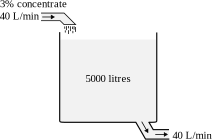
 

Let \(y\) be the volume of fruit concentrate, in litres, present in the tank at time \(t\).

  1. Show that  \(\dfrac{dy}{dt}=\dfrac{150-y}{125} \)   (1 mark)

    --- 4 WORK AREA LINES (style=lined) ---

  2. Show that the amount fruit juice concentrate in the tank at time \(t\) is given by
  3.       \(y=150 + 100e^{-0.008t} \)   (3 marks)

    --- 9 WORK AREA LINES (style=lined) ---

  4. Determine how long will it take for the mixture to reach a fruit juice concentration of 3.5%, giving your answer to the nearest minute?   (2 marks)

    --- 6 WORK AREA LINES (style=lined) ---

Show Answers Only

a.   \(\text{See Worked Solutions}\)

b.  \(\text{See Worked Solutions}\)

c.   \(\text{174 minutes}\)

Show Worked Solution

a.    \(\text{Inflow}=40 \ \text{L/min} \times 0.03=1.2 \ \text{L/min}\)

\(\text{Outflow }=40 \ \text{L/min} \times \dfrac{y}{5000}=\dfrac{y}{125} \ \text{L/min}\)

\(\dfrac{dy}{dt}\) \(=\text{Inflow}-\text{Outflow}\)
  \(=1.2-\dfrac{y}{125}\)
  \(=\dfrac{150-y}{125}\)


b.     \(\dfrac{dy}{dt}\) \(=\dfrac{150-y}{125}\)
  \(\dfrac{dt}{dy}\) \(=\dfrac{125}{150-y}\)
  \(\displaystyle\int dt\) \(=\displaystyle \int \dfrac{125}{150-y} \, dy\)
  \(t\) \(=-125\, \ln \abs{150-y}+c\)
  \(\ln \abs{150-y}\) \(=-\dfrac{t}{125}+c\)
  \(150-y\) \(=e^{-0.008 t+c}\)
  \(150-y\) \(=e^{-0.008 t} \cdot e^c\)
  \(150-y\) \(=A e^{-0.008 t}\)

 
\(\text{At} \ \ t=0, y=5000 \times 0.05=250\ \text{L}\)

\(150-250=Ae^{\circ} \ \  \Rightarrow \ \  A=-100\)

\(150-y\) \(=-100 e^{-0.008 t}\)
\(y\) \(=150+100 e^{0.008 t}\)


c.   \(\text{When fruit concentrate}=3.5 \%\)

\(y=5000 \times 0.035=175 \ \text{L}\)

\(\text{Find} \ t \ \text{when} \ \ y=175:\)

\(175\) \(=150+100 e^{-0.008 t}\)
\(25\) \(=100 e^{-0.008 t}\)
\(e^{-0.008t}\) \(=0.25\)
\(-0.008 t\) \(=\ln (0.25)\)
\(t\) \(=\dfrac{\ln (0.25)}{-0.008}\)
  \(=173.28 \ldots\)


\(\therefore \ \text{After 174 minutes, the fruit concentrate first falls below} \  3.5\%\)

Filed Under: Applications of Differential Equations, Applications of Differential Equations Tagged With: Band 4, Band 5, smc-1198-10-Mixing, smc-7297-10-Mixing

Calculus, EXT1 C2 EQ-Bank 18

Find the value of \(n\), given

\(\displaystyle \int_0^n-\dfrac{1}{\sqrt{1-x^2}}=-\dfrac{\pi}{6}\).   (2 marks)

--- 8 WORK AREA LINES (style=lined) ---

Show Answers Only

\(n=\dfrac{1}{2}\)

Show Worked Solution
\(\displaystyle\int_0^n-\dfrac{1}{\sqrt{1-x^2}}\) \(=-\dfrac{\pi}{6}\)
\(\left[\cos ^{-1} x\right]_0^n\) \(=-\dfrac{\pi}{6}\)
\(\cos ^{-1}(n)-\cos ^{-1} 0\) \(=-\dfrac{\pi}{6}\)
\(\cos ^{-1}(n)-\dfrac{\pi}{2}\) \(=-\dfrac{\pi}{6}\)
\(\cos ^{-1}(n)\) \(=\dfrac{\pi}{2}-\dfrac{\pi}{6}\)
\(n\) \(=\cos \left(\dfrac{\pi}{3}\right)\)
  \(=\dfrac{1}{2}\)

Filed Under: Inverse Functions Calculus, Inverse Functions Calculus Tagged With: Band 4, smc-1037-30-Sin/Cos Integration, smc-7289-30-\(\large \sin^{-1}/\cos^{-1}\ \) integration

Calculus, EXT1 C2 EQ-Bank 20

Use the substitution  \(u=\cos\,x\)  to evaluate

\(\displaystyle {\int}_{\frac{\pi}{2}}^\pi e^{\cos\,x} \sin x\, dx\).   (3 marks)

--- 7 WORK AREA LINES (style=lined) ---

Show Answers Only

\(1-\dfrac{1}{e}\)

Show Worked Solution

\(u=\cos x\)

\(\dfrac{d u}{d x}=-\sin\,x\  \Rightarrow\  du=-\sin\,x\,dx\)

\(\text {When} \ \ x=\pi, u=-1\)

\(\text{When} \ \ x=\dfrac{\pi}{2}, u=0\)

\(\displaystyle \int_{\frac{\pi}{2}}^\pi e^{\cos\,x} \sin\,x\,d x\) \(=\displaystyle -\int_0^{-1} e^u\,d u\)
  \(=\left[-e^u\right]_0^{-1}\)
  \(=-e^{-1}+e^0\)
  \(=1-\dfrac{1}{e}\)

Filed Under: Integration By Substitution, Integration By Substitution Tagged With: Band 4, smc-1036-30-Trig, smc-1036-50-Limits Invert, smc-7290-30-Trig, smc-7290-50-Limits Invert

Calculus, EXT1 C3 EQ-Bank 16

Find the general solution to the differential equation  \(y^{\prime}=e^{-y}\).   (2 marks)

--- 6 WORK AREA LINES (style=lined) ---

Show Answers Only

\(\ln \left|x+c_1\right|\)

Show Worked Solution
\(\dfrac{d y}{d x}\) \(=e^{-y}\)
\(\dfrac{d x}{d y}\) \(=e^y\)
\(\displaystyle \int d x\) \(=\displaystyle \int e^y\, d y\)
\(x\) \(=e^y+c\)
\(e^y\) \(=x+c_1\)
\(y\) \(=\ln \left|x+c_1\right|\)

Filed Under: Equations and Slope Fields, Equations and Slope Fields Tagged With: Band 4, smc-1197-20-Differential Equations, smc-1197-40-\(\dfrac{dy}{dx}=f(y)\), smc-7296-20-Differential Equations, smc-7296-40-\(\dfrac{dy}{dx}=f(y)\)

Calculus, EXT1 C2 EQ-Bank 17

Find  \(\displaystyle \int \frac{1}{\sqrt{15-2 x-x^2}}\, d x\).   (3 marks)

--- 3 WORK AREA LINES (style=lined) ---

Show Answers Only

\(\displaystyle\sin ^{-1}\left(\frac{x+1}{4}\right)+c\)

Show Worked Solution
\(\displaystyle\int \frac{1}{\sqrt{15-2 x-x^2}}\, d x\) \(=\displaystyle\int \frac{1}{\sqrt{16-1-2 x-x^2}}\, d x\)
  \(=\displaystyle\int \frac{1}{\sqrt{16-(x+1)^2}}\, d x\)
  \(=\displaystyle\sin ^{-1}\left(\frac{x+1}{4}\right)+c\)

Filed Under: Inverse Functions Calculus, Inverse Functions Calculus Tagged With: Band 4, smc-1037-30-Sin/Cos Integration, smc-7289-30-\(\large \sin^{-1}/\cos^{-1}\ \) integration

Calculus, EXT1 C2 EQ-Bank 6 MC

\(\displaystyle \int \dfrac{1}{\sqrt{5-4 x-x^2}}\, d x=\)
 

  1. \(\sin ^{-1}\left(\dfrac{x+2}{3}\right)+c \)
  2. \(\sin ^{-1}\left(\dfrac{x-2}{3}\right)+c \)
  3. \(\sin ^{-1}\left(\dfrac{x+2}{9}\right)+c \)
  4. \(\sin ^{-1}\left(\dfrac{x-2}{9}\right)+c\)
Show Answers Only

\(A\)

Show Worked Solution
\(\displaystyle \int \frac{1}{\sqrt{5-4 x-x^2}}\, d x\) \(=\displaystyle\int \frac{1}{\sqrt{9-4-4 x-x^2}}\,dx\)
  \(=\displaystyle \int \frac{1}{\sqrt{9-(x+2)^2}}\,dx\)
  \(=\sin ^{-1}\left(\dfrac{x+2}{3}\right)+c\)

\(\Rightarrow A\)

Filed Under: Inverse Functions Calculus, Inverse Functions Calculus Tagged With: Band 4, smc-1037-30-Sin/Cos Integration, smc-7289-30-\(\large \sin^{-1}/\cos^{-1}\ \) integration

Statistics, 2ADV S3 EQ-Bank 15

A probability density function for a random variable, \(X\), is defined by the following function
 

\(f(x)=\left\{\begin{array}{rl}
k x(2-x), & 0 \leqslant x \leqslant 2 \\
0, & \text{for all other } x
\end{array}\right.\)
 

Determine the value of \(k\) and hence write the equation of the Cumulative Density Function.   (3 marks)

--- 10 WORK AREA LINES (style=lined) ---

Show Answers Only

\(F(x)=\dfrac{3}{4} x^2-\dfrac{1}{4} x^3\)

Show Worked Solution
  \(\displaystyle \int_0^2 k x(2-x)\) \(=1\)
  \(\displaystyle \int_0^2 2 k x-k x^2\) \(=1\)
  \(\left[k x^2-\dfrac{k}{3} x^3\right]_0^2\) \(=1\)
  \(\left(4 k-\dfrac{8 k}{3}\right)-0\) \(=1\)
  \(4 k\) \(=3\)
  \(k\) \(=\dfrac{3}{4}\)


\(F(x)\) \(=\displaystyle \int 2 \times \frac{3}{4} x-\frac{3}{4} x^2\, d x\)
  \(=\displaystyle \int \frac{3}{2} x-\frac{3}{4} x^2\, d x\)
  \(=\dfrac{3}{4} x^2-\dfrac{1}{4} x^3+c\)

 
\(\text{When} \ \ x=0, F(x)=0 \ \Rightarrow \ c=0\)

\(\therefore\ F(x)=\dfrac{3}{4} x^2-\dfrac{1}{4} x^3\)

Filed Under: Continuous Random Variables, Probability Density Functions Tagged With: Band 4, smc-7137-40-CDF, smc-994-40-Cumulative Distribution Fn

HMS, HAG EQ-Bank 34 MC

A weight loss supplement advertisement states "Lose 10kg in 7 days without diet or exercise - doctors don't want you to know this secret!" Which combination of warning signs indicates this product should be avoided?

  1. Unrealistic promises, conspiracy claims and lack of effort required
  2. The product targets weight loss rather than general wellness
  3. The advertisement uses specific numbers and timeframes
  4. The product is marketed as a supplement rather than prescription medication
Show Answers Only

\(A\)

Show Worked Solution
  • A is correct: Unrealistic promises, conspiracy theories and “no effort” claims are major red flags.

Other Options:

  • B is incorrect: Weight loss products can be legitimate when properly evidence-based.
  • C is incorrect: Specific numbers alone don’t indicate poor products if realistic.
  • D is incorrect: Supplement classification doesn’t automatically indicate unreliable products.

Filed Under: Being a critical health consumer Tagged With: Band 4, smc-5483-17-Accuracy and credibility

HMS, HAG EQ-Bank 31 MC

When comparing health information from different sources, which combination of factors provides the MOST reliable basis for evaluating credibility?

  1. Author credentials, peer review, funding disclosure and publication date.
  2. Author credentials, peer review, technical terminology and cited references.
  3. Publication date, cited references, author credentials and positive reviews.
  4. Peer review, publication date, funding disclosure and search engine ranking.
Show Answers Only

\(A\)

Show Worked Solution
  • A is correct: Each factor tests credibility: expertise, independent scrutiny, conflicts of interest and currency.

Other Options:

  • B is incorrect: Technical terminology can make information sound authoritative without making it accurate.
  • C is incorrect: Positive reviews reflect user opinion, not the accuracy of the information.
  • D is incorrect: Search engine ranking reflects popularity and optimisation, not reliability.

Filed Under: Being a critical health consumer Tagged With: Band 4, smc-5483-17-Accuracy and credibility

HMS, HAG EQ-Bank 27 MC

A young adult sees an advertisement claiming a fitness tracker will "guarantee weight loss within 30 days".

Before deciding whether to buy it, which action BEST demonstrates informed decision making?

  1. Reading reviews from verified buyers to see whether other users lost weight.
  2. Comparing the tracker's features and price with similar models from other brands.
  3. Checking evidence on whether trackers cause weight loss and if one suits their goals.
  4. Asking a personal trainer at their gym which tracker brand they would recommend.
Show Answers Only

\(C\)

Show Worked Solution
  • C is correct: An informed decision tests the advertised claim against evidence and considers personal needs. Trackers monitor activity but do not by themselves cause weight loss.

Other Options:

  • A is incorrect: Verified reviews are still individual testimonials and cannot confirm a guaranteed result.
  • B is incorrect: Comparing features and price assumes the claim is true rather than evaluating it.
  • D is incorrect: A trainer’s brand preference is a personal opinion and does not test the advertisement’s claim.

Filed Under: Being a critical health consumer Tagged With: Band 4, smc-5483-12-Informed decisions

HMS, HAG EQ-Bank 26 MC

A person recently diagnosed with type 2 diabetes searches online and finds several websites giving different dietary recommendations.

Which approach demonstrates the most effective health information literacy?

  1. Following the advice that appears on the greatest number of the websites.
  2. Using the website with the most recent publication date and a reference list.
  3. Choosing the website written by a doctor, as medical qualifications ensure accuracy.
  4. Comparing each site's authorship and evidence, then raising differences with their GP.
Show Answers Only

\(D\)

Show Worked Solution
  • D is correct: Health information literacy involves evaluating sources against several criteria and confirming conflicting advice with a professional who knows the person’s circumstances.

Other Options:

  • A is incorrect: Websites often repeat the same content, so how often advice appears reflects popularity rather than accuracy.
  • B is incorrect: Currency and references are useful criteria, but relying on one source sets the conflicting advice aside rather than resolving it.
  • C is incorrect: Qualifications improve credibility but do not guarantee accuracy; a doctor’s website may carry commercial interests or outdated advice.

Filed Under: Being a critical health consumer Tagged With: Band 4, smc-5483-07-Trustworthy sources

HMS, HAG EQ-Bank 22 MC

Mediterranean countries such as Spain demonstrate lower obesity rates compared to Australia, partly attributed to traditional diets rich in fruits and vegetables. Which lesson from this international example could BEST be applied to improve Australia's obesity rankings?

  1. Mandate that all Australians follow Mediterranean diets exclusively
  2. Promote cultural dietary practices that emphasise fresh produce consumption
  3. Ban all processed food production in Australia immediately
  4. Focus only on increasing physical activity levels without dietary changes
Show Answers Only

\(B\)

Show Worked Solution
  • B is correct: Promoting fresh produce consumption addresses Australia’s poor vegetable guideline compliance.

Other Options:

  • A is incorrect: Mandating specific diets ignores cultural diversity and personal choice.
  • C is incorrect: Complete bans are impractical and economically disruptive.
  • D is incorrect: Physical activity alone insufficient without addressing dietary patterns.

Filed Under: Australia vs OECD Countries Tagged With: Band 4, smc-5476-30-Lessons for Australia

HMS, HAG EQ-Bank 19 MC

Based on Australia's Health 2024 OECD ranking data, which statement BEST describes the pattern of Australia's health performance across different indicators?

  1. Australia consistently ranks in the top 5 for all major health indicators
  2. Australia performs well in some areas but faces significant challenges in others
  3. Australia ranks below average for all lifestyle-related health measures
  4. Australia's rankings show no clear pattern across different health indicators
Show Answers Only

\(B\)

Show Worked Solution
  • B is correct: Strong tobacco control but challenges with alcohol and obesity rankings.

Other Options:

  • A is incorrect: Mixed rankings across indicators, not consistently top 5.
  • C is incorrect: Tobacco control shows above-average performance among lifestyle measures.
  • D is incorrect: Clear pattern of strengths and weaknesses evident.

Filed Under: Australia vs OECD Countries Tagged With: Band 4, smc-5476-05-OECD Rankings

HMS, HAG EQ-Bank 16 MC

Australia ranks fourth highest for life expectancy among OECD countries. Which factor BEST explains why Australia achieves this high ranking?

  1. Australia has the highest health spending per capita among all OECD countries
  2. Australia's climate prevents all forms of chronic disease development
  3. Australia has effective public health campaigns combined with accessible healthcare through Medicare
  4. Australia has eliminated all preventable risk factors from the population
Show Answers Only

\(C\)

Show Worked Solution
  • C is correct: Medicare accessibility and public health initiatives contribute to longevity outcomes.

Other Options:

  • A is incorrect: Australia ranks 15th in health spending, not highest.
  • B is incorrect: Climate alone cannot prevent chronic diseases entirely.
  • D is incorrect: Risk factors like obesity still present challenges.

Filed Under: Australia vs OECD Countries Tagged With: Band 4, smc-5476-10-Explaining Australia's Ranking

HMS, HAG EQ-Bank 14 MC

Based on Australia's Health 2024 data comparing risk factors across OECD countries, which statement BEST describes Australia's performance in health risk areas?

  1. Australia performs poorly across all major health risk factors compared to OECD countries
  2. Australia has successfully reduced tobacco smoking but faces challenges with overweight and obesity rates
  3. Australia ranks highest among OECD countries for alcohol consumption per person
  4. Australia has the lowest rates of overweight and obesity among all OECD member countries
Show Answers Only

\(B\)

Show Worked Solution
  • B is correct: Fifth lowest tobacco smoking but 10th highest overweight/obesity among OECD countries.

Other Options:

  • A is incorrect: Australia performs well in tobacco control measures.
  • C is incorrect: Australia ranks 16th highest, not highest for alcohol consumption.
  • D is incorrect: Australia has 10th highest overweight/obesity rates.

Filed Under: Australia vs OECD Countries Tagged With: Band 4, smc-5476-05-OECD Rankings

  • « Previous Page
  • 1
  • …
  • 18
  • 19
  • 20
  • 21
  • 22
  • …
  • 125
  • Next Page »

Copyright © 2014–2026 SmarterEd.com.au · Log in