SmarterEd

Aussie Maths & Science Teachers: Save your time with SmarterEd

  • Login
  • Get Help
  • About

HMS, HAG EQ-Bank 11 MC

According to Australia's Health 2024, people living in rural and remote areas experience higher death rates and poorer health outcomes compared to those in major cities. Which is the most effective approach to address these geographic health inequities?

  1. Reduce healthcare funding to major cities to redistribute resources
  2. Focus only on emergency medical services in remote areas
  3. Implement identical healthcare delivery models across all geographic locations
  4. Increase telehealth services and mobile healthcare units for remote communities
Show Answers Only

\(D\)

Show Worked Solution
  • D is correct: Telehealth and mobile units address geographic barriers to healthcare access.

Other Options:

  • A is incorrect: Reducing city services doesn’t improve rural access effectively.
  • B is incorrect: Emergency-only approach ignores preventive and routine care needs.
  • C is incorrect: One-size-fits-all models don’t address unique rural challenges.

Filed Under: Groups Experiencing Inequities Tagged With: Band 4, smc-5475-20-Other Inequity Groups, smc-5475-50-Actions and Interventions

HMS, HAG EQ-Bank 10 MC

According to Australia's Health 2024 data on tobacco and e-cigarette use patterns, which statement BEST describes the socioeconomic trends that exist in substance use behaviours?

  1. Both tobacco smoking and e-cigarette use follow identical socioeconomic patterns
  2. Tobacco use is higher in disadvantaged areas whilst e-cigarette use is higher in advantaged areas
  3. E-cigarette use shows no relationship to socioeconomic status across Australia
  4. Advantaged areas have equally high rates of both tobacco and e-cigarette use
Show Answers Only

\(B\)

Show Worked Solution
  • B is correct: Data shows opposite patterns – tobacco higher in disadvantaged, e-cigarettes in advantaged areas.

Other Options:

  • A is incorrect: Patterns are opposite between tobacco and e-cigarettes.
  • C is incorrect: Clear socioeconomic pattern exists for e-cigarette use.
  • D is incorrect: Advantaged areas have low tobacco but high e-cigarette rates.

Filed Under: Current Health Status Tagged With: Band 4, smc-5474-40-Risky Health Behaviours

HMS, HAG EQ-Bank 8 MC

A teenager begins vaping after seeing their favourite social media influencer promoting e-cigarettes during online content. This scenario BEST demonstrates which sociological cause of risky health behaviour?

  1. Social relationships through peer pressure from close friends
  2. Culture of everyday life influenced by media and normalisation
  3. Social interaction within workplace environments
  4. Family environment and parental modelling of behaviour
Show Answers Only

\(B\)

Show Worked Solution
  • B is correct: Media influence and normalisation of e-cigarettes demonstrates cultural factors.

Other Options:

  • A is incorrect: Involves media influence, not direct peer relationships.
  • C is incorrect: Scenario involves social media, not workplace interaction.
  • D is incorrect: Involves external media influence, not family modelling.

Filed Under: Current Health Status Tagged With: Band 4, smc-5474-40-Risky Health Behaviours

HMS, HAG EQ-Bank 5 MC

According to Australia's Health 2024 data, which statement BEST describes the differences in leading causes of disease burden between males and females?

  1. Both males and females have identical leading causes of disease burden
  2. Males experience higher rates of anxiety disorders whilst females experience higher rates of suicide
  3. Coronary heart disease is the leading cause for males whilst dementia is the leading cause for females
  4. Back pain and problems affects females more than males across all age groups
Show Answers Only

\(C\)

Show Worked Solution
  • C is correct: Data shows coronary heart disease leads for males, dementia for females.

Other Options:

  • A is incorrect: Leading causes differ significantly between genders.
  • B is incorrect: Anxiety disorders lead for females, suicide for males.
  • D is incorrect: Back pain ranks similarly for both genders.

Filed Under: Current Health Status Tagged With: Band 4, smc-5474-10-Morbidity and Mortality, smc-5474-30-Gender Inequities

Calculus, 2ADV C4 EQ-Bank 26

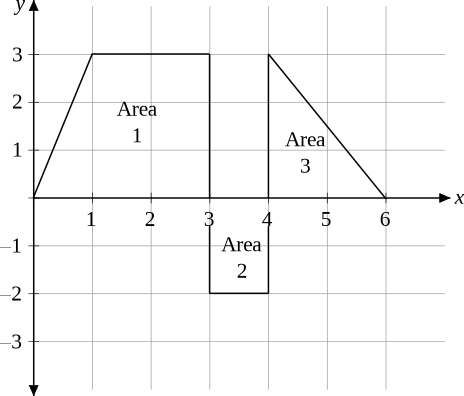
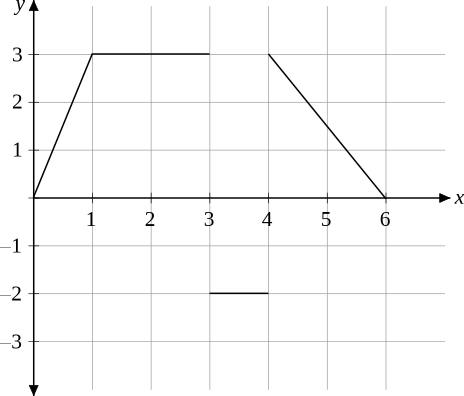
  1. The graph of \(f(x)\) is drawn below
     

  1. Evaluate \(\displaystyle \int_0^6 f(x)\, d x\)   (2 marks)

    --- 6 WORK AREA LINES (style=lined) ---

  2. Evaluate \(\displaystyle \int_0^6[f(x)-3]\, d x\)   (2 marks)

    --- 6 WORK AREA LINES (style=lined) ---

  3. Evaluate \(\displaystyle \int_4^6 f^{\prime}(x)\, d x\)   (1 mark)

    --- 6 WORK AREA LINES (style=lined) ---

Show Answers Only

a.    \(8 \dfrac{1}{2}\)

b.    \(-9 \dfrac{1}{2}\)

c.    \(-3\)

Show Worked Solution

a.
         

\(\displaystyle \int_0^6 f(x)\) \(=\text{net area above the}\ x \text{-axis }\)
  \(=\text{Area 1}+ \text{Area 3}-\text{Area 2}\)
  \(=\left(6+1 \dfrac{1}{2}\right)+3-2\)
  \(=8 \dfrac{1}{2}\)


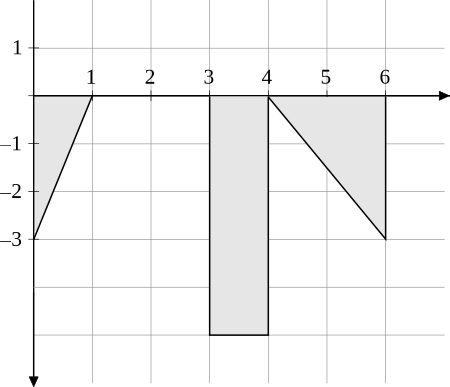
b.     \(f(x)-3 \ \ \text{shifts graph (above) 3 units lower:}\)
 

\(\displaystyle\int_0^6[f(x)-3] \ \ \text{will be negative (areas below \(x\)-axis)}\)
  \(=-\left(1 \dfrac{1}{2}+5+3\right)\)
  \(=-9 \dfrac{1}{2}\)


c.     \(\displaystyle \int_4^6 f^{\prime}(x) d x\) \(=[f(x)]_4^6\)
    \(=f(6)-f(4)\)
    \(=0-3\)
    \(=-3\)

Filed Under: Area Under Curves, Areas Under Curves Tagged With: Band 4, Band 5, smc-7131-70-Areas Without Calculus, smc-975-70-Areas Without Calculus

HMS, TIP 2012 HSC 32b

Evaluate the risks and ethical issues related to the use of drugs to improve performance.   (12 marks)

--- 28 WORK AREA LINES (style=lined) ---

Show Answers Only

Evaluation Statement

  • Performance-enhancing drug use presents significant risks and serious ethical concerns. Although some argue these concerns are overstated, the risks and ethical issues outweigh any performance benefits.

Health and Safety Risks

  • Anabolic steroids cause liver damage, cardiovascular disease and hormonal disruptions that can persist beyond athletic careers.
  • EPO increases blood viscosity, creating a high risk of stroke and heart attack, particularly during intense competition.
  • Stimulants can produce cardiac arrhythmias and overheating, which can result in sudden death during performance.
  • Many consequences emerge years after use ceases. For example, steroid use in adolescents can cause premature growth plate closure, permanently stunting height.
  • Female athletes can experience masculinisation effects such as voice deepening and increased body hair, some of which are irreversible.
  • Mental health impacts include depression, aggression and dependency, affecting quality of life beyond sport.

Ethical and Fair Play Issues

  • Drug use provides unfair advantages over clean athletes, devaluing achievement earned through training and talent.
  • When drug use is widespread, clean athletes may feel pressured to use drugs to remain competitive, putting their own health at risk.
  • Elite athletes are role models, and their drug use sends a dangerous message to young participants who may copy these practices.
  • This normalises cheating and damages public trust in sport.

Counter-Arguments

  • Some argue that drug use should be permitted because testing does not catch every user, so allowing medically supervised use would make competition fairer and reduce the risks of unsupervised use.
  • Others point out that the ethical line is unclear. For example, altitude tents are legal, yet they raise red blood cell levels in a similar way to EPO, which is banned.
  • However, permitting drug use would increase the pressure on clean athletes to use drugs, and high doses would remain harmful even under supervision.
  • The comparison with altitude training is also limited, because natural adaptations are restricted by the body, while drugs can push red blood cell levels to dangerous extremes.

Final Evaluation

  • Weighing these factors shows that performance-enhancing drugs present unacceptable risks and serious ethical violations.
  • While arguments for supervised use and the blurred line with legal methods raise valid questions, they do not outweigh the health dangers and the pressure placed on clean athletes.
  • Overall, drug use remains fundamentally incompatible with fair and ethical athletic participation.
Show Worked Solution

Evaluation Statement

  • Performance-enhancing drug use presents significant risks and serious ethical concerns. Although some argue these concerns are overstated, the risks and ethical issues outweigh any performance benefits.

Health and Safety Risks

  • Anabolic steroids cause liver damage, cardiovascular disease and hormonal disruptions that can persist beyond athletic careers.
  • EPO increases blood viscosity, creating a high risk of stroke and heart attack, particularly during intense competition.
  • Stimulants can produce cardiac arrhythmias and overheating, which can result in sudden death during performance.
  • Many consequences emerge years after use ceases. For example, steroid use in adolescents can cause premature growth plate closure, permanently stunting height.
  • Female athletes can experience masculinisation effects such as voice deepening and increased body hair, some of which are irreversible.
  • Mental health impacts include depression, aggression and dependency, affecting quality of life beyond sport.

Ethical and Fair Play Issues

  • Drug use provides unfair advantages over clean athletes, devaluing achievement earned through training and talent.
  • When drug use is widespread, clean athletes may feel pressured to use drugs to remain competitive, putting their own health at risk.
  • Elite athletes are role models, and their drug use sends a dangerous message to young participants who may copy these practices.
  • This normalises cheating and damages public trust in sport.

Counter-Arguments

  • Some argue that drug use should be permitted because testing does not catch every user, so allowing medically supervised use would make competition fairer and reduce the risks of unsupervised use.
  • Others point out that the ethical line is unclear. For example, altitude tents are legal, yet they raise red blood cell levels in a similar way to EPO, which is banned.
  • However, permitting drug use would increase the pressure on clean athletes to use drugs, and high doses would remain harmful even under supervision.
  • The comparison with altitude training is also limited, because natural adaptations are restricted by the body, while drugs can push red blood cell levels to dangerous extremes.

Final Evaluation

  • Weighing these factors shows that performance-enhancing drugs present unacceptable risks and serious ethical violations.
  • While arguments for supervised use and the blurred line with legal methods raise valid questions, they do not outweigh the health dangers and the pressure placed on clean athletes.
  • Overall, drug use remains fundamentally incompatible with fair and ethical athletic participation.

Filed Under: Impact of drug use Tagged With: Band 4, Band 5, smc-5473-10-Health implications, smc-5473-20-Ethical considerations

HMS, HIC 2012 HSC 29a

Explain the determining factors that affect the health of young people in Australia.   (8 marks)

--- 24 WORK AREA LINES (style=lined) ---

Show Answers Only

Socioeconomic characteristics

  • Low family income limits access to nutritious food, sport and health services, so young people from disadvantaged families face higher health risks.
  • Lower educational attainment reduces health literacy, making it harder to make informed health decisions.
  • Insecure or casual work also adds financial stress for older adolescents.

Environmental factors

  • Young people in rural and remote areas have less access to youth mental health and other health services, which delays treatment.
  • A lack of safe parks and facilities limits physical activity, while poor housing increases the risk of respiratory illness.

Broad features of society

  • Peers, family and social media shape health behaviours during adolescence.
  • Social media can lower body image and self-esteem, contributing to anxiety and depression.
  • Stigma about mental illness can discourage young people from seeking help.

Health behaviours

  • Risk-taking, such as risky drinking and unsafe driving, contributes to injuries, the leading cause of death for young people.
  • Most adolescents do not meet the physical activity guideline, increasing long-term chronic disease risk.
  • Vaping has increased among young adults, raising the risk of nicotine dependence.

Biomedical factors

  • Genetics and family history can increase the risk of conditions such as asthma and type 1 diabetes.
  • Excess weight in adolescence also increases the risk of high blood pressure and later heart disease.
  • Therefore, these determinants interact, so young people facing several disadvantages at once experience the poorest health.
Show Worked Solution

*Cause-and-effect language that directly addresses the “Explain” keyword is bolded in the answer below.

Socioeconomic characteristics

  • Low family income limits access to nutritious food, sport and health services, so young people from disadvantaged families face higher health risks.
  • Lower educational attainment reduces health literacy, making it harder to make informed health decisions.
  • Insecure or casual work also adds financial stress for older adolescents.

Environmental factors

  • Young people in rural and remote areas have less access to youth mental health and other health services, which delays treatment.
  • A lack of safe parks and facilities limits physical activity, while poor housing increases the risk of respiratory illness.

Broad features of society

  • Peers, family and social media shape health behaviours during adolescence.
  • Social media can lower body image and self-esteem, contributing to anxiety and depression.
  • Stigma about mental illness can discourage young people from seeking help.

Health behaviours

  • Risk-taking, such as risky drinking and unsafe driving, contributes to injuries, the leading cause of death for young people.
  • Most adolescents do not meet the physical activity guideline, increasing long-term chronic disease risk.
  • Vaping has increased among young adults, raising the risk of nicotine dependence.

Biomedical factors

  • Genetics and family history can increase the risk of conditions such as asthma and type 1 diabetes.
  • Excess weight in adolescence also increases the risk of high blood pressure and later heart disease.
  • Therefore, these determinants interact, so young people facing several disadvantages at once experience the poorest health.

♦♦ Mean mark 50%.

Filed Under: Research and Health Related Issues Tagged With: Band 4, Band 5, smc-5800-15-Protective/risk factors

HMS, TIP 2012 HSC 28

Describe the different recovery strategies used by athletes to improve performance. Provide examples.   (8 marks)

--- 24 WORK AREA LINES (style=lined) ---

Show Answers Only

Physiological recovery strategies

  • Physiological recovery strategies target the body’s physical systems to remove metabolic waste products and restore energy stores.
  • Cool-down activities involving light jogging and stretching help maintain blood circulation while gradually reducing heart rate and body temperature.
  • For example, swimmers perform easy laps after intensive training sessions to prevent blood pooling in muscles.

Thermal recovery strategies

  • Hydrotherapy utilises water-based treatments to enhance recovery through temperature manipulation and hydrostatic pressure.
  • Ice baths reduce muscle inflammation and soreness following intense exercise by constricting blood vessels.
  • Contrast showers alternating hot and cold water promote blood circulation and reduce swelling.
  • Pool recovery sessions in warm water aid muscle relaxation and joint mobility.

Psychological recovery strategies

  • Psychological recovery strategies focus on mental restoration and stress reduction after demanding training or competition.
  • Progressive muscle relaxation techniques help athletes release physical tension while calming the nervous system.
  • Meditation and deep breathing exercises reduce anxiety levels and promote mental clarity.
  • Visualisation techniques allow athletes to mentally rehearse successful performance while physically resting.

Nutritional recovery strategies

  • Nutritional recovery strategies involve optimal fluid and nutrient replacement to support physiological processes.
  • Consuming carbohydrates within 30 minutes post-exercise rapidly replenishes glycogen stores in muscles and liver.
  • Protein intake supports muscle repair processes and adaptation.
  • Adequate hydration maintains cellular function and temperature regulation during recovery periods.
Show Worked Solution

Physiological recovery strategies

  • Physiological recovery strategies target the body’s physical systems to remove metabolic waste products and restore energy stores.
  • Cool-down activities involving light jogging and stretching help maintain blood circulation while gradually reducing heart rate and body temperature.
  • For example, swimmers perform easy laps after intensive training sessions to prevent blood pooling in muscles.

Thermal recovery strategies

  • Hydrotherapy utilises water-based treatments to enhance recovery through temperature manipulation and hydrostatic pressure.
  • Ice baths reduce muscle inflammation and soreness following intense exercise by constricting blood vessels.
  • Contrast showers alternating hot and cold water promote blood circulation and reduce swelling.
  • Pool recovery sessions in warm water aid muscle relaxation and joint mobility.

Psychological recovery strategies

  • Psychological recovery strategies focus on mental restoration and stress reduction after demanding training or competition.
  • Progressive muscle relaxation techniques help athletes release physical tension while calming the nervous system.
  • Meditation and deep breathing exercises reduce anxiety levels and promote mental clarity.
  • Visualisation techniques allow athletes to mentally rehearse successful performance while physically resting.

Nutritional recovery strategies

  • Nutritional recovery strategies involve optimal fluid and nutrient replacement to support physiological processes.
  • Consuming carbohydrates within 30 minutes post-exercise rapidly replenishes glycogen stores in muscles and liver.
  • Protein intake supports muscle repair processes and adaptation.
  • Adequate hydration maintains cellular function and temperature regulation during recovery periods.

Filed Under: Recovery strategies Tagged With: Band 4, smc-5470-10-Cool down, smc-5470-20-Hydrotherapy/Cryotherapy, smc-5470-30-Psychological, smc-5470-40-Multiple strategies

HMS, TIP 2012 HSC 27

How can THREE principles of training be applied to improve strength? Provide examples.   (6 marks)

--- 18 WORK AREA LINES (style=lined) ---

Show Answers Only
  • Progressive overload requires gradually increasing training demands to stimulate strength adaptations. This occurs when athletes systematically increase weight, repetitions or sets over time. For example, a weightlifter progressing from 60kg to 80kg bench press over eight weeks demonstrates progressive overload application. Without continuous progression, strength plateaus because muscles adapt to consistent loads.
  • Specificity ensures training matches the demands of the target activity or muscle group. This means exercises must replicate movement patterns and energy systems used in performance. For instance, a shot-putter performing explosive medicine ball throws creates specific adaptations for their competitive throwing technique. This principle results in targeted muscle fibre recruitment patterns.
  • Training thresholds establish minimum intensity levels required to stimulate strength improvements. This typically involves working at 70-85% of one repetition maximum for optimal strength gains. For example, a rugby player performing squats at 75% of maximum weight triggers the physiological adaptations necessary for increased muscular strength and power development. Below this threshold, minimal strength gains occur.
Show Worked Solution
  • Progressive overload requires gradually increasing training demands to stimulate strength adaptations. This occurs when athletes systematically increase weight, repetitions or sets over time. For example, a weightlifter progressing from 60kg to 80kg bench press over eight weeks demonstrates progressive overload application. Without continuous progression, strength plateaus because muscles adapt to consistent loads.
  • Specificity ensures training matches the demands of the target activity or muscle group. This means exercises must replicate movement patterns and energy systems used in performance. For instance, a shot-putter performing explosive medicine ball throws creates specific adaptations for their competitive throwing technique. This principle results in targeted muscle fibre recruitment patterns.
  • Training thresholds establish minimum intensity levels required to stimulate strength improvements. This typically involves working at 70-85% of one repetition maximum for optimal strength gains. For example, a rugby player performing squats at 75% of maximum weight triggers the physiological adaptations necessary for increased muscular strength and power development. Below this threshold, minimal strength gains occur.

Filed Under: Principles of training Tagged With: Band 4, smc-5460-10-Progressive overload, smc-5460-20-Thresholds, smc-5460-40-Specificity

HMS, HAG 2012 HSC 24

Explain the roles of individuals, communities and governments in addressing the health inequities experienced by ONE group other than Aboriginal and Torres Strait Islander peoples.   (8 marks)

--- 24 WORK AREA LINES (style=lined) ---

Show Answers Only

Socioeconomically disadvantaged people experience significant health inequities requiring coordinated responses.

  • Individual roles involve pursuing education and employment opportunities, which leads to improved income and health outcomes. Disadvantaged individuals can access community health services, resulting in better preventive care. This occurs when people develop health literacy skills and seek appropriate medical attention early.
  • Community organisations provide essential support services that bridge healthcare gaps. For example, community health centres offer bulk-billing services in low-income areas, ensuring affordable healthcare access. Food banks and community kitchens address nutritional needs, while employment training programs create pathways to economic stability.
  • Government interventions target systemic inequities through policy and funding. Medicare provides universal healthcare coverage, removing financial barriers to medical treatment. Centrelink payments ensure basic income support, enabling disadvantaged families to meet essential needs. Public housing programs address accommodation security, which directly impacts health outcomes.
  • Collaborative approaches prove most effective when all three levels work together. This integration results in comprehensive support addressing multiple determinants of health simultaneously.
Show Worked Solution

Socioeconomically disadvantaged people experience significant health inequities requiring coordinated responses.

  • Individual roles involve pursuing education and employment opportunities, which leads to improved income and health outcomes. Disadvantaged individuals can access community health services, resulting in better preventive care. This occurs when people develop health literacy skills and seek appropriate medical attention early.
  • Community organisations provide essential support services that bridge healthcare gaps. For example, community health centres offer bulk-billing services in low-income areas, ensuring affordable healthcare access. Food banks and community kitchens address nutritional needs, while employment training programs create pathways to economic stability.
  • Government interventions target systemic inequities through policy and funding. Medicare provides universal healthcare coverage, removing financial barriers to medical treatment. Centrelink payments ensure basic income support, enabling disadvantaged families to meet essential needs. Public housing programs address accommodation security, which directly impacts health outcomes.
  • Collaborative approaches prove most effective when all three levels work together. This integration results in comprehensive support addressing multiple determinants of health simultaneously.

♦♦ Mean mark 46%.

Filed Under: Groups Experiencing Inequities Tagged With: Band 4, Band 5, smc-5475-20-Other Inequity Groups, smc-5475-50-Actions and Interventions

HMS, HIC 2012 HSC 23

How is epidemiology used to improve the health of Australians? Provide examples.   (6 marks)

--- 18 WORK AREA LINES (style=lined) ---

Show Answers Only
  • Epidemiology identifies disease patterns within populations, enabling targeted health interventions. This occurs because health authorities analyse mortality, morbidity, incidence and prevalence data from Australia’s Health reports to understand disease distribution across different demographic groups.
  • For instance, epidemiological studies revealed high cardiovascular disease rates among middle-aged men in specific socioeconomic areas. This led to targeted prevention campaigns focusing on diet modification, smoking cessation and exercise programs in these communities. As a result, cardiovascular mortality rates have declined by over 80% since the 1980s, demonstrating epidemiology’s effectiveness in guiding interventions.
  • Epidemiology tracks infectious disease outbreaks, allowing rapid public health responses. When COVID-19 emerged, epidemiological surveillance enabled contact tracing, isolation protocols and containment strategies across Australia. This process prevented wider community transmission in many instances, particularly in rural and remote areas.
  • Cancer screening programs resulted from epidemiological research identifying at-risk populations and optimal screening ages. Consequently, breast cancer screening targets women aged 50-74, while bowel cancer screening focuses on adults over 50. These programs demonstrate how epidemiological evidence guides resource allocation, policy development and preventive healthcare delivery nationwide.
Show Worked Solution
  • Epidemiology identifies disease patterns within populations, enabling targeted health interventions. This occurs because health authorities analyse mortality, morbidity, incidence and prevalence data from Australia’s Health reports to understand disease distribution across different demographic groups.
  • For instance, epidemiological studies revealed high cardiovascular disease rates among middle-aged men in specific socioeconomic areas. This led to targeted prevention campaigns focusing on diet modification, smoking cessation and exercise programs in these communities. As a result, cardiovascular mortality rates have declined by over 80% since the 1980s, demonstrating epidemiology’s effectiveness in guiding interventions.
  • Epidemiology tracks infectious disease outbreaks, allowing rapid public health responses. When COVID-19 emerged, epidemiological surveillance enabled contact tracing, isolation protocols and containment strategies across Australia. This process prevented wider community transmission in many instances, particularly in rural and remote areas.
  • Cancer screening programs resulted from epidemiological research identifying at-risk populations and optimal screening ages. Consequently, breast cancer screening targets women aged 50-74, while bowel cancer screening focuses on adults over 50. These programs demonstrate how epidemiological evidence guides resource allocation, policy development and preventive healthcare delivery nationwide.

Filed Under: Health status of Australians Tagged With: Band 4, smc-5504-10-Epidemiology - purpose and use

HMS, HAG 2012 HSC 22

Outline THREE types of carer or volunteer organisations available to help meet the needs of Australia’s ageing population.   (3 marks)

--- 9 WORK AREA LINES (style=lined) ---

Show Answers Only
  • Community health centres provide nursing services, physiotherapy and health monitoring for elderly people remaining in their homes. These centres offer coordinated care and liaison with other health professionals.
  • Meals on Wheels delivers nutritious meals directly to elderly residents who cannot prepare food independently. This service ensures proper nutrition while enabling seniors to maintain independence at home.
  • Home care services provide domestic assistance including cleaning, shopping and personal care such as bathing and dressing. These volunteers help elderly people manage daily activities safely.
Show Worked Solution
  • Community health centres provide nursing services, physiotherapy and health monitoring for elderly people remaining in their homes. These centres offer coordinated care and liaison with other health professionals.
  • Meals on Wheels delivers nutritious meals directly to elderly residents who cannot prepare food independently. This service ensures proper nutrition while enabling seniors to maintain independence at home.
  • Home care services provide domestic assistance including cleaning, shopping and personal care such as bathing and dressing. These volunteers help elderly people manage daily activities safely.

Filed Under: Impact of an Ageing Population Tagged With: Band 4, smc-5478-25-Strategies and Planning

HMS, HAG 2012 HSC 21

Describe the advantages of Medicare for Australian citizens.   (3 marks)

--- 9 WORK AREA LINES (style=lined) ---

Show Answers Only
  • Medicare is Australia’s universal healthcare system, ensuring equality of access for all Australian citizens regardless of income or circumstances.
  • It provides free or partially funded medical, optometrical and hospital care. Bulk billing removes out-of-pocket costs for GP visits, and treatment as a public patient in a public hospital is free.
  • Citizens keep the option of choosing private health care for other services, such as their own doctor or a private hospital, and Medicare still subsidises part of the fee.
Show Worked Solution
  • Medicare is Australia’s universal healthcare system, ensuring equality of access for all Australian citizens regardless of income or circumstances.
  • It provides free or partially funded medical, optometrical and hospital care. Bulk billing removes out-of-pocket costs for GP visits, and treatment as a public patient in a public hospital is free.
  • Citizens keep the option of choosing private health care for other services, such as their own doctor or a private hospital, and Medicare still subsidises part of the fee.

Filed Under: Healthcare expenditure Tagged With: Band 4, smc-5482-20-Medicare

HMS, TIP 2012 HSC 20 MC

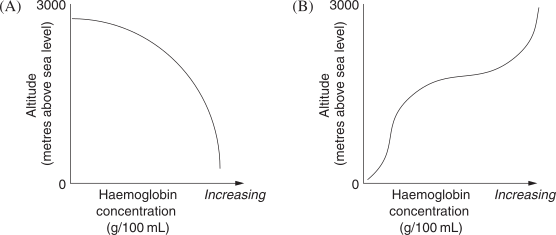
Which physiological adaptations occur in athletes when regularly training at submaximal levels to improve their aerobic performance?

  1. Increased cardiac output, decreased stroke volume and muscle atrophy
  2. Increased cardiac output, increased lung capacity and muscle hypertrophy
  3. Decreased resting heart rate, decreased haemoglobin levels and increased oxygen uptake
  4. Decreased resting heart rate, increased stroke volume and increased haemoglobin levels
Show Answers Only

\(D\)

Show Worked Solution
  • D is correct: Aerobic training decreases resting heart rate, increases stroke volume and haemoglobin.

Other Options:

  • A is incorrect: Stroke volume increases with aerobic training, not decreases.
  • B is incorrect: Aerobic training causes muscle adaptations, not significant hypertrophy.
  • C is incorrect: Haemoglobin levels increase with aerobic training, not decrease.

Filed Under: Physiological adaptations and improved performance Tagged With: Band 4, smc-5461-10-Cardiorespiratory, smc-5461-20-Muscular

HMS, TIP 2012 HSC 19 MC

Which psychological performance strategy are athletes using if they are able to perceive themselves winning an event before the event has taken place?

  1. Meditation
  2. Goal-setting
  3. Visualisation
  4. Mental rehearsal
Show Answers Only

\(C\)

Show Worked Solution
  • C is correct: Visualisation involves creating mental images of successful performance outcomes.

Other Options:

  • A is incorrect: Meditation focuses on mindfulness and relaxation, not imagery.
  • B is incorrect: Goal-setting establishes targets, not mental imagery of success.
  • D is incorrect: Mental rehearsal practices technique, not outcome visualisation.

Filed Under: Psychological strategies Tagged With: Band 4, smc-5464-10-Types of strategies

HMS, BM 2012 HSC 17 MC

Athletes are filmed executing a skill. They then watch the film and correct their techniques based upon what they observed.

What type of feedback is this?

  1. Internal and concurrent
  2. External and concurrent
  3. Internal and delayed
  4. External and delayed
Show Answers Only

\(D\)

Show Worked Solution
  • D is correct: Video feedback is external (from outside source) and delayed (after performance).

Other Options:

  • A is incorrect: Video feedback comes from external source, not internal feelings.
  • B is incorrect: Watching film occurs after performance, not concurrently.
  • C is incorrect: Video feedback is external, not internal sensory information.

Filed Under: Feedback Tagged With: Band 4, smc-7997-10-Task-intrinsic/augmented, smc-7997-20-Concurrent/delayed, smc-7997-60-Identify type of feedback

HMS, TIP 2012 HSC 16 MC

What is increased by an athlete’s use of creatine supplementation?

  1. Phosphocreatine stores and muscle glycogen
  2. Phosphocreatine stores and the ability to resynthesise ATP
  3. Haemoglobin concentration in the blood and muscle glycogen
  4. The ability to break down lactic acid and to resynthesise ATP
Show Answers Only

\(B\)

Show Worked Solution
  • B is correct: Creatine increases phosphocreatine stores and ATP resynthesis capacity.

Other Options:

  • A is incorrect: Creatine doesn’t affect muscle glycogen storage.
  • C is incorrect: Creatine doesn’t influence haemoglobin concentration or glycogen.
  • D is incorrect: Creatine doesn’t affect lactic acid breakdown mechanisms.

Filed Under: Supplementation and performance Tagged With: Band 4, smc-5468-30-Creatine

HMS, BM 2012 HSC 14 MC

What type of skill is a defensive player performing when executing a tackle during a game?

  1. Closed and self-paced
  2. Closed and externally paced
  3. Open and externally paced
  4. Open and self-paced
Show Answers Only

\(C\)

Show Worked Solution
  • C is correct: Tackling is open (unpredictable environment) and externally paced (opponent timing).

Other Options:

  • A is incorrect: Tackling involves unpredictable opponents, not closed predictable environment.
  • B is incorrect: Tackling is open skill due to changing game conditions.
  • D is incorrect: Tackle timing depends on opponent movements, not self-pacing.

Filed Under: Characteristics of skills Tagged With: Band 4, smc-5922-30-Open/Closed, smc-5922-40-Self/Externally paced, smc-5922-70-Multiple characteristics

HMS, BM 2012 HSC 11 MC

Which of the following is a feature of the associative stage of skill acquisition?

  1. Focusing on strategic play
  2. Understanding the processes related to the skill
  3. Sequencing and performing the skill instinctively
  4. Experiencing repeated success with a decreasing number of errors
Show Answers Only

\(D\)

Show Worked Solution
  • D is correct: Associative stage features practice refinement with fewer errors.

Other Options:

  • A is incorrect: Strategic focus occurs in autonomous stage.
  • B is incorrect: Understanding processes characterises cognitive stage.
  • C is incorrect: Instinctive performance describes autonomous stage.

Filed Under: Stages of learning Tagged With: Band 4, smc-5921-20-Associative

HMS, HAG 2012 HSC 9 MC

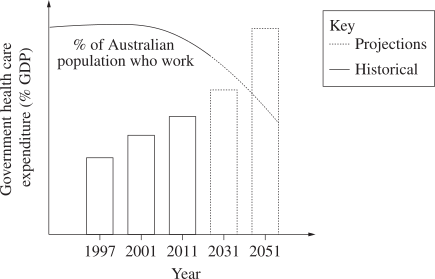
What action has been taken to reduce the impact of an ageing population on the health care system in Australia?

  1. Increasing the Medicare levy for older people
  2. Reducing funding available to carers of older people
  3. Encouraging older people to remain in the work force
  4. Decreasing access to the health system for older people
Show Answers Only

\(C\)

Show Worked Solution
  • C is correct: Encouraging workforce participation reduces healthcare system burden.

Other Options:

  • A is incorrect: Medicare levy increases would worsen healthcare access.
  • B is incorrect: Reducing carer funding increases healthcare system pressure.
  • D is incorrect: Restricting access contradicts healthcare equity principles.

Filed Under: Impact of an Ageing Population Tagged With: Band 4, smc-5478-25-Strategies and Planning

HMS, HAG 2012 HSC 3 MC

What is the most likely reason for the increase in the number of people seeking alternative health care approaches in Australia?

  1. Greater availability of alternative health care in public hospitals
  2. Greater clinical effectiveness of alternative health care methods
  3. Increased provision of Medicare subsidies for alternative approaches to health care
  4. Increased acceptance of alternative medicine by the community and medical practitioners
Show Answers Only

\(D\)

Show Worked Solution
  • D is correct: Growing community and medical acceptance drives increased alternative healthcare use.

Other Options:

  • A is incorrect: Alternative healthcare rarely available in public hospitals.
  • B is incorrect: Clinical effectiveness remains debated for many approaches.
  • C is incorrect: Medicare provides limited subsidies for alternative healthcare.

Filed Under: Complementary Healthcare Tagged With: Band 4, smc-5489-10-Products/Services

HMS, HAG 2012 HSC 2 MC

Who has primary responsibility for providing health care services such as public hospitals and mental health facilities?

  1. State governments
  2. Local governments
  3. Federal government
  4. Non-government organisations
Show Answers Only

\(A\)

Show Worked Solution
  • A is correct: State governments have primary responsibility for public hospitals and mental health facilities.

Other Options:

  • B is incorrect: Local governments have limited health responsibilities.
  • C is incorrect: Federal government funds but doesn’t directly operate hospitals.
  • D is incorrect: NGOs supplement but don’t have primary responsibility.

Filed Under: Govt and Non-Govt responsibilities Tagged With: Band 4, smc-5480-05-Levels of Government

HMS, HAG 2013 HSC 33a

Explain TWO factors that contribute to health inequities in different population groups.   (8 marks)

--- 24 WORK AREA LINES (style=lined) ---

Show Answers Only
  • Health inequities arise from complex interactions between social, economic and environmental factors that systematically disadvantage certain population groups through unequal access to health-promoting resources.
  • Socioeconomic disadvantage creates health inequities by limiting access to essential health-promoting resources and opportunities. Low income levels restrict access to nutritious foods, safe housing and quality healthcare services that are necessary for optimal health outcomes. Educational limitations reduce health literacy and decision-making capacity, leading to poor health choices and delayed healthcare seeking. Employment instability generates chronic stress and prevents consistent healthcare access through insurance coverage. This results in higher rates of chronic diseases, mental health issues and premature mortality among disadvantaged populations compared to affluent groups.
  • Geographic isolation contributes to health inequities through reduced access to healthcare services and health-promoting infrastructure. Rural and remote communities experience significant barriers including limited healthcare facilities, specialist shortages and extensive travel requirements for medical care. Distance from services delays emergency treatment and prevents regular preventive healthcare access. Poor infrastructure limits access to clean water, sanitation systems and recreational facilities that support healthy lifestyles. These geographic barriers result in higher injury rates, unmanaged chronic conditions and reduced life expectancy compared to metropolitan populations.
  • Both factors interact to compound disadvantage, as socioeconomically disadvantaged groups are more likely to live in geographically isolated areas where healthcare access remains most limited.
Show Worked Solution
  • Health inequities arise from complex interactions between social, economic and environmental factors that systematically disadvantage certain population groups through unequal access to health-promoting resources.
  • Socioeconomic disadvantage creates health inequities by limiting access to essential health-promoting resources and opportunities. Low income levels restrict access to nutritious foods, safe housing and quality healthcare services that are necessary for optimal health outcomes. Educational limitations reduce health literacy and decision-making capacity, leading to poor health choices and delayed healthcare seeking. Employment instability generates chronic stress and prevents consistent healthcare access through insurance coverage. This results in higher rates of chronic diseases, mental health issues and premature mortality among disadvantaged populations compared to affluent groups.
  • Geographic isolation contributes to health inequities through reduced access to healthcare services and health-promoting infrastructure. Rural and remote communities experience significant barriers including limited healthcare facilities, specialist shortages and extensive travel requirements for medical care. Distance from services delays emergency treatment and prevents regular preventive healthcare access. Poor infrastructure limits access to clean water, sanitation systems and recreational facilities that support healthy lifestyles. These geographic barriers result in higher injury rates, unmanaged chronic conditions and reduced life expectancy compared to metropolitan populations.
  • Both factors interact to compound disadvantage, as socioeconomically disadvantaged groups are more likely to live in geographically isolated areas where healthcare access remains most limited.

♦♦ Mean mark 54%.

Filed Under: Groups Experiencing Inequities Tagged With: Band 4, Band 5, smc-5475-40-Causes of Inequity

HMS, TIP 2013 HSC 32b*

Justify three elements that need to be considered when designing a training session.   (12 marks)

--- 28 WORK AREA LINES (style=lined) ---

Show Answers Only

Position Statement

  • Health and safety considerations, warm-up and cool-down, and skill instruction and practice are essential elements when designing a training session.
  • Together they protect athletes, prepare the body for training and develop the technique needed for competitive performance.

Health and Safety Considerations

  • Health and safety considerations provide the fundamental foundation for all training activities by protecting athlete welfare and preventing injury occurrence.
  • Pre-session injury screening identifies existing limitations that require modification or exclusion from certain exercises.
  • Environmental assessments ensure appropriate conditions for safe training, including surface quality, weather conditions and equipment functionality.
  • Risk management protocols establish emergency procedures and first aid accessibility for immediate response.
  • Evidence demonstrates that systematic safety planning reduces training injuries by 40-60%, protecting athletes from setbacks that could compromise seasonal preparation and competitive readiness.
  • Without proper safety frameworks, training sessions become liability risks that potentially cause long-term athlete harm and program disruption.

Warm-up and Cool-down Protocols

  • Warm-up and cool-down protocols prepare the body physiologically and psychologically whilst facilitating optimal recovery processes between sessions.
  • Progressive warm-up activities increase core temperature, heart rate and joint mobility that enable safe transition to high-intensity training loads.
  • Neural activation exercises prepare the nervous system for complex movement patterns and skill execution demands.
  • Cool-down protocols facilitate lactate clearance, reduce muscle stiffness and promote parasympathetic recovery responses.
  • Research confirms that structured warm-ups reduce injury rates by 25-30% whilst effective cool-downs accelerate recovery between training sessions.

Skill Development Integration

  • Skill instruction and practice enable technique refinement and tactical understanding that directly transfer to competitive performance scenarios.
  • Progressive skill development ensures athletes master fundamental movements before advancing to sport-specific applications. 
  • This builds confidence and competence systematically through structured learning progressions.

Reinforcement

  • These three elements are justified because each one meets a specific physiological or psychological need.
  • Safety protects athlete welfare, warm-up and cool-down support preparation and recovery, and skill instruction builds competence that transfers to competition.
Show Worked Solution

Position Statement

  • Health and safety considerations, warm-up and cool-down, and skill instruction and practice are essential elements when designing a training session.
  • Together they protect athletes, prepare the body for training and develop the technique needed for competitive performance.

Health and Safety Considerations

  • Health and safety considerations provide the fundamental foundation for all training activities by protecting athlete welfare and preventing injury occurrence.
  • Pre-session injury screening identifies existing limitations that require modification or exclusion from certain exercises.
  • Environmental assessments ensure appropriate conditions for safe training, including surface quality, weather conditions and equipment functionality.
  • Risk management protocols establish emergency procedures and first aid accessibility for immediate response.
  • Evidence demonstrates that systematic safety planning reduces training injuries by 40-60%, protecting athletes from setbacks that could compromise seasonal preparation and competitive readiness.
  • Without proper safety frameworks, training sessions become liability risks that potentially cause long-term athlete harm and program disruption.

Warm-up and Cool-down Protocols

  • Warm-up and cool-down protocols prepare the body physiologically and psychologically whilst facilitating optimal recovery processes between sessions.
  • Progressive warm-up activities increase core temperature, heart rate and joint mobility that enable safe transition to high-intensity training loads.
  • Neural activation exercises prepare the nervous system for complex movement patterns and skill execution demands.
  • Cool-down protocols facilitate lactate clearance, reduce muscle stiffness and promote parasympathetic recovery responses.
  • Research confirms that structured warm-ups reduce injury rates by 25-30% whilst effective cool-downs accelerate recovery between training sessions.

Skill Development Integration

  • Skill instruction and practice enable technique refinement and tactical understanding that directly transfer to competitive performance scenarios.
  • Progressive skill development ensures athletes master fundamental movements before advancing to sport-specific applications. 
  • This builds confidence and competence systematically through structured learning progressions.

Reinforcement

  • These three elements are justified because each one meets a specific physiological or psychological need.
  • Safety protects athlete welfare, warm-up and cool-down support preparation and recovery, and skill instruction builds competence that transfers to competition.

♦♦ Mean mark 51%.

Filed Under: Designing training sessions Tagged With: Band 4, Band 5, smc-5462-25-Integrated session design

HMS, TIP 2013 HSC 31a

How are skill and physical tests used to indicate an athlete's readiness to return to play after injury?   (8 marks)

--- 24 WORK AREA LINES (style=lined) ---

Show Answers Only
  • Skill and physical tests provide objective measures that ensure athletes have regained necessary capacities before resuming competitive participation safely.
  • Physical testing assesses whether injured body parts have recovered sufficient strength, flexibility and endurance. Strength testing compares the injured limb to the uninjured side, requiring 90-95% strength return before clearance. A footballer with hamstring injury must demonstrate equal strength between both legs through isokinetic testing. Range of motion assessments confirm full joint mobility has returned, preventing re-injury from compensatory movement patterns. Cardiovascular fitness tests verify the athlete can meet sport-specific demands without excessive fatigue that increases injury risk.
  • Skill testing evaluates whether technical abilities and decision-making capacities have returned to pre-injury levels. Sport-specific drills test coordination and timing that may be affected by injury or time away from training. A basketball player must demonstrate accurate shooting, dribbling and defensive movements at competition intensity. Reaction time tests ensure the athlete can respond appropriately to game situations, particularly important for contact sports where delayed reactions increase vulnerability.
  • Progressive testing protocols guide safe return by gradually increasing intensity and complexity. Athletes progress through controlled training environments before facing unpredictable competition scenarios. Functional movement screens identify compensatory patterns that could lead to secondary injuries.
  • Objective criteria remove subjective bias and ensure consistent standards across different practitioners and sports, protecting athlete welfare whilst maintaining competitive integrity.
Show Worked Solution
  • Skill and physical tests provide objective measures that ensure athletes have regained necessary capacities before resuming competitive participation safely.
  • Physical testing assesses whether injured body parts have recovered sufficient strength, flexibility and endurance. Strength testing compares the injured limb to the uninjured side, requiring 90-95% strength return before clearance. A footballer with hamstring injury must demonstrate equal strength between both legs through isokinetic testing. Range of motion assessments confirm full joint mobility has returned, preventing re-injury from compensatory movement patterns. Cardiovascular fitness tests verify the athlete can meet sport-specific demands without excessive fatigue that increases injury risk.
  • Skill testing evaluates whether technical abilities and decision-making capacities have returned to pre-injury levels. Sport-specific drills test coordination and timing that may be affected by injury or time away from training. A basketball player must demonstrate accurate shooting, dribbling and defensive movements at competition intensity. Reaction time tests ensure the athlete can respond appropriately to game situations, particularly important for contact sports where delayed reactions increase vulnerability.
  • Progressive testing protocols guide safe return by gradually increasing intensity and complexity. Athletes progress through controlled training environments before facing unpredictable competition scenarios. Functional movement screens identify compensatory patterns that could lead to secondary injuries.
  • Objective criteria remove subjective bias and ensure consistent standards across different practitioners and sports, protecting athlete welfare whilst maintaining competitive integrity.

♦♦ Mean mark 49%.

Filed Under: Management/prevention of injuries Tagged With: Band 4, Band 5, smc-5472-50-Return to play

HMS, HIC 2013 HSC 29b

How are young people's priorities and values influenced by aspects of their development?   (12 marks)

--- 28 WORK AREA LINES (style=lined) ---

Show Answers Only
  • Young people’s health priorities and values change dramatically during adolescence as a result of multiple developmental influences that shape their understanding and decision-making processes.
  • Physical development affects health priorities through changing body awareness and self-image concerns. Puberty creates heightened focus on appearance and peer acceptance, leading to increased emphasis on physical attractiveness over overall health. Growth spurts require increased nutritional needs, yet social pressures often result in poor dietary choices and disordered eating patterns. Sexual maturation introduces new health considerations including reproductive health education and risk-taking behaviours that previous generations faced differently.
  • Cognitive development enables more complex health reasoning but also creates overthinking and anxiety about health decisions. Abstract thinking capacity allows understanding of long-term health consequences, yet brain development patterns mean impulse control remains limited until mid-twenties. This results in contradictory behaviours where young people understand health risks but still engage in dangerous activities like substance use, reckless driving, or unprotected sexual behaviour.
  • Social development significantly influences health values through peer relationships and independence seeking behaviours. Peer acceptance becomes the primary concern, often overriding parental health teachings and family traditions. Social media exposure amplifies peer pressure and creates unrealistic health standards and body image expectations. The desire for independence leads to rejection of family health practices whilst developing personal health identity and autonomy.
  • Emotional development impacts health priorities through identity formation and self-worth struggles during adolescence. Mental health awareness increases significantly, yet emotional volatility makes consistent healthy choices difficult to maintain. Stress management becomes crucial as academic pressures, social expectations, and future uncertainties intensify.
  • Cultural and technological influences reshape health values compared to previous generations dramatically. Digital connectivity provides instant health information access but also exposes young people to misinformation and conflicting advice.
Show Worked Solution
  • Young people’s health priorities and values change dramatically during adolescence as a result of multiple developmental influences that shape their understanding and decision-making processes.
  • Physical development affects health priorities through changing body awareness and self-image concerns. Puberty creates heightened focus on appearance and peer acceptance, leading to increased emphasis on physical attractiveness over overall health. Growth spurts require increased nutritional needs, yet social pressures often result in poor dietary choices and disordered eating patterns. Sexual maturation introduces new health considerations including reproductive health education and risk-taking behaviours that previous generations faced differently.
  • Cognitive development enables more complex health reasoning but also creates overthinking and anxiety about health decisions. Abstract thinking capacity allows understanding of long-term health consequences, yet brain development patterns mean impulse control remains limited until mid-twenties. This results in contradictory behaviours where young people understand health risks but still engage in dangerous activities like substance use, reckless driving, or unprotected sexual behaviour.
  • Social development significantly influences health values through peer relationships and independence seeking behaviours. Peer acceptance becomes the primary concern, often overriding parental health teachings and family traditions. Social media exposure amplifies peer pressure and creates unrealistic health standards and body image expectations. The desire for independence leads to rejection of family health practices whilst developing personal health identity and autonomy.
  • Emotional development impacts health priorities through identity formation and self-worth struggles during adolescence. Mental health awareness increases significantly, yet emotional volatility makes consistent healthy choices difficult to maintain. Stress management becomes crucial as academic pressures, social expectations, and future uncertainties intensify.
  • Cultural and technological influences reshape health values compared to previous generations dramatically. Digital connectivity provides instant health information access but also exposes young people to misinformation and conflicting advice.

♦♦ Mean mark 49%.

Filed Under: Aspects of young people's lives Tagged With: Band 4, Band 5, smc-5507-10-Stages of development

HMS, TIP 2013 HSC 27

What are the advantages and disadvantages of protein supplementation and creatine supplementation for improved athletic performance?   (5 marks)

--- 15 WORK AREA LINES (style=lined) ---

Show Answers Only

Protein Supplementation:

  • Advantages: Protein supplements support muscle repair and growth following intense training sessions. They provide convenient, easily digestible amino acids for athletes with high protein requirements who struggle to meet needs through whole foods alone.
  • Disadvantages: Excessive protein intake can strain kidney function and cause digestive issues. Cost can be prohibitive, and whole food sources often provide superior nutritional profiles with additional vitamins and minerals.

Creatine Supplementation:

  • Advantages: Creatine enhances ATP-PCr energy system function, improving power output during repeated high-intensity efforts. Research demonstrates significant strength and muscle mass gains, particularly beneficial for explosive sports like sprinting and weightlifting.
  • Disadvantages: Initial water retention may cause temporary weight gain unsuitable for endurance athletes. Some individuals experience digestive discomfort, and long-term effects remain unclear despite generally accepted safety profiles.
Show Worked Solution

Protein Supplementation:

  • Advantages: Protein supplements support muscle repair and growth following intense training sessions. They provide convenient, easily digestible amino acids for athletes with high protein requirements who struggle to meet needs through whole foods alone.
  • Disadvantages: Excessive protein intake can strain kidney function and cause digestive issues. Cost can be prohibitive, and whole food sources often provide superior nutritional profiles with additional vitamins and minerals.

Creatine Supplementation:

  • Advantages: Creatine enhances ATP-PCr energy system function, improving power output during repeated high-intensity efforts. Research demonstrates significant strength and muscle mass gains, particularly beneficial for explosive sports like sprinting and weightlifting.
  • Disadvantages: Initial water retention may cause temporary weight gain unsuitable for endurance athletes. Some individuals experience digestive discomfort, and long-term effects remain unclear despite generally accepted safety profiles.

♦♦ Mean mark 50%.

Filed Under: Supplementation and performance Tagged With: Band 4, Band 5, smc-5468-15-Protein, smc-5468-30-Creatine

HMS, BM 2013 HSC 26

Describe THREE characteristics of a learner that can influence his/her ability to learn a new skill.   (4 marks)

--- 12 WORK AREA LINES (style=lined) ---

Show Answers Only

Any THREE of the following:

  • Confidence refers to a learner’s belief in their ability to successfully perform a skill. High confidence encourages risk-taking and persistent practice, whilst low confidence may limit skill attempts and slow progression through learning stages.
  • Heredity involves inherited physical characteristics that influence performance potential. Factors like muscle fibre composition, somatotype, height and gender determine natural advantages for specific sports and create unchangeable performance ceilings that cannot be exceeded through training.
  • Ability encompasses how easily an individual learns, processes and implements new skills. This includes sense acuity, perception, reaction time and intelligence, which combine to enable rapid skill acquisition and successful refinement of movement patterns.
  • Personality develops from social interactions and learning experiences throughout life. Positive traits like motivation, dedication, cooperativeness and receptiveness to instruction create favourable learning environments that accelerate skill development and performance improvement in chosen activities.
  • Prior experience involves previous exposure to similar movement patterns or sports participation. Athletes with related experience can transfer existing skills to new situations, accelerating learning through familiar movement foundations and reducing time required for skill acquisition.
Show Worked Solution

Any THREE of the following:

  • Confidence refers to a learner’s belief in their ability to successfully perform a skill. High confidence encourages risk-taking and persistent practice, whilst low confidence may limit skill attempts and slow progression through learning stages.
  • Heredity involves inherited physical characteristics that influence performance potential. Factors like muscle fibre composition, somatotype, height and gender determine natural advantages for specific sports and create unchangeable performance ceilings that cannot be exceeded through training.
  • Ability encompasses how easily an individual learns, processes and implements new skills. This includes sense acuity, perception, reaction time and intelligence, which combine to enable rapid skill acquisition and successful refinement of movement patterns.
  • Personality develops from social interactions and learning experiences throughout life. Positive traits like motivation, dedication, cooperativeness and receptiveness to instruction create favourable learning environments that accelerate skill development and performance improvement in chosen activities.
  • Prior experience involves previous exposure to similar movement patterns or sports participation. Athletes with related experience can transfer existing skills to new situations, accelerating learning through familiar movement foundations and reducing time required for skill acquisition.

Filed Under: Characteristics of learners Tagged With: Band 4, smc-5534-05-Confidence, smc-5534-10-Heredity, smc-5534-15-Ability, smc-5534-20-Personality, smc-5534-25-Prior experience, smc-5534-60-Multiple characteristics

HMS, TIP 2013 HSC 25

Describe the effect of stroke volume and cardiac output on aerobic performance.   (3 marks)

--- 9 WORK AREA LINES (style=lined) ---

Show Answers Only
  • Stroke volume is the amount of blood pumped from the heart per beat. Increased stroke volume delivers more oxygen-rich blood to working muscles during each heartbeat, improving aerobic capacity.
  • Cardiac output is the total blood volume pumped per minute, calculated by multiplying stroke volume and heart rate. Higher cardiac output increases oxygen delivery to muscles, enabling sustained aerobic activity.
  • Both adaptations result from aerobic training, allowing athletes to maintain higher exercise intensities for longer periods whilst reducing heart rate at submaximal workloads.
Show Worked Solution
  • Stroke volume is the amount of blood pumped from the heart per beat. Increased stroke volume delivers more oxygen-rich blood to working muscles during each heartbeat, improving aerobic capacity.
  • Cardiac output is the total blood volume pumped per minute, calculated by multiplying stroke volume and heart rate. Higher cardiac output increases oxygen delivery to muscles, enabling sustained aerobic activity.
  • Both adaptations result from aerobic training, allowing athletes to maintain higher exercise intensities for longer periods whilst reducing heart rate at submaximal workloads.

Filed Under: Physiological adaptations and improved performance Tagged With: Band 4, smc-5461-10-Cardiorespiratory

HMS, HIC 2013 HSC 24

How do the five action areas of the Ottawa Charter address the principles of social justice? Include examples in your answer.   (8 marks)

--- 24 WORK AREA LINES (style=lined) ---

Show Answers Only
  • The Ottawa Charter action areas systematically address social justice principles by establishing equitable health opportunities and removing barriers to participation.
  • Developing Personal Skills promotes equity through accessible health education programs. Health literacy initiatives enable individuals from diverse backgrounds to make informed decisions. School-based nutrition education guarantees all students receive knowledge regardless of socioeconomic status, eliminating access barriers to health information.
  • Creating Supportive Environments facilitates participation by removing physical and social obstacles to healthy choices. Smoke-free public spaces safeguard everyone’s right to clean air, maintaining equitable health protection. Workplace safety regulations establish environments where all workers have equal access to safe conditions.
  • Strengthening Community Action empowers communities to participate in health decision-making processes. Community health committees allow local voices to influence health services, upholding participation rights. Indigenous communities leading health programs illustrates culturally appropriate participation. 
  • Reorienting Health Services addresses equity by adapting services to meet diverse population needs. Culturally responsive healthcare breaks down access barriers for multicultural communities. Mobile health services deliver access to remote areas, advancing geographical equity.
  • Building Healthy Public Policy generates systematic change that supports rights-based approaches to health. Anti-discrimination legislation maintains equal access to healthcare services, tackling structural inequities that limit participation.
Show Worked Solution
  • The Ottawa Charter action areas systematically address social justice principles by establishing equitable health opportunities and removing barriers to participation.
  • Developing Personal Skills promotes equity through accessible health education programs. Health literacy initiatives enable individuals from diverse backgrounds to make informed decisions. School-based nutrition education guarantees all students receive knowledge regardless of socioeconomic status, eliminating access barriers to health information.
  • Creating Supportive Environments facilitates participation by removing physical and social obstacles to healthy choices. Smoke-free public spaces safeguard everyone’s right to clean air, maintaining equitable health protection. Workplace safety regulations establish environments where all workers have equal access to safe conditions.
  • Strengthening Community Action empowers communities to participate in health decision-making processes. Community health committees allow local voices to influence health services, upholding participation rights. Indigenous communities leading health programs illustrates culturally appropriate participation. 
  • Reorienting Health Services addresses equity by adapting services to meet diverse population needs. Culturally responsive healthcare breaks down access barriers for multicultural communities. Mobile health services deliver access to remote areas, advancing geographical equity.
  • Building Healthy Public Policy generates systematic change that supports rights-based approaches to health. Anti-discrimination legislation maintains equal access to healthcare services, tackling structural inequities that limit participation.

Filed Under: Models of health promotion Tagged With: Band 4, smc-5515-10-Ottawa Charter

HMS, HAG 2013 HSC 23

Why is it important to prioritise particular health issues in Australia? Include examples in your answer.   (5 marks)

--- 15 WORK AREA LINES (style=lined) ---

Show Answers Only
  • Prioritising health issues ensures efficient resource allocation to areas with greatest impact on population health. Limited healthcare funding requires strategic distribution to maximise health outcomes across diverse community needs.
  • Addressing health inequities becomes possible through targeted interventions for disadvantaged groups. Aboriginal and Torres Strait Islander peoples experience significantly higher chronic disease rates, requiring focused programs and culturally appropriate services.
  • Prevention focus enables early intervention before conditions become severe and costly. Cardiovascular disease prevention through lifestyle programs costs less than treating heart attacks and strokes requiring emergency care.
  • Population burden guides priorities toward conditions affecting large numbers of Australians. Mental health conditions impact millions annually, justifying substantial investment in awareness campaigns, treatment services and community support programs.
  • Evidence-based planning ensures interventions target conditions with proven treatment methods and measurable outcomes, improving overall healthcare system effectiveness.
Show Worked Solution
  • Prioritising health issues ensures efficient resource allocation to areas with greatest impact on population health. Limited healthcare funding requires strategic distribution to maximise health outcomes across diverse community needs.
  • Addressing health inequities becomes possible through targeted interventions for disadvantaged groups. Aboriginal and Torres Strait Islander peoples experience significantly higher chronic disease rates, requiring focused programs and culturally appropriate services.
  • Prevention focus enables early intervention before conditions become severe and costly. Cardiovascular disease prevention through lifestyle programs costs less than treating heart attacks and strokes requiring emergency care.
  • Population burden guides priorities toward conditions affecting large numbers of Australians. Mental health conditions impact millions annually, justifying substantial investment in awareness campaigns, treatment services and community support programs.
  • Evidence-based planning ensures interventions target conditions with proven treatment methods and measurable outcomes, improving overall healthcare system effectiveness.

Filed Under: Healthcare expenditure Tagged With: Band 4, smc-5482-15-Sustainability and Equity

HMS, HAG 2013 HSC 22

What should consumers consider before choosing complementary and/or alternative health care approaches?   (4 marks)

--- 12 WORK AREA LINES (style=lined) ---

Show Answers Only
  • Consumers should evaluate practitioner qualifications and accreditation to ensure appropriate training and registration with recognised professional bodies. Unqualified practitioners may lack essential knowledge for safe treatment.
  • Evidence base and safety must be considered, as some approaches lack scientific research supporting effectiveness. Consumers should research potential side effects, particularly when combining treatments with conventional medicine.
  • Cost and insurance coverage requires assessment since many complementary therapies aren’t covered by Medicare or private health insurance. Treatment expenses may become financially burdensome.
  • Integration with conventional medicine should be discussed with existing healthcare providers to prevent dangerous interactions. Some treatments may interfere with prescribed medications or delay necessary medical interventions.
Show Worked Solution
  • Consumers should evaluate practitioner qualifications and accreditation to ensure appropriate training and registration with recognised professional bodies. Unqualified practitioners may lack essential knowledge for safe treatment.
  • Evidence base and safety must be considered, as some approaches lack scientific research supporting effectiveness. Consumers should research potential side effects, particularly when combining treatments with conventional medicine.
  • Cost and insurance coverage requires assessment since many complementary therapies aren’t covered by Medicare or private health insurance. Treatment expenses may become financially burdensome.
  • Integration with conventional medicine should be discussed with existing healthcare providers to prevent dangerous interactions. Some treatments may interfere with prescribed medications or delay necessary medical interventions.

Filed Under: Being a critical health consumer Tagged With: Band 4, smc-5483-12-Informed decisions, smc-5483-17-Accuracy and credibility

HMS, HIC 2013 HSC 21

Outline TWO indicators of morbidity. Include examples in your answer.   (3 marks)

--- 8 WORK AREA LINES (style=lined) ---

Show Answers Only
  • Prevalence measures the total number of people with a condition at a particular time. For example, diabetes prevalence shows how many Australians are currently living with diabetes.
  • Incidence measures the number of new cases of a condition over a set period, usually one year. For example, cancer incidence shows how many people are newly diagnosed each year.
  • Together, these indicators show the burden of illness in the population. This helps health authorities plan services and target prevention programs.
  • Other morbidity indicators include hospitalisation rates and GP visits.
Show Worked Solution
  • Prevalence measures the total number of people with a condition at a particular time. For example, diabetes prevalence shows how many Australians are currently living with diabetes.
  • Incidence measures the number of new cases of a condition over a set period, usually one year. For example, cancer incidence shows how many people are newly diagnosed each year.
  • Together, these indicators show the burden of illness in the population. This helps health authorities plan services and target prevention programs.
  • Other morbidity indicators include hospitalisation rates and GP visits.

Filed Under: Health status of Australians Tagged With: Band 4, smc-5504-50-Morbidity, smc-5504-60-Incidence and prevalence

Trigonometry, 2ADV T1 EQ-Bank 25

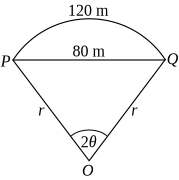
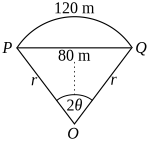
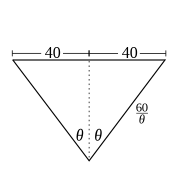
A discus throwing event is held at a field in the shape of a sector of a circle, centre \(O\), as shown in the diagram below.

Two officials are positioned at points \(P\) and \(Q\), which are 80 metres apart. The length of arc \(PQ\) is 120 metres.

The radius of the sector is \(r\) metres and the angle subtended at the centre of the arc is \(2\theta\) radians.
 

  1. Show that  \(\sin \theta=\dfrac{2 \theta}{3}\).   (2 marks)

    --- 5 WORK AREA LINES (style=lined) ---

  2. If  \(\theta=\dfrac{\pi}{3}\), find the exact area of the field.   (2 marks)

    --- 5 WORK AREA LINES (style=lined) ---

Show Answers Only

a.   \(\text{See Worked Solution.}\)

b.   \(A=\dfrac{10\ 800}{\pi}\ \text{u}^2\)

Show Worked Solution

a.   \(\text{Consider arc} \ PQ:\)

\(\dfrac{2 \theta}{2 \pi} \times 2 \pi r\) \(=120\)
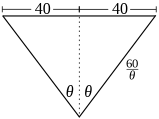
\(r\) \(=\dfrac{60}{\theta}\)

\(\sin \theta=\dfrac{40}{\frac{60}{\theta}}=40 \times \dfrac{\theta}{60}=\dfrac{2 \theta}{3}\)
 

b.     \(A\) \(=\dfrac{\frac{2 \pi}{3}}{2 \pi} \times \pi r^2\)
    \(=\dfrac{\pi}{3} \times\left(\dfrac{60}{\frac{\pi}{3}}\right)^2\)
    \(=\dfrac{\pi}{3} \times 3600 \times \dfrac{9}{\pi^2}\)
    \(=\dfrac{10\ 800}{\pi}\ \text{u}^2\)

Filed Under: Circular Measure, Circular Measure Tagged With: Band 4, Band 5, smc-6394-20-Area of Sector, smc-978-20-Area of Sector

HMS, BM 2013 HSC 19 MC

Who are part practice methods most appropriate for?

  1. Beginner athletes learning a new skill
  2. Beginner athletes applying a learned skill
  3. Experienced athletes solving a tactical problem
  4. Experienced athletes refining their kinaesthetic awareness
Show Answers Only

\(A\)

Show Worked Solution
  • A is correct: Part practice breaks complex skills into manageable components for beginners.

Other Options:

  • B is incorrect: Applying learned skills requires whole practice in context.
  • C is incorrect: Tactical problems need whole practice for decision-making integration.
  • D is incorrect: Kinaesthetic refinement requires whole movement patterns, not parts.

Filed Under: Practice methods Tagged With: Band 4, smc-5924-20-Whole/part

HMS, TIP 2013 HSC 17 MC

Which recovery strategy should an athlete choose immediately after sustaining a soft-tissue injury?

  1. Cryotherapy
  2. Deep tissue massage
  3. Relaxation
  4. Ultrasound
Show Answers Only

\(A\)

Show Worked Solution
  • A is correct: Cryotherapy reduces inflammation and pain immediately after injury.

Other Options:

  • B is incorrect: Deep massage may increase tissue damage in acute phase.
  • C is incorrect: Relaxation doesn’t address immediate physiological injury needs.
  • D is incorrect: Ultrasound used later in rehabilitation, not immediate treatment.

Filed Under: Management/prevention of injuries Tagged With: Band 4, smc-5472-30-Management

HMS, BM 2013 HSC 12 MC

Which types of feedback are received by a runner who checks her time after crossing the finish line?

  1. Concurrent and knowledge of performance
  2. Concurrent and knowledge of results
  3. Delayed and knowledge of performance
  4. Delayed and knowledge of results
Show Answers Only

\(D\)

Show Worked Solution
  • D is correct: Time checking occurs after completion (delayed) showing outcome (results).

Other Options:

  • A is incorrect: Performance feedback relates to technique, not time outcome.
  • B is incorrect: Concurrent feedback occurs during performance, not after.
  • C is incorrect: Performance feedback concerns technique quality, not finishing time.

Filed Under: Feedback Tagged With: Band 4, smc-7997-20-Concurrent/delayed, smc-7997-30-KR/KP, smc-7997-60-Identify type of feedback

HMS, HAG 2013 HSC 10 MC

In Australia, men have a lower health status than women.

What is the most likely reason for this?

  1. Types of health care services available
  2. Unwillingness to seek medical assistance
  3. Heredity and lifestyle factors experienced in early life
  4. Lack of knowledge and understanding of health care services
Show Answers Only

\(B\)

Show Worked Solution
  • B is correct: Men typically delay seeking medical help for health issues.

Other Options:

  • A is incorrect: Healthcare services available equally to both genders.
  • C is incorrect: Heredity factors similar, lifestyle choices are behavioural responses.
  • D is incorrect: Knowledge access similar, willingness to use differs significantly.

Filed Under: Current Health Status Tagged With: Band 4, smc-5474-30-Gender Inequities

HMS, HAG 2013 HSC 5 MC

Ancillary cover in private health insurance can assist with which of the following costs?

  1. General practitioner fees
  2. Prescription and other medications
  3. Physiotherapy, dental services and optometry
  4. Treatment as a private patient in either a public or private hospital
Show Answers Only

\(C\)

Show Worked Solution
  • C is correct: Ancillary cover specifically includes allied health and dental services.

Other Options:

  • A is incorrect: GP fees covered by Medicare, not ancillary.
  • B is incorrect: Medications covered by PBS, not ancillary insurance.
  • D is incorrect: Hospital treatment covered by hospital cover, not ancillary.

Filed Under: Healthcare expenditure Tagged With: Band 4, smc-5482-25-Private insurance

HMS, HAG 2013 HSC 1 MC

What currently is the area of greatest health care expenditure in Australia?

  1. Research
  2. Hospitals
  3. Dental services
  4. Preventative health initiatives
Show Answers Only

\(B\)

Show Worked Solution
  • B is correct: Hospitals account for largest portion of Australian health spending.

Other Options:

  • A is incorrect: Research receives minimal health budget allocation.
  • C is incorrect: Dental services are small expenditure component.
  • D is incorrect: Prevention receives less funding than treatment.

Filed Under: Healthcare expenditure Tagged With: Band 4, smc-5482-10-Healthcare vs Prevention

HMS, TIP 2014 HSC 32b

Justify how each of the periodisation phases is used when planning a training year.   (12 marks)

--- 28 WORK AREA LINES (style=lined) ---

Show Answers Only

Position Statement

  • Each periodisation phase is essential when planning a training year. Each phase has a distinct purpose: developing, maintaining or restoring the athlete’s physical and psychological capacities so they peak for competition without overtraining.

Pre-Season Foundation Building

  • The pre-season phase builds the fitness base and fundamental skills that the competition phase depends on.
  • A rugby team’s pre-season might run 12–16 weeks. It begins with high-volume aerobic conditioning and general strength work, then progresses to higher-intensity, game-specific training such as repeated sprints and contact drills.
  • This progression is justified by the principle of progressive overload. Gradual increases in training load allow the body to adapt safely, building cardiovascular endurance, muscular strength and technical competence.
  • Skipping or shortening this phase leaves athletes underprepared for competition loads, which increases injury risk and leads to poor early-season performance.
  • This shows that pre-season is the foundation on which every later phase depends.

In-Season Performance Maintenance

  • In-season training maintains the fitness gained in pre-season while managing fatigue from regular competition.
  • The principle of reversibility justifies this phase: if training stops, fitness adaptations begin to decline within weeks. Maintenance training is therefore needed to keep the athlete competitive across the season.
  • Training volume is reduced while intensity stays high. For example, a basketball player maintains strength with two shorter sessions per week and spends more time on tactical preparation and recovery between games.
  • Peaking and tapering are planned within this phase so that athletes reach their best condition for finals or major events.
  • This shows that in-season planning balances training stress against competition stress, which keeps performance consistent when it matters most.

Off-Season Recovery Integration

  • The off-season gives athletes time for physical and mental recovery after the demands of competition, which reduces the risk of burnout.
  • Active rest and cross-training, such as swimming or cycling for a rugby player, maintain a base level of fitness. This limits detraining, so the next pre-season does not start from scratch.
  • This phase also allows full rehabilitation of injuries and lets the athlete work on weaknesses identified during the season.
  • This shows that the off-season is a deliberate part of the plan, not a break from it.

Reinforcement

  • Each periodisation phase is justified because it addresses a specific physiological and psychological need at the right point in the year.
  • Together, the phases follow the principles of progressive overload, reversibility and specificity. This lets athletes peak for competition while avoiding overtraining and injury.
Show Worked Solution

Position Statement

  • Each periodisation phase is essential when planning a training year. Each phase has a distinct purpose: developing, maintaining or restoring the athlete’s physical and psychological capacities so they peak for competition without overtraining.

Pre-Season Foundation Building

  • The pre-season phase builds the fitness base and fundamental skills that the competition phase depends on.
  • A rugby team’s pre-season might run 12–16 weeks. It begins with high-volume aerobic conditioning and general strength work, then progresses to higher-intensity, game-specific training such as repeated sprints and contact drills.
  • This progression is justified by the principle of progressive overload. Gradual increases in training load allow the body to adapt safely, building cardiovascular endurance, muscular strength and technical competence.
  • Skipping or shortening this phase leaves athletes underprepared for competition loads, which increases injury risk and leads to poor early-season performance.
  • This shows that pre-season is the foundation on which every later phase depends.

In-Season Performance Maintenance

  • In-season training maintains the fitness gained in pre-season while managing fatigue from regular competition.
  • The principle of reversibility justifies this phase: if training stops, fitness adaptations begin to decline within weeks. Maintenance training is therefore needed to keep the athlete competitive across the season.
  • Training volume is reduced while intensity stays high. For example, a basketball player maintains strength with two shorter sessions per week and spends more time on tactical preparation and recovery between games.
  • Peaking and tapering are planned within this phase so that athletes reach their best condition for finals or major events.
  • This shows that in-season planning balances training stress against competition stress, which keeps performance consistent when it matters most.

Off-Season Recovery Integration

  • The off-season gives athletes time for physical and mental recovery after the demands of competition, which reduces the risk of burnout.
  • Active rest and cross-training, such as swimming or cycling for a rugby player, maintain a base level of fitness. This limits detraining, so the next pre-season does not start from scratch.
  • This phase also allows full rehabilitation of injuries and lets the athlete work on weaknesses identified during the season.
  • This shows that the off-season is a deliberate part of the plan, not a break from it.

Reinforcement

  • Each periodisation phase is justified because it addresses a specific physiological and psychological need at the right point in the year.
  • Together, the phases follow the principles of progressive overload, reversibility and specificity. This lets athletes peak for competition while avoiding overtraining and injury.

♦♦ Mean mark 54%.

Filed Under: Individual vs group programs Tagged With: Band 4, Band 5, smc-5463-10-Competition phases

HMS, TIP 2014 HSC 32a

How do different types of training improve performance in various sports?   (8 marks)

--- 22 WORK AREA LINES (style=lined) ---

Show Answers Only
  • Different training types create specific physiological adaptations that enhance performance by targeting the precise energy systems and movement patterns required for each sport.
      
  • Aerobic training methods improve endurance performance by enhancing the cardiovascular system’s oxygen delivery capacity and muscular efficiency.
  • Continuous training develops aerobic capacity through sustained moderate-intensity exercise, enabling marathon runners to maintain pace over 42 kilometres.
  • This occurs because continuous training increases cardiac output, stroke volume and capillarisation.
  • Fartlek training combines speed variations with aerobic conditioning, allowing middle-distance athletes to handle race pace changes.
  • As a result, sports requiring sustained effort like cycling and swimming benefit from enhanced oxygen utilisation and delayed fatigue onset.
      
  • Anaerobic training methods target power and speed development by stressing the ATP-PCr and glycolytic energy systems.
  • Plyometric training produces explosive power through stretch-shortening cycles, enabling basketball players to jump higher and sprint faster.
  • This works by improving neuromuscular coordination and fast-twitch muscle fibre recruitment.
  • High Intensity Interval Training develops anaerobic capacity whilst maintaining aerobic benefits, making it ideal for sports like hockey requiring repeated high-intensity efforts.
  • Consequently, athletes develop greater power output and faster recovery between intense bursts.
      
  • Resistance training builds muscular strength and hypertrophy, creating force production improvements essential for contact sports.
  • This leads to enhanced tackle effectiveness in rugby and throwing distance in field events.
  • Therefore, matching training types to sport-specific energy demands and movement patterns optimises performance adaptations.
Show Worked Solution
  • Different training types create specific physiological adaptations that enhance performance by targeting the precise energy systems and movement patterns required for each sport.
      
  • Aerobic training methods improve endurance performance by enhancing the cardiovascular system’s oxygen delivery capacity and muscular efficiency.
  • Continuous training develops aerobic capacity through sustained moderate-intensity exercise, enabling marathon runners to maintain pace over 42 kilometres.
  • This occurs because continuous training increases cardiac output, stroke volume and capillarisation.
  • Fartlek training combines speed variations with aerobic conditioning, allowing middle-distance athletes to handle race pace changes.
  • As a result, sports requiring sustained effort like cycling and swimming benefit from enhanced oxygen utilisation and delayed fatigue onset.
      
  • Anaerobic training methods target power and speed development by stressing the ATP-PCr and glycolytic energy systems.
  • Plyometric training produces explosive power through stretch-shortening cycles, enabling basketball players to jump higher and sprint faster.
  • This works by improving neuromuscular coordination and fast-twitch muscle fibre recruitment.
  • High Intensity Interval Training develops anaerobic capacity whilst maintaining aerobic benefits, making it ideal for sports like hockey requiring repeated high-intensity efforts.
  • Consequently, athletes develop greater power output and faster recovery between intense bursts.
      
  • Resistance training builds muscular strength and hypertrophy, creating force production improvements essential for contact sports.
  • This leads to enhanced tackle effectiveness in rugby and throwing distance in field events.
  • Therefore, matching training types to sport-specific energy demands and movement patterns optimises performance adaptations.

Filed Under: Types of training and training methods Tagged With: Band 4, smc-5459-30-Multiple training types

HMS, TIP 2014 HSC 31b

Justify the rehabilitation procedures used to manage specific sporting injuries.   (12 marks)

--- 28 WORK AREA LINES (style=lined) ---

Show Answers Only

Position Statement

  • Rehabilitation procedures are highly effective for managing sporting injuries because they systematically restore function and prevent re-injury.

Progressive Mobilisation

  • Progressive mobilisation prevents muscle stiffness and scar tissue formation by returning controlled movement gradually while protecting healing tissues.
  • For example, a footballer with an ankle sprain begins with gentle passive movements within 48–72 hours, progressing to active movements as pain decreases.
  • This approach is highly effective because, compared with complete immobilisation, it maintains blood flow, joint range and proprioception, and prevents muscle atrophy.

Graduated Exercise

  • Graduated exercise rebuilds strength, flexibility and endurance by introducing increasingly challenging exercises without overwhelming healing structures.
  • A tennis player recovering from shoulder impingement first stretches to restore flexibility, then progresses to strengthening exercises using resistance bands.
  • This reduces the risk of re-injury because tissues are only loaded once they can tolerate it, while total body fitness is maintained throughout recovery.

Training

  • Training prepares the athlete for the specific demands of their sport before returning to competition.
  • It reintroduces sport-specific skills, speed and game situations in a controlled environment.
  • For example, the tennis player progresses from shadow swings to serving practice, then to match play against a training partner.
  • This is essential because it restores timing, coordination and confidence, ensuring the athlete can meet competition demands without re-injury.

Heat and Cold Therapy

  • Heat and cold therapy supports rehabilitation by managing inflammation and promoting tissue healing at the right stage of recovery.
  • For instance, a rugby player with a hamstring strain uses ice for the first 48 hours to reduce swelling and pain, then heat packs before stretching to increase blood flow and flexibility.
  • This combination proves essential because it optimises healing conditions at each recovery stage.

Reinforcement

  • When all factors are considered, rehabilitation procedures provide superior outcomes because they address each stage of recovery in sequence.
  • Their combined use leads to safer, faster returns to sport and reduces the risk of re-injury, justifying their systematic implementation.
Show Worked Solution

Position Statement

  • Rehabilitation procedures are highly effective for managing sporting injuries because they systematically restore function and prevent re-injury.

Progressive Mobilisation

  • Progressive mobilisation prevents muscle stiffness and scar tissue formation by returning controlled movement gradually while protecting healing tissues.
  • For example, a footballer with an ankle sprain begins with gentle passive movements within 48–72 hours, progressing to active movements as pain decreases.
  • This approach is highly effective because, compared with complete immobilisation, it maintains blood flow, joint range and proprioception, and prevents muscle atrophy.

Graduated Exercise

  • Graduated exercise rebuilds strength, flexibility and endurance by introducing increasingly challenging exercises without overwhelming healing structures.
  • A tennis player recovering from shoulder impingement first stretches to restore flexibility, then progresses to strengthening exercises using resistance bands.
  • This reduces the risk of re-injury because tissues are only loaded once they can tolerate it, while total body fitness is maintained throughout recovery.

Training

  • Training prepares the athlete for the specific demands of their sport before returning to competition.
  • It reintroduces sport-specific skills, speed and game situations in a controlled environment.
  • For example, the tennis player progresses from shadow swings to serving practice, then to match play against a training partner.
  • This is essential because it restores timing, coordination and confidence, ensuring the athlete can meet competition demands without re-injury.

Heat and Cold Therapy

  • Heat and cold therapy supports rehabilitation by managing inflammation and promoting tissue healing at the right stage of recovery.
  • For instance, a rugby player with a hamstring strain uses ice for the first 48 hours to reduce swelling and pain, then heat packs before stretching to increase blood flow and flexibility.
  • This combination proves essential because it optimises healing conditions at each recovery stage.

Reinforcement

  • When all factors are considered, rehabilitation procedures provide superior outcomes because they address each stage of recovery in sequence.
  • Their combined use leads to safer, faster returns to sport and reduces the risk of re-injury, justifying their systematic implementation.

♦♦ Mean mark 46%.

Filed Under: Management/prevention of injuries Tagged With: Band 4, Band 5, smc-5472-40-Rehabilitation

HMS, HIC 2014 HSC 29a

How does the health status of young people compare with that of other age groups in the Australian population?   (8 marks)

--- 24 WORK AREA LINES (style=lined) ---

Show Answers Only
  • Young people generally have the best health status of all age groups because they experience lower rates of chronic diseases and higher self-reported wellbeing. This occurs when comparing mortality and morbidity data across different age cohorts in Australian health reports.
  • Self-assessed health ratings demonstrate that young people report excellent or very good health more frequently than older populations. These positive perceptions result from fewer chronic conditions and greater physical capabilities. However, mental health issues create concerning trends specifically affecting this demographic.
  • Mortality patterns show injury and poisoning as leading causes of death for young people. This contrasts with older age groups where chronic diseases like cardiovascular disease and cancer predominate. The shift occurs because longer exposure to risk factors accumulates health problems over time.
  • Chronic disease prevalence increases significantly with age as lifestyle behaviours and environmental exposures compound over decades. For example, cardiovascular disease rarely affects young people but becomes the leading cause of death in those aged 45-64 years.
  • Mental health presents a notable exception where young people experience higher rates than some older groups. This trend reflects increased anxiety and depression particularly affecting females aged 16-24. Social media and academic pressures contribute to these concerning patterns.
  • Preventable conditions like dental disease and sexually transmitted infections disproportionately affect young people. These issues occur because risk-taking behaviours and limited health service engagement characterise this age group’s health-seeking patterns.
Show Worked Solution
  • Young people generally have the best health status of all age groups because they experience lower rates of chronic diseases and higher self-reported wellbeing. This occurs when comparing mortality and morbidity data across different age cohorts in Australian health reports.
  • Self-assessed health ratings demonstrate that young people report excellent or very good health more frequently than older populations. These positive perceptions result from fewer chronic conditions and greater physical capabilities. However, mental health issues create concerning trends specifically affecting this demographic.
  • Mortality patterns show injury and poisoning as leading causes of death for young people. This contrasts with older age groups where chronic diseases like cardiovascular disease and cancer predominate. The shift occurs because longer exposure to risk factors accumulates health problems over time.
  • Chronic disease prevalence increases significantly with age as lifestyle behaviours and environmental exposures compound over decades. For example, cardiovascular disease rarely affects young people but becomes the leading cause of death in those aged 45-64 years.
  • Mental health presents a notable exception where young people experience higher rates than some older groups. This trend reflects increased anxiety and depression particularly affecting females aged 16-24. Social media and academic pressures contribute to these concerning patterns.
  • Preventable conditions like dental disease and sexually transmitted infections disproportionately affect young people. These issues occur because risk-taking behaviours and limited health service engagement characterise this age group’s health-seeking patterns.

Filed Under: Health Status of Young People Tagged With: Band 4, Band 5, smc-5509-10-Health trends

HMS, BM 2014 HSC 27

Compare the two anaerobic energy systems.   (5 marks)

--- 15 WORK AREA LINES (style=lined) ---

Show Answers Only

ATP-PCr system and Glycolytic (Lactic Acid) system

Similarities:

  • Both systems operate without oxygen during anaerobic metabolism processes.
  • Both provide energy for high-intensity, short-duration explosive activities.
  • Both systems work together during power-based movements like sprinting.
  • Both use stored energy sources available within muscle tissue.
  • Both produce ATP for immediate muscular contraction requirements.

Differences:

  • ATP-PCr uses stored phosphocreatine whilst glycolytic system uses muscle glycogen and glucose.
  • ATP-PCr operates for 10-15 seconds maximum, glycolytic system functions 15 seconds to 2 minutes.
  • ATP-PCr produces ATP most rapidly but glycolytic system has greater total capacity.
  • ATP-PCr fatigues when phosphocreatine stores deplete, glycolytic fatigues from lactate accumulation.
  • ATP-PCr recovers completely in 2-3 minutes, glycolytic requires longer recovery periods.
  • ATP-PCr produces no fatiguing by-products, glycolytic creates lactate causing muscle burn.

Summary:

  • ATP-PCr provides immediate explosive power whilst glycolytic sustains high-intensity efforts for longer periods.
Show Worked Solution

ATP-PCr system and Glycolytic (Lactic Acid) system

Similarities:

  • Both systems operate without oxygen during anaerobic metabolism processes.
  • Both provide energy for high-intensity, short-duration explosive activities.
  • Both systems work together during power-based movements like sprinting.
  • Both use stored energy sources available within muscle tissue.
  • Both produce ATP for immediate muscular contraction requirements.

Differences:

  • ATP-PCr uses stored phosphocreatine whilst glycolytic system uses muscle glycogen and glucose.
  • ATP-PCr operates for 10-15 seconds maximum, glycolytic system functions 15 seconds to 2 minutes.
  • ATP-PCr produces ATP most rapidly but glycolytic system has greater total capacity.
  • ATP-PCr fatigues when phosphocreatine stores deplete, glycolytic fatigues from lactate accumulation.
  • ATP-PCr recovers completely in 2-3 minutes, glycolytic requires longer recovery periods.
  • ATP-PCr produces no fatiguing by-products, glycolytic creates lactate causing muscle burn.

Summary:

  • ATP-PCr provides immediate explosive power whilst glycolytic sustains high-intensity efforts for longer periods.

♦♦ Mean mark 54%.

Filed Under: Energy systems Tagged With: Band 4, Band 5, smc-5528-10-Fuel and by-products, smc-5528-20-Duration/intensity/recovery, smc-5528-25-Causes of fatigue, smc-5528-40-Comparing systems

HMS, TIP 2014 HSC 26

How do anxiety and arousal differ in terms of their effect on athletic performance?   (4 marks)

--- 12 WORK AREA LINES (style=lined) ---

Show Answers Only
  • Anxiety is a psychological response involving fear and apprehension which creates negative emotional reactions. These feelings result in worry and distraction that typically impairs performance.
  • Arousal is physiological activation that prepares the body through increased heart rate which can enhance performance when at optimal levels.
  • Anxiety generally hinders performance because it creates tension and disrupts concentration. In contrast, optimal arousal enables peak performance by providing necessary energy.
  • Performance outcomes differ because anxiety decreases effectiveness whilst appropriate arousal facilitates improved execution during competition.
Show Worked Solution
  • Anxiety is a psychological response involving fear and apprehension which creates negative emotional reactions. These feelings result in worry and distraction that typically impairs performance.
  • Arousal is physiological activation that prepares the body through increased heart rate which can enhance performance when at optimal levels.
  • Anxiety generally hinders performance because it creates tension and disrupts concentration. In contrast, optimal arousal enables peak performance by providing necessary energy.
  • Performance outcomes differ because anxiety decreases effectiveness whilst appropriate arousal facilitates improved execution during competition.

Filed Under: Psychological strategies Tagged With: Band 4, smc-5464-15-Arousal optimisation, smc-5464-20-Stress and anxiety

HMS, HIC 2014 HSC 24

Explain why individuals, communities and governments should work in partnership on health promotion initiatives. Provide examples.   (8 marks)

--- 24 WORK AREA LINES (style=lined) ---

Show Answers Only
  • Partnerships are essential because they combine different expertise and resources that no single group possesses. Combined efforts create more comprehensive and effective health promotion strategies than isolated approaches.
  • Individual participation ensures that health promotion initiatives address real community needs and concerns. Strong connections mean programs are more likely to be accepted and sustained by target populations. For example, community members identifying local barriers to physical activity leads to more relevant solutions.
  • Community involvement provides local knowledge and cultural understanding that improves program effectiveness. Local input results in initiatives that respect community values and existing social networks. The Healthy Cities Illawarra program demonstrates how community participation creates locally relevant health promotion strategies.
  • Government partnership brings policy support, funding and regulatory power needed for large-scale change. Official backing enables comprehensive approaches that address structural determinants of health. For instance, anti-smoking campaigns combine government legislation with community education programs.
  • Resource sharing occurs when different partners contribute their unique strengths and capabilities. Collaborative arrangements create cost-effective solutions that maximise impact while minimising individual organisational burden. The outcome is sustainable programs that continue beyond initial funding periods.
  • Shared responsibility ensures that health promotion becomes embedded across multiple sectors rather than isolated initiatives. Multi-sector approaches generate broader community ownership and long-term commitment to health improvement goals.
Show Worked Solution
  • Partnerships are essential because they combine different expertise and resources that no single group possesses. Combined efforts create more comprehensive and effective health promotion strategies than isolated approaches.
  • Individual participation ensures that health promotion initiatives address real community needs and concerns. Strong connections mean programs are more likely to be accepted and sustained by target populations. For example, community members identifying local barriers to physical activity leads to more relevant solutions.
  • Community involvement provides local knowledge and cultural understanding that improves program effectiveness. Local input results in initiatives that respect community values and existing social networks. The Healthy Cities Illawarra program demonstrates how community participation creates locally relevant health promotion strategies.
  • Government partnership brings policy support, funding and regulatory power needed for large-scale change. Official backing enables comprehensive approaches that address structural determinants of health. For instance, anti-smoking campaigns combine government legislation with community education programs.
  • Resource sharing occurs when different partners contribute their unique strengths and capabilities. Collaborative arrangements create cost-effective solutions that maximise impact while minimising individual organisational burden. The outcome is sustainable programs that continue beyond initial funding periods.
  • Shared responsibility ensures that health promotion becomes embedded across multiple sectors rather than isolated initiatives. Multi-sector approaches generate broader community ownership and long-term commitment to health improvement goals.

♦♦ Mean mark 50%.

Filed Under: Models of health promotion Tagged With: Band 4, Band 5, smc-5515-15-Health partnerships, smc-5515-25-Health approaches

HMS, HAG 2014 HSC 23

Explain the nature and extent of health inequities within Australia for one group OTHER than Aboriginal and Torres Strait Islanders.   (5 marks)

--- 15 WORK AREA LINES (style=lined) ---

Show Answers Only
  • People in rural and remote areas experience significant health inequities because limited healthcare access and higher risk behaviours create poorer health outcomes compared to city residents.
  • Geographic isolation directly affects health service availability and emergency response times. This leads to higher mortality rates for preventable chronic diseases including cardiovascular disease. As a result, life expectancy is lower with increased suicide rates.
  • Limited specialist services occur because fewer medical professionals choose rural practice locations. This creates longer travel distances and delays in receiving appropriate treatment. Consequently, emergency medical situations have poorer outcomes than urban areas.
  • Higher risk behaviours develop due to social isolation and limited recreational opportunities. This results in increased smoking rates and alcohol consumption exceeding guidelines. The combination produces elevated rates of preventable chronic diseases.
  • Socioeconomic disadvantage contributes through lower average incomes and reduced educational opportunities. This interaction with geographic isolation generates compounded effects on mental health and wellbeing.
Show Worked Solution
  • People in rural and remote areas experience significant health inequities because limited healthcare access and higher risk behaviours create poorer health outcomes compared to city residents.
  • Geographic isolation directly affects health service availability and emergency response times. This leads to higher mortality rates for preventable chronic diseases including cardiovascular disease. As a result, life expectancy is lower with increased suicide rates.
  • Limited specialist services occur because fewer medical professionals choose rural practice locations. This creates longer travel distances and delays in receiving appropriate treatment. Consequently, emergency medical situations have poorer outcomes than urban areas.
  • Higher risk behaviours develop due to social isolation and limited recreational opportunities. This results in increased smoking rates and alcohol consumption exceeding guidelines. The combination produces elevated rates of preventable chronic diseases.
  • Socioeconomic disadvantage contributes through lower average incomes and reduced educational opportunities. This interaction with geographic isolation generates compounded effects on mental health and wellbeing.

Filed Under: Groups Experiencing Inequities Tagged With: Band 4, smc-5475-20-Other Inequity Groups, smc-5475-30-Extent of Inequities

HMS, HAG 2014 HSC 22

What are the responsibilities of each of the three levels of government for the delivery of health services in Australia?   (4 marks)

--- 12 WORK AREA LINES (style=lined) ---

Show Answers Only
  • Commonwealth Government has primary responsibility for health policy development and major funding programs. They manage Medicare and the Pharmaceutical Benefits Scheme for all Australians. Commonwealth also oversees health legislation and operates repatriation hospitals for veterans.
  • State and Territory Governments are responsible for delivering most direct health services to communities. They operate public hospitals, mental health services, and ambulance services. States also manage dental health programs and many health promotion initiatives.
  • Local Government focuses on community-level health services and environmental health regulation. They operate early childhood health centres and sexual health clinics. Local councils also manage waste disposal and food safety regulations.
Show Worked Solution
  • Commonwealth Government has primary responsibility for health policy development and major funding programs. They manage Medicare and the Pharmaceutical Benefits Scheme for all Australians. Commonwealth also oversees health legislation and operates repatriation hospitals for veterans.
  • State and Territory Governments are responsible for delivering most direct health services to communities. They operate public hospitals, mental health services, and ambulance services. States also manage dental health programs and many health promotion initiatives.
  • Local Government focuses on community-level health services and environmental health regulation. They operate early childhood health centres and sexual health clinics. Local councils also manage waste disposal and food safety regulations.

Filed Under: Govt and Non-Govt responsibilities Tagged With: Band 4, smc-5480-05-Levels of Government

HMS, TIP 2014 HSC 19 MC

The table below shows an athlete’s adaptations from training that occurred over 14 weeks.

\begin{array}{|l|l|}
\hline \text{Adaptation} & \text{Result} \\
\hline \text{% slow-twitch muscle fibre} \quad & \text{Increase} \\
\hline \text{Aerobic capacity} & \text{Increase} \\
\hline \text{Number of capillaries} & \text{Increase} \\
\hline \text{Anaerobic capacity} & \text{No change} \\
\hline
\end{array}

Which is the most likely method of training to have been undertaken?

  1. Circuit training
  2. Fartlek training
  3. Resistance training
  4. Continuous training
Show Answers Only

\(D\)

Show Worked Solution
  • D is correct: Continuous training produces purely aerobic adaptations without anaerobic improvements.

Other Options:

  • A is incorrect: Circuit training would improve both aerobic and anaerobic capacity.
  • B is incorrect: Fartlek training would improve some anaerobic capacity due to intervals.
  • C is incorrect: Resistance training would primarily improve anaerobic not aerobic capacity.

Filed Under: Physiological adaptations and improved performance, Types of training and training methods Tagged With: Band 4, smc-5459-10-Aerobic, smc-5461-20-Muscular, smc-5461-30-Metabolic

HMS, BM 2014 HSC 16 MC

Which of the following will occur when an endurance athlete competes in an event lasting two and a half hours?

  1. The metabolism of fat will decrease.
  2. Fat will be the only fuel source metabolised.
  3. The metabolism of protein will remain constant during the event.
  4. The metabolism of glycogen will decrease towards the end of the event.
Show Answers Only

\(D\)

Show Worked Solution
  • D is correct: Glycogen stores deplete during prolonged exercise reducing glycogen metabolism.

Other Options:

  • A is incorrect: Fat metabolism increases as glycogen stores become depleted.
  • B is incorrect: Multiple fuel sources are used not fat exclusively.
  • C is incorrect: Protein metabolism increases towards end of prolonged exercise.

Filed Under: Nutrition and energy systems Tagged With: Band 4, smc-5529-10-Macronutrients

HMS, BM 2014 HSC 15 MC

Which of the following would be suitable for enhancing the performance of an autonomous athlete?

  1. Self-paced and distributed practice
  2. Closed skills and delayed feedback
  3. Distributed practice and delayed feedback
  4. Concurrent feedback and tactical development
Show Answers Only

\(D\)

Show Worked Solution
  • D is correct: Autonomous athletes perform skills automatically, so they can process concurrent feedback without disrupting execution and can direct their freed attention to tactical development.

Other Options:

  • A is incorrect: Self-paced and distributed practice suit learners building basic technique, not autonomous athletes who need externally paced, game-like challenges.
  • B is incorrect: Closed skills are performed in predictable conditions, so they do not extend autonomous athletes, who need to adapt skills in open, changing environments.
  • C is incorrect: Distributed practice provides rest to manage fatigue and concentration in beginners, whereas autonomous athletes can sustain longer, more demanding practice.

Filed Under: Feedback Tagged With: Band 4, smc-7997-20-Concurrent/delayed, smc-7997-40-Feedback by stage

HMS, TIP 2014 HSC 12 MC

What is cardiac output?

  1. The volume of blood ejected by the heart per minute
  2. The volume of blood sent to the lungs for oxygenation
  3. The volume of deoxygenated blood returning to the heart
  4. The volume of blood sent by the left ventricle of the heart during each contraction
Show Answers Only

\(A\)

Show Worked Solution
  • A is correct: Cardiac output is the total volume of blood pumped by the heart per minute.

Other Options:

  • B is incorrect: This describes pulmonary circulation not cardiac output.
  • C is incorrect: This describes venous return not cardiac output.
  • D is incorrect: This describes stroke volume not total cardiac output.

Filed Under: Physiological adaptations and improved performance Tagged With: Band 4, smc-5461-10-Cardiorespiratory

HMS, HIC 2014 HSC 10 MC

For a health promotion strategy to be classified as strengthening community action, it must

  1. focus on a targeted health promotion for those most at risk.
  2. focus policy direction and public discussion on the health promotion strategy.
  3. facilitate participation from all government departments for the health promotion strategy.
  4. facilitate the funds and infrastructure for the health promotion strategy to be carried through successfully.
Show Answers Only

\(B\)

Show Worked Solution
  • B is correct: Strengthening community action involves empowering communities to influence policy direction.

Other Options:

  • A is incorrect: Targeting at-risk groups isn’t specific to community action.
  • C is incorrect: Government department participation isn’t community action focus.
  • D is incorrect: Providing funds relates more to creating supportive environments.

Filed Under: Models of health promotion Tagged With: Band 4, smc-5515-10-Ottawa Charter, smc-5515-15-Health partnerships, smc-5515-20-Policy legislation

HMS, HAG 2014 HSC 6 MC

How do Medicare and the Pharmaceutical Benefits Scheme support the principles of social justice?

  1. They are funded by the Australian government to supply health care services.
  2. They provide resources only to those most in need of health services and treatment.
  3. They allocate resources according to the needs of the population in order to promote equality of health outcomes.
  4. They empower individuals and communities to be involved in planning and decision making to achieve good health.
Show Answers Only

\(C\)

Show Worked Solution
  • C is correct: Medicare provides universal access for all while PBS concessions allocate additional support according to need, together promoting equality of health outcomes.

Other Options:

  • A is incorrect: Government funding alone doesn’t explain social justice principles.
  • B is incorrect: These schemes serve all Australians not just those most in need.
  • D is incorrect: Medicare/PBS don’t directly involve community planning participation.

Filed Under: Healthcare expenditure, Healthcare System effectiveness Tagged With: Band 4, smc-5479-10-Equity of Access, smc-5482-20-Medicare, smc-5482-30-Commonwealth programs

HMS, HAG 2014 HSC 5 MC

Which of the following has contributed most to the declining prevalence of cardiovascular disease (CVD) in Australia?

  1. Improved community awareness and treatment of CVD
  2. Improved nutritional quality of food consumed by Australians
  3. Increased levels of organised sport participation and exercise by those at risk of CVD
  4. Increased numbers of alternative health professionals and volunteers working with those at risk of CVD
Show Answers Only

\(A\)

Show Worked Solution
  • A is correct: Community awareness and improved treatment have been primary factors.

Other Options:

  • B is incorrect: Nutrition improvements alone haven’t been the main contributor.
  • C is incorrect: Sport participation increases haven’t been the primary factor.
  • D is incorrect: Alternative health professionals aren’t the main reason for decline.

Filed Under: Chronic Conditions, Diseases and Injury Tagged With: Band 4, smc-5477-05-Cardiovascular disease, smc-5477-30-Groups and Changing Patterns

HMS, HIC 2014 HSC 4 MC

Which of the following is an example of reorienting health services as specified in the Ottawa Charter?

  1. Redirecting services from cure to prevention
  2. Redirecting services from private to public health care
  3. Allowing health service professionals to focus on curing ill health
  4. Supporting individuals to identify personal networks and services
Show Answers Only

\(A\)

Show Worked Solution
  • A is correct: Reorienting health services means shifting focus from treatment to prevention.

Other Options:

  • B is incorrect: Private/public shift isn’t reorienting health services concept.
  • C is incorrect: Focusing on cure contradicts reorienting towards prevention.
  • D is incorrect: Supporting networks relates to strengthening community action.

Filed Under: Models of health promotion Tagged With: Band 4, smc-5515-10-Ottawa Charter, smc-5515-25-Health approaches

HMS, TIP 2015 HSC 19 MC

Which of the following graphs is most likely to represent an athlete's haemoglobin concentration while training at different altitudes for up to four weeks?


Show Answers Only

\(B\)

Show Worked Solution
  • B is correct: Haemoglobin increases at higher altitude as physiological adaptation.

Other Options:

  • A is incorrect: Altitude training increases not decreases haemoglobin levels.
  • C is incorrect: Body adapts to altitude by increasing haemoglobin concentration.
  • D is incorrect: Haemoglobin shows consistent increase not random fluctuation.

Filed Under: Physiological adaptations and improved performance Tagged With: Band 4, smc-5461-10-Cardiorespiratory

HMS, HAG 2015 HSC 18 MC

The graph summarises historical and projected data for Australian health care expenditure and the Australian working population.
 

Which major health care issue does the graph predict?

  1. Funding for new and emerging medical technologies required by working Australians
  2. Funding for health care in an increasing ageing population
  3. Increasing demand for health care by the long-term unemployed
  4. Increasing prevalence of non-communicable disease in the Australian working population
Show Answers Only

\(B\)

Show Worked Solution
  • B is correct: Rising health costs with fewer workers indicates ageing population challenges.

Other Options:

  • A is incorrect: Graph shows broader expenditure trends not technology-specific costs.
  • C is incorrect: Focus is on ageing demographics not unemployment issues.
  • D is incorrect: Graph indicates demographic shifts not disease prevalence changes.

Filed Under: Impact of an Ageing Population Tagged With: Band 4, smc-5478-10-Data Interpretation, smc-5478-15-Opportunities and Challenges

HMS, TIP 2015 HSC 12 MC

How could a coach use a circuit training program to develop the aerobic capacity and strength of her athletes?

  1. By increasing the time allowed for the circuit to be completed
  2. By increasing the resistance and the time at each of the stations
  3. By decreasing the time allowed for the circuit to be completed
  4. By decreasing the resistance and the time at each of the stations
Show Answers Only

\(B\)

Show Worked Solution
  • B is correct: Higher resistance builds strength while longer time develops aerobic capacity.

Other Options:

  • A is incorrect: More time doesn’t increase training intensity effectively.
  • C is incorrect: Less time reduces aerobic development opportunities.
  • D is incorrect: Lower resistance and time reduces both strength and aerobic benefits.

Filed Under: Principles of training Tagged With: Band 4, smc-5460-10-Progressive overload

  • « Previous Page
  • 1
  • …
  • 19
  • 20
  • 21
  • 22
  • 23
  • …
  • 125
  • Next Page »

Copyright © 2014–2026 SmarterEd.com.au · Log in