SmarterEd

Aussie Maths & Science Teachers: Save your time with SmarterEd

  • Login
  • Get Help
  • About

Recursion, GEN2 2024 NHT 8

Cleo owns equipment that was purchased for $50 000.

She depreciates the value of the equipment using the unit cost method.

Let \(V_n\) be the value of the equipment, in dollars, after \(n\) units of use.

A recurrence relation that can model this value from one unit of use to the next is given by

\(V_0=50\,000, \quad V_{n+1}=V_n-k\)

  1. What does \(k\) represent in this recurrence relation?   (1 mark)

    --- 1 WORK AREA LINES (style=lined) ---

  2. If  \(k=12.50\), determine the value of the equipment after one year if it is used twice per day on all 365 days of the year.   (1 mark)

    --- 2 WORK AREA LINES (style=lined) ---

Another option for Cleo is to depreciate the value of the $50 000 equipment using the reducing balance method.

The value of the equipment, in dollars, after \(n\) months, \(V_n\), can be modelled by a recurrence relation of the form

\(V_0=50\,000, \quad V_{n+1}=R V_n\)

  1. If the depreciation rate per month was 1.5%, what would be the value of \(R\) in this recurrence relation?   (1 mark)

    --- 2 WORK AREA LINES (style=lined) ---

  2. For what value of \(R\) would the equipment be valued at $42 868.75 after three months?   (1 mark)

    --- 2 WORK AREA LINES (style=lined) ---

Show Answers Only

a.   \(k\ \text{represents the depreciation per unit of use.}\)

b.   \(V_{730} =\$40\,875\)

c.   \(R=0.985\)

d.   \(R=0.95\)

Show Worked Solution

a.   \(k\ \text{represents the depreciation per unit of use.}\)
 

b.   \(\text{Units of use}\ = 365 \times 2=730\)

\(V_{730} = 50\,000-(730 \times 12.5)=\$40\,875\)
 

c.   \(R=1-0.015=0.985\)
 

d.   \(\text{Find \(R\) such that:}\)

\(R^{3} \times 50\,000\) \(= 42\,868.75 \)  
\(R\) \(=\sqrt[3]{\dfrac{42\,868.75}{50\,000}}\)  
  \(=0.95\)  

Filed Under: Recursion - Financial Tagged With: Band 4, Band 5, smc-717-50-Depreciation (SL), smc-717-80-Interpret RR

Recursion, GEN2 2024 NHT 7

Cleo took out a reducing balance loan to buy an apartment.

Interest on this loan is charged monthly and the loan is scheduled to be repaid in full with monthly repayments over 20 years.

The balance of Cleo's loan, in dollars, after \(n\) months, \(C_n\), can be modelled by the recurrence relation

\(C_0=560\,000\ \qquad \ \  C_{n+1}=1.005C_n-4012\)

  1. What amount, in dollars, did Cleo borrow?   (1 mark)

    --- 1 WORK AREA LINES (style=lined) ---

  2. Determine the total value, in dollars, of the repayments made by Cleo in the first year of the loan.   (1 mark)

    --- 1 WORK AREA LINES (style=lined) ---

  3. The interest rate for Cleo's loan is 6% per annum.    
  4. Use this value in a calculation to show that the multiplication factor in the recurrence relation is 1.005   (1 mark)

    --- 2 WORK AREA LINES (style=lined) ---

  5. Complete the next line in the amortisation table.
  6. Write your answers in the spaces provided in the table below.   (1 mark)

    --- 0 WORK AREA LINES (style=lined) ---

\begin{array}{|c|c|c|c|c|}
\hline
\rule{0pt}{2.5ex}\text{Payment} & \text{Repayment} & \quad \text{Interest} \quad & \text{Principal reduction} & \quad \text{Balance} \quad \\
\text{number} \rule[-1ex]{0pt}{0pt}& \text{(\$)} & \text{(\$)} & \text{(\$)} & \text{(\$)}\\
\hline
\rule{0pt}{2.5ex}0 \rule[-1ex]{0pt}{0pt}& 0.00 & 0.00 & 0.00 & 560 \ 000.00\\
\hline
\rule{0pt}{2.5ex}1 \rule[-1ex]{0pt}{0pt}&&&& \\
\hline
\end{array}

  1. The final monthly repayment required to fully repay the loan to the nearest cent will be slightly higher than all previous payments.
  2. Determine the value of this final repayment.
  3. Round your answer to the nearest cent.   (1 mark)

    --- 2 WORK AREA LINES (style=lined) ---

Show Answers Only

a.   \(\$560\,000\)

b.   \(\text{Total repayments}\ = 12 \times 4012=\$48\,144\)

c.   \(\text{Monthly interest rate}\ =\dfrac{0.06}{12}=0.005\)

\(\text{Multiplication factor}\ =1+0.005=1.005\)

d.   

\begin{array}{|c|c|c|c|c|}
\hline
\rule{0pt}{2.5ex}\text{Payment} & \text{Repayment} & \quad \text{Interest} \quad & \text{Principal reduction} & \quad \text{Balance} \quad \\
\text{number} \rule[-1ex]{0pt}{0pt}& \text{(\$)} & \text{(\$)} & \text{(\$)} & \text{(\$)}\\
\hline
\rule{0pt}{2.5ex}1 \rule[-1ex]{0pt}{0pt}& \$4012.00 & \$2800.00 & \$1212.00 & \$558\,788.00 \\
\hline
\end{array}


e. 
 \(\text{Final repayment}\ = 4012+6.44= \$4018.44\)

Show Worked Solution

a.   \(\$560\,000\)
 

b.   \(\text{Total repayments}\ = 12 \times 4012=\$48\,144\)
 

c.   \(\text{Monthly interest rate}\ =\dfrac{0.06}{12}=0.005\)

\(\text{Multiplication factor}\ =1+0.005=1.005\)
 

d.   

\begin{array}{|c|c|c|c|c|}
\hline
\rule{0pt}{2.5ex}\text{Payment} & \text{Repayment} & \quad \text{Interest} \quad & \text{Principal reduction} & \quad \text{Balance} \quad \\
\text{number} \rule[-1ex]{0pt}{0pt}& \text{(\$)} & \text{(\$)} & \text{(\$)} & \text{(\$)}\\
\hline
\rule{0pt}{2.5ex}1 \rule[-1ex]{0pt}{0pt}& \$4012.00 & \$2800.00 & \$1212.00 & \$558\,788.00 \\
\hline
\end{array}


e. 
 \(\text{Find number of payments (by TVM Solver):}\)

\(N= \text{SOLVE}\ = 240.0016\)

\(I\%=6.00\%\)

\(PV=560\,000\)

\(PMT = -4012\)

\(FV=0\)

\(P/Y = C/Y = 12\)
 

\(\text{Find \(PV\) (by TVM Solver):}\)

\(N= 240\)

\(I\%=6.00\%\)

\(PV=560\,000\)

\(PMT = -4012\)

\(FV= \text{SOLVE}\ =-6.44\)

\(P/Y = C/Y = 12\)
 

\(\therefore\ \text{Final repayment}\ = 4012+6.44= \$4018.44\)

Filed Under: Recursion - Financial Tagged With: Band 3, Band 4, Band 5, smc-717-20-Loans, smc-717-80-Interpret RR

HMS, HIC EQ-Bank 71

Explain how both family relationships and peer interactions influence adolescent development during the identity formation stage.   (5 marks)

--- 15 WORK AREA LINES (style=lined) ---

Show Answers Only

Family relationships

  • Supportive families provide emotional security, which allows adolescents to explore new interests and identities with confidence.
  • Families also pass on early values and beliefs, forming the foundation of a young person’s sense of self.
  • In contrast, family conflict or rejection can make young people less confident exploring their identity.

Peer interactions

  • Peers give feedback through acceptance or rejection, so adolescents often adjust their clothing, interests and behaviour to belong.
  • Friendship groups also allow young people to try different social roles, helping them discover who they are.
  • Online feedback through likes and comments now adds to this influence.

Interaction of family and peers

  • When family and peer values conflict, adolescents must decide which values to keep.
  • Young people with strong family support are generally better able to resist negative peer pressure.
  • As a result, they develop independent thinking and form their own identity, drawing on both influences.
Show Worked Solution

*Cause-and-effect language that directly addresses the “Explain” keyword is bolded in the answer below.

Family relationships

  • Supportive families provide emotional security, which allows adolescents to explore new interests and identities with confidence.
  • Families also pass on early values and beliefs, forming the foundation of a young person’s sense of self.
  • In contrast, family conflict or rejection can make young people less confident exploring their identity.

Peer interactions

  • Peers give feedback through acceptance or rejection, so adolescents often adjust their clothing, interests and behaviour to belong.
  • Friendship groups also allow young people to try different social roles, helping them discover who they are.
  • Online feedback through likes and comments now adds to this influence.

Interaction of family and peers

  • When family and peer values conflict, adolescents must decide which values to keep.
  • Young people with strong family support are generally better able to resist negative peer pressure.
  • As a result, they develop independent thinking and form their own identity, drawing on both influences.

Filed Under: Aspects of young people's lives Tagged With: Band 4, Band 5, smc-5507-10-Stages of development, smc-5507-20-Family influence, smc-5507-30-Peer influence

HMS, HIC EQ-Bank 60 MC

Which of the following BEST describes a developmental experience that differs for young people today compared with previous generations?

  1. The age at which the brain's prefrontal cortex finishes developing
  2. The need to develop a personal identity during adolescence
  3. The settings in which identity is explored, such as online spaces and social media
  4. The importance of peer acceptance during adolescence

Show Answers Only

\(C\)

Show Worked Solution
  • C is correct: Young people today explore their identity online as well as in person, which previous generations could not.

Other Options:

  • A is incorrect: The prefrontal cortex continues developing into the mid-20s for every generation.
  • B is incorrect: Developing a personal identity is a consistent part of adolescence across generations.
  • D is incorrect: Peer acceptance has been important to young people in every generation.

Filed Under: Aspects of young people's lives Tagged With: Band 4, smc-5507-10-Stages of development, smc-5507-50-Technology

HMS, HIC EQ-Bank 70

Outline THREE developmental changes that remain consistent for young people across different generations despite societal changes.   (3 marks)

--- 8 WORK AREA LINES (style=lined) ---

Show Answers Only

Physical maturation

  • Young people in every generation go through puberty, including growth spurts and hormonal changes that develop the body towards adulthood.
  • This is driven by biology, so it occurs regardless of social change.

Brain development

  • The prefrontal cortex, which controls decision-making and impulse control, continues developing into the mid-20s for all young people.
  • As a result, risk-taking peaks in adolescence in every generation.

Identity formation

  • Adolescents in every generation explore their values, beliefs and future goals as they develop a sense of who they are.
  • Seeking greater independence from parents is also part of this stage.
Show Worked Solution

Physical maturation

  • Young people in every generation go through puberty, including growth spurts and hormonal changes that develop the body towards adulthood.
  • This is driven by biology, so it occurs regardless of social change.

Brain development

  • The prefrontal cortex, which controls decision-making and impulse control, continues developing into the mid-20s for all young people.
  • As a result, risk-taking peaks in adolescence in every generation.

Identity formation

  • Adolescents in every generation explore their values, beliefs and future goals as they develop a sense of who they are.
  • Seeking greater independence from parents is also part of this stage.

Filed Under: Aspects of young people's lives Tagged With: Band 4, smc-5507-10-Stages of development

HMS, HIC EQ-Bank 69

Outline THREE ways that developmental stages influence the health of young people today compared to previous generations.   (3 marks)

--- 8 WORK AREA LINES (style=lined) ---

Show Answers Only

Brain development

  • The prefrontal cortex develops into the mid-20s in every generation, so impulse control is still developing.
  • Today, this occurs alongside constant online access, increasing exposure to risks such as harmful online content.

Puberty and body image

  • Puberty brings similar physical changes across generations, such as growth spurts and hormonal changes.
  • However, social media now amplifies body image concerns, which can contribute to low self-esteem and anxiety.

Identity formation

  • Adolescents in every generation explore their values and who they are.
  • Today, much of this happens online, where comparison and cyberbullying can affect mental health.
Show Worked Solution

Brain development

  • The prefrontal cortex develops into the mid-20s in every generation, so impulse control is still developing.
  • Today, this occurs alongside constant online access, increasing exposure to risks such as harmful online content.

Puberty and body image

  • Puberty brings similar physical changes across generations, such as growth spurts and hormonal changes.
  • However, social media now amplifies body image concerns, which can contribute to low self-esteem and anxiety.

Identity formation

  • Adolescents in every generation explore their values and who they are.
  • Today, much of this happens online, where comparison and cyberbullying can affect mental health.

Filed Under: Aspects of young people's lives Tagged With: Band 4, smc-5507-10-Stages of development, smc-5507-50-Technology

Data Analysis, GEN2 2024 NHT 4

In another study, the heights, in metres, of the highest high tide \(H H T\) for that day and the lowest low tide \(L L T\) for that day were recorded in Sydney Harbour for the 31 days of July 2021.

A scatterplot of this data is shown below.
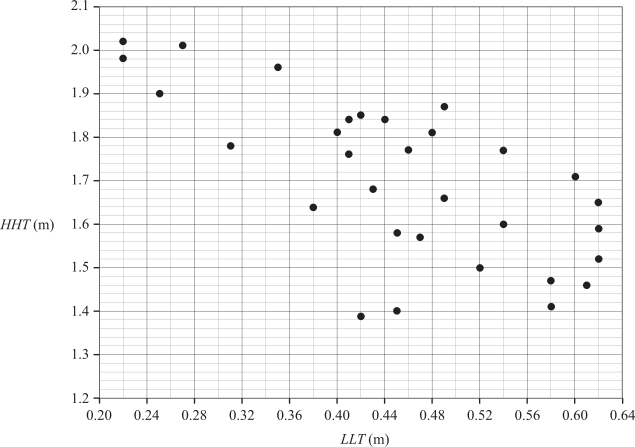
 

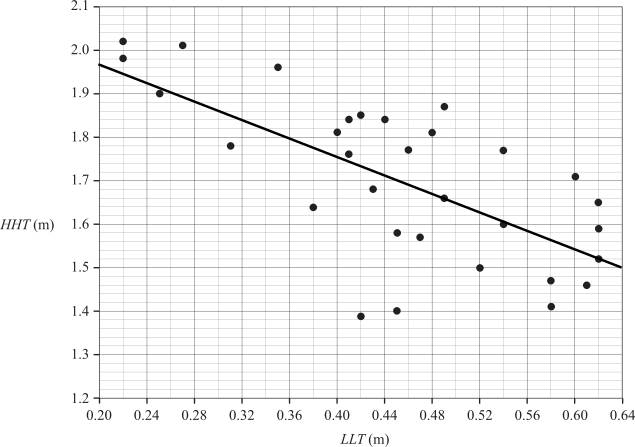
When a least squares line is fitted to the scatterplot, the equation is found to be:

\(HHT=2.19-1.08 \times LLT\)

The coefficient of determination is 0.4709

  1. Draw the graph of the least squares line on the scatterplot above.   (1 mark)

    --- 0 WORK AREA LINES (style=lined) ---

  2. Determine the value of the correlation coefficient \(r\).
  3. Round your answer to three decimal places.   (1 mark)

    --- 1 WORK AREA LINES (style=lined) ---

  4. Describe the association between \(H H T\) and \(L L T\) in terms of form and direction.   (1 mark)

    --- 2 WORK AREA LINES (style=lined) ---

  5. Interpret the slope of the least squares line in terms of the variables \(H H T\) and \(L L T\).   (1 mark)

    --- 4 WORK AREA LINES (style=lined) ---

  6. In this investigation, the \(H H T\) value was 1.81 m for an \(L L T\) value of 0.40 m .
  7. Show that when this least squares line is fitted to the scatterplot, the residual for this point is 0.052    (2 marks)

    --- 4 WORK AREA LINES (style=lined) ---

  8. The mean of the \(H H T\) values for July 2021 is 1.70 m .
  9. Calculate the mean of the \(L L T\) values.
  10. Round your answer to two decimal places.    (1 mark)

    --- 5 WORK AREA LINES (style=lined) ---

Show Answers Only

a.
       

b.   \(r= -0.686\)

c.   \(\text{Form: Linear}\)

\(\text{Direction: Negative}\)

d.   \(\text{On average, when the \(LLT\) increases by 1.00 metre, the \(HHT\) decreases}\)

\(\text{by 1.08 metres.}\)

e.   \(\text{Actual values:}\ HHT=1.81\ \text{when}\ \ LLT=0.40 \)

\(\text{Predicted value}\ =2.19-1.08 \times 0.40 = 1.758\)

\(\text{Residual = Actual – Predicted}\ = 1.81-1.758=0.052\)
 

f.   \(LLT=0.45\)

Show Worked Solution

a.


b.
   \(r=-\sqrt{0.4709} = -0.686\)
 

c.   \(\text{Form: Linear}\)

\(\text{Direction: Negative}\)
 

d.   \(\text{Interpretation of slope:}\)

\(\text{On average, when the \(LLT\) increases by 1.00 metre, the \(HHT\) decreases}\)

\(\text{by 1.08 metres.}\)
 

e.   \(\text{Actual values:}\ HHT=1.81\ \text{when}\ \ LLT=0.40 \)

\(\text{Predicted value}\ =2.19-1.08 \times 0.40 = 1.758\)

\(\text{Residual = Actual}-\text{Predicted}\ = 1.81-1.758=0.052\)
 

f.   \(\text{Mean}\ (HHT)=1.70\)

\(1.70\) \(=2.19-1.08 \times LLT\)  
\(LLT\) \(=\dfrac{2.19-1.70}{1.08} = 0.45\ \text{(2 d.p.)}\)  

Filed Under: Correlation and Regression Tagged With: Band 3, Band 4, smc-265-30-LSRL formula, smc-265-40-Interpret Gradient, smc-265-50-Residuals

Data Analysis, GEN2 2024 NHT 2

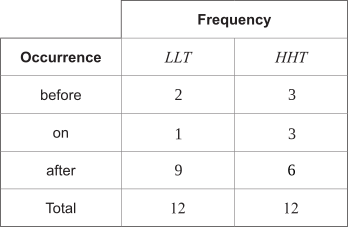
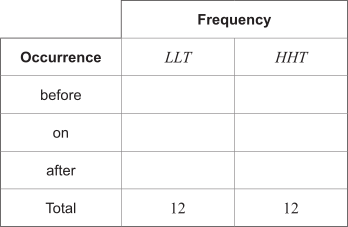
In the year 2021 there were 12 days where a new moon appeared in Sydney Harbour.

For these 12 days the occurrence of the highest high tides (HHT) and lowest low tides ( \(L L T\) ) occurred before, on or after the appearance of the new moon.

These records are displayed in the table below.

Table 3

  1. Use the data from Table 3 to complete the following frequency table.   (2 marks)

    --- 0 WORK AREA LINES (style=lined) ---

  2. Table 4

  1. Does the data in Table 4 support the contention that the occurrence of the \(L L T\) is associated with the appearance of the new moon?
  2. Explain your conclusion by comparing the values of appropriate percentages.   (2 marks)

    --- 4 WORK AREA LINES (style=lined) ---

Show Answers Only

a.   
     

b.   \(\text{% \(LLT\) “before” =}\ \dfrac{2}{12}=16.7\%\)

\(\text{% \(LLT\) “on” =}\ \dfrac{1}{12}=8.3\%\)

\(\text{% \(LLT\) “after” =}\ \dfrac{9}{12}=75\%\)

\(\therefore\ \text{The data does support the contention as the percentage of “after” is}\)

\(\text{significantly higher than those from “before” and “on”.}\)

Show Worked Solution

a.   
     

b.   \(\text{% \(LLT\) “before” =}\ \dfrac{2}{12}=16.7\%\)

\(\text{% \(LLT\) “on” =}\ \dfrac{1}{12}=8.3\%\)

\(\text{% \(LLT\) “after” =}\ \dfrac{9}{12}=75\%\)

\(\therefore\ \text{The data does support the contention as the percentage of “after” is}\)

\(\text{significantly higher than those from “before” and “on”.}\)
Filed Under: Summary Statistics Tagged With: Band 3, Band 4, smc-468-60-Frequency tables

Data Analysis, GEN2 2024 NHT 1

Data was collected to investigate the behaviour of tides in Sydney Harbour.

There are usually two high tides and two low tides each day.

The variables in this study were:

  • Day: the day number in the sample
  • LLT: the height of the lowest low tide for that day (in metres)
  • HHT: the height of the highest high tide for that day (in metres)

Table 1 displays the data collected for a sample of 14 consecutive days in February 2021.

Table 1

\begin{array}{|c|c|c|}
\hline
 \rule{0pt}{2.5ex}\ \ \ \textit{Day}\ \ \ \rule[-1ex]{0pt}{0pt}& \textit{LLT (m)} & \textit{HHT (m)}\\
\hline \rule{0pt}{2.5ex}1 \rule[-1ex]{0pt}{0pt}& 0.43 & 1.65 \\
\hline \rule{0pt}{2.5ex}2 \rule[-1ex]{0pt}{0pt}& 0.49 & 1.55 \\
\hline \rule{0pt}{2.5ex}3 \rule[-1ex]{0pt}{0pt}& 0.55 & 1.44 \\
\hline \rule{0pt}{2.5ex}4 \rule[-1ex]{0pt}{0pt}& 0.61 & 1.42 \\
\hline \rule{0pt}{2.5ex}5 \rule[-1ex]{0pt}{0pt}& 0.68 & 1.42 \\
\hline \rule{0pt}{2.5ex}6 \rule[-1ex]{0pt}{0pt}& 0.73 & 1.42 \\
\hline \rule{0pt}{2.5ex}7 \rule[-1ex]{0pt}{0pt}& 0.72 & 1.42 \\
\hline \rule{0pt}{2.5ex}8 \rule[-1ex]{0pt}{0pt}& 0.65 & 1.47 \\
\hline \rule{0pt}{2.5ex}9 \rule[-1ex]{0pt}{0pt}& 0.57 & 1.55 \\
\hline \rule{0pt}{2.5ex}10 \rule[-1ex]{0pt}{0pt}& 0.48 & 1.64 \\
\hline \rule{0pt}{2.5ex}11 \rule[-1ex]{0pt}{0pt}& 0.39 & 1.74 \\
\hline \rule{0pt}{2.5ex}12 \rule[-1ex]{0pt}{0pt}& 0.30 & 1.83 \\
\hline \rule{0pt}{2.5ex}13 \rule[-1ex]{0pt}{0pt}& 0.25 & 1.90 \\
\hline \rule{0pt}{2.5ex}14 \rule[-1ex]{0pt}{0pt}& 0.22 & 1.92 \\
\hline
\end{array}
  1. For the \(H H T\) values in Table 1:
    1. Calculate the mean, in metres.
    2. Round your answer to one decimal place.   (1 mark)

      --- 2 WORK AREA LINES (style=lined) ---

    3. Calculate the standard deviation, in metres.
    4. Round your answer to three decimal places.    (1 mark)

      --- 2 WORK AREA LINES (style=lined) ---

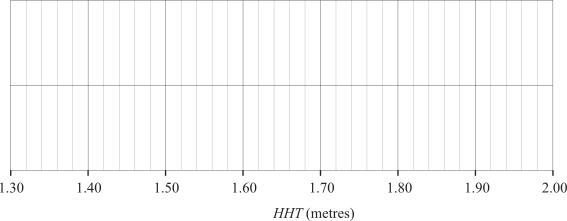
  2. Use the \(HHT\) data from Table 1 to construct a boxplot on the grid below.    (2 marks)

    --- 0 WORK AREA LINES (style=lined) ---


  1. The five-number summary of the \(L L T\) data is shown in Table 2 below.
  2. Table 2

\begin{array}{|c|c|c|c|c|}
\hline \rule{0pt}{2.5ex}\textbf{Minimum} \rule[-1ex]{0pt}{0pt}& \ \ \textbf{Q1} \ \ & \textbf{Median} & \ \  \textbf{Q3} \ \ & \textbf{Maximum} \\
\hline \rule{0pt}{2.5ex}0.22 \rule[-1ex]{0pt}{0pt}& 0.39 & 0.52 & 0.65 & 0.73 \\
\hline
\end{array}

  1. Show that the minimum \(L L T\) value of 0.22 m is not an outlier.    (2 marks)

    --- 4 WORK AREA LINES (style=lined) ---

  2. A least squares line can be used to model the association between \(L L T\) and \(H H T\). In this model, \(H H T\) is the response variable.
  3. Use the data from Table 1 to determine the equation of this least squares line.
  4. Round the values of the intercept and slope to four significant figures.
  5. Write your answers in the boxes provided.    (2 marks)

    --- 0 WORK AREA LINES (style=lined) ---

Show Answers Only

a.i.   \(\text{Mean = 1.6}\)

a.ii.  \(\text{Std dev = 0.185}\)

b.   
               

c.   \(IQR (LLT) = 0.65-0.39=0.26\)

\(\text{Lower fence}\ =Q_1-1.5 \times IQR = 0.39-1.5 \times o.26=0\)

\(\text{Since 0.22 > 0, 0.22 is not an outlier.}\)

d.   \(HHT = 2.130 + (-1.054) \times LLT\)

Show Worked Solution

a.i.   \(\text{Mean = 1.6}\)

a.ii.  \(\text{Std dev = 0.185}\)
 

b.   \(\text{Order \(HHT\) data:}\)

\(1.42, 1.42, 1.42, [1.42], 1,44, 1.47, 1.55 | 1.55, 1.64, 1.65, [1.74],\)

\(1.83, 1.90, 1.92\)

\(\text{High = 1.92, Low = 1.42, \(Q_1=1.42, Q_3=1.74\), Median = 1.55}\)

 
c.
   \(IQR (LLT) = 0.65-0.39=0.26\)

\(\text{Lower fence}\ =Q_1-1.5 \times IQR = 0.39-1.5 \times 0.26=0\)

\(\text{Since 0.22 > 0, 0.22 is not an outlier.}\)
 

d.   \(HHT\ \text{is the response \((y)\) variable.}\)

\(\text{By CAS:}\)

\(HHT = 2.130 + (-1.054) \times LLT\)

Filed Under: Correlation and Regression, Graphs - Stem/Leaf and Boxplots, Summary Statistics Tagged With: Band 3, Band 4, smc-265-20-Find LSRL Equation/Gradient, smc-468-20-Mean, smc-468-30-Std Dev, smc-468-50-IQR / Outliers, smc-643-30-Draw Box Plots

HMS, TIP 2024 HSC 31b

To what extent have advancements in sporting technology improved performance?   (12 marks)

--- 28 WORK AREA LINES (style=lined) ---

Show Answers Only

Judgment Statement

  • Advancements in sporting technology have significantly improved performance across multiple sports disciplines.
  • Key factors include equipment innovation, biomechanical analysis systems, and performance monitoring technologies.

Equipment and Material Innovation

  • Swimming technology demonstrates substantial performance gains through advanced materials.
  • Modern racing suits significantly reduced water resistance, leading to numerous world records and eventual regulation by swimming authorities.
  • Tennis racquet evolution from wooden to graphite composites increased serve speeds and they now achieve speeds up to 200 km/h.
  • Modern equipment enables athletes to achieve previously impossible performance levels.
  • These innovations directly translate to measurable improvements in speed, power and accuracy.

Performance Analysis and Monitoring Systems

  • GPS tracking and biomechanical analysis provide significant advantages in training optimisation.
  • Rugby union teams use GPS data to monitor player workloads, helping coaches reduce injury risk while maintaining performance.
  • High-speed cameras and motion sensors allow precise technical refinements in cricket bowling and golf swings.
  • Real-time feedback systems enable immediate corrections during training sessions.
  • Data-driven approaches result in more efficient training programs and reduced injury rates.

Limitations and Access Inequality

  • Technology benefits are not equally distributed across all sports and nations.
  • Financial resources determine access levels to advanced technological systems.
  • Traditional sports may resist technological integration to preserve their character.
  • Wealthier nations with greater technology investment demonstrate higher medal counts at international competitions.
  • Equipment regulations in some sports limit the extent of technological advantages.

Reaffirmation

  • Technology has substantially transformed sporting performance across multiple disciplines.
  • While access inequality moderates the overall impact, the evidence demonstrates significant improvements in speed, accuracy and training efficiency.
  • The extent remains considerable for athletes with access to advanced technological systems.
Show Worked Solution

Judgment Statement

  • Advancements in sporting technology have significantly improved performance across multiple sports disciplines.
  • Key factors include equipment innovation, biomechanical analysis systems, and performance monitoring technologies.

Equipment and Material Innovation

  • Swimming technology demonstrates substantial performance gains through advanced materials.
  • Modern racing suits significantly reduced water resistance, leading to numerous world records and eventual regulation by swimming authorities.
  • Tennis racquet evolution from wooden to graphite composites increased serve speeds and they now achieve speeds up to 200 km/h.
  • Modern equipment enables athletes to achieve previously impossible performance levels.
  • These innovations directly translate to measurable improvements in speed, power and accuracy.

Performance Analysis and Monitoring Systems

  • GPS tracking and biomechanical analysis provide significant advantages in training optimisation.
  • Rugby union teams use GPS data to monitor player workloads, helping coaches reduce injury risk while maintaining performance.
  • High-speed cameras and motion sensors allow precise technical refinements in cricket bowling and golf swings.
  • Real-time feedback systems enable immediate corrections during training sessions.
  • Data-driven approaches result in more efficient training programs and reduced injury rates.

Limitations and Access Inequality

  • Technology benefits are not equally distributed across all sports and nations.
  • Financial resources determine access levels to advanced technological systems.
  • Traditional sports may resist technological integration to preserve their character.
  • Wealthier nations with greater technology investment demonstrate higher medal counts at international competitions.
  • Equipment regulations in some sports limit the extent of technological advantages.

Reaffirmation

  • Technology has substantially transformed sporting performance across multiple disciplines.
  • While access inequality moderates the overall impact, the evidence demonstrates significant improvements in speed, accuracy and training efficiency.
  • The extent remains considerable for athletes with access to advanced technological systems.

♦♦ Mean mark 50%.

Filed Under: Technology and performance Tagged With: Band 4, Band 5, smc-5471-10-Equipment advances, smc-5471-20-Recording and monitoring, smc-5471-40-Multiple technologies

HMS, TIP 2024 HSC 31ai

Describe ONE phase of competition that can be included when planning a training year?   (3 marks)

--- 10 WORK AREA LINES (style=lined) ---

Show Answers Only

In-season phase

  • The in-season phase is the competitive period where athletes participate in scheduled competitions and matches, focusing on maintaining peak performance levels while managing fatigue.
  • Training volume typically decreases while intensity remains high to simulate competition demands.
  • Emphasis is on tactical preparation and skill refinement rather than developing fitness.
  • Training sessions become more sport-specific with reduced frequency (usually 2-3 sessions per week) to allow sufficient recovery between competitions.
  • Physical conditioning shifts to maintenance work rather than development.
  • Psychological preparation becomes increasingly important for consistent performance in competitive situations.
Show Worked Solution

In-season phase

  • The in-season phase is the competitive period where athletes participate in scheduled competitions and matches, focusing on maintaining peak performance levels while managing fatigue.
  • Training volume typically decreases while intensity remains high to simulate competition demands.
  • Emphasis is on tactical preparation and skill refinement rather than developing fitness.
  • Training sessions become more sport-specific with reduced frequency (usually 2-3 sessions per week) to allow sufficient recovery between competitions.
  • Physical conditioning shifts to maintenance work rather than development.
  • Psychological preparation becomes increasingly important for consistent performance in competitive situations.

Filed Under: Individual vs group programs Tagged With: Band 4, smc-5463-10-Competition phases

Networks, GEN1 2024 NHT 38-39 MC

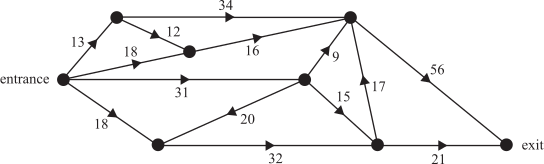
The following directed graph represents the one-way paths between attractions at an historical site. The entrance, exit and attractions are represented by vertices.

The numbers on the edges represent the maximum number of visitors allowed along each path per hour.
 

Question 38

What is the maximum number of visitors able to walk from the entrance to the exit each hour?

  1. 75
  2. 76
  3. 77
  4. 88
  5. 96

 
Question 39

A group of students set out from the entrance and walk to the exit. The students all walk together and travel along the same route. They are the only people visiting the site that hour. What is the maximum number of students that could be in the group?

  1. 9
  2. 15
  3. 16
  4. 20
  5. 31
Show Answers Only

\(\text{Question 38:}\ B\)

\(\text{Question 39:}\ D\)

Show Worked Solution

\(\text{Question 38}\)

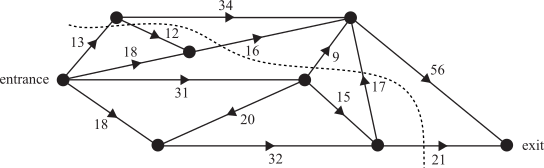
\(\text{Max flow = min cut}\)

\(\text{Max flow = 13+16+9+17+21=76\)

\(\Rightarrow B\)
  

\(\text{Question 39}\)

\(\text{Given all students must take the same route:}\)

\(\text{Path for max students is 32 → 20 → 32 → 21}\)

\(\text{Max students = minimum capacity of any edge = 20}\)

\(\Rightarrow D\)

Filed Under: Flow Problems Tagged With: Band 4, Band 5, smc-625-20-Max Flow/Min Cut

Networks, STD2 N2 EQ-Bank 26

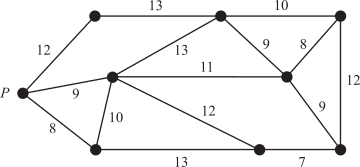
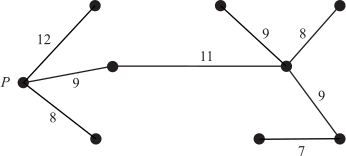
The vertices of the graph below represent cabins in a holiday park, and the water pump \((P)\) that will supply them. The numbers on the edges show the length, in metres, of water pipe required to connect the cabins and the pump.
 

The water pipes will cost $52 per metre. 

Determine the minimum cost to link all the cabins to the water pump \((P)\).    (3 marks)

--- 5 WORK AREA LINES (style=lined) ---

Show Answers Only

\(\text{Minimum cost}\ = 73 \times 52=\$3796\)

Show Worked Solution

Minimum spanning tree:
 

\(\text{MST}\ =8+9+11+8+9+9+7+12=73\)

\(\therefore\ \text{Minimum cost}\ = 73 \times 52=\$3796\)

Filed Under: Minimum Spanning Trees, Spanning Trees Tagged With: Band 4, smc-6320-30-Cost, smc-914-30-Cost

Networks, GEN1 2024 NHT 35 MC

The vertices of the graph below represent cabins in a holiday park, and the water pump \((P)\) that will supply them. The numbers on the edges show the length, in metres, of water pipe required to connect the cabins and the pump.
 

The water pipes will cost $52 per metre. What is the minimum cost to link all the cabins to the water pump \((P)\) ?

  1. $3744
  2. $3796
  3. $3848
  4. $3900
  5. $3952
Show Answers Only

\(B\)

Show Worked Solution

Minimum spanning tree:
 

\(\text{MST}\ =8+9+11+8+9+9+7+12=73\)

\(\therefore\ \text{Minimum cost}\ = 73 \times 52=\$3796\)

\(\Rightarrow B\)

Filed Under: Flow Problems Tagged With: Band 4, smc-625-20-Max Flow/Min Cut

PHYSICS, M2 EQ-Bank 4

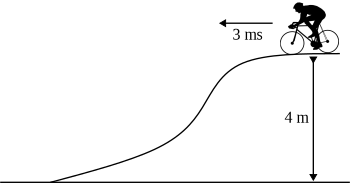
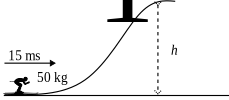
A 65 kg rider is on a 15 kg bicycle, moving across the top of a 4 metre high hill with a horizontal speed of 3 ms\(^{-1}\).
 

  1. The bicycle descends the hill, dropping a vertical distance of 4.0 meters before reaching level ground. Assuming no energy is lost to friction or air resistance, calculate the speed of the bicycle and rider at the bottom of the hill.   (3 marks)

--- 6 WORK AREA LINES (style=lined) ---

  1. At the bottom, the rider applies the brakes. The bike skids 15 metres across flat ground before coming to a stop. Calculate the magnitude of the frictional force acting on the bike during this motion.   (2 marks)

--- 5 WORK AREA LINES (style=lined) ---

Show Answers Only

a.    \(9.35\ \text{ms}^{-1}\)

b.    \(233\ \text{N}\)

Show Worked Solution

a.    By applying the Law of Conservation of Energy:

\(E_{\text{after}}\) \(=E_{\text{before}}\)  
\(\dfrac{1}{2}mv^2\) \(=\dfrac{1}{2}mu^2+mgh\)  
\(v^2\) \(=u^2 +2gh\)  
\(v\) \(=\sqrt{3^2+2 \times 9.8 \times 4}\)  
  \(=9.35\ \text{ms}^{-1}\)  


  • The velocity of the rider at the bottom of the hill is 9.35 ms\(^{-1}\).

b.    At the bottom of the hill:

  • Work done to slow rider = change in rider’s kinetic energy
\(W\) \(=\Delta KE\)  
\(Fs\) \(=\dfrac{1}{2}mv^2-\dfrac{1}{2}mu^2\)  
\(F \times 15\) \(=\dfrac{1}{2} \times 80 \times 0^2-\dfrac{1}{2} \times 80 \times 9.35^2\)  
\(F\) \(=-\dfrac{3496.9}{15}\)  
  \(=-233\ \text{N}\)  


  • The braking force acting on the bike is \(233\ \text{N}\).

Filed Under: Forces, Acceleration and Energy Tagged With: Band 4, Band 5, smc-4276-10-Conservation of energy, smc-4276-40-Work done, smc-4276-60-Kinetic Energy

PHYSICS, M2 EQ-Bank 10 MC

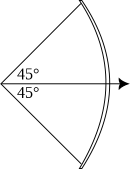
An archer pulls back the string of a bow so that it makes an angle of 45° with the arrow. At this moment, the tension in the string is 100 N.


If the archer releases a 0.2 kg arrow from this position, what would be the arrow’s initial acceleration? (Assume no friction or air resistance.)

  1. \(250\ \text{ms}^{-2}\)
  2. \(354\ \text{ms}^{-2}\)
  3. \(500\ \text{ms}^{-2}\)
  4. \(707\ \text{ms}^{-2}\)
Show Answers Only

\(D\)

Show Worked Solution
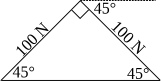
  • A force diagram for the situation can be drawn as seen below:
     
  •    
  • The resulting diagram is a right-angled triangle.
  • The net force \(F_{\text{net}}\) can be calculated by Pythagoras:
  •    \(F_{\text{net}} = \sqrt{100^2+100^2} = 141.4\ \text{N}\).
  •    \(a=\dfrac{F_{\text{net}}}{m} = \dfrac{141.4}{0.2} = 707\ \text{N}\).

\(\Rightarrow D\)

Filed Under: Forces, Acceleration and Energy Tagged With: Band 4, smc-4276-50-F=ma

HMS, HIC 2024 HSC 28b

Evaluate the effectiveness of legislation and health promotion initiatives in addressing ONE major health issue affecting young people.   (12 marks)

--- 28 WORK AREA LINES (style=lined) ---

Show Answers Only

Evaluation Statement

  • Legislation and health promotion initiatives are highly effective in addressing youth road safety when implemented together.
  • This evaluation examines behavioural change impact and long-term sustainability of interventions.

Behavioural Change Impact

  • Graduated licensing systems are highly influential in reducing youth road fatalities.
  • Evidence supporting this includes the 120 supervised hours requirement, passenger limits for P1 drivers and speed restrictions that have coincided with a sizeable reduction in collision rates.
  • The “Plan B” drink-driving campaign has also proven highly effective by promoting practical drink-driving alternatives. Campaign evaluations show a significant percentage decrease in alcohol-related crashes since 2012.
  • A critical strength of these approaches is the combination of addressing specific risk factors while building safe driving habits.
  • In this way, combined approaches can achieve comprehensive behaviour modification.

Long-term Sustainability

  • Legislative measures show excellent sustainability through systematic enforcement.
  • Mobile phone bans partially fulfil objectives due to enforcement challenges. While awareness has increased, detection difficulties limit long-term compliance although this shortcoming is being mitigated by technology developments.
  • Health promotion campaigns like “Speeding. No One Thinks Big of You” achieve moderate sustainability. Research indicates 75% of young males felt discouraged from speeding after viewing.
  • However, campaign effects diminish without ongoing reinforcement. Although effective for immediate impact, promotion requires continuous investment.

Final Evaluation

  • Weighing these factors shows integrated approaches prove most effective.
  • The strengths outweigh limitations because combining external regulation with attitude change can create lasting impact.
  • While legislation provides consistent framework, health promotion addresses cultural motivations.
  • The overall evaluation reveals neither approach alone suffices.
  • Implications suggest continued investment in both legislative and promotional strategies maximises youth road safety outcomes.
Show Worked Solution

Evaluation Statement

  • Legislation and health promotion initiatives are highly effective in addressing youth road safety when implemented together.
  • This evaluation examines behavioural change impact and long-term sustainability of interventions.

Behavioural Change Impact

  • Graduated licensing systems are highly influential in reducing youth road fatalities.
  • Evidence supporting this includes the 120 supervised hours requirement, passenger limits for P1 drivers, and speed restrictions that have coincided with a sizeable reduction in collision rates.
  • The “Plan B” drink-driving campaign has also proven highly effective by promoting practical drink-driving alternatives. Campaign evaluations show a significant percentage decrease in alcohol-related crashes since 2012.
  • A critical strength of these approaches is the combination of addressing specific risk factors while building safe driving habits.
  • In this way, combined approaches can achieve comprehensive behaviour modification.

Long-term Sustainability

  • Legislative measures show excellent sustainability through systematic enforcement.
  • Mobile phone bans partially fulfil objectives due to enforcement challenges. While awareness has increased, detection difficulties limit long-term compliance although this shortcoming is being mitigated by technology developments.
  • Health promotion campaigns like “Speeding. No One Thinks Big of You” achieve moderate sustainability. Research indicates 75% of young males felt discouraged from speeding after viewing.
  • However, campaign effects diminish without ongoing reinforcement. Although effective for immediate impact, promotion requires continuous investment.

Final Evaluation

  • Weighing these factors shows integrated approaches prove most effective.
  • The strengths outweigh limitations because combining external regulation with attitude change can create lasting impact.
  • While legislation provides consistent framework, health promotion addresses cultural motivations.
  • The overall evaluation reveals neither approach alone suffices.
  • Implications suggest continued investment in both legislative and promotional strategies maximises youth road safety outcomes.

♦♦ Mean mark 43%.

Filed Under: Models of health promotion Tagged With: Band 4, Band 5, smc-5510-280-Legislation

HMS, HIC 2024 HSC 28aii

Explain how the developmental stage of a young person's life can cause their motivation AND values to vary.   (5 marks)

--- 15 WORK AREA LINES (style=lined) ---

Show Answers Only

Physical development

  • Puberty and growth spurts change a young person’s body, which can affect their motivation to be active.
  • For example, a young person who grows tall quickly may become more motivated to play basketball.
  • However, body changes can also increase concern about appearance, motivating unhealthy dieting.

Cognitive development

  • As abstract thinking develops, young people begin to consider long-term consequences.
  • As a result, many older adolescents become more motivated by future goals, such as fitness or further study.
  • However, impulse control is still developing, so immediate rewards can still outweigh long-term health.

Social and emotional development

  • Family values shape what young people consider important, for example valuing help-seeking during stressful times.
  • However, young people who feel less emotionally connected to family may seek acceptance from peers.
  • This can lead to risk-taking behaviours, such as binge drinking, to fit in.
  • In contrast, peer groups that value sport or not drinking can motivate healthy choices.
Show Worked Solution

*Cause-and-effect language that directly addresses the “Explain” keyword is bolded in the answer below.

Physical development

  • Puberty and growth spurts change a young person’s body, which can affect their motivation to be active.
  • For example, a young person who grows tall quickly may become more motivated to play basketball.
  • However, body changes can also increase concern about appearance, motivating unhealthy dieting.

Cognitive development

  • As abstract thinking develops, young people begin to consider long-term consequences.
  • As a result, many older adolescents become more motivated by future goals, such as fitness or further study.
  • However, impulse control is still developing, so immediate rewards can still outweigh long-term health.

Social and emotional development

  • Family values shape what young people consider important, for example valuing help-seeking during stressful times.
  • However, young people who feel less emotionally connected to family may seek acceptance from peers.
  • This can lead to risk-taking behaviours, such as binge drinking, to fit in.
  • In contrast, peer groups that value sport or not drinking can motivate healthy choices.

♦ Mean mark 53%.

Filed Under: Aspects of young people's lives Tagged With: Band 4, Band 5, smc-5507-10-Stages of development, smc-5507-20-Family influence, smc-5507-30-Peer influence

Financial Maths, STD2 F4 2013 HSC 28d (Adapted)

James has 3000 shares. The current share price is  $2.50  per share. James is paid a dividend of  $0.50  per share. 

  1. What is the current value of his shares?   (1 mark)

    --- 5 WORK AREA LINES (style=lined) ---

  2. Calculate the dividend yield.    (1 mark)

    --- 5 WORK AREA LINES (style=lined) ---

Show Answers Only

a.    `$7500`

b.    `text(20%)`

Show Worked Solution
a.    `text(# Shares)=3000`
  `text(Share price) = $2.50`


`:.\ text(Current value)` `= 3000x 2.50`
  `=$7500`
♦♦♦ Mean mark 13%
MARKER’S COMMENT: A large majority of students had a poor understanding of the term dividend yield.
  

b.     `text(Dividend yield)` `=\ text(Dividend)/text(Share price)`
    `= 0.50/2.50`
    `=20 text(%)`

Filed Under: Compound Interest and Shares (Std2-X), Investment (Y12-X) Tagged With: adapted, Band 4, Band 6, smc-7726-40-Shares and Dividends, smc-817-40-Shares/Dividends

Matrices, GEN1 2024 NHT 28 MC

Matrix \(D\) is a \(2 \times 2\) matrix where each element is given by \(d_{ij}\)

Which rule will result in a binary matrix?

  1. \(d_{i j}=i+j\)
  2. \(d_{i j}=i-j\)
  3. \(d_{i j}=i \times j\)
  4. \(d_{i j}=i \ ÷ \  j\)
  5. \(d_{i j}=(i-j)^2\)
Show Answers Only

\(E\)

Show Worked Solution

\(\text{Binary matrix: each element is either 0 or 1}\)

\(\text{Consider the matrix in option}\ E:\)

\(M_E=\begin{bmatrix}(1-1)^2,(1-2)^2 \\ (2-1)^2,(2-2)^2\end{bmatrix}=\begin{bmatrix}0,1 \\ 1,0\end{bmatrix}\)

\(\Rightarrow E\)

Filed Under: Matrix Calculations Tagged With: Band 4, smc-616-70-Elements/Rules

Financial Maths, STD2 F4 2021 HSC 26 (Adapted)

Mila plans to invest $42 000 for 1.5 years. She is offered two different investment options.

Option A:  Interest is paid at 5% per annum compounded monthly.

Option B:  Interest is paid at `r` % per annum simple interest.

  1. Calculate the future value of Mila's investment after 1.5 years if she chooses Option A.   (2 marks)

    --- 4 WORK AREA LINES (style=lined) ---

  2. Find the value of `r` in Option B that would give Mila the same future value after 1.5 years as for Option A. Give your answer correct to two decimal places.   (2 marks)

    --- 4 WORK AREA LINES (style=lined) ---

Show Answers Only
  1. `$45\ 264.08`
  2. `5.18text(%)`
Show Worked Solution
a.   `r` `= text(5%)/12 = text(0.4167%) = 0.004167\ \text(per month)`
  `n` `= 12 × 1.5 = 18`
`FV` `= PV(1 + r)^n`
  `= 42\ 000(1 + 0.004167)^{18}`
  `= $45\ 264.08`


b.   `I` `= Prn`
  `3\ 264.08` `= 42\ 000 × r × 1.5`
  `r` `= 3\ 264.08 / (42\ 000 × 1.5)`
    `= 0.0518…`
    `= 5.18\ \text{% (to 2 d.p.)}`

Filed Under: Compound Interest and Shares (Std2-X), Investment (Y12-X) Tagged With: adapted, Band 4, Band 5, num-title-ct-coreb, num-title-qs-hsc, smc-4334-10-Find FV, smc-4334-40-Find r, smc-4334-50-Compound vs Simple, smc-7726-30-Interest Rate Comparisons, smc-817-20-FV Formula, smc-817-30-i/r comparisons (incl. graphs)

Matrices, GEN1 2024 NHT 27 MC

Matrix \(V\) is an  \(n \times n\)  matrix with a determinant equal to 1 .

The product of \(V \times V^{-1}\) will result in

  1. an identity matrix.
  2. a Leslie matrix.
  3. a column matrix.
  4. a zero matrix.
  5. a row matrix.
Show Answers Only

\(A\)

Show Worked Solution

\(\text{Since matrix determinant}\ \neq 0\ \ \Rightarrow\ \ \text{matrix has an inverse}\)

\(\therefore V \times V^{-1} = I\)

\(\Rightarrow A\)

Filed Under: Matrix Calculations Tagged With: Band 4, smc-616-40-Powers/Inverse, smc-616-50-Determinant

HMS, HAG 2024 HSC 27

Select ONE of the following groups that experience health inequities:

  • Socioeconomically disadvantaged people
  • People in rural and remote areas
  • Overseas-born people
  • The elderly
  • People with disabilities

To what extent do socioeconomic factors affect the health of this group?   (8 marks)
  

Group selected:............................................................................................

--- 30 WORK AREA LINES (style=lined) ---

Show Answers Only

Group selected: People with disabilities

Introduction – Overall judgement

  • Socioeconomic factors significantly affect the health of people with disabilities in Australia
  • Create a cycle of disadvantage that severely impacts both physical and mental wellbeing
  • Influence multiple aspects of life including healthcare access, housing, and social participation

Employment barriers – Primary socioeconomic influence

  • Approximately 30% lower employment rates than general population
  • Limited income potential restricts ability to afford:
    • Specialised healthcare services not covered by Medicare
    • Gap payments for NDIS-supported therapies
    • Essential assistive technologies and modifications
  • Directly impacts access to vital treatments, therapies, and medications

Educational disadvantage – Compounding factor

  • Physical access barriers and inadequate support in educational settings
  • Lower completion rates of secondary and tertiary education
  • Results in limited employment options and lower-paying positions
  • Creates cycle of disadvantage affecting ability to afford:
    • Private health insurance
    • Preventative healthcare services
    • Regular health monitoring

Housing challenges – Financial manifestation

  • Limited accessible housing options at premium prices
  • Contributes to housing stress and potential homelessness
  • Associated mental health conditions including anxiety and depression
  • Extended waiting lists for accessible public housing (often several years)
  • Many forced to live in unsuitable accommodation that compromises health and safety

Counter-argument – Other determinants:

  • Environmental barriers exist regardless of socioeconomic status
  • Healthcare system gaps include inaccessible facilities and equipment
  • Societal attitudes and stigma affect quality of care
  • Healthcare professionals’ lack of disability awareness leads to diagnostic overshadowing
  • These factors can affect health independent of financial means

Predominant influence – Financial burden:

  • Gap payments for therapies not fully covered by support systems
  • Specialised equipment costs beyond subsidies
  • Home modifications essential for independence
  • Significant portion of household income consumed by disability-related expenses
  • Disability Support Pension often insufficient, falling below poverty line
  • Forces difficult choices between healthcare needs and other essentials

Conclusion – Final judgment:

  • Socioeconomic factors affect health of people with disabilities to a very large extent
  • While other factors contribute, financial disadvantage creates the most pervasive barriers
  • Long-term cycle of disadvantage significantly impacts:
    • Quality of life
    • Health outcomes
    • Life expectancy for Australians with disabilities
Show Worked Solution

Group selected: People with disabilities

Introduction – Overall judgement

  • Socioeconomic factors significantly affect the health of people with disabilities in Australia
  • Create a cycle of disadvantage that severely impacts both physical and mental wellbeing
  • Influence multiple aspects of life including healthcare access, housing, and social participation

Employment barriers – Primary socioeconomic influence

  • Approximately 30% lower employment rates than general population
  • Limited income potential restricts ability to afford:
    • Specialised healthcare services not covered by Medicare
    • Gap payments for NDIS-supported therapies
    • Essential assistive technologies and modifications
  • Directly impacts access to vital treatments, therapies, and medications

Educational disadvantage – Compounding factor

  • Physical access barriers and inadequate support in educational settings
  • Lower completion rates of secondary and tertiary education
  • Results in limited employment options and lower-paying positions
  • Creates cycle of disadvantage affecting ability to afford:
    • Private health insurance
    • Preventative healthcare services
    • Regular health monitoring

Housing challenges – Financial manifestation

  • Limited accessible housing options at premium prices
  • Contributes to housing stress and potential homelessness
  • Associated mental health conditions including anxiety and depression
  • Extended waiting lists for accessible public housing (often several years)
  • Many forced to live in unsuitable accommodation that compromises health and safety

Counter-argument – Other determinants:

  • Environmental barriers exist regardless of socioeconomic status
  • Healthcare system gaps include inaccessible facilities and equipment
  • Societal attitudes and stigma affect quality of care
  • Healthcare professionals’ lack of disability awareness leads to diagnostic overshadowing
  • These factors can affect health independent of financial means

Predominant influence – Financial burden:

  • Gap payments for therapies not fully covered by support systems
  • Specialised equipment costs beyond subsidies
  • Home modifications essential for independence
  • Significant portion of household income consumed by disability-related expenses
  • Disability Support Pension often insufficient, falling below poverty line
  • Forces difficult choices between healthcare needs and other essentials

Conclusion – Final judgment:

  • Socioeconomic factors affect health of people with disabilities to a very large extent
  • While other factors contribute, financial disadvantage creates the most pervasive barriers
  • Long-term cycle of disadvantage significantly impacts:
    • Quality of life
    • Health outcomes
    • Life expectancy for Australians with disabilities

♦♦ Mean mark 45%.

Filed Under: Groups Experiencing Inequities Tagged With: Band 4, Band 5, smc-5475-20-Other Inequity Groups, smc-5475-40-Causes of Inequity

PHYSICS, M2 EQ-Bank 9 MC

A construction hoist uses an electric motor with a power rating of 6.0 kW, which operates at 75% efficiency when lifting materials vertically.

What is the maximum speed at which the hoist can raise a 240 kg load?

  1. \(3.1\ \text{ms}^{-1}\)
  2. \(2.0\ \text{ms}^{-1}\)
  3. \(1.5\ \text{ms}^{-1}\)
  4. \(1.9\ \text{ms}^{-1}\)
Show Answers Only

\(D\)

Show Worked Solution
  • Power lifting mass vertically \(= 0.75 \times 6 = 4.5\ \text{kW} = 4500\ \text{W}\).
\(P\) \(=F_{\parallel}v\)  
\(v\) \(=\dfrac{P}{F_{\parallel}}=\dfrac{4500}{240 \times 9.8}=1.9\ \text{ms}^{-1}\)  

 
\(\Rightarrow D\)

Filed Under: Forces, Acceleration and Energy Tagged With: Band 4, smc-4276-70-Power

PHYSICS, M2 EQ-Bank 3

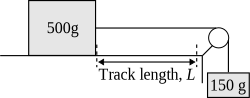
A horizontal Atwood machine begins accelerating from rest along a horizontal track of length, \(L=4.00\ \text{m}\).

A block with a mass of 500 g takes 2.7 seconds to travel the full length of the track. A constant frictional force acts on the block, described by the equation \(F_f = \mu_k mg\)
  

  1. Determine the coefficient of kinetic friction between the 500 g block and the track.   (4 marks)

--- 8 WORK AREA LINES (style=lined) ---

  1. Find the kinetic energy of the 500 g block when it reaches the end of the track.   (2 marks)

--- 4 WORK AREA LINES (style=lined) ---

Show Answers Only

a.    \(0.154\)

b.    \(2.194\ \text{J}\)

Show Worked Solution

a.     Find system acceleration using  \(s=ut + \dfrac{1}{2}at^2\):

\(s\) \(=ut +\dfrac{1}{2}at^2\)  
\(4.00\) \(=0 + \dfrac{1}{2} \times a \times 2.7^2\)  
\(a\) \(=\dfrac{2 \times 4.00}{2.7^2}=1.097\ \text{ms}^{-2}\)  

 
\(\therefore\) Total system mass \((m_T)\) = 500 + 150=650\ \text{g} = 0.65\ \text{kg} \)
 

Find frictional force acting on the block:

\(F_{\text{net}}\) \(=F_{\text{applied}}-F_f\)  
\(0.65 \times 1.097\) \(= 0.15 \times 9.8-F_f\)  
\(F_f\) \(=1.47-0.713=0.757\ \text{N}\)  

 
\(\therefore \mu_k = \dfrac{F_f}{mg} = \dfrac{0.757}{9.8 \times 0.5} = 0.154\)
  

b.    Using  \(v^2=u^2 +2as:\)

\(v^2=u^2+2as = 0^2+2 \times 1.097 \times 4.00 = 8.776\ \text{ms}^{-1}\)

\(KE = \dfrac{1}{2}mv^2 = \dfrac{1}{2} \times 0.5 \times 8.776 = 2.194\ \text{J}\)

Filed Under: Forces, Acceleration and Energy Tagged With: Band 4, Band 6, smc-4276-20-Friction, smc-4276-30-Gravity, smc-4276-50-F=ma, smc-4276-60-Kinetic Energy

HMS, HIC EQ-Bank 68

Research indicates that young people's definitions of health evolve as they move through adolescence.

How do young people's health priorities typically change between early adolescence (12-14 years) and late adolescence (17-19 years).   (5 marks)

--- 15 WORK AREA LINES (style=lined) ---

Show Answers Only

*Cause-and-effect language that directly addresses the “How” (unofficial) keyword is bolded in the answer below.

  • Young adolescents (12-14) typically define health concretely through immediate, observable aspects like physical appearance and energy levels. This occurs because their developmental stage limits abstract thinking abilities.
  • As a result of cognitive development progressing, late adolescents (17-19) shift toward more sophisticated health concepts that include preventive behaviours, long-term wellbeing, and the integration of physical, mental and social dimensions. This demonstrates why maturity changes health understanding.
  • Peer influence on health definitions transforms from early adolescence, where fitting in often dictates health behaviours, to late adolescence. This happens when greater independence enables young people to balance social factors with personal values.
  • Biological changes during puberty initially focus younger adolescents on body-related health concerns. This process leads to increased autonomy in later adolescence, which allows broader consideration of lifestyle choices.
  • These elements work together to require different health approaches: concrete, socially-relevant messaging for younger adolescents versus participatory, autonomy-respecting strategies for older teens. This shows a clear connection between developmental stage and effective health communication.
Show Worked Solution

*Cause-and-effect language that directly addresses the “How” (unofficial) keyword is bolded in the answer below.

  • Young adolescents (12-14) typically define health concretely through immediate, observable aspects like physical appearance and energy levels. This occurs because their developmental stage limits abstract thinking abilities.
  • As a result of cognitive development progressing, late adolescents (17-19) shift toward more sophisticated health concepts that include preventive behaviours, long-term wellbeing, and the integration of physical, mental and social dimensions. This demonstrates why maturity changes health understanding.
  • Peer influence on health definitions transforms from early adolescence, where fitting in often dictates health behaviours, to late adolescence. This happens when greater independence enables young people to balance social factors with personal values.
  • Biological changes during puberty initially focus younger adolescents on body-related health concerns. This process leads to increased autonomy in later adolescence, which allows broader consideration of lifestyle choices.
  • These elements work together to require different health approaches: concrete, socially-relevant messaging for younger adolescents versus participatory, autonomy-respecting strategies for older teens. This shows a clear connection between developmental stage and effective health communication.

Filed Under: Meanings of health - investigation Tagged With: Band 4, Band 5, smc-5508-50-Determinants of health

HMS, HIC EQ-Bank 67

Explain how gender influences the way young people define what is important to their health.

In your answer, provide specific examples of how young males and females might prioritise different aspects of health.   (5 marks)

--- 15 WORK AREA LINES (style=lined) ---

Show Answers Only

*PEEL – Solution is structured using an adjusted PEEL method to show cause and effect: [P] State the cause/factor [E] Show how it causes the effect [Ev] Evidence demonstrating why/how [L] Reinforce the causal relationship.

**Language highlighting the cause-effect relationship is bolded in the answer below.

  • [P] Social expectations can help shape male health priorities.
  • [E] This can lead to males focusing on strength and athletic performance.
  • [Ev] This occurs because masculine ideals emphasise physical capability – young men prioritise gym workouts and sports achievements over emotional health.
  • [L] This shows a clear connection between gender norms and narrow health definitions.
     
  • [P] Female socialisation encourages holistic health views.
  • [E] As a result, females place a greater emphasis on balancing physical, emotional and social wellbeing.
  • [Ev] This happens when young women look at stress management and relationship quality as equally important as fitness and physical capability.
  • [L] These elements work together to create broader health perspectives.
     
  • [P] Media representations are important factors that generally reinforce gender differences.
  • [E] This causes distinct body image pressures for each gender.
  • [Ev] The reason for this is males see muscular physique as ideal while females face thin beauty standards, shaping each gender’s health priorities differently.
  • [L] This demonstrates why health definitions are specific to each gender and why they persist through cultural messaging.
Show Worked Solution

*PEEL – Solution is structured using an adjusted PEEL method to show cause and effect: [P] State the cause/factor [E] Show how it causes the effect [Ev] Evidence demonstrating why/how [L] Reinforce the causal relationship.

**Language highlighting the cause-effect relationship is bolded in the answer below.

  • [P] Social expectations can help shape male health priorities.
  • [E] This can lead to males focusing on strength and athletic performance.
  • [Ev] This occurs because masculine ideals emphasise physical capability – young men prioritise gym workouts and sports achievements over emotional health.
  • [L] This shows a clear connection between gender norms and narrow health definitions.
     
  • [P] Female socialisation encourages holistic health views.
  • [E] As a result, females place a greater emphasis on balancing physical, emotional and social wellbeing.
  • [Ev] This happens when young women look at stress management and relationship quality as equally important as fitness and physical capability.
  • [L] These elements work together to create broader health perspectives.
     
  • [P] Media representations are important factors that generally reinforce gender differences.
  • [E] This causes distinct body image pressures for each gender.
  • [Ev] The reason for this is males see muscular physique as ideal while females face thin beauty standards, shaping each gender’s health priorities differently.
  • [L] This demonstrates why health definitions are specific to each gender and why they persist through cultural messaging.

Filed Under: Meanings of health - investigation Tagged With: Band 4, smc-5508-50-Determinants of health, smkey-hsc-Explain

HMS, HIC EQ-Bank 58 MC

Research shows that young people's definitions of health often differ from traditional medical models.

Which of the following best represents how adolescents typically conceptualise health?

  1. Primarily as the absence of disease or physical illness.
  2. Mainly through their ability to participate in physical activities.
  3. Through a combination of physical, social, and emotional wellbeing.
  4. Predominantly through their body image and appearance.
Show Answers Only
\(C\)
Show Worked Solution
  • C is correct because research consistently shows adolescents define health holistically across multiple dimensions rather than through any single aspect.

Other options:

  • A is incorrect because adolescents rarely limit their health definition to just the absence of disease or illness.
  • B is incorrect because while physical activity matters to many adolescents, they don’t generally reduce health primarily to physical function alone.
  • D is incorrect because although appearance concerns exist during adolescence, most young people recognise health encompasses much more than just looks.

Filed Under: Meanings of health - investigation Tagged With: Band 4, smc-5508-50-Determinants of health

HMS, HIC EQ-Bank 66

A researcher wants to investigate adolescents' experiences with physical activity and mental wellbeing. They have designed a study using online surveys with multiple-choice and rating scale questions.

Evaluate the validity, reliability and credibility of this data collection method for understanding adolescent health experiences.   (8 marks)

--- 22 WORK AREA LINES (style=lined) ---

Show Answers Only

Evaluation Statement

  • Online surveys with fixed responses prove partially effective for researching adolescent health experiences.
  • This evaluation examines validity, reliability and credibility of a study using online surveys with multiple-choice and rating scale questions.

Validity

  • The method partially fulfils validity requirements for capturing complex health experiences.
  • The research involves a method that can gather large samples quickly.
  • However, predetermined response options fail to capture nuanced adolescent perspectives, especially for subjective concepts like mental wellbeing.
  • While strong in measuring basic activity levels through quantifiable data, it proves less suitable for exploring personal health experiences that involve deeper meanings.

Reliability

  • The survey approach inadequately fulfils reliability standards without proper testing and diverse sampling.
  • A lack of pilot testing increases the risk of inconsistent question interpretation across age groups.
  • Also, without demographic information about participants, findings cannot reliably apply to all adolescents.

Credibility

  • Single-method data collection severely limits credibility of findings.
  • Online surveys alone prove insufficient for understanding lived experiences of adolescents.
  • A critical weakness is relying solely on quantitative data when health experiences require qualitative exploration.
  • Evidence shows mixed methods combining surveys with interviews produce superior insights.

Final Evaluation

  • Weighing these factors, the data collection method described provides limited insight into adolescent health experiences.
  • All three criteria reveal significant weaknesses in capturing complex teen health realities.
  • The overall evaluation demonstrates urgent need for mixed methods approaches.
  • Implications suggest researchers must combine quantitative surveys with qualitative interviews to achieve credible, valid and reliable understanding of adolescent wellbeing.
Show Worked Solution

Evaluation Statement

  • Online surveys with fixed responses prove partially effective for researching adolescent health experiences.
  • This evaluation examines validity, reliability and credibility of a study using online surveys with multiple-choice and rating scale questions.

Validity

  • The method partially fulfils validity requirements for capturing complex health experiences.
  • The research involves a method that can gather large samples quickly.
  • However, predetermined response options fail to capture nuanced adolescent perspectives, especially for subjective concepts like mental wellbeing.
  • While strong in measuring basic activity levels through quantifiable data, it proves less suitable for exploring personal health experiences that involve deeper meanings.

Reliability

  • The survey approach inadequately fulfils reliability standards without proper testing and diverse sampling.
  • A lack of pilot testing increases the risk of inconsistent question interpretation across age groups.
  • Also, without demographic information about participants, findings cannot reliably apply to all adolescents.

Credibility

  • Single-method data collection severely limits credibility of findings.
  • Online surveys alone prove insufficient for understanding lived experiences of adolescents.
  • A critical weakness is relying solely on quantitative data when health experiences require qualitative exploration.
  • Evidence shows mixed methods combining surveys with interviews produce superior insights.

Final Evaluation

  • Weighing these factors, the data collection method described provides limited insight into adolescent health experiences.
  • All three criteria reveal significant weaknesses in capturing complex teen health realities.
  • The overall evaluation demonstrates urgent need for mixed methods approaches.
  • Implications suggest researchers must combine quantitative surveys with qualitative interviews to achieve credible, valid and reliable understanding of adolescent wellbeing.

Filed Under: Meanings of health - investigation Tagged With: Band 4, Band 5, Band 6, smc-5508-30-Data collection methods, smc-5508-40-Ethical considerations

HMS, HAG 2024 HSC 25

Explain why there has been an increase in complementary health products OR services in Australia. Provide an example to support your answer.   (5 marks)

--- 15 WORK AREA LINES (style=lined) ---

Show Answers Only

Sample Answer – other examples are possible

  • Scientific validation of complementary health approaches has increased their acceptance within Australia’s healthcare system.
  • This occurs because research now demonstrates effectiveness for specific conditions, making these treatments more credible.
  • Consumer confidence grows as a result of endorsements from reputable health organisations and improved regulatory standards.
  • For instance, when the Royal Australian College of General Practitioners recognised mindfulness meditation as evidence-based intervention for anxiety management, this led to wider clinical adoption.
  • The reason for this is official endorsement provides consumers with greater confidence in exploring complementary approaches alongside traditional treatments.
  • Growing dissatisfaction with conventional medicine limitations triggers increased interest in alternative options.
  • This happens when patients experience unwanted side effects from medications or incomplete symptom relief.
  • Consequently, people seek holistic approaches that address root causes rather than just symptoms.
  • This demonstrates why complementary services experience rising demand, particularly for chronic conditions where conventional treatments may fall short.
Show Worked Solution

Sample Answer – other examples are possible

  • Scientific validation of complementary health approaches has increased their acceptance within Australia’s healthcare system.
  • This occurs because research now demonstrates effectiveness for specific conditions, making these treatments more credible.
  • Consumer confidence grows as a result of endorsements from reputable health organisations and improved regulatory standards.
  • For instance, when the Royal Australian College of General Practitioners recognised mindfulness meditation as evidence-based intervention for anxiety management, this led to wider clinical adoption.
  • The reason for this is official endorsement provides consumers with greater confidence in exploring complementary approaches alongside traditional treatments.
  • Growing dissatisfaction with conventional medicine limitations triggers increased interest in alternative options.
  • This happens when patients experience unwanted side effects from medications or incomplete symptom relief.
  • Consequently, people seek holistic approaches that address root causes rather than just symptoms.
  • This demonstrates why complementary services experience rising demand, particularly for chronic conditions where conventional treatments may fall short.

Filed Under: Complementary Healthcare Tagged With: Band 3, Band 4, smc-5489-10-Products/Services

Financial Maths, STD2 F4 2024 HSC 25 (Adapted)

Priya and Leo each invest $2500 for 6 years.

    • Priya's investment earns simple interest at a rate of 5.8% per annum.
    • Leo's investment earns interest at a rate of 4.5% per annum, compounding half-yearly.

By calculating the interest earned over the 6 years, determine who will have the greater amount.   (3 marks)

--- 10 WORK AREA LINES (style=lined) ---

Show Answers Only

\(\text{Priya’s investment:}\)

\(\text{Interest} = Prn = 2500 \times 0.058 \times 6 = \$870\)


\(\text{Leo’s investment:}\)

\(r = \dfrac{4.5\%}{2} = 2.25\% \text{ per half-year}\)

\(\text{Compounding periods} = 6 \times 2 = 12\)

\(FV = PV(1+r)^n = 2500(1+0.0225)^{12} = \$3211.83\)

\(\text{Total interest} = FV-PV = 3211.83-2500 = \$711.83\)


\(\text{Priya’s interest } > \text{ Leo’s interest.}\)

\(\Rightarrow \text{Priya will have a greater amount (since original investment the same)}\)

Show Worked Solution

\(\text{Priya’s investment:}\)

\(\text{Interest} = Prn = 2500 \times 0.058 \times 6 = \$870\)


\(\text{Leo’s investment:}\)

\(r = \dfrac{4.5\%}{2} = 2.25\% \text{ per half-year}\)

\(\text{Compounding periods} = 6 \times 2 = 12\)

\(FV = PV(1+r)^n = 2500(1+0.0225)^{12} = \$3211.83\)

\(\text{Total interest} = FV-PV = 3211.83-2500 = \$711.83\)


\(\text{Priya’s interest } > \text{ Leo’s interest.}\)

\(\Rightarrow \text{Priya will have a greater amount (since original investment the same)}\)

Filed Under: Compound Interest and Shares (Std2-X), Investment (Y12-X) Tagged With: adapted, Band 4, smc-7726-30-Interest Rate Comparisons, smc-817-20-FV Formula, smc-817-30-i/r comparisons (incl. graphs)

Financial Maths, STD2 F4 2015 HSC 26d (Adapted)

A laptop currently costs $850.

Assuming a constant annual inflation rate of 3.2%, calculate the cost of the same laptop in 4 years’ time.   (2 marks)

--- 5 WORK AREA LINES (style=lined) ---

Show Answers Only

`$962.38\ \text{(nearest cent)}`

Show Worked Solution
`FV` `= PV(1 + r)^n`
  `= 850(1.032)^4`
  `= 850(1.132216)`
  `= 962.3836…`
  `= $962.38\ \text{(nearest cent)}`

Filed Under: Compound Interest and Shares (Std2-X), Investment (Y12-X) Tagged With: adapted, Band 4, common-content, num-title-ct-coreb, num-title-qs-hsc, smc-1002-20-FV Formula, smc-1108-20-FV Formula, smc-4334-10-Find FV, smc-7726-20-FV Formula, smc-817-20-FV Formula

HMS, HIC EQ-Bank 64

Describe THREE ethical considerations that are present when collecting data from adolescents about their meaning of health.

Include a way in which researchers can address each ethical consideration in your answer.   (5 marks)

--- 15 WORK AREA LINES (style=lined) ---

Show Answers Only

Sample Answer

  • When collecting data from adolescents about health, researchers must get informed consent from both the teenagers and their parents.
    • Researchers should make sure the participant (and parents) understand what the research involves and that they can withdraw at any time.
  • Confidentiality is essential, so researchers should keep all personal information private.
    • Researchers should use anonymous surveys where possible to protect participants’ identities.
  • Researchers should also be careful that their questions about health aren’t too personal or sensitive.
    • Where appropriate, researchers should provide support resources in case talking about health issues causes any emotional distress.
Show Worked Solution

Sample Answer

  • When collecting data from adolescents about health, researchers must get informed consent from both the teenagers and their parents.
    • Researchers should make sure the participant (and parents) understand what the research involves and that they can withdraw at any time.
  • Confidentiality is essential, so researchers should keep all personal information private.
    • Researchers should use anonymous surveys where possible to protect participants’ identities.
  • Researchers should also be careful that their questions about health aren’t too personal or sensitive.
    • Where appropriate, researchers should provide support resources in case talking about health issues causes any emotional distress.

Filed Under: Meanings of health - investigation Tagged With: Band 4, Band 5, smc-5508-40-Ethical considerations

HMS, HIC EQ-Bank 55 MC

A researcher is investigating young people's meanings of health. Which of the following is an example of quantitative data?

  1. A survey that asks each participant their postcode.
  2. Interview responses describing what health means to participating students.
  3. A survey showing the percentage of Year 10 students who believe mental health is important.
  4. Written reflections from students about their personal health journeys.
Show Answers Only
\(C\)
Show Worked Solution
  • C is correct as it provides a numerical percentage that can be statistically analysed, which is characteristic of quantitative data.

Other options:

  • A is incorrect. Although it provides numerical data, the data cannot be ranked.
  • B is incorrect as interview responses are qualitative data providing in-depth descriptions.
  • D is incorrect as written reflections are qualitative data providing descriptive insights.

Filed Under: Meanings of health - investigation Tagged With: Band 4, smc-5508-10-Data classification

HMS, HIC EQ-Bank 65

Describe the difference between quantitative and qualitative data in health research, providing an example of each data type that could be used to investigate the meanings of health for young people.   (3 marks)

--- 7 WORK AREA LINES (style=lined) ---

Show Answers Only
  • Quantitative data is numerical information that can be measured and analysed statistically, while qualitative data provides descriptive, non-numerical information about qualities, opinions or experiences.
  • An example of quantitative data when investigating meanings of health for young people could be survey results showing what percentage of high school students rated their physical health as 5 or above on a 1-10 scale.
  • In contrast, qualitative data might include focus group responses where students give their opinion on whether “health means being able to jog 5 kilometres without walking”.
Show Worked Solution
  • Quantitative data is numerical information that can be measured and analysed statistically, while qualitative data provides descriptive, non-numerical information about qualities, opinions or experiences.
  • An example of quantitative data when investigating meanings of health for young people could be survey results showing what percentage of high school students rated their physical health as 5 or above on a 1-10 scale.
  • In contrast, qualitative data might include focus group responses where students give their opinion on whether “health means being able to jog 5 kilometres without walking”.

Filed Under: Meanings of health - investigation Tagged With: Band 4, smc-5508-10-Data classification

PHYSICS, M2 EQ-Bank 8 MC

A skier with a mass of 50 kg is moving toward a hill at a speed of 15 ms\(^{-1}\).
 

Assuming there is no friction between the skis and the hill, calculate the maximum vertical height, \(h\), that the skier can reach.

  1. \(10.0\ \text{m}\)
  2. \(10.5\ \text{m}\)
  3. \(11.0\ \text{m}\)
  4. \(11.5\ \text{m}\)
Show Answers Only

\(D\)

Show Worked Solution
  • Using the Law of Conservation of Energy, the initial kinetic energy of the skier will be equal to the final gravitational potential energy. Hence:
\(\dfrac{1}{2}mv^2\) \(=mgh\)  
\(\dfrac{1}{2}v^2\) \(=gh\)  
\(h\) \(=\dfrac{v^2}{2g}=\dfrac{15^2}{2 \times 9.8}=11.5\ \text{m}\)  

 
\(\Rightarrow D\)

Filed Under: Forces, Acceleration and Energy Tagged With: Band 4, smc-4276-10-Conservation of energy

PHYSICS, M2 EQ-Bank 2

Consider the information in the diagram below.
  
  1. Calculate the acceleration of the blocks as a result of the applied forces acting on them.   (2 marks)

--- 5 WORK AREA LINES (style=lined) ---

  1. What forces does block \(Y\) apply to block \(X\).   (2 marks)

--- 4 WORK AREA LINES (style=lined) ---

Show Answers Only

a.    \(0.5\ \text{ms}^{-2}\)

b.    \(1500\ \text{N}\)

Show Worked Solution

a.    Total system mass \(= 1000 + 2000 = 3000\ \text{kg}\)

Applied force on system \(= 2250\ \text{N}\)

Frictional force on system \(= 0.25 \times 3000 = 750\ \text{N}\)

Net force \(=\) the applied force \(-\) the frictional force \(=2250-750 =1500\ \text{N}\)

Find acceleration using \(F_{\text{net}}= ma\):

\(a=\dfrac{F_{\text{net}}}{m} =\dfrac{1500}{3000} = 0.5\ \text{ms}^{-2}\)


b.    Net force on \(X = ma = 1000 \times 0.5 = 500\ \text{N}\) 

Net force on \(X\)  \(=\)  applied force on \(X -\) force of \(Y\) on \(X -\) the frictional force on \(X\).  
\(500\) \(=2250-F_{Y → X}-(1000 \times 0.25)\)  
\(F_{Y → X}\) \(=2250-500-250=1500\ \text{N}\)  

Filed Under: Forces, Acceleration and Energy Tagged With: Band 4, Band 5, smc-4276-20-Friction, smc-4276-50-F=ma

HMS, BM 2024 HSC 24

How can technique be used to appraise an athlete’s performance? Provide an example to support your answer.   (5 marks)

--- 15 WORK AREA LINES (style=lined) ---

Show Answers Only

Sample Answer

  • A qualified sports biomechanist may appraise an athlete by using technique criteria to assess performance quality through systematic observation.
  • For example, high jumpers’ Fosbury Flop technique is evaluated based on specific elements that include:
    • curved approach speed,
    • appropriate lean on takeoff,
    • extended takeoff leg, horizontal to vertical conversion, and
    • efficient back arch over the bar.
  • These observations help coaches identify technical efficiency in movement. They provide a structured method to appraise the athlete’s performance against established biomechanical principles.
Show Worked Solution

Sample Answer

  • A qualified sports biomechanist can appraise an athlete’s performance quality. They use technique criteria and systematic observation to assess movement patterns.
  • For example, high jumpers’ Fosbury Flop technique is evaluated based on specific elements that include:
    • curved approach speed,
    • appropriate lean on takeoff,
    • extended takeoff leg, horizontal to vertical conversion, and
    • efficient back arch over the bar.
  • These observations help coaches identify technical efficiency in movement. They provide a structured method to appraise the athlete’s performance against established biomechanical principles.

Filed Under: Uncategorized Tagged With: Band 3, Band 4, smc-5921-20-Associative

HMS, HAG 2024 HSC 23

  1. Why is it important to consider the prevalence of a condition when identifying priority health issues?   (3 marks)

    --- 6 WORK AREA LINES (style=lined) ---

  2. Describe the costs to the community when an individual is diagnosed with a chronic disease.   (4 marks)

    --- 10 WORK AREA LINES (style=lined) ---

Show Answers Only

a.    Prevalence

  • Prevalence data shows the scale of health issues, enabling efficient resource allocation to conditions affecting larger population segments.
  • Tracking prevalence trends identifies emerging health concerns before they become widespread, allowing for more effective early intervention.
  • Demographic breakdown of prevalence data helps target specific at-risk groups, enabling more equitable and culturally appropriate health interventions.

b.    Costs to the community

  • Direct healthcare costs include medications, treatments, and hospitalisations, straining both individual finances and the healthcare system.
  • Workforce impacts include reduced productivity, absenteeism, and early retirement, resulting in lost tax revenue and increased welfare expenditure.
  • Community infrastructure modifications for those with chronic conditions require significant public investment in accessibility features and support programs.
  • Social costs include the volunteer care burden, where family members reduce work hours for unpaid caregiving, impacting their financial security and increasing reliance on support services.
Show Worked Solution

a.    Prevalence

  • Prevalence data shows the scale of health issues, enabling efficient resource allocation to conditions affecting larger population segments.
  • Tracking prevalence trends identifies emerging health concerns before they become widespread, allowing for more effective early intervention.
  • Demographic breakdown of prevalence data helps target specific at-risk groups, enabling more equitable and culturally appropriate health interventions.

b.    Costs to the community

  • Direct healthcare costs include medications, treatments, and hospitalisations, straining both individual finances and the healthcare system.
  • Workforce impacts include reduced productivity, absenteeism, and early retirement, resulting in lost tax revenue and increased welfare expenditure.
  • Community infrastructure modifications for those with chronic conditions require significant public investment in accessibility features and support programs.
  • Social costs include the volunteer care burden, where family members reduce work hours for unpaid caregiving, impacting their financial security and increasing reliance on support services.

Filed Under: Current Health Status Tagged With: Band 4, smc-5474-10-Morbidity and Mortality

HMS, BM 2024 HSC 22

Compare the by-products of TWO different energy systems.   (4 marks)

--- 10 WORK AREA LINES (style=lined) ---

Show Answers Only

Sample Answer

Similarities:

  • Both ATP-PCr and glycolytic systems produce by-products during ATP generation.
  • Both by-products must be managed by the body for continued performance.

Differences:

  • ATP-PCr produces creatine and phosphate which cause no muscle fatigue or performance impairment.
  • Glycolytic system generates lactic acid which creates burning sensation and impairs muscle contraction.
  • ATP-PCr by-products remain in muscle cells for immediate reconversion within minutes.
  • Lactic acid must be transported via bloodstream to the liver for removal, taking much longer.
  • Chemical nature determines impact: harmless phosphates versus performance-limiting acid.
Show Worked Solution

Sample Answer

Similarities:

  • Both ATP-PCr and glycolytic systems produce by-products during ATP generation.
  • Both by-products must be managed by the body for continued performance.

Differences:

  • ATP-PCr produces creatine and phosphate which cause no muscle fatigue or performance impairment.
  • Glycolytic system generates lactic acid which creates burning sensation and impairs muscle contraction.
  • ATP-PCr by-products remain in muscle cells for immediate reconversion within minutes.
  • Lactic acid must be transported via bloodstream to the liver for removal, taking much longer.
  • Chemical nature determines impact: harmless phosphates versus performance-limiting acid.

Filed Under: Energy systems Tagged With: Band 3, Band 4, smc-5528-10-Fuel and by-products, smc-5528-40-Comparing systems

Matrices, GEN1 2024 NHT 25-26 MC

The following life cycle transition diagram shows changes in a female population of mammals with three age groups (1,2 and 3).
 

Question 25

On average, what percentage of the female population from group 2 will survive to group 3 ?

  1. 12%
  2. 18%
  3. 45%
  4. 50%
  5. 65%

 
Question 26

The associated Leslie matrix, \(L\), for the above transition diagram is

  1. \(L=\begin{bmatrix} 0 & 0 & 0 \\ 0 & 1.8 & 1.2 \\ 0 & 0.65 & 0.45\end{bmatrix}\)
     
  2. \(L=\begin{bmatrix}1 & 1.8 & 1.2 \\ 0 & 0.65 & 0 \\ 0 & 0 & 0.45\end{bmatrix}\)
     
  3. \(L=\begin{bmatrix}0 & 1.8 & 1.2 \\ 0.65 & 0 & 0 \\ 0.45 & 0 & 0\end{bmatrix}\)
     
  4. \(L=\begin{bmatrix}1.8 & 1.2 & 0 \\ 0 & 0.65 & 0.45 \\ 0 & 0 & 0\end{bmatrix}\)
     
  5. \(L=\begin{bmatrix}0 & 1.8 & 1.2 \\ 0.65 & 0 & 0 \\ 0 & 0.45 & 0\end{bmatrix}\)
Show Answers Only

\(\text{Question 25:}\ C\)

\(\text{Question 26:}\ E\)

Show Worked Solution

\(\text{Question 25}\)

\(0.45 = 45\%\ \text{of group 2 transition (survive) to group 3.}\)

\(\Rightarrow C\)
 

\(\text{Question 26}\)

\(\text{By elimination:}\)

\(\text{Row 1: Reproduction rate of each group}\ \ \Rightarrow\ \ \text{Eliminate A, B and D}\)

\(e_{3,2}\ \text{shows group 2 to group 3 survival rate} \)

\(\Rightarrow E\)

Filed Under: Transition Matrices - Regular Tagged With: Band 3, Band 4, smc-618-25-Interpret Diagram, smc-618-55-Leslie matrix, smc-618-61-3x3 Matrix

Financial Maths, STD2 F4 2008 HSC 24c (Adapted)

Daniel’s funds in a retirement account are projected to have a future value of $600 000 in 15 years’ time. The interest rate is 5% per annum, with earnings calculated six-monthly.

What single amount could be invested now to produce the same result over the same period of time at the same interest rate?   (3 marks)

--- 5 WORK AREA LINES (style=lined) ---

Show Answers Only

`$288\ 629.97`

Show Worked Solution
`FV` `= PV(1 + r)^n`
`600\ 000` `= PV(1 + 2.5/100)^30`
`:. PV` `= (600\ 000)/((1.025)^30)`
  `= 288\ 629.966…`
  `= $288\ 629.97`

Filed Under: Compound Interest and Shares (Std2-X), Investment (Y12-X) Tagged With: adapted, Band 4, common-content, smc-1002-20-FV Formula, smc-1108-20-FV Formula, smc-7726-20-FV Formula, smc-817-20-FV Formula

HMS, TIP 2024 HSC 20 MC

Which row of the table correctly identifies the physiological adaptations that are the result of training slow twitch muscle fibres?

\begin{align*}
\begin{array}{l}
\rule{0pt}{2.5ex} \ \rule[-1ex]{0pt}{0pt}& \\
\rule{0pt}{2.5ex}\textbf{A.}\rule[-1ex]{0pt}{0pt}\\
\rule{0pt}{2.5ex}\textbf{B.}\rule[-1ex]{0pt}{0pt}\\
\rule{0pt}{2.5ex}\textbf{C.}\rule[-1ex]{0pt}{0pt}\\
\rule{0pt}{2.5ex}\textbf{D.}\rule[-1ex]{0pt}{0pt}\\
\end{array}
\begin{array}{|c|c|}
\hline
\rule{0pt}{2.5ex}\textit{Muscle Size}\rule[-1ex]{0pt}{0pt}& \textit{Capillary Supply} & \textit{Rate of fatigue} & \textit{Oxidative capacity} \\
\hline
\rule{0pt}{2.5ex}\text{Small}\rule[-1ex]{0pt}{0pt}&\text{High}&\text{Low}&\text{High}\\
\hline
\rule{0pt}{2.5ex}\text{Small}\rule[-1ex]{0pt}{0pt}&\text{Low}&\text{High}&\text{High}\\
\hline
\rule{0pt}{2.5ex}\text{choice}\rule[-1ex]{0pt}{0pt}&\text{Low}&\text{High}&\text{Low}\\
\hline
\rule{0pt}{2.5ex}\text{choice}\rule[-1ex]{0pt}{0pt}&\text{High}&\text{Low}&\text{Low}\\
\hline
\end{array}
\end{align*}

Show Answers Only

\(A\)

Show Worked Solution
  • A is correct: Slow twitch muscle fibres have small size, high capillary supply, low rate of fatigue and high oxidative capacity, making them ideal for endurance activities.

Other Options:

  • B is incorrect: Slow twitch fibres have high (not low) capillary supply.
  • C is incorrect: Slow twitch fibres have small (not large) size, low (not high) fatigue rate, and high (not low) oxidative capacity.
  • D is incorrect: Slow twitch fibres have small (not large) size and high (not low) oxidative capacity.

Filed Under: Physiological adaptations and improved performance Tagged With: Band 4, smc-5461-20-Muscular

HMS, BM 2024 HSC 13 MC

Which of the following traits best represents an athlete in the autonomous stage of skill acquisition?

  1. Consistency of performance, frequent and short periods of skill practice, strong kinaesthetic sense
  2. Consistency of performance, correction of movement to adjust to oppositional strategy, strong kinaesthetic sense
  3. Correction of movement to adjust to oppositional strategy, frequent and short periods of skill practice, strong kinaesthetic sense
  4. Consistency of performance, correction of movement to adjust to oppositional strategy, frequent and short periods of skill practice
Show Answers Only

\(B\)

Show Worked Solution
  • B is correct: Demonstrates consistent performance, can make adjustments based on opposition and has developed strong kinaesthetic awareness.

Other Options:

  • A, C and D all incorrect: Autonomous performers need less frequent practice.

Filed Under: Stages of learning Tagged With: Band 4, smc-5921-30-Autonomous

HMS, HIC 2024 HSC 12 MC

Which of the following would most likely be a benefit of a partnership between government and non-government agencies in health promotion?

  1. Sustainable health outcomes as collaboration and consultation will replace government policies
  2. Increased government funding as non-government agencies can provide expertise, volunteers and donation
  3. More efficient use of resources as research is not duplicated and funding can be spread across different areas
  4. Empowerment of individuals as the alliance will stimulate education and employment in the health sector
Show Answers Only

\(C\)

Show Worked Solution
  • C is correct: Partnerships enable resource efficiency by preventing duplication and coordinating efforts.

Other Options:

  • A is incorrect: Policies remain important.
  • B is incorrect: Partnerships don’t necessarily increase total funding.
  • D is incorrect: This isn’t a direct outcome of such partnerships.

Filed Under: Models of health promotion Tagged With: Band 4, smc-5515-15-Health partnerships

HMS, HIC EQ-Bank 63

Complete the following table that identifies the determinants of health of young people and provides examples of each.   (3 marks)

--- 0 WORK AREA LINES (style=blank) ---

\begin{array} {|l|l|}
\hline
\rule{0pt}{2.5ex} \textbf{Determinant of Health}\ \ \ \ \ \ \ \rule[-1ex]{0pt}{0pt} & \textbf{Example}\ \ \ \ \ \ \ \ \ \ \ \ \ \ \ \ \ \ \\
\hline
\rule{0pt}{2.5ex} \text{Health behaviour} \rule[-1ex]{0pt}{0pt} & \\
\hline
\rule{0pt}{2.5ex} \rule[-1ex]{0pt}{0pt} & \text{Blood pressure} \\
\hline
\rule{0pt}{2.5ex} \rule[-1ex]{0pt}{0pt} & \text{Distance to health services}\ \ \ \ \ \ \ \ \ \ \ \ \ \ \ \ \ \ \ \ \ \ \ \ \ \ \ \ \ \\
\hline
\rule{0pt}{2.5ex} \rule[-1ex]{0pt}{0pt} & \text{Homelessness} \\
\hline
\end{array}
Show Answers Only
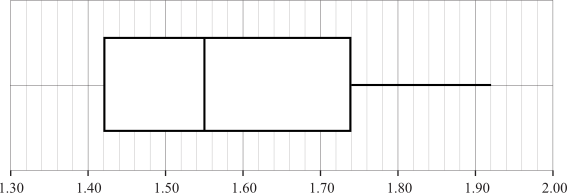
\begin{array} {|l|l|}
\hline
\rule{0pt}{2.5ex} \textbf{Determinant of Health} \rule[-1ex]{0pt}{0pt} & \textbf{Example} \\
\hline
\rule{0pt}{2.5ex} \text{Health behaviour} \rule[-1ex]{0pt}{0pt} & \text{Physical activity/sedentary behaviour} \\
\hline
\rule{0pt}{2.5ex} \text{Biomedical factor} \rule[-1ex]{0pt}{0pt} & \text{Blood pressure} \\
\hline
\rule{0pt}{2.5ex} \text{Environmental factor} \rule[-1ex]{0pt}{0pt} & \text{Distance to health services} \\
\hline
\rule{0pt}{2.5ex} \text{Socioeconomic characteristic} \rule[-1ex]{0pt}{0pt} & \text{Homelessness} \\
\hline
\end{array}
Show Worked Solution
\begin{array} {|l|l|}
\hline
\rule{0pt}{2.5ex} \textbf{Determinant of Health} \rule[-1ex]{0pt}{0pt} & \textbf{Example} \\
\hline
\rule{0pt}{2.5ex} \text{Health behaviour} \rule[-1ex]{0pt}{0pt} & \text{Physical activity/sedentary behaviour} \\
\hline
\rule{0pt}{2.5ex} \text{Biomedical factor} \rule[-1ex]{0pt}{0pt} & \text{Blood pressure} \\
\hline
\rule{0pt}{2.5ex} \text{Environmental factor} \rule[-1ex]{0pt}{0pt} & \text{Distance to health services} \\
\hline
\rule{0pt}{2.5ex} \text{Socioeconomic characteristic} \rule[-1ex]{0pt}{0pt} & \text{Homelessness} \\
\hline
\end{array}

Note: Other valid health behaviours include diet, smoking, alcohol use and sun protection.

Filed Under: Biomedical and Health Behaviours Tagged With: Band 4, smc-5806-10-Health behaviours, smc-5806-20-Biomedical

HMS, HIC EQ-Bank 62

Describe TWO methods of collecting data and what type of data is collected in each example.   (4 marks)

--- 10 WORK AREA LINES (style=lined) ---

Show Answers Only

Answers could include two of the following examples:

Interviews

  • Face-to-face interactions where researchers ask questions to gather personal opinions and experiences.
  • Collect primarily qualitative data allowing for detailed explanations and follow-up questions.

Surveys

  • Series of consistent questions administered in person or online.
  • Collect both quantitative data (ratings, multiple choice) and qualitative data (open-ended responses).

Focus Groups

  • Guided discussions with selected individuals where a moderator facilitates conversation on a topic.
  • Collect primarily qualitative data through interactive responses where participants build on each other’s ideas.
Show Worked Solution

Answers could include two of the following examples:

Interviews

  • Face-to-face interactions where researchers ask questions to gather personal opinions and experiences.
  • Collect primarily qualitative data allowing for detailed explanations and follow-up questions.

Surveys

  • Series of consistent questions administered in person or online.
  • Collect both quantitative data (ratings, multiple choice) and qualitative data (open-ended responses).

Focus Groups

  • Guided discussions with selected individuals where a moderator facilitates conversation on a topic.
  • Collect primarily qualitative data through interactive responses where participants build on each other’s ideas.

Filed Under: Meanings of health - investigation Tagged With: Band 4, smc-5508-30-Data collection methods

HMS, HIC EQ-Bank 53 MC

A researcher is investigating young people's perceptions of health using a survey. Which of the following would be most important to ensure the reliability of the data collection?

  1. Using open-ended questions exclusively
  2. Asking the same questions to all participants
  3. Conducting the survey only in person
  4. Focusing only on quantitative measurements
Show Answers Only

\(B\)

Show Worked Solution
  • B is correct because asking the same questions to all participants helps maintain consistency and reliability in the research.

Other options:

  • A is incorrect as closed questions are also valuable in surveys and help with standardisation.
  • C is incorrect as surveys can be reliable whether conducted in person or through other means.
  • D is incorrect as qualitative data can also be collected reliably through surveys.

Filed Under: Meanings of health - investigation Tagged With: Band 4, smc-5508-30-Data collection methods

HMS, HIC EQ-Bank 51 MC

Which of the following best describes a key difference between surveys and questionnaires in research?

  1. Surveys are usually conducted with the researcher present, while questionnaires are typically completed without the researcher's presence.
  2. Surveys can only collect quantitative data, while questionnaires can collect both quantitative and qualitative data.
  3. Surveys are always paper-based, while questionnaires are exclusively digital.
  4. Surveys are designed for adults, while questionnaires are designed for young people.
Show Answers Only

\(A\)

Show Worked Solution
  • A is correct because surveys involve the researcher asking questions and recording responses, while questionnaires are usually completed independently by participants.

Other options:

  • B is incorrect as both surveys and questionnaires can collect both types of data.
  • C is incorrect as both methods can be implemented in various formats.
  • D is incorrect as both can be designed for any age group with appropriate language.

Filed Under: Meanings of health - investigation Tagged With: Band 4, smc-5508-30-Data collection methods

Financial Maths, STD2 F4 2024 HSC 7 MC (Adapted)

Four years ago, the price of a laptop was $1,200.

Due to inflation, the price increased annually by 3%.

What is the price of this laptop now?

  1. $1,248.00
  2. $1,349.86
  3. $1,350.61
  4. $1,374.62
Show Answers Only

\(C\)

Show Worked Solution

\(r=3 \%=\dfrac{3}{100}=0.03\)

  \(FV\) \(=PV(1+r)^n\)
    \(=1200(1.03)^4\)
    \(=1350.61\)

 
\(\Rightarrow C\)

Filed Under: Compound Interest and Shares (Std2-X), Investment (Y12-X) Tagged With: adapted, Band 4, smc-7726-20-FV Formula, smc-817-20-FV Formula

PHYSICS, M2 EQ-Bank 6 MC

A box of mass \(m\) is sliding across a horizontal surface and slowing down with a constant deceleration of 3.0 ms\(^{-2}\).
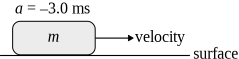
 

What is the coefficient of kinetic friction, \(\mu\), closest to?

  1. \(29.4\)
  2. \(3.1\)
  3. \(0.31\)
  4. \(0.15\)
Show Answers Only

\(C\)

Show Worked Solution
  • The coefficient of kinetic friction can be calculated using the equation \(F_f=\mu F_N\):
\(F_f\) \(=\mu F_N\)  
\(ma\) \(=\mu \times mg\)  
\(a\) \(=\mu \times g\)  
\(\mu\) \(=\dfrac{a}{g}=\dfrac{3}{9.8}=0.31\)  

 
\(\Rightarrow C\)

Filed Under: Forces, Acceleration and Energy Tagged With: Band 4, smc-4276-20-Friction

Financial Maths, STD2 F4 2023 HSC 10 MC (Adapted)

An amount of $18 000 is invested for five years. Interest is earned at a rate of 6% per annum, compounding monthly.

Which expression gives the value of the investment after 5 years, in dollars?

  1. `18\ 000 xx 1.005^{60}`
  2. `18\ 000 xx 1.06^{5}`
  3. `18\ 000 xx 1.005^{5}`
  4. `18\ 000 xx 1.06^{60}`
Show Answers Only

`A`

Show Worked Solution

`text{Interest rate}\ = 6/12=0.5%\ text{per month}`

`text{Compounding periods}\ = 5xx12=60`

`:.FV=18\ 000 xx 1.005^{60}`

`=>A`

Filed Under: Compound Interest and Shares (Std2-X), Investment (Y12-X) Tagged With: adapted, Band 4, smc-7726-20-FV Formula, smc-817-20-FV Formula

HMS, HIC EQ-Bank 061

Discuss how the determinants of health influence the health-related behaviours of Aboriginal and Torres Strait Islander young people.   (5 marks)

--- 15 WORK AREA LINES (style=lined) ---

Show Answers Only

Language highlighting relationships is bolded in the answer below.

Determinants that increase health-risk behaviours

  • Socioeconomic disadvantage, including lower household income and fewer job opportunities, increases stress and limits healthy options. This can lead to risk behaviours such as smoking and harmful alcohol use being used to cope.
  • Living in remote areas limits access to sport, affordable fresh food and youth health services. As a result, young people in remote areas have higher daily smoking rates than those in non-remote areas.
  • Experiences of racism and the intergenerational effects of past government policies reduce trust in mainstream health services. This means young people may delay help-seeking, even when they need care.

Determinants that protect or limit this influence

  • Strong family and kinship networks provide guidance and positive role models. This can encourage healthy behaviours and reduce the likelihood of substance use.
  • Behaviours are not fixed by disadvantage. Daily smoking among Aboriginal and Torres Strait Islander people aged 15–24 fell from 45% in 2002 to 31% in 2014–15, showing that targeted programs and community action can change behaviour.
  • Individual factors such as knowledge, attitudes and health literacy also shape choices. Therefore, determinants increase the risk of unhealthy behaviours rather than guarantee them.
Show Worked Solution

Language highlighting relationships is bolded in the answer below.

Determinants that increase health-risk behaviours

  • Socioeconomic disadvantage, including lower household income and fewer job opportunities, increases stress and limits healthy options. This can lead to risk behaviours such as smoking and harmful alcohol use being used to cope.
  • Living in remote areas limits access to sport, affordable fresh food and youth health services. As a result, young people in remote areas have higher daily smoking rates than those in non-remote areas.
  • Experiences of racism and the intergenerational effects of past government policies reduce trust in mainstream health services. This means young people may delay help-seeking, even when they need care.

Determinants that protect or limit this influence

  • Strong family and kinship networks provide guidance and positive role models. This can encourage healthy behaviours and reduce the likelihood of substance use.
  • Behaviours are not fixed by disadvantage. Daily smoking among Aboriginal and Torres Strait Islander people aged 15–24 fell from 45% in 2002 to 31% in 2014–15, showing that targeted programs and community action can change behaviour.
  • Individual factors such as knowledge, attitudes and health literacy also shape choices. Therefore, determinants increase the risk of unhealthy behaviours rather than guarantee them.

Filed Under: Health Status of Young People Tagged With: Band 4, Band 5, smc-5509-40-Protective factors, smc-5509-60-ATSI

HMS, HIC EQ-Bank 060

Explain how Aboriginal Community Controlled Health Organisations (ACCHOs) are addressing barriers to healthcare access for Aboriginal and Torres Strait Islander young people.   (4 marks)

--- 12 WORK AREA LINES (style=lined) ---

Show Answers Only

Language highlighting the cause-effect relationship is bolded in the answer below.

  • Fear of racism and culturally unsafe care discourages young people from seeking help. ACCHOs employ Aboriginal health workers who understand cultural protocols, which results in culturally safe care so that young people are more willing to seek help early.
  • Distance from services limits access in rural and remote areas. ACCHOs are located within the communities they serve and many provide transport, which means young people can access care locally rather than missing appointments.
  • Cost is a barrier for young people from low-income families. ACCHOs often bulk-bill or provide free services, which removes out-of-pocket costs so financial disadvantage does not delay treatment.
  • Fragmented services make it hard to manage complex needs. ACCHOs provide holistic primary health care, including social and emotional wellbeing support, in one place. As a result, young people receive coordinated care for mental and physical health.
  • Mistrust of mainstream health services stems from past and ongoing discrimination. ACCHOs are governed by boards elected from the local Aboriginal community, which builds trust because services reflect community priorities. This leads to greater use of health services by young people.
Show Worked Solution

Language highlighting the cause-effect relationship is bolded in the answer below.

  • Fear of racism and culturally unsafe care discourages young people from seeking help. ACCHOs employ Aboriginal health workers who understand cultural protocols, which results in culturally safe care so that young people are more willing to seek help early.
  • Distance from services limits access in rural and remote areas. ACCHOs are located within the communities they serve and many provide transport, which means young people can access care locally rather than missing appointments.
  • Cost is a barrier for young people from low-income families. ACCHOs often bulk-bill or provide free services, which removes out-of-pocket costs so financial disadvantage does not delay treatment.
  • Fragmented services make it hard to manage complex needs. ACCHOs provide holistic primary health care, including social and emotional wellbeing support, in one place. As a result, young people receive coordinated care for mental and physical health.
  • Mistrust of mainstream health services stems from past and ongoing discrimination. ACCHOs are governed by boards elected from the local Aboriginal community, which builds trust because services reflect community priorities. This leads to greater use of health services by young people.

Filed Under: Individual, organisational and community advocacy Tagged With: Band 4, Band 5, smc-5512-40-NGOs

HMS, HIC EQ-Bank 050 MC

Which of the following represents the MOST significant protective factor for improving the health of Aboriginal and Torres Strait Islander young people?

  1. Lowering the cost of transport to healthcare facilities.
  2. Connection to Country and participation in cultural activities.
  3. Developing more healthcare facilities in major cities.
  4. Increasing diagnostic testing facilities across all regions.
Show Answers Only

\(B\)

Show Worked Solution
  • B is correct because connection to Country and participation in cultural activities have been identified as significant protective factors that positively influence overall health and wellbeing.

Other options:

  • A is incorrect because while important, transport cost is just one aspect of healthcare access.
  • C is incorrect because most healthcare development is needed in regional and remote areas, not major cities.
  • D is incorrect because merely increasing diagnostic facilities doesn’t address the crucial cultural, social and holistic aspects of health.

Filed Under: Health Status of Young People Tagged With: Band 4, smc-5509-40-Protective factors, smc-5509-60-ATSI

PHYSICS, M2 EQ-Bank 1 MC

A block with a mass of 300 kg is sliding across a frictionless floor at a constant speed of 6 ms\(^{-1}\).

What magnitude of force is required to keep the block moving at this constant speed?

  1. \(0\ \text{N}\)
  2. \(0.03\ \text{N}\)
  3. \(50\ \text{N}\)
  4. \(1800\ \text{N}\)
Show Answers Only

\(A\)

Show Worked Solution
  • The object is moving at a constant velocity. 
  • By Newton’s first law of motion, an object travelling at a constant velocity will continue to travel at a constant velocity unless acted upon by an unbalanced force. 
  • As the block is moving on a frictionless surface, there is no net force on the block. The block requires \(0\ \text{N}\) of force to continue to move at a constant speed.

\(\Rightarrow A\)

Filed Under: Forces, Acceleration and Energy Tagged With: Band 4, smc-4276-20-Friction

Financial Maths, GEN1 2024 NHT 19-20 MC

Edo invests $10 000 in an account earning 3% interest per annum compounding monthly.

Question 19

The value, \(V_n\), of Edo's investment after \(n\) months is given by

  1. \(V_n=10\,000 \times 1.0025^n\)
  2. \(V_n=10\,000 \times 1.003^n\)
  3. \(V_n=10\,000 \times 1.03^n\)
  4. \(V_n=10\,000 \times 1.003^{12 n}\)
  5. \(V_n=10\,000 \times 1.03^{12 n}\)

 
Question 20

The effective interest rate for Edo's investment is closest to

  1. 2.96%
  2. 2.98%
  3. 3.00%
  4. 3.02%
  5. 3.04%
Show Answers Only

\(\text{Question 19:}\ A\)

\(\text{Question 20:}\ E\)

Show Worked Solution

\(\text{Question 19}\)

\(\text{Interest rate}\ = \dfrac{3.0\%}{12}=0.25\%\ \text{per month}\)

\(\text{After \(n\) months:}\)

\(V_n=10\,000 \times 1.0025^{n}\)

\(\Rightarrow  A\)
 

\(\text{Question 20}\)

\(\text{Let \(r\) = annual bank rate = 3.0%} \)

\(r_{effective} = \left[\left(1+\dfrac{3.0}{100 \times 12}\right)^{12}-1\right] \times 100\%=3.04\% \)

\(\Rightarrow E\)

Filed Under: Interest Rates and Investing Tagged With: Band 3, Band 4, smc-604-20-Compound interest, smc-604-25-Effective interest rate

Financial Maths, STD2 F4 2022 HSC 11 MC (Adapted)

In eight years, the future value of an investment will be $120 000. The interest rate is 6% per annum, compounded half-yearly.

Which equation will give the present value `(PV)` of the investment?

  1. `PV=(120\ 000)/((1+0.06)^(8))`
  2. `PV=(120\ 000)/((1+0.03)^(8))`
  3. `PV=(120\ 000)/((1+0.03)^(16))`
  4. `PV=(120\ 000)/((1+0.06)^(16))`
Show Answers Only

`C`

Show Worked Solution

`text{Compounding periods} = 8 xx 2 = 16`

`text{Compounding rate} = (6text{%}) / 2 = 3text{%} = 0.03`

`PV = (120\ 000) / ((1 + 0.03) ^{16})`

`=> C`

Filed Under: Compound Interest and Shares (Std2-X), Investment (Y12-X) Tagged With: adapted, Band 4, common-content, num-title-ct-coreb, num-title-qs-hsc, smc-7726-20-FV Formula, smc-817-20-FV Formula

Financial Maths, STD2 F4 2016 HSC 8 MC (Adapted)

The table shows the future value of an investment of $1000, compounding yearly, at varying interest rates for different periods of time.
 

2ug-2016-hsc-8-mc 

 
Based on the information provided, what is the future value of an investment of $3500 over 5 years at 2% pa?

  1.    $1554.80
  2.    $2835.72
  3.    $3864.28
  4.    $4312.36
0

Show Answers Only

`=> C`

Show Worked Solution

`text(Table factor) = 1104.08`

`:. FV` `= 3.5 xx 1104.08`
  `= $3864.28`

 
`=> C`

Filed Under: Compound Interest and Shares (Std2-X) Tagged With: adapted, Band 4, common-content, smc-1002-10-Compounded Value of $1 Table, smc-1108-40-Compounded Value of $1, smc-817-10-Compounded Value of $1 Table

Recursion, GEN1 2024 NHT 17 MC

Mel bought a new car for $60 000. She will depreciate the value of the car using the reducing balance method. A recurrence relation that models the year-to-year value of her car, \(M_n\), is

\(M_0=60 \, 000, \quad M_{n+1}=0.85 \ M_n\)

An equivalent rule to determine the value of the car after \(n\) years is

  1. \(M_n=60\,000-0.85 n\)
  2. \(M_n=60\,000+0.85 n\)
  3. \(M_n=60\,000+0.85^n\)
  4. \(M_n=60\,000 \times 0.85^{n-1}\)
  5. \(M_n=60\,000 \times 0.85^n\)
Show Answers Only

\(E\)

Show Worked Solution

\(\text{Reducing balance}\ \ \Rightarrow \ \ \text{Eliminate A, B and C}\)

\(\text{After 1 year, value}\ M_1=60\,000 \times 0.85\)

\(\Rightarrow E\)

Filed Under: Depreciation, Recursion - Financial Tagged With: Band 4, smc-602-50-Recurrence relation, smc-717-60-Depreciation (reducing balance)

  • « Previous Page
  • 1
  • …
  • 26
  • 27
  • 28
  • 29
  • 30
  • …
  • 125
  • Next Page »

Copyright © 2014–2026 SmarterEd.com.au · Log in