SmarterEd

Aussie Maths & Science Teachers: Save your time with SmarterEd

  • Login
  • Get Help
  • About

CHEMISTRY, M7 2024 HSC 14 MC

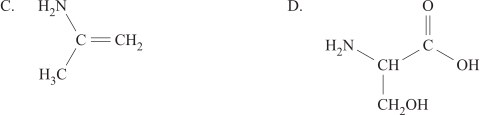
Glycine, an amino acid, can react with itself or other amino acid monomers to form silk, a natural polymer.

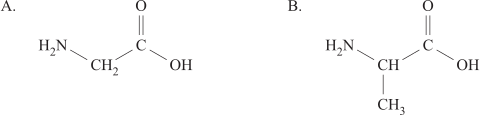
Glycine has the structure:
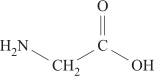


A section of silk polymer is shown.
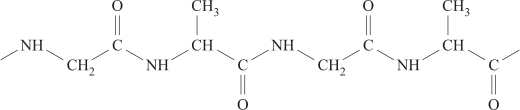
 

Which monomer could react with glycine to form this section of silk polymer?


Show Answers Only

\(B\)

Show Worked Solution
  • The silk polymer shown is a condensation polymer and also a polyamide formed from monomers containing the amine and carboxylic functional groups.
  • During the formation of the polymer, the \(\ce{NH2}\) amine group will lose a hydrogen and that hydrogen will form a water molecule with the hydroxyl group.
  • The part of glycine that remains in the polymer is \(\ce{NHCH2CO}\).
  • The second repeating unit in the polymer is \(\ce{NHCHCH3CO}\).
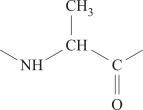
     

\(\Rightarrow B\)
Filed Under: Polymers Tagged With: Band 4, smc-3681-20-Condensation Polymers

CHEMISTRY, M7 2024 HSC 13 MC

A fuel has these enthalpies of combustion: –2057.8 kJ mol\(^{-1}\) and –48.9 kJ g\(^{-1}\).

Which of the following correctly identifies the fuel?

  1. Ethanol \(\left(M M=46.1 \text{ g mol}^{-1}\right)\)
  2. Propane \(\left(M M=44.1 \text{ g mol}^{-1}\right)\)
  3. Propene \(\left(M M=42.1 \text{ g mol}^{-1}\right)\)
  4. Hydrogen \(\left(M M=2.02 \text{ g mol}^{-1}\right)\)
Show Answers Only

\(C\)

Show Worked Solution
\(\dfrac{-2057.8\ \text{kJ mol}^{-1}}{x\ \text{g mol}^{-1}}\) \(=-48.9\ \text{kJ g}^{-1}\)  
\(x\ \text{g mol}^{-1}\) \(=\dfrac{-2057.8\ \text{kJ mol}^{-1}}{-48.9\ \text{kJ g}^{-1}}\)  
  \(=42.1\ \text{g mol}^{-1}\)  


\(\Rightarrow C\)

Filed Under: Alcohols Tagged With: Band 4, smc-3679-10-Combustion

CHEMISTRY, M7 2024 HSC 12 MC

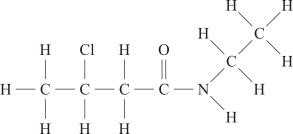
The structure of an organic substance is shown.


What is the preferred IUPAC name for this substance?

  1. 2-chloro-1-ethylbutanamide
  2. 2-chloro-\(N\)-ethylpropanamide
  3. 3-chloro-\(N\)-ethylbutanamide
  4. 3-chloro-1-ethylpropanamide
Show Answers Only

\(\Rightarrow C\)

Show Worked Solution

Compound is a secondary amide.

  • Pre-fix (longest carbon chain) \(\Rightarrow\) -butan
  • Suffix (functional group) \(\Rightarrow\) -amide, 
  • Alkyl chain bound to the amide nitrogen is treated as a substituent and as it is bound to the nitrogen atom \(\Rightarrow\) \(N\)-ethyl
  • As the amide group has the highest priority for the naming of the compound, carbon 1 is the carbon with the nitrogen and oxygen atom attached to it.
  • Hence, the chlorine atom is attached to carbon 3.
  • Compound name is 3-chloro-\(N\)-ethylbutanamide

\(\Rightarrow C\)

Filed Under: Nomenclature Tagged With: Band 4, smc-3676-08-Halogenated Organic Compounds, smc-3676-50-Amines and Amides

CHEMISTRY, M5 2024 HSC 7 MC

The following equilibrium was established in a container.

\(\ce{2SO_2(g) + O_2(g) \rightleftharpoons 2SO_3(g) \quad \Delta H= -198 kJ mol^{-1}}\)

Which of the following would increase the yield of \(\ce{SO_3(g)}\)?

  1. Increasing the volume
  2. Increasing the temperature
  3. Removing the product as it is formed
  4. Keeping temperature and volume constant
Show Answers Only

\(C\)

Show Worked Solution
  • \(A\): Increasing the volume decreases the pressure of the system → favours the reverse reaction, decreasing yield.
  • \(B\): Increasing the temperature will favour the reverse endothermic reaction, decreasing yield.
  • \(C\): Removing \(\ce{SO3(g)}\) as it is formed decreases the concentration of \(\ce{SO3(g)}\). By Le Chatelier’s principle, the equilibrium system will shift to increase the concentration of \(\ce{SO3(g)}\), increasing the yield.
  • \(D\): Keeping temp and volume constant will have no impact on the equilibrium system.

\(\Rightarrow C\)

Filed Under: Factors that Affect Equilibrium Tagged With: Band 4, smc-3670-30-Concentration, smc-3670-70-Max yield conditions

CHEMISTRY, M6 2024 HSC 6 MC

What is the hydroxide ion concentration of a solution of potassium hydroxide with a pH of 11 ?

  1. \(10^{-11} \text{ mol L}^{-1}\)
  2. \(10^{-3} \text{ mol L}^{-1}\)
  3. \(10^3 \text{ mol L}^{-1}\)
  4. \(10^{11}\text{ mol L}^{-1}\)
Show Answers Only

\(B\)

Show Worked Solution

\(\text{pOH}\ =14-11=3\)

\(\ce{[OH-]}\ =10^{-\text{pOH}}\ =10^{-3}\ \text{mol L}^{-1}\)

\(\Rightarrow B\)

Filed Under: Bronsted-Lowry Theory Tagged With: Band 4, smc-3674-10-Calculations Involving pH

CHEMISTRY, M7 2024 HSC 5 MC

Which would be the best reagent to use to determine whether an unknown substance was 2-methylpropan-1-ol or 2-methylpropan-2-ol?

  1. Bromine water
  2. Potassium nitrate solution
  3. Sodium carbonate solution
  4. Acidified potassium permanganate solution
Show Answers Only

\(D\)

Show Worked Solution
  • Can use an oxidation reaction to determine the unknown substance.
  • 2-methylpropan-1-ol is a primary alcohol whereas 2-methylpropan-2-ol is a tertiary alcohol.
  • Hence when undergoing oxidation with acidified potassium permanganate solution, the solution containing the primary alcohol will oxidise and experience a colour change from purple to colourless. The tertiary alcohol will not undergo oxidation.

\(\Rightarrow D\)

Filed Under: Alcohols Tagged With: Band 4, smc-3679-30-Oxidation

Networks, GEN2 2024 VCAA 13

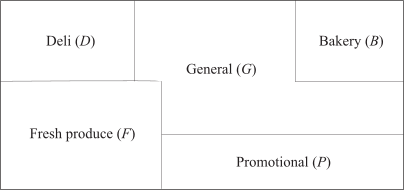
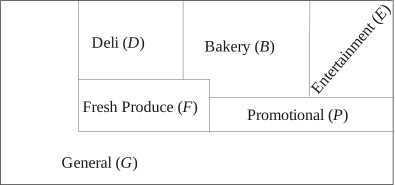
A supermarket has five departments, with areas allocated as shown on the floorplan below.
 

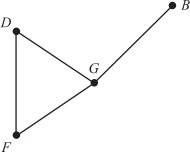
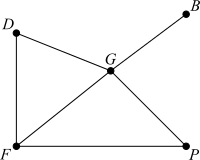
The floorplan is represented by the graph below.

On this graph, vertices represent departments and edges represent boundaries between two departments.

This graph is incomplete.
 

  1. Draw the missing vertex and missing edges on the graph above. Include a label.   (1 mark)

    --- 0 WORK AREA LINES (style=lined) ---

Karla is standing in the Promotional department.

She wants to visit each department in the supermarket once only.

  1.  i.  In which department will she finish?  (1 mark)

    --- 1 WORK AREA LINES (style=lined) ---

  2. ii.  What is the mathematical name for this type of journey?  (1 mark)

    --- 1 WORK AREA LINES (style=lined) ---

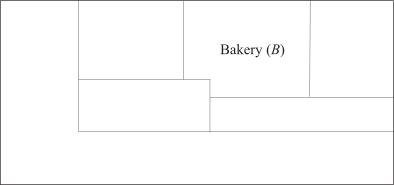
  3. The supermarket adds a new Entertainment department \((E)\), and the floorplan is rearranged.
  4. The boundaries between the departments are represented in the adjacency matrix below, where a ' 1 ' indicates a boundary between the departments.

\begin{aligned}
& \ \ B \ \ \ D \ \ \  E \ \ \  F \ \ \ G \ \ \ P \\
\begin{array}{c}
B\\
D \\
E \\
F \\
G \\
P
\end{array}& \begin{bmatrix}
0 & 1 & 1 & 1 & 0 & 1 \\
1 & 0 & 0 & 1 & 1 & 0 \\
1 & 0 & 0 & 0 & 0 & 1 \\
1 & 1 & 0 & 0 & 1 & 1 \\
0 & 1 & 0 & 1 & 0 & 1 \\
1 & 0 & 1 & 1 & 1 & 0
\end{bmatrix}
\end{aligned}

  1. Use the adjacency matrix to complete the floorplan below by labelling each department. The Bakery \((B)\) is already labelled.  (1 mark)

    --- 0 WORK AREA LINES (style=lined) ---

Show Answers Only

a. 

 
b.i.   
\(\text{The bakery}\)

b.ii.  \(\text{Hamiltonian Path}\)
 

c.

Show Worked Solution

a. 

b.i.  \(\text{Bakery}\)

b.ii. \(\text{The path has no repeated edges or vertices, and }\)

\(\text{incudes all the edges of the graph.}\)

\(\therefore\ \text{It is a Hamiltonian Path.}\)

c.

Filed Under: Travelling Problems and Adjacency Matrices Tagged With: Band 3, Band 4, smc-622-20-Hamiltonian, smc-622-40-Adjacency Matrix, smc-622-50-Draw Network from Map/Matrix

Matrices, GEN2 2024 VCAA 11

A population of a native animal species lives near the construction site.

To ensure that the species is protected, information about the initial female population was collected at the beginning of 2023. The birth rates and the survival rates of the females in this population were also recorded.

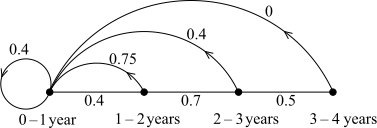
This species has a life span of 4 years and the information collected has been categorised into four age groups: 0-1 year, 1-2 years, 2-3 years, and 3-4 years.

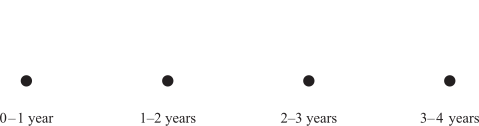
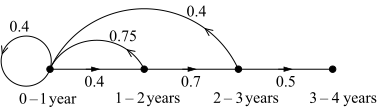
This information is displayed in the initial population matrix, \(R_0\), and the Leslie matrix, \(L\), below.

\(R_0=\left[\begin{array}{c}70 \\ 80 \\ 90 \\ 40\end{array}\right] \quad \quad L=\left[\begin{array}{cccc}0.4 & 0.75 & 0.4 & 0 \\ 0.4 & 0 & 0 & 0 \\ 0 & 0.7 & 0 & 0 \\ 0 & 0 & 0.5 & 0\end{array}\right]\)

  1. Using the information above
  2.  i. complete the following transition diagram.   (1 mark) 

    --- 0 WORK AREA LINES (style=lined) ---

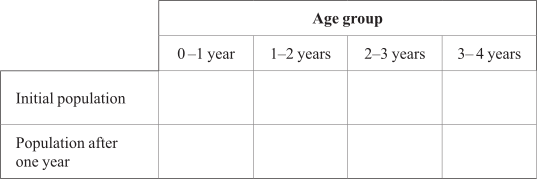
  1. ii. complete the following table, showing the initial female population, and the predicted female population after one year, for each of the age groups.  (1 mark)  

--- 0 WORK AREA LINES (style=lined) ---


  1. It is predicted that if this species is not protected, the female population of each of the four age groups will rapidly decrease within the next 10 years.
  2. After how many years is it predicted that the total female population of this species will first be half the initial female population?   (1 mark)

    --- 1 WORK AREA LINES (style=lined) ---

Show Answers Only

a.i. 

a.ii.

  \(\textbf{Age Group}\)
  \(\ 0-1\ \text{year}\ \) \(\ 1-2\ \text{years}\ \) \(\ 2-3\ \text{years}\ \) \(\ 3-4\ \text{years}\ \)
\(\ \text{Initial population}\ \) \(70\) \(80\) \(90\) \(40\)
\(\ \text{Population after}\ \)
\(\ \text{one year}\)
\(124\) \(28\) \(56\) \(45\)


b.    \(\text{5 years}\)

Show Worked Solution

a.i. 

♦♦♦ Mean mark (a) 24%.

a.ii.  \(\text{Population after 1 yr calculations}\)

\(0-1\ \text{year}\ =0.4\times 70+0.75\times 80+0.4\times 90=124\)

\(1-2\ \text{years}\ =0.4\times 70=28\)

\(2-3\ \text{years}\ =0.7\times 80=56\)

\(3-4\ \text{years}\ =0.5\times 90=45\)


  \(\textbf{Age Group}\)
  \(\ 0-1\ \text{year}\ \) \(\ 1-2\ \text{years}\ \) \(\ 2-3\ \text{years}\ \) \(\ 3-4\ \text{years}\ \)
\(\ \text{Initial population}\ \) \(70\) \(80\) \(90\) \(40\)
\(\ \text{Population after}\ \)
\(\ \text{one year}\)
\(124\) \(28\) \(56\) \(45\)


b.    \(\text{Using CAS:}\)

\(R_1=L\times R_0=\begin{bmatrix}
124  \\
28 \\
56  \\
45  \end{bmatrix}\ \ \text{Total = 253}\ ,\ \ R_2=L\times R_1=\begin{bmatrix}
93  \\
49.6 \\
19.6  \\
28  \end{bmatrix}\ \ \text{Total = 190.2}\)


\(R_3=L\times R_2=\begin{bmatrix}
82.24  \\
37.2 \\
34.72  \\
9.8  \end{bmatrix}\ \ \text{Total = 163.96}\ ,\ \ R_4=L\times R_3=\begin{bmatrix}
74.684  \\
32.896 \\
26.04  \\
17.36  \end{bmatrix}\ \ \text{Total =150.98}\)


\(R_5=L\times R_4=\begin{bmatrix}
64.9616 \\
29.8736 \\
23.0272 \\
13.02 \end{bmatrix}\ \ \text{Total = 130.8824}\)

 
\(\therefore\ \text{Total female population less than 140 after 5 years}\)

♦ Mean mark (b) 39%.

Filed Under: Transition Matrices - Regular Tagged With: Band 4, Band 5, Band 6, smc-618-20-Matrix to Diagram, smc-618-24-Interpret Matrix, smc-618-55-Leslie matrix

Matrices, GEN2 2024 VCAA 10

To access the southern end of the construction site, Vince must enter a security code consisting of five numbers.

The security code is represented by the row matrix \(W\).

The element in row \(i\) and column \(j\) of \(W\) is \(w_{i j}\).

The elements of \(W\) are determined by the rule  \((i-j)^2+2 j\).

  1. Complete the following matrix showing the five numbers in the security code.   (1 mark)

    --- 0 WORK AREA LINES (style=lined) ---

To access the northern end of the construction site, Vince enters a different security code, consisting of eight numbers.

This security code is represented by the row matrix \(X\).

The element in row \(i\) and column \(j\) of \(X\) is \(x_{i j}\).

The elements of \(X\) are also determined by the rule  \((i-j)^2+2 j\).

  1. What is the last number in this security code to access the northern end of the construction site?  (1 mark)

    --- 2 WORK AREA LINES (style=lined) ---

Show Answers Only

a.    \(W=\ [2\quad 5\quad 10\quad 17\quad 26\ ]\)

b.    \(x_{18}=65\)

Show Worked Solution

a.     \(W\) \(=\ [(0)^2+2\ \ \  (-1)^2+4\ \ \  (-2)^2+36\ \ \  (-3)^2+8\ \ \  (-4)^2+10\ ]\)
    \(=\ [\ 2\quad 5\quad 10\quad 17\quad 26\ ]\)


b.    \(x_{18}=(1-8)^2+2\times 8=65\)

Mean mark (a) 54%.
♦ Mean mark (b) 50%

Filed Under: Matrix Calculations Tagged With: Band 4, Band 5, smc-616-70-Elements/Rules

Matrices, GEN2 2024 VCAA 9

Vince works on a construction site.

The amount Vince gets paid depends on the type of shift he works, as shown in the table below.

\begin{array}{|l|c|c|c|}
\hline
\rule{0pt}{2.5ex} \textbf{Shift type} \rule[-1ex]{0pt}{0pt}& \textbf{Normal} & \textbf{Overtime} & \textbf {Weekend} \\
\hline
\rule{0pt}{2.5ex} \textbf{Hourly rate of pay} \rule[-1ex]{0pt}{0pt} \ \text{(\$ per hour)} & 36 & 54 & 72 \\
\hline
\end{array}

This information is shown in matrix \(R\) below.

\begin{align*}
R=\left[\begin{array}{lll}
36 & 54 & 72
\end{array}\right] \end{align*}

  1. Matrix \(R^T\) is the transpose of matrix \(R\).
  2. Determine the matrix \(R^T\).   (1 mark)

    --- 3 WORK AREA LINES (style=lined) ---

During one week, Vince works 28 hours at the normal rate of pay, 6 hours at the overtime rate of pay, and 8 hours at the weekend rate of pay.

  1. Complete the following matrix calculation showing the total amount Vince has been paid for this week.  (1 mark)

    --- 0 WORK AREA LINES (style=lined) ---


Vince will receive $90 per hour if he works a public holiday shift.

Matrix \(Q\), as calculated below, can be used to show Vince's hourly rate for each type of shift.

\begin{align*}
\begin{aligned}
Q & =n \times\left[\begin{array}{llll}
1 & 1.5 & 2 & p
\end{array}\right] \\
& =\left[\begin{array}{llll}
36 & 54 & 72 & 90
\end{array}\right] \end{aligned}
\end{align*}

  1. Write the values of \(n\) and \(p\).  (1 mark)

    --- 3 WORK AREA LINES (style=lined) ---

Show Answers Only

a.   \(R^T=\begin{bmatrix}
36 \\
54 \\
72
\end{bmatrix}\)

b.    \([28\quad  6\quad  8]\times R^T = [1908]\)

c.    \(n=36\ ,\ p=2.5\)

Show Worked Solution

a.   \(R^T=\begin{bmatrix}
36 \\
54 \\
72
\end{bmatrix}\)

 
b.   
\(\begin{bmatrix}
28 & 6 & 8
\end{bmatrix}\times\ R^T=\begin{bmatrix}
28\times36 + 6\times54+ 8\times 72
\end{bmatrix}=[1908]\)

 
c.   
\(n=\ \text{Normal hourly rate}\ =36\)

\(p=\ \text{Overtime rate}\ =\dfrac{90}{36}=2.5\)

Filed Under: Matrix Applications Tagged With: Band 3, Band 4, smc-619-10-Matrix from info/table, smc-619-20-Matrix product from table, smc-619-65-Transpose

Financial Maths, GEN2 2024 VCAA 7

Emi decides to invest a $300 000 inheritance into an annuity.

Let \(E_n\) be the balance of Emi's annuity after \(n\) months.

A recurrence relation that can model the value of this balance from month to month is

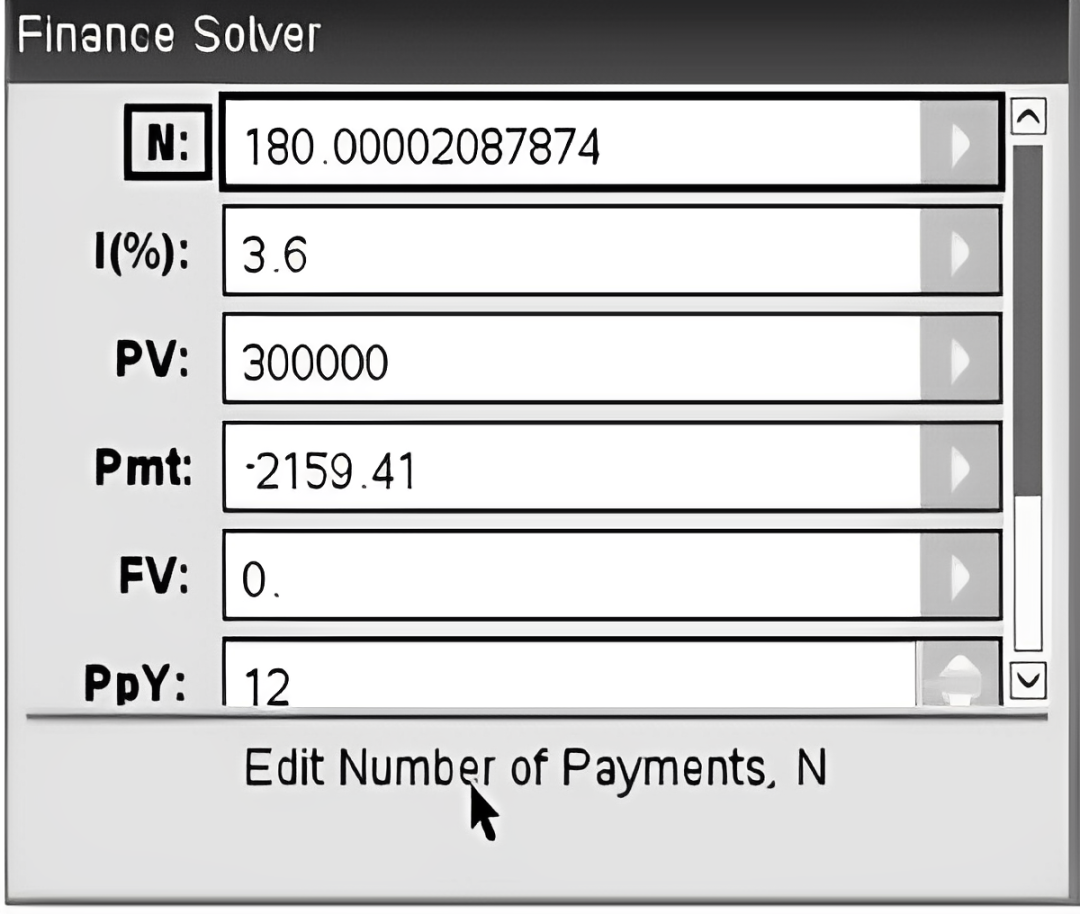
\(E_0=300\,000, \quad E_{n+1}=1.003 E_n-2159.41\)

  1. Showing recursive calculations, determine the balance of the annuity after two months. Round your answer to the nearest cent.   (1 mark)

    --- 3 WORK AREA LINES (style=lined) ---

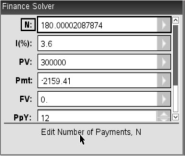
  2. For how many years will Emi receive the regular payment?  (1 mark)

    --- 2 WORK AREA LINES (style=lined) ---

  3. Calculate the annual compound interest rate for this annuity.  (1 mark)

    --- 2 WORK AREA LINES (style=lined) ---

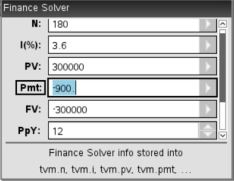
  4. If Emi wanted the annuity to act as a perpetuity, what monthly payment, in dollars, would she receive?  (1 mark)

    --- 2 WORK AREA LINES (style=lined) ---

Show Answers Only

a.    \($297\,477.40\) 

b.    \(15\ \text{years}\)

c.    \(3.6\%\)

d.    \($900\)

Show Worked Solution

a.   \(E_0=300\,000\)

\(E_1=1.003\times 300\,000-2159.41=$298\,740.59\)

\(E_2=1.003\times 298\,740.59-2159.41=$297\,477.4018\approx $297\,477.40\)

♦ Mean mark (a) 49%.

b.    \(\text{Using CAS:}\)

\(\text{Number of years}\ =\dfrac{180}{12}=15\ \text{years}\)
 

♦ Mean mark (b) 42%.

c.    \(\text{Annual interest rate}\ =(1.003-1)\times 12\times 100\% = 3.6\%\)
 

d.   \(\text{Method 1: Using CAS}\)

\(\text{Monthly payment}\ =$900\)
  

\(\text{Method 2:}\)

\(\text{Amount must be equal to the amount of monthly interest earned.}\)

\(\therefore\ \text{Monthly payment}\ =300\,000\times 0.003=$900\)

♦ Mean mark (d) 47%.

Filed Under: Annuities and Perpetuities Tagged With: Band 4, Band 5, smc-2512-10-Annuity, smc-2512-20-Perpetuity, smc-2512-50-CAS solver

Vectors, EXT2 V1 2024 HSC 15a

Consider the three vectors  \(\underset{\sim}{a}=\overrightarrow{O A}, \underset{\sim}{b}=\overrightarrow{O B}\) and \(\underset{\sim}{c}=\overrightarrow{O C}\), where \(O\) is the origin and the points \(A, B\) and \(C\) are all different from each other and the origin.

The point \(M\) is the point such that  \(\dfrac{1}{2}(\underset{\sim}{a}+\underset{\sim}{b})=\overrightarrow{O M}\).

  1. Show that \(M\) lies on the line passing through \(A\) and \(B\).   (1 mark)

    --- 2 WORK AREA LINES (style=lined) ---

  2. The point \(G\) is the point such that  \(\dfrac{1}{3}(\underset{\sim}{a}+\underset{\sim}{b}+\underset{\sim}{c})=\overrightarrow{O G}\).
  3. Show that \(G\) lies on the line passing through \(M\) and \(C\), and lies between \(M\) and \(C\).   (2 marks)

    --- 5 WORK AREA LINES (style=lined) ---

  4. The complex numbers \(x, w\) and \(z\) are all different and all have modulus 1.
  5. Using part (ii), or otherwise, show that  \(\dfrac{1}{3}(x+w+z)\) is never a cube root of \(x w z\).   (2 marks)

    --- 5 WORK AREA LINES (style=lined) ---

Show Answers Only

i.    \(\text{Equation of line through \(A\) and \(B\)}\)

\(\Rightarrow \ell_1=\overrightarrow{O A}+\lambda \overrightarrow{A B}\)

  \(\overrightarrow{O M}\) \(=\dfrac{1}{2} \underset{\sim}{a}+\dfrac{1}{2} \underset{\sim}{b}\)
    \(=\underset{\sim}{a}-\dfrac{1}{2} \underset{\sim}{a}+\dfrac{1}{2} \underset{\sim}{b}\)
    \(=\overrightarrow{O A}+\dfrac{1}{2}(\underset{\sim}{b}-\underset{\sim}{a})\)
    \(=\overrightarrow{O A}+\dfrac{1}{2} \overrightarrow{A B}\)

 
\(\therefore \overrightarrow{OM} \ \text{lies on} \ \ell_1\).
 

ii.    \(\text{Equation of line through \(M\) and \(C\)}\)

\(\Rightarrow \ell_2=\overrightarrow{OC}+\lambda \overrightarrow{CM}\)

  \(\overrightarrow{O G}\) \(=\dfrac{1}{3}(\underset{\sim}{a}+\underset{\sim}{b}+\underset{\sim}{c})\)
    \(=\underset{\sim}{c}-\dfrac{2}{3} \underset{\sim}{c}+\dfrac{1}{3} \underset{\sim}{a}+\dfrac{1}{3} \underset{\sim}{b}\)
    \(=\overrightarrow{OC}+\dfrac{2}{3}\left(\dfrac{1}{2} \underset{\sim}{a}+\dfrac{1}{2} \underset{\sim}{b}-\underset{\sim}{c}\right)\)
    \(=\overrightarrow{OC}+\dfrac{2}{3} \overrightarrow{CM}\)

 
\(\therefore \overrightarrow{O G} \ \ \text{lies on} \ \ \ell_2\)

\(\ \ \overrightarrow{O G} \neq \overrightarrow{O C}  \ \ \text{and} \ \ \overrightarrow{O G} \neq \overrightarrow{O M}\)

\(\therefore G \ \ \text{lies between} \ \ C \ \text{and} \ M\).
 

iii.  \(\text{Place}\ x, w,\ \text{and}\ z\ \text{on unit circle.}\)
 

\(\abs{w}=\abs{x}=\abs{z}=1\)

\(\text{Using part (ii):}\)

\(G \equiv \dfrac{1}{3}(x+w+z)\)

\(G \ \text{lies on} \ CM \Rightarrow G \ \text{is inside the unit circle.}\)

\(\Rightarrow\left|\dfrac{1}{3}(x+w+z)\right|<1\)

\(\text{Since}\ \ \abs{xwz}=\abs{x}\abs{w}\abs{z}=1\)

\(\Rightarrow \ \text{All cube roots have modulus = 1.}\)

\(\therefore \dfrac{1}{3}(x+w+z) \ \ \text{cannot be a cube root of  \(xwz\).}\)

Show Worked Solution

i.    \(\text{Equation of line through \(A\) and \(B\)}\)

\(\Rightarrow \ell_1=\overrightarrow{O A}+\lambda \overrightarrow{A B}\)

  \(\overrightarrow{O M}\) \(=\dfrac{1}{2} \underset{\sim}{a}+\dfrac{1}{2} \underset{\sim}{b}\)
    \(=\underset{\sim}{a}-\dfrac{1}{2} \underset{\sim}{a}+\dfrac{1}{2} \underset{\sim}{b}\)
    \(=\overrightarrow{O A}+\dfrac{1}{2}(\underset{\sim}{b}-\underset{\sim}{a})\)
    \(=\overrightarrow{O A}+\dfrac{1}{2} \overrightarrow{A B}\)

 
\(\therefore \overrightarrow{OM} \ \text{lies on} \ \ell_1\).
 

ii.    \(\text{Equation of line through \(M\) and \(C\)}\)

\(\Rightarrow \ell_2=\overrightarrow{OC}+\lambda \overrightarrow{CM}\)

  \(\overrightarrow{O G}\) \(=\dfrac{1}{3}(\underset{\sim}{a}+\underset{\sim}{b}+\underset{\sim}{c})\)
    \(=\underset{\sim}{c}-\dfrac{2}{3} \underset{\sim}{c}+\dfrac{1}{3} \underset{\sim}{a}+\dfrac{1}{3} \underset{\sim}{b}\)
    \(=\overrightarrow{OC}+\dfrac{2}{3}\left(\dfrac{1}{2} \underset{\sim}{a}+\dfrac{1}{2} \underset{\sim}{b}-\underset{\sim}{c}\right)\)
    \(=\overrightarrow{OC}+\dfrac{2}{3} \overrightarrow{CM}\)

 
\(\therefore \overrightarrow{O G} \ \ \text{lies on} \ \ \ell_2\)

\(\ \ \overrightarrow{O G} \neq \overrightarrow{O C}  \ \ \text{and} \ \ \overrightarrow{O G} \neq \overrightarrow{O M}\)

\(\therefore G \ \ \text{lies between} \ \ C \ \text{and} \ M\).

♦ Mean mark (ii) 43%.

iii.  \(\text{Place}\ x, w,\ \text{and}\ z\ \text{on unit circle.}\)
 

♦♦♦ Mean mark (iii) 10%.

\(\abs{w}=\abs{x}=\abs{z}=1\)

\(\text{Using part (ii):}\)

\(G \equiv \dfrac{1}{3}(x+w+z)\)

\(G \ \text{lies on} \ CM \Rightarrow G \ \text{is inside the unit circle.}\)

\(\Rightarrow\left|\dfrac{1}{3}(x+w+z)\right|<1\)

\(\text{Since}\ \ \abs{xwz}=\abs{x}\abs{w}\abs{z}=1\)

\(\Rightarrow \ \text{All cube roots have modulus = 1.}\)

\(\therefore \dfrac{1}{3}(x+w+z) \ \ \text{cannot be a cube root of  \(xwz\).}\)

Filed Under: Vectors and Vector Equations of Lines Tagged With: Band 4, Band 5, Band 6, smc-1196-25-Point lies on line, smc-1196-70-2D vectors, smc-1196-85-Complex Numbers

Financial Maths, GEN2 2024 VCAA 5

Emi operates a mobile dog-grooming business.

The value of her grooming equipment will depreciate.

Based on average usage, a rule for the value, in dollars, of the equipment, \(V_n\), after \(n\) weeks is

\(V_n=15000-60 n\)

Assume that there are exactly 52 weeks in a year.

  1. By what amount, in dollars, does the value of the grooming equipment depreciate each week?   (1 mark)

    --- 1 WORK AREA LINES (style=lined) ---

  2. Emi plans to replace the grooming equipment after four years.   
  3. What will be its value, in dollars, at this time?   (1 mark)

    --- 2 WORK AREA LINES (style=lined) ---

  4. \(V_n\) is the value of the grooming equipment, in dollars, after \(n\) weeks.   
  5. Write a recurrence relation in terms of \(V_0, V_{n+1}\) and \(V_n\) that can model this value from one week to the next.   (1 mark)

    --- 2 WORK AREA LINES (style=lined) ---

  6. The value of the grooming equipment decreases from one year to the next by the same percentage of the original $15 000 value.
  7. What is this annual flat rate percentage?   (1 mark)

    --- 2 WORK AREA LINES (style=lined) ---

Show Answers Only

a.    \($60\)

b.    \($2520\)

c.    \(V_0=15\,000 , \ \ V_{n+1}=V_n-60\)

d.    \(20.8\%\)

Show Worked Solution

a.    \($60\)
 

b.    \(n=4\times 52=208\)

\(V_{208}\) \(=15\,000-60\times208\)
  \(=$2520\)

 
c.   
\(V_0=15\,000 , \ \ V_{n+1}=V_n-60\)
 

d.    \(\text{Flat rate}\ =\dfrac{60}{15\,000}\times 52\times 100\%=20.8\%\)

♦ Mean mark (d) 42%.

Filed Under: Depreciation Tagged With: Band 3, Band 4, Band 5, smc-602-10-Flat rate, smc-602-50-Recurrence relation

Data Analysis, GEN2 2024 VCAA 4

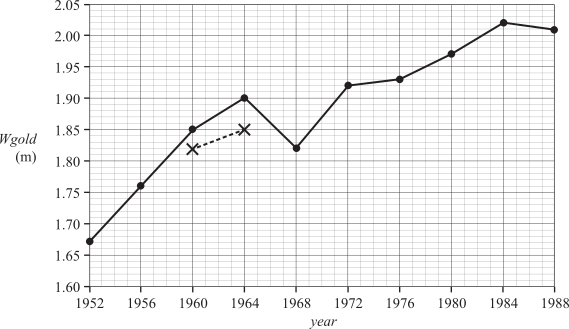
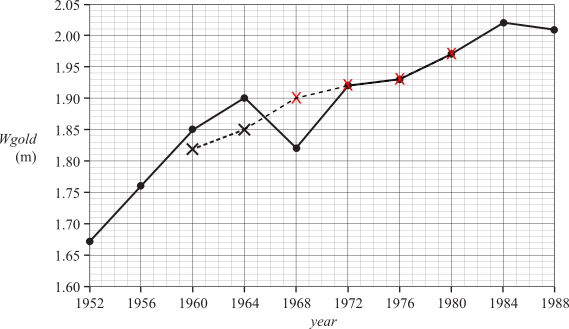
The time series plot below shows the gold medal-winning height for the women's high jump, \(\textit{Wgold}\), in metres, for each Olympic year, \(year\), from 1952 to 1988.
 

A five-median smoothing process will be used to smooth the time series plot above.

The first two points have been placed on the graph with crosses (X) and joined by a dashed line (---).

  1. Complete the five-median smoothing by marking smoothed values with crosses (X) joined by a dashed line (---) on the time series plot above.   (1 mark)

    --- 0 WORK AREA LINES (style=lined) ---

  2. Identify two qualitative features that best describe the time series plot above.  (1 mark)

    --- 2 WORK AREA LINES (style=lined) ---

Show Answers Only

a.     

b.    \(\text{Random fluctuations, increasing trend.}\)

Show Worked Solution

a.    \(\text{Medians are:}\)

\(\textbf{1960}: 1.67, 1.76, \colorbox{lightblue}{1.82}, 1.85, 1.90\)

\(\textbf{1964}: 1.76, 1.82, \colorbox{lightblue}{1.85}, 1.90, 1.92\)

\(\textbf{1968}: 1.82, 1.85, \colorbox{lightblue}{1.90}, 1.92, 1.93\)

\(\textbf{1972}: 1.82, 1.90, \colorbox{lightblue}{1.92}, 1.93, 1.97\)

\(\textbf{1976}: 1.82, 1.92, \colorbox{lightblue}{1.93}, 1.97, 2.02\)

\(\textbf{1980}: 1.92, 1.93, \colorbox{lightblue}{1.97}, 2.01, 2.02\)
  

b.   \(\text{Qualitative features:}\)

\(\text{- Random fluctuations}\)

\(\text{- Increasing trend.}\)

♦♦♦ Mean mark (b) 24%.

Filed Under: Time Series Tagged With: Band 4, Band 5, smc-266-40-Time Series Trends, smc-266-70-MEDIAN Smoothing

Data Analysis, GEN2 2024 VCAA 3

The Olympic gold medal-winning height for the women's high jump, \(\textit{Wgold}\), is often lower than the best height achieved in other international women's high jump competitions in that same year.

The table below lists the Olympic year, \(\textit{year}\), the gold medal-winning height, \(\textit{Wgold}\), in metres, and the best height achieved in all international women's high jump competitions in that same year, \(\textit{Wbest}\), in metres, for each Olympic year from 1972 to 2020.

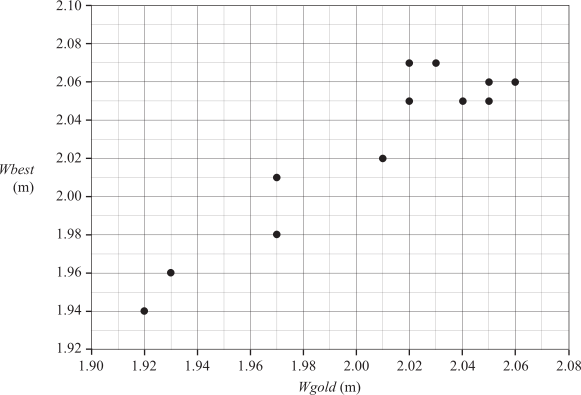
A scatterplot of \(\textit{Wbest}\) versus \(\textit{Wgold}\) for this data is also provided.

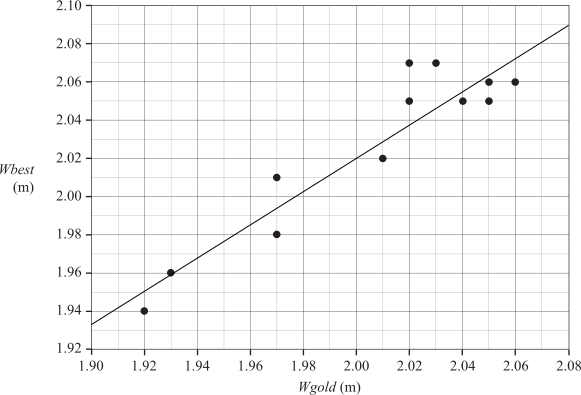
When a least squares line is fitted to the scatterplot, the equation is found to be:

\(Wbest =0.300+0.860 \times Wgold\)

The correlation coefficient is 0.9318

  1. Name the response variable in this equation.   (1 mark)

    --- 1 WORK AREA LINES (style=lined) ---

  2. Draw the least squares line on the scatterplot above.  (1 mark)

    --- 0 WORK AREA LINES (style=lined) ---

  3. Determine the value of the coefficient of determination as a percentage.  (1 mark)
  4. Round your answer to one decimal place.

    --- 1 WORK AREA LINES (style=lined) ---

  5. Describe the association between \(\textit{Wbest}\) and \(\textit{Wgold}\) in terms of strength and direction.  (1 mark)

    --- 0 WORK AREA LINES (style=lined) ---

\begin{array}{|l|l|}
\hline
\rule{0pt}{2.5ex}\text { strength } \rule[-1ex]{0pt}{0pt} & \quad \quad\quad\quad\quad\quad\quad\quad\quad\quad\quad\\
\hline
\rule{0pt}{2.5ex}\text { direction } \rule[-1ex]{0pt}{0pt} & \\
\hline
\end{array}

  1. Referring to the equation of the least squares line, interpret the value of the slope in terms of the variables \(\textit{Wbest}\) and \(\textit{Wgold}\).  (1 mark)

    --- 3 WORK AREA LINES (style=lined) ---

  2. In 1984, the \(\textit{Wbest}\) value was 2.07 m for a \(\textit{Wgold}\) value of 2.02 m .
  3. Show that when this least squares line is fitted to the scatterplot, the residual value for this point is 0.0328.  (2 marks)

    --- 4 WORK AREA LINES (style=lined) ---

  4. The residual plot obtained when the least squares line was fitted to the data is shown below. The residual value from part f is missing from the residual plot.
     

    1. Complete the residual plot by adding the residual value from part f, drawn as a cross ( X ), to the residual plot above.   (1 mark)

      --- 0 WORK AREA LINES (style=lined) ---

    2. In part b, a least squares line was fitted to the scatterplot. Does the residual plot from part g justify this? Briefly explain your answer.  (1 mark)

      --- 3 WORK AREA LINES (style=lined) ---

  1. In 1964, the gold medal-winning height, \(\textit{Wgold}\), was 1.90m . When the least squares line is used to predict \(\textit{Wbest}\), it is found to be 1.934 m .
  2. Explain why this prediction is not likely to be reliable.  (1 mark)

    --- 2 WORK AREA LINES (style=lined) ---

Show Answers Only

a.    \(Wbest\)

b.    

c.    \(86.8\%\)

d.    \(\text{Strong, positive}\)

e.    \(Wbest\ \text{will increase, on average, by 0.86 metres for every metre of increase in}\ Wgold.\)

f.      \(Wbest\) \(=0.300 +0.86\times 2.02\)
    \(=2.0372\)

\(\therefore\ \text{Residual}\ =2.07-2.0372=0.0328\)

g.i.

g.ii.  \(\text{Yes, it is justified as there is no clear pattern, linear or otherwise.}\)

h.    \(\text{This prediction is outside the data range (1972 – 2020 → extrapolation)}\)

\(\text{and therefore cannot be relied upon.}\)

Show Worked Solution

a.    \(Wbest\)

b.    \(\text{Using points:}\ (1.90, 1.934)\ \text{and}\ (2.00, 2.02)\)
 

Mean mark (b) 51%.

c.    \(r=0.9318\ \ \Rightarrow\ \ r^2=0.9318^2=0.8682\dots\)

\(\therefore\ \text{Coefficient of determination} \approx 86.8\%\)
 

d.    \(\text{Strong, positive}\)
 

e.    \(Wbest\ \text{will increase, on average, by 0.86 metres for every metre of increase in}\ Wgold.\)
 

f.      \(Wbest\) \(=0.300 +0.86\times 2.02\)
    \(=2.0372\)

 
\(\therefore\ \text{Residual}\ =2.07-2.0372=0.0328\)

♦ Mean mark (f) 48%.

g.i.

g.ii.  \(\text{Yes, it is justified as there is no clear pattern, linear or otherwise.}\)

♦ Mean mark (g)(i) 47%.
♦ Mean mark (g)(ii) 40%.

h.    \(\text{This prediction is outside the data range (1972–2020 → extrapolation)}\)

\(\text{and therefore cannot be relied upon.}\)

♦ Mean mark (h) 50%.

Filed Under: Correlation and Regression Tagged With: Band 3, Band 4, Band 5, smc-265-10-r / r^2 and Association, smc-265-30-LSRL formula, smc-265-40-Interpret Gradient, smc-265-50-Residuals, smc-265-60-Extrapolation / Interpolation, smc-265-75-Explanatory / Response

Data Analysis, GEN2 2024 VCAA 1

Table 1 lists the Olympic year, \(\textit{year}\), and the gold medal-winning height for the men's high jump, \(\textit{Mgold}\), in metres, for each Olympic Games held from 1928 to 2020. No Olympic Games were held in 1940 or 1944, and the 2020 Olympic Games were held in 2021.

Table 1

\begin{array}{|c|c|}
\hline \quad \textit{year} \quad & \textit{Mgold}\,\text{(m)} \\
\hline 1928 & 1.94 \\
\hline 1932 & 1.97 \\
\hline 1936 & 2.03 \\
\hline 1948 & 1.98 \\
\hline 1952 & 2.04 \\
\hline 1956 & 2.12 \\
\hline 1960 & 2.16 \\
\hline 1964 & 2.18 \\
\hline 1968 & 2.24 \\
\hline 1972 & 2.23 \\
\hline 1976 & 2.25 \\
\hline 1980 & 2.36 \\
\hline 1984 & 2.35 \\
\hline 1988 & 2.38 \\
\hline 1992 & 2.34 \\
\hline 1996 & 2.39 \\
\hline 2000 & 2.35 \\
\hline 2004 & 2.36 \\
\hline 2008 & 2.36 \\
\hline 2012 & 2.33 \\
\hline 2016 & 2.38 \\
\hline 2020 & 2.37 \\
\hline
\end{array}

  1. For the data in Table 1, determine:
  2.  i. the maximum \(\textit{Mgold}\) in metres   (1 mark)

    --- 1 WORK AREA LINES (style=lined) ---

  3. ii. the percentage of \(\textit{Mgold}\) values greater than 2.25 m.   (1 mark)

    --- 2 WORK AREA LINES (style=lined) ---

  4. The mean of these \(\textit{Mgold}\) values is 2.23 m, and the standard deviation is 0.15 m.
  5. Calculate the standardised \(z\)-score for the 2000 \(\textit{Mgold}\) of 2.35 m.   (1 mark)

    --- 3 WORK AREA LINES (style=lined) ---

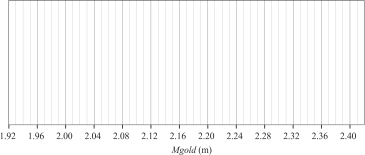
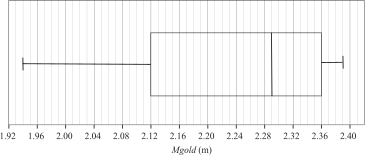
  6. Construct a boxplot for the \(\textit{Mgold}\) data in Table 1 on the grid below.   (2 marks)

    --- 0 WORK AREA LINES (style=lined) ---


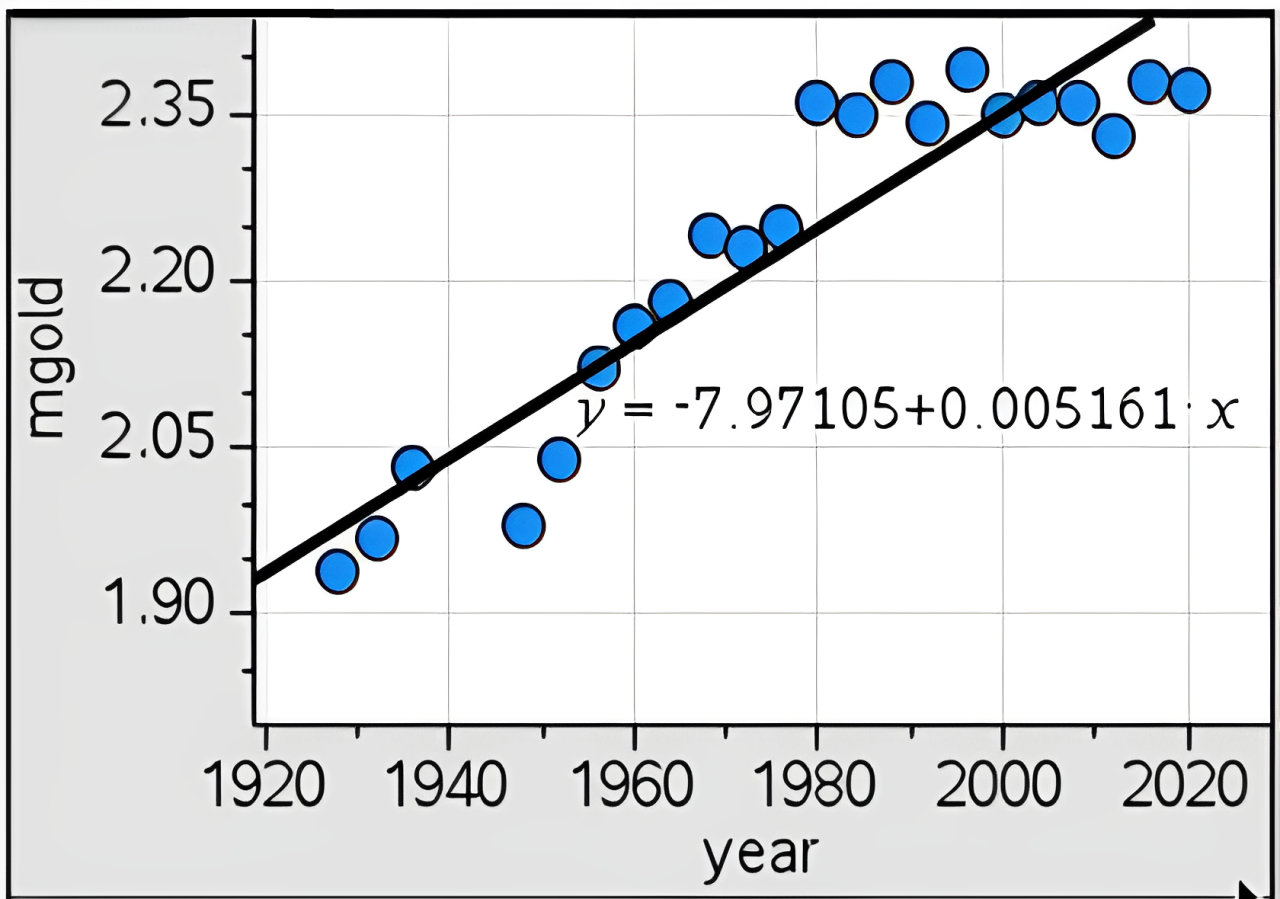
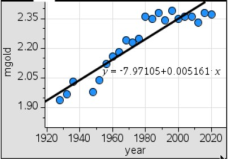
  1. A least squares line can also be used to model the association between \(\textit{Mgold}\) and \(\textit{year}\).
  2. Using the data from Table 1, determine the equation of the least squares line for this data set.
  3. Use the template below to write your answer.
  4. Round the values of the intercept and slope to three significant figures.   (2 marks)

    --- 0 WORK AREA LINES (style=lined) ---


  1. The coefficient of determination is 0.857
  2. Interpret the coefficient of determination in terms of \(\textit{Mgold}\) and \(\textit{year}\).   (1 mark)

    --- 4 WORK AREA LINES (style=lined) ---

Show Answers Only

a.i.   \(2.39\)

a.ii.  \(50\%\)

b.    \(0.8\)

c.     

d.   
    

e.    \(\text{A coefficient of determination of 85.7% shows the variation in}\)

\(\text{the}\ Mgold\ \text{that is explained by the variation in the }year.\)

Show Worked Solution

a.i.   \(2.39\)

a.ii.  \(\dfrac{11}{22}=50\%\)

b.     \(z\) \(=\dfrac{x-\overline x}{s_x}\)
    \(=\dfrac{2.35-2.23}{0.15}\)
    \(=0.8\)

  
c.   
\(Q_2=\dfrac{2.33+2.25}{2}=2.29\)

\(Q_1=2.12, \ Q_3=2.36\)

\(\text{Min}\ =1.94, \ \text{Max}\ =2.39\)
  

d.   \(\text{Using CAS:}\)


Mean mark (d) 52%.
Mean mark (e) 52%.

e.    \(\text{A coefficient of determination of 85.7% shows the variation in}\)

\(\text{the}\ Mgold\ \text{that is explained by the variation in the }year.\)

Filed Under: Correlation and Regression, Graphs - Stem/Leaf and Boxplots, Normal Distribution Tagged With: Band 2, Band 3, Band 4, smc-265-20-Find LSRL Equation/Gradient, smc-265-75-Explanatory / Response, smc-265-80-Rounding (Sig Fig), smc-600-10-Single z-score, smc-643-10-Single Box-Plots

BIOLOGY, M7 2024 HSC 12 MC

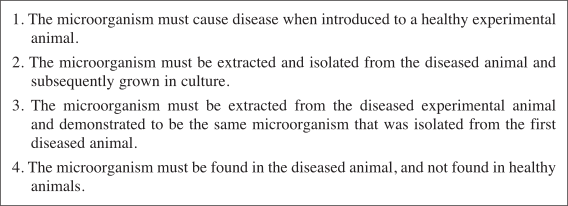
Robert Koch produced a set of criteria to establish whether a particular organism is the cause of a disease in an animal. The criteria are listed below but not in the correct order.
 

Which of the following correctly shows the order of steps required to determine the cause of a particular disease in an animal?

  1. 2, 3, 1, 4
  2. 2, 4, 1, 3
  3. 4, 2, 1, 3
  4. 4, 3, 2, 1
Show Answers Only

\(C\)

Show Worked Solution
  • Koch’s postulates follow a logical sequence of first identifying the microorganism in sick but not healthy animals (4).
  • Second step is isolating and culturing it (2), using it to infect a healthy animal to prove it causes disease (1), and finally re-isolating the same organism from the newly infected animal (3) to conclusively prove causation.

\(\Rightarrow C\)

Filed Under: Causes of Infectious Disease Tagged With: Band 4, smc-3655-70-Robert Koch

BIOLOGY, M7 2024 HSC 10 MC

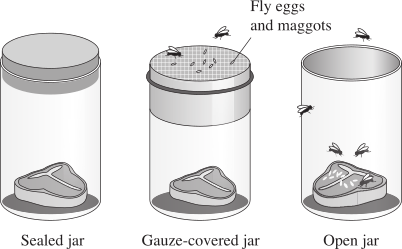
Francesco Redi challenged the idea that maggots arose spontaneously from rotting meat. A modern version of his experiment was set up as shown.
 

Which of the following is correct for this experimental set up?

  1. The sealed jar improves the validity of the experiment.
  2. The independent variable is whether the meat spoils or not.
  3. The use of three jars improves the reliability of the experiment.
  4. The dependent variable is the use of different covers for the jars.
Show Answers Only

\(A\)

Show Worked Solution
  • The sealed jar improves the validity of Redi’s experiment because it serves as a proper control that completely prevents flies from reaching the meat.
  • This allows Redi to conclusively demonstrate that maggots come from flies laying eggs rather than spontaneous generation.

\(\Rightarrow A\)

Mean mark 58%.

Filed Under: Causes of Infectious Disease Tagged With: Band 4, smc-3655-20-Transmission, smc-3655-30-Vectors

BIOLOGY, M6 2024 HSC 9 MC

The diagram shows a section of a chromosome in an insect. It represents three genes amongst non-coding DNA. The crosses mark locations of four separate mutations.
 

Which location could produce a new allele for eye colour?

  1. \(P\)
  2. \(Q\)
  3. \(R\)
  4. \(S\)
Show Answers Only

\(C\)

Show Worked Solution
  • Since \(R\) is located within the gene region for eye colour, a mutation at this location could alter the DNA sequence of this gene and produce a new allele for eye colour,.
  • Mutations at other locations (\(P, Q\) and \(S\)) are either in non-coding regions or different genes.

\(\Rightarrow C\)

Filed Under: Mutation Tagged With: Band 4, smc-3652-10-Mechanisms of Change/Variation, smc-3652-50-Non-Coding DNA

BIOLOGY, M5 2024 HSC 5 MC

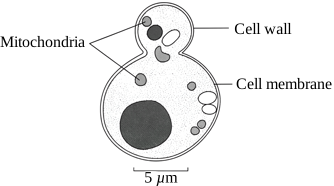
The diagram shows a cell reproducing.
 

Which row of the table correctly identifies the method of reproduction and the type of organism shown in the diagram?

\begin{align*}
\begin{array}{l}
\ & \\
\rule{0pt}{2.5ex}\textbf{}\rule[-1ex]{0pt}{0pt}\\
\rule{0pt}{2.5ex}\textbf{A.}\rule[-1ex]{0pt}{0pt}\\
\rule{0pt}{2.5ex}\textbf{B.}\rule[-1ex]{0pt}{0pt}\\
\rule{0pt}{2.5ex}\textbf{C.}\rule[-1ex]{0pt}{0pt}\\
\rule{0pt}{2.5ex}\textbf{D.}\rule[-1ex]{0pt}{0pt}\\
\\
\end{array}
\begin{array}{|l|l|}
\hline
\rule{0pt}{2.5ex} \textit{Method of reproduction} & \rule[-1ex]{0pt}{0pt} \textit{Type of organism} \\
\hline
\rule{0pt}{2.5ex} \text{Budding} \rule[-1ex]{0pt}{0pt} & \text{Fungi} \\
\hline
\rule{0pt}{2.5ex} \text{Binary fission} \rule[-1ex]{0pt}{0pt} & \text{Bacteria} \\
\hline
\rule{0pt}{2.5ex} \text{Production of spores} \rule[-1ex]{0pt}{0pt} & \text{Plant} \\
\hline
\rule{0pt}{2.5ex} \text{Gamete production} \rule[-1ex]{0pt}{0pt} & \text{Protist} \\
\hline
\end{array}
\end{align*}

Show Answers Only

\(A\)

Show Worked Solution
  • The diagram shows a cell with both mitochondria and a cell wall, and is reproducing via an outgrowth from the parent cell.
  • This represents budding in fungi rather than the other reproductive methods listed for different organisms.

\(\Rightarrow A\)

Mean mark 56%.

Filed Under: Reproduction Tagged With: Band 4, smc-3647-35-Fungi

Matrices, GEN1 2024 VCAA 30 MC

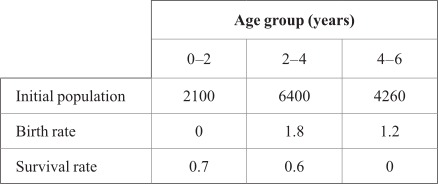
Data has been collected on the female population of a species of mammal located on a remote island.

The female population has been divided into three age groups, with the initial population (at the time of data collection), the birth rate, and the survival rate of each age group shown in the table below.
 

The Leslie matrix \((L)\) that may be used to model this particular population is

  1. \(L=\begin{bmatrix}0 & 1.8 & 0 \\ 0.7 & 0 & 1.2 \\ 0 & 0.6 & 0\end{bmatrix}\)
  2. \(L=\begin{bmatrix}0 & 1.8 & 1.2 \\ 0.7 & 0 & 0 \\ 0 & 0.6 & 0\end{bmatrix}\)
  3. \(L=\begin{bmatrix}0 & 1.8 & 1.2 \\ 0.7 & 0.6 & 0 \\ 0 & 0 & 0\end{bmatrix}\)
  4. \(L=\begin{bmatrix}2100 & 6400 & 4260 \\ 0 & 1.8 & 1.2 \\ 0.7 & 0.6 & 0\end{bmatrix}\)
Show Answers Only

\(B\)

Show Worked Solution

\(\text{Row 1 represents the birth rates for the time periods: Eliminate A}\)

\(\text{The sub-diagonal represents survival rates: Eliminate C and D}\)

\(\Rightarrow B\)

Filed Under: Transition Matrices - Regular Tagged With: Band 4, smc-618-55-Leslie matrix

Financial Maths, GEN1 2024 VCAA 22-23 MC

Stewart takes out a reducing balance loan of \$240 000, with interest calculated monthly.

Stewart makes regular monthly repayments.

Three lines of the amortisation table are shown below.

\begin{array}{|c|r|r|r|r|}
\hline
\rule{0pt}{2.5ex} \textbf{Payment} & \textbf {Payment} & \textbf {Interest} &\textbf{Principal reduction} & \textbf{Balance}\\
\rule[-1ex]{0pt}{0pt}\textbf{number} & \textbf{(\($\))}\ \ \ \ \  & \textbf{(\($\))}\ \ \ \ \ & \textbf{(\($\))}\ \ \ \ \ \ \ \ \ \ \ \ \ \ \ & \textbf{(\($\))}\ \ \ \ \ \\
\hline
\rule{0pt}{2.5ex} 0 & 0.00 & 0.00 & 0.00\ \ \ \ \ \ \ \ \ \  & 240\,000.00 \\
\hline
\rule{0pt}{2.5ex} 1 & 2741.05 & 960.00 & 1781.05\ \ \ \ \ \ \ \ \ \  & 238\,218.95 \\
\hline
\rule{0pt}{2.5ex} 2 & 2741.05 & & & \\
\hline
\end{array}

 
Part 1

The principal reduction associated with Payment number 2 is closest to

  1. $1773.93
  2. $1781.05
  3. $1788.17
  4. $2741.05

 
Part 2

The number of years that it will take Stewart to repay the loan in full is closest to

  1. 9
  2. 10
  3. 11
  4. 12
Show Answers Only

Part 1: \(C\)

Part 2: \(A\)

Show Worked Solution

Part 1

\(\text{Interest rate (monthly)}\ =\dfrac{960}{240\,000} = 0.004\)

\(\text{Interest repaid (payment 2)}\ =\dfrac{960}{240\,000}\times 238\,218.95=$952.88\)

\(\text{Principal Reduction (payment 2)}\ =2741.05-952.88=$1788.17\)

\(\Rightarrow C\)
 

Part 2

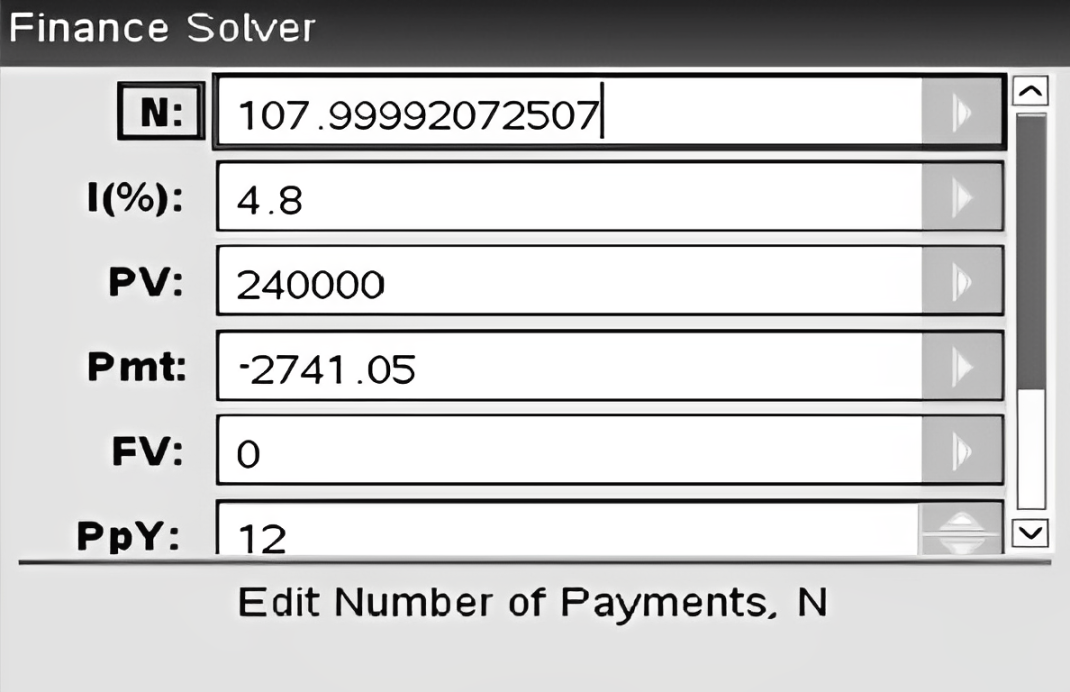
\(\text{Using CAS:}\)

\(\text{Annual interest rate}\ = 12 \times 0.004 = 4.8\%\)

\(\text{Number of repayments }= 108\ \text{months} = 9\ \text{years}\)

\(\Rightarrow A\)

♦ Mean mark (Part 2) 54%.

Filed Under: Borrowing and Loans Tagged With: Band 4, Band 5, smc-603-22-Reducible balance loans, smc-603-60-CAS (1 step)

Financial Maths, GEN1 2024 VCAA 21 MC

Lee took out a loan of $121 000, with interest compounding monthly. He makes monthly repayments of $2228.40 for five years until the loan is repaid in full.

The total interest paid by Lee is closest to

  1. $4434
  2. $5465
  3. $10 539
  4. $12 704
Show Answers Only

\(D\)

Show Worked Solution
\(\text{Repayments}\) \( =2228.40\times 12\times 5\)
  \(=$133\,704\)


\(\text{Interest}\) \(=133\,704-121\,000\)
  \(=$12\,704\)

 
\(\Rightarrow D\)

Mean mark 56%.

Filed Under: Borrowing and Loans Tagged With: Band 4, smc-603-40-Loans - Other

Recursion, GEN1 2024 VCAA 19 MC

Liv bought a new car for $35 000. The value of the car will be depreciated by 18% per annum using the reducing balance method.

A recurrence relation that models the year-to-year value of her car is of the form

\(L_0=35\,000, \quad L_{n+1}=k \times L_n\)

The value of \(k\) is

  1. 0.0082
  2. 0.18
  3. 0.82
  4. 1.18
Show Answers Only

\(C\)

Show Worked Solution

\(\text{Reducing balance rate}\ (k) =1-0.18=0.82\)

\(\Rightarrow C\)

Filed Under: Recursion - Financial Tagged With: Band 4, smc-717-80-Interpret RR

Recursion, GEN1 2024 VCAA 18 MC

Trevor took out a reducing balance loan of $400 000, with interest calculated weekly. The balance of the loan, in dollars, after \(n\) weeks,  \(T_n\), can be modelled by the recurrence relation

\(T_0=400\,000, \quad T_{n+1}=1.00075 T_n-677.55\)

Assume that there are exactly 52 weeks in a year.

The interest rate, per annum, for this loan is

  1. 0.75%
  2. 3.9%
  3. 4.5%
  4. 7.5%
Show Answers Only

\(B\)

Show Worked Solution

\(\text{Interest rate}\ = 0.00075\times 52 =0.039=3.9\%\)

\(\Rightarrow B\)

Filed Under: Recursion - Financial Tagged With: Band 4, smc-717-80-Interpret RR

Data Analysis, GEN1 2024 VCAA 16 MC

The table below shows the seasonal indices for the monthly takings of a bistro.

The seasonal indices for months 3 and 6 are missing.

\begin{array}{|l|c|c|c|c|c|c|c|c|c|c|c|c|}
\hline
\rule{0pt}{2.5ex} \textbf{Month} \rule[-1ex]{0pt}{0pt}& 1 & 2 & \ \ 3\ \ & 4 & 5 & \ \ 6 \ \ & 7 & 8 & 9 & 10 & 11 & 12 \\
\hline
\rule{0pt}{2.5ex}\textbf{Seasonal}& 1.08 & 1.13 & & 0.92 & 0.67 & & 1.09 & 1.35 & 0.82 & 0.88 & 1.01 & 0.98 \\
\textbf{index} \\
\hline
\end{array}

The seasonal index for month 3 is twice the seasonal index for month 6 .

The seasonal index for month 3 is closest to

  1. 0.69
  2. 1.04
  3. 1.38
  4. 2.07
Show Answers Only

\(C\)

Show Worked Solution

\(\text{Let}\ x=\text{seasonal index for month 6}\)

\(\rightarrow 2x=\text{seasonal index for month 3}\)
  

\(\dfrac{3x+1.08+1.13+0.92+0.67+1.09+1.35+0.82+0.88+1.01+0.98}{12}=1\)

\(3x+9.93\) \(=12\)  
\(x\) \(=\dfrac{12-9.93}{3}\)  
  \(=0.69\)  

 
\(\therefore\ \text{Seasonal Index month 3}\ =2\times 0.69=1.38\)

\(\Rightarrow C\)

Mean mark 58%.

Filed Under: Time Series Tagged With: Band 4, smc-266-10-Seasonal Index from a Table

Data Analysis, GEN1 2024 VCAA 15 MC

The table below shows the total number of cans of soft drink sold each month at a suburban cafe in 2023.

\begin{array}{|l|c|c|c|c|c|c|c|c|c|c|c|c|}
\hline
\rule{0pt}{2.5ex} \textbf{Month } \rule[-1ex]{0pt}{0pt}& 1 & 2 & 3 & 4 & 5 & 6 & 7 & 8 & 9 & 10 & 11 & 12 \\
\hline
\rule{0pt}{2.5ex} \textbf{Cans sold } \rule[-1ex]{0pt}{0pt}& 316 & 321 & 365 & 306 & 254 & 308 & 354 & 357 & 381 & 355 & 365 & 324 \\
\hline
\end{array}

The six-mean smoothed value of the number of cans sold, with centring, for month 5 is closest to

  1. 315
  2. 318
  3. 321
  4. 324
Show Answers Only

\(\Rightarrow C\)

Show Worked Solution

\(\text{Six-mean smoothed:}\)

\(\text{Months:}\ 2-7\) \(=\dfrac{321+365+306+254+308+354}{6}=318\)
\(\text{Months:}\ 3-8\) \(=\dfrac{365+306+254+308+354+357}{6}=324\)

 
\(\therefore\ \text{Centred smoothed mean}=\dfrac{318+324}{2}=321\)

\(\Rightarrow C\)

Filed Under: Time Series Tagged With: Band 4, smc-266-60-MEAN Smoothing

Data Analysis, GEN1 2024 VCAA 13-14 MC

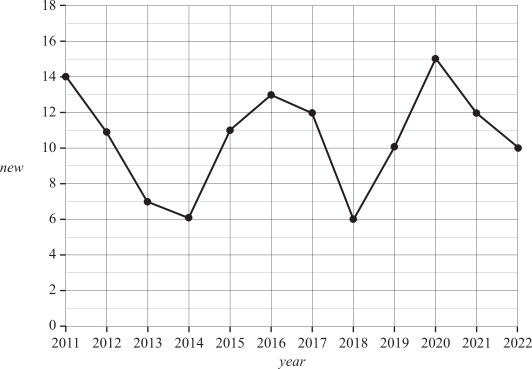
A school runs an orientation program for new staff each January.

The time series plot below shows the number of new staff, new, for each year, year, from 2011 to 2022 (inclusive).
 

Part 1

The time series is smoothed using seven-median smoothing.

The smoothed value of new for the year 2016 is

  1. 10
  2. 11
  3. 12
  4. 13

 
Part 2

The number of new staff in 2023 is added to the total number of new staff from the previous 12 years.

For these 13 years, the mean number of new staff is 11 .

The number of new staff in 2023 is

  1. 11
  2. 16
  3. 17
  4. 19
Show Answers Only

Part 1: \(A\)

Part 2: \(B\)

Show Worked Solution

Part 1

\(\text{Ordered scores}\)

\begin{array} {|c|c|c|c|c|c|}
\hline 2018 & 2014 & 2013 & 2019 & 2015 & 2017 & 2016 \\
\hline 6 & 6 & 7 & 10 & 11 & 12 & 13  \\
\hline
\end{array}

\(\text{Smoothed value of }new\ \text{for the }year\ 2016\ \text{is 10.}\)

\(\Rightarrow A\)

 
Part 2

\(\text{mean}\) \(=\dfrac{\Sigma\text{scores}}{\text{Number of scores}}\)
\(11\) \(=\dfrac{x+14+11+7+6+11+13+12+6+10+15+12+10}{13}\)
\(x+127\) \(=143\)
\(x\) \(=16\)

  
\(\Rightarrow B\)

Filed Under: Time Series Tagged With: Band 4, smc-266-70-MEDIAN Smoothing, smc-468-20-Mean

Data Analysis, GEN1 2024 VCAA 11-12 MC

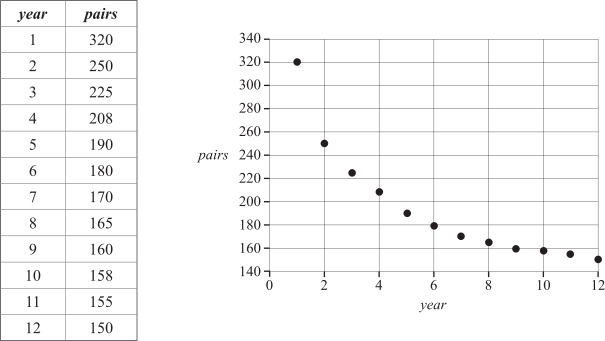
The number of breeding pairs of a small parrot species has been declining over recent years.

The table below shows the number of breeding pairs counted, pairs, and the year number, year, for the last 12 years. A scatterplot of this data is also provided.

The association between pairs and year is non-linear.
 

Part 1

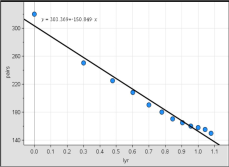
The scatterplot can be linearised using a logarithmic (base 10) transformation applied to the explanatory variable.

The least squares equation calculated from the transformed data is closest to

  1. \(\log _{10}(pairs)=2.44-0.0257 \times year\)
  2. \(\log _{10}(pairs)=151-303 \times year\)
  3. \(pairs =274-12.3 \times \log _{10}(year)\)
  4. \(pairs =303-151 \times \log _{10}( year)\)

 
Part 2

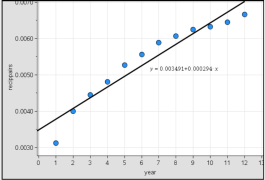
A reciprocal transformation applied to the variable \(pairs\) can also be used to linearise the scatterplot.

When a least squares line is fitted to the plot of  \(\dfrac{1}{pairs}\)  versus \(year\), the largest difference between the actual value and the predicted value occurs at \(year\)

  1. 1
  2. 2
  3. 11
  4. 12
Show Answers Only

Part 1: \(D\)

Part 2: \(A\)

Show Worked Solution

Part 1

\(\text{Apply reciprocal transformation and find regression line:}\)

\(\text{Least squares equation:}\ \ pairs=303-151\times\log_{10}{(year)}\)

\(\Rightarrow D\)
 

Part 2

\(\text{Largest difference occurs at year 1}\)

\(\Rightarrow A\)

♦ Mean mark (Part 1) 48%.

Filed Under: Correlation and Regression Tagged With: Band 4, Band 5, smc-265-70-Linearise - log10, smc-265-71-Linearise - Squared/Inverse

Data Analysis, GEN1 2024 VCAA 9-10 MC

The least squares equation for the relationship between the average number of male athletes per competing nation, males, and the number of the Summer Olympic Games, number, is

\(males =67.5-1.27 \times number\)
 

Part 1

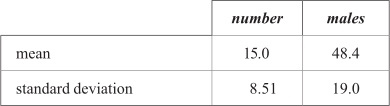
The summary statistics for the variables number and males are shown in the table below.
 

The value of Pearson's correlation coefficient, \(r\), rounded to three decimal places, is closest to

  1. \(-0.569\)
  2. \(-0.394\)
  3. \(0.394\)
  4. \(0.569\)

 
Part 2

At which Summer Olympic Games will the predicted average number of males be closest to 25.6 ?

  1. 31st
  2. 32nd
  3. 33rd
  4. 34th
Show Answers Only

Part 1: \(A\)

Part 2: \(C\)

Show Worked Solution

Part 1

\(b\) \(=r \times \dfrac{s_y}{s_x}\)
\(-1.27\) \(=r\times\dfrac{19}{8.51}\)
\(\therefore\ r\) \(=\dfrac{-1.27\times 8.51}{19}\)
  \(=-0.5688\dots\)

 
\(\Rightarrow A\)
 

♦ Mean mark (Part 1) 52%.

Part 2

\(males\) \(=67.5-1.27\times number\)
\(25.6\) \(=67.5-1.27\times number\)
\(number\) \(=\dfrac{67.5-25.6}{1.27}\)
  \(=32.992\dots\)
  \(\approx 33\)


\(\Rightarrow C\)

Filed Under: Correlation and Regression Tagged With: Band 4, Band 5, smc-265-10-r / r^2 and Association, smc-265-60-Extrapolation / Interpolation

Data Analysis, GEN1 2024 VCAA 8 MC

The scatterplot below displays the average number of female athletes per competing nation, females, against the number of the Summer Olympic Games, number, from the first Olympic Games, in 1896, to the 29th Olympic Games, held in 2021.

A least squares line has been fitted to the scatterplot.
 

The equation of the least squares line is closest to

  1. \(females =-4.87+1.02 \times number\)
  2. \( females =-3.39+0.91 \times number\)
  3. \(number =-3.39+0.91 \times females\)
  4. \(number =-0.91+3.39 \times females\)
Show Answers Only

\(B\)

Show Worked Solution

\(\text{LSRL is in the form}\ \ y=a+bx\ \rightarrow \ \ \text{Eliminate C and D}\)

\(\text{Using points}\ (29, 23)\ \text{and}\ (7, 3):\)

\(\text{Gradient}\ =\dfrac{23-3}{29-7}=\dfrac{10}{11} \approx 0.91\)

\(\Rightarrow B\)

Filed Under: Correlation and Regression Tagged With: Band 4, smc-265-20-Find LSRL Equation/Gradient

Data Analysis, GEN1 2024 VCAA 3-4 MC

The histogram below displays the population density, in people per km\(^{2}\), of the 27 countries in the European Union in 2021. The histogram has a logarithmic (base 10) scale.


Part 1

The median value occurs in a column with a frequency of

  1. 2
  2. 3
  3. 6
  4. 9

 
Part 2

There is one outlier at the upper end of the histogram. This value could be

  1. 330
  2. 1330
  3. 2030
  4. 2730
Show Answers Only

Part 1: \(D\)

Part 2: \(C\)

Show Worked Solution

Part 1

\(\text{There are 27 scores}\ \ \rightarrow\ \ \text{median is 14th score.}\)

\(\text{Column frequency }= 9\)

\(D\)

 
Part 2

\(10^{3.2} <\log\text{(Population Density)}<10^{3.4}\)

\(1585 <\log\text{(Population Density)}<2512\)

\(\Rightarrow C\)

Filed Under: Graphs - Histograms and Other Tagged With: Band 4, smc-644-60-Histogram (log10)

Complex Numbers, EXT2 N2 2024 HSC 9 MC

Consider the solutions of the equation  \(z^4=-9\).

What is the product of all of the solutions that have a positive principal argument?

  1. \(3\)
  2. \(-3\)
  3. \(3 i\)
  4. \(-3 i\)
Show Answers Only

\(B\)

Show Worked Solution

\(z^4=-9\)

\(\text{Convert}\ z^4 \ \text{to Mod/Arg form:}\)

\(\left|z^4\right|=9, \ \ \arg \left(z^4\right)=\pi \ \text{(\(-9\) is on negative real axis})\)

Mean mark 57%.

\(\text{By De Moivre:}\)

   \(\abs{z}=\sqrt[4]{9}=\sqrt{3}\)

   \(\arg (z)=\dfrac{\pi}{4}\)

\(\text{Roots are} \ \ \dfrac{\pi}{2} \ \ \text{rotations of}\ \  z=\sqrt{3} \, \text{cis}\left(\dfrac{\pi}{4}\right)\)

\(z=\sqrt{3} \, \text{cis}\left( \pm \dfrac{\pi}{4}\right), z=\sqrt{3} \, \text{cis}\left( \pm \dfrac{3 \pi}{4}\right)\)

\(\sqrt{3}\, \text{cis}\left(\dfrac{\pi}{4}\right) \cdot \sqrt{3} \, \text{cis}\left(\dfrac{3 \pi}{4}\right)=3 \, \text{cis}(\pi)=-3\)

\(\Rightarrow B\)

Filed Under: Solving Equations with Complex Numbers Tagged With: Band 4, smc-1050-30-Roots > 3

Complex Numbers, EXT2 N1 2024 HSC 8 MC

Which of the following is equal to \(e^{\large{\bar{z}}}\), where  \(z=x+i y\)  with \(x\) and \(y\) real numbers?

  1. \(\overline{e^{\large{z}}}\)
  2. \(e^{\large{-z}}\)
  3. \(e^{\large{2 x}} e^{\large{z}}\)
  4. \(e^{\large{-2 x}} e^{\large{z}}\)
Show Answers Only

\(A\)

Show Worked Solution
  \(e^{\large{\bar{z}}}\) \(=e^{x-iy}\)
    \(=e^x \cdot e^{-iy}\)
    \(=e^x(\cos (-y)+i \sin (-y))\)
    \(=e^x(\cos (y)-i \sin (y))\)

  \(\overline{e^{\large{z}}}\) \(=\overline{e^x(\cos (y)+i \sin (y)}\)
    \(=e^x(\cos (y)-i \sin (y))\)
    \(=e^{\large{\bar{z}}}\)

 
\(\Rightarrow A\)

Filed Under: Exponential Form Tagged With: Band 4, smc-1191-65-Conjugates

Mechanics, EXT2 M1 2024 HSC 6 MC

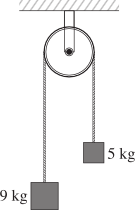
A light string passes over a smooth pulley. Attached to the ends of the string are masses of 9 kg and 5 kg , as shown.
 

The acceleration due to gravity is \(g\) m s\(^{-2}\).

What is the acceleration of the 9 kg mass?

  1. \(\dfrac{2}{7}g\)
  2. \(1 g\)
  3. \(\dfrac{7}{2}g\)
  4. \(4 g\)
Show Answers Only

\(A\)

Show Worked Solution

\(\text{Net force on 9 kg mass}\ = 9g-T\ \text{(down)}\)

\(\text{Net force on 5 kg mass}\ = 5g-T\ \text{(up)}\)

\(\text{Using}\ \ F=ma: \)

\(9 \times a\) \(=9g-T\ …\ (1)\)  
\(5 \times a\) \(=-(5g-T)\ …\ (2) \)  

 
\(\text{Adding (1) + (2):}\)

\(14a\) \(=4g\)  
\(a\) \(=\dfrac{2}{7}g\)  

 
\(\Rightarrow A\)

Filed Under: Motion Without Resistance Tagged With: Band 4, smc-1060-40-Pulleys (no air resistance)

Mechanics, EXT2 M1 2024 HSC 5 MC

A particle is moving in simple harmonic motion with period 10 seconds and an amplitude of 8 m . The particle starts at the central point of motion and is initially moving to the left with a speed of \(V\) m s\(^{-1}\), where  \(V>0\).

What will be the position and velocity of the particle after 7.5 seconds?

  1. At the central point of motion with a velocity of \(V \text{ m s} ^{-1}\)
  2. At the central point of motion with a velocity of \(-V \text{ m s} ^{-1}\)
  3. 8 m to the left of the central point of motion with a velocity of \(0 \text{ m s} ^{-1}\)
  4. 8 m to the right of the central point of motion with a velocity of \(0 \text{ m s} ^{-1}\)
Show Answers Only

\(D\)

Show Worked Solution

\(T=\dfrac{2\pi}{n}=10\ \ \Rightarrow\ \ n=\dfrac{\pi}{5}\)

\(x\) \(=-8 \sin\Big(\dfrac{\pi}{5}t\Big) \)  
\(\dot{x}\) \(=-8 \cos\Big(\dfrac{\pi}{5}t\Big) \)  

 
\(\text{At}\ \ t=7.5:\)

\(x\) \(=-8 \sin\Big(\dfrac{\pi}{5}t\Big)=-8 \)  
\(\dot{x}\) \(=-8 \cos\Big(\dfrac{\pi}{5}t\Big)=0 \)  

\(\Rightarrow D\)

Filed Under: Simple Harmonic Motion Tagged With: Band 4, smc-1059-10-Amplitude / Period

Complex Numbers, EXT2 N2 2024 HSC 11f

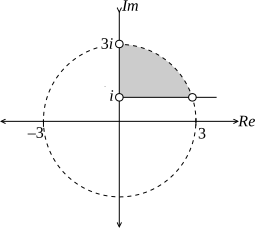
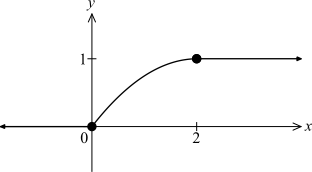
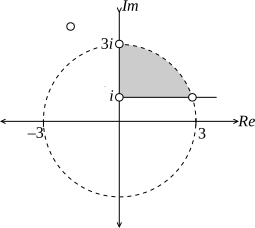
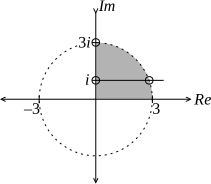
Sketch the region defined by  \(|z|<3\)  and  \(0 \leq \arg (z-i) \leq \dfrac{\pi}{2}\).   (3 marks)

--- 8 WORK AREA LINES (style=blank) ---

Show Answers Only

Show Worked Solution

\(\text {Region: }\abs{z}<3\ \ \text{and}\ \ 0 \leqslant \arg (z-i) \leqslant \dfrac{\pi}{2}\)
 

Filed Under: Geometrical Implications of Complex Numbers Tagged With: Band 4, smc-1052-10-Sketch regions

Calculus, EXT2 C1 2024 HSC 15b

Let  \(I_n=\displaystyle\int_0^a x^{n+\frac{1}{2}}(a-x)^{\frac{1}{2}}\, d x\), where  \(n \geq 0\).

Show that \((2 n+4) I_n=a(2 n+1) I_{n-1}\), for  \(n>0\).   (3 marks)

--- 9 WORK AREA LINES (style=lined) ---

Show Answers Only

\(I_n=\displaystyle{\int}_0^a x^{n+\frac{1}{2}}(a-x)^{\frac{1}{2}}\,d x \ \ \text{where}\ \ n \geqslant 0\)

\(\text{Show}\ \ (2 n+4) I_n=a(2 n+1) I_{n-1}\ \ \text{for}\ \ n>0\)

\(I_n=\displaystyle{\int}_0^a x^{n+\frac{1}{2}}(a-x)^{\frac{1}{2}}\)

\(\text{Using integration by parts: }\)

\(\begin{array}{ll}u=x^{n+\frac{1}{2}} & v^{\prime}=(a-x)^{\frac{1}{2}} \\ u^{\prime}=\left(n+\frac{1}{2}\right) x^{n-\frac{1}{2}} & v=-\dfrac{2}{3}(a-x)^{\frac{3}{2}}\end{array}\)

  \(I_n\) \(=\left[u v\right]_0^a-\displaystyle{\int}_0^a u^{\prime} v\, dx\)
    \(=\underbrace{\left[-\dfrac{2}{3} x^{n-\frac{1}{2}}(a-x)^{\frac{3}{2}}\right]_0^a}_{=0}+\dfrac{2}{3}\left(n+\frac{1}{2}\right) \displaystyle{\int}_0^a x^{n-\frac{1}{2}}(a-x)^{\frac{3}{2}}\, dx\)
    \(=\dfrac{2 n+1}{3} \displaystyle{\int}_0^a a x^{n-\frac{1}{2}}(a-x)^{\frac{1}{2}}-x^{n+\frac{1}{2}}(a-x)^{\frac{1}{2}}\, dx\)
  \(3I_n\) \(=(2 n+1)\left[a I_{n-1}-I_n\right]\)


  \(3 I_n+(2 n+1) I_n\) \(=a(2 n+1) I_{n-1}\)
  \((2 n+4) I_n\) \(=a(2 n+1) I_{n-1}\)

Show Worked Solution

\(I_n=\displaystyle{\int}_0^a x^{n+\frac{1}{2}}(a-x)^{\frac{1}{2}}\,d x \ \ \text{where}\ \ n \geqslant 0\)

\(\text{Show}\ \ (2 n+4) I_n=a(2 n+1) I_{n-1}\ \ \text{for}\ \ n>0\)

\(I_n=\displaystyle{\int}_0^a x^{n+\frac{1}{2}}(a-x)^{\frac{1}{2}}\)

\(\text{Using integration by parts: }\)

\(\begin{array}{ll}u=x^{n+\frac{1}{2}} & v^{\prime}=(a-x)^{\frac{1}{2}} \\ u^{\prime}=\left(n+\frac{1}{2}\right) x^{n-\frac{1}{2}} & v=-\dfrac{2}{3}(a-x)^{\frac{3}{2}}\end{array}\)

  \(I_n\) \(=\left[u v\right]_0^a-\displaystyle{\int}_0^a u^{\prime} v\, dx\)
    \(=\underbrace{\left[-\dfrac{2}{3} x^{n-\frac{1}{2}}(a-x)^{\frac{3}{2}}\right]_0^a}_{=0}+\dfrac{2}{3}\left(n+\frac{1}{2}\right) \displaystyle{\int}_0^a x^{n-\frac{1}{2}}(a-x)^{\frac{3}{2}}\, dx\)
    \(=\dfrac{2 n+1}{3} \displaystyle{\int}_0^a a x^{n-\frac{1}{2}}(a-x)^{\frac{1}{2}}-x^{n+\frac{1}{2}}(a-x)^{\frac{1}{2}}\, dx\)
  \(3I_n\) \(=(2 n+1)\left[a I_{n-1}-I_n\right]\)

  \(3 I_n+(2 n+1) I_n\) \(=a(2 n+1) I_{n-1}\)
  \((2 n+4) I_n\) \(=a(2 n+1) I_{n-1}\)

Filed Under: Recurrence Relations Tagged With: Band 4, smc-1054-50-Other Function

Vectors, EXT2 V1 2024 HSC 14e

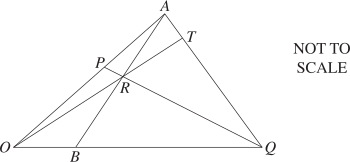
The diagram shows triangle \(O Q A\).

The point \(P\) lies on \(O A\) so that  \(O P: O A=3: 5\).

The point \(B\) lies on \(O Q\) so that  \(O B: O Q=1: 3\).

The point \(R\) is the intersection of \(A B\) and \(P Q\).

The point \(T\) is chosen on \(A Q\) so that \(O, R\) and \(T\) are collinear.
 

Let  \(\underset{\sim}{a}=\overrightarrow{O A}, \ \underset{\sim}{b}=\overrightarrow{O B}\)  and  \(\overrightarrow{P R}=k \overrightarrow{P Q}\)  where \(k\) is a real number.

  1. Show that  \(\overrightarrow{O R}=\dfrac{3}{5}(1-k) \underset{\sim}{a}+3 k \underset{\sim}{b}\).   (2 marks)

    --- 5 WORK AREA LINES (style=lined) ---

Writing  \(\overrightarrow{A R}=h \overrightarrow{A B}\), where \(h\) is a real number, it can be shown that  \(\overrightarrow{O R}=(1-h) \underset{\sim}{a}+h \underset{\sim}{b}\).  (Do NOT prove this.)

  1. Show that  \(k=\dfrac{1}{6}\).   (2 marks)

    --- 4 WORK AREA LINES (style=lined) ---

  2. Find \(\overrightarrow{O T}\) in terms of \(\underset{\sim}{a}\) and \(\underset{\sim}{b}\).   (2 marks)

    --- 4 WORK AREA LINES (style=lined) ---

Show Answers Only

i.    \(\underset{\sim}{a}=\overrightarrow{O A}, \ \underset{\sim}{b}=\overrightarrow{O B}, \ \overrightarrow{P R}=k \overrightarrow{P Q}\)

\(\overrightarrow{O P}: \overrightarrow{O A}=3: 5 \ \Rightarrow \ \overrightarrow{O P} = \dfrac{3}{5} \times \overrightarrow{O A} \)

\(\overrightarrow{O B}: \overrightarrow{O Q}=1: 3\ \Rightarrow \ \overrightarrow{O Q} = 3 \times \overrightarrow{OB} \)

\(\text {Show } \overrightarrow{O R}=\dfrac{3}{5}(1-k) \underset{\sim}{a}+3 k \underset{\sim}{b}\)

  \(\overrightarrow{O R}\) \(=\overrightarrow{O P}+k \overrightarrow{P Q}\)
    \(=\overrightarrow{O P}+k(\overrightarrow{O Q}-\overrightarrow{O P})\)
    \(=(1-k) \overrightarrow{O P}+k \overrightarrow{O Q}\)
    \(=\dfrac{3}{5}(1-k)\underset{\sim}{a}+3 k \underset{\sim}{b}\)


ii.    \(\overrightarrow{A R}=h \overrightarrow{A B}, \quad h \in \mathbb{R}\)

\(\overrightarrow{OR}=(1-h) \underset{\sim}{a}+h \underset{\sim}{b} \ \ \text{(given)}\)

\(\overrightarrow{O R}=\dfrac{3}{5}(1-k) \underset{\sim}{a}+3 k \underset{\sim}{b} \ \ \text{(part(i))}\)

\(\text{Vector }\underset{\sim}{a} \neq \lambda \underset{\sim}{b}\ (\lambda \in \mathbb{R})\ \Rightarrow \ \text{linearly independent and are basis vectors for } \overrightarrow{O R}\).

\(\text {Equating coefficients:}\)

   \(\dfrac{3}{5}(1-k)=1-h\ \ldots\ (1)\)

   \(h=3 k\ \ldots\ (2)\)

\(\text{Substituting (2) into (1)}\)

     \(\dfrac{3}{5}(1-k)\) \(=1-3 k\)
  \(3-3 k\) \(=5-15 k\)
  \(k\) \(=\dfrac{1}{6}\)

 
iii. 
   \(\overrightarrow{O T}=\dfrac{3}{4}(\underset{\sim}{a}+\underset{\sim}{b})\)

Show Worked Solution

i.    \(\underset{\sim}{a}=\overrightarrow{O A}, \ \underset{\sim}{b}=\overrightarrow{O B}, \ \overrightarrow{P R}=k \overrightarrow{P Q}\)

\(\overrightarrow{O P}: \overrightarrow{O A}=3: 5 \ \Rightarrow \ \overrightarrow{O P} = \dfrac{3}{5} \times \overrightarrow{O A} \)

\(\overrightarrow{O B}: \overrightarrow{O Q}=1: 3\ \Rightarrow \ \overrightarrow{O Q} = 3 \times \overrightarrow{OB} \)

\(\text {Show } \overrightarrow{O R}=\dfrac{3}{5}(1-k) \underset{\sim}{a}+3 k \underset{\sim}{b}\)

  \(\overrightarrow{O R}\) \(=\overrightarrow{O P}+k \overrightarrow{P Q}\)
    \(=\overrightarrow{O P}+k(\overrightarrow{O Q}-\overrightarrow{O P})\)
    \(=(1-k) \overrightarrow{O P}+k \overrightarrow{O Q}\)
    \(=\dfrac{3}{5}(1-k)\underset{\sim}{a}+3 k \underset{\sim}{b}\)


ii.    \(\overrightarrow{A R}=h \overrightarrow{A B}, \quad h \in \mathbb{R}\)

\(\overrightarrow{OR}=(1-h) \underset{\sim}{a}+h \underset{\sim}{b} \ \ \text{(given)}\)

\(\overrightarrow{O R}=\dfrac{3}{5}(1-k) \underset{\sim}{a}+3 k \underset{\sim}{b} \ \ \text{(part(i))}\)

\(\text{Vector }\underset{\sim}{a} \neq \lambda \underset{\sim}{b}\ (\lambda \in \mathbb{R})\ \Rightarrow \ \text{linearly independent and are basis vectors for } \overrightarrow{O R}\).

\(\text {Equating coefficients:}\)

   \(\dfrac{3}{5}(1-k)=1-h\ \ldots\ (1)\)

   \(h=3 k\ \ldots\ (2)\)

\(\text{Substituting (2) into (1)}\)

     \(\dfrac{3}{5}(1-k)\) \(=1-3 k\)
  \(3-3 k\) \(=5-15 k\)
  \(k\) \(=\dfrac{1}{6}\)


iii.    \(\overrightarrow{O T}=\lambda \overrightarrow{O R}\)

\(\text {Using parts (i) and (ii):}\)

\(\overrightarrow{O R}=\dfrac{3}{5}\left(1-\dfrac{1}{6}\right)\underset{\sim}{a}+3\left(\dfrac{1}{6}\right) \underset{\sim}{b}=\dfrac{1}{2}\left(\underset{\sim}{a}+\underset{\sim}{b}\right)\)

\(\overrightarrow{O T}=\dfrac{\lambda}{2}(\underset{\sim}{a}+\underset{\sim}{b})\)

♦ Mean mark (iii) 45%.
 

\(\text {Find } \lambda:\)

  \(\overrightarrow{O T}\) \(=\overrightarrow{O A}+\mu \overrightarrow{A Q}\)
  \(\dfrac{\lambda}{2}(\underset{\sim}{a}+\underset{\sim}{b})\) \(=\underset{\sim}{a}+\mu(3 \underset{\sim}{b}-\underset{\sim}{a}) \quad \Big(\text{noting}\ \overrightarrow{A Q}=\overrightarrow{O Q}-\overrightarrow{O A}=3 \underset{\sim}{b}-\underset{\sim}{a}\Big)\)
    \(=\underset{\sim}{a}(1-\mu)+3 \mu \underset{\sim}{b}\)

 
\(\text {Equating coefficients:}\)

\(\dfrac{\lambda}{2}=3 \mu \ \Rightarrow \ \mu=\dfrac{\lambda}{6}\)

  \(1-\dfrac{\lambda}{6}\) \(=\dfrac{\lambda}{2}\)
  \(6-\lambda\) \(=3 \lambda\)
  \(\lambda\) \(=\dfrac{3}{2}\)

 
\(\therefore \overrightarrow{O T}=\dfrac{3}{4}(\underset{\sim}{a}+\underset{\sim}{b})\)

Filed Under: Vectors and Geometry Tagged With: Band 3, Band 4, Band 5, smc-1210-40-Triangle, smc-1210-55-Ratios, smc-1210-60-2D problems

Proof, EXT2 P2 2024 HSC 14b

Use mathematical induction to prove that  \({ }^{2 n} C_n<2^{2 n-2}\),  for all integers  \(n \geq 5\).   (3 marks)

--- 12 WORK AREA LINES (style=lined) ---

Show Answers Only

\(\text{Prove  \({ }^{2 n} C_n<2^{2 n-2}\)  for  \(n \geqslant 5\).}\)

\(\text {If}\ \ n=5:\)

\(\text{LHS}={ }^{10} C_5=252\)

\(\text{RHS}=2^8=256>\text {LHS }\)

\(\therefore\ \text{True for}\ \ n=5\)
 

\(\text {Assume true for } n=k:\)

   \({ }^{2 k} C_k<2^{2 k-2}\ \ldots\ (1)\)

\(\text{Prove true for}\ \ n=k+1:\)

   \(\text{i.e. } {}^{2 k+2}C_{k+1}<2^{2 k}\)

  \(\text{LHS}\) \(=\dfrac{(2 k+2)!}{(k+1)!(k+1)!}\)
    \(=\dfrac{(2 k)!}{k!k!} \times \dfrac{(2 k+1)(2 k+2)}{(k+1)(k+1)}\)
    \(={ }^{2 k} C_k \times 2 \times \dfrac{2 k+1}{k+1}\)
    \(< 2^{2k-2} \times 2 \times \dfrac{2 k+1}{k+1}\)
    \(<2^{2k} \ \ \ \left(\text{since}\ \dfrac{2 k+1}{k+1}=2-\dfrac{1}{k+1}<2\right)\)

 
\(\Rightarrow \text{True for}\ \ n=k+1\)

\(\therefore \text{ Since true for \(n=5\), by PMI, true for integers \(n \geqslant 5\).}\)

Show Worked Solution

\(\text{Prove  \({ }^{2 n} C_n<2^{2 n-2}\)  for  \(n \geqslant 5\).}\)

\(\text {If}\ \ n=5:\)

\(\text{LHS}={ }^{10} C_5=252\)

\(\text{RHS}=2^8=256>\text {LHS }\)

\(\therefore\ \text{True for}\ \ n=5\)
 

\(\text {Assume true for } n=k:\)

   \({ }^{2 k} C_k<2^{2 k-2}\ \ldots\ (1)\)

\(\text{Prove true for}\ \ n=k+1:\)

   \(\text{i.e. } {}^{2 k+2}C_{k+1}<2^{2 k}\)

  \(\text{LHS}\) \(=\dfrac{(2 k+2)!}{(k+1)!(k+1)!}\)
    \(=\dfrac{(2 k)!}{k!k!} \times \dfrac{(2 k+1)(2 k+2)}{(k+1)(k+1)}\)
    \(={ }^{2 k} C_k \times 2 \times \dfrac{2 k+1}{k+1}\)
    \(< 2^{2k-2} \times 2 \times \dfrac{2 k+1}{k+1}\)
    \(<2^{2k} \ \ \ \left(\text{since}\ \dfrac{2 k+1}{k+1}=2-\dfrac{1}{k+1}<2\right)\)

 
\(\Rightarrow \text{True for}\ \ n=k+1\)

\(\therefore \text{ Since true for \(n=5\), by PMI, true for integers \(n \geqslant 5\).}\)

Filed Under: P2 Induction (Ext2) Tagged With: Band 4, smc-1044-10-Inequalities, smc-1044-68-Sigma Notation

Proof, EXT2 P1 2024 HSC 14a

Prove that if \(a\) is any odd integer, then  \(a^2-1\)  is divisible by 8.   (2 marks) 

--- 8 WORK AREA LINES (style=lined) ---

Show Answers Only

\(\text {Prove if  \(a\) is odd, \(a^2-1\) is divisible by 8.}\)

\(\text {Let}\ \ a=2 n+1, \ \ n \in \mathbb{Z}\)

  \(a^2-1\) \(=(2 n+1)^2-1\)
    \(=4 n^2+4 n+1-1\)
    \(=4 n(n+1)\)

 
\(\text{If \(n\) is odd (\(n=2 k+1, k \in Z)\):}\)

\(a^2-1=4(2 k+1)(2 k+2)=8(2 k+1)(k+1) /8\)

\(\text{If \(n\) is even \((n=2 k)\):}\)

\(a^2-1=4(2 k)(2 k+1)=8 k(2 k+1) /8\)

\(\therefore \text{ If \(a\) is odd, \(a^2-1\) is divisible by 8}\)

Show Worked Solution

\(\text {Prove if  \(a\) is odd, \(a^2-1\) is divisible by 8.}\)

\(\text {Let}\ \ a=2 n+1, \ \ n \in \mathbb{Z}\)

  \(a^2-1\) \(=(2 n+1)^2-1\)
    \(=4 n^2+4 n+1-1\)
    \(=4 n(n+1)\)

 
\(\text{If \(n\) is odd (\(n=2 k+1, k \in Z)\):}\)

\(a^2-1=4(2 k+1)(2 k+2)=8(2 k+1)(k+1) /8\)

\(\text{If \(n\) is even \((n=2 k)\):}\)

\(a^2-1=4(2 k)(2 k+1)=8 k(2 k+1) /8\)

\(\therefore \text{ If \(a\) is odd, \(a^2-1\) is divisible by 8}\)

Filed Under: Proof and Inequalities Tagged With: Band 4, smc-1208-60-Other Proofs

ENGINEERING, TE 2024 HSC 5 MC

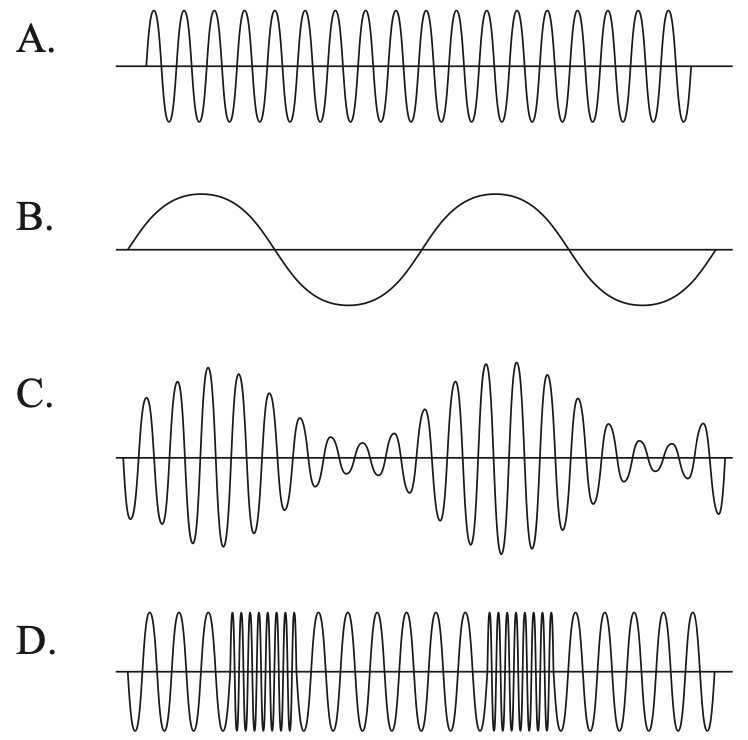
Which waveform diagram depicts an AM radio signal?
 

Show Answers Only

\(C\)

Show Worked Solution
  • AM signals show clusters of varying frequency waves while maintaining a constant baseline frequency throughout the transmission.

\(\Rightarrow C\)

Filed Under: Electricity/Electronics Tagged With: Band 4, smc-3730-10-Radio

ENGINEERING, CS 2024 HSC 2 MC

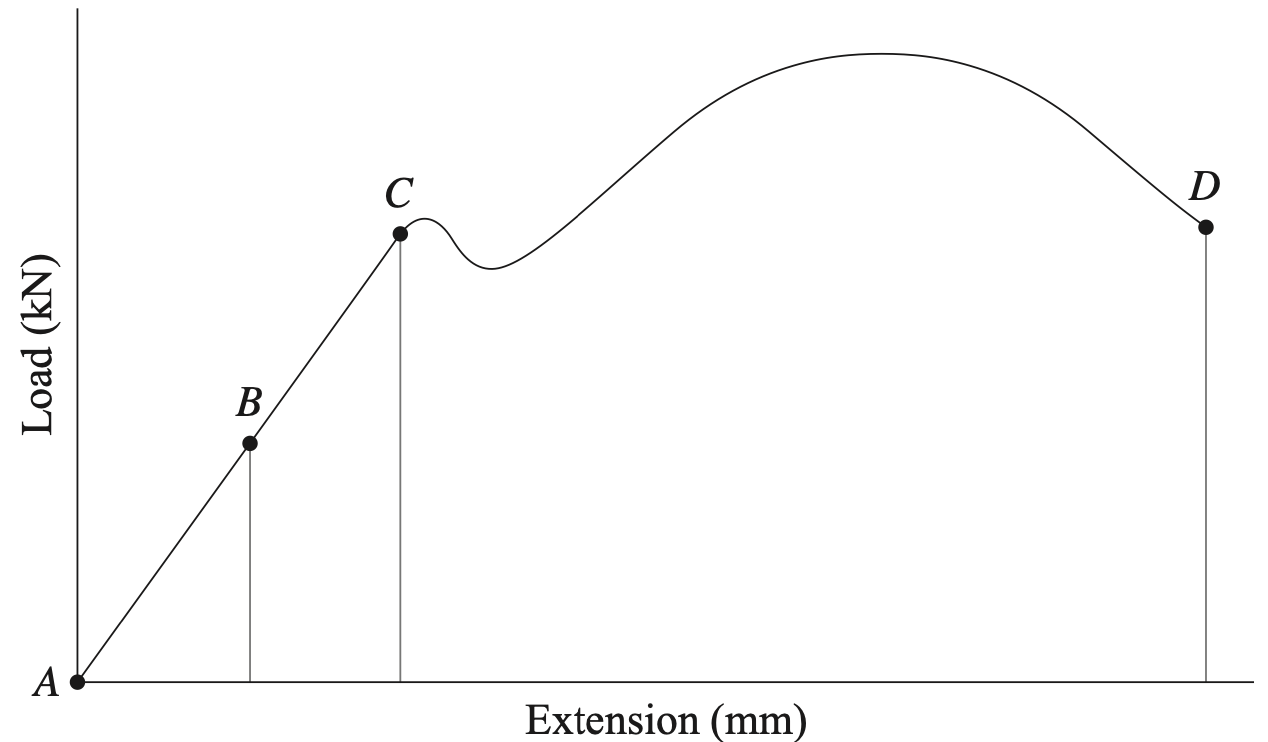
A load-extension diagram for a mild steel specimen is shown.

Which letters indicate the area under the curve in which the specimen will permanently change its size and shape?

  1. \(A B\)
  2. \(A C\)
  3. \(B D\)
  4. \(C D\)
Show Answers Only

\(D\)

Show Worked Solution

\(\Rightarrow D\)

Filed Under: Engineering Mechanics Tagged With: Band 4, smc-3714-90-Load-ext diagram

Proof, EXT2 P1 2024 HSC 13d

It is known that for all positive real numbers \(x, y\)

\(x+y \geq 2 \sqrt{x y} .\)     (Do NOT prove this.)

Show that if \(a, b, c\) are positive real numbers with  \(\dfrac{1}{a}+\dfrac{1}{b}+\dfrac{1}{c}=1\)  then  \(a \sqrt{b c}+b \sqrt{a c}+c \sqrt{a b} \leq a b c\).   (3 marks)

--- 10 WORK AREA LINES (style=lined) ---

Show Answers Only

\(\text{If }\dfrac{1}{a}+\dfrac{1}{b}+\dfrac{1}{c}=1, \ \ \ a, b, c \in \mathbb{R} ^{+}\)

\(\text {Prove} \ \ a \sqrt{b c}+b \sqrt{a c}+c \sqrt{a b} \leqslant a b c\)

\(\dfrac{1}{a}+\dfrac{1}{b}+\dfrac{1}{c}\) \(=1\)  
\(\dfrac{b c+a c+a b}{a b c}\) \(=1\)  
\(ab+bc+ac\) \(=abc\ …\ (1)\)  

 
\(x+y \geqslant 2 \sqrt{x y}, \quad x, y \in \mathbb{R}^{+} \text{(given)}\)

\(a+b \geqslant 2 \sqrt{a b} \ \Rightarrow \ \sqrt{a b} \leqslant \dfrac{1}{2}(a+b)\)

\(\text{Similarly,}\)

\(\sqrt{bc} \leqslant \dfrac{1}{2}(b+c) \ \text{and}\ \ \sqrt{a c} \leqslant \dfrac{1}{2}(a+c)\)

  \(a \sqrt{b c}+b \sqrt{a c}+c \sqrt{a b}\) \(\leqslant a \times \dfrac{1}{2}(b+c)+b \times \dfrac{1}{2}(a+c)+c \times \dfrac{1}{2}(a+b)\)
    \(\leqslant \dfrac{1}{2} a b+\dfrac{1}{2} a c+\dfrac{1}{2} a b+\dfrac{1}{2} b c+\dfrac{1}{2} a c+\dfrac{1}{2} b c\)
    \(\leqslant a b+b c+a c\)
    \(\leqslant a b c\ \  \text{(see (1) above)}\)

Show Worked Solution

\(\text{If }\dfrac{1}{a}+\dfrac{1}{b}+\dfrac{1}{c}=1, \ \ \ a, b, c \in \mathbb{R} ^{+}\)

\(\text {Prove} \ \ a \sqrt{b c}+b \sqrt{a c}+c \sqrt{a b} \leqslant a b c\)

\(\dfrac{1}{a}+\dfrac{1}{b}+\dfrac{1}{c}\) \(=1\)  
\(\dfrac{b c+a c+a b}{a b c}\) \(=1\)  
\(ab+bc+ac\) \(=abc\ …\ (1)\)  

 
\(x+y \geqslant 2 \sqrt{x y}, \quad x, y \in \mathbb{R}^{+} \text{(given)}\)

\(a+b \geqslant 2 \sqrt{a b} \ \Rightarrow \ \sqrt{a b} \leqslant \dfrac{1}{2}(a+b)\)

\(\text{Similarly,}\)

\(\sqrt{bc} \leqslant \dfrac{1}{2}(b+c) \ \text{and}\ \ \sqrt{a c} \leqslant \dfrac{1}{2}(a+c)\)

  \(a \sqrt{b c}+b \sqrt{a c}+c \sqrt{a b}\) \(\leqslant a \times \dfrac{1}{2}(b+c)+b \times \dfrac{1}{2}(a+c)+c \times \dfrac{1}{2}(a+b)\)
    \(\leqslant \dfrac{1}{2} a b+\dfrac{1}{2} a c+\dfrac{1}{2} a b+\dfrac{1}{2} b c+\dfrac{1}{2} a c+\dfrac{1}{2} b c\)
    \(\leqslant a b+b c+a c\)
    \(\leqslant a b c\ \  \text{(see (1) above)}\)

Filed Under: Proof and Inequalities Tagged With: Band 4, smc-1208-10-Proofs given a > b, smc-1208-30-Proof using given equation

Mechanics, EXT2 M1 2024 HSC 13b

A particle is moving in simple harmonic motion, described by  \(\ddot{x}=-4(x+1)\).

When the particle passes through the origin, the speed of the particle is 4 m s\(^{-1}\).

What distance does the particle travel during a full period of its motion?   (3 marks)

--- 9 WORK AREA LINES (style=lined) ---

Show Answers Only

\(4 \sqrt{5} \text{ units }\)

Show Worked Solution

  \(\ddot{x}\) \(=-4(x+1)\)
  \(\dfrac{d}{dx}\left(\dfrac{1}{2} v^2\right)\) \(=-4 x-4\)
  \(\dfrac{1}{2} v^2\) \(=\displaystyle \int-4 x-4\, d x\)
  \(\dfrac{1}{2} v^2\) \(=-2 x^2-4 x+c\)
  \(v^2\) \(=-4 x^2-8 x+2c\)

 
\(\text {When } x=0, \quad v=4\ \ \Rightarrow \ c=8\)

\(v^2=-4 x^2-8 x+16\)

\(\text {Find } x \text { when } v=0:\)

\(-4 x^2-8 x+16\) \(=0\)  
\(x^2+2 x-4\) \(=0\)  

 
\(\Rightarrow\ x=\dfrac{-2 \pm \sqrt{2^2+4 \cdot 1 \cdot 4}}{2}=-1 \pm \sqrt{5}\)

\(\Rightarrow\ \text{Amplitude}=\sqrt{5}\)

\(\therefore \text {Distance travelled in full period }=4 \sqrt{5} \text{ units }\)

Filed Under: Simple Harmonic Motion Tagged With: Band 4, smc-1059-10-Amplitude / Period, smc-1059-32-Total Distance

Calculus, EXT1 C2 2024 HSC 13d

Using the substitution  \(u=e^x+2 e^{-x}\),  and considering \(u^2\), find  \(\displaystyle \int \frac{e^{3 x}-2 e^x}{4+8 e^{2 x}+e^{4 x}}\, d x\).   (3 marks)

--- 8 WORK AREA LINES (style=lined) ---

Show Answers Only

\(\displaystyle \frac{1}{2} \tan ^{-1}\left(\frac{e^x+2 e^{-x}}{2}\right)+c\)

Show Worked Solution

\(u=e^x+2 e^{-x} \ \Rightarrow \ u^2=\left(e^x+2 e^{-x}\right)^2=e^{2 x}+4+4 e^{-2 x}\)

\(\dfrac{du}{dx}=e^x-2 e^{-x} \ \Rightarrow \ du=\left(e^x-2 e^{-x}\right)\, d x\)

Mean mark 55%.
  \(\displaystyle \int \frac{e^{3 x}-2 e^x}{4+8 e^{2 x}+e^{4 x}}\, d x\)
    \(=\displaystyle \int \frac{e^{3 x}-2 e^x}{4+8 e^{2 x}+e^{4 x}} \times \frac{e^{-2 x}}{e^{-2 x}}\, d x\)
    \(=\displaystyle \int \frac{e^x-2 e^{-x}}{4 e^{-2 x}+8+e^{2 x}}\, d x\)
    \(=\displaystyle \int \frac{e^x-2 e^{-x}}{4+\left(e^{2 x}+4+4 e^{-2 x}\right)}\, d x\)
    \(=\displaystyle \int \frac{1}{4+u^2}\, d u\)
    \(=\displaystyle \frac{1}{2} \tan ^{-1}\left(\frac{u}{2}\right)+c\)
    \(=\displaystyle \frac{1}{2} \tan ^{-1}\left(\frac{e^x+2 e^{-x}}{2}\right)+c\)

Filed Under: Integration By Substitution (Ext1) Tagged With: Band 4, smc-1036-30-Trig, smc-1036-40-Logs and Exponentials

CHEMISTRY, M2 EQ-Bank 3 MC

The following equation represents the reaction of calcium disilicide \(\ce{(CaSi2)}\) with antimony trichloride \(\ce{(SbCl3)}\) to produce calcium chloride \(\ce{(CaCl2)}\), silicon \(\ce{(Si)}\), and antimony \(\ce{(Sb)}\):

\(\ce{a CaSi2 + b SbCl3 -> c Si + d Sb + e CaCl2}\)

What are the stoichiometric values for \( a, b, c, d\) and \( e\) in the balanced equation?

  1. \(2, 3, 6, 3, 2\)
  2. \(3, 2, 2, 6, 3\)
  3. \(3, 3, 6, 2, 3\)
  4. \(3, 2, 6, 2, 3\)
Show Answers Only

\(D\)

Show Worked Solution
  • Balancing the chlorine atoms:
  •    \(\ce{a CaSi2 + 2SbCl3 -> c Si + d Sb +  3CaCl2}\)
  • Since \(\ce{Si}\) and \(\ce{Sb}\) are by themselves on the right hand side, they can be easily balanced last.
  • Next, balance the \(\ce{Ca}\) atoms on the left hand side:
  •    \(\ce{3CaSi2 + 2SbCl3 -> c Si + d Sb +  3CaCl2}\)
  • The values for \(c\) and \(d\) can be added to balance the remaining atoms.
  •    \(\ce{3CaSi2 + 2SbCl3 -> 6 Si + 2 Sb +  3CaCl2}\)

\(\Rightarrow D\)

Filed Under: Chemical Reactions and Stoichiometry Tagged With: Band 4, smc-4259-50-Balancing Chemical Equations

Calculus, EXT1 C2 2024 HSC 13b

  1. Show that  \(\cos ^4 x+\sin ^4 x=\dfrac{1+\cos ^2 2 x}{2}\).   (2 marks)

    --- 6 WORK AREA LINES (style=lined) ---

  2. Hence, or otherwise, evaluate  \(\displaystyle{\int}_0^{\frac{\pi}{4}}\left(\cos ^4 x+\sin ^4 x\right) d x\).  (3 marks)

    --- 7 WORK AREA LINES (style=lined) ---

Show Answers Only

i.     \(\text{LHS}\) \(=\left[\dfrac{1}{2}(1+\cos (2 x)\right]^2+\left[\dfrac{1}{2}(1-\cos (2 x)\right]^2\)
    \(=\dfrac{1}{4}\left(1+2 \cos (2 x)+\cos ^2(2 x)+1-2 \cos (2 x)+\cos ^2(2 x)\right)\)
    \(=\dfrac{1}{4}\left(2+2 \cos ^{2}(2 x)\right)\)
    \(=\dfrac{1+\cos ^2(2 x)}{2}\)

  
ii.   \(\dfrac{3 \pi}{16}\)

Show Worked Solution

i.     \(\text{LHS}\) \(=\left[\dfrac{1}{2}(1+\cos (2 x)\right]^2+\left[\dfrac{1}{2}(1-\cos (2 x)\right]^2\)
    \(=\dfrac{1}{4}\left(1+2 \cos (2 x)+\cos ^2(2 x)+1-2 \cos (2 x)+\cos ^2(2 x)\right)\)
    \(=\dfrac{1}{4}\left(2+2 \cos ^{2}(2 x)\right)\)
    \(=\dfrac{1+\cos ^2(2 x)}{2}\)


ii.     \(\displaystyle{\int}_0^{\frac{\pi}{4}}\left(\cos ^4 x+\sin ^4 x\right) d x\)
    \(=\dfrac{1}{2} \displaystyle{\int}_0^{\frac{\pi}{4}} 1+\cos ^2(2 x) d x\)
    \(=\dfrac{1}{2} \displaystyle{\int}_0^{\frac{\pi}{4}} 1+\dfrac{1}{2}(1+\cos (4 x)) d x\)
    \(=\dfrac{1}{2}\left[\dfrac{3}{2}x +\dfrac{1}{8} \sin (4 x)\right]_0^{\frac{\pi}{4}}\)
    \(=\dfrac{1}{2}\left[\dfrac{3}{2} \times \dfrac{\pi}{4}+\dfrac{1}{8} \sin \pi-0\right]\)
    \(=\dfrac{3 \pi}{16}\)

Filed Under: Harder Trig Calculus (Ext1) Tagged With: Band 4, smc-1038-10-Integrate sin^2(x), smc-1038-20-Integrate cos^2(x)

Calculus, EXT1 C3 2024 HSC 13a

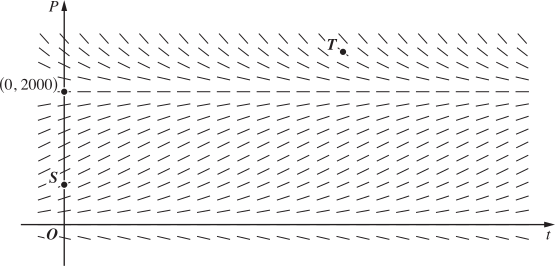
In an experiment, the population of insects, \(P(t)\), was modelled by the logistic differential equation

\(\dfrac{d P}{d t}=P(2000-P)\)

where \(t\) is the time in days after the beginning of the experiment.

The diagram shows a direction field for this differential equation, with the point \(S\) representing the initial population.
 

  1. Explain why the graph of the solution that passes through the point \(S\) cannot also pass through the point \(T\).   (1 mark)

    --- 2 WORK AREA LINES (style=lined) ---

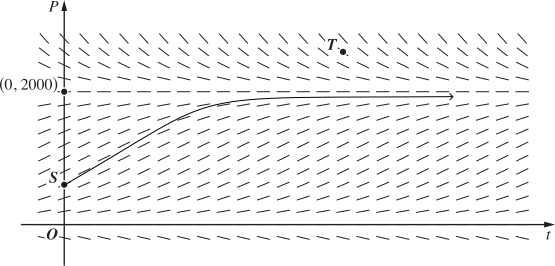
  2. Clearly sketch the graph of the solution that passes through the point \(S\).   (1 mark)

    --- 5 WORK AREA LINES (style=blank) ---

  3. Find the predicted value of the population, \(P(t)\), at which the rate of growth of the population is largest.   (2 marks)

    --- 4 WORK AREA LINES (style=lined) ---

Show Answers Only

 i.    \(\text{Any solution that passes through}\ S\ \text{will follow the}\)

\(\text{slope field (not crossing any lines) and approach a horizontal}\)

\(\text{asymptote at}\ P=2000\ \text{from the lower side}\ (P<2000).\)

ii.    
       

iii.  \(P= 1000\)

Show Worked Solution

 i.    \(\text{Any solution that passes through}\ S\ \text{will follow the}\)

\(\text{slope field (not crossing any lines) and approach a horizontal}\)

\(\text{asymptote at}\ P=2000\ \text{from the lower side}\ (P<2000).\)

ii.    
       

iii.  \(\dfrac{d P}{d t}=P(2000-P)\)

\(\text {Find \(P\) where  \(\dfrac{d P}{d t}\)  is a maximum.}\)

\(\text{Consider the graph}\ \ y=P(2000-P): \)

\(\Rightarrow \ \text {Graph is a concave down quadratic cutting at}\ \ P=0\ \ \text{and}\ \ P=2000\)

\(\Rightarrow \ \text{Max value of}\ \ P(2000-P)\ \ \Big(\text{i.e.}\ \dfrac{dP}{dt}\Big)\ \ \text{occurs at}\ \ P=1000\ \text{(axis).}\)

♦ Mean mark (iii) 51%.

Filed Under: Applications of Differential Equations Tagged With: Band 3, Band 4, Band 5, smc-1198-30-Quantity

Functions, EXT1 F1 2024 HSC 12e

The diagram shows the graph of  \(y=\dfrac{1}{\abs{x-5}}\).
 

For what values of \(x\) is  \(\dfrac{x}{6} \geq\dfrac{1}{\abs{x-5}}\) ?   (3 marks)

--- 5 WORK AREA LINES (style=lined) ---

Show Answers Only

\(x \in[2,3] \cup[6, \infty)\)

Show Worked Solution

\(\dfrac{x}{6} \geqslant \dfrac{1}{|x-5|}\)

\(x|x-5| \geqslant 6\)

\(\text{Case  1:}\)

\(x(x-5) \geqslant 6\)

\(x^2-5 x-6 \geqslant 0\)

\((x-6)(x+1) \geqslant 0\)

\(x \leqslant-1\ \ \text{or}\ \ x \geqslant 6\)

\(\text {By inspection of graph} \ \Rightarrow \ x \leqslant -1\ \text{is not a solution}\)

\(\Rightarrow x \geqslant 6\)

Mean mark 55%.

\(\text {Case 2: }\)

\(-x(x-5) \geqslant 6\)

\(-x^2+5 x-6 \geqslant 0\)

\(x^2-5 x+6 \leqslant 0\)

\((x-3)(x-2) \leqslant 0\)

\(\Rightarrow 2 \leqslant x \leqslant 3\)

\(\therefore x \in[2,3] \cup[6, \infty)\)

Filed Under: Inequalities (Ext1) Tagged With: Band 4, smc-1033-20-Absolute Value

Statistics, EXT1 S1 2024 HSC 12c

A charity employs a worker to collect donations. There is a 0.31 chance that when the charity worker talks to someone a donation is made to the charity.

Each day the charity worker must talk to exactly 100 people.

Use a standard normal distribution table to approximate the probability that, on a particular day, at least 35% of the people talked to made a donation.   (3 marks)

--- 7 WORK AREA LINES (style=lined) ---

Show Answers Only

\(P(\hat{p} \geqslant 0.35) =0.1922\)

Show Worked Solution

\(E(\hat{p})=p=0.31, n=100\)

\(\sigma^2=\dfrac{p(1-p)}{n}=\dfrac{0.31 \times 0.69}{100}=0.002139\)

\(\hat{p} \sim N\left(\mu, \sigma^2\right) \sim N(0.31,0.002139)\)

  \(P(\hat{p} \geqslant 0.35)\) \(=P\left(Z \geqslant \dfrac{x-\mu}{\sigma}\right)\)
    \(=P\left(Z \geqslant \dfrac{0.35-0.31}{\sqrt{0.002139}}\right)\)
    \(=P(Z \geqslant 0.87)\)
    \(=1-P(Z<0.87)\)
    \(=1-0.8078 \text { (from table)}\) 
    \(=0.1922\)

Filed Under: Normal Approximations of Sample Proportions (Ext1) Tagged With: Band 4, smc-1085-10-Single z-score

CHEMISTRY, M2 EQ-Bank 2

In an experiment, calcium carbonate \(\ce{(CaCO3)}\) is heated strongly to produce calcium oxide \(\ce{(CaO)}\) and carbon dioxide according to the reaction below:

\(\ce{CaCO3(s) -> CaO(s) + CO2(g)}\)

A student starts with 50.0 g of calcium carbonate. After heating, they collect 28.0 g of calcium oxide.

  1. Using the law of conservation of mass, calculate the mass of carbon dioxide gas produced in this reaction.   (2 marks)

--- 4 WORK AREA LINES (style=lined) ---

  1. Explain how the law of conservation of mass applies to this reaction.   (2 marks)

--- 4 WORK AREA LINES (style=lined) ---

Show Answers Only

a.    \(22.0\ \text{g}\)

b.    Application of law to reaction:

  • The mass of reactants in a chemical reaction must equal the mass of the products.
  • Here, the 50.0 g of calcium carbonate decomposes into 28.0 g of calcium oxide and 22.0 g of carbon dioxide gas.
  • The total mass of products (28.0 g + 22.0 g) equals the initial mass of reactants (50.0 g), confirming that mass is conserved in this reaction.
Show Worked Solution

a.    Law of conservation of mass:

  • The total mass of reactants must equal the total mass of products.
  •   \(m\ce{(CO2)}=m\ce{(CaCO3)}-m\ce{(CaO)}= 50.0-28.0=22.0\ \text{g}\)

b.    Application of law to reaction:

  • The mass of reactants in a chemical reaction must equal the mass of the products.
  • Here, the 50.0 g of calcium carbonate decomposes into 28.0 g of calcium oxide and 22.0 g of carbon dioxide gas.
  • The total mass of products (28.0 g + 22.0 g) equals the initial mass of reactants (50.0 g), confirming that mass is conserved in this reaction.

Filed Under: Chemical Reactions and Stoichiometry Tagged With: Band 3, Band 4, smc-4259-80-Conservation of Mass

CHEMISTRY, M2 EQ-Bank 1

Balance the following chemical equations:

  1. \(\ce{C2H6(l) + O2(g) -> H2O(l) + CO2(g)}\)   (1 mark)
  2. \(\ce{H3PO4(aq) + CuCO3(aq) -> Cu3(PO4)2(aq) + CO2(g) + H2O(l)}\)   (1 mark)
Show Answers Only

a.    \(\ce{2C2H6(l) + 7O2(g) -> 6H2O(l) + 4CO2(g)}\)

b.    \(\ce{2H3PO4(aq) + 3CuCO3(aq) -> Cu3(PO4)2(aq) + 3CO2(g) + 3H2O(l)}\)

Show Worked Solution

a.    \(\ce{2C2H6(l) + 7O2(g) -> 6H2O(l) + 4CO2(g)}\)

b.    \(\ce{2H3PO4(aq) + 3CuCO3(aq) -> Cu3(PO4)2(aq) + 3CO2(g) + 3H2O(l)}\)

Filed Under: Chemical Reactions and Stoichiometry Tagged With: Band 4, smc-4259-50-Balancing Chemical Equations

CHEMISTRY, M2 EQ-Bank 10 MC

When measuring very low concentrations of pollutants in water, which unit is most suitable?

  1. Molarity (mol L\(^{-1}\))
  2. Parts per million (ppm)
  3. Percentage by mass
  4. Volume percent (% v/v)
Show Answers Only

\(B\)

Show Worked Solution
  • Parts per million (ppm) is a unit used to express very low concentrations. One ppm means that there is 1 part of solute per 1,000,000 parts of solution. This unit is ideal for detecting small amounts of pollutants in large volumes of water.
  • Molarity is a common unit for concentration but is better suited for more moderate to high concentrations in laboratory and industrial contexts, rather than for trace pollutants in water.
  • Percentage by mass and volume percent (% v/v) are typically used for relatively larger concentrations and are not as effective for expressing concentrations as low as parts per million.

\(\Rightarrow B\)

Filed Under: Concentration and Molarity Tagged With: Band 4, smc-4261-95-ppm/ppb

CHEMISTRY, M2 EQ-Bank 11

A student is investigating the concentration of copper ions in a water sample collected from a local river. They use an instrument to determine that the sample contains copper ions at a concentration level of 1.75 ppm.

  1. Calculate the mass of copper ions in a 2 L sample of water.   (2 marks)

--- 4 WORK AREA LINES (style=lined) ---

  1. Explain why parts per million is a suitable unit for measuring low concentrations of ions in environmental samples like river water.   (2 marks)

--- 4 WORK AREA LINES (style=lined) ---

Show Answers Only

a.    3.5 mg

b.    Benefits of using ppm as a concentration measurement.

  • Parts per million (ppm) is suitable for measuring low concentrations of ions because it represents the mass of solute per million parts of solution, making it ideal for detecting trace levels of substances.
  • This unit allows for easy comparison of small concentrations, which is especially useful in environmental studies where contaminants are present in very low amounts.
Show Worked Solution

a.    \(1\ \text{ppm} = 1\ \text{mg/L}\)

\(\Rightarrow \ce{[Cu^{2+}]} = 1.75\ \text{mg/L}\)

\(m\ce{(Cu^{2+})} = 1.75 \times 2 = 3.5\ \text{mg}\)
 

b.    Benefits of using ppm as a concentration measurement.

  • Parts per million (ppm) is suitable for measuring low concentrations of ions because it represents the mass of solute per million parts of solution, making it ideal for detecting trace levels of substances.
  • This unit allows for easy comparison of small concentrations, which is especially useful in environmental studies where contaminants are present in very low amounts.

Filed Under: Concentration and Molarity Tagged With: Band 4, Band 5, smc-4261-40-Mass Calculations, smc-4261-95-ppm/ppb

Statistics, EXT1 S1 2024 HSC 8 MC

A local council is proposing to ban dog-walking on the beach. It is known that the proportion of households that have a dog is \(\dfrac{7}{12}\).

The local council wishes to poll \(n\) households about this proposal.

Let \(\hat{p}\) be the random variable representing the proportion of households polled that have a dog.

What is the smallest sample size, \(n\), for which the standard deviation of \(\hat{p}\) is less than 0.06?

  1. \(67\)
  2. \(68\)
  3. \(94\)
  4. \(95\)
Show Answers Only

\(B\)

Show Worked Solution

\(E(\hat{p}) = p = \dfrac{7}{12} \)

\(\sigma^{2} = \dfrac{p(1-p)}{n}\)

\(\text{Find}\ n\ \text{such that}\ \ \sigma \lt 0.06 :\)

\(\Bigg( \dfrac{6}{100}\Bigg)^{2} \) \( \gt \dfrac{ \frac{7}{12} \times \frac{5}{12}}{n} \)  
\(n\) \( \gt \dfrac{35}{144} \times \dfrac{100^2}{6^2}\)   
  \( \gt 67.5\)  

 
\(\Rightarrow B\)

Filed Under: Normal Approximations of Sample Proportions (Ext1) Tagged With: Band 4, smc-1085-30-Find smallest n

CHEMISTRY, M2 EQ-Bank 9 MC

Which of the following statements best describes a primary standard solution?

  1. It is a solution that must be prepared from a substance with a low molar mass to increase accuracy.
  2. It is a solution prepared using a substance with a precisely known and stable concentration, suitable for use in standardising other solutions.
  3. It is a solution prepared from any chemical, as long as the concentration is measured with a volumetric flask.
  4. It is a solution that can vary in concentration over time and requires frequent standardisation.
Show Answers Only

\(B\)

Show Worked Solution
  • Primary standards are used to prepare primary solutions with known and accurate concentrations.
  • A primary standard is a substance that is pure, stable, has a high molar mass (to minimise weighing errors), and is not affected by the atmosphere (such as moisture absorption or \(\ce{CO2}\)​ interaction).

\(\Rightarrow B\)
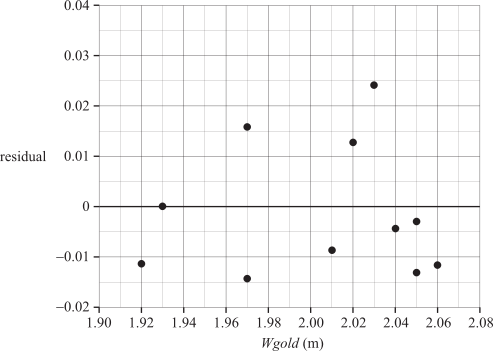
Filed Under: Concentration and Molarity Tagged With: Band 4, smc-4261-70-Standard Solutions

Trigonometry, EXT1 T1 2024 HSC 4 MC

What are the domain and range of the function  \(y = 2 \cos^{-1}(2x) + 2 \sin^{-1}(2x)\)?

  1. Domain: \([-0.5, 0.5]\) and Range: \(\{\pi\}\)
  2. Domain: \([-0.5, 0.5]\) and Range: \([-\pi, 3 \pi ]\)
  3. Domain: \([-2, 2]\) and Range: \(\{\pi\}\)
  4. Domain: \([-2, 2]\) and Range: \([-\pi, 3\pi]\)
Show Answers Only

\(A\)

Show Worked Solution

\(\text{Domain:}\ \ -1 \leqslant 2x \leqslant 1 \ \ \Rightarrow\ \ -\dfrac{1}{2} \leqslant x \leqslant \dfrac{1}{2} \)

\(\text{Range:}\ \ 2\Big(\cos^{-1}(2x)+ \sin^{-1}(2x)\Big) = 2 \times \dfrac{\pi}{2} = \pi\)

\(\Rightarrow A\)

Filed Under: T1 Inverse Trig Functions (Y11) Tagged With: Band 4, smc-1024-10-arcsin Graphs, smc-1024-11-arccos Graphs, smc-1024-20-Domain and Range

Combinatorics, EXT1 A1 2024 HSC 3 MC

Students from 4 different schools come together to form a choir.

What is the minimum size of the choir to know that there must be at least 20 students in the choir from one of the schools?

  1. \(76\)
  2. \(77\)
  3. \(80\)
  4. \(81\)
Show Answers Only

\(B\)

Show Worked Solution

\(\text{Pigeonholes}\ (k) = 4\)

\(\text{Let pigeons}\ (n) = x\)

\(\dfrac{n}{k} = \dfrac{x}{4} \gt 19\ \ \Rightarrow \  \gt 76\)

\(x_{min} = 77\)

\(\Rightarrow B\)
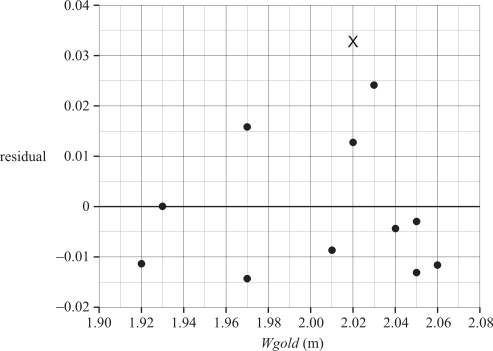
Filed Under: Permutations and Combinations (Ext1) Tagged With: Band 4, smc-1082-40-Pigeonhole

Statistics, 2ADV S3 2024 HSC 25

A function \(f(x)\) is defined as
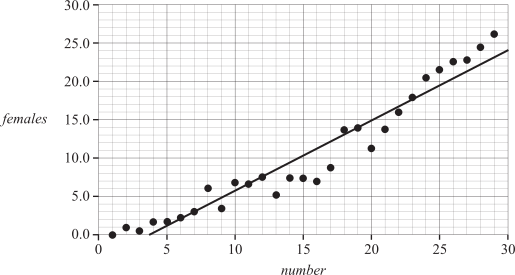
\(f(x)=\left\{\begin{array}{ll} 0, & \text { for}\ \ x \lt 0 \\
1-\dfrac{x}{h}, & \text { for}\ \ 0 \leq x \leq h, \\
0, & \text { for}\ \  x \gt h \end{array}\right.\)
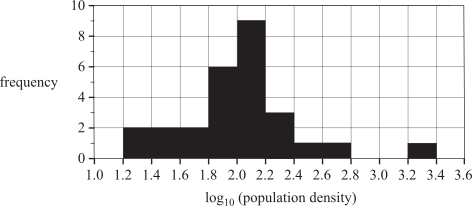
where \(h\) is a constant.

  1. Find the value of \(h\) such that \(f(x)\) is a probability density function.   (2 marks)

    --- 6 WORK AREA LINES (style=lined) ---

  2. By first finding a formula for the cumulative distribution function, sketch its graph.   (2 marks)

    --- 7 WORK AREA LINES (style=lined) ---

  3. Find the value of the median of the probability density function \(f(x)\) . Give your answer correct to 3 decimal places.   (2 marks)

    --- 10 WORK AREA LINES (style=lined) ---

Show Answers Only

a.   \(h=2\)

b.   

c.   \(\text{Median}\ =0.586\)

Show Worked Solution

a.   \(f(x)\ \text{is a PDF if:}\)

\(\displaystyle \int_{0}^{h} 1-\dfrac{x}{h}\,dx\) \(=1\)  
\(\Big[x-\dfrac{x^2}{2h} \Big]_0^{h}\) \(=1\)  
\(h-\dfrac{h}{2}\) \(=1\)  
\(h\) \(=2\)  

  
b.
   \( \displaystyle \int 1-\dfrac{x}{2}\,dx = x-\dfrac{x^2}{4} + c\)

\(\text{At}\ \ x=0, \ \ F(0)=0,\ \ c=0 \)

\(f(x)=\left\{\begin{array}{ll} 0, & \text { for}\ \ x \lt 0 \\
x-\dfrac{x^2}{4}, & \text { for}\ \ 0 \leq x \leq 2, \\
1, & \text { for}\ \  x \gt 2 \end{array}\right.\)
 

♦♦ Mean mark (b) 27%.

c.   \(\text{Let}\ \ m=\ \text{median of}\ f(x) \)

\(\displaystyle \int_0^{m} 1-\dfrac{x}{2}\,dx\)  \(=0.5\)  
\(\Big[ x-\dfrac{x^2}{4} \Big]_0^m\) \(=0.5\)  
\(m-\dfrac{m^2}{4}\) \(=0.5\)  
\(4m-m^2\) \(=2\)  
\(m^2-4m+2\) \(=0\)  
\((m-2)^2\) \(=2\)  
\(m\) \(=2 \pm \sqrt{2}\)  


\(\therefore \ \text{Median}\) \(=2-\sqrt{2}\ \ (x \in [0,2]) \)   
  \(=0.586\ \text{(3 d.p.)}\)  
♦♦ Mean mark (c) 38%.

Filed Under: Probability Density Functions (Y12) Tagged With: Band 4, Band 5, smc-994-10-Median, smc-994-40-Cumulative Distribution Fn, smc-994-50-Linear PDF

  • « Previous Page
  • 1
  • …
  • 29
  • 30
  • 31
  • 32
  • 33
  • …
  • 114
  • Next Page »

Copyright © 2014–2025 SmarterEd.com.au · Log in