SmarterEd

Aussie Maths & Science Teachers: Save your time with SmarterEd

  • Login
  • Get Help
  • About

v1 Measurement, STD2 M7 2020 HSC 23

In a tropical punch, the ratio of passionfruit juice to guava juice to lime juice is 12 : 10 : 6 .

  1. How much lime juice is needed if the punch is to contain 2.4 litres of passionfruit juice? (2 marks)

    --- 4 WORK AREA LINES (style=lined) ---

  2. The internal dimensions of a drink container, in the shape of a rectangular prism, are shown.
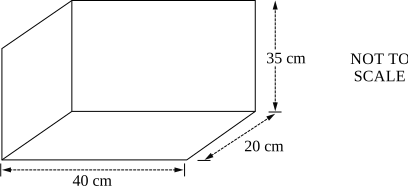
     

    To completely fill the container with the punch, how many litres of guava juice are required? (3 marks)

    --- 6 WORK AREA LINES (style=lined) ---
Show Answers Only
  1. `1.2 text{L}`
  2. `10  text{L}`
Show Worked Solution
a.    `text(12 parts)` `= 2.4\ text(L)`
  `text(1 part)` `= 2.4/12`
    `= 0.2\ text(L)`


`:.\ text(6 parts)` `= 6 xx 0.2`  
  `= 1.2\ text(L)`  
b.     `text{Volume of container}` `= 40 xx 20 xx 35`
    `= 28\ 000 \ text{cm}^3`

`1 \ text{mL} \ to \ 1 \ text{cm}^3`

`⇒ \ 28\ 000 \ text{mL of punch}`

`therefore \ text{Guava juice required}` `= text{Guava parts}/text{Total parts} \ xx \ 28\ 000`
  `= \frac{10}{28} \ xx \ 28\ 000`
  `= 10\ 000 \ text{mL}`
  `= 10 \ text{L}`

Filed Under: Ratios (Std2-X) Tagged With: Band 4, Band 5, smc-1187-20-Ratio (3 part)

v1 Measurement, STD2 M7 SM-Bank 17

There are 72 students in a school hall.

The ratio of Year 12 to Year 11 students is 7 to 5.

How many Year 12 students need to leave the hall so that the ratio of Year 12 to Year 11 becomes 1 to 1?   (2 marks)

--- 4 WORK AREA LINES (style=lined) ---

Show Answers Only

`12\ text(Year 12  students)`

Show Worked Solution

`text(Year 12 : Year  11) = 7 : 5`

`text(Since there are 72 students in the hall,)`

`42\ text(Year 12 : 30 Year 11.)`

`:. 12\ text(Year 12 students need to leave for the ratio to become 1 : 1)`

Filed Under: Ratios (Std2-X) Tagged With: Band 4, smc-1187-10-Ratio (2 part)

v1 Measurement, STD2 M7 SM-Bank 13

A triangle has angles in the ratio  7 : 5 : 4.

In degrees, what is the size of its smallest angle?  (2 marks)

--- 4 WORK AREA LINES (style=lined) ---

Show Answers Only

`45°`

Show Worked Solution
`text(Smallest angle)` `= text(smallest part)/text(total parts) xx 180`
  `= 4/(7+5+4) xx 180`
  `= 4/16 xx 180`
  `= 45°`

Filed Under: Ratios (Std2-X) Tagged With: Band 4, smc-1105-50-Ratio (3 part), smc-1187-20-Ratio (3 part)

v1 Measurement, STD2 M7 2019 HSC 18

Dana, Eden and Flynn are the first three players in the school basketball team. In a recent game, Dana scored 24 points, Eden scored 18 points and Flynn scored 30 points.

  1. What is the ratio of Dana's to Eden's to Flynn's points scored, in simplest form?   (2 marks)

    --- 4 WORK AREA LINES (style=lined) ---

  2. In this game, the ratio of the total number of points scored by Dana, Eden and Flynn to the total number of points scored by the whole team is `9:20`.
  3. How many points were scored by the whole team?   (2 marks)

    --- 4 WORK AREA LINES (style=lined) ---

Show Answers Only
  1. `4:3:5`
  2. `160\ text(points)`
Show Worked Solution
a.     `D:E:F` `= 24:18:30`
    `= 4:3:5`


b.     `text(Total points by)\ D,E,F` `= 24 + 18 + 30`
    `= 72`


`text(Let)\ P` `=\ text(team points)`
`P/72` `= 20/9`
`:. P` `= (20 xx 72)/9`
  `= 160\ text(points)`

Filed Under: Ratios (Std2-X) Tagged With: Band 3, Band 4, smc-1187-10-Ratio (2 part), smc-1187-20-Ratio (3 part)

v1 Algebra, STD2 A4 2017 HSC 28e

Sage brings 60 cartons of unpasteurised milk to the market each week. Each carton currently sells for $4 and at this price, all 60 cartons are sold each weekend.

Sage considers increasing the price to see if the total income can be increased.

It is assumed that for each $1 increase in price, 6 fewer cartons will be sold.

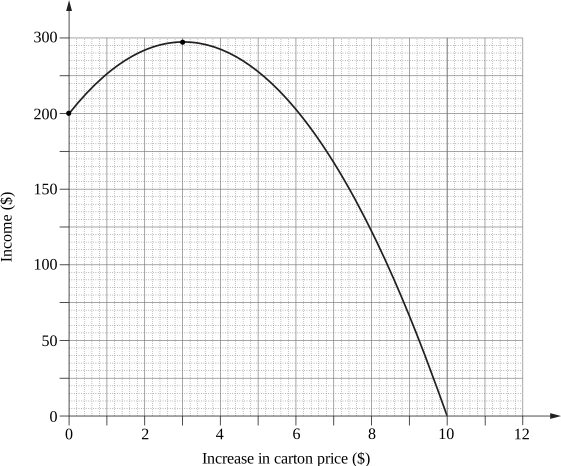
A graph showing the relationship between the increase in price per carton and the income is shown below.


  1. What price per carton should be charged to maximise the income?   (1 mark)

    --- 1 WORK AREA LINES (style=lined) ---

  2. What is the number of cartons sold when the income is maximised?   (1 mark)

    --- 1 WORK AREA LINES (style=lined) ---

  3. The cost of running the market stall is $40 plus $1.50 per carton sold.

    Calculate Sage's profit when the income earned from a day selling at the market is maximised.   (2 marks)

--- 4 WORK AREA LINES (style=lined) ---

Show Answers Only

a.   `$7`

b.   `42`

c.   `$191`

Show Worked Solution

a.   `text(Graph is highest when increase = $3)`

`:.\ text(Carton price)\ = 4 + 3= $7`
 

b.   `text(Cartons sold)\ =60-(3 xx 6)=42`
  

c.   `text{Cost}\ = 42 xx 1.50 + 40 = $103`

`:.\ text(Profit when income is maximised)`

`= (42 xx 7)-103`

`= $191`

Filed Under: Non-Linear: Exponential/Quadratics (Std 2-X) Tagged With: Band 4, Band 5, num-title-ct-coreb, num-title-qs-hsc, smc-4443-70-Other applications, smc-830-20-Quadratics

v1 Measurement, STD2 M7 2008 HSC 20 MC

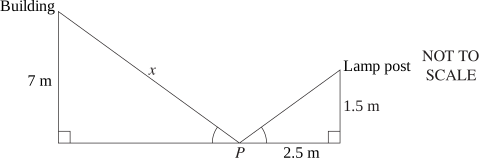
A point `P` lies between a lamp post, 1.5 metres high, and a building, 7 metres high. `P` is 2.5 metres away from the base of the post.

From `P`, the angles of elevation to the top of the lamp post and to the top of the building are equal.
 

What is the distance, `x`, from `P` to the top of the tower?

  1. 10.60
  2. 12.50
  3. 13.60
  4. 14.55
Show Answers Only

`C`

Show Worked Solution

`text(Triangles are similar)\ \ text{(equiangular)}`

`text(In smaller triangle:)`

`h^2` `= 1.5^2 + 2.5^2`
  `= 8.5`
`h` `= sqrt 8.5`
   
`x/sqrt8.5` `= 7/1.5 \ \ \ text{(sides of similar Δs in same ratio)}`
`x` `= (7 sqrt 8.5)/1.5`
  `= 13.60…`

 
`=>  C`

Filed Under: Ratios (Std2-X) Tagged With: Band 4, num-title-ct-pathc, num-title-qs-hsc, smc-1105-30-Similarity, smc-1187-60-Similarity, smc-4746-50-Real world applications

CHEMISTRY, M1 EQ-Bank 3 MC

Hydrogen bonding occurs between molecules of which of the following substances?

  1. Carbon dioxide
  2. Hydrogen fluoride
  3. Methane
  4. Hydrogen iodide
Show Answers Only

\(B\)

Show Worked Solution
  • Hydrogen bonding requires \(\ce{H}\) covalently bonded to \(\ce{N}\), \(\ce{O}\), or \(\ce{F}\).
  • Only hydrogen fluoride \(\ce{(HF)}\) meets these conditions.

\(\Rightarrow B\)

Filed Under: Bonding Tagged With: Band 4, smc-4258-40-Inter/Intramolecular Bonding

CHEMISTRY, M1 EQ-Bank 17

The following table gives some information about two covalent molecule substances

\begin{array} {|c|c|c|}
\hline \text{Compound} & \text{Molecular formula} & \text{Boiling Point } (^{\circ}C) \\
\hline \text{Water} & \ce{H2O} & 100 \\
\hline \text{Hydrogen sulfide} & \ce{H2S} & -60 \\
\hline \end{array}

  1. Draw Lewis dot diagrams for each molecule.   (2 marks)

    --- 4 WORK AREA LINES (style=blank) ---

  1. Identify the shape and polarity of each molecule.   (4 marks)

    --- 2 WORK AREA LINES (style=lined) ---

  1. Explain why there is a difference in the boiling points of these molecules.   (3 marks)

    --- 6 WORK AREA LINES (style=lined) ---
Show Answers Only

a.   
             

b.   Water: Bent and Polar

Hydrogen Sulfide: Bent and polar 

c.   Even though both molecular are polar:

  • Water has strong hydrogen bonding between molecules because \(\ce{H}\) is bonded to highly electronegative \(\ce{O}\) with lone pairs. These hydrogen bonds require large amounts of energy to break, giving water a high boiling point.
  • Hydrogen sulfide cannot form hydrogen bonds because \(\ce{S}\) is not electronegative enough. The only intermolecular forces are weak dipole–dipole and dispersion forces. Thus less energy is required to overcome the intermolecular forces and so \(\ce{H2S}\) a lower boiling point.
Show Worked Solution

a.   
             

b.   Water: Bent and Polar

Hydrogen Sulfide: Bent and polar
 

c.   Even though both molecular are polar:

  • Water has strong hydrogen bonding between molecules because \(\ce{H}\) is bonded to highly electronegative \(\ce{O}\) with lone pairs. These hydrogen bonds require large amounts of energy to break, giving water a high boiling point.
  • Hydrogen sulfide cannot form hydrogen bonds because \(\ce{S}\) is not electronegative enough. The only intermolecular forces are weak dipole–dipole and dispersion forces. Thus less energy is required to overcome the intermolecular forces and so \(\ce{H2S}\) a lower boiling point.

Filed Under: Bonding Tagged With: Band 4, Band 5, smc-4258-30-Lewis Dot, smc-4258-40-Inter/Intramolecular Bonding, smc-4258-50-Chemical structure

v1 Algebra, STD2 A4 2021 HSC 24

A population of Tasmanian devils, `D`, is to be modelled using the function  `D = 650 (0.8)^t`, where `t` is the time in years.

  1. What is the initial population?   (1 mark)

    --- 2 WORK AREA LINES (style=lined) ---

  2. Find the population after 2 years.   (1 mark)

    --- 2 WORK AREA LINES (style=lined) ---

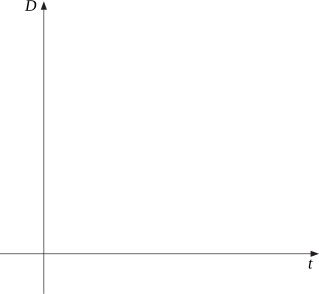
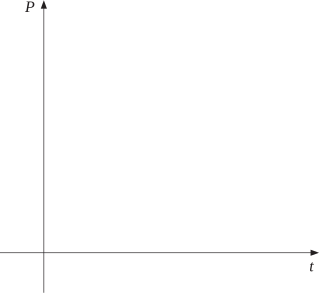
  3. On the axes below, draw the graph of the population against time, in the period  `t = 0`  to  `t = 6`.   (2 marks)
      

    --- 0 WORK AREA LINES (style=lined) ---

Show Answers Only

a.   `650`

b.   `416`

c.   `text{See Worked Solutions}`

Show Worked Solution

a.   `text{Initial population occurs when}\ \  t = 0:`

`D=650(0.8)^0=650 xx 1= 650`
 

b.    `text{Find} \ D \ text{when} \ \ t = 5: `

`D= 650 (0.8)^2= 416`

♦ Mean mark (c) 48%.

 
c. 
 `\text{At}\ t=6:`

`D=650(0.8)^6=170.39…`
 

Filed Under: Non-Linear: Exponential/Quadratics (Std 2-X) Tagged With: Band 3, Band 4, Band 5, num-title-ct-coreb, num-title-qs-hsc, smc-4444-40-Population, smc-830-30-Exponential

v1 Algebra, STD2 A4 EO-Bank 1

Taylor discovers that for a Spotted stingray, its mass is directly proportional to the square of its wingspan.

One Spotted stingray has a wingspan of 60 cm and a mass of 5400 grams.

What is the expected wingspan of a Spotted stingray with a mass of 9.6 kg?   (3 marks)

--- 6 WORK AREA LINES (style=lined) ---

Show Answers Only

`80.0\ text{cm}`

Show Worked Solution

`text(Mass) prop text(wingspan)^2\ \ =>\ \ m = kw^2`

`text(Find)\ k:`

`5400` `= k xx 60^2`
`k` `= 5400/60^2= 1.5`

 
`text(Find)\ w\ text(when)\ \ m = 9600:`

`9600` `= 1.5 xx w^2`
`w^2` `= 9600/1.5=6400`
`:. w` `= 80\ text{cm}`

Filed Under: Non-Linear: Exponential/Quadratics (Std 2-X) Tagged With: Band 4, smc-830-20-Quadratics, smc-830-60-Proportional

v1 Algebra, STD2 A4 2023 HSC 22

The stopping distance of a motor bike, in metres, is directly proportional to the square of its speed in km/h, and can be represented by the equation

`text{stopping distance}\ = k xx text{(speed)}^2`

where `k` is the constant of variation.

The stopping distance for a motor bike travelling at 40 km/h is 16 m.

  1. Find the value of `k`.  (2 marks)

    --- 4 WORK AREA LINES (style=lined) ---

  2. What is the stopping distance when the speed of the motor bike is 80 km/h?  (1 mark)

    --- 2 WORK AREA LINES (style=lined) ---

Show Answers Only

a.    `k=0.01`

b.    `64.0\ text{m}`

Show Worked Solution

a.  `text{stopping distance}\ = k xx text{(speed)}^2`

`16` `=k xx 40^2`  
`k` `=16/40^2=0.001`  

 
b.    `text{Find stopping distance}\ (d)\ text{when speed = 80 km/h:}`

`d=0.01 xx 80^2=64.0\ text{m}`

Filed Under: Non-Linear: Exponential/Quadratics (Std 2-X) Tagged With: Band 4, smc-830-20-Quadratics, smc-830-60-Proportional

JACK v1 Functions, 2ADV F1 2008 HSC 1c

Simplify  `2/n-1/(n+1)`.   (2 marks)

--- 4 WORK AREA LINES (style=lined) ---
Show Answers Only

`(n + 2)/(n(n+1))`

Show Worked Solution

`2/n-1/(n+1)`

`= (2(n+1)-1(n))/(n(n+1))`

`= (2n + 2-n)/(n(n+1))`

`= (n+2)/(n(n+1))`

Filed Under: Algebraic Techniques (Adv-X) Tagged With: Band 4, common-content, num-title-ct-pathb, num-title-qs-hsc, smc-4356-12-Subtraction, smc-983-40-Algebraic Fractions

CHEMISTRY, M1 EQ-Bank 12

  1. Draw a Lewis electron dot diagram for each of the following compounds:
  2. i. \(\ce{CO2}\)   (1 mark)
  3. ii. \(\ce{MgCl2}\)   (1 mark)
  1. Using the two substances in (a) as examples, compare the bonding in ionic compounds with the bonding in covalent molecular compounds.   (3 marks)

--- 5 WORK AREA LINES (style=lined) ---

  1. The boiling point of \(\ce{CO2}\) is –78°C, while the boiling point of \(\ce{MgCl2}\) is 1412\(^{\circ}\)C. Account for the difference in boiling points between these two substances.   (3 marks)

--- 5 WORK AREA LINES (style=lined) ---
Show Answers Only

a.i.  

 a.ii.  


b.   Bonding in ionic compounds vs covalent molecular compounds:

  • Ionic compounds are solids at STP and consist of positively and negatively charged ions held together in a lattice by strong electrostatic forces. 
  • In magnesium chloride, doubly charged magnesium cations are surrounded by chloride anions in a ratio of 1:2.
  • Covalent molecular compounds are groups of atoms in which one or more pairs of electrons are shared between atoms.
  • In carbon dioxide, carbon forms double covalent bonds with two oxygen atoms, sharing its valence electrons. Carbon dioxide molecules are bound together only by relatively weak dispersion forces and therefore exist as a gas at STP.

c.   Differences in boiling points:

  • \(\ce{CO2}\) molecules are held together by weak dispersion forces between neutral molecules. These forces require little energy to overcome, resulting in a very low boiling point –78°C.
  • \(\ce{MgCl2}\) has a giant ionic lattice. Strong electrostatic forces between \(\ce{Mg^2+}\) and \(\ce{Cl^-}\) ions extend throughout the solid. Large amounts of energy are required to break these ionic bonds, giving it a very high boiling point at 1412°C.
  • Therefore, the huge difference in boiling points is due to weak intermolecular forces in covalent molecular substances compared with strong ionic bonds in ionic compounds.
Show Worked Solution

a.i.  


 a.ii.  


b.   Bonding in ionic compounds vs covalent molecular compounds:

  • Ionic compounds are solids at STP and consist of positively and negatively charged ions held together in a lattice by strong electrostatic forces. 
  • In magnesium chloride, doubly charged magnesium cations are surrounded by chloride anions in a ratio of 1:2.
  • Covalent molecular compounds are groups of atoms in which one or more pairs of electrons are shared between atoms.
  • In carbon dioxide, carbon forms double covalent bonds with two oxygen atoms, sharing its valence electrons. Carbon dioxide molecules are bound together only by relatively weak dispersion forces and therefore exist as a gas at STP.

c.   Differences in boiling points:

  • \(\ce{CO2}\) molecules are held together by weak dispersion forces between neutral molecules. These forces require little energy to overcome, resulting in a very low boiling point –78°C.
  • \(\ce{MgCl2}\) has a giant ionic lattice. Strong electrostatic forces between \(\ce{Mg^2+}\) and \(\ce{Cl^-}\) ions extend throughout the solid. Large amounts of energy are required to break these ionic bonds, giving it a very high boiling point at 1412°C.
  • Therefore, the huge difference in boiling points is due to weak intermolecular forces in covalent molecular substances compared with strong ionic bonds in ionic compounds.

Filed Under: Bonding Tagged With: Band 4, Band 5, Band 6, smc-4258-30-Lewis Dot, smc-4258-40-Inter/Intramolecular Bonding

v1 Measurement, STD2 M7 2016 HSC 16 MC

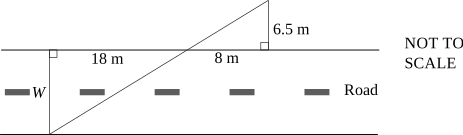
The width (`W`) of a road can be calculated using two similar triangles, as shown in the diagram.


What is the approximate width of the road?

  1. `12.8\ text(m)`
  2. `13.3\ text(m)`
  3. `14.6\ text(m)`
  4. `17.8\ text(m)`
Show Answers Only

`=> C`

Show Worked Solution

`text{Triangles are similar (equiangular)}`

`text(Using similar ratios:)`

`W/(6.5)` `= 18/8`
`:. W` `= (18 xx 6.5)/8`
  `= 14.62…`

 
`=> C`

Filed Under: Ratios (Std2-X) Tagged With: Band 4, num-title-ct-pathc, num-title-qs-hsc, smc-1105-30-Similarity, smc-1187-60-Similarity, smc-4746-50-Real world applications

v1 Algebra, STD2 A4 2008 HSC 4 MC

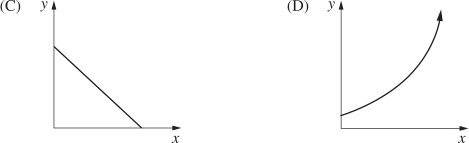
Which graph best represents  \(y = \dfrac{2}{x}\) ?
 

Show Answers Only

\(B\)

Show Worked Solution

\(y = \dfrac{2}{x}\ \text{does not touch either axis (inverse graph)}.\)

\(\Rightarrow B\)

Filed Under: Exponential/Quadratic (Projectile), Exponentials, Non-Linear: Exponential/Quadratics (Std 2-X) Tagged With: Band 4, num-title-ct-corea, num-title-qs-hsc, smc-4444-10-Identify graphs, smc-830-10-Identify Graphs

v1 Measurement, STD2 M7 2023 HSC 11 MC

A garden has 180 flowers. Some are tulips and the rest are roses. The ratio of tulips to roses is `4:5`.

A gardener picks 20 tulips and 25 roses for a bouquet.

What is the new ratio of tulips to roses in the garden?

  1. `2:3`
  2. `3:4`
  3. `4:5`
  4. `5:6`
Show Answers Only

`C`

Show Worked Solution

`text{Original ratio} = 4:5`

`text{Total parts} = 4 + 5 = 9`

`text{1 part} = 180 ÷ 9 = 20`

`text{Tulips} = 4 × 20 = 80`

`text{Roses} = 5 × 20 = 100`

`text{After picking:}`

`text{Tulips} = 80 − 20 = 60`

`text{Roses} = 100 − 25 = 75`

`text{New ratio} = 60:75`

`= 4:5`

`⇒ C`

Filed Under: Ratios (Std2-X), Uncategorized Tagged With: Band 4, smc-1187-10-Ratio (2 part)

v1 Measurement, STD2 M7 2022 HSC 6 MC

What is 45 minutes to one-quarter of a day, expressed as a ratio in simplest form?

  1. `3: 80`
  2. `1: 8`
  3. `1: 32`
  4. `1: 12`
Show Answers Only

`B`

Show Worked Solution

`text{Minutes in } 1/4 \text{ of a day}`

`= 1/4 × 24 × 60 = 360`

`text{Ratio} = 45 : 360`

`= 1 : 8`

`=> B`

Filed Under: Ratios (Std2-X) Tagged With: Band 4, smc-1187-10-Ratio (2 part)

v1 Measurement, STD2 M7 2014 HSC 17 MC

A child who weighs 22 kg needs to be given 12 mg of medicine for every 2 kg of body weight. 

Every 10 mL of this medicine contains 150 mg. 

What is the correct dosage for the child? 

  1. 7.0 mL 
  2. 8.8 mL 
  3. 10.2 mL 
  4. 11.5 mL 
Show Answers Only

\(B\)

Show Worked Solution

\(\text{Dosage needed}\ = \dfrac{22}{2} \times 12 = 132\ \text{mg}\) 

\(\text{Since there is 150 mg in 10 mL:} \) 

\(\text{Volume (132 mg)}\ =\dfrac{132}{150} \times 10 = 8.8\ \text{mL}\) 

\(\Rightarrow B\)

Filed Under: Rates (Std2-X) Tagged With: Band 4, smc-1104-15-General rate problems, smc-805-60-Other rate problems

HMS, TIP EQ-Bank 419

Compare how program customisation approaches differ between recreational participants and elite athletes.   (6 marks)

--- 20 WORK AREA LINES (style=lined) ---

Show Answers Only

Benefits

  • [P] Assessment-driven customisation significantly improves program effectiveness by targeting individual needs precisely and efficiently.
  • [E] Personalised programs address specific strengths and weaknesses identified through systematic testing rather than generic approaches that may miss individual requirements.
  • [Ev] A recreational client with poor cardiovascular fitness but strong upper body receives aerobic-focused training whilst maintaining strength levels through targeted exercises.
  • [L] This demonstrates how customisation maximises training efficiency and individual progress rates through focused interventions.
      
  • [P] Customised programs enhance participant motivation and adherence through relevant and achievable goal setting based on personal capabilities.
  • [E] Individual assessment data enables realistic target establishment that maintains engagement throughout extended training periods and prevents unrealistic expectations.
  • [Ev] Basketball players setting 5cm vertical jump improvements based on testing results show greater commitment than arbitrary goals without data foundation.
  • [L] Therefore, data-driven customisation creates meaningful progress markers that sustain long-term participation and program compliance.

Challenges

  • [P] Assessment-based customisation requires significant professional expertise and time investment from qualified fitness practitioners and specialists.
  • [E] Comprehensive testing, data analysis, and individualised program design demand extensive knowledge and planning resources that increase program costs.
  • [Ev] Detailed performance analysis for elite athletes involves multiple testing sessions and complex program modifications requiring specialised equipment and facilities.
  • [L] This highlights how customisation complexity can limit accessibility for some fitness professionals and clients with restricted budgets.
Show Worked Solution

Benefits

  • [P] Assessment-driven customisation significantly improves program effectiveness by targeting individual needs precisely and efficiently.
  • [E] Personalised programs address specific strengths and weaknesses identified through systematic testing rather than generic approaches that may miss individual requirements.
  • [Ev] A recreational client with poor cardiovascular fitness but strong upper body receives aerobic-focused training whilst maintaining strength levels through targeted exercises.
  • [L] This demonstrates how customisation maximises training efficiency and individual progress rates through focused interventions.
      
  • [P] Customised programs enhance participant motivation and adherence through relevant and achievable goal setting based on personal capabilities.
  • [E] Individual assessment data enables realistic target establishment that maintains engagement throughout extended training periods and prevents unrealistic expectations.
  • [Ev] Basketball players setting 5cm vertical jump improvements based on testing results show greater commitment than arbitrary goals without data foundation.
  • [L] Therefore, data-driven customisation creates meaningful progress markers that sustain long-term participation and program compliance.

Challenges

  • [P] Assessment-based customisation requires significant professional expertise and time investment from qualified fitness practitioners and specialists.
  • [E] Comprehensive testing, data analysis, and individualised program design demand extensive knowledge and planning resources that increase program costs.
  • [Ev] Detailed performance analysis for elite athletes involves multiple testing sessions and complex program modifications requiring specialised equipment and facilities.
  • [L] This highlights how customisation complexity can limit accessibility for some fitness professionals and clients with restricted budgets.

Filed Under: Assessment and developing training programs Tagged With: Band 4, Band 5, Band 6, smc-5458-20-Program customisation

HMS, TIP EQ-Bank 418

Compare how program customisation approaches differ between recreational participants and elite athletes.   (6 marks)

--- 18 WORK AREA LINES (style=lined) ---
Show Answers Only

Similarities

  • Both recreational participants and elite athletes require individual assessment data to identify personal strengths and weaknesses. Assessment information guides customised program development that addresses specific needs rather than generic training approaches.
  • Goal setting remains essential for both populations to provide direction and motivation throughout training programs. Customisation involves aligning program design with individual objectives whether focused on health improvement or competitive performance enhancement.
  • Progress monitoring through regular reassessment helps maintain program effectiveness for both recreational and elite populations. Customisation requires ongoing adjustments based on individual response patterns and changing needs over time.

Differences

  • Recreational participants receive broader program customisation focusing on general health, safety, and enjoyment factors. Elite athletes require highly specific customisation targeting precise performance indicators and competitive demands within their particular sports.
  • Assessment complexity varies significantly between populations with recreational clients receiving basic fitness evaluations. Elite athletes undergo comprehensive testing including advanced performance analysis and sport-specific capability measurements for detailed program customisation.
  • Customisation frequency differs as recreational participants may receive program updates quarterly or seasonally. Elite athletes require continuous customisation with frequent modifications based on performance data, competition schedules, and training phase requirements.
Show Worked Solution

Similarities

  • Both recreational participants and elite athletes require individual assessment data to identify personal strengths and weaknesses. Assessment information guides customised program development that addresses specific needs rather than generic training approaches.
  • Goal setting remains essential for both populations to provide direction and motivation throughout training programs. Customisation involves aligning program design with individual objectives whether focused on health improvement or competitive performance enhancement.
  • Progress monitoring through regular reassessment helps maintain program effectiveness for both recreational and elite populations. Customisation requires ongoing adjustments based on individual response patterns and changing needs over time.

Differences

  • Recreational participants receive broader program customisation focusing on general health, safety, and enjoyment factors. Elite athletes require highly specific customisation targeting precise performance indicators and competitive demands within their particular sports.
  • Assessment complexity varies significantly between populations with recreational clients receiving basic fitness evaluations. Elite athletes undergo comprehensive testing including advanced performance analysis and sport-specific capability measurements for detailed program customisation.
  • Customisation frequency differs as recreational participants may receive program updates quarterly or seasonally. Elite athletes require continuous customisation with frequent modifications based on performance data, competition schedules, and training phase requirements.

Filed Under: Assessment and developing training programs Tagged With: Band 4, Band 5, smc-5458-20-Program customisation

HMS, TIP EQ-Bank 417

Explain how assessment data can be used to customise training programs that address individual strengths and weaknesses.   (5 marks)

--- 15 WORK AREA LINES (style=lined) ---

Show Answers Only
  • Assessment results identify specific fitness components where individuals excel and areas requiring improvement through systematic testing. This enables trainers to allocate program focus appropriately. Therefore, strong areas receive maintenance work whilst weak components get priority attention and development emphasis.
  • Strength and weakness analysis allows targeted exercise selection that maximises training efficiency and effectiveness. Specific deficiencies require focused interventions through appropriate training methods. Consequently, programs become highly individualised rather than following generic approaches for all participants.
  • Individual capabilities data guides appropriate intensity and progression rate selection for safe and effective training outcomes. Assessment information determines starting difficulty levels and advancement schedules. This results in optimal challenge that promotes adaptation without excessive fatigue or injury risk.
  • Regular reassessment reveals changing strength and weakness patterns requiring program modifications over time. Updated data indicates when focus areas need adjustment. As a result, programs remain current and continue addressing individual needs effectively throughout training cycles.
Show Worked Solution
  • Assessment results identify specific fitness components where individuals excel and areas requiring improvement through systematic testing. This enables trainers to allocate program focus appropriately. Therefore, strong areas receive maintenance work whilst weak components get priority attention and development emphasis.
  • Strength and weakness analysis allows targeted exercise selection that maximises training efficiency and effectiveness. Specific deficiencies require focused interventions through appropriate training methods. Consequently, programs become highly individualised rather than following generic approaches for all participants.
  • Individual capabilities data guides appropriate intensity and progression rate selection for safe and effective training outcomes. Assessment information determines starting difficulty levels and advancement schedules. This results in optimal challenge that promotes adaptation without excessive fatigue or injury risk.
  • Regular reassessment reveals changing strength and weakness patterns requiring program modifications over time. Updated data indicates when focus areas need adjustment. As a result, programs remain current and continue addressing individual needs effectively throughout training cycles.

Filed Under: Assessment and developing training programs Tagged With: Band 4, smc-5458-20-Program customisation

HMS, TIP EQ-Bank 415 MC

A basketball player undergoes vertical jump testing that shows potential for 5cm improvement over 12 weeks. The trainer sets incremental goals and adjusts the program with plyometric and strength exercises to achieve this target. This scenario best demonstrates which aspect of data-driven program customisation?

  1. Using assessment data to establish realistic, measurable goals that guide systematic training progression and program modifications
  2. Implementing advanced testing protocols to identify genetic potential limitations that determine maximum achievable performance outcomes
  3. Developing sport-specific training programs that replicate exact game situations and competitive movement patterns for skill transfer
  4. Creating periodisation strategies that align training phases with competition schedules to optimise peak performance timing
Show Answers Only

\(A\)

Show Worked Solution
  • A is correct: Assessment data establishes realistic goals and guides systematic program modifications through targeted training interventions for specific outcomes.

Other Options:

  • B is incorrect: The focus is goal setting and program customisation rather than identifying genetic limitations or maximum potential.
  • C is incorrect: While sport-specific, the primary principle is data-driven goal setting rather than movement pattern replication.
  • D is incorrect: This describes periodisation timing rather than using assessment data for goal establishment and program customisation.

Filed Under: Assessment and developing training programs Tagged With: Band 4, smc-5458-20-Program customisation

HMS, TIP EQ-Bank 412

Why is continuous monitoring essential for elite athlete program development?   (3 marks)

--- 9 WORK AREA LINES (style=lined) ---

Show Answers Only
  • Continuous monitoring provides real-time feedback on training effectiveness and athlete responses. This enables coaches to identify successful protocols. Therefore, effective strategies are maintained while ineffective approaches are modified.
  • Regular assessment detects performance plateaus requiring program adjustments. This prevents wasted training time with ineffective methods. Consequently, athletes maintain progress toward performance goals.
  • Monitoring data reveals optimal timing for training increases and recovery periods. This ensures appropriate progression without overtraining. As a result, athletes achieve maximum gains safely.
Show Worked Solution
  • Continuous monitoring provides real-time feedback on training effectiveness and athlete responses. This enables coaches to identify successful protocols. Therefore, effective strategies are maintained while ineffective approaches are modified.
  • Regular assessment detects performance plateaus requiring program adjustments. This prevents wasted training time with ineffective methods. Consequently, athletes maintain progress toward performance goals.
  • Monitoring data reveals optimal timing for training increases and recovery periods. This ensures appropriate progression without overtraining. As a result, athletes achieve maximum gains safely.

Filed Under: Assessment and developing training programs Tagged With: Band 4, Band 5, smc-5458-15-Elite athlete optimisation

HMS, TIP EQ-Bank 411

Outline how detailed performance analysis assists in developing training programs for elite athletes.   (4 marks)

--- 12 WORK AREA LINES (style=lined) ---

Show Answers Only
  • Comprehensive assessment evaluates health-related and skill-related fitness components providing complete performance profiles. Testing identifies strengths to maintain and weaknesses requiring targeted improvement strategies.
  • Sport-specific performance indicators are measured to determine key capabilities relevant to competitive success. Assessment data reveals areas where performance gains will impact athletic achievement.
  • Strength and conditioning imbalances are detected through systematic testing enabling corrective program design. Targeted interventions address deficiencies whilst preserving existing capabilities and competitive advantages.
  • Continuous monitoring allows real-time program adjustments based on performance response data. Regular assessment enables optimisation of training loads, intensities and recovery strategies.
Show Worked Solution
  • Comprehensive assessment evaluates health-related and skill-related fitness components providing complete performance profiles. Testing identifies strengths to maintain and weaknesses requiring targeted improvement strategies.
  • Sport-specific performance indicators are measured to determine key capabilities relevant to competitive success. Assessment data reveals areas where performance gains will impact athletic achievement.
  • Strength and conditioning imbalances are detected through systematic testing enabling corrective program design. Targeted interventions address deficiencies whilst preserving existing capabilities and competitive advantages.
  • Continuous monitoring allows real-time program adjustments based on performance response data. Regular assessment enables optimisation of training loads, intensities and recovery strategies.

Filed Under: Assessment and developing training programs Tagged With: Band 4, smc-5458-15-Elite athlete optimisation

HMS, TIP EQ-Bank 408 MC

A sprinter undergoes testing that reveals exceptional top-end speed but weak acceleration in the first 30 metres. Based on this assessment data, which program development approach would be most appropriate?

  1. Focus training exclusively on maintaining top-end speed through longer sprint distances and technique refinement
  2. Implement explosive start drills and plyometric exercises to specifically target the identified acceleration weakness
  3. Develop a balanced program addressing all sprint components equally to ensure comprehensive speed development
  4. Prioritise aerobic base building to improve overall conditioning before addressing specific sprint weaknesses
Show Answers Only

\(B\)

Show Worked Solution
  • B is correct: Targeted training addresses the specific weakness identified through assessment while maintaining existing strengths for optimal performance improvement.

Other Options:

  • A is incorrect: Focusing only on existing strengths ignores the significant weakness that limits overall sprint performance potential.
  • C is incorrect: Equal focus doesn’t address the specific performance limitation identified through detailed assessment analysis.
  • D is incorrect: Aerobic conditioning is less relevant for sprint performance and doesn’t target the identified acceleration weakness.

Filed Under: Assessment and developing training programs Tagged With: Band 4, smc-5458-15-Elite athlete optimisation

HMS, TIP EQ-Bank 407

How does regular progress monitoring through reassessment enhance program effectiveness for recreational participants?   (5 marks)

--- 15 WORK AREA LINES (style=lined) ---

Show Answers Only
  • Regular reassessment provides objective data about fitness improvements and program effectiveness over extended time periods. This enables trainers to identify successful training elements and strategies. Therefore, proven approaches can be maintained whilst ineffective methods are systematically modified.
  • Progress tracking demonstrates tangible results that motivate recreational participants to continue their fitness journey enthusiastically. Visible improvements create positive reinforcement for sustained participation and engagement. Consequently, participants develop stronger commitment to long-term fitness goals.
  • Monitoring data reveals when training adaptations require program adjustments to prevent plateaus and maintain steady progression. Assessment results indicate optimal timing for intensity increases or exercise modifications. This leads to continuous improvement rather than stagnated performance outcomes.
  • Reassessment identifies potential overtraining or excessive fatigue requiring immediate program modifications for participant safety. Early detection prevents injury development and burnout issues effectively. As a result, participants maintain consistent training without setbacks or extended recovery periods.
Show Worked Solution
  • Regular reassessment provides objective data about fitness improvements and program effectiveness over extended time periods. This enables trainers to identify successful training elements and strategies. Therefore, proven approaches can be maintained whilst ineffective methods are systematically modified.
  • Progress tracking demonstrates tangible results that motivate recreational participants to continue their fitness journey enthusiastically. Visible improvements create positive reinforcement for sustained participation and engagement. Consequently, participants develop stronger commitment to long-term fitness goals.
  • Monitoring data reveals when training adaptations require program adjustments to prevent plateaus and maintain steady progression. Assessment results indicate optimal timing for intensity increases or exercise modifications. This leads to continuous improvement rather than stagnated performance outcomes.
  • Reassessment identifies potential overtraining or excessive fatigue requiring immediate program modifications for participant safety. Early detection prevents injury development and burnout issues effectively. As a result, participants maintain consistent training without setbacks or extended recovery periods.

Filed Under: Assessment and developing training programs Tagged With: Band 4, Band 5, Band 6, smc-5458-10-Recreational program dev

HMS, TIP EQ-Bank 406

Compare how exercise assessments inform program development for recreational participants with different fitness backgrounds and goals.   (6 marks)

--- 18 WORK AREA LINES (style=lined) ---

Show Answers Only

Similarities

  • Both sedentary and active recreational participants require comprehensive baseline fitness assessment to establish appropriate starting points for safe training. Assessment data determines safe program intensity levels and identifies potential risk factors requiring immediate attention and program modifications.
  • Goal identification remains essential regardless of current fitness level or specific long-term objectives. Clear goal setting provides direction for program design and enables accurate progress measurement over extended time periods.
  • Progress monitoring through regular reassessment helps maintain motivation and engagement for all recreational participants. Tracking improvements demonstrates program effectiveness and guides necessary adjustments to training protocols and methods.

Differences

  • Sedentary individuals require more comprehensive health screening and conservative program progression to ensure safety and prevent injury. Active participants may undergo more advanced performance testing to identify specific improvement areas and training targets.
  • Program intensity and complexity vary significantly based on current fitness levels and previous exercise experience. Beginners need gradual progression whilst experienced participants can handle more challenging training loads and advanced techniques.
  • Assessment frequency and methods differ according to individual risk factors and personal fitness goals. Higher-risk participants require more frequent monitoring whilst established exercisers may need less intensive supervision and guidance.
Show Worked Solution

Similarities

  • Both sedentary and active recreational participants require comprehensive baseline fitness assessment to establish appropriate starting points for safe training. Assessment data determines safe program intensity levels and identifies potential risk factors requiring immediate attention and program modifications.
  • Goal identification remains essential regardless of current fitness level or specific long-term objectives. Clear goal setting provides direction for program design and enables accurate progress measurement over extended time periods.
  • Progress monitoring through regular reassessment helps maintain motivation and engagement for all recreational participants. Tracking improvements demonstrates program effectiveness and guides necessary adjustments to training protocols and methods.

Differences

  • Sedentary individuals require more comprehensive health screening and conservative program progression to ensure safety and prevent injury. Active participants may undergo more advanced performance testing to identify specific improvement areas and training targets.
  • Program intensity and complexity vary significantly based on current fitness levels and previous exercise experience. Beginners need gradual progression whilst experienced participants can handle more challenging training loads and advanced techniques.
  • Assessment frequency and methods differ according to individual risk factors and personal fitness goals. Higher-risk participants require more frequent monitoring whilst established exercisers may need less intensive supervision and guidance

Filed Under: Assessment and developing training programs Tagged With: Band 4, Band 5, smc-5458-10-Recreational program dev

HMS, TIP EQ-Bank 403 MC

A fitness professional designs a program for a recreational client with a history of knee problems, incorporating low-impact strength exercises and avoiding high-impact activities. This approach primarily demonstrates which aspect of assessment-based program development?

  1. Modifying exercise selection based on injury history to minimise re-injury risk while maintaining program effectiveness
  2. Reducing program intensity across all components to accommodate any potential physical limitations or concerns
  3. Focusing exclusively on rehabilitation exercises rather than general fitness improvement for long-term client safety
  4. Implementing advanced periodisation techniques to optimise performance outcomes despite previous injury concerns
Show Answers Only

\(A\)

Show Worked Solution
  • A is correct: The approach shows targeted exercise modification based on assessment data to reduce injury risk while maintaining fitness benefits.

Other Options:

  • B is incorrect: The modification is specific to impact level rather than reducing intensity across all program components systematically.
  • C is incorrect: The program maintains fitness focus with modifications rather than becoming exclusively rehabilitation-oriented for general clients.
  • D is incorrect: This represents safety-focused modification rather than advanced periodisation for performance optimisation in recreational settings.

Filed Under: Assessment and developing training programs Tagged With: Band 4, smc-5458-10-Recreational program dev

HMS, TIP EQ-Bank 098

Discuss the use assistive technology to enhance participation and performance for athletes with disabilities.   (6 marks)

--- 18 WORK AREA LINES (style=lined) ---

Show Answers Only

Positive Impacts

  • [P] A key advantage is that assistive technology enhances performance for athletes with disabilities.
  • [E] This happens because equipment such as lightweight wheelchairs and advanced tyres improve speed and manoeuvrability.
  • [Ev] For example, racing wheelchairs designed with carbon fibre frames allow Paralympic athletes to compete at elite levels.
  • [L] This shows how assistive technology supports athletes to reach higher levels of performance.
     
  • [P] Another benefit is increased participation and access.
  • [E] Audible balls for athletes with vision impairment create fair opportunities to play sport.
  • [Ev] Evidence of this is seen in blind cricket, where specially designed balls allow athletes to track ball movement using sound.
  • [L] Therefore, technology reduces barriers and makes sport more inclusive.

Challenges and Limitations

  • [P] On the other hand, one significant limitation is cost and availability.
  • [E] This occurs because advanced wheelchairs or prosthetics are expensive and not accessible to all.
  • [Ev] For instance, high-performance prosthetic running blades can cost thousands of dollars, limiting access for some athletes.
  • [L] Consequently, while technology enhances participation, equity remains an issue.
     
  • [P] Another concern is over-reliance on assistive technology.
  • [E] This occurs because athletes may depend heavily on specialised equipment rather than developing broader skills or fitness.
  • [Ev] For example, wheelchair athletes using highly engineered chairs may struggle if equipment malfunctions, reducing performance significantly.
  • [L] This demonstrates that technology dependence can make athletes vulnerable and highlights the importance of balancing equipment use with training.
Show Worked Solution

Positive Impacts

  • [P] A key advantage is that assistive technology enhances performance for athletes with disabilities.
  • [E] This happens because equipment such as lightweight wheelchairs and advanced tyres improve speed and manoeuvrability.
  • [Ev] For example, racing wheelchairs designed with carbon fibre frames allow Paralympic athletes to compete at elite levels.
  • [L] This shows how assistive technology supports athletes to reach higher levels of performance.
     
  • [P] Another benefit is increased participation and access.
  • [E] Audible balls for athletes with vision impairment create fair opportunities to play sport.
  • [Ev] Evidence of this is seen in blind cricket, where specially designed balls allow athletes to track ball movement using sound.
  • [L] Therefore, technology reduces barriers and makes sport more inclusive.

Challenges and Limitations

  • [P] On the other hand, one significant limitation is cost and availability.
  • [E] This occurs because advanced wheelchairs or prosthetics are expensive and not accessible to all.
  • [Ev] For instance, high-performance prosthetic running blades can cost thousands of dollars, limiting access for some athletes.
  • [L] Consequently, while technology enhances participation, equity remains an issue.
     
  • [P] Another concern is over-reliance on assistive technology.
  • [E] This occurs because athletes may depend heavily on specialised equipment rather than developing broader skills or fitness.
  • [Ev] For example, wheelchair athletes using highly engineered chairs may struggle if equipment malfunctions, reducing performance significantly.
  • [L] This demonstrates that technology dependence can make athletes vulnerable and highlights the importance of balancing equipment use with training.

Filed Under: Technology and performance Tagged With: Band 4, Band 5, smc-5471-10-Equipment advances

HMS, TIP EQ-Bank 096

Explain how biomechanics analysis tools contribute to improving technique and reducing injury risk in sport.   (5 marks)

--- 15 WORK AREA LINES (style=lined) ---

Show Answers Only
  • Biomechanics analysis tools use cameras and sensors to record movement patterns. This works by capturing joint angles, force and timing in real time.
  • This is possible because precise data is collected frame by frame. As a result, small errors in movement that the eye might miss can be identified.
  • This creates opportunities to correct inefficient technique. For instance, when a golfer’s hip rotation is inconsistent, coaches can make targeted adjustments.
  • This shows a clear connection between data feedback and technical improvement. This in turn increases efficiency of movement.
  • Injury risk is also reduced. The reason for this is poor mechanics often place extra stress on joints or muscles.
  • Consequently, correcting movement through biomechanics tools makes overloading joints less common and prevents overuse injuries.
  • This demonstrates why biomechanics analysis is valuable: it helps athletes perform with better technique while staying safe
Show Worked Solution
  • Biomechanics analysis tools use cameras and sensors to record movement patterns. This works by capturing joint angles, force and timing in real time.
  • This is possible because precise data is collected frame by frame. As a result, small errors in movement that the eye might miss can be identified.
  • This creates opportunities to correct inefficient technique. For instance, when a golfer’s hip rotation is inconsistent, coaches can make targeted adjustments.
  • This shows a clear connection between data feedback and technical improvement. This in turn increases efficiency of movement.
  • Injury risk is also reduced. The reason for this is poor mechanics often place extra stress on joints or muscles.
  • Consequently, correcting movement through biomechanics tools makes overloading joints less common and prevents overuse injuries.
  • This demonstrates why biomechanics analysis is valuable: it helps athletes perform with better technique while staying safer.

Filed Under: Technology and performance Tagged With: Band 4, Band 5, smc-5471-05-Training innovations

HMS, TIP EQ-Bank 095

Explain how smart resistance training equipment with real-time feedback mechanisms can optimise strength development programs for different athletic populations.   (5 marks)

--- 15 WORK AREA LINES (style=lined) ---

Show Answers Only
  • Smart resistance training equipment adjusts load based on the athlete’s effort. This works by increasing resistance when more force is applied and decreasing it when less is applied.
  • This occurs because the machine senses the athlete’s exertion in real time. As a result, the muscles are challenged through the full range of motion.
  • This creates an optimal stimulus for strength development, rather than a fixed resistance that may underload or overload at different points.
  • A clear example is a bicep curl where resistance increases during the concentric phase. This demonstrates why athletes gain strength more efficiently.
  • For elite athletes, this mechanism helps to target small weaknesses in technique or strength. This in turn supports marginal gains needed at high levels.
  • For beginners or rehabilitation populations, this process ensures safer training. This is due to resistance adjusting instantly, lowering the risk of injury.
  • Therefore, smart resistance equipment individualises strength training and enhances outcomes across athletic populations.
Show Worked Solution
  • Smart resistance training equipment adjusts load based on the athlete’s effort. This works by increasing resistance when more force is applied and decreasing it when less is applied.
  • This occurs because the machine senses the athlete’s exertion in real time. As a result, the muscles are challenged through the full range of motion.
  • This creates an optimal stimulus for strength development, rather than a fixed resistance that may underload or overload at different points.
  • A clear example is a bicep curl where resistance increases during the concentric phase. This demonstrates why athletes gain strength more efficiently.
  • For elite athletes, this mechanism helps to target small weaknesses in technique or strength. This in turn supports marginal gains needed at high levels.
  • For beginners or rehabilitation populations, this process ensures safer training. This is due to resistance adjusting instantly, lowering the risk of injury.
  • Therefore, smart resistance equipment individualises strength training and enhances outcomes across athletic populations.

Filed Under: Technology and performance Tagged With: Band 4, Band 5, smc-5471-05-Training innovations, smc-5471-10-Equipment advances

HMS, TIP EQ-Bank 094

Describe how equipment innovations in assistive technology enhance performance for athletes with disability. In your answer, give two specific examples.   (4 marks)

--- 10 WORK AREA LINES (style=lined) ---

Show Answers Only
  • Racing wheelchairs: Made from lightweight carbon fibre with angled wheels for stability. Custom-fitted seats match athlete’s body shape for maximum power transfer. These features allow wheelchair racers to reach speeds over 30km/h.
  • Audible balls in blind cricket: Ball contains ball bearings that rattle when bowled or hit. Players with vision impairment hear the ball’s speed and direction. This enables accurate batting, bowling and fielding responses.
  • Performance benefits – Both technologies allow athletes to compete at elite levels. They maximise athletes’ abilities rather than focusing on disability.
Show Worked Solution
  • Racing wheelchairs: Made from lightweight carbon fibre with angled wheels for stability. Custom-fitted seats match athlete’s body shape for maximum power transfer. These features allow wheelchair racers to reach speeds over 30km/h.
  • Audible balls in blind cricket: Ball contains ball bearings that rattle when bowled or hit. Players with vision impairment hear the ball’s speed and direction. This enables accurate batting, bowling and fielding responses.
  • Performance benefits – Both technologies allow athletes to compete at elite levels. They maximise athletes’ abilities rather than focusing on disability.

Filed Under: Technology and performance Tagged With: Band 3, Band 4, smc-5471-10-Equipment advances

HMS, TIP EQ-Bank 093

Outline TWO ways virtual reality (VR) technology can be used to improve technique in individual sports.   (3 marks)

--- 8 WORK AREA LINES (style=lined) ---

Show Answers Only

Answers could include two of the following:

  • Simulated competition environments – Creates realistic competition settings without travel or stress. Helps athletes practice technique under pressure in familiar virtual venues.
  • Instant visual feedback – VR shows athletes their movements from different angles during practice. They can see mistakes immediately and correct body positioning in real-time.
  • Repetition without fatigue – Athletes can practice techniques repeatedly in VR without physical exhaustion. Allows perfect form practice for movements like golf swings or tennis serves.
Show Worked Solution

Answers could include two of the following:

  • Simulated competition environments – Creates realistic competition settings without travel or stress. Helps athletes practice technique under pressure in familiar virtual venues.
  • Instant visual feedback – VR shows athletes their movements from different angles during practice. They can see mistakes immediately and correct body positioning in real-time.
  • Repetition without fatigue – Athletes can practice techniques repeatedly in VR without physical exhaustion. Allows perfect form practice for movements like golf swings or tennis serves.

Filed Under: Technology and performance Tagged With: Band 4, smc-5471-10-Equipment advances

Functions, 2ADV F2 EQ-Bank 2

The curve  \(f(x)=x^2\)  is transformed to  \(g(x)=3 f[2(x+2)]\)

  1. Write the equation of \(g(x)\)   (1 mark)

    --- 3 WORK AREA LINES (style=lined) ---

  2. \(P(-3,9)\) lies on \(f(x)=x^2\)
  3. Determine the corresponding co-ordinates of \(P\) on the curve \(g(x)\).   (2 marks)

    --- 5 WORK AREA LINES (style=lined) ---

Show Answers Only

a.   \(g(x)=12(x+2)^2\)

b.   \(\left( -\dfrac{7}{2}, 27 \right) \)

Show Worked Solution
a.     \(g(x)\) \(=3[2(x+2)]^2\)
    \(=3 \times 4(x+2)^2\)
    \(=12(x+2)^2\)

 
b.
   \(P(-3,9)\ \text{lies on}\ \ f(x)=x^2 \)

\(\text{Find corresponding point on}\ f(x)\)

\(\text{Mapping}\ x_f\ \text{to}\ x_g: \)

\(2(x_g +2)=x_f\ \ \Rightarrow\ \ x_g=\dfrac{1}{2} x_f-2 \)

\(x_g=\dfrac {1}{2} \times -3 -2=-\dfrac{7}{2} \)
 

\(\text{Mapping}\ y_f\ \text{to}\ y_g: \)

\(y_g=3 \times y_f = 3 \times 9=27\)

\(\therefore\ \text{Corresponding point}\ = \left( -\dfrac{7}{2}, 27 \right) \)

Filed Under: Graph Transformations (Adv-2027), Transformations (Y12) Tagged With: Band 4, Band 5, smc-1008-10-Polynomials, smc-1008-70-Combinations, smc-1008-80-Corresponding points, smc-6408-10-Polynomials, smc-6408-60-Combinations, smc-6408-70-Corresponding Points

HMS, TIP EQ-Bank 401

Analyse how the relationship between health screening and performance testing contributes to effective exercise program development.    (8 marks)

--- 24 WORK AREA LINES (style=lined) ---

Show Answers Only

Overview Statement

  • Health screening and performance testing create complementary assessment components that provide comprehensive information for safe and effective program development.
  • Their relationship ensures both safety considerations and performance objectives are addressed.

Component Relationship 1

  • Health screening identifies potential medical risks that must be considered before performance testing protocols.
  • Risk factor identification influences test selection as medical conditions require modified assessment approaches.
  • This relationship becomes critical when cardiovascular concerns require submaximal rather than maximal testing.
  • Pre-exercise questionnaires connect to safe testing by revealing conditions like hypertension.
  • Therefore, health screening determines appropriate performance testing boundaries for individual clients.

Component Relationship 2

  • Performance testing results interact with health screening data to create comprehensive fitness profiles for program design.
  • Baseline measurements depend on health status interpretation to ensure appropriate training intensity prescription.
  • This relationship demonstrates how previous knee injury would receive modified strength assessments leading to rehabilitation exercises.
  • Health limitations influence performance expectations while fitness capabilities inform training loads.
  • Consequently, combined data enables personalised program development addressing health maintenance and performance improvement.

Implications and Synthesis

  • The relationship between health screening and performance testing reveals that effective program development requires both safety-focused and performance-oriented approaches.
  • Health screening establishes safe parameters while performance testing provides capability measurements.
  • This pattern shows that comprehensive assessment integrates medical safety with fitness evaluation for individually tailored exercise programs.
Show Worked Solution

Overview Statement

  • Health screening and performance testing create complementary assessment components that provide comprehensive information for safe and effective program development.
  • Their relationship ensures both safety considerations and performance objectives are addressed.

Component Relationship 1

  • Health screening identifies potential medical risks that must be considered before performance testing protocols.
  • Risk factor identification influences test selection as medical conditions require modified assessment approaches.
  • This relationship becomes critical when cardiovascular concerns require submaximal rather than maximal testing.
  • Pre-exercise questionnaires connect to safe testing by revealing conditions like hypertension.
  • Therefore, health screening determines appropriate performance testing boundaries for individual clients.

Component Relationship 2

  • Performance testing results interact with health screening data to create comprehensive fitness profiles for program design.
  • Baseline measurements depend on health status interpretation to ensure appropriate training intensity prescription.
  • This relationship demonstrates how previous knee injury would receive modified strength assessments leading to rehabilitation exercises.
  • Health limitations influence performance expectations while fitness capabilities inform training loads.
  • Consequently, combined data enables personalised program development addressing health maintenance and performance improvement.

Implications and Synthesis

  • The relationship between health screening and performance testing reveals that effective program development requires both safety-focused and performance-oriented approaches.
  • Health screening establishes safe parameters while performance testing provides capability measurements.
  • This pattern shows that comprehensive assessment integrates medical safety with fitness evaluation for individually tailored exercise programs.

Filed Under: Assessment and developing training programs Tagged With: Band 4, Band 5, Band 6, smc-5458-05-Assessment foundations

HMS, TIP EQ-Bank 400

Outline how establishing a baseline fitness level through assessment assists in developing appropriate training programs.   (4 marks)

--- 12 WORK AREA LINES (style=lined) ---

Show Answers Only
  • Initial fitness assessment determines current physical capabilities and identifies individual starting points for program development. This prevents programs from being too challenging and reduces injury risk for participants.
  • Baseline data enables fitness professionals to set realistic short-term and long-term goals that match client capabilities. Progressive training intensities can be planned based on measured current fitness levels.
  • Assessment results reveal specific strengths and weaknesses across different fitness components requiring targeted attention. Programs can emphasise areas needing improvement while maintaining existing capabilities.
  • Regular reassessment against baseline measurements allows monitoring of training effectiveness and program adjustments. Progress tracking motivates participants by demonstrating tangible fitness improvements over time.
Show Worked Solution
  • Initial fitness assessment determines current physical capabilities and identifies individual starting points for program development. This prevents programs from being too challenging and reduces injury risk for participants.
  • Baseline data enables fitness professionals to set realistic short-term and long-term goals that match client capabilities. Progressive training intensities can be planned based on measured current fitness levels.
  • Assessment results reveal specific strengths and weaknesses across different fitness components requiring targeted attention. Programs can emphasise areas needing improvement while maintaining existing capabilities.
  • Regular reassessment against baseline measurements allows monitoring of training effectiveness and program adjustments. Progress tracking motivates participants by demonstrating tangible fitness improvements over time.

Filed Under: Assessment and developing training programs Tagged With: Band 4, smc-5458-05-Assessment foundations

HMS, TIP EQ-Bank 397 MC

During an initial exercise assessment, a recreational runner completes a Cooper 12-minute run test and covers 1.5 kilometres. The fitness professional uses this result to set a goal of increasing distance by 200 metres over the next few months.

This process demonstrates which essential aspect of assessment-based program development?

  1. Using assessment data to establish realistic, measurable goals that guide training progression
  2. Determining whether the client requires immediate medical supervision during exercise
  3. Identifying the need for specialised equipment to improve running performance
  4. Establishing that the client should focus exclusively on strength training rather than cardiorespiratory work
Show Answers Only

\(A\)

Show Worked Solution
  • A is correct: The process shows how assessment results inform realistic goal setting that provides direction for structured training progression.

Other Options:

  • B is incorrect: The scenario focuses on goal setting rather than determining medical supervision requirements during exercise.
  • C is incorrect: The scenario focuses on goal setting based on current performance rather than equipment needs.
  • D is incorrect: The running test result supports continued cardiorespiratory training rather than suggesting a switch to strength work.

Filed Under: Assessment and developing training programs Tagged With: Band 4, smc-5458-05-Assessment foundations

HMS, TIP EQ-Bank 107 MC

A swimming coach uses AI software that analyses stroke data from multiple training sessions. Which performance improvement would this AI system most effectively provide?

  1. Automated video recording of training sessions for later review
  2. Real-time biometric feedback during races through wearable sensors
  3. Personalised technique adjustments based on identified patterns in stroke efficiency
  4. Predictive modelling of competitor strategies based on historical data
Show Answers Only

\(C\)

Show Worked Solution
  • C is correct: AI software can analyse large datasets, such as stroke efficiency over multiple sessions, to provide personalised technique adjustments that directly improve performance.

Other options:

  • A is incorrect: Automated video recording supports review but lacks the pattern-recognition AI provides.
  • B is incorrect: Real-time biometric feedback during races comes from wearable sensors, not AI analysis.
  • D is incorrect: Predictive modelling of competitor strategies is not the main application of stroke-focused AI training tools.

Filed Under: Technology and performance Tagged With: Band 4, smc-5471-20-Monitoring

HMS, TIP EQ-Bank 106 MC

A golfer's biomechanics analysis reveals inconsistent hip rotation during their swing. How would this technology best contribute to performance improvement?

  1. By identifying the swing inefficiency and enabling targeted technique corrections
  2. By strengthening core muscles through resistance feedback during the swing
  3. By comparing swing speed data to professional golfers' averages
  4. By measuring energy expenditure to optimize training intensity
Show Answers Only

\(A\)

Show Worked Solution
  • A is correct: Biomechanics analysis identifies inefficiencies such as inconsistent hip rotation, allowing targeted corrections to technique that directly improve movement efficiency and performance.

Other options:

  • B is incorrect: Resistance feedback for strengthening is a feature of smart resistance machines, not biomechanics tools.
  • C is incorrect: Comparing swing speed data is useful but does not address the specific mechanical fault.
  • D is incorrect: Measuring energy expenditure relates to physiological monitoring, not biomechanical movement analysis.

Filed Under: Technology and performance Tagged With: Band 4, smc-5471-05-Training innovations

HMS, TIP EQ-Bank 105 MC

An athlete using smart resistance machines notices the resistance increases when they apply more force during the concentric phase of a bicep curl. This adaptive resistance feature would most likely result in:

  1. Optimised strength gains through accommodating resistance training
  2. Reduced risk of injury due to lower initial resistance
  3. Improved cardiovascular endurance from varied workloads
  4. Enhanced flexibility through dynamic stretching patterns
Show Answers Only

\(A\)

Show Worked Solution
  • A is correct: Smart resistance machines provide accommodating resistance, adjusting load to match the athlete’s force. This maximises muscular activation across the full range of motion, optimising strength gains.

Other options:

  • B is incorrect: Lower initial resistance may reduce injury risk, but this is not the main purpose of adaptive resistance.
  • C is incorrect: Cardiovascular endurance requires sustained aerobic activity, not strength-based load adjustment.
  • D is incorrect: Flexibility improvements come from stretching, not variable resistance training.

Filed Under: Technology and performance Tagged With: Band 4, smc-5471-10-Equipment advances

HMS, TIP EQ-Bank 091

To what extent are psychological recovery strategies as important as physiological strategies in achieving optimal athlete recovery?  (8 marks) 

--- 22 WORK AREA LINES (style=lined) ---

Show Answers Only

Evaluation Statement

  • Recovery strategies are highly effective for endurance athletes, especially triathletes.
  • Their effectiveness rests on optimising physiological repair, enhancing psychological resilience and supporting long-term training consistency.
  • The evidence indicates that it takes carefully integrated psychological and physiological strategies to maximises performance sustainability.

Physiological Restoration

  • Endurance athletes place heavy stress on energy systems and muscle fibres.
  • Cool-downs strongly assist by reducing lactic acid, preventing blood pooling and restoring circulation.
  • Hydrotherapy, particularly cold water immersion and contrast water therapy, accelerates tissue repair and reduces inflammation.
  • A critical strength is their ability to minimise delayed onset muscle soreness, allowing triathletes to maintain high training volume.
  • These strategies clearly fulfil the demand for rapid physiological recovery in endurance sports.

Psychological Resilience

  • Sustained training also creates significant psychological fatigue.
  • Relaxation techniques such as mindfulness and progressive muscle relaxation reduce cortisol and promote mental clarity.
  • Evidence supporting this includes improved sleep, reduced anxiety and greater emotional control across long seasons.
  • Elite athletes highlight the necessity of mental recovery breaks, demonstrating its superior role in preventing burnout.
  • Psychological strategies effectively achieve the long-term focus required for peak endurance performance.

Final Evaluation

  • Recovery strategies overall are highly effective, with strengths in both immediate physiological repair and sustained psychological resilience.
  • While physical methods deliver acute benefits, psychological recovery ensures resilience across a full training cycle.
  • The implication is that endurance athletes achieve optimal outcomes only when both strategies are deliberately combined into a comprehensive program.
Show Worked Solution

Evaluation Statement

  • Recovery strategies are highly effective for endurance athletes, especially triathletes.
  • Their effectiveness rests on optimising physiological repair, enhancing psychological resilience and supporting long-term training consistency.
  • The evidence indicates that it takes carefully integrated psychological and physiological strategies to maximises performance sustainability.

Physiological Restoration

  • Endurance athletes place heavy stress on energy systems and muscle fibres.
  • Cool-downs strongly assist by reducing lactic acid, preventing blood pooling and restoring circulation.
  • Hydrotherapy, particularly cold water immersion and contrast water therapy, accelerates tissue repair and reduces inflammation.
  • A critical strength is their ability to minimise delayed onset muscle soreness, allowing triathletes to maintain high training volume.
  • These strategies clearly fulfil the demand for rapid physiological recovery in endurance sports.

Psychological Resilience

  • Sustained training also creates significant psychological fatigue.
  • Relaxation techniques such as mindfulness and progressive muscle relaxation reduce cortisol and promote mental clarity.
  • Evidence supporting this includes improved sleep, reduced anxiety and greater emotional control across long seasons.
  • Elite athletes highlight the necessity of mental recovery breaks, demonstrating its superior role in preventing burnout.
  • Psychological strategies effectively achieve the long-term focus required for peak endurance performance.

Final Evaluation

  • Recovery strategies overall are highly effective, with strengths in both immediate physiological repair and sustained psychological resilience.
  • While physical methods deliver acute benefits, psychological recovery ensures resilience across a full training cycle.
  • The implication is that endurance athletes achieve optimal outcomes only when both strategies are deliberately combined into a comprehensive program.

Filed Under: Recovery strategies Tagged With: Band 4, Band 5, smc-5470-05-Physiological, smc-5470-10-Psychological

HMS, TIP EQ-Bank 089

A rugby league player has just completed an intense 80-minute finals match. Describe the process of contrast water therapy that could be used as a recovery strategy and how it prepares her for training the following day.   (4 marks)

--- 10 WORK AREA LINES (style=lined) ---

Show Answers Only

Process

  • Alternate the player’s exposure to cold water (10-15°C) and warm water (38-40°C). Start with 2 minutes cold, then 2 minutes warm
    Repeat cycle 3-4 times over 15-20 minutes.
  • Begin within 30 minutes after the match

Physical benefits

  • Cold water reduces inflammation in bruised muscles while warm water increases blood flow to damaged tissue.
  • Alternating temperatures pumps out waste products and reduces muscle soreness for next day’s training.

Practical application

  • Use ice bath and heated pool at training facility (if available), ending with cold water to reduce swelling.
  • Combine with light stretching afterwards for best practice.
Show Worked Solution

Process

  • Alternate the player’s exposure to cold water (10-15°C) and warm water (38-40°C). Start with 2 minutes cold, then 2 minutes warm
    Repeat cycle 3-4 times over 15-20 minutes.
  • Begin within 30 minutes after the match

Physical benefits

  • Cold water reduces inflammation in bruised muscles while warm water increases blood flow to damaged tissue.
  • Alternating temperatures pumps out waste products and reduces muscle soreness for next day’s training.

Practical application

  • Use ice bath and heated pool at training facility (if available), ending with cold water to reduce swelling.
  • Combine with light stretching afterwards for best practice.

Filed Under: Recovery strategies Tagged With: Band 4, Band 5, smc-5470-05-Physiological, smc-5470-20-Thermal

HMS, TIP EQ-Bank 088

Describe the use of hydrotherapy in athlete recovery, including examples of specific methods.   (4 marks)

--- 10 WORK AREA LINES (style=lined) ---

Show Answers Only
  • Hydrotherapy uses water to help the body recover after hard exercise.
  • Cold water immersion (ice baths) reduces swelling and pain by making blood vessels smaller.
  • Warm water immersion relaxes muscles, improves blood flow and helps joints move more freely.
  • Contrast water therapy alternates hot and cold water to speed waste removal and reduce soreness.
  • Pools or hydrotherapy spas allow light movement without strain, helping recovery while lowering injury risk.
Show Worked Solution
  • Hydrotherapy uses water to help the body recover after hard exercise.
  • Cold water immersion (ice baths) reduces swelling and pain by making blood vessels smaller.
  • Warm water immersion relaxes muscles, improves blood flow and helps joints move more freely.
  • Contrast water therapy alternates hot and cold water to speed waste removal and reduce soreness.
  • Pools or hydrotherapy spas allow light movement without strain, helping recovery while lowering injury risk.

Filed Under: Recovery strategies Tagged With: Band 4, smc-5470-05-Physiological, smc-5470-20-Thermal

HMS, TIP EQ-Bank 087

Elite swimmers often compete in multiple events across several days of competition. Outline how psychological recovery strategies can help maintain their performance throughout the competition period.   (3 marks)

--- 8 WORK AREA LINES (style=lined) ---

Show Answers Only

Psychological recovery’s benefits to performance

  • Reduces stress between events: This could include deep breathing exercises to calm the nervous system, meditation that helps clear the mind of pressure. Both lower cortisol levels to reduce anxiety
  • Improves focus and concentration: Mental visualisation can prepare for competition, relaxation techniques prevent over-arousal. These strategies help swimmers stay present and focused.
  • Maintains energy levels: Progressive muscle relaxation reduces tension and allows better sleep quality,  preventing mental fatigue that may build up across days of competition.
Show Worked Solution

Psychological recovery’s benefits to performance

  • Reduces stress between events: This could include deep breathing exercises to calm the nervous system, meditation that helps clear the mind of pressure. Both lower cortisol levels to reduce anxiety
  • Improves focus and concentration: Mental visualisation can prepare for competition, relaxation techniques prevent over-arousal. These strategies help swimmers stay present and focused.
  • Maintains energy levels: Progressive muscle relaxation reduces tension and allows better sleep quality,  preventing mental fatigue that may build up across days of competition.

Filed Under: Recovery strategies Tagged With: Band 4, smc-5470-10-Psychological

HMS, TIP EQ-Bank 395

Analyse how effective strategy implementation depends on the relationship between individual player roles and overall team objectives in group sports.   (8 marks)

--- 24 WORK AREA LINES (style=lined) ---

Show Answers Only

Overview Statement

  • Effective strategy implementation in group sports requires clear relationships between individual player responsibilities and collective team goals.
  • Success depends on how well individual roles integrate with broader strategic objectives during competition.

Component Relationship 1

  • Individual role clarity connects to team strategic success when players understand their specific jobs and responsibilities clearly.
  • Each player must be aware of their specific function within the overall tactical framework, creating systematic performance execution.
  • This relationship becomes critical when basketball players execute set plays requiring coordinated movements and timing precision.
  • Position-specific training influences strategic effectiveness as players develop specialised skills that contribute to team objectives.
  • Therefore, individual competence determines collective strategic implementation success through coordinated role execution.

Component Relationship 2

  • Team communication systems interact with individual decision-making processes to create unified strategic responses during competition pressure.
  • Strategic objectives depend on individual players adapting their roles based on changing game circumstances while maintaining team coherence.
  • This relationship demonstrates how football teams modify defensive formations where individual positional adjustments serve collective tactical purposes.
  • Player understanding of role flexibility enables strategic adaptation without losing team coordination.
  • Consequently, effective implementation requires balance between individual autonomy and collective strategic discipline.

Implications and Synthesis

  • The relationship between individual roles and team objectives reveals that strategic success depends on systematic integration rather than isolated performance.
  • Individual excellence must align with collective goals to achieve effective implementation.
  • This pattern shows that successful group sport strategies require both personal accountability and team coordination, demonstrating how individual and collective elements work together for optimal strategic execution.
Show Worked Solution

Overview Statement

  • Effective strategy implementation in group sports requires clear relationships between individual player responsibilities and collective team goals.
  • Success depends on how well individual roles integrate with broader strategic objectives during competition.

Component Relationship 1

  • Individual role clarity connects to team strategic success when players understand their specific jobs and responsibilities clearly.
  • Each player must be aware of their specific function within the overall tactical framework, creating systematic performance execution.
  • This relationship becomes critical when basketball players execute set plays requiring coordinated movements and timing precision.
  • Position-specific training influences strategic effectiveness as players develop specialised skills that contribute to team objectives.
  • Therefore, individual competence determines collective strategic implementation success through coordinated role execution.

Component Relationship 2

  • Team communication systems interact with individual decision-making processes to create unified strategic responses during competition pressure.
  • Strategic objectives depend on individual players adapting their roles based on changing game circumstances while maintaining team coherence.
  • This relationship demonstrates how football teams modify defensive formations where individual positional adjustments serve collective tactical purposes.
  • Player understanding of role flexibility enables strategic adaptation without losing team coordination.
  • Consequently, effective implementation requires balance between individual autonomy and collective strategic discipline.

Implications and Synthesis

  • The relationship between individual roles and team objectives reveals that strategic success depends on systematic integration rather than isolated performance.
  • Individual excellence must align with collective goals to achieve effective implementation.
  • This pattern shows that successful group sport strategies require both personal accountability and team coordination, demonstrating how individual and collective elements work together for optimal strategic execution.

Filed Under: Application of strategies and tactics Tagged With: Band 4, Band 5, Band 6, smc-5465-20-Implementing strategy

HMS, TIP EQ-Bank 394

Outline the key differences in strategy implementation between individual and group sports.   (4 marks)

--- 12 WORK AREA LINES (style=lined) ---

Show Answers Only
  • Individual sports emphasise personal responsibility for strategic decisions without external guidance during competition. Athletes independently assess situations and modify tactics based on performance and opponent responses.
  • Group sports require coordinated implementation involving multiple players understanding specific roles within the overall plan. Team strategies depend on effective communication and synchronised execution.
  • Strategic flexibility differs as individual athletes make immediate personal adjustments without consulting others. Team sports require collective agreement for strategic modifications during competition.
  • Implementation complexity varies with individual sports focusing on personal execution. Group sports coordinate multiple roles while maintaining team cohesion and strategic unity.
Show Worked Solution
  • Individual sports emphasise personal responsibility for strategic decisions without external guidance during competition. Athletes independently assess situations and modify tactics based on performance and opponent responses.
  • Group sports require coordinated implementation involving multiple players understanding specific roles within the overall plan. Team strategies depend on effective communication and synchronised execution.
  • Strategic flexibility differs as individual athletes make immediate personal adjustments without consulting others. Team sports require collective agreement for strategic modifications during competition.
  • Implementation complexity varies with individual sports focusing on personal execution. Group sports coordinate multiple roles while maintaining team cohesion and strategic unity.

Filed Under: Application of strategies and tactics Tagged With: Band 4, Band 5, smc-5465-20-Implementing strategy

HMS, TIP EQ-Bank 393 MC

A basketball coach develops a primary strategy focusing on fast-break offense, but also prepares slower half-court plays if opponents successfully defend their transition game. This preparation demonstrates which essential aspect of effective strategy implementation?

  1. Strategies should remain unchanged throughout competition to maintain team consistency
  2. Effective strategies require multiple tactical options and adaptive planning for various scenarios
  3. Alternative strategies indicate weakness in the primary strategic approach chosen
  4. Strategy modifications should only occur during time-outs to avoid player confusion
Show Answers Only

\(B\)

Show Worked Solution
  • B is correct: Effective strategy implementation includes backup options and adaptive planning to handle different competitive scenarios.

Other Options:

  • A is incorrect: Rigid strategies without adaptation often fail when opponents counter the primary approach effectively.
  • C is incorrect: Alternative strategies demonstrate thorough planning rather than weakness in the primary approach.
  • D is incorrect: Strategic adaptations can occur throughout competition when circumstances require tactical changes.

Filed Under: Application of strategies and tactics Tagged With: Band 4, smc-5465-20-Implementing strategy

HMS, TIP EQ-Bank 392 MC

A 100m sprinter focuses on explosive starts and early race pressure, while a football team emphasises coordinated defensive shape and collective pressing. This comparison demonstrates which key principle of strategy implementation?

  1. Individual sports require more complex strategic planning than team-based activities
  2. Group sports rely entirely on physical attributes while individual sports emphasise technique
  3. Strategy implementation differs based on individual autonomy versus collective coordination requirements
  4. Team sports always require longer preparation periods for effective strategy development
Show Answers Only

\(C\)

Show Worked Solution
  • C is correct: Individual sports emphasise personal strategy execution while team sports require coordinated collective implementation.

Other Options:

  • A is incorrect: Complexity varies by sport demands rather than individual versus team structure alone.
  • B is incorrect: Both sport types combine physical and technical elements in their strategic approaches.
  • D is incorrect: Preparation time depends on strategy complexity rather than team versus individual format.

Filed Under: Application of strategies and tactics Tagged With: Band 4, smc-5465-20-Implementing strategy

HMS, TIP EQ-Bank 390

Explain how different tactical development methods can be used to improve decision-making in team sports.   (5 marks)

--- 15 WORK AREA LINES (style=lined) ---

Show Answers Only
  • Small-sided games create reduced complexity environments that focus player attention on key tactical decisions. This enables athletes to develop decision-making skills without full-game distractions. Therefore, players experience improved tactical awareness through concentrated practice opportunities.
  • Overload situations provide numerical advantages that teach players to capitalise on superior positioning effectively. Athletes learn to recognise and exploit tactical opportunities quickly. This results in enhanced decision-making speed during competitive advantage scenarios.
  • Underload scenarios force players to cope with numerical disadvantages through creative tactical solutions. Problem-solving pressure develops adaptive thinking skills under competitive stress. Consequently, athletes improve decision-making resilience when facing difficult game situations.
  • Drills with specific conditions require players to make predetermined tactical choices within structured frameworks. This leads to systematic decision-making development through repetitive practice. As a result, athletes build tactical confidence through successful execution experience.
Show Worked Solution
  • Small-sided games create reduced complexity environments that focus player attention on key tactical decisions. This enables athletes to develop decision-making skills without full-game distractions. Therefore, players experience improved tactical awareness through concentrated practice opportunities.
  • Overload situations provide numerical advantages that teach players to capitalise on superior positioning effectively. Athletes learn to recognise and exploit tactical opportunities quickly. This results in enhanced decision-making speed during competitive advantage scenarios.
  • Underload scenarios force players to cope with numerical disadvantages through creative tactical solutions. Problem-solving pressure develops adaptive thinking skills under competitive stress. Consequently, athletes improve decision-making resilience when facing difficult game situations.
  • Drills with specific conditions require players to make predetermined tactical choices within structured frameworks. This leads to systematic decision-making development through repetitive practice. As a result, athletes build tactical confidence through successful execution experience.

Filed Under: Application of strategies and tactics Tagged With: Band 4, smc-5465-15-Tactical dev

HMS, TIP EQ-Bank 387 MC

A soccer coach implements a 4-versus-3 training drill where the attacking team has a numerical advantage. Which tactical development principle does this overload situation primarily address?

  1. Teaching players to cope with defensive pressure when outnumbered by opponents
  2. Developing decision-making skills for capitalising on numerical advantages during attacks
  3. Building physical endurance through high-intensity competitive training scenarios
  4. Practising defensive positioning when facing superior opponent numbers
Show Answers Only

\(B\)

Show Worked Solution
  • B is correct: Overload situations (4v3) allow the attacking team to practise capitalising on numerical advantages through decision-making.

Other Options:

  • A is incorrect: The 4v3 scenario gives attackers the advantage, so they’re not coping with being outnumbered.
  • C is incorrect: The primary focus is tactical decision-making rather than physical endurance development.
  • D is incorrect: The defenders face superior numbers, but this isn’t the primary learning focus in overload drills.

Filed Under: Application of strategies and tactics Tagged With: Band 4, smc-5465-15-Tactical dev

HMS, TIP EQ-Bank 385

Why is understanding group strengths and weaknesses essential for effective tactical development in team sports?   (3 marks)

--- 9 WORK AREA LINES (style=lined) ---

Show Answers Only
  • Understanding team composition enables coaches to design strategies that maximise player capabilities and team effectiveness. This results in tactical approaches that complement individual strengths whilst minimising weaknesses.
  • Knowledge of opposition characteristics allows targeted exploitation of vulnerable areas during competitive situations. This leads to strategic advantages through focused tactical pressure on identified weak points.
  • Team assessment provides foundation for role allocation and positional responsibilities based on individual strengths. This causes improved team coordination and tactical execution during matches.
Show Worked Solution
  • Understanding team composition enables coaches to design strategies that maximise player capabilities and team effectiveness. This results in tactical approaches that complement individual strengths whilst minimising weaknesses.
  • Knowledge of opposition characteristics allows targeted exploitation of vulnerable areas during competitive situations. This leads to strategic advantages through focused tactical pressure on identified weak points.
  • Team assessment provides foundation for role allocation and positional responsibilities based on individual strengths. This causes improved team coordination and tactical execution during matches.

Filed Under: Application of strategies and tactics Tagged With: Band 4, smc-5465-10-Group strengths/weakness

HMS, TIP EQ-Bank 384

Compare how group strengths and weaknesses influence strategy development in contact sports versus non-contact sports.   (6 marks)

--- 18 WORK AREA LINES (style=lined) ---

Show Answers Only

Similarities

  • Both contact and non-contact sports require comprehensive team assessment to identify physical attributes and technical skill capabilities. Coaches analyse individual player strengths to determine optimal team composition and tactical approaches for competitive success.
  • Opposition analysis remains crucial in both sporting contexts for identifying vulnerable areas to exploit during matches. Teams scout opponent weaknesses and develop specific strategies to gain competitive advantages through targeted tactical approaches.
  • Strategic planning involves matching team strengths against opponent weaknesses while protecting vulnerable areas from targeted attack. Both sport types require tactical flexibility to adapt strategies during competition based on changing circumstances.

Differences

  • Contact sports emphasise physical dominance and power-based strategies that directly utilise size and strength advantages over opponents. Rugby teams focus on forward pack strength for scrum dominance and lineout control throughout matches.
  • Non-contact sports prioritise speed, agility and technical skill execution over direct physical confrontation with opponents. Basketball teams exploit height advantages through shooting and rebounding without direct physical challenges or contact.
  • Contact sports allow direct exploitation of opponent physical weaknesses through targeted confrontation and physical pressure. Non-contact sports require indirect tactical approaches to exploit weaknesses through strategic positioning and superior skill execution.
Show Worked Solution

Similarities

  • Both contact and non-contact sports require comprehensive team assessment to identify physical attributes and technical skill capabilities. Coaches analyse individual player strengths to determine optimal team composition and tactical approaches for competitive success.
  • Opposition analysis remains crucial in both sporting contexts for identifying vulnerable areas to exploit during matches. Teams scout opponent weaknesses and develop specific strategies to gain competitive advantages through targeted tactical approaches.
  • Strategic planning involves matching team strengths against opponent weaknesses while protecting vulnerable areas from targeted attack. Both sport types require tactical flexibility to adapt strategies during competition based on changing circumstances.

Differences

  • Contact sports emphasise physical dominance and power-based strategies that directly utilise size and strength advantages over opponents. Rugby teams focus on forward pack strength for scrum dominance and lineout control throughout matches.
  • Non-contact sports prioritise speed, agility and technical skill execution over direct physical confrontation with opponents. Basketball teams exploit height advantages through shooting and rebounding without direct physical challenges or contact.
  • Contact sports allow direct exploitation of opponent physical weaknesses through targeted confrontation and physical pressure. Non-contact sports require indirect tactical approaches to exploit weaknesses through strategic positioning and superior skill execution.

Filed Under: Application of strategies and tactics Tagged With: Band 4, Band 5, smc-5465-10-Group strengths/weakness

HMS, TIP EQ-Bank 383

Outline how coaches can use knowledge of group strengths and weaknesses to develop effective strategies and tactics.   (4 marks)

--- 12 WORK AREA LINES (style=lined) ---

Show Answers Only
  • Team assessment identifies physical attributes, skill levels and tactical understanding across players. Coaches analyse individual capabilities to determine group strengths and weaknesses for strategic planning.
  • Opposition analysis examines opponent team composition, playing patterns and vulnerable areas for exploitation. Effective scouting reveals tactical opportunities requiring specific strategic responses.
  • Strategic development matches team strengths against opponent weaknesses while protecting vulnerable areas. Coaches design game plans maximising advantages whilst minimising exposure to opposition strengths.
  • Tactical implementation requires player role clarity based on individual capabilities. Training focuses on executing strategies that complement team composition and exploit opportunities.
Show Worked Solution
  • Team assessment identifies physical attributes, skill levels and tactical understanding across players. Coaches analyse individual capabilities to determine group strengths and weaknesses for strategic planning.
  • Opposition analysis examines opponent team composition, playing patterns and vulnerable areas for exploitation. Effective scouting reveals tactical opportunities requiring specific strategic responses.
  • Strategic development matches team strengths against opponent weaknesses while protecting vulnerable areas. Coaches design game plans maximising advantages whilst minimising exposure to opposition strengths.
  • Tactical implementation requires player role clarity based on individual capabilities. Training focuses on executing strategies that complement team composition and exploit opportunities.

Filed Under: Application of strategies and tactics Tagged With: Band 4, smc-5465-10-Group strengths/weakness

HMS, TIP EQ-Bank 381 MC

A rugby coach observes that the opposing team has powerful forwards but weak defensive communication in the backline. Which strategic approach would most effectively exploit this weakness?

  1. Focus on forward pack confrontation to match their strength in the scrum and lineout
  2. Use expansive backline moves with multiple phases to create communication breakdowns
  3. Employ short forward charges to avoid their strong defensive line structure
  4. Implement tactical kicking to bypass their forward strength and target weak areas
Show Answers Only

\(D\)

Show Worked Solution
  • D is correct: Tactical kicking bypasses the strong forwards and targets the weak defensive communication in the backline.

Other Options:

  • A is incorrect: Confronting their strength directly doesn’t exploit the identified weakness in backline communication.
  • B is incorrect: While this targets the backline, multiple phases give defenders time to organise and communicate effectively.
  • C is incorrect: Short charges engage their strong forwards rather than exploiting the backline communication weakness.

Filed Under: Application of strategies and tactics Tagged With: Band 4, smc-5465-10-Group strengths/weakness

HMS, TIP EQ-Bank 379

Analyse how environmental conditions influence strategic decision-making differently in individual and group sports.   (8 marks)

--- 24 WORK AREA LINES (style=lined) ---

Show Answers Only

Overview Statement

  • Environmental conditions create distinct strategic challenges for individual and group sports due to different support systems and coordination requirements.
  • Decision-making processes vary significantly based on athlete autonomy levels and team dynamics during environmental adaptation.

Component Relationship 1

  • Individual sports emphasise complete personal responsibility for environmental adaptation without external guidance during competition.
  • Weather conditions directly influence athlete decision-making as they must assess and respond independently to changing circumstances.
  • This relationship becomes critical when cyclists adjust cornering speeds in rain or runners modify pacing strategies in wind.
  • Personal experience and preparation connect to real-time environmental assessment, enabling immediate tactical modifications.
  • Therefore, individual athletes develop comprehensive environmental awareness skills that determine their competitive success in adverse conditions.

Component Relationship 2

  • Group sports integrate collective environmental responses through coordinated team communication and shared decision-making processes.
  • Environmental factors interact with team dynamics as coaches and players collaborate to modify strategies during competition.
  • This influences tactical implementation as rugby teams collectively reduce passing games in wet conditions while maintaining forward dominance.
  • Team coordination depends on unified environmental assessment and synchronised tactical adjustments across all players.
  • Consequently, group sports require systematic communication protocols that enable rapid strategic modifications while maintaining team cohesion under environmental pressure.

Implications and Synthesis

  • The relationship between environmental adaptation and sport structure reveals that individual sports prioritise personal autonomy while group sports emphasise collective coordination.
  • Individual athletes develop complete self-reliance for environmental decision-making whereas team sports create shared responsibility systems for strategic adaptation.
  • Thus demonstrating how sport structure fundamentally shapes environmental response strategies.
Show Worked Solution

Overview Statement

  • Environmental conditions create distinct strategic challenges for individual and group sports due to different support systems and coordination requirements.
  • Decision-making processes vary significantly based on athlete autonomy levels and team dynamics during environmental adaptation.

Component Relationship 1

  • Individual sports emphasise complete personal responsibility for environmental adaptation without external guidance during competition.
  • Weather conditions directly influence athlete decision-making as they must assess and respond independently to changing circumstances.
  • This relationship becomes critical when cyclists adjust cornering speeds in rain or runners modify pacing strategies in wind.
  • Personal experience and preparation connect to real-time environmental assessment, enabling immediate tactical modifications.
  • Therefore, individual athletes develop comprehensive environmental awareness skills that determine their competitive success in adverse conditions.

Component Relationship 2

  • Group sports integrate collective environmental responses through coordinated team communication and shared decision-making processes.
  • Environmental factors interact with team dynamics as coaches and players collaborate to modify strategies during competition.
  • This influences tactical implementation as rugby teams collectively reduce passing games in wet conditions while maintaining forward dominance.
  • Team coordination depends on unified environmental assessment and synchronised tactical adjustments across all players.
  • Consequently, group sports require systematic communication protocols that enable rapid strategic modifications while maintaining team cohesion under environmental pressure.

Implications and Synthesis

  • The relationship between environmental adaptation and sport structure reveals that individual sports prioritise personal autonomy while group sports emphasise collective coordination.
  • Individual athletes develop complete self-reliance for environmental decision-making whereas team sports create shared responsibility systems for strategic adaptation.
  • Thus demonstrating how sport structure fundamentally shapes environmental response strategies.

Filed Under: Application of strategies and tactics Tagged With: Band 4, Band 5, Band 6, smc-5465-05-Environmental

HMS, TIP EQ-Bank 378

Explain how hot, humid conditions can lead to strategic changes for athletes in individual and group sports.   (5 marks)

--- 15 WORK AREA LINES (style=lined) ---

Show Answers Only
  • Hot, humid conditions cause increased fatigue rates and reduced performance capacity in athletes through excessive heat stress. This results in strategic modifications to conserve energy and maintain competitive effectiveness throughout competition periods.
  • Individual athletes can exploit opponent fatigue through extended rallies and movement-based tactics requiring sustained effort. Tennis players use drop shots and sideline-to-sideline play to force opponent movement. Therefore, opponents experience greater energy depletion and reduced performance quality as matches progress.
  • Group sports implement possession-based strategies that force opponents into defensive roles for extended periods without rest. Football teams maintain ball control and minimise errors to keep possession. Consequently, opposing teams use more energy defending without ball possession opportunities.
  • Heat conditions enable fitter athletes to gain competitive advantages as matches progress toward conclusion. Strategic pacing allows energy conservation early in competition phases. This leads to superior performance capacity during crucial final moments when opponents experience significant fatigue and performance decline.
Show Worked Solution
  • Hot, humid conditions cause increased fatigue rates and reduced performance capacity in athletes through excessive heat stress. This results in strategic modifications to conserve energy and maintain competitive effectiveness throughout competition periods.
  • Individual athletes can exploit opponent fatigue through extended rallies and movement-based tactics requiring sustained effort. Tennis players use drop shots and sideline-to-sideline play to force opponent movement. Therefore, opponents experience greater energy depletion and reduced performance quality as matches progress.
  • Group sports implement possession-based strategies that force opponents into defensive roles for extended periods without rest. Football teams maintain ball control and minimise errors to keep possession. Consequently, opposing teams use more energy defending without ball possession opportunities.
  • Heat conditions enable fitter athletes to gain competitive advantages as matches progress toward conclusion. Strategic pacing allows energy conservation early in competition phases. This leads to superior performance capacity during crucial final moments when opponents experience significant fatigue and performance decline.

Filed Under: Application of strategies and tactics Tagged With: Band 4, smc-5465-05-Environmental

HMS, TIP EQ-Bank 375 MC

During a windy day, a 1500m runner changes from their usual front-running strategy to sitting in the pack until the final 400m. Which environmental principle does this tactical change best demonstrate?

  1. Conserving energy by avoiding the role of windbreak for trailing athletes
  2. Using wind resistance as an advantage by breaking the wind for competitors
  3. Maintaining the same race strategy regardless of weather conditions
  4. Increasing pace early to establish a commanding lead before fatigue sets in
Show Answers Only

\(A\)

Show Worked Solution
  • A is correct: The runner conserves energy by avoiding breaking wind for others, which would waste energy benefiting competitors.

Other Options:

  • B is incorrect: Using wind resistance as an advantage would mean staying at the front, not sitting back.
  • C is incorrect: The scenario describes changing strategy specifically because of windy conditions.
  • D is incorrect: The strategy involves sitting back rather than increasing early pace in difficult conditions.

Filed Under: Application of strategies and tactics Tagged With: Band 4, smc-5465-05-Environmental

HMS, TIP EQ-Bank 100 MC

Which of the following describes a psychological recovery strategy?

  1. Cold water immersion to reduce inflammation
  2. Contrast baths to improve blood circulation
  3. Controlled tensing and releasing of muscles to lower stress and tension
  4. Static stretching to realign muscle fibres
Show Answers Only

\(C\)

Show Worked Solution
  • C is correct. The technique describes progressive muscle relaxation that targets the mind–body connection and is a psychological recovery strategy.

Other options:

  • A is incorrect: Cold water immersion is a physiological strategy (cryotherapy) that reduces inflammation.
  • B is incorrect: Contrast baths are a hydrotherapy method, classified as physiological recovery.
  • D is incorrect: Static stretching is part of a cool-down, which is also a physiological recovery strategy.

Filed Under: Recovery strategies Tagged With: Band 4, smc-5470-10-Psychological

HMS, TIP EQ-Bank 099 MC

An athlete alternates between hot and cold showers after a game. This method primarily:

  1. Enhances mental resilience that can be applied to competition
  2. Reduces fluid loss by short circuiting the sweating process
  3. Replaces muscle glycogen stores lost during activity
  4. Stimulates circulation and waste removal through vasodilation and vasoconstriction
Show Answers Only

\(D\)

Show Worked Solution
  • D is correct: Alternating between hot and cold water causes vasodilation and vasoconstriction, which stimulates circulation, speeds waste removal and supports muscle recovery.

Other options:

  • A is incorrect: Mental resilience is typically linked to psychological strategies like relaxation or meditation, not hydrotherapy.
  • B is incorrect: Sweating is controlled by thermoregulation. It isn’t appropriate to say that cold showers “short circuit” this process. 
  • C is incorrect: Glycogen replacement is a nutritional recovery strategy, not achieved through hot/cold showers.

Filed Under: Recovery strategies Tagged With: Band 4, smc-5470-05-Physiological

HMS, TIP EQ-Bank 373

Analyse the relationship between psychological factors and athletic performance in different competitive environments.   (8 marks)

--- 24 WORK AREA LINES (style=lined) ---

Show Answers Only

Overview Statement

  • Psychological factors demonstrate complex relationships with athletic performance that vary significantly across different competitive environments.
  • Performance outcomes depend on the interaction between mental preparation, environmental pressures and individual athlete characteristics.

Component Relationship 1

  • Concentration skills interact with competitive environment demands to determine performance quality during crucial moments.
  • High-pressure situations influence attention control as athletes must focus on task execution rather than external distractions.
  • This relationship becomes critical in individual sports where athletes compete without teammate support or coaching guidance.
  • Tennis players demonstrate how concentration training connects to improved performance under crowd pressure and media attention.
  • Therefore, mental focus strategies enable athletes to maintain technical proficiency despite environmental stressors and competitive intensity.

Component Relationship 2

  • Arousal management relates to environmental factors as different competitive settings require varying optimal performance states.
  • Team sports create collective psychological dynamics that influence individual athlete arousal through shared energy and communication patterns.
  • This interacts with performance outcomes as basketball teams benefit from coordinated mental preparation before high-stakes matches.
  • Confidence levels connect to past competitive experiences in similar environments, affecting current performance expectations.
  • Consequently, successful psychological adaptation depends on matching mental strategies to specific competitive contexts and environmental demands.

Implications and Synthesis

  • The relationship between psychological preparation and competitive environment determines optimal performance strategy selection for different athletic contexts.
  • Individual sports require complete mental self-reliance while team environments enable collective psychological support systems.
  • This pattern reveals that effective performance psychology must consider both internal mental factors and external competitive pressures for maximum athletic success.
Show Worked Solution

Overview Statement

  • Psychological factors demonstrate complex relationships with athletic performance that vary significantly across different competitive environments.
  • Performance outcomes depend on the interaction between mental preparation, environmental pressures and individual athlete characteristics.

Component Relationship 1

  • Concentration skills interact with competitive environment demands to determine performance quality during crucial moments.
  • High-pressure situations influence attention control as athletes must focus on task execution rather than external distractions.
  • This relationship becomes critical in individual sports where athletes compete without teammate support or coaching guidance.
  • Tennis players demonstrate how concentration training connects to improved performance under crowd pressure and media attention.
  • Therefore, mental focus strategies enable athletes to maintain technical proficiency despite environmental stressors and competitive intensity.

Component Relationship 2

  • Arousal management relates to environmental factors as different competitive settings require varying optimal performance states.
  • Team sports create collective psychological dynamics that influence individual athlete arousal through shared energy and communication patterns.
  • This interacts with performance outcomes as basketball teams benefit from coordinated mental preparation before high-stakes matches.
  • Confidence levels connect to past competitive experiences in similar environments, affecting current performance expectations.
  • Consequently, successful psychological adaptation depends on matching mental strategies to specific competitive contexts and environmental demands.

Implications and Synthesis

  • The relationship between psychological preparation and competitive environment determines optimal performance strategy selection for different athletic contexts.
  • Individual sports require complete mental self-reliance while team environments enable collective psychological support systems.
  • This pattern reveals that effective performance psychology must consider both internal mental factors and external competitive pressures for maximum athletic success.

Filed Under: Psychological strategies Tagged With: Band 4, Band 5, Band 6, smc-5464-30-Performance psych

  • « Previous Page
  • 1
  • 2
  • 3
  • 4
  • 5
  • 6
  • …
  • 114
  • Next Page »

Copyright © 2014–2025 SmarterEd.com.au · Log in