SmarterEd

Aussie Maths & Science Teachers: Save your time with SmarterEd

  • Login
  • Get Help
  • About

PHYSICS, M8 2026 HSC 8 MC

Chadwick is credited with the discovery of the neutron. The equipment used to make this discovery can be represented as shown in the diagram.
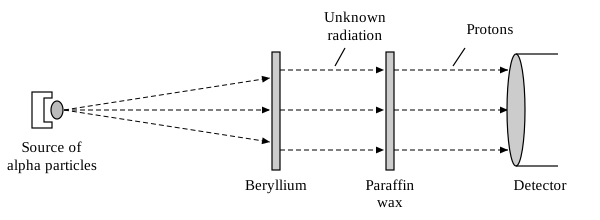
 

Which observation from this experiment led to the discovery of the neutron?

  1. The mass of the paraffin wax increased.
  2. The charge of the paraffin wax decreased.
  3. Protons were only detected when the unknown radiation was present.
  4. Particles with a mass similar to a proton mass but without charge were detected.
Show Answers Only

\(C\)

Show Worked Solution
  • The unknown radiation was not deflected by electric or magnetic fields (neutral), yet it ejected protons from the paraffin wax.
  • Protons were only detected when the unknown radiation struck the paraffin. Their energies were too high for gamma rays, so Chadwick concluded the radiation was a neutral particle with a mass similar to a proton (neutron).

Other options:

  • \(A\) and \(B\) are incorrect. No change in the mass or charge of the paraffin was measured.
  • \(D\) is incorrect. The detector detected protons, not the neutral particles. The neutron’s mass was inferred from the ejected protons’ behaviour.

\(\Rightarrow C\)

Filed Under: Structure of the Atom Tagged With: Band 4, smc-3701-60-Chadwick

PHYSICS, M7 2026 HSC 7 MC

Which row of the table identifies Maxwell's predictions regarding the orientation of the electric and magnetic fields and their propagation speed?

\({\color{transparent}{\begin{array}{c}
\hline
\rule[-2.8ex]{0pt}{7ex} \\
\hline
\rule[-1.2ex]{0pt}{3.8ex} \color{black}{\textbf{A.}} \quad \\
\hline
\rule[-1.2ex]{0pt}{3.8ex} \color{black}{\textbf{B.}} \quad \\
\hline
\rule[-1.2ex]{0pt}{3.8ex} \color{black}{\textbf{C.}} \quad \\
\hline
\rule[-1.2ex]{0pt}{3.8ex} \color{black}{\textbf{D.}} \quad \\
\hline
\end{array}}}
\begin{array}{|c|c|}
\hline
\rule[-2.8ex]{0pt}{7ex} \begin{array}{c} \textit{Orientation of the electric} \\ \textit{and magnetic fields} \end{array} & \begin{array}{c} \textit{Propagation speed} \\ \phantom{x} \end{array} \\
\hline
\rule[-1.2ex]{0pt}{3.8ex} \ \rlap{\text{Perpendicular}}\hspace{11em} & \ \rlap{\text{Constant}}\hspace{14.5em} \\
\hline
\rule[-1.2ex]{0pt}{3.8ex} \ \rlap{\text{Perpendicular}}\hspace{11em} & \ \rlap{\text{Related to photon kinetic energy}}\hspace{14.5em} \\
\hline
\rule[-1.2ex]{0pt}{3.8ex} \ \rlap{\text{Parallel}}\hspace{11em} & \ \rlap{\text{Constant}}\hspace{14.5em} \\
\hline
\rule[-1.2ex]{0pt}{3.8ex} \ \rlap{\text{Parallel}}\hspace{11em} & \ \rlap{\text{Related to photon kinetic energy}}\hspace{14.5em} \\
\hline
\end{array}\)

Show Answers Only

\(A\)

Show Worked Solution
  • Maxwell predicted that EM waves consist of oscillating electric and magnetic fields perpendicular to each other (and to the direction of propagation).
  • He predicted all EM waves travel at a constant speed in a vacuum, \(c=\dfrac{1}{\sqrt{\mu_0 \varepsilon_0}}\).

Other options:

  • \(B\) and \(D\) are incorrect. Maxwell’s theory was a wave model; photons were not proposed until later (Planck/Einstein).
  • \(C\) and \(D\) are incorrect. The fields are perpendicular, not parallel.

\(\Rightarrow A\)

Filed Under: Electromagnetic Spectrum Tagged With: Band 4, smc-3696-50-Maxwell

PHYSICS, M5 2026 HSC 3 MC

Which row of the table represents the characteristics of a geostationary orbit?

\({\color{transparent}{\begin{array}{c}
\hline
\rule[-2.8ex]{0pt}{7ex} \\
\hline
\rule[-1.2ex]{0pt}{3.8ex} \color{black}{\textbf{A.}} \quad \\
\hline
\rule[-1.2ex]{0pt}{3.8ex} \color{black}{\textbf{B.}} \quad \\
\hline
\rule[-1.2ex]{0pt}{3.8ex} \color{black}{\textbf{C.}} \quad \\
\hline
\rule[-1.2ex]{0pt}{3.8ex} \color{black}{\textbf{D.}} \quad \\
\hline
\end{array}}}
\begin{array}{|c|c|}
\hline
\rule[-2.8ex]{0pt}{7ex} \quad \begin{array}{c} \textit{Altitude} \\ \text{(km)} \end{array} \quad & \quad \begin{array}{c} \textit{Orbital period} \\ \text{(hours)} \end{array} \quad \\
\hline
\rule[-1.2ex]{0pt}{3.8ex} 400 & 1.5 \\
\hline
\rule[-1.2ex]{0pt}{3.8ex} 400 & 24 \\
\hline
\rule[-1.2ex]{0pt}{3.8ex} 36\,000 & 24 \\
\hline
\rule[-1.2ex]{0pt}{3.8ex} 42\,000 & 1.5 \\
\hline
\end{array}\)

Show Answers Only

\(C\)

Show Worked Solution
  • A geostationary satellite has the same period as Earth’s rotation (24 hours).
  • Using \(\dfrac{r^3}{T^2}=\dfrac{GM}{4\pi^2}\):
\(r\) \(=\sqrt[3]{\dfrac{GM}{4\pi^2}T^2}\)
  \(=\sqrt[3]{\dfrac{(6.67 \times 10^{-11})(6 \times 10^{24})}{4\pi^2}(24 \times 60 \times 60)^2}\)
  \(\approx 4.2 \times 10^7\ \text{m}\ \ (42\,000\ \text{km})\)
   
  • Altitude \(= h-r_{\text{Earth}} \approx 42\,000-6400 \approx 36\,000\ \text{km}\)

\(\Rightarrow C\)

Filed Under: Motion in Gravitational Fields Tagged With: Band 4, smc-3692-30-Orbital Velocity/Period/Radius

CHEMISTRY, M8 2026 HSC 35

A student was asked to identify seven unique ions within aqueous solutions, labelled \(A, B, C, D, E, F\) and \(G\).

The student was told that the solutions were either sodium salts of anions or nitrate salts of metallic cations.

The anions (sodium salts) could be \(\ce{CO3^2-}\), \(\ce{Cl-}\), \(\ce{I-}\) or \(\ce{PO4^3-}\).

The cations (nitrate salts) could be \(\ce{Ba^2+}\), \(\ce{Cu^2+}\), \(\ce{Mg^2+}\) or \(\ce{Pb^2+}\).

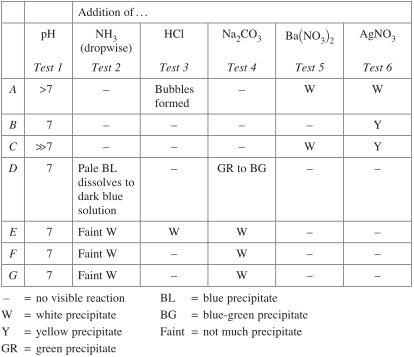
Observations and results of tests are recorded in the table.

Where possible, identify the seven unknown ions, justifying the identification.

Where needed, recommend an additional test to help identify the ions.   (8 marks)

--- 24 WORK AREA LINES (style=lined) ---

Show Answers Only
  • \(A=\ce{CO3^2-}\): basic (pH > 7), and gives bubbles with \(\ce{HCl}\). Of the possible anions, only \(\ce{CO3^2-}\) reacts with acid to produce a gas \(\ce{(CO2)}\). It also forms white \(\ce{BaCO3}\) and white \(\ce{Ag2CO3}\) precipitates.
  •    \(\ce{CO3^2-(aq) + 2H+(aq) -> CO2(g) + H2O(l)}\)
  • \(B=\ce{I-}\): neutral (pH = 7), and reacts only with \(\ce{AgNO3}\) to form a yellow \(\ce{AgI}\) precipitate. \(\ce{Cl-}\) would give a white \(\ce{AgCl}\) precipitate, so \(\ce{Cl-}\) is not present.
  • \(C=\ce{PO4^3-}\): strongly basic (pH ≫ 7), and does not release a gas when added with \(\text{HCl}\), consistent with a phosphate. Forms a white \(\ce{Ba3(PO4)2}\) precipitate and a yellow \(\ce{Ag3PO4}\) precipitate.
  • \(D=\ce{Cu^2+}\): \(\ce{NH3}\) is a weak base that produces \(\ce{OH-}\) ions, forming a pale blue \(\ce{Cu(OH)2}\) precipitate. This dissolves in excess \(\ce{NH3}\) to form the dark blue \(\ce{[Cu(NH3)4]^2+}\) complex. It also forms a green/blue-green copper carbonate precipitate.
  •    \(\ce{Cu^2+(aq) + 2OH^-(aq) -> Cu(OH)2(s)}\)
  •    \(\ce{Cu(OH)2(s) + 4NH3(aq) -> [Cu(NH3)4]^2+(aq) + 2OH^-(aq)}\)
  • \(E=\ce{Pb^2+}\): the only cation forming a white precipitate \(\ce{(PbCl2)}\) with \(\ce{HCl}\). It also forms white \(\ce{PbCO3}\). Barium and magnesium are ruled out as neither would precipitate with \(\ce{HCl}\).
  •    \(\ce{Pb^2+(aq) + 2Cl^-(aq) -> PbCl2(s)}\)
  • \(F\) and \(G=\ce{Ba^2+}\) and \(\ce{Mg^2+}\): both give the same results (faint white hydroxide precipitate and white carbonate precipitate), so they cannot be told apart from the data.
  • Additional test: add dilute \(\ce{H2SO4}\) (or \(\ce{Na2SO4}\)). \(\ce{Ba^2+}\) forms a white \(\ce{BaSO4}\) precipitate, while \(\ce{Mg^2+}\) gives no precipitate. Alternatively, a flame test gives a pale (apple) green flame for \(\ce{Ba^2+}\) and no colour for \(\ce{Mg^2+}\).
Show Worked Solution
  • \(A=\ce{CO3^2-}\): basic (pH > 7), and gives bubbles with \(\ce{HCl}\). Of the possible anions, only \(\ce{CO3^2-}\) reacts with acid to produce a gas \(\ce{(CO2)}\). It also forms white \(\ce{BaCO3}\) and white \(\ce{Ag2CO3}\) precipitates.
  •    \(\ce{CO3^2-(aq) + 2H+(aq) -> CO2(g) + H2O(l)}\)
  • \(B=\ce{I-}\): neutral (pH = 7), and reacts only with \(\ce{AgNO3}\) to form a yellow \(\ce{AgI}\) precipitate. \(\ce{Cl-}\) would give a white \(\ce{AgCl}\) precipitate, so \(\ce{Cl-}\) is not present.
  • \(C=\ce{PO4^3-}\): strongly basic (pH ≫ 7), and does not release a gas when added with \(\text{HCl}\), consistent with a phosphate. Forms a white \(\ce{Ba3(PO4)2}\) precipitate and a yellow \(\ce{Ag3PO4}\) precipitate.
  • \(D=\ce{Cu^2+}\): \(\ce{NH3}\) is a weak base that produces \(\ce{OH-}\) ions, forming a pale blue \(\ce{Cu(OH)2}\) precipitate. This dissolves in excess \(\ce{NH3}\) to form the dark blue \(\ce{[Cu(NH3)4]^2+}\) complex. It also forms a green/blue-green copper carbonate precipitate.
  •    \(\ce{Cu^2+(aq) + 2OH^-(aq) -> Cu(OH)2(s)}\)
  •    \(\ce{Cu(OH)2(s) + 4NH3(aq) -> [Cu(NH3)4]^2+(aq) + 2OH^-(aq)}\)
  • \(E=\ce{Pb^2+}\): the only cation forming a white precipitate \(\ce{(PbCl2)}\) with \(\ce{HCl}\). It also forms white \(\ce{PbCO3}\). Barium and magnesium are ruled out as neither would precipitate with \(\ce{HCl}\).
  •    \(\ce{Pb^2+(aq) + 2Cl^-(aq) -> PbCl2(s)}\)
  • \(F\) and \(G=\ce{Ba^2+}\) and \(\ce{Mg^2+}\): both give the same results (faint white hydroxide precipitate and white carbonate precipitate), so they cannot be told apart from the data.
  • Additional test: add dilute \(\ce{H2SO4}\) (or \(\ce{Na2SO4}\)). \(\ce{Ba^2+}\) forms a white \(\ce{BaSO4}\) precipitate, while \(\ce{Mg^2+}\) gives no precipitate. Alternatively, a flame test gives a pale (apple) green flame for \(\ce{Ba^2+}\) and no colour for \(\ce{Mg^2+}\).

Filed Under: Inorganic Substances Tagged With: Band 4, Band 5, Band 6, smc-3682-10-Tests for Ions in Solution

HMS, HIC EQ-Bank 507

Describe the concept of good health and its relationship to the health continuum.   (3 marks)

--- 8 WORK AREA LINES (style=lined) ---

Show Answers Only

Answers could include/expand on any of the following points:

Concept of good health

  • Good health is individual and relative, so what it looks like differs from person to person.
  • It reflects a balance across the physical, mental, emotional, social and spiritual dimensions.
  • A person can experience good health while managing a chronic condition or disability.

Relationship to the health continuum

  • The continuum ranges from poor health at one end to excellent health at the other.
  • Good health places a person toward the excellent health end.
  • As their dimensions of health change, a person’s position on the continuum also shifts.
Show Worked Solution

Answers could include/expand on any of the following points:

Concept of good health

  • Good health is individual and relative, so what it looks like differs from person to person.
  • It reflects a balance across the physical, mental, emotional, social and spiritual dimensions.
  • A person can experience good health while managing a chronic condition or disability.

Relationship to the health continuum

  • The continuum ranges from poor health at one end to excellent health at the other.
  • Good health places a person toward the excellent health end.
  • As their dimensions of health change, a person’s position on the continuum also shifts.

Filed Under: Dynamic Nature of Health Tagged With: Band 3, Band 4, smc-5503-40-Health continuum, smc-5503-50-Health changes over time

HMS, HIC EQ-Bank 506

Hannah, aged 38, was in good health until she was made redundant from her job. Over the next six months, she slept poorly, stopped exercising and withdrew from her friends.

A year after her redundancy, Hannah found new work and rejoined her netball team.

Using the health continuum, explain how Hannah's health changed over time.   (4 marks)

--- 10 WORK AREA LINES (style=lined) ---

Show Answers Only
  • Hannah’s redundancy triggered a move toward the poor health end of the continuum.
  • Losing her job increased her stress. This led to poor sleep and less motivation to exercise, reducing her physical health.
  • As a result, she withdrew from friends, which meant her emotional and social health declined at the same time.
  • In other words, one life event caused several dimensions of her health to decline together.
  • Finding new work created a renewed routine and lower stress levels.
  • Consequently, Hannah became active again. Rejoining netball improved her fitness and rebuilt her social connections.
  • This reveals that health is dynamic, because improvements across several dimensions moved her back toward the excellent health end.
Show Worked Solution
  • Hannah’s redundancy triggered a move toward the poor health end of the continuum.
  • Losing her job increased her stress. This led to poor sleep and less motivation to exercise, reducing her physical health.
  • As a result, she withdrew from friends, which meant her emotional and social health declined at the same time.
  • In other words, one life event caused several dimensions of her health to decline together.
  • Finding new work created a renewed routine and lower stress levels.
  • Consequently, Hannah became active again. Rejoining netball improved her fitness and rebuilt her social connections.
  • This reveals that health is dynamic, because improvements across several dimensions moved her back toward the excellent health end.

Filed Under: Dynamic Nature of Health Tagged With: Band 4, Band 5, smc-5503-40-Health continuum, smc-5503-50-Health changes over time

HMS, HIC EQ-Bank 505 MC

Lena and Marcus, both aged 45, have the same knee surgery.

  • Lena has paid leave from work, and her partner helps with household tasks.
  • Marcus is the sole carer for his elderly father and must return to work after one week.

Which statement BEST explains why their health is likely to differ during recovery?

  1. Marcus's recovery depends only on his motivation to complete his rehabilitation exercises.
  2. Their circumstances affect their access to rest and support, which influences several dimensions of health.
  3. Their health will follow the same pattern because they had the same surgery at the same age.
  4. Their health will differ only in the physical dimension, as Marcus has less time to rest.

Show Answers Only

\(B\)

Show Worked Solution
  • Option B is correct as Lena’s leave and support allow her to rest and recover. Marcus’s caring role and early return to work limit his rest and add pressure. These circumstances can affect their physical, emotional and social health differently.

Other options:

  • Option A is incorrect as Marcus’s circumstances affect his recovery, not just his personal motivation.
  • Option C is incorrect as the same surgery can lead to different outcomes when circumstances differ.
  • Option D is incorrect as Marcus’s responsibilities may also cause stress, affecting his emotional health.

Filed Under: Dynamic Nature of Health Tagged With: Band 4, smc-5503-60-Individual circumstances

HMS, HIC EQ-Bank 504 MC

Daniel, aged 34, trains for triathlons and has no medical conditions. He works long hours, rarely sees friends and often feels low.

Ruth, aged 68, has arthritis that limits her mobility. She manages her pain, volunteers weekly, has close friendships and feels content.

Which statement BEST reflects the concept of good health?

  1. Daniel has better health than Ruth because he has no medical conditions.
  2. Good health is the same for everyone, so both should be judged by the same physical standard.
  3. Ruth may experience good health because she functions well across several dimensions despite her condition.
  4. Both experience good health equally because neither requires hospital treatment.

Show Answers Only

\(C\)

Show Worked Solution
  • C is correct: Good health depends on wellbeing across several dimensions, and Ruth’s strong social and emotional health support this despite her arthritis.

Other Options:

  • A is incorrect: Having no medical conditions does not guarantee good health in every dimension.
  • B is incorrect: Good health is relative and differs between individuals.
  • D is incorrect: Good health is more than avoiding serious illness, and Daniel’s social and emotional health appear weak.

Filed Under: Dynamic Nature of Health Tagged With: Band 4, smc-5503-30-Concept of good health

HMS, HIC EQ-Bank 501

The National Aboriginal Health Strategy (1989) describes Aboriginal health as "not just the physical well-being of an individual" but the "social, emotional and cultural well-being of the whole Community". It is "a whole of life view and includes the cyclical concept of life-death-life".

Compare this meaning of health with the World Health Organisation's definition of health.   (4 marks)

--- 10 WORK AREA LINES (style=lined) ---

Show Answers Only

Similarities

  • Both reject a purely biomedical view, recognising that health is more than physical well-being.
  • Both include social well-being and emotional or mental well-being.
  • Both present health as a positive goal that people work towards.

Differences

  • The WHO definition focuses on the individual, while the Aboriginal meaning extends to the whole community.
  • The Aboriginal meaning includes cultural well-being, which the WHO definition does not mention.
  • The Aboriginal meaning is a whole-of-life view, including the cyclical concept of life-death-life.
  • In contrast, the WHO definition describes health as a state of well-being at one point in time.
  • The WHO definition requires “complete” well-being, whereas the Aboriginal meaning focuses on each person reaching their full potential.
Show Worked Solution

Similarities

  • Both reject a purely biomedical view, recognising that health is more than physical well-being.
  • Both include social well-being and emotional or mental well-being.
  • Both present health as a positive goal that people work towards.

Differences

  • The WHO definition focuses on the individual, while the Aboriginal meaning extends to the whole community.
  • The Aboriginal meaning includes cultural well-being, which the WHO definition does not mention.
  • The Aboriginal meaning is a whole-of-life view, including the cyclical concept of life-death-life.
  • In contrast, the WHO definition describes health as a state of well-being at one point in time.
  • The WHO definition requires “complete” well-being, whereas the Aboriginal meaning focuses on each person reaching their full potential.

Filed Under: Meanings of Health Tagged With: Band 4, smc-5502-30-Comparing meanings of health

HMS, HIC EQ-Bank 502 MC

In 1986, the World Health Organisation described health as "a resource for everyday life, not the objective of living".

Which statement BEST explains this view of health?

  1. Health only becomes important when illness prevents people from completing daily tasks.
  2. Health is a means that enables people to participate fully in life, rather than an end goal.
  3. Health requires complete physical, mental and social well-being before people can live fully.
  4. Health is achieved mainly through access to medical resources and treatment services.

Show Answers Only

\(B\)

Show Worked Solution
  • B is correct: Describing health as a resource means it is valued for enabling people to live full lives, not as a goal in itself.

Other Options:

  • A is incorrect: This view applies to all of everyday life, not only times of illness.
  • C is incorrect: Requiring complete well-being reflects the 1948 definition, not this resource-based view.
  • D is incorrect: “Resource” refers to health itself, not medical services.

Filed Under: Meanings of Health Tagged With: Band 4, smc-5502-30-Comparing meanings of health

HMS, HIC EQ-Bank 500 MC

Critics of the World Health Organisation's definition of health argue that very few people would ever be considered healthy under it.

Which feature of the definition is the MAIN reason for this criticism?

  1. It includes mental and social well-being as well as physical well-being.
  2. It requires a state of complete well-being across all dimensions of health.
  3. It states that health is more than the absence of disease or infirmity.
  4. It does not mention the spiritual dimension of health.

Show Answers Only

\(B\)

Show Worked Solution
  • B is correct: “Complete” well-being across every dimension is rarely achievable, so most people would fall short of being healthy.

Other Options:

  • A is incorrect: Including several dimensions is a strength, not the cause of unattainability.
  • C is incorrect: This broadens the meaning of health rather than making it harder to achieve.
  • D is incorrect: This is a limitation of scope, not a reason health is unattainable.

Filed Under: Meanings of Health Tagged With: Band 4, smc-5502-10-WHO definition

CHEMISTRY, M7 2026 HSC 32

Propyl butanoate can be produced in a school laboratory using propanol and butanoic acid.

The reaction mixture is heated under reflux in the presence of concentrated sulfuric acid for at least 30 minutes. The products are separated using a separating funnel.

\(\text{propanol}\ +\ \begin{array}{c}\text{butanoic}\\[-3pt]\text{acid}\end{array}\ \ \mathrel{\overset{{\textstyle\begin{array}{c}\text{concentrated}\\[-4pt]\text{sulfuric acid}\end{array}}}{\substack{\xrightharpoonup{\hspace{0.3em}\hphantom{\text{sulfuric acid}}\hspace{0.3em}}\\[-14pt]\xleftharpoondown{\hspace{0.3em}\hphantom{\text{sulfuric acid}}\hspace{0.3em}}}}}\ \ \begin{array}{c}\text{propyl}\\[-3pt]\text{butanoate}\end{array}\ +\ \text{water} \qquad \Delta H = -3.6\ \text{kJ mol}^{-1}\)

With reference to collision theory and the effect of temperature on equilibrium reactions, justify the conditions used in the school laboratory to maximise the yield of propyl butanoate. In your answer, explain TWO safety considerations (other than the use of personal protective equipment) when conducting this experiment.   (7 marks)

--- 28 WORK AREA LINES (style=lined) ---

Show Answers Only

Heating:

  • Heating increases the kinetic energy of the particles. This causes more frequent collisions, and a greater proportion of them have energy at or above the activation energy. The reaction rate increases, so equilibrium is reached within about 30 minutes.
  • The forward reaction is exothermic, so the reverse reaction is endothermic and has a higher activation energy (by 3.6 kJ mol\(^{-1}\)). Increasing the temperature gives a proportionally greater increase in successful collisions for the reverse reaction, so its rate increases more and the equilibrium shifts to the left.
  • This agrees with Le Chatelier’s principle: the endothermic reverse reaction is favoured, as it absorbs heat and opposes the temperature increase.
  • However, the reaction is only slightly exothermic \(\left(\Delta H=-3.6\ \text{kJ mol}^{-1}\right)\), so this shift to the left is very small. Heating under reflux therefore uses a moderate temperature (the boiling point of the mixture) that balances a much faster rate against only a small loss in yield, maximising the amount of ester produced in the available time.

Concentrated sulfuric acid:

  • It acts as a catalyst, providing an alternative pathway with a lower activation energy. More collisions are successful, which increases the rate.
  • It is also a dehydrating agent that absorbs the water produced. This shifts the equilibrium to the right (Le Chatelier’s principle) and increases the yield of propyl butanoate.

Reflux:

  • The condenser cools volatile reactants and products and returns them to the flask. The mixture can then be heated for a long time without loss of material, which maximises the yield.

Safety considerations (choose two):

  • Propanol, butanoic acid and propyl butanoate are flammable. Heat with an electric heating mantle or water bath, not an open flame, to prevent fires.
  • The reflux condenser must be left open at the top. A sealed system would build up pressure as it is heated and could explode.
  • Add boiling chips to the flask to prevent bumping (sudden violent boiling), which could crack the flask or splash hot, corrosive acid.
Show Worked Solution

Heating:

  • Heating increases the kinetic energy of the particles. This causes more frequent collisions, and a greater proportion of them have energy at or above the activation energy. The reaction rate increases, so equilibrium is reached within about 30 minutes.
  • The forward reaction is exothermic, so the reverse reaction is endothermic and has a higher activation energy (by 3.6 kJ mol\(^{-1}\)). Increasing the temperature gives a proportionally greater increase in successful collisions for the reverse reaction, so its rate increases more and the equilibrium shifts to the left.
  • This agrees with Le Chatelier’s principle: the endothermic reverse reaction is favoured, as it absorbs heat and opposes the temperature increase.
  • However, the reaction is only slightly exothermic \(\left(\Delta H=-3.6\ \text{kJ mol}^{-1}\right)\), so this shift to the left is very small. Heating under reflux therefore uses a moderate temperature (the boiling point of the mixture) that balances a much faster rate against only a small loss in yield, maximising the amount of ester produced in the available time.

Concentrated sulfuric acid:

  • It acts as a catalyst, providing an alternative pathway with a lower activation energy. More collisions are successful, which increases the rate.
  • It is also a dehydrating agent that absorbs the water produced. This shifts the equilibrium to the right (Le Chatelier’s principle) and increases the yield of propyl butanoate.

Reflux:

  • The condenser cools volatile reactants and products and returns them to the flask. The mixture can then be heated for a long time without loss of material, which maximises the yield.

Safety considerations (choose two):

  • Propanol, butanoic acid and propyl butanoate are flammable. Heat with an electric heating mantle or water bath, not an open flame, to prevent fires.
  • The reflux condenser must be left open at the top. A sealed system would build up pressure as it is heated and could explode.
  • Add boiling chips to the flask to prevent bumping (sudden violent boiling), which could crack the flask or splash hot, corrosive acid.

Filed Under: Reactions of Organic Acids and Bases Tagged With: Band 4, Band 5, smc-3680-10-Esters

CHEMISTRY, M6 2026 HSC 31

Hydrochloric acid and the base, sodium hypochlorite \(\ce{(NaClO)}\), are usually stored separately, as they will react to produce toxic chlorine gas, as well as water and sodium chloride.

  1. Calculate the \(\ce{[OH^-]}\) of a 0.75 mol L\(^{-1}\) aqueous solution of sodium hypochlorite, stating any assumptions made in your working.
  2. \(\left(K_b \text{ for}\ \ce{ClO^-} = 3.45 \times 10^{-7}\right)\)   (3 marks)

    --- 8 WORK AREA LINES (style=lined) ---

  3. A 2.5 L solution of 12.0 mol L\(^{-1}\) hydrochloric acid was accidentally combined with 1.00 L of 0.75 mol L\(^{-1}\) solution of sodium hypochlorite.
  4. Calculate the maximum volume of chlorine gas (at 25°C and 100 kPa) that would be released from this accident. Include a relevant balanced chemical equation, with states shown.   (4 marks)

    --- 10 WORK AREA LINES (style=lined) ---

Show Answers Only

a.    \(\ce{[OH^-]}=5.1 \times 10^{-4}\ \text{mol L}^{-1}\)

b.    \(18.6\ \text{L}\)

Show Worked Solution

a.    \(\ce{ClO^-(aq) + H2O(l) \rightleftharpoons HClO(aq) + OH^-(aq)}\)

\begin{array}{|l|c|c|c|}
\hline
\rule{0pt}{2.5ex} & \ce{[ClO^-]} & \ce{[HClO]} & \ce{[OH^-]} \rule[-1ex]{0pt}{0pt}\\
\hline
\rule{0pt}{2.5ex}\text{Initial}\rule[-1ex]{0pt}{0pt} & 0.75 & 0 & 0 \\
\hline
\rule{0pt}{2.5ex}\text{Change}\rule[-1ex]{0pt}{0pt} & -x & +x & +x \\
\hline
\rule{0pt}{2.5ex}\text{Equilibrium}\rule[-1ex]{0pt}{0pt} & 0.75-x & x & x \\
\hline
\end{array}

  • Assumptions:
  • 1. \(\ce{OH-}\) from the self-ionisation of water is negligible, so the initial \(\ce{[OH^-]}=0\) and \(\ce{[HClO]}=\ce{[OH^-]}=x\).
  • 2. \(K_b\) is very small, so \(x\) is negligible compared to 0.75 and \(0.75-x \approx 0.75\ \text{mol L}^{-1}\).
\(K_b\) \(=\dfrac{\ce{[HClO][OH^-]}}{\ce{[ClO^-]}}\)  
\(3.45 \times 10^{-7}\) \(=\dfrac{x^2}{0.75-x} \approx \dfrac{x^2}{0.75}\)  
\(x\) \(=\sqrt{3.45 \times 10^{-7} \times 0.75}\)  
  \(=5.1 \times 10^{-4}\)  
\(\ce{[OH^-]}\) \(=5.1 \times 10^{-4}\ \text{mol L}^{-1}\)  


b.    \(\ce{NaClO(aq) + 2HCl(aq) -> Cl2(g) + NaCl(aq) + H2O(l)}\)

Calculate the moles of the reactants:

\(n\ce{(HCl)}=12.0 \times 2.5=30\ \text{mol}\)

\(n\ce{(NaClO)}=0.75 \times 1.00=0.75\ \text{mol}\)

\(\ce{NaClO}\) is the limiting reagent, since only \(2 \times 0.75 = 1.5\) mol of \(\ce{HCl}\) is needed.

\(n\ce{(Cl2)}=n\ce{(NaClO)}=0.75\ \text{mol}\)

\(V\ce{(Cl2)}=0.75 \times 24.79=18.6\ \text{L}\)

Filed Under: Properties of Acids and Bases, Quantitative Analysis Tagged With: Band 4, Band 5, smc-3673-50-Acid Reactions, smc-3675-30-Ka/Kb

CHEMISTRY, M7 2026 HSC 30

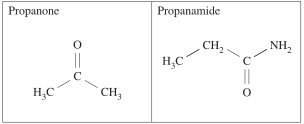
Propanone and propanamide both have the same number of carbon atoms. However, propanamide has a significantly higher boiling point.

Explain why propanamide has a higher boiling point than propanone, with reference to the strength of all intermolecular forces present in both compounds.   (3 marks)

--- 9 WORK AREA LINES (style=lined) ---

Show Answers Only
  • Both molecules have the same number of carbon atoms, but propanamide has an additional \(\ce{N}\) and \(\ce{H}\) atom (40 electrons compared to 32 in propanone). The extra electrons give propanamide slightly stronger dispersion forces.
  • Both molecules have a polar \(\ce{C=O}\) group, so both have dipole–dipole forces.
  • Propanone has no \(\ce{H}\) bonded to \(\ce{N}\), \(\ce{O}\) or \(\ce{F}\), so it cannot hydrogen bond between its molecules.
  • Propanamide has an \(\ce{-NH2}\) group, so it forms hydrogen bonds between the \(\ce{N-H}\) of one molecule and the \(\ce{O}\) (or \(\ce{N}\)) of another. It has two \(\ce{N-H}\) bonds per molecule, so it can form several hydrogen bonds.
  • Hydrogen bonds are the strongest intermolecular force. Together with its slightly stronger dispersion forces, this means more energy is needed to separate propanamide molecules, giving it a higher boiling point.
Show Worked Solution
  • Both molecules have the same number of carbon atoms, but propanamide has an additional \(\ce{N}\) and \(\ce{H}\) atom (40 electrons compared to 32 in propanone). The extra electrons give propanamide slightly stronger dispersion forces.
  • Both molecules have a polar \(\ce{C=O}\) group, so both have dipole–dipole forces.
  • Propanone has no \(\ce{H}\) bonded to \(\ce{N}\), \(\ce{O}\) or \(\ce{F}\), so it cannot hydrogen bond between its molecules.
  • Propanamide has an \(\ce{-NH2}\) group, so it forms hydrogen bonds between the \(\ce{N-H}\) of one molecule and the \(\ce{O}\) (or \(\ce{N}\)) of another. It has two \(\ce{N-H}\) bonds per molecule, so it can form several hydrogen bonds.
  • Hydrogen bonds are the strongest intermolecular force. Together with its slightly stronger dispersion forces, this means more energy is needed to separate propanamide molecules, giving it a higher boiling point.

Filed Under: Reactions of Organic Acids and Bases Tagged With: Band 4, smc-3680-30-Boiling Point and Solubility

CHEMISTRY, M7 2026 HSC 28

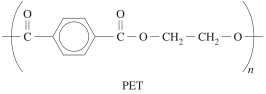
PET (polyethylene terephthalate) is a condensation polymer.


  1. In the boxes provided, draw monomers \(A\) and \(B\) that would form the condensation product, PET.   (2 marks)

    --- 0 WORK AREA LINES (style=lined) ---

  2. By accident, a third substance, ethanol, was added during the synthesis process for a batch of PET.
  3. Explain how this would affect the average polymer chain length.   (3 marks)

    --- 10 WORK AREA LINES (style=lined) ---

Show Answers Only

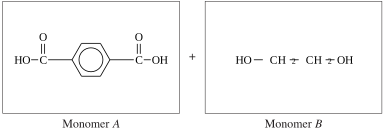
a.    

b.     Effect of ethanol:

  • PET forms when each monomer reacts at both ends: the \(\ce{-COOH}\) groups of monomer \(A\) form ester links with the \(\ce{-OH}\) groups of monomer \(B\), releasing water.
  • Ethanol \(\ce{(CH3CH2OH)}\) has only one \(\ce{-OH}\) group (it is monofunctional). It can react with a \(\ce{-COOH}\) group at the end of a growing chain to form an ethyl ester.
  • The ethyl ester end has no remaining reactive group, so that chain cannot grow any further (chain termination).
  • So the average polymer chain length decreases.
Show Worked Solution

a.     Monomer \(A\) = benzene-1,4-dicarboxylic acid (terephthalic acid), Monomer \(B\) = ethane-1,2-diol

b.     Effect of ethanol:

  • PET forms when each monomer reacts at both ends: the \(\ce{-COOH}\) groups of monomer \(A\) form ester links with the \(\ce{-OH}\) groups of monomer \(B\), releasing water.
  • Ethanol \(\ce{(CH3CH2OH)}\) has only one \(\ce{-OH}\) group (it is monofunctional). It can react with a \(\ce{-COOH}\) group at the end of a growing chain to form an ethyl ester.
  • The ethyl ester end has no remaining reactive group, so that chain cannot grow any further (chain termination).
  • So the average polymer chain length decreases.

Filed Under: Polymers Tagged With: Band 4, Band 5, smc-3681-20-Condensation Polymers, smc-3681-30-Monomers

CHEMISTRY, M7 2026 HSC 27

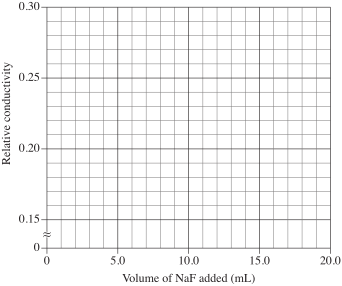
The conductivity of a 1.0 L solution of 0.010 mol L\(^{-1}\) barium nitrate solution was measured. A 1.0 mol L\(^{-1}\) solution of sodium fluoride was added in increments. After each addition, the solution was thoroughly stirred before the conductivity was measured.

Some of the results are recorded in the table.

\begin{array}{|c|c|}
\hline
\rule{0pt}{2.5ex}\quad \textit{Volume of NaF added}\ \text{(mL)} \quad \rule[-1ex]{0pt}{0pt}& \quad \quad \textit{Relative conductivity} \quad \quad \\
\hline
\rule{0pt}{2.5ex}0.0\rule[-1ex]{0pt}{0pt}& 0.160 \\
\hline
\rule{0pt}{2.5ex}4.0\rule[-1ex]{0pt}{0pt}& 0.191 \\
\hline
\rule{0pt}{2.5ex}8.0\rule[-1ex]{0pt}{0pt}& 0.222 \\
\hline
\rule{0pt}{2.5ex}10.0\rule[-1ex]{0pt}{0pt}& 0.238 \\
\hline
\rule{0pt}{2.5ex}12.0\rule[-1ex]{0pt}{0pt}& 0.242 \\
\hline
\rule{0pt}{2.5ex}16.0\rule[-1ex]{0pt}{0pt}& 0.249 \\
\hline
\rule{0pt}{2.5ex}20.0\rule[-1ex]{0pt}{0pt}& 0.257 \\
\hline
\end{array}

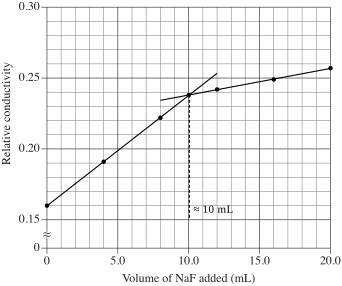
With the support of an appropriate graph, plotted on the grid provided, and a balanced chemical equation, calculate the solubility product \(\left(K_{sp}\right)\) of barium fluoride.   (5 marks)


--- 10 WORK AREA LINES (style=lined) ---

Show Answers Only

\(K_{sp}=9.7 \times 10^{-7}\)

Show Worked Solution

  • \(\ce{BaF2(s) \rightleftharpoons Ba^2+(aq) + 2F^-(aq)} \quad \quad K_{sp}=\ce{[Ba^2+][F^-]^2}\)
  • Conductivity rises steeply while \(\ce{F-}\) ions are added and stay in solution. Once \(\ce{BaF2}\) starts to precipitate, \(\ce{Ba^2+}\) and \(\ce{F-}\) are removed from solution and the slope decreases.
  • The two lines intersect at approximately 10.0 mL of \(\ce{NaF}\). This is where the solution becomes saturated \(\left(Q=K_{sp}\right)\).
  • At 10.0 mL:
  •     \(n\ce{(F^-)}=1.0 \times 0.0100=0.0100\ \text{mol}\)
  •     \(V_{\text{total}}=1.010\ \text{L}\)
  •     \(\ce{[F^-]}=\dfrac{0.0100}{1.010}=9.90 \times 10^{-3}\ \text{mol L}^{-1}\)
  •     \(n\ce{(Ba^2+)}=1.0 \times 0.0100=0.0100\ \text{mol}\)
  •     \(\ce{[Ba^2+]}=\dfrac{0.010}{1.010}=9.90 \times 10^{-3}\ \text{mol L}^{-1}\)
\(K_{sp}\) \(=\ce{[Ba^2+][F^-]^2}\)  
  \(=\left(9.90 \times 10^{-3}\right)\left(9.90 \times 10^{-3}\right)^2\)  
  \(=9.7 \times 10^{-7}\)  

Filed Under: Solution Equilibria Tagged With: Band 4, smc-3672-10-Mixed ionic solutions, smc-3672-15-Find K(sp)

CHEMISTRY, M8 2026 HSC 26

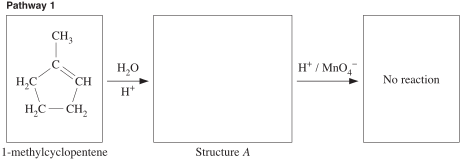
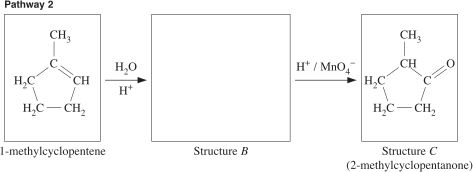
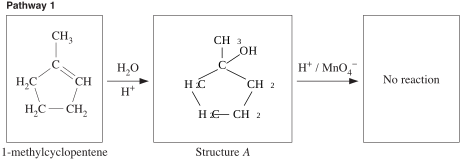
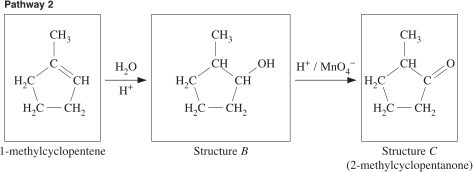
Reaction pathways 1 and 2 use the same reaction conditions but describe two possible outcomes.


  1. In the blank boxes provided, draw structures \(A\) and \(B\).   (2 marks)

    --- 0 WORK AREA LINES (style=lined) ---

  2. Account for an expected spectroscopic difference in the IR and NMR (proton or carbon) spectra that would be observed between the final products of pathway 1 (Structure \(A\)) and pathway 2 (Structure \(C\)).   (3 marks)

    Spectroscopic difference 1 (IR):

    --- 6 WORK AREA LINES (style=lined) ---

    Spectroscopic difference 2 (NMR):

    --- 7 WORK AREA LINES (style=lined) ---

Show Answers Only

a.    Structure drawings:

b.     IR:

  • Structure \(A\) (a tertiary alcohol) shows a broad \(\ce{O-H}\) (alcohol) absorption at 3230–3550 cm\(^{-1}\) and no \(\ce{C=O}\) absorption.
  • Structure \(C\) (a ketone) shows a strong, sharp \(\ce{C=O}\) absorption at 1680–1750 cm\(^{-1}\) and no broad \(\ce{O-H}\) absorption.

\(^{13}\text{C NMR}\):

  • Structure \(A\) has a line of symmetry through the \(\ce{C-OH}\) carbon and the \(\ce{CH3}\) group, so it has 4 distinct carbon environments (4 signals).
  • Structure \(C\) has no symmetry, so all 6 carbons are in distinct environments (6 signals).

Alternatively,

  • Structure \(C\) has a signal at 190–220 ppm from the ketone \(\ce{C=O}\) carbon, which \(A\) does not have.
  • Structure \(A\) has a signal at 50–90 ppm from the carbon bonded to \(\ce{-OH}\), which \(C\) does not have.
Show Worked Solution

a.    Points to note on structure drawings:

  • Hydration of 1-methylcyclopentene can add the \(\ce{-OH}\) to either carbon of the \(\ce{C=C}\) bond.
  • Pathway 1: \(\ce{-OH}\) adds to the carbon bearing \(\ce{CH3}\) \(\Rightarrow\) 1-methylcyclopentan-1-ol \((A)\). This is a tertiary alcohol, so it is not oxidised by \(\ce{H+/MnO4-}\).
  • Pathway 2: \(\ce{-OH}\) adds to the other carbon \(\Rightarrow\) 2-methylcyclopentan-1-ol \((B)\). This is a secondary alcohol, which is oxidised to the ketone \(C\).

b.     IR:

  • Structure \(A\) (a tertiary alcohol) shows a broad \(\ce{O-H}\) (alcohol) absorption at 3230–3550 cm\(^{-1}\) and no \(\ce{C=O}\) absorption.
  • Structure \(C\) (a ketone) shows a strong, sharp \(\ce{C=O}\) absorption at 1680–1750 cm\(^{-1}\) and no broad \(\ce{O-H}\) absorption.

\(^{13}\text{C NMR}\):

  • Structure \(A\) has a line of symmetry through the \(\ce{C-OH}\) carbon and the \(\ce{CH3}\) group, so it has 4 distinct carbon environments (4 signals).
  • Structure \(C\) has no symmetry, so all 6 carbons are in distinct environments (6 signals).

Alternatively,

  • Structure \(C\) has a signal at 190–220 ppm from the ketone \(\ce{C=O}\) carbon, which \(A\) does not have.
  • Structure \(A\) has a signal at 50–90 ppm from the carbon bonded to \(\ce{-OH}\), which \(C\) does not have.

Filed Under: Alcohols, Organic Substances Tagged With: Band 4, Band 5, smc-3679-30-Oxidation, smc-3683-43-IR Spectroscopy, smc-3683-50-Combining Techniques

CHEMISTRY, M7 2026 HSC 25

E10 is a fuel that contains a variety of hydrocarbons, including octane, with 10% added ethanol. The table compares the properties of both ethanol and octane.

\begin{array}{|l|c|c|c|}
\hline
\rule{0pt}{2.5ex} & \textit{Heat of} & \textit{Density} & \textit{Combustion} \\
& \textit{combustion} & & \textit{energy} \\
\rule[-1ex]{0pt}{0pt} & \left(\text{kJ mol}^{-1}\right) & \left(\text{g L}^{-1}\right) & \left(\text{kJ L}^{-1}\right) \\
\hline
\rule{0pt}{2.5ex}\text{Ethanol}\rule[-1ex]{0pt}{0pt}& \quad 1367 \quad & \quad 789 \quad & \quad 23\,412 \quad \\
\hline
\rule{0pt}{2.5ex}\text{Octane}\rule[-1ex]{0pt}{0pt}& 5470 & 750 & 35\,293 \\
\hline
\end{array}

  1. Outline how ethanol could be produced from renewable resources. Include a relevant chemical equation in your answer.   (2 marks)

    --- 5 WORK AREA LINES (style=lined) ---

  2. Explain the effect of adding 10% (v/v) ethanol to octane in terms of overall energy produced from combustion. Include a calculation in your answer.   (3 marks)

    --- 8 WORK AREA LINES (style=lined) ---

  3. Compare E10 fuel with octane, with reference to TWO environmental considerations.   (3 marks)

    --- 10 WORK AREA LINES (style=lined) ---

Show Answers Only

a.    Fermentation:

  • Glucose from renewable crops (e.g. sugar cane, corn) is fermented by yeast under anaerobic conditions at about 37°C:
  •    \(\ce{C6H12O6(aq) ->[yeast] 2C2H5OH(aq) + 2CO2(g)}\)
     

b.    Energy per litre of E10:

  • \(E=(0.10 \times 23\,412)+(0.90 \times 35\,293)=34\,105\ \text{kJ L}^{-1}\)
  • This is about 1190 kJ L\(^{-1}\) less than pure octane \(\left(35\,293\ \text{kJ L}^{-1}\right)\).
  • Ethanol is already partially oxidised (contains \(\ce{O}\)) and releases less energy per litre, so adding it lowers the overall energy produced.
     

c.    Environmental considerations (choose two of the following):

  • Greenhouse gases: the ethanol in E10 comes from crops that absorb \(\ce{CO2}\) by photosynthesis as they grow, which offsets some of the \(\ce{CO2}\) released on combustion. E10 therefore has lower net \(\ce{CO2}\) emissions than octane, which is a non-renewable fossil fuel. However, it is not fully carbon neutral, as energy from fossil fuels is used in farming, fermentation and distillation.
  • Combustion products: ethanol contains oxygen, so E10 burns more completely than octane and releases less \(\ce{CO}\) and soot (particulates).
  • Fuel efficiency: E10 releases less energy per litre than octane (see part b), so more fuel must be burned to travel the same distance. This partly offsets its emission benefits.
  • Land use: growing crops for E10 needs large areas of land, fertilisers and water, which can cause deforestation and compete with food production. Octane extraction instead risks oil spills and habitat damage.

Overall comparison:

  • Although E10 releases slightly less energy per litre than octane, its partly renewable ethanol content and cleaner combustion make it the better fuel for the environment overall.
Show Worked Solution

a.    Fermentation:

  • Glucose from renewable crops (e.g. sugar cane, corn) is fermented by yeast under anaerobic conditions at about 37°C:
  •    \(\ce{C6H12O6(aq) ->[yeast] 2C2H5OH(aq) + 2CO2(g)}\)
     

b.    Energy per litre of E10:

  • \(E=(0.10 \times 23\,412)+(0.90 \times 35\,293)=34\,105\ \text{kJ L}^{-1}\)
  • This is about 1190 kJ L\(^{-1}\) less than pure octane \(\left(35\,293\ \text{kJ L}^{-1}\right)\).
  • Ethanol is already partially oxidised (contains \(\ce{O}\)) and releases less energy per litre, so adding it lowers the overall energy produced.
     

c.    Environmental considerations (choose two of the following):

  • Greenhouse gases: the ethanol in E10 comes from crops that absorb \(\ce{CO2}\) by photosynthesis as they grow, which offsets some of the \(\ce{CO2}\) released on combustion. E10 therefore has lower net \(\ce{CO2}\) emissions than octane, which is a non-renewable fossil fuel. However, it is not fully carbon neutral, as energy from fossil fuels is used in farming, fermentation and distillation.
  • Combustion products: ethanol contains oxygen, so E10 burns more completely than octane and releases less \(\ce{CO}\) and soot (particulates).
  • Fuel efficiency: E10 releases less energy per litre than octane (see part b), so more fuel must be burned to travel the same distance. This partly offsets its emission benefits.
  • Land use: growing crops for E10 needs large areas of land, fertilisers and water, which can cause deforestation and compete with food production. Octane extraction instead risks oil spills and habitat damage.

Overall comparison:

  • Although E10 releases slightly less energy per litre than octane, its partly renewable ethanol content and cleaner combustion make it the better fuel for the environment overall.

Filed Under: Alcohols Tagged With: Band 3, Band 4, smc-3679-10-Combustion, smc-3679-60-Biofuels, smc-3679-70-Production

CHEMISTRY, M6 2026 HSC 24

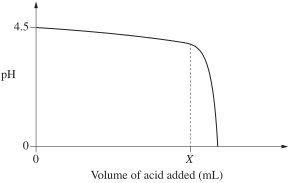
A beaker contained a buffer solution of acetic acid/sodium acetate at pH = 4.5. While a strong acid was being added to the buffer solution, the pH was measured and recorded, resulting in the graph shown.
 

Explain the shape of the curve between 0 mL and \(X\) mL of acid added, with reference to the buffer system.   (3 marks)

--- 6 WORK AREA LINES (style=lined) ---

Show Answers Only
  • The buffer contains significant amounts of a weak acid and its conjugate base in equilibrium:
  •    \(\ce{CH3COOH(aq) + H2O(l) \rightleftharpoons CH3COO^-(aq) + H3O+(aq)}\)
  • As strong acid is added, the \(\ce{CH3COO-}\) ions react with the added \(\ce{H3O+}\). The equilibrium shifts to the left, which removes most of the added \(\ce{H3O+}\).
  • So the pH decreases only slightly between 0 and \(X\) mL. At \(X\) mL the \(\ce{CH3COO-}\) is used up (the buffer capacity is exceeded), and the pH then falls sharply.
Show Worked Solution
  • The buffer contains significant amounts of a weak acid and its conjugate base in equilibrium:
  •    \(\ce{CH3COOH(aq) + H2O(l) \rightleftharpoons CH3COO^-(aq) + H3O+(aq)}\)
  • As strong acid is added, the \(\ce{CH3COO-}\) ions react with the added \(\ce{H3O+}\). The equilibrium shifts to the left, which removes most of the added \(\ce{H3O+}\).
  • So the pH decreases only slightly between 0 and \(X\) mL. At \(X\) mL the \(\ce{CH3COO-}\) is used up (the buffer capacity is exceeded), and the pH then falls sharply.

Filed Under: Quantitative Analysis Tagged With: Band 4, smc-3675-60-Buffers

CHEMISTRY, M5 2026 HSC 23

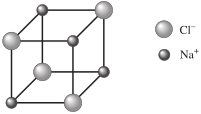
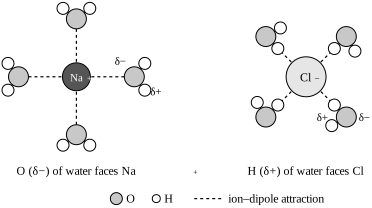
The diagram shows a section of the lattice structure of solid \(\ce{NaCl}\), which dissociates when solid \(\ce{NaCl}\) is dissolved in water.
 

Describe the process of \(\ce{NaCl}\) dissociating in water in terms of the electrostatic interactions between the polar water molecules and the ions present. Include a labelled diagram to illustrate these interactions.   (4 marks)

--- 8 WORK AREA LINES (style=lined) ---

[wa_box height="200"]

Show Answers Only
  • Water molecules are polar: the \(\ce{O}\) atom carries a partial negative charge \((\delta^{-})\) and the \(\ce{H}\) atoms carry partial positive charges \((\delta^{+})\).
  • When \(\ce{NaCl}\) is added to water, the \(\delta^{-}\) \(\ce{O}\) atoms are attracted to the \(\ce{Na+}\) ions and the \(\delta^{+}\) \(\ce{H}\) atoms are attracted to the \(\ce{Cl-}\) ions at the surface of the lattice (ion–dipole attractions).
  • These ion–dipole attractions overcome the ionic bonds between \(\ce{Na+}\) and \(\ce{Cl-}\), pulling the ions out of the lattice.
  • The separated ions are surrounded by water molecules (hydrated) and disperse through the solution:
  •    \(\ce{NaCl(s) -> Na+(aq) + Cl^-(aq)}\)
     

Show Worked Solution
  • Water molecules are polar: the \(\ce{O}\) atom carries a partial negative charge \((\delta^{-})\) and the \(\ce{H}\) atoms carry partial positive charges \((\delta^{+})\).
  • When \(\ce{NaCl}\) is added to water, the \(\delta^{-}\) \(\ce{O}\) atoms are attracted to the \(\ce{Na+}\) ions and the \(\delta^{+}\) \(\ce{H}\) atoms are attracted to the \(\ce{Cl-}\) ions at the surface of the lattice (ion–dipole attractions).
  • These ion–dipole attractions overcome the ionic bonds between \(\ce{Na+}\) and \(\ce{Cl-}\), pulling the ions out of the lattice.
  • The separated ions are surrounded by water molecules (hydrated) and disperse through the solution:
  •    \(\ce{NaCl(s) -> Na+(aq) + Cl^-(aq)}\)
     

Filed Under: Solution Equilibria Tagged With: Band 4, smc-3672-45-Dissociation

CHEMISTRY, M6 2026 HSC 22

The neutralisation reaction between nitric acid \(\ce{(HNO3)}\) and potassium hydroxide \(\ce{(KOH)}\) is exothermic.

Describe a method, including the required equipment, to collect all relevant data needed to accurately determine the heat of neutralisation using aqueous solutions of 1.00 mol L\(^{-1}\ \ce{HNO3}\) and 1.00 mol L\(^{-1}\ \ce{KOH}\). No calculations are required. (4 marks)

--- 10 WORK AREA LINES (style=lined) ---

Show Answers Only
  • \(\ce{HNO3(aq) + KOH(aq) -> KNO3(aq) + H2O(l)}\). The 1:1 mole ratio means equal volumes of the two 1.00 mol L\(^{-1}\) solutions react completely.
  • Weigh an empty polystyrene cup (calorimeter) and lid using an electronic balance.
  • Use a 50 mL measuring cylinder to add 50.0 mL of 1.00 mol L\(^{-1}\ \ce{HNO3}\) to the cup.
  • Record the initial temperature of the acid with a thermometer (0.1°C precision).
  • Measure 50.0 mL of 1.00 mol L\(^{-1}\ \ce{KOH}\) with a clean measuring cylinder and record its temperature, making sure it is the same as the acid.
  • Quickly add the \(\ce{KOH}\) to the cup, replace the lid and stir gently with the thermometer.
  • Record the highest temperature reached.
  • Reweigh the cup, lid and solution. The difference in mass gives the mass of solution \((m)\).
  • Repeat at least twice more and average the temperature changes.
  • These data are used in \(q = mc\Delta T\) (assuming \(c\) of water) and \(\Delta H = -\dfrac{q}{n(\ce{H2O})}\).
Show Worked Solution
  • \(\ce{HNO3(aq) + KOH(aq) -> KNO3(aq) + H2O(l)}\). The 1:1 mole ratio means equal volumes of the two 1.00 mol L\(^{-1}\) solutions react completely.
  • Weigh an empty polystyrene cup (calorimeter) and lid using an electronic balance.
  • Use a 50 mL measuring cylinder to add 50.0 mL of 1.00 mol L\(^{-1}\ \ce{HNO3}\) to the cup.
  • Record the initial temperature of the acid with a thermometer (0.1°C precision).
  • Measure 50.0 mL of 1.00 mol L\(^{-1}\ \ce{KOH}\) with a clean measuring cylinder and record its temperature, making sure it is the same as the acid.
  • Quickly add the \(\ce{KOH}\) to the cup, replace the lid and stir gently with the thermometer.
  • Record the highest temperature reached.
  • Reweigh the cup, lid and solution. The difference in mass gives the mass of solution \((m)\).
  • Repeat at least twice more and average the temperature changes.
  • These data are used in \(q = mc\Delta T\) (assuming \(c\) of water) and \(\Delta H = -\dfrac{q}{n(\ce{H2O})}\).

Filed Under: Properties of Acids and Bases Tagged With: Band 4, smc-3673-20-Enthalpy of Neutralisation

CHEMISTRY, M5 2026 HSC 15 MC

During the production of sulfuric acid, one of the steps is to convert sulfur dioxide to sulfur trioxide using the following equilibrium reaction.

\(\ce{2SO2(g) + O2(g) \rightleftharpoons 2SO3(g)}\)

At 800 K the equilibrium concentrations were measured and found to be:

\begin{array}{ll} \text{Sulfur dioxide} & 3.0 \times 10^{-3}\ \text{mol L}^{-1} \\ \text{Oxygen} & 3.5 \times 10^{-3}\ \text{mol L}^{-1} \\ \text{Sulfur trioxide} & 5.0 \times 10^{-2}\ \text{mol L}^{-1}. \end{array}

What is the equilibrium constant for this reaction at 800 K?

  1. \(1.3 \times 10^{-5}\)
  2. \(2.1 \times 10^{-4}\)
  3. \(4.7 \times 10^{3}\)
  4. \(7.9 \times 10^{4}\)
Show Answers Only

\(D\)

Show Worked Solution
  • \(K_{eq}=\dfrac{\ce{[SO3]^2}}{\ce{[SO2]^2[O2]}}=\dfrac{\left(5.0 \times 10^{-2}\right)^2}{\left(3.0 \times 10^{-3}\right)^2 \times 3.5 \times 10^{-3}}=7.9 \times 10^{4}\)

\(\Rightarrow D\)

Filed Under: Equilibrium Constant Tagged With: Band 4, smc-3671-10-Find K(eq)

CHEMISTRY, M5 2026 HSC 13 MC

What is the solubility \(\left(\text{mol L}^{-1}\right)\) of lead\(\text{(II)}\) bromide in 0.500 mol L\(^{-1}\) sodium bromide at 25°C?

  1. \(1.18 \times 10^{-2}\)
  2. \(1.32 \times 10^{-5}\)
  3. \(2.64 \times 10^{-5}\)
  4. \(3.30 \times 10^{-6}\)
Show Answers Only

\(C\)

Show Worked Solution
  • \(\ce{PbBr2(s) \rightleftharpoons Pb^2+(aq) + 2Br^-(aq)} \quad \quad K_{sp}=6.60 \times 10^{-6}\)

Let the solubility be \(s\). Then \(\ce{[Pb^2+]}=s\), and \(\ce{[Br^-]} \approx 0.500\) (common ion, as \(s\) is very small).

\(K_{sp}\) \(=\ce{[Pb^2+][Br^-]^2}\)  
\(6.60 \times 10^{-6}\) \(=s \times (0.500)^2\)  
\(s\) \(=\dfrac{6.60 \times 10^{-6}}{0.250}=2.64 \times 10^{-5}\ \text{mol L}^{-1}\)  

 
\(\Rightarrow C\)

Filed Under: Solution Equilibria Tagged With: Band 4, smc-3672-20-Calcs given K(sp)

CHEMISTRY, M8 2026 HSC 12 MC

An organic compound contains 40.0% carbon, 6.70% hydrogen and 53.3% oxygen by mass.

Which compound is this?

  1. Methanol
  2. Propanone
  3. Ethanoic acid
  4. Methyl ethanoate
Show Answers Only

\(C\)

Show Worked Solution
  • Assume 100 g of the compound:
  • \(n(\ce{C})=\dfrac{40.0}{12.01}=3.33 \quad n(\ce{H})=\dfrac{6.70}{1.008}=6.65 \quad n(\ce{O})=\dfrac{53.3}{16.00}=3.33\)
  • Ratio \(\ce{C : H : O} = 1:2:1\) \(\Rightarrow\) empirical formula \(\ce{CH2O}\)
  • Ethanoic acid \(\ce{(C2H4O2)}\) is the only option with this empirical formula.

\(\Rightarrow C\)

Filed Under: Organic Substances Tagged With: Band 4, smc-3683-50-Combining Techniques

CHEMISTRY, M7 2026 HSC 11 MC

Low density polyethylene (LDPE) and high density polyethylene (HDPE) are produced using various methods. Each type has very different properties as shown in the table.

\begin{array}{|l|l|l|}
\hline \rule{0pt}{2.5ex}\quad \quad \quad \textit{Property} \quad \quad \quad \rule[-1ex]{0pt}{0pt}& \quad \quad \textit{LDPE} \quad \quad & \quad \quad \textit{HDPE} \quad \quad \\
\hline \rule{0pt}{2.5ex}\text{Density}\rule[-1ex]{0pt}{0pt}& \text{Low} & \text{High} \\
\hline \rule{0pt}{2.5ex}\text{Flexibility}\rule[-1ex]{0pt}{0pt}& \text{High} & \text{Low} \\
\hline \rule{0pt}{2.5ex}\text{Transparency}\rule[-1ex]{0pt}{0pt}& \text{Translucent} & \text{Milky white} \\
\hline \rule{0pt}{2.5ex}\text{Tensile strength}\rule[-1ex]{0pt}{0pt}& \text{7–14 MPa} & \text{24–40 MPa} \\
\hline \rule{0pt}{2.5ex}\text{Branch to chain ratio}\rule[-1ex]{0pt}{0pt}& \text{High} & \text{Low} \\
\hline
\end{array}

Which of the following statements is correct?

  1. The less ordered structure of LDPE due to branching allows light to pass through.
  2. The flexibility of LDPE is due to the low number of branched chains relative to HDPE.
  3. The tensile strength of LDPE is due to stronger intramolecular forces as a result of the branched structure.
  4. The industrial process used to manufacture HDPE produces branched chains resulting in a more dense product than LDPE.
Show Answers Only

\(A\)

Show Worked Solution
  • Branching in LDPE stops the chains from packing closely, giving a less ordered (less crystalline) structure that lets light pass through (translucent).
  • Option B is incorrect: LDPE has a high branch to chain ratio.
  • Option C is incorrect: LDPE has the lower tensile strength because branching weakens the intermolecular (not intramolecular) forces.
  • Option D is incorrect: HDPE has mainly unbranched chains, which pack closely to give a higher density.

\(\Rightarrow A\)

Filed Under: Polymers Tagged With: Band 4, smc-3681-10-Addition Polymers

CHEMISTRY, M5 2026 HSC 9 MC

Ammonia can be formed through the reaction of hydrogen and nitrogen, as seen in the following equilibrium reaction.

\(\ce{N2(g) + 3H2(g) \rightleftharpoons 2NH3(g)} \quad \quad \Delta H < 0\)

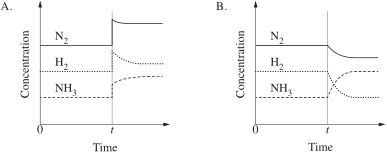
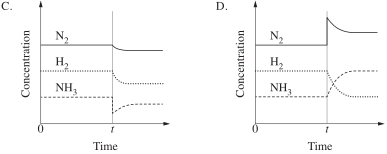
This reaction was initially at equilibrium and experienced a change at time \(t\).

Which graph represents a decrease in volume at time \(t\)?


Show Answers Only

\(A\)

Show Worked Solution
  • Decreasing the volume instantly increases the concentration of all gases, so all three lines jump up at time \(t\).
  • The equilibrium then shifts to the side with fewer moles of gas (4 mol → 2 mol), which is the right.
  • \(\ce{[N2]}\) and \(\ce{[H2]}\) then gradually decrease and \(\ce{[NH3]}\) gradually increases.

\(\Rightarrow A\)

Filed Under: Factors that Affect Equilibrium Tagged With: Band 4, smc-3670-35-Volume

CHEMISTRY, M5 2026 HSC 7 MC

The equilibrium expression for a homogeneous reaction is

\(K_{eq}=\dfrac{\ce{[NO]^4[H2O]^6}}{\ce{[NH3]^4[O2]^5}}\).

What is the chemical equation for this reaction?

  1. \(\ce{4NH3(g) + 5O2(g) \rightleftharpoons 4NO(g) + 6H2O(l)}\)
  2. \(\ce{6NO(g) + 4H2O(g) \rightleftharpoons 5NH3(g) + 4O2(g)}\)
  3. \(\ce{4NO(g) + 6H2O(g) \rightleftharpoons 4NH3(g) + 5O2(g)}\)
  4. \(\ce{4NH3(g) + 5O2(g) \rightleftharpoons 4NO(g) + 6H2O(g)}\)
Show Answers Only

\(D\)

Show Worked Solution
  • Products are in the numerator and reactants are in the denominator. The powers are the coefficients in the equation.
  • The reaction is homogeneous, so all species must be in the same state.
  • \(\ce{H2O}\) is included in the expression, so it must be a gas, not a liquid (which eliminates A).

\(\Rightarrow D\)

Filed Under: Equilibrium Constant Tagged With: Band 4, smc-3671-30-Deduce chemical equation

CHEMISTRY, M6 2026 HSC 6 MC

If solid sodium acetate is added to water at room temperature, what will occur?

  1. A gas will evolve.
  2. The pH will increase.
  3. The solid will not dissolve.
  4. There will be a colour change.
Show Answers Only

\(B\)

Show Worked Solution
  • Sodium acetate is a soluble salt that dissociates completely in water.
  • The acetate ion is the conjugate base of a weak acid and hydrolyses to produce \(\ce{OH-}\) ions:
  •    \(\ce{CH3COO^-(aq) + H2O(l) \rightleftharpoons CH3COOH(aq) + OH^-(aq)}\)
  • \(\ce{[OH^-]}\) increases, so the pH increases.

\(\Rightarrow B\)

Filed Under: Bronsted-Lowry Theory Tagged With: Band 4, smc-3674-18-Dissociation in Water

CHEMISTRY, M5 2026 HSC 4 MC

The Aboriginal Peoples of the Lake Eyre region in Central Australia heated gypsum \(\ce{(CaSO4 * 2H2O)}\) to form plaster \(\left(\ce{CaSO4} \cdot \frac{1}{2}\ce{H2O}\right)\). This white solid product was then rolled into a ball and used for various games.

Which word best describes the formation of plaster?

  1. Addition
  2. Dehydration
  3. Hydration
  4. Oxidation
Show Answers Only

\(B\)

Show Worked Solution
  • Heating gypsum removes water of crystallisation:
  •    \(\ce{CaSO4 * 2H2O(s) -> CaSO4} \cdot \frac{1}{2}\ce{H2O(s)} + \frac{3}{2}\ce{H2O(g)}\)
  • Losing water from a compound is called dehydration.
  • The oxidation states of Ca, S and O do not change, so it is not oxidation.

\(\Rightarrow B\)

Filed Under: Static and Dynamic Equilibrium Tagged With: Band 4, smc-3669-10-Static/Dynamic Models

CHEMISTRY, M5 2026 HSC 3 MC

The following endothermic reaction is at equilibrium in a closed system.

\(\ce{2HI(g)\rightleftharpoons H2(g) + I2(g)} \quad \quad \Delta H > 0\)

Which of the following statements is true?

  1. An increase in temperature will shift the equilibrium to the right.
  2. An addition of more iodine will shift the equilibrium to the right.
  3. A change in volume of the system will shift the equilibrium to the left.
  4. An addition of a catalyst into the system will shift the equilibrium to the left.
Show Answers Only

\(A\)

Show Worked Solution
  • The forward reaction is endothermic (heat can be treated as a reactant).
  • Increasing the temperature shifts the equilibrium to the right to absorb the added heat (Le Chatelier’s principle).
  • Option B is incorrect: adding iodine (a product) shifts the equilibrium to the left.
  • Option C is incorrect: there are 2 mol of gas on each side, so a change in volume causes no shift.
  • Option D is incorrect: a catalyst increases the forward and reverse rates equally, so the position of equilibrium does not change.

\(\Rightarrow A\)

Filed Under: Factors that Affect Equilibrium Tagged With: Band 4, smc-3670-10-Temperature

BIOLOGY, M8 2026 HSC 30

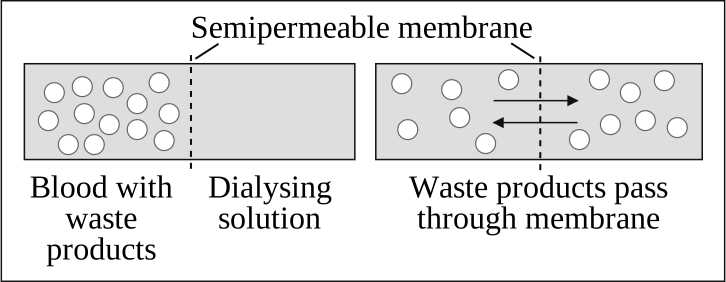
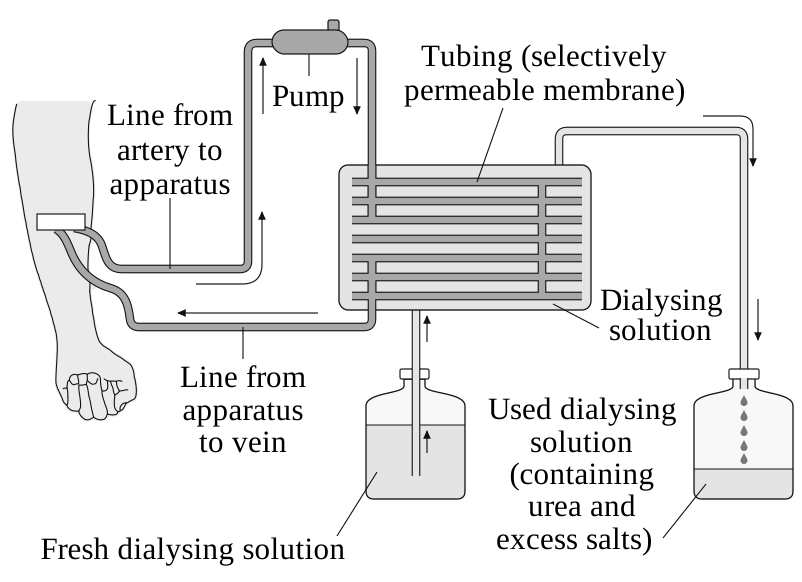
Dialysis is a technology used to deal with the effects of loss of kidney function. The diagrams show the process of dialysis and how the semipermeable membrane works.
 

Evaluate the use of dialysis as a treatment for loss of kidney function. Make reference to the information provided in the diagram.   (7 marks)

--- 24 WORK AREA LINES (style=lined) ---

Show Answers Only

Evaluation Statement

  • Dialysis is a highly effective life-sustaining treatment when evaluated against its ability to remove wastes and maintain fluid and salt balance.
  • However, it is limited as a long-term solution because it does not fully replace kidney function and significantly affects quality of life.

Effectiveness in Removing Wastes

  • Blood is pumped from an artery through selectively permeable tubing surrounded by dialysing solution.
  • Urea and excess salts diffuse across the membrane down their concentration gradient into the dialysing solution, as shown in the diagram.
  • Fresh dialysing solution is continuously supplied while used solution (containing urea and excess salts) is removed, maintaining a steep concentration gradient.
  • The dialysing solution contains normal concentrations of useful substances such as glucose, so these are not lost from the blood.
  • This criterion is strongly met as dialysis performs the key filtering role of the kidney, preventing toxic urea build-up and keeping patients alive.

Limitations

  • Dialysis is intermittent, typically requiring around three 4-hour sessions per week, so wastes and fluid accumulate between treatments.
  • Patients must follow strict diet and fluid restrictions and depend on access to a machine and clinic, reducing quality of life.
  • Repeated access to an artery and vein increases the risk of infection and blood clots.
  • Dialysis does not replace the hormonal functions of the kidney (e.g. erythropoietin production), so complications such as anaemia can still occur.
  • It is also costly for patients and health systems.

Final Evaluation

  • Weighing these factors shows dialysis is an effective treatment for managing the effects of loss of kidney function.
  • Its ability to remove urea and excess salts by diffusion outweighs its limitations because, without it, patients would not survive.
  • However, it is best regarded as a management strategy rather than a cure, often used until a kidney transplant becomes available.
Show Worked Solution

Evaluation Statement

  • Dialysis is a highly effective life-sustaining treatment when evaluated against its ability to remove wastes and maintain fluid and salt balance.
  • However, it is limited as a long-term solution because it does not fully replace kidney function and significantly affects quality of life.

Effectiveness in Removing Wastes

  • Blood is pumped from an artery through selectively permeable tubing surrounded by dialysing solution.
  • Urea and excess salts diffuse across the membrane down their concentration gradient into the dialysing solution, as shown in the diagram.
  • Fresh dialysing solution is continuously supplied while used solution (containing urea and excess salts) is removed, maintaining a steep concentration gradient.
  • The dialysing solution contains normal concentrations of useful substances such as glucose, so these are not lost from the blood.
  • This criterion is strongly met as dialysis performs the key filtering role of the kidney, preventing toxic urea build-up and keeping patients alive.

Limitations

  • Dialysis is intermittent, typically requiring around three 4-hour sessions per week, so wastes and fluid accumulate between treatments.
  • Patients must follow strict diet and fluid restrictions and depend on access to a machine and clinic, reducing quality of life.
  • Repeated access to an artery and vein increases the risk of infection and blood clots.
  • Dialysis does not replace the hormonal functions of the kidney (e.g. erythropoietin production), so complications such as anaemia can still occur.
  • It is also costly for patients and health systems.

Final Evaluation

  • Weighing these factors shows dialysis is an effective treatment for managing the effects of loss of kidney function.
  • Its ability to remove urea and excess salts by diffusion outweighs its limitations because, without it, patients would not survive.
  • However, it is best regarded as a management strategy rather than a cure, often used until a kidney transplant becomes available.

Filed Under: Technologies and Disorders Tagged With: Band 4, Band 5, smc-3663-10-Kidneys

BIOLOGY, M8 2026 HSC 22

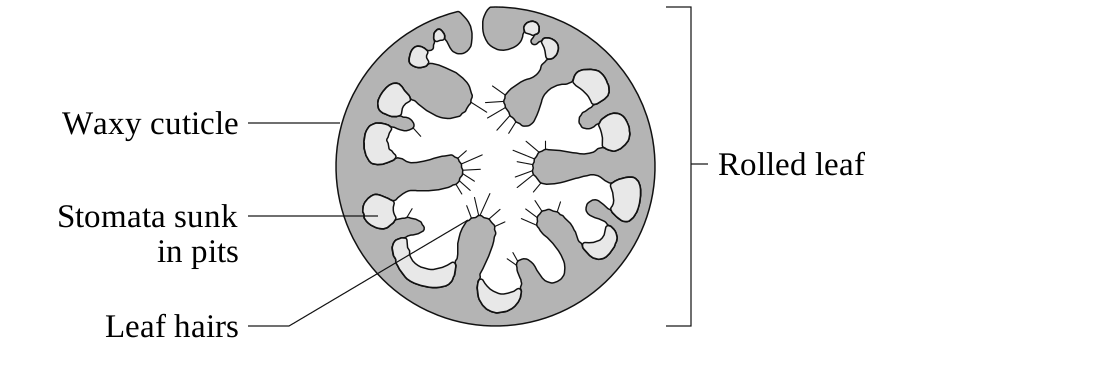
The following diagram shows the cross section of a xerophytic plant, marram grass. Xerophytic plant species have adaptations designed to maintain water balance in hot conditions.
 

Explain how TWO adaptations assist the marram grass in maintaining water balance.   (4 marks)

--- 8 WORK AREA LINES (style=lined) ---

Show Answers Only

Answers could include two of the following:

Waxy cuticle

  • The thick waxy cuticle is a waterproof layer covering the outer leaf surface.
  • This reduces water loss by evaporation directly through the epidermis, helping the plant conserve water in hot conditions.

Stomata sunk in pits

  • Sunken stomata trap a layer of moist, still air above the stomatal opening.
  • This reduces the water vapour concentration gradient between the leaf and the atmosphere, slowing the rate of transpiration.

Rolled leaf

  • The leaf rolls inwards so the stomata are enclosed on the inner surface, away from drying winds.
  • Humid air is trapped inside the rolled leaf, reducing the diffusion gradient and therefore water loss through transpiration.

Leaf hairs

  • Leaf hairs trap a layer of humid air close to the stomata and reduce air movement across the leaf surface.
  • This decreases the rate at which water vapour diffuses out of the leaf, creating a humid microclimate and reducing transpiration.
Show Worked Solution

Answers could include two of the following:

Waxy cuticle

  • The thick waxy cuticle is a waterproof layer covering the outer leaf surface.
  • This reduces water loss by evaporation directly through the epidermis, helping the plant conserve water in hot conditions.

Stomata sunk in pits

  • Sunken stomata trap a layer of moist, still air above the stomatal opening.
  • This reduces the water vapour concentration gradient between the leaf and the atmosphere, slowing the rate of transpiration.

Rolled leaf

  • The leaf rolls inwards so the stomata are enclosed on the inner surface, away from drying winds.
  • Humid air is trapped inside the rolled leaf, reducing the diffusion gradient and therefore water loss through transpiration.

Leaf hairs

  • Leaf hairs trap a layer of humid air close to the stomata and reduce air movement across the leaf surface.
  • This decreases the rate at which water vapour diffuses out of the leaf, creating a humid microclimate and reducing transpiration.

Filed Under: Homeostasis Tagged With: Band 4, smc-3659-30-Water Balance in Plants

BIOLOGY, M6 2026 HSC 10 MC

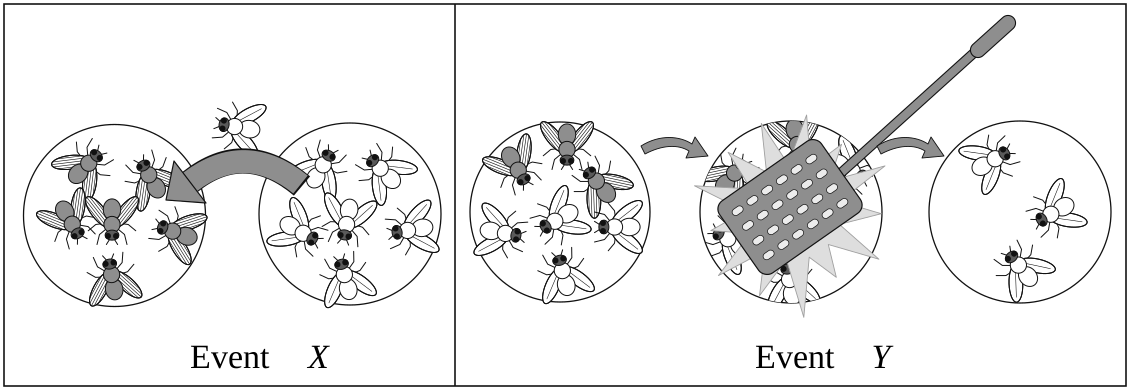
The images model two events which contribute to evolution.
 

Which row of the table correctly identifies the event being modelled in \(X\) and \(Y\)?

\begin{align*}
\begin{array}{l}
\rule{0pt}{2.5ex} \ \rule[-1ex]{0pt}{0pt}& \\
\rule{0pt}{2.5ex}\textbf{A.}\rule[-1ex]{0pt}{0pt}\\
\rule{0pt}{2.5ex}\textbf{B.}\rule[-1ex]{0pt}{0pt}\\
\rule{0pt}{2.5ex}\textbf{C.}\rule[-1ex]{0pt}{0pt}\\
\rule{0pt}{2.5ex}\textbf{D.}\rule[-1ex]{0pt}{0pt}\\
\end{array}
\begin{array}{|l|l|}
\hline
\rule{0pt}{2.5ex}\textit{Event X}\rule[-1ex]{0pt}{0pt}& \textit{Event Y} \\
\hline
\rule{0pt}{2.5ex}\text{Selective breeding}\rule[-1ex]{0pt}{0pt}& \text{Gene flow} \\
\hline
\rule{0pt}{2.5ex}\text{Gene flow}\rule[-1ex]{0pt}{0pt}& \text{Genetic drift} \\
\hline
\rule{0pt}{2.5ex}\text{Genetic drift}\rule[-1ex]{0pt}{0pt}& \text{Natural selection} \\
\hline
\rule{0pt}{2.5ex}\text{Natural selection}\rule[-1ex]{0pt}{0pt}& \text{Selective breeding} \\
\hline
\end{array}
\end{align*}

Show Answers Only

\(B\)

Show Worked Solution
  • B is correct: \(X\) shows alleles migrating between populations; \(Y\) shows random loss of individuals.

Other Options:

  • A is incorrect: \(X\) shows migration, not humans choosing breeding pairs.
  • C is incorrect: \(X\) shows movement between populations; \(Y\) is random, not selective.
  • D is incorrect: Neither event involves advantageous traits or humans choosing breeding pairs.

Filed Under: Uncategorized Tagged With: Band 4, smc-3652-10-Mechanisms of Change/Variation

BIOLOGY, M6 2026 HSC 33

Genetic diversity in koala populations is declining due to habitat loss and isolation. Conservation scientists are trialling two reproductive technologies to improve koala genetic diversity:

  1. Artificial insemination using sperm collected from multiple males
  2. Artificial pollination of their primary food source.

Assess how BOTH technologies can improve the long-term survival of the koala species.   (5 marks)

--- 20 WORK AREA LINES (style=lined) ---

Show Answers Only

Judgement

  • Both technologies can improve the long-term survival of koalas, but artificial insemination is more effective as it directly increases koala genetic diversity.

Artificial insemination

  • Sperm collected from multiple males in different, isolated populations can be used to inseminate females, introducing new alleles and increasing genetic diversity without moving animals between habitats.
  • Greater genetic diversity reduces inbreeding and the expression of harmful recessive traits, and increases the chance that some individuals carry alleles that allow survival when conditions change, such as resistance to disease (eg chlamydia).
  • However, the procedure is costly, requires handling and anaesthetising animals, and has variable success rates, limiting how many offspring can be produced.

Artificial pollination

  • Artificially pollinating eucalyptus trees by transferring pollen between selected trees can increase the genetic diversity of the koala’s food source, producing trees that are more resilient to drought, disease and climate change.
  • This supports koala survival indirectly by providing a more reliable food supply and helping to restore habitat.
  • However, it does not change koala genetic diversity, and eucalyptus trees take many years to mature, so the benefits are slow to take effect.

Conclusion

  • Used together, the two technologies are complementary.
  • Artificial insemination improves the genetic health of koala populations, while artificial pollination secures the food and habitat they depend on, though neither addresses the underlying cause of habitat loss.
Show Worked Solution

Judgement

  • Both technologies can improve the long-term survival of koalas, but artificial insemination is more effective as it directly increases koala genetic diversity.

Artificial insemination

  • Sperm collected from multiple males in different, isolated populations can be used to inseminate females, introducing new alleles and increasing genetic diversity without moving animals between habitats.
  • Greater genetic diversity reduces inbreeding and the expression of harmful recessive traits, and increases the chance that some individuals carry alleles that allow survival when conditions change, such as resistance to disease (eg chlamydia).
  • However, the procedure is costly, requires handling and anaesthetising animals, and has variable success rates, limiting how many offspring can be produced.

Artificial pollination

  • Artificially pollinating eucalyptus trees by transferring pollen between selected trees can increase the genetic diversity of the koala’s food source, producing trees that are more resilient to drought, disease and climate change.
  • This supports koala survival indirectly by providing a more reliable food supply and helping to restore habitat.
  • However, it does not change koala genetic diversity, and eucalyptus trees take many years to mature, so the benefits are slow to take effect.

Conclusion

  • Used together, the two technologies are complementary.
  • Artificial insemination improves the genetic health of koala populations, while artificial pollination secures the food and habitat they depend on, though neither addresses the underlying cause of habitat loss.

Filed Under: Genetic Technologies Tagged With: Band 4, Band 5, smc-3654-10-Genetic Diversity, smc-3654-51-Reproductive Technologies

BIOLOGY, M5 2026 HSC 32

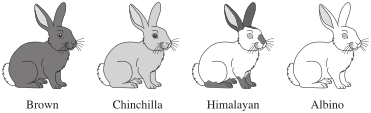
Coat colour in rabbits is inherited according to the alleles shown in the table. Each allele has a different phenotype.

\begin{align*}
\begin{array}{|l|l|l|}
\hline
\rule{0pt}{2.5ex} \textit{Allele} \rule[-1ex]{0pt}{0pt}& \textit{Phenotype} & \qquad\quad \textit{Inheritance pattern} \\
\hline
\rule{0pt}{2.5ex} \mathrm{R} \rule[-1ex]{0pt}{0pt}& \text{Brown} & \text{Dominant to all other alleles} \\
\hline
\rule{0pt}{2.5ex} \mathrm{r}^{\mathrm{ch}} \rule[-1ex]{0pt}{0pt}& \text{Chinchilla} & \text{Dominant to Himalayan and to Albino} \\
\hline
\rule{0pt}{2.5ex} \mathrm{r}^{\mathrm{h}} \rule[-1ex]{0pt}{0pt}& \text{Himalayan} & \text{Dominant to Albino} \\
\hline
\rule{0pt}{2.5ex} \mathrm{r} \rule[-1ex]{0pt}{0pt}& \text{Albino} & \text{Recessive} \\
\hline
\end{array}
\end{align*}


  1. The inheritance of coat colour in rabbits is an example of multiple alleles.
  2. What are multiple alleles?   (2 marks)

    --- 2 WORK AREA LINES (style=lined) ---

  3. An animal breeder crossed a Brown rabbit with the genotype \(\mathrm{R}\mathrm{r}^{\mathrm{ch}}\), with a Himalayan rabbit with the genotype \(\mathrm{r}^{\mathrm{h}}\mathrm{r}^{\mathrm{h}}\).
  4. Determine the genotype and phenotype ratio of the resulting offspring. Show all working.   (3 marks)

    --- 6 WORK AREA LINES (style=lined) ---

Show Answers Only

a.    Multiple alleles:

  • Occur when a gene has more than two alternative forms (alleles) in a population.
  • However, each individual carries only two of these alleles, one inherited from each parent.

b.    Dominance hierarchy: \(\mathrm{R} > \mathrm{r}^{\mathrm{ch}} > \mathrm{r}^{\mathrm{h}} > \mathrm{r}\)

\begin{align*}
\begin{array}{|c|c|c|}
\hline
\rule{0pt}{2.5ex} \rule[-1ex]{0pt}{0pt}& \mathrm{R} & \mathrm{r}^{\mathrm{ch}} \\
\hline
\rule{0pt}{2.5ex}\mathrm{r}^{\mathrm{h}} \rule[-1ex]{0pt}{0pt}& \mathrm{R}\mathrm{r}^{\mathrm{h}} & \mathrm{r}^{\mathrm{ch}}\mathrm{r}^{\mathrm{h}} \\
\hline
\rule{0pt}{2.5ex}\mathrm{r}^{\mathrm{h}} \rule[-1ex]{0pt}{0pt}& \mathrm{R}\mathrm{r}^{\mathrm{h}} & \mathrm{r}^{\mathrm{ch}}\mathrm{r}^{\mathrm{h}} \\
\hline
\end{array}
\end{align*}

Genotype ratio: \(1\ \mathrm{R}\mathrm{r}^{\mathrm{h}} : 1\ \mathrm{r}^{\mathrm{ch}}\mathrm{r}^{\mathrm{h}}\)

Phenotype ratio: 1 Brown : 1 Chinchilla

Show Worked Solution

a.    Multiple alleles:

  • Occur when a gene has more than two alternative forms (alleles) in a population.
  • However, each individual carries only two of these alleles, one inherited from each parent.

b.    Dominance hierarchy: \(\mathrm{R} > \mathrm{r}^{\mathrm{ch}} > \mathrm{r}^{\mathrm{h}} > \mathrm{r}\)

\begin{align*}
\begin{array}{|c|c|c|}
\hline
\rule{0pt}{2.5ex} \rule[-1ex]{0pt}{0pt}& \mathrm{R} & \mathrm{r}^{\mathrm{ch}} \\
\hline
\rule{0pt}{2.5ex}\mathrm{r}^{\mathrm{h}} \rule[-1ex]{0pt}{0pt}& \mathrm{R}\mathrm{r}^{\mathrm{h}} & \mathrm{r}^{\mathrm{ch}}\mathrm{r}^{\mathrm{h}} \\
\hline
\rule{0pt}{2.5ex}\mathrm{r}^{\mathrm{h}} \rule[-1ex]{0pt}{0pt}& \mathrm{R}\mathrm{r}^{\mathrm{h}} & \mathrm{r}^{\mathrm{ch}}\mathrm{r}^{\mathrm{h}} \\
\hline
\end{array}
\end{align*}

Genotype ratio: \(1\ \mathrm{R}\mathrm{r}^{\mathrm{h}} : 1\ \mathrm{r}^{\mathrm{ch}}\mathrm{r}^{\mathrm{h}}\)

Phenotype ratio: 1 Brown : 1 Chinchilla

Filed Under: Genetic Variation / Inheritance Tagged With: Band 4, Band 5, smc-3648-20-Punnet Squares, smc-3648-75-Inheritance Patterns

BIOLOGY, M7 2026 HSC 31

Hendra is a virus carried by bats that can be transmitted to horses which can then pass it on to humans. The virus is fatal to horses and humans. Horses contract the virus by eating food contaminated with bat urine or saliva. Humans contract the virus by contact with body fluids from an infected horse. Symptoms develop in horses and humans between 5 and 21 days after exposure.

A farmer noticed symptoms of the virus in three of his five horses. He isolated the affected horses, wore gloves while disinfecting the stables and immediately transported the unaffected horses to a neighbour's stable housing other horses.

  1. Outline ONE strategy that could have prevented the horses from exposure to the Hendra virus.   (2 marks)

    --- 4 WORK AREA LINES (style=lined) ---

  2. 'The quarantine method applied to this disease outbreak was ineffective.'
  3. Justify this statement.   (4 marks)

    --- 8 WORK AREA LINES (style=lined) ---

Show Answers Only

a.    Answers could include one of the following:

  • Fence horses away from flowering or fruiting trees that attract bats, reducing contact with contaminated food sources.
  • Cover feed and water containers and place them away from trees where bats roost, preventing contamination of food with bat urine or saliva.
  • Vaccinate horses against the Hendra virus so they develop immunity before any exposure occurs.
     

b.    The quarantine method applied to this disease outbreak was ineffective.

  • The unaffected horses may have already been exposed and be incubating the virus, as symptoms can take 5–21 days to appear.
  • Transporting them to a neighbour’s stable could therefore spread the virus to a new population of horses, and to the people caring for them.
  • Effective quarantine would have kept all horses on the property isolated for at least 21 days, with movement restricted and authorities notified.
  • Wearing only gloves was also inadequate, as humans contract the virus from body fluids. Full protective equipment (eg gown, mask, eye protection) was needed to prevent transmission to the farmer.
Show Worked Solution

a.    Answers could include one of the following:

  • Fence horses away from flowering or fruiting trees that attract bats, reducing contact with contaminated food sources.
  • Cover feed and water containers and place them away from trees where bats roost, preventing contamination of food with bat urine or saliva.
  • Vaccinate horses against the Hendra virus so they develop immunity before any exposure occurs.
     

b.    The quarantine method applied to this disease outbreak was ineffective.

  • The unaffected horses may have already been exposed and be incubating the virus, as symptoms can take 5–21 days to appear.
  • Transporting them to a neighbour’s stable could therefore spread the virus to a new population of horses, and to the people caring for them.
  • Effective quarantine would have kept all horses on the property isolated for at least 21 days, with movement restricted and authorities notified.
  • Wearing only gloves was also inadequate, as humans contract the virus from body fluids. Full protective equipment (eg gown, mask, eye protection) was needed to prevent transmission to the farmer.

Filed Under: Prevention, Treatment and Control Tagged With: Band 4, Band 5, smc-3658-30-Procedures to Prevent Spread

BIOLOGY, M7 2026 HSC 29

An intense rainfall event occurred in a catchment area for a city's water supply, resulting in a high volume of stormwater entering the drinking water supply.

Design a safe and valid experiment to test the microbial content of the water.   (4 marks)

--- 15 WORK AREA LINES (style=lined) ---

Show Answers Only
  • Using sterile containers, collect water samples from several points in the supply after the rainfall event, along with a sterilised (autoclaved) water sample as a control.
  • Using aseptic technique, pipette the same volume (eg 0.1 mL) of each sample onto separate nutrient agar plates, lifting the lids only slightly. Spread each sample evenly with a spreader sterilised in ethanol and flamed. Prepare three replicate plates per sample.
  • Tape the lids with two short strips (not fully sealed, so anaerobic pathogens are not encouraged), label the plates, and incubate them upside down at 25–30°C for 48 hours. Keep agar type, volume, temperature and time the same for all plates (controlled variables).
  • Count the colonies on each plate without opening it, and average the counts for each sample to compare microbial content against the control.
  • Safety: wear gloves and a lab coat, disinfect benches before and after, do not open plates after incubation, and dispose of all plates by autoclaving.
Show Worked Solution
  • Using sterile containers, collect water samples from several points in the supply after the rainfall event, along with a sterilised (autoclaved) water sample as a control.
  • Using aseptic technique, pipette the same volume (eg 0.1 mL) of each sample onto separate nutrient agar plates, lifting the lids only slightly. Spread each sample evenly with a spreader sterilised in ethanol and flamed. Prepare three replicate plates per sample.
  • Tape the lids with two short strips (not fully sealed, so anaerobic pathogens are not encouraged), label the plates, and incubate them upside down at 25–30°C for 48 hours. Keep agar type, volume, temperature and time the same for all plates (controlled variables).
  • Count the colonies on each plate without opening it, and average the counts for each sample to compare microbial content against the control.
  • Safety: wear gloves and a lab coat, disinfect benches before and after, do not open plates after incubation, and dispose of all plates by autoclaving.

Filed Under: Causes of Infectious Disease Tagged With: Band 4, smc-3655-50-Microbial Tests

BIOLOGY, M5 2026 HSC 28

The process of transcription ends with a strand of messenger RNA (mRNA) being produced within the nucleus of a eukaryotic cell.

Describe the steps involved in the construction of a polypeptide chain following the completion of transcription.   (5 marks)

--- 12 WORK AREA LINES (style=lined) ---

Show Answers Only
  • The pre-mRNA is processed in the nucleus: introns are removed and exons are spliced together, and a 5′ cap and poly-A tail are added to protect the mRNA.
  • The mature mRNA exits the nucleus through a nuclear pore and attaches to a ribosome in the cytoplasm.
  • The ribosome reads the mRNA in codons, beginning at the start codon (AUG). Transfer RNA (tRNA) molecules, each carrying a specific amino acid, bind to the mRNA where their anticodons are complementary to the codons.
  • The ribosome joins adjacent amino acids with peptide bonds, then moves along the mRNA one codon at a time, releasing the empty tRNA so the chain can lengthen.
  • When the ribosome reaches a stop codon, translation ends and the completed polypeptide chain is released. The polypeptide then folds and may be further processed to form a functional protein.
Show Worked Solution
  • The pre-mRNA is processed in the nucleus: introns are removed and exons are spliced together, and a 5′ cap and poly-A tail are added to protect the mRNA.
  • The mature mRNA exits the nucleus through a nuclear pore and attaches to a ribosome in the cytoplasm.
  • The ribosome reads the mRNA in codons, beginning at the start codon (AUG). Transfer RNA (tRNA) molecules, each carrying a specific amino acid, bind to the mRNA where their anticodons are complementary to the codons.
  • The ribosome joins adjacent amino acids with peptide bonds, then moves along the mRNA one codon at a time, releasing the empty tRNA so the chain can lengthen.
  • When the ribosome reaches a stop codon, translation ends and the completed polypeptide chain is released. The polypeptide then folds and may be further processed to form a functional protein.

Filed Under: DNA and Polypeptide Synthesis Tagged With: Band 4, Band 5, smc-3650-11-RNA, smc-3650-20-Translation

BIOLOGY, M5 2026 HSC 27

The changes in hormone levels of a pregnant woman were measured for hCG, oxytocin and progesterone. The levels of progesterone are tabulated and the levels of hCG and oxytocin are plotted.

\begin{align*}
\begin{array}{|c|c|}
\hline
\rule{0pt}{2.5ex} \ \text{Week of pregnancy}\ \rule[-1ex]{0pt}{0pt}& \begin{array}{c} \text{Relative level of progesterone} \\ \text{(% of max)} \end{array} \\
\hline
\rule{0pt}{2.5ex} 0 \rule[-1ex]{0pt}{0pt}& 0 \\
\hline
\rule{0pt}{2.5ex} 5 \rule[-1ex]{0pt}{0pt}& 8 \\
\hline
\rule{0pt}{2.5ex} 10 \rule[-1ex]{0pt}{0pt}& 13 \\
\hline
\rule{0pt}{2.5ex} 15 \rule[-1ex]{0pt}{0pt}& 14 \\
\hline
\rule{0pt}{2.5ex} 20 \rule[-1ex]{0pt}{0pt}& 24 \\
\hline
\rule{0pt}{2.5ex} 25 \rule[-1ex]{0pt}{0pt}& 43 \\
\hline
\rule{0pt}{2.5ex} 30 \rule[-1ex]{0pt}{0pt}& 80 \\
\hline
\rule{0pt}{2.5ex} 35 \rule[-1ex]{0pt}{0pt}& 100 \\
\hline
\rule{0pt}{2.5ex} 40 \rule[-1ex]{0pt}{0pt}& 96 \\
\hline
\end{array}
\end{align*}

  1. On the graph, plot the data from the table to show changes in this woman's progesterone levels. Include a suitable curve of best fit.   (3 marks)
     

  1. Describe the role of all THREE of these hormones during pregnancy and birth. In your answer, refer to the data shown on the graph.   (4 marks)

    --- 10 WORK AREA LINES (style=lined) ---

Show Answers Only

a.    
     

b.    Role of pregnancy hormones:

  • hCG maintains the corpus luteum, which produces progesterone in early pregnancy until the placenta takes over. This is why hCG peaks at 100% at 10 weeks, then falls and stays at around 20–25%.
  • Progesterone maintains the endometrium and prevents uterine contractions, sustaining the pregnancy. Its level rises steadily to a peak of 100% at 35 weeks, then drops slightly to 96% at 40 weeks, allowing contractions to begin.
  • Oxytocin stimulates uterine contractions during birth. It is absent until about 37 weeks, then rises sharply to 50% at 40 weeks as labour begins, before falling to 0% by 43 weeks.
Show Worked Solution

a.    
     

b.    Role of pregnancy hormones:

  • hCG maintains the corpus luteum, which produces progesterone in early pregnancy until the placenta takes over. This is why hCG peaks at 100% at 10 weeks, then falls and stays at around 20–25%.
  • Progesterone maintains the endometrium and prevents uterine contractions, sustaining the pregnancy. Its level rises steadily to a peak of 100% at 35 weeks, then drops slightly to 96% at 40 weeks, allowing contractions to begin.
  • Oxytocin stimulates uterine contractions during birth. It is absent until about 37 weeks, then rises sharply to 50% at 40 weeks as labour begins, before falling to 0% by 43 weeks.

Filed Under: Reproduction Tagged With: Band 3, Band 4, Band 5, smc-3647-05-Human/Mammal, smc-3647-50-Hormones

BIOLOGY, M6 2026 HSC 26

The diagram shows two techniques used in cloning.
 

  1. Name and compare the TWO techniques used in cloning shown.   (4 marks)

    --- 8 WORK AREA LINES (style=lined) ---

  2. A technique similar to Technique 2 can be used to create super salmon, which are genetically modified Atlantic salmon that contain a growth regulating gene from Chinook salmon, and a promoter gene from an ocean pout. This modification allows super salmon to grow to market size much faster than normal salmon.
  3. Analyse how social, economic, and cultural factors might influence public attitudes about using super salmon for human consumption.   (7 marks)

    --- 22 WORK AREA LINES (style=lined) ---

Show Answers Only

a.    Technique 1: Whole organism (reproductive) cloning by somatic cell nuclear transfer (SCNT).

Technique 2: Gene cloning using recombinant DNA technology.

Similarities

  • Both techniques produce genetically identical copies.
  • Both involve inserting DNA into a host cell.

Differences

  • SCNT clones a whole organism. The nucleus of a body cell is fused with an egg cell that has had its nucleus removed. The embryo develops in a surrogate, producing an identical copy of the nucleus donor (Dolly).
  • In contrast, gene cloning copies a single gene. The gene is inserted into a plasmid vector, which is taken up by bacteria. As the bacteria reproduce, they make many copies of the gene.
     

b.    Social factors

  • Concerns about food safety, such as possible allergic reactions or unknown long-term health effects, lead to negative attitudes and reduced consumer acceptance.
  • Environmental concerns that escaped GM salmon could outcompete or interbreed with wild salmon reduce public trust, although raising sterile fish in land-based tanks may ease these fears.
  • Mandatory labelling influences attitudes by allowing consumers to make informed choices, which may increase trust in regulatory systems.

Economic factors

  • Faster growth to market size reduces feed and production costs, potentially making salmon cheaper and improving food security. This can help create positive attitudes among cost-conscious consumers.
  • However, wild fishery and conventional aquaculture industries may oppose super salmon due to competition, influencing public opinion through campaigns and retailer boycotts.

Cultural factors

  • For some Indigenous communities, wild salmon holds deep spiritual and cultural significance, resulting in strong opposition to genetically modified salmon.
  • Some religious and cultural groups object to combining genes from different species, leading to concerns about whether the product complies with their dietary laws.

Overall

  • These factors interact, as economic benefits may increase acceptance, while social and cultural concerns reduce it. As a result, public attitudes are likely to vary widely between different groups in society.
Show Worked Solution

a.    Technique 1: Whole organism (reproductive) cloning by somatic cell nuclear transfer (SCNT).

Technique 2: Gene cloning using recombinant DNA technology.

Similarities

  • Both techniques produce genetically identical copies.
  • Both involve inserting DNA into a host cell.

Differences

  • SCNT clones a whole organism. The nucleus of a body cell is fused with an egg cell that has had its nucleus removed. The embryo develops in a surrogate, producing an identical copy of the nucleus donor (Dolly).
  • In contrast, gene cloning copies a single gene. The gene is inserted into a plasmid vector, which is taken up by bacteria. As the bacteria reproduce, they make many copies of the gene.
     

b.    Social factors

  • Concerns about food safety, such as possible allergic reactions or unknown long-term health effects, lead to negative attitudes and reduced consumer acceptance.
  • Environmental concerns that escaped GM salmon could outcompete or interbreed with wild salmon reduce public trust, although raising sterile fish in land-based tanks may ease these fears.
  • Mandatory labelling influences attitudes by allowing consumers to make informed choices, which may increase trust in regulatory systems.

Economic factors

  • Faster growth to market size reduces feed and production costs, potentially making salmon cheaper and improving food security. This can help create positive attitudes among cost-conscious consumers.
  • However, wild fishery and conventional aquaculture industries may oppose super salmon due to competition, influencing public opinion through campaigns and retailer boycotts.

Cultural factors

  • For some Indigenous communities, wild salmon holds deep spiritual and cultural significance, resulting in strong opposition to genetically modified salmon.
  • Some religious and cultural groups object to combining genes from different species, leading to concerns about whether the product complies with their dietary laws.

Overall

  • These factors interact, as economic benefits may increase acceptance, while social and cultural concerns reduce it. As a result, public attitudes are likely to vary widely between different groups in society.

Filed Under: Genetic Technologies Tagged With: Band 3, Band 4, Band 5, smc-3654-05-Transgenic Organisms, smc-3654-70-Whole Organism Cloning, smc-3654-80-Gene Cloning

BIOLOGY, M7 2026 HSC 24

The flow chart shows the distinguishing features of pathogens.
 

  1. Identify the distinguishing features labelled \(X\), \(Y\) and the pathogen type labelled \(Z\) in the flow chart.   (3 marks)

\(X\) ...........................................................................................

\(Y\) ...........................................................................................

\(Z\) ...........................................................................................

  1. Describe a response by a named Australian plant to a named pathogen.   (3 marks)

    --- 4 WORK AREA LINES (style=lined) ---

Show Answers Only

a.    \(X\): Composed of protein only (no genetic material i.e. DNA or RNA).

\(Y\): Nucleic acid (DNA or RNA) enclosed in a protein coat.

\(Z\): Bacteria.
 

b.    Jarrah (Eucalyptus marginata) response to Phytophthora cinnamomi (dieback):

  • When the pathogen’s hyphae invade the roots, resistant jarrah cells detect the pathogen and deposit callose and lignin to thicken cell walls.
  • Tyloses form to block the xylem vessels, limiting the spread of hyphae through the vascular tissue.
  • The plant also produces antimicrobial phenolic compounds, and infected cells may undergo programmed cell death (hypersensitive response) to contain the infection.
Show Worked Solution

a.    \(X\): Composed of protein only (no genetic material i.e. DNA or RNA).

\(Y\): Nucleic acid (DNA or RNA) enclosed in a protein coat.

\(Z\): Bacteria.
 

b.    Jarrah (Eucalyptus marginata) response to Phytophthora cinnamomi (dieback):

  • When the pathogen’s hyphae invade the roots, resistant jarrah cells detect the pathogen and deposit callose and lignin to thicken cell walls.
  • Tyloses form to block the xylem vessels, limiting the spread of hyphae through the vascular tissue.
  • The plant also produces antimicrobial phenolic compounds, and infected cells may undergo programmed cell death (hypersensitive response) to contain the infection.

Filed Under: Causes of Infectious Disease, Immunity and Responses to Pathogens Tagged With: Band 3, Band 4, smc-3655-10-Classifying Pathogens, smc-3657-40-Plant Responses

BIOLOGY, M5 2026 HSC 21

  1. A prokaryotic and eukaryotic cell are shown.

  1. Contrast ONE feature of the DNA in prokaryotes and eukaryotes.   (2 marks)

    --- 3 WORK AREA LINES (style=lined) ---

  2. Outline how ONE feature of DNA allows replication to occur.   (2 marks)

    --- 4 WORK AREA LINES (style=lined) ---

Show Answers Only

a.    Answers could include one of the following:

  • Prokaryotic DNA is a single circular chromosome found free in the cytoplasm (nucleoid region), whereas eukaryotic nuclear DNA consists of multiple linear chromosomes enclosed within a nucleus.
  • Prokaryotic DNA is not associated with histone proteins, whereas eukaryotic DNA is tightly wound around histones.
  • Prokaryotes commonly contain small circular plasmids in addition to their chromosome, whereas plasmids are rare in eukaryotes.

b.    Complementary base pairing:

  • The two strands of the double helix are held together by weak hydrogen bonds between complementary bases (A–T and C–G), allowing helicase to unwind and separate the strands.
  • Each separated strand then acts as a template, with DNA polymerase adding free nucleotides according to complementary base pairing, producing two identical DNA molecules.
Show Worked Solution

a.    Answers could include one of the following:

  • Prokaryotic DNA is a single circular chromosome found free in the cytoplasm (nucleoid region), whereas eukaryotic nuclear DNA consists of multiple linear chromosomes enclosed within a nucleus.
  • Prokaryotic DNA is not associated with histone proteins, whereas eukaryotic DNA is tightly wound around histones.
  • Prokaryotes commonly contain small circular plasmids in addition to their chromosome, whereas plasmids are rare in eukaryotes.

b.    Complementary base pairing:

  • The two strands of the double helix are held together by weak hydrogen bonds between complementary bases (A–T and C–G), allowing helicase to unwind and separate the strands.
  • Each separated strand then acts as a template, with DNA polymerase adding free nucleotides according to complementary base pairing, producing two identical DNA molecules.

Filed Under: Cell Replication, DNA and Polypeptide Synthesis Tagged With: Band 3, Band 4, smc-3649-15-DNA Replication, smc-3650-40-Eukaryotes and Prokaryotes

BIOLOGY, M7 2026 HSC 19 MC

Which row of the table correctly identifies the definition of the types of immunity and their examples?

\begin{align*}
\begin{array}{l}
\rule{0pt}{2.5ex} \ \rule[-1ex]{0pt}{0pt}& \\
\rule{0pt}{2.5ex}\textbf{A.}\\
\\
\rule[-1ex]{0pt}{0pt}\\
\rule{0pt}{2.5ex}\textbf{B.}\\
\\
\rule[-1ex]{0pt}{0pt}\\
\rule{0pt}{2.5ex}\textbf{C.}\\
\\
\rule[-1ex]{0pt}{0pt}\\
\rule{0pt}{2.5ex}\textbf{D.}\\
\\
\rule[-1ex]{0pt}{0pt}\\
\end{array}
\begin{array}{|l|l|}
\hline
\rule{0pt}{2.5ex}\textit{Active immunity} \rule[-1ex]{0pt}{0pt}& \textit{Passive immunity} \\
\hline
\rule{0pt}{2.5ex}\text{Immune system makes its own} & \text{Receives antibodies from another} \\
\text{antibodies eg antibodies made after a} & \text{organism eg antibodies made after an} \\
\text{vaccination} \rule[-1ex]{0pt}{0pt}& \text{infection} \\
\hline
\rule{0pt}{2.5ex}\text{Receives antibodies from another} & \text{Immune system makes its own} \\
\text{organism eg horse antibodies injected} & \text{antibodies eg antibodies made after an} \\
\text{into a person} \rule[-1ex]{0pt}{0pt}& \text{infection} \\
\hline
\rule{0pt}{2.5ex}\text{Immune system makes its own} & \text{Receives antibodies from another} \\
\text{antibodies eg antibodies made after an} & \text{organism eg antibodies passed on} \\
\text{infection} \rule[-1ex]{0pt}{0pt}& \text{from mother to baby via placenta} \\
\hline
\rule{0pt}{2.5ex}\text{Receives antibodies from another} & \text{Immune system makes its own} \\
\text{organism eg antibodies passed on} & \text{antibodies eg horse antibodies injected} \\
\text{from mother to baby via placenta} \rule[-1ex]{0pt}{0pt}& \text{into a person} \\
\hline
\end{array}
\end{align*}

Show Answers Only

\(C\)

Show Worked Solution
  • C is correct: Both definitions and both examples are correctly matched.

Other Options:

  • A is incorrect: Antibodies made after infection is active, not passive, immunity.
  • B is incorrect: The definitions are reversed between active and passive immunity.
  • D is incorrect: Definitions are reversed and horse antibodies are passive immunity.

Filed Under: Immunity and Responses to Pathogens Tagged With: Band 4, smc-3657-25-Antibodies

BIOLOGY, M8 2026 HSC 16 MC

An epidemiological study was conducted to investigate the relationship between smoking and asthma.

  • Method: followed 5000 participants each from urban and rural areas over a 10 year period.
  • Data for the 10 year period:

\begin{align*}
\begin{array}{|l|c|c|c|c|}
\hline
\rule{0pt}{2.5ex}\textit{Region} & \textit{Number of new} & \textit{Prevalence} & \textit{Deaths due to} & \textit{Population} \\
& \textit{asthma cases} & \textit{of asthma} & \textit{asthma} & \textit{of smokers} \\
\rule[-1ex]{0pt}{0pt}& \text{(per 100 000)} & \text{(per 100 000)} & \text{(per 100 000)} & (\%) \\
\hline
\rule{0pt}{2.5ex}\text{Urban areas} \ \ \rule[-1ex]{0pt}{0pt}& 310 & 2600 & 50 & 7 \\
\hline
\rule{0pt}{2.5ex}\text{Rural areas} \rule[-1ex]{0pt}{0pt}& 180 & 1300 & 65 & 20 \\
\hline
\end{array}
\end{align*}

Which of the following options would improve the validity of this epidemiological study?

  1. Collect data on asthma prevalence and mortality rates only
  2. Reduce the study duration so that data can be collected and analysed more efficiently
  3. Include participants from a broader range of regions, socioeconomic backgrounds and air quality
  4. Increase the proportion of participants from urban areas to better reflect the regions with higher asthma prevalence reported in the study
Show Answers Only

\(C\)

Show Worked Solution
  • C is correct: A broader sample accounts for confounding variables like air quality and allows for the study to apply to a more general population.

Other Options:

  • A is incorrect: Removing incidence and smoking data prevents testing the relationship.
  • B is incorrect: A shorter study reduces data and may miss chronic effects.
  • D is incorrect: Unequal sampling introduces bias rather than improving validity.

Filed Under: Epidemiology Tagged With: Band 4, smc-3661-25-Design Study

BIOLOGY, M8 2026 HSC 15 MC

The diagram shows a common visual disorder.
 

Which row of the table identifies the visual disorder and its appropriate lens type?

\begin{align*}
\begin{array}{l}
\rule{0pt}{2.5ex} \ \rule[-1ex]{0pt}{0pt}& \\
\rule{0pt}{2.5ex}\textbf{A.}\rule[-1ex]{0pt}{0pt}\\
\rule{0pt}{2.5ex}\textbf{B.}\rule[-1ex]{0pt}{0pt}\\
\rule{0pt}{2.5ex}\textbf{C.}\rule[-1ex]{0pt}{0pt}\\
\rule{0pt}{2.5ex}\textbf{D.}\rule[-1ex]{0pt}{0pt}\\
\end{array}
\begin{array}{|l|l|}
\hline
\rule{0pt}{2.5ex}\text{Disorder} \rule[-1ex]{0pt}{0pt}& \text{Spectacle lens type} \\
\hline
\rule{0pt}{2.5ex}\text{Myopia} \rule[-1ex]{0pt}{0pt}& \text{Concave (diverging)} \\
\hline
\rule{0pt}{2.5ex}\text{Myopia} \rule[-1ex]{0pt}{0pt}& \text{Convex (converging)} \\
\hline
\rule{0pt}{2.5ex}\text{Hyperopia} \rule[-1ex]{0pt}{0pt}& \text{Concave (diverging)} \\
\hline
\rule{0pt}{2.5ex}\text{Hyperopia} \ \ \rule[-1ex]{0pt}{0pt}& \text{Convex (converging)} \ \ \\
\hline
\end{array}
\end{align*}

Show Answers Only

\(A\)

Show Worked Solution
  • A is correct: The eye’s refractive power is too high, so light converges in front of the retina (myopia). A concave lens diverges the light rays, moving the focal point back onto the retina.

Other Options:

  • B is incorrect: A convex lens adds convergence, moving the focal point further forward.
  • C is incorrect: The diagram shows light focusing in front of the retina, not behind.
  • D is incorrect: Convex lenses suit hyperopia, but the diagram shows myopia.

Filed Under: Technologies and Disorders Tagged With: Band 4, smc-3663-20-Eyes

BIOLOGY, M5 2026 HSC 13 MC

Technology is used to determine inheritance patterns and develop DNA profiles such as the ones shown for four different individuals.

Based on the DNA profiles shown, which statement regarding Individual \(\text{X}\) is correct?

  1. Individual \(\text{X}\) cannot be the father of Child 1, because Child 1 possesses a band that is present in neither the Mother nor Individual \(\text{X}\).
  2. Individual \(\text{X}\) cannot be the father of Child 2, because Child 2 has four distinct bands that are not shared with the Mother's profile.
  3. Individual \(\text{X}\) is the father of Child 1, because every band in Child 1's profile can be matched to a band in either the Mother or Individual \(\text{X}\).
  4. Individual \(\text{X}\) is the father of Child 2, because Child 2 shares the lowest molecular weight (furthest migrating) band exclusively with Individual \(\text{X}\).
Show Answers Only

\(C\)

Show Worked Solution
  • C is correct: All nine Child 1 bands match either the Mother or Individual \(\text{X}\).

Other Options:

  • A is incorrect: Every Child 1 band is present in the Mother or Individual \(\text{X}\).
  • B is incorrect: Non-maternal bands come from the father; e(\text{X}\)clusion requires bands absent from \(\text{X}\).
  • D is incorrect: Child 2’s furthest migrating band is shared with the Mother, not \(\text{X}\).

Filed Under: Genetic Variation / Inheritance Tagged With: Band 4, smc-3648-75-Inheritance Patterns

BIOLOGY, M6 2026 HSC 11 MC

Which of the following describes a benefit of artificial insemination?

  1. Identical organisms can be cloned quickly.
  2. A population develops full immunity to all diseases.
  3. Favourable trait frequency is increased within a population.
  4. The introduction of transgenic genes into an organism results in favourable characteristics.
Show Answers Only

\(C\)

Show Worked Solution
  • C is correct: Sperm from selected males spreads desirable traits through many offspring.

Other Options:

  • A is incorrect: Sexual reproduction produces genetically varied offspring, not clones.
  • B is incorrect: No reproductive technology gives immunity to all diseases.
  • D is incorrect: Transgenic organisms are produced by genetic engineering, not insemination.

Filed Under: Genetic Technologies Tagged With: Band 4, smc-3654-20-Agriculture

BIOLOGY, M5 2026 HSC 4 MC

The diagram shows the structure of the protein haemoglobin, which plays a crucial role in transporting oxygen to the tissues.
 

What type of protein structure is haemoglobin?

  1. Primary
  2. Secondary
  3. Tertiary
  4. Quaternary
Show Answers Only

\(D\)

Show Worked Solution
  • D is correct: Haemoglobin consists of four polypeptide chains bonded together.

Other Options:

  • A is incorrect: Primary structure is only the linear amino acid sequence.
  • B is incorrect: Secondary structure is local folding into alpha helices and beta sheets.
  • C is incorrect: Tertiary structure is the 3D folding of a single polypeptide.

Filed Under: DNA and Polypeptide Synthesis Tagged With: Band 4, smc-3650-60-Proteins

BIOLOGY, M8 2026 HSC 8 MC

A team of biologists observed that a grizzly bear survived through a particularly harsh winter. They recorded several features that helped the bear maintain a stable internal environment despite freezing temperatures.

Which row of the table correctly matches each grizzly bear feature with its adaptation type?

\begin{align*}
\begin{array}{l}
\rule{0pt}{2.5ex} \ \rule[-1ex]{0pt}{0pt}& \\
\rule{0pt}{2.5ex}\textbf{A.}\rule[-1ex]{0pt}{0pt}\\
\rule{0pt}{2.5ex}\textbf{B.}\rule[-1ex]{0pt}{0pt}\\
\rule{0pt}{2.5ex}\textbf{C.}\rule[-1ex]{0pt}{0pt}\\
\rule{0pt}{2.5ex}\textbf{D.}\rule[-1ex]{0pt}{0pt}\\
\end{array}
\begin{array}{|l|l|l|}
\hline
\rule{0pt}{2.5ex}\ \textit{Structural} \rule[-1ex]{0pt}{0pt}& \textit{Behavioural} & \textit{Physiological} \\
\hline
\rule{0pt}{2.5ex}\text{Thick fur} \rule[-1ex]{0pt}{0pt}& \text{Hibernation}\ \  & \text{Shivering} \\
\hline
\rule{0pt}{2.5ex}\text{Hibernation} \ \ \rule[-1ex]{0pt}{0pt}& \text{Shivering} & \text{Thick fur} \\
\hline
\rule{0pt}{2.5ex}\text{Hibernation} \rule[-1ex]{0pt}{0pt}& \text{Thick fur} & \text{Shivering} \\
\hline
\rule{0pt}{2.5ex}\text{Thick fur} \rule[-1ex]{0pt}{0pt}& \text{Shivering} & \text{Hibernation} \\
\hline
\end{array}
\end{align*}

Show Answers Only

\(A\)

Show Worked Solution
  • A is correct: Fur is a body feature, hibernation an action, shivering an internal process.

Other Options:

  • B is incorrect: Thick fur is structural, not physiological.
  • C is incorrect: Thick fur is structural, not behavioural.
  • D is incorrect: Shivering is physiological; hibernation is behavioural.

Filed Under: Homeostasis Tagged With: Band 4, smc-3659-15-Temperature, smc-3659-20-Adaptations/Endotherms

BIOLOGY, M7 2026 HSC 7 MC

Why were the results of Pasteur's swan-neck flask experiment significant for explaining the cause and transmission of disease?

  1. They showed that bacteria are transmitted only through direct contact.
  2. They proved that microorganisms arise spontaneously from non-living matter.
  3. They helped establish a link between a specific microorganism and a particular disease.
  4. They proved that microorganisms could only grow if exposed to air containing microbes.
Show Answers Only

\(D\)

Show Worked Solution
  • D is correct: Broth stayed sterile until exposed to microbe-carrying air, supporting germ theory.

Other Options:

  • A is incorrect: Contamination came from airborne microbes, not direct contact.
  • B is incorrect: The experiment disproved spontaneous generation.
  • C is incorrect: Linking specific microbes to specific diseases was Koch’s work.

Filed Under: Causes of Infectious Disease Tagged With: Band 4, smc-3655-60-Louis Pasteur

BIOLOGY, M8 2026 HSC 6 MC

Newcastle disease is a viral disease that affects chickens. A population study was conducted on a poultry farm, and the following data was collected.

  • 50 chickens were living with the disease.
  • 500 new cases were diagnosed during the year.
  • 200 chickens died from the disease during the year.

Which row of the table correctly matches the data with the epidemiological term?

\begin{align*}
\begin{array}{l}
\rule{0pt}{2.5ex} \ \rule[-1ex]{0pt}{0pt}& \\
\rule{0pt}{2.5ex}\textbf{A.}\rule[-1ex]{0pt}{0pt}\\
\rule{0pt}{2.5ex}\textbf{B.}\rule[-1ex]{0pt}{0pt}\\
\rule{0pt}{2.5ex}\textbf{C.}\rule[-1ex]{0pt}{0pt}\\
\rule{0pt}{2.5ex}\textbf{D.}\rule[-1ex]{0pt}{0pt}\\
\end{array}
\begin{array}{|c|c|c|}
\hline
\rule{0pt}{2.5ex}\ \ \textit{Prevalence} \ \ \rule[-1ex]{0pt}{0pt}&\ \ \textit{Incidence} \ \ & \ \ \textit{Mortality} \ \ \\
\hline
\rule{0pt}{2.5ex}\text{500} \rule[-1ex]{0pt}{0pt}& \text{50} & \text{200} \\
\hline
\rule{0pt}{2.5ex}\text{200} \rule[-1ex]{0pt}{0pt}& \text{50} & \text{500} \\
\hline
\rule{0pt}{2.5ex}\text{50} \rule[-1ex]{0pt}{0pt}& \text{500} & \text{200} \\
\hline
\rule{0pt}{2.5ex}\text{50} \rule[-1ex]{0pt}{0pt}& \text{200} & \text{500} \\
\hline
\end{array}
\end{align*}

Show Answers Only

\(C\)

Show Worked Solution
  • C is correct: Prevalence counts existing cases, incidence counts new cases, and mortality counts deaths.

Filed Under: Epidemiology Tagged With: Band 4, smc-3661-10-Analysing Results

BIOLOGY, M6 2026 HSC 5 MC

How do somatic mutations differ to germ-line mutations?

  1. Somatic mutations are beneficial, while germ-line mutations are harmful.
  2. Somatic mutations occur in gametes, while germ-line mutations occur in body cells.
  3. Somatic mutations always cause cancer, while germ-line mutations always cause genetic disorders.
  4. Somatic mutations affect only the individual, while germ-line mutations can be inherited by offspring.
Show Answers Only

\(D\)

Show Worked Solution
  • D is correct: Somatic mutations stay in body cells; germ-line mutations pass via gametes.

Other Options:

  • A is incorrect: Both types can be beneficial, harmful or neutral.
  • B is incorrect: This is reversed; germ-line mutations occur in gametes.
  • C is incorrect: Neither type always causes disease; many mutations are neutral.

Filed Under: Mutation Tagged With: Band 4, smc-3652-20-Somatic vs. Germ-Line

BIOLOGY, M8 2026 HSC 3 MC

A new treatment for Huntington's disease involves infusing a modified virus directly into the affected regions of the brain. The virus carries a short genetic sequence of RNA.

What is this new treatment an example of?

  1. Organ transplant
  2. Genetic engineering
  3. Improved antibiotics
  4. Improved hygiene practices
Show Answers Only

\(B\)

Show Worked Solution
  • B is correct: A modified viral vector delivers genetic material to alter gene expression.

Other Options:

  • A is incorrect: No tissue or organ is transferred from a donor.
  • C is incorrect: Antibiotics target bacteria; Huntington’s is a genetic disease.
  • D is incorrect: Hygiene prevents pathogen spread; Huntington’s is non-infectious.

Filed Under: Epidemiology Tagged With: Band 4, smc-3661-40-Treatment/Management

Vectors, EXT2 2026 HSC 9 MC

Consider the lines:

\(\ell_1: \begin{pmatrix} 2 \\ 3 \\ -4 \end{pmatrix}+\lambda \begin{pmatrix} 1 \\ -1 \\ 2 \end{pmatrix}\ \ \text{and}\ \ \ell_2: \begin{pmatrix} 3 \\ 2 \\ -2 \end{pmatrix}+\mu \begin{pmatrix} -2 \\ 2 \\ -4 \end{pmatrix}\)

where \(\lambda\) and \(\mu\) are parameters.

Which of the following is true?

  1. The lines are intersecting and parallel.
  2. The lines are non-intersecting and parallel.
  3. The lines are intersecting and perpendicular.
  4. The lines are non-intersecting and perpendicular.
Show Answers Only

\(A\)

Show Worked Solution

\(\begin{pmatrix} -2 \\ 2 \\ -4 \end{pmatrix}=-2\begin{pmatrix} 1 \\ -1 \\ 2 \end{pmatrix}\ \ \Rightarrow\ \text{Lines are parallel}\)

 
\(\text{Test if}\ (3,2,-2)\ \text{lies on}\ \ell_1:\)

\(\begin{pmatrix} 3 \\ 2 \\ -2 \end{pmatrix}=\begin{pmatrix} 2 \\ 3 \\ -4 \end{pmatrix}+\lambda \begin{pmatrix} 1 \\ -1 \\ 2 \end{pmatrix}\)

\(x:\ 2+\lambda=3\ \Rightarrow\ \lambda=1\)

\(y:\ 3-\lambda=2\ \Rightarrow\ \lambda=1\)

\(z:\ -4+2\lambda=-2\ \Rightarrow\ \lambda=1\)

\(\Rightarrow (3,2,-2)\ \text{lies on}\ \ell_1\)

\(\therefore\ \text{Lines are parallel and intersecting (the same line).}\)

\(\Rightarrow A\)

Filed Under: Equations of Lines and Curves Tagged With: Band 4, smc-7425-30-Parallel, smc-7425-35-Perpendicular

Vectors, EXT2 2026 HSC 16c

Suppose \(A\) and \(B\) are points on a sphere with radius 1 centred at the origin \(O\). If  \(\underset{\sim}{a}=\overrightarrow{OA}\)  is perpendicular to  \(\underset{\sim}{b}=\overrightarrow{OB}\), then the circle centred at \(O\) which passes through \(A\) and \(B\) has vector equation

\(\underset{\sim}{v}(\theta)=\cos \theta\, \underset{\sim}{a}+\sin \theta\, \underset{\sim}{b},\ \ 0 \leq \theta<2\pi\).   (Do NOT prove this.)
 

  1. Show that  \(\abs{\underset{\sim}{v}(\theta)}^2=1\).    (2 marks)

    --- 8 WORK AREA LINES (style=lined) ---

  2. Let \(C_1\) and \(C_2\) be circles with radius 1 and with vector equations
  3.    \(C_1:\ \ \cos \alpha\, \dfrac{1}{\sqrt{5}}\begin{pmatrix} 1 \\ 2 \\ 0 \end{pmatrix}+\sin \alpha \begin{pmatrix} 0 \\ 0 \\ -1 \end{pmatrix},\ \ 0 \leq \alpha<2\pi\)
  4.    \(C_2:\ \ \cos \theta\, \dfrac{1}{\sqrt{2}}\begin{pmatrix} 0 \\ 1 \\ 1 \end{pmatrix}+\sin \theta \begin{pmatrix} 1 \\ 0 \\ 0 \end{pmatrix},\ \ 0 \leq \theta<2\pi\).
  5. Find the points of intersection of \(C_1\) and \(C_2\).    (2 marks)

    --- 14 WORK AREA LINES (style=lined) ---

  6. Consider the circle with centre \(O\) which passes through the points \(A(0,1,0)\) and \(P\left(\dfrac{\sqrt{3}}{2}, \dfrac{1}{\sqrt{6}},-\dfrac{1}{2\sqrt{3}}\right)\).
  7. By projecting \(\overrightarrow{OP}\) onto \(\overrightarrow{OA}\), or otherwise, find a vector equation for the circle.    (4 marks)

    --- 14 WORK AREA LINES (style=lined) ---

Show Answers Only

i.    \(\text{See worked solutions.}\)

ii.   \(\left(\dfrac{1}{3}, \dfrac{2}{3}, \dfrac{2}{3}\right)\ \ \text{and}\ \ \left(-\dfrac{1}{3},-\dfrac{2}{3},-\dfrac{2}{3}\right)\)

iii.  \(\underset{\sim}{v}(\theta)=\cos \theta \begin{pmatrix} 0 \\ 1 \\ 0 \end{pmatrix}+\sin \theta\, \dfrac{1}{\sqrt{10}}\begin{pmatrix} 3 \\ 0 \\ -1 \end{pmatrix},\ \ 0 \leq \theta<2\pi\)

Show Worked Solution

i.    \(A, B\ \text{on unit sphere}\ \Rightarrow \abs{\underset{\sim}{a}}=\abs{\underset{\sim}{b}}=1\)

\(\underset{\sim}{a} \perp \underset{\sim}{b}\ \Rightarrow \underset{\sim}{a} \cdot \underset{\sim}{b}=0\)

\(\abs{\underset{\sim}{v}(\theta)}^2\) \(=\underset{\sim}{v}(\theta) \cdot \underset{\sim}{v}(\theta)\)
  \(=\left(\cos \theta\, \underset{\sim}{a}+\sin \theta\, \underset{\sim}{b}\right) \cdot\left(\cos \theta\, \underset{\sim}{a}+\sin \theta\, \underset{\sim}{b}\right)\)
  \(=\cos^2 \theta\, \underset{\sim}{a} \cdot \underset{\sim}{a}+2 \sin \theta \cos \theta\, \underset{\sim}{a} \cdot \underset{\sim}{b}+\sin^2 \theta\, \underset{\sim}{b} \cdot \underset{\sim}{b}\)
  \(=\cos^2 \theta \abs{\underset{\sim}{a}}^2+0+\sin^2 \theta \abs{\underset{\sim}{b}}^2\)
  \(=\cos^2 \theta+\sin^2 \theta\)
  \(=1\)


ii.   \(\text{At intersection:}\)

\(\begin{pmatrix} \frac{1}{\sqrt{5}} \cos \alpha \\ \frac{2}{\sqrt{5}} \cos \alpha \\ -\sin \alpha \end{pmatrix}=\begin{pmatrix} \sin \theta \\ \frac{1}{\sqrt{2}} \cos \theta \\ \frac{1}{\sqrt{2}} \cos \theta \end{pmatrix}\)

\(\sin \theta=\dfrac{1}{\sqrt{5}} \cos \alpha\ \ \ldots\ (1)\)

\(\cos \theta=\dfrac{2\sqrt{2}}{\sqrt{5}} \cos \alpha\ \ \ldots\ (2)\)

\(\dfrac{2}{\sqrt{5}} \cos \alpha=-\sin \alpha\ \ \ldots\ (3)\)
 

\(\text{Using}\ \ \sin^2 \theta+\cos^2 \theta=1\ \ \text{with (1) and (2):}\)

\(\dfrac{1}{5} \cos^2 \alpha+\dfrac{8}{5} \cos^2 \alpha\) \(=1\)
\(\cos^2 \alpha\) \(=\dfrac{5}{9}\)
\(\cos \alpha\) \(=\pm \dfrac{\sqrt{5}}{3}\)

 
\(\text{Using (3):}\ \ \sin \alpha=-\dfrac{2}{\sqrt{5}} \cos \alpha=\pm \dfrac{2}{3}\)
 

\(\text{When}\ \ \cos \alpha=\dfrac{\sqrt{5}}{3},\ \sin \alpha=-\dfrac{2}{3}:\)

\(C_1=\dfrac{\sqrt{5}}{3} \cdot \dfrac{1}{\sqrt{5}}\begin{pmatrix} 1 \\ 2 \\ 0 \end{pmatrix}-\dfrac{2}{3}\begin{pmatrix} 0 \\ 0 \\ -1 \end{pmatrix}=\begin{pmatrix} \frac{1}{3} \\ \frac{2}{3} \\ \frac{2}{3} \end{pmatrix}\)

\(\text{When}\ \ \cos \alpha=-\dfrac{\sqrt{5}}{3},\ \sin \alpha=\dfrac{2}{3}:\)

\(C_1=-\dfrac{\sqrt{5}}{3} \cdot \dfrac{1}{\sqrt{5}}\begin{pmatrix} 1 \\ 2 \\ 0 \end{pmatrix}+\dfrac{2}{3}\begin{pmatrix} 0 \\ 0 \\ -1 \end{pmatrix}=\begin{pmatrix} -\frac{1}{3} \\ -\frac{2}{3} \\ -\frac{2}{3} \end{pmatrix}\)
 

\(\therefore\ \text{Intersection:}\ \left(\dfrac{1}{3}, \dfrac{2}{3}, \dfrac{2}{3}\right)\ \text{and}\ \left(-\dfrac{1}{3},-\dfrac{2}{3},-\dfrac{2}{3}\right)\)


iii.  \(\underset{\sim}{a}=\overrightarrow{OA}=\begin{pmatrix} 0 \\ 1 \\ 0 \end{pmatrix},\ \ \overrightarrow{OP}=\begin{pmatrix} \frac{\sqrt{3}}{2} \\ \frac{1}{\sqrt{6}} \\ -\frac{1}{2\sqrt{3}} \end{pmatrix}\)

\(\abs{\overrightarrow{OP}}^2=\dfrac{3}{4}+\dfrac{1}{6}+\dfrac{1}{12}=1\ \ \Rightarrow\ P\ \text{lies on the unit sphere}\)

\(\text{proj}_{\underset{\sim}{a}}\, \overrightarrow{OP}=\left(\overrightarrow{OP} \cdot \underset{\sim}{a}\right) \underset{\sim}{a} =\dfrac{1}{\sqrt{6}}\begin{pmatrix} 0 \\ 1 \\ 0 \end{pmatrix}\ \ \quad \left(\abs{\underset{\sim}{a}}=1\right)\)

 
\(\text{Component of}\ \overrightarrow{OP}\ \text{perpendicular to}\ \underset{\sim}{a}:\)

\(\underset{\sim}{c}=\overrightarrow{OP}-\text{proj}_{\underset{\sim}{a}}\, \overrightarrow{OP}=\begin{pmatrix} \frac{\sqrt{3}}{2} \\ 0 \\ -\frac{1}{2\sqrt{3}} \end{pmatrix}\)

\(\abs{\underset{\sim}{c}}=\sqrt{\dfrac{3}{4}+\dfrac{1}{12}}=\sqrt{\dfrac{5}{6}}\)

 
\(\text{Unit vector perpendicular to}\ \underset{\sim}{a}\ \text{in the plane of the circle:}\)

\(\underset{\sim}{b}=\dfrac{\underset{\sim}{c}}{\abs{\underset{\sim}{c}}}=\sqrt{\dfrac{6}{5}}\begin{pmatrix} \frac{\sqrt{3}}{2} \\ 0 \\ -\frac{1}{2\sqrt{3}} \end{pmatrix}=\begin{pmatrix} \frac{3}{\sqrt{10}} \\ 0 \\ -\frac{1}{\sqrt{10}} \end{pmatrix}=\dfrac{1}{\sqrt{10}}\begin{pmatrix} 3 \\ 0 \\ -1 \end{pmatrix}\)

\(\abs{\underset{\sim}{a}}=\abs{\underset{\sim}{b}}=1\ \ \text{and}\ \ \underset{\sim}{a} \cdot \underset{\sim}{b}=0\)

\(\therefore\ \underset{\sim}{v}(\theta)=\cos \theta \begin{pmatrix} 0 \\ 1 \\ 0 \end{pmatrix}+\sin \theta\, \dfrac{1}{\sqrt{10}}\begin{pmatrix} 3 \\ 0 \\ -1 \end{pmatrix},\ \ 0 \leq \theta<2\pi\)

Filed Under: Equations of Lines and Curves Tagged With: Band 4, Band 5, Band 6, smc-7425-20-Intersection, smc-7425-50-Circles/Spheres

Complex Numbers, EXT2 2026 HSC 15d

Let  \(w=2+i\).

  1. Let \(z_1\) be a complex number on the circle of radius 1, centred at \(w\).
     
  2. If  \(\text{Arg}\left(z_1-w\right)=-\dfrac{2\pi}{3}\), find \(z_1\) in Cartesian form.   (2 marks)

    --- 8 WORK AREA LINES (style=lined) ---

  3. Let \(z_2\) be a complex number on the circle of radius 1, centred at \(w\).
     
  4. If the tangent to the circle at \(z_2\) passes through the origin, find \(z_2\) in Cartesian form.   (2 marks)

    --- 10 WORK AREA LINES (style=lined) ---

Show Answers Only

i.    \(z_1=\dfrac{3}{2}+\left(1-\dfrac{\sqrt{3}}{2}\right) i\)

ii.   \(z_2=\dfrac{6}{5}+\dfrac{8}{5} i\)

Show Worked Solution

i.    \(z_1\ \text{lies on circle of radius 1, centred at}\ w\)

\(\Rightarrow \abs{z_1-w}=1\)

\(z_1-w\) \(=1\left(\cos\left(-\dfrac{2\pi}{3}\right)+i \sin\left(-\dfrac{2\pi}{3}\right)\right)\)
\(z_1-w\) \(=-\dfrac{1}{2}-\dfrac{\sqrt{3}}{2} i\)
\(z_1\) \(=2+i-\dfrac{1}{2}-\dfrac{\sqrt{3}}{2} i\)
  \(=\dfrac{3}{2}+\left(1-\dfrac{\sqrt{3}}{2}\right) i\)


ii.   \(\abs{w}=\sqrt{2^2+1^2}=\sqrt{5}\)

\(\text{Tangent}\ \perp\ \text{radius at}\ z_2\ \Rightarrow \angle O z_2 w=\dfrac{\pi}{2}\)

\(\text{Using Pythagoras in}\ \triangle O z_2 w:\)

\(\abs{z_2}=\sqrt{\left(\sqrt{5}\right)^2-1^2}=2\)
 

\(\text{Let}\ \ \alpha=\angle z_2 O w:\)

\(\cos \alpha=\dfrac{2}{\sqrt{5}},\ \ \sin \alpha=\dfrac{1}{\sqrt{5}}\)

\(z_2\ \text{is obtained by rotating}\ w\ \text{anticlockwise by}\ \alpha\ \text{and}\)

\(\text{scaling by a factor of}\ \dfrac{\abs{z_2}}{\abs{w}}=\dfrac{2}{\sqrt{5}}:\)

\(z_2\) \(=\dfrac{2}{\sqrt{5}}\,w\left(\cos \alpha+i \sin \alpha\right)\)
  \(=\dfrac{2}{\sqrt{5}}(2+i)\left(\dfrac{2}{\sqrt{5}}+\dfrac{1}{\sqrt{5}} i\right)\)
  \(=\dfrac{2}{5}(2+i)(2+i)\)
  \(=\dfrac{2}{5}(3+4i)\)
  \(=\dfrac{6}{5}+\dfrac{8}{5} i\)

Filed Under: Geometric Representations, Powers and Roots Tagged With: Band 4, Band 5, smc-7428-30-Mod/Arg to Cartesian, smc-7430-60-Rotation and Shapes

Calculus, EXT2 2026 HSC 16b

Let  \(I_n=\displaystyle \int_0^1 \dfrac{dx}{\left(x^2+1\right)^n}\)  for integers  \(n \geq 1\).

  1. Show that  \(I_n-I_{n-1}=\displaystyle \int_0^1 \dfrac{-x^2}{\left(x^2+1\right)^n}\,dx\).   (1 mark)

    --- 6 WORK AREA LINES (style=lined) ---

  2. Hence evaluate \(I_2\).   (3 marks)

    --- 12 WORK AREA LINES (style=lined) ---

Show Answers Only

i.    \(\text{See worked solutions.}\)

ii.   \(I_2=\dfrac{\pi}{8}+\dfrac{1}{4}\)

Show Worked Solution

i.    \(\text{Show that}\ \ I_n-I_{n-1}=\displaystyle \int_0^1 \dfrac{-x^2}{\left(x^2+1\right)^n}\,dx\)

\(I_n-I_{n-1}\) \(=\displaystyle \int_0^1 \dfrac{1}{\left(x^2+1\right)^n}\,dx-\int_0^1 \dfrac{1}{\left(x^2+1\right)^{n-1}}\,dx\)
  \(=\displaystyle \int_0^1 \dfrac{1}{\left(x^2+1\right)^n}-\dfrac{x^2+1}{\left(x^2+1\right)^n}\,dx\)
  \(=\displaystyle \int_0^1 \dfrac{1-\left(x^2+1\right)}{\left(x^2+1\right)^n}\,dx\)
  \(=\displaystyle \int_0^1 \dfrac{-x^2}{\left(x^2+1\right)^n}\,dx\)


ii.   \(\text{Using part (i) with}\ \ n=2:\)

\(I_2-I_1=\displaystyle \int_0^1 \dfrac{-x^2}{\left(x^2+1\right)^2}\,dx=\int_0^1 x \cdot \dfrac{-x}{\left(x^2+1\right)^2}\,dx\)
 

\(\text{Integrate by parts:}\)

\(u=x \ \Rightarrow \ u^{\prime}=1\)

\(v^{\prime}=\dfrac{-x}{\left(x^2+1\right)^2} \ \Rightarrow \ v=\dfrac{1}{2\left(x^2+1\right)}\)

\(I_2-I_1\) \(=\left[\dfrac{x}{2\left(x^2+1\right)}\right]_0^1-\displaystyle \int_0^1 \dfrac{1}{2\left(x^2+1\right)}\,dx\)
  \(=\dfrac{1}{4}-\dfrac{1}{2} I_1\)
\(I_2\) \(=\dfrac{1}{2} I_1+\dfrac{1}{4}\)

 
\(I_1=\displaystyle \int_0^1 \dfrac{1}{x^2+1}\,dx=\Big[\tan^{-1} x\Big]_0^1=\dfrac{\pi}{4}\)
 

\(\therefore I_2=\dfrac{1}{2} \times \dfrac{\pi}{4}+\dfrac{1}{4}=\dfrac{\pi}{8}+\dfrac{1}{4}\)

Filed Under: Recurrence Relations Tagged With: Band 4, Band 5, smc-7436-20-Quotient

Vectors, EXT2 2026 HSC 15b

Consider the line through the points \(A(1,-1,2)\) and \(B(2,0,3)\).

The point \(M\) lies on the line and is the midpoint of points \(P(4,-1,5)\) and \(Q\).
 

Find the coordinates of \(Q\).   (4 marks)

--- 14 WORK AREA LINES (style=lined) ---

Show Answers Only

\(Q(2,3,3)\)

Show Worked Solution

\(\overrightarrow{AB}=\begin{pmatrix} 2 \\ 0 \\ 3 \end{pmatrix}-\begin{pmatrix} 1 \\ -1 \\ 2 \end{pmatrix}=\begin{pmatrix} 1 \\ 1 \\ 1 \end{pmatrix}\)

\(\text{Line}\ \ AB:\ \ \underset{\sim}{r}=\begin{pmatrix} 1 \\ -1 \\ 2 \end{pmatrix}+\lambda \begin{pmatrix} 1 \\ 1 \\ 1 \end{pmatrix}\)
 

\(M\ \text{lies on line:}\ \ M=(1+\lambda,\, -1+\lambda,\, 2+\lambda)\)

\(\overrightarrow{PM}\) \(=\begin{pmatrix} 1+\lambda \\ -1+\lambda \\ 2+\lambda \end{pmatrix}-\begin{pmatrix} 4 \\ -1 \\ 5 \end{pmatrix}=\begin{pmatrix} \lambda-3 \\ \lambda \\ \lambda-3 \end{pmatrix}\)

 
\(\overrightarrow{PM} \perp \overrightarrow{AB}\ \ \text{(see diagram):}\)

\(\begin{pmatrix} \lambda-3 \\ \lambda \\ \lambda-3 \end{pmatrix} \cdot \begin{pmatrix} 1 \\ 1 \\ 1 \end{pmatrix}\) \(=0\)
\(3\lambda-6\) \(=0\)
\(\lambda\) \(=2\)

 
\(\Rightarrow M(3,1,4)\)

 
\(\text{Since}\ M\ \text{is the midpoint of}\ PQ:\)

\(\overrightarrow{OQ}=2\,\overrightarrow{OM}-\overrightarrow{OP}=\begin{pmatrix} 6 \\ 2 \\ 8 \end{pmatrix}-\begin{pmatrix} 4 \\ -1 \\ 5 \end{pmatrix}=\begin{pmatrix} 2 \\ 3 \\ 3 \end{pmatrix}\)

\(\therefore Q(2,3,3)\)

Filed Under: Equations of Lines and Curves Tagged With: Band 4, smc-7425-25-Point lies on line, smc-7425-35-Perpendicular

Proof, EXT2 2026 HSC 15a

Prove by mathematical induction for integers  \(n>1\)  that

\(\dfrac{1}{n+1}+\dfrac{1}{n+2}+\cdots+\dfrac{1}{2n-1}+\dfrac{1}{2n}>\dfrac{13}{24}\).   (4 marks)

--- 16 WORK AREA LINES (style=lined) ---

Show Answers Only

\(\text{See worked solutions.}\)

Show Worked Solution

\(\text{Let}\ \ S_n=\dfrac{1}{n+1}+\dfrac{1}{n+2}+\cdots+\dfrac{1}{2n-1}+\dfrac{1}{2n}\)

\(\text{Prove}\ \ S_n>\dfrac{13}{24}\ \ \text{for}\ \ n>1.\)
 

\(\text{When}\ \ n=2:\)

\(S_2=\dfrac{1}{3}+\dfrac{1}{4}=\dfrac{7}{12}=\dfrac{14}{24}>\dfrac{13}{24}\)

\(\therefore\ \text{True for}\ \ n=2.\)
 

\(\text{Assume true for}\ \ n=k:\)

\(S_k=\dfrac{1}{k+1}+\dfrac{1}{k+2}+\cdots+\dfrac{1}{2k}>\dfrac{13}{24}\ \ \ldots\ (1)\)
 

\(\text{Prove true for}\ \ n=k+1:\)

\(\text{i.e.}\ \ S_{k+1}=\dfrac{1}{k+2}+\dfrac{1}{k+3}+\cdots+\dfrac{1}{2k}+\dfrac{1}{2k+1}+\dfrac{1}{2k+2}>\dfrac{13}{24}\)

\(S_{k+1}\) \(=S_k-\dfrac{1}{k+1}+\dfrac{1}{2k+1}+\dfrac{1}{2k+2}\)
  \(=S_k-\dfrac{2}{2k+2}+\dfrac{1}{2k+1}+\dfrac{1}{2k+2}\)
  \(=S_k+\dfrac{1}{2k+1}-\dfrac{1}{2k+2}\)
  \(=S_k+\dfrac{(2k+2)-(2k+1)}{(2k+1)(2k+2)}\)
  \(=S_k+\dfrac{1}{(2k+1)(2k+2)}\)
  \(>S_k \quad \left(\text{since}\ \ \dfrac{1}{(2k+1)(2k+2)}>0\ \ \text{for}\ \ k>1\right)\)
  \(>\dfrac{13}{24}\quad \text{(by (1))}\)

 
\(\Rightarrow\ \text{True for}\ \ n=k+1.\)

\(\therefore\ \text{Since true for}\ \ n=2,\ \text{by PMI, true for integers}\ \ n>1.\)

Filed Under: Induction Tagged With: Band 4, smc-7424-10-Inequalities

Mechanics, EXT2 2026 HSC 14d

A particle of mass \(m\) kg is launched and moves horizontally in a straight line with initial velocity \(u\) m s\(^{-1}\), \(u>0\). The particle is resisted by a force with magnitude  \(mk+mv^2\)  newtons, where \(k\) is a positive constant and \(v\) m s\(^{-1}\) is the velocity of the particle at time \(t\) seconds.

  1. Show that 

    \(t=\dfrac{1}{\sqrt{k}}\left(\tan^{-1} \dfrac{u}{\sqrt{k}}-\tan^{-1} \dfrac{v}{\sqrt{k}}\right)\).  (2 marks)

    --- 8 WORK AREA LINES (style=lined) ---

  2. Hence, find the possible values of \(u\) such that the particle is moving in the negative direction when  \(t=\dfrac{\pi}{4 \sqrt{k}}\) seconds.   (3 marks)

    --- 10 WORK AREA LINES (style=lined) ---

Show Answers Only

i.    \(\text{See worked solutions.}\)

ii.   \(\ 0<u<\sqrt{k}\)

Show Worked Solution

i.    \(m \ddot{x}=-\left(mk+mv^2\right)\)

\(\dfrac{dv}{dt}\) \(=-\left(k+v^2\right)\)
\(\dfrac{dt}{dv}\) \(=-\dfrac{1}{k+v^2}\)
\(t\) \(=-\displaystyle \int \dfrac{1}{k+v^2}\,dv\)
  \(=-\displaystyle \int \dfrac{1}{\left(\sqrt{k}\right)^2+v^2}\,dv\)
  \(=-\dfrac{1}{\sqrt{k}} \tan^{-1} \dfrac{v}{\sqrt{k}}+C\)

 
\(\text{When}\ \ t=0,\ v=u\ \ \Rightarrow\ \ C=\dfrac{1}{\sqrt{k}} \tan^{-1} \dfrac{u}{\sqrt{k}}\)

\(\therefore t=\dfrac{1}{\sqrt{k}}\left(\tan^{-1} \dfrac{u}{\sqrt{k}}-\tan^{-1} \dfrac{v}{\sqrt{k}}\right)\)
 

ii.   \(\text{When}\ \ t=\dfrac{\pi}{4 \sqrt{k}}:\)

\(\dfrac{\pi}{4 \sqrt{k}}\) \(=\dfrac{1}{\sqrt{k}}\left(\tan^{-1} \dfrac{u}{\sqrt{k}}-\tan^{-1} \dfrac{v}{\sqrt{k}}\right)\)
\(\tan^{-1} \dfrac{v}{\sqrt{k}}\) \(=\tan^{-1} \dfrac{u}{\sqrt{k}}-\dfrac{\pi}{4}\)

 
\(\text{Moving in negative direction} \ \Rightarrow \ v<0\)

\(\text{By considering the graph of}\ \ y=\tan^{-1}x:\)

\(\Rightarrow \tan^{-1} \dfrac{v}{\sqrt{k}}<0\)

\(\tan^{-1} \dfrac{u}{\sqrt{k}}-\dfrac{\pi}{4}\) \(<0\)
\(\tan^{-1} \dfrac{u}{\sqrt{k}}\) \(<\dfrac{\pi}{4}\)
\(\dfrac{u}{\sqrt{k}}\) \(<1\)

 
\(\therefore 0<u<\sqrt{k} \quad (u>0)\)

Filed Under: Rectilinear Resisted Motion Tagged With: Band 4, Band 5, smc-7440-40-\(\large R \propto v^{2}\)

  • « Previous Page
  • 1
  • 2
  • 3
  • 4
  • …
  • 125
  • Next Page »

Copyright © 2014–2026 SmarterEd.com.au · Log in