SmarterEd

Aussie Maths & Science Teachers: Save your time with SmarterEd

  • Login
  • Get Help
  • About

Statistics, STD2 EQ-Bank 29

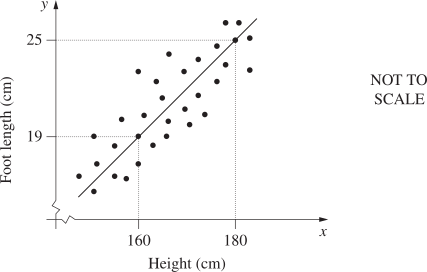
Each member of a group of males had his height and foot length measured and recorded. The results were graphed and a line of fit drawn.
 

  1. Identify the independent variable.   (1 mark)

    --- 1 WORK AREA LINES (style=lined) ---

  2. Why does the value of the `y`-intercept have no meaning in this situation?   (1 mark)

    --- 2 WORK AREA LINES (style=lined) ---

  3. George is 10 cm taller than his brother Harry. Use the line of fit to estimate the difference in their foot lengths.   (1 mark)

    --- 2 WORK AREA LINES (style=lined) ---
Show Answers Only

a.    `text{Height is the independent variable (x-axis variable).}`
 

b.    `text(The y-intercept occurs when)\ x = 0.\ text(It has no meaning to have)`

`text(a height of 0 cm.)`
  

c.    `text(A 20 cm height difference results in a foot length difference of 6 cm.)`

`text(A 10 cm height difference means George should have a 3 cm longer foot.)`

Show Worked Solution

a.    `text{Height is the independent variable (x-axis variable).}`
 

b.    `text(The y-intercept occurs when)\ x = 0.\ text(It has no meaning to have)`

`text(a height of 0 cm.)`
  

c.    `text(A 20 cm height difference results in a foot length difference of 6 cm.)`

`text(A 10 cm height difference means George should have a 3 cm longer foot.)`

Filed Under: Bivariate Data Analysis (Y12) Tagged With: Band 3, Band 4, Band 5, smc-6934-10-Line of Best Fit

ENGINEERING, CS 2025 HSC 25b

An engineer is deciding whether to use pre-tensioned concrete or post-tensioned concrete to make beams for a railway bridge.

Describe features of the manufacture of pre-tensioned and post-tensioned concrete that the engineer should consider.   (3 marks)

--- 8 WORK AREA LINES (style=lined) ---

Show Answers Only
  • Pre-tensioned concrete involves stressing the tendons before the concrete is poured, typically completed in a factory environment.
  • This method suits mass production and reduces on-site construction time.
  • Post-tensioned concrete involves stressing the tendons after the concrete has cured, allowing work to be completed on-site.
  • Post-tensioning offers greater flexibility for large or complex structures but requires more time, specialised equipment and higher cost.
Show Worked Solution
  • Pre-tensioned concrete involves stressing the tendons before the concrete is poured, typically completed in a factory environment.
  • This method suits mass production and reduces on-site construction time.
  • Post-tensioned concrete involves stressing the tendons after the concrete has cured, allowing work to be completed on-site.
  • Post-tensioning offers greater flexibility for large or complex structures but requires more time, specialised equipment and higher cost.

Filed Under: Engineering Materials Tagged With: Band 4, smc-3715-30-Concrete, smc-3715-68-Other materials/composites

ENGINEERING, AE 2025 HSC 24b

Describe what may cause an aircraft to stall in flight.   (2 marks)

--- 5 WORK AREA LINES (style=lined) ---

Show Answers Only
  • A stall occurs when the angle of attack becomes excessive. The airflow over the upper surface of the aerofoil separates and becomes turbulent rather than remaining smooth and laminar.
  • This disrupted airflow causes a sudden and significant loss of lift. Without sufficient lift to overcome the aircraft’s weight, the aircraft cannot maintain altitude and begins to descend.
Show Worked Solution
  • A stall occurs when the angle of attack becomes excessive. The airflow over the upper surface of the aerofoil separates and becomes turbulent rather than remaining smooth and laminar.
  • This disrupted airflow causes a sudden and significant loss of lift. Without sufficient lift to overcome the aircraft’s weight, the aircraft cannot maintain altitude and begins to descend

Filed Under: Mechanics and Hydraulics Tagged With: Band 4, smc-3724-10-Lift/Drag, smc-3724-30-Angle of attack

ENGINEERING, AE 2025 HSC 24a

Outline the properties of Kevlar that make it suitable for use in an aircraft.   (2 marks)

--- 4 WORK AREA LINES (style=lined) ---

Show Answers Only
  • Kevlar has an exceptionally high tensile strength-to-weight ratio, making it far lighter than steel while maintaining comparable strength. This reduces overall aircraft weight and improves fuel efficiency.
  • It is also highly impact resistant, tough and non-corrosive, making it well suited to the demanding structural and environmental conditions experienced in aircraft applications.
Show Worked Solution
  • Kevlar has an exceptionally high tensile strength-to-weight ratio, making it far lighter than steel while maintaining comparable strength. This reduces overall aircraft weight and improves fuel efficiency.
  • It is also highly impact resistant, tough and non-corrosive, making it well suited to the demanding structural and environmental conditions experienced in aircraft applications.

Filed Under: Materials Tagged With: Band 4, smc-3725-40-Composites

ENGINEERING, PPT 2025 HSC 23c

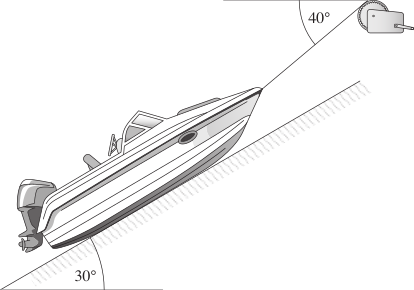
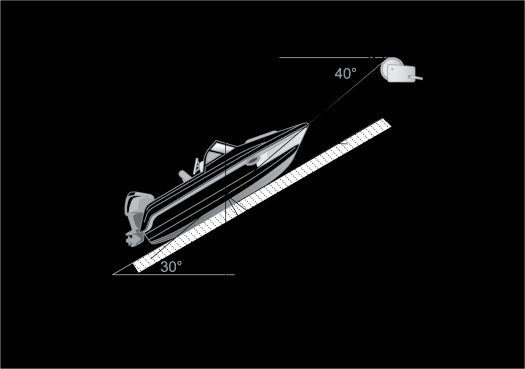
A winch is a gear system. It can be used to pull a boat out of the water and up a slipway.

A 1.2-tonne boat inclined at 30 degrees to the horizontal plane is being pulled up a slipway by a winch, as shown.


  1. The coefficient of friction between the boat and the slipway is 0.4 and the winch cable is positioned 40 degrees below the horizontal.
  1. Calculate the minimum force required in the winch cable to pull the boat up the slipway.   (5 marks)

    --- 14 WORK AREA LINES (style=lined) ---

  2. If the velocity ratio (VR) of the system is 2, calculate the efficiency.   (3 marks)

    --- 12 WORK AREA LINES (style=lined) ---

Show Answers Only

i.    \(9633.87\ \text{N}\)

ii.   \(62.3\%\)

Show Worked Solution

i.    Trigonometric solution

\(W\) \(=1200\times10=12\ 000\ \text{N}\)
\(\phi\) \(=\tan^{-1}(0.4)=21.8^{\circ}\)

    
The resultant \(R\) acts at \((30^{\circ}+21.8^{\circ})=51.8^{\circ}\) from the vertical.

Angle between \(T\) and vertical \(=180^{\circ}-50^{\circ}-51.8^{\circ}=78.2^{\circ}\)


\(\dfrac{T}{\sin 51.8^{\circ}}\) \(=\dfrac{12\ 000}{\sin 78.2^{\circ}}\)  
\(T\) \(=\dfrac{12\ 000\times\sin 51.8^{\circ}}{\sin 78.2^{\circ}}=9633.87\ \text{N}\)  


Alternative graphical solution

\(\mu=0.4,\ \ \phi=\tan^{-1}0.4=21.8^{\circ}\)

\(\text{Scale }1\ \text{mm}=100\ \text{N}\)

\(W\) \(=12\ 000\ \text{N}\rightarrow120\ \text{mm}\)
\(T\) \(=100\ \text{mm}\rightarrow T\approx10\ \text{kN}\ (9633.87\ \text{N})\)


ii.    \(MA\) \(=\dfrac{L}{E}=\dfrac{12\ 000}{9633.87}=1.2456\)
  \(\eta\) \(=\dfrac{MA}{VR}\times100\%=\dfrac{1.2456}{2}\times100\%=62.3\%\)

Filed Under: Mechanics Tagged With: Band 4, smc-3718-10-Mechanical advantage, smc-3718-25-Efficiency, smc-3718-30-Friction, smc-3718-40-Normal Force, smc-3718-50-Inclined planes

ENGINEERING, PPT 2025 HSC 23b

Outline a heat treatment method used during the manufacture of mild carbon steel gears.   (2 marks)

--- 4 WORK AREA LINES (style=lined) ---

Show Answers Only
  • Case hardening (carburising) is a suitable heat treatment for mild carbon steel gears. The gears are packed in a carbon-rich environment and heated, allowing carbon to diffuse into the outer surface layer.
  • This produces a hard, wear-resistant outer case on the gear teeth while preserving a tough, ductile inner core to resist impact loads.
Show Worked Solution
  • Case hardening (carburising) is a suitable heat treatment for mild carbon steel gears. The gears are packed in a carbon-rich environment and heated, allowing carbon to diffuse into the outer surface layer.
  • This produces a hard, wear-resistant outer case on the gear teeth while preserving a tough, ductile inner core to resist impact loads.

Filed Under: Materials Tagged With: Band 4, smc-3719-35-Tempering/Hardening

ENGINEERING, PPT 2025 HSC 23a

A winch is a gear system. It can be used to pull a boat out of the water and up a slipway.

Outline the function of the gears in a winch.   (2 marks)

--- 4 WORK AREA LINES (style=lined) ---

Show Answers Only
  • Gears in a winch increase the mechanical advantage of the system, reducing the effort needed to lift or pull a heavy load such as a boat.
  • They also increase the velocity ratio, meaning the effort moves through a greater distance than the load. Gears can additionally change the direction of the applied force.
Show Worked Solution
  • Gears in a winch increase the mechanical advantage of the system, reducing the effort needed to lift or pull a heavy load such as a boat.
  • They also increase the velocity ratio, meaning the effort moves through a greater distance than the load. Gears can additionally change the direction of the applied force.

Filed Under: Mechanics Tagged With: Band 4, smc-3718-10-Mechanical advantage, smc-3718-20-Velocity ratio

ENGINEERING, CS 2025 HSC 22c

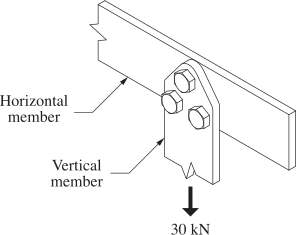
A building is being partially demolished and replaced. Part of the original structure will be retained.

A section of a building support structure is shown.


The section consists of a vertical 12 mm thick steel member connected to a 12 mm thick horizontal member with three M16 bolts. A vertical tensile load of 30 kN acts on the bolts.

  1. Assuming the load is evenly distributed across the three bolts, calculate the shear stress on each bolt.   (3 marks)

    --- 12 WORK AREA LINES (style=lined) ---

  2. The shear strength of each connecting bolt is 250 MPa. The support structure must have a factor of safety (FoS) of 2.5.
  3. Determine if the M16 bolts used can safely support the 30 kN load. Support your answer with a calculation.   (3 marks)

    --- 12 WORK AREA LINES (style=lined) ---

Show Answers Only

i.    \(49.7\ \text{MPa}\)

ii.   \(\sigma_{\text{allowable}}=\dfrac{\sigma_{\text{yield}}}{\text{FoS}}=\dfrac{250\times10^{6}}{2.5}=100\ \text{MPa}\)

Since the calculated shear stress (49.7 MPa) is less than the allowable shear stress (100 MPa), the M16 bolts can safely support the 30 kN load with the required factor of safety of 2.5.

Show Worked Solution

i.    Note to students:

The exam provides space for a working sketch showing the bolt arrangement and loading — this is good practice and helps clarify the shear plane, but full marks can be achieved with calculations alone.

\(\text{Force on 1 bolt}=\dfrac{30\times10^{3}}{3}=10\times10^{3}\ \text{N}\)

\(A=\dfrac{\pi d^{2}}{4}=\dfrac{\pi\times(16\times10^{-3})^{2}}{4}=201.1\times10^{-6}\ \text{m}^{2}\)

\(\sigma=\dfrac{F}{A}=\dfrac{10\times10^{3}}{201.1\times10^{-6}}=49.7\ \text{MPa per bolt}\)


♦ Mean mark (i) 52%.

ii.  Note to students:

The exam provides space for a working sketch showing the bolt arrangement and loading — this is good practice and helps clarify the shear plane, but full marks can be achieved with calculations alone.

\(\sigma_{\text{allowable}}=\dfrac{\sigma_{\text{yield}}}{F\ \text{of}\ S}=\dfrac{250\times10^{6}}{2.5}=100\ \text{MPa}\)

Since the calculated shear stress (49.7 MPa) is less than the allowable shear stress (100 MPa), the M16 bolts can safely support the 30 kN load with the required factor of safety of 2.5.

Filed Under: Engineering Materials Tagged With: Band 4, Band 5, smc-3714-60-Shear stress, smc-3714-80-Stress/Strain - other

ENGINEERING, CS 2025 HSC 22b

A building is being partially demolished and replaced. Part of the original structure will be retained.

Engineers want to retain some steel components of the building.

Describe a suitable process which could be used to detect surface cracks in ONE steel component of the building.   (3 marks)

--- 9 WORK AREA LINES (style=lined) ---

Show Answers Only
  • Magnetic particle inspection (MPI) is a non-destructive testing method suitable for detecting surface cracks in steel components.
  • The steel component is first cleaned and then magnetised using an electromagnet or permanent magnet. Iron oxide particles suspended in a liquid carrier are then applied to the surface.
  • Where surface cracks exist, magnetic flux leaks outward and attracts the particles, forming a visible cluster that clearly marks the location and extent of any defect.
  • The component is then inspected under white or ultraviolet light, and the severity of any cracking is assessed before a repair or replacement decision is made.
Show Worked Solution
  • Magnetic particle inspection (MPI) is a non-destructive testing method suitable for detecting surface cracks in steel components.
  • The steel component is first cleaned and then magnetised using an electromagnet or permanent magnet. Iron oxide particles suspended in a liquid carrier are then applied to the surface.
  • Where surface cracks exist, magnetic flux leaks outward and attracts the particles, forming a visible cluster that clearly marks the location and extent of any defect.
  • The component is then inspected under white or ultraviolet light, and the severity of any cracking is assessed before a repair or replacement decision is made.

Filed Under: Engineering Materials Tagged With: Band 4, smc-3715-10-Specialised testing, smc-3715-40-Cracking

ENGINEERING, TE 2025 HSC 21c

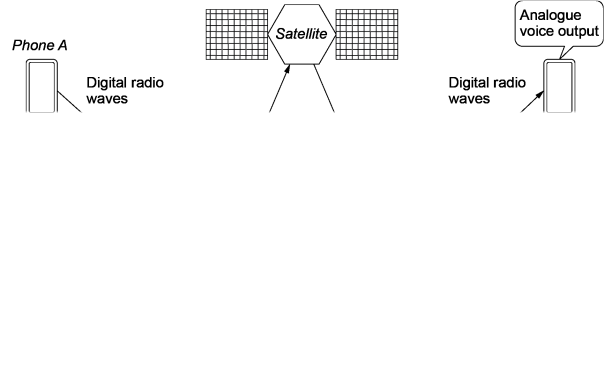
Explain how voice signals are transmitted between two mobile phones over a cellular mobile network. Use a labelled sketch to support your answer.   (4 marks)

--- 9 WORK AREA LINES (style=lined) ---

Show Answers Only
  • Speaking into Phone A causes the microphone to convert sound waves into electrical signals. These are digitised and modulated into a radio frequency (RF) signal for wireless transmission.
  • This RF signal is carried as digital radio waves to the closest cell base station in the network.
  • The signal is then routed through a ground station and relayed via satellite across the network to a ground station near Phone B.
  • At Phone B’s cell base station, the signal is demodulated.
  • This converts it back into an electrical signal, which the speaker transforms into sound waves for the listener.


Show Worked Solution
  • Speaking into Phone A causes the microphone to convert sound waves into electrical signals. These are digitised and modulated into a radio frequency (RF) signal for wireless transmission.
  • This RF signal is carried as digital radio waves to the closest cell base station in the network.
  • The signal is then routed through a ground station and relayed via satellite across the network to a ground station near Phone B.
  • At Phone B’s cell base station, the signal is demodulated.
  • This converts it back into an electrical signal, which the speaker transforms into sound waves for the listener.


Filed Under: Electricity/Electronics Tagged With: Band 4, smc-3730-20-Telephony

ENGINEERING, TE 2025 HSC 21b

Explain why aluminium alloy wire is used as an electrical transmission medium between communications towers.   (3 marks)

--- 7 WORK AREA LINES (style=lined) ---

Show Answers Only
  • Aluminium alloy has a low density. This means it can support its own weight over long spans between towers, reducing cable sag.
  • Its high tensile strength enables wider spacing between towers. Consequently, fewer towers are required, reducing infrastructure costs.
  • Aluminium is significantly less expensive and more abundant than copper. As a result, it is a more economical choice for long-distance transmission networks.
Show Worked Solution
  • Aluminium alloy has a low density. This means it can support its own weight over long spans between towers, reducing cable sag.
  • Its high tensile strength enables wider spacing between towers. Consequently, fewer towers are required, reducing infrastructure costs.
  • Aluminium is significantly less expensive and more abundant than copper. As a result, it is a more economical choice for long-distance transmission networks.

Filed Under: Materials Tagged With: Band 4, smc-3729-20-Copper and alloys

ENGINEERING, TE 2025 HSC 21a

An engineer needs to analyse signal strength in communications cabling over time.

Describe a device that the engineer could use in testing signal strength.   (2 marks)

--- 4 WORK AREA LINES (style=lined) ---

Show Answers Only
  • A cathode ray oscilloscope (CRO) is a device used to measure and display signal strength in communications cabling.
  • It displays voltage over time, showing waveform shape, frequency, peak voltage and any signal interference or loss.
Show Worked Solution
  • A cathode ray oscilloscope (CRO) is a device used to measure and display signal strength in communications cabling.
  • It displays voltage over time, showing waveform shape, frequency, peak voltage and any signal interference or loss.

Filed Under: Materials Tagged With: Band 4, smc-3729-10-Testing

Calculus, MET2 2025 VCAA 4

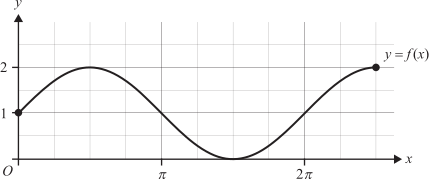
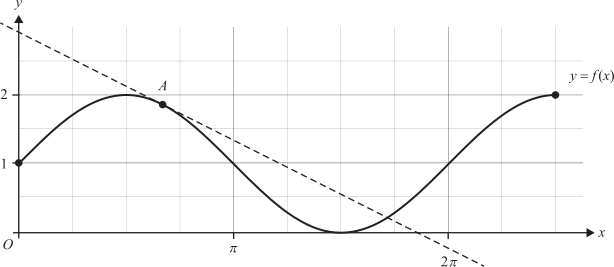
Consider the function  \(f:\left[0, \dfrac{5 \pi}{2}\right] \rightarrow R, f(x)=\sin (x)+1\).

The graph of  \(y=f(x)\)  is shown below.


  1. Evaluate  \(f\left(\dfrac{2 \pi}{3}\right)\).   (1 mark)

    --- 2 WORK AREA LINES (style=lined) ---

  2. Find the exact values of \(x\) for which  \(f(x)=\dfrac{3}{2}\).   (1 mark)

    --- 3 WORK AREA LINES (style=lined) ---

  3. There exist real numbers \(a\) and \(k\) in the interval \(\left(0, \dfrac{5 \pi}{2}\right)\), such that  \(f(x+k)=f(x)\) for all  \(x \in[0, a]\).
  4. Find the value of \(k\) and the largest possible value of \(a\).   (2 marks)

    --- 3 WORK AREA LINES (style=lined) ---

  5. Consider the tangent to the graph of  \(y=f(x)\) at the point \(A\) where  \(x=\dfrac{2 \pi}{3}\), as shown on the axes below.
     

  1. Find the equation of the tangent to the graph of \(y=f(x)\) at the point where  \(x=\dfrac{2 \pi}{3}\).   (1 mark)

    --- 2 WORK AREA LINES (style=lined) ---
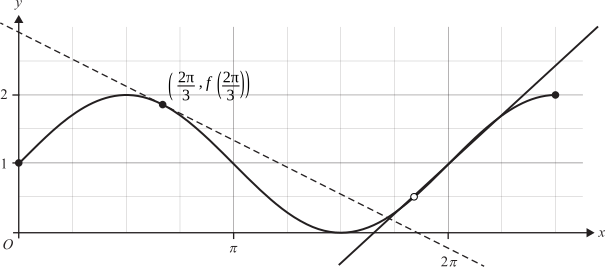
  2. Apply two iterations of Newton's method to \(f\) with  \(x_0=\dfrac{2 \pi}{3}\).
    1. Write down \(x_2\), correct to one decimal place.   (1 mark)

      --- 1 WORK AREA LINES (style=lined) ---

    2. On the axes in part d, draw the tangent to the graph of  \(y=f(x)\) at the point where  \(x=x_1\).
    3. Answer on the graph in part d.   (1 mark)

      --- 0 WORK AREA LINES (style=lined) ---

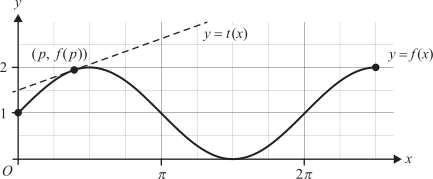
  3. Now consider the line \(y=t(x)\), which is the tangent to the graph of  \(y=f(x)\) at the point  \((p, f(p))\), where  \(p \in\left(0, \dfrac{5 \pi}{2}\right)\).

      1. Show that  \(t(x)=\cos (p)(x-p)+\sin (p)+1\).   (2 marks)

        --- 6 WORK AREA LINES (style=lined) ---

      2. Determine the minimum and maximum possible values for the \(y\)-intercept of  \(y=t(x)\), for  \(p \in\left(0, \dfrac{5 \pi}{2}\right)\).   (2 marks)

        --- 3 WORK AREA LINES (style=lined) ---

      3. Determine the values of \(p\) for which  \(y=t(x)\) has a unique \(x\)-intercept that is equal to the \(x\)-intercept of  \(y=f(x)\).
      4. Give your answers correct to two decimal places.   (2 marks)

        --- 2 WORK AREA LINES (style=lined) ---
  1. Let  \(g:\left[0, \dfrac{5 \pi}{2}\right] \rightarrow R, g(x)=a x^3+b x^2+c x+d\)  be a polynomial function, where \(a, b, c, d \in R\).
  2. Suppose  \(g(0)=f(0)\)  and  \(g^{\prime}(0)=f^{\prime}(0)\).
    1. Show that  \(c=1\)  and  \(d=1\).   (2 marks)

      --- 5 WORK AREA LINES (style=lined) ---

    2. If  \(g(2 \pi)=f(2 \pi)\) and  \(g^{\prime}(2 \pi)=f^{\prime}(2 \pi)\), determine the area bounded by the graphs of  \(y=f(x)\)  and  \(y=g(x)\), for  \(x \in[0,2 \pi]\).
    3. Give your answer correct to two decimal places.    (2 marks)

      --- 7 WORK AREA LINES (style=lined) ---

    4. Let  \(a=0, c=1, d=1\).
    5. Find \(b\) and \(r\), such that  \(g(r)=f(r)\) and  \(g^{\prime}(r)=f^{\prime}(r)\), where  \(b \in R\) and  \(r \in\left(0, \dfrac{5 \pi}{2}\right)\).   (2 marks)

      --- 5 WORK AREA LINES (style=lined) ---

Show Answers Only

a.    \(f\left(\dfrac{2 \pi}{3}\right)=\dfrac{2+\sqrt{3}}{2}\)
 

b.   \(x=\dfrac{\pi}{6}, \dfrac{5 \pi}{6}, \dfrac{13 \pi}{6}\)
 

c.    \(k=2 \pi, \ \ a=\dfrac{\pi}{2}\)
 

d.    \(y=-\dfrac{x}{2}+\dfrac{\pi}{3}+\dfrac{\sqrt{3}}{2}+1\)
 

e.i.  \(x_2=5.2\)
 

e.ii.

f.i.    \(f^{\prime}(p)=\cos (p)\)

\(\text{Equation of tangent at}\ (p, \sin (p)+1):\)

\(y-(\sin (p)+1)\) \(=\cos (p)(x-p)\)
\(t(x)\) \(=\cos (p)(x-p)+\sin (p)+1\)


f.ii.  \(y \text{-int (min)}=1-2 \pi \ \text { (at } p=2 \pi)\)

\(y \text{-int (max)}=1+\pi \ \text { (at } p= \pi)\)
 

f.iii. \(p=2.38 \ \text{or} \ 7.04\)
 

g.i.  \(g(x)=a x^3+b x^2+c x+d, \ f(x)=\sin (x)+1\)

\(\text{Given} \ \ f(0)=g(0):\)

\(d=\sin (0)+1=1\)
 

\(g^{\prime}(x)=3 a x^2+2 b x+c, \ f^{\prime}(x)=\cos (x)\)

\(\text{Given} \ \ f^{\prime}(0)=g^{\prime}(0):\)

\(c=1\)
 

g.ii.  \(\text {Area}=1.53\)
  

g.iii. \(r=\pi, \ b=-\dfrac{1}{\pi}\)

Show Worked Solution

a.    \(f(x)=\sin (x)+1\)

\(f\left(\dfrac{2 \pi}{3}\right)=\sin \left(\dfrac{2 \pi}{3}\right)+1=\dfrac{2+\sqrt{3}}{2}\)
 

b.   \(\text{Solve \(\ f(x)=\dfrac{3}{2} \ \) for \(x\) (by CAS):}\)

\(\sin (x)+1=\dfrac{3}{2} \ \Rightarrow \ \sin (x)=\dfrac{1}{2}\)

\(\text{Solve} \ \ \sin (x)=\dfrac{1}{2} \ \text { for } \ x \in\left[0, \dfrac{5 \pi}{2}\right]:\)

\(x=\dfrac{\pi}{6}, \dfrac{5 \pi}{6}, \dfrac{13 \pi}{6}\)
 

c.    \(f(x+k)=f(x) \ \ \text{for} \ \ x \in[0, a]\)

\(\text{By inspection of graph:}\)

\(k=2 \pi, \ \ a=\dfrac{\pi}{2}\)

♦♦ Mean mark (c) 28%.

d.    \(f(x)=\sin (x)+1 \ \Rightarrow \ f^{\prime}(x)=\cos (x)\)

\(f^{\prime}\left(\dfrac{2 \pi}{3}\right)=-\dfrac{1}{2}\)

\(\text{Find equation of line} \ \ m_2=-\dfrac{1}{2} \ \ \text{through}\ \ \left(\dfrac{2 \pi}{3}, \dfrac{2+\sqrt{3}}{2}\right):\)

\(y=-\dfrac{x}{2}+\dfrac{\pi}{3}+\dfrac{\sqrt{3}}{2}+1\)
 

e.i.  \(x_0=\dfrac{2 \pi}{3}\)

\(x_1=\dfrac{2 \pi}{3}-\dfrac{f\left(\dfrac{2 \pi}{3}\right)}{f^{\prime}\left(\dfrac{2 \pi}{3}\right)}=5.8264 \ldots\)

\(x_2=5.8264 \ldots-\dfrac{f(5.8264)}{f^{\prime}(5.8264)}=5.2 \ \text{(1 d.p.)}\)
 

e.ii.

♦♦ Mean mark (e.ii) 28%.

f.i.    \(f^{\prime}(p)=\cos (p)\)

\(\text{Equation of tangent at}\ (p, \sin (p)+1):\)

\(y-(\sin (p)+1)\) \(=\cos (p)(x-p)\)
\(t(x)\) \(=\cos (p)(x-p)+\sin (p)+1\)


f.ii.  \(t(x)=\cos (p) x+\sin (p)+1-p \times \cos (p)\)

\(y\text{-intercept}=\sin (p)+1-p \times \cos (p)\)

\(\text{Find max/min of} \ y\text{-int for} \ p \in\left[0, \dfrac{5 \pi}{2}\right] \ \ \text{(by CAS):}\)

\(y \text{-int (min)}=1-2 \pi \ \text { (at } p=2 \pi)\)

\(y \text{-int (max)}=1+\pi \ \text { (at } p= \pi)\)

♦♦ Mean mark (f.ii) 26%.
♦♦♦ Mean mark (f.iii) 23%.

f.iii. \(x \text{-intercept of} \ f(x) \ \text{occurs at} \ \ x=\dfrac{3 \pi}{2}\)

\(\text{Solve} \ \ t\left(\dfrac{3 \pi}{2}\right)=0 \ \ \text {for}\  p:\)

\(p=2.38 \ \text{or} \ 7.04\)
 

g.i.  \(g(x)=a x^3+b x^2+c x+d, \ f(x)=\sin (x)+1\)

\(\text{Given} \ \ f(0)=g(0):\)

\(d=\sin (0)+1=1\)
 

\(g^{\prime}(x)=3 a x^2+2 b x+c, \ f^{\prime}(x)=\cos (x)\)

\(\text{Given} \ \ f^{\prime}(0)=g^{\prime}(0):\)

\(c=1\)
 

g.ii.  \(g(x)=a x^3+b x^2+x+1 \ \Rightarrow \ g^{\prime}(x)=3 a x^2+2 b x+1\)

\(\text{Given \(\ g(2 \pi)=f(2 \pi)=1\ \) and \(\ \ g^{\prime}(2 \pi)=f^{\prime}(2 \pi)=1\)}\)

\(\text{Solve \(\ g(2 \pi)=1 \ \) and \(\ g^{\prime}(2 \pi)=1\)  simultaneously for \(a, b\):}\)

\(a=\dfrac{1}{2 \pi^2}, \ b=-\dfrac{3}{2 \pi}\)

♦♦ Mean mark (g.ii) 33%.
♦♦♦ Mean mark (g.iii) 24%.

\(\text{Find intersection of}\ f(x)\ \text{and}\ g(x)\ \text{(by CAS)}:\)

\(f(x)=g(x)\ \ \Rightarrow\ \ x=\pi\)

\(\text {Area}=\displaystyle \int_0^\pi f(x)-g(x)\, d x+\int_\pi^{2 \pi} g(x)-f(x)\, d x=1.53\)
  

g.iii. \(a=0, c=1, d=1\)

\(g(x)=b x^2+x+1, \ f(x)=\sin (x)+1\)

\(g^{\prime}(x)=2 b x+1, \ f^{\prime}(x)=\cos (x)\)

\(\text{Solve simultaneous equations for \(b\) and \(r\):}\)

\(br^2+r=\sin (r)\ \ldots\ (1)\)

\(2 b r+1=\cos (r)\ \ldots\ (2)\)

\(r=\pi, \ b=-\dfrac{1}{\pi}\)

Filed Under: Area Under Curves, Tangents and Normals, Trapezium Rule and Newton, Trig Graphing Tagged With: Band 4, Band 5, Band 6, smc-2757-10-Sin, smc-5145-50-Newton's method, smc-634-30-Trig Function, smc-634-50-Find tangent given curve, smc-723-60-Trig, smc-723-80-Area between graphs

Statistics, MET2 2025 VCAA 3

The time taken for a driver to travel to work each day, in minutes, is modelled by a continuous random variable \(T\) with probability density function

\(f(t)=\left\{\begin{array}{cl}
\dfrac{1}{1\,215\,000}(t-29)(59-t)^3 & 29 \leq t \leq 59 \\
0 & \text {otherwise}
\end{array}\right.\)

    1. Find the mean time taken, in minutes, for the driver to travel to work each day.   (1 mark)

      --- 2 WORK AREA LINES (style=lined) ---

    2. Find the standard deviation of the time taken, in minutes, for the driver to travel to work each day.   (2 marks)

      --- 7 WORK AREA LINES (style=lined) ---
  1. The driver allows \(k\) minutes to travel to work each day. If the journey takes longer than \(k\) minutes, the driver will be late. Whether the driver is late on a particular day is independent of whether they are late on any other day.
    1. If \(k=47\), write a definite integral to show that the probability of the driver being late is 0.08704    (1 mark)

      --- 2 WORK AREA LINES (style=lined) ---
    2. If \(k=47\), find the probability that the driver will be late on at least one day in a five-day working week.
    3. Give your answer correct to four decimal places.   (2 marks)

      --- 3 WORK AREA LINES (style=lined) ---
    4. For \(k=47\), let \(\hat{P}\) be the proportion of days the driver is late in any five-day working week. Find \(\operatorname{Pr}(0.4 \leq \hat{P} \leq 0.6)\) correct to four decimal places.   (2 marks)

      --- 4 WORK AREA LINES (style=lined) ---
    5. Find the integer \(k\) such that the probability, correct to one decimal place, of the driver being late at least once in any five-day working week is 0.2    (2 marks)

      --- 8 WORK AREA LINES (style=lined) ---
  2. At a given traffic light, the wait time is modelled by a normal distribution with a mean of 2.5 minutes and a standard deviation of \(\sigma\) minutes.
    1. If \(\sigma=0.6\), find the probability that the wait time will be less than 3.5 minutes.
    2. Give your answer correct to two decimal places.   (1 mark)

      --- 2 WORK AREA LINES (style=lined) ---
    3. Find the value of \(\sigma\) such that there is a 2% chance of a wait time longer than 3.5 minutes.
    4. Give your answer correct to two decimal places.   (1 mark)

      --- 4 WORK AREA LINES (style=lined) ---
  3. The driver passes through three traffic lights \((A, B\) and \(C)\) on their journey to work. The probability of each traffic light being red is shown in the table below.
  4. \begin{array}{|l|c|c|c|}
    \hline \rule{0pt}{2.5ex}\text {Traffic light} \rule[-1ex]{0pt}{0pt}& \quad A \quad & \quad B \quad & \quad C  \quad\\
    \hline \rule{0pt}{2.5ex} \text {Probability that the traffic light is red} \quad  \rule[-1ex]{0pt}{0pt}& 0.2 & 0.3 & 0.1 \\
    \hline
    \end{array}
  5. Let \(Y\) be the random variable representing the number of traffic lights that are red on the driver's journey to work. Assume that each traffic light being red is independent of any other traffic light being red.
  6. Complete the following table for the probability distribution of \(Y\).    (2 marks)

    --- 0 WORK AREA LINES (style=lined) ---
  7. \begin{array}{|c|c|c|c|c|}
    \hline \rule{0pt}{2.5ex}y \rule[-1ex]{0pt}{0pt}& \ \ \quad 0 \ \ \quad & \ \ \quad 1 \ \ \quad & \ \ \quad 2 \ \ \quad & \ \ \quad 3 \ \ \quad \\
    \hline \rule{0pt}{2.5ex}\operatorname{Pr}(Y=y) \rule[-1ex]{0pt}{0pt}& & & & \\
    \hline
    \end{array}
Show Answers Only

a.i.   \(\displaystyle \int_{29}^{59}(t \times f(t)) d t=39\)
 

a.ii. \(\text{Strategy 1}\)

\(\text{sd}(T)=\sqrt{\displaystyle\int_{29}^{59} t^2 f(t) d t-39^2}=\dfrac{10 \sqrt{14}}{7}\)

\(\text{Strategy 2}\)

\(\text{sd}(T)=\sqrt{\displaystyle\int_{29}^{59}(t-39)^2 f(t)\, d t}=\dfrac{10 \sqrt{14}}{7}\)
 

b.i.  \(P\text{(driver being late)}=\displaystyle\int_{47}^{59} f(t)\, d t=0.08704\)
 

b.ii.  \(P(\text{(driver late at least 1 day in week)}=0.3658 \ \ \text{(4 d.p.)}\)
 

b.iii. \(0.0631 \ \text{(4 d.p.)}\)
 

b.iv. \(k=49\)
 

c.i.  \(P(W<3.5)=0.95\)
 

c.ii   \(\sigma=0.49\)
 

d.

\begin{array}{|c|c|c|c|c|}
\hline \rule{0pt}{2.5ex}y \rule[-1ex]{0pt}{0pt}& \quad 0 \quad & \quad 1 \quad& \quad 2 \quad & \quad 3 \quad \\
\hline \rule{0pt}{2.5ex}\operatorname{Pr}(Y=y) \rule[-1ex]{0pt}{0pt}& \frac{63}{125}=0.504& \frac{199}{500}=0.398 & \frac{23}{250}=0.092 & \frac{3}{500}=0.006 \\
\hline
\end{array}

Show Worked Solution

a.i.   \(\text{Calculate (by CAS):}\)

\(\displaystyle \int_{29}^{59}(t \times f(t)) d t=39\)
 

a.ii. \(\text{Strategy 1}\)

\(\text{sd}(T)=\sqrt{\displaystyle\int_{29}^{59} t^2 f(t) d t-39^2}=\dfrac{10 \sqrt{14}}{7}\)

\(\text{Strategy 2}\)

\(\text{sd}(T)=\sqrt{\displaystyle\int_{29}^{59}(t-39)^2 f(t)\, d t}=\dfrac{10 \sqrt{14}}{7}\)
 

b.i.  \(P\text{(driver being late)}\)

\(=\displaystyle\int_{47}^{59} f(t)\, d t=0.08704\)
 

b.ii.  \(P(\text{(driver late at least 1 day in week)}\)

\(=1-P(\text{never late in 5 days})\)

\(=1-(0.08704)^5\)

\(=0.3658 \ \ \text{(4 d.p.)}\)
 

b.iii. \(\text{Let} \ \ Y \sim \text{Bi}(5,0.08704)\)

\(\operatorname{Pr}(0.4 \leqslant \hat{P} \leqslant 0.6)=\operatorname{Pr}(2 \leqslant Y \leqslant 3)=0.0631 \ \text{(4 d.p.)}\)
 

b.iv. \(\text{Solve for} \ k:\)

\(1-\left(1-\displaystyle \int_k^{59} f(t) d t\right)^5=0.2\)

\(k=49\)
 

c.i.  \(W \sim N\left(\mu, \sigma^2\right) \sim\left(2.5,0.6^2\right)\)

\(\text{Solve (by CAS):}\)

\(P(W<3.5)=0.95\)
 

c.ii   \(\text{Find \(z\)-score when \(P(W>3.5)=0.02\)}\)

\(z \text {-score }=2.0537 \ldots\)

\(\text{Solve for} \ \sigma :\)

\(\dfrac{3.5-2.5}{\sigma}=2.0537 \ldots \ \Rightarrow \ \sigma=0.49\ \text{(2 d.p.)}\)
 

d.

\begin{array}{|c|c|c|c|c|}
\hline \rule{0pt}{2.5ex}y \rule[-1ex]{0pt}{0pt}& \quad 0 \quad & \quad 1 \quad& \quad 2 \quad & \quad 3 \quad \\
\hline \rule{0pt}{2.5ex}\operatorname{Pr}(Y=y) \rule[-1ex]{0pt}{0pt}& \frac{63}{125}=0.504& \frac{199}{500}=0.398 & \frac{23}{250}=0.092 & \frac{3}{500}=0.006 \\
\hline
\end{array}

Filed Under: Normal Distribution, Probability Density Functions Tagged With: Band 3, Band 4, Band 5, smc-637-10-E(X), smc-637-30-Var(X), smc-637-60-Polynomial PDF, smc-719-10-Single z-score

ENGINEERING, AE 2025 HSC 17 MC

An aircraft is flying at a cruising altitude where the external atmospheric pressure is 20 kPa. Inside the aircraft's fuel tank, a column of aviation fuel has a density of 800 kg/m³ with a height of 1.5 m.

What is the pressure at the bottom of the fuel column?

  1. 10 940 Pa
  2. 20 813 Pa
  3. 32 000 Pa
  4. 300 800 Pa
Show Answers Only

\(C\)

Show Worked Solution

\(P_{\text{hydrostatic}}= \rho g h= 800 \times 10 \times 1.5 = 12\ 000\ \text{Pa}\)

\(P_{\text{total}}= P_{\text{atmospheric}} + P_{\text{hydrostatic}}= 20\ 000 + 12\ 000 = 32\ 000\ \text{Pa}\)

\(\Rightarrow C\)

Filed Under: Mechanics and Hydraulics Tagged With: Band 4, smc-3724-70-Pressure

ENGINEERING, PPT 2025 HSC 5 MC

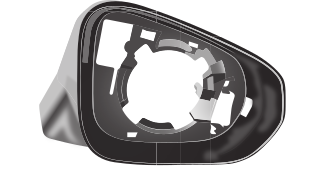
A mass-produced automotive side-view mirror casing is shown.
 

Which manufacturing process is most commonly used to produce this polymer component?

  1. Extrusion
  2. Blow moulding
  3. Injection moulding
  4. Compression moulding
Show Answers Only

\(C\)

Show Worked Solution
  • Injection moulding produces complex, hollow-free solid shapes with fine detail — ideal for mass-produced casings.
  • Extrusion produces continuous uniform profiles — unsuitable for this complex 3D shape.
  • Blow moulding produces hollow thin-walled containers such as bottles.
  • Compression moulding is used for thermosetting polymers, not thermoplastic casings.

\(\Rightarrow C\)

Filed Under: Materials Tagged With: Band 4, smc-3719-70-Polymers

ENGINEERING, AE 2025 HSC 1 MC

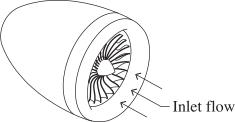
A diagram of an aircraft engine is shown.
 

What type of engine is this?

  1. Piston
  2. Ramjet
  3. Turbofan
  4. Turboprop
Show Answers Only

\(C\)

Show Worked Solution
  • The diagram shows a large front-mounted bypass fan that draws in air, with a portion passing through the core and the remainder bypassing it — this is the defining feature of a turbofan engine.
  • A turboprop also uses a fan/propeller but drives an external propeller shaft visible outside the nacelle; no such external shaft is shown.
  • A ramjet has no rotating components — it relies solely on the ram effect of high-speed inlet air; the rotating fan visible here eliminates this option.
  • A piston engine uses reciprocating cylinders and is not a jet-based design — clearly inconsistent with the diagram shown.

\(\Rightarrow C\)

Filed Under: Mechanics and Hydraulics Tagged With: Band 4, smc-3724-60-Propulsion

Functions, MET2 2025 VCAA 2

Let  \(f: R \rightarrow R, \ f(x)=\dfrac{x}{2}+7\)  and

\(g: R \rightarrow R, \ g(x)=A e^{k x}\)  where  \(A, k \in R\).

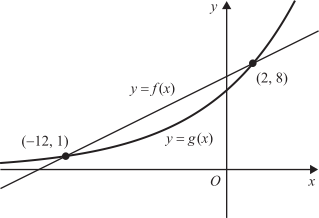
The graphs of  \(y=f(x)\)  and  \(y=g(x)\)  intersect at the points \((-12,1)\) and \((2,8)\), as shown below.


  1. Write down two simultaneous equations in terms of \(A\) and \(k\).
  2. Solve them, using algebra, to show that  \(A=2^{\tfrac{18}{7}}\)  and  \(k=\dfrac{3}{14} \log _e(2)\).   (3 marks)

    --- 12 WORK AREA LINES (style=lined) ---
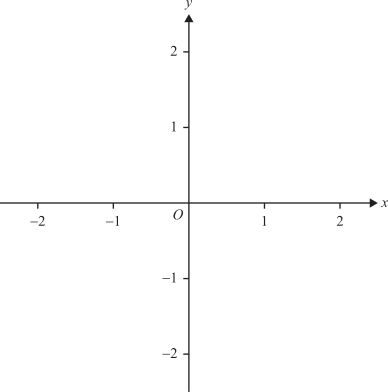
  3. Find the value of \(b\), where  \(b \in R\), such that \(g(x)\) can be expressed in the form  \(g(x)=A \times 2^{b x}\).   (1 mark)

    --- 3 WORK AREA LINES (style=lined) ---
  4. Use a definite integral to evaluate the area bounded by the graphs of  \(y=f(x)\)  and  \(y=g(x)\), where  \(x \in[-12,2]\).
  5. Give the area correct to two decimal places.   (2 marks)

    --- 5 WORK AREA LINES (style=lined) ---
  6. Let  \(h(x)=f(x)-g(x)\).
    1. Write down an expression for the derivative of \(h(x)\).   (1 mark)

      --- 2 WORK AREA LINES (style=lined) ---
    2. Find the maximum value of \(h(x)\), where  \(x \in[-12,2]\).   (1 mark)
    3. Give your answer correct to two decimal places.

      --- 2 WORK AREA LINES (style=lined) ---
  7. Let \(g^{-1}\) be the inverse of \(g\).
  8. Find the points where the graph of  \(y=g^{-1}(x)\)  intersects with the graph of  \(y=2(x-7)\).   (2 marks)

    --- 5 WORK AREA LINES (style=lined) ---
  9. Let \(F\) be an anti-derivative of \(f\) that passes through \((0, c)\), where \(c \in R\).
    1. Show that it is not possible for the graph of  \(y=F(x)\)  to pass through both \((-12,1)\) and \((2,8)\).   (2 marks)

      --- 9 WORK AREA LINES (style=lined) ---
    2. The graph of  \(y=F(x)\) can be dilated by a factor of \(m\) from the \(x\)-axis such that its image passes through both \((-12,1)\) and \((2,8)\).
    3. Find the values of \(m\) and \(c\).   (2 marks)

      --- 6 WORK AREA LINES (style=lined) ---
Show Answers Only

a.    \(f(x)=\dfrac{x}{2}+7, \ g(x)=A e^{k x}\)

\(\text{Intersection occurs at }(-12,1) \text { and }(2,8):\)

\(A e^{-12 k}\) \(=1\ \ldots\ (1)\)
\(A e^{2 k}\) \(=18\ \ldots\ (2)\)

 
\(\text{Divide:}\ \ (2) ÷ (1)\)

\(e^{2 k-(-12 k)}\) \(=8\)
\(e^{14 k}\) \(=8\)
\(14 k\) \(=\log _e 8\)
\(14 k\) \(=3\log _e 2\)
\(14 k\) \(=\dfrac{3}{14} \log _e 2\)


\(\text{Substitute \(k\) into (1):}\)

\(A e^{-12\left(\tfrac{3}{14} \log _e 2\right)}\) \(=1\)
\(A e^{-\tfrac{18}{7} \log_e2}\) \(=1\)
\(A \times 2^{-\tfrac{18}{7}}\) \(=1\)
\(A\) \(=2^{\tfrac{18}{7}}\)


b.    \(g(x)=2^{\tfrac{18}{7}} \times 2^{\tfrac{3 x}{14}}\)
 

c.    \(\text{Area}=\displaystyle \int_{-12}^2 f(x)-g(x)=15.87 \ \text{u}^2\)
 

d.i.  \(h^{\prime}(x)=\dfrac{1}{2}-\dfrac{6 \log _e 2}{7} \times 2^{\tfrac{3 x}{14}+\tfrac{4}{7}}\)
 

d.ii. \(h(x)_{\text{max}}=1.72\)
 

e.   \(\text{Intersection at}\ (1,-12) \ \text{and} \ (8,2).\)
 

f.i.  \(f(x)=\dfrac{x}{2}+7\)

\(F(x)=\displaystyle \int f(x)\ d x=\dfrac{1}{4} x^2+7 x+c\)
 

\(\text{If} \ F(x) \ \text{passes through} \ (-12,1):\)

\(F(-12)=\dfrac{1}{4}(-12)^2+7(-12)+c=1 \ \ \Rightarrow\ \ c=49\)
 

\(\text{If \(F(x)\) passes through \((2,8)\):}\)

\(F(2)=\dfrac{1}{4}(2)^2+7(2)+c=8 \ \ \Rightarrow \ \ c=-7\)

\(\text{Since \(c\) cannot have 2 values, it cannot pass through both points.}\)
 

f.ii.  \(m=\dfrac{1}{9}, \ c=57\)

Show Worked Solution

a.    \(f(x)=\dfrac{x}{2}+7, \ g(x)=A e^{k x}\)

\(\text{Intersection occurs at }(-12,1) \text { and }(2,8):\)

\(A e^{-12 k}\) \(=1\ \ldots\ (1)\)
\(A e^{2 k}\) \(=18\ \ldots\ (2)\)
Mean mark (a) 51%.

\(\text{Divide:}\ \ (2) ÷ (1)\)

\(e^{2 k-(-12 k)}\) \(=8\)
\(e^{14 k}\) \(=8\)
\(14 k\) \(=\log _e 8\)
\(14 k\) \(=3\log _e 2\)
\(14 k\) \(=\dfrac{3}{14} \log _e 2\)


\(\text{Substitute \(k\) into (1):}\)

\(A e^{-12\left(\tfrac{3}{14} \log _e 2\right)}\) \(=1\)
\(A e^{-\tfrac{18}{7} \log_e2}\) \(=1\)
\(A \times 2^{-\tfrac{18}{7}}\) \(=1\)
\(A\) \(=2^{\tfrac{18}{7}}\)


b.    \(g(x)\) \(=2^{\tfrac{18}{7}} \times e^{\left(\tfrac{3}{14} \log _e 2\right) x}\)
    \(=2^{\tfrac{18}{7}} \times e^{\left(\tfrac{3 x}{14} \log _e 2\right)}\)
    \(=2^{\tfrac{18}{7}} \times e^{\left(\log _e 2^{\tfrac{3x}{14}}\right)}\)
    \(=2^{\tfrac{18}{7}} \times 2^{\tfrac{3 x}{14}}\)

Mean mark (b) 55%.
 

c.    \(\text{Area}=\displaystyle \int_{-12}^2 f(x)-g(x)=15.87 \ \text{u}^2\)
 

d.i.  \(h(x)=f(x)-g(x)\)

\(h(x)=\dfrac{x}{2}+7-2^{\tfrac{18}{7}} \times e^{k x}\)

\(h^{\prime}(x)=\dfrac{1}{2}-\dfrac{6 \log _e 2}{7} \times 2^{\tfrac{3 x}{14}+\tfrac{4}{7}}\)
 

d.ii. \(\text{Solve}\ \ h^{\prime}(x)=0\ \ \text{for}\ x\ \text{(by CAS):}\) 

\(x=-3.829\)

\(\text{Substitute into} \ \ h(x):\)

\(h(x)_{\text{max}}=1.72\)
 

e.   \(\text{Strategy 1}\)

\(\text{By CAS, find} \ \ g^{-1}(x):\)

\(g^{-1}(x)=\dfrac{2\left(7 \log _e x-7 \log _e 8+3 \log _e 2\right)}{3 \log _e 2}\)

\(\text{Solve} \ \ g^{-1}(x)=2(x-7) \ \ \text{for} \ x:\)

\(x=1,8\)

\(\text{Intersection at}\ (1,-12) \ \text{and} \ (8,2).\)
 

\(\text{Strategy 2}\)

\(y=2(x-7) \ \ \text{is the inverse of}\ \  y=\dfrac{x}{2}+7\ \ \text{(i.e.}\ f(x)).\)

\(\text{Two inverse functions will intersect at}\ (1,-12) \ \text{and} \ (8,2).\)
 

f.i.  \(f(x)=\dfrac{x}{2}+7\)

\(F(x)=\displaystyle \int f(x)\ d x=\dfrac{1}{4} x^2+7 x+c\)
 

\(\text{If} \ F(x) \ \text{passes through} \ (-12,1):\)

\(F(-12)=\dfrac{1}{4}(-12)^2+7(-12)+c=1 \ \ \Rightarrow\ \ c=49\)
 

\(\text{If \(F(x)\) passes through \((2,8)\):}\)

\(F(2)=\dfrac{1}{4}(2)^2+7(2)+c=8 \ \ \Rightarrow \ \ c=-7\)

\(\text{Since \(c\) cannot have 2 values, it cannot pass through both points.}\)

♦ Mean mark (f.i) 50%.

f.ii.  \(F(x)=\dfrac{1}{4} x^2+7 x+c\)

\(\text{Dilation of \(m\) from \(x\)-axis passes through \((-12,1)\) and \((2,8)\).}\)

\(\text{Solve simultaneously: }\)

\(m \times F(-12)=36 m-84 m+m c=1\ \ldots\ (1)\)

\(m \times F(2)=m+14 m+m c=8\ \ldots\ (2)\)

\(m=\dfrac{1}{9}, \ c=57\)

♦♦ Mean mark (f.ii) 34%.

Filed Under: Area Under Curves, Graphs and Applications, Log/Index Laws and Equations, Transformations Tagged With: Band 3, Band 4, Band 5, smc-723-50-Log/Exponential, smc-726-50-Exponential Equation, smc-753-20-Dilation (Only)

Calculus, MET2 2025 VCAA 1

Let  \(g: R \rightarrow R\)  be defined by  \(g(x)=4 x^3-3 x^4\).

  1. Find the coordinates of both stationary points of \(g\).   (2 marks)

    --- 3 WORK AREA LINES (style=lined) ---
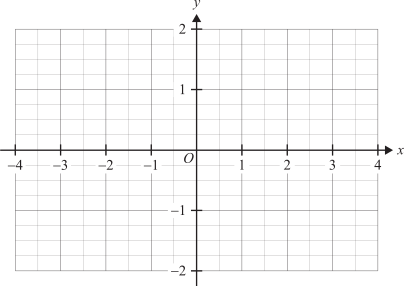
  2. Sketch the graph of \(y=g(x)\) on the axes below, labelling the stationary points and axial intercepts with their coordinates.   (2 marks)

    --- 0 WORK AREA LINES (style=lined) ---
   

  1. Complete the following gradient table with appropriate values of \(x\) and \(g^{\prime}(x)\) to show that \(g\) has a stationary point of inflection.   (2 marks)

    --- 0 WORK AREA LINES (style=lined) ---
\begin{array}{|c|c|c|c|}
\hline \rule{0pt}{2.5ex}x  \rule[-1ex]{0pt}{0pt}& \quad \quad \quad \quad& \quad \quad \quad \quad & \quad \quad \quad \quad\\
\hline\rule{0pt}{2.5ex} \quad g^{\prime}(x) \quad \rule[-1ex]{0pt}{0pt}& & & \\
\hline
\end{array}

  1. Find the average value of \(g\) between  \(x=0\)  and  \(x=2\).   (2 marks)

    --- 5 WORK AREA LINES (style=lined) ---
  2. Let \(h\) be the result after applying a sequence of transformations to \(g\), such that \(h\) has a stationary point of inflection at  \((1,0)\) and a local maximum at \((-1,1)\).
  3. Write down a possible sequence of three transformations to map from \(g\) to \(h\).   (3 marks)

    --- 4 WORK AREA LINES (style=lined) ---
  4. Let  \(X \sim \operatorname{Bi}(4, p)\) be a binomial random variable.
  5. Show that  \(\operatorname{Pr}(X \geq 3)=g(p)\) for all \(p \in[0,1]\).   (2 marks)

    --- 8 WORK AREA LINES (style=lined) ---
Show Answers Only

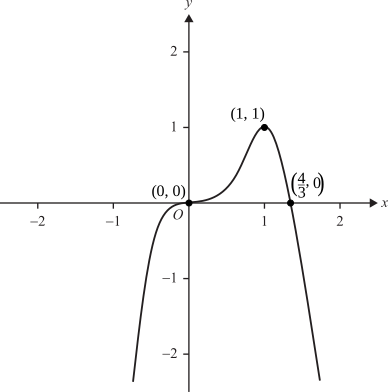
a.    \(\text{SP’s at} \ (0,0) \ \text{and}\ (1,1)\).
 

b.   

c.

\begin{array}{|c|c|c|c|}
\hline
\rule{0pt}{2.5ex}x \rule[-1ex]{0pt}{0pt}&  \quad -1 \quad & \quad \quad 0 \quad \quad & \quad \quad \frac{1}{2} \quad \quad\\
\hline
\rule{0pt}{2.5ex} \quad g^{\prime}(x) \quad \rule[-1ex]{0pt}{0pt}& 24 & 0 & \frac{3}{2} \\
\hline
\end{array}

 
d.
    \(I=-\dfrac{8}{5}\)
 

e.    \(\text{Possible sequences include:}\)

\begin{array}{|l|l|}
\hline
\rule{0pt}{2.5ex}\text{Sequence 1}\rule[-1ex]{0pt}{0pt}&\text{Sequence 2} \\
\hline
\rule{0pt}{2.5ex}\text {1. Reflect in the } y \text {-axis.}\rule[-1ex]{0pt}{0pt}&\text{1. Dilate by factor 2 from the \(y\)-axis.} \\
\hline
\rule{0pt}{2.5ex}\text{2. Dilate by factor 2 from the \(y\)-axis.} \quad \rule[-1ex]{0pt}{0pt}& \text{2. Translate 1 unit left.} \\
\hline
\rule{0pt}{2.5ex}\text {3. Translate 1 unit right.}\quad \rule[-1ex]{0pt}{0pt}&\text{3. Reflect in the \(y\)-axis.}  \\
\hline
\end{array}

\begin{array}{|l|l|}
\hline
\rule{0pt}{2.5ex}\text{Sequence 3}\rule[-1ex]{0pt}{0pt}&\text{Sequence 4} \\
\hline
\rule{0pt}{2.5ex}\text{1. Reflect in the \(y\)-axis.} \rule[-1ex]{0pt}{0pt}&\text{1. Translate 0.5 units left.} \\
\hline
\rule{0pt}{2.5ex}\text{2. Translate 0.5 units right.}\rule[-1ex]{0pt}{0pt}&\text{2. Dilate by factor 2 from the \(y\)-axis.} \\
\hline
\rule{0pt}{2.5ex}\text{3. Dilate by factor 2 from the \(y\)-axis.} \quad \rule[-1ex]{0pt}{0pt}&\text{3. Reflect in the \(y\)-axis.} \\
\hline
\end{array}

 
f. 
  \(X \sim \operatorname{Bi}(4, p)\)

\(\operatorname{Pr}(X \geqslant 3)\) \(=\operatorname{Pr}(X=3)+\operatorname{Pr}(X=4)\)
  \(=4 p^3(1-p)+p^4\)
  \(=4 p^3-4 p^4+p^4\)
  \(=4 p^3-3 p^4\)
  \(=g(p)\)
Show Worked Solution

a.    \(g(x)=4 x^3-3 x^4\)

\(g^{\prime}(x)=12 x^2-12 x^3=12 x^2(1-x)\)

\(\text{Solve} \ \ g^{\prime}(x)=0:\)

\(x=0,1\)

\(\text{SP’s at} \ (0,0) \ \text{and}\ (1,1)\).
 

b.    \(\text{Find} \ x \text {-intercepts:}\)

\(\text{Solve} \ \ g(x)=0 \ \ \Rightarrow\ \ x=0, \dfrac{4}{3}\)
 

c.

\begin{array}{|c|c|c|c|}
\hline
\rule{0pt}{2.5ex}x \rule[-1ex]{0pt}{0pt}&  \quad -1 \quad & \quad \quad 0 \quad \quad & \quad \quad \frac{1}{2} \quad \quad\\
\hline
\rule{0pt}{2.5ex} \quad g^{\prime}(x) \quad \rule[-1ex]{0pt}{0pt}& 24 & 0 & \frac{3}{2} \\
\hline
\end{array}

 
d.
    \(\text{Solve integral (by CAS):}\)

\(I=\dfrac{1}{2-0} \displaystyle \int_0^2 g(x)\ d x=-\dfrac{8}{5}\)
 

e.    \(\text{Possible sequences include:}\)

\begin{array}{|l|l|}
\hline
\rule{0pt}{2.5ex}\text{Sequence 1}\rule[-1ex]{0pt}{0pt}&\text{Sequence 2} \\
\hline
\rule{0pt}{2.5ex}\text {1. Reflect in the } y \text {-axis.}\rule[-1ex]{0pt}{0pt}&\text{1. Dilate by factor 2 from the \(y\)-axis.} \\
\hline
\rule{0pt}{2.5ex}\text{2. Dilate by factor 2 from the \(y\)-axis.} \quad \rule[-1ex]{0pt}{0pt}& \text{2. Translate 1 unit left.} \\
\hline
\rule{0pt}{2.5ex}\text {3. Translate 1 unit right.}\quad \rule[-1ex]{0pt}{0pt}&\text{3. Reflect in the \(y\)-axis.}  \\
\hline
\end{array}

\begin{array}{|l|l|}
\hline
\rule{0pt}{2.5ex}\text{Sequence 3}\rule[-1ex]{0pt}{0pt}&\text{Sequence 4} \\
\hline
\rule{0pt}{2.5ex}\text{1. Reflect in the \(y\)-axis.} \rule[-1ex]{0pt}{0pt}&\text{1. Translate 0.5 units left.} \\
\hline
\rule{0pt}{2.5ex}\text{2. Translate 0.5 units right.}\rule[-1ex]{0pt}{0pt}&\text{2. Dilate by factor 2 from the \(y\)-axis.} \\
\hline
\rule{0pt}{2.5ex}\text{3. Dilate by factor 2 from the \(y\)-axis.} \quad \rule[-1ex]{0pt}{0pt}&\text{3. Reflect in the \(y\)-axis.} \\
\hline
\end{array}

 
f. 
  \(X \sim \operatorname{Bi}(4, p)\)

\(\operatorname{Pr}(X \geqslant 3)\) \(=\operatorname{Pr}(X=3)+\operatorname{Pr}(X=4)\)
  \(=4 p^3(1-p)+p^4\)
  \(=4 p^3-4 p^4+p^4\)
  \(=4 p^3-3 p^4\)
  \(=g(p)\)
♦ Mean mark (e) 40%.
Mean mark (f) 51%

Filed Under: Average Value and Other, Binomial, Curve Sketching, Transformations Tagged With: Band 3, Band 4, Band 5, smc-638-10-binomial expansion (non-calc), smc-724-20-Degree 4, smc-753-40-Combinations, smc-756-30-Polynomial

Calculus, 2ADV C3 2025 MET2 19*

Let \(A\) be a point on the line  \(y=x+c\)  and \(B\) be a point on the curve  \(y=\log _e(x-1)\).

The tangent to the curve at point \(B\) is parallel to the line  \(y=x+c\).

  1. Show that the distance \((d)\) between the points \(AB\) can be expressed as
  2.      \(d=\sqrt{2x^2+(2c-4)x+4+c^2} \)   (2 marks)

    --- 6 WORK AREA LINES (style=lined) ---
  3. Determine the \(x\)-coordinate of point \(A\), in terms of \(c\), when the distance \(AB\) is a minimum.   (2 marks)

    --- 8 WORK AREA LINES (style=lined) ---
Show Answers Only

a.    \(\text{See Worked Solutions}\)

b.    \(d_{\text{min}}=\dfrac{2-c}{2}\)

Show Worked Solution

a.    \(\text{Gradient of}\ \ y=x+c \ \ \Rightarrow\ \ m=1\)

\(g(x)=\log _e(x-1), \ g^{\prime}(x)=\dfrac{1}{x-1}\)

\(\text{Solve} \ \ g^{\prime}(x)=1:\)

\(\dfrac{1}{x-1}=1 \ \Rightarrow \ x=2\)

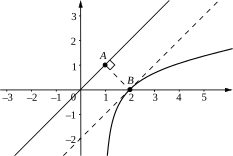
\(\text{Consider the diagram for the case when}\ \ c=0:\)


\(\text{Find distance \((d)\) between \(B(2,0)\) and \(A(x, x+c)\):}\)

\(d\) \(=\sqrt{(x-2)^2+(x+c)^2}\)  
  \(=\sqrt{x^2-4x+4+x^2+2cx+c^2}\)  
  \(=\sqrt{2x^2+(2c-4)x+4+c^2}\)  


b.    \(d^2=2x^2+(2c-4)x+4+c^2\)

\(\dfrac{d(d^2)}{dx}=4x+2c-4\)

\(\dfrac{d^2(d^2)}{dx^2}=4>0\)

\(\text{MIN when}\ \dfrac{d(d^2)}{dx}=0:\)

\(4x+2c-4=0\ \ \Rightarrow\ \ x=\dfrac{4-2c}{4}=\dfrac{2-c}{2}\)

\(\therefore d_{\text{min}}\ \text{occurs when}\ \ x=\dfrac{2-c}{2}\)

Filed Under: Maxima and Minima, Optimisation Tagged With: Band 4, Band 5, smc-7134-50-Distance, smc-970-50-Distance

Statistics, MET2 2025 VCAA 14 MC

Let \(f\) be the probability density function for a continuous random variable \(X\), where

\begin{align*}
f(x)=\left\{\begin{array}{cl}
k\, \sin (x) & 0 \leq x<\dfrac{\pi}{4} \\
k\, \cos (x) & \dfrac{\pi}{4} \leq x \leq \dfrac{\pi}{2} \\
0 & \text {otherwise }
\end{array}\right.
\end{align*}

and \(k\) is a positive real number.

The value of \(k\) is

  1. \(\dfrac{1}{\sqrt{2}}\)
  2. \(\dfrac{1}{2-\sqrt{2}}\)
  3. \(\sqrt{2}+2\)
  4. \(2-\sqrt{2}\)
Show Answers Only

\(B\)

Show Worked Solution

\(\text{Solve for} \ k \ \text{by (CAS):}\)

\(\displaystyle \int_{-\infty}^{\infty} f(x)\, d x=1\)

\(k=\dfrac{\sqrt{2}+2}{2} \times \dfrac{\sqrt{2}-2}{\sqrt{2}-2}=\dfrac{1}{2-\sqrt{2}}\)

\(\Rightarrow B\)

Filed Under: Probability Density Functions Tagged With: Band 4, smc-637-80-Trig PDF

Statistics, MET2 2025 VCAA 12 MC

For a normal random variable \(X\), it is known that  \(\operatorname{Pr}(X>200)=0.325\)  and  \(\operatorname{Pr}(180<X<200)=0.589\)

The mean and standard deviation of \(X\) are closest to

  1. 190 and 10
  2. 190 and 11
  3. 195 and 10
  4. 195 and 11
Show Answers Only

\(D\)

Show Worked Solution

\(\operatorname{Pr}(X<200)=0.325 \ \Rightarrow \ \dfrac{200-\mu}{\sigma}=0.453\ \ldots\ (1)\)

\(\operatorname{Pr}(180<X<200)=0.589\)

\(\operatorname{Pr}(X>180)=0.589+0.325=0.914\)

\(\dfrac{180-\mu}{\sigma}=-1.365\ \ldots\ (2)\)

\(\text{Solve (1) and (2) simultaneously (by CAS):}\)

\(\mu=195, \sigma=11\)

\(\Rightarrow D\)

Mean mark 58%.

Filed Under: Normal Distribution Tagged With: Band 4, smc-719-30-Other z-score intervals

Calculus, MET2 2025 VCAA 11 MC

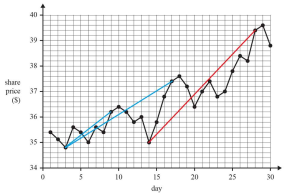
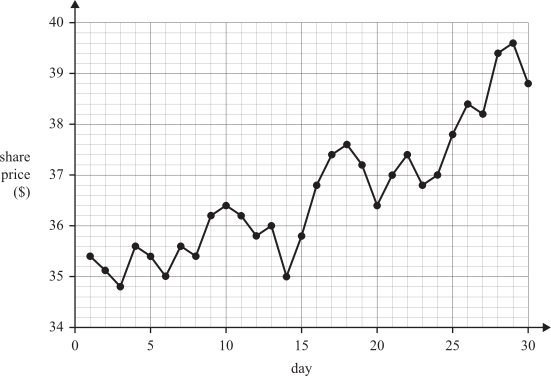
The chart below shows the daily price of a stock market share over a 30-day period.
 

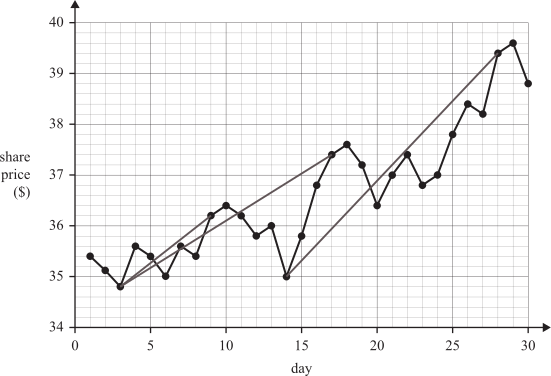
Over which of the following time intervals did the daily price undergo the greatest average rate of change?

  1. day 3 to day 10
  2. day 3 to day 17
  3. day 14 to day 21
  4. day 14 to day 28
Show Answers Only

\(D\)

Show Worked Solution

\(\text{Day 14 to Day 28 is the steepest.}\)

\(\text{Average ROC} \approx \dfrac{39.4-35.0}{28-14} \approx 0.3143\)

\(\Rightarrow D\)

Filed Under: Standard Differentiation Tagged With: Band 4, smc-746-40-Average ROC

Functions, MET2 2025 VCAA 10 MC

Consider \(f: R \rightarrow R, f(x)=2 x^2+x-1\)  and  \(g: R \rightarrow R, g(x)=\sin (x)\).

The inequality  \((f \circ g)(x)>0\) is satisfied when

  1. \(\quad \sin (x) \leq-1\)
  2. \(-1<\sin (x)<0\)
  3. \(\dfrac{1}{2}<\sin (x) \leq 1\)
  4. \(0<\sin (x)<\frac{1}{2}\)
Show Answers Only

\(C\)

Show Worked Solution

\(f(g(x))=2 \sin ^2(x)+\sin (x)-1\)

\(\text{Let} \ \  a=\sin (x)\)

\(f(g(x))=2 a^2+a-1\)

\(\text {Solve simultaneously for \(a\) (by CAS):}\)

\(2 a^2+a-1>0\ …\ (1)\)

\(-1 \leqslant a \leqslant 1\ …\ (2)\)

\(\therefore \frac{1}{2}<a \leqslant 1\)

\(\Rightarrow C\)

Mean mark 57%.

Filed Under: Functional Equations Tagged With: Band 4, smc-642-10-\((f \circ g)(x)\)

ENGINEERING, CS 2025 HSC 11 MC

Which of the following is true of cathodic protection?

  1. It uses high temperatures to preserve metals.
  2. It uses a polymer coating to prevent corrosion.
  3. It uses heat treatment to improve the tensile strength.
  4. It uses an electric current to prevent corrosion of metals.
Show Answers Only

\(D\)

Show Worked Solution
  • Cathodic protection works by supplying an electric current that makes the metal structure the cathode, preventing oxidation (corrosion).
  • \(\text{A}\) is incorrect — high temperatures accelerate corrosion rather than prevent it.
  • \(\text{B}\) describes paint/polymer coating — a separate corrosion prevention method, not cathodic protection.
  • \(\text{C}\) describes heat treatment — a process that changes mechanical properties, unrelated to corrosion prevention.

\(\Rightarrow D\)

Filed Under: Engineering Materials Tagged With: Band 4, smc-3715-70-Corrosion

ENGINEERING, AE 2025 HSC 10 MC

Which mechanical property of a thermosetting polymer increases when the number of cross-links between the polymer chains is increased?

  1. Ductility
  2. Flexibility
  3. Stiffness
  4. Toughness
Show Answers Only

\(C\)

Show Worked Solution
  • Cross-links are covalent bonds between polymer chains — more cross-links restrict chain movement, increasing stiffness.
  • Ductility and flexibility both require chain movement — cross-linking reduces these properties.
  • Toughness requires energy absorption through deformation — heavily cross-linked polymers become brittle, not tough.

\(\Rightarrow C\)

Filed Under: Materials Tagged With: Band 4, smc-3725-30-Polymers

ENGINEERING, PPT 2025 HSC 6 MC

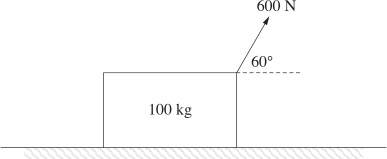
The diagram shows a 100 kg crate which is being pulled horizontally 10 metres along level ground. The tension in the tow rope is 600 N and the rope is inclined at 60 degrees to the ground on a frictionless surface.
 

What is the work done in joules?

  1. \(100 \times 10\)
  2. \(600 \times 10\)
  3. \(600\, \sin 60^{\circ} \times 10\)
  4. \(600\, \cos 60^{\circ} \times 10\)
Show Answers Only

\(D\)

Show Worked Solution

\(W= F\, \cos\theta \times d= 600\, \cos 60^{\circ} \times 10\)

\(\Rightarrow D\)

Filed Under: Mechanics Tagged With: Band 4, smc-3718-60-Work Energy Power

ENGINEERING, TE 2025 HSC 3 MC

The truth table represents the basic operation of a logic gate.

\begin{array}{|c|c|c|}
\hline
\rule{0pt}{2.5ex}\ \ \ \textit{Input A} \ \ \ \rule[-1ex]{0pt}{0pt}&\ \ \ \textit{Input B} \ \ \ & \ \ \ \textit{Output} \ \ \ \\
\hline
\rule{0pt}{2.5ex} 1 \rule[-1ex]{0pt}{0pt}& 1 & 1 \\
\hline
\rule{0pt}{2.5ex} 1 \rule[-1ex]{0pt}{0pt}& 0 & 1 \\
\hline
\rule{0pt}{2.5ex} 0 \rule[-1ex]{0pt}{0pt}& 1 & 1 \\
\hline
\rule{0pt}{2.5ex} 0 \rule[-1ex]{0pt}{0pt}& 0 & 0 \\
\hline
\end{array}

What is the logic gate?

  1. AND
  2. NAND
  3. NOR
  4. OR
Show Answers Only

\(D\)

Show Worked Solution
  • An OR gate produces an output of 1 whenever at least one input is 1, and an output of 0 only when both inputs are 0.
  • The truth table shows Output = 1 for all input combinations except (0, 0), which is the defining behaviour of an OR gate.
  • An AND gate requires both inputs to be 1 to produce an output of 1 — eliminated by rows where one input is 0 yet the output is 1.
  • NAND and NOR gates are inverted versions of AND and OR respectively — their outputs would be reversed from those shown.

\(\Rightarrow D\)

Filed Under: Electricity/Electronics Tagged With: Band 4, smc-3730-30-Logic gates/circuits

Trigonometry, 2ADV T3 2025 MET2 3 MC

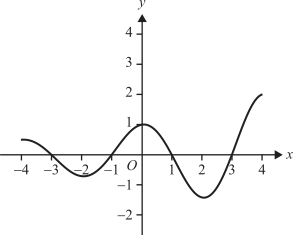
The graph of  \(y=f(x)\) is shown below.


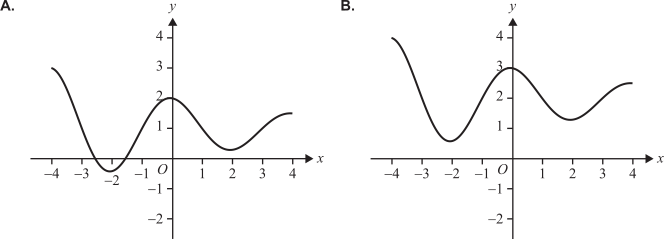
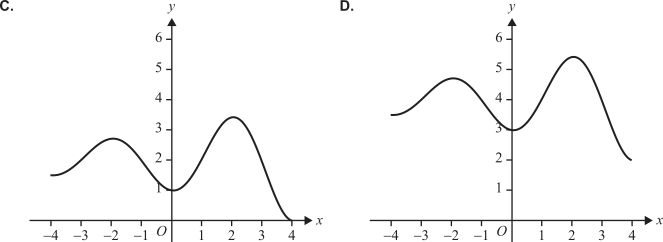
Which one of the following options best represents the graph of  \(y=f(-x)+2\) ?
 

Show Answers Only

\(B\)

Show Worked Solution

\(\text{Transformation:}\)

  • \(\text{reflect} \ \ y=f(x) \ \text {in} \ y \text {-axis}\)
  • \(\text{translate up 2 units}\)

\(\Rightarrow B\)

Filed Under: Trig Graphs, Trigonometric Functions Tagged With: Band 4, smc-7124-40-Unknown Trig Ratio, smc-977-40-Unknown Trig Ratio

Probability, MET2 2025 VCAA 9 MC

One day, at a particular school, \(m\) students walked to school and the remaining \(n\) students travelled to school using a different form of transport.

Of the \(m\) students who walked, 20% took at least 30 minutes to get to school.

Of the \(n\) students who used a different form of transport, 40% took at least 30 minutes to get to school.

Given that a randomly selected student took at least 30 minutes to get to school, the probability that they walked to school is given by

  1. \(\dfrac{m}{m+2 n}\)
  2. \(\dfrac{2 n}{m+2 n}\)
  3. \(\dfrac{m}{5(m+n)}\)
  4. \(\dfrac{1}{3}\)
Show Answers Only

\(A\)

Show Worked Solution

\(\text{Let \(W=\) student walks to school}\)

\(\text{Let \(T=\) travel time at least 30 mins}\)

Mean mark 57%.

\(P(W)=\dfrac{\text{students who walk}}{\text{total students}} = \dfrac{m}{m+n}\)
 

\(P(T)=\dfrac{\text{travel time at least 30 mins}}{\text{total students}} =\dfrac{0.2 m+0.4 n}{m+n}\)
 

\(P(W \cap T)=\dfrac{0.2 m}{m+n}\)

\(P\left(\left.W\right|T\right)=\dfrac{P\left(W \cap T\right)}{P(T)}=\dfrac{\left(\dfrac{0.2 m}{m+n}\right)}{\left(\dfrac{0.2 m+0.4 n}{m+n}\right)}=\dfrac{m}{m+2 n}\)

\(\Rightarrow A\)

Filed Under: Conditional Probability and Set Notation Tagged With: Band 4, smc-2736-10-Conditional probability

Probability, MET2 2025 VCAA 8 MC

A random sample of \(n\) Victorian households is taken to estimate the proportion of all Victorian households that have vegetable gardens. The approximate 95% confidence interval calculated using this sample is (0.248, 0.552), correct to three decimal places.

The number of households, \(n\), in the sample is

  1. 10
  2. 28
  3. 40
  4. 49
Show Answers Only

\(C\)

Show Worked Solution

\(\text{95% CI} =(0.248,0.552)\)

\(\hat{p} \approx \dfrac{0.248+0.554}{2}=0.4\)

\(\text{Solve for} \  n \ \text{(by CAS):}\)

\(1.96 \times \sqrt{\dfrac{0.4 \times(1-0.4)}{n}} \approx 0.152 \ \Rightarrow \ n \approx 39.905\)

\(\Rightarrow C\)

Filed Under: Normal Distribution Tagged With: Band 4, smc-719-20-95% confidence intervals

Calculus, MET2 2025 VCAA 7 MC

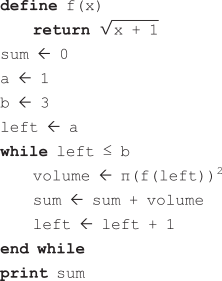
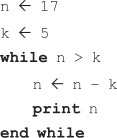
Consider the algorithm below.

In order, the values printed by the algorithm are

  1. \( 12\)
  2. \( 12,7\)
  3. \(12,7,2\)
  4. \(12,7,2,-3\)
Show Answers Only

\(C\)

Show Worked Solution

\(n=17, k=5, n>k\)

\(n=12, k=5, \ \text{print}\ 12, n>k\)

\(n=7, k=5, \ \text{print} \ 7, n>k\)

\(n=2, k=5, \ \text{print}\ 2,  n<k \text { end while}\)

\(\text { Printed values:}\ 12,7,2\)

\(\Rightarrow C\)

Filed Under: Pseudocode Tagged With: Band 4, smc-5196-25-Other

Statistics, SPEC2 2025 VCAA 6

The volume of water, \(V\) mL, consumed by a student during a school day may be assumed to be normally distributed with a mean of 1000 mL and a standard deviation of 80 mL .

    1. Write down the mean and standard deviation of the sampling distribution for the average volume of water consumed by randomly selected samples of 25 students.
    2. Give your answers in millilitres.   (1 mark)

      --- 2 WORK AREA LINES (style=lined) ---
    3. What is the probability, correct to four decimal places, that the average volume of water consumed by a random sample of 25 students on a particular school day is more than 970 mL?   (1 mark)

      --- 2 WORK AREA LINES (style=lined) ---
The canteen at a particular school stocks two brands of water in bottles, Wasser and Apa.

The manufacturer of Wasser bottled water knows that the volume of water dispensed into bottles may be assumed to be normally distributed with a standard deviation of 5 mL. Engineers at the company take a random sample of 30 bottles and measure the volume of water in each bottle. The sample mean is found to be 750 mL.

  1. Find a 95% confidence interval for the mean volume of water dispensed into each Wasser bottle.
  2. Give your values in millilitres, correct to one decimal place.   (1 mark)

    --- 1 WORK AREA LINES (style=lined) ---
  3. The engineers decide to take 300 random samples, each containing 30 bottles, and calculate the respective 95% confidence intervals. All samples are independent.
  4. In how many of these confidence intervals would the engineers expect the value of the true mean volume dispensed to be included?   (1 mark)

    --- 1 WORK AREA LINES (style=lined) ---
  5. What is the minimum size of the sample required to ensure that the difference between the sample mean and the mean volume dispensed is no more than 1 mL at the 95% confidence level?   (1 mark)

    --- 2 WORK AREA LINES (style=lined) ---
The volume of water dispensed into Apa water bottles may be assumed to be normally distributed with a mean of 750 mL and a standard deviation of 5 mL. After a service, a random sample of 50 bottles gave a sample mean of 748 mL. The company now claims that the mean volume of water dispensed is less than the stated mean of 750 mL.

A one-tailed statistical test at the 1% level of significance is proposed.

  1. Write down the null and alternative hypotheses that will be used in testing the company's claim.   (1 mark)

    --- 2 WORK AREA LINES (style=lined) ---
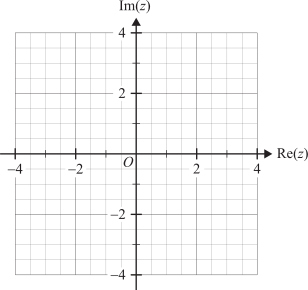
    1. Determine the \(p\) value for this test.
    2. Give your answer correct to four decimal places.   (1 mark)

      --- 2 WORK AREA LINES (style=lined) ---
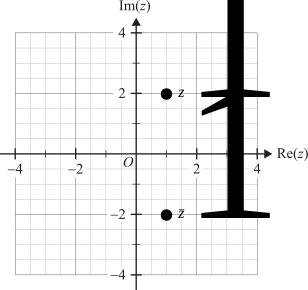
    3. Is the company's claim correct?
    4. Explain your conclusion in terms of the \(p\) value.   (1 mark)

      --- 2 WORK AREA LINES (style=lined) ---
  2. At the 1% level of significance for a sample size of 50 bottles, find the critical value of the sample mean, below which a sample mean value would support the conclusion that the mean volume of water dispensed is now less than 750 mL.
  3. Give your answer correct to three decimal places.   (1 mark)

    --- 2 WORK AREA LINES (style=lined) ---

  4. Assume that, after the service, the true mean volume of water in the Apa bottles was found to be 747.5 mL and that the population standard deviation, \(\sigma\), is 5 mL.
  5. At the 1% level of significance, for a sample size of 50 , find the probability that the company will conclude that the service has not reduced the mean volume of water in an Apa bottle.
  6. Give your answer correct to three decimal places.   (1 mark)

    --- 2 WORK AREA LINES (style=lined) ---

Show Answers Only

a.i.  \(\mu=1000,\ \ \sigma=16\)

a.ii.  \(P(V>970)=0.9696\)

b.    \(\text{95% CI}=(748.2,751.8)\) 

c.    \(95 \% \times 300=285\)

d.    \(n=97\) 

e.    \(H_0: \ \mu=750, \ H_1: \ \mu<750\)

f.i.  \(p=0.0023\) 

f.ii.   \(\text{Since \(0.0023<0.01\) (significance level), claim is correct.}\)

g.    \(\overline{X}=748.355 \ \text{mL}\)

h.    \(p=0.113\)

Show Worked Solution
a.i.   \(\mu\) \(=1000\)
  \(\sigma\) \(=\dfrac{80}{\sqrt{16}}=16\)


a.ii.  \(P(V>970)=0.9696\)
 

b.    \(\overline{X} \sim N\left(750, \dfrac{5}{\sqrt{30}}\right)\)

\(\text{95% CI}\) \(=\left(750-1.96 \times \dfrac{5}{\sqrt{30}}, 750+1.96\times\dfrac{5}{\sqrt{30}}\right)\)
  \(=(748.2,751.8)\)


c.    \(95 \% \times 300=285\)
 

d.    \(\text {Solve for} \ n:\)

\(1\) \(\geqslant 1.96 \times \dfrac{5}{\sqrt{n}}\)
\(n\) \(\geqslant 96.04\)
\(n\) \(=97\)


e.    \(H_0: \ \mu=750\)

\(H_1: \ \mu<750\)
 

f.i.    \(p\) \(=\operatorname{Pr}\left(z<\dfrac{748-750}{\frac{5}{\sqrt{50}}}\right)\)
    \(=\operatorname{Pr}\left(z<-\dfrac{2 \sqrt{50}}{5}\right)\)
    \(=0.0023\)


f.ii.   \(\text{Since \(0.0023<0.01\) (significance level), claim is correct.}\)
 

g.    \(\text{Solve for} \ c:\ \ \operatorname{Pr}(\overline{X}<c)=0.01\)

\(c=748.355 \ \text{mL}\)
 

h.    \(p=0.113\)

Filed Under: Confidence Intervals and Hypothesis Testing, Linear Combinations and Sample Means Tagged With: Band 3, Band 4, smc-1162-10-95% CI (sample), smc-1162-20-Other CI (sample), smc-1162-50-Null/Alternative hypothesis

Vectors, SPEC2 2025 VCAA 5

Consider three planes defined by the equations  \(\Pi_1: \ 2 x+9 z=8, \Pi_2: \ 3 x+6 y+5 z=7\)  and  \(\Pi_3: \ x+9 y-3 z=7\).

  1. Find the point of intersection of the three planes.   (1 mark)

    --- 2 WORK AREA LINES (style=lined) ---

    1. Find a vector that gives the direction of the line of intersection of the planes \(\Pi_2\) and \(\Pi_3\).   (2 marks)

      --- 4 WORK AREA LINES (style=lined) ---

    2. Find a set of parametric equations that give the coordinates of the points that lie on this line of intersection.   (1 mark)

      --- 4 WORK AREA LINES (style=lined) ---

  2. Find the shortest distance from the point \((1,1,2)\) to the plane \(\Pi_3\).   (2 marks)

    --- 6 WORK AREA LINES (style=lined) ---

  3. Consider a family of planes, \(\Psi\), with equation  \(6 x+27 z=m\), where \(m \in N\).
    1. Show that the plane \(\Pi_1\) is parallel to each member of \(\Psi\).   (1 mark)

      --- 2 WORK AREA LINES (style=lined) ---

    2. Find all values of \(m\) for which the shortest distance between plane \(\Pi_1\) and the plane of the form  \(6 x+27 z=m\)  is  \(\dfrac{23}{3 \sqrt{85}}\).   (3 marks)

      --- 6 WORK AREA LINES (style=lined) ---

Show Answers Only

a.    \(\text{Intersection at}\ (-5,2,2)\)
 

b.i.  \(\underset{\sim}{d}=\left(\begin{array}{c}-63 \\ 14 \\ 21\end{array}\right)\)
 

b.ii. \(x=-5-63 \lambda\)

\(y=2 + 14 \lambda\)

\(z=2+21 \lambda\)
 

c.    \(\dfrac{3}{\sqrt{91}}\)
 

d.i.  \(\Psi: \ 6 x+27 z=m\)

\(\text{Normal to} \ \Psi: \ 6 \underset{\sim}{i}+27 \underset{\sim}{k}\)

\(\text{Normal to} \ \Pi_2: \ 2 \underset{\sim}{i}+9 \underset{\sim}{k}\)

\(\displaystyle \binom{6}{27}=3\binom{2}{9} \ \Rightarrow \ \text{Planes are parallel}\)

d.ii.  \(m=1,47\)

Show Worked Solution

a.    \(\Pi_1: \ 2 x+9 z=8\)

\(\Pi_2: \ 3 x+6 y+5 z=7\)

\(\Pi_3: \ x+9 y-3 z=7\)

\(\text {Solve simultaneously (by CAS):}\)

\(\text{Intersection at}\ (-5,2,2)\)
 

b.i.  \(\underset{\sim}{d} \ \text{is} \perp \text{to normals of} \ \Pi_2 \ \text{and}\  \Pi_3.\)

\(\underset{\sim}{d}=n_2 \times n_3=\left|\begin{array}{ccc}i & j & k \\ 3 & 6 & 5 \\ 1 & 9 & -3\end{array}\right|=\left(\begin{array}{c}-63 \\ 14 \\ 21\end{array}\right)\)
 

b.ii. \((-5,2,2)\ \text{lies on both planes (from part a.)}\)

\(x=-5-63 \lambda\)

\(y=2 + 14 \lambda\)

\(z=2+21 \lambda\)

♦ Mean mark (b.ii) 51%.

c.    \(\text{Find shortest distance from (1, 1, 2) to \(\Pi_3\).}\)

\(\Pi_3: \ x+9 y-3 z=7 \ \ \Rightarrow \ \ (7,0,0)\ \text{lies on plane.}\)

\(\text {Spanning vector to} \ (1,1,2) \ \text{is} \ (-6 \underset{\sim}{i}+\underset{\sim}{j}+2 \underset{\sim}{k})\)

\(\text{Distance}=\dfrac{1}{\sqrt{91}} \times \abs{\left(\begin{array}{c}-6 \\ 1 \\ 2\end{array}\right)\left(\begin{array}{c}1 \\ 9 \\ -3\end{array}\right)}=\dfrac{3}{\sqrt{91}}\)
 

d.i.  \(\Psi: \ 6 x+27 z=m\)

\(\text{Normal to} \ \Psi: \ 6 \underset{\sim}{i}+27 \underset{\sim}{k}\)

\(\text{Normal to} \ \Pi_2: \ 2 \underset{\sim}{i}+9 \underset{\sim}{k}\)

\(\displaystyle \binom{6}{27}=3\binom{2}{9} \ \Rightarrow \ \text{Planes are parallel}\)
  

d.ii. \(\text{Point on}\ \Pi_1: (4,0,0)\)

\(\text{Point on} \ \Psi:\left(\dfrac{m}{6}, 0,0\right)\)

\(\text{Spanning vector}=\left(4-\dfrac{m}{6}\right) \underset{\sim}{i}\)

\(\text{Distance}=\abs{\left(4-\dfrac{m}{6}\right) \underset{\sim}{i} \cdot \dfrac{(2 \underset{\sim}{i}+9\underset{\sim}{k})}{\sqrt{85}}}=\dfrac{23}{3 \sqrt{85}}\)

\(\text{Solve}\ \ \abs{8-\dfrac{m}{3}}=\dfrac{23}{3} \ \ \text{for} \ m:\)

\(m=1,47\)

♦ Mean mark (d.ii) 45%.

Filed Under: Vector Lines, Planes and Geometry Tagged With: Band 3, Band 4, Band 5, smc-1177-80-Planes

Vectors, SPEC2 2025 VCAA 4

The path of a moving particle with position vector

\(\underset{\sim}{r}(t)=\left(5 \cos (t)-4 \cos \left(\dfrac{5 t}{2}\right)\right) \underset{\sim}{i}+\left(5 \sin (t)-4 \sin \left(\dfrac{5 t}{2}\right)\right) \underset{\sim}{j}\)

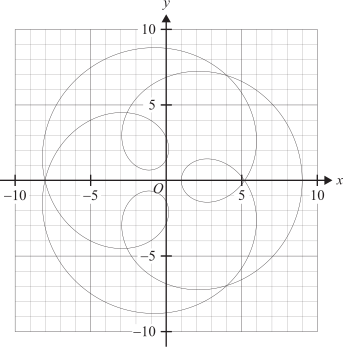
is shown below for time \(t \geq 0\).

All lengths are in metres and time is measured in seconds.
 

  1. Write down the coordinates of the particle's starting point.   (1 mark)

    --- 2 WORK AREA LINES (style=lined) ---

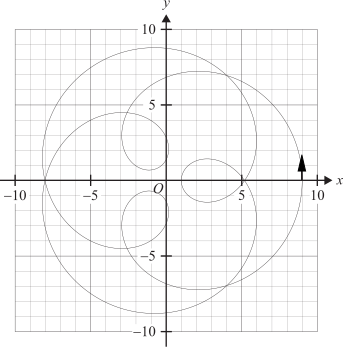
  2. On the graph above, draw an arrow from the point \((9,0)\) to indicate the direction of motion of the particle.   (1 mark)

    --- 0 WORK AREA LINES (style=lined) ---

  3. Find the value of \(t\) for which the particle will first return to its starting point.   (1 mark)

    --- 2 WORK AREA LINES (style=lined) ---

  4. Show that the speed of the particle, in m s\(^{-1}\), at time \(t\) can be expressed as  \(\sqrt{125-100 \cos \left(\dfrac{3 t}{2}\right)}\).   (3 marks)

    --- 9 WORK AREA LINES (style=lined) ---

  5. What is the maximum speed of the particle in m s\(^{-1}\)?   (1 mark)

    --- 2 WORK AREA LINES (style=lined) ---

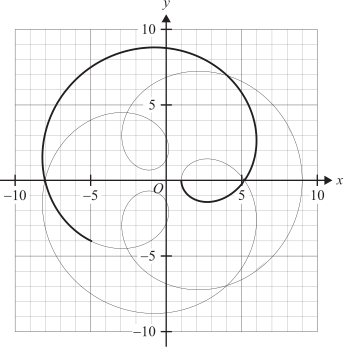
  6. On the graph above, trace the path of the particle for  \(t \in[0, \pi]\).   (1 mark)

    --- 0 WORK AREA LINES (style=lined) ---

  7. Find the length of the path traced in part f, giving your answer in metres, correct to one decimal place.   (2 marks)

    --- 5 WORK AREA LINES (style=lined) ---

Show Answers Only

a.    \(\text{Initial coordinates:}\ (1,0)\)
 

b.    
     

c.   \(t=4 \pi \ \text{seconds}\)

d.    \(r(t)=\left(5 \cos (t)-4 \cos \left(\dfrac{5 t}{2}\right)\right)\underset{\sim}{i}+\left(5 \sin (t)-4 \sin \left(\dfrac{5 t}{2}\right)\right)\underset{\sim}{j}\)

\(\dot{r}(t)=\left(-5 \sin (t)+10 \sin \left(\dfrac{5 t}{2}\right)\right) \underset{\sim}{i}+\left(5 \cos (t)-10 \cos \left(\dfrac{5 t}{2}\right)\right) \underset{\sim}{j}\)

\(\text {Speed}=\abs{\dot{r}(t)}:\)

\(\text{Speed}^2\) \(=\left(-5 \sin (t)+10 \sin \left(\dfrac{5 t}{2}\right)\right)^2+\left(5 \cos (t)-10 \cos \left(\dfrac{5 t}{2}\right)\right)^2\)
  \(=25 \sin ^2(t)-100 \sin (t) \sin \left(\dfrac{5 t}{2}\right)+100 \sin ^2\left(\dfrac{5 t}{2}\right)\)
       \(\quad +25 \cos ^2(t)-100 \cos (t) \cos \left(\dfrac{5 t}{2}\right)+100 \cos ^2\left(\dfrac{5 t}{2}\right)\)
  \(=125-100\left(\sin (t) \sin \left(\dfrac{5 t}{2}\right)-\cos (t) \cos \left(\dfrac{5 t}{2}\right)\right)\)
  \(=125-100 \cos \left(\dfrac{5 t}{2}-t\right)\)
\(\text{speed}\) \(=\sqrt{125-100 \cos \left(\dfrac{3t}{2}\right)}\)


e.    \(\text{Speed}_{\text {max}}=15 \ \text{ms}^{-1}\)
 

f.    \(\text{Path traces curve from}\ (1,0)\ \text{to}\ (-5,-4).\)


g.    \(\displaystyle \int_0^\pi \sqrt{125-100 \cos \left(\frac{3 t}{2}\right)} d t=36.6\ \text{(1 d.p.)}\)

Show Worked Solution

a.    \(\text{At} \ \ t=0:\)

\(r(t)=(5 \cos 0-4 \cos 0)\underset{\sim}{i} + (5 \sin 0-4 \sin 0) {\underset{\sim}{j}}=\underset{\sim}{i}\)

\(\text{Initial coordinates:}\ (1,0)\)
 

b.    
     

c.   \(\text{Solve for}\ t \ \text{(by CAS):}\)

\(5 \cos (t)-4 \cos \left(\dfrac{5t}{2}\right)=1\)

\(5 \sin (t)-4 \sin \left(\dfrac{5 t}{2}\right)=0\)

\(t=4 \pi \ \text{seconds}\)

Mean mark (c) 53%.
 

d.    \(r(t)=\left(5 \cos (t)-4 \cos \left(\dfrac{5 t}{2}\right)\right)\underset{\sim}{i}+\left(5 \sin (t)-4 \sin \left(\dfrac{5 t}{2}\right)\right)\underset{\sim}{j}\)

\(\dot{r}(t)=\left(-5 \sin (t)+10 \sin \left(\dfrac{5 t}{2}\right)\right) \underset{\sim}{i}+\left(5 \cos (t)-10 \cos \left(\dfrac{5 t}{2}\right)\right) \underset{\sim}{j}\)

\(\text {Speed}=\abs{\dot{r}(t)}:\)

\(\text{Speed}^2\) \(=\left(-5 \sin (t)+10 \sin \left(\dfrac{5 t}{2}\right)\right)^2+\left(5 \cos (t)-10 \cos \left(\dfrac{5 t}{2}\right)\right)^2\)
  \(=25 \sin ^2(t)-100 \sin (t) \sin \left(\dfrac{5 t}{2}\right)+100 \sin ^2\left(\dfrac{5 t}{2}\right)\)
       \(\quad +25 \cos ^2(t)-100 \cos (t) \cos \left(\dfrac{5 t}{2}\right)+100 \cos ^2\left(\dfrac{5 t}{2}\right)\)
  \(=125-100\left(\sin (t) \sin \left(\dfrac{5 t}{2}\right)-\cos (t) \cos \left(\dfrac{5 t}{2}\right)\right)\)
  \(=125-100 \cos \left(\dfrac{5 t}{2}-t\right)\)
\(\text{speed}\) \(=\sqrt{125-100 \cos \left(\dfrac{3t}{2}\right)}\)


e.    \(\text{Speed}_{\text {max }} \ \text {occurs when} \ \ \cos \left(\frac{3 t}{2}\right)=-1\)

\(\text{Speed}_{\text {max}}=\sqrt{125+100}=15 \ \text{ms}^{-1}\)
 

f.    \(\text{At} \ \ t=\pi, \quad r(\pi)=-5\underset{\sim}{i}-4\underset{\sim}{j}\)

\(\text{Path traces curve from}\ (1,0)\ \text{to}\ (-5,-4).\)


g.    \(\text{Length of curve (by CAS):}\)

\(\displaystyle \int_0^\pi \sqrt{125-100 \cos \left(\frac{3 t}{2}\right)} d t=36.6\ \text{(1 d.p.)}\)

Filed Under: Position Vectors as a Function of Time Tagged With: Band 3, Band 4, smc-1178-20-Find \(r(t)\ v(t)\ a(t)\), smc-1178-40-Circular motion

Graphs, MET2 2025 VCAA 3 MC

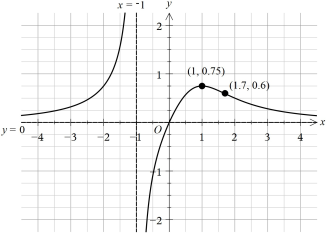
The graph of  \(y=f(x)\) is shown below.


Which one of the following options best represents the graph of  \(y=f(-x)+2\) ?
 

Show Answers Only

\(B\)

Show Worked Solution

\(\text{Transformation:}\)

  • \(\text{reflect} \ \ y=f(x) \ \text {in} \ \ y \text {-axis}\)
  • \(\text{translate up 2 units}\)

\(\Rightarrow B\)

Filed Under: Transformations, Uncategorized Tagged With: Band 4, smc-753-40-Combinations, smc-753-75-Trig functions

Calculus, SPEC2 2025 VCAA 3

A tank initially contains 5 kg of salt dissolved in 3000 litres of water. Salty water that contains 0.1 kg of salt per litre of water enters the tank at a rate of 20 litres per minute. The solution is kept thoroughly mixed and drains from the tank via a tap at the same rate of 20 litres per minute.

  1. By considering concentration, explain whether the quantity of salt in the tank increases with time.   (1 mark)

    --- 2 WORK AREA LINES (style=lined) ---

  2. Let \(Q\) denote the quantity of salt, in kilograms, in the tank at time \(t\) minutes.
  3. Show that \(Q\) satisfies the differential equation  \(\dfrac{d Q}{d t}=\dfrac{300-Q}{150}\).   (1 mark)

    --- 4 WORK AREA LINES (style=lined) ---

  4. Using Euler's method with a step size of 15 minutes, find \(Q(30)\), the approximate quantity of salt in the tank after 30 minutes.
  5. Give your answer in kilograms, correct to two decimal places.   (2 marks)

    --- 4 WORK AREA LINES (style=lined) ---

  6. Use calculus to solve the differential equation  \(\dfrac{d Q}{d t}=\dfrac{300-Q}{150}\), expressing \(Q\) in terms of \(t\).   (3 marks)

    --- 9 WORK AREA LINES (style=lined) ---

  7. What value does the quantity of salt in the tank approach as time approaches infinity?
  8. Give your answer in kilograms.   (1 mark)

    --- 2 WORK AREA LINES (style=lined) ---

  9. Find the time taken for the quantity of salt in the tank to reach 100 kg.   (1 mark)

    --- 2 WORK AREA LINES (style=lined) ---

  10. When the quantity of salt in the tank reaches 100 kg , the tap draining the tank is turned off. Assume that the tank does not overflow and there is no change to the inflow rate.
  11. After the tap is turned off, how many minutes does it take for the concentration of salt in the tank to reach  \(\dfrac{1}{20} \ \text{kg L}^{-1}\)?   (1 mark)

    --- 4 WORK AREA LINES (style=lined) ---

Show Answers Only

a.    \(\text{Initial concentration}=\dfrac{5}{3000}=0.001\dot{6} \ \text{kg/L}\)

\(\text{Concentration entering tank}=0.1 \ \text{kg/L}\)

\(\text{Since} \ \ 0.1>0.001\dot{6}, \ \text{salt concentration increases with time.}\)
 

b.    \(Q=\text{salt in tank at time}\  t\)

\(\dfrac{d Q}{d t}=\dfrac{d Q}{d t_{\text {in }}}-\dfrac{d Q}{d t_{\text {out }}}\)

\(\dfrac{d Q}{d t}=0.1 \times 20-\dfrac{Q}{3000} \times 20=2-\dfrac{Q}{150}=\dfrac{300-Q}{150}\)
 

c.    \(61.05 \ \text{kg}\)

d.    \(Q=300-295 e^{-\tfrac{t}{150}}\)

e.    \(\text{As} \ \ t \rightarrow \infty, Q \rightarrow 300\)

f.    \(t=150\, \log _e\left(\dfrac{59}{40}\right) \ \text {minutes }\)

g.    \(t=50 \ \text{minutes}\)

Show Worked Solution

a.    \(\text{Initial concentration}=\dfrac{5}{3000}=0.001\dot{6} \ \text{kg/L}\)

\(\text{Concentration entering tank}=0.1 \ \text{kg/L}\)

\(\text{Since} \ \ 0.1>0.001\dot{6}, \ \text{salt concentration increases with time.}\)

♦♦♦ Mean mark (a) 20%.

b.    \(Q=\text{salt in tank at time}\  t\)

\(\dfrac{d Q}{d t}=\dfrac{d Q}{d t_{\text {in }}}-\dfrac{d Q}{d t_{\text {out }}}\)

\(\dfrac{d Q}{d t}=0.1 \times 20-\dfrac{Q}{3000} \times 20=2-\dfrac{Q}{150}=\dfrac{300-Q}{150}\)
 

c.    \(Q_1=5+15 \times \dfrac{300-5}{150}=34.5 \ \text{kg}\)

\(Q_2=34.5+15 \times \dfrac{300-34.5}{150}=61.05 \ \text{kg}\)

♦ Mean mark (c) 46%.
d.     \(\dfrac{d Q}{d t}\) \(=\dfrac{300-Q}{150}\)
  \(\dfrac{d t}{d Q}\) \(=\dfrac{150}{300-Q}\)
  \(\displaystyle \int d t\) \(=\displaystyle \int \frac{150}{300-Q} d Q\)
  \( t\) \(=-150\, \log _e(300-Q)+c\)

\(\text{When} \ \ t=0, Q=5:\)

\(0=-150\, \log _e 295+c \ \ \Rightarrow \ \ c=150\, \log _e 295\)

\( t\) \(=150\, \log _e 295-150\, \log _e(300-Q)\)
\( t\) \(=150\, \log _e\left(\dfrac{295}{300-Q}\right)\)

\(\text{Solve for} \ Q \ \text{ by (CAS):}\)

\(Q=300-295 e^{-\tfrac{t}{150}}\)
 

e.    \(\text{As} \ \ t \rightarrow \infty, Q \rightarrow 300\)
 

f.    \(\text{Find \(t\) when \(Q=100\) (using part d):}\)

\(t=150\, \log _e\left(\dfrac{295}{300-100}\right)=150\, \log _e\left(\dfrac{59}{40}\right) \ \text {minutes }\)
 

g.    \(\text{After the tap is turned off:}\)

\(Q=100+0.1 \times 20 t=100+2 t\)

\(\text{Volume in tank}=3000+20 t\)

\(\text{Solve for \(t\):}\)

\(\dfrac{1}{20}=\dfrac{100+2 t}{3000+20 t}\)

\(t=50 \ \text{minutes}\)

♦♦♦ Mean mark (g) 18%.

Filed Under: Applied Contexts Tagged With: Band 4, Band 5, Band 6, smc-1184-40-Mixing problems

Complex Numbers, SPEC2 2025 VCAA 2

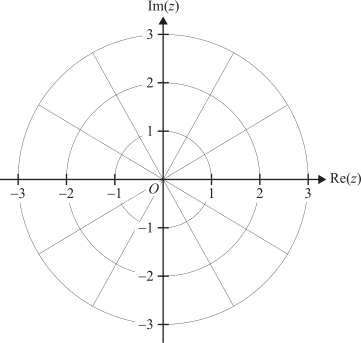
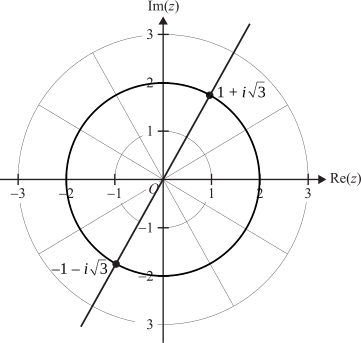
  1. Sketch \(\{z: z \bar{z}=4, z \in C\}\) on the Argand plane below.   (1 mark)
     

    1. Show that \(\{z:|z-2 i|=|z-\sqrt{3}-i|, z \in C\}\) may be expressed as  \(y=\sqrt{3} x\).   (2 marks)

      --- 5 WORK AREA LINES (style=lined) ---

    2. Sketch \(\{z:|z-2 i|=|z-\sqrt{3}-i|, z \in C\}\) on the Argand plane in part a.   (1 mark)

      --- 0 WORK AREA LINES (style=lined) ---

    1. Find the points of intersection of the curves defined in part a and in part b.i, expressing your answers in the form  \(a+i b\), where  \(a, b \in R\).   (2 marks)

      --- 4 WORK AREA LINES (style=lined) ---

    2. Label these points on the Argand plane in part a.   (1 mark)

      --- 0 WORK AREA LINES (style=lined) ---

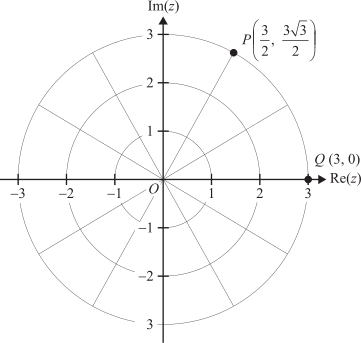
Consider the points \(P\) and \(Q\) labelled on the Argand plane below.
 

  1. A ray originating at point \(P\) and passing through point \(Q\) has the equation  \(\operatorname{Arg}\left(z-z_0\right)=\theta\), where \(\theta\) is a radian measure.
  2. Write down the values of \(z_0\) and \(\theta\).   (1 mark)

    --- 2 WORK AREA LINES (style=lined) ---

  3. Find the area of the minor segment bounded by the chord connecting the points \(P\) and \(Q\) and the circle given by  \(|z|=3\).
  4. Give your answer in the form \(c \pi+d\), where \(c, d \in R\).   (2 marks)

    --- 4 WORK AREA LINES (style=lined) ---

Show Answers Only

a.    \(z \bar{z}=4\ \ \Rightarrow\ \ \text{Circle, centre (0, 0), radius = 2}\)
 

b.i  \(\abs{z-2 i}=\abs{x+(y-2) i}=x^2+(y-2)^2\)

\(\abs{z-\sqrt{3}-i}=\abs{x-\sqrt{3}+(y-1)^2}=(x-\sqrt{3})^2+(y-1)^2\)

\(\text{Equating expressions:}\)

\(x^2+(y-2)^2=(x-\sqrt{3})^2+(y-1)^2\)

\(x^2+y^2-4 y+4=x^2-2 \sqrt{3} x+3+y^2-2 y+1\)

\(-2 y\) \(=-2 \sqrt{3} x\)
\(y\) \(=\sqrt{3} x\)


b.ii    \(\text {See image in part (a).}\)

  \(\abs{z-2 i}=\abs{z-\sqrt{3}-i} \ \Rightarrow \ \text{see straight line in image.}\)
 

c.i   \(\text{Find intersection:}\)

\(x^2+y^2=4 \ \ \text{and} \ \ y=\sqrt{3} x\)

\(x^2+3 x^2=4 \ \ \Rightarrow \ \ x^2=1 \ \ \Rightarrow \ \ x= \pm 1\)

\(\text{Intersection co-ordinates:}\ \ (1, \sqrt{3}),(-1,-\sqrt{3})\)

\(z=1+\sqrt{3} i\)

\(z=-1-\sqrt{3} i\)
 

c.ii  \(\text{See image in part (a)}\)
 

d.    \(z_0=\dfrac{3}{2}+\dfrac{3 \sqrt{3}}{2} i\)

\(\theta=-\dfrac{\pi}{3}\)
 

e.    \(A\) \(=\dfrac{1}{2} \times 3^2 \times\left(\dfrac{\pi}{3}-\sin \dfrac{\pi}{3}\right)\)
    \(=\dfrac{3}{2} \pi-\dfrac{9 \sqrt{3}}{4}\)
Show Worked Solution

a.    \(z \bar{z}=4\ \ \Rightarrow\ \ \text{Circle, centre (0, 0), radius = 2}\)
 

b.i  \(\abs{z-2 i}=\abs{x+(y-2) i}=x^2+(y-2)^2\)

\(\abs{z-\sqrt{3}-i}=\abs{x-\sqrt{3}+(y-1)^2}=(x-\sqrt{3})^2+(y-1)^2\)

\(\text{Equating expressions:}\)

\(x^2+(y-2)^2=(x-\sqrt{3})^2+(y-1)^2\)

\(x^2+y^2-4 y+4=x^2-2 \sqrt{3} x+3+y^2-2 y+1\)

\(-2 y\) \(=-2 \sqrt{3} x\)
\(y\) \(=\sqrt{3} x\)


b.ii    \(\text {See image in part (a).}\)

  \(\abs{z-2 i}=\abs{z-\sqrt{3}-i} \ \Rightarrow \ \text{see straight line in image.}\)
 

c.i   \(\text{Find intersection:}\)

\(x^2+y^2=4 \ \ \text{and} \ \ y=\sqrt{3} x\)

\(x^2+3 x^2=4 \ \ \Rightarrow \ \ x^2=1 \ \ \Rightarrow \ \ x= \pm 1\)

\(\text{Intersection co-ordinates:}\ \ (1, \sqrt{3}),(-1,-\sqrt{3})\)

\(z=1+\sqrt{3} i\)

\(z=-1-\sqrt{3} i\)
 

c.ii  \(\text{See image in part (a)}\)
 

d.    \(z_0=\dfrac{3}{2}+\dfrac{3 \sqrt{3}}{2} i\)

\(\theta=-\dfrac{\pi}{3}\)

Mean mark (d) 51%.
e.    \(A\) \(=\dfrac{1}{2} \times 3^2 \times\left(\dfrac{\pi}{3}-\sin \dfrac{\pi}{3}\right)\)
    \(=\dfrac{3}{2} \pi-\dfrac{9 \sqrt{3}}{4}\)

Filed Under: Geometry and Complex Numbers Tagged With: Band 3, Band 4, smc-1173-10-Circles, smc-1173-40-Linear

Calculus, SPEC2 2025 VCAA 1

  1. Sketch the graph of  \(y(x)=\dfrac{3 x}{x^3+x+2}\)  on the axes below.
  2. Label the asymptotes with their equations, and label the turning point and the point of inflection with their coordinates. Give the coordinates of the point of inflection correct to one decimal place.   (3 marks)

    --- 0 WORK AREA LINES (style=lined) ---

  1. The region bounded by the graph of  \(y=\dfrac{3 x}{x^3+x+2}\), the coordinate axes and the line  \(x=2\)  is rotated about the \(x\)-axis to form a solid of revolution.
    1. Write down a definite integral that, when evaluated, will give the volume of the solid of revolution.   (1 mark)

      --- 2 WORK AREA LINES (style=lined) ---

    2. Find the volume of the solid of revolution correct to two decimal places.   (1 mark)

      --- 2 WORK AREA LINES (style=lined) ---

  2. Find the equations of the vertical asymptotes of the curve given by  \(y=\dfrac{3 x}{x^3-5 x+2}\).   (1 mark)

    --- 3 WORK AREA LINES (style=lined) ---

  3. A family of curves is given by  \(y(x)=\dfrac{3 x}{x^3+a x+2}\), where  \(a \in R\).
    1. Consider the case where the graph has a stationary point \(P\).
    2. Find the \(y\)-coordinate of \(P\) in terms of \(a\).   (1 mark)

      --- 3 WORK AREA LINES (style=lined) ---

    3. For a given value of \(a\), the graph has no stationary points.
    4. Find the equations of the vertical asymptotes of the graph in this case.   (1 mark)

      --- 3 WORK AREA LINES (style=lined) ---

    5. For a given value of \(a\), the graph will have a point of inflection at  \(x=2\).
    6. Find the value of \(a\).   (2 marks)

      --- 3 WORK AREA LINES (style=lined) ---

Show Answers Only

a.    

b.i.    \(V=\displaystyle \int_0^2 \pi\left(\frac{3 x}{x^3+x+2}\right)^2 \, d x\)

b.ii.  \(V=2.29\ \text{u}^3\)

c.   \(x=-\sqrt{2}-1, \ x=\sqrt{2}-1, \ x=2\)

d.i.  \(\text{SP at} \ \left(1, \dfrac{3}{3+a}\right)\)
 

d.ii. \(\text{No SP’s exist when}\ \ 3+a=0 \ \ \Rightarrow \ \ a=-3\)

\(x=-2,1\)

d.iii.  \(a=\dfrac{24}{5}\)

Show Worked Solution

a.    

b.i.    \(V=\displaystyle \int_0^2 \pi\left(\frac{3 x}{x^3+x+2}\right)^2 \, d x\)
 

b.ii.  \(V=2.29\ \text{u}^3\)
 

c.   \(\text{Find vertical asymptotes.}\)

\(\text {Solve:} \ \ x^3-5 x+\dfrac{1}{2}=0\)

\(x=-\sqrt{2}-1, \ x=\sqrt{2}-1, \ x=2\)
 

d.i.  \(y=\dfrac{3 x}{x^3+a x+2}\)

\(\text{Find \(x\) when \(y^{\prime}=0 \ \ \Rightarrow \ \ x=1\)}\)

\(\text{SP at} \ \ \left(1, \dfrac{3}{3+a}\right)\)
 

d.ii. \(\text{No SP’s exist when}\ \ 3+a=0 \ \ \Rightarrow \ \ a=-3\)

\(y=\dfrac{3 x}{x^3-3 x+2}\)

\(\text{Vertical asymptotes occur when}\ \ x^3-3 x+2=0\)

\(\text{(By CAS):} \ \ x=-2,1\)

♦ Mean mark (d.ii) 46%.

d.iii.  \(\text{If POI exists at} \ \ x=2:\)

\(y^{\prime \prime}(2)=0 \ \Rightarrow \ \dfrac{-3(5 a-24)}{2(a+5)^3}=0\)

\(a=\dfrac{24}{5}\)

Filed Under: Solids of Revolution, Tangents and Curve Sketching Tagged With: Band 3, Band 4, Band 5, smc-1180-40-Other graphs, smc-1180-50-x-axis rotations, smc-1182-35-Sketch curve, smc-1182-40-Other 1st/2nd deriv problems

Calculus, EXT1 C3 2025 SPEC2 10*

The region bounded by the curve given by  \(y=3 \cos ^{-1}(x)\), for  \(0 \leq y \leq a\),  where  \(a>0\), and the line  \(x=0\)  is rotated about the \(y\)-axis to form a solid of revolution.

If the volume of the solid is  \(\dfrac{\pi(4 \pi+3 \sqrt{3})}{8}\), determine the value of \(a\).   (3 marks)

--- 9 WORK AREA LINES (style=lined) ---

Show Answers Only

\(a=\pi\)

Show Worked Solution

\(y=3 \cos ^{-1}(x) \ \Rightarrow \ x=\cos \left(\dfrac{y}{3}\right)\)

  \(V=\pi \displaystyle \int x^2\, d y\) \(=\pi  \displaystyle \int_0^a \cos ^2\left(\frac{y}{3}\right)\, d y\)
    \(=\pi  \displaystyle \int_0^a \dfrac{1}{2}\left(1+\cos\dfrac{2y}{3} \right)\,dy\)
    \(=\pi\,\left[\dfrac{y}{2}+\dfrac{3}{4}\sin \dfrac{2y}{3}\right]_0^a\)
    \(=\pi\,\left(\dfrac{a}{2}+\dfrac{3}{4}\sin \dfrac{2a}{3}\right)\)
    \(=\pi\,\left(\dfrac{4a+6 \times \sin\frac{2a}{3}}{8}\right)\)

 
\(\text{Equating volumes:}\ \ \dfrac{\pi(4 \pi+3 \sqrt{3})}{8}=\pi\,\left(\dfrac{4a+6 \times \sin\frac{2a}{3}}{8}\right)\)

\(\Rightarrow a=\pi\)

Filed Under: Further Area and Solids of Revolution, Further Areas and Solids of Revolution Tagged With: Band 4, smc-1039-20-Trig Function, smc-1039-61-y-axis Rotation, smc-7294-30-\(\large y\)-axis Rotation, smc-7294-55-Trig Function

Calculus, EXT1 C2 2025 SPEC2 7 MC

Using the substitution  \(u=\cos (\theta), \ \dfrac{1}{2} \displaystyle \int_0^{\tfrac{\pi}{2}} \dfrac{\sin (2 \theta)}{1+\cos (\theta)} \, d \theta\)  can be expressed as

  1. \(\displaystyle\int_0^{\tfrac{\pi}{2}} u \sqrt{\frac{1-u}{1+u}}\ d u\)
  2. \(\displaystyle\int_0^1\left(1+\frac{1}{1+u}\right) d u\)
  3. \(\displaystyle\int_0^{\tfrac{\pi}{2}}\left(1-\frac{1}{1+u}\right) d u\)
  4. \(\displaystyle\int_0^1\left(1-\frac{1}{1+u}\right) d u\)
Show Answers Only

\(D\)

Show Worked Solution

\(u=\cos (\theta) \ \Rightarrow \ du=-\sin (\theta)\ d \theta\)

\(\text{When} \ \ \theta=\dfrac{\pi}{2}, u=0\)

\(\text{When}\ \  \theta=0, u=1\)

\(I\) \(=\displaystyle\frac{1}{2} \int_0^{\tfrac{\pi}{2}} \frac{\sin (2 \theta)}{1+\cos \theta} \, d \theta\)
  \(=\displaystyle\int_0^{\tfrac{\pi}{2}} \frac{\sin (\theta) \cos (\theta)}{1+\cos (\theta)} \, d \theta\)
  \(=\displaystyle \int_1^0-\frac{u}{1+u} \, d u\)
  \(=\displaystyle\int_0^1 \frac{1+u-1}{1+u} \, d u\)
  \(=\displaystyle\int_0^1\left(1-\frac{1}{1+u}\right) \, d u\)


\(\Rightarrow D\)

Filed Under: Integration By Substitution, Integration By Substitution Tagged With: Band 4, smc-1036-30-Trig, smc-1036-50-Limits Invert, smc-7290-30-Trig, smc-7290-50-Limits Invert

Complex Numbers, EXT2 N1 2025 SPEC2 6*

Let  \(z \in C\).

Given that  \(|z|=1\)  and  \(z \neq 1,\) express  \(\operatorname{Re}\left(\dfrac{1}{1-z}\right)\) in its simplest form.   (3 marks)

--- 7 WORK AREA LINES (style=lined) ---

Show Answers Only

\(\operatorname{Re}\left(\dfrac{1}{1-z}\right) = \dfrac{1}{2}\)

Show Worked Solution

\(z=a+b i\)

\(\abs{z}=a^2+b^2=1\)

\(\dfrac{1}{1-z}=\dfrac{1}{1-(a+bi)}=\dfrac{1}{(1-a)-bi} \times \dfrac{(1-a)+bi}{(1-a)+bi}=\dfrac{(1-a)+bi}{(1-a)^2+b^2}\)

\(\operatorname{Re}\left(\dfrac{1}{1-z}\right)\) \(=\dfrac{-a+1}{a^2-2 a+b^2+1}\)
  \(=\dfrac{-a+1}{1-2 a+1}\)
  \(=\dfrac{-(a-1)}{-2(a-1)}\)
  \(=\dfrac{1}{2}\)

Filed Under: Arithmetic of Complex Numbers, Arithmetic of Complex Numbers Tagged With: Band 4, smc-1048-30-Other, smc-7427-30-Other Problems

Probability, 2ADV EQ-Bank 19

A new test has been developed for determining whether or not people are carriers of the Gaussian virus.

Two hundred people are tested. A two-way table is being used to record the results.
 

  1.  What is the value of `A`?   (1 mark)

    --- 1 WORK AREA LINES (style=lined) ---

  2.  A person randomly selected from the tested group is a carrier of the virus.
  3. What is the probability that the test results would show this?   (1 mark) 

    --- 4 WORK AREA LINES (style=lined) ---

  4. If the person randomly selected has a negative result from their test, what is the probability they are not a carrier of the virus?   (2 marks)

    --- 4 WORK AREA LINES (style=lined) ---

Show Answers Only

a.    `98`

b.    `37/43`

c.    `49/55`

Show Worked Solution

a.    `A= 200-(74 + 12 + 16)= 98`
 

b.    `P` `= text(#Positive carriers)/text(Total carriers)`
  `= 74/86`
  `= 37/43`


c.    `text(Total number with negative results) = 110`

`text{Total non-carriers with negative results}\ = 98`

`P\text{(not a carrier)|negative result}\ = 98/110=49/55`

Filed Under: Conditional Probability and Venn Diagrams Tagged With: Band 3, Band 4, smc-6470-25-Two-way tables

Probability, 2ADV EQ-Bank 6 MC

A survey of 370 people was conducted to investigate the association between watching Anime and the age of the person.

The two-way table shows the responses collected.

One response is randomly chosen. If the responder does not watch Anime, what is the probability they are 30 years old or under?

  1. 16%
  2. 29%
  3. 33%
  4. 50%
Show Answers Only

\(C\)

Show Worked Solution

\(\text{Total respondents who don’t watch anime}\ = 184\)

\(\text{Total respondents 30 years and under who don’t watch amine}\ = 61\)

\(P\text{(30 or under)}|\text{no anime} = \dfrac{61}{184}=0.331… \)

\(\Rightarrow C\)

Filed Under: Conditional Probability and Venn Diagrams Tagged With: Band 4, smc-6470-25-Two-way tables

Probability, 2ADV EQ-Bank 5 MC

A group of 485 people was surveyed. The people were asked whether or not they smoke. The results are recorded in the table.
 

A person is selected at random from the group.

If the person chosen was a female, what is the chance she is a non-smoker?

  1. 31%
  2. 32%
  3. 68%
  4. 69%
Show Answers Only

`D`

Show Worked Solution

`P(text(Female chosen is a non-smoker))`

`= (text(Total female non-smokers))/(text(Total females))`

`= 153/221`

`= 0.6923…`
 

`=> D`

Filed Under: Conditional Probability and Venn Diagrams Tagged With: Band 4, smc-6470-25-Two-way tables

Probability, 2ADV EQ-Bank 16

Lie detector tests are not always accurate. A lie detector test was administered to 200 people.

The results were:

• 50 people lied. Of these, the test indicated that 40 had lied;
• 150 people did NOT lie. Of these, the test indicated that 20 had lied.

  1. Complete the table using the information above   (1 mark)


    --- 0 WORK AREA LINES (style=lined) ---

  2. For what percentage of the people tested was the test accurate?   (1 mark)

    --- 3 WORK AREA LINES (style=lined) ---

  3. What is the probability that the test indicated a lie for a person who did NOT lie?   (1 mark)

    --- 3 WORK AREA LINES (style=lined) ---

Show Answers Only

a.    `text(See Worked Solutions)`

b.    `text(85%)`

c.    `2/15`

Show Worked Solution

a.

b.  `text(Percentage of people with accurate readings)`

`= text(# Accurate readings)/text(Total readings) xx 100`

`= (40+130)/200`

`= 85 text(%)`
 

c.  `text{P(lie detected when NOT a lie)}`

`= 20/150`

`= 2/15`

Filed Under: Conditional Probability and Venn Diagrams Tagged With: Band 3, Band 4, smc-6470-25-Two-way tables

Statistics, 2ADV EQ-Bank 6 MC

A petrol station records the amount charged to each customer, rounded to the nearest cent. Which statement best describes this random variable?

  1. Discrete, because the charge is rounded and can only take a countable set of values.
  2. Discrete, because the amount charged depends on the number of litres purchased.
  3. Continuous, because the volume of petrol dispensed can take any value within a range.
  4. Continuous, because the amount charged varies between customers.
Show Answers Only

\(A\)

Show Worked Solution
  • Although the underlying volume of petrol is continuous, the amount charged is rounded to the nearest cent, meaning it can only take values from a countable set.
  • This makes the random variable as defined – the charge – discrete.
  • Option C is the key distractor: it correctly identifies that volume is continuous, but the question defines the variable as the charge.

\(\Rightarrow A\)

Filed Under: Data Tagged With: Band 4, smc-6805-10-Discrete vs Continuous

Vectors, SPEC2 2025 VCAA 19 MC

The plane with equation  \(x+y+z=a\), where \(a \in R\), intersects the coordinate axes at three points that form the vertices of a triangle.

The area of this triangle is given by

  1. \(\dfrac{a^2 \sqrt{3}}{4}\)
  2. \(\dfrac{a^2 \sqrt{3}}{2}\)
  3. \(\dfrac{a^2}{4}\)
  4. \(a^2 \sqrt{3}\)
Show Answers Only

\(B\)

Show Worked Solution

\(\text{Plane:}\ \  x+y+z=a\)

\(\text{Axis intercepts:}\ \ (a, 0,0),(0, a, 0),(0,0, a)\)
 

\(\text{Distance between \((a, 0,0)\) and \((0, a, 0)\) :}\)

\(d=\sqrt{(a-0)^2+(0-a)^2+(0-0)^2}=\sqrt{2} a\)
 

\(\text{Similarly for the other two sides}\)

\(\Rightarrow \ \text{Equilateral triangle with side length} \ \sqrt{2} a\)

\(A=\dfrac{1}{2} a b \sin C=\dfrac{1}{2}(\sqrt{2} a)^2 \times \sin 60^{\circ}=\dfrac{1}{2} \times 2 a^2 \times \dfrac{\sqrt{3}}{2}=\dfrac{\sqrt{3} a^2}{2}\)

\(\Rightarrow B\)

Filed Under: Vector Lines, Planes and Geometry Tagged With: Band 4, smc-1177-80-Planes

Vectors, SPEC2 2025 VCAA 16 MC

The position vector of a particle at time \(t\) is given by  \(\underset{\sim}{ r }(t)=n e^{-2 t} \underset{\sim}{ i }-t^2 \underset{\sim}{ j }\), where \(n\) is a positive constant.

For what value of \(n\) is the particle's acceleration perpendicular to its velocity when  \(t=\dfrac{1}{2}\) ?

  1. \(2 e\)
  2. \(\dfrac{e^{0.5}}{2}\)
  3. \(\dfrac{e}{2}\)
  4. \(\dfrac{e}{2 \sqrt{2}}\)
Show Answers Only

\( C\)

Show Worked Solution
\(r(t)\) \(=n e^{-2 t} \underset{\sim}{i}-t^2 \underset{\sim}{j}\)
\(v(t)\) \(=-2n e^{-2t} \underset{\sim}{i}-2 t\underset{\sim}{i} \ \ \Rightarrow \ \ v\left(\frac{1}{2}\right)=-2 ne^{-1} \underset{\sim}{i}-\underset{\sim}{j}\)
\(a(t)\) \(=4 ne^{-2t} \underset{\sim}{i}-2 \underset{\sim}{j} \ \ \Rightarrow \ \ a\left(\frac{1}{2}\right)=4ne^{-1} \underset{\sim}{i}-2 \underset{\sim}{j}\)
 

\(\text{Velocity} \ \perp \ \text{acceleration at}\ \  t=\dfrac{1}{2}:\)

   \(\displaystyle \binom{-\dfrac{2 n}{e}}{-1}\binom{\dfrac{4 n}{e}}{-2}=0\)

\(-\dfrac{8 n^2}{e^2}+2=0 \ \ \Rightarrow \ \ n^2=\dfrac{e^2}{4} \ \ \Rightarrow \ \ n=\dfrac{e}{2}\)

\(\Rightarrow C\)

Filed Under: Position Vectors as a Function of Time Tagged With: Band 4, smc-1178-20-Find \(r(t)\ v(t)\ a(t)\)

Complex Numbers, EXT2 N2 2025 SPEC1 8

Consider the function with rule  \(f(z)=z^4+6 z^2+25\), where \(z \in C\).

  1. Consider  \(z_1=1+2 i\).
  2. Plot and label \(z_1\) and \(\overline{z}_1\) on the Argand plane below.   (1 mark)  

    --- 0 WORK AREA LINES (style=lined) ---

     
  3. Given that  \(1+2 i\)  is a solution of  \(f(z)=0\), find a quadratic factor of \(f(z)\).   (2 marks)  

    --- 6 WORK AREA LINES (style=lined) ---

  4. Hence, find all remaining solutions of  \(f(z)=0\).   (2 marks)

    --- 10 WORK AREA LINES (style=lined) ---

Show Answers Only

a.    \(z_1=1+z_i \ \Rightarrow \ \overline{z}_1=1-z_i\)
 

b.    \(z^2-2 z+5\)

c.    \(z=-1+2 i, z=-1-2 i\)

Show Worked Solution

a.    \(z_1=1+z_i \ \Rightarrow \ \overline{z}_1=1-z_i\)
 

b.    \(\text{Since} \ \ 1+2 i \ \ \text{is a solution of}\ \ f(z)=0:\)

\(\Rightarrow 1-2 i \ \ \text{is also a solution (conjugate factor theorem).}\)

\(\text {Express as a quadratic factor:}\)

\((z-(1+2 i))(z-(1-2 i))\) \(=((z-1)-2 i)((z-1)+2 i)\)
  \(=(z-1)^2-4 i^2\)
  \(=z^2-2 z+5\)


c.    \(f(z)=z^4+6 z^2+25, \quad z \in C\)

\(\text{Since \(\ z^2-2 z+5\ \) is a factor:}\)

\(f(z)\) \(=\left(z^2-2 z+5\right)\left(z^2+a z+b\right)\)
  \(=z^2\left(z^2+a z+b\right)-2 z\left(z^2+a z+b\right)+5\left(z^2+a z+b\right)\)
  \(=z^4+a z^3+b z^2-2 z^3-2 a z^2-2 b z+5 z^2+5 a z+5 b\)
  \(=z^4+(a-2) z^3+(b-2 a+5) z^2+(-2 b+5 a) z+5 b\)
Mean mark (c) 53%.

\(\text{Equating co-efficients:}\)

\(a-2=0 \ \Rightarrow \ a=2\)

\(5 b=25 \ \Rightarrow \ b=5\)

\(f(z)=\left(z^2-2 z+5\right)\left(z^2+2 z+5\right)\)
 

\(\text{Solve:} \ \ z^2+2 z+5=0\)

\(z=\dfrac{-2 \pm \sqrt{2^2-4 \cdot 1 \cdot 5}}{2}=\dfrac{-2 \pm \sqrt{-16}}{2}=-1 \pm 2 i\)

\(\therefore \ \text{Other solutions:}\ \ z=-1+2 i, z=-1-2 i\)

Filed Under: Solving Equations, Solving Equations with Complex Numbers Tagged With: Band 3, Band 4, smc-1050-10-Quadratic roots, smc-1050-30-Roots > 3, smc-1050-35-Conjugate roots, smc-7429-10-Quadratic roots, smc-7429-30-Roots > 3, smc-7429-35-Conjugate roots

Proof, EXT1 P1 2025 SPEC1 7

Use mathematical induction to prove that

\begin{align*}
\displaystyle \sum_{i=1}^n(i+1)^2=\frac{1}{6} n\left(2 n^2+9 n+13\right) \text { for all integers}\ n\geq 1,
\end{align*}

where  \(\displaystyle \sum_{i=1}^n(i+1)^2=2^2+3^2+4^2+\ldots+(n+1)^2\).   (4 marks)

--- 18 WORK AREA LINES (style=lined) ---

Show Answers Only

\(\text{See Worked Solutions}\)

Show Worked Solution

\(\text{Prove} \ \ \displaystyle \sum_{i=1}^n(i+1)^2=\dfrac{1}{6} n\left(2 n^2+9 n+13\right)\)

\(\text{If} \ \ n=1:\)

\(\text{LHS}=(1+1)^2=4\)

\(\text {RHS}=\dfrac{1}{6} \times 1(2+9+13)=4\)

\(\therefore \ \text{True for} \ \ n=1\)
 

\(\text{Assume true for} \ \ n=k:\)

\(\text{i.e.} \ \ \displaystyle \sum_{i=1}^k(i+1)^2=\frac{1}{6} k\left(2 k^2+9 k+13\right)\ \ldots\ (1)\)

\(\text{Prove true for} \ \ n=k+1:\)

\(\text{i.e.} \ \ \displaystyle \sum_{i=1}^{k+1}(i+1)^2\) \(=\dfrac{1}{6}(k+1)\left[2(k+1)^2+9(k+1)+13\right]\)
  \(=\dfrac{1}{6}(k+1)\left(2 k^2+4 k+2+9 k+9+13\right)\)
  \(=\dfrac{1}{6}(k+1)\left(2 k^2+13 k+24\right)\)


\(\operatorname{LHS}\) \(=\dfrac{1}{6} k\left(2 k^2+9 k+13\right)+(k+2)^2\ \ \text{(using (1) above)}\)
  \(=\dfrac{1}{6}\left(2 k^3+9 k^2+13 k\right)+\left(k^2+4 k+4\right)\)
  \(=\dfrac{1}{6}\left(2 k^3+9 k^2+13 k+6 k^2+24 k+24\right)\)
  \(=\dfrac{1}{6}\left(2 k^3+15 k^2+37 k+24\right) \quad \text{(see long division below)}\)
  \(=\dfrac{1}{6}(k+1)\left(2 k^2+13 k+24\right)\)
  \(=\operatorname{RHS}\)


\(\Rightarrow \ \text{True for} \ \ n=k+1\)

\(\therefore \ \text{Since true for \(n=1\), by PMI, true for integers}\ \ n \geq 1.\)

Filed Under: Induction (Y12), Uncategorized Tagged With: Band 4, smc-1019-20-Sum of a Series, smc-7281-20-Sum of a Series

Calculus, EXT1 2025 SPEC1 6

Find the volume of the solid of revolution formed when the area between the curve  \(y=\sqrt{\dfrac{\arctan (x)}{1+x^2}}\)  and the \(x\)-axis from  \(x=1\)  to  \(x=\sqrt{3}\)  is rotated about the \(x\)-axis.

Give your answer in exact form.   (4 marks)

--- 12 WORK AREA LINES (style=lined) ---

Show Answers Only

\(V=\dfrac{7 \pi^3}{288}\ \ \text{u}^3\)

Show Worked Solution
\(y\) \(=\sqrt{\dfrac{\tan ^{-1}(x)}{1+x^2}}\)
\(V\) \(=\displaystyle\pi \int_1^{\sqrt{3}} \frac{\tan ^{-1}(x)}{1+x^2} d x\)


\(\text{Let} \ \ u=\tan ^{-1}(x) \ \Rightarrow \ du=\dfrac{d x}{1+x^2}\)

\(\text{When} \ \ x=\sqrt{3}, u=\tan ^{-1} \sqrt{3}=\dfrac{\pi}{3}\)

\(\text{When} \ \ x=1, u=\tan ^{-1} 1=\dfrac{\pi}{4}\)

\(V\) \(=\displaystyle \pi \int_{\tfrac{\pi}{4}}^{\tfrac{\pi}{3}} u\,dx\)
  \(=\dfrac{\pi}{2}\Big[u^2\Big]_{\tfrac{\pi}{4}}^{\tfrac{\pi}{3}}\)
  \(=\dfrac{\pi}{2}\left[\left(\dfrac{\pi}{3}\right)^2-\left(\dfrac{\pi}{4}\right)^2\right]\)
  \(=\dfrac{\pi^3}{2}\left(\dfrac{1}{9}-\dfrac{1}{16}\right)\)
  \(=\dfrac{7 \pi^3}{288}\ \ \text{u}^3\)

Filed Under: Further Area and Solids of Revolution, Further Areas and Solids of Revolution Tagged With: Band 4, smc-1039-20-Trig Function, smc-1039-60-x-axis Rotation, smc-7294-20-\(\large x\)-axis Rotation, smc-7294-55-Trig Function

Calculus, EXT2 C1 EQ-Bank 20

Find  \(\displaystyle \int_0^1\dfrac{3}{2 \log _e 2}\left(\dfrac{1}{(t+1)(2-t)}\right) d t\)   (4 marks)

--- 12 WORK AREA LINES (style=lined) ---

Show Answers Only

\(I=\dfrac{1}{2}\)

Show Worked Solution

\(I=\dfrac{3}{2 \ln 2} \displaystyle \int_0^1 \dfrac{t}{(t+1)(2-t)}\, dt\)
 

\(\text {Using partial fractions:}\)

\(\dfrac{t}{(t+1)(2-t)}=\dfrac{A}{(t+1)}+\dfrac{B}{(2-t)}\)

\(A(2-t)+B(t+1)=t\)

\(\text{If}\ \ t=2:\)

\(3 B=2 \ \Rightarrow \ B=\dfrac{2}{3}\)

\(\text{If}\ \ t=-1:\)

\(3 A=-1 \ \Rightarrow \ A=-\dfrac{1}{3}\)
 

\(I\) \(=\displaystyle \frac{3}{2 \ln 2} \int_0^1-\frac{1}{3(t+1)}+\frac{2}{3(2-t)} d t\)
  \(=\displaystyle\frac{1}{2 \ln 2} \int_0^1-\frac{1}{t+1}+\frac{2}{2-t} d t\)
  \(=\displaystyle\frac{1}{2 \ln 2}\Big[-\ln \abs{t+1}+2 \ln \abs{2-t}\Big]_0^1\)
  \(=\displaystyle\frac{1}{2 \ln 2}[(-\ln 2+2 \ln 1)-(2 \ln 1-2 \ln 2)]\)
  \(=\displaystyle\frac{1}{2 \ln 2}(\ln 2)\)
  \(=\displaystyle\frac{1}{2}\)

Filed Under: Partial Fractions, Partial Fractions Tagged With: Band 4, smc-1056-10-\(\large x^2\ \) denominator, smc-1056-40-PF not given, smc-7434-10-\(\large x^2\ \) denominator, smc-7434-40-PF not given

Mechanics, EXT2 M1 2025 SPEC1 3

A particle starts from rest at a fixed point \(O\) and travels in a straight line.

The velocity, \(v\) m s\(^{-1}\), of the particle at time \(t\) seconds has equation  \(v(t)=\dfrac{t}{\sqrt{t^2+k}}\), where \(k\) is a positive constant and  \(t \geq 0\).

  1. Use integration to show that the displacement, \(x\) metres, of the particle relative to \(O\) is given by  \(x(t)=\sqrt{t^2+k}-\sqrt{k}\).   (1 mark)

    --- 5 WORK AREA LINES (style=lined) ---

  2. Find the initial acceleration, in terms of \(k\), of the particle in m s\(^{-2}\).   (2 marks)

    --- 5 WORK AREA LINES (style=lined) ---

  3. Another particle starts at \(O\) at the same time as the first particle and follows the same path.
  4. Its position relative to \(O\) is described by the equation  \(s(t)=t\).
  5. Three seconds after leaving \(O\) the second particle is 1 m ahead of the first particle.
  6. Find the value of \(k\).   (2 marks)

    --- 5 WORK AREA LINES (style=lined) ---

Show Answers Only

a.    \(v=\dfrac{t}{\sqrt{t^2+k}}\)

\(x=\displaystyle \int \frac{t}{\sqrt{t^2+k}} d t=\sqrt{t^2+k}+c\)
 

\(\text{When} \ \  t=0, x=0:\)

\(0=\sqrt{k}+c \ \ \Rightarrow \ \ c=-\sqrt{k}\)

\(\therefore x=\sqrt{t^2+k}-\sqrt{k}\)
 

b.    \(a=-\sqrt{k}\)

c.    \(k=\dfrac{25}{16}\)

Show Worked Solution

a.    \(v=\dfrac{t}{\sqrt{t^2+k}}\)

\(x=\displaystyle \int \frac{t}{\sqrt{t^2+k}} d t=\sqrt{t^2+k}+c\)
 

\(\text{When} \ \  t=0, x=0:\)

\(0=\sqrt{k}+c \ \ \Rightarrow \ \ c=-\sqrt{k}\)

\(\therefore x=\sqrt{t^2+k}-\sqrt{k}\)
 

b.    \(\text{Find initial acceleration:}\)

\(v=t\left(t^2+k\right)^{-\tfrac{1}{2}}\)

\(\text{Using product rule:}\)

\(\dfrac{dv}{dt}\) \(=t\cdot-\dfrac{1}{2} \cdot 2 t\left(t^2+k\right)^{-\tfrac{3}{2}}+\left(t^2+k\right)^{-\tfrac{1}{2}}\)
  \(=-t^2\left(t^2+k\right)^{-\tfrac{3}{2}}+\left(t^2+k\right)^{-\tfrac{1}{2}}\)


\(\text{At} \ \ t=0:\)

\(a=\dfrac{dv}{dt}=0+k^{-\tfrac{1}{2}}=-\sqrt{k}\)
 

c.   \(\text{1st particle:} \ \ x(3)=\sqrt{9+k}-\sqrt{k}\)

\(\text{2nd particle:} \ \ s(3)=3\)
 

\(\text{Since at \(t=3\), second particle is 1m ahead:}\)

\(3-\sqrt{9+k}+\sqrt{k}=1\)

\(\sqrt{9+k}\) \(=2+\sqrt{k}\)
\(\left(\sqrt{9+k}\right)^2\) \(=(2+\sqrt{k})^2\)
\(9+k\) \(=4+4 \sqrt{k}+k\)
\(4 \sqrt{k}\) \(=5\)
\(\sqrt{k}\) \(=\dfrac{5}{4}\)
\(k\) \(=\dfrac{25}{16}\)
♦ Mean mark (c) 40%.

Filed Under: Forces and Further Motion in a Straight Line, Motion Without Resistance Tagged With: Band 4, Band 5, smc-1060-04-Motion as f(t), smc-1060-35-Other function, smc-7437-20-Motion as \(\large \ f(t)\), smc-7437-75-Other functions

Vectors, EXT2 V1 2025 SPEC1 2

Consider the following two lines, \(L_1\) and \(L_2\).

\(L_1\) passes through the point \(A_1(2,3,1)\) and has direction  \(\underset{\sim}{u}=\underset{\sim}{i}+2 \underset{\sim}{j}-\underset{\sim}{k}\).

\(L_2\) passes through the point \(A_2(1,3,2)\) and has direction  \(\underset{\sim}{v}=-\underset{\sim}{i}-\underset{\sim}{j}+\underset{\sim}{k}\).

Find the coordinates of the point of intersection of the two lines.   (3 marks)

--- 10 WORK AREA LINES (style=lined) ---

Show Answers Only

\(\text{Intersection at}\ (3,5,0).\)

Show Worked Solution

\(\underset{\sim}{u}=\underset{\sim}{i}+2 \underset{\sim}{j}-\underset{\sim}{k} \ \ \text {passes through} \ A_1(2,3,1)\)

\(L_1:(2+t) \underset{\sim}{i}+(3+2 t) \underset{\sim}{j}+(1-t) \underset{\sim}{k}\)

\(\underset{\sim}{v}=\underset{\sim}{-i}-\underset{\sim}{j}+\underset{\sim}{k} \ \ \text {passes through}\  A_2(1,3,2)\)

\(L_2:(1-s) \underset{\sim}{i}+(3-s)\underset{\sim}{j}+(2+s) \underset{\sim}{k}\)

\(\text{Equating components for intersection:}\)

\(2+t=1-s \ \ \Rightarrow \ \ s+t=-1\ \ldots\ (1)\)

\(3+2 t=3-s \ \ \Rightarrow \ \ s+2 t=0\ \ldots\ (2)\)

\(\text{Subtract: (2) – (1)}\)

\(t=1 \ \Rightarrow \ s=-2\)

\(\text{Point of intersection:}\)

\((2+1,3+2,1-1) \equiv(3,5,0)\)

Filed Under: Equations of Lines and Curves, Vectors and Vector Equations of Lines Tagged With: Band 4, smc-1196-20-Intersection, smc-7425-20-Intersection

Calculus, SPEC2 2025 VCAA 11 MC

Given that \(y(x)\) is a solution to the differential equation  \(\dfrac{d y}{d x}=x^2 y^3\), where  \(y(1)=3\), the domain of \(y\) is

  1. \(x \leq\left(\dfrac{7}{6}\right)^{\tfrac{1}{3}}\)
  2. \(x<\left(\dfrac{7}{6}\right)^{\tfrac{1}{3}}\)
  3. \(x \geq\left(\dfrac{7}{6}\right)^{\tfrac{1}{3}}\)
  4. \(x>\left(\dfrac{7}{6}\right)^{\tfrac{1}{3}}\)
Show Answers Only

\(B\)

Show Worked Solution

\(\text {Solve DE (by CAS):}\)

\(\dfrac{d y}{d x}=x^2 y^3 \ \ \text{where} \ \ y(1)=3:\)

\(\dfrac{1}{18}-\dfrac{1}{2 y^2}=\dfrac{x^3}{3}-\dfrac{1}{3} \ \ \Rightarrow  \ y= \pm \sqrt{\dfrac{9}{7-6 x^3}}\)

\(\text{Solve} \ \ \dfrac{9}{7-6 x^3}>0:\)

\(x<\left(\dfrac{7}{6}\right)^{\tfrac{1}{3}}\)

\(\Rightarrow B\)

Mean mark 55%.

Filed Under: Equations Tagged With: Band 4, smc-5161-30-\(\dfrac{dy}{dx}=f(x,y)\)

Calculus, SPEC2 2025 VCAA 10 MC

The region bounded by the curve given by  \(y=3 \cos ^{-1}(x)\), for  \(0 \leq y \leq a\),  where  \(a>0\), and the line  \(x=0\)  is rotated about the \(y\)-axis to form a solid of revolution. The volume of the solid is  \(\dfrac{\pi(4 \pi+3 \sqrt{3})}{8}\).

The value of \(a\) is

  1. \(\dfrac{\pi}{4}\)
  2. \(\dfrac{\pi}{3}\)
  3. \(\dfrac{\pi}{2}\)
  4.  \(\pi\)
Show Answers Only

\(D\)

Show Worked Solution

\(y=3 \cos ^{-1}(x) \ \Rightarrow \ x=\cos \left(\dfrac{y}{3}\right)\)

\(V=\pi \displaystyle \int x^2\, d y=\pi \int \cos ^2\left(\frac{y}{3}\right) d y\)

\(\text{Solve for} \ a:\)

\(\pi  \displaystyle \int_0^a \cos ^2\left(\frac{y}{3}\right) d y=\frac{\pi(4 \pi+3 \sqrt{3})}{8}\)

\(a=\pi\)

\(\Rightarrow D\)

Filed Under: Solids of Revolution Tagged With: Band 4, smc-1180-20-Trig function, smc-1180-60-y-axis rotation

Complex Numbers, SPEC2 2025 VCAA 6 MC

Let  \(z \in C\).

Given that  \(|z|=1\)  and  \(z \neq 1, \operatorname{Re}\left(\dfrac{1}{1-z}\right)\) is

  1. \(-\dfrac{1}{2}\)
  2. \(0\)
  3. \(\dfrac{1}{2}\)
  4. \(\dfrac{\sqrt{3}}{2}\)
Show Answers Only

\(C\)

Show Worked Solution

\(z=a+b i\)

\(\abs{z}=a^2+b^2=1\)

\(\dfrac{1}{1-z}=\dfrac{1}{1-(a+bi)}=\dfrac{1}{(1-a)-bi} \times \dfrac{(1-a)+bi}{(1-a)+bi}=\dfrac{(1-a)+bi}{(1-a)^2+b^2}\)

\(\operatorname{Re}\left(\dfrac{1}{1-z}\right)\) \(=\dfrac{-a+1}{a^2-2 a+b^2+1}\)
  \(=\dfrac{-a+1}{1-2 a+1}\)
  \(=\dfrac{-(a-1)}{-2(a-1)}\)
  \(=\dfrac{1}{2}\)

\(\Rightarrow C\)

Filed Under: Basic Calculations Tagged With: Band 4, smc-1171-10-Basic Calculations

Complex Number, SPEC2 2025 VCAA 5 MC

The equation  \(z^3+a z^2+b z-52=0\), where \(a, b \in R\)  and  \(z \in C\), has a solution \(z=2-3 i\).

The value of \(a b\) is

  1. \(-232\)
  2. \(-64\)
  3. \(-8\)
  4. \(0\)
Show Answers Only

\(A\)

Show Worked Solution

\(z^3+a z^2+b z-5 z=0 \ \ \text {has factor}\ \ z=2-3 i\)

\((2-3 i)^3+a(2-3 i)^2+b(2-3 i)-52=0\)

\(\text{Expand by CAS:}\)

\((-5 a+2 b-98)+(-12 a-3 b-9) i=0\)
 

\(\text {Equating co-efficients:}\)

\(\text{Solve for \(a, b\) (by CAS) given}\)

\(-5 a+2 b-98=0\ \ldots\ (1)\)

\(-12 a-3 b-9=0\ \ldots\ (2)\)

\(a=-8, \ b=29 \ \ \Rightarrow \ \ a b=-232\)

\(\Rightarrow A\)

Filed Under: Factors and Roots Tagged With: Band 4, smc-1172-20-Cubic roots

Calculus, SPEC2 2025 VCAA 4 MC

Consider the following algorithm used to estimate a volume of revolution.

The algorithm above will print the value

  1. \(5 \pi\)
  2. \(9 \pi\)
  3. \(14 \pi\)
  4. \(29 \pi\)
Show Answers Only

\(B\)

Show Worked Solution

\(\text{Working through algorithm:}\)

\(f(x)=\sqrt{x+1}\)

\begin{array}{ccl}
\text { left } & \text { volume } & \text { sum } \\
1 & \pi(f(1))^2 & 2 \pi \\
2 & \pi(f(2))^2 & 2 \pi+3 \pi=5 \pi \\
3 & \pi(f(3))^2 & 5 \pi+4 \pi=9 \pi
\end{array}

\(\Rightarrow B\)

Filed Under: Euler, Pseudocode and Slope Fields Tagged With: Band 4, smc-1183-15-Pseudocode

  • « Previous Page
  • 1
  • 2
  • 3
  • 4
  • 5
  • 6
  • …
  • 121
  • Next Page »

Copyright © 2014–2026 SmarterEd.com.au · Log in