SmarterEd

Aussie Maths & Science Teachers: Save your time with SmarterEd

  • Login
  • Get Help
  • About

PHYSICS, M3 2018 VCE 10 MC

A loudspeaker is producing a sound wave of constant frequency. Consider a tiny dust particle 1.0 m in front of the loudspeaker.
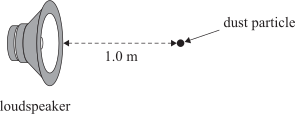
 

Which one of the following diagrams best describes the motion of the dust particle?

 

Show Answers Only

\(D\)

Show Worked Solution
  • As a sound wave is a longitudinal wave, the air and dust molecules through which the sound wave passes vibrate parallel to the direction of energy transfer. 
  • As the sound is travelling left to right (horizontally), the dust particle will vibrate forwards and backwards in the horizontal plane.

\(\Rightarrow D\)

Filed Under: Sound Waves Tagged With: Band 4, smc-4280-30-Sound wave behaviour

PHYSICS, M2 2018 VCE 8-9 MC

A railway truck \(\text{X}\) of mass 10 tonnes, moving at 6.0 m s\(^{-1}\), collides with a stationary railway truck \(\text{Y}\) of mass 5.0 tonnes. After the collision the trucks are joined together and move off as one. The situation is shown below.
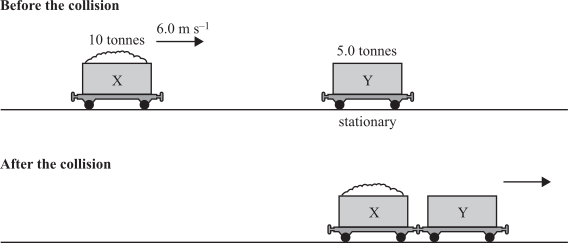


Question 8

The final speed of the joined railway trucks after the collision is closest to

  1. \( 2.0 \text{ m s}^{-1}\)
  2. \( 3.0 \text{ m s} ^{-1}\)
  3. \( 4.0 \text{ m s} ^{-1}\)
  4. \( 6.0 \text{ m s} ^{-1}\)
     

Question 9

The collision of the railway trucks is best described as one where

  1. kinetic energy is conserved but momentum is not conserved.
  2. kinetic energy is not conserved but momentum is conserved.
  3. neither kinetic energy nor momentum is conserved.
  4. both kinetic energy and momentum are conserved.
Show Answers Only

\(\text{Question 8:}\ C\)

\(\text{Question 9:}\ B\)

Show Worked Solution

Question 8

  • By the law of conservation of momentum:
\(m_Xu_X+m_Yu_Y\) \(=m_Xv_X+m_Yv_Y\)  
  \(=v(m_X + m_Y)\ \ \ (v_X=v_Y) \)  
\(10\ 000 \times 6 +0\) \(= v(10\ 000 + 5000)\)  
\(60\ 000\) \(=15\ 000v\)  
\(v\) \(=4\ \text{ms}^{-1}\)   

 
\( \Rightarrow C\)
 

Question 9

  • By the law of conservation of momentum, momentum in the collision is conserved.
  • Kinetic energy conservation:
       \(KE_{\text{init}}\) \(=\dfrac{1}{2}m_Xu_X^2+\dfrac{1}{2}m_Yu_Y^2\)
   

\(=\dfrac{1}{2} \times 10\ 000 \times 6^2 + \dfrac{1}{2} \times 5000 \times 0^2\)

    \(=180\ 000\ \text{J}\)


\(KE_{\text{final}}\) \(=\dfrac{1}{2}(m_X+m_Y)v^2\)  
  \(=\dfrac{1}{2} \times 15\ 000 \times 4^2\)   
  \(=120\ 000\ \text{J}\)  

  
\(\therefore\) The kinetic energy of the system decreases after the collision and so is not conserved.

\(\Rightarrow B\)

Filed Under: Momentum, Energy and Simple Systems Tagged With: Band 3, Band 4, smc-4277-20-Momentum conservation, smc-4277-30-Energy conservation

PHYSICS, M2 2018 VCE 6 MC

Lisa is driving a car of mass 1000 kg at 20 ms\( ^{-1}\) when she sees a dog in the middle of the road ahead of her. She takes 0.50 s to react and then brakes to a stop with a constant braking force. Her speed is shown in the graph below. Lisa stops before she hits the dog.
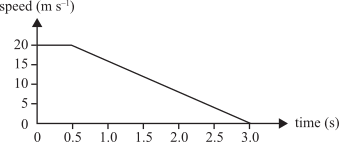
 

Which one of the following is closest to the magnitude of the braking force acting on Lisa's car during her braking time?

  1. \(6.7 \text{ N}\)
  2. \(6.7 \text{ kN}\)
  3. \(8.0 \text{ kN}\)
  4. \(20.0 \text{ kN}\)
Show Answers Only

\(C\)

Show Worked Solution
  • The deceleration of the car from \(0.5\ \text{s}\) to \(3.0\ \text{s}\) is:
  •    \(a=\dfrac{\Delta v}{\Delta t}= \dfrac{20}{2.5}=8\ \text{ms}^{-2}\) 
  • Thus the braking force on the car can be calculated:
  •    \(F = ma = 1000 \times 8 = 8000\ \text{N} = 8.0\ \text{kN} \)

\(\Rightarrow C\)

Filed Under: Forces, Acceleration and Energy Tagged With: Band 4, smc-4276-50-F=ma

PHYSICS, M1 2018 VCE 5*

Four students are pulling on ropes in a four-person tug of war. The relative sizes of the forces acting on the various ropes are \(F_{ W }=200 \text{ N} , F_{ X }=240 \text{ N} , F_{ Y }=180 \text{ N}\) and \(F_{ Z }=210 \text{ N}\). The situation is shown in the diagram below.
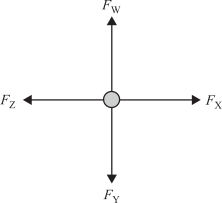
 

What is the resultant force vector \((F_{\vec{R}})\) acting at the centre of the tug-of-war ropes?   (3 marks)
Show Answers Only

\(F_{\vec{R}}=36.1\ \text{N}, 33.7^{\circ}\) above the horizontal.

Show Worked Solution
  • By resolving the vertical vectors of \(F_{ W }=200 \text{ N}\) up and \(F_{ Y }=180 \text{ N}\) down, the net force in the vertical direction is \(F_v=20\ \text{N}\) up.
  • Similarly, the net force in the horizontal direction is \(F_h=30\ \text{N}\) to the right.
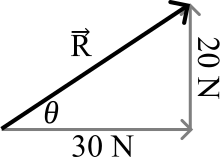
  • Thus the resultant vector \((F_{\vec{R}})\) can be calculated using the vector diagram below.

  • The magnitude of  \(F_{\vec{R}}=\sqrt{20^2+30^2}\)  and  \(\theta=\tan^{-1}\Big{(}\dfrac{20}{30}\Big{)}\)
  • Hence \(F_{\vec{R}}=36.1\ \text{N}, 33.7^{\circ}\) above the horizontal.

Filed Under: Motion on a Plane Tagged With: Band 4, smc-4274-10-Vector addition, smc-4274-20-Vector resolution

PHYSICS, M3 2019 VCE 15

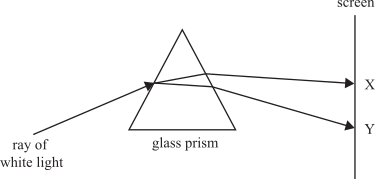
A student sets up an experiment involving a source of white light, a glass prism and a screen. The path of a single ray of white light when it travels through the prism and onto the screen is shown in Figure 14.
 

A spectrum of colours is observed by the student on the screen, which is positioned to the right of the prism.

  1. Name and explain the effect observed by the student.   (3 marks)

    --- 5 WORK AREA LINES (style=lined) ---

  2. Points \(\text{X}\) and \(\text{Y}\) on the diagram above represent either end of the visible spectrum observed by the student.
  3. Identify the two visible colours observed at point \(\text{X}\) and at point \(\text{Y}\).   (1 mark)

    --- 2 WORK AREA LINES (style=lined) ---
Show Answers Only

a.   The observed effect is dispersion.

  • As light enters the glass it slows down as it is entering a denser medium.
  • As the refractive index for different wavelengths of light differs, the angle at which individual wavelengths refract differs slightly.
  • This causes the white light to split up as each wavelength refracts differently through the glass resulting in a rainbow spectrum on the screen.

 b.   Point \(X\) is red.

        Point \(Y\) is blue/purple.

Show Worked Solution

a.   The observed effect is dispersion.

  • As light enters the glass it slows down as it is entering a denser medium.
  • As the refractive index for different wavelengths of light differs, the angle at which individual wavelengths refract differs slightly.
  • This causes the white light to split up as each wavelength refracts differently through the glass resulting in a rainbow spectrum on the screen.
♦ Mean mark 53%.

b.   Point \(X\) is red.

        Point \(Y\) is blue/purple.

Filed Under: Ray Model of Light Tagged With: Band 4, Band 5, smc-4281-30-Light dispersion, smc-4281-40-Speed of light in medium

BIOLOGY, M4 2021 VCE 23 MC

Mass extinction events

  1. allow new species to evolve to occupy available niches.
  2. allow all species that survive to recover and diverge.
  3. result from a constant global climate.
  4. affect all species equally.
Show Answers Only

\(A\)

Show Worked Solution
  • When a mass extinction event occurs, it allows the remaining species to occupy the previously inhabited niches.

\(\Rightarrow A\)

Filed Under: Population Dynamics Tagged With: Band 4, smc-4311-50-Extinction

CHEMISTRY, M4 EQ-Bank 5

The following reaction represents the conversion of diamond to graphite:

\(\ce{2C_{diamond} \rightarrow 2C_{graphite}}\)

    • \(\ce{\Delta $H$_{f}\ C_{diamond} = 1.9 kJ mol^{-1}}\)
    • \(\ce{\Delta $S$_{f}\ C_{diamond} = 2.38 J mol^{-1} K^{-1}}\)
    • \(\ce{\Delta $S$_{f}\ C_{graphite} = 5.74 J mol^{-1} K^{-1}}\)
  1. Determine \(\Delta G\) at 298K and state whether the reaction is spontaneous or not.   (3 marks)

    --- 7 WORK AREA LINES (style=lined) ---

  2. What does \(\Delta G\) indicate about the rate of reaction?   (1 mark)

    --- 2 WORK AREA LINES (style=lined) ---

Show Answers Only

a.    \(\Delta G = -5.8025\ \text{kJ}\)

  • Reaction is spontaneous.

b.   Rate of reaction and \(\Delta G\): 

  • Gibbs Free Energy doesn’t indicate anything about the kinetics of the reaction. While the conversion of diamond to graphite is spontaneous, it occurs over millions of year
Show Worked Solution

a.  Standard enthalpy and entropy of elements in their natural state is 0.

\(\Delta H\) \(= \Sigma H_{\text{products}}-\Sigma H_{\text{reactants}}\)  
  \(= (2 \times 0)-(2 \times 1.9)\)  
  \(=-3.8\ \text{kJ mol}^{-1} \)  


\(\Delta S\) \(=\Sigma S_{\text{products}}-\Sigma S_{\text{reactants}}\)  
  \(= (2 \times 5.74)-(2 \times 2.38)\)  
  \(= 11.48-4.76 \)  
  \(=6.72\ \text{J mol}^{-1}\ \text{K}^{-1}\)  


\(\Delta G\) \(= \Delta H-T\Delta S\)  
  \(= -3.8-(298 \times 0.00672)\)  
  \(= -5.8025\ \text{kJ}\)  
     
  •  The reaction is spontaneous as \(\Delta G < 0\).
     

b.   Rate of reaction and \(\Delta G\): 

  • Gibbs Free Energy doesn’t indicate anything about the kinetics of the reaction. While the conversion of diamond to graphite is spontaneous, it occurs over millions of year

Filed Under: Entropy and Gibbs Free Energy Tagged With: Band 4, Band 5, smc-4268-50-Determining Spontaneity, smc-4268-80-Calculating G, smc-4268-80-Calculating S

CHEMISTRY, M4 EQ-Bank 4

Of the following state changes, explain which represents the smallest increase in entropy and which represents the largest.   (3 marks)

    1. Sublimation of ice to gas
    2. Melting of ice to liquid water
    3. Freezing of water to ice

--- 6 WORK AREA LINES (style=lined) ---

Show Answers Only
  • State change (3) has the smallest entropy increase as solids have less entropy than liquids and the freezing of water indicates a decrease in entropy as order increases.
  • State change (2) has a larger increase in entropy than state change (3) as water has more entropy than the solid ice it is formed from.
  • State change (1) has the largest entropy increase as gas has the most entropy compared to solids or liquids.
Show Worked Solution
  • State change (3) has the smallest entropy increase as solids have less entropy than liquids and the freezing of water indicates a decrease in entropy as order increases.
  • State change (2) has a larger increase in entropy than state change (3) as water has more entropy than the solid ice it is formed from.
  • State change (1) has the largest entropy increase as gas has the most entropy compared to solids or liquids.

Filed Under: Entropy and Gibbs Free Energy Tagged With: Band 4, smc-4268-60-Predicting Entropy Changes

CHEMISTRY, M4 EQ-Bank 3

A 3.1g sample of \(\ce{CaCO3_{(s)}}\) decomposes into \(\ce{CaO_{(s)}}\) and \(\ce{CO2_{(g)}}\). Entropy values  for these chemicals are given below and the molar enthalpy for the reaction is 360 kJ/mol.

\begin{array} {|l|c|}
\hline
\rule{0pt}{2.5ex}\text{Substance}\rule[-1ex]{0pt}{0pt} & \text{Standard Entropy}\ (\Delta S) \\
\hline
\rule{0pt}{2.5ex}\ce{CaCO3}\rule[-1ex]{0pt}{0pt} & \text{92.88 J/K} \\
\hline
\rule{0pt}{2.5ex}\ce{CaO(s)}\rule[-1ex]{0pt}{0pt} & \text{39.75 J/K} \\
\hline
\rule{0pt}{2.5ex}\ce{CO2(g)}\rule[-1ex]{0pt}{0pt} & \text{213.6 J/K} \\
\hline
\end{array}

  1. Write a chemical equation for the above reaction.  (1 mark)

    --- 1 WORK AREA LINES (style=lined) ---

  2. Calculate the entropy change for this reaction.  (2 marks)

    --- 4 WORK AREA LINES (style=lined) ---

  3. Determine whether the reaction is spontaneous or non-spontaneous at room temperature.  (2 marks)

    --- 4 WORK AREA LINES (style=lined) ---

Show Answers Only
  1. \(\ce{CaCO3(s) \rightarrow CaO(s) + CO2(g)}\)
  2. \(\ce{4.97 J K^{-1}}\)
  3. \(\text{Since}\ \Delta G > 0,\ \text{the reaction is not spontaneous.}\)
Show Worked Solution

a.    \(\ce{CaCO3(s) \rightarrow CaO(s) + CO2(g)}\)

b.     \(\Delta S\) \(=\Sigma S_{\text{products}}-\Sigma S_{\text{reactants}}\) 
    \(= 213.6 + 39.75-92.88\)
    \(= 160.47\ \text{J mol}^{-1}\ \text{K}^{-1}\)

 
\(\ce{n(CaCO3)}= \dfrac{\text{m}}{\text{MM}} = \dfrac{3.1}{100.09} = 0.03097\ \text{mol} \)

\(\text{Entropy change}\ = 160.47 \times 0.03097 = 4.97\ \text{J K}^{-1}\)
 

c.   \(\text{Room Temperature = 298.15 K}\)

\(\Delta G\) \(=\Delta H-T \Delta S\)  
  \(=360-(298.15 \times 0.16047) \)  
  \(= 312.179\ \text{kJ}\)  
     
  • \(\text{Since}\ \Delta G > 0, \text{the reaction is not spontaneous.}\)

Filed Under: Entropy and Gibbs Free Energy Tagged With: Band 3, Band 4, Band 5, smc-4268-50-Determining Spontaneity, smc-4268-60-Predicting Entropy Changes

CHEMISTRY, M4 EQ-Bank 2

In the following reactions, predict whether entropy will increase or decrease, giving reasons. (3 marks)

  1. \(\ce{N2(g) + 3H2(g) \rightleftharpoons 2NH3(g)}\)   (1 mark)
  2. \(\ce{CaCO3(s) \rightleftharpoons CaO(g) + CO2(g)}\)   (1 mark)
  3. \(\ce{2HCl(aq) + Zn(s) \rightleftharpoons ZnCl2(aq) + H2(g)}\)   (1 mark)
Show Answers Only

a.    Decrease

  • 4 moles of gas becomes 2 moles of gas on the product side, causing the reaction to become more ordered and decreasing in entropy.

b.    Increase

  • A solid decomposes into 2 moles of gas. This reaction becomes more disordered, and the phase change involves an increase in entropy.

c.    Increase

  • An aqueous and solid reactant becomes an aqueous and gaseous product. The phase changes overall involve an increase in entropy.
Show Worked Solution

a.    Decrease

  • 4 moles of gas becomes 2 moles of gas on the product side, causing the reaction to become more ordered and decreasing in entropy.

b.    Increase

  • A solid decomposes into 2 moles of gas. This reaction becomes more disordered, and the phase change involves an increase in entropy.

c.    Increase

  • An aqueous and solid reactant becomes an aqueous and gaseous product. The phase changes overall involve an increase in entropy.

Filed Under: Entropy and Gibbs Free Energy Tagged With: Band 3, Band 4, smc-4268-60-Predicting Entropy Changes

CHEMISTRY, M3 2012 VCE 20*

Consider the following reaction.

\(\ce{IO3–(aq) + 5I–(aq) + 6H+(aq) \rightarrow 3I2(s) + 3H2O(l)}\)

Determine the half equation for the reduction reaction.   (3 marks)

--- 6 WORK AREA LINES (style=lined) ---

Show Answers Only

\(\ce{2IO3–(aq) + 12H+(aq) + 10e– → I2(s) + 6H2O(l)}\)

Show Worked Solution
  • The oxidation number of \(\ce{I}\) changes from +5 in \(\ce{IO3^{-}}\) to 0 in \(\ce{I2}\) (reduced), and from – 1 in \(\ce{I^{-}}\) to 0 in \(\ce{I2}\) (oxidised).
  • Reduction equation (electrons on LHS) is:
  •    \(\ce{2IO3–(aq) + 12H+(aq) + 10e– → I2(s) + 6H2O(l)}\)

Filed Under: Predicting Reactions of Metals Tagged With: Band 4

CHEMISTRY, M3 2013 VCE 14-15 MC

\(\ce{Cu(s) + 4HNO3(aq)\rightarrow Cu(NO3)2(aq) + 2NO2(g) + 2H2O(l)}\)
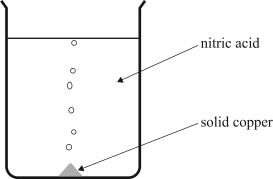
 

Question 14

Which one of the following will not increase the rate of the above reaction?

  1. decreasing the size of the solid copper particles
  2. increasing the temperature of \(\ce{HNO3}\) by 20 °C
  3. increasing the concentration of \(\ce{HNO3}\)
  4. allowing \(\ce{NO2}\) gas to escape

 
Question 15

In the above reaction, the number of successful collisions per second is a small fraction of the total number of collisions.

The major reason for this is that

  1. the nitric acid is ionised in solution.
  2. some reactant particles have too much kinetic energy.
  3. the kinetic energy of the particles is reduced when they collide with the container’s walls.
  4. not all reactant particles have the minimum kinetic energy required to initiate the reaction.
Show Answers Only

\(\text{Question 14:}\ D\)

\(\text{Question 15:}\ D\)

Show Worked Solution

Question 14

  • Options \(A, B\) and \(C\) will all increase the rate of the given chemical reaction.

\(\Rightarrow D\)
 

Question 15

  • Successful collisions occur only if the particles involved have at least the minimum kinetic energy required and the correct orientation.

\(\Rightarrow D\)

Filed Under: Rates of Reactions Tagged With: Band 3, Band 4, smc-4265-10-Collision theory, smc-4265-30-Temperature, smc-4265-35-Surface area, smc-4265-40-Concentration

CHEMISTRY, M3 2014 VCE 10 MC

Which one of the reactions of hydrochloric acid below is a redox reaction?

  1. \(\ce{2HCl(aq) + Fe(s)\rightarrow H2(g) + FeCl2(aq)}\)
  2. \(\ce{2HCl(aq) + Na2S(s)\rightarrow H2S(g) + 2NaCl(aq)}\)
  3. \(\ce{2HCl(aq) + MgO(s)\rightarrow MgCl2(aq) + H2O(l)}\)
  4. \(\ce{2HCl(aq) + K2CO3(s)\rightarrow CO2(g) + 2KCl(aq) + H2O(l)}\)
Show Answers Only

\(A\)

Show Worked Solution
  • \(\ce{HCl}\) is the common reactant in all options.
  • Therefore, redox reaction will see the oxidation number of \(\ce{H}\) or \(\ce{Cl}\) change.
  • In option \(A\), the oxidation number of \(\ce{H}\) decreases from +1 to 0, while the oxidation number of \(\ce{Fe}\) increases from 0 to +2.

\(\Rightarrow A\)

Filed Under: Predicting Reactions of Metals Tagged With: Band 4, smc-4264-25-Redox

CHEMISTRY, M3 2015 VCE 6 MC

In which one of the following compounds is sulfur in its lowest oxidation state?

  1. \(\ce{SO3}\)
  2. \(\ce{HSO4–}\)
  3. \(\ce{SO2}\)
  4. \(\ce{Al2S3}\)
Show Answers Only

\(D\)

Show Worked Solution

Let \(x\) equal the oxidation of sulfur in each of the following calculations.

In \(\ce{SO3}\):

   \(x+ 3 \times -2=0\ \ \Rightarrow \ \ x=6\)

In \(\ce{HSO4–}\):

   \(1 + x+ 4 \times -2=-1\ \ \Rightarrow \ \ x=6\)

In \(\ce{SO2}\):

   \(x+ 2 \times -2=0\ \ \Rightarrow\ \ x=4\)

In \(\ce{Al2S3}\):

   \(2 \times 3+ 3 \times x=0\ \ \Rightarrow\ \ 3x=-6\ \ \Rightarrow\ \ x=-2\)

  • \(D\) has the lowest oxidation number showing it is in the lowest oxidation state.

\(\Rightarrow D\)

Filed Under: Predicting Reactions of Metals Tagged With: Band 4, smc-4264-30-Oxidation Numbers

PHYSICS, M2 2019 VCE 9

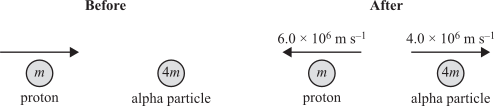
A proton in an accelerator detector collides head-on with a stationary alpha particle, as shown in diagrams below. After the collision, the alpha particle travels at a speed of \(4.0 \times 10^6 \text{ m s}^{-1}\). The proton rebounds at \(6.0 \times 10^6 \text{ m s}^{-1}\).
 

Find the speed of the proton before the collision, modelling the mass of the alpha particle, \(4m\), to be equal to four times the mass of the proton, \(m\). Show your working. Ignore relativistic effects.  (3 marks)

--- 5 WORK AREA LINES (style=lined) ---
Show Answers Only

\(u_p=1 \times 10^7\ \text{ms}^{-1}\)

Show Worked Solution

\(mu_p+4mu_a\) \(=mv_p+4mv_a\)  
\(mu_p +0\) \(=m \times -6 \times 10^6 + 4m \times 4 \times 10^6\)  
\(mu_p \) \(=16m \times 10^6-6m \times 10^{6}\)  
\(mu_p\) \(=10m \times 10^6\)  
\(u_p\) \(=1 \times 10^7\ \text{ms}^{-1}\)  

Filed Under: Momentum, Energy and Simple Systems Tagged With: Band 4, smc-4278-40-Momentum conservation

PHYSICS, M4 2020 VCE 18a

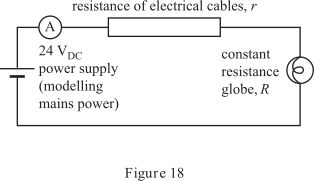
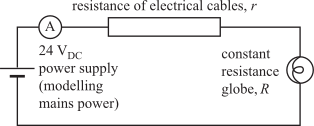
Students are modelling the effect of the resistance of electrical cables, \(r\), on the transmission of electrical power. They model the cables using the circuit shown in the diagram.
 

The 24 V DC power supply models the mains power.

Describe the effect of increasing the resistance of the electrical cables, \(r\), on the brightness of the constant resistance globe, \(R\).   (2 marks)

--- 5 WORK AREA LINES (style=lined) ---

Show Answers Only

Increasing the resistance of the electrical cables:

  • Increases the power used by the electrical cables  \(P=IV\). This results in less power in the circuit for the resistance light globe.
  • Therefore, the brightness of the resistance light globe will decrease.

Show Worked Solution

Increasing the resistance of the electrical cables:

  • Increases the power used by the electrical cables  \(P=IV\). This results in less power in the circuit for the resistance light globe.
  • Therefore, the brightness of the resistance light globe will decrease.

Filed Under: Electric Circuits Tagged With: Band 4, smc-4284-20-Resistence in circuits

PHYSICS, M2 2019 VCE 11 MC

An ultralight aeroplane of mass 500 kg flies in a horizontal straight line at a constant speed of 100 ms\(^{-1}\).

The horizontal resistance force acting on the aeroplane is 1500 N.

Which one of the following best describes the magnitude of the forward horizontal thrust on the aeroplane?

  1. 1500 N
  2. slightly less than 1500 N
  3. slightly more than 1500 N
  4. 5000 N
Show Answers Only

\(A\)

Show Worked Solution
  • There is no net force acting on the aeroplane as it is travelling at a constant speed.
  • The forward horizontal thrust on the plane must be opposite in direction but equal in magnitude to the horizontal resistance force acting on the plane.

\(\Rightarrow A\)

Filed Under: Forces, Acceleration and Energy Tagged With: Band 4, smc-4276-20-Friction

CHEMISTRY, M2 2013 VCE 8a

In an experiment, 5.85 g of ethanol was ignited with 14.2 g of oxygen.

  1. Write an equation for the complete combustion of ethanol.  (1 mark)

    --- 2 WORK AREA LINES (style=lined) ---

  2. Which reagent is in excess? Calculate the amount, in moles, of the reagent identified as being in excess.  (3 marks)

    --- 6 WORK AREA LINES (style=lined) ---

Show Answers Only

a.    \(\ce{C2H5OH(g) + 3O2(g) \rightarrow 2CO2(g) + 3H2O(g) }\)

b.   \(\ce{O2_{\text{(excess)}} = 0.062\ \text{mol}}\)

Show Worked Solution

a.    \(\ce{C2H5OH(g) + 3O2(g) \rightarrow 2CO2(g) + 3H2O(g) }\)

♦ Mean mark 43%.

 
b.
   \(\ce{MM(C2H5OH) = 2 \times 12.0 + 6 \times 1.0 + 16.0 = 46.0\ \text{g mol}^{-1}}\)

\(\ce{n(C2H5OH) = \dfrac{5.85}{46.0} = 0.1272\ \text{mol}} \)

\(\ce{n(O2) = \dfrac{14.2}{32.0} = 0.444\ \text{mol}}\)

\(\text{Reaction ratio}\ \ \ce{C2H5OH : O2 = 1:3}\)

\(\Rightarrow \ce{n(O2)_{\text{required}} = 3 \times 0.1272 = 0.382\ \text{mol}\ \ (\ce{O2}\ \text{excess}) }\)

\(\ce{O2_{\text{(excess)}} = 0.444-0.382 = 0.062\ \text{mol}}\)

Filed Under: Chemical Reactions and Stoichiometry Tagged With: Band 4, Band 5, smc-4259-20-Mass Changes, smc-4259-50-Balancing Chemical Equations

CHEMISTRY, M2 2013 VCE 1 MC

Consider the following.

"Calculate the pressure exerted by 6.9 g of argon in a 0.07500 L container at 11.5 °C."

The number of significant figures that should be expressed in the answer is

  1. 2
  2. 3
  3. 4
  4. 5
Show Answers Only

\(A\)

Show Worked Solution
  • The data input for calculating the pressure with the least number of significant figures is 6.9 grams (to 2 sig fig).
  • The answer should then be expressed to 2 significant figures.

\(\Rightarrow A\)

Filed Under: Gas Laws Tagged With: Band 4, smc-4262-50-Pressure

CHEMISTRY, M2 2015 VCE 3 MC

In an experiment, 0.051 mol of sodium hydroxide, \(\ce{NaOH}\), reacted completely with 0.017 mol of citric acid, \(\ce{C6H8O7}\).

Which one of the following equations correctly represents the reaction between citric acid and the sodium hydroxide solution?

  1. \(\ce{NaOH(aq) + C6H8O7(aq)\rightarrow NaC6H7O7(aq) + H2O(l)}\)
  2. \(\ce{2NaOH(aq) + C6H8O7(aq)\rightarrow Na2C6H6O7(aq) + 2H2O(l)}\)
  3. \(\ce{3NaOH(aq) + C6H8O7(aq)\rightarrow Na3C6H5O7(aq) + 3H2O(l)}\)
  4. \(\ce{4NaOH(aq) + C6H8O7(aq)\rightarrow Na4C6H4O7(aq) + 4H2O(l)}\)
Show Answers Only

\(C\)

Show Worked Solution

\(\text{Ratio of moles reacting}\ = 0.051 : 0.017 = 3:1 \)

\(\ce{n(NaOH) : n(C6H8O7) = 3:1} \)

\(\ce{3NaOH(aq) + C6H8O7(aq)\rightarrow Na3C6H5O7(aq) + 3H2O(l)}\)

\(\Rightarrow C\)

Filed Under: Chemical Reactions and Stoichiometry Tagged With: Band 4, smc-4259-50-Balancing Chemical Equations

CHEMISTRY, M2 2012 VCE 18 MC

2.1 g of an alkene that contains only one double bond per molecule reacted completely with 8.0 g of bromine, \(\ce{Br2}\). The molar mass of bromine, \(\ce{Br2}\), is 160 g mol\(^{–1}\).

Which one of the following is the molecular formula of the alkene?

  1. \(\ce{C5H10}\)
  2. \(\ce{C4H8}\)
  3. \(\ce{C3H6}\)
  4. \(\ce{C2H4}\)
Show Answers Only

\(C\)

Show Worked Solution
  • Since each molecule only contains a single \(\ce{C=C}\) bond:
  •    \(\ce{n(alkene) = n(Br2) = \dfrac{8.0}{160.0} = 0.05\ \text{mol}}\)
  •    \(\ce{m(alkene) = \dfrac{2.1}{0.05} = 42\ \text{g mol}^{-1}} \)

\(\Rightarrow C\)

Filed Under: Mole Concept Tagged With: Band 4, smc-4260-20-Mole conversions

CHEMISTRY, M2 2012 VCE 15*

A sample of the anticancer drug Taxol\(^{\circledR}\), \(\ce{ C47H51NO14}\), contains 0.157 g of carbon.

Calculate the mass, in grams, of oxygen in the sample. Give your answer correct to three decimal places.   (2 marks)

--- 4 WORK AREA LINES (style=lined) ---

Show Answers Only

\(\text{0.062 grams}\)

Show Worked Solution

\(\ce{n(C) = \dfrac{0.157}{12.0} = 0.0131\ \text{mol}} \)

\(\ce{n(\text{Taxol}) = \dfrac{0.0131}{47}\ \text{mol}} \)

\(\ce{n(O) = 14 \times n(\text{Taxol}) = 14 \times \dfrac{0.0131}{47} = 0.00390\ \text{mol}} \)

\( \therefore \ce{m(O) = 0.00390 \times 16.0 = 0.062\ \text{g  (3 d.p.)}}\)

Filed Under: Mole Concept Tagged With: Band 4, smc-4260-20-Mole conversions

PHYSICS, M3 2019 VCE 10*

The horizontal face of a glass block is covered with a film of liquid, as shown below.

A monochromatic light ray is incident on the glass-liquid boundary with an angle of incidence of 62.0°.
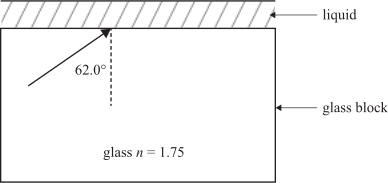
 

Calculate the minimum value of the liquid's refractive index, so that some light will just cross the interface into the liquid.   (2 marks)

--- 4 WORK AREA LINES (style=lined) ---

Show Answers Only

\(1.55\)

Show Worked Solution
\(\sin\theta_c\) \(=\dfrac{n_2}{n_1}\)  
\(n_2\) \(=\sin\theta_c \times n_1\)  
  \(= \sin62^{\circ} \times 1.75\)  
  \(=1.55\)  

Filed Under: Ray Model of Light Tagged With: Band 4, smc-4281-20-Snell's Law and TIR

PHYSICS, M3 2019 VCE 9 MC

A monochromatic light ray passes through three different media, as shown in the diagram below.
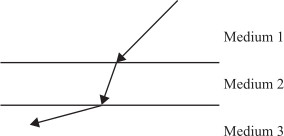
Assume that \(v_1\) is the speed of light in Medium 1, \(v_2\) is the speed of light in Medium 2 and \(v_3\) is the speed of light in Medium 3.

Which one of the following would best represent the relative speeds in the media?

  1. \(v_1>v_2>v_3\)
  2. \(v_1>v_3>v_2\)
  3. \(v_3>v_2>v_1\)
  4. \(v_3>v_1>v_2\)
Show Answers Only

\(D\)

Show Worked Solution
  • From Medium 1 to Medium 2, the light bends towards the normal, this means the light is entering a denser medium and so the light will slow down (\(v_1>v_2\)).
  • From Medium 2 to Medium 3, the light bends away from the normal, this means the light is entering a less dense medium and so the light will speed up. Hence (\(v_2<v_3\)).
  • As the angle of the light as it enters medium 3 is greater than the original angle of incidence. Medium three must be less dense than Medium 1, hence the light would travel faster in medium 3, \(v_3>v_1\).

\(\Rightarrow D\)

Filed Under: Ray Model of Light Tagged With: Band 4, smc-4281-40-Speed of light in medium

PHYSICS, M4 2019 VCE 3*

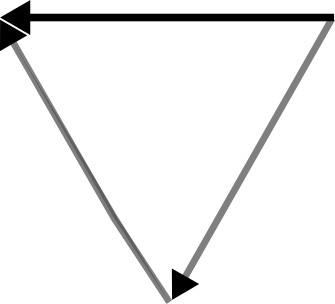
Three charges \((- \text{Q} ,+2 \text{Q} ,-2 \text{Q})\) are placed at the vertices of an isosceles triangle, as shown below.
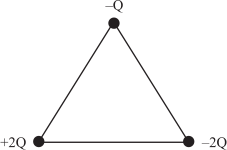


Draw a force vector diagram to show the direction of the net force on the charge \(- \text{Q}\) ?   (2 marks)

--- 4 WORK AREA LINES (style=lined) ---
Show Answers Only

Show Worked Solution
  • \(- \text{Q}\) will be attracted to \(+2 \text{Q}\) charge and repelled from the \(-2 \text{Q}\) charge.
  • This results in a force vector diagram as seen below.

Filed Under: Electrostatics Tagged With: Band 4, smc-4283-30-Forces on charges

BIOLOGY, M1 2022 VCE 4a

Increased protein consumption is a global trend. Chicken eggs are a good source of protein.

Ovalbumin (egg white protein) is formed from chicken cells during egg production.

Describe the role of organelles in the export of ovalbumin from a chicken's cells into an egg.  (3 marks)

--- 6 WORK AREA LINES (style=lined) ---

Show Answers Only

→ The production, transport and exportation of ovalbumin requires energy, which is supplied via mitochondria within the cell.

→ After ovalbumin is made, the rough endoplasmic reticulum transports it to the Golgi, where it is packaged into vesicles.

→ The vesicles then fuse with the plasma membrane of the cell and the ovalbumin can be released from the cell via exocytosis into an egg.

Show Worked Solution

→ The production, transport and exportation of ovalbumin requires energy, which is supplied via mitochondria within the cell.

→ After ovalbumin is made, the rough endoplasmic reticulum transports it to the Golgi, where it is packaged into vesicles.

→ The vesicles then fuse with the plasma membrane of the cell and the ovalbumin can be released from the cell via exocytosis into an egg.

Filed Under: BIO - Ex-syllabus checks required Tagged With: Band 4, smc-4302-20-Organelles

BIOLOGY, M3 2022 VCE 34 MC

Consider a hypothetical animal species, Species X, that can neither fly nor swim. Separate populations of Species X live in the same geographical area and often interbreed. After a period of time, a new species, Species Z, arises from Species X. The following list describes some barriers that may have contributed to the formation of Species Z:

    1. A newly formed river separated one population of Species X from the other populations.
    2. One population of Species X developed a new mating ritual that was not recognised by members of the other populations of Species X.
    3. One population of Species X began to breed several weeks later than the other populations of Species X.
    4. A volcanic eruption created a mountain that separated one population of Species X from the other populations of Species X.

The barrier(s) that could have led to the formation of Species Z by sympatric speciation is

  1. either barrier 1 or barrier 4 .
  2. either barrier 2 or barrier 3 .
  3. barrier 1 only.
  4. barrier 2 only.
Show Answers Only

\(B\)

Show Worked Solution

By Elimination

  • Sympatric speciation is the evolution of a new species (Species Z) from an ancestral species (Species X) while both continue to inhabit the same geographical location.
  • Therefore the physical separation by barrier 1 does not fit the definition (Eliminate A and C).
  • Both barrier 2 and 3 are barriers which could lead to the formation of Species Z, while both Species Z and X can continue to occupy the same area.

\(\Rightarrow B\)

Filed Under: Effects of the Environment on Organisms Tagged With: Band 4, smc-4307-40-Selection pressures

PHYSICS, M3 2020 VCE 13

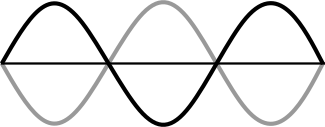
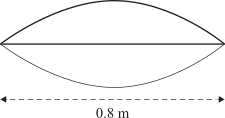
A 0.8 m long guitar string is set vibrating at a frequency of 250 Hz. The standing wave envelope created in the guitar string is shown in the diagram below.
 

  1. Calculate the speed of the wave in the guitar string.   (2 marks)

    --- 4 WORK AREA LINES (style=lined) ---

  2. The frequency of the vibration in the guitar string is tripled to 750 Hz.
  3. On the guitar string below, draw the shape of the standing wave envelope now created.   (2 marks)


--- 0 WORK AREA LINES (style=lined) ---

Show Answers Only

a.   \(v=400\ \text{ms}^{-1}\)

b. 
       

Show Worked Solution
a.    \(v\) \(=f\lambda\)  
  \(=250 \times 1.6 \)  
  \(=400\ \text{ms}^{-1}\)  

  
b.
         

  • Tripling the frequency means decreasing the wavelength by a factor of 3, hence three half wavelengths will now fit on the string.

Filed Under: Sound Waves Tagged With: Band 3, Band 4, smc-4280-20-Modelling standing waves

PHYSICS, M2 2020 VCE 10

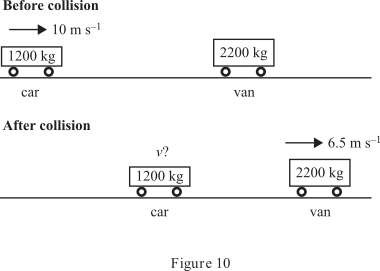
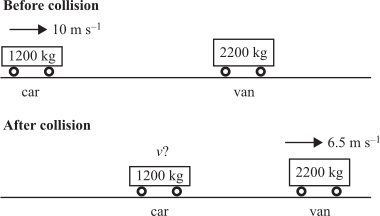
Jacinda designs a computer simulation program as part of her practical investigation into the physics of vehicle collisions. She simulates colliding a car of mass 1200 kg, moving at 10 ms\(^{-1}\), into a stationary van of mass 2200 kg. After the collision, the van moves to the right at 6.5 ms\(^{-1}\). This situation is shown in the diagrams below.
 

  1. Calculate the speed of the car after the collision and indicate the direction it would be travelling in. Show your working.  (4 marks)

    --- 7 WORK AREA LINES (style=lined) ---

  2. Explain, using appropriate physics, why this collision represents an example of either an elastic or an inelastic collision.  (3 marks)

    --- 8 WORK AREA LINES (style=lined) ---

  3. The collision between the car and the van takes 40 × 10\(^{-3}\) seconds.
    1. Calculate the magnitude and indicate the direction of the average force on the van by the car.  (3 marks)

      --- 6 WORK AREA LINES (style=lined) ---

    2. Calculate the magnitude and indicate the direction of the average force on the car by the van.  (2 marks)

      --- 4 WORK AREA LINES (style=lined) ---

Show Answers Only

a.    \(v_{\text{car}} =1.92\ \text{ms}^{-1}\) to the left.

b.    The collision is an inelastic collision as the kinetic energy decreases after the collision.

c.i   The average force of \(358\ \text{kN}\) is to right as the change in the momentum is also to the right.

c.ii    The average force of \(358\ \text{kN}\) is to the left as the change in momentum is also to the left.

Show Worked Solution

a.    Using the Conservation of Momentum:

\(m_{\text{car}}u_{\text{car}}+m_{\text{van}}u_{\text{van}}\) \(=m_{\text{car}}v_{\text{car}}+m_{\text{van}}v_{\text{van}}\)  
\(1200 \times 10 + 2200 \times 0\) \(=1200 \times v_{\text{car}} + 2200 \times 6.5\)  
\(1200v_{\text{car}}\) \(=12\ 000-14\ 300\)  
  \(=-2300\)  
\(v_{\text{car}}\) \(=-1.92\ \text{ms}^{-1}\)  
  \(=1.92\ \text{ms}^{-1}\ \text{to the left}\)  


b.     \(KE_{\text{init}}\) \(=\dfrac{1}{2}m_{\text{car}}u_{\text{car}}^2+\dfrac{1}{2}m_{\text{van}}u_{\text{van}}^2\)
   

\(=\dfrac{1}{2} \times 1200 \times 10^2 + \dfrac{1}{2} \times 2200 \times 0^2\)

    \(=60\ 000\ \text{J}\)

\(KE_{\text{final}}\) \(=\dfrac{1}{2}m_{\text{car}}v_{\text{car}}^2+\dfrac{1}{2}m_{\text{van}}v_{\text{van}}^2\)  
  \(=\dfrac{1}{2} \times 1200 \times 1.92^2 + \dfrac{1}{2} \times 2200 \times 6.5^2\)  
  \(=48\ 687\ \text{J}\)  


  • As the kinetic energy of the system decreases after the collision, the collision is inelastic.
     
c.i.   \(\Delta p\) \(=F_{net}\Delta t\)  
\(F_{net}\) \(=\dfrac{\Delta p}{ \Delta t}\)  
  \(= \dfrac{m\Delta v}{\Delta t}\)  
  \(= \dfrac{2200 \times (6.5-0)}{40 \times 10^{-3}}\)  
  \(=357\ 500\ \text{N}\)  
  \(=358\ \text{kN to the right}\)  
 
The average force of \(358\ \text{kN}\) is to right as Δmomentum is to the right.
  
c.ii.   \(F_{net}\) \(=\dfrac{\Delta p}{ \Delta t}\)
  \(= \dfrac{m\Delta v}{\Delta t}\)
  \(= \dfrac{1200 \times (-1.92-10)}{40 \times 10^{-3}}\)
  \(=-357\ 600\ \text{N}\)
  \(=-358\ \text{kN}\)


  • The average force of \(358\ \text{kN}\) is to the left as the change in momentum is also to the left.
  • Note: no calculation was required for this question as it is an example of Newton’s third law of motion. Simply stating that the force would be equal in magnitude but opposite in direction earned full marks.

Filed Under: Momentum, Energy and Simple Systems Tagged With: Band 4, smc-4277-20-Momentum conservation, smc-4277-40-Elastic/inelastic collisions, smc-4277-50-Impulse

PHYSICS, M3 2020 VCE 14 MC

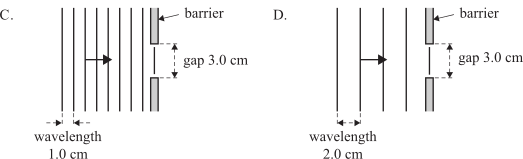
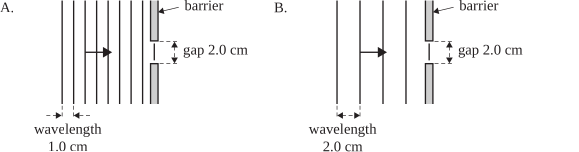
Students are investigating the diffraction of waves using a ripple tank. Water waves are directed towards barriers with gaps of different sizes, as shown below.

In which one of the following would the greatest diffraction effects be observed?
 

Show Answers Only

\(B\)

Show Worked Solution
  • The greatest diffraction patterns are observed when the wavelength is the same size as the slit through which the wave passes.

\( \Rightarrow B\)

Filed Under: Wave Properties and Behaviour Tagged With: Band 4, smc-4278-25-Diffraction

PHYSICS, M4 2020 VCE 1 MC

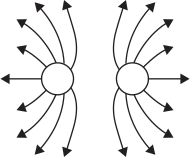
The diagram below shows the electric field lines between two charges of equal magnitude.
 

The best description of the two charges is that the

  1. charges are both positive.
  2. charges are both negative.
  3. charges can be either both positive or both negative.
  4. left-hand charge is positive and the right-hand charge is negative.
Show Answers Only

\(A\)

Show Worked Solution
  • The field lines show the charges are experiencing a repulsion force hence they must be the same charge.
  • The direction of the field lines are away from the charges so they must be positive charges.

\(\Rightarrow A\)

Filed Under: Electrostatics Tagged With: Band 4, smc-4283-10-Electric fields

PHYSICS, M3 2021 VCE 12

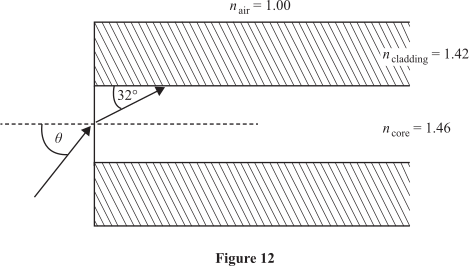
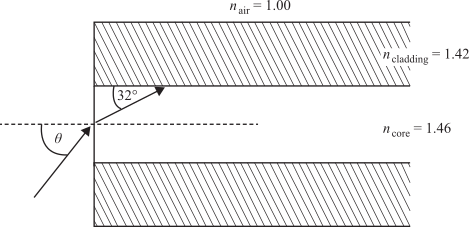
A Physics teacher is conducting a demonstration involving the transmission of light within an optical fibre. The optical fibre consists of an inner transparent core with a refractive index of 1.46 and an outer transparent cladding with a refractive index of 1.42. A single monochromatic light ray is incident on the optical fibre, as shown in diagram below.
 

  1. Determine the angle of incidence, \(\theta\), at the air-core boundary. Show your working.  (2 marks)

    --- 4 WORK AREA LINES (style=lined) ---

  2. Will any of the initial light ray be transmitted into the cladding? Explain your answer and show any supporting working.  (3 marks)

    --- 6 WORK AREA LINES (style=lined) ---

Show Answers Only

a.   \(\theta=51^{\circ}\)

b.    Find the critical angle for Total Internal Reflection (TIR):

\(\sin\theta_c\) \(=\dfrac{n_2}{n_1}\)  
\(\theta_c\) \(=\sin^{-1}\Big{(}\dfrac{n_2}{n_1}\Big{)} =\sin^{-1} \Big{(}\dfrac{1.42}{1.46} \Big{)}=76.6^{\circ}\)  
  • The angle of incidence \(=90^{\circ}-32^{\circ}=58^{\circ}\).
  • As the angle of incidence is less than the critical angle, TIR will not occur and light will be transmitted into the cladding.
Show Worked Solution

a.    Using Snell’s Law:

\(n_1\sin\theta_1\) \(=n_2\sin\theta_2\)  
\(\theta_1\) \(=\sin^{-1} \Big{(}\dfrac{n_2\sin\theta_2}{n_1} \Big{)} \)  
  \(=\sin^{-1}\Big{(}\dfrac{1.46 \times \sin32^{\circ}}{1.0}\Big{)} \)  
  \(=51^{\circ}\)  
     

b.    Find the critical angle for Total Internal Reflection (TIR):

\(\sin\theta_c\) \(=\dfrac{n_2}{n_1}\)  
\(\theta_c\) \(=\sin^{-1}\Big{(}\dfrac{n_2}{n_1}\Big{)} =\sin^{-1} \Big{(}\dfrac{1.42}{1.46} \Big{)}=76.6^{\circ}\)  
  • The angle of incidence \(=90^{\circ}-32^{\circ}=58^{\circ}\).
  • As the angle of incidence is less than the critical angle, TIR will not occur and light will be transmitted into the cladding. 
♦ Mean mark (b) 45%.

Filed Under: Ray Model of Light Tagged With: Band 4, Band 5, smc-4281-10-Snell's Law, smc-4281-20-Snell's Law and TIR

PHYSICS, M2 2021 VCE 9a

Abbie and Brian are about to go on their first loop-the-loop roller-coaster ride. As competent Physics students, they are working out if they will have enough speed at the top of the loop to remain in contact with the track while they are upside down at point \(\text{C}\), shown in diagram. 
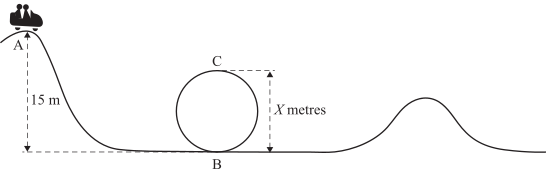
 

The highest point of the roller-coaster (point \(\text{A}\)) is 15 m above point \(\text{B}\) and the car starts at rest from point \(\text{A}\). Assume that there is negligible friction between the car and the track.

What is the speed of the car at point \(\text{B}\) at the bottom of the loop? Show your working.  (2 marks)

--- 4 WORK AREA LINES (style=lined) ---

Show Answers Only

\(17.1\ \text{ms}^{-1}\)

Show Worked Solution

Using the Law of Conservation of Energy: 

\(mgh\) \(=\dfrac{1}{2}mv^2\)  
\(v\) \(=\sqrt{2gh}\)  
  \(=\sqrt{2 \times 9.8 \times 15}\)  
  \(=17.1\ \text{ms}^{-1}\)  

Filed Under: Forces, Acceleration and Energy Tagged With: Band 4, smc-4276-10-Conservation of energy

CHEMISTRY, M4 EQ-Bank 1

Find \(\Delta G \) at 298.15K for the following reaction:

\(\ce{2CO + O2 \rightarrow 2CO2}\)

Given that  \(\Delta H =-128.3\ \text{kJ},\ \ \Delta S = -159.5\ \text{J K}^{-1} \)  (2 marks)

--- 4 WORK AREA LINES (style=lined) ---

Show Answers Only

\(-80.75\ \text{kJ}\)

Show Worked Solution

\(\Delta S = -159.5\ \text{J K}^{-1} = -0.1595\ \text{kJ K}^{-1}\)

\(\text{Using the Gibbs free energy equation:}\)

\(\Delta G\) \(= \Delta H-T \Delta S\)  
  \(=-128.3-(298.15 \times -0.1595) \)  
  \(=-128.3 + 47.554\)  
  \(=-80.75\ \text{kJ}\)  

Filed Under: Entropy and Gibbs Free Energy Tagged With: Band 4, smc-4268-80-Calculating G

PHYSICS, M3 2021 VCE 15 MC

A Physics class is investigating the dispersion of white light using a triangular glass prism.

Which one of the following diagrams best shows the principle of dispersion?



Show Answers Only

\(A\)

Show Worked Solution
  • Dispersion is a result of white light splitting into different colours when it is refracted.
  • Dispersion occurs during both changes in medium (i.e. from air into glass and from glass into air).
  • The shorter violet wavelengths of light experience a greater refraction than the longer wavelength red light.

\(\Rightarrow A\)

Filed Under: Ray Model of Light Tagged With: Band 4, smc-4281-30-Light dispersion

PHYSICS, M3 2021 VCE 13

The diagram below shows part of a travelling wave.
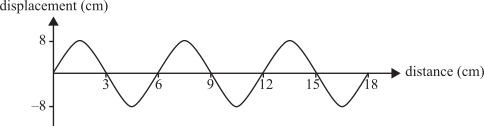
 

The wave propagates with a speed of 18 ms\(^{-1}\).

What is the amplitude and frequency of the wave?   (2 marks)

--- 4 WORK AREA LINES (style=lined) ---

Show Answers Only

Amplitude = 8 cm

Frequency = 300 Hz

Show Worked Solution
  • Amplitude: the distance from the centre line to maximum displacement.
  • Amplitude = 8 cm.
  • Frequency: can be determined using  \(f=\dfrac{v}{\lambda}\), (wavelength in metres):
  •    \(f=\dfrac{v}{\lambda}=\dfrac{18}{0.06}=300\ \text{Hz} \)

Filed Under: Wave Properties and Behaviour Tagged With: Band 4, smc-4278-20-Wave calculations

PHYSICS, M4 2021 VCE 3 MC

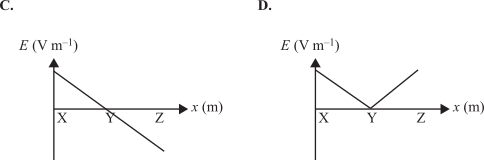
The diagram below shows two parallel metal plates with opposite charges on each plate. \(\text{X , Y}\) and \(\text{Z}\) represent different distances from the positive plate.
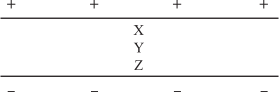
 

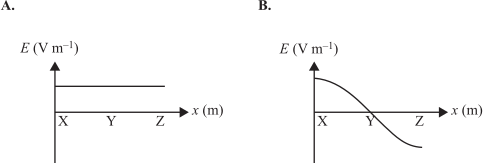
Which one of the following graphs best shows the electric field strength, \(E\), versus the position, \(x\), between the two parallel plates?
 

Show Answers Only

\(A\)

Show Worked Solution
  • The strength of the electric field is uniform between parallel plates. Hence its magnitude remains constant.

\( \Rightarrow A\)

Filed Under: Electrostatics Tagged With: Band 4, smc-4283-10-Electric fields

PHYSICS, M3 2022 VCE 16

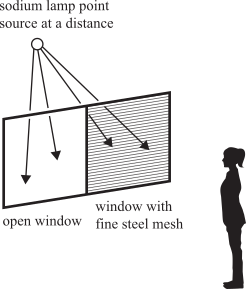
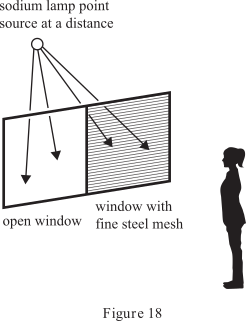
A small sodium lamp, emitting light of wavelength 589 nm, is viewed at night through two windows from across a street. The glass of one window has a fine steel mesh covering it and the other window is open, as shown in Figure 18. Assume that the sodium lamp is a point source at a distance.

A Physics student is surprised to see a pattern formed by the light passing through the steel mesh but no pattern for the light passing through the open window. She takes a photograph of the observed pattern to show her teacher, who assures her that it is a diffraction pattern.
 

  1. State the condition that the fine steel mesh must satisfy for a diffraction pattern to form.  (1 mark)

    --- 2 WORK AREA LINES (style=lined) ---

  1. Explain why the condition stated in part a. does not apply to the open window.  (2 marks)

    --- 6 WORK AREA LINES (style=lined) ---

Show Answers Only

a.   Condition to satisfy:

  • The size of the gaps from the fine steel mesh must be of the same order of magnitude of the wavelengths of the light from the sodium lamp.

b.   Open window differences:

  • The width of the window is significantly greater than wavelength of the light from the sodium lamp and the width of the glass molecules that make up the glass window is significantly smaller than the light from the sodium lamp.
  • These widths contrast greatly to the size of the steel mesh and are not of the same order of magnitude of the light from the sodium lamp, hence no diffraction will occur.
Show Worked Solution

a.   Condition to satisfy:

  • The size of the gaps from the fine steel mesh must be of the same order of magnitude of the wavelengths of the light from the sodium lamp.

b.   Open window differences:

  • The width of the window is significantly greater than wavelength of the light from the sodium lamp and the width of the glass molecules that make up the glass window is significantly smaller than the light from the sodium lamp.
  • These widths contrast greatly to the size of the steel mesh and are not of the same order of magnitude of the light from the sodium lamp, hence no diffraction will occur.
♦ Mean mark (b) 40%.

Filed Under: Wave Properties and Behaviour Tagged With: Band 3, Band 4, smc-4278-25-Diffraction, smc-4279-20-Diffraction

PHYSICS, M3 2022 VCE 13

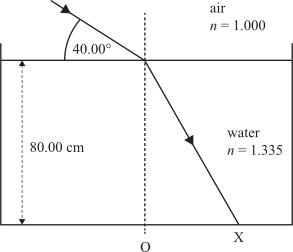
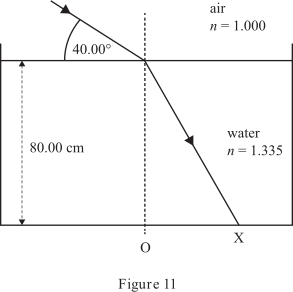
A ray of green light from a light-emitting diode (LED) strikes the surface of a tank of water at an angle of 40.00° to the surface of the water, as shown in diagram below. The ray arrives at the base of the tank at point \(\text{X}\). The depth of the water in the tank is 80.00 cm. The refractive index of green LED light in water is 1.335
 

  1. Calculate the distance \(\text{OX}\). Outline your reasoning and show all your working. Give your answer in centimetres.   (4 marks)

    --- 8 WORK AREA LINES (style=lined) ---
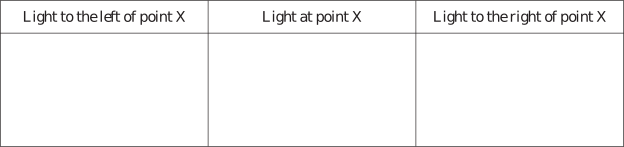
  2. The green LED light is replaced with a narrow beam of white sunlight.
  3. Describe the colour of the light that arrives to the left of point \(\text{X}\), at point \(\text{X}\) and to the right of point \(\text{X}\).   (3 marks)
     
  4. --- 0 WORK AREA LINES (style=lined) ---

Show Answers Only

a.  \(OX=56\ \text{cm}\)

b.

\begin{array} {|c|c|c|}
\hline
\rule{0pt}{2.5ex}\text{Light to the left of point X}\rule[-1ex]{0pt}{0pt} & \text{Light at point X} & \text{Light to the right of point X} \\
\hline
\rule{0pt}{2.5ex}\text{Blue/Purple}\rule[-1ex]{0pt}{0pt} & \text{Green} & \text{Red} \\ \text{(lower wavelength)} & & \text{(higher wavelength)} \\
\hline
\end{array}

Show Worked Solution

a.  \(\text{Using Snell’s Law:}\)

\(n_1 \sin \theta_1\) \(=n_2 \sin \theta_2\)  
\(\sin \theta_2\) \(=\dfrac{n_1 \sin \theta_1}{n_2}\)  
\( \theta_2\) \(= \sin^{-1}\Big{(}\dfrac{1 \times \sin 50^{\circ}}{1.335} \Big{)}=35^{\circ}\)  


\(\tan35^{\circ}\) \(=\dfrac{OX}{80}\)  
\(OX\) \(=80\times \tan35^{\circ}=56\ \text{cm}\)  

♦ Mean mark 48%.

b. 

\begin{array} {|c|c|c|}
\hline
\rule{0pt}{2.5ex}\text{Light to the left of point X}\rule[-1ex]{0pt}{0pt} & \text{Light at point X} & \text{Light to the right of point X} \\
\hline
\rule{0pt}{2.5ex}\text{Blue/Purple}\rule[-1ex]{0pt}{0pt} & \text{Green} & \text{Red} \\ \text{(lower wavelength)} & & \text{(higher wavelength)} \\
\hline
\end{array}

Filed Under: Ray Model of Light Tagged With: Band 4, Band 5, smc-4281-10-Snell's Law, smc-4281-30-Light dispersion

PHYSICS, M2 2022 VCE 7

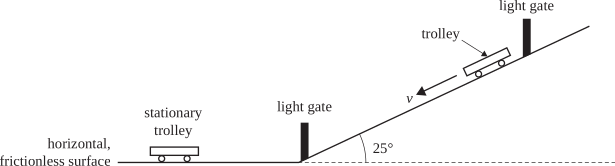
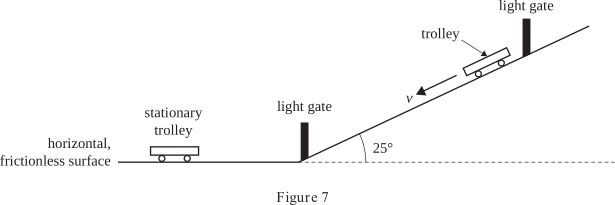
Kym and Kelly are experimenting with trolleys on a ramp inclined at 25°, as shown in the diagram below. They release a trolley with a mass of 2.0 kg from the top of the ramp. The trolley moves down the ramp, through two light gates and onto a horizontal, frictionless surface. Kym and Kelly calculate the acceleration of the trolley to be \(3.2\ \text{m s}^{-2}\) using the information from the light gates.


  1.  i. Show that the component of the gravitational force of the trolley down the slope is \(8.3 \text{ N}\). Use \(g=9.8 \text{ m s}^{-2}\).  (2 marks)

--- 5 WORK AREA LINES (style=lined) ---

  1. ii. Assume that on the ramp there is a constant frictional force acting on the trolley and opposing its motion.
  2.      Calculate the magnitude of the constant frictional force acting on the trolley.  (2 marks)

--- 5 WORK AREA LINES (style=lined) ---

  1. When it reaches the bottom of the ramp, the trolley travels along the horizontal, frictionless surface at a speed of \(4.0\ \text{m s}^{-1}\) until it collides with a stationary identical trolley. The two trolleys stick together and continue in the same direction as the first trolley.
    1. Calculate the speed of the two trolleys after the collision. Show your working and clearly state the physics principle that you have used.  (3 marks)

--- 6 WORK AREA LINES (style=lined) ---

    1. Determine, with calculations, whether this collision is an elastic or inelastic collision. Show your working.  (3 marks)

--- 6 WORK AREA LINES (style=lined) ---

Show Answers Only

a.i.   See Worked Solutions

a.ii.  \(F_f=1.9\ \text{N}\)

b.i.   \(2.0\ \text{ms}^{-1}\)

 b.ii.  For the collision to be elastic, the kinetic energy must be conserved.

\(KE_{\text{init}}=\dfrac{1}{2} mv^2=\dfrac{1}{2} \times 2 \times 4^2=16\ \text{J}\)

\(KE_{\text{final}}=\dfrac{1}{2} mv^2=\dfrac{1}{2} \times 4 \times 2^2=8\ \text{J}\)

\(\therefore\) Since the kinetic energy of the system decreases after the collision, it is not an elastic collision.

Show Worked Solution

a.i.  The gravitational force down the slope:

\(F=mg\, \sin \theta=2.0 \times 9.8 \times \sin 25=8.3\ \text{N}\) 

 
a.ii.
\(F_{net}=ma=2.0 \times 3.2=6.4\ \text{N}\)

\(6.4\) \(=F-F_f\)  
\(F_f\) \(=8.3-6.4\)  
  \(=1.9\ \text{N}\)  
♦ Mean mark (a.ii) 53%.

b.i.   By the conservation of momentum:

\(m_1u_1+m_2u_2\) \(=v(m_1+m_2)\)  
\(2 \times 4 + 2 \times 0\) \(=v(2 +2)\)  
\(8\) \(=4v\)  
\(v\) \(=2\ \text{ms}^{-1}\)  
 

 b.ii.  For the collision to be elastic, the kinetic energy must be conserved.

\(KE_{\text{init}}=\dfrac{1}{2} mv^2=\dfrac{1}{2} \times 2 \times 4^2=16\ \text{J}\)

\(KE_{\text{final}}=\dfrac{1}{2} mv^2=\dfrac{1}{2} \times 4 \times 2^2=8\ \text{J}\)

\(\therefore\) Since the kinetic energy of the system decreases after the collision, it is not an elastic collision.

Filed Under: Forces, Acceleration and Energy, Momentum, Energy and Simple Systems Tagged With: Band 3, Band 4, Band 5, smc-4276-20-Friction, smc-4277-20-Momentum conservation, smc-4277-40-Elastic/inelastic collisions

PHYSICS, M3 2022 VCE 13*

A travelling wave produced at point \(\text{A}\) is reflected at point \(\text{B}\) to produce a standing wave on a rope, as represented in the diagram below.



The distance between points \(\text{A}\) and \(\text{B}\) is 2.4 m. The period of vibration of the standing wave is 1.6 s.

Find the speed of the travelling wave along the rope in metres per second.   (2 marks)

--- 4 WORK AREA LINES (style=lined) ---

Show Answers Only

\(A\)

Show Worked Solution

\( \lambda = 1.2\ \text{m}\)

\(f= \dfrac{1}{T} = \dfrac{1}{1.6} = 0.625\)

\(v\) \(=f \lambda\)  
  \(=0.625 \times 1.2\)  
  \(=0.75\ \text{ms}^{-1}\)  

Filed Under: Wave Properties and Behaviour Tagged With: Band 4, smc-4278-20-Wave calculations

BIOLOGY, M4 2022 VCE 20 MC

During their lifetime, plants are exposed to both pathogenic and beneficial microorganisms. Some plants provide shelter within their bodies for beneficial microorganisms.

These beneficial microorganisms help plants that have not been genetically modified to resist pathogenic microorganisms.

The beneficial microorganisms may be providing protection by

  1. Synthesising toxins that kill pathogenic microorganisms.
  2. Providing a permeable physical barrier to pathogenic microorganisms.
  3. Stimulating the production of antibodies against pathogenic microorganisms.
  4. Mobilising the cells of the third line of defence against pathogenic microorganisms.
Show Answers Only

\(A\)

Show Worked Solution

By Elimination

  • Stimulating antibody production and mobilising cells of the third line of defence are impossible in a plant as they do not contain an adaptive immune system (Eliminate C and D).
  • Microorganisms are not able to create a permeable physical barrier which will allow passage of materials but deter pathogenic microorganisms (Eliminate B).

\(\Rightarrow A\)

Filed Under: Population Dynamics Tagged With: Band 4, smc-4311-15-Symbiotic relationships

CHEMISTRY, M4 2014 VCE 1

The decomposition of ammonia is represented by the following equation.

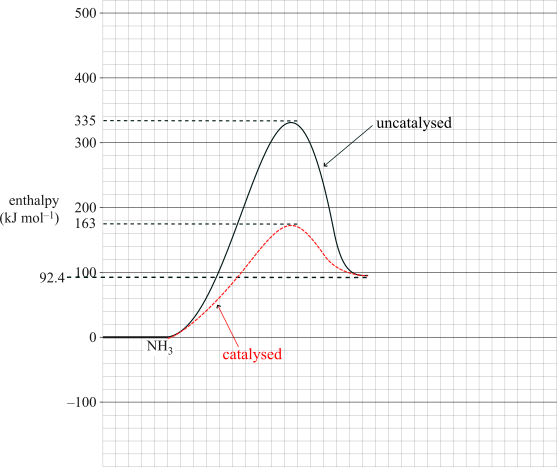
\(\ce{2NH3(g)\rightleftharpoons N2(g) + 3H2(g) \quad \quad \Delta H = 92.4 \text{kJ mol}^{–1}}\)
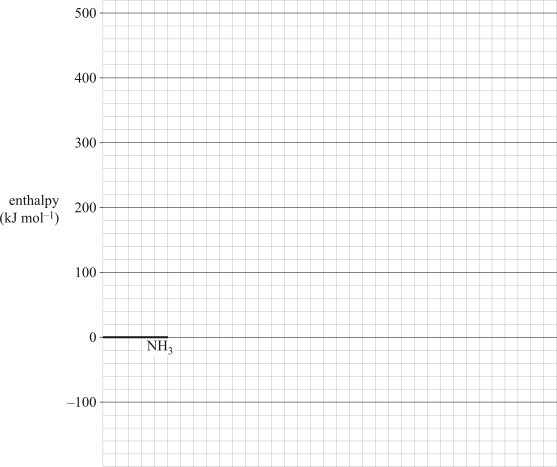
  1. The activation energy for the uncatalysed reaction is 335 kJ mol\(^{-1}\).
  2. The activation energy for the reaction when tungsten is used as a catalyst is 163 kJ mol\(^{-1}\).
  3. On the grid provided below, draw a labelled energy profile diagram for the uncatalysed and catalysed reactions.  (3 marks)
     

  1. When osmium is used as a catalyst, the activation energy is 197 kJ mol\(^{-1}\).
  2. Which catalyst – osmium or tungsten – will cause ammonia to decompose at a faster rate? Justify your answer in terms of the chemical principles you have studied this year.  (2 marks)

    --- 5 WORK AREA LINES (style=lined) ---

Show Answers Only

a.    


b.   •   Tungsten will cause ammonia to decompose faster.

  • Faster rate due to lower activation energy.
  • Lower activation energy results in a greater proportion of successful collisions.
Show Worked Solution

a.    


b.   •   Tungsten will cause ammonia to decompose faster.

  • Faster rate due to lower activation energy.
  • Lower activation energy results in a greater proportion of successful collisions.

Filed Under: Energy Changes in Chemical Reactions Tagged With: Band 3, Band 4

CHEMISTRY, M4 2020 VCE 6c

In an experiment, the combustion of 0.485 g of \(\ce{CH4}\) raises the temperature of 350.0 grams of water from 20°C to 32.3°C.

The heat of combustion of \(\ce{CH4}\) is 892 kJ mol\(^{-1}\).

Calculate the percentage of the combustion energy that is lost to the environment.  (3 marks)

--- 6 WORK AREA LINES (style=lined) ---

Show Answers Only

\(33.3\% \)

Show Worked Solution

\(\ce{MM(CH4)} = 12.01 + 4 \times 1.008 = 16.042\ \text{g mol}^{-1} \)

\(\text{Energy}\ \ce{(CH4)} = \dfrac{892}{16.042} = 55.6\ \text{kJ g}^{-1} \)

\(\text{Energy}\ \ce{(CH4)}_{\text{combusted}} = 0.485 \times 55.6 = 27.0\ \text{kJ} \)

\(\text{Energy absorbed}\ \ce{(H2O)} = mC \Delta T = 0.350 \times 4.18 \times 10^{3} \times (32.3-20) = 18.0\ \text{kJ} \)

\(\text{% lost to environment}\ = \dfrac{27.0-18.0}{27.0} \times 100 = 33.3\% \)

Filed Under: Energy Changes in Chemical Reactions Tagged With: Band 4

CHEMISTRY, M4 EQ-Bank 23

An experiment was carried out to determine the enthalpy of combustion of propan-1-o1. Combustion of 557 mg of propan-1-o1 increased the temperature of 150 g of water from 22.1°C to 40.6°C.

Calculate the enthalpy of combustion of propan-1-o1 in kJ mol\(^{-1}\).   (3 marks)

Show Answers Only

\(-1258\ \text{kJ mol}^{-1} \)

Show Worked Solution
\(\text{Energy absorbed}\ \ce{(H2O)}\) \(=mC \Delta T\)  
  \(=0.150 \times 4.18 \times 10^{3} \times (40.6-22.1) \)  
  \(=1.16 \times 10^{4}\ \text{J}\)  
  \(=11.6\ \text{kJ} \)  

 
\(\ce{MM(C3H8O) = 3 \times 12.01 + 8 \times 1.008 + 16 = 60.4\ \text{g mol}^{-1}}\)

\(\ce{n(C3H8O) = \dfrac{0.557}{60.4} = 9.22 \times 10^{-3}\ \text{mol}} \)

\(\text{Enthalpy of combustion}\ = -\dfrac{11.6}{9.22 \times 10^{-3}} = -1258\ \text{kJ mol}^{-1} \)

Filed Under: Energy Changes in Chemical Reactions Tagged With: Band 4

CHEMISTRY, M4 EQ-Bank 25

In an experiment, 1.40 g of pure sucrose, \(\ce{C12H22O11}\), underwent complete combustion, heating 350 mL of water from 19.6 °C to 35.8 °C.

\(\ce{MM(C12H22O11)}\) = 342 g mol\(^{−1}\)

Assuming there was no heat lost to the surroundings, calculate the experimental heat of combustion of pure sucrose, in joules per gram.   (2 marks)

--- 4 WORK AREA LINES (style=lined) ---

Show Answers Only

\(1.65 \times 10^{4}\ \text{J g}^{-1} \)

Show Worked Solution

\(\text{Energy absorbed} \ce{(H2O)}\ = mC \Delta T = 0.350 \times 4.18 \times 10^{3} \times (35.8-19.6) = 23\ 070.6\ \text{J} \)

\(\text{Energy (sucrose)}\ = \dfrac{23\ 070.6}{1.40} = 1.65 \times 10^{4}\ \text{J g}^{-1} \)

Filed Under: Energy Changes in Chemical Reactions Tagged With: Band 4, smc-4266-20-Heat of combustion, smc-4266-50-Calorimetry

CHEMISTRY, M4 2019 VCE 21 MC

The diagram below represents the Maxwell-Boltzmann distribution of an uncatalysed reaction.
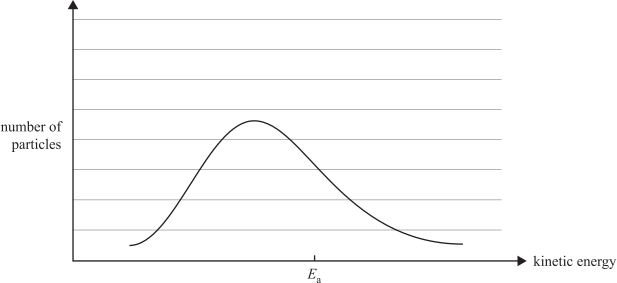
 

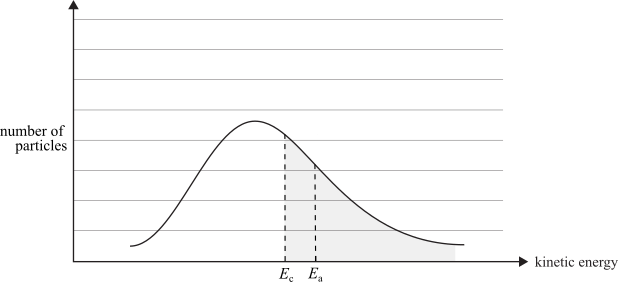
The effect of adding a catalyst could be:

    1. the curve flattens to reflect the lower activation energy barrier
    2. the curve shifts to the right
    3. the \(E_\text{a}\) shifts to the left.

Which of the statements above are correct?
  1. 1 only
  2. 1 and 2
  3. 2 and 3
  4. 3 only
Show Answers Only

\(D\)

Show Worked Solution

  • The shape of the curve is not changed with the introduction of a catalyst.
  • A catalyst will decrease the activation energy of the reaction (shifting it left from \(E_{\text{a}}\) to \(E_{\text{c}}\)).
  • The shaded area under the curve represents the proportion of successful collisions.

\(\Rightarrow D\)

Filed Under: Energy Changes in Chemical Reactions Tagged With: Band 4, smc-4266-30-Energy profiles

CHEMISTRY, M4 2018 VCE 25 MC

The molar heat of combustion of pentan-1-ol, \(\ce{C5H11OH}\), is 3329 kJ mol\(^{–1}\).

\(\ce{MM(C5H11OH)}\) = 88.0 g mol\(^{–1}\)

The mass of \(\ce{C5H11OH}\), in tonnes, required to produce 10800 MJ of energy is closest to

  1. 0.0286
  2. 0.286
  3. 2.86
  4. 286
Show Answers Only

\(B\)

Show Worked Solution

\(10\ 800\ \text{MJ} = 10\ 800 \times 10^{3}\ \text{kJ}\)

\(\ce{n(C5H11OH) = \dfrac{10\ 800 \times 10^{3}}{3329} = 3.244 \times 10^{3}\ \text{mol}}\)

\(\ce{m(C5H11OH)}\)

\(= 3.244 \times 10^{3} \times 88.0 \)

 
  \(= 2.85 \times 10^{5}\ \text{g} \)  
  \(= 2.85 \times 10^{2}\ \text{kg}\)  
  \(= 0.285\ \text{tonnes}\)  

 
\(\Rightarrow B\)

Filed Under: Energy Changes in Chemical Reactions Tagged With: Band 4, smc-4266-20-Heat of combustion

CHEMISTRY, M4 EQ-Bank 22b

Methane undergoes complete combustion in excess oxygen, \(\ce{O2}\), and the energy released is used to heat 1000 g of water.

Assuming there is no energy lost to the environment and given methane produces 810 kJ g\(^{-1}\) of energy when combusted, what mass of methane is needed to increase the temperature of the water from 25.0°C to 85.0°C?   (2 marks)

Show Answers Only

\(0.310\ \text{g}\)

Show Worked Solution

\(\text{Energy absorbed by}\ \ce{H2O} = mC \Delta T = 1.000 \times 4.18 \times 10^{3} \times (85-25) = 250.8\ \text{kJ} \)

\(\ce{m(CH4)_{\text{req}} = \dfrac{250.8}{810} = 0.310\ \text{g}}\)

Filed Under: Energy Changes in Chemical Reactions Tagged With: Band 4

CHEMISTRY, M4 2005 HSC 17

  1. The heat of combustion of ethanol is 1367 kJ mol\(^{-1}\). In a first-hand investigation to determine the heat of combustion of ethanol, the experimental value differed from the theoretical value.
  2. Identify a reason for this difference.   (1 mark)

    --- 2 WORK AREA LINES (style=lined) ---

  3. Calculate the theoretical mass of ethanol \(\ce{(C2H6O)}\) required to heat 200 mL of water from 21.0°C to 45.0°C.   (2 marks)

    --- 6 WORK AREA LINES (style=lined) ---

Show Answers Only

a.    Answers could include one of the following:

  • Heat loss into the surroundings from combustion process.
  • Specific examples of heat loss such as inefficient heating of water caused by proximity of the heat or not using a beaker lid.

b.    \(0.68\ \text{g} \)

Show Worked Solution

a.    Answers could include one of the following:

  • Heat loss into the surroundings from combustion process.
  • Specific examples of heat loss such as inefficient heating of water caused by proximity of the heat or not using a beaker lid.

b.    \(\Delta H = mC \Delta T = 0.200 \times 4.18 \times 10^{3} \times (45-21) = 20\ 064\ \text{J}\)

\(\ce{n(C2H6O)_{\text{req}} = \dfrac{20.064}{1367} = 0.014677\ \text{mol}} \)

\(\ce{MM(C2H6O) = 2 \times 12.01 + 6 \times 1.008 + 16 = 46.068\ \text{g mol}^{-1}} \)

\(\ce{m(C2H6O)_{\text{req}} = n \times MM = 0.014677 \times 46.068 = 0.68\ \text{g}} \)

Filed Under: Energy Changes in Chemical Reactions Tagged With: Band 3, Band 4, smc-4266-20-Heat of combustion

CHEMISTRY, M4 EQ-Bank 30

A student used the apparatus shown to determine the molar heat of combustion of ethanol.
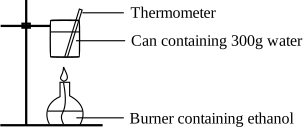
 

The following results were obtained.

\begin{array} {|l|c|}
\hline
\rule{0pt}{2.5ex}\text{Initial mass of burner}\rule[-1ex]{0pt}{0pt} & \text{133.20 g} \\
\hline
\rule{0pt}{2.5ex}\text{Final mass of burner}\rule[-1ex]{0pt}{0pt} & \text{132.05 g}\\
\hline
\rule{0pt}{2.5ex}\text{Initial temperature of water}\rule[-1ex]{0pt}{0pt} & \text{25.0°C}\\
\hline
\rule{0pt}{2.5ex}\text{Final temperature of water}\rule[-1ex]{0pt}{0pt} & \text{45.5°C}\\
\hline
\end{array}

Calculate ethanol's molar heat of combustion from this data?   (3 marks)

Show Answers Only

\(1030\ \text{kJ mol}^{-1} \)

Show Worked Solution

\(\ce{Ethanol \ \Rightarrow \ C2H6O }\)

\(\ce{m(C2H6O) = 133.20-132.05=1.15\ \text{grams}}\)

\(\ce{MM(C2H6O) = 2 \times 12.01 + 6 \times 1.008 + 16 = 46.068\ \text{g mol}^{-1}} \)

\(\ce{n(C2H6O) = \dfrac{\text{m}}{\text{MM}} = \dfrac{1.15}{46.068} = 0.02496\ \text{mol}}\)

\(\Delta H = mC\Delta T = 0.300 \times 4.18 \times 10^{3} \times (45.5-25) = 25\ 707\ \text{J} = 25.707\ \text{kJ} \)

\(\ce{C2H6O \text{molar heat of combustion}}\)

\(=\dfrac{25.707}{0.02496}\)

\(=1030\ \text{kJ mol}^{-1} \)

Filed Under: Energy Changes in Chemical Reactions Tagged With: Band 4, smc-4266-20-Heat of combustion, smc-4266-50-Calorimetry

CHEMISTRY, M4 EQ-Bank 24

The table shows four fuels and their various properties.
 

\(\textit{Property}\) \(\textit{Petrol}\)  \(\textit{Kerosene}\) \(\textit{Hydrogen}\) \(\textit{Ethanol}\)
\(\text{Heat of combustion (kJ mol} ^{-1}) \) \(5460\) \(10\ 000\) \(285\) \(1370\)
\(\text{Boiling Point (°C)}\) \(126\) \(300\) \(-253\) \(78\)
\(\text{Density (g  mL}^{-1}) \) \(0.69\) \(0.78\) \(\text{n/a}\) \(0.78\)
\(\text{Average molar mass (g mol}^{-1}) \) \(114\) \(210\) \(2\) \(46\)

 
Showing your calculations, which fuel provides the greatest amount of energy per gram?  (2 marks)

Show Answers Only

Calculating each option:

\(\text{Energy (petrol)} = \dfrac{5460}{114} = 47.9\ \text{kJ/g} \)

\(\text{Energy (kerosene)} = \dfrac{10\ 000}{210} = 47.6\ \text{kJ/g} \)

\(\text{Energy (hydrogen)} = \dfrac{285}{2} = 142.5\ \text{kJ/g} \)

\(\text{Energy (ethanol)} = \dfrac{1370}{46} = 29.8\ \text{kJ/g} \)

\(\therefore\) Hydrogen provides the greatest energy per gram.

Show Worked Solution

Calculating each option:

\(\text{Energy (petrol)} = \dfrac{5460}{114} = 47.9\ \text{kJ/g} \)

\(\text{Energy (kerosene)} = \dfrac{10\ 000}{210} = 47.6\ \text{kJ/g} \)

\(\text{Energy (hydrogen)} = \dfrac{285}{2} = 142.5\ \text{kJ/g} \)

\(\text{Energy (ethanol)} = \dfrac{1370}{46} = 29.8\ \text{kJ/g} \)

\(\therefore\) Hydrogen provides the greatest energy per gram.

Filed Under: Energy Changes in Chemical Reactions Tagged With: Band 4, smc-4266-20-Heat of combustion

CHEMISTRY, M4 EQ-Bank 22

The molar heat of combustion of pentan-1-ol is 2800 kJ mol−1. A quantity of pentan-1-ol was combusted, generating 108 kJ of heat. \(MM=88.146\ \text{gmol}^{-1}\)

What mass of pentan-1-ol was combusted?   (2 marks)

Show Answers Only

3.40 grams

Show Worked Solution

\(\ce{Pentan-1-ol\ \Rightarrow C5H12O}\)

\(\ce{MM(C5H12O) = 12.01 \times 5 + 1.008 \times 12 + 16.00 = 88.146\ \text{g mol}^{-1}}\)

\(\ce{Moles combusted = \dfrac{108}{2800} = 0.03857\ \text{mol}}\)

\(\ce{m(C5H12O) = 0.03857 \times 88.146 = 3.40\ \text{g}}\)


Filed Under: Energy Changes in Chemical Reactions Tagged With: Band 4, smc-4266-20-Heat of combustion

CHEMISTRY, M4 2013 HSC 11 MC

The table shows the heat of combustion for four compounds.
 

\(\textit{Compound}\) \(\textit{Heat of combustion}\)
\( (\text{kJ mol}^{-1} )\) 
\(\ce{CO}\)  \(233\)
 \(\ce{CH4}\)  \(890\)
 \(\ce{C2H2}\)  \(1300\)
 \(\ce{C2H6}\)  \(1560\)

Which of these compounds would produce the greatest amount of energy if 1.00 g of each is burnt?

  1. \(\ce{CO}\)
  2. \(\ce{CH4}\)
  3. \(\ce{C2H2}\)
  4. \(\ce{C2H6}\)
Show Answers Only

\(B\)

Show Worked Solution
  • The smallest molecular mass it will result in the highest number of moles.
  • The highest number of moles gives the greatest amount of energy.
  • By comparing the molecular mass of each compound, the smallest is methane (\(\ce{CH4})\).

\(\Rightarrow B\)

Filed Under: Energy Changes in Chemical Reactions Tagged With: Band 4, smc-4266-20-Heat of combustion

CHEMISTRY, M4 EQ-Bank 21

The heat of combustion of propan-1-ol is 2021 kJ mol−1. Combustion takes place according to the equation:

\(\ce{2C3H7OH(l) + 9O2(g) \rightarrow 6CO2(g) + 8H2O(l)}\)

What mass of water is formed when 1530 kJ of energy is released?   (2 marks)

--- 5 WORK AREA LINES (style=lined) ---

Show Answers Only

\(54.55\ \text{g}\)

Show Worked Solution
  • The stoichiometric ratio between propanol and water = 1 : 4
  • Moles of propane required if 1530 kJ of energy released:

\(\ce{n(C3H7OH) = \dfrac{1530}{2021} = 0.757\ \text{mol}}\)

\(\ce{n(H2O) = 4 \times 0.757 = 3.028\ \text{mol}}\)

\(\ce{MM(H2O) = 2 \times 1.008 + 16 = 18.016\ \text{g mol}^{-1}}\)

\(\ce{m(H2O) = 3.028 \times 18.016 = 54.55\ \text{g (2 d.p.)}}\)

Filed Under: Energy Changes in Chemical Reactions Tagged With: Band 4, smc-4266-20-Heat of combustion

CHEMISTRY, M3 2018 VCE 2

Hydrogen peroxide, \(\ce{H2O2}\), in aqueous solution at room temperature decomposes slowly and irreversibly to form water, \(\ce{H2O}\), and oxygen, \(\ce{O2}\), according to the following equation.

\(\ce{2H2O2(aq)\rightarrow 2H2O(l) + O2(g)}\)    \(\Delta H < 0\)

  1. What effect will increasing the temperature have on the rate of \(\ce{O2}\) production? Use collision theory to explain your answer.   (3 marks)

    --- 6 WORK AREA LINES (style=lined) ---

  2. When a small lump of manganese(\(\text{IV}\)) dioxide, \(\ce{MnO2}\), is added to the \(\ce{H2O2}\) solution, the rate of \(\ce{O2}\) production increases, but when powdered \(\ce{MnO2}\) is added instead, the rate of \(\ce{O2}\) production is greatly increased. The \(\ce{MnO2}\) is recovered at the end of the reaction.
  3. State the function of \(\ce{MnO2}\) in this reaction.   (1 mark)

    --- 1 WORK AREA LINES (style=lined) ---
Show Answers Only

a.    Rate of \(\ce{O2}\) production:

  • Increasing the temperature will increase the rate of \(\ce{O2}\) production.
  • An increase in temperature increases the kinetic energy of all molecules which causes both the frequency of collisions and the energy of each collision to increase.
  • The temperature increase results in more collisions, of which a higher proportion are successful (i.e. occur with greater energy than the activation energy threshold required to react).

b.    \(\ce{MnO2}\) acts as a catalyst in this reaction.

Show Worked Solution

a.    Rate of \(\ce{O2}\) production:

  • Increasing the temperature will increase the rate of \(\ce{O2}\) production.
  • An increase in temperature increases the kinetic energy of all molecules which causes both the frequency of collisions and the energy of each collision to increase.
  • The temperature increase results in more collisions, of which a higher proportion are successful (i.e. occur with greater energy than the activation energy threshold required to react).

b.    \(\ce{MnO2}\) acts as a catalyst in this reaction.

Filed Under: Rates of Reactions Tagged With: Band 3, Band 4

CHEMISTRY, M2 2022 VCE 2a

A coal-fired power station is used to generate electricity. Carbon dioxide, \(\ce{CO2}\), gas is produced as part of the process.

Carbon capture and storage is one option being considered to reduce the amount of \(\ce{CO2}\) released into the atmosphere. 5.17 × 10\(^4\) mol of \(\ce{CO2}\) is captured, cooled to 28 °C and stored in a sealed 20 000.0 L tank prior to transportation.

Calculate the pressure, in kilopascals, in the tank when it contains 5.17 × 10\(^4\) mol of \(\ce{CO2}\).  (2 marks)

Show Answers Only

\(6.47 \times 10^{3}\ \text{kPa}\)

Show Worked Solution

\(\ce{n(CO2) = 5.17 \times 10^{4} \ \text{mol  (given)}}\)

\(\ce{T = 273 + 28 = 301\ \text{K}}\)

\(\ce{\text{Pressure}\ = \dfrac{\text{nRT}}{\text{V}} = \dfrac{5.17 \times 10^{4} \times 8.31 \times 301}{20 \times 10^{3}} = 6.47 \times 10^{3}\ \text{kPa}}\)

Filed Under: Gas Laws Tagged With: Band 4

CHEMISTRY, M2 2021 VCE 12

Butane, \(\ce{C4H10}\), undergoes complete combustion according to the following equation.

\(\ce{2C4H10(g) + 13O2(g)\rightarrow 8CO2(g) + 10H2O(g)}\)

67.0 g of \(\ce{C4H10}\) released 3330 kJ of energy during complete combustion at standard laboratory conditions (SLC).

Calculate the mass of carbon dioxide, \(\ce{CO2}\), produced in this reaction.   (2 marks)

Show Answers Only

\(202.8\ \text{g}\)

Show Worked Solution

\(\ce{MM(C4H10) = 4 \times 12.01 + 10 \times 1.008 = 58.1\ \text{g mol}^{-1}}\)

\(\ce{n(C4H10) = \dfrac{67.0}{58.1} = 1.153\ \text{mol}}\)

\(\ce{n(CO2) = 4 \times 1.153 = 4.61\ \text{mol}}\)

\(\ce{MM(CO2) = 12.01 + 2 \times 16 = 44.0\ \text{g mol}^{-1}}\)

\(\ce{m(CO2) = 4.61 \times 44.0 = 202.8\ \text{g}}\)

Filed Under: Chemical Reactions and Stoichiometry Tagged With: Band 4

CHEMISTRY, M2 2020 VCE 6b

If 20.0 g of methane gas, \(\ce{CH4}\), is kept in a 5.0 L sealed container at 25 °C, what would be the pressure in the container?  (2 marks)

Show Answers Only

\(6.2 \times 10^{2}\ \text{kPa}\)

Show Worked Solution

\(\ce{MM(CH4) = 12.01 + 4 \times 1.008 = 16.0\ \text{g mol}^{-1}}\)

\(\ce{n(CH4) = \dfrac{\ce{m}}{\ce{MM}}= \dfrac{20.0}{16.0} = 1.25\ \text{mol}}\)

\(\ce{\text{Pressure} (CH4) = \dfrac{\text{nRT}}{\text{V}} = \dfrac{1.25 \times 8.31 \times 298}{5.0} = 6.2 \times 10^{2}\ \text{kPa}}\)

Filed Under: Gas Laws Tagged With: Band 4

CHEMISTRY, M2 2016 VCE 9a

Standard solutions of sodium hydroxide, \(\ce{NaOH}\), must be kept in airtight containers. This is because \(\ce{NaOH}\) is a strong base and absorbs acidic oxides, such as carbon dioxide, \(\ce{CO2}\), from the air and reacts with them. As a result, the concentration of \(\ce{NaOH}\) is changed to an unknown extent.

\(\ce{CO2}\) in the air reacts with water to form carbonic acid, \(\ce{H2CO3}\). This can react with \(\ce{NaOH}\) to form sodium carbonate, \(\ce{Na2CO3}\).

  1. Write a balanced overall equation for the reaction between \(\ce{CO2}\) gas and water to form \(\ce{H2CO3}\).   (1 mark)

    --- 1 WORK AREA LINES (style=lined) ---
  2. Write a balanced equation for the complete reaction between \(\ce{H2CO3}\) and \(\ce{NaOH}\) to form \(\ce{Na2CO3}\).   (1 mark)

    --- 1 WORK AREA LINES (style=lined) ---
Show Answers Only

a.    \(\ce{CO2(g) + H2O(l) \rightarrow H2CO3(aq)} \)

b.   \(\ce{2NaOH(aq) + H2CO3(aq) \rightarrow Na2CO3(aq) + 2H2O(l)}\)

Show Worked Solution

a.    \(\ce{CO2(g) + H2O(l) \rightarrow H2CO3(aq)} \)

b.   \(\ce{2NaOH(aq) + H2CO3(aq) \rightarrow Na2CO3(aq) + 2H2O(l)}\)

Filed Under: Chemical Reactions and Stoichiometry Tagged With: Band 2, Band 4, smc-4259-50-Balancing Chemical Equations

  • « Previous Page
  • 1
  • …
  • 42
  • 43
  • 44
  • 45
  • 46
  • …
  • 114
  • Next Page »

Copyright © 2014–2025 SmarterEd.com.au · Log in