SmarterEd

Aussie Maths & Science Teachers: Save your time with SmarterEd

  • Login
  • Get Help
  • About

CHEMISTRY, M2 2009 HSC 22

The nitrogen content of bread was determined using the following procedure:

    • A sample of bread weighing 2.80 g was analysed.
    • The nitrogen in the sample was converted into ammonia.
    • The ammonia was collected in 50.0 mL of 0.125 mol L\(^{-1}\) hydrochloric acid. All of the ammonia was neutralised, leaving an excess of hydrochloric acid.
    • The excess hydrochloric acid was titrated with 23.30 mL of 0.116 mol L\(^{-1}\) sodium hydroxide solution.
  1. Write balanced equations for the TWO reactions involving hydrochloric acid.   (2 marks)

    --- 4 WORK AREA LINES (style=lined) ---

  2. Calculate the moles of excess hydrochloric acid.   (1 mark)

    --- 2 WORK AREA LINES (style=lined) ---

  3. Calculate the moles of ammonia.   (2 marks)

    --- 4 WORK AREA LINES (style=lined) ---

  4. Calculate the percentage by mass of nitrogen in the bread.   (2 marks)

    --- 4 WORK AREA LINES (style=lined) ---
Show Answers Only

a.    \(\ce{NH3(g) + HCl(aq) \rightarrow NH4+(aq) + Cl-(aq)}\)

\(\ce{NaOH(aq) + HCl(aq) \rightarrow NaCl(aq) + H2O(l)}\)

b.   \(2.70 \times 10^{-3}\)

c.   \(3.55 \times 10^{-3}\)

d.   \(1.78\%\)

Show Worked Solution

a.    \(\ce{NH3(g) + HCl(aq) \rightarrow NH4+(aq) + Cl-(aq)}\)

\(\ce{NaOH(aq) + HCl(aq) \rightarrow NaCl(aq) + H2O(l)}\)
 

b.    \(\ce{n(NaOH excess) = c \times V = 0.116 \times 0.02330 = 2.70 \times 10^{-3} moles}\)
 

c.    \(\ce{n(HCl original) = c \times V = 0.125 \times 0.0500 = 6.25 \times 10^{-3} moles}\)

\(\ce{n(HCl used) = 6.25 \times 10^{-3}-2.70 \times 10^{-3} = 3.55 \times 10^{-3} moles}\)

\(\ce{n(NH3) = n(HCl used) = 3.55 \times 10^{-3} moles}\)
 

d.    \(\ce{n(N) = n(NH3) = 3.55 \times 10^{-3} moles}\)

\(\ce{Mass N = 3.55 \times 10^{-3} \times 14.01 = 0.0497 g}\)

\[\ce{\% N (by mass) = \frac{0.0497}{2.80} \times 100\% = 1.78\%}\]

Filed Under: Mole Concept Tagged With: Band 3, Band 4, Band 5, smc-4260-20-Mole conversions, smc-4260-30-Molar mass, smc-4260-40-Limiting reagent reactions, smc-4260-50-Percentage composition

CHEMISTRY, M2 2009 HSC 13 MC

In a fermentation experiment 6.50 g of glucose was completely converted to ethanol and carbon dioxide.

\(\ce{C6H12O6 \rightarrow 2C2H5OH + 2CO2}\)

What is the mass of carbon dioxide produced?

  1. 1.59 g
  2. 3.18 g
  3. 9.53 g
  4. 13.0 g
Show Answers Only

\(B\)

Show Worked Solution
\(MM(\ce{C6H12O6})\) \(= 6(12.01)+12(1.008)+6(16)\)  
  \(=180.156\ \text{gmol}^{-1}\)  


\(n(\ce{C6H12O6})=\dfrac{6.50}{180.156}=0.036\ \text{mol}\)

\(n(\ce{CO2})=0.072\ \text{mol}\)

\(m(\ce{CO2})=0.072 \times 44.01=3.18\ \text{g}\)

\(\Rightarrow B\)

Filed Under: Mole Concept Tagged With: Band 4, smc-4260-20-Mole conversions, smc-4260-30-Molar mass

CHEMISTRY, M2 2010 HSC 7 MC

Equal volumes of four 0.1 mol L\(^{-1}\) acids were titrated with the same sodium hydroxide solution.

Which one requires the greatest volume of base to change the colour of the indicator?

  1. Citric acid
  2. Acetic acid
  3. Sulfuric acid
  4. Hydrochloric acid
Show Answers Only

\(A\)

Show Worked Solution
  • Citric acid is triprotic.
  • Sulfuric acid is diprotic.
  • Acetic acid and Hydrochloric acid are monoprotic.
  • The greatest volume of \(\ce{NaOH}\) is required for the triprotic acid as it has a 1:3, acid:base, stoichiometric ratio.

\(\Rightarrow A\)

Filed Under: Quantitative Analysis Tagged With: Band 4, smc-3675-10-Titration

CHEMISTRY, M2 2010 HSC 26

A gas is produced when 10.0 g of zinc is placed in 0.50 L of 0.20 mol L\(^ {-1}\) nitric acid.

Calculate the volume of gas produced at 25°C and 100 kPa. Include a balanced chemical equation in your answer.  (4 marks)

Show Answers Only

\(1.24\ \text{L}\)

Show Worked Solution

\(\ce{2HNO3 + Zn \rightarrow Zn(NO3)2 + H2}\)

\(\ce{n(HNO3) = c \times V = 0.20 \times 0.5 = 0.10 moles}\)

\(\ce{n(Zn) = \dfrac{\text{m}}{\ce{MM}} = \dfrac{10}{65.38} = 0.153 moles}\)

  • \(\ce{HNO3}\) and \(\ce{Zn}\) react in a \(2:1\) ratio
  • \(\ce{HNO3}\) is the limiting reagent and 0.05 moles of gas \(\ce{H2}\) will be produced
  •    \(\ce{V(H2) = 0.05 \times 24.79 = 1.24\ \text{L  (2 d.p.)}}\)

Filed Under: Gas Laws Tagged With: Band 4, smc-4262-20-Molar Calculations, smc-4262-40-Volume

CHEMISTRY, M2 2010 HSC 15 MC

What mass of ethanol \(\ce{C2H5OH}\) is obtained when 5.68 g of carbon dioxide is produced during fermentation, at 25°C and 100 kPa ?

\(\ce{C6H12O6 \rightarrow 2CO2 + 2C2H5OH}\)

  1. 2.95 g
  2. 5.95 g
  3. 33.6 g
  4. 147.2 g
Show Answers Only

\(B\)

Show Worked Solution

\(n(\ce{CO2})= \dfrac{5.68}{44.01} =0.129\ \text{mol} = n(\ce{C2H5OH})\)

\(m(\ce{C2H5OH})=0.129 \times 46.068 = 5.95\ \text{g}\)

\(\Rightarrow B\)

Filed Under: Mole Concept Tagged With: Band 4, smc-4260-20-Mole conversions

CHEMISTRY, M2 2010 HSC 23a

  1. Write a balanced chemical equation for the complete combustion of 1-butanol.  (1 mark)
  2. A student measured the heat of combustion of three different fuels. The results are shown in the table.

\begin{array} {|c|c|}
\hline  & \textit{Heat of} \\ \ \ \ \textit{Fuel}\ \ \  & \textit{combustion}  \\ & (\text{kJ g}^{-1})  \\
\hline A  &  -48 \\ B & -38 \\ C & -28 \\
\hline \end{array}

  1. The published value for the heat of combustion of 1-butanol is 2676 kJ mol\(^{-1}\).
  2. Which fuel from the table is likely to be 1-butanol? Justify your answer.  (2 marks)

    --- 4 WORK AREA LINES (style=lined) ---

Show Answers Only

a.   \(\ce{C4H9OH + 6O2 \rightarrow 4CO2 + 5H2O}\)
 

b.   \(\text{Convert heat of combustion for each fuel to kJ mol}^{-1}:\)

\(\ce{MM(C4H9OH) = 12.01 \times 4 + 1.008 \times 9 + 16 + 1.008 = 74.12}\)

\(\ce{$A$: 48 \times 74 = 3552 kJ mol^{-1}}\)

\(\ce{$B$: 38 \times 74 = 2812 kJ mol^{-1}}\)

\(\ce{$C$: 28 \times 74 = 2072 kJ mol^{-1}}\)
 

  • \(\text{Energy will be lost due to heat and fuel impurities.}\)
  • \(A\ \text{and}\ B\ \text{have values higher than the published value.}\)

\(\therefore\ C\ \text{is most likely to be 1-butanol.}\)

Show Worked Solution

a.   \(\ce{C4H9OH + 6O2 \rightarrow 4CO2 + 5H2O}\)
 

b.   \(\text{Convert heat of combustion for each fuel to kJ mol}^{-1}:\)

\(\ce{MM(C4H9OH) = 12.01 \times 4 + 1.008 \times 9 + 16 + 1.008 = 74.12}\)

\(\ce{$A$: 48 \times 74 = 3552 kJ mol^{-1}}\)

\(\ce{$B$: 38 \times 74 = 2812 kJ mol^{-1}}\)

\(\ce{$C$: 28 \times 74 = 2072 kJ mol^{-1}}\)
 

  • \(\text{Energy will be lost due to heat and fuel impurities.}\)
  • \(A\ \text{and}\ B\ \text{have values higher than the published value.}\)

\(\therefore\ C\ \text{is most likely to be 1-butanol.}\)

Filed Under: Chemical Reactions and Stoichiometry Tagged With: Band 4, smc-4259-50-Balancing Chemical Equations

CHEMISTRY, M4 2012 HSC 17 MC

The heat of combustion of propan-1-ol is 2021 kJ mol\(^{-1}\). Combustion takes place according to the equation:

\( \ce{2C3H7OH}(l)+ \ce{9O2}(g) \rightarrow \ce{6CO2}(g) + \ce{8H2O}(l)\)

What mass of water is formed when 1530 kJ of energy is released?

  1. 3.4 g
  2. 14 g
  3. 55 g
  4. 144 g
Show Answers Only

\(C\)

Show Worked Solution

\(\ce{n(C3H7OH)}=\dfrac{1530}{2021}=0.757\ \text{mol}\)

\(\ce{n(H2O)}=0.757 \times 4=3.03\ \text{mol}\)

\(\ce{m(H2O)}=3.03 \times 18.016=55\ \text{g}\)

\(\Rightarrow C\)

Filed Under: Energy Changes in Chemical Reactions Tagged With: Band 4, smc-4266-20-Heat of combustion

CHEMISTRY, M2 2013 HSC 14 MC

Sodium reacts with water to give hydrogen gas and sodium hydroxide solution.

What volume of gas would be produced from the reaction of 22.99 g of sodium at 25°C and 100 kPa ?

  1. 11.36 L
  2. 12.40 L
  3. 22.71 L
  4. 24.79 L
Show Answers Only

\(B\)

Show Worked Solution

\(\ce{2Na(s) + 2H2O(l) \rightarrow H2(g) + 2NaOH(aq)}\)

\(n(\ce{Na(s)}) = \dfrac{22.99}{22.99}= 1\ \text{mol}\)

\(n(\ce{H2(g)}) = \dfrac{1}{2} \times 1= 0.5\ \text{mol}\)

The volume of \(\ce{H2(g)}= 0.5 \times 24.79 = 12.40\ \text{L}\)

\(\Rightarrow B\)

Filed Under: Gas Laws Tagged With: Band 4, smc-4262-20-Molar Calculations, smc-4262-40-Volume

CHEMISTRY, M6 2014 HSC 30

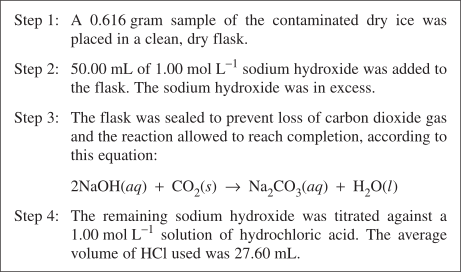
A batch of dry ice (solid \(\ce{CO_2}\)) was contaminated during manufacture. To determine its purity, the following steps were carried out.

  1. Calculate the number of moles of \(\ce{NaOH}\) added in Step 2.  (1 mark)
  2. Calculate the percentage purity by mass of this batch of dry ice.  (4 marks)
Show Answers Only

a.   0.0500 moles

b.   80.0%

Show Worked Solution

a.    \(\ce{n(NaOH) = c \times V = 0.0500 \times 1.00 = 0.0500 moles}\)
  

b.    \(\ce{n(HCl) = c \times V = 0.0276 \times 1.00 = 0.0276 mol (titrate excess NaOH)}\)

\(\ce{n(NaOH to neutralise CO2) = 0.0500-0.0276 = 0.0224 mol}\)
 

\(\ce{Ratio \ NaOH\ : CO2 = 2\ : 1  (from equation)}\)

\(\ce{n(CO2) = \frac{1}{2} \times n(NaOH) = \frac{1}{2} \times 0.0224 = 0.0112 mol}\)

\(\ce{MM (CO2) = 12.01 + 2 \times 16 = 44.01}\)

\(\ce{Mass (CO2) = n \times MM = 0.0112 \times 44.01 = 0.493 g}\)

\[\ce{\% Dry ice (by mass) = \frac{0.493}{0.616} \times 100\% = 80.0\%}\]

♦ Mean mark (b) 41%.

Filed Under: Quantitative Analysis Tagged With: Band 4, Band 5, smc-3675-10-Titration

CHEMISTRY, M2 2014 HSC 25b*

Under conditions of low oxygen levels, octane can undergo incomplete combustion according to the following chemical equation:

\( \ce{2C8H18}(l) + \ce{17O2}(g) \rightarrow \ce{6C}(s)+4 \ce{CO}(g) + \ce{6CO2}(g) + \ce{18H2O}(l)\)

Calculate the mass of soot \((\ce{C}(s))\) produced if 50 grams of octane are combusted in this way with 30 grams of oxygen and the mass of soot accounts for \(\dfrac{1}{5}\) of the total mass of the products.  (2 marks)

Show Answers Only

\(16\ \text{g}\)

Show Worked Solution
  • Total mass of the reactants 80 grams.
  • By the law of conservation of mass, the total mass of the products will be 80 grams.
  • Mass of soot \(=\dfrac{1}{5} \times 80 = 16\ \text{g}\)

Filed Under: Chemical Reactions and Stoichiometry Tagged With: Band 4, smc-4259-20-Mass Changes, smc-4259-80-Conservation of Mass

CHEMISTRY, M2 2017 HSC 17 MC

What is the density of ozone \(\ce{(O3(g))}\) at 25°C and 100 kPa ?

  1. \(1.291 \mathrm{~g} \mathrm{~L}^{-1}\)
  2. \(1.500 \mathrm{~g} \mathrm{~L}^{-1}\)
  3. \(1.936 \mathrm{~g} \mathrm{~L}^{-1}\)
  4. \(2.114 \mathrm{~g} \mathrm{~L}^{-1}\)
Show Answers Only

\(C\)

Show Worked Solution
  • Molar Mass of ozone \(= 3 \times 16=48\ \text{gmol}^{-1}\).
  • Density at 25°C and 100 kPa is 24.79 \(\text{Lmol}^{-1}\)
  • Density in \(\text{gL}^{-1}= \dfrac{48}{24.79}=1.936\ \text{gL}^{-1}\)

\(\Rightarrow C\)

Filed Under: Gas Laws Tagged With: Band 4, smc-4262-20-Molar Calculations

CHEMISTRY, M2 2015 HSC 26c

The sodium hydroxide solution was mixed with 25.0 mL samples of 0.100 mol L\(^{-1}\) citric acid \(\ce{(C6H8O7)}\). The average volume of sodium hydroxide used was 41.50 mL.  

\(\ce{C6H8O7 + 3NaOH \rightarrow C6H5O7Na3 + 3 H2O}\)

Calculate the concentration of the sodium hydroxide solution.  (4 marks)

Show Answers Only

\(\ce{0.18 mol L^{-1} \text{(to 2 d.p.)}}\)

Show Worked Solution

\(\ce{n(C6H8O7) = c \times V = 0.100 \times 0.0250 = 0.00250 moles}\)

\(\ce{NaOH : C6H8O7}\ \ \text{reaction ratio is}\ 3:1\)

\(\ce{n(NaOH in 41.50 mL) = 3 \times 0.00250 = 0.00750 moles}\)

\[\ce{[NaOH] = \frac{n}{V} = \frac{0.00750}{0.04150} = 0.18072… = 0.18 mol L^{-1} \text{(to 2 d.p.)}}\]

Mean mark 56%.

Filed Under: Concentration and Molarity Tagged With: Band 4, smc-4261-20-Concentration Calculations

CHEMISTRY, M6 2016 HSC 29

A solution of hydrochloric acid was standardised by titration against a sodium carbonate solution using the following procedure.

  • All glassware was rinsed correctly to remove possible contaminants.
  • Hydrochloric acid was placed in the burette.
  • 25.0 mL of sodium carbonate solution was pipetted into the conical flask.

The titration was performed and the hydrochloric acid was found to be 0.200 mol L\(^{-1} \).

  1. Identify the substance used to rinse the conical flask and justify your answer.   (2 marks)

    --- 4 WORK AREA LINES (style=lined) ---

  2. Seashells contain a mixture of carbonate compounds. The standardised hydrochloric acid was used to determine the percentage by mass of carbonate in a seashell using the following procedure.
    • A 0.145 g sample of the seashell was placed in a conical flask.
    • 50.0 mL of the standardised hydrochloric acid was added to the conical flask.
    • At the completion of the reaction, the mixture in the conical flask was titrated with 0.250 mol L\(^{-1} \) sodium hydroxide.
  1. The volume of sodium hydroxide used in the titration was 29.5 mL.
  2. Calculate the percentage by mass of carbonate in the sample of the seashell.   (4 marks)

    --- 14 WORK AREA LINES (style=lined) ---

Show Answers Only

a.   Substance for rinse:

  • Water should be used to rinse the conical flask as this will not change the number of moles of \(\ce{Na2CO3}\) placed in it.

b.   \( 54.3\% \)

Show Worked Solution

a.   Substance for rinse:

  • Water should be used to rinse the conical flask as this will not change the number of moles of \(\ce{Na2CO3}\) placed in it.

b.   \(\ce{HCl + NaOH \rightarrow H2O + NaCl}\)

\(\ce{n(NaOH) = c \times V = 0.250 \times 0.0295 = 7.375 \times 10^{-3} moles}\)

\(\ce{n(HCl) = 7.375 \times 10^{-3} (after reaction)}\)

\(\ce{n(HCl – original) = c \times V = 0.200 \times 0.0500 = 0.0100 moles}\)

\(\ce{n(HCl – used) = 0.0100-7.375 \times 10^{-3} = 2.625 \times 10^{-3} moles}\)
 

\(\ce{2HCl + CO3^{2-} \rightarrow H2O + CO2 + 2Cl-}\)

\(\ce{HCl\ : CO3^{2-} = 2\ : 1}\)

\[\ce{n(CO3^{2-}) = \frac{2.625 \times 10^{-3}}{2} = 1.3125 \times 10^{-3} moles}\]

\(\ce{m(CO3^{2-}) = 1.3125 \times 10^{-3} \times 60.01 = 0.07876 g}\)

\[\ce{\text{% Mass} (CO3^{2-}) = \frac{0.07876}{0.145} \times 100\% = 54.3\%} \]

♦ Mean mark (b) 40%.

Filed Under: Quantitative Analysis Tagged With: Band 4, Band 5, smc-3675-10-Titration

CHEMISTRY, M1 2014 HSC 35ci

Three electron configurations are presented in the table. For elemental titanium, the ground state is represented by \(\text{I}\), while \(\text{II}\) and \(\text{III}\) are both invalid ground state electron configurations.
 

Write a valid electron configuration for \(\ce{Ti^3+}\).  (2 marks)

Show Answers Only

Possible answer structures include:

\(\ce{1s^2 2s^2 2p^6 3s^2 3p^6 3d^1}\)

Show Worked Solution

Possible answer structures include:

\(\ce{1s^2 2s^2 2p^6 3s^2 3p^6 3d^1}\)

Filed Under: Atomic Structure and Atomic Mass Tagged With: Band 4, smc-4256-30-Electronic Configuration

CHEMISTRY, M2 2016 HSC 25

An unattended car is stationary with its engine running in a closed workshop. The workshop is 5.0 m × 5.0 m × 4.0 m and its volume is \(1.0\ ×\ 10^{5}\) L. The engine of the car is producing carbon monoxide in an incomplete combustion according to the following chemical equation: 

\(\ce{C8H18(l)+\dfrac{17}{2}O2(g) \rightarrow 8CO(g) + 9H2O(l)}\)

Exposure to carbon monoxide at levels greater than 0.100 g L\(^{-1}\) of air can be dangerous to human health.

6.0 kg of octane was combusted by the car in this workshop.

Using the equation provided, determine if the level of carbon monoxide produced in the workshop would be dangerous to human health. Support your answer with relevant calculations.  (4 marks)

Show Answers Only

\(\ce{\text{Volume of garage} = 5 \times 5 \times 4 = 100 \text{m}^2}\)

\(\ce{100 \text{m}^2} = 100\ 000\ \text{L}\)

\[\ce{\text{n(octane)} = \frac{n}{M} = \frac{6000}{114.224} = 52.53 \text{moles}} \]

\(\ce{Molar ratio of  Octane : CO = 1:8}\)

\(\ce{n(CO) = 8 \times 52.53 = 420.23}\)

\(\ce{m(CO) = n \times M = 420.23 \times 28.01 = 11\ 771\ g}\)

\[\ce{[CO] = \frac{11\ 771}{100\ 000} = 0.118 g L^{-1}}\]

\(\ce{\text{Since} [CO] > 0.100 g L^{-1}, \text{it is dangerous to human health.}}\)

Show Worked Solution

\(\ce{\text{Volume of garage} = 5 \times 5 \times 4 = 100 \text{m}^2}\)

\(\ce{100 \text{m}^2} = 100\ 000\ \text{L}\)

\[\ce{\text{n(octane)} = \frac{n}{M} = \frac{6000}{114.224} = 52.53 \text{moles}} \]

\(\ce{Molar ratio of  Octane : CO = 1:8}\)

\(\ce{n(CO) = 8 \times 52.53 = 420.23}\)

\(\ce{m(CO) = n \times M = 420.23 \times 28.01 = 11\ 771\ g}\)

\[\ce{[CO] = \frac{11\ 771}{100\ 000} = 0.118 g L^{-1}}\]

\(\ce{\text{Since} [CO] > 0.100 g L^{-1}, \text{it is dangerous to human health.}}\)

Filed Under: Gas Laws Tagged With: Band 4, smc-4262-20-Molar Calculations, smc-4262-40-Volume

CHEMISTRY, M2 2016 HSC 19 MC

Excess barium nitrate solution is added to 200 mL of 0.200 mol L\(^{-1}\) sodium sulfate.

What is the mass of the solid formed?

  1. 4.65 g
  2. 8.69 g
  3. 9.33 g
  4. 31.5 g
Show Answers Only

`C`

Show Worked Solution

\( \ce{Ba(NO3)2 (aq) + Na2SO4 (aq) \rightarrow BaSO4 (s) + 2NaNO3 (aq)}\)

\(n(\ce{Na2SO4})=0.2 \times 0.2=0.04\ \text{mol}\)

\(n(\ce{BaSO4 (s)})=0.04\ \text{mol}\)

\(m(\ce{BaSO4 (s)})=0.04 \times 233.37=9.33\ \text{g}\)

\(\Rightarrow C\)

Filed Under: Chemical Reactions and Stoichiometry Tagged With: Band 4, smc-4259-20-Mass Changes, smc-4259-50-Balancing Chemical Equations, smc-4259-80-Conservation of Mass

CHEMISTRY, M1 2007 HSC 31ai

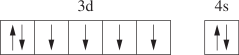
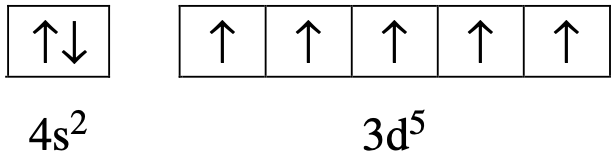
The electron spin orbital diagram represents the \(3d\) and \(4s\) electrons for an element in the first transition series.

Identify this element and explain the arrangement of electrons in these sub-shells in terms of the Pauli exclusion principle and Hund's rule.   (3 marks)

Show Answers Only
  • The electron configuration of \(3d^{6}\) \(4s^{2}\) is that of Iron (Atomic No. 26). 
  • Hund’s Rule: Every orbital within a sub shell must by singly occupied before an orbital can become doubly occupied.
    • The \(3d\) sub shell has 5 orbitals, therefore for an orbital to contain 2 electrons, there must be a minimum of 6 electrons 
  • Pauli Exclusion Principle: No more than 2 electrons can occupy the same orbital and the 2 electrons in the same orbital must have opposite spin.
    • The orbital within the \(3d\) sub shell containing 2 electrons follows this rule, as does the orbital within the \(4s\) sub shell.
Show Worked Solution
  • The electron configuration of \(3d^{6}\) \(4s^{2}\) is that of Iron (Atomic No. 26). 
  • Hund’s Rule: Every orbital within a sub shell must by singly occupied before an orbital can become doubly occupied.
    • The \(3d\) sub shell has 5 orbitals, therefore for an orbital to contain 2 electrons, there must be a minimum of 6 electrons 
  • Pauli Exclusion Principle: No more than 2 electrons can occupy the same orbital and the 2 electrons in the same orbital must have opposite spin.
    • The orbital within the \(3d\) sub shell containing 2 electrons follows this rule, as does the orbital within the \(4s\) sub shell.

Filed Under: Atomic Structure and Atomic Mass Tagged With: Band 4, smc-4256-30-Electronic Configuration

CHEMISTRY, M1 2008 HSC 32ai

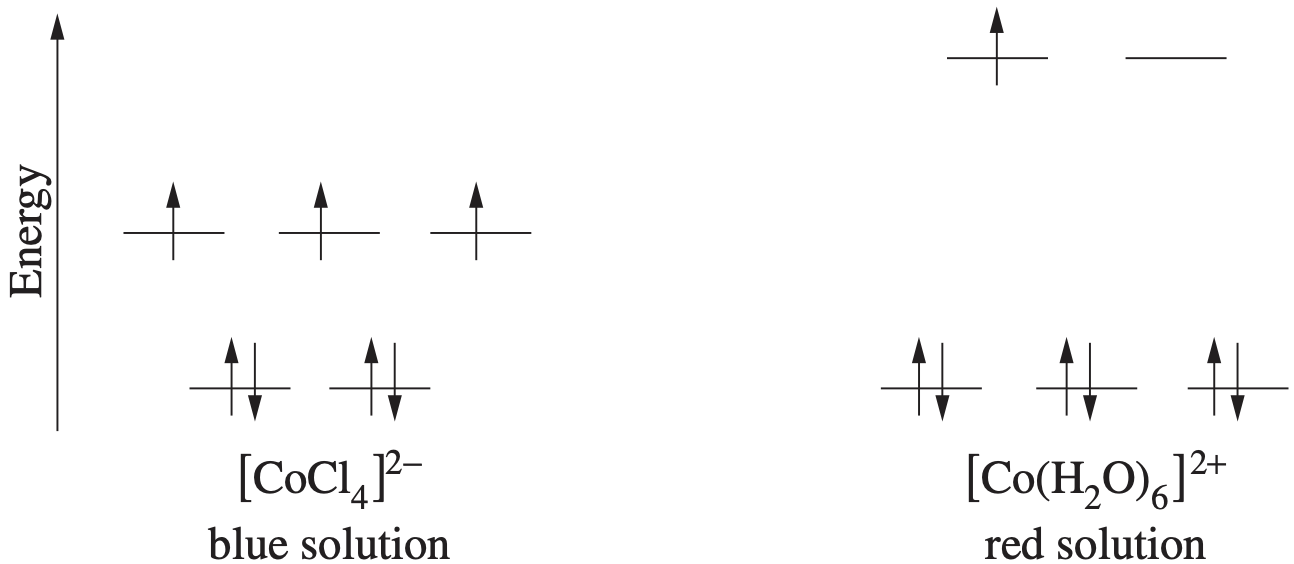
The diagram below shows the ground state electron configuration of two complexes of cobalt in aqueous solution.


Identify the block in the periodic table to which cobalt belongs and write the electron configuration of cobalt metal in its ground state.  (2 marks)

--- 4 WORK AREA LINES (style=lined) ---
Show Answers Only
  • Cobalt belongs to the D-block on the periodic table.
  • The electron configuration of Cobalt metal in its ground state is:

\(1s^{2}\)  \(2s^{2}\) \(2p^{6}\) \(3s^{2}\) \(3p^{6}\) \(4s^{2}\) \(3d^{7}\)

Show Worked Solution
  • Cobalt belongs to the D-block on the periodic table.
  • The electron configuration of Cobalt metal in its ground state is:

\(1s^{2}\)  \(2s^{2}\) \(2p^{6}\) \(3s^{2}\) \(3p^{6}\) \(4s^{2}\) \(3d^{7}\)

Filed Under: Atomic Structure and Atomic Mass Tagged With: Band 4, smc-4256-30-Electronic Configuration

CHEMISTRY, M1 2009 HSC 30bii

Write the full electron configurations for a \(\ce{Ca}\) atom in the ground state, an excited \(\ce{Ca}\) atom and a \( \ce{Ca}^{+}\) ion.  (2 marks)

Show Answers Only

\(\ce{Ca}\) atom: \(\ce{1s^2 2s^2 2p^6 3s^2 3p^6 4s^2}\)

\(\ce{Ca}\) atom (excited): \(\ce{1s^2 2s^2 2p^6 3s^2 3p^6 4s^1 4p^1}\)

\(\ce{Ca^+}\) atom: \(\ce{1s^2 2s^2 2p^6 3s^2 3p^6 4s}\)

Show Worked Solution

\(\ce{Ca}\) atom:  \(\ce{1s^2 2s^2 2p^6 3s^2 3p^6 4s^2}\)

\(\ce{Ca}\) atom (excited):  \(\ce{1s^2 2s^2 2p^6 3s^2 3p^6 4s^1 4p^1}\)

\(\ce{Ca^+}\) atom:  \(\ce{1s^2 2s^2 2p^6 3s^2 3p^6 4s}\)

Filed Under: Atomic Structure and Atomic Mass Tagged With: Band 4, smc-4256-30-Electronic Configuration

CHEMISTRY, M1 2010 HSC 35d

Experimental evidence from emission line spectra of gaseous atoms has highlighted both the merits and the limitations of Bohr's atomic model. 

Discuss Bohr's atomic model with reference to this evidence.  (5 marks)

Show Answers Only


Show Worked Solution
  • The Bohr model of the atom describes the orbit of electrons around the nucleus at fixed radii and energy.
  • The emission line spectrum of hydrogen was seen to support the Bohr model as discrete lines were observed which could be assigned to electronic transitions between fixed energy levels.
  • However when the emission line spectrum for sodium was recorded there were more spectral lines than could be explained by the Bohr model. Line splitting or doublets were observed.
  • The line splitting or doublets result from electrons having differing angular momenta, residing in sub-shells, which was not considered in the Bohr model.

Filed Under: Periodicity Tagged With: Band 4, Band 5, smc-4257-40-Reactivity

CHEMISTRY, M1 2010 HSC 35a

Identify the element in period 3 of the periodic table that has the highest electronegativity and justify your choice.   (3 marks)

Show Answers Only
  • Most electronegative element in period 3 is chlorine \(\ce{(Cl)}\).
  • The electronegativity is a measure of an atom’s ability to attract electrons to itself.
  • Electronegativities increase across periods in the periodic table from left to right or as the number of valence electrons increases.
  • Fluorine is the most electronegative element with all other electronegativities relative to this.
Show Worked Solution
  • Most electronegative element in period 3 is chlorine \(\ce{(Cl)}\).
  • The electronegativity is a measure of an atom’s ability to attract electrons to itself.
  • Electronegativities increase across periods in the periodic table from left to right or as the number of valence electrons increases.
  • Fluorine is the most electronegative element with all other electronegativities relative to this.

Filed Under: Atomic Structure and Atomic Mass Tagged With: Band 4, smc-4256-90-Models of the Atom

CHEMISTRY, M1 2014 HSC 11 MC

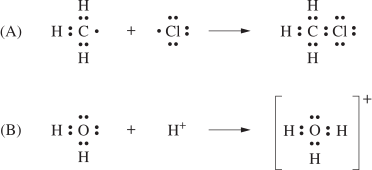
Which of the following does NOT represent the formation of a coordinate covalent bond?
 

Show Answers Only

`A`

Show Worked Solution
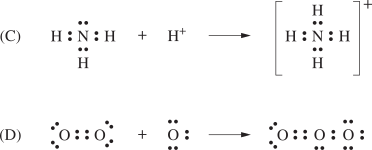
  • A coordinate covalent bond occurs when one atom donates a pair of electrons (both electrons) to form the covalent bond.
  • In \(A\) both atoms donate 1 electron each, therefore it is not a coordinate covalent bond.

`=>A`

Filed Under: Bonding Tagged With: Band 4, smc-4258-50-Chemical structure

CHEMISTRY, M1 2016 HSC 5 MC

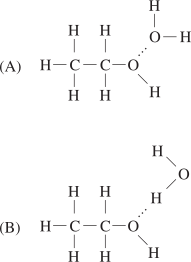
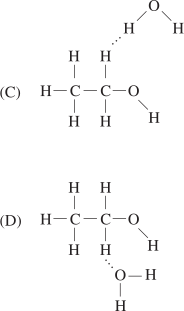
Which of the following diagrams best represents the bonding between molecules of water and ethanol?


Show Answers Only

`B`

Show Worked Solution
  • Ethanol, \(\ce{C2H5OH}\) has a polar \(\ce{OH}\) group. The partially negative oxygen atom is attracted to the partially positive hydrogen atom in the water molecule.
  • This forms a hydrogen bond.

`=>B`

Filed Under: Bonding Tagged With: Band 4, smc-4258-40-Inter/Intramolecular Bonding, smc-4258-50-Chemical structure

CHEMISTRY, M1 2011 HSC 36bi

Identify ONE cation and ONE anion that can be represented by the electron configuration \( \ce{1 s^2 2 s^2 2 p^6 3 s^2 3 p^6} \).  (2 marks)

Show Answers Only

Answers could include one of the following:

\(\ce{K+, Cl-}\)

\(\ce{Ca^{2+}, S^{2-}}\)

\(\ce{Sc^{3+}, P^{3-}}\)

Show Worked Solution

Answers could include one of the following:

\(\ce{K+, Cl-}\)

\(\ce{Ca^{2+}, S^{2-}}\)

\(\ce{Sc^{3+}, P^{3-}}\)

Filed Under: Atomic Structure and Atomic Mass Tagged With: Band 4, smc-4256-30-Electronic Configuration

CHEMISTRY, M1 2011 HSC 23a

Element 112 was first synthesised in 1996 and officially named in 2009 as copernicium, \(\ce{Cn}\).

Explain why the transuranic isotope \( \ce{^{278 }_{112}Cn}\) is unstable.  (1 mark)

--- 2 WORK AREA LINES (style=lined) ---

Show Answers Only
  • Isotopes such as copernicium-278 are unstable because they are heavy nuclei with high neutron-proton ratios (eg. Cn-278 = 166 : 112).
Show Worked Solution
  • Isotopes such as copernicium-278 are unstable because they are heavy nuclei with high neutron-proton ratios (eg. Cn-278 = 166 : 112).

Filed Under: Atomic Structure and Atomic Mass Tagged With: Band 4, smc-4256-60-Isotopes

CHEMISTRY, M1 2011 HSC 9 MC

What property of \(\ce{O3}\) makes it more soluble in water than \(\ce{O2}\) in water?

  1. \(\ce{O3}\) is a polar molecule.
  2. \(\ce{O3}\) has a resonance structure.
  3. \(\ce{O3}\) is a highly reactive molecule.
  4. \(\ce{O3}\) has a coordinate covalent bond.
Show Answers Only

`A`

Show Worked Solution
  • Solubility in water is directly correlated to the polarity of a molecule. The more polar a molecule is the more it will dissolve in water.
  • Thus if \(\ce{O3}\) is more soluble in water than \(\ce{O2}\), it must be polar while \(\ce{O2}\) is relatively nonpolar.

`=>A`

Filed Under: Bonding Tagged With: Band 4, smc-4258-40-Inter/Intramolecular Bonding

CHEMISTRY, M1 2012 HSC 37e

Evaluate the contribution of the Bohr model to the development of our understanding of the structure of the atom.   (7 marks)

Show Answers Only
  • The Bohr model of the atom was developed to use the quantisation of energy to explain the emission and absorption spectrum of hydrogen.
  • It proposed that the single electron of the atom was confined to defined orbits around the nucleus, somewhat analogous to a planet’s orbit around its star.
  • For the electron to change to a different orbit, energy had to be absorbed (to go to a higher energy orbit) or emitted (to go to a lower energy orbit).
  • The energy absorbed or emitted is well-defined, giving rise to sharp absorption or emission lines. No other changes in energy are allowed.
  • The model was an important step towards understanding and accepting the quantum view of the atom and introduced the idea of energy levels (shells) to describe the electronic configuration of atoms.
  • The Bohr model could not be applied to atoms other than hydrogen and did not provide any explanation for the quantisation.
  • These restrictions and limitations of the model were recognised by Bohr and the model was not meant to be used beyond the hydrogen atom, but the attractiveness of the simplicity of the model has ensured continued use and propagates the incorrect concept of electrons as particles orbiting a nucleus.
Show Worked Solution

Evaluation Statement

  • The Bohr model was partially effective in advancing atomic understanding.
  • This evaluation is based on: explaining hydrogen spectra, introducing quantum concepts and applicability to other atoms.

Explaining Hydrogen Spectra

  • Bohr’s model successfully addressed hydrogen’s emission and absorption lines.
  • Evidence supporting this includes: correctly predicted wavelengths of spectral lines using quantised energy levels.
  • The model clearly fulfilled its primary purpose by mathematically linking electron transitions to observed spectra.
  • This strongly meets the criterion as it solved a major scientific puzzle of the time.

Applicability Beyond Hydrogen

  • The model fails to achieve accuracy for multi-electron atoms.
  • Evidence indicates that predictions become increasingly inaccurate with more electrons.
  • Bohr himself recognised these limitations, restricting the model to hydrogen.
  • This criterion is insufficiently met, revealing fundamental flaws in the model’s underlying assumptions.

Introduction of Quantum Concepts

  • The model effectively introduced revolutionary ideas like energy levels (electron shells) and quantisation.
  • These concepts became foundational for quantum mechanics development.
  • While the orbital concept was incorrect, it adequately fulfilled the need for a transitional model.
  • This satisfactorily meets the criterion of advancing theoretical understanding.

Final Evaluation

  • Weighing these factors shows the Bohr model was highly effective as a stepping stone but limited as a complete theory.
  • The strengths outweigh the weaknesses because it successfully bridged classical and quantum physics.
  • Although inadequate for complex atoms, it proves essential for teaching atomic concepts.
  • The overall evaluation demonstrates its crucial but transitional role in atomic theory development.

Filed Under: Atomic Structure and Atomic Mass Tagged With: Band 4, Band 5, smc-4256-90-Models of the Atom

CHEMISTRY, M1 2012 HSC 37dii

Write the electronic configuration of \(\ce{Fe^2+}\) and \(\ce{Fe^3+}\).  (2 marks)

Show Answers Only


Show Worked Solution

Method 1

\(\ce{Fe^2+: [Ar] \text{3d}^6 }\)

\(\ce{Fe^3+: [Ar] \text{3d}^5 }\)
 

Method 2

\(\ce{Fe^2+: 1s^2 2s^2 2p^2 2p^6 3s^2 3p^6 4s^2 3d^6}\)

\(\ce{Fe^3+: 1s^2 2s^2 2p^2 2p^6 3s^2 3p^6 4s^2 3d^5}\)

Filed Under: Bonding Tagged With: Band 4, smc-4258-30-Lewis Dot

CHEMISTRY, M1 2012 HSC 15 MC

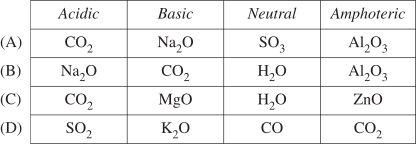
In which row of the following table are the listed oxides correctly classified?

Show Answers Only

`C`

Show Worked Solution
  • Acidic Oxides: are often the oxides of non-metals and form acidic solutions.
  • Basic Oxides: are usually formed by reacting oxygen with metals and participate with acids in neutralisation reactions.
  • Neutral Oxides: react with neither acids or bases and do not lead to either acidic or basic solutions.
  • Amphoteric Oxides: exhibit both acidic and basic properties and can chemically react as either an acid or base.

`=>C`

Filed Under: Properties of Matter Tagged With: Band 4, smc-4255-20-Periodic Table

CHEMISTRY, M1 2013 HSC 35bii

An atom has FIVE valence electrons in its \(d\) orbital. Using an orbital diagram of the valence shell of the atom, explain how Hund's rule determines the electronic configuration.   (3 marks)

Show Answers Only

  • Hund’s rule states that every orbital in a subshell is occupied with one electron before any orbital is doubly occupied.
  • In this example Hund’s rule is illustrated by the \(3d\) sub-shell having 5 electrons in 5 different orbitals.
Show Worked Solution

  • Hund’s rule states that every orbital in a subshell is occupied with one electron before any orbital is doubly occupied.
  • In this example Hund’s rule is illustrated by the \(3d\) sub-shell having 5 electrons in 5 different orbitals.

Filed Under: Atomic Structure and Atomic Mass Tagged With: Band 4, smc-4256-30-Electronic Configuration

CHEMISTRY, M1 2013 HSC 35bi

Identify in which of the \( s, p, d \) or \(f \) blocks of the Periodic Table the element \(\ce{Ra}\) is found. Justify your answer.   (2 marks)

Show Answers Only
  • \(\ce{Ra}\) (radium) is an \( s \)-block element.
  • Its valence electrons are in the \( s \) orbital.
Show Worked Solution
  • \(\ce{Ra}\) (radium) is an \( s \)-block element.
  • Its valence electrons are in the \( s \) orbital.

Filed Under: Atomic Structure and Atomic Mass Tagged With: Band 4, smc-4256-30-Electronic Configuration

CHEMISTRY, M1 2013 HSC 35a

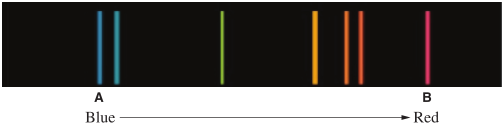
The emission spectrum of a metal salt is observed with a spectroscope. 

Explain the processes by which emission lines arise. Include an energy level diagram for the lines marked A and B in your response.   (3 marks)

Show Answers Only
  • Metal ions absorb flame energy which causes electrons to jump to higher energy levels.
  • Subsequently, excited electrons fall back to lower levels. This process releases specific amounts of energy as light photons.
  • Since electron energies are quantised and transitions between states are restricted to well-defined energies, the energy released is well defined. 
  • In the spectroscope image, each line represents one specific electron transition.
  • Line A is the blue end of the spectrum, meaning the transition is of high energy (shorter wavelength).
  • Line B is at the red end of the spectrum, meaning the transition is of low energy (longer wavelength).
  • This demonstrates why emission spectra show distinct coloured lines.
Show Worked Solution
  • Metal ions absorb flame energy which causes electrons to jump to higher energy levels.
  • Subsequently, excited electrons fall back to lower levels. This process releases specific amounts of energy as light photons.
  • Since electron energies are quantised and transitions between states are restricted to well-defined energies, the energy released is well defined. 
  • In the spectroscope image, each line represents one specific electron transition.
  • Line A is the blue end of the spectrum, meaning the transition is of high energy (shorter wavelength).
  • Line B is at the red end of the spectrum, meaning the transition is of low energy (longer wavelength).
  • This demonstrates why emission spectra show distinct coloured lines.

Filed Under: Atomic Structure and Atomic Mass Tagged With: Band 4, smc-4256-35-Flame Test

CHEMISTRY, M1 2013 HSC 20 MC

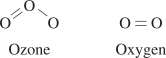
The structures of ozone and molecular oxygen are shown.
 

Ozone is more easily decomposed than molecular oxygen because

  1. it is polar.
  2. it is a bent molecule.
  3. it has a greater molecular mass.
  4. it has a lower average bond energy.
Show Answers Only

`D`

Show Worked Solution
  • The presence of the single bond in the ozone molecule lowers the average bond energy.
  • Bond breaking is an endothermic process and so requires energy. As ozone has a lower average bond energy, less energy is required to break the bonds and thus decomposes more easily than molecular oxygen.

`=>D`

Filed Under: Periodicity Tagged With: Band 4, smc-4257-10-Atomic Radii, smc-4257-20-Electronegativity, smc-4257-30-Ionisation Energy

BIOLOGY, M4 2014 HSC 34c

Demonstrate how applications of the Human Genome Project could affect future trends in human biological evolution.   (4 marks)

Show Answers Only

→ The Human Genome Project has succeeded in mapping genes and identifying base sequences of the entire genome.

→ Precise locations of disease-causing genes have been discovered, as well as their specific base sequences.

→ Genetic screening allows people to find out whether they hold defective genes. This can show whether themselves, their family or potentially future children are at risk of a genetic disease even before symptoms appear. 

→ Modification of lifestyle could help to prolong life and increase the chances of the individual producing offspring. This could increase the frequency of the defective gene in the population.

→ Pharmaceuticals can be designed to prevent expression of defective DNA using base sequence recognition chemistry.

→ This would mean that holders of a defective gene would not experience a defective genotype and might live longer lives, causing the defective gene to become more common in the humans species as a consequence.

→ CRISPR is an emerging gene-editing technology that can be used to modify, delete or correct precise regions of our DNA. Its use on humans is currently very limited but its potential is promising for treatment of genetic diseases.

→ While somatic gene editing by CRISPR affects only the patient being treated, germ-line editing affects all cells in an organism, including eggs and sperm. This means that future generations who would normally be affected by the genetic disease in question would be unaffected as the defective gene would not be part of their genotype.

Show Worked Solution

→ The Human Genome Project has succeeded in mapping genes and identifying base sequences of the entire genome.

→ Precise locations of disease-causing genes have been discovered, as well as their specific base sequences.

→ Genetic screening allows people to find out whether they hold defective genes. This can show whether themselves, their family or potentially future children are at risk of a genetic disease even before symptoms appear. 

→ Modification of lifestyle could help to prolong life and increase the chances of the individual producing offspring. This could increase the frequency of the defective gene in the population.

→ Pharmaceuticals can be designed to prevent expression of defective DNA using base sequence recognition chemistry.

→ This would mean that holders of a defective gene would not experience a defective genotype and might live longer lives, causing the defective gene to become more common in the humans species as a consequence.

→ CRISPR is an emerging gene-editing technology that can be used to modify, delete or correct precise regions of our DNA. Its use on humans is currently very limited but its potential is promising for treatment of genetic diseases.

→ While somatic gene editing by CRISPR affects only the patient being treated, germ-line editing affects all cells in an organism, including eggs and sperm. This means that future generations who would normally be affected by the genetic disease in question would be unaffected as the defective gene would not be part of their genotype.

Filed Under: BIO - Ex-syllabus checks required Tagged With: Band 4, smc-4313-20-Preserving biodiversity

BIOLOGY, M4 2015 HSC 35e

'Science has been used to solve problems in the investigation of evolutionary
relationships between humans and other primates, and so has provided information of interest to society.' 

Justify this statement in terms of the scientific knowledge behind DNA-DNA hybridisation AND karyotype analysis.  (7 marks)

--- 20 WORK AREA LINES (style=lined) ---

Show Answers Only

→ Using comparative morphologies limits our ability in determining relationships between humans and other primates. Sometimes morphologies seem very different, yet the changes or modifications required to achieve those differences might be small in number or too simple. 

→ Using genetic evidence gives a much more accurate picture.

DNA-DNA Hybridisation

→ Can be used to show how genetically similar two species are.

→ DNA from a human and a chimpanzee (other primate) can be tested for melting point. Then it can be melted into single strands. The single strands are combined into hybrid DNA, in which some hydrogen bonding between base pairs does not happen because they are not complementary.

→ The lower the hybrid DNA M.P. is compared to the original DNA is a measure of how similar the original DNA was.

→ When the DNA is similar the two species are seen to be close in evolutionary terms.

Karyotype Analysis

→ Involves using a chemical to kill a cell during cell division when the chromosomes can be seen individually.

→ Photos are taken and the chromosome pictures arranged in pairs of increasing size. This picture of all the chromosomes in the genome is a karyotype.

→ Comparing the number, size, shape and banding pattern of chromosomes allows scientists to observe differences between species.

→ The fewer differences between karyotypes, the closer the species are in evolutionary terms.

→ People are interested to study our closest living relatives, as it helps us to understand where we have come from. It helps us to understand ourselves as a species when we can identify our closest living relatives and see our unique or common features and behaviours. DNA-DNA hybridisation and karyotype analysis help scientists to accurately achieve this knowledge.

Show Worked Solution

→ Using comparative morphologies limits our ability in determining relationships between humans and other primates. Sometimes morphologies seem very different, yet the changes or modifications required to achieve those differences might be small in number or too simple. 

→ Using genetic evidence gives a much more accurate picture.

DNA-DNA Hybridisation

→ Can be used to show how genetically similar two species are.

→ DNA from a human and a chimpanzee (other primate) can be tested for melting point. Then it can be melted into single strands. The single strands are combined into hybrid DNA, in which some hydrogen bonding between base pairs does not happen because they are not complementary.

→ The lower the hybrid DNA M.P. is compared to the original DNA is a measure of how similar the original DNA was.

→ When the DNA is similar the two species are seen to be close in evolutionary terms.

Karyotype Analysis

→ Involves using a chemical to kill a cell during cell division when the chromosomes can be seen individually.

→ Photos are taken and the chromosome pictures arranged in pairs of increasing size. This picture of all the chromosomes in the genome is a karyotype.

→ Comparing the number, size, shape and banding pattern of chromosomes allows scientists to observe differences between species.

→ The fewer differences between karyotypes, the closer the species are in evolutionary terms.

→ People are interested to study our closest living relatives, as it helps us to understand where we have come from. It helps us to understand ourselves as a species when we can identify our closest living relatives and see our unique or common features and behaviours. DNA-DNA hybridisation and karyotype analysis help scientists to accurately achieve this knowledge.

Filed Under: BIO - Ex-syllabus checks required Tagged With: Band 4, Band 5

BIOLOGY, M4 2015 HSC 35d

  1. Distinguish between relative dating and absolute dating of fossils.   (2 marks)

    --- 4 WORK AREA LINES (style=lined) ---
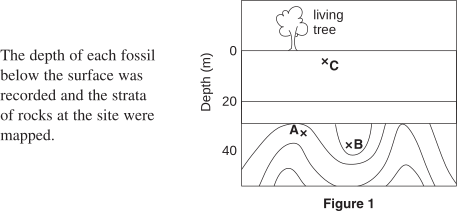
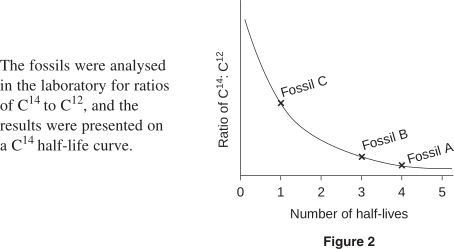
  2. Students found three fossils (A, B and C) at an archaeological site. 
     

The students concluded that their data were conflicting and they could not determine the relative ages of the fossils.

Evaluate the students' conclusion with reference to the data presented.   (4 marks)

--- 8 WORK AREA LINES (style=lined) ---
Show Answers Only

i.    Relative vs absolute dating:

  • Relative dating is used to compare fossils, giving scientists data to determine if one fossil is older/younger than another.
  • Absolute dating can provide a quantitative value for the actual age of individual fossils. 

ii.    Evaluation of conclusion:

  • Fossil B is located at a lower depth than fossil A, however, the strata that contains fossil A is below the strata that contains fossil B.
  • This has occurred because the landscape was folded via geological processes, pushing up some of the strata containing fossil A and pushing down the strata containing fossil B. Therefore, fossil A is the older of the two. 
  • Fossil C is younger because it is located in a higher strata than the other two fossils.
  • In Figure 2, fossil A is shown to have an age of four half-lives of \(\ce{C^{14}}\), fossil B three half-lives and fossil C one half-life. This evidence suggests fossil A is the oldest and fossil C is much younger. Therefore the students’ conclusion is incorrect as the graphical data is consistent with the mapped data.
Show Worked Solution

i.    Relative vs absolute dating:

  • Relative dating is used to compare fossils, giving scientists data to determine if one fossil is older/younger than another.
  • Absolute dating can provide a quantitative value for the actual age of individual fossils. 

ii.    Evaluation of conclusion:

  • Fossil B is located at a lower depth than fossil A, however, the strata that contains fossil A is below the strata that contains fossil B.
  • This has occurred because the landscape was folded via geological processes, pushing up some of the strata containing fossil A and pushing down the strata containing fossil B. Therefore, fossil A is the older of the two. 
  • Fossil C is younger because it is located in a higher strata than the other two fossils.
  • In Figure 2, fossil A is shown to have an age of four half-lives of \(\ce{C^{14}}\), fossil B three half-lives and fossil C one half-life. This evidence suggests fossil A is the oldest and fossil C is much younger. Therefore the students’ conclusion is incorrect as the graphical data is consistent with the mapped data.

Filed Under: Past Ecosystems Tagged With: Band 4, Band 5, smc-4312-07-Rock structure/formation, smc-4312-25-Palaeontology, smc-4312-40-Evaluating hypotheses

BIOLOGY, M4 2015 HSC 35a

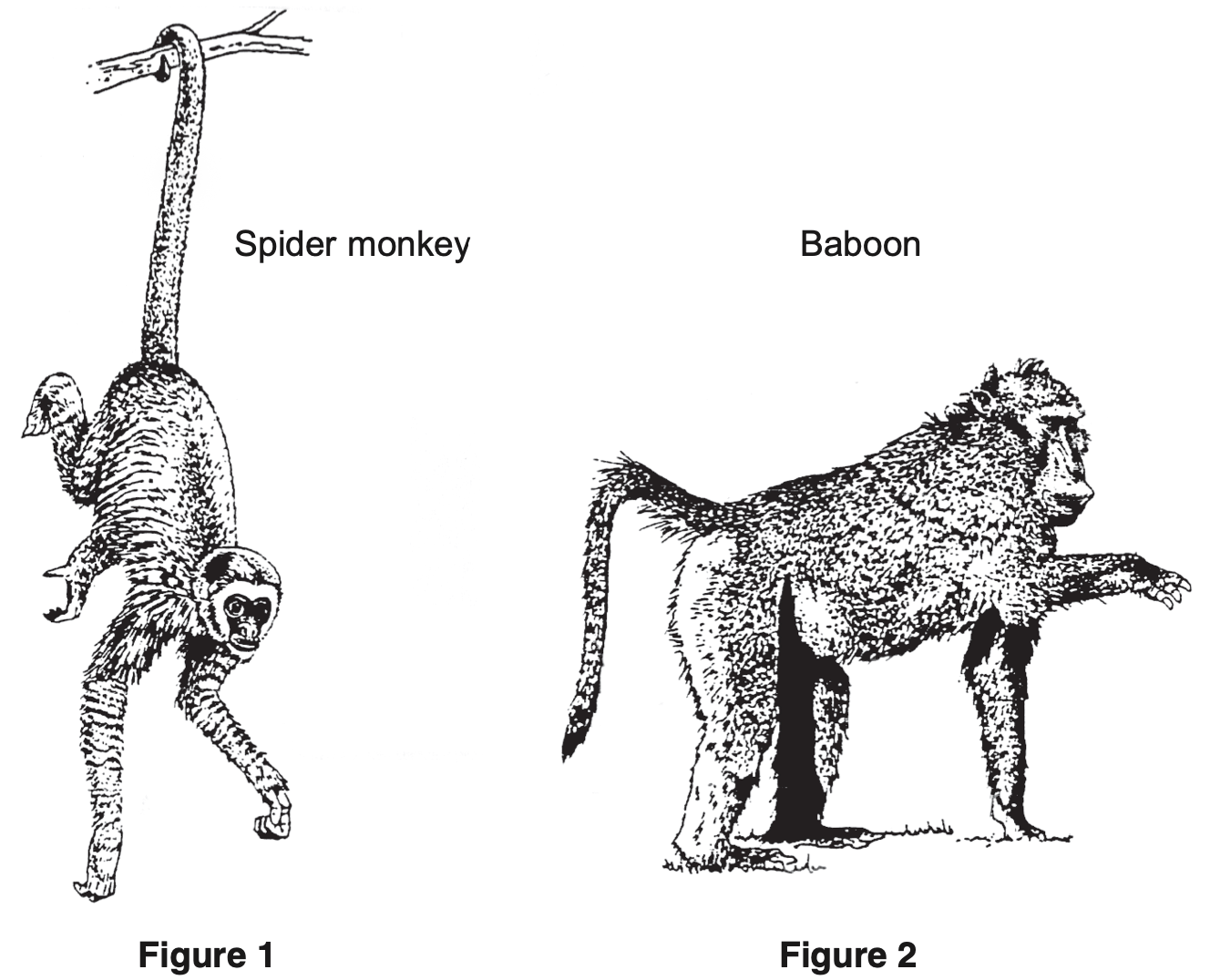
The diagram shows two primates. 

  1. Provide the word that describes the tail for the classification of each primate.  (2 marks)

    --- 2 WORK AREA LINES (style=lined) ---
  2. Spider monkeys and baboons are members of the same order. Use the hierarchical classification system to explain whether they would necessarily be in the same phylum and the same genus.  (2 marks)

    --- 5 WORK AREA LINES (style=lined) ---
Show Answers Only

i.     Figure 1: Prehensile

Figure 2: Non-prehensile
 

ii.   → Classification will be identical in higher levels, not necessarily the same in the lower levels.

→ Since phylum is above order in the classification system, these two animals in the same order will be in the same phylum.

→ Genus is below order in the classification system, so these animals are not necessarily in the same genus.

Show Worked Solution

i.     Figure 1: Prehensile

Figure 2: Non-prehensile
 

ii.   → Classification will be identical in higher levels, not necessarily the same in the lower levels.

→ Since phylum is above order in the classification system, these two animals in the same order will be in the same phylum.

→ Genus is below order in the classification system, so these animals are not necessarily in the same genus.

Filed Under: BIO - Ex-syllabus checks required Tagged With: Band 4

BIOLOGY, M4 2016 HSC 35d

A new fossil form was recently found in South Africa. This fossil shares characteristics with both the genus Australopithecus and the genus Homo.

There has been debate as to whether this new fossil form should be classified in the genus Australopithecus or in the genus Homo.

  1. Describe a key difference between fossils classified as the genus Australopithecus and those classified as the genus Homo.   (2 marks)

    --- 3 WORK AREA LINES (style=lined) ---
  2. Explain how DNA sequencing technology could be used to determine which genus the new fossil belongs to. In your answer, refer to relevant hominid species.   (4 marks)

    --- 8 WORK AREA LINES (style=lined) ---
Show Answers Only

i.     → If the fossil is to be classified as the genus Homo, then the fossil should indicate an upright stance.

→ Alternatively, if the fossil is to be classified as the genus Australopithecus, then the fossil should indicate a stooped stance.
 

ii.   → Mitochondrial DNA sequences of the fossil and a modern Homo species (eg Homo sapiens) could be compared to determine time since a common ancestor.

→ If the time since a common ancestor is less than 2 MYA, the fossil is likely to be of the Homo genus.

→ If it is greater than 2 MYA since a common ancestor, it is likely that this fossil is either Australopithecus or another species.

Show Worked Solution

i.     → Genus Homo: the fossil should indicate an upright stance.

→ Genus Australopithecus: the fossil should indicate a stooped stance.
 

ii.   DNA sequencing

→ Mitochondrial DNA sequences of the fossil and a modern Homo species (eg Homo sapiens) could be compared to determine time since a common ancestor.

→ If the time since a common ancestor is less than 2 MYA, the fossil is likely to be of the Homo genus.

→ If it is greater than 2MYA since a common ancestor, it is likely that this fossil is either Australopithecus or another species.

Filed Under: BIO - Ex-syllabus checks required Tagged With: Band 4, Band 5

BIOLOGY, M4 2016 HSC 35b

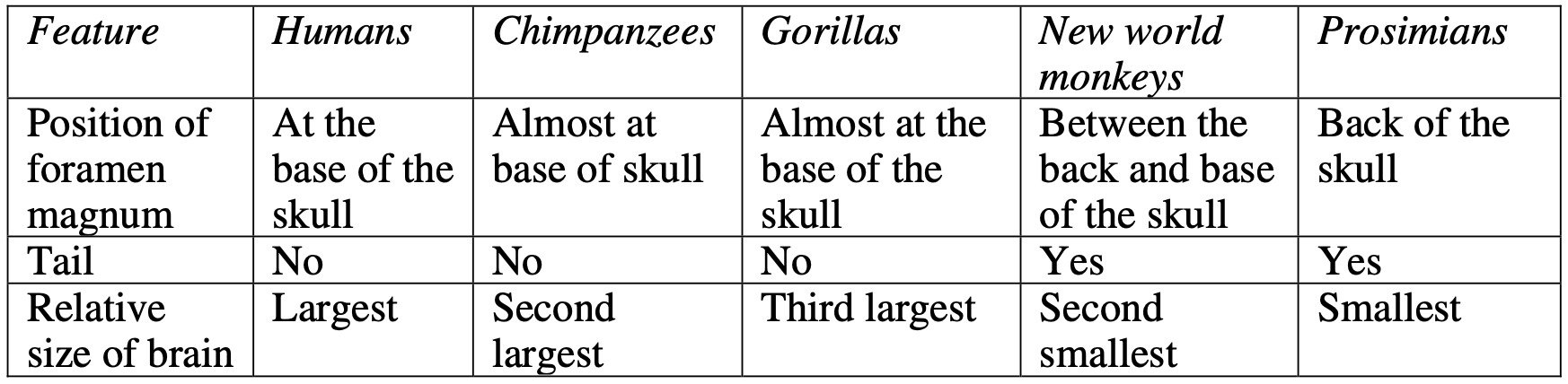
The table compares some of the amino acids present in a particular protein in different primates.

Using these data and your knowledge of the characteristics of primate groups, explain why using different types of data improves the reliability of estimated evolutionary relationships.  (5 marks)

Show Answers Only


Show Worked Solution

→ The amino acid data set shows that chimpanzees and humans have identical amino acids in this protein.

→ Gorillas show one amino acid difference, new world monkeys show three amino acid differences and prosimians show four amino acid differences.

→ On the basis of this data, it can be assessed that chimpanzees and humans are identical, followed by gorillas then new world monkeys and then prosimians.
 

→ The morphological characteristics outlined in the table would rank the organisms in evolutionary proximity as chimpanzees most closely related to humans but different species, followed by gorillas then new world monkeys and then prosimians.

→ Both data sets correlate and therefore the estimates of evolutionary proximity to humans can be considered to be more reliable.

Filed Under: BIO - Ex-syllabus checks required Tagged With: Band 4, Band 5

BIOLOGY, M4 2016 HSC 35c

  1. What are TWO features of chromosomes used in karyotype analysis?  (2 marks)

    --- 2 WORK AREA LINES (style=lined) ---
  2. Sketch a graph that depicts changes in human population over the last 10 000 years. Identify a point on the graph that shows the effect of a technological advance on world population.  (2 marks)

    --- 8 WORK AREA LINES (style=blank) ---

Show Answers Only

i.      → The position of centromeres.

→ The banding patterns present.
 

ii.    
       

Show Worked Solution

i.      → The position of centromeres

→ The banding patterns present.
 

ii.    
       

Filed Under: BIO - Ex-syllabus checks required Tagged With: Band 3, Band 4, smc-4311-20-Biotic/Abiotic factors

BIOLOGY, M3 SM-Bank 23

In 1926, T H Muller experimented with fruit flies (Drosophila sp.) by exposing them to X-rays. He found that their offspring showed new phenotypes not observed in the wild population.

Explain how the results of these experiments can provide support for Darwin's theory of evolution by natural selection.  (4 marks)

--- 9 WORK AREA LINES (style=lined) ---
Show Answers Only

→ He demonstrated that genetic mutations produced by X-rays in the lab, could be passed on to offspring.

→ As the X-rays could induce genetic diversity in the fruit flies, Muller’s experiments proved that genetic variation could be increased.

→ These findings bridged the gap between laboratory experiments and field observations, making evolution a rigorous experimental science

→ Muller’s work provided experimental evidence that genetic mutations could drive evolutionary change, aligning with Darwin’s theory.

Show Worked Solution

→ He demonstrated that genetic mutations produced by X-rays in the lab, could be passed on to offspring.

→ As the X-rays could induce genetic diversity in the fruit flies, Muller’s experiments proved that genetic variation could be increased.

→ These findings bridged the gap between laboratory experiments and field observations, making evolution a rigorous experimental science

→ Muller’s work provided experimental evidence that genetic mutations could drive evolutionary change, aligning with Darwin’s theory.

Filed Under: BIO - Ex-syllabus checks required Tagged With: Band 4, smc-4309-10-Biological diversity

BIOLOGY, M3 2002 HSC 25

  1. Define the concept of punctuated equilibrium in evolution.  (1 mark)

    --- 2 WORK AREA LINES (style=lined) ---
  2. How does punctuated equilibrium differ from the process proposed by Darwin?  (3 marks)

    --- 7 WORK AREA LINES (style=lined) ---
Show Answers Only

a.    Punctuated equilibrium:

  • Once species adapts to their environment, they will undergo little or no evolutionary change, remaining in an equilibrium state until a rapid change to their environment forces evolutionary change.

b.    Punctuated equilibrium vs Darwin:

  • These two theories both acknowledge natural selection, but differ in the pace and pattern of evolution.
  • Darwin’s theory suggests gradual, continuous evolution, with small changes accumulating over time as species adapt to their environment.
  • In contrast, punctuated equilibrium proposes that species remain stable for long periods with drastic evolutionary changes occurring in when the environment undergoes rapid change, thus forcing quick evolutionary change.
Show Worked Solution

a.    Punctuated equilibrium:

  • Once species adapts to their environment, they will undergo little or no evolutionary change, remaining in an equilibrium state until a rapid change to their environment forces evolutionary change.

b.    Punctuated equilibrium vs Darwin:

  • These two theories both acknowledge natural selection, but differ in the pace and pattern of evolution.
  • Darwin’s theory suggests gradual, continuous evolution, with small changes accumulating over time as species adapt to their environment.
  • In contrast, punctuated equilibrium proposes that species remain stable for long periods with drastic evolutionary changes occurring in when the environment undergoes rapid change, thus forcing quick evolutionary change.

Filed Under: Natural Selection Tagged With: Band 4, Band 5, smc-4309-30-Punctuated equilibrium

BIOLOGY, M3 2003 HSC 19

The widespread use of antibiotics for the treatment of bacterial infections has led to the development of antibiotic resistance in some species of bacteria. From your studies of evolution and the mechanisms of inheritance, explain how resistance has developed in bacteria.  (3 marks)

--- 6 WORK AREA LINES (style=lined) ---
Show Answers Only
  • Resistance in bacteria develops through a process of natural selection and genetic mutation.
  • Some bacteria possess random mutations that allow them to be resistant to antibiotics.
  • As these resistant bacteria are more likely to survive, when they reproduce via binary fission, the daughter cells will also possess the resistant mutation.
  • Over time, the whole population of bacteria becomes antibiotic-resistant because the resistant bacteria are best suited to their environment. This is how resistance has developed in bacteria.
Show Worked Solution
  • Resistance in bacteria develops through a process of natural selection and genetic mutation.
  • Some bacteria possess random mutations that allow them to be resistant to antibiotics.
  • As these resistant bacteria are more likely to survive, when they reproduce via binary fission, the daughter cells will also possess the resistant mutation.
  • Over time, the whole population of bacteria becomes antibiotic-resistant because the resistant bacteria are best suited to their environment. This is how resistance has developed in bacteria.

Filed Under: Evolution - The Evidence Tagged With: Band 4, smc-4310-70-Bacteria

BIOLOGY, M3 2004 HSC 18b

Justify the use of vertebrate forelimbs as evidence to support the theory of evolution.  (3 marks)

--- 7 WORK AREA LINES (style=lined) ---
Show Answers Only

  • Vertebrate forelimbs exhibit a shared structure across species, suggesting common ancestry.
  • Despite varying functions and appearances, the five-fingered bone structure remains consistent.
  • The transition from fins to limbs in early tetrapods further supports evolution as these transitions reveal functional stages in limb development.
  • By comparing the limbs of vertebrate we are presented with compelling evidence to support the theory of evolution.

Show Worked Solution

  • Vertebrate forelimbs exhibit a shared structure across species, suggesting common ancestry.
  • Despite varying functions and appearances, the five-fingered bone structure remains consistent.
  • The transition from fins to limbs in early tetrapods further supports evolution as these transitions reveal functional stages in limb development.
  • By comparing the limbs of vertebrate we are presented with compelling evidence to support the theory of evolution.

Filed Under: Evolution - The Evidence Tagged With: Band 4, smc-4310-15-Comparative anatomy

BIOLOGY, M3 2004 HSC 18a

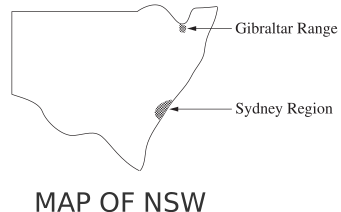
A plant species found in the area immediately around Sydney has also been found in a small area in the Gibraltar Range in the far north of NSW. 
 

Predict what might happen to the TWO populations over the next 5 million years, in terms of Darwin/Wallace's theory of evolution.   (3 marks)

Show Answers Only

  • According to Darwin/Wallace’s theory of evolution these two plant populations will undergo divergent evolution over the next 5 million years due to their seperate geographical location.
  • The Sydney population will likely experience significantly more rainfall than the Gibralter range population. As a result, this plant will evolve to require more water and have less resistance to drier conditions.
  • The Gibralter range species exist further inland and at a higher altitude and are likely to experience less rainfall and a greater range of temperatures. This species could evolve to be more drought resistant and hardier in extreme temperatures.
  • While the theory of evolution can provide a prediction, the actual outcome may be vastly different due to other abiotic and biotic factors, such as the presence of predators.

Show Worked Solution

  • According to Darwin/Wallace’s theory of evolution these two plant populations will undergo divergent evolution over the next 5 million years due to their seperate geographical location.
  • The Sydney population will likely experience significantly more rainfall than the Gibralter range population. As a result, this plant will evolve to require more water and have less resistance to drier conditions.
  • The Gibralter range species exist further inland and at a higher altitude and are likely to experience less rainfall and a greater range of temperatures. This species could evolve to be more drought resistant and hardier in extreme temperatures.
  • While the theory of evolution can provide a prediction, the actual outcome may be vastly different due to other abiotic and biotic factors, such as the presence of predators.

Filed Under: Effects of the Environment on Organisms, Natural Selection Tagged With: Band 4, smc-4307-40-Selection pressures, smc-4309-35-Convergent/Divergent

BIOLOGY, M3 2009 HSC 27

Most offspring resemble their parents in a number of characteristics, but there are often some characteristics in the offspring that are unexpected.  

Explain, using examples, how genetics and the environment can affect the phenotype of individuals.  (8 marks)

--- 16 WORK AREA LINES (style=lined) ---

Show Answers Only

→ Offspring inherit characteristics based off their parents. Their are various factors which can influence what characteristics, or phenotype, they actually exhibit.

→ When offspring exhibit characteristics that are unexpected, this is often due to the characteristic being a recessive trait. In this way, both parents had the allele for it but it was masked by the dominant trait. The offspring then inherited both of these recessive alleles, meaning it could no longer be masked.

→ One such example is if the parents are both type A but their son/daughter is type O as a result of inheriting the recessive allele for no surface proteins.

→ Traits can also be unexpected if they are sex-linked, meaning the allele lies on an X sex chromosome. In this way, males will only have to have one recessive X allele for it to be expressed, while females need them both. In this way, the ratios for sex-linked characteristics is different than if they were autosomal.

→ When genes are being copied, mistakes (mutations) are made in the process and new genes or combinations of genes can be generated in the process.

→ These can be passed on to offspring, giving them characteristics different from their parents. For example, the peppered moth. Dark coloured peppered moths appeared in the population due to a mutation.

→ The environment can affect the way in which genes are expressed so that an individuals phenotype is affect by environmental conditions. For example, malnutrition can lead to individuals being shorter in height compared to their genetic potential.

Show Worked Solution

→ Offspring inherit characteristics based off their parents. Their are various factors which can influence what characteristics, or phenotype, they actually exhibit.

→ When offspring exhibit characteristics that are unexpected, this is often due to the characteristic being a recessive trait. In this way, both parents had the allele for it but it was masked by the dominant trait. The offspring then inherited both of these recessive alleles, meaning it could no longer be masked.

→ One such example is if the parents are both type A but their son/daughter is type O as a result of inheriting the recessive allele for no surface proteins.

→ Traits can also be unexpected if they are sex-linked, meaning the allele lies on an X sex chromosome. In this way, males will only have to have one recessive X allele for it to be expressed, while females need them both. In this way, the ratios for sex-linked characteristics is different than if they were autosomal.

→ When genes are being copied, mistakes (mutations) are made in the process and new genes or combinations of genes can be generated in the process.

→ These can be passed on to offspring, giving them characteristics different from their parents. For example, the peppered moth. Dark coloured peppered moths appeared in the population due to a mutation.

→ The environment can affect the way in which genes are expressed so that an individuals phenotype is affect by environmental conditions. For example, malnutrition can lead to individuals being shorter in height compared to their genetic potential.

Filed Under: BIO - Ex-syllabus checks required Tagged With: Band 4, Band 5, smc-4307-40-Selection pressures

BIOLOGY, M3 2010 HSC 30

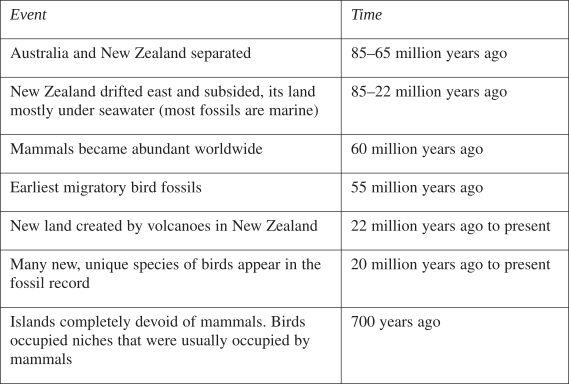
Geological and biological history of New Zealand

Use this information and other relevant knowledge to demonstrate how the practice of biology has led to the validation of current theories of evolution.  (7 marks)

--- 18 WORK AREA LINES (style=lined) ---
Show Answers Only
  • In the New Zealand information, many practices of biology were undertaken to compile the data.
  • The observations of fauna in New Zealand represent an important practice in biological science. Making clear, dispassionate and unbiased observations, and recording such observations are intrinsic to science and provide an essential pathway to validating theories.
  • These observations validated the idea of convergent evolution; birds in New Zealand, without competition from mammals, developed similar characteristics and were able to live in the same environments as mammals do elsewhere.
  • Practices in palaeontology of ageing fossils by radiometric dating or stratigraphy, describing fossils and comparing fossils, allows a history of fauna of New Zealand to be compiled, and history of islands (eg. deducing from fossils found to be almost completely marine that New Zealand was covered by oceans).
  • The history of fauna and geologic events validates Charles Darwin’s theory of evolution in that populations of birds, which began as occasional visitors, gradually changed into permanent endemic species.
  • Divergent evolution is validated as new unique species develop from migratory species, as shown by the fossils of new, unique birds.
  • The data also validates the punctuated equilibrium theory in that the diversification of bird species happened very quickly in the space of only 2 million years.
Show Worked Solution
  • In the New Zealand information, many practices of biology were undertaken to compile the data.
  • The observations of fauna in New Zealand represent an important practice in biological science. Making clear, dispassionate and unbiased observations, and recording such observations are intrinsic to science and provide an essential pathway to validating theories.
  • These observations validated the idea of convergent evolution; birds in New Zealand, without competition from mammals, developed similar characteristics and were able to live in the same environments as mammals do elsewhere.
  • Practices in palaeontology of ageing fossils by radiometric dating or stratigraphy, describing fossils and comparing fossils, allows a history of fauna of New Zealand to be compiled, and history of islands (eg. deducing from fossils found to be almost completely marine that New Zealand was covered by oceans).
  • The history of fauna and geologic events validates Charles Darwin’s theory of evolution in that populations of birds, which began as occasional visitors, gradually changed into permanent endemic species.
  • Divergent evolution is validated as new unique species develop from migratory species, as shown by the fossils of new, unique birds.
  • The data also validates the punctuated equilibrium theory in that the diversification of bird species happened very quickly in the space of only 2 million years.

Filed Under: Evolution - The Evidence, Natural Selection Tagged With: Band 4, Band 5, smc-4309-35-Convergent/Divergent, smc-4310-05-Fossils

BIOLOGY, M3 2013 SM-Bank 21

Explain how ONE secondary source has provided support for the theory of evolution.  (4 marks)

--- 10 WORK AREA LINES (style=lined) ---

Show Answers Only
  • The theory of evolution suggests that species occur by variation of a common ancestor.
  • Variation within an ancient species caused certain characteristics to be favoured in certain environments, causing divergent evolution and overtime the development of new species.
  • This theory can be validated by comparative anatomy, the practise of comparing body structures of different species.
  • When comparing forelimbs of vertebrate, such as canines, humans and whales, we are presented with similarities in their structures. The bone structure is especially similar, with the named animals all having the same pentadactyl (five-digit) limb plan, as they all possess some form of humerus, ulna, radius, carpels and metacarpals. This suggests common ancestry.
Show Worked Solution
  • The theory of evolution suggests that species occur by variation of a common ancestor.
  • Variation within an ancient species caused certain characteristics to be favoured in certain environments, causing divergent evolution and overtime the development of new species.
  • This theory can be validated by comparative anatomy, the practise of comparing body structures of different species.
  • When comparing forelimbs of vertebrate, such as canines, humans and whales, we are presented with similarities in their structures. The bone structure is especially similar, with the named animals all having the same pentadactyl (five-digit) limb plan, as they all possess some form of humerus, ulna, radius, carpels and metacarpals. This suggests common ancestry.

Filed Under: Evolution - The Evidence Tagged With: Band 4, smc-4310-05-Fossils, smc-4310-15-Comparative anatomy

BIOLOGY, M3 2014 HSC 26

Explain how Darwin/Wallace's theory of evolution by natural selection and isolation accounts for convergent evolution. Use an example to support your answer.  (5 marks)

Show Answers Only
  • Convergent evolution occurs when two species evolve to possess similar characteristics by natural selection in similar environments.
  • The organisms cannot interbreed to share any new DNA generated by mutation: they are genetically isolated from each other yet they develop similar characteristics.
  • When variation exists in a population, the theory of evolution by natural selection states that this variation will cause some individuals to be better suited to their environment. In this way, they are more likely to survive and hence reproduce, passing on their adaptive characteristics to further generations. After many generations, the traits of those variants are common in the population.
  • Dolphins and sharks demonstrate convergent evolution. The dolphin is a mammal and the shark is a fish. They inhabit the marine environment which imposes the same selection pressures on both types of organism. 
  • Despite being genetically isolated, they both exhibit a streamlined body shape and possess fins for propulsion and stability.
  • These features are adaptive for movement in a highly viscous environment.
Show Worked Solution
  • Convergent evolution occurs when two species evolve to possess similar characteristics by natural selection in similar environments.
  • The organisms cannot interbreed to share any new DNA generated by mutation: they are genetically isolated from each other yet they develop similar characteristics.
  • When variation exists in a population, the theory of evolution by natural selection states that this variation will cause some individuals to be better suited to their environment. In this way, they are more likely to survive and hence reproduce, passing on their adaptive characteristics to further generations. After many generations, the traits of those variants are common in the population.
  • Dolphins and sharks demonstrate convergent evolution. The dolphin is a mammal and the shark is a fish. They inhabit the marine environment which imposes the same selection pressures on both types of organism. 
  • Despite being genetically isolated, they both exhibit a streamlined body shape and possess fins for propulsion and stability.
  • These features are adaptive for movement in a highly viscous environment.
Mean mark 51%.

Filed Under: Natural Selection Tagged With: Band 4, Band 5, smc-4309-35-Convergent/Divergent

BIOLOGY, M2 2014 HSC 24

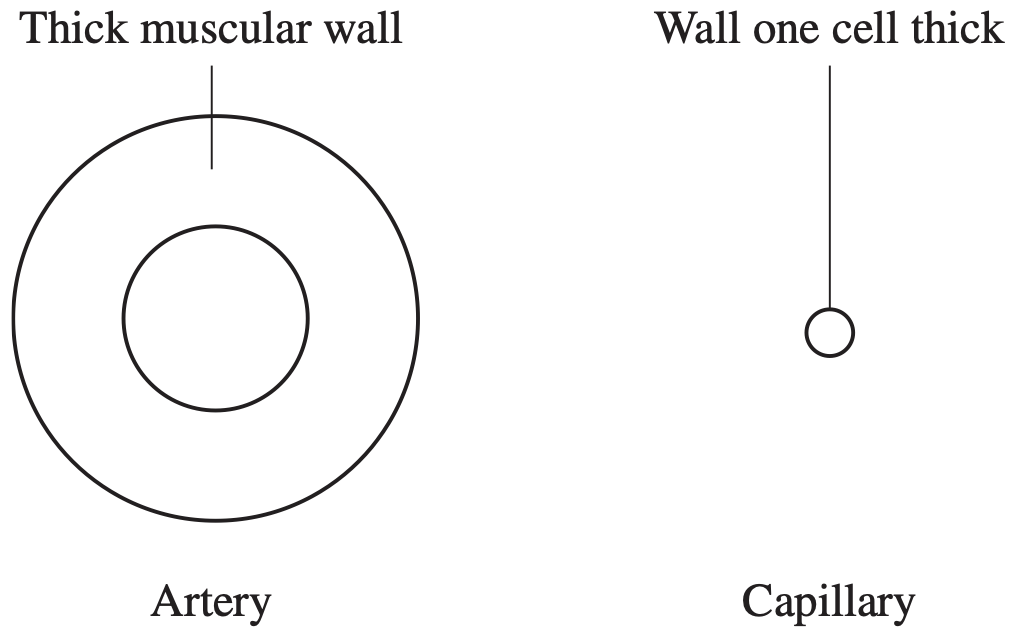
  1. Use labelled diagrams to distinguish between the structure of an artery and that of a capillary.   (2 marks)

    --- 8 WORK AREA LINES (style=blank) ---

  2. Relate one structure of a capillary to its function.   (2 marks)

    --- 5 WORK AREA LINES (style=lined) ---
Show Answers Only

a.   
       

b.    Structure: One cell thick wall.

Related function: Allows diffusion of small molecules through the capillary wall to allow substances in and out of the bloodstream.

Show Worked Solution

a.   
       

b.    Structure: One cell thick wall.

Related function: Allows diffusion of small molecules through the capillary wall to allow substances in and out of the bloodstream.

♦ Mean mark 49%.

Filed Under: Organisation of Cells Tagged With: Band 4, Band 5, smc-4304-75-Cardiorespiratory System

BIOLOGY, M2 2015 HSC 27

  1. Outline TWO differences between whole blood and plasma.  (2 marks)

    --- 3 WORK AREA LINES (style=lined) ---
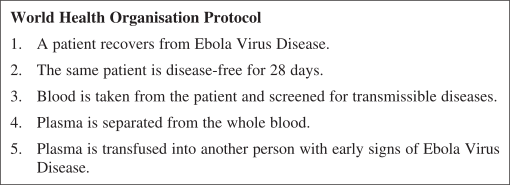
The steps below show the preparation and use of blood products in the treatment of Ebola Virus Disease. This disease is characterised by significant blood loss.

  1. Explain why this protocol produces an effective treatment for Ebola Virus Disease.  (3 marks)

    --- 8 WORK AREA LINES (style=lined) ---
Show Answers Only

a.    Whole blood and plasma differences:

→ Whole blood contains cells including WBC’s, RBC’s and platelets while plasma does not.

→ Plasma is a straw coloured liquid and whole blood is a thick red liquid.
 

b.   Answers could include:

→ The plasma will contain antibodies for this disease because it has been taken from someone who has survived the disease. This will help to immobilise the virus in recipients blood stream.

→ Screening blood prevents the spread of Ebola and other blood-borne diseases from donor to recipient.

→ The plasma is separated from the whole blood meaning no blood type match is needed as there are no cells in the plasma but it still contains the beneficial antibodies.

Show Worked Solution

a.    Whole blood and plasma differences:

→ Whole blood contains cells including WBC’s, RBC’s and platelets while plasma does not.

→ Plasma is a straw coloured liquid and whole blood is a thick red liquid.

♦ Mean mark (a) 49%.

b.   Answers could include:

→ The plasma will contain antibodies for this disease because it has been taken from someone who has survived the disease. This will help to immobilise the virus in recipients blood stream.

→ Screening blood prevents the spread of Ebola and other blood-borne diseases from donor to recipient.

→ The plasma is separated from the whole blood meaning no blood type match is needed as there are no cells in the plasma but it still contains the beneficial antibodies.

Filed Under: BIO - Ex-syllabus checks required Tagged With: Band 4, Band 5, smc-4306-10-Blood

BIOLOGY, M2 2015 HSC 24

Data can be provided by a pulse oximeter pegged to a person's finger, as shown in the diagram.

  1. What is the oxygen saturation for this person?  (1 mark)

    --- 1 WORK AREA LINES (style=lined) ---
  2. Outline TWO limitations of using only the information provided in the diagram to determine the 'health' of a person.  (2 marks)

    --- 5 WORK AREA LINES (style=lined) ---

  3. Explain TWO advantages in using a pulse oximeter to measure oxygen saturation compared to using another named technology in a specific setting.  (4 marks)

    --- 8 WORK AREA LINES (style=lined) ---
Show Answers Only

a.   97%
 

b.   Answers could include:

→ Data requires context (eg. is the user exercising or resting).

→ There are many other parameters of physical health: disease status, blood levels of toxic environmental substances, presence of cancers etc…

→ There are other aspects of non-physical health (eg. mental health).

→ The pulse oximeter could read faulty i.e. if not properly calibrated, so comparing with results from another form of test such as a blood pressure monitor would give a better indication of cardiorespiratory health.
 

c.   Answers could include:

→ The pulse oximeter can give you immediate and continuous data. This makes it better than arterial blood gas determination from a blood sample that requires the sample to be analysed in a laboratory with a delayed and one-off reading.

→ The pulse oximeter is very portable being compact and battery operated.

→ The pulse oximeter is better for an ambulance where fast and continuous data delivery in an emergency setting is required.

Show Worked Solution

a.   97%
 

b.   Answers could include:

→ Data requires context (eg. is the user exercising or resting).

→ There are many other parameters of physical health: disease status, blood levels of toxic environmental substances, presence of cancers etc…

→ There are other aspects of non-physical health (eg. mental health).

→ The pulse oximeter could read faulty i.e. if not properly calibrated, so comparing with results from another form of test such as a blood pressure monitor would give a better indication of cardiorespiratory health.
 

c.   Answers could include:

→ The pulse oximeter can give you immediate and continuous data. This makes it better than arterial blood gas determination from a blood sample that requires the sample to be analysed in a laboratory with a delayed and one-off reading.

→ The pulse oximeter is very portable being compact and battery operated.

→ The pulse oximeter is better for an ambulance where fast and continuous data delivery in an emergency setting is required.

Filed Under: BIO - Ex-syllabus checks required Tagged With: Band 3, Band 4, smc-4304-75-Cardiorespiratory System

BIOLOGY, M2 2016 HSC 31

As altitude increases, the partial pressure of oxygen \( \text{(p} \ce{O_2)}\) in air decreases. 

Species A and B are closely related endotherms that live in different habitats in Asia. The minimum \( \text{p} \ce{O_2}\) required for 100% blood oxygen saturation differs in these species because of differences in their haemoglobin structure. Data related to these two species are shown below.

\begin{equation}
\begin{array}{|c|c|c|}
\hline \text { Endotherm species } & \text { Habitat altitude } & \text { Minimum } \mathrm{pO}_2 \text { for } 100 \%\ \mathrm{Hb} \text { saturation } \\
\hline \mathrm{A} & \mathrm{High} & 54 \\
\mathrm{~B} & \text { Low } & 80 \\
\hline
\end{array}
\end{equation}

Explain how the differences in these species could have arisen, using the Darwin/Wallace theory of evolution and your understanding of the adaptive advantage of haemoglobin.  (8 marks)

--- 18 WORK AREA LINES (style=lined) ---

Show Answers Only
  • Haemoglobin is a protein that provides a mechanism for transport of oxygen around the body. As it is a protein, it’s structure is dependant on the individual’s genotype.
  • Species A and Species B are able to reach 100% saturation at differing partial pressures of oxygen, meaning they have different DNA which codes for different haemoglobin structures.
  • Species A and B are likely to have diverged from a common ancestor because of differing environmental pressures resulting in two different species. Within the ancestral population there was variation which resulted from random mutations. One mutation would have resulted in haemoglobin that is able to reach 100% saturation at a lower partial pressure of oxygen.
  • When members of the ancestral species moved to a higher altitude the ability of their haemoglobin to reach saturation at a lower \( \text{p} \ce{O_2}\) gave them a survival advantage. These individuals were then more likely to reproduce and pass on their favourable genes.
  • For individuals living at lower altitudes, there is no survival advantage to being able to reach 100% saturation at lower \( \text{p} \ce{O_2}\) which means this trait was not selected for.
  • Over time, due to the isolation at a higher altitude a new species evolved.
Show Worked Solution
  • Haemoglobin is a protein that provides a mechanism for transport of oxygen around the body. As it is a protein, it’s structure is dependant on the individual’s genotype.
  • Species A and Species B are able to reach 100% saturation at differing partial pressures of oxygen, meaning they have different DNA which codes for different haemoglobin structures.
  • Species A and B are likely to have diverged from a common ancestor because of differing environmental pressures resulting in two different species. Within the ancestral population there was variation which resulted from random mutations. One mutation would have resulted in haemoglobin that is able to reach 100% saturation at a lower partial pressure of oxygen.
  • When members of the ancestral species moved to a higher altitude the ability of their haemoglobin to reach saturation at a lower \( \text{p} \ce{O_2}\) gave them a survival advantage. These individuals were then more likely to reproduce and pass on their favourable genes.
  • For individuals living at lower altitudes, there is no survival advantage to being able to reach 100% saturation at lower \( \text{p} \ce{O_2}\) which means this trait was not selected for.
  • Over time, due to the isolation at a higher altitude a new species evolved.
♦♦ Mean mark 41%.

Filed Under: Natural Selection Tagged With: Band 4, Band 5, Band 6, smc-4309-10-Biological diversity

BIOLOGY, M2 2016 HSC 27

The diagram shows a vascular bundle from a flowering plant.

  1. On the diagram, clearly label a xylem vessel.  (1 mark)
  2. A adaptation of this species causes the walls of the xylem vessels to be significantly reduced in thickness.
  3. Explain why the leaves of these adapted strains will wilt more easily.  (3 marks)

    --- 5 WORK AREA LINES (style=lined) ---
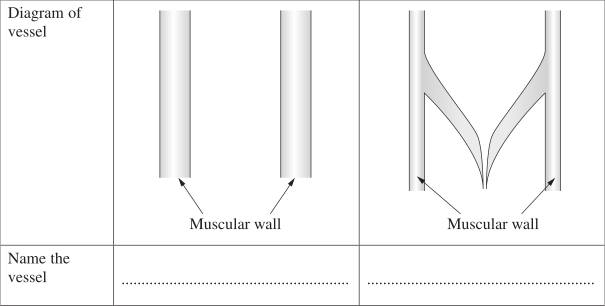
Show Answers Only

a.   
       

b.   Leaves wilt when they lose water.

  • As xylem tissue is responsible for water transport from roots to leaves, plants with the adaptation will wilt easier as the xylem vessels are more likely to collapse with thinner walls.
Show Worked Solution

a.   
       

b.   Leaves wilt when they lose water.

  • As xylem tissue is responsible for water transport from roots to leaves, plants with the adaptation will wilt easier as the xylem vessels are more likely to collapse with thinner walls.

Filed Under: Transport Tagged With: Band 3, Band 4, smc-4306-30-Plants

BIOLOGY, M2 2017 HSC 23

Complete the table with reference to the two types of blood vessel shown.   (5 marks)

Name the vessel in the space provided and explain how ONE structural feature of the vessel enables it to carry out its function.   (5 marks)

--- 8 WORK AREA LINES (style=lined) ---

Show Answers Only

Left image: Artery

  • Arteries have thick muscular walls.
  • This enables them to withstand the high pressure at which blood is pumped from the heart. 

Right image: Vein

  • Nutrients are absorbed from the blood at the capillaries. This results in the lowering of blood pressure.
  • The valves are used to prevent backflow of blood at these lower pressures.
Show Worked Solution

Left image: Artery

  • Arteries have thick muscular walls.
  • This enables them to withstand the high pressure at which blood is pumped from the heart. 

Right image: Vein

  • Nutrients are absorbed from the blood at the capillaries. This results in the lowering of blood pressure.
  • The valves are used to prevent backflow of blood at these lower pressures.

Filed Under: Organisation of Cells Tagged With: Band 4, smc-4304-75-Cardiorespiratory System

BIOLOGY, M1 2008 HSC 18

Using a light microscope, a student looked at a prepared slide of human blood, and drew a scaled diagram.

The diagram shown is a representation of the student's scaled diagram.
 

  1. Assess the accuracy of the diagram.  (3 marks)

    --- 6 WORK AREA LINES (style=lined) ---

  2. Why is it safer to use prepared slides instead of fresh blood?  (1 mark)

    --- 2 WORK AREA LINES (style=lined) ---
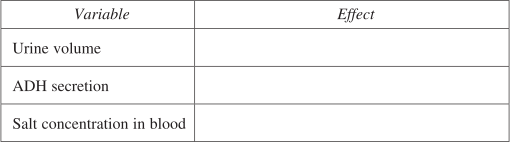
Show Answers Only

a.    The diagram has the following inaccuracies:

  • The scale is wrong as red and white blood cells are much smaller. A more accurate scale would use micrometres as apposed to millimetres.
  • Relative size of red and white blood cells is wrong, as WBC’s are on average 1.5 – 2 times bigger than RBC’s. 

b.   A slide with fresh blood could contain pathogenic bacteria, leading to disease.

Show Worked Solution

a.    The diagram has the following inaccuracies:

  • The scale is wrong as red and white blood cells are much smaller. A more accurate scale would use micrometres as apposed to millimetres.
  • Relative size of red and white blood cells is wrong, as WBC’s are on average 1.5 – 2 times bigger than RBC’s. 

b.   A slide with fresh blood could contain pathogenic bacteria, leading to disease.

Filed Under: Cell Structure Tagged With: Band 4, smc-4302-40-Diagrams

BIOLOGY, M1 2012 HSC 24

You conducted first-hand investigations to test the effects of temperature, pH and substrate concentration on enzyme activity.

  1. Complete the following table by identifying the variables for ONE of your investigations.  (1 mark)

\begin{array} {|l|c|c|}
\hline
\rule{0pt}{2.5ex} \textit{Independent variable} \rule[-1ex]{0pt}{0pt} & \textit{Dependent variable} & \textit{Kept constant} \\
\hline
\rule{0pt}{2.5ex}   \rule[-1ex]{0pt}{0pt} & & \text{pH,} \\ & & \text{substrate concentration,} \\ \text{................................} & \text{................................} & \text{enzyme concentration} \\
\hline
\end{array}

--- 0 WORK AREA LINES (style=lined) ---

  1. Outline how you measured the activity of an enzyme in your investigation. In your answer, name the enzyme.  (2 marks)

    --- 3 WORK AREA LINES (style=lined) ---
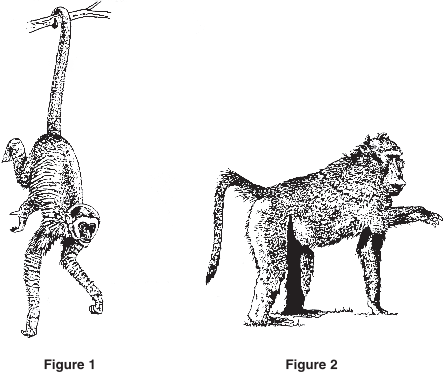
  2. Describe how a condition needed for optimal enzyme activity would be expected to vary between endotherms and ectotherms.   (2 marks)

    --- 5 WORK AREA LINES (style=lined) ---
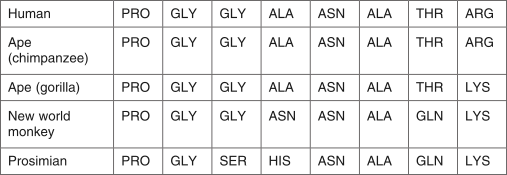
Show Answers Only

a.    Independent variable: Temperature

Dependent variable: Enzyme Activity
 

b.    Activity measure:

  • The activity of catalase is measured by the height of oxygen in a test tube when a fresh piece of raw potato is added to hydrogen peroxide. 

c.    Optimal enzyme activity:

  • The body temperature of ectotherms changes to be similar to the environment, while endotherms maintain a relatively stable internal temperature.
  • Enzyme activity is dependant on temperature.
  • Therefore, it is expected that an ectotherm’s enzymes can function effectively over a much greater temperature range as apposed to endotherms.

Show Worked Solution

a.    Independent variable: Temperature

Dependent variable: Enzyme Activity
 

b.    Activity measure:

  • The activity of catalase is measured by the height of oxygen in a test tube when a fresh piece of raw potato is added to hydrogen peroxide. 

c.    Optimal enzyme activity:

  • The body temperature of ectotherms changes to be similar to the environment, while endotherms maintain a relatively stable internal temperature.
  • Enzyme activity is dependant on temperature.
  • Therefore, it is expected that an ectotherm’s enzymes can function effectively over a much greater temperature range as apposed to endotherms.

Filed Under: Cell Function Tagged With: Band 4, smc-4303-60-Enzymes

BIOLOGY, M1 2013 HSC 29

  1. What chemicals are filtered out of the blood by the kidney?   (2 marks)

    --- 2 WORK AREA LINES (style=lined) ---
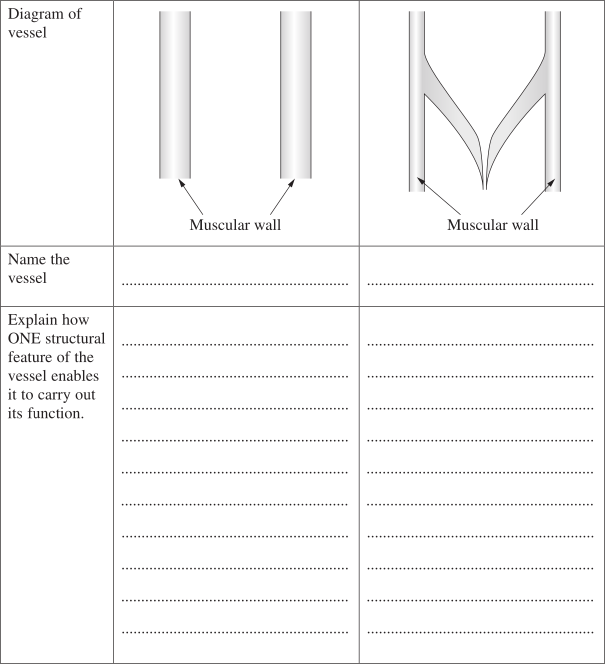
  2. What chemicals are reabsorbed into the blood by the kidney?   (2 marks)

    --- 2 WORK AREA LINES (style=lined) ---

  3. Explain the steps involved in the formation of urine.   (4 marks)

    --- 10 WORK AREA LINES (style=lined) ---

Show Answers Only

a.    Glucose and \(\ce{NaCl}\).

b.    Water \(\ce{(H2O)}\) and glucose.

c.    Blood is filtered at the glomerulus through Bowman’s capsule.

  • Blood cells and large molecules remain in the blood and small molecules, salts and water enter the proximal tubule.
  • Glucose is actively taken back to the blood through the wall of the proximal tubule.
  • The filtrate then enters the loop of Henle where a countercurrent mechanism uses active transport (ascending limb) and osmosis causes a concentration gradient of ions down the loop of Henle (towards the medulla).
  • The filtrate then enters the distal tubule where its other ions are removed. The urine can be made more acidic here. It then enters the collecting tubule which is not permeable to water unless stimulated by ADH.
  • ADH causes it to be permeable to water as it descends past the loop of Henle in the medulla. This then leads to a concentration of the urine by osmosis.
Show Worked Solution

a.    Glucose and \(\ce{NaCl}\).

b.    Water \(\ce{(H2O)}\) and glucose.

c.    Blood is filtered at the glomerulus through Bowman’s capsule.

  • Blood cells and large molecules remain in the blood and small molecules, salts and water enter the proximal tubule.
  • Glucose is actively taken back to the blood through the wall of the proximal tubule.
  • The filtrate then enters the loop of Henle where a countercurrent mechanism uses active transport (ascending limb) and osmosis causes a concentration gradient of ions down the loop of Henle (towards the medulla).
  • The filtrate then enters the distal tubule where its other ions are removed. The urine can be made more acidic here. It then enters the collecting tubule which is not permeable to water unless stimulated by ADH.
  • ADH causes it to be permeable to water as it descends past the loop of Henle in the medulla. This then leads to a concentration of the urine by osmosis.
Mean mark (c) 53%.

Filed Under: Cell Function Tagged With: Band 4, smc-4303-50-Excretion

BIOLOGY, M1 2013 HSC 25

The graph below shows the results obtained from testing the activity of a bacterial enzyme.
 

  1. Name ONE variable, other than temperature, that would have been controlled in the experiment.  (1 mark)

    --- 2 WORK AREA LINES (style=lined) ---

  2. For what temperature range does the enzyme display the maximum rate of change in activity?   (1 mark)

    --- 1 WORK AREA LINES (style=lined) ---

  3. Account for the activity of the enzyme at the parts of the graph labelled A, B, C and D.  (4 marks)

    --- 8 WORK AREA LINES (style=lined) ---

  4. Based on the information in the graph, suggest the type of environment in which these bacteria might survive. (1 mark)

    --- 1 WORK AREA LINES (style=lined) ---

Show Answers Only

a.    Answers could include:

  • pH
  • Enzyme concentration
  • Substrate concentration 

b.    89 – 93°C (D).

c.    Enzyme activity at each point:

A: A constant gradient indicates a constant increasing rate of enzyme activity as temperature increases.

B: Graph level at a maximum (10 μmol/s). Enzyme-substrate complex operating at maximum even though temperature is increasing.

C: Graph decreasing indicating a reduction in enzyme efficiency due to increasing temperature denaturing enzyme.

D: Graph rapidly goes to 0 indicating enzyme activity stops because the enzyme is denatured.

d.    Hotter environments, such as desserts or hot, geothermal springs.

Show Worked Solution

a.    Answers could include:

  • pH
  • Enzyme concentration
  • Substrate concentration 

b.    89 – 93°C (D).

c.    Enzyme activity at each point:

A: A constant gradient indicates a constant increasing rate of enzyme activity as temperature increases.

B: Graph level at a maximum (10 μmol/s). Enzyme-substrate complex operating at maximum even though temperature is increasing.

C: Graph decreasing indicating a reduction in enzyme efficiency due to increasing temperature denaturing enzyme.

D: Graph rapidly goes to 0 indicating enzyme activity stops because the enzyme is denatured.

♦♦♦ Mean mark (b) 22%.

d.    Hotter environments, such as desserts or hot, geothermal springs.

Filed Under: Cell Function Tagged With: Band 4, Band 5, smc-4303-60-Enzymes

BIOLOGY, M1 2016 HSC 23

  1. Explain ONE reason why the concentration of water in cells should be maintained within a narrow range for optimal cell function.  (2 marks)

    --- 5 WORK AREA LINES (style=lined) ---

  2. A person has consumed large amounts of water. Complete the table to show the effect on each of the variables listed.  (3 marks)


--- 0 WORK AREA LINES (style=lined) ---

Show Answers Only

a.    Correct answers could include:

  • Concentration of water in cells is maintained to regulate concentrations of solutes in cells.
  • Concentration of water in a narrow range provides appropriate substrate concentrations for metabolic function.

b.

\begin{array} {|l|l|}
\hline
\rule{0pt}{2.5ex}\ \ \ \ \ \ \ \ \textit{Variable}\rule[-1ex]{0pt}{0pt} & \rule{0pt}{2.5ex}\textit{Effect}\rule[-1ex]{0pt}{0pt}\\
\hline
\rule{0pt}{2.5ex}\text{Urine Volume}\rule[-1ex]{0pt}{0pt} & \rule{0pt}{2.5ex}\text{Increase}\rule[-1ex]{0pt}{0pt}\\
\hline
\rule{0pt}{2.5ex}\text{ADH Secretion}\rule[-1ex]{0pt}{0pt} & \rule{0pt}{2.5ex}\text{Decrease}\rule[-1ex]{0pt}{0pt}\\
\hline
\rule{0pt}{2.5ex}\text{Salt concentration in blood}\rule[-1ex]{0pt}{0pt} & \rule{0pt}{2.5ex}\text{Decrease}\rule[-1ex]{0pt}{0pt}\\
\hline
\end{array}

Show Worked Solution

a.    Correct answers could include:

  • Concentration of water in cells is maintained to regulate concentrations of solutes in cells.
  • Concentration of water in a narrow range provides appropriate substrate concentrations for metabolic function.
♦ Mean mark 43%.

b.

\begin{array} {|l|l|}
\hline
\rule{0pt}{2.5ex}\ \ \ \ \ \ \ \ \textit{Variable}\rule[-1ex]{0pt}{0pt} & \rule{0pt}{2.5ex}\textit{Effect}\rule[-1ex]{0pt}{0pt}\\
\hline
\rule{0pt}{2.5ex}\text{Urine Volume}\rule[-1ex]{0pt}{0pt} & \rule{0pt}{2.5ex}\text{Increase}\rule[-1ex]{0pt}{0pt}\\
\hline
\rule{0pt}{2.5ex}\text{ADH Secretion}\rule[-1ex]{0pt}{0pt} & \rule{0pt}{2.5ex}\text{Decrease}\rule[-1ex]{0pt}{0pt}\\
\hline
\rule{0pt}{2.5ex}\text{Salt concentration in blood}\rule[-1ex]{0pt}{0pt} & \rule{0pt}{2.5ex}\text{Decrease}\rule[-1ex]{0pt}{0pt}\\
\hline
\end{array}

Filed Under: Cell Function Tagged With: Band 4, Band 5, smc-4303-50-Excretion

  • « Previous Page
  • 1
  • …
  • 46
  • 47
  • 48
  • 49
  • 50
  • …
  • 114
  • Next Page »

Copyright © 2014–2025 SmarterEd.com.au · Log in