Which of the following correctly expresses \(X\) as the subject of \(Y=4\pi\Bigg(\dfrac{X}{4}+L\Bigg)\)?
- \(X=\dfrac{Y}{\pi}-L\)
- \(X=\dfrac{Y}{\pi}-4L\)
- \(X=4L-\dfrac{Y}{2\pi}\)
- \(X=\dfrac{Y}{8\pi}-\dfrac{L}{4}\)
Aussie Maths & Science Teachers: Save your time with SmarterEd
Which of the following correctly expresses \(X\) as the subject of \(Y=4\pi\Bigg(\dfrac{X}{4}+L\Bigg)\)?
Make \(r\) the subject of the equation \(V=4\pi r^2\). (2 marks)
--- 3 WORK AREA LINES (style=lined) ---
Make \(b\) the subject of the equation \(a=\sqrt{bc-4}\). (2 marks)
Which of the following correctly expresses \(y\) as the subject of the formula \(5x-2y-9=0\)?
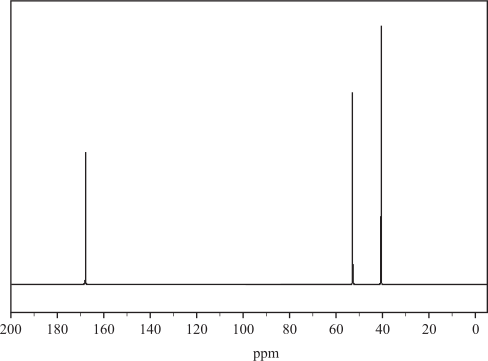
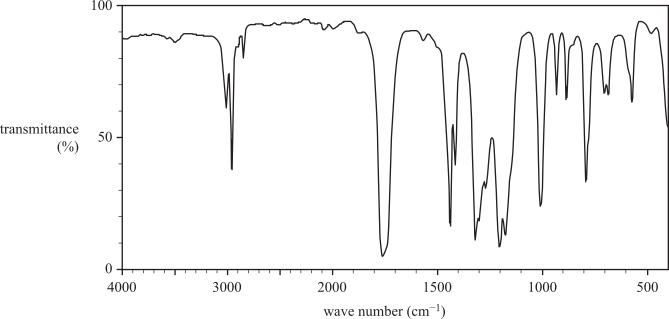
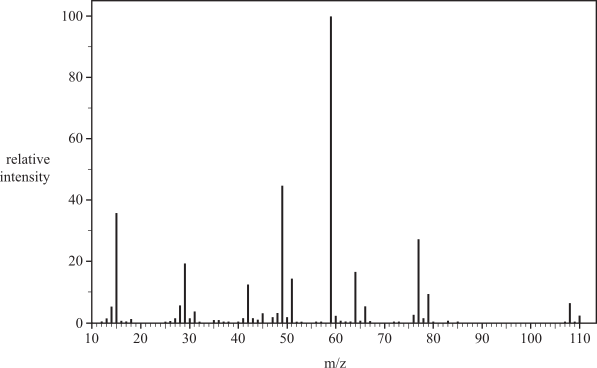
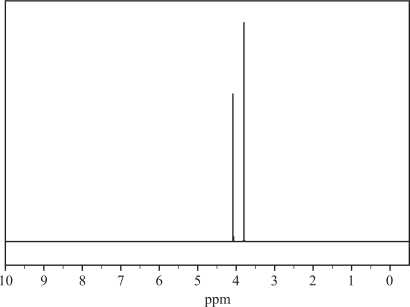
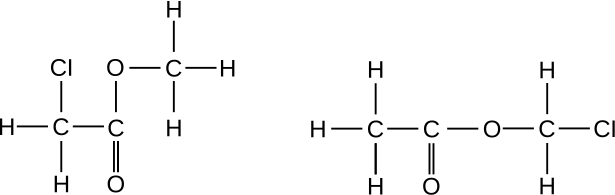
A chemist uses spectroscopy to identify an unknown organic molecule, Molecule \(\text{J}\), that contains chlorine. The \({}^{13}\text{C NMR}\) spectrum of Molecule \(\text{J}\) is shown below. The infra-red (IR) spectrum of Molecule \(\text{J}\) is shown below. --- 2 WORK AREA LINES (style=lined) --- The mass spectrum of Molecule \(\text{J}\) is shown below --- 2 WORK AREA LINES (style=lined) --- The \({ }^1 \text{H NMR}\) spectrum of Molecule \(\text{J}\) is shown below. --- 3 WORK AREA LINES (style=lined) --- --- 5 WORK AREA LINES (style=blank) --- a. Absence of a very broad \(\ce{OH}\) acid peak between 2500–3000. b. The peak at 110 m/z: c. The two singlet peaks indicate: d. Either of the two molecules shown below are correct: a. Absence of a very broad \(\ce{OH}\) acid peak between 2500–3000. b. The peak at 110 m/z: c. The two singlet peaks indicate: d. Either of the two molecules shown below are correct:
Show Answers Only
 Show Worked Solution
♦ Mean mark (a) 41%.
♦♦♦ Mean mark (b) 15%.
COMMENT: Know the masses of common isotopes.
♦ Mean mark (d) 40%.
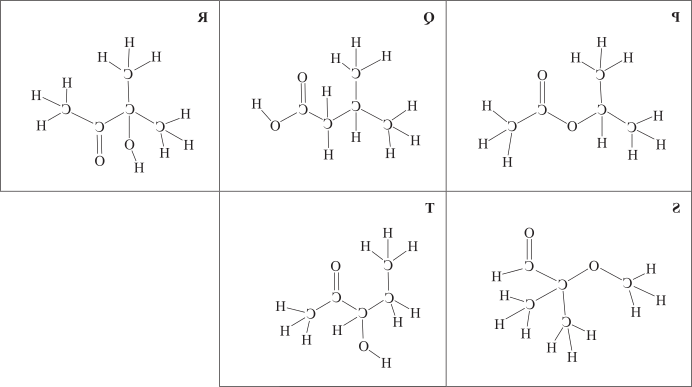
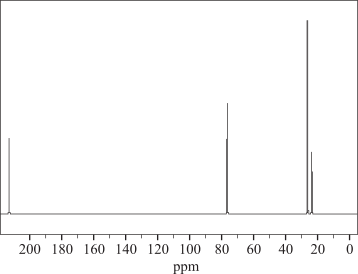
Two students are given a homework assignment that involves analysing a set of spectra and identifying an unknown compound. The unknown compound is one of the molecules shown below. The \(^{13}\text{C NMR}\) spectrum of the unknown compound is shown below. --- 1 WORK AREA LINES (style=lined) --- --- 6 WORK AREA LINES (style=lined) --- --- 1 WORK AREA LINES (style=lined) --- --- 4 WORK AREA LINES (style=lined) ---
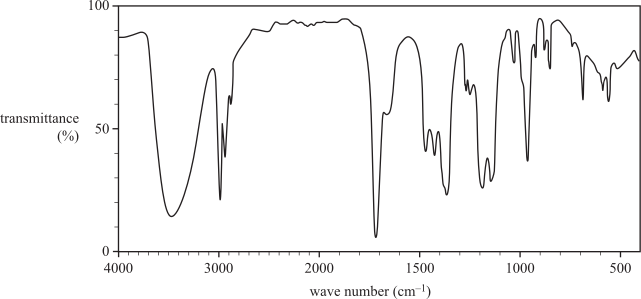
The infra-red (IR) spectrum of the unknown compound is shown below.
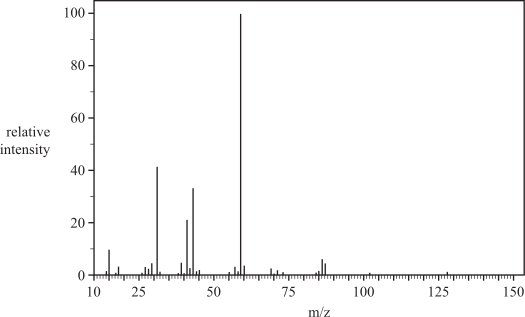
Molecule \(\text{V}\) contains only carbon atoms, hydrogen atoms and one oxygen atom. The mass spectrum of molecule \(\text{V}\) is shown below. --- 4 WORK AREA LINES (style=lined) --- --- 1 WORK AREA LINES (style=lined) --- The \({ }^1 \text{H NMR}\) spectrum of molecule \(\text{V}\) is shown below. --- 2 WORK AREA LINES (style=lined) --- The \({ }^{13} \text{C NMR}\) spectrum of molecule \(\text{V}\) is shown below. --- 8 WORK AREA LINES (style=blank) --- a.i. Molar mass of \(\text{V}\ = 86\ \text{g mol}^{-1}\) a.ii. Small peak at m/z = 87: b. The doublet peak at 1.1 ppm: c. a.i. Molar mass of \(\text{V}\ = 86\ \text{g mol}^{-1}\) a.ii. Small peak at m/z = 87: b. The doublet peak at 1.1 ppm: c. From the carbon NMR graph: From the hydrogen NMR graph:
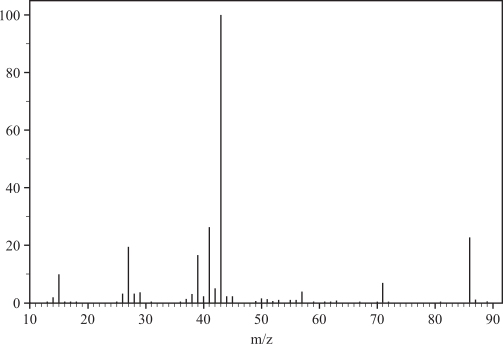
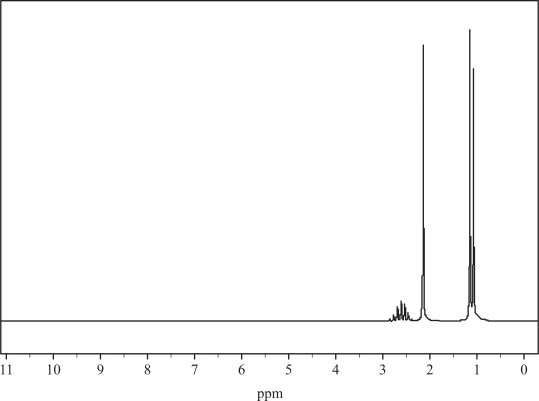
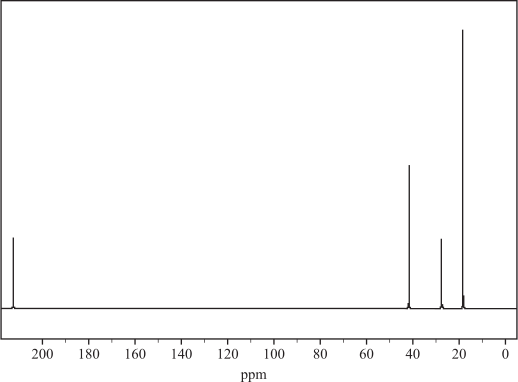
Show Answers Only
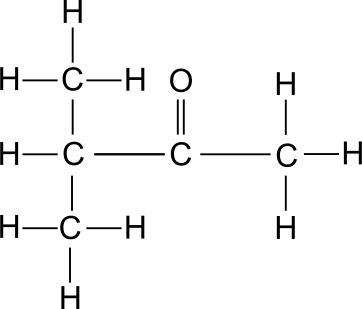 Show Worked Solution
♦ Mean mark (b) 50%.
♦ Mean mark (c) 43%.
The \({ }^{13}\text{C NMR}\) spectrum of an organic compound is shown below.
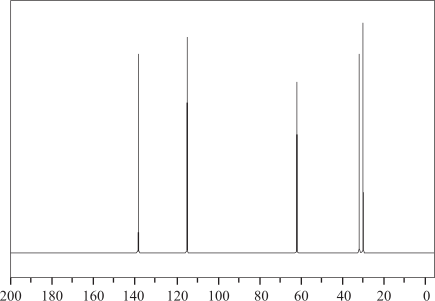
The organic compound could be
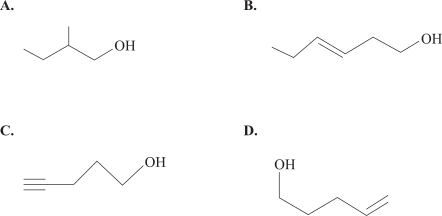
Which one of the following statements about mass spectrometry is always correct?
Consider the following molecule.
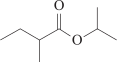
How many peaks will be observed in a \({ }^{13} \text{C NMR}\) spectrum of this molecule
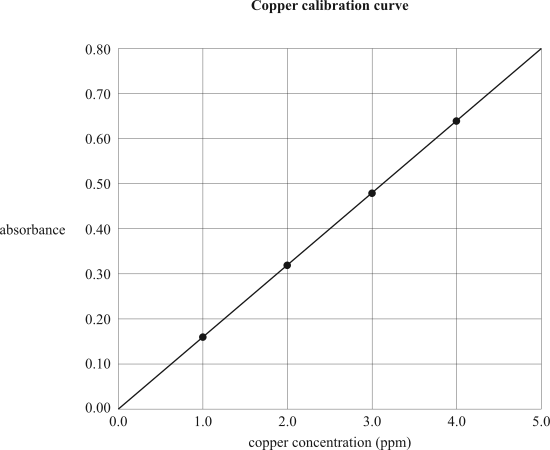
An atomic absorption spectrometer can be used to determine the level of copper in soils. The calibration curve below plots the absorbance of four standard copper solutions against the concentration of copper ions in ppm.
The concentrations of copper ions in the standard solutions were 1.0, 2.0, 3.0 and 4.0 mg L\(^{-1}\). (1 mg L\(^{-1}\) = 1 ppm)
Question 16
The concentration of copper in a test solution can be determined most accurately from the calibration curve if it is between
Question 17
If the test solution gave an absorbance reading of 0.40, what would be the concentration of copper ions in the solution in mol L\(^{-1}\)?
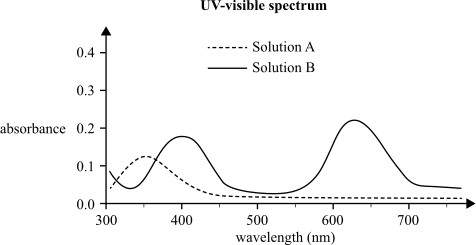
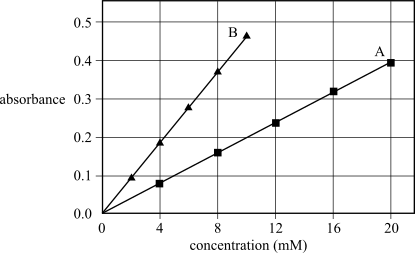
UV-visible spectroscopy was used to measure the spectra of two solutions, \(\text{A}\) and \(\text{B}\). Solution \(\text{A}\) was a pink colour, while Solution \(\text{B}\) was a green colour. The analyst recorded the absorbance of each solution over a range of wavelengths on the same axes. The resultant absorbance spectrum is shown below. --- 3 WORK AREA LINES (style=lined) --- The analyst used two sets of standard solutions and blanks to determine the calibration curves for the two solutions. The absorbances were plotted on the same axes. The graph is shown below. --- 6 WORK AREA LINES (style=lined) --- --- 4 WORK AREA LINES (style=lined) ---
A common iron ore, fool’s gold, contains the mineral iron pyrite, \(\ce{FeS2}\).
Typically, the percentage by mass of \(\ce{FeS2}\) in a sample of fool’s gold is between 90% and 95%. The actual percentage in a sample can be determined by gravimetric analysis.
The sulfur in \(\ce{FeS2}\) is converted to sulfate ions, \(\ce{SO4^2–}\) as seen below:
\(\ce{4FeS2 + 11O2 \rightarrow 2Fe2O3 + 8SO4^2-}\)
This is then mixed with an excess of barium chloride, \(\ce{BaCl2}\), to form barium sulfate, \(\ce{BaSO4}\), according to the equation
\(\ce{Ba^2+(aq) + SO4^2–(aq)\rightarrow BaSO4(s)}\)
When the reaction has gone to completion, the \(\ce{BaSO4}\) precipitate is collected in a filter paper and carefully washed. The filter paper and its contents are then transferred to a crucible. The crucible and its contents are heated until constant mass is achieved.
The data for an analysis of a mineral sample is as follows.
| \(\text{initial mass of mineral sample}\) | \(\text{14.3 g}\) |
| \(\text{mass of crucible and filter paper}\) | \(\text{123.40 g}\) |
| \(\text{mass of crucible, filter paper and dry}\ \ce{BaSO4}\) | \(\text{174.99 g}\) |
| \(\ce{M(FeS2)}\) | \(\text{120.0 g mol}^{-1}\) |
| \(\ce{M(BaCl2)}\) | \(\text{208.3 g mol}^{-1}\) |
| \(\ce{M(BaSO4)}\) | \(\text{233.4 g mol}^{-1}\) |
--- 9 WORK AREA LINES (style=lined) ---
--- 2 WORK AREA LINES (style=lined) ---
The following is a student’s summary of catalysts. It contains some correct and incorrect statements.
--- 1 WORK AREA LINES (style=lined) ---
--- 8 WORK AREA LINES (style=lined) ---
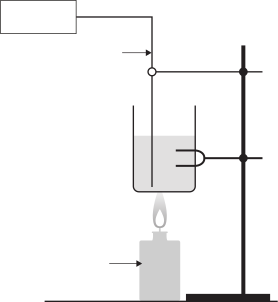
A senior Chemistry student created an experiment to calculate the molar heat of combustion of butane.
The experimental steps are as follows:
Results
| Quantity | Measurement |
| mass of empty can | 52.14 g |
| mass of can + water before combustion | 303.37 g |
| mass of butane canister before heating | 260.15 g |
| mass of butane canister after heating | 259.79 g |
| initial temperature of water | 22.1 °C |
| final temperature of water | 32.7 °C |
The balanced thermochemical equation for the complete combustion of butane is
\(\ce{2C4H10(g) + 13O2(g) \rightarrow 8CO2(g) + 10H2O(l)},\ \ \Delta H=-5748\ \text{kJ mol}^{-1}\)
--- 4 WORK AREA LINES (style=lined) ---
--- 4 WORK AREA LINES (style=lined) ---
--- 3 WORK AREA LINES (style=lined) ---
The combustion of ethanol is represented by the following equation.
\(\ce{C2H5OH(l) + 3O2(g)\rightarrow 2CO2(g) + 3H2O(l)}\ \ \ \ \ \ \Delta H=-1364\ \text{kJ mol}^{-1}\)
A spirit burner used 1.80 g of ethanol to raise the temperature of 100.0 g of water in a metal can from 25.0 °C to 40.0 °C.
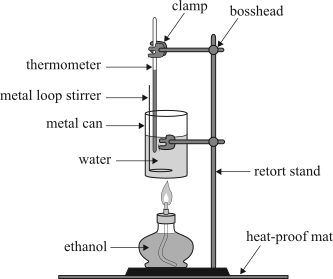
Calculate the percentage of heat lost to the environment and to the apparatus. (5 marks)
--- 8 WORK AREA LINES (style=lined) ---
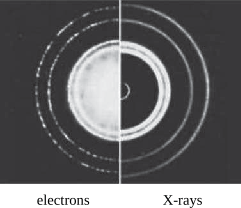
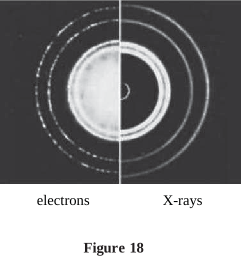
Students are comparing the diffraction patterns produced by electrons and X-rays, in which the same spacing of bands is observed in the patterns, as shown schematically in the diagram. Note that both patterns shown are to the same scale.
The electron diffraction pattern is produced by 3.0 × 10\(^3\) eV electrons.
--- 4 WORK AREA LINES (style=lined) ---
--- 6 WORK AREA LINES (style=lined) ---
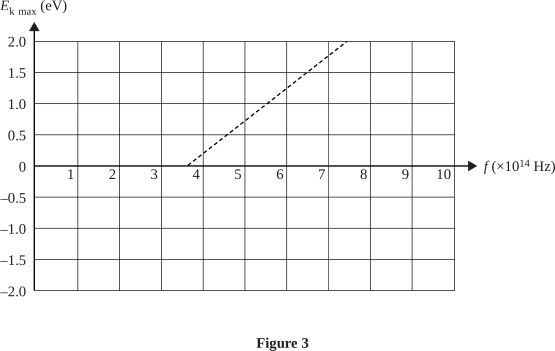
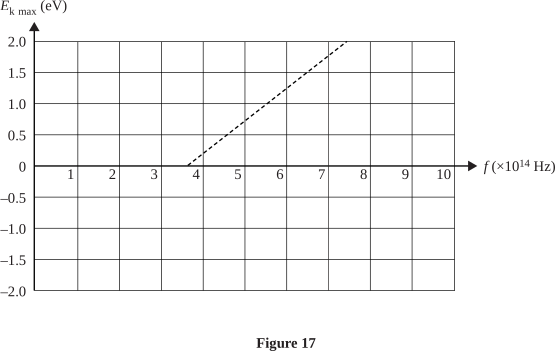
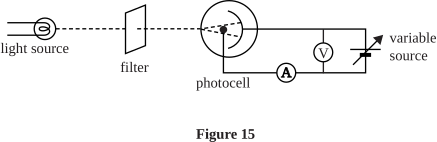
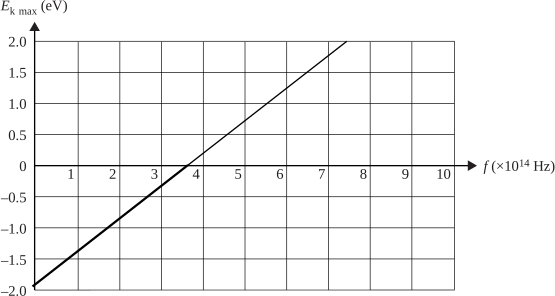
Students are studying the photoelectric effect using the apparatus shown in Figure 1. Figure 2 shows the results the students obtained for the maximum kinetic energy \((E_{\text{k max }})\) of the emitted photoelectrons versus the frequency of the incoming light. --- 2 WORK AREA LINES (style=lined) --- --- 2 WORK AREA LINES (style=lined) --- --- 2 WORK AREA LINES (style=lined) --- --- 0 WORK AREA LINES (style=blank) --- a.i. \(5.4 \times 10^{-15}\ \text{eV s}\) ii. \(811\ \text{nm}\) iii. \(1.9\ \text{eV}\). b. a.i. Planck’s constant \((h)\): \(\therefore h=\dfrac{\text{rise}}{\text{run}}=\dfrac{1.25-0}{6 \times 10^{14}-3.7\times 10^{-14}}=5.4 \times 10^{-15}\ \text{eV s}\) a.ii. Max wavelength = minimum frequency of emitted photoelectron. \(\lambda=\dfrac{c}{f}=\dfrac{3 \times 10^8}{3.7 \times 10^{14}}=811\ \text{nm}\) a.iii. b. Constructing the new graph:
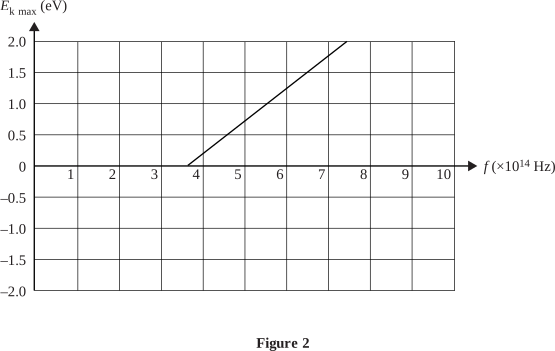
On Figure 3, draw the line that would be obtained if a different metal, with a work function of \(\dfrac{1}{2} \phi\), were used in the photocell. The original graph is shown as a dashed line. (2 marks)
Show Answers Only
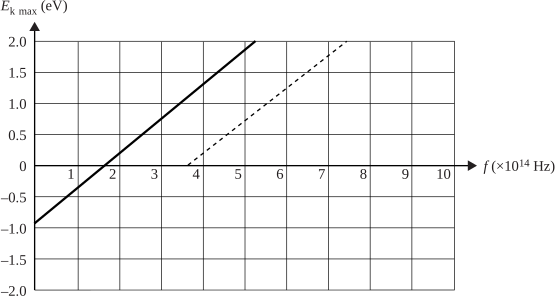 Show Worked Solution
♦ Mean mark (a)(ii) 44%.
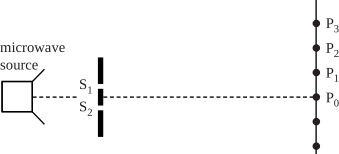
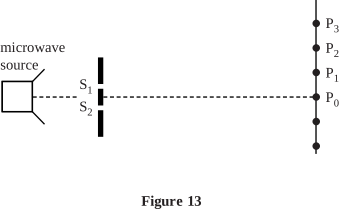
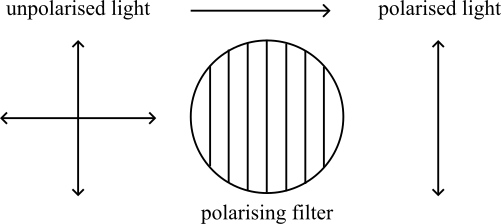
Students have set up a double-slit experiment using microwaves. The beam of microwaves passes through a metal barrier with two slits, shown as \(\text{S}_1\) and \(\text{S}_2\) in the diagram. The students measure the intensity of the resulting beam at points along the line shown. They determine the positions of maximum intensity to be at the points labelled \(\text{P}_0,\) \(\text{P}_1\), \(\text{P}_2\) and \(\text{P}_3\).
The distance from \(\text{S}_1\) to \(\text{P}_3\) is 72.3 cm and the distance from \(\text{S}_2\) to \(\text{P}_3\) is 80.6 cm.
--- 4 WORK AREA LINES (style=lined) ---
--- 4 WORK AREA LINES (style=lined) ---
a. \(1.08 \times 10^{10}\ \text{Hz}\)
b. Signal strength at midpoints:
c. Polarised:
a. The path difference to \(P_3\) is equal to 3 wavelengths of the microwaves.
| \(3\lambda\) | \(=0.806-0.723\) | |
| \(\lambda\) | \(=\dfrac{0.083}{3}=0.0277\ \text{m}\) |
\(f=\dfrac{c}{\lambda}=\dfrac{3 \times 10^8}{0.0277}=1.08 \times 10^{10}\ \text{Hz}\)
b. Signal strength at midpoints:
c. Polarised:
What is the second postulate of Einstein's theory of special relativity regarding the speed of light? Explain how the second postulate differs from the concept of the speed of light in classical physics. (3 marks)
--- 6 WORK AREA LINES (style=lined) ---
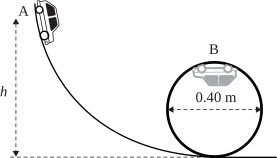
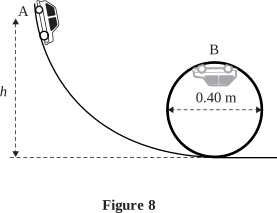
A 250 g toy car performs a loop in the apparatus shown in the diagram below. The car starts from rest at point \(\text{A}\) and travels along the track without any air resistance or retarding frictional forces. The radius of the car's path in the loop is 0.20 m. When the car reaches point \(\text{B}\) it is travelling at a speed of 3.0 m s\(^{-1}\). --- 6 WORK AREA LINES (style=lined) --- --- 6 WORK AREA LINES (style=lined) --- --- 5 WORK AREA LINES (style=lined) ---
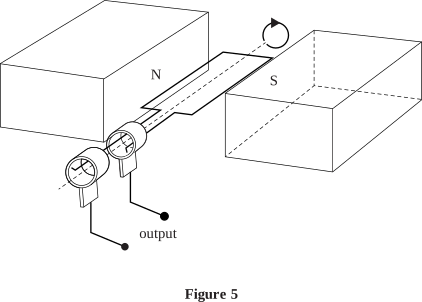
Students in a Physics practical class investigate the piece of electrical equipment shown in the diagram. It consists of a single rectangular loop of wire that can be rotated within a uniform magnetic field. The loop has dimensions 0.50 m × 0.25 m and is connected to the output terminals with slip rings. The loop is in a uniform magnetic field of strength 0.40 T. --- 1 WORK AREA LINES (style=lined) --- --- 3 WORK AREA LINES (style=lined) --- The students connect the output terminals of the piece of electrical equipment to an oscilloscope. One student rotates the loop at a constant rate of 20 revolutions per second. --- 3 WORK AREA LINES (style=lined) --- --- 4 WORK AREA LINES (style=lined) --- --- 3 WORK AREA LINES (style=lined) ---
Navigation in vehicles or on mobile phones uses a network of global positioning system (GPS) satellites. The GPS consists of 31 satellites that orbit Earth. In December 2018, one satellite of mass 2270 kg, from the GPS Block \(\text{IIIA}\) series, was launched into a circular orbit at an altitude of \(20\ 000\) km above Earth's surface. --- 4 WORK AREA LINES (style=lined) --- \begin{array}{|l|l|} --- 6 WORK AREA LINES (style=lined) ---
\hline \rule{0pt}{2.5ex}\text{mass of satellite} \rule[-1ex]{0pt}{0pt}& 2.27 \times 10^3 \ \text{kg} \\
\hline \rule{0pt}{2.5ex}\text{altitude of satellite above Earth's surface} \rule[-1ex]{0pt}{0pt}& 2.00 \times 10^7 \ \text{m} \\
\hline
\end{array}
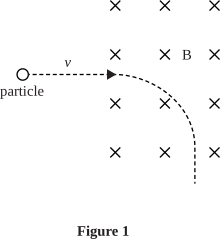
A particle of mass \(m\) and charge \(q\) travelling at velocity \(v\) enters a uniform magnetic field \(\text{B}\), as shown in the diagram. --- 2 WORK AREA LINES (style=lined) --- --- 3 WORK AREA LINES (style=lined) ---
Electrons pass through a fine metal grid, forming a diffraction pattern.
If the speed of the electrons was doubled using the same metal grid, what would be the effect on the fringe spacing?
The diagram represents one hydrogen emission line from the spectrum of a star. Explain the changes to this spectral line that would be observed as a result of the star’s rotational velocity. Modify the diagram to support your answer. (4 marks) --- 8 WORK AREA LINES (style=lined) ---
 Show Answers Only
 Show Worked Solution
♦ Mean mark 55%.
Let \(f: R \rightarrow R\), where \(f(x)=2-x^2\).
--- 2 WORK AREA LINES (style=lined) ---
--- 4 WORK AREA LINES (style=lined) ---
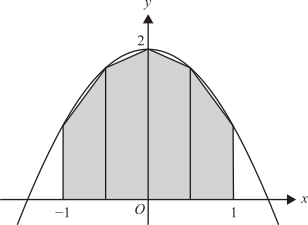
--- 5 WORK AREA LINES (style=lined) ---
Citric acid, the predominant acid in lemon juice, is a triprotic acid. A student titrated 25.0 mL samples of lemon juice with 0.550 mol L\(^{-1}\ \ce{NaOH}\). The mean titration volume was 29.50 mL. The molar mass of citric acid is 192.12 g mol\(^{-1}\).
What was the concentration of citric acid in the lemon juice?
Find the general solution for \(2 \sin (x)=\tan (x)\) for \(x \in R\). (3 marks) --- 6 WORK AREA LINES (style=lined) ---
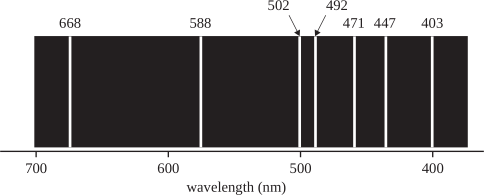
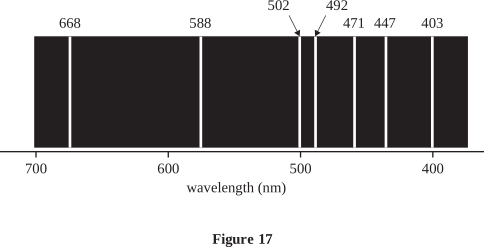
The diagram shows the emission spectrum for helium gas. --- 1 WORK AREA LINES (style=lined) --- --- 6 WORK AREA LINES (style=lined) --- --- 4 WORK AREA LINES (style=lined) ---
A beam of electrons travelling at 1.72 × 10\(^5\) m s\(^{-1}\) illuminates a crystal, producing a diffraction pattern as shown below. Ignore relativistic effects. --- 5 WORK AREA LINES (style=lined) --- The electron beam is now replaced by an X-ray beam. The resulting diffraction pattern has the same spacing as that produced by the electron beam. Calculate the energy of one X-ray photon. Show your working. (3 marks) --- 6 WORK AREA LINES (style=lined) ---

The metal surface in a photoelectric cell is exposed to light of a single frequency and intensity in the apparatus shown in Diagram A. The voltage of the battery can be varied in value and reversed in direction. --- 0 WORK AREA LINES (style=lined) --- --- 1 WORK AREA LINES (style=lined) --- --- 2 WORK AREA LINES (style=lined) --- a. The photocurrent will also be tripled. b. The stopping voltage. c. Zero photocurrent at \(\text{A}\): a. The photocurrent will also be tripled. b. The stopping voltage. c. Zero photocurrent at \(\text{A}\):
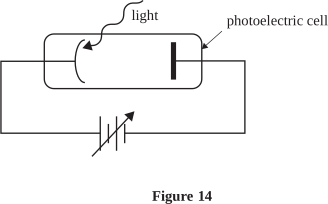

Show Answers Only
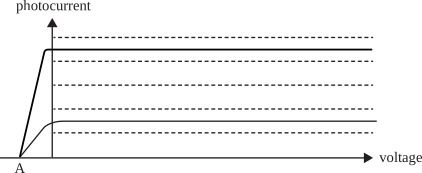
Show Worked Solution
♦♦ Mean mark (c) 32%.
COMMENT: The work function of the metal had no relevance to this question.
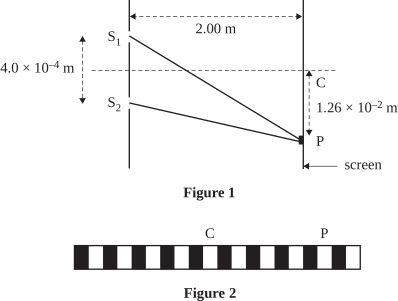
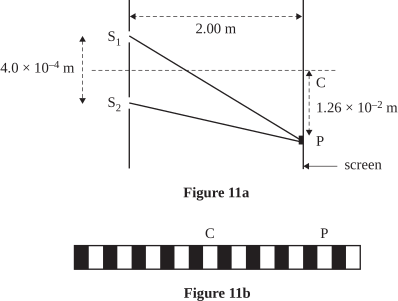
In a Young's double-slit interference experiment, laser light is incident on two slits, \(\text{S}_1\) and \(\text{S}_2\), that are 4.0 × 10\(^{-4}\) m apart, as shown in Figure 1. Rays from the slits meet on a screen 2.00 m from the slits to produce an interference pattern. Point \(\text{C}\) is at the centre of the pattern. Figure 2 shows the pattern obtained on the screen. --- 4 WORK AREA LINES (style=lined) --- --- 4 WORK AREA LINES (style=lined) ---
An astronaut has left Earth and is travelling on a spaceship at 0.800\(c\) directly towards the star known as Sirius, which is located 8.61 light-years away from Earth, as measured by observers on Earth. --- 4 WORK AREA LINES (style=lined) --- --- 3 WORK AREA LINES (style=lined) ---
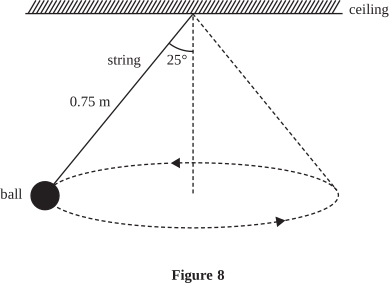
The diagram below shows a small ball of mass 1.8 kg travelling in a horizontal circular path at a constant speed while suspended from the ceiling by a 0.75 m long string.
--- 0 WORK AREA LINES (style=blank) ---
--- 8 WORK AREA LINES (style=lined) ---
a.

b. \(1.2\ \text{ms}^{-1}\)
a. Only two forces are acting on the ball: \(F_w\) and \(F_T\):
b.

\(\text{Using}\ \ \tan\theta=\dfrac{F_{\text{net}}}{mg}:\)
| \( F_{\text{net}}\) | \(=mg\,\tan\theta\) | |
| \(\dfrac{mv^2}{r}\) | \(=mg\,\tan\theta\) | |
| \(\dfrac{v^2}{r}\) | \(=g\,\tan\theta\) | |
| \(\therefore v\) | \(=\sqrt{g\,r\,\tan\theta}\) | |
| \(=\sqrt{9.8 \times 0.317 \times \tan 25}\ \ ,\ \ (r = 0.75 \times \sin25=0.317\ \text{m})\) | ||
| \(=1.2\ \text{ms}^{-1}\) |
Two Physics students hold a coil of wire in a constant uniform magnetic field, as shown in Figure 5a. The ends of the wire are connected to a sensitive ammeter. The students then change the shape of the coil by pulling each side of the coil in the horizontal direction, as shown in Figure 5b. They notice a current register on the ammeter.
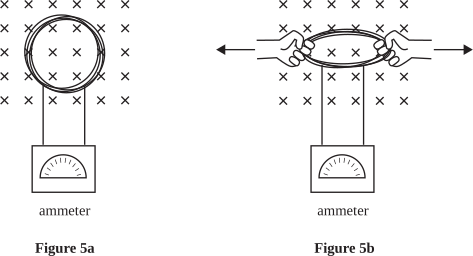
--- 2 WORK AREA LINES (style=blank) ---
--- 6 WORK AREA LINES (style=lined) ---
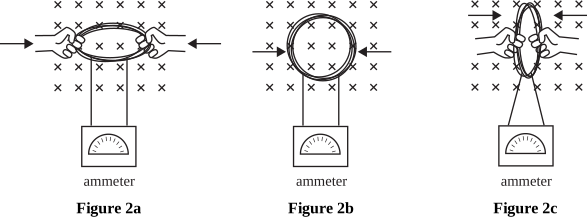
--- 6 WORK AREA LINES (style=lined) ---
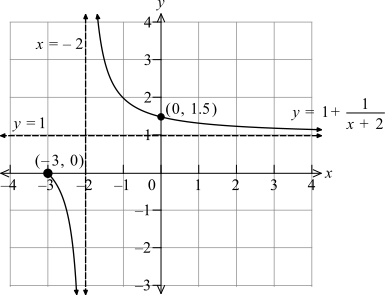
Let \(\displaystyle f:[-3,-2) \cup(-2, \infty) \rightarrow R, f(x)=1+\frac{1}{x+2}\). --- 0 WORK AREA LINES (style=lined) --- --- 3 WORK AREA LINES (style=lined) --- a. b. \(x\in [-3, -2)\cap (-1, \infty)\) a. b. \(\text{From graph }f(x)\leq -2\ \text{ for}\ -3\leq x <2\ \text{ and when }\ x\geq -1\) \(\rightarrow x\in [-3, -2)\cap (-1, \infty)\)
Show Answers Only
 Show Worked Solution
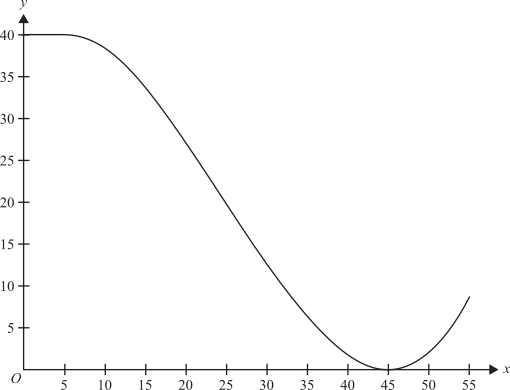
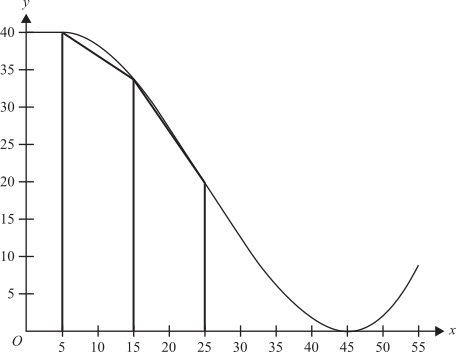
Jac and Jill have built a ramp for their toy car. They will release the car at the top of the ramp and the car will jump off the end of the ramp. The cross-section of the ramp is modelled by the function \(f\), where \(f(x)= \begin{cases}\displaystyle \ 40 & 0 \leq x<5 \\ \dfrac{1}{800}\left(x^3-75 x^2+675 x+30\ 375\right) & 5 \leq x \leq 55\end{cases}\) \(f(x)\) is both smooth and continuous at \(x=5\). The graph of \(y=f(x)\) is shown below, where \(x\) is the horizontal distance from the start of the ramp and \(y\) is the height of the ramp. All lengths are in centimetres. --- 2 WORK AREA LINES (style=lined) --- --- 1 WORK AREA LINES (style=lined) --- --- 1 WORK AREA LINES (style=lined) --- --- 1 WORK AREA LINES (style=lined) --- Jac and Jill decide to use two trapezoidal supports, each of width \(10 cm\). The first support has its left edge placed at \(x=5\) and the second support has its left edge placed at \(x=15\). Their cross-sections are shown in the graph below. --- 5 WORK AREA LINES (style=lined) --- --- 4 WORK AREA LINES (style=lined) --- --- 6 WORK AREA LINES (style=lined) --- --- 3 WORK AREA LINES (style=lined) ---
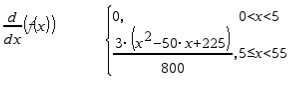
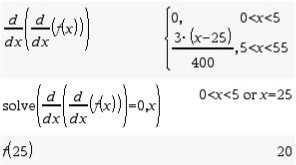
a. \(\text{Using CAS: Define f(x) then}\) \(\text{OR}\quad f^{\prime}(x)= \begin{cases}\displaystyle \ 0 & 0 < x<5 \\ \dfrac{1}{800}\left(3x^2-150 x+675 \right) & 5 \leq x < 55\end{cases}\) b.i \(\text{Using CAS: Find }f^”(x)\ \text{then solve }=0\) \(\therefore\ \text{Point of inflection at }(25, 20)\) b.ii \(\text{Gradient function strictly increasing for }x\in [25, 55]\) b.iii \(\text{Gradient function strictly decreasing for }x\in [5, 25]\) c. \(\text{Using CAS:}\)
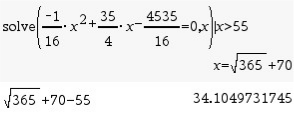
\(\therefore\ \text{The sloped edges of the trapeziums would be above }f(x)\) \(\text{making the trapezium rule approximation greater than the}\) \(\text{actual area.}\) e.i \(f(55)=\dfrac{35}{4}\ \text{(Using CAS)}\) \(\text{and }f(55)=g(55)\rightarrow g(55)=\dfrac{35}{4}\) \(\text{and }g'(55)=f'(55)\) \(\rightarrow\ f'(55)=\dfrac{1}{800}(3\times 55^2-150\times 55+675)=\dfrac{15}{8}\) \(\rightarrow\ -\dfrac{55}{8}+b=\dfrac{15}{8}\) \(\therefore b=\dfrac{35}{4}\quad (2)\) \(\text{Sub (2) into (1)}\) \(c=\dfrac{3165}{16}-55\times\dfrac{35}{4}\) \(c=-\dfrac{4535}{16}\) \(\therefore\ b=\dfrac{35}{4}\ \text{or}\ 8.75 , c=-\dfrac{4535}{16}\ \text{or}\ -283.4375\) e.ii \(\text{Using CAS: Solve }g(x)=0|x>55\) \(\text{Horizontal distance}=\sqrt{365}+70-55=34.104\dots\approx 34.10\ \text{cm (2 d.p.)}\)
Show Worked Solution
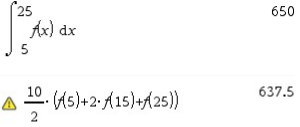
\(\text{Area}\)
\(=\dfrac{h}{2}\Big(f(5)+2f(15)+f(25)\Big)\)
\(=\dfrac{10}{2}\Big(40+2\times 33.75+20\Big)=637.5\)
\(\therefore\ \text{Estimate : Exact}\)
\(=637.5:650\)
\(=\dfrac{637.5}{650}\times 100\)
\(=98.0769\%\approx 98.1\%\)
d. \(\text{In the interval }x\in [25, q]\text{ the curve is concave up.}\)
\(\therefore -\dfrac{1}{16}\times 55^2+55b+c\)
\(=\dfrac{35}{4}\)
\(c\)
\(=\dfrac{35}{4}+\dfrac{3025}{16}-55b\)
\(c\)
\(=\dfrac{3165}{16}-55b\quad (1)\)
\(g'(x)=-\dfrac{x}{8}+b\)
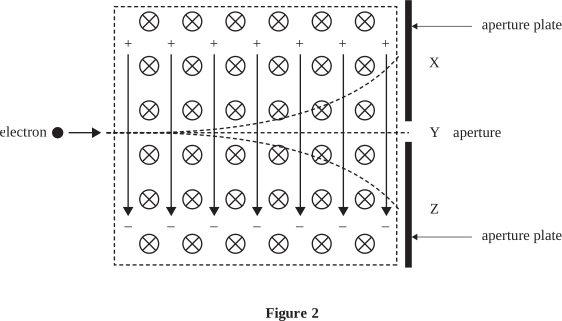
Electron microscopes use a high-precision electron velocity selector consisting of an electric field, \(E\), perpendicular to a magnetic field, \(B\).
Electrons travelling at the required velocity, \(v_0\), exit the aperture at point \(\text{Y}\), while electrons travelling slower or faster than the required velocity, \(v_0\), hit the aperture plate, as shown in Figure 2.
--- 2 WORK AREA LINES (style=lined) ---
--- 4 WORK AREA LINES (style=lined) ---
--- 1 WORK AREA LINES (style=lined) ---
--- 5 WORK AREA LINES (style=lined) ---
A company produces soft drinks in aluminium cans.
The company sources empty cans from an external supplier, who claims that the mass of aluminium in each can is normally distributed with a mean of 15 grams and a standard deviation of 0.25 grams.
A random sample of 64 empty cans was taken and the mean mass of the sample was found to be 14.94 grams.
Uncertain about the supplier's claim, the company will conduct a one-tailed test at the 5% level of significance. Assume that the standard deviation for the test is 0.25 grams.
--- 1 WORK AREA LINES (style=lined) ---
--- 3 WORK AREA LINES (style=lined) ---
--- 2 WORK AREA LINES (style=lined) ---
--- 3 WORK AREA LINES (style=lined) ---
The equipment used to package the soft drink weighs each can after the can is filled. It is known from past experience that the masses of cans filled with the soft drink produced by the company are normally distributed with a mean of 406 grams and a standard deviation of 5 grams.
--- 5 WORK AREA LINES (style=lined) ---
A student is playing minigolf on a day when there is a very strong wind, which affects the path of the ball. The student hits the ball so that at time \(t=0\) seconds it passes through a fixed origin \(O\). The student aims to hit the ball into a hole that is 7 m from \(O\). When the ball passes through \(O\), its path makes an angle of \(\theta\) degrees to the forward direction, as shown in the diagram below.
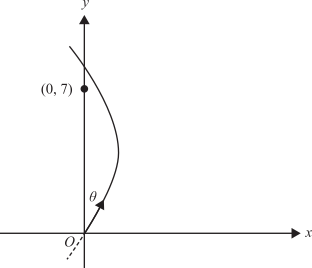
The path of the ball \(t\) seconds after passing through \(O\) is given by
\(\underset{\sim}{\text{r}}(t)=\dfrac{1}{2} \sin \left(\dfrac{\pi t}{4}\right) \underset{\sim}{\text{i}}+2 t \underset{\sim}{\text{j}}\) for \(t \in[0,5]\)
where \(\underset{\sim}{i}\) is a unit vector to the right, perpendicular to the forward direction, \(\underset{\sim}{j}\) is a unit vector in the forward direction and displacement components are measured in metres.
--- 7 WORK AREA LINES (style=lined) ---
--- 4 WORK AREA LINES (style=lined) ---
--- 4 WORK AREA LINES (style=lined) ---
--- 5 WORK AREA LINES (style=lined) ---
--- 5 WORK AREA LINES (style=lined) ---
a. \(r(t)=\dfrac{1}{2}\,\sin \left(\dfrac{\pi t}{4}\right) \underset{\sim}{i}+2 t \underset{\sim}{j}\)
\(\dot{r}(t)=\dfrac{\pi}{8}\, \cos \left(\dfrac{\pi t}{4}\right) \underset{\sim}{i}+2 \underset{\sim}{j}\)
\(\dot{r}(0)=\dfrac{\pi}{8}\,\underset{\sim}{i}+2\underset{\sim}{j}\)

\begin{aligned}
\tan (90-\theta) & =\dfrac{2}{\frac{\pi}{8}} \\
90-\theta & =\tan ^{-1}\left(\dfrac{16}{\pi}\right)=78.9^{\circ} \\
\theta & =11.1^{\circ}
\end{aligned}
| b.i. | \(\text{Speed}\) | \(=\abs{\dot{r}(0)}\) |
| \(=\sqrt{\left(\dfrac{\pi}{8}\right)^2+2^2}\) | ||
| \(=2.04\ \text{ms}^{-1}\ \text{(2 d.p.)}\) |
b.ii. \(\abs{\dot{r}}=\sqrt{\left(\dfrac{\pi}{8}\right)^2 \times \cos ^2\left(\dfrac{\pi t}{4}\right)+4}\)
\(\abs{\dot{r}}\text { is a minimum when}\ \ \cos ^2\left(\dfrac{\pi t}{4}\right)=0\)
\(\Rightarrow t=2\)
\(\therefore\ \text{Minimum speed} =\sqrt{4}=2 \text{ ms} ^{-1}\)
c. \(\text{Ball position}\ \Rightarrow \ \underset{\sim}{r}=\dfrac{1}{2}\,\sin \left(\dfrac{\pi t}{4}\right)\underset{\sim}{i}+2 \, t\underset{\sim}{j}\)
\(\text{Hole position}\ \Rightarrow \ \underset{\sim}{h}=0 \underset{\sim}{i}+7\underset{\sim}{j}\)
\(\underset{\sim}{d}=\underset{\sim}{r}-\underset{\sim}{h}=\dfrac{1}{2}\, \sin \left(\dfrac{\pi t}{4}\right) \underset{\sim}{i}+(2 t-7)\underset{\sim}{j}\)
\(\abs{\underset{\sim}{d}}=\sqrt{\left(\dfrac{1}{2}\right)^2 \sin ^2\left(\dfrac{\pi t}{4}\right)+(2 t-7)^2}\)
\(\text {Minimum }\abs{d}=0.188\text{ m (3 d.p.)}\)
| d. | \(\text{Distance}\) | \(=\displaystyle \int_0^4\left(\frac{\pi}{8}\, \cos \left(\frac{\pi t}{4}\right)\right)^2+4\, dt\) |
| \(=8.077\ \text{m (3 d.p.)}\) |
A student stirs 2.80 g of silver \(\text{(I)}\) nitrate powder into 250.0 mL of 1.00 mol L\(^{-1}\) sodium hydroxide solution until it is fully dissolved. A reaction occurs and a precipitate appears.
--- 2 WORK AREA LINES (style=lined) ---
--- 8 WORK AREA LINES (style=lined) ---
The student weighed a piece of filter paper, filtered out the precipitate and dried it thoroughly in an incubator. The final precipitate mass was higher than predicted in (b).
--- 4 WORK AREA LINES (style=lined) ---
A student stirs 2.45 g of copper \(\text{(II)}\) nitrate powder into 200.0 mL of 1.25 mol L\(^{-1}\) sodium carbonate solution until it is fully dissolved. A reaction occurs and a precipitate appears.
--- 1 WORK AREA LINES (style=lined) ---
--- 6 WORK AREA LINES (style=lined) ---
The student weighed a piece of filter paper, filtered out the precipitate and dried it thoroughly in an incubator. The final precipitate mass was higher than predicted in (b).
--- 5 WORK AREA LINES (style=lined) ---
Carbon dioxide is produced during the combustion of propane \(\ce{(C3H8)}\) in oxygen \(\ce{(O2)}\). The balanced chemical equation for this reaction is:
\(\ce{C3H8(g) + 5O2(g) -> 3CO2(g) + 4H2O(g)}\)
If 44.0 grams of propane are completely combusted, calculate the volume of carbon dioxide produced at STP (100 kPa and 0\(^{\circ}\)C). (3 marks)
--- 6 WORK AREA LINES (style=lined) ---
Consider the algorithm below, which uses the bisection method to estimate the solution to an equation in the form \(f(x)=0\).
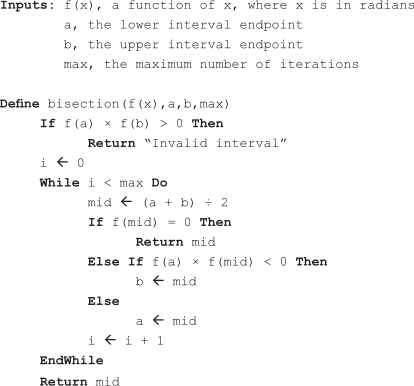
The algorithm is implemented as follows.

Which value would be returned when the algorithm is implemented as given?
The function \(g\) is defined as follows.
\(g:(0,7] \rightarrow R, g(x)=3\, \log _e(x)-x\)
--- 0 WORK AREA LINES (style=lined) ---
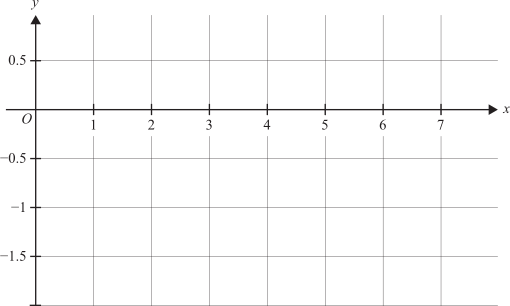
--- 2 WORK AREA LINES (style=lined) ---
--- 0 WORK AREA LINES (style=lined) ---
Newton's method is used to find an approximate \(x\)-intercept of \(g\), with an initial estimate of \(x_0=1\).
--- 3 WORK AREA LINES (style=lined) ---
--- 3 WORK AREA LINES (style=lined) ---
--- 4 WORK AREA LINES (style=lined) ---
--- 0 WORK AREA LINES (style=lined) ---
| a. | 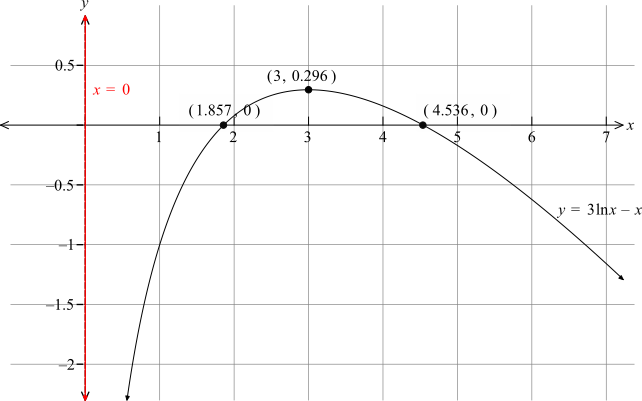 |
| b.i | \(y=2x-3\) |
| b.ii | 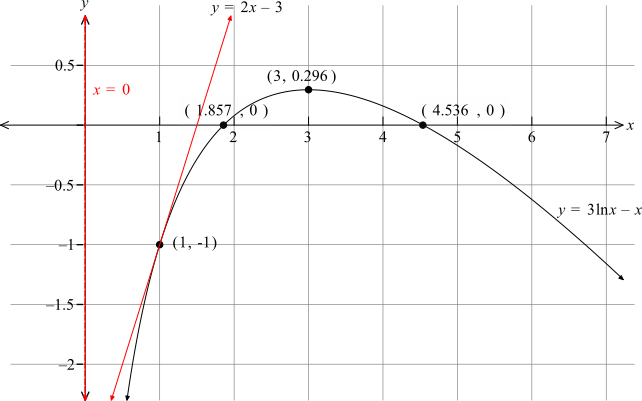 |
| c. | \(\dfrac{3}{2}=1.5\) |
| d. | \(0.0036\) |
| e.i | \(k=2.397\) |
| e.ii | 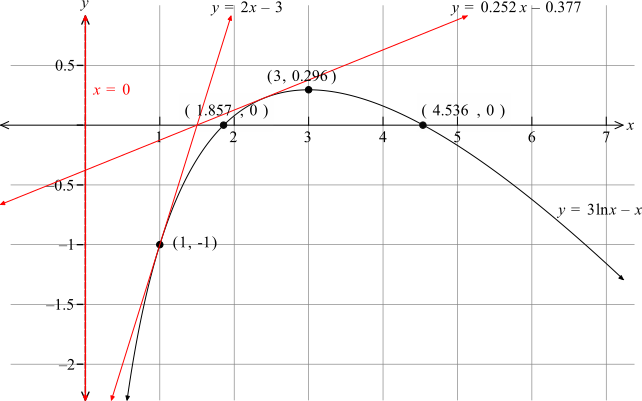 |
a.
| b.i | \(g(x)\) | \(=3\log_{e}x-x\) |
| \(g(1)\) | \(=3\log_{e}1-1=-1\) | |
| \(g^{\prime}(x)\) | \(=\dfrac{3}{x}-1\) | |
| \(g^{\prime}(1)\) | \(=\dfrac{3}{1}-1=2\) |
\(\text{Equation of tangent at }(1, -1)\ \text{with }m=2\)
\(y+1=2(x-1)\ \ \rightarrow \ \ y=2x-3\)
b.ii
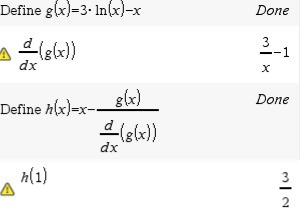
c. \(\text{Newton’s Method}\)
| \(x_1\) | \(=x_0-\dfrac{g(x)}{g'(x)}\) |
| \(=1-\left(\dfrac{-1}{2}\right)\) | |
| \(=\dfrac{3}{2}=1.5\) |
\(\text{Using CAS:}\)
d. \(\text{Using CAS}\)
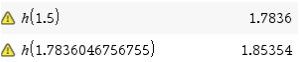

\(x\text{-intercept}:\ x=1.85718\)
\(\therefore\ \text{Horizontal distance}=1.85718-1.85354=0.0036\)
e.i. \(\text{Using CAS}\)

| \(k-\dfrac{3\log_{e}x-x}{\dfrac{3}{x}-1}\) | \(=1.5\) |
| \(k>1\ \therefore\ \ k\) | \(=2.397\) |
e.ii
During a laboratory experiment, a gas is collected in a sealed syringe. Initially, the gas has a volume of 5.0 litres and a pressure of 1.0 atmosphere.
--- 4 WORK AREA LINES (style=lined) ---
--- 4 WORK AREA LINES (style=lined) ---
--- 4 WORK AREA LINES (style=lined) ---
A mixture of sand and salt was provided to a group of students for them to determine its percentage composition by mass.
They added water to the sample before using filtration and evaporation to separate the components.
During the evaporation step, the students noticed white powder ‘spitting’ out of the basin onto the bench, so they turned off the Bunsen burner and allowed the remaining water to evaporate overnight.
After filtering, they allowed the filter paper to dry overnight before weighing. An electronic balance was used to measure the mass of each component to two decimal places.
The results were recorded as shown:
--- 6 WORK AREA LINES (style=lined) ---
--- 5 WORK AREA LINES (style=lined) ---
Explain why ethanol \(\ce{(C2H5OH)}\) is a liquid at room temperature whereas ethane \(\ce{(C2H6)}\) is a gas. (3 marks)
--- 6 WORK AREA LINES (style=lined) ---
Carbon exhibits allotropy, meaning it can exist in different forms with distinct physical properties.
Describe two carbon allotropes, graphite and diamond, and explain how their structural differences result in their distinct physical properties. (4 marks)
--- 9 WORK AREA LINES (style=lined) ---
Using your knowledge of electronic configurations, explain what happens to atomic radii as you go across a period from left to right in the periodic table.
Identify one element from the first period with a larger atomic radius and one with a smaller atomic radius than Boron. (3 marks)
--- 6 WORK AREA LINES (style=lined) ---
One way of implementing Newton's method using pseudocode, with a tolerance level of 0.001 , is shown below.
The pseudocode is incomplete, with two missing lines indicated by an empty box.
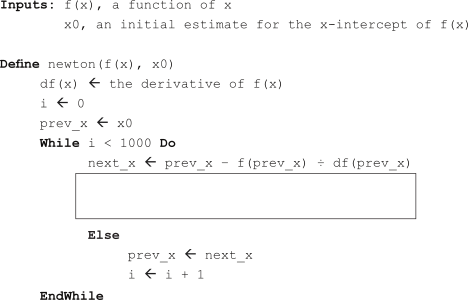
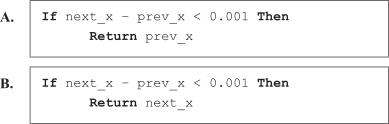
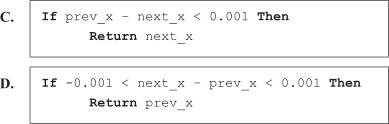
Which one of the following options would be most appropriate to fill the empty box?

Using your understanding of periodic trends, explain and predict the differences in the properties of the elements lithium \(\ce{(Li)}\) and fluorine \(\ce{(F)}\) regarding their:
Give reasons for your predictions based on their positions in the periodic table and electronic configurations. (4 marks)
--- 8 WORK AREA LINES (style=lined) ---
The algorithm below, described in pseudocode, estimates the value of a definite integral using the trapezium rule.
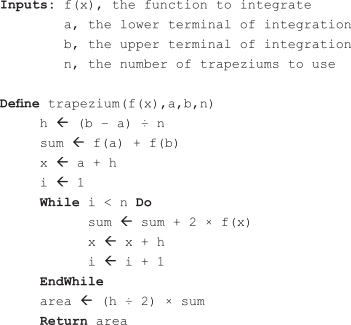
Consider the algorithm implemented with the following inputs.

The value of the variable sum after one iteration of the while loop would be closest to
Newton's method is being used to approximate the non-zero \(x\)-intercept of the function with the equation \(f(x)=\dfrac{x^3}{5}-\sqrt{x}\). An initial estimate of \(x_0=1\) is used.
Which one of the following gives the first estimate that would correctly approximate the intercept to three decimal places?
| \(f(x)\) | \(=\dfrac{x^3}{5}-\sqrt{x}\) |
| \(f'(x)\) | \(=\dfrac{3x^2}{5}-\dfrac{1}{2\sqrt{x}}\) |
\(\text{For Newton’s Method: }\)
| \(x_o\) | \(=1\) |
| \(x_{n+1}\) | \(=x_n-\dfrac{f(x_n)}{f'(x_n)}\) |
\(\text{Check using CAS:}\)
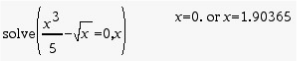
\begin{array} {|c|c|}
\hline
\ \ \ n\ \ \ & x_n \\
\hline
\ 0 \ & 1\\
\hline
\ 1 \ & 1-\dfrac{\dfrac{1^3}{5}-\sqrt{1}}{\dfrac{3\times 1^2}{5}-\dfrac{1}{2\sqrt{1}}}=9\\
\hline
\ 2 \ & 9-\dfrac{\dfrac{9^3}{5}-\sqrt{9}}{\dfrac{3\times 9^2}{5}-\dfrac{1}{2\sqrt{9}}}\approx 6.05\\
\hline
\ 3 \ & 6.05-\dfrac{\dfrac{6.05^3}{5}-\sqrt{6.05}}{\dfrac{3\times 6.05^2}{5}-\dfrac{1}{2\sqrt{6.05}}}\approx 4.13\\
\hline
\ 4 \ & 4.13-\dfrac{\dfrac{4.13^3}{5}-\sqrt{4.13}}{\dfrac{3\times 4.13^2}{5}-\dfrac{1}{2\sqrt{4.13}}}\approx 2.92\\
\hline
\ 5 \ & 2.92-\dfrac{\dfrac{2.92^3}{5}-\sqrt{2.92}}{\dfrac{3\times 2.92^2}{5}-\dfrac{1}{2\sqrt{2.92}}}\approx 2.24\\
\hline
\ 6 \ & 2.24-\dfrac{\dfrac{2.24^3}{5}-\sqrt{2.24}}{\dfrac{3\times 2.24^2}{5}-\dfrac{1}{2\sqrt{2.24}}}\approx 1.96\\
\hline
\ 7 \ & 1.96-\dfrac{\dfrac{1.96^3}{5}-\sqrt{1.96}}{\dfrac{3\times 1.96^2}{5}-\dfrac{1}{2\sqrt{1.96}}}\approx 1.906\\
\hline
\ 8 \ & 1.906-\dfrac{\dfrac{1.906^3}{5}-\sqrt{1.906}}{\dfrac{3\times 1.906^2}{5}-\dfrac{1}{2\sqrt{1.906}}}\approx 1.90366\\
\hline
\end{array}
\(\Rightarrow C\)
Consider the composite function `g(x)=f(\sin (2 x))`, where the function `f(x)` is an unknown but differentiable function for all values of `x`.
Use the following table of values for `f` and `f^{\prime}`.
| `\quad x \quad` | `\quad\quad 1/2\quad\quad` | `\quad\quad(sqrt{2})/2\quad\quad` | `\quad\quad(sqrt{3})/2\quad\quad` |
| `f(x)` | `-2` | `5` | `3` |
| `\quad\quad f^{prime}(x)\quad\quad` | `7` | `0` | `1/9` |
--- 3 WORK AREA LINES (style=lined) ---
The derivative of `g` with respect to `x` is given by `g^{\prime}(x)=2 \cdot \cos (2 x) \cdot f^{\prime}(\sin (2 x))`.
--- 2 WORK AREA LINES (style=lined) ---
--- 4 WORK AREA LINES (style=lined) ---
--- 5 WORK AREA LINES (style=lined) ---
--- 8 WORK AREA LINES (style=lined) ---
Mika is flipping a coin. The unbiased coin has a probability of \(\dfrac{1}{2}\) of landing on heads and \(\dfrac{1}{2}\) of landing on tails.
Let \(X\) be the binomial random variable representing the number of times that the coin lands on heads.
Mika flips the coin five times.
--- 2 WORK AREA LINES (style=lined) ---
--- 2 WORK AREA LINES (style=lined) ---
--- 4 WORK AREA LINES (style=lined) ---
--- 4 WORK AREA LINES (style=lined) ---
The height reached by each of Mika's coin flips is given by a continuous random variable, \(H\), with the probability density function
\(f(h)=\begin{cases} ah^2+bh+c &\ \ 1.5\leq h\leq 3 \\ \\ 0 &\ \ \text{elsewhere} \\ \end{cases}\)
where \(h\) is the vertical height reached by the coin flip, in metres, between the coin and the floor, and \(a, b\) and \(c\) are real constants.
--- 5 WORK AREA LINES (style=lined) ---
--- 5 WORK AREA LINES (style=lined) ---
--- 5 WORK AREA LINES (style=lined) ---
--- 2 WORK AREA LINES (style=lined) ---
--- 6 WORK AREA LINES (style=lined) ---
--- 2 WORK AREA LINES (style=lined) ---
Solve the following equation for \(x\):
\(2^{2x}=3(2^{x+1})-8\). (3 marks)
--- 7 WORK AREA LINES (style=lined) ---
Two complex numbers \(u\) and \(v\) are given by \(u=a+i\) and \(v=b-\sqrt{2}i\), where \(a, b \in R\).
--- 7 WORK AREA LINES (style=lined) ---
--- 3 WORK AREA LINES (style=lined) ---
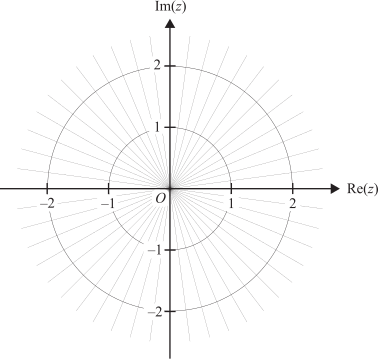
--- 0 WORK AREA LINES (style=lined) ---
--- 4 WORK AREA LINES (style=lined) ---
--- 5 WORK AREA LINES (style=lined) ---
a.i. \(\text{See worked solutions.}\)
a.ii. \(a=-1, \ b=-\sqrt{6}\)
b.
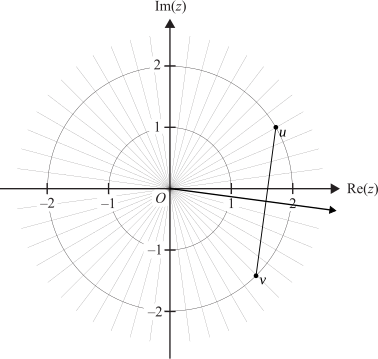
c. \(\theta=-\dfrac{\pi}{24}\)
d. \(0.69\ \text{u}^2\)
a.i. \(u v=(\sqrt{2}+\sqrt{6})+(\sqrt{2}-\sqrt{6}) i\)
\begin{aligned}
(a+i)(b-\sqrt{2} i) & =a b-\sqrt{2} a i+b i+\sqrt{2} \\
& =a b+\sqrt{2}+(b-\sqrt{2}a) i
\end{aligned}
\(\text {Equating co-efficients: }\)
\(ab=\sqrt{6} \ \Rightarrow \ b=\dfrac{\sqrt{6}}{a}\ \cdots\ \text {(1)}\)
\(b-\sqrt{2} a=\sqrt{2}-\sqrt{6}\ \cdots\ \text {(2)}\)
\(\text{Substitute (1) into (2):}\)
\(\dfrac{\sqrt{6}}{a}-\sqrt{2}a=\sqrt{2}-\sqrt{6}\)
\(\sqrt{6}-\sqrt{2} a^2=(\sqrt{2}-\sqrt{6}) a\)
| \(\sqrt{2} a^2+(\sqrt{2}-\sqrt{6}) a-\sqrt{6}\) | \(=0\) | |
| \(a^2+(1-\sqrt{3}) a-\sqrt{3}\) | \(=0\) |
a.ii. \(\text{Solve } a^2+(1-\sqrt{3}) a-\sqrt{3}=0 \ \ \text{for}\ a :\)
\(a=\sqrt{3} \ \text{ or } -1\)
\(\therefore \text{ Other solution: } a=-1, \ b=-\sqrt{6}\)
b.
c. |
\begin{aligned} \theta & =\frac{\operatorname{Arg}(u)-\operatorname{Arg}(v)}{2} \\ & =\frac{1}{2}\left(\frac{\pi}{6}-\frac{\pi}{4}\right) \\ & =-\frac{\pi}{24} \end{aligned} |
d. \(\text {Sector angle (centre) }=\dfrac{\pi}{6}+\dfrac{\pi}{4}=\dfrac{5 \pi}{12}\)
\(\text {Area of sector }=\dfrac{\frac{5 \pi}{12}}{2 \pi} \times \pi \times 2^2=\dfrac{5 \pi}{6}\)
\begin{aligned}
\text {Area of segment } & =\frac{5 \pi}{6}-\dfrac{1}{2} \times 2 \times 2 \times \sin \left(\dfrac{5 \pi}{6}\right) \\
& \approx 0.69\ \text{u} ^2
\end{aligned}
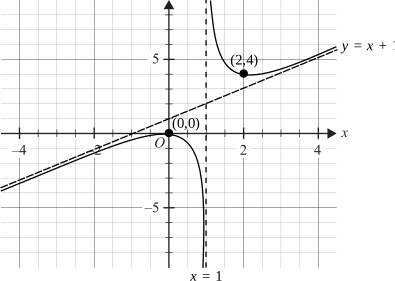
Consider the family of functions \(f\) with rule \(f(x)=\dfrac{x^2}{x-k}\), where \(k \in R \backslash\{0\}\).
--- 3 WORK AREA LINES (style=lined) ---
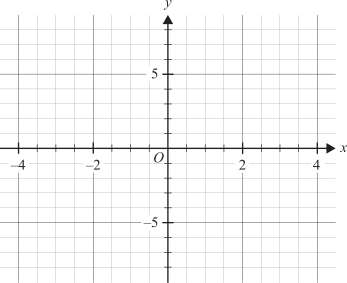
--- 0 WORK AREA LINES (style=lined) ---
--- 2 WORK AREA LINES (style=lined) ---
--- 4 WORK AREA LINES (style=lined) ---
--- 5 WORK AREA LINES (style=lined) ---
--- 2 WORK AREA LINES (style=lined) ---
a. \(\text {Asymptotes: } x=1,\ y=x+1\)
b.
c.i. \(\text {Asymptotes: } x=k,\ y=x+k\)
c.ii. \(\text {Distance }=2 \sqrt{5}|k|\)
d.i. \(\displaystyle V=\pi \int_{\frac{-\sqrt{7}-1}{2}}^{\frac{\sqrt{7}-1}{2}}(x+3)^2-\left(\frac{x^2}{x-1}\right)^2 dx\)
d.ii. \(V=51.42\ \text{u}^3 \)
a. \(\text {When } k=1 :\)
\(f(x)=\dfrac{x^2}{x-1}=\dfrac{(x+1)(x-1)+1}{(x-1)}=x+1+\dfrac{1}{x-1}\)
\(\text {Asymptotes: } x=1,\ y=x+1\)
b.
c.i. \(f(x)=\dfrac{x^2}{x-k}=\dfrac{(x+k)(x-k)+k^2}{x-k}=x+k+\dfrac{k^2}{x-k}\)
\(\text {Using part a.}\)
\(\text {Asymptotes: } x=k,\ y=x+k\)
c.ii. \(f^{\prime}(x)=1-\left(\dfrac{k}{x-k}\right)^2\)
\(\text {TP’s when } f^{\prime}(x)=0 \text { (by CAS):}\)
\(\Rightarrow(2 k, 4 k),(0,0)\)
\(\text {Distance }\displaystyle=\sqrt{(2 k-0)^2+(4 k-0)^2}=\sqrt{20 k^2}=2 \sqrt{5}|k|\)
d.i \(\text {Solve for intersection of graphs (by CAS):}\)
\(\displaystyle x+3=\left|\frac{x^2}{x-1}\right|\)
\(\displaystyle \Rightarrow x=\frac{3}{2}, x=\frac{-1 \pm \sqrt{7}}{2}\)
\(\displaystyle V=\pi \int_{\frac{-\sqrt{7}-1}{2}}^{\frac{\sqrt{7}-1}{2}}(x+3)^2-\left(\frac{x^2}{x-1}\right)^2 dx\)
d.ii. \(V=51.42\ \text{u}^3 \text{ (by CAS) }\)