SmarterEd

Aussie Maths & Science Teachers: Save your time with SmarterEd

  • Login
  • Get Help
  • About

CHEMISTRY, M1 EQ-Bank 14

Compare and explain the reactivity of Group 1 (alkali metals) and Group 2 (alkaline earth metals) with water. In your answer, link your explanation to electron configuration, atomic radius, and ionisation energy.   (6 marks)

--- 15 WORK AREA LINES (style=lined) ---

Show Answers Only
  • Group 1 metals (e.g. \(\ce{Li, Na, K}\)) react vigorously with water to form a hydroxide and hydrogen gas.
  • Group 2 metals (e.g. \(\ce{Mg, Ca}\)) also react with water but much less vigorously, especially at the top of the group. For example, magnesium reacts only slowly with cold water.
  • Electron configuration: Group 1 metals have one valence electron, while Group 2 metals have two valence electrons. Losing one electron requires less energy than losing two, making Group 1 metals more reactive.
  • Atomic radius and ionisation energy: Down both groups, the atomic radius increases, shielding increases, and ionisation energy decreases. This means reactivity with water increases down the group.
  • Therefore: Reactivity increases down both groups, but Group 1 metals show higher reactivity with water compared with Group 2 metals in the same period.
Show Worked Solution
  • Group 1 metals (e.g. \(\ce{Li, Na, K}\)) react vigorously with water to form a hydroxide and hydrogen gas.
  • Group 2 metals (e.g. \(\ce{Mg, Ca}\)) also react with water but much less vigorously, especially at the top of the group. For example, magnesium reacts only slowly with cold water.
  • Electron configuration: Group 1 metals have one valence electron, while Group 2 metals have two valence electrons. Losing one electron requires less energy than losing two, making Group 1 metals more reactive.
  • Atomic radius and ionisation energy: Down both groups, the atomic radius increases, shielding increases, and ionisation energy decreases. This means reactivity with water increases down the group.
  • Therefore: Reactivity increases down both groups, but Group 1 metals show higher reactivity with water compared with Group 2 metals in the same period.

Filed Under: Periodicity Tagged With: Band 5, Band 6, smc-4257-10-Atomic Radii, smc-4257-30-Ionisation Energy, smc-4257-40-Reactivity

v1 Measurement, STD2 M7 2022 HSC 38

A 5.0 L container is filled with a mixture of milk and coffee in the ratio 3:2.

After removing 1.0 L of the mixture, pure milk is added to refill the container.

What is the ratio of milk to coffee in the final mixture? (3 marks)

--- 6 WORK AREA LINES (style=lined) ---

Show Answers Only

`17:8`

Show Worked Solution

`text{Original mixture amounts}`

`text{Milk : Coffee = 3000 mL : 2000 mL}`

`text{Removing 1.0 L (1000 mL) removes}`

`text{→ }(3/5)×1000=600\text{ mL milk and }(2/5)×1000=400\text{ mL coffee}`
 

`text{Milk after removal}`

`=3000-600=2400\text{ mL}`
 

`text{Coffee after removal}`

`=2000-400=1600\text{ mL}`
 

`text{After refilling with 1000 mL milk:}`

`text{Milk }=2400+1000=3400\text{ mL}`

`text{Coffee }=1600\text{ mL}`
 

`:.\ \text{Final ratio } \text{Milk : Coffee}`

`=3400:1600`

`=17:8`


♦♦ Mean mark 34%.

Filed Under: Ratios (Std2-X) Tagged With: Band 5, smc-1187-10-Ratio (2 part)

v1Measurement, STD2 M7 2021 HSC 25

A rectangular sportsground has been drawn to scale on a 1-cm grid as shown. The scale used is `1:2000`.
 

Johnny took 12 minutes to walk around the perimeter of this sportsground.

What was Johnny's average speed in kilometres per hour?  (4 marks)

--- 8 WORK AREA LINES (style=lined) ---

Show Answers Only

`3.4 \ text{km/hr}`

Show Worked Solution
`text{Distance walked on map} \ = \ 2 times  (10 + 7) = 34 \ text{cm}`
Mean mark 54%.


`text{Actual distance}` ` =34 times 2000`  
  `= 68\ 000 \ text{cm}`  
  `=680 \ text{m}`  
  `= 0.68 \ text{km}`  

 
`12 \ text{minutes}\ = 12/60 = 0.2 \ text{hours}`
 

`text{Speed}` `= text{distance}/text{time}`  
  `= 0.68/0.2`  
  `= 3.4 \ text{km/hr}`  

Filed Under: Ratios (Std2-X) Tagged With: Band 5, smc-1187-40-Maps and Scale Drawings

v1 Measurement, STD1 M5 2021 HSC 26

The diagrams show two similar shapes. The dimensions of the small shape are enlarged by a scale factor of 1.5 to produce the large shape.
 

Calculate the area of the large shape.  (3 marks)

--- 5 WORK AREA LINES (style=lined) ---

Show Answers Only

`94.5\ text(cm)^2`

Show Worked Solution

`text(Dimension of larger shape:)`

♦♦ Mean mark 32%.

`text(Width) = 6 xx 1.5 = 9\ text(cm)`

`text(Height) = 8 xx 1.5 = 12 \ text(cm)`

`text(Triangle height) = 2 xx 1.5 = 3\ text(cm)`

`:.\ text(Area)` `= 9 xx (12-3) + 1/2 xx 9 xx 3`
  `= 94.5\ text(cm)^2`

Filed Under: Ratios (Std2-X) Tagged With: Band 5, num-title-ct-pathb, num-title-qs-hsc, smc-1105-30-Similarity, smc-1187-60-Similarity, smc-4746-30-Other similar figures, smc-4746-40-Areas and Volumes

CHEMISTRY, M1 EQ-Bank 13

Using your knowledge of the atomic radii for the 2nd and 3rd period elements.

  1. Explain the general trend in atomic radius across Period 2.   (3 marks)

--- 7 WORK AREA LINES (style=lined) ---

  1. Explain why the elements of Period 3 have larger atomic radii than the corresponding elements of Period 2.   (2 marks)

--- 5 WORK AREA LINES (style=lined) ---

Show Answers Only

a.   Across Period 2, atomic radius decreases from lithium to neon:

  • This occurs because the number of protons (nuclear charge) increases across the period, while electrons are added to the same energy level.
  • As a result, the increased nuclear attraction pulls the electron cloud closer to the nucleus.
  • This leads to reduced atomic radius despite more electrons being present.
  • Therefore, there is a clear trend of decreasing atomic size from left to right across Period 2.

b.   Period 3 atomic radii are larger than corresponding Period 2 element:

  • Period 3 elements have larger atomic radii than Period 2 elements because they have one additional electron shell.
  • This occurs because Period 3 elements have electrons in the n=3 shell, while Period 2 elements only fill up to n=2.
  • Period 3 elements have more protons that create a greater nuclear attractive force with the orbiting electrons but the extra electron shell outweighs the effect of increased nuclear charge.
  • As a result, the outermost electrons in Period 3 are further from the nucleus, causing increased atomic size despite having more protons.
Show Worked Solution

a.   Across Period 2, atomic radius decreases from lithium to neon:

  • This occurs because the number of protons (nuclear charge) increases across the period, while electrons are added to the same energy level.
  • As a result, the increased nuclear attraction pulls the electron cloud closer to the nucleus.
  • This leads to reduced atomic radius despite more electrons being present.
  • Therefore, there is a clear trend of decreasing atomic size from left to right across Period 2.

b.   Period 3 atomic radii are larger than corresponding Period 2 element:

  • Period 3 elements have larger atomic radii than Period 2 elements because they have one additional electron shell.
  • This occurs because Period 3 elements have electrons in the n=3 shell, while Period 2 elements only fill up to n=2.
  • Period 3 elements have more protons that create a greater nuclear attractive force with the orbiting electrons but the extra electron shell outweighs the effect of increased nuclear charge.
  • As a result, the outermost electrons in Period 3 are further from the nucleus, causing increased atomic size despite having more protons.

Filed Under: Periodicity Tagged With: Band 4, Band 5, smc-4257-10-Atomic Radii

CHEMISTRY, M1 EQ-Bank 12

Explain the trend in electronegativity across a period (from left to right) and down a group in the Periodic Table. Use your knowledge of atomic structure to support your answer.   (4 marks)

--- 12 WORK AREA LINES (style=lined) ---

Show Answers Only

Across a period (left to right):

  • Electronegativity increases because nuclear charge (proton number) increases.
  • As a result, atoms have stronger pull on bonding electrons.
  • This occurs because electrons are added to the same shell, not further away.
  • In this way, atoms become smaller from left to right due to extra protons attracting electrons more strongly and reducing their radii.

Down a group:

  • Electronegativity decreases despite increasing nuclear charge (more protons).
  • This occurs because atoms gain additional electron shells, leading to increased distance between nucleus and bonding electrons.
  • Extra shells provide shielding, which means that outer electrons feel less nuclear attraction.
  • Therefore, the shell effect outweighs the increased nuclear charge and electronegativity decreases down a group.
Show Worked Solution

Across a period (left to right):

  • Electronegativity increases because nuclear charge (proton number) increases.
  • As a result, atoms have stronger pull on bonding electrons.
  • This occurs because electrons are added to the same shell, not further away.
  • In this way, atoms become smaller from left to right due to extra protons attracting electrons more strongly and reducing their radii.

Down a group:

  • Electronegativity decreases despite increasing nuclear charge (more protons).
  • This occurs because atoms gain additional electron shells, leading to increased distance between nucleus and bonding electrons.
  • Extra shells provide shielding, which means that outer electrons feel less nuclear attraction.
  • Therefore, the shell effect outweighs the increased nuclear charge and electronegativity decreases down a group.

Filed Under: Periodicity Tagged With: Band 5, smc-4257-20-Electronegativity

CHEMISTRY, M1 EQ-Bank 5 MC

Which of the following elements has the highest second ionisation energy?

  1. Sodium
  2. Magnesium
  3. Aluminium
  4. Silicon
Show Answers Only

\(A\)

Show Worked Solution
  • Second ionisation energy = energy required to remove a second electron after the first has already been removed.
  • Sodium: After losing one electron, it becomes \(\ce{Na^+}\) with a stable noble gas configuration (like neon). Removing a second electron means breaking into the stable core → very high second IE.
  • The second electron still comes from the valence electron shell for the other three elements hence they all have relatively low second ionisation energies.
  • Therefore, the element with the highest second ionisation energy is Sodium.

\(\Rightarrow A\)

Filed Under: Periodicity Tagged With: Band 5, smc-4257-30-Ionisation Energy

CHEMISTRY, M1 EQ-Bank 11

Explain the relationship between electronegativity and atomic radius with non-metal reactivity down Group 17 (the halogens) of the Periodic Table.   (4 marks)

--- 8 WORK AREA LINES (style=lined) ---

Show Answers Only
  • Atomic radius increases down Group 17 because each element gains more electron shells.
  • This leads to weaker nuclear attraction for incoming electrons, due to greater distance from the nucleus and increased shielding by inner shells.
  • As a result, electronegativity decreases down the group, and consequently decreasing reactivity down Group 17
  • For instance, fluorine (small radius, high electronegativity) is most reactive while in contrast, iodine (large radius, low electronegativity) is least reactive.
  • Therefore, smaller atoms with higher electronegativity are more reactive non-metals.
Show Worked Solution
  • Atomic radius increases down Group 17 because each element gains more electron shells.
  • This leads to weaker nuclear attraction for incoming electrons, due to greater distance from the nucleus and increased shielding by inner shells.
  • As a result, electronegativity decreases down the group, and consequently decreasing reactivity down Group 17
  • For instance, fluorine (small radius, high electronegativity) is most reactive while in contrast, iodine (large radius, low electronegativity) is least reactive.
  • Therefore, smaller atoms with higher electronegativity are more reactive non-metals.

Filed Under: Periodicity Tagged With: Band 4, Band 5, smc-4257-10-Atomic Radii, smc-4257-20-Electronegativity, smc-4257-40-Reactivity

CHEMISTRY, M1 EQ-Bank 2 MC

Ionisation energy is the energy required to remove an electron from an atom.

The table below shows the ionisations energies for element \(\text{Y}\). 

\begin{array} {|l|c|c|}
\hline \text{Ionisation energy number} & 1\text{st} & 2\text{nd} & 3\text{rd} & 4\text{th} & 5\text{th} & 6\text{th}\\
\hline \text{Ionisation energy (kJ/mol)} & 738 & 1450 & 7730 & 10\,500 & 13\,600 & 18\,000 \\
\hline \end{array}

Identify the element described by the table.

  1. Sodium
  2. Magnesium
  3. Silicon
  4. Phosphorus
Show Answers Only

\(B\)

Show Worked Solution
  • The big jump occurs between the 2nd (1450) and 3rd (7730) ionisation energies.
  • This means the element has two valence electrons (after those are removed, you hit a stable core).
  • Group two elements have two valence electrons. 

\(\Rightarrow B\)

Filed Under: Periodicity Tagged With: Band 5, smc-4257-30-Ionisation Energy

v1 Measurement, STD2 M7 2012 HSC 27c

A topographic map has a scale of 1 : 250 000.

  1. Two lookouts are 3.6 cm apart on the map.


    What is the actual distance between the two lookouts, in kilometres?   (1 mark)

    --- 3 WORK AREA LINES (style=lined) ---

  2. Two towns are 42.5 km apart. How far apart are the two towns on the map, in centimetres?   (1 mark)

    --- 2 WORK AREA LINES (style=lined) ---

Show Answers Only
  1. `text(9 km)`
  2. `text(17 cm)`
Show Worked Solution
♦ Mean mark 41%
MARKER’S COMMENT: Better responses converted between centimetres, metres and kilometres systematically using the map scale (1 unit on the map represents 250 000 of the same unit in reality).
i.    `text{Actual distance (3.6 cm)}` `= 3.6 xx 250\ 000`
  `= 900\ 000\ text(cm)`
  `= 9\ 000\ text(m)`
  `= 9\ text(km)`


`:.\ text(The 2 lookouts are 9 km apart.)`

♦ Mean mark 45%

ii.   `text(Towns are 42.5 km apart.)`

`text{From the scale, } 1\ \text{cm} = 250\ 000\ \text{cm} = 2\ 500\ \text{m} = 2.5\ \text{km}`

`=>\ \text{On the map, } 42.5\ \text{km} = 42.5/2.5 = 17\ \text{cm}`

`:.\ \text{Distance on the map is 17 cm.}`

Filed Under: Ratios (Std2-X) Tagged With: Band 5, num-title-ct-corea, num-title-qs-hsc, smc-1105-20-Maps and Scale Drawings, smc-1187-40-Maps and Scale Drawings, smc-4746-60-Scale drawings

v1 Measurement, STD2 M7 2012 HSC 26f

The capture-recapture technique was used to estimate a population of turtles in 2015.

• 80 turtles were caught, tagged and released.

• Later, 200 turtles were caught at random.

• 40 of these 200 turtles had been tagged.

The estimated population of turtles in 2015 was 25% greater than the estimated population for 2010.

What was the estimated population for 2010? (2 marks)

--- 4 WORK AREA LINES (style=lined) ---

Show Answers Only

`text{320 turtles}`

Show Worked Solution

`text(Let population in 2015 =)\ P(2015)`

`text(Capture)`

`⇒ 80/{P(2015)}`

`text(Recapture)`

`=> 40/200 = 1/5`

`80/{P(2015)}` `=1/5`
`:. P(2015)` `= 80 xx 5 =400`


`text(We know)\ P(2015)\ text(is 25% greater than P(2010))`

`text{(100% + 25%)} xx P(2010)` `= 400`
`125% xxP(2010)` `=400`
`:. P(2010)` `=400/1.25`
  `= 320`


`:.\ text{2010 population estimate = 320 turtles}`

Filed Under: Ratios (Std2-X) Tagged With: Band 5, smc-1187-30-Capture/Recapture

v1 Measurement, STD2 M7 2020 HSC 23

In a tropical punch, the ratio of passionfruit juice to guava juice to lime juice is 12 : 10 : 6 .

  1. How much lime juice is needed if the punch is to contain 2.4 litres of passionfruit juice? (2 marks)

    --- 4 WORK AREA LINES (style=lined) ---

  2. The internal dimensions of a drink container, in the shape of a rectangular prism, are shown.
     

    To completely fill the container with the punch, how many litres of guava juice are required? (3 marks)

    --- 6 WORK AREA LINES (style=lined) ---

Show Answers Only
  1. `1.2 text{L}`
  2. `10  text{L}`
Show Worked Solution
a.    `text(12 parts)` `= 2.4\ text(L)`
  `text(1 part)` `= 2.4/12`
    `= 0.2\ text(L)`


`:.\ text(6 parts)` `= 6 xx 0.2`  
  `= 1.2\ text(L)`  
b.     `text{Volume of container}` `= 40 xx 20 xx 35`
    `= 28\ 000 \ text{cm}^3`

`1 \ text{mL} \ to \ 1 \ text{cm}^3`

`⇒ \ 28\ 000 \ text{mL of punch}`

`therefore \ text{Guava juice required}` `= text{Guava parts}/text{Total parts} \ xx \ 28\ 000`
  `= \frac{10}{28} \ xx \ 28\ 000`
  `= 10\ 000 \ text{mL}`
  `= 10 \ text{L}`

Filed Under: Ratios (Std2-X) Tagged With: Band 4, Band 5, smc-1187-20-Ratio (3 part)

v1 Algebra, STD2 A4 2021 HSC 35

A toy store releases a limited edition LEGO set for $20 each. At this price, 3000 LEGO sets are sold each week and the revenue is  `3000 xx 20=$60\ 000`.

The toy store considers increasing the price. For every dollar price increase, 15 fewer LEGO sets will be sold.

If the toy store charges `(20+x)` dollars for each LEGO set, a quadratic model for the revenue raised, `R`, from selling them is

`R=-15x^2+2700x+60\ 000`


  1. What price should be charged per LEGO set to maximise the revenue?   (2 marks)

    --- 4 WORK AREA LINES (style=lined) ---

  2. How many LEGO sets are sold when the revenue is maximised?   (2 marks)

    --- 4 WORK AREA LINES (style=lined) ---

  3. Find the value of the intercept of the parabola with the vertical axis.   (1 mark) 

    --- 2 WORK AREA LINES (style=lined) ---

Show Answers Only

a.   `$110`

b.    `1650`

c.   `$60\ 000`

Show Worked Solution

a.   `text{Highest revenue}\ (R_text{max})\ text(occurs halfway between)\ \ x= -20 and x=200.`

`text{Midpoint}\ =(-20 + 200)/2 = 90`

`:.\ text(Price of LEGO set for)\ R_text(max)`

`=90 + 20`

`=$110`
 

b.  `text{LEGO sets sold when}\ R_{max}`

`=3000-(90 xx 15)`

`=1650`
 

c.   `ytext(-intercept → find)\ R\ text(when)\ \ x=0:`

`R` `= -15(0)^2 + 2700(0) + 60\ 000`
  `=$60\ 000`

Filed Under: Non-Linear: Exponential/Quadratics (Std 2-X) Tagged With: Band 5, Band 6, smc-830-20-Quadratics

v1 Algebra, STD2 A4 2017 HSC 28e

Sage brings 60 cartons of unpasteurised milk to the market each week. Each carton currently sells for $4 and at this price, all 60 cartons are sold each weekend.

Sage considers increasing the price to see if the total income can be increased.

It is assumed that for each $1 increase in price, 6 fewer cartons will be sold.

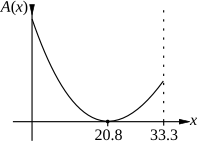
A graph showing the relationship between the increase in price per carton and the income is shown below.


  1. What price per carton should be charged to maximise the income?   (1 mark)

    --- 1 WORK AREA LINES (style=lined) ---

  2. What is the number of cartons sold when the income is maximised?   (1 mark)

    --- 1 WORK AREA LINES (style=lined) ---

  3. The cost of running the market stall is $40 plus $1.50 per carton sold.

    Calculate Sage's profit when the income earned from a day selling at the market is maximised.   (2 marks)

--- 4 WORK AREA LINES (style=lined) ---

Show Answers Only

a.   `$7`

b.   `42`

c.   `$191`

Show Worked Solution

a.   `text(Graph is highest when increase = $3)`

`:.\ text(Carton price)\ = 4 + 3= $7`
 

b.   `text(Cartons sold)\ =60-(3 xx 6)=42`
  

c.   `text{Cost}\ = 42 xx 1.50 + 40 = $103`

`:.\ text(Profit when income is maximised)`

`= (42 xx 7)-103`

`= $191`

Filed Under: Non-Linear: Exponential/Quadratics (Std 2-X) Tagged With: Band 4, Band 5, num-title-ct-coreb, num-title-qs-hsc, smc-4443-70-Other applications, smc-830-20-Quadratics

v1 Algebra, STD2 A4 2009 HSC 28c

The brightness of a lamp \((L)\) is measured in lumens and varies directly with the square of the voltage \((V)\) applied, which is measured in volts.

When the lamp runs at 7 volts, it produces 735 lumens.

What voltage is required for the lamp to produce 1820 lumens? Give your answer correct to one decimal place.   (3 marks)

--- 6 WORK AREA LINES (style=lined) ---

Show Answers Only

 `11.2\ \text(volts)`

Show Worked Solution
♦♦ Mean mark 22%
TIP: Establishing `L=k V^2` is the key part of solving this question.

`L prop V^2\ \ => \ \ L=kV^2`

`text(Find)\ k\ \text{given}\ L = 735\ \text{when}\ V = 7:`

`735` `= k xx 7^2`
`:. k` `= 735/49=15`

 
`text(Find)\ V\ text(when)\ L = 1820:`

`1820` `= 15 xx V^2`
`V^2` `= 1820/15=121.33…`
`V` `= sqrt{121.33} = 11.2\ text(volts)\ \ text{(to 1 d.p.)}`

Filed Under: Non-Linear: Exponential/Quadratics (Std 2-X) Tagged With: Band 5, num-title-ct-patha, num-title-qs-hsc, smc-4239-40-a prop other, smc-830-20-Quadratics, smc-830-60-Proportional

CHEMISTRY, M1 EQ-Bank 17

The following table gives some information about two covalent molecule substances

\begin{array} {|c|c|c|}
\hline \text{Compound} & \text{Molecular formula} & \text{Boiling Point } (^{\circ}C) \\
\hline \text{Water} & \ce{H2O} & 100 \\
\hline \text{Hydrogen sulfide} & \ce{H2S} & -60 \\
\hline \end{array}

  1. Draw Lewis dot diagrams for each molecule.   (2 marks)

    --- 4 WORK AREA LINES (style=blank) ---

  1. Identify the shape and polarity of each molecule.   (4 marks)

    --- 2 WORK AREA LINES (style=lined) ---

  1. Explain why there is a difference in the boiling points of these molecules.   (3 marks)

    --- 6 WORK AREA LINES (style=lined) ---

Show Answers Only

a.   
             

b.   Water: Bent and Polar

Hydrogen Sulfide: Bent and polar 

c.   Even though both molecular are polar:

  • Water has strong hydrogen bonding between molecules because \(\ce{H}\) is bonded to highly electronegative \(\ce{O}\) with lone pairs. These hydrogen bonds require large amounts of energy to break, giving water a high boiling point.
  • Hydrogen sulfide cannot form hydrogen bonds because \(\ce{S}\) is not electronegative enough. The only intermolecular forces are weak dipole–dipole and dispersion forces. Thus less energy is required to overcome the intermolecular forces and so \(\ce{H2S}\) a lower boiling point.
Show Worked Solution

a.   
             

b.   Water: Bent and Polar

Hydrogen Sulfide: Bent and polar
 

c.   Even though both molecular are polar:

  • Water has strong hydrogen bonding between molecules because \(\ce{H}\) is bonded to highly electronegative \(\ce{O}\) with lone pairs. These hydrogen bonds require large amounts of energy to break, giving water a high boiling point.
  • Hydrogen sulfide cannot form hydrogen bonds because \(\ce{S}\) is not electronegative enough. The only intermolecular forces are weak dipole–dipole and dispersion forces. Thus less energy is required to overcome the intermolecular forces and so \(\ce{H2S}\) a lower boiling point.

Filed Under: Bonding Tagged With: Band 4, Band 5, smc-4258-30-Lewis Dot, smc-4258-40-Inter/Intramolecular Bonding, smc-4258-50-Chemical structure

CHEMISTRY, M1 EQ-Bank 16

Carbon has multiple allotropes. Compare and contrast two allotropes of carbon.   (2 marks)

--- 4 WORK AREA LINES (style=lined) ---

Show Answers Only
  • An allotrope is a different structural form of the same element in the same physical state, where the atoms are arranged differently, giving rise to distinct physical and chemical properties.
  • Both diamond and graphite are made entirely of carbon atoms and have high melting points due to strong covalent bonding.
  • However, they differ in bonding arrangement: diamond has a 3D tetrahedral network (hard, non-conductive), while graphite has layered structures with delocalised electrons (soft, conductive).
Show Worked Solution
  • An allotrope is a different structural form of the same element in the same physical state, where the atoms are arranged differently, giving rise to distinct physical and chemical properties.
  • Both diamond and graphite are made entirely of carbon atoms and have high melting points due to strong covalent bonding.
  • However, they differ in bonding arrangement: diamond has a 3D tetrahedral network (hard, non-conductive), while graphite has layered structures with delocalised electrons (soft, conductive).

Filed Under: Bonding Tagged With: Band 5, smc-4258-60-Allotropes

v1 Algebra, STD2 A4 2021 HSC 24

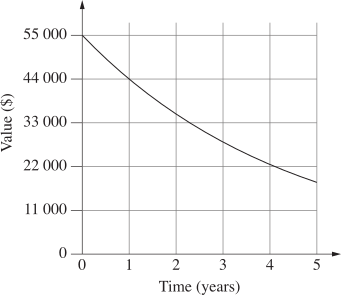
A population of Tasmanian devils, `D`, is to be modelled using the function  `D = 650 (0.8)^t`, where `t` is the time in years.

  1. What is the initial population?   (1 mark)

    --- 2 WORK AREA LINES (style=lined) ---

  2. Find the population after 2 years.   (1 mark)

    --- 2 WORK AREA LINES (style=lined) ---

  3. On the axes below, draw the graph of the population against time, in the period  `t = 0`  to  `t = 6`.   (2 marks)
      

    --- 0 WORK AREA LINES (style=lined) ---

Show Answers Only

a.   `650`

b.   `416`

c.   `text{See Worked Solutions}`

Show Worked Solution

a.   `text{Initial population occurs when}\ \  t = 0:`

`D=650(0.8)^0=650 xx 1= 650`
 

b.    `text{Find} \ D \ text{when} \ \ t = 5: `

`D= 650 (0.8)^2= 416`

♦ Mean mark (c) 48%.

 
c. 
 `\text{At}\ t=6:`

`D=650(0.8)^6=170.39…`
 

Filed Under: Non-Linear: Exponential/Quadratics (Std 2-X) Tagged With: Band 3, Band 4, Band 5, num-title-ct-coreb, num-title-qs-hsc, smc-4444-40-Population, smc-830-30-Exponential

CHEMISTRY, M1 EQ-Bank 15

Explain the characteristics of the two oxides given below.   (4 marks)

\begin{array} {|c|c|c|}
\hline \text{Compound} & \text{Melting Point } (^{\circ}C) & \text{Conductivity when molten} \\
\hline \ce{XO} & 2850 &  \text{good} \\
\hline \ce{YO} & -183 & \text{poor} \\
\hline \end{array}

--- 8 WORK AREA LINES (style=lined) ---

Show Answers Only

\(\ce{XO}\) is an ionic oxide.

  • Its melting point is high because there are strong electrostatic forces of attraction between the oppositely charged ions throughout the giant ionic lattice that must be overcome to melt the solid.
  • When molten, the ions are free to move and can transfer charge, so conductivity is good.

\(\ce{YO}\) is a covalent molecular oxide.

  • The molecules are held together only by weak dispersion forces. These are easily overcome, giving it a very low melting point.
  • There are no mobile charged particles present in the liquid, so it does not conduct electricity.
Show Worked Solution

\(\ce{XO}\) is an ionic oxide.

  • Its melting point is high because there are strong electrostatic forces of attraction between the oppositely charged ions throughout the giant ionic lattice that must be overcome to melt the solid.
  • When molten, the ions are free to move and can transfer charge, so conductivity is good.

\(\ce{YO}\) is a covalent molecular oxide.

  • The molecules are held together only by weak dispersion forces. These are easily overcome, giving it a very low melting point.
  • There are no mobile charged particles present in the liquid, so it does not conduct electricity.

Filed Under: Bonding Tagged With: Band 5, smc-4258-40-Inter/Intramolecular Bonding

CHEMISTRY, M1 EQ-Bank 13

Carbon is an important element in industry and biology.

Carbon exists naturally as several allotropes and also has many isotopes. Distinguish between the terms allotrope and isotope, using carbon as an example.   (3 marks)

--- 6 WORK AREA LINES (style=lined) ---

Show Answers Only
  • Allotropes are different structural forms of the same element in the same physical state.
  • For example, diamond and graphite are both made entirely of carbon atoms but differ in atomic arrangement and bonding: diamond has a 3D tetrahedral network of covalent bonds, while graphite has layers of hexagonally arranged atoms held together by weak dispersion forces.
  • Isotopes are atoms of the same element with the same number of protons but different numbers of neutrons.
  • For example, carbon-12 and carbon-14 are isotopes of carbon; both have 6 protons, but carbon-12 has 6 neutrons while carbon-14 has 8 neutrons, giving it radioactivity.
Show Worked Solution
  • Allotropes are different structural forms of the same element in the same physical state.
  • For example, diamond and graphite are both made entirely of carbon atoms but differ in atomic arrangement and bonding: diamond has a 3D tetrahedral network of covalent bonds, while graphite has layers of hexagonally arranged atoms held together by weak dispersion forces.
  • Isotopes are atoms of the same element with the same number of protons but different numbers of neutrons.
  • For example, carbon-12 and carbon-14 are isotopes of carbon; both have 6 protons, but carbon-12 has 6 neutrons while carbon-14 has 8 neutrons, giving it radioactivity.

Filed Under: Bonding Tagged With: Band 5, smc-4258-60-Allotropes

CHEMISTRY, M1 EQ-Bank 12

  1. Draw a Lewis electron dot diagram for each of the following compounds:
  2. i. \(\ce{CO2}\)   (1 mark)
  3. ii. \(\ce{MgCl2}\)   (1 mark)
  1. Using the two substances in (a) as examples, compare the bonding in ionic compounds with the bonding in covalent molecular compounds.   (3 marks)

--- 5 WORK AREA LINES (style=lined) ---

  1. The boiling point of \(\ce{CO2}\) is –78°C, while the boiling point of \(\ce{MgCl2}\) is 1412\(^{\circ}\)C. Account for the difference in boiling points between these two substances.   (3 marks)

--- 5 WORK AREA LINES (style=lined) ---

Show Answers Only

a.i.  

 a.ii.  


b.   Bonding in ionic compounds vs covalent molecular compounds:

  • Ionic compounds are solids at STP and consist of positively and negatively charged ions held together in a lattice by strong electrostatic forces. 
  • In magnesium chloride, doubly charged magnesium cations are surrounded by chloride anions in a ratio of 1:2.
  • Covalent molecular compounds are groups of atoms in which one or more pairs of electrons are shared between atoms.
  • In carbon dioxide, carbon forms double covalent bonds with two oxygen atoms, sharing its valence electrons. Carbon dioxide molecules are bound together only by relatively weak dispersion forces and therefore exist as a gas at STP.

c.   Differences in boiling points:

  • \(\ce{CO2}\) molecules are held together by weak dispersion forces between neutral molecules. These forces require little energy to overcome, resulting in a very low boiling point –78°C.
  • \(\ce{MgCl2}\) has a giant ionic lattice. Strong electrostatic forces between \(\ce{Mg^2+}\) and \(\ce{Cl^-}\) ions extend throughout the solid. Large amounts of energy are required to break these ionic bonds, giving it a very high boiling point at 1412°C.
  • Therefore, the huge difference in boiling points is due to weak intermolecular forces in covalent molecular substances compared with strong ionic bonds in ionic compounds.
Show Worked Solution

a.i.  


 a.ii.  


b.   Bonding in ionic compounds vs covalent molecular compounds:

  • Ionic compounds are solids at STP and consist of positively and negatively charged ions held together in a lattice by strong electrostatic forces. 
  • In magnesium chloride, doubly charged magnesium cations are surrounded by chloride anions in a ratio of 1:2.
  • Covalent molecular compounds are groups of atoms in which one or more pairs of electrons are shared between atoms.
  • In carbon dioxide, carbon forms double covalent bonds with two oxygen atoms, sharing its valence electrons. Carbon dioxide molecules are bound together only by relatively weak dispersion forces and therefore exist as a gas at STP.

c.   Differences in boiling points:

  • \(\ce{CO2}\) molecules are held together by weak dispersion forces between neutral molecules. These forces require little energy to overcome, resulting in a very low boiling point –78°C.
  • \(\ce{MgCl2}\) has a giant ionic lattice. Strong electrostatic forces between \(\ce{Mg^2+}\) and \(\ce{Cl^-}\) ions extend throughout the solid. Large amounts of energy are required to break these ionic bonds, giving it a very high boiling point at 1412°C.
  • Therefore, the huge difference in boiling points is due to weak intermolecular forces in covalent molecular substances compared with strong ionic bonds in ionic compounds.

Filed Under: Bonding Tagged With: Band 4, Band 5, Band 6, smc-4258-30-Lewis Dot, smc-4258-40-Inter/Intramolecular Bonding

v1 Algebra, STD2 A4 2021 HSC 10 MC

Which of the following best represents the graph of  \(y = 5 (0.4)^{x}\) ?
 

Show Answers Only

\(D\)

Show Worked Solution

\(\text{By elimination:}\)

♦ Mean mark 41%.

\(\text{When}\  x = 0, \ y = 5 \times (0.4)^0 = 5\)

\(\rightarrow\ \text{Eliminate B and C} \)

\(\text{As}\ \ x \rightarrow \infty, \ y \rightarrow 0 \)

\(\rightarrow\ \text{Eliminate A} \)

\(\Rightarrow D\)

Filed Under: Non-Linear: Exponential/Quadratics (Std 2-X) Tagged With: 2adv-std2-common, Band 5, common-content, num-title-ct-coreb, num-title-qs-hsc, smc-4444-10-Identify graphs, smc-830-10-Identify Graphs, smc-830-30-Exponential

CHEMISTRY, M1 EQ-Bank 1 MC

The Lewis electron dot diagram of ammonia \(\ce{NH3}\) is shown:
 

Which of the following is correct for this molecule?

\begin{align*}
\begin{array}{l}
\rule{0pt}{2.5ex} \ \rule[-1ex]{0pt}{0pt}& \\
\rule{0pt}{2.5ex}\textbf{A.}\rule[-1ex]{0pt}{0pt}\\
\rule{0pt}{2.5ex}\textbf{B.}\rule[-1ex]{0pt}{0pt}\\
\rule{0pt}{2.5ex}\textbf{C.}\rule[-1ex]{0pt}{0pt}\\
\rule{0pt}{2.5ex}\textbf{D.}\rule[-1ex]{0pt}{0pt}\\
\end{array}
\begin{array}{|c|c|}
\hline
\rule{0pt}{2.5ex}\text{Molecule polarity}\rule[-1ex]{0pt}{0pt}& \text{Molecular shape} \\
\hline
\rule{0pt}{2.5ex}\text{Non-polar}\rule[-1ex]{0pt}{0pt}&\text{Trigonal Planar}\\
\hline
\rule{0pt}{2.5ex}\text{Non-polar}\rule[-1ex]{0pt}{0pt}& \text{Tetrahedral}\\
\hline
\rule{0pt}{2.5ex}\text{Polar}\rule[-1ex]{0pt}{0pt}& \text{Tetrahedral} \\
\hline
\rule{0pt}{2.5ex}\text{Polar}\rule[-1ex]{0pt}{0pt}& \text{Pyramidal} \\
\hline
\end{array}
\end{align*}

Show Answers Only

\(D\)

Show Worked Solution
  • \(\ce{NH3}\) has 3 bonding pairs and 1 lone pair of electrons around nitrogen.
  • According to VSEPR theory, this gives a pyramidal molecular shape (not planar or tetrahedral as a whole).
  • The bonds between nitrogen and hydrogen are polar covalent bonds. The arrangement causes the whole molecule to be polar.

\(\Rightarrow D\)

Filed Under: Bonding Tagged With: Band 5, smc-4258-30-Lewis Dot, smc-4258-50-Chemical structure

v1 Measurement, STD2 M7 2022 HSC 4 MC

A wildlife researcher wanted to estimate the number of turtles in a swamp.

She initially caught and tagged 25 turtles before releasing them.

Two weeks later, she caught 50 turtles and found that 10 of them had tags.

What is the best estimate for the total number of turtles in the swamp?

  1. 100
  2. 110
  3. 120
  4. 125
Show Answers Only

`D`

Show Worked Solution

`text{Let}\ \ T=\ text{population of turtles in swamp}`

`text{Initial tag ratio}\ = 25/T`

`text{Recapture ratio}\ = 10/50`

`25/T` `=10/50`
`10T` `=25 xx 50`
`T` `=1250/10`
  `=125`

`=> D`


♦♦ Mean mark 35%.

Filed Under: Ratios (Std2-X), Uncategorized Tagged With: Band 5, smc-1187-30-Capture/Recapture

HMS, TIP EQ-Bank 419

Compare how program customisation approaches differ between recreational participants and elite athletes.   (6 marks)

--- 20 WORK AREA LINES (style=lined) ---

Show Answers Only

Benefits

  • [P] Assessment-driven customisation significantly improves program effectiveness by targeting individual needs precisely and efficiently.
  • [E] Personalised programs address specific strengths and weaknesses identified through systematic testing rather than generic approaches that may miss individual requirements.
  • [Ev] A recreational client with poor cardiovascular fitness but strong upper body receives aerobic-focused training whilst maintaining strength levels through targeted exercises.
  • [L] This demonstrates how customisation maximises training efficiency and individual progress rates through focused interventions.
      
  • [P] Customised programs enhance participant motivation and adherence through relevant and achievable goal setting based on personal capabilities.
  • [E] Individual assessment data enables realistic target establishment that maintains engagement throughout extended training periods and prevents unrealistic expectations.
  • [Ev] Basketball players setting 5cm vertical jump improvements based on testing results show greater commitment than arbitrary goals without data foundation.
  • [L] Therefore, data-driven customisation creates meaningful progress markers that sustain long-term participation and program compliance.

Challenges

  • [P] Assessment-based customisation requires significant professional expertise and time investment from qualified fitness practitioners and specialists.
  • [E] Comprehensive testing, data analysis, and individualised program design demand extensive knowledge and planning resources that increase program costs.
  • [Ev] Detailed performance analysis for elite athletes involves multiple testing sessions and complex program modifications requiring specialised equipment and facilities.
  • [L] This highlights how customisation complexity can limit accessibility for some fitness professionals and clients with restricted budgets.
Show Worked Solution

Benefits

  • [P] Assessment-driven customisation significantly improves program effectiveness by targeting individual needs precisely and efficiently.
  • [E] Personalised programs address specific strengths and weaknesses identified through systematic testing rather than generic approaches that may miss individual requirements.
  • [Ev] A recreational client with poor cardiovascular fitness but strong upper body receives aerobic-focused training whilst maintaining strength levels through targeted exercises.
  • [L] This demonstrates how customisation maximises training efficiency and individual progress rates through focused interventions.
      
  • [P] Customised programs enhance participant motivation and adherence through relevant and achievable goal setting based on personal capabilities.
  • [E] Individual assessment data enables realistic target establishment that maintains engagement throughout extended training periods and prevents unrealistic expectations.
  • [Ev] Basketball players setting 5cm vertical jump improvements based on testing results show greater commitment than arbitrary goals without data foundation.
  • [L] Therefore, data-driven customisation creates meaningful progress markers that sustain long-term participation and program compliance.

Challenges

  • [P] Assessment-based customisation requires significant professional expertise and time investment from qualified fitness practitioners and specialists.
  • [E] Comprehensive testing, data analysis, and individualised program design demand extensive knowledge and planning resources that increase program costs.
  • [Ev] Detailed performance analysis for elite athletes involves multiple testing sessions and complex program modifications requiring specialised equipment and facilities.
  • [L] This highlights how customisation complexity can limit accessibility for some fitness professionals and clients with restricted budgets.

Filed Under: Assessment and developing training programs Tagged With: Band 4, Band 5, Band 6, smc-5458-20-Program customisation

HMS, TIP EQ-Bank 418

Compare how program customisation approaches differ between recreational participants and elite athletes.   (6 marks)

--- 18 WORK AREA LINES (style=lined) ---

Show Answers Only

Similarities

  • Both recreational participants and elite athletes require individual assessment data to identify personal strengths and weaknesses. Assessment information guides customised program development that addresses specific needs rather than generic training approaches.
  • Goal setting remains essential for both populations to provide direction and motivation throughout training programs. Customisation involves aligning program design with individual objectives whether focused on health improvement or competitive performance enhancement.
  • Progress monitoring through regular reassessment helps maintain program effectiveness for both recreational and elite populations. Customisation requires ongoing adjustments based on individual response patterns and changing needs over time.

Differences

  • Recreational participants receive broader program customisation focusing on general health, safety, and enjoyment factors. Elite athletes require highly specific customisation targeting precise performance indicators and competitive demands within their particular sports.
  • Assessment complexity varies significantly between populations with recreational clients receiving basic fitness evaluations. Elite athletes undergo comprehensive testing including advanced performance analysis and sport-specific capability measurements for detailed program customisation.
  • Customisation frequency differs as recreational participants may receive program updates quarterly or seasonally. Elite athletes require continuous customisation with frequent modifications based on performance data, competition schedules, and training phase requirements.
Show Worked Solution

Similarities

  • Both recreational participants and elite athletes require individual assessment data to identify personal strengths and weaknesses. Assessment information guides customised program development that addresses specific needs rather than generic training approaches.
  • Goal setting remains essential for both populations to provide direction and motivation throughout training programs. Customisation involves aligning program design with individual objectives whether focused on health improvement or competitive performance enhancement.
  • Progress monitoring through regular reassessment helps maintain program effectiveness for both recreational and elite populations. Customisation requires ongoing adjustments based on individual response patterns and changing needs over time.

Differences

  • Recreational participants receive broader program customisation focusing on general health, safety, and enjoyment factors. Elite athletes require highly specific customisation targeting precise performance indicators and competitive demands within their particular sports.
  • Assessment complexity varies significantly between populations with recreational clients receiving basic fitness evaluations. Elite athletes undergo comprehensive testing including advanced performance analysis and sport-specific capability measurements for detailed program customisation.
  • Customisation frequency differs as recreational participants may receive program updates quarterly or seasonally. Elite athletes require continuous customisation with frequent modifications based on performance data, competition schedules, and training phase requirements.

Filed Under: Assessment and developing training programs Tagged With: Band 4, Band 5, smc-5458-20-Program customisation

HMS, TIP EQ-Bank 416 MC

Two recreational clients complete identical fitness assessments but receive different program recommendations. Client A, who shows excellent motivation but limited time availability, receives a high-intensity interval program. Client B, with more flexible scheduling but lower motivation levels, gets a moderate-intensity continuous training program. This customisation approach primarily demonstrates which principle?

  1. Assessment results should be the sole determining factor in program design regardless of individual circumstances
  2. Program intensity must match fitness test results to ensure appropriate physiological training stimulus
  3. Effective customisation integrates assessment data with personal factors to optimise program adherence and success
  4. Time availability is the most important consideration when designing programs for recreational participants
Show Answers Only

\(C\)

Show Worked Solution
  • C is correct: Effective customisation combines assessment data with personal factors like motivation and time availability to optimise program success.

Other Options:

  • A is incorrect: The scenario shows personal factors being considered alongside assessment results rather than assessment data being sole determinant.
  • B is incorrect: Program design considers personal factors beyond just physiological capacity indicated by fitness test results.
  • D is incorrect: Time availability is one factor but the principle demonstrates comprehensive customisation rather than single-factor prioritisation.

Filed Under: Assessment and developing training programs Tagged With: Band 5, smc-5458-20-Program customisation

HMS, TIP EQ-Bank 413

Analyse the relationship between sport-specific assessment and training program effectiveness for elite athletes.   (8 marks)

--- 24 WORK AREA LINES (style=lined) ---

Show Answers Only

Overview Statement

  • Sport-specific assessment and training program effectiveness demonstrate strong interconnected relationships in elite athlete development.
  • Assessment precision directly influences program targeting and subsequent performance improvements.

Component Relationship 1

  • Sport-specific assessments identify key performance indicators that directly relate to competitive success requirements in individual sports.
  • Testing protocols measure capabilities most relevant to performance outcomes rather than general fitness parameters.
  • This relationship becomes critical when kickboxers undergo leg strength testing to reveal bilateral imbalances affecting competition performance.
  • Assessment specificity connects to program effectiveness as targeted training addresses exact performance limitations.
  • Therefore, sport-specific testing determines the precision of subsequent training interventions and performance improvement potential.

Component Relationship 2

  • Training program effectiveness depends on assessment accuracy in identifying genuine performance-limiting factors versus minor weaknesses.
  • Precise measurement influences program focus allocation and resource distribution across different training components.
  • This relationship demonstrates how sprinters with identified acceleration deficits receive explosive training emphasis rather than generic speed development.
  • Program success interacts with assessment quality as accurate testing leads to targeted interventions.
  • Consequently, sport-specific assessment precision enables maximum training effectiveness through focused performance improvement strategies.

Implications and Synthesis

  • The relationship between sport-specific assessment and program effectiveness reveals that testing precision directly determines training success rates.
  • Assessment accuracy establishes program targeting quality while training specificity maximises performance improvement efficiency.
  • This pattern shows that elite athlete development requires integrated assessment and training approaches where testing precision guides intervention effectiveness.
Show Worked Solution

Overview Statement

  • Sport-specific assessment and training program effectiveness demonstrate strong interconnected relationships in elite athlete development.
  • Assessment precision directly influences program targeting and subsequent performance improvements.

Component Relationship 1

  • Sport-specific assessments identify key performance indicators that directly relate to competitive success requirements in individual sports.
  • Testing protocols measure capabilities most relevant to performance outcomes rather than general fitness parameters.
  • This relationship becomes critical when kickboxers undergo leg strength testing to reveal bilateral imbalances affecting competition performance.
  • Assessment specificity connects to program effectiveness as targeted training addresses exact performance limitations.
  • Therefore, sport-specific testing determines the precision of subsequent training interventions and performance improvement potential.

Component Relationship 2

  • Training program effectiveness depends on assessment accuracy in identifying genuine performance-limiting factors versus minor weaknesses.
  • Precise measurement influences program focus allocation and resource distribution across different training components.
  • This relationship demonstrates how sprinters with identified acceleration deficits receive explosive training emphasis rather than generic speed development.
  • Program success interacts with assessment quality as accurate testing leads to targeted interventions.
  • Consequently, sport-specific assessment precision enables maximum training effectiveness through focused performance improvement strategies.

Implications and Synthesis

  • The relationship between sport-specific assessment and program effectiveness reveals that testing precision directly determines training success rates.
  • Assessment accuracy establishes program targeting quality while training specificity maximises performance improvement efficiency.
  • This pattern shows that elite athlete development requires integrated assessment and training approaches where testing precision guides intervention effectiveness.

Filed Under: Assessment and developing training programs Tagged With: Band 5, Band 6, smc-5458-15-Elite athlete optimisation

HMS, TIP EQ-Bank 412

Why is continuous monitoring essential for elite athlete program development?   (3 marks)

--- 9 WORK AREA LINES (style=lined) ---

Show Answers Only
  • Continuous monitoring provides real-time feedback on training effectiveness and athlete responses. This enables coaches to identify successful protocols. Therefore, effective strategies are maintained while ineffective approaches are modified.
  • Regular assessment detects performance plateaus requiring program adjustments. This prevents wasted training time with ineffective methods. Consequently, athletes maintain progress toward performance goals.
  • Monitoring data reveals optimal timing for training increases and recovery periods. This ensures appropriate progression without overtraining. As a result, athletes achieve maximum gains safely.
Show Worked Solution
  • Continuous monitoring provides real-time feedback on training effectiveness and athlete responses. This enables coaches to identify successful protocols. Therefore, effective strategies are maintained while ineffective approaches are modified.
  • Regular assessment detects performance plateaus requiring program adjustments. This prevents wasted training time with ineffective methods. Consequently, athletes maintain progress toward performance goals.
  • Monitoring data reveals optimal timing for training increases and recovery periods. This ensures appropriate progression without overtraining. As a result, athletes achieve maximum gains safely.

Filed Under: Assessment and developing training programs Tagged With: Band 4, Band 5, smc-5458-15-Elite athlete optimisation

HMS, TIP EQ-Bank 409 MC

An elite kickboxer undergoes rigorous testing that reveals a significant strength imbalance, with the dominant leg being much stronger than the non-dominant leg. Which principle of assessment-based program development does addressing this imbalance primarily demonstrate?

  1. Maintaining competitive advantages by further developing already superior physical attributes
  2. Creating sport-specific training programs that replicate exact competition movement patterns
  3. Using detailed performance analysis to identify and correct weaknesses that limit peak performance
  4. Implementing periodisation strategies that align training phases with competition scheduling requirements
Show Answers Only

\(C\)

Show Worked Solution
  • C is correct: The approach demonstrates using precise assessment data to identify performance limitations and develop targeted corrective training interventions.

Other Options:

  • A is incorrect: The focus is correcting weaknesses rather than further developing existing strengths for competitive advantage.
  • B is incorrect: While sport-specific, the primary principle is weakness identification and correction rather than movement pattern replication.
  • D is incorrect: This relates to training timing and periodisation rather than using assessment data for targeted weakness correction.

Filed Under: Assessment and developing training programs Tagged With: Band 5, smc-5458-15-Elite athlete optimisation

HMS, TIP EQ-Bank 407

How does regular progress monitoring through reassessment enhance program effectiveness for recreational participants?   (5 marks)

--- 15 WORK AREA LINES (style=lined) ---

Show Answers Only
  • Regular reassessment provides objective data about fitness improvements and program effectiveness over extended time periods. This enables trainers to identify successful training elements and strategies. Therefore, proven approaches can be maintained whilst ineffective methods are systematically modified.
  • Progress tracking demonstrates tangible results that motivate recreational participants to continue their fitness journey enthusiastically. Visible improvements create positive reinforcement for sustained participation and engagement. Consequently, participants develop stronger commitment to long-term fitness goals.
  • Monitoring data reveals when training adaptations require program adjustments to prevent plateaus and maintain steady progression. Assessment results indicate optimal timing for intensity increases or exercise modifications. This leads to continuous improvement rather than stagnated performance outcomes.
  • Reassessment identifies potential overtraining or excessive fatigue requiring immediate program modifications for participant safety. Early detection prevents injury development and burnout issues effectively. As a result, participants maintain consistent training without setbacks or extended recovery periods.
Show Worked Solution
  • Regular reassessment provides objective data about fitness improvements and program effectiveness over extended time periods. This enables trainers to identify successful training elements and strategies. Therefore, proven approaches can be maintained whilst ineffective methods are systematically modified.
  • Progress tracking demonstrates tangible results that motivate recreational participants to continue their fitness journey enthusiastically. Visible improvements create positive reinforcement for sustained participation and engagement. Consequently, participants develop stronger commitment to long-term fitness goals.
  • Monitoring data reveals when training adaptations require program adjustments to prevent plateaus and maintain steady progression. Assessment results indicate optimal timing for intensity increases or exercise modifications. This leads to continuous improvement rather than stagnated performance outcomes.
  • Reassessment identifies potential overtraining or excessive fatigue requiring immediate program modifications for participant safety. Early detection prevents injury development and burnout issues effectively. As a result, participants maintain consistent training without setbacks or extended recovery periods.

Filed Under: Assessment and developing training programs Tagged With: Band 4, Band 5, Band 6, smc-5458-10-Recreational program dev

HMS, TIP EQ-Bank 406

Compare how exercise assessments inform program development for recreational participants with different fitness backgrounds and goals.   (6 marks)

--- 18 WORK AREA LINES (style=lined) ---

Show Answers Only

Similarities

  • Both sedentary and active recreational participants require comprehensive baseline fitness assessment to establish appropriate starting points for safe training. Assessment data determines safe program intensity levels and identifies potential risk factors requiring immediate attention and program modifications.
  • Goal identification remains essential regardless of current fitness level or specific long-term objectives. Clear goal setting provides direction for program design and enables accurate progress measurement over extended time periods.
  • Progress monitoring through regular reassessment helps maintain motivation and engagement for all recreational participants. Tracking improvements demonstrates program effectiveness and guides necessary adjustments to training protocols and methods.

Differences

  • Sedentary individuals require more comprehensive health screening and conservative program progression to ensure safety and prevent injury. Active participants may undergo more advanced performance testing to identify specific improvement areas and training targets.
  • Program intensity and complexity vary significantly based on current fitness levels and previous exercise experience. Beginners need gradual progression whilst experienced participants can handle more challenging training loads and advanced techniques.
  • Assessment frequency and methods differ according to individual risk factors and personal fitness goals. Higher-risk participants require more frequent monitoring whilst established exercisers may need less intensive supervision and guidance.
Show Worked Solution

Similarities

  • Both sedentary and active recreational participants require comprehensive baseline fitness assessment to establish appropriate starting points for safe training. Assessment data determines safe program intensity levels and identifies potential risk factors requiring immediate attention and program modifications.
  • Goal identification remains essential regardless of current fitness level or specific long-term objectives. Clear goal setting provides direction for program design and enables accurate progress measurement over extended time periods.
  • Progress monitoring through regular reassessment helps maintain motivation and engagement for all recreational participants. Tracking improvements demonstrates program effectiveness and guides necessary adjustments to training protocols and methods.

Differences

  • Sedentary individuals require more comprehensive health screening and conservative program progression to ensure safety and prevent injury. Active participants may undergo more advanced performance testing to identify specific improvement areas and training targets.
  • Program intensity and complexity vary significantly based on current fitness levels and previous exercise experience. Beginners need gradual progression whilst experienced participants can handle more challenging training loads and advanced techniques.
  • Assessment frequency and methods differ according to individual risk factors and personal fitness goals. Higher-risk participants require more frequent monitoring whilst established exercisers may need less intensive supervision and guidance

Filed Under: Assessment and developing training programs Tagged With: Band 4, Band 5, smc-5458-10-Recreational program dev

HMS, TIP EQ-Bank 404 MC

A recreational participant focused on weight loss uses regular DEXA scans to track changes in body composition throughout their program. Despite minimal weight changes on scales, the scans show significant increases in lean muscle mass and decreases in fat tissue. This monitoring approach demonstrates which key principle of assessment-based program development?

  1. Advanced technology ensures more accurate progress measurement than traditional methods for all fitness goals
  2. Regular reassessment provides detailed progress data that maintains motivation despite apparent lack of scale-based improvements
  3. Expensive testing methods are necessary to demonstrate program effectiveness to recreational participants seeking results
  4. Body composition changes should be the primary focus rather than functional fitness improvements for weight loss clients
Show Answers Only

\(B\)

Show Worked Solution
  • B is correct: Regular detailed assessment maintains client motivation by revealing positive changes not visible through simple scale measurements.

Other Options:

  • A is incorrect: While DEXA is accurate, the key principle is appropriate progress measurement rather than technology superiority alone.
  • C is incorrect: Effectiveness demonstration doesn’t require expensive methods – appropriateness and motivation are the key factors here.
  • D is incorrect: The scenario demonstrates progress tracking benefits rather than suggesting body composition should be prioritised over functional improvements.

Filed Under: Assessment and developing training programs Tagged With: Band 5, smc-5458-10-Recreational program dev

HMS, TIP EQ-Bank 098

Discuss the use assistive technology to enhance participation and performance for athletes with disabilities.   (6 marks)

--- 18 WORK AREA LINES (style=lined) ---

Show Answers Only

Positive Impacts

  • [P] A key advantage is that assistive technology enhances performance for athletes with disabilities.
  • [E] This happens because equipment such as lightweight wheelchairs and advanced tyres improve speed and manoeuvrability.
  • [Ev] For example, racing wheelchairs designed with carbon fibre frames allow Paralympic athletes to compete at elite levels.
  • [L] This shows how assistive technology supports athletes to reach higher levels of performance.
     
  • [P] Another benefit is increased participation and access.
  • [E] Audible balls for athletes with vision impairment create fair opportunities to play sport.
  • [Ev] Evidence of this is seen in blind cricket, where specially designed balls allow athletes to track ball movement using sound.
  • [L] Therefore, technology reduces barriers and makes sport more inclusive.

Challenges and Limitations

  • [P] On the other hand, one significant limitation is cost and availability.
  • [E] This occurs because advanced wheelchairs or prosthetics are expensive and not accessible to all.
  • [Ev] For instance, high-performance prosthetic running blades can cost thousands of dollars, limiting access for some athletes.
  • [L] Consequently, while technology enhances participation, equity remains an issue.
     
  • [P] Another concern is over-reliance on assistive technology.
  • [E] This occurs because athletes may depend heavily on specialised equipment rather than developing broader skills or fitness.
  • [Ev] For example, wheelchair athletes using highly engineered chairs may struggle if equipment malfunctions, reducing performance significantly.
  • [L] This demonstrates that technology dependence can make athletes vulnerable and highlights the importance of balancing equipment use with training.
Show Worked Solution

Positive Impacts

  • [P] A key advantage is that assistive technology enhances performance for athletes with disabilities.
  • [E] This happens because equipment such as lightweight wheelchairs and advanced tyres improve speed and manoeuvrability.
  • [Ev] For example, racing wheelchairs designed with carbon fibre frames allow Paralympic athletes to compete at elite levels.
  • [L] This shows how assistive technology supports athletes to reach higher levels of performance.
     
  • [P] Another benefit is increased participation and access.
  • [E] Audible balls for athletes with vision impairment create fair opportunities to play sport.
  • [Ev] Evidence of this is seen in blind cricket, where specially designed balls allow athletes to track ball movement using sound.
  • [L] Therefore, technology reduces barriers and makes sport more inclusive.

Challenges and Limitations

  • [P] On the other hand, one significant limitation is cost and availability.
  • [E] This occurs because advanced wheelchairs or prosthetics are expensive and not accessible to all.
  • [Ev] For instance, high-performance prosthetic running blades can cost thousands of dollars, limiting access for some athletes.
  • [L] Consequently, while technology enhances participation, equity remains an issue.
     
  • [P] Another concern is over-reliance on assistive technology.
  • [E] This occurs because athletes may depend heavily on specialised equipment rather than developing broader skills or fitness.
  • [Ev] For example, wheelchair athletes using highly engineered chairs may struggle if equipment malfunctions, reducing performance significantly.
  • [L] This demonstrates that technology dependence can make athletes vulnerable and highlights the importance of balancing equipment use with training.

Filed Under: Technology and performance Tagged With: Band 4, Band 5, smc-5471-10-Equipment advances

HMS, TIP EQ-Bank 097

To what extent has GPS tracking technology revolutionised tactical analysis and performance improvement in team sports?   (6 marks)

--- 18 WORK AREA LINES (style=lined) ---

Show Answers Only

Judgment Statement

  • GPS tracking technology has significantly revolutionised tactical analysis and performance improvement in team sports.
  • This is due to its role in workload monitoring, tactical decision-making and injury prevention.

Workload and Tactical Insights

  • GPS provides data on distance covered, speed, acceleration and positional heat maps.
  • Evidence supporting this includes the growing use of GPS technology by rugby coaches to monitor player fatigue and adjust substitutions accordingly.
  • Soccer teams use GPS to map player positioning, ensuring tactical discipline and improving defensive structures.
  • This shows GPS has transformed coaching decisions by replacing guesswork with objective data.
  • As a result, both tactical outcomes and player performance are improved.

Limitations in Real-Time Application

  • However, GPS is less useful in real-time decision-making during matches.
  • Data often needs post-game analysis which limits immediate tactical adjustments.
  • Cost can also restrict access for smaller teams.
  • Despite this, GPS remains a key driver of performance improvement because post-game insights refine future tactics and reduce injury risk.

Reaffirmation

  • In summary, GPS has largely revolutionised tactical analysis and performance improvement.
  • Its data-driven insights create stronger tactical planning and safer workload management.
  • While there are practical limits, its impact on modern team sports, particularly at the well resourced elite level, is profound.
Show Worked Solution

Judgment Statement

  • GPS tracking technology has significantly revolutionised tactical analysis and performance improvement in team sports.
  • This is due to its role in workload monitoring, tactical decision-making and injury prevention.

Workload and Tactical Insights

  • GPS provides data on distance covered, speed, acceleration and positional heat maps.
  • Evidence supporting this includes the growing use of GPS technology by rugby coaches to monitor player fatigue and adjust substitutions accordingly.
  • Soccer teams use GPS to map player positioning, ensuring tactical discipline and improving defensive structures.
  • This shows GPS has transformed coaching decisions by replacing guesswork with objective data.
  • As a result, both tactical outcomes and player performance are improved.

Limitations in Real-Time Application

  • However, GPS is less useful in real-time decision-making during matches.
  • Data often needs post-game analysis which limits immediate tactical adjustments.
  • Cost can also restrict access for smaller teams.
  • Despite this, GPS remains a key driver of performance improvement because post-game insights refine future tactics and reduce injury risk.

Reaffirmation

  • In summary, GPS has largely revolutionised tactical analysis and performance improvement.
  • Its data-driven insights create stronger tactical planning and safer workload management.
  • While there are practical limits, its impact on modern team sports, particularly at the well resourced elite level, is profound.

Filed Under: Technology and performance Tagged With: Band 5, Band 6, smc-5471-20-Monitoring

HMS, TIP EQ-Bank 096

Explain how biomechanics analysis tools contribute to improving technique and reducing injury risk in sport.   (5 marks)

--- 15 WORK AREA LINES (style=lined) ---

Show Answers Only
  • Biomechanics analysis tools use cameras and sensors to record movement patterns. This works by capturing joint angles, force and timing in real time.
  • This is possible because precise data is collected frame by frame. As a result, small errors in movement that the eye might miss can be identified.
  • This creates opportunities to correct inefficient technique. For instance, when a golfer’s hip rotation is inconsistent, coaches can make targeted adjustments.
  • This shows a clear connection between data feedback and technical improvement. This in turn increases efficiency of movement.
  • Injury risk is also reduced. The reason for this is poor mechanics often place extra stress on joints or muscles.
  • Consequently, correcting movement through biomechanics tools makes overloading joints less common and prevents overuse injuries.
  • This demonstrates why biomechanics analysis is valuable: it helps athletes perform with better technique while staying safe
Show Worked Solution
  • Biomechanics analysis tools use cameras and sensors to record movement patterns. This works by capturing joint angles, force and timing in real time.
  • This is possible because precise data is collected frame by frame. As a result, small errors in movement that the eye might miss can be identified.
  • This creates opportunities to correct inefficient technique. For instance, when a golfer’s hip rotation is inconsistent, coaches can make targeted adjustments.
  • This shows a clear connection between data feedback and technical improvement. This in turn increases efficiency of movement.
  • Injury risk is also reduced. The reason for this is poor mechanics often place extra stress on joints or muscles.
  • Consequently, correcting movement through biomechanics tools makes overloading joints less common and prevents overuse injuries.
  • This demonstrates why biomechanics analysis is valuable: it helps athletes perform with better technique while staying safer.

Filed Under: Technology and performance Tagged With: Band 4, Band 5, smc-5471-05-Training innovations

HMS, TIP EQ-Bank 095

Explain how smart resistance training equipment with real-time feedback mechanisms can optimise strength development programs for different athletic populations.   (5 marks)

--- 15 WORK AREA LINES (style=lined) ---

Show Answers Only
  • Smart resistance training equipment adjusts load based on the athlete’s effort. This works by increasing resistance when more force is applied and decreasing it when less is applied.
  • This occurs because the machine senses the athlete’s exertion in real time. As a result, the muscles are challenged through the full range of motion.
  • This creates an optimal stimulus for strength development, rather than a fixed resistance that may underload or overload at different points.
  • A clear example is a bicep curl where resistance increases during the concentric phase. This demonstrates why athletes gain strength more efficiently.
  • For elite athletes, this mechanism helps to target small weaknesses in technique or strength. This in turn supports marginal gains needed at high levels.
  • For beginners or rehabilitation populations, this process ensures safer training. This is due to resistance adjusting instantly, lowering the risk of injury.
  • Therefore, smart resistance equipment individualises strength training and enhances outcomes across athletic populations.
Show Worked Solution
  • Smart resistance training equipment adjusts load based on the athlete’s effort. This works by increasing resistance when more force is applied and decreasing it when less is applied.
  • This occurs because the machine senses the athlete’s exertion in real time. As a result, the muscles are challenged through the full range of motion.
  • This creates an optimal stimulus for strength development, rather than a fixed resistance that may underload or overload at different points.
  • A clear example is a bicep curl where resistance increases during the concentric phase. This demonstrates why athletes gain strength more efficiently.
  • For elite athletes, this mechanism helps to target small weaknesses in technique or strength. This in turn supports marginal gains needed at high levels.
  • For beginners or rehabilitation populations, this process ensures safer training. This is due to resistance adjusting instantly, lowering the risk of injury.
  • Therefore, smart resistance equipment individualises strength training and enhances outcomes across athletic populations.

Filed Under: Technology and performance Tagged With: Band 4, Band 5, smc-5471-05-Training innovations, smc-5471-10-Equipment advances

HMS, TIP EQ-Bank 110 MC

Which combination of technologies would best help prevent overtraining in an endurance athlete?

  1. Smart clothing with biometric sensors and AI performance analysis
  2. Virtual reality training simulations and motion capture systems
  3. Heart rate monitors and GPS tracking devices
  4. Altitude masks and sensor monitoring power output
Show Answers Only

\(C\)

Show Worked Solution
  • C is correct: These technologies provide workload and physiological data such as distance, speed and heart rate. This helps coaches and athletes identify fatigue and manage training load.

Other options:

  • A is incorrect: Smart clothing and AI analysis optimise training and technique but are less directly used to monitor overtraining.
  • B is incorrect: VR and motion capture focus on skill development and biomechanics, not workload management.
  • D is incorrect: Altitude masks and power sensors inform performance adaptations but do not directly prevent overtraining.

Filed Under: Technology and performance Tagged With: Band 5, smc-5471-20-Monitoring

HMS, TIP EQ-Bank 109 MC

How do 3D-printed footwear designs most directly enhance performance?

  1. By providing lightweight, customised support for efficiency 
  2. By enabling variable density midsoles that optimise energy return
  3. By incorporating lattice structures that reduce manufacturing costs
  4. By regulating foot temperature in hot conditions
Show Answers Only

\(A\)

Show Worked Solution
  • A is correct: 3D-printed footwear is most effective when customised to an athlete’s biomechanics, offering lightweight support that enhances efficiency and reduces injury risk.

Other options:

  • B is incorrect: Variable density midsoles can aid energy return but this is a broader shoe design feature, not specific to 3D printing.
  • C is incorrect: Lower manufacturing costs are an economic benefit, not a direct performance improvement.
  • D is incorrect: Foot temperature regulation relates to smart textiles, not 3D-printed design.

Filed Under: Technology and performance Tagged With: Band 5, smc-5471-10-Equipment advances

Calculus, EXT1 C2 EQ-Bank 4

Using the substitution  \(x=\cos 2 \theta\),  show

\(\displaystyle \int \sqrt{\frac{1-x}{1+x}}\,dx=\sqrt{1-x^2}-\cos ^{-1} x+c\)    (4 marks)

--- 10 WORK AREA LINES (style=lined) ---

Show Answers Only

\(\text{See worked solutions}\)

Show Worked Solution

\(x=\cos 2 \theta\)

\(\dfrac{dx}{d \theta}=-2 \sin 2 \theta \ \Rightarrow\ \ dx=-2 \sin 2 \theta\, d \theta\)

\(\displaystyle \int \sqrt{\frac{1-x}{1+x}} \, dx\) \(=\displaystyle\int \sqrt{\frac{1-\cos 2 \theta}{1+\cos 2 \theta}} \times -2 \sin 2 \theta\, d \theta\)
  \(=\displaystyle\int \sqrt{\frac{1-\left(2 \cos ^2 \theta-1\right)}{1+\left(2 \cos ^2 \theta-1\right)}} \times -4 \sin \theta \, \cos \theta \, d \theta\)
  \(=\displaystyle \int \sqrt{\frac{2\left(1-\cos ^2 \theta\right)}{2 \cos ^2 \theta}} \times-4 \sin \theta \, \cos \theta \, d \theta\)
  \(=\displaystyle \int\sqrt{\dfrac{\sin ^2 \theta}{\cos ^2 \theta}} \times-4 \sin \theta \, \cos \theta \, d \theta\)
  \(=\displaystyle \int-4 \sin ^2 \theta \, d \theta\)
  \(=-4 \displaystyle \int \frac{1-\cos 2 \theta}{2} \,d \theta\)
  \(=-2 \displaystyle \int 1-\cos 2 \theta \, d \theta\)
  \(=-2 \displaystyle \int 1\, d \theta+2 \int \cos 2 \theta \, d \theta\)
  \(=-2 \theta+\sin 2 \theta+c\)
  \(=-\cos ^{-1} x+\sqrt{1-\cos ^2 2 \theta}+c \quad \text {(note:}\ \  x=\cos 2 \theta \Rightarrow 2 \theta=\cos ^{-1} x \text{)}\)
  \(=-\cos ^{-1} x+\sqrt{1-x^2}+c\)

Filed Under: Integration By Substitution (Ext1) Tagged With: Band 5, smc-1036-30-Trig

Functions, 2ADV F2 EQ-Bank 2

The curve  \(f(x)=x^2\)  is transformed to  \(g(x)=3 f[2(x+2)]\)

  1. Write the equation of \(g(x)\)   (1 mark)

    --- 3 WORK AREA LINES (style=lined) ---

  2. \(P(-3,9)\) lies on \(f(x)=x^2\)
  3. Determine the corresponding co-ordinates of \(P\) on the curve \(g(x)\).   (2 marks)

    --- 5 WORK AREA LINES (style=lined) ---

Show Answers Only

a.   \(g(x)=12(x+2)^2\)

b.   \(\left( -\dfrac{7}{2}, 27 \right) \)

Show Worked Solution
a.     \(g(x)\) \(=3[2(x+2)]^2\)
    \(=3 \times 4(x+2)^2\)
    \(=12(x+2)^2\)

 
b.
   \(P(-3,9)\ \text{lies on}\ \ f(x)=x^2 \)

\(\text{Find corresponding point on}\ f(x)\)

\(\text{Mapping}\ x_f\ \text{to}\ x_g: \)

\(2(x_g +2)=x_f\ \ \Rightarrow\ \ x_g=\dfrac{1}{2} x_f-2 \)

\(x_g=\dfrac {1}{2} \times -3 -2=-\dfrac{7}{2} \)
 

\(\text{Mapping}\ y_f\ \text{to}\ y_g: \)

\(y_g=3 \times y_f = 3 \times 9=27\)

\(\therefore\ \text{Corresponding point}\ = \left( -\dfrac{7}{2}, 27 \right) \)

Filed Under: Graph Transformations (Adv-2027), Transformations (Y12) Tagged With: Band 4, Band 5, smc-1008-10-Polynomials, smc-1008-70-Combinations, smc-1008-80-Corresponding points, smc-6408-10-Polynomials, smc-6408-60-Combinations, smc-6408-70-Corresponding Points

HMS, TIP EQ-Bank 401

Analyse how the relationship between health screening and performance testing contributes to effective exercise program development.    (8 marks)

--- 24 WORK AREA LINES (style=lined) ---

Show Answers Only

Overview Statement

  • Health screening and performance testing create complementary assessment components that provide comprehensive information for safe and effective program development.
  • Their relationship ensures both safety considerations and performance objectives are addressed.

Component Relationship 1

  • Health screening identifies potential medical risks that must be considered before performance testing protocols.
  • Risk factor identification influences test selection as medical conditions require modified assessment approaches.
  • This relationship becomes critical when cardiovascular concerns require submaximal rather than maximal testing.
  • Pre-exercise questionnaires connect to safe testing by revealing conditions like hypertension.
  • Therefore, health screening determines appropriate performance testing boundaries for individual clients.

Component Relationship 2

  • Performance testing results interact with health screening data to create comprehensive fitness profiles for program design.
  • Baseline measurements depend on health status interpretation to ensure appropriate training intensity prescription.
  • This relationship demonstrates how previous knee injury would receive modified strength assessments leading to rehabilitation exercises.
  • Health limitations influence performance expectations while fitness capabilities inform training loads.
  • Consequently, combined data enables personalised program development addressing health maintenance and performance improvement.

Implications and Synthesis

  • The relationship between health screening and performance testing reveals that effective program development requires both safety-focused and performance-oriented approaches.
  • Health screening establishes safe parameters while performance testing provides capability measurements.
  • This pattern shows that comprehensive assessment integrates medical safety with fitness evaluation for individually tailored exercise programs.
Show Worked Solution

Overview Statement

  • Health screening and performance testing create complementary assessment components that provide comprehensive information for safe and effective program development.
  • Their relationship ensures both safety considerations and performance objectives are addressed.

Component Relationship 1

  • Health screening identifies potential medical risks that must be considered before performance testing protocols.
  • Risk factor identification influences test selection as medical conditions require modified assessment approaches.
  • This relationship becomes critical when cardiovascular concerns require submaximal rather than maximal testing.
  • Pre-exercise questionnaires connect to safe testing by revealing conditions like hypertension.
  • Therefore, health screening determines appropriate performance testing boundaries for individual clients.

Component Relationship 2

  • Performance testing results interact with health screening data to create comprehensive fitness profiles for program design.
  • Baseline measurements depend on health status interpretation to ensure appropriate training intensity prescription.
  • This relationship demonstrates how previous knee injury would receive modified strength assessments leading to rehabilitation exercises.
  • Health limitations influence performance expectations while fitness capabilities inform training loads.
  • Consequently, combined data enables personalised program development addressing health maintenance and performance improvement.

Implications and Synthesis

  • The relationship between health screening and performance testing reveals that effective program development requires both safety-focused and performance-oriented approaches.
  • Health screening establishes safe parameters while performance testing provides capability measurements.
  • This pattern shows that comprehensive assessment integrates medical safety with fitness evaluation for individually tailored exercise programs.

Filed Under: Assessment and developing training programs Tagged With: Band 4, Band 5, Band 6, smc-5458-05-Assessment foundations

HMS, TIP EQ-Bank 398 MC

A fitness professional completes comprehensive exercise assessments including health screening, performance testing and goal identification before program design. Which factor most critically determines the success of this assessment-based approach?

  1. Ensuring all assessment protocols are completed within a single session to maintain data consistency
  2. Selecting standardised tests that can be directly compared across all client populations regardless of fitness level
  3. Tailoring assessment methods and interpretation to align with individual client characteristics and objectives
  4. Prioritising the most advanced testing equipment available to ensure maximum data accuracy and reliability
Show Answers Only

\(C\)

Show Worked Solution
  • C is correct: Tailoring assessments to individual characteristics and objectives ensures relevance and appropriate program development for each client.

Other Options:

  • A is incorrect: While consistency is valuable, assessment timing flexibility often produces better results than rigid single-session protocols.
  • B is incorrect: Standardised tests may not be appropriate for all fitness levels and could provide misleading data for program design.
  • D is incorrect: Advanced equipment doesn’t guarantee success if assessments aren’t matched to individual client needs and capabilities.

Filed Under: Assessment and developing training programs Tagged With: Band 5, smc-5458-05-Assessment foundations

HMS, TIP EQ-Bank 108 MC

An endurance runner wants to increase VO₂ max but cannot train at altitude. Which technology best replicates these conditions?

  1. Respiratory muscle trainers with adjustable resistance settings
  2. Hypoxic training masks with oxygen concentration controls
  3. High-output fans creating wind resistance during treadmill running
  4. Wearable devices that restrict breathing rate during intervals
Show Answers Only

\(B\)

Show Worked Solution
  • B is correct: Hypoxic training masks replicate low-oxygen environments, similar to altitude, promoting adaptations such as increased red blood cell production and improved VO₂ max.

Other options:

  • A is incorrect: Respiratory muscle trainers strengthen breathing muscles but do not reduce oxygen availability like altitude conditions.
  • C is incorrect: Fans create airflow and resistance but do not alter oxygen concentration.
  • D is incorrect: Wearables that restrict breathing rate affect rhythm, not oxygen levels in inspired air.

Filed Under: Technology and performance Tagged With: Band 5, smc-5471-05-Training innovations, smc-5471-20-Monitoring

HMS, TIP EQ-Bank 091

To what extent are psychological recovery strategies as important as physiological strategies in achieving optimal athlete recovery?  (8 marks) 

--- 22 WORK AREA LINES (style=lined) ---

Show Answers Only

Evaluation Statement

  • Recovery strategies are highly effective for endurance athletes, especially triathletes.
  • Their effectiveness rests on optimising physiological repair, enhancing psychological resilience and supporting long-term training consistency.
  • The evidence indicates that it takes carefully integrated psychological and physiological strategies to maximises performance sustainability.

Physiological Restoration

  • Endurance athletes place heavy stress on energy systems and muscle fibres.
  • Cool-downs strongly assist by reducing lactic acid, preventing blood pooling and restoring circulation.
  • Hydrotherapy, particularly cold water immersion and contrast water therapy, accelerates tissue repair and reduces inflammation.
  • A critical strength is their ability to minimise delayed onset muscle soreness, allowing triathletes to maintain high training volume.
  • These strategies clearly fulfil the demand for rapid physiological recovery in endurance sports.

Psychological Resilience

  • Sustained training also creates significant psychological fatigue.
  • Relaxation techniques such as mindfulness and progressive muscle relaxation reduce cortisol and promote mental clarity.
  • Evidence supporting this includes improved sleep, reduced anxiety and greater emotional control across long seasons.
  • Elite athletes highlight the necessity of mental recovery breaks, demonstrating its superior role in preventing burnout.
  • Psychological strategies effectively achieve the long-term focus required for peak endurance performance.

Final Evaluation

  • Recovery strategies overall are highly effective, with strengths in both immediate physiological repair and sustained psychological resilience.
  • While physical methods deliver acute benefits, psychological recovery ensures resilience across a full training cycle.
  • The implication is that endurance athletes achieve optimal outcomes only when both strategies are deliberately combined into a comprehensive program.
Show Worked Solution

Evaluation Statement

  • Recovery strategies are highly effective for endurance athletes, especially triathletes.
  • Their effectiveness rests on optimising physiological repair, enhancing psychological resilience and supporting long-term training consistency.
  • The evidence indicates that it takes carefully integrated psychological and physiological strategies to maximises performance sustainability.

Physiological Restoration

  • Endurance athletes place heavy stress on energy systems and muscle fibres.
  • Cool-downs strongly assist by reducing lactic acid, preventing blood pooling and restoring circulation.
  • Hydrotherapy, particularly cold water immersion and contrast water therapy, accelerates tissue repair and reduces inflammation.
  • A critical strength is their ability to minimise delayed onset muscle soreness, allowing triathletes to maintain high training volume.
  • These strategies clearly fulfil the demand for rapid physiological recovery in endurance sports.

Psychological Resilience

  • Sustained training also creates significant psychological fatigue.
  • Relaxation techniques such as mindfulness and progressive muscle relaxation reduce cortisol and promote mental clarity.
  • Evidence supporting this includes improved sleep, reduced anxiety and greater emotional control across long seasons.
  • Elite athletes highlight the necessity of mental recovery breaks, demonstrating its superior role in preventing burnout.
  • Psychological strategies effectively achieve the long-term focus required for peak endurance performance.

Final Evaluation

  • Recovery strategies overall are highly effective, with strengths in both immediate physiological repair and sustained psychological resilience.
  • While physical methods deliver acute benefits, psychological recovery ensures resilience across a full training cycle.
  • The implication is that endurance athletes achieve optimal outcomes only when both strategies are deliberately combined into a comprehensive program.

Filed Under: Recovery strategies Tagged With: Band 4, Band 5, smc-5470-05-Physiological, smc-5470-10-Psychological

HMS, TIP EQ-Bank 090

To what extent are psychological recovery strategies as important as physiological strategies in achieving optimal athlete recovery?  (6 marks) 

--- 18 WORK AREA LINES (style=lined) ---

Show Answers Only

Judgment Statement

  • Psychological strategies are important to a large extent, though slightly secondary to physiological methods in short-term recovery.
  • Justification rests on three factors: sustaining long-term performance, preventing burnout and complementing physical repair.

Long-Term Psychological Value

  • Evidence supporting this includes the impact of strategies like mindfulness, meditation and progressive muscle relaxation.
  • These methods reduce cortisol, enhance emotional regulation and improve sleep quality.
  • Elite athletes such as Simone Biles and Naomi Osaka highlight the need for mental recovery breaks.
  • Sustained psychological wellbeing ensures resilience, sharper focus and consistent performance over an entire season.
  • This shows psychological recovery underpins both performance readiness and career longevity.

Immediate Physiological Necessity

  • However, physiological strategies often deliver the most immediate benefits.
  • Cold water immersion reduces inflammation and DOMS, while cool-downs aid waste removal and circulation.
  • Without these processes, athletes would experience stiffness, cramps and compromised training capacity.
  • Despite this, physiological recovery alone cannot maintain long-term focus, confidence or resilience, reinforcing the value of psychological methods.

Reaffirmation

  • Psychological recovery is important to a large extent, complementing but not replacing physiological recovery.
  • Athletes achieve optimal outcomes when both strategies are integrated.
  • The implication is that effective recovery programs must deliberately balance body repair with psychological resilience to sustain peak performance.
Show Worked Solution

Judgment Statement

  • Psychological strategies are important to a large extent, though slightly secondary to physiological methods in short-term recovery.
  • Justification rests on three factors: sustaining long-term performance, preventing burnout and complementing physical repair.

Long-Term Psychological Value

  • Evidence supporting this includes the impact of strategies like mindfulness, meditation and progressive muscle relaxation.
  • These methods reduce cortisol, enhance emotional regulation and improve sleep quality.
  • Elite athletes such as Simone Biles and Naomi Osaka highlight the need for mental recovery breaks.
  • Sustained psychological wellbeing ensures resilience, sharper focus and consistent performance over an entire season.
  • This shows psychological recovery underpins both performance readiness and career longevity.

Immediate Physiological Necessity

  • However, physiological strategies often deliver the most immediate benefits.
  • Cold water immersion reduces inflammation and DOMS, while cool-downs aid waste removal and circulation.
  • Without these processes, athletes would experience stiffness, cramps and compromised training capacity.
  • Despite this, physiological recovery alone cannot maintain long-term focus, confidence or resilience, reinforcing the value of psychological methods.

Reaffirmation

  • Psychological recovery is important to a large extent, complementing but not replacing physiological recovery.
  • Athletes achieve optimal outcomes when both strategies are integrated.
  • The implication is that effective recovery programs must deliberately balance body repair with psychological resilience to sustain peak performance.

Filed Under: Recovery strategies Tagged With: Band 5, Band 6, smc-5470-05-Physiological, smc-5470-10-Psychological

HMS, TIP EQ-Bank 089

A rugby league player has just completed an intense 80-minute finals match. Describe the process of contrast water therapy that could be used as a recovery strategy and how it prepares her for training the following day.   (4 marks)

--- 10 WORK AREA LINES (style=lined) ---

Show Answers Only

Process

  • Alternate the player’s exposure to cold water (10-15°C) and warm water (38-40°C). Start with 2 minutes cold, then 2 minutes warm
    Repeat cycle 3-4 times over 15-20 minutes.
  • Begin within 30 minutes after the match

Physical benefits

  • Cold water reduces inflammation in bruised muscles while warm water increases blood flow to damaged tissue.
  • Alternating temperatures pumps out waste products and reduces muscle soreness for next day’s training.

Practical application

  • Use ice bath and heated pool at training facility (if available), ending with cold water to reduce swelling.
  • Combine with light stretching afterwards for best practice.
Show Worked Solution

Process

  • Alternate the player’s exposure to cold water (10-15°C) and warm water (38-40°C). Start with 2 minutes cold, then 2 minutes warm
    Repeat cycle 3-4 times over 15-20 minutes.
  • Begin within 30 minutes after the match

Physical benefits

  • Cold water reduces inflammation in bruised muscles while warm water increases blood flow to damaged tissue.
  • Alternating temperatures pumps out waste products and reduces muscle soreness for next day’s training.

Practical application

  • Use ice bath and heated pool at training facility (if available), ending with cold water to reduce swelling.
  • Combine with light stretching afterwards for best practice.

Filed Under: Recovery strategies Tagged With: Band 4, Band 5, smc-5470-05-Physiological, smc-5470-20-Thermal

HMS, TIP EQ-Bank 102 MC

Which combination of recovery strategies provides the most comprehensive support for both physiological and psychological recovery?

  1. Hydrotherapy and progressive muscle relaxation
  2. Hydration and contrast water therapy
  3. Static stretching and nutritional intake
  4. Massage therapy and cryotherapy
Show Answers Only

\(A\)

Show Worked Solution
  • A is correct: Hydrotherapy addresses physiological recovery, while progressive muscle relaxation lowers stress and tension, making this the most comprehensive combination.

Other options:

  • B is incorrect: Both hydration and contrast therapy are physiological recovery measures.
  • C is incorrect: Stretching and nutrition are also both physiological, lacking a psychological component.
  • D is incorrect: Massage and cryotherapy assist physiologically but do not provide psychological recovery.

Filed Under: Recovery strategies Tagged With: Band 5, smc-5470-05-Physiological, smc-5470-10-Psychological

HMS, TIP EQ-Bank 395

Analyse how effective strategy implementation depends on the relationship between individual player roles and overall team objectives in group sports.   (8 marks)

--- 24 WORK AREA LINES (style=lined) ---

Show Answers Only

Overview Statement

  • Effective strategy implementation in group sports requires clear relationships between individual player responsibilities and collective team goals.
  • Success depends on how well individual roles integrate with broader strategic objectives during competition.

Component Relationship 1

  • Individual role clarity connects to team strategic success when players understand their specific jobs and responsibilities clearly.
  • Each player must be aware of their specific function within the overall tactical framework, creating systematic performance execution.
  • This relationship becomes critical when basketball players execute set plays requiring coordinated movements and timing precision.
  • Position-specific training influences strategic effectiveness as players develop specialised skills that contribute to team objectives.
  • Therefore, individual competence determines collective strategic implementation success through coordinated role execution.

Component Relationship 2

  • Team communication systems interact with individual decision-making processes to create unified strategic responses during competition pressure.
  • Strategic objectives depend on individual players adapting their roles based on changing game circumstances while maintaining team coherence.
  • This relationship demonstrates how football teams modify defensive formations where individual positional adjustments serve collective tactical purposes.
  • Player understanding of role flexibility enables strategic adaptation without losing team coordination.
  • Consequently, effective implementation requires balance between individual autonomy and collective strategic discipline.

Implications and Synthesis

  • The relationship between individual roles and team objectives reveals that strategic success depends on systematic integration rather than isolated performance.
  • Individual excellence must align with collective goals to achieve effective implementation.
  • This pattern shows that successful group sport strategies require both personal accountability and team coordination, demonstrating how individual and collective elements work together for optimal strategic execution.
Show Worked Solution

Overview Statement

  • Effective strategy implementation in group sports requires clear relationships between individual player responsibilities and collective team goals.
  • Success depends on how well individual roles integrate with broader strategic objectives during competition.

Component Relationship 1

  • Individual role clarity connects to team strategic success when players understand their specific jobs and responsibilities clearly.
  • Each player must be aware of their specific function within the overall tactical framework, creating systematic performance execution.
  • This relationship becomes critical when basketball players execute set plays requiring coordinated movements and timing precision.
  • Position-specific training influences strategic effectiveness as players develop specialised skills that contribute to team objectives.
  • Therefore, individual competence determines collective strategic implementation success through coordinated role execution.

Component Relationship 2

  • Team communication systems interact with individual decision-making processes to create unified strategic responses during competition pressure.
  • Strategic objectives depend on individual players adapting their roles based on changing game circumstances while maintaining team coherence.
  • This relationship demonstrates how football teams modify defensive formations where individual positional adjustments serve collective tactical purposes.
  • Player understanding of role flexibility enables strategic adaptation without losing team coordination.
  • Consequently, effective implementation requires balance between individual autonomy and collective strategic discipline.

Implications and Synthesis

  • The relationship between individual roles and team objectives reveals that strategic success depends on systematic integration rather than isolated performance.
  • Individual excellence must align with collective goals to achieve effective implementation.
  • This pattern shows that successful group sport strategies require both personal accountability and team coordination, demonstrating how individual and collective elements work together for optimal strategic execution.

Filed Under: Application of strategies and tactics Tagged With: Band 4, Band 5, Band 6, smc-5465-20-Implementing strategy

HMS, TIP EQ-Bank 394

Outline the key differences in strategy implementation between individual and group sports.   (4 marks)

--- 12 WORK AREA LINES (style=lined) ---

Show Answers Only
  • Individual sports emphasise personal responsibility for strategic decisions without external guidance during competition. Athletes independently assess situations and modify tactics based on performance and opponent responses.
  • Group sports require coordinated implementation involving multiple players understanding specific roles within the overall plan. Team strategies depend on effective communication and synchronised execution.
  • Strategic flexibility differs as individual athletes make immediate personal adjustments without consulting others. Team sports require collective agreement for strategic modifications during competition.
  • Implementation complexity varies with individual sports focusing on personal execution. Group sports coordinate multiple roles while maintaining team cohesion and strategic unity.
Show Worked Solution
  • Individual sports emphasise personal responsibility for strategic decisions without external guidance during competition. Athletes independently assess situations and modify tactics based on performance and opponent responses.
  • Group sports require coordinated implementation involving multiple players understanding specific roles within the overall plan. Team strategies depend on effective communication and synchronised execution.
  • Strategic flexibility differs as individual athletes make immediate personal adjustments without consulting others. Team sports require collective agreement for strategic modifications during competition.
  • Implementation complexity varies with individual sports focusing on personal execution. Group sports coordinate multiple roles while maintaining team cohesion and strategic unity.

Filed Under: Application of strategies and tactics Tagged With: Band 4, Band 5, smc-5465-20-Implementing strategy

HMS, TIP EQ-Bank 391

Evaluate the effectiveness of small-sided games versus traditional drills for developing tactical awareness in team sports.   (6 marks)

--- 18 WORK AREA LINES (style=lined) ---

Show Answers Only

Evaluation Statement

  • Small-sided games are more effective than traditional drills for developing tactical awareness due to their realistic pressure situations and enhanced decision-making requirements.

Game-like Conditions

  • Small-sided games provide performance-like pressure that closely mimics actual competition environments.
  • Players experience realistic timing constraints and spatial challenges that develop genuine tactical awareness.
  • Evidence shows athletes transfer skills more effectively from small-sided games to full competition compared to isolated drill practice.

Decision-making Development

  • Traditional drills focus on repetitive technical execution without tactical pressure or decision-making requirements.
  • Small-sided games force continuous tactical decisions under competitive stress, developing adaptive thinking skills.
  • However, traditional drills provide greater repetition volume for technical skill refinement without tactical complexity.

Final Evaluation

  • While traditional drills offer technical skill development benefits, small-sided games demonstrate superior effectiveness for tactical awareness development.
  • The realistic pressure and decision-making requirements create more transferable tactical skills for competitive performance.
  • Small-sided games should form the primary tactical development method with traditional drills supporting technical skill refinement.
Show Worked Solution

Evaluation Statement

  • Small-sided games are more effective than traditional drills for developing tactical awareness due to their realistic pressure situations and enhanced decision-making requirements.

Game-like Conditions

  • Small-sided games provide performance-like pressure that closely mimics actual competition environments.
  • Players experience realistic timing constraints and spatial challenges that develop genuine tactical awareness.
  • Evidence shows athletes transfer skills more effectively from small-sided games to full competition compared to isolated drill practice.

Decision-making Development

  • Traditional drills focus on repetitive technical execution without tactical pressure or decision-making requirements.
  • Small-sided games force continuous tactical decisions under competitive stress, developing adaptive thinking skills.
  • However, traditional drills provide greater repetition volume for technical skill refinement without tactical complexity.

Final Evaluation

  • While traditional drills offer technical skill development benefits, small-sided games demonstrate superior effectiveness for tactical awareness development.
  • The realistic pressure and decision-making requirements create more transferable tactical skills for competitive performance.
  • Small-sided games should form the primary tactical development method with traditional drills supporting technical skill refinement.

Filed Under: Application of strategies and tactics Tagged With: Band 5, Band 6, smc-5465-15-Tactical dev

HMS, TIP EQ-Bank 388 MC

A basketball coach uses a two-on-one half-court drill where offensive players must create scoring opportunities against a single defender. Which aspect of tactical development does this method most effectively address?

  1. Developing offensive decision-making and spatial awareness in advantage situations
  2. Building defensive positioning skills under numerical disadvantage pressure
  3. Improving individual ball-handling techniques through competitive pressure scenarios
  4. Enhancing physical conditioning through high-intensity small-sided game activities
Show Answers Only

\(A\)

Show Worked Solution
  • A is correct: The drill develops offensive decision-making and spatial awareness when players have numerical advantages.

Other Options:

  • B is incorrect: While the defender experiences pressure, the drill’s primary focus is offensive tactical development.
  • C is incorrect: Ball-handling is a technical skill; the drill focuses on tactical decision-making rather than technique.
  • D is incorrect: Physical conditioning is a secondary benefit rather than the primary tactical development focus.

Filed Under: Application of strategies and tactics Tagged With: Band 5, smc-5465-15-Tactical dev

HMS, TIP EQ-Bank 384

Compare how group strengths and weaknesses influence strategy development in contact sports versus non-contact sports.   (6 marks)

--- 18 WORK AREA LINES (style=lined) ---

Show Answers Only

Similarities

  • Both contact and non-contact sports require comprehensive team assessment to identify physical attributes and technical skill capabilities. Coaches analyse individual player strengths to determine optimal team composition and tactical approaches for competitive success.
  • Opposition analysis remains crucial in both sporting contexts for identifying vulnerable areas to exploit during matches. Teams scout opponent weaknesses and develop specific strategies to gain competitive advantages through targeted tactical approaches.
  • Strategic planning involves matching team strengths against opponent weaknesses while protecting vulnerable areas from targeted attack. Both sport types require tactical flexibility to adapt strategies during competition based on changing circumstances.

Differences

  • Contact sports emphasise physical dominance and power-based strategies that directly utilise size and strength advantages over opponents. Rugby teams focus on forward pack strength for scrum dominance and lineout control throughout matches.
  • Non-contact sports prioritise speed, agility and technical skill execution over direct physical confrontation with opponents. Basketball teams exploit height advantages through shooting and rebounding without direct physical challenges or contact.
  • Contact sports allow direct exploitation of opponent physical weaknesses through targeted confrontation and physical pressure. Non-contact sports require indirect tactical approaches to exploit weaknesses through strategic positioning and superior skill execution.
Show Worked Solution

Similarities

  • Both contact and non-contact sports require comprehensive team assessment to identify physical attributes and technical skill capabilities. Coaches analyse individual player strengths to determine optimal team composition and tactical approaches for competitive success.
  • Opposition analysis remains crucial in both sporting contexts for identifying vulnerable areas to exploit during matches. Teams scout opponent weaknesses and develop specific strategies to gain competitive advantages through targeted tactical approaches.
  • Strategic planning involves matching team strengths against opponent weaknesses while protecting vulnerable areas from targeted attack. Both sport types require tactical flexibility to adapt strategies during competition based on changing circumstances.

Differences

  • Contact sports emphasise physical dominance and power-based strategies that directly utilise size and strength advantages over opponents. Rugby teams focus on forward pack strength for scrum dominance and lineout control throughout matches.
  • Non-contact sports prioritise speed, agility and technical skill execution over direct physical confrontation with opponents. Basketball teams exploit height advantages through shooting and rebounding without direct physical challenges or contact.
  • Contact sports allow direct exploitation of opponent physical weaknesses through targeted confrontation and physical pressure. Non-contact sports require indirect tactical approaches to exploit weaknesses through strategic positioning and superior skill execution.

Filed Under: Application of strategies and tactics Tagged With: Band 4, Band 5, smc-5465-10-Group strengths/weakness

HMS, TIP EQ-Bank 382 MC

A basketball coach has identified that their team possesses excellent aerobic fitness but limited height compared to opponents. During the final quarter when opponents typically tire, which strategic combination would best utilise their fitness advantage?

  1. Increase defensive pressure and transition speed to exploit opponent fatigue while avoiding height disadvantages
  2. Focus on inside post play and rebounding to directly challenge the opponent's height advantage
  3. Reduce game tempo to conserve energy and minimise the impact of their height disadvantage
  4. Substitute taller players more frequently to match opponent height while maintaining fresh legs
Show Answers Only

\(A\)

Show Worked Solution
  • A is correct: Increasing pressure and tempo exploits superior fitness while avoiding direct height confrontations where they’re disadvantaged.

Other Options:

  • B is incorrect: Inside play directly challenges their weakness (height) rather than leveraging their fitness strength.
  • C is incorrect: Reducing tempo wastes their fitness advantage when opponents are most vulnerable to fatigue.
  • D is incorrect: This assumes they have taller bench players available and doesn’t strategically use their fitness strength.

Filed Under: Application of strategies and tactics Tagged With: Band 5, smc-5465-10-Group strengths/weakness

HMS, TIP EQ-Bank 379

Analyse how environmental conditions influence strategic decision-making differently in individual and group sports.   (8 marks)

--- 24 WORK AREA LINES (style=lined) ---

Show Answers Only

Overview Statement

  • Environmental conditions create distinct strategic challenges for individual and group sports due to different support systems and coordination requirements.
  • Decision-making processes vary significantly based on athlete autonomy levels and team dynamics during environmental adaptation.

Component Relationship 1

  • Individual sports emphasise complete personal responsibility for environmental adaptation without external guidance during competition.
  • Weather conditions directly influence athlete decision-making as they must assess and respond independently to changing circumstances.
  • This relationship becomes critical when cyclists adjust cornering speeds in rain or runners modify pacing strategies in wind.
  • Personal experience and preparation connect to real-time environmental assessment, enabling immediate tactical modifications.
  • Therefore, individual athletes develop comprehensive environmental awareness skills that determine their competitive success in adverse conditions.

Component Relationship 2

  • Group sports integrate collective environmental responses through coordinated team communication and shared decision-making processes.
  • Environmental factors interact with team dynamics as coaches and players collaborate to modify strategies during competition.
  • This influences tactical implementation as rugby teams collectively reduce passing games in wet conditions while maintaining forward dominance.
  • Team coordination depends on unified environmental assessment and synchronised tactical adjustments across all players.
  • Consequently, group sports require systematic communication protocols that enable rapid strategic modifications while maintaining team cohesion under environmental pressure.

Implications and Synthesis

  • The relationship between environmental adaptation and sport structure reveals that individual sports prioritise personal autonomy while group sports emphasise collective coordination.
  • Individual athletes develop complete self-reliance for environmental decision-making whereas team sports create shared responsibility systems for strategic adaptation.
  • Thus demonstrating how sport structure fundamentally shapes environmental response strategies.
Show Worked Solution

Overview Statement

  • Environmental conditions create distinct strategic challenges for individual and group sports due to different support systems and coordination requirements.
  • Decision-making processes vary significantly based on athlete autonomy levels and team dynamics during environmental adaptation.

Component Relationship 1

  • Individual sports emphasise complete personal responsibility for environmental adaptation without external guidance during competition.
  • Weather conditions directly influence athlete decision-making as they must assess and respond independently to changing circumstances.
  • This relationship becomes critical when cyclists adjust cornering speeds in rain or runners modify pacing strategies in wind.
  • Personal experience and preparation connect to real-time environmental assessment, enabling immediate tactical modifications.
  • Therefore, individual athletes develop comprehensive environmental awareness skills that determine their competitive success in adverse conditions.

Component Relationship 2

  • Group sports integrate collective environmental responses through coordinated team communication and shared decision-making processes.
  • Environmental factors interact with team dynamics as coaches and players collaborate to modify strategies during competition.
  • This influences tactical implementation as rugby teams collectively reduce passing games in wet conditions while maintaining forward dominance.
  • Team coordination depends on unified environmental assessment and synchronised tactical adjustments across all players.
  • Consequently, group sports require systematic communication protocols that enable rapid strategic modifications while maintaining team cohesion under environmental pressure.

Implications and Synthesis

  • The relationship between environmental adaptation and sport structure reveals that individual sports prioritise personal autonomy while group sports emphasise collective coordination.
  • Individual athletes develop complete self-reliance for environmental decision-making whereas team sports create shared responsibility systems for strategic adaptation.
  • Thus demonstrating how sport structure fundamentally shapes environmental response strategies.

Filed Under: Application of strategies and tactics Tagged With: Band 4, Band 5, Band 6, smc-5465-05-Environmental

HMS, TIP EQ-Bank 376 MC

A rugby team playing in heavy rain reduces their passing game and focuses on forward pack dominance through scrums and lineouts.

This tactical adjustment primarily demonstrates

  1. Adapting skill execution methods to maintain tactical effectiveness in adverse conditions
  2. Changing fundamental team strategy to exploit environmental conditions for competitive advantage
  3. Reducing game complexity to minimise error rates caused by environmental factors
  4. Shifting from expansive play to conservative tactics due to player safety concerns
Show Answers Only

\(C\)

Show Worked Solution
  • C is correct: The team simplifies their game plan by reducing passes and focusing on set pieces to minimise handling errors.

Other Options:

  • A is incorrect: While skills adapt, the primary focus is simplification rather than maintaining complex tactical effectiveness.
  • B is incorrect: This represents tactical adjustment rather than a fundamental strategic change to exploit conditions.
  • D is incorrect: The focus is on reducing errors rather than player safety being the primary concern.

Filed Under: Application of strategies and tactics Tagged With: Band 5, smc-5465-05-Environmental

HMS, TIP EQ-Bank 101 MC

Why is cold water immersion particularly effective for athletes experiencing delayed onset muscle soreness?

  1. It reduces nerve conduction speed, lowering pain perception
  2. It maintains high heart rate to flush lactic acid
  3. It dilates blood vessels to increase inflammation
  4. It increases adrenaline release for faster tissue repair
Show Answers Only

\(A\)

Show Worked Solution
  • A is correct: Cold water immersion reduces nerve conduction speed, which lowers the perception of pain. It also minimises inflammation, making it effective for relieving muscle soreness.

Other options:

  • B is incorrect: A high heart rate is not maintained. Cold water immersion (CWI) lowers heart rate and promotes recovery.
  • C is incorrect: CWI causes vasoconstriction, not vasodilation. It therefore reduces rather than increases inflammation.
  • D is incorrect: Adrenaline release is linked to arousal and stress, not effective muscle recovery.

Filed Under: Recovery strategies Tagged With: Band 5, smc-5470-05-Physiological

HMS, TIP EQ-Bank 373

Analyse the relationship between psychological factors and athletic performance in different competitive environments.   (8 marks)

--- 24 WORK AREA LINES (style=lined) ---

Show Answers Only

Overview Statement

  • Psychological factors demonstrate complex relationships with athletic performance that vary significantly across different competitive environments.
  • Performance outcomes depend on the interaction between mental preparation, environmental pressures and individual athlete characteristics.

Component Relationship 1

  • Concentration skills interact with competitive environment demands to determine performance quality during crucial moments.
  • High-pressure situations influence attention control as athletes must focus on task execution rather than external distractions.
  • This relationship becomes critical in individual sports where athletes compete without teammate support or coaching guidance.
  • Tennis players demonstrate how concentration training connects to improved performance under crowd pressure and media attention.
  • Therefore, mental focus strategies enable athletes to maintain technical proficiency despite environmental stressors and competitive intensity.

Component Relationship 2

  • Arousal management relates to environmental factors as different competitive settings require varying optimal performance states.
  • Team sports create collective psychological dynamics that influence individual athlete arousal through shared energy and communication patterns.
  • This interacts with performance outcomes as basketball teams benefit from coordinated mental preparation before high-stakes matches.
  • Confidence levels connect to past competitive experiences in similar environments, affecting current performance expectations.
  • Consequently, successful psychological adaptation depends on matching mental strategies to specific competitive contexts and environmental demands.

Implications and Synthesis

  • The relationship between psychological preparation and competitive environment determines optimal performance strategy selection for different athletic contexts.
  • Individual sports require complete mental self-reliance while team environments enable collective psychological support systems.
  • This pattern reveals that effective performance psychology must consider both internal mental factors and external competitive pressures for maximum athletic success.
Show Worked Solution

Overview Statement

  • Psychological factors demonstrate complex relationships with athletic performance that vary significantly across different competitive environments.
  • Performance outcomes depend on the interaction between mental preparation, environmental pressures and individual athlete characteristics.

Component Relationship 1

  • Concentration skills interact with competitive environment demands to determine performance quality during crucial moments.
  • High-pressure situations influence attention control as athletes must focus on task execution rather than external distractions.
  • This relationship becomes critical in individual sports where athletes compete without teammate support or coaching guidance.
  • Tennis players demonstrate how concentration training connects to improved performance under crowd pressure and media attention.
  • Therefore, mental focus strategies enable athletes to maintain technical proficiency despite environmental stressors and competitive intensity.

Component Relationship 2

  • Arousal management relates to environmental factors as different competitive settings require varying optimal performance states.
  • Team sports create collective psychological dynamics that influence individual athlete arousal through shared energy and communication patterns.
  • This interacts with performance outcomes as basketball teams benefit from coordinated mental preparation before high-stakes matches.
  • Confidence levels connect to past competitive experiences in similar environments, affecting current performance expectations.
  • Consequently, successful psychological adaptation depends on matching mental strategies to specific competitive contexts and environmental demands.

Implications and Synthesis

  • The relationship between psychological preparation and competitive environment determines optimal performance strategy selection for different athletic contexts.
  • Individual sports require complete mental self-reliance while team environments enable collective psychological support systems.
  • This pattern reveals that effective performance psychology must consider both internal mental factors and external competitive pressures for maximum athletic success.

Filed Under: Psychological strategies Tagged With: Band 4, Band 5, Band 6, smc-5464-30-Performance psych

HMS, TIP EQ-Bank 372

Evaluate the effectiveness of psychological strategies in improving athletic performance for both individual and group sports.   (6 marks)

--- 18 WORK AREA LINES (style=lined) ---

Show Answers Only

Evaluation Statement

  • Psychological strategies are highly effective in improving athletic performance across both individual and group sports.
  • However implementation methods differ based on sporting context and individual athlete needs.

Mental Preparation Effectiveness

  • Mental rehearsal demonstrates strong effectiveness in building athlete confidence and reducing pre-competition anxiety levels.
  • Research shows athletes using visualisation techniques achieve improved skill execution and better competitive outcomes.
  • Goal setting provides clear performance targets that enhance motivation and focus during training and competition periods.

Application Challenges

  • Individual differences affect strategy effectiveness as some athletes respond better to relaxation techniques while others benefit from arousal-building approaches.
  • Group sports face additional complexity in coordinating individual psychological needs with collective team preparation requirements.
  • Technique effectiveness depends on consistent practice and proper implementation throughout training phases.

Final Evaluation

  • Evidence strongly supports psychological strategy effectiveness for improving athletic performance in both sporting contexts.
  • While implementation challenges exist, properly applied mental training techniques produce significant performance improvements.
  • Success depends on matching appropriate strategies to individual athlete characteristics and sporting demands.
Show Worked Solution

Evaluation Statement

  • Psychological strategies are highly effective in improving athletic performance across both individual and group sports.
  • However implementation methods differ based on sporting context and individual athlete needs.

Mental Preparation Effectiveness

  • Mental rehearsal demonstrates strong effectiveness in building athlete confidence and reducing pre-competition anxiety levels.
  • Research shows athletes using visualisation techniques achieve improved skill execution and better competitive outcomes.
  • Goal setting provides clear performance targets that enhance motivation and focus during training and competition periods.

Application Challenges

  • Individual differences affect strategy effectiveness as some athletes respond better to relaxation techniques while others benefit from arousal-building approaches.
  • Group sports face additional complexity in coordinating individual psychological needs with collective team preparation requirements.
  • Technique effectiveness depends on consistent practice and proper implementation throughout training phases.

Final Evaluation

  • Evidence strongly supports psychological strategy effectiveness for improving athletic performance in both sporting contexts.
  • While implementation challenges exist, properly applied mental training techniques produce significant performance improvements.
  • Success depends on matching appropriate strategies to individual athlete characteristics and sporting demands.

Filed Under: Psychological strategies Tagged With: Band 4, Band 5, smc-5464-30-Performance psych

HMS, TIP EQ-Bank 371 MC

A coach notices that one athlete performs excellently in training but struggles during competitions, while another athlete thrives under competitive pressure. This scenario best demonstrates which psychological concept?

  1. The importance of physical fitness differences between athletes
  2. Individual variations in optimal arousal levels for peak performance
  3. The need for improved technical skill development in training
  4. Equipment and environmental factors affecting performance outcomes
Show Answers Only

\(B\)

Show Worked Solution
  • B is correct: Individual athletes have different optimal arousal requirements, with some performing better under pressure while others prefer calm conditions.

Other Options:

  • A is incorrect: The scenario describes psychological rather than physical fitness differences between the athletes.
  • C is incorrect: Technical skills aren’t the issue since one athlete performs excellently in training conditions.
  • D is incorrect: The performance differences relate to psychological factors rather than external equipment or environmental conditions.

Filed Under: Psychological strategies Tagged With: Band 5, smc-5464-30-Performance psych

  • « Previous Page
  • 1
  • 2
  • 3
  • 4
  • 5
  • …
  • 81
  • Next Page »

Copyright © 2014–2025 SmarterEd.com.au · Log in