SmarterEd

Aussie Maths & Science Teachers: Save your time with SmarterEd

  • Login
  • Get Help
  • About

ENGINEERING, PPT 2023 HSC 24c

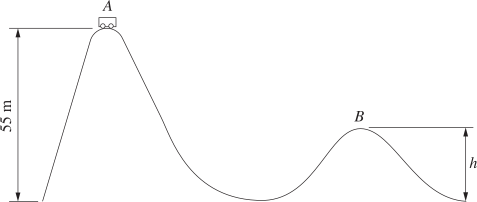
A roller coaster car is at rest at point \(A\) as shown.

Determine the height, \(h\), of the roller coaster at point \(B\) if it is travelling at 30 m/s at that point. Assume no energy losses.   (3 marks)

--- 6 WORK AREA LINES (style=lined) ---
Show Answers Only

\(10\ \text{metres}\)

Show Worked Solution

Using the Conservation of Energy:

\(\begin{aligned}
mgh_{\text{A}}+ \dfrac{1}{2} mv_\text{A}^2 & =mgh_{\text{B}} + \dfrac{1}{2} mv_\text{B}^2 \\
550+\dfrac{1}{2} \times 0^2 & =10h_\text{B}+ \dfrac{1}{2} \times 30^2 \\
550 & =10h_{\text{B}}+450 \\
h_{\text{B}} & = \dfrac{(550-450)}{10} =10\ \text {metres }\\
\end{aligned}\)

♦ Mean mark 48%.

Filed Under: Mechanics Tagged With: Band 5, smc-3718-80-Conservation of energy

ENGINEERING, AE 2023 HSC 21d

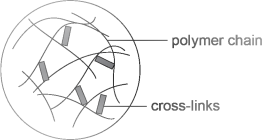
Draw, label and describe the microstructure of a thermosetting polymer.   (3 marks)
 

--- 0 WORK AREA LINES (style=lined) ---

Show Answers Only

Show Worked Solution

  • Thermosetting polymers have a three-dimensional network structure, where polymer chains are cross-linked by covalent bonds in a network of polymer chains.
     

♦♦ Mean mark 36%.

Filed Under: Materials Tagged With: Band 5, smc-3725-30-Polymers

ENGINEERING, AE 2023 HSC 21c

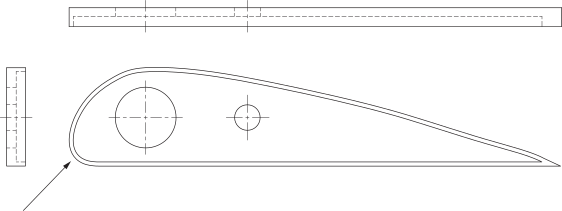
An orthogonal view of a rib in an aircraft wing is shown.
 

Construct a freehand isometric sketch of the wing rib as viewed in the direction of the arrow.   (3 marks)

--- 0 WORK AREA LINES (style=lined) ---

Show Answers Only

Show Worked Solution

♦ Mean mark 50%.

Other correct images include:
 

Filed Under: Communication Tagged With: Band 5, smc-3726-30-Freehand drawings

BIOLOGY, M2 EQ-Bank 32

Human blood is composed of various cellular and non-cellular components, each uniquely contributing to different processes and roles required by the circulatory system.

Explain the importance of TWO different non-cellular components of blood.   (4 marks)

--- 8 WORK AREA LINES (style=lined) ---

Show Answers Only

Answers can include two of the following.

Water:

  • Water is a main constituent of blood and lymph. It is critical in blood as it is a solvent for many substances, helping transport nutrients to all cells in the body.
  • Water in blood also helps lubricate joints and helps replace fluids lost to metabolism, breathing and the removal of waste.

Mineral ions:

  • There are many different types of mineral ions which are dissolved in blood including sodium, bicarbonate, magnesium, potassium, calcium and chloride.
  • These mineral ions regulate osmotic balance, pH and membrane permeability, amongst many other functions.

Plasma proteins:

  • Plasma proteins make up a significant portion of blood by volume (7–9%).
  • They regulate osmotic balance and pH (serum albumin) and contain enzymes and antibodies.
Show Worked Solution

Answers can include two of the following.

Water:

  • Water is a main constituent of blood and lymph. It is critical in blood as it is a solvent for many substances, helping transport nutrients to all cells in the body.
  • Water in blood also helps lubricate joints and helps replace fluids lost to metabolism, breathing and the removal of waste.

Mineral ions:

  • There are many different types of mineral ions which are dissolved in blood including sodium, bicarbonate, magnesium, potassium, calcium and chloride.
  • These mineral ions regulate osmotic balance, pH and membrane permeability, amongst many other functions.

Plasma proteins:

  • Plasma proteins make up a significant portion of blood by volume (7–9%).
  • They regulate osmotic balance and pH (serum albumin) and contain enzymes and antibodies.

Filed Under: Transport Tagged With: Band 5, smc-4306-10-Blood

CHEMISTRY, M5 EQ-Bank 13

A student hypothesises that increasing the temperature of an exothermic reaction slows down the reaction rate because less products are produced. Is this student correct? Give reasons.   (4 marks)

--- 8 WORK AREA LINES (style=lined) ---

Show Answers Only
  • The student is incorrect.
  • Exothermic reactions release heat to the surrounding environment, as modelled in this general reaction equation:
  •    \(\ce{R_{(1)} + R_{(2)} \rightleftharpoons P_{(1)} + P_{(2)} + Heat}\)
  • Increasing the temperature will result in fewer products being produced as the position of equilibrium shifts to the left (as per Le Chatelier’s principle).
  • However, contrary to the student’s hypothesis, fewer products being produced does not cause the reaction rate to slow down.
  • In fact, the rate of reaction will increase as the kinetic energy of particles will increase, leading to more successful particle collisions that exceed \(\ce{E_{a}}\).
  • The mistake the student has made is viewing fewer products as causing a decrease in reaction rate. The actual occurrence has been a shift in equilibrium to the left and an increase in the (forward) reaction rate to reach equilibrium.
Show Worked Solution
  • The student is incorrect.
  • Exothermic reactions release heat to the surrounding environment, as modelled in this general reaction equation:
  •    \(\ce{R_{(1)} + R_{(2)} \rightleftharpoons P_{(1)} + P_{(2)} + Heat}\)
  • Increasing the temperature will result in fewer products being produced as the position of equilibrium shifts to the left (as per Le Chatelier’s principle).
  • However, contrary to the student’s hypothesis, fewer products being produced does not cause the reaction rate to slow down.
  • In fact, the rate of reaction will increase as the kinetic energy of particles will increase, leading to more successful particle collisions that exceed \(\ce{E_{a}}\).
  • The mistake the student has made is viewing fewer products as causing a decrease in reaction rate. The actual occurrence has been a shift in equilibrium to the left and an increase in the (forward) reaction rate to reach equilibrium.

Filed Under: Factors that Affect Equilibrium Tagged With: Band 5, smc-3670-10-Temperature

BIOLOGY, M2 EQ-Bank 29

The countercurrent flow in the gills of fish allow for up to 95% of oxygen to be extracted from water.

Explain how the structure of fish gills and the countercurrent flow contribute to the efficiency of the gas exchange process.   (4 marks)

--- 8 WORK AREA LINES (style=lined) ---

Show Answers Only
  • Fish do not breathe air like humans but instead acquire oxygen through water when it flows over their gills.
  • The gill is structured by a gill bar (in bony fish) and contains thousands of leaf like filaments called lamellae.
  • Gas exchange can occur when water flows over the lamellae and their abundance drastically increases surface area, allowing for a higher frequency of gas exchange.
  • Gills also utilise countercurrent flow, where the water and deoxygenated blood will flow in opposite directions.
  • This allows for a concentration gradient to be maintained, rather than co-current flow which results in diffusion stopping when the oxygen is ‘evenly split’ 50/50 between the water and the blood.
Show Worked Solution
  • Fish do not breathe air like humans but instead acquire oxygen through water when it flows over their gills.
  • The gill is structured by a gill bar (in bony fish) and contains thousands of leaf like filaments called lamellae.
  • Gas exchange can occur when water flows over the lamellae and their abundance drastically increases surface area, allowing for a higher frequency of gas exchange.
  • Gills also utilise countercurrent flow, where the water and deoxygenated blood will flow in opposite directions.
  • This allows for a concentration gradient to be maintained, rather than co-current flow which results in diffusion stopping when the oxygen is ‘evenly split’ 50/50 between the water and the blood.

Filed Under: Organisation of Cells Tagged With: Band 5, Band 6, smc-4304-75-Cardiorespiratory System

BIOLOGY, M2 EQ-Bank 28

Explain how the structure of the alveoli is suited to their function of gas exchange.   (3 marks)

--- 6 WORK AREA LINES (style=lined) ---

Show Answers Only
  • Alveoli are the millions of microscopic air sacs which are in mammalian lungs.
  • They are surrounded by capillaries which contain deoxygenated blood. When air is inhaled the oxygen is able to diffuse into the blood along its concentration gradient.
  • The miniature size of alveoli is what allows simple diffusion to occur, while their abundance in mammalian lungs maximises the surface area, allowing more frequent gas exchange.
Show Worked Solution
  • Alveoli are the millions of microscopic air sacs which are in mammalian lungs.
  • They are surrounded by capillaries which contain deoxygenated blood. When air is inhaled the oxygen is able to diffuse into the blood along its concentration gradient.
  • The miniature size of alveoli is what allows simple diffusion to occur, while their abundance in mammalian lungs maximises the surface area, allowing more frequent gas exchange.

Filed Under: Nutrient and Gas Requirements Tagged With: Band 5, smc-4305-35-Animal Gas Exchange

CHEMISTRY, M3 EQ-Bank 5

Write a balanced chemical equation for the complete combustion of butane \(\ce{(C4H10)}\).   (2 marks)

--- 5 WORK AREA LINES (style=lined) ---

Show Answers Only

\(\ce{2C4H10(aq) + 13O2(g) \rightarrow 8CO2(g) + 10H2O(l)}\)

Show Worked Solution
  • Products of complete combustion are: \(\ce{CO2,\ H2O}\)
  • Balanced equation:
  •    \(\ce{2C4H10(aq) + 13O2(g) \rightarrow 8CO2(g) + 10H2O(l)}\)

Filed Under: Chemical Reactions Tagged With: Band 5, smc-4263-10-Balanced chemical equations, smc-4263-30-Combustion

CHEMISTRY, M1 EQ-Bank 4

Draw Lewis electron dot structures for the following ionic molecular compounds

  1. Sodium chloride  \((\ce{NaCl})\)   (1 mark)

    --- 4 WORK AREA LINES (style=lined) ---

  2. Aluminium fluoride \((\ce{GaF3})\)   (1 mark)

    --- 4 WORK AREA LINES (style=lined) ---

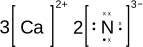
  3. Calcium nitride  \((\ce{Ca3N2})\)   (2 marks)

    --- 4 WORK AREA LINES (style=lined) ---

Show Answers Only

a.    Sodium chloride  \((\ce{NaCl}\)


b.  Aluminium Fluoride \((\ce{GaF3}\)
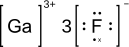
c.  Calcium nitride   \((\ce{Ca3N2}\)
Show Worked Solution

a.    Sodium chloride  \((\ce{NaCl}\)


b.  Aluminium Fluoride \((\ce{GaF3}\)

c.  Calcium nitride   \((\ce{Ca3N2}\)

Filed Under: Bonding Tagged With: Band 3, Band 4, Band 5, smc-4258-30-Lewis Dot

CHEMISTRY, M1 EQ-Bank 3

Draw Lewis electron dot structures for the following covalent molecular compounds

  1. Ammonia   (2 marks)

    --- 4 WORK AREA LINES (style=lined) ---

  2. Carbon dioxide   (2 marks)

    --- 4 WORK AREA LINES (style=lined) ---

Show Answers Only

a.    Ammonia \( (\ce{CH3})\)


b.   Carbon dioxide \( (\ce{CO2}) \)
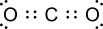
Show Worked Solution

a.    Ammonia \( (\ce{CH3})\)


b.   Carbon dioxide \( (\ce{CO2}) \)
 

Filed Under: Bonding Tagged With: Band 4, Band 5, smc-4258-30-Lewis Dot

PHYSICS, M3 EQ-Bank 5

A 50 gram copper ball is placed into an insulated container containing 50 mL of water and immediately sealed. The initial temperature of the metal ball and water is 50°C and 10°C respectively. 

A student hypothesises that since the water and copper ball both have the same mass, the temperature of the metal ball and water, once thermal equilibrium is established, would be 30°C.

When the student measured the temperature inside the container, it was 26°C.

Explain the results of the experiment and why the student's hypothesis is incorrect.   (4 marks)

--- 10 WORK AREA LINES (style=lined) ---

Show Answers Only
  • Although the masses of the copper ball and water are the same, the specific heat capacities of the objects are different which leads to different changes in temperature.
  • The student’s hypothesis is incorrect as they did not take the specific heat capacity values into account.
  • The specific heat capacity of water is greater than that of copper, thus a greater amount of energy would be required to heat water to a certain temperature than to heat copper to that same temperature.
  • Therefore, when reaching a state of thermal equilibrium, the energy transfer between the copper ball and water cools the copper ball down faster than the water heats up.
  • This leads to the final temperature within the container of 26°C, which is closer to the initial temperature of the water than the copper ball.
Show Worked Solution
  • Although the masses of the copper ball and water are the same, the specific heat capacities of the objects are different which leads to different changes in temperature.
  • The student’s hypothesis is incorrect as they did not take the specific heat capacity values into account.
  • The specific heat capacity of water is greater than that of copper, thus a greater amount of energy would be required to heat water to a certain temperature than to heat copper to that same temperature.
  • Therefore, when reaching a state of thermal equilibrium, the energy transfer between the copper ball and water cools the copper ball down faster than the water heats up.
  • This leads to the final temperature within the container of 26°C, which is closer to the initial temperature of the water than the copper ball.

Filed Under: Thermodynamics Tagged With: Band 5, Band 6, smc-4282-10-Specific heat capacity

BIOLOGY, M2 EQ-Bank 26

Explain the process by which nutrients are absorbed in the small intestine, giving examples.   (5 marks)

--- 10 WORK AREA LINES (style=lined) ---

Show Answers Only
  • When food is broken down in the stomach, it forms a slurry of nutrients called chyme.
  • When chyme travels through the small intestine it passes over millions of folds called villi, each containing its own set of millions of microvilli which increase its surface area to roughly 300m2. Each villi is lined with one epithelial cell before reaching the blood vessels and then the lymph.
  • When thew chyme passes through the lumen (the space between villi), certain molecules can be rapidly absorbed by simple or facilitated diffusion across a concentration gradient.
    • Example: fructose and water soluble vitamins can pass via facilitated diffusion through carrier and channel proteins respectively.
  • Large molecules cannot diffuse through the cells and instead must be actively transported. To accommodate this, villi contain many mitochondria which produce the ATP required for active transport.
    • Example: amino acids and glucose must be actively transported, while fatty acids and glycerol don’t need to be as they can diffuse through the epithelial cells.
Show Worked Solution
  • When food is broken down in the stomach, it forms a slurry of nutrients called chyme.
  • When chyme travels through the small intestine it passes over millions of folds called villi, each containing its own set of millions of microvilli which increase its surface area to roughly 300m2. Each villi is lined with one epithelial cell before reaching the blood vessels and then the lymph.
  • When thew chyme passes through the lumen (the space between villi), certain molecules can be rapidly absorbed by simple or facilitated diffusion across a concentration gradient.
    • Example: fructose and water soluble vitamins can pass via facilitated diffusion through carrier and channel proteins respectively.
  • Large molecules cannot diffuse through the cells and instead must be actively transported. To accommodate this, villi contain many mitochondria which produce the ATP required for active transport.
    • Example: amino acids and glucose must be actively transported, while fatty acids and glycerol don’t need to be as they can diffuse through the epithelial cells.

Filed Under: Nutrient and Gas Requirements Tagged With: Band 5, smc-4305-52-Digestive system

PHYSICS, M1 EQ-Bank 6

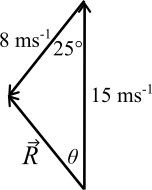
A boat is being rowed due north at a constant speed of 15 ms\(^{-1}\) when it encounters a current of 8 ms\(^{-1}\) going in the direction of S25°W.

Using vectors, determine the resultant velocity of the boat.   (3 marks)

--- 8 WORK AREA LINES (style=lined) ---

Show Answers Only

\(\overset{\rightarrow}R=8.455\ \text{ms}^{-1}\ \text{N}23.6^{\circ}\text{W}\)

Show Worked Solution

  • Using the cosine rule, the magnitude of \(\overset{\rightarrow}R\) is:
  •    \(\overset{\rightarrow}R=\sqrt{15^2+8^2-2 \times 15 \times 8 \times \cos25°}=8.455\ \text{ms}^{-1}\)
  • Using the sine rule, the direction of \(\overset{\rightarrow}R\) is:
\(\dfrac{\sin\theta}{8}\) \(=\dfrac{\sin25°}{8.455}\)  
\(\sin\theta\) \(=\dfrac{8\sin25°}{8.455}\)  
\(\theta\) \(=\sin^{-1}\Big{(}\dfrac{8\sin25°}{8.455}\Big{)}=23.6^{\circ}\)  

 
\(\therefore \overset{\rightarrow}R =8.455\ \text{ms}^{-1}\ \text{N}23.6^{\circ}\text{W}\)

Filed Under: Motion on a Plane Tagged With: Band 5, smc-4274-10-Vector addition, smc-4274-50-Vector diagrams

PHYSICS, M1 EQ-Bank 4

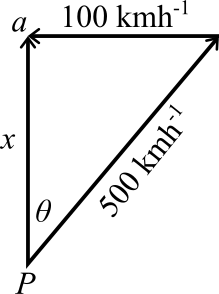
A plane that can fly at 500 kmh\(^{-1}\) with no wind, encounters a strong cross wind of 100 kmh\(^{-1}\) from the east. The plane needs to travel directly north to an airstrip

  1. Calculate the angle, correct to one decimal place, at which the pilot should steer for the plane to fly directly to the airstrip?   (3 marks)

    --- 6 WORK AREA LINES (style=lined) ---

  2. If the airstrip is 100 km from the planes current position, how long, to the nearest minute, will it take for the plane to complete the journey?   (2 marks)
  3. --- 4 WORK AREA LINES (style=lined) ---

Show Answers Only

a.    \(\text{N11.5°E}\)

b.    \(\text{12 minutes}\)

Show Worked Solution

a.    
       

\(\sin\theta\) \(=\dfrac{100}{500}\)  
\(\theta\) \(=\sin^{-1}\Big{(}\dfrac{100}{500}\Big{)}\)  
  \(=11.5^{\circ}\)  

 
\(\text{Plane direction should be N11.5°E}\)
 

b.    \(\text{Using the diagram in part (i):}\)

\(\tan(11.5°)\) \(=\dfrac{100}{x}\)  
\(x\) \(=\dfrac{100}{\tan(11.5°)}\)  
  \(=491.5\ \text{kmh}^{-1}\)  


\(t\) \(=\dfrac{\text{distance}}{\text{speed}}\)  
  \(=\dfrac{100}{491.5}\)  
  \(=0.203\ \text{h}\)  
  \(=12\ \text{m (nearest minute)}\)  

Filed Under: Motion on a Plane Tagged With: Band 4, Band 5, smc-4274-40-Relative motion, smc-4274-50-Vector diagrams

PHYSICS, M1 EQ-Bank 2

A cricket ball is hit vertically upwards from ground level, it gains 70 metres vertically and then falls back to the ground.

At what time(s) will the ball be 40 metres above the ground? Ignore any air resistance, giving your answer in seconds, correct to two decimal places.  (4 marks)

--- 7 WORK AREA LINES (style=lined) ---

Show Answers Only

\(6.25\ \text{s}\ \ \text{and}\ \ 1.31\ \text{s}\)

Show Worked Solution

\(\text{At 70 m}\ \Rightarrow \ v=0\ \text{ms}^{-1}:\)

\(v^2\) \(=u^2+2as\)  
\(0^2\) \(=u^2+2 \times -9.8 \times 70\)  
\(u^2\) \(=1372\)  
\(u\) \(=37.04\ \text{ms}^{-1}\)  

 
\(\text{Find}\ t\ \text{when}\ \ s=40:\)

\(s\) \(=ut+\dfrac{1}{2}at^2\)
\(40\) \(=37.04t+\dfrac{1}{2} \times -9.8 \times t^2\)
\(4.9t^2\) \(-37.04t+40=0\)
\(t\) \(=\dfrac{37.04 \pm \sqrt{(-37.04)^2-4 \times 4.9 \times 40}}{2 \times 4.9}\)
  \(=6.25\ \text{s}\ \ \text{and}\ \ 1.31\ \text{s}\)

Filed Under: Motion in a Straight Line Tagged With: Band 5, smc-4273-50-s=ut+1/2at^2

CHEMISTRY, M1 EQ-Bank 5

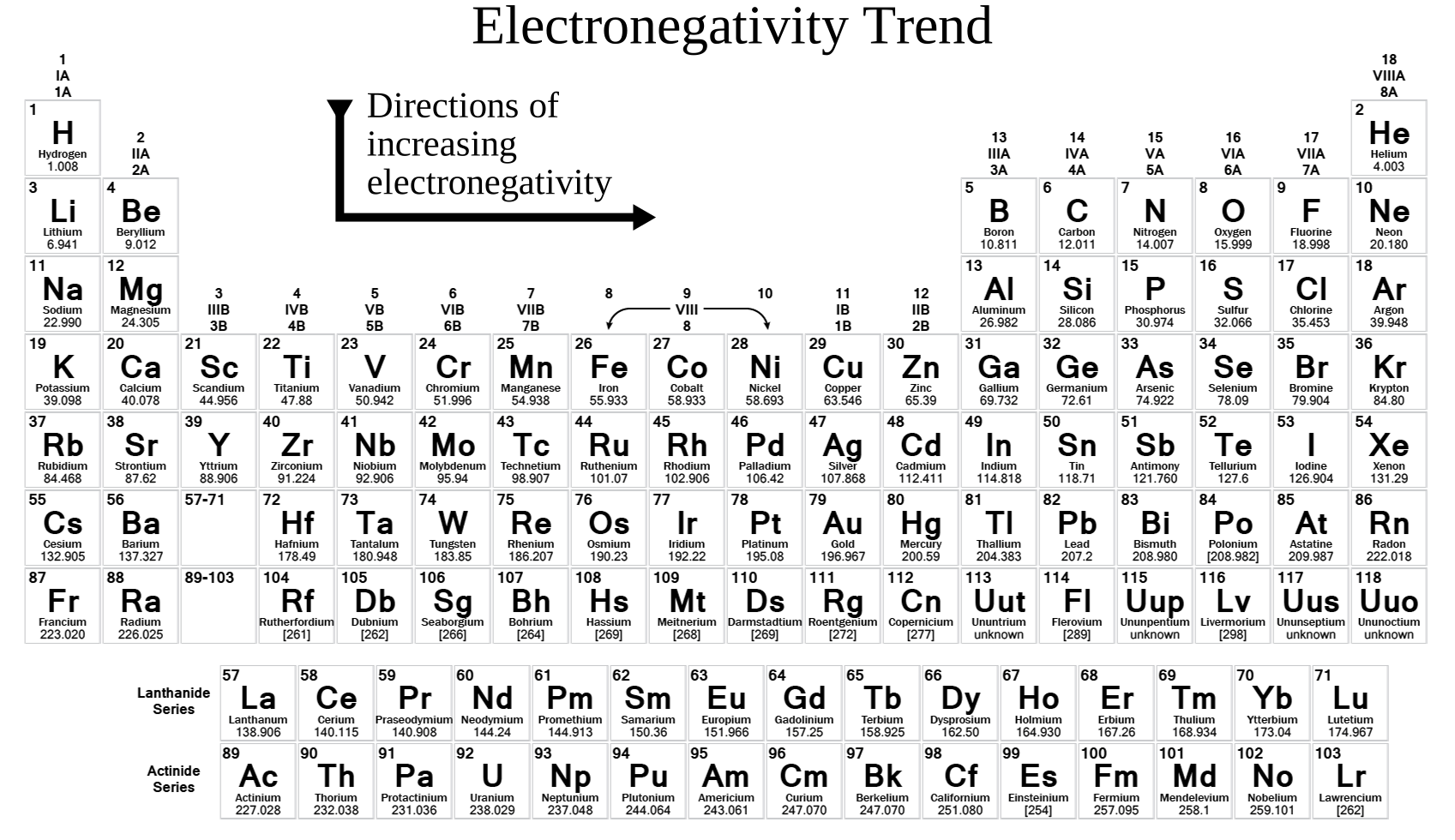
"Electronegativity increases as you move across periods left to right and decreases as you move down groups".

Explain this trend with reference to the following periodic table.   (4 marks)
  

Show Answers Only

Moving from left to right:

  • As you move across a period from left to right in the same row, the number of protons in the nucleus of elements increases in accordance with their atomic number.
  • eg. \(\ce{Li}\) (far left) has 3 protons in its nucleus whereas \(\ce{F}\) (far right) has 9 protons in its nucleus.
  • This leads to a greater attractive force and thus higher electronegativity. 

Moving down within a group (column):

  • Adding electron shells to a nucleus decreases electronegativity.
  • This is due to an increase in atomic radius and the effect that extra electron shells have in shielding the attractive forces of protons.
  • All the elements in a period (row) further down the periodic table have an extra electron shell than the period directly above them, decreasing electronegativity as you move down.
Show Worked Solution

Moving from left to right:

  • As you move across a period from left to right in the same row, the number of protons in the nucleus of elements increases in accordance with their atomic number.
  • eg. \(\ce{Li}\) (far left) has 3 protons in its nucleus whereas \(\ce{F}\) (far right) has 9 protons in its nucleus.
  • This leads to a greater attractive force and thus higher electronegativity. 

Moving down within a group (column):

  • Adding electron shells to a nucleus decreases electronegativity.
  • This is due to an increase in atomic radius and the effect that extra electron shells have in shielding the attractive forces of protons.
  • All the elements in a period (row) further down the periodic table have an extra electron shell than the period directly above them, decreasing electronegativity as you move down.

Filed Under: Periodicity Tagged With: Band 4, Band 5, smc-4257-10-Atomic Radii, smc-4257-20-Electronegativity

BIOLOGY, M1 2020 VCE 3

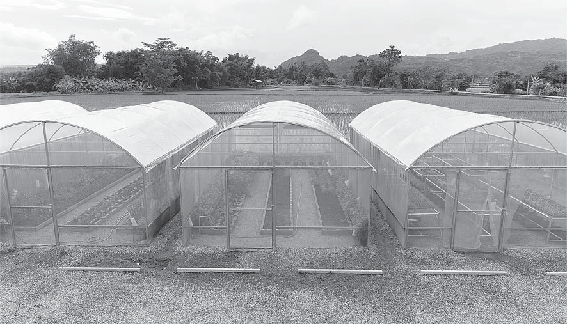
Greenhouses have been used to generate higher crop yields than open-field agriculture. To encourage plant growth in greenhouses, the conditions required for photosynthesis are controlled. Commercial greenhouses, like the ones shown below, often use a lot of energy for heating, ventilation, lighting and water.
  1. Consider the reactions of photosynthesis. Why would it be important to maintain the temperature within narrow limits in a commercial greenhouse? Justify your answer.  (2 marks)

    --- 5 WORK AREA LINES (style=lined) ---

  2. Scientists are developing a new material to cover greenhouses, which can split incoming light and convert the rays from green wavelengths into red wavelengths.
  3. Explain how this new material increases crop yields.  (2 marks)

    --- 4 WORK AREA LINES (style=lined) ---

Show Answers Only

a.    Temperature maintenance:

  • Photosynthesis is regulated by different enzymes which are intrinsic to numerous processes involved in photosynthesis.
  • If the temperature of a greenhouse is changed, then the enzymes may decrease in activity or denature, causing a reduction in the rate of photosynthesis or even ceasing it all together.
  • This can cause problems in the plants such as a reduction in growth or plant death. 

b.    Crop yield increases:

  • Red wavelengths of light are used during photosynthesis, while green light is reflected off the plants.
  • This technology will allow an increase in crop yields by increasing the amount of red light which increases the rate of photosynthesis.
Show Worked Solution

a.    Temperature maintenance:

  • Photosynthesis is regulated by different enzymes which are intrinsic to numerous processes involved in photosynthesis.
  • If the temperature of a greenhouse is changed, then the enzymes may decrease in activity or denature, causing a reduction in the rate of photosynthesis or even ceasing it all together.
  • This can cause problems in the plants such as a reduction in growth or plant death. 

b.    Crop yield increases:

  • Red wavelengths of light are used during photosynthesis, while green light is reflected off the plants.
  • This technology will allow an increase in crop yields by increasing the amount of red light which increases the rate of photosynthesis.

Filed Under: Cell Function Tagged With: Band 3, Band 5, smc-4303-10-Photosynthesis

PHYSICS, M3 2017 VCE 14

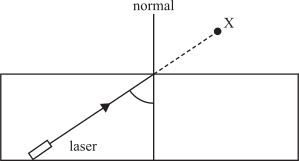
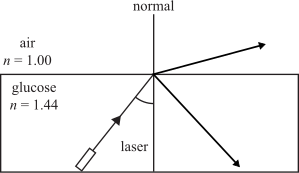
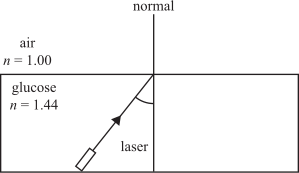
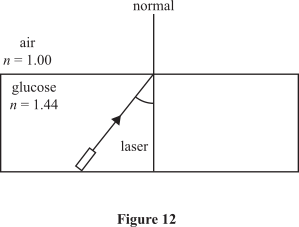
A light ray from a laser passes from a glucose solution \((n=1.44)\) into the air \((n=1.00)\), as shown in Figure 12.
 

  1. Calculate the critical angle (total internal reflection) from the glucose solution to the air.   (1 mark)

    --- 2 WORK AREA LINES (style=lined) ---

  2. The light ray strikes the surface at an angle of incidence to the normal of less than the critical angle calculated in part a.
  3. On the diagram above, sketch the ray or rays that should be observed.   (2 marks)

    --- 0 WORK AREA LINES (style=lined) ---

  4. The angle to the normal is increased to a value greater than the critical angle. An observer at point \(\text{X}\) in the image below says she cannot see the laser.
     

  1. Explain why the observer says she cannot see the laser.   (2 marks)

    --- 6 WORK AREA LINES (style=lined) ---

Show Answers Only

a.    \(\theta_c=44^{\circ}\)

b.    
       
  • As the light strikes the surface at an angle less than that of the critical angle, both reflection and refraction will be observed. 
c.    Observer cannot see the laser:
  • When the light strikes the surface at an angle greater than the critical angle, Total Internal Reflection will occur.
  • As a result of the total internal reflection, all the light will be reflected off the boundary back into the glucose solution and therefore will not travel to the observer.

Show Worked Solution

a.     \(\sin\theta_c\) \(=\dfrac{n_2}{n_1}\)
  \(\theta_c\) \(=\sin^{-1}\Big{(}\dfrac{1.00}{1.44}\Big{)}=44^{\circ}\)

 
b.


  • As the light strikes the surface at an angle less than that of the critical angle, both reflection and refraction will be observed.
♦♦ Mean mark (b) 37%.

c.    Observer cannot see the laser:

  • When the light strikes the surface at an angle greater than the critical angle, Total Internal Reflection will occur.
  • As a result of the total internal reflection, all the light will be reflected off the boundary back into the glucose solution and therefore will not travel to the observer.

Filed Under: Ray Model of Light Tagged With: Band 3, Band 4, Band 5, smc-4281-20-Snell's Law and TIR

BIOLOGY, M4 2021 VCE 8

Ancient cave drawings contribute evidence of cognitive changes that are unique to modern humans, Homo sapiens. Biologists argue that these unique cognitive changes in H. sapiens allowed cultural evolution that would have been impossible in other hominin species.

  1. Describe how ancient cave drawings contribute evidence of cultural evolution in H. sapiens.   (2 marks)

--- 4 WORK AREA LINES (style=lined) ---

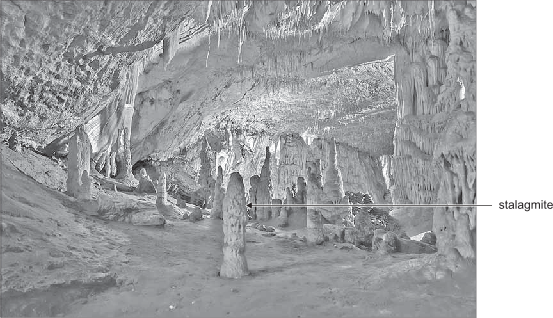
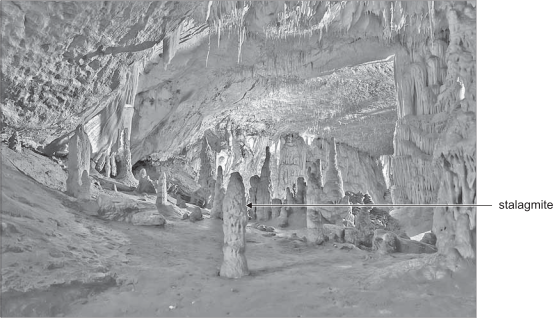
Cave drawings depicting animals have been found on stalagmites in the Ardales Cave in south-west Europe. A stalagmite is a rock formation that grows upwards from a cave floor, as shown in the image below. Over a long period of time, water, containing minerals, dripped from the cave roof, solidified and formed a transparent layer on top of the drawings on the stalagmites.
 
  1. A team of scientists dated the mineral deposits in the solid, transparent layer using uranium-thorium dating. They found that some of the mineral deposits are 65 000 years old.

    What conclusion can be made about the age of the ancient drawings on the stalagmites? Justify your response.   (2 marks)

--- 3 WORK AREA LINES (style=lined) ---

  1. The table below shows the arrival dates of some hominin species to the European continent as well as their extinction dates. The dates are the best estimates based on fossil evidence from multiple sites and genetic data.
     

\( \textbf{Hominin species} \)

\( \textbf{First appearance in Europe} \)

\( \textbf{(years before present)} \)

\( \textbf{Time of extinction} \)

\( \textbf{(years before present)} \)

\( \text{Homo sapiens} \) \(45\ 000\) \( \text{not extinct}\)
\( \text{Homo neanderthalensis} \) \(130\ 000\) \(30\ 000\)
\( \text{Homo heidelbergensis} \) \(800\ 000-600\ 000\) \(400\ 000-200\ 000\)
\( \text{Homo erectus} \) \(1\ 200\ 000-600\ 000\) \(143\ 000\)
 
  1. How does the discovery of the drawings in the Ardales Cave challenge the view that the art of cave drawing first arose in H. sapiens? In your response, refer to the evidence provided in the table and above.   (2 marks)

--- 5 WORK AREA LINES (style=lined) ---

Show Answers Only

a.    Answers could include two of the following:

  • Cave drawings show information being passed through generations.
  • The paintings often depict changing hunting techniques or dreaming stories over time.
  • Increasing complexity of these cave drawings over time shows the development of complex thought and symbolic relationships in H. sapien tribes. 

b.    The drawings must be a minimum of 65,000 years old.

  • This is because they must be at least as old as the mineral layer on top of them. 

c.    H. sapiens are believed to have arrived in Europe 45,000 years ago.

  • The dating shows the drawings are a minimum of 65,000 years old.
  • Therefore the data suggests that either H. neanderthalensis drew the art, or H. sapiens arrived earlier than currently believed.
Show Worked Solution

a.    Answers could include two of the following:

  • Cave drawings show information being passed through generations.
  • The paintings often depict changing hunting techniques or dreaming stories over time.
  • Increasing complexity of these cave drawings over time shows the development of complex thought and symbolic relationships in H. sapien tribes.  

b.    The drawings must be a minimum of 65,000 years old.

  • This is because they must be at least as old as the mineral layer on top of them. 
♦ Mean mark (b) 49%.

c.    H. sapiens are believed to have arrived in Europe 45,000 years ago.

  • The dating shows the drawings are a minimum of 65,000 years old.
  • Therefore the data suggests that either H. neanderthalensis drew the art, or H. sapiens arrived earlier than currently believed.

Filed Under: Past Ecosystems Tagged With: Band 3, Band 5, smc-4312-07-Rock structure/formation

BIOLOGY, M3 2021 VCE 6

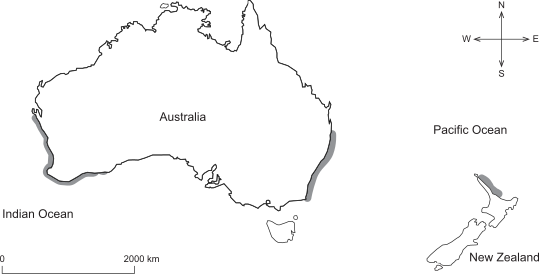
Many species of octopus can be found in the oceans surrounding Australia and New Zealand. Populations of octopus can be found on both the east and west coasts of Australia and on the north coast of New Zealand. The distribution of the populations is shown shaded on the map below.
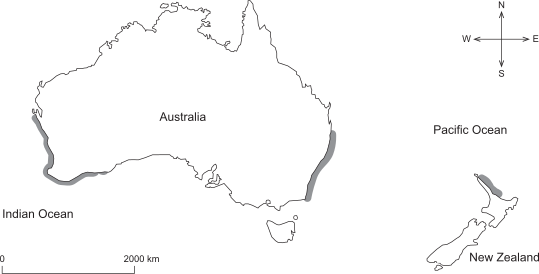
 

  1. Scientists investigated whether the octopus populations on Australia's east coast are a separate species from the populations on the west coast. After analysing both molecular and morphological results, the scientists concluded that all populations share a distant common ancestor. They also concluded that the populations of octopus on the east coast of Australia are a distinct species from the populations of octopus on the west coast of Australia.

    Describe the process that may have led to the formation of the two distinct species of octopus from the distant common ancestor.   (4 marks)

    --- 8 WORK AREA LINES (style=lined) ---

  1. The scientists also compared the populations of east Australian octopus with the populations of the New Zealand octopus. No significant genetic differences between these populations of the New Zealand octopus and east Australian octopus were found. It is known that young octopi can be carried long distances by water currents. Occasionally, adult octopi have been seen on pieces of floating wood.
  2. Give two reasons that may explain the lack of genetic diversity between the populations.   (2 marks)

    --- 5 WORK AREA LINES (style=lined) ---

Show Answers Only

a.    Geographical separation creates unique environmental selection pressures.

  • Random mutations that change the phenotype of an individual may then be beneficial and provide a survival advantage in their respective environment.
  • By Natural Selection, this survival advantage allows these beneficial traits to be preserved and carried through generations.
  • Over many generations this process produced two different octopus species on the east and west coast. 

b.     Answers can include any two of the following:

  • The populations could share a recent common ancestor which does not leave enough time to develop two seperate species.
  • The relatively close proximity (≈ 3000 km) may have led to very similar selection pressures in the two regions, thus leading to both communities developing similar characteristics.
  • The ability of octopi to travel long distances on wood or in the water currents may have led to interbreeding, causing gene flow between the populations.
Show Worked Solution

a.    Geographical separation creates unique environmental selection pressures.

  • Random mutations that change the phenotype of an individual may then be beneficial and provide a survival advantage in their respective environment.
  • By Natural Selection, this survival advantage allows these beneficial traits to be preserved and carried through generations.
  • Over many generations this process produced two different octopus species on the east and west coast. 

b.     Answers can include any two of the following:

  • The populations could share a recent common ancestor which does not leave enough time to develop two seperate species.
  • The relatively close proximity (≈ 3000 km) may have led to very similar selection pressures in the two regions, thus leading to both communities developing similar characteristics.
  • The ability of octopi to travel long distances on wood or in the water currents may have led to interbreeding, causing gene flow between the populations.

Filed Under: Natural Selection Tagged With: Band 5, smc-3653-10-Biodiversity

BIOLOGY, M1 2021 VCE 3

Scientists measured the metabolic activity of mammalian cells by measuring the uptake of glucose into the cells. The cells were maintained at 37 °C with a pH of 7.4 and suspended in a nutrient solution containing glucose. The uptake of glucose into the cells was recorded for the next 30 minutes.

  1. Explain why the uptake of glucose into the cells could be used to measure the metabolic activity of the cells.   (2 marks)

    --- 4 WORK AREA LINES (style=lined) ---

  1. The scientists repeated the experiment. They kept all conditions the same as for the first experiment, except that the cells were kept in low-oxygen conditions.

    Would the uptake of glucose into the cells be expected to be higher, lower or the same as for the first experiment? Justify your response.   (4 marks)

    --- 6 WORK AREA LINES (style=lined) ---

Show Answers Only

a.    Metabolic activity requires energy in the form of ATP molecules.

  • ATP molecules are made via aerobic cellular respiration, a process which requires glucose. 

b.    Low oxygen environment:

  • By depriving the cell of oxygen it would struggle to respire aerobically, producing less ATP per molecule of glucose.
  • This would lead to a higher uptake of glucose to produce the same amount of ATP.

Answer could also include:

  • Being deprived of oxygen would cause the cell to respire anaerobically, producing toxins that damage the cell. 
  • This anaerobic respiration does not require glucose. Therefore, the uptake of glucose by the cell would be less than in an oxygen rich environment.
Show Worked Solution

a.    Metabolic activity requires energy in the form of ATP molecules.

  • ATP molecules are made via aerobic cellular respiration, a process which requires glucose. 
♦ Mean mark (a) 47%.

b.    Low oxygen environment:

  • By depriving the cell of oxygen it would struggle to respire aerobically, producing less ATP per molecule of glucose.
  • This would lead to a higher uptake of glucose to produce the same amount of ATP.

Answer could also include:

  • Being deprived of oxygen would cause the cell to respire anaerobically, producing toxins that damage the cell. 
  • This anaerobic respiration does not require glucose. Therefore, the uptake of glucose by the cell would be less than in an oxygen rich environment.
♦ Mean mark (b) 45%.

Filed Under: Cell Function Tagged With: Band 5, smc-4303-20-Respiration

BIOLOGY, M1 2021 VCE 1

The diagram below shows a small part of a cross-section of the plasma membrane of a cell.
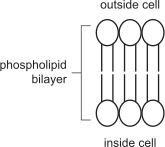
 

Some substances can move directly through the phospholipid bilayer.

  1. Complete the table below by naming one small hydrophilic substance and one small hydrophobic substance that can move through the phospholipid bilayer. Provide an example of a situation when each small substance would move through the phospholipid bilayer. The first row has been completed for you.   (2 marks)

    --- 0 WORK AREA LINES (style=lined) ---

\begin{array} {|c|l|l|}
\hline \textbf{Name of small} & \textbf{Hydrophilic or} & \ \ \textbf{Situation when substance moves} \ \ \\
\textbf{substance} & \ \ \textbf{hydrophobic} & \ \ \ \ \  \textbf{through phospholipid bilayer}  \\
\hline \text{oxygen}  & \text{hydrophobic} & \text{Oxygen diffuses out of photosynthetic}  \\
& & \text{plant.}\\
\hline  & \text{hydrophilic} &  \\
& & \\
\hline  & \text{hydrophobic} &  \\
& & \\
\hline \end{array}

  1. Some very large substances and/or large particles that do not dissolve in the phospholipid bilayer can still move into or out of a cell.

    Using one example, explain how the phospholipid bilayer transports these very large substances and/or large particles without the use of channel or carrier proteins either into a cell or out of a cell.   (3 marks)

--- 6 WORK AREA LINES (style=lined) ---

Show Answers Only

a.   

\begin{array} {|c|l|l|}
\hline \textbf{Name of small} & \textbf{Hydrophilic or} & \ \ \textbf{Situation when substance moves} \ \ \\
\textbf{substance} & \ \ \textbf{hydrophobic} & \ \ \ \ \  \textbf{through phospholipid bilayer}  \\
\hline \text{oxygen}  & \text{hydrophobic} & \text{Oxygen diffuses out of photosynthetic}  \\
& & \text{plant}\\
\hline \text{water} & \text{hydrophilic} & \text{Water diffuses out of a cell during} \\
& & \text{respiration. }\\
\hline \text{carbon dioxide} & \text{hydrophobic} & \text{Carbon dioxide diffuses out of a cell} \\
& & \text{during respiration. } \\
\hline \end{array}

b.    Into a cell:

  • Endocytosis is a process which allows large particles such as proteins or antigens to enter a cell.
  • Endocytosis involves the folding over of a membrane to form a vesicle. The contents of the vesicle can then be digested by enzymes within the cell. 

Out of a cell:

  • Exocytosis is a process which allows large particles such as proteins, antibodies or neurotransmitters to exit a cell.
  • Exocytosis involves the formation of a vesicle around the materials which need to exit the cell.
  • This vesicle then fuses with the plasma membrane, releasing the contents into the environment.
Show Worked Solution

a.   

\begin{array} {|c|l|l|}
\hline \textbf{Name of small} & \textbf{Hydrophilic or} & \ \ \textbf{Situation when substance moves} \ \ \\
\textbf{substance} & \ \ \textbf{hydrophobic} & \ \ \ \ \  \textbf{through phospholipid bilayer}  \\
\hline \text{oxygen}  & \text{hydrophobic} & \text{Oxygen diffuses out of photosynthetic}  \\
& & \text{plant}\\
\hline \text{water} & \text{hydrophilic} & \text{Water diffuses out of a cell during} \\
& & \text{respiration. }\\
\hline \text{carbon dioxide} & \text{hydrophobic} & \text{Carbon dioxide diffuses out of a cell} \\
& & \text{during respiration. } \\
\hline \end{array}

 
b.
    Into a cell:

  • Endocytosis is a process which allows large particles such as proteins or antigens to enter a cell.
  • Endocytosis involves the folding over of a membrane to form a vesicle. The contents of the vesicle can then be digested by enzymes within the cell. 

Out of a cell:

  • Exocytosis is a process which allows large particles such as proteins, antibodies or neurotransmitters to exit a cell.
  • Exocytosis involves the formation of a vesicle around the materials which need to exit the cell.
  • This vesicle then fuses with the plasma membrane, releasing the contents into the environment.

Filed Under: Cell Structure Tagged With: Band 4, Band 5, smc-4302-50-Cell membrane

CHEMISTRY, M4 2019 VCE 23 MC

Which one of the following statements about enthalpy change is correct?

  1. The sign of the enthalpy change for an endothermic reaction is negative.
  2. The sign of the enthalpy change for the condensation of a gas to a liquid is negative.
  3. The enthalpy change is the difference between the activation energy and the energy of the reactants.
  4. The enthalpy change is the difference between the activation energy and the energy of the products.
Show Answers Only

\(B\)

Show Worked Solution
  • \(\Delta H > 0\) for endothermic reaction. Enthalpy change is positive (eliminate \(A\)).
  • When gas condensation occurs, energy is released in an exothermic reaction. \(\Delta H < 0\) and enthalpy change is negative (\(B\) is correct).
  • When gas condensation occurs, stronger bonds are formed between molecules and as bond forming is exothermic, condensation is an exothermic process.
  • Enthalpy change does not involve activation energy levels (eliminate \(C\) and \(D\)).

\(\Rightarrow B\)

♦ Mean mark 47%.

Filed Under: Enthalpy and Hess's Law Tagged With: Band 5, smc-4267-20-Enthalpy and bonding

CHEMISTRY, M4 2022 VCE 15 MC

The molar heat of combustion of glucose, \(\ce{C6H12O6}\), in the cellular respiration equation is 2805 kJ mol\(^{-1}\) at standard laboratory conditions (SLC). The equation for cellular respiration is below.

\(\ce{C6H12O6(aq) + 6O2(g) \rightarrow 6CO2(g) + 6H2O(l)}\)

Which one of the following statements about cellular respiration is correct?

  1. Cellular respiration is an endothermic reaction.
  2. The products of cellular respiration are water and carbon monoxide.
  3. Cellular respiration is a redox reaction because \(\ce{C6H12O6}\) accepts electrons from oxygen.
  4. When one mole of oxygen is consumed in the reaction, 467.5 kJ of energy is released.
Show Answers Only

\(D\)

Show Worked Solution
  • Chemical equation for respiration:
  •    \(\ce{C6H12O6(aq) + 6O2(g) \rightarrow 6CO2(g) + 6H2O(l)}\)
  •    \(\Delta H = -2805\ \text{kJ mol}^{-1}\)
  • Exothermic redox reaction where \(\ce{C6H12O6}\) is oxidised (loses electrons).
  • 6 mol of \(\ce{O2}\) is required to produce 2805 kJ of energy.
  • 1 mol \(\ce{O2}\) = 2805 ÷ 6 = 467.5 kJ of energy.

\(\Rightarrow D\)

♦ Mean mark 47%.

Filed Under: Energy Changes in Chemical Reactions Tagged With: Band 5, smc-4266-20-Heat of combustion

PHYSICS, M3 2018 VCE 12

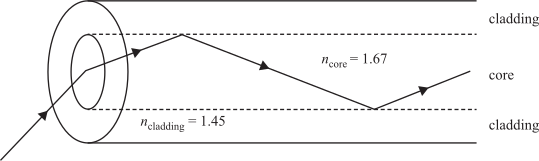
Optical fibres are constructed using transparent materials with different refractive indices.

The diagram below shows one type of optical fibre that has a cylindrical core and surrounding cladding. Laser light of wavelength 565 nm is shone from air into the optical fibre (\(v=3 \times 10^8\)).
 

  1. Calculate the frequency of the laser light before it enters the optical fibre.  (1 mark)

    --- 2 WORK AREA LINES (style=lined) ---

  2. Calculate the critical angle for the laser light at the cladding-core boundary. Show your working.  (2 marks)

    --- 4 WORK AREA LINES (style=lined) ---
  3. Calculate the speed of the laser light once it enters the core of the optical fibre. Give your answer correct to three significant figures. Show your working.  (2 marks)

    --- 4 WORK AREA LINES (style=lined) ---

Show Answers Only

a.    \(f=5.31 \times 10^{14}\ \text{Hz}\)

b.    \(\theta_c=60.3^{\circ}\)

c.    \(v_{\text{x}}=1.80 \times 10^8\ \text{ms}^{-1}\)

Show Worked Solution

a.     \(f\) \(=\dfrac{v}{\lambda}\)
    \(=\dfrac{3\times 10^8}{565 \times 10^{-9}}\)
    \(=5.31 \times 10^{14}\ \text{Hz}\)

 
b.
  \(\theta_c=\sin^{-1}\Big{(}\dfrac{n_2}{n_1}\Big{)}=\sin^{-1} \Big{(}\dfrac{1.45}{1.67} \Big{)}=60.3^{\circ}\) 

c.     \(v_{\text{x}}\) \(=\dfrac{c}{n_{\text{x}}}\)
    \(=\dfrac{3 \times 10^8}{1.67}\)
    \(=1.80 \times 10^8\ \text{ms}^{-1}\)
♦ Mean mark (c) 50%.

Filed Under: Ray Model of Light Tagged With: Band 4, Band 5, smc-4281-20-Snell's Law and TIR, smc-4281-40-Speed of light in medium

PHYSICS, M2 2018 VCE 8

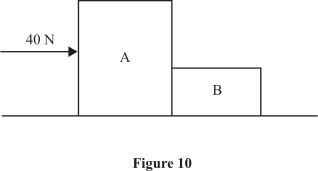
Two blocks, \(\text{A}\) of mass 4.0 kg and \(\text{B}\) of mass 1.0 kg, are being pushed to the right on a smooth, frictionless surface by a 40 N force, as shown in the diagram.
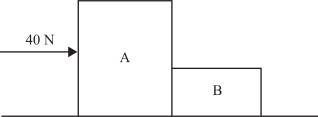
 

  1. Calculate the magnitude of the force on block \(\text{B}\) by block \(\text{A}\) (\(\left.F_{\text {on B by A}}\right)\). Show your working.   (2 marks)

    --- 5 WORK AREA LINES (style=lined) ---

  2. State the magnitude and the direction of the force on block \(\text{A}\) by block \(\text{B}\) (\(\left.F_{\text {on A by B}}\right)\).   (2 marks)

    --- 5 WORK AREA LINES (style=lined) ---

Show Answers Only

a.    \(8\ \text{N}\)

b.    \(8\ \text{N}\) to the left.

Show Worked Solution

a.   Using \(F=ma\), calculate the acceleration of the entire system:

\(a=\dfrac{F}{m}=\dfrac{40}{5}=8\ \text{ms}^{-2}\)

\(F_{\text {on B by A }}=m \times a=1 \times 8=8\ \text{N}\)

♦♦ Mean mark (a) 36%.

 
b.   
Newton’s third law of motion:

  • \(F_{\text {on A by B }}\) will be equal in magnitude and opposite in direction.
  • \(F_{\text {on A by B }}= 8\ \text{N}\) to the left.

Filed Under: Forces Tagged With: Band 4, Band 5, smc-4275-20-Newtons 3rd Law, smc-4275-30-Newton's 2nd Law

PHYSICS, M3 2019 VCE 15

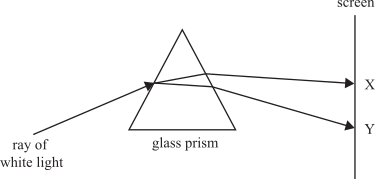
A student sets up an experiment involving a source of white light, a glass prism and a screen. The path of a single ray of white light when it travels through the prism and onto the screen is shown in Figure 14.
 

A spectrum of colours is observed by the student on the screen, which is positioned to the right of the prism.

  1. Name and explain the effect observed by the student.   (3 marks)

    --- 5 WORK AREA LINES (style=lined) ---

  2. Points \(\text{X}\) and \(\text{Y}\) on the diagram above represent either end of the visible spectrum observed by the student.
  3. Identify the two visible colours observed at point \(\text{X}\) and at point \(\text{Y}\).   (1 mark)

    --- 2 WORK AREA LINES (style=lined) ---
Show Answers Only

a.   The observed effect is dispersion.

  • As light enters the glass it slows down as it is entering a denser medium.
  • As the refractive index for different wavelengths of light differs, the angle at which individual wavelengths refract differs slightly.
  • This causes the white light to split up as each wavelength refracts differently through the glass resulting in a rainbow spectrum on the screen.

 b.   Point \(X\) is red.

        Point \(Y\) is blue/purple.

Show Worked Solution

a.   The observed effect is dispersion.

  • As light enters the glass it slows down as it is entering a denser medium.
  • As the refractive index for different wavelengths of light differs, the angle at which individual wavelengths refract differs slightly.
  • This causes the white light to split up as each wavelength refracts differently through the glass resulting in a rainbow spectrum on the screen.
♦ Mean mark 53%.

b.   Point \(X\) is red.

        Point \(Y\) is blue/purple.

Filed Under: Ray Model of Light Tagged With: Band 4, Band 5, smc-4281-30-Light dispersion, smc-4281-40-Speed of light in medium

PHYSICS, M3 2019 VCE 13

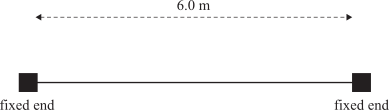
In an experimental set-up used to investigate standing waves, a 6.0 m length of string is fixed at both ends, as shown in diagram below. The string is under constant tension, ensuring that the speed of the wave pulses created is a constant 40 ms\(^{-1}\).


In an initial experiment, a continuous transverse wave of frequency 7.5 Hz is generated along the string.

  1. Determine the wavelength of the transverse wave travelling along the string.   (1 mark)

    --- 3 WORK AREA LINES (style=lined) ---

  2. Will a standing wave form? Give a reason for your answer.   (2 marks)

    --- 4 WORK AREA LINES (style=lined) ---
Show Answers Only

a.    \(\lambda=5.3\ \text{m}\)

b.    A standing wave will not form.

  • A standing wave will only form if the length of the string is equal to an integer multiple of \(\dfrac{\lambda}{2}\).
  • Since 6.0 m is not an integer multiple of \(\dfrac{5.3}{2}\) m, a standing wave will not form.

Show Worked Solution

a.    \(\lambda = \dfrac{v}{f} = \dfrac{40}{7.5} = 5.3\ \text{m} \) 

 
b.
   A standing wave will not form.

  • A standing wave will only form if the length of the string is equal to an integer multiple of \(\dfrac{\lambda}{2}\).
  • Since 6.0 m is not an integer multiple of \(\dfrac{5.3}{2}\) m, a standing wave will not form.
♦♦ Mean mark (b) 38%.

Filed Under: Sound Waves Tagged With: Band 3, Band 5, smc-4280-20-Modelling standing waves

BIOLOGY, M3 2022 VCE 8a

There are 13 species of small birds commonly known as Darwin's finches, found only on the Galápagos Islands in the Pacific Ocean, 1000 km west of South America. Their closest living relative is the dull-coloured grassquit, Asemospiza obscura, which is found on mainland South America. It is believed that Darwin's finches evolved from A. obscura or from its ancestor on the mainland.

The different finch species are similar in colour but vary in beak size and shape, habitat and diet.

Discuss how the different species of Darwin's finches arose from an ancestral population on the mainland. In your response, name the type of speciation that occurred and identify the main selection pressure(s) that has acted on finch populations.   (6 marks)

--- 12 WORK AREA LINES (style=lined) ---

Show Answers Only

  • The variation in Darwin’s finches can be explained by allopatric speciation, where a few million years ago geographical separation of an ancestral finch species prevented gene flow between these isolated groups.
  • On the separate islands, varying factors including available food, water and shelter acted as selection pressures on the finch communities.
  • Random mutations in the finches, including ones which caused changes in beak size and shape, were potentially beneficial to the finch on it’s respective island. For example, if grubs were a common sauce of food on an island, a random mutation in a finch that produced a longer beak would make the grubs more accessible.
  • By Natural Selection, these traits would then be passed on by generations and overtime creating a new species of finch which is unique compared to those found on the other islands.

Show Worked Solution

  • The variation in Darwin’s finches can be explained by allopatric speciation, where a few million years ago geographical separation of an ancestral finch species prevented gene flow between these isolated groups.
  • On the separate islands, varying factors including available food, water and shelter acted as selection pressures on the finch communities.
  • Random mutations in the finches, including ones which caused changes in beak size and shape, were potentially beneficial to the finch on it’s respective island. For example, if grubs were a common sauce of food on an island, a random mutation in a finch that produced a longer beak would make the grubs more accessible.
  • By Natural Selection, these traits would then be passed on by generations and overtime creating a new species of finch which is unique compared to those found on the other islands.

Filed Under: Adaptations Tagged With: Band 5, smc-4308-50-Galapagos

CHEMISTRY, M4 EQ-Bank 6

At what temperature range would the following reaction occur spontaneously.

\(\ce{2Cr2O3(s)\rightarrow 4Cr_(s) + 3O2(g)}\)

where \(\Delta H = 1256.4\ \text{kJ}\)  and  \(\Delta S = 587\ \text{J K}^{-1} \)  (3 marks)

--- 6 WORK AREA LINES (style=lined) ---

Show Answers Only
  • The reaction is spontaneous at temperatures greater than 2140.37 K.
Show Worked Solution

\(\text{Using}\ \ \Delta H-T \Delta S=0:\)

   \(T= \dfrac{\Delta H}{\Delta S}\dfrac{1256.4}{0.587}=2140.37\ \text{K} \)

  • As \(T\) increases, \(\Delta G\) decreases.
  • Reaction is spontaneous when \(\Delta G < 0\).
  • Therefore the reaction is spontaneous at temperatures greater than 2140.37 K.

Filed Under: Entropy and Gibbs Free Energy Tagged With: Band 5

CHEMISTRY, M4 EQ-Bank 5

The following reaction represents the conversion of diamond to graphite:

\(\ce{2C_{diamond} \rightarrow 2C_{graphite}}\)

    • \(\ce{\Delta $H$_{f}\ C_{diamond} = 1.9 kJ mol^{-1}}\)
    • \(\ce{\Delta $S$_{f}\ C_{diamond} = 2.38 J mol^{-1} K^{-1}}\)
    • \(\ce{\Delta $S$_{f}\ C_{graphite} = 5.74 J mol^{-1} K^{-1}}\)
  1. Determine \(\Delta G\) at 298K and state whether the reaction is spontaneous or not.   (3 marks)

    --- 7 WORK AREA LINES (style=lined) ---

  2. What does \(\Delta G\) indicate about the rate of reaction?   (1 mark)

    --- 2 WORK AREA LINES (style=lined) ---

Show Answers Only

a.    \(\Delta G = -5.8025\ \text{kJ}\)

  • Reaction is spontaneous.

b.   Rate of reaction and \(\Delta G\): 

  • Gibbs Free Energy doesn’t indicate anything about the kinetics of the reaction. While the conversion of diamond to graphite is spontaneous, it occurs over millions of year
Show Worked Solution

a.  Standard enthalpy and entropy of elements in their natural state is 0.

\(\Delta H\) \(= \Sigma H_{\text{products}}-\Sigma H_{\text{reactants}}\)  
  \(= (2 \times 0)-(2 \times 1.9)\)  
  \(=-3.8\ \text{kJ mol}^{-1} \)  


\(\Delta S\) \(=\Sigma S_{\text{products}}-\Sigma S_{\text{reactants}}\)  
  \(= (2 \times 5.74)-(2 \times 2.38)\)  
  \(= 11.48-4.76 \)  
  \(=6.72\ \text{J mol}^{-1}\ \text{K}^{-1}\)  


\(\Delta G\) \(= \Delta H-T\Delta S\)  
  \(= -3.8-(298 \times 0.00672)\)  
  \(= -5.8025\ \text{kJ}\)  
     
  •  The reaction is spontaneous as \(\Delta G < 0\).
     

b.   Rate of reaction and \(\Delta G\): 

  • Gibbs Free Energy doesn’t indicate anything about the kinetics of the reaction. While the conversion of diamond to graphite is spontaneous, it occurs over millions of year

Filed Under: Entropy and Gibbs Free Energy Tagged With: Band 4, Band 5, smc-4268-50-Determining Spontaneity, smc-4268-80-Calculating G, smc-4268-80-Calculating S

CHEMISTRY, M4 EQ-Bank 3

A 3.1g sample of \(\ce{CaCO3_{(s)}}\) decomposes into \(\ce{CaO_{(s)}}\) and \(\ce{CO2_{(g)}}\). Entropy values  for these chemicals are given below and the molar enthalpy for the reaction is 360 kJ/mol.

\begin{array} {|l|c|}
\hline
\rule{0pt}{2.5ex}\text{Substance}\rule[-1ex]{0pt}{0pt} & \text{Standard Entropy}\ (\Delta S) \\
\hline
\rule{0pt}{2.5ex}\ce{CaCO3}\rule[-1ex]{0pt}{0pt} & \text{92.88 J/K} \\
\hline
\rule{0pt}{2.5ex}\ce{CaO(s)}\rule[-1ex]{0pt}{0pt} & \text{39.75 J/K} \\
\hline
\rule{0pt}{2.5ex}\ce{CO2(g)}\rule[-1ex]{0pt}{0pt} & \text{213.6 J/K} \\
\hline
\end{array}

  1. Write a chemical equation for the above reaction.  (1 mark)

    --- 1 WORK AREA LINES (style=lined) ---

  2. Calculate the entropy change for this reaction.  (2 marks)

    --- 4 WORK AREA LINES (style=lined) ---

  3. Determine whether the reaction is spontaneous or non-spontaneous at room temperature.  (2 marks)

    --- 4 WORK AREA LINES (style=lined) ---

Show Answers Only
  1. \(\ce{CaCO3(s) \rightarrow CaO(s) + CO2(g)}\)
  2. \(\ce{4.97 J K^{-1}}\)
  3. \(\text{Since}\ \Delta G > 0,\ \text{the reaction is not spontaneous.}\)
Show Worked Solution

a.    \(\ce{CaCO3(s) \rightarrow CaO(s) + CO2(g)}\)

b.     \(\Delta S\) \(=\Sigma S_{\text{products}}-\Sigma S_{\text{reactants}}\) 
    \(= 213.6 + 39.75-92.88\)
    \(= 160.47\ \text{J mol}^{-1}\ \text{K}^{-1}\)

 
\(\ce{n(CaCO3)}= \dfrac{\text{m}}{\text{MM}} = \dfrac{3.1}{100.09} = 0.03097\ \text{mol} \)

\(\text{Entropy change}\ = 160.47 \times 0.03097 = 4.97\ \text{J K}^{-1}\)
 

c.   \(\text{Room Temperature = 298.15 K}\)

\(\Delta G\) \(=\Delta H-T \Delta S\)  
  \(=360-(298.15 \times 0.16047) \)  
  \(= 312.179\ \text{kJ}\)  
     
  • \(\text{Since}\ \Delta G > 0, \text{the reaction is not spontaneous.}\)

Filed Under: Entropy and Gibbs Free Energy Tagged With: Band 3, Band 4, Band 5, smc-4268-50-Determining Spontaneity, smc-4268-60-Predicting Entropy Changes

CHEMISTRY M3 2013 VCE 6 MC

Which one of the following reactions is a redox reaction?

  1. \(\ce{2Al(s) + 3Cl2(g)\rightarrow 2AlCl3(s)}\)
  2. \(\ce{Pb^{2+}(aq) + 2Cl^{-}(aq)\rightarrow PbCl2(s)}\)
  3. \(\ce{NaOH(aq) + HCl(aq)\rightarrow NaCl(aq) + H2O(l)}\)
  4. \(\ce{CH3OH(l) + HCOOH(l)\rightarrow HCOOCH3(l) + H2O(l)}\)
Show Answers Only

\(A\)

Show Worked Solution
  • In option \(A\), the oxidation number of \(\ce{Al}\) increases from 0 to +3, while the oxidation number of \(\ce{Cl}\) decreases from 0 to – 1.
  • Other reactions are: precipitation (option \(B\)), neutralisation (option \(C\)) and condensation (option \(D\)).

\(\Rightarrow A\)

♦ Mean mark 55%.

Filed Under: Predicting Reactions of Metals Tagged With: Band 5, smc-4264-25-Redox

CHEMISTRY, M3 2016 VCE 3 MC

Hydrogen peroxide solutions are commercially available and have a range of uses. The active ingredient, hydrogen peroxide, \(\ce{H2O2}\), undergoes decomposition in the presence of a suitable catalyst according to the reaction

\(\ce{2H2O2(l)\rightarrow 2H2O(l) + O2(g)}\)

In this reaction, oxygen

  1. only undergoes oxidation.
  2. only undergoes reduction.
  3. undergoes both oxidation and reduction.
  4. undergoes neither oxidation nor reduction.
Show Answers Only

\(C\)

Show Worked Solution
  • The oxidation number of oxygen has decreased from –1 to –2 when \(\ce{H2O2}\) has been reduced to \(\ce{H2O}\).
  • Also, the oxidation number of oxygen has increased from –1 to 0 when \(\ce{H2O2}\) has been oxidised to \(\ce{O2}\).

\(\Rightarrow C\)

♦ Mean mark 53%.

Filed Under: Predicting Reactions of Metals Tagged With: Band 5, smc-4264-25-Redox

CHEMISTRY, M2 2012 VCE 14*

A desalination plant produces 200 gigalitres (GL) of fresh water each year. The maximum level of boron permitted in desalinated water is 0.5 ppm (0.5 mg L\(^{-1}\)).

Calculate the maximum mass, in kilograms, of boron that is permitted in one year's production of desalinated water.   (2 marks)

--- 4 WORK AREA LINES (style=lined) ---

Show Answers Only

\(1.0 \times 10^{5}\ \text{kg}\)

Show Worked Solution

\(\text{Volume of water} = 200 \times 10^{9}\ \text{L} \)

\(\ce{m(B)}\) \(=0.5\ \text{mg L}^{-1} \times 200 \times 10^{9}\ \text{L} \)  
  \(=100 \times 10^{9}\ \text{mg} \)  
  \(=100 \times 10^{6}\ \text{g} \)  
  \(=100 \times 10^{3}\ \text{kg} \)  
  \(=1.0 \times 10^{5}\ \text{kg} \)  
♦ Mean mark 49%.
COMMENT: Multiplying \(\ce{m(B)}\) by Boron’s molar mass was a common error.

Filed Under: Chemical Reactions and Stoichiometry Tagged With: Band 5, smc-4259-80-Conservation of Mass

PHYSICS, M3 2019 VCE 12

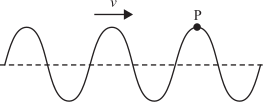
A sinusoidal wave of wavelength 1.40 m is travelling along a stretched string with constant speed \(v\), as shown in the figure below. The time taken for point \(\text{P}\) on the string to move from maximum displacement to zero is 0.120 s.
 

Calculate the speed of the wave, \(v\). Give your answer correct to three significant figures. Show your working.   (3 marks)

--- 5 WORK AREA LINES (style=lined) ---
Show Answers Only

\(v=2.92\ \text{ms}^{-1}\)

Show Worked Solution

Using  \(v=f\lambda\) and  \(f=\dfrac{1}{T}\):

\(v=\dfrac{\lambda}{T}=\dfrac{1.4}{4 \times 0.120}=2.92\ \text{ms}^{-1}\)

♦ Mean mark 50%.

Filed Under: Wave Properties and Behaviour Tagged With: Band 5, smc-4278-20-Wave calculations

PHYSICS, M2 2019 VCE 20 MC

As part of their Physics course, Anna, Bianca, Chris and Danshirou investigate the physics of car crashes. On an internet site that describes what happens during car crashes, they find the following statement.

"It happens in a flash: your car goes from driving to impacting ... As the vehicle crashes into something, it stops or slows very abruptly, and at the point of impact the car's structure will bend or break. That crumpling action works to absorb some of the initial crash forces, protecting the passenger compartment to some degree." 

The students disagree about the use of the word 'forces' in the statement, 'That crumpling action works to absorb some of the initial crash forces, protecting the passenger compartment to some degree',

Which one of the following students best identifies the physics of how the crumpling action protects the passengers?

A.   Anna '... to absorb some of the initial crash speed, protecting ...'
B. Bianca '... to absorb some of the initial crash kinetic energy, protecting ...'
C. Chris '... to absorb some of the initial crash momentum, protecting ...'
D. Danshirou '... to absorb some of the initial crash forces, protecting ...'
Show Answers Only

\(B\)

Show Worked Solution
  • It is the kinetic energy of the car which is transferred as the car hits the wall.
  • Part of the car’s kinetic energy goes into crumpling the front of the vehicle to protect the driver.

\(\Rightarrow B\) 

♦♦ Mean mark 36%.

Filed Under: Momentum, Energy and Simple Systems Tagged With: Band 5, smc-4277-30-Energy conservation

CHEMISTRY, M2 2013 VCE 8a

In an experiment, 5.85 g of ethanol was ignited with 14.2 g of oxygen.

  1. Write an equation for the complete combustion of ethanol.  (1 mark)

    --- 2 WORK AREA LINES (style=lined) ---

  2. Which reagent is in excess? Calculate the amount, in moles, of the reagent identified as being in excess.  (3 marks)

    --- 6 WORK AREA LINES (style=lined) ---

Show Answers Only

a.    \(\ce{C2H5OH(g) + 3O2(g) \rightarrow 2CO2(g) + 3H2O(g) }\)

b.   \(\ce{O2_{\text{(excess)}} = 0.062\ \text{mol}}\)

Show Worked Solution

a.    \(\ce{C2H5OH(g) + 3O2(g) \rightarrow 2CO2(g) + 3H2O(g) }\)

♦ Mean mark 43%.

 
b.
   \(\ce{MM(C2H5OH) = 2 \times 12.0 + 6 \times 1.0 + 16.0 = 46.0\ \text{g mol}^{-1}}\)

\(\ce{n(C2H5OH) = \dfrac{5.85}{46.0} = 0.1272\ \text{mol}} \)

\(\ce{n(O2) = \dfrac{14.2}{32.0} = 0.444\ \text{mol}}\)

\(\text{Reaction ratio}\ \ \ce{C2H5OH : O2 = 1:3}\)

\(\Rightarrow \ce{n(O2)_{\text{required}} = 3 \times 0.1272 = 0.382\ \text{mol}\ \ (\ce{O2}\ \text{excess}) }\)

\(\ce{O2_{\text{(excess)}} = 0.444-0.382 = 0.062\ \text{mol}}\)

Filed Under: Chemical Reactions and Stoichiometry Tagged With: Band 4, Band 5, smc-4259-20-Mass Changes, smc-4259-50-Balancing Chemical Equations

CHEMISTRY, M2 2015 VCE 4*

The emergency oxygen system in a passenger aircraft uses the decomposition of sodium chlorate to produce oxygen.

At 76.0 kPa and 292 K, each adult passenger needs about 1.60 L of oxygen per minute. The equation for the reaction is

\(\ce{2NaClO3(s)\rightarrow 2NaCl(s) + 3O2(g)}\)

\(\ce{MM(NaClO3) = 106.5 \text{g mol}^{–1}}\)

Calculate the mass of sodium chlorate required to provide the required volume of oxygen for each adult passenger per minute.   (3 marks)

--- 6 WORK AREA LINES (style=lined) ---

Show Answers Only

\(\text{3.56 grams\)

Show Worked Solution

\(\ce{2NaClO3(s)\rightarrow 2NaCl(s) + 3O2(g)}\)

\(\ce{n(O2)_{\text{req}} = \dfrac{pV}{RT} = \dfrac{76.0 \times 1.60}{8.31 \times 292} = 0.0501\ \text{mol} }\)

\(\ce{n(NaClO3) = \dfrac{2}{3} \times n(O2) = \dfrac{2}{3} \times 0.0501 = 0.0334\ \text{mol}}\)

\(\ce{m(NaClO3)_{\text{req}} = n \times MM = 0.0334 \times 106.6 = 3.56\ \text{g min}^{-1}}\)

♦ Mean mark 48%.

Filed Under: Gas Laws Tagged With: Band 5, smc-4262-20-Molar Calculations

PHYSICS, M4 2020 VCE 18

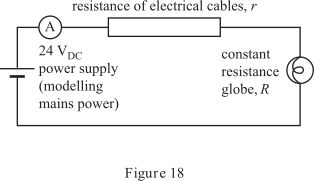
Students are modelling the effect of the resistance of electrical cables, \(r\), on the transmission of electrical power. They model the cables using the circuit shown in Figure 18.
 

The students investigate the effect of changing \(r\) by measuring the current in the electrical cables for a range of values. Their results are shown in Table 1 below.
 

\begin{array} {|c|c|c|}
\hline
\rule{0pt}{2.5ex} \text{Resistance of cables,}\ r\ (\Omega) \rule[-1ex]{0pt}{0pt} & \text{Current in cables},\ i\ (\text{A}) & \ \ \ \dfrac{1}{i} \Big{(}\text{A}^{-1}\Big{)}\ \ \  \\
\hline
\rule{0pt}{2.5ex} 2.4 \rule[-1ex]{0pt}{0pt} & 2.4 &  \\
\hline
\rule{0pt}{2.5ex} 3.6 \rule[-1ex]{0pt}{0pt} & 2.0 &  \\
\hline
\rule{0pt}{2.5ex} 6.4 \rule[-1ex]{0pt}{0pt} & 1.7 &  \\
\hline
\rule{0pt}{2.5ex} 7.6 \rule[-1ex]{0pt}{0pt} & 1.5 &  \\
\hline
\rule{0pt}{2.5ex} 10.4 \rule[-1ex]{0pt}{0pt} & 1.3 &  \\
\hline
\end{array}

  1. To analyse the data, the students use the following equation to calculate the resistance of the cables for the circuit.
  2.         \(r=\dfrac{24}{i}-R\)
  3. Show that this equation is true for the circuit shown in Figure 18. Show your working.  (2 marks)

    --- 3 WORK AREA LINES (style=lined) ---

  4. Calculate the values of \(\dfrac{1}{i}\) and write them in the spaces provided in the last column of Table 1 . (1 mark)

    --- 0 WORK AREA LINES (style=lined) ---

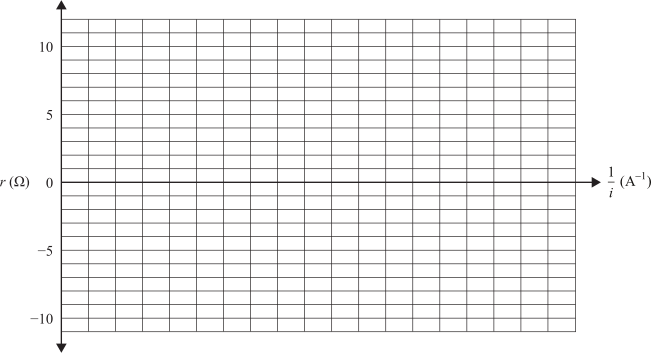
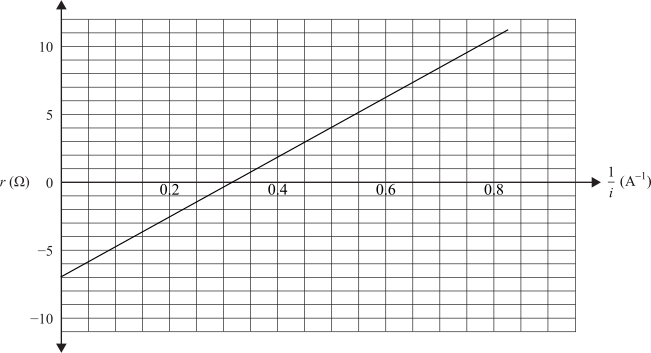
  5. Plot a graph of \(r\) on the \(y\)-axis against \(\dfrac{1}{i}\) on the \(x\)-axis on the grid provided below. On your graph:
    • choose an appropriate scale and numbers for the \(x\)-axis
    • draw a straight line of best fit through the plotted points  (3 marks)


--- 0 WORK AREA LINES (style=lined) ---

  1. Use the straight line of best fit to find the value of the constant resistance globe, \(R\). Give your reasoning.  (2 marks)

    --- 5 WORK AREA LINES (style=lined) ---

Show Answers Only

a.      \(V\) \(=iR\)  
\(V\) \(=i(r+R)\)  
\(\dfrac{V}{i}\) \(=r+R\)  
\(r\) \(=\dfrac{V}{i}-R\)  
\(r\) \(=\dfrac{24}{i}-R\)  

b.   

\begin{array} {|c|c|c|}
\hline
\rule{0pt}{2.5ex} \text{Resistance of cables,}\ r\ (\Omega) \rule[-1ex]{0pt}{0pt} & \text{Current in cables},\ i\ (\text{A}) & \ \ \ \dfrac{1}{i} \Big{(}\text{A}^{-1}\Big{)}\ \ \  \\
\hline
\rule{0pt}{2.5ex} 2.4 \rule[-1ex]{0pt}{0pt} & 2.4 & 0.42 \\
\hline
\rule{0pt}{2.5ex} 3.6 \rule[-1ex]{0pt}{0pt} & 2.0 & 0.5 \\
\hline
\rule{0pt}{2.5ex} 6.4 \rule[-1ex]{0pt}{0pt} & 1.7 & 0.59 \\
\hline
\rule{0pt}{2.5ex} 7.6 \rule[-1ex]{0pt}{0pt} & 1.5 & 0.67 \\
\hline
\rule{0pt}{2.5ex} 10.4 \rule[-1ex]{0pt}{0pt} & 1.3 & 0.77 \\
\hline
\end{array}

c.    
       

d.    The equation for the line:  \(r=\dfrac{24}{i}-R\).
  • The \(y\)-intercept of the graph correlates to the value of \(R\).
  • Reading from the graph, \(R= 7\ \Omega\).

Show Worked Solution

a.      \(V\) \(=iR\)  
\(V\) \(=i(r+R)\)  
\(\dfrac{V}{i}\) \(=r+R\)  
\(r\) \(=\dfrac{V}{i}-R\)  
\(r\) \(=\dfrac{24}{i}-R\)  
♦♦ Mean mark (a) 37%.

b.   

\begin{array} {|c|c|c|}
\hline
\rule{0pt}{2.5ex} \text{Resistance of cables,}\ r\ (\Omega) \rule[-1ex]{0pt}{0pt} & \text{Current in cables},\ i\ (\text{A}) & \ \ \ \dfrac{1}{i} \Big{(}\text{A}^{-1}\Big{)}\ \ \  \\
\hline
\rule{0pt}{2.5ex} 2.4 \rule[-1ex]{0pt}{0pt} & 2.4 & 0.42 \\
\hline
\rule{0pt}{2.5ex} 3.6 \rule[-1ex]{0pt}{0pt} & 2.0 & 0.5 \\
\hline
\rule{0pt}{2.5ex} 6.4 \rule[-1ex]{0pt}{0pt} & 1.7 & 0.59 \\
\hline
\rule{0pt}{2.5ex} 7.6 \rule[-1ex]{0pt}{0pt} & 1.5 & 0.67 \\
\hline
\rule{0pt}{2.5ex} 10.4 \rule[-1ex]{0pt}{0pt} & 1.3 & 0.77 \\
\hline
\end{array}
c.    
       

d.    The equation for the line:  \(r=\dfrac{24}{i}-R\).

  • The \(y\)-intercept of the graph correlates to the value of \(R\).
  • Reading from the graph, \(R= 7\ \Omega\).
♦♦ Mean mark (d) 33%.

Filed Under: Electric Circuits Tagged With: Band 5, Band 6, smc-4284-10-V=IR, smc-4284-20-Resistence in circuits, smc-4284-40-Heating effects of current

PHYSICS, M2 2020 VCE 9-10 MC

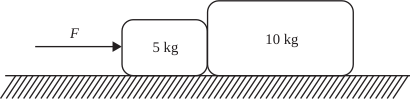
Two blocks of mass 5 kg and 10 kg are placed in contact on a frictionless horizontal surface, as shown in the diagram below. A constant horizontal force, \(F\), is applied to the 5 kg block.


Question 9

Which one of the following statements is correct?

  1. The net force on each block is the same.
  2. The acceleration experienced by the 5 kg block is twice the acceleration experienced by the 10 kg block.
  3. The magnitude of the net force on the 5 kg block is half the magnitude of the net force on the 10 kg block.
  4. The magnitude of the net force on the 5 kg block is twice the magnitude of the net force on the 10 kg block.

 
Question 10

If the force \(F\) has a magnitude of 250 N, what is the work done by the force in moving the blocks in a straight line for a distance of 20 m?

  1. \(5 \text{ kJ}\)
  2. \(25 \text{ kJ}\)
  3. \(50 \text{ kJ}\)
  4. \(500 \text{ kJ}\)
Show Answers Only

\(\text{Question 9:}\ C\)

\(\text{Question 10:}\ A\)

Show Worked Solution

\(\text{Question 9}\)

Using Newton’s second Law:  \(F=ma\ \ \Rightarrow\ \ a=\dfrac{F}{m}\).

  • The blocks will experience the same acceleration.
  • Both blocks will have the same force to mass ratio. Since the 5 kg block is half the mass of the 10 kg block, it will experience half the magnitude of the net force as the 10 kg block.

\(\Rightarrow C\)

♦ Mean mark 49%.

 
\(\text{Question 10}\)

\(W\) \(=F_{\parallel}s\)  
  \(=250 \times 20\)  
  \(=5000\ \text{J}\)  
  \(=5\ \text{kJ}\)  

 
\(\Rightarrow A\)

Filed Under: Forces Tagged With: Band 3, Band 5, smc-4275-10-Using Newton's laws, smc-4275-30-Newton's 2nd Law, smc-4276-40-Work done

PHYSICS, M3 2021 VCE 12

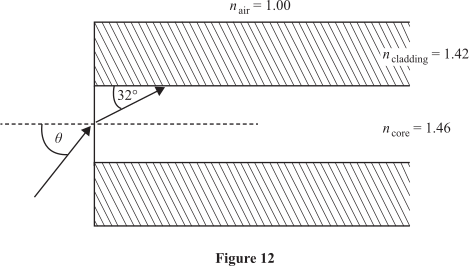
A Physics teacher is conducting a demonstration involving the transmission of light within an optical fibre. The optical fibre consists of an inner transparent core with a refractive index of 1.46 and an outer transparent cladding with a refractive index of 1.42. A single monochromatic light ray is incident on the optical fibre, as shown in diagram below.
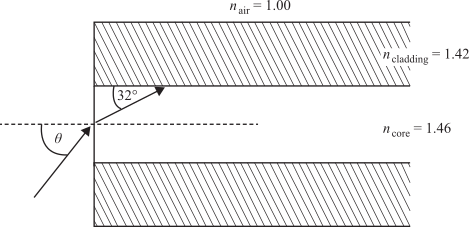
 

  1. Determine the angle of incidence, \(\theta\), at the air-core boundary. Show your working.  (2 marks)

    --- 4 WORK AREA LINES (style=lined) ---

  2. Will any of the initial light ray be transmitted into the cladding? Explain your answer and show any supporting working.  (3 marks)

    --- 6 WORK AREA LINES (style=lined) ---

Show Answers Only

a.   \(\theta=51^{\circ}\)

b.    Find the critical angle for Total Internal Reflection (TIR):

\(\sin\theta_c\) \(=\dfrac{n_2}{n_1}\)  
\(\theta_c\) \(=\sin^{-1}\Big{(}\dfrac{n_2}{n_1}\Big{)} =\sin^{-1} \Big{(}\dfrac{1.42}{1.46} \Big{)}=76.6^{\circ}\)  
  • The angle of incidence \(=90^{\circ}-32^{\circ}=58^{\circ}\).
  • As the angle of incidence is less than the critical angle, TIR will not occur and light will be transmitted into the cladding.
Show Worked Solution

a.    Using Snell’s Law:

\(n_1\sin\theta_1\) \(=n_2\sin\theta_2\)  
\(\theta_1\) \(=\sin^{-1} \Big{(}\dfrac{n_2\sin\theta_2}{n_1} \Big{)} \)  
  \(=\sin^{-1}\Big{(}\dfrac{1.46 \times \sin32^{\circ}}{1.0}\Big{)} \)  
  \(=51^{\circ}\)  
     

b.    Find the critical angle for Total Internal Reflection (TIR):

\(\sin\theta_c\) \(=\dfrac{n_2}{n_1}\)  
\(\theta_c\) \(=\sin^{-1}\Big{(}\dfrac{n_2}{n_1}\Big{)} =\sin^{-1} \Big{(}\dfrac{1.42}{1.46} \Big{)}=76.6^{\circ}\)  
  • The angle of incidence \(=90^{\circ}-32^{\circ}=58^{\circ}\).
  • As the angle of incidence is less than the critical angle, TIR will not occur and light will be transmitted into the cladding. 
♦ Mean mark (b) 45%.

Filed Under: Ray Model of Light Tagged With: Band 4, Band 5, smc-4281-10-Snell's Law, smc-4281-20-Snell's Law and TIR

PHYSICS, M4 2021 VCE 5b

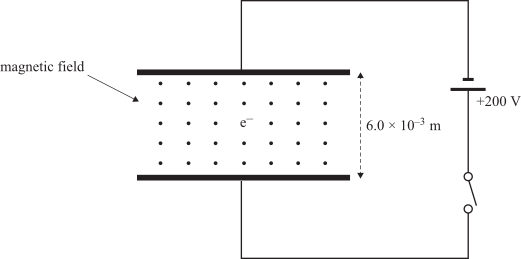
Figure 5 shows a stationary electron \(\left( \text{e} ^{-}\right)\) in a uniform magnetic field between two parallel plates. The plates are separated by a distance of 6.0 × 10\(^{-3}\) m, and they are connected to a 200 V power supply and a switch. Initially, the plates are uncharged. Assume that gravitational effects on the electron are negligible.


The switch is now closed.

Determine the magnitude and the direction of any electric force now acting on the electron. Show your working.  (3 marks)

Show Answers Only

\(F=5.34 \times 10^{-15}\ \text{N towards the bottom plate.}\)

Show Worked Solution
  • Determine the magnitude of the electric force on the electron:
  •    \(F=qE = \dfrac{qV}{d}=\dfrac{1.602 \times 10^{-19} \times 200}{6.0 \times 10^{-3}}=5.34 \times 10^{-15}\ \text{N}\)
  • The longer line of the battery cell represents the positive terminal, hence the bottom plate will be the positive plate and the electric force on the electron will be towards the bottom plate.
♦ Mean mark 53%.

Filed Under: Electrostatics Tagged With: Band 5, smc-4283-30-Forces on charges

PHYSICS, M4 2021 VCE 1

Two identical bar magnets of the same magnetic field strength are arranged at right angles to each other and at the same distance from point \(\text{P}\), as shown in Figure 1.
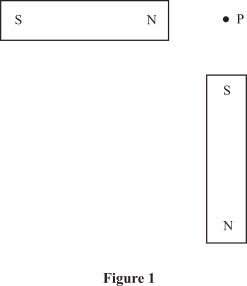
 

  1. At point \(\text{P}\) on Figure 1, draw an arrow indicating the direction of the combined magnetic field of the two bar magnets.  (1 mark)

    --- 0 WORK AREA LINES (style=lined) ---

  2. Calculate the magnitude of the combined magnetic field strength of the two bar magnets if each bar magnet has a magnetic field strength of 10.0 mT at point \(\text{P}\).  (2 marks)

    --- 5 WORK AREA LINES (style=lined) ---

Show Answers Only

a. 
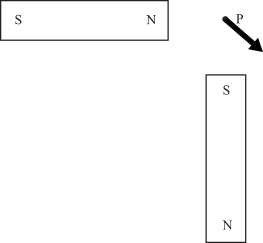
           

b.     \(\text{14.1 mT} \)

Show Worked Solution
a. 
           

♦ Mean mark (a) 39%.

 
b. 
 \(\text{Using Pythagoras:}\)

\(\text{Magnetic field strength}\) \(=\sqrt{(10.0 \times 10^{-3})^2 + (10.0 \times 10^{-3})^2}\)  
  \(=\sqrt{2 \times 10^{-4}}\)  
  \(=14.1 \times 10^{-3}\ \text{T}\)  
  \(=14.1\ \text{mT}\)  
♦♦ Mean mark (b) 33%.

Filed Under: Magnetism Tagged With: Band 5, smc-4285-30-Magnetic field models

PHYSICS, M3 2022 VCE 13

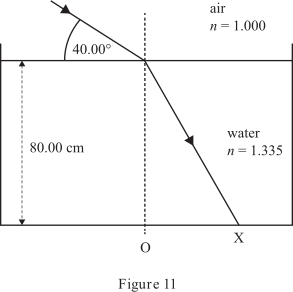
A ray of green light from a light-emitting diode (LED) strikes the surface of a tank of water at an angle of 40.00° to the surface of the water, as shown in diagram below. The ray arrives at the base of the tank at point \(\text{X}\). The depth of the water in the tank is 80.00 cm. The refractive index of green LED light in water is 1.335
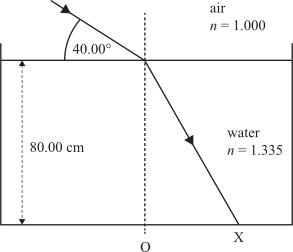
 

  1. Calculate the distance \(\text{OX}\). Outline your reasoning and show all your working. Give your answer in centimetres.   (4 marks)

    --- 8 WORK AREA LINES (style=lined) ---

  2. The green LED light is replaced with a narrow beam of white sunlight.
  3. Describe the colour of the light that arrives to the left of point \(\text{X}\), at point \(\text{X}\) and to the right of point \(\text{X}\).   (3 marks)
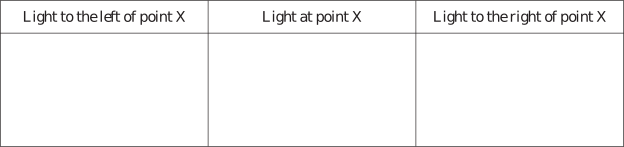
     
  4. --- 0 WORK AREA LINES (style=lined) ---

Show Answers Only

a.  \(OX=56\ \text{cm}\)

b.

\begin{array} {|c|c|c|}
\hline
\rule{0pt}{2.5ex}\text{Light to the left of point X}\rule[-1ex]{0pt}{0pt} & \text{Light at point X} & \text{Light to the right of point X} \\
\hline
\rule{0pt}{2.5ex}\text{Blue/Purple}\rule[-1ex]{0pt}{0pt} & \text{Green} & \text{Red} \\ \text{(lower wavelength)} & & \text{(higher wavelength)} \\
\hline
\end{array}

Show Worked Solution

a.  \(\text{Using Snell’s Law:}\)

\(n_1 \sin \theta_1\) \(=n_2 \sin \theta_2\)  
\(\sin \theta_2\) \(=\dfrac{n_1 \sin \theta_1}{n_2}\)  
\( \theta_2\) \(= \sin^{-1}\Big{(}\dfrac{1 \times \sin 50^{\circ}}{1.335} \Big{)}=35^{\circ}\)  


\(\tan35^{\circ}\) \(=\dfrac{OX}{80}\)  
\(OX\) \(=80\times \tan35^{\circ}=56\ \text{cm}\)  

♦ Mean mark 48%.

b. 

\begin{array} {|c|c|c|}
\hline
\rule{0pt}{2.5ex}\text{Light to the left of point X}\rule[-1ex]{0pt}{0pt} & \text{Light at point X} & \text{Light to the right of point X} \\
\hline
\rule{0pt}{2.5ex}\text{Blue/Purple}\rule[-1ex]{0pt}{0pt} & \text{Green} & \text{Red} \\ \text{(lower wavelength)} & & \text{(higher wavelength)} \\
\hline
\end{array}

Filed Under: Ray Model of Light Tagged With: Band 4, Band 5, smc-4281-10-Snell's Law, smc-4281-30-Light dispersion

PHYSICS, M2 2022 VCE 7

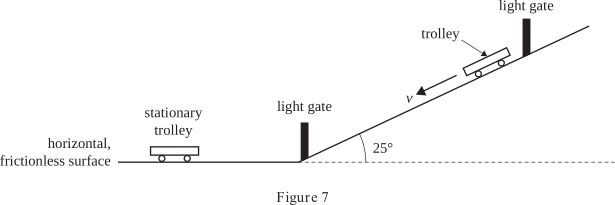
Kym and Kelly are experimenting with trolleys on a ramp inclined at 25°, as shown in the diagram below. They release a trolley with a mass of 2.0 kg from the top of the ramp. The trolley moves down the ramp, through two light gates and onto a horizontal, frictionless surface. Kym and Kelly calculate the acceleration of the trolley to be \(3.2\ \text{m s}^{-2}\) using the information from the light gates.
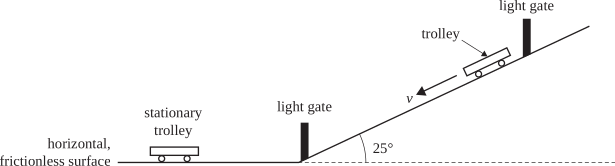


  1.  i. Show that the component of the gravitational force of the trolley down the slope is \(8.3 \text{ N}\). Use \(g=9.8 \text{ m s}^{-2}\).  (2 marks)

--- 5 WORK AREA LINES (style=lined) ---

  1. ii. Assume that on the ramp there is a constant frictional force acting on the trolley and opposing its motion.
  2.      Calculate the magnitude of the constant frictional force acting on the trolley.  (2 marks)

--- 5 WORK AREA LINES (style=lined) ---

  1. When it reaches the bottom of the ramp, the trolley travels along the horizontal, frictionless surface at a speed of \(4.0\ \text{m s}^{-1}\) until it collides with a stationary identical trolley. The two trolleys stick together and continue in the same direction as the first trolley.
    1. Calculate the speed of the two trolleys after the collision. Show your working and clearly state the physics principle that you have used.  (3 marks)

--- 6 WORK AREA LINES (style=lined) ---

    1. Determine, with calculations, whether this collision is an elastic or inelastic collision. Show your working.  (3 marks)

--- 6 WORK AREA LINES (style=lined) ---

Show Answers Only

a.i.   See Worked Solutions

a.ii.  \(F_f=1.9\ \text{N}\)

b.i.   \(2.0\ \text{ms}^{-1}\)

 b.ii.  For the collision to be elastic, the kinetic energy must be conserved.

\(KE_{\text{init}}=\dfrac{1}{2} mv^2=\dfrac{1}{2} \times 2 \times 4^2=16\ \text{J}\)

\(KE_{\text{final}}=\dfrac{1}{2} mv^2=\dfrac{1}{2} \times 4 \times 2^2=8\ \text{J}\)

\(\therefore\) Since the kinetic energy of the system decreases after the collision, it is not an elastic collision.

Show Worked Solution

a.i.  The gravitational force down the slope:

\(F=mg\, \sin \theta=2.0 \times 9.8 \times \sin 25=8.3\ \text{N}\) 

 
a.ii.
\(F_{net}=ma=2.0 \times 3.2=6.4\ \text{N}\)

\(6.4\) \(=F-F_f\)  
\(F_f\) \(=8.3-6.4\)  
  \(=1.9\ \text{N}\)  
♦ Mean mark (a.ii) 53%.

b.i.   By the conservation of momentum:

\(m_1u_1+m_2u_2\) \(=v(m_1+m_2)\)  
\(2 \times 4 + 2 \times 0\) \(=v(2 +2)\)  
\(8\) \(=4v\)  
\(v\) \(=2\ \text{ms}^{-1}\)  
 

 b.ii.  For the collision to be elastic, the kinetic energy must be conserved.

\(KE_{\text{init}}=\dfrac{1}{2} mv^2=\dfrac{1}{2} \times 2 \times 4^2=16\ \text{J}\)

\(KE_{\text{final}}=\dfrac{1}{2} mv^2=\dfrac{1}{2} \times 4 \times 2^2=8\ \text{J}\)

\(\therefore\) Since the kinetic energy of the system decreases after the collision, it is not an elastic collision.

Filed Under: Forces, Acceleration and Energy, Momentum, Energy and Simple Systems Tagged With: Band 3, Band 4, Band 5, smc-4276-20-Friction, smc-4277-20-Momentum conservation, smc-4277-40-Elastic/inelastic collisions

PHYSICS, M3 2022 VCE 12*

A 45° glass prism is submerged in water and oriented as shown in the diagram below. It is used to reflect a light ray through 90°.
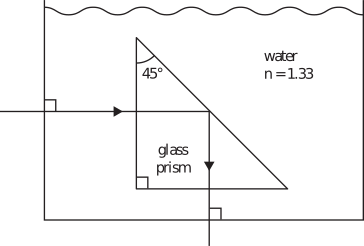
 

What is the lowest refractive index of the glass prism that will ensure that total internal reflection occurs inside the prism?   (2 marks)

--- 4 WORK AREA LINES (style=lined) ---

Show Answers Only

\(1.88\)

Show Worked Solution

Using snell’s law where  \( \theta_2 = 90^{\circ}\):

\(n_1\sin\theta_1\) \(=n_2\sin\theta_2\)  
\(n_1 \times \sin 45^{\circ}\) \(=1.33 \times \sin 90^{\circ}\)  
\(n_1\) \(=\dfrac{1.33 \times 1}{\sin 45^{\circ}}\)  
  \(=1.88\)  
♦ Mean mark 51%.

Filed Under: Ray Model of Light Tagged With: Band 5, smc-4281-20-Snell's Law and TIR

PHYSICS, M2 2022 VCE 6-7 MC

A railway truck \(\text{(X)}\) of mass 10 tonnes, moving at 3.0 m s\(^{-1}\), collides with a stationary railway truck \(\text{(Y)}\), as shown in the diagram below.

After the collision, they are joined together and move off at speed  \(v= 2.0\ \text{m s}^{-1}\).
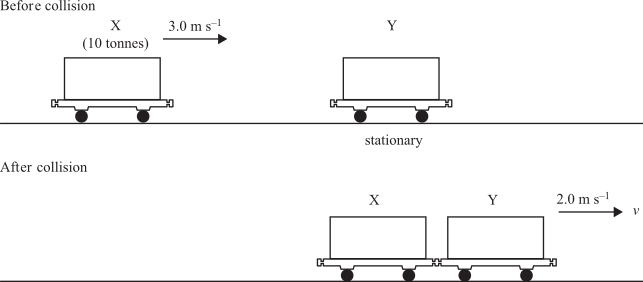


Question 6

Which one of the following is closest to the mass of railway truck \(\text{Y}\)?

  1. 3 tonnes
  2. 5 tonnes
  3. 6.7 tonnes
  4. 15 tonnes

 
Question 7

Which one of the following best describes the force exerted by the railway truck \(\text{X}\) on the railway truck \(\text{Y} \left(F_{\text { X on Y}}\right)\) and the force exerted by the railway truck \(\text{Y}\) on the railway truck \(\text{X} \left(F_{\text {Y on X}}\right)\) at the instant of collision?

  1. \(F_{  \text { X on Y }  }<F_{ \text {Y on X}  }\)
  2. \(F_{ \text { X on Y }  }=F_{ \text { Y on X}  }\)
  3. \(F_{ \text { X on Y }  }=-F_{  \text { Y on X}  }\)
  4. \(F_{  \text {X on Y } }>F_{ \text {Y on X}  }\)
Show Answers Only

\(\text{Question 6:}\ B\)

\(\text{Question 7:}\ C\)

Show Worked Solution

Question 6

  • By the law of conservation of momentum, the momentum before the collision is equal to the momentum after the collision.
\(m_Xu_X+m_Yu_Y\) \(=m_Xv_X+m_Yv_Y\)  
  \(=v(m_X + m_Y)\ \ \ (v_X=v_Y) \)  
\(10000 \times 3 +0\) \(= 2(10000 + m_Y)\)  
\(15000\) \(=10000 +m_Y\)  
\(m_Y\) \(=5000\ \text{kg}\)   
  \(=5\ \text{tonnes}\)   

\( \Rightarrow B\)

 
Question 7

  • By Newton’s 3rd law of motion, each action has an equal and opposite reaction. 
  • Hence, the force of \(F_{ \text { X on Y }  }\) is equal in magnitude to \(F_{  \text { Y on X}  }\) but opposite in direction which is indicated by the negative sign (–).

\( \Rightarrow C\)

♦ Mean mark (Q7) 47%.

Filed Under: Forces, Momentum, Energy and Simple Systems Tagged With: Band 3, Band 5, smc-4275-20-Newtons 3rd Law, smc-4277-20-Momentum conservation

PHYSICS, M2 2022 VCE 9 MC

Two students pull on opposite ends of a rope, as shown in the diagram below. Each student pulls with a force of 400 N.
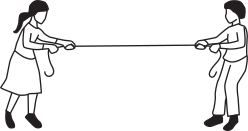
 

Which one of the following is closest to the magnitude of the force of the rope on each student?

  1. \(\text{0 N}\)
  2. \(\text{400 N}\)
  3. \(\text{600 N}\)
  4. \(\text{800 N}\)
Show Answers Only

\(B\)

Show Worked Solution
  • Newton’s 3rd Law states that every action has an equal and opposite reaction.
  • As each student exerts a force of 400 N on the rope, the rope will exert a force of 400 N on the student.

\(\Rightarrow B\)

♦ Mean mark 52%.

Filed Under: Forces Tagged With: Band 5, smc-4275-10-Using Newton's laws, smc-4275-20-Newtons 3rd Law

BIOLOGY, M3 2022 VCE 32-33 MC

Victoria’s fossil emblem Koolasuchus cleelandi, shown on the stamp above, was chosen in January 2022.

K. cleelandi fossils have been found in Boonwurrung country in Gippsland. Studies of K. cleelandi fossils have revealed many interesting findings. Several of these findings are summarised below.

K. cleelandi findings

    1. It was an amphibian that lived 125 million years ago.
    2. It had a jaw, a skull, vertebrae and ribs made of bone.
    3. It was covered in scales and had fangs on the roof of its mouth.
    4. It lived in rivers carrying many sediments.
    5. It lived in Victoria for 50 million years after its closest relatives in the rest of the world became extinct.
    6. It fed on small dinosaurs, turtles and fish.
    7. It was the size of a small car, 4 m long and weighed 500 kg. 


Part 1

Which combination of findings from the list above is most likely to be associated with an increased chance of formation of K. cleelandi fossils?

  1. findings 1 and 6
  2. findings 2 and 4
  3. findings 3 and 5
  4. findings 2 and 7

 
Part 2

It is most likely that scientists determined the absolute age of K. cleelandi fossils

  1. through mtDNA analysis of K. cleelandi scales and fangs.
  2. through carbon-14 dating of jaw bones, skull, vertebrae and ribs.
  3. by finding index fossils nearby, such as those of small dinosaurs and turtles.
  4. through radioisotope dating of rock surrounding the fossils.
Show Answers Only

Part 1: \(B\)

Part 2: \(D\)

Show Worked Solution

Part 1

  • K. cleelandi has large, dense bones (finding 2) which are less likely to decay overtime and hence have a higher chnace of being fossilised for a long period of time.
  • Because these bones are remaining in a river carrying many sediments (finding 4) the bones are more likely to be fossilised as they are covered quicker, reducing disturbance and hiding them from scavnegers.

\(\Rightarrow B\)
  

Part 2

  • Radioisotope dating of rocks is extremely accurate and reliable source of dating.
  • Therefore it is likely that scientists dated K. cleelandi fossils by dating the surrounding rock.

\(\Rightarrow D\)

♦ Mean mark (part 2) 52%.

Filed Under: Evolution - The Evidence Tagged With: Band 3, Band 5, smc-4310-05-Fossils

CHEMISTRY, M4 2021 VCE 24 MC

Which one of the following statements describes the effect that adding a catalyst will have on the energy profile diagram for an exothermic reaction?

  1. The energy of the products will remain the same.
  2. The shape of the energy profile diagram will remain the same.
  3. The peak of the energy profile will move to the left as the reaction rate increases.
  4. The activation energy will be lowered by the same proportion in the forward and reverse reactions.
Show Answers Only

\(A\)

Show Worked Solution

  • The energy content of both the products and reactants is the same in both reactions (\(\Delta H\) unchanged).
  • Although the activation energy of the forward and reverse reaction decreases by the same amount in the uncatalysed vs catalysed reactions, the proportions are different (i.e. the decrease is a higher proportion of the forward reaction’s activation energy).

\(\Rightarrow A\)

Filed Under: Energy Changes in Chemical Reactions Tagged With: Band 5, smc-4266-30-Energy profiles, smc-4266-40-Role of catalysts

CHEMISTRY, M4 2020 VCE 27 MC

The heat of combustion of ethanoic acid, \(\ce{C2H4O2}\), is –876 kJ mol\(^{-1}\) and the heat of combustion of methyl methanoate, \(\ce{C2H4O2}\), is –973 kJ mol\(^{-1}\). The auto-ignition temperature (the temperature at which a substance will combust in air without a source of ignition) of ethanoic acid is 485°C and the auto-ignition temperature of methyl methanoate is 449°C.

Which one of the following pairs is correct?
 

  \(\text{Compound with the lower}\)
\(\text{chemical energy per mole}\)
\(\text{Compound with the lower activation}\)
\(\text{energy of combustion per mole}\)
A.   \(\text{ethanoic acid}\) \(\text{methyl methanoate}\)
B. \(\text{ethanoic acid}\) \(\text{ethanoic acid}\)
C. \(\text{methyl methanoate}\) \(\text{methyl methanoate}\)
D. \(\text{methyl methanoate}\) \(\text{ethanoic acid}\)
Show Answers Only

\(A\)

Show Worked Solution
  • Ethanoic acid converts less chemical energy to heat energy per mole (–876 kJ vs –973 kJ) indicating a lower chemical energy per mole.
  • Methyl methanoate’s lower autoignition temperature (449°C vs 485°C) indicates that a lower activation energy for combustion is needed.

\(\Rightarrow A\)

♦ Mean mark 53%.

Filed Under: Energy Changes in Chemical Reactions Tagged With: Band 5, smc-4266-20-Heat of combustion

CHEMISTRY, M4 2020 VCE 22 MC

The combustion of which fuel provides the most energy per 100 g?

  1. pentane (\(\ce{MM}\) = 72 g mol\(^{-1}\)), which releases 49 097 MJ tonne\(^{-1}\)
  2. nitromethane (\(\ce{MM}\) = 61 g mol\(^{-1}\)), which releases 11.63 kJ g\(^{-1}\)
  3. butanol (\(\ce{MM}\) = 74 g mol\(^{-1}\)), which releases 2670 kJ mol\(^{-1}\)
  4. ethyne (\(\ce{MM}\) = 26 g mol\(^{-1}\)), which releases 1300 kJ mol\(^{-1}\)
Show Answers Only

\(D\)

Show Worked Solution

\(\text{Convert all options to kJ per 100 grams}\)

\(\text{A: Energy}\ = 100\ \text{g} \times 49\ 097 \times\ 10^{-6}\ \text{MJ g}^{-1} = 4.91\ \text{MJ}\ =4.91\ \times 10^{3}\ \text{kJ} \)

\(\text{B: Energy}\ = 100\ \text{g} \times 11.63\ \text{kJ g}^{-1} =1.16\ \times 10^{3}\ \text{kJ} \)

\(\text{C: Energy}\ = \dfrac{100}{74}\ \text{mol} \times 2670\ \text{kJ mol}^{-1} =3.73\ \times 10^{3}\ \text{kJ} \)

\(\text{D: Energy}\ = \dfrac{100}{26}\ \text{mol} \times 1300\ \text{kJ mol}^{-1} =5.0\ \times 10^{3}\ \text{kJ} \)

\(\Rightarrow D\)

♦ Mean mark 46%.

Filed Under: Energy Changes in Chemical Reactions Tagged With: Band 5, smc-4266-20-Heat of combustion

CHEMISTRY, M4 2017 VCE 24*

A sample of olive oil with a wick in a jar is ignited and used to heat a beaker containing 500.0 g of water, \(\ce{H2O}\). The relevant data for the experiment is included in the table below.
 

After complete combustion of 2.97 g of olive oil, calculate the final temperature of the water, in degrees Celsius.   (3 marks)

Show Answers Only

\(\text{Final temperature}\ = 65.9°\text{C} \)

Show Worked Solution

\(\Delta H\text{(olive oil)} = 2.97 \times 41.0 = 121.8\ \text{kJ}\)

\(\text{Energy absorbed by}\ \ce{H2O} = 121.8-28.0 = 93.8\ \text{kJ}\)

♦ Mean mark 48%.
\(\Delta H\) \(= mC \Delta T\)  
\(93.8 \times 10^3\) \(=0.500 \times 4.18 \times 10^3 \times \Delta T \)  
\(\Delta T\) \(= \dfrac{93.8}{0.500 \times 4.18}\)  
  \(=44.9 \text{°C}\)  

 
\( \text{Final temperature}\ = 21.0 + 44.9 = 65.9° \text{C} \)

Filed Under: Energy Changes in Chemical Reactions Tagged With: Band 5

CHEMISTRY, M4 2017 VCE 23 MC

The heat of combustion of a sample of crude oil is to be determined using a bomb calorimeter. All of the students in a class are given the same method to follow. The apparatus used by the students is shown below.
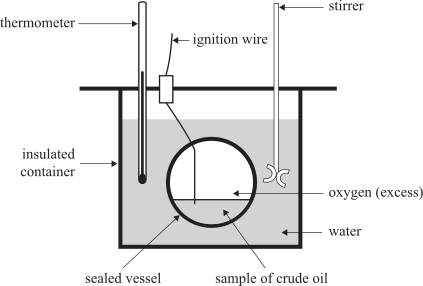
 

For this experiment, the students could maximise

  1. precision by using a digital thermometer \(\pm\)0.2 °C.
  2. validity by calculating the heat of combustion per mole.
  3. accuracy by taking samples from three different sources.
  4. uncertainty by having all students closely follow the same experimental procedure.
Show Answers Only

\(\A\)

Show Worked Solution

Consider each option:

  • Option A: Error involved in reading the thermometer would be improved by this measure.
  • Option B: Energy per mole is inappropriate as crude oil is used.
  • Option C: Accuracy dependent on process technique, not the source of samples.
  • Option D: If the procedure itself creates inaccuracy, this is incorrect. 

\(\Rightarrow A\)

♦ Mean mark 49%.

Filed Under: Energy Changes in Chemical Reactions Tagged With: Band 5, smc-4266-50-Calorimetry

CHEMISTRY, M4 2015 HSC 20 MC

The table shows the heat of combustion of four straight chain alkanols.

\begin{array} {|c|c|}
\hline \text{Number of C atoms in} & \text{Heat of combustion} \\ \text{straight chain alkanol} & \text{(kJ mol}^{-1})  \\
\hline 1  &  726 \\
\hline 3 & 2021  \\
\hline 5 &  3331 \\
\hline 7 & 4638  \\
\hline \end{array}

What is the mass of water that could be heated from 20°C to 45°C by the complete combustion of 1.0 g of heptan-1-ol \(\ce{(C7H16O)}\)? 

  1. 0.032 kg
  2. 0.044 kg
  3. 0.36 kg
  4. 0.38 kg
Show Answers Only

\(D\)

Show Worked Solution

Heptan-1-ol has seven \(\ce{C}\) atoms.

\(\ce{n(heptan-1-ol) = \dfrac{\text{m}}{\text{MM}} = \dfrac{1}{116.88} = 0.00856\ \text{mol}}\)

\(\ce{\Delta $H$ = 4638 \times 0.00856 = 39.7\ \text{kJ}}\)

♦ Mean mark 51%.
\(\ce{\Delta $H$}\) \(=mC \Delta H\)  
\(39.7 \times 10^3\) \(=m \times 4.18 \times 10^3(45-20) \)  
\(m\) \(=\dfrac{39.7 \times 10^3}{25 \times 4.18 \times 10^3}\)  
  \(=0.380\ \text{kg}\)  

 
\(\Rightarrow D\)

Filed Under: Energy Changes in Chemical Reactions Tagged With: Band 5, smc-4266-20-Heat of combustion

CHEMISTRY, M2 2018 VCE 2c

A solution of \(\ce{H2O2}\) is labelled ‘10 volume’ because 1.00 L of this solution produces 10.0 L of \(\ce{O2}\) measured at standard laboratory conditions (SLC) when the \(\ce{H2O2}\) in the solution is fully decomposed.

\(\ce{2H2O2 -> 2H2O + O2}\)

Calculate the concentration of \(\ce{H2O2}\) in the ‘10 volume’ solution, in grams per litre, when this solution is first prepared.  (3 marks)

--- 5 WORK AREA LINES (style=lined) ---

Show Answers Only

\(\ce{[H2O2] = 27.4\ \text{g L}^{-1}}\)

Show Worked Solution

\(\ce{n(O2) = \dfrac{10.0}{24.8} = 0.403\ \text{mol  (at SLC)}}\)

\(\ce{n(H2O2) = 2 \times n(O2) = 2 \times 0.403 = 0.806\ \text{mol}}\)

\(\ce{MM(H2O2) = 2 \times 1.008 + 2 \times 16 = 34.0\ \text{g}}\)

\(\ce{m(H2O2) = 0.806 \times 34.0 = 27.4\ \text{g}}\)

\(\therefore \ce{[H2O2] = 27.4\ \text{g L}^{-1}}\)

♦♦ Mean mark 38%.

Filed Under: Concentration and Molarity Tagged With: Band 5, smc-4261-20-Concentration Calculations

PHYSICS, M3 2014 HSC 32bi

What happens to white light when it hits a red surface?   (2 marks)

--- 4 WORK AREA LINES (style=lined) ---

Show Answers Only
  • When white light hits a red surface, the shorter wavelengths of light are absorbed into the surface.
  • The longer red wavelengths of light are reflected off of the surface and into the eyes of the observer, hence the surface appears red.
Show Worked Solution
  • When white light hits a red surface, the shorter wavelengths of light are absorbed into the surface.
  • The longer red wavelengths of light are reflected off of the surface and into the eyes of the observer, hence the surface appears red.
♦ Mean mark 44%.

Filed Under: Ray Model of Light Tagged With: Band 5, smc-4281-30-Light dispersion

PHYSICS, M4 2014 HSC 32ai

Draw a labelled diagram to describe Earth’s present magnetic field.  (2 marks)

--- 7 WORK AREA LINES (style=lined) ---

Show Answers Only
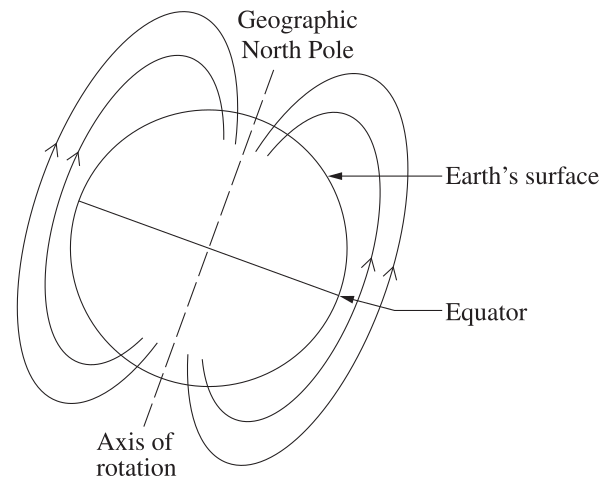
Show Worked Solution

♦ Mean mark 47%.

Filed Under: Magnetism Tagged With: Band 5, smc-4285-30-Magnetic field models

PHYSICS, M1 2012 HSC 21

  1. Outline a first-hand investigation that could be performed to measure a value for acceleration due to gravity.   (3 marks)

    --- 8 WORK AREA LINES (style=lined) ---

  2. How would you assess the accuracy of the result of the investigation?   (1 mark)

    --- 2 WORK AREA LINES (style=lined) ---

  3. How would you increase the reliability of the data collected?   (1 mark)

    --- 2 WORK AREA LINES (style=lined) ---

  4. How would you assess the reliability of the data collected?   (1 mark)

    --- 2 WORK AREA LINES (style=lined) ---

Show Only

a.    Timing of a falling mass.

  • Set up an electronic and automatic timing system with sensors to detect the presence of a small falling metal ball.
  • Heights for the ball should be set up between 0.2 m to 1 m with intervals every 0.2 m. To increase the reliability of the results, multiple trials should be conducted at each height and the average falling time for each height should be calculated which can then be used to graph the data.
  • The results should be plotted on a graph of height vs time\(^2\). This uses the equation  \(s=ut +\dfrac{1}{2}at^2\)  where  \(u=0\)  which becomes  \(s=\dfrac{1}{2}at^2\).
  • After plotting the data, the acceleration due to gravity, \(a\), can be calculated using  \(a=\dfrac{2s}{t^2}\), which will make it equal to 2 × the gradient of the line of best fit.

b.    Assessing accuracy of results:

  • Look up known value on a reliable website (e.g. National Measurement Institute).
  • Ensure the value is for the location of the experiment (it can differ slightly).
  • Compare the known value to the value determined experimentally and the closer they are, the greater the accuracy of the experiment.

c.    Increasing data reliability:

  • Conduct multiple trials at each height.
  • Use the average of the calculations as stated in the method above.

d.   Assessing data reliability:

  • Compare the values obtained at a single height.
  • If there is a large variation in the calculations conducted at the same height, the data collected is less reliable.

Show Worked Solution

a.    Timing of a falling mass.

  • Set up an electronic and automatic timing system with sensors to detect the presence of a small falling metal ball.
  • Heights for the ball should be set up between 0.2 m to 1 m with intervals every 0.2 m. To increase the reliability of the results, multiple trials should be conducted at each height and the average falling time for each height should be calculated which can then be used to graph the data.
  • The results should be plotted on a graph of height vs time\(^2\). This uses the equation  \(s=ut +\dfrac{1}{2}at^2\)  where  \(u=0\)  which becomes  \(s=\dfrac{1}{2}at^2\).
  • After plotting the data, the acceleration due to gravity, \(a\), can be calculated using  \(a=\dfrac{2s}{t^2}\), which will make it equal to 2 × the gradient of the line of best fit.
♦ Mean mark (a) 55%.

b.    Assessing accuracy of results:

  • Look up known value on a reliable website (e.g. National Measurement Institute).
  • Ensure the value is for the location of the experiment (it can differ slightly).
  • Compare the known value to the value determined experimentally and the closer they are, the greater the accuracy of the experiment.
♦♦♦ Mean mark (b) 26%.

c.    Increasing data reliability:

  • Conduct multiple trials at each height.
  • Use the average of the calculations as stated in the method above.

d.   Assessing data reliability:

  • Compare the values obtained at a single height.
  • If there is a large variation in the calculations conducted at the same height, the data collected is less reliable.
♦♦♦ Mean mark (d) 7%.

Filed Under: Motion in a Straight Line Tagged With: Band 3, Band 5, Band 6, smc-4273-30-Acceleration

  • « Previous Page
  • 1
  • …
  • 29
  • 30
  • 31
  • 32
  • 33
  • …
  • 82
  • Next Page »

Copyright © 2014–2025 SmarterEd.com.au · Log in