The function `f` is defined by `f(x)=\sin (x)` for all real numbers `x`. Let `g` be the function defined on `[-1,1]` by `g(x)=\arcsin (x)`.
Is `g` the inverse of `f`? Justify your answer. (2 marks)
Aussie Maths & Science Teachers: Save your time with SmarterEd
The function `f` is defined by `f(x)=\sin (x)` for all real numbers `x`. Let `g` be the function defined on `[-1,1]` by `g(x)=\arcsin (x)`.
Is `g` the inverse of `f`? Justify your answer. (2 marks)
A game consists of randomly selecting 4 balls from a bag. After each ball is selected it is replaced in the bag. The bag contains 3 red balls and 7 green balls. For each red ball selected, 10 points are earned and for each green ball selected, 5 points are deducted. For instance, if a player picks 3 red balls and 1 green ball, the score will be `3xx10-1xx5=25` points.
What is the expected score in the game? (2 marks)
--- 6 WORK AREA LINES (style=lined) ---
The angle between two unit vectors `underset~a` and `underset~b` is `theta` and `|underset~a+ underset~b| < 1`.
Which of the following best describes the possible range of values of `theta` ?
The diagram shows triangle `A B C` with points chosen on each of the sides. On side `A B`, 3 points are chosen. On side `A C`, 4 points are chosen. On side `B C`, 5 points are chosen.
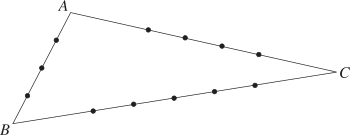
How many triangles can be formed using the chosen points as vertices?
The following diagram shows the vector `underset∼u` and the vectors `underset∼i+underset∼j,-underset∼i+ underset∼j,-underset∼i- underset∼j` and `underset∼i-underset∼j`.

Which statement regarding this diagram could be true?
`text{Consider each option by tracing projections on the graph:}`
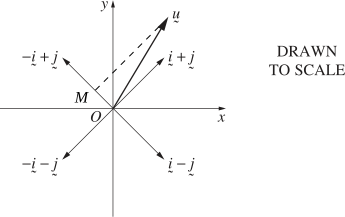
`overset(->)(OM)= text(proj)_((-underset~i+underset~j)) underset~u`
`text{Option B’s projection is only possible correct option.}`
`=>B`
Let `P(x)` be a polynomial of degree 5. When `P(x)` is divided by the polynomial `Q(x)`, the remainder is `2x+5`.
Which of the following is true about the degree of `Q`?
In a reducing-balance loan, an amount `$P` is borrowed for a period of `n` months at an interest rate of 0.25% per month, compounded monthly. At the end of each month, a repayment of `$M` is made. After the `n`th repayment has been made, the amount owing, `$A_n`, is given by
`A_(n)=P(1.0025)^(n)-M(1+(1.0025)^(1)+(1.0025)^(2)+cdots+(1.0025)^(n-1))`
(Do NOT prove this.)
The loan is to be repaid in 180 monthly repayments.
Show that `M` = 1381.16, when rounded to the nearest cent. (2 marks)
--- 5 WORK AREA LINES (style=lined) ---
After 100 repayments of $1381.16 have been made, the interest rate changes to 0.35% per month.
At this stage, the amount owing to the nearest dollar is $100 032. (Do NOT prove this.)
Jane continues to make the same monthly repayments.
For how many more months will Jane need to make full monthly payments of $1381.16? (3 marks)
--- 6 WORK AREA LINES (style=lined) ---
--- 4 WORK AREA LINES (style=lined) ---
A line passes through the point `P(1,2)` and meets the axes at `X(x, 0)` and `Y(0, y)`, where `x>1`.

--- 5 WORK AREA LINES (style=lined) ---
--- 9 WORK AREA LINES (style=lined) ---
a. `text{Show}\ \ y=(2x)/(x-1)`
`text{S}text{ince}\ \ m_(YP)=m_(PX):`
| `(y-2)/(0-1)` | `=(2-0)/(1-x)` | |
| `y-2` | `=(-2)/(1-x)` | |
| `y` | `=2-2/(1-x)` | |
| `=(2(1-x)-2)/(1-x)` | ||
| `=(-2x)/(1-x)` | ||
| `=(2x)/(x-1)\ \ text{… as required}` |
| b. | `A` | `=1/2 xx b xxh` |
| `=1/2x((2x)/(x-1))` | ||
| `=(x^2)/(x-1)` |
| `(dA)/dx` | `=((x-1)*2x-x^2(1))/((x-1)^2)` | |
| `=(2x^2-2x-x^2)/((x-1)^2)` | ||
| `=(x(x-2))/((x-1)^2)` |
`text{SP’s occur when}\ \ (dA)/dx=0:`
`x=0\ \ text{or}\ \ 2`
`text{Use 1st derivative test to find max/min:}`
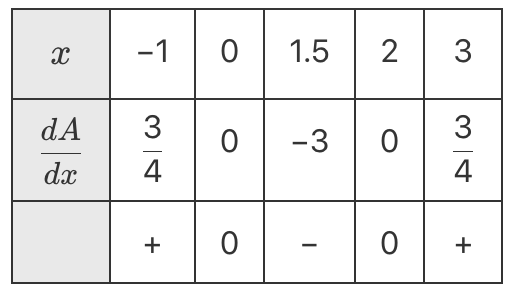
`=>\ text{MIN at}\ \ x=2`
| `:.A_min` | `=1/2 xx 2 xx (2xx2)/(2-1)` | |
| `=4\ text{u}^2` |
A continuous random variable \(X\) has cumulative distribution function given by
\(F(x)= \begin{cases}
1 & x>e^3 \\
\ \\
\dfrac{1}{k}\, \ln x & 1 \leq x \leq e^3 . \\
\ \\
0 & x<1\end{cases}\)
--- 2 WORK AREA LINES (style=lined) ---
--- 4 WORK AREA LINES (style=lined) ---
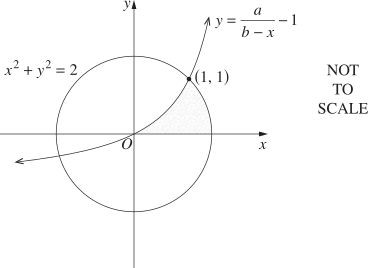
The graph of the circle `x^2+y^2=2` is shown.
The interval connecting the origin, `O`, and the point `(1,1)` makes an angle `theta` with the positive `x`-axis.

--- 4 WORK AREA LINES (style=lined) ---
Part of the hyperbola `y=(a)/(b-x)-1` which passes through the points `(0,0)` and `(1,1)` is drawn with the circle `x^2+y^2=2` as shown.
--- 5 WORK AREA LINES (style=lined) ---
--- 6 WORK AREA LINES (style=lined) ---
The depth of water in a bay rises and falls with the tide. On a particular day the depth of the water, `d` metres, can be modelled by the equation
`d=1.3-0.6 cos((4pi)/(25)t)`,
where `t` is the time in hours since low tide.
--- 3 WORK AREA LINES (style=lined) ---
--- 3 WORK AREA LINES (style=lined) ---
--- 6 WORK AREA LINES (style=lined) ---
The graph of the function `f(x)=x^2` is translated `m` units to the right, dilated vertically by a scale factor of `k` and then translated 5 units down. The equation of the transformed function is `g(x)=3 x^2-12 x+7`.
Find the values of `m` and `k`. (3 marks)
--- 6 WORK AREA LINES (style=lined) ---
In a bag there are 3 six-sided dice. Two of the dice have faces marked 1, 2, 3, 4, 5, 6. The other is a special die with faces marked 1, 2, 3, 5, 5, 5.
One die is randomly selected and tossed.
--- 2 WORK AREA LINES (style=lined) ---
--- 3 WORK AREA LINES (style=lined) ---
The graphs of `y=f(x)` and `y=g(x)` are shown.
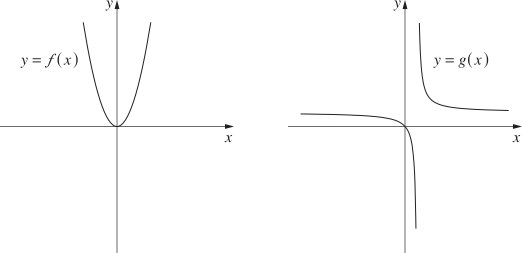
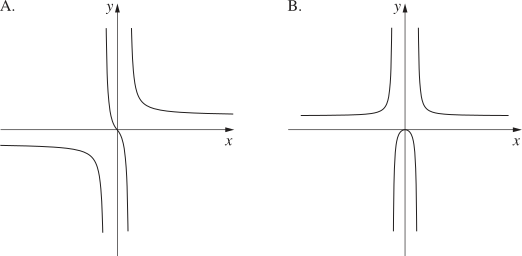
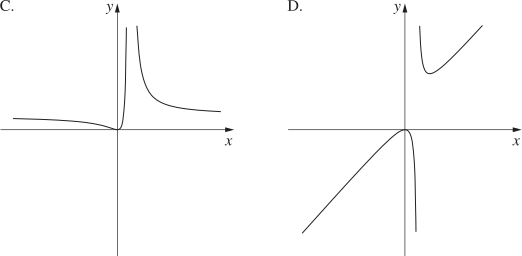
Which graph best represents `y=g(f(x))`
A student believes that the time it takes for an ice cube to melt (`M` minutes) varies inversely with the room temperature `(T^@ text{C})`. The student observes that at a room temperature of `15^@text{C}` it takes 12 minutes for an ice cube to melt.
--- 2 WORK AREA LINES (style=lined) ---
\begin{array} {|c|c|c|c|}
\hline \ \ T\ \ & \ \ 5\ \ & \ 15\ & \ 30\ \\
\hline M & & & \\
\hline \end{array}
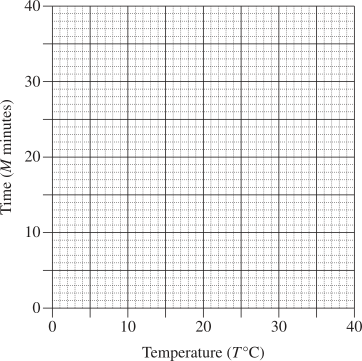
--- 0 WORK AREA LINES (style=lined) ---
a. `M=180/T`
b.
\begin{array} {|c|c|c|c|}
\hline \ \ T\ \ & \ \ 5\ \ & \ 15\ & \ 30\ \\
\hline M & 36 & 12 & 6 \\
\hline \end{array}
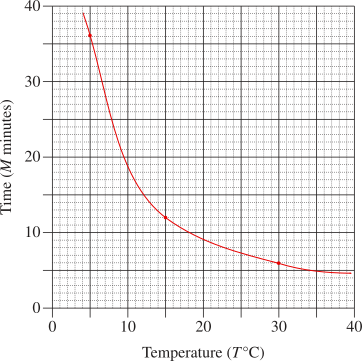
| a. | `M` | `prop 1/T` |
| `M` | `=k/T` | |
| `12` | `=k/15` | |
| `k` | `=15 xx 12` | |
| `=180` |
`:.M=180/T`
b.
\begin{array} {|c|c|c|c|}
\hline \ \ T\ \ & \ \ 5\ \ & \ 15\ & \ 30\ \\
\hline M & 36 & 12 & 6 \\
\hline \end{array}
A student believes that the time it takes for an ice cube to melt (`M` minutes) varies inversely with the room temperature `(T^@ text{C})`. The student observes that at a room temperature of `15^@text{C}` it takes 12 minutes for an ice cube to melt.
--- 4 WORK AREA LINES (style=lined) ---
\begin{array} {|l|c|c|c|}
\hline
\rule{0pt}{2.5ex} \ \ T\ \ \rule[-1ex]{0pt}{0pt} & \ \ \ 5\ \ \ & \ \ 15\ \ \ & \ \ \ 30\ \ \ \\
\hline
\rule{0pt}{2.5ex} \ \ M\ \ \rule[-1ex]{0pt}{0pt} & & & \\
\hline
\end{array}
--- 0 WORK AREA LINES (style=lined) ---
a. `M prop 1/T \ \ =>\ \ M=k/T`
| `12` | `=k/15` | |
| `k` | `=15 xx 12=180` |
`:.M=180/T`
b.
\begin{array} {|l|c|c|c|}
\hline
\rule{0pt}{2.5ex} \ \ T\ \ \rule[-1ex]{0pt}{0pt} & \ \ \ 5\ \ \ & \ \ 15\ \ \ & \ \ 30\ \ \\
\hline
\rule{0pt}{2.5ex} \ \ M\ \ \rule[-1ex]{0pt}{0pt} & 36 & 12 & 6 \\
\hline
\end{array}
| a. | `M` | `prop 1/T` |
| `M` | `=k/T` | |
| `12` | `=k/15` | |
| `k` | `=15 xx 12` | |
| `=180` |
`:.M=180/T`
b.
\begin{array} {|l|c|c|c|}
\hline
\rule{0pt}{2.5ex} \ \ T\ \ \rule[-1ex]{0pt}{0pt} & \ \ \ 5\ \ \ & \ \ 15\ \ \ & \ \ 30\ \ \\
\hline
\rule{0pt}{2.5ex} \ \ M\ \ \rule[-1ex]{0pt}{0pt} & 36 & 12 & 6 \\
\hline
\end{array}
A full container has 4.8 L of a mixture of cordial and water in the ratio 1:3.
After removing 1.2 L of the mixture, more water is added to refill the container.
What is the ratio of cordial to water in the final mixture? (3 marks)
--- 6 WORK AREA LINES (style=lined) ---
The life span of batteries from a particular factory is normally distributed with a mean of 840 hours and a standard deviation of 80 hours.
It is known from statistical tables that for this distribution approximately 60% of the batteries have a life span of less than 860 hours.
What is the approximate percentage of batteries with a life span between 820 and 920 hours? (3 marks)
--- 6 WORK AREA LINES (style=lined) ---
`mu=840, \ sigma=80`
`ztext{-score (860)}\ = (x-mu)/sigma=(860-840)/80=0.25`
`ztext{-score (820)}\ =(820-840)/80=-0.25`
`ztext{-score (920)}\ =(920-840)/80=1`

`text{50% of batteries have a life span below 840 hours (by definition)}`
`=>\ text{10% lie between 840 and 860 hours}`
`=>\ text{By symmetry, 10% lie between 820 and 840 hours}`
`=> P(-0.25<=z<=0)=10text{%}`
`:.\ text{Percentage between 820 and 920}`
`=P(-0.25<=z<=1)`
`=P(-0.25<=z<=0) + P(0<=z<=1)`
`=10+34`
`=44text{%}`
Jo is researching the relationship between the ages of teenage characters in television series and the ages of actors playing these characters.
After collecting the data, Jo finds that the correlation coefficient is 0.4564.
A scatterplot showing the data is drawn. The line of best fit with equation `y=-7.51+1.85 x`, is also drawn.
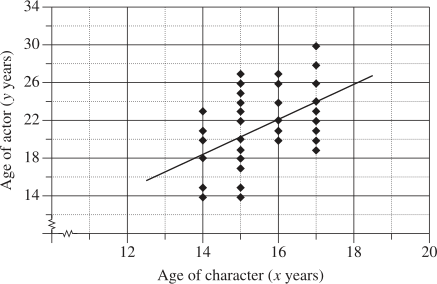
Describe and interpret the data and other information provided, with reference to the context given. (4 marks)
--- 8 WORK AREA LINES (style=lined) ---
A composite solid is shown. The top section is a cylinder with a height of 3 cm and a diameter of 4 cm. The bottom section is a hemisphere with a diameter of 6 cm. The cylinder is centred on the flat surface of the hemisphere.
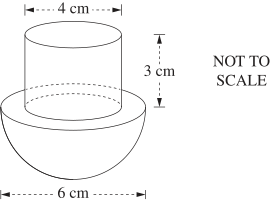
Find the total surface area of the composite solid in cm², correct to 1 decimal place. (4 marks)
--- 8 WORK AREA LINES (style=lined) ---
The diagram shows an aeroplane that was flying towards an airport at `A` on a bearing of `135^@ text{T}`. When it was at point `O`, 20 km away from the airport at `A`, the flight course was changed. The aeroplane landed at an airport at `B` directly south of `O`. The distance from `O` to `B` is 50 km.

--- 4 WORK AREA LINES (style=lined) ---
--- 4 WORK AREA LINES (style=lined) ---
--- 1 WORK AREA LINES (style=lined) ---
a. `angle AOB=180-135=45^@`
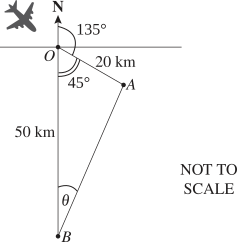
`text{Using the cosine rule:}`
| `AB^2` | `=20^2+50^2-2xx20xx50xxcos45^@` | |
| `=1485.786…` | ||
| `:.AB` | `=38.54…` | |
| `=38.5\ \text{km (to 1 d.p.)}` |
b. `text{Let}\ \ theta=angleOBA`
`text{Using the sine rule:}`
| `sintheta/20` | `=sin45^@/38.5` | |
| `sintheta` | `=(sin45^@xx20)/38.5` | |
| `:.theta` | `=sin^(-1)((sin45^@xx20)/38.5)` | |
| `=21.55…^@` | ||
| `=22^@\ \ text{(nearest degree)}` |
c.

`text{Bearing of}\ B\ text{from}\ \ A`
`=180 + 22`
`=202^@text{T}`
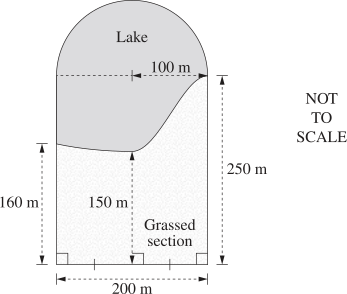
The diagram shows a park consisting of a rectangle and a semicircle. The semicircle has a radius of 100 m. The dimensions of the rectangle are 200 m and 250 m.
A lake occupies a section of the park as shown. The rest of the park is a grassed section. Some measurements from the end of the grassed section to the edge of the lake are also shown.
--- 4 WORK AREA LINES (style=lined) ---
--- 4 WORK AREA LINES (style=lined) ---
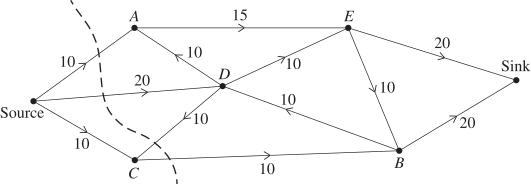
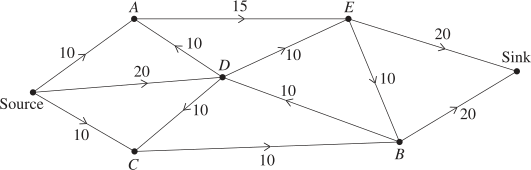
A wildlife park has 5 main attractions `(A, B, C, D, E)` connected by directional paths. A simple network is drawn to represent the flow through the park's paths. The number of visitors who can access each path at any one time is also shown.
--- 2 WORK AREA LINES (style=lined) ---
--- 2 WORK AREA LINES (style=lined) ---
--- 4 WORK AREA LINES (style=lined) ---
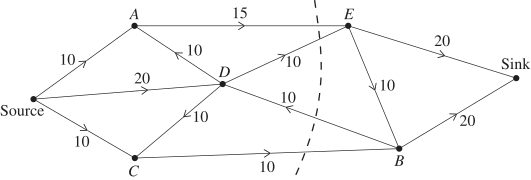
a. `text{Flow capacity = 10 + 20 + 10 = 40}`
`text{(DE is not counted as it runs from sink → source)}`
b.
`text{Min Cut = Max Flow}`
| `text{Max Flow}` | `=15+10+10` | |
| `=35<40` |
c. `text{Two strategies:}`
`text{(both strategies would increase the minimum cut to}`
`text{40 by increasing the flow to vertex}\ E\ text{to 30)}`
Eli is choosing between two investment options.

A table of future value interest factors for an annuity of $1 is shown.

--- 4 WORK AREA LINES (style=lined) ---
--- 4 WORK AREA LINES (style=lined) ---
A dam is in the shape of a triangular prism which is 50 m long, as shown.
Both ends of the dam, `A B C` and `D E F`, are isosceles triangles with equal sides of length 25 metres. The included angles `B A C` and `E D F` are each `150^@`.
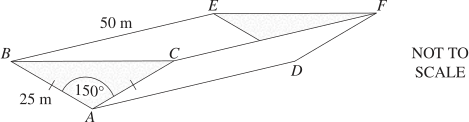
Calculate the number of litres of water the dam will hold when full. (4 marks)
--- 8 WORK AREA LINES (style=lined) ---
A company purchases a machine for $50 000. The two methods of depreciation being considered are the declining-balance method and the straight-line method.
The diagram shows two right-angled triangles, `ABC` and `ABD`,
where `AC=35 \ text{cm},BD=93 \ text{cm}, /_ACB=41^(@)` and `/_ADB=theta`.
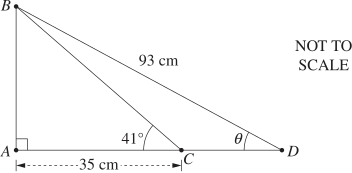
Calculate the size of angle `theta`, to the nearest minute. (4 marks)
--- 8 WORK AREA LINES (style=lined) ---
The table shows the future value of an annuity of $1.
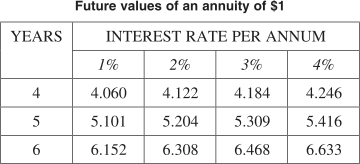
Zal is saving for a trip and estimates he will need $15 000. He opens an account earning 3% per annum, compounded annually.
--- 4 WORK AREA LINES (style=lined) ---
--- 4 WORK AREA LINES (style=lined) ---
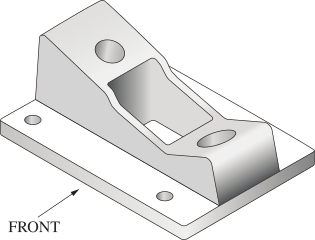
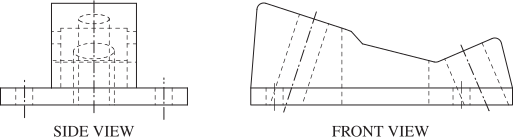
A baseplate used to support the wheels under a trolley is shown in pictorial view.
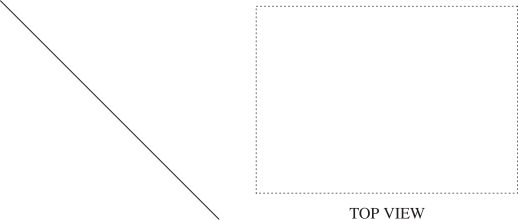
Construct, within the dashed-line box provided, a top view of the baseplate. Do NOT dimension. (3 marks)
--- 0 WORK AREA LINES (style=lined) ---
Top view
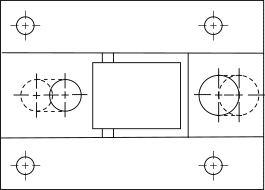
Top View
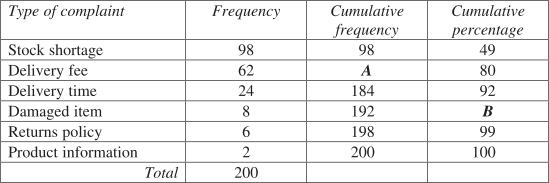
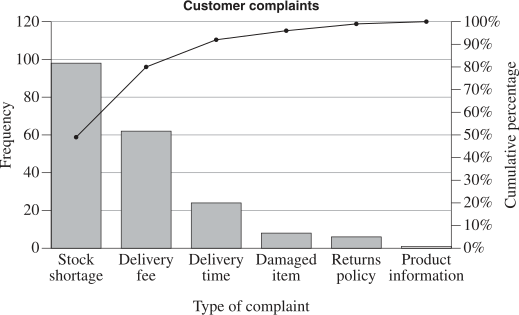
The table shows the types of customer complaints received by an online business in a month.
--- 4 WORK AREA LINES (style=lined) ---
--- 2 WORK AREA LINES (style=lined) ---
Lily wanted to estimate the number of fish in a lake.
She randomly captured 30 fish, then tagged and released them.
One week later she randomly captured 40 fish from the same lake. She found that 12 of these 40 fish were tagged.
What is the best estimate for the total number of fish in the lake?
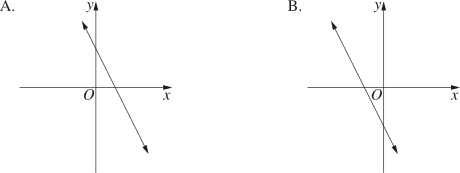
Which of the following could be the graph of `y= –2 x+2`?
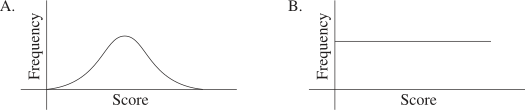
Which graph represents a negatively skewed distribution?

The diagram shows a model of electromagnetic waves.

Relate this model to predictions made by Maxwell. (4 marks)
--- 8 WORK AREA LINES (style=lined) ---
A step-up transformer is constructed using a solid iron core. The coils are made using copper wires of different thicknesses as shown.

The table shows electrical data for this transformer.
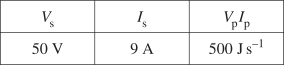
--- 6 WORK AREA LINES (style=lined) ---
--- 8 WORK AREA LINES (style=lined) ---
In the apparatus shown, a backboard is connected by a rod to a shaft. The shaft is spun by an electric motor causing the backboard to rotate in the horizontal plane around the axis X `–` X′.
A cube is suspended by a string so that it touches the surface of the backboard.

When the angular velocity of the motor is great enough, the string is cut and the position of the cube does not change relative to the backboard.
Which statement correctly describes the forces after the string is cut?
Consider the following nuclear reaction.
\(\text{W} + \text{X} \rightarrow \text{Y} + \text{Z}\)
Information about W, X and Y is given in the table.
\begin{array}{|c|c|}
\hline
\rule{0pt}{2.5ex}\textit{Species} & \textit{Mass defect} & \textit{Total binding energy} & \textit{Binding energy per nucleon}\\
\textit{} & \textit{(u)} \rule[-1ex]{0pt}{0pt}& \text{(MeV)} & \text{(MeV)}\\
\hline \rule{0pt}{2.5ex}\text{W} \rule[-1ex]{0pt}{0pt}& 0.00238817 & 2.224566 & 1.112283 \\
\hline \rule{0pt}{2.5ex}\text{X} \rule[-1ex]{0pt}{0pt}& 0.00910558 & 8.481798 & 2.827266 \\
\hline \rule{0pt}{2.5ex}\text{Y }\rule[-1ex]{0pt}{0pt}& 0.03037664 & 28.29566 & 7.073915 \\
\hline
\end{array}
Which of the following is a correct statement about energy in this reaction?
A straight current-carrying conductor, `QR`, is connected to a battery and a variable resistor. `QR` is enclosed in an evacuated chamber with a fluorescent screen at one end.
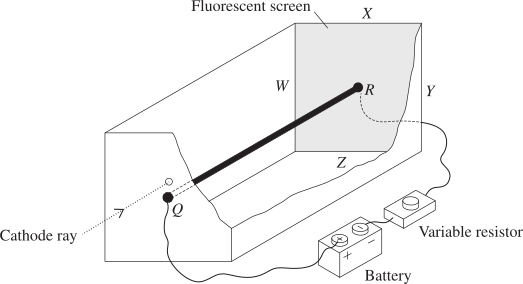
A cathode ray enters the chamber directly above `Q`, initially travelling parallel to `QR`. It passes through the chamber and strikes the fluorescent screen causing a bright spot.
Which direction will this spot move towards if the resistance is increased?
The diagram shows the trajectory of a particle with charge `q` and mass `m` when fired horizontally into a vacuum chamber, where it falls under the influence of gravity.
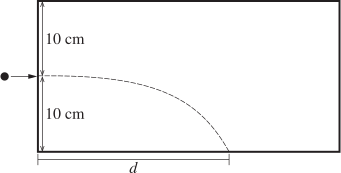
The horizontal distance, `d`, travelled by the particle is recorded.
The experiment is repeated with a uniform vertical electric field applied such that the particle travels the same horizontal distance, `d`, but strikes the upper surface of the chamber.
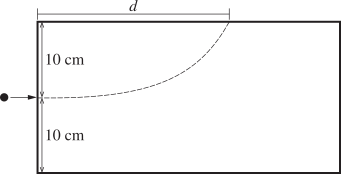
What is the magnitude of the electric field?
A satellite in circular orbit at a distance `r` from the centre of Earth has an orbital velocity `v`.
If the distance was increased to `2r`, what would be the satellite's orbital velocity?
A laser has a power output of 30 mW and emits light with a wavelength of 650 nm.
How many photons does this laser emit per second?
The table shows two types of quarks and their respective charges.

In a particular nuclear transformation, a particle having a quark composition `udd` is transformed into a particle having a quark composition `u ud`.
What is another product of this transformation?
Two satellites have the same mass. One (LEO) is in low-Earth orbit and the other (GEO) is in a geostationary orbit.
The total energy of a satellite is half its gravitational potential energy.
Which row of the table correctly identifies the satellite with the greater orbital period and the satellite with the greater total energy?
\begin{align*}
\begin{array}{l}
\rule{0pt}{2.5ex} \ \rule[-1ex]{0pt}{0pt}& \\
\rule{0pt}{2.5ex}\textbf{A.}\rule[-1ex]{0pt}{0pt}\\
\rule{0pt}{2.5ex}\textbf{B.}\rule[-1ex]{0pt}{0pt}\\
\rule{0pt}{2.5ex}\textbf{C.}\rule[-1ex]{0pt}{0pt}\\
\rule{0pt}{2.5ex}\textbf{D.}\rule[-1ex]{0pt}{0pt}\\
\end{array}
\begin{array}{|c|c|}
\hline
\rule{0pt}{2.5ex}\textit{Greater orbital period}\rule[-1ex]{0pt}{0pt}& \textit{Greater total energy} \\
\hline
\rule{0pt}{2.5ex}\text{LEO}\rule[-1ex]{0pt}{0pt}&\text{LEO}\\
\hline
\rule{0pt}{2.5ex}\text{LEO}\rule[-1ex]{0pt}{0pt}& \text{GEO}\\
\hline
\rule{0pt}{2.5ex}\text{GEO}\rule[-1ex]{0pt}{0pt}& \text{LEO} \\
\hline
\rule{0pt}{2.5ex}\text{GEO}\rule[-1ex]{0pt}{0pt}& \text{GEO} \\
\hline
\end{array}
\end{align*}
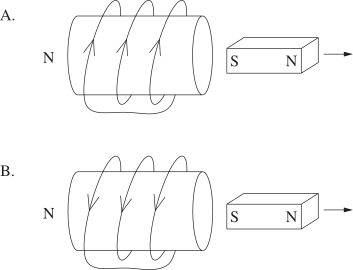
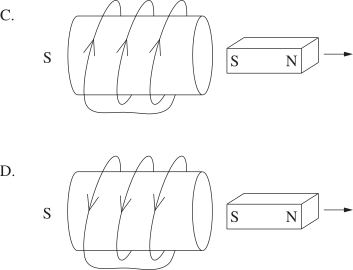
A bar magnet is moved away from a stationary coil.
Which diagram correctly shows the direction of the induced current in the coil and the resulting magnetic polarity of the coil?
A rope connects a mass on a horizontal surface to a pulley attached to an electric motor as shown.
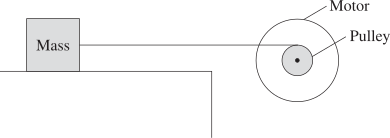
Explain the factors that limit the speed at which the mass can be pulled along the horizontal surface. Use mathematical models to support your answer. (7 marks)
--- 20 WORK AREA LINES (style=lined) ---
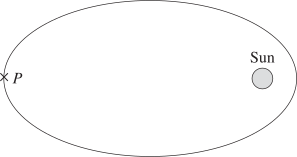
--- 7 WORK AREA LINES (style=lined) ---
--- 8 WORK AREA LINES (style=lined) ---
--- 5 WORK AREA LINES (style=lined) ---
--- 5 WORK AREA LINES (style=lined) ---
Explain, using an example, how a particle accelerator has provided evidence for the Standard Model of matter. (3 marks)
--- 7 WORK AREA LINES (style=lined) ---
A spacecraft is powered by a radioisotope generator. Pu-238 in the generator undergoes alpha decay, releasing energy. The decay is shown with the mass of each species in atomic mass units, `u`
\begin{array} {ccccc}
\ce{^{238}Pu} & \rightarrow & \ce{^{234}U} & + & \alpha \\
238.0495\ u & & 234.0409\ u & & 4.0026\ u \end{array}
--- 6 WORK AREA LINES (style=lined) ---
--- 6 WORK AREA LINES (style=lined) ---
The graph shows the levels of three hormones, oestrogen, progesterone and human chorionic gonadotrophin (HCG), measured in the blood of a woman during her pregnancy.
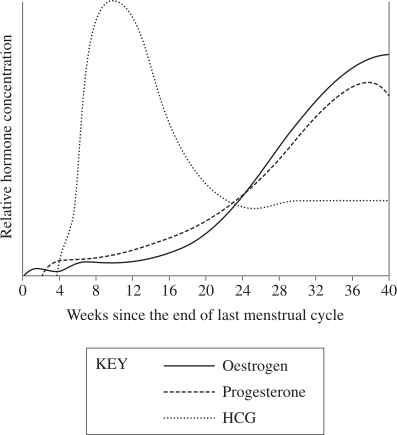
Which statement can be inferred from the graph?
A quantity of silver nitrate is added to 250.0 mL of 0.100 mol L ¯1 potassium sulfate at 298 K in order to produce a precipitate. Silver nitrate has a molar mass of 169.9 g mol ¯1.
What mass of silver nitrate will cause precipitation to start?
The table lists the information from a proton NMR spectrum.
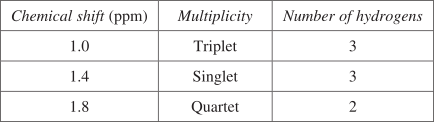
Which compound could have produced this spectrum?
A sample was contaminated with sodium phosphate. The sample was dissolved in water and added to an excess of acidified \(\ce{(NH_4)_2MoO_4}\) to produce a precipitate of \(\ce{(NH_4)_3PO_4.12MoO_3\ \ \ \ \ \ ($MM$ = 1877 g mol^{-1})} \).
If 24.21 g of dry \(\ce{(NH_4)_3PO_4.12MoO_3}\) was obtained, what was the mass of sodium phosphate in the original sample?
This titration curve is produced when an acid is titrated with a sodium hydroxide solution of the same concentration.

How many acidic protons does this acid possess?
What is the pH of the resultant solution after 20.0 mL of 0.20 mol `text{L}^{-1}\ text{HCl} (aq)` is mixed with 20.0 mL of 0.50 mol `text{L}^{-1}\ text{NaOH} (aq)`?
A sample of nickel was dissolved in nitric acid to produce a solution with a volume of 50.00 mL. 10.00 mL of this solution was then diluted to 250.0 mL. This solution was subjected to colorimetric analysis. A calibration curve for this analysis is given.

The solution gave an absorbance value of 0.30.
What was the mass of the sample of nickel?
A metal rod sits on a pair of parallel metal rails, 20 cm apart, that are connected by a copper wire. The rails are at 30° to the horizontal.
The apparatus is in a uniform magnetic field of 1 T which is upward, perpendicular to the table.

A force, `F`, is applied parallel to the rails to move the rod at a constant speed along the rails. The rod is moved a distance of 30 cm in 2.5 s.
--- 4 WORK AREA LINES (style=lined) ---
--- 4 WORK AREA LINES (style=lined) ---
--- 6 WORK AREA LINES (style=lined) ---
The following apparatus is used to investigate light interference using a double slit.
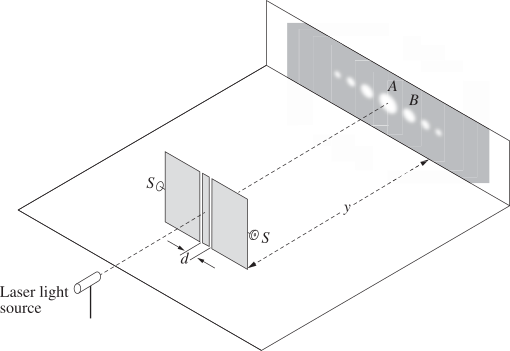
The distance, `y`, from the slits to the screen can be varied. The adjustment screws `(S)` vary the distance, `d`, between the slits. The wavelength of the laser light can be varied across the visible spectrum. The diffraction pattern shown is for a specific wavelength of light.
Explain TWO methods of keeping the distance between the maxima at `A` and `B` constant when the wavelength of the laser light is reduced. (4 marks)
--- 11 WORK AREA LINES (style=lined) ---
--- 4 WORK AREA LINES (style=lined) ---

Identify an assumption of EACH model which determines the shape of its curve. (2 marks)
--- 4 WORK AREA LINES (style=lined) ---

On the same diagram, sketch a curve for a black body radiator at a temperature of 4000 K and explain the differences between the curves. (4 marks)
--- 6 WORK AREA LINES (style=lined) ---
a. The spectra of light produced by a gas discharge tube will consist of lines only at a few discrete wavelengths.
The spectra of light produced by an incandescent lamp will be a continuous spectrum.
b. Model `X` black bodies absorb and emit energy continuously.
Model `Y` assumes that black bodies absorb and emit energy in discrete quantities.
c.

a. Differences:
b. Assumptions of EACH model:
c.