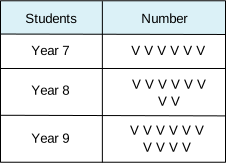
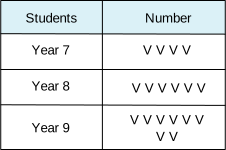
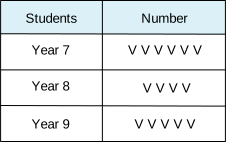
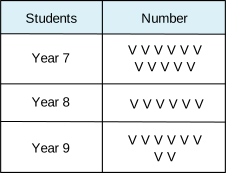
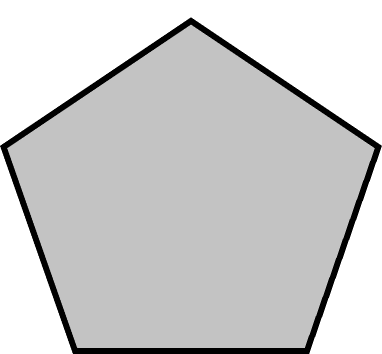
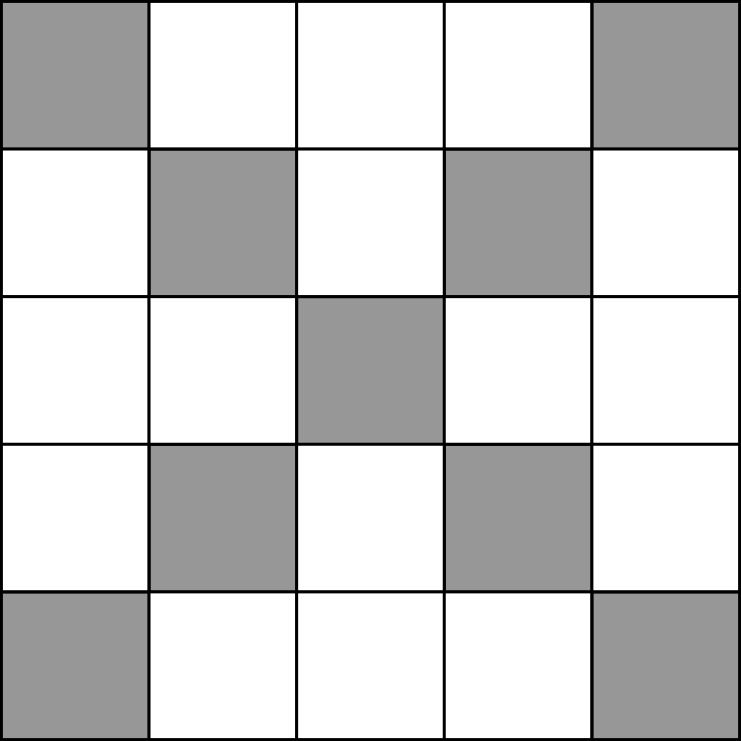
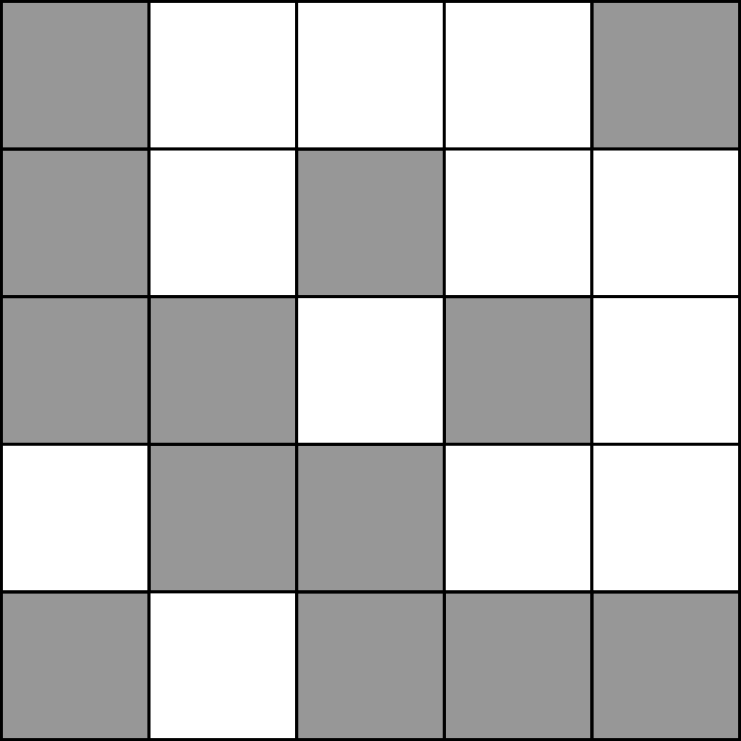
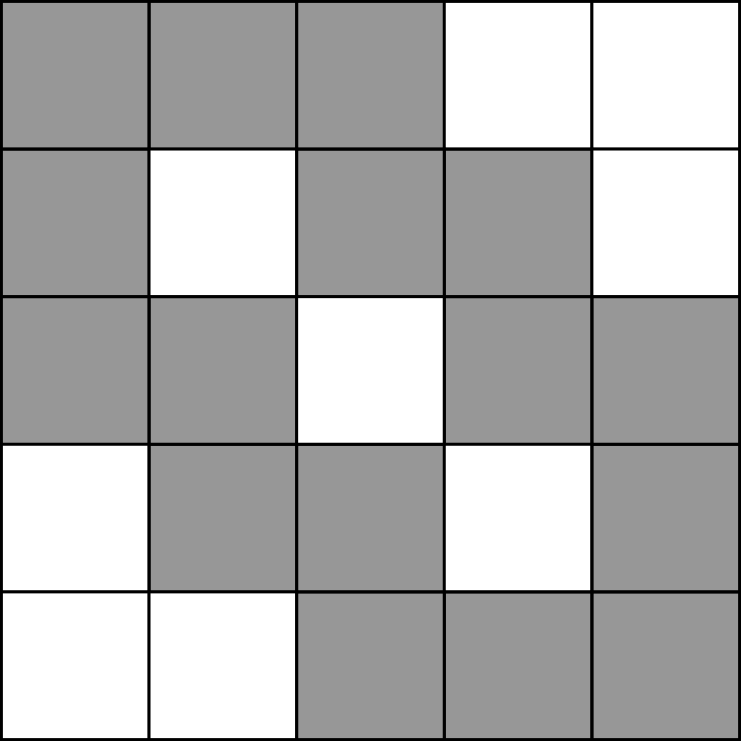
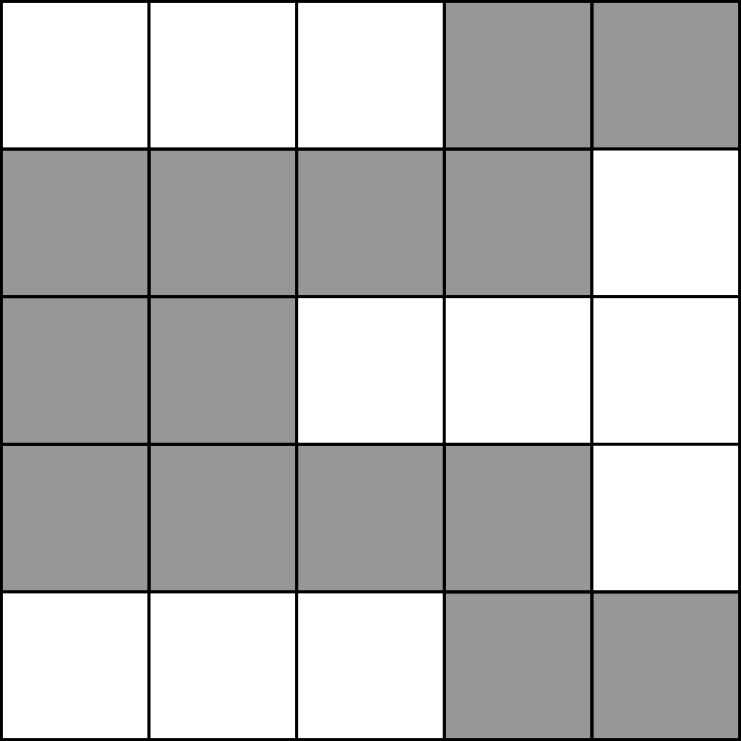
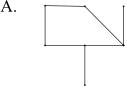
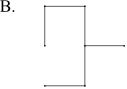
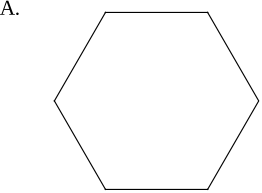
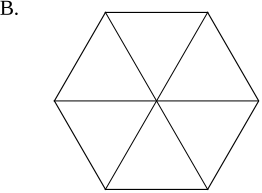
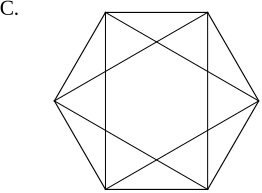
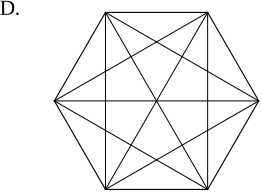
Sam painted grids in the larger square areas pictured below.
All of the grids are the same size.
Which of the following squares has the largest area painted?
|
|
|
|
|
|
|
|
|
|
|
Aussie Maths & Science Teachers: Save your time with SmarterEd
Sam painted grids in the larger square areas pictured below.
All of the grids are the same size.
Which of the following squares has the largest area painted?
|
|
|
|
|
|
|
|
|
|
|
`text(The largest area painted is the figure with the most squares painted grey.)`
`text(Checking each option:)`
`text(Option 1 – 9 square grids painted)`
`text(Option 2 – 13 square grids painted)`
`text{Option 3 – 16 square grids painted (Correct)}`
`text(Option 4 – 14 square grids painted)`
The acceleration, `a\ text(ms)^(-2)`, of a particle moving in a straight line is given by `a = v^2 + 1`, where `v` is the velocity of the particle at any time `t`. The initial velocity of the particle when at origin O is `2\ text(ms)^(-1)`.
The displacement of the particle from O when its velocity is `3\ text(ms)^(-1)` is
`C`
| `v* (dv)/(dx)` | `= v^2 + 1` |
| `(dv)/(dx)` | `= (v^2 + 1)/v` |
| `(dx)/(dv)` | `= v/(v^2 + 1)` |
| `x` | `= int (v/(v^2 + 1))\ dv` |
| `=1/2 ln(v^2 + 1)+c` |
`text(When)\ \ x=0, \ v=2:`
`c=-1/2 ln5`
`text(Find)\ \ x\ \ text(when)\ \ v=3:`
| `x` | `= 1/2ln(9 + 1) – 1/2 ln5` |
| `= 1/2 ln (10/5)` | |
| `= 1/2 ln 2` |
`=> C`
An object of mass 2 kg is suspended from a spring balance that is inside a lift travelling downwards.
If the reading on the spring balance is 30 N, the acceleration of the lift is
`A`
Two forces, `underset~F_(text(A)) = 4 underset~i - 2 underset~j` and `underset~F_(text(B)) = 2 underset~i - 5 underset~j`, act on a particle of mass 3 kg. The particle is initially at rest at position `underset~i + underset~j`. All force components are measured in newtons and displacements are measured in metres.
The cartesian equation of the path of the particle is
`E`
`text(Net Force)\ (underset~F) = 4underset~i – 2underset~j + 2underset~i + 5underset~j = 6underset~i + 3underset~j`
`underset~a = underset~F/m = 2underset~i + underset~j`
`underset~v = int_0^t 2underset~i + underset~j\ dt = 2tunderset~i + tunderset~j`
| `underset~r` | `= int_0^t 2tunderset~i + tunderset~j\ dt + (underset~i + underset~j)` |
| `= t^2 underset~i + (t^2)/2 underset~j + underset~i + underset~j` | |
| `= (t^2 + 1)underset~i + ((t^2)/2 + 1)underset~j` |
`x = t^2 + 1 \ => \ t^2 = x – 1`
| `y` | `= (t^2)/2 + 1` |
| `= ((x – 1))/2 + 1` | |
| `= x/2 + 1/2` |
`=>E`
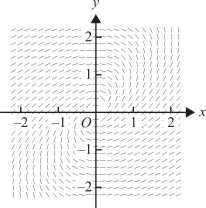
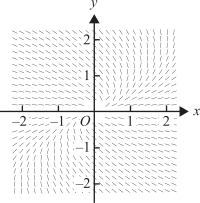
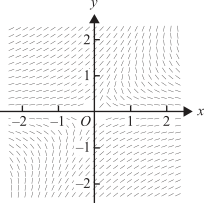
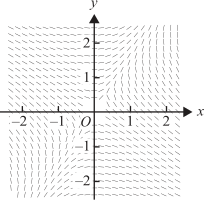
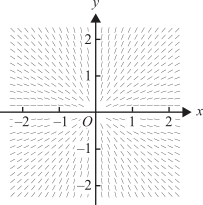
`P(x, y)` is a point on a curve. The `x`-intercept of a tangent to point `P(x, y)` is equal to the `y`-value at `P`.
Which one of the following slope fields best represents this curve?
| A. | |
B. | |
| C. | D. |
`B`
`text(The tangent to the curve passes through)`
`(x, y)\ and\ (y, 0)`
`(dy)/(dx) = (0 – y)/(y – x) = y/(x – y)`
`text(When)\ \ x = 0:`
`(dy)/(dx) = y/(−y) = −1`
`=>B`
`P(x, y)` is a point on a curve. The `x`-intercept of a tangent to point `P(x, y)` is equal to the `y`-value at `P`.
Which one of the following slope fields best represents this curve?
| A. | |
B. | |
| C. | D. | ||
| E. |
`B`
`text(The tangent to the curve passes through)`
`(x, y)\ and\ (y, 0)`
`(dy)/(dx) = (0 – y)/(y – x) = y/(x – y)`
`text(When)\ \ x = 0:`
`(dy)/(dx) = y/(−y) = −1`
`=>B`
Given that `(x + iy)^14 = a + ib`, where `x, y, a, b ∈ R, \ (y - ix)^14` for all values of `x` and `y` is equal to
`A`
| `(y – ix)^14` | `= (−i(x + iy))^14` |
| `= −i^14(x + iy)^14` | |
| `= −(x + iy)^14` | |
| `= −a – ib` |
`=>A`
Find the coordinates of the points of intersection of the graph of the relation
`y = text(cosec)^2 ((pi x)/6)` with the line `y = 4/3`, for `0 < x < 12.` (3 marks)
--- 6 WORK AREA LINES (style=lined) ---
`(2, 4/3),(4, 4/3),(8, 4/3), (10, 4/3)`
`text(Intersection occurs when:)`
| `text(cosec)^2((pix)/6)` | `=4/3` |
| `text(cosec)((pix)/6)` | `= ±2/sqrt3` |
| `sin((pix)/6)` | `= ±sqrt3/2` |
`text(Given:)\ \ 0 < x < 12 \ \ =>\ \ 0 < (pix)/6 < 2pi`
| `(pix)/6` | `= pi/3, pi – pi/3, pi + pi/3, 2pi – pi/3` |
| `= pi/3, (2pi)/3, (4pi)/3,(5pi)/3` | |
| `x` | `= 2, 4, 8, 10` |
`=> y = 4/3\ text(for each)`
`:.\ text(Intersection at:)\ \ (2, 4/3),(4, 4/3),(8, 4/3), (10, 4/3)`
A function `f` has the rule `f(x) = |b cos^(−1)(x) - a|`, where `a > 0, b > 0` and `a < (bpi)/2`.
The range of `f` is
`B`
`text(Range:)\ \ cos^(−1)(x) = [0, pi]`
`text(Range:)\ \ b cos^(−1)(x) – a = [−a, bpi – a]`
`text(Given)\ \ 0 < a < (bpi)/2, text(Range) = [−a, bpi – a]`
`:.\ text(Range:)\ \ |b cos^(−1) (x) – a| = [0, bpi – a]`
`=>B`
Shot-put is an athletics field event in which competitors throw a heavy spherical ball (a shot) as far as they can.
The size of the shot for men and the shot for women is different.
The diameter of the shot for men is 1.25 times larger than the diameter of the shot for women.
The ratio of the total surface area of the women’s shot to the total surface area of the men’s shot is
`E`
| `SA_f` | `: SA_m` |
| `4pir^2` | `: 4 pi(5/4r)^2` |
| `1` | `: 25/16` |
| `16` | `: 25` |
`=> E`
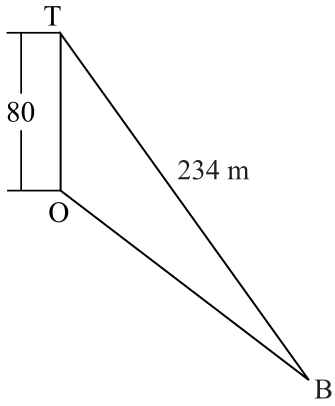
An 80 m high lookout tower stands in the centre of town.
Two landmarks, on the same horizontal plane, are visible from the top of the lookout tower.
The direct distance from the top of the lookout tower to the base of Landmark A is 170 m.
The direct distance from the top of the lookout tower to the base of Landmark B is 234 m.
The bearing of Landmark B from Landmark A is 105°.
The bearing of Landmark B from the lookout tower is 142°.
The direct distance along the ground, in metres, between Landmark A and Landmark B is closest to
`C`
`text(Let)\ \ T = text(top of tower),\ \ O = text(base of tower)`
`text(In)\ \ Delta TOB:`
`OB = sqrt(234^2 – 80^2) ~~ 220`
`text(Similarly),`
`OA = sqrt(170^2 – 80^2) = 150`
`text(Find)\ \ /_AOB:`
| `(sin /_OAB)/220` | `= (sin 37^@)/150` |
| `sin /_OAB` | `= (220 xx sin 37^@)/150` |
| `/_OAB` | `~~ 62^@` |
`/_AOB = 180 – (62 + 37) = 81^@`
`text(Using cosine rule:)`
| `AB^2` | `= 150^2 + 220^2 – 2 xx 150 xx 220 xx cos 81^@` |
| `= 60\ 575.32…` | |
| `AB` | `~~ 246` |
`=> C`
The directed graph below represents a series of one-way streets.
The vertices represent the intersections of these streets.
The number of vertices that can be reached from `S` is
`C`
`S\ text(can reach vertices)\ V, T\ text(directly.)`
`S\ text(can also reach)\ X\ text(indirectly through)\ V.`
`=> C`
Consider the matrix recurrence relation below.
`S_0 = [(30),(20),(40)], quad S_(n+1) = TS_n qquad text(where)\ T = [(j, 0.3, l),(0.2, m, 0.3),(0.4, 0.2, n)]`
Matrix `T` is a regular transition matrix.
Given the information above and that `S_1 = [(42),(28),(20)]`, which one of the following is true?
`E`
`text(Transition matrix columns sum to 1)`
`j = 1 – 0.2 – 0.4 = 0.4`
`m = 1 – 0.3 – 0.2 = 0.5`
`l + n = 0.7`
`[(0.4, 0.3, l),(0.2, 0.5, 0.3),(0.4, 0.2, n)][(30),(20),(40)]=[(42),(28),(20)]`
| `42` | `= 0.4 xx 30 + 0.3 xx 20 + l xx 40` |
| `24` | `= 40l` |
| `l` | `= 0.6` |
`:. n = 0.1`
`=> E`
A small shopping centre has two coffee shops: Fatima’s (F) and Giorgio’s (G).
The percentage of coffee-buyers at each shop changes from day to day, as shown in the transition matrix `T`.
`{:(quadqquadqquadqquadquad t\oday),(qquadqquadqquadquad F quadqquad G),(T = [(0.85,0.35),(0.15,0.65)]{:(F),(G):}qquad t\omo\rrow):}`
On a particular Monday, 40% of coffee-buyers bought their coffees at Fatima’s.
The matrix recursion relation `S_(n+1) = TS_n` is used to model this situation.
The percentage of coffee-buyers who are expected to buy their coffee at Giorgio’s on Friday of the same week is closest to
`B`
| `text(Tuesday)` | `= [(0.85, 0.35),(0.15, 0.65)][(0.40),(0.60)]` |
| `text(Friday)` | `= [(0.85, 0.35),(0.15, 0.65)]^4 [(0.40),(0.60)]` |
| `~~ [(0.68),(0.32)]` |
`=> B`
Twenty years ago, Hector invested a sum of money in an account earning interest at the rate of 3.2% per annum, compounding monthly.
After 10 years, he made a one-off extra payment of $10 000 to the account.
For the next 10 years, the account earned interest at the rate of 2.8% per annum, compounding monthly.
The balance of his account today is $686 904.09
The sum of money Hector originally invested is closest to
`B`
`text(Let)\ I = text(original investment)`
`text(Strategy 1:)`
| `text(Balance)` | `= [I(1 + 3.2/(12 xx 100))^120 + 10\ 000](1 + 2.8/(12 xx 100))^120` |
| `= $686\ 904.09` |
`text(Test each option in the equation)`
`text(Option)\ B:\ \ I = $370\ 000\ \ text(is correct)`
`text{Strategy 2 (By TVM Solver):}`
| `N` | `=120` | |
| `Itext{(%)}` | `= 2.8` | |
| `PMT` | `=0` | |
| `PV` | `= ?` | |
| `FV` | `= 686\ 904.09` | |
| `text(PY)` | `= text(CY) =12` |
`:. PV = 519\ 320.3`
| `N` | `=120` | |
| `Itext{(%)}` | `= 3.2` | |
| `PMT` | `=0` | |
| `PV` | `= ?` | |
| `FV` | `= 509\ 320.3` | |
| `text(PY)` | `= text(CY) =12` |
`:. PV = 370\ 000`
`=> B`
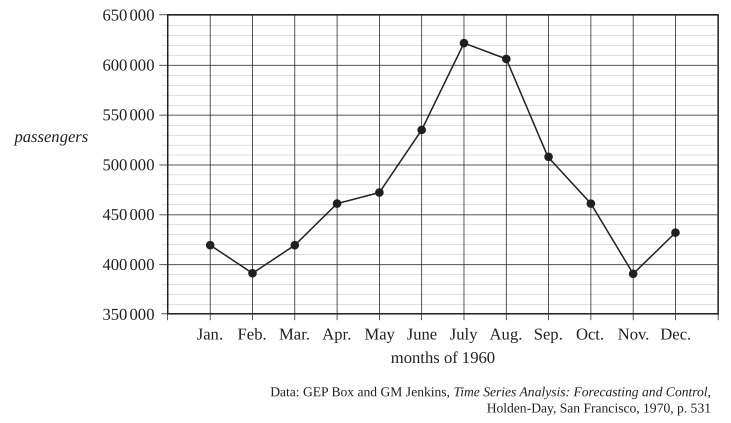
The time series plot below displays the number of airline passengers, in thousands, each month during the period January to December 1960.
Part 1
During 1960, the median number of monthly airline passengers was closest to
Part 2
During the period January to May 1960, the total number of airline passengers was 2 160 000.
The five-mean smoothed number of passengers for March 1960 is
`text(Part 1:)\ A`
`text(Part 2:)\ D`
Part 1
`text(12 data points)`
| `text(Median)` | `= {text(6th + 7th data point)}/2` |
| `~~ (460\ 000 + 460\ 000)/2` | |
| `~~ 460\ 000` |
`=> A`
Part 2
`text(Five-mean smoothed number)`
`= (2\ 160\ 000)/5`
`= 432\ 000`
`=> D`
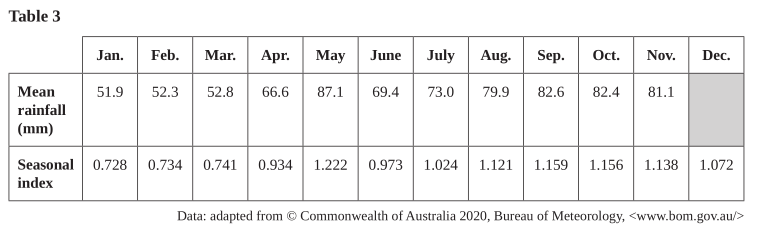
Table 3 below shows the long-term mean rainfall, in millimetres, recorded at a weather station, and the associated long-term seasonal indices for each month of the year.
The long-term mean rainfall for December is missing.
Part 1
To correct the rainfall in March for seasonality, the actual rainfall should be, to the nearest per cent
Part 2
The long-term mean rainfall for December is closest to
`text(Part 1:)\ C`
`text(Part 2:)\ D`
Part 1
`text(Deseasonalised rainfall for March)`
`= 52.8/0.741`
`= 71.255`
| `:.\ text(Percentage increase)` | `= (71.255 – 52.8)/() xx 100` |
| `~~ 35%` |
`=> D`
Part 2
`text(Mean) = 51.9/0.728 = 71.3`
| `text(Actual December)` | `= 71.3 xx 1.072` |
| `~~ 76.4\ text(mm)` |
`=> D`
A least squares line of the form `y = a + bx` is fitted to a scatterplot.
Which one of the following is always true?
`E`
`text(The sum of the squares of the vertical distances from)`
`text(the line to each data point will be a minimum.)`
`=> E`
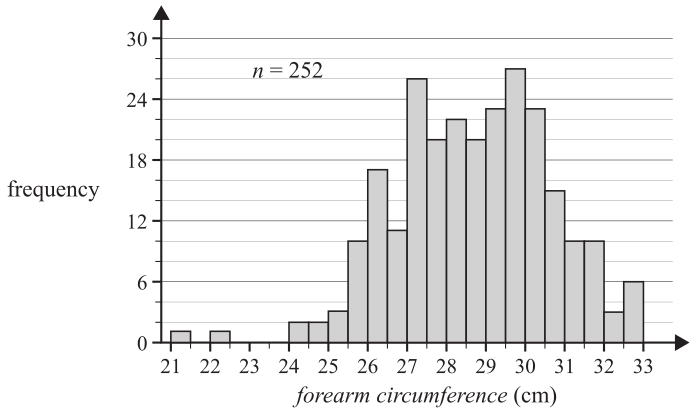
The histogram below shows the distribution of the forearm circumference, in centimetres, of 252 men.
Assume that the forearm circumference values were all rounded to one decimal place.
The third quartile `(Q_3)` for this distribution could be
`C`
`text(S) text(ince)\ \ n = 252,`
`Q_3\ text(occurs at data point 189.)`
`text(Datapoint 189 falls in the class interval 30 – 30.5)`
`=> C`
Consider the curve defined parametrically by `x = arcsin (t)` `y = log_e(1 + t) + 1/4 log_e (1-t)` where `t in [0, 1)`. --- 4 WORK AREA LINES (style=lined) --- --- 6 WORK AREA LINES (style=lined) ---
a.
`y`
`= log_e(1 + t) + 1/4 log_e (1-t)`
`(dy)/(dt)`
`= 1/(1 + t)-1/(4(1-t))`
`((dy)/(dt))^2`
`= 1/(1 + t)^2-2 ⋅ 1/(1 + t) ⋅ 1/(4(1-t)) + 1/(16(1-t)^2)`
`= 1/(1 + t)^2-1/(2(1-t^2)) + 1/(16(1-t)^2)`
`:. a = 1, b = – 2, c = 16`
b.
`s`
`= int_0^(1/2) sqrt(((dx)/(dt))^2 + ((dy)/(dt))^2)\ dt`
`= int_0^(1/2) sqrt(1/(1-t^2) + 1/(1 + t^2)-1/(2(1-t^2)) + 1/(16(1-t)^2))\ dt`
`= int_0^(1/2) sqrt(1/(1 + t^2) + 1/(2(1-t^2)) + 1/(16(1-t)^2))\ dt`
`= int_0^(1/2) sqrt((1/(1 + t) + 1/(4(1-t)))^2)\ dt`
`= int_0^(1/2) 1/(1 + t) + 1/(4(1-t))\ dt`
`= [log_e(1 + t)-1/4 log_e(1-t)]_0^(1/2)`
`= log_e(3/2)-1/4 log_e(1/2)`
Find the volume of, `V`, of the solid of revolution formed when the graph of `y = 2sqrt((x^2 + x + 1)/((x + 1)(x^2 + 1)))` is rotated about the `x`-axis over the interval `[0, sqrt 3]`. Give your answer in the form `V = 2pi(log_e(a) + b)`, where `a, b in R`. (5 marks)
`V = 2pi (log_e(2 sqrt 3 + 2) + pi/3)\ text(u³)`
| `V` | `= pi int_0^sqrt 3 y^2\ dx` |
| `= 4 pi int_0^sqrt 3 (x^2 + x + 1)/((x + 1)(x^2 + 1))\ dx` |
`text(Using partial fractions):`
| `(x^2 + x + 1)/((x + 1)(x^2 + 1))` | `= A/(x + 1) + (Bx + C)/(x^2 + 1)` |
| `x^2 + x + 1` | `= Ax^2 + A + (Bx + C)(x + 1)` |
| `=(A+B)x^2 + (B+C)x + A + C` |
`text(If)\ \ x = – 1,\ 2A = 1 \ => \ A = 1/2`
`text(Equating coefficients of)\ x^2: A + B = 1 \ => \ B = 1/2`
`text(Equating constants): A + C = 1 \ => \ C = 1/2`
| `:. V` | `= 2 pi int_0^sqrt 3 1/(x + 1) + x/(x^2 + 1) + 1/(x^2 + 1)\ dx` |
| `= 2 pi [log_e |x + 1| + 1/2 log_e |x^2 + 1| + tan^(-1)(x)]_0^sqrt 3` | |
| `= 2 pi (log_e (sqrt 3 + 1) + 1/2 log_e4 + pi/3)` | |
| `= 2 pi (log_e (sqrt 3 + 1) + log_e 2 + pi/3)` | |
| `= 2 pi (log_e (2 sqrt 3 + 2) + pi/3)\ text(u³)` |
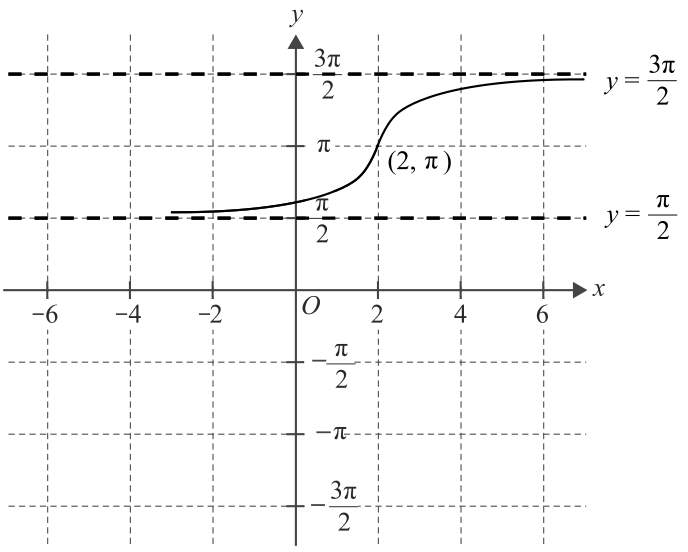
Let `f(x) = arctan (3x - 6) + pi`. --- 2 WORK AREA LINES (style=lined) --- --- 5 WORK AREA LINES (style=lined) --- --- 0 WORK AREA LINES (style=lined) ---
b. `f^{\prime\prime}(x) = (3(18x – 36))/(9x^2 – 36x + 37)^2` `f^{\prime\prime}(x) = 0\ \ text(when)\ \ 18x – 36 = 0 \ => \ x = 2` `text(If)\ \ x < 2, 18x – 36 < 0 \ => \ f^{\prime\prime}(x) < 0` `text(If)\ \ x > 2, 18x – 36 > 0 \ => \ f^{\prime\prime}(x) > 0` `text(S) text(ince)\ \ f^{\prime\prime}(x)\ \ text(changes sign about)\ \ x = 2,` `text(a POI exists at)\ \ x = 2`
a.
`f^{\prime}(x)`
`= (d/(dx) (3x – 6))/(1 + (3x – 6)^2)`
`= 3/(9x^2 – 36x + 37)`
c.
Let `underset ~ a = 2 underset ~i - 3 underset ~j + underset ~k` and `underset ~b = underset ~i + m underset ~j - underset ~k`, where `m` is an integer.
The projection of `underset ~a` onto `underset ~b` is `-11/18 (underset ~i + m underset ~j - underset ~k)`.
--- 6 WORK AREA LINES (style=lined) ---
--- 3 WORK AREA LINES (style=lined) ---
| a. | `underset ~b ⋅ underset ~a` | `= ((1), (m), (-1))((2), (-3), (1)) = 2 – 3m – 1 = 1 – 3m` |
| `|underset ~b|^2` | `= 1^2 + m^2 + (-1)^2 = m^2 + 2` |
| `(underset ~b ⋅ underset ~a)/|underset ~b|^2 ⋅ underset ~b` | `= -11/18 underset ~b` |
| `(1 -3m)/(m^2 + 2)` | `= -11/18` |
| `18 – 54m` | `= -11m^2 – 22` |
| `11m^2 – 54m + 40` | `=0` | |
| `(11m – 10)(m – 4)` | `=0` |
`:. m= 4\ \ (m != 10/11, \ m ∈ Z)`
| b. | `underset ~a_(⊥ underset ~b)` | `= underset ~a + 11/18 (underset ~i + 4 underset ~j – underset ~k)` |
| `= 2 underset ~i + 11/18 underset ~i – 3 underset ~j + 44/18 underset ~j + underset ~k – 11/18 underset ~k` | ||
| `= 47/18 underset ~i – 5/9 underset ~j + 7/18 underset ~k` |
Let `underset ~ a = 2 underset ~i-3 underset ~j + underset ~k` and `underset ~b = underset ~i + m underset ~j-underset ~k`, where `m` is an integer. The vector resolute of `underset ~a` in the direction of `underset ~b` is `-11/18 (underset ~i + m underset ~j-underset ~k)`. --- 6 WORK AREA LINES (style=lined) --- --- 3 WORK AREA LINES (style=lined) ---
a.
`underset ~b ⋅ underset ~a`
`= ((1), (m), (-1))((2), (-3), (1)) = 2-3m-1 = 1-3m`
`|underset ~b|^2`
`= 1^2 + m^2 + (-1)^2 = m^2 + 2`
`(underset ~b ⋅ underset ~a)/|underset ~b|^2 ⋅ underset ~b`
`= -11/18 underset ~b`
`(1 -3m)/(m^2 + 2)`
`= -11/18`
`18-54m`
`= -11m^2-22`
`11m^2-54m + 40`
`=0`
`(11m-10)(m-4)`
`=0`
`:. m= 4\ \ (m != 10/11, \ m ∈ Z)`
b.
`underset ~a_(⊥ underset ~b)`
`= underset ~a + 11/18 (underset ~i + 4 underset ~j-underset ~k)`
`= 2 underset ~i + 11/18 underset ~i-3 underset ~j + 44/18 underset ~j + underset ~k-11/18 underset ~k`
`= 47/18 underset ~i-5/9 underset ~j + 7/18 underset ~k`
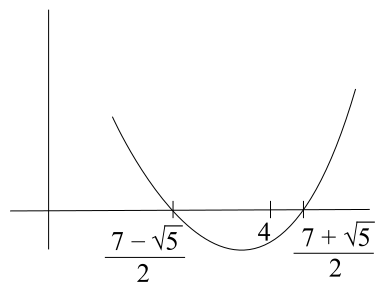
Solve the inequality `3 - x > 1/|x - 4|` for `x`, expressing your answer in interval notation. (4 marks)
`x ∈ (– oo, (7 – sqrt 5)/2)`
`3 – x > 1/|x – 4|`
`|x – 4| (3 – x) > 1`
`text(If)\ \ x – 4 > 0, x > 4`
| `(x – 4) (3 – x)` | `> 1` |
| `3x – x^2 – 12 + 4x` | `> 1` |
| `-x^2 + 7x – 13` | `> 0` |
`Delta = 7^2 – 4 ⋅ 1 ⋅ 13 = -3 < 0`
`=>\ text(No Solutions)`
`text(If)\ \ x – 4 < 0, x < 4`
| `-(x – 4) (3 – x)` | `> 1` |
| `x^2 – 7x + 12` | `> 1` |
| `x^2 – 7x + 11` | `> 0` |
| `x` | `= (7 +- sqrt(7^2 – 4 ⋅ 1 ⋅ 11))/2` |
| `= (7 +- sqrt 5)/2` |
`text(Combining solutions)`
`(x < (7 – sqrt 5)/2 ∪ x > (7 + sqrt 5)/2) nn x < 4`
`x ∈ (– oo, (7 – sqrt 5)/2)`
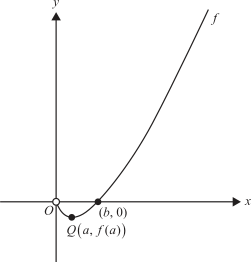
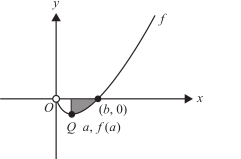
Part of the graph of `y = f(x)`, where `f:(0, ∞) -> R, \ f(x) = xlog_e(x)`, is shown below.
The graph of `f` has a minimum at the point `Q(a, f(a))`, as shown above.
--- 6 WORK AREA LINES (style=lined) ---
--- 3 WORK AREA LINES (style=lined) ---
--- 7 WORK AREA LINES (style=lined) ---
i. Find the value of `k` for which `y = 2x` is a tangent to the graph of `g`. (1 mark)
--- 6 WORK AREA LINES (style=lined) ---
ii. Find all values of `k` for which the graphs of `g` and `g^(-1)` do not intersect. (2 marks)
--- 5 WORK AREA LINES (style=lined) ---
a. `y = xlog_e x`
| `(dy)/(dx)` | `= x · 1/x + log_e x` |
| `= 1 + log_e x` |
`text(Find)\ x\ text(when)\ (dy)/(dx) = 0:`
| `1 + log_e x` | `= 0` |
| `log_e x` | `= -1` |
| `x` | `= 1/e` |
| `y` | `= 1/e log_e (e^(-1))` |
| `= -1/e` |
`:. Q(1/e, -1/e)`
| b. | `int 2x log_e(x) + x\ dx` | `= x^2 log_e (x) + c` |
| `2 int x log_e(x)\ dx` | `= x^2 log_e (x)-intx\ dx + c` | |
| `:. int x log_e(x)\ dx` | `= (x^2 log_e (x))/2-(x^2)/4 \ \ (c = 0)` |
| c. |
`text(When)\ \ x log_e x = 0 \ => \ x = 1`
`=> b = 1`
| `:.\ text(Area)` | `= −int_(1/e)^1 x log_e(x)\ dx` |
| `= [(x^2)/4-(x^2 log_e(x))/2]_(1/e)^1` | |
| `= (1/4-0)-(1/(4e^2)-(log_e(e^(-1)))/(2e^2))` | |
| `= 1/4-(1/(4e^2) + 1/(2e^2))` | |
| `= 1/4-3/(4e^2) \ text(u)^2` |
d.i. `text(When)\ \ f^{prime}(x) = m_text(tang) = 2,`
| `1 + log_e(x)` | `= 2` |
| `x` | `= e` |
`text(T)text(angent meets)\ \ g(x)\ \ text(at)\ \ (e, 2e)`
| `g(e)` | `= f(e) + k` |
| `2e` | `= e log_e e + k` |
| `:.k` | `= e` |
d.ii. `text(Find the value of)\ k\ text(when)\ \ y = x\ \ text(is a tangent to)\ g(x):`
`text(When)\ \ f^{prime}(x) = 1,`
| `1 + log_e(x)` | `= 1` |
| `x` | `= 1` |
`text(T)text(angent occurs at)\ (1, 1)`
`g(1) = f(1) + k \ => \ k = 1`
`:.\ text(Graphs don’t intersect for)\ k ∈ (1, ∞)`
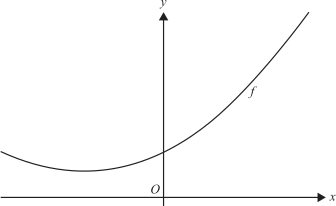
Consider the function `f(x) = x^2 + 3x + 5` and the point `P(1, 0)`. Part of the graph `y = f(x)` is shown below.
--- 2 WORK AREA LINES (style=lined) ---
i. Find the slope of the line connecting points `P` and `Q` in terms of `a`. (1 mark)
--- 3 WORK AREA LINES (style=lined) ---
ii. Find the slope of the tangent to the graph of `f` at point `Q` in terms of `a`. (1 mark)
--- 2 WORK AREA LINES (style=lined) ---
iii. Let the tangent to the graph of `f` at `x = a` pass through point `P`.
Find the values of `a`. (2 marks)
--- 7 WORK AREA LINES (style=lined) ---
iv. Give the equation of one of the lines passing through point `P` that is tangent to the graph of `f`. (1 mark)
--- 6 WORK AREA LINES (style=lined) ---
--- 5 WORK AREA LINES (style=lined) ---
a. `f(1) = 1 + 3 + 5 = 9`
`text(S)text(ince)\ \ f(1) != 0, P(1, 0)\ text(does not lie on)\ \ y = f(x)`
b.i. `P(1, 0), Q(a, f(a))`
| `m_(PQ)` | `= (f(a)-0)/(a-1)` |
| `= (a^2 + 3a + 5)/(a-1)` |
b.ii. `f^{prime}(x) = 2x + 3`
`m_Q = f^{prime}(a) = 2a + 3`
b.iii. `text(T)text(angent:)\ m = 2a + 3,\ text(passes through)\ (a, a^2 + 3a + 5)`
`y-(a^2 + 3a + 5) = (2a + 3)(x-1)`
`text(Passes through)\ P(1, 0):`
| `0-(a^2 + 3a + 5)` | `= (2a + 3)(1-a)` |
| `-(a^2 + 3a + 5)` | `= 2a-2a^2 + 3-3a` |
| `a^2-2a-8` | `= 0` |
| `(a-4)(1 + 2)` | `= 0` |
`:. a = 4\ text(or)\ -2`
b.iv. `text(When)\ \ a = -2`
`m_text(tang) = 2x-2 + 3 = -1`
`text(Equation of line)\ \ m =-1,\ text(through)\ P(1, 0)`
| `y-a` | `=-1(x-1)` |
| `y` | `= -x + 1` |
`text(Similarly, if)\ \ a = 4:`
`y = 11x-11`
c. `f(x)\ text(is a quadratic with no roots.`
`text(Shortest distance needs S.P. to occur when)\ \ x = 1`
`f^{prime}(x) = 2x + 3`
`text(MIN S.P. of)\ \ f(x)\ \ text(occurs when)\ \ f^{prime}(x) = 0`
`x =-3/2`
`f(-2/3-k) = f(1)\ \ text(for shortest distance.)`
`:. k = 5/2`
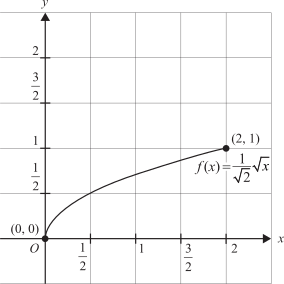
Let `f:[0,2] -> R`, where `f(x) = 1/sqrt2 sqrtx`.
--- 5 WORK AREA LINES (style=lined) ---
The graph of `y = f(x)`, where `x ∈ [0, 2]`, is shown on the axes below.
--- 0 WORK AREA LINES (style=lined) ---
--- 8 WORK AREA LINES (style=lined) ---
`f^(-1)(x) = 2x^2`
| a. | `text(Domain)\ \ f^(-1)(x)` | `= text(Range)\ \ f(x)=[0,1]` |
`y = 1/sqrt2 x`
`text(Inverse: swap)\ \ x ↔ y`
| `x` | `= 1/sqrt2 sqrty` |
| `sqrty` | `= sqrt2 x` |
| `y` | `= 2x^2` |
`:. f^(-1)(x) = 2x^2`
| b. | |
| c. | |
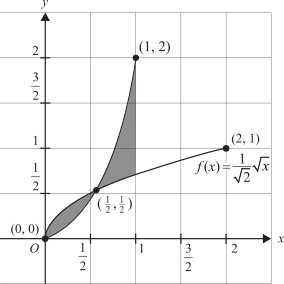
| `A` | `= int_0^(1/2) 1/sqrt2 sqrtx-2x^2 dx + int_(1/2)^1 2x^2-1/sqrt2 sqrtx\ dx` |
| `= [sqrt2/3 x^(3/2)-2/3 x^3]_0^(1/2) + [2/3 x^3-sqrt2/3 x^(3/2)]_(1/2)^1` | |
| `= [sqrt2/3 (1/sqrt2)^3-2/3(1/2)^3] + [(2/3-sqrt2/3)-(2/24-sqrt2/3 · 1/(2sqrt2))]` | |
| `= (1/6-1/12) + 2/3-sqrt2/3-(1/12-1/6)` | |
| `= 1/12 + 2/3-sqrt2/3 + 1/12` | |
| `= (1 + 8-4sqrt2 + 1)/12` | |
| `= (5-2sqrt2)/6\ \ text(u²)` |
Solve the equation `2 log_2(x + 5)-log_2(x + 9) = 1`. (3 marks)
--- 6 WORK AREA LINES (style=lined) ---
`x = text{−1}`
| `2 log_2(x + 5)-log_2(x + 9)` | `= 1` |
| `log_2(x + 5)^2-log_2(x + 9)` | `= 1` |
| `log_2(((x + 5)^2)/(x + 9))` | `= 1` |
| `((x + 5)^2)/(x + 9)` | `= 2` |
| `x^2 + 10x + 25` | `= 2x + 18` |
| `x^2 + 8x + 7` | `= 0` |
| `(x + 7)(x + 1)` | `= 0` |
`:. x = -1\ \ \ \ (x != text{−7}\ \ text(as)\ \ x > text{−5})`
Vicki wants to investigate the number of hours spent on homework by students at her high school.
She asks each student how many hours (to the nearest hour) they usually spend on homework during one week.
The responses are shown in the frequency table.
\begin{array} {|c|c|}
\hline
\textit{ Number of hours spent } & \ \ \ \ \ \textit{Frequency}\ \ \ \ \ \\ \textit{ on homework in a week } & \\
\hline
\rule{0pt}{2.5ex} \text{0 to 4} \rule[-1ex]{0pt}{0pt} & 69 \\
\hline
\rule{0pt}{2.5ex} \text{5 to 9} \rule[-1ex]{0pt}{0pt} & 72 \\
\hline
\rule{0pt}{2.5ex} \text{10 to 14} \rule[-1ex]{0pt}{0pt} & 38 \\
\hline
\rule{0pt}{2.5ex} \text{15 to 19} \rule[-1ex]{0pt}{0pt} & 21 \\
\hline
\end{array}
What is the mean amount of time spent on homework? (2 marks)
--- 4 WORK AREA LINES (style=lined) ---
`text(7.275 hours)`
![]() |
| `text(Mean)` | `= text(Sum of Scores) / text(Total scores)` |
| `= 1455/200` | |
| `= 7.275\ text(hours)` |
--- 2 WORK AREA LINES (style=lined) ---
--- 8 WORK AREA LINES (style=lined) ---
--- 3 WORK AREA LINES (style=lined) ---
--- 2 WORK AREA LINES (style=lined) ---
| i. | `frac{1 + i sqrt3}{1 + i} xx frac{1 – i}{1 – i}` | `= frac{(1 + i sqrt3)(1 – i)}{1 – i^2}` |
| `= frac{1 – i + i sqrt3 – sqrt3 i^2}{2}` | ||
| `= frac{1 + sqrt3}{2} – i ( frac{1 – sqrt3}{2} )` |
ii. `z_1 = 1 + i sqrt3`
`| z_1 | = sqrt(1 + ( sqrt3)^2) = 2`
`text{arg} (z_1) = tan^-1 (sqrt3) = frac{pi}{3}`
`z_1 = 2 (cos frac{pi}{3} + i sin frac{pi}{3})`
`z_2 = 1 + i`
`| z_2 | = sqrt(1^2 + 1^2) = sqrt2`
`text{arg} (z_2) = tan^-1 (1) = frac{pi}{4}`
`z_2 = sqrt2 (cos frac{pi}{4} + i sin frac{pi}{4})`
| `frac{1 + i sqrt3}{1 + i}` | `= frac{z_1}{z_2}` |
| `= frac{2}{sqrt2} ( cos ( frac{pi}{3} – frac{pi}{4} ) + i sin ( frac{pi}{3} – frac{pi}{4} ) )` | |
| `= sqrt2 ( cos (frac{pi}{12}) + i sin (frac{pi}{12}) )` |
iii. `text{Equating real parts of i and ii:}`
| `sqrt2 cos (frac{pi}{12})` | `= frac{1 + sqrt3}{2}` |
| `cos(frac{pi}{12})` | `= frac{1 + sqrt3}{2 sqrt2} xx frac{sqrt2}{sqrt2}` |
| `= frac{sqrt2 + sqrt6}{4}` |
| iv. | `(frac{1 + i sqrt2}{1 + i})^12` | `= (sqrt2)^12 (cos (frac{pi}{12} xx 12) + i sin (frac{pi}{12} xx 12))` |
| `= 64 (cos pi + i sin pi)` | ||
| `= – 64` |
Which of the following is equal to `int_0^(2a) f(x)\ dx`?
`B`
`int_0^(2a) f(x)\ dx – int_0^a f(x)\ dx + int_a^(2a) f(x)\ dx`
`text(Let)\ \ x = 2a – u\ \ => \ u = 2a – x`
`frac{du}{dx} = -1 \ \ => \ du = -dx`
| `text{When}` | `x = a,` | `\ u = a` |
| `x= 2a,` | `\ u = 0` |
`int_0^(2a) f(x)\ dx= int_0^a f(x)\ dx – int_a^0 f(2a – u)\ du`
`text(Use substitution for)\ \ int_a^0 f(2a – u)\ du`
`text(Let)\ \ 2a – u = 2a-x \ \ => \ x=u`
`dx/(du) = 1 \ => \ du=dx`
| `text{When}` | `u = a,` | `\ x = a` |
| `u= 0,` | `\ x = 0` |
| `:. int_0^(2a) f(x)\ dx` | `= int_0^a f(x)\ dx – int_a^0 f(2a – x)\ dx` |
| `= int_0^a f(x)\ dx + int_0^a f(2a -x)\ dx` | |
| `= int_0^a f(x) + f(2a – x)\ dx` |
`=> \ B`
Consider the statement:
'If `n` is even, then if `n` is a multiple of 3, then `n` is a multiple of 6'.
Which of the following is the negation of this statement?
`B`
`text{Proposition: If} \ \ X =>Y`
`X \ text{is a compound statement}`
`text{“If} \ n \ text{is even and a multiple of 3.”}`
`Y \ text{states “} n \ text{is a multiple of 6.”}`
`text{Negation if} \ X \ text{but} \ ¬ \ Y.`
`=> \ B`
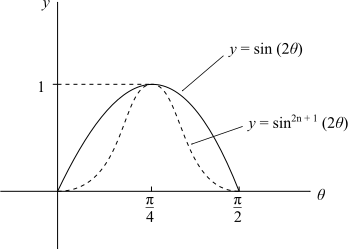
Let `I_n = int_0^(frac{pi}{2}) sin^(2n + 1)(2theta)\ d theta, \ n = 0, 1, ...`
--- 8 WORK AREA LINES (style=lined) ---
Let `J_n = int_0^1 x^n (1 - x)^n\ dx , \ n = 0, 1, 2,...`
--- 8 WORK AREA LINES (style=lined) ---
--- 10 WORK AREA LINES (style=lined) ---
i. `text{Prove} \ \ I_n = frac{2n}{2n + 1} I_(n-1) , \ n ≥ 1`
`I_n = int_0^(frac{pi}{2}) sin^(2n) (2 theta) * sin (2 theta)\ d theta`
`text{Integrating by parts:}`
| `u = sin^(2n) (2 theta)` | `u^(′) = 2n sin^(2n -1) (2 theta) xx -frac(1)(2) cos (2 theta)` | |
| `v = -frac{1}{2} cos (2 theta)` | `v^(′) = sin 2 theta` |
| `I_n` | `= [ sin^(2n) (2 theta) * -frac{1}{2} cos (2 theta)]_0^(frac{pi}{2}) -2n int_0^(frac{pi}{2}) sin^(2n -1) (2 theta) * 2 cos (2 theta) * -frac{1}{2} cos (2 theta)\ d theta` |
| `I_n` | `= 0 + 2n int_0^(frac{pi}{2}) sin^(2n-1) (2 theta) * cos^2 (2 theta)\ d theta` |
| `I_n` | `= 2 n int_0^(frac{pi}{2}) sin^(2n-1) (2 theta) (1 – sin^2 (2 theta))\ d theta` |
| `I_n` | `= 2 n int_0^(frac{pi}{2}) sin^(2n-1) ( 2 theta) – sin^(2n+1) (2 theta)\ d theta` |
| `I_n` | `= 2n (I_(n-1) – I_n)` |
| `I_n + 2 n I_n` | `= 2 n I_(n-1)` |
| `I_n (2n + 1)` | `= 2 n I_(n-1)` |
| `therefore I_n` | `= frac{2n}{2n +1} I_(n-1)` |
| ii. | `I_0` | `= int_0^(frac{pi}{2}) sin (2 theta)\ d theta` |
| `= [ -frac(1)(2) cos (2 theta) ]_0^(frac{pi}{2}` | ||
| `=( -frac{1}{2} cos pi + frac{1}{2} cos 0 )` | ||
| `= 1` | ||
| `I_n` | `= frac{2n}{2n + 1} I_(n-1)` |
| `I_(n-1)` | `= frac{2(n -1)}{2n -1} I_(n-2)` |
| `vdots` | |
| `I_1` | `= frac{2}{3} I_0` |
| `I_n` | `= frac{2n}{2n + 1} xx frac{2(n-1)}{2n-1} xx frac{2(n-2)}{2n-3} xx … xx frac{2}{3} xx 1` |
| `= frac{2n}{2n+1} xx frac{2n}{2n} xx frac{2(n-1)}{2n-1} xx frac{2(n-1)}{2n-2} xx … xx frac{2}{3} xx frac{2}{2} xx 1` | |
| `= frac{2^n (n xx (n-1) xx .. xx 1) xx 2^n (n xx (n – 1) xx … xx 1)}{(2n + 1)!}` | |
| `= frac{2^(2n) (n!)^2}{(2n + 1)!}` |
iii. `J_n = int_0^1 x^n (1-x)^n\ dx , \ n = 0, 1, 2, …`
| `text{Let} \ \ x` | `= sin^2 theta` |
| `frac{dx}{d theta}` | `= 2 sin theta \ cos theta \ => \ dx = 2 sin theta \ cos theta \ d theta` |
| `text{When}` | `x = 0 \ ,` | ` \ theta = 0` |
| `x = 1 \ ,` | ` \ theta = frac{pi}{2}` |
| `J_n` | `= int_0^(frac{pi}{2}) (sin^2 theta)^n (1 – sin^2 theta)^n * 2 sin theta \ cos theta \ d theta` |
| `= int_0^(frac{pi}{2}) sin^(2n) theta \ cos^(2n) theta * sin (2 theta)\ d theta` | |
| `= frac{1}{2^(2n)} int_0^(frac{pi}{2}) 2^(2n) sin^(2n) theta \ cos^(2n) theta * sin (2 theta)\ d theta` | |
| `= frac{1}{2^(2n)} int_0^(frac{pi}{2}) sin^(2n) (2 theta) * sin (2 theta)\ d theta` | |
| `= frac{1}{2^(2n)} int_0^(frac{pi}{2}) sin^(2n+1) (2 theta)\ d theta` | |
| `= frac{1}{2^(2n)} * frac{2^(2n) (n!)^2}{(2n+1)!}\ \ \ text{(using part (ii))}` | |
| `= frac{(n!)^2}{(2n + 1)!}` |
iv. `text{If} \ \ I_n ≤ 1,`
| `2^(2n) (n!)^2` | ` ≤ (2n + 1)!` |
| `(2^n n!)^2` | `≤ (2n + 1)!` |
`text{Show} \ \ I_n ≤ 1 :`
`text{Consider the graphs}`
`y = sin(2 theta) \ \ text{and}\ \ y = sin^(2n + 1) (2 theta) \ \ text{for} \ \ 0 ≤ theta ≤ frac{pi}{2}`
| `int_0^(frac{pi}{2}) sin(2 theta)` | `= [ – frac{1}{2} cos (2 theta) ]_0^(frac{pi}{2})` |
| `= – frac{1}{2} cos \ pi + frac{1}{2} cos \ 0` | |
| `= 1` |
`y = sin(2 theta) \ => \ text{Range} \ [0, 1] \ \ text{for}\ \ theta ∈ [0, frac{pi}{2}]`
| `sin^(2n+1) (2 theta)` | `≤ sin (2 theta) \ \ text{for}\ \ theta ∈ [0, frac{pi}{2}]` |
| `sin^(2n+1) (2 theta)` | `≤ 1` |
| `I_n` | `≤ 1` |
| `therefore (2^n n!)^2` | `≤ (2n + 1) !` |
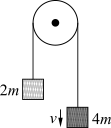
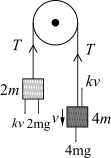
Two masses, `2m` kg and `4m` kg, are attached by a light string. The string is placed over a smooth pulley as shown.
The two masses are at rest before being released and `v` is the velocity of the larger mass at time `t` seconds after they are released.
The force due to air resistance on each mass has magnitude `kv`, where `k` is a positive constant.
--- 6 WORK AREA LINES (style=lined) ---
--- 8 WORK AREA LINES (style=lined) ---
i.
`text{Taking} \ v \ text{downwards as positive.}`
`text{Forces acting on}\ 2m\ text{mass:}`
`kv + 2 mg-T = -2m * frac{dv}{dt}\ …\ (1)`
`text{Forces acting our} \ 4m \ text{mass:}`
`4mg-kv-T = 4m * frac{dv}{dt}\ …\ (2)`
`text{Subtract} \ \ (2)-(1)`
| `2 mg-2 kv` | `= 6 m * frac{dv}{dt}` |
| `:. frac{dv}{dt}` | `= frac{2mg-2 kv}{6 m}` |
| `= frac{gm-kv}{3m}` |
| ii. | `frac{dv}{dt}` | `= frac{gm-kv}{3m}` |
| `frac{dt}{dv}` | `= frac{3m}{gm-kv}` | |
| `t` | `= int frac{3m}{gm-kv}\ dv` | |
| `= -frac{3m}{k} log_e |gm-kv | + c` |
`text{When} \ \ t = 0, v = 0:`
| `0` | `= -frac{3m}{k} log_e \ | gm | + c` |
| `c` | `= frac{3m}{k} log_e \ | gm | ` |
| `t` | `= frac{3m}{k} log_e \ | gm | \-frac{3m}{k} log_e \ | gm -kv |` |
| `= frac{3m}{k} log_e \ | frac{mg}{gm-kv} |` |
`text{Find} \ \ v\ \ text{when} \ \ t = frac{3m}{k} log_e 2 :`
| `frac{3m}{k} log_e 2` | `= frac{3m}{k} log_e | frac{gm}{gm-kv} |` |
| `2` | `= frac{gm}{gm-kv}` |
| `2gm-2kv` | `= gm` |
| `2kv` | `= gm` |
| `therefore \ v` | `= frac{gm}{2k}` |
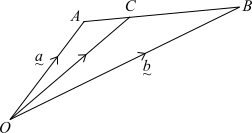
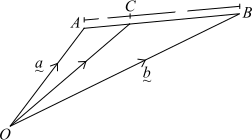
The point `C` divides the interval `AB` so that `frac{CB}{AC} = frac{m}{n}`. The position vectors of `A` and `B` are `underset~a` and `underset~b` respectively, as shown in the diagram.
--- 6 WORK AREA LINES (style=lined) ---
--- 5 WORK AREA LINES (style=lined) ---
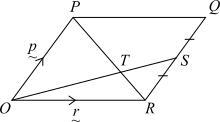
Let `OPQR` be a parallelogram with `overset->(OP) = underset~p` and `overset->(OR) = underset~r`. The point `S` is the midpoint of `QR` and `T` is the intersection of `PR` and `OS`, as shown in the diagram.
--- 8 WORK AREA LINES (style=lined) ---
--- 3 WORK AREA LINES (style=lined) ---
i.
| `frac{overset->(AC)}{overset->(AB)}` | `= frac{n}{m + n}` |
| `overset->(AC)` | `= frac{n}{m + n} * overset->(AB)` |
| `= frac{n}{m + n} (underset~b – underset~a)` |
| ii. | `overset->(OC)` | `= overset->(OA) + overset->(AC)` |
| `= underset~a + frac{n}{m + n} (underset~b – underset~a)` | ||
| `= underset~a – frac{n}{m + n} underset~a + frac{n}{m + n} underset~b` | ||
| `= (1 – frac{n}{m + n}) underset~a + frac{n}{m + n} underset~b` | ||
| `= (frac{m + n – n}{m + n}) underset~a + frac{n}{m + n} underset~b` | ||
| `= frac{m}{m + n} underset~a + frac{n}{m + n} underset~b` |
iii. `text{Show} \ \ overset->(OT) = frac{2}{3} underset~r + frac{1}{3} underset~p`
`text{Consider} \ \ Delta PTO \ \ text{and} \ \ Delta RTS:`
`angle PTO = angle RTS \ (text{vertically opposite})`
`angle OPT = angle SRT \ (text{vertically opposite})`
`therefore \ Delta PTO \ text{|||} \ Delta RTS\ \ text{(equiangular)}`
`OT : TS = OP : SR = 2 : 1`
`(text{corresponding sides in the same ratio})`
| `frac{overset->(OT)}{overset->(OS)}` | `= frac{2}{3}` |
| `overset->(OT)` | `= frac{2}{3} overset->(OS)` |
| `= frac{2}{3} ( underset~r + frac{1}{2} underset~p)` | |
| `= frac{2}{3} underset~r + frac{1}{3} underset~p` |
iv. `text{Let} \ \ overset->(OT) \ text{divide} \ PR\ text{so that}\ \ frac{TR}{PT} = frac{m}{n}`
`text{Using part (ii):}`
| `overset->(OT)` | `= frac{m}{m + n} underset~p + frac{n}{m + n} c` |
| `overset->(OT)` | `= frac{1}{3} underset~p + frac{2}{3} underset~r \ \ \ (text{part (iii)})` |
| `frac{m}{m + n}` | `= frac{1}{3} , frac{n}{m + n} = frac{2}{3}` |
`=> \ m = 1 \ , \ n = 2`
`therefore \ T \ text{divides} \ PR \ text{in ratio 2 : 1}.`
In the set of integers, let `P` be the proposition:
'If `k + 1` is divisible by 3, then `k^3 + 1` divisible by 3.'
--- 5 WORK AREA LINES (style=lined) ---
--- 2 WORK AREA LINES (style=lined) ---
--- 8 WORK AREA LINES (style=lined) ---
i. `text{Let} \ \ k + 1 = 3N, \ N∈ Z`
`=> k = 3N – 1`
| `k^3 + 1` | `= (3N -1)^3 + 1` |
| `= (3N)^3 + 3(3N)^2 (-1) + 3(3N)(-1)^2 + (-1)^3 + 1` | |
| `= 27N^3 – 27N^2 + 9N – 1 + 1` | |
| `= 3 (9N^3 – 9N^2 + 3N)` | |
| `= 3Q \ , \ Q ∈ Z` |
`therefore \ text{If} \ \ k+ 1 \ \ text{is divisible by 3}, text{then} \ \ k^3 + 1 \ \ text{is divisible by 3.}`
ii. `text{Contrapositive}`
`text{If} \ \ k^3 + 1 \ \ text{is not divisible by 3, then}\ \ k + 1\ \ text{is not divisible by 3.}`
iii. `text{Converse:}`
`text{If} \ \ k^3 + 1\ \ text{is divisible by 3, then}\ \ k + 1\ \ text{is divisible by 3.}`
`text(Contrapositive of converse:)`
`text{If}\ \ k + 1\ \ text{is not divisible by 3, then}\ \ k^3 + 1\ \ text{is not divisible by 3.}`
`text(i.e.)\ \ k + 1 \ \ text{is not divisible by 3 when}\ \ k + 1 = 3Q + 1\ \ text{or}\ \ k + 1 = 3Q + 2, text{where}\ Q ∈ Z`
| `text{If} \ \ k + 1` | `= 3Q + 1\ \ => \ k=3Q` |
| `k^3 + 1` | `= (3Q)^3 + 1` |
| `= 27Q^3 + 1` | |
| `= 3(9Q^3) + 1` | |
| `= 3M + 1 \ \ (text{not divisible by 3,}\ M ∈ Z)` |
| `text{If} \ \ k + 1` | `= 3Q + 2\ \ => \ k=3Q+1` |
| `k^3 + 1` | `= (3Q + 1)^3 + 1` |
| `= (3Q)^3 + 3(3Q)^2 + 3(3Q) + 1 + 1` | |
| `= 27Q^3 + 27Q^2 + 9Q + 2` | |
| `= 3(9Q^3 + 9Q^2 + 3Q) + 2` | |
| `= 3M + 2 \ (text{not divisible by 3,}\ M ∈ Z) ` |
`therefore \ text{By contrapositive, if}\ \ k^3 + 1\ \ text {is divisible by 3, k + 1 is divisible by 3.}`
\(38 \ \ 25 \ \ 38 \ \ 46 \ \ 55 \ \ 68 \ \ 72 \ \ 55 \ \ 36 \ \ 38\)
--- 4 WORK AREA LINES (style=lined) ---
--- 5 WORK AREA LINES (style=lined) ---
a. \(1\)
b. \(\text{Standard deviation is a measure of how much the}\)
\(\text{ages of individuals differ from the mean age of the group.}\)
\(\Rightarrow\ \text{Standard deviation of Wednesday’s group would be}\)
\(\text{less as the mean is 70 and everyone’s age is 70.}\)
a. \(\text{Reorder ages in ascending order:}\)
\(25, 36, 38, 38, 38, 46, 55 , 55, 68, 72\)
\(\text{Median} = \dfrac{\text{5th + 6th}}{2} = \dfrac{38 + 46}{2} = 42\)
\(\therefore\ \text{People with age between 42 − 47.1 = 1}\)
b. \(\text{Standard deviation is a measure of how much the}\)
\(\text{ages of individuals differ from the mean age of the group.}\)
\(\Rightarrow\ \text{Standard deviation of Wednesday’s group would be}\)
\(\text{less as the mean is 70 and everyone’s age is 70.}\)
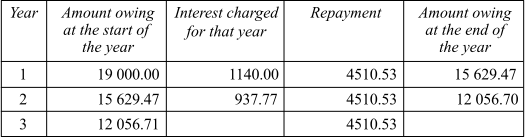
Colin takes out a 5-year reducing balance loan of $19 000 with interest charged at 6% per annum. He uses this money to buy a car valued at $19 000.
The table shows some of the output from a spreadsheet used to model the reducing balance loan.
Colin's car is depreciated using the declining-balance method, with a depreciation rate of 20% per annum.
At the end of 3 years, after making the third repayment on the loan, Colin sells the car at its salvage value. He uses the money from the sale of the car to repay the amount owing on the loan at the end of the third year.
How much money will he have left over? (4 marks)
--- 8 WORK AREA LINES (style=lined) ---
`$1458.43`
`V_0 = 19\ 000 \ , \ r = 20text(%) \ , \ n=3`
| `S` | `= V_0 (1 – r)^n` |
| `= 19\ 000 (1 – 0.2)^3` | |
| `= $9728` |
`text{Find the amount owing on the loan after 3 years:}`
`text(Using the table,)`
`text{Interest (year 3)} = 0.06 xx 12\ 056.70 = $ 723.40`
`text{Amount owing (end of year 3)`
`= 12\ 056.70 + 723.40 – 4510.53`
`= $ 8269.57`
`therefore \ text{Money left over}`
`= 9728 – 8269.57`
`= $1458.43`
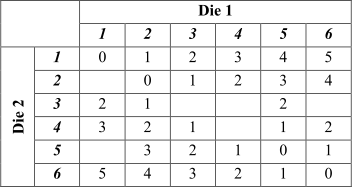
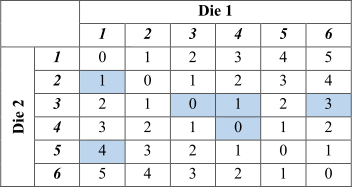
Barbara plays a game of chance, in which two unbiased six-sided dice are rolled. The score for the game is obtained by finding the difference between the two numbers rolled. For example, if Barbara rolls a 2 and a 5, the score is 3.
The table shows some of the scores.
--- 3 WORK AREA LINES (style=lined) ---
a.
| b. | `Ptext{(not zero)}` | `= frac{text(numbers) ≠ 0}{text(total numbers)}` |
| `= frac{30}{36}` | ||
| `= frac{5}{6}` |
\(\text{Alternate solution (b)}\)
| b. | `Ptext{(not zero)}` | `= 1 – Ptext{(zero)}` |
| `= 1 – frac{6}{36}` | ||
| `= frac{5}{6}` |
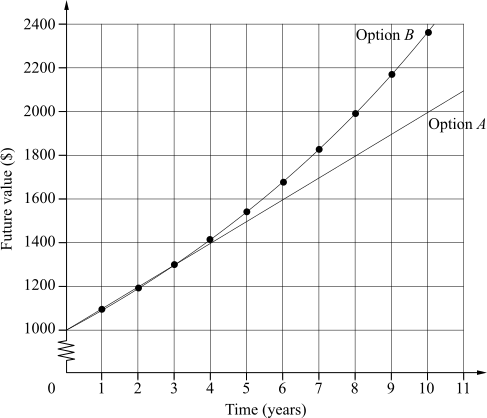
Tom is offered two different investment options.
Option A: 10% per annum simple interest.
Option B: 9% per annum interest, compounded annually.
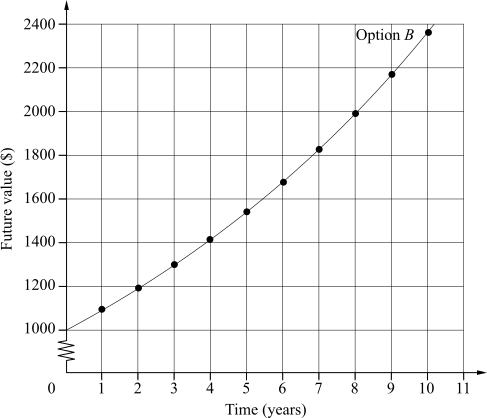
Tom has $1000 to invest. The graph shows the future values over time of $1000 invested using Option B.
Tom wants to find the difference between the future values after 8 years using these two investment options.
By first drawing, on the grid above, the graph of the future values of $1000 invested using Option A, estimate the difference between the future values after 8 years. (3 marks)
--- 6 WORK AREA LINES (style=lined) ---
`$200`
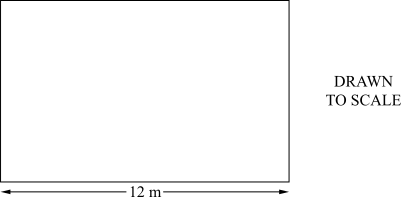
The diagram shows a scale drawing of the floor of a room.
Carpet is to be laid to cover the entire floor. The cost of the carpet is $100 per square metre.
Find the total cost of the carpet required. (3 marks)
--- 6 WORK AREA LINES (style=lined) ---
`$9000`
| `text{Ratio of sides}` | `= \ text{base : height}` |
| `=8 : 5` |
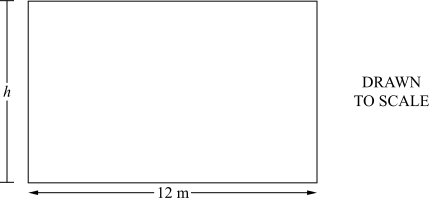
`text{Find actual} \ h :`
| `frac{h}{12}` | `= frac{5}{8}` |
| `h` | `= frac{5 xx 12}{8} = 7.5` |
`text{Area (actual)} = 12 xx 7.5 = 90 \ text{m}^2`
| `therefore \ text{C} text{ost}` | `= 90 xx 100` |
| `= $9000` |
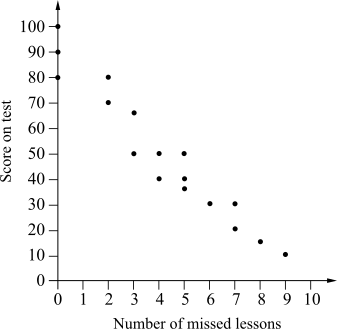
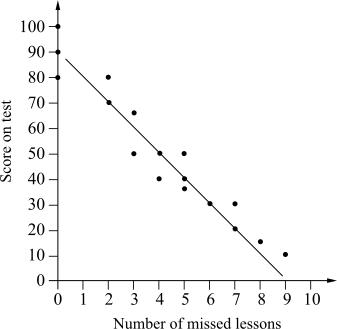
A group of students sat a test at the end of term. The number of lessons each student missed during the term and their score on the test are shown on the scatterplot.
--- 5 WORK AREA LINES (style=lined) ---
--- 1 WORK AREA LINES (style=lined) ---
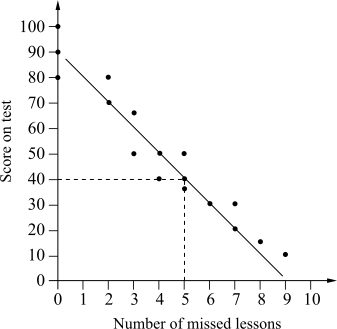
Use the line of the best fit drawn in part (c) to estimate Meg's score on this test. (1 mark)
--- 1 WORK AREA LINES (style=lined) ---
Is it appropriate to use the line of the best fit to estimate his score on the test? Briefly explain your answer. (1 mark)
--- 2 WORK AREA LINES (style=lined) ---
a. \(\text{Strength : strong}\)
\(\text{Direction : negative} \)
b. \(\text{Range}\ = \text{high}-\text{low}\ = 100-80=20\)
c.
d.
e. \(\text{John’s missed days are too extreme and the LOBF is not}\)
\(\text{appropriate. The model would estimate a negative score for}\)
\(\text{John which is impossible.}\)
a. \(\text{Strength : strong}\)
\(\text{Direction : negative} \)
b. \(\text{Range}\ = \text{high}-\text{low}\ = 100-80=20\)
c.
d.
\(\therefore\ \text{Meg’s estimated score = 40}\)
e. \(\text{John’s missed days are too extreme and the LOBF is not}\)
\(\text{appropriate. The model would estimate a negative score for}\)
\(\text{John which is impossible.}\)
The weight of a bundle of A4 paper (`W` kg) varies directly with the number of sheets (`N`) of A4 paper that the bundle contains.
This relationship is modelled by the formula `W = kN`, where `k` is a constant.
The weight of a bundle containing 500 sheets of A4 paper is 2.5 kilograms.
--- 2 WORK AREA LINES (style=lined) ---
--- 4 WORK AREA LINES (style=lined) ---
a. `W = 2.5\ text{kg when} \ N = 500:`
| `2.5` | `= k xx 500` |
| `therefore \ k` | `= frac{2.5}{500}` |
| `= 0.005` |
b. `text{Find}\ \ N \ \ text{when} \ \ W = 1.2\ text{kg:}`
| `1.2` | `= 0.005 xx N` |
| `therefore N` | `= frac{1.2}{0.005}` |
| `= 240 \ text{sheets}` |
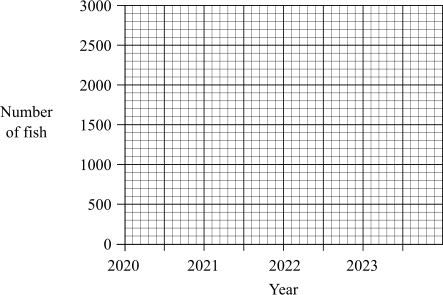
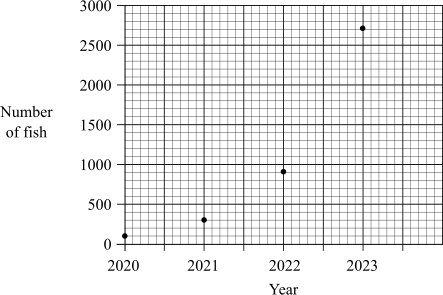
Each year the number of fish in a pond is three times that of the year before.
Complete the table above showing the number of fish in 2021 and 2022. (2 marks)
--- 4 WORK AREA LINES (style=lined) ---
a.
\begin{array} {|l|c|c|c|c|}
\hline
\rule{0pt}{2.5ex}\textit{Year}\rule[-1ex]{0pt}{0pt} & \ \ \ 2020\ \ \ & \ \ \ 2021\ \ \ & \ \ \ 2022\ \ \ & \ \ \ 2023\ \ \ \\
\hline
\rule{0pt}{2.5ex}\textit{Number of fish}\rule[-1ex]{0pt}{0pt} & 100 & 300 & 900 & 2700\\
\hline
\end{array}
c. The more suitable model is exponential.
A linear dataset would graph a straight line which is not the case here.
An exponential curve can be used to graph populations that grow at an increasing rate, such as this example.
a.
\begin{array} {|l|c|c|c|c|}
\hline
\rule{0pt}{2.5ex}\textit{Year}\rule[-1ex]{0pt}{0pt} & \ \ \ 2020\ \ \ & \ \ \ 2021\ \ \ & \ \ \ 2022\ \ \ & \ \ \ 2023\ \ \ \\
\hline
\rule{0pt}{2.5ex}\textit{Number of fish}\rule[-1ex]{0pt}{0pt} & 100 & 300 & 900 & 2700\\
\hline
\end{array}
b.
c. The more suitable model is exponential.
A linear dataset would graph a straight line which is not the case here.
An exponential curve can be used to graph populations that grow at an increasing rate, such as this example.
The distance, `d` metres, travelled by a car slowing down from `u` km/h to `v` km/h can be obtained using the formula
`v^2 = u^2-100 d`
What distance does a car travel while slowing down from 70 km/h to 40 km/h? (2 marks)
--- 5 WORK AREA LINES (style=lined) ---
`33 \ text{metres}`
`u = 70 \ , \ v = 40`
| `v^2` | `= u^2-100d` |
| `40^2` | `= 70^2-100d` |
| `100d` | `= 70^2-40^2` |
| `:. d` | `= frac{70^2-40^2}{100}` |
| `= 33 \ text{metres}` |
The time in Melbourne is 11 hours ahead of Coordinated Universal Time (UTC). The time in Honolulu is 10 hours behind UTC. A plane departs from Melbourne at 7 pm on Tuesday and lands in Honolulu 9 hours later.
What is the time and day in Honolulu when the plane lands? (2 marks)
--- 4 WORK AREA LINES (style=lined) ---
`7\ text{am (Tuesday)}`
`text{Melbourne} \ to \ text{UTC}\ + 11`
`text{Honolulu} \ to \ text{UTC}\ – 10`
`=>\ text{Honolulu is 21 hours behind Melbourne}`
`therefore \ text{Plane landing time}`
`= 7\ text{pm} + 9 \ text{hours}`
`= 4\ text{am (Wednesday – Melb)}`
`= 7\ text{am (Tuesday – Honolulu)}`
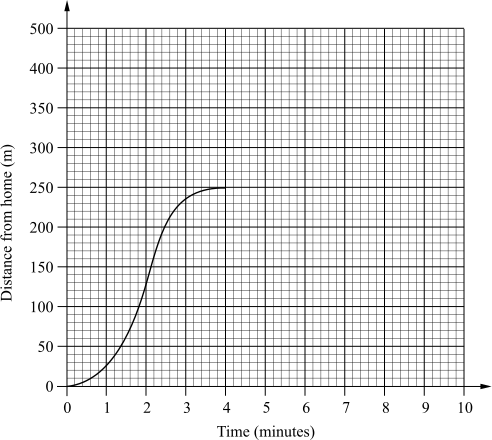
Adam travels on a straight road away from his home. His journey is shown in the distance – time graph.
--- 5 WORK AREA LINES (style=lined) ---
On the above, complete the distance-time using the information provided. (2 marks)
--- 0 WORK AREA LINES (style=lined) ---
`text{Speed: Adam increases speed until approximately}\ \ t=2,`
`text{and then decreases speed until he stops when}\ \ t=4.`
`text{Distance travelled: Adam’s distance from home increases}`
`text{at an increasing rate until}\ \ t=2, \ text{and then continues}`
`text{to increase but at a decreasing rate until}\ \ t=4, \ text(when the)`
`text(distance from home remains the same.)`
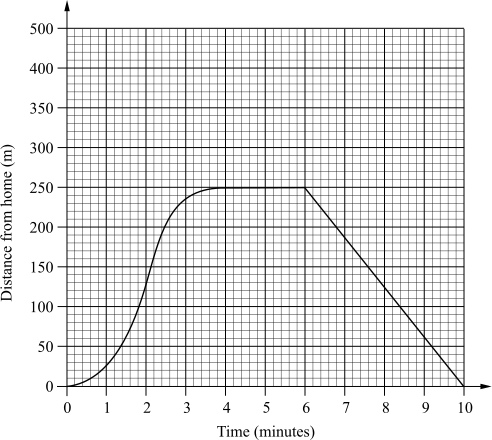
a. `text{Speed: Adam increases speed until approximately}\ \ t=2,`
`text{and then decreases speed until he stops when}\ \ t=4.`
`text{Distance travelled: Adam’s distance from home increases}`
`text{at an increasing rate until}\ \ t=2, \ text{and then continues}`
`text{to increase but at a decreasing rate until}\ \ t=4, \ text(when the)`
`text(distance from home remains the same.)`
b. `text(S)text(ince Adam travels home at a constant speed, the graph is)`
`text{is a straight line and ends at (10, 0).}`
Taro needs $1000 in 5 years time. He is going to invest some money today in an account earning 3% per annum compounded annually. He will make no further deposits or withdrawals.
How much money does he need to invest today? (3 marks)
`$862.61`
| `FV` | `= PV (1 + r)^n` |
| `1000` | `= PV (1 + frac{3}{100})^5` |
| `1000` | `= PV (1.0.3)^5` |
| `:. PV` | `= frac{1000}{(1.03)^5}` |
| `= $862.61` |
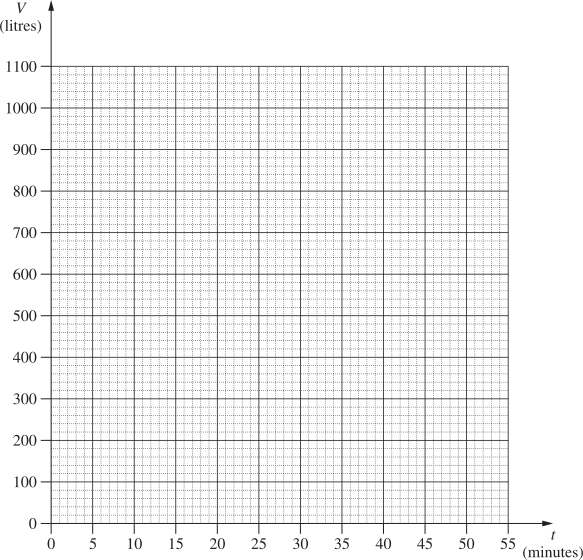
There are two tanks on a property, Tank A and Tank B. Initially, Tank A holds 1000 litres of water and Tank B is empty.
The volume of water in Tank A is modelled by `V = 1000 - 20t` where `V` is the volume in litres and `t` is the time in minutes from when the tank begins to lose water.
On the grid below, draw the graph of this model and label it as Tank A. (1 mark)
--- 2 WORK AREA LINES (style=lined) ---
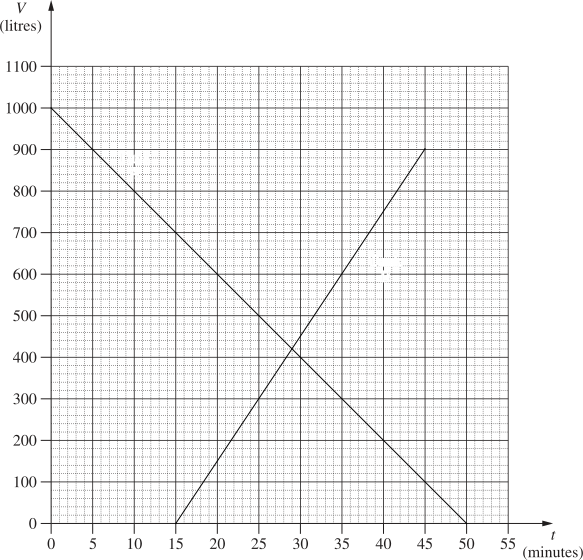
a. `text{T} text{ank} \ A \ text{will pass trough (0, 1000) and (50, 0)}`
b. `text{T} text{ank} \ B \ text{will pass through (15, 0) and (45, 900)}`
`text{By inspection, the two graphs intersect at} \ \ t = 29 \ text{minutes}`
c. `text{Strategy 1}`
`text{By inspection of the graph, consider} \ \ t = 45`
`text{T} text{ank A} = 100 \ text{L} , \ text{T} text{ank B} =900 \ text{L} `
`:.\ text(Total volume = 1000 L when t = 45)`
`text{Strategy 2}`
| `text{Total Volume}` | `=text{T} text{ank A} + text{T} text{ank B}` |
| `1000` | `= 1000 – 20t + (t – 15) xx 30` |
| `1000` | `= 1000 – 20t + 30t – 450 ` |
| `10t` | `= 450` |
| `t` | `= 45 \ text{minutes}` |
The table shows the income tax rates for the 2019 – 2020 financial year.

For the 2019 – 2020 financial year, Wally had a taxable income of $122 680. During the year, he paid $3000 per month in Pay As You Go (PAYG) tax.
Calculate Wally's tax refund, ignoring the Medicare levy. (3 marks)
--- 6 WORK AREA LINES (style=lined) ---
`$3111.40`
| `text(Tax paid)` | `=12 xx 3000` |
| `=$36\ 000` |
`text(Tax payable on $122 680)`
`=20\ 797 + 0.37(122\ 680 – 90\ 000)`
`=20\ 797 + 0.37(32\ 680)`
`=$32\ 888.60`
| `:.\ text(Tax refund)` | `=36\ 000 – 32\ 888.60` | |
| `=$3111.40` |
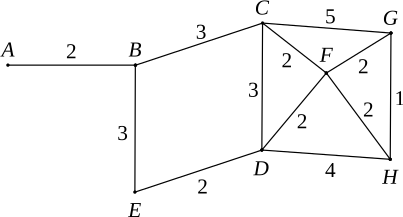
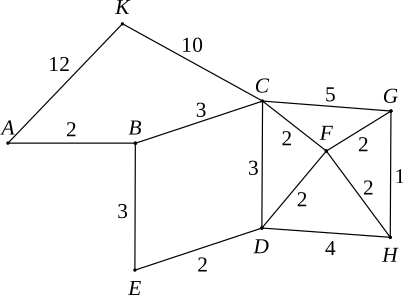
The diagram represents a network with weighted edges.
--- 8 WORK AREA LINES (style=lined) ---
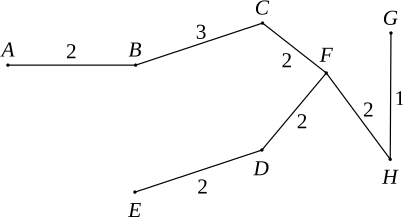
What is the length of the minimum spanning tree for this revised network? (1 mark)
--- 1 WORK AREA LINES (style=lined) ---
`text(One of many possibilities:)`
a. `text{Using Kruskal’s Algorithm (one of many possibilities):}`
`text{Edge 1 :}\ GH\ (1)`
`text{Edge 2 :}\ FH\ (2)`
`text{Edge 3 :}\ CF\ (2)`
`text{Edge 4 :}\ FD\ (2)`
`text{Edge 5 :}\ DE\ (2)`
`text{Edge 6 :}\ BC\ (3)`
`text{Edge 7 :}\ AB\ (2)`
| `text{Minimum length of spanning tree}` | `= 1 + 2 + 2 + 2 +2 + 3 +2` |
| `= 14` |
b. `text{Add}\ CK \ text{to the minimum spanning tree in (a).}`
| `therefore \ text(Revised length)` | `= 14 + 10` |
| `= 24` |
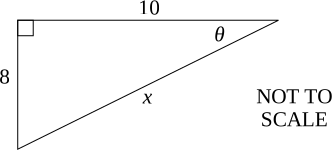
Consider the triangle shown.
--- 4 WORK AREA LINES (style=lined) ---
| a. | `tan theta` | `= frac{8}{10}` |
| `theta` | `= tan ^(-1) frac{8}{10}` | |
| `= 38.659…` | ||
| `= 39^@ \ text{(nearest degree)}` |
b. `text{Using Pythagoras:}`
| `x` | `= sqrt{8^2 + 10^2}` |
| `= 12.806…` | |
| `= 12.8 \ \ text{(to 1 d.p.)}` |
Team `A` and Team `B` have entered a chess competition.
Team `A` and `B` have three members each. Each member of Team `A` must play each member of Team `B` once.
Which of the following network diagrams could represent the chess games to be played?
|
|
`B`
`text(Vertices = players)`
`text(Edges = games between 2 players)`
`text(S)text(ince each player plays once against the three players)`
`text(in the other team, each vertex must be degree 3.)`
`=> \ B`
Joan invests $200. She earns interest at 3% per annum, compounded monthly.
What is the future value of Joan's investment after 1.5 years?
`B`
`text(Monthly interest rate) \ = frac(0.03)(12)`
`n \ = \ 1.5 xx 12 = 18`
| `FV` | `= PV(1 + r)^n` |
| `= 200 (1 + frac(0.03)(12))^18` | |
| `= $209.19` |
`=> \ B`
Suppose `f(x) = tan(cos^(-1)(x))` and `g(x) = (sqrt(1-x^2))/x`.
The graph of `y = g(x)` is given.
--- 8 WORK AREA LINES (style=lined) ---
--- 6 WORK AREA LINES (style=lined) ---
i. `f(x) = tan(cos^(-1)(x))`
| `f^(′)(x)` | `= -1/sqrt(1-x^2) · sec^2(cos^(-1)(x))` |
| `= -1/sqrt(1-x^2) · 1/(cos^2(cos^(-1)(x)))` | |
| `= -1/(x^2sqrt(1-x^2))` |
`g(x) = (1-x^2)^(1/2) · x^(-1)`
| `g^(′)(x)` | `= 1/2 · -2x(1-x^2)^(-1/2) · x^(-1)-(1-x^2)^(1/2) · x^(-2)` |
| `= (-x)/(x sqrt(1-x^2))-sqrt(1-x^2)/(x^2)` | |
| `= (-x^2-sqrt(1-x^2) sqrt(1-x^2))/(x^2 sqrt(1-x^2))` | |
| `= (-x^2-(1-x^2))/(x^2sqrt(1-x^2))` | |
| `= -1/(x^2sqrt(1-x^2))` | |
| `=f^(′)(x)` |
ii. `f^(′)(x) = g^(′)(x)`
`=> f(x) = g(x) + c`
`text(Find)\ c:`
| `f(1)` | `= tan(cos^(-1) 1)` |
| `= tan 0` | |
| `= 0` |
`g(1) = sqrt(1-1)/0 = 0`
`f(1) = g(1) + c`
`:. c = 0`
`:. f(x) = g(x)`
The intelligence Quotient (IQ) scores for adults in City A are normally distributed with a mean of 108 and a standard deviation of 10.
The IQ score for adults in City B are normally distributed with a mean of 112 and a standard deviation of 16.
--- 4 WORK AREA LINES (style=lined) ---
--- 6 WORK AREA LINES (style=lined) ---
a. `text{In City A:}`
`z text{-score}\ (128) = frac {x -mu}{sigma} = frac{128 – 108}{10} = 2`
`therefore\ text{2.5% have a higher IQ in City} \ A.`
b. `text{In City B:}`
`z text{-score}\ (128) = frac{128 – 112}{16} = 1`
`therefore \ text{Adults in City} \ B \ text{with an IQ}\ < 128`
`= 84text(%) xx 1 \ 000 \ 000`
`= 840 \ 000`
c. `z text{-score in City A}\ = z text{-score in City B}`
| `frac{x – 108}{10} ` | `= frac{x -112}{16} \ \ text{(multiply b.s.} \ xx 160 text{)}` |
| `16 (x – 108)` | `= 10 (x – 112)` |
| `16 x – 1728` | `= 10 x – 1120` |
| `6x` | `= 608` |
| `x` | `= 101.3` |
`therefore \ text{Simon’s IQ} = 101.3 \ text{(to 1 d.p.)}`
The diagram shows a regular decagon (ten-sided shape with all sides equal and all interior angles equal). The decagon has centre `O`.
The perimeter of the shape is 80 cm.
By considering triangle `OAB`, calculate the area of the ten-sided shape. Give your answer in square centimetres correct to one decimal place. (4 marks)
--- 8 WORK AREA LINES (style=lined) ---
`492.4\ text(cm²)`
Mr Ali, Ms Brown and a group of students were camping at the site located at `P`. Mr Ali walked with some of the students on a bearing of 035° for 7 km to location `A`. Ms Brown, with the rest of the students, walked on a bearing of 100° for 9 km to location `B`.
--- 2 WORK AREA LINES (style=lined) ---
--- 4 WORK AREA LINES (style=lined) ---
| a. | `angle APB` | `= 100 – 35` |
| `= 65^@` |
b. `text(Using cosine rule:)`
| `AB^2` | `= AP^2 + PB^2 – 2 xx AP xx PB cos 65^@` |
| `= 49 + 81 – 2 xx 7 xx 9 cos 65^@` | |
| `= 76.750…` | |
| `:.AB` | `= 8.760…` |
| `= 8.76\ text{km (to 2 d.p.)}` |
c.
`anglePAC = 35^@\ (text(alternate))`
`text(Using cosine rule, find)\ anglePAB:`
| `cos anglePAB` | `= (7^2 + 8.76 – 9^2)/(2 xx 7 xx 8.76)` | |
| `= 0.3647…` | ||
| `:. angle PAB` | `= 68.61…^@` | |
| `= 69^@\ \ (text(nearest degree))` |
`:. text(Bearing of)\ B\ text(from)\ A\ (theta)`
`= 180 – (69 – 35)`
`= 146^@`