A set of data is displayed in this dot plot.
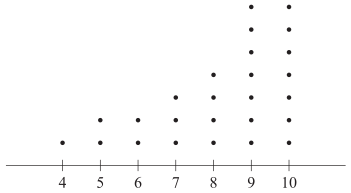
Which of the following best describes this set of data?
- Symmetrical
- Positively skewed
- Negatively skewed
- Normally distributed
Aussie Maths & Science Teachers: Save your time with SmarterEd
A set of data is displayed in this dot plot.
Which of the following best describes this set of data?
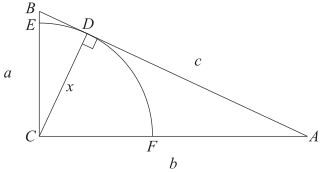
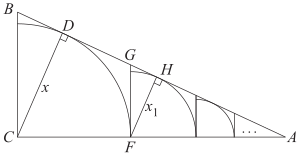
In triangle `ABC, BC` is perpendicular to `AC`. Side `BC` has length `a`, side `AC` has length `b` and side `AB` has length `c`. A quadrant of a circle of radius `x`, centered at `C`, is constructed. The arc meets side `BC` at `E`. It touches the side `AB` at `D`, and meets side `AC` at `F`. The interval `CD` is perpendicular to `AB`.
The diagram shows quadrilateral `ABCD` and the bisectors of the angles at `A, B, C` and `D`. The bisectors at `A` and `B` intersect at the point `P`. The bisectors at `A` and `D` meet at `Q`. The bisectors at `C` and `D` meet at `R`. The bisectors at `B` and `C` meet at `S`.
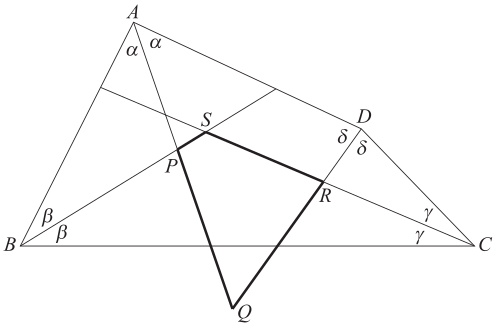
Copy or trace the diagram into your writing booklet.
Show that `PQRS` is a cyclic quadrilateral. (3 marks)
The diagram shows the graph `y = x/(x^2 + 1)`, for all real `x`.
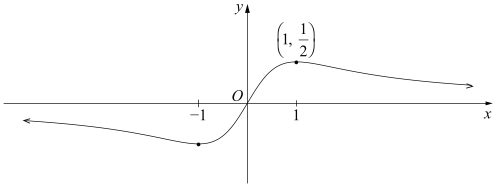
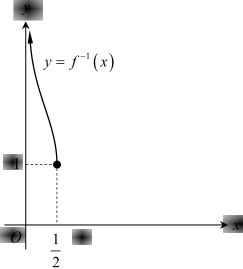
Consider the function `f(x) = x/(x^2 + 1)`, for `x >= 1.`
The function `f(x)` has an inverse. (Do NOT prove this.)
--- 4 WORK AREA LINES (style=lined) ---
--- 6 WORK AREA LINES (style=lined) ---
--- 5 WORK AREA LINES (style=lined) ---
i. `text(Domain of)\ \ f(x)\ \ text(is)\ \ x>=1\ \ text{(given)}`♦♦ Mean mark part (i) 31%.
`=>\ text(Range of)\ \ f^(-1)(x)\ \ text(is)\ \ y >= 1`
`text(Range of)\ \ f(x)\ \ text(is)\ \ 0<y<1/2`
`=>\ text(Domain of)\ \ f^-1(x)\ text(is)\ 0 < x <= 1/2.`
♦ Mean mark part (ii) 43%.
| ii. |
|
iii. `y=x/(x^2+1)`♦ Mean mark part (iii) 45%.
`text(Inverse:)\ \ x ↔ y`
| `x` | `= y/(y^2 + 1)` |
| `xy^2+ x` | `= y` |
| `xy^2-y+x` | `=0` |
| `y` | `= (1 +- sqrt(1 – 4x^2))/(2x)` |
`text(S)text(ince, range of)\ \ f^(-1)(x)\ \ text(is)\ \ y >= 1,`
`:. f^(-1)(x) = (1 + sqrt(1 – 4x^2))/(2x)`
An object is projected from the origin with an initial velocity of `V` at an angle `theta` to the horizontal. The equations of motion of the object are
| `x(t)` | `= Vt cos theta` |
| `y(t)` | `= Vt sin theta - (g t^2)/2.` (Do NOT prove this.) |
`V^2/g sin 2 theta` (2 marks)
--- 6 WORK AREA LINES (style=lined) ---
`V^2/g sin 2 theta`. (1 mark)
--- 3 WORK AREA LINES (style=lined) ---
Let these angles be `alpha` and `beta`, where `beta = pi/2 - alpha.`
Let `h_alpha` be the maximum height reached by the object when projected at the angle `alpha` to the horizontal.
Let `h_beta` be the maximum height reached by the object when projected at the angle `beta` to the horizontal.
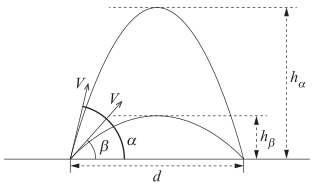
Show that the average of the two heights, `(h_alpha + h_beta)/2`, depends only on `V` and `g`. (3 marks)
--- 9 WORK AREA LINES (style=lined) ---
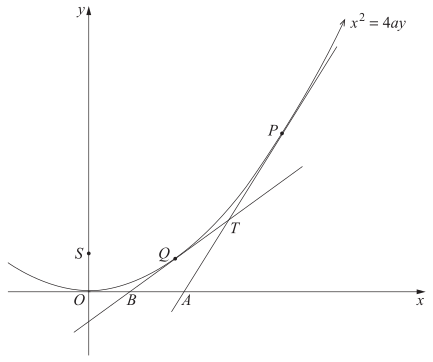
The points `P(2ap, ap^2)` and `Q(2aq, aq^2)` lie on the parabola `x^2 = 4ay`. The focus of the parabola is `S(0, a)` and the tangents at `P` and `Q` intersect at `T(a(p + q), apq)`. (Do NOT prove this.)
The tangents at `P` and `Q` meet the `x`-axis at `A` and `B` respectively, as shown.
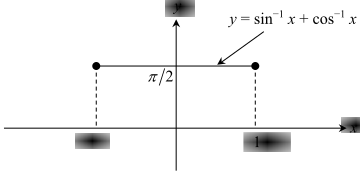
Let `f(x) = sin^(-1) x + cos^(-1) x`.
--- 2 WORK AREA LINES (style=lined) ---
--- 4 WORK AREA LINES (style=lined) ---
--- 8 WORK AREA LINES (style=lined) ---
i. `f^{′}(x) = 1/sqrt(1-x^2) + (-1/sqrt (1-x^2)) = 0`
ii. `text(S)text(ince)\ \ f^{′}(x) = 0\ \ => f(x)\ \ text(is a constant.)`♦ Mean mark (ii) 37%.
`text(Substituting)\ \ x=1\ \ text{into the equation (any value works)}`
| `sin^(-1) 1 + cos^(-1) 1` | `= pi/2 + 0` | |
| `= pi/2\ \ text(… as required)` |
iii. `text(Domain restrictions require:)\ \ -1<x<1`♦ Mean mark (iii) 40%.
|
|
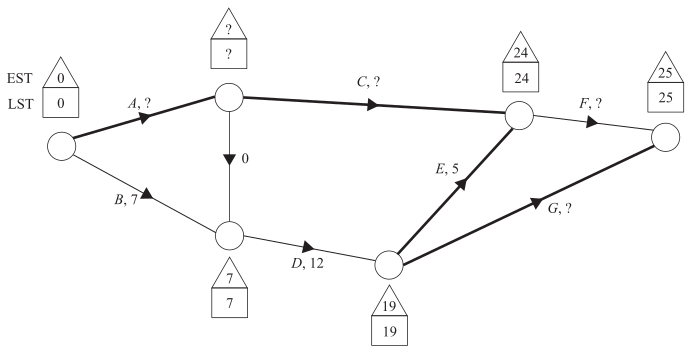
An engineering project requires activities A to G to be completed, as shown in the table.

The minimum completion time for the project is 25 days and the critical path includes activities B, D, E and F. The float for activity G is two days and the float for activity C is four days.
Find the possible duration for each of the activities A, C, F and G. Include a network diagram in your answer. (5 marks)
`text(Duration of)\ F = 1\ text(day)`
`text(Duration of)\ G = 4\ text(days)`
`text(*Understand why there are many possibilities for the duration of)`
`A and C, text(provided they add up to 20 days and)\ A\ text(is not longer)`
`text{than 7 days (or a new critical path is created)}.`
`text(Sketch the network:)`
`text{Critical path information included in the network (where EST = LST)}`
`F\ text(is on critical path ⇒ no float)`
`:.\ text(Duration of)\ F= 25 – 24 = 1\ text(day)`
| `text(Duration of)\ G` | `=\ text(LST of next activity − EST of)\ G – text(float)` |
| `= 25 – 19 – 2` | |
| `= 4\ text(days)` |
`text(The float of)\ C\ text{is 4 days (given)}`
| `:.\ text(Duration of)\ C` | `=\ text(LST of)\ F -\ text(EST of)\ C – 4` |
| `= 24 -\ text(EST of)\ C – 4` | |
| `= 20 -\ text(EST of)\ C` |
`text(EST of)\ C =\ text(Duration of)\ A\ \ (A\ text(has no prerequisites))`
`=>\ text(Duration of)\ A +\ text(Duration of)\ C = 20\ text(days)`
`:.\ text(Possible durations of)\ A\ text(and)\ C\ text(are:)`
`A = 5\ text(days), C = 15\ text(days)`
`text(*Understand why there are many possibilities for the duration of)`
`A and C, text(provided they add up to 20 days and)\ A\ text(is not longer)`
`text{than 7 days (or a new critical path is created)}.`
An engineering project requires activities A to G to be completed, as shown in the table.
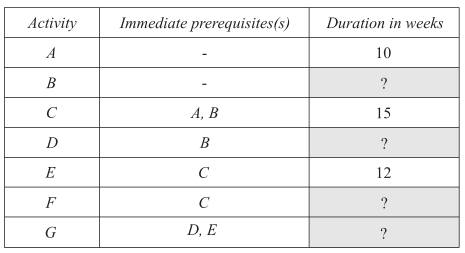
The minimum completion time for the project is 40 weeks and the critical path includes activities A, C, E and G. The float for activity F is six weeks and the float for activity D is 9 weeks.
Find the possible duration for each of the activities B, D, F and G. Include a network diagram in your answer. (5 marks)
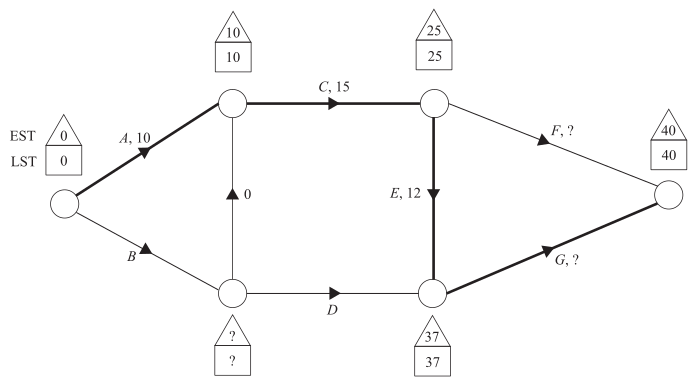
`text(Duration of)\ G = 3\ text(weeks)`
`text(Duration of)\ F = 9\ text(weeks)`
`text(There are many possibilities for the duration of)\ B and D`
`text(provided they add up to 28 weeks and)\ B\ text(is not longer)`
`text{than 10 weeks (new critical path)}.`
`text(Sketch network:)`
`text{Critical path added to network (where EST = LST)}`
`G\ text(is on critical path ⇒ no float)`
`:.\ text(Duration of)\ G = 40-37 = 3\ text(weeks)`
| `text(Duration of)\ F` | `=\ text(40 − EST of)\ F – text(float)` |
| `= 40 – 25 – 6` | |
| `= 9\ text(weeks)` |
`text(Float of)\ D = 9\ text{weeks (given)}`
| `:.\ text(Duration of)\ D` | `=\ text(LST of)\ G -\ text(EST of)\ D – 9` |
| `= 37 -\ text(EST of)\ D – 9` | |
| `= 28 -\ text(EST of)\ D` |
`text(EST of)\ D =\ text(Duration of)\ B\ \ \ (B\ text(has no prerequisites))`
`text(Duration of)\ B +\ text(Duration of)\ D = 28\ text(weeks)`
`:.\ text(Possible durations of)\ B\ text(and)\ D\ text(are:)`
`B = 1\ text(week), D = 27\ text(weeks)`
`text(*Understand why there are many possibilities for the duration of)`
`B and D, text(provided they add up to 28 weeks and)\ B\ text(is not longer)`
`text{than 10 weeks (or a new critical path is created)}.`
A particle is moving in simple harmonic motion. The displacement of the particle is `x` and its velocity, `v`, is given by the equation `v^2 = n^2 (2kx - x^2)`, where `n` and `k` are constants.
The particle is initially at `x = k`.
Which function, in terms of time `t`, could represent the motion of the particle?
A. `x = k cos (nt)`
B. `x = k sin (nt) + k`
C. `x = 2k cos (nt) - k`
D. `x = 2k sin (nt) + k`
Which of the following is a general solution of the equation `sin 2x = -1/2`?
A. `x = n pi + (-1)^n pi/12`
B. `x = (n pi)/2 + (-1)^n pi/12`
C. `x = n pi + (-1)^(n + 1) pi/12`
D. `x = (n pi)/2 + (-1)^(n + 1) pi/12`
Six men and six women are to be seated at a round table.
In how many different ways can they be seated if men and women alternate?
A. `5!\ 5!`
B. `5!\ 6!`
C. `2!\ 5!\ 5!`
D. `2!\ 5!\ 6!`
A community centre is to be built on the new housing estate.
Nine activities have been identified for this building project.
The directed network below shows the activities and their completion times in weeks.

--- 1 WORK AREA LINES (style=lined) ---
--- 4 WORK AREA LINES (style=lined) ---
The builders of the community centre are able to speed up the project.
Some of the activities can be reduced in time at an additional cost.
The activities that can be reduced in time are `A`, `C`, `E`, `F` and `G`.
--- 2 WORK AREA LINES (style=lined) ---
The owner of the estate is prepared to pay the additional cost to achieve early completion.
The cost of reducing the time of each activity is $5000 per week.
The maximum reduction in time for each one of the five activities, `A`, `C`, `E`, `F`, `G`, is `2` weeks.
--- 1 WORK AREA LINES (style=lined) ---
--- 1 WORK AREA LINES (style=lined) ---
a. `text(Scanning forwards and backwards:)`

`BCFHI\ \ text(is the critical path.)`
| `:.\ text(Minimum time)` | `= 4 + 3 + 4 + 2 + 6` |
| `= 19\ text(weeks)` |
| b. | `text(EST of)\ D` | `= 4` |
| `text(LST of)\ D` | `= 9` |
| `:.\ text(Float time of)\ D` | `= 9 – 4` |
| `= 5\ text(weeks)` |
c. `A, E,\ text(and)\ G\ text(are not currently on the critical path,)`
`text(therefore reducing their time will not result in an)`
`text(earlier completion time.)`
d. `text(Reduce)\ C\ text(and)\ F\ text(by 2 weeks each.)`
`text(However, a new critical path created:)\ BEHI\ \ text{(16 weeks)}`
`:.\ text(Also reduce)\ E\ text(by 1 week.)`
`:.\ text(Minimum completion time = 15 weeks)`
| e. | `text(Additional cost)` | `= 5 xx $5000` |
| `= $25\ 000` |
The five musicians are to record an album. This will involve nine activities.
The activities and their immediate predecessors are shown in the following table.
The duration of each activity is not yet known.


There is only one critical path for this project.
--- 1 WORK AREA LINES (style=lined) ---
The following table gives the earliest start times (EST) and latest start times (LST) for three of the activities only. All times are in hours.

--- 1 WORK AREA LINES (style=lined) ---
The minimum time required for this project to be completed is 19 hours.
The duration of activity `C` is 3 hours.
--- 1 WORK AREA LINES (style=lined) ---
--- 1 WORK AREA LINES (style=lined) ---

| a. | |
b. `text(S)text(ince no time information, possible critical paths are:)`
`ADGI, BEGI\ text(or)\ CFHI\ \ text{(all have 4 activities)}`
`:.\ text(Non-critical activities)`
`= 9 – 4 = 5`
c. `text(Critical activities have zero float time.)`
`=> A\ text(and)\ C\ text(are non-critical.)`
`:. B E G I\ text(is the critical path.)`
| d. | `text(Duration of)\ \ I` | `= 19 – 12` |
| `= 7\ text(hours)` |
e. `text(Maximum time for)\ F\ text(and)\ H`♦♦ MARKER’S COMMENT: Many students incorrectly answered 9 hours in part (e).
`=\ text(LST of)\ I – text(duration)\ C – text(slack time of)\ C`
`= 12 – 3 – 1`
`= 8\ text(hours)`
A project will be undertaken in the wildlife park. This project involves the 13 activities shown in the table below. The duration, in hours, and predecessor(s) of each activity are also included in the table.
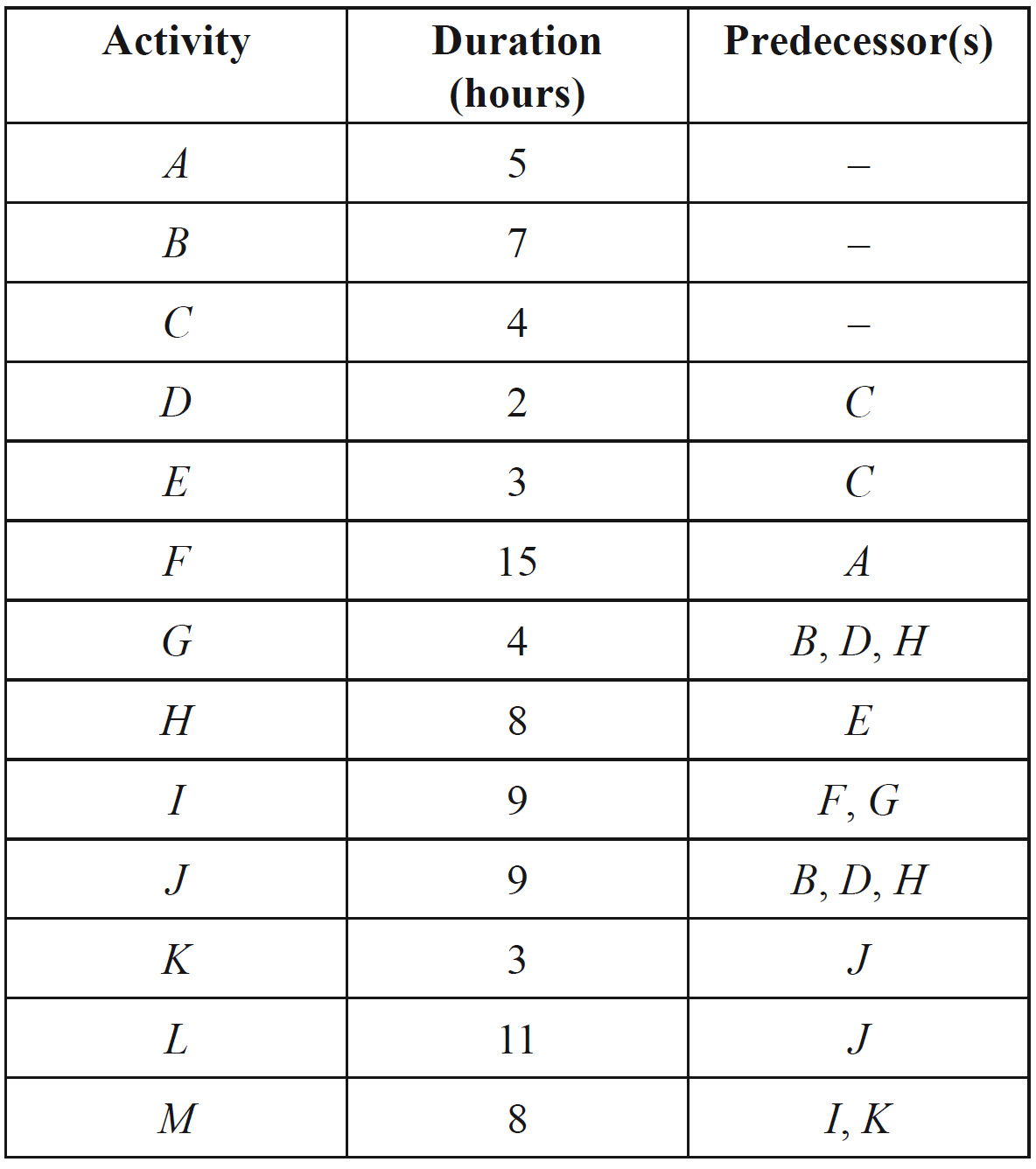
Activity `G` is missing from the network diagram for this project, which is shown below.

--- 1 WORK AREA LINES (style=lined) ---
--- 2 WORK AREA LINES (style=lined) ---
--- 1 WORK AREA LINES (style=lined) ---
‘If the time to complete just one of the activities in this project is reduced by one hour, then the minimum time to complete the entire project will be reduced by one hour.’
Explain the circumstances under which this statement will be true for this project. (1 mark)
--- 2 WORK AREA LINES (style=lined) ---
--- 2 WORK AREA LINES (style=lined) ---
a.

b. `7\ text(hours)`
c.i. `AFIM`
c.ii. `14\ text(hours)`
d. `text(The statement will only be true if the crashed activity)`
`text(is on the critical path)\ \ A F I M.`
e. `text(36 hours)`
| a. | |
b. `text(Scanning forwards and backwards:)`

`text(EST for Activity)\ H`
`= 4 + 3`
`= 7\ text(hours)`
c.i. `A F I M`
c.ii. `text(LST of)\ G = 20 – 4 = 16\ text(hours)`
`text(LST of)\ D = 16 – 2 = 14\ text(hours)`
d. `text(The statement will only be true if the time reduced activity)`
`text(is on the critical path)\ \ A F I M.`
e. `A F I M\ text(is 37 hours.)`
`text(If)\ F\ text(is reduced by 2 hours, the new critical)`
`text(path is)\ \ C E H G I M\ text{(36 hours)}`
`:.\ text(Minimum completion time = 36 hours)`
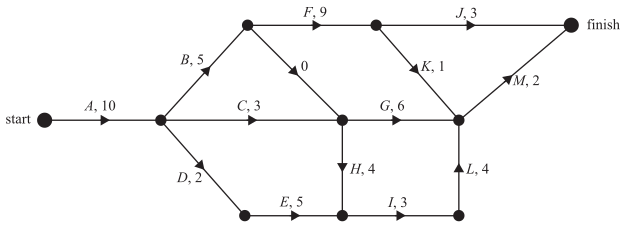
Thirteen activities must be completed before the produce grown on a farm can be harvested.
The directed network below shows these activities and their completion times in days.
--- 1 WORK AREA LINES (style=lined) ---
Explain why this activity is used on the network diagram. (1 mark)
--- 1 WORK AREA LINES (style=lined) ---
--- 1 WORK AREA LINES (style=lined) ---
--- 2 WORK AREA LINES (style=lined) ---
--- 1 WORK AREA LINES (style=lined) ---
| a. | `text(EST of)\ E` | `= 10 + 2` |
| `= 12\ text(days)` |
b. `F\ text(has)\ B\ text(as a predecessor while)\ G\ text(and)\ H`
`text(have)\ B\ text(and)\ C\ text(as predecessors.)`
`text(S)text(ince there cannot be 2 activities called)\ B, text(a zero)`
`text{duration activity is drawn as an extension of}\ B\ text(to)`
`text(show that it is also a predecessor of)\ G\ text(and)\ H.`
c. `text(Scanning forwards:)`
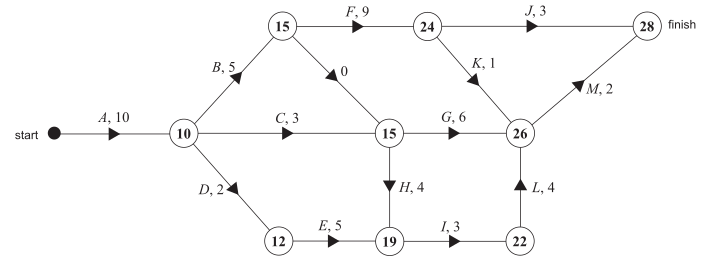
`text(EST for)\ H = 15\ text(days)`
d. `text(The critical path is)\ \ ABHILM`
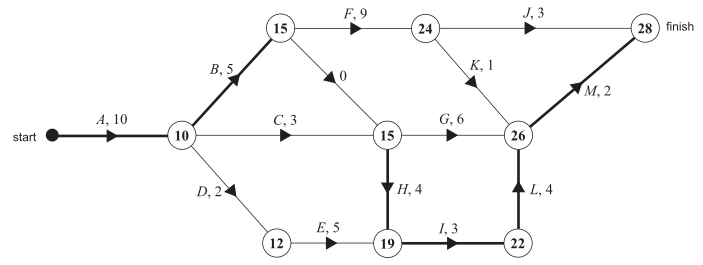
e. `text(The shortest time to complete all the activities)`
`= 10 + 5 + 4 + 3 + 4 + 2`
`= 28\ text(days)`
| `:.\ text(LST of)\ J` | `= 28 − 3` |
| `= 25\ text(days)` |
A walkway is to be built across the lake.
Eleven activities must be completed for this building project.
The directed network below shows the activities and their completion times in weeks.

--- 1 WORK AREA LINES (style=lined) ---
--- 1 WORK AREA LINES (style=lined) ---
Determine the longest float time, in weeks, on the supervisor’s list. (1 mark)
--- 2 WORK AREA LINES (style=lined) ---
A twelfth activity, L, with duration three weeks, is to be added without altering the critical path.
Activity L has an earliest start time of four weeks and a latest start time of five weeks.
Determine the total overall time, in weeks, for the completion of this building project. (1 mark)
--- 2 WORK AREA LINES (style=lined) ---

a. `7\ text(weeks)`
b. `text(Scanning forwards and backwards)`
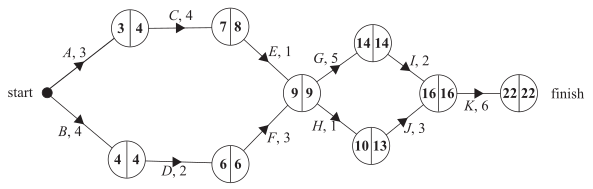
`text(Critical Path is)\ BDFGIK`
c. `H\ text(or)\ J\ text(can be delayed for a maximum)`
`text(of 3 weeks.)`
| d. | |
e. `text(The new critical path is)\ BLEGIK.`
`=>\ text(Activity)\ L\ text(now takes 7 weeks.)`
`:.\ text(Time for completion)`
`= 4 + 7 + 1 + 5 + 2 + 6`
`= 25\ text(weeks)`
Andy, Brian and Caleb must complete three activities in total (K, L and M)
The table shows the person selected to complete each activity, the time it will take to complete the activity in minutes and the immediate predecessor for each activity.

All three activities must be completed in a total of 40 minutes.
The instant that Andy starts his activity, Caleb gets a telephone call.
The maximum time, in minutes, that Caleb can speak on the telephone before he must start his allocated activity is
A. `5`
B. `13`
C. `18`
D. `24`
Which one of the following statements about critical paths is true?
The directed graph below shows the sequence of activities required to complete a project.
The time to complete each activity, in hours, is also shown.
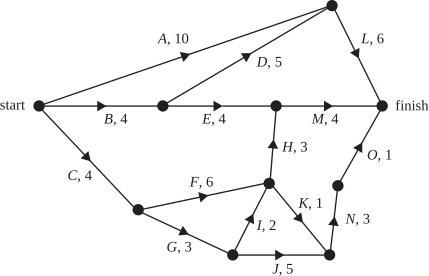
To complete the project in minimum time, some activities cannot be delayed.
i. `text{Scanning forward:}`
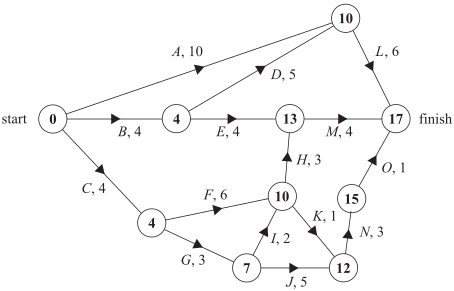
| `:.\ text(EST for)\ N` | `= CGJ` |
| `= 4 +3+5` | |
| `= 12` |
ii. `text(Critical path is:)\ CFHM`
`:. 4\ text(activities can’t be delayed.)`
The directed graph below shows the sequence of activities required to complete a project.
All times are in hours.

--- 1 WORK AREA LINES (style=lined) ---
--- 2 WORK AREA LINES (style=lined) ---
i. `I\ text(and)\ J`
`:.\ text(2 activities have exactly two immediate predecessors.)`
ii. `text(Scanning forwards:)`
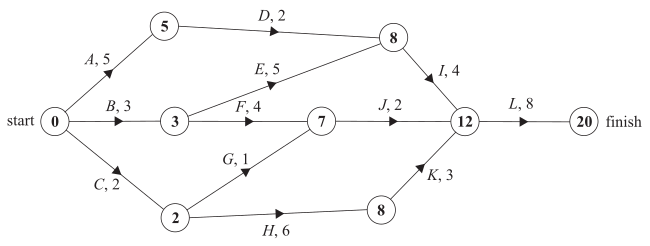
`:.\ text(Initial critical path)\ BEIL`
iii. `text(If)\ E\ text(reduced by 1 hour, critical path)\ BEIL`
`text(reduces to 19 hours.)`
`:.\ text(Other critical paths of 19 hours are:)`
`ADIL = 5 + 2 + 4 + 8 = 19`
`CHKL = 2 + 6 + 3 + 8 = 19`
The network shows the activities that are needed to complete a particular project.

--- 1 WORK AREA LINES (style=lined) ---
The duration of every activity is initially 5 hours.
--- 4 WORK AREA LINES (style=lined) ---
i. `A, B, C, D, E, H\ text(and)\ I\ text(must be completed before)\ L.`
`:.\ text(7 activities need to be completed.)`
ii. `text{Scanning forward (all activities take 5 hours):}`
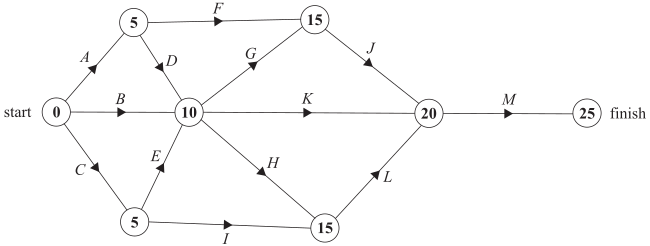
`text(Activity)\ F\ text(and)\ K\ text(are not on any critical path.)`
`:.\ text(Reducing either will not change the completion time)`
`text(for the project.)`
The network below shows the activities that are needed to finish a particular project and their completion times (in days).

Part 1
The earliest start time for Activity K, in days, is
A. `7`
B. `15`
C. `16`
D. `19`
Part 2
This project currently has one critical path.
A second critical path, in addition to the first, would be created by
A. increasing the completion time of D by 7 days.
B. increasing the completion time of G by 1 day.
C. increasing the completion time of I by 2 days.
D. decreasing the completion time of C by 1 day.
`text(Part 1)`
`text(Scanning forwards:)`
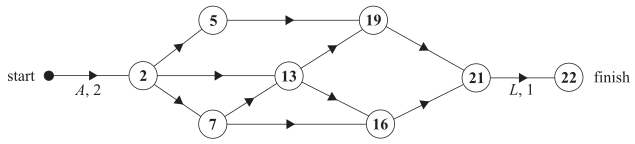
`text(EST for Activity)\ K`
`=\ text(Duration)\ ACFI`
`= 2 + 5 + 6 + 3`
`= 16`
`=> C`
`text(Part 2)`
`text(Original critical path:)\ ACFHJL\ text{(22 days)}`
`text(Consider option)\ A,`
`text(New critical path:)\ ABDJL\ text{(22 days)}`
`=> A`
As an attraction for young children, a miniature railway runs throughout a new housing estate.
The trains travel through stations that are represented by nodes on the directed network diagram below.
The number of seats available for children, between each pair of stations, is indicated beside the corresponding edge.

Cut 1, through the network, is shown in the diagram above.
On one particular train, 10 children set out from the West Terminal.
No new passengers board the train on the journey to the East Terminal.
a. `text(The capacity of Cut 1)`
`=14 + 8 + 13 + 8`
`= 43`
| b. |  |
| `text(Maximum seats)` | `=\ text(minimum cut)` |
| `= 6 + 7 + 9` | |
| `= 22` |
c. `text{The path (edge weights) of the train setting out with}`
`text(10 children starts with: 11 → 13.)`
`text(At the next station, a maximum of 7 seats are available)`
`text(which remain until the East Terminal.)`
`:.\ text(Maximum number of children arriving is 7.)`
The rangers at the wildlife park restrict access to the walking tracks through areas where the animals breed.
The edges on the directed network diagram below represent one-way tracks through the breeding areas. The direction of travel on each track is shown by an arrow. The numbers on the edges indicate the maximum number of people who are permitted to walk along each track each day.

One day, all the available walking tracks will be used by students on a school excursion.
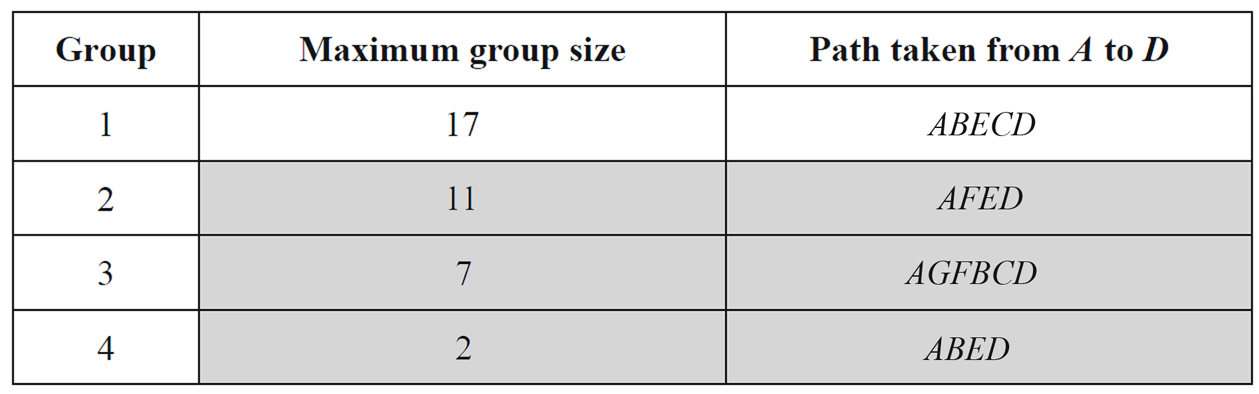
The students will start at `A` and walk in four separate groups to `D`.
Students must remain in the same groups throughout the walk.

| a. | `text(Maximum flow)` | `=\ text(Minimum cut through)\ CD and ED` |
| `= 24 + 13` | ||
| `= 37` |
`:.\ text(A maximum of 37 people can walk)`
`text(to)\ D\ text(from)\ A.`
b.i. `A B E C D`
b.ii. `text(One solution using the second possible largest)`
`text(group of 11 students and two groups from the)`
`text(remaining 9 students is:)`
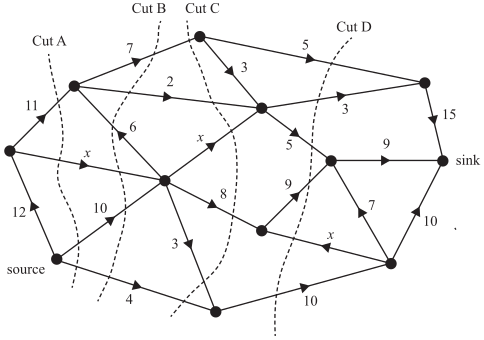
The flow of oil through a series of pipelines, in litres per minute, is shown in the network below.
The weightings of three of the edges are labelled `x`.
Four cuts labelled A–D are shown on the network.
The maximum flow of oil from the source to the sink, in litres per minute, is given by the capacity of

The maximum flow from source to sink through the network shown above is
A. `6`
B. `7`
C. `11`
D. `16`

| `text(Maximum flow)` | `=\ text(minimum cut)` |
| `= 1 + 4 + 2` | |
| `= 7` |
`=> B`

For the graph above, the capacity of the cut shown is
A. `36`
B. `30`
C. `42`
D. `46`
In the network below, the values on the edges give the maximum flow possible between each pair of vertices. The arrows show the direction of flow. A cut that separates the source from the sink in the network is also shown.

--- 1 WORK AREA LINES (style=lined) ---
--- 4 WORK AREA LINES (style=lined) ---
i. `text(Capacity of the cut)`
`= 11 + 5 + 7`
`= 23`
ii.

`text(The maximum flow)`
`=\ text{minimum cut (see above)}`
`= 4 + 2 + 3 + 1`
`= 10`
A map of the roads connecting five suburbs of a city, Alooma (`A`), Beachton (`B`), Campville (`C`), Dovenest (`D`) and Easyside (`E`), is shown below.

A graph that represents the map of the roads is shown below.

One of the edges that connects to vertex `E` is missing from the graph.
(Answer on the graph above.)

a. `text(Alooma and Easyside.)`
| b.i. | |
`text(Draw a third edge between Easyside and Dovenest.)`
b.ii. `text(The loop represents that a driver can take a)`
`text(route out of Dovenest and return home without)`
`text(going through another suburb or turning back.)`
Consider the following graph.
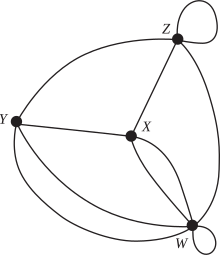
The matrix for this graph that records the number of direct routes between points, is shown below.
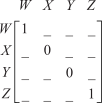
This adjacency table contains 16 values when complete.
Of the 12 missing elements
`text(Completing the adjacency matrix:)`
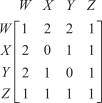
`=> A`
The minimum spanning tree for the network below includes the edge with weight labelled `k`.

The total weight of all edges for the minimum spanning tree is 33.
The value of `k` is
`text(Include)\ k\ text(as a given edge before using Kruskal’s Algorithm,)`
`text(Edge 1:)\ k`
`text(Edge 2: 1)`
`text(Edges 3-4: 2)`
`text(Edge 4: 3 etc…)`
`:.\ text(Minimum spanning tree)`
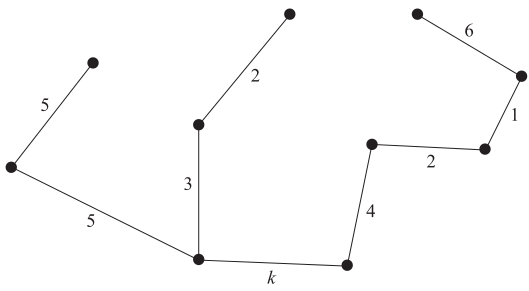
| `text(Total weight)` | `= k + 1+2+2+3+4+5+5+6` |
| `33` | `= k + 28` |
| `:. k` | `= 5` |
`=> D`

The map above shows the road connections between three towns, `P, Q\ text(and)\ R`.
The graph that could be used to model these road connections is


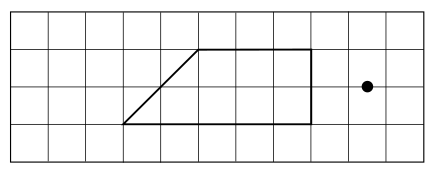
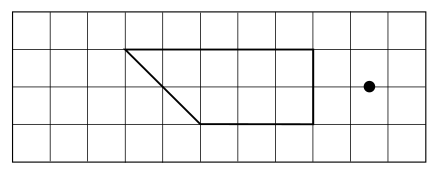
Patchouli draws a shape on some grid paper.
She puts a pin through the dot.
She then rotates the paper a half turn clockwise.
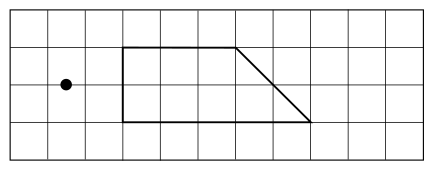
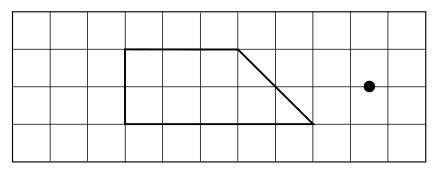
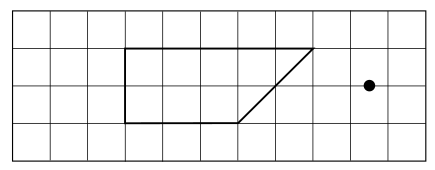
Which of the following shows Patchouli's shape after the rotation?
 |
 |
|
|
|
 |
 |
|
|
|
The entry fees to visit the Toorak Aquarium are $15 for an adult and $7 for a child.
A group of 8 people paid $88 in total to visit the aquarium.
How many adults are in the group?
| `2` | `3` | `4` | `5` |
|
|
|
|
|
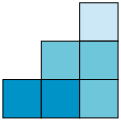
Which of these shows the top view of this stack of boxes?

 |
 |
 |
 |
|
|
|
|
|
The diagram shows a point `T` on the unit circle `x^2+y^2=1` at an angle `theta` from the positive `x`-axis, where `0<theta<pi/2`.
The tangent to the circle at `T` is perpendicular to `OT`, and intersects the `x`-axis at `P`, and the line `y=1` intersects the `y`-axis at `B`

--- 7 WORK AREA LINES (style=lined) ---
--- 4 WORK AREA LINES (style=lined) ---
--- 8 WORK AREA LINES (style=lined) ---
--- 10 WORK AREA LINES (style=lined) ---
| i. |  |
`text(Find)\ T:`
`text(S)text(ince)\ \ cos theta=x/1\ \ \ text(and)\ \ \ sin theta=y/1`
`:. T\ (cos theta, sin theta)`
`text(Gradient of)\ OT=sin theta/cos theta`
`:.\ text(Gradient)\ PT=-cos theta/sin theta\ \ text{(} _|_ text{lines)}`
`text(Equation of)\ PT\ text(where)`
`m=-cos theta/sin theta,\ \ text(and through)\ \ (cos theta, sin theta)`
| `text(Using)\ \ y-y_1` | `=m(x-x_1)` |
| `y-sin theta` | `=-cos theta/sin theta(x-cos theta)` |
| `y sin theta-sin^2 theta` | `=-x cos theta+cos^2 theta` |
| `x cos theta+y sin theta` | `=sin^2 theta+cos^2 theta` |
| `x cos theta+y sin theta` | `=1\ \ \ \ \ text(… as required)` |
ii. `text(Find)\ Q:`
`Q\ => text(intersection of)\ xcos theta+y sin theta=1\ \ text(and)\ \ y=1`
| `x cos theta+sin theta` | `=1` |
| `x cos theta` | `=1-sin theta` |
| `x` | `=(1-sin theta)/cos theta` |
`:.\ text(Length of)\ BQ\ text(is)\ \ (1-sin theta)/cos theta\ text(units)`
iii. `text(Show Area)\ \ OPQB=(2-sin theta)/(2cos theta)`
`A=1/2h(a+b)\ \ text(where)\ \ h=OB=1\ \ a=OP\ \ text(and)`
`b=BQ=(1-sin theta)/cos theta`
`text(Find length)\ OP:`
`P => xcos theta+ysin theta=1 \ text(cuts)\ \ x text(-axis)`
| `xcos theta` | `=1` |
| `x` | `=1/cos theta` |
| `=>\ text(Length)\ OP` | `=1/cos theta` |
| `text(Area)\ OPQB` | `=1/2xx1(1/cos theta+(1-sin theta)/cos theta)` |
| `=1/2((2-sin theta)/cos theta)` | |
| `=(2-sin theta)/(2cos theta)\ \ text(u²)\ \ \ text(… as required)` |
iv. `text(Find)\ theta\ text(such that Area)\ OPQB\ text(is a MIN)`
| `A` | `=(2-sin theta)/(2cos theta)` |
| `(dA)/(d theta)` | `=(2cos theta(-cos theta)-(2- sin theta)(-2 sin theta))/(4cos^2 theta)` |
| `=(4 sin theta-2sin^2 theta-2 cos^2 theta)/(4 cos^2 theta)` | |
| `=(4sin theta-2(sin^2 theta+cos^2 theta))/(4 cos^2 theta)` | |
| `=(4sin theta-2)/(4cos^2 theta)` | |
| `=(2sin theta-1)/(2 cos^2 theta)` |
`text(MAX or MIN when)\ (dA)/(d theta)=0`
| `=>2sin theta-1` | `=0` |
| `sin theta` | `=1/2` |
| `theta` | `=pi/6\ \ \ \ \0<theta<pi/2` |
`text(Test for MAX/MIN:)`
`text(If)\ theta=pi/12\ \ (dA)/(d theta)<0`
`text(If)\ theta=pi/3\ \ (dA)/(d theta)>0\ \ =>text(MIN)`
`:.\text(Area)\ OPQB\ text(is a MIN when)\ theta=pi/6`.

A cone is inscribed in a sphere of radius `a`, centred at `O`. The height of the cone is `x` and the radius of the base is `r`, as shown in the diagram.
--- 6 WORK AREA LINES (style=lined) ---
--- 9 WORK AREA LINES (style=lined) ---
i. `text(Show)\ V = 1/3 pi (2ax^2-x^3)`

`V = 1/3 pi r^2 h`
`text(Using Pythagoras:)`
| `(x-a)^2 + r^2` | `= a^2` |
| `r^2` | `= a^2-(x-a)^2` |
| `= a^2-x^2 + 2ax-a^2` | |
| `= 2ax-x^2` |
| `:. V` | `= 1/3 xx pi xx (2ax-x^2) xx x` |
| `= 1/3 pi (2ax^2-x^3)\ …\ text(as required)` |
ii. `(dV)/(dx) = 1/3 pi (4ax-3x^2)`
`(d^2V)/(dx^2) = 1/3 pi (4a-6x)`
`text(Max or min when)\ (dV)/(dx) = 0`
| `1/3 pi (4ax-3x^2)` | `= 0` |
| `4ax-3x^2` | `= 0` |
| `x(4a-3x)` | `= 0` |
| `3x` | `= 4a,` | ` \ \ \ \ x ≠ 0` |
| `x` | ` =4/3 a` |
`text(When)\ \ x = 4/3 a`
| `(d^2V)/(dx^2)` | `= 1/3 pi (4a-6 xx 4/3 a)` |
| `= 1/3 pi (-4a) < 0` | |
| `=>\ text(MAX)` | |
`:.\ text(Cone volume is a maximum when)\ \ x = 4/3 a.`

The diagram shows two parallel brick walls `KJ` and `MN` joined by a fence from `J` to `M`. The wall `KJ` is `s` metres long and `/_KJM=alpha`. The fence `JM` is `l` metres long.
A new fence is to be built from `K` to a point `P` somewhere on `MN`. The new fence `KP` will cross the original fence `JM` at `O`.
Let `OJ=x` metres, where `0<x<l`.
--- 9 WORK AREA LINES (style=lined) ---
--- 9 WORK AREA LINES (style=lined) ---
--- 5 WORK AREA LINES (style=lined) ---
| i. |  |
`A=text(Area)\ Delta OJK+text(Area)\ Delta OMP`
`text(Using sine rule)`
`text(Area)\ Delta OJK=1/2\ x s sin alpha`
`text(Area)\ DeltaOMP =>text(Need to find)\ \ MP`
| `/_OKJ` | `=/_MPO\ \ text{(alternate angles,}\ MP\ text(||)\ KJtext{)}` |
| `/_PMO` | `=/_OJK=alpha\ \ text{(alternate angles,}\ MP\ text(||)\ KJtext{)}` |
`:.\ DeltaOJK\ text(|||)\ Delta OMP\ \ text{(equiangular)}`
| `=>x/s` | `=(l-x)/(MP)\ ` | ` text{(corresponding sides of similar triangles)}` |
| `MP` | `=(l-x)/x *s` |
| `text(Area)\ Delta\ OMP` | `=1/2 (l-x)* MP * sin alpha` |
| `=1/2 (l-x)*((l-x))/x* s sin alpha` |
| `:. A` | `=1/2 x*s sin alpha+1/2 (l-x)*((l-x))/x* s sin alpha` |
| `=s sin alpha(1/2 x+1/2 (l-x)*((l-x))/x)` | |
| `=s sin alpha(1/2 x+(l-x)^2/(2x))` | |
| `=s sin alpha(1/2 x+l^2/(2x)-l+1/2 x)` | |
| `=s(x-l+l^2/(2x))sin alpha\ \ \ \ text(… as required)` |
ii. `text(Find)\ x\ text(such that)\ A\ text(is a minimum)`
| `A` | `=s(x-l+l^2/(2x))sin alpha` |
| `(dA)/(dx)` | `=s(1-l^2/(2x^2))sin alpha` |
`text(MAX/MIN when)\ (dA)/(dx)=0`
| `s(1-l^2/(2x^2))sin alpha` | `=0` |
| `l^2/(2x^2)` | `=1` |
| `2x^2` | `=l^2` |
| `x^2` | `=l^2/2` |
| `x` | `=l/sqrt2,\ \ \ x>0` |
`(d^2A)/(dx^2)=s((l^2)/(2x^3))sin alpha`
`text(S)text(ince)\ \ 0<alpha<90°\ \ =>\ sin alpha>0,\ \ l>0\ \ text(and)\ \ x>0`
`(d^2A)/(dx^2)>0\ \ \ =>text(MIN at)\ \ x=l/sqrt2`
iii. `text(S)text(ince)\ \ MP=((l-x))/x s\ \ text(and MIN when)\ \ x=l/sqrt2`
| `MP` | `=((l-l/sqrt2)/(l/sqrt2))s xx sqrt2/sqrt2` |
| `=((sqrt2 l-l))/l s` | |
| `=(sqrt2-1)s\ \ text(metres)` |
`:.\ MP=(sqrt2-1)s\ \ text(metres when)\ A\ text(is a MIN.)`

A cylinder of radius `x` and height `2h` is to be inscribed in a sphere of radius `R` centred at `O` as shown.
--- 4 WORK AREA LINES (style=lined) ---
--- 9 WORK AREA LINES (style=lined) ---
The rule for function `f` is `f(x) = x^3 - 3x^2 + kx + 8`, where `k` is a constant.
Find the values of `k` for which `f(x)` is an increasing function. (2 marks)
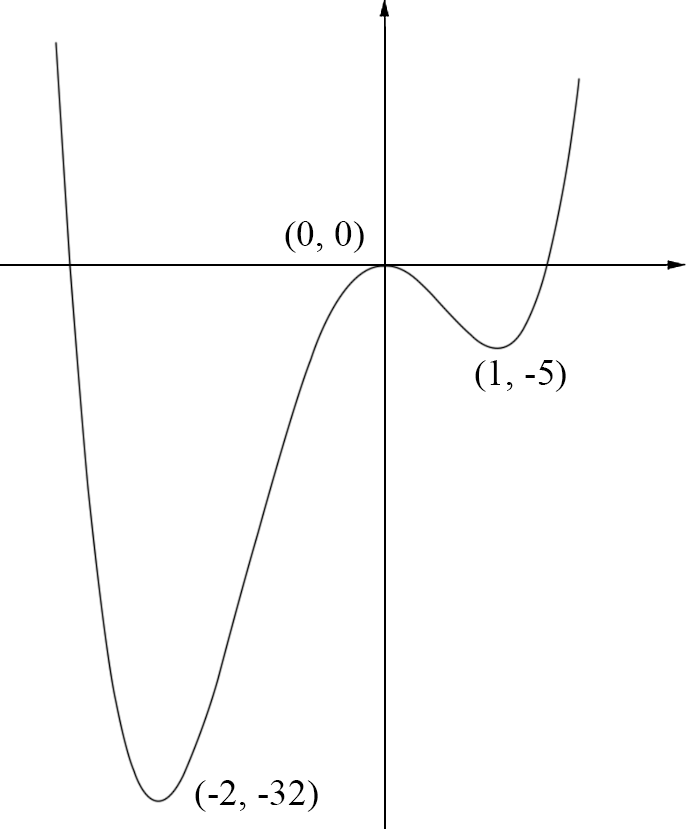
A function is given by `f(x) = 3x^4 + 4x^3-12x^2`.
--- 9 WORK AREA LINES (style=lined) ---
--- 6 WORK AREA LINES (style=lined) ---
--- 2 WORK AREA LINES (style=lined) ---
--- 3 WORK AREA LINES (style=lined) ---
| i. | `f(x)` | `= 3x^4 + 4x^3 -12x^2` |
| `f^{′}(x)` | `= 12x^3 + 12x^2-24x` | |
| `f^{″}(x)` | `= 36x^2 + 24x-24` |
`text(Stationary points when)\ f prime (x) = 0`
| `=> 12x^3 + 12x^2-24x` | `=0` |
| `12x(x^2 + x-2)` | `=0` |
| `12x (x+2) (x -1)` | `=0` |
`:.\ text(Stationary points at)\ x=0,\ 1\ text(or)\ –2`
| `text(When)\ x=0,\ \ \ \ f(0)=0` | |
| `f^{″}(0)` | `= -24 < 0` |
| `:.\ text{MAX at (0,0)}` | |
`text(When)\ x=1`
| `f(1)` | `= 3+4\-12 = -5` |
| `f^{″}(1)` | `= 36 + 24\-24 = 36 > 0` |
| `:.\ text{MIN at (1,–5)}` | |
`text(When)\ x=–2`
| `f(–2)` | `=3(–2)^4 + 4(–2)^3-12(–2)^2` |
| `= 48 -32\-48` | |
| `= -32` | |
| `f^{″}(–2)` | `= 36(–2)^2 + 24(–2) -24` |
| `=144-48-24 = 72 > 0` | |
| `:.\ text{MIN at (–2,–32)}` | |
| ii. | |
| iii. | `f(x)\ text(is increasing for)` |
| `-2 < x < 0\ text(and)\ x > 1` |
iv. `text(Find)\ k\ text(such that)`
`3x^4 + 4x^3-12x^2 + k = 0\ \ text(has no solution)`
`k\ text(is the vertical shift of)\ \ y = 3x^4 + 4x^3-12x^2`
`=>\ text(No solution if it does not cross the)\ x text(-axis.)`
`:.\ text(No solution when)\ \ k > 32`
Let `f : [-π, π] → R`, where `f (x) = 2 sin (2x)-1`.
Calculate the average value of `f` over the interval `-pi/3 <= x <= pi/6`. (3 marks)
--- 9 WORK AREA LINES (style=lined) ---
The figure shown represents a wire frame where `ABCE` is a convex quadrilateral. The point `D` is on line segment `EC` with `AB = ED = 2\ text(cm)` and `BC = a\ text(cm)`, where `a` is a positive constant.
`/_ BAE = /_ CEA = pi/2`
Let `/_ CBD = theta` where `0 < theta < pi/2.`

--- 5 WORK AREA LINES (style=lined) ---
--- 2 WORK AREA LINES (style=lined) ---
--- 5 WORK AREA LINES (style=lined) ---
--- 2 WORK AREA LINES (style=lined) ---
i. `text(In)\ \ Delta BCD,`
| `cos theta` | `= (BD)/a` |
| `:. BD` | `= a cos theta` |
| `sin theta` | `= (CD)/a` |
| `:. CD` | `= a sin theta` |
| ii. | `L` | `= 4 + 2 BD + CD + a` |
| `= 4 + 2a cos theta + a sin theta + a` | ||
| `= 4 + a + 2a cos theta + a sin theta` |
iii. `text(Noting that)\ a\ text(is a constant:)`
`(dL)/(d theta)= – 2 a sin theta + a cos theta`
`text(When)\ \ (dL)/(d theta) = 0`,
| `- 2 a sin theta+ a cos theta` | `= 0` |
| `a cos theta` | `= 2 a sin theta` |
| `:. BD` | `= 2CD\ \ text{(using part (a))}` |
iv. `text(SP’s when)\ \ (dL)/(d theta)=0,`
| `- 2 a sin theta+ a cos theta` | `= 0` |
| `sin theta` | `=1/2 cos theta` |
| `tan theta` | `=1/2` |

`text(If)\ \ tan theta=1/2,\ \ cos theta = 2/sqrt5,\ \ sin theta = 1/sqrt5`
| `L_(max)` | `= 4 + a + 2a cos theta + a sin theta` |
| `= 4 + (3 sqrt 5) + 2 (3 sqrt 5) (2/sqrt 5) + (3 sqrt 5) (1/sqrt 5)` | |
| `= 4 + 3 sqrt 5 + 12 + 3` | |
| `= 19 + 3 sqrt 5\ text(cm)` |
Let `f(x) = 2e^(-x/5)\ \ \ text(for)\ \ x>=0`
A right-angled triangle `OQP` has vertex `O` at the origin, vertex `Q` on the `x`-axis and vertex `P` on the graph of `f`, as shown. The coordinates of `P` are `(x, f(x)).`

--- 2 WORK AREA LINES (style=lined) ---
--- 6 WORK AREA LINES (style=lined) ---

--- 5 WORK AREA LINES (style=lined) ---
| i. | `text(Area)` | `= 1/2 xx b xx h` |
| `= 1/2x(2e^(-x/5))` | ||
| `:. A` | `= xe^(-x/5)` |
ii. `text(Stationary point when)\ \ (dA)/(dx) = 0,`
| `x(-1/5 e^(-x/5)) + e^(-x/5)` | `= 0` |
| `e^(-x/5)(1 – x/5)` | `= 0` |
| `:. x` | `= 5\ \ \ \ (e^(-x/5) >0,\ \ text(for all)\ x)` |
| `text(When)\ \ x = 5,\ \ A` | `= xe^(-x/5)= 5e^-1` |
`:. A_max = 5/e\ text(u², when)\ \ x = 5`
iii. `text(Find)\ \ S:\ F(0) = 2`
`=>S(0, 2)`
| `text(Find)\ \ T:\ \ \ ` | `2e^(-x/5)` | `= 1/2` |
| `e^(-x/5)` | `= 1/4` | |
| `-x/5` | `= log_e (1/4)` | |
| `x` | `= 5 log_e (4)` |
`=> T(5log_e(4), 1/2)`

| `:.\ text(Area)` | `= text(Area)\ SOAT – int_0^(5 log_e(4)) (2e^(-x/5)) dx` |
| `=1/2h(a+b) + 10 [e^(-x/5)]_0^(5 log_e (4))` | |
| `= 5/2 log_e (4) (2 + 1/2) + 10 [e^(-log_e (4)) – e^0]` | |
| `= 25/4 log_e (4) +10 (1/4 – 1)` | |
| `= 25/4 log_e (4) – 15/2\ text(u²)` |
Lifeguards are required to ensure the safety of swimmers at the beach.
Let `x` be the number of junior lifeguards required.
Let `y` be the number of senior lifeguards required.
The inequality below represents the constraint on the relationship between the number of senior lifeguards required and the number of junior lifeguards required.
Constraint 1 `y >= x/4`
There are three other constraints.
Constraint 2 `x ≥ 6`
Constraint 3 `y ≥ 4`
Constraint 4 `x + y ≥ 12`
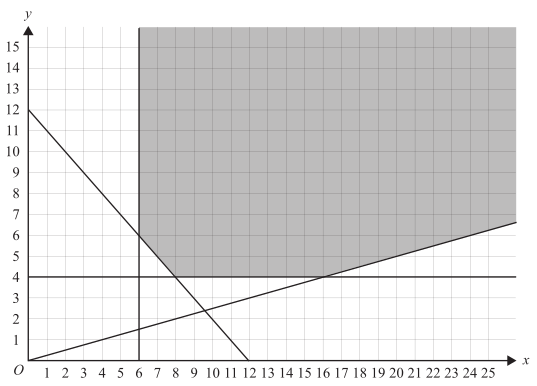
The shaded region of the graph below contains the points that satisfy Constraints 1 to 4.
All lifeguards receive a meal allowance per day.
Junior lifeguards receive $15 per day and senior lifeguards receive $25 per day.
The total meal allowance cost per day, `$C`, for the lifeguards is given by
`C = 15x + 25y`
• Constraint 2 `(x ≥ 6)` and Constraint 3 `(y ≥ 4)` are removed
• Constraint 1 and Constraint 4 are to remain.
Constraint 1 `y >= x/4`
Constraint 4 `x + y >= 12`
The total meal allowance cost per day, `$C`, for the lifeguards remains as
`C = 15x + 25y`
How many junior lifeguards and senior lifeguards work on a rainy day if the total meal allowance cost is to be a minimum?
Write your answers in the boxes provided below. (1 mark)

a. `2`
b. `text(The total combined number of junior and)`
`text(senior lifeguards must be at least 12.)`
c. `$220`
| d. |  |
a. `text(Minimum senior lifeguards) = 8/4 = 2`
b. `text(The total combined number of junior and)`
`text(senior lifeguards must be at least 12.)`
c. `text(Minimum cost occurs at (8, 4))`
| `:. C_text(min)` | `= 15 xx 8 + 25 xx 4` |
| `= $220` |
d. `text(Consider the graph without the restrictions)`♦♦ Mean mark 24%.
MARKER’S COMMENT: A common incorrect answer was 10 and 3.
`x >= 6quadtext(and)quady >= 4:`
`text(By inspection, intersection around (9.5, 2.4))`
`text(⇒ Minimum allowance when)`
A swimming race is being held in the ocean.
From the shore, competitors swim 500 m out to a buoy in the ocean and then return to the shore.
One competitor, Edgar, reaches the buoy after 12.5 minutes and completes the race in 25 minutes.
The graph below shows his distance from shore, in metres, `t` minutes after the race begins.
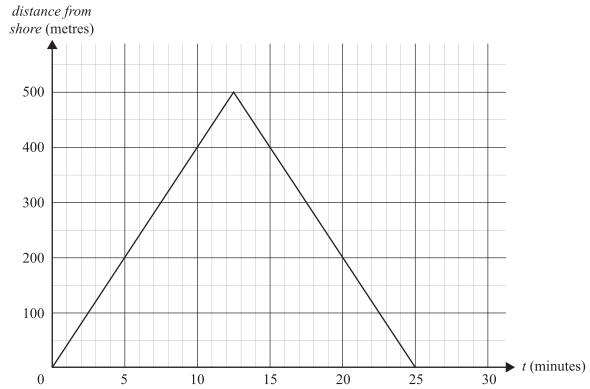
The linear relation that represents his swim out to the buoy is of the form
`E = kt,` where `0 < t ≤ 12.5`
The slope of the line `k` is the speed at which Edgar is swimming, in metres per minute.
Show that `k = 40`. (1 mark)
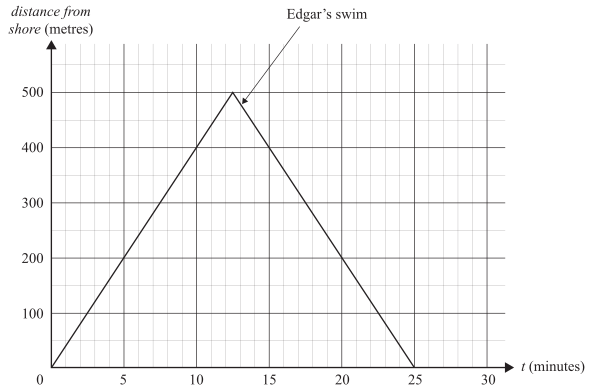
A second competitor, Zlatko, began the race at the same time as Edgar.
Below is the relation that describes Zlatko’s swim, where `Z` is his distance from the shore, in metres, `t` minutes after the race begins and `F` is the time it took Zlatko to finish the race.
`Z = {(qquadqquadqquad50t,0 < t <= 10),(−62.5t + 1125, 10 < t <= F):}`
Sketch the relation representing Zlatko’s swim on the graph below. (2 marks)
Round your answer to two decimal places. (1 mark)
a. `600\ text(metres)`
b. `text(See Worked Solutions)`
| c. | 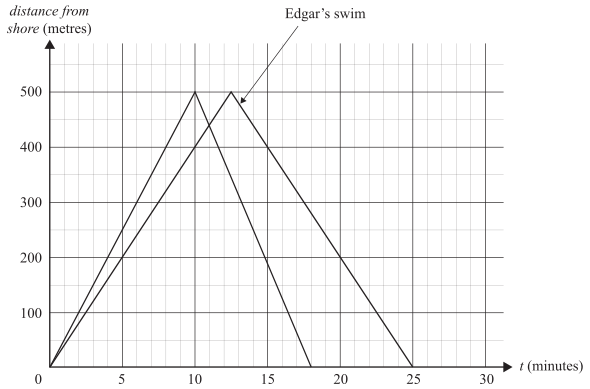 |
d. `10.98\ text(minutes)`
| a. | `text(Distance)` | `= 500 + 100` |
| `= 600\ text(metres)` |
b. `text(When)\ t = 12.5,quadE = 500`♦ Mean mark 49%.
MARKER’S COMMENT: Note that it was not sufficient to type in the equation and write “Solve”.
| `500` | `= k xx 12.5` |
| `:. k` | `= 500/12.5` |
| `= 40\ \ text(… as required)` |
c. `text(Zlatko reaches 500 m buoy when)`♦ Mean mark 47%
`t = 500/50 = 10\ text(min)`
`text(Zlatko returns to shore when)`
| `0` | `=-62.5t + 1125` |
| `:. t` | `= 1125/62.5= 18\ text(min)` |
d. `text(Same distance from shore when:)`
| `40t` | `= −62.5t + 1125` |
| `102.5t` | `= 1125` |
| `:. t` | `= 1125/102.5` |
| `= 10.975…` | |
| `= 10.98\ text(minutes)` |
Some hostel buildings are arranged around a grassed area.
The grassed area is shown shaded in the diagram below.
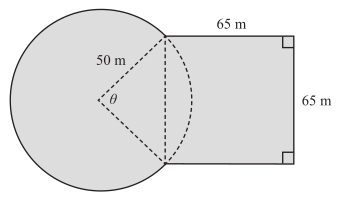
The grassed area is made up of a square overlapping a circle.
The square has side lengths of 65 m.
The circle has a radius of 50 m.
An angle, `theta`, is also shown on the diagram.
Round your answer to the nearest metre. (1 mark)
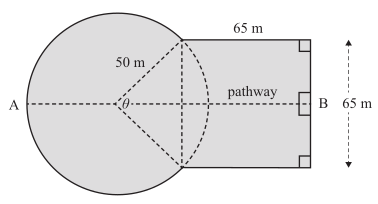
Round your answer to the nearest metre. (2 marks)
| a. | `costheta` | `= (50^2 + 50^2 – 65^2)/(2 xx 50 xx 50)` |
| `= 0.155` | ||
| `= 81.08…` | ||
| `= 81^@\ \ text{(nearest degree) … as required)` |
♦♦ Mean mark part (b) 34%.
| b. | `text(Perimeter)` | `= (3 xx 65) + ((360-81))/360 xx 2 xx pi xx 50` |
| `= 195 + 279/360 xx 2 xx pi xx 50` | ||
| `= 438.47…` | ||
| `= 438\ text(m (nearest metre))` |
♦♦ Mean mark part (c) 34%.
| c. | 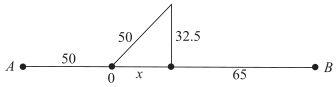 |
`text(Using Pythagoras,)`
`x = sqrt(50^2 – 32.5^2) = 37.99…`
| `:. text(Length)\ AB` | `= 50 + 37.99… + 65` |
| `= 152.99…` | |
| `= 153\ text(m)` |
Miki will travel from Melbourne (38° S, 145° E) to Tokyo (36° N, 140° E) on Wednesday, 20 December.
The flight will leave Melbourne at 11.20 am, and will take 10 hours and 40 minutes to reach Tokyo.
The time difference between Melbourne and Tokyo is two hours at that time of year.
Miki will travel by train from Tokyo to Nemuro and she will stay in a hostel when she arrives.
The hostel is located 186 m north and 50 m west of the Nemuro railway station.
Round your answer to the nearest metre. (1 mark)
Round your answer to the nearest degree. (1 mark)
The city of Nemuro is located 43° N, 145° E.
Assume that the radius of Earth is 6400 km.
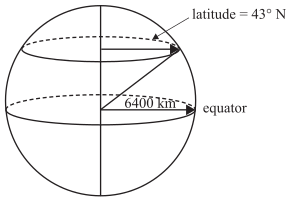
Round your answer to the nearest kilometre. (1 mark)
Round your answer to the nearest kilometre. (1 mark)
a. `text{Flight arrival (in Melb time) = 11:20 + 10:40 = 22:00 (Wed)}`♦ Mean mark 40%.
COMMENT: A surprisingly poor result for this standard question.
| `text(Tokyo time)` | `=\ text(Melb time less 2 hrs)` |
| `= 20:00\ (text(Wed))` | |
| `= 8\ text(pm (Wed))` |
b.i. `text(Using Pythagoras:)`
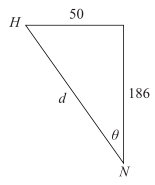
| `d` | `= sqrt(186^2 + 50^2)` |
| `= 192.603…` | |
| `= 193\ text(m (nearest metre))` |
♦♦ Mean mark part (b)(ii) 27%.
MARKER’S COMMENT: N15°W is not a 3-figure bearing and received no marks.
| b.ii. | `tan theta` | `= 50/186` |
| `theta` | `= 15.04…^@` |
`:. text(Bearing of)\ H\ text(from)\ N`
`= 360 – 15`
`= 345^@`
c. `text(Let)\ \ x = text(radius of small circle)`♦ Mean mark part (c) 43%
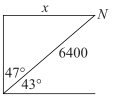
| `sin47^@` | `= x/6400` |
| `:.x` | `= 6400 xx sin47^@` |
| `= 4680.66…` | |
| `= 4681\ text(km (nearest km))` |
| d. | 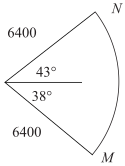 |
`text(Shortest distance)`♦ Mean mark part (d) 38%
`= text(Arc length)\ NM`
`= 81/360 xx 2 xx pi xx 6400`
`= 9047.78…`
`= 9048\ text(km (nearest km))`
Miki is planning a gap year in Japan.
She will store some of her belongings in a small storage box while she is away.
This small storage box is in the shape of a rectangular prism.
The diagram below shows that the dimensions of the small storage box are 40 cm × 19 cm × 32 cm.
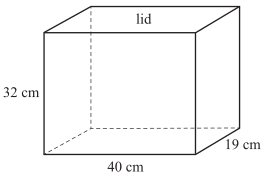
The lid of the small storage box is labelled on the diagram above.
The large storage box and the small storage box are similar in shape.
The volume of the large storage box is eight times the volume of the small storage box.
The length of the small storage box is 40 cm.
What is the length of the large storage box, in centimetres? (1 mark)
The rides at the theme park are set up at the beginning of each holiday season.
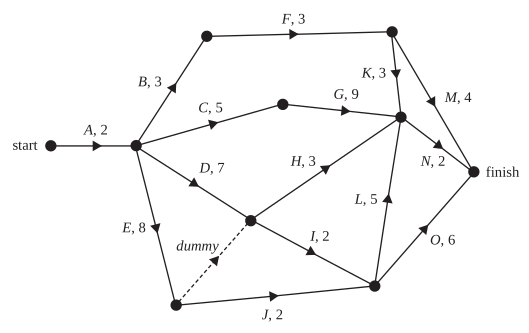
This project involves activities A to O.
The directed network below shows these activities and their completion times in days.
--- 1 WORK AREA LINES (style=lined) ---
i. There are two critical paths. One of the critical paths is A–E–J–L–N.
Write down the other critical path. (1 mark)
--- 1 WORK AREA LINES (style=lined) ---
ii. Determine the float time, in days, for activity F. (1 mark)
--- 2 WORK AREA LINES (style=lined) ---
Six activities, B, D, G, I, J and L, can all be reduced by one day.
The cost of this crashing is $1000 per activity.
i. What is the minimum number of days in which the project could now be completed? (1 mark)
--- 4 WORK AREA LINES (style=lined) ---
ii. What is the minimum cost of completing the project in this time? (1 mark)
--- 3 WORK AREA LINES (style=lined) ---
Bai joins his friends Agatha, Colin and Diane when he arrives for a holiday in Seatown.
Each person will plan one tour that the group will take.
Table 1 shows the time, in minutes, it would take each person to plan each of the four tours.
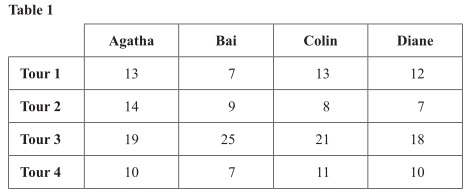
The aim is to minimise the total time it takes to plan the four tours.
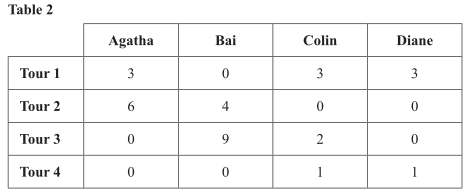
Agatha applies the Hungarian algorithm to Table 1 to produce Table 2.
Table 2 shows the final result of all her steps of the Hungarian algorithm.
--- 1 WORK AREA LINES (style=lined) ---
--- 2 WORK AREA LINES (style=lined) ---
Senior students at a school choose one elective activity in each of the four terms in 2018.
Their choices are communication (`C`), investigation (`I`), problem-solving (`P`) and service (`S`).
The transition matrix `T` shows the way in which senior students are expected to change their choice of elective activity from term to term.
`{:(qquadqquadqquadqquadquadtext(this term)),(qquadqquadqquad\ CqquadquadIqquadquadPqquad\ S),(T = [(0.4,0.2,0.3,0.1),(0.2,0.4,0.1,0.3),(0.2,0.3,0.3,0.4),(0.2,0.1,0.3,0.2)]{:(C),(I),(P),(S):}qquadtext(next term)):}`
Let `S_n` be the state matrix for the number of senior students expected to choose each elective activity in Term `n`.
For the given matrix `S_1`, a matrix rule that can be used to predict the number of senior students in each elective activity in Terms 2, 3 and 4 is
`S_1 = [(300),(200),(200),(300)],qquadS_(n + 1) = TS_n`
--- 2 WORK AREA LINES (style=lined) ---
--- 3 WORK AREA LINES (style=lined) ---
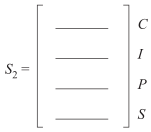
--- 5 WORK AREA LINES (style=lined) ---
--- 3 WORK AREA LINES (style=lined) ---
Junior students at a school must choose one elective activity in each of the four terms in 2018.
Students can choose from the areas of performance (`P`), sport (`S`) and technology (`T`).
The transition diagram below shows the way in which junior students are expected to change their choice of elective activity from term to term.
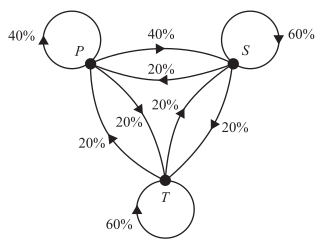
--- 1 WORK AREA LINES (style=lined) ---
Matrix `J_1` lists the number of junior students who will be in each elective activity in Term 1.
`J_1 = [(300),(240),(210)]{:(P),(S),(T):}`
--- 0 WORK AREA LINES (style=lined) ---

--- 3 WORK AREA LINES (style=lined) ---
Alex sold his mechanics’ business for $360 000 and invested this amount in a perpetuity.
The perpetuity earns interest at the rate of 5.2% per annum.
Interest is calculated and paid monthly.
--- 2 WORK AREA LINES (style=lined) ---
This annuity investment earns interest at the rate of 3.8% per annum, compounding monthly.
For the first four years Alex makes a further payment each month of $500 to his investment.
This monthly payment is made immediately after the interest is added.
After four years of these regular monthly payments, Alex increases the monthly payment.
This new monthly payment gives Alex a balance of $500 000 in his annuity after a further two years.
What is the value of Alex’s new monthly payment?
Round your answer to the nearest cent. (2 marks)
--- 2 WORK AREA LINES (style=lined) ---
Alex sends a bill to his customers after repairs are completed.
If a customer does not pay the bill by the due date, interest is charged.
Alex charges interest after the due date at the rate of 1.5% per month on the amount of an unpaid bill.
The interest on this amount will compound monthly.
Marcus paid the full amount one month after the due date.
How much did Marcus pay? (1 mark)
--- 3 WORK AREA LINES (style=lined) ---
Alex sent Lily a bill of $428 for repairs to her car.
Lily did not pay the bill by the due date.
Let `A_n` be the amount of this bill `n` months after the due date.
--- 1 WORK AREA LINES (style=lined) ---
How much interest was Lily charged?
Round your answer to the nearest cent. (1 mark)
--- 3 WORK AREA LINES (style=lined) ---
The eggs laid by the female moths hatch and become caterpillars.
The following time series plot shows the total area, in hectares, of forest eaten by the caterpillars in a rural area during the period 1900 to 1980.
The data used to generate this plot is also given.
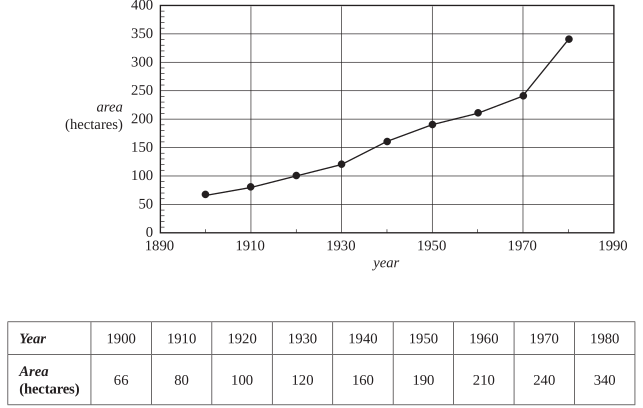
The association between area of forest eaten by the caterpillars and year is non-linear.
A log10 transformation can be applied to the variable area to linearise the data.
--- 0 WORK AREA LINES (style=lined) ---

The least squares line predicts that the log10 (area) of forest eaten by the caterpillars by the year 2020 will be approximately 2.85
--- 2 WORK AREA LINES (style=lined) ---
--- 2 WORK AREA LINES (style=lined) ---
The graph of `f(x) = sqrt x (1 - x)` for `0<=x<=1` is shown below.
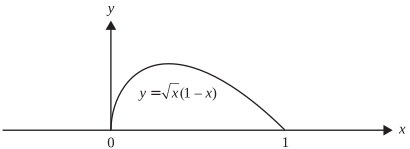
--- 5 WORK AREA LINES (style=lined) ---
--- 2 WORK AREA LINES (style=lined) ---
The edges of the right-angled triangle `ABC` are the line segments `AC` and `BC`, which are tangent to the graph of `f(x)`, and the line segment `AB`, which is part of the horizontal axis, as shown below.
Let `theta` be the angle that `AC` makes with the positive direction of the horizontal axis.
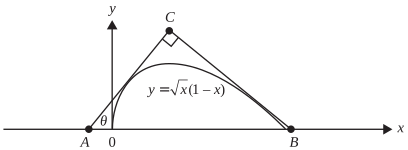
--- 6 WORK AREA LINES (style=lined) ---
Let `(tantheta - 1) (sin theta - sqrt 3 cos theta) (sin theta + sqrt 3 costheta) = 0`.