SmarterEd

Aussie Maths & Science Teachers: Save your time with SmarterEd

  • Login
  • Get Help
  • About

Statistics, NAP-I3-NC04

Matt was recording the colour of cars that drove past his school in 1 hour.

In the hour, Matt saw 9 blue, 12 silver and 6 white cars.

In the tables below, `text(X)` = 3 cars.

Which table correctly shows the number of cars that Matt saw?


Show Answers Only

Show Worked Solution

`text(S)text(ince)\ X = 3\ text(cars,)`

`text(9 Blue cars)` `=\ text(XXX)`
`text(12 Silver cars)` `=\ text(XXXX)`
`text(6 White cars)` `=\ text(XX)`

Filed Under: Data and Statistics (7) Tagged With: Band 5, smc-674-11-Picture graphs, smc-674-20-Table data

Number, NAP-I3-NC03

Alison has 15 lollipops and decides to give  `1/3`  of them to her sister.

How many lollipops does her sister get?

`3` `4` `5` `6`


Show Answers Only

`5`

Show Worked Solution

`1/3 xx 15 = 5`

Filed Under: Fractions, Fractions Tagged With: Band 5, smc-3145-30-Word problems, smc-662-30-Word problems

Algebra, NAP-I3-NC02

George has no money in his bank account.

He deposits $6 in his account in week 1.

He then deposits twice the amount into his account each week than he did the previous week.

The total amount in his account is?

 
always odd.
 
always even.
 
sometimes odd and sometimes even.
Show Answers Only

`text(always even.)`

Show Worked Solution

`text(In each successive week, an even number will)`

`text(be added to an existing even number.)`

`text(even + even = even)`

`:.\ text(His account total will always be even.)`

Filed Under: Patterns and The Number Plane Tagged With: Band 5, smc-664-10-Patterns and numbers

Geometry, NAP-I3-NC01

Richard is at the starting line of an orienteering course, as shown on the grid diagram below.


Richard jogs 300 metres north and 400 metres west from the starting line to reach Checkpoint 1.

In which cell is Checkpoint 1?

`text(E6)` `text(H5)` `text(B6)` `text(A5)`


Show Answers Only

`text(A5)`

Show Worked Solution

`text(A5)`

Filed Under: Maps and Directions Tagged With: Band 5, smc-667-10-Compass directions, smc-667-20-Map scales

Number, NAP-C3-NC02

At a local netball game between the Stars and the Strikers, 475 people turned up to watch.

The Stars had 223 supporters.

The rest supported the Strikers.

How many people supported the Strikers?

`242` `252` `248` `258`


Show Answers Only

`252`

Show Worked Solution
`text(Strikers supporters)` `= 475-223`
  `=252`

Filed Under: Basic Concepts and Calculations, Basic Concepts and Calculations Tagged With: Band 5, smc-3143-20-Basic operators, smc-676-20-Basic operators

Geometry, NAP-C3-NC01

Geoff drew a map of his neighbourhood.


What is the grid reference of the cinema?

`text(D5)` `text(D4)` `text(E5)` `text(E4)`


Show Answers Only

`text(E5)`

Show Worked Solution

`text(E5)`

Filed Under: Maps and Directions, Maps and Directions Tagged With: Band 5, smc-3164-30-Grid locations, smc-667-30-Grid locations

Geometry, NAP-C3-CA04

Daniel made this design by joining six tiles together.


Which of this could not be Daniel's design? 


Show Answers Only


Show Worked Solution


Filed Under: Transformations and Symmetry, Transformations and Symmetry Tagged With: Band 5, smc-3156-20-Rotations, smc-3163-20-Rotations

Statistics, NAP-C3-CA01

This is John's University timetable.


Which room is John in at 2:45 pm on Tuesday?

`text(Room 7)` `text(Room 9)` `text(Room 11)` `text(Room 22)`


Show Answers Only

 `text(Room 9)`

Show Worked Solution

`text(Room 9)` 

Filed Under: Data and Statistics (7) Tagged With: Band 5, smc-674-20-Table data

Number, NAP-E4-NC01

Penny has four 20-cent pieces.

Fi has three 20-cent pieces.

Sophie has four 20-cent pieces.

How much money do they have in total?

`$1.10` `$2.00` `$2.20` `$2.60`


Show Answers Only

`$2.20`

Show Worked Solution

`$2.20`

Filed Under: Financial Maths, Financial Maths Tagged With: Band 5, smc-3174-10-Coins and change, smc-892-10-Coins and change

Geometry, NAP-F4-CA02

The distance between Newcastle and Canberra on the map below is 9 cm.


The scale of the map is  1 cm = 50 km.

What is the actual distance between Newcastle and Canberra?

`350\ text(km)` `450\ text(km)` `600\ text(km)` `900\ text(km)`


Show Answers Only

`450\ text(km)`

Show Worked Solution
`text(Distance)` `= 9 xx 50`
  `= 450\ text(km)`

Filed Under: Maps and Bearings, Maps and Bearings, Maps and Directions Tagged With: Band 5, smc-3164-20-Map scales, smc-3187-20-Map scales, smc-670-20-Map scales

Geometry, NAP-G4-NC01

This 2-dimensional shape pictured below is made from


a rhombus and an ellipse.
 
a circle and parallelogram.
 
a semi-circle and a trapezium.
 
a semi-circle and a parallelogram.
Show Answers Only

`text(A semi-circle and a trapezium)` 

Show Worked Solution

`text(A semi-circle and a trapezium)`

Filed Under: 2D-3D Shapes, 2D-3D Shapes Tagged With: Band 5, smc-3185-10-Identify 2D-3D shapes, smc-672-10-Identify 2D-3D shapes

Statistics, NAP-G4-CA03

10 of the tallest mountains in the United States are listed in the table below:


How much taller than Utah's tallest mountain is Colorado's tallest mountain?

`225\ text(metres)` `227\ text(metres)` `273\ text(metres)` `330\ text(metres)`


Show Answers Only

`273\ text(metres)`

Show Worked Solution

`text(Mount Massive – Kings Peak)`

`= 4398 – 4125`

`= 273\ text(metres)`

Filed Under: Data and Interpretation, Data and Statistics Tagged With: Band 5, smc-3190-20-Table data, smc-681-20-Table data

Probability, NAP-G4-CA02

Arun flips an unbiased coin 200 times.

Which result is most likely?

`20\ text(tails)` `98\ text(tails)` `108\ text(tails)` `196\ text(tails)`


Show Answers Only

`98\ text(tails)`

Show Worked Solution

`text(The expected result is 100 tails.)`

`:.\ text(The most likely result is the one closest to 100 tails.)`

`=> 98\ text(tails)`

Filed Under: Probability, Probability Tagged With: Band 5, smc-3191-10-Core concepts, smc-3191-30-Multi-step events, smc-3191-40-Relative frequency, smc-682-10-Core concepts, smc-682-30-Multi-step events, smc-682-40-Relative frequency

Geometry, NAP-H4-CA01

Peter made this 3D object using 36 small cubes.
 

 naplan-2015-1mc

 
Which of these has a volume half that of Peter's object?

naplan-2015-1mciii naplan-2015-1mcii naplan-2015-1mci naplan-2015-1mciv


Show Answers Only

naplan-2015-1mci

Show Worked Solution

`text(The shape with 18 cubes is:)`

naplan-2015-1mci

Filed Under: 2D-3D Shapes, 2D-3D Shapes Tagged With: Band 5, smc-3185-20-Building blocks, smc-672-20-Building blocks

Statistics, NAP-I4-NC06

The heights, in centimetres, of children in Patrick's soccer team are as follows:

   `120, \ 123, \ 120, \ 128, \ 117, \ 128, \ 124, \ 127, \ 123`

Select the dot plot that correctly displays the data.

 
nap-169-nc06-a1
 
nap-169-nc06-b
 
nap-169-nc06-c
Show Answers Only

nap-169-nc06-c

Show Worked Solution

nap-169-nc06-c

Filed Under: Data and Interpretation, Data and Statistics Tagged With: Band 5, smc-3190-10-Dot plots, smc-681-10-Dot plots

Number, NAP-I4-NC01

A butcher sells sausages in bags of four.

For a party, 20 sausages are needed.

How many bags of sausages are needed?

`4` `5` `25` `80`


Show Answers Only

`5`

Show Worked Solution

`text(Bags needed) = 20/4 = 5`

Filed Under: Multi-Step Problems, Multi-Step Problems Tagged With: Band 5

Quadratic, EXT1 2016 HSC 14c

The point  `T(2at,at^2)` lies on the parabola `P_1` with the equation  `x^2=4ay`.

The tangent to the parabola `P_1` at `T` meets the directrix at `D`.

The normal to the parabola `P_1` at `T` meets the vertical line through `D` at the point `R`, as shown in the diagram.


ext1-2016-hsc-q14

  1. Show that the point `D` has coordinates `(at - a/t, −a)`.  (1 mark)
  2. Show that the locus of `R` lies on another parabola `P_2`.  (3 marks)
  3. State the focal length of the parabola `P_2`.  (1 mark)

It can be shown that the minimum distance between `R` and `T` occurs when the normal to `P_1` at `T` is also the normal to `P_2` at `R`.  (Do NOT prove this.)

  1. Find the values of `t` so that the distance between `R` and `T` is a minimum.  (2 marks)
Show Answers Only
  1. `text(Proof)\ \ text{(See Worked Solutions)}`
  2. `text(Proof)\ \ text{(See Worked Solutions)}`
  3. `a/4`
  4. `+- sqrt 2`
Show Worked Solution

i.     `text(Show)\ \ D (text{at}\ -a/t, -a)`

`text(T)text(angent equation at)\ \ T:`

`y = tx – at^2`

`D\ \ text(occurs when)\ \ y = -a,`

`tx – at^2` `= -a`
`tx` `= at^2 – a`
`x` `= at – a/t`

`:. D\ text(has coordinates)\ \ (text{at}\ -a/t, -a)`


ii.    `text(Normal equation at)\ \ T:`

♦♦ Mean mark 32%.
MARKER’S COMMENT: Normal equation is found in the Reference Sheet. Save time by using it!

`x + ty = 2at + at^3`

`R\ text(occurs when)\ \ x = at – a/t`

`at – a/t + ty` `= 2at + at^3`
`ty` `= at + a/t + at^3`
`y` `= a + a/t^2 + at^2`
  `= a(1 + 1/t^2 + t^2)\ \ …\ text{(*)}`


`:. R (a (t – 1/t), a (1 + 1/t^2 + t^2))`

`x^2` `= a^2 (t – 1/t)^2`
  `= a^2 (t^2 – 2 + 1/t^2)`
  `= a + (1+1/t^2 + t^2 – 3)`
  `= a^2 (y/a – 3)\ \ text{(see (*) above)}`
  `= ay – 3a^2`


`:.\ text(Locus of)\ R\ text(is)\ \ x^2 = ay – 3a^2`


iii.   `text(In the form)\ \ x^2 = 4ay,`

♦♦♦ Mean mark 15%.
`x^2` `= a(y – 3a)`
  `= 4 · a/4 (y – 3a)`


`:.\ text(Focal length) = a/4`


iv.   `text(Equation of)\ \ P_2`

♦♦♦ Mean mark 11%.
`x^2` `= ay – 3a^2`
`y` `= x^2/a + 3a`
`y prime` `= (2x)/a`

`text(At)\ \ R,\ \ x = a (t – 1/t)`

`:.\ text(Gradient of normal at)\ \ R`

`=(-a)/(2x)`

`= (-a)/(2a(t – 1/t)) xx t/t`

`= (-t)/(2(t^2 – 1))`


`text(Gradient of normal at)\ \ T:`

`x + ty` `= 2at + at^3`
`y` `= -1/t x + 2a + at^2`
`:. m` `= -1/t`


`text(Distance)\ \ RT\ \ text(is a minimum when)`

`(-t)/(2(t^2 – 1))` `= -1/t`
`t^2` `= 2t^2 – 2`
`t^2` `= 2`
`:. t` `= +- sqrt 2`

Filed Under: 9. Quadratics and the Parabola EXT1 Tagged With: Band 4, Band 5, Band 6

Mechanics, EXT2* M1 2016 HSC 13b

The trajectory of a projectile fired with speed  `u\ text(ms)^-1`  at an angle  `theta`  to the horizontal is represented by the parametric equations

`x = utcostheta`   and   `y = utsintheta - 5t^2`,

where `t` is the time in seconds.

  1. Prove that the greatest height reached by the projectile is  `(u^2 sin^2 theta)/20`.  (2 marks)

    --- 5 WORK AREA LINES (style=lined) ---

A ball is thrown from a point `20\ text(m)` above the horizontal ground. It is thrown with speed `30\ text(ms)^-1` at an angle of `30^@` to the horizontal. At its highest point the ball hits a wall, as shown in the diagram.
 

     ext1-2016-hsc-q13
 

  1. Show that the ball hits the wall at a height of `125/4\ text(m)` above the ground.  (2 marks)

    --- 4 WORK AREA LINES (style=lined) ---

The ball then rebounds horizontally from the wall with speed `10\ text(ms)^-1`. You may assume that the acceleration due to gravity is `10\ text(ms)^-2`.

  1. How long does it take the ball to reach the ground after it rebounds from the wall?  (2 marks)

    --- 6 WORK AREA LINES (style=lined) ---

  2. How far from the wall is the ball when it hits the ground?  (1 mark)

    --- 2 WORK AREA LINES (style=lined) ---

Show Answers Only
  1. `text(Proof)\ \ text{(See Worked Solutions)}`
  2. `text(Proof)\ \ text{(See Worked Solutions)}`
  3. `2.5\ text(seconds)`
  4. `25\ text(m)`
Show Worked Solution
i.    `y` `= u t sin theta – 5t^2`
  `y prime` `= u sin theta – 10t`


`text(Maximum height when)\ \ y prime = 0`

`10 t` `= u sin theta`
`t` `= (u sin theta)/10`


`:.\ text(Maximum height)`

`= u ((u sin theta)/10) · sin theta – 5 ((u sin theta)/10)^2`

`= (u^2 sin^2 theta)/10 – (u^2 sin^2 theta)/20`

`= (u^2 sin^2 theta)/20\ text(… as required)`


ii.   `text{Using part (i)},`

`text(Height that ball hits wall)`

`= (30^2 · (sin 30)^2)/20 + 20`

`= (30^2 · (1/2)^2)/20 + 20`

`= 11 1/4 + 20`

`= 125/4\ text(m … as required)`


♦♦ Mean mark part (iii) 35%.
iii.   ext1-hsc-2016-13bi
`y ″` `= -10`
`y prime` `= -10 t`
`y` `= 125/4 – 5t^2`


`text(Ball hits ground when)\ \ y = 0,`

MARKER’S COMMENT: Many students struggled to solve: `5t^2=125/4`.
`5t^2` `= 125/4`
`t^2` `= 25/4`
`:. t` `= 5/2,\ \ t > 0`


`:.\ text(It takes the ball 2.5 seconds to hit the ground.)`


iv.   `text(Distance from wall)`

♦ Mean mark 43%.

`= 2.5 xx 10`

`= 25\ text(m)`

Filed Under: Projectile Motion, Projectile Motion EXT1 Tagged With: Band 3, Band 4, Band 5, smc-1062-10-Range/Time of Flight, smc-1062-20-Max Height, smc-1062-95-Hit Wall

Mechanics, EXT2* M1 2016 HSC 13a

The tide can be modelled using simple harmonic motion.

At a particular location, the high tide is 9 metres and the low tide is 1 metre.

At this location the tide completes 2 full periods every 25 hours.

Let `t` be the time in hours after the first high tide today.

  1. Explain why the tide can be modelled by the function  `x = 5 + 4cos ((4pi)/25 t)`.  (2 marks)

    --- 6 WORK AREA LINES (style=lined) ---

  2. The first high tide tomorrow is at 2 am.


    What is the earliest time tomorrow at which the tide is increasing at the fastest rate?  (2 marks)

    --- 5 WORK AREA LINES (style=lined) ---

Show Answers Only
  1. `text(See Worked Solutions)`
  2. `11:22:30\ text(am)`
Show Worked Solution
i.    `text(High tide)` `= 9\ text(m)`
  `text(Low tide)` `= 1\ text(m)`

 
`:. A = (9 – 1)/2 = 4\ text(m)`

`T = 25/2`

`:. (2 pi)/n` `= 25/2`
`n` `= (4 pi)/25`


`text(Centre of motion) = 5`


`text(S) text(ince high tide occurs at)\ \ t = 0,`

`x` `= 5 + 4 cos (nt)`
  `= 5 + 4 cos ((4 pi)/25 t)`


ii.   `x = 5 + 4 cos ((4 pi)/25 t)`

`(dx)/(dt)` `= -4 · (4 pi)/25 *sin ((4 pi)/25 t)`
  `= -(16 pi)/25 *sin ((4 pi)/25 t)`


`text(Tide increases at maximum rate)`

`text(when)\ \ sin ((4 pi)/25 t) = -1,`

`:. (4 pi)/25 t` `= (3 pi)/2`
  `= 75/8`
  `= 9\ text(hours 22.5 minutes)`


`:.\ text(Earliest time is)\ 11:22:30\ text(am)`

Filed Under: Simple Harmonic Motion, Simple Harmonic Motion EXT1 Tagged With: Band 4, Band 5, smc-1059-20-Prove/Identify SHM, smc-1059-31-Max Speed, smc-1059-50-Real World examples

Calculus, EXT1 C1 2016 HSC 12b

In a chemical reaction, a compound `X` is formed from a compound `Y`. The mass in grams of `X` and `Y` are `x(t)` and `y(t)` respectively, where `t` is the time in seconds after the start of the chemical reaction.

Throughout the reaction the sum of the two masses is 500 g. At any time `t`, the rate at which the mass of compound `X` is increasing is proportional to the mass of compound `Y`.

At the start of the chemical reaction, `x = 0`  and  `(dx)/(dt) = 2`.

  1.  Show that  `(dx)/(dt) = 0.004(500 - x)`.  (3 marks)

    --- 6 WORK AREA LINES (style=lined) ---

  2.  Show that  ` x = 500 - Ae^(−0.004t)`  satisfies the equation in part (i), and find the value of `A`.  (2 marks)

    --- 6 WORK AREA LINES (style=lined) ---

Show Answers Only
  1. `text(Proof)\ \ text{(See Worked Solutions)}`
  2. `text(Proof)\ \ text{(See Worked Solutions)}`
Show Worked Solution

i.   `x + y = 500\ \ text{(given)}`

♦ Mean mark (part i) 43%.

`(dx)/(dt)` `= ky`
  `= k(500 – x)`

 
`text(When)\ \ t = 0,\ \ x = 0,\ \ (dx)/(dt) = 2`

`2` `= k (500 – 0)`
`:. k` `= 0.004`

 
`:. (dx)/(dt) = 0.004 (500 – x)\ text(… as required)`


ii.    `x` `= 500 – Ae^(-0.004t)`
  `Ae^(-0.004t)` `= 500 – x`


`(dx)/(dt)` `= 0.004 Ae^(-0.004t)`
  `= 0.004 (500 – x)`

 
`text(When)\ \ t = 0,\ \ x = 0,`

`0` `= 500 – Ae^0`
`:. A` `= 500`

Filed Under: Exponential Growth and Decay EXT1, Modified Growth and Decay Tagged With: Band 4, Band 5, smc-1080-20-Other

Geometry and Calculus, EXT1 2016 HSC 9 MC

The diagram shows the graph of  `y = f(x)`.

ext1-2016-hsc-9-mc

Which of the following is a correct statement?

A.   `f″(1)` `< f(1)` `<quad1` `< f prime (1)`
B.   `f″(1)` `< f prime(1)` `< f(1)` `<quad1`
C.   `f(1)` `<quad1` `< f prime (1)` `< f″(1)`
D.   `f prime(1)` `< f(1)` `<quad1` `< f″(1)`
Show Answers Only

`A`

Show Worked Solution

`text(When)\ \ x = 1,`

`f(1)` `< 1`
`f prime (1)` `> 1\ \ text{(graph slope}^+\ text{> 45°)}`
`f ″ (1)` `< 1\ \ text{(concave down)}`

`=>   A`

Filed Under: 10. Geometrical Applications of Calculus EXT1 Tagged With: Band 5

Calculus, 2ADV C4 2016 HSC 16a

A particle moves in a straight line. Its velocity `v\ text(ms)^-1` at time `t` seconds is given by

`v = 2 - 4/(t + 1).`

  1. Find the initial velocity.  (1 mark)

    --- 1 WORK AREA LINES (style=lined) ---

  2. Find the acceleration of the particle when the particle is stationary.  (2 marks)

    --- 4 WORK AREA LINES (style=lined) ---

  3. By considering the behaviour of `v` for large `t`, sketch a graph of `v` against `t` for  `t >= 0`, showing any intercepts.  (2 marks)

    --- 4 WORK AREA LINES (style=lined) ---

  4. Find the exact distance travelled by the particle in the first 7 seconds.  (3 marks)

    --- 6 WORK AREA LINES (style=lined) ---

Show Answers Only
  1. `-2\ text(ms)^-1`
  2. `1\ text(ms)^-2`
  3.  
    hsc-2016-16ai
  4. `10 – 4 ln 2\ \ text(metres)`
Show Worked Solution

i.   `text(Initial velocity when)\ \ t = 0`

Mean mark 93%.
COMMENT: Great example of low hanging fruit late in the exam for students who progress efficiently.

`v = 2 – 4/1 = -2\ text(ms)^-1`


ii.   `v` `= 2 – 4/(t + 1)`
  `a` `=(dv)/(dt)= 4/(t + 1)^2`


`text(Particle is stationary when)\ \ v = 0,`

`2 – 4/(t + 1)` `= 0`
`2 (t + 1)` `= 4`
`t` `= 1`
   

`text(When)\ \ t=1,`

`:.a` `= 4/(1 + 1)^2`
  `= 1\ text(ms)^-2` 


iii.  `v = 2 – 4/(t + 1)`

♦ Mean mark 47%.

`text(As)\ \ t -> oo,\ \ \ 4/(t + 1) -> 0`

`:. v -> 2`

 hsc-2016-16ai


♦♦ Mean mark 26%.

iv.   `text(Distance travelled in 1st 7 seconds)`

`= |\ int_0^1 (2 – 4/(t + 1))\ dt\ | + int_1^7 (2 – 4/(t + 1))\ dt`

`= -[2t – 4 ln (t + 1)]_0^1 + [2t – 4 ln (t + 1)]_1^7`

`= -[(2 – 4 ln 2) – 0] + [(14 – 4 ln 8) – (2 – 4 ln 2)]`

`= 4 ln 2 – 2 + 12 – 4 ln 2^3 + 4 ln 2`

`= 10 + 8 ln 2 – 12 ln 2`

`= 10 – 4 ln 2\ \ text(metres)`

Filed Under: Motion, Other Integration Applications (Y12) Tagged With: Band 2, Band 4, Band 5, smc-1213-10-Motion

Plane Geometry, 2UA 2016 HSC 15c

Maryam wishes to estimate the height, `h` metres, of a tower, `ST`, using a square, `ABCD,` with side length `1` metre.

She places the point `A` on the horizontal ground and ensures that the point `D` lies on the line joining `A` to the top of the tower `T.` The point `F` is the intersection of the line joining `B` and `T` and the side `CD.` The point `E` is the foot of the perpendicular from `B` to the ground. Let `CF` have length `x` metres and `AE` have length `y` metres.

hsc-2016-15c

Copy or trace the diagram into your writing booklet.

  1. Show that `Delta FCB` and `Delta BAT` are similar.  (2 marks)
  2. Show that `Delta TSA` and `Delta AEB` are similar.  (2 marks)
  3. Find `h` in terms of `x` and `y`.  (2 marks)
Show Answers Only
  1. `text(Proof)\ \ text{(See Worked Solutions)}`
  2. `text(Proof)\ \ text{(See Worked Solutions)}`
  3. `y/x`
Show Worked Solution
i.  

`/_ BAT = /_ CBA = 90^@`

`text(Let)\ \ /_ TBA = theta`

`:. /_ ATB = 90 – theta\ \ text{(Angle sum of}\ Delta BAT text{)}`

`/_ CBF = 90 – theta\ \ (/_ CBA\ \ text{is a right angle)}`


`/_ FCB = /_ BAT = 90^@`

`:. Delta FCB\ text(|||)\ Delta BAT\ \ text{(equiangular)}`


ii.   `text(Let)\ \ /_ BAE = alpha`

♦♦ Mean mark 27%.

`text(In)\ \ Delta TSA,`

`/_ TAS` `= 180 – (90 + alpha) qquad (/_ SAE\ \ text{is a straight angle)}`
  `= 90 – alpha`


`text(In)\ \ Delta AEB,`

`/_ EBA = 90 – alpha\ \ text{(angle sum of}\ Delta AEB text{)}`

`/_ BEA = /_ TSA = 90^@\ \ text{(given)}`


`:. Delta TSA\ text(|||)\ Delta AEB\ \ text{(equiangular)}`


iii.   `text(Using)\ \ Delta TSA\ text(|||)\ Delta AEB,`

♦♦ Mean mark 27%.
`h/(TA)` `= y/(AB)` `text{(corresponding sides of}`
  `text{similar triangles)}`
`:. h` `= y · (TA)/(AB)`  


 `text(Using)\ \ Delta FCB\ text(|||)\ Delta BAT,`

`1/x` `= (TA)/(AB)` `qquad qquad text{(corresponding sides of}`
   `qquad qquad text{similar triangles)}`
`:. h` `= y/x`  

Filed Under: 2. Plane Geometry Tagged With: Band 4, Band 5

Probability, 2ADV S1 2016 HSC 15b

An eight- sided die is marked with numbers  1, 2, … , 8. A game is played by rolling the die until an 8 appears on the uppermost face. At this point the game ends.

  1. Using a tree diagram, or otherwise, explain why the probability of the game ending before the fourth roll is


    `qquad qquad 1/8 + 7/8 xx 1/8 + (7/8)^2 xx 1/8`.  (2 marks)

    --- 8 WORK AREA LINES (style=lined) ---

  2. What is the smallest value of `n` for which the probability of the game ending before the `n`th roll is more than  `3/4`?  (3 marks)

    --- 6 WORK AREA LINES (style=lined) ---

Show Answers Only
  1. `text(See Worked Solutions)`
  2. `12`
Show Worked Solution

i.   `P text{(game ends before 4th roll)}`

`= P (8) + P (text{not}\ 8, 8) + P (text{not}\ 8, text{not}\ 8, 8)`

`= 1/8 + 7/8 · 1/8 + 7/8 · 7/8 · 1/8`

`= 1/8 + 7/8 · 1/8 + (7/8)^2 · 1/8\ \ text(…  as required)`


ii.  `1/8 + 7/8 · 1/8 + (7/8)^2 · 1/8 + …`

`=> text(GP where)\ \ a = 1/8,\ \ r = 7/8`

`text(Find)\ \ n\ \ text(such that)\ \ S_(n – 1) > 3/4,`

♦♦ Mean mark 29%.
ALGEBRA: Note that dividing by `ln\ 7/8` reverses the < sign as it is dividing by a negative number.
`S_(n-1)` `= (a (1 – r^(n – 1)))/(1 – r)`
`3/4` `< 1/8 xx {(1 – (7/8)^(n – 1))}/(1 – 7/8)`
`3/4` `< 1 – (7/8)^(n – 1)`
`(7/8)^(n – 1)` `< 1/4`
`(n-1)* ln\ 7/8` `< ln\ 1/4`
`n – 1` `> (ln\ 1/4)/(ln\ 7/8)`
  `> 11.38…`

`:. n = 12`

Filed Under: 3. Probability, Multi-Stage Events (Adv-2027), Multi-Stage Events (Y11) Tagged With: Band 4, Band 5, smc-6469-10-Probability Trees, smc-6469-20-Other Multi-Stage Events, smc-6469-50-Probability and Series, smc-989-10-Probability Trees, smc-989-20-Other Multi-Stage Events, smc-989-50-Probability and Series

Calculus, EXT1* C3 2016 HSC 15a

The diagram shows two curves  `C_1` and `C_2.` The curve `C_1` is the semicircle  `x^2 + y^2 = 4, \ -2 <= x <= 0.` The curve `C_2` has equation  `x^2/9 + y^2/4 = 1, \ 0 <= x <= 3.`
 

hsc-2016-15a
 

An egg is modelled by rotating the curves about the `x`-axis to form a solid of revolution.

Find the exact value of the volume of the solid of revolution.  (4 marks)

--- 10 WORK AREA LINES (style=lined) ---

Show Answers Only

`(40 pi)/3\ text(u³)`

Show Worked Solution

`text(Consider)\ \ C_1,`

`V_1` `= pi int_-2^0 y^2\ dx`
  `= pi int_-2^0 4 – x^2\ dx`
  `= pi [4x – x^3/3]_-2^0`
  `= pi [0 – (-8 + 8/3)]`
  `= (16 pi)/3\ u³`


`text(Consider)\ \ C_2`

`x^2/9 + y^2/4` `= 1`
`y^2` `= 4 – (4x^2)/9`


`V_2` `= pi int_0^3 4 – (4x^2)/9\ dx`
  `= pi [4x – (4x^3)/27]_0^3`
  `= pi [(12 – (4 · 3^3)/27) – 0]`
  `= 8 pi\ text(u³)`


`text(Volume)` `= V_1 + V_2`
  `= (16 pi)/3 + 8 pi`
  `= (40 pi)/3\ text(u³)`

Filed Under: Further Area and Solids of Revolution (Ext1), Volumes of Solids of Rotation Tagged With: Band 5, smc-1039-30-(Semi) Circle, smc-1039-40-Other Graphs, smc-1039-60-x-axis Rotation

L&E, 2ADV E1 2016 HSC 14e

Write  `log 2 + log 4 + log 8 + … + log 512`  in the form  `a log b`  where `a` and `b` are integers greater than `1.`  (2 marks)

--- 5 WORK AREA LINES (style=lined) ---

Show Answers Only

`45 log 2`

Show Worked Solution

`log 2 + log 4 + log 8 + … + log 512`

`= log 2^1 + log 2^2 + log2^3 + … + log 2^9`

`= log 2 + 2 log 2 + 3 log 2 + … + 9 log 2`

`= 45 log 2`

♦ Mean mark 40%.
 
TIP: Note that `log 2 = log_10 2`

Filed Under: Log/Index Laws and Equations (Adv-2027), Log/Index Laws and Equations (Y11), Log/Index laws and Other Equations, Logarithms Tagged With: Band 5, num-title-ct-patha, num-title-qs-hsc, smc-4243-30-Power rule, smc-6455-20-Logs - Power Rule, smc-963-20-Log - power rule

Financial Maths, 2ADV M1 2016 HSC 14d

By summing the geometric series  `1 + x + x^2 + x^3 + x^4`, or otherwise,

find  `lim_(x -> 1) (x^5 - 1)/(x - 1).`  (2 marks)

--- 5 WORK AREA LINES (style=lined) ---

Show Answers Only

`5`

Show Worked Solution

`1 + x + x^2 + x^3 + x^4`

♦ Mean mark 45%.

`=> text(GP where)\ \ a = 1,\ \ r = x,\ \ n = 5`

`S_n` `= (a(r^n – 1))/(r – 1)`
 `S_5` `= ((x^5 – 1))/(x – 1)`

 
`:. lim_(x -> 1) (x^5 – 1)/(x – 1)`

`= lim_(x -> 1) (1 + x + x^2 + x^3 + x^4)`

`= 5`

Filed Under: Geometric Series, Geometric Series (Y12) Tagged With: Band 5, smc-1006-40-Limiting Sum

Proof, EXT2 P2 2016 HSC 16c

In a group of `n` people, each has one hat, giving a total of `n` different hats. They place their hats on a table. Later, each person picks up a hat, not necessarily their own.

A situation in which none of the `n` people picks up their own hat is called a derangement.

Let  `D(n)`  be the number of possible derangements.

  1. Tom is one of the `n` people. In some derangements Tom finds that he and one other person have each other's hat.


    Show that, for  `n > 2`, the number of such derangements is  `(n - 1) D (n - 2).`  (1 mark)

    --- 4 WORK AREA LINES (style=lined) ---

  2. By also considering the remaining possible derangements, show that, for  `n > 2,`

    `qquad qquad D(n) = (n - 1) [D(n - 1) + D(n - 2)].`  (2 marks)

    --- 6 WORK AREA LINES (style=lined) ---

  3. Hence, show that  `D(n) - nD(n - 1) = -[D(n - 1) - (n - 1) D(n - 2)]`,  for  `n > 2.`  (1 mark)

    --- 2 WORK AREA LINES (style=lined) ---

  4. Given  `D(1) = 0`  and  `D(2) = 1`,  deduce that  `D(n) - n D(n - 1) = (-1)^n`,  for  `n > 1.`  (1 mark)

    --- 5 WORK AREA LINES (style=lined) ---

  5. Prove by mathematical induction, or otherwise, that for all integers  `n >= 1,\ D(n) = n! sum_(r = 0)^n (-1)^r/(r!).`  (2 marks)

    --- 8 WORK AREA LINES (style=lined) ---

Show Answers Only
  1. `text(See Worked Solutions)`
  2. `text(See Worked Solutions)`
  3. `text(See Worked Solutions)`
  4. `text(See Worked Solutions)`
  5. `text(See Worked Solutions)`
Show Worked Solution

i.   `text(Tom and one other person can have each)`

♦♦♦ Mean mark 22%.

`text(other’s hat in)\ (n – 1)\ text(combinations.)`

`text(There are)\ \ D(n – 2)\ \ text(possibilities for the)`

`text(rest of the people selecting the wrong hats.)`

`:. text(Number of derangements) = (n – 1)D(n – 2)`


ii.   `text(Consider all possible derangements:)`

♦♦♦ Mean mark 6%.

`text(Any of)\ n\ text(people choose the wrong hat.)`

`text(Remainder)\ (n – 1)\ text(people can select the)`

`text(wrong hat in)\ D(n – 1)\ text(ways.)`

`:. nD(n – 1)\ text(derangements.)`

`text{This includes part (i) combinations.}`


`:.\ text(Remaining possible derangements)`

`= nD(n – 1) – (n – 1)D(n – 2)`

`= nD(n – 1) – D(n – 1)`

`= (n – 1)D(n – 1)`

`:. D(n)` `= (n – 1)D(n – 1) + (n – 1)D(n – 2)`
  `= (n – 1)[D(n – 1) + D(n – 2)]`


♦♦ Mean mark part (iii) 37%.
iii.    `D(n)` `= (n – 1)[D(n – 1) + D(n – 2)]`
    `= nD(n – 1) – D(n – 1) + (n – 1)D(n – 2)`


`:. Dn – nD(n – 1) = −[D(n – 1) – (n – 1)D(n – 2)]`


iv.   `D(1) = 0, D(2) = 1`

♦♦♦ Mean mark 1%!

`D(2) – 2D(1) = 1`

`D(3) – 3D(2) = −[D(2) – 2D(1)] = −1`

`D(4) – 4D(3) = −[D(3) – 3D(2)] = −(−1) = 1`

`D(5) – 5D(4) = −[D(4) – 4D(3)] = −1`


`:. D(n) – nD(n – 1) = (−1)^n\ text(for)\ n > 1`


v.   `text(Prove)\ D(n) = n! sum_(r = 0)^n ((−1)^r)/(r!)\ text(for)\ n >= 1`

`text(When)\ n = 1,`

`D(1) = 1! sum_(r = 0)^1 ((−1)^r)/(r!) = 1 – 1 = 0`

`text(S)text(ince)\ D(1) = 0\ (text(given)),`

`:.\ text(True for)\ n = 1`

♦♦♦ Mean mark 13%.


`text(Assume true for)\ \ n = k,`

`text(i.e.)\ \ D(k) = k! sum_(r = 0)^k ((−1)^r)/(r!)`

`text(Prove true for)\ \ n=k+1,`

`text(i.e.)\ \ D(k+1) = (k+1)!sum_(r = 0)^(k+1) ((−1)^r)/(r!)`

`D(k+1)`

`= (k + 1)D(k) + (−1)^(k + 1)qquad(text{from part (iv)})`
`= (k + 1) · k! sum_(r = 0)^k ((−1)^r)/(r!) + (−1)^(k + 1)`
`= (k + 1)!(1 – 1/(1!) + 1/(2!) – 1/(3!) + … + ((−1)^k)/(k!)) + (−1)^(k + 1) · ((k + 1)!)/((k + 1)!)`
`= (k + 1)!(1 – 1/(1!) + 1/(2!) – 1/(3!) + … + ((−1)^k)/(k!) + ((−1)^(k+1))/((k+1)!))`
`= (k + 1)! sum_(r = 0)^(k + 1) ((−1)^r)/(r!)`


`=> text(True for)\ n = k + 1.`

`:. text(S)text(ince true for)\ \ n = 1,\ text(by PMI, true for integral)\ n >= 1.`

Filed Under: Induction, Induction EXT2, P2 Induction (Ext2), Probability and The Binomial Tagged With: Band 5, Band 6, smc-1044-68-Sigma Notation, smc-1044-80-Other, smc-5115-68-Sigma notation, smc-5115-80-Other

Complex Numbers, EXT2 N2 2016 HSC 16b

  1. The complex numbers  `0, \ u`  and  `v`  form the vertices of an equilateral triangle in the Argand diagram.


    Show that  `u^2 + v^2 = uv.`  (2 marks)

    --- 8 WORK AREA LINES (style=lined) ---

  2. Give an example of non-zero complex numbers  `u`  and  `v`, so that  `0, \ u`  and  `v`  form the vertices of an equilateral triangle in the Argand diagram.  (1 mark)

    --- 3 WORK AREA LINES (style=lined) ---

Show Answers Only
  1. `text(Show Worked Solutions)`
  2. `u = 1/2 + sqrt3/2 i`
Show Worked Solution

i.   `0,u,v\ text(are vertices of an equilateral triangle.)`

♦♦ Mean mark 23%.


ext2-2016-hsc-16b-answer

`=> u` `= v text(cis)(±pi/3)`
`u^3` `= v^3text(cis)(±pi)`
`u^3` `= − v^3`
`u^3 + v^3` `= 0`

 
`(u + v)(u^2 – uv + v^2) = 0`

`text(S)text(ince)\ u != v,`

`u^2 – uv + v^2` `= 0`
`:. u^2 + v^2` `= uv`


ii.   `text(Let)\ \ v = 1,`

♦♦ Mean mark 33%.
`:. u` `= text(cis)(pi/3)`
  `= cos\ pi/3 + isin\ pi/3`
  `= 1/2 + sqrt3/2 i`

Filed Under: Geometrical Implications of Complex Numbers, Geometry and Complex Numbers (vectors) Tagged With: Band 5, Band 6, smc-1052-20-Triangles

Mechanics, EXT2 M1 2016 HSC 15b

A particle is initially at rest at the point `B` which is `b` metres to the right of `O.`

The particle then moves in a straight line towards `O.`

For `x != 0,` the acceleration of the particle is given by  `(- mu^2)/x^2,`  where `x` is the distance from `O` and `mu` is a positive constant.

  1. Prove that  `(dx)/(dt) = -mu sqrt 2 sqrt((b - x)/(bx)).`  (2 marks)

    --- 4 WORK AREA LINES (style=lined) ---

  2. Using the substitution  `x = b cos^2 theta,` show that the time taken to reach a distance `d` metres to the right of `O` is given by
     
         `t = (b sqrt (2b))/mu int_0^(cos^-1 sqrt (d/b)) cos^2 theta\ d theta.`  (3 marks)

    --- 6 WORK AREA LINES (style=lined) ---

It can be shown that   `t = 1/mu sqrt (b/2) (sqrt(bd - d^2) + b cos^-1 sqrt (d/b)).`  (Do NOT prove this.)

  1. What is the limiting time taken for the particle to reach `O?`  (1 mark)

    --- 4 WORK AREA LINES (style=lined) ---

Show Answers Only
  1. `text(See Worked Solutions)`
  2. `text(See Worked Solutions)`
  3. `(pi(sqrtb)^3)/(2sqrt2mu)\ text(seconds)`
Show Worked Solution

i.   `a = d/dx(1/2 v^2) = −(mu^2)/(x^2)`

`:. 1/2 v^2` `= int −(mu^2)/(x^2)\ dx`
  `= (mu^2)/x + c`


`text(Initially,)\ v = 0\ text(and)\ x = b`

`:. c = −(mu^2)/b`

`v^2` `= 2mu^2(1/x – 1/b)`
`v` `= −musqrt2 · sqrt(1/x – 1/b)qquad(text(negative since moving to left))`
  `= −musqrt2 · sqrt((b – x)/(bx))\ …\ text(as required.)`


ii.    `dx/dt` `= −musqrt2 · sqrt((b – x)/(bx))`
  `dt/dx` `= −1/(musqrt2) · sqrt((bx)/(b – x))`
  `int_0^t dt` `= −1/(musqrt2) · int_b^d sqrt((bx)/(b – x))\ dx`


`text(Integration by substitution:)`

`text(Let)\ \ \ x` `= bcos^2theta`
`dx` `= −2bcosthetasintheta\ d theta`


`text(When)quadx` `= b,` `theta` `= 0`
`x` `= d,` `theta` `= cos^(−1)sqrt(d/b)`


`:. t` `= −1/(musqrt2) · int_0^(cos^(−1)sqrt(d/b))sqrt((b^2cos^2theta)/(b(1 – cos^2theta))) · −2bcosthetasintheta\ d theta`
 

`= (2b)/(musqrt2) · int_0^(cos^(−1)sqrt(d/b))(sqrtb costheta)/(sintheta) · costhetasintheta\ d theta`


`= (bsqrt(2b))/mu int_0^(cos^(−1)sqrt(d/b)) cos^2theta\ d theta\ …\ text(as required)`


iii.   `t = 1/mu sqrt(b/2)(sqrt(bd – d^2) + bcos^(−1)sqrt(d/b))`


`text(As)\ \ d->0,`

♦♦ Mean mark 29%.
`t` `= 1/mu sqrt(b/2) (sqrt0 + bcos^(−1)0)`
  `= 1/mu sqrt(b/2) · b · pi/2`
  `= (pi(sqrtb)^3)/(2sqrt2mu)\ text(seconds)`

Filed Under: Motion Without Resistance, Resisted Motion Tagged With: Band 4, Band 5, smc-1060-02-Motion as f(x), smc-1060-30-Inverse

Proof, EXT2 P1 2016 HSC 14c

Show that  `x sqrt x + 1 >= x + sqrt x,`  for  `x >= 0.`  (3 marks)

--- 8 WORK AREA LINES (style=lined) ---

Show Answers Only

`text(See Worked Solutions)`

Show Worked Solution

`text(Show)\ \ xsqrtx + 1 >= x + sqrtx,quadtext(for)\ x >= 0`

♦ Mean mark 39%.
`(text(LHS))^2` `= x^3 + 2xsqrtx + 1`
  `= 2xsqrtx + (x + 1)(x^2 – x + 1)`


`(x – 1)^2` `>= 0`
`x^2 – 2x + 1` `>= 0`
`:. x^2 + 1` `>= 2x`


`:.\ (text(LHS))^2` `>= 2xsqrtx + (x + 1)(2x – x)`
  `>= 2xsqrtx + x(x + 1)`
  `>= x^2 +2xsqrtx+x`
  `>= (x + sqrtx)^2`
  `>= (text(RHS))^2`


`:.\ text(LHS ≥ RHS for)\ \ x >= 0`

Filed Under: Inequalities EXT2, Proof and Inequalities Tagged With: Band 5, smc-1208-20-Proofs using Square > 0

Calculus, EXT2 C1 2016 HSC 14b

Let  `I_n = int_0^1 x^n/(x^2 + 1)^2\ dx,`  for   `n = 0, 1, 2, … .`

  1. Using a suitable substitution, show that  `I_0 = pi/8 + 1/4.`  (3 marks)

    --- 6 WORK AREA LINES (style=lined) ---

  2. Show that  `I_0 + I_2 = pi/4.`  (1 mark)

    --- 4 WORK AREA LINES (style=lined) ---

  3. Find  `I_4.`  (3 marks)

    --- 8 WORK AREA LINES (style=lined) ---

Show Answers Only
  1. `text(See Worked Solutions)`
  2. `text(See Worked Solutions)`
  3. `5/4 – (3pi)/8`
Show Worked Solution

i.   `I_n = int_0^1 (x^n)/((x^2 + 1)^2) dx,quadn >= 0`

`text(Let)\ \ \ x` `= tantheta`
`dx` `= sec^2theta\ d theta`


`text(When)\ \ \ x` `= 0,quad` `theta` `= 0`
`x` `= 1,` `theta` `= pi/4`


`:. I_0` `= int_0^(pi/4)(sec^2theta)/((tan^2theta + 1)^2)\ d theta`
  `= int_0^(pi/4)(sec^2theta)/(sec^4theta)\ d theta`
  `= int_0^(pi/4)cos^2theta\ d theta`
  `= int_0^(pi/4)1/2(1 + cos2theta)\ d theta`
  `= 1/2[x + 1/2sin2theta]_0^(pi/4)`
  `= 1/2[(pi/4 + 1/2 · sin\ pi/2) – 0]`
  `= pi/8 + 1/4`


ii.    `I_0 + I_2` `= int_0^1 1/((x^2 + 1)^2)\ dx + int_0^1 (x^2)/((x^2 + 1)^2)\ dx`
    `= int_0^1 (x^2 + 1)/((x^2 + 1)^2)\ dx`
    `= int_0^1 1/(x^2 + 1)\ dx`
    `= [tan^(−1)x]_0^1`
    `= pi/4`


♦ Mean mark part (iii) 49%.
iii.    `I_4` `= int_0^1 (x^4)/(x^2 + 1)\ dx`
    `= int_0^1 (x^4 – 1)/((x^2 + 1)^2)\ dx + int_0^1 1/((x^2 + 1)^2)`
    `= int_0^1 ((x^2 + 1)(x^2 – 1))/((x^2 + 1)^2)\ dx + I_0`
    `= int_0^1 (x^2 – 1)/(x^2 + 1)\ dx + I_0`
    `= int_0^1 (1 – 2/(x^2 + 1))\ dx + I_0`
    `= [x – 2tan^(−1)x]_0^1 + pi/8 + 1/4`
    `= [(1 – 2 · pi/4) – 0] + pi/8 + 1/4`
    `= 5/4 – (3pi)/8`

Filed Under: Recurrence Relations, Recurrence Relations Tagged With: Band 4, Band 5, smc-1054-20-Quotient

Statistics, STD2 S5 2016 HSC 30d

The formula to calculate  `z`-scores can be rearranged to give

`mu = x - σz`


where    `mu`  is the mean
  `x`  is the score
  `σ`  is the standard deviation
  `z`  is the `z`-score
   
  1. In an examination, Aaron achieved a score of 88, which corresponds to a  `z`-score of 2.4.


    Substitute these values into the rearranged formula above to form an equation.  (1 mark)

    --- 1 WORK AREA LINES (style=lined) ---

  2. In the same examination, Brock achieved a score of 52, which corresponds to a  `z`-score of  –1.2.


    Using this information, form another equation and solve it simultaneously with the equation from part (i) to find the values of  `mu`  and  `σ`.  (3 marks)

    --- 6 WORK AREA LINES (style=lined) ---

Show Answers Only
  1. `mu = 88 – 2.4σ`
  2. `64`
Show Worked Solution

i.   `mu = 88 – 2.4σ`
 

ii.   `mu = 52 + 1.2σ\ …\ (1)`

♦♦ Mean mark part (ii) 32%.
COMMENT: Recognise this is a simultaneous equation problem (now outside Std2 syllabus) and not a normal distribution one.

`mu = 88 – 2.4σ\ …\ (2)`
 

`text(Subtract)\ \ (2) – (1):`

`0` `= 36 – 3.6σ`
`3.6σ` `= 36`
`:. σ` `= 10`

 
`text(Substitute)\ \ σ = 10\ \ text(into)\ (1):`

`:. mu` `= 52 + 1.2 xx 10`
  `= 64`

Filed Under: DS5/6 - Normal Distribution and Sampling, Normal Distribution (Y12) Tagged With: Band 4, Band 5, smc-995-10-Single z-score

FS Comm, 2UG 2016 HSC 30b

Michael was transferring some video files from his computer onto a USB stick. At some point during the transfer, he observed the information shown below. 

2ug-2016-hsc-q30_1

  1. Show that, at that time, approximately `3072` MB of data remained to be transferred.  (1 mark)
  2. Calculate the speed required to transfer `3072` MB in `7` minutes. Give your answer in megabits per second (Mbps), correct to the nearest whole number. (Note that `1` megabit = `1\ 000\ 000` bits.)  (3 marks)


Show Answers Only
  1. `3072\ text(MB)`
  2. `61\ text{Mbps  (nearest whole)}`
Show Worked Solution

(i)   `text(Data to be transferred)`

`= 6.44 – 3.44`

`= 3\ text(GB)`

`= 3 xx 2^10\ text(MB)`

`= 3072\ text(MB)`


(ii)   `text(7 min = 7 × 60 = 420 seconds)`

♦ Mean mark part (ii) 35%.

`text(Convert MB to Megabits:)`

`3072\ text(MB)` `= 3072 xx 2^20 xx 8`
  `= 2.576… xx 10^10\ text(bits)`
  `= 25\ 769.8…\ text(Mb)`


`:.\ text(Download speed required)`

`= (25\ 769.8…)/420`

`= 61.35…`

`= 61\ text{Mbps  (nearest whole)}`

Filed Under: FS Communication Tagged With: Band 4, Band 5

Measurement, STD2 M1 2016 HSC 30a

The area of a roof is 30 m². Any rain that falls on the roof flows directly onto a garden.

Calculate how many litres of water flow onto the garden when 20 mm of rain falls on the roof.  (2 marks)

Show Answers Only

`600\ text(L)`

Show Worked Solution
♦♦ Mean Mark 27%.
STRATEGY: Converting 20 mm into metres as a 1st step is an efficient approach here.
`text(Volume)` `= Ah`
  `= 30 xx 20/1000`
  `= 0.6\ text(m³)`
  `= 600\ text(L)`

Filed Under: Areas and Volumes (Harder), FS Resources, Perimeter, Area and Volume (Std 2), Volume, Mass and Capacity (Std2-2027) Tagged With: Band 5, smc-6304-40-Volume, smc-6304-60-Water Catchment, smc-798-40-Volume, smc-798-60-Water Catchment

Algebra, STD2 A2 2016 HSC 29e

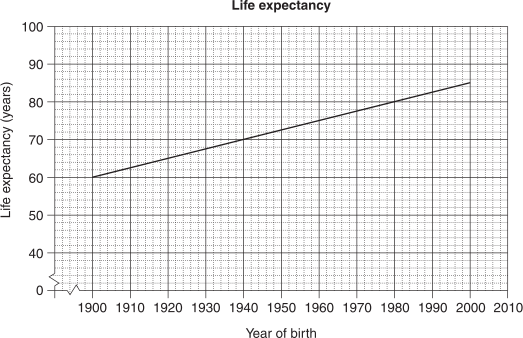
The graph shows the life expectancy of people born between 1900 and 2000.


  1. According to the graph, what is the life expectancy of a person born in 1932?  (1 mark)

    --- 1 WORK AREA LINES (style=lined) ---

  2. With reference to the value of the gradient, explain the meaning of the gradient in this context.  (2 marks)

    --- 4 WORK AREA LINES (style=lined) ---

Show Answers Only
  1. `text(68 years)`
  2. `text(After 1900, life expectancy increases 0.25 years for each later year someone is born.)`
Show Worked Solution

a.    \(\text{68 years}\)

b.    \(\text{Using (1900,60), (1980,80):}\)

\(\text{Gradient}\) \(= \dfrac{y_2-y_1}{x_2-x_1}\)
  \(= \dfrac{80-60}{1980-1900}\)
  \(= 0.25\)

 
\(\text{After 1900, life expectancy increases by 0.25 years for}\)

\(\text{each year later that someone is born.}\)

♦♦ Mean mark (ii) 33%.

Filed Under: Applications: Currency, Fuel and Other Problems (Std 1), Applications: Currency, Fuel and Other Problems (Std 2), Applications: Fuel and Other Problems (Std2-2027), Bivariate Data Analysis (Y12), Life Expectancy, Other Linear Modelling, S3 Further Statistical Analysis (Y12), S4 Bivariate Data Analysis (Y12) Tagged With: Band 3, Band 5, common-content, smc-1001-10-Line of Best Fit, smc-1001-50-Gradient Interpretation, smc-1113-10-Line of Best Fit, smc-1113-50-Gradient, smc-1119-30-Other Linear Applications, smc-6256-30-Other Linear Applications, smc-785-10-Line of Best Fit, smc-785-50-Gradient Interpretation, smc-793-30-Other Linear Applications

FS Health, 2UG 2016 HSC 29d

Five students sat both a Physics and a Chemistry exam. Their results are shown in the table. The mean and standard deviation of each exam are also shown.
 

2ug-2016-hsc-q29_3
 

The correlation coefficient for this data set is approximately 0.9.

  1. Verify the value of the correlation coefficient, using your calculator, and give your value correct to three decimal places.  (1 mark)
  2. By using the appropriate formulae from the Formulae and Data Sheet, and the given information, determine the equation of the least-squares line of best fit.  (3 marks)


Show Answers Only
  1. `0.907`
  2. `y = 1.376x – 29.494`
Show Worked Solution

(i)   `r ~~ 0.907`

♦♦ Mean mark part (i) 31%


(ii)    `text(gradient)` `= r xx (text(std dev)(y))/(text(std dev)(x))`
    `= 0.907 xx 13.73/9.05`
    `= 1.376\ \ (text(3 d.p.))`
♦ Mean mark part (ii) 48%


`ytext(-intercept)` `= bary – (text(gradient) xx barx)`
  `= 66 – 1.376 xx 69.4`
  `= −29.494\ \ (text(3 d.p.))`


`:.\ text(Equation:)\ \ y = 1.376x – 29.494`

Filed Under: Correlation / Body Measurements Tagged With: Band 5

Statistics, STD2 S1 2016 HSC 29c

The ages of members of a dance class are shown in the back-to-back stem-and-leaf plot.
 

2ug-2016-hsc-q29_2
 

Pat claims that the women who attend the dance class are generally older than the men.

Is Pat correct? Justify your answer by referring to the median and skewness of the two sets of data.  (3 marks)

--- 6 WORK AREA LINES (style=lined) ---

Show Answers Only

`text(Women:)`

`text(The median is 55 in a data)`

`text(set that is negatively skewed.)`

`text(Men:)`

`text(The median is 45 in a data)`

`text(set that is positively skewed.)`

`:.\ text(Pat is correct.)`

Show Worked Solution

`text(Women:)`

♦ Mean mark 44%.

`text(The median is 55 in a data)`

`text(set that is negatively skewed.)`

`text(Men:)`

`text(The median is 45 in a data)`

`text(set that is positively skewed.)`

`:.\ text(Pat is correct.)`

Filed Under: Bar Charts, Histograms and Other Graphs (Std 1), Other Chart Types (Y12), Other Charts (Std 2), Other Charts (Std2-2027), Stem & Leaf, Box & Whisker Tagged With: Band 5, common-content, smc-1128-26-Back-to-back Stem and Leaf, smc-6311-20-Back-to-Back Stem-and-Leaf, smc-822-30-Back-to-Back Stem and Leaf, smc-998-30-Back-to-Back Stem and Leaf

Functions, EXT1′ F2 2016 HSC 13d

Suppose  `p(x) = ax^3 + bx^2 + cx + d`  with `a, b, c` and `d` real, `a != 0.`

  1. Deduce that if  `b^2 - 3ac < 0`  then `p(x)`  cuts the `x`-axis only once.  (2 marks)

    --- 6 WORK AREA LINES (style=lined) ---

  2. If  `b^2 - 3ac = 0 and p(-b/(3a)) = 0`, what is the multiplicity of the root  `x = -b/(3a)?`  (2 marks)

    --- 4 WORK AREA LINES (style=lined) ---

Show Answers Only
  1. `text(See Worked Solutions)`
  2. `3`
Show Worked Solution

i.     `p(x) = ax^3 + bx^2 + cx + d`

`pprime(x) = 3ax^2 + 2bx + c`

`=> p(x)\ text(will cut the)\ xtext(-axis once)`

`text(only if)\ \ Delta(pprime(x)) < 0`

`(2b)^2 – 4(3a)c` `< 0`
`4b^2 – 12ac` `< 0`
`b^2 – 3ac` `< 0`


ii.   `p(−b/(3a)) = 0`

`pprime(−b/(3a))` `=3a(- b/(3a))^2 + 2b (- b/(3a))+c`
  `=- b^2/(3a)+c`
  `=0\ \ \ (text{given}\ \ b^2 – 3ac = 0)`

 
`:.\ text(Multiplicity at least 2.)`

♦♦ Mean mark 32%.

 
`p″(x) = 6ax + 2b`

`p″(−b/(3a))` `= 6a(−b/(3a)) + 2b=0`

`:. text(Multiplicity of)\ \ x=− b/(3a)\ \ text(is 3.)`

Filed Under: Roots and Coefficients, Sum, Products and Multiplicity of Roots (Ext1) Tagged With: Band 4, Band 5, smc-1205-20-Multiplicity of Roots

Mechanics, EXT2 2016 HSC 13c

The ends of a string are attached to points `A` and `B`, with `A` directly above `B.` The points `A` and `B` are  `0.4` m apart.

An object of mass `M` kg is fixed to the string at `C.` The object moves in a horizontal circle with centre `B` and radius  `0.3` m, as shown in the diagram.

ext2-hsc-2016-13c

The tensions in the string from the object to points `A` and `B` are `T_1` and `T_2` respectively. The object rotates with constant angular velocity `omega.` You may assume that the acceleration due to gravity is  `g = 10\ text(ms)^-2.`

  1. Show that  `T_2 = 0.3M (omega^2 - 25).`  (3 marks)
  2. For what range of values of  `omega` is  `T_2 > T_1?`  (1 mark)
Show Answers Only
  1. `text(See Worked Solutions)`
  2. `8.16\ text{rad/sec}`
Show Worked Solution
i.    ext2-hsc-2016-13c-answer1

`tantheta = 4/3, costheta = 3/5, sintheta = 4/5`

`text(Resolving the forces at)\ C\ text(vertically:)`

`sintheta · T_1 – 10M` `= 0`
`4/5 · T_1` `= 10M`
`T_1` `= (50M)/4\ …\ (1)`


`text(Resolving the forces at)\ C\ text(horizontally:)`

`costheta · T_1 + T_2` `= Mr omega^2`
`3/5T_1 + T_2` `= 0.3M omega^2`


`text(Substitute)\ \ T_1 = (50M)/4\ \ text(from)\ (1)`

`T_2` `= 0.3Momega^2 – 3/5 · (50M)/4`
  `= 0.3Momega^2 – (30M)/4`
  `= 0.3M(omega^2 – 25)\ …\ text(as required.)`


ii.   `text(Find)\ omega,\ text(such that)\ T_2 > T_1,`

♦ Mean mark 41%.
`0.3M(omega^2 – 25)` `> (50M)/4`
`omega^2 – 25` `> 125/3`
`omega^2` `> 200/3`
`omega` `> 8.16\ text{rad/sec  (2 d.p.)}`

Filed Under: Circular Motion Tagged With: Band 4, Band 5

Harder Ext1 Topics, EXT2 2016 HSC 13a

The function `f(x) = x^x` is defined and positive for all `x > 0.`

By differentiating `ln(f(x))`, find the value of `x` at which `f(x)` has a minimum.  (3 marks)

Show Answers Only

`1/e`

Show Worked Solution
`f(x)` `= x^x`
`ln f(x)` `= ln x^x`
  `= x ln x`


`:. d/dx (x ln x) = ln x + 1`

♦ Mean mark 41%.

`text(Max or min when)`

`ln x + 1` `= 0`
`ln x` `= −1`
`x` `= 1/e`


ext2-2016-hsc-13a-answer

`:. f(x)\ text(has a minimum at)\ \ x = 1/e.`

Filed Under: Other Ext1 Topics Tagged With: Band 5

Complex Numbers, EXT2 N2 2016 HSC 10 MC

Suppose that  `x + 1/x = -1.`

What is the value of  `x^2016 + 1/x^2016?`

  1. `1`
  2. `2`
  3. `(2 pi)/3`
  4. `(4 pi)/3`
Show Answers Only

`=> B`

Show Worked Solution

`x + 1/x = −1`

♦ Mean mark 43%.

`x^2 + x + 1 = 0`

`:. x` `= (−1 ± sqrt(1 – 4))/2`
  `= −1/2 ± sqrt3/2 i`


`|\ x\ | = sqrt((−1/2)^2 + (sqrt3/2)^2) = 1`

`:. x` `= cos\ (2pi)/3 + isin\ (2pi)/3`
  `= text(cis)(2pi)/3`

`text(or)`

`x` `= cos\ (2pi)/3 – isin\ (2pi)/3`
  `= text(cis)(−(2pi)/3)`


`x^2016` `= text(cis)(±1344pi)quad(text(De Moivre))`
  `= text(cis)0`
  `= 1`


`:. x^2016 + 1/(x^2016) = 2`

`=> B`

Filed Under: Powers and Roots, Solving Equations with Complex Numbers Tagged With: Band 5, smc-1050-10-Quadratic roots

Conics, EXT2 2016 HSC 7 MC

The hyperbola with equation  `xy = 8`  is the hyperbola  `x^2 - y^2 = k`  referred to different axes.

What is the value of `k?`

  1. `2`
  2. `4`
  3. `8`
  4. `16`
Show Answers Only

`=> D`

Show Worked Solution

met1-2008-vcaa-q2-answer

`text(Distance)\ OA = 4.`

♦♦ Mean mark 35%.

`text(Rotate)\ xy = 8quad\ text(clockwise 45°)`

`text{Intersection is (4, 0)}`

`4^2 – 0^2` `= k`
`:.k` `= 16`

`=> D`

Filed Under: Hyperbola Tagged With: Band 5, M/C

Algebra, STD2 A4 2016 HSC 29b

The mass `M` kg of a baby pig at age `x` days is given by  `M = A(1.1)^x`  where `A` is a constant. The graph of this equation is shown.
 

2ug-2016-hsc-q29_1

  1. What is the value of `A`?   (1 mark)

    --- 1 WORK AREA LINES (style=lined) ---

  2. What is the daily growth rate of the pig’s mass? Write your answer as a percentage.   (1 mark)

    --- 2 WORK AREA LINES (style=lined) ---

Show Answers Only
  1. `1.5\ text(kg)`
  2. `10text(%)`
Show Worked Solution

i.   `text(When)\ x = 0,`

♦ Mean mark (i) 48%.
♦♦♦ Mean mark part (ii) 6%!

`1.5` `= A(1.1)^0`
`:. A` `= 1.5\ text(kg)`

 
ii.
   `text(Daily growth rate)`

`= 0.1`

`= 10text(%)`

Filed Under: Exponential/Quadratic (Projectile), Graphs and Applications (Y11), Non-Linear: Exponential/Quadratics (Std 2) Tagged With: Band 5, Band 6, common-content, smc-830-30-Exponential, smc-966-10-Exponential graphs, smc-966-30-Other exponential modelling

Probability, 2UG 2016 HSC 29a

Two unbiased coins are tossed.

  1. What is the probability that one coin shows heads and the other shows tails?  (1 mark)
  2. A game is played in which one player tosses the two coins. The rules are as follows:
  3. • If both coins show heads, the player wins `$40`
    • If both coins show tails, the player wins `$20`
  4. • If one coin shows heads and the other shows tails, the player loses `$30`.
  5.  

    What is the financial expectation of this game?  (2 marks)


Show Answers Only
  1. `1/2`

  2. `text(Expectation is breakeven)`
Show Worked Solution

(i)   `P(H\ text(and)\ T)`

`= P(H,T) + P(T,H)`

`= 1/2 xx 1/2 + 1/2 xx 1/2`

`= 1/2`


(ii)   `P(H,H) = 1/2 xx 1/2 = 1/4`

♦ Mean mark part (ii) 43%.

`P(T,T) = 1/2 xx 1/2 = 1/4`


`:.\ text(Financial expectation)`

`= 1/4 xx 40 + 1/4 xx 20 – 1/2 xx 30`

`=10+5-15`

`= 0\ \ \ text{(i.e. breakeven.)}`

Filed Under: Financial Expectation Tagged With: Band 4, Band 5

Measurement, STD2 M1 2016 HSC 28e

A company makes large marshmallows. They are in the shape of a cylinder with diameter 5 cm and height 3 cm, as shown in the diagram.

2ug-2016-hsc-q28_4

  1. Find the volume of one of these large marshmallows, correct to one decimal place.  (2 marks)

    --- 4 WORK AREA LINES (style=lined) ---

A cake is to be made by stacking 24 of these large marshmallows and filling the gaps between them with chocolate. The diagrams show the cake and its top view. The shading shows the gaps to be filled with chocolate.
 

2ug-2016-hsc-q28_5

  1. What volume of chocolate will be required? Give your answer correct to the nearest whole number.  (3 marks)

    --- 6 WORK AREA LINES (style=lined) ---

Show Answers Only
  1. `58.9\ text{cm}^3`
  2. `193\ text{cm}^3`
Show Worked Solution
a.    `V` `= pir^2h`
    `= pi xx 2.5^2 xx 3`
    `= 58.904…`
    `= 58.9\ text{cm³  (1 d.p.)}`


b.    2ug-2016-hsc-q28-answer1

`text(Volume of rectangle)`

♦ Mean mark part (ii) 35%.

`= 15 xx 10 xx 6`

`= 900\ text(cm)^3`
 

`text(Volume of marshmallows in rectangle)`

`= 6 xx 2 xx 58.9`

`= 706.8\ text(cm)^3`


`:.\ text(Volume of chocolate)`

`= 900-706.8`

`= 193.2`

`= 193\ text{cm}^3 \ text{(nearest cm}^3 text{)}`

Filed Under: Areas and Volumes (Harder), Perimeter, Area and Volume (Std 2), Volume, Mass and Capacity (Std2-2027) Tagged With: Band 4, Band 5, num-title-ct-corea, num-title-qs-hsc, smc-4235-20-Cylinders, smc-6304-50-Volume (Circular Measure), smc-798-50-Volume (Circular Measure)

Financial Maths, STD2 F5 2016 HSC 28d

The table gives the contribution per period for an annuity with a future value of $1 at different interest rates and different periods of time. 
 

2ug-2016-hsc-q28_31
 

Margaret needs to save $75 000 over 6 years for a deposit on a new apartment. She makes regular quarterly contributions into an investment account which pays interest at 3% pa.

How much will Margaret need to contribute each quarter to reach her savings goal?  (2 marks)

--- 4 WORK AREA LINES (style=lined) ---

Show Answers Only

`$2865`

Show Worked Solution

`text(Periods) = 6 xx 4 = 24`

♦ Mean mark 40%.

`text(Interest rate) = 1/4 xx 3 = 0.75text(%)`

`=>\ text(Table factor = 0.0382)`

`(text(i.e. 3.82 cents contributed per)`

  `text(quarter = $1 after 6 years))`


`:.\ text(Quarterly contribution)`

`= 75\ 000 xx 0.0382`

`= $2865`

Filed Under: F5 Annuities (Y12), FM5 - Annuities and Loan repayments, Modelling Investments and Loans (Y12) Tagged With: Band 5, common-content, smc-1002-60-Other Annuity Tables, smc-816-30-Other Annuity Tables

Probability, STD2 S2 2016 HSC 28c

A cricket team is about to play two matches. The probability of the team having a win, a loss or a draw is 0.7, 0.1 and 0.2 respectively in each match. The possible results in the two matches are displayed in the probability tree diagram.
  

2ug-2016-hsc-q28_2

  1. What is the probability of the team having a win and a draw, in any order?  (2 marks)

    --- 4 WORK AREA LINES (style=lined) ---

  2. Paul claims that 1.4 is the probability of the team winning both matches.


    Give one reason why this is NOT correct.  (1 mark)

    --- 2 WORK AREA LINES (style=lined) ---

Show Answers Only
  1. `0.28`
  2. `text(Probabilities cannot exceed 1.)`
Show Worked Solution

i.   `P(W\ text(and)\ D)`

`= P(W,D) + P(D,W)`

`= 0.7 xx 0.2 + 0.2 xx 0.7`

`= 0.28`

♦ Mean mark (i) 45%.
♦ Mean mark (ii) 49%.

 
ii.
   `text(Probabilities cannot exceed 1.)`

Filed Under: Multi-stage Events, Multi-Stage Events (Std 2), Single and Multi-Stage Events (Std 1) Tagged With: Band 5, num-title-ct-corea, smc-1135-10-Probability Trees, smc-4238-10-Dependent events, smc-4238-50-Probability trees, smc-829-10-Probability Trees

Measurement, STD2 M7 2016 HSC 28a

Jacob has a large jar of silver coins. He adds 20 gold coins into the jar. He then seals the jar and shakes it to ensure that the gold coins are mixed in thoroughly with the silver coins. Jacob then opens the jar and takes a handful of coins. In his hand he has 33 silver coins and 4 gold coins. 

  1. Based on Jacob’s handful, if a coin is selected at random from the jar, what is the probability that it is a gold coin?  (1 mark)

    --- 1 WORK AREA LINES (style=lined) ---

  2. Jacob returns the handful of coins to the jar. Estimate the total number of coins in the jar.  (2 marks)

    --- 4 WORK AREA LINES (style=lined) ---

Show Answers Only
  1. `4/37`
  2. `185`
Show Worked Solution
i.    `P(G)` `= 4/(4 + 33)`
    `= 4/37`
♦ Mean mark part (i) 28%.


ii.  `text(Let)\ \ X =\ text(total coins in jar.)`

`20/X` `=4/37`
`:.X` `=(20 xx 37)/4`
  `=185`

Filed Under: Combinations and Single Stage Events (Std 2), DS5/6 - Normal Distribution and Sampling, Ratio and Scale (Std2), Single stage events Tagged With: Band 4, Band 5, smc-1187-30-Capture/Recapture, smc-828-10-Simple Probability

Financial Maths, STD2 F4 2016 HSC 27d

Marge borrowed $19 000 to buy a used car. Interest on the loan was charged at 4.8% pa at the end of each month. She made a repayment of $436 at the end of every month. The table below sets out her monthly repayment schedule for the first four months of the loan. 
 

2ug-2016-hsc-q27_1

  1. Some values in the table are missing. Write down the values for `A` and `B`.  (2 marks)

    --- 4 WORK AREA LINES (style=lined) ---

  2. Calculate the value of `X`.  (2 marks)

    --- 3 WORK AREA LINES (style=lined) ---

  3. Marge repaid this loan over four years.


    What is the total amount that Marge repaid?  (1 mark)

    --- 2 WORK AREA LINES (style=lined) ---

Show Answers Only
  1. `A = $19\ 000,quadB = $17\ 551.33`
  2. `$74.56`
  3. `$20\ 928`
Show Worked Solution
i.    `A + 76-436` `= 18\ 640`
  `:. A` `= $19\ 000`


`17\ 915.67 + 71.66-436 = B`

`:. B = $17\ 551.33`


ii.   `18\ 640 + X-436 = 18\ 278.56`

`:. X` `= 18\ 278.56 + 436-18\ 640`
  `= $74.56`
♦♦ Mean mark part (iii) 28%.
COMMENT: Read carefully whether total paid or total interest paid is required.


iii.   `text(Total amount repaid)`

`= 48 xx 436`

`= $20\ 928`

Filed Under: FM4 - Credit and Borrowing, Loans (Std 1), Loans and Credit Cards (Std 2) Tagged With: Band 3, Band 4, Band 5, smc-1140-20-P+I-R Tables, smc-1140-40-Total Loan/Interest Payments, smc-814-20-P+I-R Tables, smc-814-40-Total Loan/Interest Payments

Statistics, STD2 S1 2016 HSC 27c

The heights of 400 students were measured. The results are displayed in this cumulative frequency polygon.
 

2ug-2016-hsc-q27_2

 
Use the polygon to estimate the interquartile range.  (2 marks)

--- 4 WORK AREA LINES (style=lined) ---

Show Answers Only

`36\ text(cm)`

Show Worked Solution

`text(See graph for values:)`

♦ Mean mark 46%.

2ug-2016-hsc-q27c-answer

`IQR` `= Q_3 – Q_1`
  `= 172 – 136`
  `= 36\ text(cm)`

Filed Under: Bar Charts and Histograms, Bar Charts and Histograms (Std 2), Bar Charts and Histograms (Std2-2027), Bar Charts and Histograms (Y12), Bar Charts, Histograms and Other Graphs (Std 1) Tagged With: Band 5, common-content, smc-1128-20-Cumulative Frequency Histograms, smc-1128-30-IQR, smc-6310-30-Cumulative Frequency Histograms, smc-6310-40-IQR, smc-821-20-Cumulative Frequency Histograms, smc-821-30-IQR, smc-997-20-Cumulative Frequency Histograms, smc-997-30-IQR

Statistics, STD2 S1 2016 HSC 27b

A small population consists of three students of heights 153 cm, 168 cm and 174 cm. Samples of varying sizes can be taken from this population.

What is the mean of the mean heights of all the possible samples? Justify your answer.  (2 marks)

--- 4 WORK AREA LINES (style=lined) ---

Show Answers Only

`165\ text(cm)`

Show Worked Solution

`text(If sample is 1 person,)`

♦ Mean mark 40%.

`text{Possible mean(s): 153, 168 or 174.}`
 

`text(If sample is 2 people,)`

`text{Possible mean(s):}quad(153 + 168)/2` `= 160.5`
`(153 + 174)/2` `= 163.5`
`(168 + 174)/2` `= 171`


`text(If sample is 3 people,)`

`text(Mean:)quad(153 + 168 + 174)/3 = 165`
 

`:.\ text(Mean of all mean heights)`

`= (153 + 168 + 174 + 160.5 + 163.5 + 171 + 165)/7`

`= 165\ text(cm)`

Filed Under: Measures of Centre and Spread (Std2-2027), Summary Statistics - No Graph (Std 2), Summary Statistics - No graph (Y12), Summary Statistics (no graph) Tagged With: Band 5, common-content, smc-6312-10-Mean, smc-824-10-Mean, smc-999-10-Mean

Financial Maths, STD2 F1 2016 HSC 27a

Alice intends to buy a car and insure it.

Briefly describe what each of these types of insurance covers: 

    • Compulsory third-party insurance (CTP)

    • Non-compulsory third-party property insurance.  (2 marks)

--- 4 WORK AREA LINES (style=lined) ---

Show Answers Only

`text(CTP Insurance:)`

`text(This insures a driver against liability)`

`text(if their car injures or kills a person)`

`text(in an accident.)`

`text(Non-compulsory TP Insurance:)`

`text(This insurance covers damage to)`

`text(other people’s property in an accident,)`

`text(but does not cover the driver’s own vehicle.)`

Show Worked Solution

`text(CTP Insurance:)`

♦♦♦ Mean mark 13%.
MARKER’S COMMENT: Again, car insurance causes major issues for students.

`text(This insures a driver against liability)`

`text(if their car injures or kills a person)`

`text(in an accident.)`

`text(Non-compulsory TP Insurance:)`

`text(This insurance covers damage to)`

`text(other people’s property in an accident,)`

`text(but does not cover the driver’s own vehicle.)`

Filed Under: Costs to Purchase / Insurance, Earning Money and Budgeting (Std 1), Earning Money and Budgeting (Std 2), Purchasing Goods (Std2-2027) Tagged With: Band 5, smc-1126-40-Insurance, smc-6278-20-Stamp Duty/Insurance, smc-810-40-Insurance

Measurement, STD2 M6 2016 HSC 25 MC

The diagram shows towns `A`, `B` and `C`. Town `B` is 40 km due north of town `A`. The distance from `B` to `C` is 18 km and the bearing of `C` from `A` is 025°. It is known that  `∠BCA`  is obtuse.
 

2ug-2016-hsc-25-mc

 
What is the bearing of `C` from `B`?

  1.    `070°`
  2.    `095°`
  3.    `110°`
  4.    `135°`
Show Answers Only

`=> D`

Show Worked Solution

`text(Using the sine rule,)`

♦ Mean mark 39%.
`(sin∠BCA)/40` `= (sin25^@)/18`
`sin angle BCA` `= (40 xx sin25^@)/18`
  `= 0.939…`
`angle BCA` `= 180 – 69.9quad(angleBCA > 90^@)`
  `= 110.1°`


`:. text(Bearing of)\ C\ text(from)\ B`

`= 110.1 + 25qquad(text(external angle of triangle))`

`= 135.1`

 
`=> D`

Filed Under: Bearings & Field Surveys, Bearings and Radial Surveys (Std2) Tagged With: Band 5, common-content, smc-803-10-Bearings

Statistics, STD2 S1 2016 HSC 21 MC

A grouped data frequency table is shown.

\begin{array} {|c|c|}
\hline
\rule{0pt}{2.5ex} \textit{Class Interval} \rule[-1ex]{0pt}{0pt} & \ \ \ \ \ \textit{Frequency}\ \ \ \ \  \\
\hline
\rule{0pt}{2.5ex} \text{1 – 5} \rule[-1ex]{0pt}{0pt} & 3 \\
\hline
\rule{0pt}{2.5ex} \text{6 – 10} \rule[-1ex]{0pt}{0pt} & 6 \\
\hline
\rule{0pt}{2.5ex} \text{11 – 15} \rule[-1ex]{0pt}{0pt} & 8 \\
\hline
\rule{0pt}{2.5ex} \text{16 – 20} \rule[-1ex]{0pt}{0pt} & 9 \\
\hline
\end{array}

What is the mean for this set of data?

  1.    6.5
  2.    10.5
  3.    11.9
  4.    12.4
Show Answers Only

`=> D`

Show Worked Solution

`text(Using the centre of each class interval:)`

♦ Mean mark 43%.
`text(Mean)` `= (3 xx 3 + 8 xx 6 + 13 xx 8 + 18 xx 9)/(3 + 6 + 8 + 9)`
  `= 12.42…`

`=> D`

Filed Under: Measures of Centre and Spread (Std2-2027), Summary Statistics - No Graph (Std 2), Summary Statistics - No graph (Y12), Summary Statistics (no graph), Summary Statistics (Std 1) Tagged With: Band 5, common-content, smc-1131-10-Mean, smc-1131-40-Class Centres, smc-6312-10-Mean, smc-6312-40-Class Centres, smc-824-10-Mean, smc-824-40-Class Centres, smc-999-10-Mean, smc-999-40-Class Centres

Statistics, STD2 S1 2016 HSC 19 MC

A soccer referee wrote down the number of goals scored in 9 different games during the season.

`2,  \ 3,  \ 3,  \ 3,  \ 5,  \ 5,  \ 8,  \ 9,  \ ...`

The last number has been omitted. The range of the data is 10.

What is the five-number summary for this data set?

  1. `2, 3, 5, 8.5, 12`
  2. `2, 3, 5, 8.5, 10`
  3. `2, 3, 5, 8, 12`
  4. `2, 3, 5, 8, 10`
Show Answers Only

`=> A`

Show Worked Solution

`text{Since range is 10} \ => \ text{Last data point = 12}`

`text{Q}_1 = 3`

`text{Q}_3 = (8 + 9)/2 = 8.5`

`text(Median = 5)`

`=> A`

♦ Mean mark 46%.

Filed Under: Box Plots and 5-Number Summary, Measures of Centre and Spread (Std2-2027), Stem & Leaf, Box & Whisker, Summary Statistics - Box Plots (Std 2), Summary Statistics - Box Plots (Std2-2027), Summary Statistics - Box Plots (Y12), Summary Statistics - No Graph (Std 2), Summary Statistics (no graph), Summary Statistics (Std 1) Tagged With: Band 5, common-content, num-title-ct-corea, num-title-qs-hsc, smc-1000-10-Single Box-Plots, smc-5021-15-5 number (even values), smc-5021-18-Find median, smc-5021-25-Find range, smc-6312-70-Other, smc-6313-10-Single Box Plots, smc-824-70-Other, smc-825-10-Single Box-Plots

Financial Maths, STD2 F4 2016 HSC 17 MC

Ariana is charged compound interest at the rate of  0.036%  per day on outstanding credit card balances. She has $780 outstanding for 24 days.

How much compound interest is she charged?

  1.    $6.74
  2.    $6.77
  3.    $786.74
  4.    $786.77
Show Answers Only

`=> B`

Show Worked Solution

`text(Total owing)`

♦ Mean mark 38%.
COMMENT: Credit card problems consistently produce sub-50% mean marks. Important review area.

`= P(1+r)^n`

`= 780(1 + 0.036/100)^24`

`= 786.77`
 

`:.\ text(Interest charged)`

`= 786.77 – 780`

`= $6.77`

 
`=> B`

Filed Under: Credit Cards (Std 1), FM4 - Credit and Borrowing, Loans and Credit Cards (Std 2) Tagged With: Band 5, smc-814-10-Credit Cards

Measurement, STD2 M7 2016 HSC 15 MC

Calls on a mobile phone plan are charged at the rate of 54 cents per 30 seconds, or part thereof.

What is the cost of a call lasting 2 minutes and 15 seconds?

  1.    $2.16
  2.    $2.32
  3.    $2.43
  4.    $2.70
Show Answers Only

`=> D`

Show Worked Solution

`5 xx 30\ text(second blocks)`

♦ Mean mark 44%.
`:.\ text(C)text(ost)` `= 5 xx 0.54`
  `= $2.70`

`=> D`

Filed Under: FS Communication, M4 Rates (Y12), Rates (Std2) Tagged With: Band 5, smc-1104-15-General rate problems, smc-805-60-Other rate problems

Measurement, STD2 M1 2016 HSC 12 MC

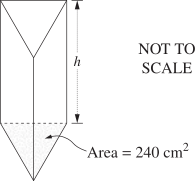
A container is in the shape of a triangular prism which has a capacity of 12 litres. The area of the base is 240 cm².
 

What is the distance, `h`, between the two triangular ends of the container?

  1. 5 cm
  2. 20 cm
  3. 25 cm
  4. 50 cm
Show Answers Only

`=> D`

Show Worked Solution
♦♦ Mean mark 35%.

`text{1 mL = 1 cm}^3\ \ =>\ \ text{1 L = 1000 cm}^3`

`text(Volume)` `= Ah`
`12\ 000` `= 240 xx h`
`h` `= (12\ 000)/240`
  `= 50\ text(cm)`

 
`=> D`

Filed Under: MM2 - Perimeter, Area and Volume (Prelim), Perimeter, Area and Volume (Std 2), Volume, Volume, Mass and Capacity (Std2-2027) Tagged With: Band 5, num-title-ct-corea, num-title-qs-hsc, smc-4235-10-Prisms, smc-6304-40-Volume, smc-798-40-Volume

Measurement, STD2 M1 2016 HSC 1 MC

What is  208.345  correct to two significant figures?

  1. 208
  2. 210
  3. 208.34
  4. 208.35
Show Answers Only

`B`

Show Worked Solution

`208.345 = 210\ (2\ text(sig. fig.))`

♦♦ Mean mark 36%!!

`=> B`


Filed Under: Identify and Convert Between Units (Std2-2027), MM1 - Units of Measurement, Numbers of Any Magnitude, Units and Measurement Error (Std 1), Units and Measurement Error (Std 2) Tagged With: Band 5, num-title-ct-corea, num-title-qs-hsc, smc-1120-30-Significant Figures, smc-4232-50-Significant figures, smc-6303-50-Significant Figures, smc-797-30-Significant Figures

  • « Previous Page
  • 1
  • …
  • 64
  • 65
  • 66
  • 67
  • 68
  • …
  • 81
  • Next Page »

Copyright © 2014–2025 SmarterEd.com.au · Log in