SmarterEd

Aussie Maths & Science Teachers: Save your time with SmarterEd

  • Login
  • Get Help
  • About

GEOMETRY, FUR2 2015 VCAA 2

There are plans to construct a series of straight paths on the flat top of the mountain.

A straight path will connect the cable car station at `C` to a communications tower at `T`, as shown in the diagram below.

Geometry and Trig, FUR2 2015 VCAA 21 

The bearing of the communications tower from the cable car station is 060°.

The length of the straight path between the communications tower and the cable car station is 950 m.

  1. How far north of the cable car station is the communications tower?  (1 mark)

Paths will also connect the cable car station and the communications tower to a camp site at `E`, as shown below.

Geometry and Trig, FUR2 2015 VCAA 22

The length of the straight path between the cable car station and the camp site is 1400 m.

The angle  `TCE`  is 40°.

    1. What will be the length of the straight path between the communications tower and the camp site?


      Write your answer correct to the nearest metre.  (1 mark)

    2. Use the cosine rule to find the bearing of the camp site from the communications tower.


      Write your answer correct to the nearest degree.  (2 marks)

Show Answers Only
  1. `475\ text(metres)`
    1. `908\ text(m)`
    2. `142^@`
Show Worked Solution
a.    `sin 30°` `=x/950`
  `:. x` `=950 xx sin 30°`
    `=475\ text(m)`


b.i   `text(Using the cosine rule,)`

`TE` `= sqrt(950^2 + 1400^2 – 2 xx 950 xx 1400 xx cos40^@)`
  `=908.196…`
  `=908\ text{m (nearest m)}`


b.ii.   VCAA 2015 fur2 Q2bii

`text(Let)\ \ alpha= angleCTE`

`cos alpha` `= (950^2 + 908.2^2 – 1400^2)/(2 xx 950 xx 908.196…)`
  `=-0.1348…`
`:. alpha` `=97.7…°`


`text(Let point)\ \ B\ \ text(be due south of)\ \ T`

`∠BTE` `= 97.7… -60`
  `=37.7…°`


`:. text(Bearing of)\ E\ text(from)\ T`

`= 180 – 37.7…`

`=142.2…`

`=142°\ \ text{(nearest °)}`

Filed Under: Trig - Bearings Tagged With: Band 4, Band 5

Calculus, MET2 2013 VCAA 4

Part of the graph of a function `g: R -> R, \ g (x) = (16-x^2)/4` is shown below.

VCAA 2013 4a

  1. Points `B` and `C` are the positive `x`-intercept and `y`-intercept of the graph `g`, respectively, as shown in the diagram above. The tangent to the graph of `g` at the point `A` is parallel to the line segment `BC.`
    1. Find the equation of the tangent to the graph of `g` at the point `A.`   (2 marks)

      --- 5 WORK AREA LINES (style=lined) ---

    2. The shaded region shown in the diagram above is bounded by the graph of `g`, the tangent at the point `A`, and the `x`-axis and `y`-axis.
    3. Evaluate the area of this shaded region.   (3 marks)

      --- 6 WORK AREA LINES (style=lined) ---

  2. Let `Q` be a point on the graph of  `y = g(x)`.
  3. Find the positive value of the `x`-coordinate of `Q`, for which the distance `OQ` is a minimum and find the minimum distance.   (3 marks)

    --- 6 WORK AREA LINES (style=lined) ---

The tangent to the graph of `g` at a point `P` has a negative gradient and intersects the `y`-axis at point  `D(0, k)`, where  `5 <= k <= 8.`
 

VCAA 2013 4c
 

  1. Find the gradient of the tangent in terms of `k.`   (2 marks)

    --- 8 WORK AREA LINES (style=lined) ---

  2.   i. Find the rule `A(k)` for the function of `k` that gives the area of the shaded region.   (2 marks)

    --- 5 WORK AREA LINES (style=lined) ---

  3.  ii. Find the maximum area of the shaded region and the value of `k` for which this occurs.   (2 marks)

    --- 5 WORK AREA LINES (style=lined) ---

  4. iii. Find the minimum area of the shaded region and the value of `k` for which this occurs.  (2 marks)

    --- 3 WORK AREA LINES (style=lined) ---

Show Answers Only
    1. `A: y = 5-x`
    2. `text(See Worked Solutions)`
  1. `2sqrt3\ text(units when)\ x = 2sqrt2`
  2. `gprime(2sqrt(k-4)) =-sqrt(k-4)`
    1. `A(k) = (k^2)/(2sqrt(k-4))-32/3, k ∈ [5,8]`
    2. `A_text(max) = 16/3quadtext(when)quadk = 8`
    3. `A_text(min) = (64sqrt3)/9-32/3quadtext(when)quadk = 16/3`
Show Worked Solution

a.i.   `B(4,0), C(0,4), A(a,(16-a^2)/4)`

`m_(BC) = m_text(tan) = (4-0)/(0-4) = -1`

`g(x)` `= (16-x^2)/4`
`g^{prime}(x)` `=-x/2`

 
`text(S)text(ince)\ \ g^{prime}(a) = -1,`

`=>a = 2`

`text(T)text(angent passes through)\ \ (2,3),`

`y-3` `=-(x-2)`
`y` `=-x + 5`

 
`text(Alternatively, using technology:)`

`[text(CAS: tangent Line)]\ (g(x),x,2)`
 

a.ii.   `text(Solution 1)`

♦ Mean mark 37%.
MARKER’S COMMENT: A common incorrect answer:
`int_0^5((-x+5)-g(x))dx=35/12`.  Know why it’s wrong!

  `D(5,0), E(0,5)`

`text(Area)` `= DeltaEOD-int_0^4 g(x)\ dx`
  `= 1/2 xx 5 xx 5-32/3`
  `= 11/6\ text(u²)`

 
`text(Solution 2)`

`text(Area)` `= int_0^5 (-x+5)\ dx-int_0^4 g(x)\ dx`
  `= 11/6\ text(u²)`


b.   `Q(x, (16-x^2)/4), O(0,0)`

♦♦♦ Mean mark 20%.
`z` `= OQ`
  `= sqrt(x^2 + ((16-x^2)/4)^2), x > 0`

 
`text(Max or min when)\ \ (dz)/(dx)=0,`

`text(Solve:)\ (dz)/dx = 0quadtext(for)quadx > 0`

`=> x = 2sqrt2`

`=>z(2sqrt2) = 2sqrt3`

`:. text(Min distance of)\ \ 2sqrt3\ \ text(units when)\ \ x = 2sqrt2`
 

c.   `text(Let)\ \ P(p, (16-p^2)/4)`

♦♦♦ Mean mark 8%.

`m_text(tan)\ text(at)\ P =-p/2`

`m_(PD) = ((16-p^2)/4-k)/(p-0)`
 

`text(Equating gradients,)`

`text(Solve:)\ \ ((16-p^2)/4-k)/p=-p/2\ \ text(for)\ p,`

`=> p=2sqrt(k-4)`
 

 `:.\ text(Gradient of tangent:)`

`g^{prime}(2sqrt(k-4)) =-sqrt(k-4)`
 

d.i.   `text(Equation of tangent:)`

♦♦♦ Mean mark 8%.

`y = -sqrt(k-4)x + k`

`text(CAS: tangent Line)\ (g(x),x,2sqrt(k-4))`

`xtext(-int of tangent:)\ x = k/(sqrt(k-4))`
 

`:. A(k)` `= 1/2 xx (k/(sqrt(k-4))) xx k-int_0^4 g(x)\ dx`
  `= (k^2)/(2sqrt(k-4))-32/3, \ \ k ∈ [5,8]`


d.ii.   `text(Solve:)\ \ A(k)=0quadtext(for)quadk ∈ [5,8]`

♦♦♦ Mean mark 5%.

`=> k=16/3`

  `text(Sketch the graph of)\ \ A(k)\ \ text(for)\ \ 5<=k<=8`


 met2-2013-vcaa-sec4-answer

`:. A_text(max) = 16/3quadtext(when)quadk = 8`
 

d.iii.   `A_text(min)\ text(occurs at the turning point)\ (k=16/3).`

♦♦♦ Mean mark 3%.
 `A_text(min)` `=A(16/3)`
  `=(64sqrt3)/9-32/3`

Filed Under: Area Under Curves, Maxima and Minima, Tangents and Normals Tagged With: Band 4, Band 5, Band 6, smc-634-10-Polynomial, smc-634-50-Find tangent given curve, smc-641-10-Area, smc-723-10-Quadratic, smc-723-80-Area between graphs

Calculus, MET2 2013 VCAA 3

Tasmania Jones is in Switzerland. He is working as a construction engineer and he is developing a thrilling train ride in the mountains. He chooses a region of a mountain landscape, the cross-section of which is shown in the diagram below.

VCAA 2013 2a

The cross-section of the mountain and the valley shown in the diagram (including a lake bed) is modelled by the function with rule

`f(x) = (3x^3)/64-(7x^2)/32 + 1/2.`

Tasmania knows that  `A (0, 1/2)`  is the highest point on the mountain and that `C(2, 0)` and `B(4, 0)` are the points at the edge of the lake, situated in the valley. All distances are measured in kilometres.

  1. Find the coordinates of `G`, the deepest point in the lake.   (3 marks)

    --- 5 WORK AREA LINES (style=lined) ---

Tasmania’s train ride is made by constructing a straight railway line `AB` from the top of the mountain, `A`, to the edge of the lake, `B`. The section of the railway line from `A` to `D` passes through a tunnel in the mountain.

  1. Write down the equation of the line that passes through `A` and `B.`   (2 marks)

    --- 4 WORK AREA LINES (style=lined) ---

  2.  i. Show that the `x`-coordinate of `D`, the end point of the tunnel, is `2/3.`   (1 mark)

    --- 3 WORK AREA LINES (style=lined) ---

  3. ii. Find the length of the tunnel `AD.`   (2 marks)

    --- 2 WORK AREA LINES (style=lined) ---

In order to ensure that the section of the railway line from `D` to `B` remains stable, Tasmania constructs vertical columns from the lake bed to the railway line. The column `EF` is the longest of all possible columns. (Refer to the diagram above.)

  1.  i. Find the `x`-coordinate of `E.`   (2 marks)

    --- 3 WORK AREA LINES (style=lined) ---

  2. ii. Find the length of the column `EF` in metres, correct to the nearest metre.   (2 marks)

    --- 2 WORK AREA LINES (style=lined) ---

Tasmania’s train travels down the railway line from `A` to `B`. The speed, in km/h, of the train as it moves down the railway line is described by the function.

`V: [0, 4] -> R, \ V(x) = k sqrt x-mx^2,`

where `x` is the `x`-coordinate of a point on the front of the train as it moves down the railway line, and `k` and `m` are positive real constants.

The train begins its journey at `A (0, 1/2)`. It increases its speed as it travels down the railway line.

The train then slows to a stop at `B(4, 0)`, that is  `V(4) = 0.`

  1. Find `k` in terms of `m.`   (1 mark)

    --- 3 WORK AREA LINES (style=lined) ---

  2. Find the value of `x` for which the speed, `V`, is a maximum.   (2 marks)

    --- 3 WORK AREA LINES (style=lined) ---

Tasmania is able to change the value of `m` on any particular day. As `m` changes, the relationship between `k` and `m` remains the same.

  1. If, on one particular day, `m = 10`, find the maximum speed of the train, correct to one decimal place.   (2 marks)

    --- 4 WORK AREA LINES (style=lined) ---

  2. If, on another day, the maximum value of `V` is 120, find the value of `m.`   (2 marks)

    --- 4 WORK AREA LINES (style=lined) ---

Show Answers Only
  1. `G(28/9,−50/243)`
  2. `y = −1/8x + 1/2`
  3.  i. `text(See Worked Solutions)`
  4. ii. `sqrt65/12`
  5.  i. `(2(sqrt31 + 7))/9`
  6. ii. `336\ text(m)`
  7. `8\ text(m)`
  8. `2^(2/3)`
  9. `75.6\ text(km/h)`
  10. `10 xx 2^(2/3)`
Show Worked Solution

a.   `G\ text(occurs when)\ \ f^{′}(x)=0.`

`text(Solve:)\ \ (3x^3)/64-(7x^2)/32 + 1/2=0\ \ text(for)\ x`

`x= 28/9quadtext(for)quadx ∈ (2,4)`

`f(28/9) = −50/243`

`:. G(28/9,−50/243)`
 

b.    `m_(AB)` `= (1/2-0)/(0-4)`
    `= −1/8`

 
`text(Equation using point gradient formula,)`

`y-y_1` `= m(x-x_1)`
`y-1/2` `= −1/8(x-0)`
`:. y` `= −1/8x + 1/2`

 
c.i.
 `text{Solution 2 (using technology)}`

`text(Solve:)\ \ ` `3/64x^3-7/32x^2 + 1/2` `= −1/8x + 1/2\ \ text(for)\ x`

`x=0, 2/3 or 4`

`:.x=2/3,\ \ (0<x<4)`
 

`text(Solution 1)`

`text(Intersection occurs when:)`

`3/64x^3-7/32x^2 + 1/2` `= −1/8x + 1/2`
`3x^3-14x^2 + 8x` `= 0`
`x(3x^2-14x + 8)` `= 0`
`x(x-4)(3x-2)` `= 0`

 
`x = 2/3,\ \ (0<x<4)`

`:. x text(-coordinate of)\ D = 2/3`
 

c.ii.   `D (2/3, 5/12)qquadA(0,1/2)`

  `text(By Pythagoras,)`

`AD` `= sqrt((2/3-0)^2 + (5/12-1/2)^2)`
  `= sqrt65/12`


d.i.  `text(Let)\ \ z =\ EF`

♦♦♦ Mean mark part (d)(i) 24%.
MARKER’S COMMENT: Many students unfamiliar with this type of question.
 `z` `= (−1/8x + 1/2)-((3x^2)/64-7/32 x^2 + 1/2)`
  `=-1/8x-(3x^2)/64 + 7/32 x^2`

 
`text(Solve:)\ \ d/dx (-1/8x-(3x^2)/64 + 7/32 x^2) =0\ \ text(for)\ x`

`x= (2(sqrt31 + 7))/9,\ \ \ x > 0`
 

♦♦♦ Mean mark part (d)(ii) 22%.
d.ii.    `z((2sqrt31 + 14)/9)` `= 0.3360…\ text(km)`
    `= 336\ text{m  (nearest m)}`


e.    `V(4)` `= 0quadtext{(given)}`
  ` 0` `= k sqrt4-m xx 4^2`
  `:.k` `= 8m`


f.  `V(x) = 8msqrtx-mx^2`

`text(Solve:)\ \ V^{′}(x)` `= 0quadtext(for)quadx`

`x= 2^(2/3)`
 

g.  `text(When)\ \ m=10,\ \ k=8 xx 10=80`

♦ Mean mark 43%.

`:.V(x) = 80sqrtx-10x^2`

`text(Solve:)\ \ V^{′}(x)` `= 0quadtext(for)quadx`

`x= 2^(2/3)`

`V(2^(2/3))` `=75.59…`
  `= 75.6\ text(km/h)`


h.   `text(Maximum occurs at)\ x = 2^(2/3)`

♦ Mean mark 38%.

`V(x) = 8msqrtx-mx^2`

`text(Solve:)\ \ V(2^(2/3))` `= 120quadtext(for)quadm`
`:. m` `= 10 xx 2^(2/3)`

Filed Under: Curve Sketching, Maxima and Minima Tagged With: Band 3, Band 4, Band 5, Band 6, smc-641-60-Other themes, smc-724-10-Cubic, smc-724-70-Applied context

Probability, MET2 2013 VCAA 2

FullyFit is an international company that owns and operates many fitness centres (gyms) in several countries. At every one of FullyFit’s gyms, each member agrees to have his or her fitness assessed every month by undertaking a set of exercises called `S`. There is a five-minute time limit on any attempt to complete `S` and if someone completes `S` in less than three minutes, they are considered fit.

  1. At FullyFit’s Melbourne gym, it has been found that the probability that any member will complete `S` in less than three minutes is `5/8.` This is independent of any member.
  2. In a particular week, 20 members of this gym attemp `S.`
    1. Find the probability, correct to four decimal places, that at least 10 of these 20 members will complete `S` in less than three minutes (2 marks)

      --- 4 WORK AREA LINES (style=lined) ---

    2. Given that at least 10 of these 20 members complete `S` in less than three minutes, what is the probability, correct to three decimal places, that more than 15 of them complete `S` in less than three minutes?  (3 marks)

      --- 5 WORK AREA LINES (style=lined) ---

  3. When FullyFit surveyed all its gyms throughout the world, it was found that the time taken by members to complete `S` is a continuous random variable `X`, with a probability density function `g`, as defined below.
     
    `qquad qquad qquad g(x) = {(((x-3)^3 + 64)/256 ,  1 <= x <= 3),((x + 29)/128 ,  3 < x <= 5),(0 ,  text(elsewhere)):}`

    1. Find `text(E)(X)`, correct to four decimal places.  (2 marks)

      --- 4 WORK AREA LINES (style=lined) ---

    2. In a random sample of 200 FullyFit members, how many members would be expected to take more than four minutes to complete `S?` Give your answer to the nearest integer.  (2 marks)

      --- 5 WORK AREA LINES (style=lined) ---

Show Answers Only

a.i.   `0.9153`

a.ii.   `0.086`

b.i.   `3.0458`

b.ii.  `52\ text(people)`

Show Worked Solution

a.i.   `text(Let)\ \ y =\ text(number who complete in less than 3 min)`

`Y ∼\ text(Bi)(20, 5/8)`

`text(Pr)(Y >= 10)` `= 0.91529…`
  `= 0.9153\ \ text{(4 d.p.)}`


a.ii.    `text(Pr)(Y> 15 | Y >= 10)` `= (text(Pr)(Y > 15))/(text(Pr)(Y >= 10))`
    `= (0.079041…)/(0.915292…)`
    `= 0.086\ \ text{(3 d.p.)}`


b.i.    `text(E)(X)` `=int_-oo^oo (x xx g(x))\ dx`
    `= int_1^3 x[((x-3)^3 + 64)/256]dx + int_3^5 x((x + 29)/128) dx`
    `= 3.04583…`
    `= 3.0458\ \ text{(4 d.p.)}`


b.ii.  `text(Let)\ \ W =\ text(number who take more than 4 min)`

♦ Mean mark 48%.

`W ∼\ text(Bi)(200, int_4^5 (x + 29)/128\ dx)`

`W ∼\ text(Bi)(200, 67/256)`

`text(E)(W)` `= np`
  `= 200 xx 67/256`
  `= 1675/32`
  `= 52.3437…`
  `= 52\ text(people)`

Filed Under: Binomial, Probability density functions Tagged With: Band 4, Band 5, smc-637-10-E(X), smc-637-60-Polynomial PDF, smc-638-20-binomCdf (CAS), smc-638-50-Conditional

Calculus, MET2 2012 VCAA 5

The shaded region in the diagram below is the plan of a mine site for the Black Possum mining company.

All distances are in kilometres.

Two of the boundaries of the mine site are in the shape of the graphs of the functions

`f: R -> R,\ f(x) = e^x and g: R^+ -> R,\ g(x) = log_e (x).`

VCAA 2012 5a

    1. Evaluate `int_(−2)^0 f(x)\ dx`.   (1 mark)

      --- 2 WORK AREA LINES (style=lined) ---

    2. Hence, or otherwise, find the area of the region bounded by the graph of `g`, the `x` and `y` axes, and the line `y = –2`.   (1 mark)

      --- 2 WORK AREA LINES (style=lined) ---

    3. Find the total area of the shaded region.   (1 mark)

      --- 2 WORK AREA LINES (style=lined) ---

  1. The mining engineer, Victoria, decides that a better site for the mine is the region bounded by the graph of `g` and that of a new function  `k: (– oo, a) -> R,\ k(x) = – log_e(a-x)`, where `a` is a positive real number.
    1. Find, in terms of `a`, the `x`-coordinates of the points of intersection of the graphs of `g` and `k`.   (2 marks)

      --- 3 WORK AREA LINES (style=lined) ---

    2. Hence, find the set of values of `a`, for which the graphs of `g` and `k` have two distinct points of intersection.   (1 mark)

      --- 3 WORK AREA LINES (style=lined) ---

  2. For the new mine site, the graphs of `g` and `k` intersect at two distinct points, `A` and `B`. It is proposed to start mining operations along the line segment `AB`, which joins the two points of intersection.
  3. Victoria decides that the graph of `k` will be such that the `x`-coordinate of the midpoint of `AB` is `sqrt 2`.
  4. Find the value of `a` in this case.   (2 marks)

    --- 4 WORK AREA LINES (style=lined) ---

Show Answers Only
    1. `1-1/(e^2)`
    2. `1-1/(e^2)\ text(units²)`
    3. `e-1/(e^2)\ text(units²)`
    1. `(a ± sqrt(a^2-4))/2`
    2. `a > 2`
  1. `2sqrt2`
Show Worked Solution
ai.    `int_(−2)^0 f(x)\ dx` `=[e^x]_(-2)^0`
    `= e^0-e^(-2)`
    `=1-1/e^2`


a.ii.   `text(S)text(ince)\ \ g(x) = f^(−1)(x),`

♦ Mean mark part (a)(ii) 45%.

`=>\ text(Area is the same as)\ int_(−2)^0f(x)\ dx,`

`:. text(Area) = 1-1/(e^2)\ text(u²)`


♦ Mean mark part (a)(iii) 36%.
a.iii.    `text(Area)` `=int_0^1 (e^x)\ dx + text{Area from part (a)(ii)}`
    `= [e^x]_0^1 + (1-1/(e^2))`
    `= e-1/(e^2)\ text(u²)`


b.i.    `g(x)` `= k(x)`
  `log_e (x)` `=- log_e(a-x)`
  `log_e (x)+log_e(a-x)` `=0`
  `log_e(x(a-x))` `=0`
  `ax-x^2` `=1`
  `x^2-ax+1` `=0`

 
`:.x= (a ± sqrt(a^2-4))/2`


♦♦♦ Mean mark (b.ii.) 11%.

b.ii.   `text(For 2 solutions:)`

`b^2-4ac` `>0`
`a^2-4` `>0`
`:. a` `>2,\  \ (a>0)`


c.   `xtext(-coordinate of Midpoint)= sqrt2`

♦♦♦ Mean mark (c) 15%.
`((a + sqrt(a^2-4))/2 +(a-sqrt(a^2-4))/2)/2` `= sqrt2`
`a + sqrt(a^2-4) +a-sqrt(a^2-4)`  `=4 sqrt2`
`a` `=2sqrt2quadtext(for)quada > 2`

Filed Under: Area Under Curves Tagged With: Band 3, Band 4, Band 5, Band 6, smc-723-50-Log/Exponential, smc-723-80-Area between graphs

Calculus, MET2 2012 VCAA 4

Tasmania Jones is in the jungle, searching for the Quetzalotl tribe’s valuable emerald that has been stolen and hidden by a neighbouring tribe. Tasmania has heard that the emerald has been hidden in a tank shaped like an inverted cone, with a height of 10 metres and a diameter of 4 metres (as shown below).

The emerald is on a shelf. The tank has a poisonous liquid in it.

VCAA 2012 4a

  1. If the depth of the liquid in the tank is `h` metres.
      
     i. 
    find the radius, `r` metres, of the surface of the liquid in terms of `h`.   (1 mark)

    --- 5 WORK AREA LINES (style=lined) ---

    ii.
    show that the volume of the liquid in the tank is  `(pi h^3)/75\ text(m³)`.   (1 mark)

    --- 5 WORK AREA LINES (style=lined) ---

The tank has a tap at its base that allows the liquid to run out of it. The tank is initially full. When the tap is turned on, the liquid flows out of the tank at such a rate that the depth, `h` metres, of the liquid in the tank is given by

`h = 10 + 1/1600 (t^3 - 1200t)`,

where `t` minutes is the length of time after the tap is turned on until the tank is empty.

  1. Show that the tank is empty when  `t = 20`.   (1 mark)

    --- 5 WORK AREA LINES (style=lined) ---

  2. When  `t = 5` minutes, find
      
    i.
    the depth of the liquid in the tank.   (1 mark)

    --- 5 WORK AREA LINES (style=lined) ---

    ii. No longer in syllabus

  1. The shelf on which the emerald is placed is 2 metres above the vertex of the cone.

    From the moment the liquid starts to flow from the tank, find how long, in minutes, it takes until  `h = 2`.

    (Give your answer correct to one decimal place.)   (2 marks)

    --- 5 WORK AREA LINES (style=lined) ---

  2. As soon as the tank is empty, the tap turns itself off and poisonous liquid starts to flow into the tank at a rate of 0.2 m³/minute.
      
    How long, in minutes, after the tank is first empty will the liquid once again reach a depth of 2 metres?   (2 marks)

    --- 5 WORK AREA LINES (style=lined) ---

  3. In order to obtain the emerald, Tasmania Jones enters the tank using a vine to climb down the wall of the tank as soon as the depth of the liquid is first 2 metres. He must leave the tank before the depth is again greater than 2 metres.
      
    Find the length of time, in minutes, correct to one decimal place, that Tasmania Jones has from the time he enters the tank to the time he leaves the tank.   (1 mark)

    --- 5 WORK AREA LINES (style=lined) ---

Show Answers Only
  1.  i. `h/5`
    ii. `(pih^3)/75`
  2. `text(See Worked Solutions)`
  3.  i. `405/64\ text(m)`
    ii. `text(No longer in course)`
  4. `12.2\ text(min)`
  5. `(8pi)/15\ text(min)`
  6. `9.5\ text(min)`
Show Worked Solution

a.i.   `text(Using similar triangles:)`

`r/h` `= 2/10`
`:. r` `= h/5`


a.ii.    `V` `= 1/3 pir^2h`
    `= 1/3 pi(h/5)^2h`
  `:. V` `= (pih^3)/75\ \ \ text(… as required)`


b.    `h(20)` `= 10 + 1/1600(20^3-1200 xx 20)`
    `= 10 + 1/1600(-16\ 000)`
    `= 10-10`
    `= 0`


c.i.   `text(When)\ \ t=5,`

`h(5)` `=10 + 1/1600 (5^3-1200xx5)`
  `= 405/64\ text(m)`


c.ii.   `text(No longer in syllabus.)`


d.    `text(Solve:)\ \ 10 + 1/1600 (t^3-1200t)` `= 2`


`t= 12.2\ text(min)quadtext(for)quadt ∈ (0,20)`


e.   `text(When)\ \ h=2,`

♦♦♦ Mean mark part (e) 17%.
`text(Volume)` `=(pi 2^3)/75=(8pi)/75\ text(m³)`
   

`text(Time to fill back up to)\ \ h=2`

`=(8pi)/75 -: 0.2`

`=(8pi)/15\ text(minutes)`


f.   `text(Length of time)`

♦♦♦ Mean mark part (f) 11%.

`=\ text(Time for 2m to empty + Time to Fill to 2m)`

`= (20-12.16799…) + (8pi)/15`

`= 9.5\ text(min)\ \ text{(1 d.p.)}`

Filed Under: Average Value and Other Tagged With: Band 3, Band 4, Band 5, Band 6, smc-756-50-Other problems

Probability, MET2 2012 VCAA 3

Steve, Katerina and Jess are three students who have agreed to take part in a psychology experiment. Each student is to answer several sets of multiple-choice questions. Each set has the same number of questions, `n`, where `n` is a number greater than 20. For each question there are four possible options A, B, C or D, of which only one is correct.

  1. Steve decides to guess the answer to every question, so that for each question he chooses A, B, C or D at random.
  2. Let the random variable `X` be the number of questions that Steve answers correctly in a particular set.
    1. What is the probability that Steve will answer the first three questions of this set correctly?   (1 mark)

      --- 2 WORK AREA LINES (style=lined) ---

    2. Find, to four decimal places, the probability that Steve will answer at least 10 of the first 20 questions of this set correctly.   (2 marks)

      --- 4 WORK AREA LINES (style=lined) ---

    3. Use the fact that the variance of `X` is `75/16` to show that the value of `n` is 25.   (1 mark)

      --- 4 WORK AREA LINES (style=lined) ---

  1. The probability that Jess will answer any question correctly, independently of her answer to any other question, is  `p\ (p > 0)`. Let the random variable `Y` be the number of questions that Jess answers correctly in any set of 25.
  2. If  `text(Pr) (Y > 23) = 6 text(Pr) (Y = 25)`, show that the value of  `p` is `5/6`.   (2 marks)

    --- 5 WORK AREA LINES (style=lined) ---

  3. From these sets of 25 questions being completed by many students, it has been found that the time, in minutes, that any student takes to answer each set of 25 questions is another random variable, `W`, which is normally distributed with mean `a` and standard deviation `b`.
  4. It turns out that, for Jess, `text(Pr)(Y >= 18) = text(Pr) (W >= 20)` and also `text(Pr)(Y >= 22) = text(Pr)(W >= 25)`.
  5. Calculate the values of `a` and `b`, correct to three decimal places.   (4 marks)

    --- 8 WORK AREA LINES (style=lined) ---

Show Answers Only

    1. `1/64`
    2. `0.0139`
    3. `text(See Worked Solutions)`
  1. `text(No longer in syllabus.)`
  2. `text(See Worked Solutions)`
  3. `a = 24.246, b = 2.500`

Show Worked Solution

a.i.    `text{Pr(3 correct in a row)}` `= (1/4)^3`
    `= 1/64`


a.ii.   `X =\ text(Number Steve gets correct)`

  `X ∼\ text(Bi)(20,1/4)`

`text(Pr)(X >= 10) = 0.0139\ \ text{(4 d.p.)}`

`[text(CAS: binom Cdf)\ (20,1/4,10,20)]`


a.iii.    `text(Var)(X)` `= np(1 – p)`
  `75/16` `= n(1/4)(3/4)`
  `75` `= 3n`
  `:. n` `= 25`


b.i. & b.ii.  `text(No longer in syllabus.)`


c.   `Y ∼\ text(Bi)(25,p)`

♦♦♦ Mean mark part (c) 19%.

`text(Pr)(Y > 23)` `= 6text(Pr)(Y = 25)`
`text(Pr)(Y = 24) + text(Pr)(Y = 25)` `= 6text(Pr)(Y = 25)`
`text(Pr)(Y = 24)` `= 5 text(Pr)(Y = 25)`
`((25),(24))p^24(1 – p)^1` `= 5p^25`
`25p^24(1 – p)` `= 5p^25`
`25p^24-25p^25-5p^25` `=0`
`25p^24-30p^25` `=0`
`5p^24(5 – 6p)` `= 0`


`:. p = 5/6,\ \ (p>0)\ \ text(… as required)`


d.   `W ∼\ text(N)(a,b^2)`

♦♦♦ Mean mark part (d) 19%.

`text(Pr)(Y >= 18)` `= text(Pr)(W >= 20)`
`0.9552…` `= text(Pr)(W >= 20)`
`:. text(Pr)(W<20)`  `=1-0.9552…` 
`text(Pr)(Z<(20-a)/b)` `=0.0447…`
`(20-a)/b` `=-1.698…\ \ (1)`

MARKER’S COMMENT: Many students didn’t use binomial calculations for `Y` here.


`text(Pr)(Y >= 22)` `= text(Pr)(W >= 25)`
`0.3815…` `= text(Pr)(W >= 25)`
`text(Pr)(W < 25)`   `=1-0.3815…`
`text(Pr)(Z<(25-a)/b)` `=0.6184…`
`(25-a)/b` `=0.30136…\ \ (2)`


`text{Solve (1) and (2) simultaneously:}`

`a = 24.246\ \ text{(3 d.p.)}, \ b = 2.500\ \ text{(3 d.p.)}`

Filed Under: Binomial, Normal Distribution Tagged With: Band 4, Band 5, Band 6, smc-638-20-binomCdf (CAS), smc-638-35-Find n/p given E(X) Var(X)

Calculus, MET2 2012 VCAA 2

Let  `f: R text(\{2}) -> R,\ f(x) = 1/(2x-4) + 3.`

  1. Sketch the graph of  `y = f(x)` on the set of axes below. Label the axes intercepts with their coordinates and label each of the asymptotes with its equation.   (3 marks)

    --- 0 WORK AREA LINES (style=lined) ---

           VCAA 2012 2a
     

  2.   i. Find `f^{′}(x)`.   (1 mark)

    --- 1 WORK AREA LINES (style=lined) ---

  3.  ii. State the range of  `f ^{′}`.   (1 mark)

    --- 1 WORK AREA LINES (style=lined) ---

  4. iii. Using the result of part ii. explain why `f` has no stationary points.   (1 mark)

    --- 2 WORK AREA LINES (style=lined) ---

  5. If  `(p, q)`  is any point on the graph of  `y = f(x)`, show that the equation of the tangent to  `y = f(x)`  at this point can be written as  `(2p-4)^2 (y-3) = -2x + 4p-4.`   (2 marks)

    --- 5 WORK AREA LINES (style=lined) ---

  6. Find the coordinates of the points on the graph of  `y = f(x)`  such that the tangents to the graph at these points intersect at  `(-1, 7/2).`   (4 marks)

    --- 4 WORK AREA LINES (style=lined) ---

  7. A transformation  `T: R^2 -> R^2`  that maps the graph of  `f` to the graph of the function  `g: R text(\{0}) -> R,\ g(x) = 1/x`  has rule
  8.      `T([(x), (y)]) = [(a, 0), (0, 1)] [(x), (y)] + [(c), (d)]`, where `a`, `c` and `d` are non-zero real numbers.
  9. Find the values of `a, c` and `d`.   (2 marks)

    --- 6 WORK AREA LINES (style=lined) ---

Show Answers Only
  1. met2-2012-vcaa-sec2-answer
  2.   i. `f^{′}(x) = (−2)/((2x-4)^3)`
     ii. `text(Range) = (−∞,0)`
    iii. `text(See Worked Solutions)`
  3. `text(See Worked Solutions)`
  4. `text(Coordinates:) (1,5/2)\ text(or)\ (5,19/6)`
  5. `a = 2, c = −4, d = −3`
Show Worked Solution

a.   `text(Asymptotes:)`

`x = 2`

`y = 3`

met2-2012-vcaa-sec2-answer


b.i.   `f^{′}(x) = (−2)/((2x-4)^2)`


b.ii.   `text(Range) = (−∞,0), or  R^-`

MARKER’S COMMENT: Incorrect notation in part (b)(ii) was common, including `{-oo,0}, -R, (0,-oo)`.


b.iii.    `text(As)\ \ ` `f^{′}(x) < 0quadtext(for)quadx ∈ R text(\{2})`
    `f^{′}(x) != 0`

 
`:. f\ text(has no stationary points.)`
 

c.   `text(Point of tangency) = P(p,1/(2p-4) + 3)`

♦♦ Mean mark 29%.
`m_text(tang)` `= f^{′}(p)`
  `= (-2)/((2p-4)^2)`

 
`text(Equation of tangent using:)`

`y-y_1` `= m(x-x_1)`
`y-(1/(2p-4) + 3)` `= (-2)/((2p-4)^2)(x-p)`
`y-3` `= (-2(x-p))/((2p-4)^2) + (2p-4)/((2p-4)^2)`
`(2p-4)^2(y-3)` `=-2x + 2p + 2p-4`
`:. (2p-4)^2(y-3)` `=-2x + 4p-4\ \ text(… as required)`


d.   `text(Substitute)\ \ (−1,7/2)\ text{into tangent (part c),}`

♦♦♦ Mean mark 19%.

`text(Solve)\ \ (2p-4)^2(7/2-3) = −2(-1) + 4p-4\ \ text(for)\ p:`

`:. p = 1,\ text(or)\ 5`

`text(Substitute)\ \ p = 1\ text(and)\ p = 5\ text(into)\ \ P(p,1/(2p-4) + 3)`

`:. text(Coordinates:)\ (1,5/2)\ text(or)\ (5,19/6)`
 

e.   `text(Determine transformations that that take)\ f -> g:`

`text(Dilate the graph of)\ \ f(x) = 1/(2x-4) + 3\ \ text(by a)`

`text(factor of 2 from the)\ \ ytext(-axis).`

`y = 1/(2(x/2)-4) + 3= 1/(x-4) + 3`

`text(Translate the graph 4 units to the left and 3)`

`text(units down to obtain)\ \ g(x).`
 

`text(Using the transformation matrix,)`

`x^{′}` `=ax+c`
`y^{′}` `=y+d`

 
`f -> g:\ \ 1/(2x-4) -> 1/(x^{′})`

`x^{′}=2x-4`

`=> a=2,\ \ c=-4`
 

`f -> g:\ \ y -> y^{′} + 3`

`y^{′}=y -3`

`=>\ \ d=-3`

Filed Under: Quotient and Other Graphs, Tangents and Normals, Transformations Tagged With: Band 3, Band 4, Band 5, Band 6, smc-634-50-Find tangent given curve, smc-753-60-Matrix, smc-753-85-Other functions, smc-757-10-Quotient function, smc-757-50-Sketch graph

GRAPHS, FUR2 2011 VCAA 2

Michael began his hike at the national park office and followed a track towards a camping ground, 16 km away.

The distance-time graph below shows Michael's distance from the national park office, `d` kilometres, after `t` hours of hiking.

GRAPHS, FUR2 2011 VCAA 2

It took Michael seven hours to complete this hike.

  1. What was Michael's average speed, in kilometres per hour, during this hike?


    Write your answer correct to one decimal place.  (1 mark)

The equation of Michael's distance-time graph from  `t = 3`  to  `t = 7`  is

`d = at + b`

  1. Determine the value of both `a` and `b`.(2 marks)

Katie hiked along the same track as Michael, but hiked in the opposite direction.

She begun at the camping ground and hiked towards the national park office.

Katie's distance from the national park office, `d` kilometres, after `t` hours of hiking, can be determined from the equation

`d = -3t + 16`

Katie and Michael both starter hiking at the same time.

  1. After how many hours did Katie pass Michael?  (1 mark)

Katie and Michael both carry radio transmitters that allow them to talk to each other while hiking.

The transmitters will not work if Katie and Michael are more than three kilometres apart.

  1. For how many hours during the hike were Michael and Katie able to use the radio transmitters to talk to each other?


    Write your answer in hours correct to two decimal places.  (2 marks)


Show Answers Only
  1. `2.3\ text(km/hr)`
  2. `a = 1.5, b = 5.5`
  3. `text(2 hours)`
  4. `text(1.38 hours)`
Show Worked Solution
a.    `text(Average speed)` `= text(total kms)/text(total time)`
    `= 16/7`
    `= 2.285…`
    `= 2.3\ text{km/hr  (1 d.p.)}`


b.   `text(When)\ \ t = 3\ \ text{(from graph)},`

`10 = 3a + b\ \ text{…  (1)}`

`text(When)\ \ t = 7`

`16 = 7a + b\ \ text{…  (2)}`

♦ Mean mark for all parts (combined) was 31%.


`text(Substitute)\ \ b = 10 – 3a\ \ text{from  (1) into (2)}`

`16` `= 7a + 10 – 3a`
 `6` `= 4a`
 `:. a` `= 1.5`


`text(Substitute)\ a = 1.5\ \ text{into  (1)}`

`10` `= 3 xx 1.5 + b`
`:. b` `= 5.5`


c.   

`text(From the graph, Katie’s distance from)`

MARKER’S COMMENT: Drawing Katie’s graph was a feature of the best answers here.

`text(the office is the same as Michael’s at)`

`text(the intersection of)`

`d` `= -3t + 16\ \ text{…  (1)}`
`d` `= 5t\ \ text{…  (2)}`


 `text(Intersection when)`

`5t` `= -3t + 16`
`8t` `= 16`
`t` `= 2`

`:.\ text(Katie passes Michael after 2 hours.)`


d.   `text(Find the times when they are 3km apart.)`

`-3t + 16 – 5t` `= 3`
`8t` `= 13`
`t` `= 1.625\ text(hours)`

 

`text(After passing each other, the graph)`

♦♦♦ “Few students” answered this part correctly.
MARKER’S COMMENT: Students who had drawn Katie’s graph were the most successful in this part.

`text(shows the next time they are 3km)`

`text(apart is when)\ \ t = 3\ text(hours.)`


`:.\ text(Time the radios will work)`

`= 3 – 1.625`

`= 1.375`

`= 1.38\ text{hours  (2 d.p.)}`

Filed Under: Linear relationships Tagged With: Band 5, Band 6

GRAPHS, FUR2 2011 VCAA 1

Michael is preparing to hike through a national park.

He decides to make some trail mix to eat on the hike.

The trail mix consists of almonds and raisins.

The table below shows some information about the amout of carbohydrate and protein contained in each gram of almonds and raisins.

GRAPHS, FUR2 2011 VCAA 11 

  1. If Michael mixed 180 g of almonds and 250 g of raisins to make some trail mix, calculate the weight, in grams, of carbohydrate in the trail mix.  (1 mark)

Michael wants to make some trail mix that contains 72 g of protein. He already has 320 g of almonds.

  1. How many grams of raisins does he need to add?  (2 marks)

The trail mix Michael takes on his hike must satisfy his dietary requirements.

Let `x` be the weight, in grams, of almonds Michael puts into the trail mix.

Let `y` be the weight, in grams, of raisins Michael puts into the trail mix.

Inequalities 1 to 4 represents Michael's dietary requirements for the weight of carbohydrate and protein in the trail mix.

Inequality 1 `x >= 0`
Inequality 2 `y >= 0`
Inequality 3 (carbohydrate)   `0.2x + 0.8y >= 192`
Inequality 4 (protein) `0.2x + 0.04y <= 40`    


Michael also requires a minimum of 16 g of fibre in the trail mix.

Each gram of almonds contains 0.1 g of fibre.

Each gram of raisins contains 0.04 g of fibre.

  1. Write down an inequality, in terms of `x` and `y`, that represents this dietary requirement.


    Inequality 5 (fibre) _________________________  (1 mark)

The graphs of  `0.2x + 0.8y = 192`  and  `0.2x + 0.04y = 40`  are shown below.

GRAPHS, FUR2 2011 VCAA 12

  1. On the graph above


    1. draw the straight line that relates to Inequality 5  (1 mark)
    2. shade the region that satisfies Inequalities 1 to 5.  (1 mark)
  2. What is the maximum weight, in grams, of trail mix that satisfies Michael's dietary requirements?  (1 mark)

Michael plans to carry at least 500 g of trail mix on his hike.

He would also like this trail mix to cantain the greatest possible weight of almonds.

The trail mix must satisfy all of Michael's dietary requirements.

  1. What is the weight of the almonds, in grams, in this trail mix?  (2 marks) 
Show Answers Only
  1. `236\ text(g)`
  2. `200\ text(g)`
  3. `0.1x + 0.04y >= 16`
  4. i. & ii.
  5. `1000`
  6. `125\ text(g)`
Show Worked Solution
a.    `text(Carbohydrates)` `= 180 xx 0.2 + 250 xx 0.8`
    `= 236\ text(grams)`


b.   `text(Almond protein)`

`= 320 xx 0.2`

`= 64\ text(g)`

`=>\ text(8 grams of protein still required.)`


`:.\ text(Amount of raisins needed)`

`= 8/0.04`

`= 200\ text(g)`


c.   `text(Inequality 5)`

`0.1x + 0.04y >= 16`


d.i. & ii.   


e.   `text(Maximum weight to satisfy)`

`= 1000\ text(grams)`


f.   `text(New constraint)`

`x + y >= 500`

VCAA GRAPHS FUR2 2011 1dii

`text(In the new feasible region, the maximum amount)`

`text(of almonds occurs at the intersection of)`

`x + y = 500\ text{  …  (1)}`

♦♦ Part f was “Poorly answered” although exact data unavailable.
MARKER’S COMMENT: Ensure you incorporate the new constraint!

`0.2x + 0.04y = 40\ text{  …  (2)}`


`text(Substitute)\ \ y = 500 – x\ \ text{from (1) into (2)}`

`0.2x + 0.04 (500 – x)` `= 40`
`0.2x + 20 – 0.04x` `= 40`
`0.16x` `= 20`
`x` `= 125`


`:.\ text(Weight of almonds) = 125\ text(g)`

Filed Under: Linear Programming Tagged With: Band 3, Band 4, Band 5

GEOMETRY, FUR2 2011 VCAA 3

A lighthouse has a lightroom, shown shaded in Figure 2 below.

The floor of the lightroom is in the shape of a regular octagon.

The longest distance across the floor is 4 metres.

The lightroom floor and `anglePOQ = theta^@` are shown in Figure 3 below.

GEOMETRY, FUR2 2011 VCAA 31

  1. Show that the size of the angle `theta` is 45°.  (1 mark)
  2. Determine the area of triangle `POQ`.


    Write your answer in square metres correct to one decimal place.  (1 mark)

The lightroom is surrounded by a walkway of diameter 6.4 metres.

An outer circular wall surrounds the walkway.

The walkway is shown in Figure 4 below.

GEOMETRY, FUR2 2011 VCAA 32

  1. Determine the minimum distance between the lightroom wall and the outer circular wall.  (1 mark)
  2. The walkway is the shaded area in Figure 4. Determine its area correct to the nearest square metre.  (2 marks)
Show Answers Only
  1. `45^@`
  2. `1.4\ text(m)²`
  3. `1.2\ text(m)`
  4. `21\ text(m)²`
Show Worked Solution
a.    `8 theta` `= 360^@`
  `:. theta` `= (360^@)/8`
    `= 45^@\ \ text(… as required)`


b.   `text(Using the sine rule,)`

VCAA GEO FUR2 2011 3i

`text(Area)` `= 1/2 ab sin C`
  `= 1/2 xx 2 xx 2 xx sin 45^@`
  `= 1.414…`
  `= 1.4\ text(m²)`


c.    `text(Minimum distance)` `= 1/2 (6.4 – 4)`
    `= 1.2\ text(m)`


d.    `text(Area of lightroom)` `= 8 xx 1.4`
    `= 11.2\ text(m)²`


`text(Area within outer wall)`

`= pi r^2`

`= pi xx 3.2^2`

`= 32.16…\ text(m)²`


`:.\ text(Area of walkway)`

`= 32.16… – 11.2`

`= 20.96…`

`= 21\ text{m²   (nearest m²)`

Filed Under: Perimeter, Area and Volume, Trig - Harder Applications Tagged With: Band 4, Band 5

GEOMETRY, FUR2 2011 VCAA 4

A lighthouse tower, shaded on Figure 5 below, is in the shape of a truncated cone.

It has circular cross-sections that decrease uniformly from a radius of 3.5 metres at ground level to a radius of 2 metres at the walkway.

The height of the lighthouse tower is 18 metres.

The angle marked as `alpha` is the angle that the outer wall of the lighthouse tower makes with the horizontal at ground level.

GEOMETRY, FUR2 2011 VCAA 41

  1. Determine the size of the angle `alpha`.


    Write your answer in degrees correct to one decimal place.  (1 mark)

The lighthouse tower is part of a cone. The height of this cone is `h` metres and the base radius is 3.5 metres, as shown in Figure 6.

GEOMETRY, FUR2 2011 VCAA 42

    1. Determine `h`, the height of this cone, in meters.  (2 marks)
    2. Determine the volume of the lighthouse tower.


      Write your answer to the nearest cubic metre.  (1 mark)

Show Answers Only
  1. `85.2^@`
    1. `42\ text(m)`
    2. `438\ text(m³)`
Show Worked Solution
a.   VCAA GEO FUR2 2011 4i
`tan alpha` `= 18/1.5`
`:. alpha` `= tan^-1 12`
  `= 85.23…`
  `= 85.2^@\ text{(1 d.p.)}`
♦♦♦ Mean mark for all parts (combined) 17%.
MARKER’S COMMENT: A common mistake had the base of this triangle equal to 3.5m.


b.i.   VCAA GEO FUR2 2011 4ii
`tan 85.2^@` `= h/3.5`
`:. h` `= 3.5 xx tan 85.2^@`
  `= 41.68…`
  `= 42\ text{m   (nearest m)}`
  ii.   VCAA GEO FUR2 2011 4iii

`text(Volume of large cone)`

`= 1/3 pi r^2 h`

`= 1/3 pi xx (3.5)^2 xx 42`

`= 538.78…\ text(m³)`


`text(Volume of Upper Cone)`

`= 1/3 xx pi xx 2^2 xx h_(uc)`

`= 4/3 pi xx (42 – 18)`

`= 100.53…\ text(m³)`


`:.\ text(Volume of lighthouse tower)`

`= 538.78… – 100.53…`

`= 438.2…`

`= 438\ text{m³   (nearest m³)}`

Filed Under: Perimeter, Area and Volume Tagged With: Band 5, Band 6

GEOMETRY, FUR2 2011 VCAA 2

Ship A and Ship B can both be seen from a lighthouse.

Ship A is 5 kilometres from the lighthouse, on a bearing of 028°.

Ship B is 5 kilometres from Ship A, on a bearing of 130°.

This information is shown in Figure 1 below.

GEOMETRY, FUR2 2011 VCAA 2

  1. Two angles, `x` and `y`, are shown in Figure 1 above.

    1. Determine the size of the angle `x` in degrees.  (1 mark)
    2. Determine the size of the angle `y` in degrees.  (1 mark)
  2. Determine the bearing of the lighthouse from Ship A.  (1 mark)
  3. Determine the bearing of Ship B from the lighthouse.  (1 mark)


Show Answers Only
    1. `152^@`
    2. `78^@`
  1. `208°\ \ text{(or S28°W)}`
  2. `079°\ \ text{(or N79°E)}`
Show Worked Solution

a.i.  `text(Draw a North/South line through Ship A.)`

VCAA GEO FUR2 2011 2i

`x` `= 180 – 28`
  `= 152^@`


   ii.    `y` `= 28^@ + 50^@`
    `= 78^@`


b.   `text(Bearing of the lighthouse from Ship)\ A`

`= 180 + 28`

`= 208^@`


c.   `Delta ABL\ \ text(is isosceles)`

MARKER’S COMMENT: True bearings are required and an answer of 79° is incorrect.

`:.\ text(Size of base angles)`

`= 1/2 (180 – 78)`

`= 51^@`


`:.\ text(Bearing of Ship B from the lighthouse)`

`= 28 + 51`

`= 079^@`

Filed Under: Trig - Bearings Tagged With: Band 4, Band 5

MATRICES, FUR2 2014 VCAA 2

There are three candidates in the election: Ms Aboud (`A`), Mr Broad (`B`) and Mr Choi (`C`).

The election campaign will run for six months, from the start of January until the election at the end of June.

A survey of voters found that voting preference can change from month to month leading up to the election.

The transition diagram below shows the percentage of voters who are expected to change their preferred candidate from month to month.
 

MATRICES, FUR2 2014 VCAA 2

    1. Of the voters who prefer Mr Choi this month, what percentage are expected to prefer Ms Aboud next month?   (1 mark)

      --- 1 WORK AREA LINES (style=lined) ---

    2. Of the voters who prefer Ms Aboud this month, what percentage are expected to change their preferred candidate next month?   (1 mark)

      --- 1 WORK AREA LINES (style=lined) ---

In January, 12 000 voters are expected in the city. The number of voters in the city is expected to remain constant until the election is held in June.

The state matrix that indicates the number of voters who are expected to have a preference for each candidate in January, `S_1`, is given below.

`S_1 = [(6000), (3840), (2160)]{:(A), (B), (C):}`

  1. How many voters are expected to change their preference to Mr Broad in February?   (1 mark)

    --- 2 WORK AREA LINES (style=lined) ---

The information in the transition diagram has been used to write the transition matrix, `T`, shown below.

`{:(qquadqquadqquadqquadtext(this month)),(qquadqquadqquad{:(\ A,qquadB,qquadC):}),(T = [(0.75,0.10,0.20),(0.05,0.80,0.40),(0.20,0.10,0.40)]{:(A),(B),(C):}qquadtext(next month)):}`

    1. Evaluate the matrix `S_3 = T^2S_1` and write it down in the space below.
    2. Write the elements, correct to the nearest whole number.   (1 mark)

      --- 0 WORK AREA LINES (style=lined) ---

    3. `S_3 = [(qquadqquadqquad),(),()]`
    4. What information does matrix `S_3` contain?   (1 mark)

      --- 2 WORK AREA LINES (style=lined) ---

  1. Using matrix `T`, how many votes would the winner of the election in June be expected to receive?
  2. Write your answer, correct to the nearest whole number.   (1 mark)

    --- 3 WORK AREA LINES (style=lined) ---

Show Answers Only
    1. `text(20%)`
    2. `text(25%)`
  1. `1164`
    1.  
      `S_3 = [(4900), (4634), (2466)]{:(A), (B), (C):}`
    2. `S_3\ text(contains the predicted number of)`
      `text(preferences for each candidate for)`
      `text(March.)`
  2. `5303`
Show Worked Solution

a.i.   `text(20%)`
 

a.ii.   `text(5%) + text(20%) = 25text(%)`
 

b.   `text(Voters expected to change to)\ B`

`= 5text(%) xx 6000 + 40text(%) xx 2160`

`= 1164`


c.i.    `S_3` `= T^2S_1`
    `= [(4900), (4634), (2466)]{:(A), (B), (C):}`


c.ii.   `S_3\ text(contains the predicted number of preferences)`

  `text(for each candidate for March.)`


MARKER’S COMMENT: A common error used `S_text(June)“=S_6=T^6 xx S_1`. Know why this is incorrect.
d.    `S_6` `= T^5S_1`
    `= [(4334), (5303), (2363)]{:(A), (B), (C):}`


`:. B\ text(is the expected winner with 5303 votes.)`

Filed Under: Transition Matrices - Regular Tagged With: Band 3, Band 4, Band 5

CORE, FUR2 2006 VCAA 1

Table 1 shows the heights (in cm) of three groups of randomly chosen boys aged 18 months, 27 months and 36 months respectively.

Core, FUR2 2006 VCAA 11

  1. Complete Table 2 by calculating the standard deviation of the heights of the 18-month-old boys.


    Write your answer correct to one decimal place.   (1 mark)

    --- 2 WORK AREA LINES (style=lined) ---


    Core, FUR2 2006 VCAA 12

A 27-month-old boy has a height of 83.1 cm.

  1. Calculate his standardised height (`z` score) relative to this sample of 27-month-old boys.
  2. Write your answer correct to one decimal place.   (1 mark)

    --- 2 WORK AREA LINES (style=lined) ---

The heights of the 36-month-old boys are normally distributed.

A 36-month-old boy has a standardised height of 2.

  1. Approximately what percentage of 36-month-old boys will be shorter than this child?   (1 mark)

    --- 2 WORK AREA LINES (style=lined) ---

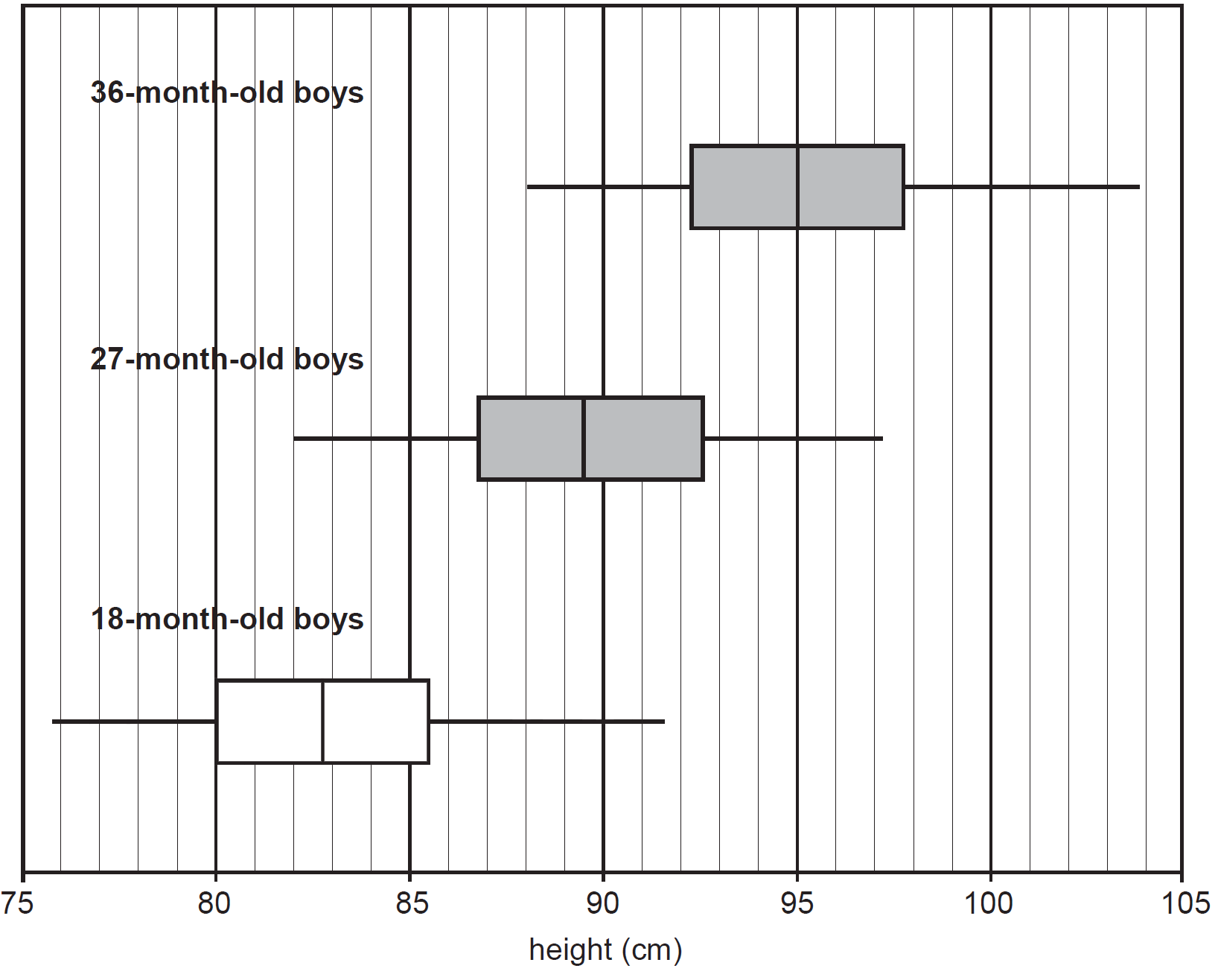
Using the data from Table 1, boxplots have been constructed to display the distributions of heights of 36-month-old and 27-month-old boys as shown below. 

     Core, FUR2 2006 VCAA 13

  1. Complete the display by constructing and drawing a boxplot that shows the distribution of heights for the 18-month-old boys.   (2 marks)

    --- 0 WORK AREA LINES (style=lined) ---

  2. Use the appropriate boxplot to determine the median height (in centimetres) of the 27-month-old boys.   (1 mark)

    --- 1 WORK AREA LINES (style=lined) ---

The three parallel boxplots suggest that height and age (18 months, 27 months, 36 months) are positively related.

  1. Explain why, giving reference to an appropriate statistic.   (1 mark)

    --- 1 WORK AREA LINES (style=lined) ---

Show Answers Only
  1. `3.8`
  2. `−1.4`
  3.  `2.5 text(%)`
  4.  
    Core, FUR2 2006 VCAA 13 Asnwer
  5. `89.5`
  6. `text(Median height increases as age increases.)`
Show Worked Solution

a.   `text(By calculator,)`

`text(standard deviation) = 3.8`


b.    `z` `= (x – barx)/s`
    `= (83.1 – 89.3)/(4.5)`
    `=-1.377…`
    `= -1.4\ \ text{(1 d.p.)}`


♦♦ MARKER’S COMMENT: Attention required here as this standard question was “very poorly answered”.

c.  `text{2.5%  (see graph below)}`

CORE, FUR2 2006 VCAA Answer 111


d.   `text(Range = 76 – 89.8,)\ Q_1 = 80,\ Q_3 = 85.8,\ text(Median = 83,)`

Core, FUR2 2006 VCAA 13 Asnwer

e.   `89.5`

MARKER’S COMMENT: A boxplot statistic was required, so mean values were not relevant.


f.   `text(The median height increases with age.)`

Filed Under: Graphs - Stem/Leaf and Boxplots, Normal Distribution Tagged With: Band 3, Band 4, Band 5, smc-600-10-Single z-score, smc-643-20-Parallel Box-Plots, smc-643-30-Draw Box Plots

CORE, FUR2 2006 VCAA 3

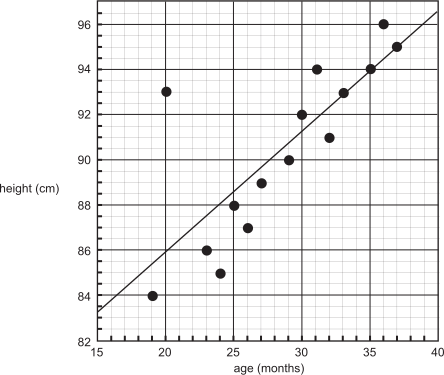
The heights (in cm) and ages (in months) of the 15 boys are shown in the scatterplot below.
 

Core, FUR2 2006 VCAA 3
 

  1. Fit a three median line to the scatterplot. Circle the three points you used to determine this three median line.  (2 marks)
  2. Determine the equation of the three median line. Write the equation in terms of the variables height and age and give the slope and intercept correct to one decimal place.  (2 marks)
  3. Explain why the three median line might model the relationship between height and age better than the least squares regression line.  (1 mark)
Show Answers Only
  1.   
    Core, FUR2 2006 VCAA 3 Answer
  2. `text(height =)\ 70.7 + 0.7 xx text(age)`
  3. `text(The three median line is not as influenced)`
    `text{by extreme values such as (20, 93).}`
Show Worked Solution
a.    Core, FUR2 2006 VCAA 3 Answer
♦ Average mean mark for all parts 36%.

b.  `text{Using the points (23,86) and (35, 94),}`

`text(Slope)` `= (94 – 86)/(35 – 23)`
  `= 0.666…`
  `=0.7\ \ text{(1 d.p.)}`


`:.\ text(height =)\ c + 0.7 xx text(age)`


`text{Substituting (35,94) into the equation,}`

`94` `=c + 0.66… xx 35`
`:.c` `=94-23.33…`
  `=70.66…`
  `=70.7\ \ text{(1 d.p.)}`


`:.text(height)\ = 70.7 + 0.7 xx text(age)`


c.   `text(The three median line is not as influenced)`

`text{by extreme values such as (20, 93).}`

Filed Under: Uncategorized Tagged With: Band 4, Band 5, Band 6

CORE, FUR2 2006 VCAA 2

The heights (in cm) and ages (in months) of a random sample of 15 boys have been plotted in the scatterplot below. The least squares regression line has been fitted to the data.


The equation of the least squares regression line is 

`text(height = 75.4 + 0.53 × age)`

The correlation coefficient is  `r= 0.7541`

  1. Complete the following sentence.


    On average, the height of a boy increases by _______ cm for each one-month increase in age.   (1 mark)

    --- 0 WORK AREA LINES (style=lined) ---

  2.  i. Evaluate the coefficient of determination.
  3.     Write your answer, as a percentage, correct to one decimal place.   (1 mark)

    --- 1 WORK AREA LINES (style=lined) ---

  4. ii. Interpret the coefficient of determination in terms of the variables height and age.   (1 mark)

    --- 2 WORK AREA LINES (style=lined) ---

Show Answers Only

a.    `0.53`

b.i.   `text(56.9%)`

b.ii. `text{The coefficient of determination 0.569 (56.9%) represents}`

`text{the proportion (percentage) of the variability in height with age}`

`text(that is explained by the least squares regression line.)`

Show Worked Solution

a.   `0.53`

♦ Average mean mark for all parts 44%.
MARKER’S COMMENT: b.i. errors included not converting to % and rounding as a decimal before converting and answering 60%.


b.i.    `r^2` `= 0.7541^2`
    `= 0.5686…`
    `= 56.9text(%)`
MARKER’S COMMENT: Any reference to causation in b.ii. was marked incorrect.


b.ii.  `text{56.9% of the variation in height is}`

`text{explained by the variation in age.}`

Filed Under: Correlation and Regression Tagged With: Band 4, Band 5, smc-265-10-r / r^2 and Association, smc-265-40-Interpret Gradient

CORE, FUR2 2007 VCAA 3

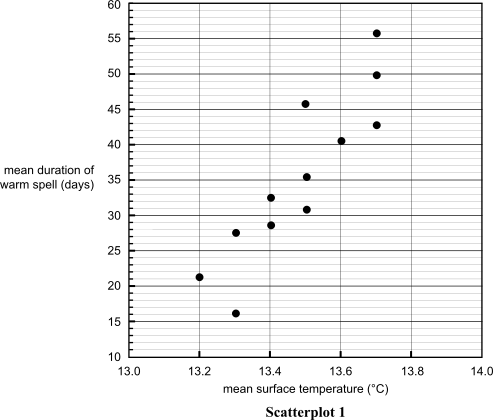
The table below displays the mean surface temperature (in °C) and the mean duration of warm spell (in days) in Australia for 13 years selected at random from the period 1960 to 2005.
 

CORE, FUR2 2007 VCAA 31
 

This data set has been used to construct the scatterplot below. The scatterplot is incomplete.

  1. Complete the scatterplot below by plotting the bold data values given in the table above. Mark the point with a cross (×).  (1 mark)

    --- 0 WORK AREA LINES (style=lined) ---


  2. Mean surface temperature is the explanatory variable.


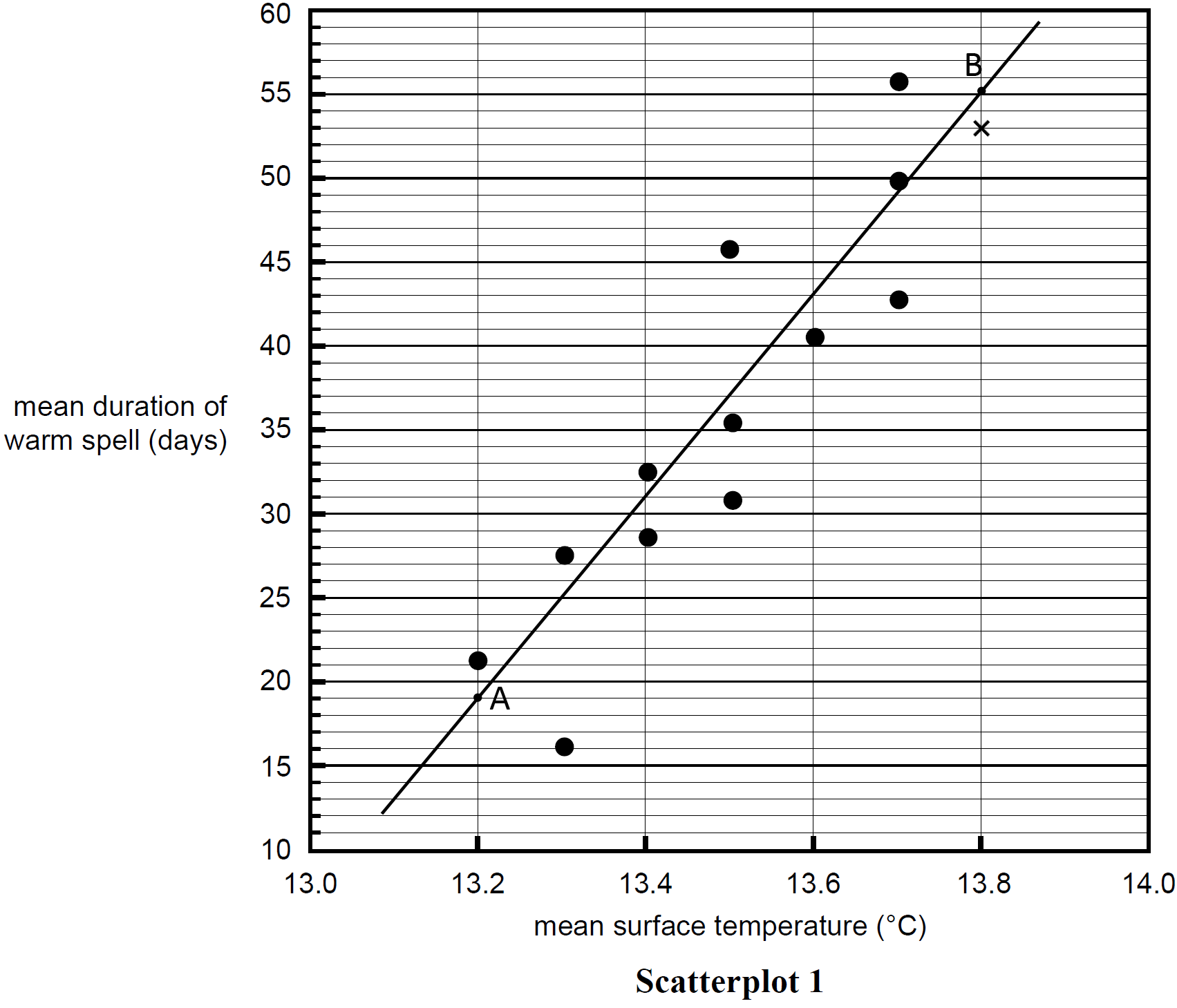
    1. Determine the equation of the least squares regression line for this set of data. Write the equation in terms of the variables mean duration of warm spell and mean surface temperature. Write the value of the coefficients correct to one decimal place.  (2 marks)

      --- 2 WORK AREA LINES (style=lined) ---

    2. Plot the least squares regression line on Scatterplot 1.  (1 mark)

      --- 0 WORK AREA LINES (style=lined) ---

The residual plot below was constructed to test the assumption of linearity for the relationship between the variables mean duration of warm spell and the mean surface temperature.

CORE, FUR2 2007 VCAA 33

  1. Explain why this residual plot supports the assumption of linearity for this relationship.  (1 mark)

    --- 1 WORK AREA LINES (style=lined) ---

  2. Write down the percentage of variation in the mean duration of a warm spell that is explained by the variation in mean surface temperature. Write your answer correct to the nearest per cent.  (1 mark)

    --- 1 WORK AREA LINES (style=lined) ---

  3. Describe the relationship between the mean duration of a warm spell and the mean surface temperature in terms of strength, direction and form.  (2 marks)

    --- 2 WORK AREA LINES (style=lined) ---

Show Answers Only
  1.  
    CORE, FUR2 2007 VCAA 3 Answer

    1. `text{See part b.ii. below.}`
    2. `text(Mean duration of warm spell)`
      `= -776.9 + 60.3 xx text(mean surface temperature)`
  2. `text(Linearity is supported because there is no)`
    `text(pattern to the residual data.)`
  3. `83text(%)`
  4. `text(Strong, positive, and linear.)`
Show Worked Solution
a.    CORE, FUR2 2007 VCAA 3 Answer


b.i.   `text(Mean duration of warm spell)`

`= -776.9 + 60.3 xx text(mean surface temperature)`


MARKER’S COMMENT: A consistent error in these type of questions is taking 2 points that are too close together!

b.ii.   `text(Taking extreme points on the above graph,)`

  `text(When)\ \ x = 13.2, \ y = -776.9 + 60.3 xx 13.2 = 19.06`

`:.\ text(Passes through)\ \ A (13.2, 19.06)`

  `text(When)\ x = 13.8, y = -776.9 + 60.3 xx 13.8 = 55.24`

`:.\ text(Passes through)\ \ B (13.8, 55.24)`

`text(*See the regression line plotted above.)`


c.   `text(Linearity is supported because there is no)`

`text(pattern to the residual data.)`
 

d.   `text(By Calculator,)`

`r^2 = 0.828… = 83text{%  (nearest %)}`
 

e.   `text(Strong, positive, and linear.)`

Filed Under: Correlation and Regression Tagged With: Band 3, Band 4, Band 5, smc-265-10-r / r^2 and Association, smc-265-20-Find LSRL Equation/Gradient, smc-265-50-Residuals

CORE, FUR2 2008 VCAA 4

The arm spans (in cm) and heights (in cm) for a group of 13 boys have been measured. The results are displayed in the table below.
 

CORE, FUR2 2008 VCAA 4 

The aim is to find a linear equation that allows arm span to be predicted from height.

  1. What will be the explanatory variable in the equation?   (1 mark)

    --- 1 WORK AREA LINES (style=lined) ---

  2. Assuming a linear association, determine the equation of the least squares regression line that enables arm span to be predicted from height. Write this equation in terms of the variables arm span and height. Give the coefficients correct to two decimal places.   (2 marks)

    --- 2 WORK AREA LINES (style=lined) ---

  3. Using the equation that you have determined in part b., interpret the slope of the least squares regression line in terms of the variables height and arm span.   (1 mark)

    --- 2 WORK AREA LINES (style=lined) ---

Show Answers Only
  1. `text(Height)`
  2. `text(Arm span)\ = 1.09 xx text(height) – 15.63`
  3. `text(On average, arm span increases by 1.09 cm)`


    `text(for each 1 cm increase in height.)`

Show Worked Solution

a.   `text(Height)`

♦ Mean mark sub 50% (exact data not available).
MARKER’S COMMENT: Many students did not understand the term co-efficients as it applies to the regression equation.


b.   `text(By calculator,)`

`text(Arm span)\ = 1.09 xx text(height) – 15.63`


c.   `text(On average, arm span increases by 1.09 cm)`

`text(for each 1 cm increase in height.)`

Filed Under: Correlation and Regression Tagged With: Band 4, Band 5, smc-265-20-Find LSRL Equation/Gradient, smc-265-40-Interpret Gradient, smc-265-75-Explanatory / Response

CORE, FUR2 2008 VCAA 3

The arm spans (in cm) were also recorded for each of the Years 6, 8 and 10 girls in the larger survey. The results are summarised in the three parallel box plots displayed below.
 

CORE, FUR2 2008 VCAA 3

  1. Complete the following sentence.
  2. The middle 50% of Year 6 students have an arm span between _______ and _______ cm.   (1 mark)

    --- 0 WORK AREA LINES (style=lined) ---

  3. The three parallel box plots suggest that arm span and year level are associated.
  4. Explain why.   (1 mark)

    --- 3 WORK AREA LINES (style=lined) ---

  5. The arm span of 110 cm of a Year 10 girl is shown as an outlier on the box plot. This value is an error. Her real arm span is 140 cm. If the error is corrected, would this girl’s arm span still show as an outlier on the box plot? Give reasons for your answer showing an appropriate calculation.   (2 marks)

    --- 5 WORK AREA LINES (style=lined) ---

Show Answers Only
  1. `text(124 and 148)`
  2. `text(The median arm span increases with the year)`
    `text(level, or the range/IQR decreases as the year.)`
    `text(level increases.)`
  3. `text(See Worked Solution)`
Show Worked Solution

a.   `text(124 and 148 cm)`
 

b.   `text(The median arm span increases with the year)`

♦ Sub 50% mean.
MARKER’S COMMENT: Use specific metrics! Stating “arm span increases” did not receive a mark.

`text(level, or the range/IQR decreases as the year.)`

`text(level increases.)`


c.   `text(Consider the Year 10 boxplot,)`

MARKER’S COMMENT: The final comparison here, “Since 140 < 145” is worth a full mark.

`Q_1=160, \ Q_3=170,`

`=> IQR=170-160=10`

`Q_1-1.5 xx text(IQR)= 160-1.5 xx 10= 145`

`text(S)text(ince 140 < 145,)`

`:. 140\ text(will remain an outlier.)`

Filed Under: Graphs - Stem/Leaf and Boxplots Tagged With: Band 3, Band 4, Band 5, smc-643-20-Parallel Box-Plots, smc-643-60-Outliers

CORE, FUR2 2009 VCAA 4

  1. Table 2 shows the seasonal indices for rainfall in summer, autumn and winter. Complete the table by calculating the seasonal index for spring.   (1 mark)

    --- 0 WORK AREA LINES (style=lined) ---


    CORE, FUR2 2009 VCAA 4

  2. In 2008, a total of 188 mm of rain fell during summer.


    Using the appropriate seasonal index in Table 2, determine the deseasonalised value for the summer rainfall in 2008. Write your answer correct to the nearest millimetre.   (1 mark)

    --- 3 WORK AREA LINES (style=lined) ---

  3. What does a seasonal index of 1.05 tell us about the rainfall in autumn?   (1 mark)

    --- 2 WORK AREA LINES (style=lined) ---

Show Answers Only
  1. `1.10`
  2. `241\ text(mm)`
  3. `text(The Autumn rainfall is 5% above the average)`
    `text(for the four seasons of the year.)`
Show Worked Solution

a.   `text(Seasonal index for Spring)`

`=4-(0.78 + 1.05 + 1.07)`

`= 1.10`


b.   `text{Deseasonalised value (Summer)}`

`= 188/0.78`

`=241.02…`

`=241\ text{mm (nearest mm)}`

♦ Part (c) was “poorly answered” (no exact data).
MARKER’S COMMENT: A common error was to say rainfall was above average monthly rainfall.


c.   `text(The Autumn rainfall is 5% above the average)`

`text(for the four seasons of the year.)`


Filed Under: Time Series Tagged With: Band 3, Band 4, Band 5, smc-266-10-Seasonal Index from a Table, smc-266-20-(De)Seasonalising Data

CORE, FUR2 2009 VCAA 3

The scatterplot below shows the rainfall (in mm) and the percentage of clear days for each month of 2008. 
 

An equation of the least squares regression line for this data set is

rainfall = 131 – 2.68 × percentage of clear days

  1. Draw this line on the scatterplot.   (1 mark)

    --- 0 WORK AREA LINES (style=lined) ---

  2. Use the equation of the least squares regression line to predict the rainfall for a month with 35% of clear days. Write your answer in mm correct to one decimal place.   (1 mark)

    --- 2 WORK AREA LINES (style=lined) ---

  3. The coefficient of determination for this data set is 0.8081.
  4.  i. Interpret the coefficient of determination in terms of the variables rainfall and percentage of clear days.   (1 mark)

    --- 3 WORK AREA LINES (style=lined) ---

  5. ii. Determine the value of Pearson’s product moment correlation coefficient. Write your answer correct to three decimal places.   (2 marks)

    --- 2 WORK AREA LINES (style=lined) ---

Show Answers Only
  1.  
    CORE, FUR2 2009 VCAA 3 Answer
  2. `37.2\ text(mm)`
    1. `text(The coefficient means that 80.81% of the)`
      `text(variation in the rainfall can be explained by)`
      `text(the variation in the percentage of clear days.)`
    2. `-0.899`
Show Worked Solution
a.    CORE, FUR2 2009 VCAA 3 Answer


b.    `text(Rainfall)` `= 131-2.68 xx 35`
    `= 37.2\ text(mm)`
MARKER’S COMMENT: Any answers that suggested causation with terms like “is due to” etc.., did not receive a mark.


c.i.   `text(The coefficient means that 80.81% of the)`

  `text(variation in the rainfall can be explained by)`

  `text(the variation in the percentage of clear days.)`


MARKER’S COMMENT: Many students failed to include the negative sign as indicated by the negative slope of the graph.
c.ii.    `r` `= -sqrt(0.8081)`
    `= -0.8989…`
    `=-0.899\ \ text{(to 3 d.p.)}`

Filed Under: Correlation and Regression Tagged With: Band 4, Band 5, smc-265-10-r / r^2 and Association

CORE, FUR2 2010 VCAA 2

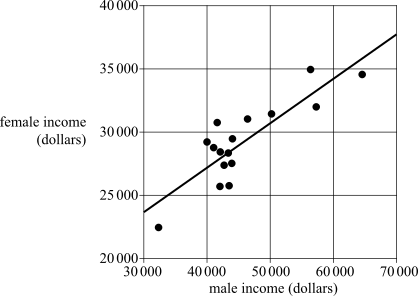
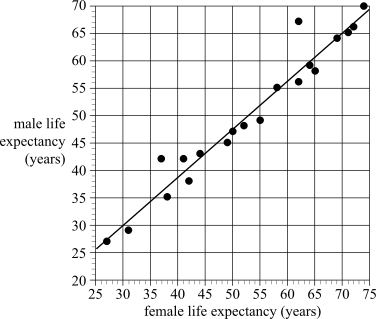
In the scatterplot below, average annual female income, in dollars, is plotted against average annual male income, in dollars, for 16 countries. A least squares regression line is fitted to the data.


The equation of the least squares regression line for predicting female income from male income is

female income = 13 000 + 0.35 × male income

  1. What is the explanatory variable?  (1 mark)

    --- 1 WORK AREA LINES (style=lined) ---

  2. Complete the following statement by filling in the missing information.


    From the least squares regression line equation it can be concluded that, for these countries, on average, female income increases by `text($________)` for each $1000 increase in male income.  (1 mark)

    --- 0 WORK AREA LINES (style=lined) ---

    1. Use the least squares regression line equation to predict the average annual female income (in dollars) in a country where the average annual male income is $15 000.  (1 mark)

      --- 1 WORK AREA LINES (style=lined) ---

    2. The prediction made in part c.i. is not likely to be reliable.


      Explain why.  (1 mark)

      --- 2 WORK AREA LINES (style=lined) ---


Show Answers Only

  1. `text(Male income)`
  2. `$350`
    1. `$18\ 250`
    2. `text(The model established by the regression)`
      `text(equation cannot be relied upon outside the)`
      `text(range of the given data set.)`
  3.  

Show Worked Solution

a.   `text(Male income)`
 

b.   `text(Increase in female income)`

`= 0.35 xx 1000`

`= $350`
 

c.i.   `text(Average annual female income)`

`= 13\ 000 + 0.35 xx 15\ 000`

`= $18\ 250`

♦♦ This part was poorly answered (exact data unavailable).
MARKER’S COMMENT: Many students offered “real world” explanations which did not gain a mark here.

 
c.ii.
   `text(The model established by the regression)`

   `text(equation cannot be relied upon outside the)`

   `text(range of the given data set.)`

Filed Under: Correlation and Regression Tagged With: Band 3, Band 4, Band 5, smc-265-40-Interpret Gradient, smc-265-60-Extrapolation / Interpolation, smc-265-75-Explanatory / Response

CORE, FUR2 2011 VCAA 4

The average age of women at first marriage in years (average age) and average yearly income in dollars per person (income) were recorded for a group of 17 countries.

The results are displayed in Table 2. A scatterplot of the data is also shown.
 

2011 4-1

The relationship between average age and income is nonlinear.

A log transformation can be applied to the variable income and used to linearise the scatterplot.

  1. Apply this log transformation to the data and determine the equation of the least squares regression line that allows average age to be predicted from log (income).
  2. Write the coefficients for this equation, correct to two decimal places, in the spaces provided.   (2 marks)

    --- 0 WORK AREA LINES (style=lined) ---

    2011 4-2

  1. Use this equation to predict the average age of women at first marriage in a country with an average yearly income of $20 000 per person.
  2. Write your answer correct to one decimal place.   (1 mark) 

    --- 3 WORK AREA LINES (style=lined) ---

Show Answers Only
  1. `text(Average age) = 2.39 + 5.89 xx log (text(income))`
  2. `text(27.7 years)`
Show Worked Solution

a.   `text(By calculator after applying the log transformation,)`

`text(Average age) = 2.39 + 5.89 xx log (text(income))`

♦♦ Parts (i) and (ii) had a combined mean mark 0f 34%.
MARKER’S COMMENT: Students struggled with the log transformation, incorrect data entry and choosing the correct dependent variable.


b.   `text(The average age at first marriage with an)`

`text(average yearly income of $20 000)`

`=2.39+5.89 xx log(20\ 000)`

`=27.7\ text{years  (1 d.p.)}`

Filed Under: Correlation and Regression Tagged With: Band 5, Band 6, smc-265-70-Linearise - log10

CORE, FUR2 2011 VCAA 3

The following time series plot shows the average age of women at first marriage in a particular country during the period 1915 to 1970.
 

CORE, FUR2 2011 VCAA 31

  1. Use this plot to describe, in general terms, the way in which the average age of women at first marriage in this country has changed during the period 1915 to 1970.   (1 mark)

    --- 3 WORK AREA LINES (style=lined) ---

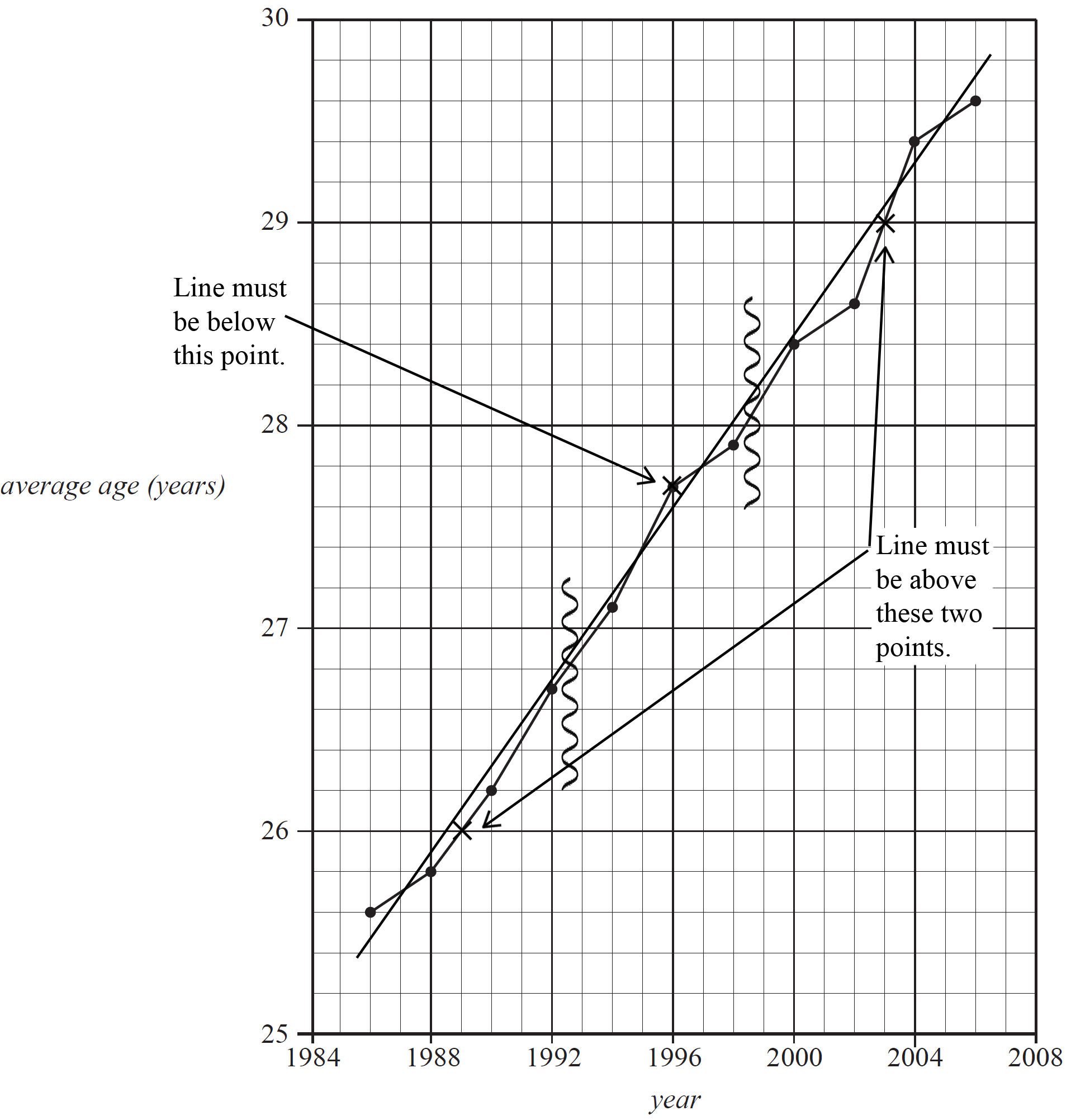
During the period 1986 to 2006, the average age of men at first marriage in a particular country indicated an increasing linear trend, as shown in the time plot below.

CORE, FUR2 2011 VCAA 32

A three-median line could be used to model this trend.

  1. On the graph above
  2.  i. clearly mark with a cross (×) the three points that would be used to fit a three-median line to this time series plot.   (2 marks)

    --- 0 WORK AREA LINES (style=lined) ---

  3. ii. draw in the three-median line.   (1 mark)

    --- 0 WORK AREA LINES (style=lined) ---

Show Answers Only
  1. `text(Constant between 1915 and 1935 and then)`
    `text(decreasing between 1935 and 1970.)`
  2.  
    CORE, FUR2 2011 VCAA 3 Answer
Show Worked Solution

a.   `text(The average age of women at first marriage was fairly)`

`text(constant between 1915 and 1935, and then decreased)`

`text(between 1935 and 1970.)`


b.i. & ii.

CORE, FUR2 2011 VCAA 3 Answer

Filed Under: Time Series Tagged With: Band 4, Band 5, smc-266-40-Time Series Trends, smc-266-70-MEDIAN Smoothing

CORE, FUR2 2012 VCAA 4

The wind speeds (in km/h) that were recorded at the weather station at 9.00 am and 3.00 pm respectively on 18 days in November are given in the table below. A scatterplot has been constructed from this data set.
 

CORE, FUR2 2012 VCAA 41
 

Let the wind speed at 9.00 am be represented by the variable ws9.00am and the wind speed at 3.00 pm be represented by the variable ws3.00pm. 

The relationship between ws9.00am and ws3.00pm shown in the scatterplot above is nonlinear. 

A squared transformation can be applied to the variable ws3.00pm to linearise the data in the scatterplot.

  1. Apply the squared transformation to the variable ws3.00pm and determine the equation of the least squares regression line that allows (ws3.00pm)² to be predicted from ws9.00am.


    In the boxes provided, write the coefficients for this equation, correct to one decimal place.   (2 marks)

    --- 0 WORK AREA LINES (style=lined) ---

    2012 4-1

  2. Use this equation to predict the wind speed at 3.00 pm on a day when the wind speed at 9.00 am is 24 km/h.


    Write your answer, correct to the nearest whole number.   (1 mark)

    --- 3 WORK AREA LINES (style=lined) ---

Show Answers Only
  1. `(ws3.00p m)^2 = 3.4 + 6.6 xx ws9.00am`
  2. `13`
Show Worked Solution

a.   `text(By Calculator,)`

MARKER’S COMMENT: Many students were unable to deal with the squared transformation.

`(ws3.00p m)^2 = 3.4 + 6.6 xx ws9.00am`
 

b.   `text(Substitute)\ \ ws9.00am = 24\ \ text(into the equation:)`

`(ws3.00p m)^2=3.4+6.6 xx 24=161.8`

`:. ws3.00p m≈ 12.720… =13\ \ text{(nearest whole)}`

Filed Under: Correlation and Regression Tagged With: Band 4, Band 5, smc-265-71-Linearise - Squared/Inverse

CORE, FUR2 2012 VCAA 3

A weather station records the wind speed and the wind direction each day at 9.00 am. 

The wind speed is recorded, correct to the nearest whole number. 

The parallel boxplots below have been constructed from data that was collected on the 214 days from June to December in 2011.
 

CORE, FUR2 2012 VCAA 3

  1. Complete the following statements.
  2. The wind direction with the lowest recorded wind speed was ________.
  3. The wind direction with the largest range of recorded wind speeds was _______.   (1 mark)

    --- 0 WORK AREA LINES (style=lined) ---

  4. The wind blew from the south on eight days.
  5. Reading from the parallel boxplots above we know that, for these eight wind speeds, the
first quartile `Q_1 = 2\ text(km/h)`
median `M = 3.5\ text(km/h)`
third quartile `Q_3 = 4\ text(km/h)`
  1. Given that the eight wind speeds were recorded to the nearest whole number, write down the eight wind speeds.   (1 mark) 

    --- 4 WORK AREA LINES (style=lined) ---

Show Answers Only
  1. `text(South-East and North East.)`
  2. `2, 2, 2, 3, 4, 4, 4, 4`
Show Worked Solution

a.   `text(South-East and North-East.)`
 

b.   `text(S)text(ince the boxplot has no whiskers and the median is 3.5,)`

`text(the data set is {2, _ , _ , 3, 4, _ , _ , 4})`

♦♦ MARKER’S COMMENT: Although specific data isn’t available, “few” students answered this part correctly.

`text(S)text(ince)\ Q_1=2\ text(and is the mid-point of the 2nd and)`

`text(3rd points, both must be 2.)`

`text(Similarly,)\ Q_3=4,\ text(so the 6th and 7th points are both 4.)`
  

`:.\ text(The data set is:)\ {2, 2, 2, 3, 4, 4, 4, 4}`

Filed Under: Graphs - Stem/Leaf and Boxplots Tagged With: Band 4, Band 5, smc-643-20-Parallel Box-Plots

CORE, FUR2 2012 VCAA 2

The maximum temperature and the minimum temperature at this weather station on each of the 30 days in November 2011 are displayed in the scatterplot below.

CORE, FUR2 2012 VCAA 2

The correlation coefficient for this data set is  `r = 0.630`. 

The equation of the least squares regression line for this data set is

maximum temperature = `13 + 0.67` × minimum temperature

  1. Draw this least squares regression line on the scatterplot above.   (1 mark)

    --- 0 WORK AREA LINES (style=lined) ---

  2. Interpret the vertical intercept of the least squares regression line in terms of maximum temperature and minimum temperature.   (1 mark)

    --- 2 WORK AREA LINES (style=lined) ---

  3. Describe the relationship between the maximum temperature and the minimum temperature in terms of strength and direction.   (1 mark)

    --- 2 WORK AREA LINES (style=lined) ---

  4. Interpret the slope of the least squares regression line in terms of maximum temperature and minimum temperature.   (1 mark)

    --- 2 WORK AREA LINES (style=lined) ---

  5. Determine the percentage of variation in the maximum temperature that may be explained by the variation in the minimum temperature.
  6. Write your answer, correct to the nearest percentage.   (1 mark)

    --- 2 WORK AREA LINES (style=lined) ---

On the day that the minimum temperature was 11.1 °C, the actual maximum temperature was 12.2 °C.

  1. Determine the residual value for this day if the least squares regression line is used to predict the maximum temperature.
  2. Write your answer, correct to the nearest degree.   (2 marks)

    --- 4 WORK AREA LINES (style=lined) ---

Show Answers Only
  1. `text(See Worked Solutions)`
  2. `text(On average, when the minimum temperature is)`
    `text(0 °C, the maximum temperature is 13 °C)`
  3. `text(Moderate and positive.)`
  4. `text(On average, it is predicted that the maximum)`
    `text(temperature increases by 0.67 °C for every 1 °C)`
    `text(increase in the minimum temperature.)`
  5. `40text(%)`
  6. `-8^@text(C)`
Show Worked Solution

a.   `text(The two widest points in this data range are,)`

`text{(0, 13) and (20, 26.4).}`

 CORE, FUR2 2012 VCAA 2 Answer 

b.   `text(On average, when the minimum temperature is)`

`text(0 °C, the maximum temperature is 13 °C.)`


♦ Parts (i) to (vi) have an average mean mark of 41%.

c.   `text(Given)\ r = 0.630,`

`text(Strength: moderate)`

`text(Direction: positive)`


d.   `text(On average, it is predicted that \the maximum)`

 `text(temperature increases by 0.67 °C for every 1 °C)`

 `text(increase in the minimum temperature.)`


e.    `r^2` `= 0.630^2`
    `=0.3969`
    `=40text{%  (nearest %)}`


f.   `text(When the minimum temperature was)\ 11.1 text(°C),`

MARKER’S COMMENT: Students had particular difficulty with this part, with many using the incorrect calculation of  12.2 – 11.1 = 1.1.
`text(Predicted Value)` `= 13 + 0.67 xx 11.1`
  `=20.437…`
`:.\ text(Residual)` `= 12.2 − 20.437…`
  `= – 8.237…`
  `= – 8\ text{°C (nearest degree)}`

Filed Under: Correlation and Regression Tagged With: Band 4, Band 5, Band 6, smc-265-10-r / r^2 and Association, smc-265-40-Interpret Gradient, smc-265-50-Residuals

CORE, FUR2 2013 VCAA 4

The time series plot below shows the average pay rate, in dollars per hour, for workers in a particular country for the years 1991 to 2005.
 

CORE, FUR2 2013 VCAA 4

A three median line will be used to model the increasing trend in the average pay rate shown in this time series.

The explanatory variable to be used is year.

  1. Three medians will be used to draw the three median line.


    1. On the time series plot above, mark the location of each of the three medians with a cross (`X`).  (2 marks)
    2. Draw the three median line on the time series plot.  (1 mark)
  2. Calculate the slope of the three median line.


    Write your answer, correct to one decimal place.  (1 mark)

  3. Interpret the slope of the three median line in terms of the relationship between the variables average pay rate and year.  (1 mark)
Show Answers Only
  1. i. & ii. `text(See Worked Solutions)`
  2. `0.8`
  3. `text(The average pay rate increases, on average,)`


    `text(by $0.80 each year between 1991 and 2005.)`

Show Worked Solution

a.i. & ii.   `text(The three medians points are)`

♦ Mean mark 45%.
MARKER’S COMMENT: Few students found the correct middle point.

`(1993,13.7), (1998,16.7), (2003,21.8)`


CORE, FUR2 2013 VCAA 4 Answer

♦♦ Parts (ii) and (iii) produced an overall mean mark of 32%.


b.    `text(Slope)` `=(y_2-y_1)/(x_2-x_1)`
    `=(21.8 − 13.7)/(2003 − 1993)`
    `= 0.81`
    `=0.8\ \ text{(to 1 d.p.)}`


MARKER’S COMMENT: Answering “an increase of 0.8 each year” received no marks (refer to actul units).


c.   `text(The average pay rate increases, on average,)`

`text(by $0.80 each year between 1991 and 2005.)`


Filed Under: Uncategorized Tagged With: Band 4, Band 5, Band 6

CORE, FUR2 2013 VCAA 3

The development index and the average pay rate for workers, in dollars per hour, for a selection of 25 countries are displayed in the scatterplot below.

CORE, FUR2 2013 VCAA 31   

The table below contains the values of some statistics that have been calculated for this data.

     CORE, FUR2 2013 VCAA 32

  1. Determine the standardised value of the development index (`z` score) for a country with a development index of 91.
  2. Write your answer, correct to one decimal place.   (1 mark)

    --- 3 WORK AREA LINES (style=lined) ---

  3. Use the information in the table to show that the equation of the least squares regression line for a country’s development index, `y`, in terms of its average pay rate, `x`, is given by
  4.        `y = 81.3 + 0.272x`   (2 marks)

    --- 4 WORK AREA LINES (style=lined) ---

  5. The country with an average pay rate of $14.30 per hour has a development index of 83.
  6. Determine the residual value when the least squares regression line given in part (b) is used to predict this country’s development index.
  7. Write your answer, correct to one decimal place.   (2 marks)

    --- 4 WORK AREA LINES (style=lined) ---

Show Answers Only
  1. `1.8`
  2. `text(See Worked Solutions)`
  3. `−2.2`
Show Worked Solution
MARKER’S COMMENT: Many students made a careless error by using the Average pay rate (`x`-variable).
a.    `z` `= (y-bar y)/s`
    `= (91-85.6)/2.99`
    `=1.806…`
    `= 1.8\ \ text{(to 1 d.p.)}`


♦ Parts (b) and (c) had a combined mean mark of 48%.
b.    `b` `= r xx s_y/s_x`
    `= 0.488 xx 2.99/5.37`
    `=0.2717…`


`a` `= bary-b barx`
  `= 85.6-0.272 xx 15.7`
  `= 81.329…`

 
`:.\ text(The least squares line is)`

`y = 81.3 + 0.272x`


c.    `text(Predicted)` `= 81.3 + 0.272 xx 14.30`
    `= 85.1896…`


`:.\ text(Residual)` `= 83-85.1896…`
  `=-2.1896…`
  `= – 2.2`

Filed Under: Correlation and Regression, Normal Distribution Tagged With: Band 4, Band 5, smc-265-30-LSRL formula, smc-265-50-Residuals, smc-600-10-Single z-score

CORE, FUR2 2014 VCAA 4

The scatterplot below shows the population density, in people per square kilometre, and the area, in square kilometres, of 38 inner suburbs of the same city.

Core, FUR2 2015 VCAA 41

For this scatterplot, `r^2 = 0.141`

  1. Describe the association between the variables population density and area for these suburbs in terms of strength, direction and form.   (1 mark)

    --- 3 WORK AREA LINES (style=lined) ---

  2. The mean and standard deviation of the variables population density and area for these 38 inner suburbs are shown in the table below.
     
    Core, FUR2 2015 VCAA 42
  3.   i. One of these suburbs has a population density of 3082 people per square kilometre.
  4.     Determine the standard `z`-score of this suburb’s population density.
  5.     Write your answer, correct to one decimal place.   (1 mark)

    --- 3 WORK AREA LINES (style=lined) ---

Assume the areas of these inner suburbs are approximately normally distributed.

  1.  ii. How many of these 38 suburbs are expected to have an area that is two standard deviations or more above the mean?
  2.     Write your answer, correct to the nearest whole number.   (1 mark)

    --- 1 WORK AREA LINES (style=lined) ---

  3. iii. How many of these 38 inner suburbs actually have an area that is two standard deviations or more above the mean?   (1 mark)

    --- 3 WORK AREA LINES (style=lined) ---

Show Answers Only
  1. `text(The association is weak, negative and linear.)`
    1. `− 0.8`
    2. `1`
    3. `2`
Show Worked Solution
♦♦ Mean mark 30%.
MARKER’S COMMENT: The most common error was to describe the association as positive.
a.    `r` `= −sqrt(0.141)`
    `= −0.3755`

 
`:.\ text(The association is weak, negative and linear.)`


b.i    `z` `=(x-bar x)/s`
    `= (3082-4370)/1560`
    `= -0.82…`
    `= -0.8\ \ text{(to 1 d.p.)}`


b.ii.   `2.5text(%) xx 38 =0.95=1\ text{(nearest whole)}`


b.iii.   `text{Area size (2 std deviation above mean)}`

♦♦ Very few students answered this part correctly.

`= 3.4 + 2 xx 1.6`

`=6.6\ text(km²)`


`:.\ text{From the graph, 2 inner suburbs have an area}`

`text(2 standard deviations above the mean.)`

Filed Under: Correlation and Regression, Normal Distribution Tagged With: Band 4, Band 5, Band 6, smc-265-10-r / r^2 and Association, smc-600-10-Single z-score

CORE, FUR2 2014 VCAA 3

The scatterplot and table below show the population, in thousands, and the area, in square kilometres, for a sample of 21 outer suburbs of the same city.
  

Core, FUR2 2015 VCAA 3

In the outer suburbs, the relationship between population and area is non-linear.

A log transformation can be applied to the variable area to linearise the scatterplot.

  1. Apply the log transformation to the data and determine the equation of the least squares regression line that allows the population of an outer suburb to be predicted from the logarithm of its area.
  2. Write the slope and intercept of this regression line in the boxes provided below.
  3. Write your answers, correct to one decimal place.   (1 mark)

    --- 0 WORK AREA LINES (style=lined) ---

  Core, FUR2 2015 VCAA 32

  1. Use this regression equation to predict the population of an outer suburb with an area of 90 km².
  2. Write your answer, correct to the nearest one thousand people.   (1 mark)

    --- 2 WORK AREA LINES (style=lined) ---

Show Answers Only
  1. `text(Population)\ = 7.7 + 7.7 xx log_(10)(text(area))`
  2. `23\ 000`
Show Worked Solution

a.   `text(By Calculator,)`

♦ Mean marks of 43% (part (a)) and 35% (part (b)).
MARKER’S COMMENT: Many students confused the base 10 logarithm with the natural logarithm.

`text(Population)\ = 7.7 + 7.7 xx log_(10)(text(area))`


b.   `text(By Calculator,)`

`text(Population)` `= 7.7 + 7.7 xx log_(10) 90`
  `=22.747…`
  `= 23\ 000\ text{(nearest thousand)}`

Filed Under: Correlation and Regression Tagged With: Band 5, smc-265-70-Linearise - log10

CORE, FUR2 2014 VCAA 2

The scatterplot below shows the population and area (in square kilometres) of a sample of inner suburbs of a large city.
 

Core, FUR2 2015 VCAA 2

The equation of the least squares regression line for the data in the scatterplot is

population = 5330 + 2680 × area

  1. Write down the response variable.   (1 mark)

    --- 1 WORK AREA LINES (style=lined) ---

  2. Draw the least squares regression line on the scatterplot above.   (1 mark)

    --- 0 WORK AREA LINES (style=lined) ---

  3. Interpret the slope of this least squares regression line in terms of the variables area and population.  (2 marks)

    --- 4 WORK AREA LINES (style=lined) ---

  4. Wiston is an inner suburb. It has an area of 4 km² and a population of 6690.
  5. The correlation coefficient, `r`, is equal to 0.668
  6.  i. Calculate the residual when the least squares regression line is used to predict the population of Wiston from its area.  (1 mark)

    --- 2 WORK AREA LINES (style=lined) ---

  7. ii. What percentage of the variation in the population of the suburbs is explained by the variaton in area.
  8.     Write your answer, correct to one decimal place.  (1 mark)

    --- 2 WORK AREA LINES (style=lined) ---

Show Answers Only
  1. `text(Population.)`
  2.  
          Core, FUR2 2015 VCAA 2 Answer
  3. `text(Population increases by 2680 people, on average,)`
    `text(for each additional 1 km² in area.)`
    1. ` −9360`
    2. `text(44.6%)`
Show Worked Solution

a.   `text(Population.)`
 

♦ Mean mark 36%.
MARKER’S COMMENT: Use the equation to draw the line and use points at the extremities.
b.   

Core, FUR2 2015 VCAA 2 Answer


c.   `text(Population increases by 2680 people, on average,)`

♦ Mean mark 41% (part (iii)).

`text(for each additional 1 km² in area.)`
 

d.i.  `text(Predicted population) = 5330 + 2680 xx 4= 16\ 050`

`:.\ text(Residual)\ = 6690-16\ 050= -9360`
 

♦ Part (iv) in total had a mean mark 42%.
d.ii.    `r` `= 0.668^2`
  `r^2` `= 0.4462…`
    `= 44.6 text{%  (to 1 d.p.)}`


`:.\ text(44.6% of the variation in the population is explained)`

`text(by variation in the area.)`

Filed Under: Correlation and Regression Tagged With: Band 4, Band 5, smc-265-10-r / r^2 and Association, smc-265-40-Interpret Gradient, smc-265-75-Explanatory / Response

CORE, FUR2 2014 VCAA 1

The segmented bar chart below shows the age distribution of people in three countries, Australia, India and Japan, for the year 2010.
 

Core, FUR2 2015 VCAA 1

  1. Write down the percentage of people in Australia who were aged 0 – 14 years in 2010.
  2. Write your answer, correct to the nearest percentage.  (1 mark)

    --- 1 WORK AREA LINES (style=lined) ---

  3. In 2010, the population of Japan was 128 000 000.
  4. How many people in Japan were aged 65 years and over in 2010?  (1 mark)

    --- 3 WORK AREA LINES (style=lined) ---

  5. From the graph above, it appears that there is no association between the percentage of people in the 15 – 64 age group and the country in which they live.
  6. Explain why, quoting appropriate percentages to support your explanation.  (1 mark)

    --- 4 WORK AREA LINES (style=lined) ---

Show Answers Only

  1. `text(19%)`
  2. `29\ 440\ 000`
  3. `text(The percentages of people in the 15 – 64 age group)` 
    `text(in each country is: Australia 67%, India 64%, and)` 
    `text(Japan 64%.)` 
    `text(S)text(ince the percentages are very close no matter which)`
    `text(country this age group belonged to, there is no association.)`

Show Worked Solution

a.   `text(19%)`


b.   `text(From the graph, 23% of Japan’s population is 65 or over.)`

`:.\ text(The number of people 65 or over)`

`=128\ 000\ 000 xx 23/100`

`= 29\ 440\ 000`


c.   `text(The percentages of people in the 15 – 64 age group)`

♦ Mean mark 41%.

`text(in each country is: Australia 67%, India 64%, and)`

`text(Japan 64%.)`

`text(S)text(ince the percentages are very close no matter which)`

`text(country this age group belonged to, there is no association.)`

Filed Under: Graphs - Histograms and Other Tagged With: Band 2, Band 4, Band 5, smc-644-40-Segmented Bar Charts, smc-644-60-Distribution Description

CORE, FUR2 2015 VCAA 5

The time series plot below displays the life expectancy, in years, of people living in Australia and the United Kingdom (UK) for each year from 1920 to 2010.
 

Core, FUR2 2015 VCAA 51

  1. By how much did life expectancy in Australia increase during the period 1920 to 2010?
  2. Write your answer correct to the nearest year.   (1 mark)

    --- 2 WORK AREA LINES (style=lined) ---

  3. In 1975, the life expectancies in Australia and the UK were very similar.
  4. From 1975, the gap between the life expectancies in the two countries increased, with people in Australia having a longer life expectancy than people in the UK.
  5. To investigate the difference in life expectancies, least squares regression lines were fitted to the data for both Australia and the UK for the period 1975 to 2010.
  6. The results are shown below. 

  Core, FUR2 2015 VCAA 52

  1. The equations of the least squares regression lines are as follows.
`text(Australia:)\ \ \ ` `text(life expectancy) = – 451.7 + 0.2657 xx text(year)`
`text(UK:)` `text(life expectancy) = – 350.4 + 0.2143 xx text(year)` 


  1. Use these equations to predict the difference between the life expectancies of Australia and the UK in 2030.
  2. Give your answer correct to the nearest year.   (2 marks)

    --- 4 WORK AREA LINES (style=lined) ---

  3. Explain why this prediction may be of limited reliability.   (1 mark)

    --- 3 WORK AREA LINES (style=lined) ---

Show Answers Only
  1. `text(22 years)`
    1. `3\ text(years)`
    2. `text(The year 2030 is outside the available range)`


      `text(of data and therefore its predictions may)`


      `text(become unreliable.)`

Show Worked Solution

a.   `text{The increase in life expectancy (1920 – 2010)}`

`=82-60`

`=22\ text(years)`


b.i.    `text{Life expectancy (Aust)}` `= −451.7 + 0.2657× 2030`
    `= 87.67…\ text(years)`
     
  `text{Life expectancy (UK)}` `= −350.4 + 0.2143× 2030`
    `=84.62…\ text(years)`


`:.\ text(Difference)` `= 87.67…-84.62…`
  `= 3\ text(years)\ \ \ text{(nearest year)}`
♦ Mean mark 45%.
MARKER’S COMMENT: Relate answers directly to the limitations of the given statistical data rather than future events in (b)(ii).


b.ii.   `text(The year 2030 is outside the available range)`

  `\ text(of data and therefore its predictions may)`

  `\ text(become unreliable.)`

Filed Under: Correlation and Regression Tagged With: Band 3, Band 4, Band 5, smc-265-60-Extrapolation / Interpolation

CORE, FUR2 2015 VCAA 4

The table below shows male life expectancy (male) and female life expectancy (female) for a number of countries in 2013. The scatterplot has been constructed from this data.
 

Core, FUR2 2015 VCAA 4

  1. Use the scatterplot to describe the association between male life expectancy and female life expectancy in terms of strength, direction and form.   (1 mark)

    --- 3 WORK AREA LINES (style=lined) ---

  2. Determine the equation of a least squares regression line that can be used to predict male life expectancy from female life expectancy for the year 2013.


    Complete the equation for the least squares regression line below by writing the intercept and slope in the space provided.


    Write these values correct to two decimal places.  (1 mark)

    --- 0 WORK AREA LINES (style=lined) ---

male = ______________ + ______________ ×  female

Show Answers Only
  1. `text(Strong, positive and linear.)`
  2. `text(male) = 9.69 + 0.81 xx text(female)`
Show Worked Solution

a.   `text(Strong, positive and linear.)`

♦ Mean mark 49%.
MARKER’S COMMENT: Common errors included using the 1st column as the independent (`x`) variable and poor rounding.


b.   `text(By calculator,)`

`text(male) = 9.69 + 0.81 xx text(female)`

Filed Under: Correlation and Regression Tagged With: Band 4, Band 5, smc-265-10-r / r^2 and Association, smc-265-20-Find LSRL Equation/Gradient

CORE, FUR2 2015 VCAA 3

The scatterplot below plots male life expectancy (male) against female life expectancy (female) in 1950 for a number of countries. A least squares regression line has been fitted to the scatterplot as shown.


The slope of this least squares regression line is 0.88

  1. Interpret the slope in terms of the variables male life expectancy and female life expectancy.  (1 mark)

    --- 3 WORK AREA LINES (style=lined) ---

The equation of this least squares regression line is

male = 3.6 + 0.88 × female

  1. In a particular country in 1950, female life expectancy was 35 years.


    Use the equation to predict male life expectancy for that country.  (1 mark)

    --- 2 WORK AREA LINES (style=lined) ---

  2. The coefficient of determination is 0.95


    Interpret the coefficient of determination in terms of male life expectancy and female life expectancy.  (1 mark)

    --- 4 WORK AREA LINES (style=lined) ---

Show Answers Only
  1. `text(A slope of 0.88 means that for each year that a)`
    `text(female lives longer in a particular country, a male)`
    `text(in that country, on average, will tend to live 0.88)`
    `text(of a year longer.)`
  2. `34.4\ text(years)`
  3. `text(This figure means that 95% of the variability in)`
    `text(the male life expectancy can be explained by the)`
    `text(variation in female life expectancy.)`
Show Worked Solution

a.   `text(A slope of 0.88 means that for each year)`

♦ Mean mark 40%.
MARKER’S COMMENT: Many students did not describe the slope, despite being specifically asked about it!

`text(that a female lives longer in a particular)`

`text(country, a male in that country, on average,)`

`text(will tend to live 0.88 of a year longer.)`


b.   `text(Male life expectancy)`

`=3.6 + 0.88 xx 35`

`=34.4\ text(years)`


c.   `text(This figure means that 95% of the variability)`

MARKER’S COMMENT: A common error: use of `r^2 = 90.25 text(%)` as the basis of the interpretation.

`text(in the male life expectancy can be explained)`

`text(by the variation in female life expectancy.)`


Filed Under: Correlation and Regression Tagged With: Band 3, Band 4, Band 5, smc-265-10-r / r^2 and Association, smc-265-40-Interpret Gradient

CORE, FUR2 2015 VCAA 2

The parallel boxplots below compare the distribution of life expectancy for 183 countries for the years 1953, 1973 and 1993.
 

Core, FUR2 2015 VCAA 2

  1. Describe the shape of the distribution of life expectancy for 1973.   (1 mark)

    --- 2 WORK AREA LINES (style=lined) ---

  2. Explain why life expectancy for these countries is associated with the year. Refer to specific statistical values in your answer.   (2 marks)

    --- 5 WORK AREA LINES (style=lined) ---

Show Answers Only
  1. `text(Negatively skewed)`
  2. `text(There is a positive correlation between the median of life)`
    `text(expectancy and the year.)`
Show Worked Solution

a.   `text(Negatively skewed with no outliers. The extended left)`

`text(line from the box clearly indicates negative skew.)`
 

b.   `text(The medians in each boxplot are approximately,)`

♦ Mean mark 45%.
MARKER’S COMMENT: Means are typically not discernible from a box plot (unless the data is perfectly symmetrical) and shouldn’t be referred to.
`1953` `\ \ \ 51`
`1973` `\ \ \ 63`
`1993` `\ \ \ 69`


`:.\ text(The chart shows a positive correlation between the)`

`text(median of life expectancy and the year.)`

Filed Under: Graphs - Stem/Leaf and Boxplots Tagged With: Band 3, Band 5, smc-643-20-Parallel Box-Plots, smc-643-70-Distribution Description

GRAPHS, FUR1 2015 VCAA 5 MC

For an overnight school excursion there must be at least one teacher for every 15 students.

Let `x` be the number of students
      `y` be the number of teachers.

The inequality for this constraint is

A.   `y ≥ 15`

B.   `x ≤ 15`

C.   `y ≥ 15x`

D.   `y >= x/15`

E.   `x >= y/15`

Show Answers Only

`D`

Show Worked Solution
♦ Mean mark 37%.
MARKER’S COMMENT: Test your answer. 40% of students chose C which means 10 students would be supervised by over 150 teachers!

`y >= x/15`

`=> D`


Filed Under: Linear Programming Tagged With: Band 5

Financial Maths, 2ADV M1 SM-Bank 6

A toy train track consists of a number of pieces of track which join together.

The shortest piece of the track is 15 centimetres long and each piece of track after the shortest is 2 centimetres longer than the previous piece.

The total length of the complete track is 7.35 metres.

Find the length of the longest piece of track. (3 marks)

--- 6 WORK AREA LINES (style=lined) ---

Show Answers Only

`55\ text(cm)`

Show Worked Solution

`text(Sequence is 15, 17, 19 , . . .)`

`text(AP where)\ \ \ a` `= 15, and`
`d` `= 2`
`S_n` `= n / 2 [ 2a + (n – 1) d ]`
`:. 735` `= n / 2 [ 2 xx 15 + (n – 1) 2 ]`
  `= n / 2 [ 30 + 2n – 2 ]`
  `= n^2 + 14n`
`0`  `= n^2 + 14n – 735`


`text(Using the quadratic formula)`

`n` `= {–14 +- sqrt (14^2 – 4. 1. (–735))} / (2 xx 1)`
  `= (–14 +-56) / 2`
  `= 21 \ \ \ \  (n > 0)`


`:.\ text(Longest piece of track)` `= a + (n – 1) d`
  `= 15 + (21 – 1) 2`
  `= 55\ text(cm)`

Filed Under: Arithmetic Series, Arithmetic Series (Y12) Tagged With: Band 5, smc-1005-10-Find Term, smc-1005-70-Applied Context

Financial Maths, 2ADV M1 SM-Bank 5 MC

The first three terms of an arithmetic sequence are  `1, 3, 5 . . .`

The sum of the first  `n`  terms of this sequence, `S_n`, is

  1. `S_n = n^2`
  2. `S_n = 2n`
  3. `S_n = 2n - 1`
  4. `S_n = 2n + 1`
Show Answers Only

`A`

Show Worked Solution

`text(Sequence is  1, 3, 5 , . . .)`

`text(AP where)\ \ \ a` `= 1, and`
`d` `= 3 – 1 = 2`
`S_n` `= n / 2 [ 2a + (n – 1) d ]`
  `= n / 2 [ 2 xx 1 + (n – 1) 2 ]`
  `= n / 2 [ 2 + 2n – 2 ]`
  `= n^2`

 
`=> A`

Filed Under: Arithmetic Series, Arithmetic Series (Y12) Tagged With: Band 5, smc-1005-20-Find Sum, smc-1005-60-Calculations Only

Statistics, STD2 S5 SM-Bank 2 MC

The pulse rates of a large group of 18-year-old students are approximately normally distributed with a mean of 75 beats/minute and a standard deviation of 11 beats/minute. 

The percentage of 18-year-old students with pulse rates less than 53 beats/minute or greater than 86 beats/minute is closest to

  1. `2.5text(%)` 
  2. `5text(%)` 
  3. `16text(%)` 
  4. `18.5text(%)` 
Show Answers Only

`D`

Show Worked Solution

`mu=75,\ \ \ sigma=11`

COMMENT: Two applications of the 68-95-99.7% rule are required. A good strategy is to first draw a normal curve and shade the required areas.
`z text{-score (53)}` `=(x-mu) /sigma`
   `=(53-75)/11`
   `= – 2`
`z text{-score (86)}` `= (86-75)/11`
  `=1`

core 2008 VCAA 6-7

`text(From the diagram, the % of students that have a)`

`z text(-score below – 2 or above 1)`

 `=2.5+16`

`=18.5 text(%)`

 `=>D`

Filed Under: DS5/6 - Normal Distribution and Sampling, Normal Distribution (Y12), S5 The Normal Distribution (Y12) Tagged With: Band 5, common-content, smc-819-20-z-score Intervals, smc-995-20-z-score Intervals

Financial Maths, STD2 F4 SM-Bank 1 MC

Ernie took out a reducing balance loan to buy a new family home.

He correctly graphed the amount paid off the principal of his loan each year for the first five years.

The shape of this graph (for the first five years of the loan) is best represented by


Show Answers Only

 `B`

Show Worked Solution

`text(A reducing balance loan means that the amount of)`

`text(interest paid out decreases each year, and therefore)`

`text(the amount paid off the principal will not only increase)`

`text(each year, but will do so at an increasing rate.)`

`B\ text(correctly shows this trend.)`

`=>  B`

Filed Under: FM5 - Annuities and Loan repayments, Loans (Std 1), Loans and Credit Cards (Std 2) Tagged With: Band 5, smc-1140-50-Loan Graphs, smc-814-50-Loan Graphs

GRAPHS, FUR1 2010 VCAA 9 MC

Two roof sections of a building are separated by a vertical window.

The roof sections are modelled by two straight line graphs as follows.

`text(height) = {[1/2 xx text(length) + 3,\ \ \ \ \ 0 <= text(length) < b], [-1/6 xx text(length) + 5,\ \ \ \ \ b <= text(length) <= 10]:}`


The vertical window has height 1 m.

The value of `b` is

A.   `3.0`

B.   `4.5`

C.   `4.8`

D.   `5.0`

E.   `5.3`

Show Answers Only

`B`

Show Worked Solution

`text(Let)\ \ h = text(height of roof)`

♦ Mean mark 37%.

`text(At length)\  b,`

`h` `= 1/2 xx b + 3\ \ …\ (1), and`
`h-1` `= (- 1/6 xx b + 5)`
 `h` `= – 1/6 xx b + 6\ \ …\ (2)`


`text(Solving simultaneously,)`

`1/2 b + 3` `= -1/6 b + 6`
`2/3 b` `= 3`
`b` `= 9/2\ text(m)`

`=>  B`

Filed Under: Linear Programming Tagged With: Band 5

GRAPHS, FUR1 2010 VCAA 8 MC

The graph of  `y = 3x^2`  is shown below.

Another graph that represents this relationship between `x` and `y` is


Show Answers Only

`A`

Show Worked Solution

`text(Let)\ X=x^2,`

♦ Mean mark 45%.

`:. y = 3x^2\ \ text(becomes)\ \ y=3X`

`text(Test the coordinates of each option in the new equation.)`

`text(Consider A,)`

`y` `= 3X`
`27` `= 3 (9)=27\ \ \ text{(satisfies equation)}`


`text (B, C, D, and E can be eliminated using the same method.)`

`=> A`

Filed Under: Non-linear Relationships Tagged With: Band 5

GRAPHS, FUR1 2011 VCAA 7-9 MC

Craig plays sport and computer games every Saturday.

Let `x` be the number of hours that he spends playing sport.
Let `y` be the number of hours that he spends playing computer games.

Craig has placed some constraints on the amount of time that he spends playing sport and computer games.

These constraints define the feasible region shown shaded in the graph below. The equations of the lines that define the boundaries of the feasible regions are also shown.

Part 1

One of the constraints that defines the feasible region is

A.   `y ≤ 1`

B.   `x ≤ 2`

C.   `x + y ≥ 9`

D.   `2x + y ≤ 6`

E.   `4x - y ≤ 11`


Part 2

By spending Saturday playing sport and computer games, Craig believes he can improve his health.

Let `W` be the health rating Craig achieves by spending a day playing sport and computer games.

The value of `W` is determined by using the rule  `W = 5x - 2y`.

For the feasible region shown in the graph above, the maximum value of `W` occurs at

A.   point `A`

B.   point `B`

C.   point `C`

D.   point `D`

E.   point `E`


Part 3

By spending Saturday playing sport and computer games, Craig believes he can improve his mental alertness.

Let `M` be the mental alertness rating Craig achieves by spending a day playing sport and computer games.

For the feasible region shown in the graph above, the maximum value of `M` occurs at any point that lies on the line that joins points `A` and `B` is the feasible region.

The rule for `M` could be

A.   `M = 2x - 5y`

B.   `M = 5x - 2y`

C.   `M = 5x - 5y`

D.   `M = 5x + 2y`

E.   `M = 5x + 5y`

Show Answers Only

`text(Part 1:)\ E`

`text(Part 2:)\ C`

`text(Part 3:)\ E`

Show Worked Solution

`text(Part 1)`

`text(The constraints on the feasible region are:)`

`y` `>=1`
`x` `>=2`
`x+y` `<=9`
`2x+y` `>=6`
`4x-y` `<=11`

`=>E`


`text(Part 2)`

`text(Testing each of the boundary points in)`

`W = 5x – 2y`

`text(At)\ A(2,7),\ \ W` `= 5 (2) – 2 (7)`
  `= – 4`
`text(At)\ B(4,5),\ \ W` `= 5 (4) – 2 (5)`
  `=10`
`text(At)\ C(3,1),\ \ W` `= 5 (3) – 2 (1)`
  `=13`
`text(At)\ D(2.5,1),\ \ W` `= 5 (2.5) – 2 (1)`
  `= 10.5`
`text(At)\ E(2,2),\ \ W` `= 5 (2) – 2 (2)`
  `=6`


`:. W_(max) = 13`

`=>  C`


`text(Part 3)`

`text(Find gradient of line between)\ \ A\ (2, 7), and B\ (4, 5).`

`m_(AB)` `= (y_2 – y_1) / (x_2 – x_1)`
  `= (7 – 5) / (2 – 4)`
  `= – 1`

 `:.\ text(The rule for)\ M\ text(has a gradient)\ = – 1.`


`text(Testing each option,)`

`text(Consider)\ E,`

`M` `= 5x + 5y`
`5y` `= -5x + M`
`y` `= -x + M/5`

 `:.\ text(Gradient) = – 1`

`=>  E`

Filed Under: Linear Programming Tagged With: Band 4, Band 5

GRAPHS, FUR1 2012 VCAA 7 MC

A graph of `y` versus `1 / x` is shown below.

The rule connecting `x` and `y` is

A.   `y = 5 / (2x)`

B.   `y = 5 / 2x`

C.   `y = 2 / (5x)`

D.   `y = 2 / 5x`

E.   `y = 10 / x`

Show Answers Only

`A`

Show Worked Solution

 `text(Let)\ \ Y = y, and X = 1/ x`

`text(Straight line equation is)\ \ Y = mX + c`

`text(Equation passes through)\ \ (2, 5) and (0, 0),`

`:. m` `= (5 – 0) / (2 – 0)=5/2`


`text(S)text(ince the)\ y text(-intercept is at)\ (0, 0),`

`:.Y` `= 5/2 X`
`y` `= 5/2 xx 1/x`
  `= 5 / (2x)`

`=>  A`

Filed Under: Non-linear Relationships Tagged With: Band 5

GRAPHS, FUR1 2012 VCAA 6 MC

The oil price (dollars/barrel) over a ten-year period is shown on the graph below.

Which one of the following statements is true?

  1. The highest oil price over the ten-year period is $70.
  2. The oil price decreased for exactly two of the ten years.
  3. The oil price changed most rapidly during the sixth year.
  4. On average, the oil price changed by $4.50 per year over the ten years.
  5. The difference between the highest and lowest oil price during this ten-year period is $45.
Show Answers Only

`D`

Show Worked Solution

`text(Consider D,)`

♦ Mean mark 49%.
`text(Average oil price change)` `= text(Net change)/text(Number of years)`
  `= (85-40)/10`
  `= $4.50`


`text(All other options can be shown to be false.)`

`=>  D`

Filed Under: Graph Applications Tagged With: Band 5

GRAPHS, FUR1 2012 VCAA 4-5 MC

Part 1

The graph above shows the volume of water, `V` litres, in a tank at time `t` minutes.

The equation of this line between  `t = 50`  and  `t = 85`  minutes is

A.   `V = 1700 - 20t`

B.   `V = 700 - 20t`

C.   `V = 20t + 1700`

D.   `V = 20t + 700`

E.   `V = 35t - 700`


Part 2

During the 85 minutes that it took to empty the tank, the volume of water in the tank first decreased at the rate of 15 litres per minute and then did not change for a period of time.

The period of time, in minutes, for which the volume of water in the tank did not change is

A.   `15`

B.   `20`

C.   `30`

D.   `50`

E.   `85`

Show Answers Only

`text (Part 1:)\ A`

`text (Part 2:)\ C`

Show Worked Solution

`text(Part 1)`

♦ Mean mark 49%.

`text(Find the equation of the line that passes through)`

`(50, 700) and (85, 0).`

`text(Gradient)` `=(y_2 – y_1)/(x_2 – x_1)`
  `=(0-700)/(85-50)`
  `=-20`


`:.\ text(Equation has)\ \ m=-20,\ \ text(and passes through)\ (50,700)`

`y-y_1` `= m(x – x_1)`
`y-700` `= -20(x-50)`
`y-700` `= -20x + 1000`
`y` `= -20x + 1700, or`
`V` `= -20t + 1700`

`=>  A`


`text(Part 2)`

`text{Volume initially decreases by 300 L (from graph) at}`

`text{a rate of 15 litres per minute (given).}`

`:.\ text(Time taken for first decrease)`

`= 300 / 15 = 20\ text(minutes)`


`text(Time of second decrease)`

`= 85 – 50 = 35\ text(minutes)`


`:.\ text(Time of no volume change)`

`= 85 – 35 – 20`

`= 30\ text(minutes)`

`=>  C`

Filed Under: Graph Applications Tagged With: Band 4, Band 5

GRAPHS, FUR1 2013 VCAA 9 MC

A cafe sells the first 200 cups of hot chocolate each day at a special price of $3.00 per cup. After that, a cup of hot chocolate will be sold for $4.50.

The revenue, `R`, in dollars, made from selling `n` cups of hot chocolate each day is given by the rule

`R = {(3n, 0 <= n <= 200), (4.50n - 300,\ \ \ \ \ \ \ \ n>200):}`

The cost, `C`, in dollars, of making `n` cups of hot chocolate each day is

`C = 500 + 1.30n`

To break even, the number of cups of hot chocolate that must be sold each day is

A.     `63`

B.   `200`

C.   `250`

D.   `295`

E.   `300`

Show Answers Only

`C`

Show Worked Solution

`text(To break even,)`

COMMENT: Selling up to 200 cups at the special price creates a loss, and the breakeven level must be found in the 2nd revenue equation.
`text(C)text(ost)` `=\ text(Revenue)`
`500 + 1.30n` `= 4.50n – 300`
`-3.20n` `= -800`
`n` `= 250`


`:.250\ text(cups have to be sold.)`

`=>   C`

Filed Under: Linear Programming Tagged With: Band 5

GRAPHS, FUR1 2013 VCAA 7 MC

The heat intensity of a fire, `H`, is recorded at different distances, `d`, from the fire.

When `H` is plotted against `1/d^2`, the data points lie on a straight line, as shown below.

The point `(0.44, 25.7)` lies on the line.

Given this information, the rule that relates the intensity of the fire, `H`, to the distance, `d`, from the fire is closest to

  1. `H = 58.4 / d^2`
  2. `H = 38.7 / d^2`
  3. `H = 4.98 / d^2`
  4. `H = 38.7d`
  5. `H = 58.4d`
Show Answers Only

`A`

Show Worked Solution

`H = k / d^2, \ \ text(where)\ \ k\ \ text(is a constant.)`

`text(Substitute)\ \ (0.44, 25.7)\ \ text(into equation, where)`

`H = 25.7,\ and 1 / d^2 = 0.44`

`:. 25.7` `= 0.44k`
`k` `=25.7/0.44`
  `= 58.409…`


`:. H= (58.409…) / d^2`

`=>   A`

Filed Under: Non-linear Relationships Tagged With: Band 5

GEOMETRY, FUR1 2011 VCAA 8 MC

The diagram below shows a cross-section, ` PQRS`, of a swimming pool.

The swimming pool is 11 metres long and the depth increases uniformly from 1 metre at the shallow end to 1.8 metres at the deep end.

The depth of the water at a point 8 metres from the shallow end, represented by `TU` on the diagram is closest to

A.  `1.25\ text(metres)`

B.  `1.31\ text(metres)`

C.  `1.34\ text(metres)`

D.  `1.58\ text(metres)`

E.  `1.62\ text(metres)`

Show Answers Only

`D`

Show Worked Solution

`/_ PXU = /_ PYS = 90^@`

♦ Mean mark 40%.
MARKERS’ COMMENT: The most common mistake was to apply the properties of similar triangles to trapeziums, leading to an incorrect answer of B.

`/_ XPU\ text(is common)`

`:. Delta PXU\ text(|||)\ Delta PYS\ text{(equiangular)}`

`(XU)/8` `= (YS)/11` `text{(corresponding sides of}`
`\ text{similar triangles)}`
`:. XU` `= (8 xx 0.8)/11`  
  `= 0.581…\ \ text(m)`  


`:. text(Depth)\ TU = 1.581…\ \ text(m)`

`=> D`

Filed Under: Similarity and Scale Tagged With: Band 5, smc-606-10-Similarity

GEOMETRY, FUR1 2015 VCAA 9 MC

A wedge of cheese is in the shape of a triangular prism.

The base of the wedge of cheese is 8 cm long, as shown below.
 

GEO & TRIG, FUR1 2015 VCAA 9 MC

A smaller, similar wedge of cheese is cut from the larger wedge of cheese, as shown in the diagram.

The cut is made at a distance of `d` cm from the back edge of the larger wedge.

The volume of the smaller wedge is half the volume of the larger wedge.

The value of `d`, in centimetres, is closest to

A.   `1.7`

B.   `2.3`

C.   `4.0`

D.   `5.7`

E.   `6.3`

Show Answers Only

`B`

Show Worked Solution

`text(The right-angled triangle with the dotted line)`

`text(is similar to the large right-angled triangle.)`

`V\ text{(Large wedge)}` `= A_(text{large}) xx h`
`V\ text{(Small wedge)}` `= A_(text{small}) xx h`

 
`:.\ (A_(text{large}))/(A_(text{small}))=2`
 

`text(Linear factor)\ = 8 : (8-d)`
 

 `(8/(8 – d))^2` `=2`
`8/(8 – d)`  `= sqrt2`
`8-d` `=8/sqrt2`
`d` `=8-8/sqrt2`
  `=2.34…`

 
`=> B`


`text(The word “similar” was used in the stem of this question)`

`text(in its everyday sense. However, some students interpreted)`

`text(this word geometrically, so option)\ A\ text(was also accepted.)`

Filed Under: Similarity and Scale Tagged With: Band 5, smc-606-30-Factors k / k^2 / k^3

CORE*, FUR1 2015 VCAA 9 MC

Ravi borrowed $160 000 at an interest rate of 6.18% per annum.

Interest is calculated monthly on the reducing balance of the loan.

The loan will be fully repaid with monthly payments of $1950.

Which one of the following statements is not true?

A.   His first payment reduces the loan by less than $1950.

B.   His second payment reduces the loan by more than the first payment.

C.   Repaying more than $1950 per month will reduce the term of the loan.

D.   His final payment will be less than $1760.

E.   His final payment includes interest.

Show Answers Only

`D`

Show Worked Solution

`text(By TVM solver,)`

♦ Mean mark 37%.
STRATEGY: Eliminating A, B and C is clear, and once a decimal month is confirmed for full payment, the last payment must contain interest and E can be eliminated.
`N` `=?`
`I (%)` `=6.18`
`PV` `=-160\ 000`
`PMT` `=1950`
`FV` `=0`
`text(P/Y)` `= text(C/Y) = 12`

 
`:.\ text(Number of monthly payments)\ = 106.906…`


`text{After 106 payments,}`

`text{FV (balance of loan)} = $1759.88…`

`:.\ text(Final payment)` `= 1759.88…xx (1 + 6.18/(12 xx 100))`
  `= $1768.94…`

`=> D`

Filed Under: Borrowing and Loans Tagged With: Band 5, smc-603-22-Reducible balance loans, smc-603-60-CAS (1 step)

CORE*, FUR1 2015 VCAA 6 MC

The transaction details for a savings account for the month of August 2014 are shown in the table below.

The table is incomplete.


Interest is calculated and paid monthly on the minimum balance for that month.

The annual rate of interest paid on this account is closest to

A.   `text(3.10%)`

B.   `text(3.11%)`

C.   `text(3.57%)`

D.   `text(3.75%)`

E.   `text(14.9%)`

Show Answers Only

`D`

Show Worked Solution

`text(Minimum balance) = $4870.50`

♦ Mean mark 46%.
`text(Interest)` `= 5885.72-5870.50`
  `= $15.22`


`15.22` `=PrT`
`15.22` `= 4870.50 xx r xx 1/12`
`:. r`  `=(12 xx 15.22)/4870.50`
  `= 3.74…text(%)`

 
`=> D`

Filed Under: Interest Rates and Investing Tagged With: Band 5, smc-604-10-Simple interest, smc-604-80-Bank Statement

CORE*, FUR1 2015 VCAA 9 MC

Paul has to replace 3000 m of fencing on his farm.

Let `F_n` be the length, in metres, of fencing left to replace after `n` weeks.

The difference equation

`F_(n + 1) = 0.95F_n + a\ \ \ \ \ \ F_0 = 3000`

can be used to calculate the length of fencing left to replace after `n` weeks.

In this equation, `a` is a constant.

After one week, Paul still has 2540 m of fencing left to replace.

After three weeks, the length of fencing, in metres, left to replace will be closest to

A.   1310

B.   1380

C.   1620

D.   1690

E.   2100

Show Answers Only

`D`

Show Worked Solution

`F_(n + 1) = 0.95F_n + a`

♦ Mean mark 47%.
`F_1` `= 0.95F_0 + a`
 `2540` `= 0.95 xx 3000 + a`
 `:.a` `= – 310`


 `F_2` `= 0.95 xx 2540 – 310`
  `= 2103`
 `F_3` `= 0.95 xx 2103 – 310`
  `= 1687.85`

 
`=> D`

Filed Under: Difference Equations - MC, Recursion - General Tagged With: Band 5, smc-714-25-RR (combination), smc-714-50-Find term(s)

PATTERNS, FUR1 2015 VCAA 7 MC

A plant was 80 cm tall when planted in a garden.

After it was planted in the garden, its height increased by 16 cm in the first year.

It grew another 12 cm in the second year and another 9 cm in the third year.

Assuming that this pattern of geometric growth continues, the plant will grow to a maximum height of

A.     `64\ text(cm)`

B.   `128\ text(cm)`

C.   `144\ text(cm)`

D.   `320\ text(cm)`

E.   `400\ text(cm)`

Show Answers Only

`C`

Show Worked Solution

`text(16, 12, 9, …)`

♦ Mean mark 48%.
`text(GP where)\ \ \ a` `=16, and`
`r` `=t_2/t_1=12/16=0.75`


`text(S)text(ince)\ \ \ |\ r\ |<1,`

`S_∞` `= a/(1 – r)`
  `= 16/(1 – 0.75)`
  `= 64`
`:.\ text(Max. height)` `= 80 + 64`
  `= 144`

`=> C`

Filed Under: APs and GPs - MC Tagged With: Band 5

CORE*, FUR1 2009 VCAA 9 MC

To purchase a house Sam has borrowed $250 000 at an interest rate of 4.45% per annum, fixed for ten years.

Interest is calculated monthly on the reducing balance of the loan. Monthly repayments are set at $1382.50.

After 10 years, Sam renegotiates the conditions for the balance of his loan. The new interest rate will be 4.25% per annum. He will pay $1750 per month.

The total time it will take him to pay out the loan fully is closest to

A.   17 years.

B.   20 years.

C.   21 years.

D.   22 years.

E.   23 years.

Show Answers Only

`C`

Show Worked Solution

`text(By TVM solver:)`

♦ Mean mark 45%.
`N` `= 10 × 12 = 120`
`I` `= 4.45text(%)`
`PV` `= – 250\ 000`
`PMT` `= 1382.50`
`FV` `= ?`
`text(P/Y)` `= text(C/Y) = 12`


`FV = 181\ 324.43…`

`:.\ text(Loan remaining after 10 years = $181 324.43…)`


`text(From 10 years on …)`

`N` `= ?`
`I` `= 4.25text(%)`
`PV` `= 181\ 324.4`
`PMT` `= 1750`
`FV` `= 0`
`text(P/Y)` `= text(C/Y) = 12`


`=> N` `= 129.33text( months)`
  `= 10.77…text( years)`


`:.\ text(Total time to pay off loan)`

`= 10 + 10.77…\ text(years)`

`= 20.77…\ text( years)`

`=>  C`

Filed Under: Borrowing and Loans Tagged With: Band 5, smc-603-22-Reducible balance loans, smc-603-60-CAS (1 step), smc-603-65-CAS (2 step)

CORE*, FUR1 2009 VCAA 8 MC

Robin takes out a reducing balance loan of $100 000 with quarterly repayments of $2150.

After seven years of quarterly repayments, Robin still owes $80 000.

Correct to one decimal place, the interest rate per annum for this loan is

A.     6.3%

B.     8.2%

C.   12.9%

D.   18.9%

E.   24.7%

Show Answers Only

`A`

Show Worked Solution

`text(Using TVM solver,)`

♦ Mean mark 45%.
`N` `= 7 × 4 = 28`
`I(%)` `= ?`
`PV` `= – 100\ 000`
`PMT` `= 2150`
`FV` `= 80\ 000`
`text(P/Y)` `= text(C/Y) = 4`


`:. I(%) = 6.305… text(%)`

`=>  A`

Filed Under: Borrowing and Loans Tagged With: Band 5, smc-603-22-Reducible balance loans, smc-603-60-CAS (1 step)

CORE*, FUR1 2010 VCAA 9 MC

Rebecca invested $4000 at 5.0% per annum with interest compounding quarterly.

After interest is paid at the end of each quarter, Rebecca adds $800 to her investment.

The value of her investment at the end of the second quarter, after the $800 has been added, is closest to

A.   $4101

B.   $4901

C.   $4911

D.   $5711

E.   $6060

Show Answers Only

`D`

Show Worked Solution

`P=4000,\ \ R=1 + 0.05/4`

♦ Mean mark 47%.

`text(After 1st quarter where)\ \ n=1,`

`A` `= PR^n + 800`
  `= 4000 xx (1 + 0.05 / 4)^1 + 800`
  `= 4850`


`text(After 2nd quarter,)`

`A`  `= 4850 xx (1 + 0.05 / 4)^1 + 800`
  `= $5710.625`

`=> D`

Filed Under: Annuities and Perpetuities Tagged With: Band 5, smc-2512-10-Annuity

  • « Previous Page
  • 1
  • …
  • 68
  • 69
  • 70
  • 71
  • 72
  • …
  • 81
  • Next Page »

Copyright © 2014–2025 SmarterEd.com.au · Log in