SmarterEd

Aussie Maths & Science Teachers: Save your time with SmarterEd

  • Login
  • Get Help
  • About

Calculus, MET2 2011 VCAA 4

Deep in the South American jungle, Tasmania Jones has been working to help the Quetzacotl tribe to get drinking water from the very salty water of the Parabolic River. The river follows the curve with equation  `y = x^2-1`,  `x >= 0` as shown below. All lengths are measured in kilometres.

Tasmania has his camp site at `(0, 0)` and the Quetzacotl tribe’s village is at `(0, 1)`. Tasmania builds a desalination plant, which is connected to the village by a straight pipeline.
 

met2-2011-vcaa-q4

  1. If the desalination plant is at the point `(m, n)` show that the length, `L` kilometres, of the straight pipeline that carries the water from the desalination plant to the village is given by
  2.    `L = sqrt(m^4-3m^2 + 4)`.   (3 marks)

    --- 6 WORK AREA LINES (style=lined) ---

  3. If the desalination plant is built at the point on the river that is closest to the village
    1. find `(dL)/(dm)` and hence find the coordinates of the desalination plant.   (3 marks)

      --- 5 WORK AREA LINES (style=lined) ---

    2. find the length, in kilometres, of the pipeline from the desalination plant to the village.   (2 marks)

      --- 3 WORK AREA LINES (style=lined) ---

The desalination plant is actually built at `(sqrt7/2, 3/4)`.

If the desalination plant stops working, Tasmania needs to get to the plant in the minimum time.

Tasmania runs in a straight line from his camp to a point `(x,y)` on the river bank where  `x <= sqrt7/2`. He then swims up the river to the desalination plant.

Tasmania runs from his camp to the river at 2 km per hour. The time that he takes to swim to the desalination plant is proportional to the difference between the `y`-coordinates of the desalination plant and the point where he enters the river.

  1. Show that the total time taken to get to the desalination plant is given by


    `qquadT = 1/2 sqrt(x^4-x^2 + 1) + 1/4k(7-4x^2)` hours where `k` is a positive constant of proportionality.   (3 marks)

    --- 6 WORK AREA LINES (style=lined) ---

The value of `k` varies from day to day depending on the weather conditions.

  1. If  `k = 1/(2sqrt13)`
    1. find `(dT)/(dx)`   (1 mark)

      --- 1 WORK AREA LINES (style=lined) ---

    2. hence find the coordinates of the point where Tasmania should reach the river if he is to get to the desalination plant in the minimum time.   (2 marks)

      --- 4 WORK AREA LINES (style=lined) ---

  2. On one particular day, the value of `k` is such that Tasmania should run directly from his camp to the point `(1,0)` on the river to get to the desalination plant in the minimum time. Find the value of `k` on that particular day.   (2 marks)

    --- 4 WORK AREA LINES (style=lined) ---

  3. Find the values of `k` for which Tasmania should run directly from his camp towards the desalination plant to reach it in the minimum time.   (2 marks)

    --- 5 WORK AREA LINES (style=lined) ---

Show Answers Only
  1. `text(See Worked Solutions)`
  2.  i. `(sqrt6/2, 1/2)`
  3. ii. `sqrt7/2\ text(km)`
  4. `text(See Worked Solutions)`
  5.  i. `(dT)/(dx) = (x(2x^2-1))/(2sqrt(x^4-x^2 + 1))-(sqrt13 x)/13`
  6. ii. `(sqrt3/2, −1/4)`
  7. `1/4`
  8. `(5sqrt37)/74`
Show Worked Solution

a.   `text(S)text(ince)\ \ (m,n)\ \ text(lies on)\ \ y=x^2-1,`

♦ Mean mark (a) 47%.

`=> n=m^2-1`

`V(0,1), D(m,m^2-1)`

`L` `= sqrt((m-0)^2 + ((m^2-1)-1)^2)`
  `= sqrt(m^2 + m^4-4m^2 + 4)`
  `= sqrt(m^4-3m^2 + 4)\ \ text(… as required)`


b.i.   `(dL)/(dm) = (2m^2-3m)/(sqrt(m^4-3m^2 + 4))`

`text(Solve:)\ \ (dL)/(dm) = 0quadtext(for)quadm >= 0`

`\Rightarrow m = sqrt6/2`

`text(Substitute into:)\ \ D(m, m^2-1),`

`:. text(Desalination plant at)\ \ (sqrt6/2, 1/2)`
 

♦ Mean mark part (b)(ii) 41%.
b.ii.   `L(sqrt6/2)` `= sqrt(m^4-3m^2 + 4)`
    `=sqrt(36/16-3xx6/4+4`
    `=sqrt7/2`


c.   `text(Let)\ \ P(x,x^2-1)\ text(be run point on bank)`

♦♦♦ Mean mark (c) 16%.

`text(Let)\ \ D(sqrt7/2, 3/4)\ text(be desalination location)`

`T` `=\ text(run time + swim time)`
  `= (sqrt((x-0)^2 + ((x^2-1)-0)^2))/2 + k(3/4-(x^2-1))`
  `= (sqrt(x^2 + x^4-2x^2 + 1))/2 + k/4(3-4(x^2-1))`
`:. T` `= (sqrt(x^4-x^2 + 1))/2 + 1/4k(7-4x^2)`


d.i.   `(dT)/(dx) = (x(2x^2-1))/(2sqrt(x^4-x^2 + 1))-(sqrt13 x)/13`


d.ii.   `text(Solve:)\ \ (dT)/(dx) = 0`

♦♦ Mean mark (d.ii.) 33%.

`x = sqrt3/2`

`y=x^2-1=-1/4`

`:. T_(text(min)) \ text(when point is)\ \ (sqrt3/2, −1/4)`


e.  `(dT)/(dx) = (x(2x^2-1))/(2sqrt(x^4-x^2 + 1))-2kx`

♦♦ Mean mark (e) 39%.

`text(When)\ \ x=1:`

`text(Solve:)\ \ (dT)/(dx)` `=0\ \ text(for)\ k,`
`1/2 -2k` `=0`
`:.k` `=1/4`


f.   `text(Require)\ T_text(min)\ text(to occur at right-hand endpoint)\ \ x = sqrt7/2.`

`text(This can occur in 2 situations:)`

♦♦♦ Mean mark (f) 13%.

`text(Firstly,)\ \ T\ text(has a local min at)\ \ x = sqrt7/2,`

`text(Solve:)\ \ (x(2x^2-1))/(2sqrt(x^4-x^2 + 1))-2kx=0| x = sqrt7/2,\ \ text(for)\ k,`

`:.k = (5sqrt37)/74`
 

`text(S)text(econdly,)\ \ T\ text(is decreasing function over)\ x ∈ (0, sqrt7/2),`

`text(Solve:)\ \ (dT)/(dx) <= 0 | x = sqrt7/2,\ text(for)\ k,`

`:. k > (5sqrt37)/74`

`:. k >= (5sqrt37)/74`

Filed Under: Maxima and Minima Tagged With: Band 4, Band 5, Band 6, smc-641-50-Distance, smc-641-60-Other themes

Calculus, MET2 2011 VCAA 3

  1. Consider the function  `f: R -> R, f(x) = 4x^3 + 5x-9`.


    1. Find  `f^{prime}(x).`   (1 mark)

      --- 1 WORK AREA LINES (style=lined) ---

    2. Explain why  `f^{prime}(x) >= 5` for all `x`.   (1 mark)

      --- 4 WORK AREA LINES (style=lined) ---

  2. The cubic function `p` is defined by  `p: R -> R, p(x) = ax^3 + bx^2 + cx + k`, where `a`, `b`, `c` and `k` are real numbers.


    1. If `p` has `m` stationary points, what possible values can `m` have?   (1 mark)

      --- 2 WORK AREA LINES (style=lined) ---

    2. If `p` has an inverse function, what possible values can `m` have?   (1 mark)

      --- 2 WORK AREA LINES (style=lined) ---

  3. The cubic function `q` is defined by  `q:R -> R, q(x) = 3-2x^3`.


    1. Write down a expression for  `q^(-1)(x)`.   (2 marks)

      --- 4 WORK AREA LINES (style=lined) ---

    2. Determine the coordinates of the point(s) of intersection of the graphs of  `y = q(x)`  and  `y = q^(-1)(x)`.   (2 marks)

      --- 3 WORK AREA LINES (style=lined) ---

  4. The cubic function `g` is defined by  `g: R -> R, g(x) = x^3 + 2x^2 + cx + k`, where `c` and `k` are real numbers.


    1. If `g` has exactly one stationary point, find the value of `c`.   (3 marks)

      --- 4 WORK AREA LINES (style=lined) ---

    2. If this stationary point occurs at a point of intersection of  `y = g(x)`  and  `g^(−1)(x)`, find the value of `k`.   (3 marks)

      --- 8 WORK AREA LINES (style=lined) ---

Show Answers Only
    1. `f^{prime}(x) = 12x^2 + 5`
    2. `text(See Worked Solutions)`
    1. `m = 0, 1, 2`
    2. `m = 0, 1`
    1. `q^(-1)(x) = root(3)((3-x)/2), x ∈ R`
    2. `(1, 1)`
    1. `4/3`
    2. `-10/27`
Show Worked Solution

a.i.   `f^{prime}(x) = 12x^2 + 5`
  

a.ii.  `text(S)text(ince)\ \ x^2>=0\ \ text(for all)\ x,`

♦ Mean mark 47%.
` 12x^2` `>= 0`
`12x^2 + 5` `>=  5`
`f^{prime}(x)` `>=  5\ \ text(for all)\ x`


b.i.   `p(x) = text(is a cubic)`

♦♦♦ Mean mark part (b)(i) 9%, and part (b)(ii) 20%.
MARKER’S COMMENT: Good exam strategy should point students to investigate earlier parts for direction. Here, part (a) clearly sheds light on a solution!

`:. m = 0, 1, 2`

`text{(Note: part a.ii shows that a cubic may have no SP’s.)}`


b.ii.   `text(For)\ p^(−1)(x)\ text(to exist)`

`:. m = 0, 1`


c.i.   `text(Let)\ y = q(x)`

`text(Inverse: swap)\ x ↔ y`

`x` `= 3-2y^3`
`y^3` `= (3-x)/2`

`:. q^(-1)(x) = root(3)((3-x)/2), \ x ∈ R`
  

c.ii.  `text(Any function and its inverse intersect on)`

   `text(the line)\ \ y=x.`

`text(Solve:)\ \ 3-2x^3` `= xqquadtext(for)\ x,`
`x` `= 1`


`:.\ text{Intersection at (1, 1)}`
  

♦ Mean mark part (d)(i) 44%.
d.i.    `g^{prime}(x)` `= 0`
  `3x^2 + 4x + c` `= 0`
  `Delta` `= 0`
  `16-4(3c)` `= 0`
  `:. c` `= 4/3`


d.ii.   `text(Define)\ \ g(x) = x^3 + 2x^2 + 4/3x + k`

♦♦♦ Mean mark part (d)(ii) 14%.

  `text(Stationary point when)\ \ g^{prime}(x)=0`

`g^{prime}(x) = 3x^2+4x+4/3`

`text(Solve:)\ \ g^{prime}(x)=0\ \ text(for)\ x,`

`x = -2/3`

`text(Intersection of)\ g(x)\ text(and)\ g^(-1)(x)\ text(occurs on)\ \ y = x`

`text(Point of intersection is)\  (-2/3, -2/3)`

`text(Find)\ k:`

`g(-2/3)` `= -2/3\ text(for)\ k`
`:. k` ` = -10/27`

Filed Under: Curve Sketching, Polynomial and Other Functions Tagged With: Band 2, Band 3, Band 4, Band 5, Band 6, smc-5205-10-Polynomials, smc-5205-50-Find intersection, smc-724-10-Cubic, smc-724-40-Inverse functions

Probability, MET2 2011 VCAA 2*

In a chocolate factory the material for making each chocolate is sent to one of two machines, machine A or machine B.

The time, `X` seconds, taken to produce a chocolate by machine A, is normally distributed with mean 3 and standard deviation 0.8.

The time, `Y` seconds, taken to produce a chocolate by machine B, has the following probability density function
 

`f(y) = {{:(0,y < 0),(y/16,0 <= y <= 4),(0.25e^(−0.5(y-4)),y > 4):}`
 

  1. Find correct to four decimal places

    1. `text(Pr)(3 <= X <= 5)`   (1 mark)

      --- 3 WORK AREA LINES (style=lined) ---

    2. `text(Pr)(3 <= Y <= 5)`   (3 marks)

      --- 3 WORK AREA LINES (style=lined) ---

  2. Find the mean of `Y`, correct to three decimal places.   (3 marks)

    --- 5 WORK AREA LINES (style=lined) ---

  3. It can be shown that  `text(Pr)(Y <= 3) = 9/32`. A random sample of 10 chocolates produced by machine B is chosen. Find the probability, correct to four decimal places, that exactly 4 of these 10 chocolate took 3 or less seconds to produce.   (2 marks)

    --- 5 WORK AREA LINES (style=lined) ---

All of the chocolates produced by machine A and machine B are stored in a large bin. There is an equal number of chocolates from each machine in the bin.

It is found that if a chocolate, produced by either machine, takes longer than 3 seconds to produce then it can easily be identified by its darker colour.

  1. A chocolate is selected at random from the bin. It is found to have taken longer than 3 seconds to produce.
  2. Find, correct to four decimal places, the probability that it was produced by machine A.   (3 marks)

    --- 6 WORK AREA LINES (style=lined) ---

Show Answers Only

a.i.  `0.4938`

a.ii. `0.4155`

b.    `4.333`

c.    `0.1812`

d.    `0.4103`

Show Worked Solution

a.i.   `X ∼\ N(3,0.8^2)`

`text(Pr)(3 <= X <= 5) = 0.4938\ \ text{(4 d.p.)}`


a.ii.    `text(Pr)(3 <= Y <= 5)` `= text(Pr)(3 <= Y <= 4) + (4 < Y <= 5)`
    `= int_3^4 (y/16)dy + int_4^5(1/4 e^(−1/2(y-4)))dy`
    `= 0.4155\ \ text{(4 d.p.)}`


b.    `text(E)(Y)` `= int_0^4 y(y/16)dy + int_4^∞ 0.25ye^(−1/2(y-4))dy`
    `= 4.333\ \ text{(3 d.p.)}`


c.   `text(Solution 1)`

`text(Let)\ \ W = #\ text(chocolates from)\ B\ text(that take less)`

`text(than 3 seconds)`

`W ∼\ text(Bi)(10, 9/32)`

`text(Using CAS: binomPdf)(10, 9/32,4)`

`text(Pr)(W = 4) = 0.1812\ \ text{(4 d.p.)}`
 

`text(Solution 2)`

`text(Pr)(W = 4)`  `=((10),(4)) (9/32)^4 (23/32)^6` 
  `=0.1812`

♦♦♦ Mean mark part (e) 19%.
MARKER’S COMMENT: Students who used tree diagrams were the most successful.


d.   
`text(Pr)(A | L)` `= (text(Pr)(AL))/(text(Pr)(L))`
  `= (0.5 xx 0.5)/(0.5 xx 0.5 + 0.5 xx 23/32)`
  `= 0.4103\ \ text{(4 d.p.)}`

Filed Under: Binomial, Conditional Probability and Set Notation, Normal Distribution, Probability Density Functions Tagged With: Band 4, Band 5, Band 6, smc-2736-10-Conditional probability, smc-637-10-E(X), smc-637-45-Other probability, smc-637-70-Exp/Log PDF, smc-638-10-binomial expansion (non-calc), smc-638-20-binomCdf (CAS), smc-646-20-Multi-stage events, smc-719-10-Single z-score, smc-719-30-Other z-score intervals

Calculus, MET2 2016 VCAA 4

  1. Express  `(2x + 1)/(x + 2)`  in the form  `a + b/(x + 2)`,  where `a` and `b` are non-zero integers.   (2 marks)

    --- 2 WORK AREA LINES (style=lined) ---

  2. Let  `f: R text(\){−2} -> R,\ f(x) = (2x + 1)/(x + 2)`.
    1. Find the rule and domain of `f^(-1)`, the inverse function of `f`.   (2 marks)

      --- 3 WORK AREA LINES (style=lined) ---

    2. Part of the graphs of `f` and  `y = x`  are shown in the diagram below.
       

    3. Find the area of the shaded region.   (1 mark)

      --- 5 WORK AREA LINES (style=lined) ---

    4. Part of the graphs of `f` and `f^(-1)` are shown in the diagram below.
       

    5. Find the area of the shaded region.   (1 mark) 

      --- 5 WORK AREA LINES (style=lined) ---

  1. Part of the graph of `f` is shown in the diagram below.


    The point `P(c, d)` is on the graph of `f`.


    Find the exact values of `c` and `d` such that the distance of this point to the origin is a minimum, and find this minimum distance.   (3 marks)

    --- 6 WORK AREA LINES (style=lined) ---

Let  `g: (−k, oo) -> R, g(x) = (kx + 1)/(x + k)`, where `k > 1`.

  1. Show that  `x_1 < x_2`  implies that  `g(x_1) < g(x_2),` where  `x_1 in (−k, oo) and x_2 in (−k, oo)`.   (2 marks)

    --- 7 WORK AREA LINES (style=lined) ---

  2. Let `X` be the point of intersection of the graphs of  `y = g (x) and y = −x`.
    1. Find the coordinates of `X` in terms of `k`.   (2 marks)

      --- 7 WORK AREA LINES (style=lined) ---

    2. Find the value of `k` for which the coordinates of `X` are  `(-1/2, 1/2)`.   (2 marks)

      --- 5 WORK AREA LINES (style=lined) ---

    3. Let  `Ztext{(− 1, − 1)}, Y(1, 1)`  and `X` be the vertices of the triangle `XYZ`. Let  `s(k)`  be the square of the area of triangle `XYZ`.


      Find the values of `k` such that  `s(k) >= 1`.   (2 marks)

      --- 5 WORK AREA LINES (style=lined) ---

  3. The graph of `g` and the line  `y = x`  enclose a region of the plane. The region is shown shaded in the diagram below.


    Let  `A(k)`  be the rule of the function `A` that gives the area of this enclosed region. The domain of `A` is  `(1, oo)`.

    1. Give the rule for `A(k)`.   (2 marks)

      --- 4 WORK AREA LINES (style=lined) ---

    2. Show that  `0 < A(k) < 2`  for all  `k > 1`.   (2 marks)

      --- 6 WORK AREA LINES (style=lined) ---
Show Answers Only
  1. `2 + {(−3)}/(x + 2)`
  2.   i. `f^(-1) (x) = (-3)/(x-2)-2,\ \ x in R text(\){2}`
  3.  ii. `4-3 ln(3)\ text(units²)`
  4. iii. `8-6 log_e (3)\ text(units²)`
  5. `c = sqrt 3-2, \ d = 2-sqrt 3`
  6. `text(min distance) = (2 sqrt 2-sqrt 6)`
  7. `text(Proof)\ \ text{(See Worked Solutions)}`
  8.   i. `X (−k + sqrt (k^2-1), k-sqrt (k^2-1))`
  9.  ii. `k = 5/4`
  10. iii. `k in (1, 5/4]`
  11.  i. `A(k) = (k^2-1) log_e ((k-1)/(k + 1)) + 2k`
  12. ii. `text(Proof)\ \ text{(See Worked Solutions)}`
Show Worked Solution

a.   `text(Solution 1)`

`(2x + 1)/(x + 2)` `= 2-3/(x + 2)`
  `= 2 + {(-3)}/(x + 2) qquad [text(CAS: prop Frac) ((2x + 1)/(x + 2))]`


`text(Solution 2)`

`(2x + 1)/(x + 2)` `=(2(x+2)-3)/(x+2)`
  `=2+ (-3)/(x+2)`


b.i.  `text(Let)\ \ y = f(x)`

`text(For Inverse: swap)\ \ x ↔ y`

`x` `=2-3/(y + 2)`
`(x-2)(y+2)` `=-3`
`y` `=(-3)/(x-2)-2`


`text(Range of)\ f(x):\ \ y in R text(\){2}`

`:. f^(-1) (x) = (-3)/(x-2)-2, \ x in R text(\){2}`


b.ii.   `text(Find intersection points:)`

`f(x)` `= x`
`(2x+1)/(x+2)` `=x`
`2x+1` `=x^2+2x`
`:. x` `= +- 1`
`:.\ text(Area)` `= int_(-1)^1 (f(x)-x)\ dx`
  `=int_(-1)^1 (2-3/(x + 2)-x)\ dx`
  `= 4-3 ln(3)\ text(u²)`


b.iii.    `text(Area)` `= int_(-1)^1 (f(x)-f^(-1) (x)) dx`
    `=2 xx (4-3 ln(3))\ \ \ text{(twice the area in (b)(ii))}`
    `= 8-6 log_e (3)\ text(u²)`
♦♦♦ Mean mark part (c) 25%.


c.   
  `text(Let)\ \ z` `= OP, qquad P(c, -3/(c + 2) + 2)`
  `z` `= sqrt (c^2 + (2-3/(c + 2))^2), \ c > -2`

`text(Stationary point when:)`

`(dz)/(dc) = 0, c > -2`

`:.\ c = sqrt 3-2 overset and (->) d = 2-sqrt 3`

`:. text(Minimum distance) = (2 sqrt 2-sqrt 6)`


d.   `text(Given:)\ \ -k < x_1 < x_2`

♦♦♦ Mean mark part (d) 8%.

`text(Must prove:)\ \ g(x_2)-g(x_1) > 0`

`text(LHS:)`

`g(x_2)-g(x_1)`

`= (kx_2 +1)/(x_2+k)-(kx_1 +1)/(x_1+k)`

`=((kx_2 +1)(x_1+k)-(kx_1 +1)(x_2+k))/((x_2+k)(x_1+k))`

`=(k^2(x_2-x_1)-(x_2-x_1))/((x_2+k)(x_1+k))`

`=((k^2-1)(x_2-x_1))/((x_2+k)(x_1+k))`


`x_2-x_1 >0,\ and \ k^2-1>0`

`text(S)text(ince)\ \ x_2>x_1> -k,`

`=> -x_2<-x_1<k`

`=>k+x_1 >0, \ and \ k+x_2>0`


`:.g(x_2)-g(x_1) >0`

`:. g(x_2) > g(x_1)`


♦♦ Mean mark part (e)(i) 32%.
e.i.    `g(x)` `= -x`
  `(kx +1)/(x+k)` `=-x`
  `kx+1` `=-x^2-xk`
  `x^2+2k+1` `=0`
  `:. x` `=(-2k +- sqrt(4k^2-4))/2`
    `= sqrt (k^2-1)-k\ \ text(for)\ \ x > -k`


`:. X (-k + sqrt(k^2-1),\ \ k-sqrt(k^2-1))`


e.ii.   `text(Equate)\ \ x text(-coordinates:)`

♦ Mean mark part (e)(ii) 44%.
`-k + sqrt(k^2-1)` `= -1/2`
`sqrt(k^2-1)` `=k-1/2`
`k^2-1` `=k^2-k+1/4`
`:. k` `= 5/4`


e.iii.   `s(k)` `= (1/2 xx YZ xx XO)^2`
    `= 1/4 xx (YZ)^2 xx (XO)^2`


`ZO = sqrt(1^2+1^2) = sqrt2`

♦♦♦ Mean mark (e)(iii) 6%.

`YZ=2 xx ZO = 2sqrt2`

`(YZ)^2 = 8`

`(XO)^2` `=(-k + sqrt(k^2-1))^2-(k-sqrt (k^2-1))^2`
  `=2(-k + sqrt(k^2-1))^2`
   

 `text(Solve)\ \ s(k) >= 1\ \ text(for)\ \ k >= 1,`

`1/4 xx 8 xx 2(-k + sqrt(k^2-1))^2` `>=1`
`(-k + sqrt(k^2-1))^2` `>=1/4`
`k-sqrt(k^2-1)` `>=1/2`
`k-1/2` `>= sqrt(k^2-1)`
`k^2-k+1/4` `>=k^2-1`
`:.k` `<= 5/4`

`:.  1<k<= 5/4`


♦♦ Mean mark (f)(i) 28%.
f.i.    `A(k)` `= int_(-1)^1 (g(x)-x)\ dx,\ \ k > 1`
    `= int_(-1)^1 ((kx+1)/(x+k) -x)\ dx`
    `= int_(-1)^1 (k+ (1-k^2)/(x+k) -x)`
    `=[kx + (1-k^2) log_e(x+k)-x^2/2]_(-1)^1`
    `=(k+(1-k^2)log_e(1+k)-1/2)-(-k+(1-k^2)log_e(k-1)-1/2)`
    `=2k+(1-k^2)log_e ((1+k)/(k-1))`
    `= (k^2-1) log_e ((k-1)/(k + 1)) + 2k`


♦♦♦ Mean mark part (f)(ii) 4%.
f.ii.  
  `0` `< A(k) < text(Area of)\ Delta ABC`
  `0` `< A(k) < 1/2 xx AC xx BO`
  `0` `< A(k) < 1/2 sqrt(2^2 + 2^2) xx (sqrt(1^2 + 1^2))`
  `0` `< A(k) < 1/2 xx 2 sqrt 2 xx sqrt 2`
  `:. 0` `< A(k) < 2`

Filed Under: Area Under Curves, Maxima and Minima Tagged With: Band 4, Band 5, Band 6, page-break-before-question, smc-641-50-Distance, smc-723-40-Hyperbola/Quotient, smc-723-80-Area between graphs

Probability, MET2 2016 VCAA 3*

A school has a class set of 22 new laptops kept in a recharging trolley. Provided each laptop is correctly plugged into the trolley after use, its battery recharges.

On a particular day, a class of 22 students uses the laptops. All laptop batteries are fully charged at the start of the lesson. Each student uses and returns exactly one laptop. The probability that a student does not correctly plug their laptop into the trolley at the end of the lesson is 10%. The correctness of any student’s plugging-in is independent of any other student’s correctness.

  1. Determine the probability that at least one of the laptops is not correctly plugged into the trolley at the end of the lesson. Give your answer correct to four decimal places.   (2 marks)

    --- 5 WORK AREA LINES (style=lined) ---
  2. A teacher observes that at least one of the returned laptops is not correctly plugged into the trolley.
  3. Given this, find the probability that fewer than five laptops are not correctly plugged in. Give your answer correct to four decimal places.   (2 marks)

    --- 5 WORK AREA LINES (style=lined) ---
The time for which a laptop will work without recharging (the battery life) is normally distributed, with a mean of three hours and 10 minutes and standard deviation of six minutes. Suppose that the laptops remain out of the recharging trolley for three hours.

  1. For any one laptop, find the probability that it will stop working by the end of these three hours. Give your answer correct to four decimal places.   (2 marks)

    --- 5 WORK AREA LINES (style=lined) ---

A supplier of laptops decides to take a sample of 100 new laptops from a number of different schools. For samples of size 100 from the population of laptops with a mean battery life of three hours and 10 minutes and standard deviation of six minutes, `hat P` is the random variable of the distribution of sample proportions of laptops with a battery life of less than three hours.

  1. Find the probability that `text(Pr) (hat P >= 0.06 | hat P >= 0.05)`. Give your answer correct to three decimal places. Do not use a normal approximation.   (3 marks)

    --- 6 WORK AREA LINES (style=lined) ---

It is known that when laptops have been used regularly in a school for six months, their battery life is still normally distributed but the mean battery life drops to three hours. It is also known that only 12% of such laptops work for more than three hours and 10 minutes.

  1. Find the standard deviation for the normal distribution that applies to the battery life of laptops that have been used regularly in a school for six months, correct to four decimal places.   (2 marks)

    --- 5 WORK AREA LINES (style=lined) ---

The laptop supplier collects a sample of 100 laptops that have been used for six months from a number of different schools and tests their battery life. The laptop supplier wishes to estimate the proportion of such laptops with a battery life of less than three hours.

  1. Suppose the supplier tests the battery life of the laptops one at a time.
  2. Find the probability that the first laptop found to have a battery life of less than three hours is the third one.   (1 mark)

    --- 2 WORK AREA LINES (style=lined) ---

The laptop supplier finds that, in a particular sample of 100 laptops, six of them have a battery life of less than three hours.

  1. Determine the 95% confidence interval for the supplier’s estimate of the proportion of interest. Give values correct to two decimal places.   (1 mark)

    --- 2 WORK AREA LINES (style=lined) ---

  2. The supplier also provides laptops to businesses. The probability density function for battery life, `x` (in minutes), of a laptop after six months of use in a business is


    `qquad qquad f(x) = {(((210-x)e^((x-210)/20))/400, 0 <= x <= 210), (0, text{elsewhere}):}`
     

  3. Find the mean battery life, in minutes, of a laptop with six months of business use, correct to two decimal places.   (1 mark)

--- 2 WORK AREA LINES (style=lined) ---

Show Answers Only

  1. `0.9015`
  2. `0.9311`
  3. `0.0478`
  4. `0.658`
  5. `8.5107`
  6. `1/8`
  7. `p in (0.01, 0.11)`
  8. `170.01\ text(min)`

Show Worked Solution

a.   `text(Solution 1)`

`text(Let)\ \ X = text(number not correctly plugged),`

`X ~ text(Bi) (22, .1)`

`text(Pr) (X >= 1) = 0.9015\ \ [text(CAS: binomCdf)\ (22, .1, 1, 22)]`


`text(Solution 2)`

`text(Pr) (X>=1)` `=1-text(Pr) (X=0)`
  `=1-0.9^22`
  `=0.9015\ \ text{(4 d.p.)}`


 b.   `text(Pr) (X < 5 | X >= 1)`

MARKER’S COMMENT: Early rounding was a common mistake, producing 0.9312.

`= (text{Pr} (1 <= X <= 4))/(text{Pr} (X >= 1))`

`= (0.83938…)/(0.9015…)\ \ [text(CAS: binomCdf)\ (22, .1, 1,4)]`

`= 0.9311\ \ text{(4 d.p.)}`


c.   `text(Let)\ \ Y = text(battery life in minutes)`

MARKER’S COMMENT: Some working must be shown for full marks in questions worth more than 1 mark.

`Y ~ N (190, 6^2)`

`text(Pr) (Y <= 180)= 0.0478\ \ text{(4 d.p.)}`

`[text(CAS: normCdf)\ (−oo, 180, 190,6)]`


d.   `text(Let)\ \ W = text(number with battery life less than 3 hours)`

♦ Mean mark part (d) 33%.

`W ~ Bi (100, .04779…)`

`text(Pr) (hat P >= .06 | hat P >= .05)` `= text(Pr) (X_2 >= 6 | X_2 >= 5)`
  `= (text{Pr} (X_2 >= 6))/(text{Pr} (X_2 >= 5))`
  `= (0.3443…)/(0.5234…)`
  `= 0.658\ \ text{(3 d.p.)}`


e.   `text(Let)\ \ B = text(battery life), B ~ N (180, sigma^2)`

`text(Pr) (B > 190)` `= .12`
`text(Pr) (Z < a)` `= 0.88`
`a` `dot = 1.17499…\ \ [text(CAS: invNorm)\ (0.88, 0, 1)]`
`-> 1.17499` `= (190-180)/sigma\ \ [text(Using)\ Z = (X-u)/sigma]`
`:. sigma` `dot = 8.5107`


f.    `text(Pr) (MML)` `= 1/2 xx 1/2 xx 1/2`
    `= 1/8`


g.   `text(95% confidence int:) qquad quad [(text(CAS:) qquad qquad 1-text(Prop)\ \ z\ \ text(Interval)), (x = 6), (n = 100)]`

`p in (0.01, 0.11)`


h.    `mu` `= int_0^210 (x* f(x)) dx`
  `:. mu` `dot = 170.01\ text(min)`

Filed Under: Binomial, Normal Distribution, Probability Density Functions Tagged With: Band 3, Band 4, Band 5, Band 6, smc-637-10-E(X), smc-637-70-Exp/Log PDF, smc-638-20-binomCdf (CAS), smc-719-10-Single z-score, smc-719-20-95% confidence intervals

Calculus, MET2 2010 VCAA 22 MC

Let  `f` be a differentiable function defined for  `x > 2`  such that

`int_3^(ab + 2) f (x)\ dx = int_3^(a + 2) f(x)\ dx + int_3^(b + 2) f(x)\ dx`  where  `a > 1  and  b > 1.`

The rule for  `f (x)` is

  1. `sqrt (x - 2)`
  2. `log_e (x - 2)`
  3. `sqrt (2x - 4)`
  4. `log_e (2x - 2)`
  5. `1/(x - 2)`
Show Answers Only

`E`

Show Worked Solution

`text(Solution 1)`

`text(Consider option)\ E:`

`int_3^(ab + 2) (1/(x-2))\ dx` `= int_3^(a + 2) (1/(x-2))\ dx + int_3^(b + 2) (1/(x-2))\ dx`
`[log_e (x-2)]_3^(ab+2)` `=[log_e (x-2)]_3^(a+2) + [log_e (x-2)]_3^(b+2)`
`log_e(ab)-log_e1` `=(log_e a-log_e1) + (log_e b-log_e1)`
`log_e(ab)` `=log_e a + log_e b`


`text(Solution 2)`

♦♦♦ Mean mark 29%.

`text(Define each specific function)`

`(text{i.e.}\ \ f(x) = 1/(x – 2))`

`text(Enter functional equation until)`

`text(CAS output is “true”.)`

`=>   E`

Filed Under: Integration (L&E), L&E Integration Tagged With: Band 6, smc-740-40-Log (definite), smc-748-40-Log (definite)

Calculus, MET2 2010 VCAA 20 MC

Let  `f` be a differentiable function defined for all real `x`, where  `f (x) >= 0`  for all  `x in [0, a].`

If  `int_0^a f(x)\ dx = a`, then  `2 int_0^(5a) (f (x/5) + 3)\ dx`  is equal to

A.   `2a + 6`

B.   `10a + 6`

C.   `20a`

D.   `40a`

E.   `50a`

Show Answers Only

`D`

Show Worked Solution

`2 int_0^(5a) f(x/5) + 3\ dx`

♦♦♦ Mean mark 25%.

`= 2 int_0^(5a) f(x/5)\ dx + 2 int_0^(5a) (3)\ dx`

`= 2 xx 5 [F(x/5)]_0^(5a) + [3x]_0^(5a)`

`= 10 [F(a) – F (0)] + 30a`

`= 10a + 30a`

`= 40a`

 
`=>   D`

Filed Under: Standard Integration Tagged With: Band 6, smc-749-20-Definite Integrals

Graphs, MET2 2016 VCAA 20 MC

Consider the transformation `T`, defined as

`T: R^2 -> R^2, T([(x), (y)]) = [(−1, 0), (0, 3)][(x), (y)] + [(0), (5)]`

The transformation `T` maps the graph of  `y = f (x)`  onto the graph of  `y = g(x).`

If  `int_0^3 f(x)\ dx = 5`, then  `int_-3^0 g(x)\ dx`  is equal to

  1. `0`
  2. `15`
  3. `20`
  4. `25`
  5. `30`
Show Answers Only

`E`

Show Worked Solution

`text(Transformation taking)\ \ f -> g:`

♦♦♦ Mean mark 17%.
  • `text(reflection in)\ y text(-axis)`
  • `text(dilation by a factor of 3 from)\ x text(-axis)`
  • `text(translation up 5 units)`

`:. g(x) = 3 f(−x) + 5`

`int_-3^0 g(x)\ dx` `= int_-3^0 (3 f(−x) + 5)\ dx`
  `= 3 int_-3^0 f(−x)\ dx + int_-3^0 5\ dx`
  `=3 int_0^3 f(x)\ dx + [5x]_-3^0`
  `= 3(5) + 15`
  `= 30`

`=>   E`

Filed Under: Transformations Tagged With: Band 6, smc-753-60-Matrix

Probability, MET2 2016 VCAA 19 MC

Consider the discrete probability distribution with random variable `X` shown in the table below.


The smallest and largest possible values of  `text(E)(X)`  are respectively

  1. `−0.8 and 1`
  2. `−0.8 and 1.6`
  3. `0 and 2.4`
  4. `0.2125 and 1`
  5. `0 and 1`
Show Answers Only

`E`

Show Worked Solution

`text(Smallest)\ text(E)(X)\ \ text(occurs when)\ \ a=0.8,`

♦♦♦ Mean mark 15%.
`:.\ text(Smallest)\ text(E)(X)` `=0.8 xx -1 + 0.2 xx 4`
  `=0`


`text(Consider the value of)\ b,`

`text(Sum of probabilities) = 1`

`:. 0 <= 4b <= 0.8 \ => \ 0 <= b <= 0.2`


`text(Largest)\ text(E)(X)\ \ text(occurs when)\ \ a=0, and b=0.2,`

`:.\ text(Largest)\ text(E)(X)`

`=0.2 xx 0 + 0.2 xx 0.2+(2xx0.2)xx(2xx0.2)+0.2 xx 4`

`=0.04 + 0.16 + 0.8`

`=1`

`=>   E`

Filed Under: Probability Distribution Tables Tagged With: Band 6, smc-732-10-Sum of Probabilities = 1, smc-732-20-E(X) / Mean

Probability, MET2 2011 VCAA 21 MC

For two events, `P` and `Q`, `text(Pr)(P ∩ Q) = text(Pr)(P′ ∩ Q)`.

`P` and `Q` will be independent events exactly when

  1. `text(Pr)(P′) = text(Pr)(Q)`
  2. `text(Pr)(P ∩ Q′) = text(Pr)(P′ ∩ Q)`
  3. `text(Pr)(P ∩ Q) = text(Pr)(P) + Pr(Q)`
  4. `text(Pr)(P ∩ Q′) = text(Pr)(P ∩ Q)`
  5. `text(Pr)(P) = 1/2`
Show Answers Only

`=> E`

Show Worked Solution

`text(Let)\ \ text(Pr)(P ∩ Q)` `= x = text(Pr)(P′ ∩ Q)`
`text(Let)\ \ text(Pr)(P ∩ Q′)` `= y`


`text(If)\ P, Q\ text(independent)`

♦♦♦ Mean mark 15%.
`text(Pr)(P) xx text(Pr)(Q)` `= text(Pr)(P ∩ Q)`
`(y + x)(2x)` `= x`
`:. 2(x + y)` `= 1`
`x + y` `= 1/2`
`text(Pr)(P)` `= 1/2`

`=> E`

Filed Under: Conditional Probability and Set Notation Tagged With: Band 6, smc-2736-20-Set Notation, smc-2736-30-Venn Diagrams, smc-2736-40-Independent Events

NETWORKS, FUR2 2016 VCAA 3

A new skateboard park is to be built in Beachton.

This project involves 13 activities, `A` to `M`.

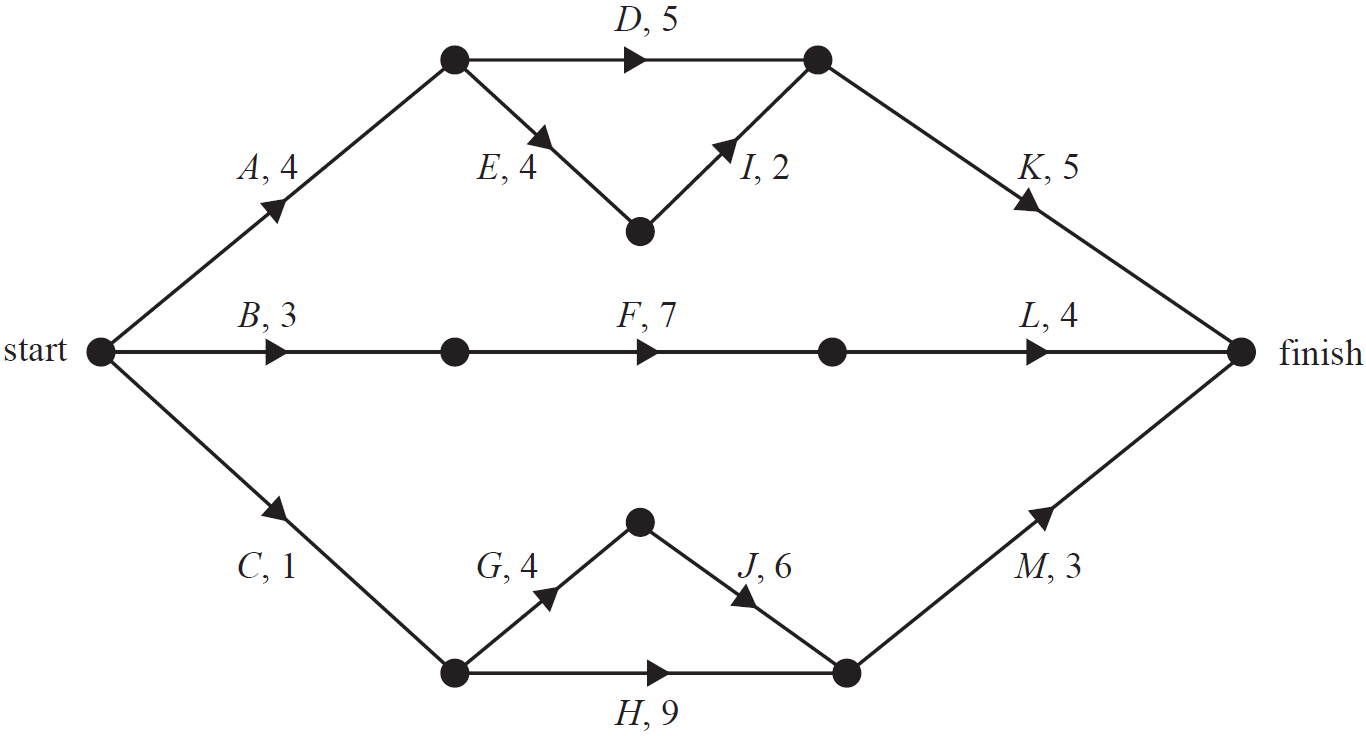
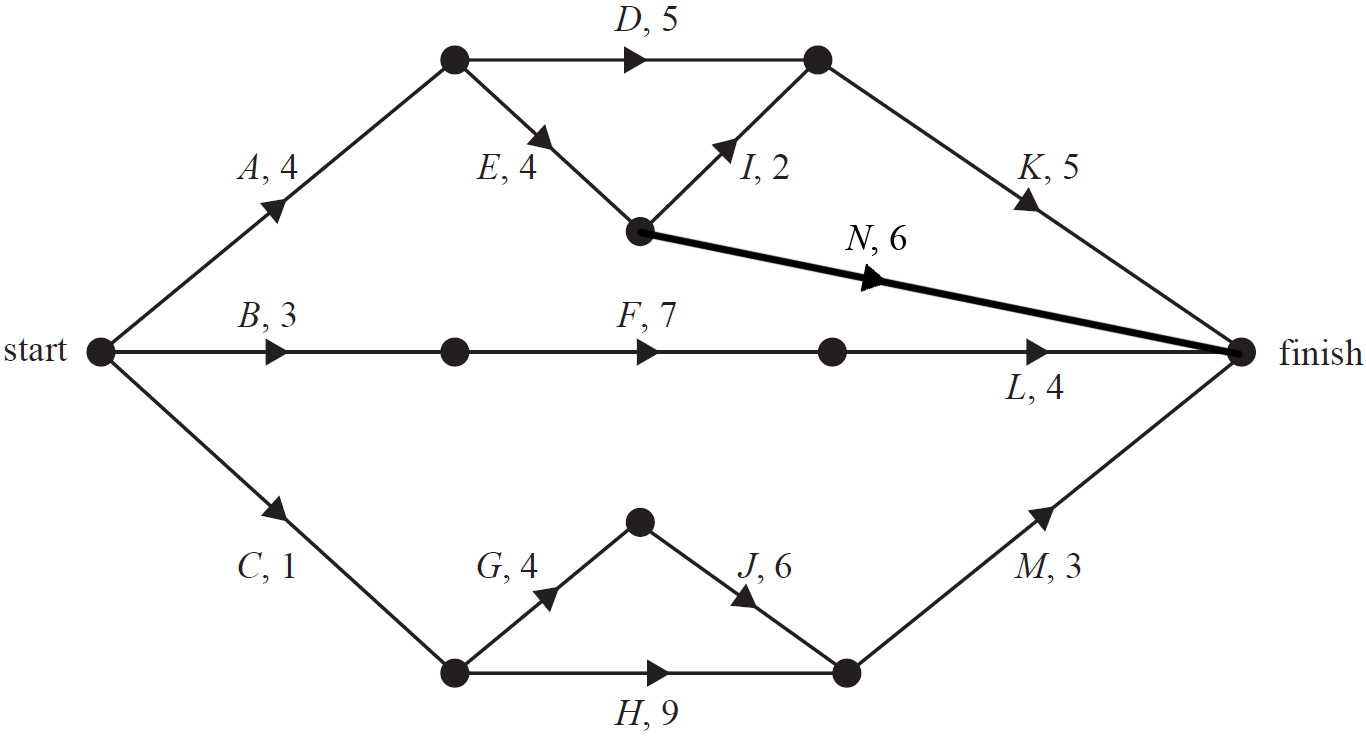
The directed network below shows these activities and their completion times in days.


  1. Determine the earliest start time for activity `M`.   (1 mark)

    --- 2 WORK AREA LINES (style=lined) ---

  2. The minimum completion time for the skateboard park is 15 days.


    Write down the critical path for this project.   (1 mark)

    --- 1 WORK AREA LINES (style=lined) ---
  3. Which activity has a float time of two days?   (1 mark)

    --- 1 WORK AREA LINES (style=lined) ---
  4. The completion times for activities `E, F, G, I` and `J` can each be reduced by one day.


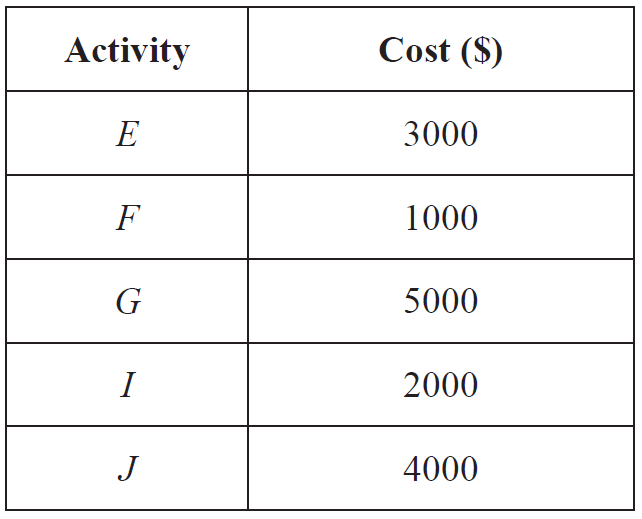
    The cost of reducing the completion time by one day for these activities is shown in the table below.


    What is the minimum cost to complete the project in the shortest time possible?   (1 mark)

    --- 2 WORK AREA LINES (style=lined) ---

  5. The original skateboard park project from part (a), before the reduction of time in any activity, will be repeated at another town named Campville, but with the addition of one extra activity.


    The new activity, `N`, will take six days to complete and has a float time of one day.


    Activity `N` will finish at the same time as the project.


     i.  Add activity `N` to the network below.   (1 mark) 

    --- 0 WORK AREA LINES (style=lined) ---


    ii.  What is the latest start time for activity `N`?   (1 mark)

    --- 3 WORK AREA LINES (style=lined) ---

Show Answers Only
  1. `11\ text(days)`
  2. `AEIK`
  3. `text(Activity)\ H`
  4. `text(Minimum cost of $2000 when activity)\ I\ text(is reduced by 1 day.)`

    1. `9\ text(days from the start)`
Show Worked Solution
a.    `text(EST)` `= 1 + 4 + 6`
    `= 11\ text(days)`

  
b.
  `text(Critical Path:)\ AEIK`

♦♦ Mean mark part (c) 37%, part (d) 21%.
MARKER’S COMMENT: In part (d), `ADK` cannot be crashed, therefore shortest duration is 14 days. Activity `I` is cheapest to reduce.
  

c.   `text(Activity)\ H`
  

d.   `text(Minimum days to complete is 14 days by reducing)`

`text(either)\ E\ text(or)\ I\ text(by 1 day.)`

`:. text(Minimum cost of $2000 when activity)\ I\ text(is reduced)`

`text(by 1 day.)`
  

e.i.   

♦♦ Mean mark part (e)(i) 21%, (e)(ii) 27%.
MARKER’S COMMENT: In (e)(ii), activity `N` must have an arrow on it.
  

e.ii.    `text(LST)` `=\ text(critical path time − 6 days)`
    `= 15-6`
    `= 9\ text(days from the start.)`

Filed Under: Critical Path Analysis Tagged With: Band 4, Band 5, Band 6, smc-621-20-Critical Paths/EST, smc-621-30-Float time/LST, smc-621-40-Crashing/Reduce completion time, smc-621-45-Adding activities

GRAPHS, FUR2 2016 VCAA 3

A company produces two types of hockey stick, the ‘Flick’ and the ‘Jink’.

Let `x` be the number of Flick hockey sticks that are produced each month.

Let `y` be the number of Jink hockey sticks that are produced each month.

Each month, up to 500 hockey sticks in total can be produced.

The inequalities below represent constraints on the number of each hockey stick that can be produced each month.

Constraint 1 `x >= 0` Constraint 2 `y >= 0`
Constraint 3 `x + y <= 500` Constraint 4 `y <= 2x`
  1. Interpret Constraint 4 in terms of the number of Flick hockey sticks and the number of Jink hockey sticks produced each month.  (1 mark)

There is another constraint, Constraint 5, on the number of each hockey stick that can be produced each month.

Constraint 5 is bounded by Line `A`, shown on the graph below.

The shaded region of the graph contains the points that satisfy constraints 1 to 5.

  1. Write down the inequality that represents Constraint 5.  (1 mark)

The profit, `P`, that the company makes from the sale of the hockey sticks is given by

`P = 62x + 86y`

  1. Find the maximum profit that the company can make from the sale of the hockey sticks.  (1 mark)
  2. The company wants to change the selling price of the Flick and Jink hockey sticks in order to increase its maximum profit to $42 000.

    All of the constraints on the numbers of Flick and Jink hockey sticks that can be produced each month remain the same.

    The profit, `Q`, that is made from the sale of hockey sticks is now given by

    `qquadQ = mx + ny`


    The profit made on the Flick hockey sticks is `m` dollars per hockey stick.

    The profit made on the Jink hockey sticks is `n` dollars per hockey stick.

    The maximum profit of $42 000 is made by selling 400 Flick hockey sticks and 100 Jink hockey sticks.

    What are the values of `m` and `n`?  (2 marks)

Show Answers Only
  1. `text(Constraint 4 means the number of Jink sticks produced each)`
    `text(month is less than or equal to twice the number of flick)`
    `text(sticks produced each month.)`
  2. `y <= 300`
  3. `$38\ 200`
  4. `84`
Show Worked Solution

a.   `text(Constraint 4 means the number of Jink sticks)`

♦♦♦ Mean mark 25%.

`text(produced each month is less than or equal to)`

`text(twice the number of flick sticks produced each)`

`text(month.)`


b.   `y <= 300`


c.   `text(From the equation, 1 Jink stick produces a)`

`text(higher profit than 1 Flick stick.)`

`text(Maximum profit at)\ (200,300)`

`P` `= (62 xx 200) + (86 xx 300)`
  `= $38\ 200`


d.   `Q = mx + ny`

♦♦♦ Mean mark 7%.
MARKER’S COMMENT: Very few students were able to identify the need for the sliding line concept and execute it correctly in this question.

`text(Max profit at)\ (400,100)`

`(400,100)\ text(lies on)\ x + y = 500`

`=>\ text(Max profit equation has the same)`

`text(gradient as the profit line.)`

`=> m = −1, m = n`

`text(Using the maximum profit = $42 000,)`

`400m + 100n` `= 42\ 000`
`500m` `= 42\ 000`
`m` `= (42\ 000)/500`
  `= 84`

`:. m = n = 84`

Filed Under: Linear Programming Tagged With: Band 4, Band 5, Band 6

MATRICES, FUR2 2016 VCAA 3

A travel company is studying the choice between air (`A`), land (`L`), sea (`S`) or no (`N`) travel by some of its customers each year.

Matrix `T`, shown below, contains the percentages of customers who are expected to change their choice of travel from year to year.

`{:(qquadqquadqquadqquadqquadquadtext(this year)),(qquadqquadqquadquadAqquadqquadLqquadqquadSqquadquadN),(T = [(0.65,0.25,0.25,0.50),(0.15,0.60,0.20,0.15),(0.05,0.10,0.25,0.20),(0.15,0.05,0.30,0.15)]{:(A),(L),(S),(N):}text(next year)):}`

Let `S_n` be the matrix that shows the number of customers who choose each type of travel `n` years after 2014.

Matrix `S_0` below shows the number of customers who chose each type of travel in 2014.

`S_0 = [(520),(320),(80),(80)]{:(A),(L),(S),(N):}`

Matrix `S_1` below shows the number of customers who chose each type of travel in 2015.

`S_1 = TS_0 = [(478),(d),(e),(f)]{:(A),(L),(S),(N):}`

  1. Find the values missing from matrix `S_1 (d, e, f )`.   (1 mark)

    --- 2 WORK AREA LINES (style=lined) ---

  2. Write a calculation that shows that 478 customers were expected to choose air travel in 2015.   (1 mark)

    --- 2 WORK AREA LINES (style=lined) ---

  3. Consider the customers who chose sea travel in 2014.
  4. How many of these customers were expected to choose sea travel in 2015?   (1 mark)

    --- 3 WORK AREA LINES (style=lined) ---

  5. Consider the customers who were expected to choose air travel in 2015.
  6. What percentage of these customers had also chosen air travel in 2014?
  7. Round your answer to the nearest whole number.   (1 mark)

    --- 4 WORK AREA LINES (style=lined) ---

In 2016, the number of customers studied was increased to 1360.
Matrix `R_2016`, shown below, contains the number of these customers who chose each type of travel in 2016.

`R_2016 = [(646),(465),(164),(85)]{:(A),(L),(S),(N):}`

  1. The company intends to increase the number of customers in the study in 2017 and in 2018.
  2. The matrix that contains the number of customers who are expected to choose each type of travel in 2017 (`R_2017`) and 2018 (`R_2018`) can be determined using the matrix equations shown below.

`R_2017 = TR_2016 + BqquadqquadqquadR_2018 = TR_2017 + B`
 

`{:(qquadqquadqquadqquadqquadquadtext(this year)),(qquadqquadqquadquadAqquadqquadLqquadqquadSqquadquadN),(T = [(0.65,0.25,0.25,0.50),(0.15,0.60,0.20,0.15),(0.05,0.10,0.25,0.20),(0.15,0.05,0.30,0.15)]{:(A),(L),(S),(N):}text(next year)):}qquadqquad{:(),(),(B = [(80),(80),(40),(−80)]{:(A),(L),(S),(N):}):}`

    1. The element in the fourth row of matrix `B` is – 80.
    2. Explain this number in the context of selecting customers for the studies in 2017 and 2018.   (1 mark)

      --- 2 WORK AREA LINES (style=lined) ---
    3. Determine the number of customers who are expected to choose sea travel in 2018.
    4. Round your answer to the nearest whole number.   (2 marks)

      --- 5 WORK AREA LINES (style=lined) ---
Show Answers Only
  1. `d=298, \ e=94, \ f=130`
  2. `(0.65 xx 520) + (0.25 xx 320) + (0.25 xx 80) + (0.50 xx 80) = 478`
  3. `20\ text(customers)`
  4. `71text(%)`
  5.  
    1. `text(80 customers who have no travel in a given)`
      `text(year are removed from the study. This occurs)`
      `text(in both 2017 and 2018.)`
    2. `text(190 customers)`
Show Worked Solution

a.   `d=298, \ e=94, \ f=130`
 

b.   `(0.65 xx 520) + (0.25 xx 320) + (0.25 xx 80) + (0.50 xx 80) = 478`

♦♦ Mean mark part (b) and (c) was 35% and 45% respectively.


c.   `text(Sea Travel in 2014-80 customers.)`

`text(Of those 80 customers,)`

`text(Sea Travel in 2015)` `= 25text(%) xx 80`
  `= 20\ text(customers)`


d.   `text(Expected total for air travel in 2015)`

♦♦♦ Mean mark 17%.

`= 478\ text(customers)`
 

`text(In 2014, 520 customers chose air travel.)`

`text(65% of those chose air travel in 2015)`

`= 65text(%) xx 520`

`= 338\ text(customers)`

`:.\ text(Percentage)` `= 338/478 xx 100`
  `= 70.71…`
  `= 71text(%)`


e.i.   `text(80 customers who have no travel in a given)`

♦ Mean mark 14%.
MARKER’S COMMENT: “80 people chose not to travel” was a common answer that received no marks.

`text(year are removed from the study. This occurs)`

`text(in both 2017 and 2018.)`


e.ii.   `R_2017` `= TR_2016 + B`
    `= [(0.65,0.25,0.25,0.50),(0.15,0.60,0.20,0.15),(0.05,0.10,0.25,0.20),(0.15,0.05,0.30,0.15)][(646),(465),(164),(85)] + [(80),(80),(40),(−80)]`
    `= [(699.65),(501.45),(176.80),(102.10)]`


`R_2018` `= TR_2017 + B`
  `= [(0.65,0.25,0.25,0.50),(0.15,0.60,0.20,0.15),(0.05,0.10,0.25,0.20),(0.15,0.05,0.30,0.15)][(699.65),(501.45),(176.80),(102.10)]`
  `= [(755.39),(536.49),(189.75),(118.38)]`


`:. 190\ text(customers are expected to choose)`

`text(sea travel in 2018.)`

Filed Under: Transition Matrices - Modified Tagged With: Band 2, Band 5, Band 6, page-break-before-question, smc-1893-20-State Matrix in discrete period, smc-1893-32-4x4 Matrix, smc-1893-60-Regular Transition Matrices

GEOMETRY, FUR2 2016 VCAA 5

A golf course has a sprinkler system that waters the grass in the shape of a sector, as shown in the diagram below. 
 

A sprinkler is positioned at point `S` and can turn through an angle of 100°.

The shaded area on the diagram shows the area of grass that is watered by the sprinkler.

  1. If 147.5 m² of grass is watered, what is the maximum distance, `d` metres, that the water reaches from `S`?


    Round your answer to the nearest metre.  (1 mark)

  2. Another sprinkler can water a larger area of grass.


    This sprinkler will water a section of grass as shown in the diagram below.


    The section of grass that is watered is 4.5 m wide at all points.


    Water can reach a maximum of 12 m from the sprinkler at `L`.


    What is the area of grass that this sprinkler will water?


    Round your answer to the nearest square metre.  (2 marks)

Show Answers Only
  1. `13\ text{m  (nearest m)}`
  2. `199\ text{m²  (nearest m²)}`
Show Worked Solution
♦ Mean mark 48%.
a.    `text(Area of sector)` `= theta/360 xx pi xx r^2`
  `147.5` `= 100/360 xx pi xx d^2`
  `d^2` `= 147.5/pi xx 360/100`
    `= 169.02…`
  `:.d` `= 13.00…`
    `= 13\ text{m  (nearest m)}`
♦♦♦ Mean mark 23%.


b.    `text(Area)` `= ((360 – theta))/360 xx pi xx R^2 – ((360 – theta))/360 xx pi xx r^2`
    `= 260/360 xx pi (12^2 – 7.5^2)`
    `= 199.09…`
    `= 199\ text{m²  (nearest m²)}`

Filed Under: Perimeter, Area and Volume Tagged With: Band 5, Band 6

GEOMETRY, FUR2 2016 VCAA 4

During a game of golf, Salena hits a ball twice, from `P` to `Q` and then from `Q` to `R`.

The path of the ball after each hit is shown in the diagram below.

After Salena’s first hit, the ball travelled 80 m on a bearing of 130° from point `P` to point `Q`.

After Salena’s second hit, the ball travelled 100 m on a bearing of 054° from point `Q` to point `R`.

  1. Another ball is hit and travels directly from `P` to `R`.


    Use the cosine rule to find the distance travelled by this ball.


    Round your answer to the nearest metre.  (2 marks)

  2. What is the bearing of `R` from `P`?


    Round your answer to the nearest degree.  (1 mark) 

Show Answers Only
  1. `142\ text{m  (nearest m)}`
  2. `0.87^@\ \ (text(nearest degree))`
Show Worked Solution
a.   
`PR^2` `= PQ^2 + QR^2 – 2 xx PQ xx QR xx cos104^@`
  `= 80^2 + 100^2 – 2 xx 80 xx 100 xx cos104^@`
  `= 20\ 270.75…`
  `= 142.37…`
  `= 142\ text{m  (nearest m)}`


b.   `text(Find)\ angle RPQ.`

`text(Using the sin rule),`

`(sin angleRPQ)/100` `= (sin104^@)/142`
`sin angle RPQ` `= (100 xx sin104^@)/142`
  `= 0.683…`
`angle RPQ` `= 43.1^@\ \ (text(1 d.p.))`


`:. text(Bearing of)\ R\ text(from)\ P`

`= 130 – 43.1`

`= 086.9`

`= 087^@\ \ (text(nearest degree))`

Filed Under: Trig - Bearings Tagged With: Band 4, Band 6

CORE, FUR2 2016 VCAA 7


Ken has borrowed $70 000 to buy a new caravan.

He will be charged interest at the rate of 6.9% per annum, compounding monthly.

  1. For the first year (12 months), Ken will make monthly repayments of $800.

    1. Find the amount that Ken will owe on his loan after he has made 12 repayments.   (1 mark)

      --- 3 WORK AREA LINES (style=lined) ---
    2. What is the total interest that Ken will have paid after 12 repayments?   (1 mark)

      --- 4 WORK AREA LINES (style=lined) ---

  2. After three years, Ken will make a lump sum payment of $L in order to reduce the balance of his loan.
  3. This lump sum payment will ensure that Ken’s loan is fully repaid in a further three years.
  4. Ken’s repayment amount remains at $800 per month and the interest rate remains at 6.9% per annum, compounding monthly.
  5. What is the value of Ken’s lump sum payment, $L?
  6. Round your answer to the nearest dollar.   (2 marks)

    --- 5 WORK AREA LINES (style=lined) ---

Show Answers Only

a.i.`$65\ 076.22`

a.ii.`$4676.22`

b.  `$28\ 204.02`

Show Worked Solution

a.i.  `text(By TVM Solver,)`

♦ Mean mark 46%.

`N` `= 12`
`I(%)` `= 6.9`
`PV` `= 70\ 000`
`PMT` `= -800`
`FV` `= ?`
`text(P/Y)` `= text(C/Y) = 12`

 
`=> FV = -65\ 076.219…`

`:.\ text(Ken will owe $65 076.22)`

♦♦ Mean mark 26%.

a.ii.    `text(Total interest paid)` `= text(Total repayments) – text(reduction in principal)`
    `= (12 xx 800) – (70\ 000 – 65\ 076.22)`
    `= $4676.22`

  
b.   
`text(Find the loan balance after 3 years)`

♦♦♦ Mean mark 20%.
MARKER’S COMMENT: Correct input tables allowed for a method mark if answers were calculated incorrectly.

`N` `= 12 xx 3 = 36`
`I(%)` `= 6.9`
`PV` `= 70\ 000`
`PMT` `= -800`
`FV` `= ?`
`text(P/Y)` `=text(C/Y)=12`
   

`=> FV = 54\ 151.60`

  
`text(Find the loan amount that can be)`

`text(fully repaid by monthly payments)`

`text(of $800 over 3 years.)`

`N` `= 36`
`I(%)` `= 6.9`
`PV` `= ?`
`PMT` `= -800`
`FV` `= 0`
`text(P/Y)` `= text(C/Y)= 0`

 
`=> PV = 25\ 947.58`
  

`:.\ $L` `= 54\ 151.60 -25\ 947.58`
  `= $28\ 204.02`

Filed Under: Borrowing and Loans Tagged With: Band 5, Band 6, smc-603-22-Reducible balance loans, smc-603-60-CAS (1 step), smc-603-65-CAS (2 step)

CORE*, FUR2 2016 VCAA 6

Ken’s first caravan had a purchase price of $38 000.

After eight years, the value of the caravan was $16 000.

  1. Show that the average depreciation in the value of the caravan per year was $2750.   (1 mark)

    --- 2 WORK AREA LINES (style=lined) ---

  2. Let `C_n` be the value of the caravan `n` years after it was purchased.


    Assume that the value of the caravan has been depreciated using the flat rate method of depreciation.


    Write down a recurrence relation, in terms of `C_(n +1)` and `C_n`, that models the value of the caravan.   (1 mark)

    --- 2 WORK AREA LINES (style=lined) ---

  3. The caravan has travelled an average of 5000 km in each of the eight years since it was purchased.


    Assume that the value of the caravan has been depreciated using the unit cost method of depreciation.


    By how much is the value of the caravan reduced per kilometre travelled?   (1 mark)

    --- 5 WORK AREA LINES (style=lined) ---

Show Answers Only
  1. `text(Proof)\ text{(See Worked Solutions)}`
  2. `text(See Worked Solutions)`
  3. `$0.55`
Show Worked Solution
a.    `text(Average depreciation)`

`= {(38\ 000-16\ 000)}/8`

`= $2750`


♦♦ Mean mark (a) 39%.
MARKER’S COMMENT: A “show that” question should include an equation
  

b.    `C_0` `= 38\ 000,`
  `C_(n+1)` `= C_n-2750`

♦♦ Mean mark (b) 33%.
MARKER’S COMMENT: A lack of attention to detail and careless errors were common!
  

c.    `text(Total kms travelled)` `= 8 xx 5000`
    `= 40\ 000`

 
`:.\ text(Depreciation per km)`

`= {(38\ 000-16\ 000)}/(40\ 000)`

`= $0.55`


♦♦ Mean mark (c) 29%.
  

Filed Under: Depreciation, Recursion - Financial Tagged With: Band 5, Band 6, smc-602-40-Comparing methods, smc-717-50-Depreciation (SL), smc-717-70-Find RR

NETWORKS, FUR1 2016 VCAA 8 MC

Five children, Alan, Brianna, Chamath, Deidre and Ewen, are each to be assigned a different job by their teacher. The table below shows the time, in minutes, that each child would take to complete each of the five jobs.


The teacher wants to allocate the jobs so as to minimise the total time taken to complete the five jobs.

In doing so, she finds that two allocations are possible.

If each child starts their allocated job at the same time, then the first child to finish could be either

  1. Alan or Brianna.
  2. Brianna or Deidre.
  3. Chamath or Deidre.
  4. Chamath or Ewen.
  5. Deidre or Ewen. 
Show Answers Only

`B`

Show Worked Solution

`text(Apply the Hungarian algorithm.)`

♦♦♦ Mean mark 30%.

`text(Optimum allocations are:)`

 
`:.\ text(The first child to finish could be Brianna or Deidre.)`

`=> B`

Filed Under: Matching Problems Tagged With: Band 6, smc-623-10-Hungarian Algorithm

NETWORKS, FUR1 2016 VCAA 3 MC

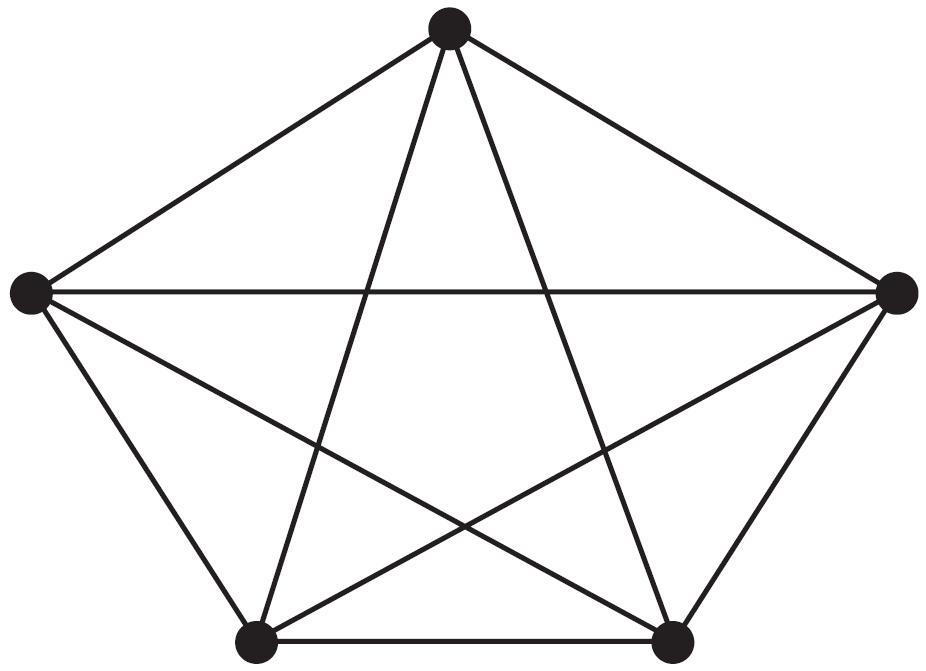
The following graph with five vertices is a complete graph.
 

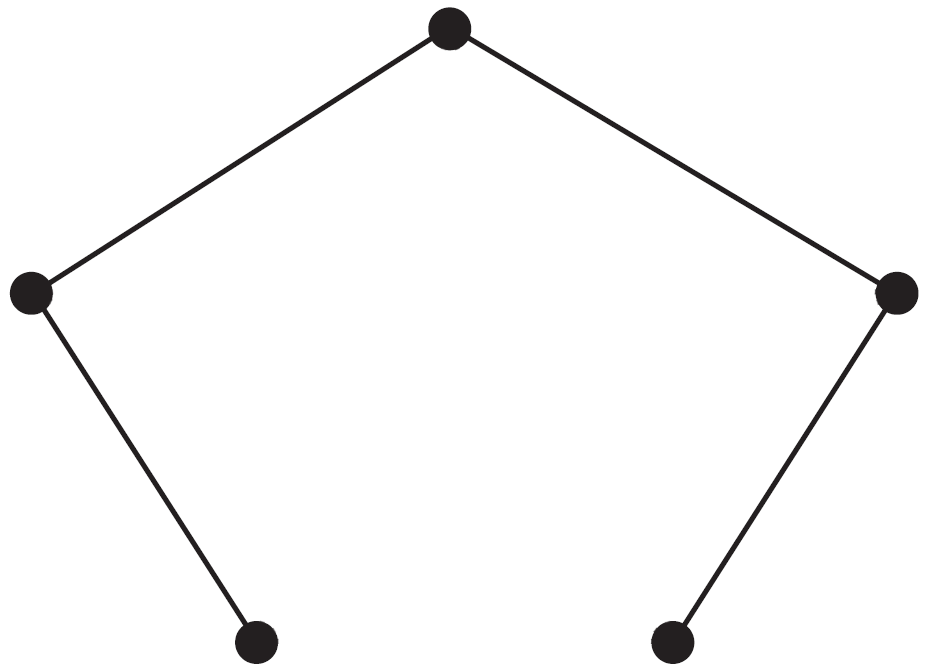
Edges are removed so that the graph will have the minimum number of edges to remain connected.

The number of edges that are removed is

  1.   `4`
  2.   `5`
  3.   `6`
  4.   `9`
  5. `10`
Show Answers Only

`C`

Show Worked Solution

`text(The minimum number of edges for)`

♦♦ Mean mark 35%.

`text{a connected graph is 4 (spanning tree).}`


`:.\ text(Edges to be removed)`

`= 10 – 4`

`= 6`

`=> C`

Filed Under: Basic Concepts Tagged With: Band 6, smc-626-10-Definitions, smc-626-50-Bipartite

GRAPHS, FUR1 2016 VCAA 8 MC

Megan walks from her house to a shop that is 800 m away.

The equation for the relationship between the distance, in metres, that Megan is from her house `t` minutes after leaving is

`text(distance) = {(100t, 0 <= t <= 6),(\ 600, 6 < t <= a),(quadkt, a < t <= 10):}`

If Megan reaches the shop 10 minutes after leaving her house, the value of `a` is

  1. `7.0`
  2. `7.5`
  3. `8.0`
  4. `8.5`
  5. `9.0`
Show Answers Only

`B`

Show Worked Solution

`text(When)\ t = 10, d = 800`

♦♦♦ Mean mark 26%.
`800` `= 10k`
`k` `= 80`


`text(From the equations and using)\ \ k=80,`

`80a` `= 600`
`:. a` `= 600/80`
  `= 7.5`

`=> B`

Filed Under: Graph Applications Tagged With: Band 6

GRAPHS, FUR1 2016 VCAA 6 MC

The point  (2, 12)  lies on the graph of  `y = kx^n`, as shown below.

Another graph that represents this relationship between `y` and `x` could be

Show Answers Only

`E`

Show Worked Solution

`text(Consider each option,)`

♦♦♦ Mean mark 17%.
STRATEGY: Use the gradient and `x`-axis variable to form an equation for each linear graph.

`text(Option)\ A:\ text(graph between)\ x\ text(and)\ y\ text(cannot be linear.)`

`text(Option)\ B:\ y = 6x^2`

`text(Test)\ (2,12):\ 6 xx 2^2 = 24 != 12`

`text(Option)\ C:\ y = 3/2 x^2`

`text(Test)\ (2,12):\ 3/2 xx 2^2 = 6 != 12`

`text(Option)\ D:\ y = 6x^3`

`text(Test)\ (2,12):\ 6 xx 2^3 = 48 != 12`

`text(Option)\ E:\ y = 3/2 x^3`

`text(Test)\ (2,12):\ 3/2 xx 2^3 = 12`

`=> E`

Filed Under: Non-linear Relationships Tagged With: Band 6

GRAPHS, FUR1 2016 VCAA 5 MC

The feasible region for a linear programming problem is shaded in the diagram below.

The equation of the objective function for this problem is of the form

`P = ax + by`,              where `a > 0` and `b > 0`

The dotted line in the diagram has the same slope as the objective function for this problem.

The maximum value of the objective function can be determined by calculating its value at

  1. point A.
  2. point B.
  3. point C.
  4. point D.
  5. any point along line segment BC. 
Show Answers Only

`C`

Show Worked Solution

`text(By applying the sliding rule technique)`

♦♦♦ Mean mark 29%.
MARKER’S COMMENT: The majority of students had no idea of the sliding rule technique or applied it inaccurately and answered E.

`text{(moving the objective function out in}`

`text{a series of parallel lines), the maximum}`

`text(value occurs at point)\ C.`

`=> C`


Filed Under: Linear Programming Tagged With: Band 6

GEOMETRY, FUR1 2016 VCAA 8 MC

A string of seven flags consisting of equilateral triangles in two sizes is hanging at the end of a racetrack, as shown in the diagram below.


The edge length of each black flag is twice the edge length of each white flag.

For this string of seven flags, the total area of the black flags would be

  1. two times the total area of the white flags.
  2. four times the total area of the white flags.
  3. `4/3` times the total area of the white flags.
  4. `16/3` times the total area of the white flags.
  5. `16/9` times the total area of the white flags. 
Show Answers Only

`D`

Show Worked Solution

`text(Shapes are similar.)`

♦♦♦ Mean mark 30%.

`text(Scale factor of sides = 2)`

`text(Scale factor of areas) = 2^2 = 4`


`text(S)text(ince there are 4 black and 3)`

`text(white flags,)`

`:.\ text{Total area of black flags (in white flags)}`

`= 4/3 xx 4`

`= 16/3 xx text(Area of white flags)`

`=> D`

Filed Under: Similarity and Scale Tagged With: Band 6, smc-606-30-Factors k / k^2 / k^3

GEOMETRY, FUR1 2016 VCAA 4 MC

All towns in the state of Victoria are in the same time zone.

Mallacoota (38°S, 150°E) and Portland (38°S, 142°E) are two coastal towns in the state of Victoria.

On one day in January, the sun rose in Mallacoota at 6.03 am.

Assuming that 15° of longitude equates to a one-hour time difference, the time that the sun was expected to rise in Portland is

  1. 5.31 am.
  2. 5.55 am.
  3. 6.03 am.
  4. 6.11 am.
  5. 6.35 am.
Show Answers Only

`E`

Show Worked Solution
`text(Angular difference)` `= 150 – 142`
  `= 8^@`


`text(Time difference)` `= 8/15 xx 60`
  `= 32\ text(minutes)`
♦♦♦ Mean mark 26%.


`text(S)text(ince Portland is West of Mallacoota,)`

`text(it’s sunrise will be later.)`
 

`:.\ text(Portland)` `= 6:03 + 32\ text(minutes)`
  `= 6:35\ text(am)`

 
`=> E`

Filed Under: Great Circle Geometry Tagged With: Band 6, smc-758-10-Time differences

CORE, FUR1 2016 VCAA 24 MC

Mai invests in an annuity that earns interest at the rate of 5.2% per annum compounding monthly.

Monthly payments are received from the annuity.

The balance of the annuity will be $130 784.93 after five years.

The balance of the annuity will be $66 992.27 after 10 years.

The monthly payment that Mai receives from the annuity is closest to

  1. $1270
  2. $1400
  3. $1500
  4. $2480
  5. $3460
Show Answers Only

`C`

Show Worked Solution

`text(By TVM solver, starting at 5 years,)`

♦♦ Mean mark 30%.
MARKER’S COMMENT: Many students incorrectly chose `E`, by allocating the same sign to both the PV and FV.
`N` `= 5 xx 12=60`
`I(text(%))` `= 5.2`
`PV` `= −130\ 784.93`
`PMT` `= ?`
`FV` `= 66\ 992.27`
`text(P/Y)` `= text(C/Y) = 12`
   
`:. PMT` `= 1500.00…`

 
`=> C`

Filed Under: Annuities and Perpetuities Tagged With: Band 6, smc-2512-10-Annuity, smc-2512-50-CAS solver

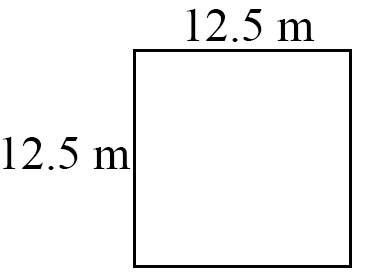
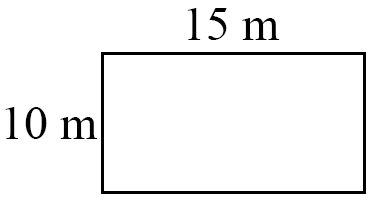
Measurement, NAP-B4-CA07

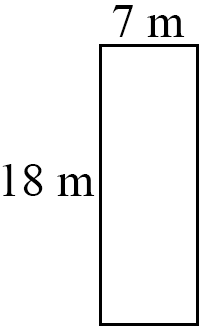
A resort has 4 pools.

Which pool has the largest surface area?


Show Answers Only

Show Worked Solution

`text(Consider the surface area of each pool:)`

`text(1st pool) = 6 xx 19 = 114\ text(m²)`

`text(2nd pool) = 7 xx 18 = 126\ text(m²)`

`text(3rd pool) = 12.5 xx 12.5 = 156.25\ text(m²)`

`text(4th pool) =10 xx 15 = 150\ text(m²)`


 `:.\ text(The 3rd pool, 12.5 × 12.5, has the largest)`

`text(surface area.)`

Filed Under: Perimeter, Area and Volume, Perimeter, Area and Volume Tagged With: Band 6, smc-3183-20-Area, smc-669-20-Area

Measurement, NAP-C4-CA05

A shape, pictured below, is made with 5 rhombuses.


What is the perimeter of the shape?

`10\ text(cm)` `14\ text(cm)` `12\ text(cm)` `20\ text(cm)`


Show Answers Only

`12\ text(cm)`

Show Worked Solution

`text(S)text(ince all sides of a rhombus are equal,)`

 `text(Perimeter)\ = 12\ text(cm)`

Filed Under: Perimeter, Area and Volume, Perimeter, Area and Volume Tagged With: Band 6

Geometry, NAP-C4-CA03

Daniel made this design by joining six tiles together.

 Which of this could not be Daniel's design? 


Show Answers Only


Show Worked Solution


Filed Under: Transformations, Transformations and Symmetry Tagged With: Band 6, smc-3186-20-Rotations, smc-3196-20-Rotations

Geometry, NAP-B2-24

 
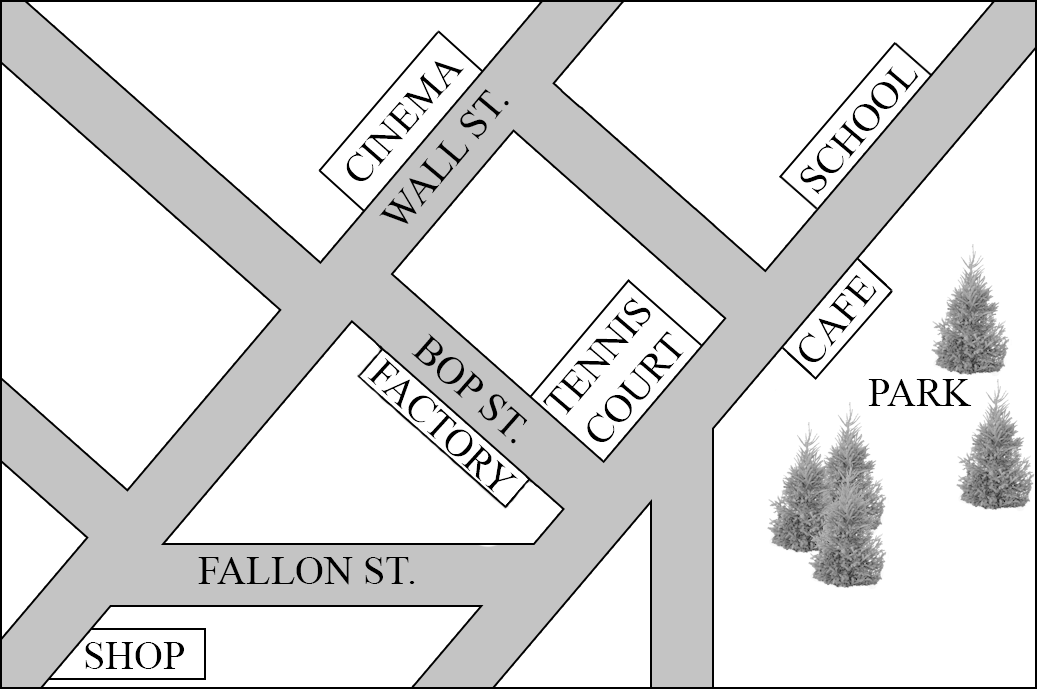
Jude left the factory and turns left on Bop St.

He then turns left immediately and walks straight ahead.

What building does he pass?

`text(school)` `text(cinema)` `text(shop)` `text(cafe)`


Show Answers Only

`text(shop)`

Show Worked Solution

`text(shop)`

Filed Under: Location, Directions and Angles, Location, Directions and Angles Tagged With: Band 6, smc-3123-30-Maps and directions, smc-697-30-Maps and directions

Number and Algebra, NAP-B2-23

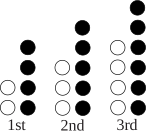
Jake makes a pattern with black and white balls.


Altogether, how many balls are needed for the 5th pattern?

`13` `14` `15` `18`


Show Answers Only

`14`

Show Worked Solution

`text(White ball pattern: 2, 3, 4, 5, 6 …)`

`text(Black ball pattern: 4, 5, 6, 7, 8, …)`

`:.\ text(Total balls in pattern 5)`

`=6\ text(white balls) + 8\ text(black balls)`

`=14\ text(balls)`

Filed Under: Patterns, Patterns, Patterns Tagged With: Band 6, smc-3021-20-Patterns and images, smc-3088-20-Patterns and images, smc-692-20-Patterns and images

Number and Algebra, NAP-B2-21

Jane and five of her friends share 2 cakes.

If all six friends share equally, what fraction of one cake does each of them get?

`1/2` `1/3` `1/6` `1/12`


Show Answers Only

`1/3`

Show Worked Solution
`text(Fraction of 1 cake)` `=2/6`
  `=1/3`

Filed Under: Fractions, Fractions and Decimals, Fractions and Decimals, Fractions and Decimals, TESTLET F Tagged With: Band 6, smc-3019-30-Other fractions, smc-3087-30-Fraction word problems, smc-691-30-Fraction word problems

Number and Algebra, NAP-B2-20

A group of soccer fans all go to a soccer game.

Entry to the game costs $3.

Altogether the group pay $156.

How many soccer fans are there in the group?

`50` `51` `52` `63`


Show Answers Only

`52`

Show Worked Solution
`text(Fans in group)` `=156 -: 3`
  `=52`

Filed Under: Financial Mathematics, Money and Financial Mathematics, Solving Problems - Multiply/Divide, Solving Problems - Multiply/Divide, Solving problems - Multiply/Divide Tagged With: Band 6, smc-2536-20-Whole $ calculations, smc-3018-20-Divide, smc-3085-20-Division, smc-3086-20-Whole $ calculations, smc-922-20-Division

Number and Algebra, NAP-B1-31 SA

5 boys win $3.

They share the money equally.

How much does each boy get?

  cents
Show Answers Only

`60¢`

Show Worked Solution
`$3 ÷ 5` `= 300¢ ÷ 5`
  `= 60¢`

 
`=>\ text(Each boy gets)\ 60¢`

Filed Under: Money, Money, Solving Problems - Multiply/Divide, Solving Problems - Multiply/Divide, Solving Problems - Multiply/Divide, TESTLET F Tagged With: Band 6, smc-2907-20-Divide, smc-2909-20-$ and cents, smc-3018-20-Divide, smc-3020-20-$ and cents calculations

Number and Algebra, NAP-C1-32 SA

Percy buys a cricket ball and a set of stumps.

The total cost is $23.

The stumps cost $3 more than the ball.

What is the cost of the ball?

$  
Show Answers Only

`$10`

Show Worked Solution

`text(Test some numbers:)`

 `text(Stumps $12 – Ball $11)`

`= $1\ text(difference)`

`text(Stumps $13 – Ball $10)`

`= $3\ text(difference)`


`=>\ text(The ball must cost $10.)`

Filed Under: Money, Money, Solving Problems - Add/Subtract, Solving Problems - Add/Subtract, Solving Problems - Add/Subtract, TETSLET F Tagged With: Band 6, smc-2909-15-Whole $, smc-3017-20-Subtraction, smc-3020-15-Whole $ calculations, smc-710-20-Subtraction

Measurement, NAP-C1-30 SA

There are 8 small boxes packed into the carton below.


How many small boxes can fit in the carton altogether?

Show Answers Only

`text(24 boxes)`

Show Worked Solution
`text(Boxes on base)` `= 3 xx 2`
  `= 6`


`:.\ text(Total boxes)` `= 6 xx 4`
  `= 24`

Filed Under: Length, Area and Capacity, Length, Area and Capacity Tagged With: Band 6, smc-3036-40-Capacity, smc-706-40-Capacity

Geometry, NAP-C1-29

Jeremy had these tiles.

He then turned each tile a quarter turn clockwise.

Which of these is his new design?


Show Answers Only

Show Worked Solution

Filed Under: 2D-3D Shapes, Transformations and Symmetry Tagged With: Band 6, smc-3555-20-Rotations, smc-704-70-Rotations and reflections

Number and Algebra, NAP-B2-18

Jeff went to the corner store to buy 4 kg of flour.

Approximately how much did Jeff pay?

`$2` `$3` `$4` `$6`


Show Answers Only

`$6`

Show Worked Solution
`$1.48 xx 4` `~~ 4 xx $1.50`
  `~~ $6`

Filed Under: Money, Money, Solving Problems - Multiply/Divide, Solving Problems - Multiply/Divide Tagged With: Band 6, smc-2907-10-Multiply, smc-2909-20-$ and cents, smc-3018-10-Multiply, smc-3020-20-$ and cents calculations

Number and Algebra, NAP-C1-26

Kim started at 5 and made this number pattern

`5, 6, 8, 11, 15, 20,`
 

What is the next number in the pattern?

`21` `25` `26` `30`


Show Answers Only

`26`

Show Worked Solution

`text(The difference between each number increases)`

`text(by 1 each time.)`

`5+1` `=6`
`6+2` `=8`
`vdots\ \ `  
`20+6` `=26`


`=>\ text(The next number is 26.)`

Filed Under: Patterns, Patterns Tagged With: Band 6, smc-3021-10-Number sequences, smc-711-10-Number sequences

Measurement, NAP-C1-27 SA

Bernard is putting tiles on a section of his toy room wall.


Altogether, how many tiles of the same size will be needed to fully cover this section of the wall?

Show Answers Only

`24`

Show Worked Solution

`text(6 tiles will fit the width.)`

`text(4 tiles will fit the height.)`

`=>\ text(Total tiles needed)` `= 6 xx 4`
  `= 24`

Filed Under: Length, Area and Capacity, Length, Area and Capacity Tagged With: Band 6, smc-3036-20-Area, smc-706-20-Area

Number and Algebra, NAP-C1-25

How many quarters are there in three and a half apples?

`7` `8` `13` `14`


Show Answers Only

`14`

Show Worked Solution

`text(Each full apple can be cut into 4 quarters,)`

`=>\ text(Number of quarters)` `=4+4+4+2`
  `=14`

Filed Under: Fractions, Fractions and Decimals Tagged With: Band 6, smc-3019-25-Quarters, smc-709-25-Quarters

Number and Algebra, NAP-B1-29

Iris needs 4 cups of raisins to make a fruit cake.

She measures `1/2` a cup each time.

How many `1/2` cups will she need?

`1` `2` `4` `8`


Show Answers Only

`8`

Show Worked Solution
`2 xx 1/2\ text(cup)` `= 1\ text(cup)`
`4 xx 1/2\ text(cup)` `= 2\ text(cups)`
`6 xx 1/2\ text(cup)` `= 3\ text(cups)`
`8 xx 1/2\ text(cup)` `= 4\ text(cups)`


`=>\ text(Iris needs 8 half cups.)`

Filed Under: Fractions, Fractions and Decimals Tagged With: Band 6, smc-3019-20-Halves, smc-3019-40-Counting by fractions, smc-709-20-Halves

Number and Algebra, NAP-B1-28 SA

Kim is packing 27 plums into boxes to take to the market.

Each box can hold 5 plums.

What is the smallest number of boxes Kim needs to make sure all the plums are packed?

Show Answers Only

`6\ text(boxes)`

Show Worked Solution
`text(Boxes needed)` `=27 -: 5`
  `=5\ \ text(remainder 2)`
  `=6\ text(boxes)`

Filed Under: Solving Problems - Multiply/Divide, Solving Problems - Multiply/Divide, Solving Problems - Multiply/Divide, TETSLET F Tagged With: Band 6, smc-2907-20-Divide, smc-2907-35-Remainder, smc-3018-20-Divide, smc-3018-35-Remainder

Number and Algebra, NAP-B1-25 SA

`29 + 37` has the same value as `30 +`
Show Answers Only

`36`

Show Worked Solution
`29 + 37` `= (29 + 1) + (37 – 1)`
  `= 30 + 36`

Filed Under: Number and Place, Number and Place, Number and Place Value, TESTLET F Tagged With: Band 6, smc-3016-10-Addition, smc-708-10-Addition

Number and Algebra, NAP-B1-24 SA

`55 - 28 =`
Show Answers Only

`27`

Show Worked Solution
`55 – 28` `= 35 – 8`
  `= 27`

Filed Under: Number and Place, Number and Place Tagged With: Band 6, smc-3016-20-Subtraction, smc-708-20-Subtraction

Number and Algebra, NAP-D1-30

In 5 years time, Megan will be 16.

Brian will then be half Megan's age.

How old is Brian now?

`3` `6` `8` `11`


Show Answers Only

`3`

Show Worked Solution

`text(In 5 years time:)`

`text{Megan will be 16 (given)}`

`=>\ text(Brian will be 8.)`

`:.\ text(Brian’s age now)` `= 8-5`
  `= 3`

Filed Under: Fractions, Fractions and Decimals, Solving Problems - Multiply/Divide, Solving Problems - Multiply/Divide Tagged With: Band 6, smc-2907-30-Multi-Step, smc-3018-30-Multi-Step, smc-3019-20-Halves, smc-709-20-Halves

Geometry, NAP-D1-29

John left the police station and drove to the Law Courts.


What was the first building he passed on his left?

`text(bank)` `text(chemist)` `text(newsagent)` `text(cafe)`


Show Answers Only

`text(newsagent)`

Show Worked Solution

`text(newsagent)`

Filed Under: Location, Directions and Angles, Location, Directions and Angles, Location, Maps and Directions, TETSLET F Tagged With: Band 6, smc-3051-20-Maps and directions, smc-705-20-Maps and directions

Number and Algebra, NAP-D1-27 SA

Dinesh thought of a number.

He doubled the number and subtracted 4.

The answer was 14.

What number did Dinesh first think of?

Show Answers Only

`9`

Show Worked Solution

`text(Double the number)`

`= 14 + 4`

`= 18`
 

`=>\ text(Number that Dinesh started with)`

`=18 ÷ 2`

`= 9`

Filed Under: Solving Problems - Multiply/Divide, Solving Problems - Multiply/Divide Tagged With: Band 6, smc-2907-30-Multi-Step, smc-3018-30-Multi-Step

Geometry, NAP-D1-26

Rachael draws around this tile.

She turns the tile a quarter turn.

She draws around the tile in its new position.

Which of these could show the two shapes that Rachael drew?


Show Answers Only

Show Worked Solution

Filed Under: 2D-3D Shapes, Transformations and Symmetry Tagged With: Band 6, smc-3555-20-Rotations, smc-704-70-Rotations and reflections

Measurement, NAP-D1-25

At what time does the next train leave?

`9:02` `1:09` `2:45` `1:45`


Show Answers Only

`1:45`

Show Worked Solution

`1:45`

Filed Under: Time, Time Tagged With: Band 6, smc-3037-10-Telling the time, smc-707-10-Telling the time

Number and Algebra, NAP-D1-24 SA

Write a number in the box to make this number sentence correct.

`33 -` `= 17`
Show Answers Only

`16`

Show Worked Solution

`33 – 16 = 17`

`=> 16`

Filed Under: Number and Place, Number and Place Tagged With: Band 6, smc-3016-20-Subtraction, smc-708-20-Subtraction

Measurement, NAP-E1-29 SA

Mandy is cutting out luggage tags from a plastic sheet.

Each luggage tag is identical and is pictured below.

Mandy throws away all pieces of plastic that are not complete tags.

What is the greatest number of luggage tags that Mandy can cut from the plastic sheet?

Show Answers Only

`text(10 luggage tags)`

Show Worked Solution

`text(10 luggage tags is the most that can be cut.)`

Filed Under: Length, Area and Capacity, Length, Area and Capacity, Length, Area and Capacity, TESTLET F Tagged With: Band 6, smc-3036-20-Area, smc-706-20-Area

Measurement, NAP-E1-28 SA

These clocks show two times in the afternoon.

How many minutes are there between the two times?

  minutes
Show Answers Only

`text(75 minutes)`

Show Worked Solution

`text(Times are 2:15 and 3:30.)`

`text(Time difference)` `=\ text(1 hr 15 minutes)`
  `=\ text(75 minutes)`

Filed Under: TESTLET F, Time, Time, Time Tagged With: Band 6, smc-3037-12-Time difference, smc-3037-20-Convert sec/min/hr, smc-707-12-Time difference

Number and Algebra, NAP-E1-27 SA

Domi had some money in her purse.

She spent $3.75 and had $2.55 left .

How much money did Domi start with?

$  
Show Answers Only

`$6.30`

Show Worked Solution

`text(Money Domi started with)`

`= $3.75 + $2.55`

`= $6.30`

Filed Under: Money, Money Tagged With: Band 6, smc-2909-20-$ and cents, smc-3020-20-$ and cents calculations

Statistics, NAP-G1-30

Peter travels a lot for work.

The table below shows the months when Peter visited different places.

During how many months did Peter visit Adelaide but not New Zealand?

`4` `5` `6` `7` `9`


Show Answers Only

`5`

Show Worked Solution

`text(Peter visited Adelaide and not NZ in January,)`

`text(February, September, October and November.)`

`=>5`

Filed Under: Data and Interpretation, Data and Interpretation, Data and Interpretation, TESTLET F Tagged With: Band 6, smc-3052-40-Table data, smc-713-40-Table data

Number and Algebra, NAP-G1-29 SA

A shop sells eggs in small and large cartons.

A small carton holds 6 eggs.

A large carton holds 12 eggs.

Alice buys a total of 60 eggs.

She buys 3 large cartons and some small cartons.

How many small cartons does she buy?

Show Answers Only

`4`

Show Worked Solution

`text(Eggs in 3 large cartons)`

`= 3 xx 12`

`= 36`
 

`text(Eggs needed in small cartons)`

`= 60 – 36`

`= 24`
 

`:.\ text(Small cartons needed)`

`= 24 ÷ 6`

`= 4`

Filed Under: Solving Problems - Multiply/Divide, Solving Problems - Multiply/Divide, Solving Problems - Multiply/Divide, TESTLET F Tagged With: Band 6, smc-2907-30-Multi-Step, smc-3018-30-Multi-Step

Number and Algebra, NAP-G1-27 SA

Marcus hangs 2 pairs of pants on a line.

Any trousers next to each other share a peg.

He uses 3 pegs.

How many pegs would Marcus use to hang 5 pairs of pants?

Show Answers Only

`6`

Show Worked Solution

`text(1 pair of trousers = 2 pegs)`

`text(2 pairs of trousers = 3 pegs)`

`text(3 pairs of trousers = 4 pegs)`

`vdots`

`text(5 pairs of trousers = 6 pegs)`

Filed Under: Patterns, Patterns Tagged With: Band 6, smc-3021-20-Patterns and images, smc-711-20-Patterns and images

Measurement, NAP-F1-30 SA

Kylie cut this shape into rectangles with no pieces left over.

What is the smallest number of rectangles she could have cut it into?

Show Answers Only

`4`

Show Worked Solution

Filed Under: Length, Area and Capacity, Length, Area and Capacity Tagged With: Band 6, smc-3036-20-Area, smc-706-20-Area

Geometry, NAP-F1-29

This shoe print was found at a crime scene.

Which shoe below could have made the print?


Show Answers Only

Show Worked Solution

Filed Under: 2D-3D Shapes, 2D-3D Shapes, TETSLET F, Transformations and Symmetry Tagged With: Band 6, smc-3555-10-Reflections/Folding, smc-704-70-Rotations and reflections

Number and Algebra, NAP-G1-25 SA

Damon had $1.40 in 5-cent coins in his piggy bank.

How many 5-cent coins does Damon have?

Show Answers Only

`28`

Show Worked Solution

`text(One strategy:)`

`$1.40 = 14 xx 10¢`

`2 xx 5¢\ text(coins)\ = 10¢`

`:.\ text(Number of 5¢ coins)` `= 14 xx 2`
  `= 28`

Filed Under: Money, Money, Solving Problems - Multiply/Divide, Solving Problems - Multiply/Divide, Solving Problems - Multiply/Divide, TETSLET F Tagged With: Band 6, smc-2907-20-Divide, smc-2909-20-$ and cents, smc-3018-20-Divide, smc-3020-20-$ and cents calculations

Statistics, NAP-G1-24

Anne went for a walk everyday.

This graph shows how far Anne went on her walk each day in a week.

On how many days in the week did Anne walk at least 5 kilometres?

`3` `4` `5` `6`


Show Answers Only

`4`

Show Worked Solution

`text(Anne walked 5 km or more on Monday, Wednesday,)`

`text(Thursday and Saturday.)`

`=> 4\ text(days)`

Filed Under: Data and Interpretation, Data and Interpretation, Data and Interpretation, TETSLET F Tagged With: Band 6, smc-3052-20-Column graph, smc-713-20-Column graph

  • « Previous Page
  • 1
  • …
  • 17
  • 18
  • 19
  • 20
  • 21
  • …
  • 29
  • Next Page »

Copyright © 2014–2026 SmarterEd.com.au · Log in