SmarterEd

Aussie Maths & Science Teachers: Save your time with SmarterEd

  • Login
  • Get Help
  • About

Calculus, MET1-NHT 2018 VCAA 1a

Let  `f(x) = (e^x)/((x^2-3))`.

Find  `f^{prime}(x)`.   (2 marks)

--- 4 WORK AREA LINES (style=lined) ---

Show Answers Only

`{e^x(x^2-2x-3)}/{(x^2-3)^2}`

Show Worked Solution

`text(Let) \ \ u = e^x \ \ => \ \ u^{prime} = e^x`

 `v = (x^2-3) \ \ => \ \ v^{prime} = 2x`

`f^{prime}(x)` `= {e^x(x^2-3)-2x e^x}/{(x^2-3)^2}`
  `= {e^x(x^2-2x-3)}/{(x^2-3)^2}`

Filed Under: Differentiation (L&E), L&E Differentiation Tagged With: Band 3, smc-739-10-Exponential, smc-739-50-Quotient Rule, smc-745-10-Exponential, smc-745-40-Quotient Rule

Vectors, EXT1 V1 EQ-Bank 7

The vectors  `underset~a = 6underset~i + 2underset~j, \ underset~b = underset~i - 5underset~j`  and  `underset~c = 4underset~i + 4underset~j`

Find the values of  `m`  and  `n`  such that  `m underset~a + n underset~b = underset~c`.  (2 marks)

--- 6 WORK AREA LINES (style=lined) ---

Show Answers Only

`n= −1/2`

`m = 3/4`

Show Worked Solution

`m underset~a + n underset~b= underset~c`

`m((6),(2)) + n((1),(−5))` `= ((4),(4))`

 
`6m + n = 4\ \ …\ (1)`

`2m – 5n = 4\ \ …\ (2)`
 

`text(Multiply)\ (2) xx 3`

`6m – 15n = 12\ \ …\ (3)`
 

`text(Subtract)\ \ (1) – (3)`

`16n = –8 \ => \ n= −1/2`

`text(Substitute)\ \ n = –1/2\ \ text{into (2):}`

`2m + 5/2` `= 4`
`m` `= 3/4`

 
`:. m=3/4, \ n= −1/2`

Filed Under: Operations With Vectors (Ext1) Tagged With: Band 3, smc-1086-10-Basic Calculations

Vectors, EXT1 V1 EQ-Bank 4

Let the vectors  `underset~a=4 underset~i - underset~j, \ underset~ b = 3underset~i+2 underset~j`  and  `underset~c=-2 underset~i +5underset~j`.

  1. Calculate  `underset~a*(underset~b+underset~c)`   (1 mark)

    --- 3 WORK AREA LINES (style=lined) ---

  2. Verify  `underset~a*(underset~b+underset~c) = underset~a * underset~b + underset~a * underset~c`   (1 mark)

    --- 3 WORK AREA LINES (style=lined) ---

Show Answers Only

`text{Proof (See Worked Solution)}`

Show Worked Solution

i.   `underset~a=((4),(-1)),\ \ underset~b=((3),(2)),\ \ underset~c=((-2),(5))`

`(underset~b+underset~c) = ((3),(2)) + ((-2),(5)) = ((1),(7))`

`underset~a*(underset~b+underset~c)` `=((4),(-1)) *((1),(7))`   
  `=(4 xx 1) -(1 xx 7)`  
  `=-3`  


ii.   `underset~a * underset~b + underset~a * underset~c` `=((4),(-1)) *((3),(2)) + ((4),(-1))*((-2),(5))`  
    `=(4 xx 3) -(1 xx 2) + (4xx-2) -(1 xx 5)`
    `=-3`
    `=underset~a*(underset~b+underset~c)`


Filed Under: Operations With Vectors (Ext1) Tagged With: Band 3, smc-1086-10-Basic Calculations

Financial Maths, GEN2 2019 NHT 6

Marlon plays guitar in a band.

He paid $3264 for a new guitar.

The value of Marlon's guitar will be depreciated by a fixed amount for each concert that he plays.

After 25 concerts, the value of the guitar will have decreased by $200.

  1. What will be the value of Marlon's guitar after 25 concerts?   (1 mark)

    --- 2 WORK AREA LINES (style=lined) ---

  2. Write a calculation that shows that the value of Marlon's guitar will depreciate by $8 per concert.   (1 mark)

    --- 2 WORK AREA LINES (style=lined) ---

  3. The value of Marlon's guitar after `n` concerts, `G_n`, can be determined using a rule.


    Complete the rule below by writing the appropriate numbers in the boxes provided.   (1 mark)

    --- 1 WORK AREA LINES (style=lined) ---

     
              `G_n =`   – × `n`
     

  4. The value of the guitar continues to be depreciated by $8 per concert.


    After how many concerts will the value of Marlon's guitar first fall below $2500?   (2 marks)

    --- 4 WORK AREA LINES (style=lined) ---

Show Answers Only
  1. `$3064`
  2. `text{Proof (See Worked Solution)}`
  3. `G_n = 3264-8 xx n`
  4. `96 \ text(concerts)`
Show Worked Solution
a.    `text(Value)` `= 3264-200`
  `= $3064`


b.    `text(Depreciation per concert)` `= (200)/(25)`
  `= $8 \ text(per concert)`

c.    `G_n = 3264 – 8 xx n`
 

d.    `text(Find) \ n \ text(when) \ \ G_n = 2500:`

`2500` `= 3264 – 8n`
`n` `= (3264-2500)/8`
  `= 95.5`

 
`:. \ text(After) \ 96 \ text(concerts, value first falls below $2500)`

Filed Under: Depreciation Tagged With: Band 2, Band 3, Band 4, smc-602-30-Unit cost

Data Analysis, GEN2 2019 NHT 4

The scatterplot below plots the variable life span, in years, against the variable sleep time, in hours, for a sample of 19 types of mammals.
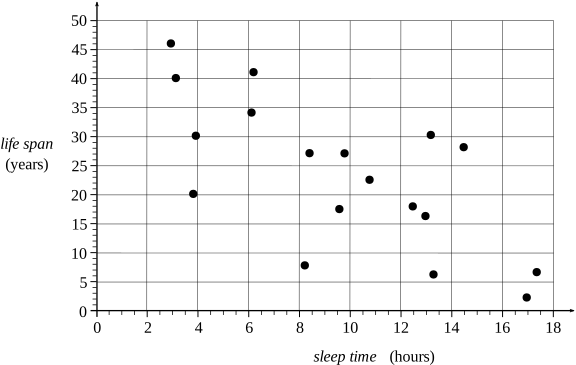
 

On the assumption that the association between sleep time and life span is linear, a least squares line is fitted to this data with sleep time as the explanatory variable.

The equation of this least squares line is

life span = 42.1 – 1.90 × sleep time

The coefficient of determination is 0.416

  1. Draw the graph of the least squares line on the scatterplot above.   (1 mark)

    --- 0 WORK AREA LINES (style=lined) ---

  2. Describe the linear association between life span and sleep time in terms of strength and direction.   (2 marks)

    --- 2 WORK AREA LINES (style=lined) ---

  3. Interpret the slope of the least squares line in terms of life span and sleep time.   (2 marks)

    --- 2 WORK AREA LINES (style=lined) ---

  4. Interpret the coefficient of determination in terms of life span and sleep time.   (1 mark)

    --- 2 WORK AREA LINES (style=lined) ---

  5. The life of the mammal with a sleep time of 12 hours is 39.2 years.
  6. Show that, when the least squares line is used to predict the life span of this mammal, the residual is 19.9 years.   (2 marks)

    --- 4 WORK AREA LINES (style=lined) ---
Show Answers Only
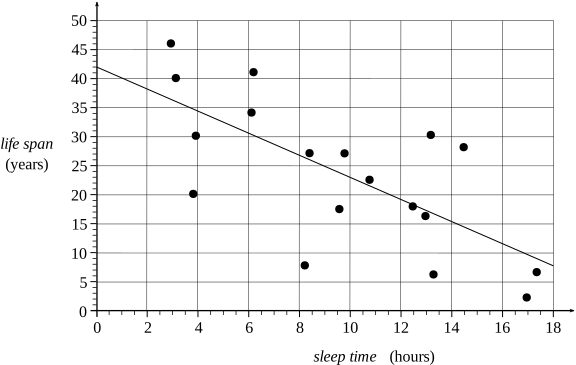
  1.  

  2. `text(Strength is moderate.)`


    `text(Direction is negative.)`

  3. `text(The gradient of –1.9 means that life span decreases by)` 


    `text(1.9 years for each additional hour of sleep time.)`

  4. `text(41.6% of the variation in life span can be explained by the)`


    `text(variation in sleep time.)`

  5. `text(Proof(See Worked Solution))`
Show Worked Solution

a.    `text{Graph endpoints (0, 42.1) and (18, 7.9)}`


b.   `text(Strength is moderate.)`

`text(Direction is negative.)`
 

c.    `text(The gradient of –1.9 means that life span decreases by)`

`text(1.9 years for each additional hour of sleep time.)`


d.    `text(41.6% of the variation in life span can be explained by the )`

`text(variation in sleep time.)`
 

e.    `text(Predicted value)` `= 42.1 – 1.9 xx 12`
  `= 19.3 \ text(years)`


`text(Residual)` `= text(actual) – text(predicted)`
  `= 39.2 – 19.3`
  `= 19.9 \ text(years)`

Filed Under: Correlation and Regression Tagged With: Band 3, Band 4, Band 5, smc-265-10-r / r^2 and Association, smc-265-40-Interpret Gradient, smc-265-50-Residuals

Data Analysis, GEN2 2019 NHT 3

The life span, in years, and gestation period, in days, for 19 types of mammals are displayed in the table below.
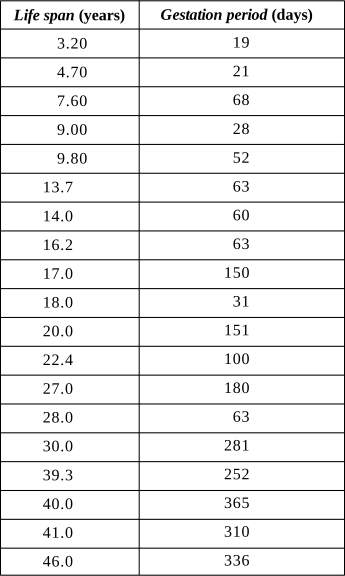
 

  1. A least squares line that enables life span to be predicted from gestation period is fitted to this data.
  2. Name the explanatory variable in the equation of this least squares line.   (1 mark)

    --- 1 WORK AREA LINES (style=lined) ---

  3. Determine the equation of the least squares line in terms of the variables life span and gestation period.
  4. Round the numbers representing the intercept and slope to three significant figures.   (2 marks)

    --- 2 WORK AREA LINES (style=lined) ---

  5. Write the value of the correlation rounded to three decimal places.   (1 mark)

    --- 2 WORK AREA LINES (style=lined) ---

Show Answers Only
  1. `text(gestation period)`
  2. `text(life span) = 7.58 + 0.101 xx \ text(gestation period)`
  3. `0.904`
Show Worked Solution

a.    `text(gestation period)`
 

b.    `text(Input data points into CAS:)`

`text(life span) = 7.58 + 0.101 xx \ text(gestation period)`
 

c.    `r = 0.904 \ text{(by CAS)}`

Filed Under: Correlation and Regression Tagged With: Band 3, Band 4, page-break-before-question, smc-265-10-r / r^2 and Association, smc-265-20-Find LSRL Equation/Gradient, smc-265-75-Explanatory / Response, smc-265-80-Rounding (Sig Fig)

Data Analysis, GEN2 2019 NHT 1

The table below displays the average sleep time, in hours, for a sample of 19 types of mammals.
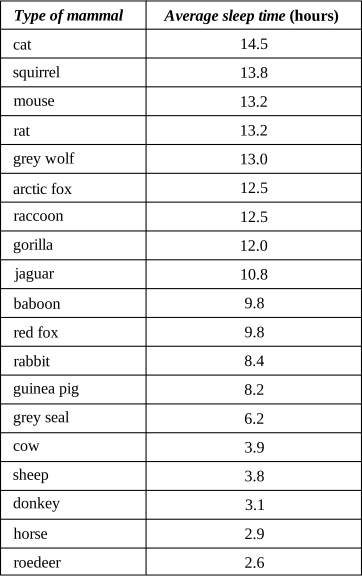
 

  1. Which of the two variables, type of mammal or average sleep time, is a nominal variable?   (1 mark)

    --- 1 WORK AREA LINES (style=lined) ---

  2. Determine the mean and standard deviation of the variable average sleep time for this sample of mammals.
  3. Round your answer to one decimal place.   (1 mark)

    --- 2 WORK AREA LINES (style=lined) ---

  4. The average sleep time for a human is eight hours.
  5. What percentage of this sample of mammals has an average sleep time that is less than the average sleep time for a human.
  6. Round your answer to one decimal place.   (1 mark)

    --- 2 WORK AREA LINES (style=lined) ---

  7. The sample is increase in size by adding in the average sleep time of the little brown bat.
  8. Its average sleep time is 19.9 hours.
  9. By how many many hours will the range for average sleep time increase when the average sleep time for the little brown bat is added to the sample?   (1 mark)

    --- 2 WORK AREA LINES (style=lined) ---

Show Answers Only
  1. `text(type of mammal)`
  2. `text(mean)= 9.2 \ text(hours)`


    `sigma = 4.2 \ text(hours)`

  3. `31.6text(%)`
  4. `5.4 \ text(hours)`
Show Worked Solution

a.    `text(type of mammal is nominal)`

 
b.    `text(mean)= 9.2 \ text(hours) \ \ text{(by CAS)}`

`sigma = 4.2 \ text(hours) \ \ text{(by CAS)}`
 

c.    `text(Percentage)` `= (6)/(19) xx 100`
  `= 0.3157 …`
  `= 31.6text(%)`


d.    `text(Range increase)` `= 19.9-14.5`
  `= 5.4 \ text(hours)`

Filed Under: Summary Statistics Tagged With: Band 2, Band 3, Band 4, page-break-before-question, smc-468-10-Data Classification, smc-468-20-Mean, smc-468-30-Std Dev, smc-468-40-Median Mode and Range

Statistics, EXT1 S1 EQ-Bank 10

Four cards are placed face down on a table. The cards are made up of a Jack, Queen, King and Ace.

A gambler bets that she will choose the Queen in a random pick of one of the cards.

If this process is repeated 7 times, express the gambler's success as a Bernoulli random variable and calculate

  1. the mean.  (1 mark)

    --- 1 WORK AREA LINES (style=lined) ---

  2. the variance.  (1 mark)

    --- 1 WORK AREA LINES (style=lined) ---

Show Answers Only
  1. `7/4`
  2. `21/16`
Show Worked Solution

i.     `text(Let)\ \ X = text(number of Queens chosen)`

`X\ ~\ text(Bin) (7,1/4)`

`E(X)` `=np`
  `= 7 xx 1/4`
  `=7/4`


ii.   `text(Var)(X)` `= np(1-p)`
    `=7/4(1-1/4)`
    `= 21/16`

Filed Under: Statistics and Binomial Distributions (Ext1) Tagged With: Band 3, Band 4, smc-1199-10-Calculate E(X), smc-1199-20-Calculate Var(X)/Std Dev

Statistics, EXT1 S1 EQ-Bank 1 MC

If `X` equals the number of successes in `n` independent Bernoulli trials, how many distinct values can `X` take?

  1. `\ n-1`
  2. `\ n(n-1)`
  3. `\ n`
  4. `\ n+1`
Show Answers Only

`D`

Show Worked Solution

`text(Distinct values of)\ X\ text(in:)`

`text{1 trial = 2}\ \ (X=0 or 1)`

`text{2 trials = 3}\ \ (X=0, 1 or 2)`

 `vdots`

`n\ text{trials =}\ n+1\ \ (X=0, 1, …, n)`

`=>  D`

Filed Under: Statistics and Binomial Distributions (Ext1) Tagged With: Band 3, smc-1199-50-Other problems

GRAPHS, FUR1-NHT 2019 VCAA 2 MC

Two straight lines have the equations  `3x - 2y = 3`  and  `-2x + 5y = 9`.

These lines have one point of intersection.

Another line that also passes through this point of intersection has the equation

  1.  `y = -x`
  2.  `y = x`
  3.  `y = -2x`
  4.  `y = 2x`
  5.  `y = 3x`
Show Answers Only

`B`

Show Worked Solution
`3x – 2y` `= 3\ text{… (1)}`
`-2x + 5y` `= 9\ text{… (2)}`

 
`text{Mult}\ \ (1) xx 2`

`6x – 4y = 6\ text{… (3)}`

`text{Mult}\ \ (2) xx 3`

`-6x + 15y = 27\ text{… (4)}`

`(3) + (4)`

`11y = 33 \ => \ y = 3`

`text(Substitute)\ \ y = 3\ \ text{into (1)}`

`3x – 6 = 3 \ => \ x = 3`

`=>  B`

Filed Under: Linear relationships Tagged With: Band 3

MATRICES, FUR1-NHT 2019 VCAA 3 MC

In matrix `A`, the element  `a_21 = 7`.

The order of matrix `A` is  `3 xx 2`.

Matrix `B` is the transpose of matrix `A`.

Matrix `B` could be

A. `\ [(3,9,4),(2,7,1)]` B. `\ [(4,7,2),(1,0,5)]` C. `\ [(4,1,3),(7,8,0)]`
D. `\ [(5,6),(7,1),(4,2)]` E. `\ [(9,7),(3,4),(0,2)]`    
Show Answers Only

`B`

Show Worked Solution

`A = (3 xx 2) \ => \ a_21 = 7`

`text(S)text(ince)\ \ B = A^T:`

`B = (2 xx 3) \ => \ b_12=7`

`=>\ B`

Filed Under: Matrix Calculations Tagged With: Band 3, smc-616-60-Transpose

MATRICES, FUR1-NHT 2019 VCAA 1 MC

The number of individual points scored by Rhianna (`R`), Suzy (`S`), Tina (`T`), Ursula (`U`) and Vicki (`V`) in five basketball matches `(F, G, H, I, J)` is shown in matrix `P` below.
 

`{:(),(),(P=):}{:(qquadqquadqquad\ text(match)),((quadF,G,H,I,J)),([(2,\ 0,\ 3,\ 1,\ 8),(4,7,2,5,3),(6,4,0,0,5),(1,6,1,4,5),(0,5,3,2,0)]):}{:(),(),({:(R),(S),(T),(U),(V):}):}{:(),(),(text(player)):}`
 

Who scored the highest number of points and in which match?

  1. Suzy in match  `I`
  2. Tina in match  `H`
  3. Vicki in match  `F`
  4. Ursula in match  `G`
  5. Rhianna in match  `J`
Show Answers Only

`E`

Show Worked Solution

`text(Highest points = 8 =)\ e_15`

`e_15 \ => \ text(Rhianna in match)\ J`

`=>\ E`

Filed Under: Matrix Calculations Tagged With: Band 3, smc-616-70-Elements/Rules

NETWORKS, FUR1-NHT 2019 VCAA 2 MC

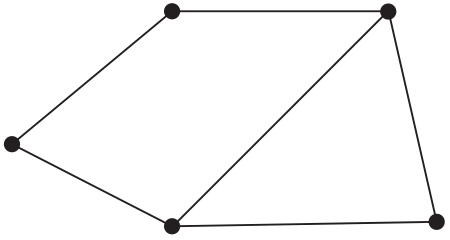
Consider the graph below.


Euler’s formula will be verified for this graph.

What values of  `e, v`  and  `f`  will be used in this verification?

  1. `e = 5, v = 5, f = 2`
  2. `e = 5, v = 5, f = 3`
  3. `e = 6, v = 5, f = 2`
  4. `e = 6, v = 5, f = 3`
  5. `e = 6, v = 6, f = 3`
Show Answers Only

`D`

Show Worked Solution

`text(Euler):\ \ v + f = e + 2`

`v` `= 5`
`e` `= 6`
`:. f` `= 3`

 
`=>  D`

Filed Under: Basic Concepts Tagged With: Band 3, smc-626-40-Euler's Formula

Vectors, EXT1 V1 EQ-Bank 5 MC

What is the angle between the vectors  `((2),(1))`  and  `((-4),(2))`?

A.   `cos^(-1)(0.06)`

B.   `cos^(-1)(–0.06)`

C.   `cos^(-1)(0.6)`

D.   `cos^(-1)(–0.6)`

Show Answers Only

`D`

Show Worked Solution
`cos theta` `=(underset~a * underset~b)/(|underset~a||underset~b|)`  
  `=(-8+2)/(sqrt(2^2+1^2) xx sqrt((-4)^2+2^2)`  
  `=(-6)/(sqrt5 sqrt20)`  
  `=-0.6`  
`:. theta` `= cos^(-1) (-0.6)`  

  
`=> D`

Filed Under: Operations With Vectors (Ext1) Tagged With: Band 3, smc-1086-20-Angles Between Vectors

Graphs, MET2-NHT 2019 VCAA 1

Parts of the graphs of  `f(x) = (x-1)^3(x + 2)^3`  and  `g(x) = (x-1)^2(x + 2)^3`  are shown on the axes below.
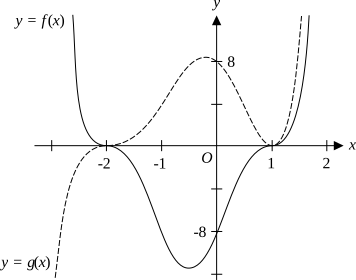


The two graphs intersect at three points,  (–2, 0),  (1, 0)  and  (`c`, `d`). The point  (`c`, `d`)  is not shown in the diagram above.

  1. Find the values of `c` and `d`.   (2 marks)

    --- 4 WORK AREA LINES (style=lined) ---

  2. Find the values of `x` such that  `f(x) > g(x)`.   (1 mark)

    --- 2 WORK AREA LINES (style=lined) ---

  3. State the values of `x` for which
    1. `f^{'}(x) > 0`   (1 mark)

      --- 2 WORK AREA LINES (style=lined) ---

    2. `g^{'}(x) > 0`   (1 mark)

      --- 2 WORK AREA LINES (style=lined) ---

  4. Show that  `f(1 + m) = f(–2-m)`  for all  `m`.   (1 mark)

    --- 3 WORK AREA LINES (style=lined) ---

  5. Find the values of `h` such that  `g(x + h) = 0`  has exactly one negative solution.   (2 marks)

    --- 4 WORK AREA LINES (style=lined) ---

  6. Find the values of `k` such that  `f(x) + k = 0`  has no solutions.   (1 mark)

    --- 2 WORK AREA LINES (style=lined) ---

Show Answers Only
  1. `c = 2 \ , \ d = 64`
  2. `(–∞, –2) \ ∪ \ (2, ∞)`
  3. i.  `(–(1)/(2), 1) \ ∪ \ (1, ∞)`
    ii. `(–∞, –2) \ ∪ \ (–2, –(1)/(5)) \ ∪ \ (1, ∞)`
  4. `text{Proof (Show Worked Solution)}`
  5.  `-2< h <=1`
  6. `(729)/(64)`
Show Worked Solution

a.    `text(Solve:) \ \ f(x) = g(x)`

`x = 1 , \ –2 \ text(and) \ 2`
 
`f(2) = 1^3 xx 4^3 = 64`
 
`text(Intersection at) \ (2, 64)`

`:. \ c = 2 \ , \ d = 64`


b.    `text(Using the graph and intersection at) \ (2, 64):`

`f(x) > g(x) \ \ text(for) \ \ (–∞, –2) \ ∪ \ (2, ∞)`


c.i.  `f'(x) > 0 \ \ text(for) \ \ (–(1)/(2), 1) \ ∪ \ (1, ∞)`

c.ii.  `g'(x) > 0 \ \ text(for) \ \ (–∞, –2) \ ∪ \ (–2, –(1)/(5)) \ ∪ \ (1, ∞)`


d.     `f(1 + m)` `= (1 + m-1)^3 (1 + m + 2)^3`
  `= m^3 (m + 3)^3`


`f(–2-m)` `= (–2-m -1)^3 (-2-m + 2)^3`
  `= (-m-3)^3 (-m)^3`
  `= (–1)^3 (m + 3)^3 (–1)^3 m^3`
  `= m^3 (m + 3)^3`


e.     `g(x + h)` `= (x + h-1)^2(x + h + 2)^3`
  `= underbrace{(x-(1 -h))^2}_{text(+ve solution)} * underbrace{(x-(h-2))^3}_{text(–ve solution)}`

 
`1-h ≥ 0 \ \ => \ \ h ≤ 1`

`-h-2 < 0 \ \ =>\ \ h > -2`

`:. -2< h <=1`


f.    `f(x) \ \ text(minimum S.P. when) \ \ f ′(x) = 0 \ =>  \ x =-(1)/(2)`

`text(S.P. at) \ \ (-(1)/(2) \ , \ -(729)/(64))`

`:. \ text(No solution if) \ \ k > (729)/(64)`

Filed Under: Polynomials Tagged With: Band 3, Band 4, Band 5, smc-750-60-Other

Functions, EXT1 F2 2019 MET2-N 3 MC

If  `x + a`  is a factor of  `8x^3-14x^2-a^2 x`, where  `a ∈ R, a!=0`, then the value of  `a`  is

  1.  `7`
  2.  `4`
  3.  `1`
  4. `-2`
Show Answers Only

`D`

Show Worked Solution
`f(-a)` `= 8(-a)^3-14(-a)^2-a^2(-a)`
`0` `= -8a^3-14a^2 + a^3`
`0` `= -7a^3-14a^2`
`0` `= -7a^2 (a + 2)`
`a` `= -2`

 
`=>D`

Filed Under: Remainder and Factor Theorems (Ext1) Tagged With: Band 3, smc-1031-10-Factor Theorem

Trigonometry, 2ADV T3 SM-Bank 8 MC

The diagram below shows one cycle of a circular function.
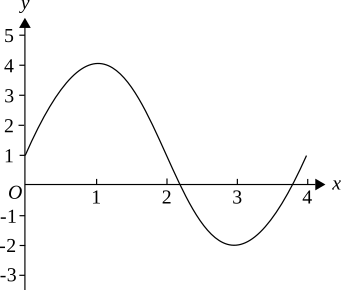
 

The amplitude and period of this function are respectively

  1. `3\ \ text(and)\ \ 2 `
  2. `3\ \ text(and)\ \ (pi)/(2)`
  3. `4\ \ text(and)\ \ (pi)/(4)`
  4. `3\ \ text(and)\ \ 4`
Show Answers Only

`D`

Show Worked Solution

`text(Graph centres around)\ \ y = 1`

`text(Amplitude) \ = 3`

`text(Period:) = 4`

`=> D`

Filed Under: Trig Graphs (Y12) Tagged With: Band 3, smc-977-40-Unknown Trig Ratio

Recursion, GEN1 2019 NHT 17 MC

A sequence of numbers is generated by the recurrence relation shown below.

`P_0 = 2,quadqquadP_(n + 1) = 3P_n - 1`

What is the value of  `P_3`?

  1.     2
  2.     5
  3.    11
  4.    41
  5.  122
Show Answers Only

`D`

Show Worked Solution

`P_1 = 3P_0 – 1 = 3 xx 2 – 1 = 5`

`P_2 = 3 xx 5 – 1 = 14`

`P_3 = 3 xx 14 – 1 = 41`

`=>\ D`

Filed Under: Recursion - General Tagged With: Band 3, smc-714-25-RR (combination), smc-714-50-Find term(s)

Data Analysis, GEN1 2019 NHT 5-7 MC

The birth weights of a large population of babies are approximately normally distributed with a mean of 3300 g and a standard deviation of 550 g.

Part 1

A baby selected at random from this population has a standardised weight of  `z = – 0.75`

Which one of the following calculations will result in the actual birth weight of this baby?
 

  1. `text(actual birth weight)\ = 550 - 0.75 × 3300`
  2. `text(actual birth weight)\ = 550 + 0.75 × 3300`
  3. `text(actual birth weight)\ = 3300 - 0.75 × 550`
  4. `text(actual birth weight)\ = 3300 + 0.75/550`
  5. `text(actual birth weight)\ = 3300 - 0.75/550`


Part 2

Using the 68–95–99.7% rule, the percentage of babies with a birth weight of less than 1650 g is closest to

  1. 0.14%
  2. 0.15%
  3. 0.17%
  4. 0.3%
  5. 2.5%


Part 3

A sample of 600 babies was drawn at random from this population.

Using the 68–95–99.7% rule, the number of these babies with a birth weight between 2200 g and 3850 g is closest to

  1. 111
  2. 113
  3. 185
  4. 408
  5. 489
Show Answers Only

`text(Part 1:)\ \ C`

`text(Part 2:)\ \ B`

`text(Part 3:)\ \ E`

Show Worked Solution

`text(Part 1)`

`text(Actual weight)` `= text(mean) + z xx text(std dev)`
  `= 3300 – 0.75 xx 550`

`=> C`


`text(Part 2)`

`z-text(score)` `= (x – barx)/5`
  `= (1650 – 3300)/550`
  `= −3`


`:. P(x < 1650)` `= P(z < −3)`
  `= 0.3/2`
  `= 0.15\ text(%)`

`=>B`
 

`text(Part 3)`

`ztext(-score)\ (2200) = (2200 – 3300)/550 = −2`

`ztext(-score)\ (3850) = (3850 – 3300)/550 = 1`
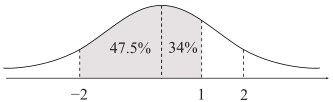


`text(Percentage)` `= (47.5 + 34)text(%) xx 600`
  `= 81.5text(%) xx 600`
  `= 48text(%)`

`=>\ E`

Filed Under: Normal Distribution Tagged With: Band 3, Band 4, Band 5, smc-600-10-Single z-score, smc-600-20-z-score Intervals

Data Analysis, GEN1 2019 NHT 1-2 MC

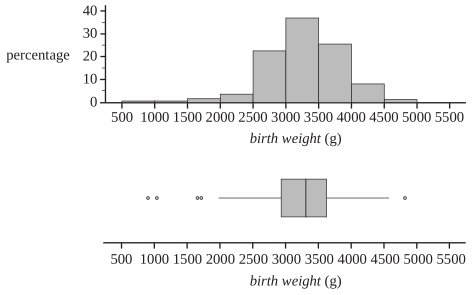
The histogram and boxplot shown below both display the distribution of the birth weight, in grams, of 200 babies.
 

Part 1

The shape of the distribution of the babies’ birth weight is best described as

  1. positively skewed with no outliers.
  2. negatively skewed with no outliers.
  3. approximately symmetric with no outliers.
  4. positively skewed with outliers.
  5. approximately symmetric with outliers.


Part 2

The number of babies with a birth weight between 3000 g and 3500 g is closest to

  1. 30
  2. 32
  3. 37
  4. 74
  5. 80
Show Answers Only
  1. `text(Part 1:)\ E`
  2. `text(Part 2:)\ D`
Show Worked Solution

`text(Part 1)`

`text(Approximately symmetric with outliers.)`

`=>\ E`


`text(Part 2)`

`text(Column representing 3000 – 3500g) ~~  37text(%)`

`text(37%) xx 200 = 74\ text(babies)`

`=> D`

Filed Under: Graphs - Stem/Leaf and Boxplots Tagged With: Band 3, smc-643-10-Single Box-Plots, smc-643-70-Distribution Description

Algebra, MET2-NHT 2019 VCAA 3 MC

If  `x + a`  is a factor of  `8x^3 - 14x^2 - a^2 x`, where  `a ∈ R text(\{0})`, then the value of  `a`  is

  1.  7
  2.  4
  3.  1
  4. –2
  5. –1
Show Answers Only

`D`

Show Worked Solution
`f(–a)` `= 8(–a)^3 – 14(–a)^2 – a^2(–a)`
`0` `= -8a^3 – 14a^2 + a^3`
`0` `= -7a^3 – 14a^2`
`0` `= -7a^2 (a + 2)`
`a` `= -2`

Filed Under: Polynomials Tagged With: Band 3, smc-750-10-Factor Theorem

Graphs, MET2-NHT 2019 VCAA 2 MC

The diagram below shows one cycle of a circular function.
 

The amplitude, period and range of this function are respectively

  1. `3, 2 \ \ text(and)\ \ [-2, 4]`
  2. `3, (pi)/(2) \ \ text(and)\ \ [-2, 4]`
  3. `4, 4 \ \ text(and) \ \ [0, 4]`
  4. `4, (pi)/(4) \ \ text(and) \ \ [-2, 4]`
  5. `3, 4 \ \ text(and) \ \ [-2, 4]`
Show Answers Only

`E`

Show Worked Solution

`text(Graph centres around)\ \ y = 1`

`text(Amplitude) \ = 3`

`:. \ text(Range) \ = [1 – 3, 1 + 3] = [-2, 4]`

`text(Period:) = 4`

`=> E`

Filed Under: Trig Equations Tagged With: Band 3, smc-2757-30-Find period, smc-2757-35-Find range, smc-2757-40-Find amplitude

Algebra, MET2-NHT 2019 VCAA 1 MC

The maximal domain of the function with rule  `f(x) = x^2 + log_e(x)`  is

  1. `R`
  2. `(0, ∞)`
  3. `[0, ∞)`
  4. `(–∞, 0)`
  5. `[1, ∞)`
Show Answers Only

`B`

Show Worked Solution

`log_e x \ \ text(is defined for)\ \ x > 0`

`:. \ text(Maximal domain) \ (0, ∞)`

`=> \ B`

Filed Under: Graphs and Applications Tagged With: Band 3, smc-2745-40-Log graphs, smc-2745-50-Find Domain/Range

Calculus, 2ADV C3 2019 MET1 4

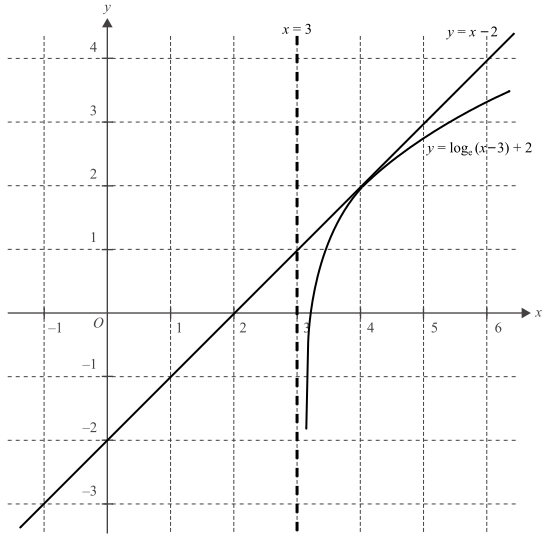
Given the function  `f(x) = log_e (x-3) + 2`,

  1. State the domain and range of `f(x)`.  (1 mark)

    --- 1 WORK AREA LINES (style=lined) ---

  2. i.  Find the equation of the tangent to the graph of  `f(x)` at  `(4, 2)`.  (2 marks)

    --- 4 WORK AREA LINES (style=lined) ---


    ii. On the axes below, sketch the graph of the function  `f(x)`, labelling any asymptote with its equation.


        Also draw the tangent to the graph of  `f(x)`  at  `(4, 2)`.  (4 marks)
     

--- 0 WORK AREA LINES (style=lined) ---

Show Answers Only
  1. `x >3`


    `y in R`

  2. i.  `y = x-2`


    ii. `text(See Worked Solutions)`

Show Worked Solution
a.   `text(Domain)` `: \ x > 3`
  `text(Range)` `: \ y in R`


b.i.   `g(x)` `= log_e (x-3) + 2`
  `g^{\prime}(x)` `= 1/(x-3)`
  `g^{\prime}(4)` `= 1`

 
`text(Equation of tangent),\ m = 1\ \ text(through)\ (4, 2):`

`y-2` `= 1(x-4)`
`y` `= x-2`


b.ii.  

Filed Under: Curve Sketching (Y12), Graphs and Applications (Y11) Tagged With: Band 3, Band 4, Band 5, smc-966-40-Log graphs, smc-969-30-Other Graphs

Calculus, 2ADV C2 2019 MET1 1a

Let  `y = (2e^(2x) - 1)/e^x`.

Find  `(dy)/(dx)`.  (2 marks)

--- 4 WORK AREA LINES (style=lined) ---

Show Answers Only

`(dy)/(dx) = 2e^x + e^(-x)`

Show Worked Solution

`text(Method 1)`

`y` `= 2e^x – e^(-x)`
`(dy)/(dx)` `= 2e^x + e^(-x)`


`text(Method 2)`

`(dy)/(dx)` `= (4e^(2x) ⋅ e^x – (2e^(2x) – 1) e^x)/(e^x)^2`
  `= (4e^(3x) – 2e^(3x) + e^x)/e^(2x) `
  `= (2e^(2x) + 1)/e^x`

Filed Under: Exponential Calculus (Y12), L&E Differentiation (Y12) Tagged With: Band 3, smc-965-10-Differentiation (base e), smc-967-10-Exponentials (base e), smc-967-40-Quotient Rule, smc-967-50-Chain Rule, smc-967-70-Log Laws required

Algebra, MET1-NHT 2019 VCAA 5a

Let  `h:[-3/2, oo) -> R,\ h(x) = sqrt(2x + 3) - 2.`

Find the value(s) of `x` such that  `[h(x)]^2 = 1`.  (2 marks)

Show Answers Only

`3 or\ text(−1)`

Show Worked Solution
  `[h(x)]^2 = 1` `\ => \ h(x) = +- 1`
  `sqrt(2x + 3)` `= 1` `sqrt(2x + 3) – 2` `= -1`
  `sqrt(2x + 3)` `= 3` `sqrt(2x + 3)` `= 1`
  `2x + 3` `= 9` `2x + 3` `= 1`
  `x` `= 3` `x` `= -1`

 
`:. x = 3 or -1\ \ \ text{(both in the domain of}\ h)`

Filed Under: Functional Equations Tagged With: Band 3, smc-642-30-[ f(x) ]^2

Calculus, MET1-NHT 2019 VCAA 4

A function `g` has rule  `g(x) = log_e (x-3) + 2`.

  1. State the maximal domain of `g` and the range of `g` over its maximal domain.   (2 marks)

    --- 4 WORK AREA LINES (style=lined) ---

  2. i.  Find the equation of the tangent to the graph of `g` at `(4, 2)`.   (2 marks)

    --- 5 WORK AREA LINES (style=lined) ---


    ii. On the axes below, sketch the graph of the function `g`, labelling any asymptote with its equation.

  3.     Also draw the tangent to the graph of `g` at  `(4, 2)`.   (4 marks)
      

--- 4 WORK AREA LINES (style=lined) ---

Show Answers Only
  1. `x in (3, oo)`


    `y in R`

  2. i.  `y = x-2`
    ii. 
     
Show Worked Solution
a.   `text(Domain)` `: \ x in (3, oo)`
  `text(Range)` `: \ y in R`


b.i.   `g(x)` `= log_e (x-3) + 2`
  `g^{prime} (x)` `= 1/(x-3)`
  `g^{prime} (4)` `= 1`

 
`text(Equation of tangent),\ m = 1\ \ text(through)\ (4, 2):`

`y-2` `= 1(x-4)`
`y` `= x-2`


b.ii.  

Filed Under: Curve Sketching Tagged With: Band 3, Band 4, smc-724-30-Log/Exponential

Calculus, MET1-NHT 2019 VCAA 3

  1. Evaluate  `int_2^7 1/(x + sqrt 3)\ dx`  and  `int_2^7 1/(x-sqrt 3)\ dx`.   (2 marks)

    --- 6 WORK AREA LINES (style=lined) ---

  2. Show that  `1/2 (1/(x-sqrt 3) + 1/(x + sqrt 3)) = x/(x^2-3)`.   (1 mark)

    --- 4 WORK AREA LINES (style=lined) ---

  3. Use your answers to part a. and part b. to evaluate  `int_2^7 x/(x^2-3)\ dx`  in the form  `1/a log_e(b)`, where  `a` and `b` are positive integers.   (1 mark)

    --- 5 WORK AREA LINES (style=lined) ---

Show Answers Only
  1. `log_e((7-sqrt 3)/(2-sqrt 3))`
  2. `text(Proof)\ text{(See Worked Solutions)}`
  3. `1/2 log_e 46`
Show Worked Solution
a.   `int_2^7 1/(x + sqrt 3)\ dx` `= [log_e (x + sqrt 3)]_2^7`
    `= log_e(7 + sqrt 3)-log_e (2 + sqrt 3)`
    `= log_e ((7 + sqrt 3)/(2 + sqrt 3))`


`int_2^7 1/(x-sqrt 3)\ dx` `= [log_e (x – sqrt 3)]_2^7`
  `= log_e (7-sqrt 3)-log_e (2-sqrt 3)`
  `= log_e ((7-sqrt 3)/(2-sqrt 3))`


b.   `1/2(1/(x-sqrt 3) + 1/(x + sqrt 3))` `= 1/2 ((x + sqrt 3 + x-sqrt 3)/((x-sqrt 3)(x + sqrt 3)))`
    `= 1/2 ((2x)/(x^2-3))`
    `= x/(x^2-3)\ \ text(… as required)`


c.   `int_2^7 x/(x^2-3)` `= 1/2 int_2^7 1/(x-sqrt 3) + 1/(x + sqrt 3)\ dx`
    `= 1/2[log_e ((7-sqrt 3)/(2-sqrt 3)) + log_e ((7 + sqrt 3)/(2 + sqrt 3))]`
    `= 1/2 log_e (((7-sqrt 3)(7 + sqrt 3))/((2-sqrt 3)(2 + sqrt 3)))`
    `= 1/2 log_e ((49-3)/(4-3))`
    `= 1/2 log_e 46`

Filed Under: Integration (L&E), L&E Integration Tagged With: Band 3, Band 4, smc-740-40-Log (definite), smc-740-75-Log/Index laws required, smc-748-40-Log (definite), smc-748-75-Log/Index laws required

Calculus, MET1-NHT 2019 VCAA 1a

Let  `y = (2e^(2x)-1)/e^x`.

Find  `(dy)/(dx)`.   (2 marks)

--- 3 WORK AREA LINES (style=lined) ---
Show Answers Only

`(dy)/(dx) = 2e^x + e^(-x)`

Show Worked Solution

`text(Method 1)`

`y` `= 2e^x-e^(-x)`
`(dy)/(dx)` `= 2e^x + e^(-x)`


`text(Method 2)`

`(dy)/(dx)` `= (4e^(2x) ⋅ e^x-(2e^(2x)-1) e^x)/(e^x)^2`
  `= (4e^(3x)-2e^(3x) + e^x)/e^(2x) `
  `= (2e^(2x) + 1)/e^x`

Filed Under: Differentiation (L&E), L&E Differentiation Tagged With: Band 3, smc-739-10-Exponential, smc-739-50-Quotient Rule, smc-745-10-Exponential, smc-745-40-Quotient Rule

Statistics, EXT1 S1 EQ-Bank 23

A light manufacturer knows that 6% of the light bulbs it produces are defective.

Light bulbs are supplied in boxes of 20 bulbs. Boxes are supplied in pallets of 120 boxes.

Calculate the probability that

  1. A box of light bulbs contains exactly 3 defective bulbs.  (1 mark)

    --- 2 WORK AREA LINES (style=lined) ---

  2. A box of light bulbs contains at least 1 defective bulb.  (1 mark)

    --- 2 WORK AREA LINES (style=lined) ---

  3. A pallet contains between 90 and 95 (inclusive) boxes with at least 1 defective bulb (use the probability table attached).  (3 marks)

    --- 8 WORK AREA LINES (style=lined) ---

Show Answers Only
  1. `0.086\ \ (text(to 3 d.p.))`
  2. `0.710\ \ (text(3 d.p.))`
  3. `0.1416`
Show Worked Solution

i.   `P(D) = 0.06, \ P(barD) = 0.94`

`P(D = 3)` `= \ ^20C_3(0.06)^3(0.94)^17`
  `= 0.086\ \ (text(to 3 d.p.))`


ii.    `P(D >= 1)` `= 1 – P(D = 0)`
    `= 1 – \ ^20C_0(0.06)^0(0.94)^20`
    `= 0.710\ \ (text(to 3 d.p.))`


iii.   `text(Let)\ \ X = text(number of boxes where)\ \ D >= 1`

`text(Let)\ \ overset^p = text(proportion of boxes where)\ \ D >= 1`

`E(overset^p) = p = 0.710`

`text(Var)(overset^p) = (0.710(1 – 0.710))/120 = 0.0017158`

`sigma(overset^p) = 0.04142`
 

`overset^p\ ~\ N(0.710, 0.04142)`

`text(If)\ \ X = 90 \ => \ overset^p = 90/120 = 0.75`

`text(If)\ \ X = 95 \ => \ overset^p = 95/120 = 0.79167`
 

`ztext(-score)\ (X = 90) = (0.75 – 0.710)/(0.04142) = 0.9657`

`ztext(-score)\ (X = 95) = (0.79167 – 0.710)/(0.04142) = 1.972`
 

`P(90 <= X <= 95)` `= P(0.97 <= z <= 1.97)`
  `= 0.9756 – 0.8340`
  `= 0.1416`

Filed Under: Normal Approximations of Sample Proportions (Ext1) Tagged With: Band 3, Band 4, Band 5, smc-1085-20-z-score intervals

Statistics, EXT1 S1 EQ-Bank 20

Netball Australia records show that 10% of all registered players are over the age of 25.

  1. A random survey of 100 netball players was carried out to find out how many were over 25 years of age.


    Assuming the sample proportion is normally distributed, calculate the expected mean and standard deviation of this group.  (2 marks)

    --- 4 WORK AREA LINES (style=lined) ---

  2. Using the probability table attached, estimate the probability that at least 15 players surveyed will be over 25 years of age.  (2 marks)

    --- 3 WORK AREA LINES (style=lined) ---
Show Answers Only
  1. `0.03`
  2. `0.0475`
Show Worked Solution
i.   `E(hat p)` `= p = 0.1`
  `text(Var)(hat p)` `= (p(1 – p))/n`
    `= (0.1(0.9))/100`
    `= 0.0009`
  `sigma(hat p)` `= sqrt(0.0009)`
    `= 0.03`


ii.  `Ptext{(at least 15 players are over 25)} = P(hat p >= 0.15)`

`hat p\ ~\ N(mu,sigma)\ ~\ N(0.1, 0.03)`

`P(hat p >= 0.15)` `= P(z >= (0.15 – 0.10)/0.03)`
  `= P(z >= 1.67)`
  `= 1 – 0.9525`
  `= 0.0475`

Filed Under: Normal Approximations of Sample Proportions (Ext1) Tagged With: Band 3, Band 4, smc-1085-10-Single z-score

Statistics, SPEC2-NHT 2019 VCAA 6

A paint company claims that the mean time taken for its paint to dry when motor vehicles are repaired is 3.55 hours, with a standard deviation of 0.66 hours.

Assume that the drying time for the paint follows a normal distribution and that the claimed standard deviation value is accurate.

  1. Let the random variable  `barX`  represent the mean time taken for the paint to dry for a random sample of 36 motor vehicles.


    Write down the mean and standard deviation of  `barX`.   (2 marks)

    --- 4 WORK AREA LINES (style=lined) ---

At a car crash repair centre, it was found that the mean time taken for the paint company's paint to dry on randomly selected vehicles was 3.85 hours. The management of this crash repair centre was not happy and believed that the claim regarding the mean time taken for the paint to dry was too low. To test the paint company's claim, a statistical test was carried out.

  1. Write down suitable null and alternative hypotheses `H_0` and `H_1` respectively to test whether the mean time taken for the paint to dry is longer than claimed.   (1 mark)

    --- 1 WORK AREA LINES (style=lined) ---

  2. Write down an expression for the  `p`  value of the statistical test and evaluate it correct to three decimal places.   (2 marks)

    --- 4 WORK AREA LINES (style=lined) ---

  3. Using a 1% level of significance, state with a reason whether the crash repair centre is justified in believing that the paint company's claim of mean time taken for its paint to dry of 3.55 hours is too low.  (1 mark)

    --- 2 WORK AREA LINES (style=lined) ---

  4. At the 1% level of significance, find the set of sample mean values that would support the conclusion that the mean time taken for the paint to dry exceeded 3.55 hours. Give your answer in hours, correct to three decimal places.  (2 marks)

    --- 4 WORK AREA LINES (style=lined) ---

  5. If the true time taken for the paint to dry is 3.83 hours, find the probability that the paint company's claim is not rejected at the 1% level of significance, assuming the standard deviation for the paint to dry is still 0.66 hours. Give your answer correct to two decimal places.  (1 mark)

    --- 3 WORK AREA LINES (style=lined) ---

Show Answers Only
  1. `0.11`
  2. `H_0 : \ mu = 3.55`
    `H_1 : \ mu > 3.55`
  3. `0.003 \ text{(to 3 decimal places)}`
  4. `text(S) text(ince) \ \ p < 0.01 , H_0 \ text(should be rejected at the 1% level.)`
  5. `barX > 3.806`
  6. `0.41`
Show Worked Solution
a.   `E(barX)` `= 3.55`
`sigma(barX)` `= (sigma)/(sqrtn)`
  `= (0.66)/(sqrt36)`
  `= 0.11`


b.   `H_0 : \ mu = 3.55`

`H_1 : \ mu > 3.55`


c.   `p` `= text(Pr) (barX > 3.85)`
  `= text(Pr) (z > (3.85-3.55)/(0.11))`
  `= text(Pr) (z >2.326)`
  `= 0.003 \ text{(to 3 decimal places)}`


d.   `text(S) text(ince)\ \ p < 0.01 , H_0 \ text(should be rejected at the 1% level.)`

`text(i.e. repair centre is justified that the mean time 3.55 hours is too low.)`


e.   `text(If) \ \ mu = 3.55`

`(barX-mu)/(sigma)` `> 2.3263`
`barX` `> 2.3263 xx 0.11 + 3.55`
`barX` `> 3.806`


f.   `text(Pr) (barX< 3.806 | mu = 3.83)` `= text(Pr) (z < (3.806-3.83)/(0.11))`
  `= text(Pr) (z < -0.21818)`
  `= 0.41`

Filed Under: Confidence Intervals and Hypothesis Testing (SM) Tagged With: Band 3, Band 4, Band 5, smc-1162-20-Other CI (sample), smc-1162-30-One-tail test, smc-1162-50-Null/Alternative hypothesis

Calculus, SPEC2-NHT 2019 VCAA 3


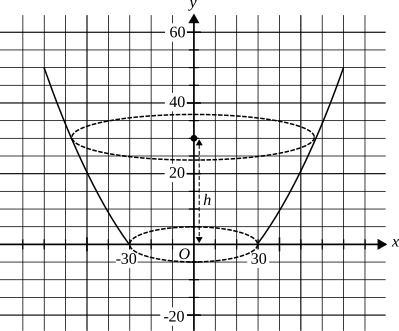
The vertical cross-section of a barrel is shown above. The radius of the circular base (along the `x`-axis) is 30 cm and the radius of the circular top is 70 cm. The curved sides of the cross-section shown are parts of the parabola with rule  `y = (x^2)/(80) - (45)/(4)`. The height of the barrel is 50 cm.
 
a.  i.   Show that the volume of the barrel is given by  `pi int_0^50 (900 + 80 y)\ dy`.  (1 marks)
     ii.  Find the volume of the barrel in cubic centimetres.  (1 marks)    

The barrel is initially full of water. Water begins to leak from the bottom of the barrel such that  `(dV)/(dt) = (-8000pi sqrth)/(A)`  cubic centimetres per second, where after  `t`  seconds the depth of the water is  `h`  centimetres, the volume of water remaining in the barrel is  `V`  cubic centimetres and the uppermost surface area of the water is  `A`  square centimetres.
 
b.     Show that  `(dV)/(dt) = (-400 sqrth)/(4h + 45)`?  (2 marks)
c.      Find  `(dh)/(dt)`  in terms of  `h`. Express your answer in the form  `(-a sqrth)/(pi(b + ch)^2)`, where  `a, b`  and  `c`  are positive integers.  (3 marks)
d.     Using a definite integral in terms of  `h`, find the time, in hours, correct to one decimal place, taken for the barrel to empty.  (2 marks)

Show Answers Only

a.  i. `text(Proof(Show Worked Solution))`

      ii.  `145000 pi \ text(cm)^3`

b.    `text(Proof (Show Worked Solution))`

c.    `(-20 sqrth)/(pi(45 + 4h)^2)`

d.    `9.9\ text(hours)`

Show Worked Solution
a.i. `V` `= pi int x^2 dy`
  `y` `= (x^2)/(80) – (45)/(4)`
  `x^2` `= 80y + 900`
     
  `:. \ V` `= pi int_0^50 (900 + 80y)dy`


a.ii. `V` `= pi int_0_50 (900 + 80y) dy`
    `= pi [900y + 40y^2]_0^50`
    `= 145000pi \ text(cm)^3`


b.    `A = pi x^2 = pi (900 + 80h)`

`(dV)/(dt)` `= (-8000pi sqrth)/(pi(900 + 80h))`
  `= (-8000 sqrth)/(20(4h + 45))`
  `= (-400 sqrth)/(4h + 45)`


c.    `(dV)/(dh) = pi(900 + 80h)`

`(dh)/(dt)` `= (dh)/(dV) ⋅ (dV)/(dt)`
  `= (1)/(pi(900 +80h)) xx (-400 sqrth)/(4h +45)`
  `= (-400 sqrth)/(20pi(4h +45)^2)`
  `= (-20 sqrth)/(pi(45 +4h)^2)`


d.    `(dt)/(dh) = (-pi(45 + 4h)^2)/(20 sqrth)`

`t` `= -pi int_50^0 ((45 + 4h)^2)/(20 sqrth)\ dh`
  `≈ 35\ 598.6 \ text(seconds)`
  `≈ 9.9 \ text{hours  (to 1 d.p.)}`

Filed Under: Uncategorized Tagged With: Band 3, Band 4, Band 5

Calculus, SPEC2-NHT 2019 VCAA 2

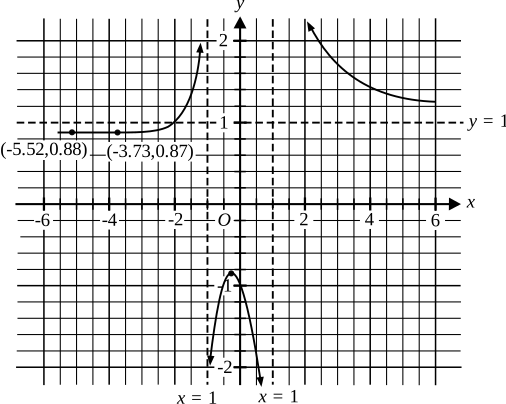
Consider the function `f` with rule  `f(x) = (x^2 + x + 1)/(x^2-1)`.

  1. State the equations of the asymptotes of the graph of `f`.  (2 marks)

    --- 2 WORK AREA LINES (style=lined) ---

  2. State the coordinates of the stationary points and the point of inflection. Give your answers correct to two decimal places.  (2 marks)

    --- 5 WORK AREA LINES (style=lined) ---

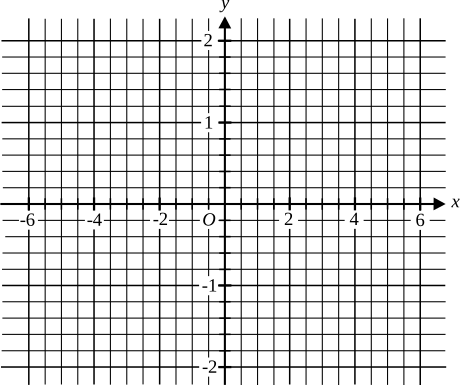
  3. Sketch the graph of `f` from  `x = -6`  to  `x = 6`  (endpoint coordinates are not required) on the set of axes below, labeling the turning points and the point of inflection with their coordinates correct to two decimal places. Label the asymptotes with their equations.  (3 marks)

    --- 0 WORK AREA LINES (style=lined) ---

Consider the function `f_k` with rule  `f_k(x) = (x^2 + x + k)/(x^2-1)`  where  `k ∈ R`.

  1. For what values of `k` will `f_k` have no stationary points?  (2 marks)

    --- 5 WORK AREA LINES (style=lined) ---

  2. For what value of `k` will the graph of `f_k` have a point of  inflection located on the `y`-axis?  (1 marks)

    --- 3 WORK AREA LINES (style=lined) ---

Show Answers Only

i.     `x = 1, x = -1, y = 1`

 ii.   `(-3.73, 0.87) \ text(and) \ (-0.27, -0.87)`

`(-5.52, 0.88)`

iii.

iv.  `-2`

v.  `-1`

Show Worked Solution

i.    `f(x) = 1 + (x + 2)/((x + 1)(x-1))`

`:. \ text(Asymptotes at)\ \ x = 1, x = -1, y = 1`
  

ii.   `f′(x) = (-(x^2 + 4x + 1))/(x^2-1)^2`

`text(Solve:) \ \ f^{′}(x) = 0 \ => \ x = -2 ± sqrt3`

`text(SP’s at) \ (-3.73, 0.87) \ \ text(and)\ \ (-0.27, -0.87)`
 
`f^{″}(x) = (-2x^3-12x^2-6x-4)/(x^2-1)^3`
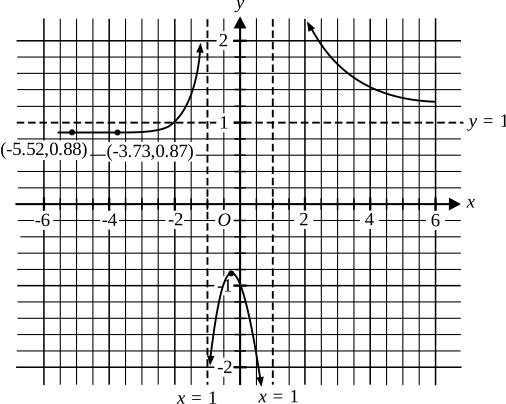
`text(Solve:) \ \ f^{″}(x) = 0 \ => \ x = -5.52`

`text(POI at) \ \ (-5.52, 0.88)`
 

iii.


iv.    `f_k^{′}(x) = (-x^2-2(k+1) x-1)/(x^2-1)^2`

`text(If no SP’s,) \ \ Δ < 0`

`[-2( k + 1)]^2-4(-1)(-1)` `< 0`
`4k^2 + 8k + 4-4` `< 0`
`4k(k + 2)` `< 0`

 
`:. \ -2 < k < 0`
 

v.    `f_k^{″}(x) = (2(x^3 + 3(k + 1) x^2 + 3x + k + 1))/((x^2-1)^3)`

`text(Solve:)\ \ f_k^{″}(x) = 0`

`k = -1`

Filed Under: Tangents and Curve Sketching Tagged With: Band 3, Band 4, Band 5, smc-1182-35-Sketch curve

Complex Numbers, SPEC2-NHT 2019 VCAA 6 MC

`P(z)`  is a polynomial of degree  `n`  with real coefficients where  `z ∈ C`. Three of the roots of the equation  `P(z) = 0`  are  `z = 3 - 2i`, `z = 4`  and  `z = −5i`.

The smallest possible value of  `n`  is

  1.  3
  2.  4
  3.  5
  4.  6
  5.  7
Show Answers Only

`C`

Show Worked Solution

`text(Roots:)\ 4, 3 ± 2i, ±5i\ \ \ (text(conjugate root theorem))`

`:.\ text(Minimum roots = 5)`

`=>\ C`

Filed Under: Factors and Roots (SM) Tagged With: Band 3, smc-1172-30-Roots > 3, smc-1172-40-Conjugate roots

Complex Numbers, SPEC2-NHT 2019 VCAA 1

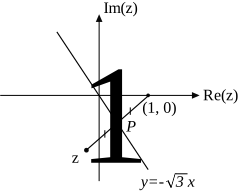
In the complex plane, `L` is the with equation `|z + 2| = |z-1-sqrt3 i|`.

  1.  Verify that the point (0, 0) lies on `L`.   (1 marks)

    --- 4 WORK AREA LINES (style=lined) ---

  2.  The line  `L`  can also be expressed in the form  `|z-1| = |z-z_1|`, where  `z_1 ∈ C`.


     Find  `z_1` in cartesian form.   (2 marks)

    --- 5 WORK AREA LINES (style=lined) ---

  3.  Find, in cartesian form, the points(s) of intersection of  `L`  and the graph of  `|z| = 4`.   (2 marks)

    --- 5 WORK AREA LINES (style=lined) ---

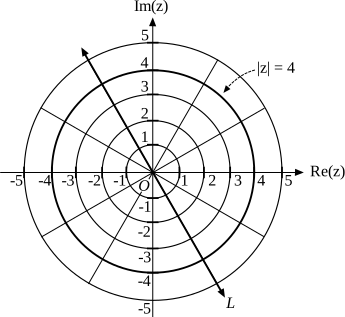
  4.  Sketch  `L`  and the graph of  `|z| = 4`  on the Argand diagram below.   (2 marks)

    --- 0 WORK AREA LINES (style=lined) ---
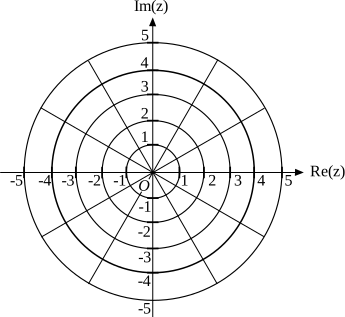


  5.  Find the area of the sector defined by the part of  `L`  where  `text(Re)(z) ≥ 0`, the graph of  `|z| = 4`  where  `text(Re)(z) ≥ 0`, and imaginary axis where  `text(Im)(z) > 0`.   (1 marks)

    --- 3 WORK AREA LINES (style=lined) ---
Show Answers Only
  1. `text(Proof(See Worked Solution))`
  2. `text(Proof(See Worked Solution))`
  3. `-(1)/(2)-(sqrt3)/(2) i`
  4. `(2,-2 sqrt3) text(and) (-2, 2 sqrt3)`
  5.  

     
  6. `(20pi)/(3)`
Show Worked Solution

a.   `text(Substitute)\ \ z = 0 + 0i\ \  text(into both sides:)`

`text(LHS) = |2| = 2`

`text(RHS) = |-1-sqrt3i| = sqrt{(-1)^2 + (-sqrt3)^2} = 2`

`:. (0,0)\ \ text(lies on both sides.)`


b.  `|x + yi + 2|` `= |x + yi-1-sqrt3 i|`
  `|(x + 2) + yi|` `= |(x-1) + (y-sqrt3) i|`
  `sqrt(x^2 + 4x + 4 + y^2` `= sqrt(x^2-2x + 1 + y^2 -2 sqrt3 y + 3`
  `x^2 + 4x + 4 + y^2` `= x^2-2x + 4-2 sqrt3 y + y^2`
  `6x` `= -2 sqrt3 y`
  `y` `= -(3)/(sqrt3) x`
  `y` `= -sqrt3 x`


c.

`m_text(perp) = (sqrt2)/(3) , text(through)\ (1, 0)`

`y = (sqrt3)/(3) (x-1)\ …\ L_1`

`text(Intersection) \ L\ text(and) \ L_1,`

`text(Solve:) \ (sqrt3)/3 (x-1) = -sqrt3 x\ \ \ text{(by CAS)}`

`=> x = (1)/(4) , y = -(sqrt3)/(4) \ \ \ text{(point}\ Ptext{)}`
 

`P(x_1,y_1) \ text(is midpoint of) \ \ z_1 \ text(and) \ \ (1, 0):`

`(x_1 + 1)/(2) = (1)/(4) \ => \ x_1 = -(1)/(2)`

`(y_1 + 0)/(2) = -sqrt3/(4) \ => \ y_1 = -sqrt3/(2)`

`:. \ z_1 = -(1)/(2)-(sqrt3)/(2) i`


d.   `|z| = 4 => \ text(circle, centre) \ (0,0), \ text(radius) = 4`

`x^2 + y^2 = 16\ …\ (1)`

`y =-sqrt3 x\ …\ (2)`

`text(Substitute)\ (2) \ text(into) \ (1)`

`x^2 + 3x^2 = 16`

`x = ±2`

`:. \ text(Intersection at)\ (2,-2 sqrt3) \ text(and) \ (-2, 2 sqrt3)`


e.


f.    
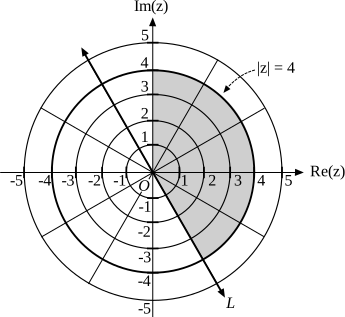
`text(Area)` `= (5)/(12) xx  pi xx 4^2`
  `= (20pi)/(3)`

Filed Under: Geometry and Complex Numbers (SM) Tagged With: Band 3, Band 4, Band 5, smc-1173-30-Sketch regions, smc-1173-40-Linear

Functions, EXT1 F1 2019 SPEC2-N 2 MC

The curve given by  `x = 3sec(t) + 1`  and  `y = 2tan(t)-1`  can be expressed in cartesian form as

  1.  `((y + 1)^2)/4-((x-1)^2)/9 = 1`
  2.  `((x + 1)^2)/3-((y-1)^2)/2 = 1`
  3.  `((x-1)^2)/3 + ((y + 1)^2)/2 = 1`
  4.  `((x-1)^2)/9-((y + 1)^2)/4 = 1`
Show Answers Only

`D`

Show Worked Solution

`sec^2theta = tan^2theta + 1`

`x = 3sec(t) + 1 \ => \ sec(t) = (x-1)/3`

`y = 2tan(t)-1 \ => \ tan(t) = (y + 1)/2`

`:.((x-1)/3)^2-((y + 1)/2)^2` `= 1`
`((x-1)^2)/9-((y + 1)^2)/4` `= 1`

`=>\ D`

Filed Under: Parametric Functions (Ext1), Parametric Functions and Relations (Ext1-2027) Tagged With: Band 3, smc-1035-30-Linear and Other, smc-6642-30-Linear and Other

Graphs, SPEC2-NHT 2019 VCAA 1 MC

The graph of which one of the following relations does not have a vertical asymptote?

  1.  `y = (x^3 - 1)/x`
  2.  `y = (5x^2 + 2)/(x^2 + 1)`
  3.  `y = (x^4 - 3)/(x^2)`
  4.  `y = 1/(x^2 + 4x)`
  5.  `y = (x - 1)/(sqrt(x + 2))`
Show Answers Only

`B`

Show Worked Solution

`text(Vertical asymptote when denominator = 0)`

`x^2 + 1 != 0`

`=>\ B`

Filed Under: Partial Fractions, Quotient and Other Functions (SM) Tagged With: Band 3, smc-1154-10-Quotient functions/Asymptotes

Vectors, EXT1 V1 EQ-Bank 28

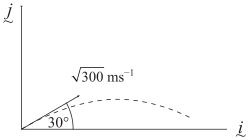
A projectile is fired from a canon at ground level with initial velocity `sqrt300` ms−1 at an angle of 30° to the horizontal.

The equations of motion are  `(d^2x)/(dt^2) = 0`  and  `(d^2y)/(dt^2) = −10`.

  1. Show that  `x = 15t`.  (1 mark)

    --- 5 WORK AREA LINES (style=lined) ---

  2. Show that  `y = 5sqrt3t - 5t^2`.  (2 marks)

    --- 5 WORK AREA LINES (style=lined) ---

  3. Hence find the Cartesian equation for the trajectory of the projectile.  (1 mark)

    --- 2 WORK AREA LINES (style=lined) ---

Show Answers Only
  1. `text(See Worked Solutions)`
  2. `text(See Worked Solutions)`
  3. `y = sqrt3/3 – (x^2)/45`
Show Worked Solution

i.   

`dotx = sqrt300\ cos30^@ = 10sqrt3 xx sqrt3/2 = 15\ text(ms)^(−1)`

`x = int 15\ dt = 15t + C_1`

`text(When)\ \ t = 0, \ x = 0 \ => \ C_1 = 0`

`:. x = 15t`


ii.   `doty = int −10\ dt = −10t + C_1`

`text(When)\ \ t = 0, \ doty = 10sqrt3 sin30^@ = 5sqrt3 \ => \ C_1 = 5sqrt3`

`:. doty = 5sqrt3 – 10t`
 

`y = int doty\ dt = 5sqrt3t – 5t^2 + C_2`

`text(When)\ \ t = 0, \ y = 0 \ => \ C_2 = 0`

`:. y = 5sqrt3t – 5t^2`


iii.   `x = 15t \ => \ t = x/15`

`y` `= 5sqrt3 xx x/15 – 5(x/15)^2`  
`:.y` `=sqrt3/3 x – (x^2)/45`  

Filed Under: Vectors and Projectile Motion (Ext1) Tagged With: Band 3, Band 4, smc-1087-90-Cartesian

Combinatorics, EXT1 A1 SM-Bank 9

`(2 - sqrt3)^5 = a + bsqrt3`.

Evaluate `a` and `b` using a binomial expansion.  (2 marks)

Show Answers Only

`a = 362, \ b = -209`

Show Worked Solution
`(2 – sqrt3)^5` `= \ ^5C_0 *2^5 + \ ^5C_1* 2^4(−sqrt3) + \ ^5C_2 *2^3(−sqrt3)^2 + \ ^5C_3 *2^2(−sqrt3)^3`
               `+ \ ^5C_4 *2(−sqrt3)^4 + \ ^5C_5(−sqrt3)^5`
  `= 32 – 80sqrt3 + 240 – 120sqrt3 + 90 – 9sqrt3`
  `= 362 – 209sqrt3`

 
`:. a = 362, \ b = -209`

Filed Under: Binomial Expansion (Ext1) Tagged With: Band 3, smc-1088-40-Full Expansion

Combinatorics, EXT1 A1 EQ-Bank 8

Show `\ ^nC_k = \ ^nC_(n - k)`.  (1 mark)

Show Answers Only

`text(See Worked Solutions)`

Show Worked Solution

`\ ^nC_k = (n!)/((n – k)!k!)`

`\ ^nC_(n – k)` `= (n!)/((n – (n – k))!(n – k)!)`
  `= (n!)/(k!(n – k)!)`
  `= \ ^nC_k`

Filed Under: Binomial Expansion (Ext1) Tagged With: Band 3, smc-1088-30-Proofs

Vectors, EXT2 V1 2019 SPEC2 4

The base of a pyramid is the parallelogram  `ABCD`  with vertices at points  `A(2,−1,3),  B(4,−2,1),  C(a,b,c)`  and  `D(4,3,−1)`. The apex (top) of the pyramid is located at  `P(4,−4,9)`.

  1. Find the values of  `a, b`  and  `c`.  (2 marks)

    --- 4 WORK AREA LINES (style=lined) ---

  2. Find the cosine of the angle between the vectors  `overset(->)(AB)`  and  `overset(->)(AD)`.  (2 marks)

    --- 4 WORK AREA LINES (style=lined) ---

  3. Find the area of the base of the pyramid.  (2 marks)

    --- 4 WORK AREA LINES (style=lined) ---

Show Answers Only
  1. `a = 6, b = 2, c = −3`
  2. `4/9`
  3. `2sqrt65\ text(u²)`
Show Worked Solution
i.    `overset(->)(AB)` `= (4 – 2)underset~i + (−2 + 1)underset~j + (1 – 3)underset~k`
    `= 2underset~i – underset~j – 2underset~k`

 
`text(S)text(ince)\ ABCD\ text(is a parallelogram)\ => \ overset(->)(AB)= overset(->)(DC)`

`overset(->)(DC) = (a – 4)underset~i + (b – 3)underset~j + (c + 1)underset~k`

`a – 4 = 2 \ => \ a = 6`

`b – 3 = −1 \ => \ b = 2`

`c + 1 = −2 \ => \ c = −3`


ii.   `overset(->)(AB) = 2underset~i – underset~j – 2underset~k`

`overset(->)(AD) = 2underset~i + 4underset~j – 4underset~k`

`cos angleBAD` `= (overset(->)(AB) · overset(->)(AD))/(|overset(->)(AB)| · |overset(->)(AD)|)`
  `= (4 – 4 + 8)/(sqrt(4 + 1 + 4) · sqrt(4 + 16 + 16))`
  `= 4/9`


iii.    `1/2 xx text(Area)_(ABCD)` `= 1/2 ab sin c`
  `text(Area)_(ABCD)` `= |overset(->)(AB)| · |overset(->)(AD)| *sin(cos^(−1)\ 4/9)`


`:. text(Area)_(ABCD)` `= 3 · 6 · sqrt65/9`
  `= 2sqrt65\ text(u²)`

Filed Under: Vectors and Geometry Tagged With: Band 3, Band 4, Band 5, smc-1210-20-Pyramid, smc-1210-30-Quadrilateral, smc-1210-70-3D problems

Calculus, EXT2 C1 2019 SPEC1-N 4

Evaluate  `int_(e^3) ^(e^4) (1)/(x log_e (x))\ dx`.   (3 marks)

--- 6 WORK AREA LINES (style=lined) ---

Show Answers Only

`log_e ((4)/(3))`

Show Worked Solution

`text(Let)\ \ u = log_e x`

`(du)/(dx) = (1)/(x) \ => \ du = (1)/(x) dx`

`text(When) \ \ x = e^4 \ => \ u = 4`

`text(When) \ \ x = e^3 \ => \ u = 3`

`int_(e^3) ^(e^4) (1)/(x log_e (x))` `= int_3 ^4 (1)/(u)\ du`
  `= [ log_e u]_3 ^4`
  `= log_e 4 – log_e 3`
  `= log_e ((4)/(3))`

Filed Under: Substitution and Harder Integration Tagged With: Band 3, smc-1057-20-Logs, smc-1057-60-Substitution not given

Calculus, 2ADV C2 EQ-Bank 3

Differentiate  `3x  6^x`.  (2 marks)

Show Answers Only

`3*6^x(xln6 +1)`

Show Worked Solution

COMMENT: See HSC exam reference sheet when differentiating  `6^x`.

`y` `= 3x * 6^x`
`(dy)/(dx)` `= 3*6^x + ln6 * 6^x *3x`
  `= 3*6^x(1 + xln6)`

Filed Under: Exponential Calculus (Y12), L&E Differentiation (Y12) Tagged With: Band 3, smc-965-20-Differentiation (base a), smc-967-15-Exponentials (base a), smc-967-30-Product Rule, smc-967-60-New Reference Sheet

Vectors, EXT2 V1 SM-Bank 24

Show that the points  `A(2, 1, text{−1}), \ B(4, 2, text{−3})`  and  `C(text{−4}, text{−2}, 5)`  are collinear.  (2 marks)

Show Answers Only

`text(Proof)\ \ text{(See Worked Solutions)}`

Show Worked Solution

`vec(AB) = ((4), (2), (text{−3})) – ((2), (1), (text{−1})) = ((2), (1), (text{−2}))`

`vec(AC) = ((text{−4}), (text{−2}), (5)) – ((2), (1), (text{−1})) = ((text{−6}), (text{−3}), (6)) = -3((2), (1), (text{−2}))`


`text(S) text(ince)\ vec(AB)\ text(||)\ vec(AC) and A\ text(lies on both lines,)`

`A, B, C\ \ text(are collinear).`

Filed Under: Vectors and Vector Equations of Lines Tagged With: Band 3, smc-1196-25-Point lies on line, smc-1196-80-3D vectors

Vectors, EXT2 V1 SM-Bank 23

A cube with side length 3 units is pictured below.
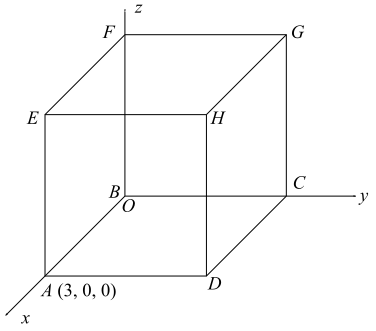


  1. Calculate the magnitude of vector `vec(AG)`.  (1 mark)

    --- 3 WORK AREA LINES (style=lined) ---

  2. Find the acute angle between the diagonals `vec(AG)` and `vec(BH)`.  (3 marks)

    --- 7 WORK AREA LINES (style=lined) ---

Show Answers Only
  1. `3 sqrt 3\ text(units)`
  2. `70^@32′`
Show Worked Solution

i.   `A(3, 0 , 0), \ \ G(0, 3, 3)`

  `vec(AG)` `= ((0), (3), (3)) – ((3), (0), (0)) = ((text{−3}), (3), (3))`
  `|\ vec(AG)\ |` `= sqrt (9 + 9 + 9)`
    `= 3 sqrt 3\ text(units)`


ii.    `H (3, 3, 3)`
  `vec(BH) = ((3), (3), (3))`
`vec(AG) ⋅ vec(BH)` `= |\ vec(AG)\ | ⋅ |\ vec(BH)\ |\ cos theta`
`((text{−3}), (3), (3)) ⋅ ((3), (3), (3))` `= sqrt (9 + 9 + 9) ⋅ sqrt (9 + 9 + 9) cos theta`
`-9 + 9 + 9` `= 27 cos theta`
`cos theta` `= 1/3`
`theta` `= 70.52…`
  `= 70^@32′`

Filed Under: Vectors and Geometry Tagged With: Band 3, Band 4, smc-1210-10-Cube/Rect Prism, smc-1210-70-3D problems

Vectors, EXT2 V1 SM-Bank 21

  1. Find the equation of the vector line  `underset~v`  that passes through  `Atext{(5, 2, 3)}`  and  `B(7, 6, 1)`.  (1 mark)

    --- 2 WORK AREA LINES (style=lined) ---

  2. A sphere has centre  `underset~c`  at  `text{(2, 3, 5)}`  and a radius of  `5sqrt2`  units.
    Find the points where the vector line  `underset~v`  meets the sphere.  (3 marks)

    --- 6 WORK AREA LINES (style=lined) ---

Show Answers Only
  1. `underset~v = ((5),(2),(3)) + lambda((1),(2),(−1))`
  2. `((2),(–4),(6)), \ ((7),(6),(1))`
Show Worked Solution

i.   `overset(->)(BA) = ((7-5),(6-2),(1-3)) = ((2),(4),(−2)) = 2((1),(2),(−1))`

`underset~v = ((5),(2),(3)) + lambda((1),(2),(−1))`
 

ii.   `text(General point)\ underset~v:`

`x = 5 + lambda`

`y = 2 + 2lambda`

`z = 3-lambda`
 

`text(Equation of sphere,)\ underset~c = (2, 3, 5),\ text(radius)\ 5sqrt2:`

`(x-2)^2 + (y-3)^2 + (z -5)^2` `= (5sqrt2)^2`
`(lambda + 3)^2 + (2lambda-1)^2 + (−lambda-2)^2` `= 50`
`lambda^2 + 6lambda + 9 + 4lambda^2-4lambda + 1 + lambda^2 + 4lambda + 4` `= 50`
`6lambda^2 + 6lambda + 14` `= 50`
`6lambda^2 + 6lambda-36` `= 0`
`6(lambda + 3)(lambda-2)` `= 0`
`lambda` `= –3\ text(or)\ 2`

 
`text(When)\ \ lambda = –3,`

`text(Intersection) = ((5),(2),(3))-3((1),(2),(−1)) = ((2),(–4),(6))`

`text(When)\ \ lambda = 2,`

`text(Intersection) = ((5),(2),(3)) + 2((1),(2),(−1)) = ((7),(6),(1))`

Filed Under: Vectors and Vector Equations of Lines Tagged With: Band 3, smc-1196-10-Find line given 2 points, smc-1196-48-Spheres, smc-1196-80-3D vectors

Functions, 2ADV F1 SM-Bank 56

Simplify  `(9x^2)/(x+3) -: (3x)/(x^2-9)`.   (2 marks)

--- 4 WORK AREA LINES (style=lined) ---

Show Answers Only

`3x(x-3)`

Show Worked Solution
`(9x^2)/(x+3) -: (3x)/(x^2-9)` `=(9x^2)/(x+3) xx  (x^2-9)/(3x)`  
  `=(9x^2)/(x+3) xx  ((x-3)(x+3))/(3x)`  
  `=3x(x-3)`  

Filed Under: Algebraic Techniques (Adv-2027), Algebraic Techniques (Y11) Tagged With: Band 3, common-content, smc-6213-10-Algebraic Fractions, smc-983-40-Algebraic Fractions

Functions, 2ADV F1 SM-Bank 55

Simplify  `(4p-12p^2)/3 xx (6p)/(3p^2-p)`.  (2 marks)

Show Answers Only

`-8p`

Show Worked Solution
`(4p-12p^2)/3 xx (6p)/(3p^2-p)` `= (4p(1-3p))/3 xx (6p)/(p(3p-1))`  
  `= (8p(1-3p))/(3p-1)`  
  `=-8p`  

Filed Under: Algebraic Techniques (Adv-2027), Algebraic Techniques (Y11) Tagged With: Band 3, common-content, smc-6213-10-Algebraic Fractions, smc-983-40-Algebraic Fractions

Functions, 2ADV F1 SM-Bank 54

Find the reciprocal of   `1/a + 1/b -c/(ab)`.   (2 marks)

Show Answers Only

`(ab)/(a+b-c)`

Show Worked Solution
`1/a + 1/b -c/(ab)` `=b/(ab)+a/(ab)-c/(ab)`
  `=(b+a-c)/(ab)`

 
`text(Reciprocal of)\ \ x = x^(-1)`

`:.\ text(Reciprocal of)\ \ (b+a-c)/(ab)=((b+a-c)/(ab))^(-1)=(ab)/(a+b-c)`

Filed Under: Algebraic Techniques (Adv-2027), Algebraic Techniques (Y11) Tagged With: Band 3, common-content, smc-6213-10-Algebraic Fractions, smc-983-40-Algebraic Fractions

Functions, 2ADV F1 SM-Bank 53

  1. If  `1/(root3(7+pi)) = (7+pi)^x`, find  `x`.  (1 mark)

    --- 1 WORK AREA LINES (style=lined) ---

  2. Calculate the value of  `1/(root3(7+pi))`  to 3 significant figures.   (1 mark)

    --- 2 WORK AREA LINES (style=lined) ---

Show Answers Only
  1. `-1/3`
  2. `0.462`
Show Worked Solution

i.    `1/(root3(7+pi)) = (7+pi)^(-1/3)`

ii.     `1/(root3(7+pi))` `=0.4619…`
    `=0.462\ \ text{(to 3 sig. fig.)}`

Filed Under: Algebraic Techniques (Adv-2027), Algebraic Techniques (Y11), Log/Index Laws and Equations (Adv-2027), Log/Index Laws and Equations (Y11) Tagged With: Band 2, Band 3, smc-6213-60-Rounding, smc-6455-50-Exponential Equations, smc-963-50-Exponential Equation, smc-983-10-Rounding

Functions, 2ADV F1 SM-Bank 52

Find `a`  and  `b`  such that  `a,b`  are real numbers and

`(6sqrt3-sqrt5)/(2sqrt5)= a + b sqrt15`.   (2 marks)

--- 4 WORK AREA LINES (style=lined) ---

Show Answers Only

`a= -1/2, \ b=3/5`

Show Worked Solution
`(6sqrt3-sqrt5)/(2sqrt5)` `=(6sqrt3-sqrt5)/(2sqrt5) xx (2sqrt5)/(2sqrt5)`  
  `=(2sqrt5(6sqrt3 – sqrt5))/(4 xx5)`  
  `=(12sqrt15-10)/20`  
  `=- 1/2 + 3/5 sqrt15`  

 
`:. a= -1/2, \ b=3/5`

Filed Under: Algebraic Techniques (Adv-2027), Algebraic Techniques (Y11), Skeletal and muscular systems Tagged With: Band 3, smc-6213-30-Surd Denominators, smc-983-30-Surd Denominators

Functions, 2ADV F1 SM-Bank 51

Find `a`  and  `b`  such that  `a,b`  are real numbers and 

`(sqrt3-2)/(2sqrt3)= a + b sqrt3`.   (2 marks)

--- 4 WORK AREA LINES (style=lined) ---
Show Answers Only

 `a = 1/2, \ b = – 1/3`

Show Worked Solution
`(sqrt3-2)/(2sqrt3)` `= (sqrt3-2)/(2sqrt3) xx (2sqrt3)/(2sqrt3)`
  `= (2sqrt3(sqrt3-2))/(4 xx 3)`
  `= (6-4sqrt3)/12`
  `=1/2 – 1/3 sqrt3`

 
`:.\ a = 1/2, \ b = – 1/3`

Filed Under: Algebraic Techniques (Adv-2027), Algebraic Techniques (Y11), Skeletal and muscular systems Tagged With: Band 3, smc-6213-30-Surd Denominators, smc-983-30-Surd Denominators

Vectors, EXT1 V1 EQ-Bank 27


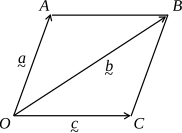
`OABC`  are the vertices of a rhombus.

Prove, using vectors, that its diagonals are perpendicular.  (2 marks)

--- 6 WORK AREA LINES (style=lined) ---

Show Answers Only

`text(See Worked Solution)`

Show Worked Solution

`text(S) text(ince)\ \ OABC\ \ text(is a rhombus)`

`| underset~a | = | underset~c |`
 
`text(Diagonals are) \ \ overset(->)(OB) \ \ text(and) \ \ overset(->)(AC) , text(where)`

`overset(->)(OB) = underset~a + underset~c`

`overset(->)(AC) = underset~c-underset~a`
  

`(underset~c-underset~a) · (underset~a + underset~c)` `= underset~c* underset~a + underset~c* underset~c-underset~a* underset~a-underset~a *underset~c`
  `=| underset~c |^2-| underset~a |^2`
  `= 0`

 
`:. \ overset(->)(OB) ⊥ overset(->)(AC)`

Filed Under: Vectors and Geometry (Ext1) Tagged With: Band 3, smc-1211-20-Rhombus

Vectors, EXT2 V1 SM-Bank 18

A sphere is represented by the equation

`x^2-4x + y^2 + 8y + z^2-3z + 2 = 0`

  1. Determine the centre  `underset~c`  and radius of the sphere.  (2 marks)

    --- 4 WORK AREA LINES (style=lined) ---

  2. Find the vector equation of the sphere.  (1 mark)

    --- 2 WORK AREA LINES (style=lined) ---

Show Answers Only
  1.  `underset~c = ((2),(-4),({3}/{2})) \ , \ text(radius) = (9)/(2)`
  2. `| \ underset~r-((2),(-4),({3}/{2})) | = (9)/(2)`
Show Worked Solution

i.  `x^2-4x + y^2 + 8y + z^2-3z + 2 = 0`

`(x-2)^2 + (y+4)^2 + (z-{3}/{2})^2 + 2-(89)/(4) = 0`

`(x-2)^2 + (y+4)^2 + (z-{3}/{2})^2 = (81)/(4)`
 
`:. \ underset~c = ((2),(-4),({3}/{2})) \ , \ text(radius) = (9)/(2)`
 

ii. `text(Vector equation:)`

`| \ underset~r-((2),(-4),({3}/{2})) | = (9)/(2)`

Filed Under: Vectors and Vector Equations of Lines Tagged With: Band 3, smc-1196-48-Spheres, smc-1196-80-3D vectors

Vectors, EXT2 V1 SM-Bank 11

Given  `lambda_1underset~a + lambda_2underset~b = [(50),(−45),(−8)]`, find  `lambda_1` and `lambda_2`  if 
 

`underset~a = [(2),(−3),(4)]`  and  `underset~b = [(3),(−2),(−3)]`.  (2 marks)

--- 6 WORK AREA LINES (style=lined) ---

Show Answers Only

`lambda_1 = 7, lambda_2 = 12`

Show Worked Solution

`lambda_1underset~a + lambda_2underset~b = [(2lambda_1 + 3lambda_2),(−3lambda_1 – 2lambda_2),(4lambda_1 – 3lambda_2)]`

`2lambda_1 + 3lambda_2 = 50\ \ …\ (1)`  
`4lambda_1 – 3lambda_2 = −8\ \ …\ (2)`  

 
`(1) + (2)`

`6lambda_1` `= 42`
`lambda_1` `= 7`

 
`text(Substitute)\ \ lambda_1=7\ \ text{into (1):}`

`14+3lambda_2` `= 50`
`lambda_2` `= 12`

Filed Under: Basic Concepts and Arithmetic Tagged With: Band 3, smc-1195-10-Basic Calculations

Vectors, EXT2 V1 SM-Bank 15

Consider the two vector line equations

`underset~(v_1) = ((1),(4),(−2)) + lambda_1((3),(0),(−1)), qquad underset~(v_2) = ((3),(2),(2)) + lambda_2((4),(2),(−6))`

  1. Show that  `underset~(v_1)`  and  `underset~(v_2)`  intersect and determine the point of intersection . (2 marks)

    --- 6 WORK AREA LINES (style=lined) ---

  2. What is the acute angle between the vector lines, to the nearest minute.  (2 marks)

    --- 5 WORK AREA LINES (style=lined) ---

Show Answers Only
  1. `text(See Worked Solutions)`
  2. `40°29’\ \ (text(nearest minute))`
Show Worked Solution

i.   `text(Solve simultaneously:)`

`1 + 3lambda_1` `= 3 + 4lambda_2` `\ \ …\ (1)`
`4 + 0lambda_1` `= 2 + 2lambda_2` `\ \ …\ (2)`
`−2 – lambda_1` `= 2 – 6lambda_2` `\ \ …\ (3)`

 
`=> lambda_2 = 1\ \ \ text{(from (2))}`

`=>lambda_1 = 2\ \ \ text{(from (1) and (3))}`

`:.\ text(vector lines intersect)`
  

`text(P.O.I.) = ((1),(4),(−2)) + 2((3),(0), (−1)) = ((7),(4),(−4))`


ii.   `underset~(v_1) = underset~(a_1) + lambda_1*underset~(b_1)`

`underset~(v_2) = underset~(a_2) + lambda_2*underset~(b_2)`

`costheta` `= (underset~(b_1) · underset~(b_2))/(|underset~b_1||underset~b_2|)`
  `= (12 + 0 + 6)/(sqrt10 sqrt56)`
  `= 0.7606…`


`theta` `= 40.479…`
  `= 40°29’\ \ (text(nearest minute))`

Filed Under: Vectors and Vector Equations of Lines Tagged With: Band 3, Band 4, smc-1196-20-Intersection, smc-1196-80-3D vectors

Vectors, EXT2 V1 SM-Bank 6

  1. What vector line equation, `underset~r`, corresponds to the Cartesian equation
  2. `qquad (x + 2)/5 = (y - 5)/4`  (1 mark)

    --- 2 WORK AREA LINES (style=lined) ---

  3. Express   `underset~v`  in Cartesian form where,
  4. `qquad underset~v = ((1),(−4)) + lambda((3),(1))`  (1 mark)

    --- 4 WORK AREA LINES (style=lined) ---

Show Answers Only
  1.  `underset~r = ((−2),(5)) + lambda((5),(4))`
  2.  `y = (x – 13)/3`
Show Worked Solution

i.   `underset~r = ((−2),(5)) + lambda((5),(4))`

COMMENT: Ensure you know the format for conversion from Cartesian to vector form (part i)!


ii.   `((x),(y)) = ((1),(−4)) + lambda((3),(1))`

`x = 1 + 3lambda \ \ => \ lambda = (x – 1)/3`
`y = −4 + lambda\ \ => \ lambda = y + 4`

 
`y + 4 = (x – 1)/3`

`:. y = (x – 13)/3`

Filed Under: Vectors and Vector Equations of Lines Tagged With: Band 3, smc-1196-50-Vector to Cartesian, smc-1196-60-Cartesian to Vector, smc-1196-70-2D vectors

Vectors, EXT2 V1 SM-Bank 4

Determine the equation of the line vector `underset~r`, given it passes through the point  `(7, 1, 0)`  and is parallel to the line joining  `P(2, −1, 2)`  and  `Q(3, 4, 1)`.   (2 marks)

--- 3 WORK AREA LINES (style=lined) ---

Show Answers Only

`underset~r = ((7),(1),(0)) + lambda((1),(5),(−1))`

Show Worked Solution

`overset(->)(PQ) = ((3),(4),(1)) – ((2),(−1),(2)) = ((1),(5),(−1))`
 

`:. underset~r = ((7),(1),(0)) + lambda((1),(5),(−1))`

Filed Under: Vectors and Vector Equations of Lines Tagged With: Band 3, smc-1196-30-Parallel

Vectors, EXT2 V1 SM-Bank 3

Find the value of  `n`  given

`underset~v = ((5),(2),(n)) + lambda_1((2),(1),(3))` 

is perpendicular to

`underset~u = ((2),(0),(1)) + lambda_2((2),(n),(1))`.  (2 marks)

Show Answers Only

`−7`

Show Worked Solution

`text(Given)\ \ underset~v ⊥ underset~u:`

`((2),(1),(3)) · ((2),(n),(1)) = 0`

`4 + n + 3` `= 0`
`n` `= −7`

Filed Under: Vectors and Vector Equations of Lines Tagged With: Band 3, smc-1196-40-Perpendicular, smc-1196-80-3D vectors

  • « Previous Page
  • 1
  • …
  • 29
  • 30
  • 31
  • 32
  • 33
  • …
  • 57
  • Next Page »

Copyright © 2014–2025 SmarterEd.com.au · Log in