SmarterEd

Aussie Maths & Science Teachers: Save your time with SmarterEd

  • Login
  • Get Help
  • About

Mechanics, EXT2* M1 2015 HSC 14a

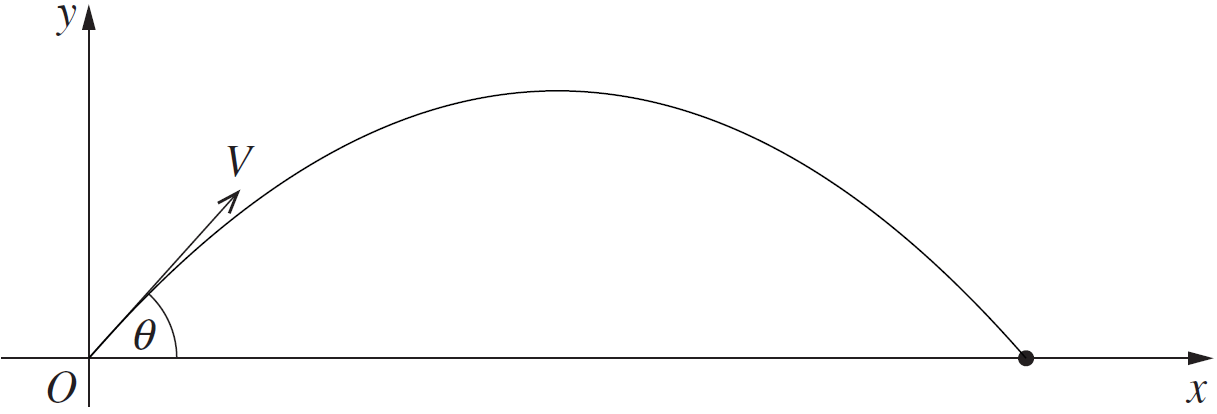
A projectile is fired from the origin `O` with initial velocity `V` m s`\ ^(−1)` at an angle `theta` to the horizontal. The equations of motion are given by

`x = Vt\ cos\ theta, \ y = Vt\ sin\ theta − 1/2 g t^2`.    (Do NOT prove this)
 

Calculus in the Physical World, EXT1 2015 HSC 14a
 

  1. Show that the horizontal range of the projectile is
     
         `(V^2\ sin\ 2theta)/g`.  (2 marks)

    --- 6 WORK AREA LINES (style=lined) ---

A particular projectile is fired so that  `theta = pi/3`.

  1. Find the angle that this projectile makes with the horizontal when
     
         `t = (2V)/(sqrt3\ g)`.  (2 marks)

    --- 8 WORK AREA LINES (style=lined) ---


  2. State whether this projectile is travelling upwards or downwards when
     
          `t = (2V)/(sqrt3\ g)`. Justify your answer.  (1 mark)

    --- 2 WORK AREA LINES (style=lined) ---

Show Answers Only
  1. `text(See Worked Solutions.)`
  2. `30^@`
  3. `text(Downwards)`
Show Worked Solution

i.   `text(Show range is)\ \ (V^2\ sin\ 2theta)/g`

`x` `= Vt\ cos\ theta`
`y` `= Vt\ sin\ theta − 1/2 g t^2`

 
`text(Horizontal range occurs when)\ \ y = 0`

`Vt\ sin\ theta − 1/2 g t^2` `= 0`
`t(V\ sin\ theta − 1/2 g t)` `= 0`
`:.V\ sin\ theta − 1/2 g t` `= 0`
`1/2 g t` `= V\ sin\ theta`
`t` `= (2V\ sin\ theta)/g`

 
`text(Find)\ \ x\ \ text(when)\ \ t = (2V\ sin\ theta)/g`

`x` `= V · (2V\ sin\ theta)/g · cos\ theta`
  `= (V^2\ sin\ 2theta)/g\ \ …\ text(as required)`


♦♦ Mean mark part (ii) 28%.
ii.    `x` `= Vt\ cos\ theta`
  `dot x` `= V\ cos\ theta`
  `y` `= Vt\ sin\ theta − 1/2 g t^2`
  `dot y` `= V\ sin\ theta − g t`


`text(When)\ \ t = (2V)/(sqrt3\ g)\ \ text(and)\ \ theta = pi/3`

`dot x` `= V\ cos\ pi/3 = V/2`
`dot y` `= V\ sin\ pi/3 − g\ (2V)/(sqrt3\ g)`
  `= (sqrt3V)/2 − (2V)/sqrt3`
  `= (sqrt3(sqrt3V) − 2 xx 2V)/(2sqrt3)`
  `= -V/(2sqrt3)`

Calculus in the Physical World, EXT1 2015 HSC 14a Answer

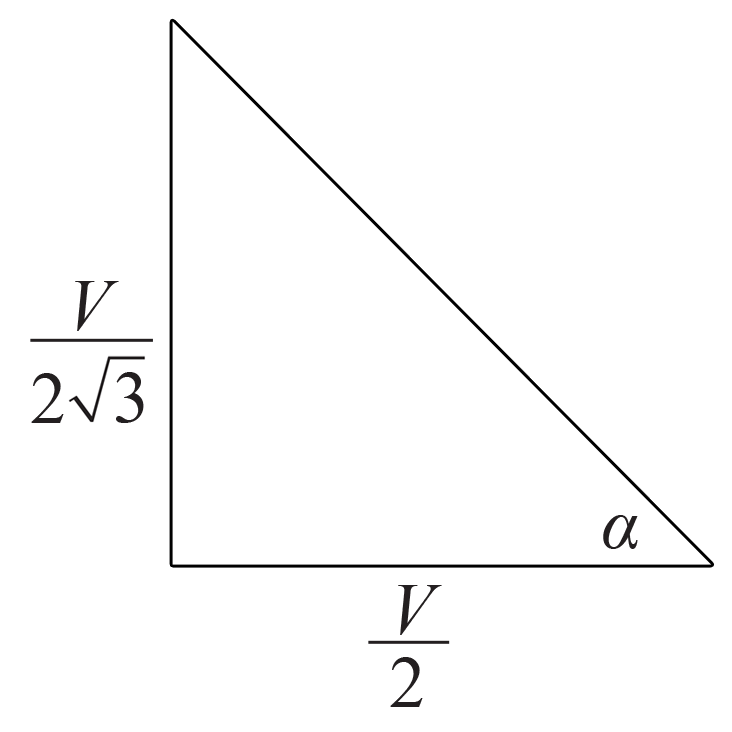
`text(Let)\ alpha =\ text(Angle of projectile with the horizontal)`

`tan\ α` `=(|\ doty\ |) / dotx`
  `= (V/(2sqrt3))/(V/2)`
  `= V/(2sqrt3) xx 2/V`
  `= 1/sqrt3`
`:.α` `= 30^@`

 
`:.\ text(When)\ \ t = (2V)/(sqrt3\ g),\ text(the projectile makes)`

`text(a)\ \ 30^@\ \ text(angle with the horizontal.)`


iii.  `text(When)\ t = (2V)/(sqrt3\ g)`

♦♦ Mean mark part (iii) 31%.

`dot y = −V/(2sqrt3)`

`text(The negative value of)\ \ dot y\ \ text(indicates that)`

`text(the particle is travelling downwards.)`

Filed Under: Projectile Motion, Projectile Motion EXT1 Tagged With: Band 3, Band 5, smc-1062-10-Range/Time of Flight, smc-1062-50-Angle of Trajectory/Impact

Trigonometry, 2ADV T2 2007 HSC 4a

Solve  `sqrt 2\ sin\ x = 1`  for  `0 <= x <= 2 pi`.  (2 marks)

Show Answers Only

`pi/4 ,  (3 pi)/4`

Show Worked Solution
`sqrt 2\ sin\ x` `= 1` `\ \ \ \ \ \ \ 0 <= x <= 2 pi`
`sin\ x` `= 1/sqrt 2`  

`=>sin\ pi/4 = 1/sqrt 2\ \ text(and sin is positive in)`

`text(1st/2nd quadrants,)`

`:. x` `= pi/4\ ,\ pi – pi/4`
  `= pi/4\ ,\ (3 pi)/4`

Filed Under: Exact Trig Ratios, Exact Trig Ratios, Exact Trig Ratios and Other Identities Tagged With: Band 3, smc-6411-10-sin, smc-979-10-sin

Financial Maths, 2ADV M1 2007 HSC 3b

Heather decides to swim every day to improve her fitness level.

On the first day she swims 750 metres, and on each day after that she swims `100` metres more than the previous day. That is, she swims 850 metres on the second day, 950 metres on the third day and so on.

  1. Write down a formula for the distance she swims on the `n`th day.  (1 mark)

    --- 2 WORK AREA LINES (style=lined) ---

  2. How far does she swim on the 10th day?  (1 mark)

    --- 1 WORK AREA LINES (style=lined) ---

  3. What is the total distance she swims in the first 10 days?  (1 mark)

    --- 2 WORK AREA LINES (style=lined) ---

  4. After how many days does the total distance she has swum equal the width of the English Channel, a distance of 34 kilometres?  (2 marks)

    --- 5 WORK AREA LINES (style=lined) ---

Show Answers Only
  1. `T_n = 650 + 100n`
  2. `1650\ text(metres)`
  3. `12\ text(km)`
  4. `34\ text(km)`
Show Worked Solution
i.  `T_1` `= 750`
`T_2` `= 850`

`=>  text(AP)\ text(where)\ a = 750\ ,\ d = 100`

`:. T_n` `= a + (n-1) d`
  `= 750 + (n – 1) 100`
  `= 750 + 100n – 100`
  `= 650 + 100n`


ii.  `T_10` `= 650 + 100 xx 10`
  `= 1650\ text(metres)`


`:.\ text(She swims 1650 metres on the 10th day.)`


iii.  `S_n = n/2 [2a + (n – 1) d]`

`:. S_10` `= 10/2 [2 xx 750 + (10 -1) 100]`
  `= 5 [1500 + 900]`
  `= 12\ 000`


`:.\ text(She swims 12 km in the first 10 days.)`


iv.  `text(Find)\ n\ text(such that)\ S_n = 34\ text(km)`

`n/2 [2 xx 750 + (n – 1) 100]` `= 34\ 000`
`n/2 [1500 + 100n – 100]` `= 34\ 000`
`n/2 [1400 + 100n]` `= 34\ 000`
`700n + 50n^2` `= 34\ 000`
`50 n^2 + 700n – 34\ 000` `= 0`
`50 (n^2 + 14 n – 680)` `= 0`


`text(Using the quadratic formula)`

`n` `= {-b +- sqrt(b^2 – 4ac)}/(2a)`
  `= {-14 +- sqrt(14^2 – 4 xx 1 xx (-680))}/(2 xx 1)`
  `= (-14 +- sqrt 2916)/2`
  `= (-14 +- 54)/2`
  `= 20 or -34`
  `= 20\ ,\ n > 0`


`:.\ text(Her total distance equals 34 km after 20 days.)`

Filed Under: Arithmetic Series, Arithmetic Series Tagged With: Band 3, Band 4, smc-1005-10-Find Term, smc-1005-20-Find Sum, smc-1005-70-Applied Context

Linear Functions, 2UA 2007 HSC 3a

2007 3a

In the diagram, `A`, `B` and `C` are the points `(10, 5)`, `(12, 16)` and `(2, 11)` respectively.

Copy or trace this diagram into your writing booklet.

  1. Find the distance `AC`.  (1 mark)
  2. Find the midpoint of `AC`.  (1 mark)
  3. Show that `OB_|_AC`.  (2 marks)
  4. Find the midpoint of `OB` and hence explain why `OABC` is a rhombus.  (2 marks)
  5. Hence, or otherwise, find the area of `OABC`.  (1 mark)
Show Answers Only
  1. `10\ text(units)`
  2. `(6, 8)`
  3. `text(Proof)\ \ text{(See Worked Solutions)}`
  4. `(6, 8)\ \ text(See Worked Solutions)`
  5. `100\ text(u²)`
Show Worked Solution

(i)   `A (10, 5)\ \ \ C (2, 11)`

`text(dist)\ AC` `= sqrt {(x_2 – x_1)^2 + (y_2 – y_1)^2}`
  `= sqrt {(2 – 10)^2 + (11 – 5)^2}`
  `= sqrt (64 + 36)`
  `= sqrt 100`
  `= 10\ text(units)`


(ii)  `text(Midpoint)\ AC` `= ((x_1 + x _2)/2 , (y_1 + y_2)/2)`
  `= ((10+2)/2 , (5 + 11)/2)`
  `= (6, 8)`


(iii)  `B (12, 16)`

`M_(OB)` `= (y_2 – y_1)/(x_2 – x_1)`
  `= (16 – 0)/(12 – 0)`
  `= 4/3`
`M_(AC)` `= (11 – 5)/(2 – 10)`
  `= 6/-8`
  `= -3/4`

`M_(OB) xx M_(AC) = 4/3 xx -3/4 = -1`

`:. OB_|_ AC`


(iv)  `text(Midpoint)\ OB` `= ((12 + 0)/2 , (16 + 0)/2)`
  `= (6, 8)`

`text(S)text(ince midpoint)\ OB = text(midpoint)\ AC`

`text(and)\ OB_|_AC`

`=>  text(Diagonals of)\ OABC\ text(are perpendicular)`

`text(bisectors)`

`:. OABC\ text(is a rhombus)`


(v)  `text(dist)\ OB`

`= sqrt ((12 – 0)^2 + (16 – 0)^2)`

`= sqrt (144 + 256)`

`= sqrt 400`

`= 20\ text(units)`

`text(Area of)\ OABC`

`= 1/2 xx AC xx OB`

`= 1/2 xx 10 xx 20`

`= 100\ text(u²)`

Filed Under: 6. Linear Functions Tagged With: Band 2, Band 3, HSC

Calculus, 2ADV C3 2007 HSC 2c

The point  `P (pi, 0)`  lies on the curve  `y = x sinx`. Find the equation of the tangent to the curve at  `P`.  (3 marks)

--- 6 WORK AREA LINES (style=lined) ---

Show Answers Only

`y = – pi x + pi^2`

Show Worked Solution

`y = x sin x`

`(dy)/(dx)` `= x xx d/(dx) (sin x) + d/(dx) x xx sin x`
  `= x  cos x + sin x`

 
`text(When)\ \ x = pi`

`(dy)/(dx)` `= pi xx cos pi + sin pi`
  `= pi (-1) + 0`
  `= – pi`

 
`text(Equation of line,)\ \ m = – pi,\ text(through)\ P(pi, 0):`

`y – y_1` `= m(x – x_1)`
`y – 0` `= – pi(x – pi)`
`:. y` `= – pi x + pi^2`

Filed Under: Differentiation and Integration, Tangents, Tangents and Normals Tagged With: Band 3, Band 4, smc-1090-10-Find tangent given curve, smc-1090-60-Trig Function

Calculus, 2ADV C4 2007 HSC 2bii

Evaluate  `int_1^4 8/x^2\ dx`.  (3 marks)

Show Answers Only

`6`

Show Worked Solution

`int_1^4 8/x^2\ dx`

`= 8 int_1^4 x^-2\ dx` 

`= 8[-1/x]_1^4`

`= 8[(-1/4) – (-1/1)]`

`= 8(3/4)`

`= 6`

Filed Under: Integrals, Standard Integration Tagged With: Band 3, Band 4, smc-1202-20-Definite Integrals

Calculus, 2ADV C4 2007 HSC 2bi

Find  `int (1 + cos 3x)\ dx`.  (2 marks)

Show Answers Only

`x + 1/3 sin 3x + C`

Show Worked Solution

`int (1 + cos 3x)\ dx`

`= x + 1/3 sin 3x + C`

Filed Under: Differentiation and Integration, Integrals, Trig Integration Tagged With: Band 3, Band 4, smc-1204-20-Cos

Calculus, 2ADV C2 2007 HSC 2aii

Differentiate with respect to `x`:

`(1 + tan x)^10`.  (2 marks)

Show Answers Only

`10 sec^2 x \ (1 + tan x)^9`

Show Worked Solution

`y = (1 + tan x)^10`

`(dy)/(dx)` `= 10 (1 + tan x)^9 xx d/(dx) (tan x)`
  `= 10 sec^2 x \ (1 + tan x)^9`

Filed Under: Differentiation and Integration, Trig Differentiation, Trig Differentiation Tagged With: Band 3, smc-968-30-Tan, smc-968-60-Chain Rule

Functions, 2ADV F1 2007 HSC 1f

Find the equation of the line that passes through the point `(1, 3)` and is perpendicular to  `2x + y + 4 = 0`.  (2 marks)

--- 5 WORK AREA LINES (style=lined) ---

Show Answers Only

`x-2y + 7 = 0`

Show Worked Solution
`2x + y + 4` `= 0`
`y` `= -2x-4`

  
`=>\ text(Gradient) = -2`

`:. text(⊥ gradient) = 1/2\ \ \ (m_1 m_2=-1)`
 

`text(Equation of line)\ \ m = 1/2, \ text(through)\ (1, 3):`

`y-y_1` `= m (x-x_1)`
`y-3` `= 1/2 (x-1)`
`y` `= 1/2 x + 5/2`
`2y` `= x + 5`
`:. x-2y + 5` `= 0`

Filed Under: 6. Linear Functions, Cartesian Plane, Linear Functions, Linear Functions Tagged With: Band 3, num-title-ct-pathc, num-title-qs-hsc, smc-4422-60-Perpendicular, smc-6214-02-Equation of Line, smc-6214-06-Perpendicular

Financial Maths, 2ADV M1 2007 HSC 1d

Find the limiting sum of the geometric series

`3/4 + 3/16 + 3/64 + …`.  (2 marks)

Show Answers Only

`1`

Show Worked Solution

`3/4 + 3/16 + 3/64 + …`

`=>  text(GP where)\ \ a = 3/4,\ \ \ r = T_2/T_1 = 1/4`

`:. S_oo` `= a/(1 – r)`
  `= (3/4)/(1 – 1/4)`
  `= 1`

Filed Under: Geometric Series, Geometric Series Tagged With: Band 3, smc-1006-40-Limiting Sum, smc-1006-70-Calculations Only

Proof, EXT1 P1 2015 HSC 13c

Prove by mathematical induction that for all integers `n ≥ 1`,

`1/(2!) + 2/(3!) + 3/(4!) + … + n/((n + 1)!) = 1 − 1/((n + 1)!)`.  (3 marks)

--- 14 WORK AREA LINES (style=lined) ---

Show Answers Only

`text{Proof (See Worked Solutions)}`

Show Worked Solution

`text(Prove for)\ n ≥ 1`

`1/(2!) + 2/(3!) + 3/(4!) + … + n/((n + 1)!) = 1 − 1/((n + 1)!)`

`text(If)\ n = 1`

`text(LHS)` `= 1/(2!) = 1/2`
`text(RHS)` `= 1 − 1/(2!) = 1 − 1/2 = 1/2`

`:.\ text(True for)\ n = 1`

 
`text(Assume true for)\ n = k`

`text(i.e.)\ \ 1/(2!) + 2/(3!) + … + k/((k + 1)!) = 1 − 1/((k + 1)!)`

`text(Prove true for)\ n = k + 1`

`text(i.e.)\ \ 1/(2!) + 2/(3!) + … + k/((k + 1)!) + (k + 1)/((k + 2)!) = 1 − 1/((k + 2)!)`

`text(LHS)` `= 1 − 1/((k + 1)!) + (k + 1)/((k + 2)!)`
  `= 1 − (((k + 2) − (k + 1))/((k + 1)!(k + 2)))`
  `= 1 − 1/((k + 2)!)\ \ …\ text(as required)`

 
`=>\ text(True for)\ n = k + 1`

`:.\ text(S)text(ince true for)\ n = 1,\ text(by PMI, true for integral)\ n ≥ 1.`

Filed Under: 7. Induction and Other Series EXT1, P1 Induction (Y12) Tagged With: Band 3, smc-1019-20-Sum of a Series, smc-1019-30-Factorial

Combinatorics, EXT1 A1 2015 HSC 13b

Consider the binomial expansion

`(2x + 1/(3x))^18 = a_0x^(18) + a_1x^(16) + a_2x^(14) + …`

where `a_0, a_1, a_2`, . . . are constants.

  1. Find an expression for `a_2`.  (2 marks)

    --- 6 WORK AREA LINES (style=lined) ---

  2. Find an expression for the term independent of `x`.  (2 marks)

    --- 4 WORK AREA LINES (style=lined) ---

Show Answers Only
  1. `(\ ^18C_2 · 2^(16))/(3^2)`
  2. `(\ ^(18)C_9 · 2^9)/(3^9)`
Show Worked Solution

i.    `text(Need co-efficient of)\ x^(14)`

`text(General term of)\ (2x + 1/(3x))^(18)`

`T_k` `= \ ^(18)C_k(2x)^(18-k) · (1/(3x))^k`
  `= \ ^(18)C_k · 2^(18-k) · x^(18-k) · 3^(-k) · x^(-k)`
  `= \ ^(18)C_k · 2^(18-k) · 3^(-k) · x^(18-2k)`

 
`a_2\ text(occurs when:)`

`18-2k= 14\ \ =>\ \ k=2`

`:.a_2= \ ^(18)C_2 · 2^(18-2) · 3^(-2)= (\ ^(18)C_2 · 2^(16))/(3^2)`
 

ii.   `text(Independent term occurs when:)`

`18-2k= 0\ \ =>\ \ k=9`

`:.\ text(Independent term)= \ ^(18)C_9 · 2^(18-9) · 3^(-9) = (\ ^(18)C_9 · 2^9)/(3^9)`

Filed Under: 17. Binomial EXT1, Binomial Expansion, The Binomial Theorem (Y11) Tagged With: Band 3, Band 4, smc-1088-10-Coefficients, smc-1088-20-Independent Term, smc-6639-10-Coefficients, smc-6639-20-Independent Term

Mechanics, EXT2* M1 2015 HSC 13a

A particle is moving along the `x`-axis in simple harmonic motion. The displacement of the particle is `x` metres and its velocity is `v` ms`\ ^(–1)`. The parabola below shows `v^2` as a function of `x`.

2015 13a

  1. For what value(s) of `x` is the particle at rest?  (1 mark)

    --- 2 WORK AREA LINES (style=lined) ---

  2. What is the maximum speed of the particle?  (1 mark)

    --- 2 WORK AREA LINES (style=lined) ---

  3. The velocity `v` of the particle is given by the equation

         `v^2 = n^2(a^2 − (x −c)^2)`  where `a`, `c` and `n` are positive constants.


    What are the values of `a`, `c` and `n`?  (3 marks)

    --- 6 WORK AREA LINES (style=lined) ---

Show Answers Only
  1. `3\ text(or)\ 7`
  2. `V = sqrt11\ text(m/s)`
  3. `a = 2, c = 5,`
  4. `n = (sqrt11)/2`
Show Worked Solution

i.   `text(Particle is at rest when)\ v^2 = 0`

`:. x = 3\ \ text(or)\ \ 7`


ii.   `text(Maximum speed occurs when)`

`v^2` `= 11`
`v` `= sqrt11\ text(m/s)`


iii.  `v^2 = n^2(a^2 − (x − c)^2)`

♦ Mean mark 41%.

`text(Amplitude) = 2`

`:.a = 2`

`text(Centre of motion when)\ x = 5`

`:.c = 5`

`text(S)text(ince)\ \ v^2 = 11\ \ text(when)\ \ x = 5`

`11` `= n^2(2^2 − (5 − 5)^2)`
  `= 4n^2`
`n^2` `= 11/4`
`:.n`  `= sqrt11/2`

Filed Under: Simple Harmonic Motion, Simple Harmonic Motion EXT1 Tagged With: Band 3, Band 4, Band 5, smc-1059-10-Amplitude / Period, smc-1059-20-Prove/Identify SHM, smc-1059-30-At Rest, smc-1059-31-Max Speed

Trig Ratios, EXT1 2015 HSC 12d

A kitchen bench is in the shape of a segment of a circle. The segment is bounded by an arc of length 200 cm and a chord of length 160 cm. The radius of the circle is `r` cm and the chord subtends an angle `theta` at the centre `O` of the circle.
 

2015 12d
 

  1. Show that  `160^2 = 2r^2 (1 - cos\ theta)`.  (1 mark)
  2. Hence, or otherwise, show that  `8 theta^2 + 25 cos\ theta - 25 = 0`.  (2 marks)
  3. Taking  `theta_1 = pi`  as a first approximation to the value of  `theta`, use one application of Newton’s method to find a second approximation to the value of  `theta`. Give your answer correct to two decimal places.  (2 marks)


Show Answers Only
  1. `text(See Worked Solutions)`
  2. `text(See Worked Solutions)`
  3. `2.57\ \ text{(to 2 d.p.)}`
Show Worked Solution

(i)   `text(Using the cosine rule)`

`a^2` `= b^2 + c^2 − 2bc\ cos\ A`
`160^2` `= r^2 + r^2 −2 xx r xx r xx cos\ theta`
  `= 2r^2 − 2r^2\ cos\ theta`
  `= 2r^2(1 − cos\ theta)\ \ …\ text(as required)`


(ii)   `text(Show)\ \ 8theta^2 + 25\ cos\ theta − 25 = 0`

`text(Arc length)` `= 200`
`theta/(2pi) xx 2pir` `= 200`
`rtheta` `= 200`
`r` `= 200/theta`


`text(Substitute)\ \ r = 200/theta\ text{into part (i) equation}`

`2 xx (200/theta)^2(1 – cos\ theta)` `= 160^2`
`80\ 000(1 – cos\ theta)` `= 25\ 600\ theta^2`
`25(1 – cos\ theta)` `= 8theta^2`
`8theta^2 + 25\ cos\ theta – 25` `= 0\ \ …\ text(as required.)`


(iii)   `f(theta)` `= 8theta^2 + 25\ cos\ theta – 25`
  `f′(theta)` `= 16theta – 25\ sin\ theta`
  `f(pi)` `= 8pi^2 + 25\ cos\ pi – 25`
    `= 28.9568…`
  `f′(pi)` `= 16pi – 25\ sin\ pi`
    `= 50.2654…`
`theta_2` `= pi – (f(pi))/(f′(pi))`
  `= pi – (28.9568…)/(50.2654…)`
  `= 2.5655…`
  `= 2.57\ \ text{(to 2 d.p.)}`

Filed Under: 13. Trig Calc, Graphs and Circular Measure EXT1, 5. Trig Ratios EXT1, Newton's Method etc... EXT1 Tagged With: Band 3, Band 4

Plane Geometry, EXT1 2015 HSC 12a

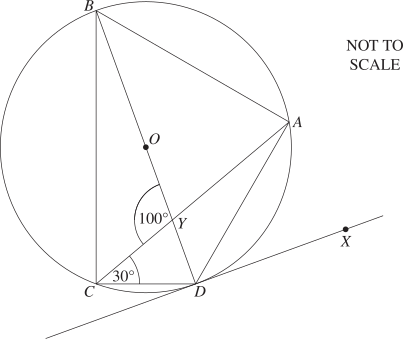
In the diagram, the points `A`, `B`, `C` and `D` are on the circumference of a circle, whose centre `O` lies on `BD`. The chord `AC` intersects the diameter `BD` at `Y`. The tangent at `D` passes through the point `X`.

It is given that  `∠CYB = 100^@`  and  `∠DCY = 30^@`.


Copy or trace the diagram into your writing booklet.

  1. What is the size of  `∠ACB`?  (1 mark)
  2. What is the size of  `∠ADX`?  (1 mark)
  3. Find, giving reasons, the size of  `∠CAB`.  (2 marks)
Show Answers Only
  1. `60°`
  2. `30°`
  3. `70°`
Show Worked Solution
(i)   

Plane Geometry, EXT1 2015 HSC 12a Answer

`∠DCB` `= 90^@\ \ text{(angle in semi-circle)}`
`:.∠ACB` `= 90^@ − 30^@`
  `= 60^@`


(ii)     `∠ADX` `= ∠ACD\ \ text{(angle in alternate segment)}`
    `= 30^@`


(iii)  `∠CBY` `= 180 − (100 + 60)\ \ text{(angle sum of}\ Delta CBY text{)}`
    `= 20^@`
   `∠CAD` `= 20^@\ \ text{(angles in the same segment on arc}\ CD text{)}`
  `∠DAB`  `= 90^@\ \ text{(angle in semi-circle)}`
  `:.∠CAB`  `= 90^@ − 20^@`
    `= 70^@`

Filed Under: 2. Plane Geometry EXT1 Tagged With: Band 2, Band 3

Functions, EXT1 F2 2015 HSC 11f

Consider the polynomials  `P(x) = x^3-kx^2 + 5x + 12`  and  `A(x) = x - 3`.

  1. Given that `P(x)` is divisible by `A(x)`, show that  `k = 6`.  (1 mark)

    --- 4 WORK AREA LINES (style=lined) ---

  2. Find all the zeros of `P(x)` when  `k = 6`.  (2 marks)

    --- 6 WORK AREA LINES (style=lined) ---

Show Answers Only
  1. `text(See Worked Solutions)`
  2. `3, 4, −1`
Show Worked Solution
i.    `P(x)` `= x^3-kx^2 + 5x + 12`
  `A(x)` `= x-3`

 
`text(If)\ P(x)\ text(is divisible by)\ A(x)\ \ =>\ \ P(3) = 0`

`3^3-k(3^2) + 5 xx 3 + 12` `= 0`
`27-9k + 15 + 12` `= 0`
`9k` `= 54`
`:.k` `= 6\ \ …\ text(as required)`


ii.  `text(Find all roots of)\ P(x)`

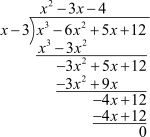
`P(x)=(x-3)*Q(x)`

`text{Using long division to find}\ Q(x):`
 

`:.P(x)` `= x^3-6x^2 + 5x + 12`
  `= (x-3)(x^2-3x-4)`
  `= (x-3)(x-4)(x + 1)`

 
`:.\ text(Zeros at)\ \ \ x = -1, 3, 4`

Filed Under: Polynomials, Remainder and Factor Theorems, Remainder and Factor Theorems, Roots, Remainders and Factors Tagged With: Band 2, Band 3, num-title-ct-patha, num-title-qs-hsc, smc-1031-10-Factor Theorem, smc-4242-10-Factor Theorem, smc-4242-40-Long division, smc-6644-10-Factor Theorem

Calculus, EXT1 C2 2015 HSC 11e

Use the substitution  `u = 2x - 1`  to evaluate  `int_1^2 x/((2x - 1)^2)\ dx`.  (3 marks)

--- 8 WORK AREA LINES (style=lined) ---

Show Answers Only

`1/4(ln 3 + 2/3)`

Show Worked Solution

`u = 2x − 1`

`⇒ 2x` `= u + 1`
 `x` `= 1/2(u + 1)`
`(du)/(dx)` `= 2`
`dx` `= (du)/2`
`text(When)` `\ \ x = 2,\ ` `u = 3`
  `\ \ x = 1,\ ` `u = 1`


`:. int_1^2 x/((2x − 1)^2) \ dx`

`= int_1^3 1/2(u + 1) · 1/(u^2) · (du)/2`

`= 1/4int_1^3 ((u + 1)/(u^2)) du`

`= 1/4 int_1^3 1/u + u^(−2) du`

`= 1/4 [ln u − u^(−1)]_1^3`

`= 1/4 [(ln 3 − 1/3) − (ln 1 − 1)]`

`= 1/4 (ln 3 − 1/3 + 1)`

`= 1/4(ln 3 + 2/3)`

Filed Under: 11. Integration EXT1, Integration By Substitution Tagged With: Band 3, smc-1036-10-Linear, smc-1036-40-Logs and Exponentials

Trigonometry, EXT1 T3 2015 HSC 11d

Express  `5 cos x-12 sin x`  in the form `A cos (x + \alpha)`, where  `0 ≤ \alpha ≤ pi/2`.   (2 marks)

--- 7 WORK AREA LINES (style=lined) ---

Show Answers Only

`13\ cos\ (x + 1.176…)`

Show Worked Solution
`5\ cos\ x-12\ sin\ x` `= A\ cos\ (x + \alpha)`
  `= A\ cos\ x\ cos\ \alpha-A\ sin\ x\ sin\ \alpha`

 
`A\ cos\ \alpha = 5,\ \ A\ sin\ \alpha = 12`

`A^2= 5^2 + 12^2 = 169\ \ =>\ \ A=13`

`13\ cos\ \alpha` `= 5`
`cos\ \alpha` `= 5/13`
`\alpha` `= cos^(-1)\ (5/13) ≈ 1.176…\ text(radians)`

 
`:. 5cos x-12sin x = 13 cos (x + 1.176…)`

Filed Under: 5. Trig Ratios EXT1, Auxiliary Angles, Auxiliary Angles Tagged With: Band 3, smc-1075-20-Rcos, smc-6674-20-Rcos

Functions, EXT1 F1 2015 HSC 11c

Solve the inequality  `4/(x + 3) ≥ 1`.   (3 marks)

--- 8 WORK AREA LINES (style=lined) ---

Show Answers Only

`−3 < x ≤ 1, \ \ x ≠ −3`

Show Worked Solution

`text(Solution 1)`

`4/(x + 3) ≥ 1`

`4(x + 3)` `≥ (x + 3)^2`
`4x + 12` `≥ x^2 + 6x + 9`
`x^2 + 2x-3` `≤ 0`
`(x + 3)(x-1)` `≤ 0`


Real Functions, EXT1 2015 HSC 11c Answer

`:.−3 < x ≤ 1, \ \ x ≠ −3`


`text(Solution 2)`

`text(If)\ (x + 3)` `> 0:`
`x` `> -3`
`4/(x + 3)` `≥ 1`
`4` `≥ x + 3`
`x` `≤ 1`

 
`-3 < x ≤ 1`


`text(If)\ (x + 3)` `< 0:`
`x` `< -3`
`4/(x + 3)` `≥ 1`
`4` `≤ x + 3`
`x` `≥ 1`

 
`text(No solution.)`

`:. −3 < x ≤ 1`

Filed Under: 1. Basic Arithmetic and Algebra EXT1, Inequalities, Inequalities Tagged With: Band 3, smc-1033-10-Algebraic Fractions, smc-6643-10-Algebraic Fractions

Linear Functions, EXT1 2015 HSC 11b

Calculate the size of the acute angle between the lines  `y = 2x + 5`  and  `y = 4 − 3x`.  (2 marks)

Show Answers Only

`45^@`

Show Worked Solution
`y = 2x + 5,` `m_1 = 2`
`y = 4 − 3x,` `m_2 =  −3`
`tan\ theta` `= |(m_1 − m_2)/(1 + m_1m_2)|`
  `= |(2 − (−3))/(1 + 2(−3))|`
  `= |5/(−5)|`
  `= 1`


`:.theta = 45^@`

Filed Under: 6. Linear Functions EXT1 Tagged With: Band 3

Trig Calculus, EXT1 2015 HSC 11a

Find `int sin^2\ x\ dx`.  (2 marks)

Show Answers Only

`x/2 − 1/4\ sin\ 2x + c`

Show Worked Solution

`int sin^2\ x\ dx`

`= 1/2 int 1 − cos\ 2x\ dx`

`= 1/2 (x − 1/2\ sin\ 2x) + c`

`= x/2 − 1/4\ sin\ 2x + c`

Filed Under: 13. Trig Calc, Graphs and Circular Measure EXT1 Tagged With: Band 3, HSC

Calculus, EXT1 C2 2015 HSC 7 MC

What is the value of `k` such that `int_0^k 1/sqrt(4 − x^2) \ dx= pi/3 ?`

  1. `1`
  2. `sqrt3`
  3. `2`
  4. `2sqrt3`
Show Answers Only

`B`

Show Worked Solution
`int_0^1 1/sqrt(4 − x^2)dx` `= pi/3`
`[sin^(−1)\ x/2]_0^k` `= pi/3`
`sin^(−1)\ k/2 − sin^(−1)\ 0` `= pi/3`
`sin^(−1)\ k/2` `= pi/3`
`k/2` `= sin\ pi/3`
  `= sqrt3/2`
`:.k` `= sqrt3`

`⇒ B`

Filed Under: 11. Integration EXT1, Inverse Functions Calculus, Inverse Trig Functions EXT1 Tagged With: Band 3, smc-1037-30-Sin/Cos Integration

Trigonometry, EXT1 T1 2015 HSC 6 MC

What is the domain of the function `f(x) = sin^(-1)\ (2x)`?

  1. `-pi ≤ x ≤ pi`
  2. `-2 ≤ x ≤ 2`
  3. `-pi/4 ≤ x ≤ pi/4`
  4. `-1/2 ≤ x ≤ 1/2`
Show Answers Only

`D`

Show Worked Solution

`f(x)= sin^(-1)\ (2x)`

`text(Domain of)\ f(x) = sin^(-1) x\ \ text(is)`

`-1 ≤ x ≤ 1`

`:.\ text(Domain of)\ \ f(x) = sin^(-1)\ (2x)\ \ text(is)`

`-1 ≤ 2x ≤ 1`

`-1/2 ≤ x ≤ 1/2`

`=> D`

Filed Under: Inverse Trig Functions EXT1, T1 Inverse Trig Functions (Y11) Tagged With: Band 3, smc-1024-20-Domain and Range

Combinatorics, EXT1 A1 2015 HSC 4 MC

A rowing team consists of 8 rowers and a coxswain.

The rowers are selected from 12 students in Year 10.

The coxswain is selected from 4 students in Year 9.

In how many ways could the team be selected?

  1. `\ ^(12)C_8 +\ ^4C_1`
  2. `\ ^(12)P_8 +\ ^4P_1`
  3. `\ ^(12)C_8 ×\ ^4C_1`
  4. `\ ^(12)P_8 ×\ ^4P_1`
Show Answers Only

`C`

Show Worked Solution
 `\ ^(12)C_8` `=\ text(Combinations of rowers)`
 `\ ^4C_1` `=\ text(Combinations of coxswains)`

 
`:.\ text(Number of ways to select team)`

`=\ ^12C_8 xx\ ^4C_1`
 

`=> C`

Filed Under: Permutations and Combinations, Permutations and Combinations (Y11), Permutations and Combinations EXT1 Tagged With: Band 3, smc-1082-20-Unordered Combinations, smc-6638-20-Unordered Combinations

Functions, EXT1 F2 2015 HSC 1 MC

What is the remainder when `x^3-6x` is divided by `x + 3`?

  1. `-9`
  2. `9`
  3. `x^2-2x`
  4. `x^2-3x + 3`
Show Answers Only

`A`

Show Worked Solution
`text(Remainder)` `= P(-3)`
  `= (-3)^3-6(-3)`
  `= -27 + 18`
  `= -9`

 
`=> A`

Filed Under: Polynomials, Remainder and Factor Theorems, Remainder and Factor Theorems, Roots, Remainders and Factors Tagged With: Band 3, num-title-ct-patha, num-title-qs-hsc, smc-1031-20-Remainder Theorem, smc-4242-20-Remainder Theorem, smc-6644-20-Remainder Theorem

Measurement, STD2 M7 2015 HSC 27b

A patient requires 2400 mL of fluid to be delivered at a constant rate by means of a drip over 12 hours. Each mL of fluid is equivalent to 15 drops.

How many drops per minute need to be delivered?  (2 marks)

--- 4 WORK AREA LINES (style=lined) ---

Show Answers Only

`50\ text(per minute)`

Show Worked Solution

`text(Fluid rate of delivery)`

`= 2400/12`

`= 200\ text(mL per hour)`

`= 200/60`

`= 3 1/3\ text(mL per minute)`

 
`text(S)text(ince each mL has 15 drops)`

`#\ text(Drops)` `= 15 xx 3 1/3`
  `= 50\ text(per minute)`

Filed Under: M4 Rates (Y12), MM1 - Units of Measurement, Rates Tagged With: Band 3, smc-1104-30-Medication, smc-805-60-Other rate problems

Probability, STD2 S2 2015 HSC 26e

The table shows the relative frequency of selecting each of the different coloured jelly beans from packets containing green, yellow, black, red and white jelly beans.

\begin{array} {|c|c|}
\hline
\rule{0pt}{2.5ex} \textit{Colour} \rule[-1ex]{0pt}{0pt} & \textit{Relative frequency} \\
\hline
\rule{0pt}{2.5ex} \text{Green} \rule[-1ex]{0pt}{0pt} & 0.32 \\
\hline
\rule{0pt}{2.5ex} \text{Yellow} \rule[-1ex]{0pt}{0pt} & 0.13 \\
\hline
\rule{0pt}{2.5ex} \text{Black} \rule[-1ex]{0pt}{0pt} & 0.14 \\
\hline
\rule{0pt}{2.5ex} \text{Red} \rule[-1ex]{0pt}{0pt} &  \\
\hline
\rule{0pt}{2.5ex} \text{White} \rule[-1ex]{0pt}{0pt} & 0.24 \\
\hline
\end{array}

  1. What is the relative frequency of selecting a red jelly bean?  (1 mark)

    --- 2 WORK AREA LINES (style=lined) ---

  2. Based on this table of relative frequencies, what is the probability of NOT selecting a black jelly bean?  (1 mark)

    --- 2 WORK AREA LINES (style=lined) ---

Show Answers Only
  1. \(0.17\)
  2. \(0.86\)
Show Worked Solution

i.  \(\text{Relative frequency of red}\)

\(= 1-(0.32 + 0.13 + 0.14 + 0.24)\)

\(= 1-0.83\)

\(= 0.17\)


ii.  \(P\text{(not selecting black)}\)

\(= 1-P\text{(selecting black)}\)

\(= 1-0.14\)

\(= 0.86\)

Filed Under: Combinations and Single Stage Events, Data, Probability, Relative Frequency, Relative Frequency, Relative Frequency, Relative Frequency, Single and Multi-Stage Events, Single stage events Tagged With: Band 3, Band 4, common-content, num-title-ct-core, num-title-qs-hsc, smc-1133-20-Games of Chance, smc-1135-05-Simple Probability, smc-4225-20-Complementary events, smc-4225-35-Relative frequency, smc-6805-40-Games of Chance, smc-827-20-Games of Chance, smc-828-10-Simple Probability, smc-990-20-Games of Chance

Algebra, STD2 A1 2015 HSC 26b

Clark’s formula is used to determine the dosage of medicine for children.
 

`text(Dosage) = text(weight in kg × adult dosage)/70`
 

The adult daily dosage of a medicine contains 3150 mg of a particular drug.

A child who weighs 35 kg is to be given tablets each containing 525 mg of this drug.

How many tablets should this child be given daily?   (2 marks)

--- 4 WORK AREA LINES (style=lined) ---

Show Answers Only

`3`

Show Worked Solution

`text(Dosage)= (35 xx 3150)/70= 1575\ text(mg)`

`text(# Tablets per day)= text(Dosage)/text(mg per tablet)= 1575/525= 3`

`:.\ text(The child should be given 3 tablets per day.)`

Filed Under: Applications: BAC, D=SxT and Medication, Applications: BAC, Medication and D=SxT, Applications: BAC, Medicine and d=s x t, Applications: D=SxT and Other, Medication Tagged With: Band 3, smc-1117-30-Medication Formulae, smc-6235-40-Medication Formulas, smc-6509-30-Medication Formulas, smc-791-30-Medication Formulae

Calculus, EXT1* C1 2015 HSC 14a

In a theme park ride, a chair is released from a height of  `110`  metres and falls vertically. Magnetic brakes are applied when the velocity of the chair reaches  `text(−37)`  metres per second.
 

2015 2ua 14a
 

The height of the chair at time `t` seconds is `x` metres. The acceleration of the chair is given by   `ddot x = −10`. At the release point,  `t = 0, x = 110 and dot x = 0`.

  1. Using calculus, show that  `x = -5t^2 + 110`.  (2 marks)

    --- 5 WORK AREA LINES (style=lined) ---

  2. How far has the chair fallen when the magnetic brakes are applied?  (2 marks)

    --- 4 WORK AREA LINES (style=lined) ---

Show Answers Only
  1. `text(Proof)\ \ text{(See Worked Solutions)}`
  2. `68.45\ text(m)`
Show Worked Solution

i.  `text(Show)\ \ x = -5t^2 + 110`

`ddot x` `= -10`
`dot x` `= int ddot x\ dt`
  `= int -10\ dt`
  `= -10t + c`

 
`text(When)\ \ t = 0,\ dot x = 0`

`:.\ 0` `= -10 (0) + c`
`c` `= 0`
`dot x` `= -10t`
`x` `= int dot x\ dt`
  `= int -10t\ dt`
  `= -5t^2 + c`

 
`text(When)\ \ t = 0,\ x = 110`

`:.\ 110` `= -5 (0^2) + c`
`c` `= 110`

 
`:.\ x = -5t^2 + 110\ \ text(…  as required.)`
 

ii.  `text(Find)\ \t\ \text(when)\ \ dot x = -37`

`-37` `= -10t`
`t` `= 3.7\ \ text(seconds)`

 
`text(When)\ \ t = 3.7`

`x` `= -5 (3.7^2) + 110`
  `= -68.45 + 110`
  `= 41.55`

 
`:.\ text(Distance the chair has fallen)`

`= 110 – 41.55`

`= 68.45\ text(m)`

Filed Under: Motion, Rates of Change with respect to time Tagged With: Band 3, Band 4, smc-1077-10-Motion

Algebra, STD2 A1 2015 HSC 2 MC

Which of the following is  `4x+3y-x-5y`   in its simplest form?

  1. `3x-2y`
  2. `3x+8y`
  3. `5x-2y`
  4. `5x+8y`
Show Answers Only

`A`

Show Worked Solution

`4x+3y-x-5y= 3x-2y`

`⇒ A`

Filed Under: AM1 - Algebra (Prelim), Distributive Laws, Substitution and Other Equations, Substitution and Other Equations, Substitution and Other Equations, Substitution and Other Equations Tagged With: Band 3, num-title-ct-corea, num-title-qs-hsc, smc-1116-50-Other Equations, smc-6234-50-Other Equations, smc-6508-50-Other Equations, smc-789-50-Other Equations

Calculus, 2ADV C4 2015 HSC 16a

The diagram shows the curve with equation  `y = x^2-7x + 10`. The curve intersects the `x`-axis at points `A and B`. The point `C` on the curve has the same `y`-coordinate as the `y`-intercept of the curve.


  1. Find the `x`-coordinates of points `A and B.`  (1 mark)

    --- 1 WORK AREA LINES (style=lined) ---

  2. Write down the coordinates of `C.`  (1 mark)

    --- 1 WORK AREA LINES (style=lined) ---

  3. Evaluate  `int _0^2 (x^2-7x + 10)\ dx.`  (1 mark)

    --- 1 WORK AREA LINES (style=lined) ---

  4. Hence, or otherwise, find the area of the shaded region.  (2 marks)

    --- 4 WORK AREA LINES (style=lined) ---

Show Answers Only
  1. `A = 2,\ \ B = 5`
  2. `(7, 10)`
  3. `8 2/3`
  4. `16 1/3\ text(u²)`
Show Worked Solution
i.    `y` `= x^2-7x + 10`
  `= (x-2) (x-5)`

 
`:.x = 2 or 5`

`:.\ \ x text(-coordinate of)\ \ A = 2`

`x text(-coordinate of)\ \ B = 5`


ii.    `y\ text(intercept occurs when)\ \ x = 0`

`=>y text(-intercept) = 10`
 

`C\ text(occurs at intercept:)`

`y` `= x^2-7x + 10` `\ \ \ \ \ text{…  (1)}`
`y` `= 10` `\ \ \ \ \ text{…  (2)}`

 
`(1) = (2)`

`x^2-7x + 10` `= 10`
`x^2-7x` `= 10`
`x (x-7)` `= 10`

 
`x = 0 or 7`

`:.\ C\ \ text(is)\ \ (7, 10)`


iii.  `int_0^2 (x^2 – 7x + 10)\ dx`

`= [1/3 x^3 – 7/2 x^2 + 10x]_0^2`

`= [(1/3 xx 2^3 – 7/2 xx 2^2 + 10 xx 2) – 0]`

`= 8/3 – 14 + 20`

`= 8 2/3`


iv.  

`A_1 = A_2`

♦ Mean mark 49%.

`A_2 = 8 2/3\ text(u²)\ \ \ \ text{(from part (iii))}`

`text(Let)\ \ D\ \ text(be)\ \ (7, 0)`

`text(Shaded Area)`

`= text(Area of)\ \ Delta ACD – A_2`

`= 1/2 bh – 8 2/3`

`= 1/2 xx 5 xx 10 – 8 2/3`

`= 16 1/3\ text(u²)`

Filed Under: Areas Under Curves, Areas Under Curves Tagged With: Band 2, Band 3, Band 5, smc-975-10-Quadratic

Calculus, EXT1* C1 2015 HSC 15a

The amount of caffeine, `C`, in the human body decreases according to the equation

`(dC)/(dt) = -0.14C,` 

where `C` is measured in mg and `t` is the time in hours.

  1. Show that  `C = Ae^(-0.14t)`  is a solution to  `(dC)/(dt) = -0.14C,` where ` A` is a constant.


    When `t = 0`, there are 130 mg of caffeine in Lee’s body.  (1 mark)

    --- 3 WORK AREA LINES (style=lined) ---

  2. Find the value of `A.`  (1 mark)

    --- 1 WORK AREA LINES (style=lined) ---

  3. What is the amount of caffeine in Lee’s body after 7 hours?   (1 mark)

    --- 4 WORK AREA LINES (style=lined) ---

  4. What is the time taken for the amount of caffeine in Lee’s body to halve?  (2 marks)

    --- 8 WORK AREA LINES (style=lined) ---

Show Answers Only
  1. `text(Proof)\ \ text{(See Worked Solutions)}`
  2. `130`
  3. `48.8\ text(mg)`
  4. `4.95\ text(hours)`
Show Worked Solution
i. `C` `= Ae^(-0.14t)`
  `(dC)/(dt)` `= d/(dt) (Ae^(-0.14t))`
    `= -0.14 xx Ae^(-0.14t)`
    `= -0.14\ C`

 
`:.\ C = Ae^(-0.14t)\ \ text(is a solution)`


ii.  `text(When)\ \ t = 0,\ C = 130`

`130` `= Ae^(-0.14 xx 0)`
`:.\ A` `= 130`


iii.  `text(Find)\ \ C\ \ text(when)\ \ t = 7`

`C` `= 130\ e^(-0.14 xx 7)`
  `= 130\ e^(-0.98)`
  `= 48.79…`
  `= 48.8\ text{mg  (to 1 d.p.)}`

 
`:.\ text(After 7 hours, Lee will have 48.8 mg)`

`text(of caffeine left in her body.)`


iv.  `text(Find)\ \ t\ \ text(when caffeine has halved.)`

`text(When)\ \ t = 0,\ \ C = 130`

`:.\ text(Find)\ \ t\ \ text(when)\ \ C = 65`

`65` `= 130 e^(-0.14 xx t)`
`e^(-0.14t)` `= 65/130`
`ln e^(-0.14t)` `= ln\ 65/130`
`-0.14t xx ln e` `= ln\ 65/130`
`t` `= (ln\ 65/130)/-0.14`
  `= 4.951…`
  `= 4.95\ text{hours  (to 2 d.p.)}`


`:.\ text(It will take 4.95 hours for Lee’s)`

`text(caffeine to halve.)`

Filed Under: Exponential growth and decay, Standard Growth and Decay Tagged With: Band 2, Band 3, Band 4, HSC, smc-1081-20-Decay, smc-1081-50-Other Themes

Financial Maths, 2ADV M1 2015 HSC 14c

Sam borrows $100 000 to be repaid at a reducible interest rate of 0.6% per month. Let  `$A_n`  be the amount owing at the end of  `n`  months and  `$M`  be the monthly repayment.

  1. Show that  `A_2 = 100\ 000 (1.006)^2 - M (1 + 1.006).`  (1 mark)

    --- 1 WORK AREA LINES (style=lined) ---

  2. Show that  `A_n = 100\ 000 (1.006)^n - M (((1.006)^n - 1)/0.006).`  (2 marks)

    --- 5 WORK AREA LINES (style=lined) ---

  3. Sam makes monthly repayments of $780. Show that after making 120 monthly repayments the amount owing is $68 500 to the nearest $100.  (1 mark)

    --- 2 WORK AREA LINES (style=lined) ---

Immediately after making the 120th repayment, Sam makes a one-off payment, reducing the amount owing to $48 500. The interest rate and monthly repayment remain unchanged.

  1. After how many more months will the amount owing be completely repaid?  (3 marks)

    --- 6 WORK AREA LINES (style=lined) ---

Show Answers Only
  1. `text(Proof)\ \ text{(Show Worked Solutions)}`
  2. `text(Proof)\ \ text{(Show Worked Solutions)}`
  3. `text(Proof)\ \ text{(Show Worked Solutions)}`
  4. `79\ text(months)`
Show Worked Solution
i.  `A_1` `= 100\ 000 (1.006) – M`
`A_2` `= A_1 (1.006) – M`
  `= [100\ 000 (1.006) – M] (1.006) – M`
  `= 100\ 000 (1.006)^2 – M (1.006) – M`
  `= 100\ 000 (1.006)^2 – M (1 + 1.006)\ \ text(…  as required)`


ii.  `A_3 = 100\ 000 (1.006)^3 – M (1 + 1.006 + 1.006^2)`

`vdots`

`A_n = 100\ 000 (1.006)^n – M (1 + 1.006 + … + 1.006^(n-1))`

`=> text(S)text(ince)\ \ (1 + 1.006 + … + 1.006^(n-1))\ text(is a)`

`text(GP with)\ \ a = 1,\ r = 1.006`

`:.\ A_n` `= 100\ 000 (1.006)^n – M ((a (r^n – 1))/(r – 1))`
  `= 100\ 000 (1.006)^n – M ((1 (1.006^n – 1))/(1.006 – 1))`
  `= 100\ 000 (1.006)^n – M (((1.006)^n – 1)/0.006)`

`text(…  as required.)`


iii.  `text(If)\ \ M = 780 and n = 120`

`A_120` `= 100\ 000 (1.006)^120 – 780 ((1.006^120 – 1)/0.006)`
  `= 205\ 001.80… – 780 (175.0030…)`
  `= 205\ 001.80… – 136\ 502.34…`
  `= 68\ 499.45…`
  `= $68\ 500\ \ text{(to nearest $100)  …  as required}`


iv.  `text(After the one-off payment, amount owing)=$48\ 500`

`:. A_n = 48\ 500 (1.006)^n – 780 ((1.006^n – 1)/0.006)`

`text(where)\ \ n\ \ text(is the number of months after)`

 `text(the one-off payment.)`
 

`text(Find)\ \ n\ \ text(when)\ \ A_n = 0`

`48\ 500 (1.006)^n – 780 ((1.006^n – 1)/0.006) = 0`

`48\ 500 (1.006)^n` `= 780 ((1.006^n – 1)/0.006)`
`48\ 500 (1.006)^n` `= 130\ 000 (1.006^n – 1)`
  `= 130\ 000 (1.006)^n – 130\ 000`
`81\ 500 (1.006)^n` `= 130\ 000`
`1.006^n` `= (130\ 000)/(81\ 500)`
`n xx ln 1.006` `= ln\ 1300/815`
`n` `= (ln\ 1300/815)/(ln\ 1.006)`
  `= 78.055…`

 
`:.\ text(The amount owing will be completely repaid after)`

`text(another 79 months.)`

Filed Under: Compound interest, loan repayments and annuities, Financial Applications of Series Tagged With: Band 3, Band 4, Band 5, smc-1007-10-Loan

Probability, 2ADV S1 2015 HSC 14b

Weather records for a town suggest that:

  • if a particular day is wet `(W)`, the probability of the next day being dry is  `5/6`
  • if a particular day is dry `(D)`, the probability of the next day being dry is  `1/2`.

In a specific week Thursday is dry. The tree diagram shows the possible outcomes for the next three days: Friday, Saturday and Sunday.
 

2015 2ua 14b
 

  1. Show that the probability of Saturday being dry is `2/3`.  (1 mark)

    --- 2 WORK AREA LINES (style=lined) ---

  2. What is the probability of both Saturday and Sunday being wet?  (2 marks)

    --- 4 WORK AREA LINES (style=lined) ---

  3. What is the probability of at least one of Saturday and Sunday being dry?  (1 mark)

    --- 2 WORK AREA LINES (style=lined) ---

Show Answers Only
  1. `text(Proof)\ \ text{(See Worked Solutions)}`
  2. `1/(18)`
  3. `(17)/(18)`
Show Worked Solution

i.  `text{Show}\ \ P text{(Sat dry)} = 2/3`

`P text{(Sat dry)}`

`= P (W,D) + P (D, D)`

`=(1/2 xx 5/6) + (1/2 xx 1/2)`

`= 5/(12) + 1/4`

`= 2/3\ \ text(…  as required)`
 

ii.  `Ptext{(Sat and Sun wet)}`

`= P (WWW) + P (DWW)`

`= (1/2 xx 1/6 xx 1/6) + (1/2 xx 1/2 xx 1/6)`

`= 1/(72) + 1/(24)`

`= 1/(18)`
 

iii.  `Ptext{(At least Sat or Sun dry)}`

`= 1-Ptext{(Sat and Sun both wet)}`

`= 1-1/(18)`

`= (17)/(18)`

Filed Under: 3. Probability, Multi-Stage Events, Multi-Stage Events Tagged With: Band 3, Band 4, smc-6469-10-Probability Trees, smc-6469-30-Complementary Probability, smc-989-10-Probability Trees, smc-989-30-Complementary Probability

Calculus, 2ADV C3 2015 HSC 13c

Consider the curve  `y = x^3 − x^2 − x + 3`.

  1. Find the stationary points and determine their nature.   (4 marks)

    --- 8 WORK AREA LINES (style=lined) ---

  2. Given that the point  `P (1/3, 70/27)`  lies on the curve, prove that there is a point of inflection at  `P`.  (2 marks)

    --- 5 WORK AREA LINES (style=lined) ---

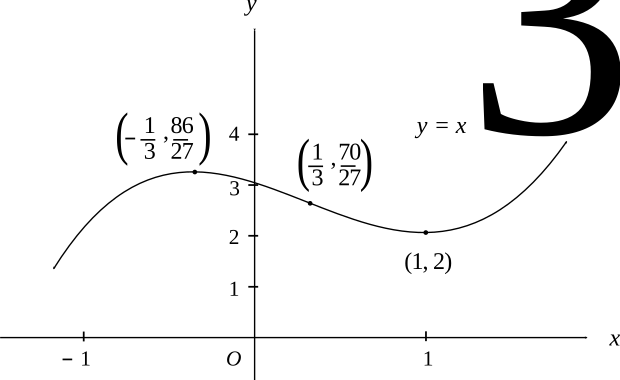
  3. Sketch the curve, labelling the stationary points, point of inflection and `y`-intercept.  (2 marks)

    --- 8 WORK AREA LINES (style=lined) ---

Show Answers Only
  1. `text(MAX at)\ (-1/3, 86/27); \ text(MIN at)\ (1, 2)`
  2. `text(Proof)\ \ text{(See Worked Solutions)}`
  3.  
Show Worked Solution
i. `y` `= x^3 – x^2 – x + 3`
  `(dy)/(dx)` `= 3x^2 – 2x – 1`
  `(d^2y)/(dx^2)` `= 6x – 2`

`text(S.P.’s when)\ (dy)/(dx) = 0`

`3x^2 – 2x – 1` `= 0`
`(3x + 1) (x – 1)` `= 0`

`x = -1/3 or 1`


`text(When)\ \ x = -1/3`

`f(-1/3)` `= (-1/3)^3 – (-1/3)^2 – (-1/3) + 3`
  `= -1/27 – 1/9 + 1/3 + 3`
  `= 86/27`
`f″(-1/3)` `= (6 xx -1/3) – 2 = -4 < 0`

`:.\ text(MAX at)\ \ (-1/3, 86/27)`


`text(When)\ \ x = 1`

`f(1)` `= 1^3 – 1^2 – 1 + 3 =2`
`f″(1)` `= (6 xx 1) – 2 = 4 > 0`

`:.\ text(MIN at)\ \ (1, 2)`


ii.  `(d^2y)/(dx^2) = 0\ \ text(when)`

`6x-2` `=0`
`x` `=1/3`


`text(Checking change of concavity)`

`text(Concavity changes either side of)\ x = 1/3`

`:.\ (1/3, 70/27)\ \ text(is a P.I.)`


iii.  `text(When)\ \ x` `= 0`
`y` `= 3`

Filed Under: Curve Sketching, Curve Sketching and The Primitive Function Tagged With: Band 3, Band 4, smc-969-10-Cubic

Trigonometry, 2ADV T1 2015 HSC 13a

The diagram shows `Delta ABC` with sides  `AB = 6` cm, `BC = 4` cm  and  `AC = 8` cm.
 

  1. Show that  `cos A = 7/8`.  (1 mark)

    --- 2 WORK AREA LINES (style=lined) ---

  2. By finding the exact value of `sin A`, determine the exact value of the area of `Delta ABC`.  (2 marks)

    --- 5 WORK AREA LINES (style=lined) ---

Show Answers Only
  1. `text(Proof)\ \ text{(See Worked Solutions)}`
  2. `3 sqrt 15\ \ text(cm²)`
Show Worked Solution

i.    `text(Show)\ cos A = 7/8`

`text(Using the cosine rule:)`

`cos A` `= (b^2 + c^2-a^2)/(2bc)`
  `= (8^2 + 6^2-4^2)/(2 xx 8 xx 6)`
  `= (64 + 36-16)/96`
  `= 84/96`
  `= 7/8\ \ text(…  as required)`


♦ Mean mark 40%.
ii.    2UA HSC 2015 13ai
`a^2 + 7^2` `= 8^2`
`a^2 + 49` `= 64`
`a^2` `= 15`
`a` `= sqrt 15`
`:.\ sin A` `= (sqrt 15)/8`


`:.\ text(Area)\ Delta ABC` `= 1/2 bc\ sin A`
  `= 1/2 xx 8 xx 6 xx (sqrt 15)/8`
  `= 3 sqrt 15\ \ text(cm²)`

Filed Under: Sine and Cosine Rules, Bearings, Trig Ratios, Sine and Cosine Rules, Trig Ratios, Sine and Cosine Rules Tagged With: Band 3, Band 5, smc-6392-35-Sine Rule (Area), smc-6392-40-Cosine Rule, smc-980-30-Sine Rule, smc-980-40-Cosine Rule

Quadratic, 2UA 2015 HSC 12e

The diagram shows the parabola `y = x^2/2` with focus `S (0, 1/2).` A tangent to the parabola is drawn at `P (1, 1/2).`

  1. Find the equation of the tangent at the point `P`.   (2 marks)
  2. What is the equation of the directrix of the parabola?   (1 mark)
  3. The tangent and directrix intersect at `Q`.
    Show that `Q` lies on the `y`-axis.   (1 mark)

  4. Show that `Delta PQS` is isosceles.   (1 mark)
Show Answers Only
  1. `y = x – 1/2`
  2. `y = -1/2`
  3.  
  4. `text(Proof)\ \ text{(See Worked Solutions)}`
  5. `text(Proof)\ \ text{(See Worked Solutions)}`
Show Worked Solution
(i)   

`y = 1/2 x^2`

`(dy)/(dx) = x`
 

`text(When)\ \ x = 1,\ \ (dy)/(dx) = 1`

`text(Equation of tangent,)\ m = 1,\ text(through)\ (1, 1/2):`

`y – y_1` `= m (x – x_1)`
`y – 1/2` `= 1 (x – 1)`
`y – 1/2` `= x – 1`
`y` `= x – 1/2`


(ii)  `text(Directrix is)\ \ y = -1/2`
 

(iii)  `Q\ text(is at the intersection of)`

`y = x – 1/2\ \ …\ \ text{(1)}`

`y = -1/2\ \ \ \ …\ \ text{(2)}`

`text{(1) = (2)}`

`x – 1/2` `= -1/2`
`x` `= 0`

 
`:.\ Q\ text(lies on the)\ y text(-axis)\ \ …\ \ text(as required)`


(iv)  `text(Show)\ Delta PQS\ text(is isosceles.)`

`text(Distance)\ PS = 1 – 0 = 1`

`Q\ text(has coordinates)\ (0, -1/2)`

`text(Distance)\ SQ = 1/2 + 1/2 = 1`

`:. PS = SQ = 1`

`:.\ Delta PQS\ text(is isosceles)`

Filed Under: 6. Linear Functions, Tangents and Normals, The Parabola Tagged With: Band 3, Band 4, HSC, page-break-before-solution

Calculus, 2ADV C1 2015 HSC 12c

Find  `f^{′}(x)`, where  `f(x) = (x^2 + 3)/(x-1).`   (2 marks)

--- 5 WORK AREA LINES (style=lined) ---

Show Answers Only

`((x-3) (x + 1))/(x-1)^2`

Show Worked Solution

`f(x) = (x^2 + 3)/(x-1)`

`text(Using the quotient rule:)`

`u` `= x^2 + 3` `\ \ \ \ \ \ v` `= x-1`
`u^{′}` `= 2x` `\ \ \ \ \ \ v^{′}` `= 1`
`f^{′}(x)` `= (u^{′} v-uv^{′})/v^2`
  `= (2x (x-1)-(x^2 + 3) xx 1)/(x-1)^2`
  `= (2x^2-2x-x^2-3)/(x-1)^2`
  `= (x^2-2x-3)/(x-1)^2`
  `= ((x-3) (x + 1))/(x-1)^2`

Filed Under: Standard / 1st Principles, Standard Differentiation, Standard Differentiation Tagged With: Band 3, smc-1069-10-Quotient Rule, smc-6436-10-Quotient Rule

Functions, 2ADV F1 2015 HSC 12b

The diagram shows the rhombus  `OABC`.

The diagonal from the point  `A (7, 11)`  to the point `C` lies on the line `l_1`.

The other diagonal, from the origin `O` to the point `B`, lies on the line `l_2` which has equation  `y = -x/3`.

2015 2ua 12b

  1. Show that the equation of the line  `l_1`  is  `y = 3x - 10`.  (2 marks)
  2. The lines  `l_1`  and  `l_2`  intersect at the point `D`.
  3. Find the coordinates of  `D`.  (2 marks)


Show Answers Only
  1. `text(Proof)\ \ text{(See Worked Solutions)}`
  2. `(3, –1)`
Show Worked Solution

(i)  `text(Show)\ \ l_1\ \ text(is)\ \ y = 3x – 10`

`l_2\ \ text(is)\ \ y = -x/3`

`m_(l_2)` `= -1/3`  
`:.\ m_(l_1)` `= 3\ \ \ ` `text{(diagonals of rhombus}\ OABC\ text(are)`
    `text{perpendicular bisectors.)}`

 
`l_1\ text(has)\ m = 3,\ text(through)\ \ A(7, 11)`

`y – y_1` `= m (x – x_1)`
`y – 11` `= 3 (x – 7)`
`y-11` `= 3x – 21`
`y` `= 3x – 10\ \ text(… as required)`


(ii)  `D\ text(occurs at the intersection of)\ \ l_1 and l_2`

`y` `= -1/3\ x` `\ text{…  (1)}`
`y` `= 3x – 10` `\ text{…  (2)}`
`text{(1)}` `=\ text{(2)}`
`-1/3\ x` `= 3x – 10`
`10/3\ x` `= 10`
`:.\ x` `= 3`


`text(Substitute)\ \ x = 3\ \ text{into   (1)}`

`y` `= -1/3 xx 3`
  `= -1`
`:.\ D\ text{has coordinates  (3, –1)}`

Filed Under: 6. Linear Functions Tagged With: Band 3, HSC

Trigonometry, 2ADV T2 2015 HSC 12a

Find the solutions of  `2 sin theta = 1`  for  `0 <= theta <= 2 pi`.   (2 marks)

--- 4 WORK AREA LINES (style=lined) ---

Show Answers Only

`pi/6, (5 pi)/6`

Show Worked Solution
`2 sin theta` `= 1,\ \ \ \ 0 <= theta <= 2 pi`
`sin theta` `= 1/2`

`=> sin (pi/6) = 1/2 \ \ text(and sin is positive)`

`text(in the 1st/2nd quadrants)`

`:. theta` `= pi/6, pi-pi/6`
  `= pi/6, (5 pi)/6`

Filed Under: Exact Trig Ratios, Exact Trig Ratios, Exact Trig Ratios and Other Identities Tagged With: Band 3, smc-6411-10-sin, smc-979-10-sin

Calculus, 2ADV C4 2015 HSC 11h

Find  `int x/(x^2 - 3)\ dx`.  (2 marks)

Show Answers Only

`1/2 ln (x^2 – 3) + C`

Show Worked Solution

`int x/(x^2 – 3)\ dx`

`= 1/2 int (2x)/(x^2 – 3)\ dx`

`= 1/2 ln (x^2 – 3) + C`

Filed Under: L&E Integration, Log Calculus, Log Calculus (Y12) Tagged With: Band 3, smc-1203-30-Log (Indefinite), smc-964-20-Indefinite Integrals

Trig Calculus, 2UA 2015 HSC 11g

Evaluate `int_0^(pi/4) cos 2x\ dx`.  (2 marks)

Show Answers Only

`1/2`

Show Worked Solution

`int_0^(pi/4) cos 2x`

`= [1/2 sin\ 2x]_0^(pi/4)`

`= [1/2 sin\ pi/2 – 1/2 sin\ 0]`

`= 1/2 – 0`

`= 1/2`

Filed Under: Differentiation and Integration Tagged With: Band 3, HSC

Calculus, 2ADV C2 2015 HSC 11f

Differentiate  `y = (x + 4) ln\ x`.  (2 marks)

Show Answers Only

`ln\x + 4/x +1`

Show Worked Solution

`y = (x + 4) ln\ x`

`text(Using the product rule)`

`(dy)/(dx)` `= d/(dx) (x + 4) * ln x + (x + 4) d/(dx) ln\ x`
  `= ln x + (x + 4) 1/x`
  `= ln x + 4/x + 1`

Filed Under: L&E Differentiation (Y12), Log Calculus, Log Calculus (Y12), Logs and Exponentials - Differentiation Tagged With: Band 3, smc-964-10-Differentiation, smc-967-20-Logs, smc-967-30-Product Rule

Calculus, 2ADV C2 2015 HSC 11e

Differentiate  `(e^x + x)^5`.  (2 marks)

Show Answers Only

`5 (e^x + 1) (e^x + x)^4`

Show Worked Solution
`y` `= (e^x + x)^5`
 `(dy)/(dx)` `= 5 (e^x + x)^4 xx d/(dx) (e^x + x)`
  `= 5 (e^x + x)^4 xx (e^x + 1)`
  `= 5 (e^x + 1) (e^x + x)^4`

Filed Under: Exponential Calculus, Exponential Calculus (Y12), L&E Differentiation (Y12), Logs and Exponentials - Differentiation Tagged With: Band 3, smc-965-10-Differentiation (base e), smc-967-10-Exponentials (base e), smc-967-50-Chain Rule

Financial Maths, 2ADV M1 2015 HSC 11d

Find the limiting sum of the geometric series  `1 - 1/4 + 1/16 - 1/64 + …`.  (2 marks)

--- 5 WORK AREA LINES (style=lined) ---

Show Answers Only

`4/5`

Show Worked Solution

`1 – 1/4 + 1/16 – 1/64 + …`

`r = -1/4,\ \ a=1`

`text(S)text(ince)\ |\ r\ | = 1/4 < 1`

`S_oo` `= a/(1 – r)`
  `= 1/(1 – (-1/4))`
  `= 1/(5/4)`
  `= 4/5`

Filed Under: Geometric Series, Geometric Series Tagged With: Band 3, smc-1006-40-Limiting Sum, smc-1006-70-Calculations Only

Functions, 2ADV F1 2015 HSC 11c

Express  `8/(2 + sqrt 7)`  with a rational denominator.  (2 marks)

Show Answers Only

`(-8 (2-sqrt 7))/3`

Show Worked Solution

`8/(2 + sqrt 7) xx (2-sqrt 7)/(2-sqrt 7)`

`= (8(2-sqrt 7))/(2^2 -(sqrt 7)^2)`

`= (8 (2-sqrt 7))/(4-7)`

`= (-8(2-sqrt 7))/3`

Filed Under: Algebraic Techniques Tagged With: Band 3, smc-6213-30-Surd Denominators, syllabus-2027

Functions, 2ADV F1 2015 HSC 11b

Factorise fully  `3x^2-27`.  (2 marks)

Show Answers Only

`3 (x + 3) (x-3)`

Show Worked Solution
`3x^2-27` `= 3 (x^2-9)`
  `= 3 (x + 3) (x-3)`

Filed Under: Factors and Other Equations, Quadratics and Cubic Functions, Quadratics and Cubic Functions Tagged With: Band 3, smc-6215-10-Quadratics, smc-6215-40-Factorise, smc-6215-50-Cubics, smc-984-10-Quadratics, smc-984-20-Cubics

Functions, 2ADV F1 2015 HSC 11a

Simplify  `4x − (8 − 6x)`.  (1 mark)

Show Answers Only

`2 (5x – 4)`

Show Worked Solution

`4x – (8 – 6x)`

`= 4x – 8 + 6x`

`= 10x – 8`

`= 2 (5x – 4)`

Filed Under: Factors and Other Equations, Linear Functions Tagged With: Band 3, HSC

Probability, 2ADV S1 2015 HSC 4 MC

The probability that Mel’s soccer team wins this weekend is `5/7`.

The probability that Mel’s rugby league team wins this weekend is `2/3`.

What is the probability that neither team wins this weekend?

  1. `2/21`
  2. `10/21`
  3. `13/21`
  4. `19/21`
Show Answers Only

`A`

Show Worked Solution

`Ptext{(win at soccer)} = 5/7\ \ =>\ \ Ptext{(not win at soccer)} = 1-5/7 = 2/7`

`Ptext{(win at league)} = 2/3\ \ =>\ \ Ptext{(not win at league)} = 1/3`

`Ptext{(not win at both)}= 2/7 xx 1/3= 2/21`

`=> A`

Filed Under: 3. Probability, Multi-Stage Events, Multi-Stage Events Tagged With: Band 3, smc-6469-30-Complementary Probability, smc-989-30-Complementary Probability

Functions, 2ADV F1 2015 HSC 2 MC

What is the slope of the line with equation  `2x-4y + 3 = 0`?

  1. `-2`
  2. `-1/2`
  3. `1/2`
  4. `2`
Show Answers Only

`C`

Show Worked Solution
`2x-4y + 3` `= 0`
`4y` `= 2x + 3`
`y` `= 1/2 x + 3/4`

 
`=> C`

Filed Under: 6. Linear Functions, Linear Equations and Basic Graphs, Linear Functions, Linear Functions Tagged With: Band 3, common-content, smc-6214-04-Gradient, smc-792-10-Gradient, smc-985-30-Coordinate Geometry

Functions, 2ADV F1 2015 HSC 1 MC

What is  `0.005\ 233\ 59`  written in scientific notation, correct to 4 significant figures?

  1. `5.2336 xx 10^-2`
  2. `5.234 xx 10^-2`
  3. `5.2336 xx 10^-3`
  4. `5.234 xx 10^-3`
Show Answers Only

`D`

Show Worked Solution

`0.005\ 233\ 59 = 5.234 xx 10^-3`

`=> D`

Filed Under: Algebraic Techniques, Algebraic Techniques, Surds and Rounding Tagged With: Band 3, smc-6213-60-Rounding, smc-983-10-Rounding

Functions, 2ADV 2006 HSC 7c

  1. Write down the discriminant of  `2x^2 + (k-2)x + 8`  where  `k`  is a constant.   (1 mark)

    --- 4 WORK AREA LINES (style=lined) ---

  2. Hence, or otherwise, find the values of `k` for which the parabola  `y = 2x^2 + kx + 9` does not intersect the line  `y = 2x + 1`.   (2 marks)

    --- 6 WORK AREA LINES (style=lined) ---

Show Answers Only

i.    `\Delta= k^2-4k-60`

ii.  `-6 < k < 10`

Show Worked Solution

i.   `2x^2 + (k-2)x + 8`

`Delta` `= b^2-4ac`
  `= (k-2)^2-4 xx 2 xx 8`
  `= k^2-4k + 4-64`
  `= k^2-4k-60`


ii.   `y` `= 2x^2 + kx + 9` `\ \ text{…  (1)}`
`y` `= 2x + 1` `\ \ text{…  (2)}`

 
`text(Substitute)\ y = 2x + 1\ text{into (1)}`

`2x + 1 = 2x^2 + kx + 9`

`2x^2 + kx-2x + 8 = 0`

`2x^2 + (k-2)x + 8 = 0\ …\ text{(∗)}`
 

`text{The graphs will not intercept if (∗) has no roots, i.e.)\ \ Delta <0`

`k^2-4k-60` `< 0`
`(k-10) (k + 6)` `< 0`


HSC quadratic

`text(From the graph, no intersection when)`

`-6 < k < 10`

Filed Under: Quadratics and Cubic Functions Tagged With: Band 3, Band 4, smc-6215-80-Discriminant

Calculus, EXT1* C1 2006 HSC 6b

A rare species of bird lives only on a remote island. A mathematical model predicts that the bird population, `P`, is given by

`P = 150 + 300 e^(-0.05t)`

where `t` is the number of years after observations began.

  1. According to the model, how many birds were there when observations began?  (1 mark)

    --- 2 WORK AREA LINES (style=lined) ---

  2. According to the model, what will be the rate of change in the bird population ten years after observations began?  (2 marks)

    --- 5 WORK AREA LINES (style=lined) ---

  3. What does the model predict will be the limiting value of the bird population?  (1 mark)

    --- 3 WORK AREA LINES (style=lined) ---

  4. The species will become eligible for inclusion in the endangered species list when the population falls below `200`. When does the model predict that this will occur?  (2 marks)

    --- 6 WORK AREA LINES (style=lined) ---

Show Answers Only
  1. `450\ text(birds)`
  2. `-9.1\ text{(to 1 d.p.)}`
  3. `150\ text(birds)`
  4. `text(After 35.83… years)`
Show Worked Solution

i.  `P = 150 + 300 e^(-0.05t)`

`text(When)\ \ t = 0`

`P` `= 150 + 300 e^0`
  `= 450`

 
`:.\ text(There were 450 birds when observations began.)`
 

ii.  `(dP)/dt` `= 300 xx (-0.05) xx e^(-0.05t)`
  `= -15 e^(-0.05t)`

 
`text(When)\ \ t = 10`

`(dP)/dt` `= -15 e^(-0.05 xx 10)`
  `= -15 e^(-0.5)`
  `= -9.097…`
  `= -9.1\ text{(to 1 d.p.)}`


`:.\ text(After 10 years, the bird population will be)`

`text(decreasing at a rate of 9.1 birds per year.)`


iii.  `text(As)\ t rarr oo`

`300 e^(-0.05t) rarr 0`

`:. P = 150 + 300 e^(-0.05t) rarr 150`

`:.\ text(The model predicts a limiting population)`

`text(of 150 birds.)`


iv.  `text(Find)\ t\ text(when)\ P < 200`

`150 + 300 e^(-0.05t)` `< 200`
`300 e^(-0.05t)` `< 50`
`e^(-0.05t)` `< 50/300`
`ln e^(-0.05t)` `< ln­ 1/6`
`-0.05t` `< ln­ 1/6`
`t` `> (ln­ 1/6)/(-0.05t)`
`t` `> 35.83…`


`:.\ text(The model predicts the population)`

`text(will fall below 200 after 35.83… years.)`

Filed Under: Exponential growth and decay, Standard Growth and Decay Tagged With: Band 3, Band 4, smc-1081-20-Decay, smc-1081-40-Population

Plane Geometry, 2UA 2006 HSC 6a

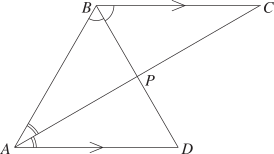
In the diagram, `AD` is parallel to `BC`, `AC` bisects `/_BAD` and `BD` bisects `/_ABC`. The lines `AC` and `BD` intersect at `P`.

Copy or trace the diagram into your writing booklet.

  1. Prove that `/_BAC = /_BCA`.  (1 mark)
  2. Prove that `Delta ABP ≡ Delta CBP`.  (2 marks)
  3. Prove that `ABCD` is a rhombus.  (3 marks)
Show Answers Only
  1. `text(Proof)\ \ text{(See Worked Solutions)}`
  2. `text(Proof)\ \ text{(See Worked Solutions)}`
  3. `text(Proof)\ \ text{(See Worked Solutions)}`
Show Worked Solution
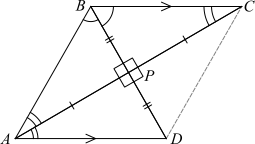
(i)  

`text(Prove)\ /_BAC = /_BCA`

`/_BCA` `= /_CAD\ \ \ text{(alternate angles,}\ BC\ text(||)\ AD text{)}`
`/_CAD` `= /_BAC\ \ \ text{(}AC\ text(bisects)\ /_BAD text{)}`
`:. /_BAC` `= /_BCA\ …\ text(as required)`


(ii)  `text(Prove)\ Delta ABP ≡ Delta CBP`

`/_BAC` `= /_BCA\ \ \ text{(from part (i))}`
`/_ABP` `= /_CBP\ text{(}BD\ text(bisects)\ /_ABC text{)}`
`BP\ text(is common)`


`:. Delta ABP ≡ Delta CBP\ \ text{(AAS)}`


(iii)  `text(Using)\ Delta ABP ≡ Delta CBP`

`AP = PC\ \ text{(corresponding sides of congruent triangles)}`

`/_BPA = /_BPC\ \ text{(corresponding angles of congruent triangles)}`

`text(Also,)\ /_BPA = /_BPC = 90^@`

`text{(}/_APC\ text{is a straight angle)}`


`text(Considering)\ Delta APD and Delta APB`

`/_DAP` `= /_BAP\ text{(}AC\ text(bisects)\ /_BAD text{)}`
`/_DPA` `= 90^@\ text{(vertically opposite angles)}`
`:. /_DPA` `= /_BPA = 90^@`

`PA\ text(is common)`

`:. Delta APD ≡ Delta APB\ \ text{(AAS)}`

`BP = PD\ \ text{(corresponding sides of congruent triangles)}`


 `:. ABCD\ text(is a rhombus as its diagonals are)`

`text(perpendicular bisectors.)`

Filed Under: 2. Plane Geometry Tagged With: Band 3, Band 4, Band 5, HSC, page-break-before-solution

Calculus, 2ADV C4 2006 HSC 5b

  1. Show that `d/dx log_e (cos x) = -tan x.`  (1 mark)

    --- 2 WORK AREA LINES (style=lined) ---


  2.   
     
    2006 5b
     
    The shaded region in the diagram is bounded by the curve  `y =tan x`  and the lines  `y =x`  and  `x = pi/4.`


    Using the result of part (i), or otherwise, find the area of the shaded region.  (3 marks)

    --- 6 WORK AREA LINES (style=lined) ---

Show Answers Only
  1. `text(Proof)\ \ text{(See Worked Solutions)}`
  2. `(1/2 log_e 2 – pi^2/32)\ text(u²)`
Show Worked Solution
i.   `d/dx log_e (cos x)` `= (-sin x)/cos x`
  `= – tan x\ …\ text(as required)`


ii.  `text(Shaded Area)`

`= int_0^(pi/4) tan x\ dx – int_0^(pi/4) x\ dx`

`= int_0^(pi/4) tan x – x\ dx`

`= [-log_e (cos x) – 1/2 x^2]_0^(pi/4)`

`=[(-log_e (cos­ pi/4) – 1/2 xx (pi^2)/16) – (-log_e(cos 0) – 0)]`

`= -log_e­ 1/sqrt 2 – pi^2/32 + log_e1`

`= -log_e 2^(-1/2) – pi^2/32`

`= (1/2 log_e 2 – pi^2/32)\ text(u²)`

Filed Under: Areas Under Curves, Areas Under Curves Tagged With: Band 3, Band 4, Band 5, smc-975-50-Trig

Calculus, 2ADV C3 2004 HSC 4b

Consider the function  `f(x) = x^3 − 3x^2`.

  1. Find the coordinates of the stationary points of the curve  `y = f(x)`  and determine their nature.   (3 marks)

    --- 6 WORK AREA LINES (style=lined) ---

  2. Sketch the curve showing where it meets the axes.   (2 marks)

    --- 8 WORK AREA LINES (style=lined) ---

  3. Find the values of  `x`  for which the curve  `y = f(x)`  is concave up.   (2 marks)

    --- 5 WORK AREA LINES (style=lined) ---

Show Answers Only
  1. `text(MAX at)\ (0,0),\ \ text(MIN at)\ (2,-4)`
  2.  
    1. Geometry and Calculus, 2UA 2004 HSC 4b Answer
  3. `f(x)\ text(is concave up when)\ x>1`
Show Worked Solution
(i)    `f(x)` `= x^3 – 3x^2`
  `f'(x)` `= 3x^2 – 6x`
  `f″(x)` `= 6x – 6`


`text(S.P.’s  when)\ \ f'(x) = 0`

`3x^2 – 6x` `= 0`
`3x (x – 2)` `= 0`
`x` `= 0\ \ text(or)\ \ 2`


`text(When)\ x = 0`

`f(0)` `= 0`
`f″(0)` `= 0 – 6 = -6 < 0`
`:.\ text(MAX at)\ (0,0)`


`text(When)\ x = 2`

`f(2)` `= 2^3 – (3 xx 4) = -4`
`f″(2)` `= (6 xx 2) – 6 = 6 > 0`
`:.\ text(MIN at)\ (2, -4)`


(ii)   `f(x) = x^3 – 3x^2\ text(meets the)\ x text(-axis when)\ f(x) = 0`
`x^3 – 3x^2` `= 0`
`x^2 (x-3)` `= 0`
`x` `= 0\ \ text(or)\ \ 3`

 Geometry and Calculus, 2UA 2004 HSC 4b Answer

(iii)   `f(x)\ text(is concave up when)`
`f″(x)` `>0`
`6x – 6` `>0`
`6x` `>6`
`x` `>1`


`:. f(x)\ text(is concave up when)\ \ x>1`

Filed Under: Curve Sketching, Curve Sketching and The Primitive Function Tagged With: Band 3, Band 4, Band 5, page-break-before-solution, smc-969-10-Cubic, smc-969-40-Concavity Intervals

Trigonometry, 2ADV T1 2004 HSC 3c

Trig Ratios, 2UA 2004 HSC 3c

The diagram shows a point `P` which is 30 km due west of the point `Q`.

The point `R` is 12 km from `P` and has a bearing from `P` of 070°. 

  1. Find the distance of `R` from `Q`.   (2 marks)

    --- 4 WORK AREA LINES (style=lined) ---

  2. Find the bearing of `R` from `Q`.   (2 marks)

    --- 4 WORK AREA LINES (style=lined) ---

Show Answers Only
  1. `19.2\ text(km)\ \ \ text{(1 d.p.)}` 
  2. `282^@`
Show Worked Solution

i.   `text(Join)\ \ RQ\ \ text(to form)\ \ Delta RPQ`

Trig Ratios, 2UA 2004 HSC 3c Answer

`/_RPQ = 90-70 = 20^@`

`text(Using the cosine rule:)`

`RQ^2` `= PR^2 + PQ^2-2 xx PR xx PQ xx cos /_RPQ`
  `= 12^2 + 30^2-2 xx 12 xx 30 xx cos 20^@`
  `= 367.421…`
`RQ` `= 19.168…= 19.2\ text(km)\ \ text{(1 d.p.)}`

 
ii.   
`text(Using sine rule:)`

`(sin /_RQP)/12` `= (sin 20^@)/(19.168…)`
`sin/_RQP` `= (12 xx sin 20^@)/(19.168…)= 0.214…`
`/_RQP` `= 12.36…^@= 12^@\ \ \ text{(nearest degree)}`

 
`:.\ text(Bearing of)\ R\ text(from)\ Q`

`=270+12`

`=282^@`

Filed Under: Bearings, Bearings, Sine and Cosine Rules, Bearings Tagged With: Band 3, Band 4, common-content, smc-6395-10-Bearings, smc-981-10-Bearings

Calculus, 2ADV C4 2004 HSC 3bi

Evaluate  `int_1^2 e^(3x)\ dx`.   (2 marks)

Show Answers Only

`1/3 (e^6 – e^3)`

Show Worked Solution
  `int_1^2 e^(3x)\ dx` `= 1/3 [e^(3x)]_1^2`
    `= 1/3 (e^6 – e^3)`

Filed Under: Exponential Calculus, Exponential Calculus (Y12), L&E Integration, Log Calculus Tagged With: Band 3, smc-1203-20-Exponential (Definite), smc-965-40-Definite Integrals

Calculus, 2ADV C2 2004 HSC 3aii

Differentiate with respect to  `x`:

`(1 + sin x)^5`.   (2 marks)

Show Answers Only

`5 cos x\ (1 + sinx)^4`

Show Worked Solution
`y` `= (1 + sinx)^5`
`dy/dx` `= 5 (1 + sinx)^4 xx d/(dx)(sinx)`
  `= 5 cos x (1 + sinx)^4`

Filed Under: Differentiation and Integration, Trig Differentiation, Trig Differentiation Tagged With: Band 3, smc-968-10-Sin, smc-968-60-Chain Rule

Functions, 2ADV 2004 HSC 2c

For what values of `k` does  `x^2-kx + 4 = 0`  have no real roots?   (2 marks)

--- 5 WORK AREA LINES (style=lined) ---

Show Answers Only

`-4 < k < 4`

Show Worked Solution

`x^2-kx + 4 = 0`

`text(No real roots when)\ Delta < 0`

`b^2-4ac` `< 0`
`(text(–) k^2)-4 xx 1 xx 4` `< 0`
`k^2-16` `< 0`
`k^2` `< 16`
`:.\ -4 < k` `< 4`


`:.\ text(There are no real roots when)\ \ \ -4 < k < 4.`

Filed Under: Algebraic Techniques Tagged With: Band 3, smc-6213-40-Discriminant

  • « Previous Page
  • 1
  • …
  • 51
  • 52
  • 53
  • 54
  • 55
  • …
  • 59
  • Next Page »

Copyright © 2014–2026 SmarterEd.com.au · Log in