SmarterEd

Aussie Maths & Science Teachers: Save your time with SmarterEd

  • Login
  • Get Help
  • About

Plane Geometry, 2UA 2004 HSC 2b

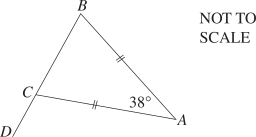
In the diagram, `ABC`  is an isosceles triangle with  `AB = AC`  and  `/_BAC = 38^@`. The line `BC` is produced to `D`. 

Find the size of `/_ACD`. Give reasons for your answer.   (2 marks)

--- 4 WORK AREA LINES (style=lined) ---

Show Answers Only

`109^@`

Show Worked Solution

Plane Geometry, 2UA 2004 HSC 2b Answer

`/_ABC` `= 1/2 (180-38)\ \ \ text{(base angle of isosceles}\ Delta ABC text{)}`
  `= 71^@`


`:.\ /_ACD` `= 71 + 38\ \ \ text{(exterior angle of}\ Delta ABC text{)}`
  `= 109^@`

Filed Under: 2. Plane Geometry, Special Properties Tagged With: Band 3, num-title-ct-pathc, num-title-qs-hsc, smc-4748-10-Triangle properties

Probability, 2ADV S1 2006 HSC 4c

A chessboard has 32 black squares and 32 white squares. Tanya chooses three different squares at random.

  1. What is the probability that Tanya chooses three white squares?   (2 marks)

    --- 4 WORK AREA LINES (style=lined) ---

  2. What is the probability that the three squares Tanya chooses are the same colour?   (1 mark)

    --- 3 WORK AREA LINES (style=lined) ---

  3. What is the probability that the three squares Tanya chooses are not the same colour?   (1 mark)

    --- 3 WORK AREA LINES (style=lined) ---

Show Answers Only
  1. `5/42`
  2. `5/21`
  3. `16/21`
Show Worked Solution

i.    `text(P)(WWW)= 32/64 xx 31/63 xx 30/62= 5/42`
 

ii.   `text{P(same colour)}`

`= P(WWW) + P(BBB)`

`= 5/42 + 32/64 xx 31/63 xx 30/62`

`= 5/42 + 5/42`

`= 5/21`


iii.  `text{P(not all the same colour)}`

`= 1-text{P(same colour)}`

`= 1-5/21`

`= 16/21`

Filed Under: 3. Probability, Multi-Stage Events, Multi-Stage Events Tagged With: Band 3, Band 4, smc-6469-20-Other Multi-Stage Events, smc-6469-30-Complementary Probability, smc-989-20-Other Multi-Stage Events, smc-989-30-Complementary Probability

Calculus, EXT1* C3 2006 HSC 4b

2006 4b

In the diagram, the shaded region is bounded by the parabola  `y = x^2 + 1`, the `y`-axis and the line  `y = 5`.

Find the volume of the solid formed when the shaded region is rotated about the `y`-axis.  (3 marks)

--- 6 WORK AREA LINES (style=lined) ---

Show Answers Only

`8 pi\ \ text(u³)`

Show Worked Solution

`y = x^2 + 1`

`x^2 = y – 1`

`V` `= pi int_1^5 x^2 \ dy`
  `= pi int_1^5 y-1 \ dy`
  `= pi [y^2/2 – y]_1^5`
  `= pi[(25/2 – 5) – (1/2 – 1)]`
  `= pi[15/2 – (-1/2)]`
  `= 8 pi\ \ text(u³)`

Filed Under: Further Area and Solids of Revolution, Volumes of Solids of Rotation Tagged With: Band 3, Band 4, smc-1039-10-Polynomial, smc-1039-61-y-axis Rotation

Trigonometry, 2ADV T1 2006 HSC 4a

In the diagram, `ABCD` represents a garden. The sector  `BCD`  has centre `B` and  `/_DBC = (5 pi)/6`

The points `A, B` and `C` lie on a straight line and  `AB = AD = 3` metres.

Copy or trace the diagram into your writing booklet.

  1. Show that `/_DAB = (2 pi)/3.`   (1 mark)

    --- 3 WORK AREA LINES (style=lined) ---

  2. Find the length of `BD`.   (2 marks)

    --- 6 WORK AREA LINES (style=lined) ---

  3. Find the area of the garden `ABCD`.   (2 marks)

    --- 8 WORK AREA LINES (style=lined) ---

Show Answers Only
  1. `text(Proof)\ \ text{(See Worked Solutions)}`
  2. `3 sqrt 3\ \ text(m)`
  3. `(9 sqrt 3 + 45 pi) / 4\ \ text(m²)`
Show Worked Solution
i.   

`text(Show)\ /_DAB = (2 pi)/3:`

`/_DBA= pi-(5 pi)/6= pi/6\ text{(π radians in straight angle}\ ABC text{)}`

`/_BDA = pi/6\ text(radians)\ \ text{(base angles of isosceles}\ Delta ADB text{)}`

`:. /_DAB` `= pi-(pi/6 + pi/6)\ \ text{(angle sum of}\ Delta ADB text{)}`
  `= (2 pi)/3`


ii.  `text(Using the cosine rule:)`

`BD^2` `= AD^2 + AB^2-2 xx AD xx AB xx cos {:(2 pi)/3`
  `= 9 + 9-(2 xx 3 xx 3 xx -0.5)= 27`
  `= 27`
`:. BD` `= sqrt 27= 3 sqrt 3\ \ text(m)`


iii.  `text(Area of)\ Delta ADB` `= 1/2 ab sin C`
  `= 1/2 xx 3 xx 3 xx sin{:(2 pi)/3`
  `= 9/2 xx sqrt3/2`
  `= (9 sqrt 3)/4\ \ text(m²)`

 
`text(Area of sector)\ BCD`

`= {(5 pi)/6}/(2 pi) xx pi r^2`

`= (5 pi)/12 xx (3 sqrt 3)^2`

`= (45 pi)/4\ \ text(m)^2`


`:.\ text(Area of garden)\ ABCD`

`= (9 sqrt 3)/4 + (45 pi)/4`

`= (9 sqrt 3 + 45 pi)/4\ \ text(m)^2`

Filed Under: Circular Measure, Circular Measure, Circular Measure, Sine and Cosine Rules, Bearings, Trig Ratios, Sine and Cosine Rules, Trig Ratios, Sine and Cosine Rules Tagged With: Band 3, Band 4, smc-6392-35-Sine Rule (Area), smc-6392-40-Cosine Rule, smc-6394-30-Area - Other, smc-978-30-Area - Other, smc-980-30-Sine Rule, smc-980-40-Cosine Rule

Financial Maths, 2ADV M1 2006 HSC 3c

On the first day of the harvest, an orchard produces 560 kg of fruit. On the next day, the orchard produces 543 kg, and the amount produced continues to decrease by the same amount each day.

  1. How much fruit is produced on the fourteenth day of the harvest?  (2 marks)

    --- 4 WORK AREA LINES (style=lined) ---

  2. What is the total amount of fruit that is produced in the first 14 days of the harvest?  (1 mark)

    --- 2 WORK AREA LINES (style=lined) ---

  3. On what day does the daily production first fall below 60 kg?  (2 marks)

    --- 4 WORK AREA LINES (style=lined) ---

Show Answers Only
  1. `text(339 kg of fruit is produced on 14th day.)`
  2. `text(6293 kg of fruit is produced in the 1st 14 days.)`
  3. `text(On the 31st day, production will first drop below 60 kg.)`
Show Worked Solution

i.   `T_1 = a = 560`

`T_2 = a + d = 543`

`=>\ text(AP where)\ a = 560, d = -17`

`vdots`

`T_14` `= a + 13d`
  `= 560 – (13 xx 17)`
  `= 339`


`:.\ text(339 kg of fruit is produced on 14th day.)`


ii.  `S_14 = text(total fruit produced in 1st 14 days)`

`S_14` `= n/2 [2a + (n – 1)d]`
  `= 14/2 [2 xx 560 – (14 – 1) xx 17]`
  `= 7 [1120 – 221]`
  `= 6293`


`:.\ text(6293 kg of fruit is produced in the 1st 14th days.)`


iii.  `text(Find)\ n\ text(such that)\ T_n < 60`

`T_n = a + (n – 1)d` `< 60`
`560 – 17(n – 1)` `< 60`
`560 – 17n + 17` `< 60`
`17n` `> 517`
`n` `> 30.41…`

 
`:.\ text(On the 31st day, production will first drop)`

`text(below 60 kg.)`

Filed Under: Arithmetic Series, Arithmetic Series Tagged With: Band 3, smc-1005-10-Find Term, smc-1005-20-Find Sum, smc-1005-70-Applied Context

Financial Maths, 2ADV M1 2006 HSC 3b

Evaluate  `sum_(r=2)^4 1/r.`  (1 mark)

Show Answers Only

`13/12`

Show Worked Solution
`sum_(r=2)^4 1/r` `= 1/2 + 1/3 + 1/4`
  `= 13/12`

Filed Under: Geometric Series, Geometric Series Tagged With: Band 3, smc-1006-20-Find Sum

Calculus, 2ADV C3 2006 HSC 2c

Find the equation of the tangent to the curve  `y = cos 2x`  at the point whose `x`-coordinate is  `pi/6`.  (3 marks)

--- 6 WORK AREA LINES (style=lined) ---

Show Answers Only

`y = – sqrt 3 x + ((sqrt 3 pi)/6 + 1/2)`

Show Worked Solution

`y = cos 2x`

`dy/dx = -2 sin 2x`

`text(When)\ \ x = pi/6`

`y` `= cos (2 xx pi/6)`
  `= cos (pi/3)`
  `= 1/2`


`dy / dx` `= -2 sin (pi/3)`
  `= -2 xx sqrt 3 / 2`
  `= – sqrt 3`

 
`text(Equation of tangent,)\ \ m = – sqrt 3, text(through)\ \ (pi/6, 1/2):`

`y – y_1` `= m(x – x_1)`
`y – 1/2` `= – sqrt 3 ( x – pi/6)`
`y – 1/2` `= – sqrt 3 x + (sqrt 3 pi)/6`
`y` `= – sqrt 3 x + ((sqrt 3 pi)/6 + 1/2)`

Filed Under: Differentiation and Integration, Tangents, Tangents and Normals Tagged With: Band 3, smc-1090-10-Find tangent given curve, smc-1090-60-Trig Function

Linear Functions, 2UA 2006 HSC 3a

In the diagram, `A, B and C` are the points  `(1, 4), (5, –4) and (–3, –1)`  respectively. The line  `AB`  meets the y-axis at `D`.

  1. Show that the equation of the line  `AB`  is  `2x + y - 6 = 0`.  (2 marks)
  2. Find the coordinates of the point `D`.  (1 mark)
  3. Find the perpendicular distance of the point `C` from the line  `AB`.  (1 mark)
  4. Hence, or otherwise, find the area of the triangle  `ADC`.  (2 marks)
Show Answers Only
  1. `text(Proof)\ \ text{(See Worked Solutions)}`
  2. `D(0, 6)`
  3. `13/sqrt 5\ text(units)`
  4.  
  5. `text(6.5 u²)`
Show Worked Solution

(i)  `text(Show)\ \ AB\ \ text(is)\ \ 2x + y – 6 = 0`

`A (1, 4)\ \ \ B (5, text(–4))`

`m_(AB)` `= (y_2 – y_1) / (x_2 – x_1)`
  `= (-4 – 4) / (5 – 1)`
  `= (-8)/4`
  `= – 2`

 
`:.\ text(Equation of)\ AB, m = -2,\ text(through)\ \ (1,4)`

`y-y_1` `=m(x-x_1)`
`y – 4` `= -2 (x – 1)`
`y – 4` `= -2x + 2`
`2x + y – 6` `= 0\ …\ text(as required)`


(ii)  `AB\ text(intersects y-axis at)\ D`

`0 + y – 6` `= 0`
`y` `= 6`

`:. D\ text(has coordinates)\ (0, 6)`


(iii)  `C\ text{(–3, –1)}`

`AB\ text(is)\ 2x + y – 6 = 0`

`_|_ text(dist)` `= |\ (ax_1 + by_1 + c)/sqrt (a^2 + b^2)\ |`
  `= |\ (2(−3) + 1(-1) – 6)/sqrt(2^2 + 1^2)\ |`
  `= |\ (-13)/sqrt 5\ |`
  `= 13/sqrt 5\ text(units)`


(iv)


`text(dist)\ AD` `= sqrt((x_2 – x_1)^2 + (y_2 – y_1)^2)`
  `= sqrt((0 – 1)^2 + (6 – 4)^2`
  `= sqrt (1 + 4)`
  `= sqrt 5`
`text(Area of)\ Delta ADC` `= 1/2 xx b xx h`
  `= 1/2 xx sqrt 5 xx 13/sqrt 5`
  `= 6.5\ text(u²)`

Filed Under: 6. Linear Functions Tagged With: Band 3, Band 4, HSC

Calculus, EXT1* C1 2005 HSC 9a

A particle is initially at rest at the origin. Its acceleration as a function of time, `t`, is given by

`ddot x = 4sin2t`

  1. Show that the velocity of the particle is given by  `dot x = 2 − 2\ cos\ 2t`.  (2 marks)

    --- 5 WORK AREA LINES (style=lined) ---

  2. Sketch the graph of the velocity for  `0 ≤ t ≤ 2π`  AND determine the time at which the particle first comes to rest after  `t = 0`.  (3 marks)

    --- 10 WORK AREA LINES (style=lined) ---

  3. Find the distance travelled by the particle between  `t = 0`  and the time at which the particle first comes to rest after  `t = 0`.  (2 marks)

    --- 4 WORK AREA LINES (style=lined) ---

Show Answers Only
  1. `text(See Worked Solutions)`
  2. `text(See Worked Solutions)`
  3. `2pi\ \ text(units)`
Show Worked Solution

i.   `text(Show)\ \ dot x = 2 − 2\ cos\ 2t`

`ddot x` `= 4\ sin\ 2t`
`dot x` `= int ddot x\ dt`
  `= int4\ sin\ 2t\ dt`
  `= −2\ cos\ 2t + c`

 
`text(When)\ t = 0, \ x = 0`

`0 = −2\ cos\ 0 + c`

`c = 2`

`:.dot x = 2 − 2\ cos\ 2t\ \ …text(as required)`


ii.  `text(Considering the range)`

`−1` `≤ \ \ \ cos\ 2t` `≤ 1`
`−2` `≤ \ \ \ 2\ cos\ 2t`  `≤ 2` 
`0` `≤ 2 − 2\ cos\ 2t` `≤ 4` 

 
`text(Period) = (2pi)/n = (2pi)/2 = pi`

Calculus in the Physical World, 2UA 2005 HSC 9a Answer

`text(After)\ t = 0,\ text(the particle next comes)`

`text(to rest at)\ t = pi.`


iii.  `text(Distance travelled)`

`= int_0^pi dot x\ dt`

`= int_0^pi 2 − 2\ cos\ 2t\ dt`

`= [2t − sin\ 2t]_0^pi`

`= [(2pi − sin\ 2pi) − (0 − sin\ 0)]`

`= 2pi\ \ text(units)`

Filed Under: Motion, Rates of Change with respect to time Tagged With: Band 3, Band 4, Band 5, smc-1077-10-Motion, smc-1077-30-Trig Equation

Financial Maths, 2ADV M1 2005 HSC 7a

Anne and Kay are employed by an accounting firm.

Anne accepts employment with an initial annual salary of  $50 000. In each of the following years her annual salary is increased by $2500.

Kay accepts employment with an initial annual salary of  $50 000. In each of the following years her annual salary is increased by 4%.

  1. What is Anne’s annual salary in her thirteenth year?  (2 marks)

    --- 4 WORK AREA LINES (style=lined) ---

  2. What is Kay’s annual salary in her thirteenth year?  (2 marks)

    --- 4 WORK AREA LINES (style=lined) ---

  3. By what amount does the total amount paid to Kay in her first twenty years exceed that paid to Anne in her first twenty years?  (3 marks)

    --- 6 WORK AREA LINES (style=lined) ---

Show Answers Only
  1. `$80\ 000`
  2. `text{$80 052 (nearest dollar)}`
  3. `text{$13 904 (nearest $)}`
Show Worked Solution

i.   `text(Let)\ T_n = text(Anne’s salary in year)\ n`

`T_1 = a = $50\ 000`

`T_2 = a + d = $52\ 500`

`⇒\ text(AP where)\ a = $50\ 000,\ \ d = $2500`

`T_n = a + (n − 1)d`

`T_13` `= 50\ 000 + (13 − 1) xx 2500`
  `=80\ 000`


`:.\ text(Anne’s salary in her 13th year is $80 000.)`


ii.  `text(Let)\ K_1 =text(Kay’s salary in year)\ n`

`K_1` `= a` `= 50\ 000`
`K_2` `= ar` `= 50\ 000 xx 1.04 = 52\ 000`
`⇒\ text(GP where)\ \ a = 50\ 000, \ \ r = 1.04`
`K_n` `= ar^(n − 1)`
 `K_13` `= 50\ 000 xx (1.04)^12`
  `= $80\ 051.61…`
  `= $80\ 052\ \ \ text{(nearest dollar)}`


iii.  `text(Anne)`

`S_n` `= n/2[2a + (n − 1)d]`
 `S_20` `= 20/2[2 xx 50\ 000 + (20 − 1)2500]`
  `= 10[100\ 000 + 47\ 500]`
  `= $1\ 475\ 000`


`text(Kay)`

`S_n` `= (a(r^n − 1))/(r − 1)`
`S_20`  `= (50\ 000(1.04^20 -1))/(1.04 − 1)`
  `= $1\ 488\ 903.929…`


`text(Difference)`

`= 1\ 488\ 903.929… − 1\ 475\ 000`

`= $13\ 903.928…`

`= $13\ 904\ \ \  text{(nearest $)}`


`:.\ text(Kay’s total salary exceeds Anne’s by)\ $13\ 904`

Filed Under: Arithmetic Series, Arithmetic Series, Geometric Series, Geometric Series Tagged With: Band 3, Band 4, smc-1005-10-Find Term, smc-1005-20-Find Sum, smc-1005-40-AP/GP Combination, smc-1005-70-Applied Context, smc-1006-10-Find Term, smc-1006-20-Find Sum, smc-1006-50-AP/GP Combination, smc-1006-80-Applied Context

Calculus, 2ADV C4 2006 HSC 2bi

Find  `int 1 + e^(7x)\ dx`.  (2 marks)

Show Answers Only

`x + 1 /7 e^(7x) + c`

Show Worked Solution

`int 1 + e^(7x) \ dx = x + 1/7 e^(7x) + c`

Filed Under: Exponential Calculus, Exponential Calculus (Y12), L&E Integration Tagged With: Band 3, smc-1203-10-Exponential (Indefinite), smc-965-30-Indefinite integrals

Calculus, 2ADV C2 2006 HSC 2ai

Differentiate  `x tan x`  with respect to `x`.  (2 marks)

Show Answers Only

`dy/dx = x  sec^2 x + tan x `

Show Worked Solution

i.  `y = x tan x`

`text(Using product rule)`

`d/dx (uv)` `= u prime v + uv prime`
`:.dy/dx` `= tan x + x xx sec^2 x`
  `= x sec^2 x + tan x`

Filed Under: Differentiation and Integration, Trig Differentiation, Trig Differentiation Tagged With: Band 3, smc-968-30-Tan, smc-968-40-Product Rule

Functions, 2ADV F1 2006 HSC 1e

Solve  `3-5x <= 2`.  (2 marks)

Show Answers Only

`x >= 1/5`

Show Worked Solution
`3-5x` `<= 2`
`-5x` `<= -1`
`x` `>= 1/5`

Filed Under: Further Functions and Relations, Inequalities, Inequalities and Absolute Values, Linear Functions Tagged With: Band 3, num-title-ct-pathb, num-title-qs-hsc, smc-4385-10-Linear, smc-6214-12-Inequalities, smc-987-20-Inequalities

Trigonometry, 2ADV T1 2006 HSC 1d

2006 1d

 
Find the value of `theta` in the diagram. Give your answer to the nearest degree.   (2 marks)

--- 5 WORK AREA LINES (style=lined) ---

Show Answers Only

`18°`

Show Worked Solution

`text(Using the sine rule:)`

`sin theta / 5` `= (sin 33°)/9`
`sin theta` `= (5 xx sin 33°)/9= 0.30257…`
`:. theta` `= 17.612…`
  `= text{18°  (nearest degree)}`

Filed Under: Sine and Cosine Rules, Bearings, Trig Ratios, Sine and Cosine Rules, Trig Ratios, Sine and Cosine Rules Tagged With: Band 3, smc-6392-30-Sine Rule, smc-980-30-Sine Rule

Calculus, 2ADV C2 2007 HSC 2ai

Differentiate with respect to `x`:

`(2x)/(e^x + 1)`  (2 marks)

--- 5 WORK AREA LINES (style=lined) ---

Show Answers Only

`{2(e^x + 1 – xe^x)}/(e^x + 1)^2`

Show Worked Solution

`y = (2x)/(e^x + 1)`

`u` `= 2x` `\ \ \ \ \v` `= e^x + 1`
`u prime` `= 2` `\ \ \ \ \ v prime` `= e^x`
`(dy)/(dx)` `= (u prime v – uv prime)/v^2`
  `= {2(e^x + 1) – 2x(e^x)}/(e^x + 1)^2`
  `= (2e^x + 2 – 2x * e^x)/(e^x + 1)^2`
  `= {2(e^x + 1 – xe^x)}/(e^x + 1)^2`

Filed Under: Exponential Calculus, Exponential Calculus (Y12), L&E Differentiation (Y12), Logs and Exponentials - Differentiation Tagged With: Band 3, smc-965-10-Differentiation (base e), smc-967-10-Exponentials (base e), smc-967-40-Quotient Rule

Financial Maths, STD2 F4 2006 HSC 27c

Kai purchased a new car for $30 000. It depreciated in value by $2000 per year for the first three years.

After the end of the third year, Kai changed the method of depreciation to the declining balance method at the rate of 25% per annum.

  1. Calculate the value of the car at the end of the third year.  (1 mark)

    --- 1 WORK AREA LINES (style=lined) ---

  2. Calculate the value of the car seven years after it was purchased.  (2 marks)

    --- 4 WORK AREA LINES (style=lined) ---

  3. Without further calculations, sketch a graph to show the value of the car over the seven years.


    Use the horizontal axis to represent time and the vertical axis to represent the value of the car.  (3 marks)

    --- 8 WORK AREA LINES (style=lined) ---

Show Answers Only
  1. `$24\ 000`
  2. `$7593.75`
  3. `text{See Worked Solutions}`
Show Worked Solution

i.  `text(Using)\ \ S = V_0 – Dn`

`S` `= 30\ 000 – (2000 xx 3)`
  `= $24\ 000`


ii.  `text(Using)\ \ S = V_0(1 – r)^n`

`text(where)\ V_0` `= 24\ 000`
`r` `= 0.25`
`n` `= 4`


`S` `= 24\ 000(1 – 0.25)^4`
  `= $7593.75`

 
`:.\ text(The value of the car after 7 years is $7593.75)`


iii.

Filed Under: Depreciation - Declining Balance, Depreciation - Declining Balance, Depreciation / Running costs Tagged With: Band 3, Band 4, Band 5, smc-1139-50-Declining Balance vs Straight Line, smc-1139-60-Depreciation Graphs, smc-813-50-Declining Balance vs Straight Line, smc-813-60-Depreciation Graphs

Probability, STD2 S2 2006 HSC 26c

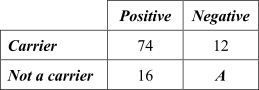
A new test has been developed for determining whether or not people are carriers of the Gaussian virus.

Two hundred people are tested. A two-way table is being used to record the results.
 

  1.  What is the value of  `A`?  (1 mark)

    --- 1 WORK AREA LINES (style=lined) ---

  2.  A person selected from the tested group is a carrier of the virus.


     What is the probability that the test results would show this?  (2 marks) 

    --- 4 WORK AREA LINES (style=lined) ---

  3.  For how many of the people tested were their test results inaccurate?  (1 mark)

    --- 2 WORK AREA LINES (style=lined) ---

Show Answers Only
  1. `98`
  2. `37/43`
  3. `28`
Show Worked Solution
i.  `A` `= 200-(74 + 12 + 16)`
  `= 98`


ii.  `P` `= text(# Positive carriers)/text(Total carriers)`
  `= 74/86`
  `= 37/43`


iii.  `text(# People with inaccurate results)`

`= 12 + 16`

`= 28`

Filed Under: Relative Frequency, Relative Frequency, Relative Frequency, Relative Frequency, Relative Frequency and Venn Diagrams Tagged With: Band 3, Band 4, common-content, num-title-ct-pathb, num-title-qs-hsc, smc-1133-10-Surveys/Two-Way Tables, smc-4815-10-2-Way tables, smc-827-10-Surveys/Two-Way Tables, smc-990-10-Surveys/Two-Way Tables

Calculus, EXT1* C3 2005 HSC 6c

2005 6c
 

The graphs of the curves  `y = x^2`  and  `y = 12 - 2x^2`  are shown in the diagram.

  1. Find the points of intersection of the two curves.  (1 mark)

    --- 4 WORK AREA LINES (style=lined) ---

  2. The shaded region between the curves and the `y`-axis is rotated about the `y`-axis. By splitting the shaded region into two parts, or otherwise, find the volume of the solid formed.  (3 marks)

    --- 6 WORK AREA LINES (style=lined) ---

Show Answers Only
  1. `text{(2, 4), (–2, 4)`
  2. `24pi\ \ text(u³)`
Show Worked Solution
i.    `y` `= x^2` `\ …\ (1)`
  `y` `= 12 − 2x^2` `\ …\ (2)`


`text(Substitute)\ \ y = x^2\ \ text(into)\ (2)`

`x^2` `= 12 − 2x^2`
`3x^2 − 12` `= 0`
`3(x^2 − 4)` `= 0`
`x` `= ±2`
`text(When)` `\ x = 2,` `\ y = 4`
`text(When)` `\ x = text(−2),` `\ y = 4`

 
`:.\ text{Intersection at (2, 4), (−2, 4)}`
 

ii.  `text{In (1),}\ \ x^2=y`

`text{In (2),}\ \ \ y` `= 12 − 2x^2`
`2x^2` `= 12 − y`
`x^2` `= (12 − y)/2`
  `= 6 − 1/2y`

 
`:.\ text(Volume)`

`= pi int_0^4 y\ dy + pi int_4^12 6 − 1/2y\ dy`
`= pi[y^2/2]_0^4 + pi[6y − y^2/4]_4^12`
`= pi[16/2 − 0] + pi[(6 xx 12 − 12^2/4) − (6 xx 4 − 4^2/4)]`
`= 8pi + pi[36 − 20]`
`= 8pi + 16pi`
`= 24pi\ \ text(u³)`

Filed Under: Further Area and Solids of Revolution, Volumes of Solids of Rotation Tagged With: Band 3, Band 4, smc-1039-10-Polynomial, smc-1039-61-y-axis Rotation

Calculus, 2ADV C3 2005 HSC 6b

A tank initially holds 3600 litres of water. The water drains from the bottom of the tank. The tank takes 60 minutes to empty.

A mathematical model predicts that the volume, `V`  litres, of water that will remain in the tank after  `t`  minutes is given by
  

`V = 3600(1 − t/60)^2,\ \ text(where)\ \ 0 ≤ t ≤ 60`.
 

  1. What volume does the model predict will remain after ten minutes?  (1 mark)

    --- 1 WORK AREA LINES (style=lined) ---

  2. At what rate does the model predict that the water will drain from the tank after twenty minutes?  (2 marks)

    --- 4 WORK AREA LINES (style=lined) ---

  3. At what time does the model predict that the water will drain from the tank at its fastest rate?  (2 marks)

    --- 4 WORK AREA LINES (style=lined) ---

Show Answers Only
  1. `text(2500 L)`
  2. `80\ text(liters per minute)`
  3. `0`
Show Worked Solution

i.    `V = 3600(1 − t/60)^2`

`text(When)\ t = 10,`

`V` `= 3600(1 − 10/60)^2`
  `= 3600 xx (5/6)^2`
  `= 2500\ text(L)`


ii.   `V = 3600(1 -t/60)^2`

`text(Using chain rule:)`

`(dV)/dt` `= 3600 xx 2 xx (1 – t/60) xx d/dt(1 – t/60)`
  `= 7200(1 – t/60) xx -1/60`
  `= −120(1 – t/60)`


`text(When)\ \ t =20`

`(dV)/dt` `= −120(1 – 20/60)`
  `= −80`


`:.\ text(After 20 minutes, the water will drain)`

`text(at 80 litres per minute.)`


iii. `(dV)/dt` `= −120(1 − t/60)`
    `= −120 + 2t`
  `(d^2V)/dt^2` `= 2`

 
`text(S)text(ince)\ (d^2V)/dt^2\ text(is a constant, no S.P.’s)`


`text(Checking limits of)\ \ 0 ≤ t ≤ 60`

`text(At)\ t = 0,`

`(dV)/dt = −120(1-0) = −120\ text(L/min)`

`text(At)\ t = 60,`

`(dV)/dt = −120(1 − 60/60) = 0\ text(L/min)`


`:.\ text(The model predicts water will drain)`

`text(out the fastest when)\ \ t = 0.`

Filed Under: Rates of Change, Rates of Change Tagged With: Band 3, Band 4, Band 5, smc-1091-20-Flow, smc-1091-50-Other Function

L&E, 2ADV E1 2005 HSC 5a

Use the change of base formula to evaluate  `log_3 7`, correct to two decimal places.  (1 mark)

Show Answers Only

`1.77\ \ text{(to 2 d.p.)}`

Show Worked Solution
`log_3 7` `= (log_10 7)/(log_10 3)`
  `= 1.771…`
  `= 1.77\ \ text{(to 2 d.p.)}`

Filed Under: Log Laws and Equations (Y11), Log/Index Laws and Equations, Log/Index laws and Other Equations, Logarithms Tagged With: Band 3, num-title-ct-patha, num-title-qs-hsc, smc-4243-50-Change of base, smc-6455-30-Logs - COB Rule, smc-963-30-Log - COB rule

Calculus, 2ADV C3 2005 HSC 4b

A function  `f(x)`  is defined by  `f(x) = (x + 3)(x^2- 9)`.

  1. Find all solutions of  `f(x) = 0`  (2 marks)

    --- 4 WORK AREA LINES (style=lined) ---

  2. Find the coordinates of the turning points of the graph of  `y = f(x)`, and determine their nature.  (3 marks)

    --- 8 WORK AREA LINES (style=lined) ---

  3. Hence sketch the graph of  `y = f(x)`, showing the turning points and the points where the curve meets the `x`-axis.  (2 marks)

    --- 8 WORK AREA LINES (style=lined) ---

  4. For what values of `x` is the graph of  `y = f(x)`  concave down?  (1 mark)

    --- 2 WORK AREA LINES (style=lined) ---

Show Answers Only
  1. `−3 or 3`
  2. `text{53.2 cm  (to 1 d.p.)}`
  3. `text(See worked solutions)`
  4. `x < −1`
Show Worked Solutions
i.    `f(x)` `= (x + 3)(x^2 − 9)`
    `= (x + 3)(x +3)(x − 3)`
  `:. f(x)` `= 0\ text(when)\ \ x=–3\ text(or)\ 3`


ii.   `f (x)` `= (x +3)(x^2 − 9)`
    `= x^3 − 9x + 3x^2 − 27`
    `= x^3 + 3x^2 − 9x − 27`
  `f′(x)` `= 3x^2 + 6x − 9`
  `f″(x)` `= 6x + 6`


`text(S.P.’s  when)\ \ f′(x) = 0`

`3x^2 + 6x − 9` `= 0`
`3(x^2 + 2x − 3)` `= 0`
`3(x − 1)(x + 3)` `= 0`


`text(At)\ x =1`

`f(1)` `= (4)(−8)=−32`
 `f″(1)` `= 6 + 6=12>0`
`:.\ text(MIN at)\ (1, −32)` 


`text(At)\ x = −3`

`f(-3)` `= 0`
`f″(−3)` `= (6 xx −3) + 6 = −12 <0`
`:.\ text(MAX at)\ (−3, 0)`


iii.   Geometry and Calculus, 2UA 2005 HSC 4b Answer


iv.  `f(x)\ \ text(is concave down when)`

`f″(x)` `< 0`
`6x + 6` `< 0`
`6x` `< −6`
`x` `< −1`

Filed Under: Curve Sketching, Curve Sketching and The Primitive Function Tagged With: Band 3, Band 4, smc-969-10-Cubic, smc-969-40-Concavity Intervals

Trigonometry, 2ADV T1 2005 HSC 4a

 Trig Calculus, 2UA 2005 HSC 4a

A pendulum is 90 cm long and swings through an angle of 0.6 radians. The extreme positions of the pendulum are indicated by the points `A` and `B` in the diagram.

  1. Find the length of the arc `AB`.   (1 mark)

    --- 3 WORK AREA LINES (style=lined) ---

  2. Find the straight-line distance between the extreme positions of the pendulum.   (2 marks)

    --- 5 WORK AREA LINES (style=lined) ---

  3. Find the area of the sector swept out by the pendulum.   (1 mark)

    --- 3 WORK AREA LINES (style=lined) ---

Show Answers Only
  1. `text(54 cm)`
  2. `text{53.2 cm  (to 1 d.p.)}`
  3. `text(2430 cm)^2`
Show Worked Solution
i.    `text(Arc)\ AB` `= theta/(2 pi) xx 2 pi r`
    `= rtheta`
    `= 90 xx 0.6`
    `= 54\ text(cm)`


ii. 

 Trig Calculus, 2UA 2005 HSC 4a Answer

`text(Using the cosine rule:)`

`text(Distance)\ AB\ text(in straight line)`

`AB^2` `= 90^2 xx 90^2-2 xx 90 xx 90 xx cos\ 0.6`
  `= 2829.563…`
`:.AB` `= 53.193…= 53.2\ text{cm  (to 1 d.p.)}`


iii. `text(Area of Sector)`

`= 0.6/(2pi) xx pir^2`

`= 0.3 xx 90^2`

`= 2430\ text(cm)^2`

Filed Under: Circular Measure, Circular Measure, Circular Measure Tagged With: Band 3, Band 4, Band 5, smc-6394-10-Arc Length/Perimeter, smc-6394-20-Area of Sector, smc-978-10-Arc Length/Perimeter, smc-978-20-Area of Sector

Plane Geometry, 2UA 2005 HSC 3c

2005 3c

In the diagram, `A`, `B`  and  `C`  are the points  `(6, 0), (9, 0)`  and  `(12, 6)` respectively. The equation of the line  `OC`  is  `x - 2y = 0`. The point  `D`  on  `OC`  is chosen so that  `AD`  is parallel to  `BC`. The point  `E`  on  `BC`  is chosen so that  `DE`  is parallel to the `x`-axis.

  1.  Show that the equation of the line `AD` is `y = 2x - 12`.  (2 marks)
  2. Find the coordinates of the point `D`.  (2 marks)
  3. Find the coordinates of the point `E`.  (1 marks)
  4. Prove that  `ΔOAD\ text(|||)\ ΔDEC`.  (2 marks)
  5. Hence, or otherwise, find the ratio of the lengths `AD` and `EC`.  (1 marks)
Show Answers Only
  1. `text(See Worked Solutions)`
  2. `(8, 4)`
  3. `(11, 4)`
  4. `text(See Worked Solutions)`
  5. `2:1`
Show Worked Solution

(i)   `text(S)text(ince)\ DA\ text(||)\ CB`

`m_(DA)` `= (y_2 − y_1)/(x_2 − x_1)`
  `= (6 − 0)/(12 − 9)`
  `= 2`


`:.\ text(Equation of)\ AD, m = 2,\ text(through)\ A(6, 0)`

`y − y_1` `= m(x − x_1)`
 `y − 0` `= 2(x − 6)`
 `y` `= 2x − 12\ \ \ \ …\ text(as required)`


(ii)  `D\ text(is at the intersection of)`

`x − 2y` `= 0` `\ \ …\ (1)`
 `y` `= 2x − 12\ ` `\ \ …\ (2)` 

`text(Substitute)\ y = 2x − 12\ text{into (1)}`

`x − 2(2x − 12)` `= 0`
`x − 4x + 24` `= 0`
`text(−3)x + 24` `= 0`
`3x` `= 24`
`x` `= 8`

`text(Substitute)\ x = 8\ text{into (2)}`

`y` `= 2 xx 8 − 12 = 4`
`:.D` `= (8, 4)`


(iii)  `text(Distance)\ \ AB=3`

`:. E\ \ text(has coordinates)\ \ (8+3,4)-=(11,4)`


(iv)  `text(Prove)\ ΔOAD\ text(|||)\ ΔDEC`

`∠ODA = ∠DCE`

`text{(corresponding angles,}\ AD\ text(||)\ BC)`

`∠OAD = ∠ABE`

`text{(corresponding angles,}\ AD\ text(||)\ BC)`

`∠ABE = ∠DEC`

`text{(corresponding angles,}\ AB\ text(||)\ DE)`

`:.∠OAD = ∠DEC`

`:.ΔOAD\ text(|||)\ ΔDEC\ text{(equiangular)}`


(v)     `(AD)/(EC)` `= (OA)/(DE)` 
    `= 6/3` 
    `=2` 

 `text{(corresponding sides of similar triangles)}`


`:.\ text(Ratio of lengths)\ AD:EC = 2:1` 

Filed Under: 2. Plane Geometry Tagged With: Band 3, Band 4, Band 5

Financial Maths, 2ADV M1 2005 HSC 3a

Evaluate  `sum_(n = 3)^5 (2n + 1)`.  (1 mark)

Show Answers Only

`27`

Show Worked Solution
`sum_(n = 3)^5 (2n + 1)` `= (2 xx 3 +1) + (2 xx 4 + 1)+(2 xx 5 + 1)`
  `= 7 + 9 + 11`
  `= 27`

Filed Under: Arithmetic Series, Arithmetic Series Tagged With: Band 3, smc-1005-20-Find Sum, smc-1005-60-Calculations Only

Calculus, 2ADV C3 2006 HSC 5a

A function  `f(x)`  is defined by  `f(x) =2x^2(3-x)`.

  1. Find the coordinates of the turning points of  `y =f(x)`  and determine their nature.  (3 marks)

    --- 6 WORK AREA LINES (style=lined) ---

  2. Find the coordinates of the point of inflection.  (1 mark)

    --- 2 WORK AREA LINES (style=lined) ---

  3. Hence sketch the graph of  `y =f(x)`, showing the turning points, the point of inflection and the points where the curve meets the `x`-axis.  (3 marks)

    --- 8 WORK AREA LINES (style=lined) ---

  4. What is the minimum value of  `f(x)`  for  `–1 ≤ x ≤4`?  (1 mark)

    --- 2 WORK AREA LINES (style=lined) ---

Show Answers Only
  1. `text(Min)\ (0, 0),\ text(Max)\ (2, 8)`
  2. `text(P.I. at)\ (1, 4)`
  3.  
  4. `-32`
Show Worked Solution
i.       `f(x)` `= 2x^2 (3-x)`
  `= 6x^2-2x^3`
`f^{prime} (x)` `= 12x-6x^2`
`f^{″}(x)` `= 12-12x`


`text(S.P.’s when)\ f^{′}(x) = 0`

`12x-6x^2` `= 0`
`6x(2-x)` `= 0`

`x = 0 or 2`

`text(When)\ x = 0`

`f(0)` `= 0`
`f^{″}(0)` `= 12-0 = 12 > 0`
`:.\ text(MIN at)\ (0, 0)`


`text(When)\ x = 2`

`f(2)` `= 2 xx 2^2 (3-2)` `= 8`
`f^{″}(2)` `= 12-(12 xx 2)` `= -12 < 0`
`:.\ text(MAX at)\ (2, 8)`


ii.  `text(P.I. when)\ f^{″}(x) = 0`

`12-12x` `= 0`
`12x` `= 12`
`x` `= 1`
`f^{″}(0.5)` `=6>0`
`f^{″}(1.5)` `=-6<0`

`text(S)text(ince concavity changes)\ \ =>\  text(P.I. exists)` 

`f(1)` `= 2 xx 1^2(3-1)`
  `= 4`

`:.\ text(P.I. at)\ (1, 4)`


iii.  `f(x)\ text(meets)\ x text(-axis when)\ f(x) = 0`

`2x^2 xx (3-x) = 0`

`x = 0 or 3`

2UA HSC 2006 5a


(iv)  `text(The graph clearly shows that in the given range)`

`-1<= x<=4,\ text(the minimum will occur when)\ x = 4`

`:.\ text(Minimum` `= 2 xx 4^2 (3-4)`
  `= -32`

Filed Under: Curve Sketching, Curve Sketching and The Primitive Function Tagged With: Band 3, Band 4, smc-969-10-Cubic, smc-969-60-Range defined

Calculus, 2ADV C3 2005 HSC 2d

Find the equation of the tangent to  `y = log_ex`  at the point  `(e, 1)`.  (2 marks)

--- 5 WORK AREA LINES (style=lined) ---

Show Answers Only

`y = x/e`

Show Worked Solution

`y = log_ex`

`dy/dx = 1/x`

`text(At)\ \ (e, 1),`

`m = 1/e`
 

`text(Equation of tangent,)\ \ m = 1/e,\ text(through)\ (e, 1)`

`y – y_1` `= m(x – x_1)`
`y – 1`  `= 1/e(x -e)`
`y – 1`  `= x/e – 1`
`y`  `= x/e`

Filed Under: Applied Calculus (L&E), L&E Differentiation (Y12), Tangents, Tangents and Normals Tagged With: Band 3, smc-1090-10-Find tangent given curve, smc-1090-50-Log/Exp Function, smc-967-20-Logs

Trig Calculus, 2UA 2005 HSC 2cii

Evaluate `int_0^(pi/6) cos\ 3x\ dx`.  (2 marks)

Show Answers Only

`1/3`

Show Worked Solution
`int_0^(pi/6)\ cos\ 3x\ dx` `= 1/3\ [sin\ 3x]_0^(pi/6)`
  `= 1/3\ [sin\ (3 xx pi/6) − sin\ 0]`
  `= 1/3\ [sin\ pi/2 − sin\ 0]`
  `= 1/3\ [1 − 0]`
  `= 1/3`

Filed Under: Differentiation and Integration Tagged With: Band 3

Calculus, 2ADV C1 2005 HSC 2bii

Differentiate with respect to `x`:

`x^2/(x-1).`   (2 marks)

--- 5 WORK AREA LINES (style=lined) ---

Show Answers Only

`(x(x-2))/(x-1)^2`

Show Worked Solution

`y = x^2/(x-1)`

`text(Using)\ \ dy/dx = (u^{′}v-uv^{′})/v^2:`

`u` `= x^2` `v` `= x-1`
`u^{′}` `= 2x` `v^{′}` `= 1`


`dy/dx` `= (2x(x-1)-x^2(1))/(x-1)^2`
  `= (2x^2-2x-x^2)/(x-1)^2`
  `= (x^2-2x)/(x-1)^2`
  `= (x(x-2))/(x-1)^2`

Filed Under: Standard / 1st Principles, Standard Differentiation, Standard Differentiation Tagged With: Band 3, smc-1069-10-Quotient Rule, smc-6436-10-Quotient Rule

Trigonometry, 2ADV T2 2005 HSC 2a

Solve  `cos\ theta =1/sqrt2`  for  `0 ≤ theta ≤ 2pi`.   (2 marks)

Show Answers Only

`pi/4, (7pi)/4`

Show Worked Solution

`cos\ theta = 1/sqrt2,\ \ \ 0 ≤ theta ≤ 2pi`

`text(S)text(ince)\ cos\ pi/4 = 1/sqrt2,\ \ text(and cos)`

`text(is positive in 1st/4th quadrants)`

`theta` `= pi/4, 2pi-pi/4`
  `= pi/4, (7pi)/4`


Filed Under: Exact Trig Ratios, Exact Trig Ratios, Exact Trig Ratios and Other Identities Tagged With: Band 3, smc-6411-20-cos, smc-979-20-cos

Functions, EXT1* F1 2005 HSC 1e

Find the values of `x` for which `|\ x-3\ | ≤ 1`.   (2 marks)
--- 6 WORK AREA LINES (style=lined) ---

Show Answers Only

`2 ≤ x ≤ 4`

Show Worked Solution

`|\ x-3\ | ≤ 1`
`text(Solution 1)`

`(x-3)^2 ≤ 1`

`x^2-6x + 9 ≤ 1`

`x^2-6x +8 ≤ 0`

`(x-4)(x-2) ≤ 0`
 

Algebra, 2UA 2005 HSC 1e Answer  

 
`:. 2 ≤ x ≤ 4`


`text(Alternative Solution)`

`(x-3)` `≤1` `-(x-3)` ` ≤ 1`
`x` `≤4` `-x +3` `≤ 1`
    `-x` `≤-2`
    `x` `≥ 2`

`:. 2 ≤ x ≤ 4`

Filed Under: Inequalities, Inequalities, Inequalities and Absolute Values Tagged With: Band 3, smc-1033-20-Absolute Value, SMc-6643-20-Absolute Value

Functions, 2ADV F1 2005 HSC 1d

Express  `((2x-3))/2-((x-1))/5`  as a single fraction in its simplest form.  (2 marks)

--- 5 WORK AREA LINES (style=lined) ---

Show Answers Only

`(8x-13)/10`

Show Worked Solution

`((2x-3))/2-((x-1))/5`

`= (5(2x-3)-2(x-1))/10`

`= (10x-15-2x + 2)/10`

`= (8x-13)/10`

Filed Under: Algebraic Fractions, Algebraic Techniques, Algebraic Techniques, Factors and Other Equations Tagged With: Band 3, common-content, num-title-ct-pathc, num-title-qs-hsc, smc-4356-10-Addition, smc-6213-10-Algebraic Fractions, smc-983-40-Algebraic Fractions

Trig Calculus, 2UA 2005 HSC 1c

Find a primitive of  `4 + sec^2\ x`.  (2 marks)

Show Answers Only

`4x + tan\ x + c`

Show Worked Solution

`int 4 + sec^2\ x\ dx`

`= 4x + tan\ x + c`

Filed Under: Differentiation and Integration Tagged With: Band 3

Financial Maths, 2ADV M1 2006 HSC 1f

Find the limiting sum of the geometric series  `13/5 + 13/25 + 13/125 + …`  (2 marks)

--- 5 WORK AREA LINES (style=lined) ---

Show Answers Only

`13/4`

Show Worked Solution

`13/5 + 13/25 + 13/125`

`=>\ text(GP where)\ \ a=13/5,\ text(and)`

`r = T_2/T_1 = 13/25 ÷ 13/5 = 1/5`

`text(S)text(ince)\ |\ r\ | < 1`

`S_oo` `= a/(1-r)`
  `= (13/5)/(1 – 1/5)`
  `= 13/5 xx 5/4`
  `= 13/4`

Filed Under: Geometric Series, Geometric Series Tagged With: Band 3, smc-1006-40-Limiting Sum, smc-1006-70-Calculations Only

Functions, 2ADV F2 2006 HSC 1c

Sketch the graph of  `y = |x + 4|`.  (2 marks)

Show Answers Only

Show Worked Solution

2UA HSC 2006 1c

Filed Under: 4. Real Functions, Other Graph Transformations, Transformations Tagged With: Band 3, smc-1008-20-Absolute Value, smc-1008-60-Translation (Only), smc-6408-15-Absolute Value, smc-6408-40-Translation (only)

Data, 2UG 2005 HSC 27a

The area graph shows sales figures for Shoey’s shoe store.

2UG-2005-27a

  1. Approximately how many school shoes were sold in January?   (1 mark)
  2. For which month does the graph indicate that the same number of school shoes and business shoes was sold?   (1 mark)
  3. Identify ONE trend in this graph, and suggest a valid reason for this trend.   (2 marks)
Show Answers Only
  1. `15\ 000`
  2.  `text(April)`
  3. `text(Possible trends include)`
  4. `text(- Boot sales peak in the Winter months of Jun-Aug)`
  5. `\ \ text(because of the colder weather.)`
    `text(- School shoe sales peak in January as children prepare)`
    `\ \ text(to return to school for the new year.)`
Show Worked Solution

(i)   `text(School shoes sold)`

`≈ 18\ 000 − 3000`

`≈ 15\ 000`


(ii)  `text(April)`


(iii) `text(Possible trends include)`

`text(- Boot sales peak in the Winter months of Jun-Aug)`

`\ \ text(because of the colder weather.)`

`text(- School shoe sales peak in January as children prepare)`

`\ \ text(to return to school for the new year.)`

Filed Under: Other Graphs Tagged With: Band 3, Band 4

Measurement, 2UG 2004 HSC 26b

The location of Sorong is `text(1°S 131°E)` and the location of Darwin is `text(12°S 131°E)`.

  1. What is the difference in the latitudes of Sorong and Darwin?  (1 mark)
  2. The radius of Earth is approximately `text(6400 km.)`

  3. Show that the great circle distance between Sorong and Darwin is approximately `text(1200 km)`.  (2 marks)


Show Answers Only
  1. `11°`
  2. `text(Proof)\ \ text{(See Worked Solutions)}`
Show Worked Solution

(i)  `text(Difference in latitudes)`

`= 12^@ – 1^@`

`= 11^@`


(ii)   `text(S)text(ince longitude is the same,)`

`text(Distance between Sarang and Darwin)`

`= 11/360 xx 2 pi r`

`= 11/360 xx 2 xx pi xx 6400`

`= 1228.7…\ text(km)`

`~~ 1200\ text(km … as required.)`

Filed Under: MM6 - Spherical Geometry Tagged With: Band 3, Band 4

Data, 2UG 2006 HSC 23d

The graph shows the amounts charged by Company `A` and Company `B` to deliver parcels of various weights.

2UG-2006-23d

  1. How much does Company `A` charge to deliver a `3` kg parcel?  (1 mark)
  2. Give an example of the weight of a parcel for which both Company `A` and Company `B` charge the same amount.  (1 mark)
  3. For what weight(s) is it cheaper to use Company `A`?  (2 marks)
  4. What is the rate per kilogram charged by Company `B` for parcels up to `8` kg?  (1 mark)
Show Answers Only
  1. `$6`
  2. `text(4 kg or 7 kg)`
  3. `x > 7`
  4. `text($1.50 per kg)`
Show Worked Solution

(i)   `$6`


(ii)  `text(4 kg or 7 kg)`


(iii)  `text(Let)\ x = text(weights where Company)\ A`

`text{is cheaper (kg).}`

`4 < x <= 6`

`x > 7`


(iv)   `text(Company)\ B\ text(charges $12 for 8 kg)`

`:.\ text(Rate)` `= 12/8`
  `= $1.50\  text(per kg)`

Filed Under: AM2 - Linear Relationships (Prelim) Tagged With: Band 2, Band 3, Band 4

Data, 2UG 2006 HSC 23b

This radar chart was used to display the average daily temperatures each month for two different towns.

2UG-2006-23b

  1. What is the average daily temperature of Town `B` for April?  (1 mark)
  2. In which month do the average daily temperatures of the two towns have the greatest difference?  (1 mark)
  3. In which months is the average daily temperature in Town `B` higher than in Town `A`?  (1 mark)
Show Answers Only
  1. `18.5^@\ \ text{(approx)}`
  2. `text(February)`
  3. `text(May, June, July, August and September)`
Show Worked Solution

(i)   `18.5^@\ \ \ text{(approx)}`


(ii)   `text(February)`


(iii)  `text(May, June, July, August and September)`

Filed Under: Other Graphs Tagged With: Band 3, HSC

Measurement, STD2 M6 2005 HSC 25b

2UG-2005-25b

  1. Use Pythagoras’ theorem to show that `ΔABC` is a right-angled triangle.  (1 mark)

    --- 2 WORK AREA LINES (style=lined) ---

  2. Calculate the size of `∠ABC` to the nearest minute.  (2 marks)

    --- 4 WORK AREA LINES (style=lined) ---

Show Answers Only
  1. `text(Proof)`
  2. `67°23^{′}`
Show Worked Solution

i.   `ΔABC\ text(is right-angled if)\ \ a^2 + b^2 = c^2`

`a^2 + b^2` `= 5^2 + 12^2`
  `= 169`
  `= 13^2`
  `= c^2…\ text(as required.)`

MARKER’S COMMENT: Know your calculator process for producing an angle in minutes/seconds. Note >30 “seconds” rounds up to the higher “minute”.

 
ii. 
`sin ∠ABC = 12/13`

`:.∠ABC` `= 67.38…°`
  `=67°22^{′}48^{″}`
  `= 67°23^{′}\ \ \ text{(nearest minute)}`

Filed Under: M3 Right-Angled Triangles (Y12), Pythagoras and basic trigonometry, Pythagoras and Right-Angled Trig Tagged With: Band 3, Band 4, smc-1103-10-Pythagoras, smc-1103-20-Right-angled Trig, smc-1103-50-Rounding to the Minute, smc-802-10-Pythagoras, smc-802-20-Right-Angled Trig, smc-802-50-Rounding to the Minute

Financial Maths, STD2 F1 2005 HSC 25a

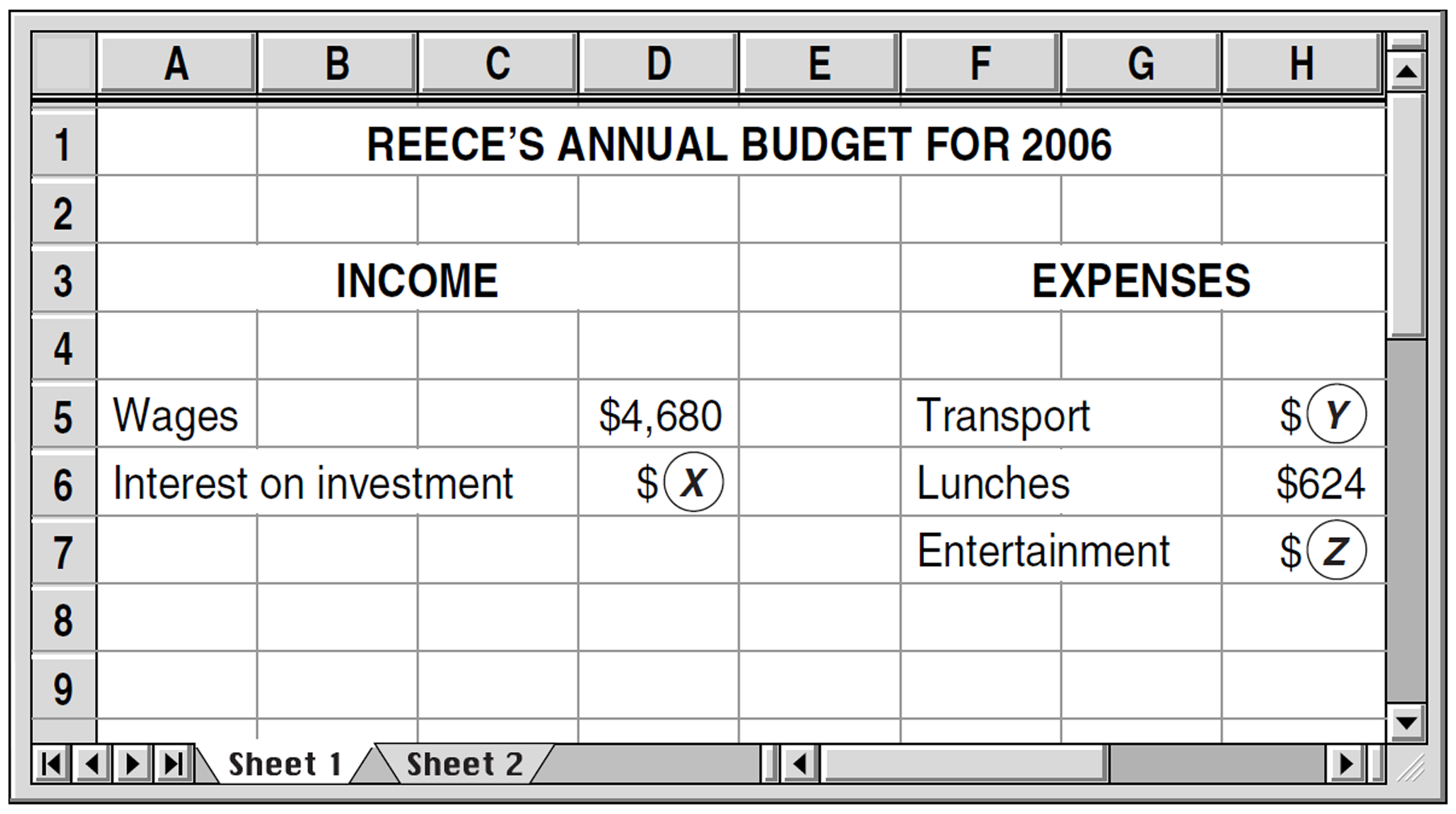
Reece is preparing his annual budget for 2006.

His expected income is:

• $90 every week as a swimming coach
• Interest earned from an investment of $5000 at a rate of 4% per annum.

His planned expenses are:

• $30 every week on transport
• $12 every week on lunches
• $48 every month on entertainment.

Reece will save his remaining income. He uses the spreadsheet below for his budget.
 

2UG-2005-25a
 

  1. Determine the values of `X`, `Y` and `Z`. (Assume there are exactly 52 weeks in a year.)   (3 marks)

    --- 5 WORK AREA LINES (style=lined) ---

At the beginning of 2006, Reece starts saving.

  1. Will Reece have saved enough money during 2006 for a deposit of $2100 on a car if he keeps to his budget? Justify your answer with suitable calculations.   (2 marks)

    --- 4 WORK AREA LINES (style=lined) ---

Show Answers Only

a.    `X =$200, Y = $1560\ text(and) \ Z = $576`

b.    `text(Reece will have saved have saved enough for a $2100 deposit.)`

Show Worked Solution

a.   `text(Interest on Investment) (X)=5000 xx 4%= $200`

`text(Transport)(Y)= 52 × 30= $1560`

`text(Entertainment) (Z)= 48 × 12= $576`

b.    `text(Total Income)= 4680 + 200= $4880`

`text(Total Expenses)= 1560 + 624 + 576= $2760`

`text(Savings)= 4880-2760= $2120`

`:.\ text(Reece will have saved enough for a $2100 deposit.)` 

Filed Under: Budgeting, Budgeting, Earning Money and Budgeting, Earning Money and Budgeting, FM1 - Earning money, FM2 - Investing, Simple Interest and S/L Depreciation, Simple Interest and S/L Depreciation Tagged With: Band 3, smc-1124-10-Simple Interest, smc-1126-30-Budgeting, smc-6279-10-Personal Budget, smc-6518-10-Personal Budget, smc-808-10-Simple Interest, smc-810-30-Budgeting

Probability, STD2 S2 2005 HSC 23c

Moheb owns five red and seven blue ties. He chooses a tie at random for himself and puts it on. He then chooses another tie at random, from the remaining ties, and gives it to his brother.

  1. What is the probability that Moheb chooses a red tie for himself?  (1 mark)

    --- 1 WORK AREA LINES (style=lined) ---

Copy the tree diagram into your writing booklet.
 

2UG-2005-23c
 

  1. Complete your tree diagram by writing the correct probability on each branch.  (2 marks)
  2. Calculate the probability that both of the ties are the same colour.  (2 marks)

    --- 4 WORK AREA LINES (style=lined) ---

Show Answers Only
  1. `5/12`
  2.  
  3. `31/66`
Show Worked Solution
i. `P(R)` `= (#\ text(red ties))/(#\ text(total ties))`
    `= 5/12`


ii.  


iii. `Ptext((same colour))`

`= P(text(RR)) + P(text(BB))`

`= 5/12 × 4/11\ \ +\ \ 7/12 × 6/11`

`= 20/132 + 42/132`

`= 31/66`

Filed Under: Multi-stage Events, Multi-Stage Events, Single and Multi-Stage Events Tagged With: Band 3, Band 4, Band 5, smc-1135-10-Probability Trees, smc-829-10-Probability Trees

Algebra, STD2 A4 2004 HSC 26a

  1. The number of bacteria in a culture grows from 100 to 114 in one hour.


    What is the percentage increase in the number of bacteria?   (1 mark)

    --- 1 WORK AREA LINES (style=lined) ---

  2. The bacteria continue to grow according to the formula  `n = 100(1.14)^t`, where `n` is the number of bacteria after `t` hours.


    What is the number of bacteria after 15 hours?   (1 mark)

\begin{array} {|l|c|}
\hline
\rule{0pt}{2.5ex} \text{Time in hours $(t)$} \rule[-1ex]{0pt}{0pt} & \;\; 0 \;\;  &  \;\; 5 \;\;  & \;\; 10 \;\;  & \;\; 15 \;\; \\
\hline
\rule{0pt}{2.5ex} \text{Number of bacteria ( $n$ )} \rule[-1ex]{0pt}{0pt} & \;\; 100 \;\;  &  \;\; 193 \;\;  & \;\; 371 \;\;  & \;\; ? \;\; \\
\hline
\end{array}

--- 1 WORK AREA LINES (style=lined) ---

  1. Use the values of `n` from  `t = 0`  to  `t = 15`  to draw a graph of  `n = 100(1.14)^t`.


    Use about half a page for your graph and mark a scale on each axis.   (4 marks)

    --- 10 WORK AREA LINES (style=lined) ---

  2. Using your graph or otherwise, estimate the time in hours for the number of bacteria to reach 300.   (1 mark)

    --- 1 WORK AREA LINES (style=lined) ---

Show Answers Only
  1. `text(14%)`
  2. `714`
  3. `text(Proof)\ \ text{(See Worked Solutions)}`
  4. `text(8.4 hours)`
Show Worked Solution

i.   `text(Percentage increase)`

COMMENT: Common ADV/STD2 content in new syllabus.

`= (114 -100)/100 xx 100`

`= 14text(%)`


ii.  `n = 100(1.14)^t`

`text(When)\ \ t = 15,`

`n` `= 100(1.14)^15`
  `= 713.793\ …`
  `= 714\ \ \ text{(nearest whole)}`


iii. 


iv.  `text(Using the graph)`

`text(The number of bacteria reaches 300 after)`

`text(approximately 8.4 hours.)`

Filed Under: Exponential/Quadratic (Projectile), Graphs and Applications, Non-Linear: Exponential/Quadratics Tagged With: Band 3, Band 4, Band 5, common-content, HSC, smc-830-30-Exponential, smc-966-10-Exponential graphs, smc-966-30-Other exponential modelling

Data, 2UG 2004 HSC 24a

The following graphs have been constructed from data taken from the Bureau of Meteorology website. The information relates to a town in New South Wales.

The graphs show the mean 3 pm wind speed (in kilometres per hour) for each month of the year and the mean number of days of rain for each month (raindays).

2004 24a

  1. What is the mean 3 pm wind speed for September?  (1 mark)
  2. Which month has the lowest mean 3 pm wind speed?  (1 mark)
  3. In which three-month period does the town have the highest number of raindays?  (1 mark)
  4. Briefly describe the pattern relating wind speed with the number of raindays for this town. Refer to specific months.  (2 marks)


Show Answers Only
  1. `text(15 km/h)`
  2. `text(February)`
  3. `text(Jan – Mar)`
  4. `text(The mean number of rain days tends to be higher)`
    `text(when the wind speed is lower and vice versa.)`
    `text(For example, the highest number of mean rain)`
    `text(days is in Feb, which is also the month of the lowest)`
    `text(mean wind speed.)`


Show Worked Solution

(i)    `text(15 km/h)`

(ii)   `text(February)`

(iii)  `text(Jan – Mar)`

(iv)  `text(The mean number of rain days tends to be higher)`

`text(when the wind speed is lower and vice versa.)`

`text(For example, the highest number of mean rain)`

`text(days is in Feb, which is also the month of the lowest)`

`text(mean wind speed.)`

Filed Under: Other Graphs Tagged With: Band 3, Band 4

Measurement, STD2 M1 2005 HSC 23b

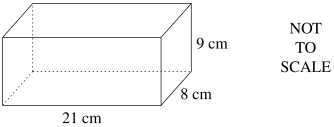
A clay brick is made in the shape of a rectangular prism with dimensions as shown.
 

  1. Calculate the volume of the clay brick.   (1 mark)

    --- 2 WORK AREA LINES (style=lined) ---

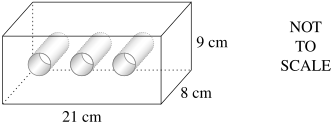
Three identical cylindrical holes are made through the brick as shown. Each hole has a radius of 1.4 cm.  
 

  1. What is the volume of clay remaining in the brick after the holes have been made? (Give your answer to the nearest cubic centimetre.)   (3 marks)

    --- 6 WORK AREA LINES (style=lined) ---

  2. What percentage of clay is removed by making the holes through the brick? (Give your answer correct to one decimal place.)   (1 mark)

    --- 2 WORK AREA LINES (style=lined) ---

Show Answers Only

a.   `text(1512 cm)^3`

b.   `text{1364 cm}^3`

c.   `text{9.8%}`

Show Worked Solution

a.    `V= l × b × h= 21 × 8 × 9= 1512\ text(cm)^3`

b.    `text(Volume of each hole)`

`= pir^2h= pi × 1.4^2 × 8= 49.260…\ text(cm)^3`

 `:.\ text(Volume of clay still in brick)`

`= 1512 − (3 × 49.260…)`

`= 1364.219…= 1364\ text{cm}^3\ text{(nearest whole)}`

c.     `text(Percentage of clay removed)`

`= ((3 × 49.260…))/1512 × 100`

`= 9.773…= 9.8 text{%   (1 d.p.)}`

Filed Under: Areas and Volumes (Harder), Perimeter, Area and Volume, Volume, Volume, Mass and Capacity, Volume, Mass and Capacity Tagged With: Band 3, Band 4, Band 5, num-title-ct-corea, num-title-qs-hsc, smc-4235-10-Prisms, smc-4235-20-Cylinders, smc-6304-50-Volume (Circular Measure), smc-6521-50-Volume (Circular Measure), smc-798-50-Volume (Circular Measure)

Measurement, 2UG 2005 HSC 12 MC

The shaded region represents a block of land bounded on one side by a road.

2UG-2005-12MC

What is the approximate area of the block of land, using Simpson’s rule?

(A)   `680\ text(m²)`

(B)   `760\ text(m²)`

(C)   `840\ text(m²)`

(D)   `1360\ text(m²)`

Show Answers Only

`A`

Show Worked Solution

2UG-2005-12MC Answer

`A` `≈ h/3[y_0 + 4y_1 + y_2]`
  `≈ 20/3 [19 + (4 × 15) + 23]`
  `≈ 20/3 [102]`
  `≈ 680\ text(m²)`

`=>  A`

Filed Under: Simpson's Rule/Measurement Error Tagged With: Band 3

Probability, STD2 S2 2005 HSC 11 MC

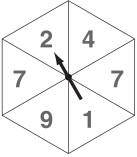
The diagram shows a spinner.


The arrow is spun and will stop in one of the six sections.

What is the probability that the arrow will stop in a section containing a number greater
than 4?

  1.    `2/5`
  2.    `2/3`
  3.    `1/3`
  4.    `1/2`
Show Answers Only

`D`

Show Worked Solution

`P\ text((number greater than 4))`

`= P(7) + P (9)`

`= 2/6 + 1/6`

`= 1/2`

`=>  D`

Filed Under: Combinations and Single Stage Events, Probability, Single and Multi-Stage Events, Single stage events Tagged With: Band 3, num-title-ct-core, num-title-qs-hsc, smc-1135-05-Simple Probability, smc-4225-15-Single-stage events, smc-828-10-Simple Probability

Financial Maths, STD2 F4 2004 HSC 25a

Tai uses the declining balance method of depreciation to calculate tax deductions for her business. Tai’s computer is valued at $6500 at the start of the 2003 financial year. The rate of depreciation is 40% per annum.

  1. Calculate the value of her tax deduction for the 2003 financial year.  (1 mark)

    --- 1 WORK AREA LINES (style=lined) ---

  2. What is the value of her computer at the start of the 2006 financial year?  (2 marks)

    --- 3 WORK AREA LINES (style=lined) ---

Show Answers Only
  1. `$2600`
  2. `$1404`
Show Worked Solution
i.  `text(Tax deduction)` `= 40 text(%) xx $6500`
  `= $2600`


ii. `text(Using)\  S = V_0(1 – r)^n,`

`text(Value at the start of 2006 FY)`

`= 6500(1 – 0.4)^3`

`= $1404`

Filed Under: Depreciation - Declining Balance, Depreciation - Declining Balance, Depreciation / Running costs Tagged With: Band 3, Band 4, smc-1139-10-Find \(S\), smc-813-10-Find \(S\)

Algebra, 2UG 2004 HSC 23b

Kirbee is shopping for computer software. Novirus costs `$115` more than
Funmaths. Let `x` dollars be the cost of Funmaths.

  1. Write an expression involving `x` for the cost of Novirus.  (1 mark)
  2. Novirus and Funmaths together cost `$415`. Write an equation involving
  3. `x` and solve it to find the cost of Funmaths.  (2 marks)
Show Answers Only
  1. `N = x + 115`
  2. `text(Funmaths costs $150)`
Show Worked Solution

(i)   `text(Let)\ \ N = text(cost of Novirus)`

`N = x + 115`


(ii)  `N + x = 415\ …\ (1)`

`text(Substitute)\ \ N = x + 115\ text{into (1) above}`

`x + 115 + x` `= 415`
`2x` `= 300`
`x` `= 150`

`:.\ text(Funmaths costs $150)`

Filed Under: Linear and Other Equations Tagged With: Band 3, Band 4

Linear Functions, 2UA 2004 HSC 2a

The diagram shows the points  `A(text(−1) , 3)`  and  `B(2, 0)`.

The line  `l`  is drawn perpendicular to the  `x`-axis through the point  `B`.
 

Linear Functions, 2UA 2004 HSC 2a 
 

  1. Calculate the length of the interval  `AB`.   (1 mark)
  2. Find the gradient of the line  `AB`.   (1 mark)
  3. What is the size of the acute angle between the line  `AB`  and the line  `l`?   (1 mark)
  4. Show that the equation of the line  `AB`  is  `x + y − 2 = 0`.    (1 mark)
  5. Copy the diagram into your writing booklet and shade the region defined by  `x + y − 2 <= 0`.   (1 mark)
  6. Write down the equation of the line  `l`.   (1 mark)
  7. The point  `C`  is on the line  `l`  such that  `AC`  is perpendicular to  `AB`. Find the coordinates of  `C`.   (2 marks)


Show Answers Only
  1. `3 sqrt2\ text(units)`
  2. `-1`
  3. `45^@`
  4. `text(Proof)\ \ text{(See Worked Solutions)}`
  5. Linear Functions, 2UA 2004 HSC 2a Answer
  6. `x = 2`
  7. `C\ (2, 6)`
Show Worked Solution
(i)    `A(-1,3)\ \ \ \ \ B(2,0)`
`AB` `= sqrt( (x_2 – x_1)^2 + (y_2 – y_1)^2 )`
  `= sqrt( (2+1)^2 + (0-3)^2 )`
  `= sqrt(9+9)`
  `= sqrt 18`
  `= 3 sqrt 2\ text(units)`


(ii)   `text(Gradient of)\ AB` `= (y_2 – y_1)/(x_2 – x_1)`
    `= (0 – 3)/(2 + 1)`
    `= – 1`


(iii)   `text(S) text(ince Gradient)\ AB = – 1`

`/_ABO = 45^@`

`:.\ text(Angle between)\ AB\ text(and)\ l`

`= 90 – 45`

`= 45^@`


(iv)   `text(Equation of)\ AB\ text(has)\ m = -1,\ text(through)\ \ (2,0)`
`y – y_1` `= m(x – x_1)`
`y – 0` `= -1 (x – 2)`
`y` `= -x + 2`


`:.\ x + y – 2 = 0\ \ \ …\ text(as required)`


(v)

Linear Functions, 2UA 2004 HSC 2a Answer

`text{Origin (0,0) satisfies the inequality}`

`:.\ text(Shaded area is below)\ x + y – 2 = 0`


(vi)   `text(Equation of)\ l`
  `x = 2`


(vii)   `m_(AC) xx m_(AB)` `= -1\ \ \ (AC⊥AB)`
  `m_(AC) xx -1` `= -1`
  `m_(AC)` `= + 1`


`text(Equation of)\ AC\ text(has)\ \ m = 1,\ text(through)\ (-1, 3),`

`y – y_1` `= m(x – x_1)`
`y – 3` `= 1 (x + 1)`
`y` `= x + 4`


`=>C\ text(lies on)\ y = x + 4`

`text(When)\ \ x = 2,\ \ y = 6`

`:. C\ (2, 6)`

Filed Under: 6. Linear Functions Tagged With: Band 2, Band 3, Band 4

Functions, EXT1* F1 2004 HSC 1f

Find the values of `x` for which `|\ x + 1\ |<= 5`.   (2 marks)

--- 6 WORK AREA LINES (style=lined) ---

Show Answers Only

`-6 <= x <= 4`

Show Worked Solution

`text(Solution 1)`

`|\ x + 1\ |<= 5`

`-5` `≤x+1≤5`
`:.-6` `≤x≤4` 


`text(Solution 2)`

`|\ x + 1\ |<= 5`

`(x+1)^2` `<= 5^2`
` x^2 + 2x + 1` `<= 25`
 `x^2 + 2x-24` `<= 0`
`(x + 6)(x-4)` `<= 0`


Algebra, 2UA 2004 HSC 1f Answer

`:.\ -6 <= x <= 4`

Filed Under: Inequalities, Inequalities, Inequalities and Absolute Values Tagged With: Band 3, smc-1033-20-Absolute Value, SMc-6643-20-Absolute Value

Measurement, STD2 M6 2006 HSC 9 MC

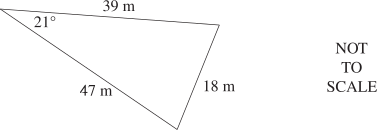
What is the area of this triangle, to the nearest square metre?


  1. `text(152 m²)`
  2. `text(283 m²)`
  3. `text(328 m²)`
  4. `text(351 m²)`
Show Answers Only

`C`

Show Worked Solution

`text(Using the Sine rule)`

`A` `= 1/2 ab\ sin C`
  `= 1/2 xx 39 xx 47 xx sin 21^@`
  `=\ text(328.44… m²)`

 
`=>  C`

Filed Under: Non Right-Angled Trig, Non-Right Angled Trig, Non-Right Angled Trig Tagged With: Band 3, num-title-ct-pathc, num-title-qs-hsc, smc-804-30-Sine Rule (Area)

Probability, 2ADV S1 2004 HSC 1e

A packet contains 12 red,  8 green, 7 yellow and 3 black jellybeans.

One jellybean is selected from the packet at random.

What is the probability that the selected jellybean is red or yellow?   (2 marks)

Show Answers Only

`19/30`

Show Worked Solution

`text(12 R,  8 G,  7 Y,  3 B)`

`text(Total jellybeans) = 30`

`P text{(R or Y)}=\ text{(# Red + Yellow)}/text(Total jellybeans)= (12 + 7)/30= 19/30`

Filed Under: 3. Probability, Multi-Stage Events, Multi-Stage Events Tagged With: Band 3, smc-6469-20-Other Multi-Stage Events, smc-989-20-Other Multi-Stage Events

Calculus, 2ADV C1 2004 HSC 1b

Differentiate  `x^4 + 5x^(−1)`  with respect to  `x`.   (2 marks)

Show Answers Only

`4x^3 – 5x^(-2)`

Show Worked Solution
`y` `= x^4 + 5x^(-1)`
`dy/dx`  `= 4x^3 – 5x^(-2)`

Filed Under: Standard / 1st Principles, Standard Differentiation, Standard Differentiation Tagged With: Band 3, smc-1069-30-Basic Differentiation, smc-6436-30-Basic Differentiation

Functions, 2ADV F1 2004 HSC 1c

Solve   `(x-5)/3-(x+1)/4 = 5`.   (2 marks)

Show Answers Only

`83`

Show Worked Solution
`(x-5)/3-(x+1)/4` `= 5`
`12((x-5)/3)-12((x+1)/4)` `= 12 xx 5`
`4x-20-3x-3` `= 60`
`x-23` `= 60`
`:. x` `= 83`

Filed Under: Algebraic Fractions, Algebraic Techniques, Algebraic Techniques, Factors and Other Equations Tagged With: Band 3, common-content, num-title-ct-pathc, num-title-qs-hsc, smc-4402-40-Multiple fractions, smc-6213-10-Algebraic Fractions, smc-983-40-Algebraic Fractions

Financial Maths, STD2 F1 2006 HSC 5 MC

A salesman earns $200 per week plus $40 commission for each item he sells.

How many items does he need to sell to earn a total of $2640 in two weeks?

  1. 33
  2. 56
  3. 61
  4. 66
Show Answers Only

`B`

Show Worked Solution

`text(Let items sold) = n`

`text{Wages over 2 weeks}\ (w)`

`= (2 xx 200) + 40n=400 + 40n` 

`text(Find)\ n\ text(when)\ w = 2640:`

`2640` `= 400 + 40n`
`40n` `= 2240`
`n` `= 56`

 
`=>  B`

Filed Under: Earning and Spending Money, Earning Money and Budgeting, Earning Money and Budgeting, FM1 - Earning money, Ways of Earning, Ways of Earning Tagged With: Band 3, num-title-ct-corea, num-title-qs-hsc, smc-1126-20-Commission, smc-4331-20-Commission, smc-6276-20-Commission, smc-6515-20-Commission, smc-810-20-Commission

Measurement, STD2 M6 2006 HSC 3 MC

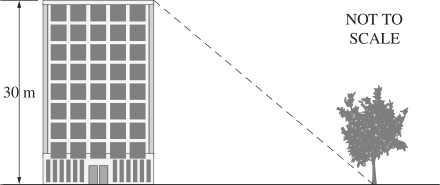
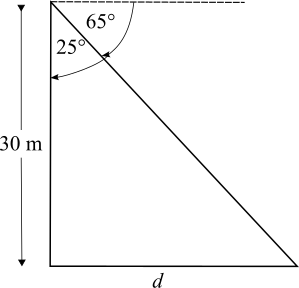
The angle of depression of the base of the tree from the top of the building is 65°. The height of the building is 30 m.

How far away is the base of the tree from the building, correct to one decimal place?


  1. 12.7 m
  2. 14.0 m
  3. 33.1 m
  4. 64.3 m
Show Answers Only

`B`

Show Worked Solution
 

`text(Let)\ d =\ text(distance from base to tree)`

`tan25^@` `=d/30`  
`:.d` `=30 xx tan25^@`  
  `=13.98…\ text{m}`  

 
`=>  B`

Filed Under: M3 Right-Angled Triangles (Y12), Pythagoras and basic trigonometry, Pythagoras and Right-Angled Trig, Right-Angled Trig Tagged With: Band 3, num-title-ct-coreb, num-title-qs-hsc, smc-1103-20-Right-angled Trig, smc-1103-30-Angle of Depression, smc-4552-40-Real world applications, smc-4552-50-Angle of depression, smc-802-20-Right-Angled Trig, smc-802-30-Angle of Depression

Probability, STD2 S2 2006 HSC 1 MC

The probability of an event occurring is `9/10.`

Which statement best describes the probability of this event occurring?

  1.    The event is likely to occur.
  2.    The event is certain to occur.
  3.    The event is unlikely to occur.
  4.    The event has an even chance of occurring.
Show Answers Only

`A`

Show Worked Solution

`text(The event is highly likely to occur)`

`text(but not certain.)`

`=>  A`

Filed Under: Fundamental understanding, Fundamental Understanding, Fundamental Understanding, Probability Tagged With: Band 3, num-title-ct-core, num-title-qs-hsc, smc-4225-05-Core concepts

Probability, STD2 S2 2005 HSC 23a

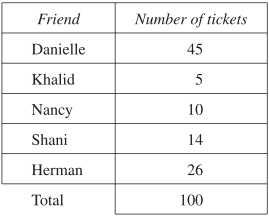
There are 100 tickets sold in a raffle. Justine sold all 100 tickets to five of her friends. The number of tickets she sold to each friend is shown in the table.
 

  1. Justine claims that each of her friends is equally likely to win first prize.


    Give a reason why Justine’s statement is NOT correct.   (1 mark)

    --- 2 WORK AREA LINES (style=lined) ---

  2. What is the probability that first prize is NOT won by Khalid or Herman?   (2 marks)

    --- 4 WORK AREA LINES (style=lined) ---

Show Answers Only
  1. `text(The claim is incorrect because each of her friends)`
    `text(bought a different number of tickets and therefore)`
    `text(their chances of winning are different.)`
  2. `69/100`
Show Worked Solution

i.    `text(The claim is incorrect because each of her friends bought)`

`text(a different number of tickets and therefore their chances of)`

`text(winning are different.)`


ii.  `text(Number of tickets not sold to K or H)`

`= 45 + 10 + 14`

`= 69`
 

`:.\ text(Probability 1st prize NOT won by K or H)`

`= 69/100`

Filed Under: Combinations and Single Stage Events, Fundamental understanding, Fundamental Understanding, Fundamental Understanding, Multi-Stage Events, Single and Multi-Stage Events, Single stage events Tagged With: Band 3, Band 4, num-title-ct-corea, num-title-qs-hsc, smc-1135-05-Simple Probability, smc-4238-70-Complementary events, smc-828-10-Simple Probability

Measurement, STD2 M1 2004 HSC 23a

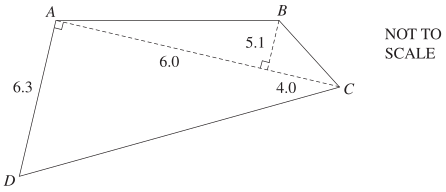
The diagram shows the shape of Carmel’s garden bed. All measurements are in
metres.

  1. Show that the area of the garden bed is 57 square metres.   (2 marks)

    --- 4 WORK AREA LINES (style=lined) ---

  2. Carmel decides to add a 5 cm layer of straw to the garden bed.


    Calculate the volume of straw required. Give your answer in cubic metres.   (2 marks)

    --- 4 WORK AREA LINES (style=lined) ---

  3. Each bag holds 0.25 cubic metres of straw.


    How many bags does she need to buy?   (2 marks)

    --- 4 WORK AREA LINES (style=lined) ---

  4. A straight fence is to be constructed joining point A to point B.


    Find the length of this fence to the nearest metre.   (2 marks)

    --- 4 WORK AREA LINES (style=lined) ---

Show Answers Only

a.   `text(Proof)\ text{(See Worked Solutions)}`

b.   `text(2.85 m³)`

c.   `text(She needs to buy 12 bags)`

d.   `8\ text{m  (nearest metre)}`

Show Worked Solution

a.    `text(Area of)\ Delta ABC= 1/2 xx b xx h= 1/2 xx 10 xx 5.1=25.5\ text(m²)`

`text(Area of)\ Delta ACD= 1/2 xx 10 xx 6.3= 31.5\ text(m²)`

`:.\ text(Total Area)= 25.5 + 31.5= 57\ text(m² … as required)`

b.    `V= Ah= 57 xx 0.05= 2.85\ text(m³)`

c.    `text(Bags to buy)= 2.85/0.25= 11.4`

`:.\ text(She needs to buy 12 bags.)`

d.   `text(Using Pythagoras,)`

`AB^2= 6.0^2 + 5.1^2= 36 + 26.01= 62.01`

`AB= 7.874…=8\ text{m  (nearest metre)}`

Filed Under: Areas and Volumes (Harder), M3 Right-Angled Triangles (Y12), MM2 - Perimeter, Area and Volume (Prelim), Perimeter and Area, Perimeter and Area, Perimeter, Area and Volume, Pythagoras and basic trigonometry, Rates, Volume, Mass and Capacity, Volume, Mass and Capacity Tagged With: Band 3, Band 4, smc-1103-10-Pythagoras, smc-6304-40-Volume, smc-6483-20-Composite Areas, smc-6520-20-Composite areas, smc-6521-40-Volume, smc-798-10-Perimeter and Area, smc-798-40-Volume, smc-805-60-Other rate problems

Measurement, STD2 M7 2005 HSC 4 MC

The diagram is a scale drawing of a butterfly.
 

2UG-2005-4MC 
 

What is the actual wingspan of the butterfly?

  1.    2.5 cm
  2.    3 cm
  3.    15 cm
  4.    8.75 cm
Show Answers Only

`B`

Show Worked Solution

`text(Wingspan is 3 times the scale distance)`

`text(that equals 1 cm.)`

`:.\ text(Wingspan)` `= 3 × 1`
  `= 3\ text(cm)`

`=> B`

Filed Under: M5 Scale Drawings (Y12), Ratio and Scale, Similarity and Scale Tagged With: Band 3, smc-1105-20-Maps and Scale Drawings, smc-1187-40-Maps and Scale Drawings

  • « Previous Page
  • 1
  • …
  • 52
  • 53
  • 54
  • 55
  • 56
  • …
  • 59
  • Next Page »

Copyright © 2014–2026 SmarterEd.com.au · Log in