SmarterEd

Aussie Maths & Science Teachers: Save your time with SmarterEd

  • Login
  • Get Help
  • About

GEOMETRY, FUR1 2008 VCAA 2-3 MC

An orienteering course is triangular in shape and is marked by three points, `A`, `B` and `C`, as shown in the diagram below.

GEOMETRY, FUR1 2008 VCAA 2-3 MC

Part 1

In this course, the bearing of `B` from `A` is `050^@` and the bearing of `C` from `B` is `120^@`.

The bearing of `B` from `C` is

A.   `060°`

B.   `120°`

C.   `240°`

D.   `300°`

E.   `310°`


Part 2

In this course, `B` is 7.0 km from `A`, ` C` is 8.0 km from `B` and `A` is 12.3 km from `C`.

The area (in km²) enclosed by this course is closest to

A.   `21`

B.   `24`

C.   `25`

D.   `26`

E.   `28`

Show Answers Only

`text(Part 1:)\ D`

`text(Part 2:)\ D`

Show Worked Solution

`text(Part 1)`

GEOMETRY, FUR1 2008 VCAA 2-3 MC Answer

`text(Let)\ D\ text(be directly North of)\ C`

`/_ BCD = 60^@\ \ \ ` `text{(cointerior, North South}`
`\ \ text{lines are parallel)}`
   

`∴ text(Bearing of)\ B\ text(from)\ C`

♦ Mean mark (Part 1) 43%.
MARKER’S COMMENT: The low mean mark for this question flagged a fundamental lack of understanding in this area.

`= 360 − 60`

`= 300^@`

`=>  D`


`text(Part 2)`

`text(Using cosine rule in)\ Delta ABC,`

`cos /_ BAC` `= (7.0^2 + 12.3^2 − 8.0^2) / (2 xx 7.0 xx 12.3)`
  `= 0.7914…`
`/_ BAC` `= 37.67…^@`


`text(Using sine rule,)`

`text(Area of)\ Delta ABC` `= 1/2 xx 7.0 xx 12.3 xx sin 37.67…^@`
  `= 26.31…\ text(km²)`

`=>  D`

Filed Under: Trig - Bearings Tagged With: Band 4, Band 5

Statistics, STD2 S5 2007 HSC 25d

The results of two class tests are normally distributed. The means and standard deviations of the tests are displayed in the table.


  1. Stuart scored 63 in Test 1 and 62 in Test 2. He thinks that he has performed better in Test 1. Do you agree? Justify your answer using appropriate calculations.   (2 marks)

    --- 5 WORK AREA LINES (style=lined) ---

  2. If 150 students sat for Test 2, how many students would you expect to have scored less than 64?   (2 marks)

    --- 4 WORK AREA LINES (style=lined) ---

Show Answers Only
  1. `text(Proof)\ \ text{(See Worked Solutions)}`
  2. `126`
Show Worked Solution

i.  `text(In Test 1,)\ \ mu = 60,\ sigma = 6.2`

`z text(-score)\ (63)` `= (x – mu)/sigma`
  `= (63 – 60)/6.2`
  `= 0.483…`

 
`text(In Test 2,)\ \ mu = 58,\ sigma = 6.0`

`z text(-score)\ (62)` `= (62 – 58)/6.0`
  `= 0.666…`
 

`text(S) text(ince Stuart’s)\ z\ text(-score is higher in Test 2,)`

`text(his performance relative to the class is better)`

`text(despite his mark being slightly lower.)`


ii.  `text(In Test 2)`

`z text(-score)\ (64)` `= (64 – 58)/6`
  `= 1`

`=> text(84% have)\ z text(-score) < 1`

`:.\ text(# Students expected below 64)`

`= text(84%) xx 150`

`= 126`

Filed Under: DS5/6 - Normal Distribution and Sampling, Normal Distribution (Y12), S5 The Normal Distribution (Y12) Tagged With: Band 4, Band 5, common-content, smc-819-10-Single z-score, smc-819-30-Comparisons of Data Sets, smc-995-10-Single z-score, smc-995-30-Comparisons of Data Sets

Probability, STD2 S2 2007 HSC 25a

Give an example of an event that has a probability of exactly  `3/4`.   (1 mark)

--- 2 WORK AREA LINES (style=lined) ---

Show Answers Only

`text(Choosing a red ball out of a bag that)`

`text(contains 3 red balls and 1 green ball.)`

`text {(} text(An infinite amount of examples are)`

`text(possible) text{).}`

Show Worked Solution

`text(Choosing a red ball out of a bag that contains)`

`text(3 red balls and 1 green ball.)`

`text {(} text(An infinite amount of examples are)`

`text(possible) text{).}`

Filed Under: Fundamental understanding, Fundamental Understanding (Std 1), Fundamental Understanding (Std 2), Probability Tagged With: Band 4, num-title-ct-core, num-title-qs-hsc, smc-4225-05-Core concepts

Statistics, STD2 S1 2007 HSC 24d

Barry constructed a back-to-back stem-and-leaf plot to compare the ages of his students.


  1. Write a brief statement that compares the distribution of the ages of males and females from this set of data.   (1 mark)

    --- 2 WORK AREA LINES (style=lined) ---

  2. What is the mode of this set of data?   (1 mark)

    --- 1 WORK AREA LINES (style=lined) ---

  3. Liam decided to use a grouped frequency distribution table to calculate the mean age of the students at Barry’s Ballroom Dancing Studio. 


    For the age group 30 - 39 years, what is the value of the product of the class centre and the frequency?   (2 marks)

    --- 3 WORK AREA LINES (style=lined) ---

  4. Liam correctly calculated the mean from the grouped frequency distribution table to be 39.5.


    Caitlyn correctly used the original data in the back-to-back stem-and-leaf plot and calculated the mean to be 38.2. 


    What is the reason for the difference in the two answers?   (1 mark)

    --- 2 WORK AREA LINES (style=lined) ---

Show Answers Only
  1. `text(More males attend than females and a higher proportion)`
    `text(of those are younger males, with the distribution being)`
    `text(positively skewed. Female attendees are generally older)`
    `text(and have a negatively skewed distribution.)`
  2. `text(Mode) = 64\ \ \ text{(4 times)}`
  3. `172.5`
  4. `text(The difference in the answers is due to the class)`
  5. `text(centres used in group frequency tables distorting)`
  6. `text(the mean value from the exact data.)`
Show Worked Solution
a. `text(More males attend than females and a higher proportion)`
  `text(of those are younger males, with the distribution being)`
  `text(positively skewed. Female attendees are generally older)`
  `text(and have a negatively skewed distribution.)`


b. `text(Mode) = 64\ \ \ text{(4 times)}`


c. `text(Class centre)` `= (30 + 39)/2`
    `= 34.5`
  `text(Frequency) = 5`

 
`:.\ text(Class centre) xx text(frequency)`

`= 34.5 xx 5`

`= 172.5`
 

d. `text(The difference in the answers is due to the class)`
  `text(centres used in group frequency tables distorting)`
  `text(the mean value from the exact data.)`

Filed Under: Bar Charts, Histograms and Other Graphs (Std 1), Other Chart Types (Y12), Other Charts (Std 2), Other Charts (Std2-2027), Stem & Leaf, Box & Whisker Tagged With: Band 3, Band 4, Band 5, common-content, smc-1128-26-Back-to-back Stem and Leaf, smc-6311-20-Back-to-Back Stem-and-Leaf, smc-822-30-Back-to-Back Stem and Leaf, smc-998-30-Back-to-Back Stem and Leaf

Algebra, STD2 A2 2007 HSC 24c

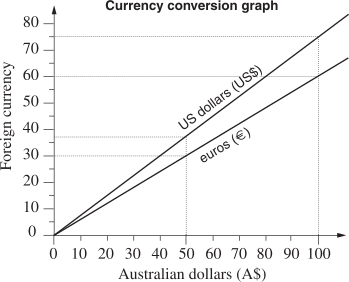
Sandy travels to Europe via the USA. She uses this graph to calculate her currency conversions.


  1. After leaving the USA she has US$150 to add to the A$600 that she plans to spend in Europe.


    She converts all of her money to euros. How many euros does she have to spend in Europe?    (3 marks)

    --- 6 WORK AREA LINES (style=lined) ---

  2. If the value of the euro falls in comparison to the Australian dollar, what will be the effect on the gradient of the line used to convert Australian dollars to euros?   (1 mark)

    --- 2 WORK AREA LINES (style=lined) ---

Show Answers Only
  1. `480\ €`
  2. `text(If the value of the euro falls against the)`
  3.  

    `text(A$, then 1 A$ will buy more euros than)`

  4.  

    `text(before and the gradient used to convert)`

  5.  

    `text{the currencies will steepen (increase).}`

Show Worked Solution

a.   `text(From graph:)`

`75\ text(US$)` `=\ text(100 A$)`
`=> 150\ text(US$)` `=\ text(200 A$)`

 
`:.\ text(Sandy has a total of 800 A$)`
 

`text(Converting A$ to €:)`

`text(100 A$)` `= 60\ €`
`:.\ text(800 A$)` `= 8 xx 60`
  `= 480\ €`


b.   `text(If the value of the euro falls against the)`

`text(A$, then 1 A$ will buy more euros than)`

`text(before and the gradient used to convert)`

`text{the currencies will steepen (increase).}`

Filed Under: AM2 - Linear Relationships (Prelim), Applications: Currency, Fuel and Other Problems (Std 1), Applications: Currency, Fuel and Other Problems (Std 2), Direct Variation and Currency Conversion (Std2-2027), Variation and Rates of Change Tagged With: Band 4, num-title-ct-patha, num-title-qs-hsc, smc-1119-10-Currency Conversion, smc-4239-70-Currency convert, smc-6249-30-Graphical Solutions, smc-6249-40-Direct Variation Relationships, smc-6249-50-Currency Conversion, smc-793-10-Currency Conversion

Statistics, STD2 S1 2007 HSC 24a

Consider the following set of scores:

`3, \ 5, \ 5, \ 6, \ 8, \ 8, \ 9, \ 10, \ 10, \ 50.` 

  1. Calculate the mean of the set of scores.   (1 mark)

    --- 1 WORK AREA LINES (style=lined) ---

  2. What is the effect on the mean and on the median of removing the outlier?   (2 marks)

    --- 5 WORK AREA LINES (style=lined) ---

Show Answers Only
  1. `11.4`
  2. `text{If the outlier (50) is removed, the mean}`


    `text(would become lower.)`

  3.  

    `text(Median will NOT change.)`

Show Worked Solution

a.  `text(Total of scores)`

`= 3 + 5 + 5 + 6 + 8 + 8 + 9 + 10 + 10 +50`

`= 114`
 

`:.\ text(Mean) = 114/10 = 11.4`


b.  `text(Mean)`

`text{If the outlier (50) is removed, the mean}`

`text(would become lower.)`
 

`text(Median)`

`text(The current median (10 data points))`

`= text(5th + 6th)/2 = (8 + 8)/2 = 8`

`text(The new median (9 data points))`

`=\ text(5th value)`

`= 8`
 

`:.\ text(Median will NOT change.)`

Filed Under: Data Analysis, Measures of Centre and Spread (Std2-2027), Summary Statistics - No Graph (Std 2), Summary Statistics - No graph (Y12), Summary Statistics (no graph), Summary Statistics (Std 1) Tagged With: Band 3, Band 4, common-content, num-title-ct-core, num-title-qs-hsc, smc-1131-10-Mean, smc-1131-20-Median and Mode, smc-4224-25-Mean, smc-4224-30-Outliers, smc-4224-50-Add/remove data, smc-6312-10-Mean, smc-6312-20-Median and Mode, smc-824-10-Mean, smc-824-20-Median and Mode, smc-999-10-Mean, smc-999-20-Median and Mode

Measurement, STD2 M7 2007 HSC 23c

A scientific study uses the ‘capture-recapture’ technique.

In the first stage of the study, 24 crocodiles were caught, tagged and released.

Later, in the second stage of the study, some crocodiles were captured from the same area. Eighteen of these were found to be tagged, which was 40% of the total captured during the second stage. 

  1. How many crocodiles were captured in total during the second stage of the study?  (1 mark)

    --- 2 WORK AREA LINES (style=lined) ---

  2. Calculate the estimate for the total population of crocodiles in this area.   (2 marks)

    --- 4 WORK AREA LINES (style=lined) ---

Show Answers Only
  1. `text(45 crocodiles)`
  2. `text(60 crocodiles)`
Show Worked Solution
i.    `text(Let)\ C_1` `=\ text(crocodiles captured in stage 1)`
  `C_2` `=\ text(crocodiles captured in stage 2)`
`C_1` `=\ text(40%)\ xx C_2`
`18` `=\ text(40%)\ xx C_2`
`:.\ C_2` `= 18/0.4 = 45\ text(crocodiles)`

COMMENT: Std2 sample exam questions from NESA included capture/recapture as examinable content within M7 Rates and Ratios.


ii.    `text(Capture) = 24/text(Population)`

`text(Recapture) = 18/45`

`24/text(Population)` `= 18/45`
`:.\ text(Population)` `= (24 xx 45)/18`
  `= 60`

Filed Under: DS5/6 - Normal Distribution and Sampling, Ratio and Scale (Std2) Tagged With: Band 4, Band 5, smc-1187-30-Capture/Recapture

GEOMETRY, FUR1 2009 VCAA 6-7 MC

GEOMETRY, FUR1 2009 VCAA 6-7 MC

`ABCD` is a sloping rectangular roof above a horizontal rectangular ceiling, `TCDR`.

`AB` `= DC` `= 12\ text(metres)`
`RD` `= TC` `= 3.8\ text(metres)`
`AR` `= BT` `= 1.5\ text(metres)`


Part 1

The angle of depression of `D` from `A` is closest to

A.     `21.5^@`

B.     `23.3^@`

C.     `66.7^@`

D.     `68.5^@`

E.   `111.5^@`


Part 2

The angle `ACR` is closest to

A.     `6.80^@`

B.     `6.84^@`

C.     `7.13^@`

D.   `18.80^@`

E.   `21.54^@`

Show Answers Only

`text(Part 1:)\ A`

`text(Part 2:)\ A`

Show Worked Solution

`text(Part 1)`

GEOMETRY, FUR1 2009 VCAA 6-7 MC Answer1  

`text(Let)\ theta =` `text(Angle of Depression of)\ D\ text(from)\ A`
`/_ADR` `= theta\ text( (alternate,)\ AB \ text (||)\ RD)`
`tan theta` `= 1.5 / 3.8`
`theta` `= 21.54…^@`
`=>  A`


`text(Part 2)`

`text(Find)\ x,`

GEOMETRY, FUR1 2009 VCAA 6-7 MC Answer2 

`text(Using Pythagoras in)\ Delta RCD,`

`x^2` `= 3.8^2 + 12^2`
  `= 158.44`
`x` `= 12.587…\ text(m)`


`text(In)\ Delta ACR,`

GEOMETRY, FUR1 2009 VCAA 6-7 MC Answer3

`tan /_ ACR` `= 1.5 / (12.587…)`
`/_ ACR` `= 6.79…^@`

`=>  A`

Filed Under: Trig - Harder Applications Tagged With: Band 4

Measurement, STD2 M1 2007 HSC 23b

A cylindrical water tank, of height 2 m, is placed in the ground at a school.

The radius of the tank is 3.78 metres. The hole is 2 metres deep. When the tank is placed in the hole there is a gap of 1 metre all the way around the side of the tank.


  1. When digging the hole for the water tank, what volume of soil was removed? Give your answer to the nearest cubic metre.  (3 marks)

    --- 6 WORK AREA LINES (style=lined) ---

  2. Sprinklers are used to water the school oval at a rate of 7500 litres per hour.   


    The water tank holds 90 000 litres when full. 


    For how many hours can the sprinklers be used before a full tank is emptied?   (1 mark)

    --- 2 WORK AREA LINES (style=lined) ---

  3. Water is to be collected in the tank from the roof of the school hall, which has an area of 400 m².


    During a storm, 20 mm of rain falls on the roof and is collected in the tank. 


    How many litres of water were collected?   (2 marks)

    --- 4 WORK AREA LINES (style=lined) ---

Show Answers Only
  1. `144\ text(m³)\ \ text{(nearest m³)}`
  2. `text(12 hours)`
  3. `8000\ text(litres)`
Show Worked Solution

a.  `V = pi r^2 h\ \ \ \ text(where)`

`h = 2\ text(and)\ r = 4.78\ text(m)`

`:.\ V` `= pi xx 4.78^2 xx 2`
  `= 143.56…`
  `= 144\ text(m³)\ \ text{(nearest m³)}`


b.  `text(Total water) = 90\ 000\ text(litres)`

`text(Usage) = 7500\ \ text(litres/hr)`

`:.\ text(Hours before it is empty)`

`= (90\ 000)/7500`

`= 12\ text(hours)`


c.  `text(Water collected)`

`= 400 xx 0.020`

`= 8\ text(m²)`

`= 8000\ text(litres)`

Filed Under: Areas and Volumes (Harder), FS Resources, Perimeter, Area and Volume (Std 2), Volume, Mass and Capacity (Std2-2027) Tagged With: Band 3, Band 4, smc-6304-50-Volume (Circular Measure), smc-798-50-Volume (Circular Measure)

GEOMETRY, FUR1 2009 VCAA 3 MC

GEOMETRY, FUR1 2009 VCAA 3 MC 

The locations of three towns, `Q`, `R` and `T`, are shown in the diagram above.

Town `T` is due south of town `R`.

The angle `TRQ` is `48^@`.

The bearing of town `R` from town `Q` is

A.   `048^@`

B.   `132^@`

C.   `138^@`

D.   `228^@`

E.   `312^@`

Show Answers Only

`E`

Show Worked Solution

GEOMETRY, FUR1 2009 VCAA 3 MC Answer

`∠RQA = 48^@    text{(} text(alternate)\ RT\ text(||)\ QA text{})`

`∴ text(Bearing of)\ R\ text(from)\ Q`

`= 360 – 48`

`= 312^@`

`=>  E`

Filed Under: Trig - Bearings Tagged With: Band 4

GEOMETRY, FUR1 2009 VCAA 5 MC

GEOMETRY, FUR1 2009 VCAA 5 MC

A right triangular prism has a volume of 160 cm3.

A second right triangular prism is made with the same width, twice the height and three times the length of the prism shown.

The volume of the second prism (in cm3) is

A.     `320`

B.     `640`

C.     `960`

D.   `1280`

E.   `1920`

Show Answers Only

`C`

Show Worked Solution

`text(Volume of existing prism)\ (V)`

  `= 1/2 xx b xx h xx l`
  `= 160 \ text(cm³)`


`text(Volume of new prism)\ (V_1)`

  `= 1/2 xx b xx 2h xx 3l`
  `= 6 xx 1/2 xx b xx h xx l`
  `= 6 xx V`
  `= 6 xx 160`
  `= 960 \ text(cm³)`

 `=>  C`

Filed Under: Perimeter, Area and Volume Tagged With: Band 4

Financial Maths, STD2 F1 2007 HSC 23a

Lilly and Rose each have money to invest and choose different investment accounts.

The graph shows the values of their investments over time.


  1. How much was Rose’s original investment?  (1 mark)

    --- 1 WORK AREA LINES (style=lined) ---

  2. At the end of  6 years, which investment will be worth the most and by how much?  (2 marks)

    --- 4 WORK AREA LINES (style=lined) ---

  3. Lilly’s investment will reach a value of  $20 000  first.
  4. How much longer will it take Rose’s investment to reach a value of  $20 000?   (1 mark)

    --- 2 WORK AREA LINES (style=lined) ---

Show Answers Only
  1. `$5000`
  2. `text(Rose’s is worth $2000 more.)`
  3. `text(It takes Lilly 14 years to reach $20 000 and it takes)`


    `text{Rose 1 year longer (15 years) to reach the same value}`

Show Worked Solution

i.  `$5000\ text{(} y text(-intercept) text{)}`
 

ii.  `text(After 6 years,)`

`text(Lilly’s investment)` `= $9000`
`text(Rose’s investment)` `= $11\ 000`
`:.\ text(Rose’s is worth $2000 more.)`


iii.  `text(It takes Lilly 14 years to reach $20 000 and it)`

`text{takes Rose 1 year longer (15 years) to reach the}`

`text(same value.)`

Filed Under: Compound Interest and Shares (Std2), F2 Investment (Y12), FM2 - Investing, Simple Interest and S/L Depreciation (Std 1), Simple Interest and S/L Depreciation (Std 2) Tagged With: Band 2, Band 3, Band 4, smc-1108-30-i/r comparisons (incl. graphs), smc-1124-10-Simple Interest, smc-808-10-Simple Interest, smc-817-30-i/r comparisons (incl. graphs)

CORE*, FUR1 2009 VCAA 7 MC

The difference equation  `u_(n + 1) = 4u_n - 2`  generates a sequence.

If  `u_2 = 2`, then  `u_4`  will be equal to

A.     4

B.     8

C.   22

D.   40

E.   42

Show Answers Only

`C`

Show Worked Solution
`u_(n+1)` `= 4u_n – 2`
`∴ u_3` `= 4u_2 – 2`
  `= 4 xx 2 – 2\ \ text{(given}\ u_2 = 2 text{)}`  
  `= 6`
`∴ u_4` `= 4u_3 – 2`
  `= 4 xx 6 – 2`
  `= 22`

 
`=>  C`

Filed Under: Difference Equations - MC, Recursion - General Tagged With: Band 4, smc-714-25-RR (combination), smc-714-50-Find term(s)

GEOMETRY, FUR1 2014 VCAA 8 MC

The distance, `AC`, across a small lake can be calculated using the measurements shown in the diagram below.

In this diagram, `BCA` and `BDE` are right-angled triangles, where `CB = 40.4\ text(m), BD = 10\ text(m)` and `BE = 12\ text(m).`

The distance between the points `A` and `C`, in metres, is closest to

A.    `22.4`

B.    `26.8`

C.    `33.6`

D.    `48.5`

E.  `177.8`

Show Answers Only

`B`

Show Worked Solution

`/_ ABC = /_ DBE\ \ text{(vertically opposite angles)}`

`/_ ACB = /_ BDE = 90°\ \ text{(given)}`

`∴ Delta ABC\ \ text(|||)\ \ Delta EBD\ \ \ \ text{(equiangular)}`

`∴ (AB)/40.4` `= 12/10` `\ \ \ \ \ text{(corresponding sides}`
`\ \ \ \ \ \ text{of similar triangles)}`
`AB` `= (12 xx 40.4)/10`  
  `= 48.48\ \ text(m)`  


`text(Using Pythagoras in)\ Delta ABC:`

`48.48^2` `= x^2 + 40.4^2`
`x^2` `= 718.1504`
`x` `= 26.79\ text(m)`

 
`=>B`

Filed Under: Similarity and Scale Tagged With: Band 4

CORE*, FUR1 2011 VCAA 7 MC

Let `P_2011` be the number of pairs of shoes that Sienna owns at the end of 2011.

At the beginning of 2012, Sienna plans to throw out the oldest 10% of pairs of shoes that she owned in 2011.

During 2012 she plans to buy 15 new pairs of shoes to add to her collection.

Let `P_2012` be the number of pairs of shoes that Sienna owns at the end of 2012.

A rule that enables `P_2012` to be determined from `P_2011` is

A.   `P_2012 = 1.1 P_2011 + 15`

B.   `P_2012 = 1.1 (P_2011 + 15)`

C.   `P_2012 = 0.1 P_2011 + 15`

D.   `P_2012 = 0.9 (P_2011 + 15)`

E.   `P_2012 = 0.9 P_2011 + 15`

Show Answers Only

`E`

Show Worked Solution

`text(By throwing out 10%, Sienna keeps 90% of her)`

`text{her 2011 shoes (or 0.9} \ P_2011 text{) and then adds 15.}`

`:. P_(2012) = 0.9\ P_2011 + 15`

`=> E`

Filed Under: Difference Equations - MC, Recursion - General Tagged With: Band 4, smc-714-25-RR (combination), smc-714-60-Identify RR

PATTERNS, FUR1 2011 VCAA 4 MC

The number of bees in a colony was recorded for three months and the results are displayed in the table below.

If this pattern of increase continues, which one of the following statements is not true.

A.   There will be nine times as many bees in the colony in month 5 than in month 3.

B.   In month 4, the number of bees will equal 270.

C.   In month 6, the number of bees will equal 7290.

D.   In month 8, the number of bees will exceed 20 000.

E.   In month 10, the number of bees will be under 200 000.

Show Answers Only

`C`

Show Worked Solution

`text(Sequence is 10, 30, 90, …)`

`text(GP where)\ \ \ a` ` = 10, and`
`r` ` = t_2/t_1=30 / 10 = 3`


`text(In A,)\ \ T_5 = 10 xx 3^4 and T_3 = 10 xx 3^2`

`:. T_5 = T_3 xx 3^2\ \ text{(True)}`

`text(In B,)\ \ T_4 = 10 xx 3^3 = 270\ \ text{(True)}`

`text(In C,)\ \ T_6 = 10 xx 3^5 = 2430\ \ text{(NOT true)}`

`text(In D,)\ \ T_8 = 10 xx 3^7 = 21\ 870\ \ text{(True)}`

`text(In E,)\ \ T_10 = 10 xx 3^9 = 196\ 830\ \ text{(True)}`

`=> C`

Filed Under: APs and GPs - MC Tagged With: Band 4

CORE*, FUR1 2011 VCAA 3 MC

The graph above shows the first five terms of a sequence.

Let `A_n` be the `n`th term of the sequence.

A difference equation that generates the terms of this sequence is

A.  `A_(n+1) = 2A_n - 2` `\ \ \ \ text(where) \ \ \ \ ` `A_1 =8`
B.  `A_(n+1) = 3A_n` `\ \ \ \ text(where) \ \ \ \ ` `A_1 =8`
C.  `A_(n+1) = -2A_n` `\ \ \ \ text(where) \ \ \ \ \ \ \ \ ` `A_1 =8`
D.  `A_(n+1) = -1 / 2 A_n` `\ \ \ \ text(where) \ \ \ \ ` `A_1 =8`
E.  `A_(n+1) = -A_n - 1` `\ \ \ \ text(where) \ \ \ \ ` `A_1 =8`
Show Answers Only

`D`

Show Worked Solution

`A_1 = 8, \ \ A_2 = –4, \ \ A_3 = 2\ \ text{(from graph)}`

`text(This sequence is geometric where)`

`r=t_2/t_1=- 1/2`

`:.\ text(Difference equation is)\ \ \ A_(n+1) = -1/2 A_n`

`=> D`
Filed Under: Difference Equations - MC, Recursion - General Tagged With: Band 4, smc-714-70-RR and graphs

PATTERNS, FUR1 2011 VCAA 2 MC

The first three terms of an arithmetic sequence are  –3, –7, –11 . . .

An expression for the  `n`th  term of this sequence, `t_n`, is

A.   `t_n = 1 - 4n`

B.   `t_n = 1 - 8n`

C.   `t_n = -3 - 4n`

D.   `t_n = -3 + 4n`

E.   `t_n = -7 + 4n`

Show Answers Only

`A`

Show Worked Solution

`text(Sequence is  –3, –7, –11, …)`

`text(AP where)\ \ \ a` `= –3, and`
`d` `= –7 – (–3) = –4`
`t_n` ` = a + (n – 1) d`
  ` = –3 + (n – 1) (–4)`
  ` = –3 – 4n + 4`
  ` = 1 – 4n`

`=> A`

Filed Under: APs and GPs - MC Tagged With: Band 4

GEOMETRY, FUR1 2012 VCAA 7 MC

`PQR` is a triangle with side lengths `x, 10` and `y`, as shown below.

In this triangle, angle `RPQ = 37°` and angle `QRP = 42°.`

Which one of the following expressions is correct for triangle `PQR`?

A.    `x = 10/(sin 37°)`

B.    `y = 10/(tan 37°)`

C.    `x = 10 × (sin 42°)/(sin 37°)`

D.    `y = 10 × (sin 37°)/(sin 101°)`

E.    `10^2 = x^2 + y^2 - 2xy cos 42°`

Show Answers Only

`C`

Show Worked Solution

`∠ PQR` `= 180 – (37 + 42)\ \ \ \ text {(angle sum of}\ ΔPQR text{)}`
  `= 101°`


`text (Using the sine rule:)`

`y/sin 101= x/sin 42= 10/sin 37`

`:. x= 10 × (sin 42)/(sin 37)`

 
`rArr C`

Filed Under: Non-Right-Angled Trig Tagged With: Band 4, smc-3589-10-Sine rule

GEOMETRY, FUR1 2012 VCAA 3 MC

A rectangular sheet of cardboard has length 50 cm and width 20 cm.

This sheet of cardboard is made into an open-ended cylinder by joining the two shorter sides, with no overlap.

This is shown in the diagram below. 

The radius of this cylinder, in cm, is closest to

A.     `6.4`

B.     `8.0`

C.   `15.6`

D.   `15.9`

E.   `17.8`

Show Answers Only

`B`

Show Worked Solution

`text (Circumference) = 50\ text(cm)`

 `2pi r` `= 50`
 `:. r` `= 50/(2pi)`
  `= 7.95…\ text(cm)`

`rArr B`

Filed Under: Perimeter, Area and Volume Tagged With: Band 4

Measurement, STD2 M2 2007 HSC 20 MC

Kim lives in Perth. He wants to watch an ice hockey game being played in Toronto starting at 10.00 pm on Wednesday.

Toronto is 13 hours behind Perth.

What is the time in Perth when the game starts?

  1.   9.00 am on Wednesday
  2. 7.40 pm on Wednesday
  3. 12.20 am on Thursday
  4. 11.00 am on Thursday
Show Answers Only

`D`

Show Worked Solution

`:.\ text(Time in Perth)`

`=\ text{10 pm (Wed) + 13 hours}`

`=\ text(11 am on Thursday)`

`=>  D`

Filed Under: M2 Working with Time (Y11), M2 Working with Time (Y11), Time and Time Difference (Std2-2027) Tagged With: Band 4, smc-1102-10-Time Differences, smc-6306-10-Time Differences, smc-776-10-Time Differences

Probability, STD2 S2 2007 HSC 16 MC

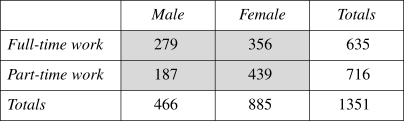
Leanne copied a two-way table into her book.


Leanne made an error in copying one of the values in the shaded section of the table.

Which value has been incorrectly copied?

  1. The number of males in full-time work
  2. The number of males in part-time work
  3. The number of females in full-time work
  4. The number of females in part-time work
Show Answers Only

`D`

Show Worked Solution

`text(By checking row and column total, the number)`

`text(of females part-time work is incorrect)`

`=>  D`

Filed Under: Relative Frequency (Std 1), Relative Frequency (Std 2), Relative Frequency (Y11), Relative Frequency and Venn Diagrams, Summary Statistics (no graph) Tagged With: Band 4, common-content, num-title-ct-pathb, num-title-qs-hsc, smc-1133-10-Surveys/Two-Way Tables, smc-4815-10-2-Way tables, smc-827-10-Surveys/Two-Way Tables, smc-990-10-Surveys/Two-Way Tables

Algebra, 2UG 2007 HSC 14 MC

Which expression is equivalent to  `3x^2 (x + 8) + x^2`?

(A)   `3x^3 + x^2 + 8`

(B)   `3x^3 + 25x^2`

(C)   `4x^3 + 32x^2`

(D)   `24x^3 + x^2`

Show Answers Only

`B`

Show Worked Solution

`3x^2 (x + 8) + x^2`

`= 3x^3 + 24x^2 + x^2`

`= 3x^3 + 25x^2`

`=>  B`

Filed Under: Linear and Other Equations Tagged With: Band 4

Probability, 2UG 2007 HSC 13 MC

The positions of President, Secretary and Treasurer of a club are to be chosen from a committee of  `5` people.

In how many ways can the three positions be chosen? 

(A)   `3`

(B)   `10`

(C)   `60`

(D)   `125`

Show Answers Only

`C`

Show Worked Solution

`text(3 positions and order matters)`

`:.\ text(# Combinations)` `= 5 xx 4 xx 3`
  `= 60`

`=>  C`

Filed Under: # Combinations Tagged With: Band 4

Financial Maths, STD2 F4 2007 HSC 12 MC

The value of a car is depreciated using the declining balance method.

Which graph best illustrates the value of the car over time?
 

VCAA 2007 12 mcii

Show Answers Only

`C`

Show Worked Solution

`text(Declining balance depreciates quicker in absolute)`

`text(terms in the early stages, and slower as time goes)`

`text(on and the balance owing decreases.)`

`=>  C`

Filed Under: Depreciation - Declining Balance (Std 1), Depreciation - Declining Balance (Std 2), Depreciation / Running costs Tagged With: Band 4, smc-1139-60-Depreciation Graphs, smc-813-60-Depreciation Graphs

Measurement, 2UG 2007 HSC 11 MC

`P`  and  `Q`  are points on the circumference of a circle with centre  `O`  and radius  `3`  cm.  

2007 11 mc

What is the length of the arc  `PQ`, in centimetres, correct to three significant figures?

(A)   `1.57`

(B)   `3.14`

(C)   `4.71`

(D)   `18.8`

Show Answers Only

`B`

Show Worked Solution
`text(Length of Arc)\ PQ` `= 60/360 xx 2 pi r`
  `= 1/6 xx 2pi (3)`
  `= pi`
  `= 3.14\ text(cm)`

`=>  B`

Filed Under: MM6 - Spherical Geometry Tagged With: Band 4

Probability, STD2 S2 2007 HSC 10 MC

Each time she throws a dart, the probability that Mary hits the dartboard is  `2/7`.

She throws two darts, one after the other.

What is the probability that she hits the dartboard with both darts?

  1. `1/21` 
  2. `4/49` 
  3. `2/7`
  4. `4/7`
Show Answers Only

`B`

Show Worked Solution

`P text{(hits)} = 2/7`

`P text{(hits twice)}` `= 2/7 xx 2/7`
  `= 4/49`

`=>  B`

Filed Under: Multi-stage Events, Multi-Stage Events (Std 2), Single and Multi-Stage Events (Std 1) Tagged With: Band 4, smc-1135-20-Other Multi-Stage Events, smc-829-20-Other Multi-Stage Events

Statistics, STD2 S4 2007 HSC 9 MC

Which of the following would be most likely to have a positive correlation?

  1. The population of a town and the number of schools in that town
  2. The price of petrol per litre and the number of litres of petrol sold
  3. The hours training for a marathon and the time taken to complete the marathon
  4. The number of dogs per household and the number of televisions per household
Show Answers Only

\(A\)

Show Worked Solution

\(\text{Positive correlation means that as one variable increases,}\)

\(\text{the other tends to increase also.}\)

\(\Rightarrow A\)

Filed Under: Bivariate Data, Bivariate Data Analysis (Y12), Correlation / Body Measurements, S3 Further Statistical Analysis (Y12), S4 Bivariate Data Analysis (Y12) Tagged With: Band 4, common-content, num-title-ct-coreb, num-title-qs-hsc, smc-1001-30-Correlation, smc-1113-30-Correlation, smc-5022-35-Causality, smc-785-30-Correlation

Financial Maths, STD2 F1 2007 HSC 7 MC

Margaret has a weekly income of $900 and allocates her money according to the budget shown in the sector graph.


How long will it take Margaret to save $3600?

  1.    4 weeks
  2.    5 weeks
  3.    16 weeks
  4.    18 weeks
Show Answers Only

`D`

Show Worked Solution
`text(Savings)` `= 80/360\ \ \ text(sector graph)`
  `= 80/360 xx 900`
  `= $200\ text(per week)`


`:.\ text(Time to save $3600)`

`= 3600/200`

`= 18\ text(weeks)`

`=>  D`

Filed Under: Budgeting (Std2-2027), Earning Money and Budgeting (Std 1), Earning Money and Budgeting (Std 2), FM1 - Earning money Tagged With: Band 4, smc-1126-30-Budgeting, smc-6279-10-Personal Budget, smc-810-30-Budgeting

Financial Maths, STD2 F1 2007 HSC 6 MC

The price of a CD is $22.00, which includes 10% GST.

What is the amount of GST included in this price?

  1.    $2.00
  2.    $2.20
  3.    $19.80
  4.    $20.00
Show Answers Only

`A`

Show Worked Solution

`text(CD costs $22.00 incl. GST`

`text(Let)\ C = text(original cost)`

`C + text(10%) xx C` `= 22`
`1.1C` `= 22`
`C` `= 20`


`:.\ text(GST)` `= 22.00 – 20.00`
  `= $2.00`

 
`=>  A`

Filed Under: FM3 - Taxation, Purchasing Goods (Std2-2027), Tax and Percentage Increase/Decrease (Std 1), Tax and Percentage Increase/Decrease (Std 2) Tagged With: Band 4, smc-1125-20-GST, smc-6278-20-GST/VAT, smc-831-20-GST

Financial Maths, STD2 F1 2007 HSC 3 MC

Joe is about to go on holidays for four weeks. His weekly salary is $280 and his holiday loading is 17.5% of four weeks pay.

What is Joe’s total pay for the four weeks holiday?

  1. $196
  2. $329
  3. $1169 
  4. $1316 
Show Answers Only

`D`

Show Worked Solution
`text(Salary)\ text{(4 weeks)}` `= 4 xx 280`
  `= $1120`


`text(Holiday loading)` `= 1120 xx 17.5%`
  `= $196`


`:.\ text(Total pay)` `= 1120 + 196`
  `= $1316`

 
`=>  D`

Filed Under: Earning and Spending Money, Earning Money and Budgeting (Std 1), Earning Money and Budgeting (Std 2), FM1 - Earning money, Purchasing Goods (Std2-2027), Tax and Percentage Increase/Decrease (Std 1), Tax and Percentage Increase/Decrease (Std 2), Ways of Earning (Std2-2027) Tagged With: Band 4, num-title-ct-corea, num-title-qs-hsc, smc-1125-30-% Increase/Decrease, smc-1126-10-Wages, smc-4331-10-Wages, smc-4331-30-Leave loading, smc-6276-10-Wages/Salaries, smc-810-10-Wages, smc-831-30-% Increase/Decrease

GEOMETRY, FUR1 2014 VCAA 6-7 MC

A cross-country race is run on a triangular course. The points  `A, B` and `C` mark the corners of the course, as shown below.


The distance from `A` to `B` is 2050 m.

The distance from `B` to `C` is 2250 m.

The distance from `A` to `C` is 1900 m.

The bearing of `B` from `A` is 140°.


Part 1

The bearing of `C` from `A` is closest to

A.   `032°`

B.   `069°`

C.   `192°`

D.   `198°`

E.   `209°`


Part 2

The area within the triangular course `ABC`, in square metres, can be calculated by evaluating

A.  `sqrt (3100 xx 1200 xx 1050 xx 850)`

B.  `sqrt (3100 xx 2250 xx 2050 xx 1900)`

C.  `sqrt (6200 xx 4300 xx 4150 xx 3950)`

D.  `1/2 xx 2050 xx 2250 xx sin\ (140^@)`

E.  `1/2 xx 2050 xx 2250 xx sin\ (40^@)`

Show Answers Only

`text(Part 1:)\ E`

`text(Part 2:)\ A`

Show Worked Solution

`text(Part 1)`

♦ Mean mark 43%.

`text(Using the cosine rule:)`

`cos ∠CAB` `= ((AC)^2 + (AB)^2 – (CB)^2)/(2 xx AC xx AB)`
  `= (1900^2 + 2050^2 – 2250^2)/(2 xx 1900 xx 2050)`
  `= 0.3530…`
`/_ CAB` `= 69.32…°`


`∴\ text(Bearing of C from A)`

`= 140 + 69.32…`

`= 209.32…°`

`=>E`


`text(Part 2)`

`text(Using Heron’s rule,)`

`text{Semi-perimeter (s)}`

`= (1900 + 2050 + 2250)/2`

`= 3100`
 

`∴ A` `= sqrt{s (s-a)(s-b)(s-c)}`
  `= sqrt{3100 xx 1200 xx 1050 xx 850}`

 
`=> A`

Filed Under: Trig - Bearings Tagged With: Band 4, Band 5

GEOMETRY, FUR1 2014 VCAA 5 MC

A rectangular box, `ABCDEFGH` is 22 cm long, 16 cm wide and 8 cm high, as shown below.

A thin rod is resting in the box. One end of the rod sits at `X` and the other end of the rod sits at `H.`

The point `X` lies on the line `AB` at a distance of 10 cm from `B.`

The length of the rod, in centimetres, is closest to

A.  `17.89`

B.  `18.87`

C.  `20.00`

D.  `21.54`

E.  `26.83`

Show Answers Only

`D`

Show Worked Solution

`text(Consider)\ \ Delta AEX,`

`AX = 22 – 10 = 12\ text{cm  (from diagram)}`

`text(Using Pythagoras in)\ Delta EAX,`

`x^2` `= 16^2 + 12^2`
  `= 400`
`:. x` `= 20`


`text(Consider)\ \ Delta HEX,\ text(where)\ \ HX = d`

`text(Using Pythagoras in)\ Delta HEX,`

`d^2` `= 8^2 + 20^2`
  `= 464`
`∴ d` `= 21.54…\ text(cm)`

`=>D`

Filed Under: Trig - Harder Applications Tagged With: Band 4

CORE*, FUR1 2014 VCAA 7 MC

The first term of a Fibonacci-related sequence is  `p`.

The second term of the same Fibonacci-related sequence is  `q`.

The difference in value between the fourth and fifth terms of this sequence is

A.   `p - q`  

B.   `q - p`  

C.   `p + q`

D.   `p + 2q`

E.   `2p + 3q`

Show Answers Only

`C`

Show Worked Solution

`text(Fibonacci sequence general form is)`

♦ Mean mark 42%.

`t_(n+2) = t_(n+1) + t_n`

`t_1 = p`

`t_2 = q`

`t_3 = p + q`

`t_4 = (p + q) + q = p + 2q`

`t_5 = p + 2q + (p + q) = 2p + 3q`

`∴ t_5 – t_4` `= 2p + 3q – (p + 2q)`
  `= p + q`

 
`=>  C`

Filed Under: Difference Equations - MC, Recursion - General Tagged With: Band 4, smc-714-30-RR (Fibonacci), smc-714-50-Find term(s)

PATTERNS, FUR1 2014 VCAA 5 MC

Mary plans to read a book in seven days.
Each day, Mary plans to read 15 pages more than she read on the previous day.
The book contains 1155 pages.
The number of pages that Mary will need to read on the first day, if she is to finish reading the book in seven days, is

A.   `112` 

B.   `120` 

C.   `150`

D.   `165`

E.   `180`

Show Answers Only

`B`

Show Worked Solution

`text(Sequence is)\ \ a, a+15, a + 2 xx 15, …`

`=>\ text(AP where)\ \ \d=15`

`text(Find)\ \ a\ \ text(when)\  S_7 = 1155`

`S_n` `=n/2[2a + (n-1)d]`
`1155` `=7/2[2a + (7-1)15]`
`1155` `=7/2[2a + 90]`
  `=7a + 315`
`7a` `=840`
`a` `=120`

`=>  B`

Filed Under: APs and GPs - MC Tagged With: Band 4

CORE, FUR1 2014 VCAA 9 MC

The equation of a least squares regression line is used to predict the fuel consumption, in kilometres per litre of fuel, from a car’s weight, in kilograms.

This equation predicts that a car weighing 900 kg will travel 10.7 km per litre of fuel, while a car weighing 1700 kg will travel 6.7 km per litre of fuel.

The slope of this least squares regression line is closest to

A.   `–250`

B.   `–0.005`

C.   `–0.004`

D.   `0.005`

E.   `200`

Show Answers Only

`B`

Show Worked Solution


`text(Gradient)` `=(y_2-y_1)/(x_2 – x_1)`
  `=(6.7 – 10.7)/(1700 – 900)`
  `=- 4/800`
  `=-0.005`

 
`=>  B`

Filed Under: Correlation and Regression Tagged With: Band 4, smc-265-20-Find LSRL Equation/Gradient

CORE, FUR1 2011 VCAA 13 MC

The table below shows the number of broadband users in Australia for each of the years from 2004 to 2008.
 

core 2011  VCAA 13
 

A two-point moving mean, with centring, is used to smooth the time series.

The smoothed value for the number of broadband users in Australia in 2006 is

A.   `2 \ 958 \ 000`

B.   `3 \ 379 \ 600`

C.   `3 \ 455 \ 500`

D.   `3 \ 661 \ 500`

E.   `3 \ 900 \ 000`

Show Answers Only

`D`

Show Worked Solution

`text(Two point mean for)`

`text(2005/06)` `= (2 \ 016 \ 000 + 3 \ 900 \ 000) / 2`
  `= 2 \ 958 \ 000`
   
`text(2006/07)`  `= (3 \ 900 \ 000 + 4 \ 830 \ 000) / 2`
  `= 4 \ 365 \ 000`
`:.\ text(Centered mean)` `= (2 \ 958 \ 000 + 4 \ 365 \ 000) / 2`
  `= 3 \ 661 \ 500`

`=> D`

Filed Under: Time Series Tagged With: Band 4, smc-266-60-MEAN Smoothing

CORE, FUR1 2011 VCAA 11 MC

For a group of 15-year-old students who regularly played computer games, the correlation between the time spent playing computer games and fitness level was found to be  `r = -0.56.`

On the basis of this information it can be concluded that

  1. 56% of these students were not very fit.
  2. these students would become fitter if they if they spent less time playing computer games.
  3. these students would become fitter if they if they spent more time playing computer games.
  4. the students in the group who spent a short amount of time playing computer games tended to be fitter.
  5. the students in the group who spent a large amount of time playing computer games tended to be fitter.
Show Answers Only

`D`

Show Worked Solution

`text(Negative correlation means that as time spent playing)`

`text(computer games decreases, fitness levels tend to increase.)`

`text(Note that)\ B\ text(is incorrect because it assumes one causes the)`

`text(other.)`

`=> D`

Filed Under: Correlation and Regression Tagged With: Band 4, smc-265-10-r / r^2 and Association

CORE, FUR1 2011 VCAA 9-10 MC

The length of a type of ant is approximately normally distributed with a mean of 4.8 mm and a standard deviation of 1.2 mm.

Part 1

From this information it can be concluded that around 95% of the lengths of these ants should lie between

A.   `text(2.4 mm and 6.0 mm)`

B.   `text(2.4 mm and 7.2 mm)`

C.   `text(3.6 mm and 6.0 mm)`

D.   `text(3.6 mm and 7.2 mm)`

E.   `text(4.8 mm and 7.2 mm)`


Part 2

A standardised ant length of  `z = text(−0.5)`  corresponds to an actual ant length of

A.   `text(2.4 mm)`

B.   `text(3.6 mm)`

C.   `text(4.2 mm)`

D.   `text(5.4 mm)`

E.   `text(7.0 mm)`

Show Answers Only

`text(Part 1:)\ B`

`text(Part 2:)\ C`

Show Worked Solution

`text(Part 1)`

`text(95% of scores lie between ±2 std dev)`

`bar x = 4.8, \ \ \ s = 1.2`

`text(Lower limit)` `= bar x – 2text(s)`
  `= 4.8 – 2(1.2)`
  `= 2.4\ text(mm)`
`text(Upper limit)` `= bar x + 2text(s)`
  `= 4.8 + 2(1.2)`
  `= 7.2\ text(mm)`

 
`=>B`
 

`text(Part 2)`

`z` `= \ \ (x – bar x)/s`
`-0.5` `= \ \ (x – 4.8)/1.2`
`-0.6` `= \ \ x – 4.8`
`x` `= \ \ 4.2\ text(mm)`

 
`=>C`


Filed Under: Normal Distribution Tagged With: Band 3, Band 4, smc-600-10-Single z-score, smc-600-20-z-score Intervals

CORE, FUR1 2011 VCAA 6-8 MC

When blood pressure is measured, both the systolic (or maximum) pressure and the diastolic (or minimum) pressure are recorded.

Table 1 displays the blood pressure readings, in mmHg, that result from fifteen successive measurements of the same person's blood pressure.
 

core 2011  VCAA 6-8

Part 1

Correct to one decimal place, the mean and standard deviation of this person's systolic blood pressure measurements are respectively

A.   `124.9 and 4.4`

B.   `125.0 and 5.8`

C.   `125.0 and 6.0`

D.   `125.9 and 5.8`

E.   `125.9 and 6.0`


Part 2

Using systolic blood pressure (systolic) as the response variable, and diastolic blood pressure (diastolic) as the explanatory variable, a least squares regression line is fitted to the data in Table 1.

The equation of the least squares regression line is closest to

A.   `text(systolic) = 70.3 + 0.790 xx text(diastolic)`

B.   `text(diastolic) = 70.3 + 0.790 xx text(systolic)`

C.   `text(systolic) = 29.3 + 0.330 xx text(diastolic)`

D.   `text(diastolic) = 0.330 + 29.3 xx text(systolic)`

E.   `text(systolic) = 0.790 + 70.3 xx text(diastolic)`


Part 3

From the fifteen blood pressure measurements for this person, it can be concluded that the percentage of the variation in systolic blood pressure that is explained by the variation in diastolic blood pressure is closest to

A.   `25.8text(%)`

B.   `50.8text(%)`

C.   `55.4text(%)`

D.   `71.9text(%)`

E.   `79.0text(%)`

Show Answers Only

`text(Part 1:)\ E`

`text(Part 2:)\ A`

`text(Part 3:)\ A`

Show Worked Solution

`text(Part 1)`

`text{By calculator (using sample standard deviation)}`

`text{the results are: }`

`text(Mean = 125.9, std dev = 6.0)`

`=>E`


`text(Part 2)`

`text{By calculator (making sure diastolic values are}`

`text{the explanatory or}\ x text{-variable), the regression line}`

`text(can be expressed as follows,)`

`text(systolic) = 70.3 + 0.790 xx text(diastolic)`

`=>A`


`text(Part 3)`

`text{By calculator, the regression line (above) should}`

`text(have found) \ \ r^2 = 0.258,\ text(which means that)`

`text(25.8% of the variation in systolic pressure can be)`

`text(explained by variation in diastolic pressure.)`

`=>A`

Filed Under: Correlation and Regression, Summary Statistics Tagged With: Band 4, smc-265-10-r / r^2 and Association, smc-265-20-Find LSRL Equation/Gradient, smc-468-20-Mean, smc-468-30-Std Dev

CORE, FUR1 2011 VCAA 5 MC

The boxplots below display the distribution of average pay rates, in dollars per hour, earned by workers in 35 countries for the years 1980, 1990 and 2000.
 

Based on the information contained in the boxplots, which one of the following statements is not true?

  1. In 1980, over 50% of the countries had an average pay rate less than $8.00 per hour.
  2. In 1990, over 75% of the countries had an average pay rate greater than $5.00 per hour.
  3. In 1990, the average pay rate in the top 50% of the countries was higher than the average pay rate for any of the countries in 1980.
  4. In 1990, over 50% of the countries had an average pay rate less than the median average pay rate in 2000.
  5. In 2000, over 75% of the countries had an average pay rate greater than the median average pay rate in 1980. 


Show Answers Only

`E`

Show Worked Solution

`text(By elimination,)`

`text(In A, 1980 median is below $8.00. True)`

`text(In B, 1990 Q1 is above $5.00. True)`

`text(In C, 1990 median is above 1980 high. True)`

`text(In D, 1990 median is below 2000 median. True)`

`text(In E, 2000 Q1 is below 1980 median. NOT true)`

`=>  E`

Filed Under: Graphs - Stem/Leaf and Boxplots Tagged With: Band 4, smc-643-20-Parallel Box-Plots

CORE, FUR1 2009 VCAA 12 MC

The mathematics achievement level (TIMSS score) for grade 8 students and the general rate of Internet use (%) for 10 countries are displayed in the scatterplot below.

To linearise the data, it would be best to plot 

A.   mathematics achievement against Internet use.

B.   log (mathematics achievement) against Internet use.

C.   mathematics achievement against log (Internet use).

D.   mathematics achievement against (Internet use)2.

E.  ` 1/text(mathematics achievement)` against Internet use.

Show Answers Only

`C`

Show Worked Solution

`text(The shape of the data is logarithmic.)`

`:.\ text(To linearise the data, it would be best to)`

`text{plot mathematics achievement against}`

`text{log (Internet use). }`

`=>  C`

Filed Under: Correlation and Regression Tagged With: Band 4, smc-265-70-Linearise - log10

CORE, FUR1 2009 VCAA 7 MC

The level of oil use in certain countries is approximately normally distributed with a mean of 42.2 units and a standard deviation of 10.2 units.

The percentage of these countries in which the level of oil use is greater than 32 units is closest to

A.     5%

B.   16%

C.   34%

D.   84%

E.   97.5%

Show Answers Only

`D`

Show Worked Solution
`bar x` `=42.2` `s` `=10.2`
`z text(-score (32))` `=(x – barx)/s`
  `=(32-42.2)/10.2`
  `=–1`

 
`text(68% lie between)\ z text(-score of  –1 and 1)`

`=>\ text(34%  lie between z-score  –1 and 0)`

`text(50% lie above z-score of 0)`

`∴\ text(% above 32 units)` `=34 + 50`
  `= 82text(%)`

 
`rArr  D`

Filed Under: Normal Distribution Tagged With: Band 4, smc-600-10-Single z-score

CORE, FUR1 2008 VCAA 10 MC

A large study of Year 12 students shows that there is a negative association between the time spent doing homework each week and the time spent watching television. The correlation coefficient is `r = – 0.6`.

From this information it can be concluded that

  1. the time spent doing homework is 60% lower than the time spent watching television.  
  2. 36% of students spend more time watching television than doing homework.  
  3. the slope of the least squares regression line is 0.6.
  4. if a student spends less time watching television, they will do more homework.
  5. an increased time spent watching television is associated with a decreased time doing homework.
Show Answers Only

`E`

Show Worked Solution

`text(A negative correlation means that the greater the time)`

`text(spent watching television is associated with the less)`

`text(time spent doing homework.)`

`D\ text(assumes one causes the other and is therefore incorrect.)`

`=>E`

Filed Under: Correlation and Regression Tagged With: Band 4, smc-265-10-r / r^2 and Association

CORE, FUR1 2008 VCAA 8-9 MC

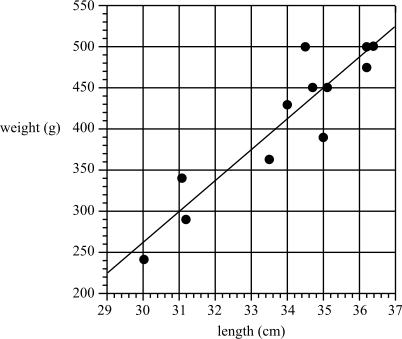
The weights (in g) and lengths (in cm) of 12 fish were recorded and plotted in the scatterplot below. The least squares regression line that enables the weight of these fish to be predicted from their length has also been plotted.
 

Part 1

The least squares regression line predicts that the weight (in g) of a fish of length 30 cm would be closest to

A.   `240`

B.   `252`

C.   `262`

D.   `274`

E.   `310`

 
Part 2

The median weight (in g) of the 12 fish is closest to

A.   `346`

B.   `375`

C.   `440`

D.   `450`

E.   `475`

Show Answers Only

`text(Part 1:)\ C`

`text(Part 2:)\ C`

Show Worked Solution

`text(Part 1)`

`text{The regression line crosses the 30cm length (on the}`

`xtext{-axis) at approx 262.}`

`=>C`


`text(Part 2)`

`text(12 weight data points – the median will be the average of)`

`text(the 6th and 7th.)`

`text(From the graph,)`

`text(6th highest weight = 430 g)`

`text(7th highest weight = 450 g)`

`:.\ text(Median)` `=(430+450)/2`
  `=440\ text(g)`

`=> C` 

Filed Under: Correlation and Regression, Summary Statistics Tagged With: Band 4, smc-468-40-Median Mode and Range

CORE, FUR1 2008 VCAA 6-7 MC

The pulse rates of a large group of 18-year-old students are approximately normally distributed with a mean of 75 beats/minute and a standard deviation of 11 beats/minute.

Part 1

The percentage of 18-year-old students with pulse rates less than 75 beats/minute is closest to

A.   32%

B.   50%

C.   68%

D.   84%

E.   97.5%


Part 2

The percentage of 18-year-old students with pulse rates less than 53 beats/minute or greater than 86 beats/minute is closest to

A.      2.5%

B.      5%

C.    16%

D.    18.5%

E.     21%

Show Answers Only

`text(Part 1:)\ B`

`text(Part 2:)\ D`

Show Worked Solution

`text(Part 1)`

`barx=75,\ \ \ s=11`

`text(In a normal distribution, mean = median.)`

`:.\ text(50% of group are below mean of 75)`

`=>B`


`text(Part 2)`

♦ Mean mark 44%.
MARKERS’ COMMENT: Two applications of the 68-95-99.7% rule are required. A good strategy is to first draw a normal curve and shade the required areas.

`barx=75,\ \ \ s=11`

`z text{-score (53)}` `=(x-barx) /s`
   `=(53-75)/11`
   `= – 2`


`z text{-score (86)}` `= (86-75)/11`
  `=1`

core 2008 VCAA 6-7

`text(From the diagram, the % of students that have a)`

`z text(-score below –2 or above 1)`

 `=2.5+16`

`=18.5 text(%)`

 `=>D`

Filed Under: Normal Distribution Tagged With: Band 4, Band 5, smc-600-10-Single z-score, smc-600-20-z-score Intervals

CORE, FUR1 2008 VCAA 5 MC

A sample of 14 people were asked to indicate the time (in hours) they had spent watching television on the previous night. The results are displayed in the dot plot below.
 

    2008 5
 

Correct to one decimal place, the mean and standard deviation of these times are respectively

A.   `bar x=2.0\ \ \ \ \ s=1.5`

B.   `bar x=2.1\ \ \ \ \ s=1.5`  

C.   `bar x=2.1\ \ \ \ \ s=1.6`

D.   `bar x=2.6\ \ \ \ \ s=1.2`

E.   `bar x=2.6\ \ \ \ \ s=1.3` 

Show Answers Only

`C`

Show Worked Solution

`text(Data points are:)`

`0,0,0,1,1,2,2,2,2,3,3,4,4,5`

`text(By calculator (using sample standard deviation))`

`bar x=2.1,\ \ s=1.6`

`=>  C`

Filed Under: Graphs - Histograms and Other, Summary Statistics Tagged With: Band 4, smc-468-20-Mean, smc-468-30-Std Dev, smc-644-10-Dot Plots

CORE, FUR1 2008 VCAA 1-4 MC

The box plot below shows the distribution of the time, in seconds, that 79 customers spent moving along a particular aisle in a large supermarket.
 

     2008 1-4

Part 1

The longest time, in seconds, spent moving along this aisle is closest to

A.    `40`

B.    `60`

C.   `190`

D.   `450`

E.   `500`


Part 2

The shape of the distribution is best described as

A.   symmetric.

B.   negatively skewed.

C.   negatively skewed with outliers.

D.   positively skewed.

E.   positively skewed with outliers.


Part 3

The number of customers who spent more than 90 seconds moving along this aisle is closest to

A.    `7`

B.   `20`

C.   `26`

D.   `75`

E.   `79`


Part 4

From the box plot, it can be concluded that the median time spent moving along the supermarket aisle is

A.   less than the mean time.

B.   equal to the mean time.

C.   greater than the mean time

D.   half of the interquartile range.

E.   one quarter of the range.

Show Answers Only

`text(Part 1:)\ D`

`text(Part 2:)\ E`

`text(Part 3:)\ B`

`text(Part 4:)\ A`

Show Worked Solution

`text(Part 1)`

`text(Longest time is represented by the farthest right)`

`text(data point.)`

`=>D`


`text(Part 2)`

`text(Positively skewed as the tail of the distribution can)`

`text(clearly be seen to extend to the right.)`

`text(The data also clearly shows outliers.)`

`=>E`


`text(Part 3)`

♦ Mean mark 43%.
MARKERS’ COMMENT: Note that the outliers are already accounted for in the boxplot.

`text(From the box plot,)`

`text(Q)_3=90\ text{s}\ \ text{(i.e. 25% spend over 90 s)}`

`:.\ text(Customers that spend over 90 s)`

`= 25text(%) xx 79`

`=19.75`

`=>B`


`text(Part 4)`

`text(The mean is greater than the median for positively)`

`text(skewed data.)`

`=>A`

Filed Under: Graphs - Stem/Leaf and Boxplots Tagged With: Band 3, Band 4, Band 5, smc-643-10-Single Box-Plots, smc-643-70-Distribution Description

CORE*, FUR1 2010 VCAA 7 MC

Each trading day, a share trader buys and sells shares according to the rule

 `T_(n+1)=0.6 T_n + 50\ 000` 

where `T_n` is the number of shares the trader owns at the start of the `n`th trading day.

From this rule, it can be concluded that each day

  1. the trader sells 60% of the shares that she owned at the start of the day and then buys another 50 000 shares.
  2. the trader sells 40% of the shares that she owned at the start of the day and then buys another 50 000 shares.
  3. the trader sells 50 000 of the shares that she owned at the start of the day.
  4. the trader sells 60% of the 50 000 shares that she owned at the start of the day.
  5. the trader sells 40% of the 50 000 shares that she owned at the start of the day.
Show Answers Only

`B`

Show Worked Solution

`T_(n+1)=0.6\ \T_n + 50\ 000`

`text(The difference equation describes a rule)`

`text(where a trader sells 40% of shares owned on)`

`text{the day before (left with 60% or 0.6}T_n text{)} `

`text(and then buys another 50 000 each day.)`

`=> B`

Filed Under: Difference Equations - MC, Recursion - General Tagged With: Band 4, smc-714-60-Identify RR

PATTERNS, FUR1 2012 VCAA 6 MC

The second and third terms of a geometric sequence are 100 and 160 respectively.

The sum of the first ten terms of this sequence is closest to

A.   `4300`

B.   `6870`

C.  `11\ 000`

D.  `11\ 290`

E.  `11\ 350`

Show Answers Only

`E`

Show Worked Solution

`text (GP where)\ \ \ T_2 = 100, and T_3 = 160` 

`:. r= T_3/T_2 = 160/100 = 1.6`

`T_2` `= ar`
`100`  `= a xx 1.6`
 `:. a` `= 62.5`


`text (Find)\ \ S_10`

`S_n` `= (a (r^n – 1))/ (r-1)`
`S_10` `= (62.5 (1.6^10 – 1))/(1.6 – 1)`
  `=11\ 349.07…`

`rArr E`

Filed Under: APs and GPs - MC Tagged With: Band 4

PATTERNS, FUR1 2012 VCAA 3-4 MC

 Use the following information to answer Parts 1 and 2.

As part of a savings plan, Stacey saved $500 the first month and successively increased the amount that she saved each month by $50. That is, in the second month she saved $550, in the third month she saved $600, and so on.

Part 1

The amount Stacey will save in the 20th month is

A.  `$1450`

B.  `$1500`

C.  `$1650`

D.  `$1950`

E.  `$3050`


Part 2

The total amount Stacey will save in four years is

A.  `$13\ 400`

B.  `$37\ 200`

C.  `$58\ 800`

D.  `$80\ 400`

E.  `$81\ 600`

Show Answers Only

`text (Part 1:)\ A`

`text (Part 2:)\ D`

Show Worked Solution

`text (Part 1)`

`text (Sequence is 500, 550, 600,…)`

`text (AP where)\ \  a` `= 500, and` 
 `d` `= text (550 – 500 = 50)`
 `T_n` `= a + (n – 1) d` 
`T_20` `= 500 + (20 – 1)50`
  `= 1450`

`rArr A`


`text (Part 2)`

`n` `= 4 xx 12 = 48` 
 `S_n` `= n/2 [2a + (n-1)d]`
`S_4` `= 48/2 [2 xx 500 + (48-1)50]`
  `= 24 [1000 + 2350]`
  `= 80\ 400`

`rArr D`

Filed Under: APs and GPs - MC Tagged With: Band 3, Band 4

GEOMETRY, FUR1 2010 VCAA 5-6 MC

A soccer goal is 7.4 metres wide.

A rectangular region `ABCD` is marked out directly in front of the goal.

In this rectangular region, `AB = DC = 11.0\ text(metres)` and `AD = BC = 5.5\ text(metres.)`

The goal line `XY` lies on `DC` and `M` is the midpoint of both `DC` and `XY`.

Part 1

Ben kicks the ball from point `B`. It travels in a straight line to the base of the goal post at point `Y` on the goal line.

Angle `CBY`, the angle that the path of the ball makes with the line `BC`, is closest to

A.   `18°` 

B.   `33°` 

C.   `45°` 

D.   `67°` 

E.   `72°` 


 Part 2

David kicks the ball from point `D` in a straight line to Tara. Tara is standing near point `T` on the line `AB`, a distance of 4.5 metres from point `A`. Tara then kicks the ball from point `T` in a straight line to the midpoint of the goal line at `M`.

The total distance that the ball will travel in moving from point `D` to `T` to `M` is closest to

A.    `5.5\ text(m)`

B.   `12.1\ text(m)`

C.   `12.5\ text(m)`

D.   `12.7\ text(m)`

E.   `12.9\ text(m)`

Show Answers Only

`text(Part 1:)\ A`

`text(Part 2:)\ D`

Show Worked Solution

`text(Part 1)`


`YC + 7.4 + DX` `=11.0`
`2YC` `= 3.6\ \ \ (DX=YC)`
`YC` `= 1.8`
`tan\ /_ CBY` `= 1.8/5.5 = 0.3272…`
`/_ CBY` `= 18.12…°`

`=> A`


`text(Part 2)`

`text(Using Pythagoras in)\ Delta DAT,`

`DT^2` `= 5.5^2 + 4.5^2`
  `= 50.5`
`:. DT` `= 7.106…`


`text(In)\ Delta MFT`

`FT = 5.5 – 4.5 = 1`

`text(Using Pythagoras)`

`MT^2` `= 1^2 + 5.5^2`
  `= 31.25`
`MT` `= 5.59…`


`:.\ text(The distance the ball travels)`

`= 7.106… + 5.59…`

`= 12.69…\ text(m)`

`=> D`


Filed Under: Trig - Harder Applications Tagged With: Band 4

GEOMETRY, FUR1 2010 VCAA 2 MC

A circle has a circumference of 10 cm.

The radius of this circle is closest to

A.  `1.3\ text(cm)`

B.  `1.6\ text(cm)`

C.  `1.8\ text(cm)`

D.  `3.2\ text(cm)`

E.  `5.0\ text(cm)`

Show Answers Only

`B`

Show Worked Solution
`C` `= 2πr`
`10` `= 2 xx π xx r`
`:. r` `= 10/(2 xx π)`
  `= 1.59…\ text(cm)`

`=> B`


Filed Under: Perimeter, Area and Volume Tagged With: Band 4

GEOMETRY, FUR1 2010 VCAA 3 MC

An equilateral triangle of side length 6 cm is cut from a sheet of cardboard.

A circle is then cut out of the triangle, leaving a hole of diameter 2 cm as shown below.
 

The area of cardboard remaining, as shown by the shaded region in the diagram above, is closest to

A.    `3\ text(cm²)`

B.    `9\ text(cm²)`

C.  `12\ text(cm²)`

D.  `15\ text(cm²)`

E.  `16\ text(cm²)`

Show Answers Only

`C`

Show Worked Solution

`text(Equilateral triangle)\ =>\ 3 xx 60°\ text(angles.)`

`text(Area of)\ Delta` `= 1/2 ab sin C`
  `= 1/2 xx 6 xx 6 xx sin 60°`
  `= 15.58\ text(cm²)`


`text(Area of circle)` `= pir^2`
  `= pi xx 1^2`
  `= 3.14\ text(cm²)`

 
`:.\ text(Area of cardboard remaining)`

`= 15.58- 3.14`

`= 12.44\ text(cm²)`

 
`=> C`

Filed Under: Non-Right-Angled Trig, Perimeter, Area and Volume Tagged With: Band 4, smc-3589-10-Sine rule

CORE, FUR1 2010 VCAA 7-9 MC

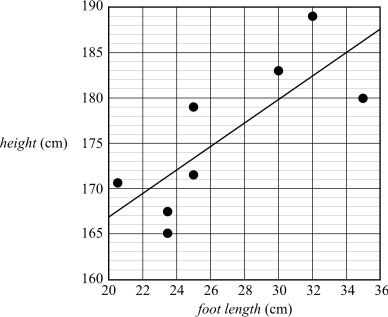
The height (in cm) and foot length (in cm) for each of eight Year 12 students were recorded and displayed in the scatterplot below.
A least squares regression line has been fitted to the data as shown.
 

Part 1

By inspection, the value of the product-moment correlation coefficient `(r)` for this data is closest to

  1. `0.98`
  2. `0.78`
  3. `0.23`
  4. `– 0.44`
  5. `– 0.67`


Part 2

The explanatory variable is foot length.

The equation of the least squares regression line is closest to

  1. height = –110 + 0.78 × foot length.
  2. height = 141 + 1.3 × foot length.
  3. height = 167 + 1.3 × foot length.
  4. height = 167 + 0.67 × foot length.
  5. foot length = 167 + 1.3 × height.


Part 3

The plot of the residuals against foot length is closest to

CORE, FUR1 2010 VCAA 7-9 MCab

CORE, FUR1 2010 VCAA 7-9 MCcd

CORE, FUR1 2010 VCAA 7-9 MCe

Show Answers Only

`text(Part 1:)\ B`

`text(Part 2:)\ B`

`text(Part 3:)\ B`

Show Worked Solution

`text(Part 1)`

`text(The correlation is positive and strong.)`

`text(Eliminate)\ C, D\ text(and)\ E.`

`r= 0.98\  text(is too strong. Eliminate)\ A.`

`=> B`


`text(Part 2)`

♦♦ Mean mark 35%.
STRATEGY: An alternate but less efficient strategy could be to find 2 points and calculate the gradient and then use the point gradient formula.

`text(The intercept with the height axis)\ (ytext{-axis)}`

`text{is below 167 because that is the height when}`

`text{foot length = 20 cm.}`

`text(Eliminate)\ C, D\ text(and)\ E.`

`text(The gradient is approximately 1.3, by observing)`

`text(the increase in height values when the foot)`

`text(length increases from 20 to 22 cm.)`

`=>  B`


`text(Part 3)`

`text(First residual is positive. Eliminate)\ A, D, E.`

`text(The next 3 residuals are negative. Eliminate)\ C`

`=>  B`

Filed Under: Correlation and Regression Tagged With: Band 3, Band 4, Band 5, smc-265-10-r / r^2 and Association, smc-265-20-Find LSRL Equation/Gradient, smc-265-50-Residuals

Trig Ratios, EXT1 2008 HSC 6a

From a point  `A`  due south of a tower, the angle of elevation of the top of the tower  `T`, is 23°. From another point  `B`, on a bearing of 120° from the tower, the angle of elevation of  `T`  is 32°. The distance  `AB`  is 200 metres.
 

Trig Ratios, EXT1 2008 HSC 6a 
 

  1. Copy or trace the diagram into your writing booklet, adding the given information to your diagram.  (1 mark)
  2. Hence find the height of the tower.   (3 marks)
Show Answers Only
  1. Trig Ratios, EXT1 2008 HSC 6a Answer

  2. `96\ text(m)`
Show Worked Solution

(i) 

Trig Ratios, EXT1 2008 HSC 6a Answer 


(ii)  `text(Find)\ \ OT = h`

`text(Using the cosine rule in)\ Delta AOB :`

`200^2 = OA^2 + OB^2 – 2 * OA * OB * cos 60\ …\ text{(*)}`

 `text(In)\ Delta OAT,\tan 23^@= h/(OA)`

`=> OA= h/(tan 23^@)\  …\ (1)`

 `text(In)\ Delta OBT,\ tan 32^@= h/(OB)`

`=> OB= h/(tan 32^@)\ \ \ …\ (2)`
 

`text(Substitute)\ (1)\ text(and)\ (2)\ text(into)\ text{(*)}`

`200^2` `= (h^2)/(tan^2 23^@) + (h^2)/(tan^2 32^@) – 2 * h/(tan 23^@) * h/(tan 32^@) * 1/2`
  `= h^2 (1/(tan^2 23^@) + 1/(tan^2 32^@) + 1/(tan23^@ * tan32^@) )`
  `= h^2 (4.340…)`
`h^2` `= (40\ 000)/(4.340…)`
  `= 9214.55…`
`:. h` `= 95.99…`
  `= 96\ text(m)\ \ \ text{(to nearest m)}`

Filed Under: 5. Trig Ratios EXT1 Tagged With: Band 3, Band 4

Functions, EXT1 F1 2008 HSC 5a

Let  `f(x) = x-1/2 x^2`  for  `x <= 1`.  This function has an inverse,  `f^(-1) (x)`. 

  1.  Sketch the graphs of  `y = f(x)`  and  `y = f^(-1) (x)`  on the same set of axes. (Use the same scale on both axes.)  (2 marks)

    --- 8 WORK AREA LINES (style=lined) ---

  2.  Find an expression for  `f^(-1) (x)`.   (3 marks)

    --- 6 WORK AREA LINES (style=lined) ---

  3.  Evaluate  `f^(-1) (3/8)`.   (1 mark)

    --- 3 WORK AREA LINES (style=lined) ---

Show Answers Only
  1.  
    Inverse Functions, EXT1 2008 HSC 5a Answer

  2. `y = 1-sqrt(1-2x)`
  3. `1/2`
Show Worked Solution
i. 

Inverse Functions, EXT1 2008 HSC 5a Answer

ii.    `y = x-1/2 x^2,\ \ \ x <= 1`

 
`text(Inverse function: swap)\ \ x↔y,`

`x` `= y-1/2 y^2,\ \ \ y <= 1`
`2x` `= 2y-y^2`
`y^2-2y + 2x` `= 0`


`y` `= (2 +- sqrt( (-2)^2-4 * 1 * 2x) )/2`
  `= (2 +- sqrt(4-8x))/2`
  `= (2 +- 2 sqrt(1-2x))/2`
  `= 1 +- sqrt (1-2x)`


`:. y = 1-sqrt(1-2x), \ \ (y <= 1)`


iii.    `f^(-1) (3/8)` `= 1-sqrt(1 -2(3/8))`
    `= 1-sqrt(1-6/8)`
    `= 1-sqrt(1/4)`
    `= 1-1/2`
    `= 1/2`

Filed Under: Inverse Functions (Ext1), Other Inverse Functions EXT1 Tagged With: Band 4, smc-1034-20-Other Functions

CORE, FUR1 2012 VCAA 11-12 MC

Use the following information to answer Parts 1 and 2.

The table below shows the long-term average rainfall (in mm) for summer, autumn, winter and spring. Also shown are the seasonal indices for summer and autumn. The seasonal indices for winter and spring are missing.

Part 1

The seasonal index for spring is closest to

A.  `0.90`

B.  `1.03`

C.  `1.13`

D.  `1.15`

E.  `1.17`


Part 2

In 2011, the rainfall in autumn was 48.9 mm.

The deseasonalised rainfall (in mm) for autumn is closest to

A.  `48.4`

B.  `48.9`

C.  `49.4`

D.  `50.9`

E.  `54.0`

Show Answers Only

`text (Part 1:)\ C`

`text (Part 2:)\ A`

Show Worked Solution

`text (Part 1)`

`text (Average Seasonal Rainfall)`

`= (52.0 + 54.5 + 48.8 + 61.3)/4` 

`=54.15`

`:.\ text {Seasonal index (Spring)}`

`= 61.3/54.15`

`= 1.132…`

`rArr C`


`text (Part 2)`

`:.\ text {Deseasonalised Rainfall (Autumn)}`

`= 48.9/1.01`

`=48.415`

`rArr A`

Filed Under: Time Series Tagged With: Band 4, smc-266-10-Seasonal Index from a Table, smc-266-20-(De)Seasonalising Data

CORE, FUR1 2012 VCAA 10 MC

Which one of the following statistics is never negative?

A.  a median

B.  a residual

C.  a standardised score

D.  an interquartile range

E.  a correlation coefficient

Show Answers Only

`D`

Show Worked Solution

`text (S) text(ince IQR)\ = Q_3 – Q_1, and`

`Q_1\ text(is always less than)\ Q_3,`

`text(IQR is always positive.)`

`rArr D`

Filed Under: Summary Statistics Tagged With: Band 4, smc-468-40-Median Mode and Range, smc-468-50-IQR / Outliers

CORE, FUR1 2012 VCAA 8 MC

The maximum wind speed and maximum temperature were recorded each day for a month. The data is displayed in the scatterplot below and a least squares regression line has been fitted. The response variable is temperature. The explanatory variable is wind speed.
 

 The equation of the least squares regression line is closest to

A.  `text(temperature) = 25.7 - 0.191 xx text(wind speed)`

B.  `text(wind speed) = 25.7 - 0.191 xx text(temperature)`

C.  `text(temperature) = 0.191 + 25.7 xx text(wind speed)`

D.  `text(wind speed) = 25.7 + 0.191 xx text(temperature)`

E.  `text(temperature) = 25.7 + 0.191 xx text(wind speed)`

Show Answers Only

`A`

Show Worked Solution

`text (Using the form)\ \ y = mx +b\ \ text(where)`

`y rArr text (temperature)`

`x rArr text (wind speed)`

`text (b = 25.7 (y intercept))`


`text (Gradient is negative because temperature decreases as)`

`text(wind speed increases.)`

`:.\ text (Equation must take the form of A.)`

`rArr A`

Filed Under: Correlation and Regression Tagged With: Band 4, smc-265-20-Find LSRL Equation/Gradient

  • « Previous Page
  • 1
  • …
  • 105
  • 106
  • 107
  • 108
  • 109
  • …
  • 114
  • Next Page »

Copyright © 2014–2025 SmarterEd.com.au · Log in