Simplify `2/n-1/(n+1)`. (2 marks)
--- 4 WORK AREA LINES (style=lined) ---
Aussie Maths & Science Teachers: Save your time with SmarterEd
Simplify `2/n-1/(n+1)`. (2 marks)
--- 4 WORK AREA LINES (style=lined) ---
`(n + 2)/(n(n+1))`
`2/n-1/(n+1)`
`= (2(n+1)-1(n))/(n(n+1))`
`= (2n + 2-n)/(n(n+1))`
`= (n+2)/(n(n+1))`
The table below shows the present value of an annuity with a contribution of $1.
--- 2 WORK AREA LINES (style=lined) ---
--- 4 WORK AREA LINES (style=lined) ---
i. `text(Table factor when)\ \ n = 4,\ r = text(2%) \ => \ 3.8077`
| `:.\ PVA\ text{(Fiona)}` | `= 3000 xx 3.8077` |
| `= $11\ 423.10` |
ii. `text(Table factor when)\ n = 2, r = text(4%)`
`=> 1.8861`
| `:.\ PVA\ text{(John)}` | `= 6000 xx 1.8861` |
| `= $11\ 316.60` |
`:.\ text(Fiona will be better off because her)\ PVA`
`text(is higher.)`
The take-off point `O` on a ski jump is located at the top of a downslope. The angle between the downslope and the horizontal is `pi/4`. A skier takes off from `O` with velocity `V` m s−1 at an angle `theta` to the horizontal, where `0 <= theta < pi/2`. The skier lands on the downslope at some point `P`, a distance `D` metres from `O`.
The flight path of the skier is given by
`x = Vtcos theta,\ y = -1/2 g t^2 + Vt sin theta`, (Do NOT prove this.)
where `t` is the time in seconds after take-off.
--- 5 WORK AREA LINES (style=lined) ---
--- 8 WORK AREA LINES (style=lined) ---
--- 4 WORK AREA LINES (style=lined) ---
--- 9 WORK AREA LINES (style=lined) ---
i. `text(Show)\ \ y = x tan theta – (gx^2)/(2V^2) sec^2 theta`
| `x` | `= Vt cos theta` |
| `t` | `= x/(V cos theta)\ \ \ …\ text{(1)}` |
`text(Subst)\ text{(1)}\ text(into)\ y = -1/2 g t^2 + Vt sin theta`
| `y` | `= -1/2 g (x/(Vcostheta))^2 + V sin theta (x/(Vcostheta))` |
| `= (-gx^2)/(2V^2 cos^2 theta) + x * (sin theta)/(cos theta)` | |
| `= x tan theta – (gx^2)/(2V^2) sec^2 theta\ \ \ text(… as required.)` |
ii. `text(Show)\ D = 2 sqrt 2 (V^2)/g\ cos theta (cos theta + sin theta)`
`text(S)text(ince)\ P\ text(lies on line)\ y = -x`
| `-x` | `=x tan theta – (gx^2)/(2V^2) sec^2 theta` |
| `-1` | `=tan theta – (gx)/(2V^2) sec^2 theta` |
| `(gx)/(2V^2) sec^2 theta` | `= tan theta + 1` |
| `x (g/(2V^2))` | `=(sin theta)/(cos theta) * cos^2 theta + 1 * cos^2 theta` |
| `x` | `=(2V^2)/g\ (sin theta cos theta + cos^2 theta)` |
| `=(2V^2)/g\ cos theta (cos theta + sin theta)` |
| `text(Given that)\ \ cos(pi/4)` | `= x/D = 1/sqrt2` |
| `text(i.e.)\ \ D` | `= sqrt 2 x` |
`:.\ D = 2 sqrt 2 (V^2)/g\ cos theta (cos theta + sin theta)`
`text(… as required.)`
iii. `text(Show)\ (dD)/(d theta) = 2 sqrt 2 (V^2)/g\ (cos 2 theta – sin 2 theta)`
| `D` | `= 2 sqrt 2 (V^2)/g\ (cos^2 theta + cos theta sin theta)` |
| `(dD)/(d theta)` | `= 2 sqrt 2 (V^2)/g\ [2cos theta (–sin theta) + cos theta cos theta + (– sin theta) sin theta]` |
| `= 2 sqrt 2 (V^2)/(g) [(cos^2 theta – sin^2 theta) – 2 sin theta cos theta]` | |
| `= 2 sqrt 2 (V^2)/g\ (cos 2 theta – sin 2 theta)\ \ \ text(… as required)` |
iv. `text(Max/min when)\ (dD)/(d theta) = 0`
| `2 sqrt 2 (V^2)/g\ (cos 2 theta – sin 2 theta)` | `= 0` |
| `cos 2 theta – sin 2 theta` | `= 0` |
| `sin 2 theta` | `= cos 2 theta` |
| `tan 2 theta` | `= 1` |
| `2 theta` | `= pi/4` |
| `theta` | `= pi/8` |
| `(d^2D)/(d theta^2)` | `= 2 sqrt 2 (V^2)/g\ [-2 sin 2theta – 2 cos 2 theta]` |
| `= 4 sqrt 2 (V^2)/g\ (-sin 2 theta – cos 2 theta)` |
`text(When)\ \ theta = pi/8:`
| `(d^2 D)/(d theta^2)` | `= 4 sqrt 2 (V^2)/g\ (- sin (pi/4) – cos (pi/4))` |
| `= 4 sqrt 2 (V^2)/g\ (- 1/sqrt2 – 1/sqrt2) < 0` | |
| ` =>\ text(MAX)` |
`:.\ D\ text(has a maximum value when)\ theta = pi/8`
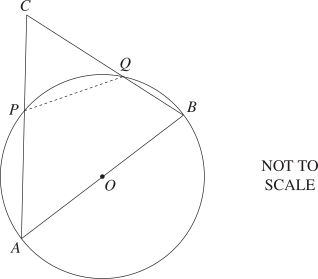
In the diagram, `AB` is a diameter of a circle with centre `O`. The point `C` is chosen such that `Delta ABC` is acute-angled. The circle intersects `AC` and `BC` at `P` and `Q` respectively.
Copy or trace the diagram into your writing booklet.
| (i) | ![]() |
`APQB\ text(is a cyclic quad)`
`=> /_BAC + /_BQP = 180°`
`text{(opposite angles of cyclic quadrilateral}\ BAPQ text{)}`
`/_CQP + /_BQP = 180°\ text{(}/_ CQB\ text{is a straight angle)}`
`:.\ /_BAC = /_CQP`
(ii) `text(Let)\ /_BAC = alpha`
`/_OPA = alpha\ \ \ \ text{(angles opposite equal sides}`
`text(in)\ Delta OAP,\ OA=OP\ text{radii)}`
`/_TPC = alpha\ \ \ text{(vertically opposite)}`
`text(S)text(ince)\ /_TPC = /_CQP = alpha`
`:. OP\ text(is a tangent to circle)\ CPQ`
`text{(angles in alternate segments equal)}`
One end of a rope is attached to a truck and the other end to a weight. The rope passes over a small wheel located at a vertical distance of 40 m above the point where the rope is attached to the truck.
The distance from the truck to the small wheel is `L\ text(m)`, and the horizontal distance between them is `x\ text(m)`. The rope makes an angle `theta` with the horizontal at the point where it is attached to the truck.
The truck moves to the right at a constant speed of `text(3 m s)^(-1)`, as shown in the diagram.
--- 10 WORK AREA LINES (style=lined) ---
--- 2 WORK AREA LINES (style=lined) ---
| i. | |
`text(Show)\ \ (dL)/(dx) = cos theta`
`text(Using Pythagoras,)`
| `L^2` | `=40^2 + x^2` |
| `L` | `=(40^2 + x^2)^(1/2)` |
| `(dL)/(dx)` | `=1/2 * 2x * (40^2 + x^2)^(-1/2)` |
| `=x/ sqrt((40^2 + x^2))` | |
| `=x/L` | |
| `=cos theta\ \ \ text(… as required.)` |
ii. `text(Show)\ \ (dL)/(dt) = 3 cos theta`
| `(dL)/(dt)` | `= (dL)/(dx) * (dx)/(dt)` |
| `= cos theta * 3` | |
| `= 3 cos theta\ \ \ text(… as required)` |
Use the binomial theorem to show that
`0 = ((n),(0)) - ((n),(1)) + ((n),(2)) - ... + (-1)^n ((n),(n))`. (2 marks)
`text(Proof)\ \ text{(See Worked Solutions)}`
`text(Prove)`
`0 = ((n),(0)) – ((n),(1)) + ((n),(2)) – … + (-1)^n ((n),(n))`
`text(Using binomial expansion:)`
`(1 + x)^n = ((n),(0)) + ((n),(1))x + ((n),(2))x^2 + … + ((n),(n))x^n`
`text(Let)\ \ x = -1`
`:. 0 = ((n),(0)) – ((n),(1)) + ((n),(2)) – … + (-1)^n ((n),(n))`
A particle moves along a straight line with displacement `x\ text(m)` and velocity `v\ \ text(ms)^(-1)`. The acceleration of the particle is given by
`ddot x = 2 - e^(-x/2)`.
Given that `v = 4` when `x = 0`, express `v^2` in terms of `x`. (3 marks)
--- 6 WORK AREA LINES (style=lined) ---
`v^2 = 4x + 4e^(-x/2) + 12`
`ddot x = d/(dx) (1/2 v^2) = 2 – e^(-x/2)`
| `1/2 v^2` | `= int (2 – e^(-x/2))\ dx` |
| `= 2x + 2e^(-x/2) + c` | |
| `v^2` | `= 4x + 4e^(-x/2) + c` |
`text(When)\ \ v = 4, x = 0:`
| `:. 4^2` | `= 0 + 4e^0 + c` |
| `16` | `= 4 + c` |
| `c` | `= 12` |
`:.\ v^2 = 4x + 4e^(-x/2) + 12`
The region bounded by `y = cos 4x` and the `x`-axis, between `x = 0` and `x = pi/8`, is rotated about the `x`-axis to form a solid.
Find the volume of the solid. (3 marks)
`(pi^2)/16\ \ text(u³)`
| `V` | `= pi int_0^(pi/8) y^2\ dx` |
| `= pi int_0^(pi/8) cos^2 4x\ dx` | |
| `= pi int_0^(pi/8) 1/2 (cos 8x + 1)\ dx` | |
| `= pi/2 [1/8 sin 8x + x]_0^(pi/8)` | |
| `= pi/2 [(1/8 sin pi + pi/8)] – 0]` | |
| `= (pi^2)/16\ \ text(u³)` |
A particle is moving in simple harmonic motion about the origin, with displacement `x` metres. The displacement is given by `x = 2 sin 3t`, where `t` is time in seconds. The motion starts when `t = 0`.
--- 4 WORK AREA LINES (style=lined) ---
--- 6 WORK AREA LINES (style=lined) ---
| i. | `x = 2 sin 3t` |
`text(At)\ \ t = 0,\ x = 0`
`text(Amplitude) = 2`
`:.\ text(Distance travelled)`
`= 2 xx text(amplitude)`
`= 4\ text(m)`
| ii. | `x` | `= 2 sin 3t` |
| `v` | `= 6 cos 3t` | |
| `ddot x` | `= -18 sin 3t` |
`text(Particle first comes to rest when)\ v = 0`
| `6 cos 3t` | `= 0` |
| `cos 3t` | `= 0` |
| `3t` | `= pi/2` |
| `t` | `= pi/6` |
`text(When)\ \ t = pi/6`
| `ddot x` | `= -18 * sin (3 xx pi/6)` |
| `= -18 sin (pi/2)` | |
| `= -18\ text(m/s²)` |
Differentiate `(e^x ln x)/x`. (2 marks)
`(e^x (x * lnx + 1 – lnx))/(x^2)`
`y = (e^x * lnx)/x`
| `u` | `= e^x lnx` | `\ \ \ \ \ v` | `= x` |
| `u prime` | `= (e^x)/x + e^x lnx` | `\ \ \ \ \ v prime` | `= 1` |
| `= e^x (1/x + lnx)` |
| `dy/dx` | `= (u prime v – u v prime)/(v^2)` |
| `= (e^x (1/x + lnx) * x – e^x lnx * 1)/(x^2)` | |
| `= (e^x (x* lnx + 1 – lnx))/(x^2)` |
Evaluate `int_2^5 x/(sqrt(x - 1))\ dx` using the substitution `x = u^2 + 1`. (3 marks)
--- 8 WORK AREA LINES (style=lined) ---
`20/3`
| `x` | `= u^2 + 1` |
| `u^2` | `= x – 1` |
| `u` | `= sqrt (x – 1)` |
| `(du)/(dx)` | `= 1/2 (x – 1)^(-1/2)` |
| `= 1/(2 sqrt(x – 1))` | |
| `\ \ =>2du` | `= dx/sqrt(x – 1)` |
| `text(When)\ \ \ x = 5,` | `\ \ u = 2` |
| `x = 2,` | `\ \ u = 1` |
`:.\ int_2^5 x/(sqrt(x – 1))\ dx`
`= 2 int_1^2 u^2 + 1\ du`
`= 2 [ (u^3)/3 + u]_1^2`
`= 2 [(8/3 + 2) – (1/3 + 1)]`
`= 20/3`
The probability that it rains on any particular day during the 30 days of November is 0.1.
Write an expression for the probability that it rains on fewer than 3 days in November. (2 marks)
--- 5 WORK AREA LINES (style=lined) ---
`\ ^30 C_2 (0.1)^2 (0.9)^28 +\ ^30C_1 (0.1) (0.9)^29 + (0.9)^30`
| `P (R)` | `= 0.1` |
| `P (bar R)` | `= 1 – 0.1 = 0.9` |
`text(Over 30 days:)`
| `P (R<3)` |
`= P (R=2) + P(R=1) + P (R=0)` |
|
| `=\ ^30 C_2 (0.1)^2 (0.9)^28 +\ ^30C_1 (0.1)^1 (0.9)^29` | ||
| `qquad qquad +\ ^30C_0 (0.1)^0 (0.9)^30` | ||
| `=\ ^30C_2 (0.1)^2 (0.9)^28 +\ ^30C_1 (0.1)(0.9)^29 + (0.9)^30` |
The remainder when the polynomial `P(x) = x^4-8x^3-7x^2 + 3` is divided by `x^2 + x` is `ax + 3`.
What is the value of `a`?
`C`
`P(x) = x^4-8x^3-7x^2 + 3`
| `text(Given)\ \ P(x)` | `= (x^2 + x) *Q(x) + ax + 3` |
| `= x (x + 1) Q(x) + ax + 3` |
`P(-1) = 1 + 8-7 + 3 = 5`
| `:. -a + 3` | `= 5` |
| `a` | `= -2` |
`=> C`
In how many ways can 6 people from a group of 15 people be chosen and then arranged
in a circle?
`D`
`text(# Arrangements)`
`=\ ^15C_6 xx 5!`
`= (15! 5!)/(6! 9!)`
`= (15!)/(9! 6)`
`=> D`
Which group of three numbers could be the roots of the polynomial equation `x^3 + ax^2 − 41x + 42 = 0`?
`B`
`text(Let roots be)\ alpha, beta, gamma`
`alpha beta gamma = -d/a = -42`
`:.\ text(Cannot be)\ A\ text(or)\ C`
`alpha beta + beta gamma + gamma alpha = c/a = -41`
`:.\ text(Cannot be D)`
`=> B`
The acute angle between the lines `2x + 2y = 5` and `y = 3x + 1` is `theta`.
What is the value of `tan theta`?
`D`
`y = 3x + 1`
`:. m_1 = 3`
| `2x + 2y` | `= 5` |
| `2y` | `= -2x + 5` |
| `y` | `= -x + 5/2` |
`:. m_2 = -1`
| `tan theta` | `= | (m_1 – m_2)/(1 + m_1 m_2)|` |
| `= | (3 – (–1))/(1 + (3 xx –1))|` | |
| `= |4/(–2)|` | |
| `= 2` |
`=> D`
The cross-section of a 10 metre long tank is an isosceles triangle, as shown in the diagram. The top of the tank is horizontal.
When the tank is full, the depth of water is 3 m. The depth of water at time `t` days is `h` metres.
--- 6 WORK AREA LINES (style=lined) ---
--- 2 WORK AREA LINES (style=lined) ---
Find the rate at which the depth of water is changing at time `t`. (2 marks)
--- 6 WORK AREA LINES (style=lined) ---
--- 2 WORK AREA LINES (style=lined) ---
| (i) | ![]() |
| `text(Let)\ A = text(area of front)` |
| `tan 30^@` | `= h/x` |
| `x` | `= h/(tan 30^@)` |
| `= sqrt3 h` |
| `:.\ A` | `= 2 xx 1/2 xx sqrt 3 h xx h` |
| `= sqrt 3 h^2\ \ text(m²)` |
| `V` | `= Ah` |
| `= sqrt 3 h^2 xx 10` | |
| `= 10 sqrt3 h^2\ \ text(m³)` |
| (ii) | `text(Area of surface)` |
| `= 10 xx 2 sqrt 3 h` | |
| `= 20 sqrt 3 h\ \ text(m²)` |
| (iii) | `(dV)/(dt)` | `= -kA` |
| `= -k\ 20 sqrt3 h` |
| `V` | `= 10 sqrt3 h^2` |
| `(dV)/(dh)` | `= 20 sqrt 3 h` |
`text(Find)\ (dh)/(dt)`
| `(dV)/(dt)` | `= (dV)/(dh) * (dh)/(dt)` |
| `(dh)/(dt)` | `= ((dV)/(dt))/((dV)/(dh))` |
| `= (-k * 20 sqrt 3 h)/(20 sqrt 3 h)` | |
| `= -k` |
`:.\ text(The water depth is changing at a rate)`
`text(of)\ -k\ text(metres per day.)`
| (iv) | `text(S)text(ince)\ \ (dh)/(dt)\ \ text(is a constant, each metre)` |
| `text(takes the same time.)` |
`:.\ text(It takes 100 days to fall from 2 m to 1 m.)`
The equation of motion for a particle moving in simple harmonic motion is given by
`(d^2x)/(dt^2) = -n^2x`
where `n` is a positive constant, `x` is the displacement of the particle and `t` is time.
where `v = (dx)/(dt)` and `a` is the amplitude of the motion. (3 marks)
--- 6 WORK AREA LINES (style=lined) ---
--- 3 WORK AREA LINES (style=lined) ---
--- 2 WORK AREA LINES (style=lined) ---
--- 5 WORK AREA LINES (style=lined) ---
| i. | `text(Show)\ \ v^2 = n^2 (a^2\ – x^2)` |
`(d^2x)/(dt^2) = -n^2x`
| `d/(dx) (1/2 v^2)` | `= -n^2 x` |
| `1/2 v^2` | `= int -n^2x\ dx` |
| `= (-n^2 x^2)/2 + c` | |
| `v^2` | `= -n^2 x^2 + c` |
`text(When)\ \ v = 0,\ \ x = a`
| `0` | `= -n^2a + c` |
| `c` | `= n^2 a^2` |
| `:.\ v^2` | `= -n^2 x^2 + n^2 a^2` |
| `= n^2 (a^2\ – x^2)\ \ text(… as required)` |
| ii. | `text(Max speed when)\ \ x = 0` |
| `v^2` | `= n^2 (a^2\ – 0)` |
| `= n^2 a^2` | |
| `:.v_text(max)` | `= na` |
| iii. | `(d^2x)/(dt^2)\ \ text(is maximum at limits)\ \ (x = +-a)` |
| `(d^2x)/(dt^2)` | `= |n^2 (a)|` |
| `= n^2 a` |
| iv. | `x` | `= a sin nt` |
| `dot x` | `= an cos nt` |
`text(Find)\ \ t\ \ text(when)\ \ dot x = (na)/2`
| `(na)/2` | `= an cos nt` |
| `cos nt` | `= 1/2` |
| `nt` | `= pi/3` |
| `:.t` | `= pi/(3n)` |
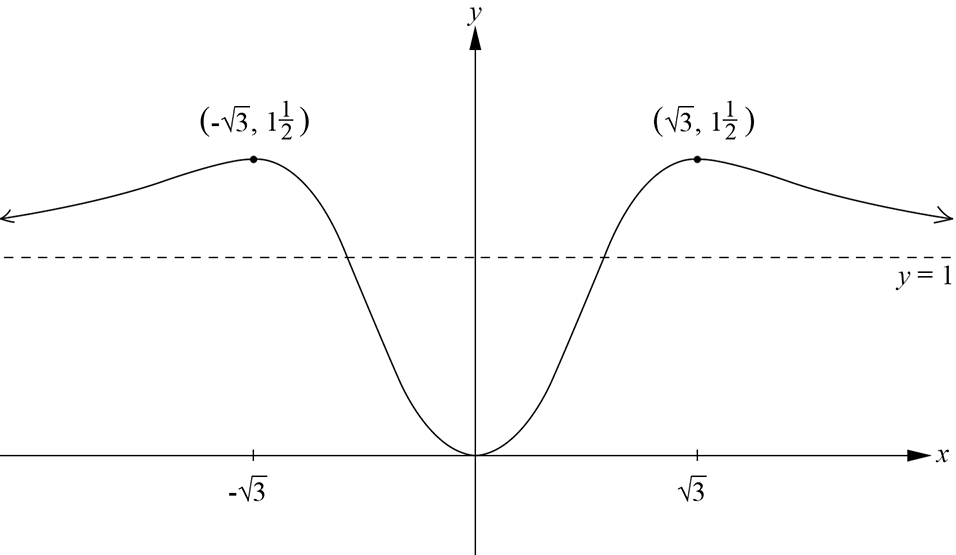
Consider the function `f(x) = (x^4 + 3x^2)/(x^4 + 3)`.
| (i) | `f(x)` | `= (x^4 + 3x^2)/(x^4 + 3)` |
| `f(–x)` | `= ((–x)^4 + 3(-x)^2)/((–x)^4 + 3)` | |
| `= (x^4 + 3x^2)/(x^4 + 3)` | ||
| `= f(x)` |
`:.\ text(Even function.)`
| (ii) | `y` | `= (x^4 + 3x^2)/(x^4 + 3)` |
| `= (1 + 3/(x^2))/(1 + 3/(x^4))` |
| `text(As)\ \ ` | `x` | `-> oo` |
| `y` | `-> 1` |
`:.\ text(Horizontal asymptote at)\ \ y = 1`
| (iii) | `f(x) = (x^4 + 3x^2)/(x^4 + 3)` |
| `u` | `= x^4 + 3x^2\ \ \ \ \ ` | `v` | `= x^4 + 3` |
| `u prime` | `= 4x^3 + 6x\ \ \ \ \ ` | `v prime` | `= 4x^3` |
| `f prime (x)` | `= (u prime v\ – u v prime)/(v^2)` |
| `= ((4x^3 + 6x)(x^4 + 3)\ – (x^4 + 3x^2)4x^3)/((x^4 + 3)^2)` | |
| `= (4x^7 + 12x^3 + 6x^5 + 18x\ – 4x^7\ – 12x^5)/((x^4 + 3)^2)` | |
| `= (-6x^5 + 12x^3 + 18x)/((x^4 + 3)^2)` | |
| `= (-6x(x^4\ – 2x^2\ – 3))/((x^4 + 3)^2)` |
`text(S.P. when)\ x = 0\ \ \ text(or) \ \ x^4\ – 2x^2\ – 3 = 0`
`text(Let)\ X = x^2`
| `X^2\ – 2X\ – 3` | `= 0` |
| `(X\ – 3)(X + 1)` | `= 0` |
`X = 3\ \ text(or)\ \ -1`
| `:. x^2` | `= 3` | `text(or)\ \ \ \ \ ` | `x^2 = -1` |
| `x` | `= +- sqrt3\ \ \ \ ` | `text{(no solution)}` |
`:.\ text(SPs occur when)\ \ x = 0, – sqrt3, sqrt3`
| (iv) | `text(When)\ x = 0,\ ` | `y = 0` |
| `text(When)\ x = sqrt3,\ \ \ ` | `y = ((sqrt3)^4 + 3(sqrt3)^2)/((sqrt3)^4 + 3) = 3/2` |
A test consists of five multiple-choice questions. Each question has four alternative answers. For each question only one of the alternative answers is correct.
Huong randomly selects an answer to each of the five questions.
--- 4 WORK AREA LINES (style=lined) ---
--- 3 WORK AREA LINES (style=lined) ---
--- 2 WORK AREA LINES (style=lined) ---
i. `P text{(correct)} = 1/4`
`P text{(wrong)} = 3/4`
`P text{(3 correct, 2 wrong)}`
`=\ ^5C_3 * (1/4)^3 (3/4)^2`
`= (5!)/(3!2!) * (1/64) * (9/16)`
`= 90/1024`
`= 45/512`
ii. `P text{(3 or more correct)}`
`= P text{(3 correct)} + P text{(4 correct)} + P text{(5 correct)}`
`=\ ^5C_3 * (1/4)^3 (3/4)^2 +\ ^5C_4 * (1/4)^4 (3/4)^1 +\ ^5C_5 (1/4)^5 (3/4)^0`
`= 90/1024 + 15/1024 + 1/1024`
`= 53/512`
iii. `P text{(at least 1 incorrect)}`
`= 1\ – P text{(0 incorrect)}`
`= 1 -\ ^5C_5 (1/4)^5 (3/4)^0`
`= 1\ – 1/1024`
`= 1023/1024`
--- 6 WORK AREA LINES (style=lined) ---
| i. | `text(Prove)\ \ tan^2 theta = (1 – cos 2 theta)/(1 + cos 2 theta),\ cos 2 theta != -1` |
| `text(Using)\ \ cos 2 theta` | `= 2 cos^2 theta\ – 1` |
| `= 1 – 2 sin^2 theta` |
| `text(RHS)` | `= (1 – (1 – 2 sin^2 theta))/(1 + (2 cos^2 theta\ – 1))` |
| `= (2 sin^2 theta)/(2 cos^2 theta)` | |
| `= tan^2 theta\ text(… as required.)` |
| ii. | `tan^2\ pi/8` | `= (1 – cos (2 xx pi/8))/(1 + cos (2 xx pi/8))` |
| `= (1 – 1/sqrt2)/(1 + 1/sqrt2) xx sqrt2/sqrt2` | ||
| `= (sqrt2 – 1)/(sqrt2 + 1) xx (sqrt 2 – 1)/(sqrt2 – 1)` | ||
| `= (sqrt 2 – 1)^2/(2\ – 1)` | ||
| `= (sqrt 2 -1)^2` |
`:.\ tan\ pi/8 = sqrt 2\ – 1\ \ \ \ \ (tan(pi/8)>0)`
`text{(}tan\ pi/8 = sqrt (3\ – 2 sqrt 2)\ \ text{is also a correct answer)}`
| (i) | ![]() |
(ii) `text(3 solutions)`
(iii) `2 cos 2x = x + 1`
| `f(x)` | `= 2 cos 2x\ – x\ – 1` |
| `f prime (x)` | `= -4 sin 2x\ – 1` |
| `=>f(0.4)` | `= 2 cos 0.8\ – 0.4\ – 1` |
| `=-0.0065865 …` | |
| `=> f prime(0.4)` | `= -4 sin 0.8\ – 1` |
| `=-3.869424 …` |
`text(Find)\ x_1\ text(where)`
| `x_1` | `= 0.4\ – (f(0.4))/(f prime(0.4))` |
| `= 0.4\ – ((-0.0065865 …)/(-3.869424 …))` | |
| `= 0.39829…` | |
| `= 0.398\ \ text{(3 d.p.)}` |
Let `f(x) = (3 + e^(2x))/4`.
--- 2 WORK AREA LINES (style=lined) ---
--- 5 WORK AREA LINES (style=lined) ---
| i. `f(x) = (3 + e^(2x))/4` |
`text(As)\ \ x -> oo, \ e^(2x) ->oo, \ f(x)->oo`
`text(As)\ \ x -> -oo, \ e^(2x) ->0, \ f(x)->3/4`
`:.\ text(Range is)\ \ y > 3/4`
ii. `text(Inverse function: swap)\ \ x↔y`
| `x` | `= (3 + e^(2y))/4` |
| `4x` | `= 3 + e^(2y)` |
| `e^(2y)` | `= 4x\ – 3` |
| `ln e^(2y)` | `= ln (4x\ – 3)` |
| `2y` | `= ln (4x\ – 3)` |
| `y` | `= 1/2 ln (4x\ – 3)` |
`:.\ f^(-1) (x) = 1/2 ln (4x\ – 3)`
--- 6 WORK AREA LINES (style=lined) ---
Give your answer, or answers, correct to two decimal places. (2 marks)
--- 8 WORK AREA LINES (style=lined) ---
`5 sin (x+0.93)`
| i. | `A sin (x + alpha) = 3 sin x + 4 cos x` |
| `A sinx cos alpha + A cos x sin alpha = 3 sin x + 4 cos x` |
`=> A cos alpha = 3\ \ \ \ \ A sin alpha = 4`
| `A^2` | `= 3^2 + 4^2 = 25` |
| `:. A` | `= 5` |
| `=> 5 cos alpha` | `= 3` |
| `cos alpha` | `= 3/5` |
| `alpha` | `= cos^(-1) (3/5)= 0.9272… \ \ text(radians)` |
`:.\ 3 sin x + 4 cos x = 5 sin (x + cos^-1 (3/5)) `
| ii. | `3 sin x + 4 cos x` | `= 5` |
| `5 sin (x + alpha)` | `= 5` | |
| `sin (x + alpha)` | `= 1` | |
| `x + alpha` | `= pi/2, (5pi)/2, …` | |
| `x` | `= pi/2\ – 0.9272…\ \ \ \ \ (0 <= x <= 2 pi)` | |
| `= 0.6435…` | ||
| `= 0.64\ text(radians)\ text{(2 d.p.)}` |
Using the substitution `u = x^3 + 1`, or otherwise, evaluate `int_0^2 x^2 e^(x^3 + 1)\ dx`. (3 marks)
--- 8 WORK AREA LINES (style=lined) ---
`1/3 (e^9\ – e)`
| `u` | `= x^3 + 1` |
| `(du)/(dx)` | `= 3x^2` |
| `du` | `= 3x^2\ dx` |
| `text(If)\ \ \ ` | `x` | `= 2,\ ` | `u` | `= 9` |
| `x` | `= 0,\ ` | `u` | `= 1` |
`:.\ int_0^2 x^2 e^(x^3 + 1)\ dx`
`=1/3 int_0^2 e^(x^3 + 1) * 3x^2\ dx`
`= 1/3 int_1^9 e^u\ du`
`= 1/3 [e^u]_1^9`
`= 1/3 (e^9\ – e)`
Solve the inequality `(x + 3)/(2x) > 1`. (3 marks)
--- 6 WORK AREA LINES (style=lined) ---
`0 < x < 3`
`text(Solution 1)`
| `(2x)^2 xx (x + 3)/(2x)` | `> (2x)^2` |
| `2x (x + 3)` | `> 4x^2` |
| `2x^2 + 6x` | `> 4x^2` |
| `2x^2\ – 6x` | `< 0` |
| `2x (x\ – 3)` | `< 0` |
`:.\ {x: 0 < x < 3}`
`text(Solution 2)`
`text(If)\ \ x > 0,`
| `x + 3` | `> 2x` |
| `x` | `< 3` |
`:.\ 0 < x < 3`
`text(If)\ \ x < 0,`
| `x + 3` | `< 2x` |
| `x` | `> 3\ \ \ =>\ text(No solution)` |
`:.\ {x: 0 < x < 3}`
Find `lim_(x -> 0) (sin 2x)/x`. (1 mark)
`2`
`lim_(x -> 0) (sin 2x)/(x)`
`= 2 lim_(x->0) (sin 2x)/(2x)`
`= 2`
Factorise `8x^3 + 27`. (2 marks)
`(2x + 3)(4x^2\ – 6x + 9)`
`8x^3 + 27`
`= (2x)^3 + 3^3`
`= (2x + 3)(4x^2\ – 6x + 9)`
The diagram shows a window consisting of two sections. The top section is a semicircle of diameter `x` m. The bottom section is a rectangle of width `x` m and height `y` m.
The entire frame of the window, including the piece that separates the two sections, is made using 10 m of thin metal.
The semicircular section is made of coloured glass and the rectangular section is made of clear glass.
Under test conditions the amount of light coming through one square metre of the coloured glass is 1 unit and the amount of light coming through one square metre of the clear glass is 3 units.
The total amount of light coming through the window under test conditions is `L` units.
--- 4 WORK AREA LINES (style=lined) ---
--- 6 WORK AREA LINES (style=lined) ---
| i. | ![]() |
`text(Frame is 10m)`
| `10` | `= 2x + 2y + 1/2 pi x` |
| `2y` | `= 10\ – 2x\ – 1/2 pi x` |
| `:.y` | `= 5\ – x\ – pi/4 x` |
| `= 5\ – x (1 + pi/4)\ \ \ text(… as required.)` |
| ii. | `text(Area)\ text{(clear)}` | `= x xx y` |
| `text(Area)\ text{(colour)}` | `= 1/2 xx pi r^2` | |
| `= 1/2 xx pi (x/2)^2` | ||
| `= (pi x^2)/8` |
| `:.\ L` | `= 3xy + ((pix^2)/8 xx 1)` |
| `= 3x [5\ – x (1 + pi/4)] + (pix^2)/8\ \ \ text{(see part (i))}` | |
| `= 15x\ – 3x^2\ – (3x^2pi)/4 + (x^2 pi)/8` | |
| `= 15x\ – 3x^2\ – (5x^2 pi)/8` | |
| `= 15x\ – x^2 (3 + (5pi)/8)\ \ \ text(… as required)` |
| iii. | `L` | `= 15x\ – x^2 (3 + (5pi)/8)` |
| `(dL)/(dx)` | `= 15\ – 2x (3 + (5pi)/8)` | |
| `(d^2L)/(dx^2)` | `= -2 (3 + (5pi)/8)` |
`text(Max or min when)\ (dL)/(dx) = 0`
| `15\ – 2x (3x + (5pi)/8)=` | `0` |
| `2x (3 + (5pi)/8)=` | `15` |
| `x=` | `15/(2 (3 + (5pi)/8)` |
| `=` | `1.51103…` |
| `=` | `1.511\ \ \ text{(3 d.p.)}` |
`text(S)text(ince)\ (d^2L)/(dx^2) < 0\ \ \ => text(MAX)`
| `text(When)\ \ x` | `= 1.511` |
| `y` | `= 5\ – 1.511 (1 + pi/4)` |
| `= 2.3022…` | |
| `= 2.302\ text{(3 d.p.)}` |
`:.\ text(MAX light when)\ x = 1.511\ text(m)`
`text(and)\ y = 2.302\ text(m.)`
The line `y = mx` is a tangent to the curve `y = e^(2x)` at a point `P`.
--- 8 WORK AREA LINES (style=lined) ---
--- 6 WORK AREA LINES (style=lined) ---
--- 1 WORK AREA LINES (style=lined) ---
| i. | ![]() |
| ii. | `y` | `= e^(2x)` |
| `dy/dx` | `= 2e^(2x)` |
`text(Gradient of)\ \ y = mx\ \ text(is)\ \ m`
`text(Gradients equal when)`
| `2e^(2x)` | `= m` |
| `e^(2x)` | `= m/2` |
| `ln e^(2x)` | `= ln (m/2)` |
| `2x` | `= ln (m/2)` |
| `x` | `= 1/2 ln (m/2)` |
`text(When)\ \ x = 1/2 ln (m/2)`
| `y` | `= e^(2 xx 1/2 ln (m/2))` |
| `= e^(ln(m/2))` | |
| `= m/2` |
`:.\ P (1/2 ln (m/2), m/2)`
iii. `y=mx\ \ text(passes through)\ \ (0,0)\ text(and)\ (1/2 ln (m/2), m/2)`
`text(Equating gradients:)`
| `(m/2 – 0)/(1/2 ln (m/2) – 0)` | `=m` |
| `m/2` | `=m xx 1/2 ln(m/2)` |
| `ln (m/2)` | `= 1` |
| `m/2` | `= e^1` |
| `m` | `= 2e` |
In `Delta DEF`, a point `S` is chosen on the side `DE`. The length of `DS` is `x`, and the length of `ES` is `y`. The line through `S` parallel to `DF` meets `EF` at `Q`. The line through `S` parallel to `EF` meets `DF` at `R`.
The area of `Delta DEF` is `A`. The areas of `Delta DSR` and `Delta SEQ` are `A_1` and `A_2` respectively.
(i) `text(Need to show)\ Delta DEF\ text(|||) \ Delta DSR`
`/_FDE\ text(is common)`
`/_DSR = /_DEF = theta\ \ text{(corresponding angles,}\ RS\ text(||)\ FE text{)}`
`:.\ Delta DEF \ text(|||) \ Delta DSR\ \ text{(equiangular)}`
(ii) `(DR)/(DF) = (DS)/(DE) = x/(x + y)`
`text{(Corresponding sides of similar triangles)}`
(iii) `text(Show)\ sqrt((A_1)/A) = x/(x + y)`
| `text(Using Area)` | `= 1/2 ab sin C` |
| `A_1` | `= 1/2 xx DR xx x xx sin alpha` |
| `A` | `= 1/2 xx DF xx (x + y) xx sin alpha` |
| `(A_1)/A` | `= (1/2 * DR * x * sin alpha)/(1/2 * DF * (x + y) * sin alpha)` |
| `= (DR * x)/(DF * (x + y)` | |
| `= (x * x)/((x + y)(x + y))\ \ \ \ text{(using part(ii))}` | |
| `= (x^2)/((x + y)^2)` | |
| `:.\ sqrt ((A_1)/A)` | `= x/((x + y))\ \ \ text(… as required.)` |
(iv) `text(Consider)\ Delta DFE\ text(and)\ Delta SQE`
| `/_FED` | `= theta\ text(is common)` |
| `/_FDE` | `= /_QSE = alpha\ \ ` | `text{(corresponding angles,}\ DF\ text(||)\ QS text{)}` |
`:.\ Delta DFE\ text(|||)\ Delta SQE\ \ text{(equiangular)}`
`(QE)/(FE) = (SE)/(DE) = y/(x +y)`
`text{(corresponding sides of similar triangles)}`
| `A_2` | `= 1/2 xx QE xx y xx sin theta` |
| `A` | `= 1/2 xx FE xx (x + y) xx sin theta` |
| `(A_2)/A` | `= (QE * y)/(FE * (x + y))` |
| `= (y^2)/((x + y)^2)` | |
| `sqrt ((A_2)/A)` | `= y/((x + y))` |
`text(Need to show)\ sqrt A = sqrt (A_1) + sqrt (A_2)`
| `sqrt(A_2)/sqrtA` | `= y/((x + y))` |
| `sqrt (A_2)` | `= (sqrtA * y)/((x + y))` |
`text(Similarly, from part)\ text{(iii)}`
`sqrt (A_1) = (sqrtA * x)/((x + y))`
| `sqrt (A_1) + sqrt (A_2)` | `= (sqrt A * x)/((x + y)) + (sqrt A * y)/((x + y))` |
| `= (sqrt A (x + y))/((x + y))` | |
| `= sqrt A\ \ \ text(… as required.)` |
At the beginning of every 8-hour period, a patient is given 10 mL of a particular drug.
During each of these 8-hour periods, the patient’s body partially breaks down the drug. Only `1/3` of the total amount of the drug present in the patient’s body at the beginning of each 8-hour period remains at the end of that period.
--- 2 WORK AREA LINES (style=lined) ---
--- 4 WORK AREA LINES (style=lined) ---
i. `text(Let)\ \ A =\ text(Amount of drug in body)`
`text(Initially)\ A = 10`
| `text(After 8 hours)\ \ \ A` | `=1/3 xx 10` |
| `text(After 2nd dose)\ \ A` | `= 10 + 1/3 xx 10\ text(mL)` |
| `=13.33\ text{mL (2 d.p.)}` |
ii. `text(After the 3rd dose)`
| `A_3` | `= 10 + 1/3 (10 + 1/3 xx 10)` |
| `= 10 + 1/3 xx 10 + (1/3)^2 xx 10` |
` =>\ text(GP where)\ a = 10,\ r = 1/3`
`text(S)text(ince)\ \ |\ r\ | < 1:`
| `S_oo` | `= a/(1\ – r)` |
| `= 10/(1\ – 1/3)` | |
| `= 10/(2/3)` | |
| `= 15` |
`:.\ text(The amount of the drug will never exceed 15 mL.)`
The region bounded by the curve `y = 1 + sqrtx` and the `x`-axis between `x = 0` and `x = 4` is rotated about the `x`-axis to form a solid.
Find the volume of the solid. (3 marks)
--- 6 WORK AREA LINES (style=lined) ---
`(68 pi)/3\ text(u³)`
`y = 1 + sqrtx`
| `V` | `= pi int_0^4 y^2\ dx` |
| `= pi int_0^4 (1 + sqrtx)^2\ dx` | |
| `= pi int_0^4 (1 + 2 sqrtx + x)\ dx` | |
| `= pi [x + 4/3 x^(3/2) + 1/2 x^2]_0^4` | |
| `= pi [(4 + 4/3 xx 4^(3/2) + 1/2 xx 4^2)\ – 0]` | |
| `= pi (4 + 32/3 + 8)` | |
| `= (68 pi)/3\ text(u³)` |
The roots of the quadratic equation `2x^2 + 8x + k = 0` are `alpha` and `beta`.
| (i) | `2x^2 + 8x + k = 0` |
| `alpha + beta = (-b)/a = (-8)/2 = -4` |
| (ii) | `alpha^2 beta + alpha beta^2` | `= 6` |
| `alpha beta (alpha + beta)` | `= 6` |
`text(S)text(ince)\ \ alpha beta = c/a = k/2`
| `=> k/2 (–4)` | `= 6` |
| `-2k` | `= 6` |
| `k` | `= -3` |
Find the coordinates of the stationary point on the graph `y = e^x − ex`, and determine its nature. (3 marks)
--- 6 WORK AREA LINES (style=lined) ---
`(1,0)\ =>text(MINIMUM)`
| `y` | `= e^x – ex` |
| `dy/dx` | `= e^x – e` |
| `(d^2 y)/(dx^2)` | `= e^x` |
`text(S.P. when)\ \ dy/dx = 0`
| `e^x – e` | `= 0` |
| `e^x` | `= e^1` |
| `x` | `= 1` |
`text(At)\ \ x = 1`
| `y` | `= e^1 – e = 0` |
| `(d^2 y)/(dx^2)` | `= e > 0\ \ => text(MIN)` |
`:.\ text(MINIMUM S.P. at)\ (1,0)`
Chris leaves island `A` in a boat and sails 142 km on a bearing of 078° to island `B`. Chris then sails on a bearing of 191° for 220 km to island `C`, as shown in the diagram.
--- 5 WORK AREA LINES (style=lined) ---
--- 7 WORK AREA LINES (style=lined) ---
| i. | ![]() |
`text(Find)\ \ /_ABC`
`text(Let)\ D\ text(be south of)\ B`
`:.\ /_CBD = 191\ – 180 = 11°`
| `/_ DBA` | `= 78°\ text{(alternate)}` |
| `/_ ABC` | `= 78\ – 11` |
| `= 67°` |
`text(Using Cosine rule:)`
| `AC^2` | `= AB^2 + BC^2\ – 2 * AB * BC * cos /_ABC` |
| `= 142^2 + 220^2\ – 2 xx 142 xx 220 xx cos 67°` | |
| `= 44\ 151.119…` |
| `:.\ AC` | `= 210.121…` |
| `~~ 210\ text(km)\ \ \ text(… as required)` |
ii. `text(Find)\ \ /_ ACB`
`text(Using Sine rule:)`
| `(sin /_ ACB)/142` | `= (sin /_ABC)/210` |
| `sin /_ ACB` | `= (142 xx sin 67°)/210` |
| `= 0.6224…` | |
| `/_ ACB` | `= 38.494…` |
| `= 38°\ text{(nearest degree)}` |
`text(Let)\ E\ text(be due North of)\ C`
`/_ECB = 11°\ text{(} text(alternate to)\ /_CBD text{)}`
| `:.\ /_ECA` | `= 38\ – 11` |
| `= 27°` |
`:.\ text(Bearing of)\ A\ text(from)\ C`
`= 360\ – 27`
`= 333°`
The displacement of a particle moving along the `x`-axis is given by
`x = t - 1/(1 + t)`,
where `x` is the displacement from the origin in metres, `t` is the time in seconds, and `t >= 0`.
--- 4 WORK AREA LINES (style=lined) ---
--- 2 WORK AREA LINES (style=lined) ---
| i. | `x` | `= t\ – 1/(1 + t)` |
| `= t\ – (1 + t)^(-1)` |
| `dot x` | `= 1\ – (-1) (1 + t)^(-2)` |
| `= 1 + 1/((1 + t)^2)` |
| `ddot x` | `= -2(1 + t)^(-3)` |
| `= – 2/((1 + t)^3)` |
`text(S)text(ince)\ \ t >= 0,`
`=> -2/((1 + t)^3) < 0`
`:.\ text(Acceleration is always negative.)`
| ii. | `text(Velocity)\ (dot x) = 1 + 1/((1 + t)^2)` |
`text(As)\ t -> oo,\ 1/((1 + t)^2) -> 0`
`:.\ text(As)\ t -> oo,\ dot x -> 1`
A quantity of radioactive material decays according to the equation
`(dM)/(dt) = -kM`,
where `M` is the mass of the material in kg, `t` is the time in years and `k` is a constant.
--- 2 WORK AREA LINES (style=lined) ---
--- 10 WORK AREA LINES (style=lined) ---
| i. | `M` | `= Ae^(-kt)` |
| `(dM)/(dt)` | `= -k * Ae^(-kt)` | |
| `= -kM\ \ text(… as required)` |
| ii. | `text(At)\ \ t = 0,\ M = 20` |
| `=> 20` | `= Ae^0` |
| `A` | `= 20` |
| `:.\ M` | `= 20 e^(-kt)` |
`text(At)\ \ t = 300,\ M = 10`
| `=> 10` | `= 20 e^(-300 xx k)` |
| `e^(-300k)` | `= 10/20` |
| `ln e^(-300k)` | `= ln 0.5` |
| `-300 k` | `= ln 0.5` |
| `k` | `= – ln 0.5/300` |
| `= 0.00231049…` |
`text(Find)\ M\ text(when)\ t = 1000`
| `M` | `= 20 e^(-1000k)` |
| `= 20 e^(-1000 xx 0.00231049…)` | |
| `= 20 xx 0.099212…` | |
| `= 1.9842…` | |
| `= 1.98\ text(kg)\ text{(2 d.p.)}` |
--- 2 WORK AREA LINES (style=lined) ---
--- 4 WORK AREA LINES (style=lined) ---
| i. | `y` | `= 3 + sin 2x` |
| `dy/dx` | `= 2 cos 2x` |
| ii. | `int (cos 2x)/(3 + sin 2x)\ dx` |
| `= 1/2 int (2 cos 2x)/(3 + sin 2x)\ dx` | |
| `= 1/2 ln (3 + sin 2x) + C\ \ \ \ \ text{(from part (i))}` |
Evaluate the arithmetic series 2 + 5 + 8 + 11 + ... + 1094. (2 marks)
--- 4 WORK AREA LINES (style=lined) ---
`200\ 020`
`2 + 5 + 8 + … + 1094`
`AP\ \ text(where)\ \ a = 2,\ \ \ d = 5-2 = 3`
`text(Find)\ n:`
| `T_n` | `= a + (n\ – 1) d` |
| `1094` | `= 2 + (n\ – 1)3` |
| `3n\ – 3` | `= 1092` |
| `3n` | `= 1095` |
| `n` | `= 365` |
| `:. S_365` | `= n/2 (a + l)` |
| `= 365/2 (2 + 1094)` | |
| `= 200\ 020` |
The graph shows the displacement `x` of a particle moving along a straight line as a function of time `t`.
Which statement describes the motion of the particle at the point `P`?
`A`
`text(At)\ P,\ text(the particle is moving back towards)\ O`
`text{after hitting a max (positive) displacement}`
`:.\ text(Velocity is negative.)`
`text(Its displacement hits a minimum just after)\ P`
`text(and increases again.)`
`:.\ text{Acceleration is working against (negative) velocity}`
`text(and must be positive.)`
`=> A`
Which expression is a term of the geometric series `3x − 6x^2 + 12x^3 − ...` ?
`C`
`3x\ – 6x^2 + 12x^3\ – …`
| `a` | `= 3x` |
| `r` | `= (T_2)/(T_1) = (-6x^2)/(3x) = -2x` |
| `:.\ T_n = ar^n` | `= 3x (-2x)^n` |
| `= 3(-2)^n x^(n + 1)` |
`text(If)\ n = 9`
`T_9 = 3(–2)^9 x^(9 + 1) = -1536 x^10`
`text(If)\ n = 10`
`T_10 = 3(–2)^10 x^(10 + 1) = 3072 x^11`
`=> C`
Which equation represents the line perpendicular to `2x-3y = 8`, passing through the point `(2, 0)`?
`B`
| `2x-3y` | `= 8` |
| `3y` | `= 2x-8` |
| `y` | `= 2/3x-8/3` |
| `m` | `= 2/3` |
| `:.\ m_text(perp)` | `= -3/2\ \ \ (m_1 m_2=-1\text( for)_|_text{lines)}` |
`text(Equation of line)\ \ m = -3/2\ \ text(through)\ \ (2,0):`
| `y-y_1` | `= m (x-x_1)` |
| `y-0` | `= -3/2 (x-2)` |
| `y` | `= -3/2x + 3` |
| `2y` | `= -3x + 6` |
| `3x + 2y` | `= 6` |
`=> B`
What is the solution to the equation `log_2(x-1) = 8`?
`D`
| `log_2 (x-1)` | `= 8` |
| `x-1` | `= 2^8` |
| `x` | `= 257` |
`=> D`
The gradient function of a curve `y = f(x)` is given by `f^{′}(x) = 4x-5`. The curve passes through the point `(2, 3)`.
Find the equation of the curve. (2 marks)
--- 6 WORK AREA LINES (style=lined) ---
`f(x) = 2x^2-5x + 5`
| `f^{′}(x)` | `= 4x-5` |
| `f(x)` | `= int 4x-5\ dx` |
| `= 2x^2-5x + C` |
`text(Given)\ \ f(x)\ text(passes through)\ (2,3):`
| `3` | `= 2(2^2)-5(2) + C` |
| `3` | `= 8-10 + C` |
| `C` | `= 5` |
`:.\ f(x) = 2x^2-5x + 5`
Evaluate `int_0^(pi/2) sin (x/2)\ dx`. (3 marks)
`2\ – sqrt2`
`int_0^(pi/2) sin (x/2)\ dx`
`= [-2cos (x/2)]_0^(pi/2)`
`= -2 [ cos (pi/4)\ – cos 0]`
`= -2 [ 1/sqrt2\ – 1]`
`= -2/sqrt2 + 2`
`= 2\ – sqrt2`
Find `int 1/((x + 3)^2)\ dx`. (2 marks)
`(-1)/((x + 3)) + C`
`int 1/((x + 3)^2)\ dx`
`= int (x + 3)^(-2)\ dx`
`= 1/(-1)*(x + 3)^(-1) + C`
`= (-1)/((x + 3)) + C`
The scatterplot shows the relationship between expenditure per primary school student, as a percentage of a country’s Gross Domestic Product (GDP), and the life expectancy in years for 15 countries.
--- 1 WORK AREA LINES (style=lined) ---
What is the interquartile range? (1 mark)
--- 1 WORK AREA LINES (style=lined) ---
Would this country be an outlier for this set of data? Justify your answer with calculations. (2 marks)
--- 4 WORK AREA LINES (style=lined) ---
--- 1 WORK AREA LINES (style=lined) ---
`text(correlation between the two variables.)`

`text(of 127.3. This line of best fit is only accurate)`
`text(in a lower range of GDP expediture.)`
| i. | `text(It indicates there is a strong positive)` |
| `text(correlation between the two variables)` |
| ii. | `text(IQR)` | `= Q_U\ – Q_L` |
| `= 22.5\ – 8.4` | ||
| `= 14.1` |
iii. `text(An outlier on the upper side must be more than)`
`Q_u\ +1.5xxIQR`
`=22.5+(1.5xx14.1)`
`=\ text(43.65%)`
`:.\ text(A country with an expenditure of 47.6% is an outlier).`
| iv. | |
v. `text(Life expectancy) ~~ 73.1\ text{years (see dotted line)}`
`text(Alternative Solution)`
`text(When)\ x=18`
`y=1.29(18)+49.9=73.12\ \ text(years)`
| vi. | `text(At 60% GDP, the line predicts a life)` |
| `text(expectancy of 127.3. This line of best)` | |
| `text(fit is only predictive in a lower range)` | |
| `text(of GDP expenditure.)` |
Blood alcohol content of males can be calculated using the following formula
`BAC_text(Male) = (10N - 7.5H)/(6.8M)`
where `N` is the number of standard drinks consumed
`H` is the number of hours drinking
`M` is the person's mass in kilograms
What is the maximum number of standard drinks that a male weighing 84 kg can consume over 4 hours in order to maintain a blood alcohol content (BAC) of less than 0.05? (3 marks)
--- 6 WORK AREA LINES (style=lined) ---
`5`
`text(BAC)_text(male) = (10N\ – 7.5H)/(6.8M)`
`text(Find)\ \ N\ \ text(for BAC)<0.05,\ \ text(given)\ \ H = 4\ \ text(and)\ \ M = 84`
| ` (10N – 7.5(4))/(6.8(84))` | `< 0.05` |
| `10N – 30` | `< 0.05 (571.2)` |
| `10N` | `< 28.56 + 30` |
| `< 58.56` | |
| `N` | `< 5.856` |
`:.\ text(Max number of drinks is 5.)`
The cost of hiring an open space for a music festival is $120 000. The cost will be shared equally by the people attending the festival, so that `C` (in dollars) is the cost per person when `n` people attend the festival.

--- 1 WORK AREA LINES (style=lined) ---
--- 2 WORK AREA LINES (style=lined) ---
i.
\begin{array} {|l|c|c|c|c|c|c|}
\hline
\rule{0pt}{2.5ex}\text{Number of people} (n) \rule[-1ex]{0pt}{0pt} & \ 500\ & \ 1000 \ & 1500 \ & 2000 \ & 2500\ & 3000 \ \\
\hline
\rule{0pt}{2.5ex}\text{Cost per person} (C)\rule[-1ex]{0pt}{0pt} & 240 & 120 & 80 & 60 & 48\ & 40 \ \\
\hline
\end{array}
| ii. | ![]() |
iii. `C = (120\ 000)/n`
`n\ text(must be a whole number)`
iv. `text(Limitations can include:)`
`•\ n\ text(must be a whole number)`
`•\ C > 0`
v. `text(If)\ C = 94:`
| `94` | `= (120\ 000)/n` |
| `94n` | `= 120\ 000` |
| `n` | `= (120\ 000)/94` |
| `= 1276.595…` |
`:.\ text(C)text(ost cannot be $94 per person,)`
`text(because)\ n\ text(isn’t a whole number.)`
i.
\begin{array} {|l|c|c|c|c|c|c|}
\hline
\rule{0pt}{2.5ex}\text{Number of people} (n) \rule[-1ex]{0pt}{0pt} & \ 500\ & \ 1000 \ & 1500 \ & 2000 \ & 2500\ & 3000 \ \\
\hline
\rule{0pt}{2.5ex}\text{Cost per person} (C)\rule[-1ex]{0pt}{0pt} & 240 & 120 & 80 & 60 & 48\ & 40 \ \\
\hline
\end{array}
| ii. | ![]() |
iii. `C = (120\ 000)/n`
iv. `text(Limitations can include:)`
`•\ n\ text(must be a whole number)`
`•\ C > 0`
v. `text(If)\ C = 94`
| `=> 94` | `= (120\ 000)/n` |
| `94n` | `= 120\ 000` |
| `n` | `= (120\ 000)/94` |
| `= 1276.595…` |
`:.\ text(C)text(ost cannot be $94 per person,)`
`text(because)\ n\ text(isn’t a whole number.)`
An aerial diagram of a swimming pool is shown.
The swimming pool is a standard length of 50 metres but is not in the shape of a rectangle.
(i) Given `AB=8\ text(cm)`, determine the scale of the diagram such that
1 cm = `x` m (1 mark)
(ii) If the length of a carpark next to the pool measured 5 cm (not shown), how long would it be in real life? (1 mark)
(iii) In the diagram of the swimming pool, the five widths are measured to be:
`CD = 21.88\ text(m)`
`EF = 25.63\ text(m)`
`GH = 31.88\ text(m)`
`IJ = 36.25\ text(m)`
`KL = 21.88\ text(m)`
The average depth of the pool is 1.2 m
Calculate the approximate volume of the swimming pool, in cubic metres. In your calculations, use TWO applications of Simpson’s Rule. (3 marks)
(i) `x=6.25\ text(m)`
(ii) `31.25\ text(m)`
(iii) `1775\ text(m³)`
| (i) | `\ \ \ \ 8\ text(cm)` | `=50\ text(m)` |
| `1\ text(cm)` | `=50/8` | |
| `=6.25\ text(m)` |
`:.x=6.25\ text(m)`
(ii) `text{Using scale from (i)}`
| `5\ text(cm)` | `=5 xx 6.25` |
| `=31.25\ text(m)` |
`:.\ text(The carpark would be 31.25 m long)`
| (iii) | ![]() |
`h = 50/4 = 12.5\ text(m)`
| `A` | `~~ h/3 [y_0 + 4(y_1) + y_2]\ \ text(… applied twice)` |
| `~~ 12.5/3 [21.88 + 4(25.63) + 31.88]` | |
| `+ 12.5/3 [31.88 + 4(36.25) + 21.88]` | |
| `~~ 12.5/3 [156.28] + 12.5/3 [198.76]` | |
| `~~ 1,479.33\ text(m²)` |
| `V` | `= Ah` |
| `~~ 1479.33 xx 1.2` | |
| `~~ 1775.2` | |
| `~~ 1775\ text(m³)` |
A fair coin is tossed three times. Using a tree diagram, or otherwise, calculate the probability of obtaining two heads and a tail in any order. (2 marks)
--- 4 WORK AREA LINES (style=lined) ---
`3/8`
A radial compass survey of a sports centre is shown in the diagram.
--- 2 WORK AREA LINES (style=lined) ---
--- 4 WORK AREA LINES (style=lined) ---
--- 6 WORK AREA LINES (style=lined) ---
| i. | ![]() |
`text(Let)\ D\ text(be directly north of)\ O`
`/_AOD = 360\ – 320 = 40^@`
`:.\ /_AOB = 40 + 74 = 114^@\ \ \ text(… as required)`
ii. `text(Using cosine rule)`
| `AB^2` | `= AO^2 + BO^2\ – 2 xx AO xx BO xx cos /_AOB` |
| `= 287^2 + 211^2\ – 2 xx 287 xx 211 xx cos 114^@` | |
| `= 126\ 890\ – 121\ 114 (-0.4067…)` | |
| `= 176\ 151.50…` | |
| `AB` | `= 419.704…` |
| `= 420\ text(m)\ text{(nearest m)}` |
iii. `text(Using)\ A = 1/2 ab sin C,`
| `text(Area)\ Delta AOB` | `= 1/2 xx 287 xx 211 xx sin 114^@` |
| `= 27\ 660.786…\ text(m²)` | |
| `= 2.7660…\ text(ha)\ \ \ \ text{(1 ha = 10 000 m²)}` | |
| `= 2.8\ text(ha)\ text{(2 sig figures)}` |
Alex is buying a used car which has a sale price of $13 380. In addition to the sale price there are the following costs:
| (i) | `($13\ 380)/100 = 133.8` |
| `:.\ text(Stamp duty)` | `= 134 xx $3` |
| `= $402` |
| (ii) | `text(Total loan)` | `= $13\ 380 + 30 + 402` |
| `= $13\ 812` |
| `text(Total interest)\ (I)` | `= Prn` |
| `= 13\ 812 xx 7.5/100 xx 3` | |
| `= 3107.70` |
| `text(Total to repay)` | `= 3107.70 + 13\ 812` |
| `= 16\ 919.70` |
`text(# Repayments) = 3 xx 12 = 36`
| `:.\ text(Monthly repayment)` | `= (16\ 919.70)/36` |
| `= 469.9916…` | |
| `= $470\ text{(nearest dollar)}` |
| (iii) | `text(Base rate) = $845` |
`text(FSL) =\ text(1%) xx 845 = $8.45`
| `text(Stamp)` | `=\ text(5.5%) xx(845 + 8.45)` |
| `= 46.9397…` | |
| `= $46.94\ text{(nearest cent)}` |
| `text(GST)` | `= 10 text(%) xx(845 + 8.45)` |
| `= 85.345` | |
| `= $85.35` |
| `:.\ text(Total cost)` | `= 845 + 8.45 + 46.94 + 85.35` |
| `= $985.74` |
| (iv) | `text(Comprehensive insurance covers Alex)` |
| `text(for damage done to his own car as well.)` |
The weight of an object on the moon varies directly with its weight on Earth. An astronaut who weighs 84 kg on Earth weighs only 14 kg on the moon.
A lunar landing craft weighs 2449 kg when on the moon. Calculate the weight of this landing craft when on Earth. (2 marks)
--- 4 WORK AREA LINES (style=lined) ---
`14\ 694\ text(kg)`
`W_text(moon) prop W_text(earth)`
`=> W_text(m) = k xx W_text(e)`
`text(Find)\ k\ text{given}\ W_text(e) = 84\ text{when}\ W_text(m) = 14`
| `14` | `= k xx 84` |
| `k` | `= 14/84 = 1/6` |
`text(If)\ W_text(m) = 2449\ text(kg),\ text(find)\ W_text(e):`
| `2449` | `= 1/6 xx W_text(e)` |
| `W_text(e)` | `= 14\ 694\ text(kg)` |
`:.\ text(Landing craft weighs)\ 14\ 694\ text(kg on earth)`
Solve the equation `(5x + 1)/3-4 = 5-7x`. (3 marks)
`x = 1`
| `(5x + 1)/3-4` | `= 5-7x` |
| `5x + 1-3(4)` | `= 3(5-7x)` |
| `5x + 1-12` | `= 15-21x` |
| `26x` | `= 26` |
| `:. x` | `= 1` |
Expand `4x(7x^4 - x^2)`. (1 mark)
`28x^5 – 4x^3`
`4x(7x^4 – x^2)`
`= 28x^5 – 4x^3`
Heather’s car uses fuel at the rate of 6.6 L per 100 km for long-distance driving and 8.9 L per 100 km for short-distance driving.
She used the car to make a journey of 560 km, which included 65 km of short-distance driving.
Approximately how much fuel did Heather’s car use on the journey?
`B`
`text(Fuel used in short distance)`
`= 65/100 xx 8.9\ text(L) = 5.785\ text(L)`
`text(Fuel used in long distance)`
`= 495/100 xx 6.6\ text(L) = 32.67\ text(L)`
| `:.\ text(Total Fuel)` | `= 5.785 + 32.67` |
| `= 38.455\ text(L)` |
`=> B`
Jaz has 2 bags of apples.
Bag A contains 4 red apples and 3 green apples.
Bag B contains 3 red apples and 1 green apple.
Jaz chooses an apple from one of the bags.
Which tree diagram could be used to determine the probability that Jaz chooses a red apple?
`A`
`text(The tree diagram needs to identify 2 separate events.)`
`text(1st event – which bag is chosen)`
`text(2nd event – choosing a red apple from a particular bag)`
`=> A`