SmarterEd

Aussie Maths & Science Teachers: Save your time with SmarterEd

  • Login
  • Get Help
  • About

HMS, HIC EQ-Bank 458

Explain how the SDGs address the interconnected nature of global challenges.   (5 marks)

--- 15 WORK AREA LINES (style=lined) ---

Show Answers Only

*Language highlighting the cause-effect relationship is bolded in the answer below.

  • The 17 SDGs address interconnected challenges because global problems share common root causes. For example, poverty can be directly linked to poor health, limited education, and environmental degradation simultaneously.
  • Due to this connection, goals need to be designed to work together rather than in isolation.
  • The framework functions through five areas: People, Planet, Prosperity, Peace, and Partnership.
  • This works by ensuring each area supports the others. For instance, when SDG 1 (poverty) improves, this leads to better outcomes in SDG 2 (hunger) and SDG 3 (health).
  • Further, there is a direct link between environmental protection and human wellbeing. This happens when climate action (SDG 13) enables food security through sustainable farming. As a result, protecting the planet directly supports human prosperity.
  • All 193 UN nations adopt SDGs because global challenges cross borders. This results in universal cooperation where wealthy nations support developing countries.
  • Consequently, coordinated global action generates measurable results by addressing interconnected challenges. In this way, the SDGs succeed through integrated solutions rather than isolated efforts.
Show Worked Solution

*Language highlighting the cause-effect relationship is bolded in the answer below.

  • The 17 SDGs address interconnected challenges because global problems share common root causes. For example, poverty can be directly linked to poor health, limited education, and environmental degradation simultaneously.
  • Due to this connection, goals need to be designed to work together rather than in isolation.
  • The framework functions through five areas: People, Planet, Prosperity, Peace, and Partnership.
  • This works by ensuring each area supports the others. For instance, when SDG 1 (poverty) improves, this leads to better outcomes in SDG 2 (hunger) and SDG 3 (health).
  • Further, there is a direct link between environmental protection and human wellbeing. This happens when climate action (SDG 13) enables food security through sustainable farming. As a result, protecting the planet directly supports human prosperity.
  • All 193 UN nations adopt SDGs because global challenges cross borders. This results in universal cooperation where wealthy nations support developing countries.
  • Consequently, coordinated global action generates measurable results by addressing interconnected challenges. In this way, the SDGs succeed through integrated solutions rather than isolated efforts.

Filed Under: Improved health through SDGs Tagged With: Band 4, Band 5, smc-5516-10-What are SDGs

PHYSICS, M3 EQ-Bank 1 MC

Objects \(\text{X}\) and \(\text{Y}\) are in thermal equilibrium. Objects \(\text{Y}\) and \(\text{Z}\) are also in thermal equilibrium.

Which of the following statements must be true?

\(\text{I.}\)  Objects \(\text{X}\), \(\text{Y}\), and \(\text{Z}\) are all at the same temperature.  
\(\text{II.}\)  Heat is flowing from object \(\text{X}\) to object \(\text{Z}\).  
\(\text{III.}\)  Objects \(\text{X}\) and \(\text{Z}\) are in thermal equilibrium.  
\(\text{IV.}\)  Object \(\text{Y}\) must be cooler than object \(\text{X}\).  


  1. \(\text{I}\) and \(\text{II}\)
  2. \(\text{I}\) and \(\text{III}\)
  3. \(\text{II}\) and \(\text{IV}\)
  4. \(\text{I}\) and \(\text{IV}\)
Show Answers Only

\(B\)

Show Worked Solution
  • \(\text{I}\) is true. If \(\text{X}\) is in thermal equilibrium with \(\text{Y}\), and \(\text{Y}\) is in thermal equilibrium with \(\text{Z}\), that means no heat is being exchanged between \(\text{X}\) and \(\text{Y}\) or between \(\text{Y}\) and \(\text{Z}\). This can only happen if all three objects are at the same temperature.
  • \(\text{II}\) is false. Since there is no temperature difference between any of the objects, no heat transfer occurs. Heat only flows from a hotter object to a cooler one.
  • \(\text{III}\) is true. If \(\text{X}\) and \(\text{Y}\) have equal temperatures, and \(\text{Y}\) and \(\text{Z}\) also have equal temperatures, then \(\text{X}\) and \(\text{Z}\) must also be at the same temperature. This means they are in thermal equilibrium, even if they are not directly in contact.
  • \(\text{IV}\) is false. They are all the same temperature as they are all in thermal equilibrium with one another.

\(\Rightarrow B\)

Filed Under: Thermodynamics Tagged With: Band 4, smc-4282-20-Thermal conductivity, smc-4282-40-Energy transfer

PHYSICS, M3 EQ-Bank 7

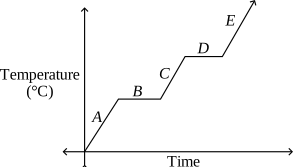
The graph below shows the temperature of a pure substance as heat is added at a constant rate.
 

  1. Identify the section(s) of the graph where the substance is undergoing a phase change.   (1 mark)

--- 1 WORK AREA LINES (style=lined) ---

  1. For one of the phase change sections you identified, explain why the temperature remains constant even though heat is being added.   (2 marks)

--- 4 WORK AREA LINES (style=lined) ---

  1. What is the name of the heat associated with the horizontal section representing the solid-to-liquid phase change?   (1 mark)

--- 1 WORK AREA LINES (style=lined) ---

Show Answers Only

a.    Phase changes:

  • Phase changes occur during the horizontal (flat) sections of the graph.
  • These occur during sections \(B\) and \(D\).

b.    For the phase change at \(B\):

  • The added heat is used to break intermolecular bonds, rather than increase the kinetic energy of the particles.
  • Since temperature is a measure of average kinetic energy, the temperature remains constant during this process. The energy added is called latent heat, which is required to overcome the forces holding the particles in their current phase.

c.    The heat involved in the solid-to-liquid phase change is latent heat of fusion.

Show Worked Solution

a.    Phase changes:

  • Phase changes occur during the horizontal (flat) sections of the graph.
  • These occur during sections \(B\) and \(D\).

b.    For the phase change at \(B\):

  • The added heat is used to break intermolecular bonds, rather than increase the kinetic energy of the particles.
  • Since temperature is a measure of average kinetic energy, the temperature remains constant during this process. The energy added is called latent heat, which is required to overcome the forces holding the particles in their current phase.

c.    The heat involved in the solid-to-liquid phase change is latent heat of fusion.

Filed Under: Thermodynamics Tagged With: Band 3, Band 4, smc-4282-50-Latent heat

HMS, HIC EQ-Bank 452 MC

Which example best demonstrates WHO's emphasis on shared responsibility across sectors to address health inequities?

  1. Education sector teaching about heart disease while urban planning creates exercise-friendly environments
  2. Only healthcare professionals treating coronary heart disease
  3. Governments funding all health programs independently
  4. International organisations working separately on different health issues
Show Answers Only

\(A\)

Show Worked Solution
  • A is correct: This demonstrates multiple sectors (education, urban planning, healthcare) working together to address coronary heart disease through their respective expertise.

Other Options:

  • B is incorrect: This represents single-sector approach, not shared responsibility
  • C is incorrect: Independent funding doesn’t demonstrate cross-sector collaboration
  • D is incorrect: Separate work contradicts the collaborative approach WHO advocates

Filed Under: Improved health through SDGs Tagged With: Band 4, smc-5516-20-WHO health lens

HMS, HIC EQ-Bank 451 MC

According to the WHO's approach to the SDGs, what does applying a 'health lens' primarily involve?

  1. Focusing only on SDG 3: Good Health and Well-being
  2. Targeting health outcomes through creating supportive environments and expanding community resources
  3. Ensuring all SDGs have equal health-related targets
  4. Prioritising healthcare services over other development goals
Show Answers Only

\(B\)

Show Worked Solution
  • B is correct: WHO’s health lens approach focuses on creating supportive physical and social environments and expanding community resources to help people reach their full potential.

Other Options:

  • A is incorrect: Health lens applies to all SDGs, not just SDG 3
  • C is incorrect: Not all SDGs need equal health targets, but health implications are considered
  • D is incorrect: This contradicts the collaborative, multi-sector approach WHO promotes

Filed Under: Improved health through SDGs Tagged With: Band 4, smc-5516-20-WHO health lens

PHYSICS, M3 EQ-Bank 6

A student investigates how heat travels through different materials. They smear small pieces of wax onto rods made of aluminium and plastic, placing identical metal pins into the wax at regular intervals. The rods are then heated at one end using a Bunsen burner. The student times how long it takes for each pin to fall as the wax melts.

After testing the aluminium rod, the experiment is repeated using a plastic rod under the same conditions.

Using your understanding of heat transfer in solids, explain what property of the materials is being investigated. Describe what you expect to observe for each material, and explain your reasoning using principles of thermal conduction.   (4 marks)

Show Answers Only
  • This experiment investigates the thermal conductivity of different materials. When one end of each rod is heated by the Bunsen burner, heat energy travels along the rod via conduction, where thermal energy is transferred through collisions between particles.
  • Metals like aluminium are good conductors because they have free-moving electrons that rapidly transfer energy through the material.
  • In contrast, plastics are poor conductors (insulators) because they lack these free electrons, and energy is transferred only through slower molecular vibrations.
  • On the aluminium rod, the pins will fall off more quickly and in succession, starting from the end nearest the heat source. This shows that heat is conducted rapidly and efficiently along the metal rod.
  • On the plastic rod, the pins will either not fall off at all or will fall off much more slowly and inconsistently, because plastic does not effectively transfer heat along its length.
Show Worked Solution
  • This experiment investigates the thermal conductivity of different materials. When one end of each rod is heated by the Bunsen burner, heat energy travels along the rod via conduction, where thermal energy is transferred through collisions between particles.
  • Metals like aluminium are good conductors because they have free-moving electrons that rapidly transfer energy through the material.
  • In contrast, plastics are poor conductors (insulators) because they lack these free electrons, and energy is transferred only through slower molecular vibrations.
  • On the aluminium rod, the pins will fall off more quickly and in succession, starting from the end nearest the heat source. This shows that heat is conducted rapidly and efficiently along the metal rod.
  • On the plastic rod, the pins will either not fall off at all or will fall off much more slowly and inconsistently, because plastic does not effectively transfer heat along its length.

Filed Under: Thermodynamics Tagged With: Band 4, Band 5, smc-4282-20-Thermal conductivity, smc-4282-40-Energy transfer

PHYSICS, M3 EQ-Bank 11

Sound waves can undergo different types of interactions when they encounter obstacles or boundaries.

  1. Describe how diffraction and reflection affect the propagation of sound in everyday situations.   (2 marks)

--- 4 WORK AREA LINES (style=lined) ---

  1. A musical instrument produces sound by forming standing waves within a tube. Explain how resonance and superposition contribute to the production of clear, sustained notes in such an instrument.   (2 marks)

--- 4 WORK AREA LINES (style=lined) ---

Show Answers Only

a.    Sound wave propagation:

  • Reflection of sound occurs when sound waves bounce off hard surfaces, like walls or cliffs. This allows echoes to be heard in large halls or open spaces.
  • Diffraction allows sound to bend around obstacles or spread out after passing through narrow openings. This is why we can still hear someone speaking around a corner, even without direct line of sight.

b.   Musical instruments sound production:

  • Resonance occurs when the frequency of the sound wave matches the natural frequency of the air column in the instrument, causing amplification of the sound.
  • Superposition of the incident and reflected waves inside the tube creates standing waves, with nodes and antinodes, reinforcing specific frequencies and allowing clear, sustained musical notes to be produced.
Show Worked Solution

a.    Sound wave propagation:

  • Reflection of sound occurs when sound waves bounce off hard surfaces, like walls or cliffs. This allows echoes to be heard in large halls or open spaces.
  • Diffraction allows sound to bend around obstacles or spread out after passing through narrow openings. This is why we can still hear someone speaking around a corner, even without direct line of sight.

b.   Musical instruments sound production:

  • Resonance occurs when the frequency of the sound wave matches the natural frequency of the air column in the instrument, causing amplification of the sound.
  • Superposition of the incident and reflected waves inside the tube creates standing waves, with nodes and antinodes, reinforcing specific frequencies and allowing clear, sustained musical notes to be produced.

Filed Under: Sound Waves Tagged With: Band 4, Band 5, smc-4280-30-Sound wave behaviour

v1 Measurement, STD2 M1 SM-Bank 13 MC

The table shows the average energy used, in kilojoules per kilogram of body mass, by a person running on a treadmill for 20 minutes at different speeds.

\begin{array} {|c|c|} \hline \rule{0pt}{2.5ex} \text{Running speed} \rule[-1ex]{0pt}{0pt} & \text{Energy used in 20 minutes} \\ \hline \rule{0pt}{2.5ex} \text{6 km/h} \rule[-1ex]{0pt}{0pt} & \text{6.2 kJ/kg} \\ \hline \rule{0pt}{2.5ex} \text{9 km/h} \rule[-1ex]{0pt}{0pt} & \text{9.8 kJ/kg} \\ \hline \end{array}

Jess weighs 72 kg and eats a muffin containing 305 kilocalories.

For approximately how long must Jess run at 9 km/hr to burn off the energy from the muffin? (1 kilocalorie = 4.184 kilojoules)

  1. 29 minutes
  2. 32 minutes
  3. 36 minutes
  4. 45 minutes
Show Answers Only

`text(C)`

Show Worked Solution

`text{Kilojoules in muffin}`

`= 305 xx 4.184`

`= 1276.72 \text{ kJ}`

`text{Energy used by Jess in 20 minutes at 9 km/h}`

`= 72 xx 9.8`

`= 705.6 \text{ kJ}`

`:.\ text(Time of the walk)`

`= 1276.72/(705.6) xx 20`

`= 36.1…\ text(minutes)`

Filed Under: Energy and Mass (Std2-X) Tagged With: Band 4, smc-799-10-Calories/Joules

v1 Financial Maths, STD2 F4 2008 HSC 27c

A laptop depreciated in value by 20% per annum. Three years after it was purchased, it had depreciated to a value of $2048, using the declining balance method.

What was the purchase price of the laptop?   (2 marks)

--- 4 WORK AREA LINES (style=lined) ---

Show Answers Only

`$4000`

Show Worked Solution

`S = V_0 (1 – r)^n`

`2048` `= V_0 (1-0.20)^3`
`2048` `= V_0 (0.80)^3`
`V_0` `= 2048 / 0.512`
  `= 4000`


`:.\ text(The purchase price) = $4000`

Filed Under: Depreciation - Declining Balance (Std2-X) Tagged With: Band 4, num-title-ct-coreb, num-title-qs-hsc, smc-1139-30-Find V, smc-4335-28-Find V, smc-813-30-Find V

v1 Financial Maths, STD2 F4 2005 HSC 26a

A new high-end coffee machine is purchased for $25 000 in January 2020.

At the end of each year, starting in 2021, the machine depreciates in value by 15% per annum, using the declining balance method of depreciation.

In which year will the value of the machine first fall below $15 000? (2 marks)

--- 5 WORK AREA LINES (style=lined) ---

Show Answers Only

`text(The value falls below $15 000 in the fourth year)`

`text{which will be during 2024.}`

Show Worked Solution

`text(Using the formula:)\ \ S = V_0(1-r)^n`

`text(where) \ \ V_0 = 25\ 000,\ \ r = 0.15`

`text(If)\ n = 1\ \text{(2021)}`

`S` `= 25\ 000(0.85)^1`
  `=21\ 250`


`text(If)\ n = 2\ \text{(2022)}`

`S` `=25\ 000(0.85)^2`
  `=25\ 000(0.7225)`
  `=18\ 062.50`


`text(If)\ n = 3\ \text{(2023)}`

`S` `=25\ 000(0.85)^3`
  `=25\ 000(0.614125)`
  `=15\ 353.13`


`text(If)\ n = 4\ \text{(2024)}`

`S` `=25\ 000(0.85)^4`
  `=25\ 000(0.52200625)`
  `=13\ 050.16`


`:.\ \text{The value first falls below $15 000 in the fourth year}`

`text{which will be during 2024.}`

Filed Under: Depreciation - Declining Balance (Std2-X) Tagged With: Band 4, num-title-ct-coreb, num-title-qs-hsc, smc-1139-10-Find S, smc-1139-40-Find n, smc-4335-30-Find n, smc-813-10-Find S, smc-813-40-Find n

HMS, HIC EQ-Bank 443

To what extent does developing multiple individual strengthening skills, help young people address complex health challenges such as balancing academic pressure with maintaining physical and mental wellbeing?   (6 marks)

--- 18 WORK AREA LINES (style=lined) ---

Show Answers Only

*Recommended language to consider for “To What Extent” questions is bolded in the answer below.

Judgment Statement

  • Multiple strengthening skills significantly help young people manage complex health challenges.
  • Evidence shows integrated skills create comprehensive solutions for academic and wellbeing balance.

Integrated Skill Effectiveness

  • Evidence supporting this includes problem-solving skills enabling systematic approaches to competing demands.
  • One major reason why this works is that young people with time management and stress-reduction techniques show moderately higher wellbeing during exam periods.
  • Coping strategies combined with clear purpose help maintain exercise routines despite increased life stressors.
  • This demonstrates that multiple skills working together significantly outperform single approaches.
  • An alternative perspective is that single focused skills might be easier to master, but evidence shows integrated approaches prove more effective.

Limitations in Extreme Situations

  • However, it is important to consider that extreme academic pressure can overwhelm even strong skill sets.
  • Some students with excellent skills still experience burnout during HSC preparation.
  • Despite this, multiple skills remain the stronger factor because they provide options when one approach fails.
  • Students with diverse skills recover faster from setbacks, largely due to their ability to switch strategies.

Reaffirmation

  • Evidence confirms multiple strengthening skills significantly enhance young people’s capacity for balance.
  • The main factors supporting this include integrated problem-solving and healthy coping.
  • This implies schools should only minimally focus on single skills and instead prioritise teaching diverse skill sets.
  • Developing multiple skills creates resilient young people who thrive academically while maintaining wellbeing.
Show Worked Solution

*Recommended language to consider for “To What Extent” questions is bolded in the answer below.

Judgment Statement

  • Multiple strengthening skills significantly help young people manage complex health challenges.
  • Evidence shows integrated skills create comprehensive solutions for academic and wellbeing balance.

Integrated Skill Effectiveness

  • Evidence supporting this includes problem-solving skills enabling systematic approaches to competing demands.
  • One major reason why this works is that young people with time management and stress-reduction techniques show moderately higher wellbeing during exam periods.
  • Coping strategies combined with clear purpose help maintain exercise routines despite increased life stressors.
  • This demonstrates that multiple skills working together significantly outperform single approaches.
  • An alternative perspective is that single focused skills might be easier to master, but evidence shows integrated approaches prove more effective.

Limitations in Extreme Situations

  • However, it is important to consider that extreme academic pressure can overwhelm even strong skill sets.
  • Some students with excellent skills still experience burnout during HSC preparation.
  • Despite this, multiple skills remain the stronger factor because they provide options when one approach fails.
  • Students with diverse skills recover faster from setbacks, largely due to their ability to switch strategies.

Reaffirmation

  • Evidence confirms multiple strengthening skills significantly enhance young people’s capacity for balance.
  • The main factors supporting this include integrated problem-solving and healthy coping.
  • This implies schools should only minimally focus on single skills and instead prioritise teaching diverse skill sets.
  • Developing multiple skills creates resilient young people who thrive academically while maintaining wellbeing.

Filed Under: Strengthening, protecting and enhancing health Tagged With: Band 4, Band 5, smc-5511-40-Skills application/impact

HMS, HIC EQ-Bank 442

Outline how combining health literacy with social connectedness can enhance young people's ability to make informed health decisions.   (3 marks)

--- 7 WORK AREA LINES (style=lined) ---

Show Answers Only
  • Health literacy provides knowledge about health risks and protective factors, while social connectedness offers trusted networks for discussing and validating health information.
  • Connected relationships enable young people to share reliable health resources and learn from others’ experiences, expanding their health knowledge base.
  • Social support networks provide encouragement and accountability for maintaining healthy behaviours, making it easier to apply health literacy knowledge in practical situations.
Show Worked Solution
  • Health literacy provides knowledge about health risks and protective factors, while social connectedness offers trusted networks for discussing and validating health information.
  • Connected relationships enable young people to share reliable health resources and learn from others’ experiences, expanding their health knowledge base.
  • Social support networks provide encouragement and accountability for maintaining healthy behaviours, making it easier to apply health literacy knowledge in practical situations.

Filed Under: Strengthening, protecting and enhancing health Tagged With: Band 4, smc-5511-40-Skills application/impact

HMS, HIC EQ-Bank 441

Analyse how strong community connectedness can influence young people to make ethical choices that benefit both individual and collective wellbeing.   (8 marks)

--- 22 WORK AREA LINES (style=lined) ---

Show Answers Only

*Language that helps to highlight relationships and draw out implications is bolded throughout the answer below.

Overview Statement

  • Community connectedness shapes ethical decision-making through social accountability, positive role models, and sense of belonging
  • These components influence young people’s choices creating mutual benefits for individuals and communities

Social Accountability

  • Strong community bonds connect to ethical behaviour through awareness of how actions affect others
  • When young people feel accountable, this leads to careful consideration before acting.
  • This reveals that caring relationships prevent selfish choices.
  • Therefore, social accountability can help transform decisions into collective considerations.

Role Models and Belonging

  • Positive role models directly influence ethical development through observation and imitation.
  • For example, sports coaches demonstrating fair play enable young athletes to adopt similar standards.
  • Simultaneously, a sense of belonging can motivate ethical choices to protect community reputation.
  • Young people who feel they belong contribute through volunteering and service.
  • This pattern shows belonging creates emotional investment in collective wellbeing.
  • Consequently, young people make choices that show they value their community.

Implications and Synthesis

  • Community and role model relationships form an ethical ecosystem supporting youth development.
  • This analysis demonstrates how individual wellbeing can thrive when supported by strong collective ethical standards.
  • Therefore, investing in community programs is critical as it cultivates ethical development that benefits both young people and their communities
  • The significance is that strong connectedness enables young people to become ethical citizens who balance personal needs with community benefit.
Show Worked Solution

*Good words/phrases to convey relationships and implications are bolded.

Overview Statement

  • Community connectedness shapes ethical decision-making through social accountability, positive role models, and sense of belonging
  • These components influence young people’s choices creating mutual benefits for individuals and communities

Social Accountability

  • Strong community bonds connect to ethical behaviour through awareness of how actions affect others
  • When young people feel accountable, this leads to careful consideration before acting.
  • This reveals that caring relationships prevent selfish choices.
  • Therefore, social accountability can help transform decisions into collective considerations.

Role Models and Belonging

  • Positive role models directly influence ethical development through observation and imitation.
  • For example, sports coaches demonstrating fair play enable young athletes to adopt similar standards.
  • Simultaneously, a sense of belonging can motivate ethical choices to protect community reputation.
  • Young people who feel they belong contribute through volunteering and service.
  • This pattern shows belonging creates emotional investment in collective wellbeing.
  • Consequently, young people make choices that show they value their community.

Implications and Synthesis

  • Community and role model relationships form an ethical ecosystem supporting youth development.
  • This analysis demonstrates how individual wellbeing can thrive when supported by strong collective ethical standards.
  • Therefore, investing in community programs is critical as it cultivates ethical development that benefits both young people and their communities
  • The significance is that strong connectedness enables young people to become ethical citizens who balance personal needs with community benefit.

Filed Under: Strengthening, protecting and enhancing health Tagged With: Band 4, Band 5, smc-5511-30-Social connection/ethics

HMS, HIC EQ-Bank 440

Explain how ethical behaviour contributes to building positive relationships and community connectedness among young people.   (5 marks)

--- 15 WORK AREA LINES (style=lined) ---

Show Answers Only

ANSWER STYLE #1: General Points to use within student-chosen answer structure

*Language highlighting the cause-effect relationship is bolded in the answer below.

  • Ethical behaviour, like honesty and keeping promises, builds trust because it proves young people are reliable and respectful. This leads to stronger friendships and peer support networks.
  • When young people consider others’ wellbeing in their decisions, this causes everyone to feel valued and included, thereby creating communities where diverse individuals connect meaningfully.
  • Acting ethically towards others results in reciprocal respect, as people naturally respond positively to fair treatment, promoting mutual understanding and cooperation.
  • This occurs because ethical behaviour reduces conflicts and misunderstandings between young people. This allows them to focus on building positive relationships rather than managing disputes.
  • Consistent ethical actions demonstrate personal integrity to the community. This causes others to seek out these individuals for friendship and collaboration, thus strengthening overall community connectedness.


ANSWER STYLE #2: Highly structured (PEEL)

  • [P] Ethical behaviour like honesty and fairness builds trust between young people.
  • [E] This occurs because consistent ethical actions prove someone is reliable and respectful.
  • [Ev] When teens keep promises and treat others fairly, friendships strengthen and peer groups become more supportive.
  • [L] Therefore, ethical behaviour directly leads to deeper, more meaningful relationships.
     
  • [P] Considering others’ wellbeing through ethical choices creates inclusive communities.
  • [E] This works by making all young people feel valued regardless of differences.
  • [Ev] Schools where students stand up against bullying report higher levels of belonging and connection.
  • [L] This demonstrates why ethical actions result in stronger community bonds.
     
  • [P] Young people modelling ethical behaviour inspire others to act similarly.
  • [E] This happens when positive actions create ripple effects throughout peer groups.
  • [Ev] One student’s ethical stance against cheating often influences entire classes to value academic integrity.
  • [L] As a result, ethical behaviour spreads, which enables widespread community connectedness.
Show Worked Solution

*Language highlighting the cause-effect relationship is bolded in the answer below.

  • Ethical behaviour, like honesty and keeping promises, builds trust because it proves young people are reliable and respectful. This leads to stronger friendships and peer support networks.
  • When young people consider others’ wellbeing in their decisions, this causes everyone to feel valued and included, thereby creating communities where diverse individuals connect meaningfully.
  • Acting ethically towards others results in reciprocal respect, as people naturally respond positively to fair treatment, promoting mutual understanding and cooperation.
  • This occurs because ethical behaviour reduces conflicts and misunderstandings between young people. This allows them to focus on building positive relationships rather than managing disputes.
  • Consistent ethical actions demonstrate personal integrity to the community. This causes others to seek out these individuals for friendship and collaboration, thus strengthening overall community connectedness.

Filed Under: Strengthening, protecting and enhancing health Tagged With: Band 3, Band 4, smc-5511-30-Social connection/ethics

HMS, HIC EQ-Bank 439

Explain the importance of help-seeking behaviours in maintaining young people's mental health and wellbeing.   (5 marks)

--- 15 WORK AREA LINES (style=lined) ---

Show Answers Only

*Language highlighting the cause-effect relationship is bolded in the answer below.

  • Help-seeking behaviours enable early intervention for mental health concerns because professional support identifies problems before they worsen.
  • This occurs when young people access counsellors or psychologists at the first signs of anxiety or depression. As a result, minor stress doesn’t develop into severe mental illness requiring hospitalisation
  • This demonstrates why early help-seeking prevents long-term psychological damage. The reason for this is that professionals provide specialised coping strategies young people cannot develop alone.
  • This works by teaching evidence-based techniques like cognitive behavioural therapy and mindfulness.
  • These elements work together to build resilience against future mental health challenges. Consequently, young people gain lifelong skills for managing emotions and stress.
  • Seeking help creates connection with support networks, which reduces isolation and stigma.
  • This happens when young people realise others share similar struggles through group therapy or peer support, resulting in increased confidence to discuss mental health openly.
  • In this way, help-seeking transforms shame into empowerment and community connection.
Show Worked Solution

*Language highlighting the cause-effect relationship is bolded in the answer below.

  • Help-seeking behaviours enable early intervention for mental health concerns because professional support identifies problems before they worsen.
  • This occurs when young people access counsellors or psychologists at the first signs of anxiety or depression. As a result, minor stress doesn’t develop into severe mental illness requiring hospitalisation
  • This demonstrates why early help-seeking prevents long-term psychological damage. The reason for this is that professionals provide specialised coping strategies young people cannot develop alone.
  • This works by teaching evidence-based techniques like cognitive behavioural therapy and mindfulness.
  • These elements work together to build resilience against future mental health challenges. Consequently, young people gain lifelong skills for managing emotions and stress.
  • Seeking help creates connection with support networks, which reduces isolation and stigma.
  • This happens when young people realise others share similar struggles through group therapy or peer support, resulting in increased confidence to discuss mental health openly.
  • In this way, help-seeking transforms shame into empowerment and community connection.

Filed Under: Strengthening, protecting and enhancing health Tagged With: Band 3, Band 4, smc-5511-20-Health management

HMS, HIC EQ-Bank 437

Describe how a combination of resilience and sense of purpose can protect young people from developing substance abuse problems.   (4 marks)

--- 10 WORK AREA LINES (style=lined) ---

Show Answers Only
  • Resilience enables young people to cope with stress, disappointment, and peer pressure without turning to substances as escape mechanisms.
  • A strong sense of purpose provides motivation to maintain healthy behaviours because young people recognise how substance use could interfere with their goals and aspirations.
  • Resilient individuals develop healthy coping strategies that address underlying emotional needs without relying on harmful substances.
  • Sense of purpose creates long-term thinking patterns that help young people consider consequences of substance use on their future achievements and relationships.
Show Worked Solution
  • Resilience enables young people to cope with stress, disappointment, and peer pressure without turning to substances as escape mechanisms.
  • A strong sense of purpose provides motivation to maintain healthy behaviours because young people recognise how substance use could interfere with their goals and aspirations.
  • Resilient individuals develop healthy coping strategies that address underlying emotional needs without relying on harmful substances.
  • Sense of purpose creates long-term thinking patterns that help young people consider consequences of substance use on their future achievements and relationships.

Filed Under: Strengthening, protecting and enhancing health Tagged With: Band 4, smc-5511-10-Personal empowerment

HMS, HIC EQ-Bank 434 MC

A Year 11 student is experiencing high stress levels due to academic pressure and family expectations. Which combination of skills would be most effective in managing this situation?

  1. Using avoidance techniques to ignore stressful situations while maintaining high academic performance
  2. Developing time management skills, seeking support from trusted adults, and practicing stress-reduction techniques
  3. Increasing study hours significantly while avoiding social activities that might cause distraction
  4. Accepting that stress is inevitable and focusing solely on meeting others' expectations
Show Answers Only

\(B\)

Show Worked Solution
  • B is correct: This option combines problem-solving (time management), help-seeking behaviour (trusted adults), and healthy coping strategies (stress-reduction techniques).

Other Options:

  • A is incorrect: Avoidance is not a resilient coping strategy and doesn’t demonstrate health literacy about stress management.
  • C is incorrect: Shows poor understanding of healthy coping strategies and lacks balance needed for resilience.
  • D is incorrect: Demonstrates lack of self-efficacy and poor coping strategies without recognition of available support systems.

Filed Under: Strengthening, protecting and enhancing health Tagged With: Band 4, smc-5511-40-Skills application/impact

HMS, HIC EQ-Bank 433 MC

During a school anti-bullying campaign, a student witnesses cyberbullying on social media but knows reporting it might damage their friendship with the perpetrator. Which action best demonstrates ethical behaviour while maintaining healthy connectedness?

  1. Screenshot the evidence and report the incident to school authorities while privately discussing the behaviour with their friend
  2. Like or share the bullying posts to maintain friendship with the perpetrator
  3. Ignore the situation to avoid conflict within their social group
  4. Publicly defend the perpetrator's actions on social media to show loyalty
Show Answers Only

\(A\)

Show Worked Solution
  • A is correct: Ethical behaviour is demonstrated by taking action against harmful behaviour while maintaining connectedness through honest communication with their friend.

Other Options:

  • B is incorrect: Shows poor ethical behaviour by participating in harmful activities and demonstrates unhealthy connectedness based on fear.
  • C is incorrect: Demonstrates lack of ethical responsibility and fails to support healthy community connectedness.
  • D is incorrect: Shows poor ethical behaviour by endorsing harmful actions and demonstrates toxic rather than healthy connectedness.

Filed Under: Strengthening, protecting and enhancing health Tagged With: Band 4, smc-5511-30-Social connection/ethics

HMS, HIC EQ-Bank 432 MC

A young person notices their friend displaying signs of depression including social withdrawal and declining academic performance. Which response best demonstrates effective health literacy and appropriate help-seeking behaviour?

  1. Research depression symptoms online and attempt to provide counselling advice to their friend
  2. Ignore the situation believing their friend will eventually overcome the difficulties independently
  3. Encourage their friend to speak with a school counsellor while offering ongoing emotional support
  4. Immediately contact the friend's parents without discussing the concerns with their friend first
Show Answers Only

\(C\)

Show Worked Solution
  • C is correct: Health literacy is demonstrated by recognising professional help is needed and shows appropriate help-seeking behaviour while maintaining supportive friendship.

Other Options:

  • A is incorrect: Shows some health literacy but inappropriate help-seeking by attempting to provide professional services without qualifications.
  • B is incorrect: Demonstrates lack of health literacy about depression severity and poor help-seeking behaviour.
  • D is incorrect: Poor help-seeking behaviour that violates trust and doesn’t involve the affected person in decision-making.

Filed Under: Strengthening, protecting and enhancing health Tagged With: Band 4, smc-5511-20-Health management

HMS, HIC EQ-Bank 431 MC

Which of the following best demonstrates how a young person with strong self-efficacy and resilience would respond to peer pressure to engage in binge drinking at a party?

  1. Avoid attending social events where alcohol might be present to eliminate temptation
  2. Confidently decline alcohol offers while suggesting alternative activities to maintain social connections
  3. Accept one drink to fit in but limit consumption to avoid negative consequences
  4. Leave the party immediately without explanation when alcohol is offered
Show Answers Only

\(B\)

Show Worked Solution
  • B is correct: Self-efficacy is demonstrated through confident decision-making and resilience by maintaining personal values despite peer pressure while showing problem-solving skills by suggesting alternatives.

Other Options:

  • A is incorrect: Avoidance doesn’t build resilience or demonstrate self-efficacy in challenging situations.
  • C is incorrect: Compromising personal values under pressure shows lack of self-efficacy and doesn’t demonstrate resilient behaviour.
  • D is incorrect: While avoiding harm, this response doesn’t demonstrate problem-solving skills or help maintain social connectedness.

Filed Under: Strengthening, protecting and enhancing health Tagged With: Band 4, smc-5511-10-Personal empowerment

PHYSICS, M3 EQ-Bank 10

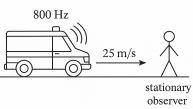
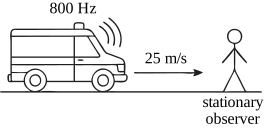
An ambulance travelling at 25 ms\(^{-1}\) towards a stationary observer emits a siren with frequency 800 Hz. The speed of sound in air is 340 ms\(^{-1}\).
 

  1. Calculate the frequency heard by the observer as the ambulance approaches.   (2 marks)

--- 4 WORK AREA LINES (style=lined) ---

  1. Calculate the frequency heard by the observer after the ambulance has passed.   (2 marks)

--- 4 WORK AREA LINES (style=lined) ---

Show Answers Only

a.    \(863\ \text{Hz}\)

b.    \(745\ \text{Hz}\)

Show Worked Solution
 

a.    Using \(f^{′}=f\dfrac{v \pm v_{\text{observer}}}{v \mp v_{\text{source}}}:\)

\(f^{′}= 800 \times \dfrac{340 + 0}{v-25} = 863\ \text{Hz}\)
  

b.    \(f^{′}= 800 \times \dfrac{340 + 0}{v + 25} = 745\ \text{Hz}\)

Filed Under: Sound Waves Tagged With: Band 4, smc-4280-10-Doppler effect

HMS, HIC EQ-Bank 429

Body image concerns and disordered eating patterns significantly impact the physical and mental health of young Australians.

Analyse the protective factors that can prevent these issues and the skills and actions that young people can develop to promote positive body image and healthy eating behaviours.   (8 marks)

--- 22 WORK AREA LINES (style=lined) ---

Show Answers Only

ANSWER STYLE #1: General Points to use within student-chosen answer structure

*Recommended words/phrases to convey relationships and implications are bolded.

Overview Statement

  • Protective factors including support networks, health literacy, and critical thinking skills can shape and reinforce personal actions to help prevent body image issues.
  • These factors influence young people’s relationships with food and body image through multiple pathways.

Support Networks and Health Literacy

  • Strong family support in combination with accurate nutritional knowledge helps foster a strong protection against disordered eating.
  • This reveals that emotional support combined with factual information prevents harmful diet trends
  • In this way, relationships and knowledge work together to build realistic body perspectives.
  • This means that protection requires both emotional and educational components.

Critical Thinking and Personal Actions

  • Media literacy skills directly influence young people’s ability to set health-focused goals.
  • This works by teaching young people to spot fake images, which empowers them to reject unhealthy weight-loss goals.
  • Young people who critically analyse advertising tactics develop wellbeing goals that prioritise energy and fitness. This is a clear illustration of critical thinking transforming into positive health behaviours.
  • As a consequence, understanding media manipulation promotes sustainable lifestyle choices over quick fixes.

Implications and Synthesis

  • These protective factors form an integrated defence system against body image issues.
  • This analysis indicates that skills development must combine with supportive environments to be most effective.
  • Consequently, when schools and families are dealing with issues of body image and eating disorders, they must combine both education and emotional support.
  • The significance is that isolated interventions fail while comprehensive strategies can create lasting protection.


ANSWER STYLE #2: Highly structured (PEEL)

*PEEL – Solution is structured using an adjusted PEEL method; [P] Identify components and their relationship, [E] explain the interaction/influence between them, [Ev] provide evidence showing the relationship in action, [L] linking sentence back to question.

  • [P] Personal support networks and critical thinking skills combine to protect against body image issues.
  • [E] The relationship between family support and media literacy creates multiple defence layers against harmful messages.
  • [Ev] Young people with strong family connections who also possess media analysis skills are at much less risk of developing eating disorders.
  • [L] This interaction demonstrates how protective factors work together to prevent body image concerns.
     
  • [P] Health knowledge and assertiveness skills work together to help young people make informed food choices.
  • [E] Access to dietitian advice directly influences young people’s ability to resist harmful diet trends on social media.
  • Ev] Teens who consult qualified professionals develop confidence to challenge peer pressure about restrictive eating.
  • [L] These elements working together enable young people to maintain healthy eating behaviours despite external pressures.
     
  • [P] Individual resilience skills and community advocacy create a reinforcing cycle of positive body image.
  • [E] When confident individuals take action, they can change the attitudes of those around them.
  • [Ev] Students who promote body diversity at school feel better about themselves while helping classmates accept different body types.
  • [L] This relationship reveals how personal skills translate into broader protective environments.
     
  • [P] Goal-setting focused on wellbeing rather than weight operates on multiple levels of protection.
  • [E] Health-focused objectives promote action and influence psychological attitudes.
  • [Ev] For example, young people pursuing fitness goals experience improved mental health regardless of body shape changes.
  • [L] Together, these protective factors and skills and actions determine long-term resilience against disordered eating patterns.
Show Worked Solution

*Recommended words/phrases to convey relationships and implications are bolded.

Overview Statement

  • Protective factors including support networks, health literacy, and critical thinking skills can shape and reinforce personal actions to help prevent body image issues.
  • These factors influence young people’s relationships with food and body image through multiple pathways.

Support Networks and Health Literacy

  • Strong family support in combination with accurate nutritional knowledge helps foster a strong protection against disordered eating.
  • This reveals that emotional support combined with factual information prevents harmful diet trends
  • In this way, relationships and knowledge work together to build realistic body perspectives.
  • This means that protection requires both emotional and educational components.

Critical Thinking and Personal Actions

  • Media literacy skills directly influence young people’s ability to set health-focused goals.
  • This works by teaching young people to spot fake images, which empowers them to reject unhealthy weight-loss goals.
  • Young people who critically analyse advertising tactics develop wellbeing goals that prioritise energy and fitness. This is a clear illustration of critical thinking transforming into positive health behaviours.
  • As a consequence, understanding media manipulation promotes sustainable lifestyle choices over quick fixes.

Implications and Synthesis

  • These protective factors form an integrated defence system against body image issues.
  • This analysis indicates that skills development must combine with supportive environments to be most effective.
  • Consequently, when schools and families are dealing with issues of body image and eating disorders, they must combine both education and emotional support.
  • The significance is that isolated interventions fail while comprehensive strategies can create lasting protection.

Filed Under: Research and Health Related Issues, Strengthening, protecting and enhancing health Tagged With: Band 4, Band 5, smc-5511-10-Personal empowerment, smc-5511-20-Health management, smc-5511-40-Skills application/impact, smc-5800-10-Youth health issue, smc-5800-15-Protective/risk factors, smc-5800-25-Strategy dev and advocacy

PHYSICS, M3 EQ-Bank 9

A guitar string of length 0.65 m vibrates with a fundamental frequency of 330 Hz. Calculate the speed of waves on this string.   (2 marks)

--- 4 WORK AREA LINES (style=lined) ---

Show Answers Only

\(429\ \text{ms}^{-1}\)

Show Worked Solution
  • For a string fixed at both ends, the fundamental frequency corresponds to a standing wave with wavelength \(\lambda = 2L\), where \(L\) is the length of the string.

\(\lambda = 2L = 2 \times 0.65 = 1.3\ \text{m}\)

\(v = f\lambda = 330 \times 1.3 = 429\ \text{ms}^{-1}\)

Filed Under: Sound Waves Tagged With: Band 4, smc-4280-20-Modelling standing waves

PHYSICS, M3 EQ-Bank 6

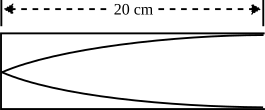
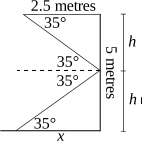
The diagram below shows the fundamental standing wave pattern in an air column that is closed at one end and open at the other.


  1. On the same diagram, draw the shape of the first overtone (which corresponds to the third harmonic) standing wave pattern.   (2 marks)

    --- 0 WORK AREA LINES (style=lined) ---

  2. State the frequencies of the fundamental and the first overtone (third harmonic) resonance modes for this air column.   (2 mark)

--- 4 WORK AREA LINES (style=lined) ---

Show Answers Only

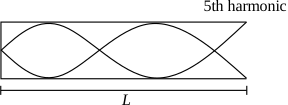
a.    
         

 b.   The fundamental frequency is 425 Hz.

The frequency of the first overtone is 1275 Hz.

Show Worked Solution

a.  


b.    For the fundamental frequency \((f_1)\), \(\dfrac{\lambda_1}{4} = 0.2\ \text{m}\ \Rightarrow\ \lambda_1 = 0.8\ \text{m}\)

\(f_1 = \dfrac{v}{\lambda_1} = \dfrac{340}{0.8} = 425\ \text{Hz}\).

For the frequency of the first overtone \((f_2)\):

\(f_2 = 3 \times f_1 = 3 \times 425 = 1275\ \text{Hz}\).

Filed Under: Sound Waves Tagged With: Band 4, Band 5, smc-4280-40-Standing Waves in Closed Pipes

PHYSICS, M3 EQ-Bank 7 MC

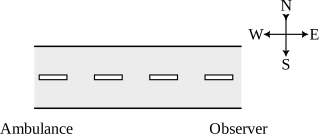
An ambulance is moving along a straight road with its siren turned on. An observer is also moving along the same road as seen below:
 

In which situation will the observer hear the highest pitch from the siren?

\begin{align*}
\begin{array}{l}
\rule{0pt}{2.5ex} \ \rule[-1ex]{0pt}{0pt}& \\
\rule{0pt}{2.5ex}\textbf{A.}\rule[-1ex]{0pt}{0pt}\\
\rule{0pt}{2.5ex}\textbf{B.}\rule[-1ex]{0pt}{0pt}\\
\rule{0pt}{2.5ex}\textbf{C.}\rule[-1ex]{0pt}{0pt}\\
\rule{0pt}{2.5ex}\textbf{D.}\rule[-1ex]{0pt}{0pt}\\
\end{array}
\begin{array}{|c|c|}
\hline
\rule{0pt}{2.5ex}\text{Velocity of ambulance (m/s)}\rule[-1ex]{0pt}{0pt}& \text{Velocity of observer (m/s)} \\
\hline
\rule{0pt}{2.5ex}\text{20 (east)}\rule[-1ex]{0pt}{0pt}&\text{15 (west)}\\
\hline
\rule{0pt}{2.5ex}\text{stationary}\rule[-1ex]{0pt}{0pt}& \text{30 (west)}\\
\hline
\rule{0pt}{2.5ex}\text{28 (west)}\rule[-1ex]{0pt}{0pt}& \text{stationary} \\
\hline
\rule{0pt}{2.5ex}\text{22 (east)}\rule[-1ex]{0pt}{0pt}& \text{10 (east)} \\
\hline
\end{array}
\end{align*}
Show Answers Only

\(A\)

Show Worked Solution
  • The highest pitched siren will occur when the ambulance and observer are approaching each other with the highest relative velocity.
  • \(A\): the relative speed of approach is \(20 +15 = 35\ \text{ms}^{-1}\).
  • \(B\): the relative speed of approach is \(0 + 30 = 30\ \text{ms}^{-1}\).
  • \(C\): the ambulance and observer are moving away from each other, hence the pitch of the siren will decrease.
  • \(D\): the relative speed of approach is \(22-10 = 12\ \text{ms}^{-1}\).

\(\Rightarrow A\)

Filed Under: Sound Waves Tagged With: Band 4, smc-4280-10-Doppler effect

PHYSICS, M3 EQ-Bank 5 MC

During a construction test, a small motor vibrates at a constant frequency while placed on a metal bridge beam. After a short time, the beam begins to vibrate strongly, even though the motor's vibration is very gentle.

Which wave behaviour is most responsible for the beam’s large vibrations?

  1. Reflection
  2. Resonance
  3. Interference
  4. Diffraction
Show Answers Only

\(B\)

Show Worked Solution

→ The motor is vibrating at a constant frequency, and that vibration is being transferred to the metal beam. Once the motor’s frequency matches the natural frequency of the beam, the beam begins to vibrate strongly.

→ This is because of resonance, a phenomenon where an object absorbs energy most efficiently when it is forced to vibrate at its natural frequency. Even a small, repeated input (like the motor’s vibration) can cause large amplitude vibrations if the frequency is just right.

\(\Rightarrow B\)

Filed Under: Uncategorized Tagged With: Band 4, smc-4280-30-Sound wave behaviour

HMS, HIC EQ-Bank 430

Australian research indicates that gambling participation increases dramatically when young people reach the legal gambling age of 18, with many forms of gambling showing substantial increases as young people gain legal access.

Analyse how individual strengthening skills can protect young people from developing gambling problems and enhance their overall wellbeing as they transition into legal gambling accessibility.   (8 marks)

--- 22 WORK AREA LINES (style=lined) ---

Show Answers Only

*Language to use that helps to highlight relationships and draw out implications is bolded.

Overview Statement

  • Individual strengthening skills including self-efficacy, health literacy, problem solving and resilience, interact with each other to protect young people from gambling problems.
  • These skills form protective relationships that influence decision-making as young people become old enough to legally gamble.

Self-efficacy and Health Literacy Relationship

  • Self-efficacy crosses over with health literacy by enabling young people to understand gambling risks.
  • When young people understand how gambling odds work against them and recognise addiction warning signs, they make informed choices to avoid gambling.
  • Evidence shows young adults with high self-efficacy combined with gambling awareness reduce participation by almost 50%.
  • This means that knowledge alone isn’t sufficient – confidence to act on that knowledge determines protective outcomes.
  • Therefore, these skills work together to resist peer pressure.

Problem-solving and Resilience Interaction

  • Problem-solving abilities depend on resilience when facing circumstances that trigger gambling urges.
  • Resilient young people use problem-solving to identify healthy alternatives like sport participation.
  • This relationship enables them to address real world pressures without any accompanying financial risk.
  • Consequently, this combination prevents gambling becoming a coping mechanism for adult pressures.

Implications and Synthesis

  • These skills function as an integrated protection system rather than isolated factors.
  • Evidence indicates that pre-adult skill development can result in lifelong gambling resistance and the critical importance of pre-emptive education programs.
  • By strengthening multiple skills simultaneously, individuals can create a strong protection against gambling.
  • Young people equipped with this skill system are much more likely to transition safely into legal gambling age.
Show Worked Solution

*Language to use that helps to highlight relationships and draw out implications is bolded.

Overview Statement

  • Individual strengthening skills including self-efficacy, health literacy, problem solving and resilience, interact with each other to protect young people from gambling problems.
  • These skills form protective relationships that influence decision-making as young people become old enough to legally gamble.

Self-efficacy and Health Literacy Relationship

  • Self-efficacy crosses over with health literacy by enabling young people to understand gambling risks.
  • When young people understand how gambling odds work against them and recognise addiction warning signs, they make informed choices to avoid gambling.
  • Evidence shows young adults with high self-efficacy combined with gambling awareness reduce participation by almost 50%.
  • This means that knowledge alone isn’t sufficient – confidence to act on that knowledge determines protective outcomes.
  • Therefore, these skills work together to resist peer pressure.

Problem-solving and Resilience Interaction

  • Problem-solving abilities depend on resilience when facing circumstances that trigger gambling urges.
  • Resilient young people use problem-solving to identify healthy alternatives like sport participation.
  • This relationship enables them to address real world pressures without any accompanying financial risk.
  • Consequently, this combination prevents gambling becoming a coping mechanism for adult pressures.

Implications and Synthesis

  • These skills function as an integrated protection system rather than isolated factors.
  • Evidence indicates that pre-adult skill development can result in lifelong gambling resistance and the critical importance of pre-emptive education programs.
  • By strengthening multiple skills simultaneously, individuals can create a strong protection against gambling.
  • Young people equipped with this skill system are much more likely to transition safely into legal gambling age.

Filed Under: Strengthening, protecting and enhancing health Tagged With: Band 4, Band 5, smc-5511-10-Personal empowerment, smc-5511-20-Health management

HMS, HIC EQ-Bank 128

Alex is a 17-year-old living in a rural town who has been experiencing depression and anxiety following family breakdown. The nearest mental health professional is 200km away, and Alex's family cannot afford private treatment. The local school has basic counselling services, but Alex feels uncomfortable accessing them due to stigma in the small community.

Discuss the effectiveness of ways in which the government, non-government organisations and the community could advocate for Alex's health needs.   (8 marks)

--- 22 WORK AREA LINES (style=lined) ---

Show Answers Only

*PEEL – Solution is structured using separate PEEL methods for each side of the argument; [P] Identify the point, [E] expand on the point with a link to question asked, [Ev] apply evidence/examples, [L] linking sentence back to question.

Effective Government Advocacy:

  • [P] Government advocacy effectively addresses Alex’s access barriers through systematic solutions.
  • [E] Legislative power is able to create telehealth funding and mobile mental health services for rural areas.
  • [Ev] Medicare subsidies for online consultations eliminate 200km travel barriers.
  • [L] Government creates comprehensive, funded solutions to rural mental health inequities.

Limitations of Government Advocacy:

  • [P] Government advocacy fails to provide immediate crisis intervention.
  • [E] Bureaucratic red tape can create lengthy implementation delays.
  • [Ev] Policy changes requiring approval cannot address Alex’s urgent depression symptoms.
  • [L] Government solutions lack immediacy needed for mental health crises.

Effective NGO Advocacy:

  • [P] NGOs provide most effective immediate support for Alex’s circumstances.
  • [E] Independent operation enables rapid crisis response with youth-focused services.
  • [Ev] For example, NGO’s such as headspace offer 24/7 support, online counselling, addressing stigma concerns.
  • [L] In this way, NGOs fill critical gaps through immediate, accessible mental health intervention.

Limitations of NGO Advocacy:

  • [P] NGO advocacy limited by resource constraints and sustainability issues.
  • [E] Donation-dependent funding creates uncertainty.
  • [Ev] Cannot establish permanent rural infrastructure or guarantee ongoing availability.
  • [L] Resource limitations compromise long-term comprehensive support.

Effective Community Advocacy:

  • [P] Community advocacy can effectively address local stigma and social support needs.
  • [E] Local understanding enables culturally appropriate mental health initiatives.
  • [Ev] Peer support groups can normalise help-seeking behaviour in a rural context and direct Alex to government and NGO health services.
  • [L] Community can transform local attitudes supporting Alex’s recovery.

Limitations of Community Advocacy:

  • [P] Community advocacy cannot replace professional clinical intervention.
  • [E] Community members lack specialised mental health training and expertise.
  • [Ev] They also cannot assess Alex or prescribe drugs or treatment for his depression.
  • [L] Community support is valuable but insufficient, by itself, for Alex’s clinical needs. When it complements other governmental and NGO health services, the best outcomes are achievable.
Show Worked Solution

*PEEL – Solution is structured using separate PEEL methods for each side of the argument; [P] Identify the point, [E] expand on the point with a link to question asked, [Ev] apply evidence/examples, [L] linking sentence back to question.

Effective Government Advocacy

  • [P] Government advocacy effectively addresses Alex’s access barriers through systematic solutions.
  • [E] Legislative power is able to create telehealth funding and mobile mental health services for rural areas.
  • [Ev] Medicare subsidies for online consultations eliminate 200km travel barriers.
  • [L] Government creates comprehensive, funded solutions to rural mental health inequities.

Limitations of Government Advocacy

  • [P] Government advocacy fails to provide immediate crisis intervention.
  • [E] Bureaucratic red tape can create lengthy implementation delays.
  • [Ev] Policy changes requiring approval cannot address Alex’s urgent depression symptoms.
  • [L] Government solutions lack immediacy needed for mental health crises.

Effective NGO Advocacy

  • [P] NGOs provide most effective immediate support for Alex’s circumstances.
  • [E] Independent operation enables rapid crisis response with youth-focused services.
  • [Ev] For example, NGO’s such as headspace offer 24/7 support, online counselling, addressing stigma concerns.
  • [L] In this way, NGOs fill critical gaps through immediate, accessible mental health intervention.

Limitations of NGO Advocacy

  • [P] NGO advocacy limited by resource constraints and sustainability issues.
  • [E] Donation-dependent funding creates uncertainty.
  • [Ev] Cannot establish permanent rural infrastructure or guarantee ongoing availability.
  • [L] Resource limitations compromise long-term comprehensive support.

Effective Community Advocacy

  • [P] Community advocacy can effectively address local stigma and social support needs.
  • [E] Local understanding enables culturally appropriate mental health initiatives.
  • [Ev] Peer support groups can normalise help-seeking behaviour in a rural context and direct Alex to government and NGO health services.
  • [L] Community can transform local attitudes supporting Alex’s recovery.

Limitations of Community Advocacy

  • [P] Community advocacy cannot replace professional clinical intervention.
  • [E] Community members lack specialised mental health training and expertise.
  • [Ev] They also cannot assess Alex or prescribe drugs or treatment for his depression.
  • [L] Community support is valuable but insufficient, by itself, for Alex’s clinical needs. When it complements other governmental and NGO health services, the best outcomes are achievable.

Filed Under: Individual, organisational and community advocacy Tagged With: Band 4, Band 5, Band 6, smc-5512-20-Government, smc-5512-40-NGOs, smc-5512-50-Other organisations

HMS, HIC EQ-Bank 094 MC

The NSW government has introduced legislation requiring all entertainment venues to provide free water and designated safe spaces for young people. Additionally, they have allocated $50 million for youth mental health services and established mandatory reporting systems for venues that serve alcohol to minors.

Which government advocacy responsibilities are demonstrated in this scenario?

  1. Setting policies, allocating funding, and implementing programs.
  2. Creating supportive environments and developing personal skills.
  3. Building community partnerships and strengthening local networks.
  4. Providing direct healthcare services and individual counselling.
Show Answers Only

\(A\)

Show Worked Solution
  • A is correct because all three core government advocacy responsibilities are demonstrated: setting policies (legislation for venues), allocating funding ($50 million for mental health), and implementing programs (mandatory reporting systems).

Other options:

  • B is incorrect because these are Ottawa Charter action areas, not specific government advocacy responsibilities.
  • C is incorrect because while partnerships may exist, the question demonstrates direct government action rather than community partnership building.
  • D is incorrect because governments don’t typically provide direct healthcare services or individual counselling – these are usually delivered by health professionals or NGOs.

Filed Under: Individual, organisational and community advocacy Tagged With: Band 4, smc-5512-20-Government

HMS, HIC EQ-Bank 127

A 16-year-old student, Maya, is struggling with anxiety but cannot access affordable mental health services through the public system due to long waiting lists. Meanwhile, her school has recently implemented a new wellbeing curriculum mandated by the state government.

Describe the differences between how government and non-government organisations would advocate for Maya's health needs in this situation.   (5 marks)

--- 15 WORK AREA LINES (style=lined) ---

Show Answers Only

Government advocacy:

  • Government advocacy for Maya would involve systematic, policy-level responses.
  • The government could addresses Maya’s needs through mandatory school wellbeing programs, funding public mental health services, and setting Medicare rebate structures.
  • However, government responses are often slow due to bureaucratic red tape and focus on population-wide solutions rather than immediate individual needs.
  • The government’s role is creating frameworks and policies that should prevent situations like Maya’s.

NGO advocacy:

  • NGO advocacy provides immediate, targeted support that government cannot deliver.
  • Organisations like headspace would offer Maya direct counselling services without waiting lists, filling gaps in the system.
  • NGOs advocate by providing evidence of unmet needs to government, offering specialised youth-focused services, and adapting quickly to emerging mental health trends.
  • They can provide culturally appropriate support and innovative service delivery models that complement government frameworks.
  • Both approaches are necessary – the government provides the funding and creates the framework while NGOs provide responsive, specialised advocacy and services.
Show Worked Solution

Government advocacy:

  • Government advocacy for Maya would involve systematic, policy-level responses.
  • The government could addresses Maya’s needs through mandatory school wellbeing programs, funding public mental health services, and setting Medicare rebate structures.
  • However, government responses are often slow due to bureaucratic red tape and focus on population-wide solutions rather than immediate individual needs.
  • The government’s role is creating frameworks and policies that should prevent situations like Maya’s.

NGO advocacy:

  • NGO advocacy provides immediate, targeted support that government cannot deliver.
  • Organisations like headspace would offer Maya direct counselling services without waiting lists, filling gaps in the system.
  • NGOs advocate by providing evidence of unmet needs to government, offering specialised youth-focused services, and adapting quickly to emerging mental health trends.
  • They can provide culturally appropriate support and innovative service delivery models that complement government frameworks.
  • Both approaches are necessary – the government provides the funding and creates the framework while NGOs provide responsive, specialised advocacy and services.

Filed Under: Individual, organisational and community advocacy Tagged With: Band 4, Band 5, smc-5512-20-Government, smc-5512-40-NGOs

v1 Financial Maths, STD2 F4 2019 HSC 37

A machine is purchased for $32 800. Each year the value of the machine is depreciated by the same percentage.

The table shows the value of the machine, based on the declining-balance method of depreciation, for the first three years.

\[ \begin{array} {|c|c|} \hline \textit{End of year} & \textit{Value} \\ \hline 1 & \$27\,056.00 \\ \hline 2 & \$22\,888.16 \\ \hline 3 & \$19\,377.82 \\ \hline \end{array} \]

What is the value of the machine at the end of 10 years?  (3 marks)

--- 6 WORK AREA LINES (style=lined) ---

Show Answers Only

`$4783.78`

Show Worked Solution

`text(Find the depreciation rate:)`

`S` `= V_0(1-r)^n`
`27\ 056` `= 32\ 800(1-r)^1`
`1-r` `= \frac{27\ 056}{32\ 800} = 0.82488`
`r` `= 0.17512`


`:.\ \text(Value after 10 years)`

`= 32\ 800(1-0.17512)^{10}`

`= 32\ 800(0.82488)^{10}`

`= 32\ 800 × 0.1458`

`= $4783.78`

Filed Under: Depreciation - Declining Balance (Std2-X) Tagged With: Band 4, num-title-ct-coreb, num-title-qs-hsc, smc-1139-10-Find S, smc-4335-10-Find S, smc-4335-25-Find r, smc-813-10-Find S, smc-813-20-Find r

HMS, HIC EQ-Bank 126

Outline three key differences between government and non-government organisations in their roles of advocating for young people's health.   (3 marks)

--- 7 WORK AREA LINES (style=lined) ---

Show Answers Only

Answers could include any three of the following:

  • Government creates binding health policies through legislative authority achieving population-wide change. In contrast, NGOs operate independently to fill service gaps and provide immediate support where government provision is inadequate.
  • Government controls significant funding through budget processes enabling large-scale initiatives, whereas NGOs adapt quickly to emerging issues with flexible, targeted responses
  • Government is accountable to voters and parliament, which often leads it to prioritise broad demographic needs. On the other hand, NGOs can focus on specific populations and needs like youth mental health.
  • Government develops formal policy frameworks through systematic processes including legislation. In contrast, NGOs attempt to cover service gaps and advocate externally to influence government policy development.
Show Worked Solution

Answers could include any three of the following:

  • Government creates binding health policies through legislative authority achieving population-wide change. In contrast, NGOs operate independently to fill service gaps and provide immediate support where government provision is inadequate.
  • Government controls significant funding through budget processes enabling large-scale initiatives, whereas NGOs adapt quickly to emerging issues with flexible, targeted responses
  • Government is accountable to voters and parliament, which often leads it to prioritise broad demographic needs. On the other hand, NGOs can focus on specific populations and needs like youth mental health.
  • Government develops formal policy frameworks through systematic processes including legislation. In contrast, NGOs attempt to cover service gaps and advocate externally to influence government policy development.

Filed Under: Individual, organisational and community advocacy Tagged With: Band 4, smc-5512-20-Government, smc-5512-40-NGOs

HMS, HIC EQ-Bank 125

Outline the role of government in promoting the health of young people.   (3 marks)

--- 7 WORK AREA LINES (style=lined) ---

Show Answers Only

Roles of government:

  • Setting policies – develops health-related legislation and frameworks that protect and promote young people’s wellbeing.
  • Allocating funding and resources – provides financial support for health programs, vaccination campaigns, and preventative healthcare initiatives targeting youth.
  • Implementing programs and education – integrates health education into school curricula, funds teacher training workshops, and establishes health promotion programs for disadvantaged groups.
Show Worked Solution

Roles of government:

  • Setting policies – develops health-related legislation and frameworks that protect and promote young people’s wellbeing.
  • Allocating funding and resources – provides financial support for health programs, vaccination campaigns, and preventative healthcare initiatives targeting youth.
  • Implementing programs and education – integrates health education into school curricula, funds teacher training workshops, and establishes health promotion programs for disadvantaged groups.

Filed Under: Individual, organisational and community advocacy Tagged With: Band 4, smc-5512-20-Government

PHYSICS, M3 EQ-Bank 3 MC

A stationary observer hears a siren mounted on a car. Initially, the car is stationary and produces a sound with speed \(v\) and wavelength \(\lambda_1\).

The car then begins to move away from the observer at a constant speed.

Which row of the table correctly shows the speed of the sound wave and the wavelength measured by the observer once the car is moving?

\begin{align*}
\begin{array}{l}
\rule{0pt}{2.5ex} \ \rule[-1ex]{0pt}{0pt}& \\
\rule{0pt}{2.5ex}\textbf{A.}\rule[-1ex]{0pt}{0pt}\\
\rule{0pt}{2.5ex}\textbf{B.}\rule[-1ex]{0pt}{0pt}\\
\rule{0pt}{2.5ex}\textbf{C.}\rule[-1ex]{0pt}{0pt}\\
\rule{0pt}{2.5ex}\textbf{D.}\rule[-1ex]{0pt}{0pt}\\
\end{array}
\begin{array}{|c|c|}
\hline
\rule{0pt}{2.5ex}\text{Wave Speed}\rule[-1ex]{0pt}{0pt}& \text{Wavelength }\lambda_2 \\
\hline
\rule{0pt}{2.5ex}\text{Equal to \(v\)}\rule[-1ex]{0pt}{0pt}&\text{Greater than } \lambda_1\\
\hline
\rule{0pt}{2.5ex}\text{Less than \(v\)}\rule[-1ex]{0pt}{0pt}& \text{Less than } \lambda_1\\
\hline
\rule{0pt}{2.5ex}\text{Equal to \(v\)}\rule[-1ex]{0pt}{0pt}& \text{Less than } \lambda_1\\
\hline
\rule{0pt}{2.5ex}\text{Greater than \(v\)}\rule[-1ex]{0pt}{0pt}& \text{Greater than } \lambda_1\\
\hline
\end{array}
\end{align*}

Show Answers Only

\(A\)

Show Worked Solution
  • The speed of sound depends only on the medium (in this case, air), not on the motion of the source or the observer.
  • This means the wave speed remains unchanged. 
  • When a source producing noise is moving away from a stationary observer, the observer will measure the frequency of the sound to be lower.
  • \(\lambda\) and \(f\) are inversely proportional so as the frequency decreases, \(\lambda\) will increase.

\(\Rightarrow A\)

Filed Under: Sound Waves Tagged With: Band 4, smc-4280-10-Doppler effect

PHYSICS, M3 EQ-Bank 4

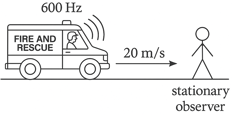
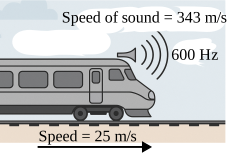
A fire truck is moving toward a stationary observer at a speed of 20 ms\(^{-1}\). The siren on the fire truck emits sound at a frequency of 600 Hz.
 

  1. Calculate the observed frequency of the siren as heard by the observer.   (1 mark)

--- 2 WORK AREA LINES (style=lined) ---

  1. The flashing lights on the fire truck do not show a noticeable Doppler shift as it passes by. Explain why the Doppler effect for light is not observed in this situation.   (2 marks)

--- 4 WORK AREA LINES (style=lined) ---

Show Answers Only

a.    \(638\ \text{Hz}\)

b.    The Doppler effect for light:

  • The effect does occur for light, but it is only noticeable when objects move at speeds close to the speed of light.
  • Since the fire truck is moving at only 20 ms\(^{-1}\), the change in frequency of the light is extremely small, far too small for the human eye to detect.
  • Therefore, the Doppler shift for the headlights is negligible and not observable in this everyday situation.
Show Worked Solution

a.    By the Doppler effect:

\(f^{′} = f \dfrac{v \pm v_{\text{observer}}}{v \mp v_{\text{source}}} = 600 \times \dfrac{340}{340-20} = 638\ \text{Hz}\)
 

b.    The Doppler effect for light:

  • The effect does occur for light, but it is only noticeable when objects move at speeds close to the speed of light.
  • Since the fire truck is moving at only 20 ms\(^{-1}\), the change in frequency of the light is extremely small, far too small for the human eye to detect.
  • Therefore, the Doppler shift for the headlights is negligible and not observable in this everyday situation.

Filed Under: Sound Waves Tagged With: Band 4, Band 5, smc-4280-10-Doppler effect

PHYSICS, M3 EQ-Bank 1 MC

The horn of a stationary train emits sound at a frequency of 1400 Hz. What will be the apparent frequency heard by an observer if the train moves away at 30 m/s?

  1. 1325 Hz
  2. 1265 Hz
  3. 1350 Hz
  4. 1286 Hz
Show Answers Only

\(D\)

Show Worked Solution
  • Doppler effect:
  •    \(f^{′} = f \dfrac{v \pm v_{\text{observer}}}{v \mp v_{\text{source}}} = 1400 \times \dfrac{340}{340 + 30} = 1286\ \text{Hz}\)

\(\Rightarrow D\)

Filed Under: Sound Waves Tagged With: Band 4, smc-4280-10-Doppler effect

PHYSICS, M3 EQ-Bank 3

A tuning fork with a frequency of 384 Hz is held above a pipe closed at one end, and it produces a fifth harmonic resonance. The speed of sound in air is 343 m/s.

How long is the pipe?   (2 marks)

--- 6 WORK AREA LINES (style=lined) ---

Show Answers Only

\(1.12\ \text{m}\)

Show Worked Solution
  • The length of a closed pipe producing the fifth harmonic will be equivalent to \(\dfrac{5}{4} \lambda \) of the wave as seen in the diagram below.
     

\(L = \dfrac{5\lambda}{4} = \dfrac{5v}{4f} = \dfrac{5 \times 343}{4 \times 384} = 1.12\ \text{m}\)

Filed Under: Sound Waves Tagged With: Band 4, smc-4280-40-Standing Waves in Closed Pipes

PHYSICS, M3 EQ-Bank 2

On a summer day, a train is moving at a speed of 25 m/s along a straight track. The train’s horn emits a steady tone at a frequency of 600 Hz. The speed of sound in air on that day is measured to be 343 m/s.
 

A stationary sound sensor is placed ahead of the train on the track.

  1. What frequency will be detected by the sensor positioned in front of the moving train?   (2 marks)

--- 4 WORK AREA LINES (style=lined) ---

  1. The same experiment is repeated on a winter day, when the speed of sound in air is measured to be 320 m/s. Would the detected pitch at the same location be higher or lower than on the summer day? Justify your answer.   (2 marks)

--- 4 WORK AREA LINES (style=lined) ---

Show Answers Only

a.    \(647\ \text{Hz}\)

b.    With speed of sound down to 320 ms\(^{-1}\), find the new frequency:

  •    \(f^{′}=600 \times \dfrac{320 + 0}{320-25}=650\ \text{Hz}\)
  • As the pitch is directly related to the frequency of a wave, the increase in the frequency of the wave will lead to an increase in the pitch.
Show Worked Solution
a.    \(f^{′}\) \(=f \dfrac{v \pm v_{\text{observer}}}{v \mp v_{\text{source}}}\)
    \(=600 \times \dfrac{343 + 0}{343-25}=647\ \text{Hz}\)

 
b.    With speed of sound down to 320 ms\(^{-1}\), find the new frequency:

  •    \(f^{′}=600 \times \dfrac{320 + 0}{320-25}=650\ \text{Hz}\)
  • As the pitch is directly related to the frequency of a wave, the increase in the frequency of the wave will lead to an increase in the pitch.

Filed Under: Sound Waves Tagged With: Band 4, smc-4280-10-Doppler effect

PHYSICS, M3 EQ-Bank 6

An arrow of height 2 cm is placed 6 cm in front of a biconvex lens of focal length 3cm.

  1. Draw a principle ray diagram to show the image that is formed.   (3 marks)


  1. Is the image real or virtual and give a reason for your answer.   (2 marks)

--- 3 WORK AREA LINES (style=lined) ---

  1. Use the principle ray diagram to determine the size of the image.   (1 mark)

--- 1 WORK AREA LINES (style=lined) ---

Show Answers Only

a.  
       

b.   The image is real.

  • The rays of light from the arrow are bent toward each other by the lens and actually converge on the opposite side of the lens.
  • Because the rays physically meet, a real image is formed.

c.    The size of the image is 2 cm.

Show Worked Solution

a.    


b.   The image is real.

  • The rays of light from the arrow are bent toward each other by the lens and actually converge on the opposite side of the lens.
  • Because the rays physically meet, a real image is formed.

c.    The size of the image is 2 cm.

Filed Under: Ray Model of Light Tagged With: Band 4, Band 5, smc-4281-55-Mirrors/Lenses

HMS, HIC EQ-Bank 428

Aboriginal and Torres Strait Islander young people experience significantly higher rates of mental health issues and suicide compared to non-Indigenous young people.

Outline the roles of government and non-government organisations in addressing this issue and discuss strategies they could adopt to improve the mental health outcomes of Aboriginal and Torres Strait Islander young people.   (6 marks)

--- 18 WORK AREA LINES (style=lined) ---

Show Answers Only

*Recommended phrases for balanced “for/against” language are bolded in the answer below.

Government Role

  • Provide funding for culturally appropriate mental health services specifically designed for ATSI communities

Government Strategies

  • Implement culturally responsive mental health programs in schools with high ATSI student populations. While this provides accessible early intervention, critics contend school-based programs often fail to be effective for disconnected youth.
  • Develop Aboriginal Community Controlled Health Organisation partnerships. On one hand, this ensures cultural governance. On the other hand, bureaucratic requirements may slow implementation.

NGO Role

  • Deliver community-based support programs incorporating traditional healing practices alongside contemporary mental health approaches.

NGO Strategies

  • Establish peer support networks led by ATSI young people to reduce stigma. A key advantage is connecting young people with relatable role models. Conversely, young leaders may lack training for difficult cases. This creates both opportunities for culturally safe spaces and challenges in ensuring support quality.
  • Train ATSI Elders as mental health first aid advocates. From one perspective, this respects traditional knowledge systems. An alternative perspective suggests Elders may feel burdened with Western responsibilities. Nevertheless, combining traditional wisdom with contemporary training offers sustainable solutions despite potential tensions.
Show Worked Solution

*Recommended phrases for balanced “for/against” language are bolded in the answer below.

Government Role

  • Provide funding for culturally appropriate mental health services specifically designed for ATSI communities

Government Strategies

  • Implement culturally responsive mental health programs in schools with high ATSI student populations. While this provides accessible early intervention, critics contend school-based programs often fail to be effective for disconnected youth.
  • Develop Aboriginal Community Controlled Health Organisation partnerships. On one hand, this ensures cultural governance. On the other hand, bureaucratic requirements may slow implementation.

NGO Role

  • Deliver community-based support programs incorporating traditional healing practices alongside contemporary mental health approaches.

NGO Strategies

  • Establish peer support networks led by ATSI young people to reduce stigma. A key advantage is connecting young people with relatable role models. Conversely, young leaders may lack training for difficult cases. This creates both opportunities for culturally safe spaces and challenges in ensuring support quality.
  • Train ATSI Elders as mental health first aid advocates. From one perspective, this respects traditional knowledge systems. An alternative perspective suggests Elders may feel burdened with Western responsibilities. Nevertheless, combining traditional wisdom with contemporary training offers sustainable solutions despite potential tensions.

Filed Under: Individual, organisational and community advocacy Tagged With: Band 4, Band 5, smc-5512-20-Government, smc-5512-40-NGOs

HMS, HIC EQ-Bank 427

Describe the personal skills that enable young people to protect themselves from health risks. Use specific examples.   (3 marks)

--- 7 WORK AREA LINES (style=lined) ---

Show Answers Only

Decision-making skills:

  • Young people can evaluate risks and make informed choices, such as deciding not to drink alcohol at parties or choosing nutritious foods over fast food options.

Communication skills:

  • Effective verbal and non-verbal communication enables young people to express boundaries in relationships, seek help from trusted adults when experiencing mental health concerns, or negotiate with peers.

Self-efficacy:

  • Having confidence in personal abilities allows young people to set and achieve health goals, such as maintaining regular exercise routines or resisting peer pressure to engage in risky behaviours.
Show Worked Solution

Decision-making skills:

  • Young people can evaluate risks and make informed choices, such as deciding not to drink alcohol at parties or choosing nutritious foods over fast food options.

Communication skills:

  • Effective verbal and non-verbal communication enables young people to express boundaries in relationships, seek help from trusted adults when experiencing mental health concerns, or negotiate with peers.

Self-efficacy:

  • Having confidence in personal abilities allows young people to set and achieve health goals, such as maintaining regular exercise routines or resisting peer pressure to engage in risky behaviours.

Filed Under: Strengthening, protecting and enhancing health Tagged With: Band 4, smc-5511-10-Personal empowerment

HMS, HIC EQ-Bank 426

Headspace provides mental health services, resources and support programs specifically targeting young Australians aged 12-25 and their families.

Identify TWO such services and explain how they address mental health issues in young Australians.   (4 marks)

--- 15 WORK AREA LINES (style=lined) ---

Show Answers Only

Any TWO of the following

Headspace centres:

  • These youth-friendly physical locations provide face-to-face counselling, psychological support and early intervention services, addressing mental health issues by offering accessible, age-appropriate treatment in non-clinical environments that reduce stigma and encourage help-seeking behaviour.

eheadspace online support:

  • This digital platform offers web-based and phone counselling services, chat support and self-help resources, addressing mental health issues by providing immediate access to professional support regardless of location, particularly benefiting young people in rural areas or those hesitant to seek face-to-face help.

School support programs:

  • Headspace delivers mental health education and early intervention programs directly in educational settings, addressing mental health issues by building awareness, reducing stigma and identifying at-risk students before problems escalate into more serious conditions. 

Family and carer support:

  • These programs provide education and resources for parents and carers about youth mental health, addressing mental health issues by creating supportive home environments and equipping families with skills to recognise warning signs and respond appropriately.
Show Worked Solution

Answers could include any two of the following:

Headspace centres

  • These youth-friendly physical locations provide face-to-face counselling, psychological support and early intervention services, addressing mental health issues by offering accessible, age-appropriate treatment in non-clinical environments that reduce stigma and encourage help-seeking behaviour.

eheadspace online support

  • This digital platform offers web-based and phone counselling services, chat support and self-help resources, addressing mental health issues by providing immediate access to professional support regardless of location, particularly benefiting young people in rural areas or those hesitant to seek face-to-face help.

School support programs

  • Headspace delivers mental health education and early intervention programs directly in educational settings, addressing mental health issues by building awareness, reducing stigma and identifying at-risk students before problems escalate into more serious conditions. 

Family and carer support

  • These programs provide education and resources for parents and carers about youth mental health, addressing mental health issues by creating supportive home environments and equipping families with skills to recognise warning signs and respond appropriately.

Filed Under: Research and Health Related Issues Tagged With: Band 3, Band 4, smc-5800-20-Current strategies

HMS, HIC EQ-Bank 425

The eSafety Commissioner provides educational resources, cyberbullying reporting systems, and online safety programs specifically targeting Australian young people and their families.

Identify TWO such resources and explain how they address technology-related health issues in young Australians.   (5 marks)

--- 15 WORK AREA LINES (style=lined) ---

Show Answers Only

*Language highlighting the cause-effect relationship is bolded in the answer below.

Answers could include any two of the following:

Cyberbullying reporting portal

  • This online system allows young people to report serious cyberbullying incidents directly to eSafety, who can then require social media platforms to remove harmful content within 24 hours.
  • This leads to immediate reduction in psychological harm because victims regain control over their online experience and see tangible action taken against perpetrators.
  • As a result, young people feel empowered to seek help early, which prevents the escalation of mental health issues like anxiety and depression that occur when cyberbullying continues unchecked.

Online safety education programs

  • These school-based initiatives teach young people to recognise online risks, manage their digital footprint, and develop resilience strategies against cyber-threats.
  • This works by building critical thinking skills that enable students to identify predatory behaviour, scams, and harmful content before engaging with them.
  • The reason this is effective is that prevention through education creates long-lasting protective behaviours, which results in fewer technology-related mental health issues and demonstrates why early intervention through schools is crucial.

Parent and carer resources

  • Educational materials help adults understand online risks, privacy settings, and age-appropriate content restrictions for different platforms.
  • This occurs because informed parents can implement protective measures at home, which creates safer digital environments where young people can explore technology without excessive exposure to harmful content.
  • This relationship results in stronger family communication about online experiences, thereby reducing the likelihood of young people hiding cyber-incidents and ensuring early intervention when problems arise.

Safer Internet Day campaigns

  • Annual awareness activities promote positive online behaviours, digital citizenship, and responsible technology use among young Australians through schools and community events.
  • This happens when widespread messaging reaches multiple stakeholders simultaneously, which causes a collective shift in understanding about healthy online interactions.
  • This demonstrates why community-wide approaches are powerful – they create social norms around respectful online behaviour, which leads to reduced cyberbullying incidents and establishes technology use as a shared responsibility between young people, families, and schools.
Show Worked Solution

*Language highlighting the cause-effect relationship is bolded in the answer below.

Answers could include any two of the following:

Cyberbullying reporting portal

  • This online system allows young people to report serious cyberbullying incidents directly to eSafety, who can then require social media platforms to remove harmful content within 24 hours.
  • This leads to immediate reduction in psychological harm because victims regain control over their online experience and see tangible action taken against perpetrators.
  • As a result, young people feel empowered to seek help early, which prevents the escalation of mental health issues like anxiety and depression that occur when cyberbullying continues unchecked.

Online safety education programs

  • These school-based initiatives teach young people to recognise online risks, manage their digital footprint, and develop resilience strategies against cyber-threats.
  • This works by building critical thinking skills that enable students to identify predatory behaviour, scams, and harmful content before engaging with them.
  • The reason this is effective is that prevention through education creates long-lasting protective behaviours, which results in fewer technology-related mental health issues and demonstrates why early intervention through schools is crucial.

Parent and carer resources

  • Educational materials help adults understand online risks, privacy settings, and age-appropriate content restrictions for different platforms.
  • This occurs because informed parents can implement protective measures at home, which creates safer digital environments where young people can explore technology without excessive exposure to harmful content.
  • This relationship results in stronger family communication about online experiences, thereby reducing the likelihood of young people hiding cyber-incidents and ensuring early intervention when problems arise.

Safer Internet Day campaigns

  • Annual awareness activities promote positive online behaviours, digital citizenship, and responsible technology use among young Australians through schools and community events.
  • This happens when widespread messaging reaches multiple stakeholders simultaneously, which causes a collective shift in understanding about healthy online interactions.
  • This demonstrates why community-wide approaches are powerful – they create social norms around respectful online behaviour, which leads to reduced cyberbullying incidents and establishes technology use as a shared responsibility between young people, families, and schools.

Filed Under: Research and Health Related Issues Tagged With: Band 4, Band 5, smc-5800-20-Current strategies

HMS, HIC EQ-Bank 423

Outline research areas that could enhance understanding and advocacy for violence prevention among Australian youth.   (4 marks)

--- 10 WORK AREA LINES (style=lined) ---

Show Answers Only

Cyberbullying intervention research:

  • Studies examining the effectiveness of different online safety education programs and digital reporting systems in reducing cyber-violence among young Australians.

Bystander behaviour analysis:

  • Research investigating what motivates young people to intervene in violent situations and how to strengthen protective peer networks in schools and communities.

Cultural violence patterns:

  • Examining how violence experiences differ across various cultural communities to develop targeted prevention strategies for Australia’s diverse youth population.

Long-term impact studies:

  • Longitudinal research tracking how early exposure to violence affects young people’s mental health, relationships, and life outcomes into adulthood.
Show Worked Solution

Cyberbullying intervention research:

  • Studies examining the effectiveness of different online safety education programs and digital reporting systems in reducing cyber-violence among young Australians.

Bystander behaviour analysis:

  • Research investigating what motivates young people to intervene in violent situations and how to strengthen protective peer networks in schools and communities.

Cultural violence patterns:

  • Examining how violence experiences differ across various cultural communities to develop targeted prevention strategies for Australia’s diverse youth population.

Long-term impact studies:

  • Longitudinal research tracking how early exposure to violence affects young people’s mental health, relationships, and life outcomes into adulthood.

Filed Under: Research and Health Related Issues Tagged With: Band 4, smc-5800-25-Strategy dev and advocacy

HMS, HIC EQ-Bank 422

Describe areas for further research that could build understanding and advocacy regarding sense of self and body issues among young Australians.   (4 marks)

--- 10 WORK AREA LINES (style=lined) ---

Show Answers Only

Social media impact studies:

  • Longitudinal research examining how different social media platforms and usage patterns specifically influence body image development and self-esteem in Australian adolescents.

Cultural diversity research:

  • Investigating how body image perceptions vary across different cultural backgrounds within Australia’s multicultural youth population to develop culturally appropriate interventions.

Gender identity studies:

  • Research exploring body image experiences among gender-diverse young people to better understand their unique challenges and support needs.

Early intervention effectiveness:

  • Evaluating which school-based body positivity programs show the most promising results in preventing eating disorders and improving self-concept among young Australians.
Show Worked Solution

Social media impact studies:

  • Longitudinal research examining how different social media platforms and usage patterns specifically influence body image development and self-esteem in Australian adolescents.

Cultural diversity research:

  • Investigating how body image perceptions vary across different cultural backgrounds within Australia’s multicultural youth population to develop culturally appropriate interventions.

Gender identity studies:

  • Research exploring body image experiences among gender-diverse young people to better understand their unique challenges and support needs.

Early intervention effectiveness:

  • Evaluating which school-based body positivity programs show the most promising results in preventing eating disorders and improving self-concept among young Australians.

Filed Under: Research and Health Related Issues Tagged With: Band 4, Band 5, smc-5800-25-Strategy dev and advocacy

HMS, HIC EQ-Bank 421

Outline three strategies that could effectively reduce addictive behaviours among Australian youth.   (3 marks)

--- 7 WORK AREA LINES (style=lined) ---

Show Answers Only

Alternative reward systems:

  • Creating community-based achievement programs that provide recognition and social connection through non-addictive activities like volunteering, creative arts and leadership opportunities.

Digital wellness education:

  • Implementing mandatory screen-time awareness programs in schools that teach young people to recognise and manage technology addiction through practical digital detox strategies.

Family-centred interventions:

  • Providing parents with specific training to identify early warning signs of addictive behaviours and effective communication strategies for addressing concerning patterns.
Show Worked Solution

Alternative reward systems:

  • Creating community-based achievement programs that provide recognition and social connection through non-addictive activities like volunteering, creative arts and leadership opportunities.

Digital wellness education:

  • Implementing mandatory screen-time awareness programs in schools that teach young people to recognise and manage technology addiction through practical digital detox strategies.

Family-centred interventions:

  • Providing parents with specific training to identify early warning signs of addictive behaviours and effective communication strategies for addressing concerning patterns.

Filed Under: Research and Health Related Issues Tagged With: Band 4, smc-5800-25-Strategy dev and advocacy

HMS, HIC EQ-Bank 420

Outline three strategies that would be effective in improving mental health outcomes for young Australians.   (3 marks)

--- 7 WORK AREA LINES (style=lined) ---

Show Answers Only

Peer-led mental health programs

  • Training young people as mental health ambassadors in schools creates relatable support and reduces stigma through peer-to-peer education and early intervention.

Digital mental health platforms

  • Developing age-appropriate apps with interactive features like mood tracking, crisis support chatbots, and virtual counselling sessions increases accessibility for tech-savvy youth.

Workplace mental health initiatives

  • Implementing mental health support in part-time employment settings where many young people work addresses stress in non-academic environments.
Show Worked Solution

Peer-led mental health programs

  • Training young people as mental health ambassadors in schools creates relatable support and reduces stigma through peer-to-peer education and early intervention.

Digital mental health platforms

  • Developing age-appropriate apps with interactive features like mood tracking, crisis support chatbots, and virtual counselling sessions increases accessibility for tech-savvy youth.

Workplace mental health initiatives

  • Implementing mental health support in part-time employment settings where many young people work addresses stress in non-academic environments.

Filed Under: Research and Health Related Issues Tagged With: Band 4, smc-5800-25-Strategy dev and advocacy

HMS, HIC EQ-Bank 419 MC

Which of the following is the most effective protective factor in preventing road safety incidents among young Australian drivers?

  1. Installing advanced safety features like airbags and anti-lock braking systems in vehicles
  2. Implementing graduated licensing systems with supervised driving hours and passenger restrictions
  3. Increasing penalties and fines for traffic violations committed by young drivers
  4. Providing free public transport options as alternatives to driving
Show Answers Only

\(B\)

Show Worked Solution
  • B is correct: Graduated licensing systems address the key risk factor of inexperience by requiring supervised practice and limiting high-risk situations for novice drivers.

Other Options:

  • A is incorrect: Safety features reduce injury severity but don’t prevent accidents caused by inexperience and risk-taking behaviours.
  • C is incorrect: Increased penalties are reactive measures that don’t address the underlying causes of poor decision-making in young drivers.
  • D is incorrect: Public transport availability doesn’t directly build driving skills or address behaviours when young people do choose to drive.

Filed Under: Research and Health Related Issues Tagged With: Band 4, smc-5800-15-Protective/risk factors

HMS, HIC EQ-Bank 418

Explain the protective factors that can reduce alcohol-related harm among Australian youth.   (5 marks)

--- 15 WORK AREA LINES (style=lined) ---

Show Answers Only

*PEEL – Solution is structured using an adjusted PEEL method to show cause and effect: [P] State the cause/factor [E] Show how it causes the effect [Ev] Evidence demonstrating why/how [L] Reinforce the causal relationship.

  • [P] Personal skills like assertiveness and decision-making protect youth from alcohol harm.
  • [E] This occurs because these skills enable young people to refuse drinks and resist peer pressure.
  • [Ev] Research shows teens with assertiveness training are much less likely to binge drink at parties.
  • [L] Therefore, strong personal skills create self-protection against risky drinking.
     
  • [P] Community alcohol-free venues and events reduce youth drinking.
  • [E] This works by providing alternative social spaces where teens can have fun without alcohol.
  • [Ev] Youth centres with late-night programs report that participants exhibit significantly lower underage drinking rates.
  • [L] This demonstrates why safe community spaces effectively prevent alcohol-related harm.
     
  • [P] Positive family role-modelling protects adolescents from alcohol misuse.
  • [E] The reason for this is that parents who drink responsibly teach healthy attitudes through example.
  • [Ev] Research shows that teens whose parents set clear alcohol rules have fewer drinking incidents.
  • [L] This relationship results in family influence creating lasting protective behaviours against alcohol harm.
Show Worked Solution

*PEEL – Solution is structured using an adjusted PEEL method to show cause and effect: [P] State the cause/factor [E] Show how it causes the effect [Ev] Evidence demonstrating why/how [L] Reinforce the causal relationship.

  • [P] Personal skills like assertiveness and decision-making protect youth from alcohol harm.
  • [E] This occurs because these skills enable young people to refuse drinks and resist peer pressure.
  • [Ev] Research shows teens with assertiveness training are much less likely to binge drink at parties.
  • [L] Therefore, strong personal skills create self-protection against risky drinking.
     
  • [P] Community alcohol-free venues and events reduce youth drinking.
  • [E] This works by providing alternative social spaces where teens can have fun without alcohol.
  • [Ev] Youth centres with late-night programs report that participants exhibit significantly lower underage drinking rates.
  • [L] This demonstrates why safe community spaces effectively prevent alcohol-related harm.
     
  • [P] Positive family role-modelling protects adolescents from alcohol misuse.
  • [E] The reason for this is that parents who drink responsibly teach healthy attitudes through example.
  • [Ev] Research shows that teens whose parents set clear alcohol rules have fewer drinking incidents.
  • [L] This relationship results in family influence creating lasting protective behaviours against alcohol harm.

Filed Under: Research and Health Related Issues Tagged With: Band 4, smc-5800-15-Protective/risk factors

HMS, HIC EQ-Bank 417

Describe how protective factors can prevent physical inactivity among young Australians.   (4 marks)

--- 10 WORK AREA LINES (style=lined) ---

Show Answers Only

Personal skills:

  • Young people with assertiveness and decision-making skills can prioritise physical activity over sedentary alternatives like excessive screen time.

Community initiatives:

  • Programs like parkrun and school sports provide structured opportunities and social support encouraging regular participation in movement activities.

Infrastructure improvements:

  • Safe cycling paths, well-lit spaces, and accessible facilities remove environmental barriers enabling safe community-based physical activity.

Social support:

  • Active families and peers create positive norms that encourage young people to value and maintain regular movement patterns.
Show Worked Solution

Personal skills:

  • Young people with assertiveness and decision-making skills can prioritise physical activity over sedentary alternatives like excessive screen time.

Community initiatives:

  • Programs like parkrun and school sports provide structured opportunities and social support encouraging regular participation in movement activities.

Infrastructure improvements:

  • Safe cycling paths, well-lit spaces, and accessible facilities remove environmental barriers enabling safe community-based physical activity.

Social support:

  • Active families and peers create positive norms that encourage young people to value and maintain regular movement patterns.

Filed Under: Research and Health Related Issues Tagged With: Band 4, smc-5800-15-Protective/risk factors

HMS, HIC EQ-Bank 416 MC

Which of the following best describes the primary role of NACCHO (National Aboriginal Community Controlled Health Organisation) in supporting the health of young Aboriginal and Torres Strait Islander people?

  1. Providing direct medical treatment to Aboriginal and Torres Strait Islander young people across Australia
  2. Advocating for and supporting community-controlled health services that deliver culturally appropriate care
  3. Funding individual Aboriginal and Torres Strait Islander families to access private healthcare
  4. Training non-Indigenous health professionals to work in remote communities
Show Answers Only

\(B\)

Show Worked Solution
  • B is correct: Advocating for and supporting community-controlled health services that provide culturally safe and appropriate healthcare for Aboriginal and Torres Strait Islander communities.

Other Options:

  • A is incorrect: NACCHO is a peak body that supports member organisations rather than directly providing medical treatment itself.
  • C is incorrect: NACCHO does not provide individual family funding but works at a systemic level to improve health service delivery.
  • D is incorrect: While NACCHO may support cultural competency training, its primary focus is advocating for community-controlled rather than mainstream services.

Filed Under: Individual, organisational and community advocacy, Research and Health Related Issues Tagged With: Band 4, smc-5512-40-NGOs, smc-5800-20-Current strategies

HMS, HIC EQ-Bank 414 MC

Which of the following demonstrates a young person using problem-solving skills to address a mental health concern?

  1. Joining a support group to connect with peers facing similar challenges
  2. Researching different therapy options when their current counsellor has a long waiting list
  3. Asking a trusted adult for advice about managing stress
  4. Practicing mindfulness techniques learned in a wellness program
Show Answers Only

\(B\)

Show Worked Solution
  • B is correct: This demonstrates problem-solving by identifying alternative solutions when faced with barriers to accessing help.

Other Options:

  • A and C incorrect: These show help-seeking behaviour and connectedness rather than active problem-solving.
  • D is incorrect: This shows application of coping strategies rather than problem-solving to overcome obstacles.

Filed Under: Research and Health Related Issues, Strengthening, protecting and enhancing health Tagged With: Band 4, smc-5511-10-Personal empowerment, smc-5800-10-Youth health issue, smc-5800-30-Personal reflection

PHYSICS, M3 EQ-Bank 11 MC

Which of the following is always true when light undergoes refraction as it passes from one transparent medium into another?

  1. The light will always bend away from the normal.
  2. The frequency of the light will increase.
  3. The angle of incidence will always equal the angle of refraction.
  4. The speed and wavelength of light will change.
Show Answers Only

\(D\)

Show Worked Solution
  • A is incorrect as the light will bend towards or away from the normal depending on whether the light is a denser and less dense medium respectively.
  • B is incorrect as the frequency of light is independent of the medium the light is travelling through.
  • C is incorrect as this is only true if the two media have the same refractive index.
  • D is correct as light slows down or speeds up depending on the refractive index of the medium. Since frequency remains constant, a change in speed causes the wavelength to change.

\(\Rightarrow D\)

Filed Under: Ray Model of Light Tagged With: Band 4, smc-4281-10-Snell's Law, smc-4281-20-Snell's Law and TIR

PHYSICS, M3 EQ-Bank 5

Optical fibres are made using materials with different refractive indices to allow total internal reflection. The diagram below shows an optical fibre with a core and an outer cladding.

A laser beam with a wavelength of 620 nm in air is directed into the fibre from air.
 

  1. Calculate the frequency of the laser light before entering the optical fibre.   (2 marks)

--- 4 WORK AREA LINES (style=lined) ---

  1. The refractive index of the core is 1.50 and the cladding is 1.40. Calculate the critical angle at the core–cladding boundary.
    Show all working.   (2 marks)

--- 4 WORK AREA LINES (style=lined) ---

  1. What is the frequency of the light while it is travelling through the optical fibre?   (1 mark)

--- 2 WORK AREA LINES (style=lined) ---

Show Answers Only

a.    \(4.84 \times 10^{14}\ \text{Hz}\)

b.    \(61.9^{\circ}\)

c.    → Frequency of light is independent of the medium it is travelling through.

→ The frequency will be \(4.84 \times 10^{14}\ \text{Hz}\) as it travels though the optical fibre.

Show Worked Solution
a.     \(f\) \(=\dfrac{c}{\lambda}\)
    \(=\dfrac{3 \times 10^8}{620 \times 10^{-9}}\)
    \(=4.84 \times 10^{14}\ \text{Hz}\)


b.     \(\sin\theta_c\) \(=\dfrac{n_1}{n_2}\)
  \(\theta_c\) \(=\sin^{-1}\left(\dfrac{n_1}{n_2}\right)=\sin^{-1}\left(\dfrac{1.5}{1.7}\right)=61.9^{\circ}\)

 
c.   
Frequency of light:

  • Frequency of light is independent of the medium it is travelling through.
  • The frequency will be \(4.84 \times 10^{14}\ \text{Hz}\) as it travels though the optical fibre.

Filed Under: Ray Model of Light Tagged With: Band 4, Band 5, smc-4281-20-Snell's Law and TIR

PHYSICS, M3 EQ-Bank 4

Describe the two conditions must be met for total internal reflection to occur when light travels between two media?   (2 marks)

--- 4 WORK AREA LINES (style=lined) ---

Show Answers Only
  • Light must travel from a medium with a higher refractive index to a medium with a lower refractive index. This ensures that the light is moving from a denser to a less dense optical medium (e.g. from glass to air).
  • The angle of incidence must be greater than the critical angle. When this happens, instead of refracting, the light is completely reflected back into the denser medium.
Show Worked Solution
  • Light must travel from a medium with a higher refractive index to a medium with a lower refractive index. This ensures that the light is moving from a denser to a less dense optical medium (e.g. from glass to air).
  • The angle of incidence must be greater than the critical angle. When this happens, instead of refracting, the light is completely reflected back into the denser medium.

Filed Under: Ray Model of Light Tagged With: Band 4, smc-4281-20-Snell's Law and TIR

PHYSICS, M3 EQ-Bank 3

A light beam enters a glass prism with a refractive index \((n)\) of 1.60.
 

  1. What happens to the speed of the light as it enters the glass prism from air?   (1 mark)

--- 3 WORK AREA LINES (style=lined) ---

  1. A beam of green light with a frequency of 5.2 \(\times\) 10\(^{14}\) enters the glass. Calculate the wavelength of this light inside the prism.   (1 mark)

--- 2 WORK AREA LINES (style=lined) ---

  1. The beam strikes the surface of the prism at an angle of incidence of 30\(^{\circ}\). Calculate the angle of refraction for the beam as it enters the prism, and draw a line on the diagram (above) to show the direction of the beam inside the prism.    (2 marks)

    --- 4 WORK AREA LINES (style=lined) ---

  2. Define the term critical angle, and calculate the critical angle for the glass-to-air boundary of the prism.   (2 marks)

--- 4 WORK AREA LINES (style=lined) ---

Show Answers Only

a.    The speed of the light will slow down.

b.    \(3.6 \times 10^{-7}\ \text{m}\)

c.    \(18.2^{\circ}\)

d.   Critical angle definition:

  • The minimum angle of incidence in a denser medium (like glass) at which light is refracted along the boundary between two media (i.e. refracted at 90° to the normal).
  • If the angle of incidence is greater than the critical angle, total internal reflection occurs. i.e. the light is reflected back entirely into the denser medium.
  • The critical angle for the glass to air boundary is 38.7°.
Show Worked Solution

a.    Using  \(n = \dfrac{c}{v}:\)

\(v_g = \dfrac{c}{n_g} = \dfrac{3 \times 10^8}{1.6} = 1.875 \times 10^8\ \text{ms}^{-1}\)

  • The speed of the light will slow down.
     

b.    Using  \(v=f \times \lambda\):

\(\lambda_g = \dfrac{v_g}{f} = \dfrac{1.875 \times 10^8}{5.2 \times 10^{14}} = 3.6 \times 10^{-7}\ \text{m}\)
 

c.    Using Snell’s Law:

\(n_1 \sin \theta_1\) \(=n_2 \sin\theta_2\)  
\(\theta_2\) \(=\sin^{-1}\left(\dfrac{n_1 \sin\theta_1}{n_2}\right)=\sin^{-1}\left(\dfrac{1 \times \sin30}{1.60}\right)=18.2^{\circ}\)  


d.   Critical angle definition:

  • The minimum angle of incidence in a denser medium (like glass) at which light is refracted along the boundary between two media (i.e. refracted at 90° to the normal).
  • If the angle of incidence is greater than the critical angle, total internal reflection occurs. i.e. the light is reflected back entirely into the denser medium.
  • Using  \(\sin \theta_c=\dfrac{n_2}{n_1}\)
  •    \(\theta_c= \sin^{-1}\left(\dfrac{n_2}{n_1}\right) = \sin^{-1}\left(\dfrac{1}{1.6}\right) = 38.7^{\circ}\)
  • The critical angle for the glass to air boundary is 38.7°.

Filed Under: Ray Model of Light Tagged With: Band 3, Band 4, smc-4281-20-Snell's Law and TIR, smc-4281-40-Speed of light in medium

HMS, HIC EQ-Bank 124

Outline how the interaction of socioeconomic and biomedical determinants could adversely affect the health of an individual.   (3 marks)

--- 7 WORK AREA LINES (style=lined) ---

Show Answers Only
  • Low-income individuals with genetic predisposition to diabetes cannot afford regular blood glucose monitoring or healthy food options. This leads to poor disease management and increased risk of complications such as kidney disease and cardiovascular problems.
  • A person with lower limb amputation from a low socioeconomic background may lack access to quality prosthetics and rehabilitation services. This causes reduced mobility, increased risk of secondary injuries and social isolation affecting mental health.
  • Individuals with hereditary high cholesterol in financially disadvantaged families cannot afford cholesterol-lowering medications or heart-healthy diets. This increases their risk of cardiovascular disease and stroke at younger ages.
Show Worked Solution
  • Low-income individuals with genetic predisposition to diabetes cannot afford regular blood glucose monitoring or healthy food options. This leads to poor disease management and increased risk of complications such as kidney disease and cardiovascular problems.
  • A person with lower limb amputation from a low socioeconomic background may lack access to quality prosthetics and rehabilitation services. This causes reduced mobility, increased risk of secondary injuries and social isolation affecting mental health.
  • Individuals with hereditary high cholesterol in financially disadvantaged families cannot afford cholesterol-lowering medications or heart-healthy diets. This increases their risk of cardiovascular disease and stroke at younger ages.

Filed Under: Biomedical and Health Behaviours, Socioeconomic Tagged With: Band 4, smc-5805-70-Interaction of factors, smc-5806-20-Biomedical, smc-5806-80-Interaction of factors

PHYSICS, M3 EQ-Bank 2

A laser beam is directed at a mirror with an angle of incidence of 35\(^{\circ}\), as shown in the diagram. The laser is positioned 2.5 metres horizontally in front of the mirror and 4.0 metres above the ground.


How far from the base of the mirror does the reflected beam hit the floor?   (3 marks)

--- 8 WORK AREA LINES (style=lined) ---

Show Answers Only

4.64 metres.

Show Worked Solution
  • By the Law of Reflection, the angle of reflection will be equal to the angle of incidence.
  • Hence the diagram below can be drawn using the information in the question.
     

\(\tan 35\) \(=\dfrac{h_1}{2.5}\)  
\(h_1\) \(=2.5 \times \tan 35=1.75\ \text{m}\)  

 
\(h_2 = 5-1.75=3.25\ \text{m}\).

\(\tan 35\) \(=\dfrac{h_2}{x}\)  
\(x\) \(=\dfrac{3.25}{\tan 35}=4.64\ \text{m}\)  


  • The reflected light beam strikes the floor 4.64 m from the base of the mirror.

Filed Under: Ray Model of Light Tagged With: Band 4, smc-4281-45-Light Reflection

HMS, HIC EQ-Bank 123

Discuss how physical resources in a community can act as both positive and negative determinants of health.   (4 marks)

--- 10 WORK AREA LINES (style=lined) ---

Show Answers Only

*PEEL – Solution is structured using separate PEEL methods for each side of the argument; [P] Identify the point, [E] expand on the point with a link to question asked, [Ev] apply evidence/examples, [L] linking sentence back to question.

  • [P] Adequate physical resources promote positive health outcomes in communities.
  • [E] Parks, recreational facilities and safe walking paths encourage physical activity and social interaction.
  • [Ev] Research has shown that this reduces obesity rates and improves mental health through community engagement.
  • [L] In this way, well-developed infrastructure supports healthy lifestyle choices.
     
  • [P] In contrast, a lack of physical resources creates barriers to good health.
  • [E] Communities without adequate access to transport or recreational facilities such as playgrounds, parks and sporting ovals experience poorer health outcomes.
  • [Ev] Poor transport infrastructure can create a barrier to healthcare access and individuals who live in communities with inadequate recreational areas are more likely to be sedentary.
  • [L] Consequently, inadequate infrastructure perpetuates health inequities and increases disease and morbidity rates in those areas
Show Worked Solution

*PEEL – Solution is structured using separate PEEL methods for each side of the argument; [P] Identify the point, [E] expand on the point with a link to question asked, [Ev] apply evidence/examples, [L] linking sentence back to question.*

  • [P] Adequate physical resources promote positive health outcomes in communities.
  • [E] Parks, recreational facilities and safe walking paths encourage physical activity and social interaction.
  • [Ev] Research has shown that this reduces obesity rates and improves mental health through community engagement.
  • [L] In this way, well-developed infrastructure supports healthy lifestyle choices.
     
  • [P] In contrast, a lack of physical resources creates barriers to good health.
  • [E] Communities without adequate access to transport or recreational facilities such as playgrounds, parks and sporting ovals experience poorer health outcomes.
  • [Ev] Poor transport infrastructure can create a barrier to healthcare access and individuals who live in communities with inadequate recreational areas are more likely to be sedentary.
  • [L] Consequently, inadequate infrastructure perpetuates health inequities and increases disease and morbidity rates in those areas.

Filed Under: Environmental Tagged With: Band 4, Band 5, smc-5804-45-Community resources

HMS, HIC EQ-Bank 122

Describe how political structures and policies can function as a determinant of health in Australia.   (5 marks)

--- 15 WORK AREA LINES (style=lined) ---

Show Answers Only

Answers could include a selection of the following:

Medicare

  • Political structures directly influence healthcare accessibility through universal healthcare programs like Medicare.
  • Medicare provides free treatment in public hospitals and subsidised medical services, reducing financial barriers to healthcare

Education and training

  • Government policies on education funding impact long-term health outcomes by determining resource allocation to schools.
  • Government investment in education and job training programs, such as the NSW Fee Free TAFE initiative, improves employment opportunities and health outcomes.

Public Health

  • Health regulations established by government control food safety, pharmaceutical standards and environmental health protections.
  • Public health initiatives funded by government address population health issues through vaccination programs and health promotion campaigns.

Housing

  • Political decisions on housing policies affect living conditions and associated health outcomes for different population groups.

Workforce Policies

  • Government healthcare workforce policies determine the availability and distribution of healthcare professionals across regions.

Health and Safety Standards

  • Legislative frameworks establish health and safety standards in workplaces, protecting worker health and preventing occupational injuries.

Budgeting 

  • Budget allocation decisions by political structures, such as the NSW Ministry of Health, determine funding allocations to health services like hospitals, emergency services and mental health.
  • Controlling this critical flow of resources makes the political office a key determinant of health in Australia.
Show Worked Solution

Answers could include a selection of the following:

Medicare

  • Political structures directly influence healthcare accessibility through universal healthcare programs like Medicare.
  • Medicare provides free treatment in public hospitals and subsidised medical services, reducing financial barriers to healthcare

Education and training

  • Government policies on education funding impact long-term health outcomes by determining resource allocation to schools.
  • Government investment in education and job training programs, such as the NSW Fee Free TAFE initiative, improves employment opportunities and health outcomes.

Public Health

  • Health regulations established by government control food safety, pharmaceutical standards and environmental health protections.
  • Public health initiatives funded by government address population health issues through vaccination programs and health promotion campaigns.

Housing

  • Political decisions on housing policies affect living conditions and associated health outcomes for different population groups.

Workforce Policies

  • Government healthcare workforce policies determine the availability and distribution of healthcare professionals across regions.

Health and Safety Standards

  • Legislative frameworks establish health and safety standards in workplaces, protecting worker health and preventing occupational injuries.

Budgeting 

  • Budget allocation decisions by political structures, such as the NSW Ministry of Health, determine funding allocations to health services like hospitals, emergency services and mental health.
  • Controlling this critical flow of resources makes the political office a key determinant of health in Australia.

Filed Under: Broad features of society Tagged With: Band 4, Band 5, smc-5803-45-Political structures

  • « Previous Page
  • 1
  • …
  • 12
  • 13
  • 14
  • 15
  • 16
  • …
  • 114
  • Next Page »

Copyright © 2014–2025 SmarterEd.com.au · Log in