Calculate the average acceleration of an airplane during landing if it touches down with a velocity of 60 m/s north and comes to a complete stop over a distance of 350 m. (2 marks)
--- 5 WORK AREA LINES (style=lined) ---
Aussie Maths & Science Teachers: Save your time with SmarterEd
Calculate the average acceleration of an airplane during landing if it touches down with a velocity of 60 m/s north and comes to a complete stop over a distance of 350 m. (2 marks)
--- 5 WORK AREA LINES (style=lined) ---
Outline an experimental procedure to determine the acceleration of a falling steel ball. Your explanation should include all the measurements that must be recorded, the calculations needed to compute the acceleration, and an identification of any potential sources of error in the experiment. (6 marks)
--- 12 WORK AREA LINES (style=lined) ---
If \( { \displaystyle \int_a^b f(x) d x=-5 } \) and \( { \displaystyle \int_a^c f(x) d x=3 } \), where \(a<b<c\).
Find \( { \displaystyle \int_b^c 2 f(x) d x } \). (2 marks)
--- 5 WORK AREA LINES (style=lined) ---
A discrete random variable \(X\) is defined using the probability distribution below, where \(k\) is a positive real number.
\begin{array} {|c|c|}
\hline
\rule{0pt}{2.5ex} x \rule[-1ex]{0pt}{0pt} & \ \ \ \ \text{0}\ \ \ \ \rule[-1ex]{0pt}{0pt} & \ \ \ \ \text{1}\ \ \ \ \rule[-1ex]{0pt}{0pt} & \ \ \ \ \text{2}\ \ \ \ \rule[-1ex]{0pt}{0pt} & \ \ \ \ \text{3}\ \ \ \ \rule[-1ex]{0pt}{0pt} & \ \ \ \ \text{4}\ \ \ \ \\
\hline
\rule{0pt}{2.5ex} \text{Pr} \ (X = x) \rule[-1ex]{0pt}{0pt} & 2k \rule[-1ex]{0pt}{0pt} & 3k \rule[-1ex]{0pt}{0pt} & 5k \rule[-1ex]{0pt}{0pt} & 3k \rule[-1ex]{0pt}{0pt} & 2k \\
\hline
\end{array}
Find \(\operatorname{Pr}(X<4 \mid X>1)\) (3 marks)
--- 7 WORK AREA LINES (style=lined) ---
A function \(g(x)\) has the derivative \( { \displaystyle g^{\prime}(x)=x^3-x } \).
Given that \(g(0)=5\), the value of \(g(2)\) is
The asymptote(s) of the graph of \(y=\log _e(x+1)-3\) are
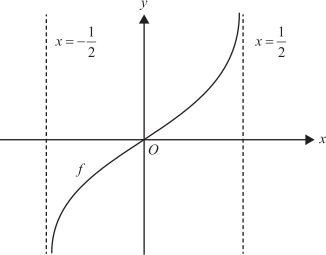
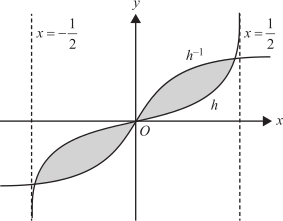
Consider the function `f`, where `f:\left(-\frac{1}{2}, \frac{1}{2}\right) \rightarrow R, f(x)=\log _e\left(x+\frac{1}{2}\right)-\log _e\left(\frac{1}{2}-x\right).`
Part of the graph of `y=f(x)` is shown below.
--- 1 WORK AREA LINES (style=lined) ---
--- 3 WORK AREA LINES (style=lined) ---
--- 2 WORK AREA LINES (style=lined) ---
--- 3 WORK AREA LINES (style=lined) ---
--- 4 WORK AREA LINES (style=lined) ---
--- 2 WORK AREA LINES (style=lined) ---
--- 2 WORK AREA LINES (style=lined) ---
A truck is driving along a straight road travelling at 10 ms\(^{-1}\). He then accelerates according to the acceleration time graph below:

Determine the final speed of the truck after it accelerates for 7 seconds.
A skydiver jumps from a stationary aircraft and yells as soon as she starts falling. Four seconds later, while still falling, she hears the echo of her shout from the ground below.
--- 2 WORK AREA LINES (style=lined) ---
--- 3 WORK AREA LINES (style=lined) ---
--- 4 WORK AREA LINES (style=lined) ---
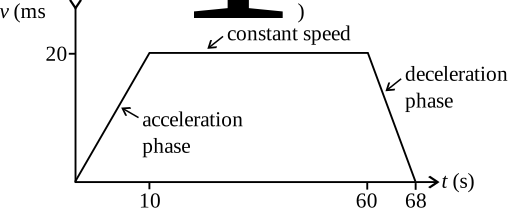
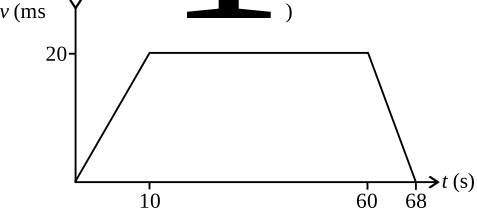
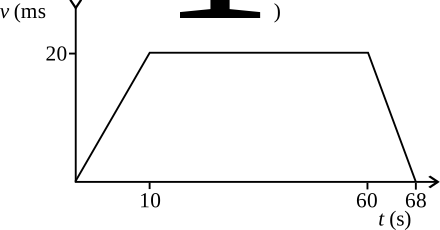
A bus departs from its depot, starting from rest and accelerating uniformly at 2.0 ms\(^{-2}\) for 10 seconds until it reaches a speed of 20 ms\(^{-1}\). It then travels at this constant speed for 50 seconds before decelerating uniformly at – 2.5 ms\(^{-2}\) until coming to a complete stop at the next bus stop. --- 6 WORK AREA LINES (style=blank) --- --- 4 WORK AREA LINES (style=lined) ---
Using the velocity-time graph below

Part 1
Determine the magnitude of the displacement:
Part 2
Determine the average acceleration between 4 and 8 seconds:
Explain how different training methods could be modified to maintain fitness during a 6-week injury rehabilitation period for a soccer player with a knee injury. (6 marks)
--- 16 WORK AREA LINES (style=lined) ---
Evaluate the benefits and limitations of Fartlek training compared to structured interval training for a team sport of your choice. (8 marks)
--- 26 WORK AREA LINES (style=lined) ---
Describe how aerobic and anaerobic training methods can be combined effectively in a basketball training session. (6 marks)
--- 18 WORK AREA LINES (style=lined) ---
Compare how anaerobic training methods would differ between a rugby league player and a tennis player. (6 marks)
--- 12 WORK AREA LINES (style=lined) ---
Discuss how HIIT training can be modified for different fitness levels in a group fitness class. (6 marks)
--- 12 WORK AREA LINES (style=lined) ---
Evaluate the effectiveness of different training methods for a 400 metre track athlete throughout a competition season. (8 marks)
--- 28 WORK AREA LINES (style=lined) ---
Analyse how contemporary training methods like HIIT and SIT have evolved from traditional aerobic and anaerobic training approaches. Use examples from two different sports. (8 marks)
--- 20 WORK AREA LINES (style=lined) ---
Explain how different training methods would be used across a soccer season to develop both aerobic and anaerobic fitness. (6 marks)
--- 18 WORK AREA LINES (style=lined) ---
Compare continuous training and High Intensity Interval Training (HIIT) methods and their application in basketball. (5 marks)
--- 15 WORK AREA LINES (style=lined) ---
Compare aerobic and anaerobic training methods. (5 marks)
--- 15 WORK AREA LINES (style=lined) ---
The most appropriate training method for improving a rugby league player's ability to repeatedly sprint during a game would be:
A soccer team's pre-season program includes:
This training session would be classified as:
A soccer player completes the following training session:
This training session would be classified as:
Compare how continuous training would be applied differently for an individual sport athlete versus a team sport athlete. (6 marks)
--- 12 WORK AREA LINES (style=lined) ---
Explain how a soccer player could use continuous training to improve their aerobic capacity during pre-season. (5 marks)
--- 15 WORK AREA LINES (style=lined) ---
Describe how continuous training differs from interval training. Use examples to support your answer. (4 marks)
--- 12 WORK AREA LINES (style=lined) ---
Which row correctly shows the characteristics of continuous training?
Outline the hydration needs of sprinters versus endurance athletes. (3 marks)
--- 7 WORK AREA LINES (style=lined) ---
Explain why timing of nutrient intake differs for a weightlifter versus a marathon runner. (3 marks)
--- 6 WORK AREA LINES (style=lined) ---
An endurance cyclist should prioritise which nutritional strategy during a 4-hour race?
A sprinter requires which micronutrient for optimal anaerobic energy production?
Let \(X\) be a binomial random variable where \(X \sim \operatorname{Bi}\left(4, \dfrac{9}{10}\right)\). --- 4 WORK AREA LINES (style=lined) --- --- 8 WORK AREA LINES (style=lined) ---
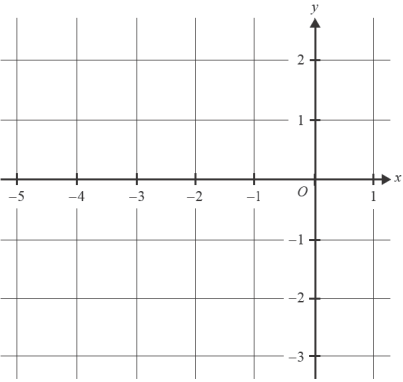
Let \(f(x)=\dfrac{1}{(x+3)^2}-2\). On the axes below, sketch the graph of \(y=f(x)\), labelling all asymptotes with their equations and axis intercepts with their coordinates. (4 marks) --- 4 WORK AREA LINES (style=lined) --- \(\text{Find asymptotes:}\) \((x+3) \neq 0\ \ \Rightarrow\ \ \text{Asymptote at}\ x=-3\) \(\text{As}\ x \rightarrow \infty, \ \dfrac{1}{(x+3)^2} \rightarrow 0\ \ \Rightarrow \ \ \text{Asymptote at}\ y=-2\) \(y\text{-intercept:}\ x=0\) \(y=\dfrac{1}{(0+3)^2}-2=-\dfrac{17}{9}\) \(x\text{-intercepts:}\ y=0\)
Show Answers Only
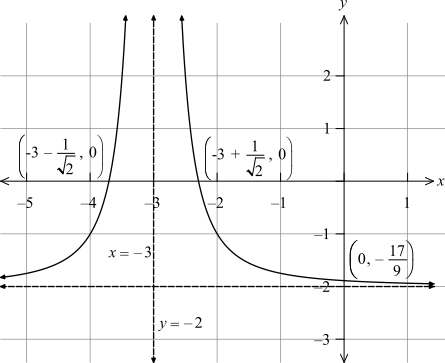 Show Worked Solution
\(\dfrac{1}{(x+3)^2}-2\)
\(=0\)
\((x+3)^2\)
\(=\dfrac{1}{2}\)
\(x+3\)
\(=\pm\dfrac{1}{\sqrt{2}}\)
\(x\)
\(=-3\pm\dfrac{1}{\sqrt{2}}\)
Compare pre and post-training nutrition requirements for a triathlete. (5 marks)
--- 15 WORK AREA LINES (style=lined) ---
Compare how carbohydrates and fats contribute to energy production during a marathon. (5 marks)
--- 15 WORK AREA LINES (style=lined) ---
Explain why iron requirements differ between endurance athletes and recreational athletes. (4 marks)
--- 10 WORK AREA LINES (style=lined) ---
A volleyball player has increased their intake of nuts and seeds during off-season training. Which nutrient in these foods is most likely to assist with reducing inflammation in their jumping knee?
Compare the nutritional requirements of a sprinter versus a marathon runner in preparation for competition. (5 marks)
--- 15 WORK AREA LINES (style=lined) ---
Assess the importance of iron intake for female endurance athletes. (5 marks)
--- 15 WORK AREA LINES (style=lined) ---
Explain how carbohydrate loading can improve performance for a marathon runner. (4 marks)
--- 8 WORK AREA LINES (style=lined) ---
A triathlete has just completed the swimming leg of their event. Which macronutrient should they prioritise during their transition to cycling?
A swimmer performs a 200 metre freestyle race.
Explain how TWO different energy systems contribute to fatigue during this event. (4 marks)
--- 8 WORK AREA LINES (style=lined) ---
During a summer time beach volleyball tournament, an athlete begins to experience fatigue during their third game of the day.
Identify TWO causes of fatigue and explain their impact on performance. (3 marks)
--- 12 WORK AREA LINES (style=lined) ---
Outline TWO causes of fatigue when an athlete performs a 100 metre sprint. (3 marks)
--- 6 WORK AREA LINES (style=lined) ---
Let \(f(x)=\log _e\left(x^3-3 x+2\right)\). Find \(f^{\prime}(3)\) (2 marks) --- 6 WORK AREA LINES (style=lined) ---
Describe how the three energy systems interact during a 3-minute boxing round. (5 marks)
--- 15 WORK AREA LINES (style=lined) ---
Explain how the lactic acid system contributes to energy production during a 200 m sprint. (4 marks)
--- 10 WORK AREA LINES (style=lined) ---
Outline how the ATP-PCr system provides energy for immediate muscle contraction. (3 marks)
--- 7 WORK AREA LINES (style=lined) ---
During a 400 metre sprint race, an athlete's performance is most dependent on which combination of energy systems?
Explain how the rate of recovery differs between anaerobic energy systems, and impacts performance. (4 marks)
--- 10 WORK AREA LINES (style=lined) ---
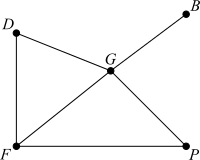
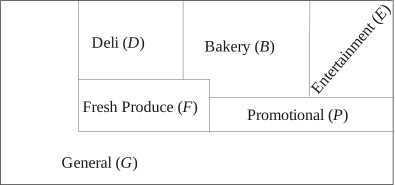
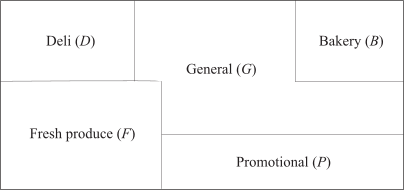
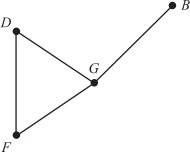
A supermarket has five departments, with areas allocated as shown on the floorplan below. The floorplan is represented by the network diagram below. On this network diagram, vertices represent departments and edges represent boundaries between two departments. This network diagram is incomplete. Draw the missing vertex and missing edges on the diagram above. Include a label. (2 marks) --- 0 WORK AREA LINES (style=lined) ---
During high-intensity interval training, an athlete performs 400 metre sprints. Which recovery period would be most appropriate to allow lactate clearance between efforts?
Compare the duration limitations of the ATP-PCr and Glycolytic energy systems. (4 marks)
--- 12 WORK AREA LINES (style=lined) ---
How does the rate of recovery between energy systems influence substitution strategies in team sports? (5 marks)
--- 15 WORK AREA LINES (style=lined) ---
A volleyball player performs six 30-second rallies with 2-minute rest periods between each rally. Which system would be LEAST relied upon for energy production?
Compare and contrast how the ATP-PCr and Glycolytic energy systems respond to high intensity exercise. (4 marks)
--- 8 WORK AREA LINES (style=lined) ---
Analyse how different intensities of training can affect energy system adaptations. (5 marks)
--- 15 WORK AREA LINES (style=lined) ---
A tennis player is in a rally lasting 45 seconds at moderate-high intensity. Which energy system sequence best represents their energy production?
During a 400 m race at high intensity, an athlete experiences muscular fatigue. What is the main cause?