SmarterEd

Aussie Maths & Science Teachers: Save your time with SmarterEd

  • Login
  • Get Help
  • About

Algebra, STD1 A3 2024 HSC 23

Carrie is organising a fundraiser.

The cost of hiring the venue and the band is $2500. The cost of providing meals is $50 per person.

  1. Complete the table of values to show the total cost of the fundraiser.   (1 mark)

    --- 0 WORK AREA LINES (style=lined) ---

\begin{array} {|l|c|c|c|c|c|c|c|}
\hline
\rule{0pt}{2.5ex} \text{Number of people} \rule[-1ex]{0pt}{0pt} & \ \ \ \ 0\ \ \ \  & 25 & 50 & 75 & 100 & 125 & 150 \\
\hline
\rule{0pt}{2.5ex} \text{Cost} \rule[-1ex]{0pt}{0pt} & & 3750 & 5000 & 6250 & 7500 & 8750 & 10\,000 \\
\hline
\end{array}

  1. Carrie decides that tickets should be sold at $70 per person. The graph shows the expected revenue at this ticket price. Using the information in part (a), plot the line that shows the cost of the fundraiser.   (2 marks)

    --- 0 WORK AREA LINES (style=lined) ---
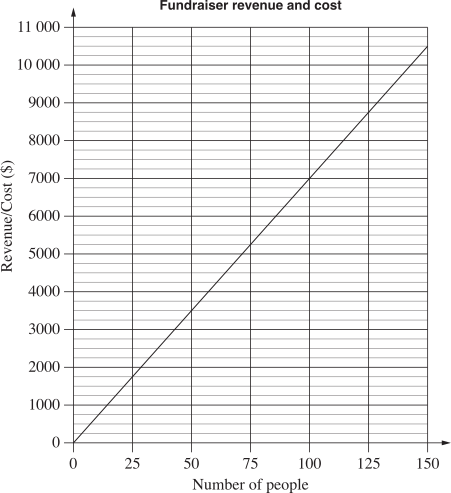
     

  1. How many tickets need to be sold for the fundraiser to break even?   (1 mark)

    --- 2 WORK AREA LINES (style=lined) ---

  2. Carrie sold 300 tickets. How much profit did the fundraiser make?   (3 marks)

    --- 8 WORK AREA LINES (style=lined) ---

Show Answers Only

a.    \(\text{Cost when 0 people }= $2500\)

b.
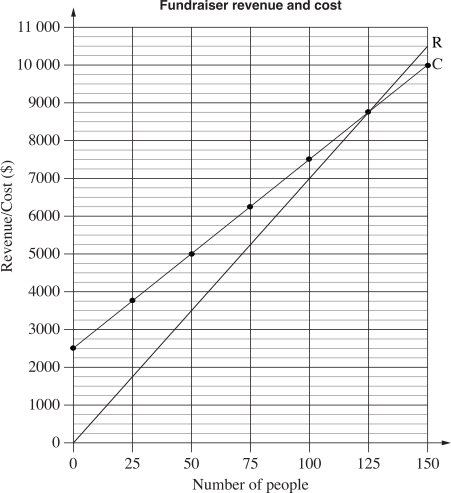

c.    \(100\ \text{tickets}\)

d.    \(\text{Profit }=$3500\)

Show Worked Solution

a.    \(\text{Cost when 0 people }= $2500\)

b.


c.    \(\text{Point of intersection}\ \ \Rightarrow\ \ \text{break-even}\)

\(\therefore\ \text{Break-even when 100 tickets sold.}\)
 

Mean mark (c) 53%.

d.    \(\text{Revenue}\ (R)=70n\ \ (n=\ \text{number of people)}\)

\(\text{Cost}\ (C)=2500 + \Big(\dfrac{1250}{25}\Big)n=2500+50n\)

\(\text{Find profit}\ (P)\ \text{when}\ \ n=300:\)

\(P\) \(=R-C\)
  \(=70\times 300-(2500+50\times300)\)
  \(=21\,000-17\,500\)
  \(=$3500\)
♦ Mean mark (d) 46%.

Filed Under: A3 Types of Relationships (Y12) Tagged With: Band 4, Band 5, smc-1099-10-Cost/Revenue

Measurement, STD1 M5 2024 HSC 29

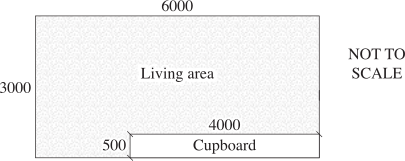
A floor plan for a living area is shown. All measurements are in millimetres.
 

  1. What is the length and width of the cupboard, in metres?   (1 mark)

    --- 2 WORK AREA LINES (style=lined) ---

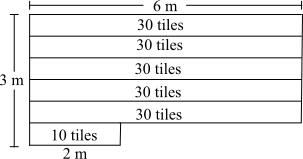
  2. The floor of the living area is to be tiled. Tiles will NOT be placed under the cupboard.
  3. Each tile is 0.2 m × 0.5 m. The tiles are supplied in boxes of 15 at a cost of $100 per box. Only full boxes can be purchased.
  4. What is the cost of the tiles for the living area?   (4 marks)

    --- 12 WORK AREA LINES (style=lined) ---

Show Answers Only

a.    \(4\ \text{m}\times 0.5\ \text{m}\)

b.    \($1100\)

Show Worked Solution

a.    \(\text{1 metre = 1000 mm}\)

\(\text{Cupboard}\ = 4\ \text{m}\times 0.5\ \text{m}\)

Mean mark (a) 53%.

b.    \(\text{Method 1}\)

\(\text{Total area to be tiled}\ =6\times 3-4\times 0.5=16\ \text{m}^2\)

\(\text{Area of each tile}\ =0.2\times0.5=0.1\ \text{m}^2\)

\(\text{Tiles needed}\ =\dfrac{16}{0.1}=160\ \text{tiles}\)

\(\text{Number of boxes}\ =\dfrac{160}{15}=10.66\dots=11\ \text{boxes}\)

\(\therefore\ \text{Total cost}\ =100\times 11=$1100\)

   
\(\text{Method 2}\)

\(\text{Tiles to fit 6 m width}\ =\dfrac{6}{0.2}=30 \)

\(\text{Tiles to fit 2 m width}\ =\dfrac{2}{0.2}=10 \)
 

\(\text{Total tiles}\ =30\times 5\ \text{rows}+10\times 1\ \text{rows}\ =160\)

\(\text{Number of boxes}\ =\dfrac{160}{15}=10.66\dots=11\ \text{boxes}\)

\(\therefore\ \text{Total cost}\ =100\times 11=$1100\)

♦♦ Mean mark (b) 35%.

Filed Under: M5 Scale Drawings (Y12), Perimeter and Area (Std 1), Perimeter and Area (Std1-2027) Tagged With: Band 4, Band 5, smc-1105-10-Floor Plans, smc-1121-10-Perimeter and Area, smc-6520-20-Composite areas

CHEMISTRY, M2 EQ-Bank 9

Sulfuric acid and potassium carbonate undergo neutralisation according to the following equation:

\(\ce{H2SO4(aq) + K2CO3(aq) -> K2SO4(aq) + CO2(g) + H2O(l)}\)

  1. Calculate the mass of potassium carbonate required to prepare 200 mL of a 0.15 mol L\(^{-1}\) solution of potassium carbonate.   (2 marks)

--- 4 WORK AREA LINES (style=lined) ---

  1. 30.00 mL of the solution in part (a.) was used to neutralise 20.00 mL of sulfuric acid. Calculate the concentration of the acid.   (2 marks)

--- 4 WORK AREA LINES (style=lined) ---

Show Answers Only

a.    \(4.1\ \text{g}\)

b.    \(0.225\ \text{mol L}^{-1}\)

Show Worked Solution

a.    \(MM\ce{(K2CO3)} = 2(39.10) + 12.01 + 3(16.00) = 138.21\ \text{g mol}^{-1}\)

\(n\ce{(K2CO3)} = c \times V = 0.15 \times 0.2 = 0.03\ \text{mol}\)

\(\Rightarrow m\ce{(K2CO3)} = 138.21 \times 0.03 = 4.1\ \text{g}\)


b.    The number of moles of \(\ce{K2CO3}\) used to neutralise:

\(c \times V = 0.15 \times 0.03 = 0.0045\ \text{mol} = n\ce{(H2SO4)}\)

\(\ce{[H2SO4]} = \dfrac{0.0045}{0.02} = 0.225\ \text{mol L}^{-1}\)

Filed Under: Concentration and Molarity Tagged With: Band 4, smc-4261-20-Concentration Calculations, smc-4261-40-Mass Calculations

CHEMISTRY, M2 EQ-Bank 7 MC

A solution is prepared by dissolving 2.00 g of calcium hydroxide \(\ce{(Ca(OH)2)}\) in enough water to produce a 500.0 mL solution. What is the concentration of hydroxide ions in the final solution?

  1. 0.108 mol L\(^{-1}\)
  2. 0.0540 mol L\(^{-1}\)
  3. 0.0270 mol L\(^{-1}\)
  4. 0.0162 mol L\(^{-1}\)
Show Answers Only

\(A\)

Show Worked Solution

\(n\ce{(Ca(OH)2)} = \dfrac{2.00}{40.08 + 2(1.008) + 2(16.00)} = 0.0270\ \text{mol}\)

\(\ce{Ca(OH)2(s) -> Ca^{2+}(aq) + 2OH-(aq)}\)

Using molar ratios:

\(n\ce{(OH^-)} = 0.0270 \times 2 = 0.0540\ \text{mol}\)

\(c\ce{(OH^-)} = \dfrac{n}{V} = \dfrac{0.0540}{0.5} = 0.108\ \text{mol L}^{-1}\)

\(\Rightarrow A\)

Filed Under: Concentration and Molarity Tagged With: Band 4, smc-4261-20-Concentration Calculations

CHEMISTRY, M2 EQ-Bank 8

Calculate the concentration of sulfate ions present in a 750.0 mL aqueous solution containing 20.0 g of dissolved iron\(\text{(III)}\) sulfate.   (3 marks)

--- 6 WORK AREA LINES (style=lined) ---

Show Answers Only

\(0.200\ \text{mol L}^{-1}\)

Show Worked Solution

\(\ce{Fe2(SO4)3(s) -> 2Fe^{2+}(aq) + 3SO4^{2-}(aq)}\)

\(n\ce{(Fe2(SO4)3)} = \dfrac{m}{MM} = \dfrac{20.00}{2(55.85) + 3(32.07) + 12(16.00)} = 0.0500\ \text{mol}\)

Molar ratio: \(\ce{Fe2(SO4)3:SO4^{2-}}\ =\ 1:3\)

\(\Rightarrow n\ce{(SO4^{2-})}= 3 \times 0.0500 = 0.1500\ \text{mol}\)

\(c\ce{(SO4^{2-})} = \dfrac{0.1500}{0.75} = 0.200\ \text{mol L}^{-1}\)

Filed Under: Concentration and Molarity Tagged With: Band 4, smc-4261-20-Concentration Calculations

CHEMISTRY, M2 EQ-Bank 6 MC

A chemist is given 200.0 mL of a 1.2 M solution of sodium sulfate and is asked to dilute it to form 50.0 mL of a 0.30 M sodium sulfate solution.

Which of the following options regarding the dilution is correct?

\begin{align*}
\begin{array}{l}
\rule{0pt}{2.5ex}\ & \\
\rule[-1ex]{0pt}{0pt} \ & \\
\rule{0pt}{2.5ex}\textbf{A.}\rule[-1ex]{0pt}{0pt}\\
\rule{0pt}{2.5ex}\textbf{B.}\rule[-1ex]{0pt}{0pt}\\
\rule{0pt}{2.5ex}\textbf{C.}\rule[-1ex]{0pt}{0pt}\\
\rule{0pt}{2.5ex}\textbf{D.}\rule[-1ex]{0pt}{0pt}\\
\end{array}
\begin{array}{|c|c|}
\hline
\rule{0pt}{2.5ex} \textbf{Volume of 1.2 M solution needed } & \textbf{Glassware to make} \\
\textbf{to dilute solution (mL)} \rule[-1ex]{0pt}{0pt}& \textbf{accurately known solution} \\
\hline
\rule{0pt}{2.5ex} 12.5 \rule[-1ex]{0pt}{0pt}& \text{beaker, measuring cylinder} \\
\hline
\rule{0pt}{2.5ex} 75 \rule[-1ex]{0pt}{0pt}& \text{beaker, measuring cylinder} \\
\hline
\rule{0pt}{2.5ex} 12.5 \rule[-1ex]{0pt}{0pt}& \text{volumetric flask, pipette} \\
\hline
\rule{0pt}{2.5ex} 75 \rule[-1ex]{0pt}{0pt}& \text{volumetric flask, pipette} \\
\hline
\end{array}
\end{align*}

Show Answers Only

\(C\)

Show Worked Solution
  • Using the dilution formula, \(c_1V_1=c_2V_2\)
  •    \(V_1 = \dfrac{c_2V_2}{c_1} = \dfrac{0.3 \times 50}{1.2} = 12.5\ \text{mL}\)
  • To prepare an accurately diluted solution, a volumetric flask and a pipette should be used, as these provide precise measurements. 

\(\Rightarrow C\)

Filed Under: Concentration and Molarity Tagged With: Band 4, smc-4261-60-Dilutions, smc-4261-70-Standard Solutions, smc-4261-90-Practical Investigation

CHEMISTRY, M2 EQ-Bank 7

  1. 4.56 g of potassium chloride \(\ce{KCl}\) is dissolved in 250 mL of water. What is the concentration of this solution?   (2 marks)

--- 4 WORK AREA LINES (style=lined) ---

  1. How many grams of calcium chloride \(\ce{CaCl2}\) will be needed to make 1.50 L of a 0.250 M solution?   (2 marks)

--- 4 WORK AREA LINES (style=lined) ---

Show Answers Only

a.    \(0.24\ \text{mol L}^{-1}\)

b.    \(41.6\ \text{g}\)

Show Worked Solution

a.    \(MM\ce{(KCl)}= 39.10 + 35.45 = 74.55\ \text{g mol}^{-1}\)

\(n\ce{(KCl)}= \dfrac{m}{MM} = \dfrac{4.56}{74.55} = 0.061\ \text{mol}\)

\(c\ce{(KCl)}=\dfrac{n}{V}= \dfrac{0.061}{0.25} = 0.24\ \text{mol L}^{-1}\)


b.    \(n\ce{(CaCl2)} = c \times V = 0.25 \times 1.5 = 0.375\ \text{mol}\)

\(m\ce{(CaCl2)} = MM \times n = (40.08 + 2(35.45)) \times 0.375 = 41.6\ \text{g}\)

Filed Under: Concentration and Molarity Tagged With: Band 3, Band 4, smc-4261-20-Concentration Calculations, smc-4261-40-Mass Calculations

Financial Maths, STD1 F1 2024 HSC 21

Jan borrowed $1500 at 6% per annum.

Calculate the simple interest for the first three months.   (2 marks)

--- 4 WORK AREA LINES (style=lined) ---

Show Answers Only

\($22.50\)

Show Worked Solution
\(\text{Interest}\) \(=Prn\)
  \(=1500\times 0.06\times \dfrac{3}{12}\)
  \(=$22.50\)
Mean mark 57%.

Filed Under: Simple Interest and S/L Depreciation (Std 1) Tagged With: Band 4, smc-1124-10-Simple Interest

Algebra, STD1 A1 2024 HSC 19

The length \((L)\) of a shark, in centimetres, can be modelled by the formula

\(L = 7.3a + 38\),

where \(a\) is the age of the shark, in years.

At what age should the shark reach a length of 156 cm, correct to the nearest year?   (2 marks)

--- 7 WORK AREA LINES (style=lined) ---

Show Answers Only

\(16\ \text{years}\)

Show Worked Solution
\(L\) \(=7.3a+38\)
\(156\) \(=7.3a+38\)
\(7.3a\) \(=156-38\)
\(a\) \(=\dfrac{118}{7.3}\)
  \(=16.16\dots\)
  \(=16\ \text{years (nearest year)}\)

Filed Under: Substitution and Other Equations (Std 1), Substitution and Other Equations (Std1-2027) Tagged With: Band 4, smc-1116-20-Rearrange and Substitute, smc-6508-20-Rearrange and Substitute

Statistics, STD1 S3 2024 HSC 12

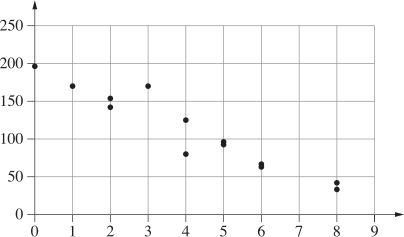
The scatterplot shows a bivariate dataset.
 

Describe the bivariate dataset in terms of strength and direction.   (2 marks)

--- 3 WORK AREA LINES (style=lined) ---

Show Answers Only

\(\text{Strong, negative correlation.}\)

Show Worked Solution

\(\text{Strong, negative correlation.}\)

Mean mark 55%.

Filed Under: S3 Further Statistical Analysis (Y12) Tagged With: Band 4, smc-1113-30-Correlation

Measurement, STD1 M1 2024 HSC 9 MC

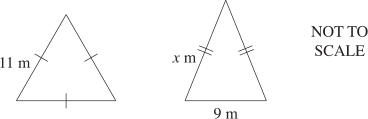
An equilateral triangle and an isosceles triangle are shown.

The triangles have the same perimeter.
 

What is the value of \(x\)?

  1. \(8\)
  2. \(9\)
  3. \(11\)
  4. \(12\)
Show Answers Only

\(D\)

Show Worked Solution

\(\text{Perimeter triangle 1 }=3\times 11=33\ \text{m}\)

\(\text{Perimeter triangle 2 }=2\times x+9=(2x+9)\ \text{m}\)

\(\therefore\ 2x+9\) \(=33\)
\(2x\) \(=24\)
\(x\) \(=12\)

  
\(\Rightarrow D\)

Filed Under: Perimeter and Area (Std 1), Perimeter and Area (Std1-2027) Tagged With: Band 4, smc-1121-10-Perimeter and Area, smc-6520-10-Perimeter

Financial Maths, STD1 F1 2024 HSC 4 MC

The cost of a plumbing job is $500 plus 10% GST.

What is the total cost of the job, including GST?

  1. $45
  2. $50
  3. $545
  4. $550
Show Answers Only

\(D\)

Show Worked Solution
\(\text{Total Cost}\) \(=500+0.10\times 500\)
  \(=500+50\)
  \(=$550\)

  
\(\Rightarrow D\)

Filed Under: Purchasing Goods (Std1-2027), Purchasing Goods (Std2-2027), Tax and Percentage Increase/Decrease (Std 1) Tagged With: Band 4, smc-1125-20-GST, smc-6278-20-GST/VAT, smc-6517-20-GST/VAT

Measurement, STD1 M4 2024 HSC 3 MC

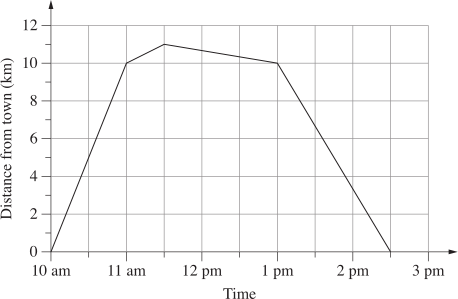
The travel graph shows the distance of a runner from a town.
 

Between what times was the runner travelling at their greatest speed?

  1. 10 am and 11 am
  2. 11 am and 11:30 am
  3. 11:30 am and 1 pm
  4. 1 pm and 2:30 pm
Show Answers Only

\(A\)

Show Worked Solution

\(\text{Greatest speed is when the graph is steepest.}\)

\(\therefore\ \text{Greatest speed is 10 km/hour and occurs between 10 am and 11 am.}\)

\(\Rightarrow A\)

Filed Under: M4 Rates (Y12) Tagged With: Band 4, smc-1104-10-Travel Graphs

CHEMISTRY, M2 EQ-Bank 6

Iron \(\text{(III)}\) hydroxide can be precipitated from the reaction of iron \(\text{(III)}\) nitrate solution with sodium hydroxide solution.

\(\ce{Fe(NO3)3(aq) + 3NaOH(aq) -> Fe(OH)3(s) + 3NaNO3(aq)}\)

  1. Calculate the mass of precipitate formed when 25.0 mL of 0.150 mol L\(^{-1}\) iron \(\text{(III)}\) nitrate solution is added to 40.0 mL of 0.250 mol L\(^{-1}\) sodium hydroxide solution.   (3 marks)

--- 6 WORK AREA LINES (style=lined) ---

  1. Calculate the concentration of nitrate ions in the final solution.   (2 marks)

--- 4 WORK AREA LINES (style=lined) ---

Show Answers Only

a.    \(0.356\ \text{g}\)

b.    \(0.173\ \text{mol L}^{-1}\)

Show Worked Solution

a.    \(n\ce{(Fe(NO3)3)} = c \times V = 0.150 \times 0.025 = 0.00375\ \text{mol}\)

\(n\ce{(NaOH)} = 0.25 \times 0.040 = 0.01\ \text{mol}\)

  • The molar ratio of  \(\ce{Fe(NO3)3:NaOH} = 1:3\)
  • \(3 \times 0.00375 = 0.01125\ \text{mol}\) of \(\ce{NaOH}\) is required to react with 0.00375 mol of \(\ce{Fe(NO3)3}\).
  • Due to there only being 0.01 mol of \(\ce{NaOH}\) present, \(\ce{NaOH}\) will be the limiting reagent. 
  • \(n\ce{(Fe(OH)3)}\) formed \(=n\ce{(NaOH)} \times \dfrac{1}{3} = 0.01 \times \dfrac{1}{3} = 0.00333\ \text{mol}\)
  • \(m\ce{(Fe(OH)3)}= n \times MM = 0.00333 \times (55.85 + 3(1.008) + 3(16.00))= 0.356\ \text{g}\)


b.    Volume of final solution \(=0.025 + 0.040 = 0.065\ \text{L}\)

\(n\ce{(NO3^-)}= 3 \times n(Fe^{3+}) = 3 \times 0.00375 = 0.01125\ \text{mol}\)

\(c\ce{(NO3^-)} = \dfrac{n}{V} = \dfrac{0.01125}{0.065} = 0.173\ \text{mol L}^{-1}\)

Filed Under: Concentration and Molarity Tagged With: Band 4, Band 5, smc-4261-20-Concentration Calculations, smc-4261-40-Mass Calculations

CHEMISTRY, M2 EQ-Bank 3 MC

What volume of water needs to be added to dilute 15.0 mL of a 0.200 mol L\(^{-1}\) solution to a 0.0500 mol L\(^{-1}\) solution?

  1. 45.0 mL
  2. 60.0 mL
  3. 75.0 mL
  4. 90.0 mL
Show Answers Only

\(A\)

Show Worked Solution

Use the dilution formula  \(c_1V_1=c_2V_2\)​, where:

\(c_1 = 0.200\ \text{mol L}^{-1}\) (initial concentration)

\(V_1 = 15\ \text{mL}\) (initial volume)

\(c_2 = 0.0500\ \text{mol L}^{-1}\) (final concentration)

\(V_2 = \dfrac{c_1V_1}{c_2} = \dfrac{0.2 \times 15}{0.05} = 60\ \text{mL}\)

\(\therefore\) Volume of water to be added \(=60-15=45\ \text{mL}\)

\(\Rightarrow A\)

Filed Under: Concentration and Molarity Tagged With: Band 4, smc-4261-60-Dilutions

CHEMISTRY, M2 EQ-Bank 5

The compound potassium nitrate has the formula \(\ce{KNO3}\).

  1. A student makes a solution of this compound by dissolving 40.0 g in 250.0 mL of distilled water. Calculate the concentration of this solution in mol L\(^{-1}\).   (2 marks)

--- 4 WORK AREA LINES (style=lined) ---

  1. The student now requires 500.0 mL of a 5.0% (w/v) solution. What volume of the solution in part (a) is required to make this?   (3 marks)

--- 6 WORK AREA LINES (style=lined) ---

Show Answers Only

a.    \(1.58\ \text{mol L}^{-1}\)

b.    \(0.156\ \text{L}\)

Show Worked Solution

a.    \(n\ce{(KNO3)}= \dfrac{m}{MM} = \dfrac{40.0}{39.10 + 14.01 + 3(16.00)} =0.396\ \text{mol}\)

Concentration of solution \(=\dfrac{n}{V} = \dfrac{0.396}{0.25} = 1.58\ \text{mol L}^{-1}\)


b.    A 5% solution requires 5 grams of solute in 100 mL of solution.

Therefore a 500 mL solution requires 25 grams of solute.

\(n\ce{(KNO3)} = \dfrac{25}{101.11} = 0.247\ \text{mol}\)

\(c\ce{(KNO3)} = \dfrac{n}{V} = \dfrac{0.247}{0.5} = 0.494\ \text{mol L}^{-1}\)

\(c_1V_1\) \(=c_2V_2\)  
\(1.58 \times V_1\) \(=0.494 \times 0.5\)  
\(V_1\) \(=\dfrac{0.247}{1.58}\)  
\(V_1\) \(=0.156\ \text{L}\)  

Filed Under: Concentration and Molarity Tagged With: Band 4, Band 5, smc-4261-20-Concentration Calculations, smc-4261-30-Volume Calculations, smc-4261-60-Dilutions

Calculus, 2ADV C3 2024 HSC 19

Sketch the curve  \(y=x^4-2 x^3+2\)  by first finding all stationary points, checking their nature, and finding the points of inflection.   (5 marks)

--- 26 WORK AREA LINES (style=lined) ---

Show Answers Only

Show Worked Solution
\(y\) \( = x^4-2 x^3+2\)  
\(y^{\prime}\) \( = 4 x^3-6 x^2 =2 x^2(2 x-3)\)  
\(y^{\prime\prime}\) \( = 12 x^2-12 x =12 x(x-1)\)  

 
\(\text{SP’s when}\ \ y^{′}=0:\)

\(2 x^2(2 x-3) =0 \ \Rightarrow \ \ x =0\ \ \text{or}\ \ \dfrac{3}{2}\)

\(\text{At}\ \ x=0, \ y^{\prime \prime} =0\)

\begin{array} {|c|c|c|c|}
\hline
\rule{0pt}{2.5ex} x \rule[-1ex]{0pt}{0pt} & -1 & \ \ \ \ 0\ \ \ \  & 1 \\
\hline
\rule{0pt}{2.5ex} y^{′} \rule[-1ex]{0pt}{0pt} & -10 & 0 & -5 \\
\hline
\end{array}

\(\Rightarrow\ \text{Horizontal POI at}\ (0,2)\)
 

\(\text{At}\ \ x=\dfrac{3}{2}:\)

\(\ y^{\prime \prime} =12 \times \dfrac{3}{2}\left(\dfrac{3}{2}-1\right)=9 \gt 0, \ \ y=\Bigg(\dfrac{3}{2}\Bigg)^{4}-2\Bigg(\dfrac{3}{2}\Bigg)^{3}+2=\dfrac{5}{16}\)

\(\Rightarrow \text{MIN at}\ \left(\dfrac{3}{2}, \dfrac{5}{16}\right)\)
 

\(\text{POI when}\ \ y^{″}=0:\)

\(12 x(x-1)=0 \ \Rightarrow\ \  x=1\ \ \text{or}\ \ x=0\ \text{(see above)}\)

\(\text{Test concavity change at}\ \ x=1:\)

\begin{array} {|c|c|c|c|}
\hline
\rule{0pt}{2.5ex} x \rule[-1ex]{0pt}{0pt} & \dfrac{1}{2} & \ \ \ \ 1\ \ \ \  &  \dfrac{3}{2} \\
\hline
\rule{0pt}{2.5ex} y^{″} \rule[-1ex]{0pt}{0pt} & \ \ -3\ \  & 0 & \ \ \ 9\ \ \  \\
\hline
\end{array}

\(\Rightarrow\ \text{POI at}\ (1,1)\)
 

Filed Under: Curve Sketching (Y12) Tagged With: Band 4, smc-969-20-Degree 4

Financial Maths, STD1 F1 2024 HSC 27

Zazu works a 38-hour week and is paid at an hourly rate of $45. Any overtime hours worked are paid at time-and-a-half.

In a particular week, Zazu worked the regular 38 hours and some overtime hours. In that week Zazu earned $2790.

How many hours of overtime did Zazu work in that week?   (3 marks)

--- 6 WORK AREA LINES (style=lined) ---

Show Answers Only

\(\text{16 hours of overtime}\)

Show Worked Solution

\(\text {Let X = overtime hours}\)

  \(\text{Total pay}\) \(=(38 \times 45)+\Big(X \times \dfrac{3}{2}\times 45\Big) \)
  \(2790\) \(=1710+\dfrac{135}{2}X\)
  \(\dfrac{135}{2}X\) \(=1080\)
  \(X\) \(=\dfrac{1080 \times 2}{135}\)
    \(=16 \text{ hours of overtime}\)

Filed Under: Earning Money and Budgeting (Std 1), Ways of Earning (Std1-2027) Tagged With: Band 4, smc-1126-10-Wages, smc-6515-10-Wages/Salaries, std2-std1-common

Financial Maths, 2ADV M1 2024 HSC 24

Jack intends to deposit $80 into a savings account on the first day of each month for 24 months. The interest rate during this time is 6% per annum, compounded monthly.

  1. Calculate how much money Jack will have in his account at the end of the 24 months.   (3 marks)

    --- 10 WORK AREA LINES (style=lined) ---

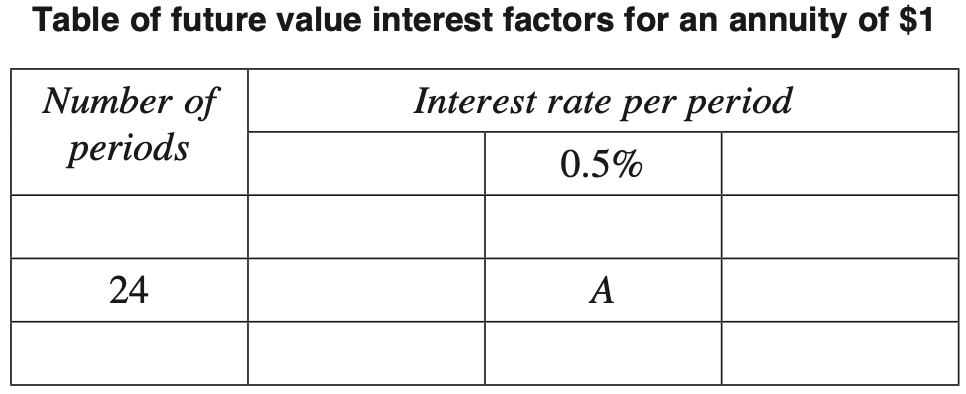
  2. A table of future value interest factors could have been used to calculate how much money Jack would have in his account at the end of the 24 months.
  3. Part of the table is shown.
     

  1. What is the value of \(A\) in the table? Give your answer correct to 3 decimal places.   (1 mark)

    --- 3 WORK AREA LINES (style=lined) ---

Show Answers Only

a.   \(A_{24}=\$2044.73\)

b.   \(A=25.559\)

Show Worked Solution

a.   \(r=\dfrac{6\%}{12}=0.5\%\ \text{per month}\)

\(\text{Let}\ \ A_n=\ \text{Amount after}\ n\ \text{months}\)

\(A_1\) \(=80(1.005)\)  
\(A_2\) \(=[80(1.005)+80](1.005)\)  
  \(=80(1.005)^2+80(1.005) \)  
\(\vdots\)    
\(A_n\) \(=80(1.005)^n+80(1.005)^{n-1}+ … + 80(1.005) \)  
  \(=80\underbrace{(1.005+1.005^2+ … + 1.005^n)}_{\text{GP where}\ \ a=1.005, r=1.005} \)  
  \(=80\Bigg(\dfrac{1.005(1.005^{n}-1)}{1.005-1}\Bigg) \)  

 
\(\text{After 24 months:}\)

\(A_{24}\) \(=80\Bigg(\dfrac{1.005(1.005^{24}-1)}{1.005-1}\Bigg) \)  
  \(=$2044.73 \ \text{(nearest cent)}\)  
♦♦ Mean mark (a) 38%.
b.    \(FV\) \(= 80 \times A\)
  \(2044.73\) \(=80 \times A\)
  \(A\) \(=\dfrac{2044.73}{80}\)
    \(=25.5591…\)
    \(=25.559\ \text{(3 d.p.)}\)
Mean mark (b) 51%.

Filed Under: Financial Applications of Series (Y12) Tagged With: Band 4, Band 5, smc-1007-20-Annuity - Growth phase

Trigonometry, 2ADV T1 2024 HSC 20

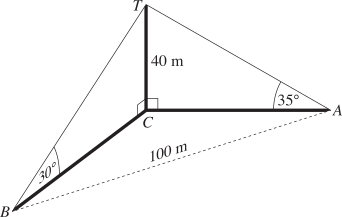
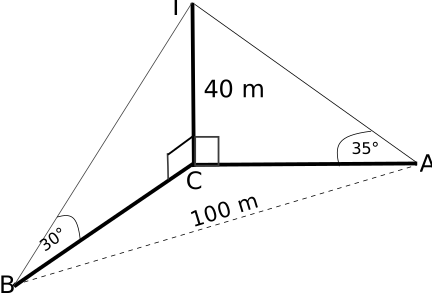
A vertical tower \(T C\) is 40 metres high. The point \(A\) is due east of the base of the tower \(C\). The angle of elevation to the top \(T\) of the tower from \(A\) is 35°. A second point \(B\) is on a different bearing from the tower as shown. The angle of elevation to the top of the tower from \(B\) is 30°. The points \(A\) and \(B\) are 100 metres apart.
 

  1. Show that distance \(A C\) is 57.13 metres, correct to 2 decimal places.  (1 mark)

    --- 5 WORK AREA LINES (style=lined) ---

  1. Find the bearing of \(B\) from \(C\) to the nearest degree.  (3 marks)

    --- 12 WORK AREA LINES (style=lined) ---

Show Answers Only

\(194^{\circ}\)

Show Worked Solution

a.   \(\text{In}\ \Delta TCA:\)

\(\tan 35°\) \( =\dfrac{40}{AC}\)  
\(AC\) \( =\dfrac{40}{\tan 35°}\)  
  \(=57.125…\)  
  \(=57.13\ \text{m (2 d.p.)}\)  

 
b. 
 \(\text{In}\ \Delta TCB:\)

\(\tan 30°\) \( =\dfrac{40}{BC}\)  
\(BC\) \( =\dfrac{40}{\tan 30°}\)  
  \(=69.28\ \text{m}\)  

  
\( \text{Find} \ \angle BCA \ \text{using cosine rule:}\)

\(\cos \angle B CA\) \( = \dfrac{57.13^2+69.28^2-100^2}{2 \times 57.13 \times 69.28}\)  
  \(= -0.2446 \)…  
\(\angle BCA\) \( = 104.2° \)  

\(\therefore\ \text{Bearing of}\ B\ \text{from}\ C= 90+104=194^{\circ} \text{(nearest degree)} \)

Filed Under: 3D Trigonometry (Y11) Tagged With: Band 2, Band 4

Statistics, 2ADV S2 2024 HSC 16

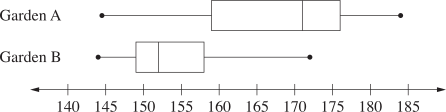
Flowers were planted in two gardens (Garden A and Garden B).

On a particular day, 25 flowers were randomly selected from each garden and their heights measured in millimetres.

The data are represented in parallel box-plots.
 

Compare the two datasets by examining the skewness of the distributions, and the measures of central tendency and spread.   (3 marks)

--- 8 WORK AREA LINES (style=lined) ---

Show Answers Only

\(\text{Skewness comparison:}\)

\(\rightarrow\ \text{Garden A is negatively skewed while Garden B is positively skewed.}\)
  

\(\text{Measures of central tendency comparison:}\)

\(\rightarrow\ \text{IQR (A)}\ \approx 17\ \text{ is greater than IQR (B)}\ \approx 9\)

\(\rightarrow\ \text{This means the middle 50% of data points of B are more closely clustered} \)
     \(\text{around the median than A.}\)

\(\text{Spread comparison:}\)

\(\rightarrow\ \text{Range (A)}\ \approx 39\ \text{is less than range (B)}\ \approx 28\)

\(\rightarrow\ \text{This means the spread of data points of A is wider than the spread of data points of B.}\)

\(\text{Overall, flowers from Garden B will tend to be higher than Garden A flowers as well as exhibiting}\)
\(\text{a larger range of heights.}\)

Show Worked Solution

\(\text{Skewness comparison:}\)

\(\rightarrow\ \text{Garden A is negatively skewed while Garden B is positively skewed.}\)
  

\(\text{Measures of central tendency comparison:}\)

\(\rightarrow\ \text{IQR (A)}\ \approx 17\ \text{ is greater than IQR (B)}\ \approx 9\)

\(\rightarrow\ \text{This means the middle 50% of data points of B are more closely clustered}\)
    \(\text{around the median than A.}\)
 

\(\text{Spread comparison:}\)

\(\rightarrow\ \text{Range (A)}\ \approx 39\ \text{is less than range (B)}\ \approx 28\)

\(\rightarrow\ \text{This means the spread of data points of A is wider than the spread of data points of B.}\)
 

\(\text{Overall, flowers from Garden B will tend to be higher than Garden A flowers as well as exhibiting}\)
\(\text{a larger range of heights.}\)

Filed Under: Summary Statistics - Box Plots (Y12) Tagged With: 2adv-std2-common, Band 4, smc-1000-20-Parallel Box-Plots

L&E, 2ADV E1 2024 HSC 13

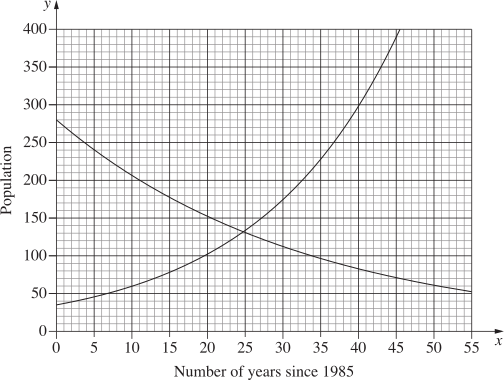
The graph shows the populations of two different animals, \(W\) and \(K\), in a conservation park over time. The \(y\)-axis is the size of the population and the \(x\)-axis is the number of years since 1985 .

Population \(W\) is modelled by the equation  \(y=A \times(1.055)^x\).

Population \(K\) is modelled by the equation  \(y=B \times(0.97)^x\).
 

Complete the table using the information provided.   (3 marks)

\begin{array}{|l|c|c|}
\hline
\rule{0pt}{2.5ex}\rule[-1ex]{0pt}{0pt}&\text {Population } W & \text {Population } K \\
\hline
\rule{0pt}{2.5ex}\text { Population in 1985 }\rule[-1ex]{0pt}{0pt} & A=34 & B=\ \ \ \ \  \\
\hline
\rule{0pt}{2.5ex}\text { Percentage yearly change in the population }\rule[-1ex]{0pt}{0pt} & & \\
\hline
\rule{0pt}{2.5ex}\text { Predicted population when } x=50 \rule[-1ex]{0pt}{0pt}& & 61 \\
\hline
\end{array}

--- 5 WORK AREA LINES (style=lined) ---

Show Answers Only

\begin{array}{|l|c|c|}
\hline
\rule{0pt}{2.5ex}\rule[-1ex]{0pt}{0pt}&\text {Population } W & \text {Population } K \\
\hline
\rule{0pt}{2.5ex}\text { Population in 1985 }\rule[-1ex]{0pt}{0pt} & A=34 & B=280 \\
\hline
\rule{0pt}{2.5ex}\text { Percentage yearly change in the population }\rule[-1ex]{0pt}{0pt} &+5.5\% & -3.0\%\\
\hline
\rule{0pt}{2.5ex}\text { Predicted population when } x=50 \rule[-1ex]{0pt}{0pt}&494 & 61 \\
\hline
\end{array}

Show Worked Solution

\begin{array}{|l|c|c|}
\hline
\rule{0pt}{2.5ex}\rule[-1ex]{0pt}{0pt}&\text {Population } W & \text {Population } K \\
\hline
\rule{0pt}{2.5ex}\text { Population in 1985 }\rule[-1ex]{0pt}{0pt} & A=34 & B=280 \\
\hline
\rule{0pt}{2.5ex}\text { Percentage yearly change in the population }\rule[-1ex]{0pt}{0pt} &+5.5\% & -3.0\%\\
\hline
\rule{0pt}{2.5ex}\text { Predicted population when } x=50 \rule[-1ex]{0pt}{0pt}&494 & 61 \\
\hline
\end{array}

\(\text{Calculations:}\)

\(\text{Population } W: \ (1.055)^x \Rightarrow \text { increase of 5.5% each year}\)

\(\text {Population } K: \ (0.97)^x \Rightarrow 1-0.97=0.03 \Rightarrow \text { decrease of 3.0% each year}\)

\(\text {Predicted population }(W)=34 \times(1.055)^{50}=494\)

Filed Under: Graphs and Applications (Adv-2027), Graphs and Applications (Y11) Tagged With: 2adv-std2-common, Band 4, smc-6456-20-Exponential Graphs, smc-966-10-Exponential graphs, smc-966-20-Population

Financial Maths, STD2 F4 2024 HSC 25

Alex and Jun each invest $1800 for 5 years.

    • Alex's investment earns simple interest at a rate of 7.5% per annum.
    • Jun's investment earns interest at a rate of 6.0% per annum, compounding quarterly.

By calculating the interest earned over the 5 years, determine who will have the greater amount.   (3 marks)

--- 10 WORK AREA LINES (style=lined) ---

Show Answers Only

\(\text {Alex’s investment:}\)

\(\text{Interest}=Prn=1800 \times 0.075 \times 5=\$ 675\)
 

\(\text {Jun’s investment:}\)

\(r=\dfrac{6.0\%}{4}=1.5 \% \text { per quarter}\)

\(\text {Compounding periods }=5 \times 4=20\)

\(F V=P V(1+r)^n=1800(1+0.015)^{20}=\$ 2424.34\)

\(\text{Total interest}=F V-P V=2424.34-1800=\$ 624.34\)
 

\(\text {Alex’s interest }>\text { Jun’s interest.}\)

\(\Rightarrow \text{ Alex will have a greater amount (since original investment the same)}\)

Show Worked Solution

\(\text {Alex’s investment:}\)

\(\text{Interest}=Prn=1800 \times 0.075 \times 5=\$ 675\)
 

\(\text {Jun’s investment:}\)

\(r=\dfrac{6.0\%}{4}=1.5 \% \text { per quarter}\)

\(\text {Compounding periods }=5 \times 4=20\)

\(F V=P V(1+r)^n=1800(1+0.015)^{20}=\$ 2424.34\)

\(\text{Total interest}=F V-P V=2424.34-1800=\$ 624.34\)
 

\(\text {Alex’s interest }>\text { Jun’s interest.}\)

\(\Rightarrow \text{ Alex will have a greater amount (since original investment the same)}\)

Filed Under: Compound Interest and Shares (Std2) Tagged With: Band 4, smc-817-20-FV Formula, smc-817-30-i/r comparisons (incl. graphs)

Algebra, STD2 A4 2024 HSC 22

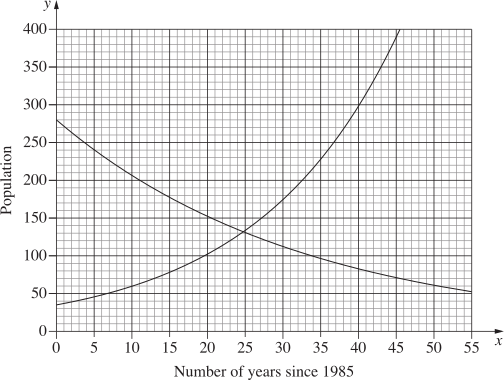
The graph shows the populations of two different animals, \(W\) and \(K\), in a conservation park over time. The \(y\)-axis is the size of the population and the \(x\)-axis is the number of years since 1985 .

Population \(W\) is modelled by the equation  \(y=A \times(1.055)^x\).

Population \(K\) is modelled by the equation  \(y=B \times(0.97)^x\).
 

Complete the table using the information provided.   (3 marks)

\begin{array}{|l|c|c|}
\hline
\rule{0pt}{2.5ex}\rule[-1ex]{0pt}{0pt}&\text {Population } W & \text {Population } K \\
\hline
\rule{0pt}{2.5ex}\text { Population in 1985 }\rule[-1ex]{0pt}{0pt} & A=34 & B=\ \ \ \ \  \\
\hline
\rule{0pt}{2.5ex}\text { Percentage yearly change in the population }\rule[-1ex]{0pt}{0pt} & & \\
\hline
\rule{0pt}{2.5ex}\text { Predicted population when } x=50 \rule[-1ex]{0pt}{0pt}& & 61 \\
\hline
\end{array}

--- 5 WORK AREA LINES (style=lined) ---

Show Answers Only

\begin{array}{|l|c|c|}
\hline
\rule{0pt}{2.5ex}\rule[-1ex]{0pt}{0pt}&\text {Population } W & \text {Population } K \\
\hline
\rule{0pt}{2.5ex}\text { Population in 1985 }\rule[-1ex]{0pt}{0pt} & A=34 & B=280 \\
\hline
\rule{0pt}{2.5ex}\text { Percentage yearly change in the population }\rule[-1ex]{0pt}{0pt} &+5.5\% & -3.0\%\\
\hline
\rule{0pt}{2.5ex}\text { Predicted population when } x=50 \rule[-1ex]{0pt}{0pt}&494 & 61 \\
\hline
\end{array}

Show Worked Solution

\begin{array}{|l|c|c|}
\hline
\rule{0pt}{2.5ex}\rule[-1ex]{0pt}{0pt}&\text {Population } W & \text {Population } K \\
\hline
\rule{0pt}{2.5ex}\text { Population in 1985 }\rule[-1ex]{0pt}{0pt} & A=34 & B=280 \\
\hline
\rule{0pt}{2.5ex}\text { Percentage yearly change in the population }\rule[-1ex]{0pt}{0pt} &+5.5\% & -3.0\%\\
\hline
\rule{0pt}{2.5ex}\text { Predicted population when } x=50 \rule[-1ex]{0pt}{0pt}&494 & 61 \\
\hline
\end{array}

\(\text{Calculations:}\)

\(\text{Population } W: \ (1.055)^x \Rightarrow \text { increase of 5.5% each year}\)

\(\text {Population } K: \ (0.97)^x \Rightarrow 1-0.97=0.03 \Rightarrow \text { decrease of 3.0% each year}\)

\(\text {Predicted population }(W)=34 \times(1.055)^{50}=494\)

Mean mark 51%.

Filed Under: Non-Linear: Exponential/Quadratics (Std 2) Tagged With: 2adv-std2-common, Band 4, smc-830-30-Exponential

Financial Maths, STD2 F4 2024 HSC 21

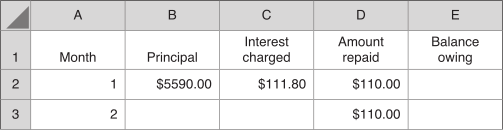
William has a reducing balance loan on which he owes $5590. He makes monthly repayments of $110.

The loan company charges interest at 24% per annum, compounded monthly.

The spreadsheet shows some of the information for the next two months of the loan.

  1. Complete the entries in the spreadsheet to show the balance owing on the loan at the end of two months.   (2 marks)


--- 4 WORK AREA LINES (style=lined) ---

  1. Explain why the loan will never be repaid if William continues to make repayments of $110 per month.   (1 mark)

    --- 3 WORK AREA LINES (style=lined) ---

Show Answers Only

a.
       

b.   \(\text{The interest charged exceeds the amount that is repaid.}\)

\(\text{Interest charges will gradually increase with the monthly repayment staying the same \(\Rightarrow\) loan will never be repaid.}\)

Show Worked Solution

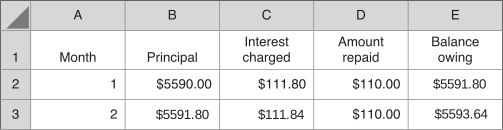
a.
       

\(\text{Calculations:}\)

\(\text {Cell E2 }= 5590+111.80-110=\$ 5591.80\)

\(\text{Cell B3 }=\text{ Cell E2}\)

\(\text{Cell C3}=5591.80 \times 0.02 = \$111.84 \ \text{(monthly r/i = 2%)}\)

\(\text{Cell E3}=5591.80+111.84-110 = \$5593.64\)
 

b.   \(\text{The interest charged exceeds the amount that is repaid.}\)

\(\text{Interest charges will gradually increase with the monthly repayment staying the same \(\Rightarrow\) loan will never be repaid.}\)

Filed Under: Loans and Credit Cards (Std 2) Tagged With: Band 4, smc-814-20-P+I-R Tables

Financial Maths, STD2 F5 2024 HSC 20

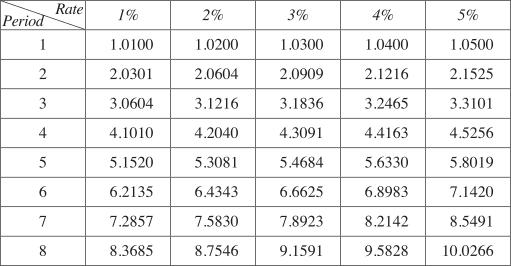
The table shows the future value for an annuity of $1 for varying interest rates and time periods.
 

  1. Ken invests $200 at the start of each year for eight years, at an interest rate of 5% per annum.
  2. Calculate the future value of Ken's investment.   (1 mark)

    --- 2 WORK AREA LINES (style=lined) ---

  3. Shay is planning to take a holiday in three years. She needs $4500 for this holiday and will make regular six-monthly payments into an account that earns interest at the rate of 4% per annum, compounded 6 monthly.
  4. What is the minimum amount Shay needs to pay into this account every 6 months? Give your answer to the nearest $10. Support your answer with calculations.  (2 marks)

    --- 7 WORK AREA LINES (style=lined) ---

Show Answers Only

a.    \(F V=\$ 2005.32\)

b.    \(\$700\)

Show Worked Solution

a.    \(\text {8 annual periods at 5% p.a.} \Rightarrow \text { Factor}=10.0266\)

\(F V=200 \times 10.0266=\$ 2005.32\)
 

b.    \(r=\dfrac{4 \%}{2}=2 \%\ \text{per 6 months}\)

\(\text {Compounding periods}=3 \times 2=6\)

\(\Rightarrow \text {Factor }=6.4343\)

\(4500\) \(=\ \text{Annuity} \times 6.4343\)  
\(\text{Annuity}\) \(=\dfrac{4500}{6.4343}\)  
  \(=699.38\)  
  \(=\$700\ \text{(nearest \$10)}\)  
♦ Mean mark (b) 51%.

Filed Under: F5 Annuities (Y12) Tagged With: Band 4, Band 5, smc-816-10-FV of $1 Annuity Table

Networks, STD2 N2 2024 HSC 18f

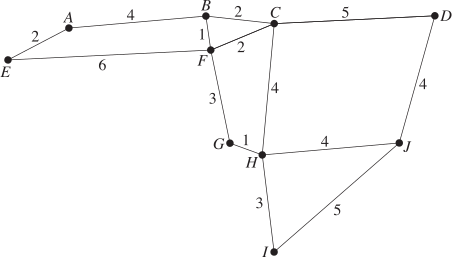
The diagram shows a network with weighted edges.
 

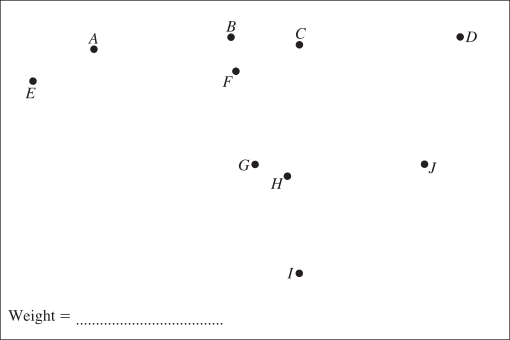
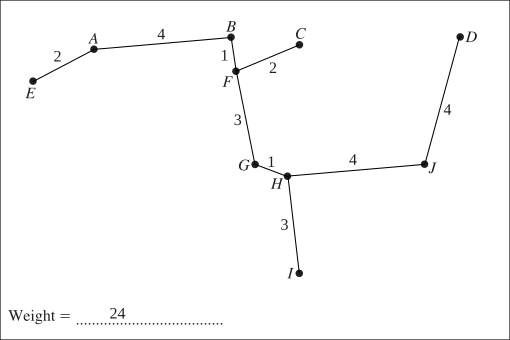
  1. Draw a minimum spanning tree for this network and determine its weight.   (2 marks)


--- 0 WORK AREA LINES (style=lined) ---

  1. Is it possible to find another spanning tree with the same weight? Give a reason for your answer.   (1 mark)

    --- 3 WORK AREA LINES (style=lined) ---

Show Answers Only

a.


b. 
  \(\text{Yes.}\)

\(\text{→ The edge}\ FC\ \text{on the MST above could be replaced by the edge}\ BC\  \text{to create}\)

\(\text{a second MST (with equivalent weight = 24)}\)

Show Worked Solution

a.
         

b.    \(\text{Yes.}\)

\(\text{→ The edge}\ FC\ \text{on the MST above could be replaced by the edge}\ BC\  \text{to create}\)

\(\text{a second MST (with equivalent weight = 24)}\)

♦ Mean mark (b) 45%.

Filed Under: Minimum Spanning Trees, Spanning Trees (Std2-2027) Tagged With: Band 4, Band 5, smc-6320-10-General, smc-6320-40-Draw Tree, smc-914-10-General, smc-914-40-Draw Tree

Statistics, STD2 S4 2024 HSC 19

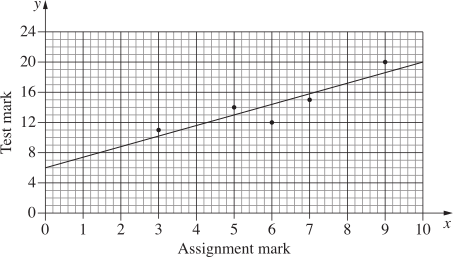
A teacher was exploring the relationship between students' marks for an assignment and their marks for a test. The data for five different students are shown on the graph.

The least-squares regression line is also shown.
 

  1. What is the equation of the least-squares regression line for this dataset?   (2 marks)

    --- 4 WORK AREA LINES (style=lined) ---

  2. Another student, whose marks are not on the graph, scored 5 for the assignment and 12 on the test.
  3. Did this student do better or worse on the test than the regression line predicts? Provide a reason for your answer.   (1 mark)

    --- 4 WORK AREA LINES (style=lined) ---

Show Answers Only

a.    \(\text {Data points: }(3,11),(5,14),(6,12),(7,15),(9,20)\)

\(y \,\text {-intercept}=6\)

\(m=\dfrac{y_2-y_1}{x_2-x_1}=\dfrac{20-6}{10-0}=1.4\)

\(\text{LSRL}\ \ \Rightarrow \ y=1.4x+6\)
 

b.    \(\text {The student’s mark \((5,12)\) sits below the LSRL.}\)

 \(\text {Therefore the student did worse than expected.}\)

Show Worked Solution

a.    \(\text {Data points: }(3,11),(5,14),(6,12),(7,15),(9,20)\)

\(y\,\text {-intercept}=6\)

\(m=\dfrac{y_2-y_1}{x_2-x_1}=\dfrac{20-6}{10-0}=1.4\)

\(\text{LSRL}\ \ \Rightarrow \ y=1.4x+6\)

♦ Mean mark (a) 46%.

b.    \(\text {The student’s mark \((5,12)\) sits below the LSRL.}\)

 \(\text {Therefore the student did worse than expected.}\)

Filed Under: S4 Bivariate Data Analysis (Y12) Tagged With: Band 4, Band 5, smc-785-20-Least-Squares Regression Line

Measurement, STD2 M7 2024 HSC 17

The cost of electricity is 30.13 cents per kWh .

Calculate the cost of using a 650 W air conditioner for 6 hours.   (2 marks)

--- 4 WORK AREA LINES (style=lined) ---

Show Answers Only

\(\text{Cost} =\$ 1.18\)

Show Worked Solution

\(\text{Usage}=6 \times 650=3900\, \text{W}=3.9\, \text{kW}\)

\(\text{Cost} =3.9 \times 30.13=117.507 \,\text{c}=\$ 1.18 \, \text {(nearest cent)}\)

Filed Under: Energy and Mass (Std 2), Rates (Std2) Tagged With: Band 4, smc-799-20-Electricity, smc-805-20-Energy

CHEMISTRY, M2 EQ-Bank 2 MC

What volume of 0.50 M hydrochloric acid  is required to neutralise 25.0 mL of 0.40 M sodium hydroxide?

\(\ce{HCl(aq) + NaOH(aq) -> NaCl(aq) + H2O(l)}\)

  1. \(15\ \text{mL}\)
  2. \(20\ \text{mL}\)
  3. \(25\ \text{mL}\)
  4. \(30\ \text{mL}\)
Show Answers Only

\(B\)

Show Worked Solution
  • Calculate the number of moles of \(\ce{NaOH}\):
  •    \(\ce{n(NaOH)=c \times V} = 0.4 \times 0.025 = 0.0100\ \text{mol}\)
  • Since the ratio of hydrochloric acid to sodium hydroxide is \(1:1\), the number of moles of hydrochloric acid required is also 0.0100 mol.
  • Calculate the volume of hydrochloric acid required:
  •    \(\ce{V(HCl)= \dfrac{\text{n}}{\text{c}}}= \dfrac{0.0100}{0.5}=0.02\ \text{L}\ =20\ \text{mL}\)

\(\Rightarrow B\)

Filed Under: Concentration and Molarity Tagged With: Band 4, smc-4261-30-Volume Calculations

CHEMISTRY, M2 EQ-Bank 1

A solution is prepared by dissolving 5.00 g of sodium carbonate \(\ce{(Na2CO3)}\) in enough water to make 250.0 mL of solution.

Calculate the concentration of the sodium carbonate solution in mol L\(^{-1}\).   (2 marks)

--- 4 WORK AREA LINES (style=lined) ---

Show Answers Only

\(0.189\ \text{mol L}^{-1}\)

Show Worked Solution

\(\ce{MM(Na2CO3)}= 105.99\ \text{g mol}^{-1}\)

\(\ce{n(Na2CO3)}= \dfrac{5}{105.99} = 0.0472\ \text{mol}\)
 

Concentration of \(\ce{Na2CO3}\):

\(c= \dfrac{\text{n}}{\text{V}} = \dfrac{0.0472}{0.250}=0.189\ \text{mol L}^{-1}\)

Filed Under: Concentration and Molarity Tagged With: Band 4, smc-4261-20-Concentration Calculations

Networks, STD2 N3 2024 HSC 39

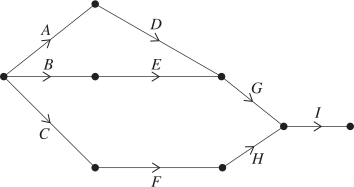
A project involving nine activities is shown in the network diagram.

The duration of each activity is not yet known.
 

The following table gives the earliest start time (EST) and latest start time (LST) for three of the activities. All times are in hours.

\begin{array} {|c|c|c|}
\hline
\rule{0pt}{2.5ex} \textit{Activity} \rule[-1ex]{0pt}{0pt} & EST & LST \\
\hline
\rule{0pt}{2.5ex} A \rule[-1ex]{0pt}{0pt} & \ \ \ \ \ \ 0\ \ \ \ \ \  & \ \ \ \ \ \ 2\ \ \ \ \ \  \\
\hline
\rule{0pt}{2.5ex} C \rule[-1ex]{0pt}{0pt} & 0 & 1 \\
\hline
\rule{0pt}{2.5ex} I \rule[-1ex]{0pt}{0pt} & 12 & 12 \\
\hline
\end{array}

  1. What is the critical path?   (1 mark)

    --- 2 WORK AREA LINES (style=lined) ---

  2. The minimum time required for this project to be completed is 19 hours.
  3. What is the duration of activity \(I\)?   (1 mark)

    --- 2 WORK AREA LINES (style=lined) ---

  4. The duration of activity \(C\) is 3 hours.
  5. What is the maximum amount of time that could occur between the start of activity \(F\) and the end of activity \(H\)?   (1 mark)

    --- 2 WORK AREA LINES (style=lined) ---

Show Answers Only

a.   \(\text{Critical Path:}\ BEGI\)

b.   \(\text{Duration of}\ I =7\ \text{hours}\)

c.  \(\text{Max time}\ =8\ \text{hours}\)

Show Worked Solution

a.   \(\text{Activity}\ A\ \text{and}\ C: \ LST \gt EST\)

\(\Rightarrow\ \text{Activity}\ A\ \text{and}\ C\ \text{not on critical path.}\)

\(\text{Critical Path:}\ BEGI\)
 

♦ Mean mark (a) 43%.

b.   \(\text{Duration of}\ I = 19-12=7\ \text{hours}\)
 

c.   \(\text{Since}\ C + F + H + I\ \text{is not a critical path:}\)

\(C + F + H + I = 18\ \text{or less (C.P. = 19 hours)}\)

\(3+F+H+7 = 18\ \text{or less}\)

\(\Rightarrow\ F+H = 8\ \text{or less}\)

\(\therefore\ \text{Max time from start of}\ F\ \text{to end of}\ H = 8\ \text{hours}\)

♦♦♦ Mean mark (c) 10%.

Filed Under: Critical Paths Tagged With: Band 4, Band 5, Band 6, smc-916-20-Forward Scanning, smc-916-30-Scanning Both Ways

CHEMISTRY, M2 EQ-Bank 11

Iron forms a compound that contains iron (36.8%), sulfur (31.6%), and oxygen (31.6%). The compound boils at 120°C. For one mole of this compound, the density of its vapor at 150°C and 250 kPa is 42.0 g/L.

  1. Determine the empirical formula of the compound.   (2 mark)

--- 4 WORK AREA LINES (style=lined) ---

  1. Calculate the molar mass of the compound.   (2 marks)

--- 4 WORK AREA LINES (style=lined) ---

Show Answers Only

a.    \(\ce{Fe2S3O6}\)

b.    \(590.94\ \text{g mol}^{-1}\).

Show Worked Solution

a.   Divide each compound’s percentage by their molar masses:

\(\ce{Fe}: \dfrac{36.8%}{55.85} = 0.65 \ \Rightarrow \ \dfrac{0.659}{0.659}=1\)

\(\ce{S}: \dfrac{31.6%}{32.07} = 0.985 \ \Rightarrow \ \dfrac{0.985}{0.659}=\dfrac{3}{2}\)

\(\ce{O}: \dfrac{31.6%}{16.00} = 1.975 \ \Rightarrow \ \dfrac{1.975}{0.659}=3\)

  • Due to the fraction, each number must be doubled so there are only whole numbers.
  • Thus the empirical formula for the compound is \(\ce{Fe2S3O6}\).

b.    Using the Ideal Gas Law to find the volume of the vapour:

\(V=\dfrac{nRT}{P}=\dfrac{1 \times 8.314 \times (150+273)}{250}=14.07\ \text{L}\)

  • Molar mass of the vapour \(= 42 \times 14.07 = 590.94\ \text{g mol}^{-1}\).

Filed Under: Gas Laws Tagged With: Band 4, Band 5, smc-4262-20-Molar Calculations, smc-4262-30-Ideal Gas Law

CHEMISTRY, M2 EQ-Bank 9 MC

A hot air balloon contains 65 L of air at ground level, where the conditions are 98 kPa and 27°C.

What will be the new volume of the balloon when it rises to an altitude where the conditions are 10 kPa and –10°C?

  1. 400 L
  2. 484 L
  3. 558 L
  4. 610 L
Show Answers Only

\(C\)

Show Worked Solution
  • Using the Combined Gas Law: \(\dfrac{P_1V_1}{T_1}=\dfrac{P_2V_2}{T_2}\)
  •    \(T_1 = 300\ \text{K}\)  and  \(T_2 = 263\ \text{K}\)
  •    \(V_2=\dfrac{P_1V_1T_2}{T_1P_2}=\dfrac{98 \times 65 \times 263}{300 \times 10}=558\ \text{L}\)

\(\Rightarrow C\)

Filed Under: Gas Laws Tagged With: Band 4, smc-4262-90-Combined Gas Law

Measurement, STD2 M6 2024 HSC 36

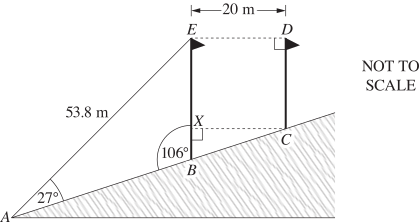
The diagram shows two vertical flagpoles, \(BE\) and \(CD\), set on sloping ground.
 

  1. What is the height of the flagpole \(BE\), correct to 1 decimal place?   (2 marks)

    --- 6 WORK AREA LINES (style=lined) ---

  2. What is the height of the flagpole \(CD\), correct to 1 decimal place?   (2 marks)

    --- 6 WORK AREA LINES (style=lined) ---

Show Answers Only

a.   \(BE=25.4\ \text{m}\)

b.   \(CD=19.7\ \text{m}\)

Show Worked Solution

a.   \(\text{Using the sine rule:}\)

\(\dfrac{BE}{\sin 27^{\circ}}\) \(=\dfrac{53.8}{\sin 106^{\circ}}\)  
\(\therefore BE\) \(=\dfrac{53.8 \times \sin 27^{\circ}}{\sin 106^{\circ}}\)  
  \(=25.408…\)  
  \(=25.4\ \text{m (1 d.p.)}\)  


b.   \(CD=EB-XB\)

\(\text{Consider}\ \Delta XBC:\)

\(\angle XBC=180-106=74^{\circ}, \ XC=ED=20\)

\(\tan 74^{\circ}\) \(=\dfrac{20}{XB}\)  
\(XB\) \(=\dfrac{20}{\tan 74^{\circ}}\)  
  \(=5.73\ \text{m}\)  

 
\(CD=25.4-5.73=19.7\ \text{m (1 d.p.)}\)

♦♦ Mean mark (b) 35%.

Filed Under: Non-Right Angled Trig (Std2) Tagged With: Band 4, Band 5, smc-804-20-Sine Rule, smc-804-40-2-Triangle

Statistics, 2ADV S3 2024 HSC 23

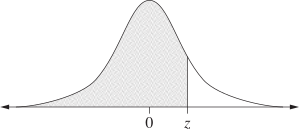
A random variable is normally distributed with mean 0 and standard deviation 1. The table gives the probability that this random variable is less than \(z\).

\begin{array} {|c|c|c|c|c|c|c|c|c|c|}
\hline
\rule{0pt}{2.5ex} z \rule[-1ex]{0pt}{0pt} & 0.6 & 0.7 & 0.8 & 0.9 & 1.0 & 1.1 & 1.2 & 1.3 & 1.4 \\
\hline
\rule{0pt}{2.5ex} \textit{Probability} \rule[-1ex]{0pt}{0pt} & 0.7257 & 0.7580 & 0.7881 & 0.8159 & 0.8413 & 0.8643 & 0.8849 & 0.9032 & 0.9192 \\
\hline
\end{array}

The probability values given in the table for different values of \(z\) are represented by the shaded area in the following diagram.
 

The scores in a university examination with a large number of candidates are normally distributed with mean 58 and standard deviation 15.

  1. By calculating a \(z\)-score, find the percentage of scores that are between 58 and 70.   (2 marks)

    --- 4 WORK AREA LINES (style=lined) ---

  2. Explain why the percentage of scores between 46 and 70 is twice your answer to part (a).   (1 mark)

    --- 2 WORK AREA LINES (style=lined) ---

  3. By using the values in the table above, find an approximate minimum score that a candidate would need to be placed in the top 10% of the candidates.   (2 marks)

    --- 4 WORK AREA LINES (style=lined) ---

Show Answers Only

a.   \(28.81%\)

b.   \(\text{Normal distribution is symmetrical about the mean (58).}\)

\(\text{Since 70 and 46 are both the same distance (12) from the mean, the percentage}\)

\(\text{of scores in this range will be twice the answer in part (a).}\)

c.   \(\text{Approx minimum score = 78%}\)

Show Worked Solution

a.   \(z\text{-score (58)}\ =\dfrac{x-\mu}{\sigma} = \dfrac{58-58}{15}=0\)

\(z\text{-score (70)}\ = \dfrac{70-58}{15}=0.8\)

\(\text{Using table:}\)

\(\text{% between 58–70}\ =0.7881-0.5=0.2881=28.81%\)
 

b.   \(\text{Normal distribution is symmetrical about the mean (58).}\)

\(\text{Since 70 and 46 are both the same distance (12) from the mean, the percentage}\)

\(\text{of scores in this range will be twice the answer in part (a).}\)
 

c.   \(z\text{-score 1.3 has a table value 0.9032}\)

\(1-0.9032=0.0968\ \Rightarrow\ \text{i.e. 9.68% of students score higher.}\)

\(\text{Find}\ x\ \text{for a}\ z\text{-score of 1.3:}\)

\(1.3\) \(=\dfrac{x-58}{15}\)  
\(x\) \(=1.3 \times 15 +58\)   
  \(=77.5\)  

 
\(\therefore\ \text{Approx minimum score = 78%}\)

Filed Under: Normal Distribution (Y12) Tagged With: 2adv-std2-common, Band 4, smc-995-10-Single z-score, smc-995-20-z-score Intervals, smc-995-45-z-score tables

Statistics, STD2 S4 2024 HSC 30

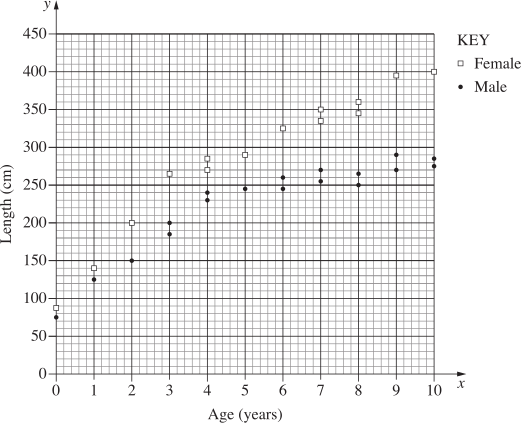
A researcher is studying anacondas (a type of snake).

A dataset recording the age (in years) and length (in cm) of female and male anacondas is displayed on the graph.

Anacondas reach maturity at about 4 years of age.
 

Write THREE observations about anacondas that may be made from the scatterplot. (Note: No calculations are required.)   (3 marks)

--- 6 WORK AREA LINES (style=lined) ---

Show Answers Only

\(\text{Answers could include three of the following:}\)

\(→\ \text{Female anacondas are longer than males of the equivalent age.}\)

\(→\ \text{Female anacondas grow more quickly than male anacondas from birth until}\)

\(\text{maturity which can be seen by the steeper gradient of the LOBF for each dataset}\)

\(\text{over this period.}\)

\(→\ \text{Female anacondas continue to grow to at least 10 years of age, well past their}\)

\(\text{age of maturity at 4 years of age.}\)

\(→\ \text{Male anacondas’ growth slows noticeably and flattens out once they hit their}\)

\(\text{age of maturity at 4 years old.}\)

Show Worked Solution

\(\text{Answers could include three of the following:}\)

\(→\ \text{Female anacondas are longer than males of the equivalent age.}\)

\(→\ \text{Female anacondas grow more quickly than male anacondas from birth until}\)

\(\text{maturity which can be seen by the steeper gradient of the LOBF for each dataset}\)

\(\text{over this period.}\)

\(→\ \text{Female anacondas continue to grow to at least 10 years of age, well past their}\)

\(\text{age of maturity at 4 years of age.}\)

\(→\ \text{Male anacondas’ growth slows noticeably and flattens out once they hit their}\)

\(\text{age of maturity at 4 years old.}\)

Filed Under: S4 Bivariate Data Analysis (Y12) Tagged With: 2adv-std2-common, Band 4, smc-785-50-Gradient Interpretation, smc-785-90-Data observations

Financial Maths, STD2 F4 2024 HSC 29

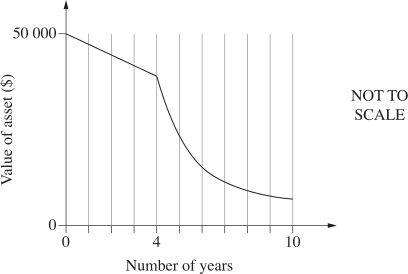
The graph shows the decreasing value of an asset.

For the first 4 years, the value of the asset depreciated by $1500 per year, using a straight-line method of depreciation.

After the end of the 4th year, the method of depreciation changed to the declining-balance method at the rate of 35% per annum.

What is the total depreciation at the end of 10 years?   (4 marks)

--- 10 WORK AREA LINES (style=lined) ---

Show Answers Only

\(\text{Total depreciation}\ =$46\,681.57\)

Show Worked Solution

\(\text{Depreciation after 4 years}\ = 4 \times 1500 = $6000\)

\(\text{Value after 4 years}\ = 50\,000-6000=44\,000\)

\(\text{Declining balance used for the next 6 years:}\)

\(V_0=$44\,000, r=0.35, n=6\)

\(S\) \(=V_0(1-r)^n\)  
  \(=44\,000(1-0.35)^6\)  
  \(=$3318.43\)  

 
\(\therefore\ \text{Total depreciation}\ =50\,000-3318.43=$46\,681.57\)

Filed Under: Depreciation - Declining Balance (Std 2) Tagged With: Band 4, smc-813-50-Declining Balance vs Straight Line, smc-813-60-Depreciation Graphs

Probability, STD2 S2 2024 HSC 12 MC

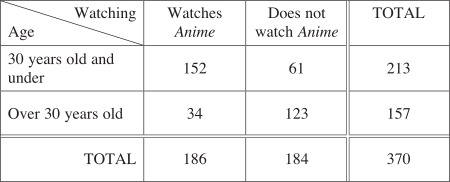
A survey of 370 people was conducted to investigate the association between watching Anime and the age of the person.

The two-way table shows the responses collected.

Approximately what percentage of the over 30-year-olds watch Anime?

  1. 9%
  2. 18%
  3. 22%
  4. 42%
Show Answers Only

\(C\)

Show Worked Solution

\(\text {Total over } 30=157\)

\(\text {Over 30s who watch anime = 34}\)

\(\text {% over 30s who watch anime}\ =\dfrac{34}{157}=21.7\%\)

\(\Rightarrow C\)

Filed Under: Relative Frequency (Std 2), Relative Frequency (Y11) Tagged With: Band 4, common-content, smc-827-10-Surveys/Two-Way Tables, smc-990-10-Surveys/Two-Way Tables

Financial Maths, STD2 F4 2024 HSC 27

A couple borrows $30 000 to be repaid in equal monthly repayments of $280 over 10 years.

After following this repayment plan for 5 years, they decide to decrease their monthly repayment to $250. As a result, it will take them an additional two years to pay off their loan.

How much more will they repay in total by making this change?   (3 marks)

--- 6 WORK AREA LINES (style=lined) ---

Show Answers Only

\(\text{Extra repaid}\ =$4200\)

Show Worked Solution

\(\text{Original plan:}\)

\(\text{Total repayments}\ =10 \times 12=120\)

\(\text{Amount repaid}\ =120 \times 280=$33\ 600\)
 

\(\text{New plan:}\)

\(\text{Repayments at \$280}\ =5 \times 12=60\)

\(\text{Repayments at \$250}\ =7 \times 12=84\)

\(\text{Amount repaid}\ = 60 \times 280 + 84 \times 250 =$37\ 800\)

\(\text{Extra repaid}\ =37\ 800-33\ 600=$4200\)

Filed Under: Loans and Credit Cards (Std 2) Tagged With: Band 4, smc-814-40-Total Loan/Interest Payments

Algebra, STD2 A1 2024 HSC 11 MC

A train left Richmond at 6:42 am and arrived at Central Station at 8:04 am. The distance travelled by the train from Richmond to Central was 61 km.

What was the average speed of this train, correct to the nearest km/h ?

  1. 38
  2. 45
  3. 50
  4. 74
Show Answers Only

\(B\)

Show Worked Solution

\(\text {Time of travel:  8:04 less 6:42 = 82 minutes.}\)

  \(\text{Speed (avg)}\) \(=\dfrac{\text{distance}}{\text{time}}\)
    \(=\dfrac{61}{82}\ \ \text{km/min}\)
    \(=\dfrac{61}{82} \times 60\ \ \text{km/hr}\)
    \(=44.6\ \ \text{km/hr}\)

 
\(\Rightarrow B\)

Filed Under: Applications: BAC, Medication and D=SxT (Std 2), Applications: BAC, Medicine and D=SxT (Std2-2027) Tagged With: Band 4, smc-6235-20-Speed Distance Time, smc-791-20-Speed Distance Time

Algebra, STD2 A4 2024 HSC 9 MC

The time taken to paint a school varies inversely with the number of painters completing the task.

It takes 6 painters a total of 20 days to paint a school.

How many days would it take 15 painters to paint the same school?

  1. 4.5
  2. 8
  3. 15.5
  4. 50
Show Answers Only

\(B\)

Show Worked Solution

\(T \propto \dfrac{1}{N} \ \Rightarrow \ \ T=\dfrac{k}{N}\)

\(\text {Find}\ k\ \text{given}\ \  T=20\ \ \text {when}\ \ N=6 \text {:}\)

\(20=\dfrac{k}{6} \ \Rightarrow\ \ k=120\)

\(\therefore\ T=\dfrac{120}{N}\)

\(\text {Find}\ T \ \text {if}\ \ N=15:\)

\(T=\dfrac{120}{15}=8 \text { days }\)

\(\Rightarrow B\)

Filed Under: Non-Linear: Inverse and Other Problems (Std 2) Tagged With: Band 4, smc-795-10-Inverse, smc-795-40-Proportional

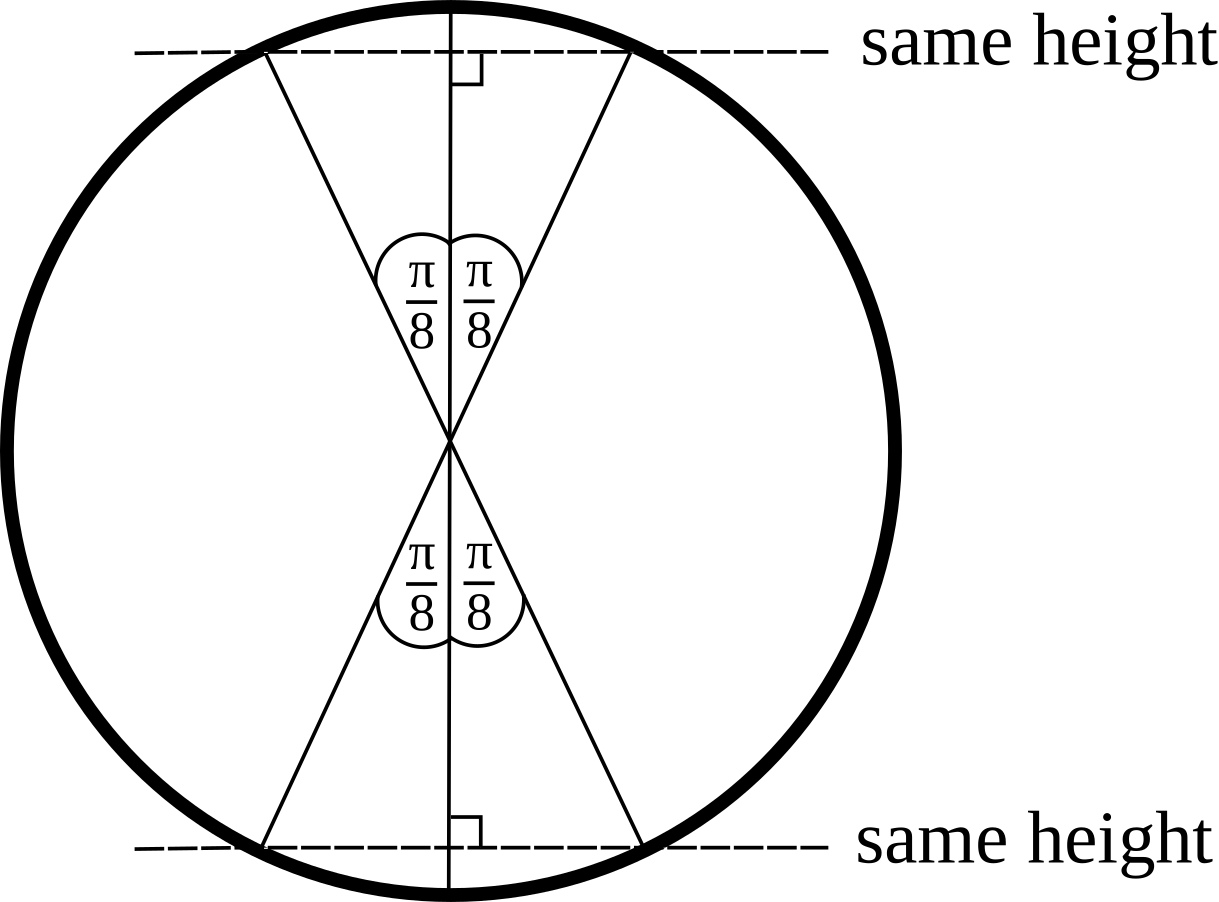
Trigonometry, 2ADV T3 2024 HSC 28

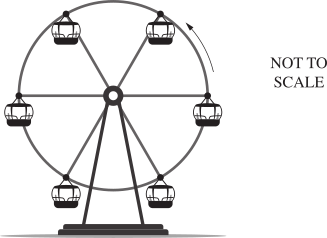
Anna is sitting in a carriage of a Ferris wheel which is revolving. The height, \(A(t)\), in metres above the ground of the top of her carriage is given by

\(A(t)=c-k\,\cos\Big( \dfrac{\pi t}{24}\Big) \),

where \(t\) is the time in seconds after Anna's carriage first reaches the bottom of its revolution and \(c\) and \(k\) are constants.
 

The top of each carriage reaches a greatest height of 39 metres and a smallest height of 3 metres.

  1. Find the value of \(c\) and \(k\).   (2 marks)

    --- 4 WORK AREA LINES (style=lined) ---

  2. How many seconds does it take for one complete revolution of the Ferris wheel?   (1 mark)

    --- 2 WORK AREA LINES (style=lined) ---

  3. Billie is in another carriage. The height, \(B(t)\), in metres above the ground of the top of her carriage is given by

\(B(t)=c-k\,\cos\Big( \dfrac{\pi}{24}(t-6)\Big) \),

  1. where \(c\) and \(k\) are as found in part (a).
  2. During each revolution, there are two occasions when Anna's and Billie's carriages are at the same heights. At what two heights does this occur? Give your answer correct to 2 decimal places.    (4 marks)

    --- 12 WORK AREA LINES (style=lined) ---

Show Answers Only

a.   \(c=\ \text{centre of motion}\ = \dfrac{39+3}{2} = 21\)

\(k=\ \text{amplitude}\ = \dfrac{39-3}{2}=18\)

b.  \(T= 48\ \text{seconds}\)

c.  \(h_1=4.37\ \text{m,}\ h_2=37.63\ \text{m}\)

Show Worked Solution

a.   \(c=\ \text{centre of motion}\ = \dfrac{39+3}{2} = 21\)

\(k=\ \text{amplitude}\ = \dfrac{39-3}{2}=18\)
 

b.  \(A(t)=21-18\,\cos\Big( \dfrac{\pi t}{24}\Big)\ \Rightarrow\ \ n=\dfrac{\pi}{24} \)

\(T=\dfrac{2\pi}{n} = 2\pi \times \dfrac{24}{\pi} = 48\ \text{seconds}\)
 

c.   \(\text{Strategy 1}\)

\(\text{Billie’s carriage is 6 seconds behind Anna’s.}\)

\(\text{When}\ t=0,\ \text{Anna’s carriage is at the lowest point}\ = 21-18=3\)

\(\text{When}\ t=3,\ \text{by symmetry, both carriages are at the same height:}\)

   \(h_1=21-18\cos(\dfrac{\pi}{8}) = 4.370… = 4.37\ \text{m (2 d.p.)}\)
 

\(\text{When}\ t=24,\ \text{Anna’s carriage is at the highest point}\ = 21+18=39\)

\(\text{When}\ t=27,\ \text{by symmetry, both carriages are at the same height:}\)

   \(h_2=21-18\cos(\dfrac{9\pi}{8}) = 37.629… = 37.63\ \text{m (2 d.p.)}\)
 

\(\text{Strategy 2}\)

\(\text{Angle between the 2 carriages}\ = \dfrac{\pi \times 6}{24} = \dfrac{\pi}{4} \)

\(\text{By inspection:}\)
 

\(\text{Heights are the same:}\)

\(h_1=21-18\cos(\dfrac{\pi}{8}) = 4.370… = 4.37\ \text{m (2 d.p.)}\)

\(h_2=21-18\cos(\dfrac{7\pi}{8}) = 37.629… = 37.63\ \text{m (2 d.p.)}\)

♦♦ Mean mark (c) 38%.

Filed Under: Trig Applications (Y12) Tagged With: Band 4, Band 5, smc-1188-30-Other Applications

Calculus, 2ADV C3 2024 HSC 17

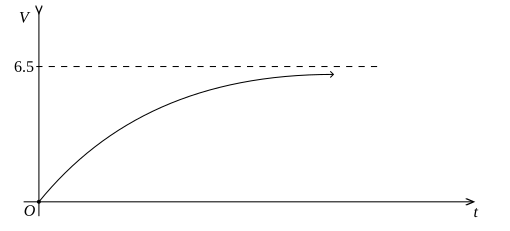
In a particular electrical circuit, the voltage \(V\) (volts) across a capacitor is given by

\(V(t)=6.5\left(1-e^{-k t}\right)\),

where \(k\) is a positive constant and \(t\) is the number of seconds after the circuit is switched on.

  1. Draw a sketch of the graph of \(V(t)\), showing its behaviour as \(t\) increases.   (2 marks)
     

    --- 0 WORK AREA LINES (style=blank) ---

  1. When \(t=1\), the voltage across the capacitor is 2.6 volts.
  2. Find the value of \(k\), correct to 3 decimal places.   (2 marks)

    --- 6 WORK AREA LINES (style=lined) ---

  1. Find the rate at which the voltage is increasing when \(t=2\), correct to 3 decimal places.   (2 marks)

    --- 4 WORK AREA LINES (style=lined) ---

Show Answers Only

a.   
       

b.   \(k=0.511\)

c.  \(1.195\ \text{V/s}\)

Show Worked Solution

a.   
       
♦ Mean mark (a) 49%.

b.   \(V=6.5(1-e^{-kt})\)

\(\text{When}\ \ t=1, V=2.6:\)

\(2.6\) \(=6.5(1-e^{-k})\)  
\(1-e^{-k}\) \(=0.4\)  
\(e^{-k}\) \(=0.6\)  
\(-k\) \(=\ln(0.6)\)  
\(k\) \(=0.5108…\)  
  \(=0.511\ \text{(3 d.p.)}\)  

 
c.
   \(V=6.5-6.5e^{-kt}\)

\(\dfrac{dV}{dt}=6.5ke^{-kt}\)

\(\text{Find}\ \dfrac{dV}{dt}\ \text{when}\ \ t=2:\)

\(\dfrac{dV}{dt}\) \(=6.5 \times 0.511 \times e^{-2 \times 0.511}\)  
  \(=1.1953…\)  
  \(=1.195\ \text{V/s (3 d.p.)}\)  

Filed Under: Rates of Change (Y12) Tagged With: Band 3, Band 4, Band 5, smc-1091-25-Other Themes, smc-1091-30-Log/Exp Function

Probability, 2ADV S1 2024 HSC 18

In a game, the probability that a particular player scores a goal at each attempt is 0.15.

  1. What is the probability that this player does NOT score a goal in the first two attempts?   (1 mark)

    --- 2 WORK AREA LINES (style=lined) ---

  2. Determine the least number of attempts that this player must make so that the probability of scoring at least one goal is greater than 0.8.   (2 marks)

    --- 6 WORK AREA LINES (style=lined) ---

Show Answers Only

a.   \(0.7225\)

b.   \(n=10\)

Show Worked Solution

a.   \(P(G)=0.15, \ \ P(\bar{G})=0.85\)

\(P(\bar{G}\bar{G}) = 0.85^2=0.7225\)
 

b.   \(\text{2 attempts:}\ P(\text{at least 1 goal})=1-P(\bar{G}\bar{G})=1-0.85^{2}\)

\(\text{3 attempts:}\ P(\text{at least 1 goal})=1-0.85^{3}\)

\(\text{n attempts:}\ P(\text{at least 1 goal})=1-0.85^{n}\)

\(\text{Find}\ n\ \text{such that:}\)

\(1-0.85^{n}\) \(\gt 0.8\)  
\(0.85^{n}\) \(\lt 0.2\)  
\(n \times\ln(0.85)\) \(\lt \ln(0.2)\)  
\(n\) \(\gt \dfrac{\ln(0.2)}{\ln(0.85)}\)  
  \(\gt 9.9…\)  

 
\(\therefore\ \text{Least}\ n=10\)

♦ Mean mark (b) 39%.

Filed Under: Multi-Stage Events (Adv-2027), Multi-Stage Events (Y11) Tagged With: Band 4, Band 5, smc-6469-20-Other Multi-Stage Events, smc-6469-30-Complementary Probability, smc-989-20-Other Multi-Stage Events, smc-989-30-Complementary Probability

CHEMISTRY, M2 EQ-Bank 10

A sample of nitrogen gas at a pressure of 400 kPa and a temperature of 60.0°C occupies a volume of 35.0 L.

  1. Calculate the volume of this nitrogen gas at 298 K and 120 kPa.   (3 marks)

--- 6 WORK AREA LINES (style=lined) ---

  1. Calculate the number of moles of nitrogen in this sample.   (2 marks)

--- 4 WORK AREA LINES (style=lined) ---

  1. Calculate the mass of this nitrogen sample.   (2 marks)

--- 4 WORK AREA LINES (style=lined) ---

Show Answers Only

a.    \(104.4\ \text{L}\)

b.    \(5.06\ \text{mol}\)

c.    \(141.8\ \text{g}\)

Show Worked Solution

a.    Using the Combined Gas Law: \(\dfrac{P_1V_1}{T_1}=\dfrac{P_2V_2}{T_2}\)

\(T_1 = 60^{\circ}\text{C}=333\ \text{K}\)

\(V_2=\dfrac{P_1V_1T_2}{T_1P_2}=\dfrac{400 \times 35 \times 298}{333 \times 120}=104.4\ \text{L}\)


b.    Using the Ideal Gas Law: \(PV=nRT\) 

\(n=\dfrac{PV}{RT}=\dfrac{400 \times 35}{8.314 \times 333}=5.06\ \text{mol}\)


c.    Nitrogen gas \(\ce{(N2)}\) has a molar mass of \(28.02\ \text{g mol}^{-1}\)

\(\ce{m(N2)}= n \times MM = 5.06 \times 28.02 = 141.8\ \text{g}\)

Filed Under: Gas Laws Tagged With: Band 4, Band 5, smc-4262-30-Ideal Gas Law, smc-4262-90-Combined Gas Law

CHEMISTRY, M2 EQ-Bank 6 MC

A sealed container of gas is heated, causing the temperature of the gas to increase from 300 K to 450 K, while the volume of the gas remains constant. If the initial pressure of the gas was 120 kPa, what will the new pressure be?

  1. 180 kPa
  2. 150 kPa
  3. 90 kPa
  4. 80 kPa
Show Answers Only

\(A\)

Show Worked Solution
  • Using Gay-Lussac’s Law:  \(\dfrac{P_1}{T_1}=\dfrac{P_2}{T_2}\)
  •    \(P_2=\dfrac{P_1T_2}{T_1}=\dfrac{120 \times 450}{300}=180\ \text{kPa}\)

\(\Rightarrow A\)

Filed Under: Gas Laws Tagged With: Band 4, smc-4262-85-Gay-Lussac's Law

CHEMISTRY, M2 EQ-Bank 9

Aluminium carbonate reacts with nitric acid to produce aluminium nitrate, carbon dioxide, and water.

What volume of carbon dioxide will be produced if 15.0 g of aluminium carbonate is reacted and the gas is collected at 25°C and 100 kPa?   (5 marks)

--- 10 WORK AREA LINES (style=lined) ---

Show Answers Only

\(4.76\ \text{L}\) 

Show Worked Solution
  • The chemical equation for the reaction:
  •    \(\ce{Al2(CO3)3 + 6HNO3 -> 2Al(NO3)3 + 3CO2 + 3H2O}\)
  • \(\ce{n(Al2(CO3)3)}=\dfrac{m}{MM}=\dfrac{15.0}{2(26.98+3(12.01)+9(16)}=0.0641\ \text{mol}\)
  • The ratio of \(\ce{Al2(CO3)3:CO2 = 1:3}\)
  • \(\ce{n(CO2)}= 3 \times 0.0641 = 0.192\ \text{mol}\)
  • Using Avogadro’s Law:
  •    \(V=n \times V_{\text{molar}} = 0.192 \times 24.79 = 4.76\ \text{L}\) 

Filed Under: Gas Laws Tagged With: Band 4, Band 5, smc-4262-20-Molar Calculations, smc-4262-80-Avogadro's Law

CHEMISTRY, M2 EQ-Bank 8

A gas at a temperature of \(9.0 \times 10^2\ \text{K}\) in a container with a volume of \(30.0\ \text{L}\) has a pressure of \(5.0 \times 10^2\ \text{kPa}\).

  1. How many moles of gas are in the container?   (3 marks)

--- 6 WORK AREA LINES (style=lined) ---

  1. If the empty container weighs \(450.0\ \text{g}\) and the container with the gas weighs \(526.0\ \text{g}\), what is the gaseous element in the container?   (2 marks)

--- 4 WORK AREA LINES (style=lined) ---

Show Answers Only

a.    \(2.0\ \text{mol}\)

b.    The unknown gas is fluorine.

Show Worked Solution

a.    Using the Ideal Gas Law:

\(PV=nRT \Rightarrow n=\dfrac{PV}{RT}\)

\(n=\dfrac{500 \times 30}{8.314 \times 900}=2.0\ \text{mol (2 sig.fig)}\) 


b.    Mass of the gas \(=526.0-450.0=76\ \text{g}\)

Molar Mass of the gas \(=\dfrac{m}{n}=\dfrac{76}{2.0}=38\ \text{g mol}^{-1}\)

  • This is equal to the MM of fluorine gas \(\ce{(F2)}\).
  • The unknown gas is fluorine.

Filed Under: Gas Laws Tagged With: Band 4, Band 6, smc-4262-20-Molar Calculations, smc-4262-30-Ideal Gas Law

Functions, 2ADV F1 2024 HSC 6 MC

What is the domain of the function  \(f(x)=\dfrac{1}{\sqrt{x^2-1}}\) ?

  1. \([-1,1]\)
  2. \((-\infty,-1] \cup[1, \infty)\)
  3. \((-1,1)\)
  4. \((-\infty,-1) \cup(1, \infty)\)
Show Answers Only

\( D \)

Show Worked Solution
\(x^2-1\) \(>0\)  
\(x^2\) \(>1\)  

 
\( x<-1 \ \cup \ x>1 \)

\( x \in(-\infty,-1) \cup(1, \infty) \)

\( \Rightarrow D \)

Filed Under: Further Functions and Relations (Y11), Other Functions and Relations (Adv-2027) Tagged With: Band 4, smc-6216-40-Square-Root Functions, smc-6218-40-Square-Root Functions, smc-987-40-Square-Root Functions

CHEMISTRY, M2 EQ-Bank 4 MC

A sample of gas is stored in a container at a pressure of 4.00 kPa, a temperature of 280 K, and a volume of 8.00 L. If the temperature increases to 320 K and the pressure changes to 4.50 kPa, what will the volume be?

  1. \(7.9\ \text{L}\)
  2. \(8.1\ \text{L}\)
  3. \(6.2\ \text{L}\)
  4. Unchanged
Show Answers Only

\(B\)

Show Worked Solution
  • Using the Combined Gas Law: \(\dfrac{P_1V_1}{T_1}=\dfrac{P_2V_2}{T_2}\)
\(V_2\) \(=\dfrac{P_1 \times V_1 \times T_2}{T_1 \times P_2}\)  
  \(=\dfrac{4.00 \times 8 \times 320}{280 \times 4.5}\)  
  \(=8.1\ \text{L}\)  

 
\(\Rightarrow B\)

Filed Under: Gas Laws Tagged With: Band 4, smc-4262-90-Combined Gas Law

CHEMISTRY, M2 EQ-Bank 3 MC

What volume will 3.0 mol of oxygen occupy at 200°C and 150 kPa?

  1. 33.3 L
  2. 52.8 L
  3. 62.4 L
  4. 78.6 L
Show Answers Only

\(D\)

Show Worked Solution
  • Using the Ideal Gas Law, \(PV=nRT \ \Rightarrow \ V=\dfrac{nRT}{P}\)
  •    \(V=\dfrac{3.0 \times 8.314 \times (200 + 273)}{150}=78.6\ \text{L}\)

\(\Rightarrow D\)

Filed Under: Gas Laws Tagged With: Band 4, smc-4262-30-Ideal Gas Law

Financial Maths, STD2 F4 2024 HSC 7 MC

Three years ago, the price of a uniform was $180.

Due to inflation, the price increased annually by 2.5%.

What is the price of this uniform now?

  1. $180.14
  2. $ 181.35
  3. $ 193.50
  4. $ 193.84
Show Answers Only

\(D\)

Show Worked Solution

\(r=2.5 \%=\dfrac{2.5}{100}=0.025\)

  \(FV\) \(=PV(1+r)^n\)
    \(=180(1.025)^3\)
    \(=193.84\)

 
\(\Rightarrow D\)

Filed Under: Compound Interest and Shares (Std2) Tagged With: Band 4, smc-817-20-FV Formula

CHEMISTRY, M2 EQ-Bank 6

A piece of zinc weighing 3.20 grams is placed into a beaker containing 300.0 mL of 0.7500 mol/L hydrochloric acid.

\(\ce{Zn(s) + 2HCl(aq) -> ZnCl2(aq) + H2(g)}\)

  1. Determine the limiting reagent (show all working).   (2 marks)

--- 4 WORK AREA LINES (style=lined) ---

  1. Calculate the volume of gas produced in this reaction at 25°C and 100 kPa.   (2 marks)

--- 4 WORK AREA LINES (style=lined) ---

Show Answers Only

a.    Zinc is the limiting reagent.

b.    \(1.21\ \text{L}\)

Show Worked Solution

a.    \(\ce{n(Zn)} = \dfrac{m}{MM} = \dfrac{3.20}{65.38}=0.0489\ \text{mol}\)

\(\ce{n(HCl)} = c \times V = 0.75 \times 0.3 = 0.225\)

  • Based on the mole ratio, \(0.0489\ \text{mol}\) of Zinc would require \(0.0978\ \text{mol}\) of hydrochloric acid. 
  • As there is excess hydrochloric acid, Zinc is the limiting reagent.

b.    The Mole ratio of \(\ce{Zn:H2}\) is \(1:1\)

  • \(0.0489\ \text{mol}\) of \(\ce{H2(g)}\) is produced.
  • At \(25^{\circ}\text{C}\) and \(100\ \text{kPa}\), \(1\) mole of gas \(=24.79\ \text{L}\)
  • \(\ce{V(H2(g))} = 0.0489 \times 24.79 = 1.21\ \text{L}\)

Filed Under: Gas Laws Tagged With: Band 3, Band 4, smc-4262-20-Molar Calculations

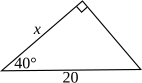
Measurement, STD2 M6 2024 HSC 6 MC

Consider the diagram shown.
 

Which of the following is the correct expression for the length of \(x\) ?

  1. \(20\, \cos 40^{\circ}\)
  2. \(20\, \sin 40^{\circ}\)
  3. \(\dfrac{20}{\cos 40^{\circ}}\)
  4. \(\dfrac{20}{\sin 40^{\circ}}\)
Show Answers Only

\(A\)

Show Worked Solution
\(\cos 40^{\circ}\) \(=\dfrac{x}{20}\)  
\(x\) \(=20\, \times \cos 40^{\circ}\)  

 
\(\Rightarrow A\)

Filed Under: Pythagoras and Right-Angled Trig (Std2) Tagged With: Band 4, smc-802-20-Right-Angled Trig

Statistics, STD2 S5 2024 HSC 5 MC

Pia's marks in Year 10 assessments are shown. The scores for each subject were normally distributed.

\begin{array}{|l|c|c|c|}
\hline & \textit {Pia's mark} & \textit {Year 10 mean} & \textit {Year 10 standard} \\
&&&\textit {deviation}\\
\hline \text {English} & 78 & 66 & 6 \\
\hline \text {Mathematics} & 80 & 71 & 10 \\
\hline \text {Science} & 77 & 70 & 15 \\
\hline \text {History} & 85 & 72 & 9 \\
\hline
\end{array}

In which subject did Pia perform best in comparison with the rest of Year 10?

  1. English
  2. Mathematics
  3. Science
  4. History
Show Answers Only

\(A\)

Show Worked Solution

\(\text {Consider the z-score of each option:}\)

\(z \text {-score (English)}=\dfrac{78-66}{6}=2\)

\(z \text {-score (Maths)}=\dfrac{80-71}{10}=0.9\)

\(z \text {-score (Science) }=\dfrac{77-70}{15}=0.46 \ldots\)

\(z \text {-score (History})=\dfrac{85-72}{9}=1.4 \ldots\)

\(\Rightarrow A\)

Filed Under: S5 The Normal Distribution (Y12) Tagged With: 2adv-std2-common, Band 4, smc-819-30-Comparisons of Data Sets

Measurement, STD2 M7 2024 HSC 33

Wombats can run at a speed of 40 km/h over short distances.

At this speed, how many seconds would it take a wombat to run 150 metres?   (3 marks)

--- 8 WORK AREA LINES (style=lined) ---

Show Answers Only

\(\text{13.5 seconds}\)

Show Worked Solution

\(\text{Convert km/h to m/sec:}\)

\(\text{40 km/h}\) \(=40\,000\ \text{m/h}\)  
  \(=\dfrac{40\,000}{60 \times 60}\ \text{m/s}\)  
  \(=11.11\ \text{m/s}\)  


\(\therefore\ \text{Time to run 150m}\) \(=\dfrac{150}{11.11…}\)  
  \(=13.5\ \text{seconds}\)  

Filed Under: Rates (Std2) Tagged With: Band 4, smc-805-60-Other rate problems

Probability, STD2 S2 2024 HSC 31

A coin is biased so that it is twice as likely to show a head than a tail.

  1. What is the probability of obtaining a head with one throw of this coin?   (1 mark)

    --- 2 WORK AREA LINES (style=lined) ---

  2. In two throws of this coin, what is the probability of obtaining at least one head?   (2 marks)

    --- 6 WORK AREA LINES (style=lined) ---

Show Answers Only

a.   \(P(H) = \dfrac{2}{3}\)

b.   \(P\text{(at least 1 head)}\ = \dfrac{8}{9}\)

Show Worked Solution

a.   \(P(H) = \dfrac{2}{3}\)

b.   \(P(T) = 1-P(H)=1-\dfrac{2}{3}=\dfrac{1}{3}\)

  \(P\text{(at least 1 head)}\) \(=1-P\text{(no heads)}\)
    \(=1-P(TT)\)
    \(=1-\dfrac{1}{3} \times \dfrac{1}{3}\)
    \(=\dfrac{8}{9}\)
♦ Mean mark (a) 51%.
♦♦ Mean mark (b) 30%.

Filed Under: Multi-Stage Events (Std 2) Tagged With: Band 4, Band 5, smc-829-30-P(E) = 1 - P(not E)

CHEMISTRY, M2 EQ-Bank 7

A sample of oxygen gas has a volume of 35 mL. If the temperature of the gas is raised from 40.0°C to 90.0°C, find the new volume of the gas, assuming constant pressure.   (2 marks)

--- 6 WORK AREA LINES (style=lined) ---

Show Answers Only

\(40.6\ \text{mL}\)

Show Worked Solution
  • Using Charles’s Law:
  •    \(V_1=35\ \text{mL}\), \(T_1=313\ \text{K}\), \(T_2=363\ \text{K}\)
  •   \(\dfrac{V_1}{T_1}=\dfrac{V_2}{T_2}\)
  •   \(V_2=\dfrac{V_1 \times T_2}{T_1}=\dfrac{35 \times 363}{313}=40.6\ \text{mL}\)

Filed Under: Gas Laws Tagged With: Band 4, smc-4262-70-Charles's Law

CHEMISTRY, M3 EQ-Bank 13

Explain how the trends in ionisation energy, atomic radius, and electronegativity across a period affect the reactivity of metals.   (3 marks)

--- 5 WORK AREA LINES (style=lined) ---

Show Answers Only
  • As you move across a period from left to right, the atomic radius decreases due to the increasing nuclear charge, which pulls the electrons closer to the nucleus.
  • This leads to an increase in ionisation energy, making it harder to remove an electron from a metal atom.
  • Additionally, electronegativity increases across the period, meaning that metals are less likely to lose electrons.
  • As a result, the reactivity of metals decreases across a period because it becomes more difficult for them to lose electrons and participate in chemical reactions.
Show Worked Solution
  • As you move across a period from left to right, the atomic radius decreases due to the increasing nuclear charge, which pulls the electrons closer to the nucleus.
  • This leads to an increase in ionisation energy, making it harder to remove an electron from a metal atom.
  • Additionally, electronegativity increases across the period, meaning that metals are less likely to lose electrons.
  • As a result, the reactivity of metals decreases across a period because it becomes more difficult for them to lose electrons and participate in chemical reactions.

Filed Under: Predicting Reactions of Metals Tagged With: Band 4, smc-4264-20-Reactivity of Metals, smc-4264-50-Patterns in Metal Activity

  • « Previous Page
  • 1
  • …
  • 30
  • 31
  • 32
  • 33
  • 34
  • …
  • 114
  • Next Page »

Copyright © 2014–2025 SmarterEd.com.au · Log in