SmarterEd

Aussie Maths & Science Teachers: Save your time with SmarterEd

  • Login
  • Get Help
  • About

BIOLOGY, M3 EQ-Bank 5

Summarise the key principles of Darwin's theory of evolution by natural selection.   (3 marks)

--- 5 WORK AREA LINES (style=lined) ---

Show Answers Only
  • Darwin’s theory of evolution by natural selection proposes that species change over time through a process of natural selection acting on inherited variations within populations.
  • He observed that individuals in a population vary in their traits, some of which are heritable, and that more offspring are produced than can survive given limited resources.
  • Darwin concluded that individuals with advantageous traits are more likely to survive and reproduce, passing these beneficial traits to their offspring.
  • Over many generations, this process leads to changes in the frequency of traits within a population, potentially resulting in the evolution of new species adapted to their environments.
Show Worked Solution
  • Darwin’s theory of evolution by natural selection proposes that species change over time through a process of natural selection acting on inherited variations within populations.
  • He observed that individuals in a population vary in their traits, some of which are heritable, and that more offspring are produced than can survive given limited resources.
  • Darwin concluded that individuals with advantageous traits are more likely to survive and reproduce, passing these beneficial traits to their offspring.
  • Over many generations, this process leads to changes in the frequency of traits within a population, potentially resulting in the evolution of new species adapted to their environments.

Filed Under: Adaptations Tagged With: Band 4, smc-4308-20-Charles Darwin

BIOLOGY, M3 EQ-Bank 4

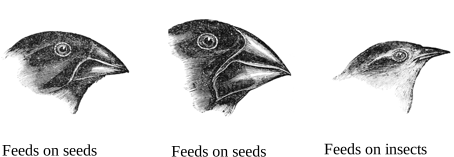
The illustrations below depict three species of finches from the Galapagos Islands, as observed by Charles Darwin during his voyage.

Explain why these finch species inhabit distinct ecological niches.   (3 marks)

--- 6 WORK AREA LINES (style=lined) ---

Show Answers Only
  • The distinct beak shapes of these finch species are adaptations that allow them to exploit different food sources, leading to occupation of distinct ecological niches.
  • The two finches with wider, shorter beaks are adapted for eating seeds, with the variation in width likely corresponding to different seed sizes or hardness they can crack.
  • The finch with the thin, long beak is specialised for probing and catching insects, allowing it to access food sources that the seed-eating finches cannot.
  • These adaptations reduce direct competition for food between the species, enabling them to coexist in the same general area by utilising different resources, a concept known as niche partitioning.
Show Worked Solution
  • The distinct beak shapes of these finch species are adaptations that allow them to exploit different food sources, leading to occupation of distinct ecological niches.
  • The two finches with wider, shorter beaks are adapted for eating seeds, with the variation in width likely corresponding to different seed sizes or hardness they can crack.
  • The finch with the thin, long beak is specialised for probing and catching insects, allowing it to access food sources that the seed-eating finches cannot.
  • These adaptations reduce direct competition for food between the species, enabling them to coexist in the same general area by utilising different resources, a concept known as niche partitioning.

Filed Under: Adaptations Tagged With: Band 4, smc-4308-50-Galapagos

CHEMISTRY, M3 EQ-Bank 15

Using collision theory, explain how increasing the temperature of a reaction mixture affects the rate of the reaction.   (3 marks)

--- 5 WORK AREA LINES (style=blank) ---

Show Answers Only
  • According to collision theory, increasing the temperature of a reaction mixture raises the kinetic energy of the reactant molecules.
  • As the molecules move faster, the frequency of collisions increases. In addition, a higher proportion of the molecules have enough energy to overcome the activation energy barrier.
  • As a result, there are more successful collisions per unit of time, leading to a faster reaction rate.
Show Worked Solution
  • According to collision theory, increasing the temperature of a reaction mixture raises the kinetic energy of the reactant molecules.
  • As the molecules move faster, the frequency of collisions increases. In addition, a higher proportion of the molecules have enough energy to overcome the activation energy barrier.
  • As a result, there are more successful collisions per unit of time, leading to a faster reaction rate.

Filed Under: Rates of Reactions Tagged With: Band 4, smc-4265-30-Temperature

CHEMISTRY, M3 EQ-Bank 7 MC

Which of the following best describes the role of activation energy in a chemical reaction?

  1. It is the total energy released when bonds are broken in a reaction.
  2. It is the minimum energy required for reactants to collide and form products.
  3. It is the energy needed to cool the reactants and stop the reaction.
  4. It increases the number of collisions between molecules.
Show Answers Only

\(B\)

Show Worked Solution
  • Activation energy is the minimum energy that reactants must have during a collision for a reaction to occur and form products.
  • If the reactants do not have sufficient energy, they will collide but fail to react.

\(\Rightarrow B\)

Filed Under: Rates of Reactions Tagged With: Band 4, smc-4265-10-Collision theory

CHEMISTRY, M3 EQ-Bank 14

A student conducted an experiment to investigate how the concentration of hydrochloric acid affects the rate of its reaction with magnesium ribbon. They measured the volume of hydrogen gas produced at regular intervals in reactions using 1.0 M, 2.0 M, and 3.0 M hydrochloric acid, keeping other variables constant.

  1. Explain how the concentration of hydrochloric acid influences the rate of reaction with magnesium, using collision theory.   (2 marks)

--- 4 WORK AREA LINES (style=blank) ---

  1. Describe how the student could modify the experiment to investigate the effect of temperature on the reaction rate.   (2 marks)

--- 4 WORK AREA LINES (style=blank) ---

  1. Identify and explain one advantage of a student using digital technologies such as a gas pressure sensor to collect or analyse data from the experiment.   (2 marks)

--- 4 WORK AREA LINES (style=blank) ---

Show Answers Only

a.   \(\ce{[HCl]}\) influence on the rate of reaction:

  • As the concentration increases, the number of acid particles in a given volume also increases.
  • This leads to more frequent collisions between hydrochloric acid molecules and the magnesium surface.
  • As a result, a higher concentration of hydrochloric acid increases the chance of successful collisions, which increases the reaction rate and causes hydrogen gas to be produced more quickly.

b.   Experiment modifications:

  • To investigate the effect of temperature on the reaction rate, the student could modify the experiment by conducting the reaction at different temperatures while keeping the concentration of hydrochloric acid constant.
  • They could use a water bath or hot plate to control the temperature for each trial. For example, the student could perform the reaction at 20°C, 30°C, and 40°C, then measure and compare the volume of hydrogen gas produced over time at each temperature.

c.   Advantage of digital technologies:

  • Using a gas pressure sensor in the experiment allows for continuous and precise data collection without human intervention.
  • This reduces the chances of human error when measuring the volume of gas produced manually at intervals, leading to more accurate and reliable results.
  • Additionally, the sensor can automatically record data over time, providing detailed information about the reaction rate that can be easily analysed using digital tools such as graphing software.
Show Worked Solution

a.   \(\ce{[HCl]}\) influence on the rate of reaction:

  • As the concentration increases, the number of acid particles in a given volume also increases.
  • This leads to more frequent collisions between hydrochloric acid molecules and the magnesium surface.
  • As a result, a higher concentration of hydrochloric acid increases the chance of successful collisions, which increases the reaction rate and causes hydrogen gas to be produced more quickly.

b.   Experiment modifications:

  • To investigate the effect of temperature on the reaction rate, the student could modify the experiment by conducting the reaction at different temperatures while keeping the concentration of hydrochloric acid constant.
  • They could use a water bath or hot plate to control the temperature for each trial. For example, the student could perform the reaction at 20°C, 30°C, and 40°C, then measure and compare the volume of hydrogen gas produced over time at each temperature.

c.   Advantage of digital technologies:

  • Using a gas pressure sensor in the experiment allows for continuous and precise data collection without human intervention.
  • This reduces the chances of human error when measuring the volume of gas produced manually at intervals, leading to more accurate and reliable results.
  • Additionally, the sensor can automatically record data over time, providing detailed information about the reaction rate that can be easily analysed using digital tools such as graphing software.

Filed Under: Rates of Reactions Tagged With: Band 4, Band 5, smc-4265-10-Collision theory, smc-4265-30-Temperature, smc-4265-40-Concentration

CHEMISTRY, M3 EQ-Bank 6 MC

How does increasing the surface area of a reactant, such as using a powdered solid instead of a solid block, affect the rate of a reaction?

  1. It allows more particles to be exposed to the reactant, increasing collision frequency.
  2. It decreases the energy required for successful collisions between particles.
  3. It decreases the temperature of the system, making the reaction faster.
  4. It increases the number of particles that remain unreacted at the end.
Show Answers Only

\(A\)

Show Worked Solution
  • Increasing the surface area of a reactant (e.g., using powdered solids) exposes more of the particles to the other reactants, resulting in a greater number of collisions per unit of time.
  • Since collision frequency is a key factor in the rate of reaction, having more available particles in contact increases the likelihood of successful collisions, which speeds up the reaction.

\(\Rightarrow A\)

Filed Under: Rates of Reactions Tagged With: Band 4, smc-4265-10-Collision theory, smc-4265-35-Surface area

BIOLOGY, M3 EQ-Bank 3

Analyse the role of behavioural adaptations in enhancing species survival. In your response, describe a specific behavioural adaptation in an Australian plant species and a specific Australian native animal.   (3 marks)

--- 6 WORK AREA LINES (style=lined) ---

Show Answers Only
  • Behavioural adaptations play a crucial role in enhancing species survival by allowing organisms to respond to environmental challenges through learned or instinctive actions.
  • In Australian plants, trigger plants display a distinctive behavioural adaptation in which their column rapidly snaps forward to deposit pollen onto insect pollinators, thereby enhancing their reproductive success.
  • Among Australian native animals, the frill-neck lizard erects a large frill around its neck and opens its brightly-coloured mouth when threatened. This makes itself appear larger and more intimidating to potential predators, increasing its chances of survival.
Show Worked Solution
  • Behavioural adaptations play a crucial role in enhancing species survival by allowing organisms to respond to environmental challenges through learned or instinctive actions.
  • In Australian plants, trigger plants display a distinctive behavioural adaptation in which their column rapidly snaps forward to deposit pollen onto insect pollinators, thereby enhancing their reproductive success.
  • Among Australian native animals, the frill-neck lizard erects a large frill around its neck and opens its brightly-coloured mouth when threatened. This makes itself appear larger and more intimidating to potential predators, increasing its chances of survival.

Filed Under: Adaptations Tagged With: Band 4, smc-4308-18-Behavioural adaptations

BIOLOGY, M3 EQ-Bank 2

Explain the concept of physiological adaptation in living organisms. In your answer, describe one example of a physiological adaptation in a plant species and one example in an animal species.   (3 marks)

--- 5 WORK AREA LINES (style=lined) ---

Show Answers Only
  • Physiological adaptations refer to functions of an organism’s structural features that have evolved to help them survive in their specific environments.
  • Plant example: Photosynthesis used by many succulent plants in arid regions, such as the Australian pigface, allows them to conserve water by opening their stomata at night to collect \(\ce{CO2}\).
  • Animal example: The salt glands of marine birds like the Australian pelican are a physiological adaptation that allows them to excrete excess salt from their bodies. This enables them to maintain proper osmotic balance despite drinking seawater.
Show Worked Solution
  • Physiological adaptations refer to functions of an organism’s structural features that have evolved to help them survive in their specific environments.
  • Plant example: Photosynthesis used by many succulent plants in arid regions, such as the Australian pigface, allows them to conserve water by opening their stomata at night to collect \(\ce{CO2}\).
  • Animal example: The salt glands of marine birds like the Australian pelican are a physiological adaptation that allows them to excrete excess salt from their bodies. This enables them to maintain proper osmotic balance despite drinking seawater.

Filed Under: Adaptations Tagged With: Band 4, smc-4308-15-Physiological adaptations

CHEMISTRY, M4 EQ-Bank 12

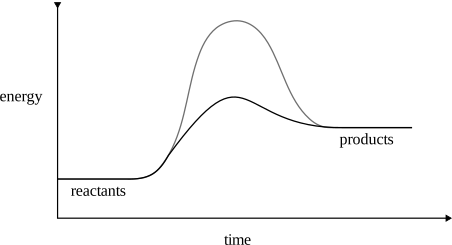
The energy profile diagram below shows the energy changes that occur during a specific chemical reaction in the absence of a catalyst.


  1. Draw the energy profile for this reaction with a catalyst on the diagram above.   (1 mark)

    --- 0 WORK AREA LINES (style=lined) ---

  2. Describe the impact of a catalyst on this reaction, using the diagram as a reference.   (2 marks)

--- 4 WORK AREA LINES (style=blank) ---

Show Answers Only

a.    
     

b.   Catalyst impact:

  • A catalyst offers an alternative pathway for the reaction to occur that requires less activation energy.
  • On the energy profile diagram, this would appear as a lower peak, indicating the reduction in the energy needed for the reaction to proceed.
Show Worked Solution

a.   


b.   Catalyst impact:

  • A catalyst offers an alternative pathway for the reaction to occur that requires less activation energy.
  • On the energy profile diagram, this would appear as a lower peak, indicating the reduction in the energy needed for the reaction to proceed.

Filed Under: Energy Changes in Chemical Reactions Tagged With: Band 4, smc-4266-30-Energy profiles, smc-4266-40-Role of catalysts

BIOLOGY, M3 EQ-Bank 7

"While biological control methods can be effective, they are not without risks and limitations."

Describe three potential disadvantages of biological controls used to manage introduced species populations.   (3 marks)

--- 8 WORK AREA LINES (style=lined) ---

Show Answers Only
  • Disadvantage 1: The potential for introducing new diseases that may affect non-target species. For example, a pathogen introduced to control an invasive plant might mutate and infect native plant species, causing unintended ecological damage.
  • Disadvantage 2: Another drawback is the long-term viability of the control agent, as the target species may develop resistance over time, rendering the control ineffective. This occurred with the myxoma virus introduced to control rabbits in Australia.
  • Disadvantage 3: The risk of the control agent itself becoming invasive. The cane toad in Australia, originally introduced to control beetle pests in sugar cane crops, became a significant pest itself.
Show Worked Solution
  • Disadvantage 1: The potential for introducing new diseases that may affect non-target species. For example, a pathogen introduced to control an invasive plant might mutate and infect native plant species, causing unintended ecological damage.
  • Disadvantage 2: Another drawback is the long-term viability of the control agent, as the target species may develop resistance over time, rendering the control ineffective. This occurred with the myxoma virus introduced to control rabbits in Australia.
  • Disadvantage 3: The risk of the control agent itself becoming invasive. The cane toad in Australia, originally introduced to control beetle pests in sugar cane crops, became a significant pest itself.

Filed Under: Effects of the Environment on Organisms Tagged With: Band 4, smc-4307-45-Biological Controls

CHEMISTRY, M3 EQ-Bank 4 MC

There could be a risk of explosion in a coal mine due to the presence of fine coal dust particles, so strict safety precautions are followed in these environments.
Which of the following statements best explains this risk?

  1. The activation energy for the reaction of fine particles is much lower than for large particles.
  2. The surface area of the coal dust particles is very large, which makes combustion reactions occur more rapidly.
  3. It is very easy to heat the fine coal dust particles to their ignition temperature.
  4. When coal is ground into fine particles, the energy profile diagram for the combustion reaction is altered.
Show Answers Only

\(B\)

Show Worked Solution
  • Fine coal dust particles have a much greater surface area compared to larger pieces of coal.
  • This increased surface area allows for more particles to be exposed to oxygen, leading to a faster and more intense combustion reaction. When ignited, the reaction can happen very quickly, which increases the risk of an explosion.
  • This is why environments with fine particles, like coal mines, must adhere to strict safety precautions to prevent such dangerous reactions.

\(\Rightarrow B\)

Filed Under: Rates of Reactions Tagged With: Band 4, smc-4265-35-Surface area

CHEMISTRY, M3 EQ-Bank 11

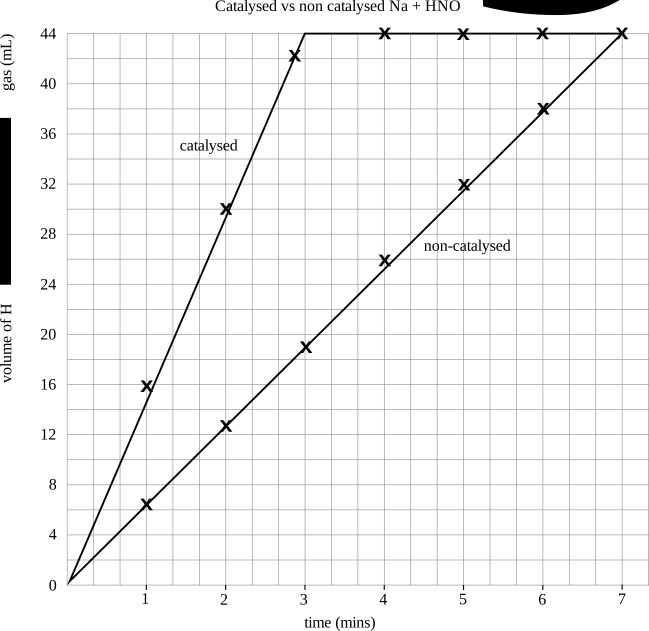
Brian measured the reaction rate of 0.5 g of sodium metal in 2.0 mol/L nitric acid. The volume of hydrogen gas produced per minute was recorded both without a catalyst and with copper as a catalyst.

\begin{array} {|c|c|c|}
\hline \text{Time (minutes)} & \text{Volume of hydrogen gas (mL)} & \text{Volume of hydrogen gas (mL)} \\ & \text{no catalyst} & \text{catalyst}  \\
\hline \text{0}  & 0 & 0  \\
\hline \text{1} & 16 & 7 \\
\hline \text{2} & 30 &  13\\
\hline \text{3} & 43 & 19 \\
\hline \text{4}  & 44 & 26 \\
\hline \text{5} & 44 &  32 \\
\hline \text{6} & 44 & 38 \\
\hline \text{7} & 44 &  44 \\
\hline \end{array}

  1. On the grid below, plot a line graph for the data in the table.   (3 marks)
     

  2. Write a conclusion for the experiment.   (2 marks)

    --- 3 WORK AREA LINES (style=blank) ---

Show Answers Only

a.    
       

b.   Experiment conclusion:

  • The rate of reaction was significantly faster when copper was used as a catalyst compared to when no catalyst was present.
  • This is because the copper catalyst provided an alternative reaction pathway with a lower activation energy, allowing the reactant particles to collide more frequently and effectively.

Show Worked Solution

a.   
     

b.   Experiment conclusion:

  • The rate of reaction was significantly faster when copper was used as a catalyst compared to when no catalyst was present.
  • This is because the copper catalyst provided an alternative reaction pathway with a lower activation energy, allowing the reactant particles to collide more frequently and effectively.

Filed Under: Rates of Reactions Tagged With: Band 3, Band 4, smc-4265-50-Catalysts

BIOLOGY, M3 EQ-Bank 6

"The prickly pear cactus, introduced to Australia in the 1800s, became a significant ecological problem before being brought under control."

Describe two significant changes to the ecosystem caused by the prickly pear invasion and the control method used to manage its population. In your answer, consider the effectiveness of this control measure and its ecological implications.   (4 marks)

--- 8 WORK AREA LINES (style=lined) ---

Show Answers Only
  • The prickly pear outcompeted native vegetation, forming dense thickets that reduced grazing land for livestock and native animals.
  • It also altered habitat structures, displacing native fauna and changing local biodiversity patterns. eg. it harboured pest species like rabbits.
  • To control the prickly pear population, scientists introduced the Cactoblastis moth, whose larvae feed exclusively on prickly pear species.
  • This biological control method proved remarkably effective, with the moths feeding almost exclusively on the prickly pear. As prickly pear numbers reduced, the moths also became rarer.
  • This control measure rapidly reduced prickly pear populations to manageable levels within a decade, restoring native ecosystems and millions of hectares of land for agricultural use.
  • This demonstrates the potential power and risks of biological control agents, as the moth’s effectiveness in Australia led to its introduction in other parts of the world, where it has sometimes become a pest itself.
Show Worked Solution
  • The prickly pear outcompeted native vegetation, forming dense thickets that reduced grazing land for livestock and native animals.
  • It also altered habitat structures, displacing native fauna and changing local biodiversity patterns. eg. it harboured pest species like rabbits.
  • To control the prickly pear population, scientists introduced the Cactoblastis moth, whose larvae feed exclusively on prickly pear species.
  • This biological control method proved remarkably effective, with the moths feeding almost exclusively on the prickly pear. As prickly pear numbers reduced, the moths also became rarer.
  • This control measure rapidly reduced prickly pear populations to manageable levels within a decade, restoring native ecosystems and millions of hectares of land for agricultural use.
  • This demonstrates the potential power and risks of biological control agents, as the moth’s effectiveness in Australia led to its introduction in other parts of the world, where it has sometimes become a pest itself.

Filed Under: Effects of the Environment on Organisms Tagged With: Band 4, Band 5, smc-4307-45-Biological Controls, smc-4307-55-Prickly Pear

BIOLOGY, M3 EQ-Bank 5

Describe the potential changes in native species populations as an introduced species becomes established and its population grows. In your answer, consider both direct and indirect effects on the ecosystem.   (4 marks)

--- 8 WORK AREA LINES (style=lined) ---

Show Answers Only

Cane toads:

  • As cane toad populations grew, many native predators such as quolls, goannas, and certain snake species experienced rapid declines due to poisoning when they attempted to eat the toxic toads.
  • This direct effect led to a decrease in these predator populations, which in turn caused indirect effects on their usual prey species.
  • For example, with fewer predators, some native frog and small mammal populations initially increased.
  • However, the cane toads also compete with native species for food and habitat, potentially leading to declines in some native insect and small animal populations over time. 

Rabbits:

  • As rabbit populations exploded, they caused significant damage to vegetation through overgrazing, reducing food and habitat for native herbivores such as kangaroos and wallabies.
  • This direct competition led to declines in these native species.
  • The changes in vegetation also indirectly affected other species; for example, small ground-dwelling animals lost protective cover, making them more vulnerable to predation.
  • In some areas, vegetation loss and rabbit burrowing has led to increased soil erosion, further altering habitats.
  • Over time, some native predators like dingoes and wedge-tailed eagles may have benefited from the abundant rabbit population as a new food source, potentially leading to complex changes in predator-prey dynamics.
Show Worked Solution

Answers could include one of the following.

Cane toads:

  • As cane toad populations grew, many native predators such as quolls, goannas, and certain snake species experienced rapid declines due to poisoning when they attempted to eat the toxic toads.
  • This direct effect led to a decrease in these predator populations, which in turn caused indirect effects on their usual prey species.
  • For example, with fewer predators, some native frog and small mammal populations initially increased.
  • However, the cane toads also compete with native species for food and habitat, potentially leading to declines in some native insect and small animal populations over time. 

Rabbits:

  • As rabbit populations exploded, they caused significant damage to vegetation through overgrazing, reducing food and habitat for native herbivores such as kangaroos and wallabies.
  • This direct competition led to declines in these native species.
  • The changes in vegetation also indirectly affected other species; for example, small ground-dwelling animals lost protective cover, making them more vulnerable to predation.
  • In some areas, vegetation loss and rabbit burrowing has led to increased soil erosion, further altering habitats.
  • Over time, some native predators like dingoes and wedge-tailed eagles may have benefited from the abundant rabbit population as a new food source, potentially leading to complex changes in predator-prey dynamics.

Filed Under: Effects of the Environment on Organisms Tagged With: Band 4, smc-4307-50-Cane toad, smc-4307-60-Rabbits

BIOLOGY, M3 EQ-Bank 3

"In the post industrial age, human activities have become increasingly influential on nature, reshaping the very foundations of our planet's ecosystems."

Describe two abiotic selection pressures caused by human activity and their potential impact on organisms in the ecosystem.   (4 marks)

--- 8 WORK AREA LINES (style=lined) ---

Show Answers Only

Answers could include two of the following.

Climate warming:

  • One major abiotic pressure is the increase in global temperatures due to climate change. This increase has affected both the atmosphere and the oceans.
  • Ocean warming has led to heat-tolerant coral species in the Great Barrier Reef having a survival advantage over less tolerant species. 

Pollution (plastics):

  • Another significant selection pressure is from plastic waste, particularly in rivers and oceans.
  • Sea turtles frequently mistake plastic bags for jellyfish, leading to blockages in their digestive systems and sometimes fatal outcomes. 

Light pollution:

  • Light pollution is another abiotic selection pressure created by humans.
  • In urban areas, light pollution has been shown to affect the breeding behaviour of birds, favouring those that can adapt to nesting and foraging under artificial light conditions.
Show Worked Solution

Answers could include two of the following.

Climate warming:

  • One major abiotic pressure is the increase in global temperatures due to climate change. This increase has affected both the atmosphere and the oceans.
  • Ocean warming has led to heat-tolerant coral species in the Great Barrier Reef having a survival advantage over less tolerant species. 

Pollution (plastics):

  • Another significant selection pressure is from plastic waste, particularly in rivers and oceans.
  • Sea turtles frequently mistake plastic bags for jellyfish, leading to blockages in their digestive systems and sometimes fatal outcomes. 

Light pollution:

  • Light pollution is another abiotic selection pressure created by humans.
  • In urban areas, light pollution has been shown to affect the breeding behaviour of birds, favouring those that can adapt to nesting and foraging under artificial light conditions.

Filed Under: Effects of the Environment on Organisms Tagged With: Band 4, smc-4307-10-Biotic/Abiotic Factors, smc-4307-40-Selection pressures

BIOLOGY, M3 EQ-Bank 2

Describe, providing an example, an abiotic factor that could act as a selection pressure in

  1. a desert ecosystem.   (2 marks)

    --- 5 WORK AREA LINES (style=lined) ---

  2. an aquatic ecosystem.   (2 marks)

    --- 5 WORK AREA LINES (style=lined) ---

Show Answers Only

a.   Desert ecosystem:

  • An abiotic factor acting as a selection pressure is extremely low rainfall/moisture.
  • For example, the thorny devil lizard has evolved a unique skin structure that allows it to collect and channel water to its mouth from any part of its body, enabling it to survive in extremely arid conditions. 

b.   Aquatic ecosystem:

  • In an aquatic ecosystem, water temperature can act as a significant abiotic selection pressure.
  • The Great Barrier Reef, for example, experiences coral bleaching events when water temperatures rise. These events stress the coral and if prolonged, can potentially kill the coral. 
Show Worked Solution

a.   Desert ecosystem:

  • An abiotic factor acting as a selection pressure is extremely low rainfall/moisture.
  • For example, the thorny devil lizard has evolved a unique skin structure that allows it to collect and channel water to its mouth from any part of its body, enabling it to survive in extremely arid conditions. 

b.   Aquatic ecosystem:

  • In an aquatic ecosystem, water temperature can act as a significant abiotic selection pressure.
  • The Great Barrier Reef, for example, experiences coral bleaching events when water temperatures rise. These events stress the coral and if prolonged, can potentially kill the coral. 

Filed Under: Effects of the Environment on Organisms Tagged With: Band 3, Band 4, smc-4307-10-Biotic/Abiotic Factors

BIOLOGY, M3 EQ-Bank 1

Describe two biotic factors that could act as selection pressures in a grassland ecosystem.

For each factor, briefly explain how it might influence the organisms living in that environment.   (4 marks)

--- 5 WORK AREA LINES (style=lined) ---

Show Answers Only

Answers could include two of the following.

Predation

  • Predation by herbivores like grazing animals could favour plants with defensive structures or compounds.
  • Example: The Acacia tree, common in Australian grasslands, has developed long, sharp thorns as a defensive structure against herbivores. 

Competition

  • Competition for resources such as light or nutrients might select for faster-growing or taller plant species. 
  • Example: Gum trees can grow to impressive heights which gives them an advantage in capturing sunlight.  

Parasites

  • Parasites causing fungal infections, could drive the evolution of resistance mechanisms in both plants and animals.
  • Example: Ticks are a parasite that can attach to the skin of animals like kangaroos and cattle, feeding on their blood and transmitting diseases. Animals with tick resistance will have a survival advantage.
Show Worked Solution

Answers could include two of the following.

Predation

  • Predation by herbivores like grazing animals could favour plants with defensive structures or compounds.
  • Example: The Acacia tree, common in Australian grasslands, has developed long, sharp thorns as a defensive structure against herbivores. 

Competition

  • Competition for resources such as light or nutrients might select for faster-growing or taller plant species. 
  • Example: Gum trees can grow to impressive heights which gives them an advantage in capturing sunlight.  

Parasites

  • Parasites causing fungal infections, could drive the evolution of resistance mechanisms in both plants and animals.
  • Example: Ticks are a parasite that can attach to the skin of animals like kangaroos and cattle, feeding on their blood and transmitting diseases. Animals with tick resistance will have a survival advantage.

Filed Under: Effects of the Environment on Organisms Tagged With: Band 4, Band 5, smc-4307-10-Biotic/Abiotic Factors

BIOLOGY, M3 EQ-Bank 2 MC

A new predatory bird species is introduced to an island ecosystem. Which of the following best describes the likely impact on the small mammal populations on the island?

  1. All small mammal species will be equally affected.
  2. Nocturnal species will have an immediate advantage.
  3. Species with better camouflage may have higher survival rates.
  4. The mammal population size will remain stable.
Show Answers Only

\(C\)

Show Worked Solution
  • The introduction of a new predator creates a selection pressure that favours individuals with traits that help them avoid predation.
  • Small mammals with better camouflage are less likely to be spotted by the predatory birds, giving them a survival advantage and potentially higher reproductive success.

\(\Rightarrow C\)

Filed Under: Effects of the Environment on Organisms Tagged With: Band 4, smc-4307-40-Selection pressures

BIOLOGY, M3 EQ-Bank 1 MC

In a grassland ecosystem, a prolonged drought occurs. Which of the following is most likely to be an immediate effect on the plant population?

  1. Increased genetic diversity.
  2. Rapid evolutionary changes.
  3. Selection for drought-tolerant individuals.
  4. Uniform growth across all plant species.
Show Answers Only

\(C\)

Show Worked Solution
  • In a prolonged drought, plants that are better adapted to conserve water or tolerate dry conditions are more likely to survive and reproduce.
  • This selection pressure favours drought-tolerant individuals in the short term, although evolutionary changes would take many generations to occur.

\(\Rightarrow C\)

Filed Under: Effects of the Environment on Organisms Tagged With: Band 4, smc-4307-40-Selection pressures

Functions, EXT1 F1 EQ-Bank 4

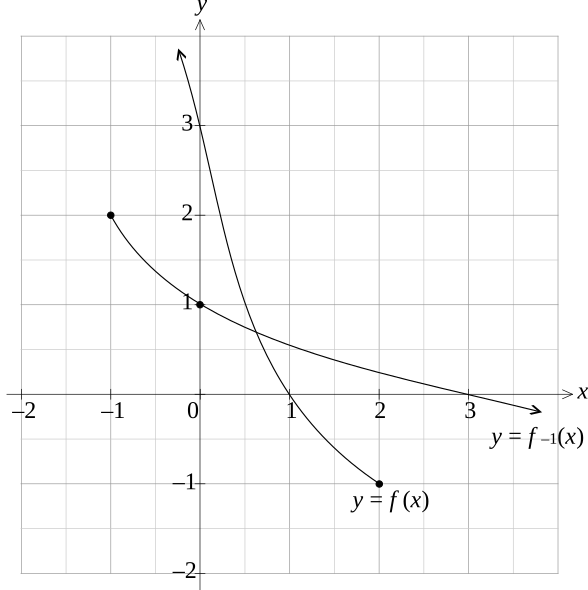
Let  \(f(x)=x^2-4 x+3\)  for  \(x \leqslant 2\).

  1. State the domain of  \(y=f^{-1}(x)\).  (1 mark)

    --- 2 WORK AREA LINES (style=lined) ---

  2. What is the equation of  \(y=f^{-1}(x)\) ?  (3 marks)

    --- 5 WORK AREA LINES (style=lined) ---

  3. For the restricted domain, sketch the function and the inverse function on the same number plane below.
  4. Clearly identify all axis intercepts.  (2 marks)

    --- 0 WORK AREA LINES (style=blank) ---

Show Answers Only

a.   \(f(x)=(x-1)(x-3)\ \Rightarrow \ \text{Axis of symmetry at}\ \ x=2. \)

\(f(2)=-1\)

\(\text{Range}\ f(x): \  y \geqslant -1\ \Rightarrow \ \text{Domain}\ f^{-1}(x): \  x \geqslant -1 \)
 

b.   \(y=2-\sqrt{x+1}\)

c.   \(f(x)\ \text{intercepts:}\ (1,0), (0,3) \)

\(f^{-1}(x)\ \text{intercepts:}\ (3,0), (0,1) \)

Show Worked Solution

a.   \(f(x)=(x-1)(x-3)\ \Rightarrow \ \text{Axis of symmetry at}\ \ x=2. \)

\(f(2)=-1\)

\(\text{Range}\ f(x): \  y \geqslant -1\ \Rightarrow \ \text{Domain}\ f^{-1}(x): \  x \geqslant -1 \)
 

b.   \(\text{Inverse: swap}\ x ↔ y \)

\(x\) \(=y^2-4y+3\)  
\(x\) \(=(y-2)^2-1\)  
\(x+1\) \(=(y-2)^2\)  
\(y-2\) \(=\pm \sqrt{x+1} \)  
\(y\) \(=2 \pm \sqrt{x+1} \)  
\(y\) \(=2-\sqrt{x+1}\ \ \ \ (\text{Range}\ f^{-1}(x): \ y \leqslant 2) \)  

 
c.   \(f(x)\ \text{intercepts:}\ (1,0), (0,3) \)

\(f^{-1}(x)\ \text{intercepts:}\ (3,0), (0,1) \)

Filed Under: Inverse Functions (Ext1) Tagged With: Band 4, Band 5, smc-1034-20-Other Functions

Calculus, EXT1 C1 EQ-Bank 2

A particle is moving along the \(x\)-axis where its displacement, in metres from the origin, after \(t\) seconds, is given by:

\(x=t^3-5t^2+8t-6\).

  1. Determine the times when the particle is at rest.   (2 marks)

    --- 6 WORK AREA LINES (style=lined) ---

  2. Find and describe the velocity of the particle at the time where there is no accelerating force acting on it.  (2 marks)

    --- 6 WORK AREA LINES (style=lined) ---

Show Answers Only

i.    \(t=\dfrac{4}{3}\ \text{s  or}\  \ t=2\ \text{s}\)

ii.  \(\dot{x}=-\dfrac{1}{3}\ \text{m/s} \ \text{(towards the left)}\)

Show Worked Solution

i.    \(x=t^3-5t^2+8t-6\)

\(\dot{x}=3 t^2-10 t+8\)

\(\ddot{x}=6 t-10\)
 

\(\text {Particle at rest}\ \Rightarrow \ \dot{x}=0:\)

\(3 t^2-10 t+8\) \(=0\)  
\((3t-4)(t-2)\) \(=0\)  

 
\(t=\dfrac{4}{3}\ \text{s  or}\  \ t=2\ \text{s}\)
 

ii.  \(\text {No acceleration}\ \Rightarrow\ \ddot{x}=0\)

\(6 t-10=0\ \Rightarrow\ \ t=\dfrac{5}{3}\ \text{s}\)

\(\text{Find}\ \dot{x}\ \text{when}\ \ t=\dfrac{5}{3}: \)

  \(\dot{x}\) \( =3\left(\dfrac{5}{3}\right)^2-10\left(\dfrac{5}{3}\right)+8\)
    \(=\dfrac{25}{3}-\dfrac{50}{3}+\dfrac{24}{3} \)
    \( =-\dfrac{1}{3}\ \text{m/s}\)

 
\(\therefore\ \text{No accelerating force when}\ \ \dot{x}=-\dfrac{1}{3}\ \text{m/s} \ \text{(towards the left)}\)

Filed Under: Rates of Change with respect to time (Ext1) Tagged With: Band 4, smc-1077-10-Motion

Functions, EXT1 F1 EQ-Bank 4

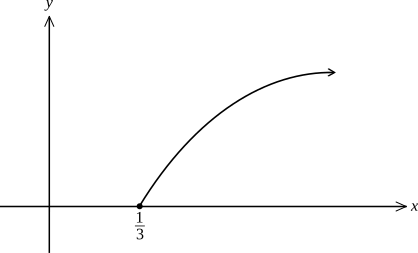
  1. Given  \(f(x)=3 x-1\), determine the domain and range for  \(y=\sqrt{f(x)}\).   (2 marks)

    --- 5 WORK AREA LINES (style=lined) ---

  2. Sketch the graph  \(y=\sqrt{f(x)}\), clearly identifying any axis intercepts.   (1 mark)

    --- 8 WORK AREA LINES (style=lined) ---

Show Answers Only

i.     \(f(x)\) \(=3x-1\)
  \(y\) \(=\sqrt{3x-1}\)

\(\text{Domain:}\ \ 3 x-1 \ \geqslant 0 \ \Rightarrow \ x \geqslant \dfrac{1}{3}\)

\(\text {Range:}\ \ y \geqslant 0\)
 

ii.

Show Worked Solution

i.     \(f(x)\) \(=3x-1\)
  \(y\) \(=\sqrt{3x-1}\)

\(\text{Domain:}\ \ 3 x-1 \ \geqslant 0 \ \Rightarrow \ x \geqslant \dfrac{1}{3}\)

\(\text {Range:}\ \ y \geqslant 0\)
 

ii.

Filed Under: Reflections and Harder Graphs (Ext1) Tagged With: Band 3, Band 4, smc-1072-20-y = root f(x); y^2 = f(x)

Functions, EXT1 F2 EQ-Bank 2

In the equation  \(x^3-8 x^2+11x+20=0\)  one of the roots is equal to the sum of the other two roots.

Find the value of the three roots.   (3 marks)

--- 7 WORK AREA LINES (style=lined) ---

Show Answers Only

\(\text{Roots}\ = -1, 4, 5\)

Show Worked Solution

\(x^3-8 x^2+11x+20=0\)

\(\text{Sum of roots}\ =-\dfrac{b}{a}:\)

\(\alpha+\beta+(\alpha + \beta)\) \(=8\)  
\(2\alpha + 2\beta\) \(=8\)  
\(\beta\) \(=4-\alpha\ \ …\ (1)\)  


\(\text{Product of roots}\ =-\dfrac{d}{a}:\)

\(\alpha \beta(\alpha + \beta)=-20\ \ …\ (2) \)

\(\text{Substitute (1) into (2):}\)

\(\alpha(4-\alpha)(4)\) \(=-20\)  
\(16\alpha-4\alpha^{2}\) \(=-20\)  
\(\alpha^{2}-4\alpha-5\) \(=0\)  
\((\alpha-5)(\alpha+1)\) \(=0\)  

\(\alpha = 5\ \ \text{or}\ -1\)

\(\beta = 5\ \ \text{or}\ -1\ \ \text{(using (1))}\)

\(\alpha+ \beta = 5-1=4\)

\(\therefore \text{Roots}\ = -1, 4, 5\)

Filed Under: Sum, Products and Multiplicity of Roots (Ext1) Tagged With: Band 4, smc-1205-10-Sum and Product

Trigonometry, EXT1 T1 EQ-Bank 5

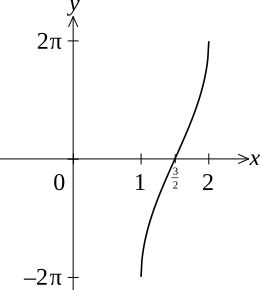
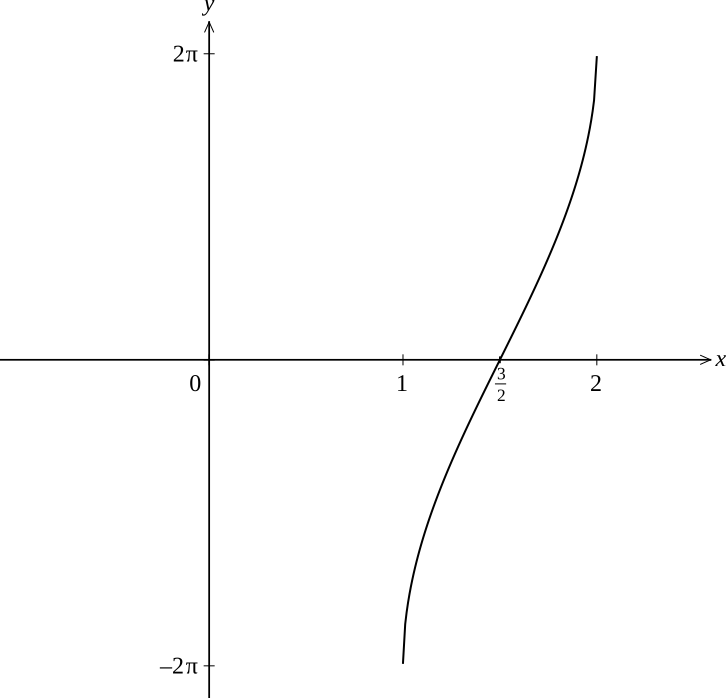
  1. State the domain and range for  \(f(x)=4 \sin ^{-1}(2 x-3)\).   (2 marks)

    --- 5 WORK AREA LINES (style=lined) ---

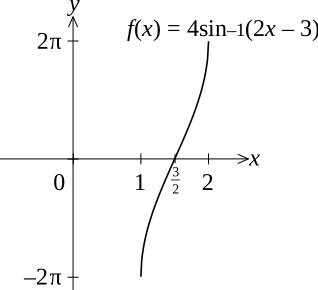
  2. Sketch the function  \(f(x)=4 \sin ^{-1}(2 x-3)\).  (1 mark)

    --- 6 WORK AREA LINES (style=blank) ---

Show Answers Only

a.    \(\text{Domain:}\ \ -1 \leqslant\) \(2 x-3 \leqslant 1 \)
  \( 2 \leqslant\) \(2 x \leqslant 4\)
  \( 1 \leqslant\)  \(x \leqslant 2\)


        \(\text{Range:}\ \ -\dfrac{\pi}{2} \leqslant\) \(y \leqslant \dfrac{\pi}{2}\)
  \( -2 \pi \leqslant \) \(4 y \leqslant 2 \pi\)

 
b.

Show Worked Solution

a.    \(\text{Domain:}\ \ -1 \leqslant\) \(2 x-3 \leqslant 1 \)
  \( 2 \leqslant\) \(2 x \leqslant 4\)
  \( 1 \leqslant\)  \(x \leqslant 2\)


        \(\text{Range:}\ \ -\dfrac{\pi}{2} \leqslant\) \(y \leqslant \dfrac{\pi}{2}\)
  \( -2 \pi \leqslant \) \(4 y \leqslant 2 \pi\)

 
b.

Filed Under: T1 Inverse Trig Functions (Y11) Tagged With: Band 3, Band 4, smc-1024-10-arcsin Graphs, smc-1024-20-Domain and Range

Functions, EXT1 F1 EQ-Bank 3

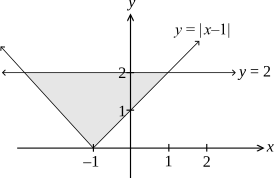
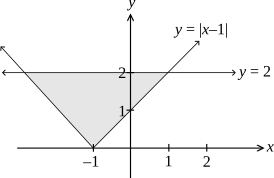
Using inequalities, define the shaded region in the diagram below.   (2 marks)
 

--- 2 WORK AREA LINES (style=lined) ---

Show Answers Only

\(y \geqslant \abs{x+1}\  \cap \  y \leqslant 2 \)

Show Worked Solution

\(\text{Shaded area is defined by the inequalities:}\)

\(y \geqslant \abs{x+1}\  \cap \  y \leqslant 2 \)

Filed Under: Uncategorized Tagged With: Band 4, smc-1072-30-y = | f(x) |; y = f( |x| )

Trigonometry, EXT1 T1 EQ-Bank 5 MC

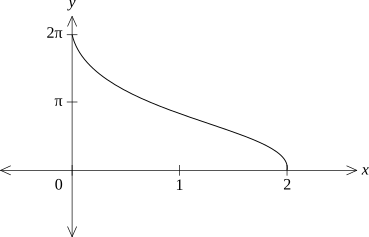
Which equation describes the graph shown?
 

  1. \(y=2 \cos ^{-1}(x+1)\)
  2. \(y= \sin ^{-1}(x-1)\)
  3. \(y=2 \cos ^{-1}(x-1)\)
  4. \(y=\dfrac{1}{2} \sin ^{-1}(x+1)\)
Show Answers Only

\(C\)

Show Worked Solution

\(\text{Graph shape (general)}\ \ → \cos^{-1}(x) \)

\(\text{Graph translated 1 unit to the right}\ → \cos^{-1}(x-1) \)

\(\text{Range:}\ 0 \leq \cos^{-1}(x-1) \leq \pi\ \ →\ 0 \leq 2\cos^{-1}(x-1) \leq 2\pi \)

\(\Rightarrow C\)

Filed Under: T1 Inverse Trig Functions (Y11) Tagged With: Band 4, smc-1024-15-Identify Graphs, smc-1024-40-Transformations

BIOLOGY, M2 EQ-Bank 7

Select two human organs and explain any alterations in blood composition as it passes through each organ.   (4 marks)

--- 7 WORK AREA LINES (style=lined) ---

Show Answers Only

Answers could include two of the following.

Lungs:

  • As blood passes through the lungs, deoxygenated blood becomes oxygenated.
  • Carbon dioxide is also removed from the blood and exhaled. 

Kidneys:

  • In the kidneys, blood is filtered to remove waste products like urea, excess salts, and water, which are excreted as urine.
  • The blood leaving the kidneys has a reduced concentration of these waste products, and its composition is more balanced in terms of water and electrolyte levels. 

Liver:

  • The liver modifies the blood by metabolising nutrients, detoxifying harmful substances, and storing or releasing glucose as needed.
  • Blood exiting the liver has a regulated concentration of glucose and may have reduced levels of toxins, as the liver converts harmful compounds into safer by-products for excretion.
Show Worked Solution

Answers could include two of the following.

Lungs:

  • As blood passes through the lungs, deoxygenated blood becomes oxygenated.
  • Carbon dioxide is also removed from the blood and exhaled. 

Kidneys:

  • In the kidneys, blood is filtered to remove waste products like urea, excess salts, and water, which are excreted as urine.
  • The blood leaving the kidneys has a reduced concentration of these waste products, and its composition is more balanced in terms of water and electrolyte levels. 

Liver:

  • The liver modifies the blood by metabolising nutrients, detoxifying harmful substances, and storing or releasing glucose as needed.
  • Blood exiting the liver has a regulated concentration of glucose and may have reduced levels of toxins, as the liver converts harmful compounds into safer by-products for excretion.

Filed Under: Transport Tagged With: Band 4, smc-4306-60-Changes in Composition

BIOLOGY, M2 EQ-Bank 6

Describe the pulmonary circuit and the changes in blood composition as it circulates through this system.   (4 marks)

--- 6 WORK AREA LINES (style=lined) ---

Show Answers Only
  • The pulmonary circuit is the part of the circulatory system that carries deoxygenated blood from the heart to the lungs for oxygenation and then returns oxygenated blood back to the heart
  • Deoxygenated blood entering the lungs has low oxygen levels and high carbon dioxide levels. As it passes through the alveolar capillaries, oxygen diffuses into the blood while carbon dioxide diffuses out.
  • This process results in blood leaving the lungs with higher oxygen content and lower carbon dioxide levels.
  • Additionally, the blood slightly cools as it passes through the lungs due to its proximity to the air in the alveoli and the evaporation of water vapour during exhalation.
  • The pH of the blood also slightly increases as carbon dioxide (which forms carbonic acid in blood) is removed.
Show Worked Solution
  • The pulmonary circuit is the part of the circulatory system that carries deoxygenated blood from the heart to the lungs for oxygenation and then returns oxygenated blood back to the heart
  • Deoxygenated blood entering the lungs has low oxygen levels and high carbon dioxide levels. As it passes through the alveolar capillaries, oxygen diffuses into the blood while carbon dioxide diffuses out.
  • This process results in blood leaving the lungs with higher oxygen content and lower carbon dioxide levels.
  • Additionally, the blood slightly cools as it passes through the lungs due to its proximity to the air in the alveoli and the evaporation of water vapour during exhalation.
  • The pH of the blood also slightly increases as carbon dioxide (which forms carbonic acid in blood) is removed.

Filed Under: Transport Tagged With: Band 4, Band 5, smc-4306-60-Changes in Composition

BIOLOGY, M2 EQ-Bank 2 MC

Blood was analysed after passing through a particular organ. It was observed that oxygen levels increased, while carbon dioxide and urea levels decreased. Which tissue is most likely responsible for these changes in blood composition?

  1. Brain
  2. Heart
  3. Kidneys
  4. Lungs
Show Answers Only

\(D\)

Show Worked Solution
  • In the lungs, oxygen diffuses into the blood while carbon dioxide diffuses out, resulting in an increase in oxygen levels and a decrease in carbon dioxide levels in the blood leaving the lungs.
  • The decrease in urea is not typical of lung function, but could be explained by small amounts of urea being excreted in exhaled air.

\(\Rightarrow D\)

Filed Under: Transport Tagged With: Band 4, smc-4306-10-Blood

BIOLOGY, M2 EQ-Bank 5

Compare and contrast the structure of red blood cells (erythrocytes) and platelets (thrombocytes), explaining how their unique features contribute to their efficiency in performing their respective functions in the circulatory system.   (4 marks)

--- 8 WORK AREA LINES (style=lined) ---

Show Answers Only
  • Red blood cells are biconcave discs lacking a nucleus, which maximises their capacity to carry haemoglobin and increases their flexibility to squeeze through narrow capillaries, enhancing oxygen transport efficiency.
  • Platelets are flat, irregularly-shaped cell fragments that lack both organelles and nuclei. When blood vessel damage occurs, they change shape and aggregate to form a blood clot and stop bleeding.
  • The absence of a nucleus in red blood cells allows for more haemoglobin but limits their lifespan to about 120 days, while platelets typically survive for 8-10 days.
  • Red blood cells’ structure optimises oxygen carrying capacity and delivery, while platelets’ structure facilitates rapid response to vascular damage. 
  • Both red blood cells and platelets have high surface area to volume ratios which allows them to efficiently carry out their primary functions.
Show Worked Solution
  • Red blood cells are biconcave discs lacking a nucleus, which maximises their capacity to carry haemoglobin and increases their flexibility to squeeze through narrow capillaries, enhancing oxygen transport efficiency.
  • Platelets are flat, irregularly-shaped cell fragments that lack both organelles and nuclei. When blood vessel damage occurs, they change shape and aggregate to form a blood clot and stop bleeding.
  • The absence of a nucleus in red blood cells allows for more haemoglobin but limits their lifespan to about 120 days, while platelets typically survive for 8-10 days.
  • Red blood cells’ structure optimises oxygen carrying capacity and delivery, while platelets’ structure facilitates rapid response to vascular damage. 
  • Both red blood cells and platelets have high surface area to volume ratios which allows them to efficiently carry out their primary functions.

Filed Under: Transport Tagged With: Band 4, Band 5, smc-4306-10-Blood

BIOLOGY, M2 EQ-Bank 3

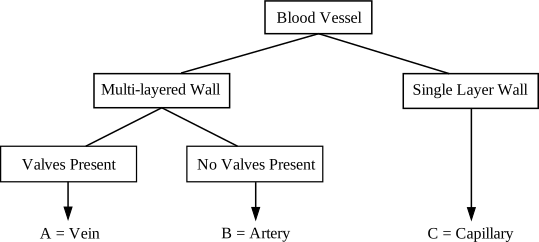
The diagram below shows features that are observed in cross-sections of three types of blood vessel.


  1. Complete the diagram by identifying the type of blood vessel identified by \(\text{A}\) and \(\text{C}\).   (2 marks)

    --- 2 WORK AREA LINES (style=lined) ---

  2. Describe how the structural features of \(\text{B}\) contribute to its role in the circulatory system.   (2 marks)

    --- 5 WORK AREA LINES (style=lined) ---

Show Answers Only

a.   

 
b.
   \(\text{B}\) is an artery.

  • Arteries have thick, elastic walls with multiple layers of smooth muscle, allowing them to withstand and maintain the high pressure of blood pumped directly from the heart.
  • This elasticity also enables arteries to expand and recoil with each heartbeat, helping to propel blood forward in a phenomenon known as the “pulse.”
  • Additionally, the smooth inner lining of arteries reduces friction, facilitating efficient blood flow and preventing clot formation.
Show Worked Solution

a.   


b.   \(\text{B}\) is an artery.

  • Arteries have thick, elastic walls with multiple layers of smooth muscle, allowing them to withstand and maintain the high pressure of blood pumped directly from the heart.
  • This elasticity also enables arteries to expand and recoil with each heartbeat, helping to propel blood forward in a phenomenon known as the “pulse.”
  • Additionally, the smooth inner lining of arteries reduces friction, facilitating efficient blood flow and preventing clot formation.


Filed Under: Transport Tagged With: Band 4, Band 5, smc-4306-10-Blood

CHEMISTRY, M2 EQ-Bank 7v3

Consider a sample of gas confined in a cylinder equipped with a movable piston. The initial pressure of the gas is 1.2 atmospheres, and the initial volume is 6.0 litres. The piston is then adjusted to change the volume of the gas.

Assuming the temperature of the gas remains constant throughout the process, calculate the new pressure of the gas when the volume is adjusted to:

  1. 3.0 litres  (2 marks)

    --- 4 WORK AREA LINES (style=blank) ---

  2. 12.0 litres  (2 marks)

    --- 4 WORK AREA LINES (style=blank) ---

Show Answers Only

a.    \(2.4\ \text{atm}\)

b.    \(0.6\ \text{atm}\)

Show Worked Solution

Boyle’s Law is mathematically expressed as \( P_1V_1 = P_2V_2 \).

a.    \( P_1 = 1.2 \, \text{atm} \)

\( V_1 = 6.0 \, \text{L} \)

\( V_2 = 3.0 \, \text{L} \)

\( P_2 = \dfrac{P_1 \times V_1}{V_2} = \dfrac{1.2 \, \text{atm} \times 6.0 \, \text{L}}{3.0 \, \text{L}} = 2.4 \, \text{atm}\)
 

b.    \( V_2 = 12.0 \, \text{L} \)

\( P_2 = \dfrac{P_1 \times V_1}{V_2} = \dfrac{1.2 \, \text{atm} \times 6.0 \, \text{L}}{12.0 \, \text{L}} = 0.6 \, \text{atm}\)

Filed Under: Gas Laws - draft Tagged With: Band 4, smc-4262-60-Boyles Law

CHEMISTRY, M2 EQ-Bank 7v4

Consider a sample of gas confined in a cylinder equipped with a movable piston. The initial pressure of the gas is 2.5 atmospheres, and the initial volume is 2.0 litres. The piston is then adjusted to change the volume of the gas.

Assuming the temperature of the gas remains constant throughout the process, calculate the new pressure of the gas when the volume is adjusted to:

  1. 1.0 litre  (2 marks)

    --- 4 WORK AREA LINES (style=blank) ---

  2. 4.0 litres  (2 marks)

    --- 4 WORK AREA LINES (style=blank) ---

Show Answers Only

a.    \(5.0\ \text{atm}\)

b.    \(1.25\ \text{atm}\)

Show Worked Solution

a.   Boyle’s Law is mathematically expressed as \( P_1V_1 = P_2V_2 \).

\( P_1 = 2.5 \, \text{atm} \)

\( V_1 = 2.0 \, \text{L} \)

\( V_2 = 1.0 \, \text{L} \)

\( P_2 = \dfrac{P_1 \times V_1}{V_2} = \dfrac{2.5 \, \text{atm} \times 2.0 \, \text{L}}{1.0 \, \text{L}} = 5.0 \, \text{atm}\)
 

b.    \( V_2 = 4.0 \, \text{L} \)

\( P_2 = \dfrac{P_1 \times V_1}{V_2} = \dfrac{2.5 \, \text{atm} \times 2.0 \, \text{L}}{4.0 \, \text{L}} = 1.25 \, \text{atm}\)

Filed Under: Gas Laws - draft Tagged With: Band 4, smc-4262-60-Boyles Law

CHEMISTRY, M3 EQ-Bank 28v4

A student stirs 2.50 g of silver (I) nitrate powder into 100.0 mL of 1.50 mol L\(^{-1}\) sodium chloride solution until it is fully dissolved. A reaction occurs and a precipitate appears.

  1. Write a balanced chemical equation for the reaction.   (1 mark)

    --- 2 WORK AREA LINES (style=lined) ---

  2. Calculate the theoretical mass of precipitate that will be formed.   (4 marks)

    --- 8 WORK AREA LINES (style=lined) ---


    The student weighed a piece of filter paper, filtered out the precipitate and dried it thoroughly in an incubator. The final precipitate mass was higher than predicted in (b).
  3. Identify one scientific reason why the precipitate mass was too high and suggest an improvement to the experimental method which would eliminate this error.   (2 marks)

    --- 4 WORK AREA LINES (style=lined) ---

Show Answers Only

a.    \(\ce{AgNO3(aq) + NaCl(aq) -> AgCl(s) + NaNO3(aq)}\)

b.    \(2.11 \text{ g}\)

c.    One possible reason for the higher mass could be the presence of excess solution in the filter paper or incomplete drying. An improvement could be to ensure the precipitate is thoroughly rinsed with distilled water to remove soluble impurities and dried completely in the incubator before weighing.

Show Worked Solution

a.    \(\ce{AgNO3(aq) + NaCl(aq) -> AgCl(s) + NaNO3(aq)}\)

b.    \(\ce{n(AgNO3) = \frac{m}{M} = \frac{2.50}{107.9 + 14.01 + 16.00 \times 3} = \frac{2.50}{169.91} = 0.01471 \text{ mol}}\)

\(\ce{n(NaCl) = c \times V = 1.50 \times 0.100 = 0.150 \text{ mol}}\)

\(\ce{AgNO3} \text{ is the limiting reagent}\)

\(\ce{n(AgCl) = n(AgNO3) = 0.01471 \text{ mol}}\)

\(\ce{m(AgCl) = n \times M = 0.01471 \times (107.9 + 35.45) = 0.01471 \times 143.35 = 2.11 \text{ g}}\)

c.    One possible reason for the higher mass could be the presence of excess solution in the filter paper or incomplete drying. An improvement could be to ensure the precipitate is thoroughly rinsed with distilled water to remove soluble impurities and dried completely in the incubator before weighing.

Filed Under: Chemical Reactions - draft Tagged With: Band 4, Band 5, Band 6, smc-4263-15-Predicting products, smc-4263-25-Precipitation

CHEMISTRY, M2 EQ-Bank 7v3

Consider a sample of gas confined in a cylinder equipped with a movable piston. The initial pressure of the gas is 1.8 atmospheres, and the initial volume is 5.0 litres. The piston is then adjusted to change the volume of the gas.

Calculate the new pressure of the gas when the volume is adjusted to:

  1. 2.5 litres  (2 marks)

    --- 4 WORK AREA LINES (style=blank) ---

  2. 10.0 litres  (2 marks)

    --- 4 WORK AREA LINES (style=blank) ---

Assume the temperature of the gas remains constant throughout the process.

Show Answers Only

a.    \(3.6\ \text{atm}\)

b.    \(0.9\ \text{atm}\)

Show Worked Solution

a.   Boyle’s Law is mathematically expressed as \( P_1V_1 = P_2V_2 \).

\( P_1 = 1.8 \, \text{atm} \)

\( V_1 = 5.0 \, \text{L} \)

\( V_2 = 2.5 \, \text{L} \)

\( P_2 = \dfrac{P_1 \times V_1}{V_2} = \dfrac{1.8 \, \text{atm} \times 5.0 \, \text{L}}{2.5 \, \text{L}} = 3.6 \, \text{atm}\)
 

b.    \( V_2 = 10.0 \, \text{L} \)

\( P_2 = \dfrac{P_1 \times V_1}{V_2} = \dfrac{1.8 \, \text{atm} \times 5.0 \, \text{L}}{10.0 \, \text{L}} = 0.9 \, \text{atm}\)

Filed Under: Gas Laws - draft Tagged With: Band 4, smc-4262-60-Boyles Law

CHEMISTRY, M3 EQ-Bank 29v4

Write balanced chemical equations for each of the following reactions (states of matter are not required).

  1. The reaction between aluminium and nitric acid.   (1 mark)

    --- 2 WORK AREA LINES (style=lined) ---

  2. The decomposition of mercury (II) oxide.    (1 mark)

    --- 2 WORK AREA LINES (style=lined) ---

  3. The complete combustion of pentane (\(\ce{C5H12}\)) with excess oxygen.   (1 mark)

    --- 2 WORK AREA LINES (style=lined) ---

  4. The reaction between magnesium hydroxide and acetic acid (\(\ce{CH3COOH}\)).   (1 mark)

    --- 2 WORK AREA LINES (style=lined) ---

  5. The reaction between calcium carbonate and hydrochloric acid.   (1 mark)

    --- 2 WORK AREA LINES (style=lined) ---

Show Answers Only

a.    \(\ce{2Al + 6HNO3 -> 2Al(NO3)3 + 3H2}\)

b.    \(\ce{2HgO -> 2Hg + O2}\)

c.    \(\ce{C5H12 + 8O2 -> 5CO2 + 6H2O}\)

d.    \(\ce{Mg(OH)2 + 2CH3COOH -> Mg(CH3COO)2 + 2H2O}\)

e.    \(\ce{CaCO3 + 2HCl -> CaCl2 + CO2 + H2O}\)

Show Worked Solution

a.    Active metal and acid

\(\ce{2Al + 6HNO3 -> 2Al(NO3)3 + 3H2}\)

b.    Decomposition 

\(\ce{2HgO -> 2Hg + O2}\)

c.    Combustion

\(\ce{C5H12 + 8O2 -> 5CO2 + 6H2O}\)

d.    Acid-base

\(\ce{Mg(OH)2 + 2CH3COOH -> Mg(CH3COO)2 + 2H2O}\)

e.    Acid-carbonate

\(\ce{CaCO3 + 2HCl -> CaCl2 + CO2 + H2O}\)

Filed Under: Chemical Reactions - draft Tagged With: Band 4, smc-4263-10-Balanced chemical equations, smc-4263-15-Predicting products

CHEMISTRY, M3 EQ-Bank 29v3

Write balanced chemical equations for each of the following reactions (states of matter are not required).

  1. The reaction between iron and sulfuric acid.   (1 mark)

    --- 2 WORK AREA LINES (style=lined) ---

  2. The decomposition of sodium carbonate.   (1 mark)

    --- 2 WORK AREA LINES (style=lined) ---

  3. The incomplete combustion of propene (\(\ce{C3H6}\)) with a limited amount of oxygen.   (1 mark)

    --- 2 WORK AREA LINES (style=lined) ---

  4. The reaction between calcium hydroxide and phosphoric acid.   (1 mark)

    --- 2 WORK AREA LINES (style=lined) ---

  5. The reaction between sodium carbonate and nitric acid.   (1 mark) 

    --- 2 WORK AREA LINES (style=lined) ---

Show Answers Only

a.    \(\ce{Fe + H2SO4 -> FeSO4 + H2}\)

b.    \(\ce{Na2CO3 -> Na2O + CO2}\)

c.    \(\ce{2C3H6 + 9O2 -> 6CO + 6H2O}\)

d.    \(\ce{3Ca(OH)2 + 2H3PO4 -> Ca3(PO4)2 + 6H2O}\)

e.    \(\ce{Na2CO3 + 2HNO3 -> 2NaNO3 + CO2 + H2O}\)

Show Worked Solution

a.    Active metal and acid

\[\ce{Fe + H2SO4 -> FeSO4 + H2}\]

b.    Decomposition

\[\ce{Na2CO3 -> Na2O + CO2}\]

c.   Combustion

\[\ce{2C3H6 + 9O2 -> 6CO + 6H2O}\]

d.    Acid-Base

\[\ce{3Ca(OH)2 + 2H3PO4 -> Ca3(PO4)2 + 6H2O}\]

e.    Acid-Carbonate

\[\ce{Na2CO3 + 2HNO3 -> 2NaNO3 + CO2 + H2O}\]

Filed Under: Chemical Reactions - draft Tagged With: Band 4, smc-4263-10-Balanced chemical equations, smc-4263-15-Predicting products

CHEMISTRY, M2 EQ-Bank 5

Consider a sample of gas confined in a cylinder equipped with a movable piston. The initial pressure of the gas is 2.0 atmospheres, and the initial volume is 3.0 litres. The piston is then adjusted to change the volume of the gas.

Assuming the temperature of the gas remains constant throughout the process, calculate the new pressure of the gas when the volume is adjusted to:

  1. 1.5 litres   (2 marks)

    --- 4 WORK AREA LINES (style=blank) ---

  2. 6.0 litres   (2 marks)

    --- 4 WORK AREA LINES (style=blank) ---

Show Answers Only

a.    \(4.0\ \text{atm}\)

b.    \(1.0\ \text{atm}\)

Show Worked Solution

a.   Boyle’s Law is mathematically expressed as \( P_1V_1 = P_2V_2 \).

\( P_1 = 2.0 \, \text{atm}, \ V_1 = 3.0 \, \text{L}, \ V_2 = 1.5 \, \text{L} \)

\( P_2 = \dfrac{P_1 \times V_1}{V_2} = \dfrac{2.0 \, \text{atm} \times 3.0 \, \text{L}}{1.5 \, \text{L}} = 4.0 \, \text{atm}\)
 

b.    \( V_2 = 6.0 \, \text{L} \)

\( P_2 = \dfrac{P_1 \times V_1}{V_2} = \dfrac{2.0 \, \text{atm} \times 3.0 \, \text{L}}{6.0 \, \text{L}} = 1.0 \, \text{atm}\)

Filed Under: Gas Laws Tagged With: Band 4, smc-4262-60-Boyles Law

CHEMISTRY, M3 EQ-Bank 28v2

A student stirs 3.50 g of copper (II) nitrate powder into 150.0 mL of 1.50 mol L\(^{-1}\) sodium chloride solution until it is fully dissolved. A reaction occurs and a precipitate appears.

  1. Write a balanced chemical equation for the reaction.   (1 mark)

    --- 2 WORK AREA LINES (style=lined) ---

  2. Calculate the theoretical mass of precipitate that will be formed.   (4 marks)

    --- 8 WORK AREA LINES (style=lined) ---


    The student weighed a piece of filter paper, filtered out the precipitate and dried it thoroughly in an incubator. The final precipitate mass was higher than predicted in (b).
  3. Identify one scientific reason why the precipitate mass was too high and suggest an improvement to the experimental method which would eliminate this error.   (2 marks)

    --- 4 WORK AREA LINES (style=lined) ---

Show Answers Only

a.    \(\ce{Cu(NO3)2(aq) + 2NaCl(aq) -> CuCl2(s) + 2NaNO3(aq)}\)

b.    \(2.51 \text{ g}\)

c.    One possible reason for the higher mass could be the presence of excess solution in the filter paper or incomplete drying. An improvement could be to ensure the precipitate is thoroughly rinsed with distilled water to remove soluble impurities and dried completely in the incubator before weighing.

Show Worked Solution

a.    \(\ce{Cu(NO3)2(aq) + 2NaCl(aq) -> CuCl2(s) + 2NaNO3(aq)}\)

b.    \(\ce{n(Cu(NO3)2) = \frac{m}{M} = \frac{3.50}{63.55 + 2 \times (14.01 + 16.00 \times 3)} = \frac{3.50}{187.57} = 0.01866 \text{ mol}}\)

\(\ce{n(NaCl) = c \times V = 1.50 \times 0.150 = 0.225 \text{ mol}}\)

\(\ce{Cu(NO3)2} \text{ is the limiting reagent}\)

\(\ce{n(CuCl2) = n(Cu(NO3)2) = 0.01866 \text{ mol}}\)

\(\ce{m(CuCl2) = n \times M = 0.01866 \times (63.55 + 2 \times 35.45) = 0.01866 \times 134.45 = 2.51 \text{ g}}\)

c.    One possible reason for the higher mass could be the presence of excess solution in the filter paper or incomplete drying. An improvement could be to ensure the precipitate is thoroughly rinsed with distilled water to remove soluble impurities and dried completely in the incubator before weighing.

Filed Under: Chemical Reactions - draft Tagged With: Band 4, Band 5, Band 6, smc-4263-15-Predicting products, smc-4263-25-Precipitation

CHEMISTRY, M2 EQ-Bank 8v3

  1. Consider the compounds ethanol (\(\ce{C2H6O}\)), formaldehyde (\(\ce{CH2O}\)), and acetic acid (\(\ce{C2H4O2}\)).
    Identify which TWO of these compounds have the same empirical formula and justify your choice.    (2 marks)

    --- 4 WORK AREA LINES (style=blank) ---

  2. The empirical formula of a compound is \(\ce{C4H5N2}\) and its molar mass is determined to be 243.3 g mol\(^{-1}\).
    Calculate the molecular formula of this compound.    (3 marks)

    --- 6 WORK AREA LINES (style=blank) ---

Show Answers Only

a.    Formaldehyde (\(\ce{CH2O}\)) and acetic acid (\(\ce{C2H4O2}\)) have the same empirical formula of \(\ce{CH2O}\).

b.    The molecular formula of the compound is \(\ce{C12H15N6}\).

Show Worked Solution

a.    Determine the empirical formula of each compound:

Ethanol (\(\ce{C2H6O}\)):
\[\text{Empirical formula} = \ce{C2H6O}\]

Formaldehyde (\(\ce{CH2O}\)):
\[\text{Empirical formula} = \ce{CH2O}\]

Acetic acid (\(\ce{C2H4O2}\)):
\[\text{Empirical formula} = \ce{CH2O}\]

Formaldehyde and acetic acid have the same empirical formula of \(\ce{CH2O}\).

b.     Calculate the molar mass of the empirical formula \(\ce{C4H5N2}\):

\[\text{Molar mass of} \ \ce{C4H5N2} = 4 \times 12.01 + 5 \times 1.01 + 2 \times 14.01 = 81.1 \ \text{g/mol}\]

Determine the ratio of the molar mass of the compound to the molar mass of the empirical formula:

\[\text{Ratio} = \frac{\text{Molar mass}}{\text{Empirical formula mass}} = \frac{243.3 \ \text{g/mol}}{81.1 \ \text{g/mol}} = 3\]

Multiply the subscripts in the empirical formula by 3 to get the molecular formula:

\[\text{Molecular formula} = \ce{(C4H5N2)} \times 3 = \ce{C12H15N6}\]

Thus, the molecular formula of the compound is \(\ce{C12H15N6}\).

Filed Under: Mole Concept - draft Tagged With: Band 3, Band 4, smc-4260-60-Empirical formula

CHEMISTRY, M2 EQ-Bank 8v2

  1. Consider the compounds glyceraldehyde (\(\ce{C3H6O3}\)), glycolic acid (\(\ce{C2H4O3}\)), and ribose (\(\ce{C5H10O5}\)).
    Identify which TWO of these compounds have the same empirical formula and justify your choice.    (2 marks)

    --- 4 WORK AREA LINES (style=blank) ---

  2. The empirical formula of a compound is \(\ce{C3H5O}\) and its molar mass is determined to be 114.14 g mol\(^{-1}\).
    Calculate the molecular formula of this compound.    (3 marks)

    --- 6 WORK AREA LINES (style=blank) ---

Show Answers Only

a.    glyceraldehyde (\(\ce{C3H6O3}\)) and ribose (\(\ce{C5H10O5}\)) have the same empirical formula of \(\ce{CH2O}\).

b.    The molecular formula of the compound is \(\ce{C6H10O2}\).

Show Worked Solution

a.    Determine the empirical formula of each compound:

Glyceraldehyde (\(\ce{C3H6O3}\)):
\[\text{Empirical formula} = \ce{CH2O}\]

Glycolic acid (\(\ce{C2H4O3}\)):
\[\text{Empirical formula} = \ce{C2H4O3}\]

Ribose (\(\ce{C5H10O5}\)):
\[\text{Empirical formula} = \ce{CH2O}\]

Acetone and ribose have the same empirical formula of \(\ce{CH2O}\).

b.    Calculate the molar mass of the empirical formula \(\ce{C3H5O}\):

\[\text{Molar mass of} \ \ce{C3H5O} = 3 \times 12.01 + 5 \times 1.008 + 1 \times 16.00 = 57.07 \ \text{g/mol}\]

Determine the ratio of the molar mass of the compound to the molar mass of the empirical formula:

\[\text{Ratio} = \frac{\text{Molar mass}}{\text{Empirical formula mass}} = \frac{114.14 \ \text{g/mol}}{57.07 \ \text{g/mol}} = 2\]

Multiply the subscripts in the empirical formula by 2 to get the molecular formula:

\[\text{Molecular formula} = \ce{(C3H5O)} \times 2 = \ce{C6H10O2}\]

Thus, the molecular formula of the compound is \(\ce{C6H10O2}\).

Filed Under: Mole Concept - draft Tagged With: Band 3, Band 4, smc-4260-60-Empirical formula

CHEMISTRY, M4 EQ-Bank 10 MC

Using Hess’s Law, if the enthalpy changes for the following reactions are known:

\(1.\ \ce{C(s) + O2(g) -> CO2(g)}\ \ \ \ \ \ \ \ \ \ \ \Delta H_1 = -393\ \text{kJ mol}^{-1}\)

\(2.\ \ce{CO(g) + 1/2 O2(g) -> CO2(g)}\ \ \ \ \Delta H_2 = -283\ \text{kJ mol}^{-1}\)

Determine the enthalpy change for the reaction:

\(\ce{C(s) + 1/2 O2(g) -> CO(g)}\)
 

  1. \(+110\ \text{kJ mol}^{-1}\)
  2. \(-110\ \text{kJ mol}^{-1}\)
  3. \(-676\ \text{kJ mol}^{-1}\)
  4. \(+676\ \text{kJ mol}^{-1}\)
Show Answer Only

\(B\)

Show Worked Solution
  • Reverse equation 2, making  \(\ce{Co(g)}\)  a product and it changes the sign for \(\Delta H_2\).
  •    Equation 2*: \(\ce{CO2(g) -> C2(g) + 1/2 O2(g)} \qquad -\Delta H_2 = +283\ \text{kJ mol}^{-1}\)
  • Combine equation 2* with equation 1 which cancels out \(\ce{CO2(g)}\) and adds the enthalpy values together.
  • Thus, the enthalpy for the final reaction \(=-393 + 283= -110\ \text{kJ mol}^{-1}\)

\(\Rightarrow B\)

Filed Under: Enthalpy and Hess's Law Tagged With: Band 4, smc-4267-10-Hess's Law in energy cycles

CHEMISTRY, M4 EQ-Bank 9 MC

Which statement best describes Hess's Law?

  1. The total enthalpy change for a reaction depends on the pathway taken to reach the final products.
  2. The total enthalpy change for a reaction is zero if the reaction is reversible.
  3. The total enthalpy change for a reaction is independent of the pathway taken, as long as the initial and final states are the same.
  4. The enthalpy change for a reaction is the same regardless of whether it occurs in one step or multiple steps, provided heat is lost to the surroundings.
Show Answer Only

\(C\)

Show Worked Solution
  • Hess’s Law states that the total enthalpy change for a reaction is independent of the pathway taken, as long as the initial and final states are the same.
  • This means that whether a reaction happens in one step or multiple steps, the overall enthalpy change will be the same if the reactants and products are the same.

\(\Rightarrow C\)

Filed Under: Enthalpy and Hess's Law Tagged With: Band 4, smc-4267-10-Hess's Law in energy cycles

CHEMISTRY, M4 EQ-Bank 7

Bond energies can be used to estimate the enthalpy change of a reaction. The equation for the combustion of methane \(\ce{CH4}\) is shown below:

\(\ce{CH4(g) + 2O2(g) -> CO2(g) + 2H2O(l)}\)

Given the following bond energies:

  • \(\ce{C-H}\) bond: 412 kJ mol\(^{-1}\)
  • \(\ce{O=O}\) bond: 498 kJ mol\(^{-1}\)
  • \(\ce{C=O}\) bond: 805 kJ mol\(^{-1}\)
  • \(\ce{O-H}\) bond: 463 kJ mol\(^{-1}\)

Calculate the total bond energy of the products.   (2 marks)

--- 4 WORK AREA LINES (style=lined) ---

Show Answer Only

\(3462\ \text{kJ mol}^{-1}\)

Show Worked Solution
  • Total bond energy of 1 mole of \(\ce{CO2} = 2 \times 805 = 1610\ \text{kJ mol}^{-1}\)
  • Total bond energy of 2 mole of \(\ce{H2O} = 4 \times 463 = 1852\ \text{kJ mol}^{-1}\)
  • Thus the total bond energy of the products is \(3462\ \text{kJ mol}^{-1}\)

Filed Under: Enthalpy and Hess's Law Tagged With: Band 3, Band 4, smc-4267-20-Enthalpy and bonding

BIOLOGY, M2 EQ-Bank 2

Describe the nature and significance of plasma in the circulatory system. In your answer, include two crucial functions that plasma performs in the body and how a deficiency or imbalance in plasma components might affect overall health.   (4 marks)

--- 7 WORK AREA LINES (style=lined) ---

Show Answers Only
  • Plasma is the liquid component of blood, making up about 55% of its volume, and consists primarily of water with dissolved proteins, glucose, clotting factors, hormones, and electrolytes.
  • One crucial function of plasma is transport, carrying nutrients, hormones, and waste products throughout the body, fuelling cells and removing metabolic waste.
  • Another vital role of plasma is in maintaining blood pressure and volume, with plasma proteins keeping fluid within blood vessels.
  • A deficiency or imbalance in plasma components can reduce the ability to form blood clots and lead to excessive bleeding.
  • A decrease in plasma proteins can result in edema where fluid leaks from blood vessels into surrounding tissues, causing swelling.
Show Worked Solution
  • Plasma is the liquid component of blood, making up about 55% of its volume, and consists primarily of water with dissolved proteins, glucose, clotting factors, hormones, and electrolytes.
  • One crucial function of plasma is transport, carrying nutrients, hormones, and waste products throughout the body, fuelling cells and removing metabolic waste.
  • Another vital role of plasma is in maintaining blood pressure and volume, with plasma proteins keeping fluid within blood vessels.
  • A deficiency or imbalance in plasma components can reduce the ability to form blood clots and lead to excessive bleeding.
  • A decrease in plasma proteins can result in edema where fluid leaks from blood vessels into surrounding tissues, causing swelling.

Filed Under: Transport Tagged With: Band 4, Band 5, smc-4306-10-Blood

BIOLOGY, M2 EQ-Bank 4

Describe two structural differences between arteries and veins and explain how these structural differences relate to their respective functions in blood circulation.   (3 marks)

--- 6 WORK AREA LINES (style=lined) ---

Show Answers Only
  • Arteries have thicker walls with more elastic tissue and smooth muscle compared to veins, which have thinner walls and less muscle.
  • This structural difference allows arteries to withstand and maintain the high pressure of blood pumped directly from the heart, while also enabling them to expand and contract to help propel blood forward.
  • Veins, on the other hand, have valves along their length, which are absent in arteries.
  • These valves prevent the backflow of blood as it moves towards the heart against gravity, especially from the lower extremities, a feature not needed in arteries where blood flows under high pressure away from the heart.
Show Worked Solution
  • Arteries have thicker walls with more elastic tissue and smooth muscle compared to veins, which have thinner walls and less muscle.
  • This structural difference allows arteries to withstand and maintain the high pressure of blood pumped directly from the heart, while also enabling them to expand and contract to help propel blood forward.
  • Veins, on the other hand, have valves along their length, which are absent in arteries.
  • These valves prevent the backflow of blood as it moves towards the heart against gravity, especially from the lower extremities, a feature not needed in arteries where blood flows under high pressure away from the heart.

Filed Under: Transport Tagged With: Band 4

BIOLOGY, M2 EQ-Bank 1

Compare and contrast open and closed circulatory systems. In your answer, describe one advantage of each system, providing an example of an organism with each type of circulatory system.   (4 marks)

--- 7 WORK AREA LINES (style=lined) ---

Show Answers Only
  • An open circulatory system has blood flowing freely in body cavities, while a closed circulatory system contains blood within vessels throughout its journey.
  • An advantage of an open system is its simplicity and low energy requirement, while a closed system allows for more efficient and rapid distribution of materials.
  • Closed systems are necessary in larger animals because they can maintain higher blood pressures, allowing for more efficient oxygen delivery to tissues far from the heart.
  • Insects (eg. grasshoppers) have an open circulatory system, while mammals (eg. humans) have a closed circulatory system.
Show Worked Solution
  • An open circulatory system has blood flowing freely in body cavities, while a closed circulatory system contains blood within vessels throughout its journey.
  • An advantage of an open system is its simplicity and low energy requirement, while a closed system allows for more efficient and rapid distribution of materials.
  • Closed systems are necessary in larger animals because they can maintain higher blood pressures, allowing for more efficient oxygen delivery to tissues far from the heart.
  • Insects (eg. grasshoppers) have an open circulatory system, while mammals (eg. humans) have a closed circulatory system.

Filed Under: Transport Tagged With: Band 4, smc-4306-50-Open vs Closed Systems

BIOLOGY, M2 EQ-Bank 16

Compare and contrast the methods by which autotrophs and heterotrophs obtain essential minerals, giving an example of each.   (3 marks)

--- 6 WORK AREA LINES (style=lined) ---

Show Answers Only
  • Autotrophs primarily obtain essential minerals directly from their environment, such as soil or water.
  • Heterotrophs mainly acquire minerals by consuming other organisms or their products, obtaining these nutrients that have already been accumulated and processed by their food sources.
  • This means autotrophs must invest energy in converting inorganic minerals into usable organic forms, whereas heterotrophs receive minerals that have already undergone this conversion.
  • For example, a plant (autotroph) absorbs nitrogen in the form of nitrates from the soil through its root system, while a lion (heterotroph) obtains nitrogen by consuming proteins in the meat of its prey. 
Show Worked Solution
  • Autotrophs primarily obtain essential minerals directly from their environment, such as soil or water.
  • Heterotrophs mainly acquire minerals by consuming other organisms or their products, obtaining these nutrients that have already been accumulated and processed by their food sources.
  • This means autotrophs must invest energy in converting inorganic minerals into usable organic forms, whereas heterotrophs receive minerals that have already undergone this conversion.
  • For example, a plant (autotroph) absorbs nitrogen in the form of nitrates from the soil through its root system, while a lion (heterotroph) obtains nitrogen by consuming proteins in the meat of its prey. 

Filed Under: Nutrient and Gas Requirements Tagged With: Band 4, smc-4305-80-Autotrophs vs Heterotrophs

BIOLOGY, M2 EQ-Bank 15

"Autotrophs and heterotrophs have distinct nutritional strategies."

Describe one similarity and one difference in the oxygen requirements between these two groups.   (2 marks)

--- 4 WORK AREA LINES (style=lined) ---

Show Answers Only
  • Both autotrophs (eg. green plants) and heterotrophs (eg. mammals) require oxygen for cellular respiration.
  • Autotrophs also produce oxygen as a byproduct of photosynthesis.
  • This means that during daylight hours, many autotrophs may produce more oxygen than they consume, while heterotrophs are always net consumers of oxygen.
Show Worked Solution
  • Both autotrophs (eg. green plants) and heterotrophs (eg. mammals) require oxygen for cellular respiration.
  • Autotrophs also produce oxygen as a byproduct of photosynthesis.
  • This means that during daylight hours, many autotrophs may produce more oxygen than they consume, while heterotrophs are always net consumers of oxygen.

Filed Under: Nutrient and Gas Requirements Tagged With: Band 4, smc-4305-80-Autotrophs vs Heterotrophs

BIOLOGY, M2 EQ-Bank 14

Explain how both physical and chemical digestion take place in the mammalian stomach.

Include specific details about the mechanisms involved in each process.   (3 marks)

--- 6 WORK AREA LINES (style=lined) ---

Show Answers Only
  • Physical digestion in the stomach occurs when muscular contractions churn and mix the food, breaking it into smaller pieces (peristalsis).
  • Chemical digestion in the stomach involves the secretion of hydrochloric acid and pepsin enzyme into the stomach.
  • The acid and enzymes then begin breaking down protein molecules into smaller peptides.
  • The combination of the physical and chemical digestion processes produce a semi-digested fluid known as chyme. This flows through to the small intestine where most of the nutrient absorption occurs.
  • We note that some absorption of water and simple molecules occurs within the stomach.
Show Worked Solution
  • Physical digestion in the stomach occurs when muscular contractions churn and mix the food, breaking it into smaller pieces (peristalsis).
  • Chemical digestion in the stomach involves the secretion of hydrochloric acid and pepsin enzyme into the stomach.
  • The acid and enzymes then begin breaking down protein molecules into smaller peptides.
  • The combination of the physical and chemical digestion processes produce a semi-digested fluid known as chyme. This flows through to the small intestine where most of the nutrient absorption occurs.
  • We note that some absorption of water and simple molecules occurs within the stomach.

Filed Under: Nutrient and Gas Requirements Tagged With: Band 4, smc-4305-52-Digestive system

BIOLOGY, M2 EQ-Bank 13

"The digestive system is a masterpiece of efficiency, selectively absorbing nutrients while eliminating waste."

Compare the processes of absorption and elimination in the mammalian digestive system.   (4 marks)

--- 8 WORK AREA LINES (style=lined) ---

Show Answers Only
  • Absorption is the process by which nutrients, water, and electrolytes are taken up from the digestive tract into the bloodstream for use by the body’s cells.
  • The main site of nutrient absorption is the small intestine, although some absorption also occurs in the stomach and large intestine.
  • The small intestine is well-suited for this function due to its extensive surface area, created by numerous finger-like projections called villi and microvilli.
  • Elimination is the process of expelling undigested food materials, waste products, and excess water from the body through the anus as faeces.
  • The main site of elimination is the large intestine, ending with the rectum and anus.
  • Unlike the small intestine, the large intestine has a smoother inner surface and is wider in diameter, which allows for the formation and storage of faeces before elimination.
  • The body regulates the balance between absorption and elimination through the action of the nervous and endocrine systems. For example, the presence of food releases hormones that increase absorption, while the build-up of waste in the large intestine triggers nerve reflexes that initiate elimination.
Show Worked Solution
  • Absorption is the process by which nutrients, water, and electrolytes are taken up from the digestive tract into the bloodstream for use by the body’s cells.
  • The main site of nutrient absorption is the small intestine, although some absorption also occurs in the stomach and large intestine.
  • The small intestine is well-suited for this function due to its extensive surface area, created by numerous finger-like projections called villi and microvilli.
  • Elimination is the process of expelling undigested food materials, waste products, and excess water from the body through the anus as faeces.
  • The main site of elimination is the large intestine, ending with the rectum and anus.
  • Unlike the small intestine, the large intestine has a smoother inner surface and is wider in diameter, which allows for the formation and storage of faeces before elimination.
  • The body regulates the balance between absorption and elimination through the action of the nervous and endocrine systems. For example, the presence of food releases hormones that increase absorption, while the build-up of waste in the large intestine triggers nerve reflexes that initiate elimination.

Filed Under: Nutrient and Gas Requirements Tagged With: Band 4, smc-4305-52-Digestive system

BIOLOGY, M2 EQ-Bank 11

Compare the digestive systems of carnivores and herbivores, highlighting their adaptations to different diets.   (3 marks)

--- 6 WORK AREA LINES (style=lined) ---

Show Answers Only
  • Carnivores typically have sharp, pointed canine teeth for tearing meat, while herbivores have flat molars for grinding plant material.
  • This difference in tooth structure reflects adaptations for their respective diets.
  • Herbivores generally have longer small intestines compared to carnivores of similar size.
  • This adaptation provides herbivores with more surface area and time to break down and absorb nutrients from their plant-based diet, which is often more difficult to digest than animal tissue.
  • Many herbivores have a specialised chamber called the cecum or an enlarged stomach compartment (like the rumen in cows) that houses symbiotic microorganisms.
  • These structures allow herbivores to ferment and break down cellulose in plant cell walls, a process that carnivores don’t require due to their protein-rich diet.
Show Worked Solution
  • Carnivores typically have sharp, pointed canine teeth for tearing meat, while herbivores have flat molars for grinding plant material.
  • This difference in tooth structure reflects adaptations for their respective diets.
  • Herbivores generally have longer small intestines compared to carnivores of similar size.
  • This adaptation provides herbivores with more surface area and time to break down and absorb nutrients from their plant-based diet, which is often more difficult to digest than animal tissue.
  • Many herbivores have a specialised chamber called the cecum or an enlarged stomach compartment (like the rumen in cows) that houses symbiotic microorganisms.
  • These structures allow herbivores to ferment and break down cellulose in plant cell walls, a process that carnivores don’t require due to their protein-rich diet.

Filed Under: Nutrient and Gas Requirements Tagged With: Band 4, smc-4305-52-Digestive system

BIOLOGY, M2 EQ-Bank 10

Explain how physical and chemical digestion work together in mammals to improve the efficiency of nutrient absorption.   (3 marks)

--- 6 WORK AREA LINES (style=lined) ---

Show Answers Only
  • Physical and chemical digestion work together synergistically to improve the efficiency of nutrient absorption in mammals.
  • For example, in the stomach, muscular contractions churn food, breaking it into smaller pieces and increasing its surface area.
  • This increased surface area allows the chemical digestive processes to work more effectively on the food particles.
  • The combined action continues in the small intestine, where physical segmentation movements mix the chyme with digestive enzymes, further breaking down nutrients chemically.
  • This teamwork between physical and chemical processes ensures that nutrients are broken down into their simplest forms, maximising their absorption through the intestinal wall.
Show Worked Solution
  • Physical and chemical digestion work together synergistically to improve the efficiency of nutrient absorption in mammals.
  • For example, in the stomach, muscular contractions churn food, breaking it into smaller pieces and increasing its surface area.
  • This increased surface area allows the chemical digestive processes to work more effectively on the food particles.
  • The combined action continues in the small intestine, where physical segmentation movements mix the chyme with digestive enzymes, further breaking down nutrients chemically.
  • This teamwork between physical and chemical processes ensures that nutrients are broken down into their simplest forms, maximising their absorption through the intestinal wall.

Filed Under: Nutrient and Gas Requirements Tagged With: Band 3, Band 4, smc-4305-52-Digestive system

BIOLOGY, M2 EQ-Bank 8

The transpiration-cohesion-tension theory provides an explanation for water movement in tall trees.

Describe this theory, including the role of transpiration in this process.   (4 marks)

--- 8 WORK AREA LINES (style=lined) ---

Show Answers Only
  • Transpiration creates a negative water potential at the leaves (tension), driving water movement upwards through the xylem.
  • This process acts like a ‘pull’ force, drawing water from the roots to replace water lost through the leaves.
  • The theory states that this movement also relies critically on cohesion, which refers to the tendency of water molecules to stick together due to hydrogen bonding.
  • This property allows water to form a continuous column in the xylem, enabling it to be pulled upwards without breaking. 
  • This tension, combined with the cohesive properties of water, allows trees to transport water against gravity to great heights. 
Show Worked Solution
  • Transpiration creates a negative water potential at the leaves (tension), driving water movement upwards through the xylem.
  • This process acts like a ‘pull’ force, drawing water from the roots to replace water lost through the leaves.
  • The theory states that this movement also relies critically on cohesion, which refers to the tendency of water molecules to stick together due to hydrogen bonding.
  • This property allows water to form a continuous column in the xylem, enabling it to be pulled upwards without breaking. 
  • This tension, combined with the cohesive properties of water, allows trees to transport water against gravity to great heights. 

Filed Under: Nutrient and Gas Requirements Tagged With: Band 4, Band 5

BIOLOGY, M2 EQ-Bank 8 MC

Van Helmont's willow tree experiment showed that over five years, the tree gained 164 pounds while the soil only lost 2 ounces. What conclusion can be drawn from this experiment?

  1. The tree gained its mass entirely from the soil
  2. Photosynthesis was the main source of the tree's increased mass
  3. The experiment proved that water was the sole source of the tree's growth
  4. The results challenged the belief that plants gained all their mass from soil
Show Answers Only

\(D\)

Show Worked Solution
  • Van Helmont’s experiment challenged the prevailing belief that plants gained all their mass from soil.
  • While his conclusion that water alone was responsible for the growth was incorrect, the experiment was crucial in prompting further investigations into plant nutrition and growth.

\(\Rightarrow D\)

Filed Under: Nutrient and Gas Requirements Tagged With: Band 4, smc-4305-50-Experiments and Plant Models

BIOLOGY, M2 EQ-Bank 7

Describe a key experiment that demonstrated photosynthesis occurs as a multi-step process.   (3 marks)

--- 6 WORK AREA LINES (style=lined) ---

Show Answers Only

Blackman and Mathgel’s experiment:

  • This experiment demonstrated that photosynthesis involves both light-dependent and light-independent reactions.
  • They showed that when light intensity increased, the rate of photosynthesis only increased up to a certain point, after which it levelled off even with more light.
  • This led to the discovery of limiting factors in photosynthesis, such as carbon dioxide concentration and temperature.
  • Their work was crucial in establishing that photosynthesis is a complex process with multiple stages, each potentially limited by different factors.

Robin Hill experiment (1937):

  • Robin Hill demonstrated that isolated chloroplasts could produce oxygen in the presence of light but without carbon dioxide.
  • This showed that the oxygen released during photosynthesis comes from water, not carbon dioxide as previously thought.
  • Hill’s experiment provided evidence that photosynthesis occurs in two main stages: a light-dependent reaction that splits water and produces oxygen, and a light-independent reaction that fixes carbon dioxide.
  • This discovery was crucial in developing our current understanding of photosynthesis as a complex, multi-step process.
Show Worked Solution

Blackman and Mathgel’s experiment:

  • This experiment demonstrated that photosynthesis involves both light-dependent and light-independent reactions.
  • They showed that when light intensity increased, the rate of photosynthesis only increased up to a certain point, after which it levelled off even with more light.
  • This led to the discovery of limiting factors in photosynthesis, such as carbon dioxide concentration and temperature.
  • Their work was crucial in establishing that photosynthesis is a complex process with multiple stages, each potentially limited by different factors.

Robin Hill experiment (1937):

  • Robin Hill demonstrated that isolated chloroplasts could produce oxygen in the presence of light but without carbon dioxide.
  • This showed that the oxygen released during photosynthesis comes from water, not carbon dioxide as previously thought.
  • Hill’s experiment provided evidence that photosynthesis occurs in two main stages: a light-dependent reaction that splits water and produces oxygen, and a light-independent reaction that fixes carbon dioxide.
  • This discovery was crucial in developing our current understanding of photosynthesis as a complex, multi-step process.

Filed Under: Nutrient and Gas Requirements Tagged With: Band 4, smc-4305-50-Experiments and Plant Models

BIOLOGY, M2 EQ-Bank 6

Explain van Helmont's willow tree experiment and discuss its significance in the early understanding of plant growth and nutrition.   (2 marks)

--- 4 WORK AREA LINES (style=lined) ---

Show Answers Only
  • Van Helmont grew a willow tree in a measured amount of soil for five years, adding only water.
  • He found that while the tree gained significant mass, the soil lost very little, leading him to conclude that the tree’s substance came from water alone.
  • Although his conclusion was incorrect, this experiment was significant because it challenged the prevailing belief that plants gained their mass from the soil and laid the groundwork for future investigations into plant nutrition and photosynthesis.
Show Worked Solution
  • Van Helmont grew a willow tree in a measured amount of soil for five years, adding only water.
  • He found that while the tree gained significant mass, the soil lost very little, leading him to conclude that the tree’s substance came from water alone.
  • Although his conclusion was incorrect, this experiment was significant because it challenged the prevailing belief that plants gained their mass from the soil and laid the groundwork for future investigations into plant nutrition and photosynthesis.

Filed Under: Nutrient and Gas Requirements Tagged With: Band 4, smc-4305-50-Experiments and Plant Models

BIOLOGY, M2 EQ-Bank 6

Compare and contrast the microscopic structures involved in gas exchange in mammals and plants.

In your answer, describe one structural similarity between these structures that aids in gas exchange and explain one key difference in how these structures function.   (4 marks)

--- 8 WORK AREA LINES (style=lined) ---

Show Answers Only

→ The primary microscopic structure for gas exchange in mammals is the alveolus, while in plants it is the leaf.
 

Structural similarities that aid in gas exchange (include one):

→ Both have a large surface area to volume ratio to maximise gas exchange.

→ Both have thin, moist surfaces to facilitate the diffusion of gases.
 

Two key differences in how these structures function in gas exchange are:

→ Alveoli primarily exchange oxygen and carbon dioxide with blood, while leaves exchange these gases with air in intercellular spaces.

→ Gas exchange in alveoli occurs continuously for respiration, while in leaves it varies with light availability due to its role in photosynthesis.

Show Worked Solution

→ The primary microscopic structure for gas exchange in mammals is the alveolus, while in plants it is the leaf.
 

Structural similarities that aid in gas exchange (include one):

→ Both have a large surface area to volume ratio to maximise gas exchange.

→ Both have thin, moist surfaces to facilitate the diffusion of gases.
 

Two key differences in how these structures function in gas exchange are:

→ Alveoli primarily exchange oxygen and carbon dioxide with blood, while leaves exchange these gases with air in intercellular spaces.

→ Gas exchange in alveoli occurs continuously for respiration, while in leaves it varies with light availability due to its role in photosynthesis.

Filed Under: Uncategorized Tagged With: Band 4, Band 5, smc-4305-25-Plant Gas Exchange, smc-4305-35-Animal Gas Exchange

CHEMISTRY, M4 EQ-Bank 8 MC

The standard enthalpy of formation of water is – 286 kJ mol\(^{-1}\). What does this value represent?

  1. The enthalpy change when 1 mole of water decomposes
  2. The enthalpy change when 1 mole of water vaporizes
  3. The enthalpy change when 1 mole of water is formed from hydrogen and oxygen
  4. The enthalpy change when 1 mole of hydrogen is formed from water
Show Answers Only

\(C\)

Show Worked Solution
  • The standard enthalpy of formation for water \(\ce{(H2O)}\) is the enthalpy change when hydrogen gas \(\ce{(H2)}\) and oxygen gas \(\ce{(O2)}\) combine to form 1 mole of liquid water under standard conditions (298K and 100kPa):
  •    \(\ce{H2(g) + \frac{1}{2}O2(g) -> H2O(l)}\)         \(\Delta H =-286\ \text{kJ mol}^{-1}\)

\(\Rightarrow C\)

Filed Under: Enthalpy and Hess's Law Tagged With: Band 4, smc-4267-20-Enthalpy and bonding

BIOLOGY, M2 EQ-Bank 5

Explain how the respiratory structures of a terrestrial mammal and a bony fish are adapted to their respective environments.

In your answer, consider how the structure of each system maximises gas exchange.   (4 marks)

--- 8 WORK AREA LINES (style=lined) ---

Show Answers Only
  • The main respiratory organ in terrestrial mammals is the lungs, while in bony fish it’s the gills.
  • Lungs have a large internal surface area created by millions of alveoli.
  • This highly efficient structure, combined with the diaphragm-driven breathing mechanism, allows for rapid oxygen uptake and carbon dioxide release. This ensures that all cells receive adequate gas exchange despite the lower oxygen content in air compared to water.
  • Gills consist of many thin filaments that spread out in the water to provide a large surface area for gas exchange.
  • Fish are able to take in water through their mouths and force the water over their gills. This creates a consistent one-way flow of oxygen-rich water for gas exchange.
  • Fish use a counter-current flow in their gills to maximise oxygen uptake, which is not necessary in lungs. 
Show Worked Solution
  • The main respiratory organ in terrestrial mammals is the lungs, while in bony fish it’s the gills.
  • Lungs have a large internal surface area created by millions of alveoli.
  • This highly efficient structure, combined with the diaphragm-driven breathing mechanism, allows for rapid oxygen uptake and carbon dioxide release. This ensures that all cells receive adequate gas exchange despite the lower oxygen content in air compared to water.
  • Gills consist of many thin filaments that spread out in the water to provide a large surface area for gas exchange.
  • Fish are able to take in water through their mouths and force the water over their gills. This creates a consistent one-way flow of oxygen-rich water for gas exchange.
  • Fish use a counter-current flow in their gills to maximise oxygen uptake, which is not necessary in lungs. 

Filed Under: Nutrient and Gas Requirements Tagged With: Band 4, Band 5, smc-4305-35-Animal Gas Exchange

  • « Previous Page
  • 1
  • …
  • 32
  • 33
  • 34
  • 35
  • 36
  • …
  • 114
  • Next Page »

Copyright © 2014–2025 SmarterEd.com.au · Log in