SmarterEd

Aussie Maths & Science Teachers: Save your time with SmarterEd

  • Login
  • Get Help
  • About

Networks, STD2 N2 2020 FUR1 5 MC

The network below shows the distances, in metres, between camp sites at a camping ground that has electricity.

The vertices `A` to `I` represent the camp sites.
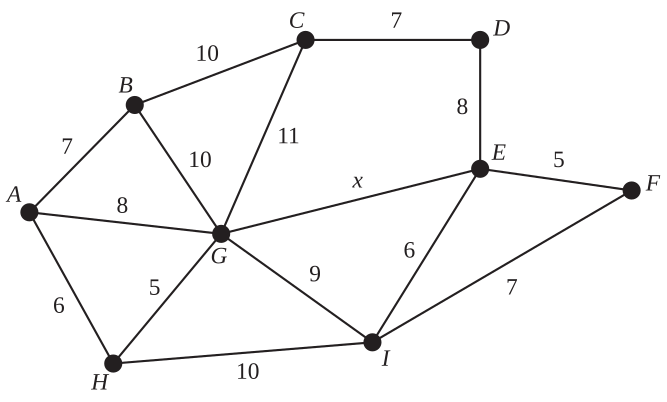


The minimum length of cable required to connect all the camp sites is 53 m.

The value of `x`, in metres, is at least

  1.  6
  2.  8
  3.  9
  4. 11
Show Answers Only

`C`

Show Worked Solution

`text(One strategy – Using Prim’s Algorithm)`

`text(Starting at)\ A`

`text(1st edge) : AH = 6`

`text(2nd edge) : HG = 5`

`text(then …)\ AB = 7,\ GI = 9,\ IE = 6,\ EF = 5`

`DE = 8,\ CD = 7`
 

`text {Total length = 53 m (not including}\ x text{)}`

`text(If)\ \ x < 9, x\ text(would replace)\ GI\ text(and minimum`

`text(length would be less than 53m.)`

`=>  C`

Filed Under: Minimum Spanning Trees, Spanning Trees (Std2-2027) Tagged With: Band 4, smc-6320-50-Unknown Edge, smc-914-50-Unknown Edge

Networks, STD2 N3 FUR1 2020 6

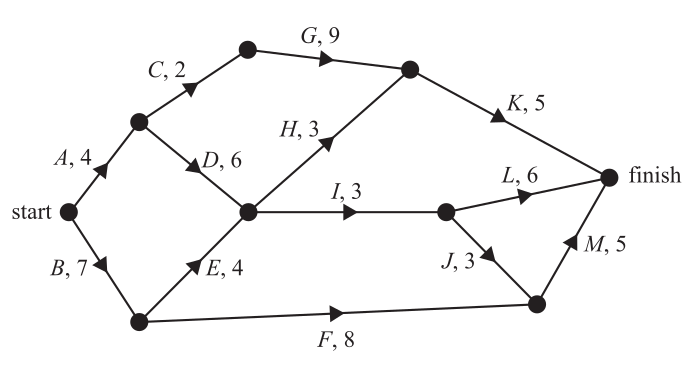
The activity network below shows the sequence of activities required to complete a project.

The number next to each activity in the network is the time it takes to complete that activity, in days.

What is the critical path and minimum completion time for this project.   (2 marks)

--- 4 WORK AREA LINES (style=lined) ---

Show Answers Only

`BEIJM = 22\ text(days)`

Show Worked Solution

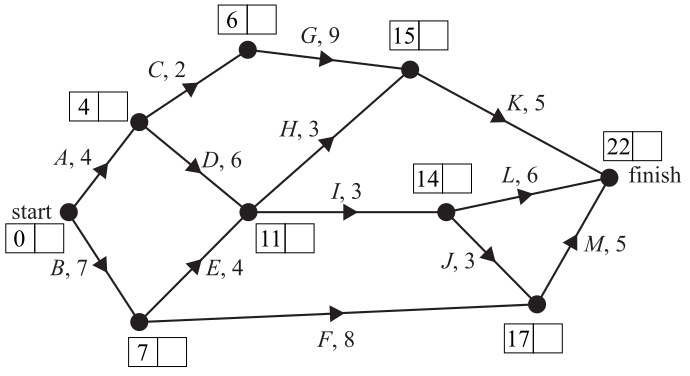
`text(Scanning forward:)`
 

`text(Critical path)` `= BEIJM`
  `= 7 + 4 + 3 + 3 + 5`
  `= 22\ text(days)`

Filed Under: Critical Paths Tagged With: Band 4, smc-916-20-Forward Scanning

NETWORKS, FUR1 2020 VCAA 6 MC

The activity network below shows the sequence of activities required to complete a project.

The number next to each activity in the network is the time it takes to complete that activity, in days.


The minimum completion time for this project, in days, is

  1. 18
  2. 19
  3. 20
  4. 21
  5. 22
Show Answers Only

`E`

Show Worked Solution

`text(Scanning forward:)`
 

`text(Critical path)` `= BEIJM`
  `= 7 + 4 + 3 + 3 + 5`
  `= 22\ text(days)`

 
`=>  E`

Filed Under: Critical Path Analysis Tagged With: Band 4, smc-621-20-Critical Paths/EST

NETWORKS, FUR1 2020 VCAA 5 MC

The network below shows the distances, in metres, between camp sites at a camping ground that has electricity.

The vertices `A` to `I` represent the camp sites.


The minimum length of cable required to connect all the camp sites is 53 m.

The value of `x`, in metres, is at least

  1.  5
  2.  6
  3.  8
  4.  9
  5. 11
Show Answers Only

`D`

Show Worked Solution

`text(One strategy – Using Prim’s Algorith)`

`text(Starting at)\ A`

`text(1st edge) : AH = 6`

`text(2nd edge) : HG = 5`

`text(then …)\ AB = 7,\ GI = 9,\ IE = 6,\ EF = 5`

`DE = 8,\ CD = 7`
 

`text {Total length = 53 m (not including}\ x text{)}`

`text(If)\ \ x < 9, x\ text(would replace)\ GI\ text(and minimum`

`text(length would be less than 53m.)`

`=>  D`

Filed Under: Minimum Spanning Trees and Shortest Paths Tagged With: Band 4, smc-624-10-Distance, smc-624-50-Unknown Edge

NETWORKS, FUR1 2020 VCAA 3 MC
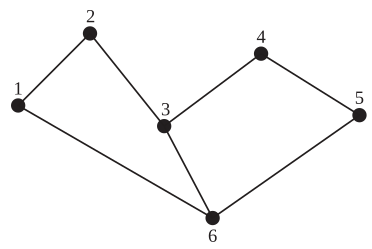
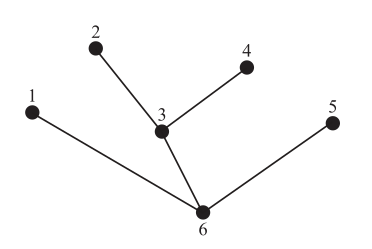
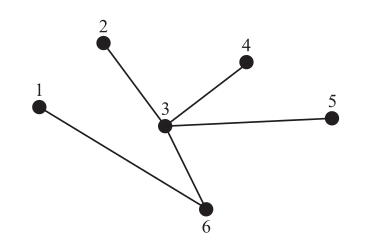
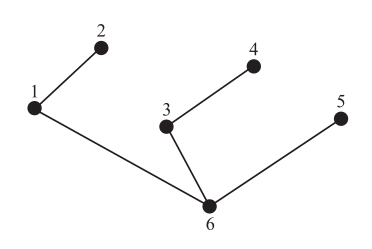
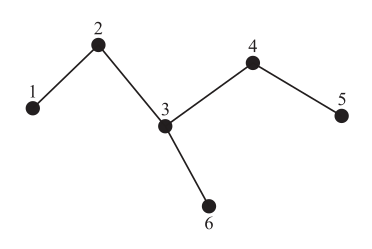
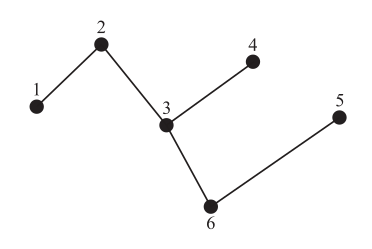
Which one of the following is not a spanning tree for the network above?

A.   B.  
C.   D.  
E.      
Show Answers Only

`B`

Show Worked Solution

`text(Option)\ B\ text(has an edge between vertex)`

`text(3 and 5 which is not in the network.)`

`=>  B`

Filed Under: Minimum Spanning Trees and Shortest Paths Tagged With: Band 4, smc-624-30-No Theme

MATRICES, FUR1 2020 VCAA 9 MC

Five competitors, Andy (A), Brie (B), Cleo (C), Della (D) and Eddie (E), participate in a darts tournament.

Each competitor plays each of the other competitors once only, and each match results in a winner and a loser.

The matrix below shows the results of this darts tournament.

There are still two matches that need to be played.
 

`{:(qquadqquadqquadqquadqquadqquadqquadqquadqquad loser),(quadqquadqquadqquadqquadqquad \ A qquad\ B qquad \ C qquad\ D qquad E),(wi\n\n\er qquad{:(A),(B),(C),(D),(E):}[(0,…,0,1,0),(…,0,1,0,1),(1,0,0,…,1),(0,1,…,0,0),(1,0,0,1,0)]):}`
 

A ‘1’ in the matrix shows that the competitor named in that row defeated the competitor named in that column.

For example, the ‘1’ in row 2, column 3 shows that Brie defeated Cleo.

A ‘…’ in the matrix shows that the competitor named in that row has not yet played the competitor named in that column.

The winner of this darts tournament is the competitor with the highest sum of their one-step and two-step dominances.

Which player, by winning their remaining match, will ensure that they are ranked first by the sum of their one-step and two-step dominances?

  1. Andie
  2. Brie
  3. Cleo
  4. Della
  5. Eddie
Show Answers Only

`B`

Show Worked Solution

`text(Case 1): e_12 = 1,\ e_21 = 0,\ e_34 = 1,\ e_43 = 0`
 

`[(0,1,0,1,0),(0,0,1,0,1),(1,0,0,1,1),(0,1,0,0,0),(1,0,0,1,0)]+[(0,1,0,1,0),(0,0,1,0,1),(1,0,0,1,1),(0,1,0,0,0),(1,0,0,1,0)]^2=[(0,2,1,1,1),(2,0,1,2,2),(2,2,0,3,1),(0,1,1,0,1),(1,2,0,2,0)]{:(5),(7),(8),(3),(5):}`
 

`text(Case 2): e_12 = 0,\ e_21 = 1,\ e_34 = 1,\ e_43 = 0`
 

`[(0,0,0,1,0),(1,0,1,0,1),(1,0,0,1,1),(0,1,0,0,0),(1,0,0,1,0)]+[(0,0,0,1,0),(1,0,1,0,1),(1,0,0,1,1),(0,1,0,0,0),(1,0,0,1,0)]^2=[(0,1,0,1,0),(3,0,1,3,2),(2,1,0,3,1),(1,1,1,0,1),(1,1,0,2,0)]{:(2),(9),(7),(4),(4):}`
 

`text(Similarly, totals can be calculated for:)`

`text(Case 3):\ e_34 = 0, e_43 = 1, and e_12=0, e_21=1`

`text(Case 4):\ e_34 = 0, e_43 = 1, and e_12=1, e_21=0`

`text(Only Brie can ensure she is top ranked by winning.)`

`=>  B`

Filed Under: Matrix Applications Tagged With: Band 4, smc-619-70-One/Two Step Dominances

MATRICES, FUR1 2020 VCAA 8 MC

The table below shows information about three matrices: `A, B`  and  `C`.


  `qquad qquad text(Matrix) qquad qquad` `quad qquad qquad text(Order) quad qquad qquad`
  `A` `2 xx 4`
  `B` `2 xx 3`
  `C` `3 xx 4`


The transpose of matrix `A`, for example, is written as `A^T`.

What is the order of the product  `C^T xx (A^T xx B)^T`?

  1. `2 xx 3`
  2. `3 xx 4`
  3. `4 xx 2`
  4. `4 xx 3`
  5. `4 xx 4`
Show Answers Only

`E`

Show Worked Solution

`C^T xx (A^T xx B)^T`

`= (3 xx 4)^T xx ((2 xx 4)^T xx (2 xx 3))^T`

`= (4 xx 3) xx ((4 xx 2) xx (2 xx 3))^T`

`= (4 xx 3) xx (4 xx 3)^T`

`= (4 xx 3) xx (3 xx 4)`

`= 4 xx 4`

`=>  E`

Filed Under: Matrix Calculations Tagged With: Band 4, smc-616-60-Transpose

MATRICES, FUR1 2020 VCAA 6 MC

The element in row  `i`  and column  `j`  of matrix  `M`  is  `m_(ij)`.

`M`  is a  3 × 3  matrix. It is constructed using the rule  `m_(ij) = 3i + 2j`.

`M`  is

A.  

`[(5,7,9),(7,9,11),(11,13,15)]`


B.  

`[(5,7,9),(8,10,12),(11,13,15)]`


C.  

`[(5,7,10),(8,10,13),(11,13,16)]`


D.  

`[(5,8,11),(7,10,13),(9,12,15)]`


E.  

`[(5,8,11),(8,11,14),(11,14,17)]`


Show Answers Only

`B`

Show Worked Solution

`text(By Elimination):`

`m_13 = 3 xx 1 + 2 xx 3 = 9`

`:.\ text(Eliminate)\ C, D and E`
 

`m_21 = 3 xx 2 + 2 xx 1 = 8`

`:.\ text(Eliminate)\ A`

`=>  B`

Filed Under: Uncategorized Tagged With: Band 4, smc-616-70-Elements/Rules

MATRICES, FUR1 2020 VCAA 3 MC

Matrices `P` and `W` are defined below.
 

`P = [(0,0,1,0,0),(0,0,0,0,1),(0,1,0,0,0),(0,0,0,1,0),(1,0,0,0,0)] qquad qquad W = [(A),(S),(T),(O),(R)]`
 

If  `P^n xx W = [(A),(S),(T),(O),(R)]`, the value of  `n`  could be

  1. 1
  2. 2
  3. 3
  4. 4
  5. 5
Show Answers Only

`D`

Show Worked Solution

`text(Find)\ n\ text(where)\ P^n\ text(is a  5 × 5  identity matrix:)`
 

`P^4 = [(1,0,0,0,0),(0,1,0,0,0),(0,0,1,0,0),(0,0,0,1,0),(0,0,0,0,1)]`


`=>  D`

Filed Under: Matrix Calculations Tagged With: Band 4, smc-616-40-Powers/Inverse

CORE, FUR1 2020 VCAA 29 MC

The value of a van purchased for $45 000 is depreciated by `k`% per annum using the reducing balance method.

After three years of this depreciation, it is then depreciated in the fourth year under the unit cost method at the rate of 15 cents per kilometre.

The value of the van after it travels 30 000 km in this fourth year is $26 166.24

The value of `k` is

  1.   9
  2. 12
  3. 14
  4. 16
  5. 18
Show Answers Only

`B`

Show Worked Solution

`text(Depreciation rate) = 1 – k/100`

`S = 45\ 000 (1 – k/100)^3 – 30\ 000 xx 0.15`

`26\ 166.24` `= 45\ 000 (1 – k/100)^3 + 4500`
`30\ 666.24` `= 45\ 000 (1 – k/100)^3`

 
`text(Testing each option:)`

`k = 12`

`=>  B`

Filed Under: Depreciation Tagged With: Band 4, smc-602-20-Reducing balance, smc-602-30-Unit cost

CORE, FUR1 2020 VCAA 28 MC

The nominal interest rate for a loan is 8% per annum.

When rounded to two decimal places, the effective interest rate for this loan is not

  1. 8.33% per annum when interest is charged daily.
  2. 8.32% per annum when interest is charged weekly.
  3. 8.31% per annum when interest is charged fortnightly.
  4. 8.30% per annum when interest is charged monthly.
  5. 8.24% per annum when interest is charged quarterly.
Show Answers Only

`C`

Show Worked Solution

`text(Consider option C:)`

`r_text(effective)` `= [(1 + 8/(100 xx 26))^26 – 1] xx 100`
  `~~ 8.3154`
  `~~ 8.32%`

 
 `=>  C`

Filed Under: Interest Rates and Investing Tagged With: Band 4, smc-604-25-Effective interest rate

CORE, FUR1 2020 VCAA 27 MC

Gen invests $10 000 at an interest rate of 5.5% per annum, compounding annually.

After how many years will her investment first be more than double its original value?

  1. 12
  2. 13
  3. 14
  4. 15
  5. 16
Show Answers Only

`B`

Show Worked Solution

`text(Find)\ n\ text(such that:)`

`10\ 000 xx 1.055^n` `> 20\ 000`
`1.055^n` `> 2`

 
`text(Testing some answer options:)`

`1.055^12 = 1.90`

`1.055^13 = 2.005`

`=>  B`

Filed Under: Interest Rates and Investing Tagged With: Band 4, smc-604-20-Compound interest

CORE, FUR1 2020 VCAA 25 MC

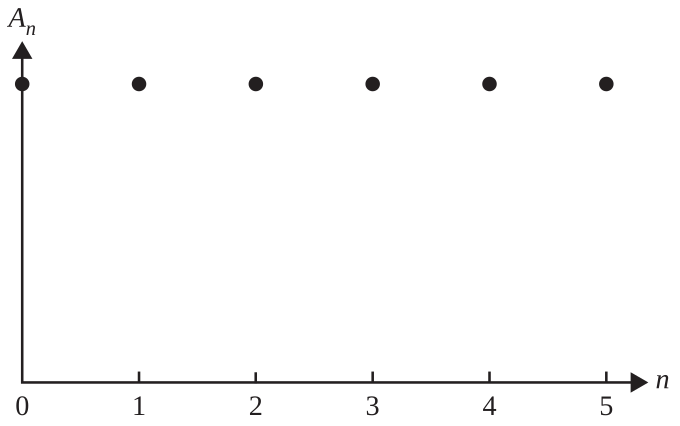
The graph below represents the value of an annuity investment, `A_n`, in dollars, after `n` time periods.


A recurrence relation that could match this graphical representation is

  1. `A_0 = 200\ 000, qquad A_(n+1) = 1.015A_n - 2500`
  2. `A_0 = 200\ 000, qquad A_(n+1) = 1.025A_n - 5000`
  3. `A_0 = 200\ 000, qquad A_(n+1) = 1.03A_n - 5500`
  4. `A_0 = 200\ 000, qquad A_(n+1) = 1.04A_n - 6000`
  5. `A_0 = 200\ 000, qquad A_(n+1) = 1.05A_n - 8000`
Show Answers Only

`B`

Show Worked Solution

`text(The value doesn’t change.)`

`text(Consider option B:)`

`A_1` `= 1.025 xx 200\ 000 – 5000`
  `= 200\ 000`
  `= A_0`

 
`=>  B`

Filed Under: Recursion - Financial Tagged With: Band 4, smc-717-70-Find RR, smc-717-90-RR and graphs

CORE, FUR1 2020 VCAA 22 MC

An asset is purchased for $2480.

The value of this asset after `n` time periods, `V_n` , can be determined using the rule

`V_n = 2480 + 45n`

A recurrence relation that also models the value of this asset after `n` time periods is

  1. `V_0 = 2480, qquad V_(n + 1) = V_n + 45n`
  2. `V_n = 2480, qquad V_(n + 1) = V_n + 45n`
  3. `V_0 = 2480, qquad V_(n + 1) = V_n + 45`
  4. `V_1 = 2480, qquad V_(n + 1) = V_n + 45`
  5. `V_n = 2480, qquad V_(n + 1) = V_n + 45`
Show Answers Only

`C`

Show Worked Solution

`V_0 = 2480`

`V_(n+1)` `= 2480 + 45(n+1)`
  `= 2480 + 45n + 45`
  `= V_n + 45`

 
`=>  C`

Filed Under: Interest Rates and Investing, Recursion - Financial Tagged With: Band 4, smc-604-95-Recurrence relations, smc-717-10-Compound interest

CORE, FUR1 2020 VCAA 19-20 MC

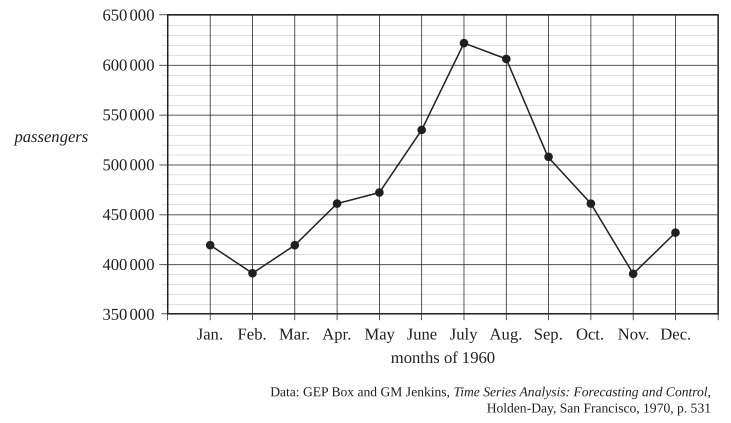
The time series plot below displays the number of airline passengers, in thousands, each month during the period January to December 1960.


Part 1

During 1960, the median number of monthly airline passengers was closest to

  1. 461 000
  2. 465 000
  3. 471 000
  4. 573 000
  5. 621 000

 
Part 2

During the period January to May 1960, the total number of airline passengers was 2 160 000.

The five-mean smoothed number of passengers for March 1960 is

  1. 419 000
  2. 424 000
  3. 430 000
  4. 432 000
  5. 434 000
Show Answers Only

`text(Part 1:)\ A`

`text(Part 2:)\ D`

Show Worked Solution

Part 1

♦ Mean mark part (1) 45%.

`text(12 data points)`

`text(Median)` `= {text(6th + 7th data point)}/2`
  `~~ (460\ 000 + 460\ 000)/2`
  `~~ 460\ 000`

`=> A`
 

Part 2

`text(Five-mean smoothed number)`

`= (2\ 160\ 000)/5`

`= 432\ 000`
 

`=> D`

Filed Under: Time Series Tagged With: Band 4, Band 5, smc-266-60-MEAN Smoothing, smc-266-70-MEDIAN Smoothing

CORE, FUR1 2020 VCAA 17-18 MC

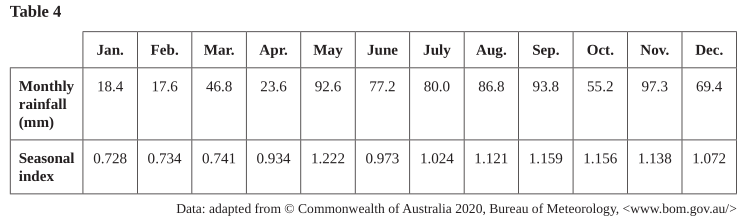
Table 4 below shows the monthly rainfall for 2019, in millimetres, recorded at a weather station, and the associated long-term seasonal indices for each month of the year.


Part 1

The deseasonalised rainfall for May 2019 is closest to

  1.   71.3 mm
  2.   75.8 mm
  3.   86.1 mm
  4.   88.1 mm
  5. 113.0 mm

 
Part 2

The six-mean smoothed monthly rainfall with centring for August 2019 is closest to

  1. 67.8 mm
  2. 75.9 mm
  3. 81.3 mm
  4. 83.4 mm
  5. 86.4 mm
Show Answers Only

`text(Part 1:)\ B`

`text(Part 2:)\ C`

Show Worked Solution

Part 1

`text(Deseasonalised rainfall for May)`

`= 92.6/1.222`

`= 75.8\ text(mm)`
 

`=> B`
 

Part 2

`text{Six-mean smoothed average (Aug)}`

`=[(92.6 + 77.2 + 80 + 86.8 + 93.8 + 55.2) ÷6 +`

`(77.2 + 80 + 86.8 + 93.8 + 55.2 + 97.3) ÷ 6] ÷ 2`

`~~ (80.93 + 81.72) ÷ 2`

`~~ 81.3\ text(mm)`
 

`=> C`

Filed Under: Time Series Tagged With: Band 3, Band 4, smc-266-20-(De)Seasonalising Data, smc-266-60-MEAN Smoothing

CORE, FUR1 2020 VCAA 15-16 MC

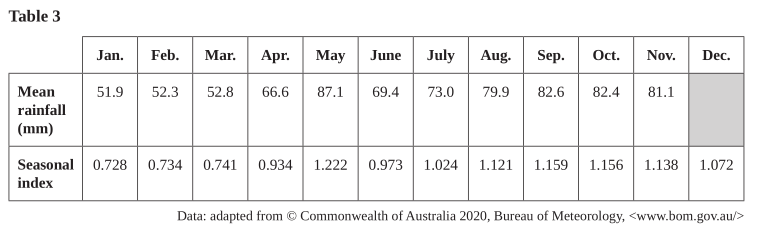
Table 3 below shows the long-term mean rainfall, in millimetres, recorded at a weather station, and the associated long-term seasonal indices for each month of the year.

The long-term mean rainfall for December is missing.


Part 1

To correct the rainfall in March for seasonality, the actual rainfall should be, to the nearest per cent

  1. decreased by 26%
  2. increased by 26%
  3. decreased by 35%
  4. increased by 35%
  5. increased by 74%

 
Part 2

The long-term mean rainfall for December is closest to

  1. 64.7 mm
  2. 65.1 mm
  3. 71.3 mm
  4. 76.4 mm
  5. 82.0 mm
Show Answers Only

`text(Part 1:)\ C`

`text(Part 2:)\ D`

Show Worked Solution

Part 1

`text(Deseasonalised rainfall for March)`

`= 52.8/0.741`

`= 71.255`

`:.\ text(Percentage increase)` `= (71.255 – 52.8)/() xx 100`
  `~~ 35%`

`=> D`
 

Part 2

`text(Mean) = 51.9/0.728 = 71.3`

`text(Actual December)` `= 71.3 xx 1.072`
  `~~ 76.4\ text(mm)`

`=> D`

Filed Under: Time Series Tagged With: Band 4, Band 5, smc-266-10-Seasonal Index from a Table, smc-266-20-(De)Seasonalising Data

CORE, FUR1 2020 VCAA 14 MC

In a study, the association between the number of tasks completed on a test and the time allowed for the test, in hours, was found to be non-linear.

The data can be linearised using a log10 transformation applied to the variable number of tasks.

The equation of the least squares line for the transformed data is

log10 (number of tasks) = 1.160 + 0.03617 × time

This equation predicts that the number of tasks completed when the time allowed for the test is three hours is closest to

  1. 13
  2. 16
  3. 19
  4. 25
  5. 26
Show Answers Only

`C`

Show Worked Solution
`log_10 text{(number of tasks)}` `= 1.160 + 0.03617 xx 3`
  `= 1.26851`


`:.\ text(Number of tasks)` `= 10^(1.26851)`
  `= 18.557…`
  `~~ 19`

`=>  C`

Filed Under: Correlation and Regression Tagged With: Band 4, smc-265-70-Linearise - log10

CORE, FUR1 2020 VCAA 10-12 MC

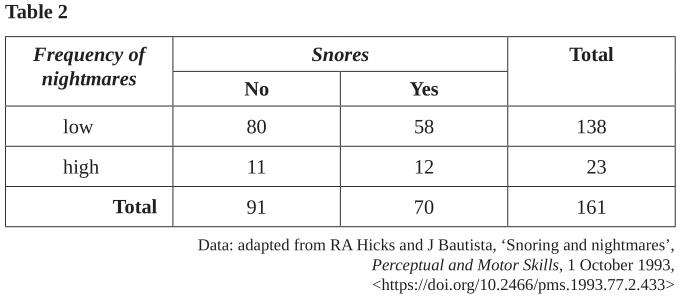
The data in Table 2 was collected in a study of the association between the variables frequency of nightmares (low, high) and snores (no, yes).


Part 1

The variables in this study, frequency of nightmares (low, high) and snores (no, yes), are

  1. ordinal and nominal respectively.
  2. nominal and ordinal respectively.
  3. both numerical.
  4. both ordinal.
  5. both nominal.

 
Part 2

The percentage of participants in the study who did not snore is closest to

  1. 42.0%
  2. 43.5%
  3. 49.7%
  4. 52.2%
  5. 56.5%

 
Part 3

Of those people in the study who did snore, the percentage who have a high frequency of nightmares is closest to

  1.   7.5%
  2. 17.1%
  3. 47.8%
  4. 52.2%
  5. 58.0%
Show Answers Only

`text(Part 1:)\ A`

`text(Part 2:)\ E`

`text(Part 3:)\ B`

Show Worked Solution

Part 1

`text{frequency of nightmares (low, high) is ordinal.}`

`text{snores (no, yes) is nominal.}`

`=> A`
 

Part 2

`text(Percentage)` `= text(not snore)/text(total participants) xx 100`
  `= 91/161 xx 100`
  `= 56.5%`

`=> E`
 

Part 3

`text(Percentage)` `= text(High frequency and snore)/text(total who snore) xx 100`
  `= 12/70 xx 100`
  `= 17.1%`

`=> B`

Filed Under: Graphs - Histograms and Other, Summary Statistics Tagged With: Band 2, Band 4, smc-468-10-Data Classification, smc-644-50-Frequency Tables

CORE, FUR1 2020 VCAA 9 MC

The lifetime of a certain brand of light globe, in hours, is approximately normally distributed.

It is known that 16% of the light globes have a lifetime of less than 655 hours and 50% of the light globes have a lifetime that is greater than 670 hours.

The mean and the standard deviation of this normal distribution are closest to

A.     mean = 655 hours standard deviation = 10 hours
B.     mean = 655 hours standard deviation = 15 hours
C.     mean = 670 hours standard deviation = 10 hours
D.     mean = 670 hours standard deviation = 15 hours
E.     mean = 670 hours standard deviation = 20 hours
Show Answers Only

`D`

Show Worked Solution

`text(mean) = 670`

`sigma = 670 – 655 = 15`

`=>  D`

Filed Under: Normal Distribution Tagged With: Band 4, smc-600-20-z-score Intervals

CORE, FUR1 2020 VCAA 8 MC

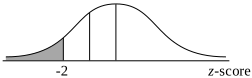
The wing length of a species of bird is approximately normally distributed with a mean of 61 mm and a standard deviation of 2 mm.

Using the 68–95–99.7% rule, for a random sample of 10 000 of these birds, the number of these birds with a wing length of less than 57 mm is closest to

  1.   50
  2. 160
  3. 230
  4. 250
  5. 500
Show Answers Only

`D`

Show Worked Solution

`z text(-score)\ (57) = (x – bar x)/s = (57 – 61)/2 = -2`


`:.\ text(Number less than 57)`

`= 2.5text(%) xx 10\ 000`

`= 250`

`=>  D`

Filed Under: Normal Distribution Tagged With: Band 4, smc-600-10-Single z-score

CORE, FUR1 2020 VCAA 7 MC

Data relating to the following five variables was collected from insects that were caught overnight in a trap:

    • colour
    • name of species
    • number of wings
    • body length (in millimetres)
    • body weight (in milligrams)

The number of these variables that are discrete numerical variables is

  1. 1
  2. 2
  3. 3
  4. 4
  5. 5
Show Answers Only

`A`

Show Worked Solution

`text(Discrete numeral variables:)`

`text(number of wings only)`

`=>  A`

Filed Under: Summary Statistics Tagged With: Band 4, smc-468-10-Data Classification

CORE, FUR1 2020 VCAA 6 MC

A percentaged segmented bar chart would be an appropriate graphical tool to display the association between month of the year (January, February, March, etc.) and the

  1. monthly average rainfall (in millimetres).
  2. monthly mean temperature (in degrees Celsius).
  3. annual median wind speed (in kilometres per hour).
  4. monthly average rainfall (below average, average, above average).
  5. annual average temperature (in degrees Celsius).
Show Answers Only

`D`

Show Worked Solution

`text(The segments could be used to show below average,)`

`text(average and above average.)`

`=>  D`

Filed Under: Graphs - Histograms and Other Tagged With: Band 4, smc-644-40-Segmented Bar Charts

CORE, FUR1 2020 VCAA 5 MC

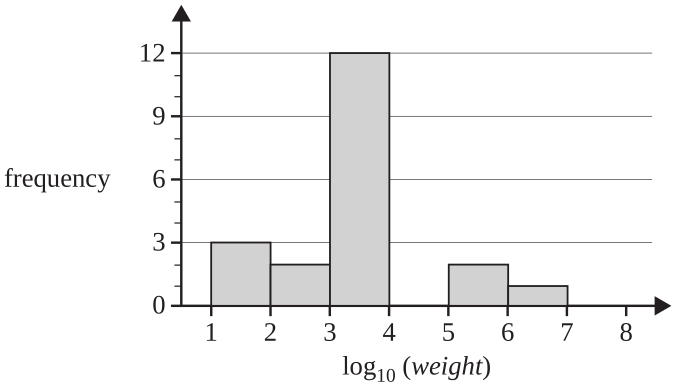
The histogram below shows the distribution of weight, in grams, for a sample of 20 animal species. The histogram has been plotted on a `log_10` scale.


The percentage of these animal species with a weight of less than 10 000 g is

  1. 17%
  2. 70%
  3. 75%
  4. 80%
  5. 85%
Show Answers Only

`E`

Show Worked Solution

`log_10 10\ 000 = 4`

`text(Animals)\ (x <= 4) = 3 + 2 + 12 = 17`

`:.\ text(Percentage)` `= 17/20`
  `= 85%`

`=>  E`

Filed Under: Graphs - Histograms and Other Tagged With: Band 4, smc-644-60-Histogram (log10)

CORE, FUR1 2020 VCAA 1-3 MC

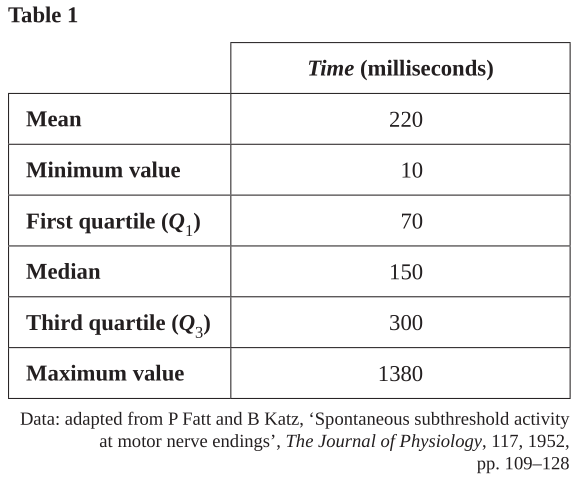
The times between successive nerve impulses (time), in milliseconds, were recorded.

Table 1 shows the mean and the five-number summary calculated using 800 recorded data values.


Part 1

The difference, in milliseconds, between the mean time and the median time is

  1.  10
  2.  70
  3.  150
  4.  220
  5.  230

 
Part 2

Of these 800 times, the number of times that are longer than 300 milliseconds is closest to

  1. 20
  2. 25
  3. 75
  4. 200
  5. 400

 
Part 3

The shape of the distribution of these 800 times is best described as

  1. approximately symmetric.
  2. positively skewed.
  3. positively skewed with one or more outliers.
  4. negatively skewed.
  5. negatively skewed with one or more outliers.
Show Answers Only

`text(Part 1:)\ B`

`text(Part 2:)\ D`

`text(Part 3:)\ C`

Show Worked Solution

Part 1

`text(Difference)` `= 220 -150`
  `= 70`

`=> B`
 

Part 2

`Q_3 = 300`

`:.\ text(Impulses longer than 300 milliseconds)`

`= 25text(%) xx 800`

`= 200`

`=> D`
 

Part 3

`text(Distribution has a long tail to the right)`

♦ Mean mark 50%.

`:.\ text(Positively skewed)`

`text(Upper fence)` `= Q_3 + 1.5 xx IQR`
  `= 300 + 1.5 (300 – 70)`
  `= 645`

 
`=> C`

Filed Under: Summary Statistics Tagged With: Band 2, Band 3, Band 4, smc-468-20-Mean, smc-468-40-Median Mode and Range, smc-468-50-IQR / Outliers

Calculus, SPEC1 2020 VCAA 9

Consider the curve defined parametrically by

`x = arcsin (t)`

`y = log_e(1 + t) + 1/4 log_e (1-t)`

where `t in [0, 1)`.

  1. `((dy)/(dt))^2` can be written in the form  `1/(a(1 + t)^2) + 1/(b(1-t^2)) + 1/(c(1-t)^2)` where  `a, b`  and  `c`  are real numbers.
  2. Show that  `a = 1, b = – 2`  and  `c = 16`.  (2 marks)

    --- 4 WORK AREA LINES (style=lined) ---

  3. Find the arc length, `s`, of the curve from  `t = 0`  to  `t = 1/2`. Give your answer in the form  `s = log_e(m) + n log_e (p)`, where  `m, n, p in Q`.  (3 marks)

    --- 6 WORK AREA LINES (style=lined) ---

Show Answers Only

  1. `text(Proof)\ text{(See Worked Solutions)}`
  2. `log_e(3/2)-1/4 log_e(1/2)`

Show Worked Solution

a.   `y` `= log_e(1 + t) + 1/4 log_e (1-t)`
  `(dy)/(dt)` `= 1/(1 + t)-1/(4(1-t))`
  `((dy)/(dt))^2` `= 1/(1 + t)^2-2 ⋅ 1/(1 + t) ⋅ 1/(4(1-t)) + 1/(16(1-t)^2)`
    `= 1/(1 + t)^2-1/(2(1-t^2)) + 1/(16(1-t)^2)`

 
`:. a = 1, b = – 2, c = 16`

♦♦ Mean mark part (b) 31%.


b.   `s` `= int_0^(1/2) sqrt(((dx)/(dt))^2 + ((dy)/(dt))^2)\ dt`
    `= int_0^(1/2) sqrt(1/(1-t^2) + 1/(1 + t^2)-1/(2(1-t^2)) + 1/(16(1-t)^2))\ dt`
    `= int_0^(1/2) sqrt(1/(1 + t^2) + 1/(2(1-t^2)) + 1/(16(1-t)^2))\ dt`
    `= int_0^(1/2) sqrt((1/(1 + t) + 1/(4(1-t)))^2)\ dt`
    `= int_0^(1/2) 1/(1 + t) + 1/(4(1-t))\ dt`
    `= [log_e(1 + t)-1/4 log_e(1-t)]_0^(1/2)`
    `= log_e(3/2)-1/4 log_e(1/2)`

Filed Under: Arc Lengths, Areas and Other Tagged With: Band 4, Band 5, smc-1181-10-Arc length, smc-1181-40-Parametric functions

Calculus, SPEC1 2020 VCAA 7

Consider the function defined by

`f(x) = {({:mx + n,:}, x < 1), ({: frac{4}{(1 + x^2)},:}, x >= 1):}`

where `m` and `n` are real numbers.

  1. Given that  `f(x)`  and  `f^{′}(x)`  are continuous over  `R`, show that  `m = -2`  and  `n = 4`.  (2 marks)

    --- 5 WORK AREA LINES (style=lined) ---

  2. Find the area enclosed by the graph of the function, the x-axis and the lines  `x = 0`  and  `x = sqrt 3`.  (3 marks)

    --- 6 WORK AREA LINES (style=lined) ---

Show Answers Only

  1. `text(Proof)\ text{(See Worked Solutions)}`
  2. `3 + pi/3\ text(u²)`

Show Worked Solution

a.  `f(x)\ \ text(continuous when:)`

`m(1) + n` `= 4/(1 + 12)`
`m + n` `= 2`

 
`f^{′} (x) = {({:m,:}, x < 1), ({:(-8x)/(1 + x^2),:}, x >= 1):}`
 

`f(x)\ \ text(continuous when:)`

`m = (-8(1))/(1+1^2)^2 = -2`

`text(When)\ \ m =-2,\ n = 4`


b.   `f(x) = {({:4-2x,:}, x < 1), ({:4/(1 + x^2),:}, x >= 1):}`

`f(x) > 0\ \ text(for)\ \ x ∈ [0, sqrt 3]`

`A` `= int_1^sqrt 3 4/(1 + x^2)\ dx + int_0^1 4-2x\ dx`
  `= [4 tan^(-1)(x)]_1^sqrt 3 + [4x-x^2]_0^1`
  `= (4 pi)/3-(4 pi)/4 + 4-1`
  `= 3 + pi/3\ text(u²)`

Filed Under: Arc Lengths, Areas and Other Tagged With: Band 4, smc-1181-30-Other

Calculus, EXT1 C2 2020 SPEC1 6

Let  `f(x) = tan^(-1) (3x - 6) + pi`.

  1. Show that  `f^{prime}(x) = 3/(9x^2 - 36x + 37)`.  (1 mark)

    --- 2 WORK AREA LINES (style=lined) ---

  2. Hence, show that the graph of  `f`  has a point of inflection at  `x = 2`.  (2 marks)

    --- 6 WORK AREA LINES (style=lined) ---

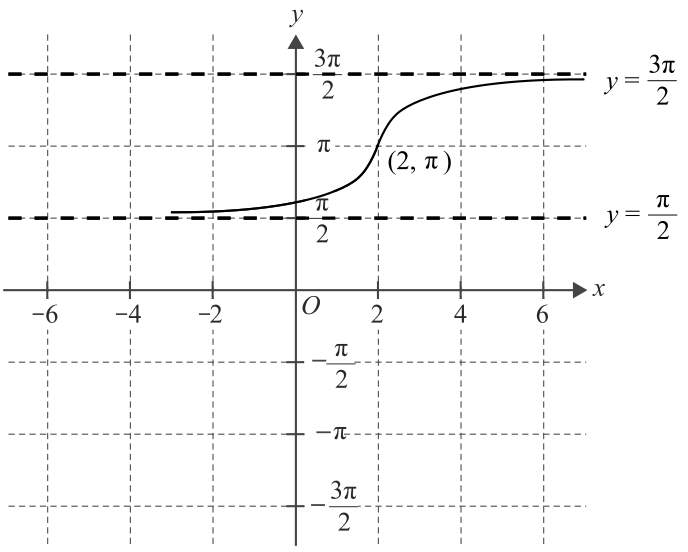
  3. Sketch the graph of  `y = f(x)`  on the axes provided below. Label any asymptotes with their equations and the point of inflection with its coordinates.   (2 marks)

--- 0 WORK AREA LINES (style=lined) ---

Show Answers Only
  1. `text(Proof)\ text{(See Worked Solutions)}`
  2. `text(Proof)\ text{(See Worked Solutions)}`
  3. `text(See Worked Solutions)`
Show Worked Solution
a.    `f^{\prime}(x)` `= (d/(dx) (3x – 6))/(1 + (3x – 6)^2)`
    `= 3/(9x^2 – 36x + 37)`


b.   `f^{\prime\prime}(x) = (3(18x – 36))/(9x^2 – 36x + 37)^2`

`f^{\prime\prime}(x) = 0\ \ text(when)\ \ 18x – 36 = 0 \ => \ x = 2`

`text(If)\ \ x < 2, 18x – 36 < 0 \ => \ f^{\prime\prime}(x) < 0`

`text(If)\ \ x > 2, 18x – 36 > 0 \ => \ f^{\prime\prime}(x) > 0`

`text(S) text(ince)\ \ f^{\prime\prime}(x)\ \ text(changes sign about)\ \ x = 2,`

`text(a POI exists at)\ \ x = 2`


c.   

Filed Under: Inverse Functions Calculus (Ext1) Tagged With: Band 3, Band 4, smc-1037-20-Tan Differentiation

Calculus, SPEC1 2020 VCAA 6

Let  `f(x) = arctan (3x - 6) + pi`.

  1. Show that  `f^{\prime}(x) = 3/(9x^2 - 36x + 37)`.  (1 mark)

    --- 2 WORK AREA LINES (style=lined) ---

  2. Hence, show that the graph of  `f`  has a point of inflection at  `x = 2`.  (2 marks)

    --- 5 WORK AREA LINES (style=lined) ---

  3. Sketch the graph of  `y = f(x)`  on the axes provided below. Label any asymptotes with their equations and the point of inflection with its coordinates.   (2 marks)

    --- 0 WORK AREA LINES (style=lined) ---

Show Answers Only

  1. `text(Proof)\ text{(See Worked Solutions)}`
  2. `text(Proof)\ text{(See Worked Solutions)}`
  3. `text(See Worked Solutions)`

Show Worked Solution

a.    `f^{\prime}(x)` `= (d/(dx) (3x – 6))/(1 + (3x – 6)^2)`
    `= 3/(9x^2 – 36x + 37)`


b.   `f^{\prime\prime}(x) = (3(18x – 36))/(9x^2 – 36x + 37)^2`

♦ Mean mark part (b) 42%.

`f^{\prime\prime}(x) = 0\ \ text(when)\ \ 18x – 36 = 0 \ => \ x = 2`

`text(If)\ \ x < 2, 18x – 36 < 0 \ => \ f^{\prime\prime}(x) < 0`

`text(If)\ \ x > 2, 18x – 36 > 0 \ => \ f^{\prime\prime}(x) > 0`

`text(S) text(ince)\ \ f^{\prime\prime}(x)\ \ text(changes sign about)\ \ x = 2,`

`text(a POI exists at)\ \ x = 2`


c.   

Filed Under: Inverse Trig Functions (SM), Tangents and Curve Sketching Tagged With: Band 3, Band 4, Band 5, smc-1153-30-arctan, smc-1182-35-Sketch curve, smc-1182-60-Inverse Trig functions

Vectors, EXT2 V1 2020 SPEC1 5

Let  `underset ~ a = 2 underset ~i - 3 underset ~j + underset ~k`  and  `underset ~b = underset ~i + m underset ~j - underset ~k`, where `m` is an integer.

The projection of  `underset ~a`  onto  `underset ~b`  is  `-11/18 (underset ~i + m underset ~j - underset ~k)`.

  1. Find the value of `m`.  (3 marks)

    --- 6 WORK AREA LINES (style=lined) ---

  2. Find the component of  `underset ~a`  that is perpendicular to  `underset ~b`.  (1 mark)

    --- 3 WORK AREA LINES (style=lined) ---

Show Answers Only
  1. `m = 4`
  2. `47/18 underset ~i – 5/9 underset ~j + 7/18 underset ~k`
Show Worked Solution
a.    `underset ~b ⋅ underset ~a` `= ((1), (m), (-1))((2), (-3), (1)) = 2 – 3m – 1 = 1 – 3m`
  `|underset ~b|^2` `= 1^2 + m^2 + (-1)^2 = m^2 + 2`
`(underset ~b ⋅ underset ~a)/|underset ~b|^2 ⋅ underset ~b` `= -11/18 underset ~b`
`(1 -3m)/(m^2 + 2)` `= -11/18`
`18 – 54m` `= -11m^2 – 22`
`11m^2 – 54m + 40` `=0`  
`(11m – 10)(m – 4)` `=0`  

 
`:. m= 4\ \ (m != 10/11, \ m ∈ Z)`
 

b.    `underset ~a_(⊥ underset ~b)` `= underset ~a + 11/18 (underset ~i + 4 underset ~j – underset ~k)`
    `= 2 underset ~i + 11/18 underset ~i – 3 underset ~j + 44/18 underset ~j + underset ~k – 11/18 underset ~k`
    `= 47/18 underset ~i – 5/9 underset ~j + 7/18 underset ~k`

Filed Under: Basic Concepts and Arithmetic Tagged With: Band 4, Band 5, smc-1195-40-Unit Vectors and Projections

Vectors, SPEC1 2020 VCAA 5

Let  `underset ~ a = 2 underset ~i-3 underset ~j + underset ~k`  and  `underset ~b = underset ~i + m underset ~j-underset ~k`, where `m` is an integer.

The vector resolute of  `underset ~a`  in the direction of  `underset ~b`  is  `-11/18 (underset ~i + m underset ~j-underset ~k)`.

  1. Find the value of `m`.   (3 marks)

    --- 6 WORK AREA LINES (style=lined) ---

  2. Find the component of  `underset ~a`  that is perpendicular to  `underset ~b`.   (1 mark)

    --- 3 WORK AREA LINES (style=lined) ---

Show Answers Only

  1. `m = 4`
  2. `47/18 underset ~i-5/9 underset ~j + 7/18 underset ~k`

Show Worked Solution

a.    `underset ~b ⋅ underset ~a` `= ((1), (m), (-1))((2), (-3), (1)) = 2-3m-1 = 1-3m`
  `|underset ~b|^2` `= 1^2 + m^2 + (-1)^2 = m^2 + 2`
`(underset ~b ⋅ underset ~a)/|underset ~b|^2 ⋅ underset ~b` `= -11/18 underset ~b`
`(1 -3m)/(m^2 + 2)` `= -11/18`
`18-54m` `= -11m^2-22`
`11m^2-54m + 40` `=0`  
`(11m-10)(m-4)` `=0`  

 
`:. m= 4\ \ (m != 10/11, \ m ∈ Z)`

♦♦ Mean mark part (b) 28%.


b.    `underset ~a_(⊥ underset ~b)` `= underset ~a + 11/18 (underset ~i + 4 underset ~j-underset ~k)`
    `= 2 underset ~i + 11/18 underset ~i-3 underset ~j + 44/18 underset ~j + underset ~k-11/18 underset ~k`
    `= 47/18 underset ~i-5/9 underset ~j + 7/18 underset ~k`

Filed Under: Basic Concepts and Calculations Tagged With: Band 4, Band 5, smc-1176-30-Perpendicular vectors, smc-1176-40-Vector resolute

Functions, EXT1 F1 2020 SPEC1 4

Solve the inequality  `3 - x > 1/|x - 4|`  for `x`, expressing your answer in interval notation.  (3 marks)

--- 8 WORK AREA LINES (style=lined) ---

Show Answers Only

`x ∈ (– oo, (7 – sqrt 5)/2)`

Show Worked Solution

`3 – x > 1/|x – 4|`

`|x – 4| (3 – x) > 1`
 

`text(If)\ \ x – 4 > 0, x > 4`

`(x – 4) (3 – x)` `> 1`
`3x – x^2 – 12 + 4x` `> 1`
`-x^2 + 7x – 13` `> 0`

 
`Delta = 7^2 – 4 ⋅ 1 ⋅ 13 = -3 < 0`

`=>\ text(No Solutions)`
 

`text(If)\ \ x – 4 < 0, x < 4`

`-(x – 4) (3 – x)` `> 1`
`x^2 – 7x + 12` `> 1`
`x^2 – 7x + 11` `> 0`
`x` `= (7 +- sqrt(7^2 – 4 ⋅ 1 ⋅ 11))/2`
  `= (7 +- sqrt 5)/2`

`text(Combining solutions)`

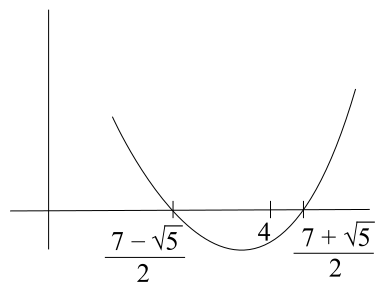
`(x < (7 – sqrt 5)/2  ∪ x > (7 + sqrt 5)/2)  nn x < 4`

`x ∈ (– oo, (7 – sqrt 5)/2)`

Filed Under: Inequalities (Ext1-2027), Inequalities (Ext1) Tagged With: Band 4, smc-1033-20-Absolute Value, smc-1033-50-Interval notation, SMc-6643-20-Absolute Value, smc-6643-50-Interval Notation

Complex Numbers, EXT2 N2 2020 SPEC1 3

Find the cube roots of  `1/sqrt 2 - 1/sqrt 2 i`. Express your answers in modulus-argument form.  (3 marks)

Show Answers Only

`z_1 = text(cis)((7 pi)/12)`

`z_2 = text(cis)(-pi/12)`

`z_3 = text(cis)((-3 pi)/4)`

Show Worked Solution

`z^3 = 1/sqrt 2 – 1/sqrt 2 i = text(cis)(-pi/4) = text(cis)(-pi/4 + 2 pi k), k ∈ Z`
 

`text(By De Moivre):`

`z = text(cis)(-pi/12 + (2 pi k)/3)`

`text(If)\ \ k = 1, \ z_1 = text(cis)(-pi/12 + (2 pi)/3) = text(cis)((7 pi)/12)`

`text(If)\ \ k = 0, \ z_2 = text(cis)(-pi/12)`

`text(If)\ \ k = – 1, \ z_3= text(cis)(-pi/12 – (2pi)/3) = text(cis)((-3 pi)/4)`

Filed Under: Solving Equations with Complex Numbers Tagged With: Band 4, smc-1050-20-Cubic roots

Complex Numbers, SPEC1 2020 VCAA 3

Find the cube roots of  `1/sqrt 2 - 1/sqrt 2 i`. Express your answers in polar form using principal values of the argument.  (3 marks)

Show Answers Only

`z_1 = text(cis)((7 pi)/12)`

`z_2 = text(cis)(-pi/12)`

`z_3 = text(cis)((-3 pi)/4)`

Show Worked Solution

`z^3 = 1/sqrt 2 – 1/sqrt 2 i = text(cis)(-pi/4) = text(cis)(-pi/4 + 2 pi k), k ∈ Z`
 

`text(By De Moivre):`

`z = text(cis)(-pi/12 + (2 pi k)/3)`

`text(If)\ \ k = 1, \ z_1 = text(cis)(-pi/12 + (2 pi)/3) = text(cis)((7 pi)/12)`

`text(If)\ \ k = 0, \ z_2 = text(cis)(-pi/12)`

`text(If)\ \ k = – 1, \ z_3= text(cis)(-pi/12 – (2pi)/3) = text(cis)((-3 pi)/4)`

Filed Under: Factors and Roots (SM) Tagged With: Band 4, smc-1172-20-Cubic roots

Mechanics, SPEC1 2020 VCAA 1

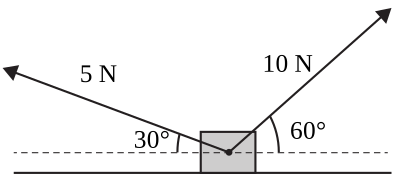
A 2 kg mass is initially at rest on a smooth horizontal surface. The mass is then acted on by two constant forces that cause the mass to move horizontally. One force has magnitude 10 N and acts in a direction 60° upwards from the horizontal, and the other force has magnitude 5 N and acts in a direction 30° upwards from the horizontal, as shown in the diagram below.


  1. Find the normal reaction force, in newtons, that the surface exerts on the mass.  (2 marks)
  2. Find the acceleration of the mass, in ms−2, after it begins to move.  (2 marks)
  3. Find how far the mass travels, in metres, during the first four seconds of motion.   (1 mark)
Show Answers Only
  1. `R = 2g – 5/2 – 5 sqrt 3\ text(N)`
  2. `a = 5/2 – (5 sqrt 3)/2\ text(ms)^(-2)`
  3. `20 – 10 sqrt 3\ text(m)`
Show Worked Solution
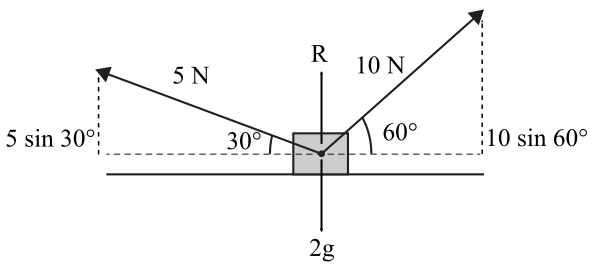
a.  

`text(Resolving forces vertically:)`

`2g` `= 5 sin 30 + 10 sin 60 + R`
`2g` `= 5/2 + 5 sqrt 3 + R`
`R` `= 2g – 5/2 – 5 sqrt 3\ text(N)`


b.    `2a` `= 10 cos 60 – 5 cos 30`
  `2a` `= 5 – (5 sqrt 3)/2`
  `:.a` `= 5/2 – (5 sqrt 3)/4\ text(ms)^(-2)`
Mean mark part (c) 51%.


c.    `text(Distance)` `= ut + 1/2 at^2`
    `= 0+ 1/2 (5/2 – (5 sqrt 3)/4) × 4^2`
    `= 20 – 10 sqrt 3\ text(m)`

Filed Under: Pulleys, Planes and Equilibrium (SM) Tagged With: Band 4, smc-1175-20-Horizontal plane

Calculus, MET1 2020 VCAA 8

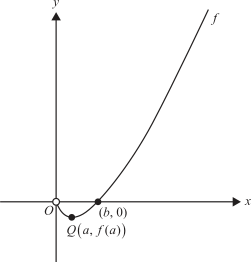
Part of the graph of  `y = f(x)`, where  `f:(0, ∞) -> R, \ f(x) = xlog_e(x)`, is shown below.


The graph of `f` has a minimum at the point `Q(a, f(a))`, as shown above.

  1. Find the coordinates of the point `Q`.   (2 marks)

    --- 6 WORK AREA LINES (style=lined) ---

  2. Using  `(d(x^2log_e(x)))/(dx) = 2x log_e(x) + x`, show that  `xlog_e(x)`  has an antiderivative  `(x^2log_e(x))/2-(x^2)/4`.   (1 mark)

    --- 3 WORK AREA LINES (style=lined) ---

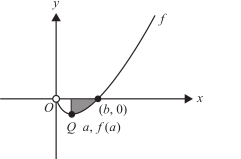
  3. Find the area of the region that is bounded by `f`, the lines  `x = a`  and the horizontal axis for  `x ∈ [a, b]`, where `b` is the `x`-intercept of `f`.   (2 marks)

    --- 7 WORK AREA LINES (style=lined) ---

  4. Let  `g: (a, ∞) -> R, \ g(x) = f(x) + k`  for  `k ∈ R`.


    i. Find the value of `k` for which  `y = 2x`  is a tangent to the graph of `g`.   (1 mark)

    --- 6 WORK AREA LINES (style=lined) ---

    ii. Find all values of `k` for which the graphs of `g` and `g^(-1)` do not intersect.   (2 marks)

    --- 5 WORK AREA LINES (style=lined) ---

Show Answers Only
  1. `Q(1/e, -1/e)`
  2. `text(See Worked Solutions)`
  3. `1/4-3/(4e^2)\ text(u)^2`
  4. i.  `e`
  5. ii.  `k ∈ (1, ∞)`
Show Worked Solution

a.   `y = xlog_e x`

`(dy)/(dx)` `= x · 1/x + log_e x`
  `= 1 + log_e x`

 
`text(Find)\ x\ text(when)\ (dy)/(dx) = 0:`

`1 + log_e x` `= 0`
`log_e x` `= -1`
`x` `= 1/e`
`y` `= 1/e log_e (e^(-1))`
  `= -1/e`

 
`:. Q(1/e, -1/e)`


b.    `int 2x log_e(x) + x\ dx` `= x^2 log_e (x) + c`
  `2 int x log_e(x)\ dx` `= x^2 log_e (x)-intx\ dx + c`
  `:. int x log_e(x)\ dx` `= (x^2 log_e (x))/2-(x^2)/4 \ \ (c = 0)`


c.   

`text(When)\ \ x log_e x = 0 \ => \ x = 1`

`=> b = 1`

`:.\ text(Area)` `= −int_(1/e)^1 x log_e(x)\ dx`
  `= [(x^2)/4-(x^2 log_e(x))/2]_(1/e)^1`
  `= (1/4-0)-(1/(4e^2)-(log_e(e^(-1)))/(2e^2))`
  `= 1/4-(1/(4e^2) + 1/(2e^2))`
  `= 1/4-3/(4e^2) \ text(u)^2`


d.i.   `text(When)\ \ f^{prime}(x) = m_text(tang) = 2,`

`1 + log_e(x)` `= 2`
`x` `= e`

 
`text(T)text(angent meets)\ \ g(x)\ \ text(at)\ \ (e, 2e)`

`g(e)` `= f(e) + k`
`2e` `= e log_e e + k`
`:.k` `= e`


d.ii. `text(Find the value of)\ k\ text(when)\ \ y = x\ \ text(is a tangent to)\ g(x):`

`text(When)\ \ f^{prime}(x) = 1,`

`1 + log_e(x)` `= 1`
`x` `= 1`

 
`text(T)text(angent occurs at)\ (1, 1)`

`g(1) = f(1) + k \ => \ k = 1`
 

`:.\ text(Graphs don’t intersect for)\ k ∈ (1, ∞)`

Filed Under: Area Under Curves, Tangents and Normals Tagged With: Band 4, Band 5, Band 6, smc-723-50-Log/Exponential

Calculus, MET1 2020 VCAA 7

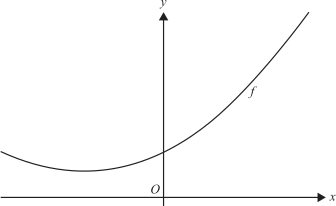
Consider the function  `f(x) = x^2 + 3x + 5`  and the point  `P(1, 0)`. Part of the graph  `y = f(x)`  is shown below.


  1. Show the point `P` is not on the graph of  `y = f(x)`.   (1 mark)

    --- 2 WORK AREA LINES (style=lined) ---

  2. Consider a point  `Q(a, f(a))`  to be a point on the graph of `f`.


      i. Find the slope of the line connecting points `P` and `Q` in terms of `a`.   (1 mark)

    --- 3 WORK AREA LINES (style=lined) ---

     ii. Find the slope of the tangent to the graph of `f` at point `Q` in terms of `a`.   (1 mark)

    --- 2 WORK AREA LINES (style=lined) ---

    iii. Let the tangent to the graph of `f` at  `x = a`  pass through point `P`.


    Find the values of `a`.   (2 marks)

    --- 7 WORK AREA LINES (style=lined) ---

     iv. Give the equation of one of the lines passing through point `P` that is tangent to the graph of `f`.   (1 mark)

    --- 6 WORK AREA LINES (style=lined) ---

  3. Find the value of `k`, that gives the shortest possible distance between the graph of the function of  `y = f(x-k)`  and point `P`.   (2 marks)

    --- 5 WORK AREA LINES (style=lined) ---

Show Answers Only
  1. `text(See Worked Solutions)`
  2.   i.  `(a^2 + 3a + 5)/(a-1)`
     ii.  `2a + 3`
    iii.  `4\ text(or)\ -2`
    iv.  `y = 11x-11`
  3. `5/2`
Show Worked Solution

a.   `f(1) = 1 + 3 + 5 = 9`

`text(S)text(ince)\ \ f(1) != 0, P(1, 0)\ text(does not lie on)\ \ y = f(x)`


b.i.   `P(1, 0), Q(a, f(a))`

`m_(PQ)` `= (f(a)-0)/(a-1)`
  `= (a^2 + 3a + 5)/(a-1)`


b.ii.   `f^{prime}(x) = 2x + 3`

`m_Q = f^{prime}(a) = 2a + 3`
  

b.iii.   `text(T)text(angent:)\ m = 2a + 3,\ text(passes through)\ (a, a^2 + 3a + 5)`

`y-(a^2 + 3a + 5) = (2a + 3)(x-1)`

`text(Passes through)\ P(1, 0):`

`0-(a^2 + 3a + 5)` `= (2a + 3)(1-a)`
`-(a^2 + 3a + 5)` `= 2a-2a^2 + 3-3a`
`a^2-2a-8` `= 0`
`(a-4)(1 + 2)` `= 0`

 
`:. a = 4\ text(or)\ -2`
  

b.iv.   `text(When)\ \ a = -2`

`m_text(tang) = 2x-2 + 3 = -1`

`text(Equation of line)\ \ m =-1,\ text(through)\ P(1, 0)`

`y-a` `=-1(x-1)`
`y` `= -x + 1`

 
`text(Similarly, if)\ \ a = 4:`

`y = 11x-11`


c.   `f(x)\ text(is a quadratic with no roots.`

`text(Shortest distance needs S.P. to occur when)\ \ x = 1`

`f^{prime}(x) = 2x + 3`

`text(MIN S.P. of)\ \ f(x)\ \ text(occurs when)\ \ f^{prime}(x) = 0`

`x =-3/2`

`f(-2/3-k) = f(1)\ \ text(for shortest distance.)`

`:. k = 5/2`

Filed Under: Tangents and Normals Tagged With: Band 3, Band 4, Band 5

Calculus, MET1 2006 ADV 2bii

Find the value of  `int_0^3 (8x)/(1 + x^2)\ dx`  in the form  `a log_e(b)`.   (2 marks)

--- 6 WORK AREA LINES (style=lined) ---

Show Answers Only

`4log_e 10`

Show Worked Solution

`int_0^3 (8x)/(1 + x^2)\ dx`

`= 4 int_0^3 (2x)/(1 + x^2)\ dx`

`= 4[log_e (1 + x^2)]_0^3`

`= 4[log_e(1 + 9)-log_e(1 + 0)]`

`= 4[log_e 10-log_e 1]`

`= 4log_e 10`

Filed Under: Integration (L&E), L&E Integration Tagged With: Band 4, smc-740-40-Log (definite), smc-748-40-Log (definite)

Calculus, 2ADV C4 SM-Bank 3

If  `f^{′}(x)= (x^2)/(x^3 + 1)`  and  `f(1)= log_e 2,` find  `f(x)`.  (3 marks)

--- 6 WORK AREA LINES (style=lined) ---

Show Answers Only

`f(x) = 1/3 log_e(x^3 + 1) + 2/3 log_e 2`

Show Worked Solution
`f(x)` `=int f^{′}(x)\ dx`
  `=int (x^2)/(x^3 + 1)\ dx`
  `= 1/3 int (3x^2)/(x^3 + 1)\ dx`
  `=1/3 log_e |(x^3 + 1)|+c`


`text(S)text(ince)\ \ f(1)= log_e 2,`

`1/3 log_e 2+c` `= log_e 2`
`c` `=2/3 log_e 2`
   

`:.\ f(x) = 1/3 log_e(x^3 + 1) + 2/3 log_e 2`

Filed Under: L&E Integration Tagged With: Band 4, smc-1203-60-Find f(x) given f'(x)

Calculus, MET1 2009 VCAA 2b

Evaluate  `int_1^4(sqrt x + 1)\ dx`.  (3 marks)

Show Answers Only

`23/3`

Show Worked Solution

`int_1^4 (x^(1/2) + 1)\ dx`

`= [2/3 x^(3/2) + x]_1^4`

`= (2/3 xx (sqrt4)^3 + 4) – (2/3 + 1)`

`=(2/3 xx 8 +4) – 5/3`

`= 23/3`

Filed Under: Standard Integration Tagged With: Band 4, smc-749-20-Definite Integrals

Calculus, MET1 2007 ADV 2aii

Let  `y=xsinx.`  Evaluate  `dy/dx`  for  `x=pi`.   (3 marks)

--- 6 WORK AREA LINES (style=lined) ---

Show Answers Only

`-pi`

Show Worked Solution

`y = x sin x`

`(dy)/(dx)` `= x xx d/(dx) (sin x) + d/(dx) (x) xx sin x`
  `= x  cos x + sin x`

 
`text(When)\ \ x = pi,`

`(dy)/(dx)` `= pi xx cos pi + sin pi`
  `= pi (-1) + 0`
  `=-pi`

Filed Under: Differentiation (Trig), Trig Differentiation Tagged With: Band 4, smc-736-10-sin, smc-736-40-Product Rule, smc-744-10-sin, smc-744-40-Product Rule

Functions, EXT1 F1 2020 MET1 6

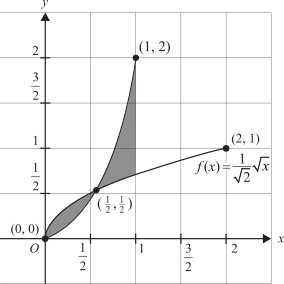
`f(x) = 1/sqrt2 sqrtx`, where `x in [0,2]`

  1. Find `f^(-1)(x)`, and state its domain.   (2 marks)

    --- 4 WORK AREA LINES (style=lined) ---

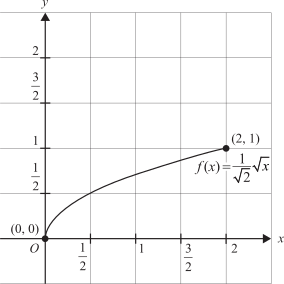
The graph of  `y = f(x)`, where `x ∈ [0, 2]`, is shown on the axes below.


  1. On the axes above, sketch the graph of `f^(-1)(x)` over its domain. Label the endpoints and point(s) of intersection with `f(x)`, giving their coordinates.   (2 marks)

    --- 0 WORK AREA LINES (style=lined) ---

Show Answers Only
  1. `text(Domain) = [0, 1]`


    `f^(-1)(x) = 2x^2`

  2.  
       
Show Worked Solution

a.    `text(Domain)\ \ f^(-1)(x)= text(Range)\ \ f(x)=[0,1]`

`y = 1/sqrt2 x`

`text(Inverse: swap)\ \ x ↔ y`

`x` `= 1/sqrt2 sqrty`  
`sqrty` `= sqrt2 x`  
`y` `= 2x^2`  

 
`:. f^(-1)(x) = 2x^2`


b.     
 

Filed Under: Inverse Functions (Ext1-2027), Inverse Functions (Ext1) Tagged With: Band 3, Band 4, smc-1034-20-Other Functions, smc-6641-20-Other Functions

Calculus, MET1 2020 VCAA 6

Let  `f:[0,2] -> R`, where  `f(x) = 1/sqrt2 sqrtx`.

  1. Find the domain and the rule for  `f^(-1)`, the inverse function of  `f`.   (2 marks)

    --- 5 WORK AREA LINES (style=lined) ---

The graph of  `y = f(x)`, where  `x ∈ [0, 2]`, is shown on the axes below.


  1. On the axes above, sketch the graph of  `f^(-1)`  over its domain. Label the endpoints and point(s) of intersection with the function  `f`, giving their coordinates.   (2 marks)

    --- 0 WORK AREA LINES (style=lined) ---

  2. Find the total area of the two regions: one region bounded by the functions  `f` and `f^(-1)`, and the other region bounded by  `f, f^(-1)`  and the line  `x = 1`. Give your answer in the form  `(a-bsqrtb)/6`, where  `a, b ∈ ZZ^+`.   (4 marks)

    --- 8 WORK AREA LINES (style=lined) ---

Show Answers Only
  1. `text(Domain) = [0, 1]`


    `f^(-1)(x) = 2x^2`

  2.  
       
  3.  `(5 + 2sqrt2)/6\ \ text(u²)`
Show Worked Solution
a.    `text(Domain)\ \ f^(-1)(x)` `= text(Range)\ \ f(x)=[0,1]`

 
`y = 1/sqrt2 x`

`text(Inverse: swap)\ \ x ↔ y`

`x` `= 1/sqrt2 sqrty`
`sqrty` `= sqrt2 x`
`y` `= 2x^2`

 
`:. f^(-1)(x) = 2x^2`


b.     


c.     
`A` `= int_0^(1/2) 1/sqrt2 sqrtx-2x^2 dx + int_(1/2)^1 2x^2-1/sqrt2 sqrtx\ dx`
  `= [sqrt2/3 x^(3/2)-2/3 x^3]_0^(1/2) + [2/3 x^3-sqrt2/3 x^(3/2)]_(1/2)^1`
  `= [sqrt2/3 (1/sqrt2)^3-2/3(1/2)^3] + [(2/3-sqrt2/3)-(2/24-sqrt2/3 · 1/(2sqrt2))]`
  `= (1/6-1/12) + 2/3-sqrt2/3-(1/12-1/6)`
  `= 1/12 + 2/3-sqrt2/3 + 1/12`
  `= (1 + 8-4sqrt2 + 1)/12`
  `= (5-2sqrt2)/6\ \ text(u²)`

Filed Under: Area Under Curves, Polynomial and Other Functions Tagged With: Band 4, Band 5, smc-5205-20-Square root, smc-5205-70-Sketch graph, smc-5205-80-Area between curves, smc-723-30-Square root

Statistics, EXT1 S1 2020 MET1 5

For a certain population the probability of a person being born with the specific gene SPGE1 is `3/5`.

The probability of a person having this gene is independent of any other person in the population having this gene.

In a randomly selected group of four people, what is the probability that three or more people have the SPGE1 gene?  (2 marks)

Show Answers Only

`297/625`

Show Worked Solution

`text(Let)\ \ X =\ text(number of people with gene)`

`X\ ~\ text(Bin) (4, 3/5)`

`P(X >= 3)` `= P(X = 3) + P(X = 4)`
  `= \ ^4C_3(3/5)^3(2/5) + \ ^4C_4(3/5)^4`
  `= (4 xx 27 xx 2)/625 + 81/625`
  `= 297/625`

Filed Under: Binomial Probability (Ext1) Tagged With: Band 4

Probability, MET1 2020 VCAA 5

For a certain population the probability of a person being born with the specific gene SPGE1 is `3/5`.

The probability of a person having this gene is independent of any other person in the population having this gene.

  1. In a randomly selected group of four people, what is the probability that three or more people have the SPGE1 gene?  (2 marks)

    --- 5 WORK AREA LINES (style=lined) ---

  2. In a randomly selected group of four people, what is the probability that exactly two people have the SPGE1 gene, given that at least one of those people has the SPGE1 gene? Express your answer in the form  `(a^3)/(b^4 - c^4)`, where, `a, b, c ∈ Z^+`.  (2 marks)

    --- 5 WORK AREA LINES (style=lined) ---

Show Answers Only

  1. `297/625`
  2. `(6^3)/(5^4 – 2^4)`

Show Worked Solution

a.   `text(Let)\ \ X =\ text(number of people with gene)`

`X\ ~\ text(Bi) (4, 3/5)`

`P(X >= 3)` `= P(X = 3) + P(X = 4)`
  `= \ ^4C_3(3/5)^3(2/5) + \ ^4C_4(3/5)^4`
  `= (4 xx 27 xx 2)/625 + 81/625`
  `= 297/625`


b.    `P(X = 2 | X >= 1)` `= (P(X = 2))/(1 – P(X = 0))`
    `= (\ ^4C_2(3/5)^2(2/5)^2)/(1 – (2/5)^4)`
    `= (6 xx (6^2)/(5^4))/((5^4 – 2^4)/(5^4))`
    `= (6^3)/(5^4 – 2^4)`

Filed Under: Binomial Tagged With: Band 4, smc-638-10-binomial expansion (non-calc), smc-638-50-Conditional

Probability, 2ADV S1 2012 MET1 2

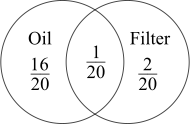
A car manufacturer is reviewing the performance of its car model X. It is known that at any given six-month service, the probability of model X requiring an oil change is `17/20`, the probability of model X requiring an air filter change is `3/20` and the probability of model X requiring both is `1/20`.

  1. State the probability that at any given six-month service model X will require an air filter change without an oil change.  (1 mark)

    --- 5 WORK AREA LINES (style=lined) ---

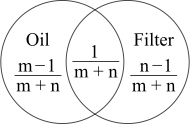
  2. The car manufacturer is developing a new model. The production goals are that the probability of model Y requiring an oil change at any given six-month service will be `m/(m + n)`, the probability of model Y requiring an air filter change will be `n/(m + n)` and the probability of model Y requiring both will be `1/(m + n)`, where `m, n ∈ Z^+`.
     
    Determine `m` in terms of `n` if the probability of model Y requiring an air filter change without an oil change at any given six-month service is 0.05.  (2 marks)

    --- 6 WORK AREA LINES (style=lined) ---

Show Answers Only
  1. `1/10`
  2. `m = 19n – 20`
Show Worked Solution
a.   
  `text(Pr)(F ∩ O′)` `= text(Pr)(F) – text(Pr)(F∩ O)`
    `= 3/20 – 1/20`
    `= 1/10`


b.   
`text(Pr)(F ∩ O′)` `= n/(m + n) – 1/(m + n)`
`1/20` `= (n – 1)/(m + n)`
`m + n` `= 20n – 20`
`m` `= 19n – 20`

Filed Under: Conditional Probability and Venn Diagrams (Adv-2027), Conditional Probability and Venn Diagrams (Y11) Tagged With: Band 3, Band 4, smc-6470-20-Venn Diagrams/Intersections, smc-991-20-Venn Diagrams/Intersections

Probability, MET1 2020 VCAA 2

A car manufacturer is reviewing the performance of its car model X. It is known that at any given six-month service, the probability of model X requiring an oil change is `17/20`, the probability of model X requiring an air filter change is `3/20` and the probability of model X requiring both is `1/20`.

  1. State the probability that at any given six-month service model X will require an air filter change without an oil change.  (1 mark)

    --- 5 WORK AREA LINES (style=lined) ---

  2. The car manufacturer is developing a new model. The production goals are that the probability of model Y requiring an oil change at any given six-month service will be `m/(m + n)`, the probability of model Y requiring an air filter change will be `n/(m + n)` and the probability of model Y requiring both will be `1/(m + n)`, where `m, n ∈ Z^+`.
  3. Determine `m` in terms of `n` if the probability of model Y requiring an air filter change without an oil change at any given six-month service is 0.05.  (2 marks)

    --- 5 WORK AREA LINES (style=lined) ---

Show Answers Only

  1. `1/10`
  2. `m = 19n – 20`

Show Worked Solution

a.   
  `text(Pr)(F ∩ O′)` `= text(Pr)(F) – text(Pr)(F∩ O)`
    `= 3/20 – 1/20`
    `= 1/10`


b.   
`text(Pr)(F ∩ O′)` `= n/(m + n) – 1/(m + n)`
`1/20` `= (n – 1)/(m + n)`
`m + n` `= 20n – 20`
`m` `= 19n – 20`

Filed Under: Conditional Probability and Set Notation Tagged With: Band 3, Band 4, smc-2736-30-Venn Diagrams

Algebra, MET1 2020 VCAA 4

Solve the equation  `2 log_2(x + 5) - log_2(x + 9) = 1`.  (3 marks)

Show Answers Only

`x = text{−1}`

Show Worked Solution
`2 log_2(x + 5) – log_2(x + 9)` `= 1`
`log_2(x + 5)^2 – log_2(x + 9)` `= 1`
`log_2(((x + 5)^2)/(x + 9))` `= 1`
`((x + 5)^2)/(x + 9)` `= 2`
`x^2 + 10x + 25` `= 2x + 18`
`x^2 + 8x + 7` `= 0`
`(x + 7)(x + 1)` `= 0`

 
`:. x = −1\ \ \ \ (x != text{−7}\ \ text(as)\ \ x > text{−5})`

Filed Under: Log/Index Laws and Equations Tagged With: Band 4, smc-726-10-Log - Product/Quotient Rule

Trigonometry, 2ADV T3 2010 MET1 3

Shown below is part of the graph of a period of the function of the form  `y = tan(ax + b)`.


Find the value of `a` and the value of `b`, where  `a > 0`  and  `0 < b < 1`.  (3 marks)

--- 6 WORK AREA LINES (style=lined) ---

Show Answers Only

`a = (7pi)/24, b = pi/24`

Show Worked Solution

`y = tan(ax + b)`

`text(Substitute)\ \ (1, sqrt3), (−1, −1)\ \ text(into equation:)`

`tan(a + b)` `= sqrt3`
`tan(b – a)` `= −1`
`a + b` `= pi/3 \ …\ (1)`
`b – a` `= −pi/4 \ …\ (2)`

 
`text{Add (1) + (2):}`

`2b` `= pi/3 – pi/4`
`b` `= pi/24`

 
`text{Substitute into (1):}`

`a + pi/24` `= pi/3`
`a` `= (7pi)/24`

Filed Under: Trig Graphs (Y12) Tagged With: Band 4, smc-977-30-tan

Graphs, MET1 2020 VCAA 3

Shown below is part of the graph of a period of the function of the form  `y = tan(ax + b)`.


The graph is continuous for  `x = ∈ [-1, 1]`.

Find the value of `a` and the value of `b`, where  `a > 0`  and  `0 < b < 1`.   (3 marks)

--- 10 WORK AREA LINES (style=lined) ---

Show Answers Only

`a = (7pi)/24, b = pi/24`

Show Worked Solution

`y = tan(ax + b)`

`text(Substitute)\ \ (1, sqrt3), (-1,-1)\ \ text(into equation:)`

`tan(a + b)` `= sqrt3`
`tan(b-a)` `=-1`
`a + b` `= pi/3 \ …\ (1)`
`b-1` `=-pi/4 \ …\ (2)`

 
`text{Add (1) + (2):}`

`2b` `= pi/3-pi/4`
`b` `= pi/24`

 
`text{Substitute into (1):}`

`a + pi/24` `= pi/3`
`a` `= (7pi)/24`

Filed Under: Trig Graphing Tagged With: Band 4, smc-2757-20-Tan

Statistics, STD2 S1 2011 HSC 25a*

A study on the mobile phone usage of NSW high school students is to be conducted.

Data is to be gathered using a questionnaire.

The questionnaire begins with the three questions shown.

2UG 2011 25a

  1. Classify the type of data that will be collected in Q2 of the questionnaire.  (1 mark)

    --- 1 WORK AREA LINES (style=lined) ---

  2. Write a suitable question for this questionnaire that would provide discrete ordinal data.  (1 mark)

    --- 2 WORK AREA LINES (style=lined) ---

Show Answers Only
  1. `text(Categorical, nominal)`
  2. `text(How many outgoing calls do you make per day?)`
Show Worked Solution

i.  `text(Categorical, nominal)`


ii.  `text(How many outgoing calls do you make per day?)`

`text{(Ensure it can be answered with a numerical score.)}`

Filed Under: Classifying Data (Y12) Tagged With: Band 4

Proof, EXT2 P1 SM-Bank 14

Prove that  `log_3 7`  is irrational.  (2 marks)

--- 5 WORK AREA LINES (style=lined) ---

Show Answers Only

`text(See Worked Solution)`

Show Worked Solution

`text(Proof by contradiction:)`

`text(Assume that)\ \ log_3 7\ \ text(is rational.)`

`text(i.e.)\ \ log_3 7 = p/q\ text(where)\ \ p, q ∈ ZZ\ \ text(with no common factor except 1.)`

`log_3 7` `= p/q`
`q log_3 7` `= p`
`log_3 7^q` `= p`
`7^q` `= 3^p`

 
`text(S)text(ince 7 and 3 are prime numbers), 7^q != 3^p`

`:.\ text(Contradiction: integer values)\ \ p, q\ \ text(do not exist.)`

`:. log_3 7\ text(is irrational.)`

Filed Under: Contradiction, Contrapositive and Other Proofs, Converse, Contradiction and Contrapositive Proof Tagged With: Band 4, smc-1207-10-Contradiction, smc-1207-30-Irrational, smc-5116-10-Contradiction, smc-5116-30-Irrational

Mechanics, EXT2 M1 2018 SPEC1-N 1

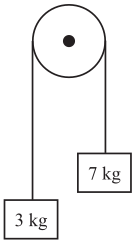
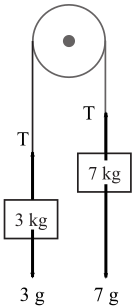
A light inextensible string hangs over a frictionless pulley connecting masses of 3 kg and 7 kg, as shown below.


  1.  Draw all of the forces acting on the two masses on the diagram above. (1 mark)
  2.  Calculate the tension in the string.  (2 marks)
Show Answers Only
  1.  `text(See Worked Solutions)`
  2. `(21g)/5 \ text(N)`
Show Worked Solution
a.   


b.    `sum F = 7g – 3g = 4g` ` = (7 + 3)a`
  `a = (4g)/10= (2g)/5`  
  `sum F_text(on 3kg) = T – 3g` `= 3a`
  `T – 3g` `= (6g)/5`
  `T` `= 3g + (6g)/5`
    `= (21g)/5\ \ text(N)`

Filed Under: Uncategorized Tagged With: Band 4

Mechanics, EXT2 M1 2012 SPEC2 20 MC

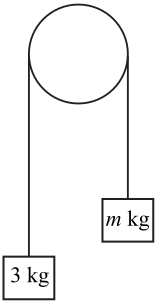
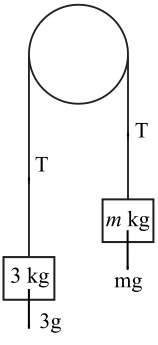
Particles of mass 3 kg and `m` kg are attached to the ends of a light inextensible string that passes over a smooth pulley, as shown.


If the acceleration of the 3 kg mass is  `4.9\ text(m/s)^2`  upwards, then

A.   `m` = 4.5

B.   `m` = 6.0

C.   `m` = 9.0

D.   `m` = 13.5

E.   `m` = 18.0

Show Answers Only

`C`

Show Worked Solution

`sum F` `=\ text(total mass × acceleration)`
`mg – 3g` `= (m + 3) xx 4.9`
`9.8m-3xx9.8` `= 4.9m + 14.7`
`:. m` `= 9`

 
`=> C`

Filed Under: Uncategorized Tagged With: Band 4

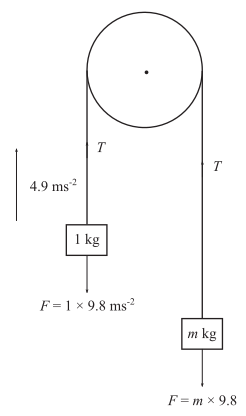
Mechanics, EXT2 M1 2015 SPEC2 19 MC

A light inextensible string passes over a smooth pulley, as shown below, with particles of mass 1 kg and `m` kg attached to the ends of the string.
 

SPEC2 2015 VCAA 19 MC

If the acceleration of the 1 kg particle is 4.9 `text(ms)^(-2)` upwards, then `m` is equal to

  1. 1
  2. 2
  3. 3
  4. 4
  5. 5
Show Answers Only

`C`

Show Worked Solution

`T-(9.8 xx 1) = 4.9 xx 1`

`T=14.7`
 

`m xx 9.8-T` `=m xx 4.9`
`4.9m` `= 14.7`
`:. m` `= 14.7/4.9`
  `= 3`

 
`=> C`

Filed Under: Uncategorized Tagged With: Band 4

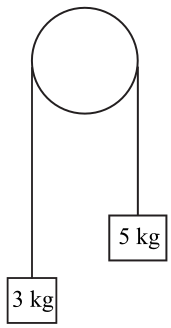
Mechanics, EXT2 M1 2014 SPEC2 20 MC

Particles of mass 3 kg and 5 kg are attached to the ends of a light inextensible string that passes over a fixed smooth pulley, as shown above. The system is released from rest.

Assuming the system remains connected, the speed of the 5 kg mass after two seconds is

A.     4.0 m/s

B.     4.9 m/s

C.     9.8 m/s

D.   19.6 m/s

Show Answers Only

`B`

Show Worked Solution
`sum F` `= 5g – 3g = 2g`
  `=2 xx 9.8`
  `=19.6\ \ text(N)`
`(5+3)a` `= 19.6`
`a` `=2.45`

  
`u = 0, quad t = 2, quad a = 2.45`

`v` `= u + at`
  `= 0 + 2.45 xx 2`
  `=4.9\ \ text(m/s)`

 
`=> B`

Filed Under: Uncategorized Tagged With: Band 4

Complex Numbers, EXT2 N2 SM-Bank 1

Find all solutions for `z`, in exponential form, given  `z^4 = -2 sqrt3 - 2 i`.   (3 marks)

--- 8 WORK AREA LINES (style=lined) ---

Show Answers Only

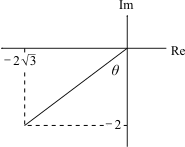
`sqrt2 e^(-frac{i 17 pi}{24}) \ , \  sqrt2 e^(-frac{i 5 pi}{24}) \ , \  sqrt2 e^(frac{i 7 pi}{24}) \ , \  sqrt2 e^(frac{i 19 pi}{24})`

Show Worked Solution

`text{Convert} \ \ z^4\ \ text{to Mod/Arg:}`

`| z^4 | = sqrt{(2 sqrt3)^2 + 2^2} = 4`


`tan \ theta` `= frac{2 sqrt3}{2} = sqrt3`
`theta` `= frac{pi}{3}`

`text{arg} (z^4) = – (frac{pi}{2} + frac{pi}{3}) = – frac{5 pi}{6}`
 

`text{By De Moivre:}`

`| z | = root4 (4) = sqrt2`

`text{arg}(z) = -frac{5 pi}{24} + frac{ k pi}{2} \ , \ k = 0 , ± 1 , ± 2`

`k = 0:\ text{arg} (z)=-frac{5 pi}{24}`

`k = 1:\ text{arg} (z)= -frac{5 pi}{24} + frac{pi}{2} = frac{7 pi}{24}`

`k = – 1:\ text{arg} (z)= -frac{5 pi}{24} – frac{pi}{2} = frac{-17 pi}{24}`

`k = 2:\ text{arg} (z)= -frac{5 pi}{24} + pi = frac{19 pi}{24}`

 
`therefore \ text{Solutions are:} \ sqrt2 e^(- frac{i 17 pi}{24}) \ , \  sqrt2 e^(frac{ -i 5 pi}{24}) \ , \  sqrt2 e^(frac{i 7 pi}{24}) \ , \  sqrt2 e^(frac{i 19 pi}{24})`

Filed Under: Solving Equations with Complex Numbers Tagged With: Band 4, smc-1050-30-Roots > 3, smc-1050-50-Exponential form

Complex Numbers, EXT2 N2 SM-Bank 8

If  `(x + iy)^3 = e^( - frac{i pi}{2}),\ \ x, y ∈ R`, find a solution in the form  `x + i y, \ x, y ≠ 0`.   (2 marks)

--- 5 WORK AREA LINES (style=lined) ---

Show Answers Only

`frac{sqrt3}{2} – i frac{1}{2}`

Show Worked Solution
`text{Let}`   `(x + i y)` `= cos theta + i sin theta`
  `(x + i y)^3` `= cos (3 theta) + isin (3 theta)`

 
`e^(- frac{i pi}{2}) = cos (frac{-pi}{2}) + i sin (frac{-pi}{2})`

COMMENT: Read the question fully and save time – only one solution is required here.


`text{Equating real parts:}`

`3 theta` `= frac{-pi}{2}`
`theta` `= frac{-pi}{6}`


`therefore \ x + i y` `= cos (frac{-pi}{6}) + i sin (frac{-pi}{6})`
  `= frac{sqrt3}{2} – i frac{1}{2}`

Filed Under: Solving Equations with Complex Numbers Tagged With: Band 4, smc-1050-20-Cubic roots, smc-1050-50-Exponential form

Complex Numbers, EXT2 N1 SM-Bank 9

Let  `z = sqrt3 - 3 i`

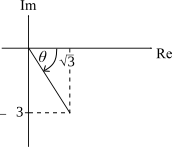
  1. Express `z` in modulus-argument form.   (2 marks)

    --- 6 WORK AREA LINES (style=lined) ---

  2. Find the smallest integer `n`, such that  `z^n + (overset_z)^n = 0`.  (3 marks)

    --- 6 WORK AREA LINES (style=lined) ---

Show Answers Only
  1. `2 sqrt3 text{cis} (frac{-pi}{3})`
  2. `3`
Show Worked Solution
i.    `z` `= sqrt3 – 3 i`
  `|z|` `= sqrt((sqrt3)^2 + 3^2) = 2 sqrt3`


`tan theta` `= frac{3}{sqrt3}=sqrt3`
`theta` `= frac{pi}{3}`
`text{arg} (z)` `= – frac{pi}{3}`

 
`therefore  z = 2 sqrt3 \ text{cis} (frac{-pi}{3})`


ii.   `z^n + (overset_z)^n = 0`

`[2 sqrt3 \ cos (frac{-pi}{3}) + i sin (frac{-pi}{3})]^n + [ 2 sqrt3 \ cos (frac{-pi}{3}) – i sin (frac{-pi}{3}) ]^n = 0`

`(2 sqrt3)^n [cos (frac{-n pi}{3}) + i sin (frac{-n pi}{3}) + cos (frac{-n pi}{3}) – i sin (frac{-n pi}{3}) = 0`

`2 \ cos (frac{-n pi}{3})` `= 0`
`cos (frac{n pi}{3})` `= 0`
`frac{n pi}{3}` `= frac{pi}{2} + k pi \ , \ k = 0, ± 1, ± 2, …`
`frac{n}{3}` `= frac{(2k + 1)}{2}`
`n` `= frac{3 (2k + 1)}{2}`

 
`text{Numerator will always be odd  ⇒  no solution exists}`

Filed Under: Argand Diagrams and Mod/Arg form Tagged With: Band 3, Band 4, smc-1049-20-Cartesian to Mod/Arg, smc-1049-50-Powers

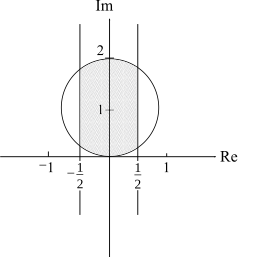
Complex Numbers, EXT2 N2 2004 HSC 2c

Sketch the region in the complex plane where the inequalities

`| z + overset_z | ≤ 1`  and  `| z - i | ≤ 1`

hold simultaneously.   (3 marks)

Show Answers Only

Show Worked Solution

`| z + overset_z | ≤ 1 `

`| x + i y + x – iy |` `≤ 1`
`| 2x |` `≤ 1`
`| x |` `≤ frac{1}{2}`

 
`| z – i | ≤ 1 \ => \ text{Circle, radius = 1 , centre (0, 1)`
 

Filed Under: Geometrical Implications of Complex Numbers Tagged With: Band 4, smc-1052-10-Sketch regions

  • « Previous Page
  • 1
  • …
  • 63
  • 64
  • 65
  • 66
  • 67
  • …
  • 114
  • Next Page »

Copyright © 2014–2025 SmarterEd.com.au · Log in