SmarterEd

Aussie Maths & Science Teachers: Save your time with SmarterEd

  • Login
  • Get Help
  • About

Vectors, EXT1 V1 SM-Bank 22

Consider the rhombus  `OPQR`  shown below, where  `overset(->)(OP) = punderset~i`  and  `overset(->)(OR) = underset~i + 2underset~j`  and  `p`  is a real constant.
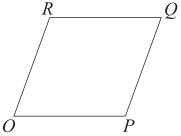
 

  1. Find  `p`.  (1 mark)

    --- 1 WORK AREA LINES (style=lined) ---

  2. Show that the diagonals of rhombus  `OPQR`  are perpendicular.  (2 marks)

    --- 6 WORK AREA LINES (style=lined) ---

Show Answers Only
  1. `sqrt5`
  2. `text(See Worked Solutions)`
Show Worked Solution

i.   `|overset(->)(OP)| = |overset(->)(OR)|`

`p` `= sqrt(1^2 + 2^2)`
  `= sqrt5`


ii.   `overset(->)(RQ) = overset(->)(OP),\ \ overset(->)(OR) = overset(->)(PQ)`

`overset(->)(OQ)` `= overset(->)(OR) + overset(->)(RQ)`
  `= [(1),(2)] + [(sqrt5),(0)]`
  `= (1 + sqrt5)underset~i + 2underset~j`


`overset(->)(PR)` `= overset(->)(OR)-overset(->)(RQ)`
  `= [(1),(2)]-[(sqrt5),(0)]`
  `= (1-sqrt5)underset~i + 2underset~j`


`overset(->)(OQ) · overset(->)(PR)` `= [(1 + sqrt5),(2)] · [(1-sqrt5),(2)]`
  `= (1 + sqrt5)(1-sqrt5) + 2 xx 2`
  `= 1-5 + 4`
  `= 0`

 
`:. overset(->)(OQ) ⊥ overset(->)(PQ)`

Filed Under: Vectors and Geometry (Ext1) Tagged With: Band 4, smc-1211-20-Rhombus

Vectors, EXT1 V1 SM-Bank 18

If  `theta`  is the angle between  `underset~a = underset~i + 3j`  and  `underset~b = 3underset~i + underset~j`, then find the exact value of  `cos 2theta`.  (2 marks)

--- 6 WORK AREA LINES (style=lined) ---

Show Answers Only

`−7/25`

Show Worked Solution

`underset~a = [(1),(3)],\ \ underset~b = [(3),(1)]`

`|underset~a| = sqrt(1^2 + 3^2) = sqrt10`

`|underset~b| = sqrt(3^2 + 1^2) = sqrt10`

`cos theta= (1 xx 3 + 3 xx 1)/(sqrt10 sqrt10)= 3/5`

`cos2theta` `= 2cos^2theta – 1`
  `= 2(3/5)^2 – 1`
  `= −7/25`

Filed Under: Operations With Vectors (Ext1) Tagged With: Band 4, smc-1086-20-Angles Between Vectors

Vectors, EXT1 V1 SM-Bank 17

Two vectors are given by `underset~a = 2underset~i + m underset~j`  and  `underset~b = −5underset~i + n underset~j`  where  `m, n > 0`.

If  `|underset~a| = 3`  and  `underset~a`  is perpendicular to  `underset~b`, find the values of  `m`  and  `n`.  (2 marks)

--- 6 WORK AREA LINES (style=lined) ---
Show Answers Only

`2sqrt5`

Show Worked Solution

`underset~a = [(2),(m)],\ \ underset~b = [(−5),(n)]`

 
`text(Using)\ |underset~a| = 3:`

`3` `= sqrt(2^2 + m^2)`
`m^2` `= 5`
`:.m` `= sqrt5,\ \ \ (m > 0)`

 
`text(S)text(ince)\ underset~a ⊥ underset~b:`

`a · b` `= 0`
`2xx −5 + mn` `= 0`
`sqrt5 n` `= 10`
`n` `= 10/sqrt5`
  `= 2sqrt5`

Filed Under: Operations With Vectors (Ext1) Tagged With: Band 4, smc-1086-25-Perpendicular Vectors

Vectors, EXT1 V1 SM-Bank 21

Relative to a fixed origin, the points `A`, `B` and `C` are defined respectively by the position vectors  `underset~a = −underset~i - underset~j, \ underset~b = 3underset~i + 2underset~j`  and  `underset~c = −aunderset~i + 2underset~j`, where  `a`  is a real constant.

If the magnitude of angle `ABC`  is  `pi/3`, find `a`.  (3 marks)

--- 10 WORK AREA LINES (style=lined) ---

Show Answers Only

`−3`

Show Worked Solution

`text(Angle between)\ overset(->)(BA)\ text(and)\ overset(->)(BC) = pi/3`

`overset(->)(BA)` `= overset(->)(OA) – overset(->)(OB)`
  `= [(−1),(−1)] – [(3),(2)] = [(−4),(−3)]`


`overset(->)(BC)` `= overset(->)(OC) – overset(->)(OB)`
  `= [(−a),(2)] – [(3),(2)] = [(−a−3),(0 )]`


`overset(->)(BA) · overset(->)(BC)` `= [(−4),(−3)] · [(−a −3),(0 )]`
  `= 4a + 12`

 
`overset(->)(BA) · overset(->)(BC) = |overset(->)(BA)| · |overset(->)(BC)|costheta`

`4a + 12` `= sqrt((−4)^2 + (−3)^2) · sqrt((−a – 3)^2) · cos\ pi/3`
`4a + 12` `= 5(−a – 3) · 1/2`
`4a + 12` `= −(5a)/2 – 15/2`
`(13a)/2` `= −39/2`
`:.a` `= −3`

Filed Under: Operations With Vectors (Ext1) Tagged With: Band 4, smc-1086-20-Angles Between Vectors

Vectors, EXT1 V1 SM-Bank 20

Consider the vector  `underset~a = underset~i + sqrt3underset~j`, where  `underset~i`  and  `underset~j`  are unit vectors in the positive direction of the `x` and `y` axes respectively.

  1. Find the unit vector in the direction of  `underset~a`.    (1 mark)

    --- 2 WORK AREA LINES (style=lined) ---

  2. Find the acute angle that  `underset~a`  makes with the positive direction of the `x`-axis.   (1 mark)

    --- 6 WORK AREA LINES (style=lined) ---
  3. The vector  `underset~b = m underset~i - 2underset~j`.


    Given that  `underset~b`  is perpendicular to  `underset~a`, find the value of  `underset~m`.   (1 mark)

    --- 4 WORK AREA LINES (style=lined) ---

Show Answers Only
  1. `1/2(underset~i + sqrt3underset~j)`
  2. `60°`
  3. `2sqrt3`
Show Worked Solution

i.   `underset~a = underset~i + sqrt3underset~j`

`|underset~a| = sqrt(1 + (sqrt(3))^2) = 2`

`overset^a = (underset~a)/(|underset~a|) = 1/2(underset~i + sqrt3underset~j)`


ii.   `text(Solution 1)`

`underset~a\ =>\ text(Position vector from)\ \ O\ \ text{to}\ \ (1, sqrt3)`

`tan theta` `=sqrt3`  
`:. theta` `=60°`  
     

`text(Solution 2)`

`text(Angle with)\ xtext(-axis = angle with)\ \ underset~b = underset~i`

`underset~a · underset~i = 1 xx 1 = 1`

`underset~a · underset~i` `= |underset~a||underset~i|costheta`
`1` `= 2 xx 1 xx costheta`
`costheta` `= 1/2`
`:. theta` `= 60°`


iii.   `underset~b = m underset~i – 2underset~j`

`underset~a · underset~b = [(1),(sqrt3)] · [(m),(−2)] = m – 2sqrt3`

`text(S)text(ince)\ underset~a ⊥ underset~b:`

`m – 2sqrt3` `= 0`
`m` `= 2sqrt3`

Filed Under: Operations With Vectors (Ext1) Tagged With: Band 3, Band 4, smc-1086-20-Angles Between Vectors, smc-1086-25-Perpendicular Vectors, smc-1086-30-Unit Vectors and Projections

Vectors, EXT1 V1 SM-Bank 19

Consider the following vectors

`overset(->)(OA) = 2underset~i + 2underset~j,\ \  overset(->)(OB) = 3underset~i - underset~j,\ \ overset(->)(OC) = 5underset~i + 3underset~j`

  1. Find  `overset(->)(AB)`.  (1 mark)

    --- 3 WORK AREA LINES (style=lined) ---

  2. The points `A`, `B` and `C` are vertices of a triangle. Prove that the triangle has a right angle at `A`.  (2 marks)

    --- 3 WORK AREA LINES (style=lined) ---

  3. Find the length of the hypotenuse of the triangle.  (1 mark)

    --- 3 WORK AREA LINES (style=lined) ---

Show Answers Only
  1. `underset~i – 3underset~j`
  2. `text(See Worked Solutions)`
  3. `2sqrt5`
Show Worked Solution

i.  `text(Find)\ overset(->)(AB):`

COMMENT: Many teachers recommend column vector notation to simplify calculations and minimise errors – we agree!

`overset(->)(OA) = [(2),(2)],\ \ overset(->)(OB)[(3),(−1)]`

`overset(->)(AB)` `= overset(->)(OB) – overset(->)(OA)`
  `= [(3),(−1)] – [(2),(2)]`
  `= [(1),(−3)]`
  `= underset~i – 3underset~j`


ii.    `overset(->)(AC)` `= overset(->)(OC) – overset(->)(OA)`
    `= [(5),(3)] – [(2),(2)]`
    `= [(3),(1)]`
    `= 3underset~i + underset~j`


`overset(->)(AB) · overset(->)(AC)` `= 1 xx 3 + −3 xx 1=0`

`=> AB ⊥ AC`

`:. DeltaABC\ text(has a right angle at)\ A.`


iii.   `overset(->)(BC)\ text(is the hypotenuse)`

`overset(->)(BC)` `= overset(->)(OC) – overset(->)(OB)`
  `= [(5),(3)] – [(3),(−1)]`
  `= [(2),(4)]`
`|overset(->)(BC)|` `=\ text(length of hypotenuse)`
  `= sqrt(2^2 + 4^2)`
  `= sqrt(20)`
  `= 2sqrt5`

Filed Under: Operations With Vectors (Ext1) Tagged With: Band 3, Band 4, smc-1086-10-Basic Calculations, smc-1086-25-Perpendicular Vectors

Vectors, EXT1 V1 SM-Bank 15

Consider the vectors

`underset~a = 6underset~i + 2underset~j,\ \ underset~b = 2underset~i - m underset~j`

  1. Calculate  `2underset~a - 3underset~b`.  (1 mark)

    --- 2 WORK AREA LINES (style=lined) ---

  2. Find the values of  `m`  for which  `|underset~b| = 3sqrt2`.  (2 marks)

    --- 5 WORK AREA LINES (style=lined) ---

  3. Find the value of  `m`  such that  `underset~a`  is perpendicular to  `underset~b`.  (1 mark)

    --- 2 WORK AREA LINES (style=lined) ---

Show Answers Only
  1. `[(6),(4 + 3m)]`
  2. `±sqrt14`
  3. `6`
Show Worked Solution
i.    `2underset~a – 3underset~b` `= 2[(6),(2)] – 3[(2),(−m)]`
    `= [(12),(4)] – [(6),(−3m)]`
    `= [(6),(4 + 3m)]`


ii.   `underset~a = [(6),(2)], \ \ underset~b = [(2),(−m)]`

`|underset~b|` `= sqrt(4 + m^2)`
`3sqrt2` `= sqrt(4 + m^2)`
`18` `= 4 + m^2`
`m^2` `= 14`
`m` `= ±sqrt14`


iii.   `text(If)\ \ underset~a ⊥ underset~b \ => \ underset~a · underset~b = 0`

`6 xx 2 + 2 xx – m` `= 0`
`2m` `= 12`
`:. m` `= 6`

Filed Under: Operations With Vectors (Ext1) Tagged With: Band 3, Band 4, smc-1086-10-Basic Calculations, smc-1086-25-Perpendicular Vectors

Vectors, EXT1 V1 SM-Bank 14

Consider the vectors,  `underset~a = overset(->)(OA)`  where  `|OA| = 5`  and  `underset~b = overset(->)(OB)`  where  `|OB| = 7`.

If  `angleAOB = 30°`, find  `text(proj)_(underset~b)underset~a`  as a multiple of  `underset~b`.  (2 marks)

Show Answers Only

`(5sqrt3)/14 · underset~b`

Show Worked Solution

`underset~overset^b = (underset~b)/(|OB|) = (underset~b)/7`

`text(proj)_underset~bunderset~a` `= (|underset~a|\ cos30°) · underset~overset^b`
  `= 5 xx sqrt3/2 xx (underset~b)/7`
  `= (5sqrt3)/14 · underset~b`

Filed Under: Operations With Vectors (Ext1) Tagged With: Band 4, smc-1086-30-Unit Vectors and Projections

Vectors, EXT1 V1 SM-Bank 13

Given  `underset~a = 4underset~i - 3underset~j`  and  `underset~b = 7underset~i - underset~j`, what is the magnitude of the projection of  `underset~a`  onto  `underset~b`. Give your answer in simplest form.  (3 marks)

--- 8 WORK AREA LINES (style=lined) ---

Show Answers Only

`(31sqrt2)/10`

Show Worked Solution

`underset~a = [(4),(−3)],\ \ underset~b = [(7),(−1)]`

`text(proj)_(underset~b) underset~a` `= (28 + 3)/(49 + 1)(7underset~i – underset~j)`
  `= 31/50(7underset~i – underset~j)`
  `= 217/50 underset~i – 31/50 underset~j`


`|\ text(proj)_(underset~b) underset~a\ |` `= sqrt((217/50)^2 + (31/50)^2)`
  `= sqrt((217^2 + 31^2))/50`
  `= sqrt(48\ 050)/50`
  `= (155sqrt2)/50`
  `= (31sqrt2)/10`

Filed Under: Operations With Vectors (Ext1) Tagged With: Band 4, smc-1086-30-Unit Vectors and Projections

Vectors, EXT1 V1 SM-Bank 11

Points  `A`  and  `B`  have position vectors  `underset~a = 2underset~i - 2underset~j`  and  `underset~b =  4i + sqrt2 underset~j` respectively.

Find the angle between  `underset~a`  and  `underset~b`  to the nearest minute.  (2 marks)

--- 5 WORK AREA LINES (style=lined) ---

Show Answers Only

`64°28′`

Show Worked Solution

`underset~a = 2underset~i – 2underset~j \ => \ |underset~a| = sqrt(2^2 + 2^2) = sqrt8`

`underset~b = 4 i + sqrt2 j \ => \ |underset~b| = sqrt(4^2 + (sqrt2)^2) = sqrt18`

`underset~a · underset~b = |underset~a||underset~b|costheta`

`costheta` `= (underset~a · underset~b)/(|underset~a||underset~b|)`
  `= (8 – 2sqrt2)/(sqrt8sqrt18)`
  `= (8 – 2sqrt2)/12`
`:. theta` `=64.471…`
  `=64°28′\ \ \ text{(nearest minute)}`

Filed Under: Operations With Vectors (Ext1) Tagged With: Band 4, smc-1086-20-Angles Between Vectors

Calculus, EXT1 C3 SM-Bank 2

The parabola with equation  `y = 9 - x^2`  cuts the `y`-axis at  `P(0,9)`  and the `x`-axis at  `Q(3,0)`.

Find the exact volume of the solid of revolution formed when the area between the line  `PQ`  and the parabola is rotated about the `y`-axis.  (4 marks)

--- 8 WORK AREA LINES (style=lined) ---

Show Answers Only

`(27pi)/2\ text(units³)`

Show Worked Solution

`text(Equation of)\ PQ:`

`m = −3,\ \ ytext(-intercept) = 9`

`y = 9 – 3x`
 

`text(Rotating about the)\ ytext(-axis:)`

`x_1^(\ 2)` `= 9 – y\ \ \ text{(parabola)}`
`y` `= 9 – 3x_2\ \ \ (text{line}\ PQ)`
`3x_2` `= 9 – y`
`x_2` `= 3 – y/3`
`x_2^(\ 2)` `= (3 – y/3)^2`


`V` `= pi int_0^9 x_1^(\ 2) – x_2^(\ 2)\ dy`
  `= pi int_0^9 9 – y – (3 – y/3)^2\ dy`
  `= pi int_0^9 9 – y – (9 – 2y + (y^2)/9)\ dy`
  `= pi int_0^9 y – (y^2)/9\ dy`
  `= pi [(y^2)/2 – (y^3)/27]_0^9`
  `= pi(81/2 – 27)`
  `= (27pi)/2\ text(units³)`

Filed Under: Further Area and Solids of Revolution (Ext1) Tagged With: Band 4, smc-1039-10-Polynomial, smc-1039-61-y-axis Rotation

Number, NAP-L3-CA03

Con packs oranges into boxes for the market.

Each box holds 20 oranges.

Con fills 3 boxes and has 6 oranges left over.


How many oranges does Con have altogether?

`46` `60` `66` `78`


Show Answers Only

`66`

Show Worked Solution

`text(One full box holds 20 oranges.)`

`:.\ text(Total oranges)` `= 3 xx 20`
  `= 60 + 6`
  `= 66`

Filed Under: Basic Concepts and Calculations, Basic Concepts and Calculations Tagged With: Band 4, smc-3143-20-Basic operators, smc-676-20-Basic operators

Statistics, NAP-L3-CA02

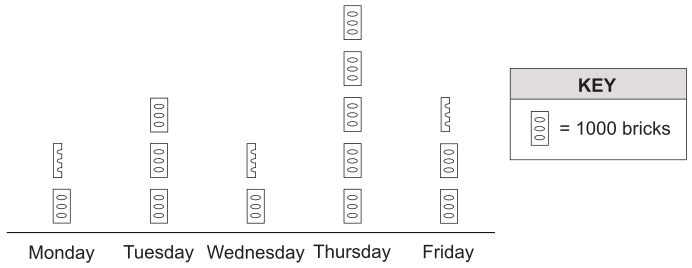
Kim is a bricklayer and he recorded the number of bricks he layed each day for five days in a picture graph.


What is the difference between the number of bricks Kim laid on Monday and the number of bricks he laid on Thursday?

`2500` `3000` `3500` `4000`


Show Answers Only

`3500`

Show Worked Solution

`text(Bricks laid on Monday = 1500)`

`text(Bricks laid on Thursday = 5000)`

`text(Difference)` `= 5000 – 1500`
  `= 3500`

Filed Under: Data and Statistics (7) Tagged With: Band 4, smc-674-11-Picture graphs

Measurement, NAP-L3-CA01

Gary works in a orchard.

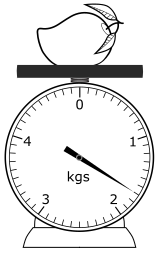
He weighs one of the mangoes he picks every hour.
 

How much does this mango weigh?

1.5 kilograms 1.7 kilograms 2.3 kilograms 17 kilograms


Show Answers Only

`text(1.7 kilograms)`

Show Worked Solution

`text(1.7 kilograms)`

Filed Under: Units of Measurement, Units of Measurement Tagged With: Band 4, smc-3152-10-Scale measure, smc-668-10-Scale measure

Statistics, STD2 S1 SM-Bank 2

A survey question is shown.

Give TWO reasons why this survey may be considered to be poorly designed.  (2 marks)

Show Answers Only

`text(Only 3 choices of many colours are given.)`

Show Worked Solution

`text(Poor design reason:)`

`text(- only 3 choices of many colours are given.)`

`text(- two colours might be someone’s equal favourite colours.)`

Filed Under: Classifying Data (Std 2), Data Classification, Investigation and Sampling Methods (Std1-2027), Data Classification, Investigation and Sampling Methods (Std2-2027) Tagged With: Band 4, common-content, smc-6309-30-Other, smc-6529-30-Other, smc-820-30-Other

Calculus, EXT2 C1 2019 HSC 15c

  1. Show that  `int_0^1 x/(x + 1)^2\ dx = ln 2 - 1/2`.  (2 marks)

    --- 5 WORK AREA LINES (style=lined) ---


  2. Let  `I_n = int_0^1 x^n/(x + 1)^2\ dx`.


    Show that  `I_n = 1/(2(n - 1)) - n/(n - 1) I_(n - 1)\ \ text(for)\ \ n >= 2`.  (3 marks)

    --- 7 WORK AREA LINES (style=lined) ---


  3. Evaluate  `I_3`.  (2 marks)

    --- 6 WORK AREA LINES (style=lined) ---

Show Answers Only
  1. `text(Proof)\ text{(See Worked Solutions)}`
  2. `text(Proof)\ text{(See Worked Solutions)}`
  3. `text(See Worked Solutions)`
Show Worked Solution

i.    `text(Show)\ \ int_0^1 x/(x + 1)^2\ dx = ln 2 – 1/2`

`text(Let)\ \ u = x + 1 \ => \ x = u – 1`

`(du)/(dx) = 1 \ => \ du = dx`
 

`text(When)\ \ x = 1,\ \ u = 2`

`text(When)\ \ x = 0,\ \ u = 1`

`int_0^1 x/(x + 1)^2\ dx` `= int_1^2 (u – 1)/(u^2)\ du`
  `= int_1^2 1/u\ du – int_1^2 1/u^2\ du`
  `= [ln u]_1^2 + [1/u]_1^2`
  `= ln 2 – ln 1 + 1/2 – 1`
  `= ln 2 – 1/2`

 
ii.
    `I_u = int_0^1 x^n/(x + 1)^2\ dx`

`u = x^n` `v prime = 1/(x + 1)^2`
`u prime = nx^(n – 1)` `v = -1/{(x + 1)}`


`I_n` `= [uv]_0^1 – int_0^1 u prime v\ dx`
  `= [(-x^n)/(x + 1)]_0^1 + int_0^1 (n x^(n – 1))/(x + 1)\ dx`
  `= (-1/2 – 0) + n int_0^1 (x^(n – 1) (x + 1))/(x + 1)^2\ dx`
  `= -1/2 + n int_0^1 x^n/(x + 1)^2 + (x^(n – 1))/(x + 1)^2\ dx`
  `= -1/2 + n I_n + n I_(n – 1)`
`nI_n – I_n` `= 1/2 – n I_(n – 1)`
`I_n(n – 1)` `= 1/2 – n I_(n – 1)`
`:. I_n` `= 1/(2(n – 1)) – n/(n – 1) I_(n – 1)`


iii.    `I_1` `= ln 2 – 1/2`
  `I_2` `= 1/(2(2 – 1)) – 2/{(2 – 1)} I_1`
    `= 1/2 – 2 I_1`
    `= 1/2 – 2 ln 2 + 1`
    `= 3/2 – 2 ln 2`


`:. I_3` `= 1/4 – 3/2(3/2 – 2 ln 2)`
  `= 1/4 – 9/4 + 3 ln 2`
  `= 3 ln 2 – 2`

Filed Under: Recurrence Relations Tagged With: Band 3, Band 4, smc-1054-20-Quotient

Calculus, EXT2 C1 2019 HSC 15a

  1. Show that
     
    `qquad int_(-a)^a (f(x))/(f(x) + f(-x))\ dx = int_(-a)^a (f(-x))/(f(x) + f(-x))\ dx`.  (2 marks)

    --- 6 WORK AREA LINES (style=lined) ---
  2. Hence, or otherwise, evaluate
     
    `qquad int_(-1)^1 (e^x)/(e^x + e^(-x))\ dx`.  (2 marks)

    --- 5 WORK AREA LINES (style=lined) ---
Show Answers Only
  1. `text(Proof)\ text{(See Worked Solutions)}`
  2. `text(See Worked Solutions)`
Show Worked Solution

i.    `text(Let)\ \ u = -x \ => \ du = -dx`

`text(When)\ \ x=a, \ u=-a`

`text(When)\ \ x=-a, \ u=a`

`int_(-a)^a (f(x))/(f(x) + f(-x))\ dx` `= -int_a^(-a) (f(-u))/(f(-u) + f(u))\ du`
  `= int_(-a)^a (f(-u))/(f(u) + f(-u))\ du`
  `= int_(-a)^a (f(-x))/(f(x) + f(-x))\ dx`


ii.    `text(Let)\ \ I = int_(-1)^1 (e^x)/(e^x + e^(-x))\ dx`

`2I` `= int_(-1)^1 (e^x)/(e^x + e^(-x))\ dx + int_(-1)^1 (e^(-x))/(e^x + e^(-x))\ dx`
`2I` `= int_(-1)^1 (e^x + e^(-x))/(e^x + e^(-x))\ dx`
`2I` `= [x]_(-1)^1`
`2I` `= 2`

 
`:. int_(-1)^1 (e^x)/(e^x + e^(-x))\ dx = 1`

Filed Under: Substitution and Harder Integration Tagged With: Band 4, smc-1057-30-Exponential

Mechanics, EXT2 M1 2019 HSC 14b

A parachutist jumps from a plane, falls freely for a short time and then opens the parachute. Let t be the time in seconds after the parachute opens, `x(t)`  be the distance in metres travelled after the parachute opens, and  `v(t)`  be the velocity of the parachutist in `text(ms)^(-1)`.

The acceleration of the parachutist after the parachute opens is given by

`ddot x = g - kv,`

where `g\ text(ms)^(-2)` is the acceleration due to gravity and `k` is a positive constant.

  1. With an open parachute the parachutist has a terminal velocity of  `w\ text(ms)^(-1)`.


    Show that  `w = g/k`.  (1 mark)

    --- 2 WORK AREA LINES (style=lined) ---
    At the time the parachute opens, the speed of descent is `1.6 w\ text(ms)^(-1)`.

  2. Show that it takes  `1/k log_e 6`  seconds to slow down to a speed of `1.1w\ text(ms)^(-1)`.  (4 marks)

    --- 10 WORK AREA LINES (style=lined) ---
  3. Let  `D`  be the distance the parachutist travels between opening the parachute and reaching the speed `1.1w\ text(ms)^(-1)`.


    Show that  `D = g/k^2 (1/2 + log_e 6)`.  (3 marks)

    --- 8 WORK AREA LINES (style=lined) ---
Show Answers Only
  1. `text(Proof)\ text{(See Worked Solutions)}`
  2. `text(Proof)\ text{(See Worked Solutions)}`
  3. `text(Proof)\ text{(See Worked Solutions)}`
Show Worked Solution

i.   `v_T=w\ \  text(when)\ \ ddot x = 0`

`0` `= g – kw`
`w` `= g/k`


ii.   `text(Show)\ \ t = 1/k log_e 6\ \ text(when)\ \ v = 1.1w`

`(dv)/(dt)` `= g – kv`
`(dt)/(dv)` `= 1/(g – kv)`
`t` `= int 1/(g – kv)\ dv`
  `= -1/k ln(g – kv) + C`

 
`text(When)\ \ t = 0,\ \ v = 1.6w`

`0` `= -1/k ln(g – 1.6 kw) + C`
`C` `= 1/k ln(g – 1.6 kw)`
`t` `= 1/k ln (g – 1.6kw) – 1/k ln(g – kv)`
  `= 1/k ln((g – 1.6 kw)/(g – kv))`

 
`text(Find)\ \ t\ \ text(when)\ \ v = 1.1w`

`t` `= 1/k ln((g – 1.6 k xx g/k)/(g – 1.1k xx g/k))`
  `=1/k ln((g – 1.6 g)/(g – 1.1g))`
  `=1/k((-0.6g)/(-0.1g))`
  `= 1/k ln 6`


iii.    `v ⋅ (dv)/(dx)` `= g – kv`
  `(dv)/(dx)` `= (g – kv)/v`
  `(dx)/(dv)` `= v/(g – kv)`
  `x` `= int v/(g – kv)\ dv`
    `= 1/k int (kv)/(g – kv)\ dv`
    `= -1/k int 1 – g/(g – kv)\ dv`


`:. D` `= -1/k int_(1.6w)^(1.1w) 1 – g/(g – kv)\ dv`
  `= 1/k int_(1.1w)^(1.6w) 1 – g/(g – kv)\ dv`
  `= 1/k[v + g/k ln (g – kv)]_(1.1w)^(1.6w)`
  `= g/k^2[(kv)/g + ln (g – kv)]_(1.1w)^(1.6w)`
  `= g/k^2[((1.6kw)/g + ln (g – 1.6kw)) – ((1.1 kw)/g + ln (g – 1.1kw))]`
  `= g/k^2[1.6 + ln ((g – 1.6kw)/(g – 1.1kw)) – 1.1]`
  `= g/k^2(0.5 + ln 6)`

Filed Under: Resisted Motion Tagged With: Band 3, Band 4, smc-1061-10-R ~ v, smc-1061-60-Time of Travel / Distance, smc-1061-80-Terminal Velocity, smc-1061-90-Parachutist

Combinatorics, EXT1 A1 2019 13b

In the expansion of  `(5x + 2)^20`, the coefficients of  `x^r`  and  `x^(r + 1)`  are equal.

What is the value of  `r` ?  (3 marks)

--- 8 WORK AREA LINES (style=lined) ---
Show Answers Only

`14`

Show Worked Solution

`(5x + 2)^20`

COMMENT: Arithmetic becomes easier by expanding  `(2 + 5x)^20`.

`text(General term:)\ (2 + 5x)^20`

`T_r` `= \ ^20C_r · 2^(20 – r) · (5x)^r`
  `= \ ^20C_r · 2^(20 – r) · 5^r · x^r`
`T_(r + 1)` `=\ ^20C_(r + 1) · 2^(19 – r) · 5^(r + 1) · x^(r + 1)`


`text(Equating co-efficients:)`

`(20!)/(r!(20 – r)!) · 2^(20 – r) · 5^r` `= (20!)/((r + 1)!(19 – r)!) · 2^(19 – r) · 5 ^(r + 1)`
`2/(20 – r)` `= 5/(r + 1)`
`2r + 2` `= 100 – 5r`
`7r` `= 98`
`r` `= 14`

Filed Under: Binomial Expansion (Ext1) Tagged With: Band 4, smc-1088-10-Coefficients

Functions, EXT1′ F1 2019 HSC 12d

Consider the function  `f(x) = x^3 - 1`.

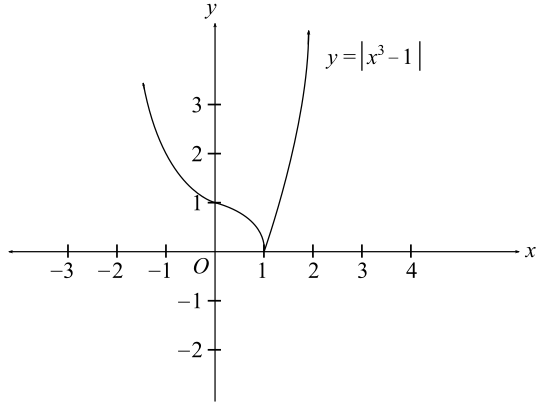
  1.  Sketch the graph  `y = |\ f(x)\ |`.  (1 mark)

    --- 8 WORK AREA LINES (style=lined) ---
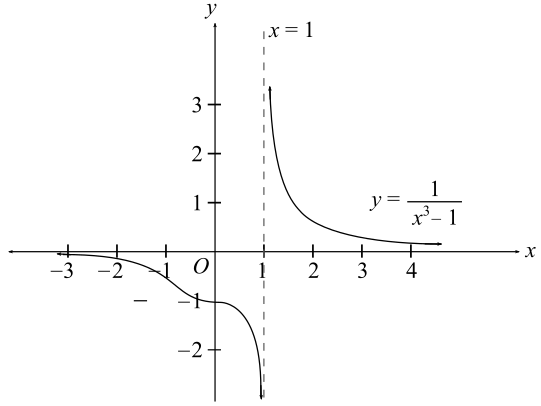
  2.  Sketch the graph  `y = 1/(f(x))`.  (2 marks)

    --- 10 WORK AREA LINES (style=lined) ---

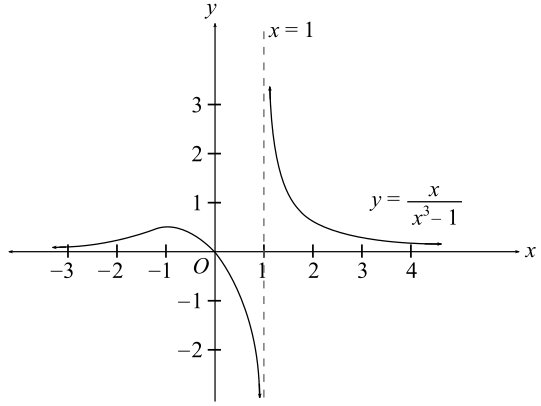
  3.  Without using calculus, sketch the graph  `y = x/(f(x))`.  (2 marks)

    --- 10 WORK AREA LINES (style=lined) ---

Show Answers Only
  1. `text(See Worked Solutions)`
  2. `text(See Worked Solutions)`
  3. `text(See Worked Solutions)`
Show Worked Solution

i.   `y = |\ x^3 – 1\ |`


ii.   `y = 1/(x^3 – 1)`


iii.   `y = x/(x^3 – 1)`

Filed Under: Reflections and Harder Graphs (Ext1) Tagged With: Band 3, Band 4, smc-1072-30-y = | f(x) |; y = f( |x| ), smc-1072-40-Other Graphs

Calculus, EXT1′ C3 2019 HSC 12b

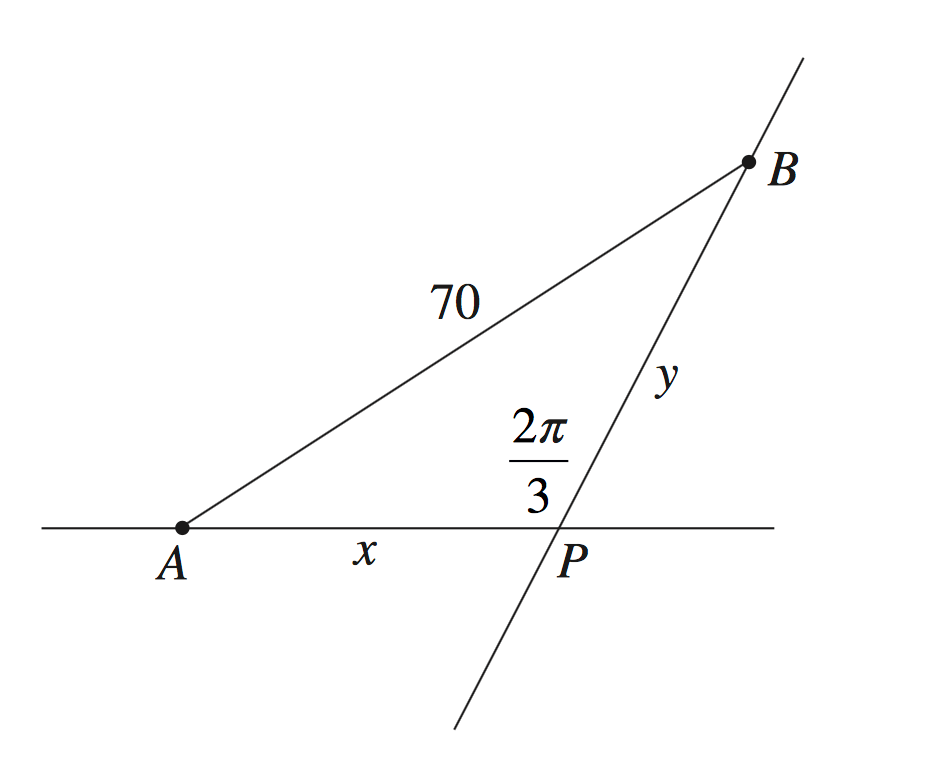
The diagram shows two straight railway tracks that meet at an angle of  `(2 pi)/3`  at the point `P`.

Trains  `A`  and  `B`  are joined by a cable which is 70 m long.

At time  `t`  seconds, train  `A`  is  `x`  metres from  `P`  and train  `B`  is  `y`  metres from `P`.

Train  `B`  is towing train  `A`  and is moving at a constant speed of  `4\ text(ms)^(-1)` away from `P`.

  1. Show that  `x^2 + xy + y^2 = 70^2`.  (1 mark)
  2. What is the value of  `(dx)/(dt)`  when train  `A`  is 30 metres from  `P`  and train  `B`  is 50 metres from `P`?  (3 marks)


Show Answers Only
  1. `text(Proof)\ text{(See Worked Solutions)}`
  2. `-52/11`
Show Worked Solution

(i)   `text(Using cosine rule):`

`x^2 + y^2 – 2xy cos ((2 pi)/3)` `= 70^2`
`x^2 + y^2 – 2xy xx -1/2` `= 70^2`
`x^2 + xy + y^2` `= 70^2`


(ii)    `(dy)/(dt)` `= 4`
  `(dx)/(dt)` `= (dy)/(dt) ⋅ (dx)/(dy)`

 
`text{Differentiate part (i)}:`

`2x + x ⋅ (dy)/(dx) + y + 2y ⋅ (dy)/(dx)` `= 0`
`(dy)/(dx) (x + 2y)` `= -2x – y`
`(dy)/(dx)` `= (-2x – y)/(x + 2y)`

 
`text(When)\ \ x = 30,\ \ y = 50`

`(dx)/(dt)` `= 4 xx (30 + 2(50))/(-2(30) – 50)`
  `= 4 xx -130/110`
  `= -52/11`

Filed Under: Uncategorized Tagged With: Band 3, Band 4

Complex Numbers, EXT2 N2 2019 HSC 12a

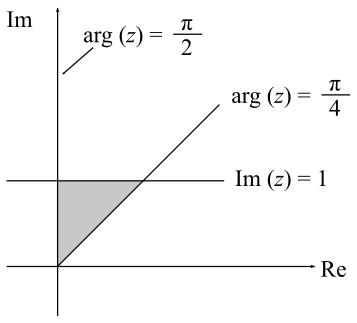
Sketch the region defined by  `pi/4 <= text(arg)(z) <= pi/2`  and  `text(Im)(z) <= 1`.  (2 marks)

Show Answers Only

Show Worked Solution

`text(Shaded Area): pi/4 <= text(arg)(z) <= pi/2 and text(Im)(z) <= 1`

Filed Under: Geometrical Implications of Complex Numbers Tagged With: Band 4, smc-1052-10-Sketch regions

Complex Numbers, EXT2 N1 2019 HSC 8 MC

Let  `z`  be a complex number such that  `z^2 = -i bar z`.

Which of the following is a possible value for `z`?

  1. `1/2 - sqrt 3/2 i`
  2. `1/2 + sqrt 3/2 i`
  3. `sqrt 3/2 - 1/2 i`
  4. `sqrt 3/2 + 1/2 i`
Show Answers Only

`C`

Show Worked Solution

`text(Solution 1)`

`text(Consider)\ C:`

`z` `=sqrt3/2 – 1/2 i`  
`barz` `=sqrt3/2 + 1/2 i`  
`-i barz` `=1/2-sqrt3/2 i`  


`z^2` `=(sqrt3/2 – 1/2 i)^2`  
  `=3/4 – 2 sqrt3/2 * 1/2 i -1/4`  
  `=1/2 – sqrt3/2 i`  

 
`=>C`


`text(Solution 2)`

`text(Let)\ \ text(arg)(z)` `= theta`
`text(arg)(z^2)` `= 2 theta`


`text(arg)(-i bar z)` `=text(arg)(i bar z) – pi`
  `= text(arg) (bar z) – pi + pi/2`
  `= -theta – pi/2`


`:. 2 theta` `= -theta – pi/2`
`3 theta` `= -pi/2`
`theta` `= -pi/6`

 
`=>   C`

Filed Under: Arithmetic of Complex Numbers Tagged With: Band 4, smc-1048-30-Other

Calculus, EXT2 C1 2019 HSC 7 MC

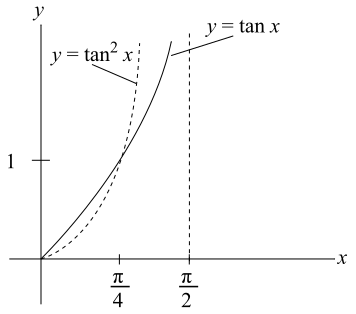
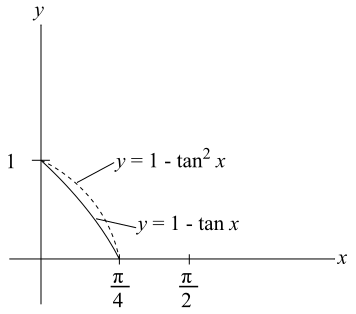
Which of these integrals has the largest value?

  1. `int_0^(pi/4) tan x\ dx`
  2. `int_0^(pi/4) tan^2 x\ dx`
  3. `int_0^(pi/4) 1 - tan x\ dx`
  4. `int_0^(pi/4) 1 - tan^2 x\ dx`
Show Answers Only

`D`

Show Worked Solution

`text(Consider options A and B:)`

`text(Consider options C and D:)`


`:. int_0^(pi/4) 1 – tan^2 x\ dx\ \ text(is the largest)`

`text{(largest area under the curve}`

  `text(between)\ \ x=0 \ and \ x=pi/4. text{)}`

 
`=>   D`

Filed Under: Trig Integration Tagged With: Band 4, smc-1193-15-tan

Algebra, STD2 A4 SM-Bank 3 MC

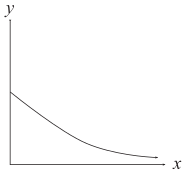
Which graph best represents the equation  `y = 5^(−x)`?
 

A. B.
C. D.
Show Answers Only

`D`

Show Worked Solution
`y` `= 5^(−x)`
  `= 1/(5^x)`

 
`text(At)\ \ x = 0, \ y = 1`

`text(As)\ \ x -> ∞, \ y -> 0`

`=> D`

Filed Under: Non-Linear: Exponential/Quadratics (Std 2) Tagged With: Band 4, smc-830-10-Identify Graphs

Measurement, STD2 M6 SM-Bank 1

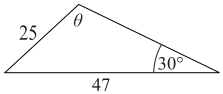
The diagram shows a triangle with side lengths 25 cm and 47 cm and angle 30° and `theta`.
 

Find  `theta`  given  it is an obtuse angle. Give your answer to the nearest minute.  (3 marks)

--- 6 WORK AREA LINES (style=lined) ---

Show Answers Only

`109°57′`

Show Worked Solution

`text(Using sine rule:)`

`(sintheta)/47` `= (sin30°)/25`
`sintheta` `=47 xx (1/2)/25`
`sintheta` `= 47/50`
`theta` `= sin^(−1)\ 47/50`
  `= 70.05\ text(or)\ 109.94`
  `= 109.948…\ \ (theta\ text(is obtuse))`
  `= 109°57′`

Filed Under: Non-Right Angled Trig (Std2) Tagged With: Band 4, smc-804-20-Sine Rule

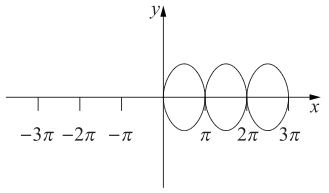
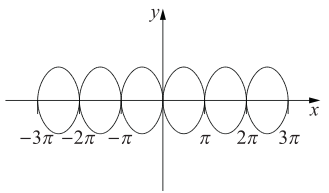
Functions, EXT1′ F1 2019 HSC 6 MC

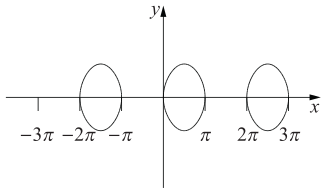
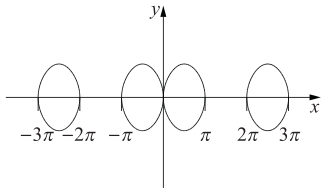
Which graph best represents  `y^2 = 2sin |\ x\ |`?

A.    B.   
C.    D.   
Show Answers Only

`B`

Show Worked Solution

`2 sin |\ x\ | >= 0`

`=>\ text(Graph doesn’t exist for)\ \ pi < |\ x\ | < 2pi `

`=>   B`

Filed Under: Reflections and Harder Graphs (Ext1) Tagged With: Band 4, smc-1072-20-y = root f(x); y^2 = f(x), smc-1072-50-Even Functions

Functions, EXT1′ F2 2019 HSC 4 MC

The polynomial  `2x^3 + bx^2 + cx + d`  has roots 1 and – 3, with one of them being a double root.

What is a possible value of  `b`?

  1. – 10
  2. – 5
  3. 5
  4. 10
Show Answers Only

`D`

Show Worked Solution

`f(x) = 2x^3 + bx^2 + cx + d`

`f prime (x) = 6x^2 + 2bx + c`

`text(Roots at 1 and −3:)`

`f(1) = 0`

`2 + b + c + d` `= 0`
`b + c + d` `= -2\ \ text{… (1)}`

 
`f(-3) = 0`

`-54 + 9b – 3c + d` `= 0`
`9b – 3c + d` `= 54\ \ text{… (2)}`

 
`(2) – (1)`

`8b – 4c` `= 56`
`2b – c` `= 14\ \ text{… (3)}`

 
`text(If double root at 1:)`

`f prime(1) = 0`

`6 + 2b + c` `= 0`
`2b + c` `= -6\ \ text{… (4)}`

 
`(3) + (4)`

`4b` `= 8`
`b` `= 2`

 
`text(If double root at – 3:)`

`f prime(-3) = 0`

`54 – 6b + c` `= 0`
`-6b + c` `= -54\ \ text{… (5)}`

 
`(3) + (5)`

`-4b` `= -40`
`b` `= 10`

 
`=>   D`

Filed Under: Sum, Products and Multiplicity of Roots (Ext1) Tagged With: Band 4, smc-1205-20-Multiplicity of Roots

Measurement, STD2 M7 SM-Bank 13

A scalene triangle has angles in the ratio  9 : 2 : 4.

In degrees, what is the size of its largest angle?  (2 marks)

Show Answers Only

`108°`

Show Worked Solution
`text(Smallest angle)` `= text(largest part)/text(total parts) xx 180`
  `= 9/(9+2+4) xx 180`
  `= 108°`

Filed Under: M5 Scale Drawings (Y12), Ratio and Scale (Std2) Tagged With: Band 4, smc-1105-50-Ratio (3 part), smc-1187-20-Ratio (3 part)

Calculus, EXT2 C1 2019 HSC 2 MC

Which of the following is a primitive of  `(sin x)/(cos^3 x)`?

  1. `1/2 sec^2 x`
  2. `-1/2 sec^2 x`
  3. `1/4 sec^4 x`
  4. `-1/4 sec^4 x`
Show Answers Only

`A`

Show Worked Solution

`text(Solution 1)`

`int(sin x)/(cos^3 x)` `= int sinx cos^(-3) x\ dx`
  `=1/2 cos^(-2)x + C`
  `= 1/2 sec^2 x + C`

 
`text(Solution 2)`

`int(sin x)/(cos^3 x)` `= int tanx sec^2x\ dx`
  `= 1/2 tan^2 + C_1`
  `= 1/2 (sec^2 x -1) + C_1`
  `=1/2 sec^2 x + C_2`

 
`=>A`

Filed Under: Trig Integration Tagged With: Band 4, smc-1193-10-sin/cos

Algebra, STD1 A3 2019 HSC 30

A small business makes and sells bird houses.

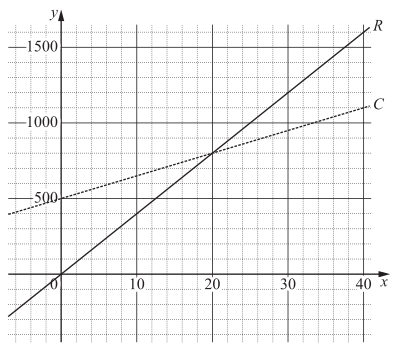
Technology was used to draw straight-line graphs to represent the cost of making the bird houses `(C)` and the revenue from selling bird houses `(R)`. The `x`-axis displays the number of bird houses and the `y`-axis displays the cost/revenue in dollars.


  1. How many bird houses need to sold to break even?  (1 mark)

    --- 2 WORK AREA LINES (style=lined) ---
  2. By first forming equations for cost `(C)` and revenue `(R)`, determine how many bird houses need to be sold to earn a profit of $1900.  (3 marks)

    --- 6 WORK AREA LINES (style=lined) ---
Show Answers Only
  1. `20`
  2. `96`
Show Worked Solution

a.   `20\ \ (xtext(-value at intersection))`


b.   `text(Find equations of both lines):`

♦ Mean mark part (b) 47%.

`(0, 500)\ text(and)\ (20, 800)\ text(lie on)\ \ C`

`m_C = (800 – 500)/(20 – 1) = 15`

`=> C = 500 + 15x`
 

`(0,0)\ text(and)\ (20, 800)\ text(lie on)\ \ R`

`m_R = (800 – 0)/(20 – 0) = 40`

`=> R = 40x`
 

`text(Profit) = R – C`

`text(Find)\ \ x\ \ text(when Profit = $1900:)`

`1900` `= 40x – (500 + 15x)`
`25x` `= 2400`
`x` `= 96`

Filed Under: A3 Types of Relationships (Y12) Tagged With: Band 4, Band 5, smc-1099-10-Cost/Revenue

Statistics, STD1 S3 2019 HSC 27

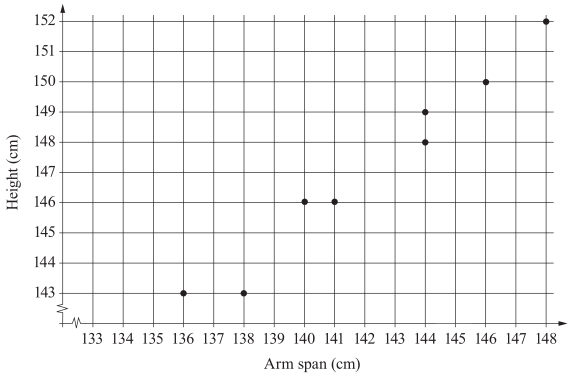
A set of bivariate data is collected by measuring the height and arm span of eight children. The graph shows a scatterplot of these measurements.
 

  1. On the graph, draw a line of best fit by eye.  (1 mark)

    --- 0 WORK AREA LINES (style=lined) ---
  2. Robert is a child from the class who was absent when the measurements were taken. He has an arm span of 147 cm. Using your line of best fit from part (a), estimate Robert’s height.  (1 mark)

    --- 1 WORK AREA LINES (style=lined) ---
Show Answers Only
  1.   
  2. `text(Robert’s height ≈ 151.1 cm)`
Show Worked Solution

a.     
       

♦ Mean mark (a) 38%.

b.   `text(Robert’s height ≈ 151.1 cm)`

`text{(Answers can vary slightly depending on line of best fit drawn).}`

Filed Under: S3 Further Statistical Analysis (Y12) Tagged With: Band 4, Band 5, num-title-ct-coreb, num-title-qs-hsc, smc-1113-10-Line of Best Fit, smc-5022-10-Line of best fit graphs, smc-5022-25-Draw LOBF

Financial Maths, STD1 F1 2019 HSC 26

Scott decided to have a shed built at his home. He agreed to the following costs:

  • Materials
– Timber $5400
– Roof $1800
– Nails $160
– Paint $375
  • $70 per hour for the builder when working Monday to Friday
  • $30 per hour for the labourer when working Monday to Friday
  • Builder and labourer paid time-and-a-half when working on Saturday.

It took six days to build the shed. The builder and labourer both worked from 8 am until 4 pm each day from Monday to Friday. On each of these days, they both took a 1 hour unpaid lunch break at 12 noon.

The builder and labourer also both worked 4 hours on Saturday, without a break, to finish the job.

What was the total cost to build the shed?  (4 marks)

--- 8 WORK AREA LINES (style=lined) ---
Show Answers Only

`$11\ 835`

Show Worked Solution
`text(Material cost)` `= 5400 + 1800 + 160 + 375`
  `= $7735`

 
`text(Labour cost:)`

`text{Hours per weekday = 8 am to 4 pm (less 1 hour) = 7}`

`text(Builder cost)` `= 5 xx 7 xx 70 + 4 xx 1.5 xx 70`
  `= $2870`
`text(Labourer cost)` `= 5 xx 7 xx 30 + 4 xx 1.5 xx 30`
  `= $1230`


`:.\ text(Total cost)` `= 7735 + 2870 + 1230`
  `= $11\ 835`

Filed Under: Earning Money and Budgeting (Std 1), Ways of Earning (Std1-2027) Tagged With: Band 4, smc-1126-10-Wages, smc-6515-10-Wages/Salaries

Probability, STD1 S2 2019 HSC 24

The faces on a biased six-sided die are labelled 1, 2, 3, 4, 5 and 6. The die was rolled twenty times. The relative frequency of rolling a 6 was 30% and the relative frequency of rolling a 2 was 15%. The number 3 was the only other number rolled in the twenty rolls.

How many times was the number 3 rolled in the twenty rolls of the die?  (3 marks)

--- 4 WORK AREA LINES (style=lined) ---
 
Show Answers Only

`11`

Show Worked Solution

`text(Number of 6’s) = 30/100 xx 20 = 6`

`text(Number of 2’s) = 15/100 xx 20 = 3`

`:.\ text(Number of 3’s)` `= 20 – (6 + 3)`
  `= 11`

Filed Under: Probability, Relative Frequency (Std 1) Tagged With: Band 4, num-title-ct-core, num-title-qs-hsc, smc-1133-30-Expected Frequency (np), smc-4225-35-Relative frequency

Algebra, STD2 A1 SM-Bank 12

Make  `F`  the subject of the equation  `C = 5/9(F - 32)`.  (2 marks)

Show Answers Only

`F = (9C)/5 + 32`

Show Worked Solution
`C` `= 5/9(F – 32)`
`9C` `= 5(F – 32)`
`(9C)/5` `= F – 32`
`:.F` `= (9C)/5 + 32`

Filed Under: Formula Rearrange (Std 1), Formula Rearrange (Std 2), Formula Rearrange (Std1-2027), Formula Rearrange (Std2-2027) Tagged With: Band 4, smc-1200-10-Linear, smc-1201-10-Linear, smc-6236-10-Linear, smc-6511-10-Linear

Algebra, STD2 A1 SM-Bank 11

Make  `r`  the subject of the equation  `V = 4/3 pir^3`.  (3 marks)

--- 6 WORK AREA LINES (style=lined) ---
Show Answers Only

`r = root(3)((3V)/(4pi))`

Show Worked Solution
`V` `= 4/3 pir^3`
`3V` `=4pir^3`
`(3V)/4` `= pir^3`
`r^3` `= (3V)/(4pi)`
`r` `= root(3)((3V)/(4pi))`

Filed Under: Formula Rearrange (Std 1), Formula Rearrange (Std 2), Formula Rearrange (Std1-2027), Formula Rearrange (Std2-2027) Tagged With: Band 4, smc-1200-20-Non-Linear, smc-1201-20-Non-Linear, smc-6236-20-Non-Linear, smc-6511-20-Non-Linear

Measurement, STD1 M5 2019 HSC 20

The plan of the lower level of a small house is shown.


  1. How many windows are shown on the plan?  (1 mark)

    --- 1 WORK AREA LINES (style=lined) ---
  2. What is the actual perimeter, in metres, of the shaded part of the kitchen floor?  (2 marks)

    --- 4 WORK AREA LINES (style=lined) ---

Show Answers Only
  1. `text(6 windows)`
  2. `6.5\ text(metres)`
Show Worked Solution

a.   `text(6 windows)`


b.    `text(Plan Perimeter)` `= 2 xx 3\ text(units) + 2 xx 3.5\ text(units)`
    `= 13\ text(units)`


`:.\ text(Actual perimeter)` `= 13 xx 0.5`
  `= 6.5\ text(metres)`

Filed Under: M5 Scale Drawings (Y12), Ratio and Scale (Std2) Tagged With: Band 3, Band 4, smc-1105-10-Floor Plans, smc-1187-50-Floor Plans

Functions, EXT1 F2 2019 HSC 14b

The diagram shows the graph of  `y = 1/(x - k)`, where  `k`  is a positive real number.


By considering the graphs of  `y = x^2`  and  `y = 1/(x - k)`, explain why the function  `f(x) = x^3 - kx^2 - 1`  has exactly one real zero.  (2 marks)

--- 5 WORK AREA LINES (style=lined) ---

Show Answers Only

`text(See Worked Solutions)`

Show Worked Solution

`text(Draw)\ \ y = x^2\ \ text(on the diagram:)`
 

`
 

`text(One point of intersection occurs when)`

`x^2` `= 1/(x – k)`
`x^3 – kx^2` `= 1`
`x^3 – kx^2 – 1` `= 0`

 
`text(S)text(ince only 1 point of intersection)`

`=> x^3 – kx^2 – 1 = 0\ \ text(has exactly 1 zero)`

Filed Under: Sum, Products and Multiplicity of Roots (Ext1) Tagged With: Band 4, smc-1205-30-Other

Financial Maths, STD1 F3 2019 HSC 21

A new car is bought for $24 950. Each year the value of the car depreciates by 14%.

Using the declining-balance method, calculate the salvage value of the car at the end of 10 years.  (2 marks)

Show Answers Only

`$5521.47\ \ (text(nearest cent))`

Show Worked Solution

`V_0 = 24\ 950, \ r = 0.14, \ n = 10`

`S` `= V_0(1 – r)^n`
  `= 24\ 950(1 – 0.14)^10`
  `= $5521.47\ \ (text(nearest cent))`

Filed Under: Depreciation - Declining Balance (Std 1) Tagged With: Band 4, smc-1139-10-Find S

Measurement, STD1 M4 2019 HSC 18

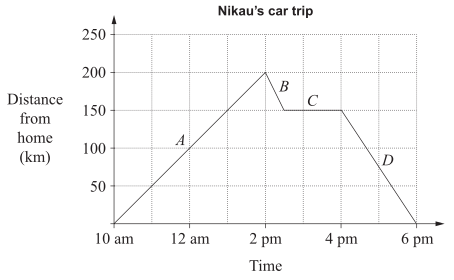
The travel graph displays Nikau's car trip along a straight road from home and back again. The trip has been broken into four separate sections: `A`, `B`, `C`  and  `D`.


  1. How far did Nikau travel in total?  (1 mark)

    --- 1 WORK AREA LINES (style=lined) ---

  2. In which section of the trip, `A`, `B`, `C` and `D`, did Nikau travel the fastest?  (1 mark)

    --- 1 WORK AREA LINES (style=lined) ---

Show Answers Only
  1. `400\ text(km)`
  2. `text(S)text(ection)\ D`
Show Worked Solution
a.    `text(Distance travelled)` `= 2 xx 200`
    `= 400\ text(km)`


♦ Mean mark part (b) 42%.

b.   `text{Fastest section has the steepest slope (in either direction).}`

`:. text(S)text(ection)\ D\ text(was the fastest.)`

Filed Under: M4 Rates (Y12) Tagged With: Band 4, Band 5, smc-1104-10-Travel Graphs

Networks, STD1 N1 2019 HSC 17

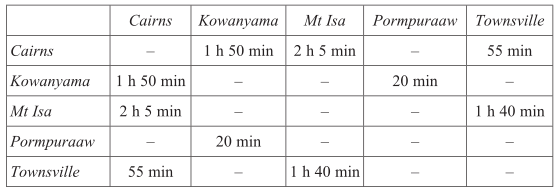
A regional airline operates flights in Queensland. Flight times between connected towns are shown in the table.


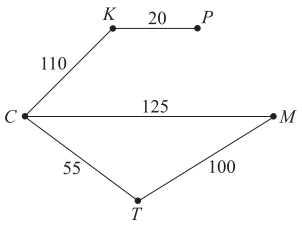
Draw a network diagram to show how the towns are connected, with weights on the edges showing the flight times.  (2 marks)

Show Answers Only

Show Worked Solution

`text(Edge weights are in minutes duration.)`

Filed Under: Basic Concepts, Basic Concepts, Network Concepts (Std1-2027), Network Concepts (Std2-2027) Tagged With: Band 4, smc-1136-10-Table to Network, smc-6307-10-Table to Network, smc-6526-10-Table to Network, smc-912-10-Table to Network

Financial Maths, STD1 F3 2019 HSC 13

Elyse borrowed $6000 from a bank. She repaid the loan in full with payments of $200 every month for 3 years.

How much interest did Elyse pay to the bank?  (2 marks)

Show Answers Only

`$1200`

Show Worked Solution

`text(Total repayments)\ = 3 xx 12 xx $200= $7200`

`:.\ text(Interest paid)= 7200-6000= $1200`

Filed Under: Loans (Std 1) Tagged With: Band 4, smc-1140-40-Total Loan/Interest Payments

Financial Maths, STD1 F1 2019 HSC 11

Julie earns $28 per hour. She is also paid an $8 travel allowance per shift.

How much will she earn from a 4-hour shift?   (2 marks)

Show Answers Only

`$120`

Show Worked Solution
`text(Shift earnings)` `=4xx28+8`  
  `=$120`  

Filed Under: Earning Money and Budgeting (Std 1), Ways of Earning (Std1-2027) Tagged With: Band 4, smc-1126-10-Wages, smc-6515-10-Wages/Salaries

Mechanics, EXT2* M1 2019 HSC 13d

The point  `O`  is on a sloping plane that forms an angle of 45° to the horizontal. A particle is projected from the point  `O`. The particle hits a point  `A`  on the sloping plane as shown in the diagram.


The equation of the line  `OA`  is  `y = -x`. The equations of motion of the particle are

`x = 18t`

`y = 18 sqrt(3t) - 5t^2,`

where  `t`  is the time in seconds after projection. Do NOT prove these equations.

  1. Find the distance  `OA`  between the point of projection and the point where the particle hits the sloping plane.  (2 marks)

    --- 6 WORK AREA LINES (style=lined) ---
  2. What is the size of the acute angle that the path of the particle makes with the sloping plane as the particle hits the point  `A`?  (3 marks)

    --- 8 WORK AREA LINES (style=lined) ---
Show Answers Only
  1. `(324(sqrt 2 + sqrt 6))/5\ text(units)`
  2. `30^@`
Show Worked Solution
i.    `x` `= 18t`
  `y` `= 18 sqrt 3 t – 5t^2`

 
`text(Particle hits slope when)\ \ y = -x`

`18 sqrt 3 t – 5t^2` `= -18t`
`5t^2 – 18t – 18 sqrt3 t` `= 0`
`t(5t – 18 – 18 sqrt 3)` `= 0`
`5t – 18 – 18 sqrt 3` `= 0`
`5t` `= 18 + 18 sqrt 3`
`t` `= (18 + 18 sqrt 3)/5`

 
`text(When)\ t = (18 + 18 sqrt 3)/5,`

`x = 18 xx ((18 + 18 sqrt 3)/5)`

`text{Using Pythagoras (isosceles Δ):}`

`OA` `= sqrt(2 xx 18^2 xx((18 + 18 sqrt 3)/5)^2)`
  `= sqrt 2 xx 18 xx ((18 + 18 sqrt 3)/5)`
  `= (324(sqrt 2 + sqrt 6))/5\ text(units)`


ii.    `x` `= 18t => dot x = 18`
  `y` `= 18 sqrt 3 t – 5t^2 => dot y = 18 sqrt 3 – 10t`

 
`text(When)\ \ t = (18 + 18 sqrt 3)/5,`

`dot y` `= 18 sqrt 3 – 10 ((18 + 18 sqrt 3)/5)`
  `= 18 sqrt 3 – 36 – 36 sqrt 3`
  `= -18 sqrt 3 – 36`
  `= -18(sqrt 3 + 2)`


`text(Find angle with the horizontal at impact:)`

♦ Mean mark part (ii) 39%.


`tan theta` `= (18(sqrt 3 + 2))/18`
  `= sqrt 3 + 2`
`theta` `= tan^(-1)(sqrt 3 + 2)`
  `= 75^@`

 
`:.\ text(Angle made with the slope)`

`= 75 – 45`

`= 30^@`

Filed Under: Projectile Motion Tagged With: Band 4, Band 5, smc-1062-10-Range/Time of Flight, smc-1062-50-Angle of Trajectory/Impact, smc-1062-70-Sloped Landing

Mechanics, EXT2* M1 2019 HSC 13c

A particle moves in a straight line. At time  `t`  seconds the particle has a displacement of `x` m, a velocity of  `v\ text(m s)^(-1)`  and acceleration  `a\ text(m s)^(-2)`.

Initially the particle has displacement  0 m  and velocity  `2\ text(m s)^(-1)`. The acceleration is given by  `a = -2e^(-x)`. The velocity of the particle is always positive.

  1. Show that  `v = 2e^((-x)/2)`.  (2 marks)

    --- 6 WORK AREA LINES (style=lined) ---
  2. Find an expression for `x` as a function of  `t`.   (2 marks)

    --- 6 WORK AREA LINES (style=lined) ---

Show Answers Only
  1. `text(See Worked Solutions)`
  2. `x = 2 ln(t + 1)`
Show Worked Solution
i.    `a` `= -2e^(-x)`
  `d/(dx)(1/2v^2)` `= -2e^(-x)`
  `1/2 v^2` `= int -2e^(-x) dx`
    `= 2e^(-x) + C`

 
`text(When)\ \ x = 0,\ \ v = 2:`

`1/2 ⋅ 2^2` `= 2e^0 + C`
`C` `= 0`
`1/2 v^2` `= 2e^(-x)`
`v^2` `= 4e^(-x)`
`v` `= +-(4e^(-x))^(1/2)`
  `= +-2e^(-x/2)`

 
`text(S)text(ince)\ \ v = 2\ \ text(when)\ \ x = 0,`

`v = 2e^((-x)/2)`


ii.    `(dx)/(dt)` `= 2e^((-x)/2)`
  `(dt)/(dx)` `= (e^(x/2))/2`
  `t` `= 1/2 int e^(x/2) dx`
    `= 1/2 xx 2 xx e^(x/2) + C`
    `= e^(x/2) + C`

 
`text(When)\ \ t = 0,\ \ x = 0:`

♦ Mean mark part (ii) 46%.

`0` `= e^0 + C`
`C` `= -1`
`t` `= e^(x/2) – 1`
`e^(x/2)` `= t + 1`
`x/2` `= ln (t + 1)`
`:. x` `= 2 ln (t + 1)`

Filed Under: Motion Without Resistance Tagged With: Band 4, smc-1060-02-Motion as f(x), smc-1060-20-Exponential

Calculus, EXT1 C2 2019 HSC 13a

Use the substitution  `u = cos^2 x`  to evaluate  `int_0^(pi/4) (sin 2x)/(4 + cos^2 x)\ dx`.  (3 marks)

--- 8 WORK AREA LINES (style=lined) ---

Show Answers Only

`ln {:10/9`

Show Worked Solution
`u` `= cos^2 x`
`(du)/(dx)` `= -2 sin x cos x`
  `= -sin 2x`
`du` `= -sin 2x\ dx`

 
`text(When)\ \ x = pi/4,\ \ u = 1/2`

`text(When)\ \ x = 0,\ \ u = 1`

`:. int_0^(pi/4) (sin 2x)/(4 + cos^2 x)\ dx` `= -int_1^(1/2) (du)/(4 + u)`
  `= -[ln (4 + u)]_1^(1/2)`
  `= -(ln 4.5 – ln 5)`
  `= -ln {:9/10`
  `= ln {:10/9`

Filed Under: Integration By Substitution (Ext1) Tagged With: Band 4, smc-1036-30-Trig, smc-1036-50-Limits Invert

Calculus, EXT1 C1 2019 HSC 12d

A refrigerator has a constant temperature of 3°C. A can of drink with temperature 30°C is placed in the refrigerator.

After being in the refrigerator for 15 minutes, the temperature of the can of drink is 28°C.

The change in the temperature of the can of drink can be modelled by  `(dT)/(dt) = k(T - 3)`,  where `T` is the temperature of the can of drink, `t` is the time in minutes after the can is placed in the refrigerator and `k` is a constant.

  1. Show that  `T = 3 + Ae^(kt)`, where `A` is a constant, satisfies


    `qquad(dT)/(dt) = k(T - 3)`.  (1 mark)

    --- 2 WORK AREA LINES (style=lined) ---
  2. After 60 minutes, at what rate is the temperature of the can of drink changing?   (3 marks)

    --- 10 WORK AREA LINES (style=lined) ---
Show Answers Only
  1. `text(See Worked Solutions)`
  2. `-0.10^@\ text{C per minute (decreasing)}`
Show Worked Solution

a.    `T = 3 + Ae^(kt)`

`(dT)/(dt)` `= k ⋅ Ae^(kt)`
  `= k (3 + Ae^(kt) – 3)`
  `= k(T – 3)`


b.   `text(When)\ \ t = 0,\ \ T = 30,`

`30` `= 3 + Ae^0`
`A` `= 27`

 
`text(When)\ \ t = 15,\ \ T = 28,`

`28` `= 3 + 27e^(15k)`
`25` `= 27e^(15k)`
`e^(15k)` `= 25/27`
`15k` `= ln (25/27)`
`k` `= 1/15 xx ln (25/27)`

 
`text(Find)\ \ (dT)/(dt)\ \ text(when)\ \ t = 60:`

`(dT)/(dt)` `= 1/15 xx ln (25/27) xx 27e^(60 xx 1/15 ln (25/27))`
  `= 27/15 xx ln (25/27) xx e^(4 ln (25/27))`
  `=27/15 xx ln(25/27) xx (25/27)^4`
  `= -0.1018…`
  `= -0.10^@ text{C per minute (decreasing)}`

Filed Under: Modified Growth and Decay Tagged With: Band 3, Band 4, smc-1080-10-Cooling

Mechanics, EXT2* M1 2019 HSC 12b

A particle is moving along the `x`-axis in simple harmonic motion. The position of the particle is given by

`x = sqrt 2 cos 3t + sqrt 6 sin 3t,` for  `t >= 0` 

  1. Write  `x`  in the form  `R cos(3t - alpha)`, where  `R > 0`  and  `0 < alpha < pi/2`.  (2 marks)

    --- 6 WORK AREA LINES (style=lined) ---
  2. Find the two values for  `x`  where the particle comes to rest.   (1 mark)

    --- 2 WORK AREA LINES (style=lined) ---
  3. When is the first time that the speed of the particle is equal to half of its maximum speed?  (2 marks)

    --- 8 WORK AREA LINES (style=lined) ---
Show Answers Only
  1. `x = 2 sqrt 2 cos (3t – pi/3)`
  2. `2 sqrt 2 or -2 sqrt 2`
  3. `t = pi/18`
Show Worked Solution

i.    `x = sqrt 2 cos 3t + sqrt 6 sin 3t`

`R cos (3t – alpha) = R cos alpha cos 3t + R sin alpha sin 3t`

`=> R cos alpha = sqrt 2`

`=> R sin alpha = sqrt 6`

`R^2 cos^2 alpha + R^2 sin^2 alpha` `= 2 + 6`
`R^2 (cos^2 alpha + sin^2 alpha)` `= 8`
`R` `=2sqrt2`


`2 sqrt 2 cos alpha` `= sqrt 2`
`cos alpha` `= 1/2`
`alpha` `= pi/3`

 
`:. x = 2 sqrt 2 cos (3t – pi/3)`

♦ Mean mark part (ii) 46%.


ii.    `text(At the extremities of the amplitude,)`
 

`text(the particle stops and reverses.)`

`:. v = 0\ \ text(when)\ \ x = 2 sqrt 2 or -2 sqrt 2`


iii.   `x = 2 sqrt 2 cos (3t – pi/3)`

♦ Mean mark part (iii) 49%.

`(dx)/(dt) = -6 sqrt 2 sin(3t – pi/3)`

 
`text(Max speed) = 6 sqrt 2`

`text(Find)\ \ t\ \ text(when)\ \ (dx)/(dt) = +-3 sqrt 2`

`-6 sqrt 2 sin (3t – pi/3)` `= 3 sqrt 2`
`sin(3t – pi/3)` `= -1/2`
`3t – pi/3` `= -pi/6`
`3t` `= pi/6`
`t` `= pi/18`


`-6 sqrt 2 sin (3t – pi/3)` `= -3 sqrt 2`
`sin(3t – pi/3)` `= 1/2`
`3t – pi/3` `= pi/6`
`3t` `= pi/2`
`t` `= pi/6`

 
`:. t = pi/18\ text{(1st time)}`

Filed Under: Simple Harmonic Motion Tagged With: Band 4, Band 5, smc-1059-30-At Rest, smc-1059-31-Max Speed, smc-1059-40-Auxiliary Angles

Statistics, EXT1 S1 2019 HSC 11f

Prize-winning symbols are printed on 5% of ice-cream sticks. The ice-creams are randomly packed into boxes of 8.

  1. What is the probability that a box contains no prize-winning symbols?  (1 mark)

    --- 2 WORK AREA LINES (style=lined) ---

  2. What is the probability that a box contains at least 2 prize-winning symbols?  (2 marks)

    --- 3 WORK AREA LINES (style=lined) ---

Show Answers Only
  1. `0.95^8`
  2. `5.72 text(%)`
Show Worked Solution

i.   `text(Chances of any stick winning:)`

`P(W) = 0.05`

`P(barW) = 0.95`

`P (text{In box of 8, all}\ barW)`

`= 0.95^8`


ii.   `P\ text{(at least two winners in a box)}`

`= 1 – P text{(1 winner)} – P text{(0 winners)}`

`= 1 – \ ^8 C_1 xx 0.95^7 xx 0.05^1 – \ ^8 C_0 xx 0.95^8`

`= 0.05724…`

`= 5.72 text{%   (to 2 d.p.)}`

Filed Under: Binomial Probability (Ext1) Tagged With: Band 3, Band 4, smc-1084-20-Games of Chance

Trigonometry, EXT1 T1 2019 HSC 9 MC

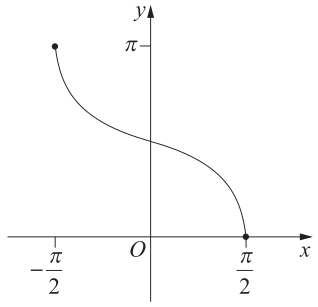
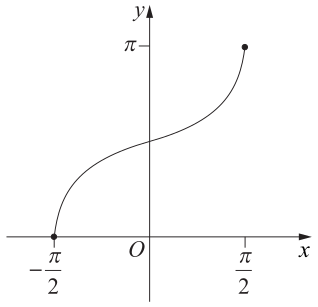
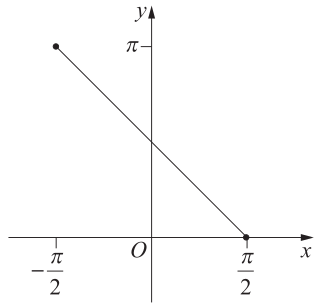
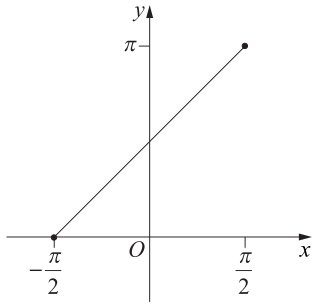
Which graph best represents  `y = cos^(-1) (-sin x)`, for  `-pi/2 <= x <= pi/2`?

A.    B.   
C.    D.   
Show Answers Only

`D`

Show Worked Solution
`y` `= cos^(-1)(-sin x)`
  `=cos^(-1)(-cos(pi/2-x))`
  `=cos^(-1)(cos[pi-(pi/2-x)])`
  `= cos^(-1)(cos(x + pi/2))`
  `= pi/2+x`

 
`=>  D`

Filed Under: T1 Inverse Trig Functions (Y11) Tagged With: Band 4, smc-1024-11-arccos Graphs

Functions, EXT1 F2 2019 HSC 7 MC

Let  `P(x) = qx^3 + rx^2 + rx + q`  where `q` and `r` are constants, `q != 0`. One of the zeros of  `P(x)`  is  `-1`.

Given that  ` alpha`  is a zero of  `P(x),\ alpha != -1`, which of the following is also a zero?

A.     `-1/alpha`

B.     `-q/alpha`

C.     `1/alpha`

D.     `q/alpha`

Show Answers Only

`C`

Show Worked Solution

`text(Roots:)\ \ alpha,\ beta,\ -1`

Mean mark 51%.

`alpha beta(-1) = -d/a = -q/q = -1`

`- alpha beta` `= -1`
`:. beta` `= 1/alpha`

 
`=>  C`

Filed Under: Sum, Products and Multiplicity of Roots (Ext1) Tagged With: Band 4, smc-1205-10-Sum and Product

Trigonometry, EXT1 T2 2019 HSC 6 MC

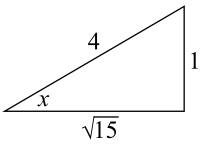
It is given that  `sin x = 1/4`, where  `pi/2 < x < pi`.

What is the value of  `sin 2x`?

A.     `-7/8`

B.     `-sqrt 15/8`

C.     `sqrt 15/8`

D.     `7/8`

Show Answers Only

`B`

Show Worked Solution

`sin x = 1/4`

`cos x = -sqrt 15/4, \ \ (pi/2 < x < pi)`

`sin 2x` `= 2 sin x cos x`
  `= 2 xx 1/4 xx – sqrt 15/4`
  `= – sqrt 15/8`

`=>  B`

Filed Under: T2 Further Trigonometric Identities (Y11) Tagged With: Band 4, smc-1025-10-Double Angles

Calculus, EXT1 C2 2019 HSC 3 MC

What is the derivative of  `tan^(-1)\ x/2`?

A.     `1/(2(4 + x^2))`

B.     `1/(4 + x^2)`

C.     `2/(4 + x^2)`

D.     `4/(4 + x^2)`

Show Answers Only

`C`

Show Worked Solution
`y` `= tan^(-1)\ x/2`
`(dy)/(dx)` `= (1/2)/(1 + (x/2)^2)`
  `= 1/(2(1 + x^2/4))`
  `= 2/(4 + x^2)`

 
`=>  C`

Filed Under: Inverse Functions Calculus (Ext1) Tagged With: Band 4, smc-1037-20-Tan Differentiation

Financial Maths, 2ADV M1 2019 HSC 16a

A person wins $1 000 000 in a competition and decides to invest this money in an account that earns interest at 6% per annum compounded quarterly. The person decides to withdraw $80 000 from this account at the end of every fourth quarter. Let  `A_n`  be the amount remaining in the account after the `n`th withdrawal.

  1.  Show that the amount remaining in the account after the withdrawal at the end of the eighth quarter is


    `qquad A_2 = 1\ 000\ 000 xx 1.015^8 - 80\ 000(1 + 1.015^4)`.  (2 marks)

    --- 5 WORK AREA LINES (style=lined) ---

  2.  For how many years can the full amount of $80 000 be withdrawn?  (3 marks)

    --- 6 WORK AREA LINES (style=lined) ---

Show Answers Only
  1. `text(Proof)\ text{(See Worked Solutions)}`
  2. `23\ text(years)`
Show Worked Solution

i.  `6 text(% p.a.)= 1.5 text(%)\ text(per quarter)`

  `A_1` `= 1\ 000\ 000 xx 1.015^4 – 80\ 000`
  `A_2` `= A_1 xx 1.015^4 – 80\ 000`
    `= (1\ 000\ 000 xx 1.015^4 – 80\ 000) xx 1.015^4 – 80\ 000`
    `= 1\ 000\ 000 xx 1.015^8 – 80\ 000 xx 1.015^4 – 80\ 000`
    `= 1\ 000\ 000 xx 1.015^8 – 80\ 000 (1 + 1.015^4)`


ii.    `A_3` `= 1\ 000\ 000 xx 1.015^12 – 80\ 000 (1 + 1.015^4 + 1.015^8)`
  `vdots`  
  `A_n` `= 1\ 000\ 000 xx 1.015^(4n) – 80\ 000\ underbrace{(1 + 1.015^4 + … + 1.015^(4n – 4))}_{text(GP where)\ a = 1,\ r = 1.015^4}`
    `= 1\ 000\ 000 xx 1.015^(4n) – 80\ 000 [(1(1.015^(4n) – 1))/(1.015^4 – 1)]`
    `= 1\ 000\ 000 xx 1.015^(4n) – 1\ 303\ 706 (1.015^(4n) – 1)`

♦♦♦ Mean mark part (ii) 19%.

`text(Find)\ \ n\ \ text(when)\ \ A_n =0:`

`0` `= 1\ 000\ 000 xx 1.015^(4n) – 1\ 303\ 706 xx 1.015^(4n) + 1\ 303\ 706`
`-1\ 303\ 706` `> -303\ 706 xx 1.015^(4n)`
`1.015^(4n)` `> (1\ 303\ 706)/(303\ 706)`
`4n` `> (ln((1\ 303\ 706)/(303\ 706)))/(ln 1.015)`
  `> 97.853…`
`n` `> 24.46…`

 
`:.\ text(Full amount can be drawn for 24 years.)`

Filed Under: Financial Applications of Series (Y12) Tagged With: Band 4, Band 6, smc-1007-30-Annuity/Deposit - Withdrawal Phase

Probability, 2ADV S1 2019 HSC 15d

The probability that a person chosen at random has red hair is 0.02

  1. Two people are chosen at random.


    What is the probability that at least ONE has red hair?  (2 marks)

    --- 4 WORK AREA LINES (style=lined) ---

  2. What is the smallest number of people that can be chosen at random so that the probability that at least ONE has red hair is greater than 0.4?  (2 marks)

    --- 5 WORK AREA LINES (style=lined) ---

Show Answers Only
  1. `0.0396`
  2. `26\ text(people)`
Show Worked Solution
a.   `P(R)` `= 0.02`
  `P(barR)` `= 0.98`

 
`P\ text{(At least 1 has red hair)}`

`= 1 – P(barR, barR)`

`= 1 – 0.98 xx 0.98`

`= 0.0396`


b.  `text(Find)\ \ n\ \ text(such that)`

♦♦ Mean mark 24%.

`1 – 0.98^n` `> 0.4`
`0.98^n` `< 0.6`
`ln 0.98^n` `< ln 0.6`
`n ln 0.98` `< ln 0.6`
`n` `> (ln 0.6)/(ln 0.98),\ \ \ (ln 0.98 <0)`
  `> 25.28…`

 
`:. 26\ text(people must be chosen.)`

Filed Under: Multi-Stage Events (Adv-2027), Multi-Stage Events (Y11) Tagged With: Band 4, Band 5, smc-6469-30-Complementary Probability, smc-989-30-Complementary Probability

Financial Maths, STD2 F4 2019 HSC 37

A new car is bought for $24 950. Each year the value of the car is depreciated by the same percentage.

The table shows the value of the car, based on the declining-balance method of depreciation, for the first three years.

\begin{array} {|c|c|}
\hline
\rule{0pt}{2.5ex}\textit{End of year}\rule[-1ex]{0pt}{0pt} & \textit{Value}\\
\hline
\rule{0pt}{2.5ex}1\rule[-1ex]{0pt}{0pt} & \$21\ 457.00 \\
\hline
\rule{0pt}{2.5ex}2\rule[-1ex]{0pt}{0pt} & \$18\ 453.02 \\
\hline
\rule{0pt}{2.5ex}3\rule[-1ex]{0pt}{0pt} & \$15\ 869.60 \\
\hline
\end{array}

What is the value of the car at the end of 10 years?  (3 marks)

--- 6 WORK AREA LINES (style=lined) ---

Show Answers Only

`$5521.47`

Show Worked Solution

`text(Find the depreciation rate:)`

`S` `= V_0(1-r)^n`
`21\ 457` `= 24\ 950(1-r)^1`
`1-r` `= (21\ 457)/(24\ 950)`
`1-r` `= 0.86`
`r` `= 0.14`

 
`:.\ text(Value after 10 years)`

`= 24\ 950(1-0.14)^10`

`= 5521.474…`

`= $5521.47\ \ (text(nearest cent))`

Filed Under: Depreciation, Depreciation - Declining Balance (Std 1), Depreciation - Declining Balance (Std 2) Tagged With: Band 4, num-title-ct-coreb, num-title-qs-hsc, smc-1139-10-Find S, smc-4335-10-Find S, smc-4335-25-Find r, smc-813-10-Find S, smc-813-20-Find r

Algebra, STD2 A2 2019 HSC 34

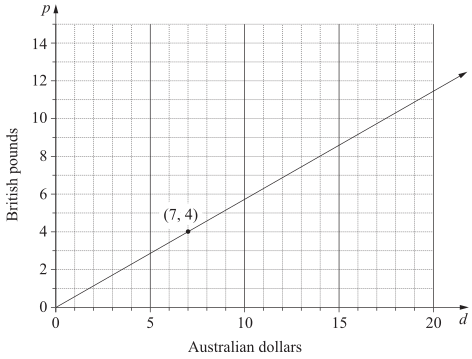
The relationship between British pounds `(p)` and Australian dollars `(d)` on a particular day is shown in the graph.
 

  1. Write the direct variation equation relating British pounds to Australian dollars in the form  `p = md`. Leave `m` as a fraction.  (1 mark)

    --- 2 WORK AREA LINES (style=lined) ---

  2. The relationship between Japanese yen `(y)` and Australian dollars `(d)` on the same day is given by the equation  `y = 76d`.


    Convert 93 100 Japanese yen to British pounds.  (2 marks)

    --- 4 WORK AREA LINES (style=lined) ---

Show Answers Only
  1. `p = 4/7 d`
  2. `93\ 100\ text(Yen = 700 pounds)`
Show Worked Solution

a.   `m = text(rise)/text(run) = 4/7`

♦ Mean mark 42%.

`p = 4/7 d`


b.   `text(Yen to Australian dollars:)`

`y` `=76d`
`93\ 100` `= 76d`
`d` `= (93\ 100)/76`
  `= 1225`

 
`text(Aust dollars to pounds:)`

`p` `= 4/7 xx 1225`
  `= 700\ text(pounds)`

 
`:. 93\ 100\ text(Yen = 700 pounds)`

Filed Under: Applications: Currency, Fuel and Other Problems (Std 2), Direct Variation and Currency Conversion (Std2-2027), Linear Functions (Adv-2027), Linear Functions (Y11), Variation and Rates of Change Tagged With: Band 4, Band 5, common-content, num-title-ct-patha, num-title-qs-hsc, smc-4239-70-Currency convert, smc-6214-20-Other Real World Applications, smc-6249-10-Find k, smc-6249-30-Graphical Solutions, smc-6249-50-Currency Conversion, smc-793-10-Currency Conversion, smc-985-20-Other Linear Applications

Algebra, STD2 A4 2019 HSC 33

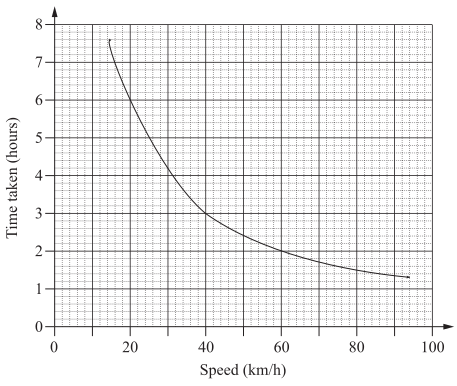
The time taken for a car to travel between two towns at a constant speed varies inversely with its speed.

It takes 1.5 hours for the car to travel between the two towns at a constant speed of 80 km/h.

  1. Calculate the distance between the two towns.  (1 mark)

    --- 1 WORK AREA LINES (style=lined) ---

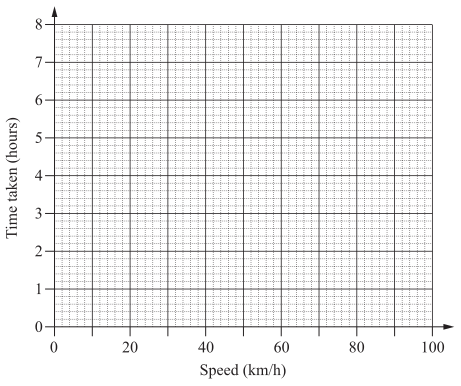
  2. By first plotting four points, draw the curve that shows the time taken to travel between the two towns at different constant speeds.  (3 marks)

--- 0 WORK AREA LINES (style=lined) ---

Show Answers Only
  1. `120\ text(km)`
  2.  
Show Worked Solution
a.    `D` `= S xx T`
    `= 80 xx 1.5`
    `= 120\ text(km)`

 
b. 
 

\begin{array} {|c|c|c|c|c|}
\hline
\rule{0pt}{2.5ex} \ \ s\ \  \rule[-1ex]{0pt}{0pt} & 20 & 40 & 60 & 80 \\
\hline
\rule{0pt}{2.5ex} t \rule[-1ex]{0pt}{0pt} & 6 & 3 & 2 & 1.5 \\
\hline
\end{array}

Filed Under: Non-Linear: Inverse and Other Problems (Std 2), Variation and Rates of Change Tagged With: Band 3, Band 4, num-title-ct-patha, num-title-qs-hsc, smc-4239-30-a prop 1/b, smc-795-10-Inverse

Financial Maths, STD2 F1 2019 HSC 32

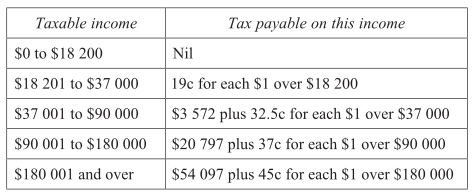
The table shows the income tax rates for the 2018-2019 financial year.

The Medicare levy is calculated as 2% of taxable income.

For the 2018-2019 financial year, Charlie pays a Medicare levy of $1934.80.

Calculate the tax payable on Charlie's taxable income.  (3 marks)

Show Answers Only

`$23\ 290.80`

Show Worked Solution
`text(2% taxable income)` `= 1934.80`
`text(taxable income)` `= 1934.80/0.02`
  `= $96\ 740`


`:.\ text(Tax payable)` `= 20\ 797 + 0.37 xx (96\ 740 – 90\ 000)`
  `= 20\ 797 + 2493.80`
  `= $23\ 290.80`

Filed Under: Tax and Percentage Increase/Decrease (Std 2), Taxation (Std2-2027) Tagged With: Band 4, smc-6277-10-Tax Tables, smc-831-10-Tax Tables

Calculus, 2ADV C4 2019 HSC 14a

A particle is moving along a straight line. The particle is initially at rest. The acceleration of the particle at time  `t`  seconds is given by  `a = e^(2t)-4`, where  `t >= 0`.

Find an expression, in terms of  `t`, for the velocity of the particle.  (2 marks)

--- 5 WORK AREA LINES (style=lined) ---

Show Answers Only

`v = 1/2e^(2t)-4t-1/2`

Show Worked Solution

`a = (dv)/(dt) = e^(2t)-4`

`v` `= int e^(2t)-4\ dt`
  `= 1/2 e^(2t)-4t + c`

 
`text(When)\ t = 0,\ v = 0`

`0 = 1/2 e^0-0 + c`

`c = -1/2`

`:. v = 1/2e^(2t)-4t-1/2`

Filed Under: Other Integration Applications (Y12) Tagged With: Band 4, smc-1091-10-Motion, smc-1091-30-Log/Exp Function, smc-1213-10-Motion

  • « Previous Page
  • 1
  • …
  • 71
  • 72
  • 73
  • 74
  • 75
  • …
  • 114
  • Next Page »

Copyright © 2014–2025 SmarterEd.com.au · Log in