SmarterEd

Aussie Maths & Science Teachers: Save your time with SmarterEd

  • Login
  • Get Help
  • About

Calculus, 2ADV C4 2006* HSC 10a

Use the Trapezoidal rule with three function values to find an approximation to the value of
 
          `int_0.5^1.5 (log_e x )^3\ dx`.

Give your answer correct to three decimal places.  (2 marks)

--- 5 WORK AREA LINES (style=lined) ---

Show Answers Only

`text(– 0.067)\ \ \ text{(to 3 d.p.)}`

Show Worked Solution

`text(Let)\ \ f(x) = (log_e x )^3`
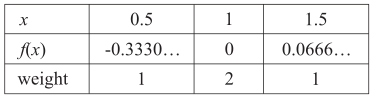
`int_0.5^1.5(log_e x)^3 dx` `~~ 0.5/2[−0.3330… + 2(0) + 0.0666…]`
  `~~ 0.25(−0.2663…)`
  `~~ −0.06659…`
  `~~ −0.067\ \ \ text{(to 3 d.p.)}`

Filed Under: Trapezium Rule and Newton, Trapezoidal Rule (Y12) Tagged With: Band 4, smc-5145-04-Trapezium rule, smc-5145-20-No table, smc-976-20-No Table

Calculus, 2ADV C4 2005* HSC 6a

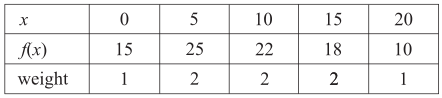
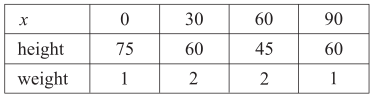
Five values of the function  `f(x)`  are shown in the table.
 

Integration, 2UA 2005 HSC 6a

Use the Trapezoidal rule with the five values given in the table to estimate

`int_0^20 f(x)\ dx`.  (3 marks)

Show Answers Only

`387.5`

Show Worked Solution

`:. int_0^20 f(x)\ dx` `~~ 5/2[15 + 2(25 + 22 + 18) + 10]`
  `~~ 5/2(155)`
  `~~ 387.5`

Filed Under: Trapezium Rule and Newton, Trapezoidal Rule (Y12) Tagged With: Band 4, smc-5145-04-Trapezium rule, smc-5145-10-Table provided, smc-976-10-Table provided

Trigonometry, 2ADV’ T1 2004 HSC 3d

Trig Ratios, EXT1 2004 HSC 3d
 

The length of each edge of the cube  `ABCDEFGH`  is 2 metres. A circle is drawn on the face  `ABCD`  so that it touches all four edges of the face. The centre of the circle is  `O`  and the diagonal  `AC`  meets the circle at  `X`  and  `Y`.

  1. Explain why  `∠FAC = 60^@`.  (1 mark)

    --- 2 WORK AREA LINES (style=lined) ---

  2. Show that  `FO = sqrt6` metres.  (1 mark)

    --- 4 WORK AREA LINES (style=lined) ---

  3. Calculate the size of  `∠XFY`  to the nearest degree.  (1 mark)

    --- 4 WORK AREA LINES (style=lined) ---

Show Answers Only
  1. `text(See Worked Solution)`
  2. `text(See Worked Solution)`
  3. `44^@\ text{(nearest degree)}`
Show Worked Solution
i.   

Trig Ratios, EXT1 2004 HSC 3d Answer

`text(S)text(ince)\ \ FA, \ AC\ \ text(and)\ \ FC\ \ text(are all)`

`text(diagonals of sides of a cube,)`

`FA = AC = FC`

`:.ΔFAC\ \ text(is equilateral)`

`:.∠FAC = 60^@`


ii.   

Trig Ratios, EXT1 2004 HSC 3d Answer2

`text(In)\ \ ΔAEF`

`AF^2` `= EF^2 + EA^2`
  `= 2^2 + 2^2`
  `= 8`
`AF` `= sqrt8`
  `= 2sqrt2`


`text(In)\ \ ΔAFO`

`sin\ 60^@` `= (FO)/(AF)`
`sqrt3/2` `= (FO)/(2sqrt2)`
`FO` `= sqrt3/2 xx 2sqrt2`
  `= sqrt6\ text(metres … as required.)`


iii.

Trig Ratios, EXT1 2004 HSC 3d Answer3

`XY\ \ text(is the diameter of a circle AND the width)`

`text(of the cube.)`

`:.XY` `= 2`
`:.OX` `= OY = 1`
`tan\ ∠OFX` `=1 /sqrt6`
`∠OFX` `= 22.207…^@`


`:.∠XFY` `= 2 xx 22.407…`
  `= 44.415…`
  `= 44^@\ text{(nearest degree)}`

Filed Under: 3D Trigonometry (Y11) Tagged With: Band 4, Band 5

Trigonometry, 2ADV’ T1 2010 HSC 5a

A boat is sailing due north from a point  `A`  towards a point  `P`  on the shore line.

The shore line runs from west to east.

In the diagram,  `T`  represents a tree on a cliff vertically above  `P`, and  `L`  represents a landmark on the shore. The distance  `PL`  is 1 km.

From  `A`  the point  `L`  is on a bearing of 020°, and the angle of elevation to  `T`  is 3°.

After sailing for some time the boat reaches a point  `B`, from which the angle of elevation to  `T`  is 30°.
 

5a
 

  1. Show that  `BP = (sqrt3 tan 3°)/(tan20°)`.   (3 marks) 

    --- 6 WORK AREA LINES (style=lined) ---

  2. Find the distance `AB`. Give your answer to 1 decimal place.   (1 mark)

    --- 3 WORK AREA LINES (style=lined) ---

Show Answers Only
  1. `text(Proof)\ \ text{(See Worked Solutions)}`
  2. `2.5\ text(km)\ \ text{(to 1 d.p.)}`
Show Worked Solution

i.   `text(Show)\ BP = (sqrt3 tan 3°)/(tan 20°)` 

`text(In)\ Delta ATP`
`tan 3°` `= (TP)/(AP)`
`=> AP` `= (TP)/(tan 3)`

 
`text(In)\ Delta APL:`

`tan 20°` `= 1/(AP)`
`=> AP` `= 1/tan 20`


`:. (TP)/(tan3)` `= 1/(tan20)`
`TP` `= (tan3°)/(tan20°)\ \ \ text(…)\ text{(} text(1)text{)}`


`text(In)\ \ Delta BTP:`

`tan 30°` `= (TP)/(BP)`
`1/sqrt3` `= (TP)/(BP)`
`BP` `= sqrt3 xx TP\ \ \ \ \ text{(using (1) above)}`
  `= (sqrt3 tan3°)/(tan20°)\ \ \ text(… as required)`


ii.    `AB` `= AP\ – BP`
  `AP` `= 1/(tan20°)\ \ \ text{(} text(from part)\ text{(i)} text{)}`
`:.\ AB` `= 1/(tan 20°)\ – (sqrt3 tan3°)/(tan20°)`
  `= (1\ – sqrt3 tan 3)/(tan20°)`
  `= 2.4980…`
  `= 2.5\ text(km)\ text{(to 1 d.p.)`

Filed Under: 3D Trigonometry (Y11) Tagged With: Band 3, Band 4, page-break-before-solution

Trigonometry, 2ADV’ T1 2008 HSC 6a

From a point  `A`  due south of a tower, the angle of elevation of the top of the tower  `T`, is 23°. From another point  `B`, on a bearing of 120° from the tower, the angle of elevation of  `T`  is 32°. The distance  `AB`  is 200 metres.
 

Trig Ratios, EXT1 2008 HSC 6a 
 

  1. Copy or trace the diagram into your writing booklet, adding the given information to your diagram.  (1 mark)

    --- 8 WORK AREA LINES (style=lined) ---

  2. Hence find the height of the tower. Give your answer to the nearest metre.  (3 marks)

    --- 6 WORK AREA LINES (style=lined) ---

Show Answers Only
  1.  
    Trig Ratios, EXT1 2008 HSC 6a Answer

  2. `96\ text(m)`
Show Worked Solution

i.

Trig Ratios, EXT1 2008 HSC 6a Answer 


ii.  `text(Find)\ \ OT = h`

`text(Using the cosine rule in)\ Delta AOB :`

`200^2 = OA^2 + OB^2 – 2 * OA * OB * cos 60\ …\ text{(*)}`

 `text(In)\ Delta OAT,\tan 23^@= h/(OA)`

`=> OA= h/(tan 23^@)\  …\ (1)`

 `text(In)\ Delta OBT,\ tan 32^@= h/(OB)`

`=> OB= h/(tan 32^@)\ \ \ …\ (2)`
 

`text(Substitute)\ (1)\ text(and)\ (2)\ text(into)\ text{(*):}`

`200^2` `= (h^2)/(tan^2 23^@) + (h^2)/(tan^2 32^@) – 2 * h/(tan 23^@) * h/(tan 32^@) * 1/2`
  `= h^2 (1/(tan^2 23^@) + 1/(tan^2 32^@) + 1/(tan23^@ * tan32^@) )`
  `= h^2 (4.340…)`
`h^2` `= (40\ 000)/(4.340…)`
  `= 9214.55…`
`:. h` `= 95.99…`
  `= 96\ text(m)\ \ \ text{(to nearest m)}`

Filed Under: 3D Trigonometry (Y11) Tagged With: Band 3, Band 4

Trigonometry, 2ADV’ T1 2015 HSC 12c

A person walks 2000 metres due north along a road from point `A` to point `B`. The point `A` is due east of a mountain `OM`, where `M` is the top of the mountain. The point `O` is directly below point `M` and is on the same horizontal plane as the road. The height of the mountain above point `O` is `h` metres.

From point `A`, the angle of elevation to the top of the mountain is 15°.

From point `B`, the angle of elevation to the top of the mountain is 13°.
 

Trig Ratios, EXT1 2015 HSC 12c
 

  1. Show that  `OA = h\ cot\ 15°`.  (1 mark)

    --- 2 WORK AREA LINES (style=lined) ---

  2. Hence, find the value of  `h`.  (2 marks)

    --- 4 WORK AREA LINES (style=lined) ---

Show Answers Only
  1. `text(See Worked Solutions)`
  2. `910\ text{m  (nearest metre)}`
Show Worked Solution

i.   `text(Show)\ \ OA = h\ cot\ 15^@` 

Trig Ratios, EXT1 2015 HSC 12c Answer1

`text(In)\ \ Delta MOA,`

`tan\ 15^@` `= h/(OA)`
`OA` `= h/(tan\ 15^@)`
  `= h\ cot\ 15^@\ \ …text(as required)`


ii.   `text(In)\ \ ΔMOB`

`tan\ 13^@` `= h/(OB)`
`OB` `= h/(tan\ 13^@)`
  `= h\ cot\ 13^@`


Trig Ratios, EXT1 2015 HSC 12c Answer2 
 

`text(In)\ \ ΔAOB:`

`OA^2 + AB^2` `= OB^2`
`OB^2 − OA^2` `= AB^2`
`(h\ cot\ 13^@)^2 − (h\ cot\ 15^@)^2` `= 2000^2`
`h^2[(cot^2\ 13^@ − cot^2\ 15^@)]` `= 2000^2`
`h^2` `= (2000^2)/(cot^2\ 13^@ − cot^2\ 15^@)`
`:. h` `= sqrt((2000^2)/(cot^2\ 13^@ − cot^2\ 15^@))`
  `= 909.704…`
  `= 910\ text{m  (nearest metre)}`

Filed Under: 3D Trigonometry (Y11) Tagged With: Band 3, Band 4

Measurement, STD2 M6 2011 HSC 24c

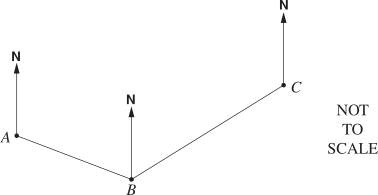
A ship sails 6 km from `A` to `B` on a bearing of 121°. It then sails 9 km to `C`.  The
size of angle `ABC` is 114°.
 

  1. What is the bearing of `C` from `B`?   (1 mark)

    --- 2 WORK AREA LINES (style=lined) ---

  2. Find the distance `AC`. Give your answer correct to the nearest kilometre.   (2 marks)

    --- 4 WORK AREA LINES (style=lined) ---

  3. What is the bearing of `A` from `C`? Give your answer correct to the nearest degree.   (3 marks)

    --- 6 WORK AREA LINES (style=lined) ---

Show Answers Only
  1.  `055^@`
  2.  `13\ text(km)`
  3.  `261^@`
Show Worked Solution
STRATEGY: Important: Draw North-South parallel lines through major points to make the angle calculations easier!
i.     2011 HSC 24c

 `text(Let point)\ D\ text(be due North of point)\ B`

`/_ABD=180-121\ text{(cointerior with}\ \ /_A text{)}\ =59^@`

`/_DBC=114-59=55^@`   

`:. text(Bearing of)\ \ C\ \ text(from)\ \ B\ \ text(is)\ 055^@`


ii.    `text(Using cosine rule:)`

`AC^2` `=AB^2+BC^2-2xxABxxBCxxcos/_ABC`
  `=6^2+9^2-2xx6xx9xxcos114^@`
  `=160.9275…`
`:.AC` `=12.685…\ \ \ text{(Noting}\ AC>0 text{)}`
  `=13\ text(km)\ text{(nearest km)}`


iii.    `text(Need to find)\ /_ACB\ \ \ text{(see diagram)}`

MARKER’S COMMENT: The best responses clearly showed what steps were taken with working on the diagram. Note that all North/South lines are parallel.
`cos/_ACB` `=(AC^2+BC^2-AB^2)/(2xxACxxBC)`
  `=((12.685…)^2+9^2-6^2)/(2xx(12.685..)xx9)`
  `=0.9018…`
`/_ACB` `=25.6^@\ text{(to 1 d.p.)}`


`text(From diagram,)`

`/_BCE=55^@\ text{(alternate angle,}\ DB\ text(||)\ CE text{)}`

`:.\ text(Bearing of)\ A\ text(from)\ C`

  `=180+55+25.6`
  `=260.6`
  `=261^@\ text{(nearest degree)}`

Filed Under: Bearings and Radial Surveys (Std2) Tagged With: Band 4, Band 5, Band 6, common-content, smc-803-10-Bearings

Trigonometry, 2ADV* T1 2009 HSC 27b

A yacht race follows the triangular course shown in the diagram. The course from  `P`  to  `Q`  is 1.8 km on a true bearing of 058°.

At  `Q`  the course changes direction. The course from  `Q`  to  `R`  is 2.7 km and  `/_PQR = 74^@`.
 

 2009-2UG-27b
 

  1. What is the bearing of  `R`  from  `Q`?   (1 mark)

    --- 2 WORK AREA LINES (style=lined) ---

  2. What is the distance from  `R`  to  `P`?     (2 marks)

    --- 5 WORK AREA LINES (style=lined) ---

  3. The area inside this triangular course is set as a ‘no-go’ zone for other boats while the race is on.


    What is the area of this ‘no-go’ zone?   (1 mark)

    --- 2 WORK AREA LINES (style=lined) ---

Show Answers Only
  1. `312^@`
  2. `2.8\ text(km)\ \ \ text{(1 d.p.)}`
  3. `2.3\ text(km²)\ \ \ text{(1 d.p.)}`
Show Worked Solution
i.    2UG-2009-27b-Answer

`/_ PQS = 58^@ \ \ \ (text(alternate to)\ /_TPQ)`

TIP: Draw North-South parallel lines through relevant points to help calculate angles as shown in the Worked Solutions.

`text(Bearing of)\ R\ text(from)\ Q`

`= 180^@ + 58^@ + 74^@`
`= 312^@`


(ii)   `text(Using Cosine rule:)`

`RP^2` `=RQ^2` + `PQ^2` `- 2` `xx RQ` `xx PQ` `xx cos` `/_RQP`
  `= 2.7^2` + `1.8^2` `- 2` `xx 2.7` `xx 1.8` `xx cos74^@`
  `=7.29 + 3.24\ – 2.679…`
  `=7.851…`
`:.RP` `= sqrt(7.851…)`
  `=2.8019…`
  `~~ 2.8\ text(km)  (text(1 d.p.) )`


(iii)   `text(Using)\ A = 1/2 ab sinC`

`A` `= 1/2` `xx 2.7` `xx 1.8` `xx sin74^@`
  `= 2.3358…`
  `= 2.3\ text(km²)`


`:.\ text(No-go zone is 2.3 km²)`

Filed Under: Bearings (Adv-2027), Bearings (Y11) Tagged With: Band 4, Band 5, common-content, smc-6395-10-Bearings, smc-6395-50-Find Area, smc-981-10-Bearings, smc-981-30-Find Area

Trigonometry, 2ADV* T1 2010 HSC 10 MC

A plane flies on a bearing of 150° from  `A`  to  `B`.
 

Capture3

 
What is the bearing of  `A` from `B`?

  1. `30^@`
  2. `150^@`
  3. `210^@`
  4. `330^@`
Show Answers Only

`D`

Show Worked Solution

Capture3-i

`/_TBA=30^@\ \ \ text{(angle sum of triangle)}`

`:.\ text(Bearing of)\ A\ text{from}\ B`

`=360-30`

`=330^@`

`=>  D`

Filed Under: Bearings (Adv-2027), Bearings (Y11) Tagged With: Band 4, common-content, smc-6395-10-Bearings, smc-981-10-Bearings

Trigonometry, 2ADV* T1 2016 HSC 25 MC

The diagram shows towns `A`, `B` and `C`. Town `B` is 40 km due north of town `A`. The distance from `B` to `C` is 18 km and the bearing of `C` from `A` is 025°. It is known that  `∠BCA`  is obtuse.
 

2ug-2016-hsc-25-mc

 
What is the bearing of `C` from `B`?

  1. `070°`
  2. `095°`
  3. `110°`
  4. `135°`
Show Answers Only

`=> D`

Show Worked Solution

`text(Using the sine rule,)`

`(sin∠BCA)/40` `= (sin25^@)/18`
`sin angle BCA` `= (40 xx sin25^@)/18`
  `= 0.939…`
`angle BCA` `= 180 – 69.9quad(angleBCA > 90^@)`
  `= 110.1°`


`:. text(Bearing of)\ C\ text(from)\ B`

`= 110.1 + 25qquad(text(external angle of triangle))`

`= 135.1`

`=> D`

Filed Under: Bearings (Adv-2027), Bearings (Y11) Tagged With: Band 4, common-content, smc-6395-10-Bearings, smc-981-10-Bearings

Trigonometry, 2ADV* T1 2014 HSC 23 MC

The following information is given about the locations of three towns `X`, `Y` and `Z`: 
 

• `X` is due east of  `Z`

• `X` is on a bearing of  `145^@`  from  `Y` 

• `Y` is on a bearing of  `060^@`  from  `Z`. 

 
Which diagram best represents this information?
 

HSC 2014 23mci

Show Answers Only

`C`

Show Worked Solution
COMMENT: Drawing a parallel North/South line through `Y` makes this question much simpler to solve.

`text(S)text(ince)\ X\ text(is due east of)\ Z`

`=> text(Cannot be)\ B\ text(or)\ D`


`text(The diagram shows we can find)`

`/_ZYX = 60 + 35^@ = 95^@`
 

`text(Using alternate angles)\ (60^@)\ text(and)`

`text(the)\ 145^@\ text(bearing of)\ X\ text(from)\ Y`

`=>  C`

Filed Under: Bearings (Adv-2027), Bearings (Y11) Tagged With: Band 4, common-content, smc-6395-10-Bearings, smc-981-10-Bearings

Trigonometry, 2ADV* T1 2008 HSC 17 MC

The diagram shows the position of  `Q`,  `R`  and  `T`  relative to  `P`.
 

VCAA 2008 17 mc

 
In the diagram,

`Q`  is south-west of  `P`

`R`  is north-west  of  `P`

`/_QPT`  is 165°
 

What is the bearing of  `T`  from  `P`?

  1. `060^@`
  2. `075^@`
  3. `105^@` 
  4. `120^@`
Show Answers Only

`A`

Show Worked Solution

VCAA 2008 17 mci

`/_QPS=45^@\ \ \ text{(} Q\ text(is south west of)\ Ptext{)}`

`/_TPS = 165 – 45 = 120^@`

`:.\ /_NPT = 60^@\ \ text{(} 180^@\ text(in straight line) text{)}`

`=>  A`

Filed Under: Bearings (Adv-2027), Bearings (Y11) Tagged With: Band 4, common-content, smc-6395-10-Bearings, smc-981-10-Bearings

Trigonometry, 2ADV* T1 2012 HSC 20 MC

Town `B` is 80 km due north of Town `A` and 59 km from Town `C`.

Town `A` is 31 km from Town `C`.
 

2012 20 mc
 

 What is the bearing of Town `C` from Town `B`?  

  1. `019^@`
  2. `122^@` 
  3. `161^@` 
  4. `341^@` 
Show Answers Only

`C`

Show Worked Solution

`text(Using the cosine rule:)`

`cos\ /_B` `= (a^2 + c^2 -b^2)/(2ac)`
  `= (59^2 + 80^2 -31^2)/(2 xx 59 xx 80)`
  `= 0.9449…`
`/_B` `= 19^@\  text((nearest degree))`


`:.\ text(Bearing of Town C from B) = 180-19= 161^@`

`=>  C`

Filed Under: Bearings (Adv-2027), Bearings (Y11) Tagged With: Band 4, common-content, smc-6395-10-Bearings, smc-981-10-Bearings

Measurement, STD2 M1 2007 HSC 28c*

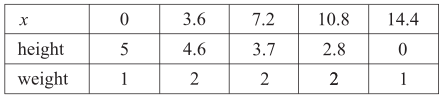
A piece of plaster has a uniform cross-section, which has been shaded, and has dimensions as shown.


  1. Use the Trapezoidal rule to approximate the area of the cross-section.    (3 marks)

    --- 6 WORK AREA LINES (style=lined) ---

  2. The total surface area of the piece of plaster is 7480.8 cm²
  3. Calculate the area of the curved surface as shown on the diagram. Give your answer to the nearest square centimetre   (2 marks)

    --- 4 WORK AREA LINES (style=lined) ---

Show Answers Only
  1. `48.96\ text(cm²)`
  2. `3502.88\ text(cm²)`
Show Worked Solution
a.   
`A` `~~ 3.6/2 [5 + 2(4.6 + 3.7 + 2.8) + 0]`
  `~~ 1.8(27.2)`
  `~~ 48.96\ text(cm²)`


b.  `text(Total Area) = 7480.8\ text{cm²   (given)}`

`text(Area of Base)` `= 14.4 xx 200`
  `= 2880\ text(cm²)`
`text(Area of End)` `= 5 xx 200`
  `= 1000\ text(cm²)`
`text(Area of sides)` `= 2 xx 48.96`
  `= 97.92\ text(cm²)`


`:.\ text(Area of curved surface)`

`= 7480.8 – (2880 + 1000 + 97.92)`

`= 3502.88`

`=3503\ text{cm²  (nearest cm²)}`

Filed Under: Trapezoidal Rule (Std 2), Trapezoidal Rule (Std2-2027) Tagged With: Band 4, Band 5, smc-6328-20-4 Approximations, smc-941-20-4 Approximations

Measurement, STD2 M1 2017 HSC 29a*

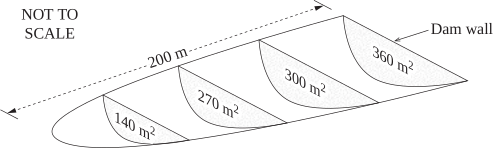
A new 200-metre long dam is to be built.

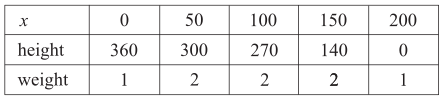
The plan for the new dam shows evenly spaced cross-sectional areas.


  1. Using the Trapezoidal rule, show that the volume of the dam is approximately 44 500 m³.  (2 marks)

    --- 4 WORK AREA LINES (style=lined) ---

  2. It is known that the catchment area for this dam is 2 km².


    Assuming no wastage, calculate how much rainfall is needed, to the nearest mm, to fill the dam.  (2 marks)

    --- 4 WORK AREA LINES (style=lined) ---

Show Answers Only
  1. `text(See Worked Solution)`
  2. `22\ text{mm  (nearest mm)}`
Show Worked Solution
a.   
`V` `~~ 50/2[360 + 2(300 + 270 + 140) + 0]`
  `~~ 25(1780)`
  `~~ 44\ 500\ text(m³)`


b.   `text(Convert  2 km² → m²:)`

♦♦♦ Mean mark 11%.
`text(2 km²)` `= 2000\ text(m × 1000 m)`
  `= 2\ 000\ 000\ text(m²)`


`text(Using)\ \ V=Ah\ \ text(where)\ \ h= text(rainfall):`

`44\ 500` `= 2\ 000\ 000 xx h`
`:.h` `= (44\ 500)/(2\ 000\ 000)`
  `= 0.02225…\ text(m)`
  `= 22.25…\ text(mm)`
  `= 22\ text{mm  (nearest mm)}`

Filed Under: Trapezoidal Rule (Std 2), Trapezoidal Rule (Std2-2027) Tagged With: Band 4, Band 6, smc-6328-30-Volume, smc-941-30-Volume

Measurement, STD2 M1 2008 HSC 28b*

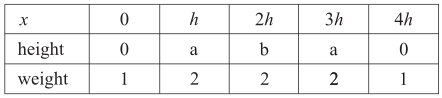
A tunnel is excavated with a cross-section as shown.


  1. Find an expression for the area of the cross-section using the Trapezoidal rule.  (2 marks)

    --- 4 WORK AREA LINES (style=lined) ---

  2. The area of the cross-section must be 600 m2. The tunnel is 80 m wide. 


    If the value of `a` increases by 2 metres, by how much will `b` change?   (2 marks)

    --- 4 WORK AREA LINES (style=lined) ---

Show Answers Only
  1. `h(2a + b)`
  2. `b\ text(decreases by 4.)`
Show Worked Solution
a.   
`A` `~~ h/2[0 + 2(a + b + a) + 0]`
  `~~ h/2(4a + 2b)`
  `~~ h(2a + b)`


b.   `A = 600\ text(m²)`

`text(If tunnel is 80 metres wide)`

`4h` `= 80`
`h` `= 20`

 
`text{Using part (i):}`

`600 = 20(2a + b)`

`2a + b` `= 30`
`b` `= 30 – 2a`

 
`:.\ text(If)\ a\ text(increases by 2,)\ b\ text(must decrease by 4.)`

Filed Under: Trapezoidal Rule (Std 2), Trapezoidal Rule (Std2-2027) Tagged With: Band 4, Band 5, smc-6328-20-4 Approximations, smc-941-20-4 Approximations

Measurement, STD2 M1 2014 HSC 28d*

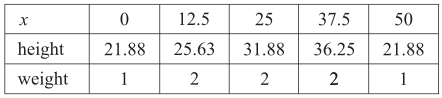
An aerial diagram of a swimming pool is shown. 

The swimming pool is a standard length of 50 metres but is not in the shape of a rectangle.

In the diagram of the swimming pool, the five widths are measured to be: 
 

`CD = 21.88\ text(m)`

`EF = 25.63\ text(m)`

`GH = 31.88\ text(m)`

`IJ = 36.25\ text(m)`

`KL = 21.88\ text(m)` 
 

  1. Use four applications of the Trapezoidal Rule to calculate the surface area of the pool.  (2 marks)

    --- 4 WORK AREA LINES (style=lined) ---

  2.  The average depth of the pool is 1.2 m


    Calculate the approximate volume of the swimming pool, in litres.  (1 mark)

    --- 2 WORK AREA LINES (style=lined) ---

Show Answers Only
  1. `1445.5\ text(m²)`
  2. `1\ 734\ 600\ text(L)`
Show Worked Solution
a.   

`text(Surface Area of pool)`

`~~ 12.5/2[21.88 + 2(25.63 + 31.88 + 36.25) + 21.88]`

`~~ 1445.5\ text(m²)`
 

♦ Mean mark 50%. Be careful not to give away easy marks! 
b.    `V` `= Ah`
    `~~ 1445.5 xx 1.2`
    `~~ 1734.6\ text(m³)`
    `~~ 1\ 734\ 600\ text(L)`

Filed Under: Trapezoidal Rule (Std 2), Trapezoidal Rule (Std2-2027) Tagged With: Band 4, smc-6328-20-4 Approximations, smc-941-20-4 Approximations

Measurement, STD2 M1 2009 HSC 25c*

There is a lake inside the rectangular grass picnic area  `ABCD`, as shown in the diagram.
 

2UG-2009-25c
  

  1. Use Trapezoidal’s Rule to find the approximate area of the lake’s surface.   (3 marks)

    --- 6 WORK AREA LINES (style=lined) ---

The lake is 60 cm deep. Bozo the clown thinks he can empty the lake using a four-litre bucket.

  1. How many times would he have to fill his bucket from the lake in order to empty the lake? (Note that 1 m³ = 1000 L).    (2 marks)

    --- 4 WORK AREA LINES (style=lined) ---

Show Answers Only
  1. 426 m²
  2. 63 900 times
Show Worked Solution
a.     `text(Area of lake = Area of rectangle)\ – text(Area of grass)`
`text(Area of rectangle)` `= 24 xx 55`
  `= 1320\ text(m²)`

 
`text{Area of grass (two applications)}`

`~~ 12/2(20 + 5) + 12/2(5 + 10) + 12/2(35 + 22) + 12/2(22 + 30)`
`~~ 6(25 + 15 + 57 + 52)`
`~~ 894\ text(m²)`


`:.\ text(Area of lake)` `~~ 1320\ – 894`
  `~~ 426\ text(m²)`


♦ Mean mark 44%
STRATEGY: Most students who did calculations in cm² and cm³ made errors. Keeping calculations in metres is much easier here.
b.    `V` `= Ah`
    `= 426 xx 0.6`
    `= 255.6\ text(m³)`
    `= 255\ 600\ text(L)\ \ \ text{(1 m³ = 1000  L)}`


`:.\ text(Times to fill bucket)` `= 255\ 600 -: 4`
  `= 63\ 900`

Filed Under: Trapezoidal Rule (Std 2), Trapezoidal Rule (Std2-2027) Tagged With: Band 4, Band 5, smc-6328-10-1-3 Approximations, smc-941-10-1-3 Approximations

Measurement, STD2 M1 2015 HSC 28c*

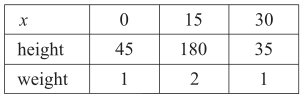
Three equally spaced cross-sectional areas of a vase are shown.
 

2UG 2015 29c

 
Use the Trapezoidal rule to find the approximate capacity of the vase in litres.  (3 marks)

--- 6 WORK AREA LINES (style=lined) ---

Show Answers Only

`3.3\ text(litres)`

Show Worked Solution

`text(Solution 1)`

`V` `≈ 15/2(45 + 180) + 15/2(180 + 35)`
  `≈ 15/2(225 + 215)`
  `≈ 3300\ text{mL   (1 cm³ = 1 mL)}`
  `~~3.3\ text(L)`


`text(Solution 2)`

`V` `≈ 15/2(45 + 2 xx 180 + 35)`
  `≈ 15/2(440)`
  `≈ 3300\ text{mL}`
  `~~3.3\ text(L)`

Filed Under: Trapezoidal Rule (Std 2), Trapezoidal Rule (Std1-2027), Trapezoidal Rule (Std2-2027) Tagged With: Band 4, smc-6328-30-Volume, smc-6523-30-Volume, smc-941-30-Volume

Measurement, STD2 M1 SM-Bank 14

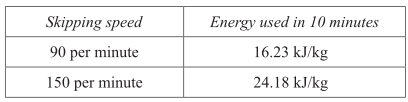
Cassius is a boxer and skips to keep fit.

The table below shows the average energy used, in kilojuoles per kilogram of body mass, by a person skipping for 10 minutes at different speeds.


Cassius eats a hamburger that contains 550 kilocalories.

If Cassuis weighs 72 kilograms, how long must he skip at 150 skips per minute to burn off the energy contained in the hamburger? (1 kilocalorie = 4.184 kJ) Give your answer to 1 decimal place.  (3 marks)

Show Answers Only

`13.2\ text{minutes  (to 1 d.p.)}`

Show Worked Solution

`text(Kilojoules in hamburger)`

`= 550 xx 4.184`

`= 2301.2`
 

`:.\ text(Skipping time to burn energy)`

`= 2301.2/((72 xx 24.18)) xx 10`

`= 1.321… xx 10`

`= 13.2\ text{minutes  (to 1 d.p.)}`

Filed Under: Energy and Mass (Std 2) Tagged With: Band 4, smc-799-10-Calories/Joules

Measurement, STD2 M1 SM-Bank 13 MC

The table shows the average energy used, in kilojoules per kilogram of body mass, by a person walking for 30 minutes at different speeds.

\begin{array} {|c|c|}
\hline
\rule{0pt}{2.5ex} \text{Walking speed} \rule[-1ex]{0pt}{0pt} & \text{Energy used in 30 minutes} \\
\hline
\rule{0pt}{2.5ex} \text{3 km/h} \rule[-1ex]{0pt}{0pt} & \text{5.53 kJ/kg} \\
\hline
\rule{0pt}{2.5ex} \text{5 km/h} \rule[-1ex]{0pt}{0pt} & \text{7.37 kJ/kg} \\
\hline
\end{array}

Rob, who weighs 90 kg, drinks a large cappuccino made with full cream milk. It contains 146 kilocalories.

For approximately how long must Rob walk at 3 km/hr to burn off the energy contained in the cappuccino? (1 kilocalorie = 4.184 kilojoules)

  1. 28 minutes
  2. 37 minutes
  3. 83 minutes
  4. 110 minutes
Show Answers Only

`text(B)`

Show Worked Solution

`text(Kilojoules in cappuccino)`

`= 146 xx 4.184`

`= 610.864\ text(kJ)`
 

`text(Energy used by Rob in 30 minutes)`

`=90 xx 5.53`

`=497.7\ text(kJ)`
 

`:.\ text(Time of the walk)`

`= 610.864/(497.7) xx 30`

`= 36.8…\ text(minutes)`

 
`=>\ text(B)`

Filed Under: Energy and Mass (Std 2) Tagged With: Band 4, smc-799-10-Calories/Joules

Measurement, STD2 M1 SM-Bank 12

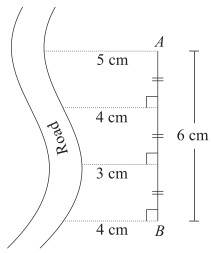
The scale diagram shows the aerial view of a block of land bounded on one side by a road. The length of the block, `AB`, is known to be 90 metres.


Calculate the approximate area of the block of land, using three applications of the Trapezoidal rule.  (3 marks)

--- 6 WORK AREA LINES (style=lined) ---

Show Answers Only

5175 m²

Show Worked Solution

`text(Solution 1)`

`text(6 cm → 90 metres)`

` text(1 cm → 15 metres)`
 

`text(Height) = 2 xx 15 = 30\ text(metres)`

`text(Area)` `~~ 30/2(75 + 60) + 30/2(60 + 45) + 30/2(45 + 60)`
  `~~ 15(135 + 105 + 105)`
  `~~ 5175\ text(m²)`


`text(Solution 2)`

`text(After converting from scale:)`

`text(Area)` `~~ 30/2(75 + 2 xx 60 + 2 xx 45 + 60)`
  `~~ 5175\ text(m²)`

Filed Under: Trapezoidal Rule (Std 2), Trapezoidal Rule (Std1-2027), Trapezoidal Rule (Std2-2027) Tagged With: Band 4, smc-6328-10-1-3 Approximations, smc-6523-10-1-3 Approximations, smc-941-10-1-3 Approximations

Proof, EXT2 P1 2018 HSC 15c

Let  `n`  be a positive integer and let  `x`  be a positive real number.

  1.  Show that  `x^n - 1 - n(x - 1) = (x - 1)(1 + x + x^2 + … + x^(n - 1) - n)`.  (1 mark)

    --- 3 WORK AREA LINES (style=lined) ---

  2.  Hence, show that  `x^n >= 1 + n(x - 1)`.  (2 marks)

    --- 5 WORK AREA LINES (style=lined) ---

  3.  Deduce that for positive real numbers `a` and `b`,
     
          `a^nb^(1-n)>=na + (1-n)b`  (2 marks)

    --- 3 WORK AREA LINES (style=lined) ---

Show Answers Only
  1. `text(See Worked Solutions)`
  2. `text(See Worked Solutions)`
  3. `text(See Worked Solutions)`
Show Worked Solution
i.    `text(RHS)` `= (x – 1)underbrace{(1 + x + x^2 + … + x^(n – 1) – n)}_{text(GP where)\ \ a = 1,\ r = x}`
    `= (x – 1) ((1(x^n – 1))/(x – 1) – n)`
    `= x^n – 1 – n(x – 1)`
    `=\ text(LHS)`


ii.   `text(Let)\ P(x) = (x – 1)(1 + x + x^2 + … + x^(n – 1) – n)`

♦♦♦ Mean mark 11%.

`text(If)\ \ x = 1, P(x) = 0`
 

`text(If)\ \ 0 < x < 1, \ (x – 1) < 0, \ (1 + x + x^2 + … + x^(n – 1) – n) < 0`

`=> P(x) > 0`
 

`text(If)\ \ x > 1, \ (x – 1) > 0, \ (1 + x + … + x^(n – 1) – n) > 0`

`=> P(x) > 0`
 

`x^n – 1 – n(x – 1) >= 0`

`:. x^n >= 1 + n(x – 1)`


iii.   `x^n >= 1 + n(x – 1)\ \ text(for)\ \ x ∈ R^+`

♦♦ Mean mark 23%.

`text(S)text(ince)\ a,b ∈ R^+`

`(a/b)^n` `>= 1 + n(a/b – 1)`
`(a^n)/(b^n) xx b` `>= b + na – nb,\ \ \ \ (b > 0)`
`a^n b^(1 – n)` `>= na + (1 – n)b`

Filed Under: Inequalities EXT2, Proof and Inequalities Tagged With: Band 4, Band 5, Band 6, smc-1208-60-Other Proofs, smc-1208-80-Geometric Series

Complex Numbers, EXT2 N2 2018 HSC 15b

  1. Use De Moivre's theorem and the expansion of `(costheta + isintheta)^8` to show that
     
    `sin8theta = ((8),(1)) cos^7thetasintheta - ((8),(3)) cos^5thetasin^3theta`
     
                        `+ ((8),(5)) cos^3thetasin^5theta - ((8),(7)) costhetasin^7theta`  (2 marks)

    --- 7 WORK AREA LINES (style=lined) ---

  2. Hence, show that
     
    `(sin8theta)/(sin2theta) = 4(1 - 10sin^2theta + 24sin^4theta - 16sin^6theta)`.  (3 marks)

    --- 7 WORK AREA LINES (style=lined) ---

Show Answers Only
  1. `text(See Worked Solutions)`
  2. `text(See Worked Solutions)`
Show Worked Solution

i.   `text(By De Moivre)`

`costheta + isintheta^8 = cos8theta + isin8theta\ \ …\ (text{*})`
 

`text(Using Binomial Expansion)`

`(costheta + isintheta)^8`

`= cos^8theta + ((8),(1))cos^7theta * isintheta + ((8),(2)) cos^6theta *i^2sin^2theta`

`+ ((8),(3)) cos^5theta *i^3sin^3theta + ((8),(4)) cos^4theta *i^4sin^4theta + ((8),(5)) cos^3theta *i^5sin^5theta`

`+ ((8),(6)) cos^2theta *i^6sin^6theta + ((8),(7)) costheta *i^7sin^7theta + i^8sin^8theta`

 
`text(Equating imaginary parts of the expansion equation (*)):`

`isin8theta = ((8),(1)) cos^7theta* isintheta + ((8),(3)) icos^5theta* i^3sin^3theta`

`+ ((8),(5)) cos^3theta* i ^5sintheta + ((8),(7)) costheta *i^7sin^7theta`

`:. sin8theta = ((8),(1)) cos^7theta sintheta – ((8),(3)) cos^5theta sin^3theta`

`+ ((8),(5)) cos^3theta sin^5theta – ((8),(7)) costheta sin^7theta`
 

ii.    `sin8theta` `= 8cos^7theta sintheta – 56cos^5 sin^3theta + 56cos^3theta sin^5theta – 8costheta sin^7theta`
    `= 2sinthetacostheta (4cos^6theta – 28cos^4theta sin^2theta + 28cos^2theta sin^4theta – 4sin^6theta)`

 
`:. (sin8theta)/(sin2theta)`

`= 4cos^6theta – 28cos^4theta sin^2theta + 28cos^2theta sin^4theta – 4sin^6theta`

`= 4(1 – sin^2theta)^3 – 28(1 – sin^2theta)^2 sin^2theta + 28(1 – sin^2theta) sin^4theta – 4sin^6theta`

`= 4(1 – 3sin^2theta + 3sin^4theta + sin^6theta) – 28sin^2theta (1 – 2sin^2theta + sin^4theta)`

`+ 28sin^4theta (1 – sin^2theta) – 4sin^6theta`

`= 4 – 40sin^2theta + 96sin^4theta – 56sin^6theta`

`= 4(1 – 10sin^2theta + 24sin^4theta – 16sin^6theta)`

Filed Under: Powers and Roots, Probability and The Binomial, Solving Equations with Complex Numbers Tagged With: Band 3, Band 4, smc-1050-40-De Moivre and trig identities

Harder Ext1 Topics, EXT2 2018 HSC 15a

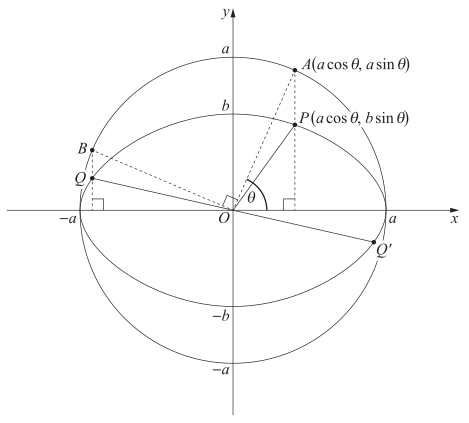
The point  `P(acostheta, bsintheta)`, where  `0 < theta < pi/2`, lies on the ellipse  `(x^2)/(a^2) + (y^2)/(b^2) = 1`, where ` a > b`. The point  `A(acostheta, asintheta)`  lies vertically above `P` on the auxiliary circle  `x^2 + y^2 = a^2`. The point `B` lies on the auxiliary circle such that  `angleAOB = pi/2`  and the point `Q` lies on the ellipse vertically below `B`, as shown.
 

  1. Show that `Q` has coordinates  `(−asintheta, bcostheta)`.  (2 marks)
     

The line `QO` meets the ellipse again at  `Qprime(asintheta, −bcostheta)`.   (Do NOT prove this.)

  1. Show that the minimum size of  `anglePOQprime`  is  `tan^(−1) ((2ab)/(a^2 - b^2))`.  (3 marks)
Show Answers Only
  1. `text(See Worked Solutions)`
  2. `text(See Worked Solutions)`
Show Worked Solution

i.   `x_Q = x_B`

`A(acostheta, asintheta)`
 

`text(S)text(ince)\ angleAOB = 90°,`

`=> x_B` `= acos(theta + pi/2)`
  `= −asintheta`

 
`text(Find)\ \ y_Q\ \ text(when)\ \ x = −asintheta`

`((−asintheta)^2)/(a^2) + (y^2)/(b^2) = 1`

`y^2` `= b^2(1 – sin^2theta)`
  `= b^2cos^2theta`
`=> y_Q` `= bcostheta\ \ \ \ (y > 0)`

 
`:.Q (−asintheta, bcostheta)\ \ …\ text(as required)`


ii.   `m_(OP) = (b sintheta)/(acostheta) = b/a tantheta`

♦ Mean mark 38%.


`m_(OQprime) = (−bcostheta)/(asintheta) = −b/a cottheta`
 

`tan anglePOQprime` `= |(m_1 – m_2)/(1 + m_1m_2)|`
  `= |(b/atantheta + b/acottheta)/(1 – b/atantheta b/acottheta)|`
  `= |(ab(tantheta + cottheta))/(a^2 – b^2(tanthetacottheta))|`
  `= |(ab)/(a^2 – b^2)| · |(sintheta)/(costheta) + (costheta)/(sintheta)|`
  `= |(ab)/(a^2 – b^2)| · |(sin^2theta + cos^2theta)/(sinthetacostheta)|`
  `= |(ab)/(a^2 – b^2)| · |2/(sin2theta)|`
  `= (ab)/(a^2 – b^2) · 2/(|sin2theta|)qquadtext{(given}\ \ a > b text{)}`


`=>\ text(Minimum angle when)\ tan anglePOQprime\ text(is a minimum.)`

`=>\ text(Minimum)\ \ (ab)/(a^2 – b^2) · 2/(|sin2theta|) = (2ab)/(a^2 – b^2) qquad (sin 2theta = 1)`
 

`:.\text(Minimum size of)\ anglePOQprime`

`= tan^(−1)((2ab)/(a^2 – b^2))`

Filed Under: Ellipse, Other Ext1 Topics Tagged With: Band 4, Band 5

Calculus, EXT2 C1 2018 HSC 14c

Let  `I_n = int_(−3)^0 x^n sqrt(x + 3)\ dx`  for  `n = 0, 1, 2…`

  1.  Show that, for  `n >= 1`,
     
         `I_n = (−6n)/(3 + 2n) I_(n - 1)`.   (3 marks)

    --- 8 WORK AREA LINES (style=lined) ---

  2.  Find the value of  `I_2`.  (2 marks)

    --- 5 WORK AREA LINES (style=lined) ---

Show Answers Only
  1. `text(See Worked Solutions)`
  2. `(144sqrt3)/35`
Show Worked Solution

i.   `I_n = int_(−3)^0 x^n sqrt(x + 3)\ dx\ \ text(for)\ \ n = 0, 1, 2…`

`u` `= x^n` `vprime` `= (x + 3)^(1/2)`
`uprime` `= nx^(n – 1)` `v` `= 2/3 (x + 3)^(3/2)`


`I_n` `= [2/3 x^n(x + 3)^(3/2)]_(−3)^0 – 2/3int_(−3)^0  nx^(n – 1)(x + 3)sqrt(x + 3)\ dx`
`I_n` `= 0 – (2n)/3 int_(−3)^0 x^nsqrt(x + 3) + 3x^(n – 1)sqrt(x + 3)\ dx`
`I_n` `= −(2n)/3 (I_n + 3I_(n-1))`
`I_n + (2n)/3 I_n` `= −2nI_(n – 1)`
`I_n(1 + (2n)/3)` `= −2nI_(n – 1)`
`I_n((3 + 2n)/3)` `= −2nI_(n – 1)`
`:. I_n` `= (−6n)/(3 + 2n) I_(n – 1)\ \ \ text(… as required)`


ii.    `I_2` `= −12/7 I_1`
    `= −12/7 xx −6/5 I_0`
    `= 72/35 int_(−3)^0 (x + 3)^(1/2)dx`
    `= 72/35 xx 2/3 [(x + 3)^(3/2)]_(−3)^0`
    `= 48/35 (3^(3/2))`
    `= (144sqrt3)/35`

Filed Under: Recurrence Relations, Recurrence Relations Tagged With: Band 3, Band 4, smc-1054-50-Other Function

Mechanics, EXT2 2018 HSC 13c

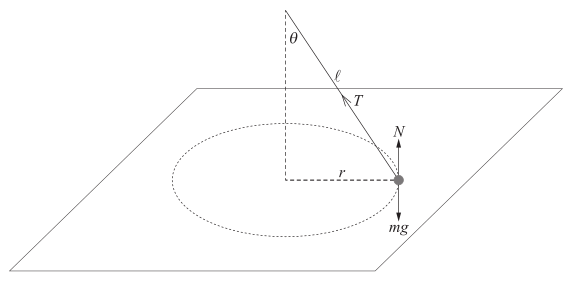
A particle of mass `m` is attached to a light inextensible string of length `l`. The string makes an angle `theta` to the vertical.

The particle is moving in a circle of radius `r` on a smooth horizontal surface. The particle is moving with uniform angular velocity `ω`. The forces on the particle are the tension `T` in the string; the normal reaction `N` to the horizontal surface; and the gravitational force  `mg`.


The particle remains in contact with the horizontal surface.

By resolving the forces on the particle in the horizontal and vertical directions, show that

`ω^2 <= g/(lcostheta)`.   (3 marks)

Show Answers Only

`text(See Worked Solutions)`

Show Worked Solution

`text(Resolve forces horizontally,)`

`Tsintheta = mrω^2\ \ …\ (1)`

`text(Resolve forces vertically,)`

`Tcostheta + N = mg\ \ …\ (2)`


`text(Solving simultaneously for)\ \ N:`

`text{Divide (1) by}\ sintheta`

`T = mrω^2 text(cosec)theta`

`text{Divide (2) by}\ costheta`

`T = (mg – N) sectheta`
 

`(mg – N)sectheta` `= mrω^2 text(cosec)theta`
`mg – N` `= mrω^2 cottheta`
`N` `= mg – mrω^2 cottheta`


`text(Particle doesn’t leave table if)\ \ N >= 0`

`mg – mrω^2 cottheta` `>= 0`
`mrω^2 cottheta` `<= mg`
`ω^2` `<= g/(r(costheta)/(sintheta))\ \ \ \ (l = r/(sintheta))`
`:. ω^2` `<= g/(lcostheta)`

Filed Under: Circular Motion Tagged With: Band 4

Complex Numbers, EXT2 N1 2018 HSC 13b

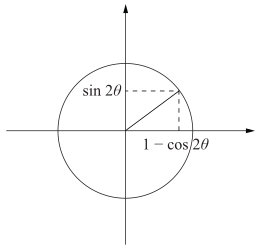
Let   `z = 1 - cos2theta + isin2theta`, where   `0 < theta <= pi`.

  1.  Show that  `|\ z\ | = 2sintheta`.  (2 marks)
    --- 6 WORK AREA LINES (style=lined) ---

  2.  Show that  `text(arg)(z) = pi/2 - theta`.  (2 marks)

    --- 8 WORK AREA LINES (style=lined) ---

Show Answers Only
  1. `text(See Worked Solutions)`
  2. `text(See Worked Solutions)`
Show Worked Solution

i.   `z = 1 – cos2theta + isin2theta`

`|\ z\ |` `= sqrt((1 – cos2theta)^2 + sin^2 2theta)`
  `= sqrt(1 – 2cos2theta + cos^2 2theta + sin^2 2theta)`
  `= sqrt(2 – 2cos2theta)`
  `= sqrt(2(1 – cos2theta))`
  `= sqrt(2(2sin^2theta))`
  `= 2sintheta\ \ \ text(… as required)`


ii.  `z= 1 – cos2theta + isin2theta`

`text(arg)(z)` `= tan^(−1)((sin2theta)/(1 – cos2theta))`
  `= tan^(−1)((2sinthetacostheta)/(2sin^2theta))`
  `= tan^(−1)(cottheta)`
  `= tan^(−1)(tan(pi/2 – theta))`
  `= pi/2 – theta`

 
`(text(S)text(ince)\ \ 0 < theta < pi => \ −pi/2 <= pi/2 – theta < pi/2)`

Filed Under: Argand Diagrams and Mod/Arg form, Geometry and Complex Numbers (vectors) Tagged With: Band 3, Band 4, smc-1049-20-Cartesian to Mod/Arg

Volumes, EXT2 2018 HSC 13a

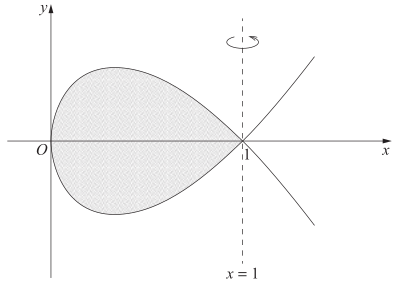
The graph  `y^2 = x(1 - x)^2` is shown.


Use the method of cylindrical shells to find the volume of the solid formed when the shaded region is rotated about the line  `x = 1`.  (3 marks)

Show Answers Only

`(64pi)/105\ \ text(u³)`

Show Worked Solution

`text(Cylindrical shell:)`

`text(Radius) = (1 – x),\ text(height) = 2y`

`y^2` `= x(1-x)^2`
`y` `= sqrtx(1 – x)`


`δV` `= 2pi(1-x)(2y)\ δx`
  `= 2pi (1 – x) · 2sqrtx (1 – x)\ δx`
  `= 4pi (1 – x)^2 sqrtx\ δx`


`:. V` `= int_0^1 4pi (1 – x)^2 sqrtx\ dx`
  `= 4pi int_0^1 (1 – 2x + x^2) sqrtx\ dx`
  `= 4pi int_0^1 x^(1/2) – 2x^(3/2) + x^(5/2)\ dx`
  `= 4pi [2/3x^(3/2) – 4/5x^(5/2) + 2/7x^(7/2)]_0^1`
  `= 4pi[(2/3 – 4/5 + 2/7) – 0]`
  `= 4pi(16/105)`
  `= (64pi)/105\ \ text(u³)`

Filed Under: Cylindrical Shells Tagged With: Band 4

Volumes, EXT2 2018 HSC 12a

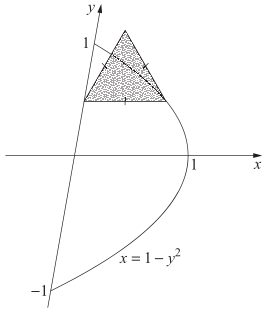
The base of a solid is the region enclosed by the parabola  `x = 1 - y^2`  and the `y`-axis. Each cross-section perpendicular to the `y`-axis is an equilateral triangle, as shown in the diagram.


Find the volume of the solid.  (3 marks)

Show Answers Only

`(4sqrt3)/15\ text(u³)`

Show Worked Solution

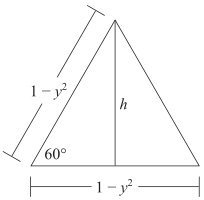
`text(Cross section of triangle)`

`sin60°` `= h/(1 – y^2)`
`:.h` `= sqrt3/2(1 – y^2)`


`δV` `= 1/2(1 – y^2) · sqrt3/2(1 – y^2)\ δy`
  `= sqrt3/4(1 – y^2)^2\ δy`


`:. V` `= int_(−1)^1 sqrt3/4(1 – y^2)\ dy`
  `= sqrt3/2 int_0^1 1 – 2y^2 + y^2\ dy`
  `= sqrt3/2 [y – 2/3y^3 + 1/5y^5]`
  `= sqrt3/2 [(1 – 2/3 + 1/5) – 0]`
  `= sqrt3/2(8/15)`
  `= (4sqrt3)/15\ text(u³)`

Filed Under: Cross sections of similar shapes Tagged With: Band 4

Harder Ext1 Topics, EXT2 2018 HSC 11e

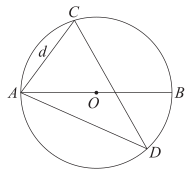
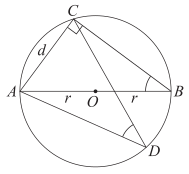
The circle centred at `O` with radius `r` has a diameter `AB`. Points `C` and `D` are chosen on the circle as shown in the diagram. The chord `AC` has length `d`.


Show that  `d = 2r sin D`.  (2 marks)

Show Answers Only

`text(See Worked Solutions)`

Show Worked Solution

`text(Join)\ CB`

`angleB = angleD\ \ (text{angles on circumference on arc}\ AC)`

`angleACB = 90°\ \ (text{angle in a semi-circle})`
 

`text(In)\ DeltaABC,`

`sin B` `= d/(2r)`
`:. d` `= 2r sin B`
  `= 2r sin D\ \ \ text(.. as required)`

Filed Under: Circle/Plane Geometry Tagged With: Band 4

Complex Numbers, EXT2 N2 2018 HSC 11d

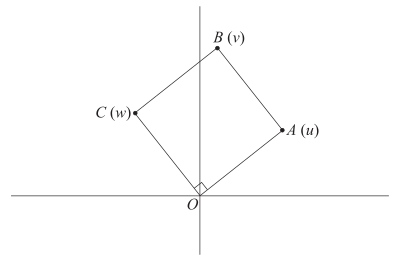
The points `A`, `B` and `C` on the Argand diagram represent the complex numbers `u`, `v` and `w` respectively.

The points `O`, `A`, `B` and `C` form a square as shown on the diagram.


It is given that  `u = 5 + 2i`.

  1.  Find  `w`.  (1 mark)

    --- 2 WORK AREA LINES (style=lined) ---

  2.  Find  `v`.  (1 mark)

    --- 2 WORK AREA LINES (style=lined) ---

  3.  Find  `text(arg)(w/v)`.  (1 mark)

    --- 2 WORK AREA LINES (style=lined) ---

Show Answers Only
  1. `−2 + 5i`
  2. `3 + 7i`
  3. `pi/4`
Show Worked Solution
i.    `w` `= iu`
    `= i(5 + 2i)`
    `= −2 + 5i`


ii.    `v` `= u + w`
    `= 5 + 2i + (−2 + 5i)`
    `= 3 + 7i`


iii.    `text(arg)(w/v)` `= text(arg)(w) – text(arg)(v)`
    `= pi/4\ \ (text(diagonal of square bisects corner))`

Filed Under: Geometrical Implications of Complex Numbers, Geometry and Complex Numbers (vectors) Tagged With: Band 2, Band 3, Band 4, smc-1052-30-Quadrilaterals

Harder Ext1 Topics, EXT2 2018 HSC 10 MC

Consider the functions  `f( x ) = sinx`  and  `g( x ) = x sinx`.

The `x`-coordinate of each stationary point of  `f(x)`  is very close to the `x`-coordinate of a stationary point of `g(x)`.

Suppose  `f(x)`  has a stationary point at  `x = a`  and the stationary point of  `g(x)`  with `x`-coordinate closest to  `x = a`  is at  `x = b`.

Which statement is always true?

  1. `a < b`
  2. `a > b`
  3. `|\ a\ | < |\ b\ |`
  4. `|\ a\ | > |\ b\ |`
Show Answers Only

`text(C)`

Show Worked Solution

`f(x) = sin x\ =>  fprime(x) = cos x`

Mean mark 57%. A challenging question well answered. 

`fprime(x) = 0\ \ text(when)\ \ x = pi/2, (3pi)/2, …`

 
`g(x) = x sin x\ =>  gprime(x) = sin x – x cos x`

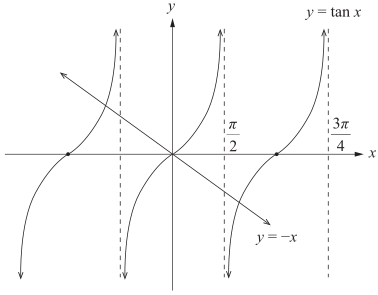
`gprime(x) = 0\ \ text(when)\ \ −x = tan x`
 

`text(When)\ x > 0,\ text{intersection (where}\ gprime(x) = 0)\ text(is to)`

`text(the right of)\ \ x = pi/2.`

`text(When)\ x < 0,\ text(intersection is to the left of)\ \ x = – pi/2 .`

`:. |\ a\ | < |\ b\ |`

`=>\ text(C)`

Filed Under: Other Ext1 Topics Tagged With: Band 4

Proof, EXT2 P1 2018 HSC 9 MC

It is given that  `a`, `b` are real and  `p`, `q` are purely imaginary.

Which pair of inequalities must always be true?

  1. `a^2p^2 + b^2q^2 <= 2abpq,qquada^2b^2 + p^2q^2 <= 2abpq`
  2. `a^2p^2 + b^2q^2 <= 2abpq,qquada^2b^2 + p^2q^2 >= 2abpq`
  3. `a^2p^2 + b^2q^2 >= 2abpq,qquada^2b^2 + p^2q^2 <= 2abpq`
  4. `a^2p^2 + b^2q^2 >= 2abpq,qquada^2b^2 + p^2q^2 >= 2abpq`
Show Answers Only

`B`

Show Worked Solution

`a, b ->\ text(real)qquad\ p, q ->\ text(purely imaginary)`

`=> ab, pq, (ab – pq)\ text(are real)`

`=> ap, bq, (ap – bq)\ text(are purely imaginary.)`
 

`(ab – pq)^2` `>= 0`
`a^2b^2 + p^2q^2` `>= 2abpq\ \ (text(Eliminate A and C))`


`(ap – bq)^2` `<= 0`
`a^2p^2 + b^2q^2` `<= 2abpq`

 
`=>B`

Filed Under: Arithmetic and Complex Numbers, Inequalities EXT2, Proof and Inequalities Tagged With: Band 4, smc-1048-30-Other, smc-1208-20-Proofs using Square > 0

Complex Numbers, EXT2 N2 2018 HSC 7 MC

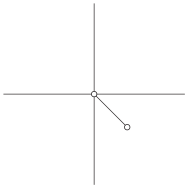
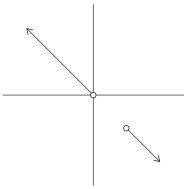
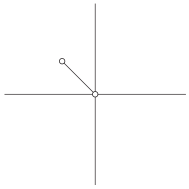
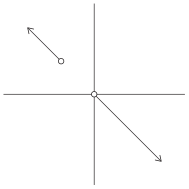
Which diagram best represents the solutions to the equation  `text(arg)(z) = text(arg)(z + 1 - i)`?

A. B.
C. D.
Show Answers Only

`text(D)`

Show Worked Solution
`text(arg)(z)` `= text(arg)(z + 1 – i)`
  `=text(arg)(z – (−1 + i))`

 
`=>\ text(arg)(z – (−1 + i))\ \ text(is the argument of)\ \ z\ \ text(from)\ \ (-1+i).`

 
`text(Plot)\ \ (-1 + i)\ \ text(on the argand diagram and then test different)`

`text(positions of)\ \ z\ \ text(along the solutions for each option.)`

`=>\ text(D)`

Filed Under: Geometrical Implications of Complex Numbers, Geometry and Complex Numbers (vectors) Tagged With: Band 4, smc-1052-60-Other problems

Complex Numbers, EXT2 N2 2018 HSC 6 MC

Which complex number is a 6th root of `i`?

  1. `−1/sqrt2 + 1/sqrt2i`
  2. `−1/sqrt2 - 1/sqrt2i`
  3. `−sqrt2 + sqrt2i`
  4. `−sqrt2 - sqrt2i`
Show Answers Only

`A`

Show Worked Solution

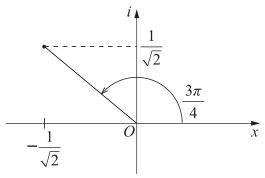
`text(Consider option A:)`
 

`|−1/sqrt2 + 1/sqrt2i|= sqrt((−1/sqrt2)^2 + (1/sqrt2)^2) = 1`

`text(arg)(z)` `= (3pi)/4`
`z` `= 1(cos\ (3pi)/4 + i sin\ (3pi)/4)`
`z^6` `= cos\ (18pi)/4 + i sin\ (18pi)/4\ \ \ text{(De Moivre)}`
  `= i`

 
`=> A`

Filed Under: Powers and Roots, Solving Equations with Complex Numbers Tagged With: Band 4, smc-1050-30-Roots > 3

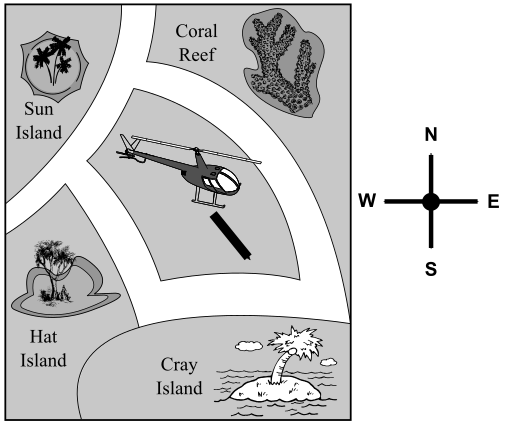
Geometry, NAP-K2-10

Kelly takes off in a helicopter and heads for Cray Island.


In which direction is Kelly flying?

north-east north-west south-east south-west


Show Answers Only

`text(south-east)`

Show Worked Solution

`text(Kelly is flying south-east)`

Filed Under: Location, Directions and Angles, Location, Directions and Angles Tagged With: Band 4, smc-3123-30-Maps and directions, smc-697-30-Maps and directions

Statistics, NAP-K2-06

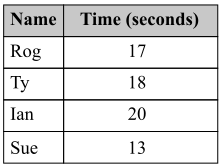
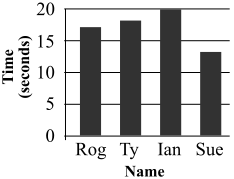
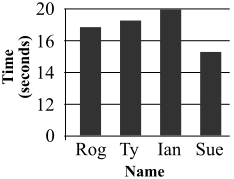
The table shows the time (in seconds) some children can run 100 metres.

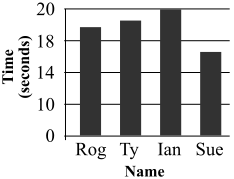
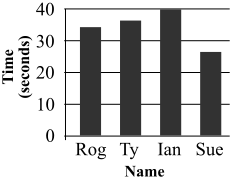
Which column graph correctly shows the data in the table?


Show Answers Only

Show Worked Solution

`text(Considering the vertical scale of each option:)`
 

Filed Under: Data and Interpretation, Data and Interpretation, Data and Interpretation Tagged With: Band 4, smc-3052-20-Column graph, smc-3136-20-Column graphs, smc-698-20-Column graphs

Number and Algebra, NAP-K2-05 SA

In a tennis competition a player won 7 games and lost the other games.

Altogether she played 15 games.

Finish the subtraction sentence below to show the number of games she lost.

`\ - 7 =`
Show Answers Only

`15 – 7 = 8`

Show Worked Solution

`15 – 7 = 8`

Filed Under: Solving problems - Add/Subtract, Solving problems - Add/Subtract Tagged With: Band 4, smc-3084-20-Subtraction, smc-3084-50-Find equation, smc-693-20-Subtraction, smc-693-50-Find equation

Statistics, NAP-K2-04 SA

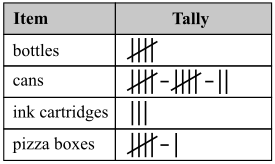
Cassie records the number of items she recycles in one week.

The tally table shows Cassie's results.

How many items does Cassie recycle in total?

Show Answers Only

`21`

Show Worked Solution
`text(Total items)` `= 5 + 12 + 3 + 6`
  `= 26`

Filed Under: Data and Interpretation, Data and Interpretation Tagged With: Band 4, smc-3136-30-Tally charts, smc-698-30-Tally charts

Integration, 2UA 2018 HSC 15c

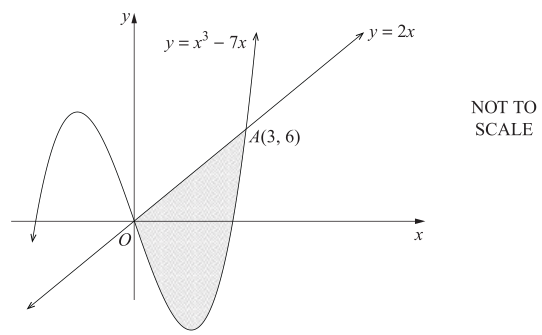
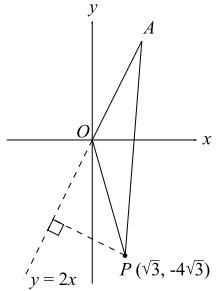
The shaded region is enclosed by the curve  `y = x^3 - 7x`  and the line  `y = 2x`, as shown in the diagram. The line  `y = 2x`  meets the curve  `y = x^3 - 7x`  at  `O(0, 0)`  and  `A(3, 6)`. Do NOT prove this.


  1. Use integration to find the area of the shaded region.  (2 marks)
  2. Verify that one application of Simpson’s rule gives the exact area of the shaded region.  (2 marks)
     
  3. The point `P` is chosen on the curve  `y = x^3 − 7x`  so that the tangent at `P` is parallel to the line  `y = 2x`  and the `x`-coordinate of `P` is positive.
     
  4. Show that the coordinates of `P` are  `(sqrt 3, -4 sqrt 3)`.  (2 marks)
  5. Find the area of  `Delta OAP`.  (2 marks)
Show Answers Only
  1. `81/4\ text(units²)`

  2. `text(Proof)\ \ text{(See Worked Solutions)}`
  3. `text(Proof)\ \ text{(See Worked Solutions)}`
  4. `9 sqrt 3\ text(units²)`
Show Worked Solution
(i)   `text(Area)` `= int_0^3 2x – (x^3 – 7x)\ dx`
    `= int_0^3 9x – x^3\ dx`
    `= [9/2 x^2 – 1/4 x^4]_0^3`
    `= [(9/2 xx 3^2 – 1/4 xx 3^4) – 0]`
    `= 81/2 – 81/4`
    `= 81/4\ text(units²)`


(ii)  `text(Using Simpson’s rule)`

♦ Mean mark 45%.

`y = 9x – x^3`
 

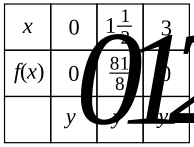
`text(A)` `~~ h/3 (y_0 + 4y_1 + y_2)`
  `= 3/6 (0 + 4 xx 81/8 + 0)`
  `= 1/2 (81/2)`
  `= 81/4\ text( … as required)`


(iii)   `y = x^3 – 7x`

`(dy)/(dx) = 3x^2 – 7`

`text(Find)\ \ x\ \ text(such that)\ \ (dy)/(dx) = 2`

`3x^2 – 7` `= 2`
`3x^2` `= 9`
`x^2` `= 3`
`x` `= sqrt 3 qquad (x > 0)`


`y` `= (sqrt 3)^3 – 7 sqrt 3`
  `= 3 sqrt 3 – 7 sqrt 3`
  `= -4 sqrt 3`

 
`:. P\ \ text(has coordinates)\ (sqrt 3, -4 sqrt 3)`


(iv)  


`text(dist)\ OA` `= sqrt((3 – 0)^2 + (6 – 0)^2)`
  `= sqrt 45`
  `= 3 sqrt 5`

 
`text(Find)\ _|_\ text(distance of)\ \ P\ \ text(from)\ \ OA`

♦♦ Mean mark 27%.

`P(sqrt 3, -4 sqrt 3),\ \ 2x – y=0`

`_|_\ text(dist)` `= |(2 sqrt 3 + 4 sqrt 3)/sqrt (3 + 2)|`
  `= (6 sqrt 3)/sqrt 5`
   
`:.\ text(Area)` `= 1/2 xx 3 sqrt 5 xx (6 sqrt 3)/sqrt 5`
  `= 9 sqrt 3\ text(units²)`

Filed Under: 6. Linear Functions, Areas Under Curves, Trapezoidal and Simpson's Rule Tagged With: Band 4, Band 5

Calculus, 2ADV C3 2018 HSC 16a

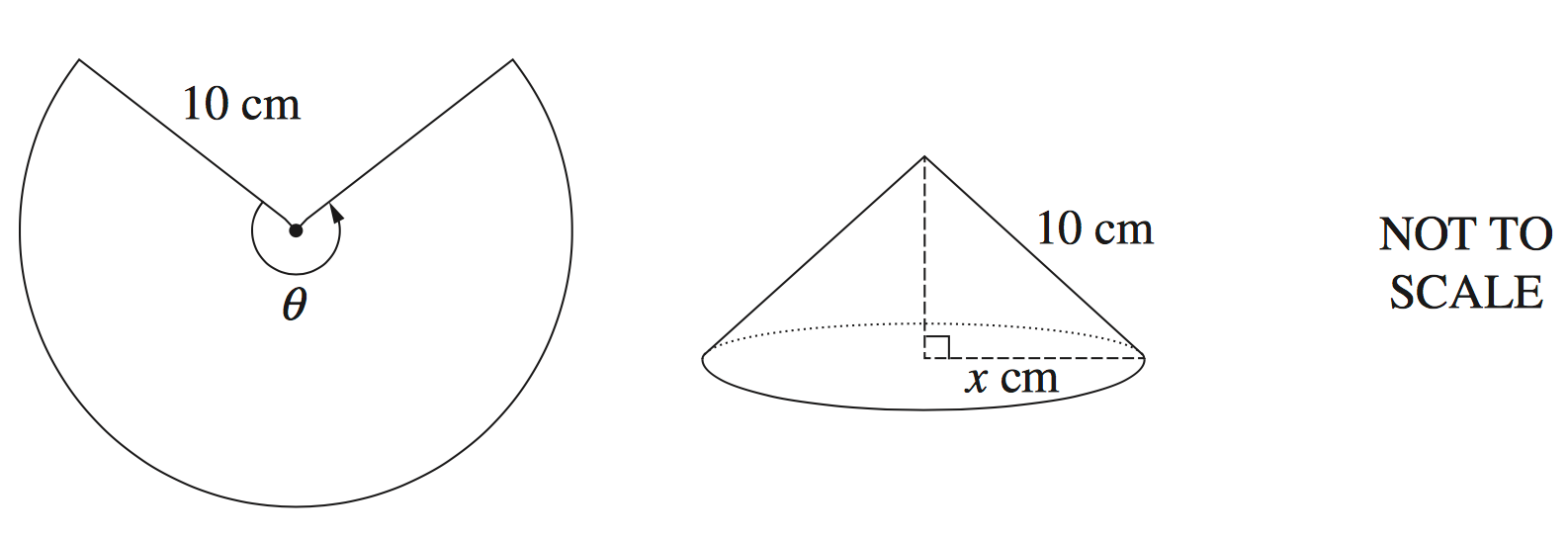
A sector with radius 10 cm and angle  `theta`  is used to form the curved surface of a cone with base radius `x` cm, as shown in the diagram.


The volume of a cone of radius `r` and height `h` is given by  `V = 1/3 pi r^2 h`.

  1. Show that the volume, `V` cm³, of the cone described above is given by
     
          `V = 1/3 pi x^2 sqrt(100-x^2)`.   (1 mark)

    --- 2 WORK AREA LINES (style=lined) ---

  2. Show that  `(dV)/(dx) = (pi x (200-3x^2))/(3 sqrt(100-x^2))`.   (2 marks)

    --- 5 WORK AREA LINES (style=lined) ---

  3. Find the exact value of  `theta`  for which `V` is a maximum.   (3 marks)

    --- 7 WORK AREA LINES (style=lined) ---

Show Answers Only
  1. `text(Proof)\ \ text{(See Worked Solutions)}`
  2. `text(Proof)\ \ text{(See Worked Solutions)}`
  3. `(2 sqrt 2 pi)/sqrt 3`
Show Worked Solution

i.   `V = 1/3 pi r^2 h`

`text(Using Pythagoras,)`

`h = sqrt(100-x^2)`

`r = x`

`:.\ text(Volume) = 1/3 pi x^2 sqrt(100-x^2)`
 

♦ Mean mark (ii) 45%.

ii.   `V` `= 1/3 pi x^2 sqrt(100-x^2)`
  `(dV)/(dh)` `= 1/3 pi [2x ⋅ sqrt(100-x^2)-2x ⋅ 1/2 (100-x^2)^(-1/2) ⋅ x^2]`
    `= 1/3 pi [(2x (100-x^2)-x^3)/sqrt(100-x^2)]`
    `= 1/3 pi [(200 x-2x^3-x^3)/sqrt(100-x^2)]`
    `= (pi x(200-3x^2))/(3 sqrt (100-x^2))\ \ text{.. as required}`


iii.  `text(Find)\ \ x\ \ text(when)\ \ (dV)/(dx) = 0`

♦♦ Mean mark (iii) 23%.

`200-3x^2` `= 0`
`x` `= sqrt(200/3)`

 
`text(When)\ \ x < sqrt(200/3),\ (200-3x^2) > 0`

`=> (dV)/(dx) > 0`

`text(When)\ \ x > sqrt(200/3),\ (200-3x^2) < 0`

`=> (dV)/(dx) < 0`

`:.\ text(MAX when)\ \ x = sqrt(200/3)`
 

`text(Equating the arc length of the section)`

`text(to the circumference of the cone:)`

`2 pi r ⋅ theta/(2 pi)` `= 2 pi ⋅ x`
`10 theta` `= 2 pi sqrt (200/3)`
`:. theta` `= (2 pi ⋅ 10 sqrt 2)/(10 ⋅ sqrt 3)`
  `= (2 sqrt 2 pi)/sqrt 3`

Filed Under: Maxima and Minima, Maxima and Minima (Y12) Tagged With: Band 4, Band 5, smc-970-20-Volume - Cone

Calculus, 2ADV C4 2018 HSC 15b

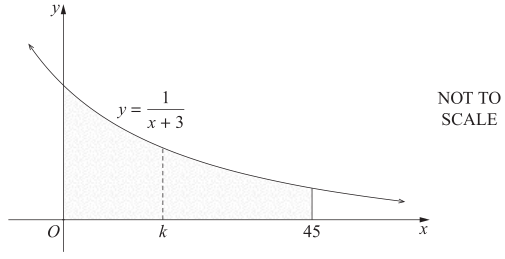
The diagram shows the region bounded by the curve  `y = 1/(x + 3)`  and the lines  `x = 0`,  `x = 45`  and  `y = 0`. The region is divided into two parts of equal area by the line  `x = k`, where `k` is a positive integer. 


What is the value of the integer `k`, given that the two parts have equal areas?  (3 marks)

--- 6 WORK AREA LINES (style=lined) ---

Show Answers Only

`9`

Show Worked Solution
`text(Total Area)` `= int_0^45 1/(x + 3)`
  `= [ln (x + 3)]_0^45`
  `= ln 48 – ln 3`
  `= ln 16`


`=> int_0^k 1/(x + 3)` `= 1/2 xx ln 16`
`[ln (x + 3)]_0^k` `= ln 16^(1/2)`
`ln (k + 3) – ln 3` `= ln 4`
`ln ((k + 3)/3)` `= ln 4`
`(k + 3)/3` `= 4`
`:. k` `= 4 xx 3 – 3`
  `= 9`

Filed Under: Areas Under Curves, Areas Under Curves (Y12) Tagged With: Band 4, smc-975-30-Hyperbola/Quotient

Trigonometry, 2ADV T3 2018 HSC 15a

The length of daylight, `L(t)`, is defined as the number of hours from sunrise to sunset, and can be modelled by the equation

`L(t) = 12 + 2 cos ((2 pi t)/366)`,

where `t` is the number of days after 21 December 2015, for  `0 ≤ t ≤ 366`.

  1. Find the length of daylight on 21 December 2015.   (1 mark)

    --- 1 WORK AREA LINES (style=lined) ---

  2. What is the shortest length of daylight?  (1 mark)

    --- 1 WORK AREA LINES (style=lined) ---

  3. What are the two values of  `t`  for which the length of daylight is 11?  (2 marks)

    --- 4 WORK AREA LINES (style=lined) ---

Show Answers Only
  1. `14\ text(hours)`
  2. `10\ text(hours)`
  3. `t = 122 or 244`
Show Worked Solution

i.   `L(t) = 12 + 2 cos ((2 pi t)/366)`

`text(On 21 Dec 2015) => t = 0`

`:. L(0)` `= 12 + 2 cos 0`
  `= 14\ text(hours)`


ii.   `text(Shortest length of daylight occurs when)`

♦ Mean mark 43%.

`cos ((2 pi t)/366) = -1`
 

`:.\ text(Shortest length)` `= 12 + 2 (-1)`
  `= 10\ text(hours)`


iii.   `text(Find)\ \ t\ \ text(such that)\ \ L(t) = 11:`

`11 = 12 + 2 cos ((2 pi t)/366)`

`cos ((2 pi t)/366) = -1/2`
 

`(2 pi t)/366` `= (2 pi)/3` `qquad\ \ text(or)`     `(2 pi t)/366` `= (4 pi)/3`
`t` `= 366/3`   `t` `= (366 xx 2)/3`
  `= 122`     `= 244`

 
`:. t = 122 or 244`

Filed Under: Exact Trig Ratios and Other Identities, Trig Applications (Y12) Tagged With: Band 3, Band 4, Band 5, smc-1188-30-Other Applications

Probability, 2ADV S1 2018 HSC 14e

Two machines, `A` and `B`, produce pens. It is known that 10% of the pens produced by machine `A` are faulty and that 5% of the pens produced by machine `B` are faulty.

  1. One pen is chosen at random from each machine.


    What is the probability that at least one of the pens is faulty?  (1 mark)

    --- 2 WORK AREA LINES (style=lined) ---

  2. A coin is tossed to select one of the two machines. Two pens are chosen at random from the selected machine.


    What is the probability that neither pen is faulty?  (2 marks)

    --- 4 WORK AREA LINES (style=lined) ---

Show Answers Only
  1. `0.145`
  2. `0.85625`
Show Worked Solution
i.   `text{P(at least 1 faulty)}` `= 1 –  text{P(both faulty)}`
    `= 1 – 0.9 xx 0.95`
    `= 1 – 0.855`
    `= 0.145`


ii.   `text{P(2 non-faulty pens})`

♦ Mean mark 48%.

`= text{(choose A, NF, NF)} + P text{(choose B, NF, NF)}`

`= 1/2 xx 0.9 xx 0.9 + 1/2 xx 0.95 xx 0.95`

`= 0.405 + 0.45125`

`=0.85625`

Filed Under: 3. Probability, Multi-Stage Events (Adv-2027), Multi-Stage Events (Y11) Tagged With: Band 4, Band 5, smc-6469-20-Other Multi-Stage Events, smc-6469-30-Complementary Probability, smc-989-20-Other Multi-Stage Events, smc-989-30-Complementary Probability

Calculus, EXT1* C3 2018 HSC 14b

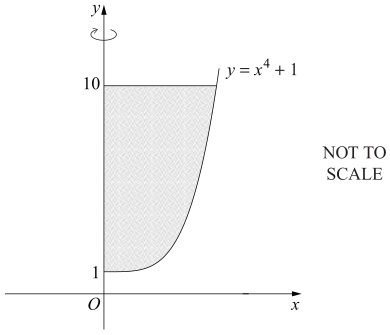
The shaded region shown in the diagram is bounded by the curve  `y = x^4 + 1`, the `y`-axis and the line  `y = 10`.


Find the volume of the solid of revolution formed when the shaded region is rotated about the `y`-axis.  (3 marks)

--- 6 WORK AREA LINES (style=lined) ---

Show Answers Only

`18 pi\ text(units²)`

Show Worked Solution

`y = x^4 + 1`

`x^4 = y – 1`

`x^2 = +- (y – 1)^(1/2)`

`text(When)\ \ x = 0,\ \ y = 1`

`=> x^2 = (y – 1)^(1/2)`
 

`:.\ text(Volume)` `= pi int_1^10 x^2\ dy`
  `= pi int_1^10 (y – 1)^(1/2)\ dy`
  `= pi xx 2/3 [(y – 1)^(3/2)]_1^10`
  `= (2 pi)/3 [9^(3/2) – 0]`
  `= (2 pi)/3 (27)`
  `= 18 pi\ \ text(units²)`

Filed Under: Further Area and Solids of Revolution (Ext1), Volumes of Solids of Rotation Tagged With: Band 4, smc-1039-10-Polynomial, smc-1039-61-y-axis Rotation

Trigonometry, 2ADV T1 2018 HSC 14a

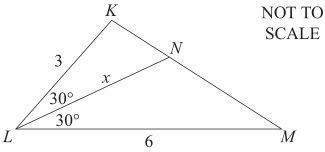
In  `Delta KLM, KL`  has length 3, `LM` has length 6 and `/_KLM` is 60°. The point `N` is chosen on side  `KM`  so that  `LN`  bisects `/_KLM`. The length  `LN`  is `x`.


  1. Find the exact value of the area of  `Delta KLM`.  (1 mark)

    --- 2 WORK AREA LINES (style=lined) ---

  2. Hence, or otherwise, find the exact value of `x`.  (2 marks)

    --- 5 WORK AREA LINES (style=lined) ---

Show Answers Only
  1. `(9 sqrt 3)/2`
  2. `2 sqrt 3`
Show Worked Solution

i.   `text(Using sine rule:)`

`text(Area)\ \ Delta KLM` `= 1/2 xx 3 xx 6 xx sin 60^@`
  `= (9 sqrt 3)/2\ \ text(u²)`


ii.  `text(Area)\ \ Delta KLN + text(Area)\ \ Delta NLM = text(Area)\ \ Delta KLM`

`1/2 xx 3 xx x xx sin 30^@ + 1/2 xx x xx 6 xx sin 30^@ = (9 sqrt 3)/2`

♦ Mean mark 37%.

`3/4 x + 3/2 x` `= (9 sqrt 3)/2`
`9/4 x` `= (9 sqrt 3)/2`
`:. x` `= (9 sqrt 3)/2 xx 4/9`
  `= 2 sqrt 3`

Filed Under: Sine and Cosine Rules, Bearings, Trig Ratios, Sine and Cosine Rules (Adv-2027), Trig Ratios, Sine and Cosine Rules (Y11) Tagged With: Band 4, Band 5, smc-6392-30-Sine Rule, smc-980-30-Sine Rule

Plane Geometry, 2UA 2018 HSC 13b

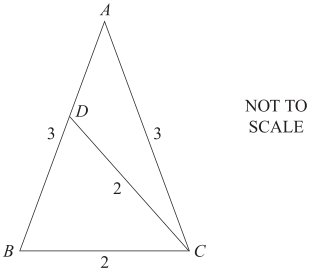
In `Delta ABC`, sides `AB` and `AC` have length 3, and `BC` has length 2. The point `D` is chosen on `AB` so that `DC` has length 2.
 

  1. Prove that `Delta ABC` and `Delta CBD` are similar.  (2 marks)

    --- 4 WORK AREA LINES (style=lined) ---

  2. Find the length `AD`.  (2 marks)

    --- 4 WORK AREA LINES (style=lined) ---

Show Answers Only
  1. `text(Proof)\ \ text{(See Worked Solutions)}`
  2. `5/3`
Show Worked Solution

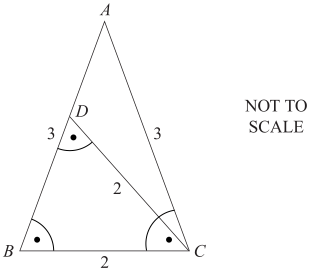
i.    `text(Prove)\ \ Delta ABC\ text(|||)\ Delta CBD`

`Delta ABC\ text{is isosceles:}`

`/_ ABC = /_ ACB qquad text{(angles opposite equal sides)}`

`Delta CBD\ text{is isosceles:}`

`/_ CBD = /_ CDB qquad text{(angles opposite equal sides)}`

 
`text{Since}\ \ /_ ABC =  /_ CBD`

`:. Delta ABC\ text(|||)\ Delta CDB qquad text{(equiangular)}`
 

ii.   `text(Using ratios of similar triangles)`

`(DB)/(CB)` `= (BC)/(AC)`
`{(3-AD)}/2` `= 2/3`
`3-AD` `= 4/3`
`:. AD` `= 5/3`


Filed Under: 2. Plane Geometry, Similarity Tagged With: Band 4, num-title-ct-pathc, num-title-qs-hsc, smc-4746-20-Similar triangles

Calculus, 2ADV C3 2018 HSC 13a

Consider the curve  `y = 6x^2 - x^3`.

  1. Find the stationary points and determine their nature.  (3 marks)

    --- 6 WORK AREA LINES (style=lined) ---

  2. Given that the point  (2,16)  lies on the curve, show that it is a point of inflection.  (2 marks)

    --- 4 WORK AREA LINES (style=lined) ---

  3. Sketch the curve, showing the stationary points, the point of inflection and the `x` and `y` intercepts.  (2 marks)

    --- 8 WORK AREA LINES (style=lined) ---

Show Answers Only
  1. `text(MIN at)\ (0, 0);\ text(MAX at)\ (4, 32)`
  2. `text(Proof)\ \ text{(See Worked Solutions)}`
  3. `text(See Worked Solutions)`
Show Worked Solution

i.    `y = 6x^2 – x^3`

`(dy)/(dx) = 12x – 3x^2`

`(d^2y)/(dx^2) = 12 – 6x`
 

`text(S.P.s occur when)\ \ (dy)/(dx) = 0`

`12x – 3x^2 = 0`

`3x(4 – x) = 0`

`x = 0 or 4`
 

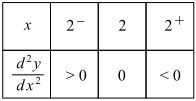
`text(When)\ \ x = 0,\ (d^2y)/(dx^2) > 0`

`:.\ text(MIN at)\ (0, 0)`
 

`text(When)\ \ x = 4,\ (d^2y)/(dx^2) < 0`

`:.\ text(MAX at)\ (4, 32)`


ii.  `text(P.I. occur when)\ \ (d^2y)/(dx^2) = 0,`

`12 – 6x` `= 0`
`x` `= 2`

 
`text(When)\ \ x = 2,\ y = 16`

 
`text(S)text(ince the concavity changes)`

`=>\ text(P.I. occurs at)\ \ (2, 16)`


iii.  

Filed Under: Curve Sketching (Y12), Curve Sketching and The Primitive Function Tagged With: Band 3, Band 4, smc-969-10-Cubic

Plane Geometry, 2UA 2018 HSC 12c

The diagram shows the square `ABCD`. The point `E` is chosen on `BC` and the point `F` is chosen on `CD` so that  `EC = FC`.
 

  1. Prove that `Delta ADF` is congruent to `Delta ABE`.   (2 marks)

    --- 4 WORK AREA LINES (style=lined) ---

  2. The side length of the square is 14 cm and `EC` has length 4 cm. Find the area of  `AECF`.   (2 marks)

    --- 4 WORK AREA LINES (style=lined) ---

Show Answers Only
  1. `text(Proof)\ \ text{(See Worked Solutions)}`
  2. `56\ text(cm)^2`
Show Worked Solution

i.    `AB = AD\ \ text{(sides of a square)}`

`DF = DC-CF`

`BE = BC-CE`

`text{Since}\ CE = CF\ \ text{(given), and}\ DC = BC\ \ text{(sides of a square)}`

`=> DF = BE`

`=> /_ ADF = /_ ABE = 90^@`

`:. Delta ADF \equiv Delta ABE\ \ text{(SAS)}`


ii.   `text(Area of)\ Delta ABE` `= 1/2 xx 14 xx 10`
    `= 70\ text(cm)^2`

 
`:.\ text(Area of)\ AECF`

`= text(Area of)\ ABCD-(2 xx 70)`

`= (14 xx 14)-140`

`= 56\ text(cm)^2`

Filed Under: 2. Plane Geometry, Congruency Tagged With: Band 4, num-title-ct-pathc, num-title-qs-hsc, smc-4747-20-SAS

Calculus, 2ADV C3 2018 HSC 12b

Find the equation of the tangent to the curve  `y = cos 2x`  at  `x = pi/6`.  (3 marks)

--- 6 WORK AREA LINES (style=lined) ---

Show Answers Only

`y = -sqrt 3 x + (sqrt 3 pi + 3)/6`

Show Worked Solution
`y` `= cos 2x`
`(dy)/(dx)` `= -2 sin 2x`

 
`text(When)\ \ x = pi/6:`

`y` `= cos  pi/3 = 1/2`
`(dy)/(dx)` `= -sin  pi/3 = -sqrt 3`

 
`text(Equation of tangent)\ \ m = -sqrt 3,\ text(through)\ (pi/6, 1/2):`

`y – y_1` `= m(x – x_1)`
`y – 1/2` `= -sqrt 3 (x – pi/6)`
`y` `= -sqrt 3 x + (sqrt 3 pi)/6 + 1/2`
`:. y` `= -sqrt 3 x + (sqrt 3 pi + 3)/6`

Filed Under: Tangents (Y12), Tangents and Normals Tagged With: Band 4, smc-1090-30-Trig Function, smc-1090-40-Find tangent given curve

Probability, 2UG 2018 HSC 30d

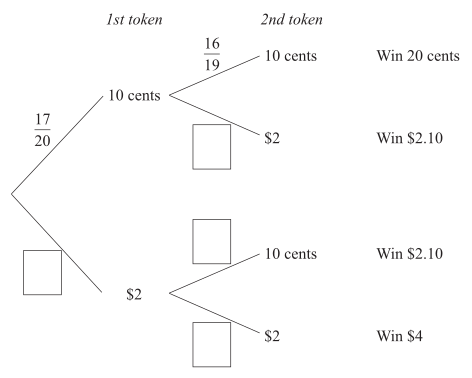
A game consists of two tokens being drawn at random from a barrel containing 20 tokens. There are 17 tokens labelled 10 cents and 3 tokens labelled $2. The player wins the total value of the two tokens drawn.

  1. Complete the probability tree by writing the missing probabilities in the boxes.  (2 marks)


  2. Considering that the game costs $1 to play, calculate the financial expectation of the game.  (3 marks)
Show Answers Only
  1.  
  2. `−$0.23\ \ (text(or $0.23 loss))`
Show Worked Solution
i.   


ii.   `text(Expectated Gain/Loss)`

♦♦ Mean mark part (ii) 27%.
COMMENT: Financial expectation included here (one example only in database) as it is possible to argue that it is an application of expectation.

`= [17/20 xx 16/19 xx 0.20 + 17/20 xx 3/19 xx 2.1`

`+ 3/20 + 17/19 xx 2.1 + 3/20 xx 2/19 xx 4] – 1`

`= 0.77 – 1`

`= −$0.23\ \ (text(or $0.23 loss))`

Filed Under: Uncategorized Tagged With: Band 4, Band 5

Financial Maths, STD2 F1 2018 HSC 30b

Last year, Luke’s taxable income was `$87\ 000` and the tax payable on this income was `$19\ 822`. This year, Luke’s taxable income has increased by `$16\ 800`.

  1. Use the table to calculate the tax payable by Luke this year.  (2 marks)
     

    --- 4 WORK AREA LINES (style=lined) ---

  2. How much extra money will Luke have this year, after paying tax, as a result of the increase in his taxable income? Ignore the Medicare levy.  (2 marks)

    --- 4 WORK AREA LINES (style=lined) ---

Show Answers Only
  1. `$26\ 038`
  2. `$10\ 584`
Show Worked Solution

a.    `text(Taxable income) = 87\ 000 + 16\ 800 = $103\ 800`

`:.\ text(Tax payable)` `= 19\ 822 + 0.37 (103\ 800-87\ 000)`
  `= $26\ 038`


b.    `text(Net income from last year)`

`= 87\ 000-19\ 822`

`= $67\ 178`
 

`text(Net income in current year)`

`= 103\ 800-26\ 038`

`= $77\ 762`
 

`:.\ text(Extra money)` `= 77\ 762-67\ 178`
  `= $10\ 584`

Filed Under: Earning and Spending Money, Tax and Percentage Increase/Decrease (Std 1), Tax and Percentage Increase/Decrease (Std 2), Taxation (Std1-2027), Taxation (Std2-2027) Tagged With: Band 4, num-title-ct-corea, num-title-qs-hsc, smc-1125-10-Tax Tables, smc-4331-50-Tax tables, smc-6277-10-Tax Tables, smc-6516-10-Tax Tables, smc-831-10-Tax Tables

Functions, 2ADV F1 2018 HSC 11c

Simplify  `(8x^3 - 27y^3)/(2x - 3y)`.  (2 marks)

Show Answers Only

`4x^2 + 6xy + 9y^2`

Show Worked Solution
`(8x^3 – 27y^3)/(2x – 3y)` `= ((2x)^3 – (3y)^3)/(2x – 3y)`
  `= ((2x – 3y)(4x^2 + 6xy + 9y^2))/(2x – 3y)`
  `= 4x^2 + 6xy + 9y^2`

Filed Under: Factors and Other Equations Tagged With: Band 4

Financial Maths, STD2 F4 2018 HSC 29e

Andrew borrowed $20 000 to be repaid in equal monthly repayments of $243 over 10 years. Having made this monthly repayment for 4 years, he increased his monthly repayment to $281. As a result, Andrew paid off the loan one year earlier.

How much less did he repay altogether by making this change?  (2 marks)

--- 5 WORK AREA LINES (style=lined) ---

Show Answers Only

`$636`

Show Worked Solution
`text(Total original repayments)` `= 10 xx 12 xx 243`
  `= $29\ 160`
   
`text(Actual repayments)` `= 4 xx 12 xx 243\ +\ 5 xx 12 xx 281`
  `= $28\ 524`
   
`:.\ text(Savings)` `= 29\ 160 – 28\ 524`
  `= $636`

Filed Under: Loans (Std 1), Loans and Credit Cards (Std 2) Tagged With: Band 4, smc-1140-40-Total Loan/Interest Payments, smc-814-40-Total Loan/Interest Payments

Measurement, STD2 M2 2018 HSC 29a

The time in Brisbane is 4.5 hours ahead of the time in New Delhi. John flew from New Delhi to Brisbane via Singapore. His plane left New Delhi at 11.30 am (New Delhi time), stopped for 3 hours in Singapore, and arrived in Brisbane at 9.00 am the following day (Brisbane time).

What was the plane’s total flying time?  (3 marks)

Show Answers Only

`14\ text(hours)`

Show Worked Solution

`text(11:30 am in New Delhi = 4 pm in Brisbane)`

`text(Total travel time)` `= 4\ text{pm → 9 am (next day)}`
  `= 17\ text(hours)`


`:.\ text(Flying time)` `= 17-3`
  `= 14\ text(hours)`

Filed Under: M2 Working with Time (Y11), M2 Working with Time (Y11), Time and Time Difference (Std1-2027), Time and Time Difference (Std2-2027) Tagged With: Band 4, smc-1102-10-Time Differences, smc-6306-10-Time Differences, smc-6525-10-Time Differences, smc-776-10-Time Differences

Measurement, STD2 M7 2018 HSC 28c

Every day, a 1200-watt microwave oven is used for 45 minutes at 40% power. Electricity is charged at $0.25 per kWh.

What is the cost of running this microwave oven for 180 days?  (3 marks)

--- 6 WORK AREA LINES (style=lined) ---

Show Answers Only

`$16.20`

Show Worked Solution
`text(Daily usage)` `= 1200 xx 45/60 xx 40text(%)`
  `= 360\ text(watts)`


`text(180 day usage)` `= 180 xx 360`
  `= 64\ 800\ text(watts)`
  `= 64.8\ text(kW)`


`:.\ text(C)text(ost over 180 days)` `= 64.8 xx 0.25`
  `= $16.20`

Filed Under: Energy and Mass (Std 2), M4 Rates (Y12), Rates (Std2) Tagged With: Band 4, smc-1104-25-Energy, smc-799-20-Electricity, smc-805-20-Energy

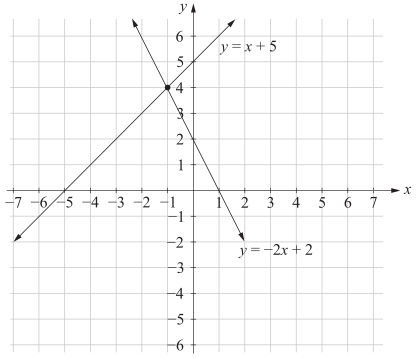
Algebra, STD2 A4 SM-Bank 5

`y` `= x + 5`
`y + 2x` `= 2`

 
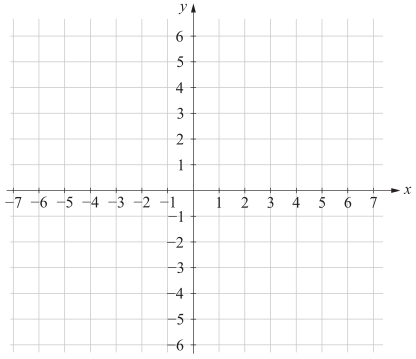
Draw these two linear graphs on the number plane below and determine their intersection.  (3 marks)


--- 2 WORK AREA LINES (style=lined) ---

 
Show Answers Only

`(−1,4)`

Show Worked Solution

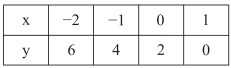
`text(Table of coordinates:)\ \ y = x + 5`

 
`text(Table of coordinates:)\ \ y + 2x = 2 \ => \ y = −2x + 2`

 
`text{From graph (and table), intersection occurs}`

`text(at)\ \ (−1,4).`

Filed Under: A3 Types of Relationships (Y12), Simultaneous Equations and Applications (Std 2) Tagged With: Band 4, smc-1099-30-Find intersection, smc-1099-40-Sketch equations, smc-794-20-Find Intersection, smc-794-30-Sketch Linear Equations

Functions, 2ADV F1 2018 HSC 4 MC

The line  `3x-4y + 3 = 0`  is a tangent to a circle with centre (3, – 2).

What is the equation of the circle?

  1. `(x + 3)^2 + (y-2)^2 = 4`
  2. `(x-3)^2 + (y + 2)^2 = 4`
  3. `(x + 3)^2 + (y-2)^2 = 16`
  4. `(x-3)^2 + (y + 2)^2 = 16`
Show Answers Only

`D`

Show Worked Solution

`text(Radius) = _|_\ text{distance of  (3, −2)  from}\ \ 3x-4y + 3 = 0`

`_|_\ text(dist)` `= |(ax_1 + by_1 + c)/sqrt(a^2 + b^2)|`
  `= |(3(3)-4(-2) + 3)/sqrt(3^2 + (-4)^2)|`
  `= |(9 + 8 + 3)/sqrt 25|`
  `= 4`

 
`text{Equation of circle, centre (3, –2) with radius 4}`

`(x-3)^2 + (y + 2)^2 = 16`

`=>  D`

Filed Under: 4. Real Functions Tagged With: Band 4

Statistics, STD2 S5 2018 HSC 27e

Joanna sits a Physics test and a Biology test.

  1. Joanna’s mark in the Physics test is 70. The mean mark for this test is 58 and the standard deviation is 8.


    Calculate the `z`-score for Joanna’s mark in this test.  (1 mark)

    --- 2 WORK AREA LINES (style=lined) ---

  2. In the Biology test, the mean mark is 64 and the standard deviation is 10.


    Joanna’s `z`-score is the same in both the Physics test and the Biology test.


    What is her mark in the Biology test?  (2 marks)

    --- 4 WORK AREA LINES (style=lined) ---

Show Answers Only
  1. `1.5`
  2. `79`
Show Worked Solution

i.   `x = 70, \ mu = 58, \ sigma = 8`

`:. ztext(-score)` `= (x – mu)/sigma`
  `= (70 – 58)/8`
  `= 1.5`


ii.    `1.5` `= (x – 64)/10`
  `x – 64` `= 15`
  `:. x` `= 79`

Filed Under: Normal Distribution (Y12), S5 The Normal Distribution (Y12) Tagged With: Band 3, Band 4, common-content, smc-819-10-Single z-score, smc-819-30-Comparisons of Data Sets, smc-995-10-Single z-score, smc-995-30-Comparisons of Data Sets

  • « Previous Page
  • 1
  • …
  • 80
  • 81
  • 82
  • 83
  • 84
  • …
  • 114
  • Next Page »

Copyright © 2014–2025 SmarterEd.com.au · Log in