SmarterEd

Aussie Maths & Science Teachers: Save your time with SmarterEd

  • Login
  • Get Help
  • About

Geometry, NAP-D3-NC02

Which of these 3D objects has exactly 5 faces?


Show Answers Only

Show Worked Solution

Filed Under: 2D-3D Shapes Tagged With: Band 4, smc-673-60-Number of faces/edges

Statistics, NAP-D3-NC01

This graph shows the number of lottery tickets sold by a newsagent on each day of a given week.

On which days did the newsagent sell 23 lottery tickets?

Tuesday Wednesday Thursday Friday


Show Answers Only

`text(Thursday)`

Show Worked Solution

`text(Thursday)`

Filed Under: Data and Interpretation, Data and Statistics (7) Tagged With: Band 4, smc-3166-12-Bar charts, smc-674-12-Bar charts

Algebra, NAP-B3-NC01

`4.25,\ 4.0,\ 3.75,\ 3.5,\ 3.25,\ …`

What is the rule to continue this decimal number pattern?

 
`text(increase by 0.5)`
 
`text(increase by 0.25)`
 
`text(decrease by 0.5)`
 
`text(decrease by 0.25)`
Show Answers Only

`text(decrease by 0.25)`

Show Worked Solution

`text(decrease by 0.25)`

Filed Under: Patterns and The Number Plane Tagged With: Band 4, smc-664-10-Patterns and numbers

Measurement, NAP-E3-NC03

Richard started his jog at 1:25. He finished at 2:08.

How long did Richard jog for?

`text(35 minutes)` `text(43 minutes)` `text(73 minutes)` `text(83 minutes)`


Show Answers Only

`text(43 minutes)`

Show Worked Solution

`text(43 minutes)`

Filed Under: Time Tagged With: Band 4, smc-903-10-Time intervals

Number, NAP-E3-NC02

Which number sentence is correct when 7 is placed in the box?

`17 + `
 
`= 10`
 
 `- 8 = 1` `10 -`
 
`= 3` `12 + 5 =` 


Show Answers Only

`10 – 7 = 3`

Show Worked Solution

`10 – 7 = 3`

Filed Under: Basic Concepts and Calculations, Basic Concepts and Calculations Tagged With: Band 4, smc-3143-20-Basic operators, smc-676-20-Basic operators

Measurement, NAP-G3-CA03

What time is shown on the clock?
 

`4:08` `4:42` `8:21` `9:21`


Show Answers Only

`8:21`

Show Worked Solution

`8:21`

Filed Under: Time, Time Tagged With: Band 4, smc-3154-50-Reading 12/24 hr time, smc-903-50-Reading 12/24 hr time

Number, NAP-G3-CA01

In Australia, 288 701 children were enrolled in kindergarten in 2013.

Of these children, 150 125 were boys.

How many girls were enrolled in kindergarten in 2013?

`122\ 896` `138\ 576` `288\ 701` `438\ 826`


Show Answers Only

`138\ 576`

Show Worked Solution

`text(Number of girls) = 288\ 701  – 150\ 125 = 138\ 576`

Filed Under: Basic Concepts and Calculations Tagged With: Band 4, smc-676-20-Basic operators

Number, NAP-F4-CA01

A return trip from Brodie's house to the beach is 5.78 kilometres. 

How far does Brodie travel if he does this 14 times?

`8.09\ text(km)` `23.12\ text(km)` `42.12\ text(km)` `69.36\ text(km)` `80.92\ text(km)`


Show Answers Only

`80.92\ text(km)`

Show Worked Solution
`text(Distance)` `= 14 xx 5.78`
  `= 80.92\ text(km)`

Filed Under: Basic Concepts and Calculations Tagged With: Band 4, smc-3143-20-Basic operators

Number, NAP-G4-CA01

In Africa, a national park estimated the population of flamingos was 183 409 in 2021.

Of these, 87 396 were male.

How many female flamingos were there?

`96\ 013` `123\ 586` `212\ 786` `270\ 805`


Show Answers Only

`96\ 013`

Show Worked Solution

`text(Number of females) = 183\ 409  – 87\ 396 = 96\ 013`

Filed Under: Basic Concepts and Calculations Tagged With: Band 4, smc-3143-20-Basic operators

Number, NAP-I4-CA01

Byron earns $16 per hour.

How much will he be paid for working 8 hours?

`$2` `$32` `$128` `$216`


Show Answers Only

`$128`

Show Worked Solution
`text(Pay)` `= 8 xx 16`
  `= $128`

Filed Under: Financial Maths Tagged With: Band 4, smc-3144-20-Wages, smc-3174-20-Wages, smc-892-20-Wages

Quadratic, EXT1 2016 HSC 14c

The point  `T(2at,at^2)` lies on the parabola `P_1` with the equation  `x^2=4ay`.

The tangent to the parabola `P_1` at `T` meets the directrix at `D`.

The normal to the parabola `P_1` at `T` meets the vertical line through `D` at the point `R`, as shown in the diagram.


ext1-2016-hsc-q14

  1. Show that the point `D` has coordinates `(at - a/t, −a)`.  (1 mark)
  2. Show that the locus of `R` lies on another parabola `P_2`.  (3 marks)
  3. State the focal length of the parabola `P_2`.  (1 mark)

It can be shown that the minimum distance between `R` and `T` occurs when the normal to `P_1` at `T` is also the normal to `P_2` at `R`.  (Do NOT prove this.)

  1. Find the values of `t` so that the distance between `R` and `T` is a minimum.  (2 marks)
Show Answers Only
  1. `text(Proof)\ \ text{(See Worked Solutions)}`
  2. `text(Proof)\ \ text{(See Worked Solutions)}`
  3. `a/4`
  4. `+- sqrt 2`
Show Worked Solution

i.     `text(Show)\ \ D (text{at}\ -a/t, -a)`

`text(T)text(angent equation at)\ \ T:`

`y = tx – at^2`

`D\ \ text(occurs when)\ \ y = -a,`

`tx – at^2` `= -a`
`tx` `= at^2 – a`
`x` `= at – a/t`

`:. D\ text(has coordinates)\ \ (text{at}\ -a/t, -a)`


ii.    `text(Normal equation at)\ \ T:`

♦♦ Mean mark 32%.
MARKER’S COMMENT: Normal equation is found in the Reference Sheet. Save time by using it!

`x + ty = 2at + at^3`

`R\ text(occurs when)\ \ x = at – a/t`

`at – a/t + ty` `= 2at + at^3`
`ty` `= at + a/t + at^3`
`y` `= a + a/t^2 + at^2`
  `= a(1 + 1/t^2 + t^2)\ \ …\ text{(*)}`


`:. R (a (t – 1/t), a (1 + 1/t^2 + t^2))`

`x^2` `= a^2 (t – 1/t)^2`
  `= a^2 (t^2 – 2 + 1/t^2)`
  `= a + (1+1/t^2 + t^2 – 3)`
  `= a^2 (y/a – 3)\ \ text{(see (*) above)}`
  `= ay – 3a^2`


`:.\ text(Locus of)\ R\ text(is)\ \ x^2 = ay – 3a^2`


iii.   `text(In the form)\ \ x^2 = 4ay,`

♦♦♦ Mean mark 15%.
`x^2` `= a(y – 3a)`
  `= 4 · a/4 (y – 3a)`


`:.\ text(Focal length) = a/4`


iv.   `text(Equation of)\ \ P_2`

♦♦♦ Mean mark 11%.
`x^2` `= ay – 3a^2`
`y` `= x^2/a + 3a`
`y prime` `= (2x)/a`

`text(At)\ \ R,\ \ x = a (t – 1/t)`

`:.\ text(Gradient of normal at)\ \ R`

`=(-a)/(2x)`

`= (-a)/(2a(t – 1/t)) xx t/t`

`= (-t)/(2(t^2 – 1))`


`text(Gradient of normal at)\ \ T:`

`x + ty` `= 2at + at^3`
`y` `= -1/t x + 2a + at^2`
`:. m` `= -1/t`


`text(Distance)\ \ RT\ \ text(is a minimum when)`

`(-t)/(2(t^2 – 1))` `= -1/t`
`t^2` `= 2t^2 – 2`
`t^2` `= 2`
`:. t` `= +- sqrt 2`

Filed Under: 9. Quadratics and the Parabola EXT1 Tagged With: Band 4, Band 5, Band 6

Binomial, EXT1 2016 HSC 14b

Consider the expansion of  `(1 + x)^n`, where `n` is a positive integer.

  1. Show that  `2^n = ((n),(0)) + ((n),(1)) + ((n),(2)) + ((n),(3)) + … + ((n),(n))`.  (1 mark)
  2. Show that  `n2^(n - 1) = ((n),(1)) + 2((n),(2)) + 3((n),(3)) + … + n((n),(n))`.  (1 mark)
  3. Hence, or otherwise, show that  `sum_(r = 1)^n ((n),(r))(2r - n) = n`.  (2 marks)
Show Answers Only
  1. `text(Proof)\ \ text[(See Worked Solutions)}`
  2. `text(Proof)\ \ text[(See Worked Solutions)}`
  3. `text(Proof)\ \ text[(See Worked Solutions)}`
Show Worked Solution

i.     `text(Show)`

`2^n = ((n),(0)) + ((n),(1)) + ((n),(2)) + ((n),(3)) + … + ((n),(n))`

`text(Using binomial expansion)`

`(1 + x)^n = ((n), (0)) + ((n), (1))x + ((n),(2)) x^2 + … + ((n), (n)) x^n`

`text(Let)\ \ x = 1,`

`2^n = ((n), (0)) + ((n), (1)) + ((n), (2)) + … + ((n), (n))`

`text(… as required.)`


ii.   `text(Differentiate both sides of expansion,)`

`n (1 + x)^(n – 1) = ((n), (1)) + 2 ((n), (2))x + 3 ((n), (3)) x^2 + … + n ((n), (n)) x^(n – 1)`

`text(Let)\ \ x = 1,`

`n2^(n – 1) = ((n), (1)) + 2 ((n), (2)) + 3 ((n), (3)) + … + n ((n), (n))`

`text(… as required.)`


iii.  `text{Multiply part (i)} xx n`

♦♦♦ Mean mark 14%.
`n2^n` `= n[((n), (0)) + ((n), (1)) + … + ((n), (n))]`
  `= sum_(r = 0)^n ((n), (r)) n\ \ text{…  (1)}`


`text{Multiply part (ii)} xx 2`

`2 xx n2^(n – 1)` `= 2[((n), (1)) + 2 ((n), (2)) + … + n ((n), (n))]`
`n2^n` `= sum_(r = 1)^n ((n), (r)) 2r\ \ text{…  (2)}`


 `text(Subtract) qquad (2) – (1)`

`sum_(r = 1)^n ((n), (r)) 2r – sum_(r = 0)^n ((n), (r))n` `= n2^n – n2^n`
`sum_(r = 1)^n ((n), (r)) 2r – sum_(r = 1)^n ((n), (r)) n – n` `= 0`
`sum_(r = 1)^n ((n), (r)) (2r – n)` `= n\ \ text(…  as required)`

Filed Under: 17. Binomial EXT1 Tagged With: Band 3, Band 4, Band 6

Proof, EXT1 P1 2016 HSC 14a

  1. Show that  `4n^3 + 18n^2 + 23n + 9`  can be written as
  2. `qquad (n + 1)(4n^2 + 14n + 9)`.   (1 marks)

    --- 2 WORK AREA LINES (style=lined) ---

  3. Using the result in part (i), or otherwise, prove by mathematical induction that, for  `n >= 1`,
  4. `qquad 1 × 3 + 3 × 5 + 5 × 7 + … + (2n-1)(2n + 1) = 1/3 n(4n^2 + 6n-1)`.   (3 marks)

    --- 14 WORK AREA LINES (style=lined) ---

Show Answers Only

i.    `text(Proof)\ \ text{(See Worked Solutions)}`

ii.   `text(Proof)\ \ text{(See Worked Solutions)}`

Show Worked Solution
i.   `text(RHS)` `= (n + 1) (4n^2 + 14n + 9)`
    `= 4n^3 + 14n^2 + 9n + 4n^2 + 14n + 9`
    `= 4n^3 + 18n^2 + 23n + 9`


ii.   `text(Prove)\ \ 1 xx 3 + 3 xx 5 + 5 xx 7 + … + (2n-1) (2n + 1)`

`= 1/3n (4n^2 + 6n-1)`

`text(If)\ \ n = 1,`

`text(LHS) = (1) (3) = 3`

`text(RHS) = 1/3 (1) (4 + 6-1) = 3`

`:.\ text(True for)\ \ n = 1`


`text(Assume true for)\ \ n = k`

`text(i.e.)\ \ 1 xx 3 + 3 xx 5 + … + (2k-1) (2k + 1)`

`= 1/3 k (4k^2 + 6k-1)`

`text(Prove true for)\ \ n = k + 1`

`text(i.e.)\ \ 1 xx 3 + … + (2k + 1) (2k + 3)`

`= 1/3 (k + 1) [4 (k + 1)^2 + 6(k + 1)-1]`

`= 1/3 (k + 1) (4k^2 + 14k + 9)`

`= 1/3 (4k^3 + 18k^2 + 23k + 9)`


`text(LHS)` `= 1 xx 3 + … + (2k-1) (2k + 1) + (2k + 1) (2k + 3)`
  `= 1/3k (4k^2 + 6k-1) + (2k + 1) (2k + 3)`
  `= 1/3 (4k^3 + 6k^2-k) + (4k^2 + 8k + 3)`
  `= 1/3 (4k^3 + 6k^2-k + 12k^2 + 24k + 9)`
  `= 1/3 (4k^3 + 18k^2 + 23k + 9)`
  `=\ text(RHS …)`


`=> text(True for)\ \ n = k + 1`

`:.\ text(S) text(ince true for)\ \ n = 1,\ text(by PMI, true for integral)\ \ n >= 1.`

Filed Under: 7. Induction and Other Series EXT1, P1 Induction (Y12) Tagged With: Band 3, Band 4, smc-1019-20-Sum of a Series

Plane Geometry, EXT1 2016 HSC 13c

The circle centred at `O` has a diameter `AB`. From the point `M` outside the circle the line segments `MA` and `MB` are drawn meeting the circle at `C` and `D` respectively, as shown in the diagram. The chords `AD` and `BC` meet at `E`. The line segment `ME` produced meets the diameter `AB` at `F`.

ext1-2016-hsc-q13_1

Copy or trace the diagram into your writing booklet.

  1. Show that `CMDE` is a cyclic quadrilateral.  (2 marks)
  2. Hence, or otherwise, prove that `MF` is perpendicular to `AB`.  (2 marks)
Show Answers Only
  1. `text(Proof)\ \ text{(See Worked Solutions)}`
  2. `text(Proof)\ \ text{(See Worked Solutions)}`
Show Worked Solution
i.  
`/_ ACB` `= /_ ADB = 90^@ qquad text{(angle in semi-circle)}`
`/_ MCE` `= 90^@ qquad (/_ MCA\ text{is a straight angle)}`
`/_ MDA` `= 90^@ qquad (/_ MDB\ text{is a straight angle)}`

 
`:. CMDE\ text(is a cyclic quad)`

`qquad text{(opposite angles are supplementary)}`
 

ii.   `text(Consider)\ \ Delta MAB,`

♦♦♦ Mean mark 14%.

`CB\ \ text(is an altitude.)`

`AD\ \ text(is an altitude.)`

`text(S) text(ince the altitudes of a triangle are)`

`text(concurrent)\ \ text{(in}\ Delta MAB, text{at}\ Etext{),}`

`=> MF\ \ text(must be an altitude.)`

`:. MF _|_ AB`

Filed Under: 2. Plane Geometry EXT1 Tagged With: Band 4, Band 6, page-break-before-solution

Mechanics, EXT2* M1 2016 HSC 13b

The trajectory of a projectile fired with speed  `u\ text(ms)^-1`  at an angle  `theta`  to the horizontal is represented by the parametric equations

`x = utcostheta`   and   `y = utsintheta - 5t^2`,

where `t` is the time in seconds.

  1. Prove that the greatest height reached by the projectile is  `(u^2 sin^2 theta)/20`.  (2 marks)

    --- 5 WORK AREA LINES (style=lined) ---

A ball is thrown from a point `20\ text(m)` above the horizontal ground. It is thrown with speed `30\ text(ms)^-1` at an angle of `30^@` to the horizontal. At its highest point the ball hits a wall, as shown in the diagram.
 

     ext1-2016-hsc-q13
 

  1. Show that the ball hits the wall at a height of `125/4\ text(m)` above the ground.  (2 marks)

    --- 4 WORK AREA LINES (style=lined) ---

The ball then rebounds horizontally from the wall with speed `10\ text(ms)^-1`. You may assume that the acceleration due to gravity is `10\ text(ms)^-2`.

  1. How long does it take the ball to reach the ground after it rebounds from the wall?  (2 marks)

    --- 6 WORK AREA LINES (style=lined) ---

  2. How far from the wall is the ball when it hits the ground?  (1 mark)

    --- 2 WORK AREA LINES (style=lined) ---

Show Answers Only
  1. `text(Proof)\ \ text{(See Worked Solutions)}`
  2. `text(Proof)\ \ text{(See Worked Solutions)}`
  3. `2.5\ text(seconds)`
  4. `25\ text(m)`
Show Worked Solution
i.    `y` `= u t sin theta – 5t^2`
  `y prime` `= u sin theta – 10t`


`text(Maximum height when)\ \ y prime = 0`

`10 t` `= u sin theta`
`t` `= (u sin theta)/10`


`:.\ text(Maximum height)`

`= u ((u sin theta)/10) · sin theta – 5 ((u sin theta)/10)^2`

`= (u^2 sin^2 theta)/10 – (u^2 sin^2 theta)/20`

`= (u^2 sin^2 theta)/20\ text(… as required)`


ii.   `text{Using part (i)},`

`text(Height that ball hits wall)`

`= (30^2 · (sin 30)^2)/20 + 20`

`= (30^2 · (1/2)^2)/20 + 20`

`= 11 1/4 + 20`

`= 125/4\ text(m … as required)`


♦♦ Mean mark part (iii) 35%.
iii.   ext1-hsc-2016-13bi
`y ″` `= -10`
`y prime` `= -10 t`
`y` `= 125/4 – 5t^2`


`text(Ball hits ground when)\ \ y = 0,`

MARKER’S COMMENT: Many students struggled to solve: `5t^2=125/4`.
`5t^2` `= 125/4`
`t^2` `= 25/4`
`:. t` `= 5/2,\ \ t > 0`


`:.\ text(It takes the ball 2.5 seconds to hit the ground.)`


iv.   `text(Distance from wall)`

♦ Mean mark 43%.

`= 2.5 xx 10`

`= 25\ text(m)`

Filed Under: Projectile Motion, Projectile Motion EXT1 Tagged With: Band 3, Band 4, Band 5, smc-1062-10-Range/Time of Flight, smc-1062-20-Max Height, smc-1062-95-Hit Wall

Mechanics, EXT2* M1 2016 HSC 13a

The tide can be modelled using simple harmonic motion.

At a particular location, the high tide is 9 metres and the low tide is 1 metre.

At this location the tide completes 2 full periods every 25 hours.

Let `t` be the time in hours after the first high tide today.

  1. Explain why the tide can be modelled by the function  `x = 5 + 4cos ((4pi)/25 t)`.  (2 marks)

    --- 6 WORK AREA LINES (style=lined) ---

  2. The first high tide tomorrow is at 2 am.


    What is the earliest time tomorrow at which the tide is increasing at the fastest rate?  (2 marks)

    --- 5 WORK AREA LINES (style=lined) ---

Show Answers Only
  1. `text(See Worked Solutions)`
  2. `11:22:30\ text(am)`
Show Worked Solution
i.    `text(High tide)` `= 9\ text(m)`
  `text(Low tide)` `= 1\ text(m)`

 
`:. A = (9 – 1)/2 = 4\ text(m)`

`T = 25/2`

`:. (2 pi)/n` `= 25/2`
`n` `= (4 pi)/25`


`text(Centre of motion) = 5`


`text(S) text(ince high tide occurs at)\ \ t = 0,`

`x` `= 5 + 4 cos (nt)`
  `= 5 + 4 cos ((4 pi)/25 t)`


ii.   `x = 5 + 4 cos ((4 pi)/25 t)`

`(dx)/(dt)` `= -4 · (4 pi)/25 *sin ((4 pi)/25 t)`
  `= -(16 pi)/25 *sin ((4 pi)/25 t)`


`text(Tide increases at maximum rate)`

`text(when)\ \ sin ((4 pi)/25 t) = -1,`

`:. (4 pi)/25 t` `= (3 pi)/2`
  `= 75/8`
  `= 9\ text(hours 22.5 minutes)`


`:.\ text(Earliest time is)\ 11:22:30\ text(am)`

Filed Under: Simple Harmonic Motion, Simple Harmonic Motion EXT1 Tagged With: Band 4, Band 5, smc-1059-20-Prove/Identify SHM, smc-1059-31-Max Speed, smc-1059-50-Real World examples

Polynomials, EXT1 2016 HSC 12c

The graphs of  `y = tan x`  and  `y = cos x`  meet at the point where  `x = α`, as shown.

ext1-2016-hsc-q12_1

  1. Show that the tangents to the curves at  `x = α`  are perpendicular.  (2 marks)
  2. Use one application of Newton’s method with  `x_1 = 1`  to find an approximate value for `α`. Give your answer correct to two decimal places.  (2 marks)
Show Answers Only
  1. `text(Proof)\ \ text{(See Worked Solutions)}`
  2. `0.76\ text{(2 d.p.)}`
Show Worked Solution
i.   `text(Let)\ \ \ y_1` `= tan x`
  `(dy_1)/(dx)` `= sec^2 x`

`text(At)\ \ x = alpha,`

`m_1 = sec^2 alpha`


`text(Let)\ \ \ y_2` `= cos x`
`(dy_2)/(dx)` `= -sin x`
`m_2` `= -sin alpha`


`text(Intersection occurs when:)`

`tan alpha` `= cos alpha`
`(sin alpha)/(cos alpha)` `= cos alpha`
`:. sin alpha` `= cos^2 alpha`


`m_1 m_2` `= sec^2 alpha · -sin alpha`
  `= 1/(cos^2 alpha) · -sin alpha`
  `= -(sin alpha)/(sin alpha)`
  `= -1`


`:.\ text(T)text(angents at)\ \ x = alpha\ \ text(are perpendicular)`


ii.   `f(x)` `= tan x – cos x`
  `f prime (x)` `= sec^2 x + sin x`


`text(Let)\ \ x_1 = 1,`

`alpha` `~~ x_1 – (f(1))/(f prime (1))`
  `~~ 1 – (tan 1 – cos 1)/(1/(cos^2 1) + sin 1)`
  `~~ 1 – 0.238…`
  `~~ 0.761…`
  `~~ 0.76\ \ text{(2 d.p.)}`

Filed Under: 10. Geometrical Applications of Calculus EXT1, Newton's Method etc... EXT1 Tagged With: Band 4

Calculus, EXT1 C1 2016 HSC 12b

In a chemical reaction, a compound `X` is formed from a compound `Y`. The mass in grams of `X` and `Y` are `x(t)` and `y(t)` respectively, where `t` is the time in seconds after the start of the chemical reaction.

Throughout the reaction the sum of the two masses is 500 g. At any time `t`, the rate at which the mass of compound `X` is increasing is proportional to the mass of compound `Y`.

At the start of the chemical reaction, `x = 0`  and  `(dx)/(dt) = 2`.

  1.  Show that  `(dx)/(dt) = 0.004(500 - x)`.  (3 marks)

    --- 6 WORK AREA LINES (style=lined) ---

  2.  Show that  ` x = 500 - Ae^(−0.004t)`  satisfies the equation in part (i), and find the value of `A`.  (2 marks)

    --- 6 WORK AREA LINES (style=lined) ---

Show Answers Only
  1. `text(Proof)\ \ text{(See Worked Solutions)}`
  2. `text(Proof)\ \ text{(See Worked Solutions)}`
Show Worked Solution

i.   `x + y = 500\ \ text{(given)}`

♦ Mean mark (part i) 43%.

`(dx)/(dt)` `= ky`
  `= k(500 – x)`

 
`text(When)\ \ t = 0,\ \ x = 0,\ \ (dx)/(dt) = 2`

`2` `= k (500 – 0)`
`:. k` `= 0.004`

 
`:. (dx)/(dt) = 0.004 (500 – x)\ text(… as required)`


ii.    `x` `= 500 – Ae^(-0.004t)`
  `Ae^(-0.004t)` `= 500 – x`


`(dx)/(dt)` `= 0.004 Ae^(-0.004t)`
  `= 0.004 (500 – x)`

 
`text(When)\ \ t = 0,\ \ x = 0,`

`0` `= 500 – Ae^0`
`:. A` `= 500`

Filed Under: Exponential Growth and Decay EXT1, Modified Growth and Decay Tagged With: Band 4, Band 5, smc-1080-20-Other

Calculus, EXT1 C1 2016 HSC 12a

The diagram shows a conical soap dispenser of radius 5 cm and height 20 cm.
 

     ext1-2016-hsc-q12
 

At any time `t` seconds, the top surface of the soap in the container is a circle of radius `r` cm and its height is `h` cm.

The volume of the soap is given by  `v = 1/3 pir^2h`.

  1.  Explain why  `r = h/4`.  (1 mark)

    --- 8 WORK AREA LINES (style=lined) ---

  2.  Show that  `(dv)/(dh) = pi/16 h^2`.  (1 mark)

    --- 5 WORK AREA LINES (style=lined) ---

The dispenser has a leak which causes soap to drip from the container. The area of the circle formed by the top surface of the soap is decreasing at a constant rate of  `0.04\ text(cm² s)^-1`.
 

  1.  Show that  `(dh)/(dt) = (−0.32)/(pih)`.  (2 marks)

    --- 6 WORK AREA LINES (style=lined) ---

  2.  What is the rate of change of the volume of the soap, with respect to time, when `h = 10`?  (2 marks)

    --- 5 WORK AREA LINES (style=lined) ---

Show Answers Only
  1. `text(Proof)\ \ text{(See Worked Solutions)}`
  2. `text(Proof)\ \ text{(See Worked Solutions)}`
  3. `text(Proof)\ \ text{(See Worked Solutions)}`
  4. `-0.2\ text(cm³ s)^-1`
Show Worked Solution
i.   ext1-hsc-2016-12a

`text(Using similar triangles,)`

`r/h` `= 5/20`
 `:. r` `= h/4\ text(… as required)`


ii.   `v` `= 1/3 pi r^2 h`
    `= 1/3 pi · (h/4)^2 h`
    `= (pi h^3)/48`
  `:. (dv)/(dh)` `= 3 xx (pi h^2)/48`
    `= (pi h^2)/16\ text(… as required.)`


iii.   `(dA)/(dt)` `= -0.04\ text(cm² s)^-1`
  `A` `= pi r^2`
    `= (pi h^2)/16`
  `:. (dA)/(dh)` `= (pi h)/8`


`(dA)/(dt)` `= (dA)/(dh) xx (dh)/(dt)`
`-0.04` `= (pi h)/8 xx (dh)/(dt)`
`:. (dh)/(dt)` `= (-0.32)/(pi h)\ text(… as required.)`


iv.   `(dv)/(dt)` `= (dv)/(dh) · (dh)/(dt)`
    `= (pi h^2)/16 · (-0.32)/(pi h)`
    `= (-0.32 h)/16`


`text(When)\ \ h =10,`

`(dv)/(dt)` `= (-0.32 xx 10)/16`
  `= -0.2\ text(cm³ s)^-1`

Filed Under: Rates of Change EXT1, Related Rates of Change (Ext1) Tagged With: Band 3, Band 4, page-break-before-solution, smc-1079-10-Volume

Statistics, EXT1 S1 2016 HSC 11f

A darts player calculates that when she aims for the bullseye the probability of her hitting the bullseye is  `3/5`  with each throw.

  1. Find the probability that she hits the bullseye with exactly one of her first three throws.  (1 mark)

    --- 2 WORK AREA LINES (style=lined) ---

  2. Find the probability that she hits the bullseye with at least two of her first six throws.  (2 marks)

    --- 4 WORK AREA LINES (style=lined) ---

Show Answers Only
  1. `36/125`
  2. `2997/3125`
Show Worked Solution

i.   `P text{(exactly 1 bullseye)}`

`=\ ^3C_1 · (3/5)^1 (2/5)^2`

`= 3 · (3/5) · (4/25)`

`= 36/125`


ii.   `P text{(at least 2 from 6 throws)}`

`= 1 – [P(0) + P(1)]`

`= 1 – [(2/5)^6 + \ ^6C_1 · (3/5)^1· (2/5)^5]`

`= 1 – [128/3125]`

`= 2997/3125`

Filed Under: Binomial Probability (Ext1), Binomial Probability EXT1 Tagged With: Band 3, Band 4, smc-1084-20-Games of Chance

Functions, EXT1 F1 2016 HSC 11e

Solve  `3/(2x + 5) - x > 0`.  (3 marks)

--- 6 WORK AREA LINES (style=lined) ---

Show Answers Only

`x < -3,\ \ – 5/2 < x < 1/2`

Show Worked Solution

`3/(2x + 5) – x > 0`

`3 (2x + 5) > x (2x + 5)^2,\ \ x != – 5/2`

`3 (2x + 5)-x(2x+5)^2` `> 0`
`(2x + 5) [3- x(2x + 5)]` `> 0`
`(2x + 5) (-2x^2 – 5x + 3)` `> 0`
`(2x + 5) (1-2x) (x + 3)` `> 0`


ext1-hsc-2016-11ei

`x < -3,\ \ \ – 5/2 < x < 1/2`

Filed Under: 1. Basic Arithmetic and Algebra EXT1, Inequalities (Ext1-2027), Inequalities (Ext1) Tagged With: Band 4, smc-1033-10-Algebraic Fractions, smc-6643-10-Algebraic Fractions

Calculus, EXT1 C2 2016 HSC 11c

Differentiate  `3tan^(−1)(2x)`.  (2 marks)

Show Answers Only

`6/(1 + 4x^2)`

Show Worked Solution
`y` `= 3 tan^-1 (2x)`
`(dy)/(dx)` `= 3/(1 + (2x)^2) xx 2`
  `= 6/(1 + 4x^2)`

Filed Under: 8. Differentiation and 1st Principles EXT1, Inverse Functions Calculus (Ext1), Inverse Trig Functions EXT1 Tagged With: Band 4, smc-1037-20-Tan Differentiation

Functions, EXT1 F2 2016 HSC 10 MC

Consider the polynomial  `p(x) = ax^3 + bx^2 + cx - 6`  with `a` and `b` positive.

Which graph could represent  `p(x)`?


ext1-2016-hsc-10-mc-ab

ext1-2016-hsc-10-mc-cd

Show Answers Only

`A`

Show Worked Solution
`p(x)` `= ax^3 + bx^2 + cx – 6`
`p prime (x)` `= 3ax^2 + 2bx + c`
`p ″ (x)` `= 6ax + 2b`


`text(S) text(ince)\ \ a, b > 0,`

`text(As)\ \ x -> oo,\ \ p(x) -> oo`

`:.\ text(Eliminate)\ \ C and D.`


`text(POI occurs when)\ \ p ″ (x) = 0,`

`6 ax + 2b` `= 0`
 `x` `= -b/(3a) < 0,\ \ \ (a, b > 0)`


`:.\ text(Eliminate)\ \ B`

`=>   A`

Filed Under: Roots, Remainders and Factors, Sum, Products and Multiplicity of Roots (Ext1) Tagged With: Band 4, smc-1205-30-Other

Combinatorics, EXT1 A1 2016 HSC 8 MC

A team of 11 students is to be formed from a group of 18 students. Among the 18 students are 3 students who are left-handed.

What is the number of possible teams containing at least 1 student who is left-handed?

  1. `19\ 448`
  2. `30\ 459`
  3. `31\ 824`
  4. `58\ 344`
Show Answers Only

`B`

Show Worked Solution

`text(Teams with at least 1 left-hander)`

`=\ ^18C_11 -\ ^15C_11`

`= 30\ 459`
 

`=>   B`

Filed Under: Permutations and Combinations (Ext1), Permutations and Combinations EXT1 Tagged With: Band 4, smc-1082-20-Unordered Combinations

Mechanics, EXT2* M1 2016 HSC 7 MC

The displacement `x` of a particle at time `t` is given by

`x = 5 sin 4t + 12 cos 4t`.

What is the maximum velocity of the particle?

  1. `13`
  2. `28`
  3. `52`
  4. `68`
Show Answers Only

`C`

Show Worked Solution

`x = 5 sin 4t + 12 cos 4t`

`(dx)/(dt) = 20 cos 4t – 48 sin 4t`

 `=>\ text(Can be written in the form:)`

`A cos (4t + alpha),\ text(where)`

`A` `= sqrt (20^2 + 48^2)`
  `= 52`

 
`:. text(Max)\ v = 52\ text(ms)^-1`

`=>   C`

Filed Under: 5. Trig Ratios EXT1, Other Motion EXT1, Simple Harmonic Motion, Simple Harmonic Motion EXT1 Tagged With: Band 4, smc-1059-31-Max Speed, smc-1059-40-Auxiliary Angles

Plane Geometry, EXT1 2016 HSC 4 MC

In the diagram, `O` is the centre of the circle `ABC`, `D` is the midpoint of `BC`, `AT` is the tangent at `A` and  `∠ATB = 40^@`.
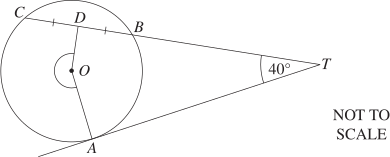
 

What is the size of the reflex angle `DOA`?

  1. `80^@`
  2. `140^@`
  3. `220^@`
  4. `280^@`
Show Answers Only

`C`

Show Worked Solution


`/_ ODT` `=90^@\ \ text{(line through centre bisecting chord)}`
`/_OAT` `= 90^@\ \ text{(tangent ⊥ to radius at point of contact)}`
`/_ DOA` `= 360-(90 + 90 + 40)`
  `= 140^@`


`:. DOA\ \ text{(reflex)}` `= 360-140`
  `= 220^@`

`=>   C`

Filed Under: 2. Plane Geometry EXT1, Circle Geometry Tagged With: Band 4, num-title-ct-path, num-title-qs-hsc, smc-4240-50-Chord properties, smc-4240-60-Tangents

Calculus, 2ADV C3 2016 HSC 16b

Some yabbies are introduced into a small dam. The size of the population, `y`, of yabbies can be modelled by the function

`y = 200/(1 + 19e^(-0.5t)),`

where `t` is the time in months after the yabbies are introduced into the dam.

  1. Show that the rate of growth of the size of the population is
  2. `qquad qquad (1900 e^(-0.5t))/(1 + 19 e^(-0.5t))^2`.  (2 marks)

    --- 4 WORK AREA LINES (style=lined) ---

  3. Find the range of the function `y`, justifying your answer.  (2 marks)

    --- 4 WORK AREA LINES (style=lined) ---

  4. Show that the rate of growth of the size of the population can be written as
  5. `qquad qquad y/400 (200-y)`.  (1 mark)

    --- 4 WORK AREA LINES (style=lined) ---

  6. Hence, find the size of the population when it is growing at its fastest rate.  (2 marks)

    --- 4 WORK AREA LINES (style=lined) ---

Show Answers Only
  1. `text(Proof)\ \ text{(See Worked Solutions)}`
  2. `10 <= y < 200`
  3. `text(Proof)\ \ text{(See Worked Solutions)}`
  4. `100`
Show Worked Solution
i.   `y` `= 200/(1 + 19 e^(-0.5t))`
  `(dy)/(dt)` `= 200/(1 + 19 e^(-0.5t))^2 xx d/(dt) (1 + 19 e^(-0.5t))`
    `= (-200)/(1 + 19 e^(-0.5t))^2 xx -0.5 xx 19 e^(-0.5t)`
    `= (1900 e^(-0.5t))/(1 + 19 e^(-0.5t))^2\ \ text(… as required)`


ii.   `text(When)\ \ t = 0,`

♦♦♦ Mean mark (ii) 21%.

`y = 200/(1 + 19) = 10`

`text(As)\ \ t -> oo,\ \ (1 + 19^(-0.5t)) -> 1`

`:. y -> 200`

`:.\ text(Range)\ \ \ 10 <= y < 200`


iii.  `(dy)/(dt) = (1900 e^(-0.5t))/(1 + 19 e^(-0.5t))^2`

♦♦♦ Mean mark (iii) 18%.

`text(S) text(ince)\ \ y = 200/(1 + 19 e^(-0.5t))`

`=> (1 + 19 e^(-0.5t)) = 200/y`

`=> 19 e^(-0.5t) = 200/y-1 = (200-y)/y`

`text(Substituting into)\ \ (dy)/(dt):`

`(dy)/(dt)` `= (100 ((200-y)/y))/(200/y)^2`
  `= 100 ((200-y)/y) xx y^2/200^2`
  `= y/400 (200-y)\ \ text(… as required)`


iv.   `(dy)/(dt) = -y^2/400 + y/2`

♦♦♦ Mean mark (iv) 14%.

`text(Sketching the parabola:)`

`(-y^2)/400 + y/2` `= 0`
`-y^2 + 200y` `= 0`
`y (200-y)` `= 0`


hsc-2016-16bi

`:.\ text(Maximum)\ \ (dy)/(dt)\ \ text(occurs when)\ \ y = 100.`

Filed Under: Rates of Change, Rates of Change (Y12) Tagged With: Band 4, Band 6, smc-1091-25-Other Themes, smc-1091-30-Log/Exp Function

Calculus, 2ADV C4 2016 HSC 16a

A particle moves in a straight line. Its velocity `v\ text(ms)^-1` at time `t` seconds is given by

`v = 2 - 4/(t + 1).`

  1. Find the initial velocity.  (1 mark)

    --- 1 WORK AREA LINES (style=lined) ---

  2. Find the acceleration of the particle when the particle is stationary.  (2 marks)

    --- 4 WORK AREA LINES (style=lined) ---

  3. By considering the behaviour of `v` for large `t`, sketch a graph of `v` against `t` for  `t >= 0`, showing any intercepts.  (2 marks)

    --- 4 WORK AREA LINES (style=lined) ---

  4. Find the exact distance travelled by the particle in the first 7 seconds.  (3 marks)

    --- 6 WORK AREA LINES (style=lined) ---

Show Answers Only
  1. `-2\ text(ms)^-1`
  2. `1\ text(ms)^-2`
  3.  
    hsc-2016-16ai
  4. `10 – 4 ln 2\ \ text(metres)`
Show Worked Solution

i.   `text(Initial velocity when)\ \ t = 0`

Mean mark 93%.
COMMENT: Great example of low hanging fruit late in the exam for students who progress efficiently.

`v = 2 – 4/1 = -2\ text(ms)^-1`


ii.   `v` `= 2 – 4/(t + 1)`
  `a` `=(dv)/(dt)= 4/(t + 1)^2`


`text(Particle is stationary when)\ \ v = 0,`

`2 – 4/(t + 1)` `= 0`
`2 (t + 1)` `= 4`
`t` `= 1`
   

`text(When)\ \ t=1,`

`:.a` `= 4/(1 + 1)^2`
  `= 1\ text(ms)^-2` 


iii.  `v = 2 – 4/(t + 1)`

♦ Mean mark 47%.

`text(As)\ \ t -> oo,\ \ \ 4/(t + 1) -> 0`

`:. v -> 2`

 hsc-2016-16ai


♦♦ Mean mark 26%.

iv.   `text(Distance travelled in 1st 7 seconds)`

`= |\ int_0^1 (2 – 4/(t + 1))\ dt\ | + int_1^7 (2 – 4/(t + 1))\ dt`

`= -[2t – 4 ln (t + 1)]_0^1 + [2t – 4 ln (t + 1)]_1^7`

`= -[(2 – 4 ln 2) – 0] + [(14 – 4 ln 8) – (2 – 4 ln 2)]`

`= 4 ln 2 – 2 + 12 – 4 ln 2^3 + 4 ln 2`

`= 10 + 8 ln 2 – 12 ln 2`

`= 10 – 4 ln 2\ \ text(metres)`

Filed Under: Motion, Other Integration Applications (Y12) Tagged With: Band 2, Band 4, Band 5, smc-1213-10-Motion

Plane Geometry, 2UA 2016 HSC 15c

Maryam wishes to estimate the height, `h` metres, of a tower, `ST`, using a square, `ABCD,` with side length `1` metre.

She places the point `A` on the horizontal ground and ensures that the point `D` lies on the line joining `A` to the top of the tower `T.` The point `F` is the intersection of the line joining `B` and `T` and the side `CD.` The point `E` is the foot of the perpendicular from `B` to the ground. Let `CF` have length `x` metres and `AE` have length `y` metres.

hsc-2016-15c

Copy or trace the diagram into your writing booklet.

  1. Show that `Delta FCB` and `Delta BAT` are similar.  (2 marks)
  2. Show that `Delta TSA` and `Delta AEB` are similar.  (2 marks)
  3. Find `h` in terms of `x` and `y`.  (2 marks)
Show Answers Only
  1. `text(Proof)\ \ text{(See Worked Solutions)}`
  2. `text(Proof)\ \ text{(See Worked Solutions)}`
  3. `y/x`
Show Worked Solution
i.  

`/_ BAT = /_ CBA = 90^@`

`text(Let)\ \ /_ TBA = theta`

`:. /_ ATB = 90 – theta\ \ text{(Angle sum of}\ Delta BAT text{)}`

`/_ CBF = 90 – theta\ \ (/_ CBA\ \ text{is a right angle)}`


`/_ FCB = /_ BAT = 90^@`

`:. Delta FCB\ text(|||)\ Delta BAT\ \ text{(equiangular)}`


ii.   `text(Let)\ \ /_ BAE = alpha`

♦♦ Mean mark 27%.

`text(In)\ \ Delta TSA,`

`/_ TAS` `= 180 – (90 + alpha) qquad (/_ SAE\ \ text{is a straight angle)}`
  `= 90 – alpha`


`text(In)\ \ Delta AEB,`

`/_ EBA = 90 – alpha\ \ text{(angle sum of}\ Delta AEB text{)}`

`/_ BEA = /_ TSA = 90^@\ \ text{(given)}`


`:. Delta TSA\ text(|||)\ Delta AEB\ \ text{(equiangular)}`


iii.   `text(Using)\ \ Delta TSA\ text(|||)\ Delta AEB,`

♦♦ Mean mark 27%.
`h/(TA)` `= y/(AB)` `text{(corresponding sides of}`
  `text{similar triangles)}`
`:. h` `= y · (TA)/(AB)`  


 `text(Using)\ \ Delta FCB\ text(|||)\ Delta BAT,`

`1/x` `= (TA)/(AB)` `qquad qquad text{(corresponding sides of}`
   `qquad qquad text{similar triangles)}`
`:. h` `= y/x`  

Filed Under: 2. Plane Geometry Tagged With: Band 4, Band 5

Probability, 2ADV S1 2016 HSC 15b

An eight- sided die is marked with numbers  1, 2, … , 8. A game is played by rolling the die until an 8 appears on the uppermost face. At this point the game ends.

  1. Using a tree diagram, or otherwise, explain why the probability of the game ending before the fourth roll is


    `qquad qquad 1/8 + 7/8 xx 1/8 + (7/8)^2 xx 1/8`.  (2 marks)

    --- 8 WORK AREA LINES (style=lined) ---

  2. What is the smallest value of `n` for which the probability of the game ending before the `n`th roll is more than  `3/4`?  (3 marks)

    --- 6 WORK AREA LINES (style=lined) ---

Show Answers Only
  1. `text(See Worked Solutions)`
  2. `12`
Show Worked Solution

i.   `P text{(game ends before 4th roll)}`

`= P (8) + P (text{not}\ 8, 8) + P (text{not}\ 8, text{not}\ 8, 8)`

`= 1/8 + 7/8 · 1/8 + 7/8 · 7/8 · 1/8`

`= 1/8 + 7/8 · 1/8 + (7/8)^2 · 1/8\ \ text(…  as required)`


ii.  `1/8 + 7/8 · 1/8 + (7/8)^2 · 1/8 + …`

`=> text(GP where)\ \ a = 1/8,\ \ r = 7/8`

`text(Find)\ \ n\ \ text(such that)\ \ S_(n – 1) > 3/4,`

♦♦ Mean mark 29%.
ALGEBRA: Note that dividing by `ln\ 7/8` reverses the < sign as it is dividing by a negative number.
`S_(n-1)` `= (a (1 – r^(n – 1)))/(1 – r)`
`3/4` `< 1/8 xx {(1 – (7/8)^(n – 1))}/(1 – 7/8)`
`3/4` `< 1 – (7/8)^(n – 1)`
`(7/8)^(n – 1)` `< 1/4`
`(n-1)* ln\ 7/8` `< ln\ 1/4`
`n – 1` `> (ln\ 1/4)/(ln\ 7/8)`
  `> 11.38…`

`:. n = 12`

Filed Under: 3. Probability, Multi-Stage Events (Adv-2027), Multi-Stage Events (Y11) Tagged With: Band 4, Band 5, smc-6469-10-Probability Trees, smc-6469-20-Other Multi-Stage Events, smc-6469-50-Probability and Series, smc-989-10-Probability Trees, smc-989-20-Other Multi-Stage Events, smc-989-50-Probability and Series

Calculus, 2ADV C3 2016 HSC 14c

A farmer wishes to make a rectangular enclosure of area 720 m². She uses an existing straight boundary as one side of the enclosure. She uses wire fencing for the remaining three sides and also to divide the enclosure into four equal rectangular areas of width `x` m as shown.
 

hsc-2016-14c
 

  1. Show that the total length, `l` m, of the wire fencing is given by
     
          `l = 5x + 720/x`.  (1 mark)

    --- 2 WORK AREA LINES (style=lined) ---

  2. Find the minimum length of wire fencing required, showing why this is the minimum length.  (3 marks)

    --- 6 WORK AREA LINES (style=lined) ---

Show Answers Only
  1. `text(Proof)\ \ text{(See Worked Solutions)}`
  2. `120\ text(m)`
Show Worked Solution
i.   `text(Area)` `= xy`
  `720` `= xy`
  `y` `= 720/x`


`l` `= 5x + y`
  `= 5x + 720/x\ \ text(… as required)`


ii.  `(dl)/(dx)` `= 5 – 720/x^2`
  `(d^2l)/(dx^2)` `= 1440/x^3`


`text(Max/Min when)\ \ (dl)/(dx) = 0,`

`5` `= 720/x^2`
`x^2` `= 144`
`x` `= 12,\ \ x > 0`


`text(When)\ \ x = 12,\ \ (d^2l)/(dx^2) > 0`

`:.\ text(Minimum occurs when)\ \ x = 12`

`:.\ text(Minimum fencing)`

`= 5 xx 12 + 720/12`

`= 120\ text(m)`

Filed Under: Maxima and Minima, Maxima and Minima (Y12) Tagged With: Band 4, smc-970-10-Area

Financial Maths, 2ADV M1 2016 HSC 14b

A gardener develops an eco-friendly spray that will kill harmful insects on fruit trees without contaminating the fruit. A trial is to be conducted with 100 000 insects. The gardener expects the spray to kill 35% of the insects each day and that exactly 5000 new insects will be produced each day.

The number of insects expected at the end of the `n`th day of the trial is `A_n.`

  1. Show that  `A_2 = 0.65 (0.65 xx 100\ 000 + 5000) + 5000`.  (2 marks)

    --- 4 WORK AREA LINES (style=lined) ---

  2. Show that  `A_n = 0.65^n xx 100\ 000 + 5000 ((1 - 0.65^n))/0.35`.  (1 mark)

    --- 2 WORK AREA LINES (style=lined) ---

  3. Find the expected insect population at the end of the fourteenth day, correct to the nearest 100.  (1 mark)

    --- 2 WORK AREA LINES (style=lined) ---

Show Answers Only
  1. `text(Proof)\ \ text{(See Worked Solutions)}`
  2. `text(Proof)\ \ text{(See Worked Solutions)}`
  3. `14\ 500\ text{(nearest 100)}`
Show Worked Solution
i.   `A_1` `= 0.65 xx 100\ 000 + 5000`
  `A_2` `= 0.65 xx A_1 + 5000`
    `= 0.65 (0.65 xx 100\ 000 + 5000) + 5000`
    `qquad qquad text(… as required)`


ii.  `A_2` `= 0.65^2 xx 100\ 000 + 0.65 xx 5000 + 5000`
  `A_3` `= 0.65^3 xx 100\ 000 + 0.65^2 xx 5000 + 0.65 xx 5000 + 5000`
  `vdots`  
  `A_n` `= 0.65^n xx 100\ 000 + 0.65^(n – 1) xx 5000 + 0.65^(n – 2) xx 5000 + … + 5000`
    `= 0.65^n xx 100\ 000 + 5000 (1 + 0.65 + … + 0.65^(n – 1))`
    `qquad qquad => text(GP where)\ \ a = 1,\ \ r = 0.65`
    `= 0.65^n xx 100\ 000 + 5000 ({(1 – r^n)}/(1 – r))`
    `= 0.65^n xx 100\ 000 + 5000 ((1 – 0.65^n))/0.35`


iii.  `A_14` `= 0.65^14 xx 100\ 000 + 5000 ((1 – 0.65^14)/0.35)`
    `= 14\ 491.70…`
    `= 14\ 500\ text{(nearest 100)}`

Filed Under: Compound interest, loan repayments and annuities, Financial Applications of Series (Y12) Tagged With: Band 3, Band 4, smc-1007-50-Non-Financial

Mechanics, EXT2 M1 2016 HSC 15b

A particle is initially at rest at the point `B` which is `b` metres to the right of `O.`

The particle then moves in a straight line towards `O.`

For `x != 0,` the acceleration of the particle is given by  `(- mu^2)/x^2,`  where `x` is the distance from `O` and `mu` is a positive constant.

  1. Prove that  `(dx)/(dt) = -mu sqrt 2 sqrt((b - x)/(bx)).`  (2 marks)

    --- 4 WORK AREA LINES (style=lined) ---

  2. Using the substitution  `x = b cos^2 theta,` show that the time taken to reach a distance `d` metres to the right of `O` is given by
     
         `t = (b sqrt (2b))/mu int_0^(cos^-1 sqrt (d/b)) cos^2 theta\ d theta.`  (3 marks)

    --- 6 WORK AREA LINES (style=lined) ---

It can be shown that   `t = 1/mu sqrt (b/2) (sqrt(bd - d^2) + b cos^-1 sqrt (d/b)).`  (Do NOT prove this.)

  1. What is the limiting time taken for the particle to reach `O?`  (1 mark)

    --- 4 WORK AREA LINES (style=lined) ---

Show Answers Only
  1. `text(See Worked Solutions)`
  2. `text(See Worked Solutions)`
  3. `(pi(sqrtb)^3)/(2sqrt2mu)\ text(seconds)`
Show Worked Solution

i.   `a = d/dx(1/2 v^2) = −(mu^2)/(x^2)`

`:. 1/2 v^2` `= int −(mu^2)/(x^2)\ dx`
  `= (mu^2)/x + c`


`text(Initially,)\ v = 0\ text(and)\ x = b`

`:. c = −(mu^2)/b`

`v^2` `= 2mu^2(1/x – 1/b)`
`v` `= −musqrt2 · sqrt(1/x – 1/b)qquad(text(negative since moving to left))`
  `= −musqrt2 · sqrt((b – x)/(bx))\ …\ text(as required.)`


ii.    `dx/dt` `= −musqrt2 · sqrt((b – x)/(bx))`
  `dt/dx` `= −1/(musqrt2) · sqrt((bx)/(b – x))`
  `int_0^t dt` `= −1/(musqrt2) · int_b^d sqrt((bx)/(b – x))\ dx`


`text(Integration by substitution:)`

`text(Let)\ \ \ x` `= bcos^2theta`
`dx` `= −2bcosthetasintheta\ d theta`


`text(When)quadx` `= b,` `theta` `= 0`
`x` `= d,` `theta` `= cos^(−1)sqrt(d/b)`


`:. t` `= −1/(musqrt2) · int_0^(cos^(−1)sqrt(d/b))sqrt((b^2cos^2theta)/(b(1 – cos^2theta))) · −2bcosthetasintheta\ d theta`
 

`= (2b)/(musqrt2) · int_0^(cos^(−1)sqrt(d/b))(sqrtb costheta)/(sintheta) · costhetasintheta\ d theta`


`= (bsqrt(2b))/mu int_0^(cos^(−1)sqrt(d/b)) cos^2theta\ d theta\ …\ text(as required)`


iii.   `t = 1/mu sqrt(b/2)(sqrt(bd – d^2) + bcos^(−1)sqrt(d/b))`


`text(As)\ \ d->0,`

♦♦ Mean mark 29%.
`t` `= 1/mu sqrt(b/2) (sqrt0 + bcos^(−1)0)`
  `= 1/mu sqrt(b/2) · b · pi/2`
  `= (pi(sqrtb)^3)/(2sqrt2mu)\ text(seconds)`

Filed Under: Motion Without Resistance, Resisted Motion Tagged With: Band 4, Band 5, smc-1060-02-Motion as f(x), smc-1060-30-Inverse

Calculus, EXT2 C1 2016 HSC 14b

Let  `I_n = int_0^1 x^n/(x^2 + 1)^2\ dx,`  for   `n = 0, 1, 2, … .`

  1. Using a suitable substitution, show that  `I_0 = pi/8 + 1/4.`  (3 marks)

    --- 6 WORK AREA LINES (style=lined) ---

  2. Show that  `I_0 + I_2 = pi/4.`  (1 mark)

    --- 4 WORK AREA LINES (style=lined) ---

  3. Find  `I_4.`  (3 marks)

    --- 8 WORK AREA LINES (style=lined) ---

Show Answers Only
  1. `text(See Worked Solutions)`
  2. `text(See Worked Solutions)`
  3. `5/4 – (3pi)/8`
Show Worked Solution

i.   `I_n = int_0^1 (x^n)/((x^2 + 1)^2) dx,quadn >= 0`

`text(Let)\ \ \ x` `= tantheta`
`dx` `= sec^2theta\ d theta`


`text(When)\ \ \ x` `= 0,quad` `theta` `= 0`
`x` `= 1,` `theta` `= pi/4`


`:. I_0` `= int_0^(pi/4)(sec^2theta)/((tan^2theta + 1)^2)\ d theta`
  `= int_0^(pi/4)(sec^2theta)/(sec^4theta)\ d theta`
  `= int_0^(pi/4)cos^2theta\ d theta`
  `= int_0^(pi/4)1/2(1 + cos2theta)\ d theta`
  `= 1/2[x + 1/2sin2theta]_0^(pi/4)`
  `= 1/2[(pi/4 + 1/2 · sin\ pi/2) – 0]`
  `= pi/8 + 1/4`


ii.    `I_0 + I_2` `= int_0^1 1/((x^2 + 1)^2)\ dx + int_0^1 (x^2)/((x^2 + 1)^2)\ dx`
    `= int_0^1 (x^2 + 1)/((x^2 + 1)^2)\ dx`
    `= int_0^1 1/(x^2 + 1)\ dx`
    `= [tan^(−1)x]_0^1`
    `= pi/4`


♦ Mean mark part (iii) 49%.
iii.    `I_4` `= int_0^1 (x^4)/(x^2 + 1)\ dx`
    `= int_0^1 (x^4 – 1)/((x^2 + 1)^2)\ dx + int_0^1 1/((x^2 + 1)^2)`
    `= int_0^1 ((x^2 + 1)(x^2 – 1))/((x^2 + 1)^2)\ dx + I_0`
    `= int_0^1 (x^2 – 1)/(x^2 + 1)\ dx + I_0`
    `= int_0^1 (1 – 2/(x^2 + 1))\ dx + I_0`
    `= [x – 2tan^(−1)x]_0^1 + pi/8 + 1/4`
    `= [(1 – 2 · pi/4) – 0] + pi/8 + 1/4`
    `= 5/4 – (3pi)/8`

Filed Under: Recurrence Relations, Recurrence Relations Tagged With: Band 4, Band 5, smc-1054-20-Quotient

Integration, EXT2 2016 HSC 14a

  1. Show that  `int sin^3 x\ dx = 1/3 cos^3 x - cos x + C.`  (1 mark)
  2. Using a graphical approach, or otherwise, explain why


    `int_0^pi cos^(2n - 1) x\ dx = 0`, for all positive integers `n.`  (1 mark)

  3. The diagram shows the region `R` enclosed by `y = sin^3 x` and the `x`-axis for `0 <= x <= pi.`

    ext2-hsc-2016-14a


    Using the method of cylindrical shells and the results in parts (i) and (ii), find the exact volume of the solid formed when `R` is rotated about the `y`-axis.  (3 marks)

Show Answers Only
  1. `text(See Worked Solutions)`
  2. `text(See Worked Solutions)`
  3. `(4pi^2)/3 \ u^3`
Show Worked Solution
i.    `int sin^3x\ dx` `= int sinx(1 – cos^2x)dx`
    `= int sinx\ dx – int (sin x · cos^2 x)\ dx`
    `= −cos x + 1/3cos^3x – c\ \ …\ text(as required)`


ii.   `int_0^pi cos^(2n – 1)x\ dx`

`text(Graphically, the integral can be represented)`

`text{below since (2n − 1) is always odd.}`

ext2-hsc-2016-14a-answer

`text(S)text(ince it is symmetrical about)\ \ x = pi/2,`

`int_0^pi cos^(2n – 1)x\ dx = 0`


iii.    `V` `= 2pi int_0^pi xy\ dx`
    `= 2pi int_0^pi (xsin^3x)\ dx`


`text(Using integration by parts:)`

`u` `= x` `du` `= dx`
`dv` `= sin^3x` `v` `= 1/3 cos^3x – cos x`


`I = [1/3 xcos^3x – xcosx]_0^pi – int_0^pi (1/3cos^3x – cosx)\ dx`

`text(S)text(ince)\ int_0^pi(1/3cos^3x – cosx)\ dx = 0\ \ text{(from part(ii)),}`

`I` `= [(1/3picos^3pi – picospi) – 0] – 0`
  `= (−pi/3 + pi)`
  `= (2pi)/3`


`:. V` `= 2pi · (2pi)/3`
  `= (4pi^2)/3 \ u^3`

Filed Under: Trig Integrals Tagged With: Band 2, Band 4

Calculus, 2ADV C4 2016 HSC 13d

The curve  `y = sqrt 2 cos (pi/4 x)`  meets the line  `y = x`  at  `P(1, 1)`, as shown in the diagram.
 

hsc-2016-13d
 

Find the exact value of the shaded area.  (3 marks)

Show Answers Only

`(4/pi – 1/2)\ text(u²)`

Show Worked Solution

`text(Shaded Area)`

`= int_0^1 sqrt 2 cos (pi/4 x)\ dx – int_0^1 x\ dx`

`= int_0^1 (sqrt 2 cos (pi/4 x) – x)\ dx`

`= [sqrt 2 xx 4/pi sin (pi/4 x) – x^2/2]_0^1`

`= [((4 sqrt 2)/pi sin\ pi/4 – 1/2) – 0]`

`= (4 sqrt 2)/pi xx 1/sqrt 2 – 1/2`

`= (4/pi – 1/2)\ text(u²)`

Filed Under: Areas Under Curves, Areas Under Curves (Y12) Tagged With: Band 4, smc-975-50-Trig

Quadratic, 2UA 2016 HSC 13b

Consider the parabola  `x^2 - 4x = 12y + 8.`

  1. By completing the square, or otherwise, find the focal length of the parabola.  (2 marks)
  2. Find the coordinates of the focus.  (1 mark)
Show Answers Only
  1. `3`
  2. `(2, -1 + 3) ≡ (2, 2)`
Show Worked Solution
i.  `x^2 – 4x` `= 12y + 8`
  `x^2 – 4x + 4` `= 12y + 12`
  `(x – 2)^2` `= 12 (y + 1)`


`text(Focal length:)`

`4a` `= 12`
`:. a` `= 3`


ii.  `text(Vertex is)\ \ (2, -1)`

`:.\ text(Focus is)\ \ (2, -1 + 3) ≡ (2, 2)`

Filed Under: The Parabola Tagged With: Band 4

Calculus, 2ADV C3 2016 HSC 13a

Consider the function  `y = 4x^3 - x^4.`

  1. Find the two stationary points and determine their nature.  (4 marks)

    --- 8 WORK AREA LINES (style=lined) ---

  2. Sketch the graph of the function, clearly showing the stationary points and the `x` and `y` intercepts.  (2 marks)

    --- 8 WORK AREA LINES (style=lined) ---

Show Answers Only

i.   `text{P.I. at (0, 0) and Max at (3, 27)}`

ii.
 ext2-hsc-2016-13bi

Show Worked Solution
i.    `y` `= 4x^3 – x^4`
  `y prime` `= 12x^2 – 4x^3`
  `y″` `= 24x – 12x^2`


`text(S.P.’s when)\ \ y prime = 0,`

`12x^2 – 4x^3` `= 0`
 `4x^2 (3 – x)` `= 0`
`:. x = 0 or 3`


`text(When)\ \ x = 0,\ \ y″ (0) = 0`

`:.\ text(P.I. at)\ \ (0, 0)`


`text(When)\ \ x = 3,`

`y″ (3) = 24(3) – 12 (9) = -36 < 0`

`:.\ text(MAX)\ \ text(at)\ \ (3, 27)`


ii.  ext2-hsc-2016-13bi

Filed Under: Curve Sketching (Y12), Curve Sketching and The Primitive Function Tagged With: Band 3, Band 4, smc-969-20-Degree 4

Calculus, 2ADV C4 2016 HSC 12d

  1. Differentiate  `y = xe^(3x)`.   (1 mark)

    --- 2 WORK AREA LINES (style=lined) ---

  2. Hence find the exact value of  `int_0^2 e^(3x) (3 + 9x)\ dx`.   (2 marks)

    --- 4 WORK AREA LINES (style=lined) ---

Show Answers Only
  1. `e^(3x) (1 + 3x)`
  2. `6e^6`
Show Worked Solution

i.  `y = xe^(3x)`

`text(Using product rule:)`

`(dy)/(dx)` `= x · 3e^(3x) + 1 · e^(3x)`
  `= e^(3x) (1 + 3x)`


ii.  `int_0^2 e^(3x) (3 + 9x)\ dx`

`= 3 int_0^2 e^(3x) (1 + 3x)\ dx`

`= 3 [x e^(3x)]_0^2`

`= 3 (2e^6 – 0)`

`= 6e^6`

Filed Under: Exponential Calculus, Exponential Calculus (Y12), Integrals, L&E Integration, Logs and Exponentials - Differentiation Tagged With: Band 3, Band 4, smc-1202-20-Definite Integrals, smc-1203-50-Diff then Integrate, smc-965-10-Differentiation (base e), smc-965-40-Definite Integrals, smc-965-60-Diff then integrate

Plane Geometry, 2UA 2016 HSC 12b

The diagram shows a semicircle with centre `O.` It is given that  `AB = OB,\ \ /_ COD = 87^@ and /_ BAO = x^@.`

hsc-2016-12b

  1. Show that  `/_ CBO = 2x^@,\ text(giving reasons)`.  (1 mark)
  2. Find the value of `x`, giving reasons.  (2 marks)
Show Answers Only
  1. `text(Proof)\ \ text{(See Worked Solutions)}`
  2. `29`
Show Worked Solution
i.   `/_ AOB` `= x\ \ (Delta AOB\ text{is isosceles})`
  `/_ ABO` `= 180 – 2x\ \ (text{Angle sum of}\ Delta AOB)`
  `/_ CBO` `= 180 – (180 – 2x)` `qquad text{(}/_ CBA\ \ text{is a straight}`
    `= 2x^@` `qquad \ \ text{angle)}`


ii   `/_ CBO = /_ BCO = 2x\ \ \ (Delta CBO\ \ text{is isosceles})`

`/_ BOC = 180 – 4x\ \ \ (text{Angle sum of}\ \ Delta CBO)`


`x + (180 – 4x) + 87` `= 180\ \ text{(}/_ AOD\ \ text{is a straight}`
  `qquad qquad qquad qquad text{angle)}`
`180 – 3x + 87` `= 180`
`3x` `= 87`
`:. x` `= 29`

Filed Under: 2. Plane Geometry Tagged With: Band 3, Band 4

Statistics, STD2 S5 2016 HSC 30d

The formula to calculate  `z`-scores can be rearranged to give

`mu = x - σz`


where    `mu`  is the mean
  `x`  is the score
  `σ`  is the standard deviation
  `z`  is the `z`-score
   
  1. In an examination, Aaron achieved a score of 88, which corresponds to a  `z`-score of 2.4.


    Substitute these values into the rearranged formula above to form an equation.  (1 mark)

    --- 1 WORK AREA LINES (style=lined) ---

  2. In the same examination, Brock achieved a score of 52, which corresponds to a  `z`-score of  –1.2.


    Using this information, form another equation and solve it simultaneously with the equation from part (i) to find the values of  `mu`  and  `σ`.  (3 marks)

    --- 6 WORK AREA LINES (style=lined) ---

Show Answers Only
  1. `mu = 88 – 2.4σ`
  2. `64`
Show Worked Solution

i.   `mu = 88 – 2.4σ`
 

ii.   `mu = 52 + 1.2σ\ …\ (1)`

♦♦ Mean mark part (ii) 32%.
COMMENT: Recognise this is a simultaneous equation problem (now outside Std2 syllabus) and not a normal distribution one.

`mu = 88 – 2.4σ\ …\ (2)`
 

`text(Subtract)\ \ (2) – (1):`

`0` `= 36 – 3.6σ`
`3.6σ` `= 36`
`:. σ` `= 10`

 
`text(Substitute)\ \ σ = 10\ \ text(into)\ (1):`

`:. mu` `= 52 + 1.2 xx 10`
  `= 64`

Filed Under: DS5/6 - Normal Distribution and Sampling, Normal Distribution (Y12) Tagged With: Band 4, Band 5, smc-995-10-Single z-score

Measurement, STD2 M1 2016 HSC 30c

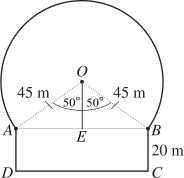
A school playground consists of part of a circle, with centre `O`, and a rectangle as shown in the diagram. The radius `OB` of the circle is 45 m, the width `BC` of the rectangle is 20 m and `AOB` is 100°.
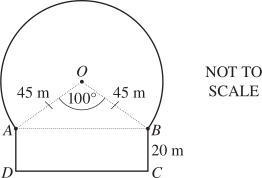
 

What is the area of the whole playground, correct to the nearest square metre?  (5 marks)

--- 12 WORK AREA LINES (style=lined) ---

Show Answers Only

`6971\ text{m²  (nearest m²)}`

Show Worked Solution

`text(In)\ DeltaOEB,`

`sin50^@` `= (EB)/45`
`EB` `= 45 xx sin50^@`
  `= 34.47…`
`:. AB` `= 2 xx 34.47…`
  `= 68.944\ \ (text(3 d.p.))`


`cos50^@` `= (OE)/45`
`:. OE` `= 45 xx cos50^@`
  `= 28.925\ \ (text(3 d.p.))`


`text(Area of)\ DeltaOAB`

`= 1/2 xx AB xx OE`

`= 1/2 xx 68.944 xx 28.925`

`= 997.12\ text(m²)`


`text(Area)\ ABCD` `= 20 xx 68.944`
  `= 1378.88\ text(m²)`


`text(Area of major sector)\ OAB`

`= pi xx 45^2 xx 260/360`

`= 4594.58\ text(m²)`


`:.\ text(Area of playground)`

`= 997.12 + 1378.88 + 4594.58`

`= 6970.58`

`= 6971\ text{m²  (nearest m²)}`

Filed Under: 2-Triangle and Harder Examples, Area and Surface Area, Areas and Volumes (Harder), MM6 - Spherical Geometry, Perimeter and Area (Std2-2027), Perimeter, Area and Volume (Std 2) Tagged With: Band 4, num-title-ct-extension, num-title-qs-hsc, smc-6483-50-Area (Circular Measure), smc-798-20-Perimeter and Area (Circular Measure)

FS Comm, 2UG 2016 HSC 30b

Michael was transferring some video files from his computer onto a USB stick. At some point during the transfer, he observed the information shown below. 

2ug-2016-hsc-q30_1

  1. Show that, at that time, approximately `3072` MB of data remained to be transferred.  (1 mark)
  2. Calculate the speed required to transfer `3072` MB in `7` minutes. Give your answer in megabits per second (Mbps), correct to the nearest whole number. (Note that `1` megabit = `1\ 000\ 000` bits.)  (3 marks)


Show Answers Only
  1. `3072\ text(MB)`
  2. `61\ text{Mbps  (nearest whole)}`
Show Worked Solution

(i)   `text(Data to be transferred)`

`= 6.44 – 3.44`

`= 3\ text(GB)`

`= 3 xx 2^10\ text(MB)`

`= 3072\ text(MB)`


(ii)   `text(7 min = 7 × 60 = 420 seconds)`

♦ Mean mark part (ii) 35%.

`text(Convert MB to Megabits:)`

`3072\ text(MB)` `= 3072 xx 2^20 xx 8`
  `= 2.576… xx 10^10\ text(bits)`
  `= 25\ 769.8…\ text(Mb)`


`:.\ text(Download speed required)`

`= (25\ 769.8…)/420`

`= 61.35…`

`= 61\ text{Mbps  (nearest whole)}`

Filed Under: FS Communication Tagged With: Band 4, Band 5

Functions, EXT1′ F2 2016 HSC 13d

Suppose  `p(x) = ax^3 + bx^2 + cx + d`  with `a, b, c` and `d` real, `a != 0.`

  1. Deduce that if  `b^2 - 3ac < 0`  then `p(x)`  cuts the `x`-axis only once.  (2 marks)

    --- 6 WORK AREA LINES (style=lined) ---

  2. If  `b^2 - 3ac = 0 and p(-b/(3a)) = 0`, what is the multiplicity of the root  `x = -b/(3a)?`  (2 marks)

    --- 4 WORK AREA LINES (style=lined) ---

Show Answers Only
  1. `text(See Worked Solutions)`
  2. `3`
Show Worked Solution

i.     `p(x) = ax^3 + bx^2 + cx + d`

`pprime(x) = 3ax^2 + 2bx + c`

`=> p(x)\ text(will cut the)\ xtext(-axis once)`

`text(only if)\ \ Delta(pprime(x)) < 0`

`(2b)^2 – 4(3a)c` `< 0`
`4b^2 – 12ac` `< 0`
`b^2 – 3ac` `< 0`


ii.   `p(−b/(3a)) = 0`

`pprime(−b/(3a))` `=3a(- b/(3a))^2 + 2b (- b/(3a))+c`
  `=- b^2/(3a)+c`
  `=0\ \ \ (text{given}\ \ b^2 – 3ac = 0)`

 
`:.\ text(Multiplicity at least 2.)`

♦♦ Mean mark 32%.

 
`p″(x) = 6ax + 2b`

`p″(−b/(3a))` `= 6a(−b/(3a)) + 2b=0`

`:. text(Multiplicity of)\ \ x=− b/(3a)\ \ text(is 3.)`

Filed Under: Roots and Coefficients, Sum, Products and Multiplicity of Roots (Ext1) Tagged With: Band 4, Band 5, smc-1205-20-Multiplicity of Roots

Mechanics, EXT2 2016 HSC 13c

The ends of a string are attached to points `A` and `B`, with `A` directly above `B.` The points `A` and `B` are  `0.4` m apart.

An object of mass `M` kg is fixed to the string at `C.` The object moves in a horizontal circle with centre `B` and radius  `0.3` m, as shown in the diagram.

ext2-hsc-2016-13c

The tensions in the string from the object to points `A` and `B` are `T_1` and `T_2` respectively. The object rotates with constant angular velocity `omega.` You may assume that the acceleration due to gravity is  `g = 10\ text(ms)^-2.`

  1. Show that  `T_2 = 0.3M (omega^2 - 25).`  (3 marks)
  2. For what range of values of  `omega` is  `T_2 > T_1?`  (1 mark)
Show Answers Only
  1. `text(See Worked Solutions)`
  2. `8.16\ text{rad/sec}`
Show Worked Solution
i.    ext2-hsc-2016-13c-answer1

`tantheta = 4/3, costheta = 3/5, sintheta = 4/5`

`text(Resolving the forces at)\ C\ text(vertically:)`

`sintheta · T_1 – 10M` `= 0`
`4/5 · T_1` `= 10M`
`T_1` `= (50M)/4\ …\ (1)`


`text(Resolving the forces at)\ C\ text(horizontally:)`

`costheta · T_1 + T_2` `= Mr omega^2`
`3/5T_1 + T_2` `= 0.3M omega^2`


`text(Substitute)\ \ T_1 = (50M)/4\ \ text(from)\ (1)`

`T_2` `= 0.3Momega^2 – 3/5 · (50M)/4`
  `= 0.3Momega^2 – (30M)/4`
  `= 0.3M(omega^2 – 25)\ …\ text(as required.)`


ii.   `text(Find)\ omega,\ text(such that)\ T_2 > T_1,`

♦ Mean mark 41%.
`0.3M(omega^2 – 25)` `> (50M)/4`
`omega^2 – 25` `> 125/3`
`omega^2` `> 200/3`
`omega` `> 8.16\ text{rad/sec  (2 d.p.)}`

Filed Under: Circular Motion Tagged With: Band 4, Band 5

Harder Ext1 Topics, EXT2 2016 HSC 13b

The circle centred at `O` has diameter `AB`. A point `P` on `AB` produced is chosen so that `PC` is a tangent to the circle at `C` and  `BP = BC.` The tangents to the circle at `A` and `C` meet at `Q.`

ext2-hsc-2016-13b-i

Copy or trace the diagram into your writing booklet.

Prove that `OP = OQ.`  (4 marks)

Show Answers Only

`text{Proof (See Worked Solutions)}`

Show Worked Solution

`text(Show that)\ OP = OQ`

ext2-hsc-2016-13b-i-answer

`text(Let)\ angle BPC = theta`

`:. angle BCP = theta\ \ \ (DeltaBPC\ text(is isosceles))`

`angle ABC` `= 2theta\ \ \ (text(external angle of)\ DeltaBPC)`
`angle BCO` `= 2theta\ \ \ (DeltaOBC\ text(is isosceles))`
`angle BOC` `= 180 – 4theta\ \ \ (text(angle sum of)\ DeltaOBC)`
   
`angle QCO` `= angle QAO = 90^@\ \ \ (text(angle between radius and tangent))`

`:. DeltaQAO ≅ DeltaQCO\ \ (text(RHS))`


`angle AOQ = angle COQ = 2theta\ \ \ (∠AOP\ text{is a straight angle})`

`:. OQ\ text(||)\ BC \ \ (text(corresponding angles))`

`angle BCP = angle OQC = theta\ \ \ (text(corresponding angles,)\ OQ\ text(||)\ BC)`

`:. DeltaOPQ\ text(is isosceles)`

`:. OP = OQ`

Filed Under: Circle/Plane Geometry Tagged With: Band 4

Conics, EXT2 2016 HSC 12d

  1. Show that the equation of the normal to the hyperbola `xy = c^2,\ \ c != 0`, at `P (cp, c/p)` is given by `px - y/p = c (p^2 - 1/p^2).`  (2 marks)
  2. The normal at `P` meets the hyperbola again at `Q (cq, c/q).`
    Show that
    `q = -1/p^3.`  (3 marks)
Show Answers Only
  1. `text(See Worked Solutions)`
  2. `text(See Worked Solutions)`
Show Worked Solution

i.   `xy = c^2, c != 0`

`y` `= (c^2)/x`
`yprime` `= −(c^2)/(x^2)`


`text(At)\ P(cp, c/p),`

`yprime = −(c^2)/((cp)^2) = −1/(p^2)`


`:. text(Normal has)\ \ m = p^2,\ text(through)\ P(cp,c/p)`

`y – c/p` `= p^2(x – cp)`
  `= p^2x – cp^3`
`p^2x – y` `= cp^3 – c/p`
`:. px – y/p` `= c(p^2 – 1/(p^2))\ …\ text(as required)`


ii.   `text(Intersection of normal and hyperbola:)`

`px – y/p` `= c(p^2 – 1/(p^2))\ …\ (1)`
`xy` `= c^2\ …\ (2)`


`text(Substitute)\ \ y = (c^2)/x\ text{from  (2)  into  (1)}`

`px – ((c^2)/x)/p` `= c(p^2 – 1/(p^2))`
`px – (c^2)/(px)` `= c(p^2 – 1/(p^2))`
`px^2 – (c^2)/p` `= c(p^2 – 1/(p^2))x`

`px^2 – c(p^2 – 1/(p^2))x – (c^2)/p = 0`

`text(Using)\ sum\ text(roots) = −b/a,`

`cp + cq` `= (c(p^2 – 1/(p^2)))/p`
`:. q` `= ((p^2 – 1/(p^2)))/p – p`
  `= (p^2)/p – 1/(p^3) – p`
  `= −1/(p^3)\ \ …\ text(as required.)`

Filed Under: Hyperbola Tagged With: Band 2, Band 4

Calculus, EXT2 C1 2016 HSC 12b

  1. Differentiate  `x\ f(x)-int x\ f^(′)(x)\ dx.`  (1 mark)

    --- 2 WORK AREA LINES (style=lined) ---

  2. Hence, or otherwise, find  `int tan^-1 x\ dx.`  (2 marks)

    --- 2 WORK AREA LINES (style=lined) ---

Show Answers Only
  1. `f(x)`
  2. `x tan^(−1)x-1/2 ln(1 + x^2)`
Show Worked Solution

i.   `d/dx (x\ f(x)-int x\ f^(′)(x)\ dx)`

`= x\ f^(′)(x) + f(x)-x\ fprime(x)`

`= f(x)`


ii.    `int tan^(−1)x\ dx` `= x\ tan^(−1)x-int x/(1 + x^2)\ dx`
    `= x\ tan^(−1)x-1/2 ln(1 + x^2)+c`

Filed Under: Harder Integration Examples, Integration By Parts, Integration By Parts, Integration By Parts (SM) Tagged With: Band 3, Band 4, smc-1055-30-Trig, smc-1055-40-Differentiate/Integrate, smc-5134-30-Trig, smc-5134-40-Differentiate/Integrate

Harder Ext1 Topics, EXT2 2016 HSC 11e

State the domain and range of the function  `f(x) = x sin^-1 (x/2).`  (2 marks)

Show Answers Only

`text(Domain:)\ \ – 2 <= x <= 2`

`text(Range:)\ \ 0 <= y <= pi`

Show Worked Solution

`text(Domain of)\ \ xsin^(−1)(x/2)\ text(is:)`

`−1 <=` `x/2` `<= 1`
`−2 <=` `x` `<= 2`


`text(Consider,)\ \ − 2 <= x <= 0,`

`=>\ text(Range:)\ \ 0 <= y <= pi`

`text(Consider,)\ \ 0 < x <= 2,`

`=>\ text(Range:)\ \ 0 <= y <= pi`


`:. text(Range is)\ 0 <= y <= pi`

Filed Under: Other Ext1 Topics Tagged With: Band 4

Functions, EXT1′ F1 2016 HSC 11d

The diagram shows the graph of  `y = f(x).`
 

ext2-hsc-2016-11d

 
Draw a separate half-page diagram for each of the following functions, showing all asymptotes and intercepts.

  1.  `y = sqrt (f(x))`  (2 marks)

    --- 8 WORK AREA LINES (style=lined) ---

  2.  `y = 1/(f(x))`  (2 marks)

    --- 8 WORK AREA LINES (style=lined) ---

Show Answers Only
i.   

ext2-hsc-2016-11d-answer2

ii.   

ext2-hsc-2016-11d-answer4

Show Worked Solution
i.    ext2-hsc-2016-11d-answer2


ii.    ext2-hsc-2016-11d-answer4

Filed Under: Reflections and Harder curves, Reflections and Harder Graphs (Ext1) Tagged With: Band 3, Band 4, smc-1072-10-y = 1 / f(x), smc-1072-20-y = root f(x); y^2 = f(x)

Volumes, EXT2 2016 HSC 9 MC

The diagram shows the dimensions of a polyhedron with parallel base and top. A slice taken at height `h` parallel to the base is a rectangle.

ext2-hsc-2016-9a

What is a correct expression for the volume of the polyhedron?

  1. `int_0^4 (h + 3) ((3h)/2 + 2)\ dh`
  2. `int_0^4 ((5h)/4 + 3) ((3h)/2 + 2)\ dh`
  3. `int_0^4 (h + 3) ((5h)/4 + 2)\ dh`
  4. `int_0^4 ((5h)/4 + 3) ((5h)/4 + 2)\ dh`
Show Answers Only

`=> A`

Show Worked Solution

`text(Let the rectangular slice)`

`text(have dimensions)\ \ x xx y.`

`(x – 2)/(8 – 2)` `= h/4`
`:.x` `= (3h)/2 + 2`
`(y – 3)/(7 – 3)` `= h/4`
`:. y` `= h + 3`


`:. V = int_0^4(h + 3)((3h)/2 + 2)\ dh`

`=> A`

Filed Under: Cross sections of similar shapes Tagged With: Band 4

Probability, 2UG 2016 HSC 29a

Two unbiased coins are tossed.

  1. What is the probability that one coin shows heads and the other shows tails?  (1 mark)
  2. A game is played in which one player tosses the two coins. The rules are as follows:
  3. • If both coins show heads, the player wins `$40`
    • If both coins show tails, the player wins `$20`
  4. • If one coin shows heads and the other shows tails, the player loses `$30`.
  5.  

    What is the financial expectation of this game?  (2 marks)


Show Answers Only
  1. `1/2`

  2. `text(Expectation is breakeven)`
Show Worked Solution

(i)   `P(H\ text(and)\ T)`

`= P(H,T) + P(T,H)`

`= 1/2 xx 1/2 + 1/2 xx 1/2`

`= 1/2`


(ii)   `P(H,H) = 1/2 xx 1/2 = 1/4`

♦ Mean mark part (ii) 43%.

`P(T,T) = 1/2 xx 1/2 = 1/4`


`:.\ text(Financial expectation)`

`= 1/4 xx 40 + 1/4 xx 20 – 1/2 xx 30`

`=10+5-15`

`= 0\ \ \ text{(i.e. breakeven.)}`

Filed Under: Financial Expectation Tagged With: Band 4, Band 5

Measurement, STD2 M1 2016 HSC 28e

A company makes large marshmallows. They are in the shape of a cylinder with diameter 5 cm and height 3 cm, as shown in the diagram.

2ug-2016-hsc-q28_4

  1. Find the volume of one of these large marshmallows, correct to one decimal place.  (2 marks)

    --- 4 WORK AREA LINES (style=lined) ---

A cake is to be made by stacking 24 of these large marshmallows and filling the gaps between them with chocolate. The diagrams show the cake and its top view. The shading shows the gaps to be filled with chocolate.
 

2ug-2016-hsc-q28_5

  1. What volume of chocolate will be required? Give your answer correct to the nearest whole number.  (3 marks)

    --- 6 WORK AREA LINES (style=lined) ---

Show Answers Only
  1. `58.9\ text{cm}^3`
  2. `193\ text{cm}^3`
Show Worked Solution
a.    `V` `= pir^2h`
    `= pi xx 2.5^2 xx 3`
    `= 58.904…`
    `= 58.9\ text{cm³  (1 d.p.)}`


b.    2ug-2016-hsc-q28-answer1

`text(Volume of rectangle)`

♦ Mean mark part (ii) 35%.

`= 15 xx 10 xx 6`

`= 900\ text(cm)^3`
 

`text(Volume of marshmallows in rectangle)`

`= 6 xx 2 xx 58.9`

`= 706.8\ text(cm)^3`


`:.\ text(Volume of chocolate)`

`= 900-706.8`

`= 193.2`

`= 193\ text{cm}^3 \ text{(nearest cm}^3 text{)}`

Filed Under: Areas and Volumes (Harder), Perimeter, Area and Volume (Std 2), Volume, Mass and Capacity (Std2-2027) Tagged With: Band 4, Band 5, num-title-ct-corea, num-title-qs-hsc, smc-4235-20-Cylinders, smc-6304-50-Volume (Circular Measure), smc-798-50-Volume (Circular Measure)

Measurement, STD2 M7 2016 HSC 28a

Jacob has a large jar of silver coins. He adds 20 gold coins into the jar. He then seals the jar and shakes it to ensure that the gold coins are mixed in thoroughly with the silver coins. Jacob then opens the jar and takes a handful of coins. In his hand he has 33 silver coins and 4 gold coins. 

  1. Based on Jacob’s handful, if a coin is selected at random from the jar, what is the probability that it is a gold coin?  (1 mark)

    --- 1 WORK AREA LINES (style=lined) ---

  2. Jacob returns the handful of coins to the jar. Estimate the total number of coins in the jar.  (2 marks)

    --- 4 WORK AREA LINES (style=lined) ---

Show Answers Only
  1. `4/37`
  2. `185`
Show Worked Solution
i.    `P(G)` `= 4/(4 + 33)`
    `= 4/37`
♦ Mean mark part (i) 28%.


ii.  `text(Let)\ \ X =\ text(total coins in jar.)`

`20/X` `=4/37`
`:.X` `=(20 xx 37)/4`
  `=185`

Filed Under: Combinations and Single Stage Events (Std 2), DS5/6 - Normal Distribution and Sampling, Ratio and Scale (Std2), Single stage events Tagged With: Band 4, Band 5, smc-1187-30-Capture/Recapture, smc-828-10-Simple Probability

Measurement, STD2 M2 2016 HSC 27e

Melbourne time is 6 hours ahead of Dubai time.

A plane leaves Melbourne on Friday at 11.30 pm. The flight time to Dubai is 15 hours.

What will be the time and the day in Dubai when the plane is due to land?  (2 marks)

--- 4 WORK AREA LINES (style=lined) ---

Show Answers Only

`8:30\ text(am on Saturday)`


Show Worked Solution
`text(Arrival time)` `= 11:30 + 15\ text(hours)`
  `= 14:30\ text{(Melbourne time)}`

 
`:.\ text(Arrival time in Dubai time)`

`= 14:30-6\ text(hours)`

`= 8:30\ text(am on Saturday)`

Filed Under: M2 Working with Time (Y11), M2 Working with Time (Y11), Time and Time Difference (Std1-2027), Time and Time Difference (Std2-2027) Tagged With: Band 4, smc-1102-10-Time Differences, smc-6306-10-Time Differences, smc-6525-10-Time Differences, smc-776-10-Time Differences

Financial Maths, STD2 F4 2016 HSC 27d

Marge borrowed $19 000 to buy a used car. Interest on the loan was charged at 4.8% pa at the end of each month. She made a repayment of $436 at the end of every month. The table below sets out her monthly repayment schedule for the first four months of the loan. 
 

2ug-2016-hsc-q27_1

  1. Some values in the table are missing. Write down the values for `A` and `B`.  (2 marks)

    --- 4 WORK AREA LINES (style=lined) ---

  2. Calculate the value of `X`.  (2 marks)

    --- 3 WORK AREA LINES (style=lined) ---

  3. Marge repaid this loan over four years.


    What is the total amount that Marge repaid?  (1 mark)

    --- 2 WORK AREA LINES (style=lined) ---

Show Answers Only
  1. `A = $19\ 000,quadB = $17\ 551.33`
  2. `$74.56`
  3. `$20\ 928`
Show Worked Solution
i.    `A + 76-436` `= 18\ 640`
  `:. A` `= $19\ 000`


`17\ 915.67 + 71.66-436 = B`

`:. B = $17\ 551.33`


ii.   `18\ 640 + X-436 = 18\ 278.56`

`:. X` `= 18\ 278.56 + 436-18\ 640`
  `= $74.56`
♦♦ Mean mark part (iii) 28%.
COMMENT: Read carefully whether total paid or total interest paid is required.


iii.   `text(Total amount repaid)`

`= 48 xx 436`

`= $20\ 928`

Filed Under: FM4 - Credit and Borrowing, Loans (Std 1), Loans and Credit Cards (Std 2) Tagged With: Band 3, Band 4, Band 5, smc-1140-20-P+I-R Tables, smc-1140-40-Total Loan/Interest Payments, smc-814-20-P+I-R Tables, smc-814-40-Total Loan/Interest Payments

Financial Maths, STD2 F1 2016 HSC 26f

Theo is completing his tax return. He has a gross salary of $82 521 and income from a rental property totalling $10 920. He is claiming $13 420 in allowable deductions.

  1. Determine Theo’s taxable income.  (1 mark)

    --- 2 WORK AREA LINES (style=lined) ---

  2. Using the tax table below, calculate Theo’s tax payable.  (2 marks)

\begin{array} {|l|l|}
\hline
\rule{0pt}{2.5ex}\textit{    Taxable income}\rule[-1ex]{0pt}{0pt} & \textit{    Tax payable}\\
\hline
\rule{0pt}{2.5ex}\text{\$0 – \$18 200}\rule[-1ex]{0pt}{0pt} & \text{Nil}\\
\hline
\rule{0pt}{2.5ex}\text{\$18 201 – \$37 000}\rule[-1ex]{0pt}{0pt} & \text{19 cents for each \$1 over \$18 200}\\
\hline
\rule{0pt}{2.5ex}\text{\$37 001 – \$80 000}\rule[-1ex]{0pt}{0pt} & \text{\$3572 plus 32.5 cents for each \$1 over \$37 000}\\
\hline
\rule{0pt}{2.5ex}\text{\$80 001 – \$180 000}\rule[-1ex]{0pt}{0pt} & \text{\$17 547 plus 37 cents for each \$1 over \$80 000}\\
\hline
\rule{0pt}{2.5ex}\text{\$180 001 and over}\rule[-1ex]{0pt}{0pt} & \text{\$54 547 plus 45 cents for each \$1 over \$180 000}\\
\hline
\end{array}

--- 4 WORK AREA LINES (style=lined) ---

  1. In addition to the above tax, Theo must also pay a Medicare levy of $1600.42
  2. Theo has already paid $20 525 as Pay As You Go (PAYG) tax.
  3. Should Theo receive a tax refund or will he owe more tax? Justify your answer with calculations.  (2 marks)

    --- 4 WORK AREA LINES (style=lined) ---

Show Answers Only
  1. `$80\ 021`
  2. `$17\ 554.77`
  3. `$1369.81\ text(refund)`
Show Worked Solution

a.   `text(Taxable income)`

`= 82\ 521 + 10\ 920-13\ 420`

`= $80\ 021`


b.   `text(Tax payable)`

`= 17\ 547 + (80\ 021-80\ 000) xx 0.37`

`= $17\ 554.77`


c.   `text(Total tax payable)`

`= 17\ 554.77 + 1600.42`

`= $19\ 155.19`
 

`text(Tax paid > tax payable)`

`:.\ text(Refund)` `= 20\ 525-19\ 155.19`
  `= $1369.81`

Filed Under: Earning and Spending Money, FM3 - Taxation, Tax and Percentage Increase/Decrease (Std 1), Tax and Percentage Increase/Decrease (Std 2), Taxation (Std1-2027), Taxation (Std2-2027) Tagged With: Band 4, num-title-ct-corea, num-title-qs-hsc, smc-1125-10-Tax Tables, smc-1125-40-Medicare Levy, smc-4331-50-Tax tables, smc-4331-55-PAYG, smc-6277-10-Tax Tables, smc-6277-20-Medicare Levy, smc-6516-10-Tax Tables, smc-6516-20-Medicare Levy, smc-831-10-Tax Tables, smc-831-40-Medicare Levy

Financial Maths, STD2 F1 2016 HSC 26e

Jenny earns a yearly salary of  $63 752. Her annual leave loading is 17.5% of four weeks pay.

Calculate her total pay for her four weeks of annual leave.  (3 marks)

--- 6 WORK AREA LINES (style=lined) ---

Show Answers Only

`$5762.20`

Show Worked Solution

`text(4 weeks’ normal pay)`

`= 4/52 xx 63\ 752`

`= $4904`


`:.\ text(Annual leave pay)`

`= 4904(1 + 17.5/100)`

`= $5762.20`

Filed Under: Earning and Spending Money, Earning Money and Budgeting (Std 1), Earning Money and Budgeting (Std 2), FM1 - Earning money, Ways of Earning (Std1-2027), Ways of Earning (Std2-2027) Tagged With: Band 4, num-title-ct-corea, num-title-qs-hsc, smc-1126-10-Wages, smc-4331-10-Wages, smc-4331-30-Leave loading, smc-6276-10-Wages/Salaries, smc-6515-10-Wages/Salaries, smc-810-10-Wages

Measurement, STD2 M6 2016 HSC 26d

The diagram shows a block of land `ABCD` that has been surveyed. All measurements are in metres.
 

2ug-2016-hsc-q26_2
 

Calculate the length of `AB`, correct to the nearest metre.  (2 marks)

--- 4 WORK AREA LINES (style=lined) ---

Show Answers Only

`46\ text{m}`

Show Worked Solution

2ug-2016-hsc-q26d-answer1

`text(Using Pythagoras,)`

`AB` `= sqrt(32^2 + 33^2)`
  `= 45.967…`
  `= 46\ text{m  (nearest m)}`

Filed Under: Bearings & Field Surveys, Bearings and Radial Surveys (Std2), M3 Right-Angled Triangles (Y12) Tagged With: Band 4, smc-1103-10-Pythagoras, smc-803-40-Other

Algebra, 2UG 2016 HSC 26b

Simplify  `(8x^4y)/(24x^3y^5)`.  (2 marks)
Show Answers Only

`x/(3y^4)`

Show Worked Solution
`(8x^4y)/(24x^3y^5)` `=(x^((4-3))y^((1-5)))/3`  
  `=(xy^(-4))/3`  
  `=x/(3y^4)`  

Filed Under: Index and Log Laws, Indices Tagged With: Band 4, num-title-ct-pathb, num-title-qs-hsc, smc-4228-10-Positive integers

  • « Previous Page
  • 1
  • …
  • 89
  • 90
  • 91
  • 92
  • 93
  • …
  • 114
  • Next Page »

Copyright © 2014–2025 SmarterEd.com.au · Log in