SmarterEd

Aussie Maths & Science Teachers: Save your time with SmarterEd

  • Login
  • Get Help
  • About

CORE*, FUR2 2015 VCAA 4

As their business grows, Jane and Michael decide to invest some of their earnings.

They each choose a different investment strategy.

Jane opens an account with Red Bank, with an initial deposit of $4000.

Interest is calculated at a rate of 3.6% per annum, compounding monthly.

  1. Determine the amount in Jane’s account at the end of six months.


    Write your answer correct to the nearest cent.   (1 mark)

    --- 3 WORK AREA LINES (style=lined) ---

Michael decides to open an account with Blue Bank, with an initial deposit of $2000.

At the end of each quarter, he adds an additional $200 to his account.

Interest is compounded at the end of each quarter.

The equation below can be used to determine the balance of Michael’s account at the end of the first quarter.

account balance = 2000 × (1 + 0.008) + 200

  1. Show that the annual compounding rate of interest is 3.2%.   (1 mark)

    --- 2 WORK AREA LINES (style=lined) ---

  2. Determine the amount in Michael’s account, after the $200 has been added, at the end of five years.


    Write your answer correct to the nearest cent.   (1 mark)

    --- 2 WORK AREA LINES (style=lined) ---

Show Answers Only
  1. `$4072.54`
  2. `3.2text(%)`
  3. `$6664.63`
Show Worked Solution

a.   `text(Amount in account after 6 months)`

`= 4000 xx (1 + 3.6/(12 xx 100))^6`

`=4072.542…`

`=$4072.54\ \ text{(nearest cent)}`


b.  `text(Annual compounding rate)`

`=0.008 xx text(100%) xx 4`

`= 3.2text(%)`


c.   `text(By TVM Solver, after 5 years)`

`N` `=5 xx 4 = 20`
`I (%)` `=3.2`
`PV` `=-2000`
`PMT` `=200`
`FV` `=?`
`text(P/Y)` `= text(C/Y) = 4`


`FV=6664.629…`

`:.\ text(The amount in Michael’s account is $6664.63)`

Filed Under: Annuities and Perpetuities Tagged With: Band 4, Band 5, smc-2512-10-Annuity, smc-2512-50-CAS solver

CORE*, FUR2 2015 VCAA 3

Jane and Michael decide to set up an annual music scholarship.

To fund the scholarship, they invest in a perpetuity that pays interest at a rate of 3.68% per annum.

The interest from this perpetuity is used to provide an annual $460 scholarship.

  1. Determine the minimum amount they must invest in the perpetuity to fund the scholarship.   (1 mark)

    --- 3 WORK AREA LINES (style=lined) ---

  2. For how many years will they be able to provide the scholarship?   (1 mark)

    --- 1 WORK AREA LINES (style=lined) ---

Show Answers Only
  1. `12\ 500`
  2. `text(It will last forever.)`
Show Worked Solution

a.   `text(Let)\ \ $A\ =\ text(Perpetuity amount)`

`3.68text(%) xx A` `= 460`
`:.A` `=460/0.0368`
  `= $12\ 500`


b.   `text(It will last forever.)`

Filed Under: Annuities and Perpetuities Tagged With: Band 3, Band 4, smc-2512-20-Perpetuity

CORE*, FUR2 2015 VCAA 2

The sound system used by the business was initially purchased at a cost of $3800.

After two years, the value of the sound system had depreciated to $3150.

  1. Assuming the flat rate method of depreciation was used, show that the value of the sound system was depreciated by $325 each year.   (1 mark)

    --- 2 WORK AREA LINES (style=lined) ---

  2. The value of the sound system will continue to depreciate by $325 each year.


    How many years will it take, after the initial purchase, for the sound system to have a value of $550?   (1 mark)

    --- 4 WORK AREA LINES (style=lined) ---

  3. The recording equipment used by the business was initially purchased at a cost of $2100.


    After five years, the value of the recording equipment had depreciated to $1040 using the reducing balance method.


    Find the annual percentage rate by which the value of this recording equipment depreciated.


    Write your answer correct to two decimal places.   (1 mark) 

    --- 6 WORK AREA LINES (style=lined) ---

Show Answers Only
  1. `$325`
  2. `10`
  3. `13.11text(%)`
Show Worked Solution

a.   `text(Annual depreciation)`

`=(3800-3150)/ 2`

`= $325\ …\ text(as required)`

  
b.
  `text(Let)\ t =\ text(number of years.)`

`3800-325 xx t` `= 550`
`325t` `= 3250`
`:. t` `=3250/325`
  `=10\ text(years)`

  
c.
   `text(Let)\ r =\ text(annual depreciation rate)`

`2100(1-r)^5` `= 1040`
`(1-r)^5` `= 1040/2100`
`(1-r)` `=0.868…`
`:. r`  `=0.13111…`
  `=13.11 text{%  (2 d.p.)}`

Filed Under: Depreciation Tagged With: Band 4, Band 5, smc-602-40-Comparing methods

CORE*, FUR2 2015 VCAA 1

Jane and Michael have started a business that provides music at parties.

The business charges customers $88 per hour.

The $88 per hour includes a 10% goods and services tax (GST).

  1. Calculate the amount of GST included in the $88 hourly rate.  (1 mark)

Jane and Michael’s first booking was a party where they provided music for four hours.

  1. Calculate the total amount they were paid for this booking.  (1 mark)

After six months of regular work, Jane and Michael decided to increase the hourly rate they charge by 12.5%.

  1. Calculate the new hourly rate (including GST).  (1 mark)
Show Answers Only
  1. `$8`
  2. `$352`
  3. `$99`
Show Worked Solution

a.   `text(Let)\ \ x=\ text(hourly rate before GST)`

`x +\ text(GST)` `= 88`
 `x+0.1x` `= 88`
`x` `=88/1.1`
  `=80`


`:.\ text(GST)\ = 88-80 = $8`


b.    `text(Total amount)` `=88 xx 4`
    `=$352`


c.    `text(New hourly rate including GST)`
   `= 88 + 88 xx 12.5 text(%)`
  `= 88 xx 1.125`
  `=$99`

Filed Under: Taxation and Other Tagged With: Band 3, Band 4, smc-605-10-GST, smc-605-20-% increase/decrease

GRAPHS, FUR2 2015 VCAA 5

When Ben is in Japan, he will study at a Japanese school.

Some of his lessons will be in English and some of his lessons will be in Japanese.

Let `x` be the number of lessons in English that he will attend each week.

Let `y` be the number of lessons in Japanese that he will attend each week.

There are 35 lessons each week.

It is a condition of his exchange that Ben attends at least 24 lessons each week.

It is also a condition that Ben attends no more than two lessons in English for every lesson in Japanese.

This information can be represented by Inequalities 1, 2 and 3.

Inequality 1   `x + y ≤ 35`

Inequality 2   `x + y ≥ 24`

Inequality 3   `y ≥ x/2`

There is another constraint given by

Inequality 4   `y ≥ 10`

  1. Describe Inequality 4 in terms of the lessons that Ben must attend.  (1 mark)
  2. The graph below shows the lines that represent the boundaries of Inequalities 1 to 4.


    On the graph below, shade the region that contains the points that satisfy these inequalities.  (1 mark)

Graphs, FUR2 2015 VCAA 5

  1. Determine the maximum number of lessons in English that Ben can attend.  (1 mark)
Show Answers Only
  1. `text(Ben must attend at least 10 lessons in Japanese.)`
  2.  

  3. `23`
Show Worked Solution

a.   `text(Ben must attend at least 10 lessons in Japanese.)`


b.   


c.   `text{The maximum integral value of}\ x\ text(in)`

`text(the shaded feasible region is 23.)`

`:.\ text(Maximum lessons in English)\ = 23`

Filed Under: Linear Programming Tagged With: Band 4

GRAPHS, FUR2 2015 VCAA 4

The airline that Ben uses to travel to Japan charges for the seat and luggage separately.

The charge for luggage is based on the weight, in kilograms, of the luggage.

If the luggage is paid for at the airport, the graph below can be used to determine the cost, in dollars, of luggage of a certain weight, in kilograms. 

Graphs, FUR2 2015 VCAA 4

  1. Find the cost at the airport for 23 kg of luggage.  (1 mark)

If the luggage is paid for online prior to arriving at the airport, the equation for the relationship between the online cost, in dollars, and the weight, in kilograms, would be

`text(online cost) = {{:(75),(22.5 xx text(weight) - 375):} qquad {:(\ \ 0 < text(weight) <= 20),(20 < text(weight ≤ 40)):} :}`


  1. Find the online cost for 30 kg of luggage.  (1 mark)
  2. On the graph above, sketch a graph of the online cost of luggage for `0 <` weight `≤ 40`. Include the end points.  (2 marks)

(Answer on the graph above.)

  1. Determine the weight of luggage for which the airport cost and online cost are the same.
    Write your answer correct to one decimal place.  (1 mark)
Show Answers Only
  1. `$250`
  2. `$300`
  3.  

    Graphs-FUR2-2015-VCAA-4i

  4. `27.8\ text(kg)`
Show Worked Solution

a.   `$250`


b.    `text(Online cost)` `= 22.5 xx 30 – 375`
    `= 300\ text(dollars)`


c.   `text{Online cost (40 kg)}` `= 22.5 xx 40 – 375`
    `= 525`

`:.\ text(End points are)\ \ (0, 75) and (40, 525)`

Graphs-FUR2-2015-VCAA-4i


d.    `text(From the graph, the intersection`

`text(occurs when)`

`22.5 xx text(weight) – 375` `= 250`
`text(weight)` `= 625/22.5`
  `= 27.77…`
  `= 27.8\ text(kg)`

Filed Under: Graph Applications Tagged With: Band 3, Band 4, Band 5

GRAPHS, FUR2 2015 VCAA 3

The graph below shows the relationship between the yen and the dollar on the same day at a different currency exchange agency.

Graphs, FUR2 2015 VCAA 3

The points `(100, 8075)` and `(200, 17\ 575)` are labelled.

The equation for the relationship between the yen and the dollar is

yen = 95 × dollars – k

  1. Use the point `(100, 8075)` to show that the value of `k` is 1425.  (1 mark)
    1. Determine the intercept on the horizontal axis.  (1 mark)
    2. Interpret the intercept on the horizontal axis in the context of converting dollars to yen.  (1 mark)
Show Answers Only
  1. `text(Proof)\ \ text{(See Worked Solutions)}`
    1. `$15`
    2. `text(There is a $15 fixed charge for)`


      `text(any conversion of dollars into yen.)`

Show Worked Solution
a.    `text(Substituting)\ \ (100, 8075)\ \ text(into equation)`
  `8075` `= 95 xx 100 – k`
  `:. k` `= 9500 – 8075`
    `= 1425\ …\ text(as required)`


b.i.    `text(Intercept when yen) = 0`
  `0` `= 95 xx text(dollars) – 1425`
  `text(dollars)` `= 1425/95`
    `= 15`


`:.\ text(Intercept is at $15)`


b.ii.   `text(There is a $15 fixed charge for)`
  `text(any conversion of dollars into yen.)`

Filed Under: Linear relationships Tagged With: Band 3, Band 4

Calculus, 2ADV C4 SM-Bank 1 MC

The diagram below is the graph of  `y = x^2 - x - 6`
 

Integration, 2UA SM-Bank 01
 

What is the correct expression for the area bounded by the `x`-axis and the graph  `y = x^2 - x - 6`  between  `0 <= x <= 4`?

  1. `A = int_0^4 x^2 - x - 6\ dx`
  2. `A = |\ int_0^3 x^2 - x - 6\ dx\ | + int_3^4 x^2 - x - 6\ dx`
  3. `A = int_0^3 x^2 - x - 6\ dx  + |\ int_3^4 x^2 - x - 6\ dx|`
  4. `A = |\ int_0^4 x^2 - x - 6\ dx\ |`
Show Answers Only

`=> B`

Show Worked Solution
`y` `= x^2 – x – 6`
  `= (x – 3)(x + 2)`


`text(Graph intersects the)\ xtext(-axis at)\ (3,0)`

`:. A = |\ int_0^3 x^2 – x – 6\ dx\ | + int_3^4 x^2 – x – 6\ dx`

`=> B`

Filed Under: Areas Under Curves, Areas Under Curves (Y12) Tagged With: Band 4, smc-975-10-Quadratic

Calculus, MET2 2014 VCAA 5

Let  `f: R -> R, \ \ f (x) = (x-3)(x-1)(x^2 + 3)  and  g: R-> R, \ \ g (x) = x^4-8x.`

  1. Express  `x^4-8x`  in the form  `x(x-a) ((x + b)^2 + c)`.   (2 marks)

    --- 4 WORK AREA LINES (style=lined) ---

  2. Describe the translation that maps the graph of  `y = f (x)`  onto the graph of  `y = g (x)`.   (1 mark)

    --- 2 WORK AREA LINES (style=lined) ---

  3. Find the values of `d` such that the graph of  `y = f (x + d)` has
    1. one positive `x`-axis intercept.   (1 mark)

      --- 3 WORK AREA LINES (style=lined) ---

    2. two positive `x`-axis intercepts.   (1 mark)

      --- 2 WORK AREA LINES (style=lined) ---

  4. Find the value of `n` for which the equation  `g (x) = n`  has one solution.   (1 mark)

    --- 3 WORK AREA LINES (style=lined) ---

  5. At the point  `(u, g(u))`, the gradient of  `y = g(x)`  is `m` and at the point `(v, g(v))`, the gradient is  `-m`, where `m` is a positive real number.
    1. Find the value of  `u^3 + v^3`.   (2 marks)

      --- 3 WORK AREA LINES (style=lined) ---

    2. Find `u` and `v` if  `u + v = 1`.   (1 mark)

      --- 3 WORK AREA LINES (style=lined) ---

    1. Find the equation of the tangent to the graph of  `y = g(x)`  at the point  `(p, g(p))`.   (1 mark)

      --- 4 WORK AREA LINES (style=lined) ---

    2. Find the equations of the tangents to the graph of  `y = g(x)`  that pass through the point with coordinates  `(3/2, -12)`.   (3 marks)

      --- 5 WORK AREA LINES (style=lined) ---

Show Answers Only
  1. `x(x-2)((x + 1)^2 + 3)`
  2. `text(See Worked Solutions)`
  3.  i. `[1,3)`
  4. ii. `d < 1`
  5. `-6 xx 2^(1/3)`
  6.  i. `4`
  7. ii. `u = (sqrt5 + 1)/2,quad v = (-sqrt5 + 1)/2`
  8. i. `y = 4(p^3-2)x-3p^4`
  9. ii. `y = -8x;quady = 24x-48`
Show Worked Solution

a.  `text(Solution 1)`

`g(x) = x^4-8x`

`= x(x-2)(x^2 + 2x + 4)\ \ \ text([by CAS])`

`= x(x-2)((x + 1)^2 + 3)`
 

`text(Solution 2)`

`x^4-8x` `=x(x^3-2^3)`
  `=x(x-2)(x^2 +2x+4)`
  `=x(x-2)(x^2 +2x+1+3)`
  `=x(x-2)((x+1)^2+3)`


b.    `f(x + 1)` `= ((x + 1)-3)((x + 1)-1)((x + 1)^2 + 3)`
    `= x(x-2)((x + 1)^2 + 3)`
    `= g(x)`


♦ Mean mark (b) 37%.

`:.\ text(Horizontal translation of 1 unit to the left.)`
 

c.i.  `text(Consider part of the)\ \ f(x)\ text(graph below:)`

♦♦♦ Mean mark 7%.

 
met2-2014-vcaa-sec5-answer
 

`text(For one positive)\ xtext(-axis intercept, translate at least)`

`text(1 unit left, but not more than 3 units left.)`

`:. d ∈ [1,3)`
 

c.ii.   `text(Translate less than 1 unit left, or translate)`

♦♦♦ Mean mark part (c)(ii) 19%.

`text(right.)`

`:. d < 1`
 

d.   `text(If)\ \ g(x)=n\ \ text(has one solution, then it)`

`text(will occur when)\ \ g^{′}(x)=0  and  x>0.`

♦♦♦ Mean mark 17%.
`g^{′}(x)` `=4x^3-8`
`4x^3` `=8`
`x` `=2^(1/3)`


met2-2014-vcaa-sec5-answer1
 

`n` `=g(2^(1/3))`
  `=2^(4/3)-8xx2^(1/3)`
  `=-6 xx 2^(1/3)`


e.i.   `gprime(u) = mqquadgprime(v) = −m`

♦♦ Mean mark (e.i.) 28%.
`g^{prime}(u)` `= -g^{prime}(v)`
`4u^3-8` `= -(4v^3-8)`
`4u^3 + 4v^3` `= 16`
`:. u^3 + v^3` `= 4`


e.ii.   `u^3 + v^3 = 4\ …\ (1)`

♦♦♦ Mean mark (e.ii.) 10%.

`u + v = 1\ …\ (2)`

`text(Solve simultaneous equation for)\ \ u > 0:`

`:. u = (sqrt5 + 1)/2,quad v = (-sqrt5 + 1)/2`
 

f.i.   `text(Solution 1)`

`text(Using the point-gradient formula,)`

`y-g(p)` `=g^{prime}(p)(x-p)`
`y-(p^4-8p)` `=(4p^3-8)(x-p)`
`y` `=(4p^3-8)x -3p^4`

 
`text(Solution 2)`

♦♦ Mean mark (f.i.) 22%.

`y = 4(p^3-2)x-3p^4`

`text([CAS: tangentLine)\ (g(u),x,p)]`


f.ii.   `text(Sub)\ (3/2,-12)\ text(into tangent equation,)`

`text(Solve:)\ \ -12 = 4(p^3-2)(3/2)-3p^4\ \ text(for)\ p,`

♦♦♦ Mean mark (f.ii.) 14%.

`p = 0\ \ text(or)\ \ p = 2`

`text(When)\ \ p = 0:`    `y` `= 4(-2)x`
    `= -8x`
`text(When)\ \ p = 2:`    `y` `= 4(2^3-2)x-3(2)^4`
    `= 24x-48`

 
`:. text(Equations are:)\ \ y =-8x, \ y = 24x-48`

Filed Under: Curve Sketching, Polynomials, Tangents and Normals Tagged With: Band 4, Band 5, Band 6, smc-634-50-Find tangent given curve, smc-724-20-Degree 4, smc-750-60-Other

Probability, MET2 2014 VCAA 4*

Patricia is a gardener and she owns a garden nursery. She grows and sells basil plants and coriander plants.

The heights, in centimetres, of the basil plants that Patricia is selling are distributed normally with a mean of 14 cm and a standard deviation of 4 cm. There are 2000 basil plants in the nursery.

  1. Patricia classifies the tallest 10 per cent of her basil plants as super.
  2. What is the minimum height of a super basil plant, correct to the nearest millimetre?   (1 mark)

    --- 5 WORK AREA LINES (style=lined) ---

Patricia decides that some of her basil plants are not growing quickly enough, so she plans to move them to a special greenhouse. She will move the basil plants that are less than 9 cm in height.

  1. How many basil plants will Patricia move to the greenhouse, correct to the nearest whole number?   (2 marks)

    --- 4 WORK AREA LINES (style=lined) ---

The heights of the coriander plants, `x` centimetres, follow the probability density function  `h(x)`,

`h(x) = {(pi/100 sin ((pi x)/50), 0 < x < 50), (\ \ \ \ \ \0, text(otherwise)):}`

  1. State the mean height of the coriander plants.   (1 mark)

    --- 2 WORK AREA LINES (style=lined) ---

Patricia thinks that the smallest 15 per cent of her coriander plants should be given a new type of plant food

  1. Find the maximum height, correct to the nearest millimetre, of a coriander plant if it is to be given the new type of plant food.   (2 marks)

    --- 1 WORK AREA LINES (style=lined) ---

Patricia also grows and sells tomato plants that she classifies as either tall or regular. She finds that 20 per cent of her tomato plants are tall.

A customer, Jack, selects `n` tomato plants at random.

  1. Let `q` be the probability that at least one of Jack’s `n` tomato plants is tall.
  2. Find the minimum value of `n` so that `q` is greater than 0.95.   (2 marks)

    --- 5 WORK AREA LINES (style=lined) ---

Show Answers Only

  1. `191\ text(mm)`
  2. `211\ text(plants)`
  3. `25\ text(cm)`
  4. `127\ text(mm)`
  5. `14\ text(plants)`

Show Worked Solution

a.   `text(Let)\ \ X = text(plant height,)`

♦ Mean mark 43%.

`X ∼\ text(N)(14,4^2)`

`text(Pr)(X > a)` `= 0.1`
`a` `= 19.1\ text(cm)quadtext([CAS: invNorm)\ (.9,14,4)]`
  `=191\ text{mm  (nearest mm)}`


`:.\ text(Min super plant height is 191 mm.)`


b.   `text(Pr)(X < 9) = 0.10565…\ qquadtext([CAS: normCdf)\ (−∞,9,14,4)]`

`:.\ text(Number moved to greenhouse)`

`= 0.10565… xx 2000`

`= 211\ text(plants)`


c.    `text(E)(X)` `= int_0^50  (x xx pi/100 sin((pix)/50))dx`
    `= 25\ text(cm)`


d.    `text(Solve:)\ \ int_0^a h(x)\ dx` `= 0.15\ \ text(for)\ \ a ∈ (0,50)`

♦♦ Mean mark 33%.

`:.a` `=12.659…\ text(cm)`
  `=127\ text{mm  (nearest mm)}`


e.   `text(Let)\ \ Y =\ text(Number of tall plants,)`

♦♦ Mean mark 30%.

`Y ∼\ text(Bi) (n,0.2)`

`text(Pr)(Y >= 1)` `> 0.95`
`1-text(Pr)(Y = 0)` `> 0.95`
`0.05` `> 0.8^n`
`n` `> 13.4\ \ text([by CAS])`


`:. n_text(min) = 14\ text(plants)`

Filed Under: Binomial, Normal Distribution, Probability density functions Tagged With: Band 4, Band 5, smc-637-10-E(X), smc-637-80-Trig PDF, smc-638-40-Inverse Binom N (CAS), smc-719-10-Single z-score

Calculus, MET2 2014 VCAA 3

In a controlled experiment, Juan took some medicine at 8 pm. The concentration of medicine in his blood was then measured at regular intervals. The concentration of medicine in Juan’s blood is modelled by the function  `c(t) = 5/2 te^(-(3t)/2), t >= 0`, where `c` is the concentration of medicine in his blood, in milligrams per litre, `t` hours after 8 pm. Part of the graph of the function `c` is shown below.
 

VCAA 2014 3a

  1. What was the maximum value of the concentration of medicine in Juan’s blood, in milligrams per litre, correct to two decimal places?   (1 mark)

    --- 2 WORK AREA LINES (style=lined) ---

    1. Find the value of `t`, in hours, correct to two decimal places, when the concentration of medicine in Juan’s blood first reached 0.5 milligrams per litre.   (1 mark)

      --- 2 WORK AREA LINES (style=lined) ---

    2. Find the length of time that the concentration of medicine in Juan’s blood was above 0.5 milligrams per litre. Express the answer in hours, correct to two decimal places.   (2 marks)

      --- 3 WORK AREA LINES (style=lined) ---

    1. What was the value of the average rate of change of the concentration of medicine in Juan’s blood over the interval  `[2/3, 3]`?
    2. Express the answer in milligrams per litre per hour, correct to two decimal places.   (2 marks)

      --- 5 WORK AREA LINES (style=lined) ---

    3. At times `t_1` and `t_2`, the instantaneous rate of change of the concentration of medicine in Juan's blood was equal to the average rate of change over the interval  `[2/3, 3]`.
    4. Find the values of `t_1` and `t_2`, in hours, correct to two decimal places.   (2 marks)

      --- 3 WORK AREA LINES (style=lined) ---

Alicia took part in a similar controlled experiment. However, she used a different medicine. The concentration of this different medicine was modelled by the function  `n(t) = Ate^(-kt),\ t >= 0`  where  `A`  and  `k in R^+`.

  1. If the maximum concentration of medicine in Alicia’s blood was 0.74 milligrams per litre at  `t = 0.5`  hours, find the value of `A`, correct to the nearest integer.  (3 marks)

    --- 6 WORK AREA LINES (style=lined) ---

Show Answers Only
  1. `0.61\ text(mg/L)`
  2.  i. `0.33\ text(hours)`
  3. ii. `0.86\ text(hours)`
  4.  i. `−0.23\ text(mg/L/h)`
  5. ii. `t = 0.90\ text(or)\ t = 2.12`
  6. `4`
Show Worked Solution

a.  `text(Solve:)\ \ c^{′}(t)=0\ text(for)\ t >= 0`

`t=2/3`

`c(2/3)= 0.61\ text(mg/L)`
 

b.i.    `text(Solve:)\ \ c(t)` `= 0.5\ text(for)\ t >= 0`

 `t=0.33\ \ text(or)\ \ t = 1.19`

`:. text(First reached 0.5 mg/L at)\ \ t = 0.33\ text(hours)`

MARKER’S COMMENT: In part (b)(ii), work to sufficient decimal places to ensure your answer has the required accuracy.


b.ii.    `text(Length)` `= 1.18756…-0.326268…`
    `= 0.86\ text(hours)`


c.i.    `text(Average ROC)` `= (c(3)-c(2/3))/(3-2/3)`
    `= (0.083-0.613)/(7/3)`
    `=-0.227…`
    `= −0.23\ text{mg/L/h  (2 d.p.)}`


c.ii.   `text(Solve:)\ \ cprime(t) = −0.22706…\ text(for)\ \ t >= 0`

♦ Mean mark part (c)(ii) 38%.

`:. t = 0.90\ \ text(or)\ \ t = 2.12\ text{h  (2 d.p.)}`
 

d.  `text(Solution 1)`

♦ Mean mark 46%.

`text(Equations from given information:)`

`n(1/2) = 0.74`

`0.74 = 1/2Ae^(−1/2k)\ …\ (1)`

`n^{′} (1/2) = 0`

`text(Solve simultaneously for)\ A and k\ \ text([by CAS])`

`:.A` `= 4.023`
  `= 4\ \ text{(nearest integer)}`

 
`text(Solution 2)`

`n(1/2) = 0.74`

`0.74 = 1/2Ae^(−1/2k)\ …\ (1)`

`n^{′}(t)` `=Ae^(- k/2)-1/2 Ake^(- k/2)`
  `=Ae^(- k/2) (1- k/2)\ …\ (2)`

 
`n^{′} (1/2) = 0`

`:. k=2\ \ text{(using equation (2))}`

`:.A` `= 4\ \ text{(nearest integer)}`

Filed Under: Maxima and Minima Tagged With: Band 3, Band 4, Band 5, smc-641-60-Other themes

Calculus, MET2 2014 VCAA 2

On 1 January 2010, Tasmania Jones was walking through an ice-covered region of Greenland when he found a large ice cylinder that was made a thousand years ago by the Vikings.

A statue was inside the ice cylinder. The statue was 1 m tall and its base was at the centre of the base of the cylinder.

VCAA 2014 2a

The cylinder had a height of `h` metres and a diameter of `d` metres. Tasmania Jones found that the volume of the cylinder was 216 m³. At that time, 1 January 2010, the cylinder had not changed in a thousand years. It was exactly as it was when the Vikings made it.

  1. Write an expression for `h` in terms of `d`.   (2 marks)

    --- 4 WORK AREA LINES (style=lined) ---

  2. Show that the surface area of the cylinder excluding the base, `S` square metres, is given by the rule  `S = (pi d^2)/4 + 864/d`.   (1 mark)

    --- 3 WORK AREA LINES (style=lined) ---

Tasmania found that the Vikings made the cylinder so that `S` is a minimum.

  1. Find the value of `d` for which `S` is a minimum and find this minimum value of `S`.   (2 marks)

    --- 5 WORK AREA LINES (style=lined) ---

  2. Find the value of `h` when `S` is a minimum.   (1 mark)

    --- 3 WORK AREA LINES (style=lined) ---

Show Answers Only
  1. `h = 864/(pi d^2)`
  2. `text(Proof)\ \ text{(See Worked Solutions)}`
  3. `12/(pi^(1/3))\ text(m);quad108pi^(1/3)\ text(square metres)`
  4. `6/(root(3)(pi))m`
Show Worked Solution
a.    `V` `= pir^2h`
  `216` `= pi(d/2)^2h`
  `:. h` `= (864)/(pi d^2)`


b.    `S` `= A_text(top) + A_text(curved surface)`
    `=pi xx (d/2)^2 + pi xx d xx h`

 
`text(Substitute)\ \ h = 864/(pid^2):`

`:. S` `= (pid^2)/4 + pi(d)(864/(pid^2))`
  `= (pid^2)/4 + 864/d`


c.  `(dS)/(dd) = (pi d)/2 -864/d^2`

`text(Stationary point when)\ \ (dS)/(dd)=0,`

`text(Solve:)\ \ (pi d)/2 -864/d^2=0\ \ text(for)\ d`

`d=12/(pi^(1/3))\ text(m)`

`:. S_text(min)=S(12/pi^(1/3)) = 108pi^(1/3)\ text(m²)`


d.   `text(Substitute)\ \ d=12/(pi^(1/3))\ \ text{into part (a):}`

♦ Mean mark (d) 42%.
MARKER’S COMMENT: An exact answer required here!

`h= 864/(pi(12/(pi^(1/3)))^2)`

   `= 6/(root(3)(pi))\ \ text(m)`

Filed Under: Maxima and Minima Tagged With: Band 3, Band 4, Band 5, smc-641-20-Surface Area

Algebra, MET2 2014 VCAA 1

The population of wombats in a particular location varies according to the rule  `n(t) = 1200 + 400 cos ((pi t)/3)`, where `n` is the number of wombats and `t` is the number of months after 1 March 2013.

  1. Find the period and amplitude of the function `n`.   (2 marks)

    --- 3 WORK AREA LINES (style=lined) ---

  2. Find the maximum and minimum populations of wombats in this location.   (2 marks)

    --- 2 WORK AREA LINES (style=lined) ---

  3. Find  `n(10)`.   (1 mark)

    --- 1 WORK AREA LINES (style=lined) ---

  4. Over the 12 months from 1 March 2013, find the fraction of time when the population of wombats in this location was less than  `n(10)`.   (2 marks)

    --- 6 WORK AREA LINES (style=lined) ---

Show Answers Only
  1. `text(Period) = text(6 months);\ text(Amplitude) = 400`
  2. `text(Max) = 1600;\ text(Min) = 800`
  3. `1000`
  4. `1/3`
Show Worked Solution

a.   `text(Period) = (2pi)/n = (2pi)/(pi/3) = 6\ text(months)`

MARKER’S COMMENT: Expressing the amplitude as [800,1600] in part (a) is incorrect.

`text(A)text(mplitude) = 400`
  

b.   `text(Max:)\ 1200 + 400 = 1600\ text(wombats)`

`text(Min:)\ 1200-400 = 800\ text(wombats)`
  

c.   `n(10) = 1000\ text(wombats)`
   

d.    `text(Solve)\ n(t)` `= 1000\ text(for)\ t ∈ [0,12]`

`t= 2,4,8,10`

`text(S)text(ince the graph starts at)\ \ (0,1600),`

♦ Mean mark 48%.

`=> n(t) < 1000\ \ text(for)`

`t ∈ (2,4)\ text(or)\ t ∈ (8,10)`

`:.\ text(Fraction)` `= ((4-2) + (10-8))/12`
  `= 1/3\ \ text(year)`

Filed Under: Trig Graphing Tagged With: Band 2, Band 3, Band 4, smc-2757-15-Cos, smc-2757-30-Find period, smc-2757-40-Find amplitude, smc-2757-80-Applications, smc-2757-85-Max/min (non-calc)

Calculus, MET2 2015 VCAA 5

  1. Let  `S(t) = 2e^(t/3) + 8e^((-2t)/3)`, where  `0 <= t <= 5`.
    1. Find `S(0)` and `S(5)`.   (1 mark)

      --- 2 WORK AREA LINES (style=lined) ---

    2. The minimum value of `S` occurs when  `t = log_e(c)`.
    3. State the value of `c` and the minimum value of `S`.   (2 marks)

      --- 4 WORK AREA LINES (style=lined) ---

    4. On the axes below, sketch the graph of `S` against `t` for  `0 <= t <= 5`.
    5. Label the end points and the minimum point with their coordinates.   (2 marks)
       
      VCAA 2015 5a

      --- 2 WORK AREA LINES (style=lined) ---

    6. Find the value of the average rate of change of the function `S` over the interval  `[0, log_e(c)]`.   (2 marks)

      --- 4 WORK AREA LINES (style=lined) ---

  2. Let  `V = [0, 5] -> R,\ \ \ V(t) = de^(t/3) + (10-d)e^(-(2t)/3)`, where `d` is a real number and  `d` in `(0, 10)`.


    If the minimum value of the function occurs when  `t = log_e (9)`, find the value of `d`.   (2 marks)

    --- 3 WORK AREA LINES (style=lined) ---

    1. Find the set of possible values of `d` such that the minimum value of the function occurs when  `t = 0`.   (2 marks)

      --- 3 WORK AREA LINES (style=lined) ---

    2. Find the set of possible values of `d` such that the minimum value of the function occurs when  `t = 5`.   (2 marks)

      --- 3 WORK AREA LINES (style=lined) ---

  3. If the function `V` has a local minimum `(a, m)`, where  `0 <= a <= 5`, it can be shown that  `m = k/2 d^(2/3) (10-d)^(1/3)`.
  4. Find the value of `k`.   (2 marks)

    --- 5 WORK AREA LINES (style=lined) ---

Show Answers Only
    1. `S(0) = 10quadS(5) = 2e^(5/3) + 8e^(-10/3)`
    2. `c = 8; S = 6`
    3.  

         vcaa-2015-5a-answer

    4. ` – 4/(log_e 8)`
  1. `20/11`
  2.   
    1. `[20/3 ,10)`
    2. `(0, 20/(2 + e^5)]`
  3. `3 xx 2^(1/3)`
Show Worked Solution
a.i.    `S(0)`   `=2e^0+8e^0=10`
  `S(5)` `=2e^(5/3)+8e^(-10/3)`


a.ii.   `text(When)\ \ S^{′}(t)=0:`

`t` `= 3ln(2)`
  `= log_e(2^3)`

 
`:. c = 8`

`:. S_text(min) = S(log_e(8)) = 6`


a.iii.  vcaa-2015-5a-answer


a.iv.    `text(Average ROC)` `= (S(log_e(8))-S(0))/(log_e(8)-0)`
    `=(6-10)/(log_(8))`
    `= (−4)/(log_e(8))`


b.   `V(t) = de^(t/3) + (10-d)e^(-(2t)/3)`

`text(Solve:)\ \ V^{′}(log_e(9)) = 0\ text(for)\ d,`

`:. d = 20/11`
 

c.i.  `text(Solve:)\ \ V^{′}(0) = 0\ \ text(for)\ \ d,`

♦♦ Mean mark part (c)(i) 28%.

`d=20/3,`

`:.  20/3 <= d <10`
 

c.ii.  `text(Solve:)\ \ V^{′}(5) = 0\ \ text(for)\ \ d,`

♦♦ Mean mark (c.ii.) 27%.

`d=20/(2+e^5),`

`:. 0< d <=20/(2 + e^5)`
 

♦♦♦ Mean mark (d) 15%.
d.    `text(Local min when)\ V^{′}(a)` `= 0`

`text(Solve)\ \ V^{′}(a)=0\ \ text(for)\ a:`

`a= log_e(20/d-2)`

`text(Solve)\ \ V(log_e(20/d-2))=k/2 d^(3/2)(10-d)^(1/3)\ \ text(for)\ k,`

`k= 3 xx 2^(1/3)`

Filed Under: Maxima and Minima Tagged With: Band 4, Band 5, Band 6

Calculus, MET2 2015 VCAA 4

An electronics company is designing a new logo, based initially on the graphs of the functions

`f(x) = 2 sin (x) and g(x) = 1/2 sin (2x),\ text(for)\ 0 <= x <= 2 pi`

These graphs are shown in the diagram below, in which the measurements in the `x` and `y` directions are in metres.

VCAA 2015 4a

The logo is to be painted onto a large sign, with the area enclosed by the graphs of the two functions (shaded in the diagram) to be painted red.

  1. The total area of the shaded regions, in square metres, can be calculated as  `a int_0^pi sin(x)\ dx`.
  2. What is the value of `a`?   (1 mark)

    --- 3 WORK AREA LINES (style=lined) ---

The electronics company considers changing the circular functions used in the design of the logo.

Its next attempt uses the graphs of the functions  `f(x) = 2 sin(x) and h(x) = 1/3 sin (3x),\ text(for)\ \ 0 <= x <= 2 pi`.

  1. On the axes below, the graph of  `y = f(x)`  has been drawn.
  2. On the same axes, draw the graph of  `y = h(x)`.   (2 marks)


          VCAA 2015 4b

  3. State a sequence of two transformations that maps the graph of  `y = f (x)`  to the graph of  `y = h(x)`.   (2 marks)

    --- 3 WORK AREA LINES (style=lined) ---

The electronics company now considers using the graphs of the functions  `k(x) = m sin(x) and q (x) = 1/n sin (nx)`, where `m` and `n` are positive integers with  `m >= 2` and `0<= x <= 2pi`.

    1. Find the area enclosed by the graphs of  `y = k(x)`  and  `y = q(x)`  in terms of `m` and `n` if `n` is even.
    2. Give your answer in the form  `am + b/n^2`, where `a` and `b` are integers.   (2 marks)

      --- 4 WORK AREA LINES (style=lined) ---

    3. Find the area enclosed by the graphs of  `y = k(x)`  and  `y = q(x)`  in terms of `m` and `n` if `n`is odd.
    4. Give your answer in the form  `am + b/n^2`, where `a` and `b` are integers.   (2 marks)

      --- 6 WORK AREA LINES (style=lined) ---

Show Answers Only
  1. `4`
  2.  

    vcaa-2015-4b-answer   

  3. `text(See Worked Solutions)`
    1. `4m + 0/n^2`
    2. `4m + (−4)/(n^2)`
Show Worked Solution
a.   `text(Area)` `= 2 xx int_0^pi (2 sin (x))\ dx`
    `= 4 xx int_0^pi sin (x)\ dx`

`:. a = 4`

♦ Mean mark part (a) 36%.


b.   vcaa-2015-4b-answer


c.   `text(Find sequence that takes)\ f(x) -> h(x)`

`text(A dilation by factor of)\ 1/6\ text(from the)\ xtext(-axis.)`

`text(A dilation by factor of)\ 1/3\ text(from the)\ ytext(-axis.)`


d.i.  `text(Area when)\ n\ text(is even)`

♦♦♦ Mean mark 20%.
MARKER’S COMMENT: Note that `cos(npi)=1` for `n` even.
`= 2 int_0^pi (msin(x) – 1/n sin(nx))\ dx`
`=2 [-mcos x + 1/n^2 cos (nx)]_0^pi`
`=2[m+1/n^2 cos (npi) – (-m+1/n^2)]`
`= 2(2m+(cos(npi)-1)/n^2)`
`= 4m + 0/(n^2)`


d.ii.  `text(Area when)\ n\ text(is even)`

♦♦♦ Mean mark 14%.
MARKER’S COMMENT: Note that `cos(npi)=-1` for `n` odd.
`= 2 int_0^pi (msin(x) – 1/n sin(nx))\ dx`
`=2 [-mcos x + 1/n^2 cos (nx)]_0^pi`
`=2[m+1/n^2 cos (npi) – (-m+1/n^2)]`
`= 2(2m+(cos(npi)-1)/n^2)`
`= 4m + (-4)/(n^2)`

Filed Under: Area Under Curves Tagged With: Band 4, Band 5, Band 6, smc-723-60-Trig, smc-723-80-Area between graphs

Probability, MET2 2015 VCAA 3

Mani is a fruit grower. After his oranges have been picked, they are sorted by a machine, according to size. Oranges classified as medium are sold to fruit shops and the remainder are made into orange juice.

The distribution of the diameter, in centimetres, of medium oranges is modelled by a continuous random variable, `X`, with probability density function
 

`f(x) = {(3/4(x-6)^2(8-x), 6 <= x <= 8), (\ \ \ \ \ \ \ 0, text(otherwise)):}`
 

    1. Find the probability that a randomly selected medium orange has a diameter greater than 7 cm.   (2 marks)

      --- 5 WORK AREA LINES (style=lined) ---

    2. Mani randomly selects three medium oranges.
    3. Find the probability that exactly one of the oranges has a diameter greater than 7 cm.
    4. Express the answer in the form `a/b`, where `a` and `b` are positive integers.   (2 marks)

      --- 5 WORK AREA LINES (style=lined) ---

  1. Find the mean diameter of medium oranges, in centimetres.   (1 mark)

    --- 3 WORK AREA LINES (style=lined) ---

For oranges classified as large, the quantity of juice obtained from each orange is a normally distributed random variable with a mean of 74 mL and a standard deviation of 9 mL.

  1. What is the probability, correct to three decimal places, that a randomly selected large orange produces less than 85 mL of juice, given that it produces more than 74 mL of juice?  (2 marks)

    --- 5 WORK AREA LINES (style=lined) ---

Mani also grows lemons, which are sold to a food factory. When a truckload of lemons arrives at the food factory, the manager randomly selects and weighs four lemons from the load. If one or more of these lemons is underweight, the load is rejected. Otherwise it is accepted.

It is known that 3% of Mani’s lemons are underweight.

    1. Find the probability that a particular load of lemons will be rejected. Express the answer correct to four decimal places.   (2 marks)

      --- 5 WORK AREA LINES (style=lined) ---

    2. Suppose that instead of selecting only four lemons, `n` lemons are selected at random from a particular load.
    3. Find the smallest integer value of `n` such that the probability of at least one lemon being underweight exceeds 0.5  (2 marks)

      --- 5 WORK AREA LINES (style=lined) ---

Show Answers Only

    1. `11/16`
    2. `825/4096`
  1. `36/5\ text(cm)`
  2. `0.778`
    1. `0.1147`
    2. `23`

Show Worked Solution

a.i.    `text(Pr)(X > 7)` `= int_7^8 f(x)\ dx`
    `= int_7^8 (3/4(x-6)^2(8-x))\ dx`
    `= 11/16`


a.ii.   `text(Let)\ \ Y =\ text(number with diameter > 7cm)`

  `Y ∼\ text(Bi)(3,11/6)`

`text(Pr)(Y = 1)` `= ((3),(1))(11/16)^1 xx (5/16)^2`
  `= 825/4096`


b.   `text{E(X)}` `= int_6^8 (x xx f(x))\ dx`
    `= 36/5`
    `=7.2\ text(cm)`


c.   `text(Let)\ \ L = text(Large juice quantity)`

`L ∼\ N(74,9^2)`

`text(Pr)(L < 85 | L > 74)` `= (text(Pr)(L < 85 ∩ L>74))/(text(Pr)(L > 74))`
  `= (text(Pr)(74 < L < 85))/(text(Pr)(L > 74))`
  `= (0.3891…)/0.5`
  `= 0.7783…` 
  `=0.778\ \ text{(3 d.p.)}`


d.i.  `text{Solution 1 [by CAS]}`

`text(Let)\ \ W =\ text(number of lemons under weight)`

 `W ∼\ text(Bi)(4,0.03)`

`text(Pr)(W >= 1) = 0.1147qquad[text(CAS: binomCdf)\ (4,0.03,1,4)]`


`text(Solution 2)`

`text(Pr)(W>=1)` `=1-text(Pr)(W=0)`
  `=1-(0.97)^4`
  `=0.11470…`
  `=0.1147\ \ text{(4 d.p.)}`


d.ii.  `W ∼\ text(Bi)(n,0.03)`

♦ Mean mark 44%.

`text(Pr)(W >= 1)` `> 1/2`
`1-text(Pr)(W = 0)` `> 1/2`
`1/2` `> (0.97)^n`
`n` `> 22.8`
`:. n_text(min)` `= 23`

Filed Under: Binomial, Probability density functions Tagged With: Band 3, Band 4, Band 5, smc-637-10-E(X), smc-637-45-Other probability, smc-637-60-Polynomial PDF, smc-638-20-binomCdf (CAS)

GRAPHS, FUR2 2006 VCAA 2

In one particular week, Harry began with 50 litres of fuel in the tank of his van.

After he had travelled 160 km there were 30 litres of fuel left in the tank of his van.

The amount of fuel remaining in the tank of Harry'’s van followed a linear trend as shown in the graph below.

GRAPHS, FUR2 2006 VCAA 2

  1. Determine the equation of the line shown in the graph above.  (2 marks)

Assume this linear trend continues and that Harry does not add fuel to the tank of his van.

  1. How much further will he be able to travel before the tank is empty?  (1 mark)

Harry stopped to refuel his van when there were 12 litres of fuel left in the tank.

He completely filled the tank in 3½ minutes when fuel was flowing from the pump at a rate of 18 litres per minute.

  1. How much fuel does the tank hold when it is completely full?


    Write your answer in litres.  (1 mark) 

Show Answers Only
  1. `f = -1/8 d + 50`
  2. `240\ text(km)`
  3. `75\ text(litres)`
Show Worked Solution

a.   `y text(-intercept) = 50`

`text(Using)\ (0, 50) and (160, 30)`

`text(Gradient)` `= (y_2 – y_1)/(x_2 – x_1)`
  `= (30 – 50)/(160 – 0)`
  `= -1/8`


`:.\ text(Equation is:)\ \ \ f = -1/8 d + 50`


b.   `text(Find)\ d\ text(when)\ \ f = 0`

`0` `= -1/8 d + 50`
`1/8 d` `= 50`
`:. d` `= 400\ text(km)`


`:.\ text(Further distance to travel)`

MARKER’S COMMENT: Parts (b) and (c) saw many students miss easy marks by not reading the question carefully.

`= 400 – 160`

`= 240\ text(km)`


c.   `text(Fuel added to tank)`

`= 3.5 xx 18`

`= 63\ text(litres)`


`text(T) text(ank capacity)` `= 63 + 12`
  `= 75\ text(litres)`

Filed Under: Linear relationships Tagged With: Band 4

Calculus, MET2 2015 VCAA 2

A city is located on a river that runs through a gorge.

The gorge is 80 m across, 40 m high on one side and 30 m high on the other side.

A bridge is to be built that crosses the river and the gorge.

A diagram for the design of the bridge is shown below.
 

 VCAA 2015 2a

The main frame of the bridge has the shape of a parabola. The parabolic frame is modelled by  `y = 60-3/80x^2`  and is connected to concrete pads at  `B (40, 0)`  and  `A (– 40, 0).`

The road across the gorge is modelled by a cubic polynomial function.

  1. Find the angle, `theta`, between the tangent to the parabolic frame and the horizontal at the point  `(– 40, 0)` to the nearest degree.   (2 marks)

    --- 4 WORK AREA LINES (style=lined) ---

The road from `X` to `Y` across the gorge has gradient zero at  `X (– 40, 0)`  and at  `Y (40, 30)`, and has equation  `y = x^3/(25\ 600)-(3x)/16 + 35`.

  1. Find the maximum downwards slope of the road. Give your answer in the form  `-m/n`  where `m` and `n` are positive integers.   (2 marks)

    --- 4 WORK AREA LINES (style=lined) ---

Two vertical supporting columns, `MN` and `PQ`, connect the road with the parabolic frame.

The supporting column, `MN`, is at the point where the vertical distance between the road and the parabolic frame is a maximum.

  1. Find the coordinates `(u, v)` of the point `M`, stating your answers correct to two decimal places.   (3 marks)

    --- 5 WORK AREA LINES (style=lined) ---

The second supporting column, `PQ`, has its lowest point at  `P (– u, w)`.

  1. Find, correct to two decimal places, the value of `w` and the lengths of the supporting columns `MN` and `PQ`.   (3 marks)

    --- 5 WORK AREA LINES (style=lined) ---

For the opening of the bridge, a banner is erected on the bridge, as shown by the shaded region in the diagram below.

VCAA 2015 2ai

  1. Find the `x`-coordinates, correct to two decimal places, of `E` and `F`, the points at which the road meets the parabolic frame of the bridge.   (3 marks)

    --- 4 WORK AREA LINES (style=lined) ---

  2. Find the area of the banner (shaded region), giving your answer to the nearest square metre.   (1 mark)

    --- 2 WORK AREA LINES (style=lined) ---

Show Answers Only
  1. `72^@`
  2. `−3/16`
  3. `M (2.49,34.53)`
  4. `w = 35.47\ text(m);quadMN = 25.23\ text(m);quadPQ = 24.30\ text(m)`
  5. `x_E = -23.71;quadx_F = 28.00`
  6. `870\ text(m²)`
Show Worked Solution
a.    `f(x)` `=60-3/80x^2`
  `f′(x)` `=- 3/40 x`


`text(At)\ \ x=-40,\ \ f′(x)=3`

♦ Mean mark part (a) 40%.
`tan theta` `= 3`
`:. theta` `= tan^(−1)(3)`
  `=71.56…`
  `= 72^@`


b.    `g(x)` `= (x^3)/(25\ 600)-3/16 x + 35`
  `g′(x)` `=(3x^2)/(25\ 600)-3/16`
     

`text(S)text(ince)\ \ 3x^2>=0\ \ text(for all)\ \ x,`

`text(Max downwards slope occurs at)\ \ x= 0.`

`gprime(0) = −3/16` 


c.   `text(Let)\ \ V=\ text(distance)\ MN`

`V` `= (60-3/80x^2)-((x^3)/(25\ 600)-3/16x + 35)`
`(dV)/(dx)` `=-3/40 x-(3x^2)/(25\ 600) + 3/16`
♦ Mean mark part (c) 39%.
`(dV)/(dx)` `= 0quadtext(for)\ x ∈ [−40,40]`
 `x` `= 2.490…`

 
`text(When)\ \ x=2.490…,\ \ g(2.490…) = 34.533…`

`:. M (2.49,34.53)`

♦♦ Mean mark part (d) 29%.
MARKER’S COMMENT: Many students didn’t work to a sufficient number of decimal places.

 
d.
   `P(-2.49, w)`

`text(When)\ \ x=-2.490…,\ \ g(-2.490…) = 35.47…`

`:. w = 35.47\ \ text{(2 d.p.)}`

`V_(MN)` `=(60-3/80(2.49…)^2)-(((2.49…)^3)/(25\ 600)-3/16(2.49…) + 35)`
  `=25.23\ text{m  (2 d.p.)}`
`V_(PQ)` `=(60-3/80(-2.49…)^2)-(((-2.49…)^3)/(25\ 600)-3/16(-2.49…) + 35)`
  `=24.30\ text{m  (2 d.p.)}`


e.   `text(Intersection occurs when:)`

`f(x) = g(x)quadtext(for)\ x ∈ (−40,40)`

`60-3/80x^2=(x^3)/(25\ 600)-3/16x + 35\ \ text([by CAS])`
 

`x_E = -23.7068… = -23.71\ text{(2 d.p.)}`

`x_F = 27.9963… = 28.00\ text{(2 d.p.)}`
 

f.     `text(Area)` `= int_-23.71^28.00 (f(x)-g(x))dx`
    `=int_-23.71^28.00 (60-3/80x^2-((x^3)/(25\ 600)-3/16x + 35))\ dx`
    `=869.619…\ \ text([by CAS])`
    `= 870\ text(m²)`

Filed Under: Maxima and Minima, Polynomials Tagged With: Band 4, Band 5, smc-641-60-Other themes, smc-750-60-Other

Calculus, MET2 2015 VCAA 1

Let  `f: R -> R,\ \ f(x) = 1/5 (x-2)^2 (5-x)`. The point  `P(1, 4/5)`  is on the graph of  `f`, as shown below.

The tangent at `P` cuts the y-axis at `S` and the x-axis at `Q.`

VCAA 2015 1ai

  1. Write down the derivative  `f^{prime} (x)` of `f (x)`.   (1 mark)

    --- 3 WORK AREA LINES (style=lined) ---

  2.  i. Find the equation of the tangent to the graph of  `f` at the point  `P(1, 4/5)`.   (1 mark)

    --- 5 WORK AREA LINES (style=lined) ---

    ii. Find the coordinates of points `Q` and `S`.   (2 marks)

    --- 6 WORK AREA LINES (style=lined) ---

  3. Find the distance `PS` and express it in the form  `sqrt b/c`, where `b` and `c` are positive integers.  (2 marks)

    --- 4 WORK AREA LINES (style=lined) ---

VCAA 2015 1di

  1. Find the area of the shaded region in the graph above.   (3 marks)

    --- 4 WORK AREA LINES (style=lined) ---

Show Answers Only
  1. `-3/5(x-4)(x-2)`
  2.  i.`y = -9/5x + 13/5`
    ii. `S (0, 13/5), \ \ Q (13/9, 0)`
  3. `sqrt 106/5`
  4. `108/5\ text(units²)`
Show Worked Solution
a.    `f(x)` `= 1/5 (x-2)^2 (5-x)`
  `f^{prime}(x)` `=1/5 xx 2(x-2)(5-x)-1/5 (x-2)^2`
    `= -3/5(x-4)(x-2)`


b.i.   `text(Solution 1)`

`y = -9/5x + 13/5qquad[text(CAS:tangentLine)\ (f(x),x,1)]`
  

`text(Solution 2)`

`m_text(tan) = -9/5,\ \ text(through)\ \ (1, 4/5)`

`y-4/5` `=-9/5 (x-1)`
`y` `=-9/5 x +13/5`

  
b.ii.
   `text(At)\ S,\ \ x=0`

`y =-9/5 xx 0 + 13/5 = 13/5`

`:. S(0,13/5)`
  

`text(At)\ Q,\ \ y=0`

`0` `=-9/5x + 13/5`
`x` `=13/5 xx 5/9=13/9`

 
`:. Q(13/9,0)`
  

c.   `P(1, 4/5),\ \ S(0,13/5)`

`text(dist)\ PS` `=sqrt((x_2-x_1)^2 + (y_2-y_1)^2)`
  `= sqrt((1-0)^2 + (4/5-13/5)^2)`
  `= (sqrt106)/5`


d.   `text(Find intersection pts of)\ SQ\ text(and)\ f(x),`

MARKER’S COMMENT: Many students complicated their answer by splitting up the area.

`text{Solve (using technology):}`

`1/5 (x-2)^2 (5-x) =-9/5x + 13/5`

`x = 1,7`

`:.\ text(Area)` `= int_1^7(f(x)-(-9/5x + 13/5))dx`
  `= 108/5\ text(u²)`

Filed Under: Area Under Curves, Tangents and Normals Tagged With: Band 2, Band 3, Band 4, smc-634-10-Polynomial, smc-634-50-Find tangent given curve, smc-723-20-Cubic, smc-723-80-Area between graphs

GEOMETRY, FUR2 2006 VCAA 3

A closed cylindrical water tank has external diameter 3.5 metres.

The external height of the tank is 2.4 metres.

The walls, floor and top of the tank are made of concrete 0.25 m thick.

Geometry and Trig, FUR2 2006 VCAA 3

  1. What is the internal radius, `r`, of the tank?  (1 mark)
  2. Determine the maximum amount of water this tank can hold.


    Write your answer correct to the nearest cubic metre.  (2 marks) 

Show Answers Only
  1. `1.5\ text(m)`
  2. `13\ text{m³ (nearest m³)}`
Show Worked Solution

a.   `text(Internal radius)\ (r)`

♦ Mean mark of both parts (combined) was 50%.

`= 1/2 xx (3.5 – 2 xx 0.25)`

`= 1.5\ text(m)`


b.    `text(Height)` `= 2.4 – (2 xx 0.25)`
    `= 1.9\ text(m)`


`:.\ text(Volume)` `= pi r^2 h`
  `= pi xx 1.5^2 xx 1.9`
  `= 13.43…`
  `= 13\ text{m³ (nearest m³)}`

Filed Under: Perimeter, Area and Volume Tagged With: Band 4, Band 5

GEOMETRY, FUR2 2006 VCAA 2

An allotment of land contains a communications tower, `PQ`.

Points `S`, `Q` and `T` are situated on level ground.

From `S` the angle of elevation of `P` is 20°.

Distance `SQ` is 125 metres.

Distance `TQ` is 98 metres. 
 

Geometry and Trig, FUR2 2006 VCAA 2
 

  1. Determine the height, `PQ`, of the communications tower.


    Write your answer, in metres, correct to one decimal place.  (1 mark)

  2. Determine the angle of depression of `T` from `P`.


    Write your answer, in degrees, correct to one decimal place.  (1 mark) 

Show Answers Only
  1. `45.5\ text{m (1 d.p.)}`
  2. `24.9^@\ text{(1 d.p.)}`
Show Worked Solution

a.   `text(In)\ Delta PQS,`

♦ Mean mark of both parts (combined) was 50%.
`tan 20^@` `= (PQ)/125`
`:. PQ` `= 125 xx tan 20^@`
  `= 45.49…`
  `= 45.5\ text{m (1 d.p.)}`


b.     


`theta = text(angle of depression of)\ T\ text(from)\ P`

`tan theta` `= 45.5/98`
  `= 0.464…`
`:. theta` `= 24.90…`
  `= 24.9^@\ text{(1 d.p.)}`


Filed Under: Right-Angled Trig and Angle Properties Tagged With: Band 4, Band 5, smc-273-10-SOHCAHTOA, smc-273-70-Angle of depression

GEOMETRY, FUR2 2006 VCAA 1

A farmer owns a flat allotment of land in the shape of triangle `ABC` shown below.

Boundary `AB` is 251 metres.

Boundary `AC` is 142 metres.

Angle `BAC` is 45°.

GEOMETRY, FUR2 2006 VCAA 11 
 

A straight track, `XY`, runs perpendicular to the boundary `AC`. 

Point `Y` is 55 m from `A` along the boundary `AC`.

  1. Determine the size of angle `AXY`.  (1 mark)
  2. Determine the length of `AX`.


    Write your answer, in metres, correct to one decimal place.  (1 mark)

  3. The bearing of `C` from `A` is 078°.


    Determine the bearing of `B` from `A`.  (1 mark)

  4. Determine the shortest distance from `X` to `C`.


    Write your answer, in metres, correct to one decimal place.  (2 marks)

  5. Determine the area of triangle `ABC` correct to the nearest square metre.  (1 mark)

The length of the boundary `BC` is 181 metres (correct to the nearest metre).

    1. Use the cosine rule to show how this length can be found.  (1 mark)

    2. Determine the size of angle `ABC`. 
      Write your answer, in degrees, correct to one decimal place.  (1 mark)

A farmer plans to build a fence, `MN`, perpendicular to the boundary `AC`. 

The land enclosed by triangle `AMN` will have an area of 3200 m².

GEOMETRY, FUR2 2006 VCAA 12

  1. Determine the length of the fence `MN`.  (2 marks)
Show Answers Only
  1. `45^@`
  2. `77.8\ text(m)`
  3. `033^@`
  4. `102.9\ text(m)`
  5. `12\ 601\ text(m²)`
    1. `text(Proof)\ \ text{(See Worked Solutions)}`
    2. `33.7^@`
  6. `80\ text(m)`
Show Worked Solution
a.    `/_ AXY` `= 180 – (90 + 45)`
    `= 45^@`


b.   `text(In)\ Delta AXY,`

`cos 45^@` `= 55/(AX)`
`:. AX` `= 55/(cos 45^@`
  `= 77.78…`
  `= 77.8\ text{m  (1 d.p.)}`


c.   VCAA GEO FUR2 2006 1ci

`text(Bearing of)\ B\ text(from)\ A`

`= 78 – 45`

`= 033^@`


d.   VCAA GEO FUR2 2006 1di

`text(Using the cosine rule,)`

`XC^2` `= 77.8^2 + 142^2 – 2 xx 77.8 xx 142 xx cos 45^@`
  `= 10\ 593.17…`
`:. XC` `=sqrt (10\ 593.17…)`
  `= 102.92…`
  `= 102.9\ text{m  (1 d.p.)}`


e.   `text(Using sine rule,)`

♦ Mean mark of parts (e)-(g) (combined) was 40%.
`text(Area)\ Delta ABC` `= 1/2 bc sin A`
  `= 1/2 xx 142 xx 251 xx sin 45^@`
  `= 12601.34…`
  `= 12\ 601\ text{m²  (nearest m²)}`


f.i.   `text(Using the cosine rule,)`

`BC^2` `= 142^2 + 251^2 – 2 xx 142 xx 251 xx cos 45^@`
  `= 32\ 759.60…`
`:. BC` `= 180.99…`
  `= 181\ text{m  (nearest m) … as required}`


f.ii.   `text(Using the cosine rule,)`

`cos /_ ABC` `= (251^2 + 181^2 – 142^2)/(2 xx 251 xx 181)`
  `= 0.832…`
`:. /_ ABC` `= 33.69…`
  `= 33.7^@\ text{(1 d.p.)}`


g.   `/_ AMN = 180 – (90 + 45) = 45^@`

MARKER’S COMMENT: Part (g) was “very poorly answered” with many failing to realise the equality of `AN` and `MN`.

`:. Delta AMN\ text(is isosceles.)`

`text(Area)\ Delta AMN` `= 1/2 xx AN xx MN`
`3200` `= 1/2 xx MN xx MN\ (AN = MN)`
`MN^2` `= 6400`
`:. MN` `= 80\ text(m)`


Filed Under: Trig - Bearings Tagged With: Band 3, Band 4, Band 5, Band 6

GEOMETRY, FUR2 2007 VCAA 1-3

Question 1

Tessa is a student in a woodwork class.

The class will construct geometrical solids from a block of wood.

Tessa has a piece of wood in the shape of a rectangular prism.

This prism, `ABCDQRST`, shown in Figure 1, has base length 24 cm, base width 28 cm and height 32 cm.

GEOMETRY, FUR2 2007 VCAA 11 

On the front face of Figure 1, `ABRQ`, Tessa marks point `W` halfway between `Q` and `R` as shown in Figure 2 below. She then draws line segments `AW` and `BW` as shown.

GEOMETRY, FUR2 2007 VCAA 12

  1. Determine the length, in cm, of `QW`.  (1 mark)
  2. Calculate the angle `WAQ`. Write your answer in degrees, correct to one decimal place.  (1 mark)
  3. Calculate the angle `AWB` correct to one decimal place.  (1 mark)
  4. What fraction of the area of the rectangle `ABRQ` does the area of the triangle `AWB` represent?  (1 mark)


Question 2

Tessa carves a triangular prism from her block of wood.

Using point `V`, halfway between `T` and `S` on the back face, `DCST`, of Figure 1, she constructs the triangular prism shown in Figure 3.

GEOMETRY, FUR2 2007 VCAA 2

  1. Show that, correct to the nearest centimetre, length `AW` is 34 cm.  (1 mark)
  2. Using length `AW` as 34 cm, find the total surface area, in cm², of the triangular prism `ABCDWV` in Figure 3.  (2 marks)


Question 3

Tessa's next task is to carve the right rectangular pyramid `ABCDY` shown in Figure 4 below.

She marks a new point, `Y`, halfway between points `W` and `V` in Figure 3. She uses point `Y` to construct this pyramid.

GEOMETRY, FUR2 2007 VCAA 3

  1. Calculate the volume, in cm³, of the pyramid `ABCDY` in Figure 4.  (1 mark)
  2. Show that, correct to the nearest cm, length `AY` is 37 cm.  (2 marks)
  3. Using `AY` as 37 cm, demonstrate the use of Heron's formula to calculate the area, in cm², of the triangular face `YAB`.  (2 marks)
Show Answers Only

Question 1

  1. `12\ text(cm)`
  2. `20.6^@`
  3. `41.2^@\ text{(1 d.p.)}`
  4. `1/2`

Question 2

  1. `34\ text(cm)`
  2. `3344\ text(cm²)`

Question 3

  1. `7168\ text(cm³)`
  2. `37\ text(cm)`
  3. `420\ text(cm²)`
Show Worked Solution

`text(Question 1)`

a.    `QW` `= 1/2 xx QR`
    `= 1/2 xx 24`
    `= 12\ text(cm)`


b.   VCAA GEO FUR2 2007 1bi
`tan\ /_ WAQ` `= 12/32`
`:. /_ WAQ` `= tan^-1\ 3/8`
  `= 20.55…`
  `= 20.6^@\ text{(1 d.p.)}`


c.    `/_ AWB` `= 2 xx /_ WAG`
    `= 2 xx 20.6`
    `= 41.2^@\ text{(1 d.p.)}`


d.   `text(Area)\ ABRQ` `= 24 xx 32`
    `= 768\ text(cm²)`
  `text(Area)\ Delta AWB` `= 2 xx text(Area)\ Delta AQW`
    `= 2 xx 1/2 xx 12 xx 32`
    `= 384\ text(cm²)`


`:.\ text(Fraction of area)`

`= 384/768`

`= 1/2`


`text(Question 2)`

a.   VCAA GEO FUR2 2007 2ai

`text(Using Pythagoras in)\ Delta AWX,`

`AW` `= sqrt (12^2 + 32^2)`
  `= sqrt 1168`
  `= 34.176…`
  `= 34\ text{cm  (nearest cm)  …  as required.}`


b.   `text(Total S.A. of triangular prism)`

`= text(area of base) + text(area of sides) + text(area of ends)`

`= 24 xx 28 + 2 xx (34 xx 28) + 2 xx (1/2 xx 24 xx 32)`

`= 672 + 1904 + 768`

`= 3344\ text(cm²)`


`text(Question 3)`

a.    `V` `= 1/3 xx b xx h`
    `= 1/3 xx 24 xx 28 xx 32`
    `= 7168\ text(cm³)`


b.   VCAA GEO FUR2 2007 3bi

`text(Using Pythagoras in)\ Delta ABC,`

`AC` `= sqrt (24^2 + 28^2)`
  `= 36.878…`


`text(Let)\ Z\ text(be the midpoint of)\ AC`

`:. AZ = (36.878…)/2 = 18.439…`

VCAA GEO FUR2 2007 3bii

`text(Using Pythagoras in)\ Delta AYZ,`

`AY` `= sqrt (32^2 + (18.439…)^2)`
  `= sqrt (1364)`
  `= 36.9…`
  `= 37\ text{cm  (nearest cm)  …  as required}`


c.   `text(Using Heron’s formula,)`

`s` `= (37 + 37 + 24)/2=49`


`:.\ text(Area of)\ Delta YAB`

`= sqrt (49 (49 – 24) (49 – 37) (49 – 37))`

`= sqrt (49 xx 25 xx 12 xx 12)`

`= 420\ text(cm²)`

Filed Under: Perimeter, Area and Volume, Trig - Harder Applications Tagged With: Band 2, Band 3, Band 4, Band 5

MATRICES, FUR2 2008 VCAA 3

The bookshop manager at the university has developed a matrix formula for determining the number of Mathematics and Physics textbooks he should order each year.

For 2009, the starting point for the formula is the column matrix `S_2008`. This lists the number of Mathematics and Physics textbooks sold in 2008.

`S_2008 = [(456),(350)]{:(text(Mathematics)),(text(Physics)):}`

`O_2009` is a column matrix listing the number of Mathematics and Physics textbooks to be ordered for 2009.

`O_2009` is given by the matrix formula

`O_2009 = A\ S_2008 + B`   where   `A = [(0.75, 0),(0, 0.68)]`   and   `B = [(18),(12)]`

  1. Determine `O_2009`   (1 mark)

    --- 3 WORK AREA LINES (style=lined) ---

The matrix formula above only allows the manager to predict the number of books he should order one year ahead. A new matrix formula enables him to determine the number of books to be ordered two or more years ahead.

The new matrix formula is

`O_(n + 1) = C O_n-D`

where `O_n` is a column matrix listing the number of Mathematics and Physics textbooks to be ordered for year `n`.

Here,  `C = [(0.8, 0),(0, 0.8)]`   and   `D = [(40),(38)]`

The number of books ordered in 2008 was given by

`O_2008 = [(500),(360)]{:(text(Mathematics)),(text(Physics)):}`

  1. Use the new matrix formula to determine the number of Mathematics textbooks the bookshop manager should order in 2010.   (2 marks)

    --- 5 WORK AREA LINES (style=lined) ---

Show Answers Only
  1. `O_2009 = [(360),(250)]`
  2. `248`
Show Worked Solution
a.    `O_2009` `= [(0.75, 0), (0, 0.68)] [(456), (350)] + [(18), (12)]`
    `= [(342), (238)] + [(18), (12)]`
    `= [(360), (250)]`


b.   `O_2009` `= [(0.8, 0), (0, 0.8)] [(500), (360)]-[(40), (38)]`
    `= [(400), (288)]-[(40), (38)]`
    `= [(360), (250)]`
  `O_2010` `= [(0.8, 0), (0, 0.8)] [(360), (250)]-[(40), (38)]`
    `= [(248), (162)]`

 
`:. 248\ text(Maths books should be ordered in 2010.)`

Filed Under: Matrix Applications Tagged With: Band 4, Band 5

MATRICES, FUR2 2008 VCAA 1

Two subjects, Biology and Chemistry, are offered in the first year of a university science course. 

The matrix `N` lists the number of students enrolled in each subject.

`N = [(460),(360)]{:(text(Biology)),(text(Chemistry)):}`

The matrix `P` lists the proportion of these students expected to be awarded an `A`, `B`, `C`, `D` or `E` grade in each subject.

`{:((qquadqquadqquadA,qquad\ B,qquadquadC,qquad\ D,qquadE)),(P = [(0.05,0.125,0.175,0.45,0.20)]):}`

  1. Write down the order of matrix `P`.   (1 mark)

    --- 1 WORK AREA LINES (style=lined) ---

  2. Let the matrix  `R = NP`.
  3.  i. Evaluate the matrix `R`.   (1 mark)

    --- 3 WORK AREA LINES (style=lined) ---

  4. ii. Explain what the matrix element `R_24`  represents.   (1 mark)

    --- 2 WORK AREA LINES (style=lined) ---

  5. Students enrolled in Biology have to pay a laboratory fee of $110, while students enrolled in Chemistry pay a laboratory fee of $95.
  6.  i. Write down a clearly labelled row matrix, called `F`, that lists these fees.   (1 mark)

    --- 2 WORK AREA LINES (style=lined) ---

  7. ii. Show a matrix calculation that will give the total laboratory fees, `L`, paid in dollars by the students enrolled in Biology and Chemistry. Find this amount.   (1 mark)

    --- 3 WORK AREA LINES (style=lined) ---

Show Answers Only
  1. `1 xx 5`
    1. `[(23,57.5,80.5,207,92),(18,45,63,162,72)]`
    2. `text(See Worked Solutions)`
    1.  `text(See Worked Solutions)`
    2. `text(See Worked Solutions)`
Show Worked Solution

a.   `1 xx 5`
 

b.i.   `R` `= NP`
    `= [(460), (360)] [0.05 quad 0.125 quad 0.175 quad 0.45 quad 0.20]`
    `= [(23,57.5,80.5,207,92),(18,45,63,162,72)]`

 
b.ii.
`R_24\ text(represents the number of chemistry students)`

  `text(expected to get a)\ D.`
 

c.i.   `{:(qquad qquad qquad B quad qquad C),(F = [(110, 95)]):}`

 
c.ii.
  `text(Total laboratory fees)`

`L = [(110, 95)] [(460), (360)] = [84\ 800]`


Filed Under: Matrix Applications Tagged With: Band 2, Band 3, Band 4

GEOMETRY, FUR2 2008 VCAA 3

A tree, 12 m tall, is growing at point `T` near a shed. 

The distance, `CT`, from corner `C` of the shed to the centre base of the tree is 13 m.
 

GEOMETRY, FUR2 2008 VCAA 31
 

  1. Calculate the angle of elevation of the top of the tree from point `C`.


    Write your answer, in degrees, correct to one decimal place.  (1 mark)
     

GEOMETRY, FUR2 2008 VCAA 32

`N` and `C` are two corners at the base of the shed. `N` is due north of `C`.

The angle, `TCN`, is 65°.

  1. Show that, correct to one decimal place, the distance, `NT`, is 12.6 m.  (1 mark)
  2. Calculate the angle, `CNT`, correct to the nearest degree.  (1 mark)
  3. Determine the bearing of `T` from `N`. Write your answer correct to the nearest degree.  (1 mark)
  4. Is it possible for the tree to hit the shed if it falls?


    Explain your answer showing appropriate calculations.  (2 marks)

Show Answers Only
  1. `42.7^@`
  2. `text(See Worked Solution)`
  3. `69^@`
  4. `111^@`
  5. `text(See Worked Solutions)`
Show Worked Solution
a.   VCAA GEO FUR2 2008 3ai
`text(Let)\ \ theta` `=\ text(angle of elevation)`
  `= 12/13`
`:. theta` `= 42.709…`
  `= 42.7^@\ text{(1 d.p.)}`


b.   VCAA GEO FUR2 2008 3bi

`text(Using the cosine rule:)`

MARKER’S COMMENT: Show the squareroot step in the calculations as per the solution.
`NT^2` `= 10^2 + 13^2 – 2 xx 10 xx 13 xx cos65^@`
  `= 159.11…`
`:. NT` `= sqrt(159.11…)`
  `= 12.61…`
  `= 12.6\ text{m  (1 d.p.) … as required}`


c.   `text(Using the sine rule:)`

♦♦ Mean mark of parts (c)-(e) (combined) was 23%.
`(sin /_ CNT)/13` `= (sin 65^@)/12.6`
`sin /_ CNT` `= (13 xx sin 65^@)/12.6`
  `= 0.935…`
`:. /_ CNT` `= 69.24…`
  `= 69^@\ text{(nearest degree)}`


d.   VCAA GEO FUR2 2008 3di

`text(Bearing of)\ T\ text(from)\ N`

`= 180 – 69`

`= 111^@`


e.   VCAA GEO FUR2 2008 3ei

`ST\ text(is the shortest distance between the)`

MARKER’S COMMENT: Many students had significant difficulty in understanding the 3-dimensional diagram.

`text(tree and the shed.)`

`text(In)\ \ Delta NST,`

`sin 69^@` `= (ST)/12.6`
`:. ST` `= 12.6 xx sin 69^@`
  `= 11.76…\ text(m)`


`:.\ text(S) text(ince the tree is 12 m, and 12 m) > 11.76\ text(m),`

`text(it could hit the shed if it falls.)`

Filed Under: Trig - Bearings Tagged With: Band 3, Band 4, Band 5, Band 6

GEOMETRY, FUR2 2014 VCAA 2

The chicken coop has two spaces, one for nesting and one for eating.

The nesting and eating spaces are separated by a wall along the line `AX`, as shown in the diagrams below.
 

GEOMETRY, FUR2 2014 VCAA 21
 

`DX = 3.16\ text(m), ∠ADX = 45^@ and ∠AXD = 60^@.`

  1. Write down a calculation to show that the value of  `theta`  is 75°.  (1 mark)
  2. The sine rule can be used to calculate the length of the wall  `AX`.


    Fill in the missing numbers below.  (1 mark)


          GEOMETRY, FUR2 2014 VCAA 22
     

  3. What is the length of  `AX`?


    Write your answer in metres, correct to two decimal places.  (1 mark)

  4. Calculate the area of the floor of the nesting space, `ADX`.


    Write your answer in square metres, correct to one decimal place.  (1 mark)

The height of the chicken coop is 1.8 m.


Wire mesh will cover the roof of the eating space.


The area of the walls along the lines  `AB, BC and CX`  will also be covered with wire mesh.

  1. What total area, in square metres, will be covered by wire mesh?


    Write your answer, correct to the nearest square metre.  (2 mark)

Show Answers Only
  1. `75^@`
  2. `(AX)/(sin 45^@) = (3.16)/(sin 75^@)`
  3. `2.31`
  4. `3.2\ text(m)^2`
  5. `17\ text(m)^2`
Show Worked Solution
a.    `theta` `= 180^@ − (45^@ + 60^@)`
    `= 75^@`


b.   `(AX)/(sin 45^@) = (3.16)/(sin 75^@)`


c.    `(AX)/(sin 45^@)` `= (3.16)/(sin 75^@)`
     
  `:. AX` `= (3.16 xx sin45^@)/(sin 75^@)`
    `= 2.313…`
    `=2.31\ text{m  (2 d.p.)}`


d.    `text(Area of)\ \ ΔADX` `= 1/2 xx b xx h`
    `= 1/2 xx 3.16 xx 2`
    `= 3.2\ text{m²  (1 d.p.)}`


e.   VCAA 2014 fur2 Q2ei
MARKER’S COMMENT: An excellent example where many students do not read the question carefully and give away easy marks.
`text(Roof area)` `=1/2 xx BC xx (AB + XC)`
  `= 1/2 xx 2 xx (3 + 1.84)`
  `= 4.84`


`text(Wall area)` `= (1.8 xx 3) + (1.8 xx 2) + (1.8 xx 1.84)`
  `= 12.312`


`:.\ text(Total area)` `= 4.84 + 12.312`
  `=17.152`
  `=17\ text{m²  (nearest m²)}`

Filed Under: Non-Right-Angled Trig, Perimeter, Area and Volume Tagged With: Band 3, Band 4, smc-3589-10-Sine rule

GEOMETRY, FUR2 2014 VCAA 1

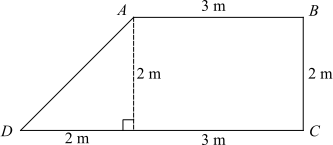
The floor of a chicken coop is in the shape of a trapezium.

The floor, `ABCD`, and the chicken coop are shown below.

 GEOMETRY, FUR2 2014 VCAA 1

`AB = 3\ text(m), BC = 2\ text(m  and)\ \ CD = 5\ text(m.)`

  1. What is the area of the floor of the chicken coop?


    Write your answer in square metres.  (1 mark)

  2. What is the perimeter of the floor of the chicken coop?


    Write your answer in metres, correct to one decimal place.  (1 mark)

Show Answers Only
  1. `8\ text(m²)`
  2. `12.8\ text(m)`
Show Worked Solution
a.    `A` `=1/2 h (a+b)`
    `= 1/2 xx 2 xx (3 + 5)`
    `= 8\ text(m²)`


b.  

`text(Using Pythagoras,)`

`AD^2` `=sqrt(2^2+2^2)`
  `=2.82…\ text(m)`


`:.\ text(Perimeter)` `= 3 + 2 + 5 + 2.82…`
  `= 12.8\ text{m  (1 d.p.)}`

Filed Under: Perimeter, Area and Volume Tagged With: Band 3, Band 4

GEOMETRY, FUR2 2008 VCAA 2

A shed has the shape of a prism. Its front face, `AOBCD`, is shaded in the diagram below. `ABCD` is a rectangle and `M` is the mid point of `AB`.
 

GEOMETRY, FUR2 2008 VCAA 2

  1. Show that the length of `OM` is 1.6 m.  (1 mark)
  2. Show that the area of the front face of the shed, `AOBCD`, is 18 m².  (1 mark)
  3. Find the volume of the shed in m³.  (1 mark)
  4. All inside surfaces of the shed, including the floor, will be painted.


    1. Find the total area that will be painted in m².  (2 marks)


      One litre of paint will cover an area of 16 m².

    2. Determine the number of litres of paint that is required.  (1 mark)
Show Answers Only
  1. `text(See Worked Solution)`
  2. `text(See Worked Solution)`
  3. `180`
    1. `208`
    2. `13\ text(litres)`
Show Worked Solution
a.  

`text(In)\ Delta AOM,\ text(using Pythagoras:)`

`OM` `= sqrt (3.4^2 – 3^2)`
  `= sqrt 2.56`
  `= 1.6\ text(m … as required)`


b.   `text(Area of front face of shed)`

MARKER’S COMMENT: “The “Show that” directive requires students to include all mathematical steps, as shown in the solution. Short cuts will not gain full marks!

`= text(Area)\ Delta AOB + text(Area)\ ABCD`

`= 1/2 xx 1.6 xx 6 + 2.2 xx 6`

`= 18\ text(m² … as required.)`


c.    `V` `= Ah`
    `= 18 xx 10`
    `= 180\ text(m³)`


d.i.    `text(Roof areas)` `= 2(1/2 xx 1.6 xx 6 + 3.4 xx 10)`
    `= 2 (4.8 + 34)`
    `= 77.6\ text(m²)`
  `text(Wall areas)` `= 2 (2.2 xx 6 + 2.2 xx 10)`
    `= 2 (13.2 + 22)`
    `= 70.4\ text(m²)`
  `text(Floor area)` `= 60\ text(m²)`


`:.\ text(Total Area to be painted)`

`= 77.6 + 70.4 + 60`

`= 208\ text(m²)`


  ii.   `text(Litres of paint required)`

`= 208/16`

`= 13\ text(litres)`

Filed Under: Perimeter, Area and Volume, Right-Angled Trig and Angle Properties Tagged With: Band 3, Band 4, smc-273-20-Pythagoras

GEOMETRY, FUR2 2008 VCAA 1

A shed is built on a concrete slab. The concrete slab is a rectangular prism 6 m wide, 10 m long and 0.2 m deep.


Geometry and Trig, FUR2 2008 VCAA 1

  1. Determine the volume of the concrete slab in m³.  (1 mark)
  2. On a plan of the concrete slab, a 3 cm line is used to represent a length of 6 m.


    1. What scale factor is used to draw this plan?  (1 mark)

The top surface of the concrete slab shaded in the diagram above has an area of 60 m².

  1. What is the area of this surface on the plan?  (1 mark)


Show Answers Only
  1. `12\ text(m³)`
    1. `1/200`
    2. `text(15 cm²)`
Show Worked Solution
a.    `V` `= lbh`
    `= 10 xx 6 xx 0.2`
    `= 12\ text(m³)`


b.i.   `text(Scale Factor)`

`= 3/600`

`= 1/200`

♦ A poorly answered question, although exact data unavailable.
MARKER’S COMMENT: The most successful answers established the scale factor and then squared it, as shown in the solution.
  ii.    `text(Plan Area)` `= text(Slab Area) xx (1/200)^2`
    `= 60 xx (1/200)^2`
    `= 0.0015\ text(m²)`
    `= 15\ text(cm²)`


Filed Under: Perimeter, Area and Volume Tagged With: Band 3, Band 4, Band 5

GEOMETRY, FUR2 2015 VCAA 3

Cabins are being built at the camp site.

The dimensions of the front of each cabin are shown in the diagram below.

Geometry and Trig, FUR2 2015 VCAA 31

The walls of each cabin are 2.4 m high.

The sloping edges of the roof of each cabin are 2.4 m long.

The front of each cabin is 4 m wide.

The overall height of each cabin is `h` metres.

  1. Show that the value of `h` is 3.73, correct to two decimal places.  (1 mark)

Each cabin is in the shape of a prism, as shown in the diagram below.

Geometry and Trig, FUR2 2015 VCAA 32

  1. All external surfaces of one cabin are to be painted, excluding the base.
     
    What is the total area of the surface to be painted?


    Write your answer correct to the nearest square metre.  (2 marks)

Show Answers Only
  1. `3.73`
  2. `76\ text(m²)`
Show Worked Solution
a.    `h` `= 2.4 + sqrt(2.4^2 – 2^2)`
    `= 3.726…`
    `=3.73\ text{m (2 d.p.)}`


b.   `text(Area of walls and roof)`

♦♦ “Few students answered this question correctly” (exact data unavailable).
MARKER’S COMMENT: In extended calculations, clearly label each step and draw supporting diagrams where applicable.

`=2xx(2.4 xx 5.4) + 2xx(2.4 xx 5.4) `

`=25.92+25.92`

`=51.84`

VCAA 2015 fur2 Q3bi

`text(Area of front and back)`

`=2xx(2.4 xx 4 + 1/2 xx 4 xx 1.33)`

`=2xx12.26`

`=24.52`

`:.\ text(Total area to be painted)`

`=51.84+24.52`

`=76.36`

`=76\ text{m² (nearest m²)}`

Filed Under: Perimeter, Area and Volume Tagged With: Band 4, Band 5

GEOMETRY, FUR2 2009 VCAA 3

The ferry has a logo painted on its side. The logo is a regular pentagon with centre `O` and side length 30 cm. 

It is shown in the diagram below.

GEOMETRY, FUR2 2009 VCAA 3

  1. Show that angle `POQ` is equal to 72°.  (1 mark)
  2. Show that, correct to two decimal places, the length `OP` is 25.52 cm.  (1 mark)
  3. Find the area of the pentagon. Write your answer correct to the nearest cm².  (2 marks)
Show Answers Only
  1. `text(See Worked Solutions.)`
  2. `text(See Worked Solutions.)`
  3. `1548\ text(cm²)`
Show Worked Solution
a.    `5 xx /_ POQ` `= 360^@`
  `/_ POQ` `= 360/5`
    `= 72^@\ \ text(…  as required)`


b.   VCAA GEO FUR2 2009 3i

`Delta POQ\ text(is isosceles)`

`:.\ text(Base angles)` `= 1/2 xx (180 – 72)`
  `= 54^@`

`text(Using sine rule,)`

`(OP)/(sin 54^@)` `= (PQ)/(sin 72^@)`
`:. OP` `= (30 xx sin 54^@)/(sin 72^@)`
  `= 25.519…`
  `= 25.52\ text{m  (2 d.p.)  … as required.}`


c.   `text(Area of)\ Delta OPQ` `= 1/2 ab sin C`
    `= 1/2 xx 25.52 xx 25.52 xx sin 72^@`
    `= 309.697…`


`:.\ text(Area of pentagon)`

`= 5 xx 309.697…`

`= 1548.4…`

`= 1548\ text(cm²)`

Filed Under: Perimeter, Area and Volume, Trig - Harder Applications Tagged With: Band 4

GEOMETRY, FUR2 2009 VCAA 2

A yacht, `Y`, is 7 km from a lighthouse, `L`, on a bearing of 210° as shown in the diagram below.


GEOMETRY, FUR2 2009 VCAA 2

  1. A ferry can also be seen from the lighthouse. The ferry is 3 km from `L` on a bearing of 135°. On the diagram above, label the position of the ferry, `F`, and show an angle to indicate its bearing.  (1 mark)
  2. Determine the angle between `LY` and `LF`.  (1 mark)
  3. Calculate the distance, in km, between the ferry and the yacht correct to two decimal places.  (1 mark)
  4. Determine the bearing of the lighthouse from the ferry.  (1 mark)
Show Answers Only
  1.  
  2. `75^@`
  3. `6.87\ text(km)`
  4. `315^@`
Show Worked Solution
a.   


b.   `text(Angle between)\ LY\ text(and)\ LF\ \ text{(from graph)}`

`= 30 + 45`

`= 75^@`


c.   `text(Using the cosine rule,)`

`FY^2` `= 7^2 + 3^2 – 2 xx 7 xx 3 xx cos 75^@`
  `= 47.129…`
`:. FY` `= 6.865…`
  `= 6.87\ text{km  (2 d.p.)}`


d.   `text(Bearing of)\ L\ text(from)\ F\ text{(from graph)}`

`= 360 – 45`

`= 315^@`

Filed Under: Trig - Bearings Tagged With: Band 3, Band 4

GEOMETRY, FUR2 2009 VCAA 1

A ferry, `F`, is 400 metres from point `O` at the base of a 50 metre high cliff, `OC`.
 

GEOMETRY, FUR2 2009 VCAA 1 
 

  1. Show that the gradient of the line `FC` in the diagram is 0.125.  (1 mark)
  2. Calculate the angle of elevation of point `C` from `F`.


    Write your answer in degrees, correct to one decimal place.  (1 mark)

  3. Calculate the distance `FC`, in metres, correct to one decimal place.  (1 mark)
Show Answers Only
  1. `text(See Worked Solution.)`
  2. `7.1^@`
  3. `403.1\ text(m)`
Show Worked Solution
a.    `text(Gradient)` `= text(rise)/text(run)`
    `= 50/400`
    `= 0.125\ \ text(…   as required)`


b.    `tan\ /_ CFO` `= 50/400`
  `:. /_ CFO` `= tan^-1 0.125`
    `= 7.12…`
    `= 7.1^@\ text{(1 d.p.)}`


c.    `text(Using Pythagoras:)`
  `FC` `= sqrt(400^2 + 50^2)`
    `= 403.11…`
    `= 403.1\ text(m)`

Filed Under: Right-Angled Trig and Angle Properties Tagged With: Band 3, Band 4, smc-273-10-SOHCAHTOA, smc-273-80-Angle of elevation

GEOMETRY, FUR2 2015 VCAA 2

There are plans to construct a series of straight paths on the flat top of the mountain.

A straight path will connect the cable car station at `C` to a communications tower at `T`, as shown in the diagram below.

Geometry and Trig, FUR2 2015 VCAA 21 

The bearing of the communications tower from the cable car station is 060°.

The length of the straight path between the communications tower and the cable car station is 950 m.

  1. How far north of the cable car station is the communications tower?  (1 mark)

Paths will also connect the cable car station and the communications tower to a camp site at `E`, as shown below.

Geometry and Trig, FUR2 2015 VCAA 22

The length of the straight path between the cable car station and the camp site is 1400 m.

The angle  `TCE`  is 40°.

    1. What will be the length of the straight path between the communications tower and the camp site?


      Write your answer correct to the nearest metre.  (1 mark)

    2. Use the cosine rule to find the bearing of the camp site from the communications tower.


      Write your answer correct to the nearest degree.  (2 marks)

Show Answers Only
  1. `475\ text(metres)`
    1. `908\ text(m)`
    2. `142^@`
Show Worked Solution
a.    `sin 30°` `=x/950`
  `:. x` `=950 xx sin 30°`
    `=475\ text(m)`


b.i   `text(Using the cosine rule,)`

`TE` `= sqrt(950^2 + 1400^2 – 2 xx 950 xx 1400 xx cos40^@)`
  `=908.196…`
  `=908\ text{m (nearest m)}`


b.ii.   VCAA 2015 fur2 Q2bii

`text(Let)\ \ alpha= angleCTE`

`cos alpha` `= (950^2 + 908.2^2 – 1400^2)/(2 xx 950 xx 908.196…)`
  `=-0.1348…`
`:. alpha` `=97.7…°`


`text(Let point)\ \ B\ \ text(be due south of)\ \ T`

`∠BTE` `= 97.7… -60`
  `=37.7…°`


`:. text(Bearing of)\ E\ text(from)\ T`

`= 180 – 37.7…`

`=142.2…`

`=142°\ \ text{(nearest °)}`

Filed Under: Trig - Bearings Tagged With: Band 4, Band 5

Calculus, MET2 2013 VCAA 4

Part of the graph of a function `g: R -> R, \ g (x) = (16-x^2)/4` is shown below.

VCAA 2013 4a

  1. Points `B` and `C` are the positive `x`-intercept and `y`-intercept of the graph `g`, respectively, as shown in the diagram above. The tangent to the graph of `g` at the point `A` is parallel to the line segment `BC.`
    1. Find the equation of the tangent to the graph of `g` at the point `A.`   (2 marks)

      --- 5 WORK AREA LINES (style=lined) ---

    2. The shaded region shown in the diagram above is bounded by the graph of `g`, the tangent at the point `A`, and the `x`-axis and `y`-axis.
    3. Evaluate the area of this shaded region.   (3 marks)

      --- 6 WORK AREA LINES (style=lined) ---

  2. Let `Q` be a point on the graph of  `y = g(x)`.
  3. Find the positive value of the `x`-coordinate of `Q`, for which the distance `OQ` is a minimum and find the minimum distance.   (3 marks)

    --- 6 WORK AREA LINES (style=lined) ---

The tangent to the graph of `g` at a point `P` has a negative gradient and intersects the `y`-axis at point  `D(0, k)`, where  `5 <= k <= 8.`
 

VCAA 2013 4c
 

  1. Find the gradient of the tangent in terms of `k.`   (2 marks)

    --- 8 WORK AREA LINES (style=lined) ---

  2.   i. Find the rule `A(k)` for the function of `k` that gives the area of the shaded region.   (2 marks)

    --- 5 WORK AREA LINES (style=lined) ---

  3.  ii. Find the maximum area of the shaded region and the value of `k` for which this occurs.   (2 marks)

    --- 5 WORK AREA LINES (style=lined) ---

  4. iii. Find the minimum area of the shaded region and the value of `k` for which this occurs.  (2 marks)

    --- 3 WORK AREA LINES (style=lined) ---

Show Answers Only
    1. `A: y = 5-x`
    2. `text(See Worked Solutions)`
  1. `2sqrt3\ text(units when)\ x = 2sqrt2`
  2. `gprime(2sqrt(k-4)) =-sqrt(k-4)`
    1. `A(k) = (k^2)/(2sqrt(k-4))-32/3, k ∈ [5,8]`
    2. `A_text(max) = 16/3quadtext(when)quadk = 8`
    3. `A_text(min) = (64sqrt3)/9-32/3quadtext(when)quadk = 16/3`
Show Worked Solution

a.i.   `B(4,0), C(0,4), A(a,(16-a^2)/4)`

`m_(BC) = m_text(tan) = (4-0)/(0-4) = -1`

`g(x)` `= (16-x^2)/4`
`g^{prime}(x)` `=-x/2`

 
`text(S)text(ince)\ \ g^{prime}(a) = -1,`

`=>a = 2`

`text(T)text(angent passes through)\ \ (2,3),`

`y-3` `=-(x-2)`
`y` `=-x + 5`

 
`text(Alternatively, using technology:)`

`[text(CAS: tangent Line)]\ (g(x),x,2)`
 

a.ii.   `text(Solution 1)`

♦ Mean mark 37%.
MARKER’S COMMENT: A common incorrect answer:
`int_0^5((-x+5)-g(x))dx=35/12`.  Know why it’s wrong!

  `D(5,0), E(0,5)`

`text(Area)` `= DeltaEOD-int_0^4 g(x)\ dx`
  `= 1/2 xx 5 xx 5-32/3`
  `= 11/6\ text(u²)`

 
`text(Solution 2)`

`text(Area)` `= int_0^5 (-x+5)\ dx-int_0^4 g(x)\ dx`
  `= 11/6\ text(u²)`


b.   `Q(x, (16-x^2)/4), O(0,0)`

♦♦♦ Mean mark 20%.
`z` `= OQ`
  `= sqrt(x^2 + ((16-x^2)/4)^2), x > 0`

 
`text(Max or min when)\ \ (dz)/(dx)=0,`

`text(Solve:)\ (dz)/dx = 0quadtext(for)quadx > 0`

`=> x = 2sqrt2`

`=>z(2sqrt2) = 2sqrt3`

`:. text(Min distance of)\ \ 2sqrt3\ \ text(units when)\ \ x = 2sqrt2`
 

c.   `text(Let)\ \ P(p, (16-p^2)/4)`

♦♦♦ Mean mark 8%.

`m_text(tan)\ text(at)\ P =-p/2`

`m_(PD) = ((16-p^2)/4-k)/(p-0)`
 

`text(Equating gradients,)`

`text(Solve:)\ \ ((16-p^2)/4-k)/p=-p/2\ \ text(for)\ p,`

`=> p=2sqrt(k-4)`
 

 `:.\ text(Gradient of tangent:)`

`g^{prime}(2sqrt(k-4)) =-sqrt(k-4)`
 

d.i.   `text(Equation of tangent:)`

♦♦♦ Mean mark 8%.

`y = -sqrt(k-4)x + k`

`text(CAS: tangent Line)\ (g(x),x,2sqrt(k-4))`

`xtext(-int of tangent:)\ x = k/(sqrt(k-4))`
 

`:. A(k)` `= 1/2 xx (k/(sqrt(k-4))) xx k-int_0^4 g(x)\ dx`
  `= (k^2)/(2sqrt(k-4))-32/3, \ \ k ∈ [5,8]`


d.ii.   `text(Solve:)\ \ A(k)=0quadtext(for)quadk ∈ [5,8]`

♦♦♦ Mean mark 5%.

`=> k=16/3`

  `text(Sketch the graph of)\ \ A(k)\ \ text(for)\ \ 5<=k<=8`


 met2-2013-vcaa-sec4-answer

`:. A_text(max) = 16/3quadtext(when)quadk = 8`
 

d.iii.   `A_text(min)\ text(occurs at the turning point)\ (k=16/3).`

♦♦♦ Mean mark 3%.
 `A_text(min)` `=A(16/3)`
  `=(64sqrt3)/9-32/3`

Filed Under: Area Under Curves, Maxima and Minima, Tangents and Normals Tagged With: Band 4, Band 5, Band 6, smc-634-10-Polynomial, smc-634-50-Find tangent given curve, smc-641-10-Area, smc-723-10-Quadratic, smc-723-80-Area between graphs

Calculus, MET2 2013 VCAA 3

Tasmania Jones is in Switzerland. He is working as a construction engineer and he is developing a thrilling train ride in the mountains. He chooses a region of a mountain landscape, the cross-section of which is shown in the diagram below.

VCAA 2013 2a

The cross-section of the mountain and the valley shown in the diagram (including a lake bed) is modelled by the function with rule

`f(x) = (3x^3)/64-(7x^2)/32 + 1/2.`

Tasmania knows that  `A (0, 1/2)`  is the highest point on the mountain and that `C(2, 0)` and `B(4, 0)` are the points at the edge of the lake, situated in the valley. All distances are measured in kilometres.

  1. Find the coordinates of `G`, the deepest point in the lake.   (3 marks)

    --- 5 WORK AREA LINES (style=lined) ---

Tasmania’s train ride is made by constructing a straight railway line `AB` from the top of the mountain, `A`, to the edge of the lake, `B`. The section of the railway line from `A` to `D` passes through a tunnel in the mountain.

  1. Write down the equation of the line that passes through `A` and `B.`   (2 marks)

    --- 4 WORK AREA LINES (style=lined) ---

  2.  i. Show that the `x`-coordinate of `D`, the end point of the tunnel, is `2/3.`   (1 mark)

    --- 3 WORK AREA LINES (style=lined) ---

  3. ii. Find the length of the tunnel `AD.`   (2 marks)

    --- 2 WORK AREA LINES (style=lined) ---

In order to ensure that the section of the railway line from `D` to `B` remains stable, Tasmania constructs vertical columns from the lake bed to the railway line. The column `EF` is the longest of all possible columns. (Refer to the diagram above.)

  1.  i. Find the `x`-coordinate of `E.`   (2 marks)

    --- 3 WORK AREA LINES (style=lined) ---

  2. ii. Find the length of the column `EF` in metres, correct to the nearest metre.   (2 marks)

    --- 2 WORK AREA LINES (style=lined) ---

Tasmania’s train travels down the railway line from `A` to `B`. The speed, in km/h, of the train as it moves down the railway line is described by the function.

`V: [0, 4] -> R, \ V(x) = k sqrt x-mx^2,`

where `x` is the `x`-coordinate of a point on the front of the train as it moves down the railway line, and `k` and `m` are positive real constants.

The train begins its journey at `A (0, 1/2)`. It increases its speed as it travels down the railway line.

The train then slows to a stop at `B(4, 0)`, that is  `V(4) = 0.`

  1. Find `k` in terms of `m.`   (1 mark)

    --- 3 WORK AREA LINES (style=lined) ---

  2. Find the value of `x` for which the speed, `V`, is a maximum.   (2 marks)

    --- 3 WORK AREA LINES (style=lined) ---

Tasmania is able to change the value of `m` on any particular day. As `m` changes, the relationship between `k` and `m` remains the same.

  1. If, on one particular day, `m = 10`, find the maximum speed of the train, correct to one decimal place.   (2 marks)

    --- 4 WORK AREA LINES (style=lined) ---

  2. If, on another day, the maximum value of `V` is 120, find the value of `m.`   (2 marks)

    --- 4 WORK AREA LINES (style=lined) ---

Show Answers Only
  1. `G(28/9,−50/243)`
  2. `y = −1/8x + 1/2`
  3.  i. `text(See Worked Solutions)`
  4. ii. `sqrt65/12`
  5.  i. `(2(sqrt31 + 7))/9`
  6. ii. `336\ text(m)`
  7. `8\ text(m)`
  8. `2^(2/3)`
  9. `75.6\ text(km/h)`
  10. `10 xx 2^(2/3)`
Show Worked Solution

a.   `G\ text(occurs when)\ \ f^{′}(x)=0.`

`text(Solve:)\ \ (3x^3)/64-(7x^2)/32 + 1/2=0\ \ text(for)\ x`

`x= 28/9quadtext(for)quadx ∈ (2,4)`

`f(28/9) = −50/243`

`:. G(28/9,−50/243)`
 

b.    `m_(AB)` `= (1/2-0)/(0-4)`
    `= −1/8`

 
`text(Equation using point gradient formula,)`

`y-y_1` `= m(x-x_1)`
`y-1/2` `= −1/8(x-0)`
`:. y` `= −1/8x + 1/2`

 
c.i.
 `text{Solution 2 (using technology)}`

`text(Solve:)\ \ ` `3/64x^3-7/32x^2 + 1/2` `= −1/8x + 1/2\ \ text(for)\ x`

`x=0, 2/3 or 4`

`:.x=2/3,\ \ (0<x<4)`
 

`text(Solution 1)`

`text(Intersection occurs when:)`

`3/64x^3-7/32x^2 + 1/2` `= −1/8x + 1/2`
`3x^3-14x^2 + 8x` `= 0`
`x(3x^2-14x + 8)` `= 0`
`x(x-4)(3x-2)` `= 0`

 
`x = 2/3,\ \ (0<x<4)`

`:. x text(-coordinate of)\ D = 2/3`
 

c.ii.   `D (2/3, 5/12)qquadA(0,1/2)`

  `text(By Pythagoras,)`

`AD` `= sqrt((2/3-0)^2 + (5/12-1/2)^2)`
  `= sqrt65/12`


d.i.  `text(Let)\ \ z =\ EF`

♦♦♦ Mean mark part (d)(i) 24%.
MARKER’S COMMENT: Many students unfamiliar with this type of question.
 `z` `= (−1/8x + 1/2)-((3x^2)/64-7/32 x^2 + 1/2)`
  `=-1/8x-(3x^2)/64 + 7/32 x^2`

 
`text(Solve:)\ \ d/dx (-1/8x-(3x^2)/64 + 7/32 x^2) =0\ \ text(for)\ x`

`x= (2(sqrt31 + 7))/9,\ \ \ x > 0`
 

♦♦♦ Mean mark part (d)(ii) 22%.
d.ii.    `z((2sqrt31 + 14)/9)` `= 0.3360…\ text(km)`
    `= 336\ text{m  (nearest m)}`


e.    `V(4)` `= 0quadtext{(given)}`
  ` 0` `= k sqrt4-m xx 4^2`
  `:.k` `= 8m`


f.  `V(x) = 8msqrtx-mx^2`

`text(Solve:)\ \ V^{′}(x)` `= 0quadtext(for)quadx`

`x= 2^(2/3)`
 

g.  `text(When)\ \ m=10,\ \ k=8 xx 10=80`

♦ Mean mark 43%.

`:.V(x) = 80sqrtx-10x^2`

`text(Solve:)\ \ V^{′}(x)` `= 0quadtext(for)quadx`

`x= 2^(2/3)`

`V(2^(2/3))` `=75.59…`
  `= 75.6\ text(km/h)`


h.   `text(Maximum occurs at)\ x = 2^(2/3)`

♦ Mean mark 38%.

`V(x) = 8msqrtx-mx^2`

`text(Solve:)\ \ V(2^(2/3))` `= 120quadtext(for)quadm`
`:. m` `= 10 xx 2^(2/3)`

Filed Under: Curve Sketching, Maxima and Minima Tagged With: Band 3, Band 4, Band 5, Band 6, smc-641-60-Other themes, smc-724-10-Cubic, smc-724-70-Applied context

Probability, MET2 2013 VCAA 2

FullyFit is an international company that owns and operates many fitness centres (gyms) in several countries. At every one of FullyFit’s gyms, each member agrees to have his or her fitness assessed every month by undertaking a set of exercises called `S`. There is a five-minute time limit on any attempt to complete `S` and if someone completes `S` in less than three minutes, they are considered fit.

  1. At FullyFit’s Melbourne gym, it has been found that the probability that any member will complete `S` in less than three minutes is `5/8.` This is independent of any member.
  2. In a particular week, 20 members of this gym attemp `S.`
    1. Find the probability, correct to four decimal places, that at least 10 of these 20 members will complete `S` in less than three minutes (2 marks)

      --- 4 WORK AREA LINES (style=lined) ---

    2. Given that at least 10 of these 20 members complete `S` in less than three minutes, what is the probability, correct to three decimal places, that more than 15 of them complete `S` in less than three minutes?  (3 marks)

      --- 5 WORK AREA LINES (style=lined) ---

  3. When FullyFit surveyed all its gyms throughout the world, it was found that the time taken by members to complete `S` is a continuous random variable `X`, with a probability density function `g`, as defined below.
     
    `qquad qquad qquad g(x) = {(((x-3)^3 + 64)/256 ,  1 <= x <= 3),((x + 29)/128 ,  3 < x <= 5),(0 ,  text(elsewhere)):}`

    1. Find `text(E)(X)`, correct to four decimal places.  (2 marks)

      --- 4 WORK AREA LINES (style=lined) ---

    2. In a random sample of 200 FullyFit members, how many members would be expected to take more than four minutes to complete `S?` Give your answer to the nearest integer.  (2 marks)

      --- 5 WORK AREA LINES (style=lined) ---

Show Answers Only

a.i.   `0.9153`

a.ii.   `0.086`

b.i.   `3.0458`

b.ii.  `52\ text(people)`

Show Worked Solution

a.i.   `text(Let)\ \ y =\ text(number who complete in less than 3 min)`

`Y ∼\ text(Bi)(20, 5/8)`

`text(Pr)(Y >= 10)` `= 0.91529…`
  `= 0.9153\ \ text{(4 d.p.)}`


a.ii.    `text(Pr)(Y> 15 | Y >= 10)` `= (text(Pr)(Y > 15))/(text(Pr)(Y >= 10))`
    `= (0.079041…)/(0.915292…)`
    `= 0.086\ \ text{(3 d.p.)}`


b.i.    `text(E)(X)` `=int_-oo^oo (x xx g(x))\ dx`
    `= int_1^3 x[((x-3)^3 + 64)/256]dx + int_3^5 x((x + 29)/128) dx`
    `= 3.04583…`
    `= 3.0458\ \ text{(4 d.p.)}`


b.ii.  `text(Let)\ \ W =\ text(number who take more than 4 min)`

♦ Mean mark 48%.

`W ∼\ text(Bi)(200, int_4^5 (x + 29)/128\ dx)`

`W ∼\ text(Bi)(200, 67/256)`

`text(E)(W)` `= np`
  `= 200 xx 67/256`
  `= 1675/32`
  `= 52.3437…`
  `= 52\ text(people)`

Filed Under: Binomial, Probability density functions Tagged With: Band 4, Band 5, smc-637-10-E(X), smc-637-60-Polynomial PDF, smc-638-20-binomCdf (CAS), smc-638-50-Conditional

Graphs, MET2 2013 VCAA 1

Trigg the gardener is working in a temperature-controlled greenhouse. During a particular 24-hour time interval, the temperature  `(Ttext{°C})` is given by  `T(t) = 25 + 2 cos ((pi t)/8), \ 0 <= t <= 24`, where `t` is the time in hours from the beginning of the 24-hour time interval.

  1. State the maximum temperature in the greenhouse and the values of `t` when this occurs.   (2 marks)

    --- 3 WORK AREA LINES (style=lined) ---

  2. State the period of the function `T.`   (1 mark)

    --- 2 WORK AREA LINES (style=lined) ---

  3. Find the smallest value of `t` for which  `T = 26.`   (2 marks)

    --- 3 WORK AREA LINES (style=lined) ---

  4. For how many hours during the 24-hour time interval is  `T >= 26?`   (2 marks)

    --- 3 WORK AREA LINES (style=lined) ---

Trigg is designing a garden that is to be built on flat ground. In his initial plans, he draws the graph of  `y = sin(x)`  for  `0 <= x <= 2 pi`  and decides that the garden beds will have the shape of the shaded regions shown in the diagram below. He includes a garden path, which is shown as line segment `PC.`

  1. The line through points  `P((2 pi)/3, sqrt 3/2)`  and  `C (c, 0)`  is a tangent to the graph of  `y = sin (x)`  at point `P.`

    1. Find  `(dy)/(dx)`  when  `x = (2 pi)/3.`   (1 mark)

      --- 3 WORK AREA LINES (style=lined) ---

    2. Show that the value of `c` is  `sqrt 3 + (2 pi)/3.`   (1 mark)

      --- 6 WORK AREA LINES (style=lined) ---

In further planning for the garden, Trigg uses a transformation of the plane defined as a dilation of factor `k` from the `x`-axis and a dilation of factor `m` from the `y`-axis, where `k` and `m` are positive real numbers.

  1. Let `X^{′}, P^{′}` and `C^{′}` be the image, under this transformation, of the points `X, P` and `C` respectively. 


    1. Find the values of `k` and `m`  if  `X^{′}P^{′} = 10`  and  `X^{′} C^{′} = 30.`   (2 marks)

      --- 8 WORK AREA LINES (style=lined) ---

    2. Find the coordinates of the point `P^{′}.`   (1 mark)

      --- 3 WORK AREA LINES (style=lined) ---

Show Answers Only
  1. `t = 0, or 16\ text(h)`
  2. `16\ text(hours)`
  3. `8/3`
  4. `8\ text(hours)`
  5.  i.  `-1/2`
    ii.  `text(See worked solution)`
  6.  i.  `k=(20sqrt3)/3, m=10sqrt3`
    ii.  `P^{′}((20pisqrt3)/3,10)`
Show Worked Solution

a.   `T_text(max)\ text(occurs when)\ \ cos((pit)/8) = 1,`

`T_text(max)= 25 + 2 = 27^@C`

`text(Max occurs when)\ \ t = 0, or 16\ text(h)`


b.    `text(Period)` `= (2pi)/(pi/8)`
    `= 16\ text(hours)`


c.   `text(Solve:)\ \ 25 + 2 cos ((pi t)/8)=26\ \ text(for)\ t,`

`t`  `= 8/3,40/3,56/3\ \ text(for)\ t ∈ [0,24]`
`t_text(min)` `= 8/3`


d.   `text(Consider the graph:)`

met2-2013-vcaa-sec1-answer1

`text(Time above)\ 26 text(°C)` `= 8/3 + (56/3-40/3)`
  `= 8\ text(hours)`


e.i.   `(dy)/(dx) = cos(x)`

`text(At)\ x = (2pi)/3,`

`(dy)/(dx)` `= cos((2pi)/3)=-1/2`


e.ii.  `text(Solution 1)`

`text(Equation of)\ \ PC,`

`y-sqrt3/2` `=-1/2(x-(2pi)/3)`
`y` `=-1/2 x +pi/3 +sqrt3/2`


`PC\ \ text(passes through)\ \ (c,0),`

`0` `=-1/2 c +pi/3 + sqrt3/2`
`c` `=sqrt3 + (2 pi)/3\ …\ text(as required)`


`text(Solution 2)`

`text(Equating gradients:)`

`- 1/2` `= (sqrt3/2-0)/((2pi)/3-c)`
`-1` `= sqrt3/((2pi-3c)/3)`
`3c-2pi` `= 3sqrt3`
`3c` `= 3 sqrt3 + 2pi`
`:. c` `= sqrt3 + (2pi)/3\ …\ text(as required)`


f.i.   `X^{′} ((2pi)/3 m,0)qquadP^{′}((2pi)/3 m, sqrt3/2 k)qquadC^{′} ((sqrt3 + (2pi)/3)m, 0)`

`X^{′}P^{′}` `= 10`
`sqrt3/2 k` `= 10`
`:. k` `= 20/sqrt3`
  `=(20sqrt3)/3`
♦♦♦ Mean mark part (f)(i) 14%.


`X^{′}C^{′}=30`

`((sqrt3 + (2pi)/3)m)-(2pi)/3 m` `= 30`
`:. m` `= 30/sqrt3`
  `=10sqrt3`
♦♦♦ Mean mark part (f)(ii) 12%.


f.ii.    `P^{′}((2pi)/3 m, sqrt3/2 k)` `= P^{′}((2pi)/3 xx 10sqrt3, sqrt3/2 xx 20/sqrt3)`
    `= P^{′}((20pisqrt3)/3,10)`

Filed Under: Tangents and Normals, Transformations, Trig Graphing Tagged With: Band 3, Band 4, Band 6, smc-2757-15-Cos, smc-2757-30-Find period, smc-2757-80-Applications, smc-2757-85-Max/min (non-calc), smc-634-30-Trig Function, smc-634-50-Find tangent given curve, smc-753-20-Dilation (Only), smc-753-75-Trig functions

Calculus, MET2 2012 VCAA 5

The shaded region in the diagram below is the plan of a mine site for the Black Possum mining company.

All distances are in kilometres.

Two of the boundaries of the mine site are in the shape of the graphs of the functions

`f: R -> R,\ f(x) = e^x and g: R^+ -> R,\ g(x) = log_e (x).`

VCAA 2012 5a

    1. Evaluate `int_(−2)^0 f(x)\ dx`.   (1 mark)

      --- 2 WORK AREA LINES (style=lined) ---

    2. Hence, or otherwise, find the area of the region bounded by the graph of `g`, the `x` and `y` axes, and the line `y = –2`.   (1 mark)

      --- 2 WORK AREA LINES (style=lined) ---

    3. Find the total area of the shaded region.   (1 mark)

      --- 2 WORK AREA LINES (style=lined) ---

  1. The mining engineer, Victoria, decides that a better site for the mine is the region bounded by the graph of `g` and that of a new function  `k: (– oo, a) -> R,\ k(x) = – log_e(a-x)`, where `a` is a positive real number.
    1. Find, in terms of `a`, the `x`-coordinates of the points of intersection of the graphs of `g` and `k`.   (2 marks)

      --- 3 WORK AREA LINES (style=lined) ---

    2. Hence, find the set of values of `a`, for which the graphs of `g` and `k` have two distinct points of intersection.   (1 mark)

      --- 3 WORK AREA LINES (style=lined) ---

  2. For the new mine site, the graphs of `g` and `k` intersect at two distinct points, `A` and `B`. It is proposed to start mining operations along the line segment `AB`, which joins the two points of intersection.
  3. Victoria decides that the graph of `k` will be such that the `x`-coordinate of the midpoint of `AB` is `sqrt 2`.
  4. Find the value of `a` in this case.   (2 marks)

    --- 4 WORK AREA LINES (style=lined) ---

Show Answers Only
    1. `1-1/(e^2)`
    2. `1-1/(e^2)\ text(units²)`
    3. `e-1/(e^2)\ text(units²)`
    1. `(a ± sqrt(a^2-4))/2`
    2. `a > 2`
  1. `2sqrt2`
Show Worked Solution
ai.    `int_(−2)^0 f(x)\ dx` `=[e^x]_(-2)^0`
    `= e^0-e^(-2)`
    `=1-1/e^2`


a.ii.   `text(S)text(ince)\ \ g(x) = f^(−1)(x),`

♦ Mean mark part (a)(ii) 45%.

`=>\ text(Area is the same as)\ int_(−2)^0f(x)\ dx,`

`:. text(Area) = 1-1/(e^2)\ text(u²)`


♦ Mean mark part (a)(iii) 36%.
a.iii.    `text(Area)` `=int_0^1 (e^x)\ dx + text{Area from part (a)(ii)}`
    `= [e^x]_0^1 + (1-1/(e^2))`
    `= e-1/(e^2)\ text(u²)`


b.i.    `g(x)` `= k(x)`
  `log_e (x)` `=- log_e(a-x)`
  `log_e (x)+log_e(a-x)` `=0`
  `log_e(x(a-x))` `=0`
  `ax-x^2` `=1`
  `x^2-ax+1` `=0`

 
`:.x= (a ± sqrt(a^2-4))/2`


♦♦♦ Mean mark (b.ii.) 11%.

b.ii.   `text(For 2 solutions:)`

`b^2-4ac` `>0`
`a^2-4` `>0`
`:. a` `>2,\  \ (a>0)`


c.   `xtext(-coordinate of Midpoint)= sqrt2`

♦♦♦ Mean mark (c) 15%.
`((a + sqrt(a^2-4))/2 +(a-sqrt(a^2-4))/2)/2` `= sqrt2`
`a + sqrt(a^2-4) +a-sqrt(a^2-4)`  `=4 sqrt2`
`a` `=2sqrt2quadtext(for)quada > 2`

Filed Under: Area Under Curves Tagged With: Band 3, Band 4, Band 5, Band 6, smc-723-50-Log/Exponential, smc-723-80-Area between graphs

Calculus, MET2 2012 VCAA 4

Tasmania Jones is in the jungle, searching for the Quetzalotl tribe’s valuable emerald that has been stolen and hidden by a neighbouring tribe. Tasmania has heard that the emerald has been hidden in a tank shaped like an inverted cone, with a height of 10 metres and a diameter of 4 metres (as shown below).

The emerald is on a shelf. The tank has a poisonous liquid in it.

VCAA 2012 4a

  1. If the depth of the liquid in the tank is `h` metres.
      
     i. 
    find the radius, `r` metres, of the surface of the liquid in terms of `h`.   (1 mark)

    --- 5 WORK AREA LINES (style=lined) ---

    ii.
    show that the volume of the liquid in the tank is  `(pi h^3)/75\ text(m³)`.   (1 mark)

    --- 5 WORK AREA LINES (style=lined) ---

The tank has a tap at its base that allows the liquid to run out of it. The tank is initially full. When the tap is turned on, the liquid flows out of the tank at such a rate that the depth, `h` metres, of the liquid in the tank is given by

`h = 10 + 1/1600 (t^3 - 1200t)`,

where `t` minutes is the length of time after the tap is turned on until the tank is empty.

  1. Show that the tank is empty when  `t = 20`.   (1 mark)

    --- 5 WORK AREA LINES (style=lined) ---

  2. When  `t = 5` minutes, find
      
    i.
    the depth of the liquid in the tank.   (1 mark)

    --- 5 WORK AREA LINES (style=lined) ---

    ii. No longer in syllabus

  1. The shelf on which the emerald is placed is 2 metres above the vertex of the cone.

    From the moment the liquid starts to flow from the tank, find how long, in minutes, it takes until  `h = 2`.

    (Give your answer correct to one decimal place.)   (2 marks)

    --- 5 WORK AREA LINES (style=lined) ---

  2. As soon as the tank is empty, the tap turns itself off and poisonous liquid starts to flow into the tank at a rate of 0.2 m³/minute.
      
    How long, in minutes, after the tank is first empty will the liquid once again reach a depth of 2 metres?   (2 marks)

    --- 5 WORK AREA LINES (style=lined) ---

  3. In order to obtain the emerald, Tasmania Jones enters the tank using a vine to climb down the wall of the tank as soon as the depth of the liquid is first 2 metres. He must leave the tank before the depth is again greater than 2 metres.
      
    Find the length of time, in minutes, correct to one decimal place, that Tasmania Jones has from the time he enters the tank to the time he leaves the tank.   (1 mark)

    --- 5 WORK AREA LINES (style=lined) ---

Show Answers Only
  1.  i. `h/5`
    ii. `(pih^3)/75`
  2. `text(See Worked Solutions)`
  3.  i. `405/64\ text(m)`
    ii. `text(No longer in course)`
  4. `12.2\ text(min)`
  5. `(8pi)/15\ text(min)`
  6. `9.5\ text(min)`
Show Worked Solution

a.i.   `text(Using similar triangles:)`

`r/h` `= 2/10`
`:. r` `= h/5`


a.ii.    `V` `= 1/3 pir^2h`
    `= 1/3 pi(h/5)^2h`
  `:. V` `= (pih^3)/75\ \ \ text(… as required)`


b.    `h(20)` `= 10 + 1/1600(20^3-1200 xx 20)`
    `= 10 + 1/1600(-16\ 000)`
    `= 10-10`
    `= 0`


c.i.   `text(When)\ \ t=5,`

`h(5)` `=10 + 1/1600 (5^3-1200xx5)`
  `= 405/64\ text(m)`


c.ii.   `text(No longer in syllabus.)`


d.    `text(Solve:)\ \ 10 + 1/1600 (t^3-1200t)` `= 2`


`t= 12.2\ text(min)quadtext(for)quadt ∈ (0,20)`


e.   `text(When)\ \ h=2,`

♦♦♦ Mean mark part (e) 17%.
`text(Volume)` `=(pi 2^3)/75=(8pi)/75\ text(m³)`
   

`text(Time to fill back up to)\ \ h=2`

`=(8pi)/75 -: 0.2`

`=(8pi)/15\ text(minutes)`


f.   `text(Length of time)`

♦♦♦ Mean mark part (f) 11%.

`=\ text(Time for 2m to empty + Time to Fill to 2m)`

`= (20-12.16799…) + (8pi)/15`

`= 9.5\ text(min)\ \ text{(1 d.p.)}`

Filed Under: Average Value and Other Tagged With: Band 3, Band 4, Band 5, Band 6, smc-756-50-Other problems

Probability, MET2 2012 VCAA 3

Steve, Katerina and Jess are three students who have agreed to take part in a psychology experiment. Each student is to answer several sets of multiple-choice questions. Each set has the same number of questions, `n`, where `n` is a number greater than 20. For each question there are four possible options A, B, C or D, of which only one is correct.

  1. Steve decides to guess the answer to every question, so that for each question he chooses A, B, C or D at random.
  2. Let the random variable `X` be the number of questions that Steve answers correctly in a particular set.
    1. What is the probability that Steve will answer the first three questions of this set correctly?   (1 mark)

      --- 2 WORK AREA LINES (style=lined) ---

    2. Find, to four decimal places, the probability that Steve will answer at least 10 of the first 20 questions of this set correctly.   (2 marks)

      --- 4 WORK AREA LINES (style=lined) ---

    3. Use the fact that the variance of `X` is `75/16` to show that the value of `n` is 25.   (1 mark)

      --- 4 WORK AREA LINES (style=lined) ---

  1. The probability that Jess will answer any question correctly, independently of her answer to any other question, is  `p\ (p > 0)`. Let the random variable `Y` be the number of questions that Jess answers correctly in any set of 25.
  2. If  `text(Pr) (Y > 23) = 6 text(Pr) (Y = 25)`, show that the value of  `p` is `5/6`.   (2 marks)

    --- 5 WORK AREA LINES (style=lined) ---

  3. From these sets of 25 questions being completed by many students, it has been found that the time, in minutes, that any student takes to answer each set of 25 questions is another random variable, `W`, which is normally distributed with mean `a` and standard deviation `b`.
  4. It turns out that, for Jess, `text(Pr)(Y >= 18) = text(Pr) (W >= 20)` and also `text(Pr)(Y >= 22) = text(Pr)(W >= 25)`.
  5. Calculate the values of `a` and `b`, correct to three decimal places.   (4 marks)

    --- 8 WORK AREA LINES (style=lined) ---

Show Answers Only

    1. `1/64`
    2. `0.0139`
    3. `text(See Worked Solutions)`
  1. `text(No longer in syllabus.)`
  2. `text(See Worked Solutions)`
  3. `a = 24.246, b = 2.500`

Show Worked Solution

a.i.    `text{Pr(3 correct in a row)}` `= (1/4)^3`
    `= 1/64`


a.ii.   `X =\ text(Number Steve gets correct)`

  `X ∼\ text(Bi)(20,1/4)`

`text(Pr)(X >= 10) = 0.0139\ \ text{(4 d.p.)}`

`[text(CAS: binom Cdf)\ (20,1/4,10,20)]`


a.iii.    `text(Var)(X)` `= np(1 – p)`
  `75/16` `= n(1/4)(3/4)`
  `75` `= 3n`
  `:. n` `= 25`


b.i. & b.ii.  `text(No longer in syllabus.)`


c.   `Y ∼\ text(Bi)(25,p)`

♦♦♦ Mean mark part (c) 19%.

`text(Pr)(Y > 23)` `= 6text(Pr)(Y = 25)`
`text(Pr)(Y = 24) + text(Pr)(Y = 25)` `= 6text(Pr)(Y = 25)`
`text(Pr)(Y = 24)` `= 5 text(Pr)(Y = 25)`
`((25),(24))p^24(1 – p)^1` `= 5p^25`
`25p^24(1 – p)` `= 5p^25`
`25p^24-25p^25-5p^25` `=0`
`25p^24-30p^25` `=0`
`5p^24(5 – 6p)` `= 0`


`:. p = 5/6,\ \ (p>0)\ \ text(… as required)`


d.   `W ∼\ text(N)(a,b^2)`

♦♦♦ Mean mark part (d) 19%.

`text(Pr)(Y >= 18)` `= text(Pr)(W >= 20)`
`0.9552…` `= text(Pr)(W >= 20)`
`:. text(Pr)(W<20)`  `=1-0.9552…` 
`text(Pr)(Z<(20-a)/b)` `=0.0447…`
`(20-a)/b` `=-1.698…\ \ (1)`

MARKER’S COMMENT: Many students didn’t use binomial calculations for `Y` here.


`text(Pr)(Y >= 22)` `= text(Pr)(W >= 25)`
`0.3815…` `= text(Pr)(W >= 25)`
`text(Pr)(W < 25)`   `=1-0.3815…`
`text(Pr)(Z<(25-a)/b)` `=0.6184…`
`(25-a)/b` `=0.30136…\ \ (2)`


`text{Solve (1) and (2) simultaneously:}`

`a = 24.246\ \ text{(3 d.p.)}, \ b = 2.500\ \ text{(3 d.p.)}`

Filed Under: Binomial, Normal Distribution Tagged With: Band 4, Band 5, Band 6, smc-638-20-binomCdf (CAS), smc-638-35-Find n/p given E(X) Var(X)

Calculus, MET2 2012 VCAA 2

Let  `f: R text(\{2}) -> R,\ f(x) = 1/(2x-4) + 3.`

  1. Sketch the graph of  `y = f(x)` on the set of axes below. Label the axes intercepts with their coordinates and label each of the asymptotes with its equation.   (3 marks)

    --- 0 WORK AREA LINES (style=lined) ---

           VCAA 2012 2a
     

  2.   i. Find `f^{′}(x)`.   (1 mark)

    --- 1 WORK AREA LINES (style=lined) ---

  3.  ii. State the range of  `f ^{′}`.   (1 mark)

    --- 1 WORK AREA LINES (style=lined) ---

  4. iii. Using the result of part ii. explain why `f` has no stationary points.   (1 mark)

    --- 2 WORK AREA LINES (style=lined) ---

  5. If  `(p, q)`  is any point on the graph of  `y = f(x)`, show that the equation of the tangent to  `y = f(x)`  at this point can be written as  `(2p-4)^2 (y-3) = -2x + 4p-4.`   (2 marks)

    --- 5 WORK AREA LINES (style=lined) ---

  6. Find the coordinates of the points on the graph of  `y = f(x)`  such that the tangents to the graph at these points intersect at  `(-1, 7/2).`   (4 marks)

    --- 4 WORK AREA LINES (style=lined) ---

  7. A transformation  `T: R^2 -> R^2`  that maps the graph of  `f` to the graph of the function  `g: R text(\{0}) -> R,\ g(x) = 1/x`  has rule
  8.      `T([(x), (y)]) = [(a, 0), (0, 1)] [(x), (y)] + [(c), (d)]`, where `a`, `c` and `d` are non-zero real numbers.
  9. Find the values of `a, c` and `d`.   (2 marks)

    --- 6 WORK AREA LINES (style=lined) ---

Show Answers Only
  1. met2-2012-vcaa-sec2-answer
  2.   i. `f^{′}(x) = (−2)/((2x-4)^3)`
     ii. `text(Range) = (−∞,0)`
    iii. `text(See Worked Solutions)`
  3. `text(See Worked Solutions)`
  4. `text(Coordinates:) (1,5/2)\ text(or)\ (5,19/6)`
  5. `a = 2, c = −4, d = −3`
Show Worked Solution

a.   `text(Asymptotes:)`

`x = 2`

`y = 3`

met2-2012-vcaa-sec2-answer


b.i.   `f^{′}(x) = (−2)/((2x-4)^2)`


b.ii.   `text(Range) = (−∞,0), or  R^-`

MARKER’S COMMENT: Incorrect notation in part (b)(ii) was common, including `{-oo,0}, -R, (0,-oo)`.


b.iii.    `text(As)\ \ ` `f^{′}(x) < 0quadtext(for)quadx ∈ R text(\{2})`
    `f^{′}(x) != 0`

 
`:. f\ text(has no stationary points.)`
 

c.   `text(Point of tangency) = P(p,1/(2p-4) + 3)`

♦♦ Mean mark 29%.
`m_text(tang)` `= f^{′}(p)`
  `= (-2)/((2p-4)^2)`

 
`text(Equation of tangent using:)`

`y-y_1` `= m(x-x_1)`
`y-(1/(2p-4) + 3)` `= (-2)/((2p-4)^2)(x-p)`
`y-3` `= (-2(x-p))/((2p-4)^2) + (2p-4)/((2p-4)^2)`
`(2p-4)^2(y-3)` `=-2x + 2p + 2p-4`
`:. (2p-4)^2(y-3)` `=-2x + 4p-4\ \ text(… as required)`


d.   `text(Substitute)\ \ (−1,7/2)\ text{into tangent (part c),}`

♦♦♦ Mean mark 19%.

`text(Solve)\ \ (2p-4)^2(7/2-3) = −2(-1) + 4p-4\ \ text(for)\ p:`

`:. p = 1,\ text(or)\ 5`

`text(Substitute)\ \ p = 1\ text(and)\ p = 5\ text(into)\ \ P(p,1/(2p-4) + 3)`

`:. text(Coordinates:)\ (1,5/2)\ text(or)\ (5,19/6)`
 

e.   `text(Determine transformations that that take)\ f -> g:`

`text(Dilate the graph of)\ \ f(x) = 1/(2x-4) + 3\ \ text(by a)`

`text(factor of 2 from the)\ \ ytext(-axis).`

`y = 1/(2(x/2)-4) + 3= 1/(x-4) + 3`

`text(Translate the graph 4 units to the left and 3)`

`text(units down to obtain)\ \ g(x).`
 

`text(Using the transformation matrix,)`

`x^{′}` `=ax+c`
`y^{′}` `=y+d`

 
`f -> g:\ \ 1/(2x-4) -> 1/(x^{′})`

`x^{′}=2x-4`

`=> a=2,\ \ c=-4`
 

`f -> g:\ \ y -> y^{′} + 3`

`y^{′}=y -3`

`=>\ \ d=-3`

Filed Under: Quotient and Other Graphs, Tangents and Normals, Transformations Tagged With: Band 3, Band 4, Band 5, Band 6, smc-634-50-Find tangent given curve, smc-753-60-Matrix, smc-753-85-Other functions, smc-757-10-Quotient function, smc-757-50-Sketch graph

GRAPHS, FUR2 2011 VCAA 1

Michael is preparing to hike through a national park.

He decides to make some trail mix to eat on the hike.

The trail mix consists of almonds and raisins.

The table below shows some information about the amout of carbohydrate and protein contained in each gram of almonds and raisins.

GRAPHS, FUR2 2011 VCAA 11 

  1. If Michael mixed 180 g of almonds and 250 g of raisins to make some trail mix, calculate the weight, in grams, of carbohydrate in the trail mix.  (1 mark)

Michael wants to make some trail mix that contains 72 g of protein. He already has 320 g of almonds.

  1. How many grams of raisins does he need to add?  (2 marks)

The trail mix Michael takes on his hike must satisfy his dietary requirements.

Let `x` be the weight, in grams, of almonds Michael puts into the trail mix.

Let `y` be the weight, in grams, of raisins Michael puts into the trail mix.

Inequalities 1 to 4 represents Michael's dietary requirements for the weight of carbohydrate and protein in the trail mix.

Inequality 1 `x >= 0`
Inequality 2 `y >= 0`
Inequality 3 (carbohydrate)   `0.2x + 0.8y >= 192`
Inequality 4 (protein) `0.2x + 0.04y <= 40`    


Michael also requires a minimum of 16 g of fibre in the trail mix.

Each gram of almonds contains 0.1 g of fibre.

Each gram of raisins contains 0.04 g of fibre.

  1. Write down an inequality, in terms of `x` and `y`, that represents this dietary requirement.


    Inequality 5 (fibre) _________________________  (1 mark)

The graphs of  `0.2x + 0.8y = 192`  and  `0.2x + 0.04y = 40`  are shown below.

GRAPHS, FUR2 2011 VCAA 12

  1. On the graph above


    1. draw the straight line that relates to Inequality 5  (1 mark)
    2. shade the region that satisfies Inequalities 1 to 5.  (1 mark)
  2. What is the maximum weight, in grams, of trail mix that satisfies Michael's dietary requirements?  (1 mark)

Michael plans to carry at least 500 g of trail mix on his hike.

He would also like this trail mix to cantain the greatest possible weight of almonds.

The trail mix must satisfy all of Michael's dietary requirements.

  1. What is the weight of the almonds, in grams, in this trail mix?  (2 marks) 
Show Answers Only
  1. `236\ text(g)`
  2. `200\ text(g)`
  3. `0.1x + 0.04y >= 16`
  4. i. & ii.
  5. `1000`
  6. `125\ text(g)`
Show Worked Solution
a.    `text(Carbohydrates)` `= 180 xx 0.2 + 250 xx 0.8`
    `= 236\ text(grams)`


b.   `text(Almond protein)`

`= 320 xx 0.2`

`= 64\ text(g)`

`=>\ text(8 grams of protein still required.)`


`:.\ text(Amount of raisins needed)`

`= 8/0.04`

`= 200\ text(g)`


c.   `text(Inequality 5)`

`0.1x + 0.04y >= 16`


d.i. & ii.   


e.   `text(Maximum weight to satisfy)`

`= 1000\ text(grams)`


f.   `text(New constraint)`

`x + y >= 500`

VCAA GRAPHS FUR2 2011 1dii

`text(In the new feasible region, the maximum amount)`

`text(of almonds occurs at the intersection of)`

`x + y = 500\ text{  …  (1)}`

♦♦ Part f was “Poorly answered” although exact data unavailable.
MARKER’S COMMENT: Ensure you incorporate the new constraint!

`0.2x + 0.04y = 40\ text{  …  (2)}`


`text(Substitute)\ \ y = 500 – x\ \ text{from (1) into (2)}`

`0.2x + 0.04 (500 – x)` `= 40`
`0.2x + 20 – 0.04x` `= 40`
`0.16x` `= 20`
`x` `= 125`


`:.\ text(Weight of almonds) = 125\ text(g)`

Filed Under: Linear Programming Tagged With: Band 3, Band 4, Band 5

GEOMETRY, FUR2 2011 VCAA 3

A lighthouse has a lightroom, shown shaded in Figure 2 below.

The floor of the lightroom is in the shape of a regular octagon.

The longest distance across the floor is 4 metres.

The lightroom floor and `anglePOQ = theta^@` are shown in Figure 3 below.

GEOMETRY, FUR2 2011 VCAA 31

  1. Show that the size of the angle `theta` is 45°.  (1 mark)
  2. Determine the area of triangle `POQ`.


    Write your answer in square metres correct to one decimal place.  (1 mark)

The lightroom is surrounded by a walkway of diameter 6.4 metres.

An outer circular wall surrounds the walkway.

The walkway is shown in Figure 4 below.

GEOMETRY, FUR2 2011 VCAA 32

  1. Determine the minimum distance between the lightroom wall and the outer circular wall.  (1 mark)
  2. The walkway is the shaded area in Figure 4. Determine its area correct to the nearest square metre.  (2 marks)
Show Answers Only
  1. `45^@`
  2. `1.4\ text(m)²`
  3. `1.2\ text(m)`
  4. `21\ text(m)²`
Show Worked Solution
a.    `8 theta` `= 360^@`
  `:. theta` `= (360^@)/8`
    `= 45^@\ \ text(… as required)`


b.   `text(Using the sine rule,)`

VCAA GEO FUR2 2011 3i

`text(Area)` `= 1/2 ab sin C`
  `= 1/2 xx 2 xx 2 xx sin 45^@`
  `= 1.414…`
  `= 1.4\ text(m²)`


c.    `text(Minimum distance)` `= 1/2 (6.4 – 4)`
    `= 1.2\ text(m)`


d.    `text(Area of lightroom)` `= 8 xx 1.4`
    `= 11.2\ text(m)²`


`text(Area within outer wall)`

`= pi r^2`

`= pi xx 3.2^2`

`= 32.16…\ text(m)²`


`:.\ text(Area of walkway)`

`= 32.16… – 11.2`

`= 20.96…`

`= 21\ text{m²   (nearest m²)`

Filed Under: Perimeter, Area and Volume, Trig - Harder Applications Tagged With: Band 4, Band 5

GEOMETRY, FUR2 2011 VCAA 2

Ship A and Ship B can both be seen from a lighthouse.

Ship A is 5 kilometres from the lighthouse, on a bearing of 028°.

Ship B is 5 kilometres from Ship A, on a bearing of 130°.

This information is shown in Figure 1 below.

GEOMETRY, FUR2 2011 VCAA 2

  1. Two angles, `x` and `y`, are shown in Figure 1 above.

    1. Determine the size of the angle `x` in degrees.  (1 mark)
    2. Determine the size of the angle `y` in degrees.  (1 mark)
  2. Determine the bearing of the lighthouse from Ship A.  (1 mark)
  3. Determine the bearing of Ship B from the lighthouse.  (1 mark)


Show Answers Only
    1. `152^@`
    2. `78^@`
  1. `208°\ \ text{(or S28°W)}`
  2. `079°\ \ text{(or N79°E)}`
Show Worked Solution

a.i.  `text(Draw a North/South line through Ship A.)`

VCAA GEO FUR2 2011 2i

`x` `= 180 – 28`
  `= 152^@`


   ii.    `y` `= 28^@ + 50^@`
    `= 78^@`


b.   `text(Bearing of the lighthouse from Ship)\ A`

`= 180 + 28`

`= 208^@`


c.   `Delta ABL\ \ text(is isosceles)`

MARKER’S COMMENT: True bearings are required and an answer of 79° is incorrect.

`:.\ text(Size of base angles)`

`= 1/2 (180 – 78)`

`= 51^@`


`:.\ text(Bearing of Ship B from the lighthouse)`

`= 28 + 51`

`= 079^@`

Filed Under: Trig - Bearings Tagged With: Band 4, Band 5

MATRICES, FUR2 2012 VCAA 2

Rosa uses the following six-digit pin number for her bank account: 216342. 

With her knowledge of matrices, she decides to use matrix multiplication to disguise this pin number.

First she writes the six digits in the 2 × 3 matrix `A`.

`A = [(2,6,4),(1,3,2)]`

Next she creates a new matrix by forming the matrix product, `C = BA`,

where `B = [(1,-1),(2,-1)]`

    1. Determine the matrix `C = BA`.   (1 mark)

      --- 3 WORK AREA LINES (style=lined) ---

    2. From the matrix `C`, Rosa is able to write down a six-digit number that disguises her original pin number. She uses the same pattern that she used to create matrix `A` from the digits 216342.


      Write down the new six-digit number that Rosa uses to disguise her pin number.   (1 mark)

      --- 2 WORK AREA LINES (style=lined) ---

  1. Show how the original matrix `A` can be regenerated from matrix `C`.   (1 mark) 

    --- 3 WORK AREA LINES (style=lined) ---

Show Answers Only
    1. `C = [(1,3,2),(3,9,6)]`
    2. `133926`
  1. `text(See Worked Solutions)`
Show Worked Solution
a.i.   `C` `= BA`
    `= [(1,-1),(2,-1)][(2,6,4),(1,3,2)]`
    `= [(1,3,2),(3,9,6)]`


a.ii. `133926`

`text(The pattern in matrix)\ C\ text(is)`


b.   `C` `= BA`
  `B^-1 C` `= B^-1 B A`
  `:. A` `= B^-1 C`

Filed Under: Matrix Applications Tagged With: Band 3, Band 4

MATRICES, FUR2 2014 VCAA 2

There are three candidates in the election: Ms Aboud (`A`), Mr Broad (`B`) and Mr Choi (`C`).

The election campaign will run for six months, from the start of January until the election at the end of June.

A survey of voters found that voting preference can change from month to month leading up to the election.

The transition diagram below shows the percentage of voters who are expected to change their preferred candidate from month to month.
 

MATRICES, FUR2 2014 VCAA 2

    1. Of the voters who prefer Mr Choi this month, what percentage are expected to prefer Ms Aboud next month?   (1 mark)

      --- 1 WORK AREA LINES (style=lined) ---

    2. Of the voters who prefer Ms Aboud this month, what percentage are expected to change their preferred candidate next month?   (1 mark)

      --- 1 WORK AREA LINES (style=lined) ---

In January, 12 000 voters are expected in the city. The number of voters in the city is expected to remain constant until the election is held in June.

The state matrix that indicates the number of voters who are expected to have a preference for each candidate in January, `S_1`, is given below.

`S_1 = [(6000), (3840), (2160)]{:(A), (B), (C):}`

  1. How many voters are expected to change their preference to Mr Broad in February?   (1 mark)

    --- 2 WORK AREA LINES (style=lined) ---

The information in the transition diagram has been used to write the transition matrix, `T`, shown below.

`{:(qquadqquadqquadqquadtext(this month)),(qquadqquadqquad{:(\ A,qquadB,qquadC):}),(T = [(0.75,0.10,0.20),(0.05,0.80,0.40),(0.20,0.10,0.40)]{:(A),(B),(C):}qquadtext(next month)):}`

    1. Evaluate the matrix `S_3 = T^2S_1` and write it down in the space below.
    2. Write the elements, correct to the nearest whole number.   (1 mark)

      --- 0 WORK AREA LINES (style=lined) ---

    3. `S_3 = [(qquadqquadqquad),(),()]`
    4. What information does matrix `S_3` contain?   (1 mark)

      --- 2 WORK AREA LINES (style=lined) ---

  1. Using matrix `T`, how many votes would the winner of the election in June be expected to receive?
  2. Write your answer, correct to the nearest whole number.   (1 mark)

    --- 3 WORK AREA LINES (style=lined) ---

Show Answers Only
    1. `text(20%)`
    2. `text(25%)`
  1. `1164`
    1.  
      `S_3 = [(4900), (4634), (2466)]{:(A), (B), (C):}`
    2. `S_3\ text(contains the predicted number of)`
      `text(preferences for each candidate for)`
      `text(March.)`
  2. `5303`
Show Worked Solution

a.i.   `text(20%)`
 

a.ii.   `text(5%) + text(20%) = 25text(%)`
 

b.   `text(Voters expected to change to)\ B`

`= 5text(%) xx 6000 + 40text(%) xx 2160`

`= 1164`


c.i.    `S_3` `= T^2S_1`
    `= [(4900), (4634), (2466)]{:(A), (B), (C):}`


c.ii.   `S_3\ text(contains the predicted number of preferences)`

  `text(for each candidate for March.)`


MARKER’S COMMENT: A common error used `S_text(June)“=S_6=T^6 xx S_1`. Know why this is incorrect.
d.    `S_6` `= T^5S_1`
    `= [(4334), (5303), (2363)]{:(A), (B), (C):}`


`:. B\ text(is the expected winner with 5303 votes.)`

Filed Under: Transition Matrices - Regular Tagged With: Band 3, Band 4, Band 5

MATRICES, FUR2 2015 VCAA 2

The ability level of students is assessed regularly and classified as beginner (`B`), intermediate (`I`) or advanced (`A`).

After each assessment, students either stay at their current level or progress to a higher level.

Students cannot be assessed at a level that is lower than their current level.

The expected number of students at each level after each assessment can be determined using the transition matrix, `T_1`, shown below.

`{:(qquad qquad text(before assessment)), (qquad qquad qquad quad {:(B, qquad quad I, quad A):}), (T_1 = [(0.50, 0, 0), (0.48, 0.80, 0), (0.02, 0.20, 1)] {:(B), (I), (A):} qquad text(after assessment)):}`

  1. The element in the third row and third column of matrix `T_1` is the number 1.
  2. Explain what this tells you about the advanced-level students.   (1 mark)

    --- 2 WORK AREA LINES (style=lined) ---

Let matrix `S_n` be a state matrix that lists the number of students at beginner, intermediate and advanced levels after `n` assessments.

The number of students in the school, immediately before the first assessment of the year, is shown in matrix `S_0` below.

`S_0 = [(20), (60), (40)] {:(B), (I), (A):}`

    1. Write down the matrix `S_1` that contains the expected number of students at each level after one assessment.
    2. Write the elements of this matrix correct to the nearest whole number.   (1 mark)

      --- 3 WORK AREA LINES (style=lined) ---

    3. How many intermediate-level students have become advanced-level students after one assessment?   (1 mark)

      --- 1 WORK AREA LINES (style=lined) ---

Show Answers Only
  1. `text(All advanced students before assessment)`
    `text(remain advanced students after)`
    `text(assessment.)`
    1. `[(10),(58),(52)]`
    2. `12`
Show Worked Solution

a.    `text(All advanced students before assessment)`

`text(remain advanced students after)`

`text(assessment.)`


b.i.    `S_1` `= T_1 S_0`
    `= [(0.5, 0, 0), (0.48, 0.80, 0), (0.02, 0.20, 1)] [(20), (60), (40)]`
    `= [(10), (58), (52)]`


b.ii.   `text(Intermediate)\  ->\  text(Advanced)`

`= 0.20 xx 60`

`= 12\ text(students)`

Filed Under: Matrix Applications Tagged With: Band 3, Band 4

CORE, FUR2 2006 VCAA 1

Table 1 shows the heights (in cm) of three groups of randomly chosen boys aged 18 months, 27 months and 36 months respectively.

Core, FUR2 2006 VCAA 11

  1. Complete Table 2 by calculating the standard deviation of the heights of the 18-month-old boys.


    Write your answer correct to one decimal place.   (1 mark)

    --- 2 WORK AREA LINES (style=lined) ---


    Core, FUR2 2006 VCAA 12

A 27-month-old boy has a height of 83.1 cm.

  1. Calculate his standardised height (`z` score) relative to this sample of 27-month-old boys.
  2. Write your answer correct to one decimal place.   (1 mark)

    --- 2 WORK AREA LINES (style=lined) ---

The heights of the 36-month-old boys are normally distributed.

A 36-month-old boy has a standardised height of 2.

  1. Approximately what percentage of 36-month-old boys will be shorter than this child?   (1 mark)

    --- 2 WORK AREA LINES (style=lined) ---

Using the data from Table 1, boxplots have been constructed to display the distributions of heights of 36-month-old and 27-month-old boys as shown below. 

     Core, FUR2 2006 VCAA 13

  1. Complete the display by constructing and drawing a boxplot that shows the distribution of heights for the 18-month-old boys.   (2 marks)

    --- 0 WORK AREA LINES (style=lined) ---

  2. Use the appropriate boxplot to determine the median height (in centimetres) of the 27-month-old boys.   (1 mark)

    --- 1 WORK AREA LINES (style=lined) ---

The three parallel boxplots suggest that height and age (18 months, 27 months, 36 months) are positively related.

  1. Explain why, giving reference to an appropriate statistic.   (1 mark)

    --- 1 WORK AREA LINES (style=lined) ---

Show Answers Only
  1. `3.8`
  2. `−1.4`
  3.  `2.5 text(%)`
  4.  
    Core, FUR2 2006 VCAA 13 Asnwer
  5. `89.5`
  6. `text(Median height increases as age increases.)`
Show Worked Solution

a.   `text(By calculator,)`

`text(standard deviation) = 3.8`


b.    `z` `= (x – barx)/s`
    `= (83.1 – 89.3)/(4.5)`
    `=-1.377…`
    `= -1.4\ \ text{(1 d.p.)}`


♦♦ MARKER’S COMMENT: Attention required here as this standard question was “very poorly answered”.

c.  `text{2.5%  (see graph below)}`

CORE, FUR2 2006 VCAA Answer 111


d.   `text(Range = 76 – 89.8,)\ Q_1 = 80,\ Q_3 = 85.8,\ text(Median = 83,)`

Core, FUR2 2006 VCAA 13 Asnwer

e.   `89.5`

MARKER’S COMMENT: A boxplot statistic was required, so mean values were not relevant.


f.   `text(The median height increases with age.)`

Filed Under: Graphs - Stem/Leaf and Boxplots, Normal Distribution Tagged With: Band 3, Band 4, Band 5, smc-600-10-Single z-score, smc-643-20-Parallel Box-Plots, smc-643-30-Draw Box Plots

CORE, FUR2 2006 VCAA 3

The heights (in cm) and ages (in months) of the 15 boys are shown in the scatterplot below.
 

Core, FUR2 2006 VCAA 3
 

  1. Fit a three median line to the scatterplot. Circle the three points you used to determine this three median line.  (2 marks)
  2. Determine the equation of the three median line. Write the equation in terms of the variables height and age and give the slope and intercept correct to one decimal place.  (2 marks)
  3. Explain why the three median line might model the relationship between height and age better than the least squares regression line.  (1 mark)
Show Answers Only
  1.   
    Core, FUR2 2006 VCAA 3 Answer
  2. `text(height =)\ 70.7 + 0.7 xx text(age)`
  3. `text(The three median line is not as influenced)`
    `text{by extreme values such as (20, 93).}`
Show Worked Solution
a.    Core, FUR2 2006 VCAA 3 Answer
♦ Average mean mark for all parts 36%.

b.  `text{Using the points (23,86) and (35, 94),}`

`text(Slope)` `= (94 – 86)/(35 – 23)`
  `= 0.666…`
  `=0.7\ \ text{(1 d.p.)}`


`:.\ text(height =)\ c + 0.7 xx text(age)`


`text{Substituting (35,94) into the equation,}`

`94` `=c + 0.66… xx 35`
`:.c` `=94-23.33…`
  `=70.66…`
  `=70.7\ \ text{(1 d.p.)}`


`:.text(height)\ = 70.7 + 0.7 xx text(age)`


c.   `text(The three median line is not as influenced)`

`text{by extreme values such as (20, 93).}`

Filed Under: Uncategorized Tagged With: Band 4, Band 5, Band 6

CORE, FUR2 2006 VCAA 2

The heights (in cm) and ages (in months) of a random sample of 15 boys have been plotted in the scatterplot below. The least squares regression line has been fitted to the data.


The equation of the least squares regression line is 

`text(height = 75.4 + 0.53 × age)`

The correlation coefficient is  `r= 0.7541`

  1. Complete the following sentence.


    On average, the height of a boy increases by _______ cm for each one-month increase in age.   (1 mark)

    --- 0 WORK AREA LINES (style=lined) ---

  2.  i. Evaluate the coefficient of determination.
  3.     Write your answer, as a percentage, correct to one decimal place.   (1 mark)

    --- 1 WORK AREA LINES (style=lined) ---

  4. ii. Interpret the coefficient of determination in terms of the variables height and age.   (1 mark)

    --- 2 WORK AREA LINES (style=lined) ---

Show Answers Only

a.    `0.53`

b.i.   `text(56.9%)`

b.ii. `text{The coefficient of determination 0.569 (56.9%) represents}`

`text{the proportion (percentage) of the variability in height with age}`

`text(that is explained by the least squares regression line.)`

Show Worked Solution

a.   `0.53`

♦ Average mean mark for all parts 44%.
MARKER’S COMMENT: b.i. errors included not converting to % and rounding as a decimal before converting and answering 60%.


b.i.    `r^2` `= 0.7541^2`
    `= 0.5686…`
    `= 56.9text(%)`
MARKER’S COMMENT: Any reference to causation in b.ii. was marked incorrect.


b.ii.  `text{56.9% of the variation in height is}`

`text{explained by the variation in age.}`

Filed Under: Correlation and Regression Tagged With: Band 4, Band 5, smc-265-10-r / r^2 and Association, smc-265-40-Interpret Gradient

CORE, FUR2 2007 VCAA 3

The table below displays the mean surface temperature (in °C) and the mean duration of warm spell (in days) in Australia for 13 years selected at random from the period 1960 to 2005.
 

CORE, FUR2 2007 VCAA 31
 

This data set has been used to construct the scatterplot below. The scatterplot is incomplete.

  1. Complete the scatterplot below by plotting the bold data values given in the table above. Mark the point with a cross (×).  (1 mark)

    --- 0 WORK AREA LINES (style=lined) ---


  2. Mean surface temperature is the explanatory variable.


    1. Determine the equation of the least squares regression line for this set of data. Write the equation in terms of the variables mean duration of warm spell and mean surface temperature. Write the value of the coefficients correct to one decimal place.  (2 marks)

      --- 2 WORK AREA LINES (style=lined) ---

    2. Plot the least squares regression line on Scatterplot 1.  (1 mark)

      --- 0 WORK AREA LINES (style=lined) ---

The residual plot below was constructed to test the assumption of linearity for the relationship between the variables mean duration of warm spell and the mean surface temperature.

CORE, FUR2 2007 VCAA 33

  1. Explain why this residual plot supports the assumption of linearity for this relationship.  (1 mark)

    --- 1 WORK AREA LINES (style=lined) ---

  2. Write down the percentage of variation in the mean duration of a warm spell that is explained by the variation in mean surface temperature. Write your answer correct to the nearest per cent.  (1 mark)

    --- 1 WORK AREA LINES (style=lined) ---

  3. Describe the relationship between the mean duration of a warm spell and the mean surface temperature in terms of strength, direction and form.  (2 marks)

    --- 2 WORK AREA LINES (style=lined) ---

Show Answers Only
  1.  
    CORE, FUR2 2007 VCAA 3 Answer

    1. `text{See part b.ii. below.}`
    2. `text(Mean duration of warm spell)`
      `= -776.9 + 60.3 xx text(mean surface temperature)`
  2. `text(Linearity is supported because there is no)`
    `text(pattern to the residual data.)`
  3. `83text(%)`
  4. `text(Strong, positive, and linear.)`
Show Worked Solution
a.    CORE, FUR2 2007 VCAA 3 Answer


b.i.   `text(Mean duration of warm spell)`

`= -776.9 + 60.3 xx text(mean surface temperature)`


MARKER’S COMMENT: A consistent error in these type of questions is taking 2 points that are too close together!

b.ii.   `text(Taking extreme points on the above graph,)`

  `text(When)\ \ x = 13.2, \ y = -776.9 + 60.3 xx 13.2 = 19.06`

`:.\ text(Passes through)\ \ A (13.2, 19.06)`

  `text(When)\ x = 13.8, y = -776.9 + 60.3 xx 13.8 = 55.24`

`:.\ text(Passes through)\ \ B (13.8, 55.24)`

`text(*See the regression line plotted above.)`


c.   `text(Linearity is supported because there is no)`

`text(pattern to the residual data.)`
 

d.   `text(By Calculator,)`

`r^2 = 0.828… = 83text{%  (nearest %)}`
 

e.   `text(Strong, positive, and linear.)`

Filed Under: Correlation and Regression Tagged With: Band 3, Band 4, Band 5, smc-265-10-r / r^2 and Association, smc-265-20-Find LSRL Equation/Gradient, smc-265-50-Residuals

CORE, FUR2 2007 VCAA 2

The mean surface temperature (in °C) of Australia for the period 1960 to 2005 is displayed in the time series plot below.

2007 2-1

  1. In what year was the lowest mean surface temperature recorded?   (1 mark)

    --- 1 WORK AREA LINES (style=lined) ---

The least squares method is used to fit a trend line to the time series plot.

  1.   i. The equation of this trend line is found to be
  2.          mean surface temperature = – 12.361 + 0.013 × year
  3.      Use the trend line to predict the mean surface temperature (in °C) for 2010.
  4.      Write your answer correct to two decimal places.   (1 mark)

    --- 1 WORK AREA LINES (style=lined) ---

  5.  ii. The actual mean surface temperature in the year 2000 was 13.55°C.
  6.      Determine the residual value (in °C) when the trend line is used to predict the mean surface temperature for this year.
  7.      Write your answer correct to two decimal places.   (1 mark)

    --- 3 WORK AREA LINES (style=lined) ---

  8. iii. By how many degrees does the trend line predict Australia's mean surface temperature will rise each year?
  9.      Write your answer correct to three decimal places.   (1 mark)

    --- 2 WORK AREA LINES (style=lined) ---

Show Answers Only
  1. `1964`
    1. `13.77 text(°C)`
    2. `-0.09`
    3. `0.013 text(°C)`
Show Worked Solution

a.   `1964`
 

b.i.   `text{Mean surface temperature (2010)}`

`= -12.361 + 0.013 xx 2010`

`=13.769`

`= 13.77 text{°C  (2 d.p.)}`
 

b.ii.   `text{Predicted mean surface temp (2010)}`

MARKER’S COMMENT: A common error was to omit the negative sign.

`= -12.361 + 0.013 xx 2000`

`= 13.639 text(°C)`


`:.\ text(Residual)` `= 13.55-13.639`
  `= -0.089`
  `=-0.09\ text{(2 d.p.)}`


b.iii.   `text(S)text(ince the gradient of the equation = 0.013,)`

  `text(the temperature is predicted to rise 0.013°C)`

  `text(each year.)`

Filed Under: Correlation and Regression Tagged With: Band 3, Band 4, smc-265-40-Interpret Gradient, smc-265-50-Residuals

CORE, FUR2 2008 VCAA 4

The arm spans (in cm) and heights (in cm) for a group of 13 boys have been measured. The results are displayed in the table below.
 

CORE, FUR2 2008 VCAA 4 

The aim is to find a linear equation that allows arm span to be predicted from height.

  1. What will be the explanatory variable in the equation?   (1 mark)

    --- 1 WORK AREA LINES (style=lined) ---

  2. Assuming a linear association, determine the equation of the least squares regression line that enables arm span to be predicted from height. Write this equation in terms of the variables arm span and height. Give the coefficients correct to two decimal places.   (2 marks)

    --- 2 WORK AREA LINES (style=lined) ---

  3. Using the equation that you have determined in part b., interpret the slope of the least squares regression line in terms of the variables height and arm span.   (1 mark)

    --- 2 WORK AREA LINES (style=lined) ---

Show Answers Only
  1. `text(Height)`
  2. `text(Arm span)\ = 1.09 xx text(height) – 15.63`
  3. `text(On average, arm span increases by 1.09 cm)`


    `text(for each 1 cm increase in height.)`

Show Worked Solution

a.   `text(Height)`

♦ Mean mark sub 50% (exact data not available).
MARKER’S COMMENT: Many students did not understand the term co-efficients as it applies to the regression equation.


b.   `text(By calculator,)`

`text(Arm span)\ = 1.09 xx text(height) – 15.63`


c.   `text(On average, arm span increases by 1.09 cm)`

`text(for each 1 cm increase in height.)`

Filed Under: Correlation and Regression Tagged With: Band 4, Band 5, smc-265-20-Find LSRL Equation/Gradient, smc-265-40-Interpret Gradient, smc-265-75-Explanatory / Response

CORE, FUR2 2008 VCAA 3

The arm spans (in cm) were also recorded for each of the Years 6, 8 and 10 girls in the larger survey. The results are summarised in the three parallel box plots displayed below.
 

CORE, FUR2 2008 VCAA 3

  1. Complete the following sentence.
  2. The middle 50% of Year 6 students have an arm span between _______ and _______ cm.   (1 mark)

    --- 0 WORK AREA LINES (style=lined) ---
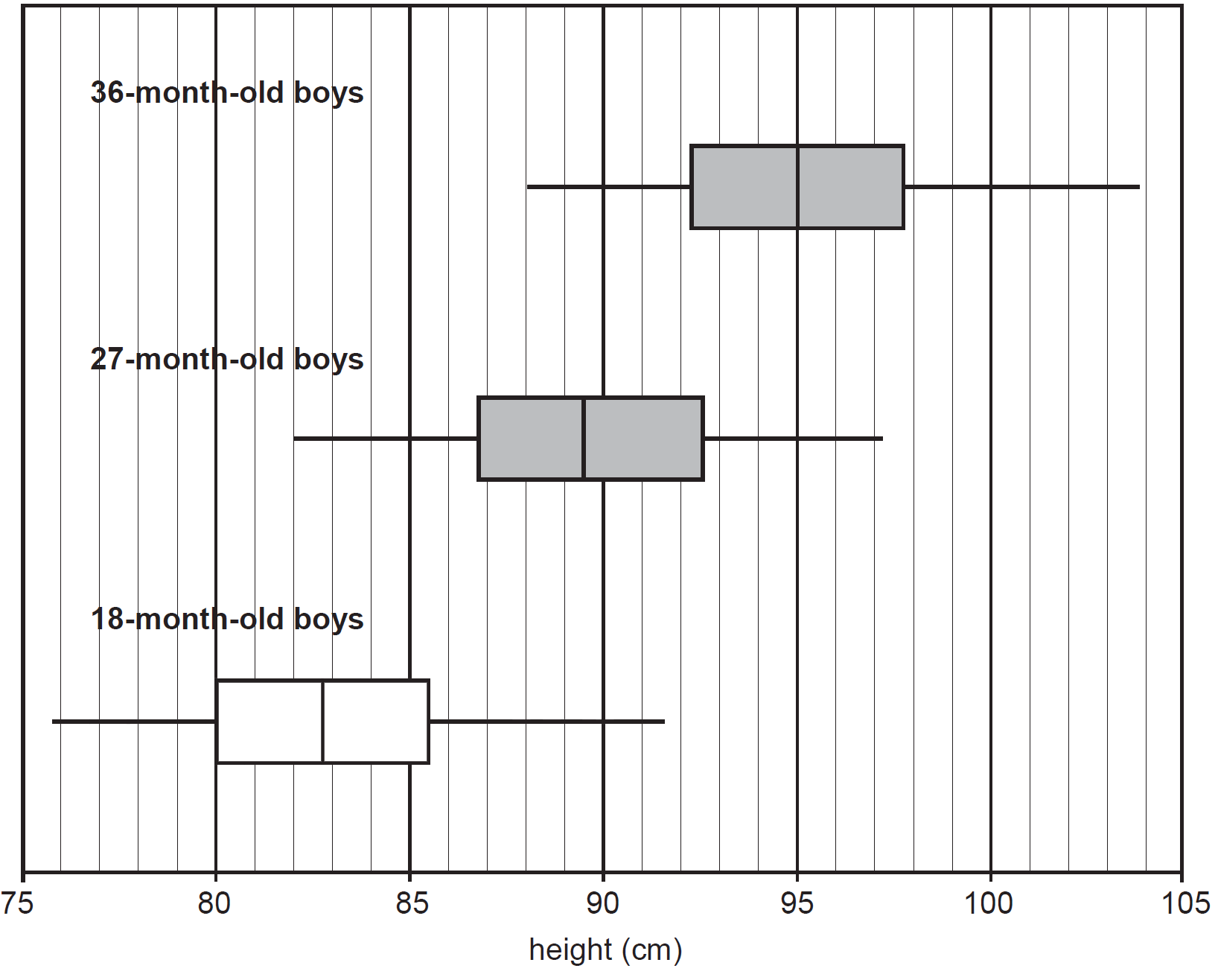
  3. The three parallel box plots suggest that arm span and year level are associated.
  4. Explain why.   (1 mark)

    --- 3 WORK AREA LINES (style=lined) ---

  5. The arm span of 110 cm of a Year 10 girl is shown as an outlier on the box plot. This value is an error. Her real arm span is 140 cm. If the error is corrected, would this girl’s arm span still show as an outlier on the box plot? Give reasons for your answer showing an appropriate calculation.   (2 marks)

    --- 5 WORK AREA LINES (style=lined) ---

Show Answers Only
  1. `text(124 and 148)`
  2. `text(The median arm span increases with the year)`
    `text(level, or the range/IQR decreases as the year.)`
    `text(level increases.)`
  3. `text(See Worked Solution)`
Show Worked Solution

a.   `text(124 and 148 cm)`
 

b.   `text(The median arm span increases with the year)`

♦ Sub 50% mean.
MARKER’S COMMENT: Use specific metrics! Stating “arm span increases” did not receive a mark.

`text(level, or the range/IQR decreases as the year.)`

`text(level increases.)`


c.   `text(Consider the Year 10 boxplot,)`

MARKER’S COMMENT: The final comparison here, “Since 140 < 145” is worth a full mark.

`Q_1=160, \ Q_3=170,`

`=> IQR=170-160=10`

`Q_1-1.5 xx text(IQR)= 160-1.5 xx 10= 145`

`text(S)text(ince 140 < 145,)`

`:. 140\ text(will remain an outlier.)`

Filed Under: Graphs - Stem/Leaf and Boxplots Tagged With: Band 3, Band 4, Band 5, smc-643-20-Parallel Box-Plots, smc-643-60-Outliers

CORE, FUR2 2009 VCAA 4

  1. Table 2 shows the seasonal indices for rainfall in summer, autumn and winter. Complete the table by calculating the seasonal index for spring.   (1 mark)

    --- 0 WORK AREA LINES (style=lined) ---


    CORE, FUR2 2009 VCAA 4

  2. In 2008, a total of 188 mm of rain fell during summer.


    Using the appropriate seasonal index in Table 2, determine the deseasonalised value for the summer rainfall in 2008. Write your answer correct to the nearest millimetre.   (1 mark)

    --- 3 WORK AREA LINES (style=lined) ---
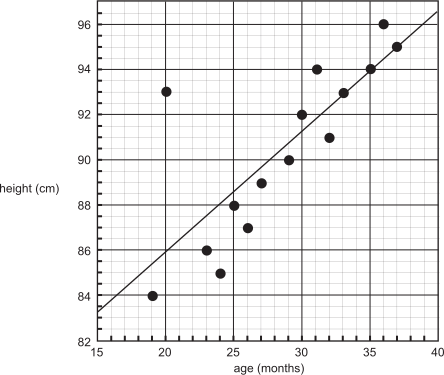
  3. What does a seasonal index of 1.05 tell us about the rainfall in autumn?   (1 mark)

    --- 2 WORK AREA LINES (style=lined) ---

Show Answers Only
  1. `1.10`
  2. `241\ text(mm)`
  3. `text(The Autumn rainfall is 5% above the average)`
    `text(for the four seasons of the year.)`
Show Worked Solution

a.   `text(Seasonal index for Spring)`

`=4-(0.78 + 1.05 + 1.07)`

`= 1.10`


b.   `text{Deseasonalised value (Summer)}`

`= 188/0.78`

`=241.02…`

`=241\ text{mm (nearest mm)}`

♦ Part (c) was “poorly answered” (no exact data).
MARKER’S COMMENT: A common error was to say rainfall was above average monthly rainfall.


c.   `text(The Autumn rainfall is 5% above the average)`

`text(for the four seasons of the year.)`


Filed Under: Time Series Tagged With: Band 3, Band 4, Band 5, smc-266-10-Seasonal Index from a Table, smc-266-20-(De)Seasonalising Data

CORE, FUR2 2009 VCAA 3

The scatterplot below shows the rainfall (in mm) and the percentage of clear days for each month of 2008. 
 

An equation of the least squares regression line for this data set is

rainfall = 131 – 2.68 × percentage of clear days

  1. Draw this line on the scatterplot.   (1 mark)

    --- 0 WORK AREA LINES (style=lined) ---
  2. Use the equation of the least squares regression line to predict the rainfall for a month with 35% of clear days. Write your answer in mm correct to one decimal place.   (1 mark)

    --- 2 WORK AREA LINES (style=lined) ---

  3. The coefficient of determination for this data set is 0.8081.
  4.  i. Interpret the coefficient of determination in terms of the variables rainfall and percentage of clear days.   (1 mark)

    --- 3 WORK AREA LINES (style=lined) ---
  5. ii. Determine the value of Pearson’s product moment correlation coefficient. Write your answer correct to three decimal places.   (2 marks)

    --- 2 WORK AREA LINES (style=lined) ---

Show Answers Only
  1.  
    CORE, FUR2 2009 VCAA 3 Answer
  2. `37.2\ text(mm)`
    1. `text(The coefficient means that 80.81% of the)`
      `text(variation in the rainfall can be explained by)`
      `text(the variation in the percentage of clear days.)`
    2. `-0.899`
Show Worked Solution
a.    CORE, FUR2 2009 VCAA 3 Answer


b.    `text(Rainfall)` `= 131-2.68 xx 35`
    `= 37.2\ text(mm)`
MARKER’S COMMENT: Any answers that suggested causation with terms like “is due to” etc.., did not receive a mark.


c.i.   `text(The coefficient means that 80.81% of the)`

  `text(variation in the rainfall can be explained by)`

  `text(the variation in the percentage of clear days.)`


MARKER’S COMMENT: Many students failed to include the negative sign as indicated by the negative slope of the graph.
c.ii.    `r` `= -sqrt(0.8081)`
    `= -0.8989…`
    `=-0.899\ \ text{(to 3 d.p.)}`

Filed Under: Correlation and Regression Tagged With: Band 4, Band 5, smc-265-10-r / r^2 and Association

CORE, FUR2 2009 VCAA 2

The time series plot below shows the rainfall (in mm) for each month during 2008.
 

CORE, FUR2 2009 VCAA 2
 

  1. Which month had the highest rainfall?   (1 mark)

    --- 1 WORK AREA LINES (style=lined) ---

  2. Use three-median smoothing to smooth the time series. Plot the smoothed time series on the plot above.
  3. Mark each smoothed data point with a cross (×).   (2 marks)

    --- 0 WORK AREA LINES (style=lined) ---

  4. Describe the general pattern in rainfall that is revealed by the smoothed time series plot.   (1 mark)

    --- 3 WORK AREA LINES (style=lined) ---

Show Answers Only
  1. `text(November)`
  2.  
    CORE, FUR2 2009 VCAA 2 Answer
     
  3. `text(Until April, the rainfall increases each month)`
    `text(and then it remains relatively constant until)`
    `text(November).`
  4.  
Show Worked Solution

a.   `text(November)`


b.    CORE, FUR2 2009 VCAA 2 Answer
MARKER’S COMMENT: Locate medians graphically by inspection. Explaining a general pattern with more than one trend proved challenging.

c.   `text(Until April, there is an increase in rainfall)`

`text(and then it remains relatively constant until)`

`text(November.)`


Filed Under: Time Series Tagged With: Band 3, Band 4, smc-266-40-Time Series Trends

MATRICES, FUR2 2015 VCAA 1

Students in a music school are classified according to three ability levels: beginner (`B`), intermediate (`I`) or advanced (`A`).

Matrix `S_0`, shown below, lists the number of students at each level in the school for a particular week.

`S_0 = [(20), (60), (40)] {:(B), (I), (A):}`

  1. How many students in total are in the music school that week?   (1 mark)

    --- 1 WORK AREA LINES (style=lined) ---

The music school has four teachers, David (`D`), Edith (`E`), Flavio (`F`) and Geoff (`G`).

Each teacher will teach a proportion of the students from each level, as shown in matrix `P` below.

`{:(qquadqquadqquad{:(Dquad,Eqquad,Fqquad,G):}),(P = [(0.25,0.5,0.15,0.1)]):}`

The matrix product, `Q = S_0P`, can be used to find the number of students from each level taught by each teacher.

  1.  i. Complete matrix `Q`, shown below, by writing the missing elements in the shaded boxes.   (1 mark) 

    --- 0 WORK AREA LINES (style=lined) ---

 Matrices, FUR2 2015 VCAA 1

  1. ii. How many intermediate students does Edith teach?  (1 mark)

    --- 1 WORK AREA LINES (style=lined) ---

The music school pays the teachers $15 per week for each beginner student, $25 per week for each intermediate student and $40 per week for each advanced student.

These amounts are shown in matrix `C` below.

`{:(qquad qquad quad{:(B quad, I quad,A):}),(C = [(15, 25, 40)]):}`

The amount paid to each teacher each week can be found using a matrix calculation.

  1.  i. Write down a matrix calculation in terms of `Q` and `C` that results in a matrix that lists the amount paid to each teacher each week.   (1 mark)

    --- 1 WORK AREA LINES (style=lined) ---

  2. ii. How much is paid to Geoff each week?   (1 mark)

    --- 3 WORK AREA LINES (style=lined) ---

Show Answers Only
  1. `120`
    1. `[(5, 10, 3, 2), (15, 30, 9, 6), (10, 20, 6, 4)]`
    2. `30`
    1. `C xx Q`
    2. `$340`
Show Worked Solution

a.   `20 + 60 + 40 = 120`
 

b.i.   `Q` `= S_0 P`
    `= [(20), (60), (40)] [(0.25, 0.5, 0.15, 0.1)]`
    `= [(5, 10, 3, 2), (15, 30, 9, 6), (10, 20, 6, 4)]`

 
b.ii.
   `text(Edith teaches 30 intermediate students.)`

 
c.i.
   `C xx Q`

 
c.ii.
   `CQ = [(15, 25, 40)] [(5, 10, 3, 2), (15, 30, 9, 6), (10, 20, 6, 4)]`

`:.\ text(Geoff’s pay)`

`= 15 xx 2 + 25 xx 6 + 40 xx 4`

`= $340`

Filed Under: Matrix Applications Tagged With: Band 2, Band 3, Band 4

  • « Previous Page
  • 1
  • …
  • 94
  • 95
  • 96
  • 97
  • 98
  • …
  • 114
  • Next Page »

Copyright © 2014–2025 SmarterEd.com.au · Log in