SmarterEd

Aussie Maths & Science Teachers: Save your time with SmarterEd

  • Login
  • Get Help
  • About

HMS, HIC EQ-Bank 413

To what extent can protective factors prevent substance misuse among young Australians.   (12 marks)

--- 30 WORK AREA LINES (style=lined) ---

Show Answers Only

Judgment Statement

  • Protective factors can significantly prevent substance misuse among young Australians.
  • Evidence shows family connections, personal skills, and community engagement substantially reduce risk.

Family and Personal Protective Factors:

  • Research has consistently shown that strong family relationships significantly reduce the risk of any individual becoming a drug addict.
  • Young people with parents who model responsible attitudes and communicate openly about risks show markedly lower substance use rates.
  • Clear family expectations create boundaries that guide decision-making during peer pressure situations.
  • One major reason why these factors work is that they establish healthy normative beliefs before exposure to substances.
  • Additionally, self-regulation skills provide crucial alternatives to substance use when facing stress.
  • Youth who learn mindfulness and healthy coping mechanisms show resilience in stressful situations that increase the risk for substance use.
  • These combined family and personal factors form powerful prevention barriers.

Community and School Connections

  • Community engagement through sports, arts, and volunteering creates protective social networks.
  • These activities provide identity, purpose, and recognition that reduce needs for substances as social tools.
  • School connectedness adds another protective layer through adult supervision and future goal orientation.
  • However, it is important to consider that some youth lack access to these protective environments.
  • Socioeconomic and cultural barriers can limit participation in activities or create family stress that undermines protection.
  • Despite this, protective factors remain the stronger influence on young Australians.

Reaffirmation

  • The evidence demonstrates protective factors significantly prevent youth substance misuse.
  • Multiple protective layers working together create resilience stronger than individual risk factors.
  • Implications suggest that investing in family support, personal skill development and community programs will further increase the most influential protective factors for young people.
Show Worked Solution

Judgment Statement

  • Protective factors can significantly prevent substance misuse among young Australians.
  • Evidence shows family connections, personal skills, and community engagement substantially reduce risk.

Family and Personal Protective Factors:

  • Research has consistently shown that strong family relationships significantly reduce the risk of any individual becoming a drug addict.
  • Young people with parents who model responsible attitudes and communicate openly about risks show markedly lower substance use rates.
  • Clear family expectations create boundaries that guide decision-making during peer pressure situations.
  • One major reason why these factors work is that they establish healthy normative beliefs before exposure to substances.
  • Additionally, self-regulation skills provide crucial alternatives to substance use when facing stress.
  • Youth who learn mindfulness and healthy coping mechanisms show resilience in stressful situations that increase the risk for substance use.
  • These combined family and personal factors form powerful prevention barriers.

Community and School Connections

  • Community engagement through sports, arts, and volunteering creates protective social networks.
  • These activities provide identity, purpose, and recognition that reduce needs for substances as social tools.
  • School connectedness adds another protective layer through adult supervision and future goal orientation.
  • However, it is important to consider that some youth lack access to these protective environments.
  • Socioeconomic and cultural barriers can limit participation in activities or create family stress that undermines protection.
  • Despite this, protective factors remain the stronger influence on young Australians.

Reaffirmation

  • The evidence demonstrates protective factors significantly prevent youth substance misuse.
  • Multiple protective layers working together create resilience stronger than individual risk factors.
  • Implications suggest that investing in family support, personal skill development and community programs will further increase the most influential protective factors for young people.

Filed Under: Research and Health Related Issues Tagged With: Band 4, Band 5, Band 6, smc-5800-15-Protective/risk factors

HMS, HIC EQ-Bank 412

Using ONE health-related issue affecting young people, evaluate the effectiveness of social justice principles in addressing health inequities experienced by young Australians.   (12 marks)

--- 30 WORK AREA LINES (style=lined) ---

Show Answers Only

Health related issue: Youth violence and bullying

Evaluation Statement

  • Social justice principles are partially effective in addressing youth violence and bullying among young Australians.
  • This evaluation examines equity in access to anti-violence programs and empowerment through participation.

Equity in Access to Programs

  • Equity principles partially fulfil the goal of equal protection from violence for all youth.
  • Evidence supporting this includes school-based anti-bullying programs reaching diverse student populations.
  • However, rural and remote communities have limited access to specialised support services. For example, Indigenous youth experience 2.5 times higher bullying rates despite targeted interventions.
  • While strong in metropolitan areas, programs show limitations in addressing geographic disparities.
  • Socioeconomic barriers prevent some families accessing private counselling when school programs prove insufficient.
  • A critical weakness is inconsistent program quality across different schools and regions.

Empowerment Through Participation

  • The participation principle strongly meets youth empowerment objectives.
  • Student-led anti-bullying committees are self reported by participants as more effective than adult-imposed policies.
  • Evidence indicates peer mentoring programs reduce bullying incidents by 30% in participating schools.
  • Research confirms youth-designed campaigns achieve higher engagement than traditional approaches. These campaigns promote young people’s leadership skills while creating culturally relevant solutions.
  • This comprehensive involvement addresses root causes rather than just symptoms.
  • The evidence indicates that meaningful participation transforms students from victims to advocates.

Final Evaluation

  • Weighing these factors shows social justice principles achieve moderate success overall.
  • The strengths in participation partially compensate for equity limitations.
  • Although effective for empowering engaged students, social justice principles prove less suitable for reaching marginalised youth
  • The overall evaluation demonstrates need for better resource distribution to underserved communities.
  • Implications suggest combining strong participation frameworks with targeted equity investments. This process will address both empowerment and access barriers simultaneously.
Show Worked Solution

Health related issue: Youth violence and bullying

Evaluation Statement

  • Social justice principles are partially effective in addressing youth violence and bullying among young Australians.
  • This evaluation examines equity in access to anti-violence programs and empowerment through participation.

Equity in Access to Programs

  • Equity principles partially fulfil the goal of equal protection from violence for all youth.
  • Evidence supporting this includes school-based anti-bullying programs reaching diverse student populations.
  • However, rural and remote communities have limited access to specialised support services. For example, Indigenous youth experience 2.5 times higher bullying rates despite targeted interventions.
  • While strong in metropolitan areas, programs show limitations in addressing geographic disparities.
  • Socioeconomic barriers prevent some families accessing private counselling when school programs prove insufficient.
  • A critical weakness is inconsistent program quality across different schools and regions.

Empowerment Through Participation

  • The participation principle strongly meets youth empowerment objectives.
  • Student-led anti-bullying committees are self reported by participants as more effective than adult-imposed policies.
  • Evidence indicates peer mentoring programs reduce bullying incidents by 30% in participating schools.
  • Research confirms youth-designed campaigns achieve higher engagement than traditional approaches. These campaigns promote young people’s leadership skills while creating culturally relevant solutions.
  • This comprehensive involvement addresses root causes rather than just symptoms.
  • The evidence indicates that meaningful participation transforms students from victims to advocates.

Final Evaluation

  • Weighing these factors shows social justice principles achieve moderate success overall.
  • The strengths in participation partially compensate for equity limitations.
  • Although effective for empowering engaged students, social justice principles prove less suitable for reaching marginalised youth
  • The overall evaluation demonstrates need for better resource distribution to underserved communities.
  • Implications suggest combining strong participation frameworks with targeted equity investments. This process will address both empowerment and access barriers simultaneously.

Filed Under: Research and Health Related Issues Tagged With: Band 4, Band 5, smc-5800-10-Youth health issue, smc-5800-15-Protective/risk factors

HMS, HIC EQ-Bank 411

Assess how youth violence affects the physical, social and mental wellbeing of young people in Australia.   (8 marks)

--- 22 WORK AREA LINES (style=lined) ---

Show Answers Only

Judgment Statement

  • Youth violence has substantial negative impact on young Australians’ overall wellbeing.
  • This assessment is based on its severity of health consequences and widespread occurrence across populations.

Physical and Mental Health Impact

  • Violence causes severe adverse effects on young people’s physical and mental health.
  • Evidence shows one in four Australian students experience weekly bullying resulting in physical injuries like bruising, fractures, and head trauma.
  • Mental health consequences include depression, anxiety and suicidal thoughts that persist into adulthood.
  • These effects further act to disrupt education and sport participation and can be a major contributor to measurable long-term health deterioration.
  • The combination of immediate physical harm and lasting psychological damage indicates major health impacts.

Social Wellbeing and Community Connection

  • Violence achieves considerable disruption to social relationships and community participation.
  • Victims experience social isolation, trust issues and withdrawal from protective activities like team sports.
  • Studies indicate a strong correlation between a young person’s exposure to violence and school disengagement.
  • Further, this research shows violence creates social anxiety preventing healthy peer relationships.
  • When all factors are considered, violence substantially undermines social support systems.

Overall Assessment

  • On the whole, youth violence proves highly damaging across all wellbeing dimensions. The substantial quantity of evidence confirms violence as a major public health concern.
  • Physical injuries, mental health disorders, and social disconnection combine to create comprehensive harm.
  • Implications of this assessment suggest the urgent implementation of prevention strategies and support services is required.
  • Creating safer environments requires policy reforms addressing this significant threat to young Australians’ wellbeing.
Show Worked Solution

Judgment Statement

  • Youth violence has substantial negative impact on young Australians’ overall wellbeing.
  • This assessment is based on its severity of health consequences and widespread occurrence across populations.

Physical and Mental Health Impact

  • Violence causes severe adverse effects on young people’s physical and mental health.
  • Evidence shows one in four Australian students experience weekly bullying resulting in physical injuries like bruising, fractures, and head trauma.
  • Mental health consequences include depression, anxiety and suicidal thoughts that persist into adulthood.
  • These effects further act to disrupt education and sport participation and can be a major contributor to measurable long-term health deterioration.
  • The combination of immediate physical harm and lasting psychological damage indicates major health impacts.

Social Wellbeing and Community Connection

  • Violence achieves considerable disruption to social relationships and community participation.
  • Victims experience social isolation, trust issues and withdrawal from protective activities like team sports.
  • Studies indicate a strong correlation between a young person’s exposure to violence and school disengagement.
  • Further, this research shows violence creates social anxiety preventing healthy peer relationships.
  • When all factors are considered, violence substantially undermines social support systems.

Overall Assessment

  • On the whole, youth violence proves highly damaging across all wellbeing dimensions. The substantial quantity of evidence confirms violence as a major public health concern.
  • Physical injuries, mental health disorders, and social disconnection combine to create comprehensive harm.
  • Implications of this assessment suggest the urgent implementation of prevention strategies and support services is required.
  • Creating safer environments requires policy reforms addressing this significant threat to young Australians’ wellbeing.

Filed Under: Research and Health Related Issues Tagged With: Band 5, Band 6, smc-5800-10-Youth health issue

HMS, HIC EQ-Bank 410

Evaluate the importance of health literacy skills in empowering young people to make positive health decisions about food choices.   (8 marks)

--- 22 WORK AREA LINES (style=lined) ---

Show Answers Only

*Recommended words/phrases for “Evaluation” keyword questions are highlighted in bold throughout the answer below.

Evaluation Statement

  • Health literacy skills are highly effective in empowering young people to make positive food choices.
  • This evaluation examines practical application abilities and long-term behaviour change impact.

Practical Application Abilities

  • Health literacy effectively equips young people with practical decision-making skills.
  • Evidence shows health-literate teens successfully read food labels and identify hidden sugars.
  • Research indicates they make significantly better supermarket choices than those without these skills.
  • This indicates a real world practical benefit as young people apply their knowledge to daily food selection.
  • The ability to decode marketing claims proves particularly valuable in today’s misleading food environment.

Long-term Behaviour Change

  • Health literacy is partially successful in achieving sustained healthy eating patterns.
  • While strong in building knowledge, only 5% of young Australians aged 15-24 meet recommended fruit and vegetable intake.
  • This shows limitations between possessing literacy and consistent application.
  • Social pressures and convenience often override health knowledge in food decisions.
  • Although effective for understanding nutrition, it proves less suitable for overcoming environmental barriers like cost and accessibility.
  • The gap between knowledge and action reveals moderate long-term success.

Final Evaluation

  • Weighing these factors shows health literacy is highly valuable but insufficient alone.
  • The strengths outweigh weaknesses because foundational skills enable lifelong learning.
  • The overall evaluation demonstrates health literacy forms a critical foundation requiring environmental support.
  • Implications suggest combining literacy education with practical cooking skills and improved food access.
Show Worked Solution

*Recommended words/phrases for “Evaluation” keyword questions are highlighted in bold throughout the answer below.

Evaluation Statement

  • Health literacy skills are highly effective in empowering young people to make positive food choices.
  • This evaluation examines practical application abilities and long-term behaviour change impact.

Practical Application Abilities

  • Health literacy effectively equips young people with practical decision-making skills.
  • Evidence shows health-literate teens successfully read food labels and identify hidden sugars.
  • Research indicates they make significantly better supermarket choices than those without these skills.
  • This indicates a real world practical benefit as young people apply their knowledge to daily food selection.
  • The ability to decode marketing claims proves particularly valuable in today’s misleading food environment.

Long-term Behaviour Change

  • Health literacy is partially successful in achieving sustained healthy eating patterns.
  • While strong in building knowledge, only 5% of young Australians aged 15-24 meet recommended fruit and vegetable intake.
  • This shows limitations between possessing literacy and consistent application.
  • Social pressures and convenience often override health knowledge in food decisions.
  • Although effective for understanding nutrition, it proves less suitable for overcoming environmental barriers like cost and accessibility.
  • The gap between knowledge and action reveals moderate long-term success.

Final Evaluation

  • Weighing these factors shows health literacy is highly valuable but insufficient alone.
  • The strengths outweigh weaknesses because foundational skills enable lifelong learning.
  • The overall evaluation demonstrates health literacy forms a critical foundation requiring environmental support.
  • Implications suggest combining literacy education with practical cooking skills and improved food access.

Filed Under: Research and Health Related Issues, Strengthening, protecting and enhancing health Tagged With: Band 4, Band 5, smc-5511-20-Health management, smc-5800-10-Youth health issue

HMS, HIC EQ-Bank 409

Analyse how socioeconomic factors influence the food choices and nutritional health of young people.   (8 marks)

--- 22 WORK AREA LINES (style=lined) ---

Show Answers Only
  • Lower socioeconomic status directly impacts food security, with the Australian Institute of Health and Welfare reporting that young people from disadvantaged backgrounds have limited access to fresh, nutritious foods due to cost barriers and geographic food deserts.
  • Educational disparity affects nutritional literacy, as young people from higher socioeconomic backgrounds typically receive more comprehensive education about nutrition at home and school, enhancing their ability to make informed food choices.
  • Time poverty in lower-income families often results in greater reliance on convenience and fast foods, as parents working multiple jobs have less time for meal preparation, resulting in higher consumption of processed foods high in salt, sugar and unhealthy fats.
  • Cultural food practices intersect with socioeconomic status, influencing dietary patterns and nutritional intake across different communities, with some traditional diets offering protective health benefits despite economic challenges.
  • Food marketing disproportionately targets lower socioeconomic areas with unhealthy options, with research showing higher densities of fast food advertising in disadvantaged neighbourhoods, influencing young people’s food preferences and consumption patterns.
  • Government initiatives like school breakfast programs and subsidised healthy canteens can help minimise socioeconomic differences in nutrition, though implementation varies significantly across different communities and school districts.
Show Worked Solution
  • Lower socioeconomic status directly impacts food security, with the Australian Institute of Health and Welfare reporting that young people from disadvantaged backgrounds have limited access to fresh, nutritious foods due to cost barriers and geographic food deserts.
  • Educational disparity affects nutritional literacy, as young people from higher socioeconomic backgrounds typically receive more comprehensive education about nutrition at home and school, enhancing their ability to make informed food choices.
  • Time poverty in lower-income families often results in greater reliance on convenience and fast foods, as parents working multiple jobs have less time for meal preparation, resulting in higher consumption of processed foods high in salt, sugar and unhealthy fats.
  • Cultural food practices intersect with socioeconomic status, influencing dietary patterns and nutritional intake across different communities, with some traditional diets offering protective health benefits despite economic challenges.
  • Food marketing disproportionately targets lower socioeconomic areas with unhealthy options, with research showing higher densities of fast food advertising in disadvantaged neighbourhoods, influencing young people’s food preferences and consumption patterns.
  • Government initiatives like school breakfast programs and subsidised healthy canteens can help minimise socioeconomic differences in nutrition, though implementation varies significantly across different communities and school districts.

Filed Under: Research and Health Related Issues Tagged With: Band 5, Band 6, smc-5800-10-Youth health issue

HMS, HIC EQ-Bank 408

Evaluate the effectiveness of social media in influencing young people's health behaviours.   (8 marks)

--- 22 WORK AREA LINES (style=lined) ---

Show Answers Only

ANSWER STYLE #1: General Points to use within student-chosen answer structure

  • Social media platforms provide accessible health information and education through influencers promoting positive health behaviors such as exercise routines, nutrition advice, and mental health awareness campaigns.
  • Online communities create support networks for young people facing health challenges, reducing isolation and providing encouragement for those managing conditions like anxiety, depression or chronic illnesses.
  • However, social media can spread misinformation about health practices, particularly concerning nutrition, fitness, and mental health treatments, leading young people to adopt potentially harmful practices without professional guidance.
  • The pressure to conform to idealised body images on platforms like Instagram contributes to poor body image, with research showing increased rates of disordered eating patterns among heavy social media users.
  • Health promotion campaigns utilising social media have demonstrated effectiveness in reaching young audiences with targeted messaging about issues like quitting smoking and sexual health, particularly when content is youth-led and authentic.
  • The algorithms of social media platforms can create echo chambers that reinforce harmful behaviours like extreme dieting or substance use by connecting users with similar content, limiting exposure to balanced health perspectives.


ANSWER STYLE #2: Highly structured

Evaluation Statement

  • Social media is partially effective in influencing young people’s health behaviours.
  • This evaluation examines reach and engagement capabilities versus harmful content exposure.

Reach and Engagement

  • Social media demonstrates superior reach for health messaging to young audiences.
  • Evidence supporting this includes health campaigns achieving millions of views through youth influencers.
  • Online support communities successfully connect isolated young people managing anxiety or chronic illnesses.
  • Online platforms are very good at engaging young people through interactive features and peer-to-peer support networks.
  • For example, youth-led content about quitting smoking shows 60% higher engagement than traditional campaigns.
  • Another critical strength is 24/7 accessibility allowing immediate health information access.

Harmful Content Exposure

  • Social media can often fail to achieve safe health information delivery for vulnerable youth.
  • Research indicates that Instagram use correlates with increased eating disorders among teenagers due to its algorithms creating echo chambers that reinforce extreme dieting.
  • Platforms inadequately fulfil their responsibility to filter health misinformation. While strong in spreading content, online platforms do not consider it their responsibility to verify its accuracy.
  • As a result, harmful content such as unqualified influencers promoting dangerous detox teas can reach more youth than qualified health professionals.

Final Evaluation

  • Weighing these factors shows social media’s influence is a double-edged sword.
  • The strengths partially outweigh weaknesses because positive campaigns can counteract harmful content.
  • Although effective for health promotion reach, it proves less suitable for ensuring information quality.
  • The overall evaluation demonstrates urgent need for digital health literacy education.
  • Implications suggest platforms should be pressured to implement stricter controls over the accuracy of content that appears on their site.
Show Worked Solution

ANSWER STYLE #1: General Points to use within student-chosen answer structure

  • Social media platforms provide accessible health information and education through influencers promoting positive health behaviors such as exercise routines, nutrition advice, and mental health awareness campaigns.
  • Online communities create support networks for young people facing health challenges, reducing isolation and providing encouragement for those managing conditions like anxiety, depression or chronic illnesses.
  • However, social media can spread misinformation about health practices, particularly concerning nutrition, fitness, and mental health treatments, leading young people to adopt potentially harmful practices without professional guidance.
  • The pressure to conform to idealised body images on platforms like Instagram contributes to poor body image, with research showing increased rates of disordered eating patterns among heavy social media users.
  • Health promotion campaigns utilising social media have demonstrated effectiveness in reaching young audiences with targeted messaging about issues like quitting smoking and sexual health, particularly when content is youth-led and authentic.
  • The algorithms of social media platforms can create echo chambers that reinforce harmful behaviours like extreme dieting or substance use by connecting users with similar content, limiting exposure to balanced health perspectives.


ANSWER STYLE #2: Highly structured

Evaluation Statement

  • Social media is partially effective in influencing young people’s health behaviours.
  • This evaluation examines reach and engagement capabilities versus harmful content exposure.

Reach and Engagement

  • Social media demonstrates superior reach for health messaging to young audiences.
  • Evidence supporting this includes health campaigns achieving millions of views through youth influencers.
  • Online support communities successfully connect isolated young people managing anxiety or chronic illnesses.
  • Online platforms are very good at engaging young people through interactive features and peer-to-peer support networks.
  • For example, youth-led content about quitting smoking shows 60% higher engagement than traditional campaigns.
  • Another critical strength is 24/7 accessibility allowing immediate health information access.

Harmful Content Exposure

  • Social media can often fail to achieve safe health information delivery for vulnerable youth.
  • Research indicates that Instagram use correlates with increased eating disorders among teenagers due to its algorithms creating echo chambers that reinforce extreme dieting.
  • Platforms inadequately fulfil their responsibility to filter health misinformation. While strong in spreading content, online platforms do not consider it their responsibility to verify its accuracy.
  • As a result, harmful content such as unqualified influencers promoting dangerous detox teas can reach more youth than qualified health professionals.

Final Evaluation

  • Weighing these factors shows social media’s influence is a double-edged sword.
  • The strengths partially outweigh weaknesses because positive campaigns can counteract harmful content.
  • Although effective for health promotion reach, it proves less suitable for ensuring information quality.
  • The overall evaluation demonstrates urgent need for digital health literacy education.
  • Implications suggest platforms should be pressured to implement stricter controls over the accuracy of content that appears on their site.

Filed Under: Research and Health Related Issues Tagged With: Band 3, Band 4, Band 5, smc-5800-10-Youth health issue

PHYSICS, M3 EQ-Bank 1

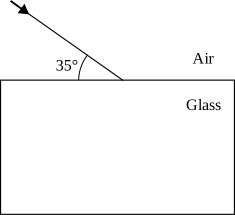
A ray of light of wavelength 4 \(\times\) 10\(^{-7}\) metres crosses from air into a block of glass as shown below. The refractive index of the glass is 1.6.
 

  1. What will be the angle of refraction in the glass?   (2 marks)

--- 4 WORK AREA LINES (style=lined) ---

  1. What is the speed of the light within the glass?   (1 mark)

--- 2 WORK AREA LINES (style=lined) ---

  1. What is the frequency of the light within the glass?   (2 marks)

--- 4 WORK AREA LINES (style=lined) ---

Show Answers Only

a.    \(30.8^{\circ}\)

b.    \(1.88 \times 10^8\ \text{ms}^{-1}\)

c.    \(7.5 \times 10^{14}\)

Show Worked Solution

a.    Using Snell’s Law:

\(n_1 \sin\theta_1\) \(=n_2 \sin \theta_2\)  
\(\theta_2\) \(=\sin^{-1}\left(\dfrac{n_1 \sin\theta_1}{n_2}\right)\)  
\(\theta_2\) \(=\sin^{-1}\left(\dfrac{1 \times \sin 55}{1.6}\right)\), where the angle of incidence is between the ray and the normal.   
  \(=30.8^{\circ}\)  


b.   \(v_g=\dfrac{c}{n_g}=\dfrac{3 \times 10^8}{1.6}=1.88 \times 10^8\ \text{ms}^{-1}\)
 

c.    The frequency of light is independent of the medium it is travelling through.

  • The frequency of the light in the glass will be the same as the frequency of the light in air.
  •    \(f=\dfrac{c}{\lambda_{\text{air}}} = \dfrac{3 \times 10^8}{4 \times 10^{-7}} = 7.5 \times 10^{14}\)

Filed Under: Ray Model of Light Tagged With: Band 4, Band 5, smc-4281-10-Snell's Law, smc-4281-20-Snell's Law and TIR, smc-4281-40-Speed of light in medium

HMS, HIC EQ-Bank 118

Outline TWO inequities related to environmental factors of health in Australia and suggest one way each could be addressed.   (4 marks)

--- 10 WORK AREA LINES (style=lined) ---

Show Answers Only

Geographic location

  • Indigenous Australian communities in remote areas experience health inequities due to limited access to health services, resulting in higher rates of preventable hospitalisations.
  • This could be addressed through increased investment in telehealth infrastructure and training local community health workers to provide basic healthcare services.

Pollution exposure

  • People of lower socioeconomic status often live in areas with higher pollution levels from industrial zones or major roadways, leading to increased respiratory conditions.
  • This inequity could be addressed through stricter environmental regulations for industries in residential areas and subsidised housing developments in areas with better air quality.
Show Worked Solution

Geographic location

  • Indigenous Australian communities in remote areas experience health inequities due to limited access to health services, resulting in higher rates of preventable hospitalisations.
  • This could be addressed through increased investment in telehealth infrastructure and training local community health workers to provide basic healthcare services.

Pollution exposure

  • People of lower socioeconomic status often live in areas with higher pollution levels from industrial zones or major roadways, leading to increased respiratory conditions.
  • This inequity could be addressed through stricter environmental regulations for industries in residential areas and subsidised housing developments in areas with better air quality.

Filed Under: Environmental Tagged With: Band 4, Band 5, smc-5804-10-Geographic location, smc-5804-20-Air/water quality, smc-5804-55-Inequities

HMS, HIC EQ-Bank 117

Explain how health inequities can result from differences in health behaviours across population groups in Australia.   (5 marks)

--- 15 WORK AREA LINES (style=lined) ---

Show Answers Only

Rural vs city populations

  • Higher tobacco use in remote areas compared to major cities causes increased rates of respiratory diseases and cancers in rural populations, creating a geographic health inequity.
  • This occurs because smoking and its significant health dangers are concentrated in these communities, leading to an increased disease burden.

English speaking vs Non-English speaking populations

  • Lower physical activity participation among people from non-English speaking backgrounds versus Australian-born residents causes higher cardiovascular disease rates in culturally diverse communities.
  • This inequity develops because reduced fitness levels lead to poorer health outcomes, including an increase in heart and respiratory issues.

Higher vs lower socioeconomic populations

  • Similarly, inadequate fruit and vegetable consumption in lower socioeconomic areas versus higher areas, causes nutritional inequities that result in increased chronic disease.
  • This occurs because nutrients aren’t high in diets, allowing preventable diseases to develop unchecked.
  • These behaviour-related health outcomes create persistent inequities that are systematically reinforced through social determinants.
Show Worked Solution

Rural vs city populations

  • Higher tobacco use in remote areas compared to major cities causes increased rates of respiratory diseases and cancers in rural populations, creating a geographic health inequity.
  • This occurs because smoking and its significant health dangers are concentrated in these communities, leading to an increased disease burden.

English speaking vs Non-English speaking populations

  • Lower physical activity participation among people from non-English speaking backgrounds versus Australian-born residents causes higher cardiovascular disease rates in culturally diverse communities.
  • This inequity develops because reduced fitness levels lead to poorer health outcomes, including an increase in heart and respiratory issues.

Higher vs lower socioeconomic populations

  • Similarly, inadequate fruit and vegetable consumption in lower socioeconomic areas versus higher areas, causes nutritional inequities that result in increased chronic disease.
  • This occurs because nutrients aren’t high in diets, allowing preventable diseases to develop unchecked.
  • These behaviour-related health outcomes create persistent inequities that are systematically reinforced through social determinants.

Filed Under: Biomedical and Health Behaviours Tagged With: Band 4, Band 5, smc-5806-10-Health behaviours, smc-5806-70-Inequities

HMS, HIC EQ-Bank 116

Outline TWO inequities related to biomedical factors of health in Australia and suggest one way each could be addressed.   (4 marks)

--- 10 WORK AREA LINES (style=lined) ---

Show Answers Only

Socioeconomic status

  • People living in the lowest socioeconomic areas have significantly higher rates of uncontrolled high blood pressure compared to those in the highest socioeconomic areas.
  • This could be addressed through targeted community health programs offering free blood pressure screening and management education in lower socioeconomic areas.

Aboriginal and Torres Strait Islander status:

  • Indigenous peoples are four times more likely than other Australians to have diabetes or pre-diabetes.
  • This could be addressed through culturally appropriate diabetes prevention programs. These initiatives should be led by Aboriginal health workers, focusing on early detection, management, and include traditional approaches to nutrition and physical activity.
Show Worked Solution

Socioeconomic status

  • People living in the lowest socioeconomic areas have significantly higher rates of uncontrolled high blood pressure compared to those in the highest socioeconomic areas.
  • This could be addressed through targeted community health programs offering free blood pressure screening and management education in lower socioeconomic areas.

Aboriginal and Torres Strait Islander status:

  • Indigenous peoples are four times more likely than other Australians to have diabetes or pre-diabetes.
  • This could be addressed through culturally appropriate diabetes prevention programs. These initiatives should be led by Aboriginal health workers, focusing on early detection, management, and include traditional approaches to nutrition and physical activity.

Filed Under: Biomedical and Health Behaviours Tagged With: Band 4, Band 5, smc-5806-20-Biomedical, smc-5806-70-Inequities

HMS, HIC EQ-Bank 404

Justify the classification of social media use as a significant health issue for young Australians.   (6 marks)

--- 18 WORK AREA LINES (style=lined) ---

Show Answers Only

Position Statement

  • Social media use is justifiably classified as a significant health issue for young Australians.
  • Evidence confirms widespread usage, mental health impacts, and cyberbullying prevalence.

Mental Health and Usage Impacts

  • Research shows one-third of teenagers aged 13-17 use social media “almost constantly”.
  • This demonstrates significant risks because almost 50% of young Australians report negative online experiences.
  • Studies indicate strong links between social media and increased anxiety and depression.
  • Excessive screen time decreases physical activity, contributing to obesity.
  • The significance of this health issue is compounded because it affects both mental and physical health simultaneously.

Cyberbullying and Sleep Disruption

  • The eSafety Commissioner identifies cyberbullying as causing serious psychological distress.
  • Additionally, excessive use disrupts sleep through blue light exposure.
  • The negative health impacts of poor sleep grow in significance due to the direct influence they have on cognitive function and academic performance.
  • Evidence confirms these effects further compound existing mental health vulnerabilities.

Reinforcement

  • While social media provides benefits like health information access, negative impacts outweigh positives.
  • The evidence remains compelling because harm affects the core health areas.
  • This justifies urgent public health responses including education programs.
  • Classification as significant is warranted given the widespread, multifaceted health consequences.
Show Worked Solution

Position Statement

  • Social media use is justifiably classified as a significant health issue for young Australians.
  • Evidence confirms widespread usage, mental health impacts, and cyberbullying prevalence.

Mental Health and Usage Impacts

  • Research shows one-third of teenagers aged 13-17 use social media “almost constantly”.
  • This demonstrates significant risks because almost 50% of young Australians report negative online experiences.
  • Studies indicate strong links between social media and increased anxiety and depression.
  • Excessive screen time decreases physical activity, contributing to obesity.
  • The significance of this health issue is compounded because it affects both mental and physical health simultaneously.

Cyberbullying and Sleep Disruption

  • The eSafety Commissioner identifies cyberbullying as causing serious psychological distress.
  • Additionally, excessive use disrupts sleep through blue light exposure.
  • The negative health impacts of poor sleep grow in significance due to the direct influence they have on cognitive function and academic performance.
  • Evidence confirms these effects further compound existing mental health vulnerabilities.

Reinforcement

  • While social media provides benefits like health information access, negative impacts outweigh positives.
  • The evidence remains compelling because harm affects the core health areas.
  • This justifies urgent public health responses including education programs.
  • Classification as significant is warranted given the widespread, multifaceted health consequences.

Filed Under: Research and Health Related Issues Tagged With: Band 4, Band 5, smc-5800-10-Youth health issue

HMS, HIC EQ-Bank 401 MC

Based on recent Mission Australia reporting, which of the following statements about body image concerns among young Australians is most accurate?

  1. Body image concerns affect only a small percentage of young Australians
  2. Body image ranks among the top concerns for both non-Indigenous and Aboriginal and Torres Strait Islander young people
  3. Body image concerns have significantly decreased among all demographic groups
  4. Body image concerns affect young females but not young males
Show Answers Only

\(B\)

Show Worked Solution
  • B is correct: Mission Australia’s youth surveys consistently show body image remains in the top four major concerns for non-Indigenous young people and in the top four (females) and top five (males) major concerns for young Aboriginal and Torres Strait Islander people.

Other Options:

  • A is incorrect: National surveys demonstrate body image is a major concern for many young Australians, not just a small percentage.
  • C is incorrect: Research data does not indicate any significant decrease in body image concerns across demographic groups.
  • D is incorrect: Survey results clearly show body image concerns affect both young males and females, though sometimes at different rates.

Filed Under: Research and Health Related Issues Tagged With: Band 5, smc-5800-10-Youth health issue

PHYSICS, M3 EQ-Bank 8

A group of students investigates resonance using a mechanical oscillator (e.g. a mass-spring system) driven by a motor that allows them to vary the driving frequency. They measure the amplitude of oscillation at different frequencies.

  1. Describe what happens to the amplitude of the oscillating system as the driving frequency approaches the natural frequency of the system.   (2 marks)

--- 5 WORK AREA LINES (style=lined) ---

  1. Explain the relationship between driving frequency, natural frequency, and energy transfer in this system.   (2 marks)

--- 5 WORK AREA LINES (style=lined) ---

Show Answers Only

a.    As the driving frequency approaches the natural frequency:

  • The amplitude of the oscillation increases significantly.
  • At exact resonance, the system reaches its maximum amplitude because the energy from the driver is transferred most efficiently. 

b.   Frequency and energy transfer:

  • When the driving frequency equals the natural frequency, the system experiences resonance, resulting in maximum energy transfer into the system.
  • At other frequencies, less energy is transferred, and the amplitude of motion is smaller.
  • This shows that energy transfer is most efficient when both frequencies match.
Show Worked Solution

a.    As the driving frequency approaches the natural frequency:

  • The amplitude of the oscillation increases significantly.
  • At exact resonance, the system reaches its maximum amplitude because the energy from the driver is transferred most efficiently. 

b.   Frequency and energy transfer:

  • When the driving frequency equals the natural frequency, the system experiences resonance, resulting in maximum energy transfer into the system.
  • At other frequencies, less energy is transferred, and the amplitude of motion is smaller.
  • This shows that energy transfer is most efficient when both frequencies match.

Filed Under: Wave Properties and Behaviour Tagged With: Band 5, smc-4278-55-Resonance

PHYSICS, M3 EQ-Bank 6

A student team conducted an experiment using a horizontal spring to study wave properties. They measured the wave speed, frequency, and wavelength under normal conditions.

The students then repeated the experiment after making a modification to the spring system.

For each of the following changes, explain whether the wave speed, frequency, and wavelength would increase, decrease, or remain unchanged using the equation \(v=\sqrt{\dfrac{T}{\mu}}\) where \(T\) is the tension in the string and \(\mu\) is the mass of the string per unit of length. Support each answer with brief reasoning.

  1. The students decrease the tension in the spring while maintaining the same oscillation pattern at the source.   (3 marks)

--- 6 WORK AREA LINES (style=lined) ---

  1. The students increase the mass per unit length of the spring by attaching small weights along its length, while keeping the tension and oscillation pattern constant.   (3 marks)

--- 6 WORK AREA LINES (style=lined) ---

Show Answers Only

a.    Velocity: decrease.

  • \(v\) is proportional to \(\sqrt{T}\), hence if the tension in the spring decreases, the wave velocity will also decrease.

Frequency: no change.

  • The frequency is determined by the oscillation pattern at the source. This is constant and therefore the frequency will not change.

Wavelength: decrease.

  • The wavelength is proportional to the velocity of the wave \((v=f\lambda)\). Since the frequency remains constant and the velocity decreases, the wavelength must also decrease.

b.    Velocity: decrease.

  • \(v\) is proportional to \(\sqrt{\dfrac{1}{\mu}}\). Given the mass per unit of length of the spring increases, the velocity of the wave will decrease.

Frequency: no change.

  • The frequency is determined by the oscillation pattern at the source. This is constant and therefore the frequency will not change.

Wavelength: decrease.

  • The wavelength is proportional to the velocity of the wave as \(v=f\lambda\). Since the frequency remains constant and the velocity decreases, the wavelength must also decrease.
Show Worked Solution

a.    Velocity: decrease.

  • \(v\) is proportional to \(\sqrt{T}\), hence if the tension in the spring decreases, the wave velocity will also decrease.

Frequency: no change.

  • The frequency is determined by the oscillation pattern at the source. This is constant and therefore the frequency will not change.

Wavelength: decrease.

  • The wavelength is proportional to the velocity of the wave \((v=f\lambda)\). Since the frequency remains constant and the velocity decreases, the wavelength must also decrease.

b.    Velocity: decrease.

  • \(v\) is proportional to \(\sqrt{\dfrac{1}{\mu}}\). Given the mass per unit of length of the spring increases, the velocity of the wave will decrease.

Frequency: no change.

  • The frequency is determined by the oscillation pattern at the source. This is constant and therefore the frequency will not change.

Wavelength: decrease.

  • The wavelength is proportional to the velocity of the wave as \(v=f\lambda\). Since the frequency remains constant and the velocity decreases, the wavelength must also decrease.

Filed Under: Wave Properties and Behaviour Tagged With: Band 5, smc-4278-35-Mechanical Waves

HMS, HIC EQ-Bank 112

Analyse how socioeconomic determinants contribute to health inequities experienced by young Australians.   (8 marks)

--- 22 WORK AREA LINES (style=lined) ---

Show Answers Only

*PEEL – Solution is structured using an adjusted PEEL method; [P] Identify components and their relationship, [E] explain the interaction/influence between them, [Ev] provide evidence showing the relationship in action, [L] linking sentence back to question.

  • [P] Education quality and parental income operate together to shape health outcomes.
  • [E] The relationship between school resources and family wealth shows disadvantaged students receive less health education due to this combination of factors.
  • [Ev] Low-income schools lack nutrition programs and sports facilities, resulting in higher obesity rates.
  • [L] This interaction demonstrates how education systematically compounds existing socioeconomic health gaps.
     
  • [P] Employment instability connects directly to mental health challenges and physical wellbeing.
  • [E] Casual work is associated with increased stress due to unpredictable work schedules, income insecurity and limited sick leave.
  • [Ev] Young people in this type of work report anxiety at double the rate of permanent employees and frequently delay medical appointments.
  • [L] This establishes a cause-effect pattern linking casual work to deteriorating psychological and physical health.
     
  • [P] Housing affordability influences an individual’s physical environment and other social health determinants.
  • [E] The interplay between rental stress and living conditions shows young people sacrifice health necessities for shelter.
  • [Ev] 40% of young renters live in overcrowded, mouldy housing, causing respiratory issues and social isolation.
  • [L] These elements combine to produce environment-driven health inequities affecting multiple dimensions.
     
  • [P] Digital access functions through the interaction of income, location and education.
  • [E] This component can influence health information access, telehealth participation and social connections.
  • [Ev] Rural youth without reliable internet miss 50% more mental health appointments than urban peers.
  • [L] The broader impact shows technology barriers compound existing disadvantages, creating deeper health divides.
Show Worked Solution

*PEEL – Solution is structured using an adjusted PEEL method; [P] Identify components and their relationship, [E] explain the interaction/influence between them, [Ev] provide evidence showing the relationship in action, [L] linking sentence back to question.

  • [P] Education quality and parental income operate together to shape health outcomes.
  • [E] The relationship between school resources and family wealth shows disadvantaged students receive less health education due to this combination of factors.
  • [Ev] Low-income schools lack nutrition programs and sports facilities, resulting in higher obesity rates.
  • [L] This interaction demonstrates how education systematically compounds existing socioeconomic health gaps.
     
  • [P] Employment instability connects directly to mental health challenges and physical wellbeing.
  • [E] Casual work is associated with increased stress due to unpredictable work schedules, income insecurity and limited sick leave.
  • [Ev] Young people in this type of work report anxiety at double the rate of permanent employees and frequently delay medical appointments.
  • [L] This establishes a cause-effect pattern linking casual work to deteriorating psychological and physical health.
     
  • [P] Housing affordability influences an individual’s physical environment and other social health determinants.
  • [E] The interplay between rental stress and living conditions shows young people sacrifice health necessities for shelter.
  • [Ev] 40% of young renters live in overcrowded, mouldy housing, causing respiratory issues and social isolation.
  • [L] These elements combine to produce environment-driven health inequities affecting multiple dimensions.
     
  • [P] Digital access functions through the interaction of income, location and education.
  • [E] This component can influence health information access, telehealth participation and social connections.
  • [Ev] Rural youth without reliable internet miss 50% more mental health appointments than urban peers.
  • [L] The broader impact shows technology barriers compound existing disadvantages, creating deeper health divides.

Filed Under: Socioeconomic Tagged With: Band 4, Band 5, Band 6, smc-5805-10-Education, smc-5805-20-Employment, smc-5805-50-Interconnection, smc-5805-80-Inequities

PHYSICS, M3 EQ-Bank 3

How do mechanical waves differ from electromagnetic waves? Include examples to illustrate your response.   (4 marks)

--- 12 WORK AREA LINES (style=lined) ---

Show Answers Only
  • Mechanical waves (e.g. sound, water waves, vibrations on a string) need a medium to travel through.
  • They transfer energy by making particles in the medium vibrate. This vibration can be either perpendicular (transverse waves – eg. ripples in water) or parallel (longitudinal waves – eg. sound waves in air) to the direction of motion.
  • The speed of a mechanical wave depends on the medium’s physical properties.
  • Electromagnetic waves (e.g. light, radio waves, X-rays) do not need a medium and can move through a vacuum.
  • These waves are transverse, made of electric and magnetic fields oscillating at right angles.
  • They travel fastest in a vacuum \((3 \times 10^8\ \text{ms}^{-1})\) and slow down in materials like air or glass—how much depends on the material’s refractive index.
  • The electromagnetic spectrum includes a wide range, from low-frequency radio waves to high-frequency gamma rays.
Show Worked Solution
  • Mechanical waves (e.g. sound, water waves, vibrations on a string) need a medium to travel through.
  • They transfer energy by making particles in the medium vibrate. This vibration can be either perpendicular (transverse waves – eg. ripples in water) or parallel (longitudinal waves – eg. sound waves in air) to the direction of motion.
  • The speed of a mechanical wave depends on the medium’s physical properties.
  • Electromagnetic waves (e.g. light, radio waves, X-rays) do not need a medium and can move through a vacuum.
  • These waves are transverse, made of electric and magnetic fields oscillating at right angles.
  • They travel fastest in a vacuum \((3 \times 10^8\ \text{ms}^{-1})\) and slow down in materials like air or glass—how much depends on the material’s refractive index.
  • The electromagnetic spectrum includes a wide range, from low-frequency radio waves to high-frequency gamma rays.

Filed Under: Wave Properties and Behaviour Tagged With: Band 4, Band 5, smc-4278-35-Mechanical Waves, smc-4278-45-EMR

HMS, HIC EQ-Bank 093 MC

The graph below shows the relationship between educational attainment and life expectancy in a given population.
 

Which of the following would be the most effective intervention to improve health outcomes for the group with the lowest life expectancy?

  1. Providing subsidised healthcare services to all citizens regardless of income.
  2. Implementing strict workplace health and safety regulations.
  3. Increasing access to quality education and retention in schools.
  4. Offering tax benefits to individuals who maintain private health insurance.
Show Answers Only

\(D\)

Show Worked Solution
  • C is correct because increasing access to quality education addresses a root cause of poor health outcomes. By improving health literacy, employment prospects and income potential both improve, contributing to higher life expectancy.

Other options:

  • A is incorrect because while healthcare access is important, it addresses symptoms rather than the underlying factors that lead to poor health.
  • B is incorrect because workplace regulations only benefit those who are employed and don’t address the broader socioeconomic determinants.
  • D is incorrect because tax benefits for private health insurance primarily benefit those who already have sufficient income to afford insurance, not those in the lowest socioeconomic brackets .

Filed Under: Socioeconomic Tagged With: Band 5, smc-5805-10-Education

HMS, HIC EQ-Bank 111

Explain how media and culture as sociocultural determinants affect health outcomes, discussing both their positive and negative influences on individual and community health.    (5 marks)

--- 15 WORK AREA LINES (style=lined) ---

Show Answers Only

Media

  • Media influences health through multiple channels including social media platforms, advertising and entertainment, with both intentional and unintentional health messaging affecting behaviour.
  • Positive media impacts include deliberate health campaigns like anti-smoking initiatives and cancer screening promotions that provide clear health information and encourage preventative actions.
  • However, media negatively affects health through embedded messaging promoting unrealistic body standards and glamorising harmful behaviours. This can contribute to eating disorders and poor self-image, particularly among young people.

Culture

  • Culture determines health through established customs, dietary patterns and healthcare practices that become normalised within communities.
  • Positive cultural influences include providing a sense of belonging and identity that supports emotional and spiritual wellbeing through shared traditions.
  • Negative cultural influences can include poor eating habits, leading to obesity, and cultural stigma surrounding issues like mental health, which discourages individuals from seeking help for psychological issues. 
Show Worked Solution

Media

  • Media influences health through multiple channels including social media platforms, advertising and entertainment, with both intentional and unintentional health messaging affecting behaviour.
  • Positive media impacts include deliberate health campaigns like anti-smoking initiatives and cancer screening promotions that provide clear health information and encourage preventative actions.
  • However, media negatively affects health through embedded messaging promoting unrealistic body standards and glamorising harmful behaviours. This can contribute to eating disorders and poor self-image, particularly among young people.

Culture

  • Culture determines health through established customs, dietary patterns and healthcare practices that become normalised within communities.
  • Positive cultural influences include providing a sense of belonging and identity that supports emotional and spiritual wellbeing through shared traditions.
  • Negative cultural influences can include poor eating habits, leading to obesity, and cultural stigma surrounding issues like mental health, which discourages individuals from seeking help for psychological issues. 

Filed Under: Broad features of society Tagged With: Band 4, Band 5, smc-5803-40-Media/peer influence, smc-5803-50-Culture, smc-5803-60-Interaction of determinants

HMS, HIC EQ-Bank 110

Identify two key sociocultural determinants and explain how they influence health behaviours and outcomes during adolescence, providing both positive and negative examples.    (5 marks)

--- 15 WORK AREA LINES (style=lined) ---

Show Answers Only

Answers could include two of the following:

Family Influence

  • [P] Parents modelling healthy behaviours can help shape adolescent lifestyle choices.
  • [E] This leads to teenagers developing similar exercise and eating patterns.
  • [Ev] Active parents produce children 50% more likely to participate in regular sports.
  • [L] This shows a clear connection between parental role-modelling and teen health habits.
     
  • [P] Family dysfunction and conflict cause poor coping mechanisms.
  • [E] This results in adolescents potentially developing harmful stress responses.
  • [Ev] Teens witnessing domestic violence show triple the rates of smoking and substance use.
  • [L] This demonstrates how family stress directly impacts adolescent health behaviours.

Peer Influence

  • [P] Positive peer groups encourage healthy activities and choices.
  • [E] This causes increased physical activity and better social connections.
  • [Ev] Teens with sporty friends exercise 60% more through team sports participation.
  • [L] These elements work together to reinforce sustainable healthy behaviours.
     
  • [P] Negative peer pressure promotes dangerous risk-taking behaviours.
  • [E] This increases the chances of substance experimentation for social acceptance.
  • [Ev] Party culture normalises binge drinking, with 70% initially trying alcohol due to peer pressure.
  • [L] This relationship results in social acceptance overriding health knowledge.

Religion

  • [P] Religious communities provide strong support networks.
  • [E] This causes improved mental wellbeing through belonging.
  • [Ev] Church youth groups reduce adolescent depression rates by 40% through meaningful connections.
  • [L] Spiritual communities enhance resilience during challenging developmental periods.
     
  • [P] Religious restrictions can limit healthcare access.
  • [E] This results in delayed treatment or untreated conditions.
  • [Ev] Some faiths prohibit blood transfusions, contraception or mental health medication.
  • [L] In this way, religious beliefs can occasionally compromise optimal health outcomes.
Show Worked Solution

Answers could include two of the following:

Family Influence

  • [P] Parents modelling healthy behaviours can help shape adolescent lifestyle choices.
  • [E] This leads to teenagers developing similar exercise and eating patterns.
  • [Ev] Active parents produce children 50% more likely to participate in regular sports.
  • [L] This shows a clear connection between parental role-modelling and teen health habits.
     
  • [P] Family dysfunction and conflict cause poor coping mechanisms.
  • [E] This results in adolescents potentially developing harmful stress responses.
  • [Ev] Teens witnessing domestic violence show triple the rates of smoking and substance use.
  • [L] This demonstrates how family stress directly impacts adolescent health behaviours.

Peer Influence

  • [P] Positive peer groups encourage healthy activities and choices.
  • [E] This causes increased physical activity and better social connections.
  • [Ev] Teens with sporty friends exercise 60% more through team sports participation.
  • [L] These elements work together to reinforce sustainable healthy behaviours.
     
  • [P] Negative peer pressure promotes dangerous risk-taking behaviours.
  • [E] This increases the chances of substance experimentation for social acceptance.
  • [Ev] Party culture normalises binge drinking, with 70% initially trying alcohol due to peer pressure.
  • [L] This relationship results in social acceptance overriding health knowledge.

Religion

  • [P] Religious communities provide strong support networks.
  • [E] This causes improved mental wellbeing through belonging.
  • [Ev] Church youth groups reduce adolescent depression rates by 40% through meaningful connections.
  • [L] Spiritual communities enhance resilience during challenging developmental periods.
     
  • [P] Religious restrictions can limit healthcare access.
  • [E] This results in delayed treatment or untreated conditions.
  • [Ev] Some faiths prohibit blood transfusions, contraception or mental health medication.
  • [L] In this way, religious beliefs can occasionally compromise optimal health outcomes.

Filed Under: Broad features of society Tagged With: Band 4, Band 5, smc-5803-20-Family, smc-5803-40-Media/peer influence, smc-5803-60-Interaction of determinants

PHYSICS, M3 EQ-Bank 4 MC

When a water wave moves from deep water into shallow water, its speed decreases.

What effect does this have on the wave?

  1. The frequency decreases while the wavelength stays the same.
  2. The wavelength decreases while the frequency stays the same.
  3. Both the wavelength and frequency decrease.
  4. The wavelength and frequency both remain unchanged.
Show Answers Only

\(B\)

Show Worked Solution
  • The frequency of a wave is determined by the source and remains constant when moving from deeper to shallower water.
  • Since \(v=f \lambda\), if the speed decreases and the frequency remains the same, the wavelength must also decrease.

\(\Rightarrow B\)

Filed Under: Wave Properties and Behaviour Tagged With: Band 5, smc-4278-35-Mechanical Waves

HMS, HIC EQ-Bank 090 MC

Research indicates that LGBTQIA+ young people are more likely to experience mental health issues than their heterosexual peers.

This health disparity is most directly related to which sociocultural factor of society?

  1. Cultural narratives and their transmission across generations.
  2. Community structures that shape collective identity and belonging.
  3. Social dynamics that influence self-perception and stress responses.
  4. Institutional frameworks that determine resource distribution.
Show Answers Only

\(C\)

Show Worked Solution
  • C is correct as social dynamics looks at societal attitudes and stigmas. This affects self-perception and can directly impact a person’s mental health through minority stress.

Other options:

  • A is incorrect as while cultural narratives contribute to attitudes about sexuality, they represent a broader influence than immediate social dynamics.
  • B is incorrect as community structures are important but don’t capture the specific psychological mechanisms through which prejudice affects mental health.
  • D is incorrect as institutional frameworks primarily relate to systemic determinants rather than interpersonal social dynamics most directly linked to mental health issues.

Filed Under: Broad features of society Tagged With: Band 5, smc-5803-40-Media/peer influence

HMS, HIC EQ-Bank 109

Explain how limited access to health services in rural areas impacts health outcomes, and discuss TWO ways in which this environmental factor interacts with other determinants of health.    (5 marks)

--- 15 WORK AREA LINES (style=lined) ---

Show Answers Only

Language highlighting the cause-effect relationship is bolded in the answer below.

  • Limited access to health services in rural areas directly impacts health outcomes. This occurs because delayed diagnosis and treatment allow conditions to worsen.
  • This happens when people living rurally travel hours to reach hospitals and specialists. As a result, treatment and preventative care become less accessible.

Interaction with other determinants:

  • This environmental factor interacts with socioeconomic determinants. The reason for this is rural areas typically have lower incomes. This leads to residents lacking money to overcome access barriers.
  • There is a direct link between distance and financial burden. This shows when travelling to cities for cancer screening adds costs. This relationship results in services like physiotherapy becoming unaffordable without Medicare coverage.
  • Individual determinants are also affected. This demonstrates why health literacy remains lower – it occurs because lack of local health education programs limits knowledge about preventative care.
  • These elements work together to create emotional burdens. This happens when separation from family during treatment affects mental health. This interaction allows multiple stressors to compound simultaneously.
  • To put it simply, this combination of factors multiplies health inequities. This demonstrates why rural populations experience higher mortality rates for preventable conditions. The clear connection between access, income, and knowledge creates systematic disadvantage.
Show Worked Solution

Language highlighting the cause-effect relationship is bolded in the answer below.

  • Limited access to health services in rural areas directly impacts health outcomes. This occurs because delayed diagnosis and treatment allow conditions to worsen.
  • This happens when people living rurally travel hours to reach hospitals and specialists. As a result, treatment and preventative care become less accessible.

Interaction with other determinants:

  • This environmental factor interacts with socioeconomic determinants. The reason for this is rural areas typically have lower incomes. This leads to residents lacking money to overcome access barriers.
  • There is a direct link between distance and financial burden. This shows when travelling to cities for cancer screening adds costs. This relationship results in services like physiotherapy becoming unaffordable without Medicare coverage.
  • Individual determinants are also affected. This demonstrates why health literacy remains lower – it occurs because lack of local health education programs limits knowledge about preventative care.
  • These elements work together to create emotional burdens. This happens when separation from family during treatment affects mental health. This interaction allows multiple stressors to compound simultaneously.
  • To put it simply, this combination of factors multiplies health inequities. This demonstrates why rural populations experience higher mortality rates for preventable conditions. The clear connection between access, income, and knowledge creates systematic disadvantage.

Filed Under: Environmental Tagged With: Band 4, Band 5, smc-5804-10-Geographic location, smc-5804-60-Interaction of determinants

HMS, HIC EQ-Bank 085 MC

In Australia, which of the following health outcomes is MOST significant when comparing very remote populations to those living in major cities?

  1. 4 times higher mortality rates for diabetes and land transport accidents.
  2. 3 times higher mortality rates for dementia and Alzheimer's disease.
  3. 2 times higher mortality rates for colorectal cancer.
  4. Equal mortality rates for influenza and pneumonia.
Show Answers Only

\(A\)

Show Worked Solution
  • A is correct as very remote populations have a much greater risk of diabetes (availability of nutritious foods) and road accidents.

Other options:

  • B is incorrect as remote populations have similar mortality rates due to dementia and Alzheimer’s disease.
  • C is incorrect as the data does not specify that colorectal cancer mortality rates are significantly higher in remote areas.
  • D is incorrect as deaths from influenza and pneumonia are actually more common in major cities.

Filed Under: Environmental Tagged With: Band 5, smc-5804-10-Geographic location, smc-5804-40-Safe workplaces

PHYSICS, M2 EQ-Bank 5

Two identical 1200 kg cars travelling at 72 kmh\(^{-1}\) in opposite directions collide head-on and then rebound with exactly half of their original speeds.

  1. Is this collision elastic or inelastic? Give your reasons.   (2 marks)

--- 4 WORK AREA LINES (style=lined) ---

  1. Given that the cars were in contact with each other for a total of 0.5 seconds, calculate the average force that acts on each car whilst they are in contact.   (2 marks)

--- 4 WORK AREA LINES (style=lined) ---

Show Answers Only

a.    A collision will be elastic if kinetic energy is conserved in the reaction.

  \(KE_i = \dfrac{1}{2} \times 1200 \times 20^2 + \dfrac{1}{2} \times 1200 \times 20^2 = 480\ \text{kJ}\)

  \(KE_f = \dfrac{1}{2} \times 1200 \times 10^2 + \dfrac{1}{2} \times 1200 \times 10^2 = 120\ \text{kJ}\)

  • As kinetic energy is not conserved in the collision, the collision is inelastic.
     

b.    There is 72 kN acting on each car in the direction of their change in motion.

Show Worked Solution

a.    A collision will be elastic if kinetic energy is conserved in the reaction.

  \(KE_i = \dfrac{1}{2} \times 1200 \times 20^2 + \dfrac{1}{2} \times 1200 \times 20^2 = 480\ \text{kJ}\)

  \(KE_f = \dfrac{1}{2} \times 1200 \times 10^2 + \dfrac{1}{2} \times 1200 \times 10^2 = 120\ \text{kJ}\)

  • As kinetic energy is not conserved in the collision, the collision is inelastic.
     

b.    Using the impulse equation, \(I= \Delta p = F \Delta t\):

\(F\) \(=\dfrac{\Delta p}{\Delta t}\)  
  \(=\dfrac{m \Delta v}{\Delta t}\)  
  \(=\dfrac{1200 \times (10-(-20))}{0.5}\)  
  \(=-72\,000\ \text{N}\)  
     
  • There is 72 kN acting on each car in the direction of their change in motion.

Filed Under: Momentum, Energy and Simple Systems Tagged With: Band 4, Band 5, smc-4277-40-Elastic/inelastic collisions, smc-4277-50-Impulse

HMS, HAG 2023 HSC 32b

Evaluate how effectively funding has been used to solve health inequities in Australia.   (12 marks)

--- 30 WORK AREA LINES (style=lined) ---

Show Answers Only

Evaluation Statement

  • Funding has been moderately effective in addressing health inequities in Australia. Universal programs demonstrate strong effectiveness while targeted initiatives show limited success due to structural barriers.

Universal Healthcare Funding

  • Medicare funding demonstrates strong effectiveness in reducing financial barriers to healthcare access. Universal coverage ensures all Australians receive essential medical services regardless of socioeconomic status, with bulk-billing providing free GP consultations. Evidence supporting this includes significantly improved health outcomes since Medicare’s introduction and reduced medical bankruptcies compared to countries without universal systems. However, Medicare shows limitations in addressing geographical inequities, with less than 5% of specialists practising in rural areas despite nearly 30% of Australians living there. This criterion reveals that while Medicare effectively addresses financial barriers, it inadequately tackles structural service distribution problems.

Targeted Indigenous Health Funding

  • Funding for Aboriginal and Torres Strait Islander health shows limited effectiveness despite substantial investment through Closing the Gap initiatives. Programs have achieved modest improvements including increased childhood immunisation rates and reduced infant mortality in some communities. However, the persistent 8-year life expectancy gap demonstrates significant limitations in current funding approaches. Evidence indicates that funding alone cannot address complex cultural, social and historical determinants without integrated community-led approaches. This criterion shows funding partially meets health service targets but fails to achieve comprehensive equity outcomes.

Final Evaluation

  • Weighing these factors shows funding has achieved moderate effectiveness in solving health inequities. While universal programs prove highly successful for financial access, targeted approaches require fundamental redesign to address systemic inequalities effectively.
Show Worked Solution

Evaluation Statement

  • Funding has been moderately effective in addressing health inequities in Australia. Universal programs demonstrate strong effectiveness while targeted initiatives show limited success due to structural barriers.

Universal Healthcare Funding

  • Medicare funding demonstrates strong effectiveness in reducing financial barriers to healthcare access. Universal coverage ensures all Australians receive essential medical services regardless of socioeconomic status, with bulk-billing providing free GP consultations. Evidence supporting this includes significantly improved health outcomes since Medicare’s introduction and reduced medical bankruptcies compared to countries without universal systems. However, Medicare shows limitations in addressing geographical inequities, with less than 5% of specialists practising in rural areas despite nearly 30% of Australians living there. This criterion reveals that while Medicare effectively addresses financial barriers, it inadequately tackles structural service distribution problems.

Targeted Indigenous Health Funding

  • Funding for Aboriginal and Torres Strait Islander health shows limited effectiveness despite substantial investment through Closing the Gap initiatives. Programs have achieved modest improvements including increased childhood immunisation rates and reduced infant mortality in some communities. However, the persistent 8-year life expectancy gap demonstrates significant limitations in current funding approaches. Evidence indicates that funding alone cannot address complex cultural, social and historical determinants without integrated community-led approaches. This criterion shows funding partially meets health service targets but fails to achieve comprehensive equity outcomes.

Final Evaluation

  • Weighing these factors shows funding has achieved moderate effectiveness in solving health inequities. While universal programs prove highly successful for financial access, targeted approaches require fundamental redesign to address systemic inequalities effectively.

♦♦ Mean mark 44%.

Filed Under: Healthcare expenditure Tagged With: Band 5, smc-5482-30-Commonwealth programs

HMS, HAG 2023 HSC 32aii

Explain how ensuring cultural relevance improves the potential for the success of ONE health promotion strategy.   (5 marks)

--- 15 WORK AREA LINES (style=lined) ---

Show Answers Only

Sample answer

  • Cultural relevance in the Aboriginal and Torres Strait Islander health promotion campaign “Bring the Mob Home Safely” significantly improves success potential through multiple mechanisms.
  • This occurs because acknowledging and respecting cultural values and beliefs ensures that health messages align with cultural worldviews. As a result, community members are more likely to accept and act on safety messages rather than rejecting externally imposed solutions.
  • Using appropriate language, terminology and communication styles leads to better message resonance with target audiences. This creates stronger connections when visual representations reflect community members rather than generic imagery. Therefore, culturally appropriate messaging enables deeper engagement with road safety content.
  • Community involvement in planning and implementation produces genuine ownership of the campaign. This mechanism allows communities to identify locally relevant barriers to safe road practices. Consequently, solutions become more practical and sustainable because they address specific contextual factors affecting each community.
  • The underlying reason is that cultural relevance builds trust with communities historically subjected to inappropriate interventions. This relationship results in improved participation rates and generates lasting behaviour change towards safer road practices.

Show Worked Solution

  • Cultural relevance in the Aboriginal and Torres Strait Islander health promotion campaign “Bring the Mob Home Safely” significantly improves success potential through multiple mechanisms.
  • This occurs because acknowledging and respecting cultural values and beliefs ensures that health messages align with cultural worldviews. As a result, community members are more likely to accept and act on safety messages rather than rejecting externally imposed solutions.
  • Using appropriate language, terminology and communication styles leads to better message resonance with target audiences. This creates stronger connections when visual representations reflect community members rather than generic imagery. Therefore, culturally appropriate messaging enables deeper engagement with road safety content.
  • Community involvement in planning and implementation produces genuine ownership of the campaign. This mechanism allows communities to identify locally relevant barriers to safe road practices. Consequently, solutions become more practical and sustainable because they address specific contextual factors affecting each community.
  • The underlying reason is that cultural relevance builds trust with communities historically subjected to inappropriate interventions. This relationship results in improved participation rates and generates lasting behaviour change towards safer road practices.

♦♦ Mean mark 41%.

Filed Under: Groups Experiencing Inequities Tagged With: Band 5, smc-5475-05-Indigenous health, smc-5475-10-Determinants interaction

HMS, HAG 2023 HSC 32ai

Describe the contribution of intersectoral collaboration to the sustainability of ONE health promotion strategy.   (3 marks)

--- 7 WORK AREA LINES (style=lined) ---

Show Answers Only

Sample answer

Intersectoral collaboration in health promotion occurs when multiple sectors work together toward a common health goal.

  • The Slip, Slop, Slap, Seek, Slide campaign’s sustainability benefits from collaboration between:
    • Government funding ($10 million)
    • Cancer Council Australia’s implementation expertise
    • Schools’ educational outreach
    • Media partners’ promotional support
  • This collaboration ensures program continuity, resource sharing, broader community reach, and consistent messaging across multiple settings.

Show Worked Solution

  • Intersectoral collaboration in health promotion occurs when multiple sectors work together toward a common health goal.
  • The Slip, Slop, Slap, Seek, Slide campaign’s sustainability benefits from collaboration between:
    • Government funding ($10 million)
    • Cancer Council Australia’s implementation expertise
    • Schools’ educational outreach
    • Media partners’ promotional support
  • This collaboration ensures program continuity, resource sharing, broader community reach, and consistent messaging across multiple settings.

♦ Mean mark 52%.

Filed Under: Application of SDGs 3, 4, 10 & 11 Tagged With: Band 5, smc-5492-20-Advocacy strategies

HMS, TIP 2023 HSC 31b

Assess the consequences for athletes who test positive to performance enhancing drugs.   (12 marks)

--- 30 WORK AREA LINES (style=lined) ---

Show Answers Only

Judgment Statement

  • Athletes testing positive for performance-enhancing drugs experience highly significant consequences across health, career and social domains. Assessment reveals substantial impacts in physical wellbeing and professional standing with major long-term implications.

Health and Physical Consequences

  • Assessment demonstrates major negative impacts on athlete health and wellbeing from prohibited substances. Anabolic steroids cause cardiovascular complications, liver damage and hormonal imbalances that persist beyond competitive careers. EPO increases blood viscosity creating potentially fatal blood clot risks.
  • Evidence shows considerable harm as many athletes develop psychological dependencies requiring extensive rehabilitation. This criterion reveals significant consequences because health impacts extend far beyond sport, affecting quality of life permanently.
  • The substantial nature of these consequences reflects how performance-enhancing drugs produce major physical deterioration that athletes often underestimate when making initial decisions.

Professional and Financial Consequences

  • Assessment shows substantial career impacts through sporting sanctions and economic penalties. Athletes face disqualification with medal removal and suspensions ranging from months to lifetime bans.
  • Evidence demonstrates major financial losses as sponsorship contracts terminate and athletes must return prize money while facing legal costs. Post-violation earnings decrease significantly even after returning to competition.
  • This criterion proves highly significant because professional consequences destroy years of career development and create lasting economic hardship.
  • The considerable scope of these penalties reflects sport’s commitment to maintaining competitive integrity.

Overall Assessment

  • When all factors are considered, positive drug tests produce major consequences across multiple areas of life. The substantial evidence indicates that athletes face significant and lasting impacts that extend far beyond immediate sporting penalties.

Show Worked Solution

Judgment Statement

  • Athletes testing positive for performance-enhancing drugs experience highly significant consequences across health, career and social domains. Assessment reveals substantial impacts in physical wellbeing and professional standing with major long-term implications.

Health and Physical Consequences

  • Assessment demonstrates major negative impacts on athlete health and wellbeing from prohibited substances. Anabolic steroids cause cardiovascular complications, liver damage and hormonal imbalances that persist beyond competitive careers. EPO increases blood viscosity creating potentially fatal blood clot risks.
  • Evidence shows considerable harm as many athletes develop psychological dependencies requiring extensive rehabilitation. This criterion reveals significant consequences because health impacts extend far beyond sport, affecting quality of life permanently.
  • The substantial nature of these consequences reflects how performance-enhancing drugs produce major physical deterioration that athletes often underestimate when making initial decisions.

Professional and Financial Consequences

  • Assessment shows substantial career impacts through sporting sanctions and economic penalties. Athletes face disqualification with medal removal and suspensions ranging from months to lifetime bans.
  • Evidence demonstrates major financial losses as sponsorship contracts terminate and athletes must return prize money while facing legal costs. Post-violation earnings decrease significantly even after returning to competition.
  • This criterion proves highly significant because professional consequences destroy years of career development and create lasting economic hardship.
  • The considerable scope of these penalties reflects sport’s commitment to maintaining competitive integrity.

Overall Assessment

  • When all factors are considered, positive drug tests produce major consequences across multiple areas of life. The substantial evidence indicates that athletes face significant and lasting impacts that extend far beyond immediate sporting penalties.

♦♦ Mean mark 49%.

Filed Under: Impact of drug use Tagged With: Band 5, smc-5473-10-Health implications, smc-5473-20-Ethical considerations, smc-5473-30-Drug testing

HMS, TIP 2023 HSC 31a

Choose ONE type of training to answer BOTH Question 31 (a) (i) and (ii).

  1. For the type of training chosen, outline TWO methods an athlete can use to improve performance.  (3 marks)

    --- 7 WORK AREA LINES (style=lined) ---

  2. For the type of training chosen, explain TWO measurements that can be used by an athlete to monitor improved performance.  (5 marks)

    --- 15 WORK AREA LINES (style=lined) ---

Show Answers Only

Sample answer

i.   Anaerobic Training

  • Sprint Interval Training (SIT)
    • In this method an athlete performs repeated bouts of all-out sprints (e.g., 30-second maximal effort) followed by longer rest periods (e.g., 2-4 minutes).
    • Anaerobic capacity is improved by stressing the lactic acid system, enhancing the ability to perform high-intensity efforts.
  • Plyometrics
    • This method involves explosive movements such as box jumps, depth jumps, or medicine ball throws.
    • These exercises utilise the stretch-shortening cycle to develop power, improving performance in sports requiring explosive movements like basketball or volleyball.

ii.  Performance Measurements – Anaerobic Training

  • The Wingate test measures anaerobic power through a 30-second all-out cycling assessment. This test works by recording peak power output and power decline over the duration. Athletes can monitor improvement because pre and post-training comparisons reveal increased anaerobic capacity. For example, a soccer player showing increased peak power demonstrates improved ability to perform repeated sprints during matches. This measurement is effective because it directly reflects the energy system adaptations resulting from anaerobic training programs.
  • Vertical jump testing assesses lower body power development from explosive training methods. The measurement functions through precise height recording using contact mats or jump platforms. Athletes track progress because increased jump height indicates enhanced muscular power and coordination. A basketball player who improves their vertical jump after plyometric training demonstrates better explosive capacity. This measurement proves valuable because it directly translates to improved in-game performance when jumping for rebounds or blocking shots, showing clear functional application of training adaptations.

Show Worked Solution

Sample answer

i.   Anaerobic Training

  • Sprint Interval Training (SIT)
    • In this method an athlete performs repeated bouts of all-out sprints (e.g., 30-second maximal effort) followed by longer rest periods (e.g., 2-4 minutes).
    • Anaerobic capacity is improved by stressing the lactic acid system, enhancing the ability to perform high-intensity efforts.
  • Plyometrics
    • This method involves explosive movements such as box jumps, depth jumps, or medicine ball throws.
    • These exercises utilise the stretch-shortening cycle to develop power, improving performance in sports requiring explosive movements like basketball or volleyball.

ii.  Performance Measurements – Anaerobic Training

  • The Wingate test measures anaerobic power through a 30-second all-out cycling assessment. This test works by recording peak power output and power decline over the duration. Athletes can monitor improvement because pre and post-training comparisons reveal increased anaerobic capacity. For example, a soccer player showing increased peak power demonstrates improved ability to perform repeated sprints during matches. This measurement is effective because it directly reflects the energy system adaptations resulting from anaerobic training programs.
  • Vertical jump testing assesses lower body power development from explosive training methods. The measurement functions through precise height recording using contact mats or jump platforms. Athletes track progress because increased jump height indicates enhanced muscular power and coordination. A basketball player who improves their vertical jump after plyometric training demonstrates better explosive capacity. This measurement proves valuable because it directly translates to improved in-game performance when jumping for rebounds or blocking shots, showing clear functional application of training adaptations.

♦ (ii) Mean mark 55%.

Filed Under: Types of training and training methods Tagged With: Band 4, Band 5, smc-5457-30-Specific tests, smc-5459-05-Anaerobic

HMS, TIP 2023 HSC 30a

Refer to the following scenario to answer BOTH Questions 30 (a) (i) and (ii).

An athlete tries to change direction quickly to evade an opponent during a basketball game. They hear a loud snap and feel their knee give way beneath them, sustaining knee ligament damage.

  1. Outline TWO classifications of this injury.   (3 marks)

    --- 7 WORK AREA LINES (style=lined) ---

  2. Explain the process for determining the nature and extent of this injury.   (5 marks)

    --- 15 WORK AREA LINES (style=lined) ---

Show Answers Only

Sample answer

i.   Injury classifications

  • An indirect injury as it resulted from internal forces when the athlete tried to change direction, rather than from direct external impact.
  • A soft tissue injury since ligaments are connective tissue rather than bone, with damage occurring to the structural components that stabilize the knee joint.

ii. Assessment of nature and extent of the injury – TOTAPS

  • The TOTAPS assessment begins by talking with the athlete about injury mechanism and symptoms. This communication reveals critical information about the snap sound and knee instability because these details indicate potential ligament rupture severity. Questioning establishes pain location and movement limitations which helps identify specific structures involved.
  • Observation follows because visual indicators reveal injury extent through swelling, bruising, or deformity patterns. These signs demonstrate ligament damage severity and guide subsequent assessment steps. Touch assessment then occurs to pinpoint specific pain sites along knee ligament pathways. This palpation process identifies which structures like ACL or MCL are damaged because tenderness patterns correspond to anatomical locations.
  • Active movement testing enables the athlete to attempt limited knee flexion and extension. Range restrictions occur due to ligament injury and muscle guarding which indicates functional limitations. Passive movement assessment involves careful knee manipulation including anterior drawer tests. These specialised tests determine ligament stability because abnormal movement patterns reveal structural compromise. Skills testing becomes contraindicated because obvious instability creates risk for further damage to compromised ligaments.

Show Worked Solution

Sample answer

i.   Injury classifications

  • An indirect injury as it resulted from internal forces when the athlete tried to change direction, rather than from direct external impact.
  • A soft tissue injury since ligaments are connective tissue rather than bone, with damage occurring to the structural components that stabilize the knee joint.

ii. Assessment of nature and extent of the injury – TOTAPS

  • The TOTAPS assessment begins by talking with the athlete about injury mechanism and symptoms. This communication reveals critical information about the snap sound and knee instability because these details indicate potential ligament rupture severity. Questioning establishes pain location and movement limitations which helps identify specific structures involved.
  • Observation follows because visual indicators reveal injury extent through swelling, bruising, or deformity patterns. These signs demonstrate ligament damage severity and guide subsequent assessment steps. Touch assessment then occurs to pinpoint specific pain sites along knee ligament pathways. This palpation process identifies which structures like ACL or MCL are damaged because tenderness patterns correspond to anatomical locations.
  • Active movement testing enables the athlete to attempt limited knee flexion and extension. Range restrictions occur due to ligament injury and muscle guarding which indicates functional limitations. Passive movement assessment involves careful knee manipulation including anterior drawer tests. These specialised tests determine ligament stability because abnormal movement patterns reveal structural compromise. Skills testing becomes contraindicated because obvious instability creates risk for further damage to compromised ligaments.

♦ (ii) Mean mark 51%.

Filed Under: Management/prevention of injuries Tagged With: Band 4, Band 5, smc-5472-05-Management classification, smc-5472-10-Management assessment

HMS, HIC 2023 HSC 28b

To what extent can the development of support networks and access to health services enable young people to attain better health?   (12 marks)

--- 28 WORK AREA LINES (style=lined) ---

Show Answers Only

*Recommended language to consider for “To What Extent” questions is bolded in the answer below.

Judgment Statement

  • Support networks and health services enable young people to attain significantly better health.
  • Evidence shows mental health services, accessible platforms and culturally appropriate care substantially improve outcomes.

Mental Health and Accessibility

  • One major reason why these services work is they’re specifically designed for young people’s unique needs and preferences.
  • Evidence supporting this includes nearly three-quarters of headspace clients reporting satisfaction and experiencing measurable reductions in psychological distress.
  • Research consistently shows that school-based health services show considerably higher consultation rates compared to community alternatives.
  • This demonstrates how removing transportation and scheduling barriers significantly improves access.
  • Digital platforms like ReachOut reached 280,000 young Australians in 2022. Crucially, over 80% of these users wouldn’t have sought traditional help.
  • The main factors supporting this success include multiple access points which work flexibly with young people’s needs.

Aboriginal Community Controlled Health Organisations (ACCHO’s)

  • ACCHO’s achieve 45% higher Indigenous youth engagement than mainstream services by recognising Country connection and community as central to wellbeing.
  • This culturally appropriate approach largely addresses specific health inequities.
  • However, it is important to consider that rural youth still face significant service gaps.
  • An alternative perspective is that geographic isolation minimally impacts access when digital options work well, but poor internet connectivity undermines this potential.
  • Compounding this, workforce shortages mean long waiting lists even in well-serviced areas.
  • Despite this, available services remain the stronger factor because they have shown they are highly effective when accessible.

Reaffirmation

  • Support networks and health services significantly enable better youth health outcomes.
  • The main factors supporting this include varied delivery mechanisms providing multiple pathways for young people to access healthcare.
  • Implications suggest that continued investment in youth-specific, accessible, and culturally appropriate services remains critical.
Show Worked Solution

*Recommended language to consider for “To What Extent” questions is bolded in the answer below.

Judgment Statement

  • Support networks and health services enable young people to attain significantly better health.
  • Evidence shows mental health services, accessible platforms and culturally appropriate care substantially improve outcomes.

Mental Health and Accessibility

  • One major reason why these services work is they’re specifically designed for young people’s unique needs and preferences.
  • Evidence supporting this includes nearly three-quarters of headspace clients reporting satisfaction and experiencing measurable reductions in psychological distress.
  • Research consistently shows that school-based health services show considerably higher consultation rates compared to community alternatives.
  • This demonstrates how removing transportation and scheduling barriers significantly improves access.
  • Digital platforms like ReachOut reached 280,000 young Australians in 2022. Crucially, over 80% of these users wouldn’t have sought traditional help.
  • The main factors supporting this success include multiple access points which work flexibly with young people’s needs.

Aboriginal Community Controlled Health Organisations (ACCHO’s)

  • ACCHO’s achieve 45% higher Indigenous youth engagement than mainstream services by recognising Country connection and community as central to wellbeing.
  • This culturally appropriate approach largely addresses specific health inequities.
  • However, it is important to consider that rural youth still face significant service gaps.
  • An alternative perspective is that geographic isolation minimally impacts access when digital options work well, but poor internet connectivity undermines this potential.
  • Compounding this, workforce shortages mean long waiting lists even in well-serviced areas.
  • Despite this, available services remain the stronger factor because they have shown they are highly effective when accessible.

Reaffirmation

  • Support networks and health services significantly enable better youth health outcomes.
  • The main factors supporting this include varied delivery mechanisms providing multiple pathways for young people to access healthcare.
  • Implications suggest that continued investment in youth-specific, accessible, and culturally appropriate services remains critical.

♦♦ Mean mark 46%.

Filed Under: Strengthening, protecting and enhancing health Tagged With: Band 4, Band 5, Band 6, smc-5511-30-Social connection/ethics

PHYSICS, M2 EQ-Bank 3

The diagram below shows a top view of two objects moving across a frictionless surface. Object \(X\) has a mass of 3.5 kg, and object \(Y\) has a mass of 2.5 kg. Their initial velocities are indicated in the diagram.


The two objects collide and stick together after the collision.

  1. Calculate the velocity of the combined mass after the collision.   (4 marks)

--- 8 WORK AREA LINES (style=lined) ---

  1. Determine the amount of kinetic energy lost due to the collision.   (2 marks)

--- 4 WORK AREA LINES (style=lined) ---

Show Answers Only

a.    \(2.91\ \text{ms}^{-1}, \ \text{S}57.8^{\circ}\text{E}\).

b.    \(16.21\ \text{J}\).

Show Worked Solution

a.    The momentum of each object can be seen in the diagrams below:
 

  • By letting east and south be the positive directions we can sum the vectors by their horizontal and vertical components:

\(p_h = 14\cos 60 + 8.25\cos 20 = 14.75\ \text{Ns}\)

\(p_v = 14\sin 60-8.25\sin 20 = 9.30\ \text{Ns}\)
 

  • The total momentum of the system after the collision can be represented in the diagram below:
     

\(p_T^2=9.30^2 + 14.75^2=\sqrt{304.0525} = 17.44\ \text{Ns}\)
 

  • Total mass of the system after the collision = 6 kg
  • The speed after the collision \(=\dfrac{p_T}{m} = \dfrac{17.44}{6} = 2.91\ \text{ms}^{-1}\).
\(\tan \theta \) \(=\dfrac{9.30}{14.75}\)  
\(\theta\) \(=\tan^{-1}\left(\dfrac{9.30}{14.75}\right)=32.2^{\circ}\)  

  
\(\therefore\) The velocity of the combined mass after the collision is \(2.91\ \text{ms}^{-1}\), \(\text{S}57.8^{\circ}\text{E}\).

 
b.    
The kinetic energy before the collision:

\(KE_i = \dfrac{1}{2} \times 3.5 \times 4^2 + \dfrac{1}{2} \times 2.5 \times 3.3^2 = 41.6125\ \text{J}\)

The kinetic energy after the collision:

\(KE_f = \dfrac{1}{2} \times 6 \times 2.91^2 = 25.4043\ \text{J}\)

\(\Delta KE = 25.4043-41.6125 = -16.21\ \text{J}\)

\(\therefore\) The kinetic energy lost in the collision was \(16.21\ \text{J}\).

Filed Under: Momentum, Energy and Simple Systems Tagged With: Band 4, Band 5, smc-4277-20-Momentum conservation, smc-4277-30-Energy conservation

HMS, HIC 2023 HSC 28aii

Explain the effect of sociocultural factors on the health of young people.   (5 marks)

--- 15 WORK AREA LINES (style=lined) ---

Show Answers Only

Sample answer

  • Cultural food practices significantly influence young people’s nutritional health through inherited dietary patterns. Traditional diets create protective health effects because Mediterranean and Asian cultures emphasise vegetables, fruits and whole grains. These patterns result in reduced obesity and chronic disease risk. However, religious dietary requirements can generate access challenges when appropriate food options are unavailable outside home environments.
  • Cultural attitudes toward physical activity directly affect young people’s fitness levels and health outcomes. Some communities promote active lifestyles through cultural sports which enhances cardiovascular health and social connection. Conversely, cultures prioritising academic achievement over physical participation may lead to sedentary behaviours and associated health risks.
  • Religious and cultural values create both protective and challenging effects on health behaviours. Communities restricting alcohol and substances produce significant physical health benefits by preventing addiction and injury risks. Strong family connectedness within Aboriginal and Torres Strait Islander and migrant communities provides crucial mental health protection through support networks. These relationships generate resilience and belonging which reduces psychological distress during adolescent development.
Show Worked Solution

Sample answer

  • Cultural food practices significantly influence young people’s nutritional health through inherited dietary patterns. Traditional diets create protective health effects because Mediterranean and Asian cultures emphasise vegetables, fruits and whole grains. These patterns result in reduced obesity and chronic disease risk. However, religious dietary requirements can generate access challenges when appropriate food options are unavailable outside home environments.
  • Cultural attitudes toward physical activity directly affect young people’s fitness levels and health outcomes. Some communities promote active lifestyles through cultural sports which enhances cardiovascular health and social connection. Conversely, cultures prioritising academic achievement over physical participation may lead to sedentary behaviours and associated health risks.
  • Religious and cultural values create both protective and challenging effects on health behaviours. Communities restricting alcohol and substances produce significant physical health benefits by preventing addiction and injury risks. Strong family connectedness within Aboriginal and Torres Strait Islander and migrant communities provides crucial mental health protection through support networks. These relationships generate resilience and belonging which reduces psychological distress during adolescent development.

♦ Mean mark 49%.

Filed Under: Broad features of society Tagged With: Band 5, smc-5506-80-Interaction of factors

HMS, HIC EQ-Bank 83 MC

A local government initiative includes installing air quality monitoring stations throughout the community and advocating for stricter emissions standards for nearby factories.

This approach best represents which health model?

  1. Ecological model
  2. Biomedical model
  3. Salutogenic model
  4. Sociocultural model
Show Answers Only

\(A\)

Show Worked Solution
  • A is correct as the ecological model addresses multiple levels of influence on health – relationships (school-based programs) and societal (emissions standards).

Other options:

  • B is incorrect because the biomedical model focuses primarily on biological aspects of disease and treatment rather than this initiative’s environmental and social approach.
  • C is incorrect as while the salutogenic model focuses on factors maintaining wellness, it doesn’t specifically emphasise the multi-level systemic approach evident in this initiative.
  • D is incorrect because this initiative more strongly demonstrates the ecological model’s focus on interactions between an individual and multiple levels of environmental influence.

Filed Under: Models of health promotion Tagged With: Band 5, smc-5510-30-Biomedical, smc-5510-45-Sociocultural, smc-5510-50-Salutogenic, smc-5510-55-Ecological

HMS, HIC EQ-Bank 82 MC

Which of the following health promotion campaigns most clearly demonstrates the application of the salutogenic model of health?

  1. "Quit smoking or face severe health consequences" campaign featuring graphic images of damaged lungs.
  2. "Get tested early to detect cancer before symptoms appear" campaign promoting screening programs.
  3. "Know the warning signs" campaign teaching people to recognise symptoms of heart attack.
  4. "Move your way" campaign encouraging people to find physical activities they genuinely enjoy.
Show Answers Only

\(D\)

Show Worked Solution
  • D is correct as the “Move your way” campaign focuses on positive aspects of maintaining health (finding enjoyable activities) rather than avoiding disease.

Other options:

  • A is incorrect because the campaign uses fear and negative consequences, contradicting the salutogenic focus on positive factors that maintain health.
  • B is incorrect as early detection still represents a disease-focused approach rather than promoting factors that maintain health and wellbeing.
  • C is incorrect because focusing on warning signs reflects a risk-and-illness orientation rather than the strengths-based approach of the salutogenic model.

Filed Under: Models of health promotion Tagged With: Band 5, smc-5510-50-Salutogenic

HMS, HIC EQ-Bank 105

Explain how the sociocultural model of health has influenced the development and implementation of health promotion strategies targeting youth mental health in Australia.

In your answer, address at least TWO key determinants that influence health within this model.   (5 marks)

--- 15 WORK AREA LINES (style=lined) ---

Show Answers Only

*Language highlighting the cause-effect relationship is bolded in the answer below.

Answers could include two of the following factors:

  • The sociocultural model recognises that youth mental health is influenced by broader social, cultural, environmental and socioeconomic factors beyond individual control, which leads to more comprehensive health approaches.

Social factors

  • The sociocultural model recognises that youth mental health is influenced by social factors beyond an individual’s control.
  • This has caused health promotion strategies to address peer relationships and bullying through school-based programs like Headspace, showing how social environments directly impact mental wellbeing.
  • As a result, these programs create safer school environments which reduces anxiety and depression rates.

Cultural factors

  • Cultural factors are addressed in youth mental health promotion through culturally responsive services.
  • These programs acknowledge how different cultural backgrounds affect help-seeking behaviours and mental health stigma.
  • The cause-effect relationship is evident: culturally appropriate services increase engagement from diverse youth populations, and consequently improve treatment outcomes.

Environmental factors

  • Environmental influences like social media pressure and academic stress are targeted through initiatives creating supportive school and online environments.
  • This relationship shows how physical and digital spaces directly affect youth mental health outcomes. In this way, environmental modifications produce measurable wellbeing improvements.

Socioeconomic factors

  • Socioeconomic factors are addressed through programs targeting disadvantaged youth.
  • These initiatives recognise the relationship between socioeconomic status and mental health by providing free or subsidised services, which enables equal access to support.
  • This occurs because financial barriers prevent help-seeking, and therefore free services remove this obstacle.

Summary

  • In conclusion, the sociocultural approach has resulted in strategies that actively involve young people in planning and implementation, thereby making youth health promotion more relevant and effective.
  • This demonstrates why holistic models generate better outcomes than individual-focused approaches.
Show Worked Solution

*Language highlighting the cause-effect relationship is bolded in the answer below.

Answers could include two of the following factors:

  • The sociocultural model recognises that youth mental health is influenced by broader social, cultural, environmental and socioeconomic factors beyond individual control, which leads to more comprehensive health approaches.

Social factors

  • The sociocultural model recognises that youth mental health is influenced by social factors beyond an individual’s control.
  • This has caused health promotion strategies to address peer relationships and bullying through school-based programs like Headspace, showing how social environments directly impact mental wellbeing.
  • As a result, these programs create safer school environments which reduces anxiety and depression rates.

Cultural factors

  • Cultural factors are addressed in youth mental health promotion through culturally responsive services.
  • These programs acknowledge how different cultural backgrounds affect help-seeking behaviours and mental health stigma.
  • The cause-effect relationship is evident: culturally appropriate services increase engagement from diverse youth populations, and consequently improve treatment outcomes.

Environmental factors

  • Environmental influences like social media pressure and academic stress are targeted through initiatives creating supportive school and online environments.
  • This relationship shows how physical and digital spaces directly affect youth mental health outcomes. In this way, environmental modifications produce measurable wellbeing improvements.

Socioeconomic factors

  • Socioeconomic factors are addressed through programs targeting disadvantaged youth.
  • These initiatives recognise the relationship between socioeconomic status and mental health by providing free or subsidised services, which enables equal access to support.
  • This occurs because financial barriers prevent help-seeking, and therefore free services remove this obstacle.

Summary

  • In conclusion, the sociocultural approach has resulted in strategies that actively involve young people in planning and implementation, thereby making youth health promotion more relevant and effective.
  • This demonstrates why holistic models generate better outcomes than individual-focused approaches.

Filed Under: Models of health promotion Tagged With: Band 5, Band 6, smc-5510-45-Sociocultural

HMS, HIC EQ-Bank 79 MC

Australia's implementation of tobacco plain packaging laws in 2012 was subsequently challenged at the World Trade Organisation by several countries.

This controversy best illustrates which tension in global health policy implementation?

  1. The conflict between international trade agreements and domestic health promotion objectives.
  2. The difficulty of measuring health outcomes from policy interventions across different populations.
  3. The resistance of medical professionals to government regulations on clinical practice.
  4. The challenges of funding preventative health measures during economic downturns.
Show Answers Only

\(A\)

Show Worked Solution
  • A is correct as the WTO challenge highlights the tension between domestic health policy objectives (reducing smoking rates through plain packaging) and international trade agreements that protect intellectual property and branding rights of tobacco companies.

Other options:

  • B is incorrect because the controversy centred on trade implications rather than measurement challenges.
  • C is incorrect as medical professionals generally supported the plain packaging initiative.
  • D is incorrect because the controversy was about trade and commercial interests rather than funding issues.

Filed Under: Models of health promotion Tagged With: Band 5, smc-5510-60-Global health policies

HMS, HIC EQ-Bank 103

Outline THREE ways the Ottawa Charter has been used as a framework to improve Australia's health in different population groups.    (3 marks)

--- 7 WORK AREA LINES (style=lined) ---

Show Answers Only
  • The Ottawa Charter’s action area of building healthy public policy has guided legislation like tobacco plain packaging laws. This has contributed to reducing smoking rates across Australia, particularly in young people and demonstrates how policy changes can help support healthier choices.
  • The Charter’s action area of strengthening community action is evident in Australia’s Close the Gap initiative (2008). This empowers ATSI communities to identify their health priorities and participate in developing culturally appropriate solutions.
  • The Charter’s principle of reorienting health services is demonstrated through the implementation of Australia’s National Chronic Disease Strategy (2005). This initiative shifted focus from treatment-centred approaches to prevention and early intervention.
Show Worked Solution
  • The Ottawa Charter’s action area of building healthy public policy has guided legislation like tobacco plain packaging laws. This has contributed to reducing smoking rates across Australia, particularly in young people and demonstrates how policy changes can help support healthier choices.
  • The Charter’s action area of strengthening community action is evident in Australia’s Close the Gap initiative (2008). This empowers ATSI communities to identify their health priorities and participate in developing culturally appropriate solutions.
  • The Charter’s principle of reorienting health services is demonstrated through the implementation of Australia’s National Chronic Disease Strategy (2005). This initiative shifted focus from treatment-centred approaches to prevention and early intervention.

Filed Under: Models of health promotion Tagged With: Band 5, smc-5510-70-Ottawa Charter

HMS, TIP 2023 HSC 27

Analyse the relationship between ONE physiological adaptation and improved performance. Provide examples to support your answer.   (8 marks)

--- 30 WORK AREA LINES (style=lined) ---

Show Answers Only

Sample answer – Increased Stroke Volume (Other adaptations are possible)

Overview Statement

  • Increased stroke volume represents a critical cardiovascular adaptation that directly correlates with enhanced endurance performance. This relationship demonstrates how physiological changes create measurable performance improvements across multiple sporting contexts.

Component Relationship 1: Adaptation Mechanism and Efficiency

  • Increased stroke volume develops from ventricular enlargement and strengthened heart walls which enables greater blood ejection per heartbeat. This adaptation occurs because endurance training creates cardiac overload, forcing the heart muscle to adapt like skeletal muscle. Enhanced ventricular filling capacity combines with stronger myocardial contractions to produce more efficient oxygen delivery. For example, a triathlete with increased stroke volume can maintain race pace at lower heart rates than pre-training. This relationship means cardiac efficiency allows sustained higher intensities without reaching maximum heart rate, directly extending competitive endurance capacity.

Component Relationship 2: Recovery and Performance Sustainability

  • Increased stroke volume significantly affects recovery between high-intensity efforts which influences overall performance quality. Athletes with greater stroke volume demonstrate faster return to resting heart rates between intervals. This enhanced recovery enables more complete energy system replenishment between plays in sports like soccer and basketball. Marathon runners benefit because improved oxygen delivery delays fatigue onset by better meeting muscular oxygen demands. The relationship shows that stroke volume works synergistically with other adaptations like increased capillarisation, creating comprehensive improvements in oxygen transport systems.

Implications and Synthesis

  • These relationships reveal that stroke volume adaptation functions as a cornerstone physiological change that amplifies multiple performance benefits. The interconnected nature demonstrates how single adaptations create cascading performance improvements across endurance sporting demands.
Show Worked Solution

Sample answer – Increased Stroke Volume (Other adaptations are possible)

Overview Statement

  • Increased stroke volume represents a critical cardiovascular adaptation that directly correlates with enhanced endurance performance. This relationship demonstrates how physiological changes create measurable performance improvements across multiple sporting contexts.

Component Relationship 1: Adaptation Mechanism and Efficiency

  • Increased stroke volume develops from ventricular enlargement and strengthened heart walls which enables greater blood ejection per heartbeat. This adaptation occurs because endurance training creates cardiac overload, forcing the heart muscle to adapt like skeletal muscle. Enhanced ventricular filling capacity combines with stronger myocardial contractions to produce more efficient oxygen delivery. For example, a triathlete with increased stroke volume can maintain race pace at lower heart rates than pre-training. This relationship means cardiac efficiency allows sustained higher intensities without reaching maximum heart rate, directly extending competitive endurance capacity.

Component Relationship 2: Recovery and Performance Sustainability

  • Increased stroke volume significantly affects recovery between high-intensity efforts which influences overall performance quality. Athletes with greater stroke volume demonstrate faster return to resting heart rates between intervals. This enhanced recovery enables more complete energy system replenishment between plays in sports like soccer and basketball. Marathon runners benefit because improved oxygen delivery delays fatigue onset by better meeting muscular oxygen demands. The relationship shows that stroke volume works synergistically with other adaptations like increased capillarisation, creating comprehensive improvements in oxygen transport systems.

Implications and Synthesis

  • These relationships reveal that stroke volume adaptation functions as a cornerstone physiological change that amplifies multiple performance benefits. The interconnected nature demonstrates how single adaptations create cascading performance improvements across endurance sporting demands.

♦♦ Mean mark 43%.

Filed Under: Physiological adaptations and improved performance Tagged With: Band 5, smc-5461-10-Cardio adaptations

HMS, HIC EQ-Bank 102

Analyse how social, historical and political determinants impact the effectiveness of Aboriginal and Torres Strait Islander approaches to health.

In your response, discuss at least THREE domains of the Aboriginal and Torres Strait Islander model of social and emotional wellbeing.   (8 marks)

--- 22 WORK AREA LINES (style=lined) ---

Show Answers Only

*Recommended words/phrases to convey relationships and implications are bolded.

Overview Statement

  • Social, historical and political determinants interact with Aboriginal health approaches through the social, community and Country domains.
  • These relationships influence the effectiveness of culturally appropriate care and self-determination.

Social and community domains:

  • Socioeconomic factors like housing and education directly affect Aboriginal peoples’ ability to access health services.
  • When poverty prevents things like transport to appointments, it effects an individuals’ ability to engage with health services and maintain wellbeing across multiple domains.
  • ACCHOs respond by providing outreach programs that bring services to remote and poor areas. This reveals a key issue whereby social barriers can work to undermine even culturally appropriate approaches.
  • Therefore, politically and socially addressing housing and income inequities can promote stronger community connections.
  • A key takeaway is that health approaches must tackle social inequity to strengthen wellbeing domains.

Country domain:

  • Colonisation and forced removals created intergenerational trauma that disrupts connection to Country.
  • This historical damage effectively prevents traditional land relationships for many Indigenous individuals, essential for Aboriginal identity.
  • On-Country healing programs demonstrate how reconnecting with land improves health outcomes. For example, Ngangkari healers working on traditional lands show much better engagement than clinic-based services.
  • In this way, historical acknowledgment enables rebuilding of Country and spiritual connections.

Implications and Synthesis

  • These determinants form an interconnected system affecting all wellbeing domains simultaneously.
  • This analysis shows that political self-determination strengthens both cultural and community connections, with the COVID-19 Aboriginal Advisory Group’s success a case in point.
  • It is significant that isolated health interventions fail without tackling underlying systemic issues which clearly indicates that health programs must address all three determinants together.
Show Worked Solution

*Recommended words/phrases to convey relationships and implications are bolded.

Overview Statement

  • Social, historical and political determinants interact with Aboriginal health approaches through the social, community and Country domains.
  • These relationships influence the effectiveness of culturally appropriate care and self-determination.

Social and community domains:

  • Socioeconomic factors like housing and education directly affect Aboriginal peoples’ ability to access health services.
  • When poverty prevents things like transport to appointments, it effects an individuals’ ability to engage with health services and maintain wellbeing across multiple domains.
  • ACCHOs respond by providing outreach programs that bring services to remote and poor areas. This reveals a key issue whereby social barriers can work to undermine even culturally appropriate approaches.
  • Therefore, politically and socially addressing housing and income inequities can promote stronger community connections.
  • A key takeaway is that health approaches must tackle social inequity to strengthen wellbeing domains.

Country domain:

  • Colonisation and forced removals created intergenerational trauma that disrupts connection to Country.
  • This historical damage effectively prevents traditional land relationships for many Indigenous individuals, essential for Aboriginal identity.
  • On-Country healing programs demonstrate how reconnecting with land improves health outcomes. For example, Ngangkari healers working on traditional lands show much better engagement than clinic-based services.
  • In this way, historical acknowledgment enables rebuilding of Country and spiritual connections.

Implications and Synthesis

  • These determinants form an interconnected system affecting all wellbeing domains simultaneously.
  • This analysis shows that political self-determination strengthens both cultural and community connections, with the COVID-19 Aboriginal Advisory Group’s success a case in point.
  • It is significant that isolated health interventions fail without tackling underlying systemic issues which clearly indicates that health programs must address all three determinants together.

Filed Under: Models of health promotion Tagged With: Band 4, Band 5, Band 6, smc-5510-10-ATSI model

HMS, HAG 2023 HSC 26

Explain how ONE government health promotion initiative addresses social justice by reorienting health services. Provide examples to support your answer.   (8 marks)

--- 30 WORK AREA LINES (style=lined) ---

Show Answers Only
  • The National Immunisation Program demonstrates how government initiatives reorient health services toward prevention while addressing social justice principles. This program works by providing free vaccines to eligible Australians which shifts focus from hospital-centred treatment to community-based prevention approaches.
  • Service reorientation occurs because the NIP establishes multiple community access points including schools, Aboriginal health services, and local GP clinics. This approach creates greater accessibility by bringing prevention services directly to communities rather than requiring hospital visits. The Australian Immunisation Register enables integrated federal tracking which allows healthcare providers across all jurisdictions to access patient histories seamlessly.
  • Social justice principles are addressed through equity-focused strategies that ensure equal access regardless of socioeconomic status. Free HPV vaccines demonstrate this approach because all Australian adolescents receive protection nationwide without financial barriers. Tailored strategies work by providing culturally appropriate services for Aboriginal and Torres Strait Islander communities alongside multilingual resources.
  • These reorientation efforts result in measurable health equity improvements. Childhood immunisation rates have increased substantially nationwide because prevention services became more accessible. Most significantly, the gap between Indigenous and non-Indigenous immunisation rates has narrowed markedly, demonstrating how service reorientation can effectively address historical health inequities through systematic prevention-focused approaches.
Show Worked Solution
  • The National Immunisation Program demonstrates how government initiatives reorient health services toward prevention while addressing social justice principles. This program works by providing free vaccines to eligible Australians which shifts focus from hospital-centred treatment to community-based prevention approaches.
  • Service reorientation occurs because the NIP establishes multiple community access points including schools, Aboriginal health services, and local GP clinics. This approach creates greater accessibility by bringing prevention services directly to communities rather than requiring hospital visits. The Australian Immunisation Register enables integrated federal tracking which allows healthcare providers across all jurisdictions to access patient histories seamlessly.
  • Social justice principles are addressed through equity-focused strategies that ensure equal access regardless of socioeconomic status. Free HPV vaccines demonstrate this approach because all Australian adolescents receive protection nationwide without financial barriers. Tailored strategies work by providing culturally appropriate services for Aboriginal and Torres Strait Islander communities alongside multilingual resources.
  • These reorientation efforts result in measurable health equity improvements. Childhood immunisation rates have increased substantially nationwide because prevention services became more accessible. Most significantly, the gap between Indigenous and non-Indigenous immunisation rates has narrowed markedly, demonstrating how service reorientation can effectively address historical health inequities through systematic prevention-focused approaches.

♦♦♦ Mean mark 33%.

Filed Under: Application of SDGs 3, 4, 10 & 11 Tagged With: Band 5, smc-5492-05-Community applications/lessons, smc-5492-20-Advocacy strategies

HMS, HIC EQ-Bank 101

Explain how health promotion partnerships with Aboriginal and Torres Strait Islander communities strengthen health outcomes in Australia.

In your answer, refer to at least THREE domains of the Aboriginal and Torres Strait Islander model of social and emotional wellbeing.   (6 marks)

--- 18 WORK AREA LINES (style=lined) ---

Show Answers Only

*Language highlighting the cause-effect relationship is bolded in the answer below.

  • Health promotion partnerships strengthen cultural connection because they incorporate traditional healing alongside Western medicine. Examples include programs like Ngangkari healers working in hospitals, validating Indigenous knowledge. As a result, young Aboriginal people see their culture respected in healthcare which leads to increased engagement and stronger cultural identity.
  • Community connection is strengthened through ACCHOs, which create Indigenous-controlled health spaces. This works by enabling communities to decide their own health priorities. In this process, young people develop ownership and leadership skills which builds social capital through community action.
  • Connection to Country is strengthened through partnerships that recognise the fundamental relationship between land and wellbeing. This occurs when initiatives like on-Country healing programs provide access to traditional lands. This relationship results in improved spiritual and mental health for young Indigenous people.
  • Connection to spirituality and ancestors is supported when health services acknowledge traditional systems of knowledge. This can be seen when the Ngangkari healing approach integrates practitioners who connect “ancestors to ancestors”.
  • These partnerships address historical determinants by acknowledging past government policies that damaged health and wellbeing. As a result, they enable self-determination through community leadership in design and implementation.
Show Worked Solution

*Language highlighting the cause-effect relationship is bolded in the answer below.

  • Health promotion partnerships strengthen cultural connection because they incorporate traditional healing alongside Western medicine. Examples include programs like Ngangkari healers working in hospitals, validating Indigenous knowledge. As a result, young Aboriginal people see their culture respected in healthcare which leads to increased engagement and stronger cultural identity.
  • Community connection is strengthened through ACCHOs, which create Indigenous-controlled health spaces. This works by enabling communities to decide their own health priorities. In this process, young people develop ownership and leadership skills which builds social capital through community action.
  • Connection to Country is strengthened through partnerships that recognise the fundamental relationship between land and wellbeing. This occurs when initiatives like on-Country healing programs provide access to traditional lands. This relationship results in improved spiritual and mental health for young Indigenous people.
  • Connection to spirituality and ancestors is supported when health services acknowledge traditional systems of knowledge. This can be seen when the Ngangkari healing approach integrates practitioners who connect “ancestors to ancestors”.
  • These partnerships address historical determinants by acknowledging past government policies that damaged health and wellbeing. As a result, they enable self-determination through community leadership in design and implementation.

Filed Under: Models of health promotion Tagged With: Band 4, Band 5, smc-5510-10-ATSI model

HMS, HAG 2023 HSC 25

Choose ONE alternative health care approach.

Describe strategies consumers could use to help them make an informed decision prior to using this approach.  (5 marks)

--- 18 WORK AREA LINES (style=lined) ---

Show Answers Only

Alternate healthcare approach – Acupuncture

  • Consumers should consult qualified healthcare professionals before pursuing acupuncture treatment. General practitioners can assess whether acupuncture suits their condition and identify potential interactions with existing treatments or medications. This consultation provides medical oversight and ensures safe integration.
  • Evidence-based research forms another crucial strategy for informed decision-making. Consumers can access reliable Australian sources including the NHMRC, TGA and university research databases to understand scientific evidence supporting acupuncture. This research helps distinguish between proven benefits and unsubstantiated claims.
  • Practitioner qualification verification represents an essential safety strategy. Consumers should confirm that acupuncturists are registered with the Chinese Medicine Board of Australia under AHPRA, ensuring practitioners meet established Australian standards.
  • Financial considerations require evaluation through cost investigation and insurance coverage assessment. Consumers should determine treatment expenses and verify whether private health insurance extras policies provide coverage.
  • Critical evaluation of testimonials provides balanced perspective on treatment outcomes. Consumers should recognise these are subjective accounts and seek diverse feedback from reputable health forums.
Show Worked Solution

Alternate healthcare approach – Acupuncture

  • Consumers should consult qualified healthcare professionals before pursuing acupuncture treatment. General practitioners can assess whether acupuncture suits their condition and identify potential interactions with existing treatments or medications. This consultation provides medical oversight and ensures safe integration.
  • Evidence-based research forms another crucial strategy for informed decision-making. Consumers can access reliable Australian sources including the NHMRC, TGA and university research databases to understand scientific evidence supporting acupuncture. This research helps distinguish between proven benefits and unsubstantiated claims.
  • Practitioner qualification verification represents an essential safety strategy. Consumers should confirm that acupuncturists are registered with the Chinese Medicine Board of Australia under AHPRA, ensuring practitioners meet established Australian standards.
  • Financial considerations require evaluation through cost investigation and insurance coverage assessment. Consumers should determine treatment expenses and verify whether private health insurance extras policies provide coverage.
  • Critical evaluation of testimonials provides balanced perspective on treatment outcomes. Consumers should recognise these are subjective accounts and seek diverse feedback from reputable health forums.

♦ Mean mark  51%.

Filed Under: Complementary Healthcare Tagged With: Band 5, smc-5489-10-Alternative treatments

HMS, HIC EQ-Bank 076 MC

Which of the following best illustrates how health promotion in partnership with Aboriginal and Torres Strait Islander communities strengthens health outcomes?

  1. Government health departments independently designing culturally-themed health resources.
  2. Aboriginal Community Controlled Health Organisations leading local health initiatives with community input.
  3. Mainstream health services offering the same programs to all cultural groups.
  4. Medical specialists providing short-term clinical services in remote communities.
Show Answers Only

\(B\)

Show Worked Solution
  • B is correct as ACCHOs exemplify true partnership by enabling community leadership and culturally appropriate service delivery.

Other options:

  • A is incorrect because this approach lacks genuine partnership and community input, merely applying cultural themes without community leadership.
  • C is incorrect as it fails to recognise the unique health needs of different cultural groups and doesn’t involve partnership with communities.
  • D is incorrect because short-term clinical services without community involvement represent a top-down approach rather than a collaborative partnership.

Filed Under: Models of health promotion Tagged With: Band 5, smc-5510-10-ATSI model

HMS, HIC EQ-Bank 099

Describe how a paramedic working in both city and rural Australian communities, might observe the principles of the ecological model of health through their daily experiences.   (5 marks)

--- 15 WORK AREA LINES (style=lined) ---

Show Answers Only
  • At the individual level, the paramedic would notice how personal factors like genetics, health literacy, and behaviours influence health emergencies differently.
  • For example, paramedics are likely to see more stress-induced incidents, like heart attacks, in the cities and a higher percentage of physical injuries in the country.
  • The relationship level would be evident as the paramedic observes how family support structures influence recovery. Tight-knit rural communities are more likely to provide stronger social support networks compared to potentially isolated urban dwellers.
  • At the community level, the paramedic would recognise how local environments affect health access and outcomes. For example, rural communities face longer emergency response times and limited specialist care.
  • The societal level can be seen through the paramedic’s observations of how broader policies affect healthcare equity. Medicare funding distributions, telehealth availability and cultural attitudes to health all differ significantly across the country.
Show Worked Solution
  • At the individual level, the paramedic would notice how personal factors like genetics, health literacy, and behaviours influence health emergencies differently.
  • For example, paramedics are likely to see more stress-induced incidents, like heart attacks, in the cities and a higher percentage of physical injuries in the country.
  • The relationship level would be evident as the paramedic observes how family support structures influence recovery. Tight-knit rural communities are more likely to provide stronger social support networks compared to potentially isolated urban dwellers.
  • At the community level, the paramedic would recognise how local environments affect health access and outcomes. For example, rural communities face longer emergency response times and limited specialist care.
  • The societal level can be seen through the paramedic’s observations of how broader policies affect healthcare equity. Medicare funding distributions, telehealth availability and cultural attitudes to health all differ significantly across the country.

Filed Under: Models of health promotion Tagged With: Band 5, smc-5510-55-Ecological

HMS, HIC EQ-Bank 098

Describe how the ecological model of health can be applied to improve the wellbeing of young people in Australian schools.   (4 marks)

--- 10 WORK AREA LINES (style=lined) ---

Show Answers Only
  • The ecological model addresses multiple levels of influence, starting with individual factors where schools could provide personalised health education to help students make informed health choices.
  • At the relationship level, schools could implement peer support programs and strengthen teacher-student connections to create positive social influences that promote healthy behaviours.
  • The community level involves creating supportive school environments with healthy food options, quality physical education facilities, and mental health resources that make healthier choices more accessible.
  • At the societal level, schools can challenge unhealthy cultural norms through policies that promote inclusivity, reduce stigma around mental health, and recognise cultural health practices.
Show Worked Solution
  • The ecological model addresses multiple levels of influence, starting with individual factors where schools could provide personalised health education to help students make informed health choices.
  • At the relationship level, schools could implement peer support programs and strengthen teacher-student connections to create positive social influences that promote healthy behaviours.
  • The community level involves creating supportive school environments with healthy food options, quality physical education facilities, and mental health resources that make healthier choices more accessible.
  • At the societal level, schools can challenge unhealthy cultural norms through policies that promote inclusivity, reduce stigma around mental health, and recognise cultural health practices.

Filed Under: Models of health promotion Tagged With: Band 4, Band 5, smc-5510-55-Ecological

HMS, HIC EQ-Bank 096

Explain how a police officer might observe the limitations of the biomedical model of health when responding to incidents in communities experiencing socioeconomic disadvantage.   (5 marks)

--- 15 WORK AREA LINES (style=lined) ---

Show Answers Only
  • A police officer would observe that the biomedical model fails to address social determinants affecting health in disadvantaged communities.
  • The officer might repeatedly encounter individuals experiencing mental health crises who receive hospital treatment but return to the same situation (poor housing, unemployment) that initially triggered their condition.
  • When responding to domestic violence, the officer would see that medical treatment for injuries doesn’t address underlying factors such as financial stress, substance abuse, or intergenerational trauma.
  • Drug-related offences persist despite addiction treatment because the biomedical model doesn’t account for social factors like limited education or lack of support services.
  • Through community policing, the officer might observe that biomedically focused health initiatives fail to engage residents who distrust healthcare systems due to past experiences or cultural differences.
Show Worked Solution
  • A police officer would observe that the biomedical model fails to address social determinants affecting health in disadvantaged communities.
  • The officer might repeatedly encounter individuals experiencing mental health crises who receive hospital treatment but return to the same situation (poor housing, unemployment) that initially triggered their condition.
  • When responding to domestic violence, the officer would see that medical treatment for injuries doesn’t address underlying factors such as financial stress, substance abuse, or intergenerational trauma.
  • Drug-related offences persist despite addiction treatment because the biomedical model doesn’t account for social factors like limited education or lack of support services.
  • Through community policing, the officer might observe that biomedically focused health initiatives fail to engage residents who distrust healthcare systems due to past experiences or cultural differences.

Filed Under: Models of health promotion Tagged With: Band 4, Band 5, smc-5510-30-Biomedical

HMS, HIC EQ-Bank 093

How might does the salutogenic model of health influence health promotion strategies in Australia.   (5 marks)

--- 15 WORK AREA LINES (style=lined) ---

Show Answers Only

*Cause-and-effect language that directly addresses the “How” (unofficial) keyword is bolded in the answer below.

  • The salutogenic model focuses on factors that maintain health and wellbeing rather than on disease, emphasising how individuals use coping mechanisms despite stressful conditions. This occurs because the model recognises people’s inherent capacity for resilience.
  • It employs strengths-based approaches by asking positive questions like “What keeps me healthy?” rather than focusing on risky behaviors to avoid. As a result, individuals identify their own protective factors which leads to more sustainable health behaviours.
  • Health promotion strategies influenced by this model include the ‘Plan B’ drink-driving campaign which emphasises positive choices rather than negative consequences, and complementary health treatments used alongside traditional medicine.
  • The model is also evident in healthcare facilities design, such as the Royal Children’s Hospital in Melbourne. This design creates child-friendly environments to promote relaxation and comfort while supporting physical and emotional wellbeing during treatment. As a direct result, children experience reduced anxiety which enables better outcomes.
Show Worked Solution

*Cause-and-effect language that directly addresses the “How” (unofficial) keyword is bolded in the answer below.

  • The salutogenic model focuses on factors that maintain health and wellbeing rather than on disease, emphasising how individuals use coping mechanisms despite stressful conditions. This occurs because the model recognises people’s inherent capacity for resilience.
  • It employs strengths-based approaches by asking positive questions like “What keeps me healthy?” rather than focusing on risky behaviors to avoid. As a result, individuals identify their own protective factors which leads to more sustainable health behaviours.
  • Health promotion strategies influenced by this model include the ‘Plan B’ drink-driving campaign which emphasises positive choices rather than negative consequences, and complementary health treatments used alongside traditional medicine.
  • The model is also evident in healthcare facilities design, such as the Royal Children’s Hospital in Melbourne. This design creates child-friendly environments to promote relaxation and comfort while supporting physical and emotional wellbeing during treatment. As a direct result, children experience reduced anxiety which enables better outcomes.

Filed Under: Models of health promotion Tagged With: Band 4, Band 5, smc-5510-50-Salutogenic

HMS, HIC EQ-Bank 092

Assess the challenges and opportunities for young people advocating for health issues within their communities.

In your response, consider past approaches, current methods, and future directions.   (8 marks)

--- 22 WORK AREA LINES (style=lined) ---

Show Answers Only

Judgment Statement

  • Youth health advocacy shows moderately successful outcomes with significant potential for improvement.
  • This assessment is based on platform accessibility evolution and the effectiveness in achieving policy change.

Platform Accessibility Evolution

  • Past advocacy methods demonstrated limited reach through traditional school councils and formal submissions.
  • Evidence indicates SRCs positioned youth as passive recipients rather than active contributors.
  • Current digital platforms provide opportunities for considerable expansion in reach, enabling the organisation of large events such as global climate-health demonstrations.
  • However, digital divides can prevent marginalised groups like rural and low-income youth from accessing these advocacy platforms.
  • Overall, the digital platform evolution demonstrates substantial improvements for advocacy while highlighting persistent accessibility gaps.

Policy Change Effectiveness

  • Youth advocacy shows minimal impact on policy decisions through past approaches.
  • Traditional methods produced limited results as adult decision-makers controlled implementation.
  • Current approaches achieve moderate success through viral campaigns raising awareness.
  • The combination of youth advocacy and institutional support is an area of great opportunity, as demonstrated by CYDA’s LivedX and The National Youth Disability Summit.
  • This indicates significant improvement in the effectiveness of youth advocacy is possible through hybrid models.

Overall Assessment

  • When all factors are considered, youth advocacy proves moderately successful with a clear growth trajectory.
  • Past limitations in both access and impact show marked improvement through digital evolution.
  • This assessment shows that future hybrid models combining authentic youth voice with institutional frameworks offer highly valuable opportunities.
  • On balance, challenges remain significant but opportunities increasingly outweigh barriers.
  • Implications suggest investing in collaborative approaches will maximise youth advocacy effectiveness.
Show Worked Solution

Judgment Statement

  • Youth health advocacy shows moderately successful outcomes with significant potential for improvement.
  • This assessment is based on platform accessibility evolution and the effectiveness in achieving policy change.

Platform Accessibility Evolution

  • Past advocacy methods demonstrated limited reach through traditional school councils and formal submissions.
  • Evidence indicates SRCs positioned youth as passive recipients rather than active contributors.
  • Current digital platforms provide opportunities for considerable expansion in reach, enabling the organisation of large events such as global climate-health demonstrations.
  • However, digital divides can prevent marginalised groups like rural and low-income youth from accessing these advocacy platforms.
  • Overall, the digital platform evolution demonstrates substantial improvements for advocacy while highlighting persistent accessibility gaps.

Policy Change Effectiveness

  • Youth advocacy shows minimal impact on policy decisions through past approaches.
  • Traditional methods produced limited results as adult decision-makers controlled implementation.
  • Current approaches achieve moderate success through viral campaigns raising awareness.
  • The combination of youth advocacy and institutional support is an area of great opportunity, as demonstrated by CYDA’s LivedX and The National Youth Disability Summit.
  • This indicates significant improvement in the effectiveness of youth advocacy is possible through hybrid models.

Overall Assessment

  • When all factors are considered, youth advocacy proves moderately successful with a clear growth trajectory.
  • Past limitations in both access and impact show marked improvement through digital evolution.
  • This assessment shows that future hybrid models combining authentic youth voice with institutional frameworks offer highly valuable opportunities.
  • On balance, challenges remain significant but opportunities increasingly outweigh barriers.
  • Implications suggest investing in collaborative approaches will maximise youth advocacy effectiveness.

Filed Under: Individual, organisational and community advocacy Tagged With: Band 4, Band 5, Band 6, smc-5512-10-Advocacy over time

HMS, HIC EQ-Bank 090

With reference to Children and Young People with Disability Australia (CYDA) and ONE other example, explain how the methods used by young people to advocate for their health have evolved over time.   (5 marks)

--- 15 WORK AREA LINES (style=lined) ---

Show Answers Only

*Language highlighting the cause-effect relationship is bolded in the answer below.

  • Young people’s health advocacy has evolved from formal representation to direct participation because technology and social attitudes have transformed communication.
  • This has evolved due to organisations recognising young people’s ability to self-advocate. As a result, advocacy has shifted from “speaking for” to “speaking with” young people.
  • CYDA demonstrates this evolution through changing operational models. Initially, CYDA advocated on behalf of young people with disabilities. Subsequently however, they launched youth-led initiatives like the National Youth Disability Summit and LivdX. This shift enables young people with disabilities to directly share experiences and propose solutions.
  • Individual advocacy emerged due to the emergence of accessible digital platforms. For instance, 14-year-old Scout Sylva-Richardson independently wrote a bestselling autism book after identifying resource gaps.
  • This reveals that young people no longer must have organisational backing. Social media creates direct pathways to global audiences. This happens because platforms bypass traditional gatekeepers.
  • Consequently, youth health messages reach targets faster and more authentically. In this way, contemporary youth advocacy achieves greater impact through evolved digital methods.
Show Worked Solution

*Language highlighting the cause-effect relationship is bolded in the answer below.

  • Young people’s health advocacy has evolved from formal representation to direct participation because technology and social attitudes have transformed communication.
  • This has evolved due to organisations recognising young people’s ability to self-advocate. As a result, advocacy has shifted from “speaking for” to “speaking with” young people.
  • CYDA demonstrates this evolution through changing operational models. Initially, CYDA advocated on behalf of young people with disabilities. Subsequently however, they launched youth-led initiatives like the National Youth Disability Summit and LivdX. This shift enables young people with disabilities to directly share experiences and propose solutions.
  • Individual advocacy emerged due to the emergence of accessible digital platforms. For instance, 14-year-old Scout Sylva-Richardson independently wrote a bestselling autism book after identifying resource gaps.
  • This reveals that young people no longer must have organisational backing. Social media creates direct pathways to global audiences. This happens because platforms bypass traditional gatekeepers.
  • Consequently, youth health messages reach targets faster and more authentically. In this way, contemporary youth advocacy achieves greater impact through evolved digital methods.

Filed Under: Individual, organisational and community advocacy Tagged With: Band 4, Band 5, smc-5512-10-Advocacy over time, smc-5512-40-NGOs

HMS, HIC EQ-Bank 069 MC

Which of the following best represents how technological advancement has transformed youth health advocacy from past to present?

  1. Traditional in-person youth councils have largely shifted toward hybrid models combining digital and face-to-face engagement.
  2. Social media has enabled youth to communicate directly with global audiences about health issues.
  3. Youth typically partner with professional organisations to amplify their health advocacy messages.
  4. Contemporary youth advocacy tends to balance individual health concerns with broader community impacts.
Show Answers Only

\(B\)

Show Worked Solution
  • B is correct because social media has allowed youth (eg. Greta Thunberg) to directly communicate with global audiences, representing the most significant transformation in advocacy methods.

Other options:

  • A contains partial truth as hybrid models exist, but doesn’t represent the primary transformation.
  • C contains some truth as partnerships do occur, but misses the key transformation of direct communication that bypasses traditional intermediaries.
  • D contains an element of truth about balance, but doesn’t address the technological transformation that’s central to the question.

Filed Under: Individual, organisational and community advocacy Tagged With: Band 5, smc-5512-10-Advocacy over time

HMS, HIC EQ-Bank 089

The NSW Department of Education is evaluating the effectiveness of various school-based health promotion models.

  1. Identify two health promotion approaches commonly implemented in secondary schools.   (1 mark)

    --- 2 WORK AREA LINES (style=lined) ---

  2. Discuss the effectiveness of each approach in improving student health and wellbeing.   (5 marks)

    --- 15 WORK AREA LINES (style=lined) ---

Show Answers Only

a.    Health promotion approaches could include:

Healthy Canteen Program, Anti-Bullying Policy, physical activity promotion.
 

b.   Healthy Canteen Program (using PEEL method):

*PEEL – Solution is structured using separate PEEL methods for each side of the argument; [P] Identify the point, [E] expand on the point with a link to question asked, [Ev] apply evidence/examples, [L] linking sentence back to question.

  • [P] The NSW Healthy Canteen Strategy effectively improves student nutrition by promoting healthier alternatives.
  • [E] School canteens report reduced sugary drink consumption and increased fresh food sales.
  • [Ev] Studies show compliant canteens correlate with improved student concentration.
  • [L] Environmental changes positively shape dietary choices.
      
  • [P] However, implementation challenges limit effectiveness.
  • [E] Rural schools struggle with higher costs and limited suppliers.
  • [Ev] Research reveals student “workarounds” like purchasing from nearby shops.
  • [L] The strategy requires approaches that broaden the “healthier” options available to students.

  
Anti-Bullying Policy (using PEEL method):

  • [P] School anti-bullying policies create safer learning environments through clear reporting pathways and consequences.
  • [E] Students in schools with robust policies report feeling more secure and supported by staff.
  • [Ev] Research indicates consistent policy enforcement can reduce bullying incidents by up to 20%.
  • [L] Well-implemented policies significantly improve mental health outcomes and school attendance.
      
  • [P] However, anti-bullying policies face implementation challenges that limit effectiveness.
  • [E] Many policies fail to address cyberbullying adequately as technology evolves.
  • [Ev] Studies show policy success depends heavily on consistent staff enforcement.
  • [L] Effective policies require ongoing adaptation and whole-school commitment.
Show Worked Solution

a.    Health promotion approaches could include:

Healthy Canteen Program, Anti-Bullying Policy, physical activity promotion.
 

b.   Healthy Canteen Program (using PEEL method):

*PEEL – Solution is structured using separate PEEL methods for each side of the argument; [P] Identify the point, [E] expand on the point with a link to question asked, [Ev] apply evidence/examples, [L] linking sentence back to question.

  • [P] The NSW Healthy Canteen Strategy effectively improves student nutrition by promoting healthier alternatives.
  • [E] School canteens report reduced sugary drink consumption and increased fresh food sales.
  • [Ev] Studies show compliant canteens correlate with improved student concentration.
  • [L] Environmental changes positively shape dietary choices.
      
  • [P] However, implementation challenges limit effectiveness.
  • [E] Rural schools struggle with higher costs and limited suppliers.
  • [Ev] Research reveals student “workarounds” like purchasing from nearby shops.
  • [L] The strategy requires approaches that broaden the “healthier” options available to students.

 
Anti-Bullying Policy (using PEEL method):

  • [P] School anti-bullying policies create safer learning environments through clear reporting pathways and consequences.
  • [E] Students in schools with robust policies report feeling more secure and supported by staff.
  • [Ev] Research indicates consistent policy enforcement can reduce bullying incidents by up to 20%.
  • [L] Well-implemented policies significantly improve mental health outcomes and school attendance.
      
  • [P] However, anti-bullying policies face implementation challenges that limit effectiveness.
  • [E] Many policies fail to address cyberbullying adequately as technology evolves.
  • [Ev] Studies show policy success depends heavily on consistent staff enforcement.
  • [L] Effective policies require ongoing adaptation and whole-school commitment.

Filed Under: Individual, organisational and community advocacy Tagged With: Band 3, Band 4, Band 5, smc-5512-50-Other organisations

HMS, HIC EQ-Bank 088

A health policy advisor is investigating the effectiveness of Indigenous youth healthcare models.

Outline THREE key factors that explain why young Aboriginal and Torres Strait Islander people might choose Aboriginal Community Controlled Health Organisations (ACCHOs) over mainstream services.   (3 marks)

--- 7 WORK AREA LINES (style=lined) ---

Show Answers Only
  • ACCHOs provide culturally safe environments where cultural identities are respected. This reduces experiences of discrimination and allows patients to express their cultural needs without fear of judgment.
  • These organisations offer healthcare models designed by and for ATSI Peoples, ensuring treatments and approaches align with cultural practices and community-specific understanding of health and wellbeing for both the young and old.
  • Evidence shows ACCHOs achieve 5% greater lifetime impact than mainstream services. This demonstrates their effectiveness in addressing health inequities through culturally responsive approaches with Indigenous youth further benefiting from early intervention.
Show Worked Solution
  • ACCHOs provide culturally safe environments where cultural identities are respected. This reduces experiences of discrimination and allows patients to express their cultural needs without fear of judgment.
  • These organisations offer healthcare models designed by and for ATSI Peoples, ensuring treatments and approaches align with cultural practices and community-specific understanding of health and wellbeing for both the young and old.
  • Evidence shows ACCHOs achieve 5% greater lifetime impact than mainstream services. This demonstrates their effectiveness in addressing health inequities through culturally responsive approaches with Indigenous youth further benefiting from early intervention.

Filed Under: Individual, organisational and community advocacy Tagged With: Band 4, Band 5, smc-5512-40-NGOs

HMS, HIC EQ-Bank 087

Identify an organisation that advocates for the health of young people and discuss its impact on the health of young people in the community.   (6 marks)

--- 18 WORK AREA LINES (style=lined) ---

Show Answers Only

*Recommended phrases for balanced “for/against” language are bolded in the answer below.

Example 1: Office of the Advocate for Children and Young People (ACYP)

  • ACYP is a government organisation that has significantly impacted youth health by consulting with over 40,000 young people through face-to-face meetings and online surveys. While this provides extensive reach for gathering youth perspectives, critics argue online methods may exclude digitally disadvantaged communities
  • ACYP provides young people with a formal voice in parliament, ensuring their perspectives directly influence policies. On one hand, this creates unprecedented youth representation in government. On the other hand, young voices must still filter through adult decision-makers who control implementation
  • By engaging youth in surveys, advocacy training and round tables, ACYP helps promote young people to become active participants. A key advantage is developing youth leadership skills for future advocacy. However, this must be weighed against the time commitment required.
  • These consultations have led to parliamentary recommendations that better address actual youth needs. From one perspective, this ensures evidence-based policy development. An alternative view suggests recommendations often face lengthy implementation delays. Nevertheless, youth-informed policies create both opportunities for targeted solutions and challenges in translating recommendations into funded programs.

Example 2: National Aboriginal Community Controlled Health Organisation (NACCHO)

  • NACCHO is an NGO that has substantially impacted Indigenous youth health by providing culturally appropriate healthcare through community-run organisations. While this offers services aligned with cultural values, critics contend limited funding restricts their reach to all remote communities.
  • NACCHO’s approach ensures healthcare respects cultural traditions, increasing Indigenous youth engagement with services. A key advantage is building trust through familiar cultural practices. Conversely, maintaining both traditional and Western medical standards creates challenges in staff training and resource allocation.
  • Evidence of NACCHO’s impact includes over 3 million healthcare interactions producing significant Indigenous patient growth. On one hand, these numbers demonstrate widespread community acceptance. However, this must be weighed against the strain on limited resources and potential service quality concerns.
  • Research shows NACCHO achieves better long-term health outcomes than mainstream services for Indigenous communities. From one perspective, this validates community-led healthcare models. An alternative view suggests comparison difficulties arise from different patient demographics and health complexities. Nevertheless, the evidence supports culturally appropriate care despite ongoing funding uncertainties.
Show Worked Solution

*Recommended phrases for balanced “for/against” language are bolded in the answer below.

Example 1: Office of the Advocate for Children and Young People (ACYP)

  • ACYP is a government organisation that has significantly impacted youth health by consulting with over 40,000 young people through face-to-face meetings and online surveys. While this provides extensive reach for gathering youth perspectives, critics argue online methods may exclude digitally disadvantaged communities
  • ACYP provides young people with a formal voice in parliament, ensuring their perspectives directly influence policies. On one hand, this creates unprecedented youth representation in government. On the other hand, young voices must still filter through adult decision-makers who control implementation
  • By engaging youth in surveys, advocacy training and round tables, ACYP helps promote young people to become active participants. A key advantage is developing youth leadership skills for future advocacy. However, this must be weighed against the time commitment required.
  • These consultations have led to parliamentary recommendations that better address actual youth needs. From one perspective, this ensures evidence-based policy development. An alternative view suggests recommendations often face lengthy implementation delays. Nevertheless, youth-informed policies create both opportunities for targeted solutions and challenges in translating recommendations into funded programs.

Example 2: National Aboriginal Community Controlled Health Organisation (NACCHO)

  • NACCHO is an NGO that has substantially impacted Indigenous youth health by providing culturally appropriate healthcare through community-run organisations. While this offers services aligned with cultural values, critics contend limited funding restricts their reach to all remote communities.
  • NACCHO’s approach ensures healthcare respects cultural traditions, increasing Indigenous youth engagement with services. A key advantage is building trust through familiar cultural practices. Conversely, maintaining both traditional and Western medical standards creates challenges in staff training and resource allocation.
  • Evidence of NACCHO’s impact includes over 3 million healthcare interactions producing significant Indigenous patient growth. On one hand, these numbers demonstrate widespread community acceptance. However, this must be weighed against the strain on limited resources and potential service quality concerns.
  • Research shows NACCHO achieves better long-term health outcomes than mainstream services for Indigenous communities. From one perspective, this validates community-led healthcare models. An alternative view suggests comparison difficulties arise from different patient demographics and health complexities. Nevertheless, the evidence supports culturally appropriate care despite ongoing funding uncertainties.

Filed Under: Individual, organisational and community advocacy Tagged With: Band 4, Band 5, smc-5512-40-NGOs, smc-5512-50-Other organisations

HMS, HIC EQ-Bank 086

Explain how individuals can effectively advocate for health issues within their communities, with reference to the skills required and potential challenges.   (5 marks)

--- 15 WORK AREA LINES (style=lined) ---

Show Answers Only

*Language highlighting the cause-effect relationship is bolded in the answer below.

  • Effective advocacy begins when individuals research health issues thoroughly and gather community data. This occurs because understanding specific needs enables advocates to create targeted, relevant campaigns. As a result, advocacy messages resonate with community members and decision-makers.
  • Strong communication skills lead to successful coalition building with diverse allies. This works by articulating clear goals that attract supporters with different perspectives and resources. These elements work together to amplify advocacy impact beyond individual efforts.
  • Cultural competence directly influences advocacy effectiveness, especially in diverse communities. The reason for this is that culturally appropriate approaches build trust and ensure respectful engagement. Consequently, initiatives gain community support rather than facing resistance.
  • Advocates face challenges when initial enthusiasm fades or institutions resist change. This happens because sustained advocacy requires ongoing energy and resources.
  • Therefore, successful advocates must plan for long-term engagement and develop strategies to overcome institutional barriers while maintaining diverse community representation.
Show Worked Solution

*Language highlighting the cause-effect relationship is bolded in the answer below.

  • Effective advocacy begins when individuals research health issues thoroughly and gather community data. This occurs because understanding specific needs enables advocates to create targeted, relevant campaigns. As a result, advocacy messages resonate with community members and decision-makers.
  • Strong communication skills lead to successful coalition building with diverse allies. This works by articulating clear goals that attract supporters with different perspectives and resources. These elements work together to amplify advocacy impact beyond individual efforts.
  • Cultural competence directly influences advocacy effectiveness, especially in diverse communities. The reason for this is that culturally appropriate approaches build trust and ensure respectful engagement. Consequently, initiatives gain community support rather than facing resistance.
  • Advocates face challenges when initial enthusiasm fades or institutions resist change. This happens because sustained advocacy requires ongoing energy and resources.
  • Therefore, successful advocates must plan for long-term engagement and develop strategies to overcome institutional barriers while maintaining diverse community representation.

Filed Under: Individual, organisational and community advocacy Tagged With: Band 4, Band 5, smc-5512-10-Advocacy over time

HMS, HIC EQ-Bank 084

Explain how social media has transformed young people's advocacy for health issues, and its effectiveness when compared to traditional advocacy methods.   (5 marks)

--- 15 WORK AREA LINES (style=lined) ---

Show Answers Only

*Language highlighting the cause-effect relationship is bolded in the answer below.

  • Social media platforms have transformed youth health advocacy because instantaneous global reach enables young advocates like Greta Thunberg to communicate directly with worldwide audiences about climate change impacts on health.
  • Unlike traditional advocacy requiring organisational support, social media empowers individual youth advocates to initiate grassroots campaigns through hashtags and viral content. This leads to communities forming around health issues such as mental health awareness.
  • Social media spreads information in real-time for health demonstrations. This has resulted in protests such as youth-led climate strikes that are organised primarily through digital platforms.
  • While traditional advocacy methods often relied on established organisations, social media enables young people to bypass gatekeepers. This particularly benefits marginalised youth voices because they gain unfiltered access to audiences.
  • However, social media advocacy faces challenges including the potential for misinformation and the difficulty of maintaining momentum beyond initial viral moments. This reveals key limitations in digital-only approaches when compared to traditional advocacy.
Show Worked Solution

*Language highlighting the cause-effect relationship is bolded in the answer below.

  • Social media platforms have transformed youth health advocacy because instantaneous global reach enables young advocates like Greta Thunberg to communicate directly with worldwide audiences about climate change impacts on health.
  • Unlike traditional advocacy requiring organisational support, social media empowers individual youth advocates to initiate grassroots campaigns through hashtags and viral content. This leads to communities forming around health issues such as mental health awareness.
  • Social media spreads information in real-time for health demonstrations. This has resulted in protests such as youth-led climate strikes that are organised primarily through digital platforms.
  • While traditional advocacy methods often relied on established organisations, social media enables young people to bypass gatekeepers. This particularly benefits marginalised youth voices because they gain unfiltered access to audiences.
  • However, social media advocacy faces challenges including the potential for misinformation and the difficulty of maintaining momentum beyond initial viral moments. This reveals key limitations in digital-only approaches when compared to traditional advocacy.

Filed Under: Individual, organisational and community advocacy Tagged With: Band 4, Band 5, smc-5512-10-Advocacy over time

HMS, HIC EQ-Bank 067 MC

According to the World Health Organization (WHO), what is critical to the success of health outcomes among young people?

  1. Government funding and infrastructure development
  2. Medical research focusing on adolescent health issues
  3. Youth-led advocacy and accountability
  4. International cooperation between health organisations
Show Answers Only

\(C\)

Show Worked Solution
  • C is correct because WHO believe that youth‐led advocacy and accountability are critical in this area.

Other Options:

  • A is incorrect because while funding may be important, it’s not regarded by WHO as important as youth-led advocacy.
  • B is incorrect because medical research is important but not as critical to health outcomes as A.
  • D is incorrect for similar reasons stated above.

Filed Under: Individual, organisational and community advocacy Tagged With: Band 5, smc-5512-50-Other organisations

Vectors, EXT1 V1 EQ-Bank 8

In the diagram, \(OABC\) is a parallelogram where  \(\overrightarrow{O A}=\underset{\sim}{a}\)  and  \(\overrightarrow{O C}=\underset{\sim}{c}\).

Point \(X\) divides \(O C\) in ratio \(1: 3\) and point \(Y\) divides \(A C\) in the ratio \(4: 3\), as shown.
 

Prove that points \(X, Y\) and \(B\) are collinear.   (4 marks)

--- 10 WORK AREA LINES (style=lined) ---

Show Answers Only

\(\text{Proof (See worked solution)}\)

Show Worked Solution

\(X, Y, B \ \ \text{are collinear if:}\)

\(m_{XY}=m_{YB} \ \ \text {or} \ \ \overrightarrow{XY}=\lambda \overrightarrow{YB}\ \ …\ (1)\)

\(\overrightarrow{XY}=\overrightarrow{XC}+\overrightarrow{CY}\)

  \(\overrightarrow{XC}=\dfrac{3}{4} \overrightarrow{OC}=\dfrac{3}{4} \underset{\sim}{c}\)

  \(\overrightarrow{CY}=\dfrac{3}{7} \overrightarrow{CA}=\dfrac{3}{7}(\underset{\sim}{\alpha}-\underset{\sim}{c})\)

\(\overrightarrow{XY}=\dfrac{3}{4} \underset{\sim}{c}+\dfrac{3}{7} \underset{\sim}{a}-\dfrac{3}{7} \underset{\sim}{c}=\dfrac{9}{28} \underset{\sim}{c}+\dfrac{3}{7} \underset{\sim}{a}\)
 

\(\overrightarrow{YB}=\overrightarrow{Y A}+\overrightarrow{A B}\)

  \(\overrightarrow{YA}=\dfrac{4}{7} \overrightarrow{C A}=\dfrac{4}{7}( \underset{\sim}{a}- \underset{\sim}{c})\)

  \(\overrightarrow{AB}=\overrightarrow{OC}=\underset{\sim}{c} \quad \text{(opposite sides of parallelogram)}\)

\(\overrightarrow{Y B}=\dfrac{4}{7}(\underset{\sim}{a}-\underset{\sim}{c})+\underset{\sim}{c}=\dfrac{4}{7} \underset{\sim}{a}+\dfrac{3}{7}\underset{\sim}{c}\)
 

\(\overrightarrow{XY}\) \(=\dfrac{9}{28} \underset{\sim}{c}+\dfrac{3}{7} \underset{\sim}{a}\)
  \(=\dfrac{3}{4}\left(\dfrac{3}{7} \underset{\sim}{c}+\dfrac{4}{7} \underset{\sim}{a}\right)\)
  \(=\dfrac{3}{4} \overrightarrow{YB}\)

 
\(\therefore X, Y \ \text{and} \ B  \ \text{are collinear (see (1) above)}\)

Filed Under: Vectors and Geometry (Ext1) Tagged With: Band 5, smc-1211-30-Parallelogram, smc-1211-40-Ratio/Scalar

Calculus, EXT1 C2 EQ-Bank 1

Given  \(y=\dfrac{\cos 2 x}{x^2}\),  find the gradient of the tangent of its inverse function at  \(\left(\dfrac{8 \sqrt{2}}{\pi^2}, \dfrac{\pi}{4}\right)\).   (3 marks)

--- 7 WORK AREA LINES (style=lined) ---

Show Answers Only

\(-\dfrac{\pi^2}{32}\)

Show Worked Solution

\(y=\dfrac{\cos2x}{x^2}\)

\(\text{Inverse: Swap} \ \ x \leftrightarrow y\)

\(x=\dfrac{\cos 2 y}{y^2}\)

\(u=\cos 2 y \ \ \quad \quad \quad v=y^2\)

\(v^{\prime}=-2 \sin 2 y \ \ \quad v^{\prime}=2 y\)

\(\dfrac{dx}{dy}=\dfrac{-2 y^2 \sin 2 y-2 y\, \cos 2 y}{y^4}\)

\(\dfrac{dy}{dx}=\dfrac{y^4}{-2 y^2 \sin 2 y-2 y\, \cos 2 y}\)
 

\(\text{At}\ \ y=\dfrac{\pi}{4}:\)

\(\dfrac{d y}{d x}\) \(=\dfrac{\left(\dfrac{\pi}{4}\right)^4}{-2\left(\dfrac{\pi}{4}\right)^2 \sin \left(\dfrac{\pi}{2}\right)-2\left(\dfrac{\pi}{4}\right) \cos \left(\dfrac{\pi}{2}\right)}\)
  \(=-\dfrac{\pi^4}{256} \times \dfrac{8}{\pi^2}\)
  \(=-\dfrac{\pi^2}{32}\)

Filed Under: Inverse Functions Calculus (Ext1) Tagged With: Band 5, smc-1037-10-Sin/Cos Differentiation, smc-1037-60-Tangents

Trigonometry, EXT1 T2 EQ-Bank 8

Prove that \(\dfrac{\cos \alpha-\cos (\alpha+2 \beta)}{2 \sin \beta}=\sin (\alpha+\beta)\).   (3 marks)

--- 8 WORK AREA LINES (style=lined) ---

Show Answers Only
\(\text{LHS}\) \(=\dfrac{\cos \alpha-\cos (\alpha+2 \beta)}{2 \sin \beta}\)
  \(=\dfrac{\cos \alpha-[\cos \alpha\, \cos 2 \beta+\sin \alpha\, \sin 2 \beta]}{2 \sin \beta}\)
  \(=\dfrac{\cos \alpha-\left[\cos \alpha\left(\cos ^2 \beta-\sin ^2 \beta\right)+\sin \alpha(2 \sin \beta\, \cos \beta)\right]}{2 \sin \beta}\)
  \(=\dfrac{\cos \alpha-\cos \alpha\, \cos ^2 \beta+\cos \alpha\, \sin ^2 \beta+2 \sin \alpha\, \sin \beta\, \cos \beta}{2 \sin \beta}\)
  \(=\dfrac{\cos \alpha-\cos \alpha\left(1-\sin ^2 \beta\right)+\cos \alpha\, \sin ^2 \beta+2 \sin \alpha\, \sin \beta\, \cos \beta}{2 \sin \beta}\)
  \(=\dfrac{\cos \alpha-\cos \alpha+\cos \alpha\, \sin ^2 \beta+\cos \alpha\, \sin ^2 \beta+2 \sin \alpha\, \sin \beta\, \cos \beta}{2 \sin \beta}\)
  \(=\dfrac{2 \sin \beta(\cos \alpha\, \sin \beta+\sin \alpha\, \cos \beta)}{2 \sin \beta}\)
  \(=\sin (\alpha+\beta)\)
Show Worked Solution
\(\text{LHS}\) \(=\dfrac{\cos \alpha-\cos (\alpha+2 \beta)}{2 \sin \beta}\)
  \(=\dfrac{\cos \alpha-[\cos \alpha\, \cos 2 \beta+\sin \alpha\, \sin 2 \beta]}{2 \sin \beta}\)
  \(=\dfrac{\cos \alpha-\left[\cos \alpha\left(\cos ^2 \beta-\sin ^2 \beta\right)+\sin \alpha(2 \sin \beta\, \cos \beta)\right]}{2 \sin \beta}\)
  \(=\dfrac{\cos \alpha-\cos \alpha\, \cos ^2 \beta+\cos \alpha\, \sin ^2 \beta+2 \sin \alpha\, \sin \beta\, \cos \beta}{2 \sin \beta}\)
  \(=\dfrac{\cos \alpha-\cos \alpha\left(1-\sin ^2 \beta\right)+\cos \alpha\, \sin ^2 \beta+2 \sin \alpha\, \sin \beta\, \cos \beta}{2 \sin \beta}\)
  \(=\dfrac{\cos \alpha-\cos \alpha+\cos \alpha\, \sin ^2 \beta+\cos \alpha\, \sin ^2 \beta+2 \sin \alpha\, \sin \beta\, \cos \beta}{2 \sin \beta}\)
  \(=\dfrac{2 \sin \beta(\cos \alpha\, \sin \beta+\sin \alpha\, \cos \beta)}{2 \sin \beta}\)
  \(=\sin (\alpha+\beta)\)

Filed Under: T2 Further Trigonometric Identities (Y11) Tagged With: Band 5, smc-1025-10-Double Angles, smc-1025-20-Compound Angles

  • « Previous Page
  • 1
  • …
  • 9
  • 10
  • 11
  • 12
  • 13
  • …
  • 81
  • Next Page »

Copyright © 2014–2025 SmarterEd.com.au · Log in