SmarterEd

Aussie Maths & Science Teachers: Save your time with SmarterEd

  • Login
  • Get Help
  • About

Vectors, EXT1 V1 2024 HSC 11a

Consider the vectors  \(\underset{\sim}{a}=3 \underset{\sim}{i}+2 \underset{\sim}{j}\)  and  \(\underset{\sim}{b}=-\underset{\sim}{i}+4 \underset{\sim}{j}\).

  1. Find  \(2 \underset{\sim}{a}-\underset{\sim}{b}\).   (1 mark)

    --- 3 WORK AREA LINES (style=lined) ---

  2. Find  \(\underset{\sim}{a} \cdot \underset{\sim}{b}\).   (1 mark)

    --- 3 WORK AREA LINES (style=lined) ---

Show Answers Only

i.    \(\displaystyle \binom{7}{0}\)

ii.   \(5\)

Show Worked Solution

i.     \(\underset{\sim}{a}=3 \underset{\sim}{i}+2 \underset{\sim}{j}, \ \underset{\sim}{b}=-\underset{\sim}{i}+4 \underset{\sim}{j}\)

\(2 \underset{\sim}{a}-\underset{\sim}{b}=2 \displaystyle \binom{3}{2}-\binom{-1}{4}=\binom{6}{4}-\binom{-1}{4}=\binom{7}{0}\)
 

ii.    \(\underset{\sim}{a} \cdot \underset{\sim}{b}=\displaystyle\binom{3}{2}\binom{-1}{4}=3 \times(-1)+2 \times 4=5\).

Filed Under: Operations With Vectors (Ext1) Tagged With: Band 2, Band 3, smc-1086-10-Basic Calculations

Measurement, STD1 M4 2024 HSC 2 MC

Four people completed the same fitness activity.

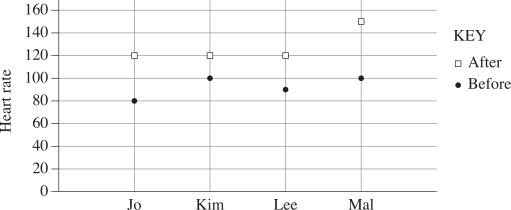
The graph shows the heart rate for each person before and after completing the activity.
 

Which person had the LEAST difference in heart rate?

  1. Jo
  2. Kim
  3. Lee
  4. Mal
Show Answers Only

\(B\)

Show Worked Solution
\(\text{Option A: }\)  \(\text{Jo}\)  \(=120-80=40\) 
\(\text{Option B: }\) \(\text{Kim}\) \(=120-100=20\ \checkmark\) 
\(\text{Option C: }\) \(\text{Lee}\) \(=120-90=30\) 
\(\text{Option D: }\) \(\text{Mal}\) \(=150-100=50\) 

  
\(\Rightarrow B\)

Filed Under: M4 Rates (Y12) Tagged With: Band 2, smc-1104-40-Heart Rates/Blood Pressure

Proof, EXT2 P1 2024 HSC 3 MC

Consider the statement:

'If a polygon is a square, then it is a rectangle.'

Which of the following is the converse of the statement above?

  1. If a polygon is a rectangle, then it is a square.
  2. If a polygon is a rectangle, then it is not a square.
  3. If a polygon is not a rectangle, then it is not a square.
  4. If a polygon is not a square, then it is not a rectangle.
Show Answers Only

\(A\)

Show Worked Solution

\(\text{Statement:}\  P \Rightarrow \ Q\)

\(\text{Converse of statement:}\  Q \Rightarrow \ P\)

\(\Rightarrow A\)

Filed Under: Converse, Contradiction and Contrapositive Proof Tagged With: Band 2, smc-1207-25-Converse

Proof, EXT2 P1 2024 HSC 2 MC

Consider the following statement written in the formal language of proof

\(\forall \theta \in\biggl(\dfrac{\pi}{2}, \pi\biggr) \exists\ \phi \in\biggl(\pi, \dfrac{3 \pi}{2}\biggr) ; \ \sin \theta=-\cos \phi\).

Which of the following best represents this statement?

  1. There exists a \(\theta\) in the second quadrant such that for all \(\phi\) in the third quadrant  \(\sin \theta=-\cos \phi\).
  2. There exists a \(\phi\) in the third quadrant such that for all \(\theta\) in the second quadrant  \(\sin \theta=-\cos \phi\).
  3. For all \(\theta\) in the second quadrant there exists a \(\phi\) in the third quadrant such that  \(\sin \theta=-\cos \phi\).
  4. For all \(\phi\) in the third quadrant there exists a \(\theta\) in the second quadrant such that  \(\sin \theta=-\cos \phi\).
Show Answers Only

\(C\)

Show Worked Solution

\(\Rightarrow C\)

Filed Under: Proof and Inequalities Tagged With: Band 2, smc-1208-90-Language of proof

Trigonometry, 2ADV T1 2024 HSC 20

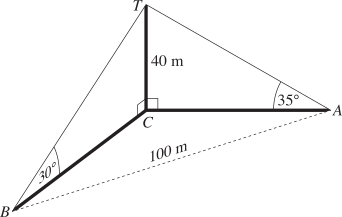
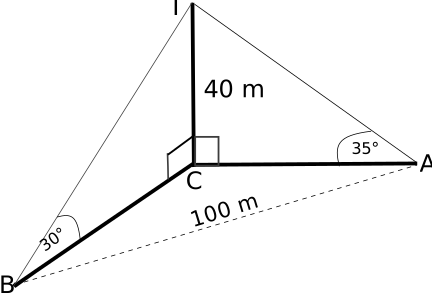
A vertical tower \(T C\) is 40 metres high. The point \(A\) is due east of the base of the tower \(C\). The angle of elevation to the top \(T\) of the tower from \(A\) is 35°. A second point \(B\) is on a different bearing from the tower as shown. The angle of elevation to the top of the tower from \(B\) is 30°. The points \(A\) and \(B\) are 100 metres apart.
 

  1. Show that distance \(A C\) is 57.13 metres, correct to 2 decimal places.  (1 mark)

    --- 5 WORK AREA LINES (style=lined) ---

  1. Find the bearing of \(B\) from \(C\) to the nearest degree.  (3 marks)

    --- 12 WORK AREA LINES (style=lined) ---

Show Answers Only

\(194^{\circ}\)

Show Worked Solution

a.   \(\text{In}\ \Delta TCA:\)

\(\tan 35°\) \( =\dfrac{40}{AC}\)  
\(AC\) \( =\dfrac{40}{\tan 35°}\)  
  \(=57.125…\)  
  \(=57.13\ \text{m (2 d.p.)}\)  

 
b. 
 \(\text{In}\ \Delta TCB:\)

\(\tan 30°\) \( =\dfrac{40}{BC}\)  
\(BC\) \( =\dfrac{40}{\tan 30°}\)  
  \(=69.28\ \text{m}\)  

  
\( \text{Find} \ \angle BCA \ \text{using cosine rule:}\)

\(\cos \angle B CA\) \( = \dfrac{57.13^2+69.28^2-100^2}{2 \times 57.13 \times 69.28}\)  
  \(= -0.2446 \)…  
\(\angle BCA\) \( = 104.2° \)  

\(\therefore\ \text{Bearing of}\ B\ \text{from}\ C= 90+104=194^{\circ} \text{(nearest degree)} \)

Filed Under: 3D Trigonometry (Y11) Tagged With: Band 2, Band 4

Networks, STD2 N2 2024 HSC 16

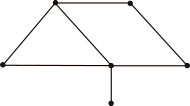
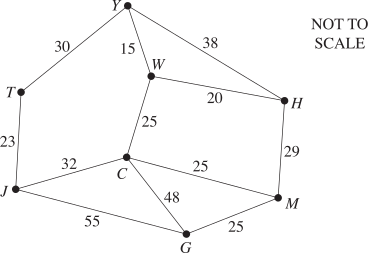
A network of towns and the distances between them in kilometres is shown.
 

  1. What is the shortest path from \(T\) to \(H\) ?   (2 marks)

    --- 2 WORK AREA LINES (style=lined) ---

  2. A truck driver needs to travel from \(Y\) to \(G\) but knows that the road from \(C\) to \(G\) is closed.
  3. What is the length of the shortest path the truck driver can take from \(Y\) to \(G\) after the road closure?  (2 marks)

    --- 4 WORK AREA LINES (style=lined) ---
Show Answers Only

a.   \(TYWH\)

b.  \(\text{Length of shortest path}\ (YWHMG) = 89 \text{km}\)

Show Worked Solution

a.    \(TYH=30+38=68, \quad TYWH=30+15+20=65\)

\(\therefore \text{ Shortest Path is}\ TYWH.\)
 

b.    \(Y W C M G=15+25+25+25=90\)

\(YWHMG=15+20+29+25=89\)

\(\Rightarrow \ \text{All other paths are longer.}\)

\(\therefore\text{ Length of shortest path = 89 km}\)

Filed Under: Shortest Paths, Shortest Paths (Std2-2027) Tagged With: Band 2, Band 3, smc-6308-10-Network Diagrams, smc-913-10-Network Diagram

BIOLOGY, M1 EQ-Bank 4 MC

Which of the following structures is present in both prokaryotic and eukaryotic cells?

  1. Golgi apparatus
  2. Mitochondria
  3. Ribosomes
  4. Endoplasmic reticulum
Show Answers Only

\(C\)

Show Worked Solution
  • Both prokaryotic and eukaryotic cells contain ribosomes, which are responsible for protein synthesis.
  • Prokaryotes lack membrane-bound organelles like mitochondria or the Golgi apparatus.

\(\Rightarrow C\)

Filed Under: Cell Structure Tagged With: Band 2

BIOLOGY, M6 2019 VCE 27 MC

Farmers and supermarkets agree that green beans are bought more frequently than yellow beans. A supermarket has asked a farmer to produce only green beans.

One way this could be achieved is by

  1. condensation polymerisation.
  2. DNA hybridisation.
  3. selective breeding.
  4. adaptive radiation.
Show Answers Only

\(C\)

Show Worked Solution
  • Selective breeding involves choosing parents with desirable traits and breeding them to produce offspring with those traits.
  • In this case, the farmer would selectively breed green bean plants to produce more green beans, as that is the preferred variety by consumers and supermarkets.
  • Selective breeding does not involve genetic engineering techniques like DNA hybridization (option B) and is a common agricultural practice used to enhance desirable traits in crops, unlike options A and D which are not relevant to this scenario.

\(\Rightarrow C\)

Filed Under: Genetic Technologies Tagged With: Band 2, smc-3654-20-Agriculture

BIOLOGY, M5 2019 VCE 5 MC

Which one of the following statements about proteins is correct?

  1. The activity of a protein may be affected by the temperature and pH of its environment.
  2. The primary structure of a protein refers to its three-dimensional protein shape.
  3. Proteins are not involved in the human immune response.
  4. A protein with a quaternary structure will be an enzyme.
Show Answers Only

\(A\)

Show Worked Solution

Consider option A:

  • Changes in temperature or pH can disrupt the interactions that stabilise a protein’s higher-order structure.
  • This causes it to lose its three-dimensional shape and become denatured which usually results in a non-functional protein (Option A is Correct)

\(\Rightarrow A\)

Filed Under: DNA and Polypeptide Synthesis Tagged With: Band 2, smc-3650-60-Proteins

BIOLOGY, M7 2021 VCE 36 MC

A study assessed the effectiveness and safety of a drug called doxycycline. One hundred and fifty adults hospitalised with malaria were involved. These adults were randomly placed into two groups of equal size. One group received doxycycline in addition to standard care. The other group received standard care only.

The group receiving standard care only was the

  1. control group.
  2. variable group.
  3. unsupported group.
  4. experimental group.
Show Answers Only

\(A\)

Show Worked Solution
  • A control group does not receive the experimental treatment or any intervention being tested.

\(\Rightarrow A\)

Filed Under: Prevention, Treatment and Control Tagged With: Band 2, smc-3658-50-Malaria

v1 Networks, STD2 N2 2012 FUR1 1 MC

The sum of the degrees of all the vertices in the graph above is

A.    `6`

B.    `7`

C.   `9`

D.   `14`

Show Answers Only

`D`

Show Worked Solution

`text(Total Degrees)`

`=1 + 3 + 2 + 2 + 2 + 2`

`=12`

`rArr D`

Filed Under: Basic Concepts (Std 2-X) Tagged With: Band 2, smc-1136-40-Degrees of Vertices, smc-912-40-Degrees of Vertices

v1 Algebra, STD2 A2 2012 HSC 13 MC

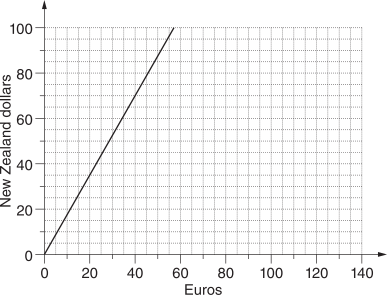
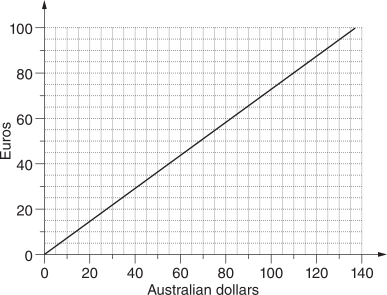
Conversion graphs can be used to convert from one currency to another.  


Abbie converted 70 New Zealand dollars into Euros. She then converted all of these Euros into Australian dollars.

How much money, in Australian dollars, should Abbie have? 

  1. $30  
  2. $45
  3. $55
  4. $95
Show Answers Only

\(C\)

Show Worked Solution

\(\text{Using the graphs:}\)

\($70\ \text{New Zealand}\) \(=40\ \text{Euro}\)
\(40\ \text{Euro}\) \(=$55\  \text{Australian}\)

 
\(\Rightarrow C\)

Filed Under: Applications: Currency, Fuel and Other Problems (Std 2-X) Tagged With: Band 2, smc-5236-10-Currency conversion

v1 Algebra, STD2 A2 2022 HSC 16

Rhonda is 38 years old, and likes to keep fit by doing cross-fit classes.

  1. Use this formula to find her maximum heart rate (bpm).   (1 mark)
      
       Maximum heart rate = 220 – age in years

    --- 2 WORK AREA LINES (style=lined) ---

  2. Rhonda will get the most benefit from this exercise if her heart rate is between 65% and 85% of her maximum heart rate.
  3. Between what two heart rates should Rhonda be aiming for to get the most benefit from her exercise?  (2 marks)

    --- 4 WORK AREA LINES (style=lined) ---
Show Answers Only

a.   \(182\ \text{bpm}\)

b.   \(118-155\ \text{bpm}\)

Show Worked Solution
a.     \(\text{Max heart rate}\) \(=220-38\)
    \(=182\ \text{bpm}\)


b.    \(\text{65% max heart rate}\ = 0.65\times 182 = 118.3\ \text{bpm}\)

\(\text{85% max heart rate}\ = 0.85\times 182 = 154.7\ \text{bpm}\)

\(\therefore\ \text{Rhonda should aim for between 118 and 155 bpm during exercise.}\)

Filed Under: Applications: Currency, Fuel and Other Problems (Std 2-X) Tagged With: Band 2, Band 3, smc-5236-30-Other linear applications

v1 Algebra, STD2 A4 2022 HSC 22

The formula  \(C=80n+b\)  is used to calculate the cost of producing desktop computers, where \(C\) is the cost in dollars, \(n\) is the number of desktop computers produced and \(b\) is the fixed cost in dollars.

  1. Find the cost \(C\) when 2458 desktop computers are produced and the fixed cost is \($18\ 230\).  (1 mark)

    --- 2 WORK AREA LINES (style=lined) ---

  2. Some desktop computers have extra features added. The formula to calculate the production cost for these desktop computers is
  3.     \(C=80n+an+18\ 230\)
  4. where \(a\) is the additional cost in dollars per desktop computer produced.
  5. Find the number of desktop computers produced if the additional cost is $35 per desktop computer and the total production cost is \($103\ 330\).  (2 marks)

    --- 4 WORK AREA LINES (style=lined) ---

Show Answers Only
  1. \($214\ 870\)
  2. \(740\ \text{desktop computers}\)
Show Worked Solution

a.   \(\text{Find}\ C,\ \text{given}\ n=2458\ \text{and}\ b=18\ 230\)

\(C\) \(=80\times 2458+18\ 230\)  
  \(=$214\ 870\)  


b.   \(\text{Find}\ n,\ \text{given}\ C=103\ 330\ \text{and}\ a=35\)

\(C\) \(=80n+an+18\ 230\)
\(103\ 330\) \(=80n+35n+18\ 230\)
\(115n\) \(=85\ 100\)
\(n\) \(=\dfrac{85\ 100}{115}\)
  \(=740\ \text{desktop computers}\)

Filed Under: Applications: Currency, Fuel and Other Problems (Std 2-X) Tagged With: Band 2, Band 4, smc-5236-30-Other linear applications

v1 Algebra, STD2 A1 2005 HSC 2 MC

What is the value of  \(\dfrac{x-y}{6}\), if  \(x=184\)  and  \(y=46\)?

  1. \(6\)
  2. \(23\)
  3. \(176\)
  4. \(552\)
Show Answers Only

\(B\)

Show Worked Solution
\(\dfrac{x-y}{6}\) \(=\dfrac{184-46}{6}\)
  \(=23\) 

  
\(\Rightarrow B\)

Filed Under: Substitution and Other Equations (Std 2-X) Tagged With: Band 2, smc-5233-10-Substitute

v1 Algebra, STD2 A1 2006 HSC 2 MC

If  \(V=\dfrac{4}{3}\pi r^3\), what is the value of  \(V\) when  \(r = 5\), correct to two decimal places?

  1. \(20.94\)
  2. \(53.05\)
  3. \(104.72\)
  4. \(523.60\)
Show Answers Only

\(D\)

Show Worked Solution

\(V =\dfrac{4}{3}\pi r^3\)

\(\text{When}\  r = 2,\)

\(V\) \(=\dfrac{4}{3}\pi\times 5^3\)
  \(=523.598\dots\)

 
\(\Rightarrow D\)

Filed Under: Substitution and Other Equations (Std 2-X) Tagged With: Band 2, smc-5233-10-Substitute

v1 Algebra, STD2 A1 2016 HSC 2 MC

Which of the following equations has  \(x=7\) as the solution?

  1. \(x-7=14\)
  2. \(7-x=14\)
  3. \(2x=14\)
  4. \(\dfrac{x}{2}=14\)
Show Answers Only

\(C\)

Show Worked Solution
\(2x\) \(=14\)
\(x\) \(=\dfrac{14}{2}\)
\(\therefore\ x\) \(=7\)

 
\(\Rightarrow C\)

Filed Under: Substitution and Other Equations (Std 2-X) Tagged With: Band 2, smc-5233-5-Other Equations

v1 Algebra, STD2 A1 SM-Bank 2

If   \(A=P(1 + r)^n\), find  \(A\)  given  \(P=$500\),  \(r=0.09\) and  \(n=5\) (give your answer to the nearest cent).  (2 marks)

Show Answers Only

\($769.31\ \text{(nearest cent)}\)

Show Worked Solution
\(A\) \(=P(1 + r)^n\)
  \(=500(1 + 0.09)^5\)
  \(=500(1.09)^5\)
  \(=769.311\dots\)
  \(=$769.31\ \text{(nearest cent)}\)

Filed Under: Substitution and Other Equations (Std 2-X) Tagged With: Band 2, Band 3, smc-5233-10-Substitute

v1 Algebra, STD2 A1 SM-Bank 3

Find the value of  \(b\)  given  \(\dfrac{b}{9}-5=3\).  (1 mark)

Show Answers Only

\(72\)

Show Worked Solution
\(\dfrac{b}{9}-5\) \(=3\)
\(\dfrac{b}{9}\) \(=8\)
\(\therefore\ b\) \(=72\)

Filed Under: Substitution and Other Equations (Std 2-X) Tagged With: Band 2, smc-5233-30-Algebraic Fractions

v1 Algebra, STD2 A1 SM-Bank 13

If  \(\dfrac{x-8}{9}=2\),  find  \(x\).  (1 mark)

Show Answers Only

\(26\)

Show Worked Solution
\(\dfrac{x-8}{9}\) \(=2\)
 \(x-8\) \(=18\)
 \(x\) \(=26\)

Filed Under: Substitution and Other Equations (Std 2-X) Tagged With: Band 2, smc-5233-30-Algebraic Fractions

v1 Algebra, STD2 A1 2017 HSC 7 MC

It is given that  \(I=\dfrac{3}{2}MR^2\).

What is the value of  \(I\) when  \(M =19.12\) and  \(R = 1.02\), correct to two decimal places?

  1. \(13.26\)
  2. \(29.84\)
  3. \(119.35\)
  4. \(570.52\)
Show Answers Only

\(B\)

Show Worked Solution
\(I\) \(=\dfrac{3}{2}\times 19.12\times 1.02^2\)
  \(=29.84\)


\(\Rightarrow B\)

Filed Under: Substitution and Other Equations (Std 2-X) Tagged With: Band 2, smc-5233-10-Substitute

PHYSICS, M6 2019 VCE 1 MC

Magnetic and gravitational forces have a variety of properties.

Which of the following best describes the attraction/repulsion properties of magnetic and gravitational forces?

\begin{align*}
\begin{array}{l}
\rule{0pt}{2.5ex} \ \rule[-1ex]{0pt}{0pt}& \\
\rule{0pt}{2.5ex}\textbf{A.}\rule[-1ex]{0pt}{0pt}\\
\rule{0pt}{2.5ex}\textbf{B.}\rule[-1ex]{0pt}{0pt}\\
\rule{0pt}{2.5ex}\textbf{C.}\rule[-1ex]{0pt}{0pt}\\
\rule{0pt}{2.5ex}\textbf{D.}\rule[-1ex]{0pt}{0pt}\\
\end{array}
\begin{array}{|l|l|}
\hline
\rule{0pt}{2.5ex}\quad \textbf{Magnetic forces}\rule[-1ex]{0pt}{0pt}& \ \textbf{Gravitational forces} \\
\hline
\rule{0pt}{2.5ex}\text{either attract or repel}\rule[-1ex]{0pt}{0pt}&\text{only attract}\\
\hline
\rule{0pt}{2.5ex}\text{only repel}\rule[-1ex]{0pt}{0pt}& \text{neither attract nor repel}\\
\hline
\rule{0pt}{2.5ex}\text{only attract}\rule[-1ex]{0pt}{0pt}& \text{only attract} \\
\hline
\rule{0pt}{2.5ex}\text{either attract or repel}\rule[-1ex]{0pt}{0pt}& \text{either attract or repel} \\
\hline
\end{array}
\end{align*}

Show Answers Only

\(A\)

Show Worked Solution
  • In magnets, like poles repel and opposite poles attract.
  • Gravitational forces are only attractive.

\(\Rightarrow A\)

Filed Under: Charged Particles, Conductors and Electric/Magnetic Fields Tagged With: Band 2, smc-3693-70-EF vs gravity

Probability, MET2 2022 VCAA 3

Mika is flipping a coin. The unbiased coin has a probability of \(\dfrac{1}{2}\) of landing on heads and \(\dfrac{1}{2}\) of landing on tails.

Let \(X\) be the binomial random variable representing the number of times that the coin lands on heads.

Mika flips the coin five times.

    1. Find \(\text{Pr}(X=5)\).   (1 mark)

      --- 2 WORK AREA LINES (style=lined) ---

    2. Find \(\text{Pr}(X \geq 2).\) (1 mark)

      --- 2 WORK AREA LINES (style=lined) ---

    3. Find \(\text{Pr}(X \geq 2 | X<5)\), correct to three decimal places.   (2 marks)

      --- 4 WORK AREA LINES (style=lined) ---

    4. Find the expected value and the standard deviation for \(X\).   (2 marks)

      --- 4 WORK AREA LINES (style=lined) ---

The height reached by each of Mika's coin flips is given by a continuous random variable, \(H\), with the probability density function
  

\(f(h)=\begin{cases} ah^2+bh+c         &\ \ 1.5\leq h\leq 3 \\ \\ 0       &\ \ \text{elsewhere} \\ \end{cases}\)
  

where \(h\) is the vertical height reached by the coin flip, in metres, between the coin and the floor, and \(a, b\) and \(c\) are real constants.

    1. State the value of the definite integral \(\displaystyle\int_{1.5}^3 f(h)\,dh\).   (1 mark)

      --- 5 WORK AREA LINES (style=lined) ---

    2. Given that  \(\text{Pr}(H \leq 2)=0.35\)  and  \(\text{Pr}(H \geq 2.5)=0.25\), find the values of \(a, b\) and \(c\).   (3 marks)

      --- 5 WORK AREA LINES (style=lined) ---

    3. The ceiling of Mika's room is 3 m above the floor. The minimum distance between the coin and the ceiling is a continuous random variable, \(D\), with probability density function \(g\).
    4. The function \(g\) is a transformation of the function \(f\) given by \(g(d)=f(rd+s)\), where \(d\) is the minimum distance between the coin and the ceiling, and \(r\) and \(s\) are real constants.
    5. Find the values of \(r\) and \(s\).   (1 mark)

      --- 5 WORK AREA LINES (style=lined) ---

  1. Mika's sister Bella also has a coin. On each flip, Bella's coin has a probability of \(p\) of landing on heads and \((1-p)\) of landing on tails, where \(p\) is a constant value between 0 and 1 .
  2. Bella flips her coin 25 times in order to estimate \(p\).
  3. Let \(\hat{P}\) be the random variable representing the proportion of times that Bella's coin lands on heads in her sample.
    1. Is the random variable \(\hat{P}\) discrete or continuous? Justify your answer.   (1 mark)

      --- 2 WORK AREA LINES (style=lined) ---

    2. If \(\hat{p}=0.4\), find an approximate 95% confidence interval for \(p\), correct to three decimal places.   (1 mark)

      --- 6 WORK AREA LINES (style=lined) ---

    3. Bella knows that she can decrease the width of a 95% confidence interval by using a larger sample of coin flips.
    4. If \(\hat{p}=0.4\), how many coin flips would be required to halve the width of the confidence interval found in part c.ii.?   (1 mark)

      --- 2 WORK AREA LINES (style=lined) ---

Show Answers Only

a. i.    `frac{1}{32}`    ii.    `frac{13}{16}`    iii.    `0.806` (3 d.p.)

a. iv    `text{E}(X)=5/2,  text{sd}(X)=\frac{\sqrt{5}}{2}`

b. i.   `1`   

b. ii.    `a=-frac{4}{5},  b=frac{17}{5},  c=-frac{167}{60}`

b. iii. `r=-1,  s=3`

c. i.   `text{Discrete}`   ii.   `(0.208,  0.592)`   iii.   `n=100`

Show Worked Solution

a.i  `X ~ text{Bi}(5 , frac{1}{2})`

`text{Pr}(X = 5) = (frac{1}{2})^5 = frac{1}{32}`
 

a.ii  By CAS:    `text{binomCdf}(5,0.5,2,5)`     `0.8125`

`text{Pr}(X>= 2) = 0.8125 = frac{13}{16}`

  
a.iii 
`\text{Pr}(X \geq 2 | X<5)`

`=frac{\text{Pr}(2 <= X < 5)}{\text{Pr}(X < 5)} = frac{\text{Pr}(2 <= X <= 4)}{text{Pr}(X <= 4)}`

  
By CAS: `frac{text{binomCdf}(5,0.5,2,4)}{text{binomCdf}(5,0.5,0,4)}`
 

`= 0.806452 ~~ 0.806` (3 decimal places)
  

a.iv `X ~ text{Bi}(5 , frac{1}{2})`

`text{E}(X) = n xx p= 5 xx 1/2 = 5/2`

`text{sd}(X) =\sqrt{n p(1-p)}=\sqrt((5/2)(1 – 0.5)) = \sqrt{5/4} =\frac{\sqrt{5}}{2}`


b.i   `\int_{1.5}^3 f(h) d h = 1`


♦♦ Mean mark (b.i) 40%.
MARKER’S COMMENT: Many students did not evaluate the integral or evaluated incorrectly.

b.ii  By CAS:

`f(h):= a\·\h^2 + b\·\h +c`
 

`text{Solve}( {(\int_{1.5}^2 f(h) d h = 0.35), (\int_{2.5}^3 f(h) d h = 0.25), (\int_{1.5}^3 f(h) d h = 1):})`

`a = -0.8 = frac{-4}{5}, \ b = 3.4 = frac{17}{5},\  c = =-2.78 \dot{3} = frac{-167}{60}`


♦♦ Mean mark (b.ii) 47%.
MARKER’S COMMENT: Many students did not give exact answers.

b.iii  `h + d = 3`

`:.\  f(h) = f(3  –  d) = f(- d + 3)`

`:.\  r = – 1 ` and ` s = 3`


♦♦♦♦ Mean mark (b.iii) 10%.
MARKER’S COMMENT: Many students did not attempt this question.

c.i  `\hat{p}`  is discrete.

The number of coin flips must be zero or a positive integer so  `\hat{p}`  is countable and therefore discrete.
 

c.ii  `\left(\hat{p}-z \sqrt{\frac{\hat{p}(1-\hat{p})}{n}}, \hat{p}+z \sqrt{\frac{\hat{p}(1-\hat{p})}{n}}\right)`

`\left(0.4-1.96 \sqrt{\frac{0.4 \times 0.6}{25}}\ , 0.4-1.96 \sqrt{\frac{0.4 \times 0.6}{25}}\right)`

`\approx(0.208\ ,0.592)`


c.iii To halve the width of the confidence interval, the standard deviation needs to be halved.

`:.\  \frac{1}{2} \sqrt{\frac{0.4 \times 0.6}{25}} = \sqrt{\frac{0.4 \times 0.6}{4 xx 25}} = \sqrt{\frac{0.4 \times 0.6}{100}}`

`:.\  n = 100`

She would need to flip the coin 100 times


♦♦♦ Mean mark (c.iii) 30%.
MARKER’S COMMENT: Common incorrect answers were 0, 10, 11, 50 and 101.

Filed Under: Binomial, Probability density functions Tagged With: Band 2, Band 4, Band 5, Band 6, smc-637-35-Sum probabilities = 1, smc-637-60-Polynomial PDF, smc-638-20-binomCdf (CAS), smc-638-32-Find E(X)/var(X) given n p, smc-638-50-Conditional, smc-719-20-95% confidence intervals, smc-719-40-Find sample size

Calculus, MET2 2022 VCAA 2

On a remote island, there are only two species of animals: foxes and rabbits. The foxes are the predators and the rabbits are their prey.

The populations of foxes and rabbits increase and decrease in a periodic pattern, with the period of both populations being the same, as shown in the graph below, for all `t \geq 0`, where time `t` is measured in weeks.

One point of minimum fox population, (20, 700), and one point of maximum fox population, (100, 2500), are also shown on the graph.

The graph has been drawn to scale.
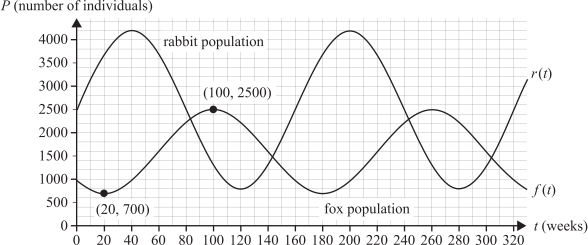
 

The population of rabbits can be modelled by the rule `r(t)=1700 \sin \left(\frac{\pi t}{80}\right)+2500`.

  1.   i. State the initial population of rabbits.   (1 mark)

    --- 2 WORK AREA LINES (style=lined) ---

  2.  ii. State the minimum and maximum population of rabbits.   (1 mark)

    --- 2 WORK AREA LINES (style=lined) ---

  3. iii. State the number of weeks between maximum populations of rabbits.   (1 mark)

    --- 2 WORK AREA LINES (style=lined) ---

The population of foxes can be modelled by the rule `f(t)=a \sin (b(t-60))+1600`.

  1. Show that `a=900` and `b=\frac{\pi}{80}`.   (2 marks)

    --- 4 WORK AREA LINES (style=lined) ---

  2. Find the maximum combined population of foxes and rabbits. Give your answer correct to the nearest whole number.   (1 mark)

    --- 1 WORK AREA LINES (style=lined) ---

  3. What is the number of weeks between the periods when the combined population of foxes and rabbits is a maximum?   (1 mark)

    --- 1 WORK AREA LINES (style=lined) ---

The population of foxes is better modelled by the transformation of `y=\sin (t)` under `Q` given by

 

  1. Find the average population during the first 300 weeks for the combined population of foxes and rabbits, where the population of foxes is modelled by the transformation of `y=\sin(t)` under the transformation `Q`. Give your answer correct to the nearest whole number.   (4 marks)

    --- 8 WORK AREA LINES (style=lined) ---

Over a longer period of time, it is found that the increase and decrease in the population of rabbits gets smaller and smaller.

The population of rabbits over a longer period of time can be modelled by the rule

`s(t)=1700cdote^(-0.003t)cdot sin((pit)/80)+2500,\qquad text(for all)\ t>=0`

  1. Find the average rate of change between the first two times when the population of rabbits is at a maximum. Give your answer correct to one decimal place.   (2 marks)

    --- 3 WORK AREA LINES (style=lined) ---

  2. Find the time, where `t>40`, in weeks, when the rate of change of the rabbit population is at its greatest positive value. Give your answer correct to the nearest whole number.   (2 marks)

    --- 3 WORK AREA LINES (style=lined) ---

  3. Over time, the rabbit population approaches a particular value.
  4. State this value.   (1 mark)

    --- 1 WORK AREA LINES (style=lined) ---

Show Answers Only

ai.   `r(0)=2500`

aii.  Minimum population of rabbits `= 800`

Maximum population of rabbits `= 4200`

aiii. `160`  weeks

b.    See worked solution.

c.    `~~ 5339` (nearest whole number)

d.    Weeks between the periods is 160

e.    `~~ 4142` (nearest whole number)

f.    Average rate of change `=-3.6` rabbits/week (1 d.p.)

g.    `t = 156` weeks (nearest whole number)  

h.    ` s → 2500`

Show Worked Solution

ai.  Initial population of rabbits

From graph when `t=0, \ r(0) = 2500`

Using formula when `t=0`

`r(t)` `= 1700\ sin \left(\frac{\pi t}{80}\right)+2500`  
`r(0)` `= 1700\ sin \left(\frac{\pi xx 0}{80}\right)+2500 = 2500`  rabbits  


aii.
From graph,

Minimum population of rabbits `= 800`

Maximum population of rabbits `= 4200`

OR

Using formula

Minimum is when `t = 120`

`r(120) = 1700\ sin \left(\frac{\pi xx 120}{80}\right)+2500 = 1700 xx (-1) + 2500 = 800`

Maximum is when `t = 40`

`r(40) = 1700\ sin \left(\frac{\pi xx 40}{80}\right)+2500 = 1700 xx (1) + 2500 = 4200`

 
aiii. Number of weeks between maximum populations of rabbits `= 200-40 = 160`  weeks

 
b.  Period of foxes = period of rabbits = 160:

`frac{\2pi}{b} = 160`

`:.\  b = frac{\2pi}{160} = frac{\pi}{80}` which is the same period as the rabbit population.

Using the point `(100 , 2500)`

Amplitude when `b = frac{\pi}{80}`: 

`f(t)` `=a \ sin (pi/80(t-60))+1600`  
`f(100)` `= 2500`  
`2500` `= a \ sin (pi/80(100-60))+1600`  
`2500` `= a \ sin (pi/2)+1600`  
`a` `= 2500-1600 = 900`  

 
`:.\  f(t)= 900 \ sin (pi/80)(t-60) + 1600`


c.    Using CAS find `h(t) = f(t) + r(t)`:

`h(t):=900 \cdot \sin \left(\frac{\pi}{80} \cdot(t-60)\right)+1600+1700\cdot \sin \left(\frac{\pit}{80}\right) +2500`

  
`text{fMax}(h(t),t)|0 <= t <= 160`      `t = 53.7306….`
  

`h(53.7306…)=5339.46`

  
Maximum combined population `~~ 5339` (nearest whole number)


♦♦ Mean mark (c) 40%.
MARKER’S COMMENT: Many rounding errors with a common error being 5340. Many students incorrectly added the max value of rabbits to the max value of foxes, however, these points occurred at different times.

d.    Using CAS, check by changing domain to 0 to 320.

`text{fMax}(h(t),t)|0 <= t <= 320`     `t = 213.7305…`
 
`h(213.7305…)=5339.4568….`
 
Therefore, the number of weeks between the periods is 160.
  

e.    Fox population:

`t^{\prime} = frac{90}{pi}t + 60`   →   `t = frac{pi}{90}(t^{\prime}-60)`

`y^{\prime} = 900y+1600`   →   `y = frac{1}{900}(y^{\prime}-1600)`

`frac{y^{\prime}-1600}{900} = sin(frac{pi(t^{\prime}-60)}{90})`

`:.\  f(t) = 900\ sin\frac{pi}{90}(t-60) + 1600`

  
Average combined population  [Using CAS]   
  
`=\frac{1}{300} \int_0^{300} left(\900 \sin \left(\frac{\pi(t-60)}{90}\right)+1600+1700\ sin\ left(\frac{\pi t}{80}\right)+2500\right) d t`
  

`= 4142.2646…..  ~~ 4142` (nearest whole number)


♦ Mean mark (e) 40%.
MARKER’S COMMENT: Common incorrect answer 1600. Some incorrectly subtracted `r(t)`. Others used average rate of change instead of average value.

f.   Using CAS

`s(t):= 1700e^(-0.003t) dot\sin\frac{pit}{80} + 2500`
 

`text{fMax}(s(t),t)|0<=t<=320`        `x = 38.0584….`
 

`s(38.0584….)=4012.1666….`
 

`text{fMax}(s(t),t)|160<=t<=320`     `x = 198.0584….`
 

`s(198.0584….)=3435.7035….`
 

Av rate of change between the points

`(38.058 , 4012.167)`  and  `(198.058 , 3435.704)`

`= frac{4012.1666….-3435.7035….}{38.0584….-198.0584….} =-3.60289….`
 

`:.` Average rate of change `=-3.6` rabbits/week (1 d.p.)


♦ Mean mark (f ) 45%.
MARKER’S COMMENT: Some students rounded too early.
`frac{s(200)-s(40)}{200-40}` was commonly seen.
Some found average rate of change between max and min populations.

g.   Using CAS

`s^(primeprime)(t) = 0` , `t = 80(n-0.049) \ \forall n \in Z`

After testing `n = 1, 2, 3, 4` greatest positive value occurs for `n = 2` 

`t` `= 80(n-0.049)`  
  `= 80(2-0.049)`  
  `= 156.08`  

 
`:. \ t = 156` weeks (nearest whole number)


♦♦♦ Mean mark (g) 25%.
MARKER’S COMMENT: Many students solved `frac{ds}{dt}=0`.
A common answer was 41.8, as `s(156.11…)=41.79`.
Another common incorrect answer was 76 weeks.

h.   As `t → ∞`, `e^(-0.003t) → 0`

`:.\ s → 2500`

Filed Under: Average Value and Other, Differentiation (Trig), Maxima and Minima, Trig Differentiation Tagged With: Band 2, Band 4, Band 5, Band 6, smc-2757-10-Sin, smc-2757-80-Applications, smc-641-60-Other themes, smc-736-10-sin, smc-744-10-sin, smc-753-60-Matrix, smc-756-20-Trig

Calculus, MET2 2022 VCAA 1

The diagram below shows part of the graph of `y=f(x)`, where `f(x)=\frac{x^2}{12}`.
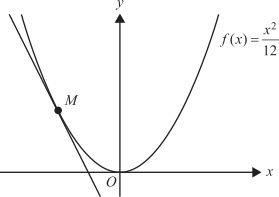
 

  1. State the equation of the axis of symmetry of the graph of `f`.   (1 mark)

    --- 2 WORK AREA LINES (style=lined) ---

  2. State the derivative of `f` with respect to `x`.   (1 mark)

    --- 2 WORK AREA LINES (style=lined) ---

The tangent to `f` at point `M` has gradient `-2` .

  1. Find the equation of the tangent to `f` at point `M`.   (2 marks)

    --- 6 WORK AREA LINES (style=lined) ---

The diagram below shows part of the graph of `y=f(x)`, the tangent to `f` at point `M` and the line perpendicular to the tangent at point `M`.
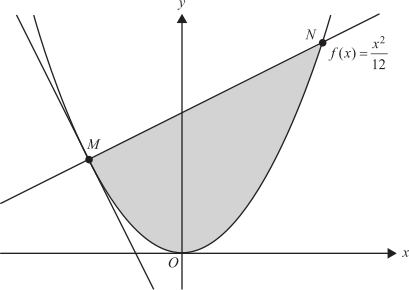


  1.  i. Find the equation of the line perpendicular to the tangent passing through point `M`.   (1 mark)

    --- 5 WORK AREA LINES (style=lined) ---

  2. ii. The line perpendicular to the tangent at point `M` also cuts `f` at point `N`, as shown in the diagram above.
  3.     Find the area enclosed by this line and the curve `y=f(x)`.   (2 marks)

    --- 8 WORK AREA LINES (style=lined) ---

  4. Another parabola is defined by the rule `g(x)=\frac{x^2}{4 a^2}`, where `a>0`.
  5. A tangent to `g` and the line perpendicular to the tangent at `x=-b`, where `b>0`, are shown below.
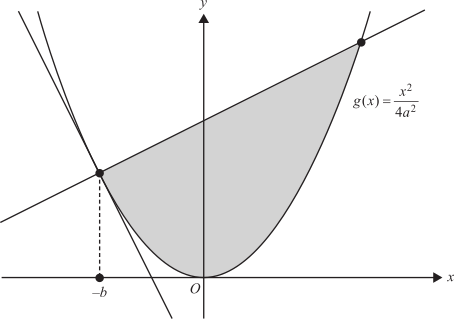
  1. Find the value of `b`, in terms of `a`, such that the shaded area is a minimum.   (4 marks)

    --- 8 WORK AREA LINES (style=lined) ---

Show Answers Only

a.    `x=0`

b.    ` f^{\prime}(x)=1/6x`

c.    `x=-12`

di.    `y=1/2x + 18`

dii.   Area`= 375` units²

e.    `b = 2a^2`

Show Worked Solution

a.   Axis of symmetry:  `x=0`
  

b.    `f(x)`  `=\frac{x^2}{12}`  
  ` f^{\prime}(x)` `= 1/6x`  

  
c.  
At `M` gradient `= -2`

`1/6x` `= -2`  
`x` `= -12`  

 
When  `x = -12`
 

`f(x) = (-12)^2/12 = 12`
 
Equation of tangent at `(-12 , 12)`:

`y-y_1` `=m(x-x_1)`  
`y-12` `= -2(x + 12)`  
`y` `= -2x-12`  


d.i  
Gradient of tangent `= -2`

`:.`  gradient of normal `= 1/2` 

Equation at `M(- 12 , 12)`

`y -y_1` `=m(x-x_1)`  
`y-12` `= 1/2(x + 12)`  
`y` `=1/2x + 18`  


d.ii 
Points of intersection of `f(x)` and normal are at  `M` and `N`.

So equate ` y = x^2/12` and  `y = 1/2x + 18` to find `N`

`x^2/12` `=1/2x + 18`  
`x^2-6x-216` `=0`  
`(x + 12)(x-18)` `=0`  

   
`:.\  x = -12` or `x = 18`

Area `= \int_{-12}^{18}\left(\frac{1}{2} x+18-\frac{x^2}{12}\right) d x`  
  `= [x^2/4 + 18x-x^3/36]_(-12)^18`  
  `= [18^2/4 +18^2-18^3/36] – [12^2/4 + 18 xx (-12)-(-12)^3/36]`  
  `= 375` units²  


e.   `g(x) = x^2/(4a^2)`   `a > 0`

At `x = -b`   `y = (-b)^2/(4a^2) = b^2/4a^2`

`g^{\prime}(x) = (2x)/(4a^2) = x/(2a^2)`

Gradient of tangent `= (-b)/(2a^2)`

Gradient of normal `= (2a^2)/b`

Equation of normal at `(- b , b^2/(4a^2))`

`y-y_1` `= m(x-x_1)`  
`y-b^2/(4a^2)` `= (2a^2)/b(x-(-b))`  
`y` `= (2a^2x)/b + 2a^2 + b^2/(4a^2)`  
`y` `= (2a^2x)/b +(8a^4 + b^2)/(4a^2)`  

 
Points of intersection of normal and parabola (Using CAS)

solve `((2a^2x)/b +(8a^4 + b^2)/(4a^2) = x^2/(4a^2),x)`

`x =-b`  or  `x = (8a^4+b^2)/b`

 
Calculate area using CAS

`A = \int_{-b}^{(8a^4+b^2)/b}\left(\frac{2a^2x}{b} +\frac{8a^4 + b^2}{4a^2}-frac{x^2}{4a^2} \right) dx`

`A = frac{64a^12 + 48a^8b^2 + 12a^4b^4 + b^6}{3a^2b^3}`
 
Using CAS Solve derivative of `A = 0`  with respect to `b` to find `b`

solve`(d/(db)(frac{64a^12 + 48a^8b^2 + 12a^4b^4 + b^6}{3a^2b^3})=0,b)`

 
`b =-2a^2`   and  `b = 2a^2`

Given `b > 0`

`b = 2a^2`


♦♦ Mean mark (e) 33%.
MARKER’S COMMENT: Common errors: Students found `\int_{-b}^{\frac{8 a^4+b^2}{b}}\left(y_n\right) d x` and failed to subtract `g(x)` or had incorrect terminals.

Filed Under: Area Under Curves, Maxima and Minima, Tangents and Normals Tagged With: Band 2, Band 4, Band 5, Band 6, smc-634-10-Polynomial, smc-634-50-Find tangent given curve, smc-641-10-Area, smc-723-10-Quadratic, smc-723-80-Area between graphs

Graphs, MET2 2022 VCAA 1 MC

The period of the function `f(x)=3 \ cos (2 x+\pi)` is

  1. `2 \pi`
  2. `\pi`
  3. `\frac{2\pi}{3}`
  4. `2`
  5. `3`
Show Answers Only

`B`

Show Worked Solution
Period `= (2pi)/n`      `(n = 2)`
  `= (2pi)/2`  
  `= pi`  

`=>B`

Filed Under: Trig Graphing Tagged With: Band 2, smc-2757-30-Find period

Calculus, MET2 2023 VCAA 3

Consider the function \(g:R \to R, g(x)=2^x+5\).

  1. State the value of \(\lim\limits_{x\to -\infty} g(x)\).   (1 mark)

    --- 1 WORK AREA LINES (style=lined) ---

  2. The derivative, \(g^{'}(x)\), can be expressed in the form \(g^{'}(x)=k\times 2^x\).
  3. Find the real number \(k\).   (1 mark)

    --- 2 WORK AREA LINES (style=lined) ---

  4.  i. Let \(a\) be a real number. Find, in terms of \(a\), the equation of the tangent to \(g\) at the point \(\big(a, g(a)\big)\).   (1 mark)

    --- 3 WORK AREA LINES (style=lined) ---

    ii. Hence, or otherwise, find the equation of the tangent to \(g\) that passes through the origin, correct to three decimal places.   (2 marks)

    --- 8 WORK AREA LINES (style=lined) ---

  1.  

Let \(h:R\to R, h(x)=2^x-x^2\).

  1. Find the coordinates of the point of inflection for \(h\), correct to two decimal places.   (1 mark)

    --- 2 WORK AREA LINES (style=lined) ---

  2. Find the largest interval of \(x\) values for which \(h\) is strictly decreasing.
  3. Give your answer correct to two decimal places.   (1 mark)

    --- 2 WORK AREA LINES (style=lined) ---

  4. Apply Newton's method, with an initial estimate of \(x_0=0\), to find an approximate \(x\)-intercept of \(h\).
  5. Write the estimates \(x_1, x_2,\) and \(x_3\) in the table below, correct to three decimal places.   (2 marks)
      

    \begin{array} {|c|c|}
    \hline
    \rule{0pt}{2.5ex} \qquad x_0\qquad \ \rule[-1ex]{0pt}{0pt} & \qquad \qquad 0 \qquad\qquad \\
    \hline
    \rule{0pt}{2.5ex} x_1 \rule[-1ex]{0pt}{0pt} &  \\
    \hline
    \rule{0pt}{2.5ex} x_2 \rule[-1ex]{0pt}{0pt} &  \\
    \hline
    \rule{0pt}{2.5ex} x_3 \rule[-1ex]{0pt}{0pt} &  \\
    \hline
    \end{array}

    --- 0 WORK AREA LINES (style=lined) ---

  6. For the function \(h\), explain why a solution to the equation \(\log_e(2)\times (2^x)-2x=0\) should not be used as an initial estimate \(x_0\) in Newton's method.   (1 mark)

    --- 3 WORK AREA LINES (style=lined) ---

  7. There is a positive real number \(n\) for which the function \(f(x)=n^x-x^n\) has a local minimum on the \(x\)-axis.
  8. Find this value of \(n\).   (2 marks)

    --- 5 WORK AREA LINES (style=lined) ---

Show Answers Only

a.    \(5\)

b.    \(\log_{e}{2}\ \ \text{or}\ \ \ln\ 2\)

ci.  \(y=2^a\ \log_{e}{(2)x}-(a\ \log_{e}{(2)}-1)\times2^a+5\)

\(\text{or}\ \ y=2^a\ \log_{e}{(2)x}-a\ 2^a\ \log_{e}{(2)}+2^a+5\)

cii. \(y=4.255x\)

d. \((2.06 , -0.07)\)

e. \([0.49, 3.21]\)

f. 

\begin{array} {|c|c|}
\hline
\rule{0pt}{2.5ex} \qquad x_0\qquad \ \rule[-1ex]{0pt}{0pt} & \qquad \qquad 0 \qquad\qquad \\
\hline
\rule{0pt}{2.5ex} x_1 \rule[-1ex]{0pt}{0pt} &  -1.433 \\
\hline
\rule{0pt}{2.5ex} x_2 \rule[-1ex]{0pt}{0pt} &  -0.897 \\
\hline
\rule{0pt}{2.5ex} x_3 \rule[-1ex]{0pt}{0pt} &  -0.773 \\
\hline
\end{array}

g. \(\text{See worked solution.}\)

h. \(n=e\)

Show Worked Solution

a.    \(\text{As }x\to -\infty,\ \ 2^x\to 0\)

\(\therefore\ 2^x+5\to 5\)
  

b.     \(g(x)\) \(=2^x+5\)
    \(=\Big(e^{\log_{e}{2}}\Big)^x\)
    \(=e\ ^{x\log_{e}{2}}+5\)
  \(g^{\prime}(x)\) \(=\log_{e}{2}\times e\ ^{x\log_{e}{2}}\)
     \(=\log_{e}{2}\times 2^x\)
  \(\therefore\ k\) \(=\log_{e}{2}\ \ \text{or}\ \ \ln\ 2\)
   
ci.  \(\text{Tangent at}\ (a, g(a)):\)

\(y-(2^a+5)\) \(=\log_{e}{2}\times2^a(x-a)\)
\(\therefore\ y\) \(=2^a\ \log_{e}{(2)x}-a\ 2^a\ \log_{e}{(2)}+2^a+5\)

♦♦ Mean mark (c)(i) 50%.

cii.  \(\text{Substitute }(0, 0)\ \text{into equation from c(i) to find}\ a\)

\( y\) \(=2^a\ \log_{e}{(2)x}-a\ 2^a\ \log_{e}{(2)}+2^a+5\)
\(0\) \(=2^a\ \log_{e}{(2)\times 0}-a\ 2^a\ \log_{e}{(2)}+2^a+5\)
\(0\) \(=-a\ 2^a\ \log_{e}{(2)}+2^a+5\)

  
\(\text{Solve for }a\text{ using CAS }\rightarrow\ a\approx 2.61784\dots\)

\(\text{Equation of tangent when }\ a\approx 2.6178\)

\( y\) \(=2^{2.6178..}\ \log_{e}{(2)x}+0\)
\(\therefore\  y\) \(=4.255x\)

♦♦♦ Mean mark (c)(ii) 30%.
MARKER’S COMMENT: Some students did not substitute (0, 0) into the correct equation or did not find the value of \(a\) and used \(a=0\).
d.     \(h(x)\) \(=2^x-x^2\)
  \(h^{\prime}(x)\) \(=\log_{e}{(2)}\cdot 2^x-2x\ \ \text{(Using CAS)}\)
  \(h^{”}(x)\) \(=(\log_{e}{(2)})^2\cdot 2^x-2\ \ \text{(Using CAS)}\)

\(\text{Solving }h^{”}(x)=0\ \text{using CAS }\rightarrow\ x\approx 2.05753\dots\)

\(\text{Substituting into }h(x)\ \rightarrow\ h(2.05753\dots)\approx-0.070703\dots\)

\(\therefore\ \text{Point of inflection at }(2.06 , -0.07)\ \text{ correct to 2 decimal places.}\)

e.    \(\text{From graph (CAS), }h(x)\ \text{is strictly decreasing between the 2 turning points.}\)

\(\therefore\ \text{Largest interval includes endpoints and is given by }\rightarrow\ [0.49, 3.21]\)
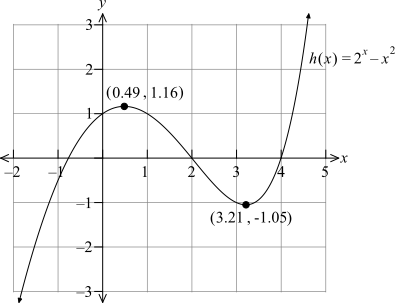

♦♦ Mean mark (e) 40%.
MARKER’S COMMENT: Round brackets were often used which were incorrect as endpoints were included. Some responses showed the interval where the function was strictly increasing.

f.    \(\text{Newton’s Method }\Rightarrow\  x_a-\dfrac{h(x_a)}{h'(x_a)}\) 

\(\text{for }a=0, 1, 2, 3\ \text{given an initial estimation for }x_0=0\)

\(h(x)=2x-x^2\ \text{and }h^{\prime}(x)=\ln{2}\times 2^x-2x\)

\begin{array} {|c|l|}
\hline
\rule{0pt}{2.5ex} \qquad x_0\qquad \ \rule[-1ex]{0pt}{0pt} & \qquad \qquad 0 \qquad\qquad \\
\hline
\rule{0pt}{2.5ex} x_1 \rule[-1ex]{0pt}{0pt} &  0-\dfrac{2^0-2\times 0}{\ln2\times 2^0\times 0}=-1.433 \\
\hline
\rule{0pt}{2.5ex} x_2 \rule[-1ex]{0pt}{0pt} &  -1.433-\dfrac{2^{-1.433}-2\times -1.433}{\ln2\times 2^{-1.433}\times -1.433}=-0.897 \\
\hline
\rule{0pt}{2.5ex} x_3 \rule[-1ex]{0pt}{0pt} &  -0.897-\dfrac{2^{-0.897}-2\times -0.897}{\ln2\times 2^{-0.897}\times -0.897}=-0.773 \\
\hline
\end{array}

g.    \(\text{The denominator in Newton’s Method is}\ h^{\prime}(x)=\log_{e}{(2)}\cdot 2^x-2x\)

\(\text{and the calculation will be undefined if }h^{\prime}(x)=0\ \text{as the tangent lines are horizontal}.\)

\(\therefore\ \text{The solution to }h^{\prime}(x)=0\ \text{cannot be used for }x_0.\)

♦♦♦ Mean mark (g) 20%.

h.    \(\text{For a local minimum }f(x)=0\)

\(\rightarrow\ n^x-x^n=0\)

\(\rightarrow\ n^x=x^n\ \ \ (1)\)

\(\text{Also for a local minimum }f^{\prime}(x)=0\)

\(\rightarrow\ \ln(n)\cdot n^x-nx^{n-1}=0\ \ \ (2)\)

\(\text{Substitute (1) into (2)}\)

\(\ln(n)\cdot x^n-nx^{n-1}=0\) 

\(x^n\Big(\ln(n)-\dfrac{n}{x}\Big)=0\)

\(\therefore\ x^n=0\ \text{or }\ \ln(n)=\dfrac{n}{x}\)

\(x=0\ \text{or }x=\dfrac{n}{\ln(n)}\)

\(\therefore\ n=e\)


♦♦♦ Mean mark (h) 10%.
MARKER’S COMMENT: Many students showed that \(f'(x)=0\) but failed to couple it with \(f(x)=0\). Ensure exact values are given where indicated not approximations.

Filed Under: Differentiation (L&E), Functional Equations, L&E Differentiation, Tangents and Normals Tagged With: Band 2, Band 4, Band 5, Band 6, smc-634-20-Log/Exp Function, smc-634-50-Find tangent given curve, smc-745-10-Exponential, smc-750-35-Newton's method

Calculus, MET2 2023 VCAA 1

Let \(f:R \rightarrow R, f(x)=x(x-2)(x+1)\). Part of the graph of \(f\) is shown below.
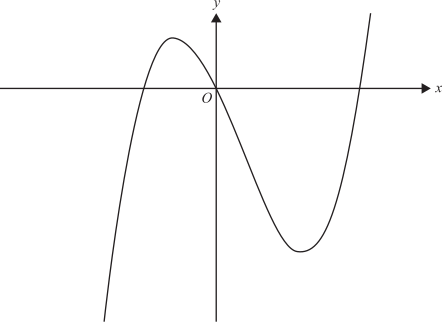
  1. State the coordinates of all axial intercepts of \(f\).   (1 mark)

    --- 2 WORK AREA LINES (style=lined) ---

  2. Find the coordinates of the stationary points of \(f\).   (2 marks)

    --- 3 WORK AREA LINES (style=lined) ---

    1. Let \(g:R\rightarrow R, g(x)=x-2\).
    2. Find the values of \(x\) for which \(f(x)=g(x)\).   (1 mark)

      --- 3 WORK AREA LINES (style=lined) ---

    1. Write down an expression using definite integrals that gives the area of the regions bound by \(f\) and \(g\).  (2 marks)

      --- 4 WORK AREA LINES (style=lined) ---

    2. Hence, find the total area of the regions bound by \(f\) and \(g\), correct to two decimal places.   (1 mark)

      --- 2 WORK AREA LINES (style=lined) ---

  1. Let \(h:R\rightarrow R, h(x)=(x-a)(x-b)^2\), where \(h(x)=f(x)+k\) and \(a, b, k \in R\).
  2. Find the possible values of \(a\) and \(b\).   (4 marks)

    --- 9 WORK AREA LINES (style=lined) ---

Show Answers Only

a.    \((-1, 0), (0, 0), (2, 0)\)

b.    \(\Bigg(\dfrac{1-\sqrt{7}}{3}, \dfrac{2(7\sqrt{7}-10}{27}\Bigg), \Bigg(\dfrac{1+\sqrt{7}}{3}, \dfrac{-2(7\sqrt{7}-10}{27}\Bigg)\)

c.i.  \(x=2,\ \text{or}\ x=\dfrac{-1\pm \sqrt{5}}{2}\)

c.ii. \(\text{Let }a=\dfrac{-1-\sqrt{5}}{2}\ \text{and }b=\dfrac{-1+\sqrt{5}}{2}\)

 \(\text{Then}\ A=\displaystyle\int_a^b (x-2)(x^2+x-1)\,dx+\displaystyle\int_b^2 -(x-2)(x^2+x-1)\,dx\)

c.iii. \(5.95\)

d.   \(\text{1st case }\rightarrow \ a=\dfrac{2\sqrt{7}+1}{3}, b=\dfrac{1-\sqrt{7}}{3}\)

\(\text{2nd case }\rightarrow \ a=\dfrac{-2\sqrt{7}+1}{3}, b=\dfrac{1+\sqrt{7}}{3}\)

Show Worked Solution

a.    \((-1, 0), (0, 0), (2, 0)\)
  

b.    \(\text{Using CAS solve for}\ x:\)

\(\dfrac{d}{dx}(x(x-2)(x+1))=0\)

\(\therefore\ x=\dfrac{1-\sqrt{7}}{3}\ \text{and }x=\dfrac{1+\sqrt{7}}{3}\)

\(\text{Substitute }x\ \text{values into }f(x)\ \text{using CAS to get}\ y\ \text{values}\)

\(\text{The stationary points of }f\ \text{are}:\)

\(\Bigg(\dfrac{1-\sqrt{7}}{3}, \dfrac{2(7\sqrt{7}-10}{27}\Bigg), \Bigg(\dfrac{1+\sqrt{7}}{3}, \dfrac{-2(7\sqrt{7}-10}{27}\Bigg)\)
  

ci    \(\text{Given }f(x)=g(x)\)

\(x(x-2)(x+1)\) \(=x-2\)
\(x(x-2)(x+1)(x-2)\) \(=0\)
\((x-2)(x(x+1)-1)\) \(=0\)
\((x-2)(x^2+x-1)\) \(=0\)

  
\(\therefore\ \text{Using CAS: } \)

\(x=2,\ \text{or}\ x=\dfrac{-1\pm \sqrt{5}}{2}\)

cii  \(\text{Area of bounded region:}\)

\(\text{Let }a=\dfrac{-1-\sqrt{5}}{2}\ \text{and }b=\dfrac{-1+\sqrt{5}}{2}\)

\(\text{Then}\ A=\displaystyle\int_a^b (x-2)(x^2+x-1)\,dx+\displaystyle\int_b^2 -(x-2)(x^2+x-1)\,dx\)
  

ciii  \(\text{Solve the integral in c.ii above using CAS:}\)
  \(\text{Total area}=5.946045..\approx 5.95\)


d.   \(\text{Method 1 – Equating coefficients}\)

\((x-a)(x-b)^2=x(x-2)(x+1)+k\)

\(x^3-2bx^2-ax^2+b^2x+2abx-ab^2=x^3-x^2-2x+k\)

\((x^3-(a+2b)x^2+(2ab+b^2)x-ab^2=x^3-x^2-2x+k\)

\(\therefore\ -(a+2b)=-1\ \to\ a=1-2b …(1)\)

\(2ab+b^2=-2\ \ …(2)\)

\(\text{Substitute (1) into (2) and solve for }b.\)

\(2b(1-2b)+b^2\) \(=-2\)
\(3b^2-2b-2\) \(=0\)
\(b\) \(=\dfrac{1\pm \sqrt{7}}{3}\)
\(\text{When }b\) \(=\dfrac{1+\sqrt{7}}{3}\)
\(a\) \(=1-2\Bigg(\dfrac{1+\sqrt{7}}{3}\Bigg)=\dfrac{-2\sqrt{7}+1}{3}\)
\(\text{When }b\) \(=\dfrac{1-\sqrt{7}}{3}\)
\(a\) \(=1-2\Bigg(\dfrac{1-\sqrt{7}}{3}\Bigg)=\dfrac{2\sqrt{7}+1}{3}\)


\(\text{Method 2 – Using transformations}\)

\(\text{The squared factor in }(x-a)(x-b)^2=x(x-2)(x+1)+k,\)

\(\text{shows that the turning point is on the }x\ \text{axis}.\)

\(\therefore\ \text{Lowering }f(x)\ \text{by }\dfrac{2(7\sqrt{7}-10)}{27}\ \text{and raising }f(x)\ \text{by }\dfrac{2(7\sqrt{7}+10)}{27}\)

\(\text{will give the 2 possible sets of values for }a\ \text{and}\ b.\)

\(\text{1st case – lowering using CAS solve }h(x) =0\ \rightarrow\ h(x)=f(x)-\dfrac{2(7\sqrt{7}-10)}{27}\)

\(\therefore\ x-\text{intercepts}\rightarrow \ a=\dfrac{2\sqrt{7}+1}{3}, b=\dfrac{1-\sqrt{7}}{3}\)

\(\text{2nd case – raising using CAS solve }h(x) =0\ \rightarrow\ h(x)=f(x)+\dfrac{2(7\sqrt{7}+10)}{27}\)

\(\therefore\ x-\text{intercepts}\rightarrow \ a=\dfrac{-2\sqrt{7}+1}{3}, b=\dfrac{1+\sqrt{7}}{3}\)


Filed Under: Area Under Curves, Functional Equations, Polynomials, Standard Integration Tagged With: Band 2, Band 3, Band 4, Band 6, smc-634-10-Polynomial, smc-642-10-(f o g)(x), smc-723-20-Cubic, smc-723-80-Area between graphs

Data Analysis, GEN2 2023 VCAA 2a

The following data shows the sizes of a sample of 20 oysters rated as small, medium or large.

\begin{array} {ccccc}
\text{small} & \text{small} & \text{large} & \text{medium} & \text{medium} \\
\text{medium} & \text{large} & \text{small} & \text{medium} & \text{medium}\\
\text{small} & \text{medium} & \text{small} & \text{small} & \text{medium}\\
\text{medium} & \text{medium} & \text{medium} & \text{small} & \text{large}
\end{array}

  1. Use the data above to complete the following frequency table.   (1 mark)

    --- 0 WORK AREA LINES (style=lined) ---
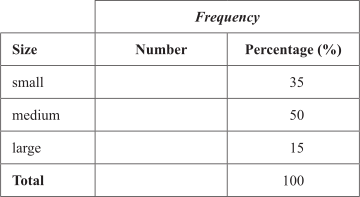
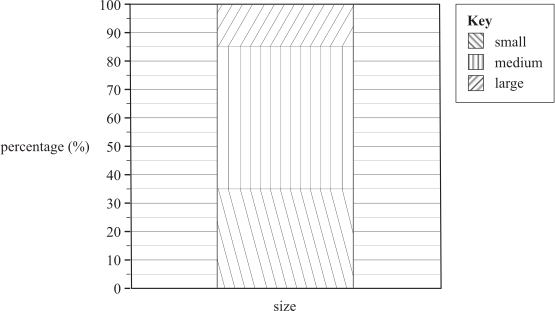
  1. Use the percentages in the table to construct a percentage segmented bar chart below. A key has been provided.   (1 mark)

    --- 0 WORK AREA LINES (style=lined) ---
     

Show Answers Only

i.    

\begin{array} {|l|c|c|}
\hline
\rule{0pt}{2.5ex} \textbf{Size} \rule[-1ex]{0pt}{0pt} & \textbf{Number} & \textbf{Percentage (%) } \\
\hline
\rule{0pt}{2.5ex} \text{small} \rule[-1ex]{0pt}{0pt} & 7 & 35 \\
\hline
\rule{0pt}{2.5ex} \text{medium} \rule[-1ex]{0pt}{0pt} & 10 & 50 \\
\hline
\rule{0pt}{2.5ex} \text{large} \rule[-1ex]{0pt}{0pt} & 3 & 15 \\
\hline
\rule{0pt}{2.5ex} \textbf{Total} \rule[-1ex]{0pt}{0pt} & 20 & 100 \\
\hline
\end{array}

ii.    
     

Show Worked Solution

i.    

\begin{array} {|l|c|c|}
\hline
\rule{0pt}{2.5ex} \textbf{Size} \rule[-1ex]{0pt}{0pt} & \textbf{Number} & \textbf{Percentage (%) } \\
\hline
\rule{0pt}{2.5ex} \text{small} \rule[-1ex]{0pt}{0pt} & 7 & 35 \\
\hline
\rule{0pt}{2.5ex} \text{medium} \rule[-1ex]{0pt}{0pt} & 10 & 50 \\
\hline
\rule{0pt}{2.5ex} \text{large} \rule[-1ex]{0pt}{0pt} & 3 & 15 \\
\hline
\rule{0pt}{2.5ex} \textbf{Total} \rule[-1ex]{0pt}{0pt} & 20 & 100 \\
\hline
\end{array}

 
ii.


Filed Under: Graphs - Histograms and Other Tagged With: Band 2, Band 4, smc-644-40-Segmented Bar Charts, smc-644-50-Frequency Tables

Data Analysis, GEN1 2023 VCAA 1-2 MC

The dot plot below shows the times, in seconds, of 40 runners in the qualifying heats of their 800 m club championship.
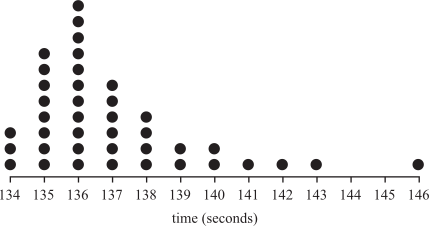
 

Question 1

The median time, in seconds, of these runners is

  1. 135.5
  2. 136
  3. 136.5
  4. 137
  5. 137

 
Question 2

The shape of this distribution is best described as

  1. positively skewed with one or more possible outliers.
  2. positively skewed with no outliers.
  3. approximately symmetric with one or more possible outliers.
  4. approximately symmetric with no outliers.
  5. negatively skewed with one or more possible outliers.
Show Answers Only

\(\text{Question 1:}\ B\)

\(\text{Question 2:}\ A\)

Show Worked Solution

\(\text{Question 1}\)

\(\text{40 data points}\ \Rightarrow \ \text{Median = average of 20th and 21st data points}\)

\(\text{Median}\ = \dfrac{136 + 136}{2} = 136\)

\(\Rightarrow B\)
 

\(\text{Question 2}\)

\(\text{Distribution is positive skewed (tail stretches to the right)} \)

\(\text{Q}_1 = \dfrac{135+135}{2} = 135\)

\(\text{Q}_3 = \dfrac{138+138}{2} = 138\)

\(\text{IQR} = 138-135=3 \)

\(\text{Outlier (upper fence)}\ = 138+ 1.5 \times 3 = 142.5\)

\(\Rightarrow A\)

Filed Under: Graphs - Histograms and Other Tagged With: Band 2, Band 4, smc-644-10-Dot Plots

ENGINEERING, TE 2023 HSC 3 MC

Why is pure copper preferred over a copper alloy in telecommunications applications?

  1. It has higher stiffness.
  2. It has better conductivity.
  3. It can be precipitation hardened.
  4. It has a better strength to weight ratio.
Show Answers Only

\( B \)

Show Worked Solution
  • Pure copper offers lower stiffness than copper alloys (eliminate A), is work hardened (eliminate C), and generally has lower strength to weight ratios (eliminate D).
  • In telecommunications, where high conductivity is crucial for transmitting electrical signals, pure copper is the preferred choice to ensure efficient signal transmission.

\(\Rightarrow B \)

Filed Under: Materials Tagged With: Band 2, smc-3729-20-Copper and alloys

ENGINEERING, PPT 2023 HSC 24a

Roller coaster support structures can be made from either timber or steel.

Compare the properties of the two materials in roller coaster support structures.  (2 marks)

--- 4 WORK AREA LINES (style=lined) ---

Show Answers Only

  • Unlike steel, timber has the ability to flex and bend, which can absorb some of the forces exerted by the roller coaster.
  • However, timber has less mechanical strength than steel and is more susceptible to rot and insect damage over time.

Answers could include:

  • Steel frames are much more easily fabricated and assembled than timber frames, which can save time and costs in the construction process.
  • Steel is much more resistant to fire than timber, which makes it a safer material to use in roller coasters.
  • Steel has greater mechanical strength and is a more durable material than timber. It is able to withstand the higher stresses and forces exerted on a roller coaster.

Show Worked Solution

  • Unlike steel, timber has the ability to flex and bend, which can absorb some of the forces exerted by the roller coaster.
  • However, timber has less mechanical strength than steel and is more susceptible to rot and insect damage over time.

Answers could include:

  • Steel frames are much more easily fabricated and assembled than timber frames, which can save time and costs in the construction process.
  • Steel is much more resistant to fire than timber, which makes it a safer material to use in roller coasters.
  • Steel has greater mechanical strength and is a more durable material than timber. It is able to withstand the higher stresses and forces exerted on a roller coaster.

Filed Under: Historical and Societal Influences Tagged With: Band 2, smc-3717-30-Historical materials

ENGINEERING, AE 2023 HSC 21b

You are part of a team of engineers working collaboratively on the design of a new aircraft.

Explain the benefits of collaboration when completing the engineering report.   (3 marks)

--- 6 WORK AREA LINES (style=lined) ---

Show Answers Only

  • A collaborative approach allows for the pooling of expert knowledge. This will produce a more comprehensive report with a lower risk of errors within the report.
  • Time efficiency – a division of tasks among team members that utilises their specific skill sets can expedite the writing of the report.
  • Validation of decisions across multiple team members who can independently verify and validate design calculations and recommendations is a more comprehensive approach.
  • Collaboration between engineers with differing years of experience is crucial for professional development and training the next generation of engineers.

Show Worked Solution

  • A collaborative approach allows for the pooling of expert knowledge. This will produce a more comprehensive report with a lower risk of errors within the report.
  • Time efficiency – a division of tasks among team members that utilises their specific skill sets can expedite the writing of the report.
  • Validation of decisions across multiple team members who can independently verify and validate design calculations and recommendations is a more comprehensive approach.
  • Collaboration between engineers with differing years of experience is crucial for professional development and training the next generation of engineers.

Filed Under: Communication Tagged With: Band 2, smc-3726-60-Reports

ENGINEERING, AE 2023 HSC 21a

How can computer graphics be utilised as a tool in aeronautical engineering?   (2 marks)

--- 4 WORK AREA LINES (style=lined) ---

Show Answers Only

  • Computer graphics can create a detailed and accurate visual models in three dimensions.
  • This technology can be extremely efficient in the design of aircraft components through simulation, allowing ideas to be tested and adjusted in short time frames.

Answers could also include:

  • The creation of interactive user interfaces
  • The provision of large amounts of data in the analysis of flight dynamics and servicing of aircraft
  • Improving manufacturing and prototyping.

Show Worked Solution

  • Computer graphics can create a detailed and accurate visual models in three dimensions.
  • This technology can be extremely efficient in the design of aircraft components through simulation, allowing ideas to be tested and adjusted in short time frames.

Answers could also include:

  • The creation of interactive user interfaces
  • The provision of large amounts of data in the analysis of flight dynamics and servicing of aircraft
  • Improving manufacturing and prototyping.

Filed Under: Communication Tagged With: Band 2, smc-3726-50-CAD

PHYSICS, M2 2017 VCE 7 MC

A model car of mass 2.0 kg is propelled from rest by a rocket motor that applies a constant horizontal force of 4.0 N, as shown below. Assume that friction is negligible.
 

Which one of the following best gives the magnitude of the acceleration of the model car?

  1. \(0.50 \text{ m s} ^{-2}\)
  2. \(1.0 \text{ m s}^{-2}\)
  3. \(2.0 \text{ m s} ^{-2}\)
  4. \( 4.0\text{ m s} ^{-2}\)
Show Answers Only

\(C\)

Show Worked Solution

\(a=\dfrac{F}{m}=\dfrac{4.0}{2.0}=2\ \text{ms}^{-2}\) 

\(\Rightarrow C\)

Filed Under: Forces, Acceleration and Energy Tagged With: Band 2, smc-4276-50-F=ma

PHYSICS, M4 2021 VCE 2 MC

The diagram below shows the electric field lines between four charged spheres: \(\text{P, Q, R}\) and \(\text{S}\). The magnitude of the charge on each sphere is the same.


Which of the following correctly identifies the type of charge (+ positive or – negative) that resides on each of the spheres \(\text{P, Q, R}\) and \(\text{S}\)?

  \(\textbf{P}\) \(\textbf{Q}\) \(\textbf{R}\) \(\textbf{S}\)
A.   \(\quad - \quad\) \(\quad + \quad\) \(\quad - \quad\) \(\quad + \quad\)
B. \(\quad + \quad\) \(\quad - \quad\) \(\quad + \quad\) \(\quad - \quad\)
C. \(\quad - \quad\) \(\quad - \quad\) \(\quad + \quad\) \(\quad + \quad\)
D. \(\quad + \quad\) \(\quad + \quad\) \(\quad - \quad\) \(\quad - \quad\)
Show Answers Only

\(B\)

Show Worked Solution
  • Electric field lines travel away from positive charges and towards negative charges.
  • Therefore, \(\text{P}\) and \(\text{R}\) must be positive charges.

\( \Rightarrow B\)

Filed Under: Electrostatics Tagged With: Band 2, smc-4283-10-Electric fields

CHEMISTRY, M3 2012 HSC 3 MC

What effect does a catalyst have on a reaction?

  1. It increases the rate.
  2. It increases the yield.
  3. It increases the heat of reaction.
  4. It increases the activation energy.
Show Answers Only

\(A\)

Show Worked Solution
  • A catalyst is a substance that increases the rate of a chemical reaction without itself undergoing any permanent chemical change.

\(\Rightarrow A\)

Filed Under: Rates of Reactions Tagged With: Band 2, smc-4265-50-Catalysts

CHEMISTRY, M3 2017 VCE 1 MC

A catalyst

  1. slows the rate of reaction.
  2. ensures that a reaction is exothermic.
  3. moves the chemical equilibrium of a reaction in the forward direction.
  4. provides an alternative pathway for the reaction with a lower activation energy.
Show Answers Only

\(D\)

Show Worked Solution
  • A catalyst increases the rate of a chemical reaction by reducing the activation energy of the reaction. Thus, by collision theory, particles require less energy than normal to react to form products.

\(\Rightarrow D\)

Filed Under: Rates of Reactions Tagged With: Band 2, smc-4265-50-Catalysts

CHEMISTRY, M2 2016 VCE 9a

Standard solutions of sodium hydroxide, \(\ce{NaOH}\), must be kept in airtight containers. This is because \(\ce{NaOH}\) is a strong base and absorbs acidic oxides, such as carbon dioxide, \(\ce{CO2}\), from the air and reacts with them. As a result, the concentration of \(\ce{NaOH}\) is changed to an unknown extent.

\(\ce{CO2}\) in the air reacts with water to form carbonic acid, \(\ce{H2CO3}\). This can react with \(\ce{NaOH}\) to form sodium carbonate, \(\ce{Na2CO3}\).

  1. Write a balanced overall equation for the reaction between \(\ce{CO2}\) gas and water to form \(\ce{H2CO3}\).   (1 mark)

    --- 1 WORK AREA LINES (style=lined) ---

  2. Write a balanced equation for the complete reaction between \(\ce{H2CO3}\) and \(\ce{NaOH}\) to form \(\ce{Na2CO3}\).   (1 mark)

    --- 1 WORK AREA LINES (style=lined) ---

Show Answers Only

a.    \(\ce{CO2(g) + H2O(l) \rightarrow H2CO3(aq)} \)

b.   \(\ce{2NaOH(aq) + H2CO3(aq) \rightarrow Na2CO3(aq) + 2H2O(l)}\)

Show Worked Solution

a.    \(\ce{CO2(g) + H2O(l) \rightarrow H2CO3(aq)} \)

b.   \(\ce{2NaOH(aq) + H2CO3(aq) \rightarrow Na2CO3(aq) + 2H2O(l)}\)

Filed Under: Chemical Reactions and Stoichiometry Tagged With: Band 2, Band 4, smc-4259-50-Balancing Chemical Equations

PHYSICS, M2 2014 HSC 3 MC

A pendulum is used to determine the value of acceleration due to gravity. The length of the pendulum is varied, and the time taken for the same number of oscillations is recorded.

Which of the following could increase the reliability of the results?

  1. Changing the mass of the pendulum
  2. Identifying the independent and dependent variables
  3. Recording all measurements to at least four significant figures
  4. Repeating each measurement several times and recording the average
Show Only

\(D\)

Show Worked Solution
  • Reliability of data can be increased by repeating the same experiment numerous times and recording an average from the data as it eliminates random error.

\(\Rightarrow D\)

Filed Under: Forces, Acceleration and Energy Tagged With: Band 2, smc-4276-30-Gravity

CHEMISTRY, M7 2023 HSC 1 MC

What is the safest method for disposing of a liquid hydrocarbon after an experiment?

  1. Pour it down the sink
  2. Place it in a garbage bin
  3. Burn it by igniting with a match
  4. Place it in a separate waste container
Show Answers Only

\(D\)

Show Worked Solution
  • Organic substances should be kept separate for safety (avoiding any possible other reactions).

\(\Rightarrow D\)

Filed Under: Hydrocarbons and Associated Reactions Tagged With: Band 2, smc-3677-85-Safe Handling / Disposal

PHYSICS, M5 2023 HSC 1 MC

The gravitational field strength acting on a spacecraft decreases as its altitude increases.

This is due to a change in the

  1. mass of Earth.
  2. mass of the spacecraft.
  3. density of the atmosphere.
  4. distance of the spacecraft from Earth's centre.
Show Answers Only

\(D\)  

Show Worked Solution

\(g=\dfrac{GM}{r^2}\ \ \Rightarrow\ \ g \propto \dfrac{1}{r^2}\)

\(\therefore\) As r increases, the gravitational field strength decreases

\( \Rightarrow D\)

Filed Under: Motion in Gravitational Fields Tagged With: Band 2, smc-3692-15-Gravitational field strength

Vectors, EXT2 V1 2023 HSC 11b

Find the angle between the vectors

\(\underset{\sim}{a}=\underset{\sim}{i}+2 \underset{\sim}{j}-3 \underset{\sim}{k}\)

\(\underset{\sim}{b}=-\underset{\sim}{i}+4 \underset{\sim}{j}+2 \underset{\sim}{k}\),

giving your answer to the nearest degree.  (3 marks)

--- 8 WORK AREA LINES (style=lined) ---

Show Answers Only

\(87^{\circ} \)

Show Worked Solution

\[\underset{\sim}{a}=\left(\begin{array}{c} 1 \\ 2 \\ -3 \end{array}\right),\ \  \underset{\sim}{b}=\left(\begin{array}{c} -1 \\ 4 \\ 2 \end{array}\right) \]

\(\Big{|} \underset{\sim}{a} \Big{|} = \sqrt{1+4+9} = \sqrt{14} \)

\(\Big{|} \underset{\sim}{b} \Big{|} = \sqrt{1+16+4} = \sqrt{21} \)

\( \underset{\sim}{a} \cdot \underset{\sim}{b} = -1 + 8-6=1 \)

\(\cos\ \theta \) \(=\dfrac{\underset{\sim}{a} \cdot \underset{\sim}{b}}{\Big{|}\underset{\sim}{a}\Big{|} \cdot \Big{|}\underset{\sim}{b}\Big{|}} \)  
  \(=\dfrac{1}{\sqrt{294}} \)  
\( \theta\) \(=\cos ^{-1} \Big{(}\dfrac{1}{\sqrt{294}}\Big{)} \)  
  \(=86.65…\)  
  \(=87^{\circ} \)  

Filed Under: Basic Concepts and Arithmetic Tagged With: Band 2, smc-1195-20-Angles Between Vectors

Calculus, EXT1 C1 2023 HSC 1 MC

The temperature \(T(t)^{\circ} \text{C}\) of an object at time \(t\) seconds is modelled using Newton's Law of Cooling,

\(T(t)=15+4 e^{-3 t}\)

What is the initial temperature of the object?

  1. \(-3\)
  2. \(4\)
  3. \(15\)
  4. \(19\)
Show Answers Only

\(D\)

Show Worked Solution

\(\text{Initial temperature when}\ \ t=0:\)

\(T=15+4e^0=19\)

\(\Rightarrow D\)

Filed Under: Modified Growth and Decay Tagged With: Band 2, smc-1080-10-Cooling

Complex Numbers, EXT2 N1 2023 HSC 1 MC

Which of the following is equal to \((a+i b)^3\)?

  1. \( (a^3-3 a b^2)+i (3 a^2 b+b^3) \)
  2. \( (a^3+3 a b^2)+i (3 a^2 b+b^3) \)
  3. \( (a^3-3 a b^2)+i (3 a^2 b-b^3) \)
  4. \( (a^3+3 a b^2)+i(3 a^2 b-b^3)\)
Show Answers Only

\(C\)

Show Worked Solution
\((a+i b)^3\) \(=a^3+3a^2ib+3a(ib)^2+(ib)^3\)  
  \(=a^3+3a^2ib-3ab^2-ib^3\)  
  \(=(a^3-3ab^2)+i(3a^2b-b^3) \)  

 
\(\Rightarrow C\)

Filed Under: Arithmetic of Complex Numbers Tagged With: Band 2, smc-1048-30-Other

Financial Maths, 2ADV M1 2023 HSC 11

The first three terms of an arithmetic sequence are 3, 7 and 11 .

Find the 15th term.  (2 marks)

Show Answers Only

`59`

Show Worked Solution

`a=T_1=3`

`d=T_2-T_1=7-3=4`

`T_15` `=a+14xxd`  
  `=3+14xx4`  
  `=59`  

Filed Under: Arithmetic Series (Y12) Tagged With: Band 2, smc-1005-10-Find Term, smc-1005-60-Calculations Only

Algebra, STD2 A4 2023 HSC 20

On another planet, a ball is launched vertically into the air from the ground.

The height above the ground, `h` metres, can be modelled using the function  `h=-6 t^2+24t`, where `t` is measured in seconds. The graph of the function is shown.

  1. Based on the graph, what is the maximum height reached by the ball?  (1 mark)

    --- 1 WORK AREA LINES (style=lined) ---

  2. Based on the graph, at what TWO times is the ball at `3/4` of its maximum height?  (2 marks)

    --- 3 WORK AREA LINES (style=lined) ---

Show Answers Only

a.    `h_max = 24\ text{metres}`

b.    `t=1 and 3\ text{seconds}`

Show Worked Solution

a.    `h_max = 24\ text{metres}`

b.    `3/4 xx h_max = 3/4xx24=18\ text{metres}`

`text{From graph, ball is at at 18 metres when:}`

`t=1 and 3\ text{seconds}`

Filed Under: Non-Linear: Exponential/Quadratics (Std 2) Tagged With: Band 2, Band 3, smc-830-20-Quadratics

Measurement, STD2 M7 2023 HSC 16

The graph shows Peta's heart rate, in beats per minute, during the first 60 minutes of a marathon.
 

  1. What was Peta's heart rate 20 minutes after she started her marathon?   (1 mark)

    --- 1 WORK AREA LINES (style=lined) ---

  2. Peta started the marathon at 10 am. At what time would her heart rate first reach 140 beats/minute?   (1 mark)

    --- 1 WORK AREA LINES (style=lined) ---

Show Answers Only

a.    `120\ text{beats/minute}`

b.    `10:30\ text{am}`

Show Worked Solution

a.    `120\ text{beats/minute}`

b.    `10:30\ text{am}`

Filed Under: Rates (Std2) Tagged With: Band 2, Band 3, smc-805-40-Heart Rates

BIOLOGY, M7 EQ-Bank 1 MC

All pathogens can be described as

  1. infectious.
  2. macroscopic.
  3. microscopic.
  4. viral.
Show Answers Only

`A`

Show Worked Solution
  • Pathogens can be macroscopic, microscopic or viral, but are all fundamentally agents of infectious disease.

`=>A`

Filed Under: Causes of Infectious Disease Tagged With: Band 2, smc-3655-10-Classifying Pathogens

BIOLOGY, M5 EQ-Bank 1 MC

A strawberry plant will send out over the ground runners which will take root and grow a new plant as shown.
 

This method of growing a new plant is an example of

  1. budding.
  2. binary fission.
  3. external fertilisation.
  4. asexual reproduction.
Show Answers Only

`D`

Show Worked Solution
  • Runners are plant stems which grow and take root to produce a new plant.
  • This does not involve the use of pollen or seeds (sexual reproduction) and the new strawberry plant will be genetically identical to the first.

`=>D`

Filed Under: Reproduction Tagged With: Band 2, smc-3647-25-Plant, smc-3647-40-Sexual vs Asexual

Vectors, EXT2 V1 EQ-Bank 3

If  `underset ~a = 3 underset ~i-underset ~j`  and  `underset ~b = −2 underset ~i + 6 underset ~j + 2underset ~k`

  1. Calculate  `underset ~a-1/2underset ~b`   (2 marks)

    --- 3 WORK AREA LINES (style=lined) ---

  2. Find  `hat underset ~b`   (2 marks)

    --- 4 WORK AREA LINES (style=lined) ---

Show Answers Only
  1. `((4),(-4),(-1))`
  2.  `hat underset~b=((-sqrt11)/11, (3sqrt11)/11, sqrt11/11)`
Show Worked Solution
i.    `underset~a-1/2underset~b` `=((3),(-1),(0))-1/2((-2),(6),(2))`
    `=((3),(-1),(0))-((-1),(3),(1))`
    `=((4),(-4),(-1))`


ii.    `hat underset~b = underset~b/{abs(underset~b)}`

`abs(underset~b)=sqrt((-2)^2+6^2+2^2)=sqrt44=2sqrt11`

`hat underset~b` `=1/(2sqrt11)(-2,6,2)`  
  `=((-1)/sqrt11, 3/sqrt11, 1/sqrt11)`  
  `=((-sqrt11)/11, (3sqrt11)/11, sqrt11/11)`  

Filed Under: Basic Concepts and Arithmetic Tagged With: Band 2, Band 3, smc-1195-40-Unit Vectors and Projections

Vectors, EXT2 V1 EQ-Bank 2

Find the angle between the vectors  `underset~r = ((3),(-2),(-1))`  and  `underset~s = ((2),(1),(1))`, giving the angle in degrees correct to 1 decimal place. (3 marks)

--- 6 WORK AREA LINES (style=lined) ---

Show Answers Only

`70.9^@`

Show Worked Solution

`underset~r = ((3),(- 2),(-1)) \ , \ |underset~r| \ = sqrt{3^2 + (-2)^2+(-1)^2} = sqrt14`

`underset~s = ((2),(1),(1)) \ , \ |underset~s| \ = sqrt{2^2 + 1^2 + 1^2} = sqrt6`

`underset~r * underset~s` `= ((3),(-2),(-1)) ((2),(1),(1)) = 6-2-1 = 3`
`underset~r * underset~s` `= |underset~a| |underset~b| \ cos theta`
`3` `= sqrt14 sqrt6 \ cos theta`
`cos theta` `= 3/sqrt84`
`theta` `= cos^(-1) (3/sqrt84)`
  `= 70.9^@ \ text{(1 d.p.)}`

Filed Under: Basic Concepts and Arithmetic Tagged With: Band 2, smc-1195-20-Angles Between Vectors

Vectors, EXT2 V1 EQ-Bank 1

Prove that the vectors  `4 underset ~i + 5 underset ~j - 2 underset ~k`  and  ` −5 underset ~i + 6 underset ~j + 5underset ~k`, are perpendicular. (2 marks)

Show Answers Only

`text{See Worked Solution}`

Show Worked Solution
`underset ~a ⋅ underset ~b` `= ((4),(5),(-2))((-5),(6),(5))`
  `=4 xx (−5) + 5 xx 6 + (−2) xx 5`
  `= -20+30+10`
  `=0`

 
`text(S)text(ince)\ \ underset ~a ⋅ underset ~b =0 \ =>\ \ underset ~a _|_ underset ~b`

Filed Under: Basic Concepts and Arithmetic Tagged With: Band 2, smc-1195-30-Perpendicular Vectors

BIOLOGY, M7 2014 HSC 22a

Explain how TWO specific personal hygiene practices reduce the risk of infection.   (4 marks)

--- 8 WORK AREA LINES (style=lined) ---

Show Answers Only

Answers can include any TWO of the following:

  • Washing hands after handling garbage to remove any pathogens from the skin.
  • Covering your mouth when coughing to reduce the chance of pathogens spreading via water droplets.
  • Covering cuts and sores with bandaids or bandages to reduce the chance of infecting others through the transfer of blood and puss which, as well as covering up potential portals of entry for pathogens, will also protect the individual.
  • Daily showers with body wash and shampoo to remove pathogens from skin and scalp.
Show Worked Solution

Answers can include any TWO of the following:

  • Washing hands after handling garbage to remove any pathogens from the skin.
  • Covering your mouth when coughing to reduce the chance of pathogens spreading via water droplets.
  • Covering cuts and sores with bandaids or bandages to reduce the chance of infecting others through the transfer of blood and puss which, as well as covering up potential portals of entry for pathogens, will also protect the individual.
  • Daily showers with body wash and shampoo to remove pathogens from skin and scalp.

Filed Under: Prevention, Treatment and Control Tagged With: Band 2, smc-3658-30-Procedures to Prevent Spread

BIOLOGY, M7 2014 HSC 22b

Drinking water contaminated with dissolved lead (a heavy metal) can cause a serious disease.

Classify this disease as either infectious or non-infectious. Justify your answer.   (2 marks)

--- 4 WORK AREA LINES (style=lined) ---

Show Answers Only
  • This disease is non-infectious as it is not caused by a pathogen and therefore cannot be transferred from host to host.
  • It can only be obtained through digestion of lead.
Show Worked Solution
  • This disease is non-infectious as it is not caused by a pathogen and therefore cannot be transferred from host to host.
  • It can only be obtained through digestion of lead.

Filed Under: Causes and Effects Tagged With: Band 2, smc-3660-11-Environmental/Nutritional

BIOLOGY, M6 2014 HSC 1 MC

Exposure to radiation such as X-rays may change the sequence of bases in DNA.

What is this called?

  1. Mutation
  2. Translation
  3. Replication
  4. Transcription
Show Answers Only

`A`

Show Worked Solution
  • Any permanent change to the DNA sequence is referred to as a mutation.

`=>A`

Filed Under: Mutation Tagged With: Band 2, smc-3652-60-Mutagens

ENGINEERING, PPT 2017 HSC 4 MC

Specifications for a Ø10 steel bar require it to have a tolerance of `pm`0.05 mm.
 

What is the permitted range of diameters for this bar?

  1. 9.90`-`10.00 mm
  2. 9.95`-`10.00 mm
  3. 9.95`-`10.05 mm
  4. 10.00`-`10.05 mm
Show Answers Only

`C`

Show Worked Solution
  • Upper limit = 10.00 + 0.05 = 10.05 mm
  • Lower limit = 10.00 – 0.05 = 9.95 mm

`=>C`

Filed Under: Communication, Communication Tagged With: Band 2, smc-3721-40-AS 1100, smc-3726-40-AS 1100

ENGINEERING, PPT 2018 HSC 21a

The diagram shows a self-driving electric vehicle.


Innovations in global positioning systems (GPS) and sensor technologies are used in the operation of this vehicle.

Describe how both of these innovations are used in the control of the vehicle.   (3 marks)

--- 8 WORK AREA LINES (style=lined) ---

Show Answers Only
  • Sensors can be used to prevent collisions through the detection of objects in the path or vicinity of the vehicle.
  • GPS shows the vehicle’s position on the Earth’s surface using triangulation.
Show Worked Solution
  • Sensors can be used to prevent collisions through the detection of objects in the path or vicinity of the vehicle.
  • GPS shows the vehicle’s position on the Earth’s surface using triangulation.

Filed Under: Electricity/Electronics Tagged With: Band 2, smc-3720-50-Control systems, smc-3720-70-Safety

BIOLOGY, M8 2017 HSC 2 MC

Which of the following body systems is involved in detecting and responding to environmental changes?

  1. Circulatory
  2. Digestive
  3. Excretory
  4. Nervous
Show Answers Only

`D`

Show Worked Solution
  • The nervous system detects and responds to environmental change using sensory nerves.

`=>D`

Filed Under: Homeostasis Tagged With: Band 2, smc-3659-60-Nervous System

BIOLOGY, M8 2017 HSC 1 MC

What is the name of the process that enables organisms to maintain a relatively stable internal environment?

  1. Osmosis
  2. Adaptation
  3. Homeostasis
  4. Active transport
Show Answers Only

`C`

Show Worked Solution
  • Homeostasis is the process of keeping a fairly stable internal environment in response to change.

`=>C`

Filed Under: Homeostasis Tagged With: Band 2, smc-3659-12-Negative Feedback Loops

  • « Previous Page
  • 1
  • 2
  • 3
  • 4
  • 5
  • …
  • 10
  • Next Page »

Copyright © 2014–2025 SmarterEd.com.au · Log in