SmarterEd

Aussie Maths & Science Teachers: Save your time with SmarterEd

  • Login
  • Get Help
  • About

CORE, FUR2 2010 VCAA 1

Table 1 shows the percentage of women ministers in the parliaments of 22 countries in 2008.
 

CORE, FUR2 2010 VCAA 11
 

  1. What proportion of these 22 countries have a higher percentage of women ministers in their parliament than Australia?  (1 mark)

    --- 1 WORK AREA LINES (style=lined) ---

  2. Determine the median, range and interquartile range of this data.  (2 marks)

    --- 5 WORK AREA LINES (style=lined) ---

The ordered stemplot below displays the distribution of the percentage of women ministers in parliament for 21 of these countries. The value of Canada is missing.
 

    CORE, FUR2 2010 VCAA 12
 

  1. Complete the stemplot above by adding the value for Canada.  (1 mark)

    --- 1 WORK AREA LINES (style=lined) ---

  2. Both the median and the mean appropriate measures of centre for this distribution.
  3. Explain why.  (1 mark)

    --- 1 WORK AREA LINES (style=lined) ---

Show Answers Only

  1. `0.5`
  2. `text(Median= 28, Range = 56, IQR = 17)`
  3. `1 | 246`
  4. `text(S)text(ince the distribution is approximately)`


    `text(symmetric, the median and mean will be)`


    `text(appropriate measures of the centre.)`

Show Worked Solution

a.   `11/22 = 0.5`

b.   `text(22 data points,)`

`text(Median)` `=\ text{(11th + 12th)}/2`
  `= (32 + 24)/2`
  `= 28`


`text(Range)` `= 56 – 0`
  `= 56`

 
`Q_1=21 and Q_3=38`

`text(IQR)` `= 38 – 21`
  `= 17`


c.   `1 | 2 quad 4 quad 6`

♦♦ Part (d) was “poorly answered”.
MARKER’S COMMENT: The use of “symmetric” gained a mark while “evenly distributed” was deemed too vague.


d.   `text(S)text(ince the distribution is approximately)`

`text(symmetric, the median and mean will be)`

`text(appropriate measures of the centre.)`

Filed Under: Graphs - Stem/Leaf and Boxplots Tagged With: Band 2, Band 3, Band 4, smc-643-40-Stem and Leaf, smc-643-70-Distribution Description

CORE, FUR2 2013 VCAA 1

A development index is used as a measure of the standard of living in a country.

The bar chart below displays the development index for 153 countries in four categories: low, medium, high and very high.
 

CORE, FUR2 2013 VCAA 1

  1. How many of these countries have a very high development index?   (1 mark)

    --- 1 WORK AREA LINES (style=lined) ---
  2. What percentage of the 153 countries has either a low or medium development index?
  3. Write your answer, correct to the nearest percentage.   (1 mark)

    --- 3 WORK AREA LINES (style=lined) ---

Show Answers Only
  1. `31`
  2. `text(61%)`
Show Worked Solution

a.   `31\ \ text{(from graph)}`


b.   `text(Number of countries with low or high index)`

`=45 + 49 = 94`

`:.\ text(Percentage)` `=94/153 xx 100text(%)`
  `=61.43…`
  `=61 text(%)\ \ text{(nearest %)}`

Filed Under: Graphs - Histograms and Other Tagged With: Band 2, Band 3, smc-644-30-Bar Charts

CORE, FUR2 2014 VCAA 1

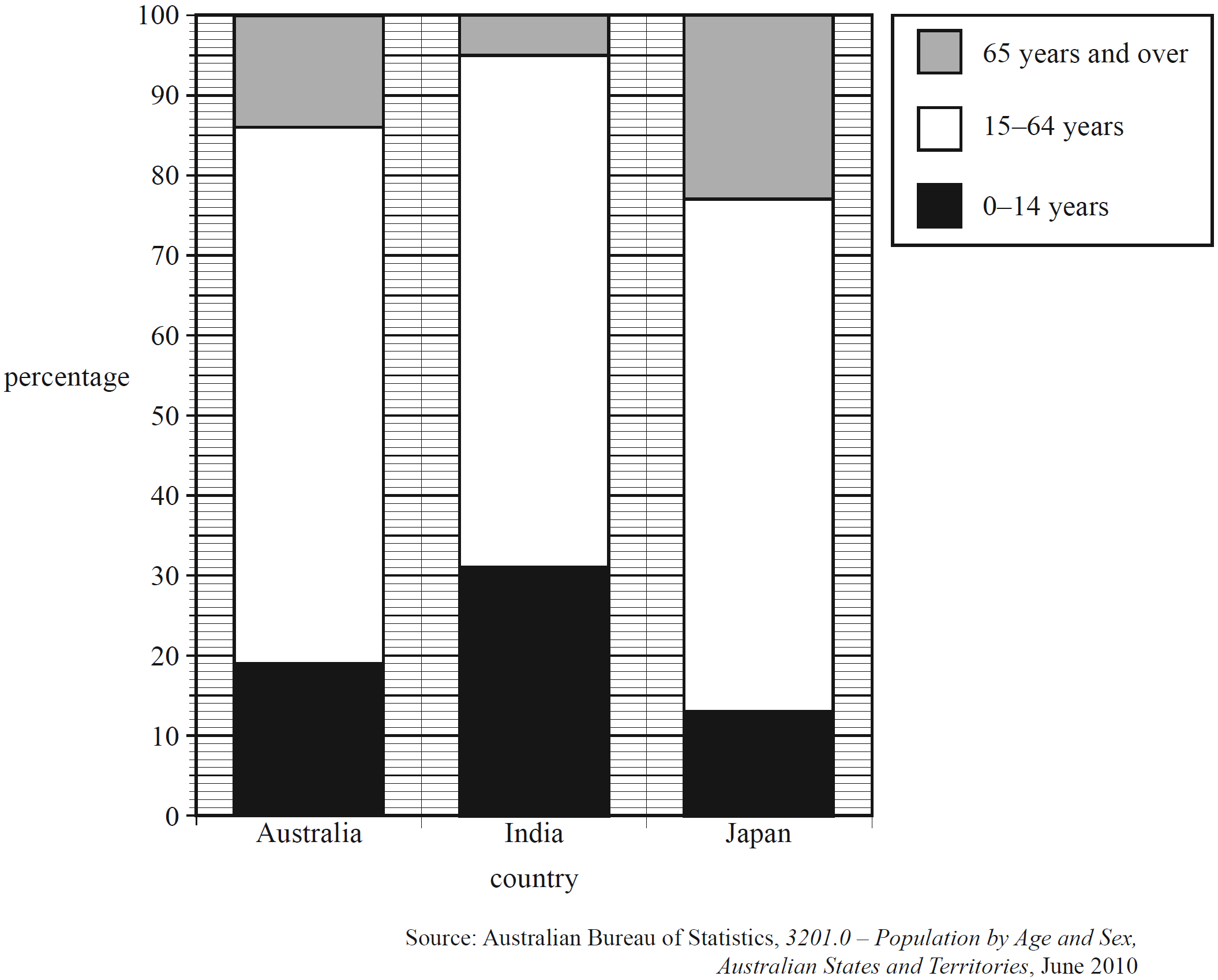
The segmented bar chart below shows the age distribution of people in three countries, Australia, India and Japan, for the year 2010.
 

Core, FUR2 2015 VCAA 1

  1. Write down the percentage of people in Australia who were aged 0 – 14 years in 2010.
  2. Write your answer, correct to the nearest percentage.  (1 mark)

    --- 1 WORK AREA LINES (style=lined) ---
  3. In 2010, the population of Japan was 128 000 000.
  4. How many people in Japan were aged 65 years and over in 2010?  (1 mark)

    --- 3 WORK AREA LINES (style=lined) ---

  5. From the graph above, it appears that there is no association between the percentage of people in the 15 – 64 age group and the country in which they live.
  6. Explain why, quoting appropriate percentages to support your explanation.  (1 mark)

    --- 4 WORK AREA LINES (style=lined) ---

Show Answers Only

  1. `text(19%)`
  2. `29\ 440\ 000`
  3. `text(The percentages of people in the 15 – 64 age group)` 
    `text(in each country is: Australia 67%, India 64%, and)` 
    `text(Japan 64%.)` 
    `text(S)text(ince the percentages are very close no matter which)`
    `text(country this age group belonged to, there is no association.)`

Show Worked Solution

a.   `text(19%)`


b.   `text(From the graph, 23% of Japan’s population is 65 or over.)`

`:.\ text(The number of people 65 or over)`

`=128\ 000\ 000 xx 23/100`

`= 29\ 440\ 000`


c.   `text(The percentages of people in the 15 – 64 age group)`

♦ Mean mark 41%.

`text(in each country is: Australia 67%, India 64%, and)`

`text(Japan 64%.)`

`text(S)text(ince the percentages are very close no matter which)`

`text(country this age group belonged to, there is no association.)`

Filed Under: Graphs - Histograms and Other Tagged With: Band 2, Band 4, Band 5, smc-644-40-Segmented Bar Charts, smc-644-60-Distribution Description

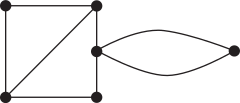
NETWORKS, FUR1 2015 VCAA 1 MC

 
In the graph above, the number of vertices of odd degree is

  1. `0`
  2. `1`
  3. `2`
  4. `3`
  5. `4`
Show Answers Only

`C`

Show Worked Solution

`text{Two vertices have degree 3 (all others are even)}`

`=> C`

Filed Under: Basic Concepts Tagged With: Band 2, smc-626-20-Degrees of Vertices

Financial Maths, STD2 F1 EQ-Bank 1 MC

$6000 is invested in an account that earns simple interest at the rate of 3.5% per annum.

The total interest earned in the first four years is

  1. $70
  2. $84
  3. $210
  4. $840
Show Answers Only

`D`

Show Worked Solution

`P = 6000,\ \ r = 3.5text(%),\ \ n = 4`

`I` `= Prn`
  `= 6000 xx 3.5/100 xx 4= 840`

 
`=>  D`

Filed Under: FM2 - Investing, Investment, Investment (Y12), Simple Interest and S/L Depreciation, Simple Interest and S/L Depreciation Tagged With: Band 2, smc-1124-10-Simple Interest, smc-6831-10-Simple Interest, smc-6924-10-Simple Interest, smc-808-10-Simple Interest

Financial Maths, STD2 F4 EQ-Bank 2 MC

Sally purchased an electronic game machine using on hire purchase. She paid $140 deposit and then $25.50 per month for two years.

The total amount that Sally paid is

  1. $191
  2. $446
  3. $612
  4. $752
Show Answers Only

`D`

Show Worked Solution

`text(Total paid)= 140 + 25.50 xx 2 xx12= $752`

`=>D`

Filed Under: FM4 - Credit and Borrowing, Loans, Loans and Credit Cards Tagged With: Band 2, smc-1140-40-Total Loan/Interest Payments, smc-814-40-Total Loan/Interest Payments

PATTERNS, FUR1 2015 VCAA 1 MC

The first four terms in a geometric sequence are: `5, 10, 20, 40, …`

The fifth term in this sequence is

A.     `45`

B.     `50`

C.     `60`

D.     `80`

E.   `100`

Show Answers Only

`D`

Show Worked Solution
`text(GP where)\ \ \ a` `=5, and`
`r` `=t_2/t_1=10/5=2`
`t_n` `=ar^(n-1)`
`t_5` `= 5 xx 2^4`
  `= 80`

`=> D`

Filed Under: APs and GPs - MC Tagged With: Band 2

PATTERNS, FUR1 2006 VCAA 1 MC

Which one of the following sequences shows the first five terms of an arithmetic sequence?

A.   `1, 3, 9, 27, 81\ …` 

B.   `1, 3, 7, 15, 31\ …`

C.   `– 10, – 5, 5, 10, 15\ …` 

D.   `– 4, – 1, 2, 5, 8\ …`

E.   `1, 3, 8, 15, 24\ …`

Show Answers Only

`D`

Show Worked Solution

 `text(Only D has a consistent common difference)`

`text(between all values.)`

`rArr D`

Filed Under: APs and GPs - MC Tagged With: Band 2

PATTERNS, FUR1 2007 VCAA 1 MC

For the geometric sequence

`24, 6, 1.5\ …`

the common ratio of the sequence is

A.    `– 18`

B.   `0.25`

C.     `0.5`

D.        `4`

E.      `18`


Show Answers Only

`B`

Show Worked Solution

`r=t_2/t_1=6/24=0.25`

`rArr B`

Filed Under: APs and GPs - MC Tagged With: Band 2

CORE, FUR1 2007 VCAA 11-13 MC

The following information relates to Parts 1, 2 and 3.

The time series plot below shows the revenue from sales (in dollars) each month made by a Queensland souvenir shop over a three-year period.

Part 1

This time series plot indicates that, over the three-year period, revenue from sales each month showed

A.   no overall trend.

B.   no correlation.

C.   positive skew.

D.   an increasing trend only.

E.   an increasing trend with seasonal variation.


Part 2

A three median trend line is fitted to this data.

Its slope (in dollars per month) is closest to

A.   `125`

B.   `146`

C.   `167`

D.   `188`

E.   `255`


Part 3

The revenue from sales (in dollars) each month for the first year of the three-year period is shown below.

If this information is used to determine the seasonal index for each month, the seasonal index for September will be closest to

A.   `0.80`

B.   `0.82`

C.   `1.16`

D.   `1.22`

E.   `1.26`

Show Answers Only

`text (Part 1:)\ E`

`text (Part 2:)\ C`

`text (Part 3:)\ E`

Show Worked Solution

`text (Part 1)`

`text(The time series plot clearly shows an increasing)`

`text(trend and a seasonal spike and drop over the)`

`text(Summer months.)`

`rArr E`


`text (Part 2)`

♦ Mean mark 37%.
MARKERS’ COMMENT: A common error was to incorrectly use the 6 month and 30 month data points as the median.

`text(From the graph, the median of the bottom third)`

`text(of data points is)\ \ (6.5, 3000).`

`text(From the graph, the median of the top third of)`

`text(data points is)\ \ (30.5, 7000).`

`:.\ text(Gradient of the three median line)`

`=(7000 – 3000)/(30.5 – 6.5)`

`=166.66…`

`rArr C`


`text (Part 3)`

`text(Average monthly sales)\ ` `= (43\ 872)/12`
  `=3656`

`:.\ text(Seasonal index for September)`

`=4597/3656`

`=1.257…` 

`rArr E`

Filed Under: Time Series Tagged With: Band 2, Band 4, Band 5, smc-266-10-Seasonal Index from a Table, smc-266-40-Time Series Trends

CORE, FUR1 2007 VCAA 1-2 MC

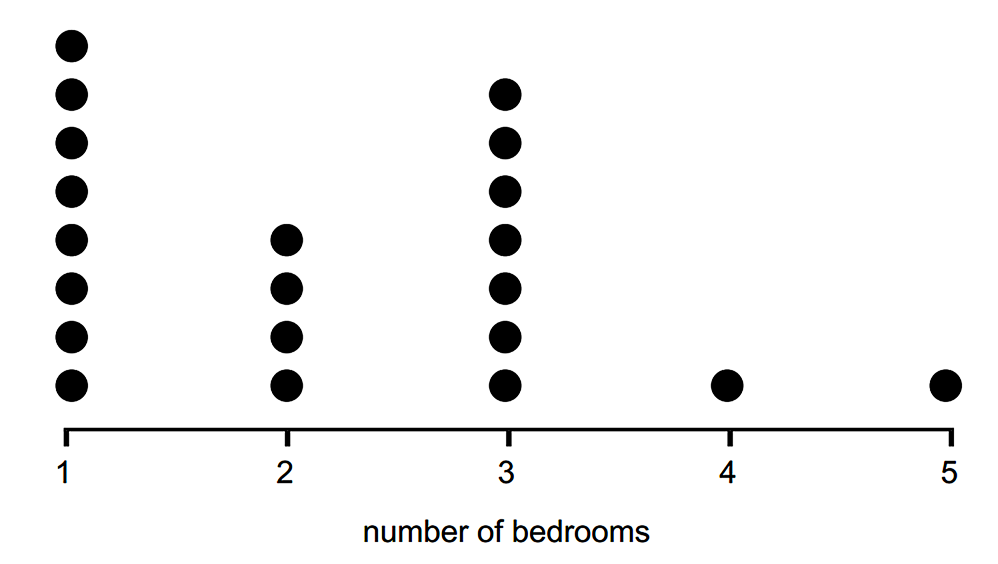
The dot plot below shows the distribution of the number of bedrooms in each of 21 apartments advertised for sale in a new high-rise apartment block.


Part 1

The mode of this distribution is

A.   `1`

B.   `2`

C.   `3`

D.   `7`

E.   `8`


Part 2

The median of this distribution is

A.   `1`

B.   `2`

C.   `3`

D.   `4`

E.   `5`

Show Answers Only

`text (Part 1:)\ A`

`text (Part 2:)\ B`

Show Worked Solution

`text (Part 1)`

`rArr A`


`text (Part 2)`

 `text(The median of 21 data points is the 11th value.)`

`:.\ text(Median) = 2`

`rArr B`

Filed Under: Graphs - Histograms and Other, Summary Statistics Tagged With: Band 2, Band 3, smc-468-40-Median Mode and Range, smc-644-10-Dot Plots

PATTERNS, FUR1 2008 VCAA 2 MC

For an examination, 8600 examination papers are to be printed at a rate of 25 papers per minute. After one hour, the number of examination papers that still need to be printed is

A.   `1600`

B.   `2500`  

C.   `6100`

D.   `7100`

E.   `8575`

Show Answers Only

`D`

Show Worked Solution

`text(Printing rate = 25 per minute)`

`:.\ text(In 1 hour, exam papers printed)`

`= 60xx25`

`= 1500`

`:.\ text(Papers still to be printed)`

`= 8600-1500`

`= 7100`

`=>D`

Filed Under: APs and GPs - MC Tagged With: Band 2

Algebra, MET2 2015 VCAA 6 MC

For the polynomial  `P(x) = x^3 - ax^2 - 4x + 4,\ \ P(3) = 10,`  the value of `a` is

A.   `− 3`

B.   `− 1`

C.       `1`

D.       `3`

E.     `10`

Show Answers Only

`C`

Show Worked Solution
`P(3)` `= 3^3 – 3^2*a -4(3)+4`
`10` `=27-9a-12+4`
`9a` `=9`
`:. a` `= 1`

 
`=>   C`

Filed Under: Polynomials Tagged With: Band 2, smc-750-50-Cubics

CORE*, FUR2 2014 VCAA 1

The adult membership fee for a cricket club is $150.

Junior members are offered a discount of $30 off the adult membership fee.

  1. Write down the discount for junior members as a percentage of the adult membership fee.   (1 mark)

    --- 2 WORK AREA LINES (style=lined) ---
Adult members of the cricket club pay $15 per match in addition to the membership fee of $150.

  1. If an adult member played 12 matches, what is the total this member would pay to the cricket club?   (1 mark)

    --- 3 WORK AREA LINES (style=lined) ---

If a member does not pay the membership fee by the due date, the club will charge simple interest at the rate of 5% per month until the fee is paid.

Michael paid the $150 membership fee exactly two months after the due date.

  1. Calculate, in dollars, the interest that Michael will be charged.   (1 mark)

    --- 2 WORK AREA LINES (style=lined) ---
The cricket club received a statement of the transactions in its savings account for the month of January 2014.

The statement is shown below.

     BUSINESS, FUR2 2014 VCAA 1

    1. Calculate the amount of the withdrawal on 17 January 2014.   (1 mark)

      --- 2 WORK AREA LINES (style=lined) ---

    2. Interest for this account is calculated on the minimum balance for the month and added to the account on the last day of the month.
    3. What is the annual rate of interest for this account?  Write your answer, correct to one decimal place.   (1 mark)

      --- 3 WORK AREA LINES (style=lined) ---
  1.  

Show Answers Only

  1. `text(20%)`
  2. `$330`
  3. `$15`
    1. `$17\ 000`
    2. `3.5`

Show Worked Solution

a.   `text(Discount for junior members)`

`= 30/150 xx 100text(%)`

`= 20text(%)`

  
b.   `text(Match Payments)= 12 xx 15=$180`

`:.\ text(Total paid to the club)` `= 150 + 180`
  `= $330`


c.    `I` `= (PrT)/100`
    `= (150 xx 5 xx 2)/100`
    `= $15`


d.i.   `text(Withdrawal on 17 Jan)`

`= 59\ 700-42\ 700`

`= $17\ 000`
    

d.ii.   `text(Minimum Jan balance) = $42\ 700`

`47\ 200 xx r xx 1/12` `= 125.12`
`:. r` `= (125.12 xx 12)/(42\ 700)`
  `= 0.0351…`

  
`:.\ text(Annual interest rate) = 3.5text(%)`

Filed Under: Interest Rates and Investing Tagged With: Band 2, Band 3, Band 4, smc-604-10-Simple interest, smc-604-40-% Increase/Decrease, smc-604-80-Bank Statement

Algebra, STD2 A1 EQ-Bank 17

If   `(y-3)/3 =5`,  find  `y`.   (2 marks)

Show Answers Only

`18`

Show Worked Solution
`(y-3)/3` `= 5`
 `y-3` `= 15`
 `y` `= 18`

Filed Under: AM1 - Algebra (Prelim), Substitution and Other Equations, Substitution and Other Equations, Substitution and Other Equations, Substitution and Other Equations Tagged With: Band 2, common-content, smc-1116-30-Algebraic Fractions, smc-6234-30-Algebraic Fractions, smc-6508-30-Algebraic Fractions, smc-789-30-Algebraic Fractions

Algebra, STD2 A1 EQ-Bank 16

Find the value of `r` given  `r/7-4 = 3`.   (1 mark)

Show Answers Only

`49`

Show Worked Solution
`r/7-4` `= 3`
`r/7` `= 7`
`:.r` `= 49`

Filed Under: AM1 - Algebra (Prelim), Substitution and Other Equations, Substitution and Other Equations, Substitution and Other Equations, Substitution and Other Equations Tagged With: Band 2, common-content, smc-1116-30-Algebraic Fractions, smc-6234-30-Algebraic Fractions, smc-6508-30-Algebraic Fractions, smc-789-30-Algebraic Fractions

Algebra, STD2 A1 EQ-Bank 19

If   `A = P(1 + r)^n`, find  `A`  given  `P = $300`,  `r = 0.12`  and  `n = 3`  (give your answer to the nearest cent).   (2 marks)

Show Answers Only

`$421.48\ \ text{(nearest cent)}`

Show Worked Solution
`A` `= P(1 + r)^n= 300(1 + 0.12)^3`
  `= 300(1.12)^3= 421.478…`
  `= $421.48\ \ text{(nearest cent)}`

Filed Under: AM1 - Algebra (Prelim), Substitution and Other Equations, Substitution and Other Equations, Substitution and Other Equations Tagged With: Band 2, Band 3, smc-1116-10-Substitution, smc-6234-10-Substitution, smc-6508-10-Substitution, smc-789-10-Substitution

Harder Ext1 Topics, EXT2 2015 HSC 13c

A small spherical balloon is released and rises into the air. At time  `t`  seconds, it has radius  `r` cm, surface area  `S = 4 pi r^2`  and volume  `V = 4/3 pi r^3`.

As the balloon rises it expands, causing its surface area to increase at a rate of  `((4 pi)/3)^(1/3)\ \text(cm)^2 text(s)^-1`. As the balloon expands it maintains a spherical shape.

  1. By considering the surface area, show that  
    1. `(dr)/(dt) = 1/(8 pi r) (4/3 pi)^(1/3).`  (2 marks)

  2. Show that  
    1. `(dV)/(dt) = 1/2 V^(1/3).`  (2 marks)

  3. When the balloon is released its volume is  `8000\ text(cm³)`. When the volume of the balloon reaches  `64000\ text(cm³)`  it will burst.
  4. How long after it is released will the balloon burst?  (2 marks)


Show Answers Only
  1. `text(Proof)\ \ text{(See Worked Solutions)}`
  2. `text(Proof)\ \ text{(See Worked Solutions)}`
  3. `1\ \ text(hour)`
Show Worked Solution
(i)    `(dS)/(dt)` `= (dS)/(dr) xx (dr)/(dt)`
  `((4 pi)/3)^(1/3)` `=8 pi r xx (dr)/(dt)`
  `(dr)/(dt)` `=((4 pi)/3)^(1/3) xx 1/(8 pi r)`
    `=1/(8 pi r) (4/3 pi)^(1/3)`


(ii)   `(dV)/(dt) = (dV)/(dr) xx (dr)/(dt)`

`(dV)/(dt) ­=` `4 pi r^2 xx ((4 pi)/3)^(1/3) xx 1/(8 pi r)`
`­=` `r/2 xx ((4 pi)/3)^(1/3)`
`­=` `1/2 (4/3 pi r^3)^(1/3)`
`­=` `1/2 V^(1/3)`


(iii)  `text(Find)\ \ t\ \ text(when)\ \ V=64\ 000`

`text(When)\ \ t = 0,\ \ V = 8000`

`(dV)/(dt)` `=1/2 V^(1/3)`
`(dt)/(dV)` `=2/V^(1/3)`
`int_0^t\ dt` `= int_8000^64000 2/V^(1/3)\ dV`
`:.t` `= [3V^(2/3)]_8000^64000`
  `= 3(1600 – 400)`
  `= 3600\ \  text(seconds)`
  `= 1\ \ text(hour)`

Filed Under: Harder Integration Examples, Other Ext1 Topics Tagged With: Band 2, Band 3, Band 4

Conics, EXT2 2015 HSC 13a

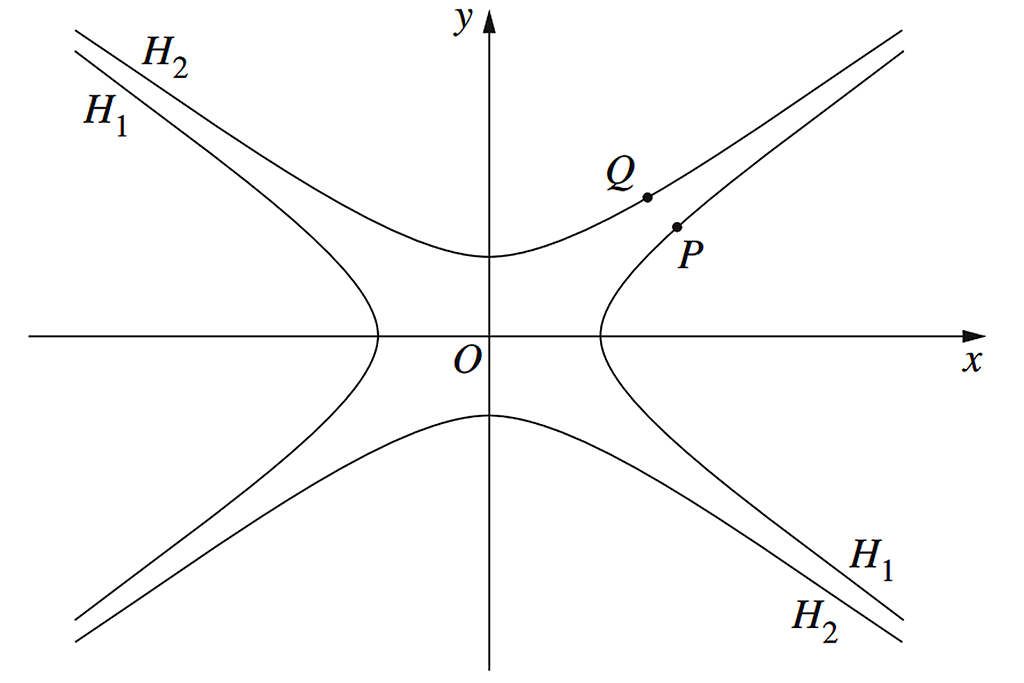
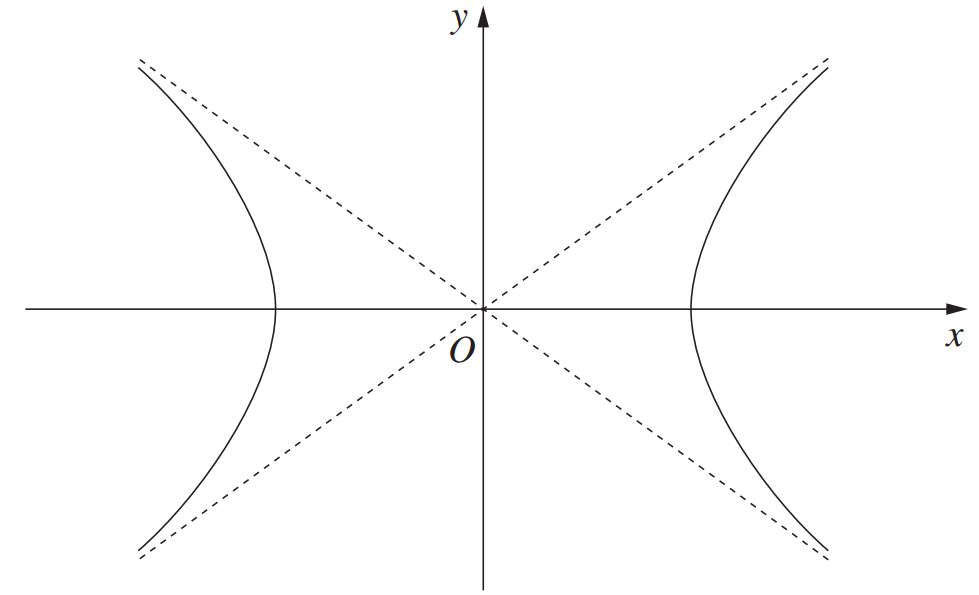
The hyperbolas  `H_1:\ \ x^2/a^2 - y^2/b^2 = 1`  and  `H_2:\ \ x^2/a^2 - y^2/b^2 = -1`  are shown in the diagram.

Let  `P(a sec theta, b tan theta)`  lie on  `H_1`  as shown on the diagram.

Let  `Q`  be the point  `(a tan theta, b sec theta)`.

  1. Verify that the coordinates of  `Q(a tan theta, b sec theta)`  satisfy the equation for  `H_2.`  (1 mark)

  2. Show that the equation of the line  `PQ`  is  `bx + ay = ab (tan theta + sec theta).`  (2 marks)

  3. Prove that the area of  `Delta OPQ`  is independent of  `theta.`  (3 marks)
Show Answers Only
  1. `text(Proof)\ \ text{(See Worked Solutions)}`
  2. `text(Proof)\ \ text{(See Worked Solutions)}`
  3. `text(Proof)\ \ text{(See Worked Solutions)}`
Show Worked Solution

(i)   `text(Substitute)\ \ Q(a tan theta, b sec theta)\ \ text(into)`

`\ \ x^2/a^2 – y^2/b^2 = -1`

`text(LHS)` `=(a^2 tan^2 theta)/a^2 – (b^2 sec^2 theta)/b^2`
  `=tan^2 theta – sec^2 theta\ \ \ \ \ \ (sec^2 theta = tan^2 theta +1)`
  `=-1`

`:. Q\ \ text(lies on)\ \ H_2`


(ii)    `m_(PQ)` `=(b tan theta-b sec theta)/(a sec theta- a tan theta)`
    `=(-b(sec theta – tan theta))/(a(sec theta – tan theta))`
    `=-b/a`


`:. text(Equation of)\ \ PQ`

`(y – b tan theta)` `=-b/a (x – a sec theta)`
`ay – ab tan theta` `=-bx + ab sec theta`
`bx + ay` `=ab (tan theta + sec theta)`
♦ Mean mark 47%.


(iii)  `text(Area)\ \ Delta OPQ = 1/2 xx QP xx d,\ \ text(where)`

`d= text(Perpendicular distance from)\ \  O\ \ text(to)\ \ QP`

`d` `= |\ (-ab(tan theta + sec theta))/sqrt (a^2 + b^2)\ |`
  `= (ab (tan theta + sec theta))/sqrt (a^2 + b^2)`


`text(Distance)\ \ QP`

`QP^2` `=(a sec theta – a tan theta)^2 + (b tan theta – b sec theta)^2`
  `=a^2(sec theta – tan theta)^2+b^2(sec theta – tan theta)^2`
  `=(a^2+b^2)(sec theta – tan theta)^2`
 `QP`  `=sqrt(a^2+b^2) *|\ sec theta – tan theta\ |`
  `=sqrt(a^2+b^2)(sec theta – tan theta),\ \ \ \ \ (sec theta>=tan theta\ \ text(for)\ \ 0<=theta<=90^@)`


`text(Area)\ \ Delta OPQ` `=1/2 sqrt(a^2+b^2)(sec theta – tan theta)*(ab (tan theta + sec theta))/sqrt(a^2 + b^2)`
  `= (ab)/2 xx (sec theta – tan theta) (sec theta + tan theta)`
  `= (ab)/2 xx (sec^2 theta – tan^2 theta)`
  `= (ab)/2`

`:.\ text(Area)\ \ Delta OPQ\ \ text(is independent of)\ \ theta.`

Filed Under: Hyperbola Tagged With: Band 2, Band 3, Band 5

Conics, EXT2 2015 HSC 11d

Sketch  `(x^2)/25 + y^2/16 = 1`  indicating the coordinates of the foci.  (2 marks)

Show Answers Only

Show Worked Solution

`(x^2)/25 + y^2/16 = 1`

`=>a = 5,\ \ \ b = 4`

`text(Using)\ \ b^2` `=a^2(1-e^2)`
`16` `= 25 (1 – e^2)`
`e^2` `=1 – 16/25`
  `=9/25`
`:. e` `=3/5`

`text(Foci coordinates) = (+-ae,0)`

`:.S(3, 0),\ \ \ S prime(– 3, 0)`

Filed Under: Ellipse Tagged With: Band 2

Polynomials, EXT2 2015 HSC 11c

Find  `A, B`  and  `C`  such that

`1/(x(x^2 + 2)) = A/x + (Bx + C)/(x^2 + 2).`   (2 marks)

Show Answers Only

`A = 1/2,\ \ \ B = -1/2,\ \ \ C = 0`

Show Worked Solution
`1/(x(x^2 + 2))` `= A/x + (Bx + C)/(x^2 + 2)`
`1` `= A (x^2 + 2) + (Bx + C) x`
`1` `= (A+B)x^2 + Cx + 2A`


`2A = 1,\ \ =>A=1/2`

`C=0`

`A + B = 0,\ \ =>B=-1/2`

`:.A = 1/2,\ \ \ \ B = -1/2,\ \ \ \ C = 0`

Filed Under: Partial Fractions Tagged With: Band 2

Conics, EXT2 2006 HSC 3b

The diagram shows the graph of the hyperbola

`x^2/144 - y^2/25 = 1.`

  1. Find the coordinates of the points where the hyperbola intersects the `x`-axis.  (1 mark)
  2. Find the coordinates of the foci of the hyperbola.  (2 marks)
  3. Find the equations of the directrices and the asymptotes of the hyperbola.  (2 marks)
Show Answers Only
  1. `(12, 0),\ (– 12, 0)`
  2. `(13, 0),\ (– 13, 0)`
  3. `text(Directrices:)\ \ x = +- 144/13;\ \ text(Asymptotes:)\ \ y = +- 5/12 x`
Show Worked Solution

(i)  `text(Intersection when)\ \ y=0`

`x^2/144 + 0` `=1`
`x` `= +-12`


`:. xtext(-axis intersection at)\ \ (12, 0),\ (– 12, 0)`


(ii)  `a=12,\ \ b = 5`

`text(Using)\ \ \ b^2` `=a^2(e^2-1)`
`25` `= 144 (e^2 – 1)`
`25/144` `= e^2 – 1`
`e^2` `= 169/144`
`e` `= 13/12`


`:.S(ae,0)-=(13,0)`

`:. S′(– ae,0)-=(– 13,0)`


(iii)   `text(Directrices when)\ \ \ x` `=+-a/e`
    `=+-144/13`
  `text(Asymptotes when)\ \ \ y` `=+-b/a x`
    `=+- 5/12 x`

Filed Under: Hyperbola Tagged With: Band 2, Band 3, Band 4

Complex Numbers, EXT2 N1 2007 HSC 2a

Let  `z = 4 + i`  and  `w = bar z`. Find, in the form  `x + iy`,

  1.  `w`   (1 mark)

    --- 1 WORK AREA LINES (style=lined) ---

  2.  `w - z`   (1 mark)

    --- 1 WORK AREA LINES (style=lined) ---

  3.  `z/w`.   (1 mark)

    --- 3 WORK AREA LINES (style=lined) ---

Show Answers Only

a.    `4 – i`

b.    `-2i`

c.    `15/17 + 8/17 i`

Show Worked Solution

a.    `z = 4 + i,\ \ w = bar z = 4 – i`
 

b.    `w – z` `= 4 – i – (4 + i)`
  `= -2i`


c.    `z/w` `=(4 + i)/(4 – i) xx (4+i)/(4+i)`
  `=(4 + i)^2/(16+1)`
  `=(16+8i-1)/17`
  `=15/17 + 8/17 i`

Filed Under: Arithmetic and Complex Numbers, Arithmetic of Complex Numbers, Arithmetic of Complex Numbers Tagged With: Band 2, smc-1048-10-Basic Arithmetic, smc-7427-10-Basic Arithmetic

Calculus, EXT2 C1 2015 HSC 6 MC

Which expression is equal to  `int x^2 sin x\ dx`

  1. `-x^2 cos x - int 2 x cos x\ dx`
  2. `-2x cos x + int x^2 cos x\ dx`
  3. `-x^2 cos x + int 2x cos x\ dx`
  4. `-2x cos x - int x^2 cos x\ dx`
Show Answers Only

`C`

Show Worked Solution
`u` `= x^2,` `\ \ \ \ u′` `= 2x`
`v′` `= sin x,` `v` `= -cos x`
`int uv′\ dx` `=uv-int u′v\ dx`
  `= x^2 (-cos x) – int 2x (-cos x) dx`
  `= -x^2 cos x + int 2x cos x\ dx`

`=>  C`

Filed Under: Integration By Parts, Integration By Parts, Integration By Parts, Integration By Parts Tagged With: Band 2, smc-1055-30-Trig, smc-5134-30-Trig, smc-7435-30-Trig

Functions, EXT1′ F1 2015 HSC 3 MC

Which graph best represents the curve  `y = (x - 1)^2 (x + 3)^5?`
 

Show Answers Only

`A`

Show Worked Solution

`text(Quick elimination)`

`text(At)\ \ x=0,\ \ y>0\ \ \ \ =>\ text{NOT (B) or (C)}`


`(x – 1)^2\ \ text(gives a turning point at)\ \ x = 1,`

`(x + 3)^5\ \ text(gives a change in concavity at)\ \ x = -3.`

`=>  A`

Filed Under: Addition / Multiplication of 2 Graphs (Ext1), Sketching - mult/division of ordinates Tagged With: Band 2, smc-1073-30-Other

Complex Numbers, EXT2 N1 2015 HSC 2 MC

What value of  `z`  satisfies  `z^2 = 7 - 24i?`

  1. `4 - 3i`
  2. `-4 - 3i`
  3. `3 - 4i`
  4. `-3 - 4i`
Show Answers Only

`A`

Show Worked Solution
`(4 – 3i)^2` `= 16 – 24i + 9i^2`
  `= 7 – 24i`

 
`=>  A`

Filed Under: Arithmetic and Complex Numbers, Arithmetic of Complex Numbers, Arithmetic of Complex Numbers Tagged With: Band 2, smc-1048-10-Basic Arithmetic, smc-1048-25-Square Root, smc-7427-10-Basic Arithmetic, smc-7427-25-Square Root

Polynomials, EXT2 2014 HSC 1 MC

What are the values of  `a`, `b`  and  `c`  for which the following identity is true?

`(5x^2 − x + 1)/(x(x^2 + 1)) = a/x + (bx + c)/(x^2 + 1)`


  1. `a = 1`, `b = 6`, `c = 1`
  2. `a = 1`, `b = 4`, `c = 1`
  3. `a = 1`, `b = 6`, `c = −1`
  4. `a = 1`, `b = 4`, `c = −1` 
Show Answers Only

`D`

Show Worked Solution

`text(Using partial fractions:)`

`(5x^2 − x + 1)/(x(x^2 + 1))` `= a/x + (bx + c)/(x^2 + 1)`
`5x^2 − x + 1` `= a(x^2 + 1) + (bx + c)x`
  `= (a + b)x^2 + cx + a`


`:.c = −1,\ \ a = 1`

`a + b` `= 5`
`1 + b` `= 5`
`b` `= 4`

`=> D`

Filed Under: Partial Fractions Tagged With: Band 2

Calculus, EXT2 C1 2013 HSC 1 MC

Which expression is equal to  `int tan x\ dx?`

  1. `sec^2 x + c`
  2. `-ln (cos x) + c`
  3. `(tan^2 x)/2 + c`
  4. `ln (sec x + tan x) + c`
Show Answers Only

`B`

Show Worked Solution
`int tan x\ dx =` `int (sin x)/(cos x)\ dx`
`­=` `-ln (cos x) + c`

`=>  B`

Filed Under: Trig Integrals, Trig Integration, Trigonometric Integration Tagged With: Band 2, smc-1193-15-\(\large \tan\), smc-7432-15-\(\large \tan\)

Complex Numbers, EXT2 N1 2006 HSC 2a

Let  `z = 3 + i`  and  `w = 2 - 5i`.  Find, in the form  `x + iy`,

  1.  `z^2.`  (1 mark)

    --- 2 WORK AREA LINES (style=lined) ---

  2.  `bar z w.`  (1 mark)

    --- 2 WORK AREA LINES (style=lined) ---

  3.  `w/z.`  (1 mark)

    --- 2 WORK AREA LINES (style=lined) ---

Show Answers Only

a.    `8 + 6i`

b.    `1 – 17i`

c.    `1/10 – 17/10 i`

Show Worked Solution
a.   `z^2` `=(3 + i)^2`
  `= 9 + 6i – 1`
  `= 8 + 6i`


b.  `bar{:z:} w` `=(3 – i) (2 – 5i)`
  `= 6 – 15i – 2i – 5`
  `= 1 – 17i`


c.  `w/z` `=(2 – 5i)/(3 + i) xx (3 – i)/(3 – i)`
  `= (1 – 17i)/10`
  `= 1/10 – 17/10 i`

Filed Under: Arithmetic and Complex Numbers, Arithmetic of Complex Numbers, Arithmetic of Complex Numbers Tagged With: Band 2, Band 3, smc-1048-10-Basic Arithmetic, smc-7427-10-Basic Arithmetic

Calculus, EXT2 C1 2006 HSC 1c

  1. Given that  `(16x - 43)/((x - 3)^2 (x + 2))`  can be written as
     
    `qquad (16x - 43)/((x - 3)^2 (x + 2)) = a/(x - 3)^2 + b/(x - 3) + c/(x + 2)`,
     
    where  `a, b` and `c`  are real numbers, find  `a, b and c.`  (3 marks)

    --- 6 WORK AREA LINES (style=lined) ---

  2. Hence find  `int (16x - 43)/((x - 3)^2 (x + 2))\ dx.`  (2 marks)

    --- 4 WORK AREA LINES (style=lined) ---

Show Answers Only

a.    `a = 1, b = 3, c = -3`

b.    `-1/(x-3)+3ln((x-3)/(x+2)) +c`

Show Worked Solution

a.    `(16x – 43)/((x – 3)^2 (x + 2)) = a/(x – 3)^2 + b/(x – 3) + c/(x + 2)`

`16x – 43 = a (x + 2) + b (x – 3) (x + 2) + c (x – 3)^2`
 

`text(When)\ \ x = 3,\ \ 5a =5\ \ =>a=1`

`text(When)\ \ x=–2,\ \ 25c=–75\ \ =>c=–3`

`text(When)\ \ x=0`

`-43` `= 2(1) – 6b + (-3)(-3)^2`
`6b` `= 18`
`b` `=3`

 
`:.a=1, b=3, c=–3`
 

b.    `int (16x – 43)/((x – 3)^2 (x + 2))\ dx`

`=int (1/(x – 3)^2 + 3/(x – 3) – 3/(x + 2))\ dx`

`=-1/(x – 3) + 3ln(x – 3) -3ln(x + 2) + c`

`=-1/(x-3)+3ln((x-3)/(x+2)) +c`

Filed Under: Harder Integration Examples, Partial Fractions, Partial Fractions, Partial Fractions Tagged With: Band 2, Band 3, smc-1056-20-\(\large x^3\ \) denominator, smc-1056-30-PF given, smc-7434-20-\(\large x^3\ \) denominator, smc-7434-30-PF given

Calculus, EXT2 C1 2006 HSC 1b

By completing the square, find

`int (dx)/(x^2 - 6x + 13)`  (2 marks)

Show Answers Only

`1/2 tan^-1 ((x – 3)/2) + c`

Show Worked Solution
`int (dx)/(x^2 – 6x + 13)` `=int (dx)/((x – 3)^2 + 4)`
  `=1/2 tan^-1 ((x – 3)/2) + c`

Filed Under: Trig Integrals, Trig Integration, Trigonometric Integration Tagged With: Band 2, smc-1193-15-\(\large \tan\), smc-1193-50-Completing the square, smc-7432-15-\(\large \tan\), smc-7432-50-Completing the square

Calculus, EXT2 C1 2006 HSC 1a

Find  `int x/sqrt (9 - 4x^2)\ dx.`  (2 marks)

Show Answers Only

`- 1/4 sqrt (9 – 4x^2)+c`

Show Worked Solution
`int x/sqrt (9 – 4x^2)\ dx` `=-1/8 int (-8x)/sqrt (9 – 4x^2)\ dx`
  `=-1/4 sqrt (9 – 4x^2) + c`

Filed Under: Harder Integration Examples, Substitution and Harder Integration, Substitution and Harder Integration Tagged With: Band 2, smc-1057-40-Other Functions, smc-7433-40-Other Functions

Complex Numbers, EXT2 N1 2009 HSC 2c

The points `P` and `Q` on the Argand diagram represent the complex numbers `z` and `w` respectively.


On the diagram, mark the following points:

  1. the point `R` representing `iz.`   (1 mark)

    --- 0 WORK AREA LINES (style=lined) ---

  2. the point `S` representing `bar w.`   (1 mark)

    --- 0 WORK AREA LINES (style=lined) ---

  3. the point `T` representing  `z + w.`   (1 mark)

    --- 0 WORK AREA LINES (style=lined) ---

Show Answers Only

a, b, and c.

Show Worked Solution

a, b, and c.

Filed Under: Argand Diagrams and Mod/Arg form, Geometry and Complex Numbers (vectors), Powers and Roots Tagged With: Band 2, Band 3, smc-1049-10-Cartesian and Argand diagrams, smc-7430-60-Rotation and Shapes

Complex Numbers, EXT2 N1 2009 HSC 2b

Write  `(-2 + 3i)/(2 + i)`  in the form  `a + ib`  where  `a`  and  `b`  are real.   (1 mark)

Show Answers Only

`-1/5 + 8/5 i`

Show Worked Solution

`(-2 + 3i)/(2 + i) xx (2-i)/(2-i)`

`= ((-2 + 3i)(2 – i))/(4 + 1)`

`= (-4 + 2i + 6i + 3)/5`

`= (8i – 1)/5`

`= -1/5 + 8/5 i`

Filed Under: Arithmetic and Complex Numbers, Arithmetic of Complex Numbers, Arithmetic of Complex Numbers Tagged With: Band 2, smc-1048-10-Basic Arithmetic, smc-7427-10-Basic Arithmetic

Complex Numbers, EXT2 N1 2009 HSC 2a

Write  `i^{9}`  in the form  `a + ib`  where  `a`  and  `b`  are real.  (1 mark)

Show Answers Only

`0 + 1i`

Show Worked Solution
`i^{9}` `= i xx i^{8}`
  `= i`
  `= 0 + 1i`

Filed Under: Arithmetic and Complex Numbers, Arithmetic of Complex Numbers, Arithmetic of Complex Numbers Tagged With: Band 2, smc-1048-30-Other, smc-7427-30-Other Problems

Calculus, EXT2 C1 2007 HSC 1a

Find  `int 1/sqrt (9 - 4x^2)\ dx.`  (2 marks)

Show Answers Only

`1/2 sin^-1­ (2x)/3 + c`

Show Worked Solution
`int (dx)/sqrt (9 – 4x^2)` `=1/2 int (dx)/sqrt (9/4 – x^2)`
  `=1/2 sin^-1­ x/(3/2) + c`
  `=1/2 sin^-1­ (2x)/3 + c`

Filed Under: Trig Integrals, Trig Integration, Trigonometric Integration Tagged With: Band 2, smc-1193-10-\(\large \sin/\cos\), smc-7432-10-\(\large \sin/\cos\)

Polynomials, EXT2 2010 HSC 6c

  1. Expand  `(cos theta + i sin theta)^5`  using the binomial theorem.   (1 mark)

  2. Expand  `(cos theta + i sin theta)^5`  using de Moivre’s theorem, and hence show that

    1. `sin 5theta = 16 sin^5 theta − 20sin^3 theta + 5 sin theta`.   (3 marks)

  3. Deduce that

  4. `x = sin (pi/10)`  is one of the solutions to

    1. `16x^5 − 20x^3 + 5x − 1 = 0`.   (1 mark)

  5. Find the polynomial  `p(x)`  such that  `(x − 1) p(x) = 16x^5 − 20x^3 + 5x − 1`.   (1 mark)

  6. Find the value of  `a`  such that  `p(x) = (4x^2 + ax − 1)^2`.   (1 mark)

  7. Hence find an exact value for
    1. `sin (pi/10)`.   (1 mark)


Show Answers Only
  1. `cos^5 theta + 5i cos^4 theta sin theta − 10 cos^3 theta sin^2 theta − 10i cos^2 theta sin^3 theta`
    `+ 5 cos theta sin^4 theta + i sin^5 theta`
  2. `text{Proof (See Worked Solutions)}`
  3. `text{Proof (See Worked Solutions)}`
  4. `16x^4 + 16x^3 − 4x^2 − 4x + 1`
  5. `a = 2`
  6. `(-1 + sqrt5)/4`
Show Worked Solution

(i)   `(cos theta + i sin theta)^5`

`=cos^5 theta + 5cos^4 theta (i sin theta) + 10 cos^3 theta (i sin theta)^2 + `

`10 cos^2 theta (isin theta)^3 + 5 cos theta (i sin theta)^4 + (i sin theta)^5`

`= cos^5 theta + 5i cos^4 theta sin theta − 10 cos^3 theta sin^2 theta − 10i cos^2 theta sin^3 theta +`

`5 cos theta sin^4 theta + i sin^5 theta`


(ii)  `text(Using De Moivre)`

`(cos theta + i sin theta)^5 = cos 5theta + i sin 5theta`

`text(Equating imaginary parts)`

`sin 5theta` `= 5 cos^4theta sin theta − 10cos^2 theta sin^3 theta + sin^5 theta`
  `= 5 sin theta (1 − sin^2 theta)^2 − 10 sin^3 theta (1 − sin^2 theta) + sin^5 theta`
  `= 5 sin theta (1 − 2 sin^2 theta + sin^4 theta) − 10 sin^3 theta + 10 sin^5 theta + sin^5 theta`
  `= 5 sin theta − 10 sin^3 theta + 5 sin^5 theta − 10 sin^3 theta + 11 sin^5 theta`
  `= 16 sin^5 theta − 20 sin^3 theta + 5 sin theta`


(iii)  `text(If)\ x = sin (pi/10)`

`16 sin^5 (pi/10) − 20 sin^3 (pi/10) + 5 sin (pi/10)` `=sin (5 xx pi/10)`
`16x^5 − 20x^3 + 5x` `= sin\ pi/2`
`16x^5 − 20x^3 + 5x` `=1`


`:. sin\ pi/10\ \ text(is one solution to)\ \ 16x^5 − 20x^3 + 5x − 1=0`


(iv)  `16x^5 − 20x^3 + 5x − 1`

`=(x-1)(16x^4 + 16x^3 − 4x^2 − 4x + 1)`

`:.p(x) = 16x^4 + 16x^3 − 4x^2 − 4x + 1`


(v)   `(4x^2 + ax − 1)^2`

`= 16x^4 + 4ax^3 − 4x^2 + 4ax^3 + a^2x^2 − ax − 4x^2 − ax + 1`

`= 16x^4 + 8ax^3 − 8x^2 + a^2x^2 − 2ax +1`

`text(By equating coefficients of)\ \ x^3`

`:.a = 2`


(vi)  `4 x^2 + 2 x − 1 = 0`

♦♦ Mean mark part (vi) 27%.
`x` `=(-2 ± sqrt(4 + 16))/8`
  `=(-1 ± sqrt5)/4`


`:. sin\ pi/10 = (-1 + sqrt5)/4\ \ \ \ (sin\ pi/10\ > 0)`

Filed Under: Powers and Roots, Roots and Coefficients Tagged With: Band 2, Band 3, Band 4, Band 5

Conics, EXT2 2010 HSC 5a

The diagram shows two circles, `C_1`  and  `C_2`, centred at the origin with radii  `a`  and  `b`, where  `a > b`.

The point  `A`  lies on  `C_1`  and has coordinates  `(a cos theta, a sin theta)`.

The point  `B`  is the intersection of  `OA`  and  `C_2`.

The point  `P`  is the intersection of the horizontal line through  `B`  and the vertical line through  `A`.

Conics, EXT2 2010 HSC 5a

  1. Write down the coordinates of  `B`.   (1 mark)
  2. Show that  `P`  lies on the ellipse
    `(x^2)/(a^2) + (y^2)/(b^2) = 1`.   (1 mark)

  3. Find the equation of the tangent to the ellipse
    `(x^2)/(a^2) + (y^2)/(b^2) = 1`  at  `P`.   (2 marks)

  4. Assume that `A` is not on the `y`-axis.
  5. Show that the tangent to the circle  `C_1`  at  `A`, and the tangent to the ellipse
    `(x^2)/(a^2) + (y^2)/(b^2) = 1`  at  `P`, intersect at a point on the `x`-axis.   (2 marks)
Show Answers Only
  1. `B(b cos theta, b sin theta)`
  2. `text{Proof (See Worked Solutions)}`
  3. `b cos theta x + a sin theta y = ab, or`
  4. `(x cos theta)/a + (y sin theta)/b = 1`
  5. `text{Proof (See Worked Solutions)}`
Show Worked Solution

(i)   `B(b cos theta, b sin theta)`


(ii)  `text(Substitue)\ \ P(a cos theta, b sin theta)\ \ text(into)\ \ (x^2)/(a^2) + (y^2)/(b^2) = 1`

`text(LHS)` `= (a^2 cos^2 theta)/(a^2) + (b^2 sin^2 theta)/(b^2)`
  `= cos^2 theta + sin^2 theta`
  `= 1`
  `=\ text(RHS)`


`:.P\ text(lies on the ellipse.)`


(iii)   `text(Solution 1)`

`(x^2)/(a^2) + (y^2)/(b^2)` `= 1`
`(2x)/(a^2) + (2y)/(b^2) xx (dy)/(dx)` `= 0`
`(dy)/(dx)` `= -(b^2x)/(a^2y)`

`text(At)\ \ P(a cos theta, b sin theta)`

`(dy)/(dx)` `= (b^2a cos theta)/(a^2b sin theta)`
  `= -(b cos theta)/(a sin theta)`


`:.\ text(Equation of tangent at)\ P`

`y − b sin theta=` ` -(b cos theta)/(a sin theta)(x − a cos theta)`
`a sin theta y − ab sin^2 theta=` ` −b cos theta x + ab cos^2 theta`
`b cos theta x + a sin theta y=` ` ab(sin^2 theta + cos^2 theta)`
`:.b cos theta x + a sin theta y=` `ab,\ \ \ text(or)`
`(x cos theta)/a + (y sin theta)/b=` `1`


`text(Alternative Solution)`

`dy/dx` `=(dy)/(d theta) xx (d theta)/(dx)`
  `=b cos theta xx 1/(-a sin theta)`
  `= -(bcos theta)/(a sin theta)`


`text{(then use the point-gradient formula as shown above)}`


(iv)  `text(Finding the tangent to)\ x^2 + y^2 = 1\ text(at)\ \ A(a cos theta, a sin theta)`

`2x + 2y* (dy)/(dx)` `=0`
`(dy)/(dx)` `= (-x)/y`


`:.\ text(Equation of tangent)`

`y – a sin theta` `=-(a cos theta)/(a sin theta)(x − a cos theta)`
`y sin theta – a sin^2 theta` `=-x cos theta + a cos^2 theta`
`x cos theta + y sin theta` `=a(sin^2 theta + cos^2 theta)`
`x cos theta + y sin theta` `=a`
`:.y sin theta` `=a- x cos theta`


`text(Substitute into the equation of the tangent at)\ \ P`

`b cos theta x + a sin theta y` `=ab`
`b cos theta x+a(a- x cos theta)` `=ab`
`bx cos theta + a^2 – ax cos theta`  `=ab`
`(b – a)x cos theta` `=a(b – a)`
`x cos theta` `= a`


`text(When)\ x cos theta = a,\ \ y sin theta = a − a = 0\ \ =>y=0,\ \ theta≠0`

`:.\ text(Intersection occurs on the)\ x text(-axis.)`

Filed Under: Ellipse Tagged With: Band 2, Band 3, Band 4, page-break-before-solution

Conics, EXT2 2010 HSC 3d

The diagram shows the rectangular hyperbola  `xy = c^2`, with  `c > 0`.

Conics, EXT2 2010 HSC 3d

The points  `A(c, c)`, `R(ct, c/t)`  and  `Q(-ct, -c/t)`  are points on the hyperbola,
with  `t ≠ ±1`.

  1. The line  `l_1`  is the line through  `R`  perpendicular to  `QA`.
  2. Show that the equation of  `l_1`  is
    1. `y = -tx + c(t^2 + 1/t)`.   (2 marks)

  3. The line  `l_2`  is the line through  `Q`  perpendicular to  `RA`.
  4. Write down the equation of  `l_2`.   (1 mark)
  5. Let  `P`  be the point of intersection of the lines  `l_1`  and  `l_2`.
  6. Show that  `P`  is the point  `(c/(t^2), ct^2)`.   (2 marks)
  7. Give a geometric description of the locus of  `P`.   (1 mark)
Show Answers Only
  1. `text{Proof (Show Worked Solutions)}`
  2. `y = tx + c(t^2 − 1/t)`
  3. `text{Proof (Show Worked Solutions)}`
  4. `text{Proof (Show Worked Solutions)}`
Show Worked Solution
(i) 

Conics, EXT2 2010 HSC 3d Answer1

`m_(QA)` `= (c + c/t)/(c + ct)`
  `= (1 + 1/t)/(1 + t)`
  `= (t + 1)/(t(1 + t))`
  `= 1/t`


 `:.\ text(Gradient of perpendicular to)\ QA\ \ (l_1) = -t`

`:.text(Equation of)\ \ l_1`

`y − c/t` `= -t(x − ct)`
`y` `= -tx + ct^2 + c/t`
  `= -tx + c(t^2 + 1/t)\ \ \ …\ (1)`


(ii)   `m_(RA)` `= (c − c/t)/(c − ct)`
    `= (1 − 1/t)/(1 − t)`
    `= (t − 1)/(t(1 − t))`
    `= -1/t`

`:.m\ text(of)\ l_2 = t`


`:.\ text(Equation of)\ l_2`

`y + c/t` `= t(x + ct)`
`y` `= tx + ct^2 – c/t`
  `= tx + c(t^2 – 1/t)\ \ \ …\ (2)`


(iii)  `text{Solving (1) and (2) simultaneously}`

`-tx + c(t^2 + 1/t)` `= tx + c(t^2 − 1/t)`
`ct^2+c/t-ct^2+c/t` `=2tx`
`(2c)/t` `= 2tx`
`x` `= c/(t^2)`

`text{Substitute into (2)}`

`y` `= (ct)/(t^2) + ct^2 − c/t`
  ` = ct^2`


`:.P\ text(has coordinates)\ (c/(t^2), ct^2)`


(iv)  `text(Using the coordinates of)\ P`

♦♦ Mean mark part (iv) 1%.
MARKER’S COMMENT: Most students found the correct locus, although very few indicated that it was only the branch in the 1st quadrant.

`=>t^2 = c/x,\ \ t^2 = y/c`

`y/c` `= c/x`
`:.xy` `=c^2`


`text(S)text(ince the parameter of)\ P\ text(is)\ t^2`

`=>\ text(the locus is in the first quadrant.)`


`:.\ text(The locus of)\ P\ text(is the branch of the rectangular hyperbola)`

`xy = c^2\ text{in the first quadrant (excluding}\ A, t≠±1 text{)}`

Filed Under: Hyperbola Tagged With: Band 2, Band 3, Band 6

Functions, EXT1′ F1 2010 HSC 3a

  1.  Sketch the graph  `y = x^2 + 4x`.   (1 mark)

    --- 8 WORK AREA LINES (style=lined) ---

  2.  Sketch the graph  `y = 1/(x^2 + 4x)`.   (2 marks)

    --- 10 WORK AREA LINES (style=lined) ---

Show Answers Only

a.    `text(See Worked Solutions.)`

b.    `text(See Worked Solutions.)`

Show Worked Solution
a.    

Graphs, EXT2 2010 HSC 3ai1


b.    

Graphs, EXT2 2010 HSC 3aii 

Filed Under: Basic Curves, Graphical Relationships, Reflections and Harder Graphs (Ext1), Sketching - mult/division of ordinates Tagged With: Band 2, smc-1072-10-\(y=\dfrac{1}{f(x)}\), smc-6640-10-\(y=\dfrac{1}{f(x)}\)

Complex Numbers, EXT2 N1 2010 HSC 2a

Let  `z = 5 − i`.

  1. Find  `z^2`  in the form  `x + iy`.   (1 mark)

    --- 3 WORK AREA LINES (style=lined) ---

  2. Find  `z + 2barz`  in the form  `x + iy`.   (1 mark)

    --- 2 WORK AREA LINES (style=lined) ---

  3. Find  `i/z`  in the form  `x + iy`.   (2 marks)

    --- 3 WORK AREA LINES (style=lined) ---

Show Answers Only

a.    `24 − 10i`

b.    `15 + i`

c.    `-1/26 + 5/26 i`

Show Worked Solution
a.     `z` `= 5 − i`
  `:.z^2` `= (5 − i)^2`
    `= 25 − 10i +i\ ^2`
    `= 24 − 10i`


b.      `z + 2bar z` `= 5 − i + 2(5 + i)`
    `= 15 + i`


c.     `i/z` `= i/(5 − i) xx (5+i)/(5+i)`
    `= (i(5 + i))/(25 + 1)`
    `= (5i − 1)/26`
    `= -1/26 + 5/26 i`

Filed Under: Arithmetic and Complex Numbers, Arithmetic of Complex Numbers, Arithmetic of Complex Numbers Tagged With: Band 2, smc-1048-10-Basic Arithmetic, smc-7427-10-Basic Arithmetic

Conics, EXT2 2011 HSC 3d

The equation  `x^2/16 - y^2/9 = 1`  represents a hyperbola.

  1. Find the eccentricity  `e.`  (1 mark)
  2. Find the coordinates of the foci.  (1 mark)
  3. State the equations of the asymptotes.  (1 mark)
  4. Sketch the hyperbola.  (1 mark)
  5. For the general hyperbola  
  6. `x^2/a^2 - y^2/b^2 = 1`,
  7. describe the effect on the hyperbola as  `e -> oo.`  (1 mark)


Show Answers Only
  1. `e = 5/4`
  2. `text(Foci) (+-5, 0)`
  3. `y = +- 3/4 x`
  4. `text(The hyperbola approaches the)\ \ y text(-axis from both sides.)`
Show Worked Solution

(i)   `x^2/16 – y^2/9 = 1,\ \ \ =>a^2 = 16,\ \ \ b^2 = 9`

`b^2` `= a^2 (e^2 – 1)`
`9` `= 16 (e^2 – 1)`
`e^2` `= 1 + 9/16 `
  `= 25/16`
`:. e` `= 5/4`


(ii)   `S (ae, 0),\ \ S prime (-ae, 0)`

`S(5, 0),\ \ S prime (–5, 0)`


(iii)  `y = +- b/a x`

`y = +- 3/4 x`


(iv)   HSC 2011 3di


♦♦♦ Mean mark part (v) 24%.


(v)   `text(As)\ \ e -> oo,\ \ b -> oo\ \ text(and the asymptotes approach the)`

`y text{-axis from both sides (i.e. the gradients of the asymptotes →∞)}`

` text(Thus the hyperbola approaches the)\ \ y text(-axis from both sides.)`

Filed Under: Ellipse Tagged With: Band 2, Band 3, Band 6

Complex Numbers, EXT2 N2 2011 HSC 2d

  1. Use the binomial theorem to expand `(cos theta + i sin theta)^3.`   (1 mark)

    --- 4 WORK AREA LINES (style=lined) ---

  2. Use de Moivre’s theorem and your result from part (a) to prove that
  3.      `cos^3 theta = 1/4 cos 3 theta + 3/4 cos theta.`   (3 marks)

    --- 8 WORK AREA LINES (style=lined) ---

  4. Hence, or otherwise, find the smallest positive solution of
  5. `4 cos^3 theta-3 cos theta = 1.`   (2 marks)

    --- 5 WORK AREA LINES (style=lined) ---

Show Answers Only
  1. `cos^3 theta + 3 i cos^2 theta sin theta-3 cos theta sin^2 theta-i sin^3 theta`
  2. `text(Proof)\ \ text{(See Worked Solutions)}`
  3. `theta = (2 pi)/3`
Show Worked Solution

a.    `(cos theta + i sin theta)^3`

`=sum_(k=0)^3 \ ^3C_k (cos theta)^(3-k) (i sin theta)^k`

`= cos^3 theta + 3 cos^2 theta (i sin theta)+ 3 cos theta (i sin theta)^2 + (i sin theta)^3`

`= cos^3 theta + 3 i cos^2 theta sin theta- 3 cos theta sin^2 theta-i sin^3 theta`


b.     `text(Using De Moivre’s Theorem)`

`(cos theta + i sin theta)^3 = cos 3 theta + i sin 3 theta`
 

`text(Equate real parts)`

`cos 3 theta` `= cos^3 theta-3 cos theta sin^2 theta`
`cos 3 theta` `= cos^3 theta-3 cos theta (1-cos^2 theta)`
`cos 3 theta` `= 4 cos^3 theta-3 cos theta`
`4 cos^3 theta`  `=cos 3 theta+3cos theta`
`:.cos^3 theta` `= 1/4 cos 3 theta + 3/4 cos theta\ \ \ text(… as required)`


c.    `text(If)\ \ \ 4 cos^3 theta-3 cos theta = 1`

`=>cos 3 theta = 1\ \ \ \ text{(from part (b))}`

`3 theta` `= 2 k pi`
`:. theta` `= (2 k pi)/3`


`:.\ text(Smallest positive solution occurs when)`

`theta = (2 pi)/3\ \ \ \ text{(i.e. when}\ k = 1 text{)}`

Filed Under: Arithmetic and Complex Numbers, Powers and Roots, Probability and The Binomial, Solving Equations with Complex Numbers Tagged With: Band 2, Band 3, Band 4, smc-1050-40-De Moivre and trig identities, smc-7430-30-De Moivre, smc-7430-55-Trig Identities

Complex Numbers, EXT2 N2 2011 HSC 2b

On the Argand diagram, the complex numbers  `0, 1 + i sqrt 3 , sqrt 3 + i`  and  `z` form a rhombus.
 

  1. Find `z` in the form  `a + ib`, where `a` and `b` are real numbers.   (1 mark)

    --- 2 WORK AREA LINES (style=lined) ---

  2. An interior angle, `theta`, of the rhombus is marked on the diagram.


    Find the value of `theta.`   (2 marks)

    --- 6 WORK AREA LINES (style=lined) ---

Show Answers Only

a.    `(1 + sqrt 3) + i(1 + sqrt 3)`

b.    `(5 pi)/6`

Show Worked Solution
a.    `z` `= 1 + i sqrt 3 + sqrt 3 + i`
  `= (1 + sqrt 3) + i (1 + sqrt 3)`


b.    `text(arg)\ z = tan^-1 ((1 + sqrt 3)/(1 + sqrt 3)) = pi/4`

`text(arg)\ (sqrt 3 + i) = tan^-1 (1/sqrt 3) = pi/6`

`text(Difference) = pi/4-pi/6 = pi/12`
 

`=>\ text(Opposite angles of a rhombus are equal)`

`=>\ text(The diagonals of a rhombus bisect the angles)`

`:.theta= pi-2 xx pi/12= (5 pi)/6\ \ text{(angle sum of triangle)`

Filed Under: Geometrical Implications of Complex Numbers, Geometry and Complex Numbers (vectors), Powers and Roots Tagged With: Band 2, Band 3, smc-1052-30-Quadrilaterals, smc-7430-60-Rotation and Shapes

Complex Numbers, EXT2 N1 2011 HSC 2a

Let  `w = 2 - 3i`  and  `z = 3 + 4i.`

  1.  Find  `bar w + z.`   (1 mark)

    --- 2 WORK AREA LINES (style=lined) ---

  2.  Find  `|\ w\ |.`   (1 mark)

    --- 2 WORK AREA LINES (style=lined) ---

  3.  Express  `w/z`  in the form  `a + ib`, where  `a`  and  `b`  are real numbers.   (2 marks)

    --- 4 WORK AREA LINES (style=lined) ---

Show Answers Only

a.    `5 + 7i`

b.    `sqrt13`

c.    `-6/25 -17/25 i`

Show Worked Solution

a.    `w = 2 – 3i,\ \ z = 3 + 4i,\ \ bar w = 2 + 3i`

`bar w + z` `= 2 + 3i + 3 + 4i`
  `= 5 + 7i`


b.    `|\ w\ |` `= sqrt (2^2 + 3^2)`
  `= sqrt 13`


 c.    `w/z` `= (2 – 3i)/(3 + 4i) xx (3 – 4i)/(3 – 4i)`
  `= (6 – 8i – 9i – 12)/(9 + 16)`
  `= (-6 – 17i)/25`
  `= -6/25 -17/25 i`

Filed Under: Arithmetic and Complex Numbers, Arithmetic of Complex Numbers, Arithmetic of Complex Numbers, Geometry and Complex Numbers (vectors) Tagged With: Band 1, Band 2, smc-1048-10-Basic Arithmetic, smc-7427-10-Basic Arithmetic

Calculus, EXT2 C1 2011 HSC 1c

  1. Find real numbers `a, b` and `c` such that 
      
       `1/(x^2 (x - 1)) = a/x + b/x^2 + c/(x - 1).`  (2 marks)

    --- 5 WORK AREA LINES (style=lined) ---

  2. Hence, find  `int 1/(x^2 (x - 1))\ dx`  (2 marks)

    --- 3 WORK AREA LINES (style=lined) ---

Show Answers Only

a.    `a = −1,\ \ \ b = −1,\ \ \ c = 1`

b.    `log_e\ ((x – 1)/x) + 1/x + c`

Show Worked Solution

a.    `1/(x^2 (x – 1)) = a/x + b/x^2 + c/(x – 1)`

`1 = ax (x – 1) + b (x – 1) + cx^2`

`1 = ax^2 + cx^2 – ax + bx – b`

`1=(a+c)x^2+(b-a)x-b`
 

`text(Equating coefficients:)`

`=>0 = a + c,\ \ \ b – a = 0,\ \ \ -b = 1`

`:.a = -1,\ \ \ b = -1,\ \ \ c = 1`


b.   `int 1/(x^2 (x – 1)) \ dx` `= int(-1/x – 1/x^2 + 1/(x – 1))\ dx`
  `= -log_e x + 1/x + log_e (x – 1) + c`
  `= log_e\ ((x – 1)/x) + 1/x + c`

Filed Under: Harder Integration Examples, Partial Fractions, Partial Fractions Tagged With: Band 2, Band 3, smc-1056-20-\(\large x^3\ \) denominator, smc-1056-30-PF given, smc-7434-20-\(\large x^3\ \) denominator, smc-7434-30-PF given

Calculus, EXT2 C1 2011 HSC 1b

Evaluate  `int_0^3 x sqrt (x + 1)\ dx.`  (3 marks)

--- 7 WORK AREA LINES (style=lined) ---

Show Answers Only

`116/15`

Show Worked Solution

`text(Let)\ \ u = 1 + x,\ \ \ du = dx`

`text(When)\ \ x = 0,` `\ \ \ u = 1`
`x = 3,` `\ \ \ u = 4`


`int_0^3 x sqrt (1 + x)\ dx` `= int_1^4 (u – 1) sqrt u\ du`
  `= int_1^4 (u^(3/2) – u^(1/2))\ du`
  `= [2/5 u^(5/2) – 2/3 u^(3/2)]_1^4`
  `= (2/5 xx 32 – 2/3 xx 8) – (2/5 – 2/3)`
  `= 116/15`

Filed Under: Harder Integration Examples, Substitution and Harder Integration, Substitution and Harder Integration Tagged With: Band 2, smc-1057-40-Other Functions, smc-1057-60-Substitution not given, smc-7433-40-Other Functions, smc-7433-60-Substitution not given

Calculus, EXT2 C1 2011 HSC 1a

Find  `int x ln x\ dx.`   (2 marks)

Show Answers Only

`(x^2 ln x)/2-x^2/4 + c`

Show Worked Solution
`text(Let)\ \ u` `=lnx` `v^{′}=` `x`
`u^{′}` `=1/x` `v=` `x^2/2`


`int x ln x\ dx` `= x^2/2* ln x-int x^2/2 xx 1/x \ dx`
  `= (x^2 ln x)/2-1/2 int x\ dx`
  `= (x^2 ln x)/2-x^2/4 + c`

Filed Under: Integration By Parts, Integration By Parts, Integration By Parts, Integration By Parts Tagged With: Band 2, smc-1055-10-Logs, smc-5134-10-Logs, smc-7435-10-Logs

Conics, EXT2 2012 HSC 12b

The diagram shows the ellipse  `(x^2)/(a^2) + (y^2)/(b^2) = 1`  with  `a > b`. The ellipse has focus  `S`  and eccentricity  `e`. The tangent to the ellipse at  `P(x_0, y_0)`  meets the `x`-axis at  `T`. The normal at  `P`  meets the `x`-axis at  `N`.  

Conics, EXT2 2012 HSC 12b

  1. Show that the tangent to the ellipse at  `P`  is given by the equation
    1. `y − y_0 = -(b^2x_0)/(a^2y_0)(x − x_0)`.   (2 marks) 
  2. Show that the `x`-coordinate of  `N`  is  `x_0e^2`.   (2 marks)
  3. Show that  `ON xx OT = OS^2`  (2 marks) 
Show Answers Only

(i)   `text(See Worked Solutions.)`

(ii)  `text(See Worked Solutions.)`

(iii)  `text(See Worked Solutions.)`

Show Worked Solution

(i)   `(x^2)/(a^2) + (y^2)/(b^2) = 1`

`(2x)/(a^2) + (2y)/(b^2) *(dy)/(dx)` `=0`
`(dy)/(dx)` `=-(2x)/(a^2) xx (b^2)/(2y)`
  `= -(b^2x)/(a^2y)`


`text(At)\ P(x_0, y_0),\ \ m_(tan)= -(b^2x_0)/(a^2y_0)`

`:.text(Equation of tangent at)\ P\ text(is)`

`y − y_0 = -(b^2x_0)/(a^2y_0)(x − x_0)`


(ii)  `text(At)\ P(x_0, y_0),\ \ m_(norm) = (a^2y_0)/(b^2x_0)`

`:.text(Equation of normal at)\ P\ text(is)`

`y − y_0 = (a^2y_0)/(b^2x_0)(x − x_0)`

`N\ \ text(occurs when)\ \ y=0`

`0-y_0=` ` (a^2y_0)/(b^2x_0)(x − x_0)`
`-b^2x_0y_0=` ` a^2y_0x − a^2x_0y_0`
`a^2y_0x=` ` a^2x_0y_0 − b^2x_0y_0`
`a^2x=` ` x_0(a^2 − b^2)`
`x=` ` (x_0(a^2 − b^2))/(a^2)\ \ \ \ \ text{(using}\ \ a^2e^2=a^2-b^2 text{)}`
`=`  `x_0e^2`


(iii) `ON = x_0e^2`

`OS=ae\ \ \ \ text{(given}\ \ S(ae,0) text{)}`

`T\ text(is the)\ x text(-axis intercept of the tangent)\ PT`

`0-y_0` `= -(b^2x_0)/(a^2y_0)(x − x_0)`
`a^2y_0^2` `=b^2x_0x-b^2x_0^2`
`b^2x_0x` `=b^2x_0^2+a^2y_0^2`
`x` `=(b^2x_0^2+a^2y_0^2)/(b^2x_0)`
   
`text(S)text(ince)\ P(x_0,y_0)\ text(lies on the ellipse,)`
`=> (x_0^2)/(a^2) + (y_0^2)/(b^2)` ` = 1`
`b^2 x_0^2+a^2y_0^2` `=a^2b^2`


`:.x=OT` `=(a^2b^2)/(b^2x_0)=a^2/x_0`


`:.ON xx OT` `= x_0e^2 xx a^2/x_0`
  `=a^2e^2`
  `=OS^2`

Filed Under: Ellipse Tagged With: Band 2, Band 3, Band 4

Functions, EXT1′ F1 2012 HSC 11f

Sketch the following graphs, showing the `x`- and `y`-intercepts

  1.  `y = |\ x\ |- 1`   (1 mark)
  2.  `y = x(|\ x\ | - 1)`    (2 marks)

    --- 10 WORK AREA LINES (style=lined) ---

Show Answers Only
  1. `text(See Worked Solutions.)`
  2. `text(See Worked Solutions.)`
Show Worked Solution
i. & ii.  

Graphs, EXT2 2012 HSC 11f Answer

`text{Note for part (ii)}`

`=>y = x(|\ x\ | – 1)\ \ text(is an ODD function)`

Filed Under: Reflections and Harder curves, Reflections and Harder Graphs (Ext1) Tagged With: Band 2, Band 4, smc-1072-30-\(y=\abs{f(x)}; y=f(\abs{x}) \), smc-1072-40-Other Graphs, smc-1072-50-Even Functions, smc-1072-60-Odd Function

Complex Numbers, EXT2 N1 2012 HSC 11d

  1. Write  `z = sqrt3-i`  in modulus-argument form.  (2 marks)

    --- 4 WORK AREA LINES (style=lined) ---

  2. Hence express  `z^9`  in the form  `x + iy`, where `x` and `y` are real.  (1 mark)

    --- 4 WORK AREA LINES (style=lined) ---

Show Answers Only

a.    `2\ text(cis)(-pi/6)`

b.    `i512`

Show Worked Solution
a.     `z` `=sqrt3-i`
  `|\ z\ |` `=sqrt((sqrt3)^2+1^2)=2`


`:.z = sqrt3 − i` `= 2(sqrt3/2 − 1/2i)`
  `= 2(cos\ (-pi/6) + i\ sin\ (-pi/6))`  
  `= 2\ text(cis)(-pi/6)`  


b.     `z^9` `= 2^9\ (cos\ (-pi/6) + i\ sin\ (-pi/6))^9`
    `= 2^9\ text(cis)(-(9pi)/6)\ \ \ \ text{(by De Moivre)}`
    `=512\ text(cis)(-(3pi)/2)`
    `= 512(0 + i)`
    `=i512`

Filed Under: Argand Diagrams and Mod/Arg form, Geometric Representations, Geometry and Complex Numbers (vectors), Powers and Roots, Powers and Roots Tagged With: Band 2, smc-1049-20-Cartesian to Mod/Arg, smc-1049-50-Powers, smc-7428-20-Cartesian to Mod/Arg, smc-7430-30-De Moivre

Complex Numbers, EXT2 N1 2012 HSC 11a

Express  `(2sqrt5 + i)/(sqrt5 − i)`  in the form  `x + iy`, where `x` and `y` are real.  (2 marks)

Show Answers Only

`3/2 + sqrt5/2 i`

Show Worked Solution
`(2sqrt5 + i)/(sqrt5 − i)` `= ((2sqrt5 + i)(sqrt5 + i))/((sqrt5 − i)(sqrt5 + i))`
  `= (10 + 2sqrt5i + sqrt5i − 1)/(5 + 1)`
  `= (9 + 3sqrt5i)/6`
  `= 3/2 + sqrt5/2 i`

Filed Under: Arithmetic and Complex Numbers, Arithmetic of Complex Numbers, Arithmetic of Complex Numbers Tagged With: Band 2, smc-1048-10-Basic Arithmetic, smc-7427-10-Basic Arithmetic

Conics, EXT2 2013 HSC 12d

The points `P (cp, c/p)` and `Q (cq, c/q)`, where `|\ p\ | ≠ |\ q\ |`, lie on the rectangular hyperbola with equation  `xy = c^2.`

The tangent to the hyperbola at `P` intersects the `x`-axis at `A` and the `y`-axis at `B`. Similarly, the tangent to the hyperbola at `Q` intersects the `x`-axis at `C` and the `y`- axis at `D`.

  1. Show that the equation of the tangent at `P` is `x + p^2 y = 2cp.`  (2 marks)
  2. Show that `A, B and O` are on a circle with centre `P.`  (2 marks)
  3. Prove that `BC` is parallel to `PQ.`  (1 mark)
Show Answers Only
  1. `text(Proof)\ \ text{(See Worked Solutions)}`
  2. `text(Proof)\ \ text{(See Worked Solutions)}`
  3. `text(Proof)\ \ text{(See Worked Solutions)}`
Show Worked Solution

(i)  `P (cp, c/p),\ \ Q (cq, c/q),\ \ xy = c^2,\ \ |\ p\ | ≠ |\ q\ |`

`xy = c^2`

`y + x*(dy)/(dx) = 0,\ \ (dy)/(dx) = -y/x`


`text(At)\ \ (cp, c/p)`

`(dy)/(dx) = (-c/p)/(cp) = -1/p^2`


`text(Equation of tangent at)\ \ P`

`y – c/p` `= -1/p^2 (x – cp)`
`p^2 y – cp` `= -x + cp`
`:. x + p^2 y` `= 2cp\ \ \ text(… as required)`


(ii)   `text(Solution 1)`

`text(At)\ \ A, y = 0,\ \ \ x = 2cp`

`text(At)\ \ B, x = 0,\ \ \ y = (2c)/p`

`OP` `= sqrt (c^2 p^2 + c^2/p^2) = c/p sqrt(p^4 + 1)`
`PA` `= sqrt {(2cp – cp)^2 + c^2/p^2} = c/p sqrt (p^4 + 1)`
`PB` `= sqrt{c^2 p^2 + ((2c)/p – c/p)^2} = c/p sqrt (p^4 + 1)`


`OP = PA = PB`

`:. A, B and O\ \ text(are on the circle centre)\ \ P.`


`text(Alternate Solution)`

`text(Mid-point of)\ \ AB`

`=((2cp+0)/2,\ (0+(2c)/p)/2)`

`=(cp,\ c/p)`

`=>P\ \ text(is the midpoint of)\ \ AB`

`text(S)text(ince)\ \ ∠AOB=90^@`

`:. A, B and O\ \ text(are on the circle centre)\ \ P.`


(iii)  `text(Equation of tangent at)\ \ Q\ \ \ text{(using part (i))}`

`x + q^2y = 2cq`

`=> C\ \ text(is)\ \ (2cq, 0)`

`m_(BC)` `= {(2c)/p – 0}/(0 – 2cq)`
  `= – 1/(pq)`
`m_(PQ)` `= (c/p – c/q)/(cp – cq)`
  `=((cq-cp)/(pq))/(c(p-q))`
  `= {-c(p – q)}/{cpq (p – q)}`
  `= -1/(pq)`


`m_(BC) = m_(PQ)`

`:. BC\ text(||)\ PQ`

Filed Under: Hyperbola Tagged With: Band 2, Band 3, Band 4

Polynomials, EXT2 2013 HSC 11b

Find numbers `A, B` and `C` such that

`(x^2 + 8x + 11)/((x -3)(x^2 + 2)) = A/(x - 3) + (Bx + C)/(x^2 + 2).`  (2 marks)

Show Answers Only

`A = 4,\ B = -3,\ C = -1`

Show Worked Solution

`(x^2 + 8x + 11)/((x -3)(x^2 + 2)) = A/(x – 3) + (Bx + C)/(x^2 + 2)`

`x^2 + 8x + 11` `=A(x^2 + 2)+(Bx+C)(x-3)`
  `=(A+B)x^2+(C-3B)x+(2A-3C)`


`A+B=1\ \ \ => B=1-A`

`C-3B=8\ \ \ =>C=11-3A`

`2A-3C=11 \ \ \ =>2A-33+9A=11\ \ \ =>A=4`

`B=1-4=-3`

`C=11-12=-1`

 `:.A=4, B=-3, C=-1`

Filed Under: Partial Fractions Tagged With: Band 2

Complex Numbers, EXT2 N1 2013 HSC 11a

Let  `z = 2-i sqrt 3`  and  `w = 1 + i sqrt 3.`

  1. Find  `z + bar w.`   (1 mark)

    --- 3 WORK AREA LINES (style=lined) ---

  2. Express `w` in modulus–argument form.   (2 marks)

    --- 5 WORK AREA LINES (style=lined) ---

  3. Write `w^24` in its simplest form.   (2 marks)

    --- 5 WORK AREA LINES (style=lined) ---

Show Answers Only

a.    `3-i\ 2 sqrt 3`

b.    `2 text(cis) pi/3`

c.    `2^24`

Show Worked Solution

a.    `z = 2-i sqrt 3\ ,\ \ w = 1 + i sqrt 3`

`bar w = 1-i sqrt 3`

`z + bar w` `= 2-i sqrt 3 + 1-i sqrt 3`
  `= 3-i\ 2 sqrt 3`

 
b.
    `|\ w\ |=sqrt(1^2 + (sqrt3)^2)=2`

 `:.w` `= 2 (1/2 + i sqrt 3/2)`
  `=2(cos\ pi/3 + i sin\ pi/3)`
  `= 2 text(cis) pi/3`
MARKER’S COMMENT: The directive “in its simplest form” required students to convert `text(cis)\ 8pi` to 1.


c.    `w^24` `= 2^24 text(cis)\ (24 xx pi/3)`
  `= 2^24\ text(cis)(8 pi)`
  `= 2^24`

Filed Under: Arithmetic and Complex Numbers, Geometry and Complex Numbers (vectors), Powers and Roots, Powers and Roots Tagged With: Band 1, Band 2, smc-1049-20-Cartesian to Mod/Arg, smc-1049-50-Powers, smc-7430-30-De Moivre

Conics, EXT2 2014 HSC 13c

The point  `S(ae, 0)` is the focus of the hyperbola  `(x^2)/(a^2)-(y^2)/(b^2) = 1` on the positive `x`-axis.

The points  `P(at, bt)`  and  `Q(a/t, −b/t)`  lie on the asymptotes of the hyperbola, where `t > 0`.

The point  `M((a(t^2 + 1))/(2t), (b(t^2 – 1))/(2t))` is the midpoint of `PQ`.

Conics, EXT2 2014 HSC 13c

  1. Show that `M` lies on the hyperbola.  (1 mark)
  2. Prove that the line through `P` and `Q` is a tangent to the hyperbola at `M`.  (3 marks)
  3. Show that  `OP xx OQ = OS^2`.  (2 marks)
  4. If  `P`  and  `S`  have the same `x`-coordinate, show that  `MS`  is parallel to one of the asymptotes of the hyperbola.  (2 marks)
Show Answers Only
  1. `text{Proof (See Worked Solutions)}`
  2. `text{Proof (See Worked Solutions)}`
  3. `text{Proof (See Worked Solutions)}`
  4. `text{Proof (See Worked Solutions)}`
Show Worked Solution

(i)   `text(Substitute)\ \ \ M((a(t^2 + 1))/(2t), (b(t^2 − 1))/(2t))\ \ text(into)`

`(x^2)/(a^2)-(y^2)/(b^2) = 1`

`text(LHS)` `=1/(a^2) xx (a^2(t^2 + 1)^2)/(4t^2) − 1/(b^2) xx (b^2(t^2 − 1)^2)/(4t^2)`
  `=1/(4t^2)[t^4 + 2t^2 + 1 – (t^4 − 2t^2 + 1)]`
  `=1/(4t^2) xx 4t^2`
  `=1`
  `=\ text(RHS)`


`:.M\ text(lies on the hyperbola).`


(ii) `P(at, bt), \ \ Q(a/t, −b/t)`

`m_(PQ)` `= (bt − (-b/t))/(at − a/t) xx t/t`
  `=(bt^2+b)/(at^2-a)`
  `= b/a  ((t^2 + 1)/(t^2 − 1))`


`text(Differentiate the hyperbola)`

`(2x)/(a^2) − (2y*dy/dx)/(b^2)` `= 0`
   `(dy)/(dx)` `= (b^2x)/(a^2y)`


`text(At)\ \ M((a(t^2 + 1))/(2t), (b(t^2 − 1))/(2t)),`

`(dy)/(dx)` `= (b^2)/(a^2) xx (a(t^2 + 1))/(2t) xx (2t)/(b(t^2 – 1))`
  `= b/a ((t^2 + 1)/(t^2 -1))`


`:. m_(PQ)=m_(at\ M)`

`:.text(S)text(ince the tangent to the hyperbola has the same gradient as)\ \ PQ`

`text(and both pass through)\ M,text(they are the same line.)`


(iii)   `OP` `= sqrt(a^2t^2 + b^2t^2) = t sqrt(a^2 + b^2)`
    `OQ` `= sqrt((a^2)/(t^2) + (b^2)/(t^2)) = 1/tsqrt(a^2 + b^2)`
`OP xx OQ` `= tsqrt(a^2 + b^2) xx 1/tsqrt(a^2 + b^2)`
  `= a^2 + b^2`
  `=a^2+a^2(e^2 − 1)`
  `= a^2e^2`
  `=OS^2\ \ \ …\ text(as required)`


(iv)  `text(Given)\ \ P and S\ \ text(have the same)\ x text(-coordinate)`

`at = ae\ \ => t = e`

`S(ae,0),\ \ M((a(e^2 + 1))/(2e), (b(e^2 − 1))/(2e))`

`m_(MS)` `= ((b(e^2 − 1))/(2e) − 0)/((a(e^2 + 1))/(2e) − ae)`
  `= (b(e^2 − 1))/(ae^2 + a − 2ae^2)`
  `= (b(e^2 − 1))/(a − ae^2)`
  `= (b(e^2 − 1))/(-a(e^2 − 1))`
  `= – b/a`

`:.text(S)text(ince the gradients of the hyperbola asymptotes are)\ ±b/a.`

`=>MS\ text(is parallel to one  … as required)`

Filed Under: Hyperbola Tagged With: Band 2, Band 3

Calculus, EXT2 C1 2014 HSC 12d

Let  `I_n = int_0^1 (x^(2n))/(x^2 + 1)\ dx`, where  `n`  is an integer and  `n ≥ 0`.

  1. Show that  `I_0 = pi/4`.  (1 mark)

    --- 4 WORK AREA LINES (style=lined) ---

  2. Show that
     
         `I_n + I_(n − 1) = 1/(2n − 1)`.  (2 marks)

    --- 6 WORK AREA LINES (style=lined) ---

  3. Hence, or otherwise, find
     
         `int_0^1 (x^4)/(x^2 + 1)\ dx`.  (2 marks)

    --- 6 WORK AREA LINES (style=lined) ---

Show Answers Only

a.    `text{Proof (See Worked Solutions)}`

b.     `text{Proof (See Worked Solutions)}`

c.     `pi/4 − 2/3`

Show Worked Solution

a.    `I_n = int_0^1 (x^(2n))/(x^2 + 1)\ dx, \ \ n ≥ 0`

  `I_0` `= int_0^1 (x^0)/(x^2 + 1)\ dx`
  `= [tan^(−1) x]_0^1` 
  ` = tan^(−1) 1 − tan^(−1)0`
  `= pi/4`


♦ Mean mark 41%.
STRATEGY: The denominator of the proof, `(2n-1)`, should flag the potential existence of `x^(2n-2)` in the integral.
b.      `I_(n − 1)` `= int_0^1 x^(2n-2)/(x^2 + 1)\ dx`
  `I_n` `= int_0^1 x^(2n)/(x^2 + 1)\ dx`


`I_n + I_(n − 1)` `= int_0^1(x^(2n))/(x^2 + 1)\ dx + int_0^1(x^(2n − 2))/(x^2 + 1)\ dx`
  `= int_0^1(x^(2n) + x^(2n − 2))/(x^2 + 1)\ dx`
  `= int_0^1(x^(2n − 2)(x^2 + 1))/(x^2 + 1)\ dx`
  `= int_0^1x^(2n − 2)\ dx`
  `= [(x^(2n − 1))/(2n − 1)]_0^1`
  `= 1/(2n − 1)`


c.      `I_2` `= int_0^1(x^4)/(x^2 + 1)\ dx`
  `I_1` `= int_0^1(x^2)/(x^2 + 1)\ dx`
`I_n + I_(n − 1)` `= 1/(2n − 1)`
`I_2 + I_1` `= 1/(2(2) − 1) = 1/3\ \ …\ (1)`
`I_1 + I_0` `= 1/(2(1)-1)=1`
`I_1+pi/4` `= 1`
`:.I_1` `=1- pi/4`
`text(Substitute into (1))`
`I_2+1- pi/4` `= 1/3`
 `:.I_2` `= pi/4 − 2/3`

Filed Under: Recurrence Relations, Recurrence Relations, Recurrence Relations Tagged With: Band 2, Band 4, Band 5, smc-1054-20-Quotient, smc-7436-20-Quotient

Harder Ext1 Topics, EXT2 2014 HSC 12b

It can be shown that  `4\ cos^3 theta - 3 cos theta = cos 3theta`.   (Do NOT prove this.)

Assume that  `x = 2cos theta` is a solution of `x^3 − 3x= sqrt3`. 

  1. Show that
    1. `cos 3theta = sqrt3/2`.  (1 mark)
  2. Hence, or otherwise, find the three real solutions of  `x^3 - 3x = sqrt3`.  (2 marks)
Show Answers Only
  1. `text{Proof (See Worked Solutions)`
  2. `2cos\ pi/18, 2cos\ (11pi)/18, 2cos\ (13pi)/18`
Show Worked Solution

(i)   `4\ cos^3 theta − 3\ cos theta = cos 3theta`

`text(Substitute)\ \ x = 2 cos theta\ \ text(into)`

`x^3 − 3x` `= sqrt3`
  `(2\ cos\ theta)^3 − 6\ cos\ theta` `= sqrt3`
`8\ cos^3\ theta − 6\ cos\ theta` `= sqrt3`
`4\ cos^3\ theta − 3\ cos\ theta` `= sqrt3/2`
`:.cos\ 3theta` `= sqrt3/2\ \ \ text{ … as required}`


MARKER’S COMMENT: Many students failed to complete the final step of part (ii) and lost an easy mark!
(ii)   `3theta` `= pi/6, 2pi − pi/6, 2pi + pi/6`
  `3theta` `= pi/6, (11pi)/6, (13pi)/6`
  `theta` `= pi/18, (11pi)/18, (13pi)/18`
  `:.x` `= 2cos\ pi/18, \ 2cos\ (11pi)/18, \ 2 cos\ (13pi)/18`

Filed Under: Other Ext1 Topics Tagged With: Band 2, Band 4

Complex Numbers, EXT2 N1 2014 HSC 11a

Consider the complex numbers  `z = -2-2i`  and  `w = 3 + i`.

  1. Express  `z + w`  in modulus–argument form.   (2 marks)

    --- 5 WORK AREA LINES (style=lined) ---

  2. Express `z/w` in the form  `x + iy`, where `x` and `y` are real numbers.   (2 marks)

    --- 5 WORK AREA LINES (style=lined) ---

Show Answers Only

a.    `sqrt2\ text(cis)(-pi/4)`

b.    `−4/5-2/5i`

Show Worked Solution

a.    `z + w= −2-2i + 3 + i= 1-i`

  `|\ z+w\ |` `= sqrt2`
  `text(arg)\ (z+w)` `=- pi/4`
  `:. z+w`   `= sqrt2\ text(cis)(-pi/4)`


b.     `z/w` `= (−2-2i)/(3 + i)`
    `= ((−2-2i)(3-i))/((3 + i)(3-i))`
    `= (−6-6i + 2i-2)/(9 + 1)`
    `= −8/10 −4/10i`
    `= −4/5-2/5i`

Filed Under: Argand Diagrams and Mod/Arg form, Geometric Representations, Geometry and Complex Numbers (vectors) Tagged With: Band 2, Band 3, smc-1049-20-Cartesian to Mod/Arg, smc-7428-20-Cartesian to Mod/Arg

Algebra, EXT1 2007 HSC 1a

Write  `(1 + sqrt5)^3`  in the form  `a + bsqrt5`, where `a` and `b` are integers.  (2 marks)

Show Answers Only

`16 + 8sqrt5`

Show Worked Solution

 `(1 + sqrt5)^3`

`= (1 + sqrt5)(1 + sqrt5)^2`

`= (1 + sqrt5)(1 + 2sqrt5 + 5)`

`= (1 + sqrt5)(6 + 2sqrt5)`

`= 6 + 2sqrt5 + 6sqrt5 + 2 xx 5`

`= 16 + 8sqrt5`

Filed Under: 1. Basic Arithmetic and Algebra EXT1 Tagged With: Band 2

  • « Previous Page
  • 1
  • …
  • 7
  • 8
  • 9
  • 10
  • 11
  • Next Page »

Copyright © 2014–2026 SmarterEd.com.au · Log in