SmarterEd

Aussie Maths & Science Teachers: Save your time with SmarterEd

  • Login
  • Get Help
  • About

PHYSICS, M8 2016 HSC 34ai

Identify the TWO types of nucleon and state ONE difference between them.   (2 marks)

--- 4 WORK AREA LINES (style=lined) ---

Show Answers Only
  • Nucleon types: Neutrons and protons.
  • Difference: Protons are positively charged whereas neutrons have no charge.
Show Worked Solution
  • Nucleon types: Neutrons and protons.
  • Difference: Protons are positively charged whereas neutrons have no charge.

Filed Under: Deep Inside the Atom Tagged With: Band 3

BIOLOGY, M8 2018 HSC 31a

  1. Identify TWO structures that refract light as it passes through the eye.   (2 marks)

    --- 1 WORK AREA LINES (style=lined) ---
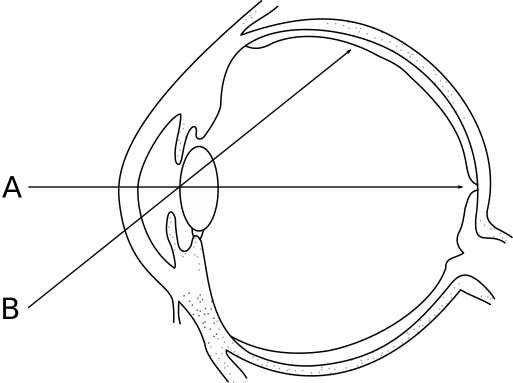
  2. The diagram shows the human eye. The two lines labelled `A` and `B` represent two beams of light passing through the eye and stimulating different areas of the retina.   


  1. The visual perception will be different at the two stimulated areas.
  2. Identify TWO of these differences.  (2 marks)

    --- 5 WORK AREA LINES (style=lined) ---

Show Answers Only

i.    Cornea and lens

ii.   Differences in visual perception at `A` and `B`.

  • At the fovea (where `A` strikes), there is a high concentration of cones, so more detail will be detected and better colour perceived than at the periphery.
  • At the periphery (where `B` strikes) there is low visual acuity (detail) and less colour perception, however, there is good distinction between black and white due to the high proportion of rods.
Show Worked Solution

i.    Cornea and lens

ii.   Differences in visual perception at `A` and `B`.

  • At the fovea (where `A` strikes), there is a high concentration of cones, so more detail will be detected and better colour perceived than at the periphery.
  • At the periphery (where `B` strikes) there is low visual acuity (detail) and less colour perception, however, there is good distinction between black and white due to the high proportion of rods.

♦♦ Mean mark (ii) 32%.

Filed Under: Technologies and Disorders Tagged With: Band 3, Band 5, smc-3663-20-Eyes

BIOLOGY, M8 2018 HSC 21

  1. Identify TWO responses of a named endotherm to a decrease in body temperature.  (2 marks)

    --- 2 WORK AREA LINES (style=lined) ---

  2. Outline the role of the nervous system of an endotherm in maintaining homeostasis when its body temperature changes.  (2 marks)

    --- 5 WORK AREA LINES (style=lined) ---

Show Answers Only

a.   Vasoconstriction and shivering.

b.   Body temperature maintenance in endotherms:

  • This is achieved via negative feedback loops.
  • Temperature receptors in the brain and skin detect changes in body temperature.
  • The central nervous system receives a signal via the receptors.
  • Muscles or glands (effectors) then receive nerve signals sent from the central nervous system.
Show Worked Solution

a.   Vasoconstriction and shivering.

b.   Body temperature maintenance in endotherms:

  • This is achieved via negative feedback loops.
  • Temperature receptors in the brain and skin detect changes in body temperature.
  • The central nervous system receives a signal via the receptors.
  • Muscles or glands (effectors) then receive nerve signals sent from the central nervous system.

Filed Under: Homeostasis Tagged With: Band 3, Band 4, smc-3659-15-Temperature, smc-3659-60-Nervous System

BIOLOGY, M5 2017 HSC 19 MC

A zebronkey hybrid is the result of crossing a male zebra which has 44 chromosomes with a female donkey which has 62 chromosomes.

How many chromosomes will the zebronkey have?

  1. 53
  2. 75
  3. 84
  4. 106
Show Answers Only

`A`

Show Worked Solution
  • A haploid set of 22 chromosomes came from the zebra and 31 came from the donkey.

`=>A`

Filed Under: Genetic Variation / Inheritance Tagged With: Band 3, smc-3648-60-Karyotypes

BIOLOGY, M5 2017 HSC 12 MC

What is the probability of producing a tall pea plant when a heterozygous tall pea plant is crossed with a homozygous short pea plant?

  1. 0%
  2. 50%
  3. 75%
  4. 100%
Show Answers Only

`B`

Show Worked Solution
  • Half the gametes produced by the heterozygous pea will have the T allele and the other half the t.
  • The homozygous short produces only t that are dominated by the T.

`=>B`

Filed Under: Genetic Variation / Inheritance Tagged With: Band 3, smc-3648-35-Autosomal

BIOLOGY, M8 2017 HSC 7 MC

Which waste product does renal dialysis remove?

  1. Urea
  2. Urine
  3. Lipids
  4. Vitamins
Show Answers Only

`A`

Show Worked Solution

`=>A`

Filed Under: Technologies and Disorders Tagged With: Band 3, smc-3663-10-Kidneys

BIOLOGY, M7 2017 HSC 6 MC

What name is given to the process whereby a white blood cell engulfs a microorganism?

  1. Infection
  2. Inflammation
  3. Phagocytosis
  4. Vaccination
Show Answers Only

`C`

Show Worked Solution
  • Phagocytes are white blood cells in the body and they use phagocytosis to engulf microorganisms.

`=>C`

Filed Under: Immunity and Responses to Pathogens Tagged With: Band 3, smc-3657-30-Innate Response (2nd Line)

BIOLOGY, M7 2017 HSC 4 MC

What is the role of lymphocytes in the body?

  1. They fight infection.
  2. They initiate blood clotting.
  3. They transport oxygen around the body.
  4. They transport carbon dioxide around the body.
Show Answers Only

`A`

Show Worked Solution
  • Lymphocytes (B and T cells) protect the body from pathogens by coordinating the immune response.

`=>A`

Filed Under: Immunity and Responses to Pathogens Tagged With: Band 3, smc-3657-10-Antibody Mediated, smc-3657-20-Cell Mediated, smc-3657-30-Innate Response (2nd Line)

CHEMISTRY, M7 2018 HSC 11 MC

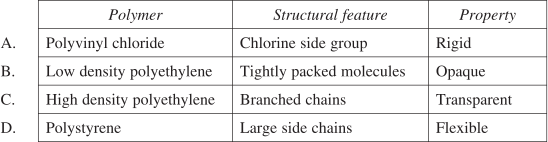
Which row of the table correctly matches the polymer with its structural feature and property?
 

Show Answers Only

`A`

Show Worked Solution
  • A chlorine side group is responsible for the property of rigidity in polymers.

`=>A`

Filed Under: Polymers Tagged With: Band 3, smc-3681-10-Addition Polymers

BIOLOGY, M5 2016 HSC 26

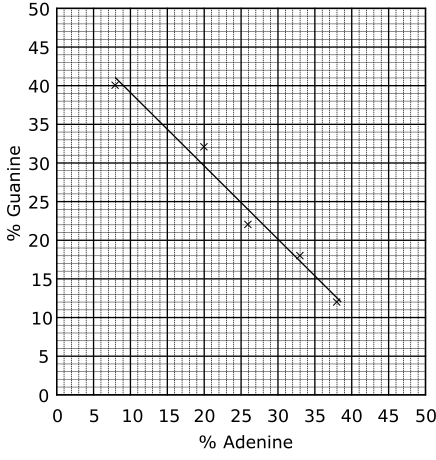
Students conducted preliminary experiments across different species to analyse their DNA base composition.

The table shows the experimental data collected.

\begin{array}{|c|c|c|}
\hline \rule{0pt}{2.5ex}\textit{Species} \rule[-1ex]{0pt}{0pt}& \textit{% Adenine} & \textit{% Guanine} \\
\hline \rule{0pt}{2.5ex}\text{A} \rule[-1ex]{0pt}{0pt}& 38 & 12 \\
\hline \rule{0pt}{2.5ex}\text{B} \rule[-1ex]{0pt}{0pt}& 26 & 22 \\
\hline \rule{0pt}{2.5ex}\text{C} \rule[-1ex]{0pt}{0pt}& 8 & 40 \\
\hline \rule{0pt}{2.5ex}\text{D} \rule[-1ex]{0pt}{0pt}& 20 & 32 \\
\hline \rule{0pt}{2.5ex}\text{E} \rule[-1ex]{0pt}{0pt}& 33 & 18 \\
\hline
\end{array}
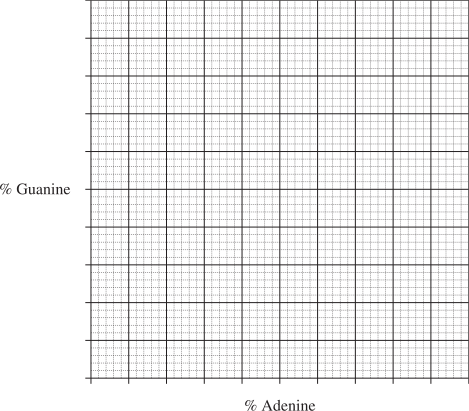
  1. On the grid below, plot the % Adenine vs % Guanine of the species analysed AND draw a suitable line of best fit.   (3 marks)


  2. Identify the relationship shown by the data.   (1 mark)

    --- 1 WORK AREA LINES (style=lined) ---

  3. Explain the relationship shown by the data.   (3 marks)

    --- 6 WORK AREA LINES (style=lined) ---

Show Answers Only

a.  

b.  As % Adenine increases, the % Guanine decreases.
  

c.    Explanation of data relationship:

  • Adenine and Thymine are complementary base pairs. Likewise with Guanine and Cytosine.
  • It would therefore be expected that as the percentage of adenine increases, the percentage of thymine would also increase.
  • Adenine + Thymine + Cytosine + Guanine = 100%
  • It follows that as adenine increases the amount of guanine should decrease.
Show Worked Solution

a.  

b.  As % Adenine increases, the % Guanine decreases.

c.    Explanation of data relationship:

  • Adenine and Thymine are complementary base pairs. Likewise with Guanine and Cytosine.
  • It would therefore be expected that as the percentage of adenine increases, the percentage of thymine would also increase.
  • Adenine + Thymine + Cytosine + Guanine = 100%
  • It follows that as adenine increases the amount of guanine should decrease.

♦♦♦ Mean mark (c) 28%.

Filed Under: Cell Replication Tagged With: Band 3, Band 4, Band 6, smc-3649-10-DNA Structure

BIOLOGY, M7 2016 HSC 24

Name an infectious disease and explain how ONE host response is a defence adaptation.   (3 marks)

Show Answers Only

Exemplar solution:

  • A primary immune response is triggered when a person first contracts chicken pox – an infectious disease.
  • Activated B and T cells reproduce in large numbers to fight and destroy the pathogen.
  • The host survives.
  • Subsequent infection with the same pathogen results in an increased secondary immune response.
Show Worked Solution
  • A primary immune response is triggered when a person first contracts chicken pox – an infectious disease.
  • Activated B and T cells reproduce in large numbers to fight and destroy the pathogen.
  • The host survives.
  • Subsequent infection with the same pathogen results in an increased secondary immune response.

Filed Under: Immunity and Responses to Pathogens Tagged With: Band 3, smc-3657-10-Antibody Mediated, smc-3657-20-Cell Mediated

CHEMISTRY, M7 2018 HSC 10 MC

Which row of the table correctly matches the reaction type with the reactant(s), catalyst and product(s)?
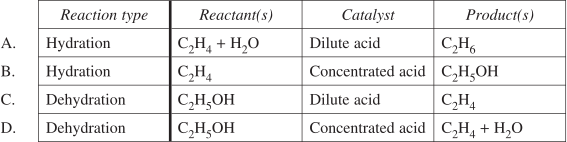
 

Show Answers Only

`D`

Show Worked Solution
  • The dehydration of an alkanol \(\ce{(C2H5OH)}\) uses a concentrated acid catalyst to produce an alkene \(\ce{(C2H4)}\) and water.

`=>D`

Filed Under: Alcohols Tagged With: Band 3, smc-3679-20-Reactions of Alcohols

CHEMISTRY, M6 2018 HSC 7 MC

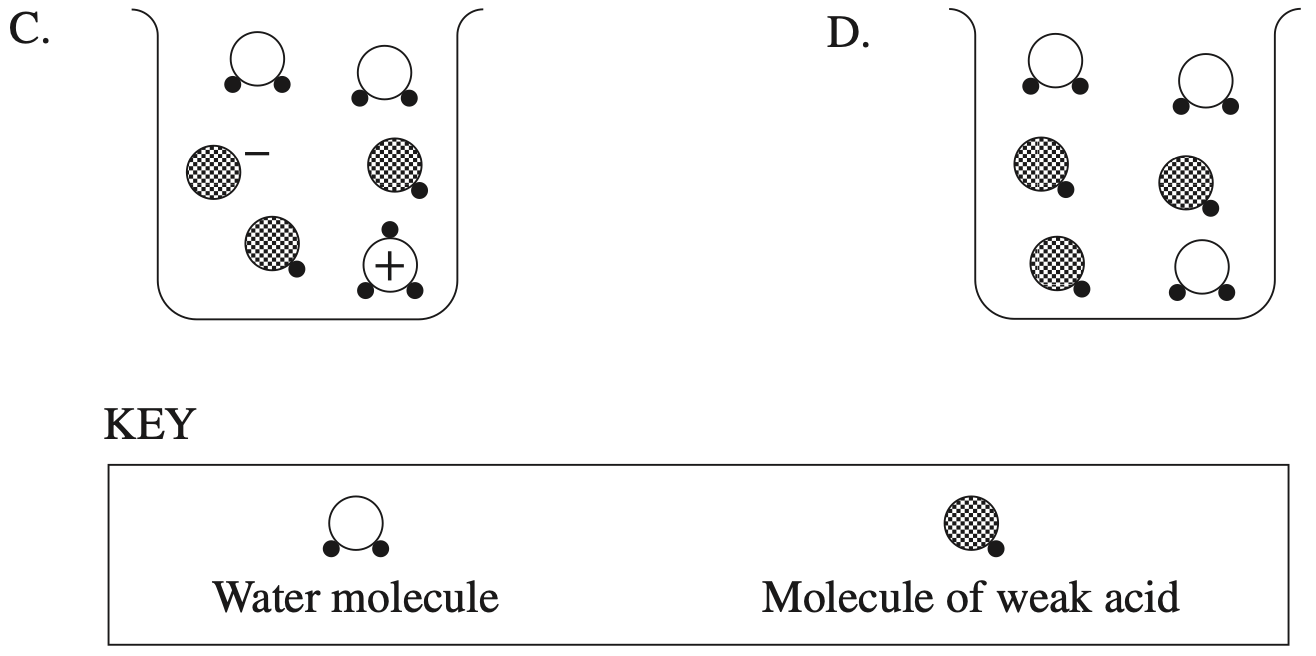
Which diagram represents ionisation of a weak acid?
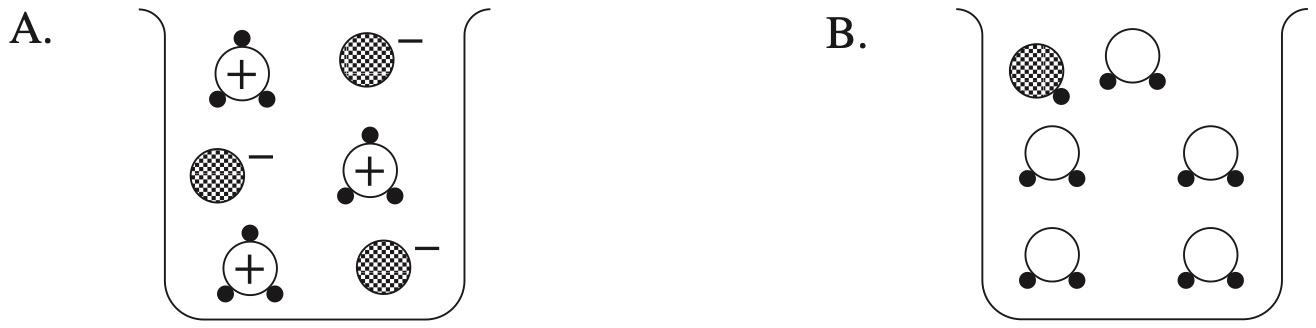


Show Answers Only

`C`

Show Worked Solution
  • Partial ionisation will result in a solution that contains hydronium, anions and water.

`=>C`

Filed Under: Bronsted-Lowry Theory Tagged With: Band 3, smc-3674-20-Strong/Weak Acids & Bases

CHEMISTRY, M8 2018 HSC 28

A camp stove using butane as a fuel was used to heat a pot of water inside a small tent. Poisonous carbon monoxide `(text{CO})` gas can be released from these stoves.
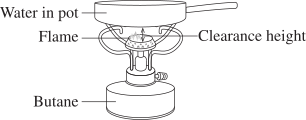
 

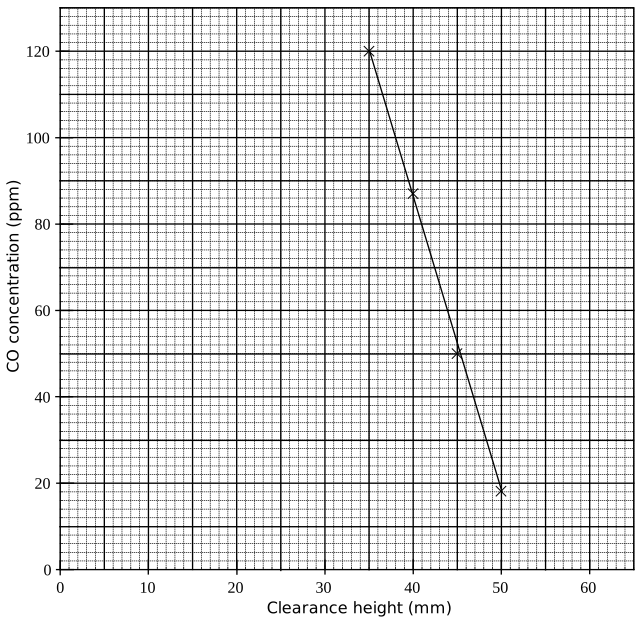
An investigation was carried out to determine the carbon monoxide concentration in the tent when the clearance height of the pot above the flame was altered. The results are shown in the table.

\begin{array} {|l|c|c|c|c|}
\hline \text{Clearance height (mm)} & 35 & 40 & 45 & 50 \\
\hline \text{CO concentration (ppm)} & 120 & 87 & 50 & 18\\
\hline \end{array}

  1. Construct a graph of the data on the grid.   (3 marks)

--- 0 WORK AREA LINES (style=lined) ---

  1. Air containing a `(text{CO})` concentration above 30 ppm is considered unsafe to breathe.  
  2. What is the minimum clearance height at which the pot should be placed?   (1 mark)

    --- 2 WORK AREA LINES (style=lined) ---

  3. Increasing the clearance height decreases the efficiency of the stove according to the following table. 

\begin{array} {|l|c|c|c|c|}
\hline \text{Clearance height (mm)} & 35 & 40 & 45 & 50 \\
\hline \text{Efficiency (%)} & 90 & 70 & 50 & 30\\
\hline \end{array}

  1. A bushwalker only has 15.0 g of butane with which to heat 1.0 L of water with a starting temperature of 20°C.
  2. Calculate the highest temperature of the water that could safely be achieved in the tent. (Molar heat of combustion of butane: `DeltaH_(c)` = 2877 kJ mol ¯1)   (4 marks)

    --- 10 WORK AREA LINES (style=lined) ---

Show Answers Only

a.   
     

b.  48 mm

c.   91.1°C

Show Worked Solution

a.   
     

b.  From the graph, the minimum height above the flame is 48 mm.

c.    Highest temperature of water:

  • The lowest safe distance = 48 mm (part (b)).
  • Fuel efficiency is 40% at 48 mm 
  • `DeltaH_(c) = 0.4 xx 2877 = 1151\ text{kJ mol}^{-1}`
  • \[\ce{n(C4H10) = \frac{m}{MM} = \frac{15}{4 \times 12.01 + 10 \times 1.008} = \frac{15}{58.12} = 0.258 mol}\]
  • \(\ce{Energy (C4H10) = 0.258 \times 1151 = 297 kJ}\)
`q` `=mC DeltaT`  
`297\ 000` `=1.0 xx 4.18 xx 10^3 xx Delta T`  
`Delta T` `=(297\ 000)/(4.18 xx 10^3)=71.1°text{C}`  

 
`:.` Highest temperature of water = 20.0 + 71.1 = 91.1°C


Mean mark (c) 54%.

Filed Under: Hydrocarbons and Associated Reactions Tagged With: Band 3, Band 4, Band 5

CHEMISTRY, M7 2018 HSC 21

Ethylene can be readily transformed into many useful products.

  1. What is the name of the industrial process by which ethylene is obtained from long chain alkanes?   (1 mark)

    --- 2 WORK AREA LINES (style=lined) ---

  2. Ethylene can be converted into vinyl chloride.
  3. Draw structural formulae for vinyl chloride and its polymer, polyvinyl chloride.   (2 marks)

    --- 8 WORK AREA LINES (style=lined) ---

Show Answers Only

a.   Cracking

b.   Vinyl chloride:


Polyvinyl chloride:
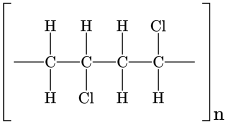


Show Worked Solution

a.   Cracking

b.   Vinyl chloride:


Polyvinyl chloride:


Filed Under: Polymers Tagged With: Band 3, Band 4, smc-3681-10-Addition Polymers

BIOLOGY, M7 2018 HSC 11 MC

The following plants were presented to a quarantine office in Australia as part of a shipment of plants entering Australia for the plant nursery trade.


Which of the following is a decision that the quarantine office is likely to make?

  1. Plant `W` can enter Australia as it looks like it has 'black spot' which already occurs in Australia.
  2. Plant `X` can enter Australia as it is unlikely the disease it has will transfer to Australian species.
  3. Plant `Y` cannot enter Australia as it has a disease caused by shortage of soil magnesium.
  4. Plant `Z` cannot enter Australia because its appearance suggests it may be carrying live insects.
Show Answers Only

`D`

Show Worked Solution
  • The aim of quarantine is to prevent any pathogens from entering the country.
  • Any plant that appears to contain live insects has a chance of carrying international diseases, and will therefore be quarantined.

`=>D`

Filed Under: Prevention, Treatment and Control Tagged With: Band 3, smc-3658-30-Procedures to Prevent Spread

ENGINEERING, CS 2022 HSC 23a

The image shows a laminated veneer lumber (LVL) beam that is used to span long distances in buildings.
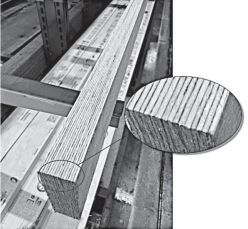
 

Give reasons for using LVL instead of a steel beam as the supporting member in a building.   (2 marks)

--- 4 WORK AREA LINES (style=lined) ---

Show Answers Only

Possible reasons include:

  • LVL has higher strength to weight ratio
  • Easier to attach to other timber framing members
  • Uses timber otherwise thrown away as waste
  • Can use defective timber as surrounding layers will support defects
  • Cheaper
  • Easier to colour
Show Worked Solution

Possible reasons include:

  • LVL has higher strength to weight ratio
  • Easier to attach to other timber framing members
  • Uses timber otherwise thrown away as waste
  • Can use defective timber as surrounding layers will support defects
  • Cheaper
  • Easier to colour

Filed Under: Engineering Materials Tagged With: Band 3, smc-3715-60-Laminates

CHEMISTRY, M5 2016 HSC 28

A mixture of carbon monoxide, chlorine and phosgene \(\ce{(COCl_2)}\) gases was placed in a closed container. The concentrations of the gases were monitored over time.
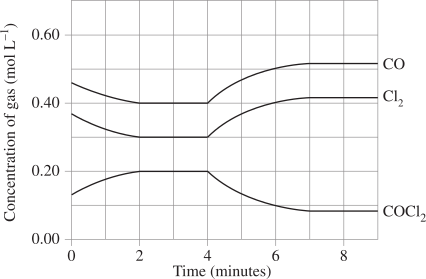
 

  1. At what time does the system first reach equilibrium? Justify your answer.   (2 marks)

    --- 2 WORK AREA LINES (style=lined) ---

  2. At four minutes, the temperature of the container was increased.
  3. Explain, with reference to the graph, whether the decomposition of \(\ce{COCl_2}\) into \(\ce{CO}\) and \(\ce{Cl_2}\) is exothermic or endothermic.   (3 marks)

    --- 5 WORK AREA LINES (style=lined) ---

Show Answers Only

a.    At two minutes (where the concentrations stop changing)

b.    \(\ce{CO(g) + Cl2(g) \rightleftharpoons COCl2(g)}\)

  • From the graph, when the temperature is increased, the \(\ce{COCl2}\) concentration decreases while \(\ce{CO}\) and \(\ce{Cl2}\) concentrations increases.
  • The reaction is countering the increase in temperature by shifting to the left and absorbing heat (Le Chatelier’s principle).
  • Therefore the decomposition of \(\ce{COCl2(g)}\) is endothermic.
Show Worked Solution

a.    At two minutes (where the concentrations stop changing)

b.    \(\ce{CO(g) + Cl2(g) \rightleftharpoons COCl2(g)}\)

  • From the graph, when the temperature is increased, the \(\ce{COCl2}\) concentration decreases while \(\ce{CO}\) and \(\ce{Cl2}\) concentrations increases.
  • The reaction is countering the increase in temperature by shifting to the left and absorbing heat (Le Chatelier’s principle).
  • Therefore the decomposition of \(\ce{COCl2(g)}\) is endothermic.

Filed Under: Factors that Affect Equilibrium Tagged With: Band 3, Band 4, smc-3670-10-Temperature, smc-3670-30-Concentration, smc-3670-60-Concentration diagrams

CHEMISTRY, M7 2016 HSC 22

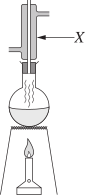
This apparatus was set up to produce methyl butanoate.
 

  1. Identify a safety issue in this experiment.   (1 mark)

    --- 2 WORK AREA LINES (style=lined) ---

  2. Using structural formulae, write the equation for the production of methyl butanoate.   (2 marks)

    --- 10 WORK AREA LINES (style=lined) ---

  3. Justify the use of apparatus `X` in this experiment.   (2 marks)

    --- 5 WORK AREA LINES (style=lined) ---

Show Answers Only

a.   Flame could ignite one of reagents which is flammable.

b.   
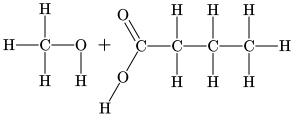
     

c.    Esterification is a relatively slow reaction.

  • Heating the reaction makes it go faster. However, the low boiling points of the reactants make them volatile as they readily convert into gas.
  • The cooling condenser `X` prevents the gas reactants from escaping the experiment by condensing them back into the reaction mixture. This process allows the reaction to proceed at higher temperatures.
Show Worked Solution

a.   Flame could ignite one of reagents which is flammable.
 

b.   
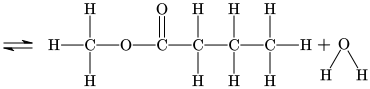


♦ Mean mark (b) 52%.

c.    Esterification is a relatively slow reaction.

  • Heating the reaction makes it go faster. However, the low boiling points of the reactants make them volatile as they readily convert into gas.
  • The cooling condenser `X` prevents the gas reactants from escaping the experiment by condensing them back into the reaction mixture. This process allows the reaction to proceed at higher temperatures.

♦♦♦ Mean mark (c) 14%.

Filed Under: Reactions of Organic Acids and Bases Tagged With: Band 3, Band 5, Band 6, smc-3680-10-Esters

CHEMISTRY, M7 2016 HSC 17 MC

A polymer has the following structure.
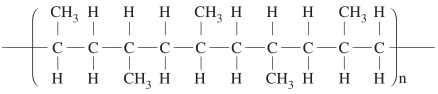
 

Which of the following represents the monomer from which this polymer can be produced?
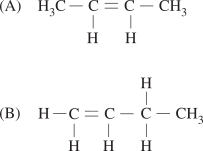


Show Answers Only

`D`

Show Worked Solution
  • Break the polymer at every second \(\ce{C–C}\) bond (yields identical sections)
  • Adjust single carbon bond to \(\ce{C=C}\) bond in monomer

`=>D`

Filed Under: Polymers Tagged With: Band 3, smc-3681-10-Addition Polymers

CHEMISTRY, M7 2016 HSC 1 MC

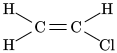
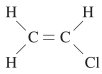
What is the name of this compound?
 

  1. Styrene
  2. Ethylene
  3. Chloroethane
  4. Vinyl chloride
Show Answers Only

`D`

Show Worked Solution
  • The compound is known as chloroethene or vinyl chloride.

`=>D`

Filed Under: Polymers Tagged With: Band 3, smc-3681-30-Monomers

ENGINEERING, AE 2022 HSC 8 MC

It is appropriate to produce a half development of a transition piece when the piece

  1. is very large.
  2. is symmetrical.
  3. is very complex.
  4. needs to be produced quickly.
Show Answers Only

`B`

Show Worked Solution
  • Half development of a transition piece is appropriate when it is symmetrical.

`=>B`

Filed Under: Communication Tagged With: Band 3, smc-3726-10-Transition pieces

CHEMISTRY, M6 2015 HSC 21

  1. Outline a suitable method to prepare a natural indicator.   (2 marks)

    --- 6 WORK AREA LINES (style=lined) ---

  2. How could a natural indicator be tested?   (2 marks)

    --- 5 WORK AREA LINES (style=lined) ---
Show Answers Only

a.    Methodology:

  • Collect plant material that is a natural indicator of pH. Examples include rose petals and red cabbage.
  • Cut the coloured parts into small pieces.
  • Place material into a beaker with water and boil until the solution becomes coloured.
  • Allow the mixture to cool at room temperature.
  • Decant the liquid into a container, leaving the solid behind.

b.   Testing a natural indicator:

  • Prepare test tubes of various acids and bases (pH of each is known).
  • Add some of the indicator to each test tube.
  • Record the natural indicator colour of each example and whether it differentiates between acids and bases and their concentrations.
Show Worked Solution

a.    Methodology:

  • Collect plant material that is a natural indicator of pH. Examples include rose petals and red cabbage.
  • Cut the coloured parts into small pieces.
  • Place material into a beaker with water and boil until the solution becomes coloured.
  • Allow the mixture to cool at room temperature.
  • Decant the liquid into a container, leaving the solid behind.

b.   Testing a natural indicator:

  • Prepare test tubes of various acids and bases (pH of each is known).
  • Add some of the indicator to each test tube.
  • Record the natural indicator colour of each example and whether it differentiates between acids and bases and their concentrations.

Filed Under: Properties of Acids and Bases Tagged With: Band 3, Band 4, smc-3673-15-Indicators

CHEMISTRY, M8 2015 HSC 18-19 MC

Question 18

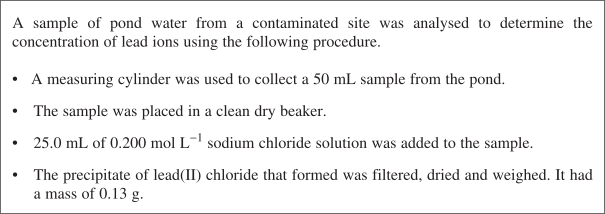
How could the reliability of the analysis of the pond water be improved?

  1. Analyse more samples from the same pond
  2. Use 50 mL of distilled water as a control sample
  3. Analyse samples from different ponds on the site
  4. Remove other contaminants from the sample before the analysis

 
Question 19

What was the concentration of lead ions in the sample?

  1. `5.0 × 10^{-3} \ text{mol L}^(-1)`
  2. `5.8 × 10^{-3} \ text{mol L}^(-1)`
  3. `9.3 × 10^{-3} \ text{mol L}^(-1)`
  4. `10.7 × 10^{-3} \ text{mol L}^(-1)`
Show Answers Only

`18.  A`

`19.  C`

Show Worked Solution

Question 18

`=>A`
 

Question 19

\[\ce{n(PbCl2) = \frac{0.13}{207.2 + 2 \times 35.45} = \frac{0.13}{278.1} = 4.67 \times 10^{-4} mol}\]

\(\ce{n(Pb^2+) = n(PbCl2) = 4.67 \times 10^{-4} mol}\)

\[\ce{[Pb^2+] = \frac{4.67 \times 10^{-4}}{0.050} = 9.3 \times 10^{-3} mol L^{-1}}\]

`=>C`


♦ Mean mark (Q19) 52%.

Filed Under: Inorganic Substances Tagged With: Band 3, Band 5, smc-3682-40-Gravimetric Analysis

BIOLOGY, M7 2015 HSC 25

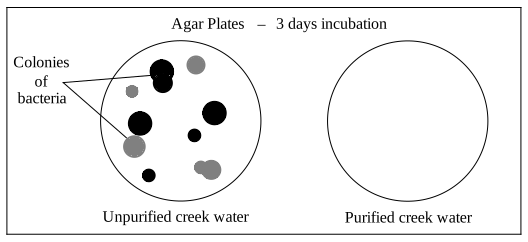
A group of students wanted to test whether water purifying tablets were effective in making creek water free from bacteria.

They conducted an experiment using a water sample collected from the creek and found that the tablets were effective.

  1. Describe a means of addressing ONE identified hazard relevant to this investigation.   (2 marks)

    --- 4 WORK AREA LINES (style=lined) ---

  2. Illustrate the results of this experiment in diagrammatic form.
  3. Use labels to clearly identify the data collected.   (3 marks)


    --- 0 WORK AREA LINES (style=lined) ---

Show Answers Only

a.   Successful answers could include one of the following:

  • A pathogenic microbe might be cultured during the process.
  • Post experiment, agar plates must be heated under high pressure to kill any microbes cultured before disposal.  

b.   Results of experiment:

Show Worked Solution

a.   Successful answers could include one of the following:

  • A pathogenic microbe might be cultured during the process.
  • Post experiment, agar plates must be heated under high pressure to kill any microbes cultured before disposal.  

b.   Results of experiment:

Filed Under: Causes of Infectious Disease Tagged With: Band 3, Band 4, smc-3655-50-Microbial Tests

BIOLOGY, M7 2015 HSC 19-20 MC

Refer to the following information to answer Questions 19 and 20 .

The intestinal tract of a human foetus is sterile.
After birth, microflora from the mother are transferred to the baby's mouth through close contact. After a year, the microflora of the baby is similar to the mother's, with the baby's immune system ignoring these microbes.

Also during the first year of life, breast milk from the mother provides antibodies to the baby for any disease the mother has already experienced. When breastfeeding ceases, these antibody levels in the baby start to fall.

After the first year, any new species of invading bacteria is treated as a pathogen by the baby's immune system.

Question 19

A medical consequence for six-month-old babies that have only been bottle-fed with formula milk and not breastfed is that

  1. they will not develop microflora.
  2. their immune system will be damaged.
  3. their consumption of milk cannot be quantified.
  4. they will be at increased risk of infectious disease.

 
Question 20

Strict hygiene practices are followed in the care of newborns, whereas hygiene practices in the care of older babies are less emphasised.

Which of the following is the best reason for this difference?

  1. Vaccinations render personal hygiene unnecessary for older babies.
  2. Procaryotic cells are not identified as antigens in early development.
  3. Antibiotic treatments kill bacterial populations in the digestive system.
  4. Early exposure to pathogens helps to build a strong immune system.


Show Answers Only

Question 19: `D`

Question 20: `B`

Show Worked Solution

Question 19

  • Bottle fed babies will not have the added immunity that is provided by the mother’s breast milk.
  • They will therefore have immune systems that are more susceptible to infectious disease.

`=>D` 
 

Question 20

  • The immune systems of newborns will not work as efficiently as that of older babies as their immune systems are underdeveloped.

`=>B`


♦ Mean mark Q20 45%.

Filed Under: Immunity and Responses to Pathogens Tagged With: Band 3, Band 5, smc-3657-10-Antibody Mediated, smc-3657-20-Cell Mediated

BIOLOGY, M5 2015 HSC 14 MC

The table shows the base triplets in mRNA for amino acids.

From the table, the amino acid Serine (Ser) can be coded for by the base triplet UCG.
 

Which base triplet could code for the amino acid Tyrosine (Tyr)?

  1. `text{CCU}`
  2. `text{CAU}`
  3. `text{UAA}`
  4. `text{UAC}`
Show Answers Only

`D`

Show Worked Solution

`=>D`

Filed Under: DNA and Polypeptide Synthesis Tagged With: Band 3, smc-3650-11-RNA, smc-3650-20-Translation

BIOLOGY, M7 2015 HSC 12-13 MC

Refer to the following information to answer Questions 12 and 13.

The larvae of fruit flies damage fruit in Western Australia. To control the problem, growers are advised to spray fruit trees with pesticides. Any already damaged fruit is boiled and disposed of as chicken food or landfill. Another control measure is the release of genetically engineered infertile flies of this species.


Question 12

Which reason best explains why the corresponding control measure reduces this problem?

\begin{align*}
\begin{array}{l}
\rule{0pt}{2.5ex} \ \rule[-1ex]{0pt}{0pt}& \\
\rule{0pt}{2.5ex}\textbf{A.}\rule[-1ex]{0pt}{0pt}\\
\rule{0pt}{2.5ex}\textbf{B.}\rule[-1ex]{0pt}{0pt}\\
\textbf{}\rule[-1ex]{0pt}{0pt}\\
\rule{0pt}{2.5ex}\textbf{C.}\rule[-1ex]{0pt}{0pt}\\
\textbf{}\rule[-1ex]{0pt}{0pt}\\
\rule{0pt}{2.5ex}\textbf{D.}\rule[-1ex]{0pt}{0pt}\\
\textbf{}\rule[-1ex]{0pt}{0pt}\\
\end{array}
\begin{array}{|l|l|}
\hline
\rule{0pt}{2.5ex}\textit{Control measure}\rule[-1ex]{0pt}{0pt}& \textit{Reason} \\
\hline
\rule{0pt}{2.5ex}\text{Release of infertile flies}\rule[-1ex]{0pt}{0pt}&\text{Infertile flies do not eat the fruit}\\
\hline
\rule{0pt}{2.5ex}\text{Release of infertile flies}\rule[-1ex]{0pt}{0pt}& \text{The number of flies in the next}\\
\text{}\rule[-1ex]{0pt}{0pt}& \text{generation is decreased}\\
\hline
\rule{0pt}{2.5ex}\text{Boiling fruit and feeding to}\rule[-1ex]{0pt}{0pt}& \text{Chickens are unaffected by the} \\
\text{chickens}\rule[-1ex]{0pt}{0pt}& \text{damaged fruit} \\
\hline
\rule{0pt}{2.5ex}\text{Boiling fruit and feeding to}\rule[-1ex]{0pt}{0pt}& \text{The amount of waste for landfill is} \\
\text{chickens}\rule[-1ex]{0pt}{0pt}& \text{reduced} \\
\hline
\end{array}
\end{align*}

 
Question 13

The following measures could be used to prevent the spread of this fruit fly across Australia.

    1. Australia-wide release of infertile fruit flies
    2. Aerial spraying of orchards throughout the country
    3. Spot spraying of newly affected orchards in Western Australia
    4. Stopping the transport of fruit from Western Australia to other states

To prevent the spread of this fruit fly across Australia, which combination of measures would be most practical to use?

  1. 1 and 2
  2. 1 and 4
  3. 2 and 3
  4. 3 and 4
Show Answers Only

Question 12: \(B\)

Question 13: \(D\)

Show Worked Solution

Question 12

  • Future generations of flies will eventually be reduced in numbers and may even be wiped out altogether.

\(\Rightarrow B\)
  

Question 13

  • It may be possible to contain the outbreak to local areas by restricting the movement of affected fruit to other states and countries, thus making it easier to manage.

\(\Rightarrow D\)


♦ Mean mark (Q13) 49%.

Filed Under: Prevention, Treatment and Control Tagged With: Band 3, Band 5, smc-3658-30-Procedures to Prevent Spread

BIOLOGY, M5 2015 HSC 11 MC

Environment can affect phenotype by altering the sequence of bases in DNA.

Which of the following is an example of this?

  1. High protein diets making children taller than their parents
  2. Stress causing the expression of one set of genes instead of another
  3. Language and music lessons improving intelligence in young children
  4. Nuclear fallout from atomic bombs increasing birth defects in populations
Show Answers Only

`D`

Show Worked Solution
  • Mutation in genes is commonly caused by radiation

`=>D`

Filed Under: DNA and Polypeptide Synthesis Tagged With: Band 3, smc-3650-50-Environment

BIOLOGY, M8 2015 HSC 7-8 MC

Refer to the following information to answer Questions 7 and 8 .

The diagram shows a homeostatic mechanism in a mammal.
 

Question 7

What does `text{X}` represent in the diagram?

  1. The heart
  2. The brain
  3. A thermoreceptor in the skin
  4. A pressure receptor in a blood vessel

 
Question 8

Which of the following describes what happens to the muscles and the arteriole walls in the skin when the core body temperature is below normal?
 

Show Answers Only

Q7.  `B`
Q8.  `B`

Show Worked Solution

Q7.   `text{X}` = the brain

  • Messages are sent by the brain to the effectors.
  • This promotes a stimulus response.

`=>B`


♦♦ Mean mark (Q7) 38%.

Q8.   When body temperature is below normal:

  • Hairs stand on end and arteriole walls of skin contract to prevent the loss of heat.

`=>B`

Filed Under: Homeostasis Tagged With: Band 3, Band 5, smc-3659-12-Negative Feedback Loops, smc-3659-15-Temperature

BIOLOGY, M8 2015 HSC 3 MC

Which adaptation would decrease water loss from a plant in a region with low rainfall?

  1. Broad leaves
  2. Surface roots
  3. Sunken stomates
  4. Loosely packed epidermal cells
Show Answers Only

`C`

Show Worked Solution
  • Sunken stomates would decrease water loss.

`=>C`

Filed Under: Homeostasis Tagged With: Band 3, smc-3659-30-Water Balance in Plants

CHEMISTRY, M8 2017 HSC 22

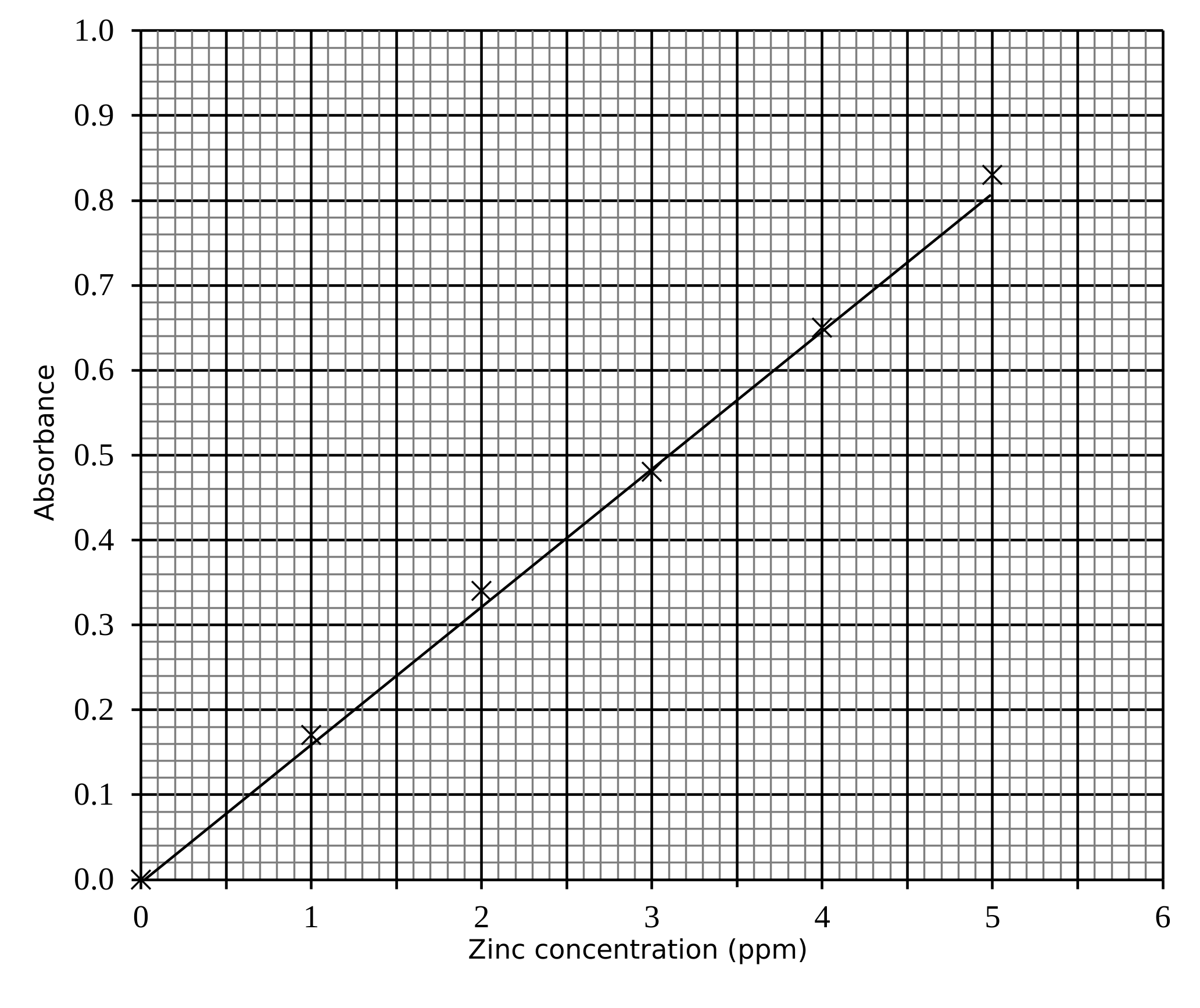
Atomic absorption spectroscopy was used to determine the concentration of zinc in a water sample. The absorbance of a series of standard solutions of known concentration of zinc was measured. The results are shown in the table.
 

  1. Plot the data on the grid and draw a line of best fit.   (3 marks)
     

  1. In order for water to be considered safe for drinking, the concentration of zinc must be less than 2.80 ppm.
  2. The absorbance of the water sample was 0.58. Explain whether this water is safe for drinking.   (2 marks)

    --- 4 WORK AREA LINES (style=lined) ---

Show Answers Only

a.   

b.   Using the line of best fit above:

  • 0.58 absorbance (y-axis) ~ 3.6 ppm of zinc concentration
  • Since 3.6 ppm > 2.8 ppm (safe level), the water is not safe to drink.
Show Worked Solution

a.   
   

b.   Using the line of best fit above:

  • 0.58 absorbance (y-axis) ~ 3.6 ppm of zinc concentration
  • Since 3.6 ppm > 2.8 ppm (safe level), the water is not safe to drink.

Filed Under: Inorganic Substances Tagged With: Band 3, smc-3682-60-Colourimetry UV-Vis and AAS

BIOLOGY, M5 2015 HSC 2 MC

What are alternative forms of genes called?

  1. Alleles
  2. Autosomes
  3. Chromatids
  4. Chromosomes
Show Answers Only

`A`

Show Worked Solution

By Elimination:

  • `B`, `C` and `D` are all associated with chromosome structure.

`=>A`

Filed Under: Genetic Variation / Inheritance Tagged With: Band 3, smc-3648-60-Karyotypes

CHEMISTRY, M6 2015 HSC 5 MC

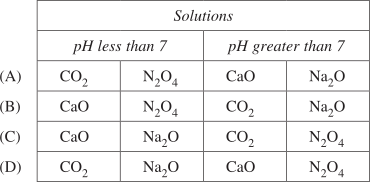
The oxides `\text{CaO}, \text{CO}_2, \text{Na}_2\text{O}` and `\text{N}_2\text{O}_4` are placed in water to form four separate solutions.

Which row of the table correctly indicates the solutions with pH less than 7 and the solutions with pH greater than 7?
 

Show Answers Only

`A`

Show Worked Solution
  • Acidic solutions (pH < 7) – non-metal oxide solutions
  • Basic solutions (pH > 7) – metal oxide solutions

`=>A`

Filed Under: Properties of Acids and Bases Tagged With: Band 3, smc-3673-30-Inorganic Nomenclature

CHEMISTRY, M8 2015 HSC 3 MC

What flame colour do copper ions produce when heated?

  1. Brick red
  2. Blue-green
  3. Pale purple
  4. Yellow-orange
Show Answers Only

`B`

Show Worked Solution
  • Copper ions produce a blue-green flame colour.

`=>B`

Filed Under: Inorganic Substances Tagged With: Band 3, smc-3682-20-Flame Tests

CHEMISTRY, M6 2015 HSC 2 MC

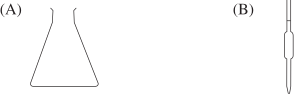
Which type of glassware is used in a titration to deliver an accurate volume of a solution to a known volume of another solution?


Show Answers Only

`D`

Show Worked Solution
  • A burette is used in a titration.

`=>D`

Filed Under: Quantitative Analysis Tagged With: Band 3, smc-3675-10-Titration

CHEMISTRY, M7 2017 HSC 9 MC

The following equipment was set up to measure the heat of combustion of an alkanol.
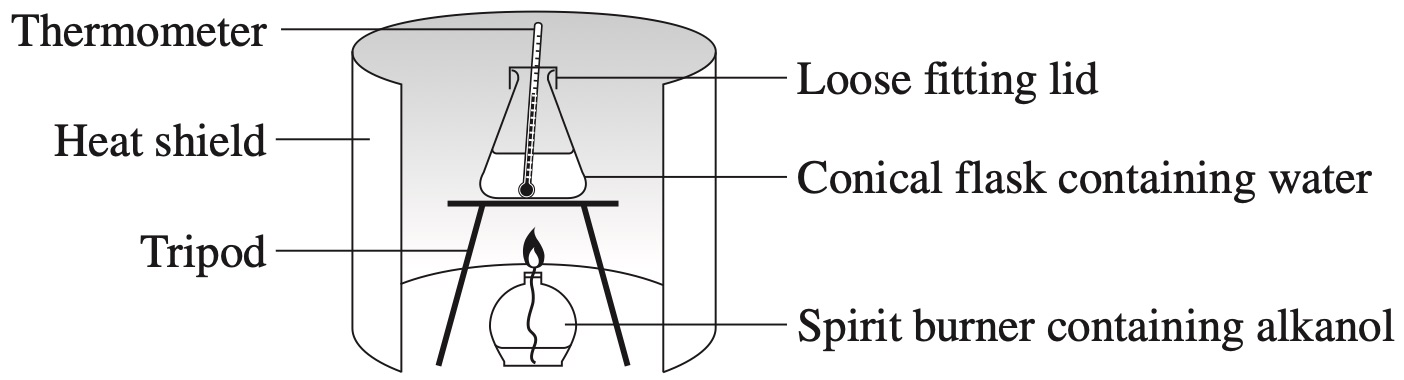


Black deposits were observed on the bottom of the conical flask and the heat of combustion measured was lower than the theoretical value.

Which of the following equations could account for these observations?

  1. `2 text{C}_(2) text{H}_(6)(g)+7 text{O}_(2)(g) rarr 4 text{CO}_(2)(g)+ 6 text{H}_(2)text{O}(g)`
  2. `text{C}_(3) text{H}_(8) text{O}(g)+4 text{O}_(2)(g) rarr text{CO}_(2)(g)+ text{CO}(g)+4 text{H}_(2) text{O}(g)`
  3. `2 text{C}_(4) text{H}_(10) text{O} (g)+3 text{O}_(2)(g) rarr 8 text{C}(s)+2 text{H}_(2)(g)+8 text{H}_(2) text{O}(g)`
  4. `2 text{C}_(2) text{H}_(6) text{O}(g)+4 text{O}_(2)(g) rarr 2 text{CO}_(2)(g)+2 text{C}(s)+6 text{H}_(2) text{O}(g)`
Show Answers Only

`D`

Show Worked Solution

The black deposit is carbon (soot).

By Elimination:

A: Ethane is not an alkanol (eliminate A).

B: No soot is formed in this reaction (eliminate B).

C: This reaction is incorrect as no hydrogen gas is produced (eliminate C).

`=>D`

Filed Under: Alcohols Tagged With: Band 3, smc-3679-10-Combustion

CHEMISTRY, M7 2017 HSC 4 MC

Esterification can be carried out in a school laboratory using the equipment shown.
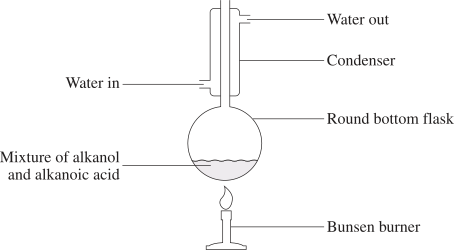


How could the safety of the process shown be improved?

  1. Place a stopper on top of the condenser.
  2. Add concentrated sulfuric acid to the flask.
  3. Change the direction of water flow through the condenser.
  4. Replace the Bunsen burner with an electric heating mantle.
Show Answers Only

`D`

Show Worked Solution

By elimination

A:  Resulting pressure build up is dangerous (incorrect)

B:  Adds to the catalytic effect but not a safety reduction measure  (incorrect)

C:  Direction is optimal as water flow is coolest where vapours are hottest (incorrect)

D:  Heating mantle reduces the chance of vapours igniting (correct)

`=>D`

Filed Under: Reactions of Organic Acids and Bases Tagged With: Band 3, smc-3680-10-Esters

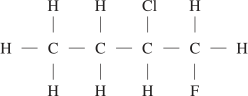
CHEMISTRY, M7 2017 HSC 3 MC

What is the name of this compound?


  1. 2-chloro-1-fluorobutane
  2. 3-chloro-4-fluorobutane
  3. 1-fluoro-2-chlorobutane
  4. 4-fluoro-3-chlorobutane
Show Answers Only

`A`

Show Worked Solution

Compound: 2-chloro-1-fluorobutane

  • Functional groups are named alphabetically and hence -chloro precedes -fluoro.

`=>A`

Filed Under: Nomenclature Tagged With: Band 3, smc-3676-08-Halogenated Organic Compounds

CHEMISTRY, M8 2017 HSC 2 MC

Which row of the table correctly matches an ion with its flame colour during a flame test?
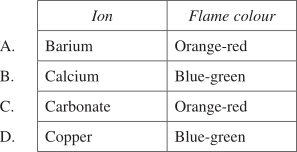
 

Show Answers Only

`D`

Show Worked Solution

Consider each option:

  • Barium ions produce blue-green (incorrect)
  • Calcium ions produce orange-red (incorrect)
  • Carbonate ions produce no colour (incorrect)
  • Copper ions produce blue-green (correct)

`=>D`

Filed Under: Inorganic Substances Tagged With: Band 3, smc-3682-20-Flame Tests

PHYSICS, M5 2015 HSC 4 MC

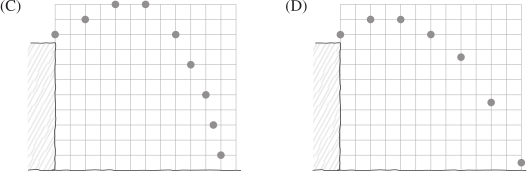
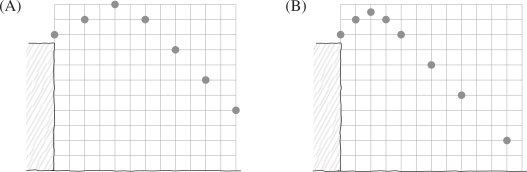
A projectile is launched from a cliff top. The dots show the position of the projectile at equal time intervals.

Assuming negligible air resistance, which diagram best shows the path of the projectile?


Show Answers Only

`D`

Show Worked Solution
  • There will be a constant horizontal spacing between the dots as the projectile has a constant horizontal velocity.
  • The vertical spacing between the dots will first decrease until the projectile reaches its maximum height then increase as it moves downwards, due to its downwards acceleration due to gravity.

`=>D`

Filed Under: Projectile Motion Tagged With: Band 3, smc-3690-10-Projectile Motion Models

PHYSICS, M6 2016 HSC 22a

When an alternating current is passed through coil `A`, a voltage is observed on the oscilloscope connected to coil `B`.
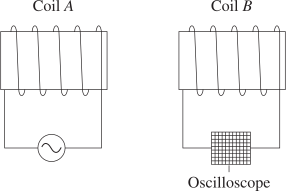


How could a bar magnet be used, instead of coil A, to produce a similar pattern on the oscilloscope?   (2 marks)

--- 3 WORK AREA LINES (style=lined) ---

Show Answers Only

Answers could include one of the following:

  • Move the bar magnet repeatedly towards and away from the end of coil `B`.
  • Rotate the bar magnet in the plane of the page.
  • Any other motion which induces an oscillating voltage in coil `B`.
Show Worked Solution

Answers could include one of the following:

  • Move the bar magnet repeatedly towards and away from the end of coil `B`.
  • Rotate the bar magnet in the plane of the page.
  • Any other motion which induces an oscillating voltage in coil `B`.

Filed Under: Electromagnetic Induction Tagged With: Band 3, smc-3705-40-Lenz and Faraday

PHYSICS, M6 2016 HSC 8 MC

Which movement of the magnet(s) will produce the greatest deflection of the galvanometer?


Show Answers Only

`D`

Show Worked Solution
  • A larger induced current will produce greater deflection of the galvanometer.
  • The induced current is proportional to the total rate of change of magnetic flux through the coil.
  • The faster the movement of the magnet, the greater the rate of change of flux.

`=>D`

Filed Under: Electromagnetic Induction Tagged With: Band 3, smc-3705-40-Lenz and Faraday

PHYSICS, M6 2016 HSC 5 MC

The diagram shows two parallel charged plates `5 × 10^(-3)  text{m}` apart.
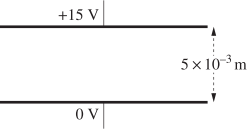
 

What is the magnitude of the electric field between the plates in `text{V m}^(-1)` ?

  1. `3.3 × 10^(-4)`
  2. `0.33`
  3. `3`
  4. `3000`
Show Answers Only

`D`

Show Worked Solution

`E=(V)/(d)=(15)/(0.005)=3000\ text{V m}^(-1)`

`=>D`

Filed Under: Charged Particles, Conductors and Electric/Magnetic Fields, Electrostatics Tagged With: Band 3, smc-3693-20-EF Strength, smc-4283-10-Electric fields

PHYSICS, M6 2016 HSC 1 MC

Some mobile phones are recharged at a power point using a charger that contains a transformer.

What is the purpose of the transformer?

  1. To convert AC at the power point to DC
  2. To convert DC at the power point to AC
  3. To increase the AC voltage at the power point
  4. To decrease the AC voltage at the power point
Show Answers Only

`D`

Show Worked Solution
  • Transformers cannot convert AC to DC or vice versa, they only change the voltage.
  • As transmission voltages are incredibly high in order to decrease power loss, transformers in the home decrease voltages to a level safe for devices to use.

`=>D`

Filed Under: Electromagnetic Induction Tagged With: Band 3, smc-3705-80-Energy Distribution

PHYSICS, M5 2017 HSC 24

The escape velocity from a planet is given by  `v = sqrt((2GM)/(r))`.

  1. The radius of Mars is  `3.39 xx 10^(6) \ text{m}`  and its mass is  `6.39 xx 10^(23) \ text{kg}`.
  2. Calculate the escape velocity from the surface of Mars.   (2 marks)

--- 4 WORK AREA LINES (style=lined) ---

  1. Using the law of conservation of energy, show that the escape velocity of an object is independent of its mass.   (3 marks)

--- 6 WORK AREA LINES (style=lined) ---

Show Answers Only

a.   `v=5010  text{m s}^(-1)`

b.   Applying the law of conservation of energy:

  • The object’s initial mechanical energy must equal its final mechanical energy.
  •    `KE_(i)+U_(i)=KE_(f)+U_(f)`
  • The escape velocity is the minimum velocity required for an object to escape from a central mass and never return.
  • As an object reaches an infinite distance away, `U_(f)=0`
  • When an object has just enough speed to escape, its final speed is zero, hence, `KE_(f)=0`.
  • It follows:
`KE_(i)+U_(i)` `=0`  
`(1)/(2)mv^(2)-(GMm)/(r)` `=0`  
`mv^(2)` `=(2GMm)/(r)`  
`∴ v_(esc)` `=sqrt((2GM)/(r))`  


  • Which is independent of the object’s mass.
Show Worked Solution
a.    `v` `=sqrt((2xx6.67 xx10^(-11)xx6.39 xx10^(23))/(3.39 xx10^(6)))`
    `=5014.5  text{m s}^(-1)`
    `=5015  text{m s}^(-1)\ \ text{(to 0 d.p.)}`


b.   Applying the law of conservation of energy:

  • The object’s initial mechanical energy must equal its final mechanical energy.
  •    `KE_(i)+U_(i)=KE_(f)+U_(f)`
  • The escape velocity is the minimum velocity required for an object to escape from a central mass and never return.
  • As an object reaches an infinite distance away, `U_(f)=0`
  • When an object has just enough speed to escape, its final speed is zero, hence, `KE_(f)=0`.
  • It follows:
`KE_(i)+U_(i)` `=0`  
`(1)/(2)mv^(2)-(GMm)/(r)` `=0`  
`mv^(2)` `=(2GMm)/(r)`  
`∴ v_(esc)` `=sqrt((2GM)/(r))`  


  • Which is independent of the object’s mass.

Mean mark (b) 53%.

Filed Under: Motion in Gravitational Fields Tagged With: Band 3, Band 5, smc-3692-20-Energy Changes, smc-3692-70-Escape Velocity

PHYSICS, M5 2017 HSC 12 MC

A satellite orbits Earth with an elliptical orbit that passes through positions `X` and `Y`.
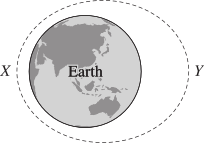
 

Which row of the table correctly identifies the position at which the satellite has greater kinetic energy and the position at which it has greater potential energy?
 

\begin{align*}
\begin{array}{l}
\rule{0pt}{2.5ex}\textit{} & \textit{} \\
\textit{}\rule[-1ex]{0pt}{0pt}& \textit{} \\
\rule{0pt}{2.5ex}\textbf{A.}\rule[-1ex]{0pt}{0pt}\\
\rule{0pt}{2.5ex}\textbf{B.}\rule[-1ex]{0pt}{0pt}\\
\rule{0pt}{2.5ex}\textbf{C.}\rule[-1ex]{0pt}{0pt}\\
\rule{0pt}{2.5ex}\textbf{D.}\rule[-1ex]{0pt}{0pt}\\
\end{array}
\begin{array}{|c|c|}
\hline
\rule{0pt}{2.5ex}\textit{Greater} & \textit{Greater} \\
\quad \textit{kinetic energy}\quad \rule[-1ex]{0pt}{0pt}& \quad \textit{potential energy} \quad \\
\hline
\rule{0pt}{2.5ex}X\rule[-1ex]{0pt}{0pt}&X\\
\hline
\rule{0pt}{2.5ex}X\rule[-1ex]{0pt}{0pt}& Y\\
\hline
\rule{0pt}{2.5ex}Y\rule[-1ex]{0pt}{0pt}& X \\
\hline
\rule{0pt}{2.5ex}Y\rule[-1ex]{0pt}{0pt}& Y \\
\hline
\end{array}
\end{align*}

Show Answers Only

`B`

Show Worked Solution
  • `Y`  is at a greater distance from the centre of Earth so it has a greater potential energy at `Y`.
  • As it moves towards `X` its potential energy is converted into kinetic energy, so it has a greater kinetic energy at `X`.

`=>B`

Filed Under: Motion in Gravitational Fields Tagged With: Band 3, smc-3692-20-Energy Changes

PHYSICS, M7 2017 HSC 2 MC

Which of the following is an inertial frame of reference?

  1. A rocket during launch
  2. A train travelling at a constant velocity
  3. A car turning a corner at a constant speed
  4. A lift slowing down as it approaches the ground floor
Show Answers Only

`B`

Show Worked Solution
  • An inertial frame of reference is one which is not accelerating.

`=>B`

Filed Under: Light and Special Relativity Tagged With: Band 3, smc-3699-40-Einstein's Postulates

PHYSICS, M5 2018 HSC 28

The radius of the moon is 1740 km. The moon's mass is `7.35 × 10^(22)` kg. In this question, ignore the moon's rotational and orbital motion.

A 20 kg mass is launched vertically from the moon's surface at a velocity of `1200 \ text{m s}^(-1)`.

  1. Show that the change in potential energy of the mass in moving from the surface to an altitude of 500 km is `1.26 × 10^7 \ text{J}`.   (2 marks)

--- 5 WORK AREA LINES (style=lined) ---

  1. Calculate the velocity of the 20 kg mass at an altitude of 500 km.   (3 marks)

--- 10 WORK AREA LINES (style=lined) ---

Show Answers Only

a.   Proof (See Worked Solutions)

b.   `424  text{m s}^-1`

Show Worked Solution
a.       `U_(i)` `=-(GMm)/(r)`
    `=(-6.67 xx10^(-11)xx7.35 xx10^(22)xx20)/(1.74 xx10^(6))`
    `=-5.64 xx10^(7)\ text{J}`
  `U_(f)` `=(-6.67 xx10^(-11)xx7.35 xx10^(22)xx20)/(2.24 xx10^(6))`
    `=-4.38 xx10^(7)\ text{J}`

 
`:.Delta U=U_(f)-U_(i)=1.26 xx10^(7)\ text{J}`
 

b.  `KE_(i)=(1)/(2)m u^(2)=(1)/(2)xx20 xx1200^(2)=1.44 xx10^(7)  text{J}`

`KE_(f)=KE_(i)-DeltaE_(p)\ \ text{(by LCE)}=1.44 xx10^(7)-1.26 xx10^(7)=1.8 xx10^(6) text{J}`

`(1)/(2)mv^(2)` `=1.8 xx10^(6)`  
`v^2` `=(2xx1.8 xx10^(6))/(20)`  
`:.v` `=sqrt((2xx1.8 xx10^(6))/(20))= 424  text{m s}^-1`  

♦♦ Mean mark (b) 32%.

Filed Under: Motion in Gravitational Fields Tagged With: Band 3, Band 5, smc-3692-20-Energy Changes

ENGINEERING, AE 2022 HSC 5 MC

Contemporary aircraft construction includes the use of alloys and composite materials.

Which of the following statements is NOT true for composite materials used in aircraft?

  1. They are generally corrosion resistant.
  2. They can be made into complex shapes.
  3. They have a high strength-to-weight ratio.
  4. They generally cost less than other materials.
Show Answers Only

`D`

Show Worked Solution
  • Composite materials have high corrosion resistance and strength to weight ratios.
  • They can also be made into complex shapes, however, they are far more expensive than other materials.

`=>D`

Filed Under: Scope, Historical and Societal Influences Tagged With: Band 3, smc-3722-10-Innovation

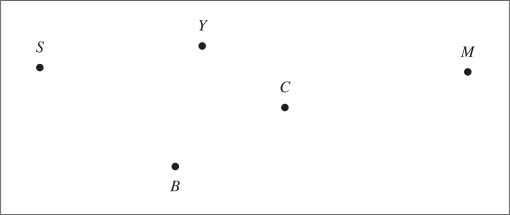
Networks, STD1 N1 2022 HSC 20

The table below shows the distances, in kilometres, between a number of towns.
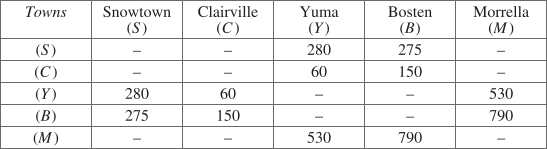
 

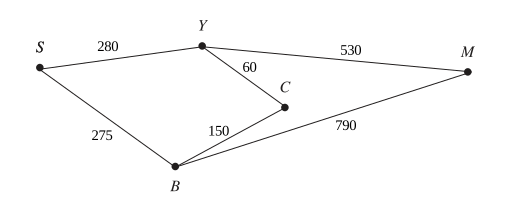
  1. Using the vertices given, draw a weighted network diagram to represent the information shown in the table.  (2 marks)


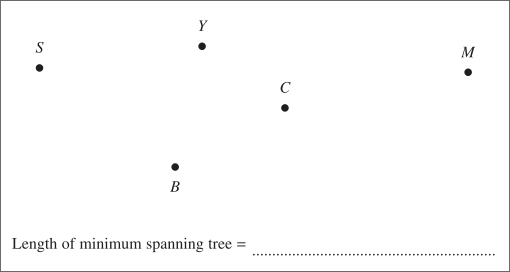
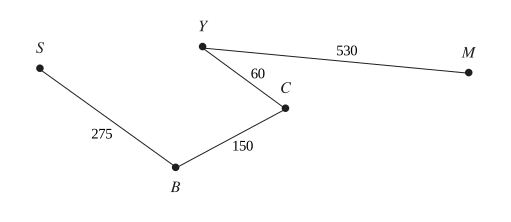
  2. A tourist wishes to visit each town.
  3. Draw the minimum spanning tree which will allow for this AND determine its length.  (3 marks)
     

    --- 0 WORK AREA LINES (style=lined) ---
Show Answers Only
  1.  
     
     
  2.   
     
  3. `1015\ text{km}`
Show Worked Solution

a. 

b.   `text{Using Prim’s algorithm (starting at}\ Y):`

`text{1st edge:}\ YC`

`text{2nd edge:}\ CB`

`text{3rd edge:}\ SB`

`text{4th edge:}\ YM`

`text{Length of minimum spanning tree}`

`=275 + 150+60+530`

`=1015\ text{km}`

Filed Under: Basic Concepts, Minimum Spanning Trees, Network Concepts (Std1-2027), Spanning Trees (Std1-2027) Tagged With: Band 3, Band 4, smc-1136-10-Table to Network, smc-1138-20-Distance, smc-1138-40-Draw Tree, smc-6526-10-Table to Network, smc-6528-20-Distance, smc-6528-40-Draw Tree, std2-std1-common

Probability, STD1 S2 2022 HSC 17

Each number from 1 to 30 is written on a separate card. The 30 cards are shuffled. A game is played where one of these cards is selected at random. Each card is equally likely to be selected.

Ezra is playing the game, and wins if the card selected shows an odd number between 20 and 30.

  1. List the numbers which would result in Ezra winning the game.  (1 mark)

    --- 1 WORK AREA LINES (style=lined) ---

  2. What is the probability that Ezra does NOT win the game?  (2 marks)

    --- 4 WORK AREA LINES (style=lined) ---

Show Answers Only
  1. `21, 23, 25, 27, 29`
  2. `Ptext{(not win)} = 5/6`
Show Worked Solution

a.   `21, 23, 25, 27, 29`
 

b.    `Ptext{(not win)}` `=1-Ptext{(win)}`
    `=1-5/30`
    `=25/30`
    `=5/6`


♦ Mean mark 51%.

Filed Under: Probability, Single and Multi-Stage Events (Std 1) Tagged With: Band 3, Band 5, num-title-ct-core, num-title-qs-hsc, smc-1135-05-Simple Probability, smc-1135-30-P(E) = 1 - P(not E), smc-4225-15-Single-stage events, smc-4225-20-Complementary events

BIOLOGY, M5 2019 HSC 27

Yeast is a single-celled fungus that can reproduce by budding.

  1. What type of reproduction is budding?   (1 mark)

    --- 2 WORK AREA LINES (style=lined) ---

  2. Outline a procedure that could be used to test the effect of temperature on reproduction in yeast.   (4 marks)

    --- 8 WORK AREA LINES (style=lined) ---

Show Answers Only

a.   Asexual.

b.   Steps of procedure:

  1. Prepare 4 water baths of 20, 30, 40 and 50 degrees Celsius.
  2. Add 10mL of yeast suspension in 12 different test tubes.
  3. Place 3 test tubes into each of the 4 water baths.
  4. Incubate for 3 hours.
  5. Take a drop from each test tube and inspect under a microscope using a mm grid and recording yeast counts for each.
  6. Compare the number of cells present at each temperature to see which temperature is most optimal for yeast reproduction.
Show Worked Solution

a.   Asexual.

b.   Steps of procedure:

  1. Prepare 4 water baths of 20, 30, 40 and 50 degrees Celsius.
  2. Add 10mL of yeast suspension in 12 different test tubes.
  3. Place 3 test tubes into each of the 4 water baths.
  4. Incubate for 3 hours.
  5. Take a drop from each test tube and inspect under a microscope using a mm grid and recording yeast counts for each.
  6. Compare the number of cells present at each temperature to see which temperature is most optimal for yeast reproduction.

♦♦ Mean mark (b) 45%.

Filed Under: Reproduction Tagged With: Band 3, Band 5, smc-3647-35-Fungi, smc-3647-40-Sexual vs Asexual

Measurement, STD1 M5 2022 HSC 11

The floor plan of a home unit has been drawn to scale.


  1. How many doors are shown on the plan?  (1 mark)

    --- 1 WORK AREA LINES (style=lined) ---

  2. What is the total floor area of the home unit in square metres?  (2 marks)

    --- 4 WORK AREA LINES (style=lined) ---

Show Answers Only
  1. `5`
  2. `text{55.5 m²}`
Show Worked Solution

a.    `5`

b.   `text{Conversion: 1000 mm = 1 metre}`

`text{Calculate area by splitting into 2 rectangles}`

`text{Area}`  `=  5.5 × 5 + (4.5 +2.5) xx 4`  
   `=  55.5\ text{m²}`  

♦♦ Mean mark part (b) 26%.

Filed Under: M5 Scale Drawings (Y12) Tagged With: Band 3, Band 5, smc-1105-10-Floor Plans

Algebra, STD1 A2 2022 HSC 6 MC

A water tank holds 6000 litres when full.

The tank is full when water starts to flow out of it at a constant rate of 3 litres per minute until the tank is empty.

Which expression represents the volume (`V` litres) of water in the tank after `t` minutes?

  1. `V=6000-3t`
  2. `V=6000 t-3`
  3. `V=3-6000 t`
  4. `V=3t-6000`
Show Answers Only

`A`

Show Worked Solution

`text{When}\ \ t=0,  \ V=6000-0 xx 3 =6000`
 
`text{When}\ \ t=1,  \ V=6000-1 xx 3 =5997`

`vdots`

`text{After}\ t\ text{minutes}, \ V=6000-t xx 3 =6000-3t`

`=> A`

Filed Under: Applications of Linear Relationships (Std1-2027), Applications: Currency, Fuel and Other Problems (Std 1) Tagged With: Band 3, smc-1119-30-Other Linear Applications, smc-6513-30-Other Linear Applications

Calculus, EXT1 C3 2022 HSC 12a

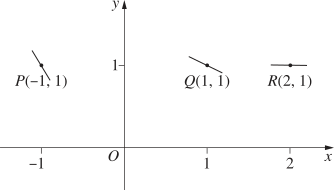
A direction field is to be drawn for the differential equation

`(dy)/(dx)=(x-2y)/(x^(2)+y^(2)). `

On the diagram, clearly draw the correct slopes of the direction field at the points `P, Q` and `R`.  (2 marks)


--- 0 WORK AREA LINES (style=lined) ---
Show Answers Only

Show Worked Solution

`text{At (–1, 1):}\ \ dy/dx=(-1-2)/(1+1)=-3/2`

`text{At (1, 1):}\ \ dy/dx=(1-2)/(1+1)=-1/2`

`text{At (2, 1):}\ \ dy/dx=(2-2)/(4+1)=0`
 

Filed Under: Equations and Slope Fields, Euler, Pseudocode and Slope Fields Tagged With: Band 3, smc-1183-20-Slope fields, smc-1197-10-Slope Fields

Calculus, EXT2 C1 2022 HSC 14b

Let  `J_(n)=int_(0)^(1)x^(n)e^(-x)\ dx`, where "n" is a non-negative integer.

  1. Show that  `J_(0)=1-(1)/(e)`.  (1  mark)

    --- 2 WORK AREA LINES (style=lined) ---

  2. Show that  `J_(n) <= (1)/(n+1)`.  (2 marks)

    --- 3 WORK AREA LINES (style=lined) ---

  3. Show that  `J_(n)=nJ_(n-1)-(1)/(e)`.  (2 marks)

    --- 4 WORK AREA LINES (style=lined) ---

  4. Using parts (i) and (iii), show by mathematical induction, or otherwise, that for all `n >= 1`,
  5.        `J_(n)=n!-(n!)/(e)sum_(r=0)^(n)(1)/(r!)`    (2 marks)

    --- 6 WORK AREA LINES (style=lined) ---

  6. Using parts (ii) and (iv) prove that  `e=lim_(n rarr oo)sum_(r=0)^(n)(1)/(r!)`.  (1  mark)

    --- 5 WORK AREA LINES (style=lined) ---

Show Answers Only
  1. `text{Proof (See Worked Solutions)}`
  2. `text{Proof (See Worked Solutions)}`
  3. `text{Proof (See Worked Solutions)}`
  4. `text{Proof (See Worked Solutions)}`
  5. `text{Proof (See Worked Solutions)}`
Show Worked Solution
i.    `J_0` `=int_0^1 e^(-x)\ dx`
    `=[-e^(-x)]_0^1`
    `=-e^(-1)+1`
    `=1-1/e`


Mean mark (i) 93%.

ii.  `text{Show}\ \ J_n<=1/(n+1)`

`text{Note:}\ e^(-x)<1\ \ text{for}\ \ x in [0,1]`

`J_n` `=int_0^1 x^n e^(-x)\ dx`  
  `leq int_0^1 x^n \ dx`  
  `leq 1/(n+1)[x^(n+1)]_0^1`  
  `leq 1/(n+1)(1^(n+1)-0)`  
  `leq 1/(n+1)\ \ text{… as required}`  


♦♦ Mean mark (ii) 28%.
 

iii.  `text{Show}\ \ J_n=nJ_(n-1)-1/e`

`u` `=x^n` `v′` `=e^(-x)`
`u′` `=nx^(n-1)` `v` `=-e^(-x)`
`J_n` `=[-x^n * e^(-x)]_0^1-int_0^1 nx^(n-1)*-e^(-x)\ dx`  
  `=(-1^n * e^(-1)+0^n e^0)+nint_0^1 x^(n-1)*e^(-x)\ dx`  
  `=nJ_(n-1)-1/e`  

 
iv.
   `text{Prove}\ \ J_(n)=n!-(n!)/(e)sum_(r=0)^(n)(1)/(r!)\ \ text{for}\ \ n >= 0`

`text{If}\ \ n=0:`

`text{LHS} = 1-1/e\ \ text{(see part (i))}`

`text{RHS} = 0!-0!/e (1/(0!)) = 1-1/e(1)=\ text{LHS}`

`:.\ text{True for}\ \ n=0.`
 

`text{Assume true for}\ \ n=k:`

`J_(k)=k!-(k!)/(e)sum_(r=0)^(k)(1)/(r!)`


♦ Mean mark (iv) 50%.

`text{Prove true for}\ \ n=k+1:`

`text{i.e.}\ \ J_(k+1)=(k+1)!-((k+1!))/(e)sum_(r=0)^(k+1)(1)/(r!)`

`J_(k+1)` `=(k+1)J_k-1/e\ \ text{(using part (iii))}`  
  `=(k+1)(k!-(k!)/(e)sum_(r=0)^(k)(1)/(r!))-1/e`  
  `=(k+1)!-((k+1)!)/(e)sum_(r=0)^(k)(1)/(r!)-1/e xx ((k+1)!)/((k+1)!)`  
  `=(k+1)!-((k+1)!)/e(\ sum_(\ r=0)^(k)(1)/(r!)+1/((k+1)!))`  
  `=(k+1)!-((k+1)!)/e(\ sum_(\ r=0)^(k+1)(1)/(r!))`  

 
`=>\ text{True for}\ \ n=k+1`

`:.\ text{S}text{ince true for}\ n=1,\ text{by PMI, true for integers}\ n>=1`
 

v.   `0<=J_n<= 1/(n+1)\ \ \ text{(part (ii))}`

`lim_(n->oo) 1/(n+1)=0\ \ => \ lim_(n->oo) J_n=0`

  
`text{Using part (iv):}`

`J_n/(n!)` `=1-1/e sum_(r=0)^(n)(1)/(r!)`  
`1/e sum_(r=0)^(n)(1)/(r!)` `=1-J_n/(n!)`  
`sum_(r=0)^(n)(1)/(r!)` `=e-(eJ_n)/(n!)`  
`lim_(n->oo)(\ sum_(\ r=0)^(n)(1)/(r!))`  `=lim_(n->oo)(e-(eJ_n)/(n!))`  
  `=e-0`  
  `=e`  

♦♦ Mean mark (v) 34%.

Filed Under: Induction, P2 Induction (Ext2), Recurrence Relations Tagged With: Band 2, Band 3, Band 5, smc-1044-60-Recursive, smc-1044-68-Sigma Notation, smc-1054-30-Logs/Exp, smc-5115-60-Recursive, smc-5115-68-Sigma notation

BIOLOGY, M5 2019 HSC 14 MC

The following DNA base sequence is used to code for a sequence of four amino acids.

`text{CGC  ATC  ATG  CTA}`

Which of the following correctly represents the anticodons on the transfer RNA during synthesis of this string of amino acids?

  1. `text{GCG  UAG  UAC  GAU}`
  2. `text{CGC  AUC  AUG  CUA}`
  3. `text{CGC  ATC  ATG  CTA}`
  4. `text{GCG  TAG  TAC  GAT}`
Show Answers Only

`B` or `A`

Show Worked Solution

By Elimination:

  • RNA has Uracil (U) in replace of Thymine (T) (eliminate C and D).
  • The DNA segment above must be copied into mRNA with complementary bases (with U replacing T), then anticodons on tRNA have complementary bases again. Therefore the tRNA associated with he DNA segment above will be the same with U instead of T.

`=>B`

*Note: `A` also considered an acceptable answer due to confusion as to whether the segment above was DNA or RNA.

Filed Under: DNA and Polypeptide Synthesis Tagged With: Band 3, smc-3650-11-RNA, smc-3650-20-Translation

CHEMISTRY, M7 2019 HSC 23

The following apparatus was used in an experiment to determine the molar enthalpy of combustion of ethanol.
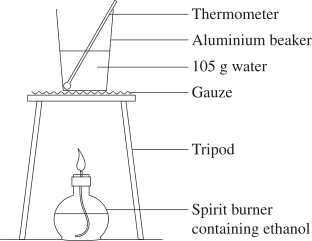


  1. Calculate the experimental molar enthalpy of combustion `(Delta_(c) H)` of ethanol when 0.370 g ethanol was used to raise the water temperature from 18.5°C to 30.0°C.   (4 marks)

    --- 6 WORK AREA LINES (style=lined) ---

  2. Upon replication, the molar enthalpy of combustion obtained in the experiment was consistently much lower than the accepted value.
  3. Explain ONE change that could be made to the experiment that would improve the accuracy of the obtained value.   (2 marks)

    --- 5 WORK AREA LINES (style=lined) ---

Show Answers Only

a.  `-628\ text{kJ mol}^(-1)`

b.   Improvement to experiment accuracy (one of many possible answers):

  • The molar enthalpy of combustion measured in the experiment was not very accurate due to heat being lost to the surroundings.
  • To improve the accuracy, it would be helpful to move the spirit burner closer to the beaker to reduce heat loss.
Show Worked Solution
a.    `text{n(ethanol)}` `= text{m}/text{MM}`
    `=0.370/46.068`
    `=0.008032\ text{mol}`

 
`q=mC DeltaT = 105\ text{g} xx 4.18\ text{J g}^(-1)\ text{K}^(-1) xx (30-18.5)\ text{K} = 5047.35\ text{J}`

`(Delta_(c) H)` `=-q/n`  
  `=- 5047.35/0.008032`  
  `=-628\ 405\ text{J mol}^(-1)`  
  `=-628\ text{kJ mol}^(-1)\ \ text{(3 sig fig)}`  


b.   Improvement to experiment accuracy (one of many possible answers):

  • The molar enthalpy of combustion measured in the experiment was not very accurate due to heat being lost to the surroundings.
  • To improve the accuracy, it would be helpful to move the spirit burner closer to the beaker to reduce heat loss.

Filed Under: Alcohols Tagged With: Band 3, Band 4, smc-3679-10-Combustion

CHEMISTRY, M7 2019 HSC 21

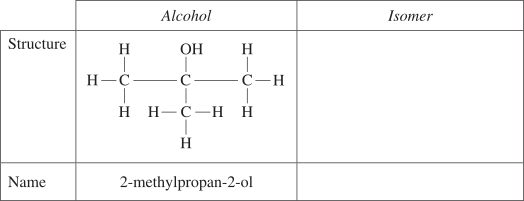
  1. The structural formula for 2-methylpropan-2-ol is shown in the table.
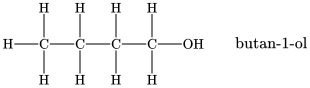
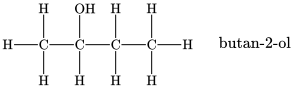
  2. Draw one structural isomer of this alcohol and state its name.   (2 marks)

    --- 0 WORK AREA LINES (style=blank) ---


  3. The structural formulae for two compounds are shown below.


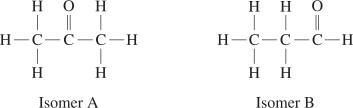
  1. Why are these two compounds classed as functional group isomers?   (2 marks)

    --- 4 WORK AREA LINES (style=lined) ---

  2. A chemical test is required to distinguish between the isomers in part (b).
  3. Identify a suitable test and explain the expected observations.   (3 marks)

    --- 6 WORK AREA LINES (style=lined) ---

Show Answers Only

a.   Successful answers should have one of the following:
 

b.  Functional Group isomers

  • Both isomers have the same number and type of atoms, but they have different arrangements of those atoms and therefore have different functional groups.
  • Isomer A has a ketone functional group, while isomer B has an aldehyde functional group.
     

c.   Tollens’ Test:

  • The Tollens’ test can be used to differentiate between Isomer A (a ketone) and Isomer B (an aldehyde).
  • Isomer B will be readily oxidised to a carboxylic acid, whereas isomer A will not.
  • As a result, Isomer B will reduce the silver-ions in Tollens’ reagent to form a silver mirror inside the test tube, while Isomer A will not react.
Show Worked Solution

a.   Successful answers should have one of the following:
b.  Functional Group isomers

  • Both isomers have the same number and type of atoms, but they have different arrangements of those atoms and therefore have different functional groups.
  • Isomer A has a ketone functional group, while isomer B has an aldehyde functional group. 

c.   Tollens’ Test:

  • The Tollens’ test can be used to differentiate between Isomer A (a ketone) and Isomer B (an aldehyde).
  • Isomer B will be readily oxidised to a carboxylic acid, whereas isomer A will not.
  • As a result, Isomer B will reduce the silver-ions in Tollens’ reagent to form a silver mirror inside the test tube, while Isomer A will not react.

♦♦ Mean mark (c) 39%.

Filed Under: Alcohols, Nomenclature, Reactions of Organic Acids and Bases Tagged With: Band 3, Band 4, Band 5, smc-3676-05-Isomers, smc-3679-40-Naming Alcohols, smc-3680-20-Formulae and Properties

  • « Previous Page
  • 1
  • …
  • 23
  • 24
  • 25
  • 26
  • 27
  • …
  • 57
  • Next Page »

Copyright © 2014–2025 SmarterEd.com.au · Log in