SmarterEd

Aussie Maths & Science Teachers: Save your time with SmarterEd

  • Login
  • Get Help
  • About

Quadratic, EXT1 2013 HSC 13b

The point  `P(2ap, ap^2)`  lies on the parabola  `x^2 = 4ay`.  The tangent to the parabola at  `P`  meets the  `x`-axis at  `T (ap, 0)`.  The normal to the tangent at  `P`  meets the  `y`-axis at  `N(0, 2a + ap^2)`.

2013 13b

The point  `G`  divides  `NT`  externally in the ratio  `2 :1`. 

  1. Show that the coordinates of  `G`  are  `(2ap, –2a – ap^2)`.    (2 marks)
  2. Show that  `G`  lies on a parabola with the same directrix and focal length as the original parabola.    (2 marks)


Show Answers Only
  1. `text(Proof)\ \ text{(See Worked Solutions)}`
  2. `text(Proof)\ \ text{(See Worked Solutions)}`
Show Worked Solution

(i)   `N (0, 2a + ap^2)`

`T (ap, 0)`

`G\ \ text(divides)\ \ NT\ \ text(externally in ratio)\ \ 2:1,`

`text(i.e.)\ \ (m:n = 2:–1)`

`:.\ G` `= ((nx_1 + mx_2)/(m + n), (ny_1 + my_2)/(m + n))`
  `= ((0 + 2ap)/(2\ – 1), (-2a\ – ap^2 + 0)/(2\ – 1))`
  `= (2ap, -2a\ – ap^2)\ text(… as required)`


♦♦ Mean mark 31%.
IMPORTANT: Remember that finding the locus involves eliminating the parameter. Expressing the locus in the form `x^2=4ay` is critical to finding its directrix and focal length.

(ii)  `x^2 = 4ay\ text(has focal length)\ \  a`

`text(and directrix)\ \ y = -a`

`text(Locus of)\ G`

`x = 2ap \ \ \ \  \ \ \ \ \ \ …\ (1)`

`y = -2a\ – ap^2\ \ \ \ \ \ …\ (2)`

`text{From (1)},\ \ \ \ p = x/(2a)`

`text(Substitute)\ \ p = x/(2a)\ \ text{into (2)}`

`y` `= -2a\ – a (x/(2a))^2`
`y` `= -2a\ – (ax^2)/(4a^2)`
`(x^2)/(4a)` `= -y\ – 2a`
`x^2` `= -4a (y + 2a)`


`text(Focal length) = a`

`text(Vertex at)\ (0, –2a)`

`text(Directrix)\ \ \ y = -2a + a = -a`


`:.\ text(Locus of)\ G\ text(has same focal length and)`

`text(directrix as)\ \ x^2 = 4ay.`

Filed Under: 6. Linear Functions EXT1, 9. Quadratics and the Parabola EXT1 Tagged With: Band 3, Band 5

Trigonometry, EXT1 T3 2013 HSC 12a


  1. Write  `sqrt3cos x - sin x`  in the form  `2 cos (x + alpha)`, where  `0 < alpha < pi/2`.   (1 mark)

    --- 6 WORK AREA LINES (style=lined) ---

  2. Hence, or otherwise, solve  `sqrt3 cos x = 1 + sin x`,  where  `0 < x < 2pi`.     (2 marks)

    --- 6 WORK AREA LINES (style=lined) ---

Show Answers Only
  1. `2cos (x + pi/6)`
  2. `pi/6,\ (3pi)/2`
Show Worked Solution

i.  `text(Write)\ sqrt3 cosx\ – sinx\ text(in form)`

`2cos (x + alpha),\ \ \ 0 < alpha < pi/2`

`2 (cosx cos alpha\ – sinx sin alpha)` `= sqrt 3 cosx\ – sinx`
`cosx cos alpha\ – sinx sin alpha` `= sqrt3/2 cos x\ – 1/2 sinx`
`=> cos alpha` `= sqrt3/2`
`=> sin alpha` `= 1/2`
`alpha` `= pi/6`

 
`:.\ 2cos (x + pi/6) = sqrt3 cosx\ – sinx`
 

ii.  `text(Solve)\ sqrt3 cosx = 1 + sinx,\ \ \ 0 < x < 2pi`

`sqrt3 cosx\ – sinx` `= 1`
`2 cos (x + pi/6)` `= 1\ \ \ text{(from part (i))}`
`cos (x + pi/6)` `= 1/2`
`cos(pi/3)` `=1/2`

 
`text(S)text(ince cos is positive in)\  1^text(st) // 4^text(th)\ text(quadrants)`

`x + pi/6` `= pi/3,\ 2pi\ – pi/3\ \ \ \ \ (0 < x < 2pi)`
`:.\ x` `= pi/6,\ (3pi)/2`

Filed Under: 5. Trig Ratios EXT1, Auxiliary Angles (Ext1) Tagged With: Band 3, Band 4, smc-1075-20-Rcos

Calculus, EXT1 C2 2013 HSC 11g

Differentiate  `x^2 sin^(–1) 5x`.   (2 marks)

Show Answers Only

`(5x^2)/sqrt(1\ – 25x^2) + 2x sin^(-1) 5x`

Show Worked Solution
`y` `= x^2 sin^(-1) 5x`
`text(Using the product rule)`
`(dy)/(dx)` `= x^2 xx 1/sqrt(1\ – (5x)^2) xx d/(dx)(5x) + 2x sin^(-1) 5x`
  `= (5x^2)/sqrt(1\ – 25x^2) + 2x sin^(-1) 5x`

Filed Under: 8. Differentiation and 1st Principles EXT1, Inverse Functions Calculus (Ext1), Inverse Trig Functions EXT1 Tagged With: Band 3, smc-1037-10-Sin/Cos Differentiation

Statistics, EXT1 S1 2013 HSC 11c

An examination has 10 multiple-choice questions, each with 4 options. In each question, only one option is correct. For each question a student chooses one option at random.

Write an expression for the probability that the student chooses the correct option for exactly 7 questions.   (2 marks)

Show Answers Only

`\ ^10C_7 (1/4)^7 (3/4)^3`

Show Worked Solution
`P text{(Correct)}` `= 1/4`
`P text{(Incorrect)}` `= 3/4`

 
`:. P text{(exactly 7 correct)} =\ ^10C_7 (1/4)^7 (3/4)^3`

Filed Under: Binomial Probability (Ext1), Binomial Probability EXT1 Tagged With: Band 3, smc-1084-10-General Case

Functions, EXT1 F2 2013 HSC 11a

The polynomial equation  `2x^3- 3x^2- 11x + 7 = 0`  has roots  `alpha`,  `beta`  and  `gamma`. 

Find  `alpha beta gamma`.   (1 mark)

Show Answers Only

`-7/2`

Show Worked Solution

`P(x) = 2x^3- 3x^2- 11x + 7 = 0`

`alpha beta gamma = -d/a = -7/2`

Filed Under: Roots, Remainders and Factors, Sum, Products and Multiplicity of Roots (Ext1) Tagged With: Band 3, smc-1205-10-Sum and Product

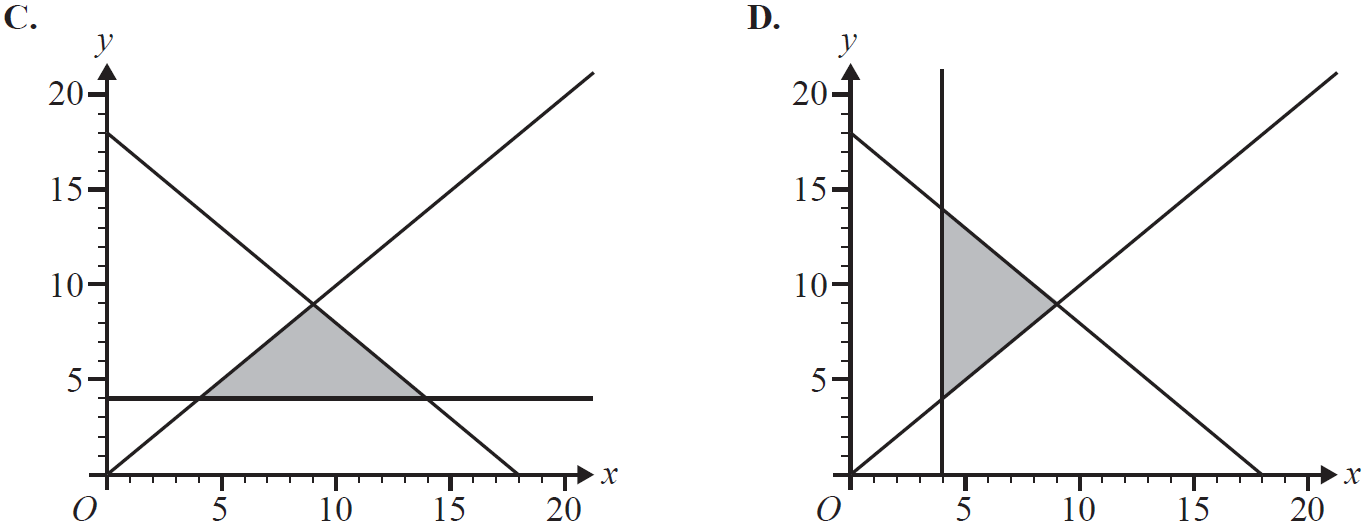
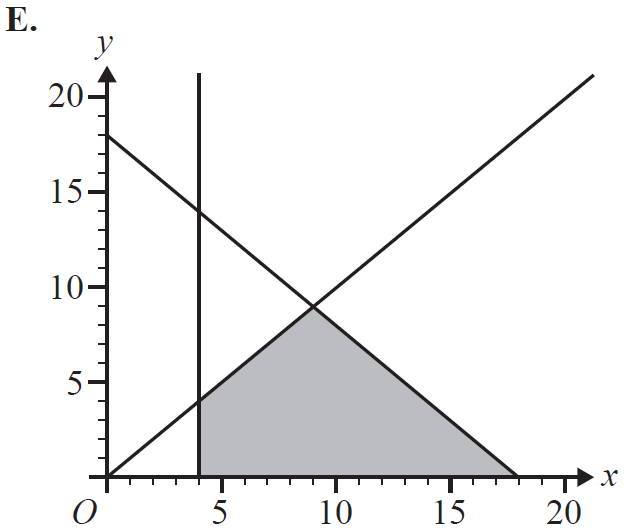
Inverse Functions, EXT1 2013 HSC 2 MC

The diagram shows the graph  `y = f(x)`.
 

Which diagram shows the graph  `y = f^(-1) (x)`?
 

Show Answers Only

`D`

Show Worked Solution


`f^(-1) (x)\ text(is the reflection of)\ \ f(x)\ \ text(in the line)\ y = x`

`=>  D`

Filed Under: Other Inverse Functions EXT1 Tagged With: Band 3, page-break-before-question

Plane Geometry, EXT1 2010 HSC 5c

In the diagram,  `ST`  is tangent to both the circles at  `A`.

The points  `B`  and  `C`  are on the larger circle, and the line  `BC`  is tangent to the smaller circle at  `D`. The line  `AB`  intersects the smaller circle at  `X`.


Plane Geometry, EXT1 2010 HSC 5c

Copy or trace the diagram into your writing booklet 

  1. Explain why  `/_AXD = /_ABD + /_XDB.`   (1 mark)
  2. Explain why  `/_AXD = /_TAC + /_CAD.`   (1 mark)
  3. Hence show that  `AD`  bisects  `/_BAC`.    (2 marks)
Show Answers Only
  1. `text(Proof)\ \ text{(See Worked Solutions)}`
  2. `text(Proof)\ \ text{(See Worked Solutions)}`
  3. `text(Proof)\ \ text{(See Worked Solutions)}`
Show Worked Solution
(i)    Plane Geometry, EXT1 2010 HSC 5c Answer
`/_ AXD = /_ABD + /_XDB`
`text{(exterior angle of}\ Delta BXD text{)}`


♦ Mean mark 47%
(ii)    `/_AXD` `= /_TAD \ \ text{(angle in alternate segment)}`
    `= /_TAC + /_CAD\ \ text(… as required)`


(iii)  `text(Show)\ \ /_XAD = /_CAD`

`/_ABD + /_XDB` `=/_TAC + /_CAD\ \ text{(} text(from part)\ text{(i)} text(,)\ text{(ii)} text{)}`


`text(S)text(ince)\ /_TAC= /_ABD\ text{(angle in alternate segment)}`

♦♦ Mean mark 22%
IMPORTANT: Recognising that angles in the alternate segment are equal is an examiner favourite. LOOK FOR IT!
`=>/_XDB` `=/_CAD`
`/_XDB` `= /_XAD\ text{(angle in alternate segment)}`
`:. /_XAD` `= /_CAD`


`:.\ AD\ \ text(bisects)\ /_BAC.`

Filed Under: 2. Plane Geometry EXT1 Tagged With: Band 3, Band 5, Band 6

Trig Ratios, EXT1 2010 HSC 5a

A boat is sailing due north from a point  `A`  towards a point  `P`  on the shore line.

The shore line runs from west to east.

In the diagram,  `T`  represents a tree on a cliff vertically above  `P`, and  `L`  represents a landmark on the shore. The distance  `PL`  is 1 km.

From  `A`  the point  `L`  is on a bearing of 020°, and the angle of elevation to  `T`  is 3°.

After sailing for some time the boat reaches a point  `B`, from which the angle of elevation to  `T`  is 30°.
 

5a
 

  1. Show that 
     
    `qquad BP = (sqrt3 tan 3°)/(tan20°)`.   (3 marks) 
     
  2. Find the distance  `AB`. Give your answer to 1 decimal place.   (1 mark)
Show Answers Only
  1. `text(Proof)\ \ text{(See Worked Solutions)}`
  2. `2.5\ text(km)\ \ text{(to 1 d.p.)}`
Show Worked Solution

(i)   `text(Show)\ \ BP = (sqrt3 tan 3°)/(tan 20°)` 

`text(In)\ Delta ATP`
`tan 3°` `= (TP)/(AP)`
`=> AP` `= (TP)/(tan 3)`

 
`text(In)\ Delta APL`

`tan 20°` `= 1/(AP)`
`=> AP` `= 1/tan 20`


`:. (TP)/(tan3)` `= 1/(tan20)`
`TP` `= (tan3°)/(tan20°)\ \ \ text(…)\ text{(} text(1)text{)}`


`text(In)\ \ Delta BTP`

`tan 30°` `= (TP)/(BP)`
`1/sqrt3` `= (TP)/(BP)`
`BP` `= sqrt3 xx TP\ \ \ \ \ text{(using (1) above)}`
  `= (sqrt3 tan3°)/(tan20°)\ \ \ text(… as required)`


(ii)    `AB` `= AP\ – BP`
  `AP` `= 1/(tan20°)\ \ \ text{(} text(from part)\ text{(i)} text{)}`
`:.\ AB` `= 1/(tan 20°)\ – (sqrt3 tan3°)/(tan20°)`
  `= (1\ – sqrt3 tan 3)/(tan20°)`
  `= 2.4980…`
  `= 2.5\ text(km)\ text{(to 1 d.p.)`

Filed Under: 5. Trig Ratios EXT1 Tagged With: Band 3, Band 4, page-break-before-solution

Mechanics, EXT2* M1 2010 HSC 4a

A particle is moving in simple harmonic motion along the `x`-axis. 

Its velocity `v`, at `x`, is given by  `v^2 = 24 − 8x − 2x^2`. 

  1. Find all values of `x` for which the particle is at rest.   (1 mark)

    --- 4 WORK AREA LINES (style=lined) ---
  2. Find an expression for the acceleration of the particle, in terms of `x`.   (1 mark)

    --- 2 WORK AREA LINES (style=lined) ---

  3. Find the maximum speed of the particle.    (2 marks)

    --- 6 WORK AREA LINES (style=lined) ---

Show Answers Only
  1. `x = –6\ \ text(or)\ \ 2`
  2. `-4\ – 2x`
  3. `4 sqrt 2`
Show Worked Solution
(i)    `v^2 = 24\ – 8x\ – 2x^2`

`text(Find)\ \ x\ \ text(when)\ \ v=0`

`24 – 8x – 2x^2` `= 0`
`x^2 + 4x – 12` `= 0`
`(x + 6)(x – 2)` `= 0`
`x= -6\ \ text(or)\ \ 2`


`:.\ text(Particle at rest when)\ \ x = –6\ \ text(or)\ \ 2`


(ii)    `ddot x` `= d/(dx) (1/2 v^2)`
    `= d/(dx) (12 – 4x – x^2)`
    `= -4 – 2x`


(iii)   `text(Solution 1)`

`text(Max speed when)\ \ ddot x = 0`

`-4 – 2x` `= 0`
`2x` `= -4`
`x` `= -2`

`text(At)\ \ x = -2`

MARKER’S COMMENT: While most students found `x=-2` correctly, too many made errors substituting this back in or failed to finish the answer by taking the square root. BE CAREFUL! .
`v^2` `= 24 – 8(–2) – 2(–2)^2`
  `= 24 + 16 – 8`
  `= 32`
`v` `= +- sqrt32`
  `= +- 4 sqrt2`

`:.\ text(Maximum speed is)\ \ 4 sqrt2`


`text(Alternate Answer)`

`text(Maximum speed occurs when)`

`x = (-6+2)/2 = –2`

`text(At)\ \ x = –2`

`v^2` `= 32\ \ \ text{(see working above)}`
`v` `= +- 4 sqrt 2`


`:.\ text(Maximum speed is)\ 4sqrt2`

Filed Under: Simple Harmonic Motion, Simple Harmonic Motion EXT1 Tagged With: Band 3, Band 4, smc-1059-30-At Rest, smc-1059-31-Max Speed

Inverse Functions, EXT1 2010 HSC 3b

Let  `f(x) = e^(-x^2)`.  The diagram shows the graph  `y = f(x)`.
 

 Inverse Functions, EXT1 2010 HSC 3b
 

  1. The graph has two points of inflection.  
  2. Find the  `x`  coordinates of these points.   (3 marks)
  3.  
  4. Explain why the domain of  `f(x)`  must be restricted if  `f(x)`  is to have an inverse function.    (1 mark)
  5. Find a formula for  `f^(-1) (x)`  if the domain of  `f(x)`  is restricted to  `x ≥ 0`.   (2 marks)
  6. State the domain of  `f^(-1) (x)`.    (1 mark)
  7. Sketch the curve  `y = f^(-1) (x)`.    (1 mark)
  8. (1)   Show that there is a solution to the equation  `x = e^(-x^2)`  between  `x = 0.6`  and  `x = 0.7`.   (1 mark)
  9. (2)   By halving the interval, find the solution correct to one decimal place.   (1 mark)


Show Answers Only
  1. `x = +- 1/sqrt2` 
  2.  
  3. `text(There can only be 1 value of)\ y`
  4. `text(for each value of)\ x.`
  5.  
  6. `f^(-1)x = sqrt(ln(1/x))`
     
  7. `0 <= x <= 1`
  8.  
  9. Inverse Functions, EXT1 2010 HSC 3b Answer
  10. (1)   `text(Proof)\ \ text{(See Worked Solutions)}`
  11. (2)   `0.7\ text{(1 d.p.)}`
Show Worked Solution
(i)    `y` `= e^(-x^2)`
  `dy/dx` `= -2x * e^(-x^2)`
  `(d^2y)/(dx^2)` `= -2x (-2x * e^(-x^2)) + e ^(-x^2) (-2)`
    `= 4x^2 e^(-x^2)\ – 2e^(-x^2)`
    `= 2e^(-x^2) (2x^2\ – 1)`


`text(P.I. when)\ \ (d^2y)/(dx^2) = 0`

`2e^(-x^2) (2x^2\ – 1)` `= 0` 
 `2x^2\ – 1` `= 0` 
 `x^2` `= 1/2`
 `x` `= +- 1/sqrt2` 
COMMENT: It is also valid to show that `f(x)` is an even function and if a P.I. exists at `x=a`, there must be another P.I. at `x=–a`.
`text(When)\ \ ` `x < 1/sqrt2,` `\ (d^2y)/(dx^2) < 0`
  `x > 1/sqrt2,` `\ (d^2y)/(dx^2) > 0`

`=>\ text(Change of concavity)`

`:.\ text(P.I. at)\ \ x = 1/sqrt2`

`text(When)\ \ ` `x < – 1/sqrt2,` `\ (d^2y)/(dx^2) > 0`
  `x > – 1/sqrt2,` `\ (d^2y)/(dx^2) < 0`

`=>\ text(Change of concavity)`

`:.\ text(P.I. at)\ \ x = – 1/sqrt2`


(ii)   `text(In)\ f(x), text(there are 2 values of)\ y\ text(for)`
  `text(each value of)\ x.`
  `:.\ text(The domain of)\ f(x)\ text(must be restricted)`
  `text(for)\ \ f^(-1) (x)\ text(to exist).`


(iii)   `y = e^(-x^2)`

`text(Inverse function can be written)` 

`x` `= e^(-y^2),\ \ \ x >= 0`
`lnx` `= ln e^(-y^2)`
`-y^2` `= lnx`
`y^2` `= -lnx`
  `=ln(1/x)`
`y` `= +- sqrt(ln (1/x))`


`text(Restricting)\ \ x>=0,\ \ =>y>=0`

`:.  f^(-1) (x)=sqrt(ln (1/x))`
 

♦ Parts (iv) and (v) were poorly answered with mean marks of 39% and 49% respectively.
(iv)   `f(0) = e^0 = 1`

`:.\ text(Range of)\ \ f(x)\ \ text(is)\ \ 0 < y <= 1`

`:.\ text(Domain of)\ \ f^(-1) (x)\ \ text(is)\ \ 0 < x <= 1`


(v) 

Inverse Functions, EXT1 2010 HSC 3b Answer


(vi)(1)  `x = e^(-x^2)`

`text(Let)\ g(x) = x\ – e^(-x^2)`

`g(0.6)` `=0.6\ – e^(-0.6^2)`
  `=0.6\ – 0.6977 < 0`
`g(0.7)` `=0.7\ – e^(-0.7^2)`
  `=0.7\ – 0.6126 > 0`
`=>g(x)\ text(changes sign)`


`:.\ g(x)\ \ text(has a root between  0.6  and  0.7)`

`:.\ x = e^(-x^2)\ \ text(has a solution between  0.6  and  0.7)`

♦ Mean mark 37%.
MARKER’S COMMENT: Better responses showed the change in sign between `g(0.65)` and `g(0.7)` as shown in the solution.


(vi)(2)   `g(0.65)` `=0.65\ – e^(-0.65^2)`
    `=0.65\ – 0.655 < 0`


`:.\ text(A solution lies between 0.65 and 0.7)`

`:.\ x = 0.7\ \ text{(1 d.p.)}`

Filed Under: 10. Geometrical Applications of Calculus EXT1, 12. Logs and Exponentials EXT1, Newton's Method etc... EXT1, Other Inverse Functions EXT1 Tagged With: Band 3, Band 4, Band 5, page-break-before-solution

Functions, EXT1 F2 2010 HSC 2c

Let  `P(x) = (x + 1)(x-3) Q(x) + ax + b`, 

where  `Q(x)`  is a polynomial and  `a`  and  `b`  are real numbers.

The polynomial  `P(x)`  has a factor of  `x-3`.

When  `P(x)`  is divided by  `x + 1`  the remainder is  `8`. 

  1. Find the values of  `a`  and  `b`.  (2 marks)

    --- 6 WORK AREA LINES (style=lined) ---

  2. Find the remainder when  `P(x)`  is divided by  `(x + 1)(x-3)`.     (1 mark)

    --- 2 WORK AREA LINES (style=lined) ---

Show Answers Only
  1. `a = -2,\ b = 6`
  2. ` -2x + 6`
Show Worked Solution

i.  `P(x) = (x+1)(x-3)Q(x) + ax + b`

`(x-3)\ \ text{is a factor   (given)}`

`:. P (3)` `= 0`
`3a + b` `= 0\ \ \ …\ text{(1)}`

 
`P(x) ÷ (x+1)=8\ \ \ text{(given)}`

`:.P(-1)` `= 8`
`-a + b` `= 8\ \ \ …\ text{(2)}`

 
`text{Subtract  (1) – (2)}`

`4a` `= -8`
`a` `= -2`

 
`text(Substitute)\ \ a = -2\ \ text{into (1)}`

`-6 + b` `= 0`
`b` `= 6`

 
`:. a= – 2, \ b=6` 
 

ii.  `P(x) -: (x + 1)(x-3)`

`= ((x+1)(x-3)Q(x)-2x + 6)/((x+1)(x-3))`

`= Q(x) + (-2x + 6)/((x+1)(x-3))`

 
`:.\ text(Remainder is)\ \ -2x + 6`

COMMENT: This question requires a fundamental understanding of the remainder theorem.

Filed Under: Polynomials, Remainder and Factor Theorems (Ext1), Roots, Remainders and Factors Tagged With: Band 3, Band 4, num-title-ct-patha, num-title-qs-hsc, smc-1031-10-Factor Theorem, smc-1031-20-Remainder Theorem, smc-4242-20-Remainder Theorem

Calculus, EXT1 C2 2010 HSC 1e

Use the substitution  `u = 1 - x`  to evaluate  `int_0^1 x sqrt(1 - x)\ dx`.   (3 marks)

--- 8 WORK AREA LINES (style=lined) ---

Show Answers Only

`4/15`

Show Worked Solution
`u = 1 – x` `\ \ \ \ \ => x = 1 – u`
`(du)/(dx) = -1` `\ \ \ \ \ => du = – dx`


`text(When)\ \ \ \ ` `x = 1,\ \ ` `u = 0`
  `x = 0,\ \ ` `u = 1`

 
`:. int_0^1 x sqrt(1 – x)\ dx`

`= – int_1^0 (1 – u) u^(1/2)\ du`

`= int_1^0 (u – 1) u^(1/2)\ du`

`= int_1^0 (u^(3/2) – u^(1/2))\ du`

`= [2/5 u^(5/2) – 2/3 u^(3/2)]_1^0`

`= [0 – (2/5 – 2/3)]`

`= – (6/15 – 10/15)`

`= 4/15`

Filed Under: 11. Integration EXT1, Integration By Substitution (Ext1) Tagged With: Band 3, smc-1036-10-Linear, smc-1036-50-Limits Invert

Functions, EXT1 F1 2010 HSC 1d

Solve  `3/(x+2) < 4`.   (3 marks)

--- 6 WORK AREA LINES (style=lined) ---

Show Answers Only

 `x < -2\ \ text(or)\ \ x > -5/4`

Show Worked Solution

`text(Solution 1)`

`3/(x + 2) < 4`

`text(Multiply b.s. by)\ \ (x + 2)^2`

`3(x + 2)` `< 4(x + 2)^2`
`3x + 6` `< 4 (x^2 + 4x + 4)`
`3x + 6` `< 4x^2 + 16x + 16`
`4x^2 + 13x + 10` `> 0`
`(4x + 5)(x + 2)` `> 0`

 
`text(LHS)\ = 0\ \ text(when)\ \ x = -5/4\ \ text(or)\ \ -2`

Algebra, EXT1 2010 HSC 1d Answer

`text(From graph)`

`x < -2\ \ text(or)\ \  x > -5/4`

 
`text(Alternate Solution)`

`text(If)\ \ x + 2 > 0\ \ \ \ text{(i.e.}\ \ x > –2 text{)}`

`3` `< 4(x + 2)`
`3` `< 4x + 8`
`4x` `> -5`
`x` `> -5/4`

 
`text(If)\ \ x + 2 < 0\ \ \ \ text{(i.e.}\ x < –2 text{)}`

`3` `> 4 (x + 2)`
`3` `> 4x + 8`
`4x` `< -5`
`x` `< -5/4`
`:. x` `< –2\ \ \ \ text{(satisfies both)}`

 
`:.\ x < –2\ \ text(or)\ \ x > –5/4`

Filed Under: 1. Basic Arithmetic and Algebra EXT1, Inequalities, Inequalities (Ext1) Tagged With: Band 3, num-title-ct-extension, num-title-qs-hsc, smc-1033-10-Algebraic Fractions, smc-4385-30-Fractions

Plane Geometry, EXT1 2011 HSC 4b

In the diagram, the vertices of  `Delta ABC`  lie on the circle with centre  `O`. The point  `D`  lies on  `BC`  such that  `Delta ABD`  is isosceles and  `/_ABC = x`.

Copy or trace the diagram into your writing booklet. 

  1. Explain why  `/_AOC = 2x`.    (1 mark)
  2. Prove that  `ACDO`  is a cyclic quadrilateral.    (2 marks)
  3. Let  `M`  be the midpoint of  `AC`  and  `P`  the centre of the circle through `A, C, D`  and  `O`. 
  4. Show that  `P, M`  and  `O`  are collinear.   (1 mark)
Show Answers Only
  1. `text(Angle at the centre of a circle is twice)`
  2. `text(angle of circumference on same arc)`
  3.  
  4. `text(Proof)\ \ text{(See Worked Solutions)}`
  5. `text(Proof)\ \ text{(See Worked Solutions)}`
Show Worked Solution
(i)

`/_AOC = 2x`

`text{(angles at circumference and}`

`text{centre on arc}\ AC text{)}`


♦ Mean mark 38%
STRATEGY: Proving part (ii) by showing opposite angles are supplementary also worked but was more time consuming.

(ii)  `text(Prove)\ ACDO\ text(is cyclic)`

`text(S)text(ince)\ Delta ADB\ text(is isosceles)`

`/_DAB = x\ \ \ text{(opposite equal sides in}\ Delta DBA text{)}`

`=> /_ADB` `= 180\ – 2x\ \ \ text{(angle sum of}\ Delta DAB text{)}`
`=> /_CDA` `= 2x\ \ \ text{(}CDB\ text{is a straight angle)}`


`text(S)text(ince chord)\ AC\ text(subtends)\ /_CDA = 2x`

`text(and)\ /_COA = 2x,`

`:.\ text(Quadrilateral)\ ACDO\ text(must be cyclic.)`


(iii)

 `text(Need to show)\ OM\ text(passes through)\ P,\ text(centre)`

♦♦♦ Mean mark 7%. 2nd hardest question in the 2011 paper!

`text(of circle through)\ ACDO.`

`AM` `= CM\ text{(} M\ text(is midpoint) text{)}`
`OC` `= OA\ text{(radii)}`

`OM\ text(is common)`

`:.\ Delta OAM -= Delta OCM\ \ \ text{(SSS)}`

`:. /_CMO = /_AMO\ \ \ ` `text{(corresponding angles of}`
  `\ \ text{congruent triangles)}`


`text(S)text(ince)\ ∠AMC\ text(is straight angle)`

`/_CMO = /_AMO = 90°`

`:.OM\ text(is perpendicular bisector)`

`text(of chord)\ AC.`

`:. OM\ text(passes through)\ P.`

`:.\ P, M,\ text(and)\ O\ text(are collinear.)`

Filed Under: 2. Plane Geometry EXT1 Tagged With: Band 3, Band 5, Band 6, page-break-before-solution

Geometry and Calculus, EXT1 2011 HSC 4a

Consider the function  `f(x) = e^(-x)\ - 2e^(-2x)`. 

  1. Find  `f prime (x)`.   (1 mark)
  2. The graph  `y = f(x)`  has one maximum turning point. 
  3. Find the coordinates of the maximum turning point.   (2 marks)
  4.  
  5. Evaluate  `f(ln2)`.   (1 mark)
  6. Describe the behaviour of  `f(x)`  as  `x -> oo`.   (1 mark)
  7. Find the  `y`-intercept of the graph  `y = f(x)`.   (1 mark)
  8. Sketch the graph  `y = f(x)`  showing the features from parts  (ii) - (v).
  9. You are not required to find any points of inflection.    (2 marks)
  10.  
  11.  
  12.  
  13.  
  14.  
  15.  
  16.  
Show Answers Only
  1. `-e^(-x) + 4e^(-2x)`
  2. `text(Max T.P. at)\ (ln4, 1/8)`
  3. `0`
  4. `text(As)\ x -> oo, f(x) -> 0`
  5. `-1`
  6.  
  7.  
  8.  
  9.  
  10.  
Show Worked Solution
(i)    `f(x)` `= e^(-x)\ – 2e^(-2x)`
  `f prime (x)` `= -e^(-x) + 4e^(-2x)`


(ii)   `text(T.P. when)\ f prime (x) = 0`

`-e^(-x) + 4e^(-2x) = 0`

`text(Let)\ e^(-x) = X`

`- X + 4X^2` `= 0`
`X (4X\ – 1)` `= 0`

`X = 0\ \ text(or)\ \ 1/4`

`text(If)\ \ e^(-x) = 0,\ \ \ text(No solution)`

`text(If)\ \ e^(-x) = 1/4`

`ln e^(-x)` `= ln (1/4)`
`-x` `= ln 4^(-1)`
  `= -ln 4`
`x` `= ln4`


ALGEBRA TIP: Note that `e^ln x=x` can often help calculations. This is easily proven by simply taking the `ln` of both sides of the equation.
`f″(x)` `= e^(-x)\ – 8e^(-2x)`
`f″(ln4)` `< 0 => text(MAX)`
`f (ln4)` `= e^(-ln4)\ – 2e^(-2ln4)`
  `= e^(ln(1/4))\ – 2 e^(ln(1/16))`
  `= 1/4\ – 2(1/16)`
  `= 1/8`

`:.\ text(Maximum T.P. at)\ \ (ln4, 1/8)`


(iii)   `f(ln2)` `= e^(-ln2)\ – 2e^(-2ln2)`
    `= e^(ln(1/2))\ – 2e^(ln(1/4))`
    `= 1/2\ – 2 xx 1/4`
    `= 0`


(iv)   `f(x)` `= e^(-x)\ – 2e^(-2x)`
    `= e^(-x) (1\ – 2e^(-x))`
  `text(As)\ x -> oo, \ e^(-x) ->0,\ f(x) -> 0`


(v)    `y text(-intercept at)\ \ f(0)`
`f(0)` `= e^0\ – 2e^0`
  `= -1`


(vi)

EXT1 2011 4a

Filed Under: 10. Geometrical Applications of Calculus EXT1, 12. Logs and Exponentials EXT1 Tagged With: Band 2, Band 3, Band 4

Quadratic, EXT1 2011 HSC 3b

The diagram shows two distinct points  `P(t, t^2)`  and  `Q(1\ - t, (1\ - t)^2)`  on the parabola  `y = x^2`.  The point  `R`  is the intersection of the tangents to the parabola at  `P`  and  `Q`. 


  1. Show that the equation of the tangent to the parabola at  `P`  is  `y = 2tx\ – t^2`.   (2 marks)
  2. Using part  `text{(i)}`, write down the equation of the tangent to the parabola at  `Q`.     (1 mark)
  3. Show that the tangents at  `P`  and  `Q`  intersect at
    `R (1/2, t\ - t^2)`.   (2 marks)
  4. Describe the locus of  `R`  as  `t`  varies, stating any restriction on the  `y`-coordinate.   (2 marks)


Show Answers Only
  1. `text(Proof)\ \ text{(See Worked Solutions)}`
  2. `y = 2 (1 -t)x\ – (1\ – t)^2`
  3. `text(Proof)\ \ text{(See Worked Solutions)}`
  4. `text(Locus of)\ R\ text(is vertical line)`
    `x = 1/2,\ y<1/4`
Show Worked Solution
(i)

`text(Show tangent at)\ P\ text(is)\ y = 2tx\ – t^2`

`y` `= x^2`
`dy/dx` `= 2x`

`x=t\ \ \ \ text(at)\ P`

`dy/dx = 2t`

`text(Find equation with)\ \ m = 2t\ \ text(through)\ \ P(t, t^2)`

`y\ – y_1` `= m(x\ – x_1)`
`y\ – t^2` `= 2t ( x\ – t)`
`y` `= 2tx\ – 2t^2 + t^2`
  `= 2tx\ – t^2\ text(… as required)`


(ii)  `text(T)text(angent at)\ Q\ text(has equation)`

MARKER’S COMMENT: Many students derived this equation rather than substituting the new parameter, costing them valuable time. This is a benefit of using the parametric approach.

`y = 2(1\ – t)x\ – (1\ – t)^2`


(iii)  `text(Need to show)\ R(1/2,\ t\ – t^2)`

`R\ text(is at intersection of tangents)`

`2tx\ – t^2` `= 2(1\ – t)x\ – (1\ – t)^2`
`2tx\ – t^2` `= 2x\ – 2tx\ – 1 + 2t\ – t^2`
`4tx\ – 2x` `= -1 + 2t\ – t^2 + t^2`
`2x(2t\ – 1)` `= 2t\ – 1`
`2x` `= 1`
`x` `= 1/2`

`text(Using)\ \ y = 2tx – t^2\ \ text(when)\ \ x = 1/2`

`y` `= 2t(1/2)\ – t^2`
  `= t\ – t^2`

`:.\ R(1/2, t\ – t^2)\ text(… as required)`


(iv)  `text(Locus of)\ R`

♦♦ Mean mark of 22%. 
MARKER’S COMMENT: Many students stated the locus as `y=t-t^2` rather than realising it had to be a straight line since `x=½`, and that `y=t-t^2` simply restricted the values of `y`.

`text(S)text(ince)\ x = 1/2\ text(is a constant)`

`R\ text(is a vertical line)`

`text(Now,)\ y = t\ – t^2 = t(1\ – t)`

`text(Graphically,)\ \ y\ \ text(has a maximum at)\ \ t = 1/2`

`text(Max)\ \ y = 1/2\ – (1/2)^2 = 1/4`

`=> y < 1/4\ \ text{(tangents can’t meet on parabola)}`

`:.\ text(Locus of)\ R\ text(is vertical line)\ x = 1/2,\ \ y<1/4`

Filed Under: 9. Quadratics and the Parabola EXT1 Tagged With: Band 2, Band 3, Band 4, Band 5, page-break-before-solution

Functions, EXT1 F2 2011 HSC 2a

Let  `P(x) = x^3-ax^2 + x`  be a polynomial, where  `a`  is a real number.

When  `P(x)`  is divided by  `x-3`  the remainder is  `12`.

Find the remainder when  `P(x)`  is divided by  `x + 1`.    (3 marks)

--- 7 WORK AREA LINES (style=lined) ---

Show Answers Only

`-4`

Show Worked Solution

`P(x) = x^3 – ax^2 + x`

`text(S)text(ince)\ \ P(x) -: (x – 3)\ \ text(has remainder 12,)`

`P(3) = 3^3-a xx 3^2 + 3` `=12`
`27-9a + 3` `= 12`
`9a` `= 18`
`a` `=2`

 
`:.\ P(x) = x^3-2x^2 + x`


`text(Remainder)\ \ P(x) -: (x + 1)\ \ text(is)\ \ P(–1)`

`P(-1)` `= (-1)^3-2(-1)^2-1`
  `= – 4`

Filed Under: Polynomials, Remainder and Factor Theorems (Ext1), Roots, Remainders and Factors Tagged With: Band 3, num-title-ct-patha, num-title-qs-hsc, smc-1031-20-Remainder Theorem, smc-4242-10-Factor Theorem, smc-4242-20-Remainder Theorem

Trigonometry, EXT1 T1 2011 HSC 1e

Find the exact value of  `cos^(-1)(-1/2)`.   (1 mark) 

Show Answers Only

 `(2pi)/3`

Show Worked Solution

`cos\ pi/3 = 1/2`

`text(S)text(ince cos is negative in 2nd)\ text(quadrant,)`

`cos^(-1)(-1/2)= pi-pi/3= (2pi)/3`

Filed Under: Inverse Trig Functions EXT1, T1 Inverse Trig Functions (Y11) Tagged With: Band 3, smc-1024-30-Equations and Exact Values

Calculus, EXT1 C2 2011 HSC 1d

Using the substitution  `u = sqrtx`, evaluate  `int_1^4 (e^(sqrtx))/(sqrtx)\ dx`.   (3 marks) 

--- 8 WORK AREA LINES (style=lined) ---

Show Answers Only

`2e (e – 1)`

Show Worked Solution
`u` `= sqrtx = x^(1/2)`
`(du)/(dx)` `= 1/2 x^(-1/2) = 1/(2 sqrtx)`
 `du` `= (dx)/(2sqrtx)`
`:.2du` `= (dx)/(sqrtx)`


`text(When)\ \ \ ` `x=4,\ \ ` `u = 2`
  `x = 1,` `\ x = 1`


`:. int_1^4 (e^(sqrtx))/(sqrtx)\ dx`
`= int_1^2 e^u xx 2\ du`
`= 2 [e^u]_1^2`
`= 2 [e^2 – e^1]`
`= 2e (e – 1)`

Filed Under: 11. Integration EXT1, Integration By Substitution (Ext1) Tagged With: Band 3, smc-1036-40-Logs and Exponentials

Trig Calculus, EXT1 2011 HSC 1b

Differentiate   `(sin^2 x)/x`  with respect to  `x`.   (2 marks)

Show Answers Only

 `(sinx (2x cosx\ – sinx))/(x^2)`

Show Worked Solution

`y = (sin^2 x)/x`

`u`  `= sin^2 x,\ \ \ \ \ ` `u prime = 2 sinx cosx`
`v`  `= x,`  `v prime = 1`


`dy/dx` `= (u prime v\ – uv prime)/(v^2)`
  `= (2sinxcosx * x – sin^2x * 1)/(x^2)`
  `= (sinx (2x cosx\ – sinx))/(x^2)`

Filed Under: 13. Trig Calc, Graphs and Circular Measure EXT1, 8. Differentiation and 1st Principles EXT1 Tagged With: Band 3

Linear Functions, EXT1 2011 HSC 1a

The point  `P`  divides the interval joining  `A(–1, –2)`  to  `B(9, 3)`  internally in the ratio  `4 : 1`. Find the coordinates of  `P`.   (2 marks)

Show Answers Only

 `(7, 2)`

Show Worked Solution

`A(–1,–2),\ \ \ B(9,3)`

`text(Internal division)\ \ 4:1\ \ text(at)\ \ P`

`P` `≡ ( (nx_1 + mx_2)/(m + n),\ (ny_1 + my_2)/(n + m) )`
  `≡ ( ((1 xx –1) + (4 xx 9))/(4 + 1),\ ((1 xx –2) + (4 xx 3))/(4 + 1))`
  `≡ (35/5, 10/5)`
  `≡ (7,2)`

Filed Under: 6. Linear Functions EXT1 Tagged With: Band 3

Mechanics, EXT2* M1 2012 HSC 13c

A particle is moving in a straight line according to the equation

`x = 5 + 6 cos 2t + 8 sin 2t`, 

where `x` is the displacement in metres and `t` is the time in seconds.

  1. Prove that the particle is moving in simple harmonic motion by showing that `x`  satisfies an equation of the form  `ddot x = -n^2 (x\ - c)`.  (2 marks)

    --- 6 WORK AREA LINES (style=lined) ---

  2. When is the displacement of the particle zero for the first time?    (3 marks)

    --- 8 WORK AREA LINES (style=lined) ---

Show Answers Only
  1. `text(Proof)\ \ text{(See Worked Solutions)}`
  2. `1.5\ text(seconds)\ text{(1 d.p.)}`
Show Worked Solution

i.  `text(Prove)\ ddot x = -n^2(x\ – c)`

`x` `= 5 + 6 cos 2t + 8 sin 2t`
`dot x` `= -12 sin 2t + 16 cos 2t`
`ddot x` `= – 24 cos 2t\ – 32 sin 2t`
  `= -4 (6 cos 2t + 8 sin 2t)`
  `= -2^2 (5 + 6 cos 2t + 8 sin 2t\ – 5)`
  `= -2^2 (x\ – 5)\ \ \ text(… as required)`


ii.  `text(Find)\ \ t\ \ text(when)\ \ x=0\ \ text(for 1st time:)`

♦ Mean mark 42%.
IMPORTANT: The critical insight required to solve `x=0` is to realise that the cosine of the difference between 2 angles, i.e. `cos (2t- theta)`, applies.
`5 + 6 cos 2t + 8 sin 2t` `= 0`
`6 cos 2t + 8 sin 2t` `= -5`
`6/10 cos 2t+ 8/10 sin 2t` `=-1/2`


 Calculus in the Physical World, EXT1 2012 HSC 13c Answer

`=>cos theta=6/10\ \ text(and)\ \ sin theta=8/10`
`cos 2t cos theta+sin 2t sin theta` `=- 1/2`
`cos(2t\ – theta)` `= – 1/2`

`text(S)text(ince)\ \ cos\ pi/3 = 1/2\ \ text(and)\ cos\ text(is negative)`

`text(in the 2nd and 3rd quadrants,)`

`=>2t\ – theta = pi\ – pi/3,\ pi + pi/3`


`text(We need the 1st time)\ \ x = 0`

`text(S)text(ince)\ \ cos theta` `= 6/10`
`theta` `= 0.9273…`


`:.\ 2t\ – 0.9273…` `= (2pi)/3`
`2t` `= (2pi)/3 + 0.9273…`
`t` `= 1/2 ((2pi)/3 + 0.9273…)`
  `= 1.5108…`
  `= 1.5\ text(seconds)\ text{(1 d.p.)}`

Filed Under: Simple Harmonic Motion, Simple Harmonic Motion EXT1 Tagged With: Band 3, Band 5, smc-1059-20-Prove/Identify SHM, smc-1059-40-Auxiliary Angles

Geometry and Calculus, EXT1 2012 HSC 13b

  1. Find the horizontal asymptote of the graph
     
    `qquad qquad y=(2x^2)/(x^2 + 9)`.   (1 mark)
  2. Without the use of calculus, sketch the graph 
     
    `qquad qquad y=(2x^2)/(x^2 + 9)`,
     
    showing the asymptote found in part (i).    (2 marks)
Show Answers Only
  1. `text(Horizontal asymptote at)\ y = 2`
    1. Geometry and Calculus, EXT1 2012 HSC 13b Answer
Show Worked Solution
(i)    `y` `= (2x^2)/(x^2 +9)`
    `= 2/(1 + 9/(x^2))`


`text(As)\ \ x -> oo,\ y ->2`

`text(As)\ \ x -> – oo,\ y -> 2`

`:.\ text(Horizontal asymptote at)\ y = 2`


(ii)    `text(At)\ \ x = 0,\ y = 0`

`f(x) = (2x^2)/(x^2 + 9) >= 0\ text(for all)\ x`

`f(–x) = (2(–x)^2)/((–x)^2 + 9) = (2x^2)/(x^2 + 9) = f(x)`

`text(S)text(ince)\ \ f(x) = f(–x) \ \ =>\ text(EVEN function)`

Geometry and Calculus, EXT1 2012 HSC 13b Answer

Filed Under: 10. Geometrical Applications of Calculus EXT1 Tagged With: Band 3, Band 4

Functions, EXT1 F1 2012 HSC 12b

Let  `f(x) = sqrt(4x-3)` 

  1.  Find the domain of  `f(x)`.   (1 mark)

    --- 2 WORK AREA LINES (style=lined) ---

  2.  Find an expression for the inverse function  `f^(-1) (x)`.    (2 marks)

    --- 4 WORK AREA LINES (style=lined) ---
  3.  Find the points where the graphs  `y = f(x)`  and  `y=x`  intersect.   (1 mark)

    --- 4 WORK AREA LINES (style=lined) ---

  4.  On the same set of axes, sketch the graphs  `y = f(x)`  and  `y = f^(-1) (x)`  showing the information found in part (iii).   (2 marks)

    --- 8 WORK AREA LINES (style=lined) ---

Show Answers Only
  1. `x >= 3/4`
  2. `f^(-1) (x) = 1/4 x^2 + 3/4,\ x >= 0`
  3. `(1,1),\ (3,3)`
  4.   
    1. Inverse Functions, EXT1 2012 HSC 12b Answer
Show Worked Solution

i.  `f(x) = sqrt(4x-3)`

`text(Domain exists when)\ \ 4x-3` `>= 0`
`4x` `>= 3`
`x` `>= 3/4`


ii.  `text(Inverse function when)`

`x` `= sqrt(4y-3)`
`x^2` `= 4y-3`
`4y` `= x^2 + 3`
`y` `= 1/4 x^2 + 3/4`


`text(S)text(ince range of)\ \ f(x)\ \ text(is)\ \ y >= 0`

`=> text(Domain of)\ \ f^(-1) (x)\ \ text(is)\ \ x >= 0`

`:.\ f^(-1) (x) = 1/4 x^2 + 3/4,\ \ \ \ x >= 0`


iii.  `text(Find intersection)`

`y` ` = sqrt(4x-3)\ \ …\ text{(1)}`
`y ` `=x\ \ …\ text{(2)}`


`text{Intersection occurs when}`

`x` `= sqrt(4x-3)`
`x^2` `= 4x-3`
`x^2-4x + 3` `= 0`
`(x-3)(x-1)` `= 0`
`x` `=1\ \ text(or 3)`


`:.\ text(Intersection at)\ \ (1,1)\ \ text(and)\ \ (3,3)`


iv.

`qquad`Inverse Functions, EXT1 2012 HSC 12b Answer

Filed Under: Inverse Functions (Ext1), Other Inverse Functions EXT1 Tagged With: Band 2, Band 3, Band 4, smc-1034-20-Other Functions

Calculus, EXT1 C2 2012 HSC 11d

Use the substitution  `u = 2 - x`  to evaluate  `int_1^2 x (2 - x)^5\ dx`.   (3 marks)  

--- 8 WORK AREA LINES (style=lined) ---

Show Answers Only

 `4/21`

Show Worked Solution
`u` `=2-x`
`:. x` `= 2 – u`
`(du)/dx` `= -1`
`:.dx` `=-du`


`text(When)\ \ x = 2,` `\ \ u = 0`
`text(When)\ \ x = 1,` `\ \ u = 1`


`:. int_1^2 x (2 – x)^5\ dx` `= int_1^0 – (2 – u) u^5\ du`
  `= int_1^0 u^6 – 2u^5\ du`
  `= [1/7 u^7 – 2/6 u^6]_1^0`
  `= [0 – (1/7 – 1/3)]`
  `= – (3/21 – 7/21)`
  `= 4/21`

Filed Under: 11. Integration EXT1, Integration By Substitution (Ext1) Tagged With: Band 3, smc-1036-10-Linear, smc-1036-50-Limits Invert

Functions, EXT1 F1 2012 HSC 11c

Solve  `x/(x - 3) < 2`.  (3 marks) 

--- 6 WORK AREA LINES (style=lined) ---

Show Answers Only

 `x<3\ \ text(or)\ \ x>6`

Show Worked Solution

`text(Solution 1)`

`x/(x – 3) < 2`

`text(When)\ \ x – 3 > 0,\ \ \ (text(i.e.)\ \ x > 3)`

`x` `< 2 ( x – 3)`
`x` `< 2x\ – 6`
`=>x` `>6\ \ \ text{(satisfies both)}`

 
`text(When)\ \ x\ – 3 < 0,\ \ \ (text(i.e.)\ \ x<3)`

`x` `>2 (x – 3)`
`x` `> 2x – 6`
`x` `<6`
`=> x` `<3\ \ \ text{(satisfies both)}`

 
`:.\ text(Equation is correct for)\ x<3\ text(or)\ x>6`

 
`text(Solution 2)`

`x/((x\ – 3)) < 2`
 

`text(Multiply b.s. by)\ \  (x-3)^2`

`x(x – 3)` `< 2(x^2 – 6x + 9)`
`x^2 – 3x` `< 2x^2 – 12x + 18`
`x^2 – 9x + 18` `>0`
`(x – 3)(x – 6)` `>0`


 Algebra, EXT1 2012 HSC 11c Answer

`:.\ text(Equation correct for)\ x<3\ \ text(or)\ \ x>6`

Filed Under: 1. Basic Arithmetic and Algebra EXT1, Inequalities (Ext1) Tagged With: Band 3, page-break-before-solution, smc-1033-10-Algebraic Fractions

Calculus, EXT1 C2 2012 HSC 11a

Evaluate  `int_0^3 1/(9 + x^2)\ dx`.   (3 marks)

Show Answers Only

 `pi/12`

Show Worked Solution
`int_0^3 1/(9 + x^2)\ dx` `= int_0^3 1/(3^2 + x^2)\ dx`
  `= [1/3 tan^(-1) (x/3)]_0^3`
  `= [(1/3 tan^(-1) 1) – 0]`
  `= 1/3 xx pi/4`
  `= pi/12`

Filed Under: 11. Integration EXT1, Inverse Functions Calculus (Ext1), Inverse Trig Functions EXT1 Tagged With: Band 3, smc-1037-40-Tan Integration

Calculus, EXT1 C2 2012 HSC 9 MC

What is the derivative of  `cos^(–1) (3x)`?

  1. `1/(3 sqrt(1 - 9x^2))`  
  2. `(-1)/(3 sqrt(1 - 9x^2))`  
  3. `3/sqrt(1 - 9x^2)`  
  4. `(-3)/sqrt(1 - 9x^2)`  
Show Answers Only

`D`

Show Worked Solution

`y = cos^(-1) (3x)`

`dy/dx` `= (-1)/sqrt(1\ – (3x)^2) xx d/dx (3x)`
  `= (-3)/sqrt(1\ – 9x^2)`

`=>  D`

Filed Under: 8. Differentiation and 1st Principles EXT1, Inverse Functions Calculus (Ext1), Inverse Trig Functions EXT1 Tagged With: Band 3, smc-1037-10-Sin/Cos Differentiation

Functions, EXT1 F2 2012 HSC 3 MC

A polynomial equation has roots  `alpha`,  `beta`,  `gamma`  where

`alpha + beta + gamma = -2`,    `alphabeta + alphagamma + betagamma = 3`,    `alphabetagamma = 1`.

Which polynomial equation has the roots  `alpha`,  `beta`, and  `gamma`?

  1. `x^3 + 2x^2 + 3x + 1 = 0`
  2. `x^3 + 2x^2 + 3x- 1 = 0`
  3. `x^3- 2x^2 + 3x + 1 = 0`
  4. `x^3- 2x^2 + 3x- 1 = 0`
Show Answers Only

`B`

Show Worked Solution

`text(Using)\ \ ax^3 + bx^2 + cx + d = 0`

`text(By elimination)`

`alpha beta gamma = -d/a  = 1`

`:.\ text(Cannot be)\ A\ text(or)\ C\ \ (text(where)\ alphabetagamma = -1 text{)}`

`alpha + beta + gamma = -b/a = -2`

`:.\ text(Cannot be)\ D\ \ (text(where)\ alpha + beta + gamma = 2 text{)}`

`=> B`

Filed Under: Roots, Remainders and Factors, Sum, Products and Multiplicity of Roots (Ext1) Tagged With: Band 3, smc-1205-10-Sum and Product

Algebra, EXT1 2012 HSC 1 MC

Which expression is a correct factorisation of  `x^3 - 27`? 

  1. ` (x - 3)( x^2 - 3x + 9)`
  2. `(x - 3)( x^2 - 6x + 9)`
  3. `(x - 3)( x^2 + 3x + 9)`
  4. `(x - 3)( x^2 + 6x + 9)`
Show Answers Only

`C`

Show Worked Solution
`x^3 – 27` `= x^3 – 3^3`
  `= (x – 3)(x^2 + 3x + 9)`
`=> C`  

Filed Under: 1. Basic Arithmetic and Algebra EXT1 Tagged With: Band 3

Functions, EXT1 F1 2011 HSC 1c

Solve  `(4-x)/x <1`.  (3 marks)

--- 6 WORK AREA LINES (style=lined) ---

Show Answers Only

 `x<0\ \ text(or)\ \ x>2`

Show Worked Solution

`text(Solution 1)`

`(4-x)/x < 1`

`text(If)\ x<0,\ \ \ \ \ 4-x` `> x`
`2x` `< 4`
`x` `<2`

`=> x<0\ \ \ text{(satisfies both)}`
 

`text(If)\ x>0,\ \ \ \ \ 4-x` `<x`
`2x` `>4`
`x` `>2`

`=> x>2\ \ \ text{(satisfies both)}`

`:.\ x < 0\ \ text(or)\ \ x > 2`

 
`text(Solution 2)`

`text(Multiply both sides by)\ \ x^2`

`x(4-x)` `< x^2`
`4x-x^2` `< x^2`
`2x^2-4x` `>0`
`2x(x-2)` `>0`


 EXT1 2011 1c

`text(From graph)`

`x<0\ \ text(or)\ \ x >2`

Filed Under: 1. Basic Arithmetic and Algebra EXT1, Inequalities, Inequalities (Ext1) Tagged With: Band 3, num-title-ct-extension, num-title-qs-hsc, smc-1033-10-Algebraic Fractions, smc-4385-30-Fractions

Probability, 2ADV S1 2009 HSC 5b

On each working day James parks his car in a parking station which has three levels. He parks his car on a randomly chosen level. He always forgets where he has parked, so when he leaves work he chooses a level at random and searches for his car. If his car is not on that level, he chooses a different level and continues in this way until he finds his car.    

  1. What is the probability that his car is on the first level he searches?     (1 mark)

    --- 1 WORK AREA LINES (style=lined) ---

  2. What is the probability that he must search all three levels before he finds his car?   (1 mark)

    --- 2 WORK AREA LINES (style=lined) ---

  3. What is the probability that on every one of the five working days in a week, his car is not on the first level he searches?    (1 mark)

    --- 2 WORK AREA LINES (style=lined) ---

Show Answers Only
  1. `1/3`
  2. `1/3`
  3. `32/243`
Show Worked Solution

i.  `P text{(1st chosen)} = 1/3`
 

ii.  `P text{(search 3 levels)}`

♦♦ Mean marks of 31% and 39% for part (ii) and (iii) respectively.

`= P text{(not 1st)} xx P text{(not 2nd)}`

`= 2/3 xx 1/2`

`= 1/3`
 

iii.  `P text{(not 1st for 5 days)}`

`= 2/3 xx 2/3 xx 2/3 xx 2/3 xx 2/3`

`= 32/243`

Filed Under: 3. Probability, Multi-Stage Events (Adv-2027), Multi-Stage Events (Y11) Tagged With: Band 3, Band 5, smc-6469-20-Other Multi-Stage Events, smc-6469-30-Complementary Probability, smc-989-20-Other Multi-Stage Events, smc-989-30-Complementary Probability

Plane Geometry, 2UA 2009 HSC 4c

In the diagram,  `Delta ABC`  is a right-angled triangle, with the right angle at  `C`. The midpoint of  `AB`  is  `M`, and  `MP _|_ AC`.

Plane Geometry, 2UA 2009 HSC 4c_1

Copy or trace the diagram into your writing booklet. 

  1. Prove that  `Delta AMP`  is similar to  `Delta ABC`.   (2 marks)
  2. What is the ratio of  `AP`  to  `AC`?    (1 mark)
  3. Prove that  `Delta AMC`  is isosceles.   (2 marks)
  4. Show that  `Delta ABC`  can be divided into two isosceles triangles.   (1 mark)
  5. Plane Geometry, 2UA 2009 HSC 4c_2
  6. Copy or trace this triangle into your writing booklet and show how to divide it into four isosceles triangles.   (1 mark)
  7.  
Show Answers Only
  1. `text(Proof)\ \ text{(See Worked Solutions)}`
  2. `text(Ratio)\ AP:AC = 1:2`
  3. `text(Proof)\ \ text{(See Worked Solutions)}`
  4. `text(Proof)\ \ text{(See Worked Solutions)}`
  5. Plane Geometry, 2UA 2009 HSC 4c_2 Answer1
Show Worked Solution
(i)    `text(Need to prove)\ Delta AMP\  text(|||)\  Delta ABC`
  `/_ PAM\ text(is common)`
  `/_ MPA = /_BCA = 90°\ \ \ text{(given)}`
  `:.\ Delta AMP \ text(|||) \ Delta ABC\ \ \ text{(equiangular)}`


(ii)   `(AP)/(AC) = (AM)/(AB)\ \ \ ` `text{(corresponding sides of}`
    `text{similar triangles)}`


`text(S)text(ince)\ \ AB = 2 xx AM`
`(AP)/(AC) = 1/2`
`:.\ text(Ratio)\ AP:AC = 1:2`


(iii)

Plane Geometry, 2UA 2009 HSC 4c_1 Answer

`AP = PC \ \ \ text{(from part (ii))}`
`PM\ text(is common)`
`/_APM = /_CPM = 90°\ \ text{(∠}\ APC\ text{is a straight angle)}`
`:.\ Delta AMP ~= Delta CMP\ text{(SAS)}`
`=> AM = CM\ \ ` `text{(corresponding sides of}`
  `text{congruent triangles)}`

`:.\ Delta AMC\ text(is isosceles.)`


(iv)   `text(S)text(ince)\ \ AM` `= MC\ \ \ text{(part (iii))}`
  `AM`  `= MB\ text{(given)}`
  `:. MC`  `= MB`
`:. Delta MCB\ text(is isosceles)`
`:. Delta ABC\ text(can be divided into 2 isosceles)`
`text(triangles)\ (Delta AMC\ text(and)\ Delta MCB text{)}`


(v)

Plane Geometry, 2UA 2009 HSC 4c_2 Answer1

♦♦ Mean mark 25%.
MARKER’S COMMENT: Use a ruler, draw large diagrams and always pay careful attention to previous parts of the question!
`/_AFB = /_CFB = 90°`
`DF\ text(bisects)\ AB`
`EF\ text(bisects)\ BC`
`text(From part)\ text{(iv)}\ text(we get 4 isosceles)`
`text(triangles as shown.)`

Filed Under: 2. Plane Geometry Tagged With: Band 3, Band 4, Band 5, Band 6

Functions, 2ADV F1 2009 HSC 3b

2009 3b
 

The circle in the diagram has centre  `N`. The line  `LM`  is tangent to the circle at  `P`. 

  1. Find the equation of  `LM`  in the form  `ax + by + c = 0`.   (2 marks)
  2. Find the distance  `NP`.    (2 marks)
  3. Find the equation of the circle.    (1 mark)
Show Answers Only
  1. `4x – 3y – 5 = 0`
  2. `2\ text(units)`
  3. `text(Equation is)\ \ (x – 1)^2 + (y – 3)^2 = 4`
Show Worked Solution

(i)  `text(Need to find the gradient of)\ LM`

`m_(LM)` `= (y_2\ – y_1)/(x_2\ – x_1)`
  `= (5\ – 1)/(5\ – 2)`
  `= 4/3`

 
`text(Equation of)\ LM\ text(has)\ m = 4/3\ text(through)\ (2,1)`

`y\ – y_1` `= m (x\ – x_1)`
`y\ – 1` `= 4/3 (x\ – 2)`
`3y\ – 3` `= 4x\ – 8`
`4x\ – 3y\ – 5` `= 0`


(ii)  `NP\ text(is)  _|_ text(distance of)\ \ N(1,3)\ \ text(from)\ \ LM`

`_|_\ text(dist)` `= |(ax_1 + by_1 + c)/sqrt(a^2 + b^2)|`
  `= |(4(1)\ – 3(3)\ – 5)/sqrt(4^2 + (-3)^2)|`
  `= |-10/5|`
  `= 2\ text(units)`


(iii)  `text{The circle has centre (1,3) and radius 2 units:`

`:.\ text(Equation is)\ \ (x\ – 1)^2 + (y\ – 3)^2 = 4`

Filed Under: 4. Real Functions, 6. Linear Functions Tagged With: Band 3, Band 4

Calculus, 2ADV C4 2009 HSC 2b

  1. Find  `int 5\ dx`.   (1 mark)

    --- 1 WORK AREA LINES (style=lined) ---

  2. Find  `int 3/((x - 6)^2)\ dx`.    (2 marks)

    --- 3 WORK AREA LINES (style=lined) ---

  3. Evaluate  `int_1^4 x^2 + sqrtx\ dx`.   (3 marks)

    --- 5 WORK AREA LINES (style=lined) ---

Show Answers Only
  1. `5x + C`
  2. `(-3)/((x – 6)) + C`
  3. `77/3`
Show Worked Solution

i.  `int 5\ dx= 5x + C`


ii.  `int 3/((x – 6)^2)\ dx`

`= 3 int (x – 6)^(-2)\ dx`

`= 3 xx 1/(-1) xx (x – 6)^(-1) + c`

`= (-3)/((x – 6)) + c`


iii.  `int_1^4 x^2 + sqrtx\ \ dx`

`= int_1^4 (x^2 + x^(1/2))\ dx`

`= [1/3 x^3 + 1/(3/2) x^(3/2)]_1^4`

`= [(x^3)/3 + 2/3x^(3/2)]_1^4`

`= [((4^3)/3 + 2/3 xx 4^(3/2))\ – (1/3 + 2/3)]`

`= [(64/3 + 16/3) – 3/3]`

`= [80/3 – 3/3]`

`= 77/3`

Filed Under: Integrals, Standard Integration Tagged With: Band 2, Band 3, Band 4, smc-1202-10-Indefinite Integrals, smc-1202-20-Definite Integrals

Calculus, 2ADV C2 2009 HSC 2ai

Differentiate with respect to  `x`: 

`x sin x`   (2 marks)

Show Answers Only
Show Worked Solution
`y` `= x sin x`
`dy/dx` `= x cos x + sin x xx 1`
  `= x cos x + sin x`

Filed Under: Differentiation and Integration, Trig Differentiation, Trig Differentiation (Y12) Tagged With: Band 3, smc-968-10-Sin, smc-968-40-Product Rule

Trigonometry, 2ADV T2 2009 HSC 1e

Find the exact value of  `theta`  such that  `2 cos theta = 1`, where  `0 <= theta <= pi/2`.   (2 marks)

Show Answers Only

 `theta = pi/3\ text(radians)`

Show Worked Solution
`2 cos theta` `= 1`
`cos theta` `= 1/2`
`:.\ theta` `= pi/3,\ \ \ \ 0 <= theta <= pi/2`

Filed Under: Exact Trig Ratios (Adv-2027), Exact Trig Ratios (Y11), Exact Trig Ratios and Other Identities Tagged With: Band 3, smc-6411-20-cos, smc-979-20-cos

Calculus, 2ADV C1 2009 HSC 1d

Find the gradient of the tangent to the curve  `y = x^4- 3x`  at the point  `(1, –2)`.   (2 marks)

Show Answers Only

 `text(Gradient = 1.`

Show Worked Solution
`y` `= x^4\ – 3x`
`dy/dx` `= 4x^3\ – 3`

 `text(At)\ x = 1`

`dy/dx = 4\ – 3 = 1`

 
`:.\ text(Gradient of tangent at)\ (1,–2) = 1.`

Filed Under: Tangents (Adv-2027), Tangents (Y11), Tangents and Normals Tagged With: Band 3, smc-6437-10-Find Tangent Equation, smc-973-10-Find Tangent Equation

Functions, 2ADV F1 2009 HSC 1a

Sketch the graph of  `y-2x = 3`, showing the intercepts on both axes.   (2 marks)

--- 8 WORK AREA LINES (style=lined) ---

Show Answers Only


Show Worked Solution

`y-2x=3\ \ =>\ \ y=2x+3`

`ytext{-intercept}\ = 3`

`text{Find}\ x\ text{when}\ y=0:`

`0-2x=3\ \ =>\ \ x=-3/2`
 

Filed Under: 6. Linear Functions, Cartesian Plane, Linear Equations and Basic Graphs (Std 2), Linear Functions (Adv-2027), Linear Functions (Y11) Tagged With: Band 3, common-content, num-title-ct-pathc, num-title-qs-hsc, smc-4422-35-Sketch graph, smc-6214-05-Coordinate Geometry, smc-792-25-Sketch Line, smc-985-30-Coordinate Geometry

Calculus, 2ADV C1 2010 HSC 7b

The parabola shown in the diagram is the graph  `y = x^2`. The points  `A (–1,1)`  and  `B (2, 4)`  are on the parabola.


  1.  Find the equation of the tangent to the parabola at `A`.   (2 marks)

    --- 4 WORK AREA LINES (style=lined) ---

  2.  Let `M` be the midpoint of  `AB`.


    There is a point `C` on the parabola such that the tangent at `C` is parallel to  `AB`.


    Show that the line  `MC`  is vertical.   (2 marks)  

    --- 4 WORK AREA LINES (style=lined) ---

  3. The tangent at `A` meets the line `MC` at `T`.


    Show that the line `BT` is a tangent to the parabola.  (2 marks)

    --- 4 WORK AREA LINES (style=lined) ---

Show Answers Only
  1. `2x + y + 1 = 0`
  2. `text(Proof)  text{(See Worked Solutions)}`
  3. `text(Proof)  text{(See Worked Solutions)}`
Show Worked Solution
i.
`y` `=x^2`
`dy/dx` `= 2x` 

 
`text(At)\ \ A text{(–1,1)}\ => dy/dx = -2`
 

`text(T)text(angent has)\ \ m=text(–2),\ text(through)\ text{(–1,1):}`

`y – y_1` `= m(x\ – x_1)`
`y – 1` `= -2 (x + 1)`
`y – 1` `= -2x -2`
`2x + y + 1` `= 0`


 `:.\ text(T)text(angent at)\ A\ text(is)\ \ 2x + y + 1 = 0`


♦ Mean mark 37%.
IMPORTANT: The critical understanding required for this question is that the gradient of `AB` needs to be equated to the gradient function (i.e. `dy/dx`).

ii.   `Atext{(–1,1)}\ \ \ B(2,4)`

`M` `= ((-1+2)/2 , (1+4)/2)`
  `= (1/2, 5/2)`


`m_(AB)` `= (y_2 – y_1)/(x_2 – x_1)`
  `= (4 – 1)/(2 + 1)=1`


`text(When)\ \ dy/dx`  `= 1`
`2x` `= 1`
`x` `= 1/2`

 
`:.\ C \ (1/2, 1/4)`
 
`=>M\ text(and)\ C\ text(both have)\ x text(-value)=1/2`

`:. MC\ text(is vertical  … as required)`


iii.   `T\ text(is point on tangent when) \ x=1/2` 

♦♦ Mean mark 29%.

`text(T)text(angent)\ \ \ 2x + y + 1 = 0`

`text(At)\ x = 1/2`

`2 xx (1/2) + y + 1=0`

`=> y=–2`

`:.\ T (1/2, –2)`

 
`text (Given)\ \ B (2, 4)`

`m_(BT)` `= (4+2)/(2\ – 1/2)`
  `=4`

 
`text(At)\ \ B(2,4),\ text(find gradient of tangent:)`

`dy/dx = 2x=2 xx2=4`

`:.m_text(tangent) = 4=m_(BT)`

`:.BT\ text(is a tangent)`

Filed Under: Tangents (Adv-2027), Tangents (Y11), Tangents and Normals Tagged With: Band 3, Band 5, page-break-before-solution, smc-6437-10-Find Tangent Equation, smc-6437-30-Intersections, smc-973-10-Find Tangent Equation, smc-973-30-Intersections

Linear Functions, 2UA 2010 HSC 3a

In the diagram  `A`,  `B`  and  `C`  are the points  `( –2, –4 ),\ (12,6)`  and  `(6,8)`  respectively.

The point  `N (2,2)`  is the midpoint of   `AC`. The point  `M`  is the midpoint of  `AB`.
 

2010 3a
 

  1. Find the coordinates of  `M`.   (1 mark)
  2. Find the gradient of  `BC`.   (1 mark)
  3. Prove that  `Delta ABC`  is similar to  `Delta AMN`.   (2 marks)
  4. Find the equation of  `MN`.   (2 marks)
  5. Find the exact length of  `BC`.   (1 mark)
  6. Given that the area of  `Delta ABC`  is  `44`  square units, find the perpendicular distance  from  `A`  to  `BC`.    (1 mark)


Show Answers Only
  1. `M (5,1)`
  2. `-1/3`
  3. `text{Proof (See Worked Solutions)}`
  4. `x + 3y  – 8 = 0`
  5. `2 sqrt 10 \ text(units)`
  6. `(22 sqrt 10)/5 \ text(units)`
  7.  
Show Worked Solution

(i)   `M \ text(is the midpoint of) \ AB`

`A text{(–2,–4),}\ \ \ \ B(12,6)`

`:.M` `=((x_1+x_2)/2 ‘ (y_1+y_2)/2)`
  `= ((-2 + 12)/2  ,  (-4 + 6)/2)`
  `= (5,1)`


(ii)   `B(12,6),     C(6,8)`

`m_(BC)` `= (y_2 – y_1)/(x_2 – x_1)`
  `= (8– 6)/(6– 12)`
  `= -1/3`


(iii)  `text(Prove)\ Delta ABC \ text(|||) \ Delta AMN`

`text(Find gradient of) \ NM`

`N(2,2)   M(5,1)`

`m_(NM)` `= (1- 2)/(5– 2)`
  `= -1/3`

`:. NM\ text(||)\ BC \ \ \ text{(gradients are equal)}`

`angle NAM \ text(is common)`

`angle ANM = angle ACB\ \ \ text{(corresponding angles},\ NM\ text(||)\ BC text{)}`

`:.  Delta ABC \ text(|||) \ Delta AMN \ \ \ text{(equiangular)}`


(iv)   `text(Equation of) \ MN \ text(has) \ m=-1/3 \ \ text(through) \ (2,2)`

`text(Using) \ \ \ y- y_1` `= m(x  – x_1)`
`y  – 2` `= -1/3 (x  – 2)`
`3y  – 6` `= -x + 2`
`x +3y  – 8` `= 0`


`:. \ text(Equation of) \ MN \ text(is) \ \ x + 3y  – 8 = 0`


(v)   `B(12,6)   C(6,8)` 

`BC` `=sqrt{(x_2 – x_1)^2 + (y_2– y_1)^2}`
  `=sqrt{(6– 12)^2 + (8– 6)^2}`
  `=sqrt(36 +4)`
  `=sqrt(40)`
  `= 2 sqrt(10) \ text(units)`


(vi)   `text(Given the Area) \  Delta ABC=44\ text(u²)`

`1/2 xx b xx h` `= 44`
`1/2 xx BC xx h`  `= 44`
`1/2 xx 2 sqrt 10 xx h` `= 44`
`:. h` `= 44/ sqrt 10 xx sqrt 10 / sqrt 10`
  `= (44 sqrt 10 )/ 10`
  `= (22 sqrt 10) / 5`


`:. _|_ text(distance from) \ A \ text(to) \ BC \ text(is) \ (22 sqrt 10) / 5  \ text(units)`.

Filed Under: 6. Linear Functions Tagged With: Band 2, Band 3, Band 4

Functions, EXT1* F1 2010 HSC 2b

Solve the inequality  `x^2 − x − 12 < 0`.   (2 marks) 

--- 4 WORK AREA LINES (style=lined) ---

Show Answers Only

 `-3 < x < 4`

Show Worked Solution
 MARKER’S COMMENT: Drawing the parabola proved the most efficient way of answering this question for students.

`x^2\ – x\ – 12<0`

`text(Solve)\ \ \ ` `x^2\ – x\ – 12` `=0`
  `(x\ – 4)(x + 3)` `=0`
`=>x = 4\ text(or)\ -3`


`x^2 – x – 12 < 0`

`text(when)\ \ -3 < x < 4`

Filed Under: Inequalities (Ext1), Inequalities and Absolute Values, The Parabola Tagged With: Band 3, smc-1033-30-Quadratics

Calculus, 2ADV C2 2010 HSC 2a

Differentiate  `cosx/x`  with respect to  `x`.   (2 marks) 

--- 4 WORK AREA LINES (style=lined) ---

Show Answers Only

 `(-x sinx – cos x)/(x^2)`

Show Worked Solution
MARKER’S COMMENT: A significant number of students did not know the quotient rule and many found assistance by writing out `u,\ u prime,\ v,\ v prime\ ` before going into calculations.

`y = cos x/x`

`text(Let)` `\ \ u = cos x` `u prime = – sin x`
  `\ \ v = x` `v prime = 1`


`text(Using quotient rule:)`

`dy/dx` `= (u prime v – u v prime)/(v^2)`
  `= (-sinx *x  – cos x*1)/x^2`
  `= (-x sin x – cos x)/(x^2)`

Filed Under: Differentiation and Integration, Trig Differentiation, Trig Differentiation (Y12) Tagged With: Band 3, smc-968-20-Cos, smc-968-50-Quotient Rule

Calculus, 2ADV C2 2010 HSC 1e

Differentiate  `x^2 tan x`  with respect to  `x`.   (2 marks)

Show Answers Only

`2x tanx + x^2 sec^2 x`

Show Worked Solution
COMMENT: There is no necessity to take out the common factor `x` in this case.

`y = x^2 tan x`

`text(Using product rule:)`

`d/dx (uv)` ` = u prime v + u v prime`
`dy/dx` `=2x tanx + x^2 sec^2 x`

Filed Under: Differentiation and Integration, Trig Differentiation, Trig Differentiation (Y12) Tagged With: Band 3, smc-968-30-Tan, smc-968-40-Product Rule

Financial Maths, 2ADV M1 2011 HSC 9d


  1. Rationalise the denominator in the expression  `1/(sqrtn + sqrt(n+1))`  where  `n`  is an integer and  `n >= 1`.   (1 mark)

    --- 4 WORK AREA LINES (style=lined) ---

  2. Using your result from part (i), or otherwise, find the value of the sum
     
         `1/(sqrt1+ sqrt2) + 1/(sqrt2 + sqrt3) + 1/(sqrt3 + sqrt4) + ... + 1/(sqrt99 + sqrt100)`   (2 marks)

    --- 5 WORK AREA LINES (style=lined) ---

Show Answers Only
  1. `sqrt(n+1)\ – sqrtn`
  2. `9`
Show Worked Solution

i.  `1/(sqrtn + sqrt(n+1)) xx (sqrtn\ – sqrt(n+1))/(sqrtn\ – sqrt(n+1))`

MARKER’S COMMENT: Students connecting the information between parts (i) and (ii) were easily the most successful. AGAIN, the information from earlier parts of multi-part questions is gold plated information for directing your answer.

`= (sqrtn\ – sqrt(n+1))/((sqrtn)^2\ – (sqrt(n+1))^2)`

`= (sqrtn\ – sqrt(n+1))/(n\ – (n + 1))`

`= (sqrtn\ – sqrt(n+1))/-1`

`= sqrt(n+1)\ – sqrtn`


ii.  `1/(sqrt1 + sqrt2) + 1/(sqrt2 + sqrt3) + 1/(sqrt3 + sqrt4) + … + 1/(sqrt99 + sqrt100)`

`= (sqrt2\ – sqrt1) + (sqrt3\ – sqrt2) + (sqrt4\ – sqrt3) + … + (sqrt100\ – sqrt99)`

`= – sqrt1 + sqrt 100`

♦♦♦ Mean mark 15%.

`= -1 + 10`

`= 9`


Filed Under: Geometric Series, Geometric Series (Y12) Tagged With: Band 3, Band 6, smc-1006-20-Find Sum, smc-1006-70-Calculations Only

Calculus, 2ADV C2 2012 HSC 12aii

Differentiate with respect to  `x`. 

`(cos x)/(x^2)`.    (2 marks)

--- 5 WORK AREA LINES (style=lined) ---

Show Answers Only

`(-x sin x\ – 2 cos x)/(x^3)`


Show Worked Solution

`y = cosx/(x^2)`

`u = cos x` `\ \ \ \ \ \ u prime = – sin x`
`v = x^2` `\ \ \ \ \ \ v prime = 2x`


`text(Using the quotient rule,)` 

`dy/dx` `= (u prime v\ – v prime u)/(v^2)`
  `= (- sin x * x^2\ – 2x * cos x)/(x^4)`
  `= (- x sin x\ – 2 cos x)/(x^3)`

Filed Under: Differentiation and Integration, Trig Differentiation, Trig Differentiation (Y12) Tagged With: Band 3, smc-968-20-Cos

Functions, 2ADV F1 2010 HSC 1b

Find integers  `a`  and  `b`  such that  `1/(sqrt5\ - 2) = a + b sqrt5`.  (2 marks)

Show Answers Only

 `a = 2, \ b = 1`

Show Worked Solution

`text(Given)\ 1/(sqrt5\ – 2) = a + b sqrt5` 

`1/(sqrt5\ – 2) xx (sqrt5 + 2)/(sqrt5 + 2)` `= (sqrt5 + 2)/((sqrt5)^2\ – 2^2)`
  `= (sqrt5 + 2)/(5\ – 4)`
  `= 2 + sqrt5`

`:.\ a = 2, \ b = 1`

Filed Under: Surds and Rounding Tagged With: Band 3

Functions, 2ADV F1 2010 HSC 1a

Solve  `x^2 = 4x`.   (2 marks)

Show Answers Only

 `x = 0\ text(or)\ 4`

Show Worked Solution
`x^2` `= 4x`
`x^2-4x` `= 0`
`x(x-4)` `= 0`


`:.\ x = 0\ text(or)\ 4`

Filed Under: Factors and Other Equations, Quadratics and Cubic Functions (Adv-2027), Quadratics and Cubic Functions (Y11), Quadratics and Cubics Tagged With: Band 3, num-title-ct-pathb, num-title-qs-hsc, smc-4386-30-Quadratics (Monic), smc-6215-10-Quadratics, smc-6215-40-Factorise, smc-984-10-Quadratics

Probability, 2ADV S1 2012 HSC 13c

Two buckets each contain red marbles and white marbles. Bucket `A` contains 3 red and 2 white marbles. Bucket `B`  contains 3 red and 4 white marbles.

Chris randomly chooses one marble from each bucket. 

  1. What is the probability that both marbles are red?   (1 mark)

    --- 2 WORK AREA LINES (style=lined) ---

  2. What is the probability that at least one of the marbles is white?   (1 mark)

    --- 3 WORK AREA LINES (style=lined) ---

  3. What is the probability that both marbles are the same colour?   (2 marks)

    --- 5 WORK AREA LINES (style=lined) ---

Show Answers Only
  1. `9/35`
  2. `26/35`
  3. ` 17/35`
Show Worked Solution
i.    `P{(both red)}` `= P(R_1) xx P(R_2)`
  `= 3/5 xx 3/7`
  `= 9/35`


STRATEGY: When the term “at least” appears in a probability question, it is likely that `1-P(text{complement})` will solve the question more efficiently and with less chance of error, as shown in part (ii).
ii.    `Ptext{(at least one white)}` `= 1 – Ptext{(none white)}`
  `= 1 – P(R_1) xx P(R_2)`
  `= 1 – 9/35`
  `= 26/35`


iii.    `Ptext{(same colour)}` `= P(R_1 R_2) + P(W_1 W_2)`
  `= 9/35 + (2/5 xx 4/7)`
  `= 9/35 + 8/35`
  `= 17/35`

Filed Under: 3. Probability, Multi-Stage Events (Adv-2027), Multi-Stage Events (Y11) Tagged With: Band 3, Band 4, smc-6469-20-Other Multi-Stage Events, smc-6469-30-Complementary Probability, smc-989-20-Other Multi-Stage Events, smc-989-30-Complementary Probability

Calculus, 2ADV C3 2011 HSC 7a

Let  `f(x) = x^3-3x + 2`. 

  1. Find the coordinates of the stationary points of  `y = f(x)`, and determine their nature.   (3 marks)

    --- 8 WORK AREA LINES (style=lined) ---

  2. Hence, sketch the graph  `y = f(x)`  showing all stationary points and the  `y`-intercept.   (2 marks)

    --- 8 WORK AREA LINES (style=lined) ---

Show Answers Only
  1. `text(MIN at)\ \ (1,0);\ text(MAX at)\ \ (–1,4)`
  2.  
    Geometry and Calculus, 2UA 2011 HSC 7a
Show Worked Solution
i.    `f(x)` `= x^3-3x + 2`
  `f^{′}(x)` `= 3x^2-3`
  `f^{″}(x)` `=6x`


`text(Stationary points when)\ f prime (x) = 0`

`3x^2-3` `=0`
`3 (x^2-1)` `= 0`
`:. x^2` `=1`
`x` `=+- 1`

 
`text(When)\ x = 1`

`f(1)` `= 1-3 + 2 = 0`
`f^{″}(1)` `= 6 > 0` 
`:.\ text(MIN S.P. at)\ \ (1,0)`


`text(When)\ \ x= -1`

`f(–1)` `= -1 + 3 + 2 = 4`
`f^{″}(–1)` `= –6 < 0`
`:.\ text(MAX S.P. at)\ \ (–1,4)`
MARKER’S COMMENT: Graphs should be large (around ½ page), axes drawn with a ruler, with intercepts and turning points clearly shown. The scale can be different on each axe for clarity, as shown in the Worked Solution.


ii.    `y = x^3-3x + 2`
  `y text(-intercept) = 2`

Geometry and Calculus, 2UA 2011 HSC 7a

Filed Under: Curve Sketching (Y12), Curve Sketching and The Primitive Function Tagged With: Band 3, smc-969-10-Cubic

Calculus, 2ADV C4 2011 HSC 6c

The diagram shows the graph  `y = 2 cos x` . 
  

2011 6c 
  

  1. State the coordinates of  `P`.   (1 mark)

    --- 1 WORK AREA LINES (style=lined) ---

  2. Evaluate the integral  `int_0^(pi/2) 2 cos x\ dx`.    (2 marks)

    --- 4 WORK AREA LINES (style=lined) ---

  3. Indicate which area in the diagram,  `A`,  `B`,  `C` or  `D`, is represented by the integral
     
           `int_((3pi)/2)^(2pi) 2 cos x\ dx`.   (1 mark)

    --- 1 WORK AREA LINES (style=lined) ---

  4. Using parts (ii) and (iii), or otherwise, find the area of the region bounded by the curve  `y = 2 cos x`  and the  `x`-axis, between  `x = 0`  and  `x = 2pi` .   (1 mark)

    --- 2 WORK AREA LINES (style=lined) ---

  5. Using the parts above, write down the value of
     
         `int_(pi/2)^(2pi) 2 cos x\ dx`.   (1 mark)

    --- 2 WORK AREA LINES (style=lined) ---

Show Answers Only
  1. `P(0,2)`
  2. `2`
  3. `C`
  4. `8\ text(u²)`
  5. `-2`
Show Worked Solution

i.  `y = 2 cos x`

`text(At)\ x = 0`

`y = 2 cos 0 = 2`

`:.\ P(0,2)`


ii.  `int_0^(pi/2) 2 cos x\ dx`

`= [2 sin x]_0^(pi/2)`

`= [2 sin (pi/2)\ – 2 sin 0]`

`= 2\ – 0`

`= 2`
 

iii.  `C`
 

iv.    `text(S)text(ince Area)\ A` `=\ text(Area)\ C,\ \ text(and)`
  `text(Area)\ B` `= 2 xx text(Area)\ A`


`:.\ text(Total Area)` `= 2 + (2xx2) + 2`
  `= 8\ text(u²)`


MARKER’S COMMENT: “Using the parts above” in part (v) was ignored by many students. Important to know when finding an area and evaluating an integral may differ.

v.  `int_(pi/2)^(2pi) 2 cos x\ dx`

`= text(Area)\ C\ – text(Area)\ B`

`= 2\ – (2 xx 2)`

`= -2`

Filed Under: Areas Under Curves, Areas Under Curves (Y12), Differentiation and Integration Tagged With: Band 3, Band 4, Band 5, smc-975-50-Trig

Plane Geometry, 2UA 2011 HSC 6a

The diagram shows a regular pentagon `ABCDE`. Sides `ED` and `BC` are produced to meet at `P`.
  

  1. Find the size of `/_CDE`.    (1 mark)

    --- 2 WORK AREA LINES (style=lined) ---

  2. Hence, show that `Delta EPC` is isosceles.    (2 marks)

    --- 5 WORK AREA LINES (style=lined) ---

Show Answers Only
  1. `108°`
  2. `text(Proof)\ \ text{(see Worked Solutions)}`
Show Worked Solution
i.  

`text(Angle sum of pentagon)=(5-2) xx 180°=540°`

`:.\ /_CDE` `= 540/5\ \ \ text{(regular pentagon has equal angles)}`
  `= 108°`
MARKER’S COMMENT: Very few students solved part (i) efficiently. Remember the general formula for the sum of internal angles equals (# sides – 2) x 90°.

 
ii.
  `text(Show)\ Delta EPC\ text(is isosceles)`

`text(S)text(ince)\ ED=CD\ \ text{(sides of a regular pentagon)}`

`Delta ECD\ text(is isosceles)`

`/_DEC=1/2 xx (180-108)= 36^{\circ}\ \ \ text{(Angle sum of}\ Delta DEC text{)}`

`/_CDP=72^@\ \ \ (\angle PDE\ \text{is a straight angle})`

`/_DCP=72^@\ \ \ (\angle PCB\ \text{is a straight angle})`

`=> /_CPD= 180-(72 + 72)=36^{\circ}\ \ \ text{(angle sum of}\ Delta CPD text{)}`

`:.\ Delta EPC\ \text(is isosceles)\ \ \ text{(2 equal angles)}`

Filed Under: 2. Plane Geometry, Special Properties Tagged With: Band 3, Band 4, HSC, num-title-ct-pathc, num-title-qs-hsc, smc-4748-10-Triangle properties, smc-4748-30-5+ sided shapes, smc-4748-50-Sum of internal angles

Calculus, 2ADV C2 2011 HSC 4a

Differentiate  `x/sinx`  with respect to  `x`.   (2 marks)

--- 5 WORK AREA LINES (style=lined) ---

Show Answers Only

 `(sin x\ – x cos x)/(sin^2x)`

Show Worked Solution

`y = x/sinx`

`u = x` `\ \ \ \ \ u prime = 1`
`v = sin x` `\ \ \ \ \ v prime = cos x`


`text(Using)\ \ d/dx (uv) = (u prime v\ – uv prime)/(v^2),`

`dy/dx` `= (1 * sinx \ – x * cos x)/((sin x)^2)`
  `= (sin x\ – x cos x)/(sin^2x)`

Filed Under: Differentiation and Integration, Trig Differentiation, Trig Differentiation (Y12) Tagged With: Band 3, smc-968-10-Sin, smc-968-50-Quotient Rule

Linear Functions, 2UA 2011 HSC 3c

The diagram shows a line  `l_1`, with equation  `3x + 4y - 12 = 0`, which intersects the  `y`-axis at  `B`.

A second line  `l_2`, with equation  `4x - 3y = 0`, passes through the origin  `O`  and intersects `l_1`  at  `E`.  
  

2011 3c
 

  1. Show that the coordinates of  `B`  are  `(0, 3)`.    (1 mark)
  2. Show that  `l_1`  is perpendicular to  `l_2`.   (2 marks)
  3. Show that the perpendicular distance from  `O`  to  `l_1`  is  `12/5`.   (1 mark) 
  4. Using Pythagoras’ theorem, or otherwise, find the length of the interval  `BE`.   (1 mark)
  5. Hence, or otherwise, find the area of  `Delta BOE`.  (1 mark)
Show Answers Only
  1. `B(0,3)`
  2. `text(Proof)  text{(See Worked Solutions)}`
  3. `text(Proof)  text{(See Worked Solutions)}`
  4. `BE = 9/5\ \ text(or)\ \ 1.8\ text(units)`
  5. `54/25\ \ text(or)\ \ 2.16\ text(u²)`
Show Worked Solution
(i)    `B\ text(is)\ y text(-intercept of)\ l_1`
  `text(When)\ x = 0`
`(3 xx 0) + 4y\ – 12` `= 0`
`4y` `=12`
`y` `=3`

`:.\ B\ text(is)\ (0,3)`


MARKER’S COMMENT: Better responses involved turning the equations into the “gradient intercept” form as shown in the worked solutions. Many students who tried to use the general formula `m=- b/a` made errors in the process. 
(ii)    `l_1\ text(is)\ 3x + 4y -12`  `= 0`
  `4y` `= -3x + 12`
  `y` `= -3/4x + 3`
  `=> m\ text(of)\  l_1` `= -3/4`
`l_2\ text(is)\ 4x -3y` `= 0`
`3y` `= 4x`
`y` `= 4/3 x`
`=> m\  text(of)\ l_2` `= 4/3`
`m (l_1) xx m (l_2)` `= -3/4 xx 4/3`
  `= -1`

`:.\ l_1\ text(and)\ l_2\ text(are perpendicular)`


(iii)   `text(Show)\ _|_\ text(distance)\ O\ (0,0)\ text(to)\ l_1 = 12/5`
`_|_\ text(dist)` `= | (ax_1 + by_1 + c)/sqrt(a^2 + b^2) |`
  `= | (0 + 0\ – 12)/sqrt(3^2 + 4^2) |`
  ` = | -12/5 |`
  `= 12/5\ text(units    … as required)`


(iv)   `text(S)text(ince)\ Delta OBE\ text(is right angled)`
`OB^2` `= OE^2 + BE^2`
`3^2` `= (12/5)^2 + BE^2`
`BE^2` `= 9\ – 144/25`
  `= 81/25`
`:.\ BE` `= 9/5`
  `=1.8\ text(units)`


(v)    `text(Area)\ Delta BOE` `= 1/2 bh`
    `= 1/2 xx 9/5 xx 12/5`
    `= 108/50`
    `= 54/25`
    `=2.16\  text(u²)`

Filed Under: 6. Linear Functions Tagged With: Band 2, Band 3

Calculus, 2ADV C1 2011 HSC 2c

Find the equation of the tangent to the curve  `y = (2x + 1)^4`   at the point where  `x = –1`.   (3 marks)

--- 6 WORK AREA LINES (style=lined) ---

Show Answers Only

`8x + y + 7 = 0`

Show Worked Solution

`y = (2x + 1)^4`

`text{Using the Function of a Function Rule  (or Chain Rule)}`

`dy/dx` `= 4 xx (2x + 1)^3 xx d/dx (2x + 1)`
  `= 8 (2x + 1)^3`

 
`text(At)\ \ x = –1,\ y = 1`

MARKER’S COMMENT: The best setting out clearly showed the derivative function, the gradient, the point and then finally, calculations for the equation of the tangent, as per the Worked Solution.
`dy/dx` `= 8 (2(–1) + 1)^3`
  `= 8 (–1)^3`
  `= -8`

 
`text(T)text(angent has)\ m = –8\ text(through)\ (–1,1)`

`text(Using)\ \ \ y – y_1` `= m (x – x_1)`
`y -1` `= -8 (x + 1)`
`y – 1` `= -8x -8`
`8x + y + 7` `= 0`

 
`:.\ text(Equation of tangent is)\ 8x + y + 7 = 0`

Filed Under: Tangents (Adv-2027), Tangents (Y11), Tangents and Normals Tagged With: Band 3, smc-6437-10-Find Tangent Equation, smc-973-10-Find Tangent Equation

Functions, 2ADV F1 2011 HSC 1b

Simplify  `(n^2 - 25)/(n - 5)`.   (1 mark)

Show Answers Only

 `n + 5`

Show Worked Solution
`(n^2\ – 25)/(n -5)` `= ((n -5)(n + 5))/(n -5)`
  `= n + 5`

Filed Under: Factors and Other Equations, Quadratics and Cubic Functions (Adv-2027), Quadratics and Cubic Functions (Y11) Tagged With: Band 3, smc-6215-10-Quadratics, smc-6215-40-Factorise, smc-984-10-Quadratics

Functions, 2ADV F1 2011 HSC 1f

Rationalise the denominator of  `4/(sqrt5-sqrt3)`.

Give your answer in the simplest form.   (2 marks)

Show Answers Only

`2(sqrt5 + sqrt3)`

Show Worked Solution

`4/(sqrt5-sqrt3) xx (sqrt5 + sqrt3)/(sqrt5 + sqrt3)`

`= (4(sqrt5 + sqrt3))/(5-3)`

`= 2 (sqrt5 + sqrt3)`

Filed Under: Algebraic Techniques (Adv-2027) Tagged With: Band 3, smc-6213-30-Surd Denominators, syllabus-2027

Functions, 2ADV F1 2011 HSC 1e

Solve  `2 -3x <= 8`.   (2 marks)

Show Answers Only

 `x>=-2`

Show Worked Solution
`2 -3x` `<= 8`
`-3x` `<= 6`
`x` `>= – 6/3`
`x` `>= -2`

Filed Under: Further Functions and Relations (Y11), Inequalities and Absolute Values, Linear Functions (Adv-2027) Tagged With: Band 3, smc-6214-08-Inequalities, smc-987-20-Inequalities

Functions, 2ADV F1 2011 HSC 1a

Evaluate  `root(3)(651/(4pi))`  correct to four significant figures.  (2 marks)

--- 5 WORK AREA LINES (style=lined) ---

Show Answers Only

 `3.728\ text{(to 4 sig. figures)}`

Show Worked Solution
 MARKER’S COMMENT: Show answer to 5 or 6 decimals before rounding. Correct rounding of a wrong answer still receives half marks.
`root(3)(651/(4pi))` `=3.72783…`
  `=3.728\ text{(to 4 sig. figures)}`

Filed Under: Algebraic Techniques (Adv-2027), Algebraic Techniques (Y11), Surds and Rounding Tagged With: Band 3, smc-6213-60-Rounding, smc-983-10-Rounding

Trigonometry, 2ADV T1 2012 HSC 13a

The diagram shows a triangle  `ABC`. The line  `2x + y = 8`  meets the `x` and `y` axes at the points `A` and `B` respectively. The point `C` has coordinates  `(7, 4)`. 
 

2012 13a
 

  1. Calculate the distance  ` AB `.   (2 marks)

    --- 5 WORK AREA LINES (style=lined) ---

  2. It is known that  `AC = 5`  and  `BC = sqrt 65 \ \ \ `(Do NOT prove this)  


    Calculate the size of  `angle ABC` to the nearest degree.    (2 marks)

    --- 4 WORK AREA LINES (style=lined) ---

  3. The point `N` lies on  `AB`  such that  `CN`  is perpendicular to  `AB`. 


    Find the coordinates of `N`.    (3 marks)

    --- 6 WORK AREA LINES (style=lined) ---

Show Answers Only
  1. `4 sqrt 5  \ text(units)`
  2. ` 34°  \ text{(nearest degree)}`
  3. `N (3,2)`
Show Worked Solution

i.   `text(Find distance) \  AB:`

`text(Find A),\ \ y=0`

`2x + 0` `= 8`
`x` `= 4 \ => A (4,0)`

 
`text(Find B),\ \ x=0`

` 0 + y = 8  \ => B(0,8)`
  

`text(Using Pythagoras:)`

`AB^2` `= OB^2 + OA^2`
  `= 8^2 + 4^2`
  `= 80`
`:. \ AB` `= sqrt 80`
  ` = 4 sqrt 5  \ text(units)`


ii.   `text(Find)\  angle ABC:`

`text(Using cosine rule)`

`cos angle ABC` `=  (AB^2 + BC^2 – AC^2)/(2 xx AB xx BC)`
  `= ((4 sqrt 5)^2 + (sqrt 65)^2 – 5^2)/(2 xx 4 sqrt 5 xx sqrt 65)` 
  `= (80 + 65 – 25) / (8 xx sqrt 325)`
  `= 120/(40 sqrt 13)`
  `= 3/ sqrt 13`
  `= 0.83205…`
`:. angle ABC` `= 33.690…`
  `= 34°\ \  text{(nearest degree)}`


iii.  `text(Find) \ N:`

`AB   text(is)  \ 2x +y = 8`

`=>  \ text(Gradient)  \ AB = -2`

`:.\ text(Gradient of) \  CN = ½ \ \ \ (m_1 m_2 = -1\ \ text(for ⊥ lines))`


`text(Equation of) \ CN, \ m = ½\ text(through)\ (7,4)`

MARKER’S COMMENT: Many students could not find the correct equation on `CN` because they took its gradient to be the reciprocal of `AB` and not the negative reciprocal. 
`y  – 4` `= ½ (x  – 7)`
`2y  – 8` `= x  – 7`
`x  – 2y + 1` `= 0`


` N \ text(is intersection of) \ AB \  text(and) \ CN`

`2x + y  – 8` `= 0\ \ …\ (1)`
`x  – 2y + 1` `= 0\ \ …\ (2)`

 
`text(Multiply)  \ (1) xx 2`

`4x +2y  – 16 = 0\ \ …\ (3)`

 
`text(Add) \  (2) + (3)`

`5x  – 15` `= 0`
`x` `=3`

 
`text(Substitute)\ \ x = 3\ \ text(into)\ \ (1)`

`2(3) + y  – 8 = 0   =>  y = 2`

`:. N (3,2)`

Filed Under: 6. Linear Functions, Sine and Cosine Rules, Bearings, Trig Ratios, Sine and Cosine Rules (Adv-2027), Trig Ratios, Sine and Cosine Rules (Y11) Tagged With: Band 3, Band 4, smc-6392-10-Pythagoras, smc-6392-40-Cosine Rule, smc-980-10-Pythagoras, smc-980-40-Cosine Rule

  • « Previous Page
  • 1
  • …
  • 53
  • 54
  • 55
  • 56
  • 57
  • Next Page »

Copyright © 2014–2025 SmarterEd.com.au · Log in